Cambridge A Level Thinking Skills 9694 — 2020 May/June Paper 4 · Variant 3
9694/43/M/J/20
The question paper and its mark scheme, free to read here and free to download. This is Cambridge’s own paper, exactly as it was sat.
Question paper8 pages
Mark scheme12 pages
Answers below. Sit the paper first if you are practising.
Paper as text
Question paper, page 1
Cambridge International AS & A Level This document has 8 pages. Blank pages are indicated. THINKING SKILLS 9694/43 Paper 4 Applied Reasoning May/June 2020 1 hour 45 minutes You must answer on the enclosed answer booklet. You will need: Answer booklet (enclosed) INSTRUCTIONS ● Answer all questions. ● Follow the instructions on the front cover of the answer booklet. If you need additional answer paper, ask the invigilator for a continuation booklet. INFORMATION ● The total mark for this paper is 50. ● The number of marks for each question or part question is shown in brackets [ ]. * 4 6 2 8 1 0 6 5 9 7 * DC (DH) 199145 © UCLES 2020 [Turn over
Question paper, page 2
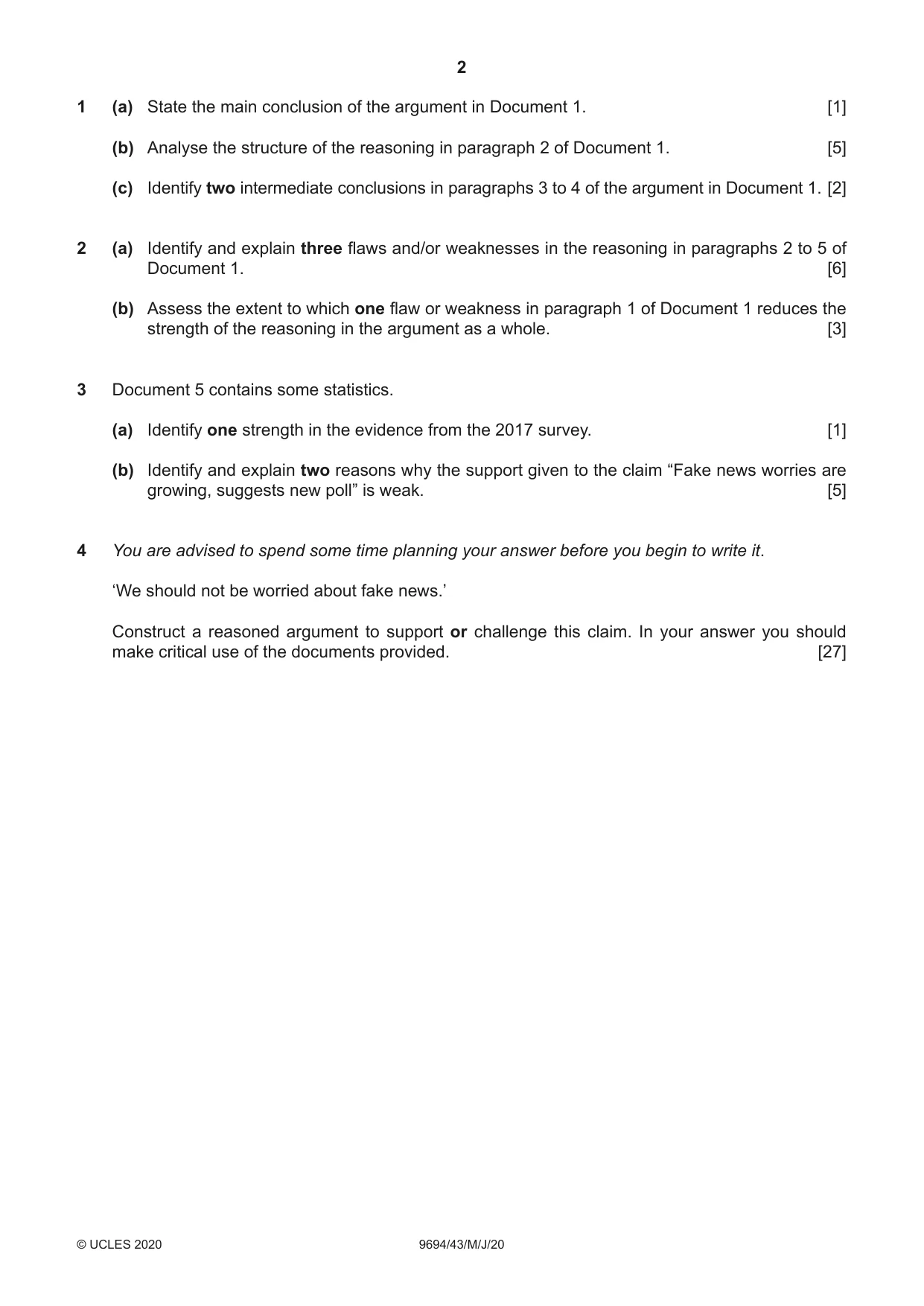
2 9694/43/M/J/20 © UCLES 2020 1 (a) State the main conclusion of the argument in Document 1. [1] (b) Analyse the structure of the reasoning in paragraph 2 of Document 1. [5] (c) Identify two intermediate conclusions in paragraphs 3 to 4 of the argument in Document 1. [2] 2 (a) Identify and explain three flaws and/or weaknesses in the reasoning in paragraphs 2 to 5 of Document 1. [6] (b) Assess the extent to which one flaw or weakness in paragraph 1 of Document 1 reduces the strength of the reasoning in the argument as a whole. [3] 3 Document 5 contains some statistics. (a) Identify one strength in the evidence from the 2017 survey. [1] (b) Identify and explain two reasons why the support given to the claim “Fake news worries are growing, suggests new poll” is weak. [5] 4 You are advised to spend some time planning your answer before you begin to write it. ‘We should not be worried about fake news.’ Construct a reasoned argument to support or challenge this claim. In your answer you should make critical use of the documents provided. [27]
Question paper, page 3
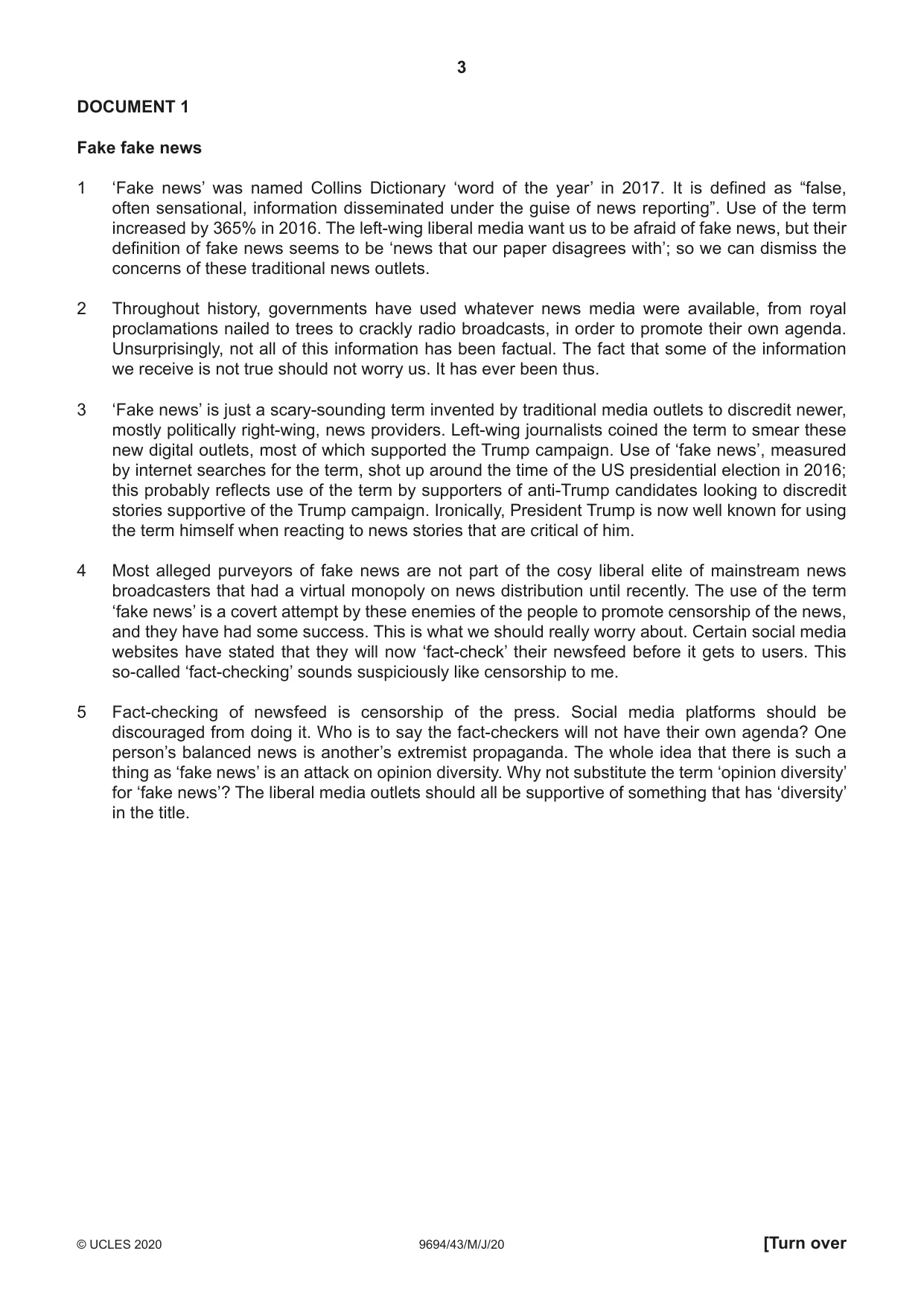
3 9694/43/M/J/20 © UCLES 2020 [Turn over DOCUMENT 1 Fake fake news 1 ‘Fake news’ was named Collins Dictionary ‘word of the year’ in 2017. It is defined as “false, often sensational, information disseminated under the guise of news reporting”. Use of the term increased by 365% in 2016. The left-wing liberal media want us to be afraid of fake news, but their definition of fake news seems to be ‘news that our paper disagrees with’; so we can dismiss the concerns of these traditional news outlets. 2 Throughout history, governments have used whatever news media were available, from royal proclamations nailed to trees to crackly radio broadcasts, in order to promote their own agenda. Unsurprisingly, not all of this information has been factual. The fact that some of the information we receive is not true should not worry us. It has ever been thus. 3 ‘Fake news’ is just a scary-sounding term invented by traditional media outlets to discredit newer, mostly politically right-wing, news providers. Left-wing journalists coined the term to smear these new digital outlets, most of which supported the Trump campaign. Use of ‘fake news’, measured by internet searches for the term, shot up around the time of the US presidential election in 2016; this probably reflects use of the term by supporters of anti-Trump candidates looking to discredit stories supportive of the Trump campaign. Ironically, President Trump is now well known for using the term himself when reacting to news stories that are critical of him. 4 Most alleged purveyors of fake news are not part of the cosy liberal elite of mainstream news broadcasters that had a virtual monopoly on news distribution until recently. The use of the term ‘fake news’ is a covert attempt by these enemies of the people to promote censorship of the news, and they have had some success. This is what we should really worry about. Certain social media websites have stated that they will now ‘fact-check’ their newsfeed before it gets to users. This so-called ‘fact-checking’ sounds suspiciously like censorship to me. 5 Fact-checking of newsfeed is censorship of the press. Social media platforms should be discouraged from doing it. Who is to say the fact-checkers will not have their own agenda? One person’s balanced news is another’s extremist propaganda. The whole idea that there is such a thing as ‘fake news’ is an attack on opinion diversity. Why not substitute the term ‘opinion diversity’ for ‘fake news’? The liberal media outlets should all be supportive of something that has ‘diversity’ in the title.
Question paper, page 4
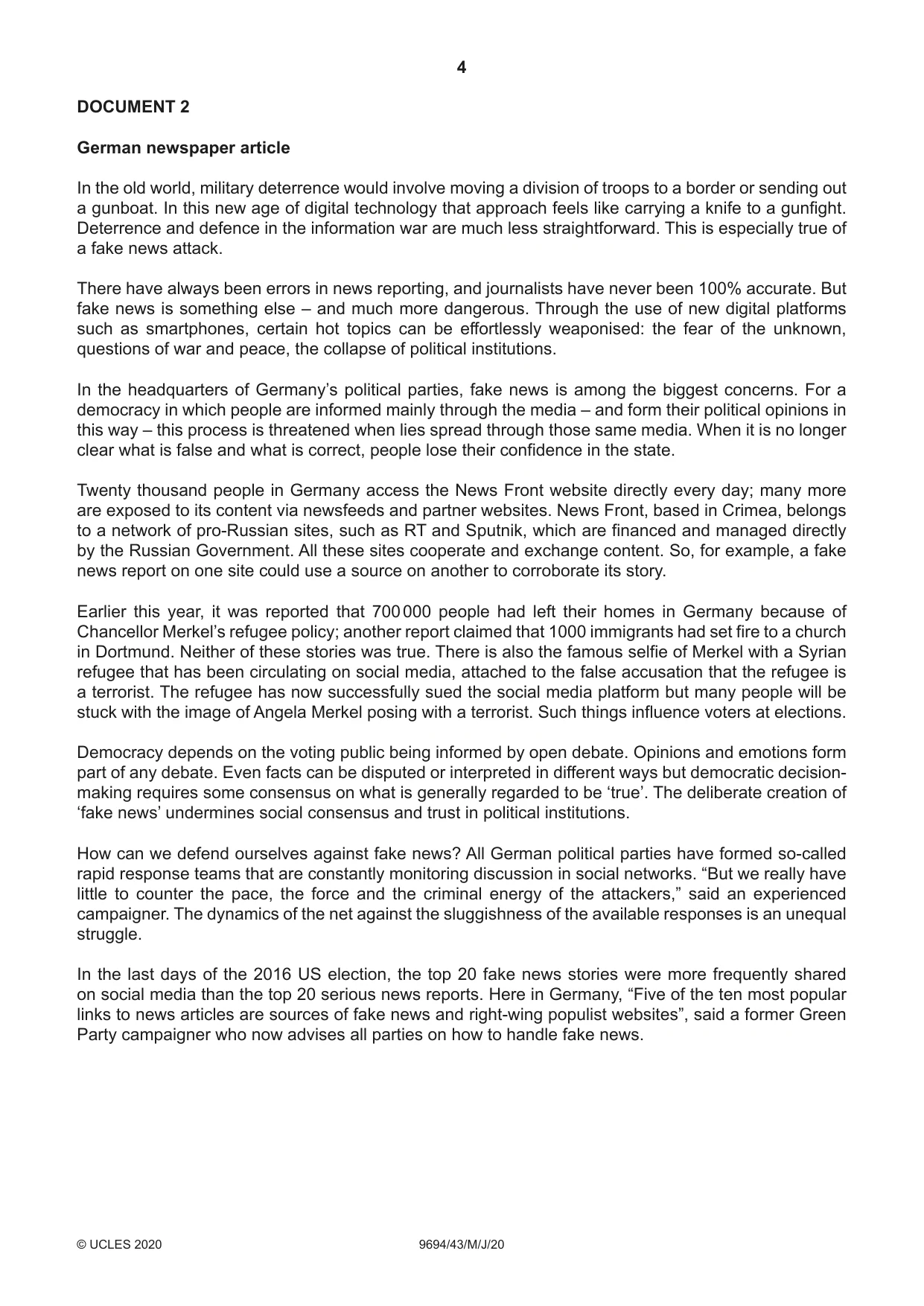
4 9694/43/M/J/20 © UCLES 2020 DOCUMENT 2 German newspaper article In the old world, military deterrence would involve moving a division of troops to a border or sending out a gunboat. In this new age of digital technology that approach feels like carrying a knife to a gunfight. Deterrence and defence in the information war are much less straightforward. This is especially true of a fake news attack. There have always been errors in news reporting, and journalists have never been 100% accurate. But fake news is something else – and much more dangerous. Through the use of new digital platforms such as smartphones, certain hot topics can be effortlessly weaponised: the fear of the unknown, questions of war and peace, the collapse of political institutions. In the headquarters of Germany’s political parties, fake news is among the biggest concerns. For a democracy in which people are informed mainly through the media – and form their political opinions in this way – this process is threatened when lies spread through those same media. When it is no longer clear what is false and what is correct, people lose their confidence in the state. Twenty thousand people in Germany access the News Front website directly every day; many more are exposed to its content via newsfeeds and partner websites. News Front, based in Crimea, belongs to a network of pro-Russian sites, such as RT and Sputnik, which are financed and managed directly by the Russian Government. All these sites cooperate and exchange content. So, for example, a fake news report on one site could use a source on another to corroborate its story. Earlier this year, it was reported that 700 000 people had left their homes in Germany because of Chancellor Merkel’s refugee policy; another report claimed that 1000 immigrants had set fire to a church in Dortmund. Neither of these stories was true. There is also the famous selfie of Merkel with a Syrian refugee that has been circulating on social media, attached to the false accusation that the refugee is a terrorist. The refugee has now successfully sued the social media platform but many people will be stuck with the image of Angela Merkel posing with a terrorist. Such things influence voters at elections. Democracy depends on the voting public being informed by open debate. Opinions and emotions form part of any debate. Even facts can be disputed or interpreted in different ways but democratic decision- making requires some consensus on what is generally regarded to be ‘true’. The deliberate creation of ‘fake news’ undermines social consensus and trust in political institutions. How can we defend ourselves against fake news? All German political parties have formed so-called rapid response teams that are constantly monitoring discussion in social networks. “But we really have little to counter the pace, the force and the criminal energy of the attackers,” said an experienced campaigner. The dynamics of the net against the sluggishness of the available responses is an unequal struggle. In the last days of the 2016 US election, the top 20 fake news stories were more frequently shared on social media than the top 20 serious news reports. Here in Germany, “Five of the ten most popular links to news articles are sources of fake news and right-wing populist websites”, said a former Green Party campaigner who now advises all parties on how to handle fake news.
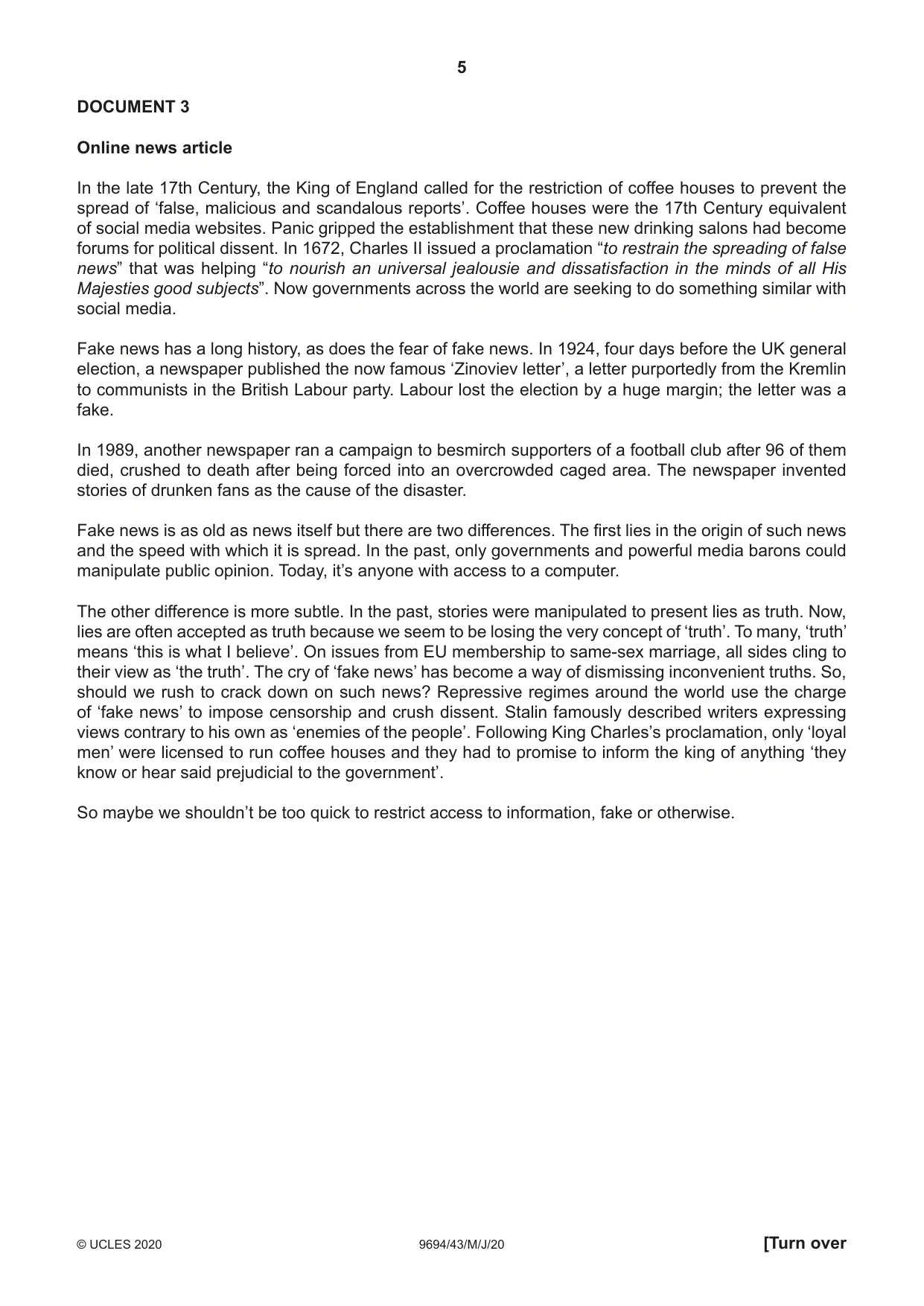
Question paper, page 5
5 9694/43/M/J/20 © UCLES 2020 [Turn over DOCUMENT 3 Online news article In the late 17th Century, the King of England called for the restriction of coffee houses to prevent the spread of ‘false, malicious and scandalous reports’. Coffee houses were the 17th Century equivalent of social media websites. Panic gripped the establishment that these new drinking salons had become forums for political dissent. In 1672, Charles II issued a proclamation “to restrain the spreading of false news” that was helping “to nourish an universal jealousie and dissatisfaction in the minds of all His Majesties good subjects”. Now governments across the world are seeking to do something similar with social media. Fake news has a long history, as does the fear of fake news. In 1924, four days before the UK general election, a newspaper published the now famous ‘Zinoviev letter’, a letter purportedly from the Kremlin to communists in the British Labour party. Labour lost the election by a huge margin; the letter was a fake. In 1989, another newspaper ran a campaign to besmirch supporters of a football club after 96 of them died, crushed to death after being forced into an overcrowded caged area. The newspaper invented stories of drunken fans as the cause of the disaster. Fake news is as old as news itself but there are two differences. The first lies in the origin of such news and the speed with which it is spread. In the past, only governments and powerful media barons could manipulate public opinion. Today, it’s anyone with access to a computer. The other difference is more subtle. In the past, stories were manipulated to present lies as truth. Now, lies are often accepted as truth because we seem to be losing the very concept of ‘truth’. To many, ‘truth’ means ‘this is what I believe’. On issues from EU membership to same-sex marriage, all sides cling to their view as ‘the truth’. The cry of ‘fake news’ has become a way of dismissing inconvenient truths. So, should we rush to crack down on such news? Repressive regimes around the world use the charge of ‘fake news’ to impose censorship and crush dissent. Stalin famously described writers expressing views contrary to his own as ‘enemies of the people’. Following King Charles’s proclamation, only ‘loyal men’ were licensed to run coffee houses and they had to promise to inform the king of anything ‘they know or hear said prejudicial to the government’. So maybe we shouldn’t be too quick to restrict access to information, fake or otherwise.
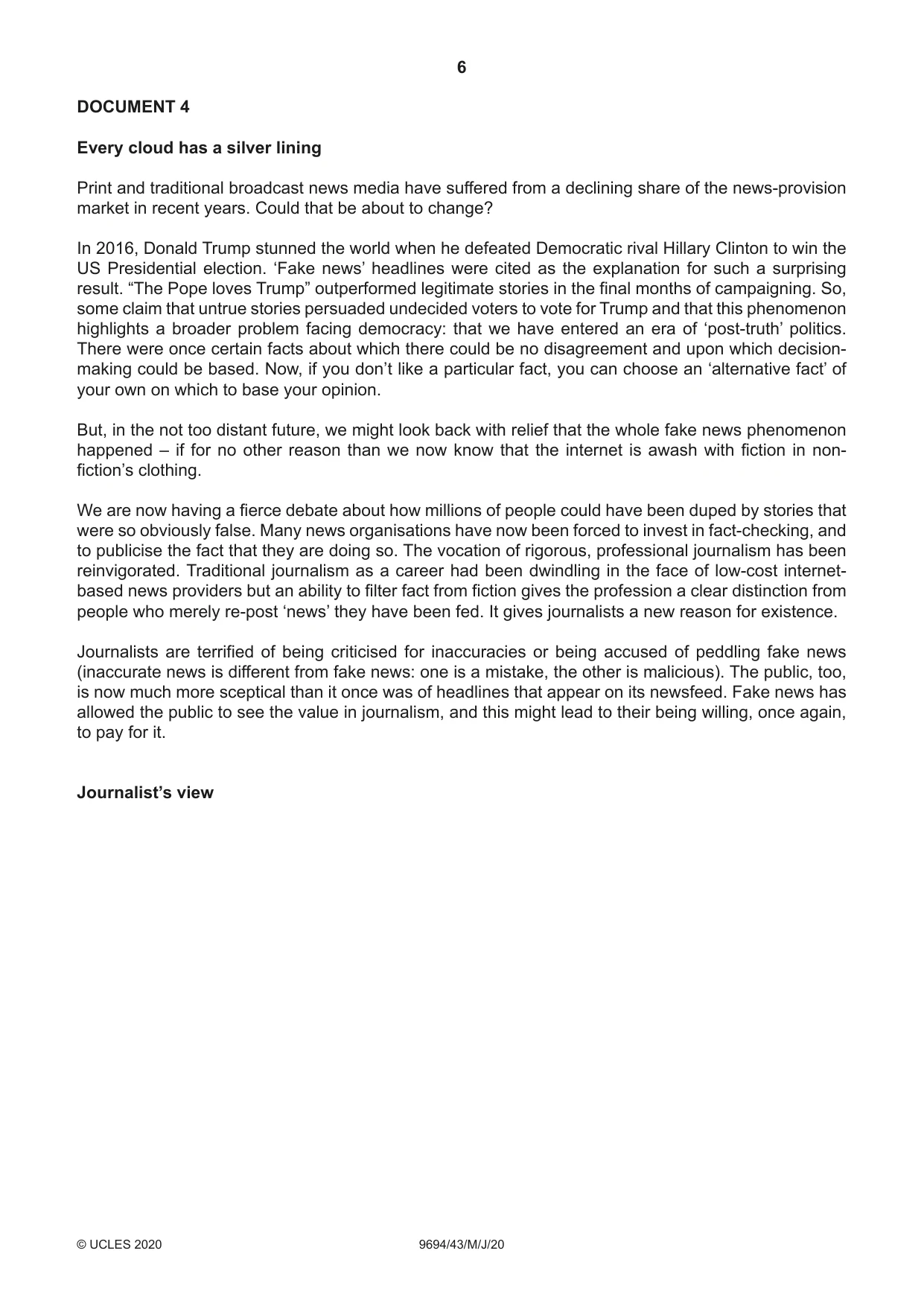
Question paper, page 6
6 9694/43/M/J/20 © UCLES 2020 DOCUMENT 4 Every cloud has a silver lining Print and traditional broadcast news media have suffered from a declining share of the news-provision market in recent years. Could that be about to change? In 2016, Donald Trump stunned the world when he defeated Democratic rival Hillary Clinton to win the US Presidential election. ‘Fake news’ headlines were cited as the explanation for such a surprising result. “The Pope loves Trump” outperformed legitimate stories in the final months of campaigning. So, some claim that untrue stories persuaded undecided voters to vote for Trump and that this phenomenon highlights a broader problem facing democracy: that we have entered an era of ‘post-truth’ politics. There were once certain facts about which there could be no disagreement and upon which decision- making could be based. Now, if you don’t like a particular fact, you can choose an ‘alternative fact’ of your own on which to base your opinion. But, in the not too distant future, we might look back with relief that the whole fake news phenomenon happened – if for no other reason than we now know that the internet is awash with fiction in non- fiction’s clothing. We are now having a fierce debate about how millions of people could have been duped by stories that were so obviously false. Many news organisations have now been forced to invest in fact-checking, and to publicise the fact that they are doing so. The vocation of rigorous, professional journalism has been reinvigorated. Traditional journalism as a career had been dwindling in the face of low-cost internet- based news providers but an ability to filter fact from fiction gives the profession a clear distinction from people who merely re-post ‘news’ they have been fed. It gives journalists a new reason for existence. Journalists are terrified of being criticised for inaccuracies or being accused of peddling fake news (inaccurate news is different from fake news: one is a mistake, the other is malicious). The public, too, is now much more sceptical than it once was of headlines that appear on its newsfeed. Fake news has allowed the public to see the value in journalism, and this might lead to their being willing, once again, to pay for it. Journalist’s view
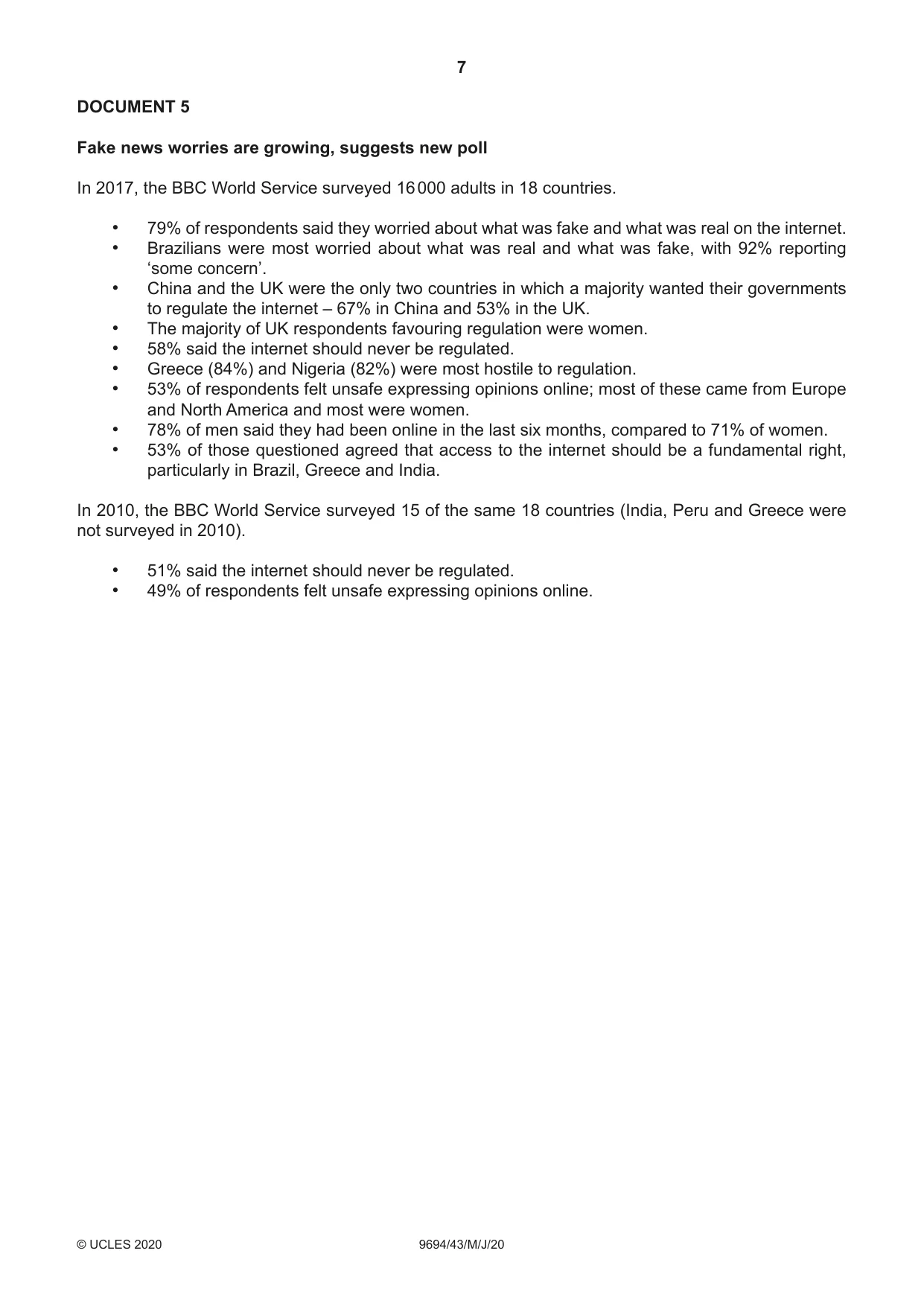
Question paper, page 7
7 9694/43/M/J/20 © UCLES 2020 DOCUMENT 5 Fake news worries are growing, suggests new poll In 2017, the BBC World Service surveyed 16 000 adults in 18 countries. • 79% of respondents said they worried about what was fake and what was real on the internet. • Brazilians were most worried about what was real and what was fake, with 92% reporting ‘some concern’. • China and the UK were the only two countries in which a majority wanted their governments to regulate the internet – 67% in China and 53% in the UK. • The majority of UK respondents favouring regulation were women. • 58% said the internet should never be regulated. • Greece (84%) and Nigeria (82%) were most hostile to regulation. • 53% of respondents felt unsafe expressing opinions online; most of these came from Europe and North America and most were women. • 78% of men said they had been online in the last six months, compared to 71% of women. • 53% of those questioned agreed that access to the internet should be a fundamental right, particularly in Brazil, Greece and India. In 2010, the BBC World Service surveyed 15 of the same 18 countries (India, Peru and Greece were not surveyed in 2010). • 51% said the internet should never be regulated. • 49% of respondents felt unsafe expressing opinions online.
Question paper, page 8
8 9694/43/M/J/20 © UCLES 2020 Permission to reproduce items where third-party owned material protected by copyright is included has been sought and cleared where possible. Every reasonable effort has been made by the publisher (UCLES) to trace copyright holders, but if any items requiring clearance have unwittingly been included, the publisher will be pleased to make amends at the earliest possible opportunity. To avoid the issue of disclosure of answer-related information to candidates, all copyright acknowledgements are reproduced online in the Cambridge Assessment International Education Copyright Acknowledgements Booklet. This is produced for each series of examinations and is freely available to download at www.cambridgeinternational.org after the live examination series. Cambridge Assessment International Education is part of the Cambridge Assessment Group. Cambridge Assessment is the brand name of the University of Cambridge Local Examinations Syndicate (UCLES), which itself is a department of the University of Cambridge. BLANK PAGE
Mark scheme, page 1
This document consists of 12 printed pages. © UCLES 2020 [Turn over Cambridge International AS & A Level THINKING SKILLS 9694/43 Paper 4 Applied Reasoning May/June 2020 MARK SCHEME Maximum Mark: 50 Published Students did not sit exam papers in the June 2020 series due to the Covid-19 global pandemic. This mark scheme is published to support teachers and students and should be read together with the question paper. It shows the requirements of the exam. The answer column of the mark scheme shows the proposed basis on which Examiners would award marks for this exam. Where appropriate, this column also provides the most likely acceptable alternative responses expected from students. Examiners usually review the mark scheme after they have seen student responses and update the mark scheme if appropriate. In the June series, Examiners were unable to consider the acceptability of alternative responses, as there were no student responses to consider. Mark schemes should usually be read together with the Principal Examiner Report for Teachers. However, because students did not sit exam papers, there is no Principal Examiner Report for Teachers for the June 2020 series. Cambridge International will not enter into discussions about these mark schemes. Cambridge International is publishing the mark schemes for the June 2020 series for most Cambridge IGCSE™ and Cambridge International A & AS Level components, and some Cambridge O Level components.
Mark scheme, page 2
9694/43 Cambridge International AS & A Level – Mark Scheme PUBLISHED May/June 2020 © UCLES 2020 Page 2 of 12 Generic Marking Principles These general marking principles must be applied by all examiners when marking candidate answers. They should be applied alongside the specific content of the mark scheme or generic level descriptors for a question. Each question paper and mark scheme will also comply with these marking principles. GENERIC MARKING PRINCIPLE 1: Marks must be awarded in line with: • the specific content of the mark scheme or the generic level descriptors for the question • the specific skills defined in the mark scheme or in the generic level descriptors for the question • the standard of response required by a candidate as exemplified by the standardisation scripts. GENERIC MARKING PRINCIPLE 2: Marks awarded are always whole marks (not half marks, or other fractions). GENERIC MARKING PRINCIPLE 3: Marks must be awarded positively: • marks are awarded for correct/valid answers, as defined in the mark scheme. However, credit is given for valid answers which go beyond the scope of the syllabus and mark scheme, referring to your Team Leader as appropriate • marks are awarded when candidates clearly demonstrate what they know and can do • marks are not deducted for errors • marks are not deducted for omissions • answers should only be judged on the quality of spelling, punctuation and grammar when these features are specifically assessed by the question as indicated by the mark scheme. The meaning, however, should be unambiguous. GENERIC MARKING PRINCIPLE 4: Rules must be applied consistently e.g. in situations where candidates have not followed instructions or in the application of generic level descriptors.
Mark scheme, page 3
9694/43 Cambridge International AS & A Level – Mark Scheme PUBLISHED May/June 2020 © UCLES 2020 Page 3 of 12 GENERIC MARKING PRINCIPLE 5: Marks should be awarded using the full range of marks defined in the mark scheme for the question (however; the use of the full mark range may be limited according to the quality of the candidate responses seen). GENERIC MARKING PRINCIPLE 6: Marks awarded are based solely on the requirements as defined in the mark scheme. Marks should not be awarded with grade thresholds or grade descriptors in mind.
Mark scheme, page 4
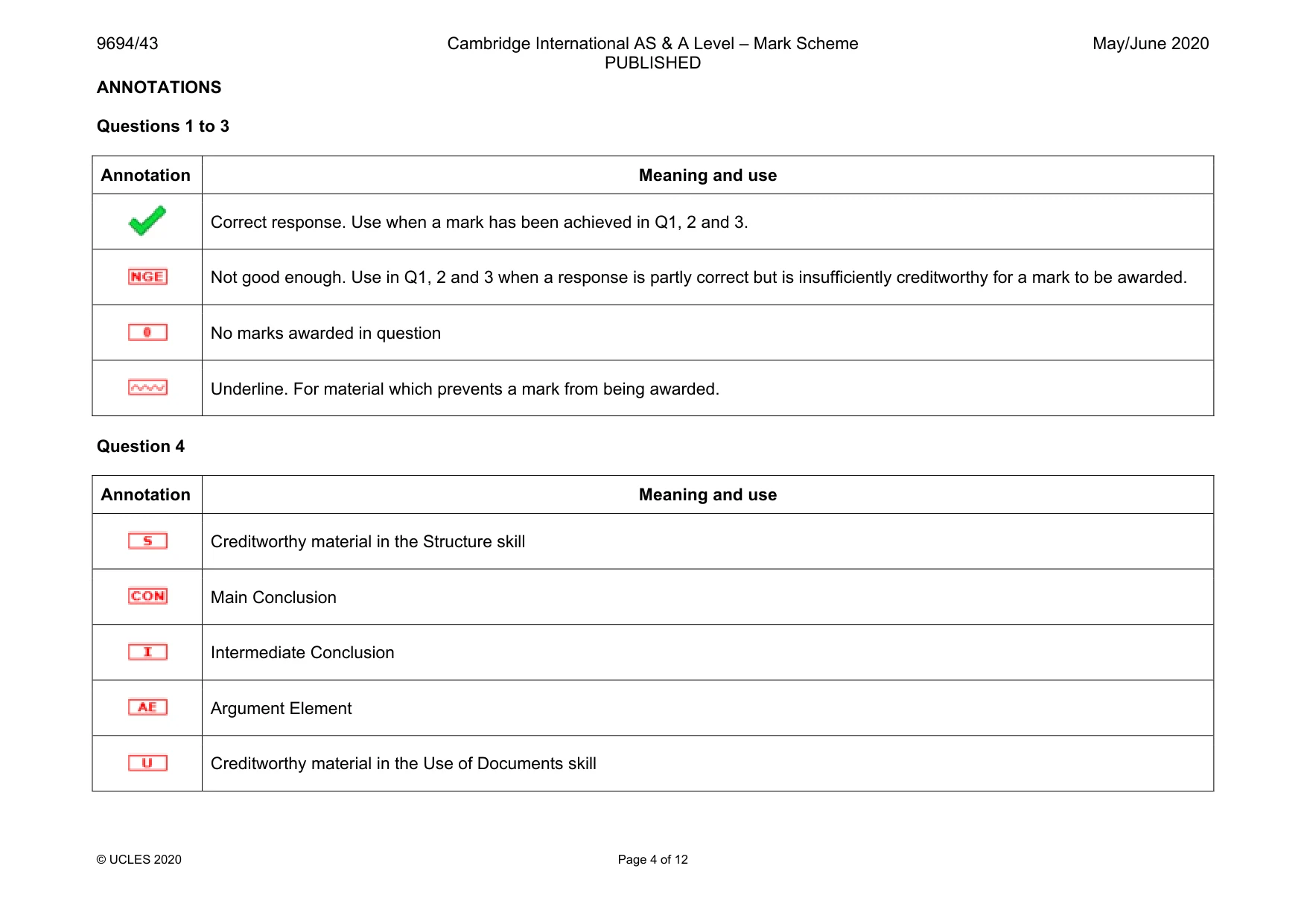
9694/43 Cambridge International AS & A Level – Mark Scheme PUBLISHED May/June 2020 © UCLES 2020 Page 4 of 12 ANNOTATIONS Questions 1 to 3 Annotation Meaning and use Correct response. Use when a mark has been achieved in Q1, 2 and 3. Not good enough. Use in Q1, 2 and 3 when a response is partly correct but is insufficiently creditworthy for a mark to be awarded. No marks awarded in question Underline. For material which prevents a mark from being awarded. Question 4 Annotation Meaning and use Creditworthy material in the Structure skill Main Conclusion Intermediate Conclusion Argument Element Creditworthy material in the Use of Documents skill
Mark scheme, page 5
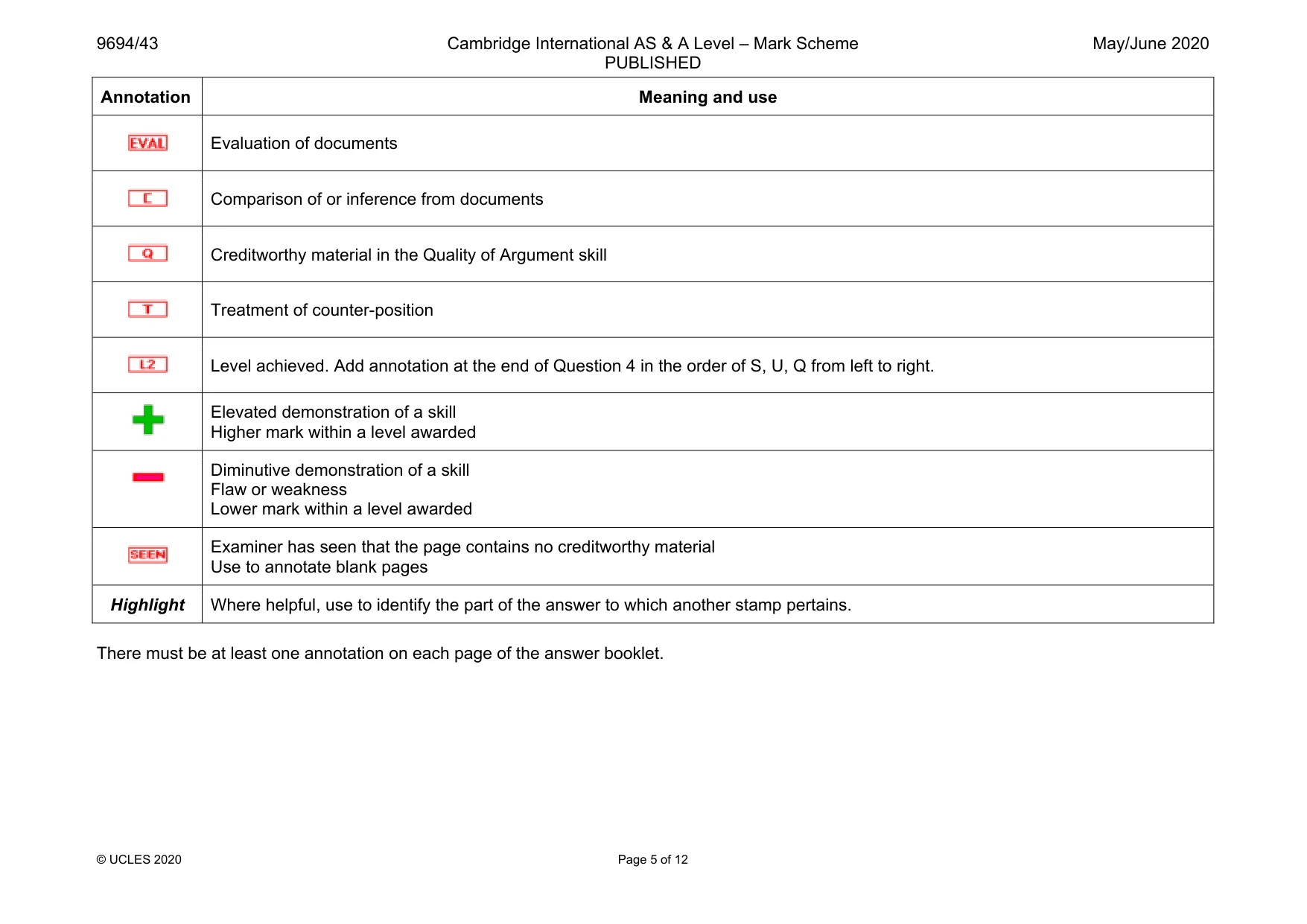
9694/43 Cambridge International AS & A Level – Mark Scheme PUBLISHED May/June 2020 © UCLES 2020 Page 5 of 12 Annotation Meaning and use Evaluation of documents Comparison of or inference from documents Creditworthy material in the Quality of Argument skill Treatment of counter-position Level achieved. Add annotation at the end of Question 4 in the order of S, U, Q from left to right. Elevated demonstration of a skill Higher mark within a level awarded Diminutive demonstration of a skill Flaw or weakness Lower mark within a level awarded Examiner has seen that the page contains no creditworthy material Use to annotate blank pages Highlight Where helpful, use to identify the part of the answer to which another stamp pertains. There must be at least one annotation on each page of the answer booklet.
Mark scheme, page 6
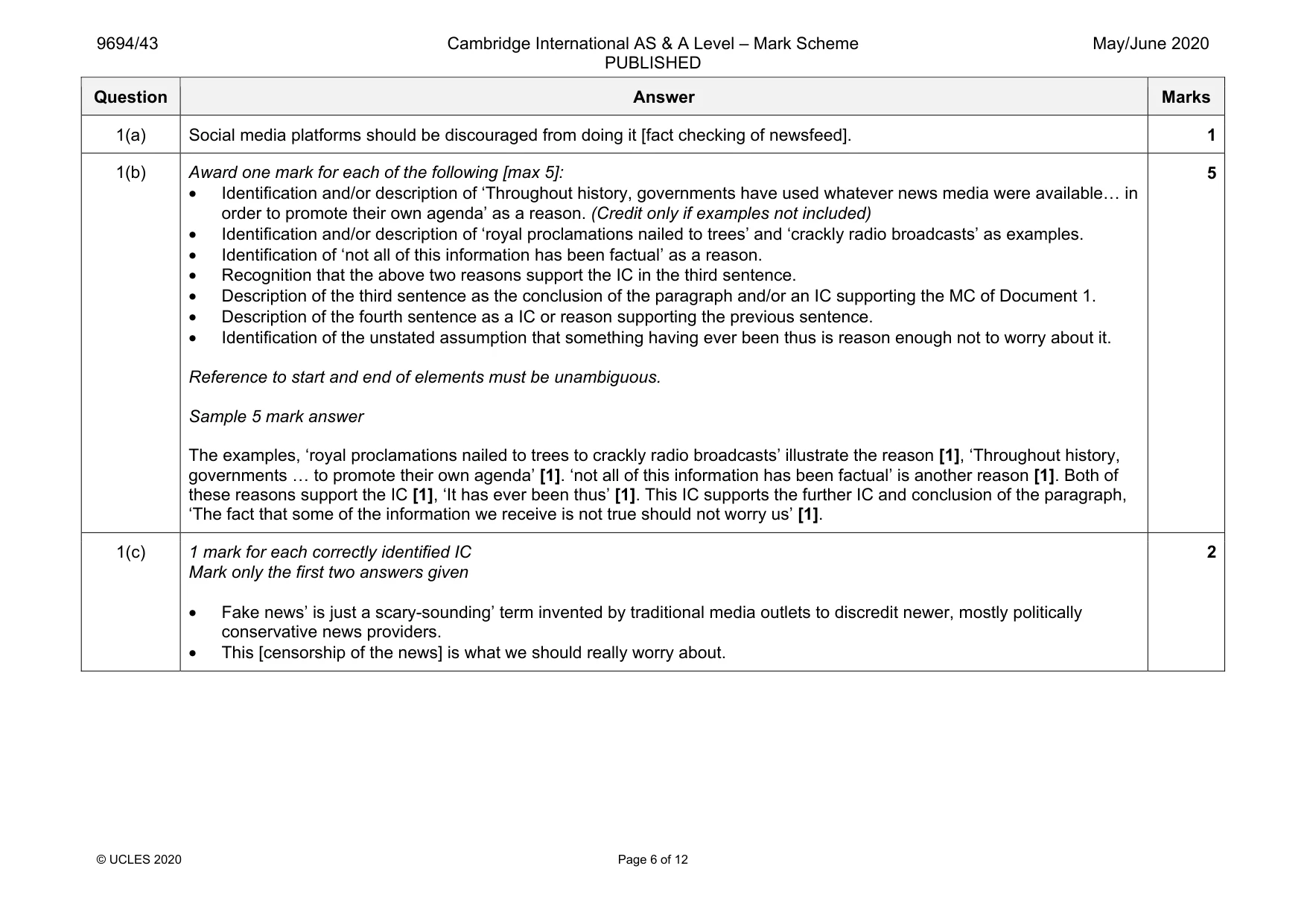
9694/43 Cambridge International AS & A Level – Mark Scheme PUBLISHED May/June 2020 © UCLES 2020 Page 6 of 12 Question Answer Marks 1(a) Social media platforms should be discouraged from doing it [fact checking of newsfeed]. 1 1(b) Award one mark for each of the following [max 5]: • Identification and/or description of ‘Throughout history, governments have used whatever news media were available… in order to promote their own agenda’ as a reason. (Credit only if examples not included) • Identification and/or description of ‘royal proclamations nailed to trees’ and ‘crackly radio broadcasts’ as examples. • Identification of ‘not all of this information has been factual’ as a reason. • Recognition that the above two reasons support the IC in the third sentence. • Description of the third sentence as the conclusion of the paragraph and/or an IC supporting the MC of Document 1. • Description of the fourth sentence as a IC or reason supporting the previous sentence. • Identification of the unstated assumption that something having ever been thus is reason enough not to worry about it. Reference to start and end of elements must be unambiguous. Sample 5 mark answer The examples, ‘royal proclamations nailed to trees to crackly radio broadcasts’ illustrate the reason [1], ‘Throughout history, governments … to promote their own agenda’ [1]. ‘not all of this information has been factual’ is another reason [1]. Both of these reasons support the IC [1], ‘It has ever been thus’ [1]. This IC supports the further IC and conclusion of the paragraph, ‘The fact that some of the information we receive is not true should not worry us’ [1]. 5 1(c) 1 mark for each correctly identified IC Mark only the first two answers given • Fake news’ is just a scary-sounding’ term invented by traditional media outlets to discredit newer, mostly politically conservative news providers. • This [censorship of the news] is what we should really worry about. 2
Mark scheme, page 7
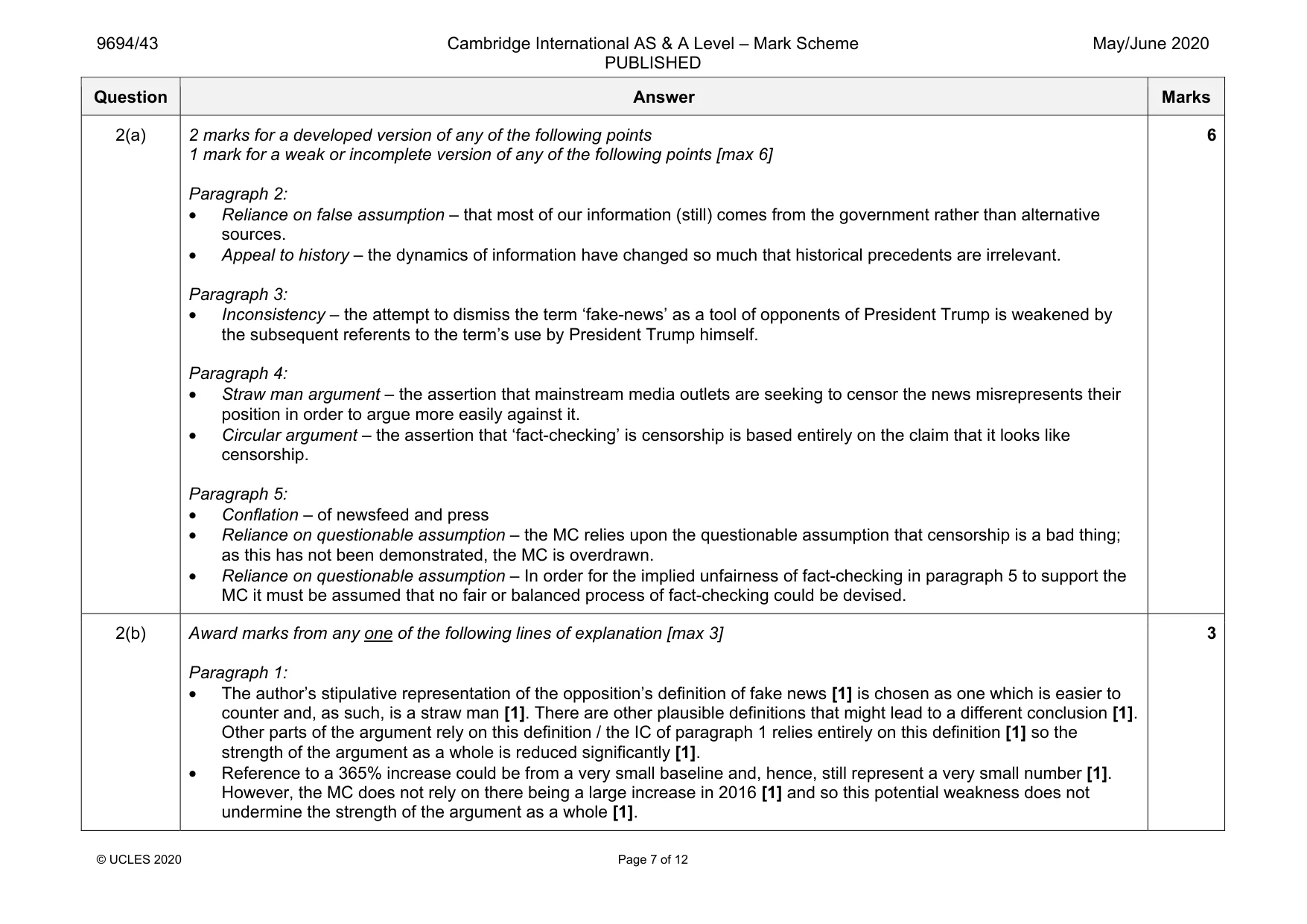
9694/43 Cambridge International AS & A Level – Mark Scheme PUBLISHED May/June 2020 © UCLES 2020 Page 7 of 12 Question Answer Marks 2(a) 2 marks for a developed version of any of the following points 1 mark for a weak or incomplete version of any of the following points [max 6] Paragraph 2: • Reliance on false assumption – that most of our information (still) comes from the government rather than alternative sources. • Appeal to history – the dynamics of information have changed so much that historical precedents are irrelevant. Paragraph 3: • Inconsistency – the attempt to dismiss the term ‘fake-news’ as a tool of opponents of President Trump is weakened by the subsequent referents to the term’s use by President Trump himself. Paragraph 4: • Straw man argument – the assertion that mainstream media outlets are seeking to censor the news misrepresents their position in order to argue more easily against it. • Circular argument – the assertion that ‘fact-checking’ is censorship is based entirely on the claim that it looks like censorship. Paragraph 5: • Conflation – of newsfeed and press • Reliance on questionable assumption – the MC relies upon the questionable assumption that censorship is a bad thing; as this has not been demonstrated, the MC is overdrawn. • Reliance on questionable assumption – In order for the implied unfairness of fact-checking in paragraph 5 to support the MC it must be assumed that no fair or balanced process of fact-checking could be devised. 6 2(b) Award marks from any one of the following lines of explanation [max 3] Paragraph 1: • The author’s stipulative representation of the opposition’s definition of fake news [1] is chosen as one which is easier to counter and, as such, is a straw man [1]. There are other plausible definitions that might lead to a different conclusion [1]. Other parts of the argument rely on this definition / the IC of paragraph 1 relies entirely on this definition [1] so the strength of the argument as a whole is reduced significantly [1]. • Reference to a 365% increase could be from a very small baseline and, hence, still represent a very small number [1]. However, the MC does not rely on there being a large increase in 2016 [1] and so this potential weakness does not undermine the strength of the argument as a whole [1]. 3
Mark scheme, page 8
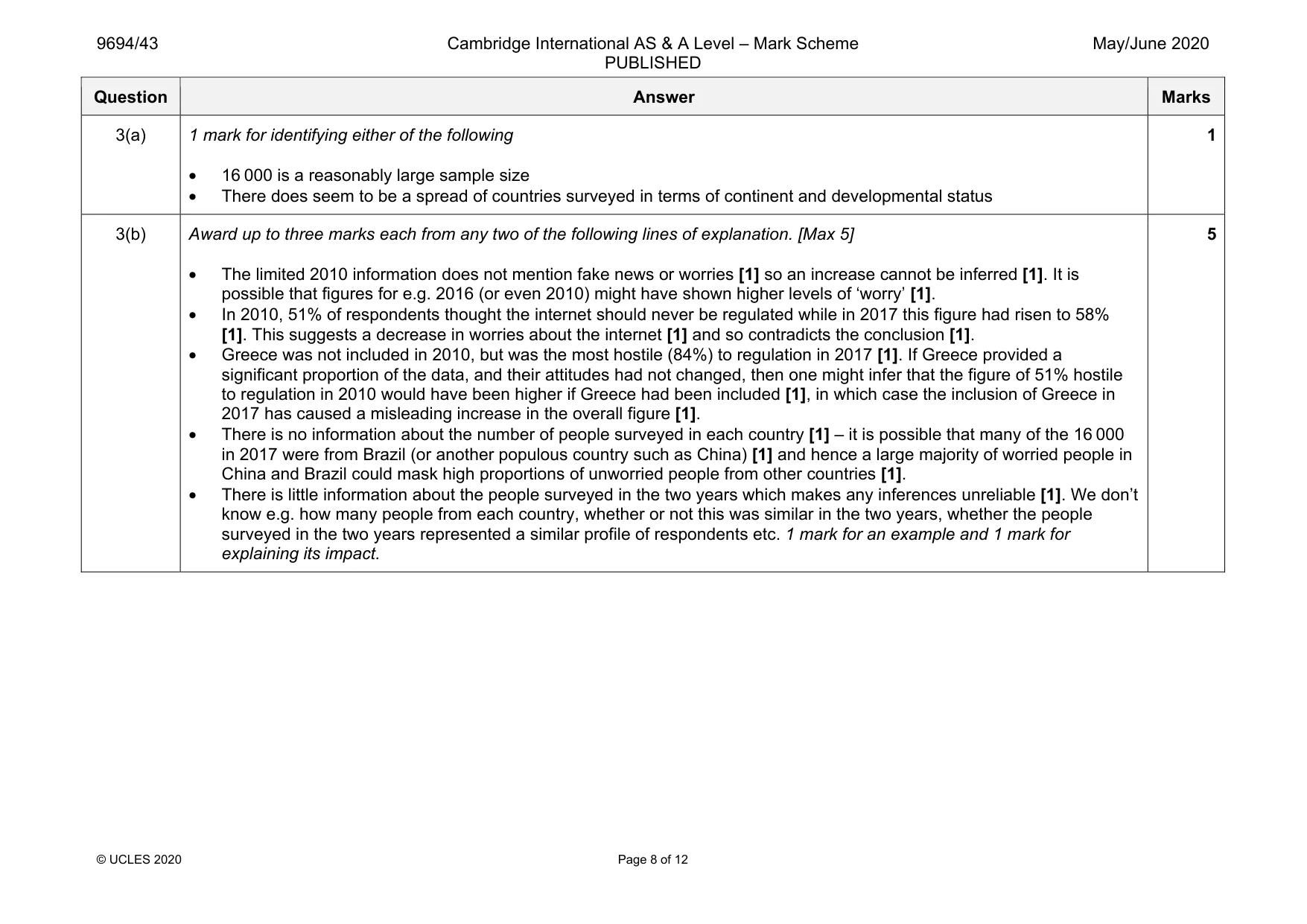
9694/43 Cambridge International AS & A Level – Mark Scheme PUBLISHED May/June 2020 © UCLES 2020 Page 8 of 12 Question Answer Marks 3(a) 1 mark for identifying either of the following • 16 000 is a reasonably large sample size • There does seem to be a spread of countries surveyed in terms of continent and developmental status 1 3(b) Award up to three marks each from any two of the following lines of explanation. [Max 5] • The limited 2010 information does not mention fake news or worries [1] so an increase cannot be inferred [1]. It is possible that figures for e.g. 2016 (or even 2010) might have shown higher levels of ‘worry’ [1]. • In 2010, 51% of respondents thought the internet should never be regulated while in 2017 this figure had risen to 58% [1]. This suggests a decrease in worries about the internet [1] and so contradicts the conclusion [1]. • Greece was not included in 2010, but was the most hostile (84%) to regulation in 2017 [1]. If Greece provided a significant proportion of the data, and their attitudes had not changed, then one might infer that the figure of 51% hostile to regulation in 2010 would have been higher if Greece had been included [1], in which case the inclusion of Greece in 2017 has caused a misleading increase in the overall figure [1]. • There is no information about the number of people surveyed in each country [1] – it is possible that many of the 16 000 in 2017 were from Brazil (or another populous country such as China) [1] and hence a large majority of worried people in China and Brazil could mask high proportions of unworried people from other countries [1]. • There is little information about the people surveyed in the two years which makes any inferences unreliable [1]. We don’t know e.g. how many people from each country, whether or not this was similar in the two years, whether the people surveyed in the two years represented a similar profile of respondents etc. 1 mark for an example and 1 mark for explaining its impact. 5
Mark scheme, page 9
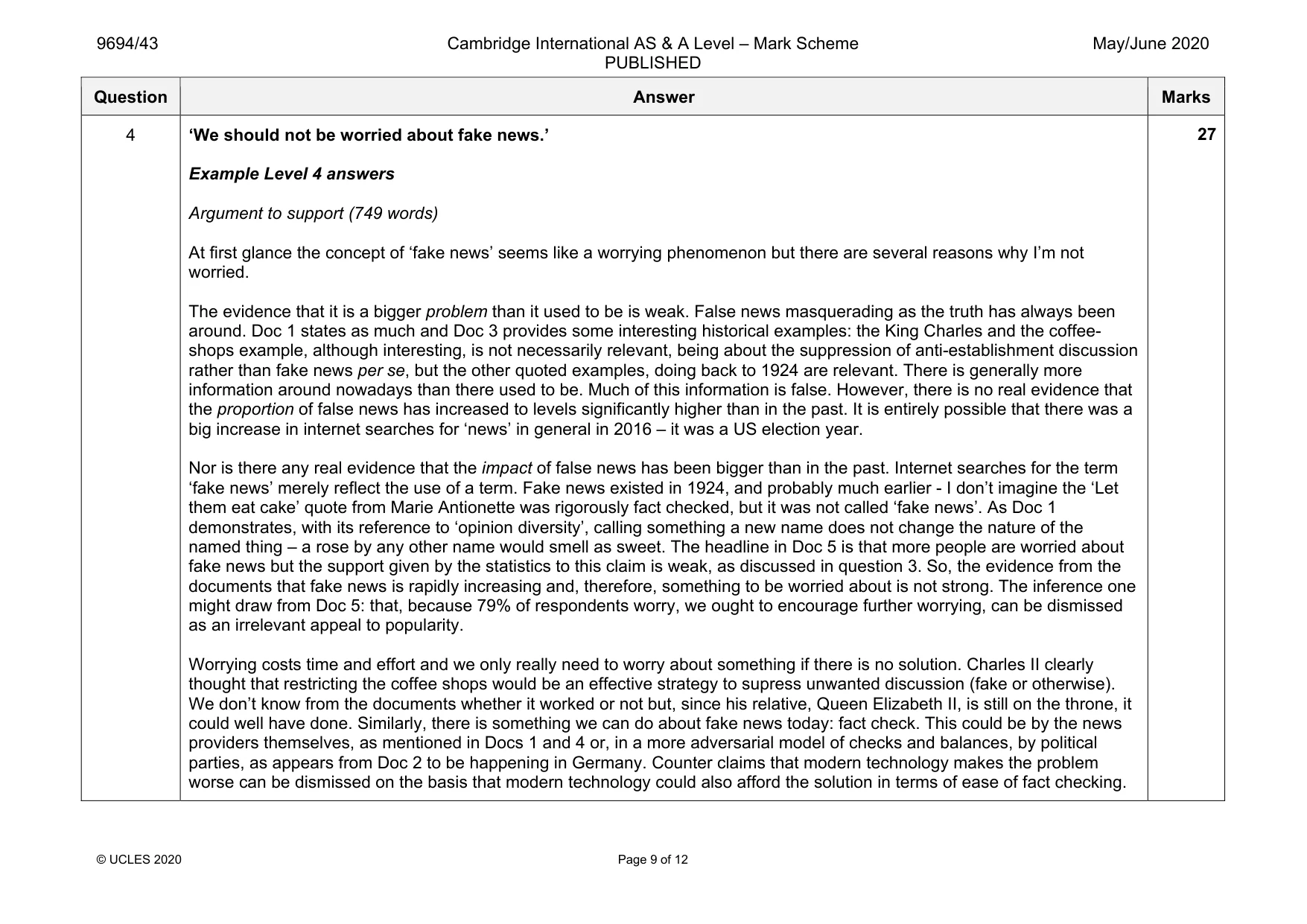
9694/43 Cambridge International AS & A Level – Mark Scheme PUBLISHED May/June 2020 © UCLES 2020 Page 9 of 12 Question Answer Marks 4 ‘We should not be worried about fake news.’ Example Level 4 answers Argument to support (749 words) At first glance the concept of ‘fake news’ seems like a worrying phenomenon but there are several reasons why I’m not worried. The evidence that it is a bigger problem than it used to be is weak. False news masquerading as the truth has always been around. Doc 1 states as much and Doc 3 provides some interesting historical examples: the King Charles and the coffee- shops example, although interesting, is not necessarily relevant, being about the suppression of anti-establishment discussion rather than fake news per se, but the other quoted examples, doing back to 1924 are relevant. There is generally more information around nowadays than there used to be. Much of this information is false. However, there is no real evidence that the proportion of false news has increased to levels significantly higher than in the past. It is entirely possible that there was a big increase in internet searches for ‘news’ in general in 2016 – it was a US election year. Nor is there any real evidence that the impact of false news has been bigger than in the past. Internet searches for the term ‘fake news’ merely reflect the use of a term. Fake news existed in 1924, and probably much earlier - I don’t imagine the ‘Let them eat cake’ quote from Marie Antionette was rigorously fact checked, but it was not called ‘fake news’. As Doc 1 demonstrates, with its reference to ‘opinion diversity’, calling something a new name does not change the nature of the named thing – a rose by any other name would smell as sweet. The headline in Doc 5 is that more people are worried about fake news but the support given by the statistics to this claim is weak, as discussed in question 3. So, the evidence from the documents that fake news is rapidly increasing and, therefore, something to be worried about is not strong. The inference one might draw from Doc 5: that, because 79% of respondents worry, we ought to encourage further worrying, can be dismissed as an irrelevant appeal to popularity. Worrying costs time and effort and we only really need to worry about something if there is no solution. Charles II clearly thought that restricting the coffee shops would be an effective strategy to supress unwanted discussion (fake or otherwise). We don’t know from the documents whether it worked or not but, since his relative, Queen Elizabeth II, is still on the throne, it could well have done. Similarly, there is something we can do about fake news today: fact check. This could be by the news providers themselves, as mentioned in Docs 1 and 4 or, in a more adversarial model of checks and balances, by political parties, as appears from Doc 2 to be happening in Germany. Counter claims that modern technology makes the problem worse can be dismissed on the basis that modern technology could also afford the solution in terms of ease of fact checking. 27
Mark scheme, page 10
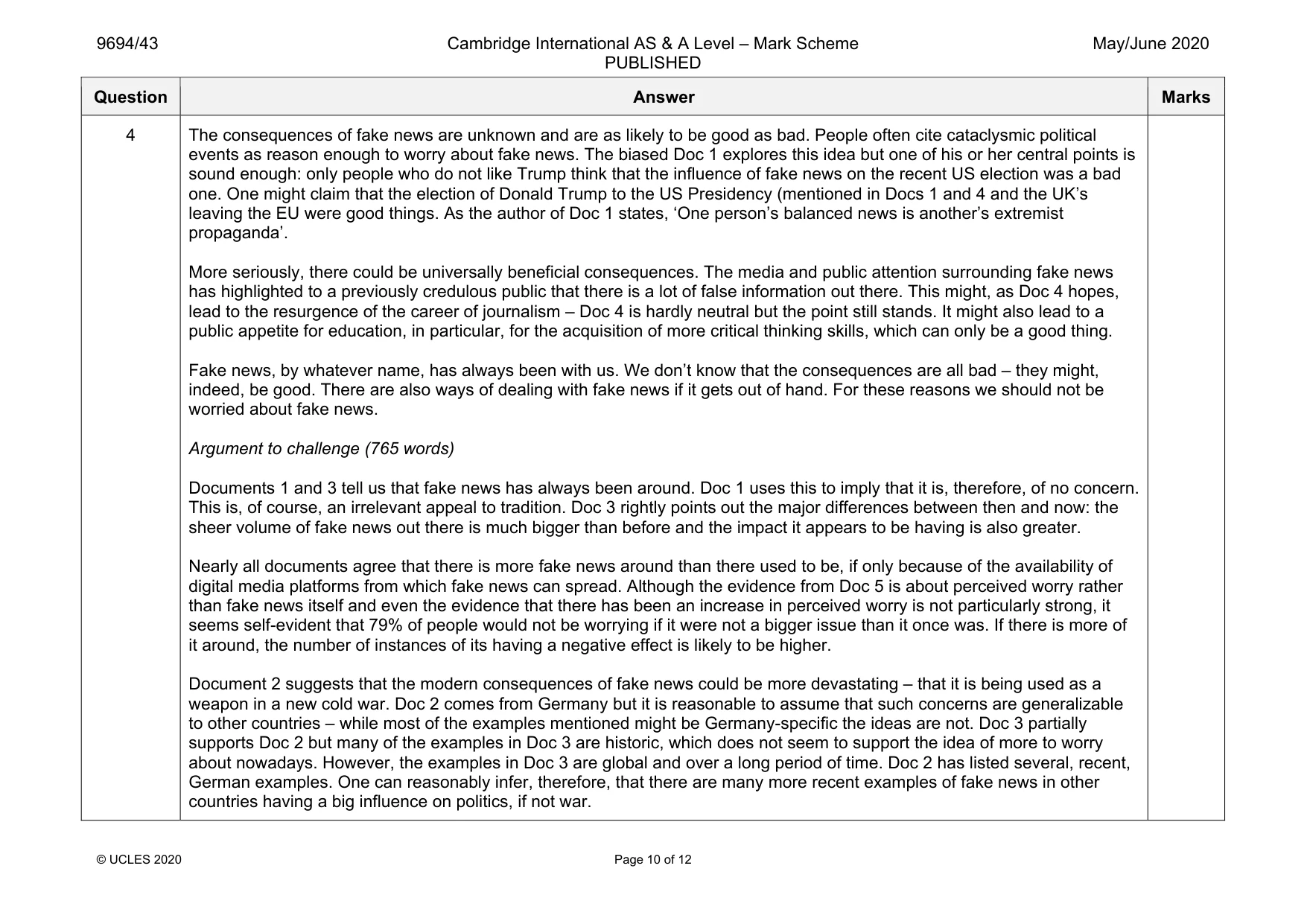
9694/43 Cambridge International AS & A Level – Mark Scheme PUBLISHED May/June 2020 © UCLES 2020 Page 10 of 12 Question Answer Marks 4 The consequences of fake news are unknown and are as likely to be good as bad. People often cite cataclysmic political events as reason enough to worry about fake news. The biased Doc 1 explores this idea but one of his or her central points is sound enough: only people who do not like Trump think that the influence of fake news on the recent US election was a bad one. One might claim that the election of Donald Trump to the US Presidency (mentioned in Docs 1 and 4 and the UK’s leaving the EU were good things. As the author of Doc 1 states, ‘One person’s balanced news is another’s extremist propaganda’. More seriously, there could be universally beneficial consequences. The media and public attention surrounding fake news has highlighted to a previously credulous public that there is a lot of false information out there. This might, as Doc 4 hopes, lead to the resurgence of the career of journalism – Doc 4 is hardly neutral but the point still stands. It might also lead to a public appetite for education, in particular, for the acquisition of more critical thinking skills, which can only be a good thing. Fake news, by whatever name, has always been with us. We don’t know that the consequences are all bad – they might, indeed, be good. There are also ways of dealing with fake news if it gets out of hand. For these reasons we should not be worried about fake news. Argument to challenge (765 words) Documents 1 and 3 tell us that fake news has always been around. Doc 1 uses this to imply that it is, therefore, of no concern. This is, of course, an irrelevant appeal to tradition. Doc 3 rightly points out the major differences between then and now: the sheer volume of fake news out there is much bigger than before and the impact it appears to be having is also greater. Nearly all documents agree that there is more fake news around than there used to be, if only because of the availability of digital media platforms from which fake news can spread. Although the evidence from Doc 5 is about perceived worry rather than fake news itself and even the evidence that there has been an increase in perceived worry is not particularly strong, it seems self-evident that 79% of people would not be worrying if it were not a bigger issue than it once was. If there is more of it around, the number of instances of its having a negative effect is likely to be higher. Document 2 suggests that the modern consequences of fake news could be more devastating – that it is being used as a weapon in a new cold war. Doc 2 comes from Germany but it is reasonable to assume that such concerns are generalizable to other countries – while most of the examples mentioned might be Germany-specific the ideas are not. Doc 3 partially supports Doc 2 but many of the examples in Doc 3 are historic, which does not seem to support the idea of more to worry about nowadays. However, the examples in Doc 3 are global and over a long period of time. Doc 2 has listed several, recent, German examples. One can reasonably infer, therefore, that there are many more recent examples of fake news in other countries having a big influence on politics, if not war.
Mark scheme, page 11
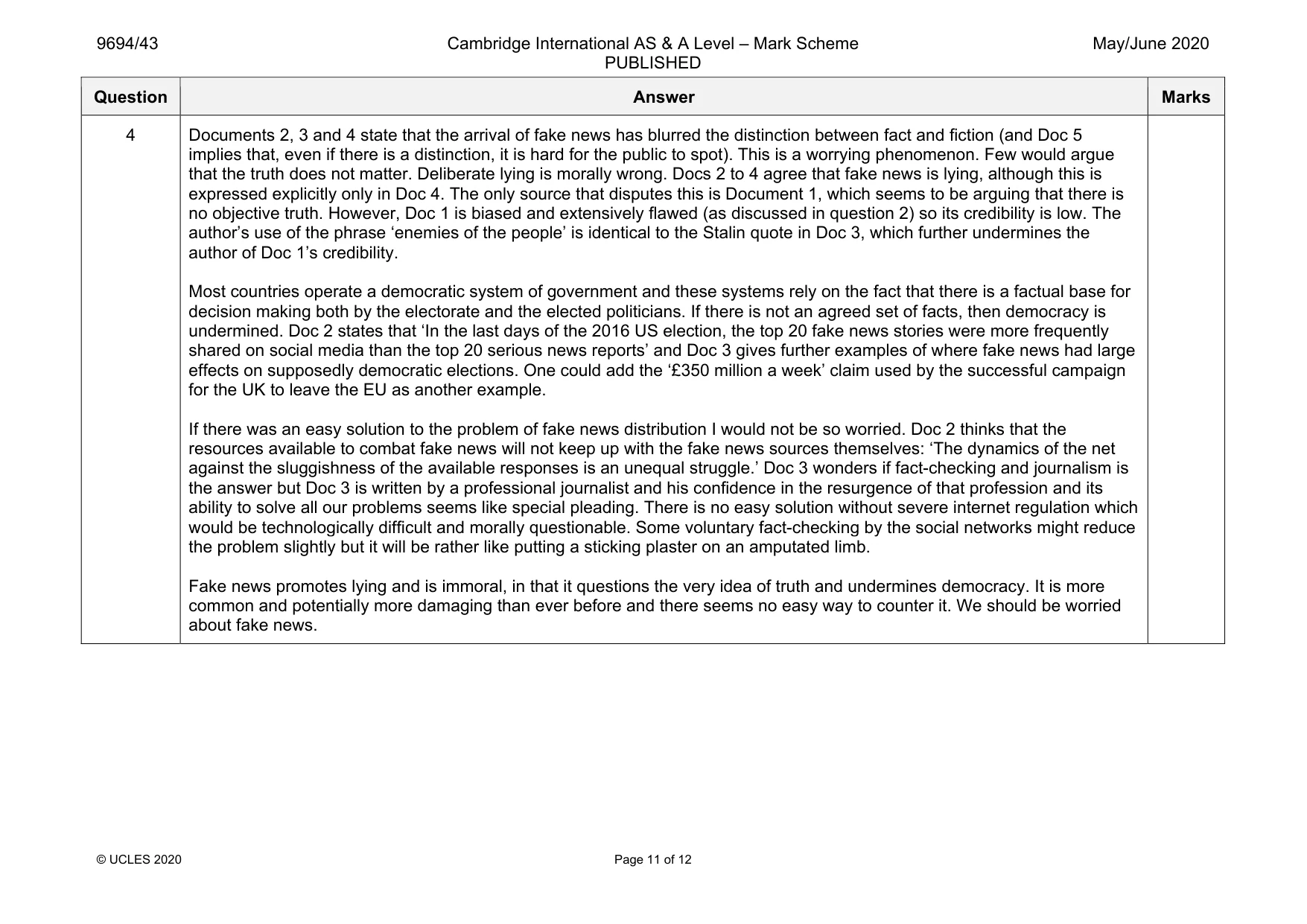
9694/43 Cambridge International AS & A Level – Mark Scheme PUBLISHED May/June 2020 © UCLES 2020 Page 11 of 12 Question Answer Marks 4 Documents 2, 3 and 4 state that the arrival of fake news has blurred the distinction between fact and fiction (and Doc 5 implies that, even if there is a distinction, it is hard for the public to spot). This is a worrying phenomenon. Few would argue that the truth does not matter. Deliberate lying is morally wrong. Docs 2 to 4 agree that fake news is lying, although this is expressed explicitly only in Doc 4. The only source that disputes this is Document 1, which seems to be arguing that there is no objective truth. However, Doc 1 is biased and extensively flawed (as discussed in question 2) so its credibility is low. The author’s use of the phrase ‘enemies of the people’ is identical to the Stalin quote in Doc 3, which further undermines the author of Doc 1’s credibility. Most countries operate a democratic system of government and these systems rely on the fact that there is a factual base for decision making both by the electorate and the elected politicians. If there is not an agreed set of facts, then democracy is undermined. Doc 2 states that ‘In the last days of the 2016 US election, the top 20 fake news stories were more frequently shared on social media than the top 20 serious news reports’ and Doc 3 gives further examples of where fake news had large effects on supposedly democratic elections. One could add the ‘£350 million a week’ claim used by the successful campaign for the UK to leave the EU as another example. If there was an easy solution to the problem of fake news distribution I would not be so worried. Doc 2 thinks that the resources available to combat fake news will not keep up with the fake news sources themselves: ‘The dynamics of the net against the sluggishness of the available responses is an unequal struggle.’ Doc 3 wonders if fact-checking and journalism is the answer but Doc 3 is written by a professional journalist and his confidence in the resurgence of that profession and its ability to solve all our problems seems like special pleading. There is no easy solution without severe internet regulation which would be technologically difficult and morally questionable. Some voluntary fact-checking by the social networks might reduce the problem slightly but it will be rather like putting a sticking plaster on an amputated limb. Fake news promotes lying and is immoral, in that it questions the very idea of truth and undermines democracy. It is more common and potentially more damaging than ever before and there seems no easy way to counter it. We should be worried about fake news.
Mark scheme, page 12
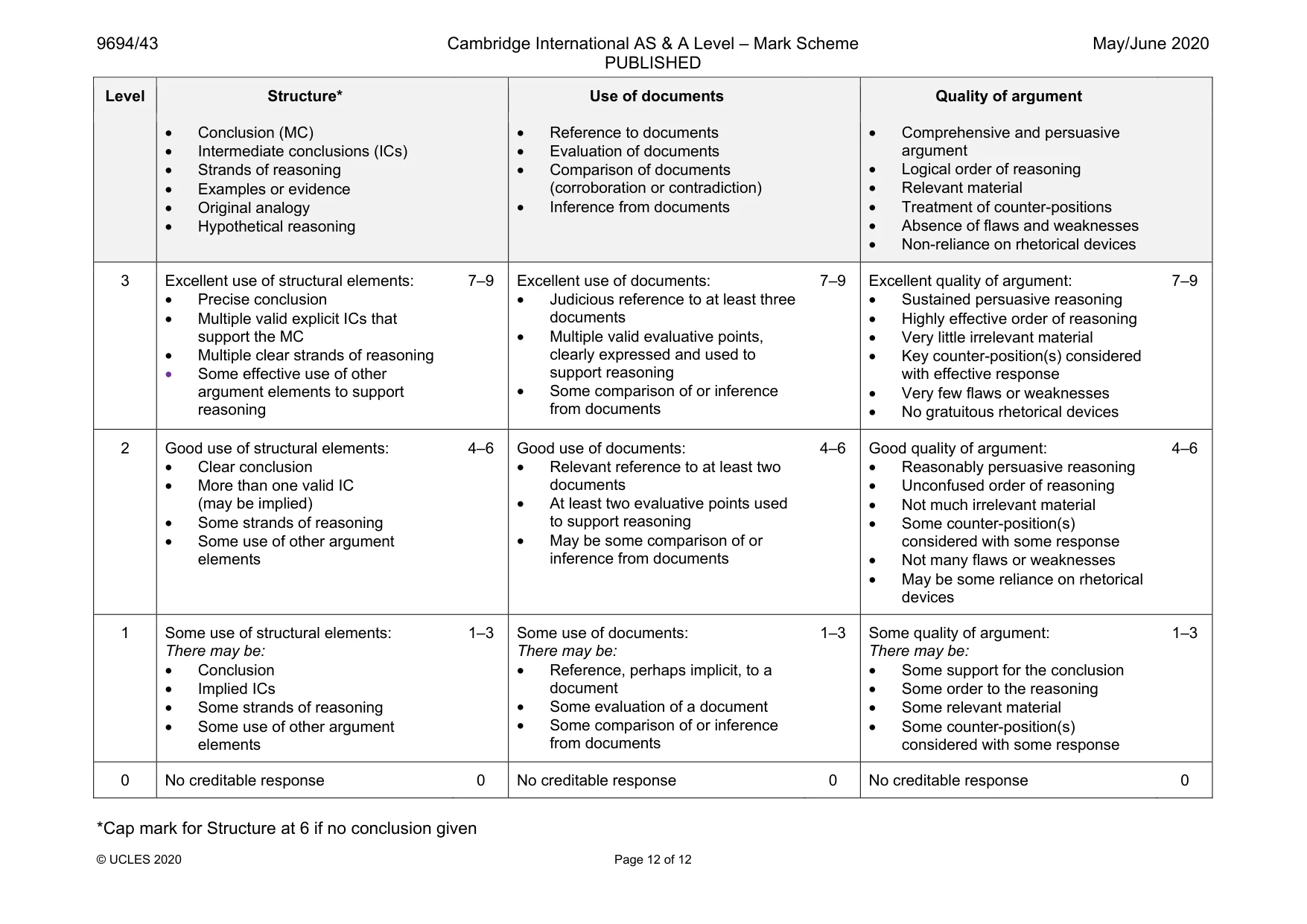
9694/43 Cambridge International AS & A Level – Mark Scheme PUBLISHED May/June 2020 © UCLES 2020 Page 12 of 12 Level Structure* Use of documents Quality of argument • Conclusion (MC) • Intermediate conclusions (ICs) • Strands of reasoning • Examples or evidence • Original analogy • Hypothetical reasoning • Reference to documents • Evaluation of documents • Comparison of documents (corroboration or contradiction) • Inference from documents • Comprehensive and persuasive argument • Logical order of reasoning • Relevant material • Treatment of counter-positions • Absence of flaws and weaknesses • Non-reliance on rhetorical devices 3 Excellent use of structural elements: • Precise conclusion • Multiple valid explicit ICs that support the MC • Multiple clear strands of reasoning • Some effective use of other argument elements to support reasoning 7–9 Excellent use of documents: • Judicious reference to at least three documents • Multiple valid evaluative points, clearly expressed and used to support reasoning • Some comparison of or inference from documents 7–9 Excellent quality of argument: • Sustained persuasive reasoning • Highly effective order of reasoning • Very little irrelevant material • Key counter-position(s) considered with effective response • Very few flaws or weaknesses • No gratuitous rhetorical devices 7–9 2 Good use of structural elements: • Clear conclusion • More than one valid IC (may be implied) • Some strands of reasoning • Some use of other argument elements 4–6 Good use of documents: • Relevant reference to at least two documents • At least two evaluative points used to support reasoning • May be some comparison of or inference from documents 4–6 Good quality of argument: • Reasonably persuasive reasoning • Unconfused order of reasoning • Not much irrelevant material • Some counter-position(s) considered with some response • Not many flaws or weaknesses • May be some reliance on rhetorical devices 4–6 1 Some use of structural elements: There may be: • Conclusion • Implied ICs • Some strands of reasoning • Some use of other argument elements 1–3 Some use of documents: There may be: • Reference, perhaps implicit, to a document • Some evaluation of a document • Some comparison of or inference from documents 1–3 Some quality of argument: There may be: • Some support for the conclusion • Some order to the reasoning • Some relevant material • Some counter-position(s) considered with some response 1–3 0 No creditable response 0 No creditable response 0 No creditable response 0 *Cap mark for Structure at 6 if no conclusion given