Cambridge A Level Thinking Skills 9694 — 2020 May/June Paper 4 · Variant 1
9694/41/M/J/20
The question paper and its mark scheme, free to read here and free to download. This is Cambridge’s own paper, exactly as it was sat.
Question paper8 pages

Mark scheme13 pages
Answers below. Sit the paper first if you are practising.
Paper as text
Question paper, page 1
Cambridge International AS & A Level THINKING SKILLS 9694/41 Paper 4 Applied Reasoning May/June 2020 1 hour 45 minutes You must answer on the enclosed answer booklet. You will need: Answer booklet (enclosed) INSTRUCTIONS ● Answer all questions. ● Follow the instructions on the front cover of the answer booklet. If you need additional answer paper, ask the invigilator for a continuation booklet. INFORMATION ● The total mark for this paper is 50. ● The number of marks for each question or part question is shown in brackets [ ]. * 7 0 5 7 5 0 7 6 4 0 * This document has 8 pages. Blank pages are indicated. DC (LK) 185799/1 © UCLES 2020 [Turn over
Question paper, page 2
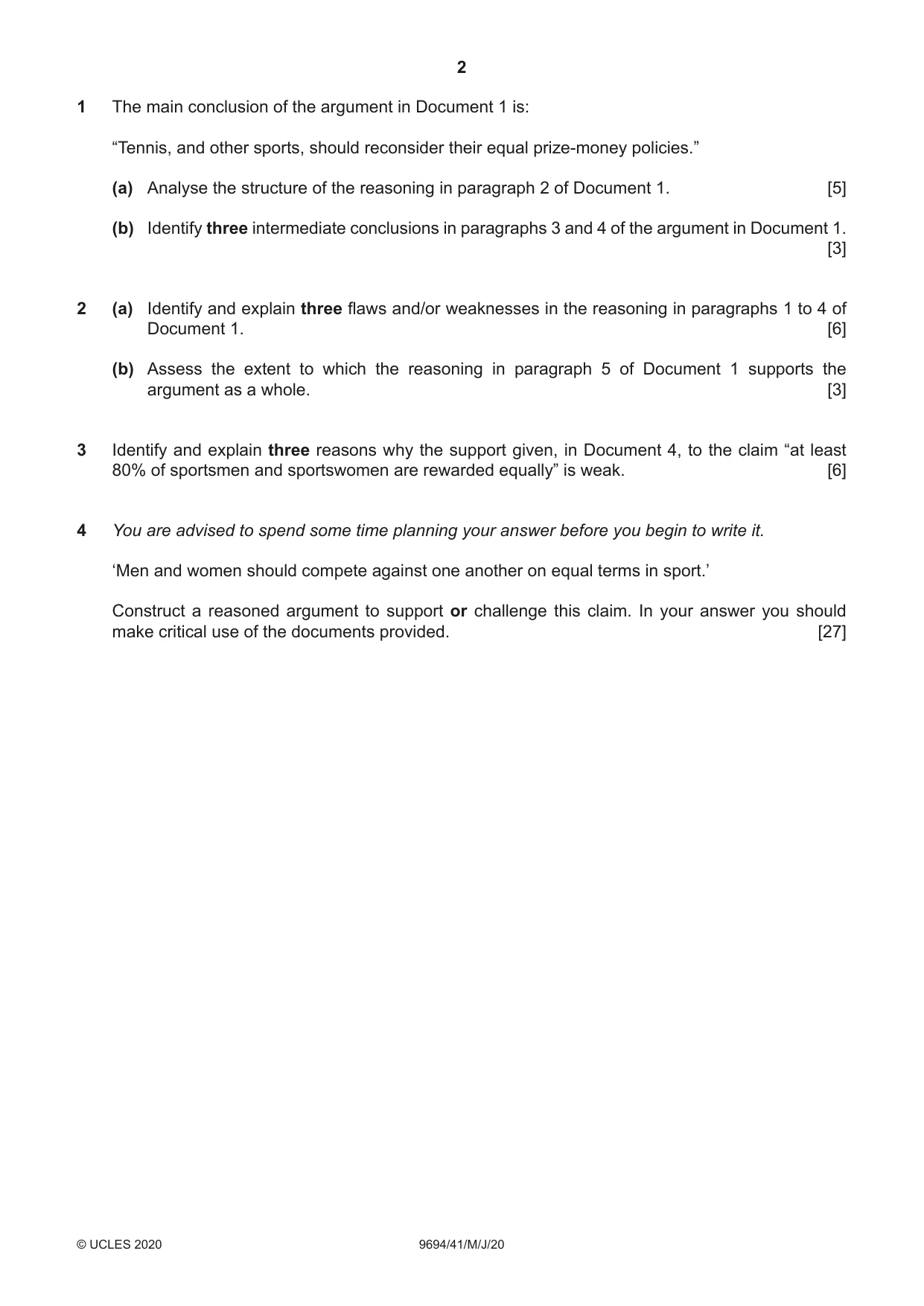
2 9694/41/M/J/20 © UCLES 2020 1 The main conclusion of the argument in Document 1 is: “Tennis, and other sports, should reconsider their equal prize-money policies.” (a) Analyse the structure of the reasoning in paragraph 2 of Document 1. [5] (b) Identify three intermediate conclusions in paragraphs 3 and 4 of the argument in Document 1. [3] 2 (a) Identify and explain three flaws and/or weaknesses in the reasoning in paragraphs 1 to 4 of Document 1. [6] (b) Assess the extent to which the reasoning in paragraph 5 of Document 1 supports the argument as a whole. [3] 3 Identify and explain three reasons why the support given, in Document 4, to the claim “at least 80% of sportsmen and sportswomen are rewarded equally” is weak. [6] 4 You are advised to spend some time planning your answer before you begin to write it. ‘Men and women should compete against one another on equal terms in sport.’ Construct a reasoned argument to support or challenge this claim. In your answer you should make critical use of the documents provided. [27]
Question paper, page 3
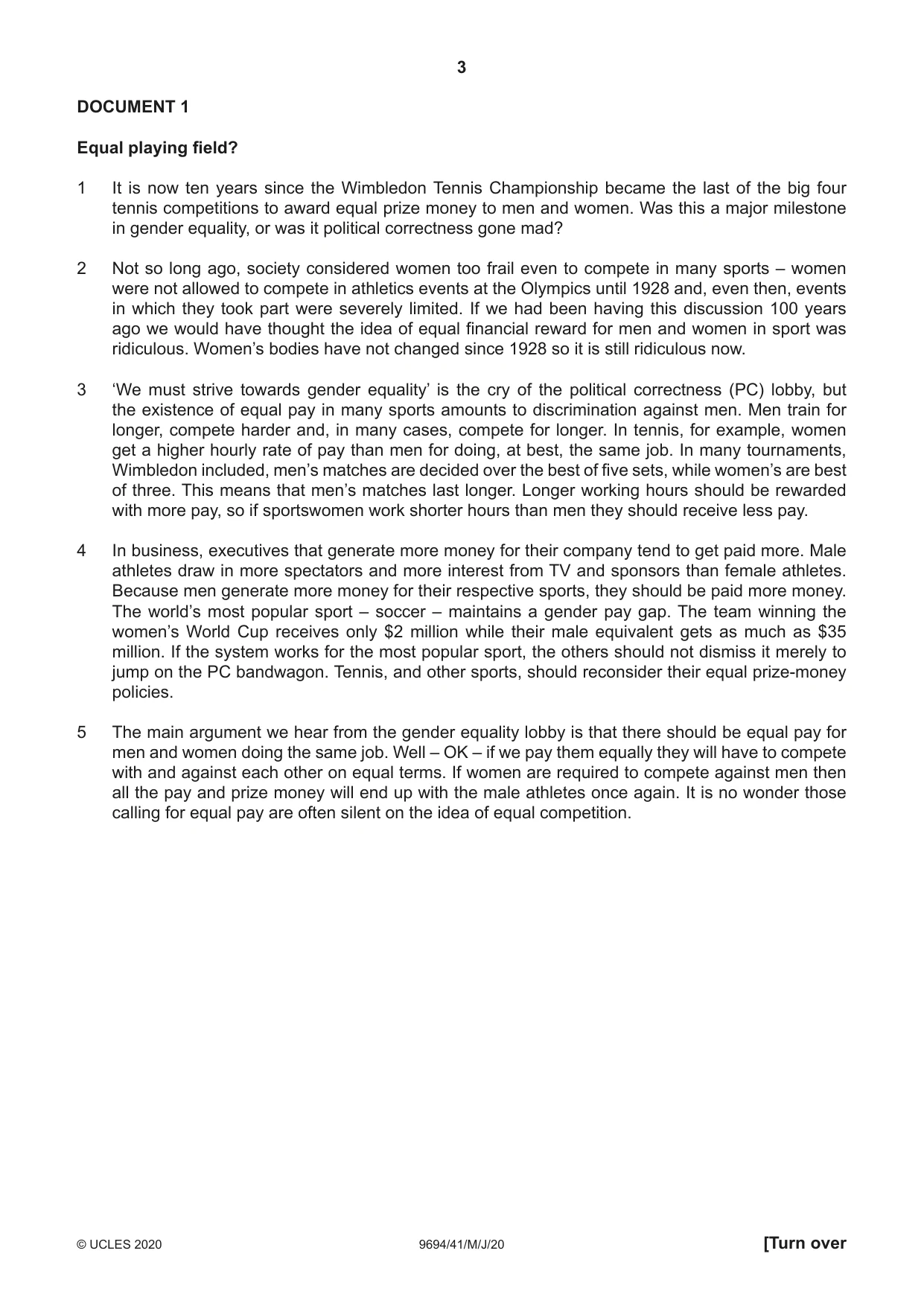
3 9694/41/M/J/20 © UCLES 2020 [Turn over DOCUMENT 1 Equal playing field? 1 It is now ten years since the Wimbledon Tennis Championship became the last of the big four tennis competitions to award equal prize money to men and women. Was this a major milestone in gender equality, or was it political correctness gone mad? 2 Not so long ago, society considered women too frail even to compete in many sports – women were not allowed to compete in athletics events at the Olympics until 1928 and, even then, events in which they took part were severely limited. If we had been having this discussion 100 years ago we would have thought the idea of equal financial reward for men and women in sport was ridiculous. Women’s bodies have not changed since 1928 so it is still ridiculous now. 3 ‘We must strive towards gender equality’ is the cry of the political correctness (PC) lobby, but the existence of equal pay in many sports amounts to discrimination against men. Men train for longer, compete harder and, in many cases, compete for longer. In tennis, for example, women get a higher hourly rate of pay than men for doing, at best, the same job. In many tournaments, Wimbledon included, men’s matches are decided over the best of five sets, while women’s are best of three. This means that men’s matches last longer. Longer working hours should be rewarded with more pay, so if sportswomen work shorter hours than men they should receive less pay. 4 In business, executives that generate more money for their company tend to get paid more. Male athletes draw in more spectators and more interest from TV and sponsors than female athletes. Because men generate more money for their respective sports, they should be paid more money. The world’s most popular sport – soccer – maintains a gender pay gap. The team winning the women’s World Cup receives only $2 million while their male equivalent gets as much as $35 million. If the system works for the most popular sport, the others should not dismiss it merely to jump on the PC bandwagon. Tennis, and other sports, should reconsider their equal prize-money policies. 5 The main argument we hear from the gender equality lobby is that there should be equal pay for men and women doing the same job. Well – OK – if we pay them equally they will have to compete with and against each other on equal terms. If women are required to compete against men then all the pay and prize money will end up with the male athletes once again. It is no wonder those calling for equal pay are often silent on the idea of equal competition.
Question paper, page 4
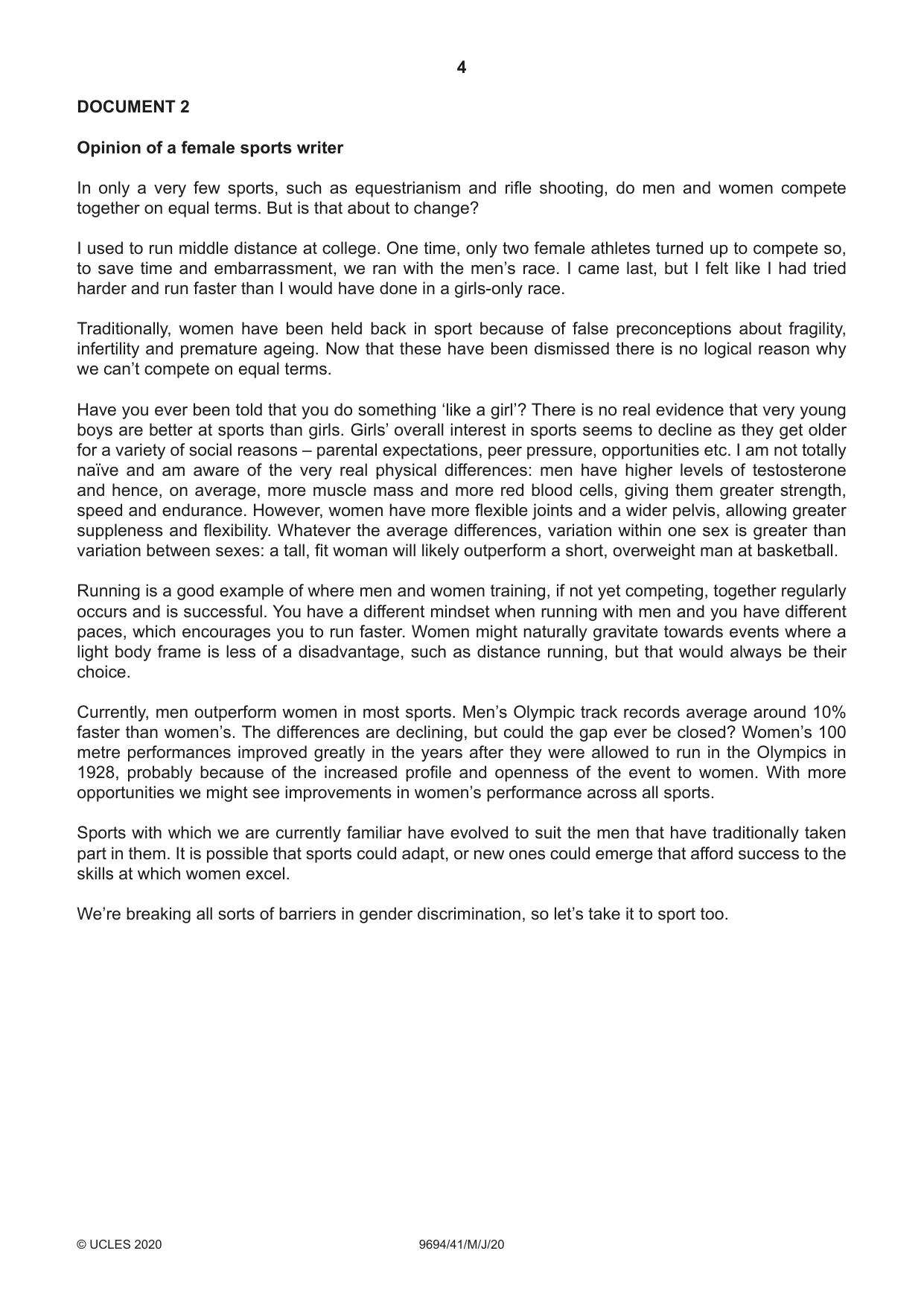
4 9694/41/M/J/20 © UCLES 2020 DOCUMENT 2 Opinion of a female sports writer In only a very few sports, such as equestrianism and rifle shooting, do men and women compete together on equal terms. But is that about to change? I used to run middle distance at college. One time, only two female athletes turned up to compete so, to save time and embarrassment, we ran with the men’s race. I came last, but I felt like I had tried harder and run faster than I would have done in a girls-only race. Traditionally, women have been held back in sport because of false preconceptions about fragility, infertility and premature ageing. Now that these have been dismissed there is no logical reason why we can’t compete on equal terms. Have you ever been told that you do something ‘like a girl’? There is no real evidence that very young boys are better at sports than girls. Girls’ overall interest in sports seems to decline as they get older for a variety of social reasons – parental expectations, peer pressure, opportunities etc. I am not totally naïve and am aware of the very real physical differences: men have higher levels of testosterone and hence, on average, more muscle mass and more red blood cells, giving them greater strength, speed and endurance. However, women have more flexible joints and a wider pelvis, allowing greater suppleness and flexibility. Whatever the average differences, variation within one sex is greater than variation between sexes: a tall, fit woman will likely outperform a short, overweight man at basketball. Running is a good example of where men and women training, if not yet competing, together regularly occurs and is successful. You have a different mindset when running with men and you have different paces, which encourages you to run faster. Women might naturally gravitate towards events where a light body frame is less of a disadvantage, such as distance running, but that would always be their choice. Currently, men outperform women in most sports. Men’s Olympic track records average around 10% faster than women’s. The differences are declining, but could the gap ever be closed? Women’s 100 metre performances improved greatly in the years after they were allowed to run in the Olympics in 1928, probably because of the increased profile and openness of the event to women. With more opportunities we might see improvements in women’s performance across all sports. Sports with which we are currently familiar have evolved to suit the men that have traditionally taken part in them. It is possible that sports could adapt, or new ones could emerge that afford success to the skills at which women excel. We’re breaking all sorts of barriers in gender discrimination, so let’s take it to sport too.
Question paper, page 5
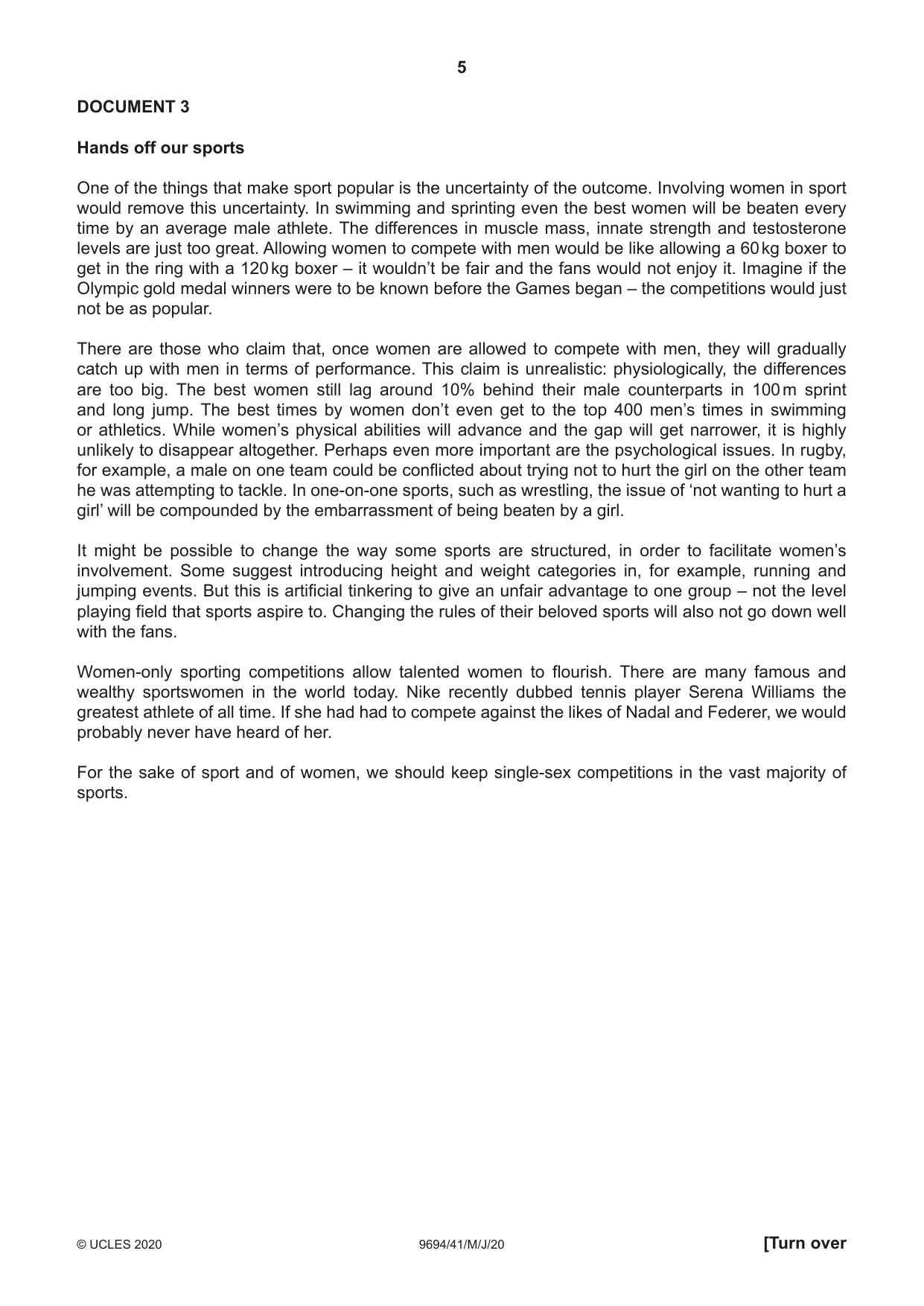
5 9694/41/M/J/20 © UCLES 2020 [Turn over DOCUMENT 3 Hands off our sports One of the things that make sport popular is the uncertainty of the outcome. Involving women in sport would remove this uncertainty. In swimming and sprinting even the best women will be beaten every time by an average male athlete. The differences in muscle mass, innate strength and testosterone levels are just too great. Allowing women to compete with men would be like allowing a 60 kg boxer to get in the ring with a 120 kg boxer – it wouldn’t be fair and the fans would not enjoy it. Imagine if the Olympic gold medal winners were to be known before the Games began – the competitions would just not be as popular. There are those who claim that, once women are allowed to compete with men, they will gradually catch up with men in terms of performance. This claim is unrealistic: physiologically, the differences are too big. The best women still lag around 10% behind their male counterparts in 100 m sprint and long jump. The best times by women don’t even get to the top 400 men’s times in swimming or athletics. While women’s physical abilities will advance and the gap will get narrower, it is highly unlikely to disappear altogether. Perhaps even more important are the psychological issues. In rugby, for example, a male on one team could be conflicted about trying not to hurt the girl on the other team he was attempting to tackle. In one-on-one sports, such as wrestling, the issue of ‘not wanting to hurt a girl’ will be compounded by the embarrassment of being beaten by a girl. It might be possible to change the way some sports are structured, in order to facilitate women’s involvement. Some suggest introducing height and weight categories in, for example, running and jumping events. But this is artificial tinkering to give an unfair advantage to one group – not the level playing field that sports aspire to. Changing the rules of their beloved sports will also not go down well with the fans. Women-only sporting competitions allow talented women to flourish. There are many famous and wealthy sportswomen in the world today. Nike recently dubbed tennis player Serena Williams the greatest athlete of all time. If she had had to compete against the likes of Nadal and Federer, we would probably never have heard of her. For the sake of sport and of women, we should keep single-sex competitions in the vast majority of sports.
Question paper, page 6
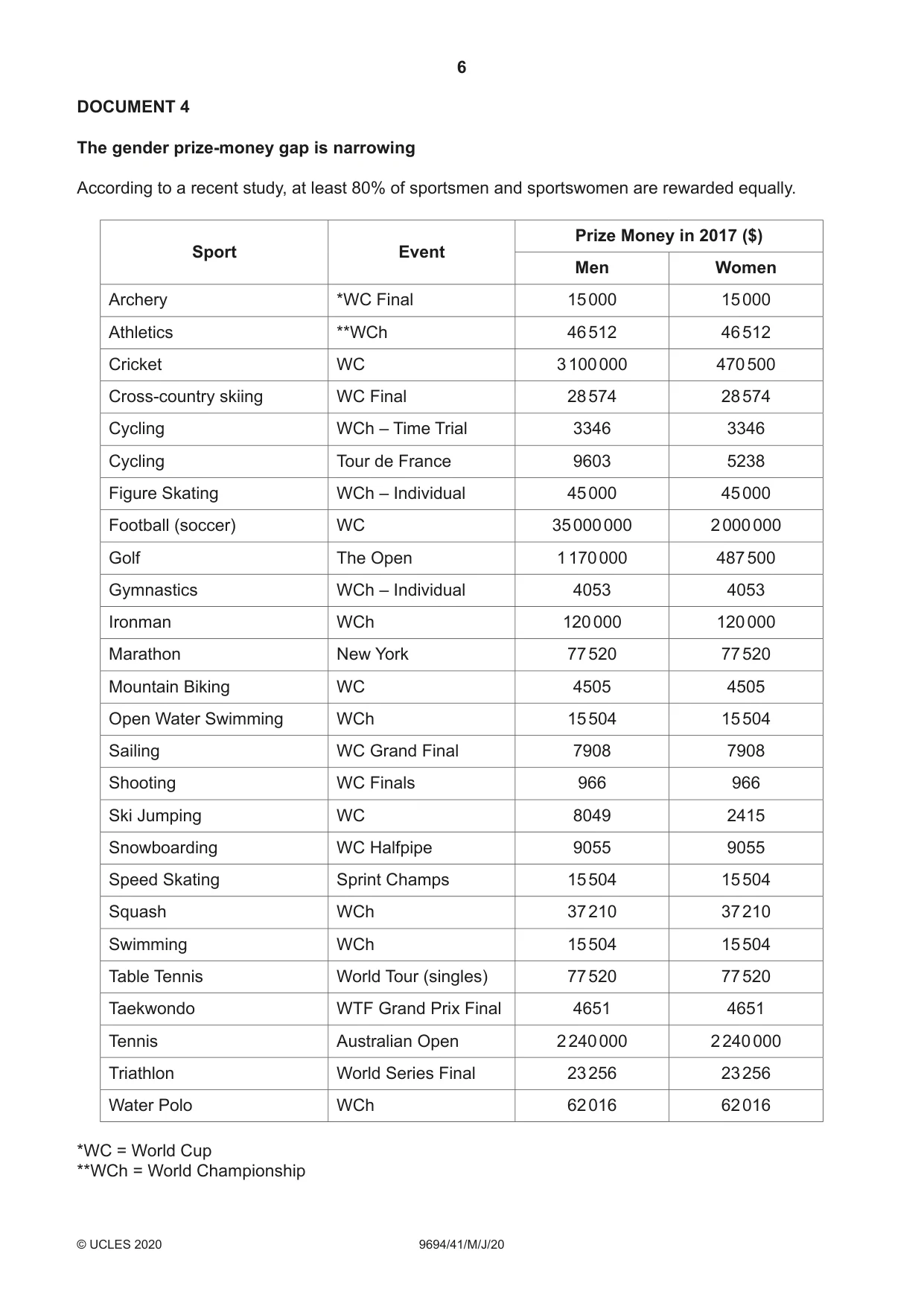
6 9694/41/M/J/20 © UCLES 2020 DOCUMENT 4 The gender prize-money gap is narrowing According to a recent study, at least 80% of sportsmen and sportswomen are rewarded equally. Sport Event Prize Money in 2017 ($) Men Women Archery *WC Final 15 000 15 000 Athletics **WCh 46 512 46 512 Cricket WC 3 100 000 470 500 Cross-country skiing WC Final 28 574 28 574 Cycling WCh – Time Trial 3346 3346 Cycling Tour de France 9603 5238 Figure Skating WCh – Individual 45 000 45 000 Football (soccer) WC 35 000 000 2 000 000 Golf The Open 1 170 000 487 500 Gymnastics WCh – Individual 4053 4053 Ironman WCh 120 000 120 000 Marathon New York 77 520 77 520 Mountain Biking WC 4505 4505 Open Water Swimming WCh 15 504 15 504 Sailing WC Grand Final 7908 7908 Shooting WC Finals 966 966 Ski Jumping WC 8049 2415 Snowboarding WC Halfpipe 9055 9055 Speed Skating Sprint Champs 15 504 15 504 Squash WCh 37 210 37 210 Swimming WCh 15 504 15 504 Table Tennis World Tour (singles) 77 520 77 520 Taekwondo WTF Grand Prix Final 4651 4651 Tennis Australian Open 2 240 000 2 240 000 Triathlon World Series Final 23 256 23 256 Water Polo WCh 62 016 62 016 *WC = World Cup **WCh = World Championship
Question paper, page 7
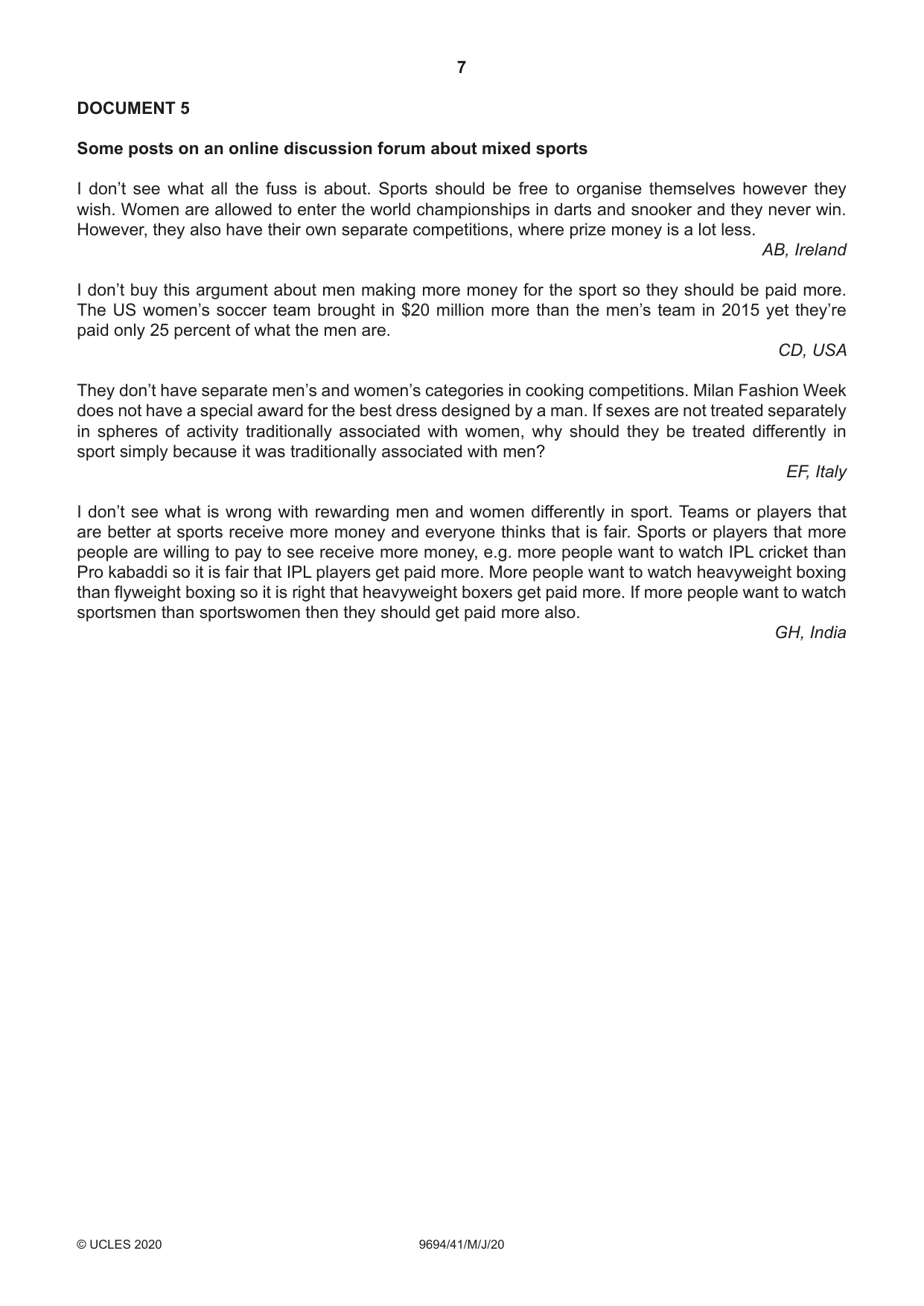
7 9694/41/M/J/20 © UCLES 2020 DOCUMENT 5 Some posts on an online discussion forum about mixed sports I don’t see what all the fuss is about. Sports should be free to organise themselves however they wish. Women are allowed to enter the world championships in darts and snooker and they never win. However, they also have their own separate competitions, where prize money is a lot less. AB, Ireland I don’t buy this argument about men making more money for the sport so they should be paid more. The US women’s soccer team brought in $20 million more than the men’s team in 2015 yet they’re paid only 25 percent of what the men are. CD, USA They don’t have separate men’s and women’s categories in cooking competitions. Milan Fashion Week does not have a special award for the best dress designed by a man. If sexes are not treated separately in spheres of activity traditionally associated with women, why should they be treated differently in sport simply because it was traditionally associated with men? EF, Italy I don’t see what is wrong with rewarding men and women differently in sport. Teams or players that are better at sports receive more money and everyone thinks that is fair. Sports or players that more people are willing to pay to see receive more money, e.g. more people want to watch IPL cricket than Pro kabaddi so it is fair that IPL players get paid more. More people want to watch heavyweight boxing than flyweight boxing so it is right that heavyweight boxers get paid more. If more people want to watch sportsmen than sportswomen then they should get paid more also. GH, India
Question paper, page 8
8 9694/41/M/J/20 © UCLES 2020 Permission to reproduce items where third-party owned material protected by copyright is included has been sought and cleared where possible. Every reasonable effort has been made by the publisher (UCLES) to trace copyright holders, but if any items requiring clearance have unwittingly been included, the publisher will be pleased to make amends at the earliest possible opportunity. To avoid the issue of disclosure of answer-related information to candidates, all copyright acknowledgements are reproduced online in the Cambridge Assessment International Education Copyright Acknowledgements Booklet. This is produced for each series of examinations and is freely available to download at www.cambridgeinternational.org after the live examination series. Cambridge Assessment International Education is part of the Cambridge Assessment Group. Cambridge Assessment is the brand name of the University of Cambridge Local Examinations Syndicate (UCLES), which itself is a department of the University of Cambridge. BLANK PAGE
Mark scheme, page 1
This document consists of 13 printed pages. © UCLES 2020 [Turn over Cambridge International AS & A Level THINKING SKILLS 9694/41 Paper 4 Applied Reasoning May/June 2020 MARK SCHEME Maximum Mark: 50 Published Students did not sit exam papers in the June 2020 series due to the Covid-19 global pandemic. This mark scheme is published to support teachers and students and should be read together with the question paper. It shows the requirements of the exam. The answer column of the mark scheme shows the proposed basis on which Examiners would award marks for this exam. Where appropriate, this column also provides the most likely acceptable alternative responses expected from students. Examiners usually review the mark scheme after they have seen student responses and update the mark scheme if appropriate. In the June series, Examiners were unable to consider the acceptability of alternative responses, as there were no student responses to consider. Mark schemes should usually be read together with the Principal Examiner Report for Teachers. However, because students did not sit exam papers, there is no Principal Examiner Report for Teachers for the June 2020 series. Cambridge International will not enter into discussions about these mark schemes. Cambridge International is publishing the mark schemes for the June 2020 series for most Cambridge IGCSE™ and Cambridge International A & AS Level components, and some Cambridge O Level components.
Mark scheme, page 2
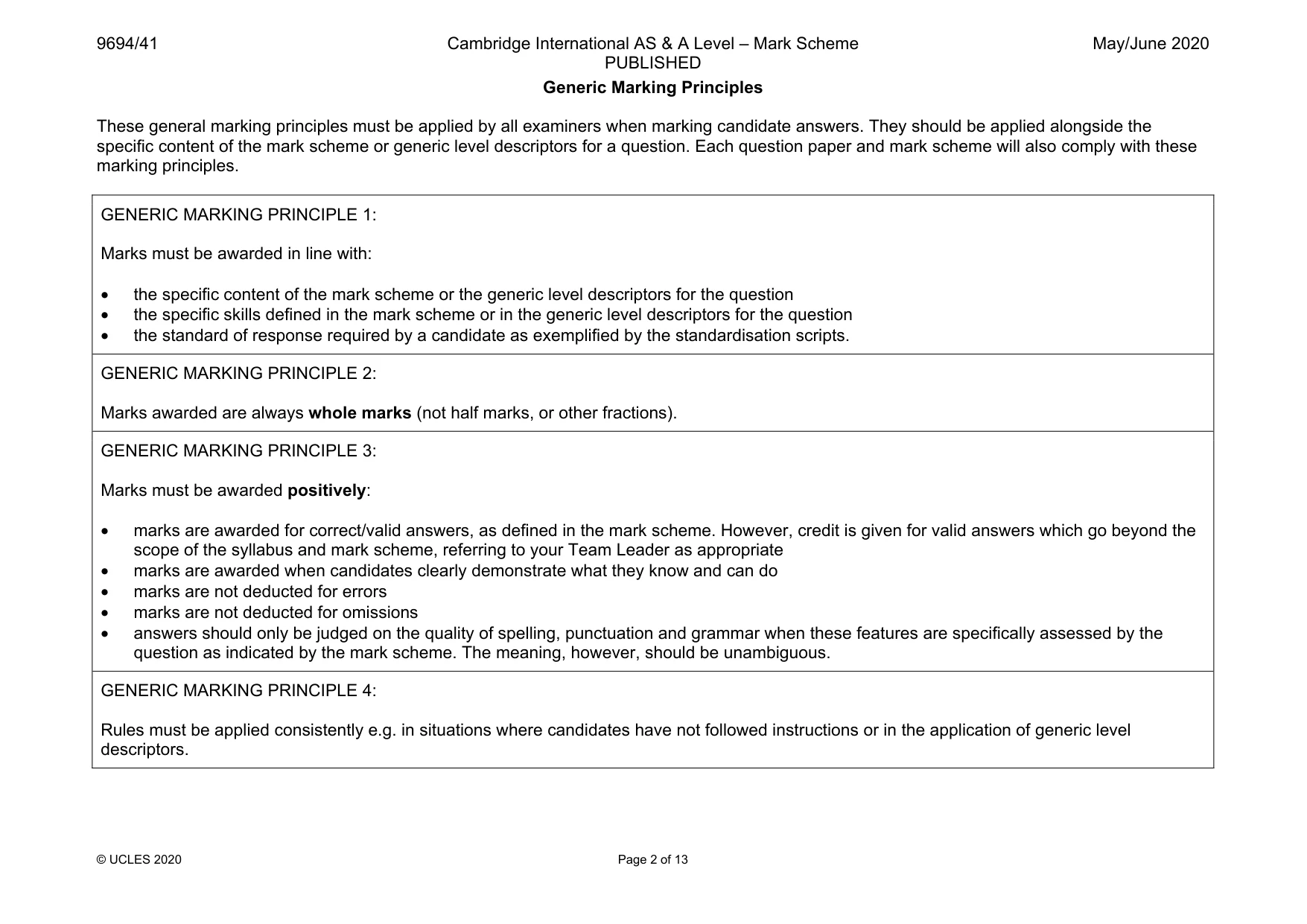
9694/41 Cambridge International AS & A Level – Mark Scheme PUBLISHED May/June 2020 © UCLES 2020 Page 2 of 13 Generic Marking Principles These general marking principles must be applied by all examiners when marking candidate answers. They should be applied alongside the specific content of the mark scheme or generic level descriptors for a question. Each question paper and mark scheme will also comply with these marking principles. GENERIC MARKING PRINCIPLE 1: Marks must be awarded in line with: • the specific content of the mark scheme or the generic level descriptors for the question • the specific skills defined in the mark scheme or in the generic level descriptors for the question • the standard of response required by a candidate as exemplified by the standardisation scripts. GENERIC MARKING PRINCIPLE 2: Marks awarded are always whole marks (not half marks, or other fractions). GENERIC MARKING PRINCIPLE 3: Marks must be awarded positively: • marks are awarded for correct/valid answers, as defined in the mark scheme. However, credit is given for valid answers which go beyond the scope of the syllabus and mark scheme, referring to your Team Leader as appropriate • marks are awarded when candidates clearly demonstrate what they know and can do • marks are not deducted for errors • marks are not deducted for omissions • answers should only be judged on the quality of spelling, punctuation and grammar when these features are specifically assessed by the question as indicated by the mark scheme. The meaning, however, should be unambiguous. GENERIC MARKING PRINCIPLE 4: Rules must be applied consistently e.g. in situations where candidates have not followed instructions or in the application of generic level descriptors.
Mark scheme, page 3
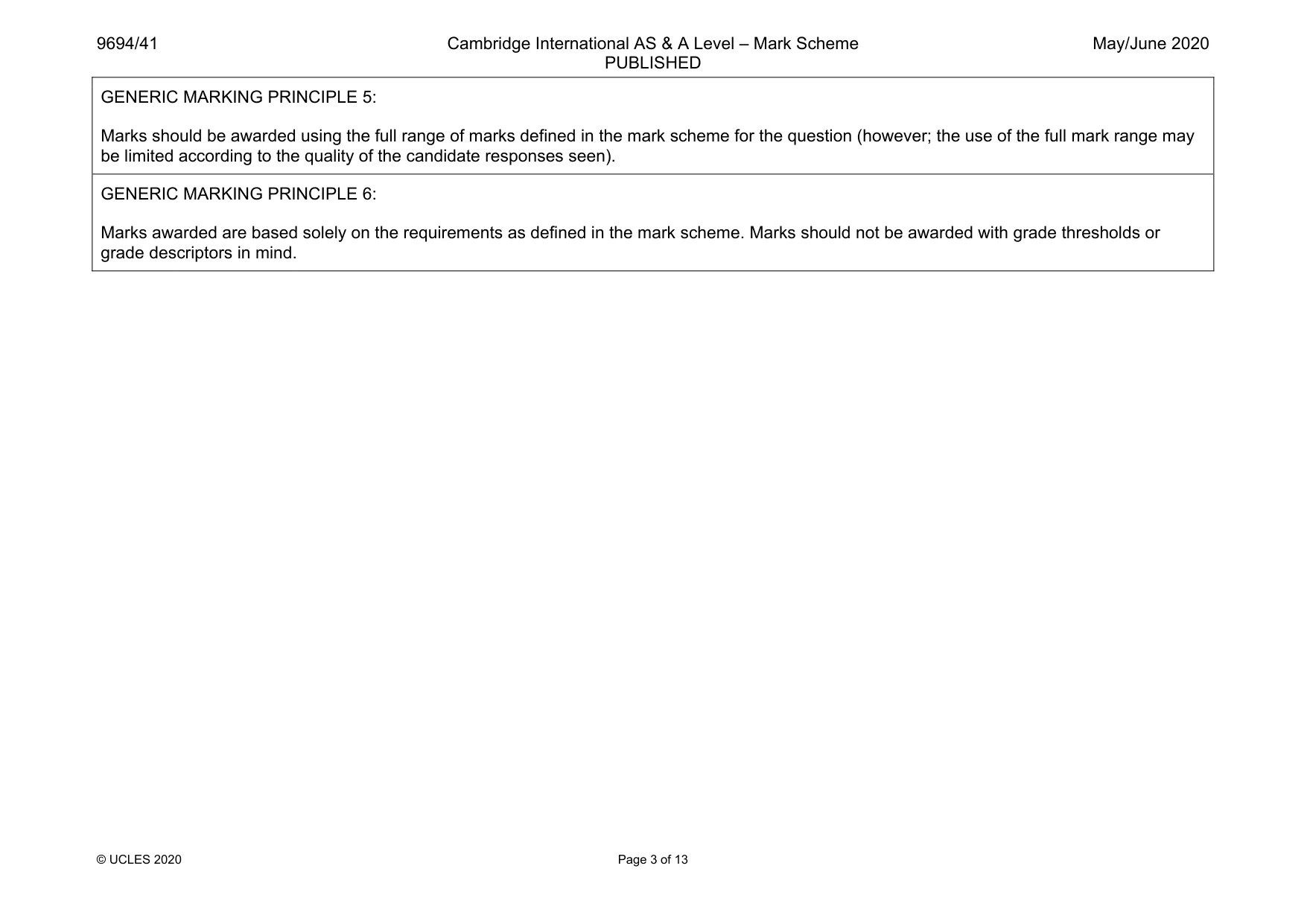
9694/41 Cambridge International AS & A Level – Mark Scheme PUBLISHED May/June 2020 © UCLES 2020 Page 3 of 13 GENERIC MARKING PRINCIPLE 5: Marks should be awarded using the full range of marks defined in the mark scheme for the question (however; the use of the full mark range may be limited according to the quality of the candidate responses seen). GENERIC MARKING PRINCIPLE 6: Marks awarded are based solely on the requirements as defined in the mark scheme. Marks should not be awarded with grade thresholds or grade descriptors in mind.
Mark scheme, page 4
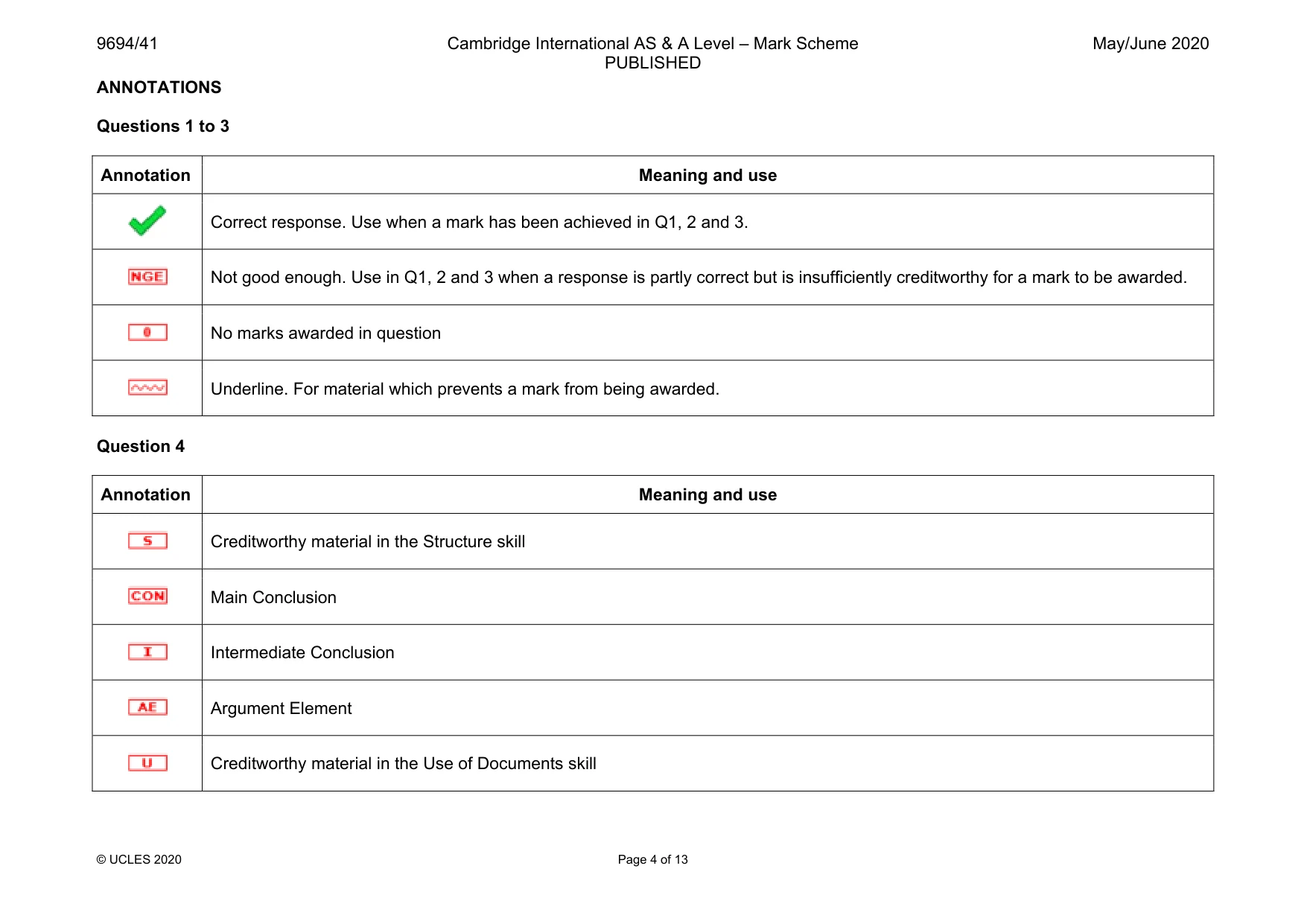
9694/41 Cambridge International AS & A Level – Mark Scheme PUBLISHED May/June 2020 © UCLES 2020 Page 4 of 13 ANNOTATIONS Questions 1 to 3 Annotation Meaning and use Correct response. Use when a mark has been achieved in Q1, 2 and 3. Not good enough. Use in Q1, 2 and 3 when a response is partly correct but is insufficiently creditworthy for a mark to be awarded. No marks awarded in question Underline. For material which prevents a mark from being awarded. Question 4 Annotation Meaning and use Creditworthy material in the Structure skill Main Conclusion Intermediate Conclusion Argument Element Creditworthy material in the Use of Documents skill
Mark scheme, page 5
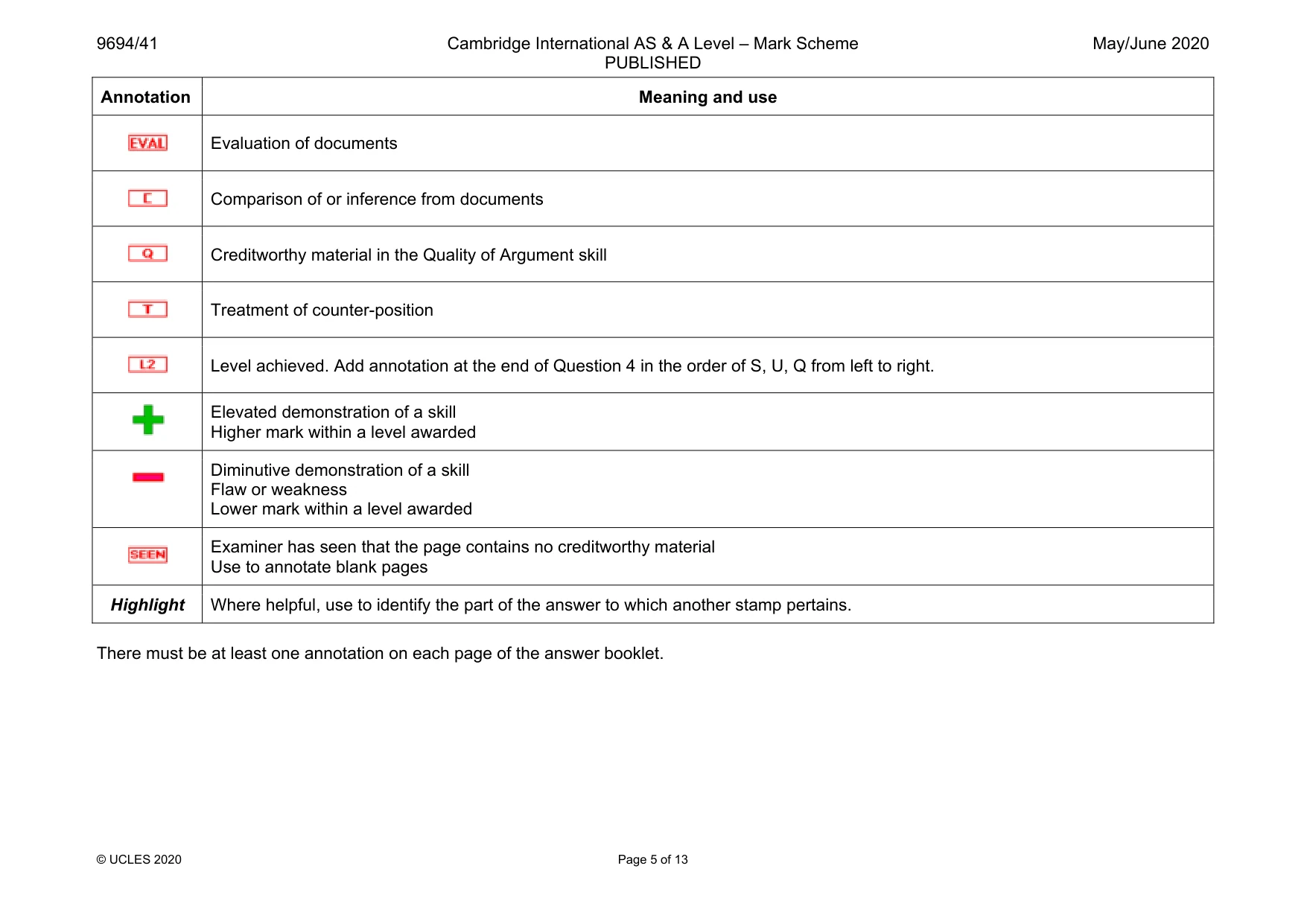
9694/41 Cambridge International AS & A Level – Mark Scheme PUBLISHED May/June 2020 © UCLES 2020 Page 5 of 13 Annotation Meaning and use Evaluation of documents Comparison of or inference from documents Creditworthy material in the Quality of Argument skill Treatment of counter-position Level achieved. Add annotation at the end of Question 4 in the order of S, U, Q from left to right. Elevated demonstration of a skill Higher mark within a level awarded Diminutive demonstration of a skill Flaw or weakness Lower mark within a level awarded Examiner has seen that the page contains no creditworthy material Use to annotate blank pages Highlight Where helpful, use to identify the part of the answer to which another stamp pertains. There must be at least one annotation on each page of the answer booklet.
Mark scheme, page 6
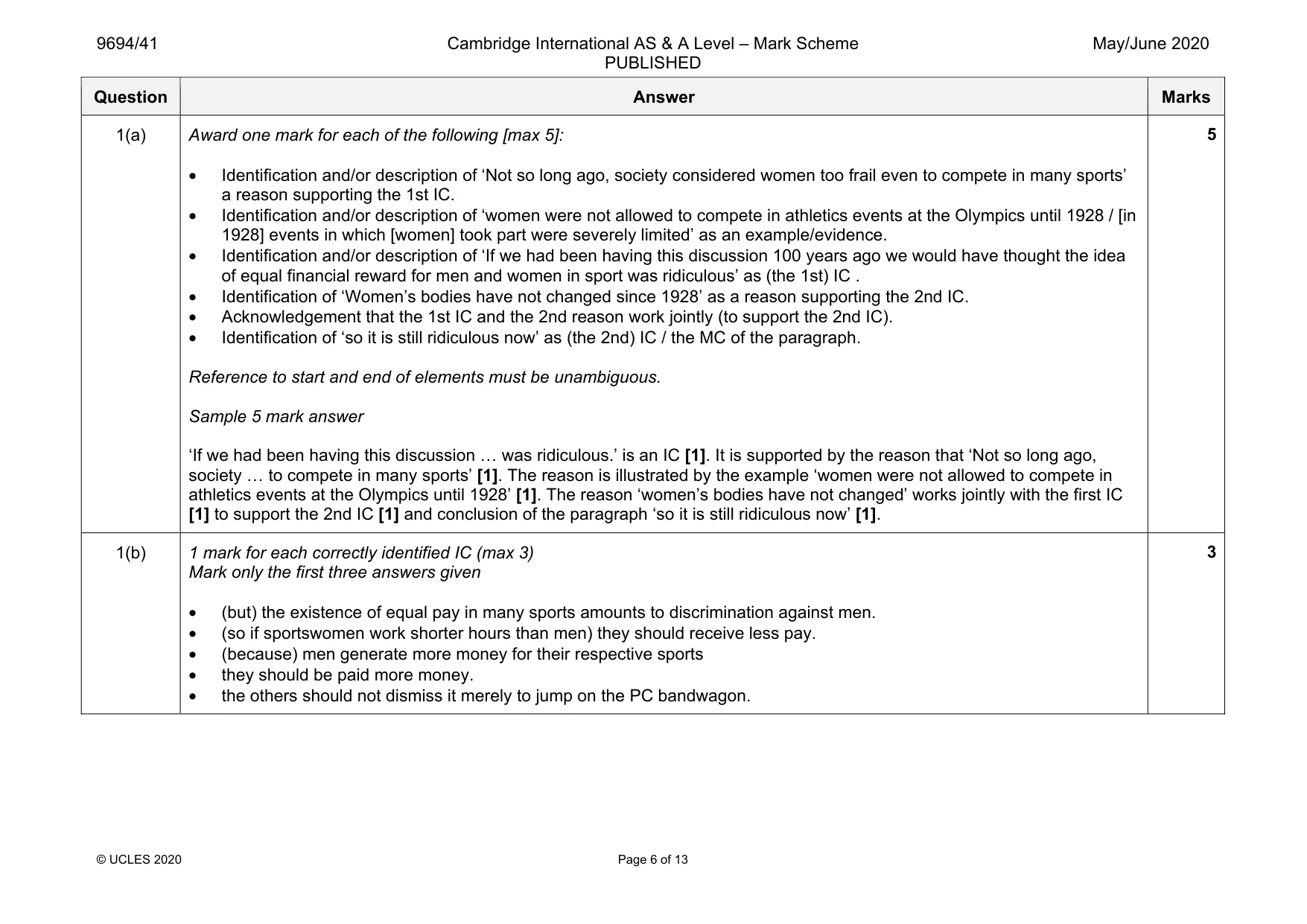
9694/41 Cambridge International AS & A Level – Mark Scheme PUBLISHED May/June 2020 © UCLES 2020 Page 6 of 13 Question Answer Marks 1(a) Award one mark for each of the following [max 5]: • Identification and/or description of ‘Not so long ago, society considered women too frail even to compete in many sports’ a reason supporting the 1st IC. • Identification and/or description of ‘women were not allowed to compete in athletics events at the Olympics until 1928 / [in 1928] events in which [women] took part were severely limited’ as an example/evidence. • Identification and/or description of ‘If we had been having this discussion 100 years ago we would have thought the idea of equal financial reward for men and women in sport was ridiculous’ as (the 1st) IC . • Identification of ‘Women’s bodies have not changed since 1928’ as a reason supporting the 2nd IC. • Acknowledgement that the 1st IC and the 2nd reason work jointly (to support the 2nd IC). • Identification of ‘so it is still ridiculous now’ as (the 2nd) IC / the MC of the paragraph. Reference to start and end of elements must be unambiguous. Sample 5 mark answer ‘If we had been having this discussion … was ridiculous.’ is an IC [1]. It is supported by the reason that ‘Not so long ago, society … to compete in many sports’ [1]. The reason is illustrated by the example ‘women were not allowed to compete in athletics events at the Olympics until 1928’ [1]. The reason ‘women’s bodies have not changed’ works jointly with the first IC [1] to support the 2nd IC [1] and conclusion of the paragraph ‘so it is still ridiculous now’ [1]. 5 1(b) 1 mark for each correctly identified IC (max 3) Mark only the first three answers given • (but) the existence of equal pay in many sports amounts to discrimination against men. • (so if sportswomen work shorter hours than men) they should receive less pay. • (because) men generate more money for their respective sports • they should be paid more money. • the others should not dismiss it merely to jump on the PC bandwagon. 3
Mark scheme, page 7
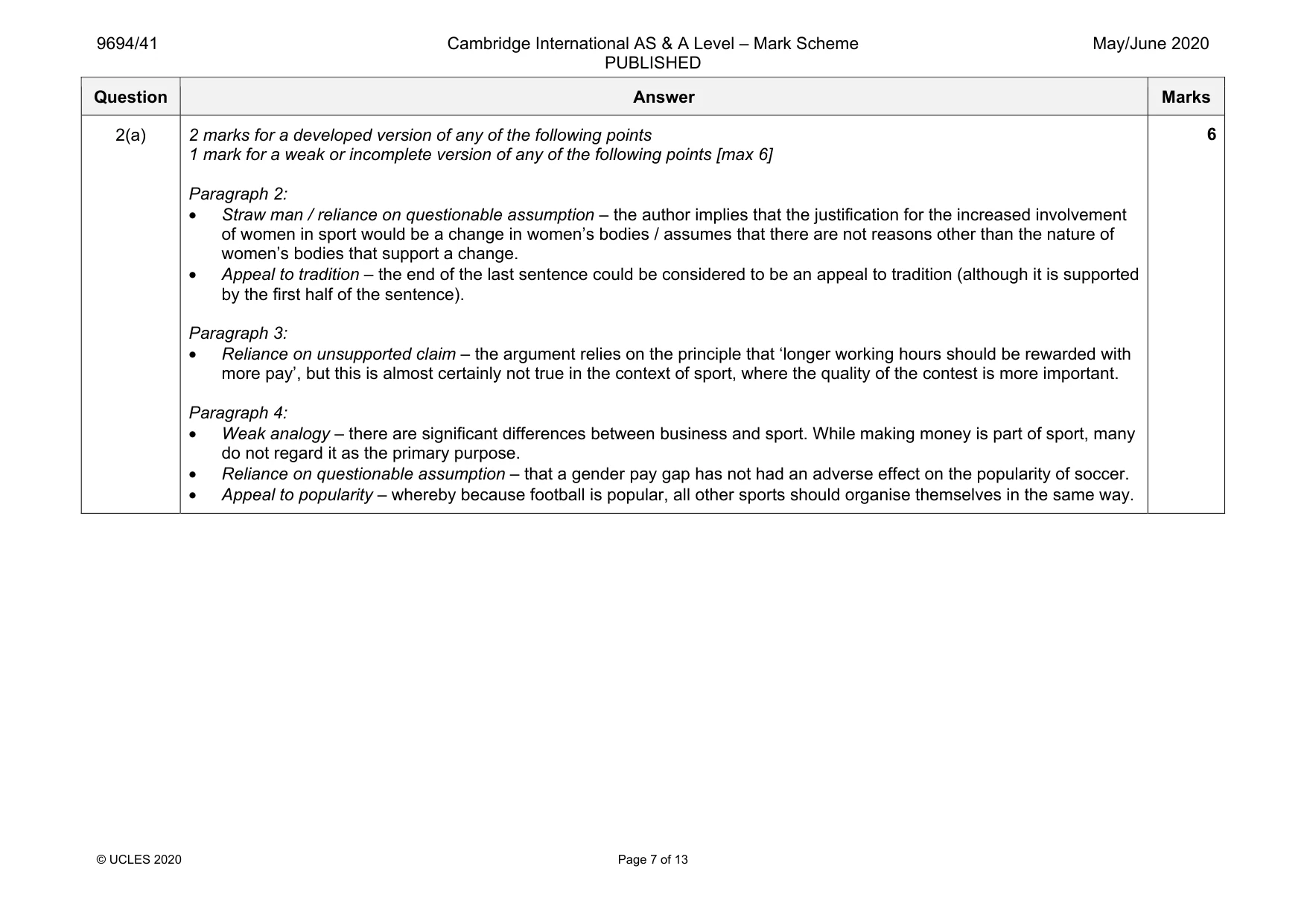
9694/41 Cambridge International AS & A Level – Mark Scheme PUBLISHED May/June 2020 © UCLES 2020 Page 7 of 13 Question Answer Marks 2(a) 2 marks for a developed version of any of the following points 1 mark for a weak or incomplete version of any of the following points [max 6] Paragraph 2: • Straw man / reliance on questionable assumption – the author implies that the justification for the increased involvement of women in sport would be a change in women’s bodies / assumes that there are not reasons other than the nature of women’s bodies that support a change. • Appeal to tradition – the end of the last sentence could be considered to be an appeal to tradition (although it is supported by the first half of the sentence). Paragraph 3: • Reliance on unsupported claim – the argument relies on the principle that ‘longer working hours should be rewarded with more pay’, but this is almost certainly not true in the context of sport, where the quality of the contest is more important. Paragraph 4: • Weak analogy – there are significant differences between business and sport. While making money is part of sport, many do not regard it as the primary purpose. • Reliance on questionable assumption – that a gender pay gap has not had an adverse effect on the popularity of soccer. • Appeal to popularity – whereby because football is popular, all other sports should organise themselves in the same way. 6
Mark scheme, page 8
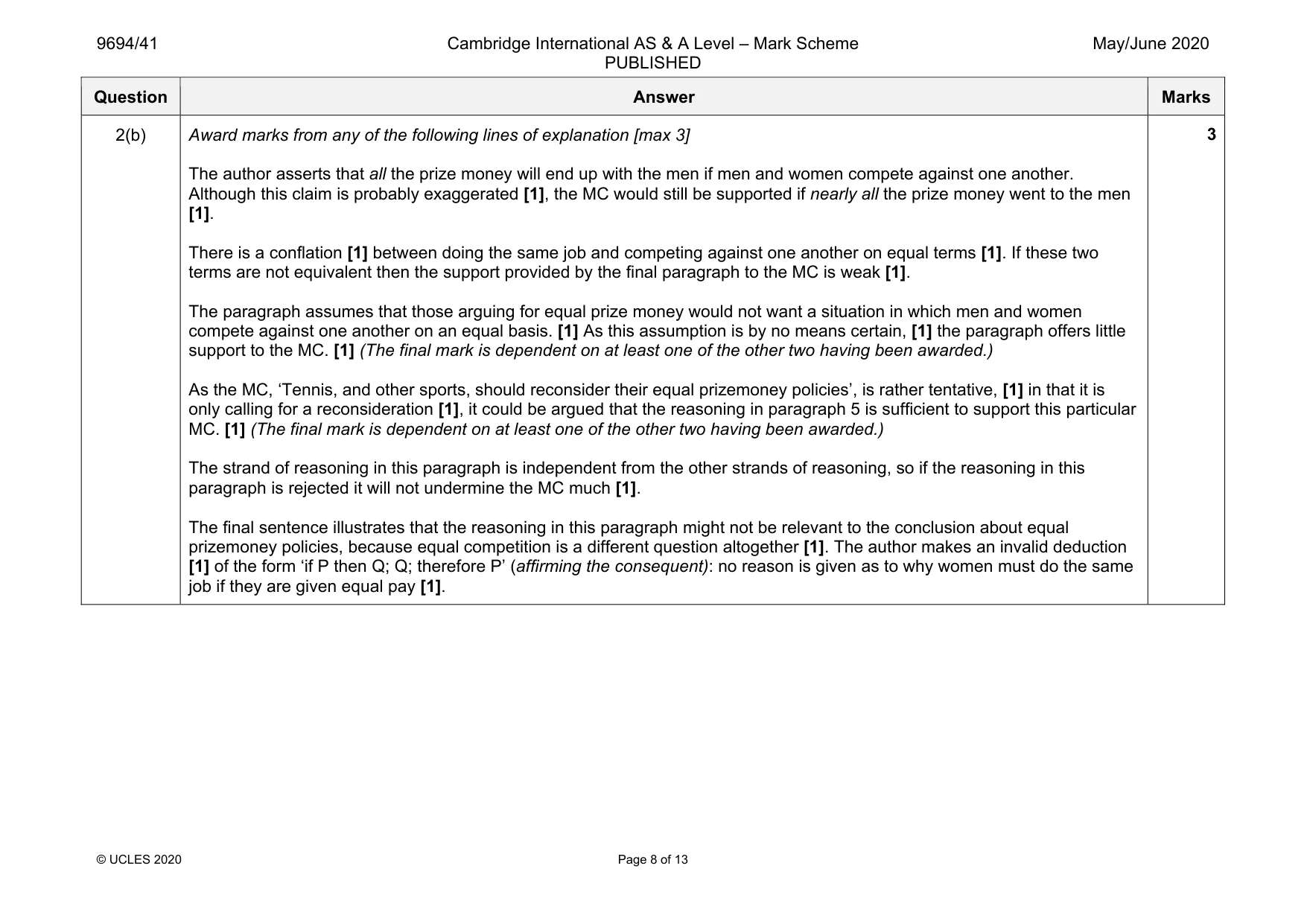
9694/41 Cambridge International AS & A Level – Mark Scheme PUBLISHED May/June 2020 © UCLES 2020 Page 8 of 13 Question Answer Marks 2(b) Award marks from any of the following lines of explanation [max 3] The author asserts that all the prize money will end up with the men if men and women compete against one another. Although this claim is probably exaggerated [1], the MC would still be supported if nearly all the prize money went to the men [1]. There is a conflation [1] between doing the same job and competing against one another on equal terms [1]. If these two terms are not equivalent then the support provided by the final paragraph to the MC is weak [1]. The paragraph assumes that those arguing for equal prize money would not want a situation in which men and women compete against one another on an equal basis. [1] As this assumption is by no means certain, [1] the paragraph offers little support to the MC. [1] (The final mark is dependent on at least one of the other two having been awarded.) As the MC, ‘Tennis, and other sports, should reconsider their equal prizemoney policies’, is rather tentative, [1] in that it is only calling for a reconsideration [1], it could be argued that the reasoning in paragraph 5 is sufficient to support this particular MC. [1] (The final mark is dependent on at least one of the other two having been awarded.) The strand of reasoning in this paragraph is independent from the other strands of reasoning, so if the reasoning in this paragraph is rejected it will not undermine the MC much [1]. The final sentence illustrates that the reasoning in this paragraph might not be relevant to the conclusion about equal prizemoney policies, because equal competition is a different question altogether [1]. The author makes an invalid deduction [1] of the form ‘if P then Q; Q; therefore P’ (affirming the consequent): no reason is given as to why women must do the same job if they are given equal pay [1]. 3
Mark scheme, page 9
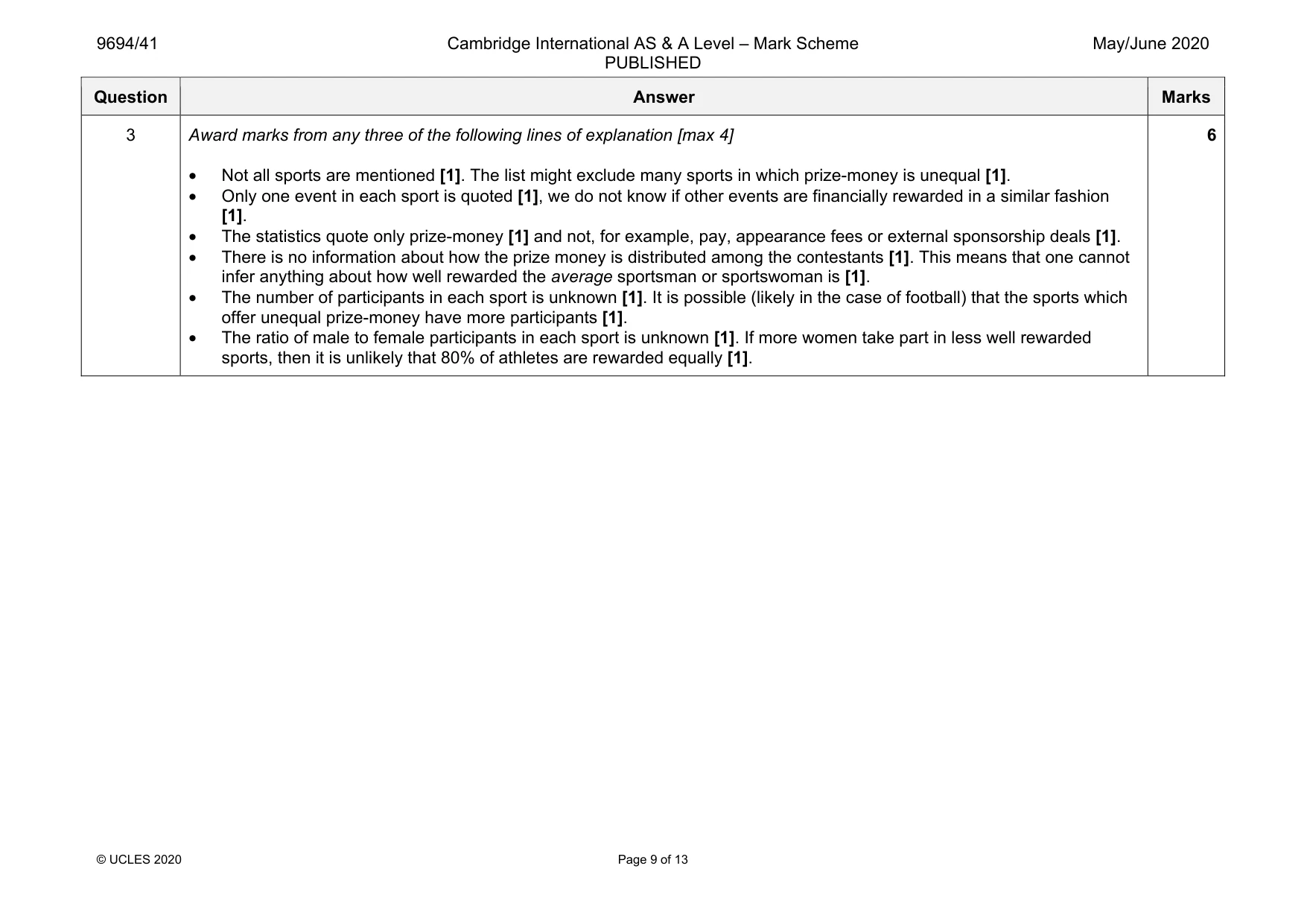
9694/41 Cambridge International AS & A Level – Mark Scheme PUBLISHED May/June 2020 © UCLES 2020 Page 9 of 13 Question Answer Marks 3 Award marks from any three of the following lines of explanation [max 4] • Not all sports are mentioned [1]. The list might exclude many sports in which prize-money is unequal [1]. • Only one event in each sport is quoted [1], we do not know if other events are financially rewarded in a similar fashion [1]. • The statistics quote only prize-money [1] and not, for example, pay, appearance fees or external sponsorship deals [1]. • There is no information about how the prize money is distributed among the contestants [1]. This means that one cannot infer anything about how well rewarded the average sportsman or sportswoman is [1]. • The number of participants in each sport is unknown [1]. It is possible (likely in the case of football) that the sports which offer unequal prize-money have more participants [1]. • The ratio of male to female participants in each sport is unknown [1]. If more women take part in less well rewarded sports, then it is unlikely that 80% of athletes are rewarded equally [1]. 6
Mark scheme, page 10
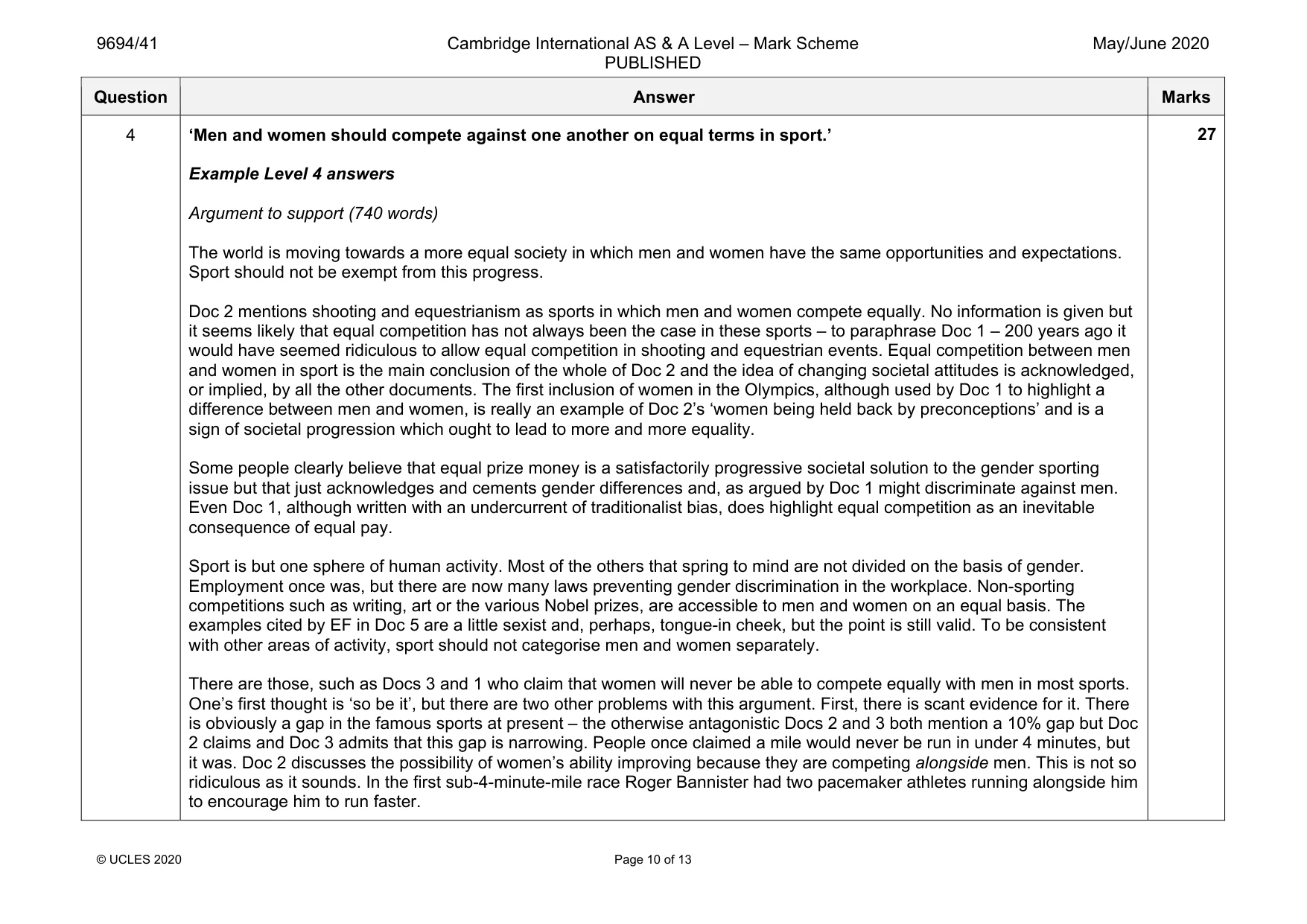
9694/41 Cambridge International AS & A Level – Mark Scheme PUBLISHED May/June 2020 © UCLES 2020 Page 10 of 13 Question Answer Marks 4 ‘Men and women should compete against one another on equal terms in sport.’ Example Level 4 answers Argument to support (740 words) The world is moving towards a more equal society in which men and women have the same opportunities and expectations. Sport should not be exempt from this progress. Doc 2 mentions shooting and equestrianism as sports in which men and women compete equally. No information is given but it seems likely that equal competition has not always been the case in these sports – to paraphrase Doc 1 – 200 years ago it would have seemed ridiculous to allow equal competition in shooting and equestrian events. Equal competition between men and women in sport is the main conclusion of the whole of Doc 2 and the idea of changing societal attitudes is acknowledged, or implied, by all the other documents. The first inclusion of women in the Olympics, although used by Doc 1 to highlight a difference between men and women, is really an example of Doc 2’s ‘women being held back by preconceptions’ and is a sign of societal progression which ought to lead to more and more equality. Some people clearly believe that equal prize money is a satisfactorily progressive societal solution to the gender sporting issue but that just acknowledges and cements gender differences and, as argued by Doc 1 might discriminate against men. Even Doc 1, although written with an undercurrent of traditionalist bias, does highlight equal competition as an inevitable consequence of equal pay. Sport is but one sphere of human activity. Most of the others that spring to mind are not divided on the basis of gender. Employment once was, but there are now many laws preventing gender discrimination in the workplace. Non-sporting competitions such as writing, art or the various Nobel prizes, are accessible to men and women on an equal basis. The examples cited by EF in Doc 5 are a little sexist and, perhaps, tongue-in cheek, but the point is still valid. To be consistent with other areas of activity, sport should not categorise men and women separately. There are those, such as Docs 3 and 1 who claim that women will never be able to compete equally with men in most sports. One’s first thought is ‘so be it’, but there are two other problems with this argument. First, there is scant evidence for it. There is obviously a gap in the famous sports at present – the otherwise antagonistic Docs 2 and 3 both mention a 10% gap but Doc 2 claims and Doc 3 admits that this gap is narrowing. People once claimed a mile would never be run in under 4 minutes, but it was. Doc 2 discusses the possibility of women’s ability improving because they are competing alongside men. This is not so ridiculous as it sounds. In the first sub-4-minute-mile race Roger Bannister had two pacemaker athletes running alongside him to encourage him to run faster. 27
Mark scheme, page 11
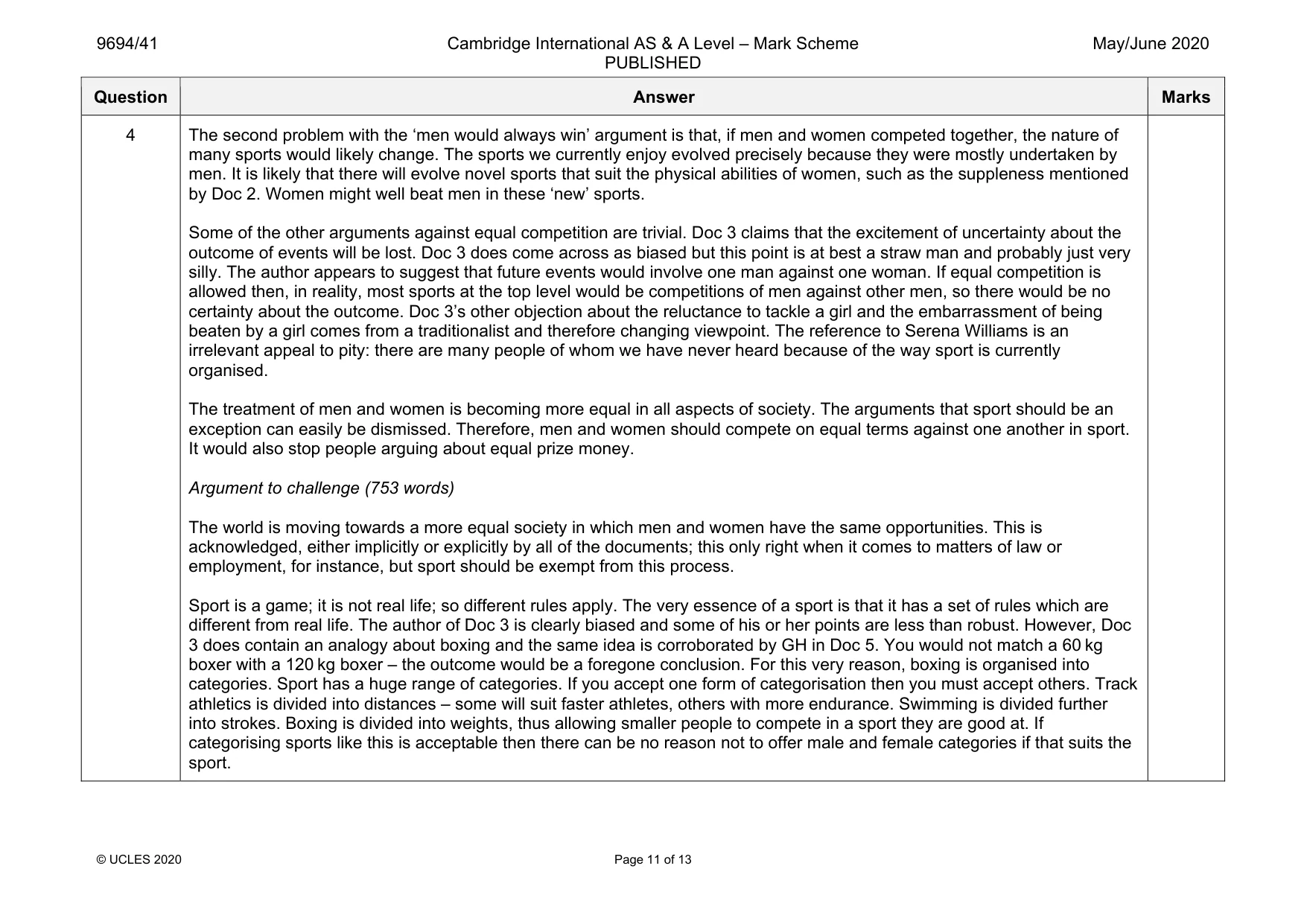
9694/41 Cambridge International AS & A Level – Mark Scheme PUBLISHED May/June 2020 © UCLES 2020 Page 11 of 13 Question Answer Marks 4 The second problem with the ‘men would always win’ argument is that, if men and women competed together, the nature of many sports would likely change. The sports we currently enjoy evolved precisely because they were mostly undertaken by men. It is likely that there will evolve novel sports that suit the physical abilities of women, such as the suppleness mentioned by Doc 2. Women might well beat men in these ‘new’ sports. Some of the other arguments against equal competition are trivial. Doc 3 claims that the excitement of uncertainty about the outcome of events will be lost. Doc 3 does come across as biased but this point is at best a straw man and probably just very silly. The author appears to suggest that future events would involve one man against one woman. If equal competition is allowed then, in reality, most sports at the top level would be competitions of men against other men, so there would be no certainty about the outcome. Doc 3’s other objection about the reluctance to tackle a girl and the embarrassment of being beaten by a girl comes from a traditionalist and therefore changing viewpoint. The reference to Serena Williams is an irrelevant appeal to pity: there are many people of whom we have never heard because of the way sport is currently organised. The treatment of men and women is becoming more equal in all aspects of society. The arguments that sport should be an exception can easily be dismissed. Therefore, men and women should compete on equal terms against one another in sport. It would also stop people arguing about equal prize money. Argument to challenge (753 words) The world is moving towards a more equal society in which men and women have the same opportunities. This is acknowledged, either implicitly or explicitly by all of the documents; this only right when it comes to matters of law or employment, for instance, but sport should be exempt from this process. Sport is a game; it is not real life; so different rules apply. The very essence of a sport is that it has a set of rules which are different from real life. The author of Doc 3 is clearly biased and some of his or her points are less than robust. However, Doc 3 does contain an analogy about boxing and the same idea is corroborated by GH in Doc 5. You would not match a 60 kg boxer with a 120 kg boxer – the outcome would be a foregone conclusion. For this very reason, boxing is organised into categories. Sport has a huge range of categories. If you accept one form of categorisation then you must accept others. Track athletics is divided into distances – some will suit faster athletes, others with more endurance. Swimming is divided further into strokes. Boxing is divided into weights, thus allowing smaller people to compete in a sport they are good at. If categorising sports like this is acceptable then there can be no reason not to offer male and female categories if that suits the sport.
Mark scheme, page 12
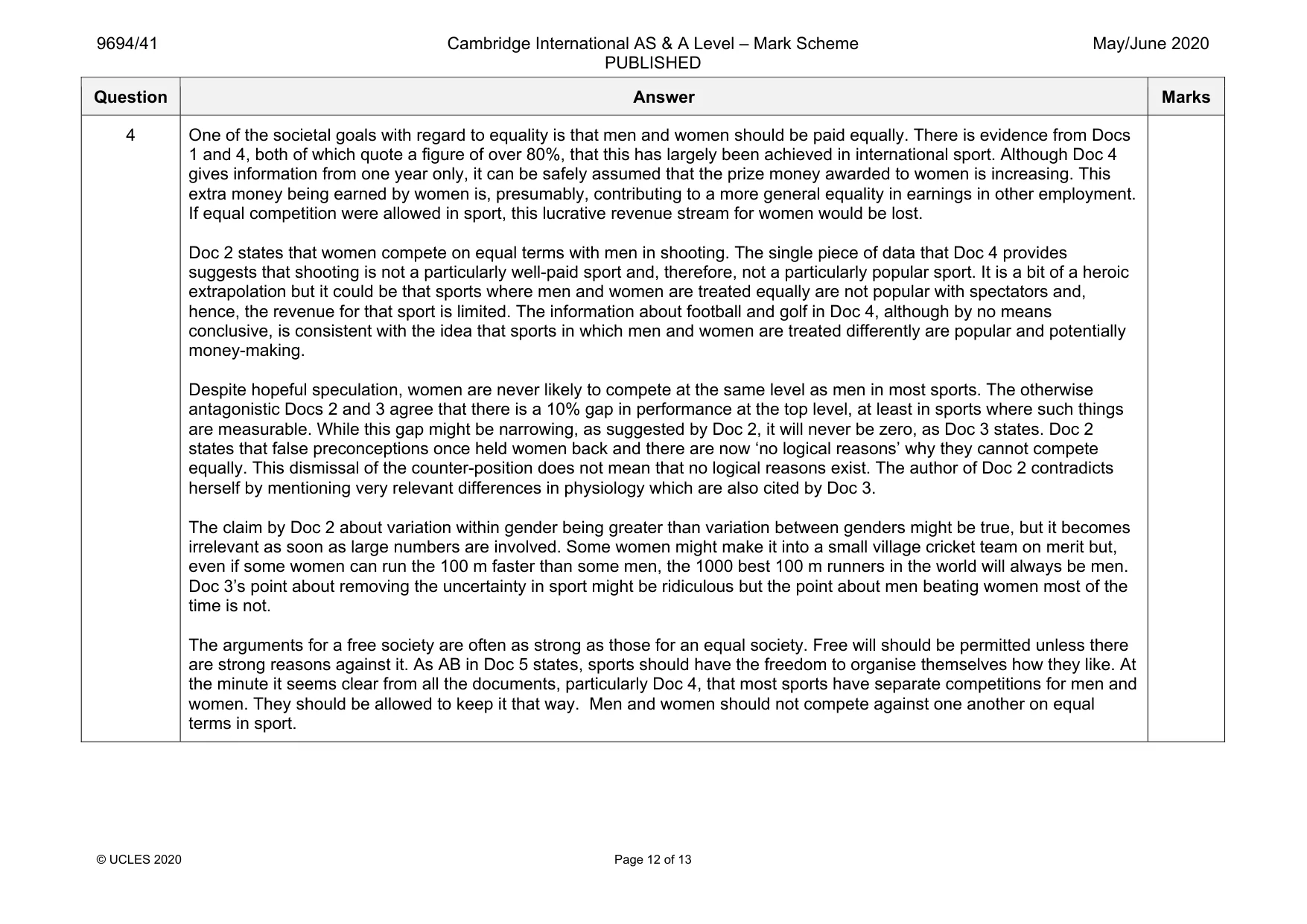
9694/41 Cambridge International AS & A Level – Mark Scheme PUBLISHED May/June 2020 © UCLES 2020 Page 12 of 13 Question Answer Marks 4 One of the societal goals with regard to equality is that men and women should be paid equally. There is evidence from Docs 1 and 4, both of which quote a figure of over 80%, that this has largely been achieved in international sport. Although Doc 4 gives information from one year only, it can be safely assumed that the prize money awarded to women is increasing. This extra money being earned by women is, presumably, contributing to a more general equality in earnings in other employment. If equal competition were allowed in sport, this lucrative revenue stream for women would be lost. Doc 2 states that women compete on equal terms with men in shooting. The single piece of data that Doc 4 provides suggests that shooting is not a particularly well-paid sport and, therefore, not a particularly popular sport. It is a bit of a heroic extrapolation but it could be that sports where men and women are treated equally are not popular with spectators and, hence, the revenue for that sport is limited. The information about football and golf in Doc 4, although by no means conclusive, is consistent with the idea that sports in which men and women are treated differently are popular and potentially money-making. Despite hopeful speculation, women are never likely to compete at the same level as men in most sports. The otherwise antagonistic Docs 2 and 3 agree that there is a 10% gap in performance at the top level, at least in sports where such things are measurable. While this gap might be narrowing, as suggested by Doc 2, it will never be zero, as Doc 3 states. Doc 2 states that false preconceptions once held women back and there are now ‘no logical reasons’ why they cannot compete equally. This dismissal of the counter-position does not mean that no logical reasons exist. The author of Doc 2 contradicts herself by mentioning very relevant differences in physiology which are also cited by Doc 3. The claim by Doc 2 about variation within gender being greater than variation between genders might be true, but it becomes irrelevant as soon as large numbers are involved. Some women might make it into a small village cricket team on merit but, even if some women can run the 100 m faster than some men, the 1000 best 100 m runners in the world will always be men. Doc 3’s point about removing the uncertainty in sport might be ridiculous but the point about men beating women most of the time is not. The arguments for a free society are often as strong as those for an equal society. Free will should be permitted unless there are strong reasons against it. As AB in Doc 5 states, sports should have the freedom to organise themselves how they like. At the minute it seems clear from all the documents, particularly Doc 4, that most sports have separate competitions for men and women. They should be allowed to keep it that way. Men and women should not compete against one another on equal terms in sport.
Mark scheme, page 13
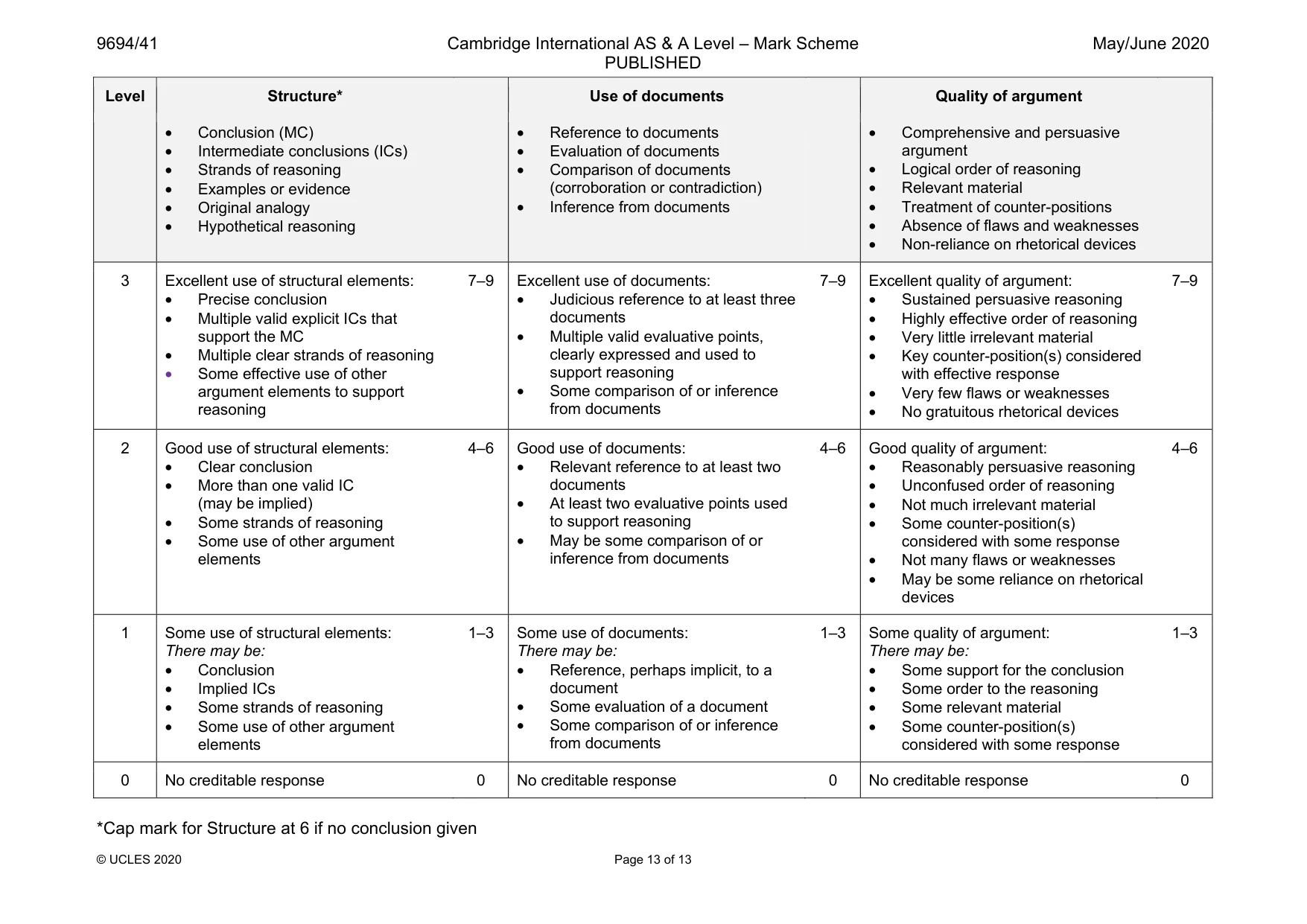
9694/41 Cambridge International AS & A Level – Mark Scheme PUBLISHED May/June 2020 © UCLES 2020 Page 13 of 13 Level Structure* Use of documents Quality of argument • Conclusion (MC) • Intermediate conclusions (ICs) • Strands of reasoning • Examples or evidence • Original analogy • Hypothetical reasoning • Reference to documents • Evaluation of documents • Comparison of documents (corroboration or contradiction) • Inference from documents • Comprehensive and persuasive argument • Logical order of reasoning • Relevant material • Treatment of counter-positions • Absence of flaws and weaknesses • Non-reliance on rhetorical devices 3 Excellent use of structural elements: • Precise conclusion • Multiple valid explicit ICs that support the MC • Multiple clear strands of reasoning • Some effective use of other argument elements to support reasoning 7–9 Excellent use of documents: • Judicious reference to at least three documents • Multiple valid evaluative points, clearly expressed and used to support reasoning • Some comparison of or inference from documents 7–9 Excellent quality of argument: • Sustained persuasive reasoning • Highly effective order of reasoning • Very little irrelevant material • Key counter-position(s) considered with effective response • Very few flaws or weaknesses • No gratuitous rhetorical devices 7–9 2 Good use of structural elements: • Clear conclusion • More than one valid IC (may be implied) • Some strands of reasoning • Some use of other argument elements 4–6 Good use of documents: • Relevant reference to at least two documents • At least two evaluative points used to support reasoning • May be some comparison of or inference from documents 4–6 Good quality of argument: • Reasonably persuasive reasoning • Unconfused order of reasoning • Not much irrelevant material • Some counter-position(s) considered with some response • Not many flaws or weaknesses • May be some reliance on rhetorical devices 4–6 1 Some use of structural elements: There may be: • Conclusion • Implied ICs • Some strands of reasoning • Some use of other argument elements 1–3 Some use of documents: There may be: • Reference, perhaps implicit, to a document • Some evaluation of a document • Some comparison of or inference from documents 1–3 Some quality of argument: There may be: • Some support for the conclusion • Some order to the reasoning • Some relevant material • Some counter-position(s) considered with some response 1–3 0 No creditable response 0 No creditable response 0 No creditable response 0 *Cap mark for Structure at 6 if no conclusion given