Cambridge A Level Thinking Skills 9694 — 2019 May/June Paper 4 · Variant 3
9694/43/M/J/19 · 50 marks · ≈56 min
The question paper and its mark scheme, free to read here and free to download. This is Cambridge’s own paper, exactly as it was sat.
Question paper8 pages
Mark scheme13 pages
Answers below. Sit the paper first if you are practising.
Paper as text
Question paper, page 1
This document consists of 7 printed pages, 1 blank page and 1 Insert. DC (RW) 178929 © UCLES 2019 [Turn over Cambridge Assessment International Education Cambridge International Advanced Subsidiary and Advanced Level * 4 5 2 5 0 3 9 6 7 8 * THINKING SKILLS 9694/43 Paper 4 Applied Reasoning May/June 2019 1 hour 30 minutes No Additional Materials are required. READ THESE INSTRUCTIONS FIRST An answer booklet is provided inside this question paper. You should follow the instructions on the front cover of the answer booklet. If you need additional answer paper ask the invigilator for a continuation booklet. Answer all the questions. The number of marks is given in brackets [ ] at the end of each question.
Question paper, page 2
2 9694/43/M/J/19 © UCLES 2019 1 Study the information below and answer the question that follows. Worrying increase in depression Depression was once rarely discussed in public. However, a recent publicity campaign involving celebrities who have suffered from the condition has brought the topic of this, and other mental health issues, out into the open. It has traditionally been difficult to collect hard data about the number of people suffering with depression but one recent, large-scale study has attempted to do just that. There are a number of treatments for depression but some of these, such as talking therapy, are difficult to measure accurately. It is much easier to collect data on sales of particular drugs. SSRIs are the modern drug of choice to treat the symptoms of depression, as well as a range of other mental health conditions. The study has shown that in the years 2013 to 2016 there was a 30% increase in sales of SSRIs. Over the same time period there was no similar increase in sales of medicinal drugs for other illnesses, e.g. heart conditions. This clear increase in the number of people suffering from depression means we can expect a doubling in the number of sufferers over 10 years. Make five criticisms of the statistics in the passage or any inferences that have been drawn from them. [5] Questions 2, 3 and 4 refer to Documents 1 to 5. 2 Briefly analyse the argument in Document 1: What should we think about GM foods? by identifying its main conclusion, intermediate conclusions and any counter-assertions. [6] 3 Give a critical evaluation of the strength of the argument in Document 1: What should we think about GM foods? by identifying and explaining any flaws, implicit assumptions and other weaknesses. [9] 4 ‘We should encourage the development of GM foods.’ Construct a reasoned argument to support or challenge this claim. In your answer you should make critical use of the documents provided. [30]
Question paper, page 3
3 9694/43/M/J/19 © UCLES 2019 [Turn over DOCUMENT 1 What should we think about GM foods? Much of our food now contains organisms that have been genetically modified (GMOs) and the proportion is increasing. The manufacturers of these foods tell us we should not be concerned but it is clear that in growing and consuming these foods we are taking a big and unnecessary risk. Tobacco companies once claimed that smoking was good for you, so we can dismiss claims by GM food companies that their products are harmless. High school science tells us that genes code for proteins, and proteins are what people with allergies are allergic to. Soya beans with ‘extra’ genes from a brazil nut contain nut proteins. In tests, people with nut allergies went into shock after eating these soya beans. Fears have also been raised over possible links to other disorders. The more GM foods we produce, the greater the possibility of a risk to health. Furthermore, the actual process of genetic modification involves creating bacteria that are resistant to antibiotics – if these escaped it could prove disastrous for the spread of disease. GM foods pose a serious risk to the environment. Many GM crops contain genes that make them resistant to herbicides. Cross-pollination of GM seeds with wild varieties would pollute the gene pool and create super-weeds that might out-compete wild species and domestic crops. Furthermore, GM growers tend to plant fewer varieties of crop, increasing the risk that a disease could wipe out a greater proportion of the food supply, with devastating effects. Also, fewer crop varieties means fewer species that can feed on the crops. So animals further up the food chain become endangered. A scientific study in the US showed that GM food crops greatly reduced butterfly populations. We should be suspicious of any safety claims originating from scientists about GM foods. The problem with scientifically testing the impact of these foods is that the checking of scientific test results by fellow scientists, known as ‘peer review’, is hindered by the unwillingness of the companies that produce GMOs to present all their data to be scrutinised. Safety claims usually come directly from the biotechnology companies or from government agencies that are heavily influenced by a powerful industry lobby. I have not yet seen any unbiased findings showing that GM crops are safe. To date there have been only a little over 500 field trials of GMOs in the US, but on this basis the US Department of Agriculture (USDA) concluded that there were no concerns regarding safety. However, many reports failed to mention or even measure any associated environmental risks and the Union of Concerned Scientists believes that the USDA’s evaluation was based on too little data. A recent study in Europe showed that many of the promises given by GM food companies were false. It is often said that GM foods are needed to feed an increasing human population, but people go hungry because of issues other than food production. There are food distribution problems, for example due to war; there is the growing of cash crops rather than food staples to pay off the national debt, and there is desertification. One scientist advising the UK government has said, ‘Today the amount of food available per person has never been higher’. Finally, genetic modification is unnatural. Natural food tastes better and is better for you. Research has shown that consumers got more pleasure from eating food they believed to be organic or ethically produced.
Question paper, page 4
4 9694/43/M/J/19 © UCLES 2019 DOCUMENT 2 The GMO debate is over Genetic modification allows foods to grow more quickly, have a better flavour or texture, contain useful vitamins or minerals or be resistant to weeds or animal pests. In short, the list of potential benefits is enormous. It might surprise you to learn, however, that a US-based poll in 2015 found that only 37% of the public thought GM foods were safe, compared to 88% of scientists. Are these stats about to change? The most comprehensive and detailed report ever produced by the scientific community on genetically engineered food and crops was released recently. The committee’s findings were clear: after examining hundreds of scientific papers and hours of live testimony, the report found no substantiated evidence that GM foods were less safe than traditional, non-GM foods. The scientists even considered comments from members of the public, however ludicrous, and engaged with them carefully as constructive challenges. For example, the committee listened to Greenpeace, to a self-styled anti-GMO activist who stated that genetically engineered foods cause just about every imaginable modern ailment, and to a French scientist, Professor Seralini, who was once professionally humiliated by having to retract his paper claiming rats that had been fed GMOs suffered from an increase in tumours. The committee considered claims about a long list of health issues. GM foods are relatively common in the US but almost non-existent in the UK, largely because of a scare campaign run by a handful of influential newspapers. Thus it is possible to use comparisons between these two countries to examine potential GM effects. Patterns of changing cancer incidence over time are similar in both places; the same goes for coeliac disease and autism. US rates of kidney disease have not changed since GM foods were introduced. There is no published evidence to support a link between GM foods and obesity or diabetes. Interestingly, the committee did not even find a relationship between consumption of GM foods and the well documented increase in food allergies. So, will public suspicion of GM foods disappear and allow us to spend time looking for the real causes of these diseases? Probably not. Psychological associations developed over many years are difficult to break. Furthermore, these attitudes are continually reinforced by a vocal and well-funded anti-GM lobby. Perhaps even more worrying is how much this report undermines the reputation of major environmental groups. Some have begun to exhibit the type of science-denial they have been campaigning against with regard to climate change. Friends of the Earth’s website claims that numerous studies show GM foods can pose serious risks to health. A spokeswoman from the group described the report as ‘deceptive’ without reading it. Food and Water Watch issued a rebuttal before the report was published, claiming there was no scientific consensus and accusing the report’s authors of having links to GM-food-producing giant Monsanto. Ironically, many of the tactics these groups use against GM foods mimic those used by the anti-climate-change lobby. Demonstrably false statements about a lack of scientific consensus abound on both issues. In reality there is no need for the general public to worry about this issue as it is being policed by science itself. The report points out that the overuse of GM crops has led to the evolution of herbicide and insecticide resistance. Domination of GM technology by big business might, indeed, restrict access to improved seeds by small farmers from poor countries. But there is no debate about the safety of consuming GM foods. That issue has been resolved. If you accept that climate change is real, you need to stop being scared of genetically modified foods. Science writer
Question paper, page 5
5 9694/43/M/J/19 © UCLES 2019 [Turn over DOCUMENT 3 If GM foods can do this to rats, what can they do to humans? A controversial study by scientists has shown that rats fed a diet of genetically modified corn suffered tumours along with liver and kidney damage. The team from Caen University in France released shocking images of tumours in rats caused by exclusively eating GM corn for their entire lives. The study – led by molecular biologist Professor Gilles-Eric Seralini, a leading critic of GM technology – has been peer-reviewed by independent scientists to guarantee the results are valid. It was published in US journal Food and Chemical Toxicology. It is the first to look at the impact of eating a GM diet over the entire two-year lifetime of a rat. Some rats were fed GM corn, others GM corn sprayed with weed-killer, and a control group fed a ‘clean’ diet of unadulterated corn. The GM corn was genetically modified to withstand spraying with a weed-killer. The scientists found that • Up to 70% of females in the GM group died prematurely compared with only 20% in the control group • 50–80% of female rats developed large tumours after 23 months compared to only 30% of the control rats • Large tumours appeared in females after seven months, compared to 14 months in the control group. This newspaper’s food safety campaign has long sought to expose problems with the lack of rigorous safety tests for GM food products. Scientists said the results raised serious questions about the safety of GM foods and the assurances offered by biotech companies and governments. An expert on GM foods from King’s College, London, said, ‘I am shocked by the extreme negative health impacts.’ The research has been criticised as being of ‘no value’ by some other scientists. A professor of cell biology at Edinburgh University has questioned the way the research was conducted, saying the number of rats involved in the study was too small to allow any meaningful conclusions to be drawn. ‘It looks to me like random variation in a rodent likely to develop tumours anyway,’ he said. Report on a newspaper website
Question paper, page 6
6 9694/43/M/J/19 © UCLES 2019 DOCUMENT 4 GM Weed needs Agent Orange to kill it Super-weeds created by farming GM crops are so virulent in the US that they can be killed only by flame-throwers and a chemical used during the Vietnam War. For years now, US farmers have been growing millions of hectares of genetically modified corn and soya. The crops have been genetically modified to withstand a weed-killer developed by a US GM food company. The idea is that the weed-killer can be sprayed on the fields and it will kill weeds but leave the GM crops unharmed. However, a number of problem weeds, including giant ragweed, have developed resistance to the weed-killer. Farmers are now having to use flame-throwers and a chemical called 2,4-D which was a key ingredient in Agent Orange, the defoliant used to strip the leaves from Vietnamese jungles by the US army in the 1970s. The 2,4-D will be used along with a new 2,4-D-resistant GM crop. The US government has declared the chemical safe but not everyone is convinced. A local farmer said, ‘If people understood the chemicals we use, they would want us to use something different’. Newspaper report
Question paper, page 7
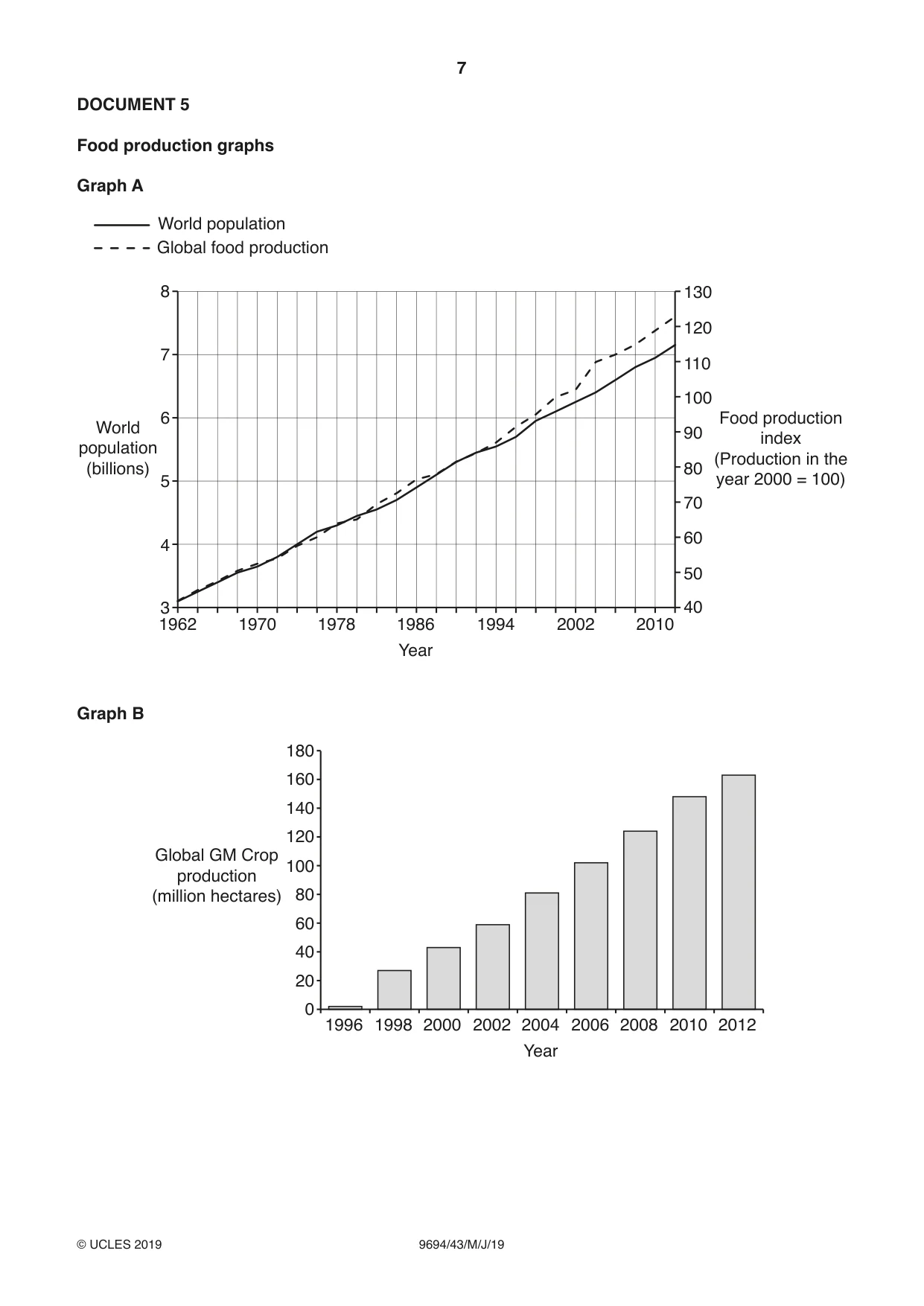
7 9694/43/M/J/19 © UCLES 2019 DOCUMENT 5 Food production graphs Graph A 8 7 6 World population (billions) World population Global food production 5 4 40 50 60 70 80 90 Food production index (Production in the year 2000 = 100) 100 110 120 130 3 1962 1970 1978 1986 Year 1994 2002 2010 Graph B 180 160 140 120 100 80 60 40 20 1996 1998 2000 2002 2004 Year Global GM Crop production (million hectares) 2006 2008 2010 2012 0
Question paper, page 8
8 9694/43/M/J/19 © UCLES 2019 Permission to reproduce items where third-party owned material protected by copyright is included has been sought and cleared where possible. Every reasonable effort has been made by the publisher (UCLES) to trace copyright holders, but if any items requiring clearance have unwittingly been included, the publisher will be pleased to make amends at the earliest possible opportunity. To avoid the issue of disclosure of answer-related information to candidates, all copyright acknowledgements are reproduced online in the Cambridge Assessment International Education Copyright Acknowledgements Booklet. This is produced for each series of examinations and is freely available to download at www.cambridgeinternational.org after the live examination series. Cambridge Assessment International Education is part of the Cambridge Assessment Group. Cambridge Assessment is the brand name of the University of Cambridge Local Examinations Syndicate (UCLES), which itself is a department of the University of Cambridge. BLANK PAGE
Mark scheme, page 1
This document consists of 13 printed pages. © UCLES 2019 [Turn over Cambridge Assessment International Education Cambridge International Advanced Subsidiary and Advanced Level THINKING SKILLS 9694/43 Paper 4 Applied Reasoning May/June 2019 MARK SCHEME Maximum Mark: 50 Published This mark scheme is published as an aid to teachers and candidates, to indicate the requirements of the examination. It shows the basis on which Examiners were instructed to award marks. It does not indicate the details of the discussions that took place at an Examiners’ meeting before marking began, which would have considered the acceptability of alternative answers. Mark schemes should be read in conjunction with the question paper and the Principal Examiner Report for Teachers. Cambridge International will not enter into discussions about these mark schemes. Cambridge International is publishing the mark schemes for the May/June 2019 series for most Cambridge IGCSE™, Cambridge International A and AS Level and Cambridge Pre-U components, and some Cambridge O Level components.
Mark scheme, page 2
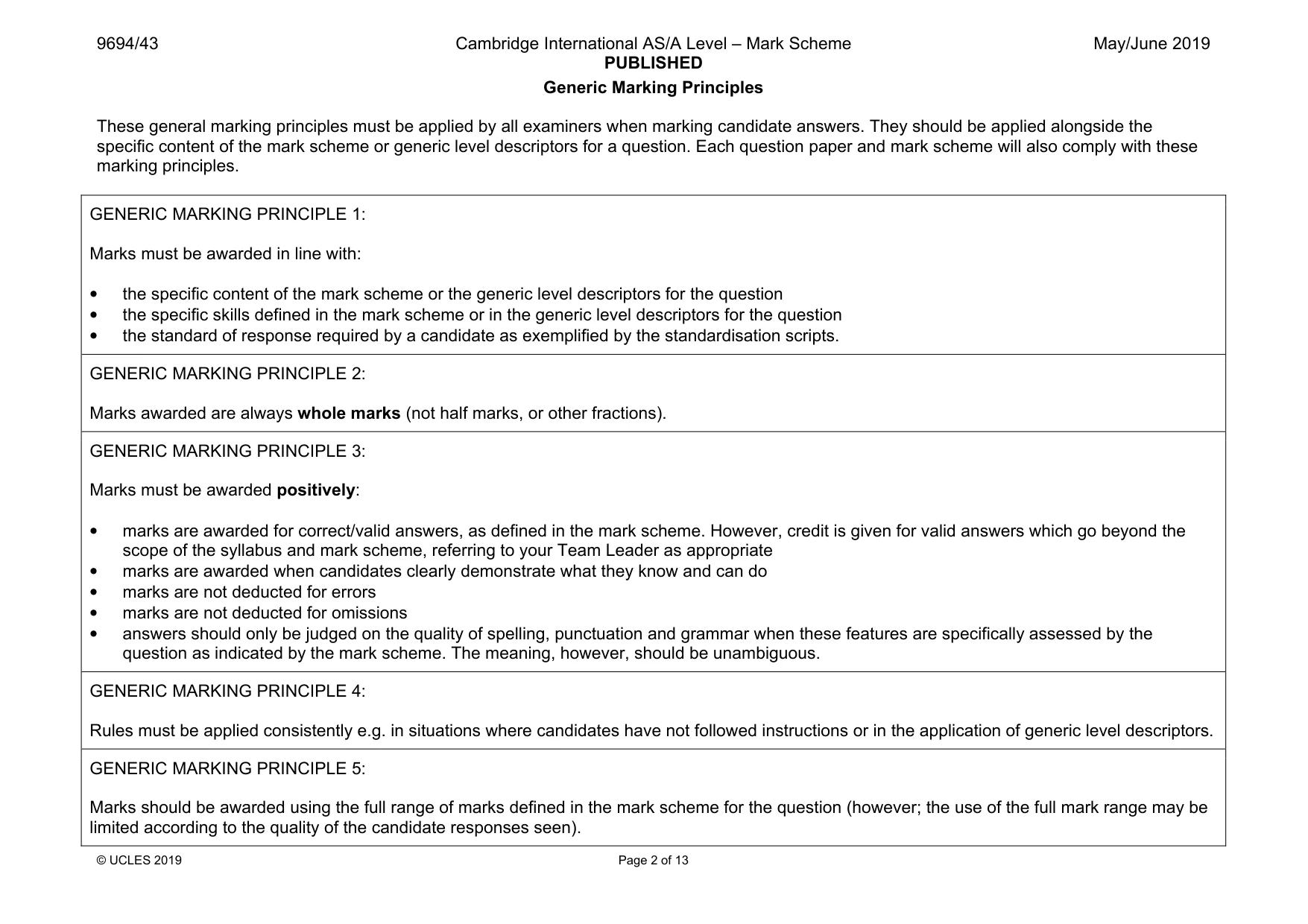
9694/43 Cambridge International AS/A Level – Mark Scheme PUBLISHED May/June 2019 © UCLES 2019 Page 2 of 13 Generic Marking Principles These general marking principles must be applied by all examiners when marking candidate answers. They should be applied alongside the specific content of the mark scheme or generic level descriptors for a question. Each question paper and mark scheme will also comply with these marking principles. GENERIC MARKING PRINCIPLE 1: Marks must be awarded in line with: • the specific content of the mark scheme or the generic level descriptors for the question • the specific skills defined in the mark scheme or in the generic level descriptors for the question • the standard of response required by a candidate as exemplified by the standardisation scripts. GENERIC MARKING PRINCIPLE 2: Marks awarded are always whole marks (not half marks, or other fractions). GENERIC MARKING PRINCIPLE 3: Marks must be awarded positively: • marks are awarded for correct/valid answers, as defined in the mark scheme. However, credit is given for valid answers which go beyond the scope of the syllabus and mark scheme, referring to your Team Leader as appropriate • marks are awarded when candidates clearly demonstrate what they know and can do • marks are not deducted for errors • marks are not deducted for omissions • answers should only be judged on the quality of spelling, punctuation and grammar when these features are specifically assessed by the question as indicated by the mark scheme. The meaning, however, should be unambiguous. GENERIC MARKING PRINCIPLE 4: Rules must be applied consistently e.g. in situations where candidates have not followed instructions or in the application of generic level descriptors. GENERIC MARKING PRINCIPLE 5: Marks should be awarded using the full range of marks defined in the mark scheme for the question (however; the use of the full mark range may be limited according to the quality of the candidate responses seen).
Mark scheme, page 3
9694/43 Cambridge International AS/A Level – Mark Scheme PUBLISHED May/June 2019 © UCLES 2019 Page 3 of 13 GENERIC MARKING PRINCIPLE 6: Marks awarded are based solely on the requirements as defined in the mark scheme. Marks should not be awarded with grade thresholds or grade descriptors in mind.
Mark scheme, page 4
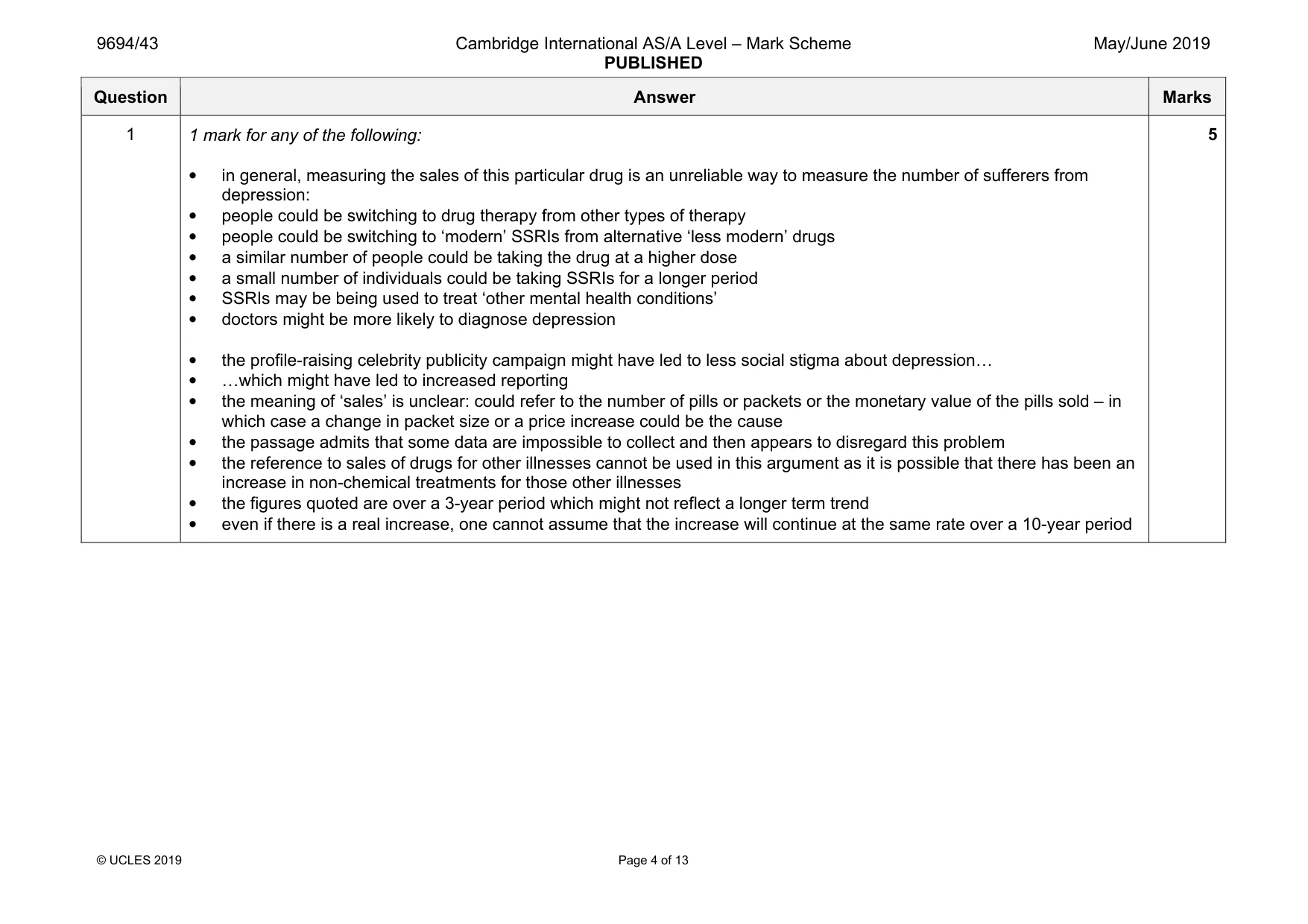
9694/43 Cambridge International AS/A Level – Mark Scheme PUBLISHED May/June 2019 © UCLES 2019 Page 4 of 13 Question Answer Marks 1 1 mark for any of the following: • in general, measuring the sales of this particular drug is an unreliable way to measure the number of sufferers from depression: • people could be switching to drug therapy from other types of therapy • people could be switching to ‘modern’ SSRIs from alternative ‘less modern’ drugs • a similar number of people could be taking the drug at a higher dose • a small number of individuals could be taking SSRIs for a longer period • SSRIs may be being used to treat ‘other mental health conditions’ • doctors might be more likely to diagnose depression • the profile-raising celebrity publicity campaign might have led to less social stigma about depression« • «which might have led to increased reporting • the meaning of ‘sales’ is unclear: could refer to the number of pills or packets or the monetary value of the pills sold – in which case a change in packet size or a price increase could be the cause • the passage admits that some data are impossible to collect and then appears to disregard this problem • the reference to sales of drugs for other illnesses cannot be used in this argument as it is possible that there has been an increase in non-chemical treatments for those other illnesses • the figures quoted are over a 3-year period which might not reflect a longer term trend • even if there is a real increase, one cannot assume that the increase will continue at the same rate over a 10-year period 5
Mark scheme, page 5
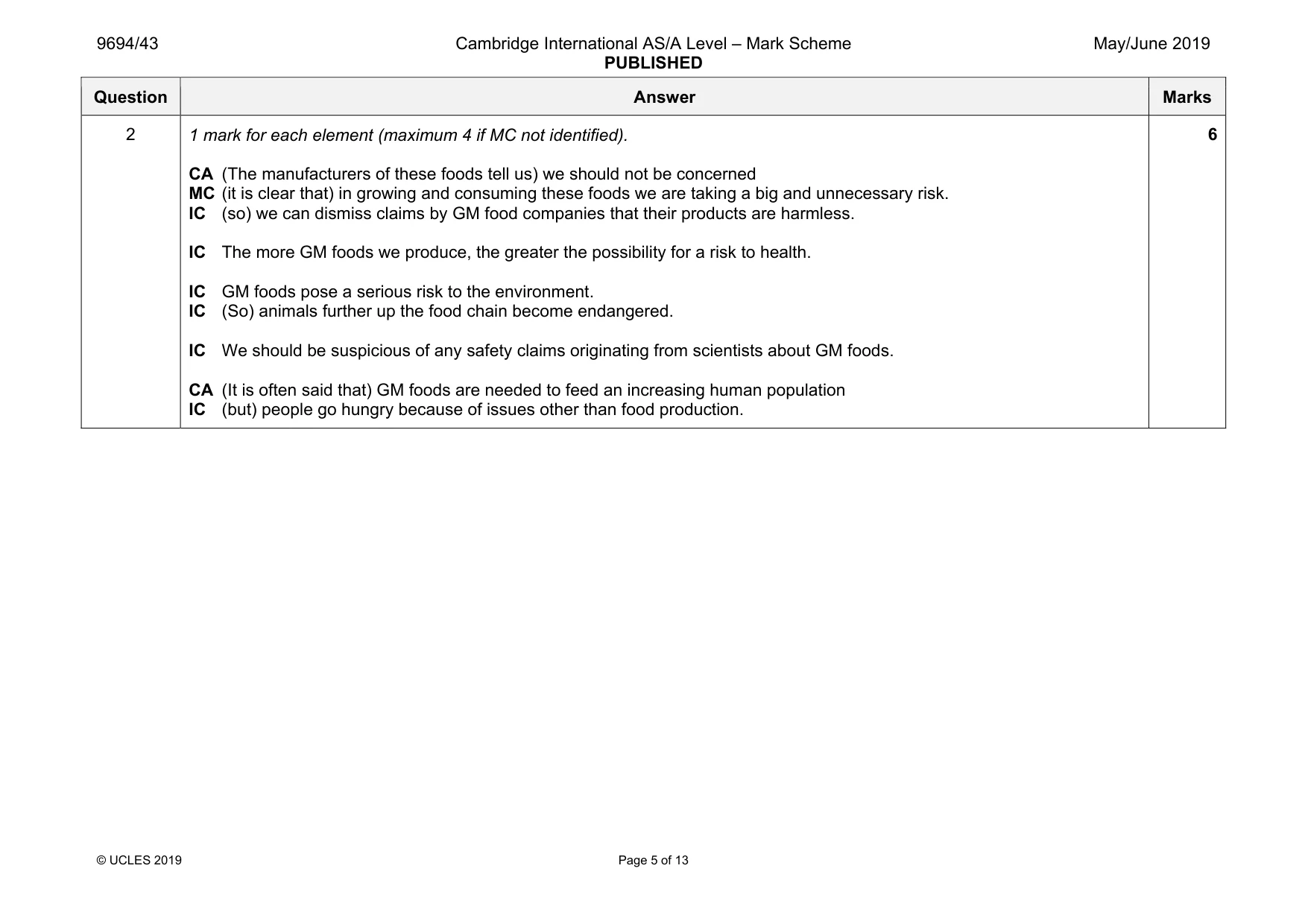
9694/43 Cambridge International AS/A Level – Mark Scheme PUBLISHED May/June 2019 © UCLES 2019 Page 5 of 13 Question Answer Marks 2 1 mark for each element (maximum 4 if MC not identified). CA (The manufacturers of these foods tell us) we should not be concerned MC (it is clear that) in growing and consuming these foods we are taking a big and unnecessary risk. IC (so) we can dismiss claims by GM food companies that their products are harmless. IC The more GM foods we produce, the greater the possibility for a risk to health. IC GM foods pose a serious risk to the environment. IC (So) animals further up the food chain become endangered. IC We should be suspicious of any safety claims originating from scientists about GM foods. CA (It is often said that) GM foods are needed to feed an increasing human population IC (but) people go hungry because of issues other than food production. 6
Mark scheme, page 6
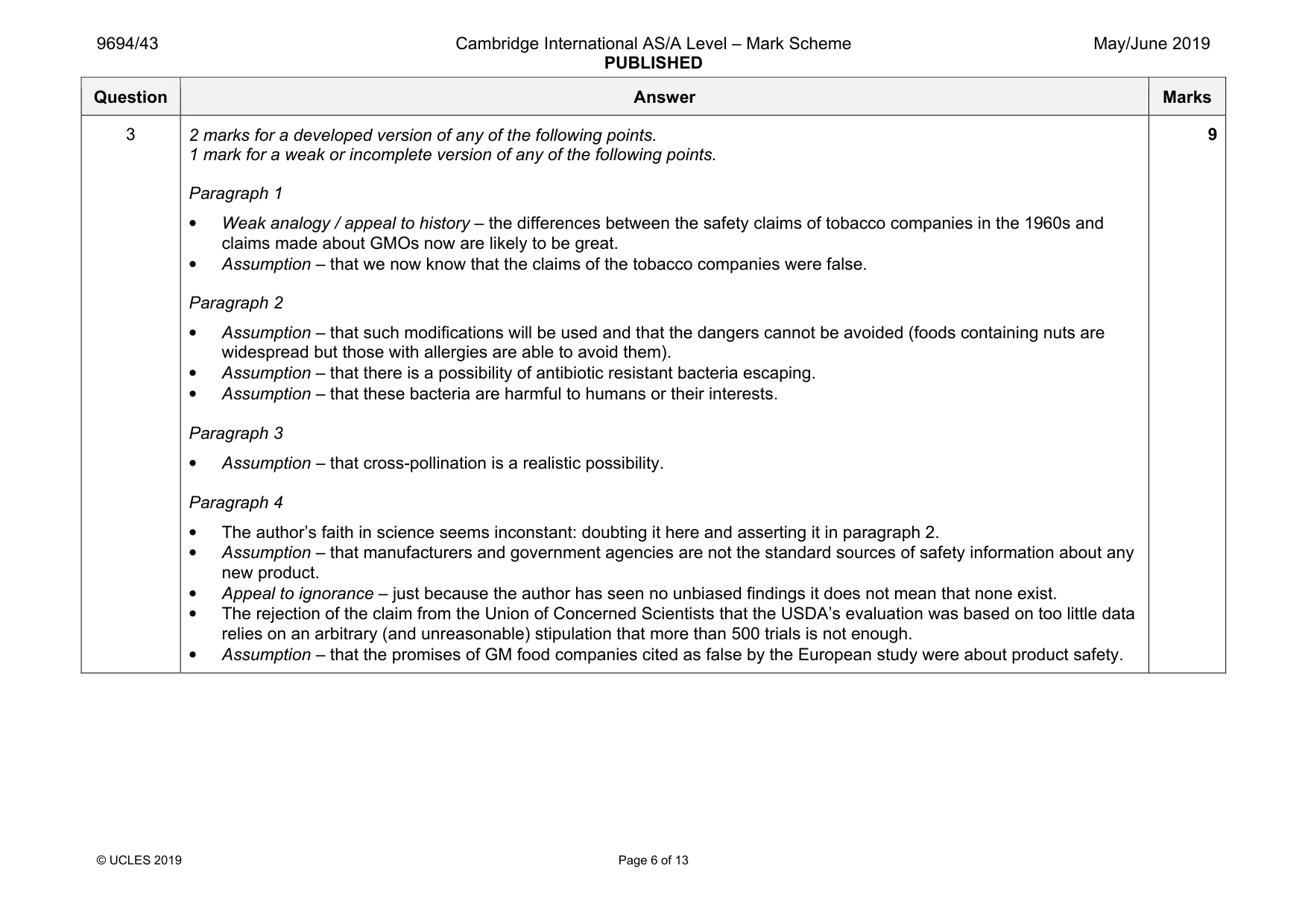
9694/43 Cambridge International AS/A Level – Mark Scheme PUBLISHED May/June 2019 © UCLES 2019 Page 6 of 13 Question Answer Marks 3 2 marks for a developed version of any of the following points. 1 mark for a weak or incomplete version of any of the following points. Paragraph 1 • Weak analogy / appeal to history – the differences between the safety claims of tobacco companies in the 1960s and claims made about GMOs now are likely to be great. • Assumption – that we now know that the claims of the tobacco companies were false. Paragraph 2 • Assumption – that such modifications will be used and that the dangers cannot be avoided (foods containing nuts are widespread but those with allergies are able to avoid them). • Assumption – that there is a possibility of antibiotic resistant bacteria escaping. • Assumption – that these bacteria are harmful to humans or their interests. Paragraph 3 • Assumption – that cross-pollination is a realistic possibility. Paragraph 4 • The author’s faith in science seems inconstant: doubting it here and asserting it in paragraph 2. • Assumption – that manufacturers and government agencies are not the standard sources of safety information about any new product. • Appeal to ignorance – just because the author has seen no unbiased findings it does not mean that none exist. • The rejection of the claim from the Union of Concerned Scientists that the USDA’s evaluation was based on too little data relies on an arbitrary (and unreasonable) stipulation that more than 500 trials is not enough. • Assumption – that the promises of GM food companies cited as false by the European study were about product safety. 9
Mark scheme, page 7
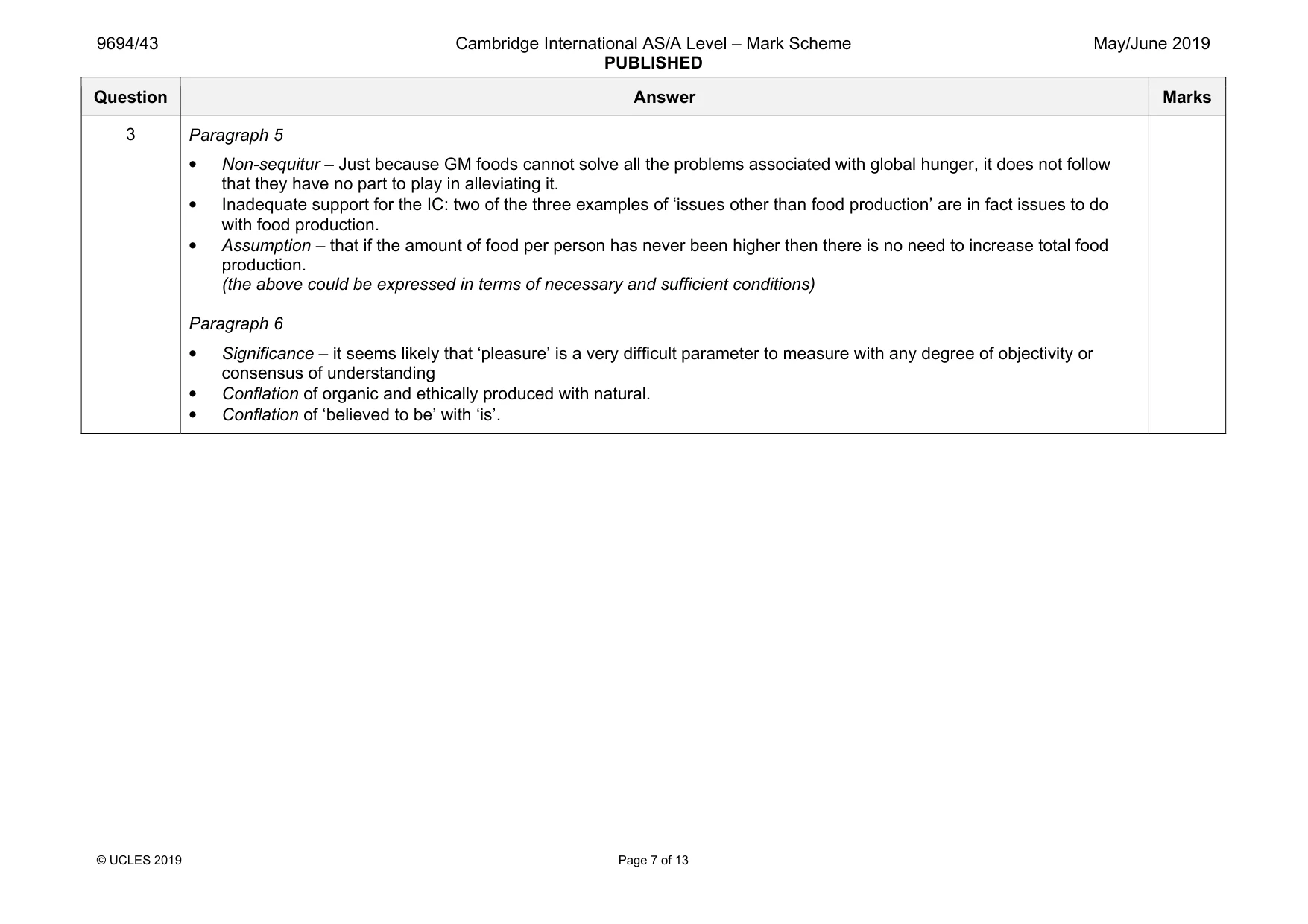
9694/43 Cambridge International AS/A Level – Mark Scheme PUBLISHED May/June 2019 © UCLES 2019 Page 7 of 13 Question Answer Marks 3 Paragraph 5 • Non-sequitur – Just because GM foods cannot solve all the problems associated with global hunger, it does not follow that they have no part to play in alleviating it. • Inadequate support for the IC: two of the three examples of ‘issues other than food production’ are in fact issues to do with food production. • Assumption – that if the amount of food per person has never been higher then there is no need to increase total food production. (the above could be expressed in terms of necessary and sufficient conditions) Paragraph 6 • Significance – it seems likely that ‘pleasure’ is a very difficult parameter to measure with any degree of objectivity or consensus of understanding • Conflation of organic and ethically produced with natural. • Conflation of ‘believed to be’ with ‘is’.
Mark scheme, page 8
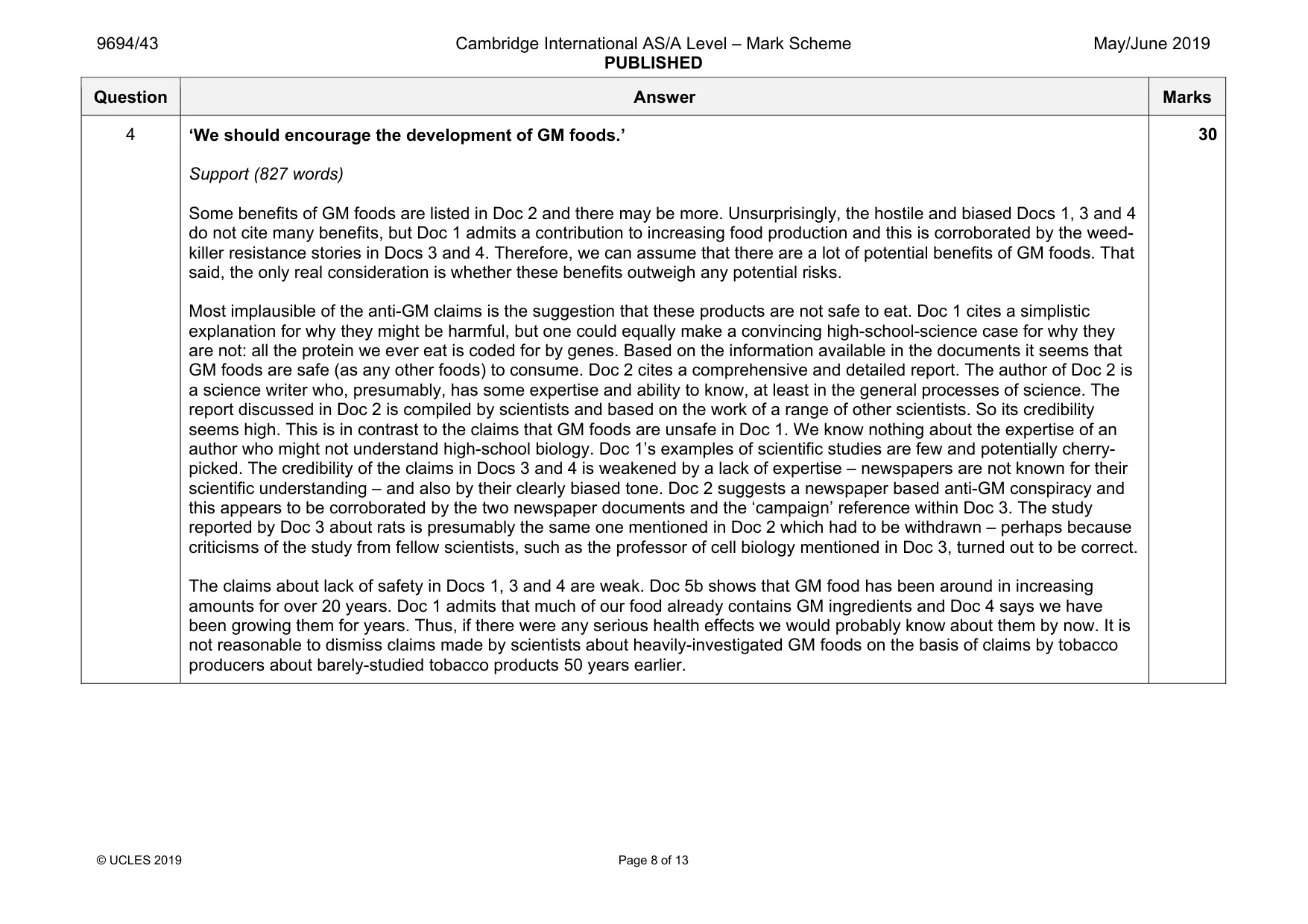
9694/43 Cambridge International AS/A Level – Mark Scheme PUBLISHED May/June 2019 © UCLES 2019 Page 8 of 13 Question Answer Marks 4 ‘We should encourage the development of GM foods.’ Support (827 words) Some benefits of GM foods are listed in Doc 2 and there may be more. Unsurprisingly, the hostile and biased Docs 1, 3 and 4 do not cite many benefits, but Doc 1 admits a contribution to increasing food production and this is corroborated by the weed- killer resistance stories in Docs 3 and 4. Therefore, we can assume that there are a lot of potential benefits of GM foods. That said, the only real consideration is whether these benefits outweigh any potential risks. Most implausible of the anti-GM claims is the suggestion that these products are not safe to eat. Doc 1 cites a simplistic explanation for why they might be harmful, but one could equally make a convincing high-school-science case for why they are not: all the protein we ever eat is coded for by genes. Based on the information available in the documents it seems that GM foods are safe (as any other foods) to consume. Doc 2 cites a comprehensive and detailed report. The author of Doc 2 is a science writer who, presumably, has some expertise and ability to know, at least in the general processes of science. The report discussed in Doc 2 is compiled by scientists and based on the work of a range of other scientists. So its credibility seems high. This is in contrast to the claims that GM foods are unsafe in Doc 1. We know nothing about the expertise of an author who might not understand high-school biology. Doc 1’s examples of scientific studies are few and potentially cherry- picked. The credibility of the claims in Docs 3 and 4 is weakened by a lack of expertise – newspapers are not known for their scientific understanding – and also by their clearly biased tone. Doc 2 suggests a newspaper based anti-GM conspiracy and this appears to be corroborated by the two newspaper documents and the ‘campaign’ reference within Doc 3. The study reported by Doc 3 about rats is presumably the same one mentioned in Doc 2 which had to be withdrawn – perhaps because criticisms of the study from fellow scientists, such as the professor of cell biology mentioned in Doc 3, turned out to be correct. The claims about lack of safety in Docs 1, 3 and 4 are weak. Doc 5b shows that GM food has been around in increasing amounts for over 20 years. Doc 1 admits that much of our food already contains GM ingredients and Doc 4 says we have been growing them for years. Thus, if there were any serious health effects we would probably know about them by now. It is not reasonable to dismiss claims made by scientists about heavily-investigated GM foods on the basis of claims by tobacco producers about barely-studied tobacco products 50 years earlier. 30
Mark scheme, page 9
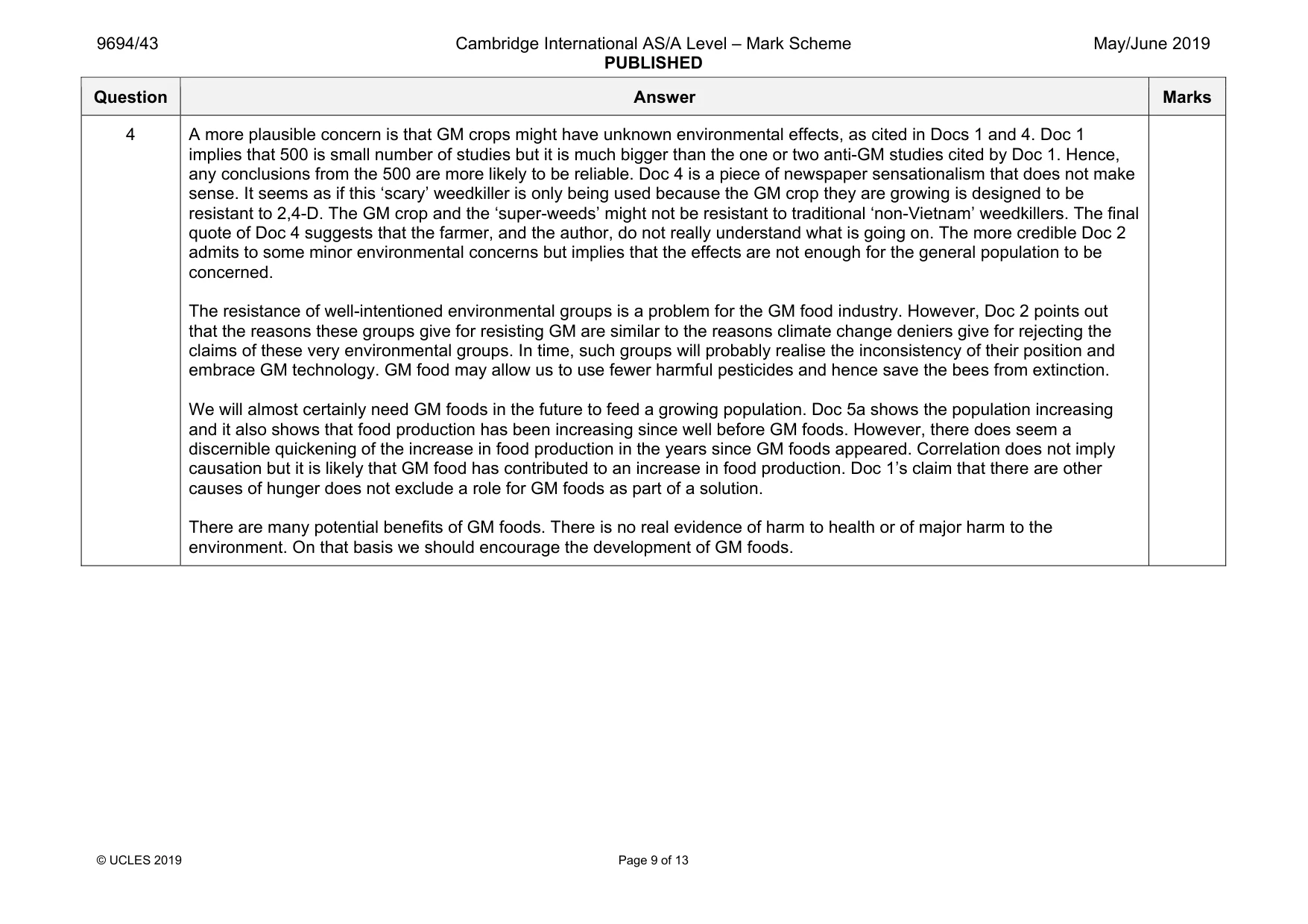
9694/43 Cambridge International AS/A Level – Mark Scheme PUBLISHED May/June 2019 © UCLES 2019 Page 9 of 13 Question Answer Marks 4 A more plausible concern is that GM crops might have unknown environmental effects, as cited in Docs 1 and 4. Doc 1 implies that 500 is small number of studies but it is much bigger than the one or two anti-GM studies cited by Doc 1. Hence, any conclusions from the 500 are more likely to be reliable. Doc 4 is a piece of newspaper sensationalism that does not make sense. It seems as if this ‘scary’ weedkiller is only being used because the GM crop they are growing is designed to be resistant to 2,4-D. The GM crop and the ‘super-weeds’ might not be resistant to traditional ‘non-Vietnam’ weedkillers. The final quote of Doc 4 suggests that the farmer, and the author, do not really understand what is going on. The more credible Doc 2 admits to some minor environmental concerns but implies that the effects are not enough for the general population to be concerned. The resistance of well-intentioned environmental groups is a problem for the GM food industry. However, Doc 2 points out that the reasons these groups give for resisting GM are similar to the reasons climate change deniers give for rejecting the claims of these very environmental groups. In time, such groups will probably realise the inconsistency of their position and embrace GM technology. GM food may allow us to use fewer harmful pesticides and hence save the bees from extinction. We will almost certainly need GM foods in the future to feed a growing population. Doc 5a shows the population increasing and it also shows that food production has been increasing since well before GM foods. However, there does seem a discernible quickening of the increase in food production in the years since GM foods appeared. Correlation does not imply causation but it is likely that GM food has contributed to an increase in food production. Doc 1’s claim that there are other causes of hunger does not exclude a role for GM foods as part of a solution. There are many potential benefits of GM foods. There is no real evidence of harm to health or of major harm to the environment. On that basis we should encourage the development of GM foods.
Mark scheme, page 10
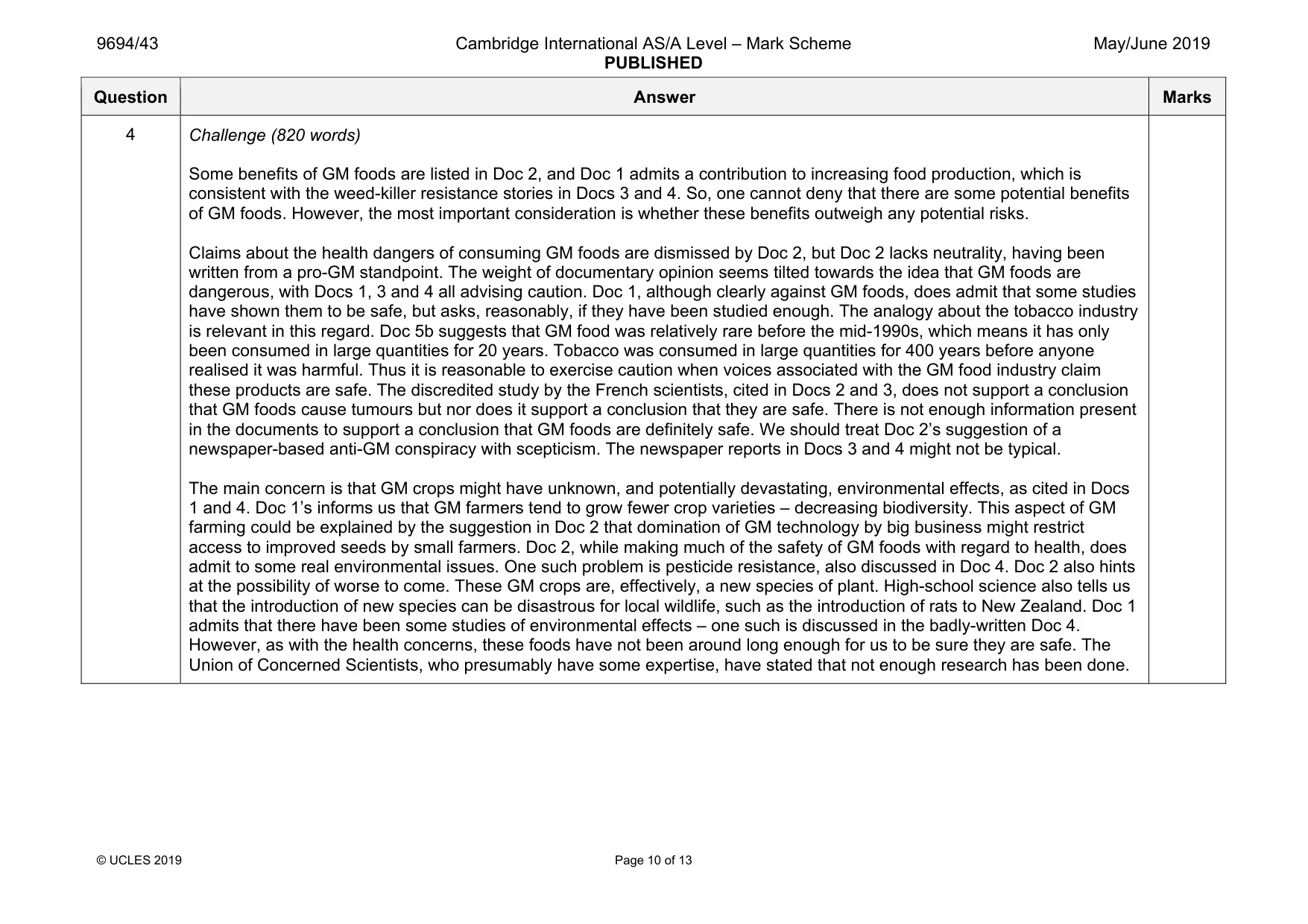
9694/43 Cambridge International AS/A Level – Mark Scheme PUBLISHED May/June 2019 © UCLES 2019 Page 10 of 13 Question Answer Marks 4 Challenge (820 words) Some benefits of GM foods are listed in Doc 2, and Doc 1 admits a contribution to increasing food production, which is consistent with the weed-killer resistance stories in Docs 3 and 4. So, one cannot deny that there are some potential benefits of GM foods. However, the most important consideration is whether these benefits outweigh any potential risks. Claims about the health dangers of consuming GM foods are dismissed by Doc 2, but Doc 2 lacks neutrality, having been written from a pro-GM standpoint. The weight of documentary opinion seems tilted towards the idea that GM foods are dangerous, with Docs 1, 3 and 4 all advising caution. Doc 1, although clearly against GM foods, does admit that some studies have shown them to be safe, but asks, reasonably, if they have been studied enough. The analogy about the tobacco industry is relevant in this regard. Doc 5b suggests that GM food was relatively rare before the mid-1990s, which means it has only been consumed in large quantities for 20 years. Tobacco was consumed in large quantities for 400 years before anyone realised it was harmful. Thus it is reasonable to exercise caution when voices associated with the GM food industry claim these products are safe. The discredited study by the French scientists, cited in Docs 2 and 3, does not support a conclusion that GM foods cause tumours but nor does it support a conclusion that they are safe. There is not enough information present in the documents to support a conclusion that GM foods are definitely safe. We should treat Doc 2’s suggestion of a newspaper-based anti-GM conspiracy with scepticism. The newspaper reports in Docs 3 and 4 might not be typical. The main concern is that GM crops might have unknown, and potentially devastating, environmental effects, as cited in Docs 1 and 4. Doc 1’s informs us that GM farmers tend to grow fewer crop varieties – decreasing biodiversity. This aspect of GM farming could be explained by the suggestion in Doc 2 that domination of GM technology by big business might restrict access to improved seeds by small farmers. Doc 2, while making much of the safety of GM foods with regard to health, does admit to some real environmental issues. One such problem is pesticide resistance, also discussed in Doc 4. Doc 2 also hints at the possibility of worse to come. These GM crops are, effectively, a new species of plant. High-school science also tells us that the introduction of new species can be disastrous for local wildlife, such as the introduction of rats to New Zealand. Doc 1 admits that there have been some studies of environmental effects – one such is discussed in the badly-written Doc 4. However, as with the health concerns, these foods have not been around long enough for us to be sure they are safe. The Union of Concerned Scientists, who presumably have some expertise, have stated that not enough research has been done.
Mark scheme, page 11
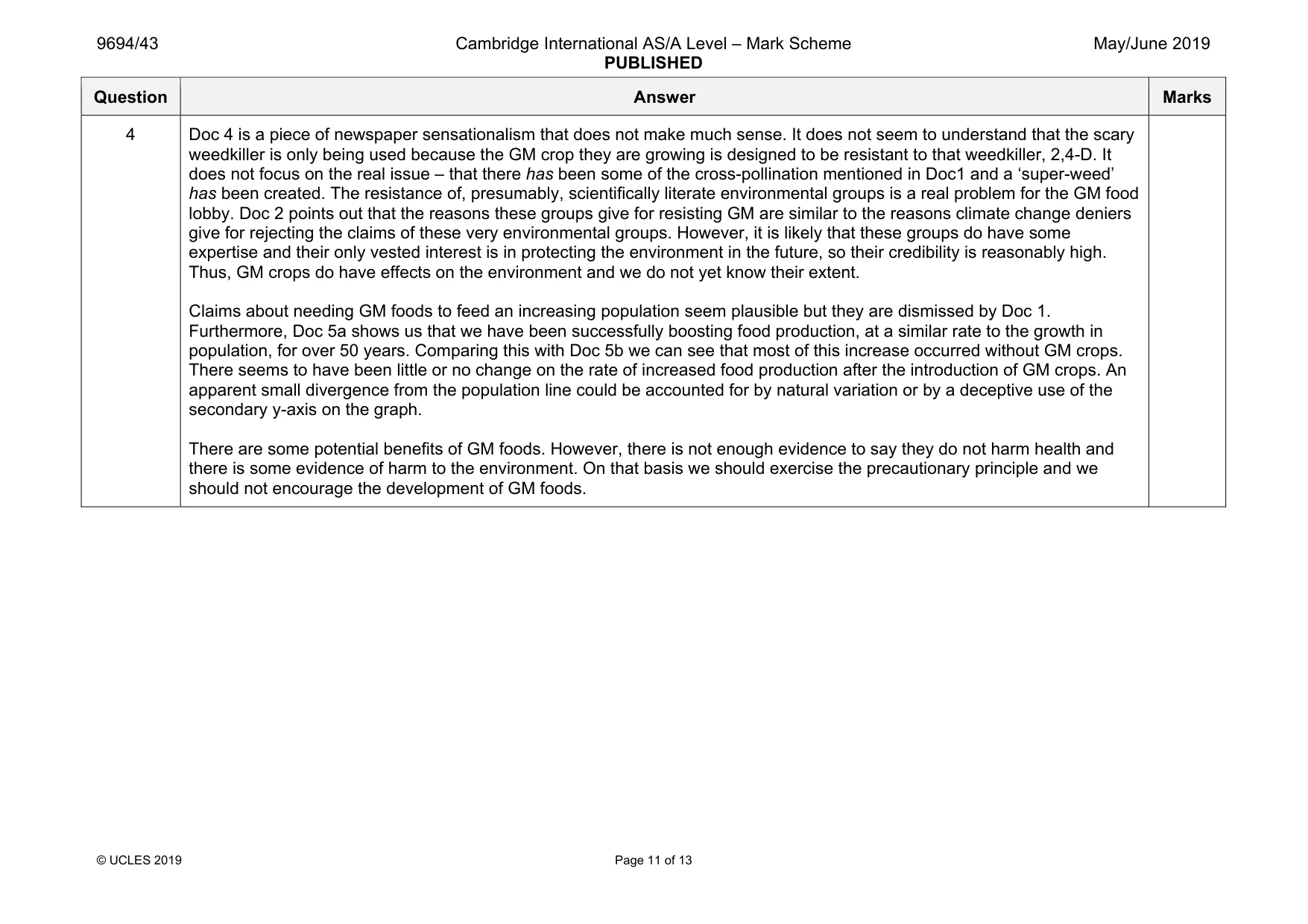
9694/43 Cambridge International AS/A Level – Mark Scheme PUBLISHED May/June 2019 © UCLES 2019 Page 11 of 13 Question Answer Marks 4 Doc 4 is a piece of newspaper sensationalism that does not make much sense. It does not seem to understand that the scary weedkiller is only being used because the GM crop they are growing is designed to be resistant to that weedkiller, 2,4-D. It does not focus on the real issue – that there has been some of the cross-pollination mentioned in Doc1 and a ‘super-weed’ has been created. The resistance of, presumably, scientifically literate environmental groups is a real problem for the GM food lobby. Doc 2 points out that the reasons these groups give for resisting GM are similar to the reasons climate change deniers give for rejecting the claims of these very environmental groups. However, it is likely that these groups do have some expertise and their only vested interest is in protecting the environment in the future, so their credibility is reasonably high. Thus, GM crops do have effects on the environment and we do not yet know their extent. Claims about needing GM foods to feed an increasing population seem plausible but they are dismissed by Doc 1. Furthermore, Doc 5a shows us that we have been successfully boosting food production, at a similar rate to the growth in population, for over 50 years. Comparing this with Doc 5b we can see that most of this increase occurred without GM crops. There seems to have been little or no change on the rate of increased food production after the introduction of GM crops. An apparent small divergence from the population line could be accounted for by natural variation or by a deceptive use of the secondary y-axis on the graph. There are some potential benefits of GM foods. However, there is not enough evidence to say they do not harm health and there is some evidence of harm to the environment. On that basis we should exercise the precautionary principle and we should not encourage the development of GM foods.
Mark scheme, page 12
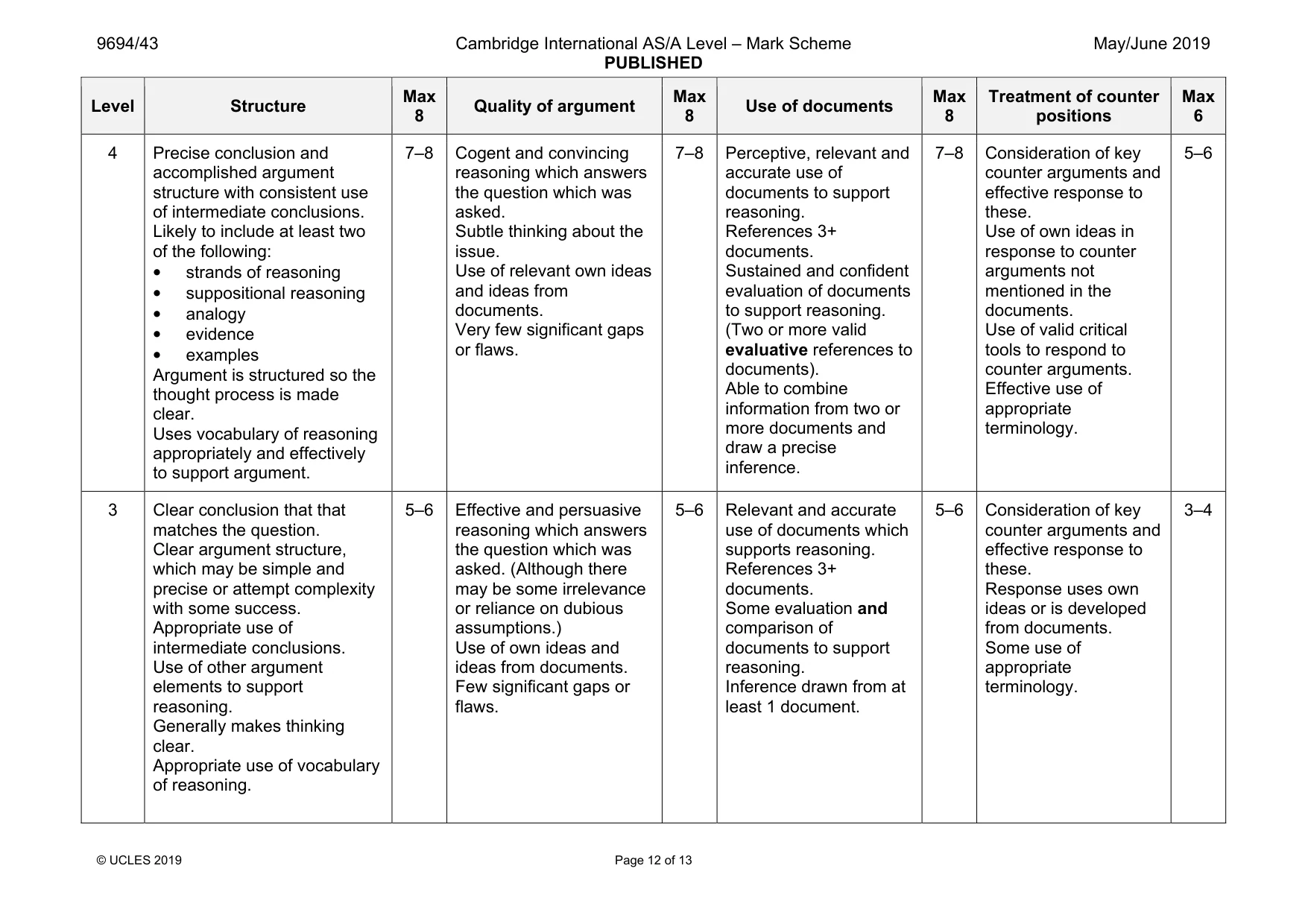
9694/43 Cambridge International AS/A Level – Mark Scheme PUBLISHED May/June 2019 © UCLES 2019 Page 12 of 13 Level Structure Max 8 Quality of argument Max 8 Use of documents Max 8 Treatment of counter positions Max 6 4 Precise conclusion and accomplished argument structure with consistent use of intermediate conclusions. Likely to include at least two of the following: • strands of reasoning • suppositional reasoning • analogy • evidence • examples Argument is structured so the thought process is made clear. Uses vocabulary of reasoning appropriately and effectively to support argument. 7–8 Cogent and convincing reasoning which answers the question which was asked. Subtle thinking about the issue. Use of relevant own ideas and ideas from documents. Very few significant gaps or flaws. 7–8 Perceptive, relevant and accurate use of documents to support reasoning. References 3+ documents. Sustained and confident evaluation of documents to support reasoning. (Two or more valid evaluative references to documents). Able to combine information from two or more documents and draw a precise inference. 7–8 Consideration of key counter arguments and effective response to these. Use of own ideas in response to counter arguments not mentioned in the documents. Use of valid critical tools to respond to counter arguments. Effective use of appropriate terminology. 5–6 3 Clear conclusion that that matches the question. Clear argument structure, which may be simple and precise or attempt complexity with some success. Appropriate use of intermediate conclusions. Use of other argument elements to support reasoning. Generally makes thinking clear. Appropriate use of vocabulary of reasoning. 5–6 Effective and persuasive reasoning which answers the question which was asked. (Although there may be some irrelevance or reliance on dubious assumptions.) Use of own ideas and ideas from documents. Few significant gaps or flaws. 5–6 Relevant and accurate use of documents which supports reasoning. References 3+ documents. Some evaluation and comparison of documents to support reasoning. Inference drawn from at least 1 document. 5–6 Consideration of key counter arguments and effective response to these. Response uses own ideas or is developed from documents. Some use of appropriate terminology. 3–4
Mark scheme, page 13
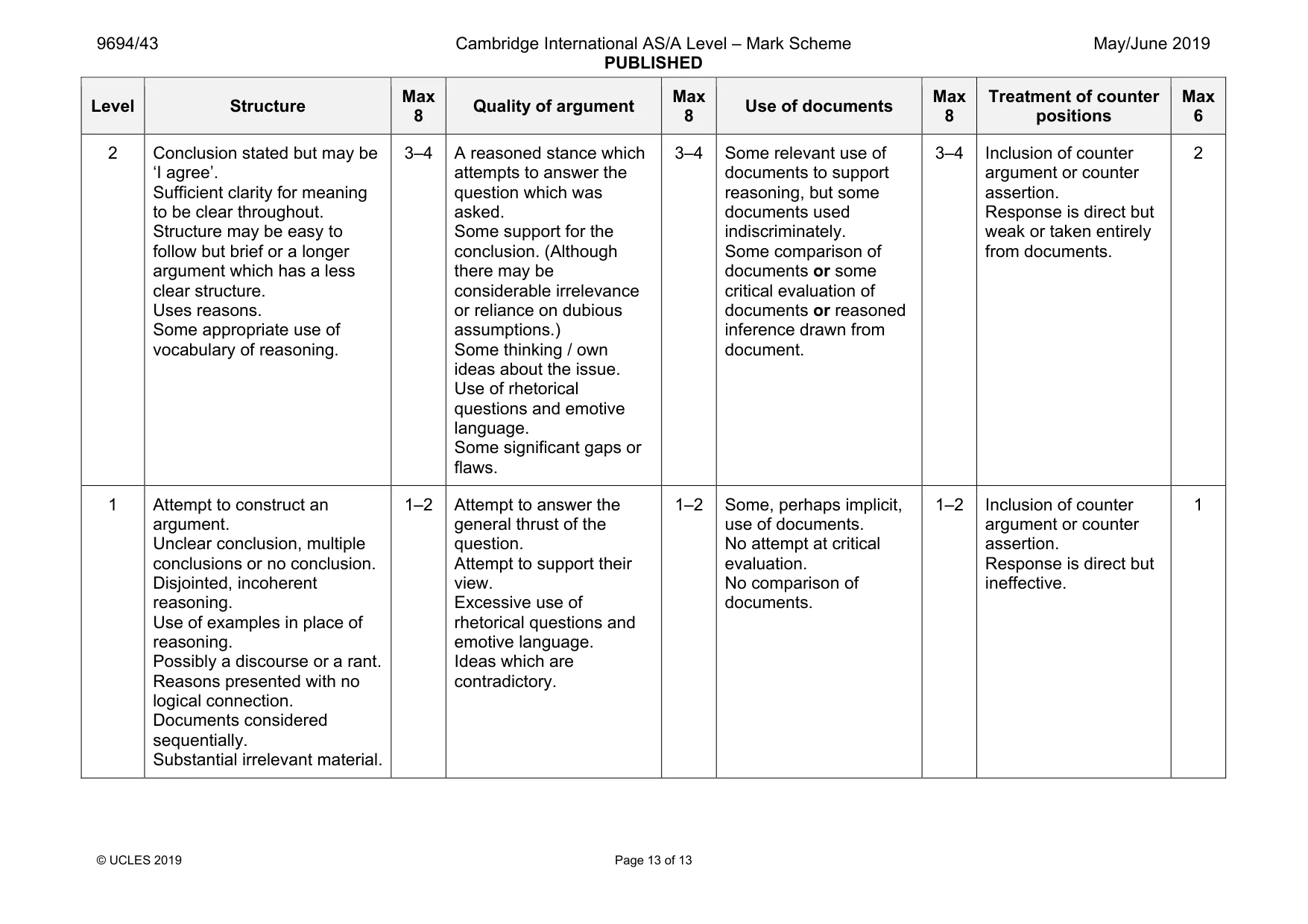
9694/43 Cambridge International AS/A Level – Mark Scheme PUBLISHED May/June 2019 © UCLES 2019 Page 13 of 13 Level Structure Max 8 Quality of argument Max 8 Use of documents Max 8 Treatment of counter positions Max 6 2 Conclusion stated but may be ‘I agree’. Sufficient clarity for meaning to be clear throughout. Structure may be easy to follow but brief or a longer argument which has a less clear structure. Uses reasons. Some appropriate use of vocabulary of reasoning. 3–4 A reasoned stance which attempts to answer the question which was asked. Some support for the conclusion. (Although there may be considerable irrelevance or reliance on dubious assumptions.) Some thinking / own ideas about the issue. Use of rhetorical questions and emotive language. Some significant gaps or flaws. 3–4 Some relevant use of documents to support reasoning, but some documents used indiscriminately. Some comparison of documents or some critical evaluation of documents or reasoned inference drawn from document. 3–4 Inclusion of counter argument or counter assertion. Response is direct but weak or taken entirely from documents. 2 1 Attempt to construct an argument. Unclear conclusion, multiple conclusions or no conclusion. Disjointed, incoherent reasoning. Use of examples in place of reasoning. Possibly a discourse or a rant. Reasons presented with no logical connection. Documents considered sequentially. Substantial irrelevant material. 1–2 Attempt to answer the general thrust of the question. Attempt to support their view. Excessive use of rhetorical questions and emotive language. Ideas which are contradictory. 1–2 Some, perhaps implicit, use of documents. No attempt at critical evaluation. No comparison of documents. 1–2 Inclusion of counter argument or counter assertion. Response is direct but ineffective. 1
What you needed in this session
Cambridge’s own grade thresholds for 2019 May/June, Paper 4 · Variant 3. A higher threshold means an easier paper — the bar moves with how the cohort did.