Cambridge A Level Thinking Skills 9694 — 2019 May/June Paper 4 · Variant 1
9694/41/M/J/19 · 50 marks · ≈56 min
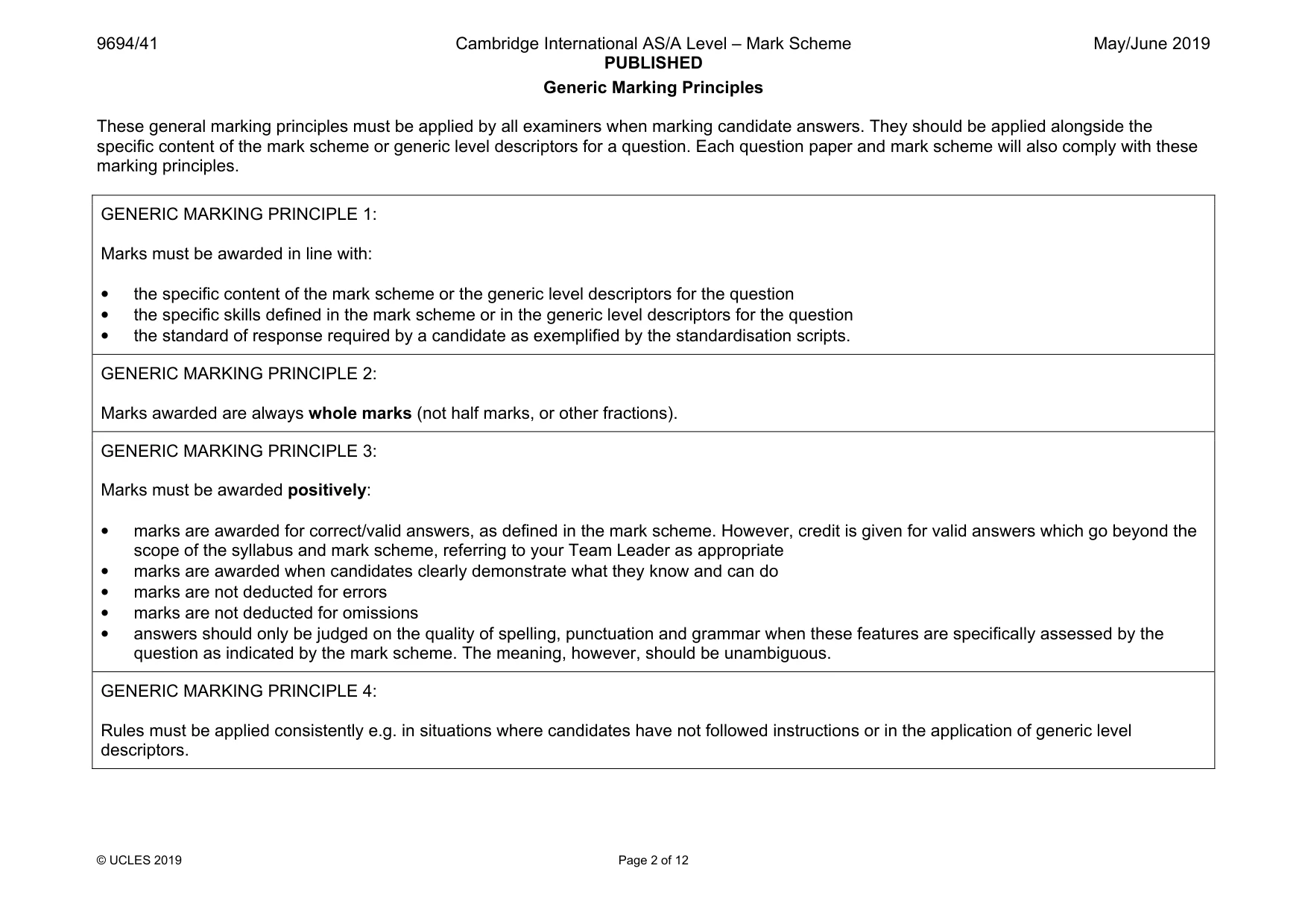
The question paper and its mark scheme, free to read here and free to download. This is Cambridge’s own paper, exactly as it was sat.
Question paper8 pages

Mark scheme12 pages
Answers below. Sit the paper first if you are practising.
Paper as text
Question paper, page 1
This document consists of 7 printed pages, 1 blank page and 1 Insert. DC (CE/TP) 170620/2 © UCLES 2019 [Turn over Cambridge Assessment International Education Cambridge International Advanced Subsidiary and Advanced Level * 8 4 8 1 5 0 6 5 4 4 * THINKING SKILLS 9694/41 Paper 4 Applied Reasoning May/June 2019 1 hour 30 minutes No Additional Materials are required. READ THESE INSTRUCTIONS FIRST An answer booklet is provided inside this question paper. You should follow the instructions on the front cover of the answer booklet. If you need additional answer paper ask the invigilator for a continuation booklet. Answer all the questions. The number of marks is given in brackets [ ] at the end of each question.
Question paper, page 2
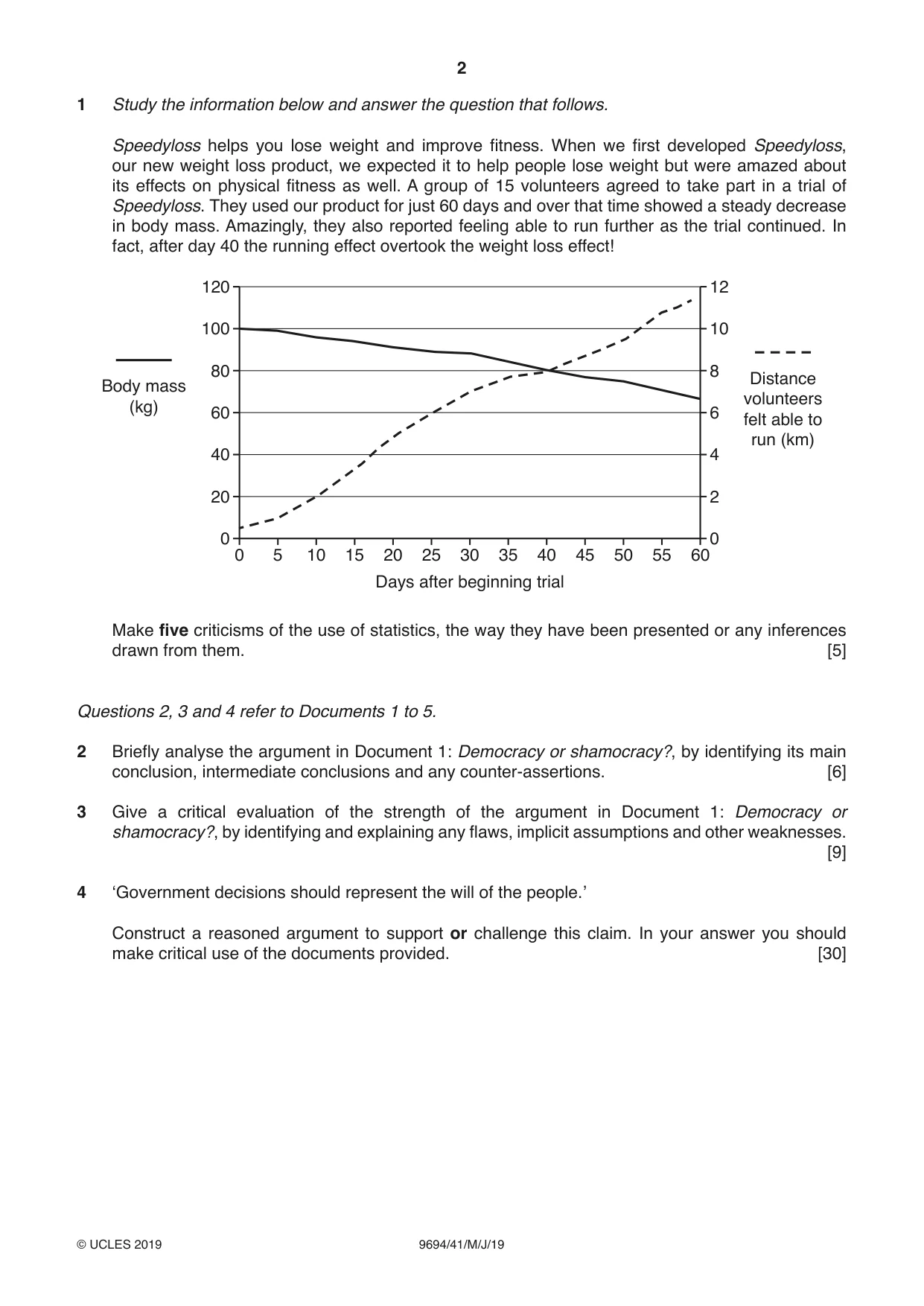
2 9694/41/M/J/19 © UCLES 2019 1 Study the information below and answer the question that follows. Speedyloss helps you lose weight and improve fitness. When we first developed Speedyloss, our new weight loss product, we expected it to help people lose weight but were amazed about its effects on physical fitness as well. A group of 15 volunteers agreed to take part in a trial of Speedyloss. They used our product for just 60 days and over that time showed a steady decrease in body mass. Amazingly, they also reported feeling able to run further as the trial continued. In fact, after day 40 the running effect overtook the weight loss effect! 120 Body mass (kg) Distance volunteers felt able to run (km) Days after beginning trial 100 80 60 40 20 0 12 10 8 6 4 2 0 0 5 10 15 20 25 30 35 40 45 50 55 60 Make five criticisms of the use of statistics, the way they have been presented or any inferences drawn from them. [5] Questions 2, 3 and 4 refer to Documents 1 to 5. 2 Briefly analyse the argument in Document 1: Democracy or shamocracy?, by identifying its main conclusion, intermediate conclusions and any counter-assertions. [6] 3 Give a critical evaluation of the strength of the argument in Document 1: Democracy or shamocracy?, by identifying and explaining any flaws, implicit assumptions and other weaknesses. [9] 4 ‘Government decisions should represent the will of the people.’ Construct a reasoned argument to support or challenge this claim. In your answer you should make critical use of the documents provided. [30]
Question paper, page 3
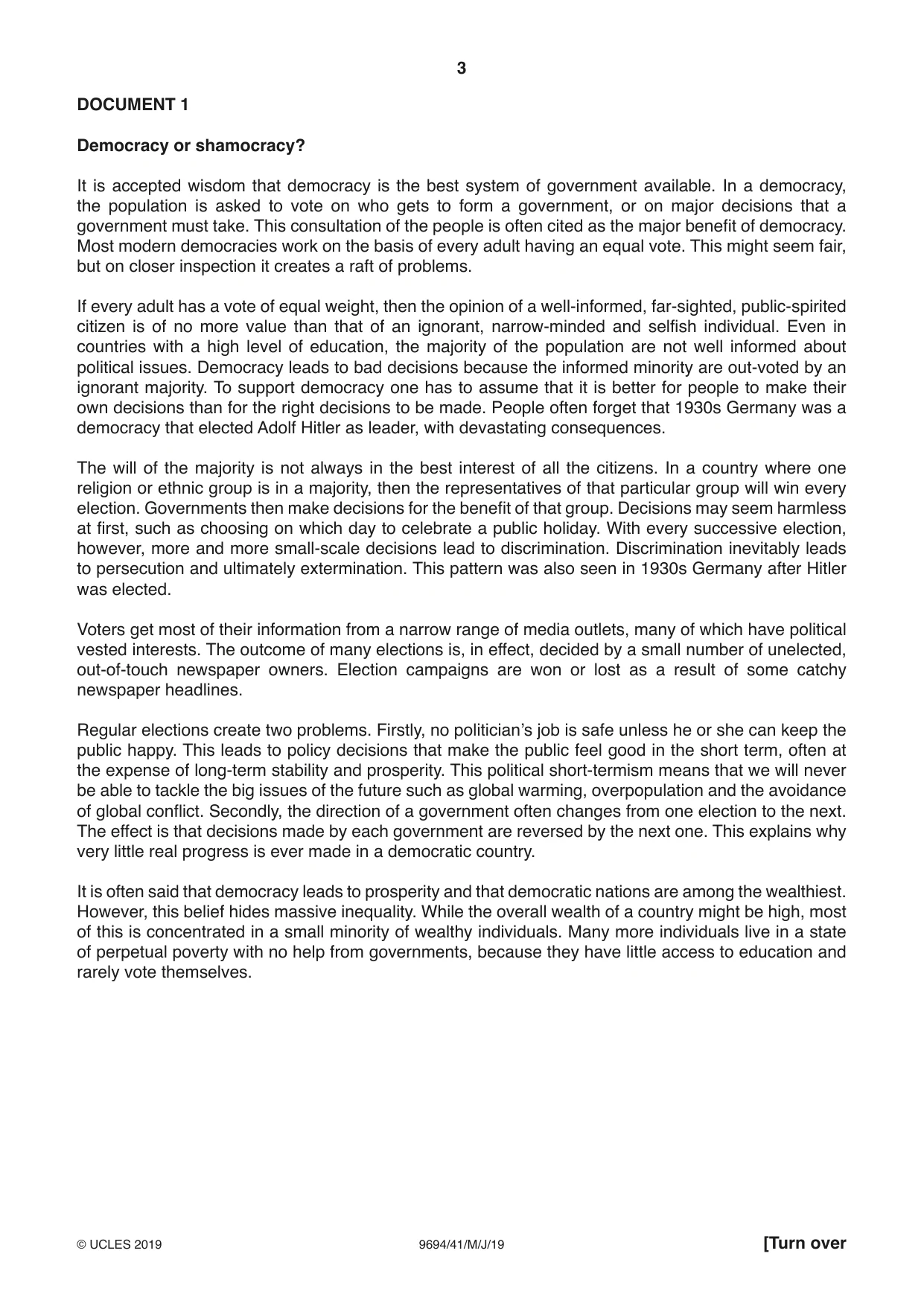
3 9694/41/M/J/19 © UCLES 2019 [Turn over DOCUMENT 1 Democracy or shamocracy? It is accepted wisdom that democracy is the best system of government available. In a democracy, the population is asked to vote on who gets to form a government, or on major decisions that a government must take. This consultation of the people is often cited as the major benefit of democracy. Most modern democracies work on the basis of every adult having an equal vote. This might seem fair, but on closer inspection it creates a raft of problems. If every adult has a vote of equal weight, then the opinion of a well-informed, far-sighted, public-spirited citizen is of no more value than that of an ignorant, narrow-minded and selfish individual. Even in countries with a high level of education, the majority of the population are not well informed about political issues. Democracy leads to bad decisions because the informed minority are out-voted by an ignorant majority. To support democracy one has to assume that it is better for people to make their own decisions than for the right decisions to be made. People often forget that 1930s Germany was a democracy that elected Adolf Hitler as leader, with devastating consequences. The will of the majority is not always in the best interest of all the citizens. In a country where one religion or ethnic group is in a majority, then the representatives of that particular group will win every election. Governments then make decisions for the benefit of that group. Decisions may seem harmless at first, such as choosing on which day to celebrate a public holiday. With every successive election, however, more and more small-scale decisions lead to discrimination. Discrimination inevitably leads to persecution and ultimately extermination. This pattern was also seen in 1930s Germany after Hitler was elected. Voters get most of their information from a narrow range of media outlets, many of which have political vested interests. The outcome of many elections is, in effect, decided by a small number of unelected, out-of-touch newspaper owners. Election campaigns are won or lost as a result of some catchy newspaper headlines. Regular elections create two problems. Firstly, no politician’s job is safe unless he or she can keep the public happy. This leads to policy decisions that make the public feel good in the short term, often at the expense of long-term stability and prosperity. This political short-termism means that we will never be able to tackle the big issues of the future such as global warming, overpopulation and the avoidance of global conflict. Secondly, the direction of a government often changes from one election to the next. The effect is that decisions made by each government are reversed by the next one. This explains why very little real progress is ever made in a democratic country. It is often said that democracy leads to prosperity and that democratic nations are among the wealthiest. However, this belief hides massive inequality. While the overall wealth of a country might be high, most of this is concentrated in a small minority of wealthy individuals. Many more individuals live in a state of perpetual poverty with no help from governments, because they have little access to education and rarely vote themselves.
Question paper, page 4
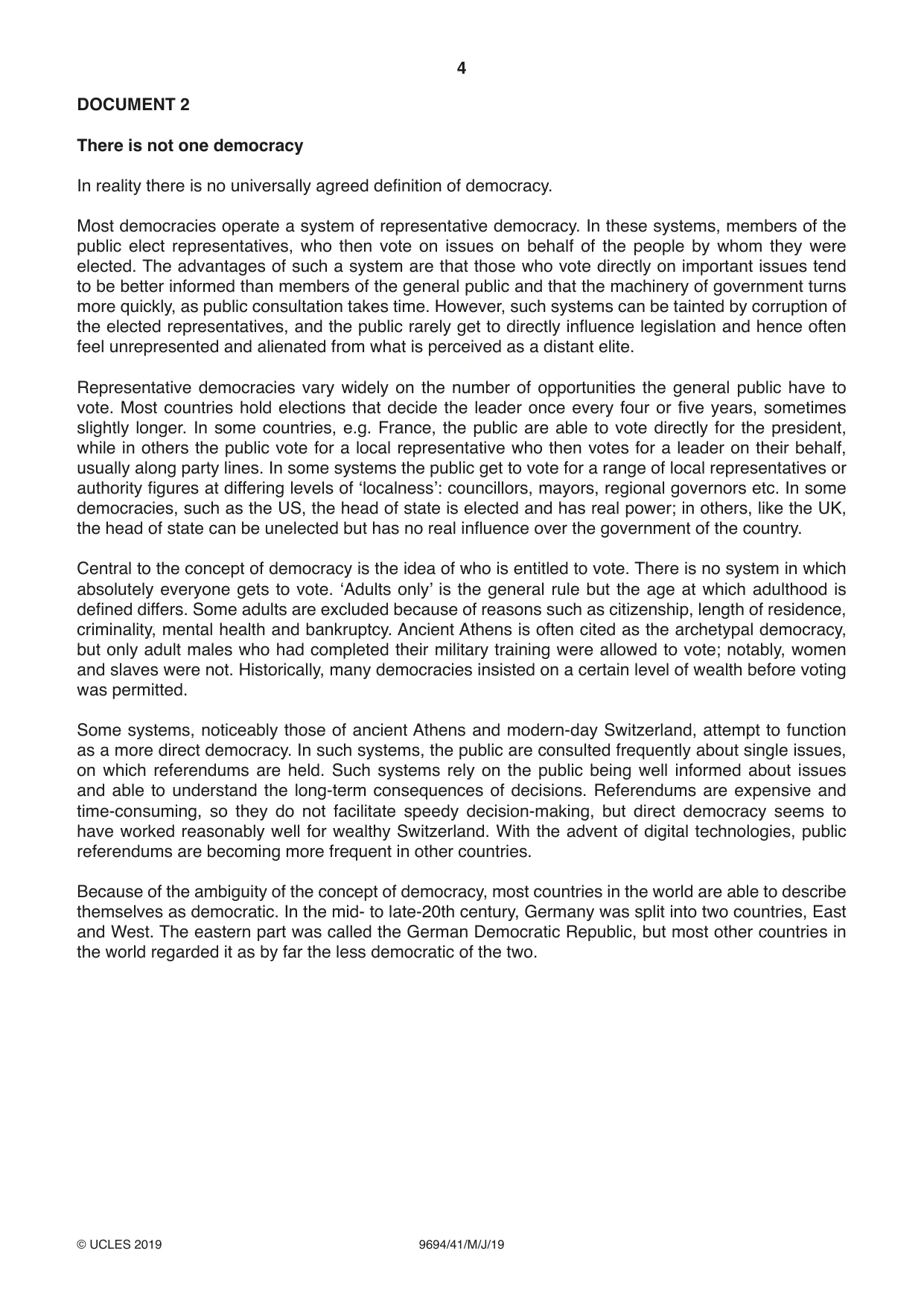
4 9694/41/M/J/19 © UCLES 2019 DOCUMENT 2 There is not one democracy In reality there is no universally agreed definition of democracy. Most democracies operate a system of representative democracy. In these systems, members of the public elect representatives, who then vote on issues on behalf of the people by whom they were elected. The advantages of such a system are that those who vote directly on important issues tend to be better informed than members of the general public and that the machinery of government turns more quickly, as public consultation takes time. However, such systems can be tainted by corruption of the elected representatives, and the public rarely get to directly influence legislation and hence often feel unrepresented and alienated from what is perceived as a distant elite. Representative democracies vary widely on the number of opportunities the general public have to vote. Most countries hold elections that decide the leader once every four or five years, sometimes slightly longer. In some countries, e.g. France, the public are able to vote directly for the president, while in others the public vote for a local representative who then votes for a leader on their behalf, usually along party lines. In some systems the public get to vote for a range of local representatives or authority figures at differing levels of ‘localness’: councillors, mayors, regional governors etc. In some democracies, such as the US, the head of state is elected and has real power; in others, like the UK, the head of state can be unelected but has no real influence over the government of the country. Central to the concept of democracy is the idea of who is entitled to vote. There is no system in which absolutely everyone gets to vote. ‘Adults only’ is the general rule but the age at which adulthood is defined differs. Some adults are excluded because of reasons such as citizenship, length of residence, criminality, mental health and bankruptcy. Ancient Athens is often cited as the archetypal democracy, but only adult males who had completed their military training were allowed to vote; notably, women and slaves were not. Historically, many democracies insisted on a certain level of wealth before voting was permitted. Some systems, noticeably those of ancient Athens and modern-day Switzerland, attempt to function as a more direct democracy. In such systems, the public are consulted frequently about single issues, on which referendums are held. Such systems rely on the public being well informed about issues and able to understand the long-term consequences of decisions. Referendums are expensive and time-consuming, so they do not facilitate speedy decision-making, but direct democracy seems to have worked reasonably well for wealthy Switzerland. With the advent of digital technologies, public referendums are becoming more frequent in other countries. Because of the ambiguity of the concept of democracy, most countries in the world are able to describe themselves as democratic. In the mid- to late-20th century, Germany was split into two countries, East and West. The eastern part was called the German Democratic Republic, but most other countries in the world regarded it as by far the less democratic of the two.
Question paper, page 5
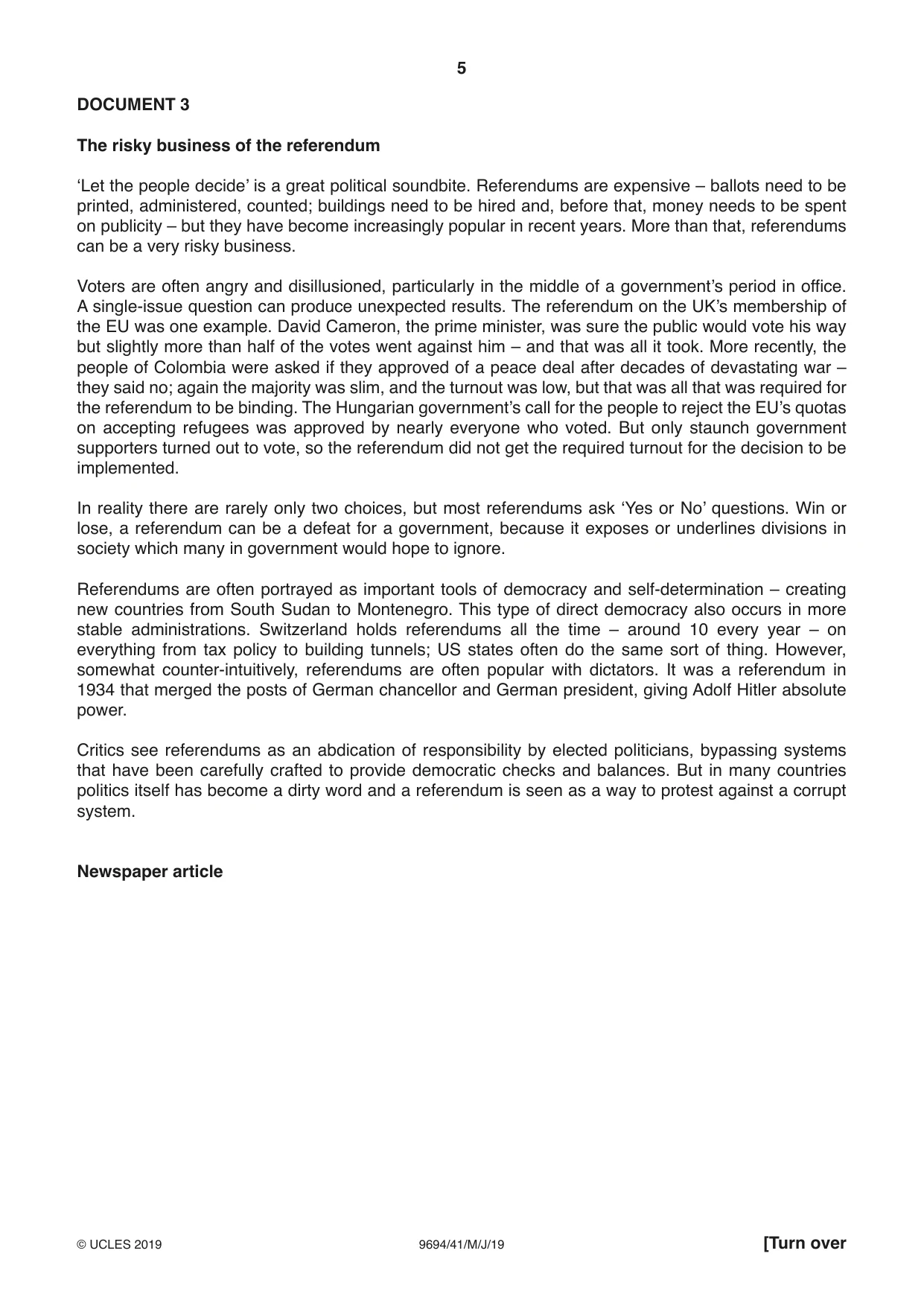
5 9694/41/M/J/19 © UCLES 2019 [Turn over DOCUMENT 3 The risky business of the referendum ‘Let the people decide’ is a great political soundbite. Referendums are expensive – ballots need to be printed, administered, counted; buildings need to be hired and, before that, money needs to be spent on publicity – but they have become increasingly popular in recent years. More than that, referendums can be a very risky business. Voters are often angry and disillusioned, particularly in the middle of a government’s period in office. A single-issue question can produce unexpected results. The referendum on the UK’s membership of the EU was one example. David Cameron, the prime minister, was sure the public would vote his way but slightly more than half of the votes went against him – and that was all it took. More recently, the people of Colombia were asked if they approved of a peace deal after decades of devastating war – they said no; again the majority was slim, and the turnout was low, but that was all that was required for the referendum to be binding. The Hungarian government’s call for the people to reject the EU’s quotas on accepting refugees was approved by nearly everyone who voted. But only staunch government supporters turned out to vote, so the referendum did not get the required turnout for the decision to be implemented. In reality there are rarely only two choices, but most referendums ask ‘Yes or No’ questions. Win or lose, a referendum can be a defeat for a government, because it exposes or underlines divisions in society which many in government would hope to ignore. Referendums are often portrayed as important tools of democracy and self-determination – creating new countries from South Sudan to Montenegro. This type of direct democracy also occurs in more stable administrations. Switzerland holds referendums all the time – around 10 every year – on everything from tax policy to building tunnels; US states often do the same sort of thing. However, somewhat counter-intuitively, referendums are often popular with dictators. It was a referendum in 1934 that merged the posts of German chancellor and German president, giving Adolf Hitler absolute power. Critics see referendums as an abdication of responsibility by elected politicians, bypassing systems that have been carefully crafted to provide democratic checks and balances. But in many countries politics itself has become a dirty word and a referendum is seen as a way to protest against a corrupt system. Newspaper article
Question paper, page 6
6 9694/41/M/J/19 © UCLES 2019 DOCUMENT 4 Some famous quotes about democracy We here highly resolve that these dead shall not have died in vain, that this nation, under God, shall have a new birth of freedom; and that government of the people, by the people, for the people, shall not perish from the earth. Abraham Lincoln The strongest argument against democracy is a five-minute discussion with the average voter. Winston Churchill What difference does it make to the dead, the orphans and the homeless, whether the mad destruction is wrought under the name of totalitarianism or in the holy name of liberty or democracy? Mahatma Gandhi If voting made any difference they wouldn’t let us do it. Mark Twain Elections belong to the people. It’s their decision. If they decide to turn their back on the fire and burn their behinds, then they will just have to sit on their blisters. Abraham Lincoln Democracy is in the blood of the Muslims, who look upon complete equality of mankind, and believe in fraternity, equality, and liberty. Muhammad Ali Jinnah Many forms of government have been tried, and will be tried in this world of sin and woe. No one pretends that democracy is perfect or all-wise. Indeed, it has been said that democracy is the worst form of government except for all those other forms that have been tried from time to time. Winston Churchill It is an axiom in my mind, that our liberty can never be safe but in the hands of the people themselves, and that too of the people with a certain degree of instruction. Thomas Jefferson Democracy is worth dying for, because it’s the most deeply honourable form of government ever devised by man. Ronald Reagan Anti-intellectualism has been a constant thread winding its way through our political and cultural life, nurtured by the false notion that democracy means that ‘my ignorance is just as good as your knowledge’. Isaac Asimov Propaganda is to a democracy what the bludgeon is to a totalitarian state. Noam Chomsky Democracy substitutes election by the incompetent many for appointment by the corrupt few. George Bernard Shaw The ballot is stronger than the bullet. Abraham Lincoln Democracy is two wolves and a lamb voting on what to have for lunch. Variously attributed
Question paper, page 7
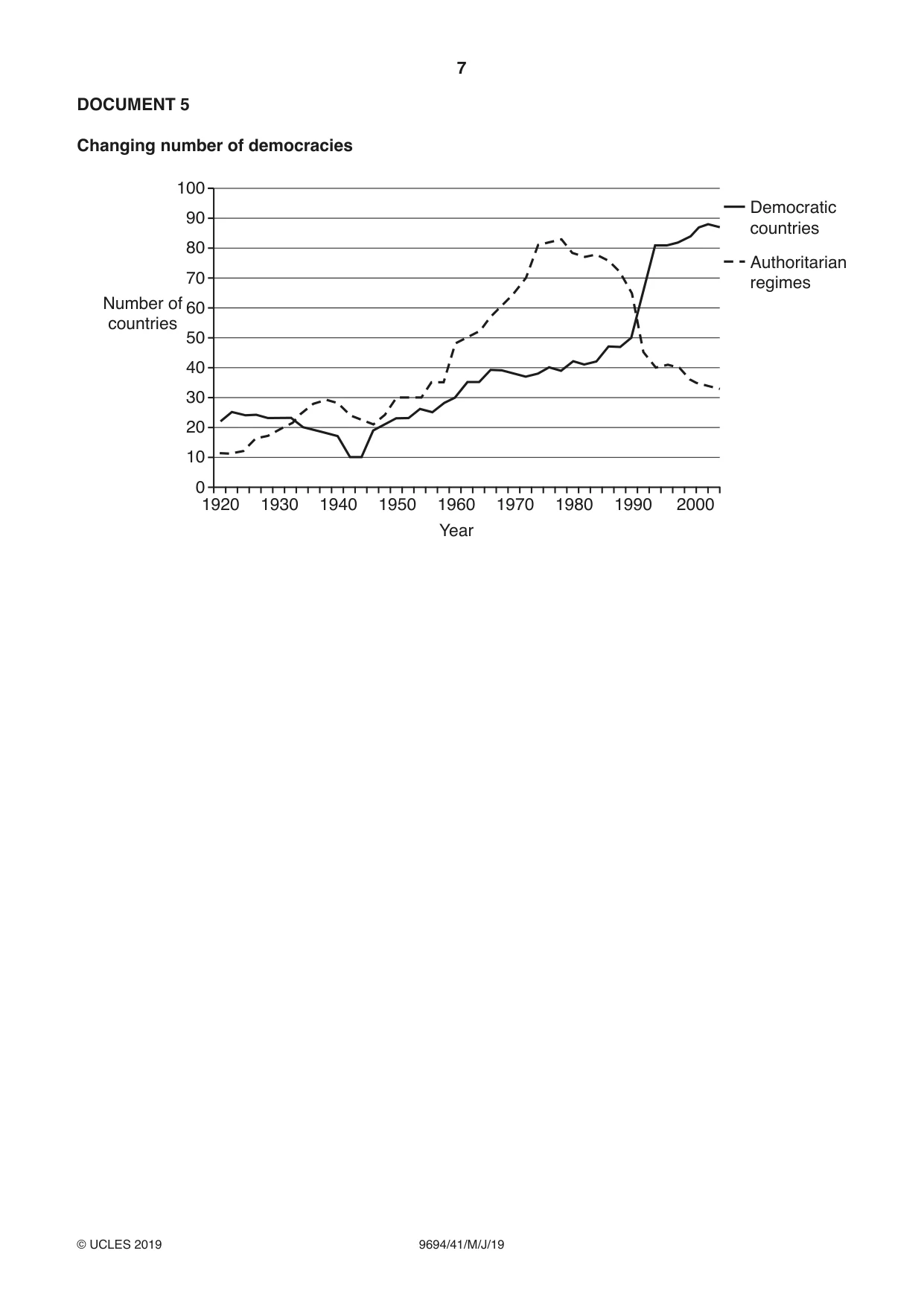
7 9694/41/M/J/19 © UCLES 2019 DOCUMENT 5 Changing number of democracies 100 90 80 70 60 50 40 30 20 10 0 1920 1930 1940 1950 1960 Year 1970 1980 1990 2000 Number of countries Democratic countries Authoritarian regimes
Question paper, page 8
8 9694/41/M/J/19 © UCLES 2019 Permission to reproduce items where third-party owned material protected by copyright is included has been sought and cleared where possible. Every reasonable effort has been made by the publisher (UCLES) to trace copyright holders, but if any items requiring clearance have unwittingly been included, the publisher will be pleased to make amends at the earliest possible opportunity. To avoid the issue of disclosure of answer-related information to candidates, all copyright acknowledgements are reproduced online in the Cambridge Assessment International Education Copyright Acknowledgements Booklet. This is produced for each series of examinations and is freely available to download at www.cambridgeinternational.org after the live examination series. Cambridge Assessment International Education is part of the Cambridge Assessment Group. Cambridge Assessment is the brand name of the University of Cambridge Local Examinations Syndicate (UCLES), which itself is a department of the University of Cambridge. BLANK PAGE
Mark scheme, page 1
This document consists of 12 printed pages. © UCLES 2019 [Turn over Cambridge Assessment International Education Cambridge International Advanced Subsidiary and Advanced Level THINKING SKILLS 9694/41 Paper 4 Applied Reasoning May/June 2019 MARK SCHEME Maximum Mark: 50 Published This mark scheme is published as an aid to teachers and candidates, to indicate the requirements of the examination. It shows the basis on which Examiners were instructed to award marks. It does not indicate the details of the discussions that took place at an Examiners’ meeting before marking began, which would have considered the acceptability of alternative answers. Mark schemes should be read in conjunction with the question paper and the Principal Examiner Report for Teachers. Cambridge International will not enter into discussions about these mark schemes. Cambridge International is publishing the mark schemes for the May/June 2019 series for most Cambridge IGCSE™, Cambridge International A and AS Level and Cambridge Pre-U components, and some Cambridge O Level components.
Mark scheme, page 2
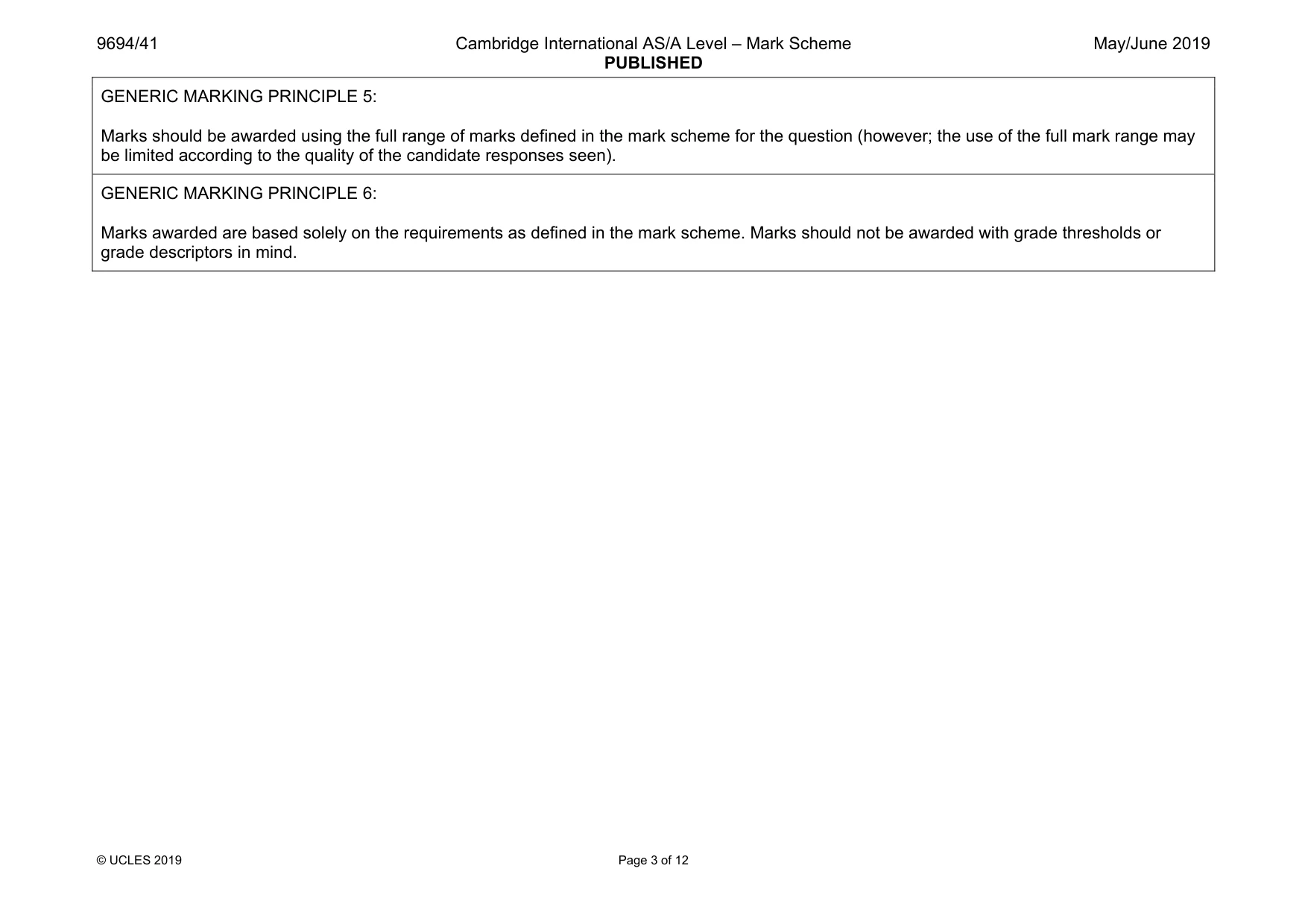
9694/41 Cambridge International AS/A Level – Mark Scheme PUBLISHED May/June 2019 © UCLES 2019 Page 2 of 12 Generic Marking Principles These general marking principles must be applied by all examiners when marking candidate answers. They should be applied alongside the specific content of the mark scheme or generic level descriptors for a question. Each question paper and mark scheme will also comply with these marking principles. GENERIC MARKING PRINCIPLE 1: Marks must be awarded in line with: • the specific content of the mark scheme or the generic level descriptors for the question • the specific skills defined in the mark scheme or in the generic level descriptors for the question • the standard of response required by a candidate as exemplified by the standardisation scripts. GENERIC MARKING PRINCIPLE 2: Marks awarded are always whole marks (not half marks, or other fractions). GENERIC MARKING PRINCIPLE 3: Marks must be awarded positively: • marks are awarded for correct/valid answers, as defined in the mark scheme. However, credit is given for valid answers which go beyond the scope of the syllabus and mark scheme, referring to your Team Leader as appropriate • marks are awarded when candidates clearly demonstrate what they know and can do • marks are not deducted for errors • marks are not deducted for omissions • answers should only be judged on the quality of spelling, punctuation and grammar when these features are specifically assessed by the question as indicated by the mark scheme. The meaning, however, should be unambiguous. GENERIC MARKING PRINCIPLE 4: Rules must be applied consistently e.g. in situations where candidates have not followed instructions or in the application of generic level descriptors.
Mark scheme, page 3
9694/41 Cambridge International AS/A Level – Mark Scheme PUBLISHED May/June 2019 © UCLES 2019 Page 3 of 12 GENERIC MARKING PRINCIPLE 5: Marks should be awarded using the full range of marks defined in the mark scheme for the question (however; the use of the full mark range may be limited according to the quality of the candidate responses seen). GENERIC MARKING PRINCIPLE 6: Marks awarded are based solely on the requirements as defined in the mark scheme. Marks should not be awarded with grade thresholds or grade descriptors in mind.
Mark scheme, page 4
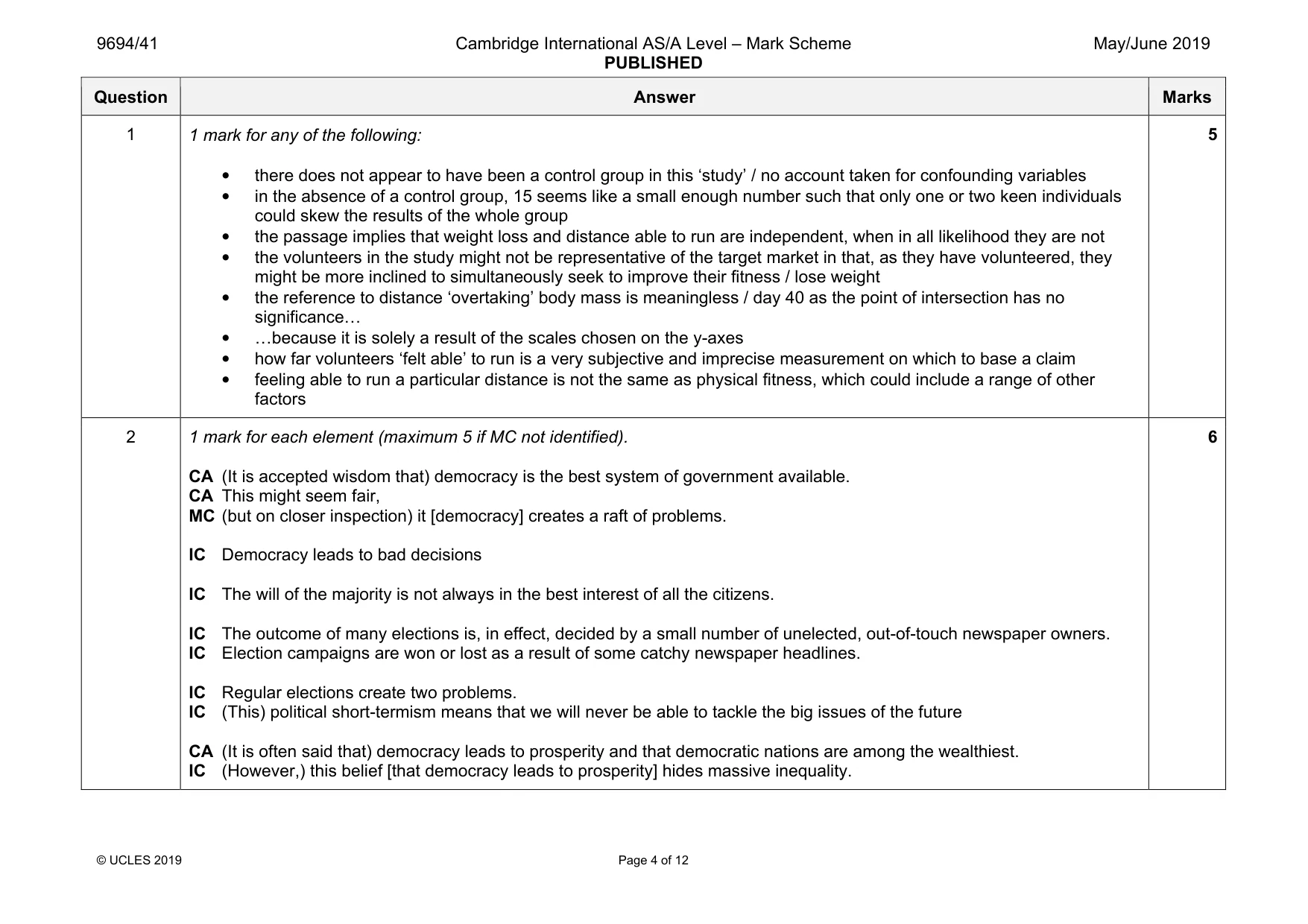
9694/41 Cambridge International AS/A Level – Mark Scheme PUBLISHED May/June 2019 © UCLES 2019 Page 4 of 12 Question Answer Marks 1 1 mark for any of the following: • there does not appear to have been a control group in this ‘study’ / no account taken for confounding variables • in the absence of a control group, 15 seems like a small enough number such that only one or two keen individuals could skew the results of the whole group • the passage implies that weight loss and distance able to run are independent, when in all likelihood they are not • the volunteers in the study might not be representative of the target market in that, as they have volunteered, they might be more inclined to simultaneously seek to improve their fitness / lose weight • the reference to distance ‘overtaking’ body mass is meaningless / day 40 as the point of intersection has no significance« • «because it is solely a result of the scales chosen on the y-axes • how far volunteers ‘felt able’ to run is a very subjective and imprecise measurement on which to base a claim • feeling able to run a particular distance is not the same as physical fitness, which could include a range of other factors 5 2 1 mark for each element (maximum 5 if MC not identified). CA (It is accepted wisdom that) democracy is the best system of government available. CA This might seem fair, MC (but on closer inspection) it [democracy] creates a raft of problems. IC Democracy leads to bad decisions IC The will of the majority is not always in the best interest of all the citizens. IC The outcome of many elections is, in effect, decided by a small number of unelected, out-of-touch newspaper owners. IC Election campaigns are won or lost as a result of some catchy newspaper headlines. IC Regular elections create two problems. IC (This) political short-termism means that we will never be able to tackle the big issues of the future CA (It is often said that) democracy leads to prosperity and that democratic nations are among the wealthiest. IC (However,) this belief [that democracy leads to prosperity] hides massive inequality. 6
Mark scheme, page 5
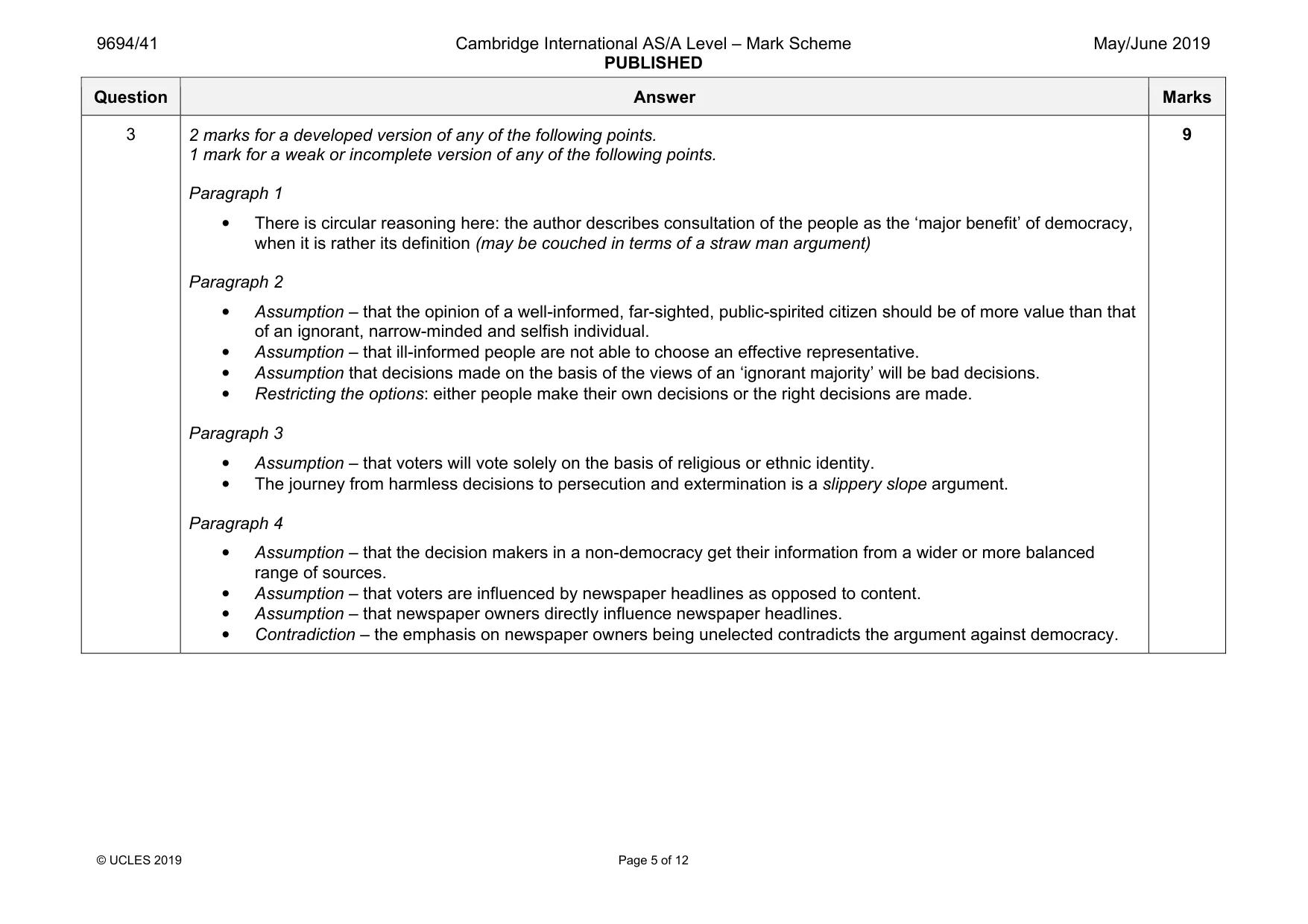
9694/41 Cambridge International AS/A Level – Mark Scheme PUBLISHED May/June 2019 © UCLES 2019 Page 5 of 12 Question Answer Marks 3 2 marks for a developed version of any of the following points. 1 mark for a weak or incomplete version of any of the following points. Paragraph 1 • There is circular reasoning here: the author describes consultation of the people as the ‘major benefit’ of democracy, when it is rather its definition (may be couched in terms of a straw man argument) Paragraph 2 • Assumption – that the opinion of a well-informed, far-sighted, public-spirited citizen should be of more value than that of an ignorant, narrow-minded and selfish individual. • Assumption – that ill-informed people are not able to choose an effective representative. • Assumption that decisions made on the basis of the views of an ‘ignorant majority’ will be bad decisions. • Restricting the options: either people make their own decisions or the right decisions are made. Paragraph 3 • Assumption – that voters will vote solely on the basis of religious or ethnic identity. • The journey from harmless decisions to persecution and extermination is a slippery slope argument. Paragraph 4 • Assumption – that the decision makers in a non-democracy get their information from a wider or more balanced range of sources. • Assumption – that voters are influenced by newspaper headlines as opposed to content. • Assumption – that newspaper owners directly influence newspaper headlines. • Contradiction – the emphasis on newspaper owners being unelected contradicts the argument against democracy. 9
Mark scheme, page 6
9694/41 Cambridge International AS/A Level – Mark Scheme PUBLISHED May/June 2019 © UCLES 2019 Page 6 of 12 Question Answer Marks 3 Paragraph 5 • Assumption – that democracy requires a system in which politicians are (regularly) re-elected. • Conflation of keeping the public happy (which could be a long term goal) with making the public feel good (in the short term) / False dichotomy between keeping the public happy and tackling long-term issues. • In order for the IC to support the MC one must assume that progress is a good thing. Paragraph 6 • Assumption – that other forms of government do not lead to greater inequality. • Contradiction – the author’s suggestion that people suffer poverty because they rarely vote appears to contradict the claim that democracy causes poverty. • That some people rarely vote is treated by the author as a problematic feature of democracy itself, rather than of its implementation.
Mark scheme, page 7
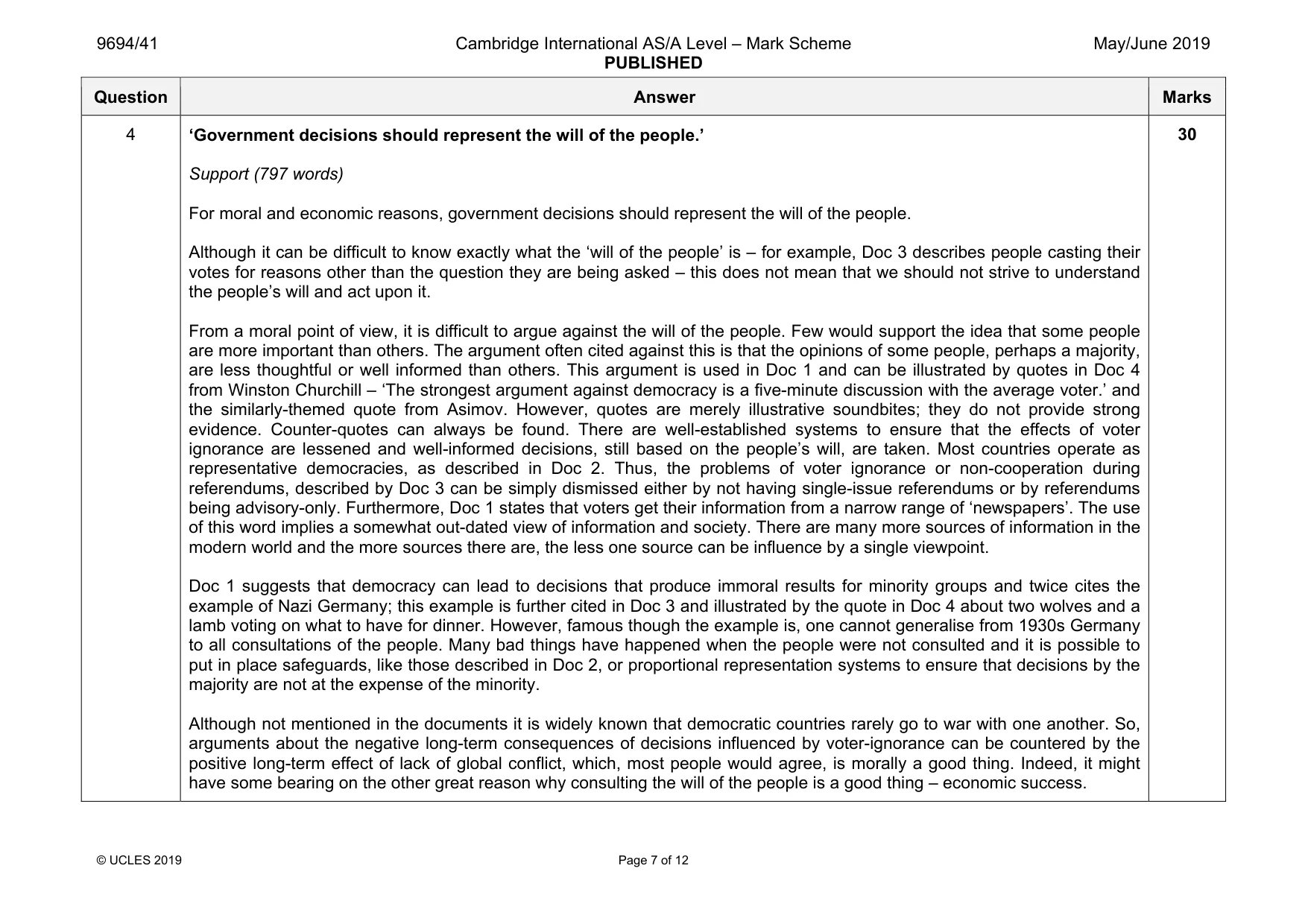
9694/41 Cambridge International AS/A Level – Mark Scheme PUBLISHED May/June 2019 © UCLES 2019 Page 7 of 12 Question Answer Marks 4 ‘Government decisions should represent the will of the people.’ Support (797 words) For moral and economic reasons, government decisions should represent the will of the people. Although it can be difficult to know exactly what the ‘will of the people’ is – for example, Doc 3 describes people casting their votes for reasons other than the question they are being asked – this does not mean that we should not strive to understand the people’s will and act upon it. From a moral point of view, it is difficult to argue against the will of the people. Few would support the idea that some people are more important than others. The argument often cited against this is that the opinions of some people, perhaps a majority, are less thoughtful or well informed than others. This argument is used in Doc 1 and can be illustrated by quotes in Doc 4 from Winston Churchill – ‘The strongest argument against democracy is a five-minute discussion with the average voter.’ and the similarly-themed quote from Asimov. However, quotes are merely illustrative soundbites; they do not provide strong evidence. Counter-quotes can always be found. There are well-established systems to ensure that the effects of voter ignorance are lessened and well-informed decisions, still based on the people’s will, are taken. Most countries operate as representative democracies, as described in Doc 2. Thus, the problems of voter ignorance or non-cooperation during referendums, described by Doc 3 can be simply dismissed either by not having single-issue referendums or by referendums being advisory-only. Furthermore, Doc 1 states that voters get their information from a narrow range of ‘newspapers’. The use of this word implies a somewhat out-dated view of information and society. There are many more sources of information in the modern world and the more sources there are, the less one source can be influence by a single viewpoint. Doc 1 suggests that democracy can lead to decisions that produce immoral results for minority groups and twice cites the example of Nazi Germany; this example is further cited in Doc 3 and illustrated by the quote in Doc 4 about two wolves and a lamb voting on what to have for dinner. However, famous though the example is, one cannot generalise from 1930s Germany to all consultations of the people. Many bad things have happened when the people were not consulted and it is possible to put in place safeguards, like those described in Doc 2, or proportional representation systems to ensure that decisions by the majority are not at the expense of the minority. Although not mentioned in the documents it is widely known that democratic countries rarely go to war with one another. So, arguments about the negative long-term consequences of decisions influenced by voter-ignorance can be countered by the positive long-term effect of lack of global conflict, which, most people would agree, is morally a good thing. Indeed, it might have some bearing on the other great reason why consulting the will of the people is a good thing – economic success. 30
Mark scheme, page 8
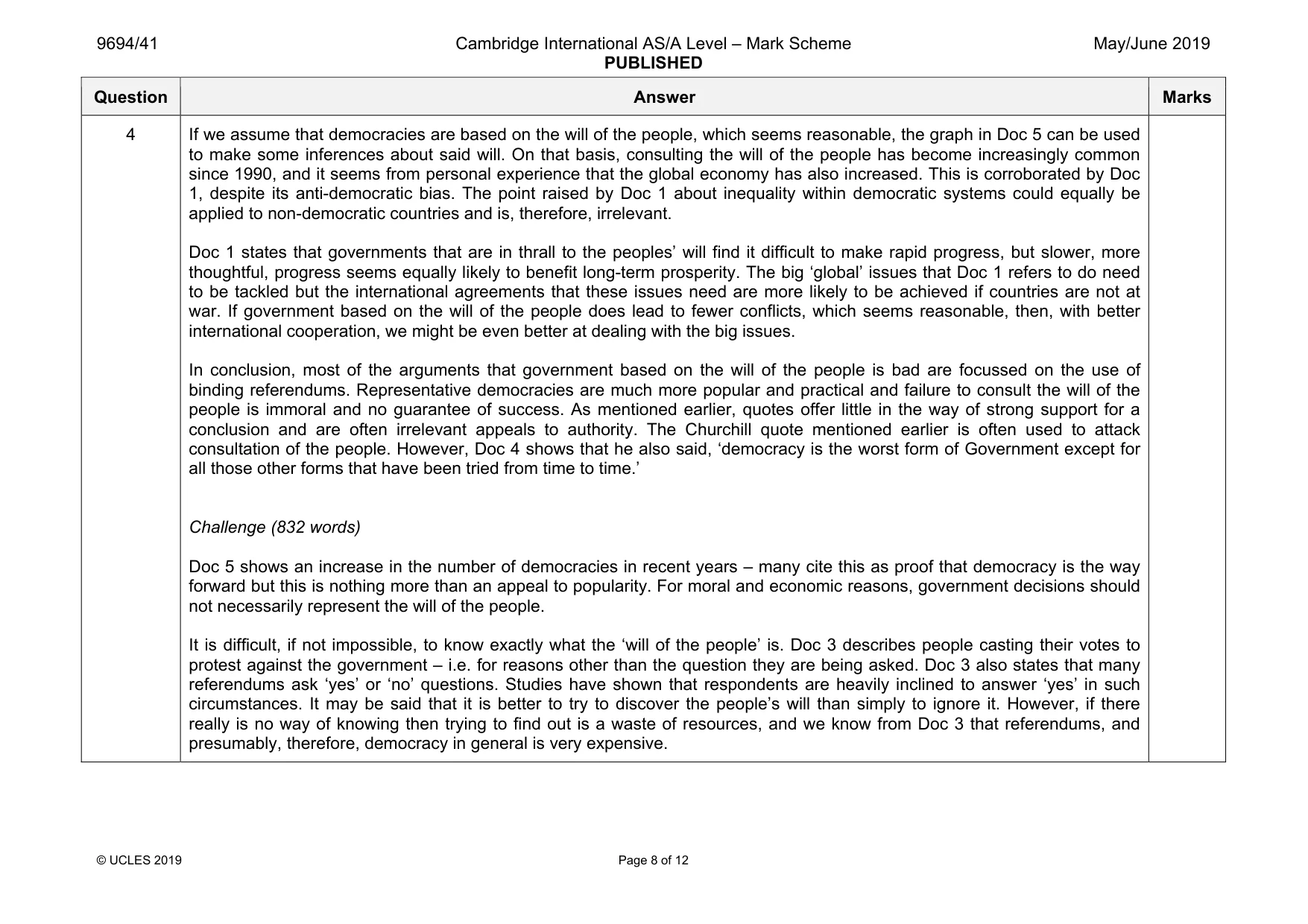
9694/41 Cambridge International AS/A Level – Mark Scheme PUBLISHED May/June 2019 © UCLES 2019 Page 8 of 12 Question Answer Marks 4 If we assume that democracies are based on the will of the people, which seems reasonable, the graph in Doc 5 can be used to make some inferences about said will. On that basis, consulting the will of the people has become increasingly common since 1990, and it seems from personal experience that the global economy has also increased. This is corroborated by Doc 1, despite its anti-democratic bias. The point raised by Doc 1 about inequality within democratic systems could equally be applied to non-democratic countries and is, therefore, irrelevant. Doc 1 states that governments that are in thrall to the peoples’ will find it difficult to make rapid progress, but slower, more thoughtful, progress seems equally likely to benefit long-term prosperity. The big ‘global’ issues that Doc 1 refers to do need to be tackled but the international agreements that these issues need are more likely to be achieved if countries are not at war. If government based on the will of the people does lead to fewer conflicts, which seems reasonable, then, with better international cooperation, we might be even better at dealing with the big issues. In conclusion, most of the arguments that government based on the will of the people is bad are focussed on the use of binding referendums. Representative democracies are much more popular and practical and failure to consult the will of the people is immoral and no guarantee of success. As mentioned earlier, quotes offer little in the way of strong support for a conclusion and are often irrelevant appeals to authority. The Churchill quote mentioned earlier is often used to attack consultation of the people. However, Doc 4 shows that he also said, ‘democracy is the worst form of Government except for all those other forms that have been tried from time to time.’ Challenge (832 words) Doc 5 shows an increase in the number of democracies in recent years – many cite this as proof that democracy is the way forward but this is nothing more than an appeal to popularity. For moral and economic reasons, government decisions should not necessarily represent the will of the people. It is difficult, if not impossible, to know exactly what the ‘will of the people’ is. Doc 3 describes people casting their votes to protest against the government – i.e. for reasons other than the question they are being asked. Doc 3 also states that many referendums ask ‘yes’ or ‘no’ questions. Studies have shown that respondents are heavily inclined to answer ‘yes’ in such circumstances. It may be said that it is better to try to discover the people’s will than simply to ignore it. However, if there really is no way of knowing then trying to find out is a waste of resources, and we know from Doc 3 that referendums, and presumably, therefore, democracy in general is very expensive.
Mark scheme, page 9
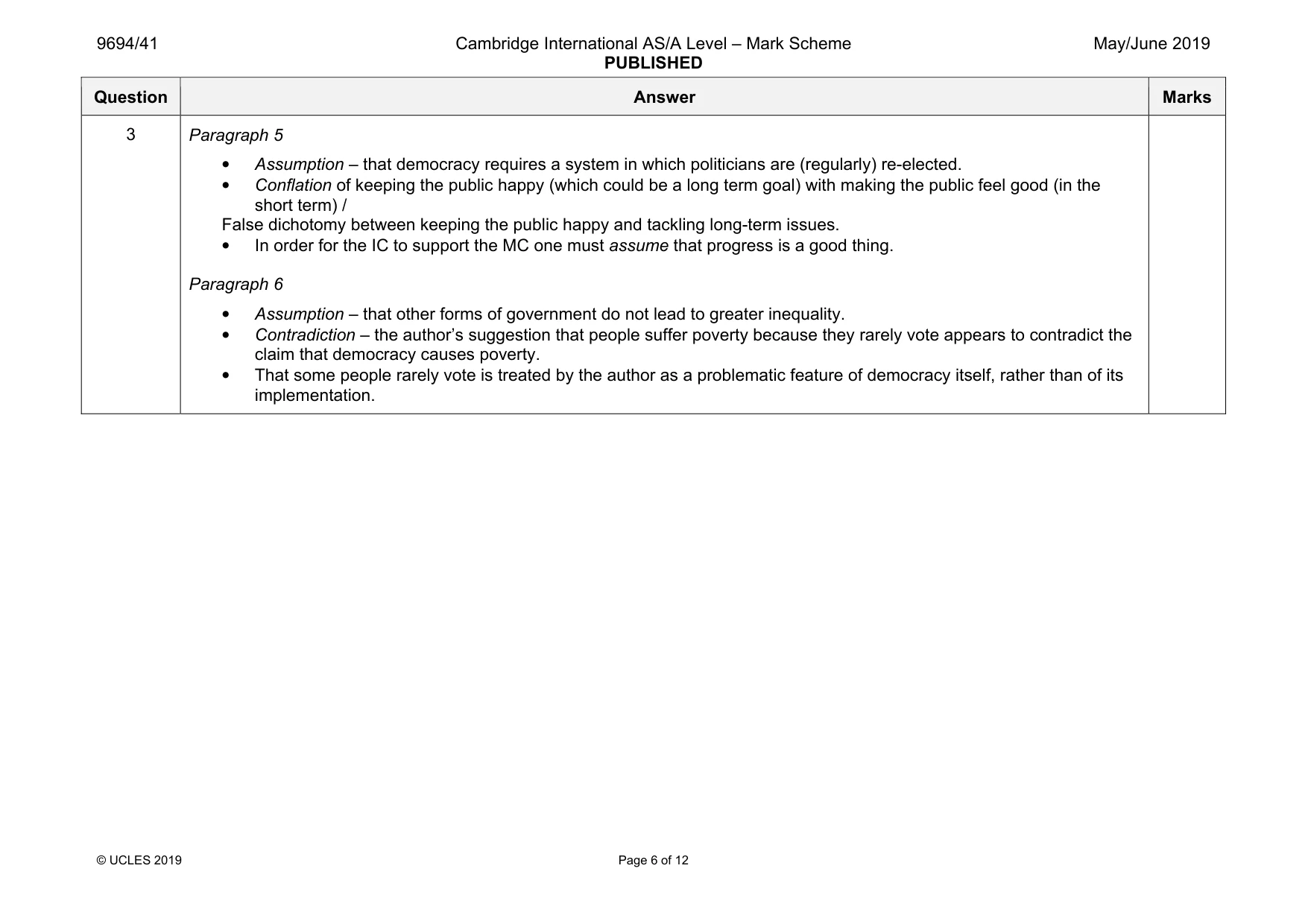
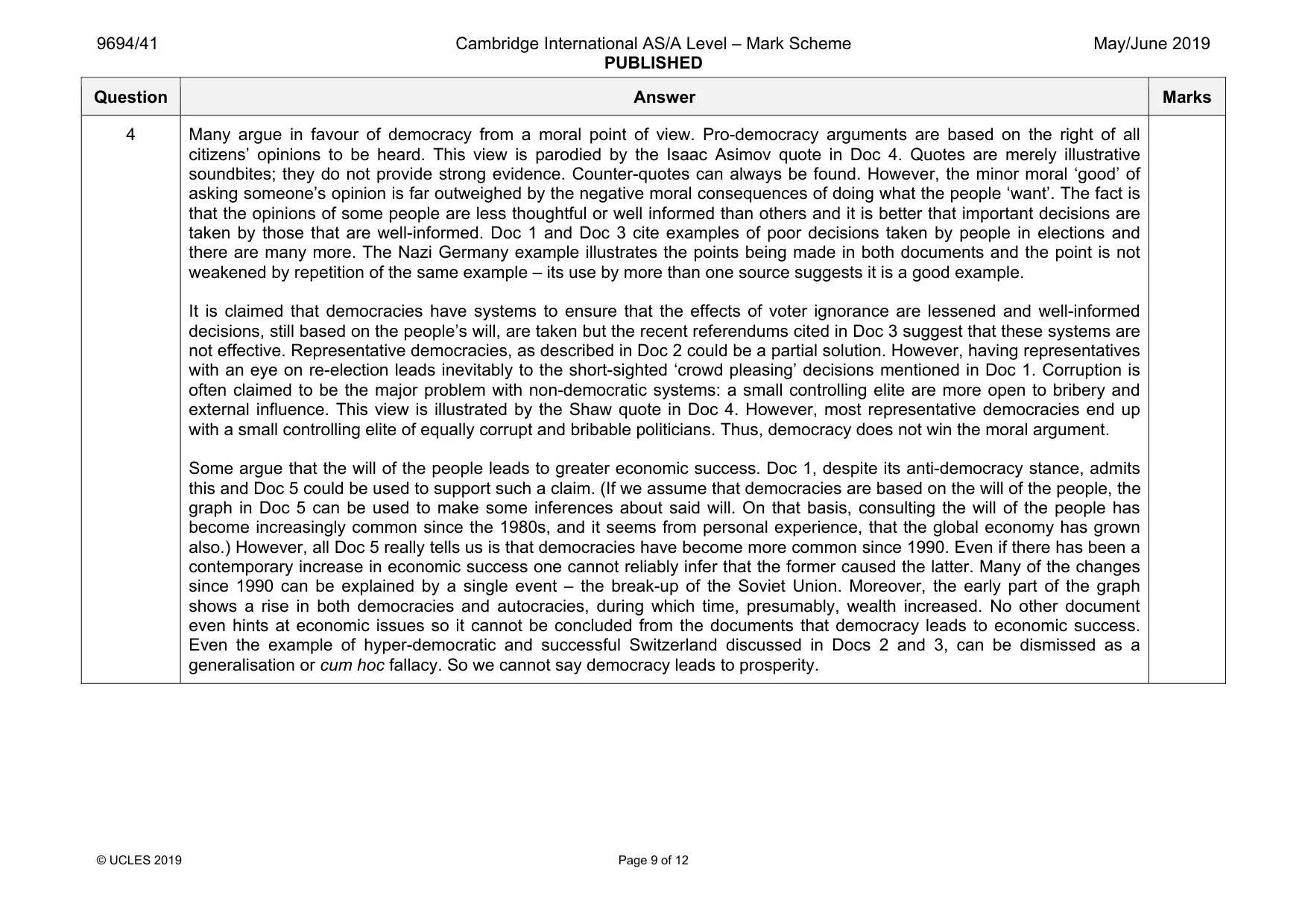
9694/41 Cambridge International AS/A Level – Mark Scheme PUBLISHED May/June 2019 © UCLES 2019 Page 9 of 12 Question Answer Marks 4 Many argue in favour of democracy from a moral point of view. Pro-democracy arguments are based on the right of all citizens’ opinions to be heard. This view is parodied by the Isaac Asimov quote in Doc 4. Quotes are merely illustrative soundbites; they do not provide strong evidence. Counter-quotes can always be found. However, the minor moral ‘good’ of asking someone’s opinion is far outweighed by the negative moral consequences of doing what the people ‘want’. The fact is that the opinions of some people are less thoughtful or well informed than others and it is better that important decisions are taken by those that are well-informed. Doc 1 and Doc 3 cite examples of poor decisions taken by people in elections and there are many more. The Nazi Germany example illustrates the points being made in both documents and the point is not weakened by repetition of the same example – its use by more than one source suggests it is a good example. It is claimed that democracies have systems to ensure that the effects of voter ignorance are lessened and well-informed decisions, still based on the people’s will, are taken but the recent referendums cited in Doc 3 suggest that these systems are not effective. Representative democracies, as described in Doc 2 could be a partial solution. However, having representatives with an eye on re-election leads inevitably to the short-sighted ‘crowd pleasing’ decisions mentioned in Doc 1. Corruption is often claimed to be the major problem with non-democratic systems: a small controlling elite are more open to bribery and external influence. This view is illustrated by the Shaw quote in Doc 4. However, most representative democracies end up with a small controlling elite of equally corrupt and bribable politicians. Thus, democracy does not win the moral argument. Some argue that the will of the people leads to greater economic success. Doc 1, despite its anti-democracy stance, admits this and Doc 5 could be used to support such a claim. (If we assume that democracies are based on the will of the people, the graph in Doc 5 can be used to make some inferences about said will. On that basis, consulting the will of the people has become increasingly common since the 1980s, and it seems from personal experience, that the global economy has grown also.) However, all Doc 5 really tells us is that democracies have become more common since 1990. Even if there has been a contemporary increase in economic success one cannot reliably infer that the former caused the latter. Many of the changes since 1990 can be explained by a single event – the break-up of the Soviet Union. Moreover, the early part of the graph shows a rise in both democracies and autocracies, during which time, presumably, wealth increased. No other document even hints at economic issues so it cannot be concluded from the documents that democracy leads to economic success. Even the example of hyper-democratic and successful Switzerland discussed in Docs 2 and 3, can be dismissed as a generalisation or cum hoc fallacy. So we cannot say democracy leads to prosperity.
Mark scheme, page 10
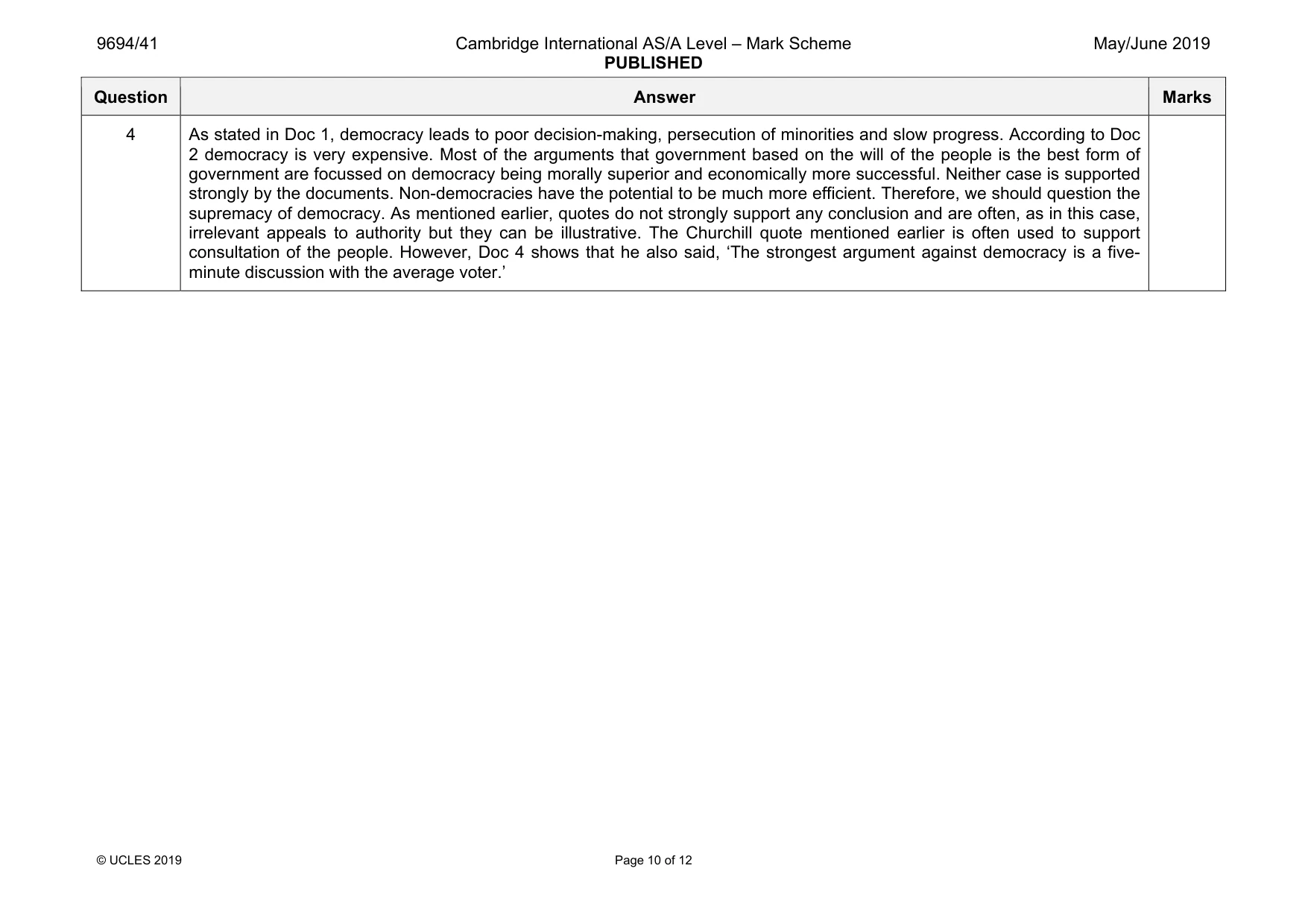
9694/41 Cambridge International AS/A Level – Mark Scheme PUBLISHED May/June 2019 © UCLES 2019 Page 10 of 12 Question Answer Marks 4 As stated in Doc 1, democracy leads to poor decision-making, persecution of minorities and slow progress. According to Doc 2 democracy is very expensive. Most of the arguments that government based on the will of the people is the best form of government are focussed on democracy being morally superior and economically more successful. Neither case is supported strongly by the documents. Non-democracies have the potential to be much more efficient. Therefore, we should question the supremacy of democracy. As mentioned earlier, quotes do not strongly support any conclusion and are often, as in this case, irrelevant appeals to authority but they can be illustrative. The Churchill quote mentioned earlier is often used to support consultation of the people. However, Doc 4 shows that he also said, ‘The strongest argument against democracy is a five- minute discussion with the average voter.’
Mark scheme, page 11
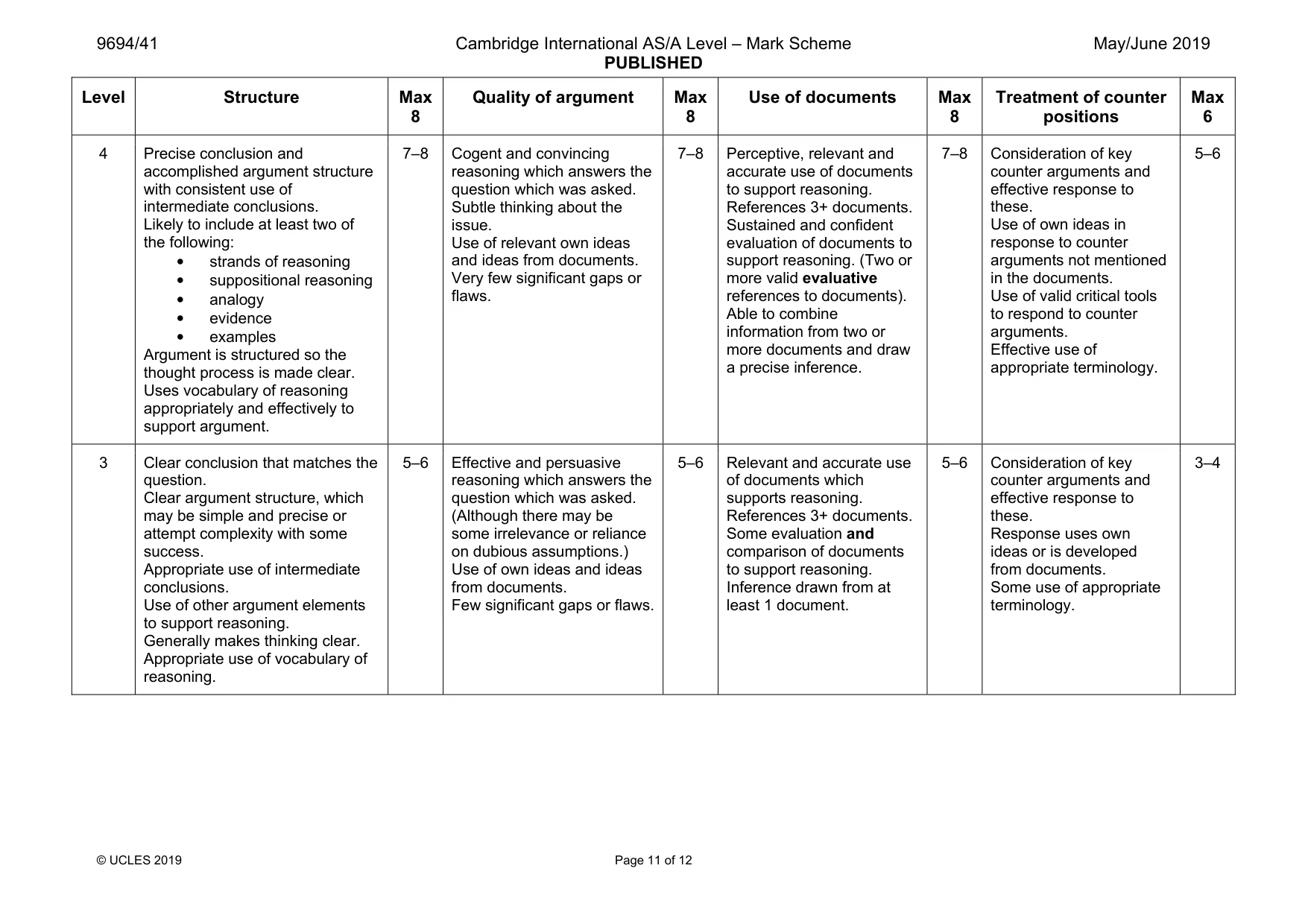
9694/41 Cambridge International AS/A Level – Mark Scheme PUBLISHED May/June 2019 © UCLES 2019 Page 11 of 12 Level Structure Max 8 Quality of argument Max 8 Use of documents Max 8 Treatment of counter positions Max 6 4 Precise conclusion and accomplished argument structure with consistent use of intermediate conclusions. Likely to include at least two of the following: • strands of reasoning • suppositional reasoning • analogy • evidence • examples Argument is structured so the thought process is made clear. Uses vocabulary of reasoning appropriately and effectively to support argument. 7–8 Cogent and convincing reasoning which answers the question which was asked. Subtle thinking about the issue. Use of relevant own ideas and ideas from documents. Very few significant gaps or flaws. 7–8 Perceptive, relevant and accurate use of documents to support reasoning. References 3+ documents. Sustained and confident evaluation of documents to support reasoning. (Two or more valid evaluative references to documents). Able to combine information from two or more documents and draw a precise inference. 7–8 Consideration of key counter arguments and effective response to these. Use of own ideas in response to counter arguments not mentioned in the documents. Use of valid critical tools to respond to counter arguments. Effective use of appropriate terminology. 5–6 3 Clear conclusion that matches the question. Clear argument structure, which may be simple and precise or attempt complexity with some success. Appropriate use of intermediate conclusions. Use of other argument elements to support reasoning. Generally makes thinking clear. Appropriate use of vocabulary of reasoning. 5–6 Effective and persuasive reasoning which answers the question which was asked. (Although there may be some irrelevance or reliance on dubious assumptions.) Use of own ideas and ideas from documents. Few significant gaps or flaws. 5–6 Relevant and accurate use of documents which supports reasoning. References 3+ documents. Some evaluation and comparison of documents to support reasoning. Inference drawn from at least 1 document. 5–6 Consideration of key counter arguments and effective response to these. Response uses own ideas or is developed from documents. Some use of appropriate terminology. 3–4
Mark scheme, page 12
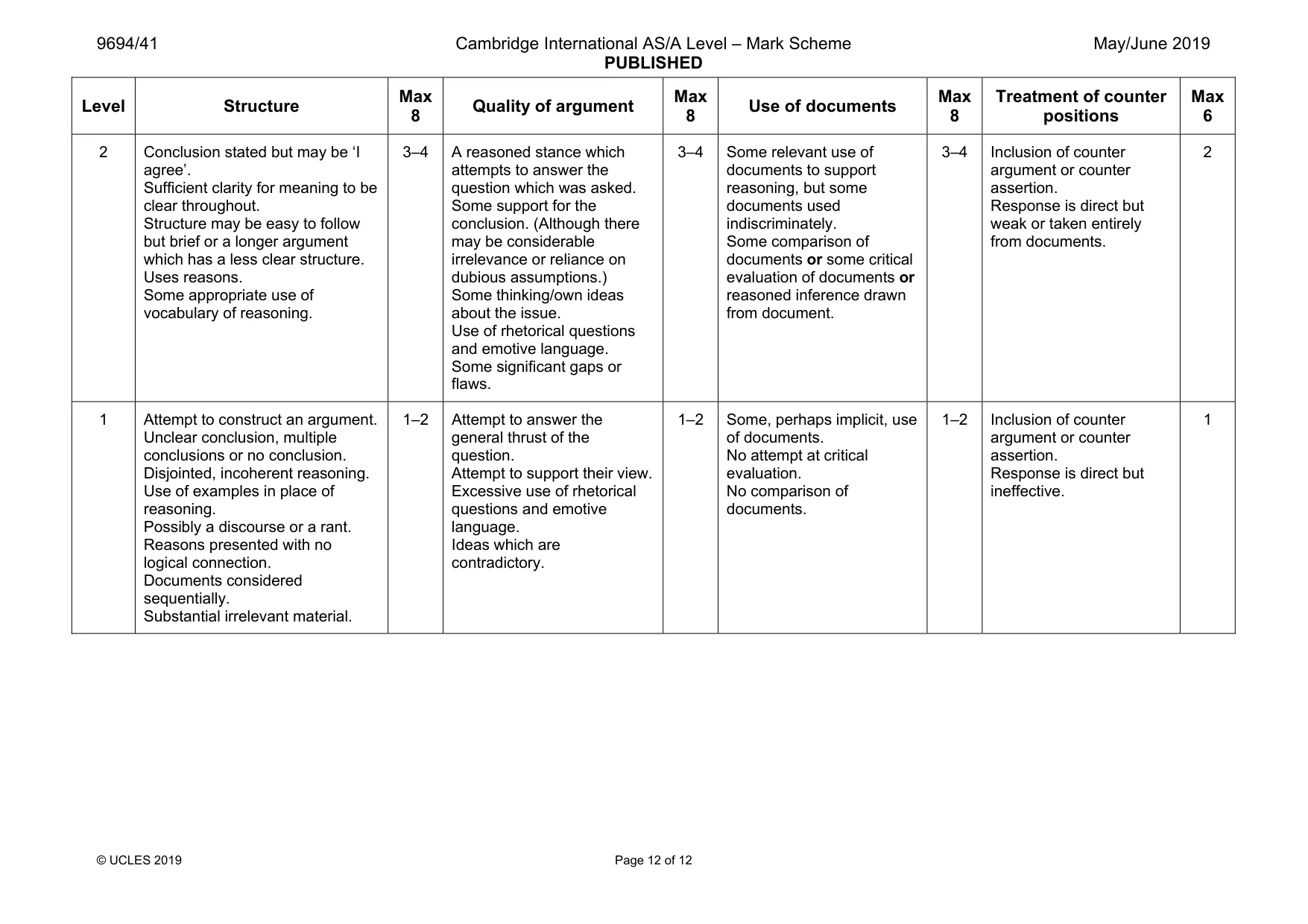
9694/41 Cambridge International AS/A Level – Mark Scheme PUBLISHED May/June 2019 © UCLES 2019 Page 12 of 12 Level Structure Max 8 Quality of argument Max 8 Use of documents Max 8 Treatment of counter positions Max 6 2 Conclusion stated but may be ‘I agree’. Sufficient clarity for meaning to be clear throughout. Structure may be easy to follow but brief or a longer argument which has a less clear structure. Uses reasons. Some appropriate use of vocabulary of reasoning. 3–4 A reasoned stance which attempts to answer the question which was asked. Some support for the conclusion. (Although there may be considerable irrelevance or reliance on dubious assumptions.) Some thinking/own ideas about the issue. Use of rhetorical questions and emotive language. Some significant gaps or flaws. 3–4 Some relevant use of documents to support reasoning, but some documents used indiscriminately. Some comparison of documents or some critical evaluation of documents or reasoned inference drawn from document. 3–4 Inclusion of counter argument or counter assertion. Response is direct but weak or taken entirely from documents. 2 1 Attempt to construct an argument. Unclear conclusion, multiple conclusions or no conclusion. Disjointed, incoherent reasoning. Use of examples in place of reasoning. Possibly a discourse or a rant. Reasons presented with no logical connection. Documents considered sequentially. Substantial irrelevant material. 1–2 Attempt to answer the general thrust of the question. Attempt to support their view. Excessive use of rhetorical questions and emotive language. Ideas which are contradictory. 1–2 Some, perhaps implicit, use of documents. No attempt at critical evaluation. No comparison of documents. 1–2 Inclusion of counter argument or counter assertion. Response is direct but ineffective. 1
What you needed in this session
Cambridge’s own grade thresholds for 2019 May/June, Paper 4 · Variant 1. A higher threshold means an easier paper — the bar moves with how the cohort did.