Cambridge A Level Thinking Skills 9694 — 2018 Oct/Nov Paper 4 · Variant 3
9694/43/O/N/18 · 50 marks · ≈56 min
The question paper and its mark scheme, free to read here and free to download. This is Cambridge’s own paper, exactly as it was sat.
Question paper8 pages

Mark scheme12 pages
Answers below. Sit the paper first if you are practising.
Paper as text
Question paper, page 1
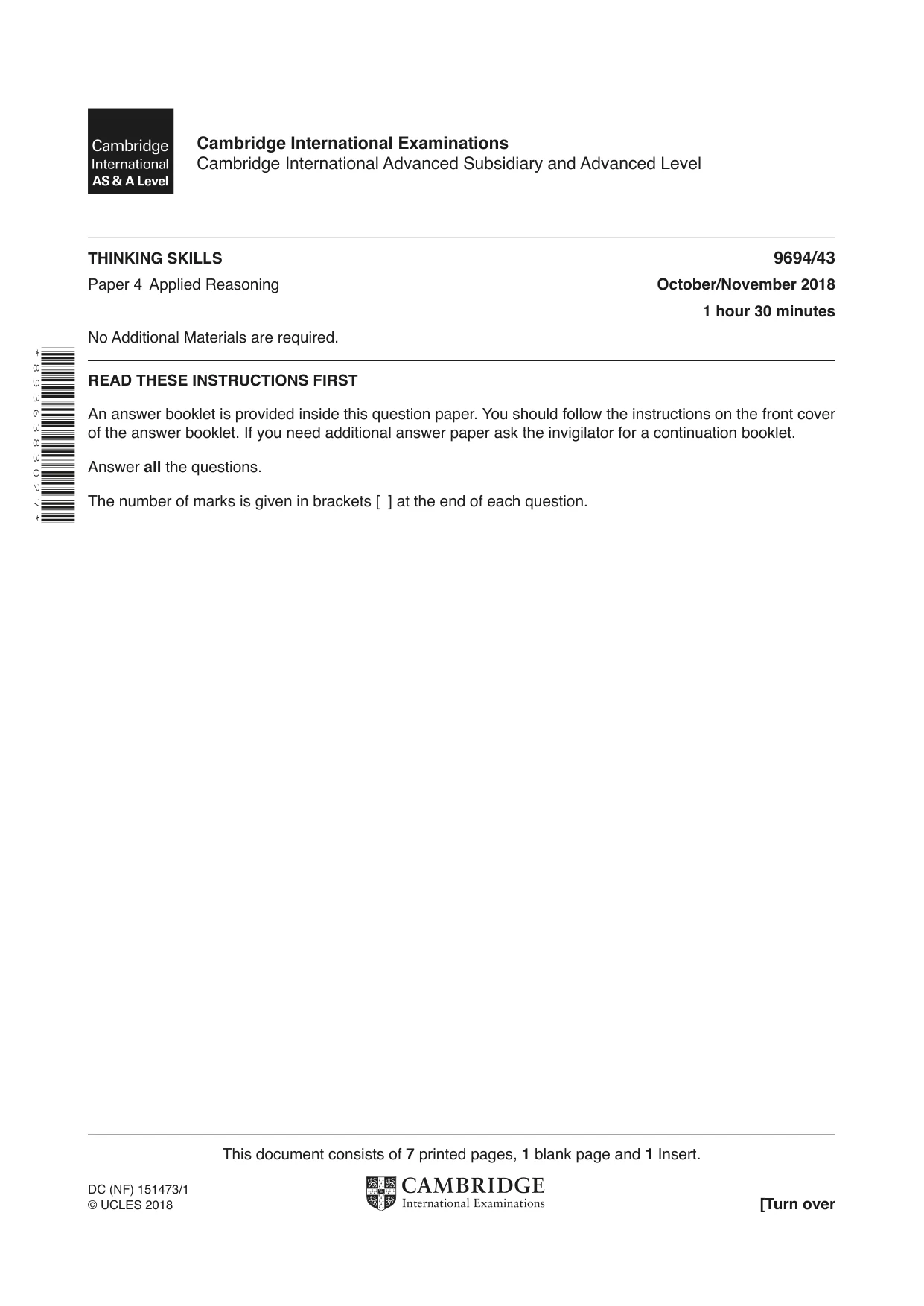
* 8 9 3 6 3 8 3 0 2 7 * This document consists of 7 printed pages, 1 blank page and 1 Insert. DC (NF) 151473/1 © UCLES 2018 [Turn over Cambridge International Examinations Cambridge International Advanced Subsidiary and Advanced Level THINKING SKILLS 9694/43 Paper 4 Applied Reasoning October/November 2018 1 hour 30 minutes No Additional Materials are required. READ THESE INSTRUCTIONS FIRST An answer booklet is provided inside this question paper. You should follow the instructions on the front cover of the answer booklet. If you need additional answer paper ask the invigilator for a continuation booklet. Answer all the questions. The number of marks is given in brackets [ ] at the end of each question.
Question paper, page 2
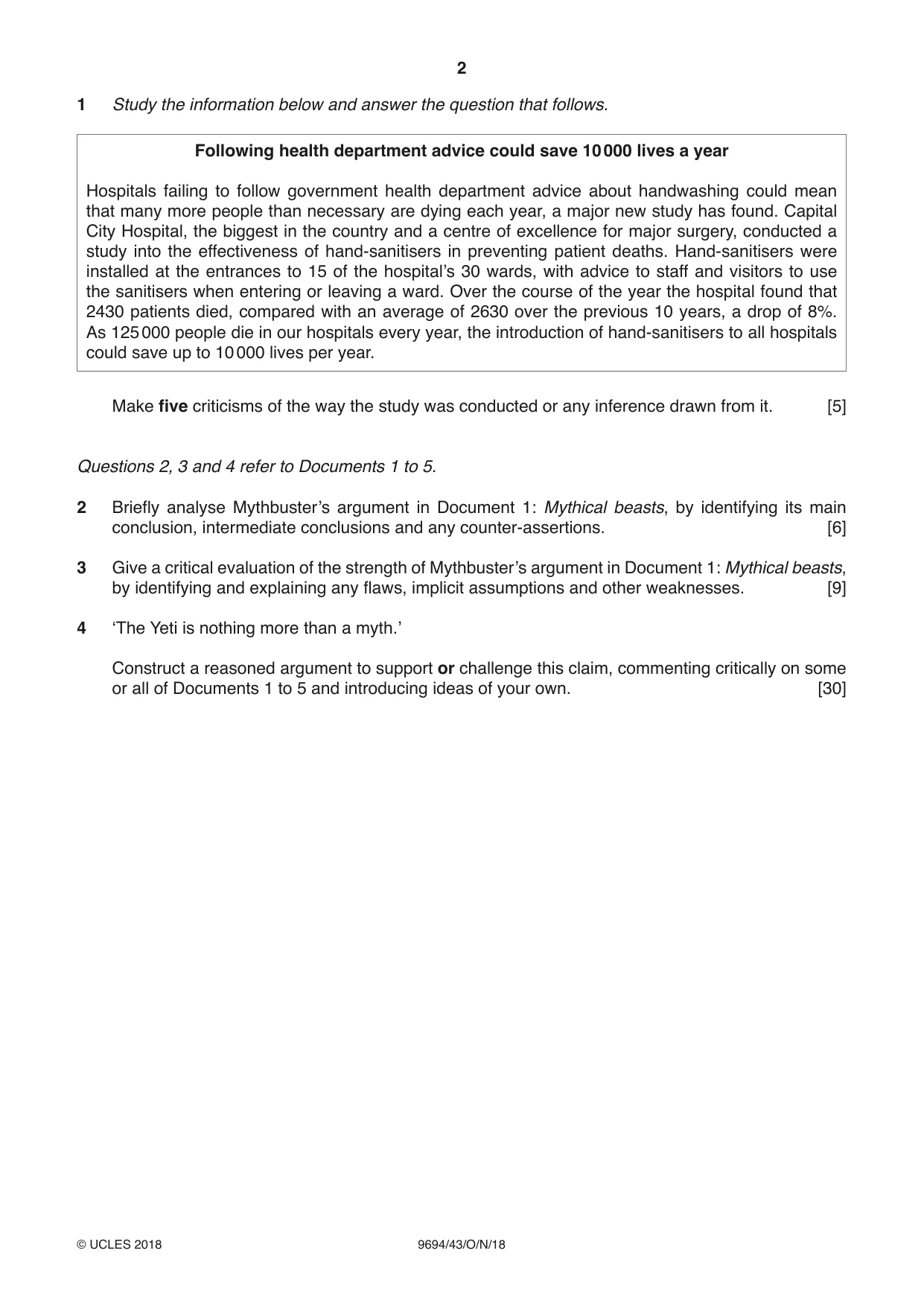
2 9694/43/O/N/18 © UCLES 2018 1 Study the information below and answer the question that follows. Following health department advice could save 10 000 lives a year Hospitals failing to follow government health department advice about handwashing could mean that many more people than necessary are dying each year, a major new study has found. Capital City Hospital, the biggest in the country and a centre of excellence for major surgery, conducted a study into the effectiveness of hand-sanitisers in preventing patient deaths. Hand-sanitisers were installed at the entrances to 15 of the hospital’s 30 wards, with advice to staff and visitors to use the sanitisers when entering or leaving a ward. Over the course of the year the hospital found that 2430 patients died, compared with an average of 2630 over the previous 10 years, a drop of 8%. As 125 000 people die in our hospitals every year, the introduction of hand-sanitisers to all hospitals could save up to 10 000 lives per year. Make five criticisms of the way the study was conducted or any inference drawn from it. [5] Questions 2, 3 and 4 refer to Documents 1 to 5. 2 Briefly analyse Mythbuster’s argument in Document 1: Mythical beasts, by identifying its main conclusion, intermediate conclusions and any counter-assertions. [6] 3 Give a critical evaluation of the strength of Mythbuster’s argument in Document 1: Mythical beasts, by identifying and explaining any flaws, implicit assumptions and other weaknesses. [9] 4 ‘The Yeti is nothing more than a myth.’ Construct a reasoned argument to support or challenge this claim, commenting critically on some or all of Documents 1 to 5 and introducing ideas of your own. [30]
Question paper, page 3
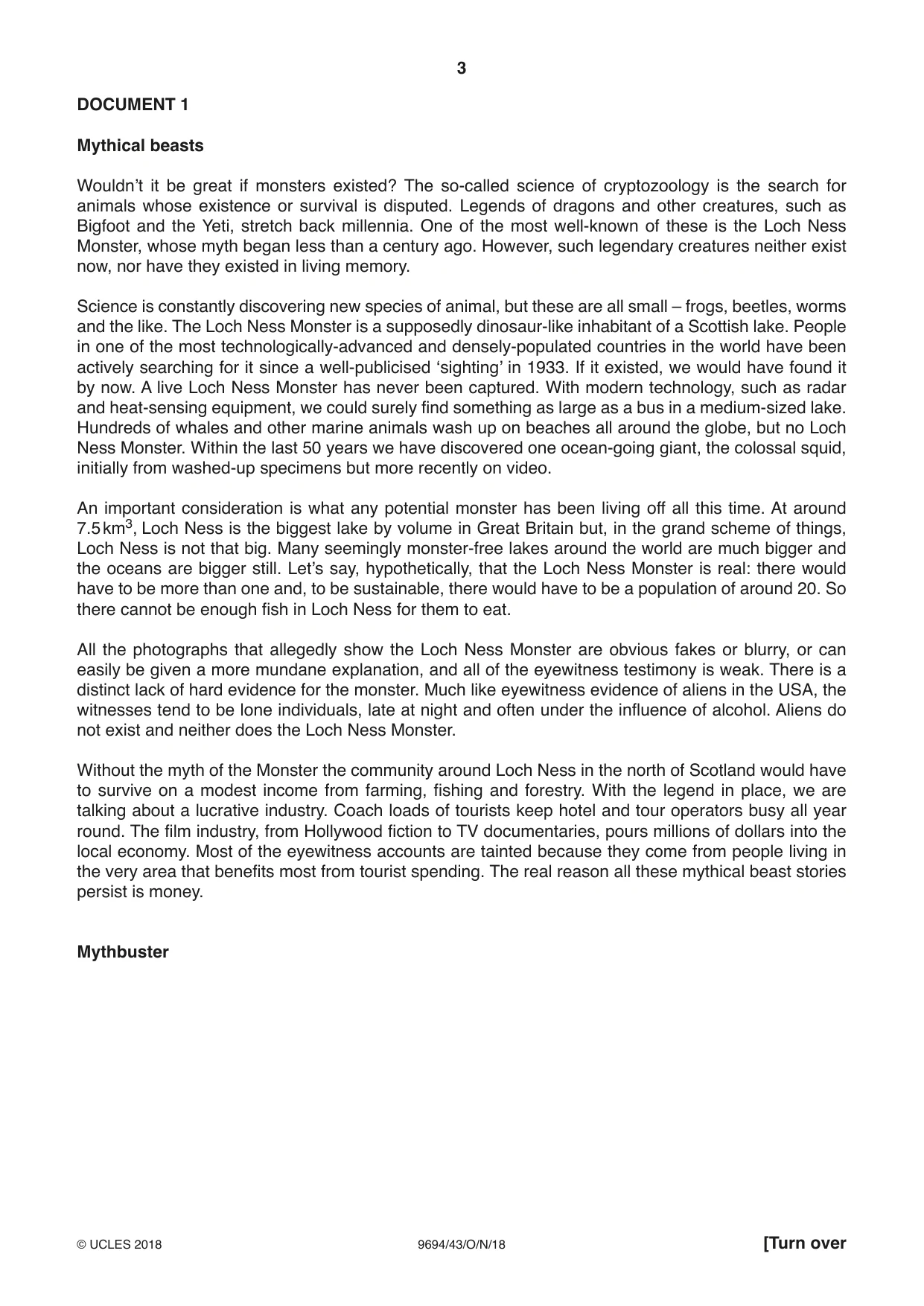
3 9694/43/O/N/18 © UCLES 2018 [Turn over DOCUMENT 1 Mythical beasts Wouldn’t it be great if monsters existed? The so-called science of cryptozoology is the search for animals whose existence or survival is disputed. Legends of dragons and other creatures, such as Bigfoot and the Yeti, stretch back millennia. One of the most well-known of these is the Loch Ness Monster, whose myth began less than a century ago. However, such legendary creatures neither exist now, nor have they existed in living memory. Science is constantly discovering new species of animal, but these are all small – frogs, beetles, worms and the like. The Loch Ness Monster is a supposedly dinosaur-like inhabitant of a Scottish lake. People in one of the most technologically-advanced and densely-populated countries in the world have been actively searching for it since a well-publicised ‘sighting’ in 1933. If it existed, we would have found it by now. A live Loch Ness Monster has never been captured. With modern technology, such as radar and heat-sensing equipment, we could surely find something as large as a bus in a medium-sized lake. Hundreds of whales and other marine animals wash up on beaches all around the globe, but no Loch Ness Monster. Within the last 50 years we have discovered one ocean-going giant, the colossal squid, initially from washed-up specimens but more recently on video. An important consideration is what any potential monster has been living off all this time. At around 7.5 km3, Loch Ness is the biggest lake by volume in Great Britain but, in the grand scheme of things, Loch Ness is not that big. Many seemingly monster-free lakes around the world are much bigger and the oceans are bigger still. Let’s say, hypothetically, that the Loch Ness Monster is real: there would have to be more than one and, to be sustainable, there would have to be a population of around 20. So there cannot be enough fish in Loch Ness for them to eat. All the photographs that allegedly show the Loch Ness Monster are obvious fakes or blurry, or can easily be given a more mundane explanation, and all of the eyewitness testimony is weak. There is a distinct lack of hard evidence for the monster. Much like eyewitness evidence of aliens in the USA, the witnesses tend to be lone individuals, late at night and often under the influence of alcohol. Aliens do not exist and neither does the Loch Ness Monster. Without the myth of the Monster the community around Loch Ness in the north of Scotland would have to survive on a modest income from farming, fishing and forestry. With the legend in place, we are talking about a lucrative industry. Coach loads of tourists keep hotel and tour operators busy all year round. The film industry, from Hollywood fiction to TV documentaries, pours millions of dollars into the local economy. Most of the eyewitness accounts are tainted because they come from people living in the very area that benefits most from tourist spending. The real reason all these mythical beast stories persist is money. Mythbuster
Question paper, page 4
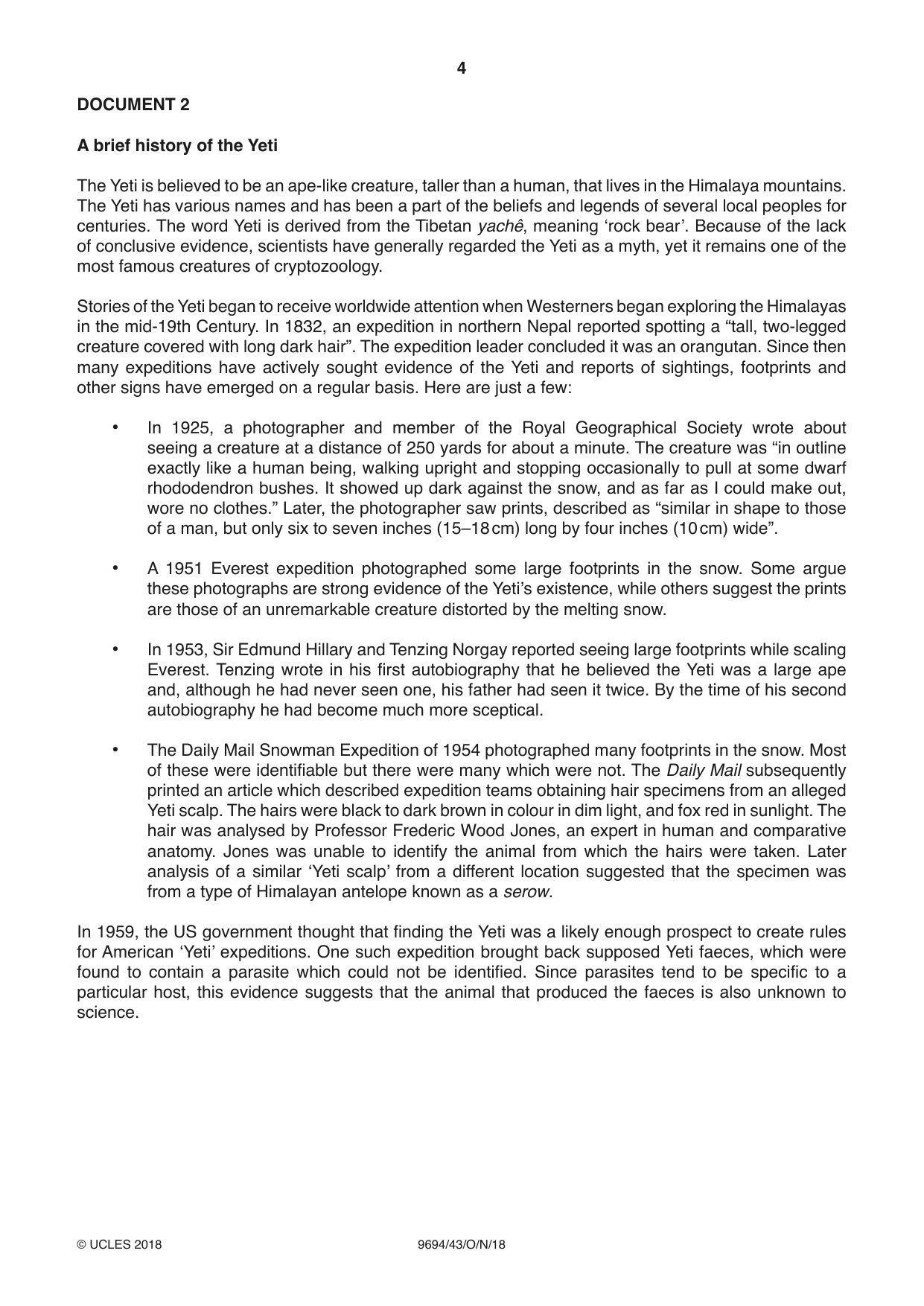
4 9694/43/O/N/18 © UCLES 2018 DOCUMENT 2 A brief history of the Yeti The Yeti is believed to be an ape-like creature, taller than a human, that lives in the Himalaya mountains. The Yeti has various names and has been a part of the beliefs and legends of several local peoples for centuries. The word Yeti is derived from the Tibetan yachê, meaning ‘rock bear’. Because of the lack of conclusive evidence, scientists have generally regarded the Yeti as a myth, yet it remains one of the most famous creatures of cryptozoology. Stories of the Yeti began to receive worldwide attention when Westerners began exploring the Himalayas in the mid-19th Century. In 1832, an expedition in northern Nepal reported spotting a “tall, two-legged creature covered with long dark hair”. The expedition leader concluded it was an orangutan. Since then many expeditions have actively sought evidence of the Yeti and reports of sightings, footprints and other signs have emerged on a regular basis. Here are just a few: • In 1925, a photographer and member of the Royal Geographical Society wrote about seeing a creature at a distance of 250 yards for about a minute. The creature was “in outline exactly like a human being, walking upright and stopping occasionally to pull at some dwarf rhododendron bushes. It showed up dark against the snow, and as far as I could make out, wore no clothes.” Later, the photographer saw prints, described as “similar in shape to those of a man, but only six to seven inches (15–18 cm) long by four inches (10 cm) wide”. • A 1951 Everest expedition photographed some large footprints in the snow. Some argue these photographs are strong evidence of the Yeti’s existence, while others suggest the prints are those of an unremarkable creature distorted by the melting snow. • In 1953, Sir Edmund Hillary and Tenzing Norgay reported seeing large footprints while scaling Everest. Tenzing wrote in his first autobiography that he believed the Yeti was a large ape and, although he had never seen one, his father had seen it twice. By the time of his second autobiography he had become much more sceptical. • The Daily Mail Snowman Expedition of 1954 photographed many footprints in the snow. Most of these were identifiable but there were many which were not. The Daily Mail subsequently printed an article which described expedition teams obtaining hair specimens from an alleged Yeti scalp. The hairs were black to dark brown in colour in dim light, and fox red in sunlight. The hair was analysed by Professor Frederic Wood Jones, an expert in human and comparative anatomy. Jones was unable to identify the animal from which the hairs were taken. Later analysis of a similar ‘Yeti scalp’ from a different location suggested that the specimen was from a type of Himalayan antelope known as a serow. In 1959, the US government thought that finding the Yeti was a likely enough prospect to create rules for American ‘Yeti’ expeditions. One such expedition brought back supposed Yeti faeces, which were found to contain a parasite which could not be identified. Since parasites tend to be specific to a particular host, this evidence suggests that the animal that produced the faeces is also unknown to science.
Question paper, page 5
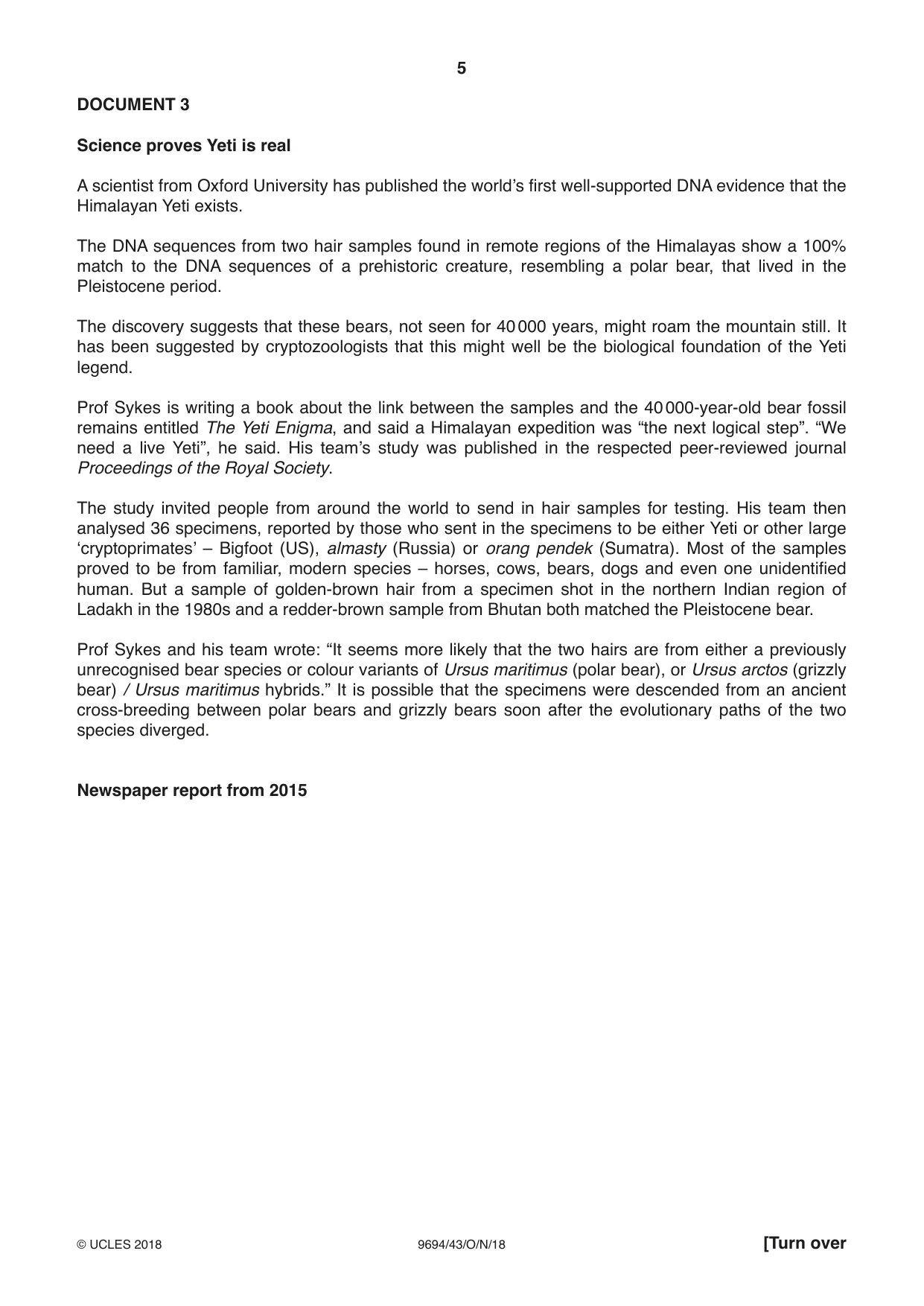
5 9694/43/O/N/18 © UCLES 2018 [Turn over DOCUMENT 3 Science proves Yeti is real A scientist from Oxford University has published the world’s first well-supported DNA evidence that the Himalayan Yeti exists. The DNA sequences from two hair samples found in remote regions of the Himalayas show a 100% match to the DNA sequences of a prehistoric creature, resembling a polar bear, that lived in the Pleistocene period. The discovery suggests that these bears, not seen for 40 000 years, might roam the mountain still. It has been suggested by cryptozoologists that this might well be the biological foundation of the Yeti legend. Prof Sykes is writing a book about the link between the samples and the 40 000-year-old bear fossil remains entitled The Yeti Enigma, and said a Himalayan expedition was “the next logical step”. “We need a live Yeti”, he said. His team’s study was published in the respected peer-reviewed journal Proceedings of the Royal Society. The study invited people from around the world to send in hair samples for testing. His team then analysed 36 specimens, reported by those who sent in the specimens to be either Yeti or other large ‘cryptoprimates’ – Bigfoot (US), almasty (Russia) or orang pendek (Sumatra). Most of the samples proved to be from familiar, modern species – horses, cows, bears, dogs and even one unidentified human. But a sample of golden-brown hair from a specimen shot in the northern Indian region of Ladakh in the 1980s and a redder-brown sample from Bhutan both matched the Pleistocene bear. Prof Sykes and his team wrote: “It seems more likely that the two hairs are from either a previously unrecognised bear species or colour variants of Ursus maritimus (polar bear), or Ursus arctos (grizzly bear) / Ursus maritimus hybrids.” It is possible that the specimens were descended from an ancient cross-breeding between polar bears and grizzly bears soon after the evolutionary paths of the two species diverged. Newspaper report from 2015
Question paper, page 6
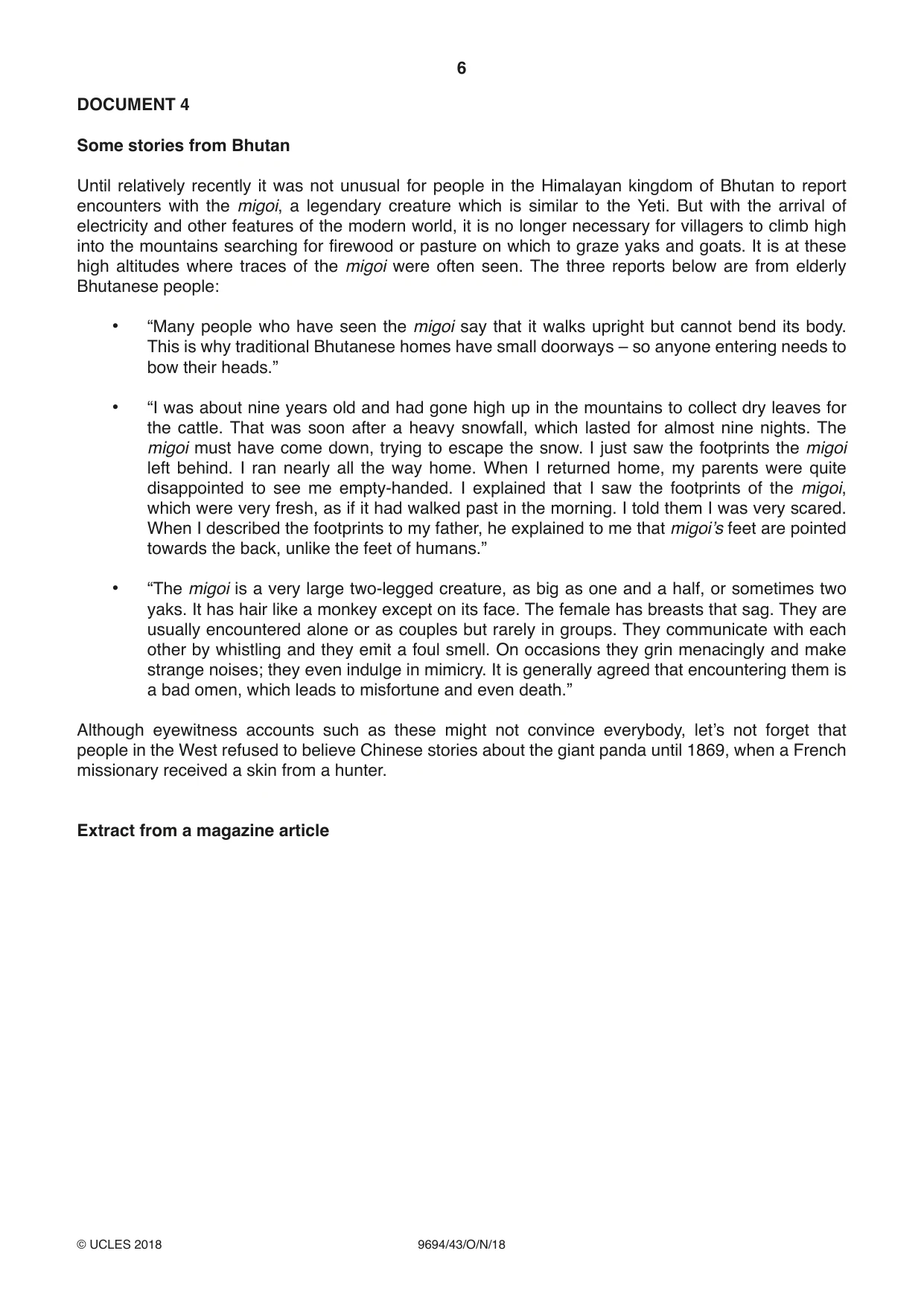
6 9694/43/O/N/18 © UCLES 2018 DOCUMENT 4 Some stories from Bhutan Until relatively recently it was not unusual for people in the Himalayan kingdom of Bhutan to report encounters with the migoi, a legendary creature which is similar to the Yeti. But with the arrival of electricity and other features of the modern world, it is no longer necessary for villagers to climb high into the mountains searching for firewood or pasture on which to graze yaks and goats. It is at these high altitudes where traces of the migoi were often seen. The three reports below are from elderly Bhutanese people: • “Many people who have seen the migoi say that it walks upright but cannot bend its body. This is why traditional Bhutanese homes have small doorways – so anyone entering needs to bow their heads.” • “I was about nine years old and had gone high up in the mountains to collect dry leaves for the cattle. That was soon after a heavy snowfall, which lasted for almost nine nights. The migoi must have come down, trying to escape the snow. I just saw the footprints the migoi left behind. I ran nearly all the way home. When I returned home, my parents were quite disappointed to see me empty-handed. I explained that I saw the footprints of the migoi, which were very fresh, as if it had walked past in the morning. I told them I was very scared. When I described the footprints to my father, he explained to me that migoi’s feet are pointed towards the back, unlike the feet of humans.” • “The migoi is a very large two-legged creature, as big as one and a half, or sometimes two yaks. It has hair like a monkey except on its face. The female has breasts that sag. They are usually encountered alone or as couples but rarely in groups. They communicate with each other by whistling and they emit a foul smell. On occasions they grin menacingly and make strange noises; they even indulge in mimicry. It is generally agreed that encountering them is a bad omen, which leads to misfortune and even death.” Although eyewitness accounts such as these might not convince everybody, let’s not forget that people in the West refused to believe Chinese stories about the giant panda until 1869, when a French missionary received a skin from a hunter. Extract from a magazine article
Question paper, page 7
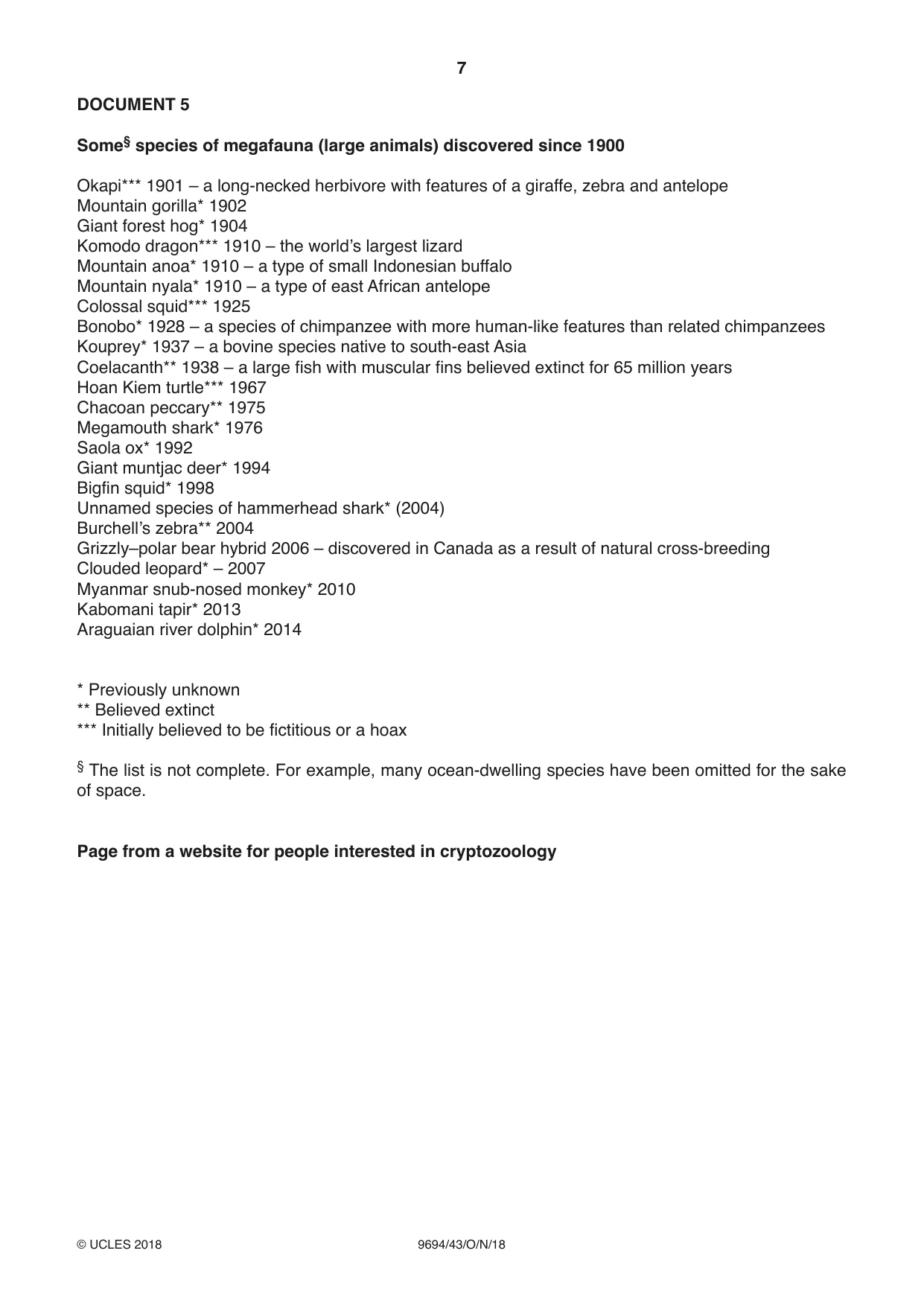
7 9694/43/O/N/18 © UCLES 2018 DOCUMENT 5 Some§ species of megafauna (large animals) discovered since 1900 Okapi*** 1901 – a long-necked herbivore with features of a giraffe, zebra and antelope Mountain gorilla* 1902 Giant forest hog* 1904 Komodo dragon*** 1910 – the world’s largest lizard Mountain anoa* 1910 – a type of small Indonesian buffalo Mountain nyala* 1910 – a type of east African antelope Colossal squid*** 1925 Bonobo* 1928 – a species of chimpanzee with more human-like features than related chimpanzees Kouprey* 1937 – a bovine species native to south-east Asia Coelacanth** 1938 – a large fish with muscular fins believed extinct for 65 million years Hoan Kiem turtle*** 1967 Chacoan peccary** 1975 Megamouth shark* 1976 Saola ox* 1992 Giant muntjac deer* 1994 Bigfin squid* 1998 Unnamed species of hammerhead shark* (2004) Burchell’s zebra** 2004 Grizzly–polar bear hybrid 2006 – discovered in Canada as a result of natural cross-breeding Clouded leopard* – 2007 Myanmar snub-nosed monkey* 2010 Kabomani tapir* 2013 Araguaian river dolphin* 2014 * Previously unknown ** Believed extinct *** Initially believed to be fictitious or a hoax § The list is not complete. For example, many ocean-dwelling species have been omitted for the sake of space. Page from a website for people interested in cryptozoology
Question paper, page 8
8 9694/43/O/N/18 © UCLES 2018 BLANK PAGE Permission to reproduce items where third-party owned material protected by copyright is included has been sought and cleared where possible. Every reasonable effort has been made by the publisher (UCLES) to trace copyright holders, but if any items requiring clearance have unwittingly been included, the publisher will be pleased to make amends at the earliest possible opportunity. To avoid the issue of disclosure of answer-related information to candidates, all copyright acknowledgements are reproduced online in the Cambridge International Examinations Copyright Acknowledgements Booklet. This is produced for each series of examinations and is freely available to download at www.cie.org.uk after the live examination series. Cambridge International Examinations is part of the Cambridge Assessment Group. Cambridge Assessment is the brand name of University of Cambridge Local Examinations Syndicate (UCLES), which is itself a department of the University of Cambridge.
Mark scheme, page 1
This document consists of 12 printed pages. © UCLES 2018 [Turn over Cambridge Assessment International Education Cambridge International Advanced Subsidiary and Advanced Level THINKING SKILLS 9694/43 Paper 4 Applied Reasoning October/November 2018 MARK SCHEME Maximum Mark: 50 Published This mark scheme is published as an aid to teachers and candidates, to indicate the requirements of the examination. It shows the basis on which Examiners were instructed to award marks. It does not indicate the details of the discussions that took place at an Examiners’ meeting before marking began, which would have considered the acceptability of alternative answers. Mark schemes should be read in conjunction with the question paper and the Principal Examiner Report for Teachers. Cambridge International will not enter into discussions about these mark schemes. Cambridge International is publishing the mark schemes for the October/November 2018 series for most Cambridge IGCSE™, Cambridge International A and AS Level components and some Cambridge O Level components.
Mark scheme, page 2
9694/43 Cambridge International AS/A Level – Mark Scheme PUBLISHED October/November 2018 © UCLES 2018 Page 2 of 12 Generic Marking Principles These general marking principles must be applied by all examiners when marking candidate answers. They should be applied alongside the specific content of the mark scheme or generic level descriptors for a question. Each question paper and mark scheme will also comply with these marking principles. GENERIC MARKING PRINCIPLE 1: Marks must be awarded in line with: • the specific content of the mark scheme or the generic level descriptors for the question • the specific skills defined in the mark scheme or in the generic level descriptors for the question • the standard of response required by a candidate as exemplified by the standardisation scripts. GENERIC MARKING PRINCIPLE 2: Marks awarded are always whole marks (not half marks, or other fractions). GENERIC MARKING PRINCIPLE 3: Marks must be awarded positively: • marks are awarded for correct/valid answers, as defined in the mark scheme. However, credit is given for valid answers which go beyond the scope of the syllabus and mark scheme, referring to your Team Leader as appropriate • marks are awarded when candidates clearly demonstrate what they know and can do • marks are not deducted for errors • marks are not deducted for omissions • answers should only be judged on the quality of spelling, punctuation and grammar when these features are specifically assessed by the question as indicated by the mark scheme. The meaning, however, should be unambiguous. GENERIC MARKING PRINCIPLE 4: Rules must be applied consistently e.g. in situations where candidates have not followed instructions or in the application of generic level descriptors.
Mark scheme, page 3
9694/43 Cambridge International AS/A Level – Mark Scheme PUBLISHED October/November 2018 © UCLES 2018 Page 3 of 12 GENERIC MARKING PRINCIPLE 5: Marks should be awarded using the full range of marks defined in the mark scheme for the question (however; the use of the full mark range may be limited according to the quality of the candidate responses seen). GENERIC MARKING PRINCIPLE 6: Marks awarded are based solely on the requirements as defined in the mark scheme. Marks should not be awarded with grade thresholds or grade descriptors in mind.
Mark scheme, page 4
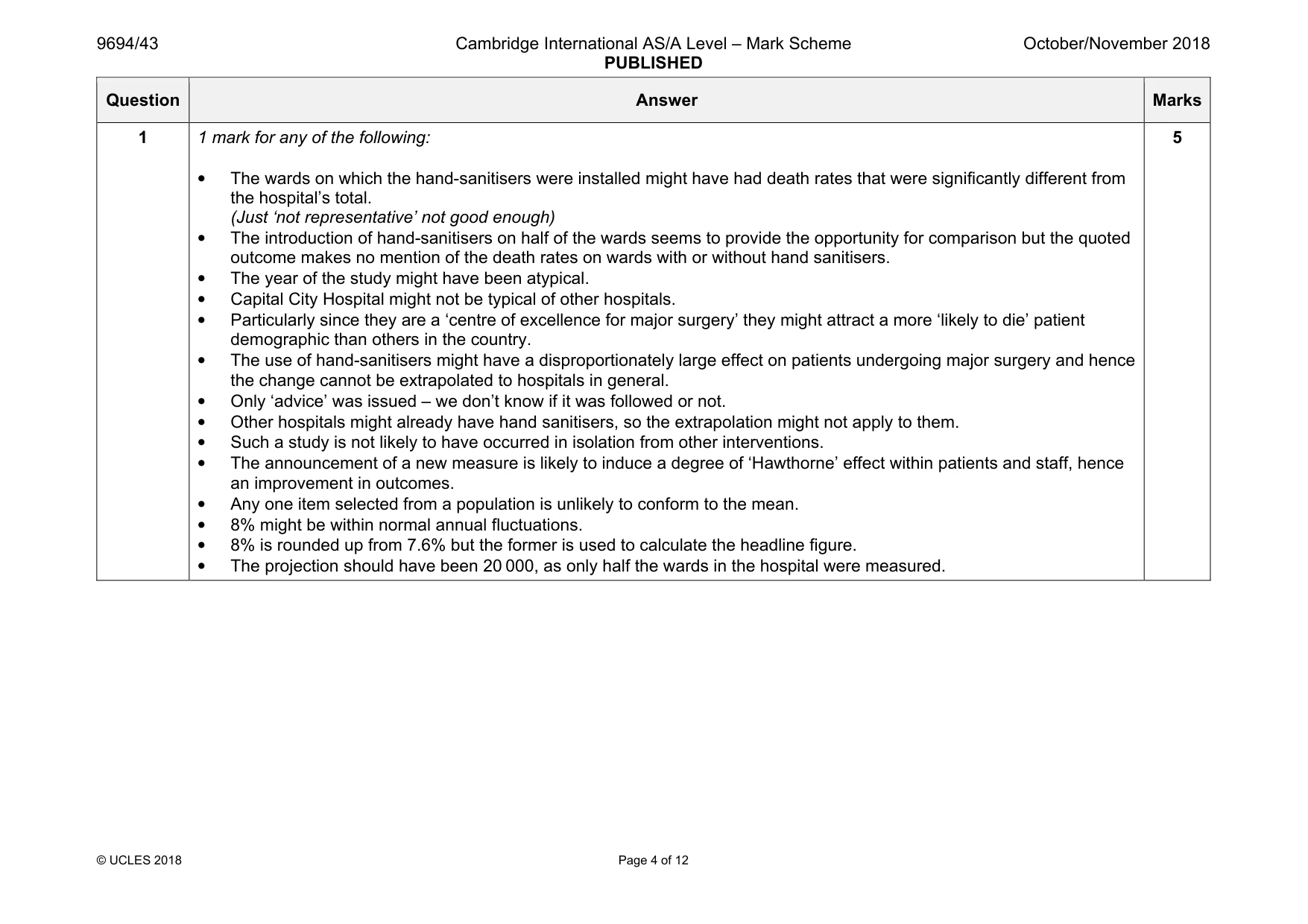
9694/43 Cambridge International AS/A Level – Mark Scheme PUBLISHED October/November 2018 © UCLES 2018 Page 4 of 12 Question Answer Marks 1 1 mark for any of the following: • The wards on which the hand-sanitisers were installed might have had death rates that were significantly different from the hospital’s total. (Just ‘not representative’ not good enough) • The introduction of hand-sanitisers on half of the wards seems to provide the opportunity for comparison but the quoted outcome makes no mention of the death rates on wards with or without hand sanitisers. • The year of the study might have been atypical. • Capital City Hospital might not be typical of other hospitals. • Particularly since they are a ‘centre of excellence for major surgery’ they might attract a more ‘likely to die’ patient demographic than others in the country. • The use of hand-sanitisers might have a disproportionately large effect on patients undergoing major surgery and hence the change cannot be extrapolated to hospitals in general. • Only ‘advice’ was issued – we don’t know if it was followed or not. • Other hospitals might already have hand sanitisers, so the extrapolation might not apply to them. • Such a study is not likely to have occurred in isolation from other interventions. • The announcement of a new measure is likely to induce a degree of ‘Hawthorne’ effect within patients and staff, hence an improvement in outcomes. • Any one item selected from a population is unlikely to conform to the mean. • 8% might be within normal annual fluctuations. • 8% is rounded up from 7.6% but the former is used to calculate the headline figure. • The projection should have been 20 000, as only half the wards in the hospital were measured. 5
Mark scheme, page 5
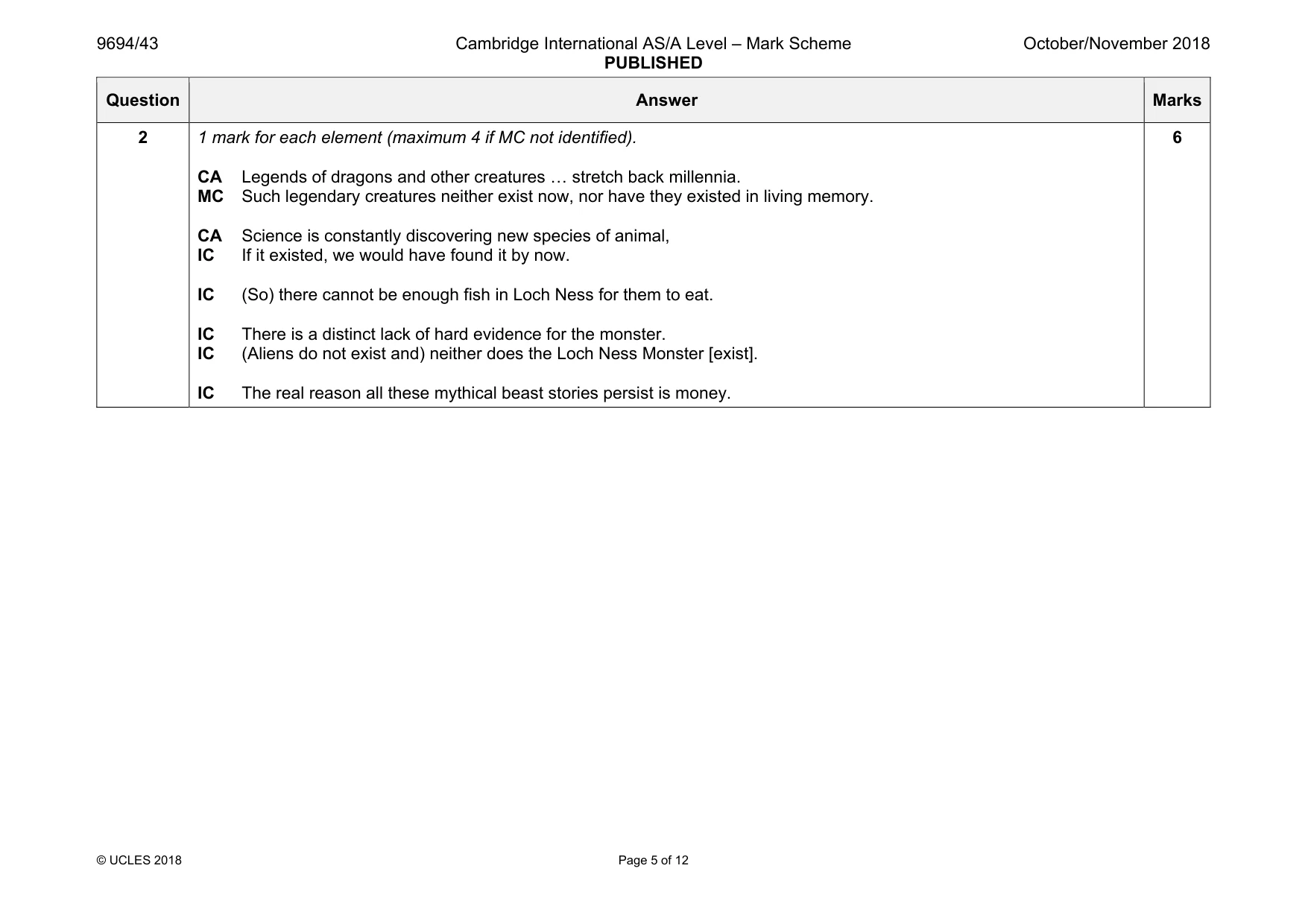
9694/43 Cambridge International AS/A Level – Mark Scheme PUBLISHED October/November 2018 © UCLES 2018 Page 5 of 12 Question Answer Marks 2 1 mark for each element (maximum 4 if MC not identified). CA Legends of dragons and other creatures « stretch back millennia. MC Such legendary creatures neither exist now, nor have they existed in living memory. CA Science is constantly discovering new species of animal, IC If it existed, we would have found it by now. IC (So) there cannot be enough fish in Loch Ness for them to eat. IC There is a distinct lack of hard evidence for the monster. IC (Aliens do not exist and) neither does the Loch Ness Monster [exist]. IC The real reason all these mythical beast stories persist is money. 6
Mark scheme, page 6
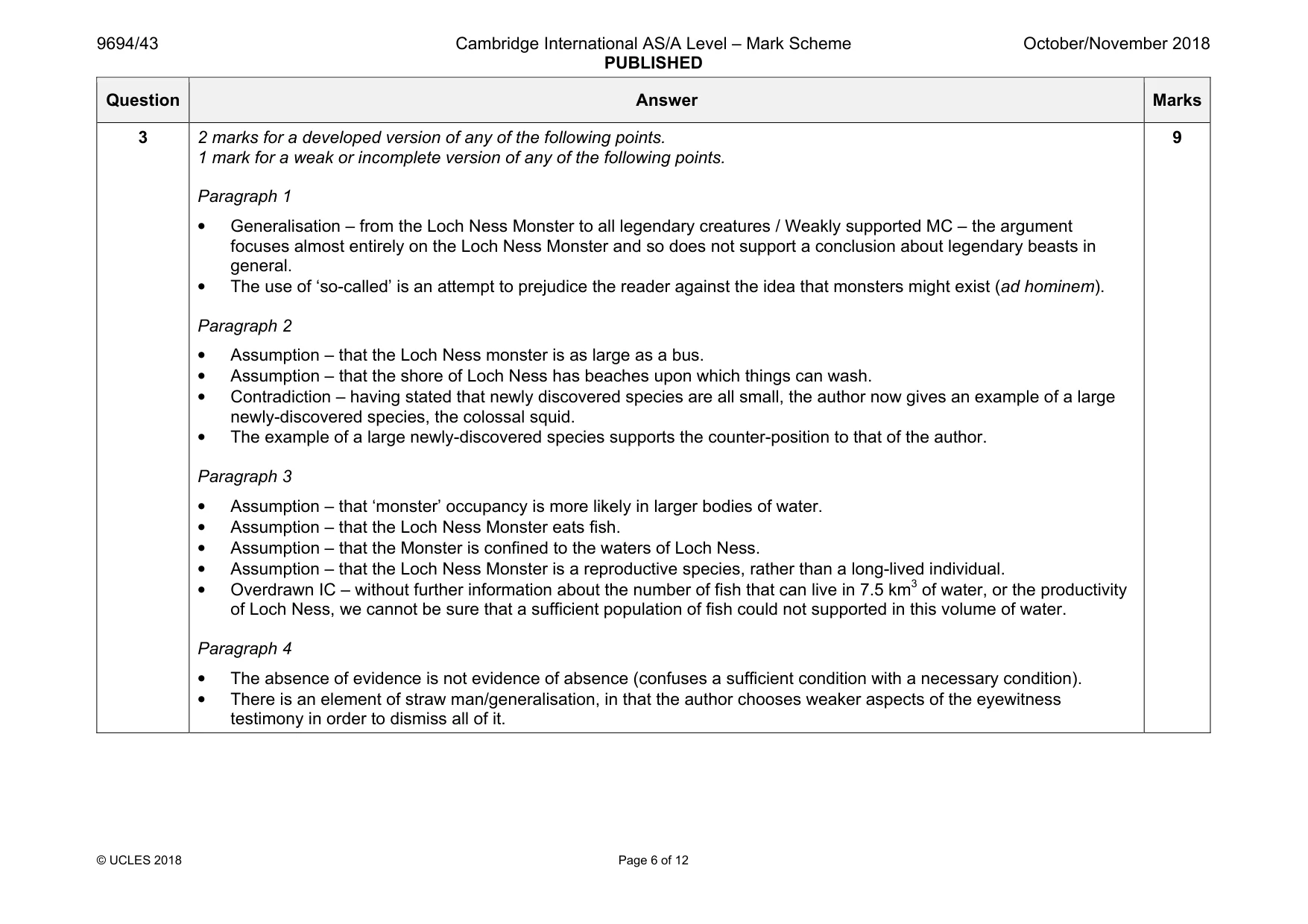
9694/43 Cambridge International AS/A Level – Mark Scheme PUBLISHED October/November 2018 © UCLES 2018 Page 6 of 12 Question Answer Marks 3 2 marks for a developed version of any of the following points. 1 mark for a weak or incomplete version of any of the following points. Paragraph 1 • Generalisation – from the Loch Ness Monster to all legendary creatures / Weakly supported MC – the argument focuses almost entirely on the Loch Ness Monster and so does not support a conclusion about legendary beasts in general. • The use of ‘so-called’ is an attempt to prejudice the reader against the idea that monsters might exist (ad hominem). Paragraph 2 • Assumption – that the Loch Ness monster is as large as a bus. • Assumption – that the shore of Loch Ness has beaches upon which things can wash. • Contradiction – having stated that newly discovered species are all small, the author now gives an example of a large newly-discovered species, the colossal squid. • The example of a large newly-discovered species supports the counter-position to that of the author. Paragraph 3 • Assumption – that ‘monster’ occupancy is more likely in larger bodies of water. • Assumption – that the Loch Ness Monster eats fish. • Assumption – that the Monster is confined to the waters of Loch Ness. • Assumption – that the Loch Ness Monster is a reproductive species, rather than a long-lived individual. • Overdrawn IC – without further information about the number of fish that can live in 7.5 km3 of water, or the productivity of Loch Ness, we cannot be sure that a sufficient population of fish could not supported in this volume of water. Paragraph 4 • The absence of evidence is not evidence of absence (confuses a sufficient condition with a necessary condition). • There is an element of straw man/generalisation, in that the author chooses weaker aspects of the eyewitness testimony in order to dismiss all of it. 9
Mark scheme, page 7
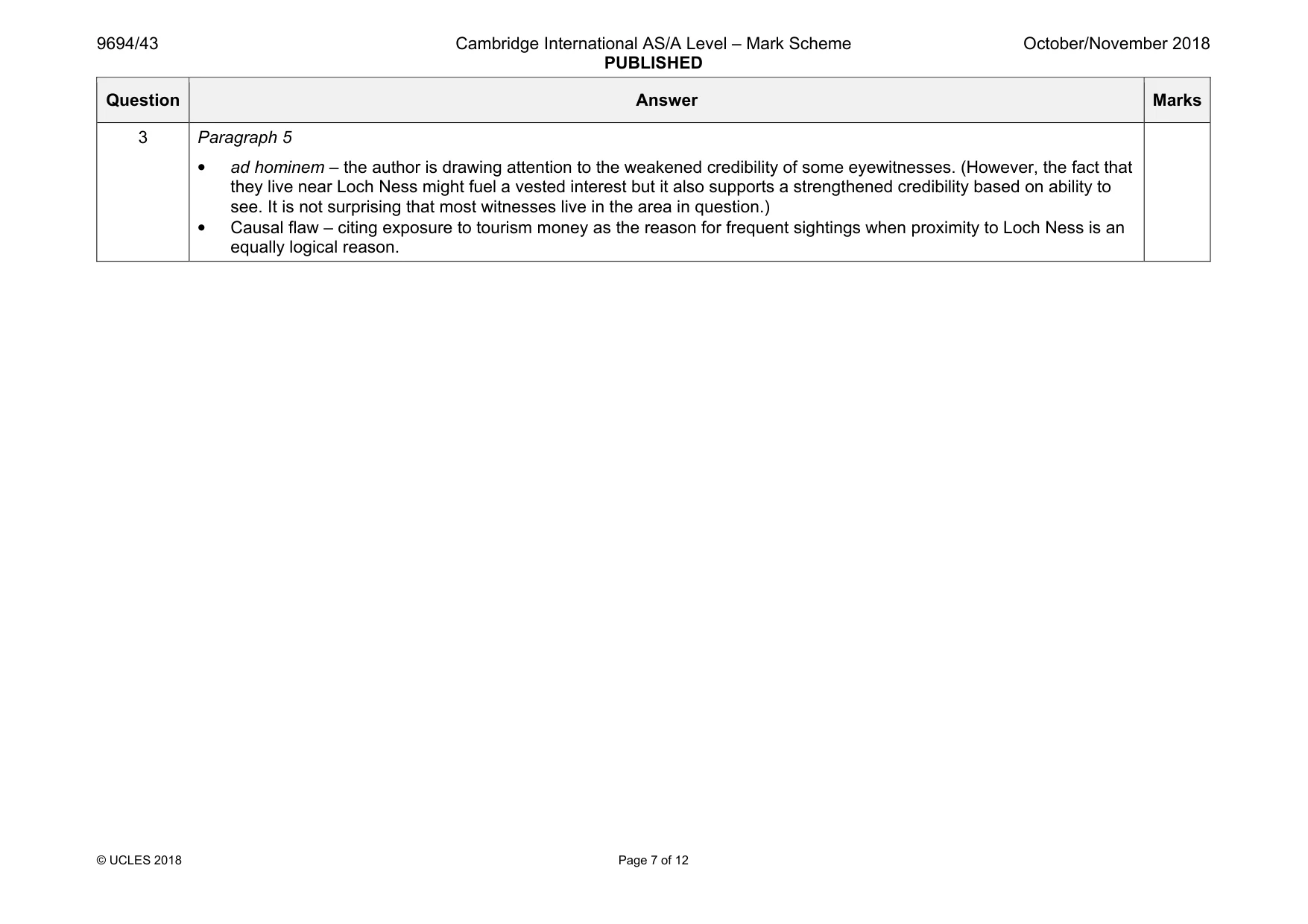
9694/43 Cambridge International AS/A Level – Mark Scheme PUBLISHED October/November 2018 © UCLES 2018 Page 7 of 12 Question Answer Marks 3 Paragraph 5 • ad hominem – the author is drawing attention to the weakened credibility of some eyewitnesses. (However, the fact that they live near Loch Ness might fuel a vested interest but it also supports a strengthened credibility based on ability to see. It is not surprising that most witnesses live in the area in question.) • Causal flaw – citing exposure to tourism money as the reason for frequent sightings when proximity to Loch Ness is an equally logical reason.
Mark scheme, page 8
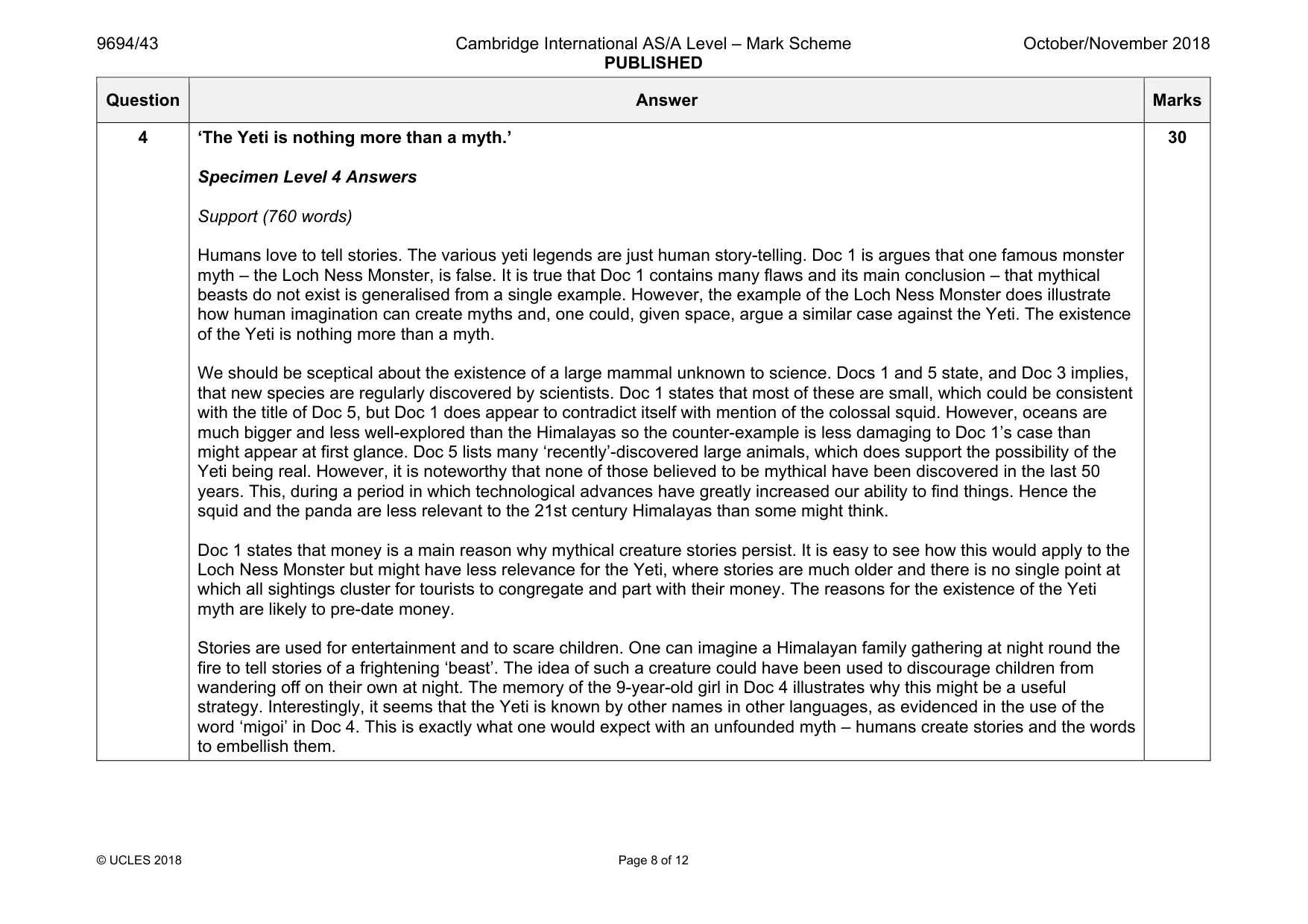
9694/43 Cambridge International AS/A Level – Mark Scheme PUBLISHED October/November 2018 © UCLES 2018 Page 8 of 12 Question Answer Marks 4 ‘The Yeti is nothing more than a myth.’ Specimen Level 4 Answers Support (760 words) Humans love to tell stories. The various yeti legends are just human story-telling. Doc 1 is argues that one famous monster myth – the Loch Ness Monster, is false. It is true that Doc 1 contains many flaws and its main conclusion – that mythical beasts do not exist is generalised from a single example. However, the example of the Loch Ness Monster does illustrate how human imagination can create myths and, one could, given space, argue a similar case against the Yeti. The existence of the Yeti is nothing more than a myth. We should be sceptical about the existence of a large mammal unknown to science. Docs 1 and 5 state, and Doc 3 implies, that new species are regularly discovered by scientists. Doc 1 states that most of these are small, which could be consistent with the title of Doc 5, but Doc 1 does appear to contradict itself with mention of the colossal squid. However, oceans are much bigger and less well-explored than the Himalayas so the counter-example is less damaging to Doc 1’s case than might appear at first glance. Doc 5 lists many ‘recently’-discovered large animals, which does support the possibility of the Yeti being real. However, it is noteworthy that none of those believed to be mythical have been discovered in the last 50 years. This, during a period in which technological advances have greatly increased our ability to find things. Hence the squid and the panda are less relevant to the 21st century Himalayas than some might think. Doc 1 states that money is a main reason why mythical creature stories persist. It is easy to see how this would apply to the Loch Ness Monster but might have less relevance for the Yeti, where stories are much older and there is no single point at which all sightings cluster for tourists to congregate and part with their money. The reasons for the existence of the Yeti myth are likely to pre-date money. Stories are used for entertainment and to scare children. One can imagine a Himalayan family gathering at night round the fire to tell stories of a frightening ‘beast’. The idea of such a creature could have been used to discourage children from wandering off on their own at night. The memory of the 9-year-old girl in Doc 4 illustrates why this might be a useful strategy. Interestingly, it seems that the Yeti is known by other names in other languages, as evidenced in the use of the word ‘migoi’ in Doc 4. This is exactly what one would expect with an unfounded myth – humans create stories and the words to embellish them. 30
Mark scheme, page 9
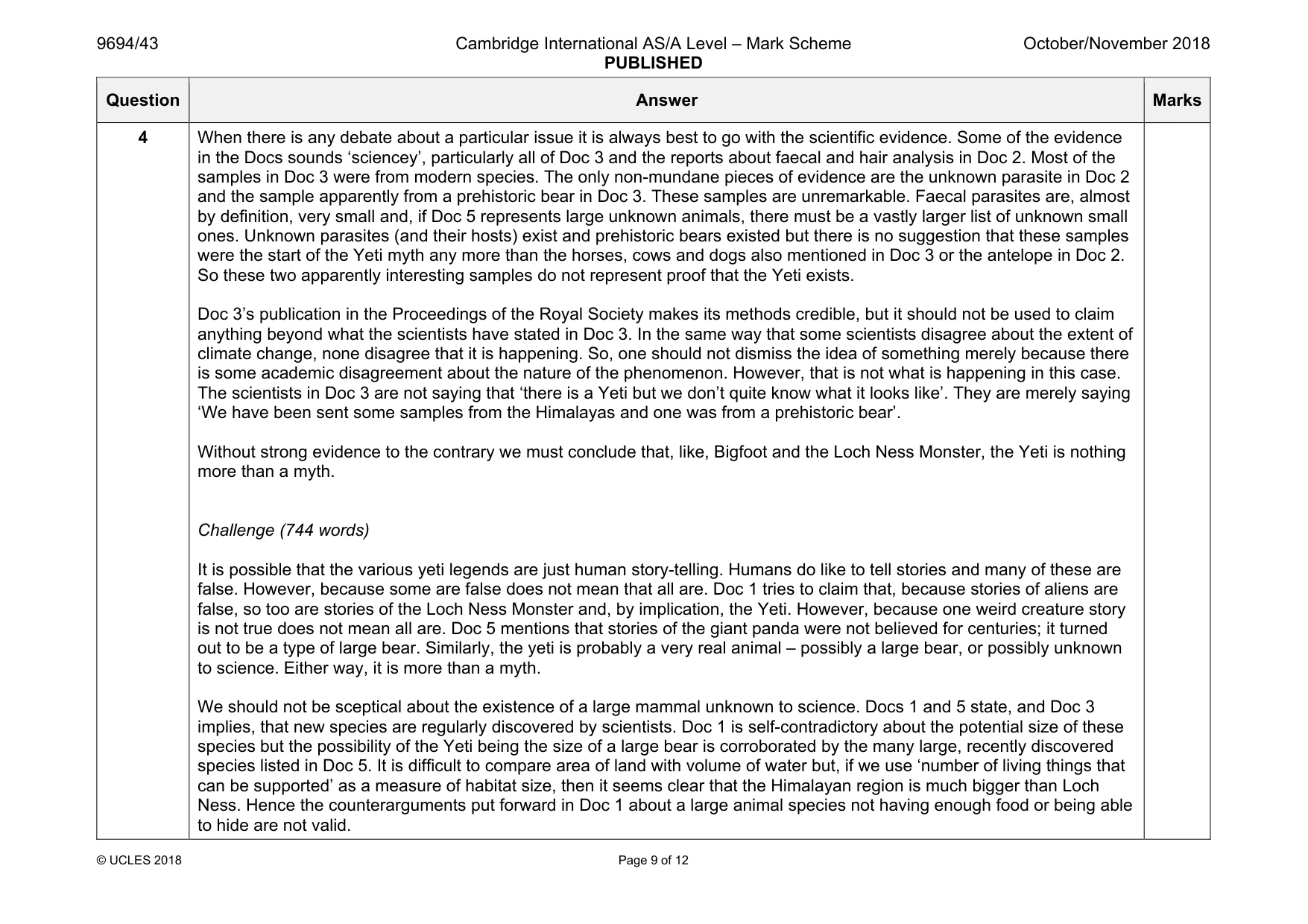
9694/43 Cambridge International AS/A Level – Mark Scheme PUBLISHED October/November 2018 © UCLES 2018 Page 9 of 12 Question Answer Marks 4 When there is any debate about a particular issue it is always best to go with the scientific evidence. Some of the evidence in the Docs sounds ‘sciencey’, particularly all of Doc 3 and the reports about faecal and hair analysis in Doc 2. Most of the samples in Doc 3 were from modern species. The only non-mundane pieces of evidence are the unknown parasite in Doc 2 and the sample apparently from a prehistoric bear in Doc 3. These samples are unremarkable. Faecal parasites are, almost by definition, very small and, if Doc 5 represents large unknown animals, there must be a vastly larger list of unknown small ones. Unknown parasites (and their hosts) exist and prehistoric bears existed but there is no suggestion that these samples were the start of the Yeti myth any more than the horses, cows and dogs also mentioned in Doc 3 or the antelope in Doc 2. So these two apparently interesting samples do not represent proof that the Yeti exists. Doc 3’s publication in the Proceedings of the Royal Society makes its methods credible, but it should not be used to claim anything beyond what the scientists have stated in Doc 3. In the same way that some scientists disagree about the extent of climate change, none disagree that it is happening. So, one should not dismiss the idea of something merely because there is some academic disagreement about the nature of the phenomenon. However, that is not what is happening in this case. The scientists in Doc 3 are not saying that ‘there is a Yeti but we don’t quite know what it looks like’. They are merely saying ‘We have been sent some samples from the Himalayas and one was from a prehistoric bear’. Without strong evidence to the contrary we must conclude that, like, Bigfoot and the Loch Ness Monster, the Yeti is nothing more than a myth. Challenge (744 words) It is possible that the various yeti legends are just human story-telling. Humans do like to tell stories and many of these are false. However, because some are false does not mean that all are. Doc 1 tries to claim that, because stories of aliens are false, so too are stories of the Loch Ness Monster and, by implication, the Yeti. However, because one weird creature story is not true does not mean all are. Doc 5 mentions that stories of the giant panda were not believed for centuries; it turned out to be a type of large bear. Similarly, the yeti is probably a very real animal – possibly a large bear, or possibly unknown to science. Either way, it is more than a myth. We should not be sceptical about the existence of a large mammal unknown to science. Docs 1 and 5 state, and Doc 3 implies, that new species are regularly discovered by scientists. Doc 1 is self-contradictory about the potential size of these species but the possibility of the Yeti being the size of a large bear is corroborated by the many large, recently discovered species listed in Doc 5. It is difficult to compare area of land with volume of water but, if we use ‘number of living things that can be supported’ as a measure of habitat size, then it seems clear that the Himalayan region is much bigger than Loch Ness. Hence the counterarguments put forward in Doc 1 about a large animal species not having enough food or being able to hide are not valid.
Mark scheme, page 10
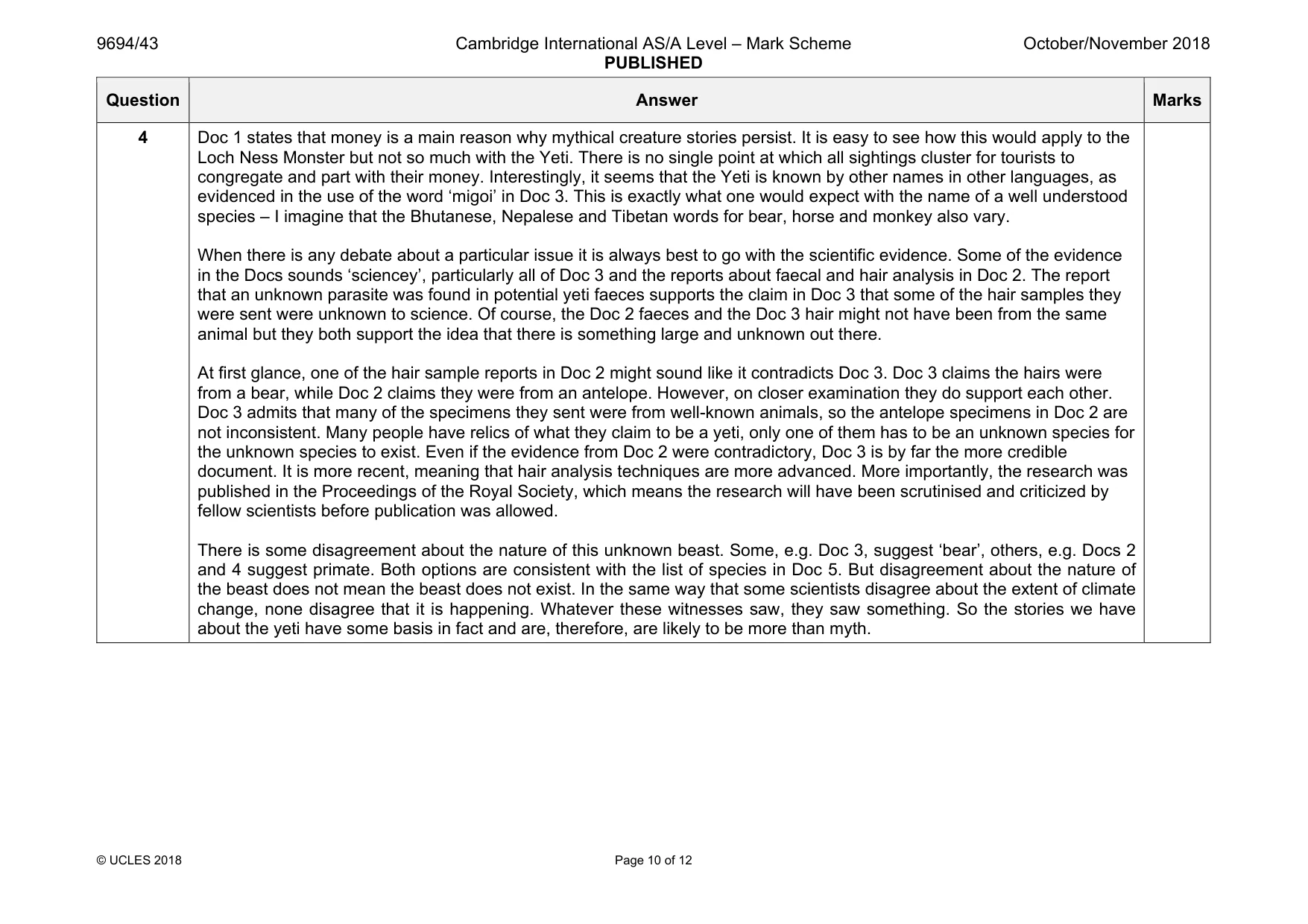
9694/43 Cambridge International AS/A Level – Mark Scheme PUBLISHED October/November 2018 © UCLES 2018 Page 10 of 12 Question Answer Marks 4 Doc 1 states that money is a main reason why mythical creature stories persist. It is easy to see how this would apply to the Loch Ness Monster but not so much with the Yeti. There is no single point at which all sightings cluster for tourists to congregate and part with their money. Interestingly, it seems that the Yeti is known by other names in other languages, as evidenced in the use of the word ‘migoi’ in Doc 3. This is exactly what one would expect with the name of a well understood species – I imagine that the Bhutanese, Nepalese and Tibetan words for bear, horse and monkey also vary. When there is any debate about a particular issue it is always best to go with the scientific evidence. Some of the evidence in the Docs sounds ‘sciencey’, particularly all of Doc 3 and the reports about faecal and hair analysis in Doc 2. The report that an unknown parasite was found in potential yeti faeces supports the claim in Doc 3 that some of the hair samples they were sent were unknown to science. Of course, the Doc 2 faeces and the Doc 3 hair might not have been from the same animal but they both support the idea that there is something large and unknown out there. At first glance, one of the hair sample reports in Doc 2 might sound like it contradicts Doc 3. Doc 3 claims the hairs were from a bear, while Doc 2 claims they were from an antelope. However, on closer examination they do support each other. Doc 3 admits that many of the specimens they sent were from well-known animals, so the antelope specimens in Doc 2 are not inconsistent. Many people have relics of what they claim to be a yeti, only one of them has to be an unknown species for the unknown species to exist. Even if the evidence from Doc 2 were contradictory, Doc 3 is by far the more credible document. It is more recent, meaning that hair analysis techniques are more advanced. More importantly, the research was published in the Proceedings of the Royal Society, which means the research will have been scrutinised and criticized by fellow scientists before publication was allowed. There is some disagreement about the nature of this unknown beast. Some, e.g. Doc 3, suggest ‘bear’, others, e.g. Docs 2 and 4 suggest primate. Both options are consistent with the list of species in Doc 5. But disagreement about the nature of the beast does not mean the beast does not exist. In the same way that some scientists disagree about the extent of climate change, none disagree that it is happening. Whatever these witnesses saw, they saw something. So the stories we have about the yeti have some basis in fact and are, therefore, are likely to be more than myth.
Mark scheme, page 11
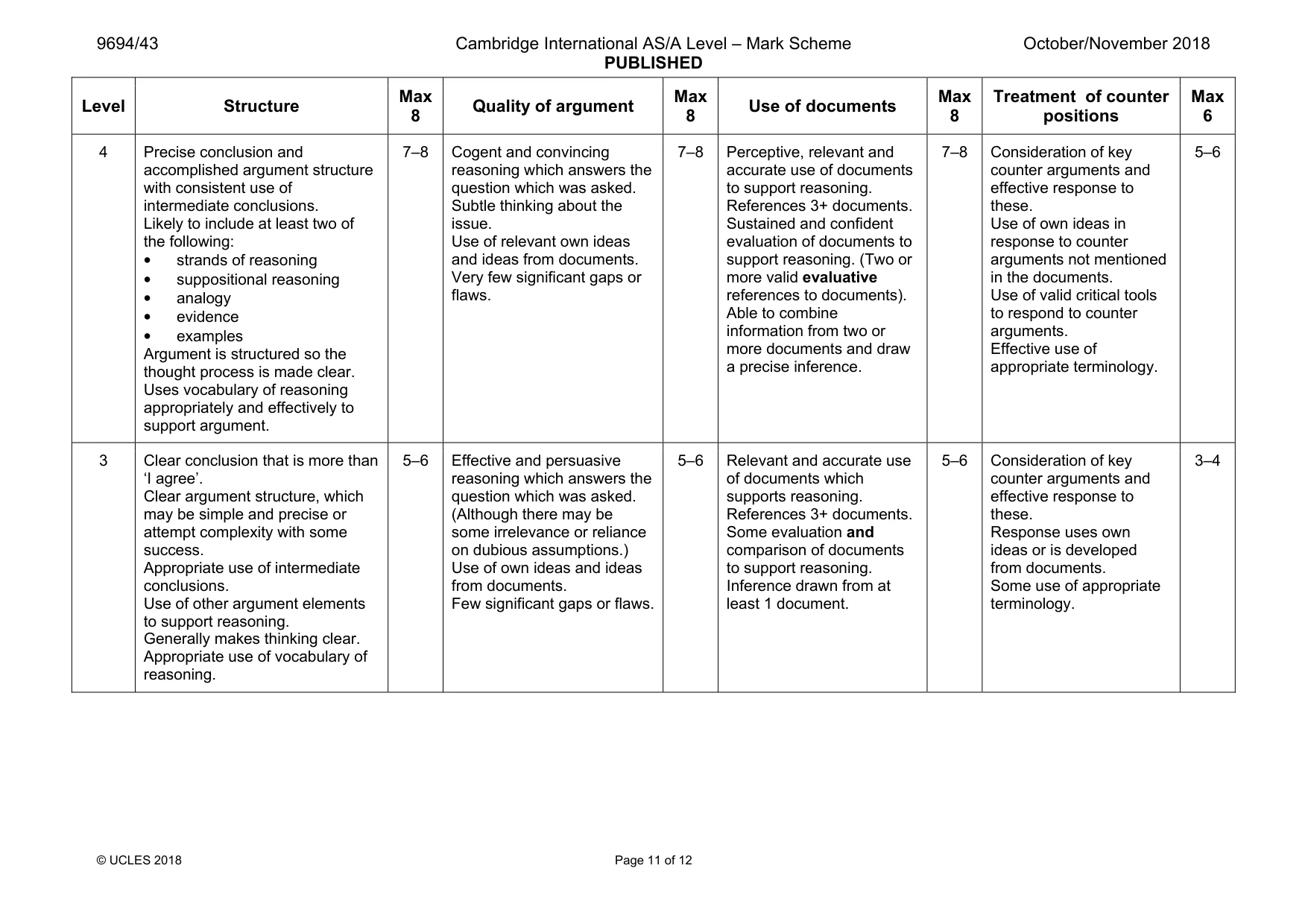
9694/43 Cambridge International AS/A Level – Mark Scheme PUBLISHED October/November 2018 © UCLES 2018 Page 11 of 12 Level Structure Max 8 Quality of argument Max 8 Use of documents Max 8 Treatment of counter positions Max 6 4 Precise conclusion and accomplished argument structure with consistent use of intermediate conclusions. Likely to include at least two of the following: • strands of reasoning • suppositional reasoning • analogy • evidence • examples Argument is structured so the thought process is made clear. Uses vocabulary of reasoning appropriately and effectively to support argument. 7–8 Cogent and convincing reasoning which answers the question which was asked. Subtle thinking about the issue. Use of relevant own ideas and ideas from documents. Very few significant gaps or flaws. 7–8 Perceptive, relevant and accurate use of documents to support reasoning. References 3+ documents. Sustained and confident evaluation of documents to support reasoning. (Two or more valid evaluative references to documents). Able to combine information from two or more documents and draw a precise inference. 7–8 Consideration of key counter arguments and effective response to these. Use of own ideas in response to counter arguments not mentioned in the documents. Use of valid critical tools to respond to counter arguments. Effective use of appropriate terminology. 5–6 3 Clear conclusion that is more than ‘I agree’. Clear argument structure, which may be simple and precise or attempt complexity with some success. Appropriate use of intermediate conclusions. Use of other argument elements to support reasoning. Generally makes thinking clear. Appropriate use of vocabulary of reasoning. 5–6 Effective and persuasive reasoning which answers the question which was asked. (Although there may be some irrelevance or reliance on dubious assumptions.) Use of own ideas and ideas from documents. Few significant gaps or flaws. 5–6 Relevant and accurate use of documents which supports reasoning. References 3+ documents. Some evaluation and comparison of documents to support reasoning. Inference drawn from at least 1 document. 5–6 Consideration of key counter arguments and effective response to these. Response uses own ideas or is developed from documents. Some use of appropriate terminology. 3–4
Mark scheme, page 12
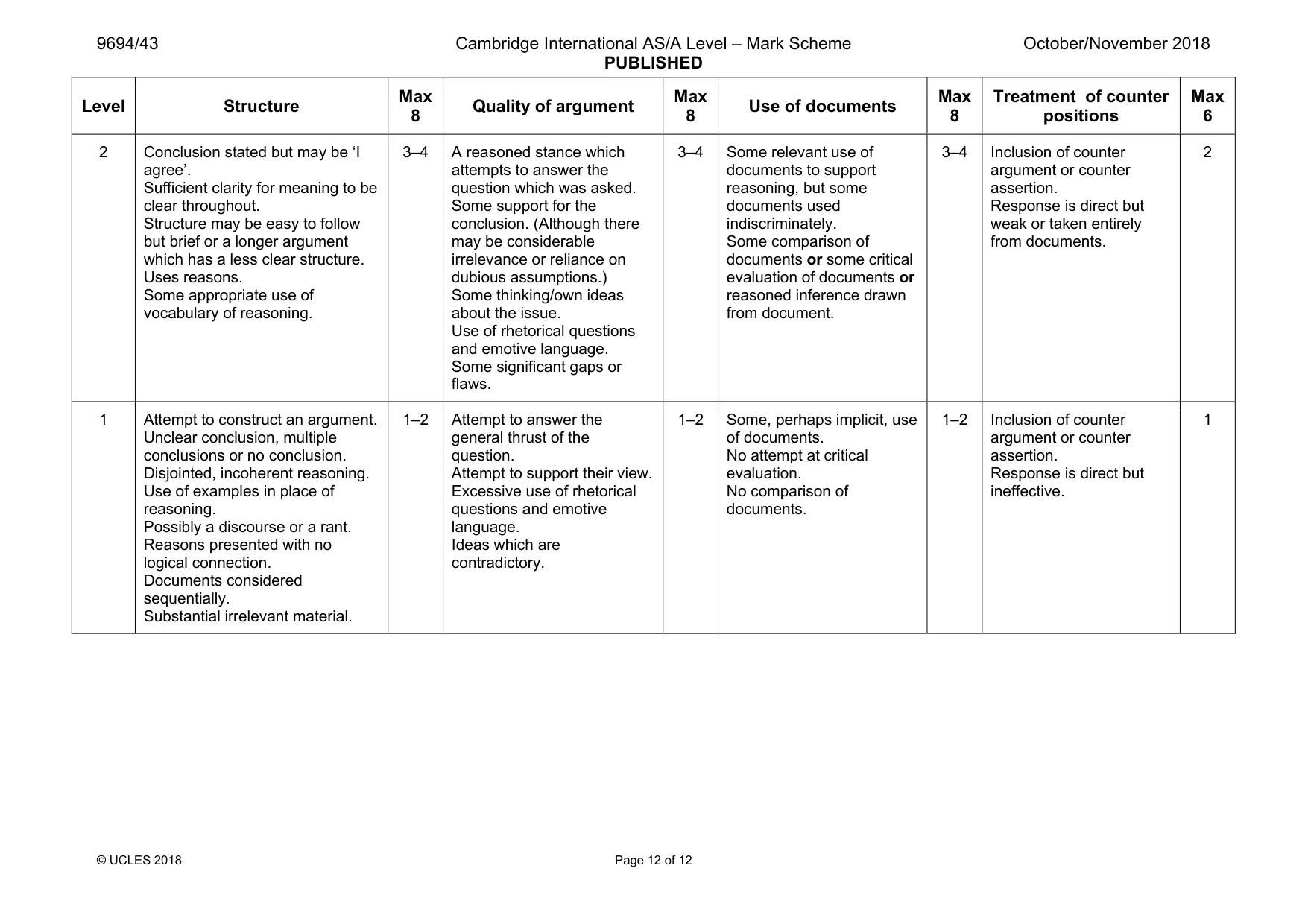
9694/43 Cambridge International AS/A Level – Mark Scheme PUBLISHED October/November 2018 © UCLES 2018 Page 12 of 12 Level Structure Max 8 Quality of argument Max 8 Use of documents Max 8 Treatment of counter positions Max 6 2 Conclusion stated but may be ‘I agree’. Sufficient clarity for meaning to be clear throughout. Structure may be easy to follow but brief or a longer argument which has a less clear structure. Uses reasons. Some appropriate use of vocabulary of reasoning. 3–4 A reasoned stance which attempts to answer the question which was asked. Some support for the conclusion. (Although there may be considerable irrelevance or reliance on dubious assumptions.) Some thinking/own ideas about the issue. Use of rhetorical questions and emotive language. Some significant gaps or flaws. 3–4 Some relevant use of documents to support reasoning, but some documents used indiscriminately. Some comparison of documents or some critical evaluation of documents or reasoned inference drawn from document. 3–4 Inclusion of counter argument or counter assertion. Response is direct but weak or taken entirely from documents. 2 1 Attempt to construct an argument. Unclear conclusion, multiple conclusions or no conclusion. Disjointed, incoherent reasoning. Use of examples in place of reasoning. Possibly a discourse or a rant. Reasons presented with no logical connection. Documents considered sequentially. Substantial irrelevant material. 1–2 Attempt to answer the general thrust of the question. Attempt to support their view. Excessive use of rhetorical questions and emotive language. Ideas which are contradictory. 1–2 Some, perhaps implicit, use of documents. No attempt at critical evaluation. No comparison of documents. 1–2 Inclusion of counter argument or counter assertion. Response is direct but ineffective. 1
What you needed in this session
Cambridge’s own grade thresholds for 2018 Oct/Nov, Paper 4 · Variant 3. A higher threshold means an easier paper — the bar moves with how the cohort did.