Cambridge A Level Thinking Skills 9694 — 2018 Oct/Nov Paper 4 · Variant 2
9694/42/O/N/18 · 50 marks · ≈56 min
The question paper and its mark scheme, free to read here and free to download. This is Cambridge’s own paper, exactly as it was sat.
Question paper8 pages

Mark scheme12 pages
Answers below. Sit the paper first if you are practising.
Paper as text
Question paper, page 1
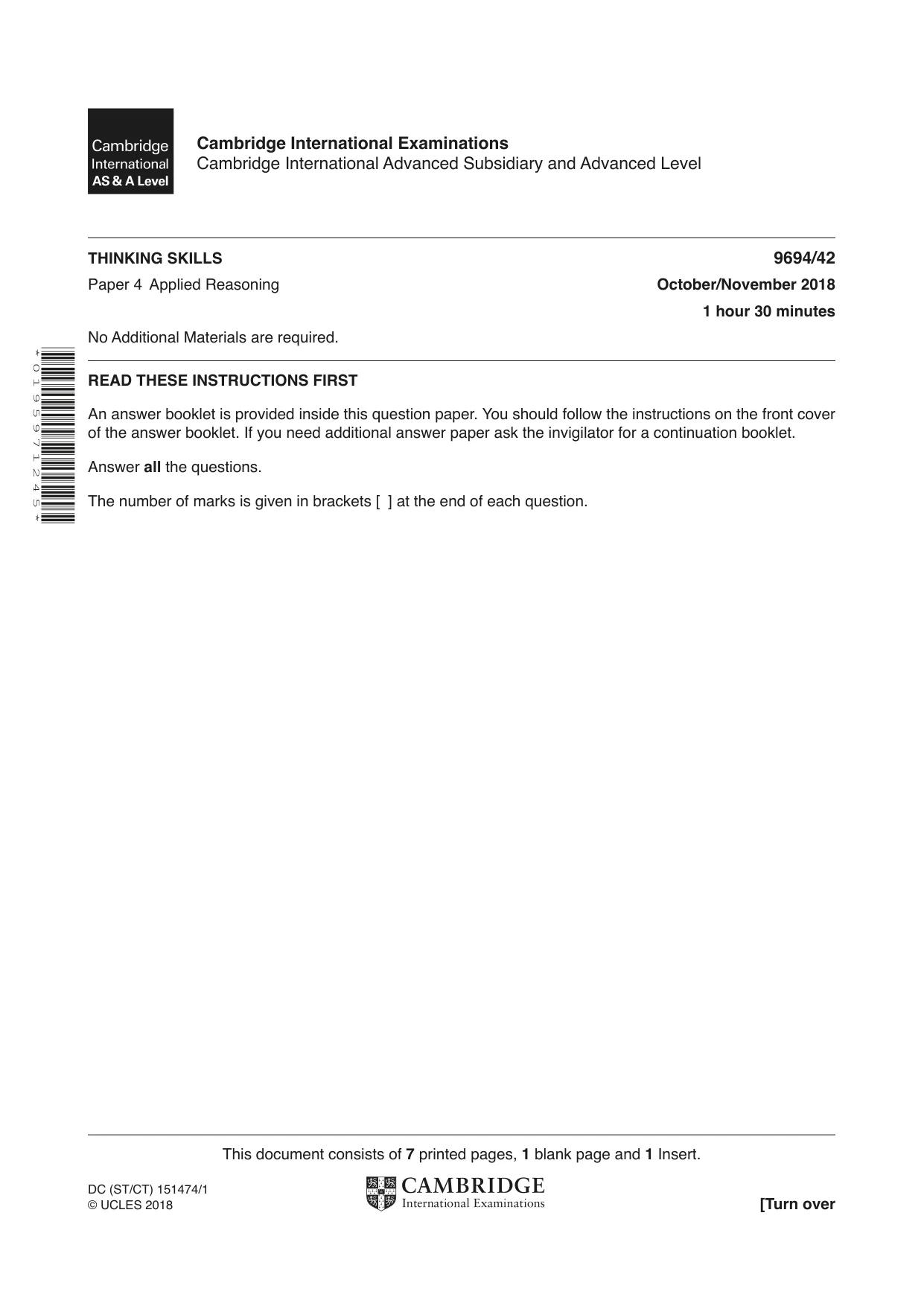
* 0 1 9 5 9 7 1 2 4 5 * This document consists of 7 printed pages, 1 blank page and 1 Insert. DC (ST/CT) 151474/1 © UCLES 2018 [Turn over Cambridge International Examinations Cambridge International Advanced Subsidiary and Advanced Level THINKING SKILLS 9694/42 Paper 4 Applied Reasoning October/November 2018 1 hour 30 minutes No Additional Materials are required. READ THESE INSTRUCTIONS FIRST An answer booklet is provided inside this question paper. You should follow the instructions on the front cover of the answer booklet. If you need additional answer paper ask the invigilator for a continuation booklet. Answer all the questions. The number of marks is given in brackets [ ] at the end of each question.
Question paper, page 2
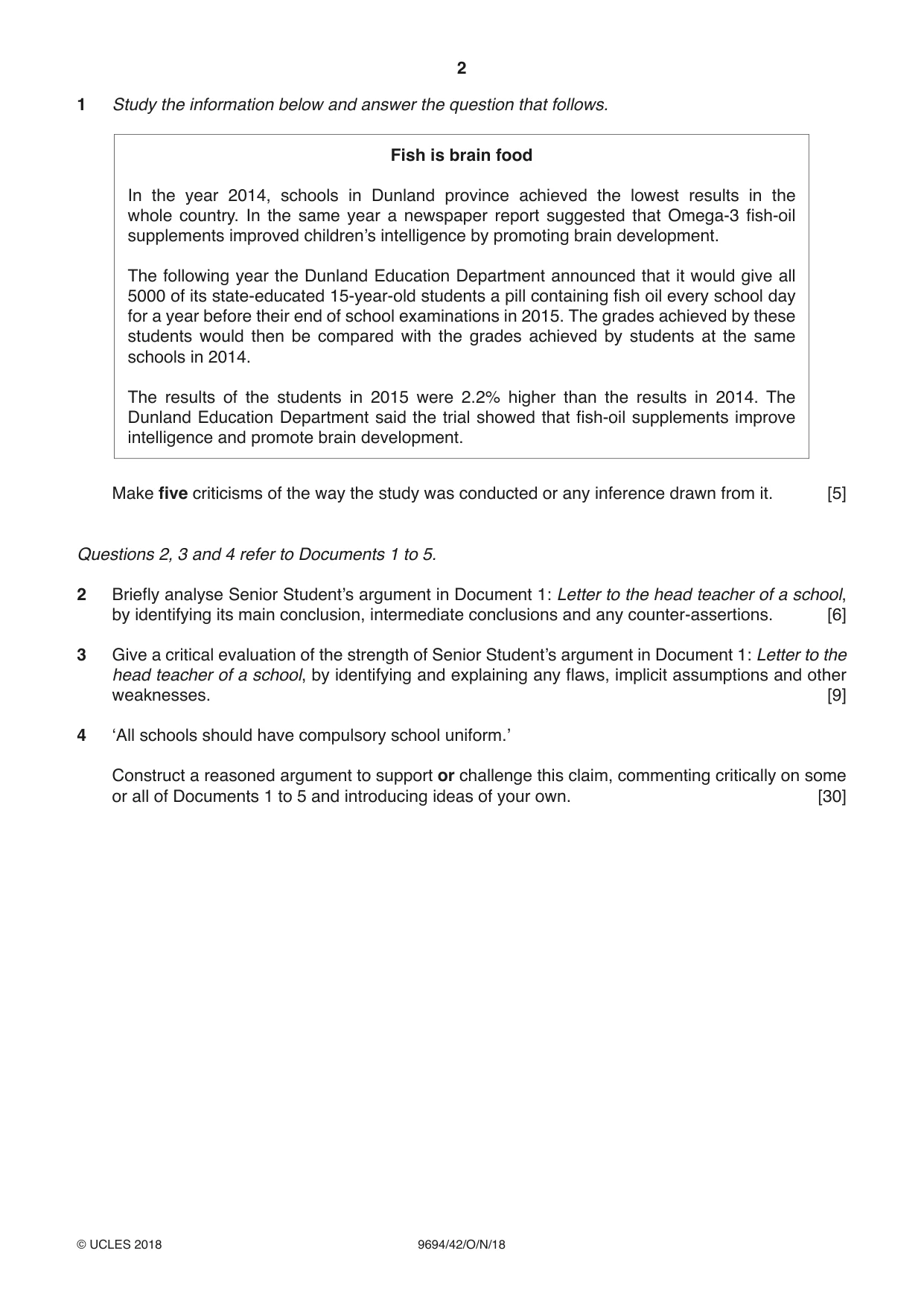
2 9694/42/O/N/18 © UCLES 2018 1 Study the information below and answer the question that follows. Fish is brain food In the year 2014, schools in Dunland province achieved the lowest results in the whole country. In the same year a newspaper report suggested that Omega-3 fish-oil supplements improved children’s intelligence by promoting brain development. The following year the Dunland Education Department announced that it would give all 5000 of its state-educated 15-year-old students a pill containing fish oil every school day for a year before their end of school examinations in 2015. The grades achieved by these students would then be compared with the grades achieved by students at the same schools in 2014. The results of the students in 2015 were 2.2% higher than the results in 2014. The Dunland Education Department said the trial showed that fish-oil supplements improve intelligence and promote brain development. Make five criticisms of the way the study was conducted or any inference drawn from it. [5] Questions 2, 3 and 4 refer to Documents 1 to 5. 2 Briefly analyse Senior Student’s argument in Document 1: Letter to the head teacher of a school, by identifying its main conclusion, intermediate conclusions and any counter-assertions. [6] 3 Give a critical evaluation of the strength of Senior Student’s argument in Document 1: Letter to the head teacher of a school, by identifying and explaining any flaws, implicit assumptions and other weaknesses. [9] 4 ‘All schools should have compulsory school uniform.’ Construct a reasoned argument to support or challenge this claim, commenting critically on some or all of Documents 1 to 5 and introducing ideas of your own. [30]
Question paper, page 3
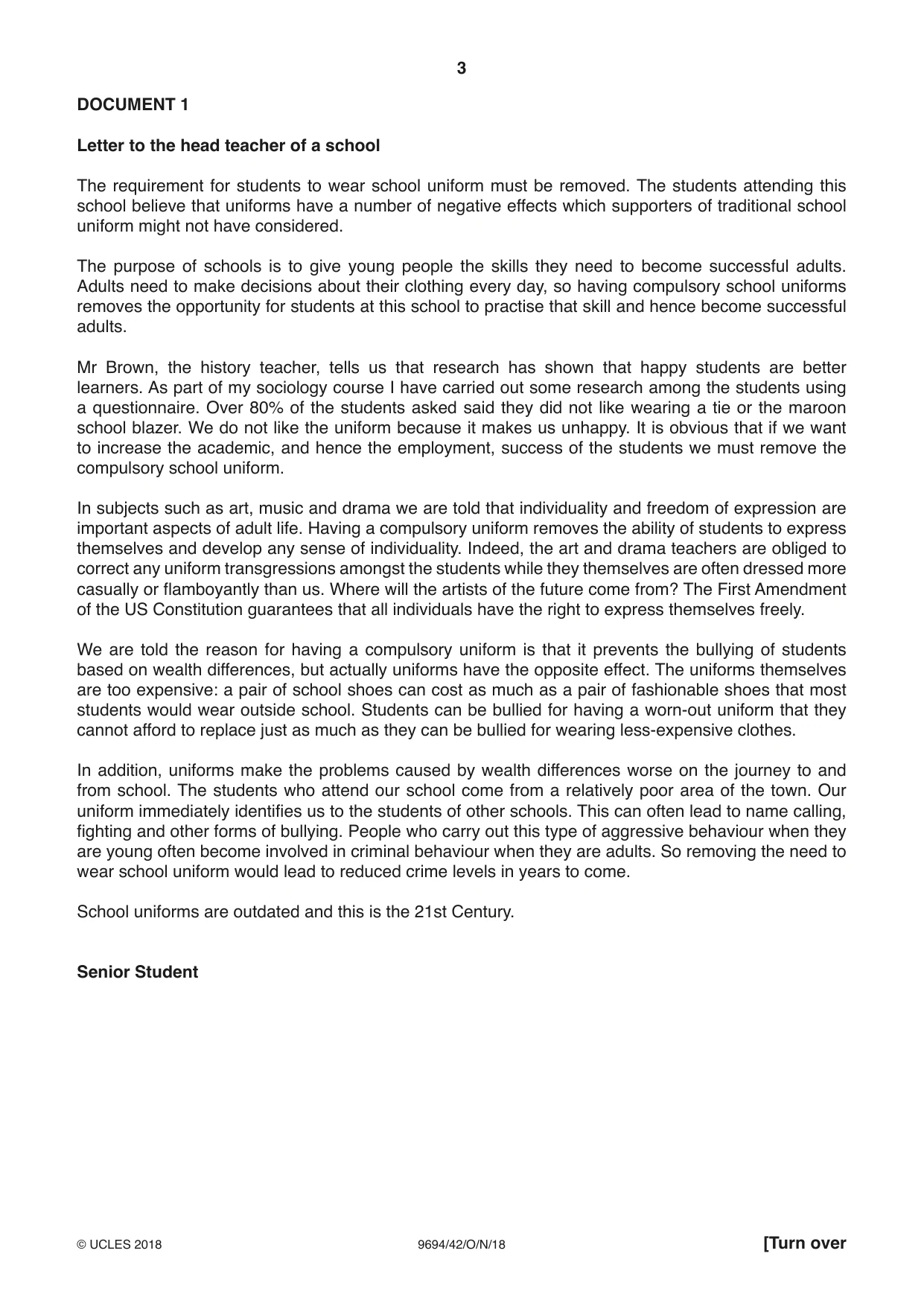
3 9694/42/O/N/18 © UCLES 2018 [Turn over DOCUMENT 1 Letter to the head teacher of a school The requirement for students to wear school uniform must be removed. The students attending this school believe that uniforms have a number of negative effects which supporters of traditional school uniform might not have considered. The purpose of schools is to give young people the skills they need to become successful adults. Adults need to make decisions about their clothing every day, so having compulsory school uniforms removes the opportunity for students at this school to practise that skill and hence become successful adults. Mr Brown, the history teacher, tells us that research has shown that happy students are better learners. As part of my sociology course I have carried out some research among the students using a questionnaire. Over 80% of the students asked said they did not like wearing a tie or the maroon school blazer. We do not like the uniform because it makes us unhappy. It is obvious that if we want to increase the academic, and hence the employment, success of the students we must remove the compulsory school uniform. In subjects such as art, music and drama we are told that individuality and freedom of expression are important aspects of adult life. Having a compulsory uniform removes the ability of students to express themselves and develop any sense of individuality. Indeed, the art and drama teachers are obliged to correct any uniform transgressions amongst the students while they themselves are often dressed more casually or flamboyantly than us. Where will the artists of the future come from? The First Amendment of the US Constitution guarantees that all individuals have the right to express themselves freely. We are told the reason for having a compulsory uniform is that it prevents the bullying of students based on wealth differences, but actually uniforms have the opposite effect. The uniforms themselves are too expensive: a pair of school shoes can cost as much as a pair of fashionable shoes that most students would wear outside school. Students can be bullied for having a worn-out uniform that they cannot afford to replace just as much as they can be bullied for wearing less-expensive clothes. In addition, uniforms make the problems caused by wealth differences worse on the journey to and from school. The students who attend our school come from a relatively poor area of the town. Our uniform immediately identifies us to the students of other schools. This can often lead to name calling, fighting and other forms of bullying. People who carry out this type of aggressive behaviour when they are young often become involved in criminal behaviour when they are adults. So removing the need to wear school uniform would lead to reduced crime levels in years to come. School uniforms are outdated and this is the 21st Century. Senior Student
Question paper, page 4
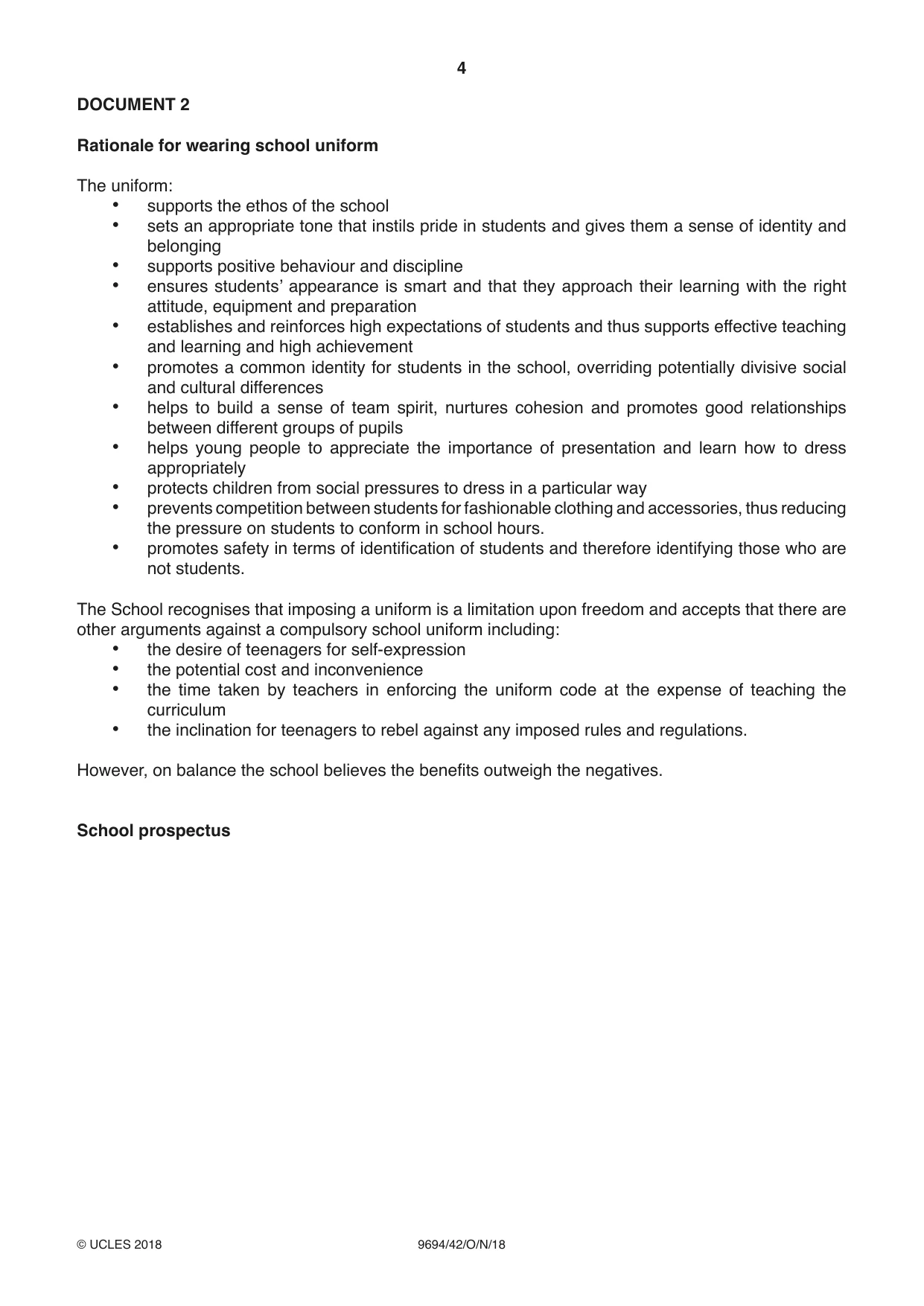
4 9694/42/O/N/18 © UCLES 2018 DOCUMENT 2 Rationale for wearing school uniform The uniform: • supports the ethos of the school • sets an appropriate tone that instils pride in students and gives them a sense of identity and belonging • supports positive behaviour and discipline • ensures students’ appearance is smart and that they approach their learning with the right attitude, equipment and preparation • establishes and reinforces high expectations of students and thus supports effective teaching and learning and high achievement • promotes a common identity for students in the school, overriding potentially divisive social and cultural differences • helps to build a sense of team spirit, nurtures cohesion and promotes good relationships between different groups of pupils • helps young people to appreciate the importance of presentation and learn how to dress appropriately • protects children from social pressures to dress in a particular way • prevents competition between students for fashionable clothing and accessories, thus reducing the pressure on students to conform in school hours. • promotes safety in terms of identification of students and therefore identifying those who are not students. The School recognises that imposing a uniform is a limitation upon freedom and accepts that there are other arguments against a compulsory school uniform including: • the desire of teenagers for self-expression • the potential cost and inconvenience • the time taken by teachers in enforcing the uniform code at the expense of teaching the curriculum • the inclination for teenagers to rebel against any imposed rules and regulations. However, on balance the school believes the benefits outweigh the negatives. School prospectus
Question paper, page 5
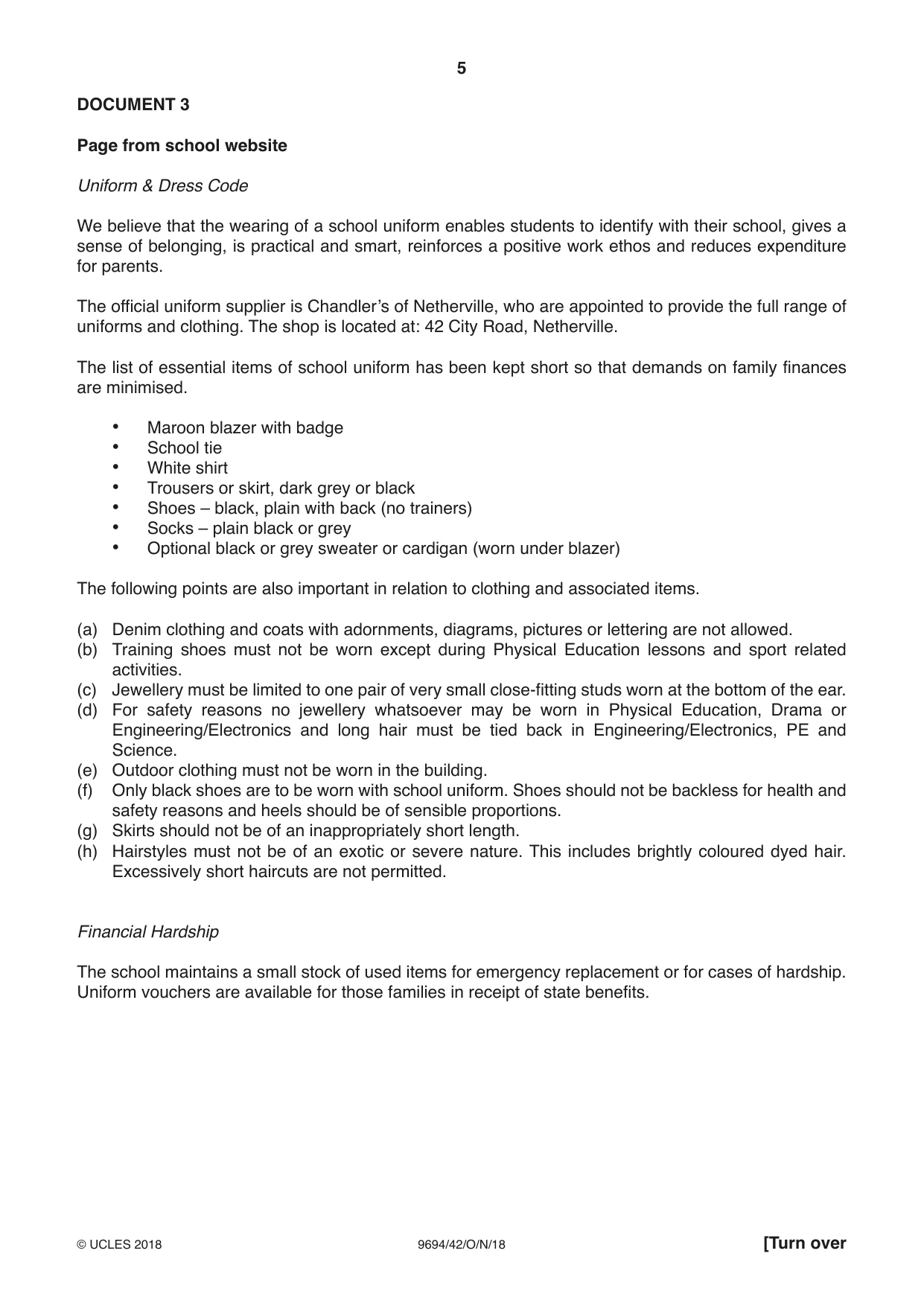
5 9694/42/O/N/18 © UCLES 2018 [Turn over DOCUMENT 3 Page from school website Uniform & Dress Code We believe that the wearing of a school uniform enables students to identify with their school, gives a sense of belonging, is practical and smart, reinforces a positive work ethos and reduces expenditure for parents. The official uniform supplier is Chandler’s of Netherville, who are appointed to provide the full range of uniforms and clothing. The shop is located at: 42 City Road, Netherville. The list of essential items of school uniform has been kept short so that demands on family finances are minimised. • Maroon blazer with badge • School tie • White shirt • Trousers or skirt, dark grey or black • Shoes – black, plain with back (no trainers) • Socks – plain black or grey • Optional black or grey sweater or cardigan (worn under blazer) The following points are also important in relation to clothing and associated items. (a) Denim clothing and coats with adornments, diagrams, pictures or lettering are not allowed. (b) Training shoes must not be worn except during Physical Education lessons and sport related activities. (c) Jewellery must be limited to one pair of very small close-fitting studs worn at the bottom of the ear. (d) For safety reasons no jewellery whatsoever may be worn in Physical Education, Drama or Engineering/Electronics and long hair must be tied back in Engineering/Electronics, PE and Science. (e) Outdoor clothing must not be worn in the building. (f) Only black shoes are to be worn with school uniform. Shoes should not be backless for health and safety reasons and heels should be of sensible proportions. (g) Skirts should not be of an inappropriately short length. (h) Hairstyles must not be of an exotic or severe nature. This includes brightly coloured dyed hair. Excessively short haircuts are not permitted. Financial Hardship The school maintains a small stock of used items for emergency replacement or for cases of hardship. Uniform vouchers are available for those families in receipt of state benefits.
Question paper, page 6
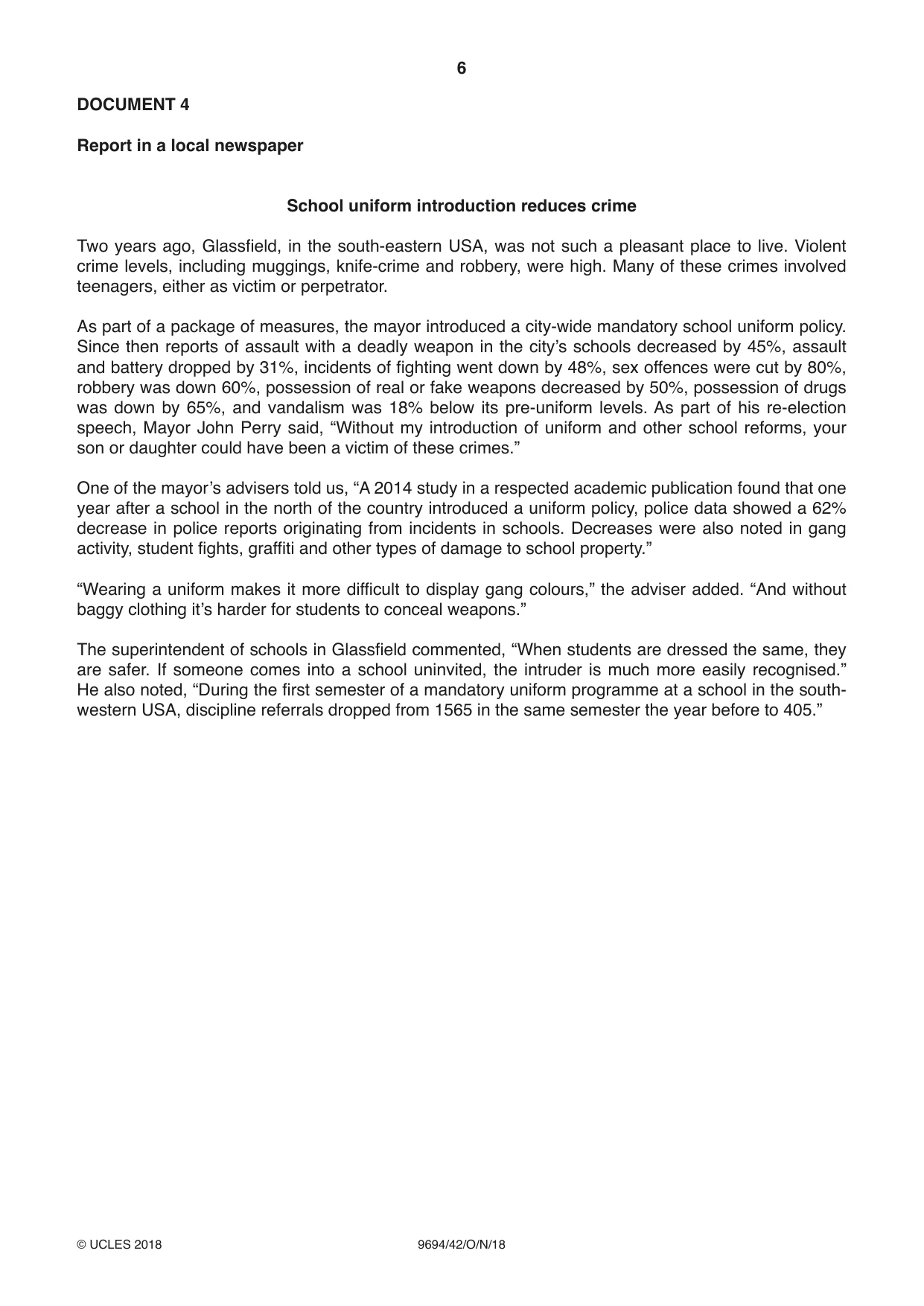
6 9694/42/O/N/18 © UCLES 2018 DOCUMENT 4 Report in a local newspaper School uniform introduction reduces crime Two years ago, Glassfield, in the south-eastern USA, was not such a pleasant place to live. Violent crime levels, including muggings, knife-crime and robbery, were high. Many of these crimes involved teenagers, either as victim or perpetrator. As part of a package of measures, the mayor introduced a city-wide mandatory school uniform policy. Since then reports of assault with a deadly weapon in the city’s schools decreased by 45%, assault and battery dropped by 31%, incidents of fighting went down by 48%, sex offences were cut by 80%, robbery was down 60%, possession of real or fake weapons decreased by 50%, possession of drugs was down by 65%, and vandalism was 18% below its pre-uniform levels. As part of his re-election speech, Mayor John Perry said, “Without my introduction of uniform and other school reforms, your son or daughter could have been a victim of these crimes.” One of the mayor’s advisers told us, “A 2014 study in a respected academic publication found that one year after a school in the north of the country introduced a uniform policy, police data showed a 62% decrease in police reports originating from incidents in schools. Decreases were also noted in gang activity, student fights, graffiti and other types of damage to school property.” “Wearing a uniform makes it more difficult to display gang colours,” the adviser added. “And without baggy clothing it’s harder for students to conceal weapons.” The superintendent of schools in Glassfield commented, “When students are dressed the same, they are safer. If someone comes into a school uninvited, the intruder is much more easily recognised.” He also noted, “During the first semester of a mandatory uniform programme at a school in the south- western USA, discipline referrals dropped from 1565 in the same semester the year before to 405.”
Question paper, page 7
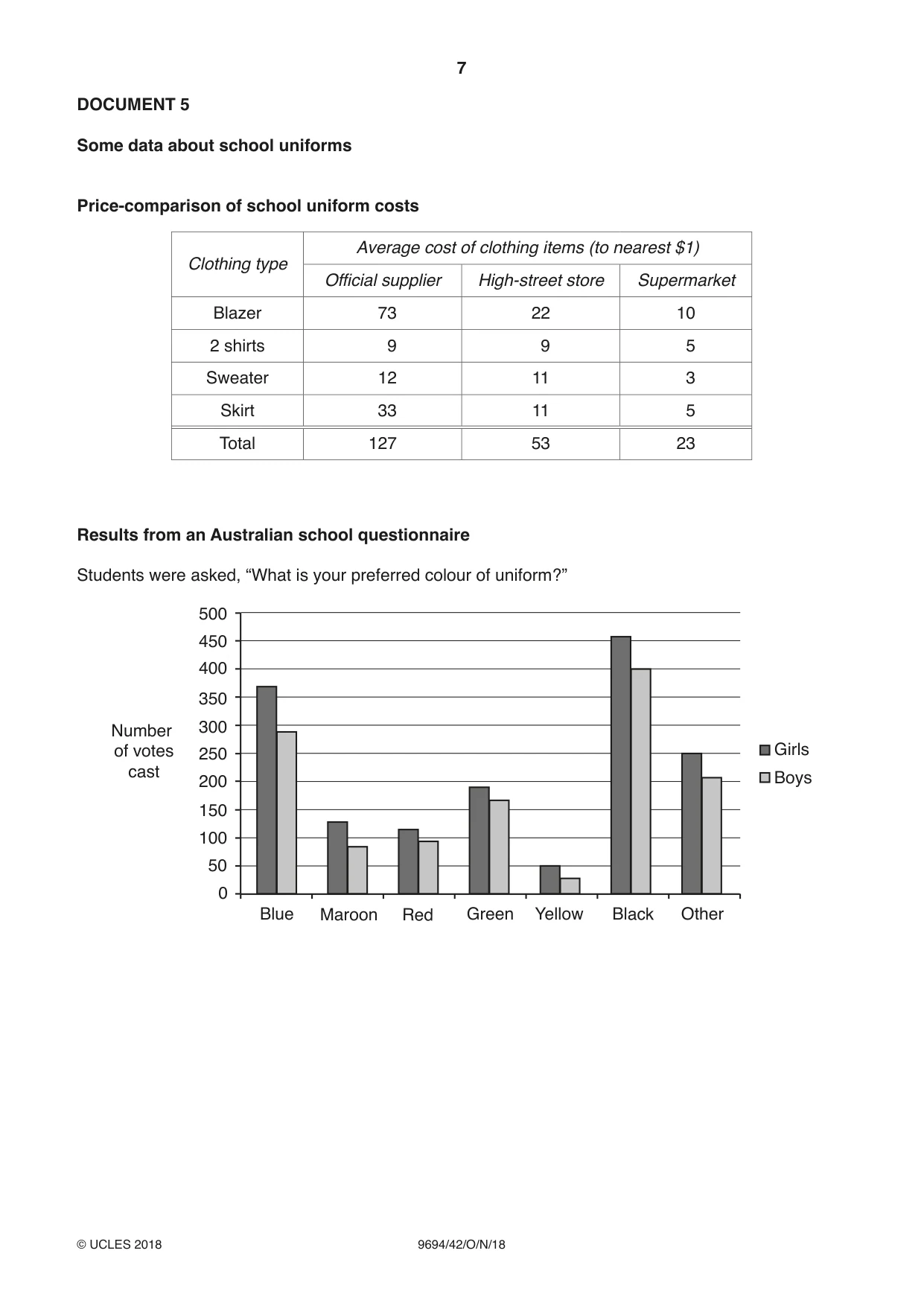
7 9694/42/O/N/18 © UCLES 2018 DOCUMENT 5 Some data about school uniforms Price-comparison of school uniform costs Clothing type Average cost of clothing items (to nearest $1) Official supplier High-street store Supermarket Blazer 73 22 10 2 shirts 9 9 5 Sweater 12 11 3 Skirt 33 11 5 Total 127 53 23 Results from an Australian school questionnaire Students were asked, “What is your preferred colour of uniform?” 0 50 100 150 200 250 300 350 400 450 500 Blue Red Green Yellow Black Other Maroon Number of votes cast Girls Boys
Question paper, page 8
8 9694/42/O/N/18 © UCLES 2018 BLANK PAGE Permission to reproduce items where third-party owned material protected by copyright is included has been sought and cleared where possible. Every reasonable effort has been made by the publisher (UCLES) to trace copyright holders, but if any items requiring clearance have unwittingly been included, the publisher will be pleased to make amends at the earliest possible opportunity. To avoid the issue of disclosure of answer-related information to candidates, all copyright acknowledgements are reproduced online in the Cambridge International Examinations Copyright Acknowledgements Booklet. This is produced for each series of examinations and is freely available to download at www.cie.org.uk after the live examination series. Cambridge International Examinations is part of the Cambridge Assessment Group. Cambridge Assessment is the brand name of University of Cambridge Local Examinations Syndicate (UCLES), which is itself a department of the University of Cambridge.
Mark scheme, page 1
This document consists of 12 printed pages. © UCLES 2018 [Turn over Cambridge Assessment International Education Cambridge International Advanced Subsidiary and Advanced Level THINKING SKILLS 9694/42 Paper 4 Applied Reasoning October/November 2018 MARK SCHEME Maximum Mark: 50 Published This mark scheme is published as an aid to teachers and candidates, to indicate the requirements of the examination. It shows the basis on which Examiners were instructed to award marks. It does not indicate the details of the discussions that took place at an Examiners’ meeting before marking began, which would have considered the acceptability of alternative answers. Mark schemes should be read in conjunction with the question paper and the Principal Examiner Report for Teachers. Cambridge International will not enter into discussions about these mark schemes. Cambridge International is publishing the mark schemes for the October/November 2018 series for most Cambridge IGCSE™, Cambridge International A and AS Level components and some Cambridge O Level components.
Mark scheme, page 2
9694/42 Cambridge International AS/A Level – Mark Scheme PUBLISHED October/November 2018 © UCLES 2018 Page 2 of 12 Generic Marking Principles These general marking principles must be applied by all examiners when marking candidate answers. They should be applied alongside the specific content of the mark scheme or generic level descriptors for a question. Each question paper and mark scheme will also comply with these marking principles. GENERIC MARKING PRINCIPLE 1: Marks must be awarded in line with: • the specific content of the mark scheme or the generic level descriptors for the question • the specific skills defined in the mark scheme or in the generic level descriptors for the question • the standard of response required by a candidate as exemplified by the standardisation scripts. GENERIC MARKING PRINCIPLE 2: Marks awarded are always whole marks (not half marks, or other fractions). GENERIC MARKING PRINCIPLE 3: Marks must be awarded positively: • marks are awarded for correct/valid answers, as defined in the mark scheme. However, credit is given for valid answers which go beyond the scope of the syllabus and mark scheme, referring to your Team Leader as appropriate • marks are awarded when candidates clearly demonstrate what they know and can do • marks are not deducted for errors • marks are not deducted for omissions • answers should only be judged on the quality of spelling, punctuation and grammar when these features are specifically assessed by the question as indicated by the mark scheme. The meaning, however, should be unambiguous. GENERIC MARKING PRINCIPLE 4: Rules must be applied consistently e.g. in situations where candidates have not followed instructions or in the application of generic level descriptors.
Mark scheme, page 3
9694/42 Cambridge International AS/A Level – Mark Scheme PUBLISHED October/November 2018 © UCLES 2018 Page 3 of 12 GENERIC MARKING PRINCIPLE 5: Marks should be awarded using the full range of marks defined in the mark scheme for the question (however; the use of the full mark range may be limited according to the quality of the candidate responses seen). GENERIC MARKING PRINCIPLE 6: Marks awarded are based solely on the requirements as defined in the mark scheme. Marks should not be awarded with grade thresholds or grade descriptors in mind.
Mark scheme, page 4
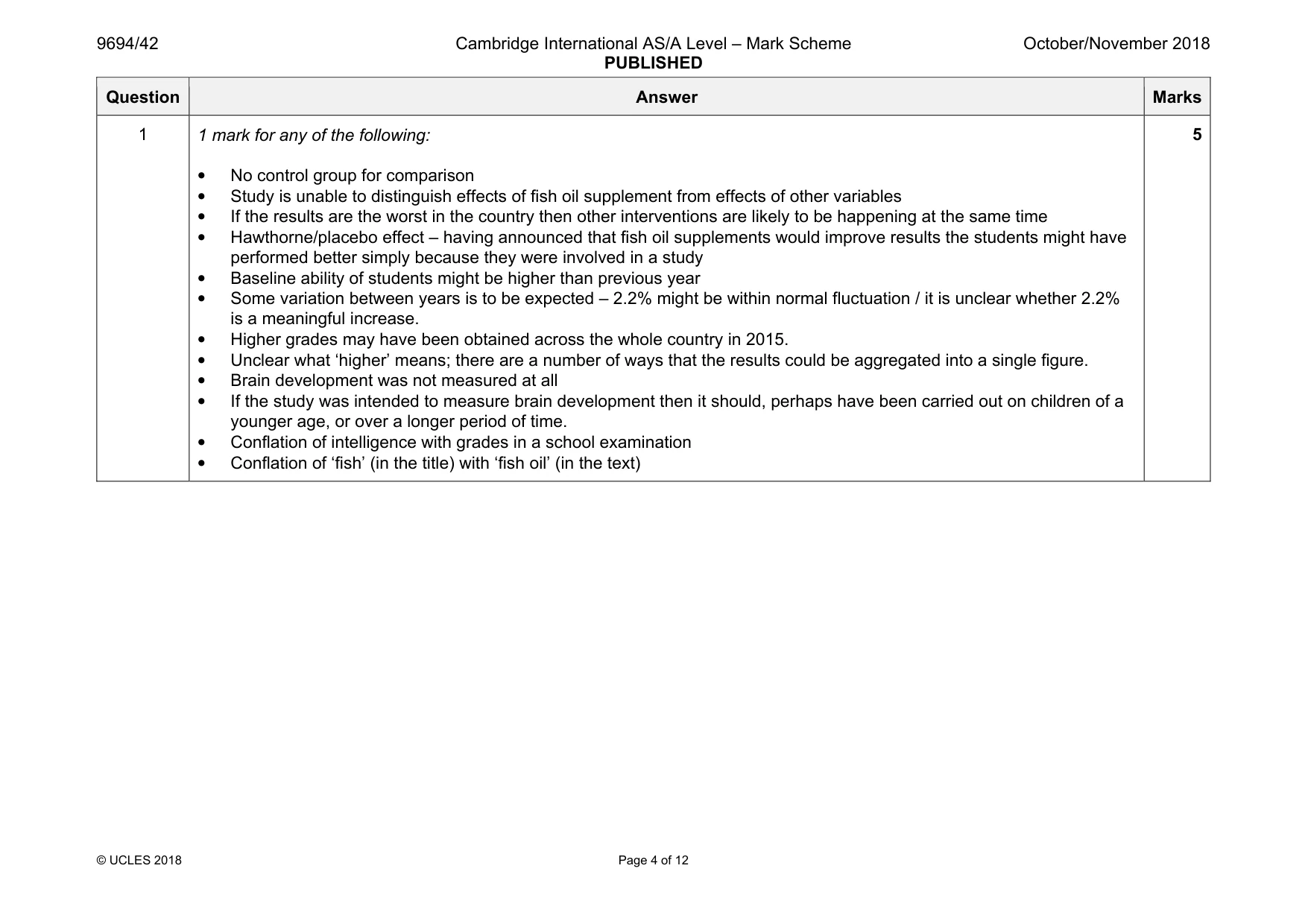
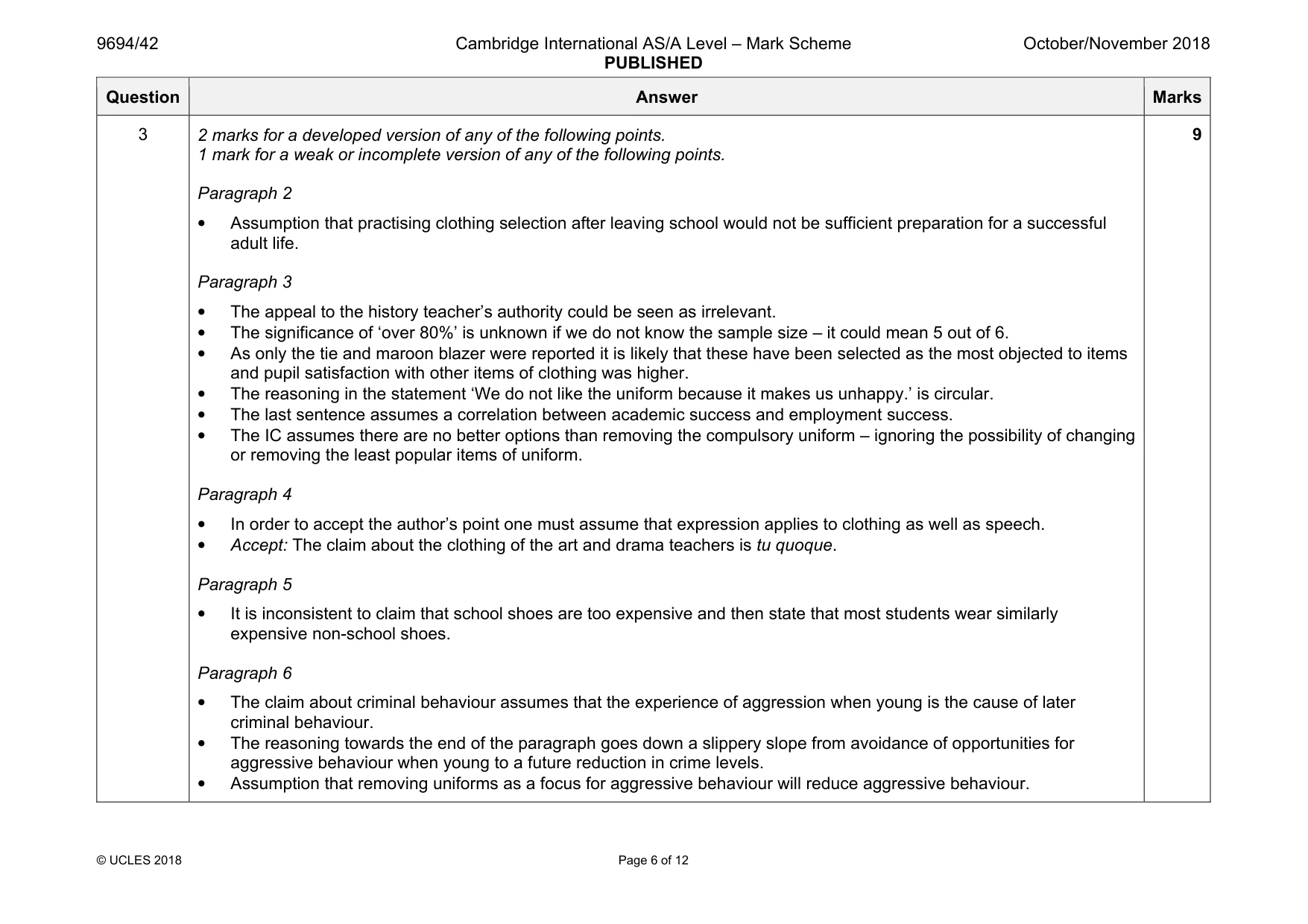
9694/42 Cambridge International AS/A Level – Mark Scheme PUBLISHED October/November 2018 © UCLES 2018 Page 4 of 12 Question Answer Marks 1 1 mark for any of the following: • No control group for comparison • Study is unable to distinguish effects of fish oil supplement from effects of other variables • If the results are the worst in the country then other interventions are likely to be happening at the same time • Hawthorne/placebo effect – having announced that fish oil supplements would improve results the students might have performed better simply because they were involved in a study • Baseline ability of students might be higher than previous year • Some variation between years is to be expected – 2.2% might be within normal fluctuation / it is unclear whether 2.2% is a meaningful increase. • Higher grades may have been obtained across the whole country in 2015. • Unclear what ‘higher’ means; there are a number of ways that the results could be aggregated into a single figure. • Brain development was not measured at all • If the study was intended to measure brain development then it should, perhaps have been carried out on children of a younger age, or over a longer period of time. • Conflation of intelligence with grades in a school examination • Conflation of ‘fish’ (in the title) with ‘fish oil’ (in the text) 5
Mark scheme, page 5
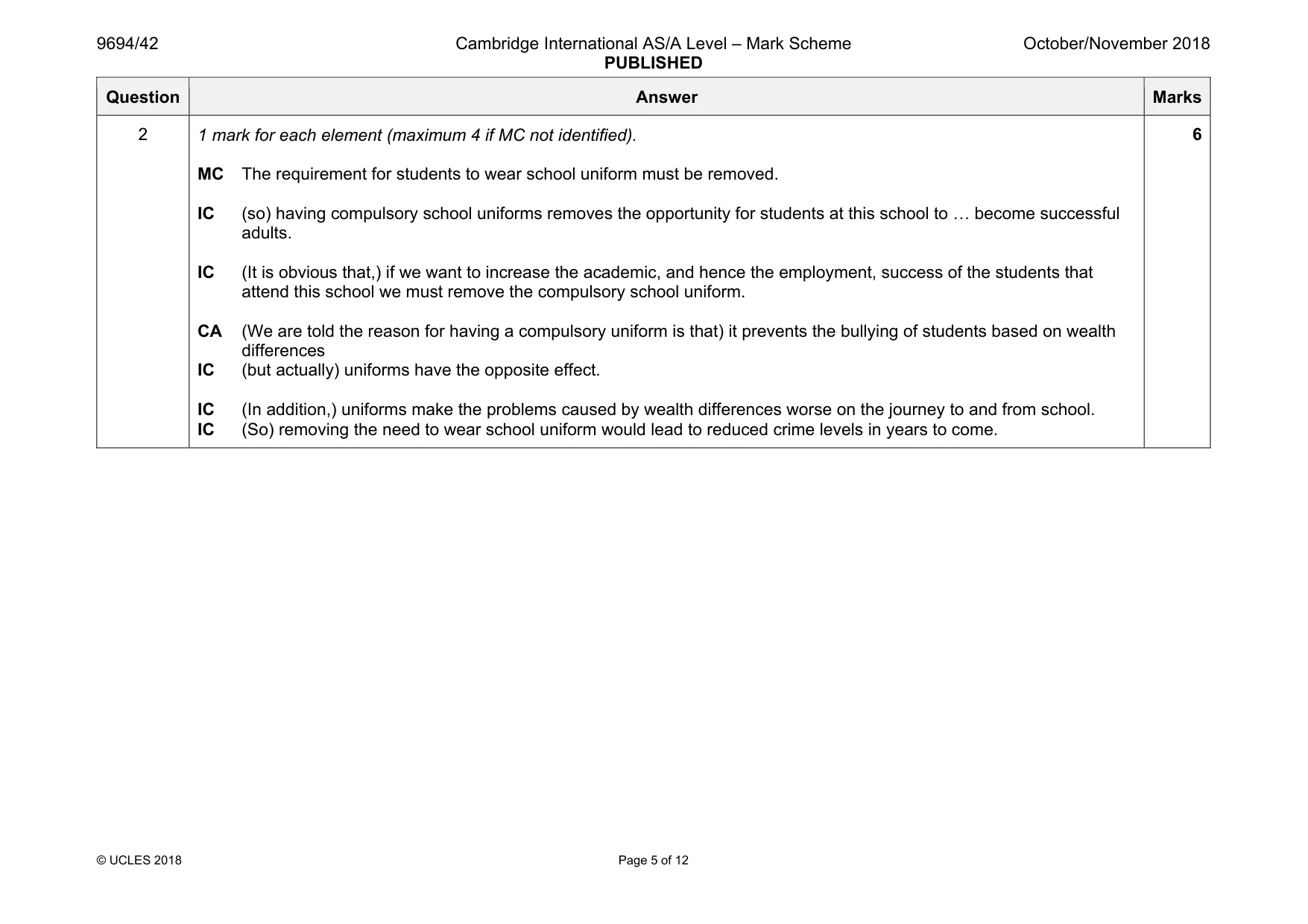
9694/42 Cambridge International AS/A Level – Mark Scheme PUBLISHED October/November 2018 © UCLES 2018 Page 5 of 12 Question Answer Marks 2 1 mark for each element (maximum 4 if MC not identified). MC The requirement for students to wear school uniform must be removed. IC (so) having compulsory school uniforms removes the opportunity for students at this school to « become successful adults. IC (It is obvious that,) if we want to increase the academic, and hence the employment, success of the students that attend this school we must remove the compulsory school uniform. CA (We are told the reason for having a compulsory uniform is that) it prevents the bullying of students based on wealth differences IC (but actually) uniforms have the opposite effect. IC (In addition,) uniforms make the problems caused by wealth differences worse on the journey to and from school. IC (So) removing the need to wear school uniform would lead to reduced crime levels in years to come. 6
Mark scheme, page 6
9694/42 Cambridge International AS/A Level – Mark Scheme PUBLISHED October/November 2018 © UCLES 2018 Page 6 of 12 Question Answer Marks 3 2 marks for a developed version of any of the following points. 1 mark for a weak or incomplete version of any of the following points. Paragraph 2 • Assumption that practising clothing selection after leaving school would not be sufficient preparation for a successful adult life. Paragraph 3 • The appeal to the history teacher’s authority could be seen as irrelevant. • The significance of ‘over 80%’ is unknown if we do not know the sample size – it could mean 5 out of 6. • As only the tie and maroon blazer were reported it is likely that these have been selected as the most objected to items and pupil satisfaction with other items of clothing was higher. • The reasoning in the statement ‘We do not like the uniform because it makes us unhappy.’ is circular. • The last sentence assumes a correlation between academic success and employment success. • The IC assumes there are no better options than removing the compulsory uniform – ignoring the possibility of changing or removing the least popular items of uniform. Paragraph 4 • In order to accept the author’s point one must assume that expression applies to clothing as well as speech. • Accept: The claim about the clothing of the art and drama teachers is tu quoque. Paragraph 5 • It is inconsistent to claim that school shoes are too expensive and then state that most students wear similarly expensive non-school shoes. Paragraph 6 • The claim about criminal behaviour assumes that the experience of aggression when young is the cause of later criminal behaviour. • The reasoning towards the end of the paragraph goes down a slippery slope from avoidance of opportunities for aggressive behaviour when young to a future reduction in crime levels. • Assumption that removing uniforms as a focus for aggressive behaviour will reduce aggressive behaviour. 9
Mark scheme, page 7
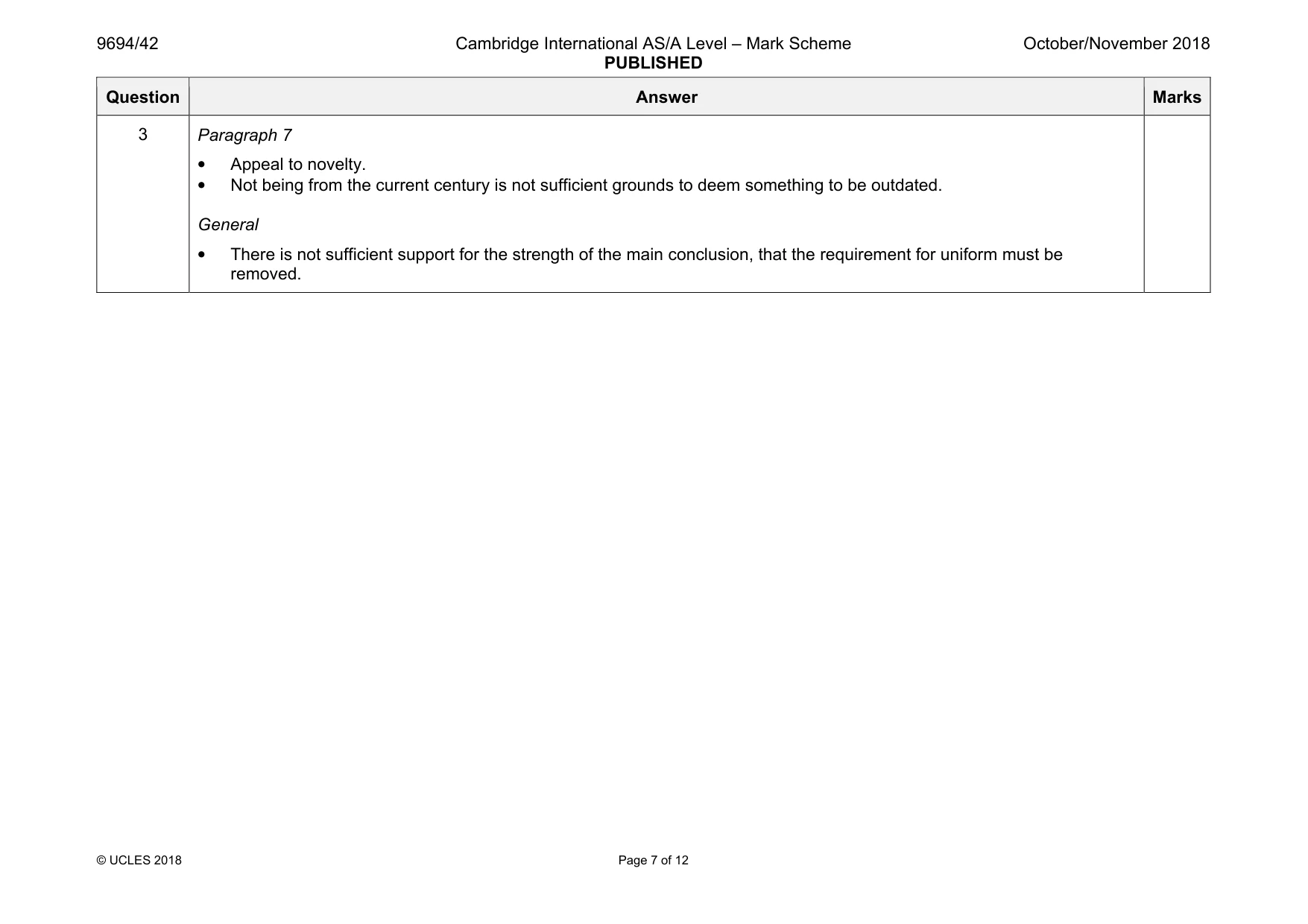
9694/42 Cambridge International AS/A Level – Mark Scheme PUBLISHED October/November 2018 © UCLES 2018 Page 7 of 12 Question Answer Marks 3 Paragraph 7 • Appeal to novelty. • Not being from the current century is not sufficient grounds to deem something to be outdated. General • There is not sufficient support for the strength of the main conclusion, that the requirement for uniform must be removed.
Mark scheme, page 8
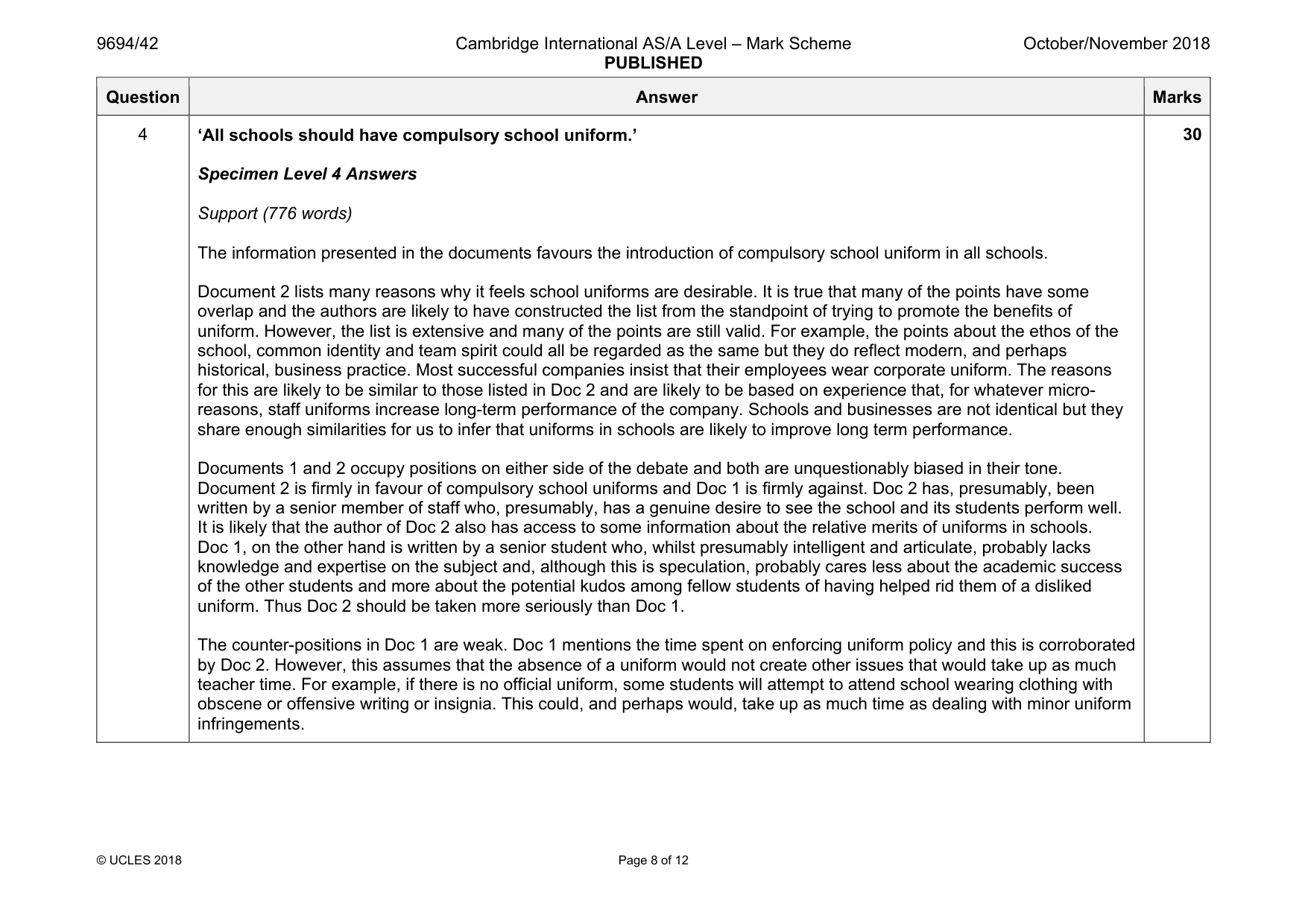
9694/42 Cambridge International AS/A Level – Mark Scheme PUBLISHED October/November 2018 © UCLES 2018 Page 8 of 12 Question Answer Marks 4 ‘All schools should have compulsory school uniform.’ Specimen Level 4 Answers Support (776 words) The information presented in the documents favours the introduction of compulsory school uniform in all schools. Document 2 lists many reasons why it feels school uniforms are desirable. It is true that many of the points have some overlap and the authors are likely to have constructed the list from the standpoint of trying to promote the benefits of uniform. However, the list is extensive and many of the points are still valid. For example, the points about the ethos of the school, common identity and team spirit could all be regarded as the same but they do reflect modern, and perhaps historical, business practice. Most successful companies insist that their employees wear corporate uniform. The reasons for this are likely to be similar to those listed in Doc 2 and are likely to be based on experience that, for whatever micro- reasons, staff uniforms increase long-term performance of the company. Schools and businesses are not identical but they share enough similarities for us to infer that uniforms in schools are likely to improve long term performance. Documents 1 and 2 occupy positions on either side of the debate and both are unquestionably biased in their tone. Document 2 is firmly in favour of compulsory school uniforms and Doc 1 is firmly against. Doc 2 has, presumably, been written by a senior member of staff who, presumably, has a genuine desire to see the school and its students perform well. It is likely that the author of Doc 2 also has access to some information about the relative merits of uniforms in schools. Doc 1, on the other hand is written by a senior student who, whilst presumably intelligent and articulate, probably lacks knowledge and expertise on the subject and, although this is speculation, probably cares less about the academic success of the other students and more about the potential kudos among fellow students of having helped rid them of a disliked uniform. Thus Doc 2 should be taken more seriously than Doc 1. The counter-positions in Doc 1 are weak. Doc 1 mentions the time spent on enforcing uniform policy and this is corroborated by Doc 2. However, this assumes that the absence of a uniform would not create other issues that would take up as much teacher time. For example, if there is no official uniform, some students will attempt to attend school wearing clothing with obscene or offensive writing or insignia. This could, and perhaps would, take up as much time as dealing with minor uniform infringements. 30
Mark scheme, page 9
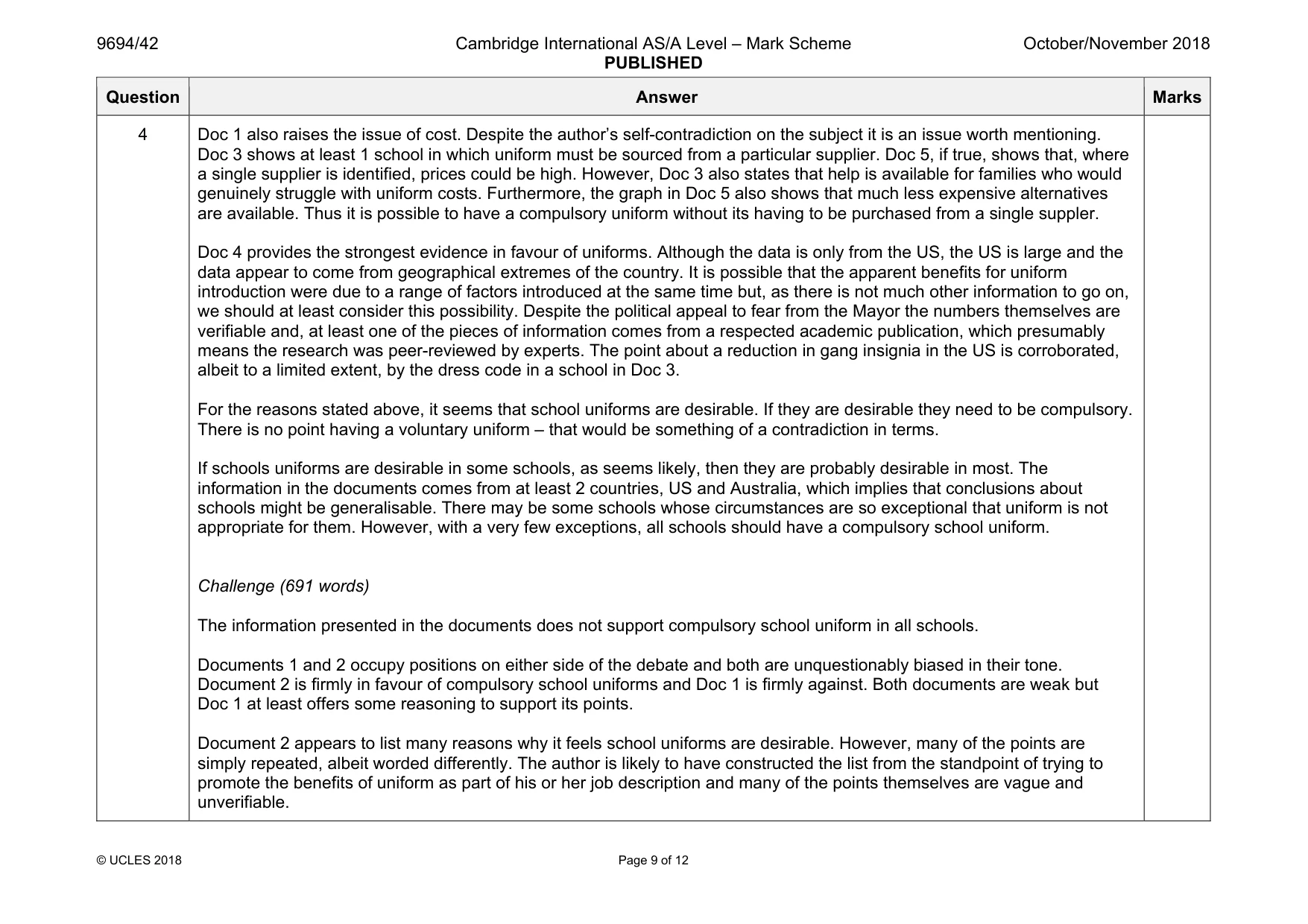
9694/42 Cambridge International AS/A Level – Mark Scheme PUBLISHED October/November 2018 © UCLES 2018 Page 9 of 12 Question Answer Marks 4 Doc 1 also raises the issue of cost. Despite the author’s self-contradiction on the subject it is an issue worth mentioning. Doc 3 shows at least 1 school in which uniform must be sourced from a particular supplier. Doc 5, if true, shows that, where a single supplier is identified, prices could be high. However, Doc 3 also states that help is available for families who would genuinely struggle with uniform costs. Furthermore, the graph in Doc 5 also shows that much less expensive alternatives are available. Thus it is possible to have a compulsory uniform without its having to be purchased from a single suppler. Doc 4 provides the strongest evidence in favour of uniforms. Although the data is only from the US, the US is large and the data appear to come from geographical extremes of the country. It is possible that the apparent benefits for uniform introduction were due to a range of factors introduced at the same time but, as there is not much other information to go on, we should at least consider this possibility. Despite the political appeal to fear from the Mayor the numbers themselves are verifiable and, at least one of the pieces of information comes from a respected academic publication, which presumably means the research was peer-reviewed by experts. The point about a reduction in gang insignia in the US is corroborated, albeit to a limited extent, by the dress code in a school in Doc 3. For the reasons stated above, it seems that school uniforms are desirable. If they are desirable they need to be compulsory. There is no point having a voluntary uniform – that would be something of a contradiction in terms. If schools uniforms are desirable in some schools, as seems likely, then they are probably desirable in most. The information in the documents comes from at least 2 countries, US and Australia, which implies that conclusions about schools might be generalisable. There may be some schools whose circumstances are so exceptional that uniform is not appropriate for them. However, with a very few exceptions, all schools should have a compulsory school uniform. Challenge (691 words) The information presented in the documents does not support compulsory school uniform in all schools. Documents 1 and 2 occupy positions on either side of the debate and both are unquestionably biased in their tone. Document 2 is firmly in favour of compulsory school uniforms and Doc 1 is firmly against. Both documents are weak but Doc 1 at least offers some reasoning to support its points. Document 2 appears to list many reasons why it feels school uniforms are desirable. However, many of the points are simply repeated, albeit worded differently. The author is likely to have constructed the list from the standpoint of trying to promote the benefits of uniform as part of his or her job description and many of the points themselves are vague and unverifiable.
Mark scheme, page 10
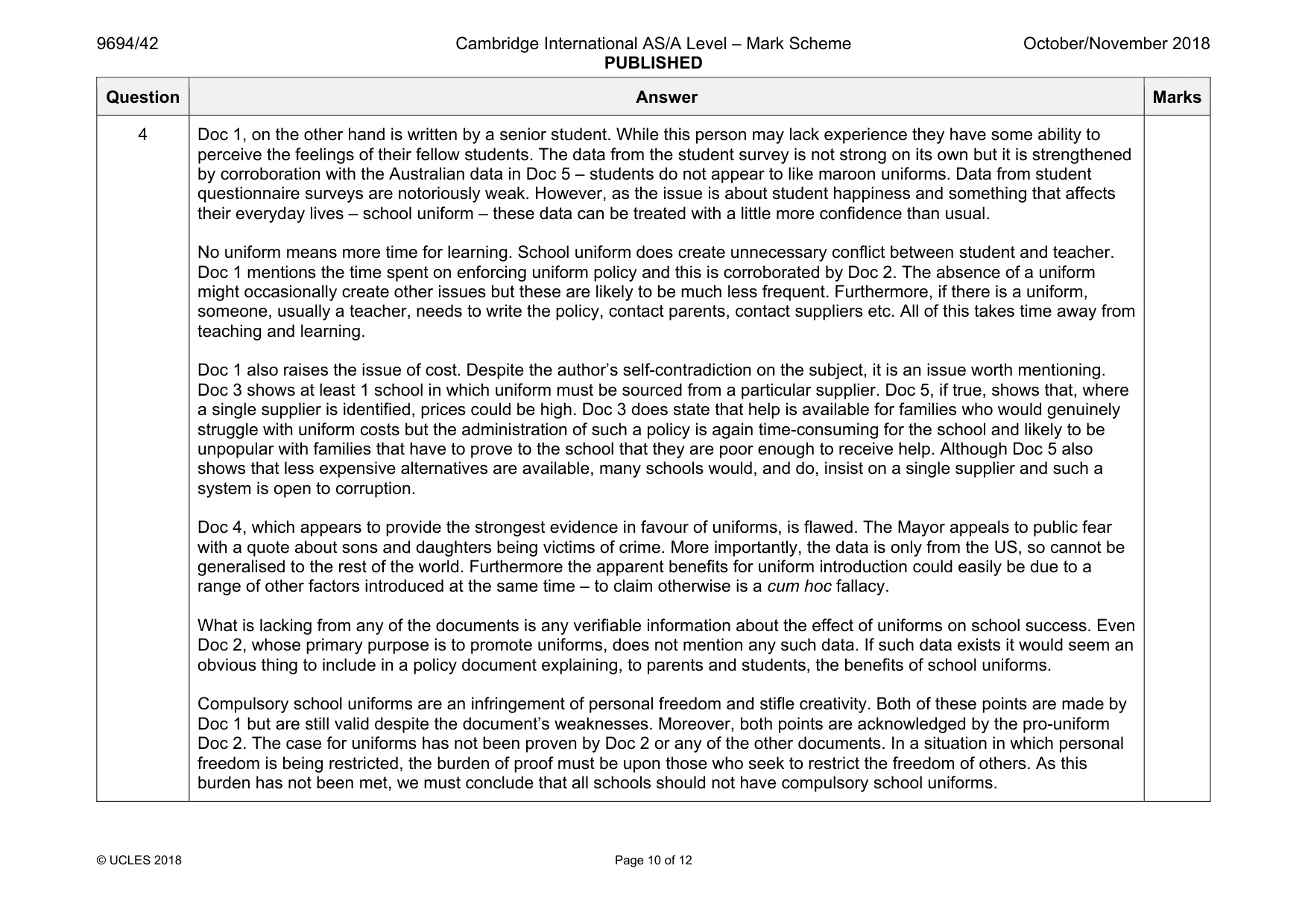
9694/42 Cambridge International AS/A Level – Mark Scheme PUBLISHED October/November 2018 © UCLES 2018 Page 10 of 12 Question Answer Marks 4 Doc 1, on the other hand is written by a senior student. While this person may lack experience they have some ability to perceive the feelings of their fellow students. The data from the student survey is not strong on its own but it is strengthened by corroboration with the Australian data in Doc 5 – students do not appear to like maroon uniforms. Data from student questionnaire surveys are notoriously weak. However, as the issue is about student happiness and something that affects their everyday lives – school uniform – these data can be treated with a little more confidence than usual. No uniform means more time for learning. School uniform does create unnecessary conflict between student and teacher. Doc 1 mentions the time spent on enforcing uniform policy and this is corroborated by Doc 2. The absence of a uniform might occasionally create other issues but these are likely to be much less frequent. Furthermore, if there is a uniform, someone, usually a teacher, needs to write the policy, contact parents, contact suppliers etc. All of this takes time away from teaching and learning. Doc 1 also raises the issue of cost. Despite the author’s self-contradiction on the subject, it is an issue worth mentioning. Doc 3 shows at least 1 school in which uniform must be sourced from a particular supplier. Doc 5, if true, shows that, where a single supplier is identified, prices could be high. Doc 3 does state that help is available for families who would genuinely struggle with uniform costs but the administration of such a policy is again time-consuming for the school and likely to be unpopular with families that have to prove to the school that they are poor enough to receive help. Although Doc 5 also shows that less expensive alternatives are available, many schools would, and do, insist on a single supplier and such a system is open to corruption. Doc 4, which appears to provide the strongest evidence in favour of uniforms, is flawed. The Mayor appeals to public fear with a quote about sons and daughters being victims of crime. More importantly, the data is only from the US, so cannot be generalised to the rest of the world. Furthermore the apparent benefits for uniform introduction could easily be due to a range of other factors introduced at the same time – to claim otherwise is a cum hoc fallacy. What is lacking from any of the documents is any verifiable information about the effect of uniforms on school success. Even Doc 2, whose primary purpose is to promote uniforms, does not mention any such data. If such data exists it would seem an obvious thing to include in a policy document explaining, to parents and students, the benefits of school uniforms. Compulsory school uniforms are an infringement of personal freedom and stifle creativity. Both of these points are made by Doc 1 but are still valid despite the document’s weaknesses. Moreover, both points are acknowledged by the pro-uniform Doc 2. The case for uniforms has not been proven by Doc 2 or any of the other documents. In a situation in which personal freedom is being restricted, the burden of proof must be upon those who seek to restrict the freedom of others. As this burden has not been met, we must conclude that all schools should not have compulsory school uniforms.
Mark scheme, page 11
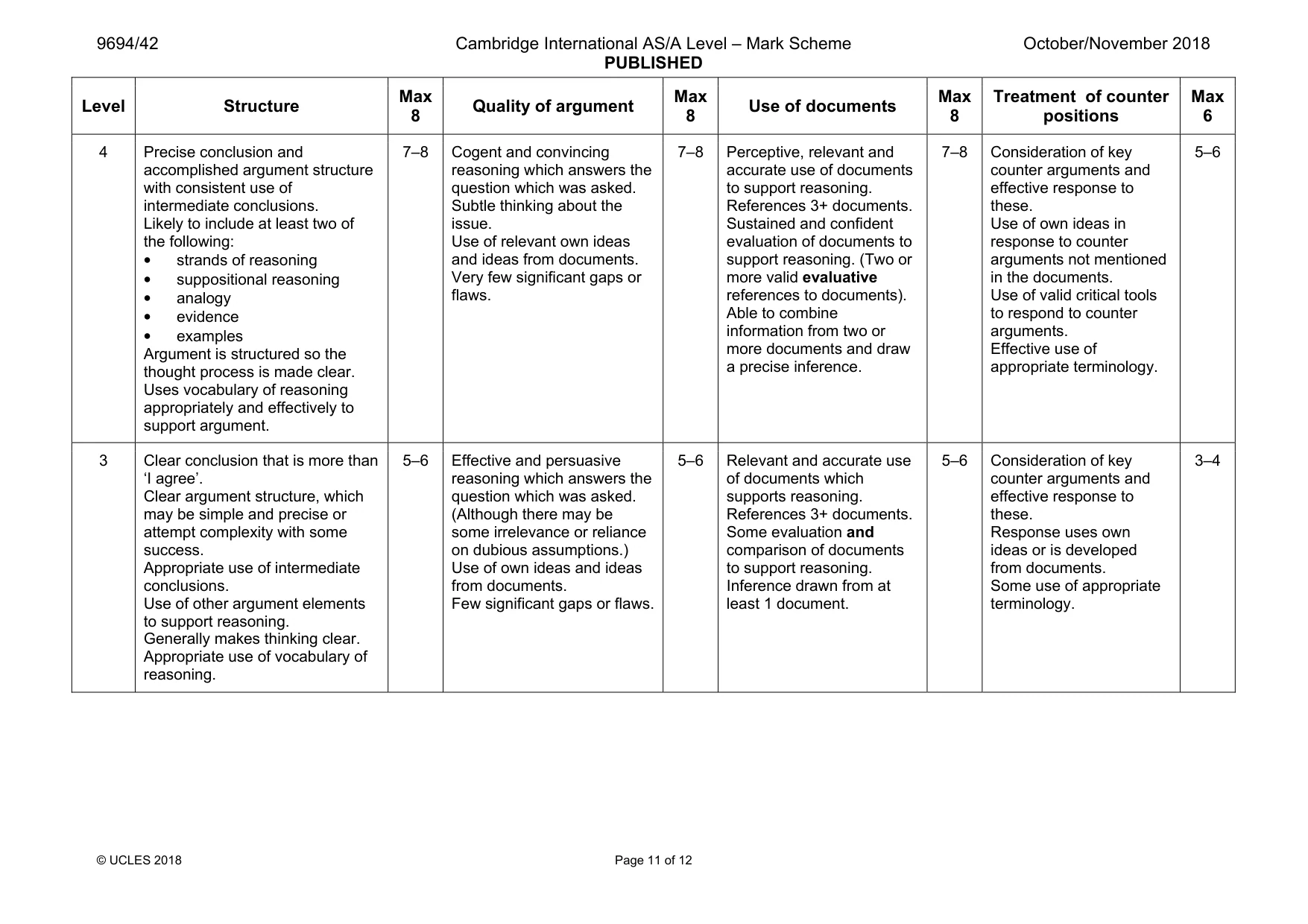
9694/42 Cambridge International AS/A Level – Mark Scheme PUBLISHED October/November 2018 © UCLES 2018 Page 11 of 12 Level Structure Max 8 Quality of argument Max 8 Use of documents Max 8 Treatment of counter positions Max 6 4 Precise conclusion and accomplished argument structure with consistent use of intermediate conclusions. Likely to include at least two of the following: • strands of reasoning • suppositional reasoning • analogy • evidence • examples Argument is structured so the thought process is made clear. Uses vocabulary of reasoning appropriately and effectively to support argument. 7–8 Cogent and convincing reasoning which answers the question which was asked. Subtle thinking about the issue. Use of relevant own ideas and ideas from documents. Very few significant gaps or flaws. 7–8 Perceptive, relevant and accurate use of documents to support reasoning. References 3+ documents. Sustained and confident evaluation of documents to support reasoning. (Two or more valid evaluative references to documents). Able to combine information from two or more documents and draw a precise inference. 7–8 Consideration of key counter arguments and effective response to these. Use of own ideas in response to counter arguments not mentioned in the documents. Use of valid critical tools to respond to counter arguments. Effective use of appropriate terminology. 5–6 3 Clear conclusion that is more than ‘I agree’. Clear argument structure, which may be simple and precise or attempt complexity with some success. Appropriate use of intermediate conclusions. Use of other argument elements to support reasoning. Generally makes thinking clear. Appropriate use of vocabulary of reasoning. 5–6 Effective and persuasive reasoning which answers the question which was asked. (Although there may be some irrelevance or reliance on dubious assumptions.) Use of own ideas and ideas from documents. Few significant gaps or flaws. 5–6 Relevant and accurate use of documents which supports reasoning. References 3+ documents. Some evaluation and comparison of documents to support reasoning. Inference drawn from at least 1 document. 5–6 Consideration of key counter arguments and effective response to these. Response uses own ideas or is developed from documents. Some use of appropriate terminology. 3–4
Mark scheme, page 12
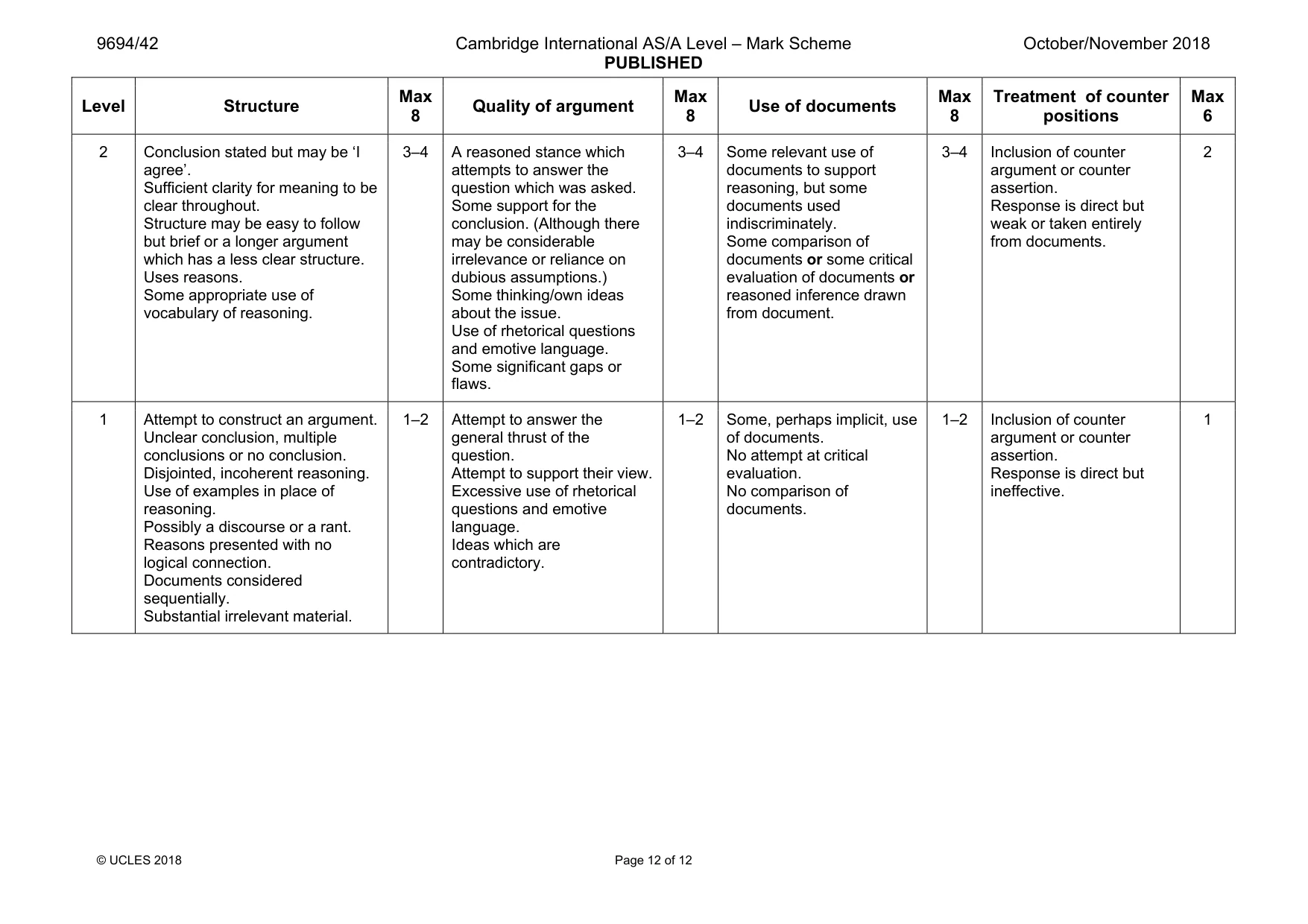
9694/42 Cambridge International AS/A Level – Mark Scheme PUBLISHED October/November 2018 © UCLES 2018 Page 12 of 12 Level Structure Max 8 Quality of argument Max 8 Use of documents Max 8 Treatment of counter positions Max 6 2 Conclusion stated but may be ‘I agree’. Sufficient clarity for meaning to be clear throughout. Structure may be easy to follow but brief or a longer argument which has a less clear structure. Uses reasons. Some appropriate use of vocabulary of reasoning. 3–4 A reasoned stance which attempts to answer the question which was asked. Some support for the conclusion. (Although there may be considerable irrelevance or reliance on dubious assumptions.) Some thinking/own ideas about the issue. Use of rhetorical questions and emotive language. Some significant gaps or flaws. 3–4 Some relevant use of documents to support reasoning, but some documents used indiscriminately. Some comparison of documents or some critical evaluation of documents or reasoned inference drawn from document. 3–4 Inclusion of counter argument or counter assertion. Response is direct but weak or taken entirely from documents. 2 1 Attempt to construct an argument. Unclear conclusion, multiple conclusions or no conclusion. Disjointed, incoherent reasoning. Use of examples in place of reasoning. Possibly a discourse or a rant. Reasons presented with no logical connection. Documents considered sequentially. Substantial irrelevant material. 1–2 Attempt to answer the general thrust of the question. Attempt to support their view. Excessive use of rhetorical questions and emotive language. Ideas which are contradictory. 1–2 Some, perhaps implicit, use of documents. No attempt at critical evaluation. No comparison of documents. 1–2 Inclusion of counter argument or counter assertion. Response is direct but ineffective. 1
What you needed in this session
Cambridge’s own grade thresholds for 2018 Oct/Nov, Paper 4 · Variant 2. A higher threshold means an easier paper — the bar moves with how the cohort did.