Cambridge A Level Thinking Skills 9694 — 2017 May/June Paper 4 · Variant 1
9694/41/M/J/17 · 50 marks · ≈56 min
The question paper and its mark scheme, free to read here and free to download. This is Cambridge’s own paper, exactly as it was sat.
Question paper8 pages
Mark scheme11 pages
Answers below. Sit the paper first if you are practising.
Paper as text
Question paper, page 1
* 1 4 1 7 2 6 9 6 1 0 * This document consists of 7 printed pages, 1 blank page and 1 insert. DC (LK/SW) 136173/2 © UCLES 2017 [Turn over Cambridge International Examinations Cambridge International Advanced Level THINKING SKILLS 9694/41 Paper 4 Applied Reasoning May/June 2017 1 hour 30 minutes No Additional Materials are required. READ THESE INSTRUCTIONS FIRST An answer booklet is provided inside this question paper. You should follow the instructions on the front cover of the answer booklet. If you need additional answer paper ask the invigilator for a continuation booklet. Answer all the questions. The number of marks is given in brackets [ ] at the end of each question.
Question paper, page 2
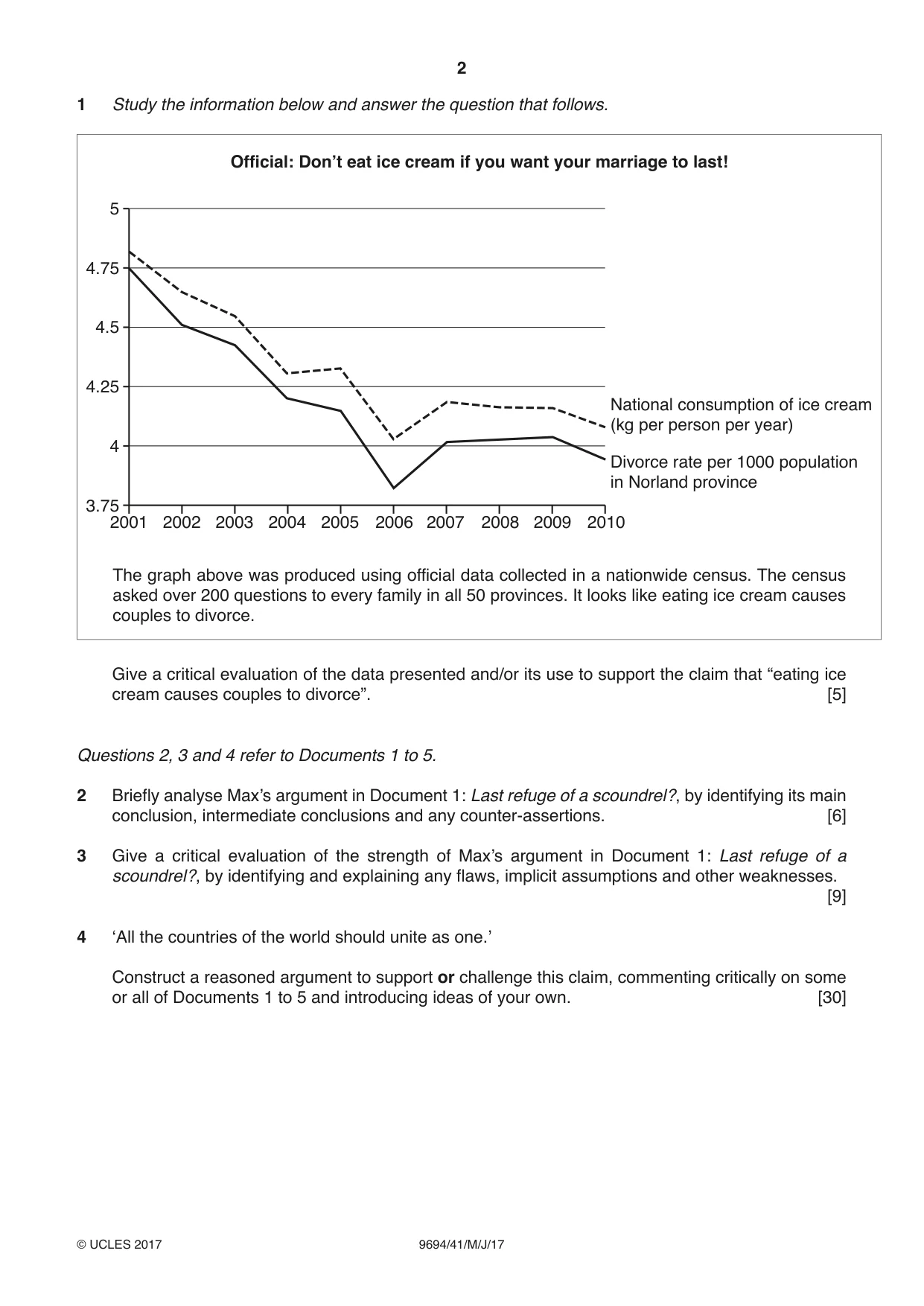
2 9694/41/M/J/17 © UCLES 2017 1 Study the information below and answer the question that follows. Official: Don’t eat ice cream if you want your marriage to last! 2001 3.75 4 4.25 4.5 4.75 5 2002 2003 2004 2005 2006 2007 2008 2009 2010 Divorce rate per 1000 population in Norland province National consumption of ice cream (kg per person per year) The graph above was produced using official data collected in a nationwide census. The census asked over 200 questions to every family in all 50 provinces. It looks like eating ice cream causes couples to divorce. Give a critical evaluation of the data presented and/or its use to support the claim that “eating ice cream causes couples to divorce”. [5] Questions 2, 3 and 4 refer to Documents 1 to 5. 2 Briefly analyse Max’s argument in Document 1: Last refuge of a scoundrel?, by identifying its main conclusion, intermediate conclusions and any counter-assertions. [6] 3 Give a critical evaluation of the strength of Max’s argument in Document 1: Last refuge of a scoundrel?, by identifying and explaining any flaws, implicit assumptions and other weaknesses. [9] 4 ‘All the countries of the world should unite as one.’ Construct a reasoned argument to support or challenge this claim, commenting critically on some or all of Documents 1 to 5 and introducing ideas of your own. [30]
Question paper, page 3
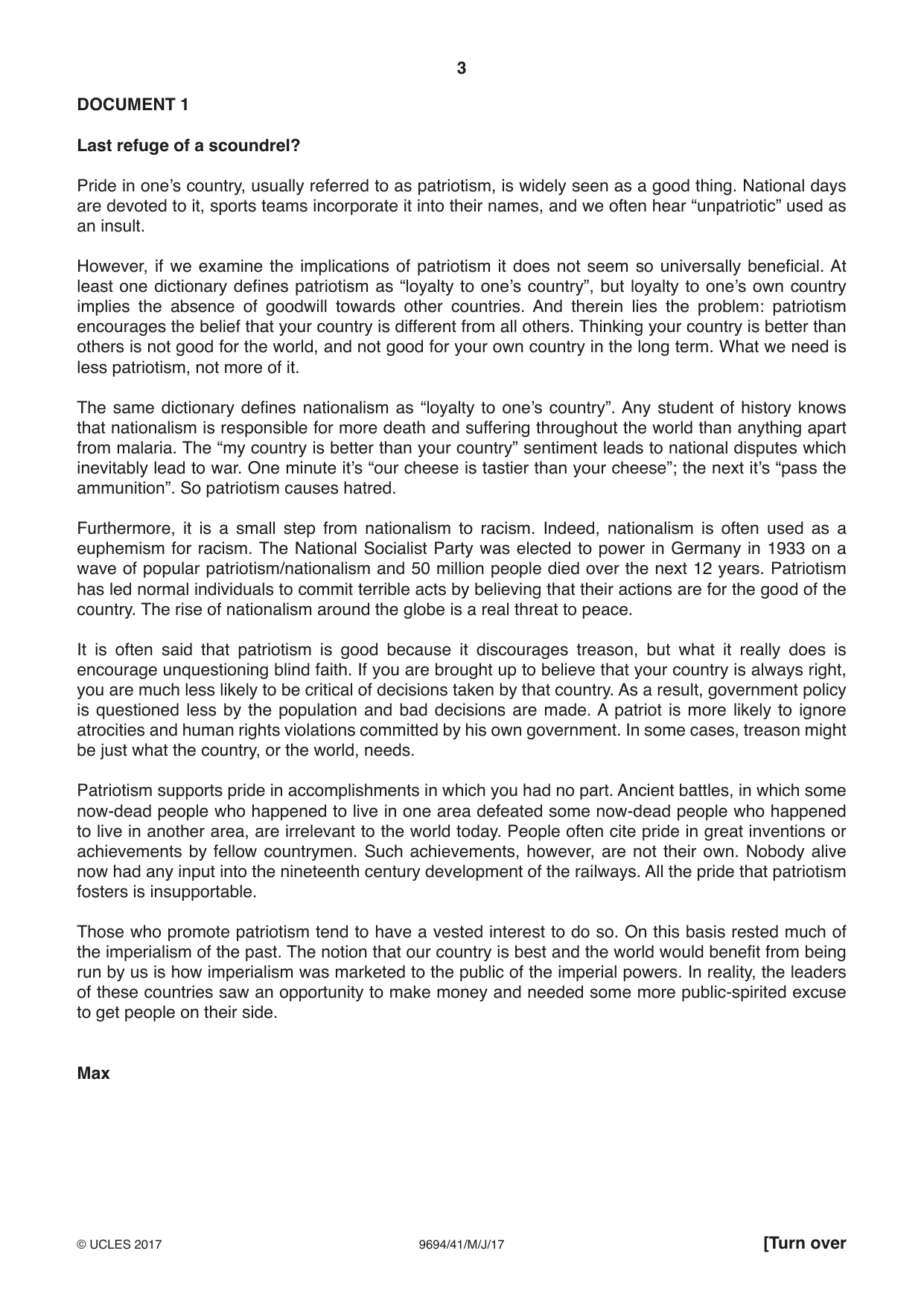
3 9694/41/M/J/17 © UCLES 2017 [Turn over DOCUMENT 1 Last refuge of a scoundrel? Pride in one’s country, usually referred to as patriotism, is widely seen as a good thing. National days are devoted to it, sports teams incorporate it into their names, and we often hear “unpatriotic” used as an insult. However, if we examine the implications of patriotism it does not seem so universally beneficial. At least one dictionary defines patriotism as “loyalty to one’s country”, but loyalty to one’s own country implies the absence of goodwill towards other countries. And therein lies the problem: patriotism encourages the belief that your country is different from all others. Thinking your country is better than others is not good for the world, and not good for your own country in the long term. What we need is less patriotism, not more of it. The same dictionary defines nationalism as “loyalty to one’s country”. Any student of history knows that nationalism is responsible for more death and suffering throughout the world than anything apart from malaria. The “my country is better than your country” sentiment leads to national disputes which inevitably lead to war. One minute it’s “our cheese is tastier than your cheese”; the next it’s “pass the ammunition”. So patriotism causes hatred. Furthermore, it is a small step from nationalism to racism. Indeed, nationalism is often used as a euphemism for racism. The National Socialist Party was elected to power in Germany in 1933 on a wave of popular patriotism/nationalism and 50 million people died over the next 12 years. Patriotism has led normal individuals to commit terrible acts by believing that their actions are for the good of the country. The rise of nationalism around the globe is a real threat to peace. It is often said that patriotism is good because it discourages treason, but what it really does is encourage unquestioning blind faith. If you are brought up to believe that your country is always right, you are much less likely to be critical of decisions taken by that country. As a result, government policy is questioned less by the population and bad decisions are made. A patriot is more likely to ignore atrocities and human rights violations committed by his own government. In some cases, treason might be just what the country, or the world, needs. Patriotism supports pride in accomplishments in which you had no part. Ancient battles, in which some now-dead people who happened to live in one area defeated some now-dead people who happened to live in another area, are irrelevant to the world today. People often cite pride in great inventions or achievements by fellow countrymen. Such achievements, however, are not their own. Nobody alive now had any input into the nineteenth century development of the railways. All the pride that patriotism fosters is insupportable. Those who promote patriotism tend to have a vested interest to do so. On this basis rested much of the imperialism of the past. The notion that our country is best and the world would benefit from being run by us is how imperialism was marketed to the public of the imperial powers. In reality, the leaders of these countries saw an opportunity to make money and needed some more public-spirited excuse to get people on their side. Max
Question paper, page 4
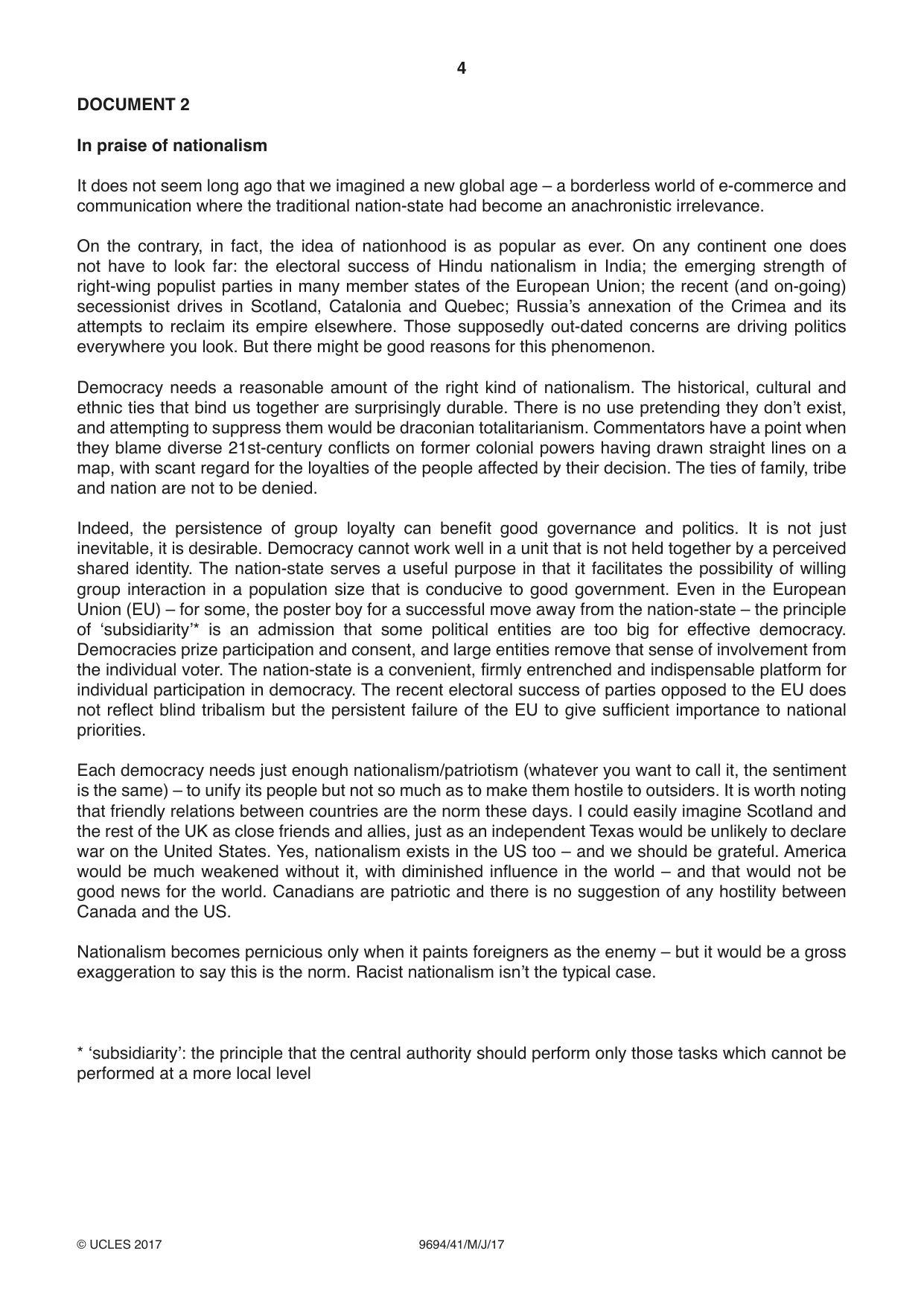
4 9694/41/M/J/17 © UCLES 2017 DOCUMENT 2 In praise of nationalism It does not seem long ago that we imagined a new global age – a borderless world of e-commerce and communication where the traditional nation-state had become an anachronistic irrelevance. On the contrary, in fact, the idea of nationhood is as popular as ever. On any continent one does not have to look far: the electoral success of Hindu nationalism in India; the emerging strength of right-wing populist parties in many member states of the European Union; the recent (and on-going) secessionist drives in Scotland, Catalonia and Quebec; Russia’s annexation of the Crimea and its attempts to reclaim its empire elsewhere. Those supposedly out-dated concerns are driving politics everywhere you look. But there might be good reasons for this phenomenon. Democracy needs a reasonable amount of the right kind of nationalism. The historical, cultural and ethnic ties that bind us together are surprisingly durable. There is no use pretending they don’t exist, and attempting to suppress them would be draconian totalitarianism. Commentators have a point when they blame diverse 21st-century conflicts on former colonial powers having drawn straight lines on a map, with scant regard for the loyalties of the people affected by their decision. The ties of family, tribe and nation are not to be denied. Indeed, the persistence of group loyalty can benefit good governance and politics. It is not just inevitable, it is desirable. Democracy cannot work well in a unit that is not held together by a perceived shared identity. The nation-state serves a useful purpose in that it facilitates the possibility of willing group interaction in a population size that is conducive to good government. Even in the European Union (EU) – for some, the poster boy for a successful move away from the nation-state – the principle of ‘subsidiarity’* is an admission that some political entities are too big for effective democracy. Democracies prize participation and consent, and large entities remove that sense of involvement from the individual voter. The nation-state is a convenient, firmly entrenched and indispensable platform for individual participation in democracy. The recent electoral success of parties opposed to the EU does not reflect blind tribalism but the persistent failure of the EU to give sufficient importance to national priorities. Each democracy needs just enough nationalism/patriotism (whatever you want to call it, the sentiment is the same) – to unify its people but not so much as to make them hostile to outsiders. It is worth noting that friendly relations between countries are the norm these days. I could easily imagine Scotland and the rest of the UK as close friends and allies, just as an independent Texas would be unlikely to declare war on the United States. Yes, nationalism exists in the US too – and we should be grateful. America would be much weakened without it, with diminished influence in the world – and that would not be good news for the world. Canadians are patriotic and there is no suggestion of any hostility between Canada and the US. Nationalism becomes pernicious only when it paints foreigners as the enemy – but it would be a gross exaggeration to say this is the norm. Racist nationalism isn’t the typical case. * ‘subsidiarity’: the principle that the central authority should perform only those tasks which cannot be performed at a more local level
Question paper, page 5
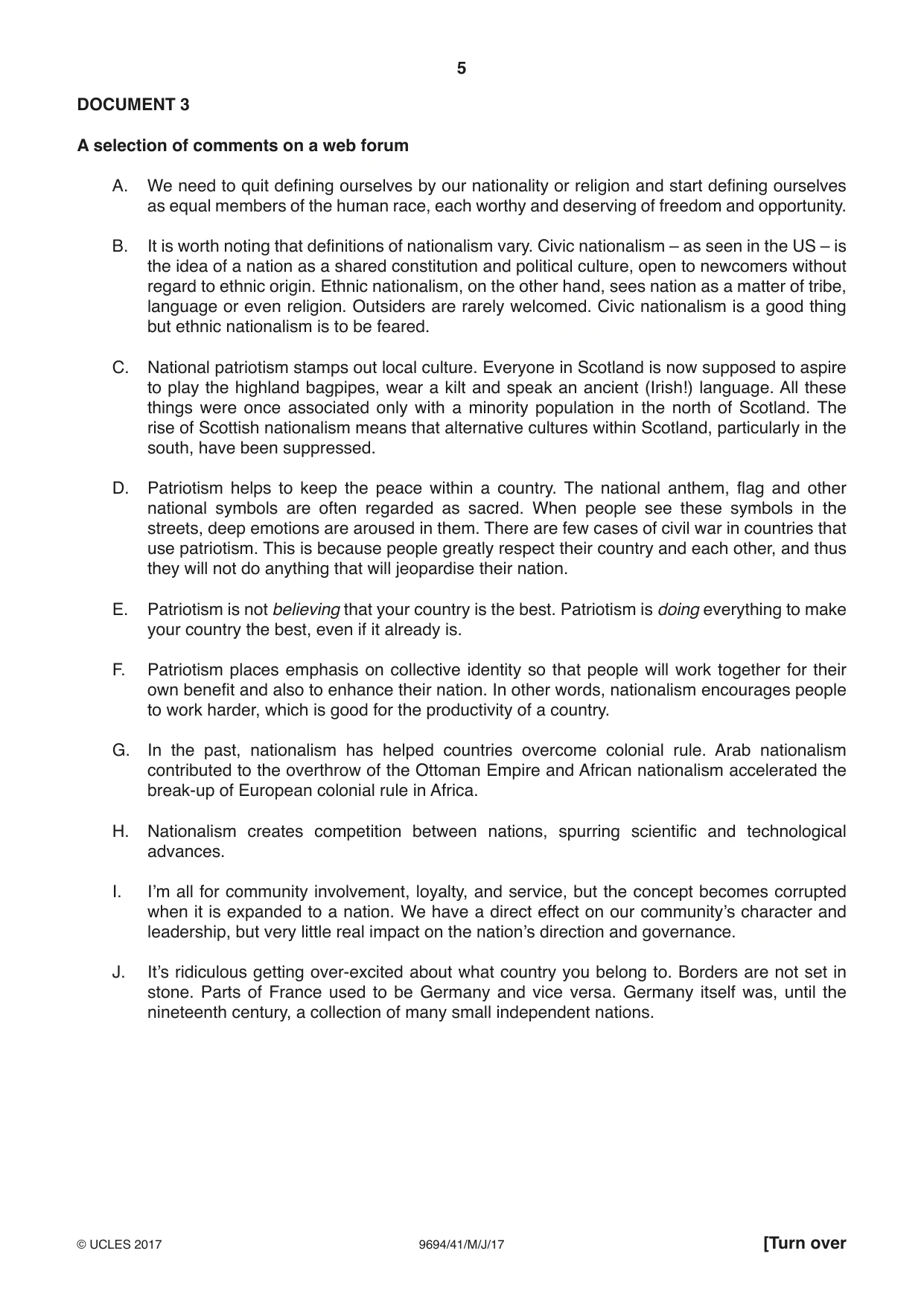
5 9694/41/M/J/17 © UCLES 2017 [Turn over DOCUMENT 3 A selection of comments on a web forum A. We need to quit defining ourselves by our nationality or religion and start defining ourselves as equal members of the human race, each worthy and deserving of freedom and opportunity. B. It is worth noting that definitions of nationalism vary. Civic nationalism – as seen in the US – is the idea of a nation as a shared constitution and political culture, open to newcomers without regard to ethnic origin. Ethnic nationalism, on the other hand, sees nation as a matter of tribe, language or even religion. Outsiders are rarely welcomed. Civic nationalism is a good thing but ethnic nationalism is to be feared. C. National patriotism stamps out local culture. Everyone in Scotland is now supposed to aspire to play the highland bagpipes, wear a kilt and speak an ancient (Irish!) language. All these things were once associated only with a minority population in the north of Scotland. The rise of Scottish nationalism means that alternative cultures within Scotland, particularly in the south, have been suppressed. D. Patriotism helps to keep the peace within a country. The national anthem, flag and other national symbols are often regarded as sacred. When people see these symbols in the streets, deep emotions are aroused in them. There are few cases of civil war in countries that use patriotism. This is because people greatly respect their country and each other, and thus they will not do anything that will jeopardise their nation. E. Patriotism is not believing that your country is the best. Patriotism is doing everything to make your country the best, even if it already is. F. Patriotism places emphasis on collective identity so that people will work together for their own benefit and also to enhance their nation. In other words, nationalism encourages people to work harder, which is good for the productivity of a country. G. In the past, nationalism has helped countries overcome colonial rule. Arab nationalism contributed to the overthrow of the Ottoman Empire and African nationalism accelerated the break-up of European colonial rule in Africa. H. Nationalism creates competition between nations, spurring scientific and technological advances. I. I’m all for community involvement, loyalty, and service, but the concept becomes corrupted when it is expanded to a nation. We have a direct effect on our community’s character and leadership, but very little real impact on the nation’s direction and governance. J. It’s ridiculous getting over-excited about what country you belong to. Borders are not set in stone. Parts of France used to be Germany and vice versa. Germany itself was, until the nineteenth century, a collection of many small independent nations.
Question paper, page 6
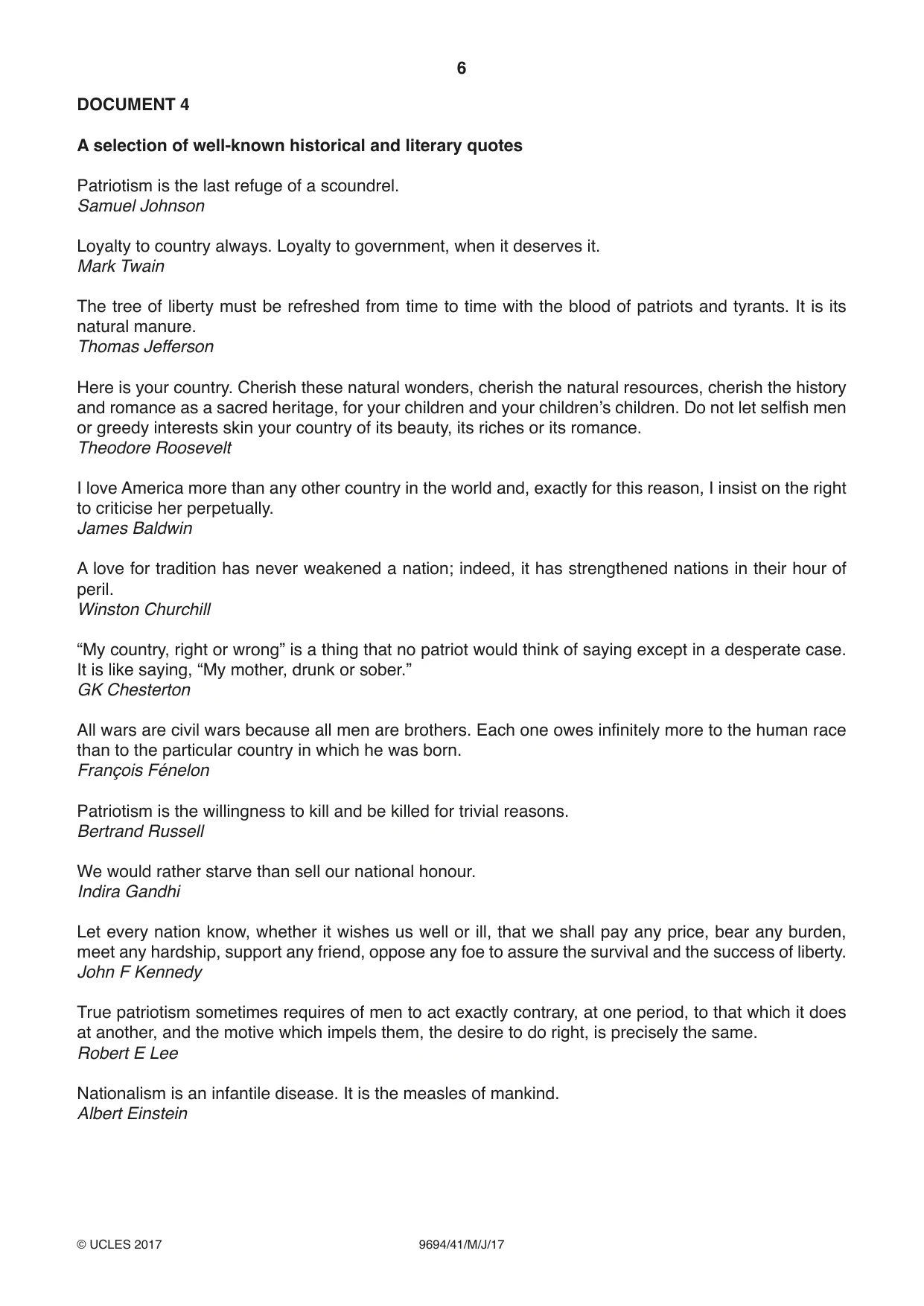
6 9694/41/M/J/17 © UCLES 2017 DOCUMENT 4 A selection of well-known historical and literary quotes Patriotism is the last refuge of a scoundrel. Samuel Johnson Loyalty to country always. Loyalty to government, when it deserves it. Mark Twain The tree of liberty must be refreshed from time to time with the blood of patriots and tyrants. It is its natural manure. Thomas Jefferson Here is your country. Cherish these natural wonders, cherish the natural resources, cherish the history and romance as a sacred heritage, for your children and your children’s children. Do not let selfish men or greedy interests skin your country of its beauty, its riches or its romance. Theodore Roosevelt I love America more than any other country in the world and, exactly for this reason, I insist on the right to criticise her perpetually. James Baldwin A love for tradition has never weakened a nation; indeed, it has strengthened nations in their hour of peril. Winston Churchill “My country, right or wrong” is a thing that no patriot would think of saying except in a desperate case. It is like saying, “My mother, drunk or sober.” GK Chesterton All wars are civil wars because all men are brothers. Each one owes infinitely more to the human race than to the particular country in which he was born. François Fénelon Patriotism is the willingness to kill and be killed for trivial reasons. Bertrand Russell We would rather starve than sell our national honour. Indira Gandhi Let every nation know, whether it wishes us well or ill, that we shall pay any price, bear any burden, meet any hardship, support any friend, oppose any foe to assure the survival and the success of liberty. John F Kennedy True patriotism sometimes requires of men to act exactly contrary, at one period, to that which it does at another, and the motive which impels them, the desire to do right, is precisely the same. Robert E Lee Nationalism is an infantile disease. It is the measles of mankind. Albert Einstein
Question paper, page 7
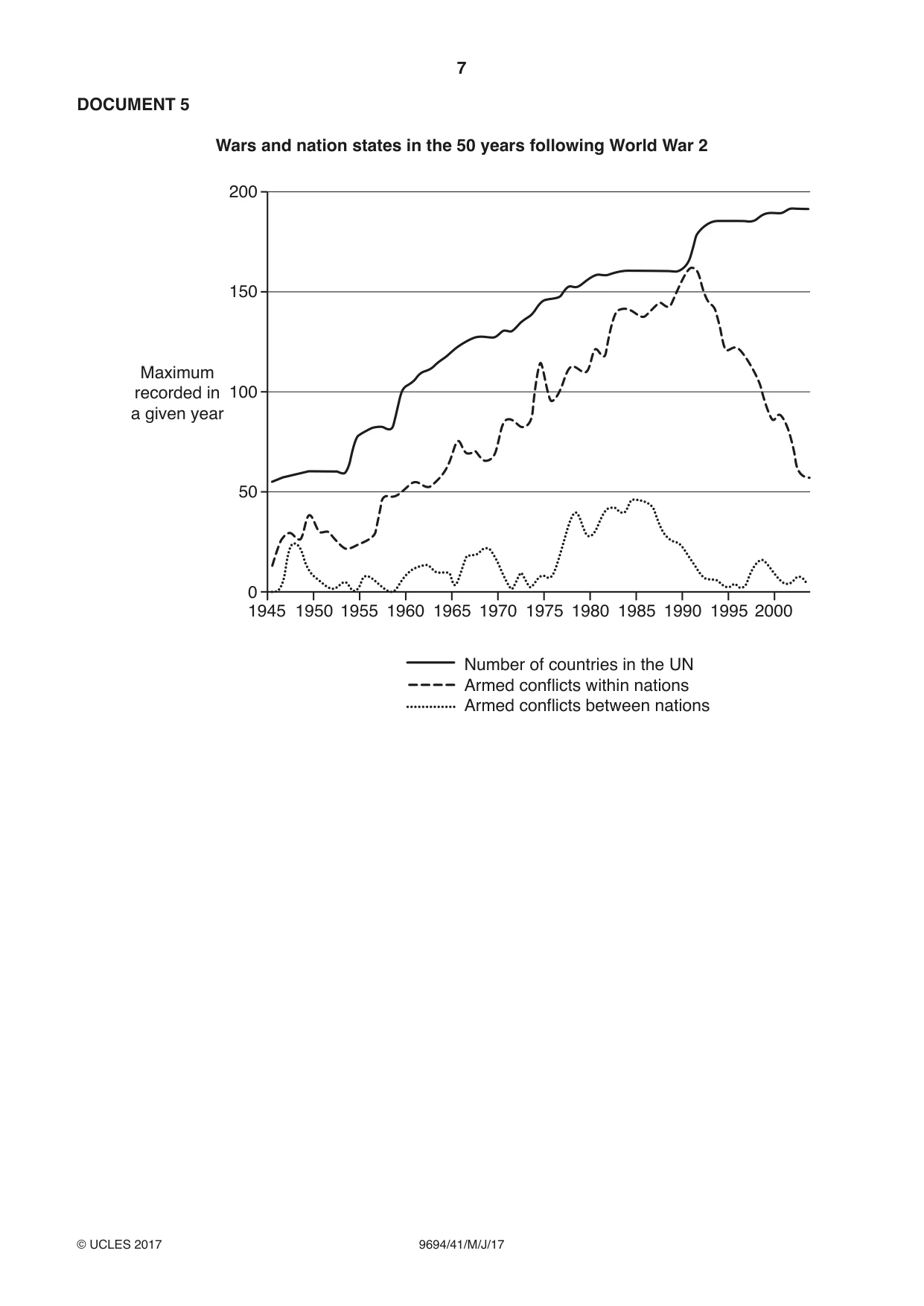
7 9694/41/M/J/17 © UCLES 2017 DOCUMENT 5 Wars and nation states in the 50 years following World War 2 0 1945 1950 1955 1960 1965 1970 1975 1980 1985 1990 1995 2000 50 100 Maximum recorded in a given year 150 200 Number of countries in the UN Armed conflicts within nations Armed conflicts between nations
Question paper, page 8
8 9694/41/M/J/17 © UCLES 2017 Permission to reproduce items where third-party owned material protected by copyright is included has been sought and cleared where possible. Every reasonable effort has been made by the publisher (UCLES) to trace copyright holders, but if any items requiring clearance have unwittingly been included, the publisher will be pleased to make amends at the earliest possible opportunity. To avoid the issue of disclosure of answer-related information to candidates, all copyright acknowledgements are reproduced online in the Cambridge International Examinations Copyright Acknowledgements Booklet. This is produced for each series of examinations and is freely available to download at www.cie.org.uk after the live examination series. Cambridge International Examinations is part of the Cambridge Assessment Group. Cambridge Assessment is the brand name of University of Cambridge Local Examinations Syndicate (UCLES), which is itself a department of the University of Cambridge. BLANK PAGE
Mark scheme, page 1
® IGCSE is a registered trademark. This document consists of 11 printed pages. © UCLES 2017 [Turn over Cambridge International Examinations Cambridge International Advanced Level THINKING SKILLS 9694/41 Paper 4 Applied Reasoning May/June 2017 MARK SCHEME Maximum Mark: 50 Published This mark scheme is published as an aid to teachers and candidates, to indicate the requirements of the examination. It shows the basis on which Examiners were instructed to award marks. It does not indicate the details of the discussions that took place at an Examiners’ meeting before marking began, which would have considered the acceptability of alternative answers. Mark schemes should be read in conjunction with the question paper and the Principal Examiner Report for Teachers. Cambridge will not enter into discussions about these mark schemes. Cambridge is publishing the mark schemes for the May/June 2017 series for most Cambridge IGCSE®, Cambridge International A and AS Level and Cambridge Pre-U components, and some Cambridge O Level components.
Mark scheme, page 2
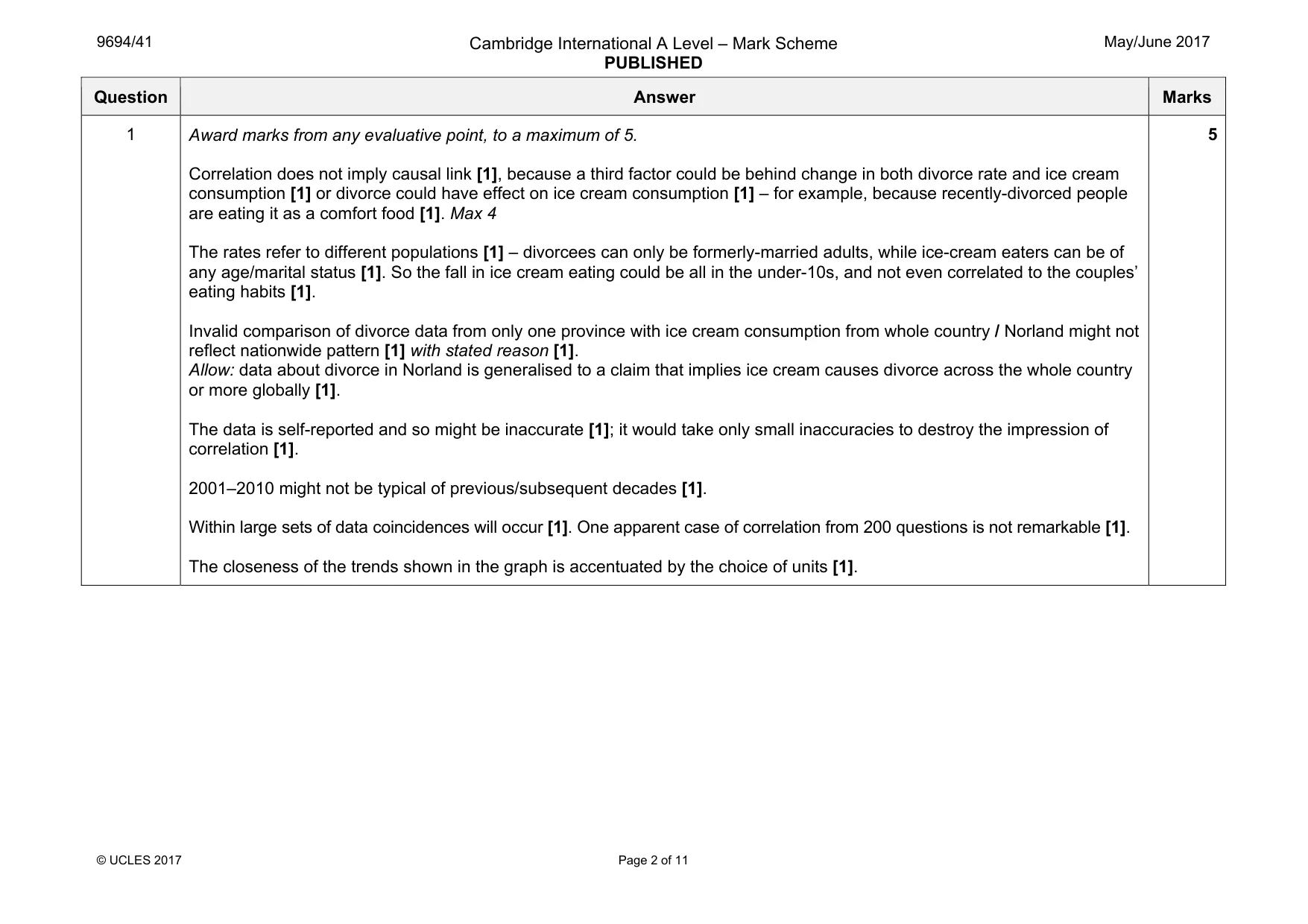
9694/41 Cambridge International A Level – Mark Scheme PUBLISHED May/June 2017 © UCLES 2017 Page 2 of 11 Question Answer Marks 1 Award marks from any evaluative point, to a maximum of 5. Correlation does not imply causal link [1], because a third factor could be behind change in both divorce rate and ice cream consumption [1] or divorce could have effect on ice cream consumption [1] – for example, because recently-divorced people are eating it as a comfort food [1]. Max 4 The rates refer to different populations [1] – divorcees can only be formerly-married adults, while ice-cream eaters can be of any age/marital status [1]. So the fall in ice cream eating could be all in the under-10s, and not even correlated to the couples’ eating habits [1]. Invalid comparison of divorce data from only one province with ice cream consumption from whole country / Norland might not reflect nationwide pattern [1] with stated reason [1]. Allow: data about divorce in Norland is generalised to a claim that implies ice cream causes divorce across the whole country or more globally [1]. The data is self-reported and so might be inaccurate [1]; it would take only small inaccuracies to destroy the impression of correlation [1]. 2001–2010 might not be typical of previous/subsequent decades [1]. Within large sets of data coincidences will occur [1]. One apparent case of correlation from 200 questions is not remarkable [1]. The closeness of the trends shown in the graph is accentuated by the choice of units [1]. 5
Mark scheme, page 3
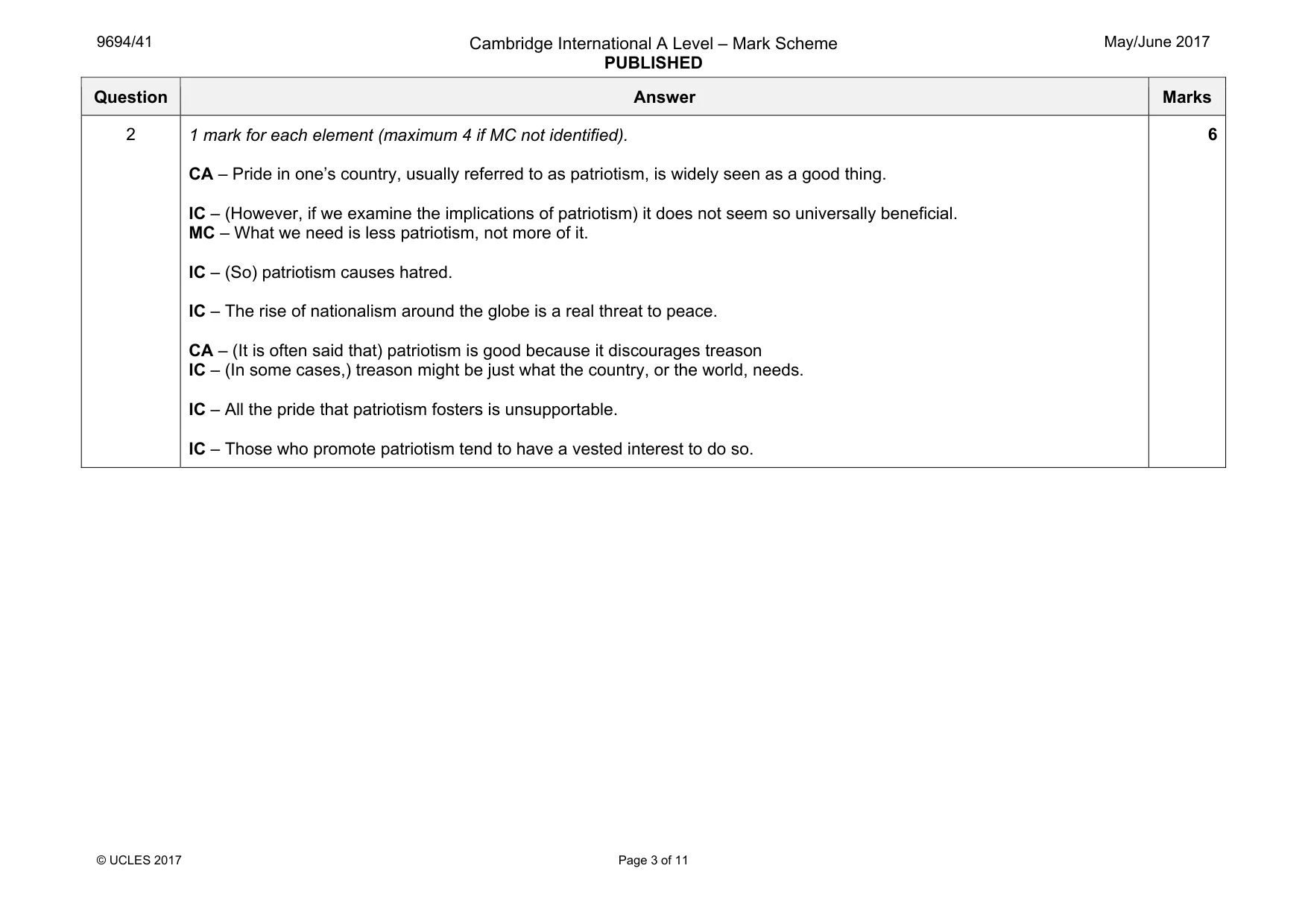
9694/41 Cambridge International A Level – Mark Scheme PUBLISHED May/June 2017 © UCLES 2017 Page 3 of 11 Question Answer Marks 2 1 mark for each element (maximum 4 if MC not identified). CA – Pride in one’s country, usually referred to as patriotism, is widely seen as a good thing. IC – (However, if we examine the implications of patriotism) it does not seem so universally beneficial. MC – What we need is less patriotism, not more of it. IC – (So) patriotism causes hatred. IC – The rise of nationalism around the globe is a real threat to peace. CA – (It is often said that) patriotism is good because it discourages treason IC – (In some cases,) treason might be just what the country, or the world, needs. IC – All the pride that patriotism fosters is unsupportable. IC – Those who promote patriotism tend to have a vested interest to do so. 6
Mark scheme, page 4
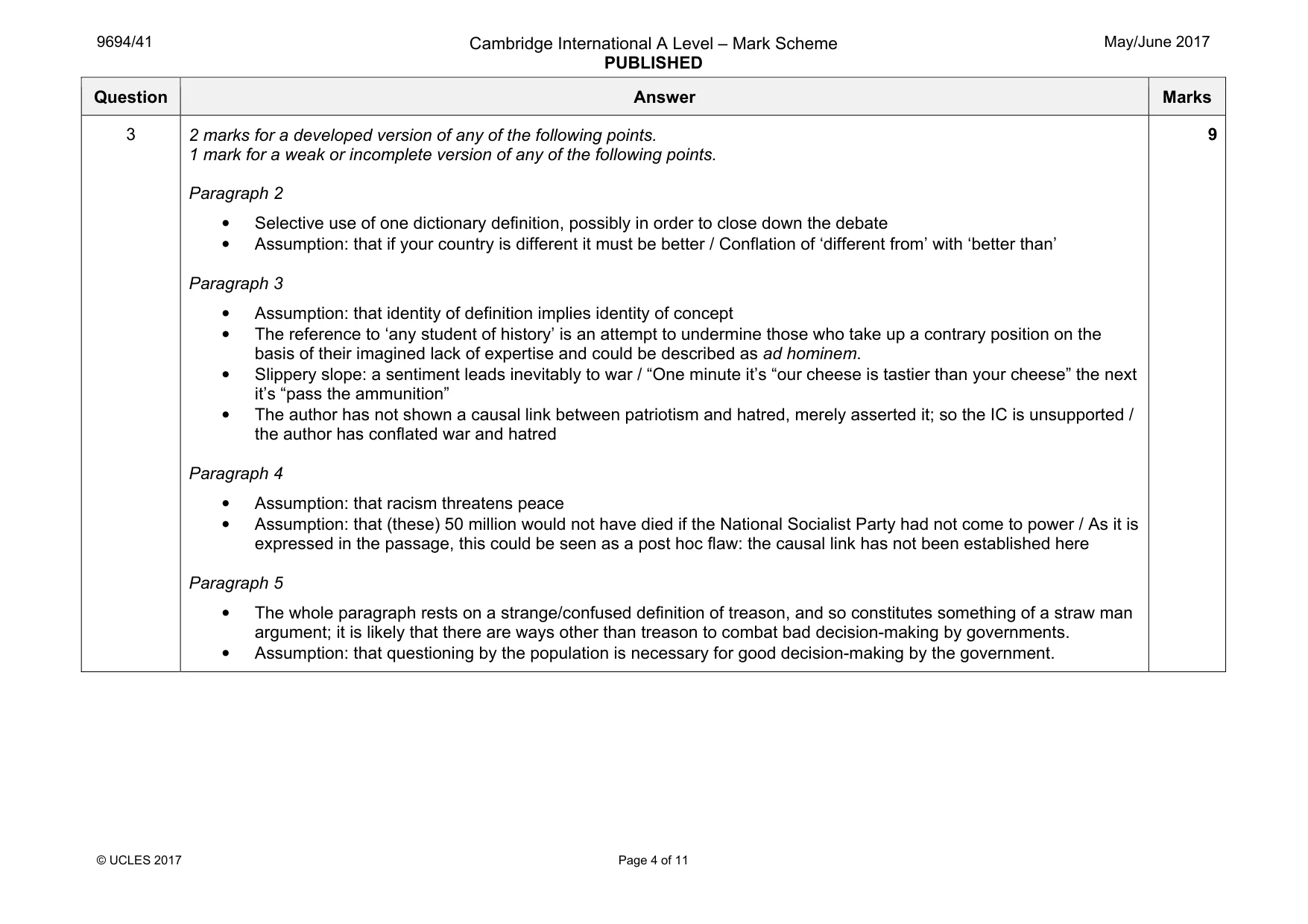
9694/41 Cambridge International A Level – Mark Scheme PUBLISHED May/June 2017 © UCLES 2017 Page 4 of 11 Question Answer Marks 3 2 marks for a developed version of any of the following points. 1 mark for a weak or incomplete version of any of the following points. Paragraph 2 • Selective use of one dictionary definition, possibly in order to close down the debate • Assumption: that if your country is different it must be better / Conflation of ‘different from’ with ‘better than’ Paragraph 3 • Assumption: that identity of definition implies identity of concept • The reference to ‘any student of history’ is an attempt to undermine those who take up a contrary position on the basis of their imagined lack of expertise and could be described as ad hominem. • Slippery slope: a sentiment leads inevitably to war / “One minute it’s “our cheese is tastier than your cheese” the next it’s “pass the ammunition” • The author has not shown a causal link between patriotism and hatred, merely asserted it; so the IC is unsupported / the author has conflated war and hatred Paragraph 4 • Assumption: that racism threatens peace • Assumption: that (these) 50 million would not have died if the National Socialist Party had not come to power / As it is expressed in the passage, this could be seen as a post hoc flaw: the causal link has not been established here Paragraph 5 • The whole paragraph rests on a strange/confused definition of treason, and so constitutes something of a straw man argument; it is likely that there are ways other than treason to combat bad decision-making by governments. • Assumption: that questioning by the population is necessary for good decision-making by the government. 9
Mark scheme, page 5
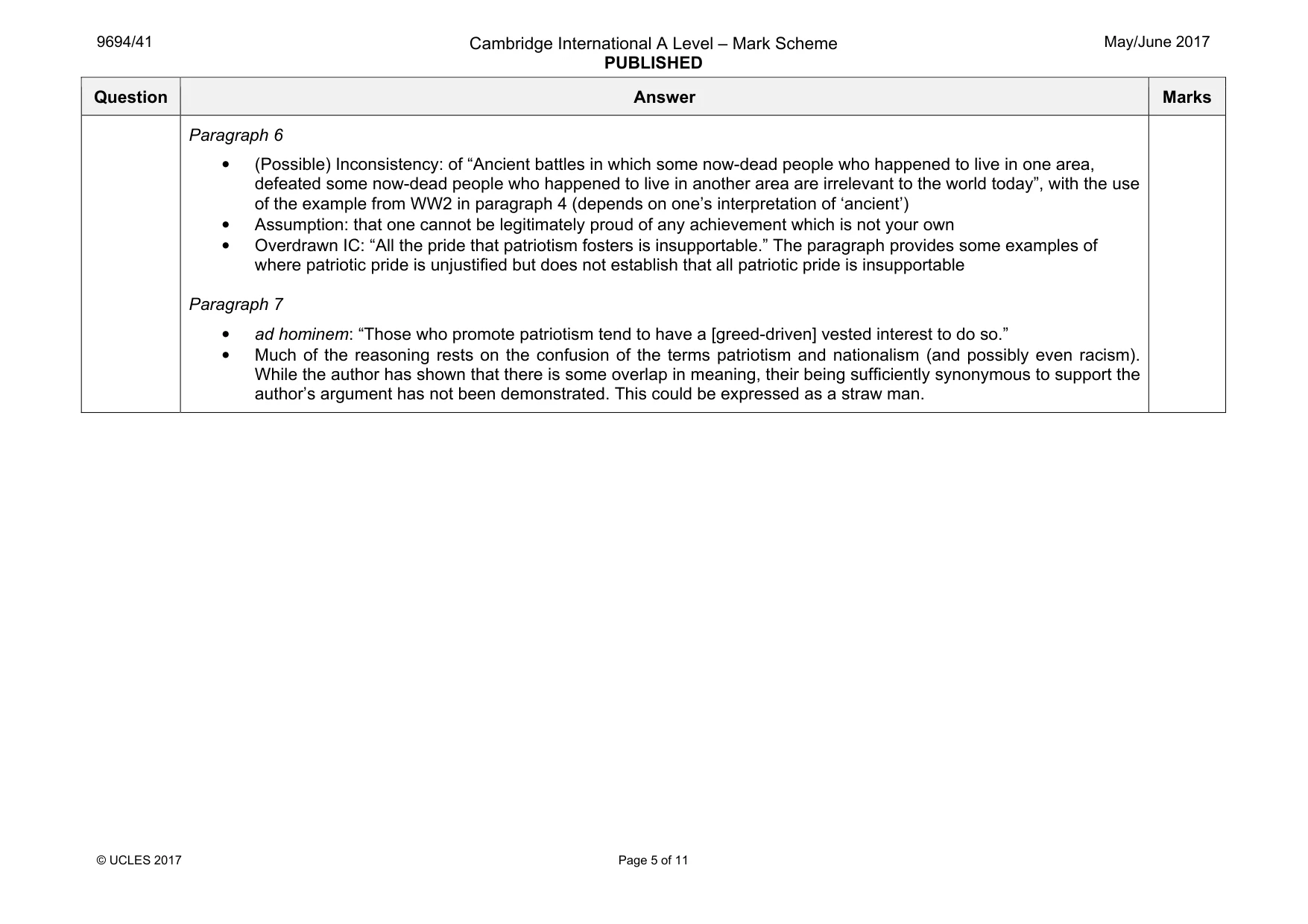
9694/41 Cambridge International A Level – Mark Scheme PUBLISHED May/June 2017 © UCLES 2017 Page 5 of 11 Question Answer Marks Paragraph 6 • (Possible) Inconsistency: of “Ancient battles in which some now-dead people who happened to live in one area, defeated some now-dead people who happened to live in another area are irrelevant to the world today”, with the use of the example from WW2 in paragraph 4 (depends on one’s interpretation of ‘ancient’) • Assumption: that one cannot be legitimately proud of any achievement which is not your own • Overdrawn IC: “All the pride that patriotism fosters is insupportable.” The paragraph provides some examples of where patriotic pride is unjustified but does not establish that all patriotic pride is insupportable Paragraph 7 • ad hominem: “Those who promote patriotism tend to have a [greed-driven] vested interest to do so.” • Much of the reasoning rests on the confusion of the terms patriotism and nationalism (and possibly even racism). While the author has shown that there is some overlap in meaning, their being sufficiently synonymous to support the author’s argument has not been demonstrated. This could be expressed as a straw man.
Mark scheme, page 6
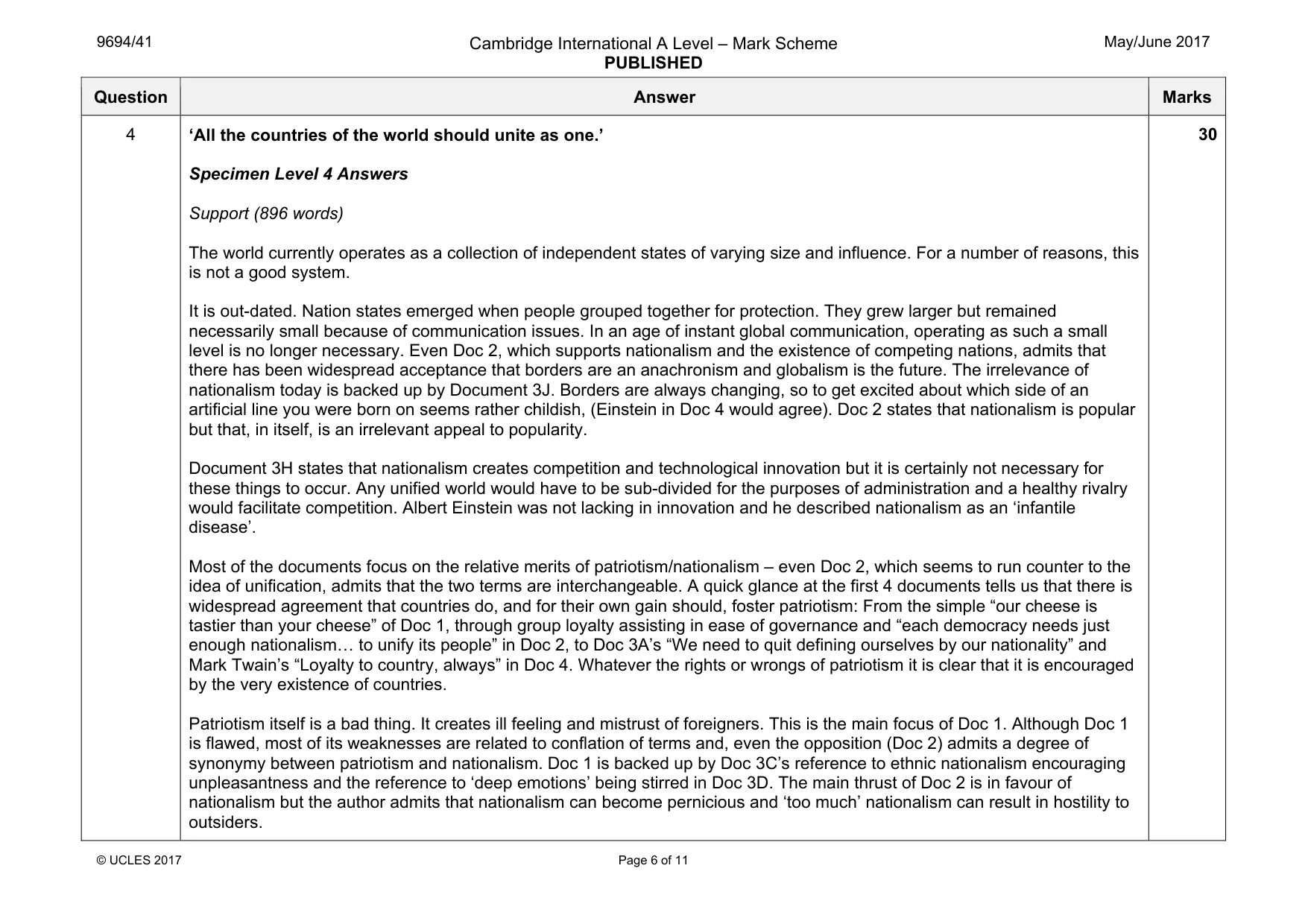
9694/41 Cambridge International A Level – Mark Scheme PUBLISHED May/June 2017 © UCLES 2017 Page 6 of 11 Question Answer Marks 4 ‘All the countries of the world should unite as one.’ Specimen Level 4 Answers Support (896 words) The world currently operates as a collection of independent states of varying size and influence. For a number of reasons, this is not a good system. It is out-dated. Nation states emerged when people grouped together for protection. They grew larger but remained necessarily small because of communication issues. In an age of instant global communication, operating as such a small level is no longer necessary. Even Doc 2, which supports nationalism and the existence of competing nations, admits that there has been widespread acceptance that borders are an anachronism and globalism is the future. The irrelevance of nationalism today is backed up by Document 3J. Borders are always changing, so to get excited about which side of an artificial line you were born on seems rather childish, (Einstein in Doc 4 would agree). Doc 2 states that nationalism is popular but that, in itself, is an irrelevant appeal to popularity. Document 3H states that nationalism creates competition and technological innovation but it is certainly not necessary for these things to occur. Any unified world would have to be sub-divided for the purposes of administration and a healthy rivalry would facilitate competition. Albert Einstein was not lacking in innovation and he described nationalism as an ‘infantile disease’. Most of the documents focus on the relative merits of patriotism/nationalism – even Doc 2, which seems to run counter to the idea of unification, admits that the two terms are interchangeable. A quick glance at the first 4 documents tells us that there is widespread agreement that countries do, and for their own gain should, foster patriotism: From the simple “our cheese is tastier than your cheese” of Doc 1, through group loyalty assisting in ease of governance and “each democracy needs just enough nationalism« to unify its people” in Doc 2, to Doc 3A’s “We need to quit defining ourselves by our nationality” and Mark Twain’s “Loyalty to country, always” in Doc 4. Whatever the rights or wrongs of patriotism it is clear that it is encouraged by the very existence of countries. Patriotism itself is a bad thing. It creates ill feeling and mistrust of foreigners. This is the main focus of Doc 1. Although Doc 1 is flawed, most of its weaknesses are related to conflation of terms and, even the opposition (Doc 2) admits a degree of synonymy between patriotism and nationalism. Doc 1 is backed up by Doc 3C’s reference to ethnic nationalism encouraging unpleasantness and the reference to ‘deep emotions’ being stirred in Doc 3D. The main thrust of Doc 2 is in favour of nationalism but the author admits that nationalism can become pernicious and ‘too much’ nationalism can result in hostility to outsiders. 30
Mark scheme, page 7
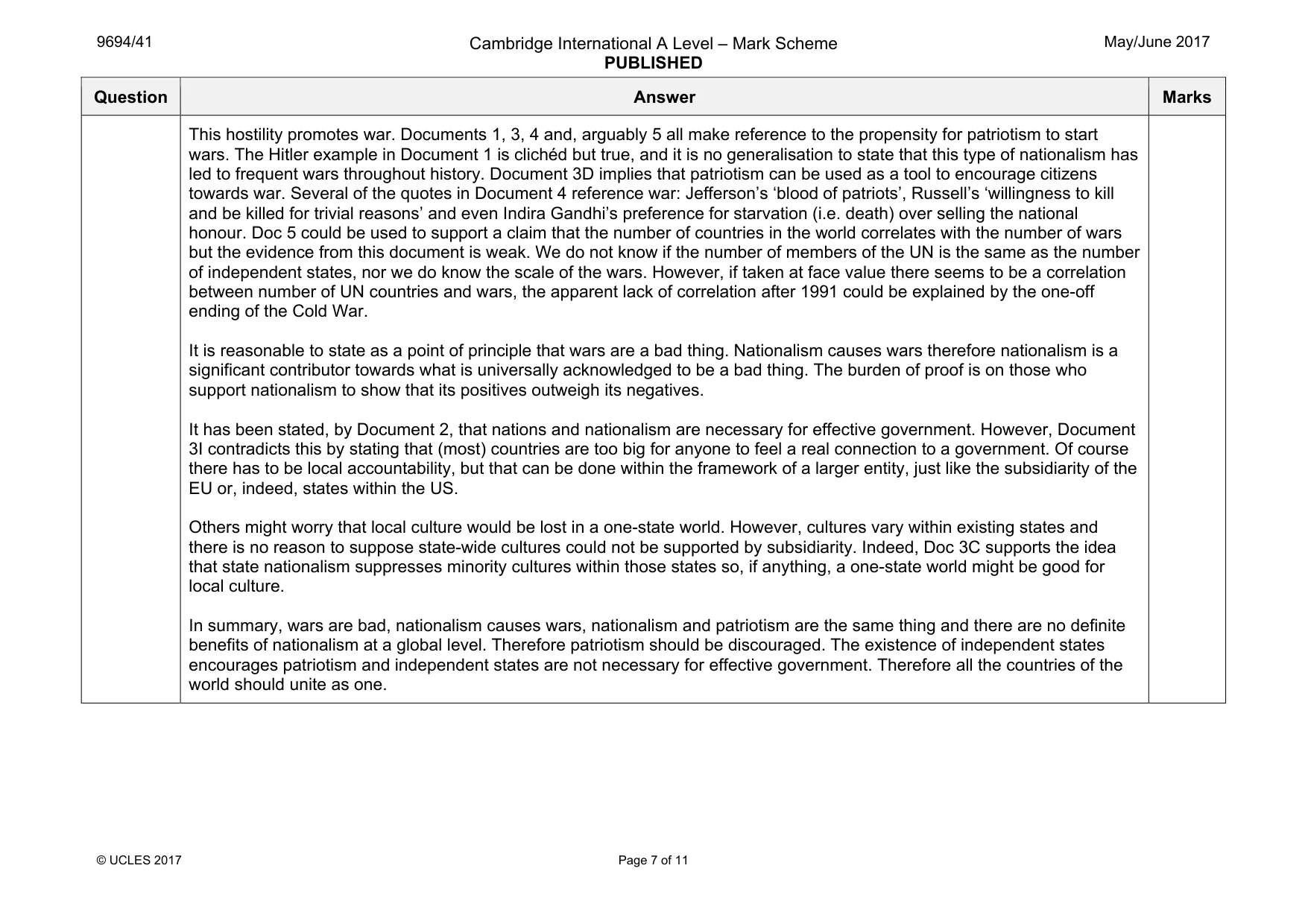
9694/41 Cambridge International A Level – Mark Scheme PUBLISHED May/June 2017 © UCLES 2017 Page 7 of 11 Question Answer Marks This hostility promotes war. Documents 1, 3, 4 and, arguably 5 all make reference to the propensity for patriotism to start wars. The Hitler example in Document 1 is clichéd but true, and it is no generalisation to state that this type of nationalism has led to frequent wars throughout history. Document 3D implies that patriotism can be used as a tool to encourage citizens towards war. Several of the quotes in Document 4 reference war: Jefferson’s ‘blood of patriots’, Russell’s ‘willingness to kill and be killed for trivial reasons’ and even Indira Gandhi’s preference for starvation (i.e. death) over selling the national honour. Doc 5 could be used to support a claim that the number of countries in the world correlates with the number of wars but the evidence from this document is weak. We do not know if the number of members of the UN is the same as the number of independent states, nor we do know the scale of the wars. However, if taken at face value there seems to be a correlation between number of UN countries and wars, the apparent lack of correlation after 1991 could be explained by the one-off ending of the Cold War. It is reasonable to state as a point of principle that wars are a bad thing. Nationalism causes wars therefore nationalism is a significant contributor towards what is universally acknowledged to be a bad thing. The burden of proof is on those who support nationalism to show that its positives outweigh its negatives. It has been stated, by Document 2, that nations and nationalism are necessary for effective government. However, Document 3I contradicts this by stating that (most) countries are too big for anyone to feel a real connection to a government. Of course there has to be local accountability, but that can be done within the framework of a larger entity, just like the subsidiarity of the EU or, indeed, states within the US. Others might worry that local culture would be lost in a one-state world. However, cultures vary within existing states and there is no reason to suppose state-wide cultures could not be supported by subsidiarity. Indeed, Doc 3C supports the idea that state nationalism suppresses minority cultures within those states so, if anything, a one-state world might be good for local culture. In summary, wars are bad, nationalism causes wars, nationalism and patriotism are the same thing and there are no definite benefits of nationalism at a global level. Therefore patriotism should be discouraged. The existence of independent states encourages patriotism and independent states are not necessary for effective government. Therefore all the countries of the world should unite as one.
Mark scheme, page 8
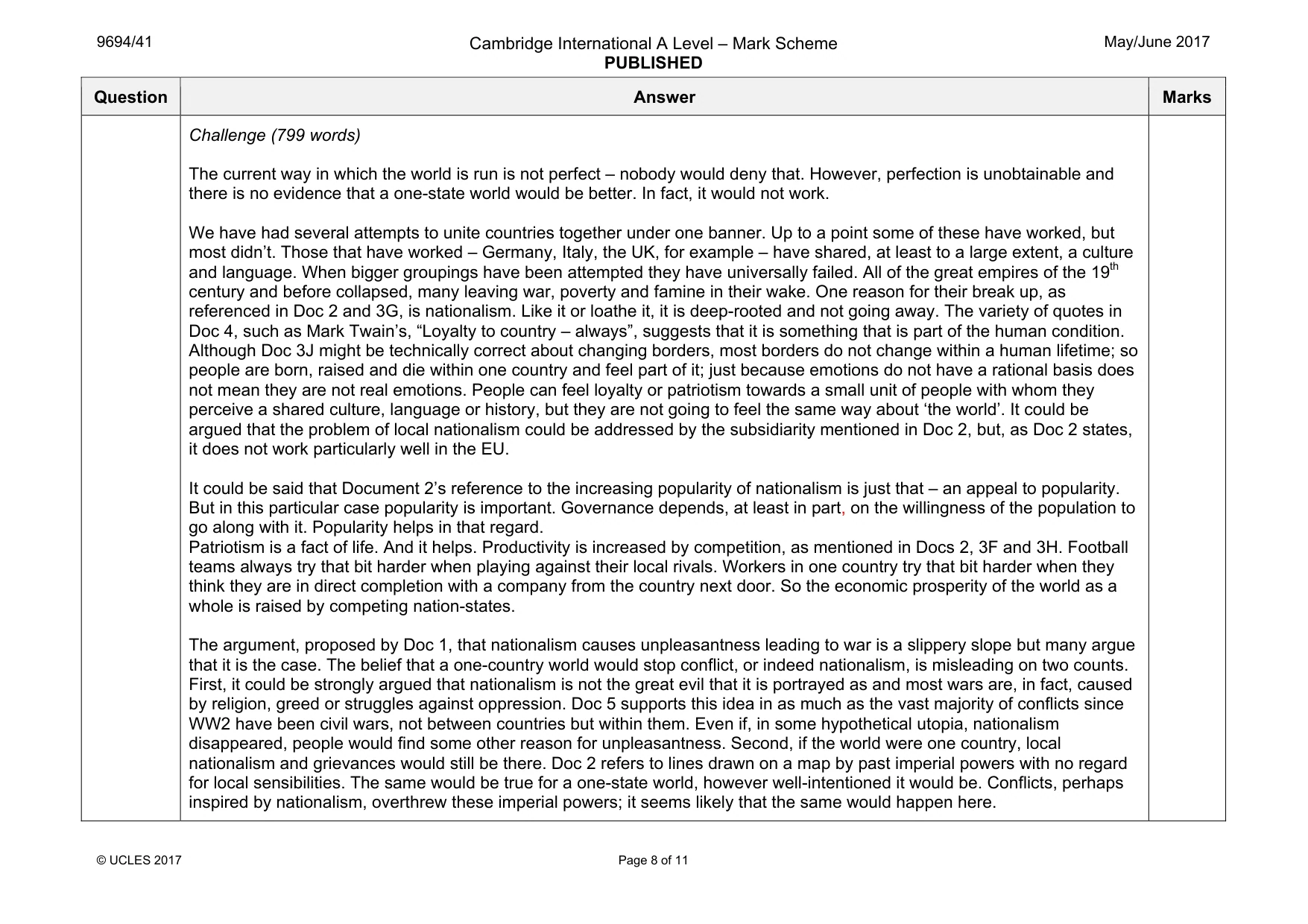
9694/41 Cambridge International A Level – Mark Scheme PUBLISHED May/June 2017 © UCLES 2017 Page 8 of 11 Question Answer Marks Challenge (799 words) The current way in which the world is run is not perfect – nobody would deny that. However, perfection is unobtainable and there is no evidence that a one-state world would be better. In fact, it would not work. We have had several attempts to unite countries together under one banner. Up to a point some of these have worked, but most didn’t. Those that have worked – Germany, Italy, the UK, for example – have shared, at least to a large extent, a culture and language. When bigger groupings have been attempted they have universally failed. All of the great empires of the 19th century and before collapsed, many leaving war, poverty and famine in their wake. One reason for their break up, as referenced in Doc 2 and 3G, is nationalism. Like it or loathe it, it is deep-rooted and not going away. The variety of quotes in Doc 4, such as Mark Twain’s, “Loyalty to country – always”, suggests that it is something that is part of the human condition. Although Doc 3J might be technically correct about changing borders, most borders do not change within a human lifetime; so people are born, raised and die within one country and feel part of it; just because emotions do not have a rational basis does not mean they are not real emotions. People can feel loyalty or patriotism towards a small unit of people with whom they perceive a shared culture, language or history, but they are not going to feel the same way about ‘the world’. It could be argued that the problem of local nationalism could be addressed by the subsidiarity mentioned in Doc 2, but, as Doc 2 states, it does not work particularly well in the EU. It could be said that Document 2’s reference to the increasing popularity of nationalism is just that – an appeal to popularity. But in this particular case popularity is important. Governance depends, at least in part, on the willingness of the population to go along with it. Popularity helps in that regard. Patriotism is a fact of life. And it helps. Productivity is increased by competition, as mentioned in Docs 2, 3F and 3H. Football teams always try that bit harder when playing against their local rivals. Workers in one country try that bit harder when they think they are in direct completion with a company from the country next door. So the economic prosperity of the world as a whole is raised by competing nation-states. The argument, proposed by Doc 1, that nationalism causes unpleasantness leading to war is a slippery slope but many argue that it is the case. The belief that a one-country world would stop conflict, or indeed nationalism, is misleading on two counts. First, it could be strongly argued that nationalism is not the great evil that it is portrayed as and most wars are, in fact, caused by religion, greed or struggles against oppression. Doc 5 supports this idea in as much as the vast majority of conflicts since WW2 have been civil wars, not between countries but within them. Even if, in some hypothetical utopia, nationalism disappeared, people would find some other reason for unpleasantness. Second, if the world were one country, local nationalism and grievances would still be there. Doc 2 refers to lines drawn on a map by past imperial powers with no regard for local sensibilities. The same would be true for a one-state world, however well-intentioned it would be. Conflicts, perhaps inspired by nationalism, overthrew these imperial powers; it seems likely that the same would happen here.
Mark scheme, page 9
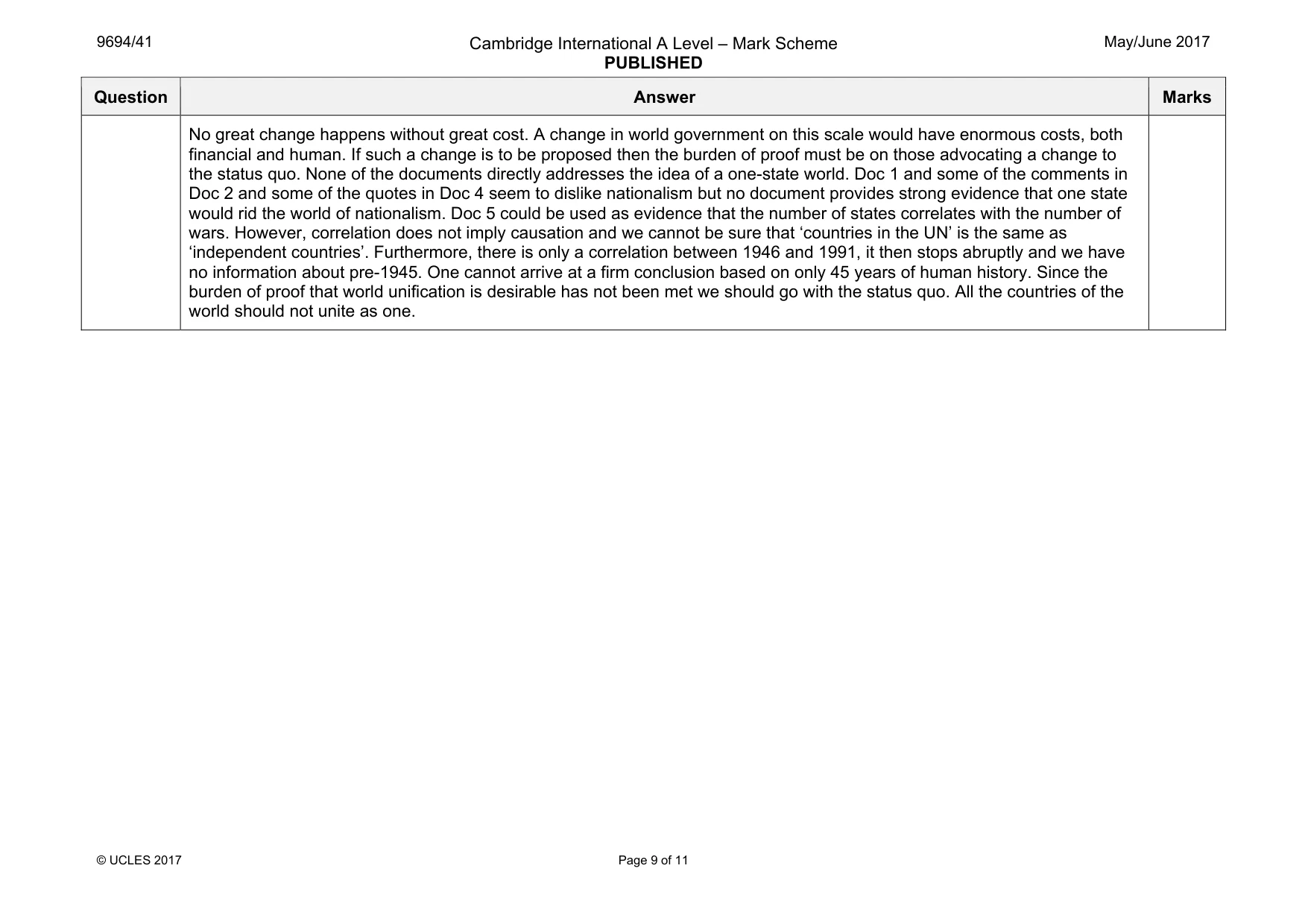
9694/41 Cambridge International A Level – Mark Scheme PUBLISHED May/June 2017 © UCLES 2017 Page 9 of 11 Question Answer Marks No great change happens without great cost. A change in world government on this scale would have enormous costs, both financial and human. If such a change is to be proposed then the burden of proof must be on those advocating a change to the status quo. None of the documents directly addresses the idea of a one-state world. Doc 1 and some of the comments in Doc 2 and some of the quotes in Doc 4 seem to dislike nationalism but no document provides strong evidence that one state would rid the world of nationalism. Doc 5 could be used as evidence that the number of states correlates with the number of wars. However, correlation does not imply causation and we cannot be sure that ‘countries in the UN’ is the same as ‘independent countries’. Furthermore, there is only a correlation between 1946 and 1991, it then stops abruptly and we have no information about pre-1945. One cannot arrive at a firm conclusion based on only 45 years of human history. Since the burden of proof that world unification is desirable has not been met we should go with the status quo. All the countries of the world should not unite as one.
Mark scheme, page 10
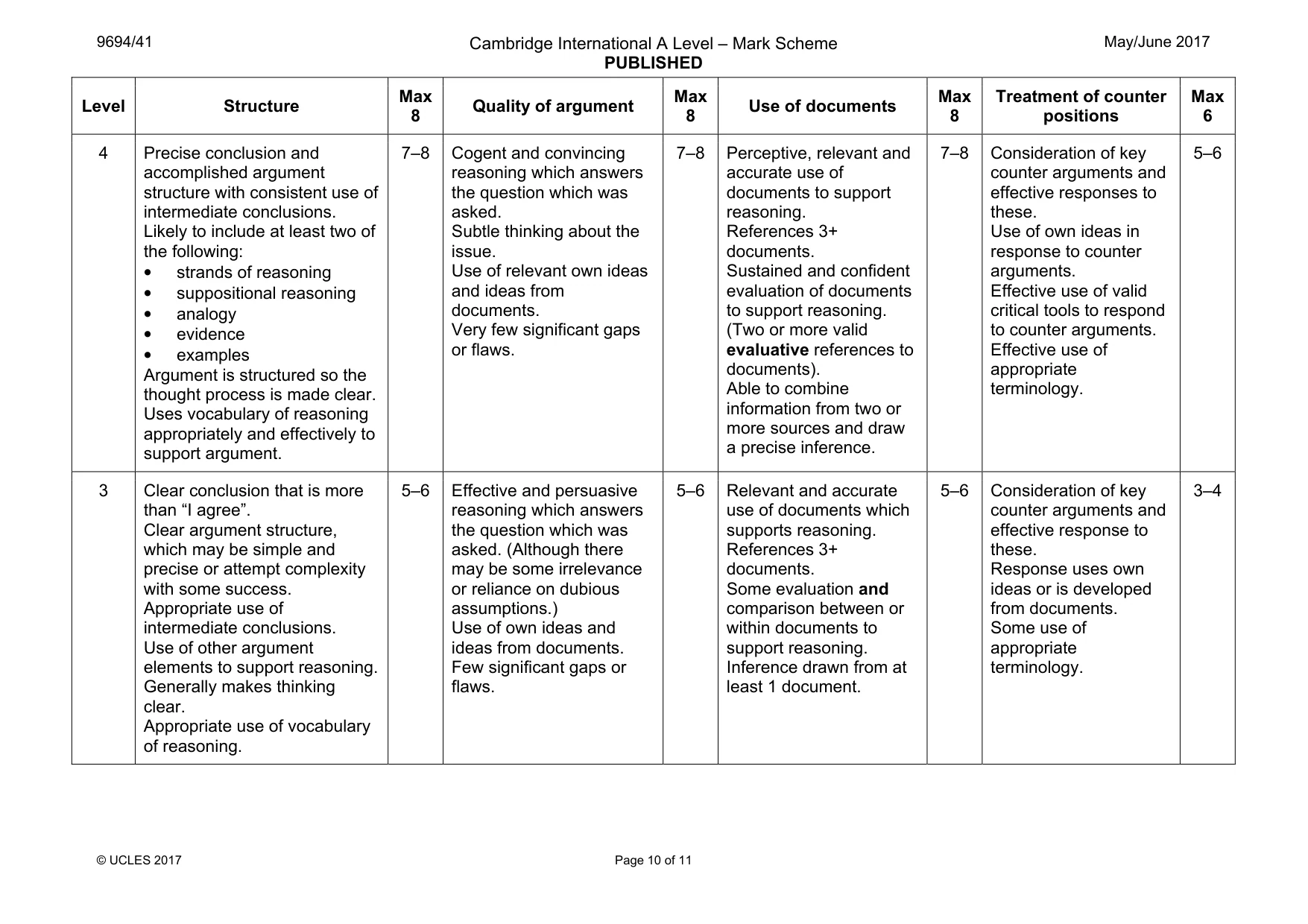
9694/41 Cambridge International A Level – Mark Scheme PUBLISHED May/June 2017 © UCLES 2017 Page 10 of 11 Level Structure Max 8 Quality of argument Max 8 Use of documents Max 8 Treatment of counter positions Max 6 4 Precise conclusion and accomplished argument structure with consistent use of intermediate conclusions. Likely to include at least two of the following: • strands of reasoning • suppositional reasoning • analogy • evidence • examples Argument is structured so the thought process is made clear. Uses vocabulary of reasoning appropriately and effectively to support argument. 7–8 Cogent and convincing reasoning which answers the question which was asked. Subtle thinking about the issue. Use of relevant own ideas and ideas from documents. Very few significant gaps or flaws. 7–8 Perceptive, relevant and accurate use of documents to support reasoning. References 3+ documents. Sustained and confident evaluation of documents to support reasoning. (Two or more valid evaluative references to documents). Able to combine information from two or more sources and draw a precise inference. 7–8 Consideration of key counter arguments and effective responses to these. Use of own ideas in response to counter arguments. Effective use of valid critical tools to respond to counter arguments. Effective use of appropriate terminology. 5–6 3 Clear conclusion that is more than “I agree”. Clear argument structure, which may be simple and precise or attempt complexity with some success. Appropriate use of intermediate conclusions. Use of other argument elements to support reasoning. Generally makes thinking clear. Appropriate use of vocabulary of reasoning. 5–6 Effective and persuasive reasoning which answers the question which was asked. (Although there may be some irrelevance or reliance on dubious assumptions.) Use of own ideas and ideas from documents. Few significant gaps or flaws. 5–6 Relevant and accurate use of documents which supports reasoning. References 3+ documents. Some evaluation and comparison between or within documents to support reasoning. Inference drawn from at least 1 document. 5–6 Consideration of key counter arguments and effective response to these. Response uses own ideas or is developed from documents. Some use of appropriate terminology. 3–4
Mark scheme, page 11
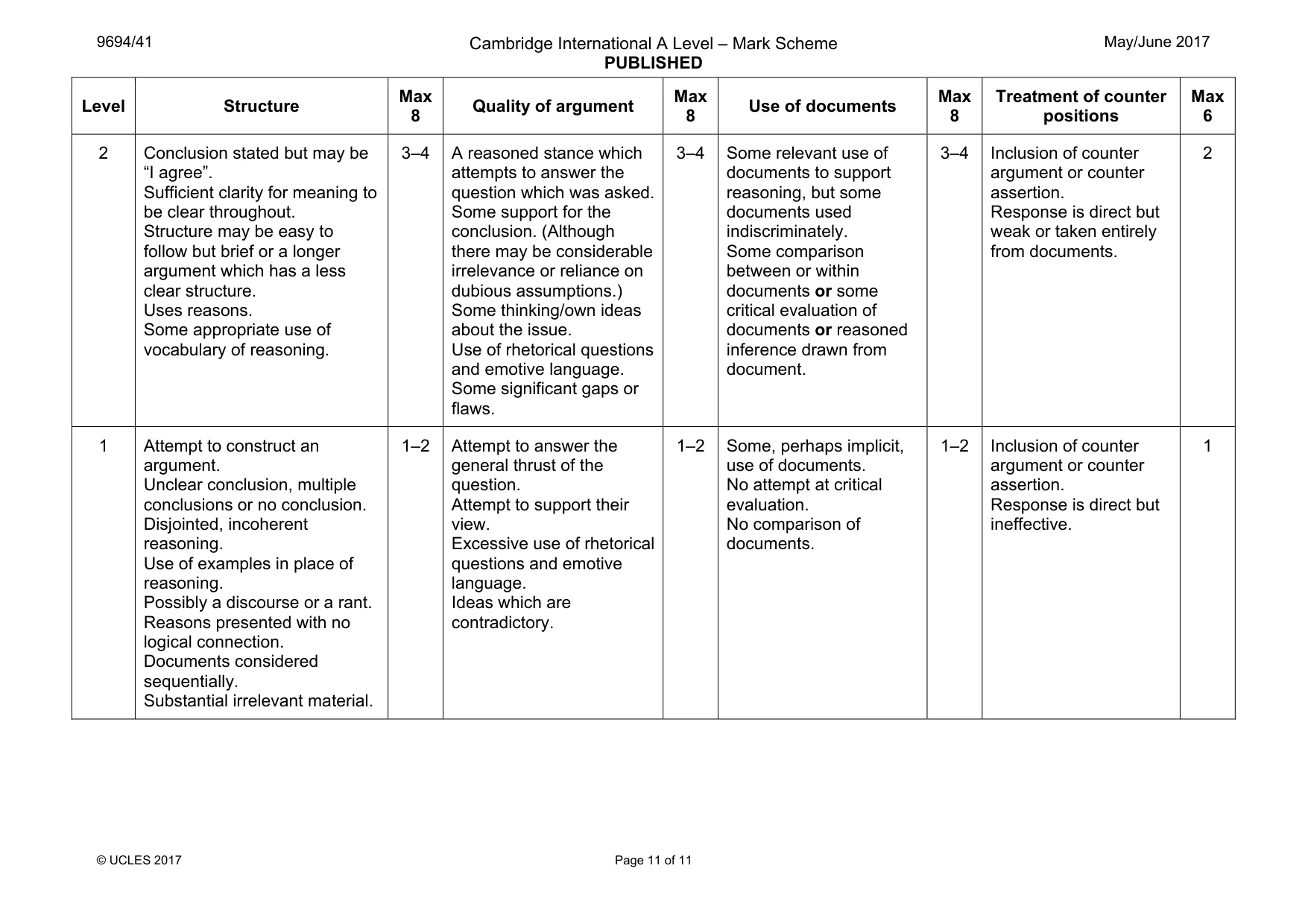
9694/41 Cambridge International A Level – Mark Scheme PUBLISHED May/June 2017 © UCLES 2017 Page 11 of 11 Level Structure Max 8 Quality of argument Max 8 Use of documents Max 8 Treatment of counter positions Max 6 2 Conclusion stated but may be “I agree”. Sufficient clarity for meaning to be clear throughout. Structure may be easy to follow but brief or a longer argument which has a less clear structure. Uses reasons. Some appropriate use of vocabulary of reasoning. 3–4 A reasoned stance which attempts to answer the question which was asked. Some support for the conclusion. (Although there may be considerable irrelevance or reliance on dubious assumptions.) Some thinking/own ideas about the issue. Use of rhetorical questions and emotive language. Some significant gaps or flaws. 3–4 Some relevant use of documents to support reasoning, but some documents used indiscriminately. Some comparison between or within documents or some critical evaluation of documents or reasoned inference drawn from document. 3–4 Inclusion of counter argument or counter assertion. Response is direct but weak or taken entirely from documents. 2 1 Attempt to construct an argument. Unclear conclusion, multiple conclusions or no conclusion. Disjointed, incoherent reasoning. Use of examples in place of reasoning. Possibly a discourse or a rant. Reasons presented with no logical connection. Documents considered sequentially. Substantial irrelevant material. 1–2 Attempt to answer the general thrust of the question. Attempt to support their view. Excessive use of rhetorical questions and emotive language. Ideas which are contradictory. 1–2 Some, perhaps implicit, use of documents. No attempt at critical evaluation. No comparison of documents. 1–2 Inclusion of counter argument or counter assertion. Response is direct but ineffective. 1
What you needed in this session
Cambridge’s own grade thresholds for 2017 May/June, Paper 4 · Variant 1. A higher threshold means an easier paper — the bar moves with how the cohort did.