Cambridge A Level Thinking Skills 9694 — 2017 May/June Paper 4 · Variant 2
9694/42/M/J/17 · 50 marks · ≈56 min
The question paper and its mark scheme, free to read here and free to download. This is Cambridge’s own paper, exactly as it was sat.
Question paper8 pages
Mark scheme10 pages
Answers below. Sit the paper first if you are practising.
Paper as text
Question paper, page 1
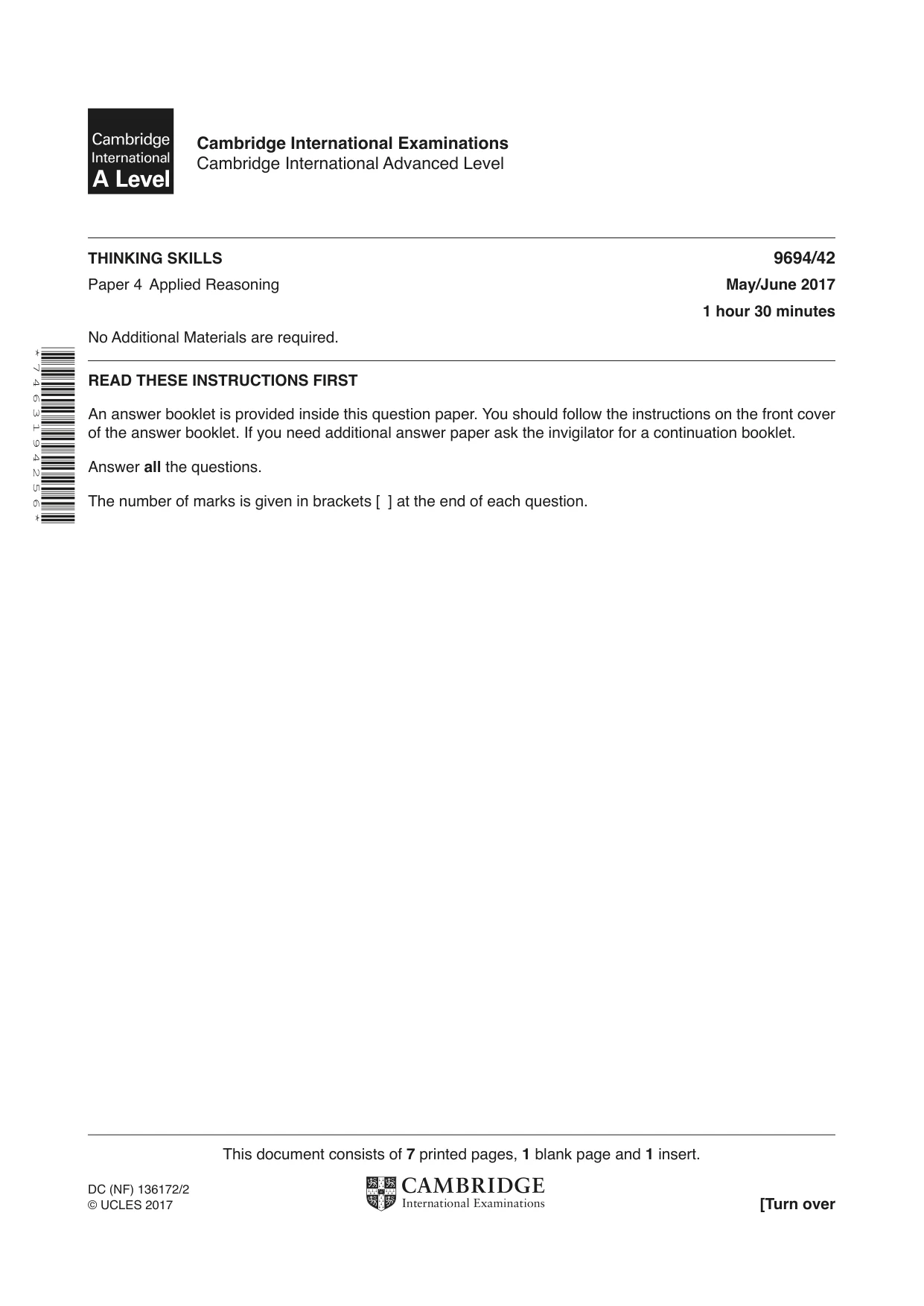
* 7 4 6 3 1 9 4 2 5 6 * This document consists of 7 printed pages, 1 blank page and 1 insert. DC (NF) 136172/2 © UCLES 2017 [Turn over Cambridge International Examinations Cambridge International Advanced Level THINKING SKILLS 9694/42 Paper 4 Applied Reasoning May/June 2017 1 hour 30 minutes No Additional Materials are required. READ THESE INSTRUCTIONS FIRST An answer booklet is provided inside this question paper. You should follow the instructions on the front cover of the answer booklet. If you need additional answer paper ask the invigilator for a continuation booklet. Answer all the questions. The number of marks is given in brackets [ ] at the end of each question.
Question paper, page 2
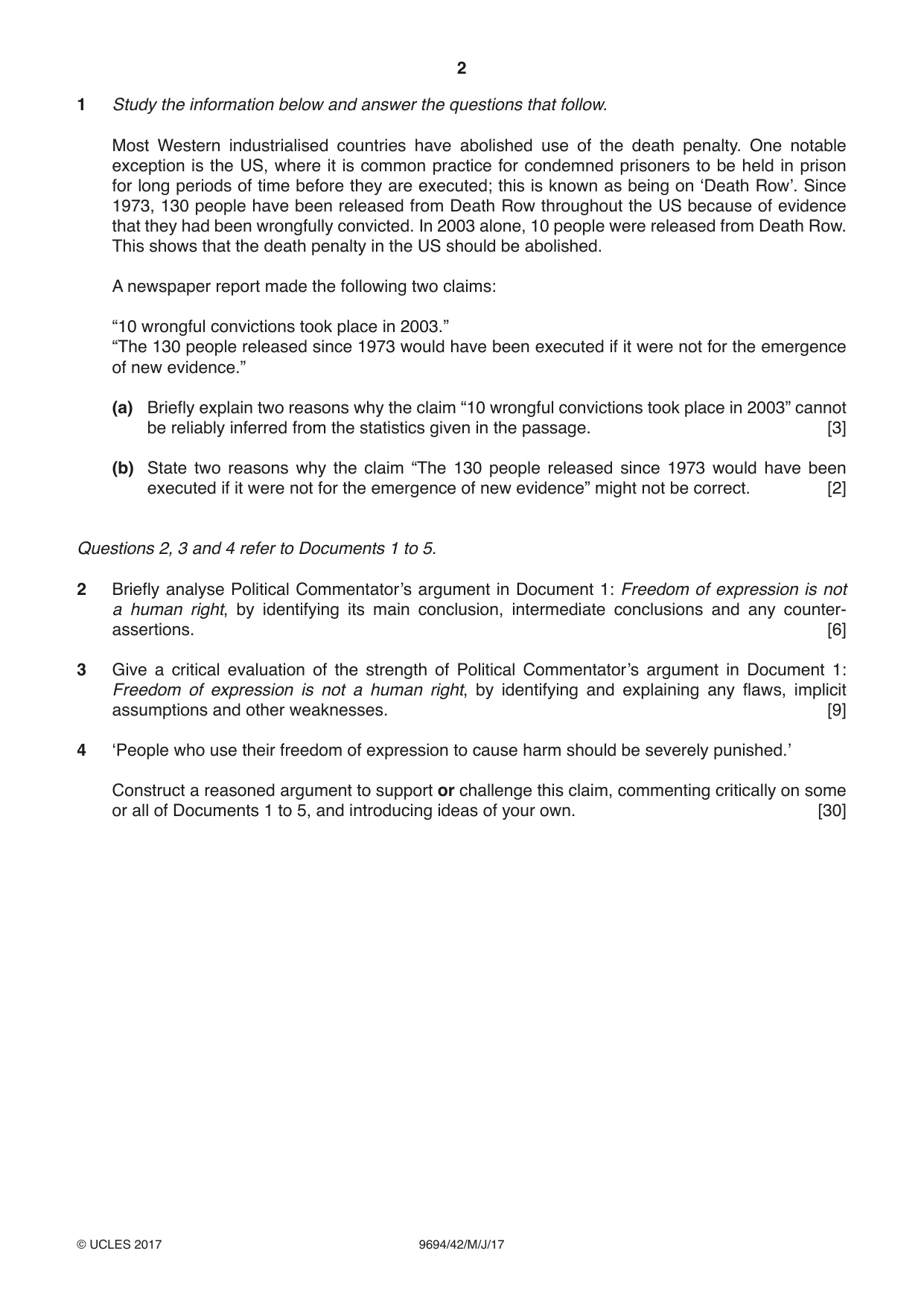
2 9694/42/M/J/17 © UCLES 2017 1 Study the information below and answer the questions that follow. Most Western industrialised countries have abolished use of the death penalty. One notable exception is the US, where it is common practice for condemned prisoners to be held in prison for long periods of time before they are executed; this is known as being on ‘Death Row’. Since 1973, 130 people have been released from Death Row throughout the US because of evidence that they had been wrongfully convicted. In 2003 alone, 10 people were released from Death Row. This shows that the death penalty in the US should be abolished. A newspaper report made the following two claims: “10 wrongful convictions took place in 2003.” “The 130 people released since 1973 would have been executed if it were not for the emergence of new evidence.” (a) Briefly explain two reasons why the claim “10 wrongful convictions took place in 2003” cannot be reliably inferred from the statistics given in the passage. [3] (b) State two reasons why the claim “The 130 people released since 1973 would have been executed if it were not for the emergence of new evidence” might not be correct. [2] Questions 2, 3 and 4 refer to Documents 1 to 5. 2 Briefly analyse Political Commentator’s argument in Document 1: Freedom of expression is not a human right, by identifying its main conclusion, intermediate conclusions and any counter- assertions. [6] 3 Give a critical evaluation of the strength of Political Commentator’s argument in Document 1: Freedom of expression is not a human right, by identifying and explaining any flaws, implicit assumptions and other weaknesses. [9] 4 ‘People who use their freedom of expression to cause harm should be severely punished.’ Construct a reasoned argument to support or challenge this claim, commenting critically on some or all of Documents 1 to 5, and introducing ideas of your own. [30]
Question paper, page 3
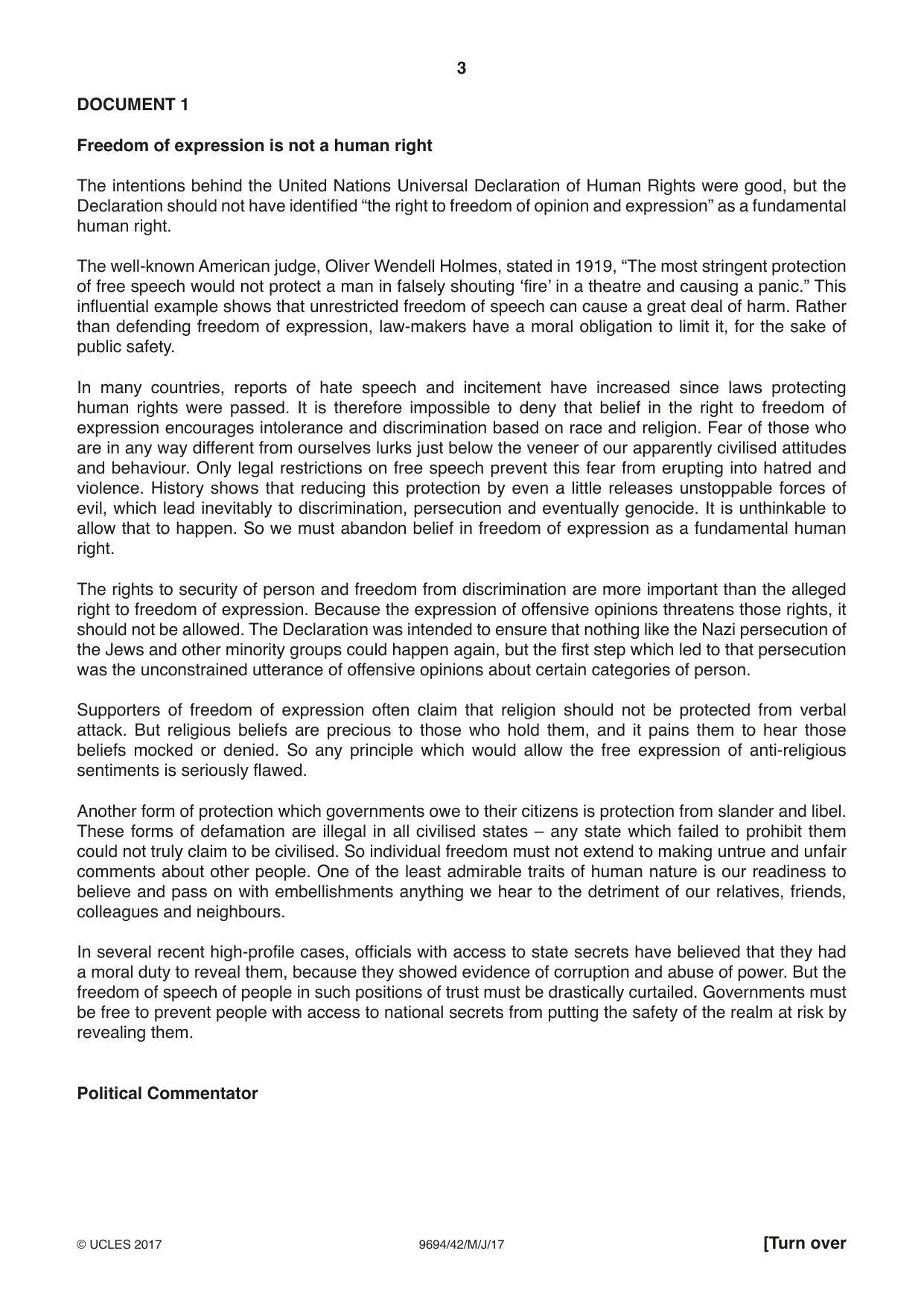
3 9694/42/M/J/17 © UCLES 2017 [Turn over DOCUMENT 1 Freedom of expression is not a human right The intentions behind the United Nations Universal Declaration of Human Rights were good, but the Declaration should not have identified “the right to freedom of opinion and expression” as a fundamental human right. The well-known American judge, Oliver Wendell Holmes, stated in 1919, “The most stringent protection of free speech would not protect a man in falsely shouting ‘fire’ in a theatre and causing a panic.” This influential example shows that unrestricted freedom of speech can cause a great deal of harm. Rather than defending freedom of expression, law-makers have a moral obligation to limit it, for the sake of public safety. In many countries, reports of hate speech and incitement have increased since laws protecting human rights were passed. It is therefore impossible to deny that belief in the right to freedom of expression encourages intolerance and discrimination based on race and religion. Fear of those who are in any way different from ourselves lurks just below the veneer of our apparently civilised attitudes and behaviour. Only legal restrictions on free speech prevent this fear from erupting into hatred and violence. History shows that reducing this protection by even a little releases unstoppable forces of evil, which lead inevitably to discrimination, persecution and eventually genocide. It is unthinkable to allow that to happen. So we must abandon belief in freedom of expression as a fundamental human right. The rights to security of person and freedom from discrimination are more important than the alleged right to freedom of expression. Because the expression of offensive opinions threatens those rights, it should not be allowed. The Declaration was intended to ensure that nothing like the Nazi persecution of the Jews and other minority groups could happen again, but the first step which led to that persecution was the unconstrained utterance of offensive opinions about certain categories of person. Supporters of freedom of expression often claim that religion should not be protected from verbal attack. But religious beliefs are precious to those who hold them, and it pains them to hear those beliefs mocked or denied. So any principle which would allow the free expression of anti-religious sentiments is seriously flawed. Another form of protection which governments owe to their citizens is protection from slander and libel. These forms of defamation are illegal in all civilised states – any state which failed to prohibit them could not truly claim to be civilised. So individual freedom must not extend to making untrue and unfair comments about other people. One of the least admirable traits of human nature is our readiness to believe and pass on with embellishments anything we hear to the detriment of our relatives, friends, colleagues and neighbours. In several recent high-profile cases, officials with access to state secrets have believed that they had a moral duty to reveal them, because they showed evidence of corruption and abuse of power. But the freedom of speech of people in such positions of trust must be drastically curtailed. Governments must be free to prevent people with access to national secrets from putting the safety of the realm at risk by revealing them. Political Commentator
Question paper, page 4
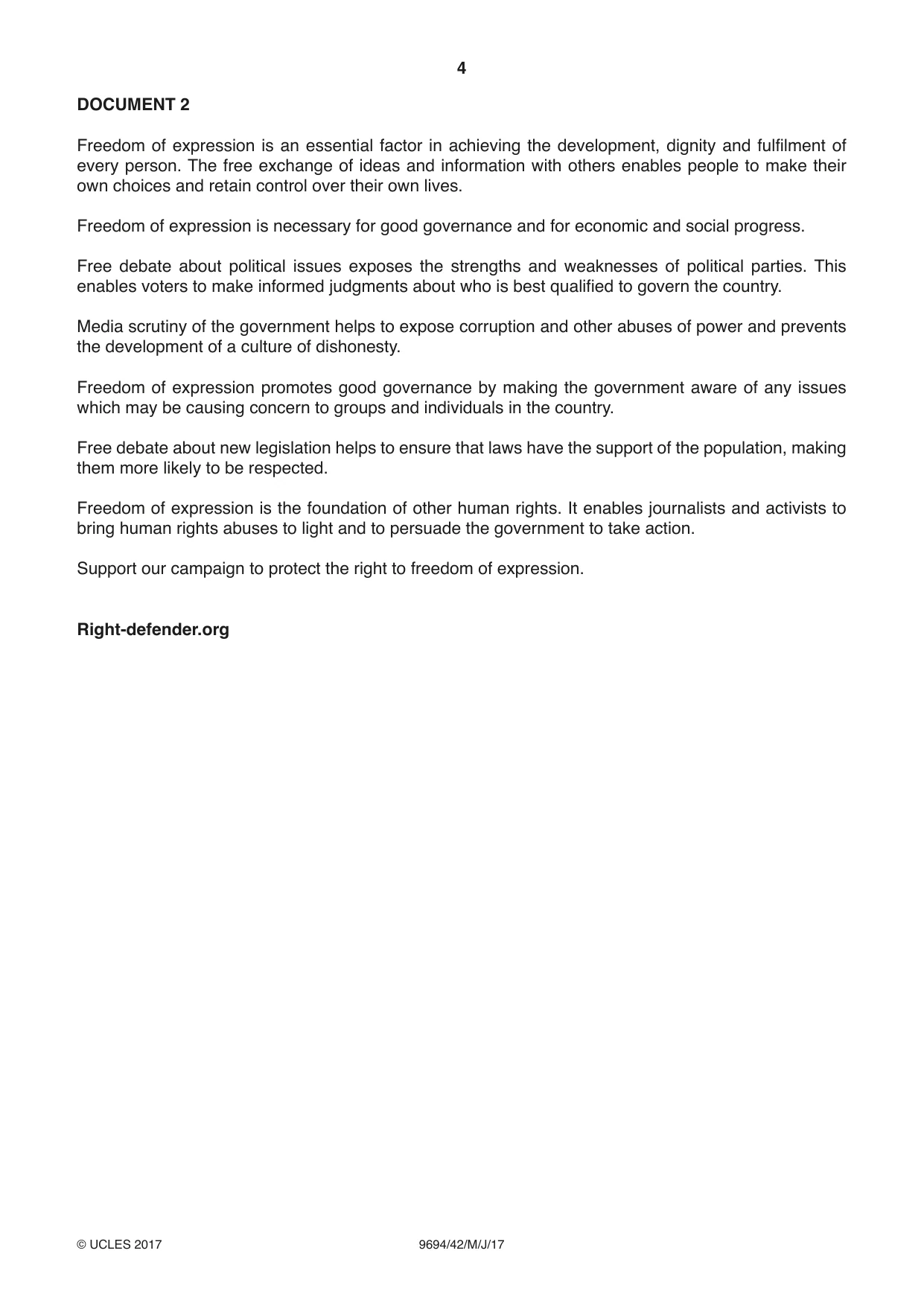
4 9694/42/M/J/17 © UCLES 2017 DOCUMENT 2 Freedom of expression is an essential factor in achieving the development, dignity and fulfilment of every person. The free exchange of ideas and information with others enables people to make their own choices and retain control over their own lives. Freedom of expression is necessary for good governance and for economic and social progress. Free debate about political issues exposes the strengths and weaknesses of political parties. This enables voters to make informed judgments about who is best qualified to govern the country. Media scrutiny of the government helps to expose corruption and other abuses of power and prevents the development of a culture of dishonesty. Freedom of expression promotes good governance by making the government aware of any issues which may be causing concern to groups and individuals in the country. Free debate about new legislation helps to ensure that laws have the support of the population, making them more likely to be respected. Freedom of expression is the foundation of other human rights. It enables journalists and activists to bring human rights abuses to light and to persuade the government to take action. Support our campaign to protect the right to freedom of expression. Right-defender.org
Question paper, page 5
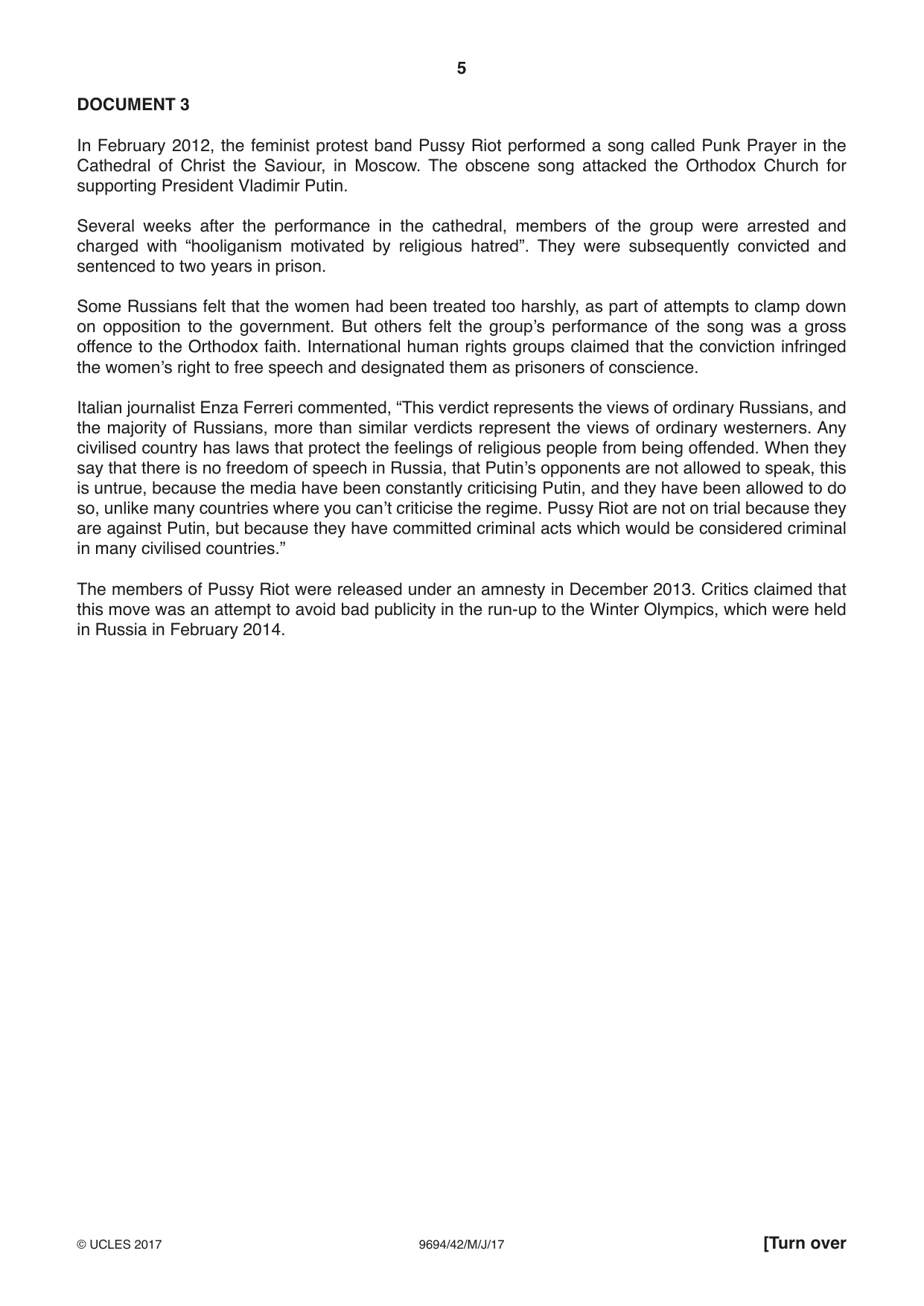
5 9694/42/M/J/17 © UCLES 2017 [Turn over DOCUMENT 3 In February 2012, the feminist protest band Pussy Riot performed a song called Punk Prayer in the Cathedral of Christ the Saviour, in Moscow. The obscene song attacked the Orthodox Church for supporting President Vladimir Putin. Several weeks after the performance in the cathedral, members of the group were arrested and charged with “hooliganism motivated by religious hatred”. They were subsequently convicted and sentenced to two years in prison. Some Russians felt that the women had been treated too harshly, as part of attempts to clamp down on opposition to the government. But others felt the group’s performance of the song was a gross offence to the Orthodox faith. International human rights groups claimed that the conviction infringed the women’s right to free speech and designated them as prisoners of conscience. Italian journalist Enza Ferreri commented, “This verdict represents the views of ordinary Russians, and the majority of Russians, more than similar verdicts represent the views of ordinary westerners. Any civilised country has laws that protect the feelings of religious people from being offended. When they say that there is no freedom of speech in Russia, that Putin’s opponents are not allowed to speak, this is untrue, because the media have been constantly criticising Putin, and they have been allowed to do so, unlike many countries where you can’t criticise the regime. Pussy Riot are not on trial because they are against Putin, but because they have committed criminal acts which would be considered criminal in many civilised countries.” The members of Pussy Riot were released under an amnesty in December 2013. Critics claimed that this move was an attempt to avoid bad publicity in the run-up to the Winter Olympics, which were held in Russia in February 2014.
Question paper, page 6
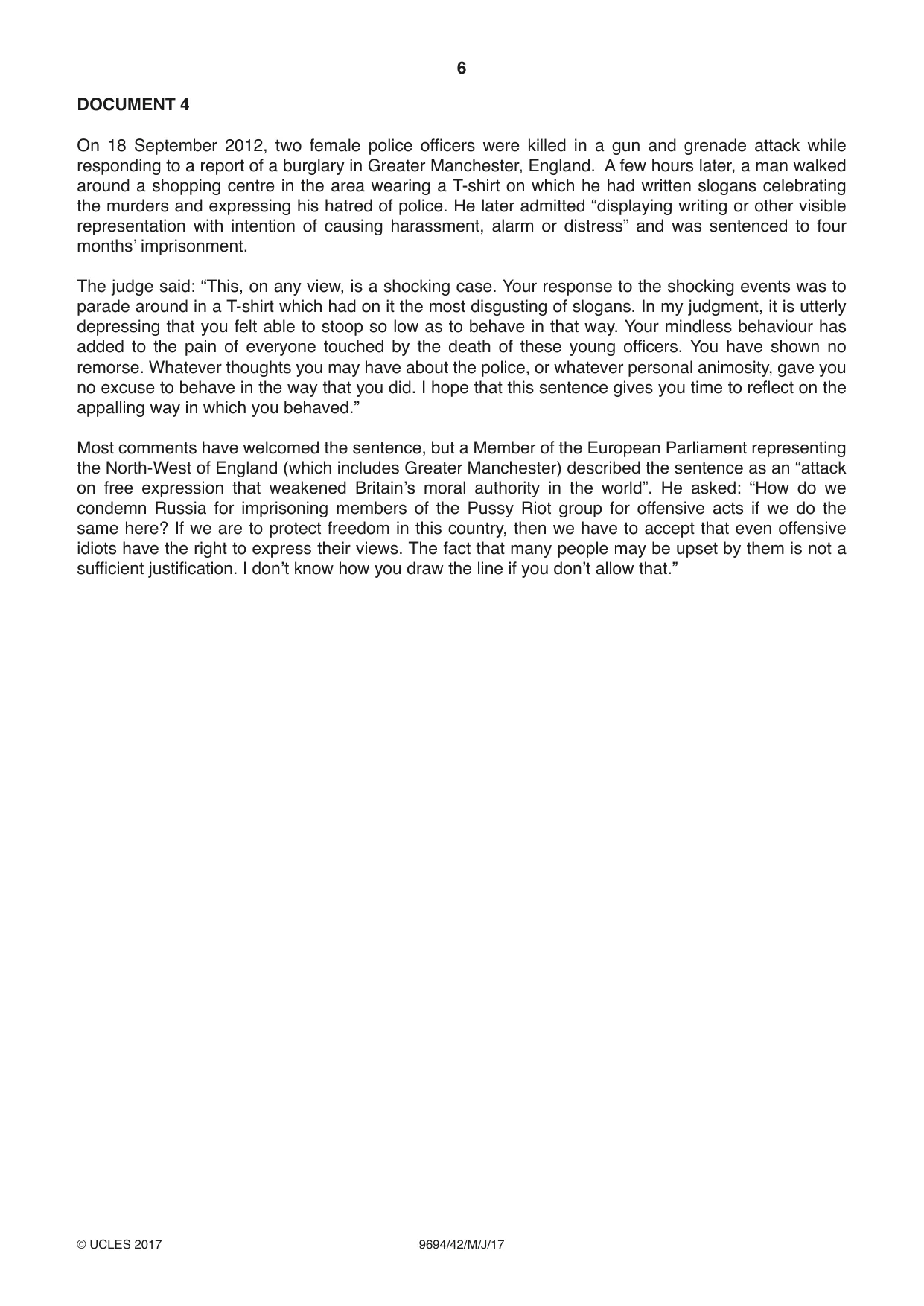
6 9694/42/M/J/17 © UCLES 2017 DOCUMENT 4 On 18 September 2012, two female police officers were killed in a gun and grenade attack while responding to a report of a burglary in Greater Manchester, England. A few hours later, a man walked around a shopping centre in the area wearing a T-shirt on which he had written slogans celebrating the murders and expressing his hatred of police. He later admitted “displaying writing or other visible representation with intention of causing harassment, alarm or distress” and was sentenced to four months’ imprisonment. The judge said: “This, on any view, is a shocking case. Your response to the shocking events was to parade around in a T-shirt which had on it the most disgusting of slogans. In my judgment, it is utterly depressing that you felt able to stoop so low as to behave in that way. Your mindless behaviour has added to the pain of everyone touched by the death of these young officers. You have shown no remorse. Whatever thoughts you may have about the police, or whatever personal animosity, gave you no excuse to behave in the way that you did. I hope that this sentence gives you time to reflect on the appalling way in which you behaved.” Most comments have welcomed the sentence, but a Member of the European Parliament representing the North-West of England (which includes Greater Manchester) described the sentence as an “attack on free expression that weakened Britain’s moral authority in the world”. He asked: “How do we condemn Russia for imprisoning members of the Pussy Riot group for offensive acts if we do the same here? If we are to protect freedom in this country, then we have to accept that even offensive idiots have the right to express their views. The fact that many people may be upset by them is not a sufficient justification. I don’t know how you draw the line if you don’t allow that.”
Question paper, page 7
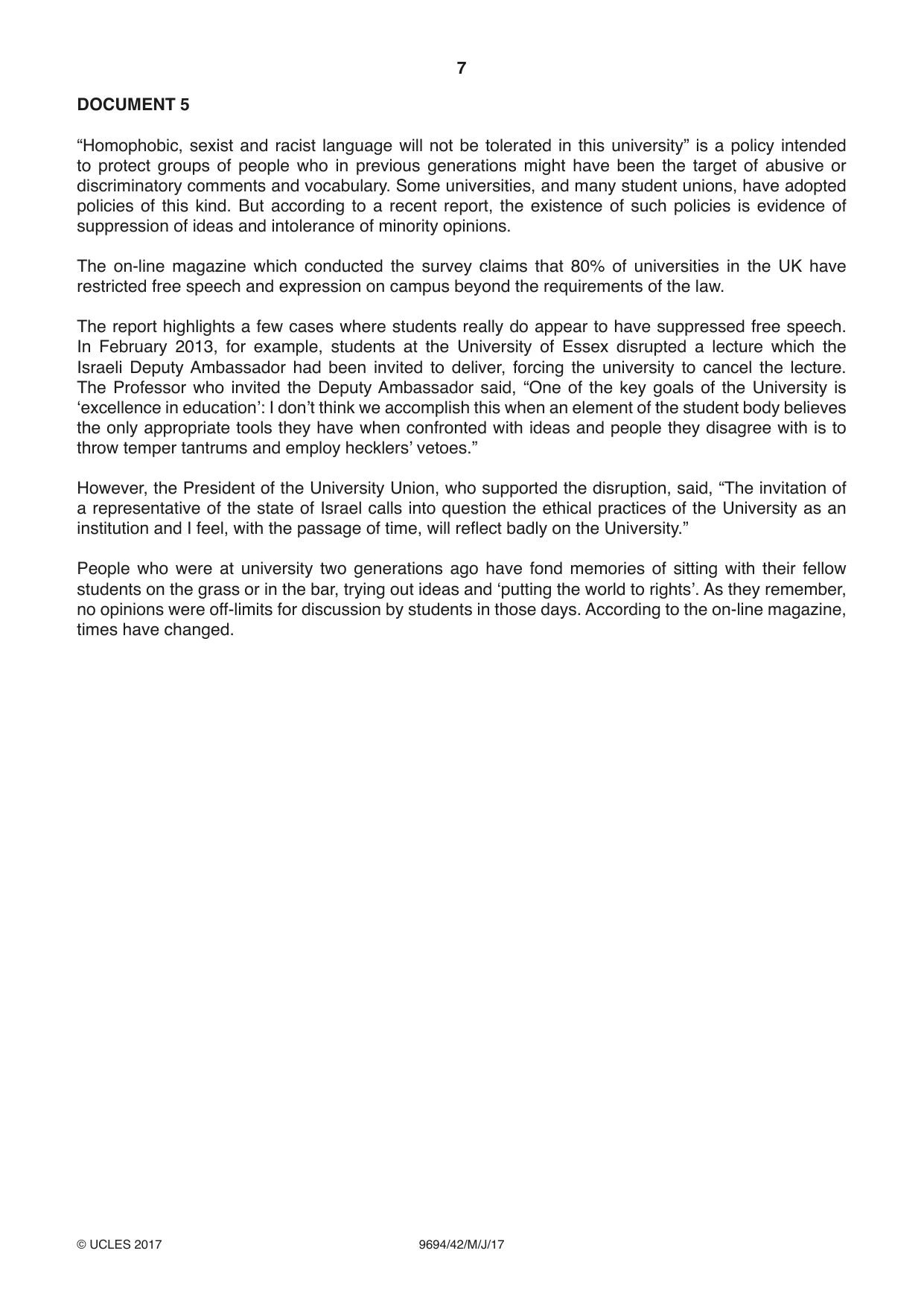
7 9694/42/M/J/17 © UCLES 2017 DOCUMENT 5 “Homophobic, sexist and racist language will not be tolerated in this university” is a policy intended to protect groups of people who in previous generations might have been the target of abusive or discriminatory comments and vocabulary. Some universities, and many student unions, have adopted policies of this kind. But according to a recent report, the existence of such policies is evidence of suppression of ideas and intolerance of minority opinions. The on-line magazine which conducted the survey claims that 80% of universities in the UK have restricted free speech and expression on campus beyond the requirements of the law. The report highlights a few cases where students really do appear to have suppressed free speech. In February 2013, for example, students at the University of Essex disrupted a lecture which the Israeli Deputy Ambassador had been invited to deliver, forcing the university to cancel the lecture. The Professor who invited the Deputy Ambassador said, “One of the key goals of the University is ‘excellence in education’: I don’t think we accomplish this when an element of the student body believes the only appropriate tools they have when confronted with ideas and people they disagree with is to throw temper tantrums and employ hecklers’ vetoes.” However, the President of the University Union, who supported the disruption, said, “The invitation of a representative of the state of Israel calls into question the ethical practices of the University as an institution and I feel, with the passage of time, will reflect badly on the University.” People who were at university two generations ago have fond memories of sitting with their fellow students on the grass or in the bar, trying out ideas and ‘putting the world to rights’. As they remember, no opinions were off-limits for discussion by students in those days. According to the on-line magazine, times have changed.
Question paper, page 8
8 9694/42/M/J/17 © UCLES 2017 BLANK PAGE Permission to reproduce items where third-party owned material protected by copyright is included has been sought and cleared where possible. Every reasonable effort has been made by the publisher (UCLES) to trace copyright holders, but if any items requiring clearance have unwittingly been included, the publisher will be pleased to make amends at the earliest possible opportunity. To avoid the issue of disclosure of answer-related information to candidates, all copyright acknowledgements are reproduced online in the Cambridge International Examinations Copyright Acknowledgements Booklet. This is produced for each series of examinations and is freely available to download at www.cie.org.uk after the live examination series. Cambridge International Examinations is part of the Cambridge Assessment Group. Cambridge Assessment is the brand name of University of Cambridge Local Examinations Syndicate (UCLES), which is itself a department of the University of Cambridge.
Mark scheme, page 1
® IGCSE is a registered trademark. This document consists of 10 printed pages. © UCLES 2017 [Turn over Cambridge International Examinations Cambridge International Advanced Level THINKING SKILLS 9694/42 Paper 4 Applied Reasoning May/June 2017 MARK SCHEME Maximum Mark: 50 Published This mark scheme is published as an aid to teachers and candidates, to indicate the requirements of the examination. It shows the basis on which Examiners were instructed to award marks. It does not indicate the details of the discussions that took place at an Examiners’ meeting before marking began, which would have considered the acceptability of alternative answers. Mark schemes should be read in conjunction with the question paper and the Principal Examiner Report for Teachers. Cambridge will not enter into discussions about these mark schemes. Cambridge is publishing the mark schemes for the May/June 2017 series for most Cambridge IGCSE®, Cambridge International A and AS Level and Cambridge Pre-U components, and some Cambridge O Level components.
Mark scheme, page 2
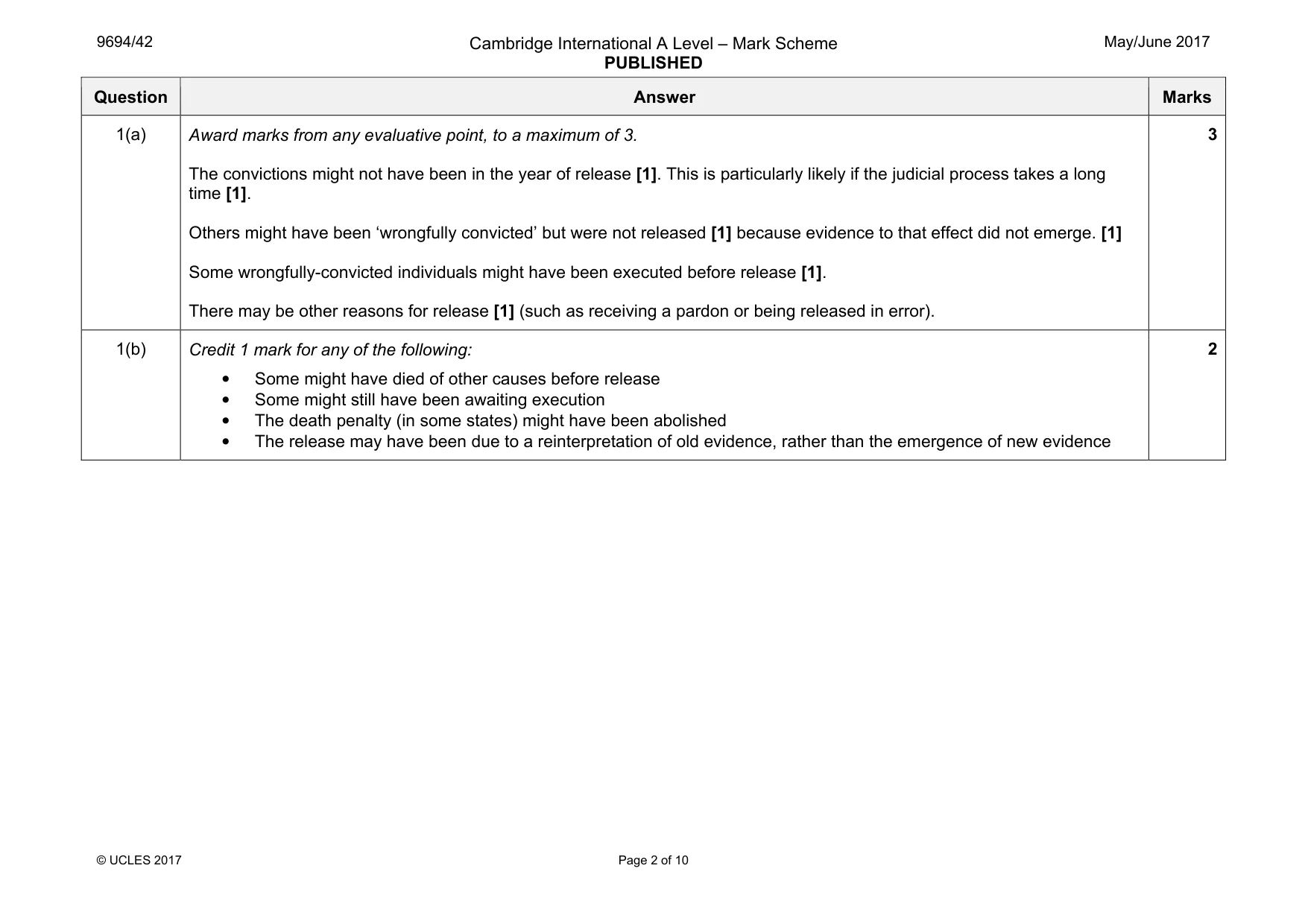
9694/42 Cambridge International A Level – Mark Scheme PUBLISHED May/June 2017 © UCLES 2017 Page 2 of 10 Question Answer Marks 1(a) Award marks from any evaluative point, to a maximum of 3. The convictions might not have been in the year of release [1]. This is particularly likely if the judicial process takes a long time [1]. Others might have been ‘wrongfully convicted’ but were not released [1] because evidence to that effect did not emerge. [1] Some wrongfully-convicted individuals might have been executed before release [1]. There may be other reasons for release [1] (such as receiving a pardon or being released in error). 3 1(b) Credit 1 mark for any of the following: • Some might have died of other causes before release • Some might still have been awaiting execution • The death penalty (in some states) might have been abolished • The release may have been due to a reinterpretation of old evidence, rather than the emergence of new evidence 2
Mark scheme, page 3
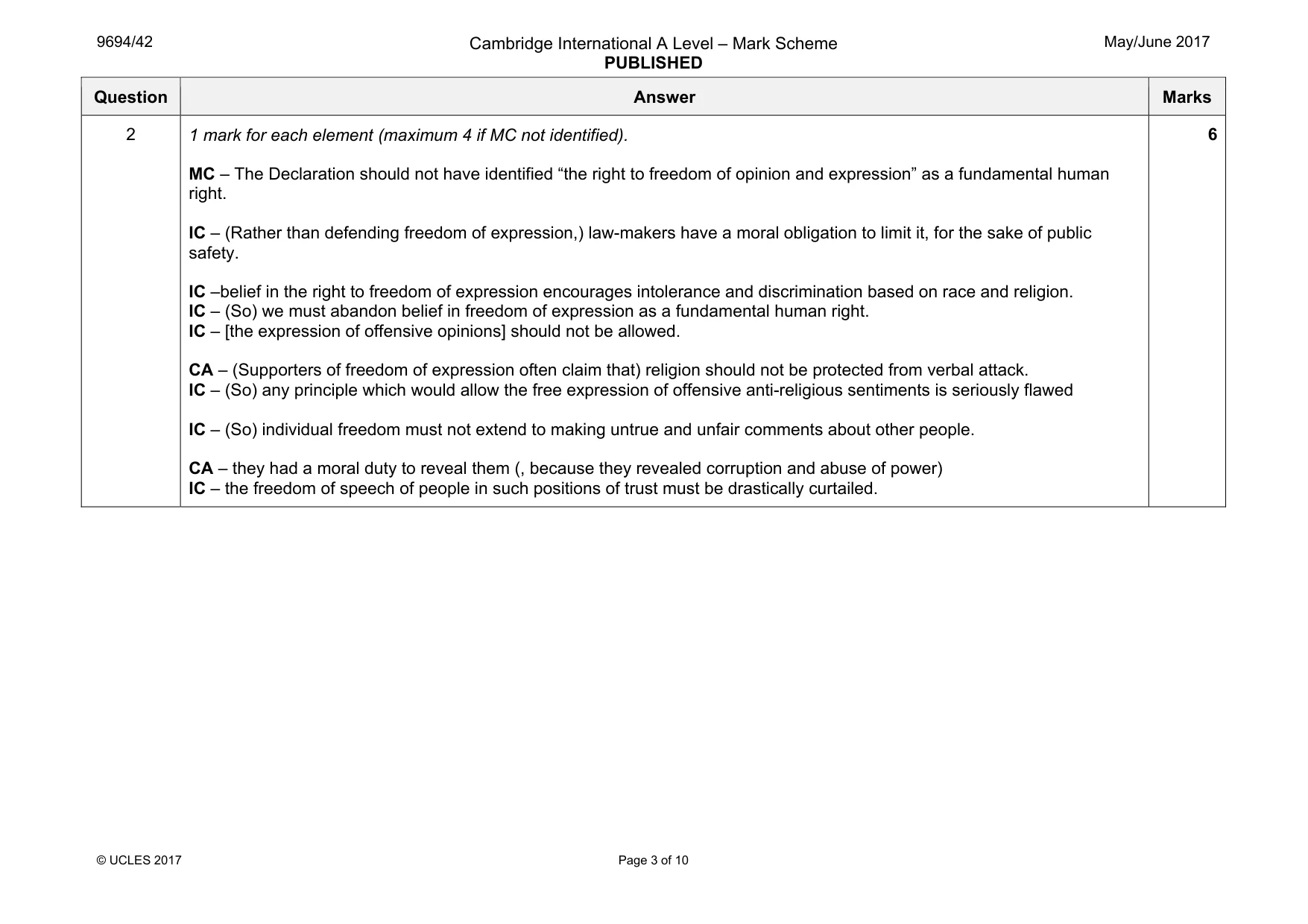
9694/42 Cambridge International A Level – Mark Scheme PUBLISHED May/June 2017 © UCLES 2017 Page 3 of 10 Question Answer Marks 2 1 mark for each element (maximum 4 if MC not identified). MC – The Declaration should not have identified “the right to freedom of opinion and expression” as a fundamental human right. IC – (Rather than defending freedom of expression,) law-makers have a moral obligation to limit it, for the sake of public safety. IC –belief in the right to freedom of expression encourages intolerance and discrimination based on race and religion. IC – (So) we must abandon belief in freedom of expression as a fundamental human right. IC – [the expression of offensive opinions] should not be allowed. CA – (Supporters of freedom of expression often claim that) religion should not be protected from verbal attack. IC – (So) any principle which would allow the free expression of offensive anti-religious sentiments is seriously flawed IC – (So) individual freedom must not extend to making untrue and unfair comments about other people. CA – they had a moral duty to reveal them (, because they revealed corruption and abuse of power) IC – the freedom of speech of people in such positions of trust must be drastically curtailed. 6
Mark scheme, page 4
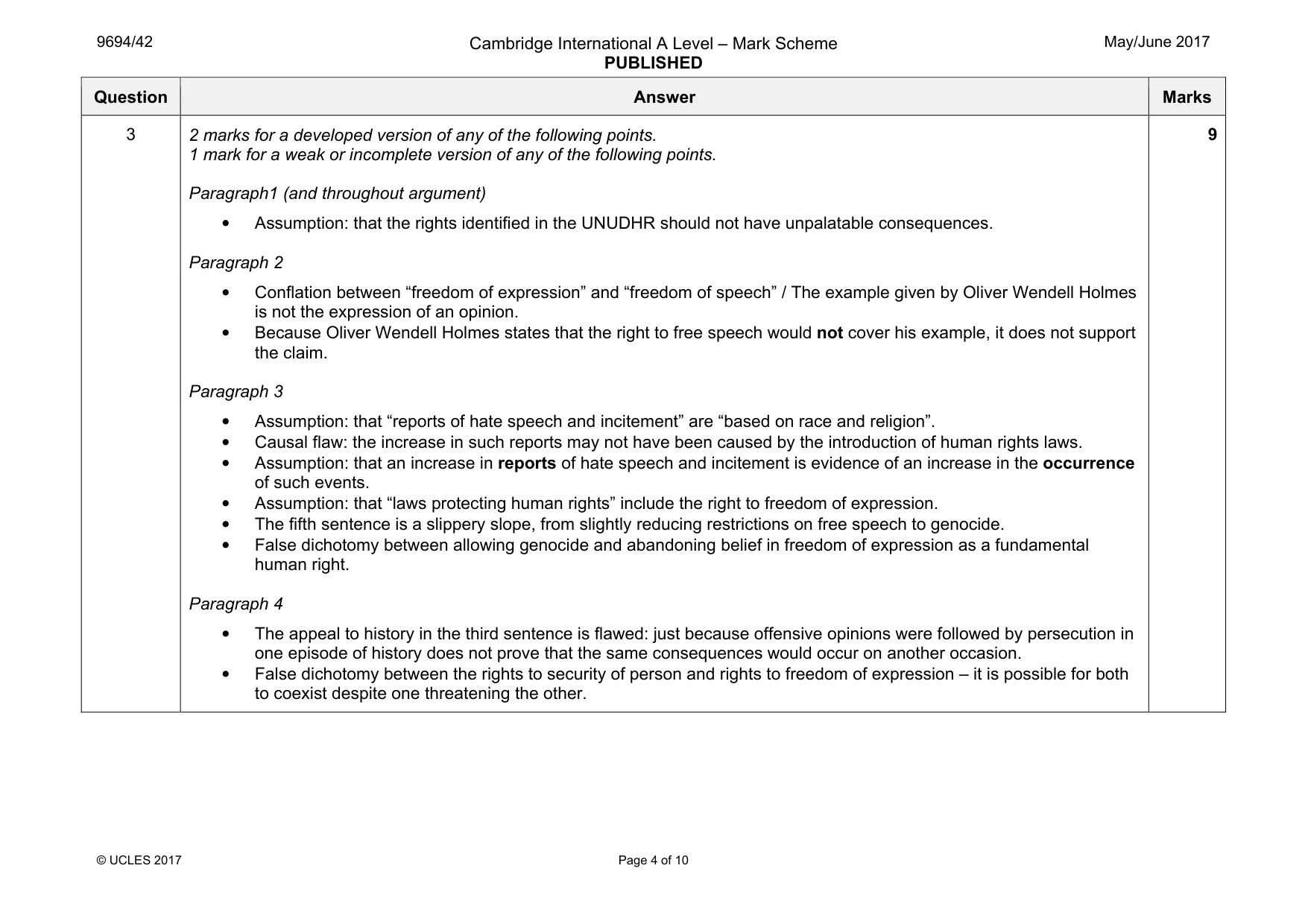
9694/42 Cambridge International A Level – Mark Scheme PUBLISHED May/June 2017 © UCLES 2017 Page 4 of 10 Question Answer Marks 3 2 marks for a developed version of any of the following points. 1 mark for a weak or incomplete version of any of the following points. Paragraph1 (and throughout argument) • Assumption: that the rights identified in the UNUDHR should not have unpalatable consequences. Paragraph 2 • Conflation between “freedom of expression” and “freedom of speech” / The example given by Oliver Wendell Holmes is not the expression of an opinion. • Because Oliver Wendell Holmes states that the right to free speech would not cover his example, it does not support the claim. Paragraph 3 • Assumption: that “reports of hate speech and incitement” are “based on race and religion”. • Causal flaw: the increase in such reports may not have been caused by the introduction of human rights laws. • Assumption: that an increase in reports of hate speech and incitement is evidence of an increase in the occurrence of such events. • Assumption: that “laws protecting human rights” include the right to freedom of expression. • The fifth sentence is a slippery slope, from slightly reducing restrictions on free speech to genocide. • False dichotomy between allowing genocide and abandoning belief in freedom of expression as a fundamental human right. Paragraph 4 • The appeal to history in the third sentence is flawed: just because offensive opinions were followed by persecution in one episode of history does not prove that the same consequences would occur on another occasion. • False dichotomy between the rights to security of person and rights to freedom of expression – it is possible for both to coexist despite one threatening the other. 9
Mark scheme, page 5
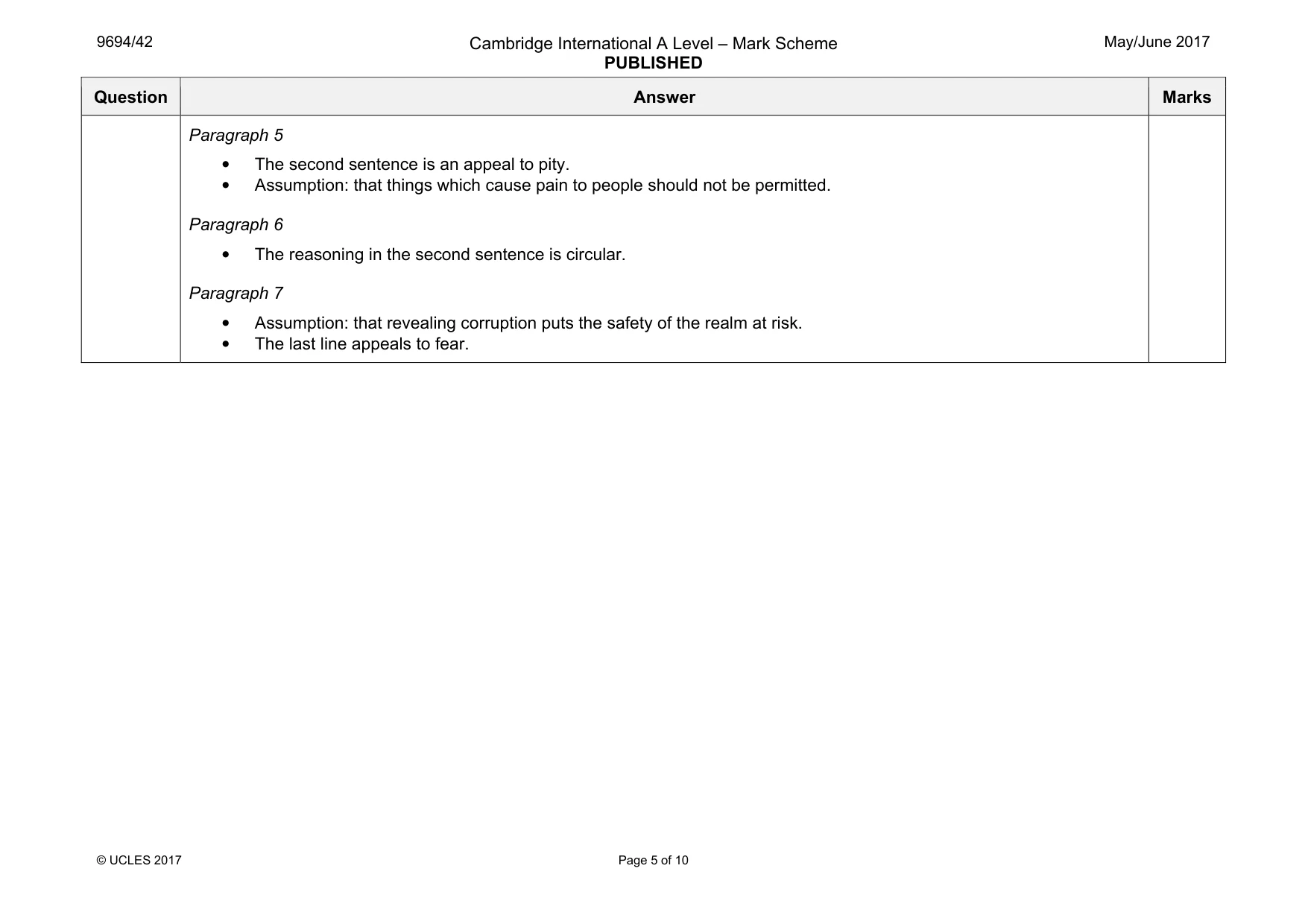
9694/42 Cambridge International A Level – Mark Scheme PUBLISHED May/June 2017 © UCLES 2017 Page 5 of 10 Question Answer Marks Paragraph 5 • The second sentence is an appeal to pity. • Assumption: that things which cause pain to people should not be permitted. Paragraph 6 • The reasoning in the second sentence is circular. Paragraph 7 • Assumption: that revealing corruption puts the safety of the realm at risk. • The last line appeals to fear.
Mark scheme, page 6
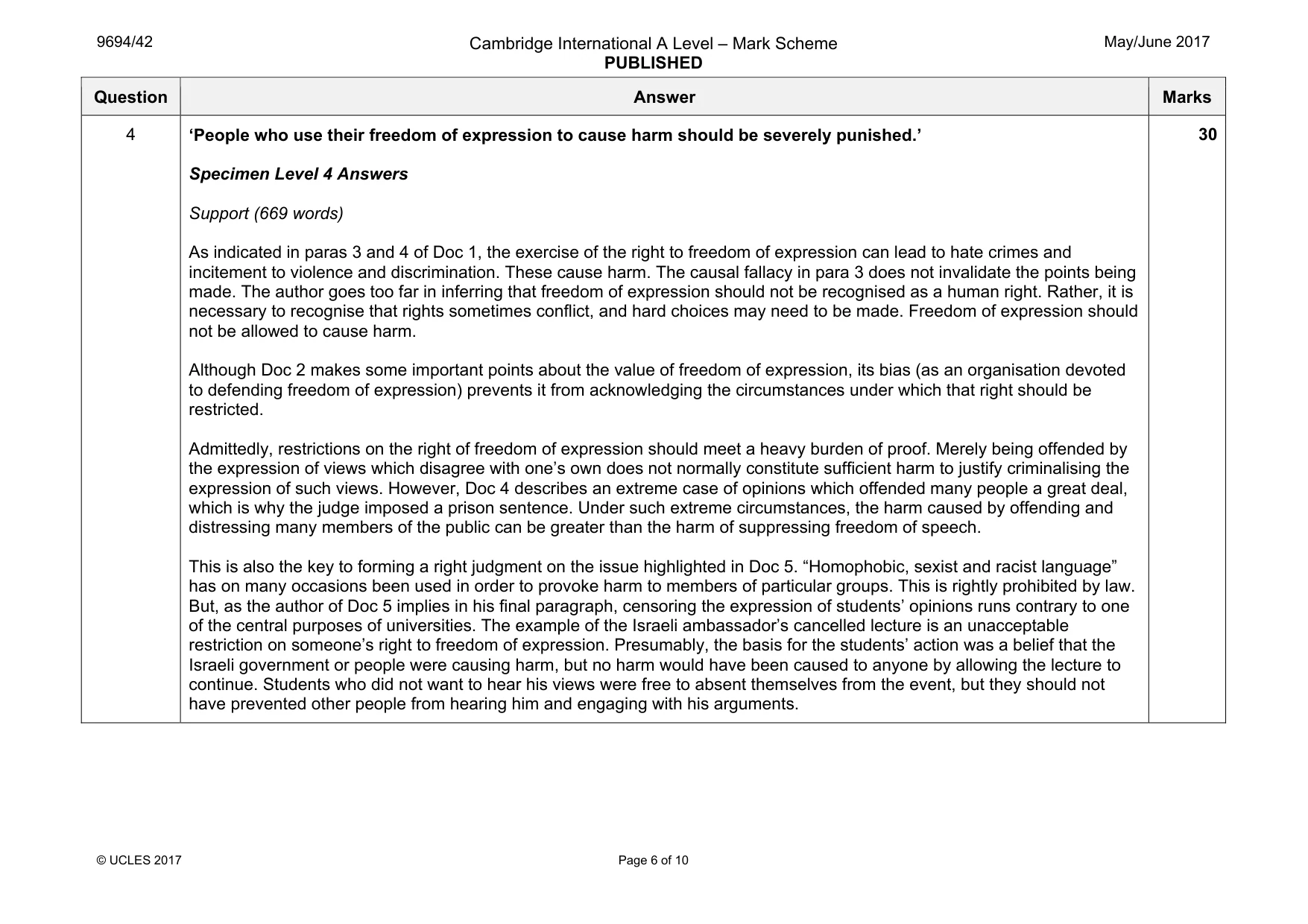
9694/42 Cambridge International A Level – Mark Scheme PUBLISHED May/June 2017 © UCLES 2017 Page 6 of 10 Question Answer Marks 4 ‘People who use their freedom of expression to cause harm should be severely punished.’ Specimen Level 4 Answers Support (669 words) As indicated in paras 3 and 4 of Doc 1, the exercise of the right to freedom of expression can lead to hate crimes and incitement to violence and discrimination. These cause harm. The causal fallacy in para 3 does not invalidate the points being made. The author goes too far in inferring that freedom of expression should not be recognised as a human right. Rather, it is necessary to recognise that rights sometimes conflict, and hard choices may need to be made. Freedom of expression should not be allowed to cause harm. Although Doc 2 makes some important points about the value of freedom of expression, its bias (as an organisation devoted to defending freedom of expression) prevents it from acknowledging the circumstances under which that right should be restricted. Admittedly, restrictions on the right of freedom of expression should meet a heavy burden of proof. Merely being offended by the expression of views which disagree with one’s own does not normally constitute sufficient harm to justify criminalising the expression of such views. However, Doc 4 describes an extreme case of opinions which offended many people a great deal, which is why the judge imposed a prison sentence. Under such extreme circumstances, the harm caused by offending and distressing many members of the public can be greater than the harm of suppressing freedom of speech. This is also the key to forming a right judgment on the issue highlighted in Doc 5. “Homophobic, sexist and racist language” has on many occasions been used in order to provoke harm to members of particular groups. This is rightly prohibited by law. But, as the author of Doc 5 implies in his final paragraph, censoring the expression of students’ opinions runs contrary to one of the central purposes of universities. The example of the Israeli ambassador’s cancelled lecture is an unacceptable restriction on someone’s right to freedom of expression. Presumably, the basis for the students’ action was a belief that the Israeli government or people were causing harm, but no harm would have been caused to anyone by allowing the lecture to continue. Students who did not want to hear his views were free to absent themselves from the event, but they should not have prevented other people from hearing him and engaging with his arguments. 30
Mark scheme, page 7
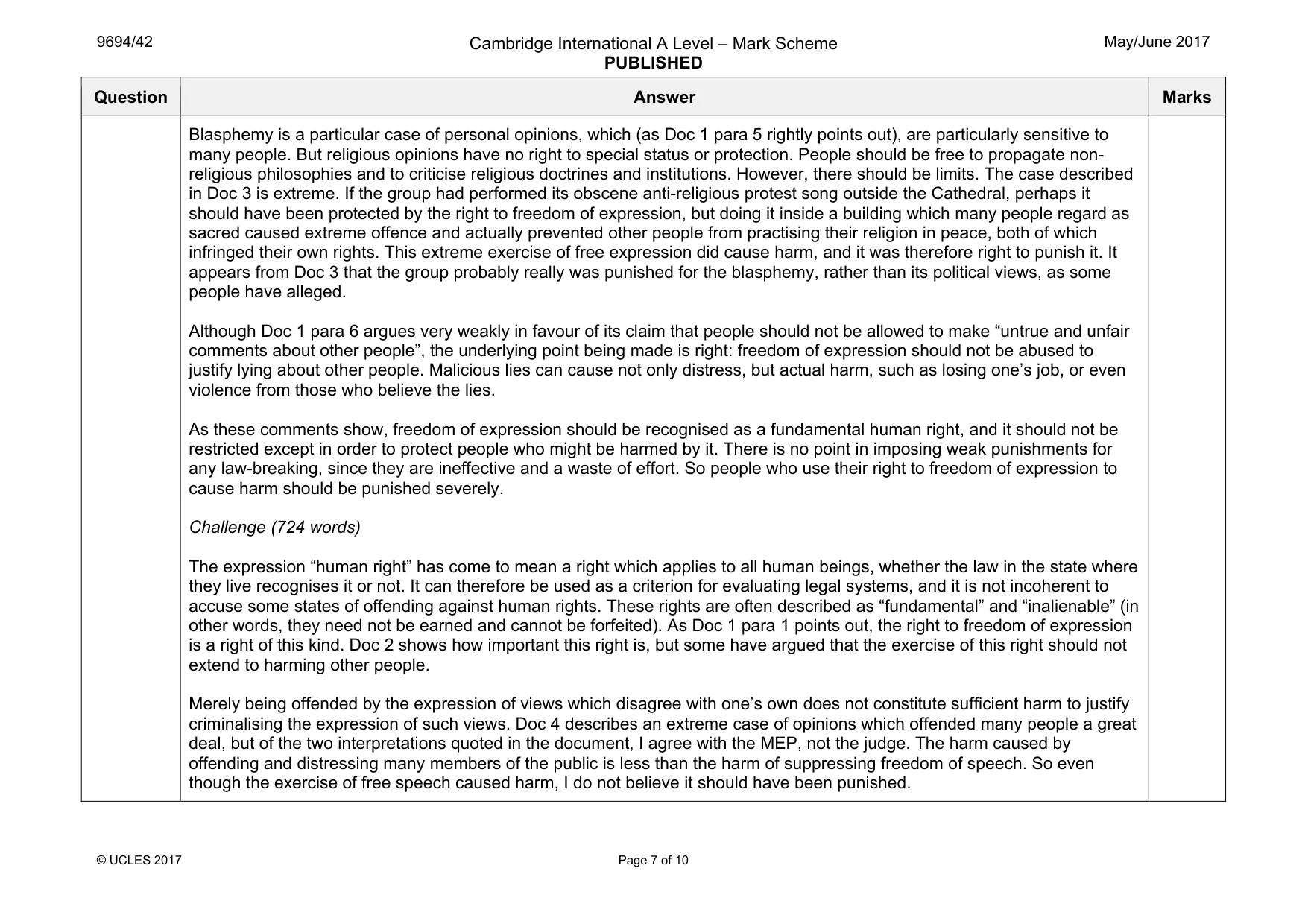
9694/42 Cambridge International A Level – Mark Scheme PUBLISHED May/June 2017 © UCLES 2017 Page 7 of 10 Question Answer Marks Blasphemy is a particular case of personal opinions, which (as Doc 1 para 5 rightly points out), are particularly sensitive to many people. But religious opinions have no right to special status or protection. People should be free to propagate non- religious philosophies and to criticise religious doctrines and institutions. However, there should be limits. The case described in Doc 3 is extreme. If the group had performed its obscene anti-religious protest song outside the Cathedral, perhaps it should have been protected by the right to freedom of expression, but doing it inside a building which many people regard as sacred caused extreme offence and actually prevented other people from practising their religion in peace, both of which infringed their own rights. This extreme exercise of free expression did cause harm, and it was therefore right to punish it. It appears from Doc 3 that the group probably really was punished for the blasphemy, rather than its political views, as some people have alleged. Although Doc 1 para 6 argues very weakly in favour of its claim that people should not be allowed to make “untrue and unfair comments about other people”, the underlying point being made is right: freedom of expression should not be abused to justify lying about other people. Malicious lies can cause not only distress, but actual harm, such as losing one’s job, or even violence from those who believe the lies. As these comments show, freedom of expression should be recognised as a fundamental human right, and it should not be restricted except in order to protect people who might be harmed by it. There is no point in imposing weak punishments for any law-breaking, since they are ineffective and a waste of effort. So people who use their right to freedom of expression to cause harm should be punished severely. Challenge (724 words) The expression “human right” has come to mean a right which applies to all human beings, whether the law in the state where they live recognises it or not. It can therefore be used as a criterion for evaluating legal systems, and it is not incoherent to accuse some states of offending against human rights. These rights are often described as “fundamental” and “inalienable” (in other words, they need not be earned and cannot be forfeited). As Doc 1 para 1 points out, the right to freedom of expression is a right of this kind. Doc 2 shows how important this right is, but some have argued that the exercise of this right should not extend to harming other people. Merely being offended by the expression of views which disagree with one’s own does not constitute sufficient harm to justify criminalising the expression of such views. Doc 4 describes an extreme case of opinions which offended many people a great deal, but of the two interpretations quoted in the document, I agree with the MEP, not the judge. The harm caused by offending and distressing many members of the public is less than the harm of suppressing freedom of speech. So even though the exercise of free speech caused harm, I do not believe it should have been punished.
Mark scheme, page 8
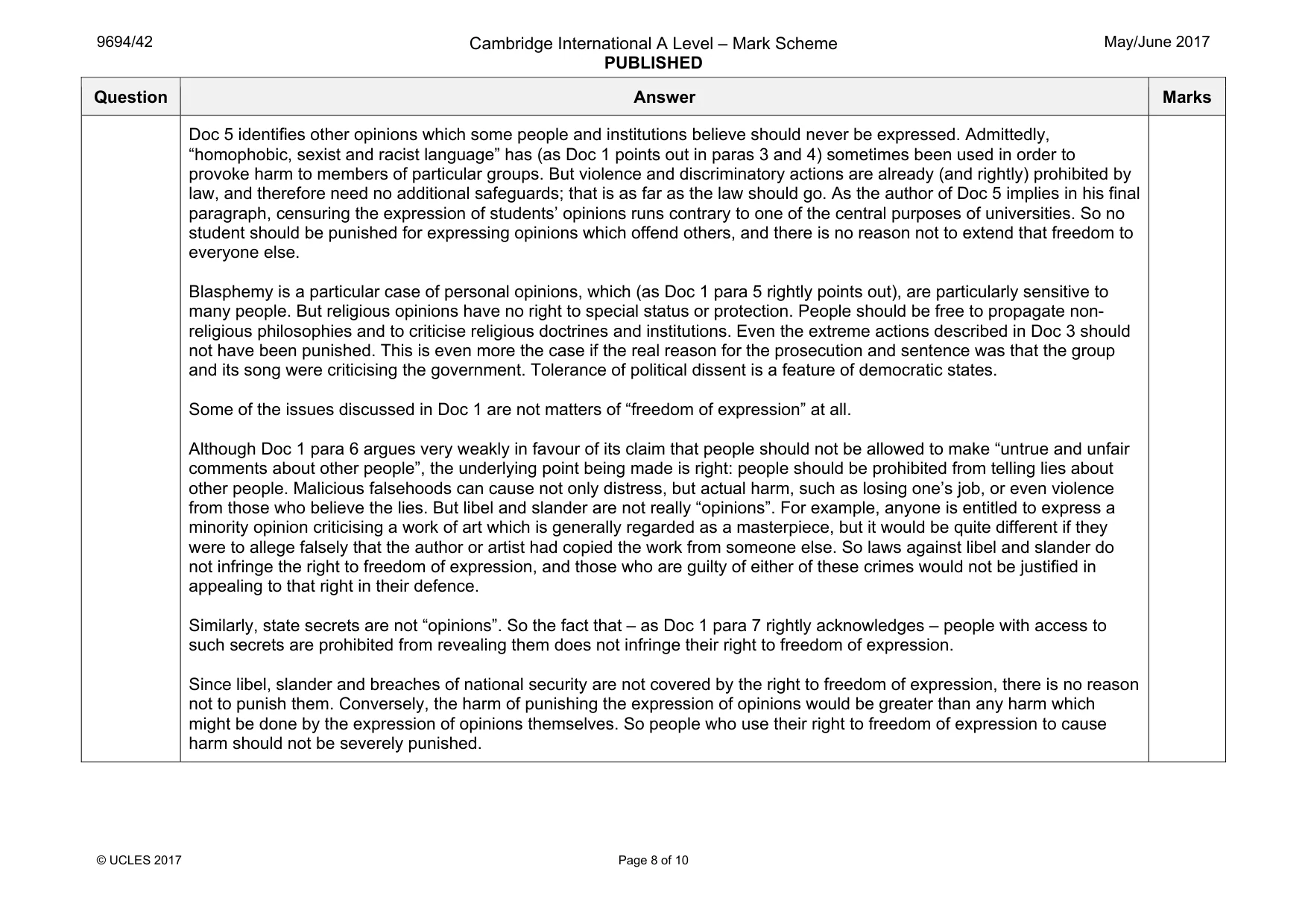
9694/42 Cambridge International A Level – Mark Scheme PUBLISHED May/June 2017 © UCLES 2017 Page 8 of 10 Question Answer Marks Doc 5 identifies other opinions which some people and institutions believe should never be expressed. Admittedly, “homophobic, sexist and racist language” has (as Doc 1 points out in paras 3 and 4) sometimes been used in order to provoke harm to members of particular groups. But violence and discriminatory actions are already (and rightly) prohibited by law, and therefore need no additional safeguards; that is as far as the law should go. As the author of Doc 5 implies in his final paragraph, censuring the expression of students’ opinions runs contrary to one of the central purposes of universities. So no student should be punished for expressing opinions which offend others, and there is no reason not to extend that freedom to everyone else. Blasphemy is a particular case of personal opinions, which (as Doc 1 para 5 rightly points out), are particularly sensitive to many people. But religious opinions have no right to special status or protection. People should be free to propagate non- religious philosophies and to criticise religious doctrines and institutions. Even the extreme actions described in Doc 3 should not have been punished. This is even more the case if the real reason for the prosecution and sentence was that the group and its song were criticising the government. Tolerance of political dissent is a feature of democratic states. Some of the issues discussed in Doc 1 are not matters of “freedom of expression” at all. Although Doc 1 para 6 argues very weakly in favour of its claim that people should not be allowed to make “untrue and unfair comments about other people”, the underlying point being made is right: people should be prohibited from telling lies about other people. Malicious falsehoods can cause not only distress, but actual harm, such as losing one’s job, or even violence from those who believe the lies. But libel and slander are not really “opinions”. For example, anyone is entitled to express a minority opinion criticising a work of art which is generally regarded as a masterpiece, but it would be quite different if they were to allege falsely that the author or artist had copied the work from someone else. So laws against libel and slander do not infringe the right to freedom of expression, and those who are guilty of either of these crimes would not be justified in appealing to that right in their defence. Similarly, state secrets are not “opinions”. So the fact that – as Doc 1 para 7 rightly acknowledges – people with access to such secrets are prohibited from revealing them does not infringe their right to freedom of expression. Since libel, slander and breaches of national security are not covered by the right to freedom of expression, there is no reason not to punish them. Conversely, the harm of punishing the expression of opinions would be greater than any harm which might be done by the expression of opinions themselves. So people who use their right to freedom of expression to cause harm should not be severely punished.
Mark scheme, page 9
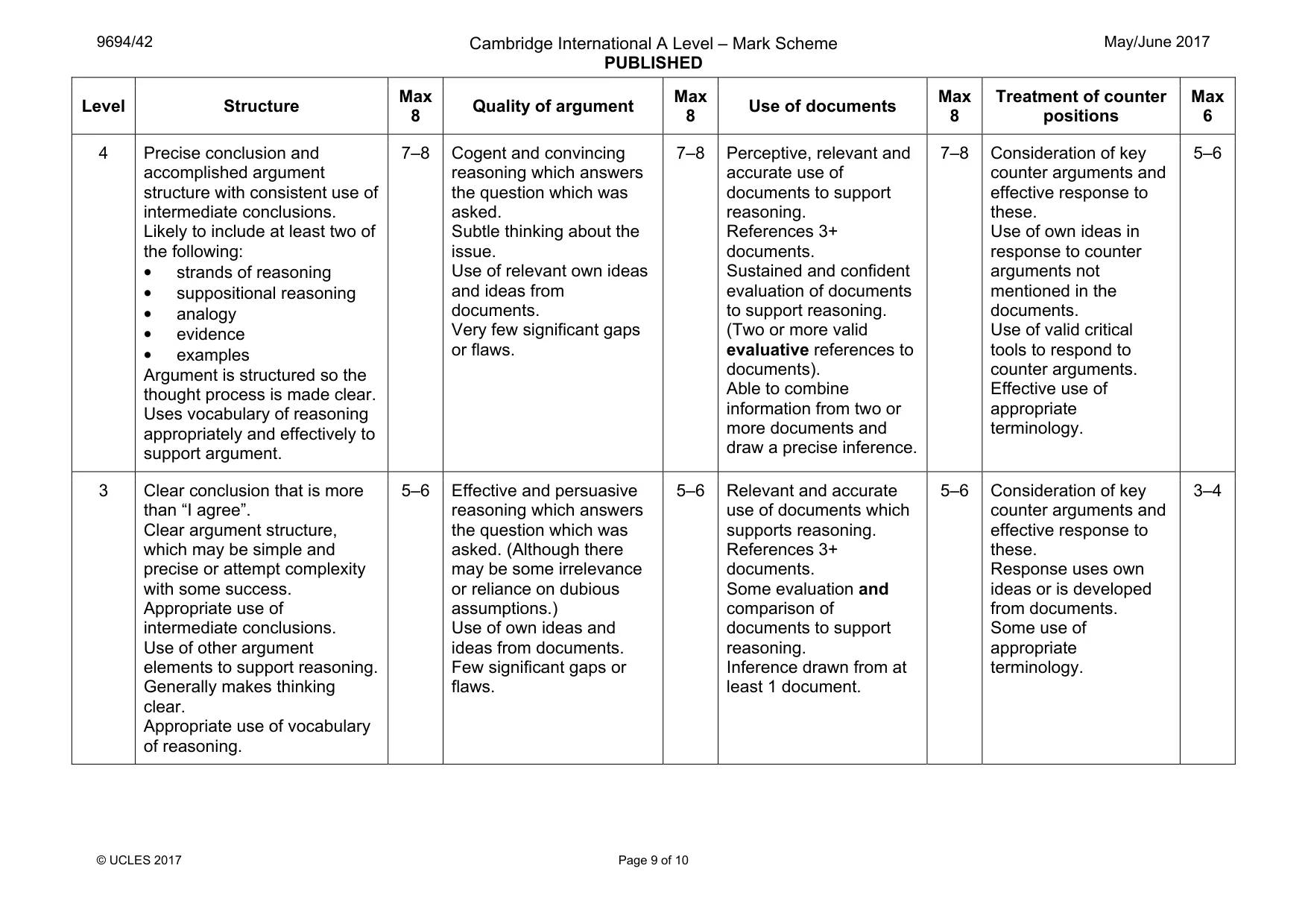
9694/42 Cambridge International A Level – Mark Scheme PUBLISHED May/June 2017 © UCLES 2017 Page 9 of 10 Level Structure Max 8 Quality of argument Max 8 Use of documents Max 8 Treatment of counter positions Max 6 4 Precise conclusion and accomplished argument structure with consistent use of intermediate conclusions. Likely to include at least two of the following: • strands of reasoning • suppositional reasoning • analogy • evidence • examples Argument is structured so the thought process is made clear. Uses vocabulary of reasoning appropriately and effectively to support argument. 7–8 Cogent and convincing reasoning which answers the question which was asked. Subtle thinking about the issue. Use of relevant own ideas and ideas from documents. Very few significant gaps or flaws. 7–8 Perceptive, relevant and accurate use of documents to support reasoning. References 3+ documents. Sustained and confident evaluation of documents to support reasoning. (Two or more valid evaluative references to documents). Able to combine information from two or more documents and draw a precise inference. 7–8 Consideration of key counter arguments and effective response to these. Use of own ideas in response to counter arguments not mentioned in the documents. Use of valid critical tools to respond to counter arguments. Effective use of appropriate terminology. 5–6 3 Clear conclusion that is more than “I agree”. Clear argument structure, which may be simple and precise or attempt complexity with some success. Appropriate use of intermediate conclusions. Use of other argument elements to support reasoning. Generally makes thinking clear. Appropriate use of vocabulary of reasoning. 5–6 Effective and persuasive reasoning which answers the question which was asked. (Although there may be some irrelevance or reliance on dubious assumptions.) Use of own ideas and ideas from documents. Few significant gaps or flaws. 5–6 Relevant and accurate use of documents which supports reasoning. References 3+ documents. Some evaluation and comparison of documents to support reasoning. Inference drawn from at least 1 document. 5–6 Consideration of key counter arguments and effective response to these. Response uses own ideas or is developed from documents. Some use of appropriate terminology. 3–4
Mark scheme, page 10
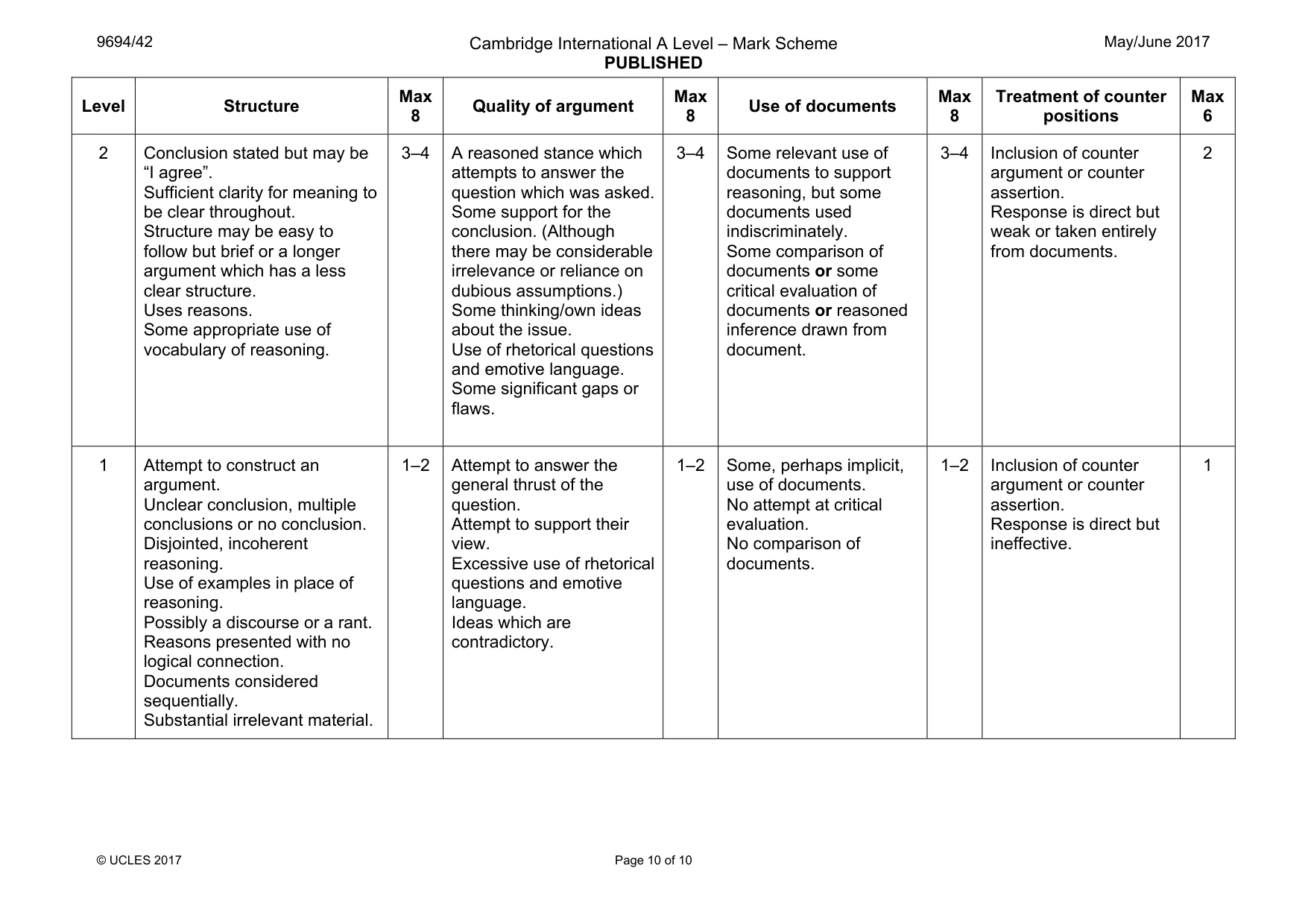
9694/42 Cambridge International A Level – Mark Scheme PUBLISHED May/June 2017 © UCLES 2017 Page 10 of 10 Level Structure Max 8 Quality of argument Max 8 Use of documents Max 8 Treatment of counter positions Max 6 2 Conclusion stated but may be “I agree”. Sufficient clarity for meaning to be clear throughout. Structure may be easy to follow but brief or a longer argument which has a less clear structure. Uses reasons. Some appropriate use of vocabulary of reasoning. 3–4 A reasoned stance which attempts to answer the question which was asked. Some support for the conclusion. (Although there may be considerable irrelevance or reliance on dubious assumptions.) Some thinking/own ideas about the issue. Use of rhetorical questions and emotive language. Some significant gaps or flaws. 3–4 Some relevant use of documents to support reasoning, but some documents used indiscriminately. Some comparison of documents or some critical evaluation of documents or reasoned inference drawn from document. 3–4 Inclusion of counter argument or counter assertion. Response is direct but weak or taken entirely from documents. 2 1 Attempt to construct an argument. Unclear conclusion, multiple conclusions or no conclusion. Disjointed, incoherent reasoning. Use of examples in place of reasoning. Possibly a discourse or a rant. Reasons presented with no logical connection. Documents considered sequentially. Substantial irrelevant material. 1–2 Attempt to answer the general thrust of the question. Attempt to support their view. Excessive use of rhetorical questions and emotive language. Ideas which are contradictory. 1–2 Some, perhaps implicit, use of documents. No attempt at critical evaluation. No comparison of documents. 1–2 Inclusion of counter argument or counter assertion. Response is direct but ineffective. 1
What you needed in this session
Cambridge’s own grade thresholds for 2017 May/June, Paper 4 · Variant 2. A higher threshold means an easier paper — the bar moves with how the cohort did.