Cambridge A Level Thinking Skills 9694 — 2016 Oct/Nov Paper 4 · Variant 1
9694/41/O/N/16 · 50 marks · ≈56 min
The question paper and its mark scheme, free to read here and free to download. This is Cambridge’s own paper, exactly as it was sat.
Question paper8 pages

Mark scheme9 pages
Answers below. Sit the paper first if you are practising.

Paper as text
Question paper, page 1
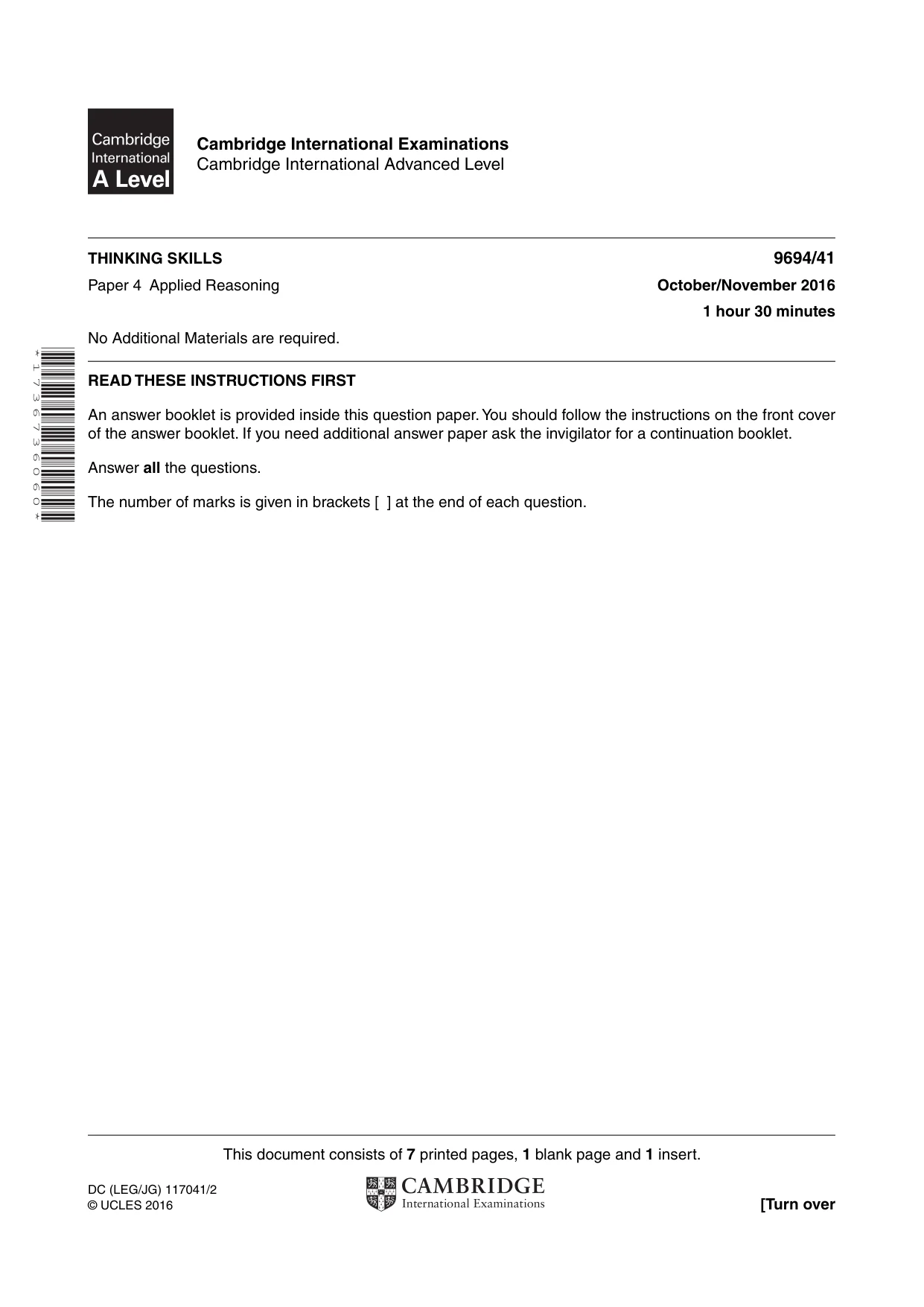
This document consists of 7 printed pages, 1 blank page and 1 insert. DC (LEG/JG) 117041/2 © UCLES 2016 [Turn over Cambridge International Examinations Cambridge International Advanced Level * 1 7 3 6 7 3 6 0 6 0 * THINKING SKILLS 9694/41 Paper 4 Applied Reasoning October/November 2016 1 hour 30 minutes No Additional Materials are required. READ THESE INSTRUCTIONS FIRST An answer booklet is provided inside this question paper. You should follow the instructions on the front cover of the answer booklet. If you need additional answer paper ask the invigilator for a continuation booklet. Answer all the questions. The number of marks is given in brackets [ ] at the end of each question.
Question paper, page 2
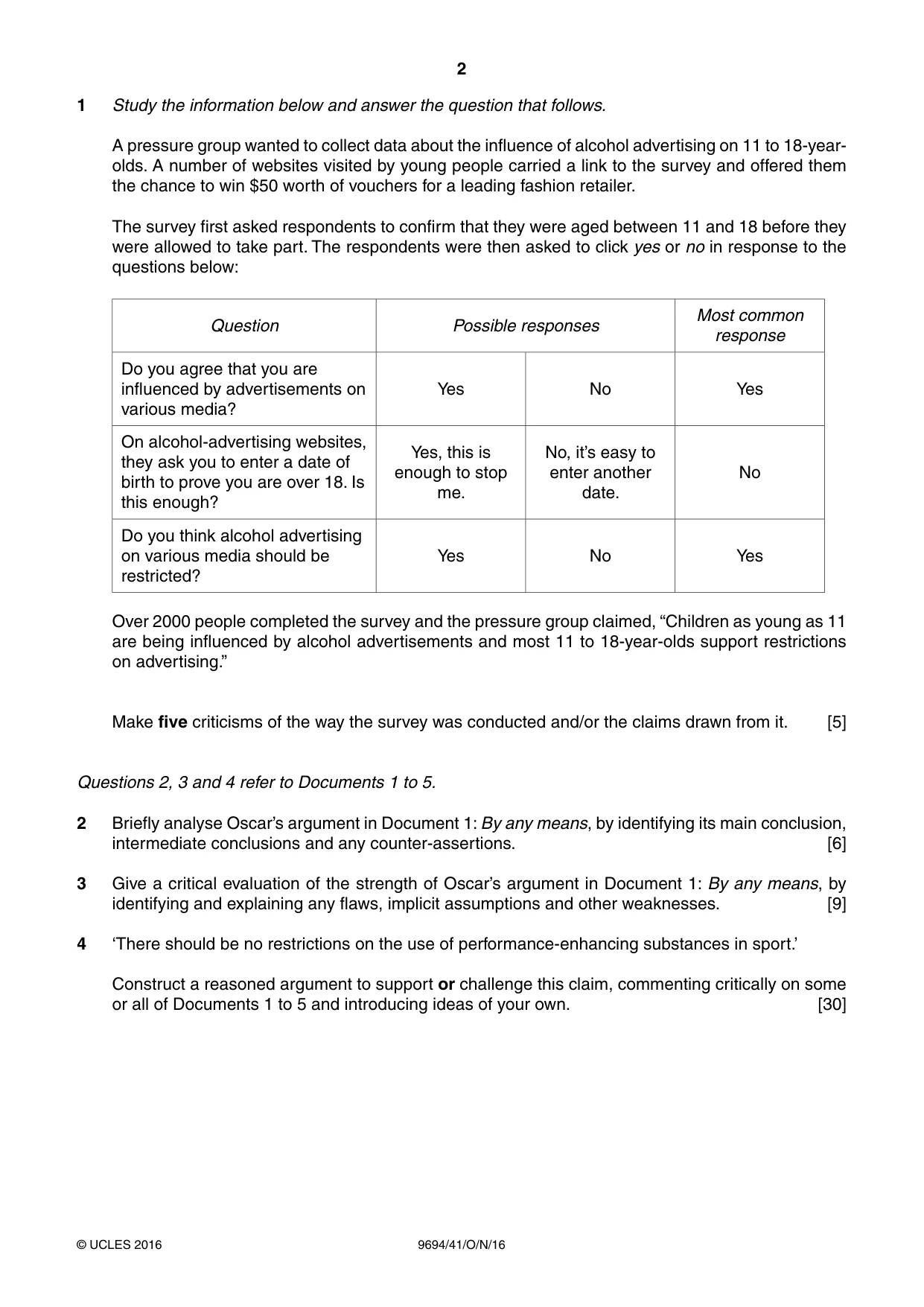
2 9694/41/O/N/16 © UCLES 2016 1 Study the information below and answer the question that follows. A pressure group wanted to collect data about the influence of alcohol advertising on 11 to 18-year- olds. A number of websites visited by young people carried a link to the survey and offered them the chance to win $50 worth of vouchers for a leading fashion retailer. The survey first asked respondents to confirm that they were aged between 11 and 18 before they were allowed to take part. The respondents were then asked to click yes or no in response to the questions below: Question Possible responses Most common response Do you agree that you are influenced by advertisements on various media? Yes No Yes On alcohol-advertising websites, they ask you to enter a date of birth to prove you are over 18. Is this enough? Yes, this is enough to stop me. No, it’s easy to enter another date. No Do you think alcohol advertising on various media should be restricted? Yes No Yes Over 2000 people completed the survey and the pressure group claimed, “Children as young as 11 are being influenced by alcohol advertisements and most 11 to 18-year-olds support restrictions on advertising.” Make five criticisms of the way the survey was conducted and/or the claims drawn from it. [5] Questions 2, 3 and 4 refer to Documents 1 to 5. 2 Briefly analyse Oscar’s argument in Document 1: By any means, by identifying its main conclusion, intermediate conclusions and any counter-assertions. [6] 3 Give a critical evaluation of the strength of Oscar’s argument in Document 1: By any means, by identifying and explaining any flaws, implicit assumptions and other weaknesses. [9] 4 ‘There should be no restrictions on the use of performance-enhancing substances in sport.’ Construct a reasoned argument to support or challenge this claim, commenting critically on some or all of Documents 1 to 5 and introducing ideas of your own. [30]
Question paper, page 3
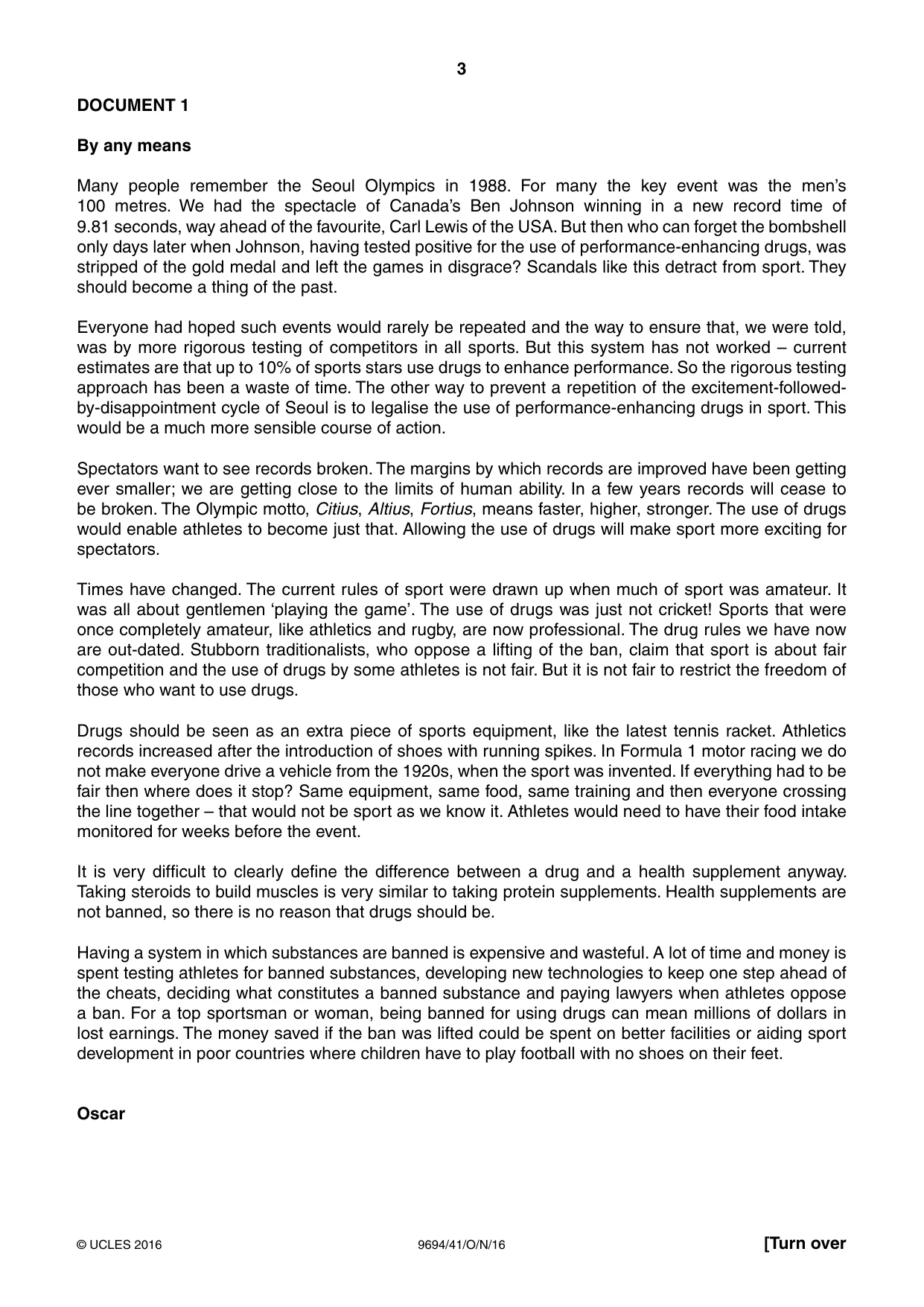
3 9694/41/O/N/16 © UCLES 2016 [Turn over DOCUMENT 1 By any means Many people remember the Seoul Olympics in 1988. For many the key event was the men’s 100 metres. We had the spectacle of Canada’s Ben Johnson winning in a new record time of 9.81 seconds, way ahead of the favourite, Carl Lewis of the USA. But then who can forget the bombshell only days later when Johnson, having tested positive for the use of performance-enhancing drugs, was stripped of the gold medal and left the games in disgrace? Scandals like this detract from sport. They should become a thing of the past. Everyone had hoped such events would rarely be repeated and the way to ensure that, we were told, was by more rigorous testing of competitors in all sports. But this system has not worked – current estimates are that up to 10% of sports stars use drugs to enhance performance. So the rigorous testing approach has been a waste of time. The other way to prevent a repetition of the excitement-followed- by-disappointment cycle of Seoul is to legalise the use of performance-enhancing drugs in sport. This would be a much more sensible course of action. Spectators want to see records broken. The margins by which records are improved have been getting ever smaller; we are getting close to the limits of human ability. In a few years records will cease to be broken. The Olympic motto, Citius, Altius, Fortius, means faster, higher, stronger. The use of drugs would enable athletes to become just that. Allowing the use of drugs will make sport more exciting for spectators. Times have changed. The current rules of sport were drawn up when much of sport was amateur. It was all about gentlemen ‘playing the game’. The use of drugs was just not cricket! Sports that were once completely amateur, like athletics and rugby, are now professional. The drug rules we have now are out-dated. Stubborn traditionalists, who oppose a lifting of the ban, claim that sport is about fair competition and the use of drugs by some athletes is not fair. But it is not fair to restrict the freedom of those who want to use drugs. Drugs should be seen as an extra piece of sports equipment, like the latest tennis racket. Athletics records increased after the introduction of shoes with running spikes. In Formula 1 motor racing we do not make everyone drive a vehicle from the 1920s, when the sport was invented. If everything had to be fair then where does it stop? Same equipment, same food, same training and then everyone crossing the line together – that would not be sport as we know it. Athletes would need to have their food intake monitored for weeks before the event. It is very difficult to clearly define the difference between a drug and a health supplement anyway. Taking steroids to build muscles is very similar to taking protein supplements. Health supplements are not banned, so there is no reason that drugs should be. Having a system in which substances are banned is expensive and wasteful. A lot of time and money is spent testing athletes for banned substances, developing new technologies to keep one step ahead of the cheats, deciding what constitutes a banned substance and paying lawyers when athletes oppose a ban. For a top sportsman or woman, being banned for using drugs can mean millions of dollars in lost earnings. The money saved if the ban was lifted could be spent on better facilities or aiding sport development in poor countries where children have to play football with no shoes on their feet. Oscar
Question paper, page 4
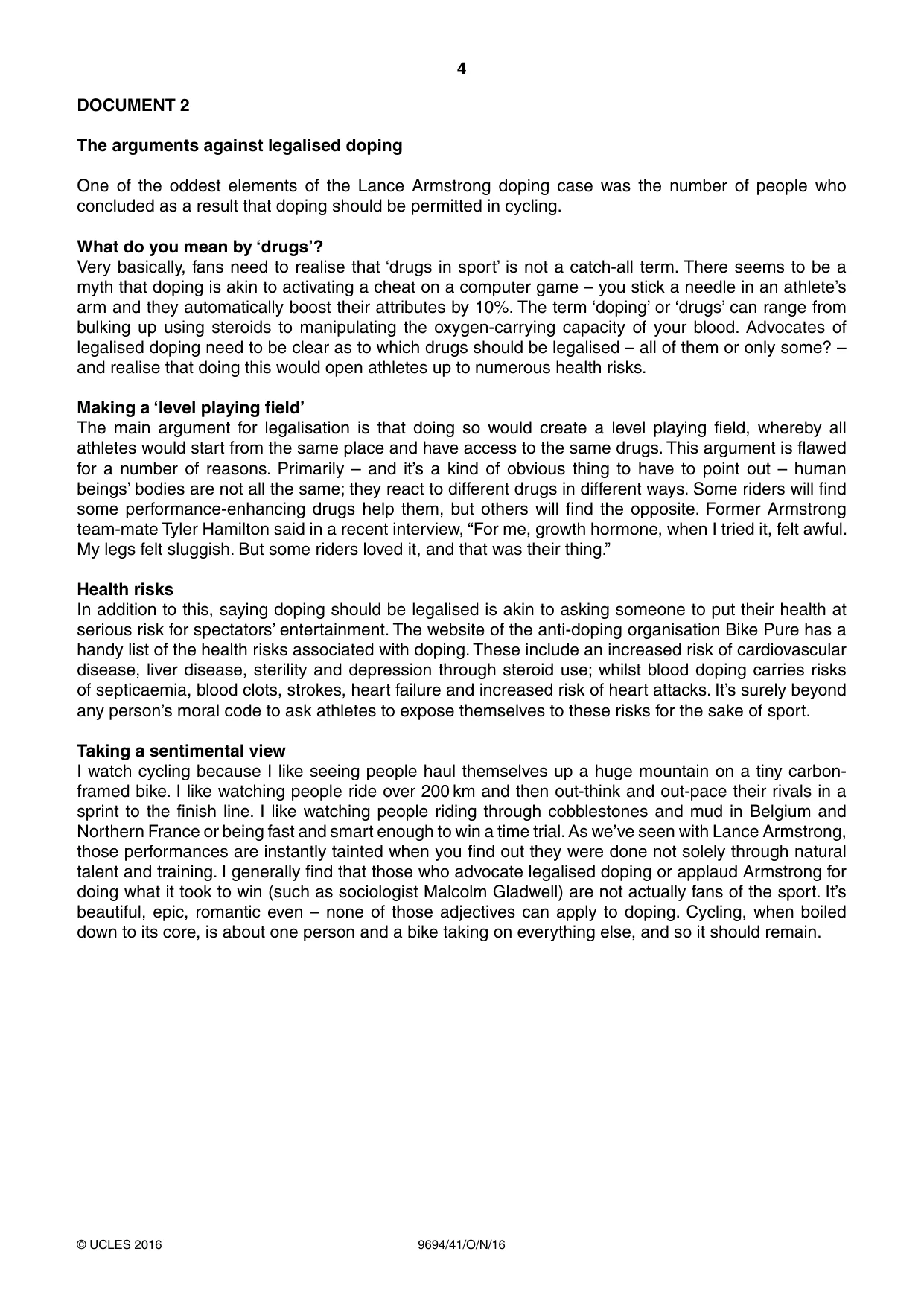
4 9694/41/O/N/16 © UCLES 2016 DOCUMENT 2 The arguments against legalised doping One of the oddest elements of the Lance Armstrong doping case was the number of people who concluded as a result that doping should be permitted in cycling. What do you mean by ‘drugs’? Very basically, fans need to realise that ‘drugs in sport’ is not a catch-all term. There seems to be a myth that doping is akin to activating a cheat on a computer game – you stick a needle in an athlete’s arm and they automatically boost their attributes by 10%. The term ‘doping’ or ‘drugs’ can range from bulking up using steroids to manipulating the oxygen-carrying capacity of your blood. Advocates of legalised doping need to be clear as to which drugs should be legalised – all of them or only some? – and realise that doing this would open athletes up to numerous health risks. Making a ‘level playing field’ The main argument for legalisation is that doing so would create a level playing field, whereby all athletes would start from the same place and have access to the same drugs. This argument is flawed for a number of reasons. Primarily – and it’s a kind of obvious thing to have to point out – human beings’ bodies are not all the same; they react to different drugs in different ways. Some riders will find some performance-enhancing drugs help them, but others will find the opposite. Former Armstrong team-mate Tyler Hamilton said in a recent interview, “For me, growth hormone, when I tried it, felt awful. My legs felt sluggish. But some riders loved it, and that was their thing.” Health risks In addition to this, saying doping should be legalised is akin to asking someone to put their health at serious risk for spectators’ entertainment. The website of the anti-doping organisation Bike Pure has a handy list of the health risks associated with doping. These include an increased risk of cardiovascular disease, liver disease, sterility and depression through steroid use; whilst blood doping carries risks of septicaemia, blood clots, strokes, heart failure and increased risk of heart attacks. It’s surely beyond any person’s moral code to ask athletes to expose themselves to these risks for the sake of sport. Taking a sentimental view I watch cycling because I like seeing people haul themselves up a huge mountain on a tiny carbon- framed bike. I like watching people ride over 200 km and then out-think and out-pace their rivals in a sprint to the finish line. I like watching people riding through cobblestones and mud in Belgium and Northern France or being fast and smart enough to win a time trial. As we’ve seen with Lance Armstrong, those performances are instantly tainted when you find out they were done not solely through natural talent and training. I generally find that those who advocate legalised doping or applaud Armstrong for doing what it took to win (such as sociologist Malcolm Gladwell) are not actually fans of the sport. It’s beautiful, epic, romantic even – none of those adjectives can apply to doping. Cycling, when boiled down to its core, is about one person and a bike taking on everything else, and so it should remain.
Question paper, page 5
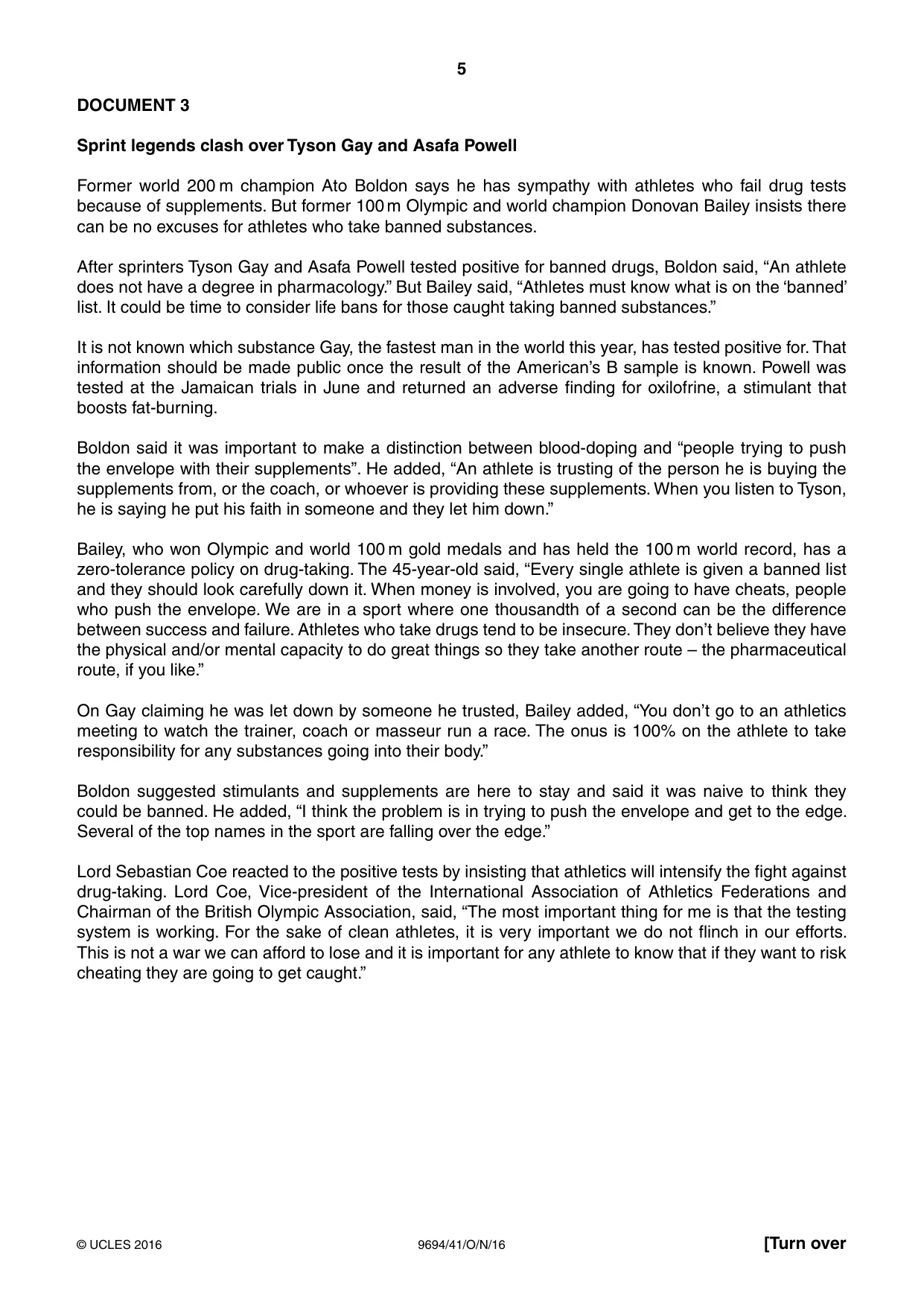
5 9694/41/O/N/16 © UCLES 2016 [Turn over DOCUMENT 3 Sprint legends clash over Tyson Gay and Asafa Powell Former world 200 m champion Ato Boldon says he has sympathy with athletes who fail drug tests because of supplements. But former 100 m Olympic and world champion Donovan Bailey insists there can be no excuses for athletes who take banned substances. After sprinters Tyson Gay and Asafa Powell tested positive for banned drugs, Boldon said, “An athlete does not have a degree in pharmacology.” But Bailey said, “Athletes must know what is on the ‘banned’ list. It could be time to consider life bans for those caught taking banned substances.” It is not known which substance Gay, the fastest man in the world this year, has tested positive for. That information should be made public once the result of the American’s B sample is known. Powell was tested at the Jamaican trials in June and returned an adverse finding for oxilofrine, a stimulant that boosts fat-burning. Boldon said it was important to make a distinction between blood-doping and “people trying to push the envelope with their supplements”. He added, “An athlete is trusting of the person he is buying the supplements from, or the coach, or whoever is providing these supplements. When you listen to Tyson, he is saying he put his faith in someone and they let him down.” Bailey, who won Olympic and world 100 m gold medals and has held the 100 m world record, has a zero-tolerance policy on drug-taking. The 45-year-old said, “Every single athlete is given a banned list and they should look carefully down it. When money is involved, you are going to have cheats, people who push the envelope. We are in a sport where one thousandth of a second can be the difference between success and failure. Athletes who take drugs tend to be insecure. They don’t believe they have the physical and/or mental capacity to do great things so they take another route – the pharmaceutical route, if you like.” On Gay claiming he was let down by someone he trusted, Bailey added, “You don’t go to an athletics meeting to watch the trainer, coach or masseur run a race. The onus is 100% on the athlete to take responsibility for any substances going into their body.” Boldon suggested stimulants and supplements are here to stay and said it was naive to think they could be banned. He added, “I think the problem is in trying to push the envelope and get to the edge. Several of the top names in the sport are falling over the edge.” Lord Sebastian Coe reacted to the positive tests by insisting that athletics will intensify the fight against drug-taking. Lord Coe, Vice-president of the International Association of Athletics Federations and Chairman of the British Olympic Association, said, “The most important thing for me is that the testing system is working. For the sake of clean athletes, it is very important we do not flinch in our efforts. This is not a war we can afford to lose and it is important for any athlete to know that if they want to risk cheating they are going to get caught.”
Question paper, page 6
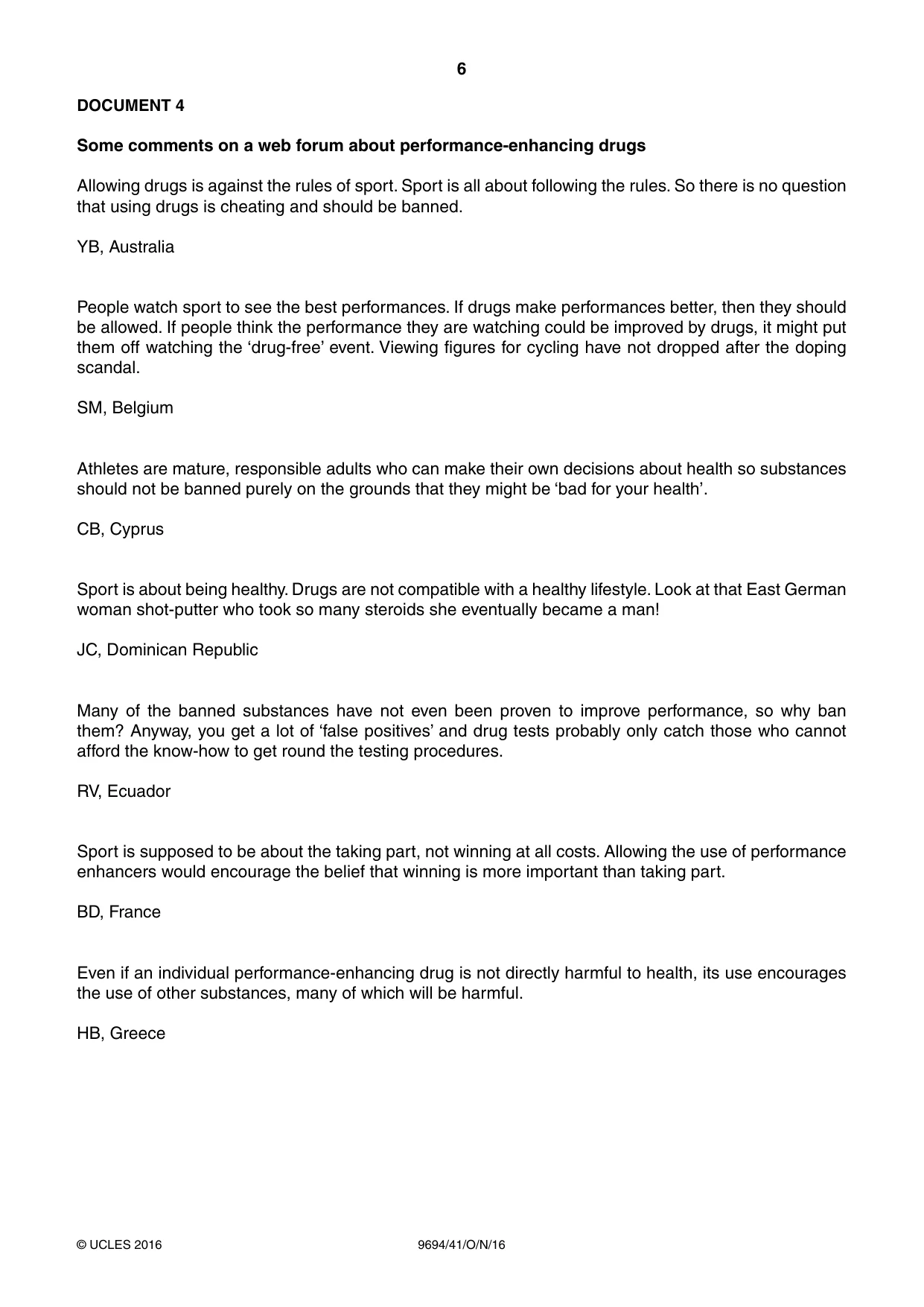
6 9694/41/O/N/16 © UCLES 2016 DOCUMENT 4 Some comments on a web forum about performance-enhancing drugs Allowing drugs is against the rules of sport. Sport is all about following the rules. So there is no question that using drugs is cheating and should be banned. YB, Australia People watch sport to see the best performances. If drugs make performances better, then they should be allowed. If people think the performance they are watching could be improved by drugs, it might put them off watching the ‘drug-free’ event. Viewing figures for cycling have not dropped after the doping scandal. SM, Belgium Athletes are mature, responsible adults who can make their own decisions about health so substances should not be banned purely on the grounds that they might be ‘bad for your health’. CB, Cyprus Sport is about being healthy. Drugs are not compatible with a healthy lifestyle. Look at that East German woman shot-putter who took so many steroids she eventually became a man! JC, Dominican Republic Many of the banned substances have not even been proven to improve performance, so why ban them? Anyway, you get a lot of ‘false positives’ and drug tests probably only catch those who cannot afford the know-how to get round the testing procedures. RV, Ecuador Sport is supposed to be about the taking part, not winning at all costs. Allowing the use of performance enhancers would encourage the belief that winning is more important than taking part. BD, France Even if an individual performance-enhancing drug is not directly harmful to health, its use encourages the use of other substances, many of which will be harmful. HB, Greece
Question paper, page 7
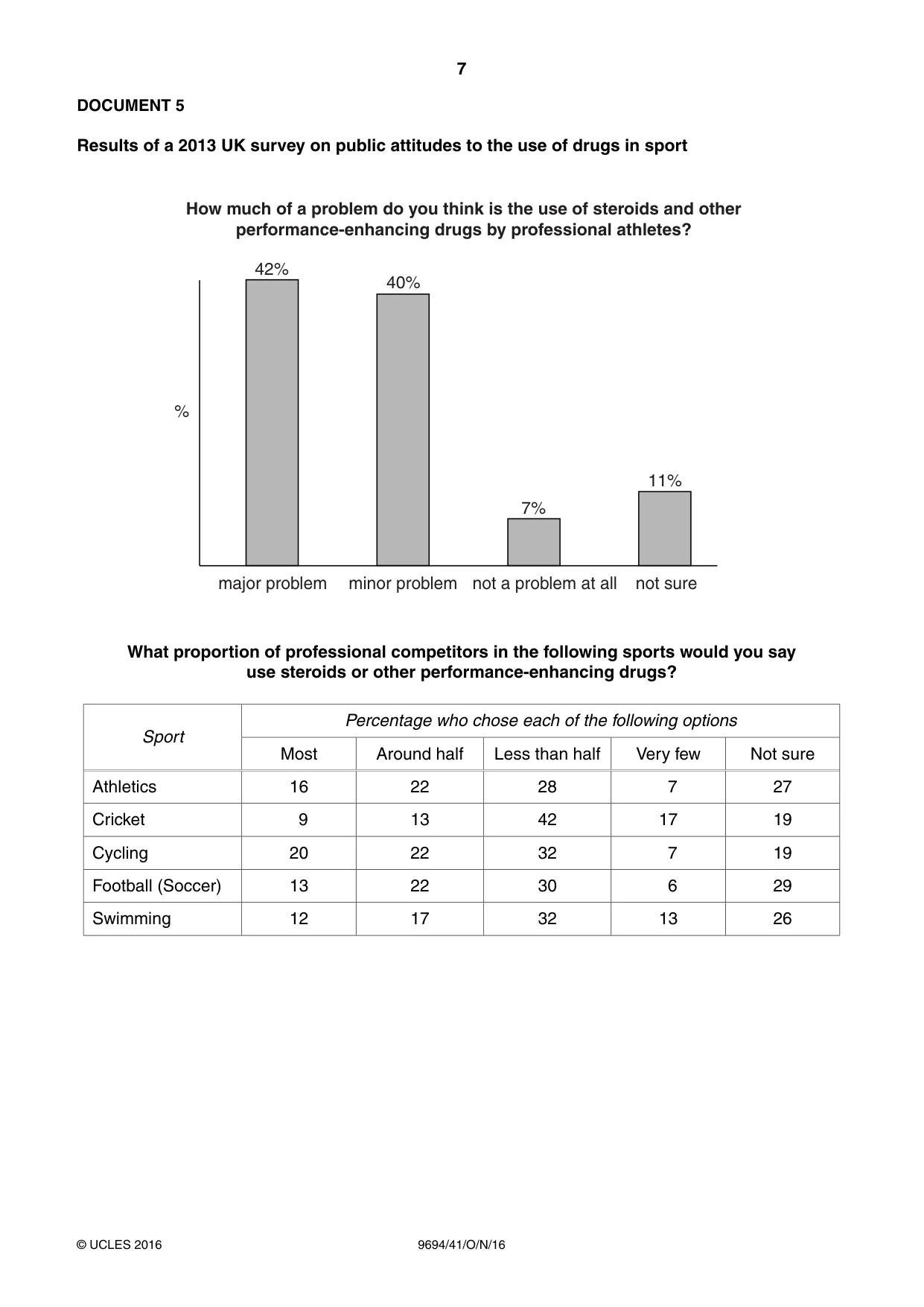
7 9694/41/O/N/16 © UCLES 2016 DOCUMENT 5 Results of a 2013 UK survey on public attitudes to the use of drugs in sport major problem minor problem not a problem at all not sure 42% How much of a problem do you think is the use of steroids and other performance-enhancing drugs by professional athletes? 40% 7% 11% % What proportion of professional competitors in the following sports would you say use steroids or other performance-enhancing drugs? Sport Percentage who chose each of the following options Most Around half Less than half Very few Not sure Athletics 16 22 28 7 27 Cricket 9 13 42 17 19 Cycling 20 22 32 7 19 Football (Soccer) 13 22 30 6 29 Swimming 12 17 32 13 26
Question paper, page 8
8 9694/41/O/N/16 © UCLES 2016 BLANK PAGE Permission to reproduce items where third-party owned material protected by copyright is included has been sought and cleared where possible. Every reasonable effort has been made by the publisher (UCLES) to trace copyright holders, but if any items requiring clearance have unwittingly been included, the publisher will be pleased to make amends at the earliest possible opportunity. To avoid the issue of disclosure of answer-related information to candidates, all copyright acknowledgements are reproduced online in the Cambridge International Examinations Copyright Acknowledgements Booklet. This is produced for each series of examinations and is freely available to download at www.cie.org.uk after the live examination series. Cambridge International Examinations is part of the Cambridge Assessment Group. Cambridge Assessment is the brand name of University of Cambridge Local Examinations Syndicate (UCLES), which is itself a department of the University of Cambridge.
Mark scheme, page 1
® IGCSE is the registered trademark of Cambridge International Examinations. This document consists of 9 printed pages. © UCLES 2016 [Turn over Cambridge International Examinations Cambridge International Advanced Level THINKING SKILLS 9694/41 Paper 4 Applied Reasoning October/November 2016 MARK SCHEME Maximum Mark: 50 Published This mark scheme is published as an aid to teachers and candidates, to indicate the requirements of the examination. It shows the basis on which Examiners were instructed to award marks. It does not indicate the details of the discussions that took place at an Examiners’ meeting before marking began, which would have considered the acceptability of alternative answers. Mark schemes should be read in conjunction with the question paper and the Principal Examiner Report for Teachers. Cambridge will not enter into discussions about these mark schemes. Cambridge is publishing the mark schemes for the October/November 2016 series for most Cambridge IGCSE®, Cambridge International A and AS Level components and some Cambridge O Level components.
Mark scheme, page 2
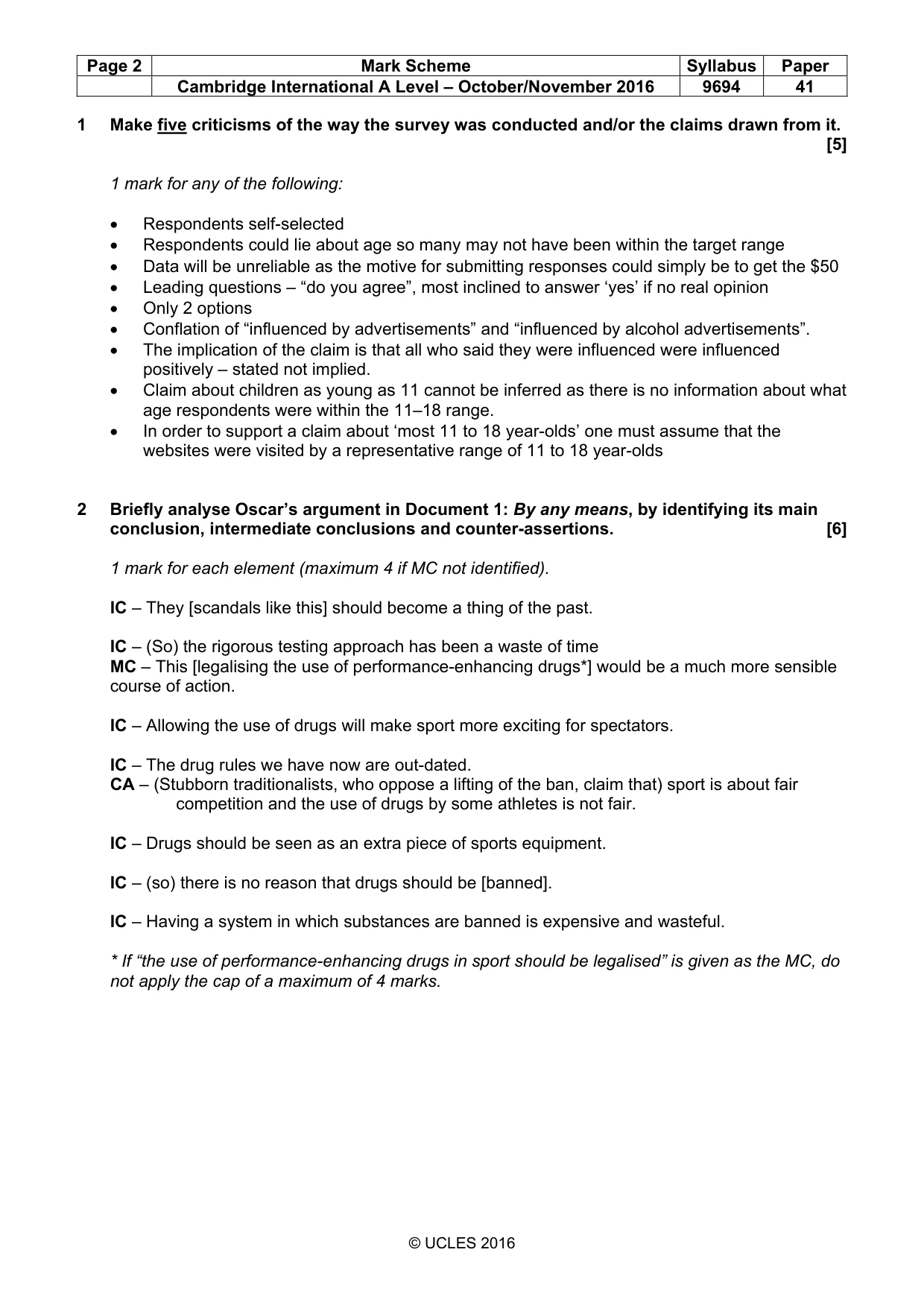
Page 2 Mark Scheme Syllabus Paper Cambridge International A Level – October/November 2016 9694 41 © UCLES 2016 1 Make five criticisms of the way the survey was conducted and/or the claims drawn from it. [5] 1 mark for any of the following: • Respondents self-selected • Respondents could lie about age so many may not have been within the target range • Data will be unreliable as the motive for submitting responses could simply be to get the $50 • Leading questions – “do you agree”, most inclined to answer ‘yes’ if no real opinion • Only 2 options • Conflation of “influenced by advertisements” and “influenced by alcohol advertisements”. • The implication of the claim is that all who said they were influenced were influenced positively – stated not implied. • Claim about children as young as 11 cannot be inferred as there is no information about what age respondents were within the 11–18 range. • In order to support a claim about ‘most 11 to 18 year-olds’ one must assume that the websites were visited by a representative range of 11 to 18 year-olds 2 Briefly analyse Oscar’s argument in Document 1: By any means, by identifying its main conclusion, intermediate conclusions and counter-assertions. [6] 1 mark for each element (maximum 4 if MC not identified). IC – They [scandals like this] should become a thing of the past. IC – (So) the rigorous testing approach has been a waste of time MC – This [legalising the use of performance-enhancing drugs*] would be a much more sensible course of action. IC – Allowing the use of drugs will make sport more exciting for spectators. IC – The drug rules we have now are out-dated. CA – (Stubborn traditionalists, who oppose a lifting of the ban, claim that) sport is about fair competition and the use of drugs by some athletes is not fair. IC – Drugs should be seen as an extra piece of sports equipment. IC – (so) there is no reason that drugs should be [banned]. IC – Having a system in which substances are banned is expensive and wasteful. * If “the use of performance-enhancing drugs in sport should be legalised” is given as the MC, do not apply the cap of a maximum of 4 marks.
Mark scheme, page 3
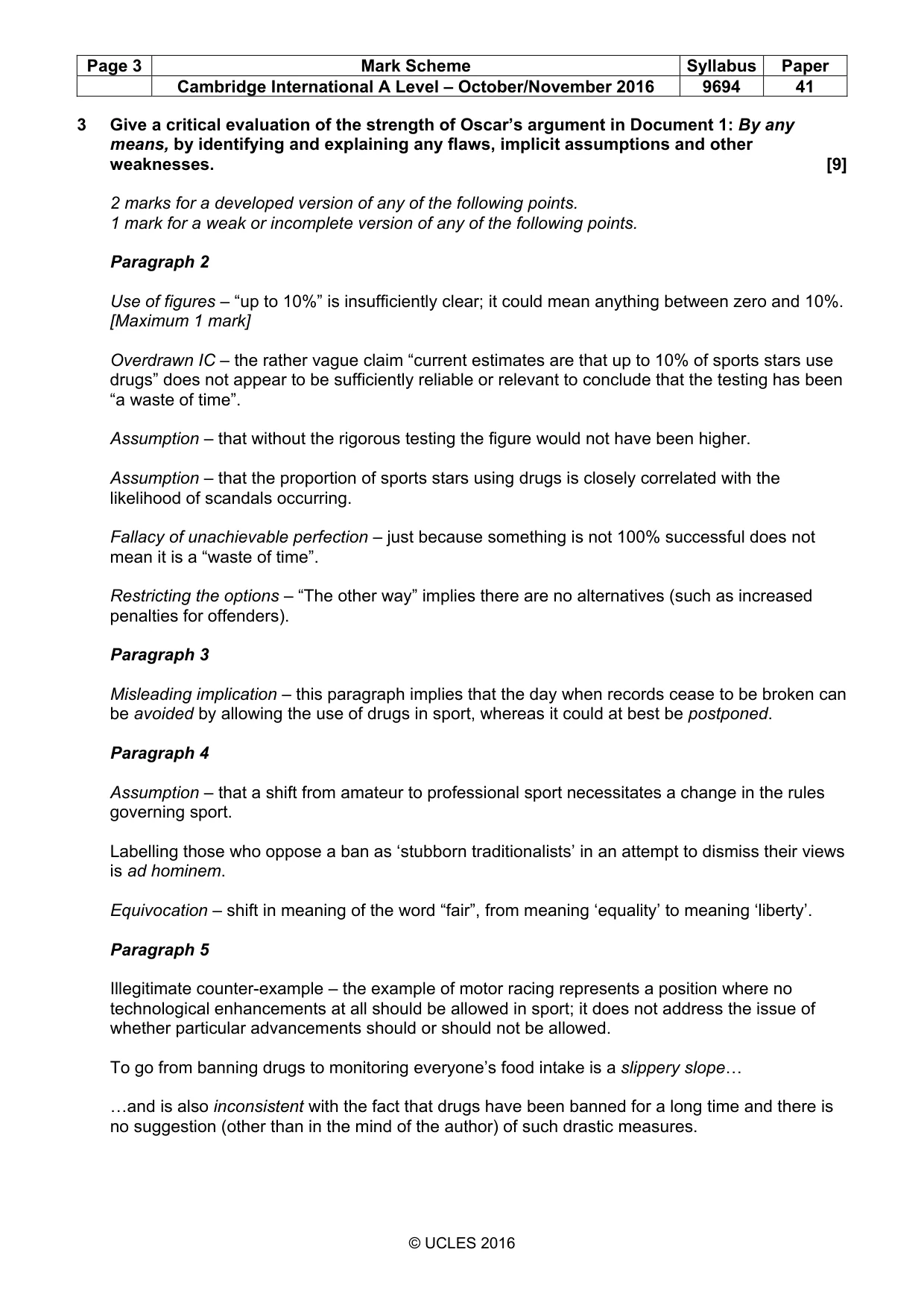
Page 3 Mark Scheme Syllabus Paper Cambridge International A Level – October/November 2016 9694 41 © UCLES 2016 3 Give a critical evaluation of the strength of Oscar’s argument in Document 1: By any means, by identifying and explaining any flaws, implicit assumptions and other weaknesses. [9] 2 marks for a developed version of any of the following points. 1 mark for a weak or incomplete version of any of the following points. Paragraph 2 Use of figures – “up to 10%” is insufficiently clear; it could mean anything between zero and 10%. [Maximum 1 mark] Overdrawn IC – the rather vague claim “current estimates are that up to 10% of sports stars use drugs” does not appear to be sufficiently reliable or relevant to conclude that the testing has been “a waste of time”. Assumption – that without the rigorous testing the figure would not have been higher. Assumption – that the proportion of sports stars using drugs is closely correlated with the likelihood of scandals occurring. Fallacy of unachievable perfection – just because something is not 100% successful does not mean it is a “waste of time”. Restricting the options – “The other way” implies there are no alternatives (such as increased penalties for offenders). Paragraph 3 Misleading implication – this paragraph implies that the day when records cease to be broken can be avoided by allowing the use of drugs in sport, whereas it could at best be postponed. Paragraph 4 Assumption – that a shift from amateur to professional sport necessitates a change in the rules governing sport. Labelling those who oppose a ban as ‘stubborn traditionalists’ in an attempt to dismiss their views is ad hominem. Equivocation – shift in meaning of the word “fair”, from meaning ‘equality’ to meaning ‘liberty’. Paragraph 5 Illegitimate counter-example – the example of motor racing represents a position where no technological enhancements at all should be allowed in sport; it does not address the issue of whether particular advancements should or should not be allowed. To go from banning drugs to monitoring everyone’s food intake is a slippery slope… …and is also inconsistent with the fact that drugs have been banned for a long time and there is no suggestion (other than in the mind of the author) of such drastic measures.
Mark scheme, page 4
Page 4 Mark Scheme Syllabus Paper Cambridge International A Level – October/November 2016 9694 41 © UCLES 2016 Paragraph 6 Assumption – that there are not significant differences between drugs and health supplements or that a difference that is hard to define is not a real difference. Paragraph 7 Appeal to pity – ‘children have to play football with no shoes on their feet’.
Mark scheme, page 5
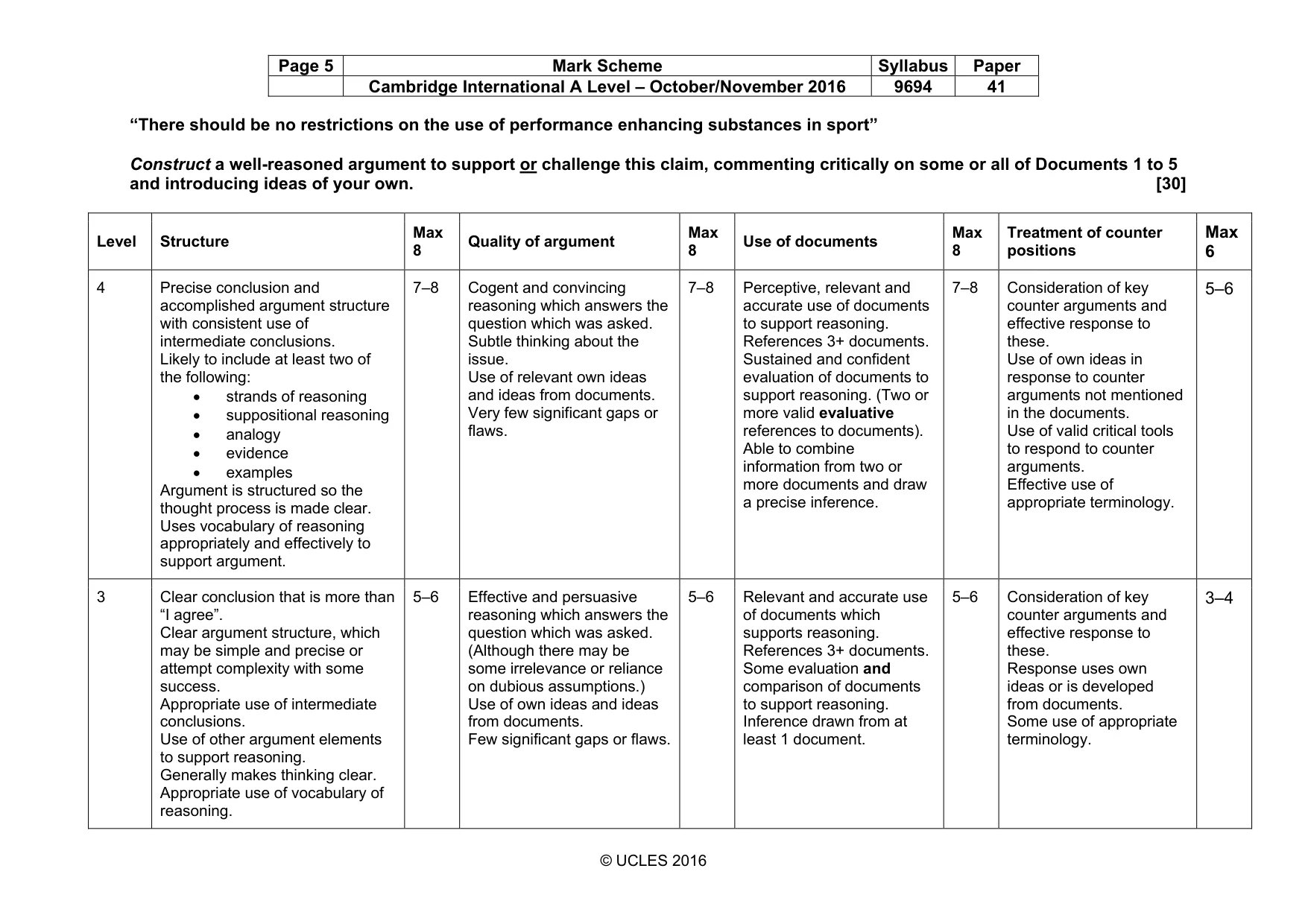
Page 5 Mark Scheme Syllabus Paper Cambridge International A Level – October/November 2016 9694 41 © UCLES 2016 “There should be no restrictions on the use of performance enhancing substances in sport” Construct a well-reasoned argument to support or challenge this claim, commenting critically on some or all of Documents 1 to 5 and introducing ideas of your own. [30] Level Structure Max 8 Quality of argument Max 8 Use of documents Max 8 Treatment of counter positions Max 6 4 Precise conclusion and accomplished argument structure with consistent use of intermediate conclusions. Likely to include at least two of the following: • strands of reasoning • suppositional reasoning • analogy • evidence • examples Argument is structured so the thought process is made clear. Uses vocabulary of reasoning appropriately and effectively to support argument. 7–8 Cogent and convincing reasoning which answers the question which was asked. Subtle thinking about the issue. Use of relevant own ideas and ideas from documents. Very few significant gaps or flaws. 7–8 Perceptive, relevant and accurate use of documents to support reasoning. References 3+ documents. Sustained and confident evaluation of documents to support reasoning. (Two or more valid evaluative references to documents). Able to combine information from two or more documents and draw a precise inference. 7–8 Consideration of key counter arguments and effective response to these. Use of own ideas in response to counter arguments not mentioned in the documents. Use of valid critical tools to respond to counter arguments. Effective use of appropriate terminology. 5–6 3 Clear conclusion that is more than “I agree”. Clear argument structure, which may be simple and precise or attempt complexity with some success. Appropriate use of intermediate conclusions. Use of other argument elements to support reasoning. Generally makes thinking clear. Appropriate use of vocabulary of reasoning. 5–6 Effective and persuasive reasoning which answers the question which was asked. (Although there may be some irrelevance or reliance on dubious assumptions.) Use of own ideas and ideas from documents. Few significant gaps or flaws. 5–6 Relevant and accurate use of documents which supports reasoning. References 3+ documents. Some evaluation and comparison of documents to support reasoning. Inference drawn from at least 1 document. 5–6 Consideration of key counter arguments and effective response to these. Response uses own ideas or is developed from documents. Some use of appropriate terminology. 3–4
Mark scheme, page 6
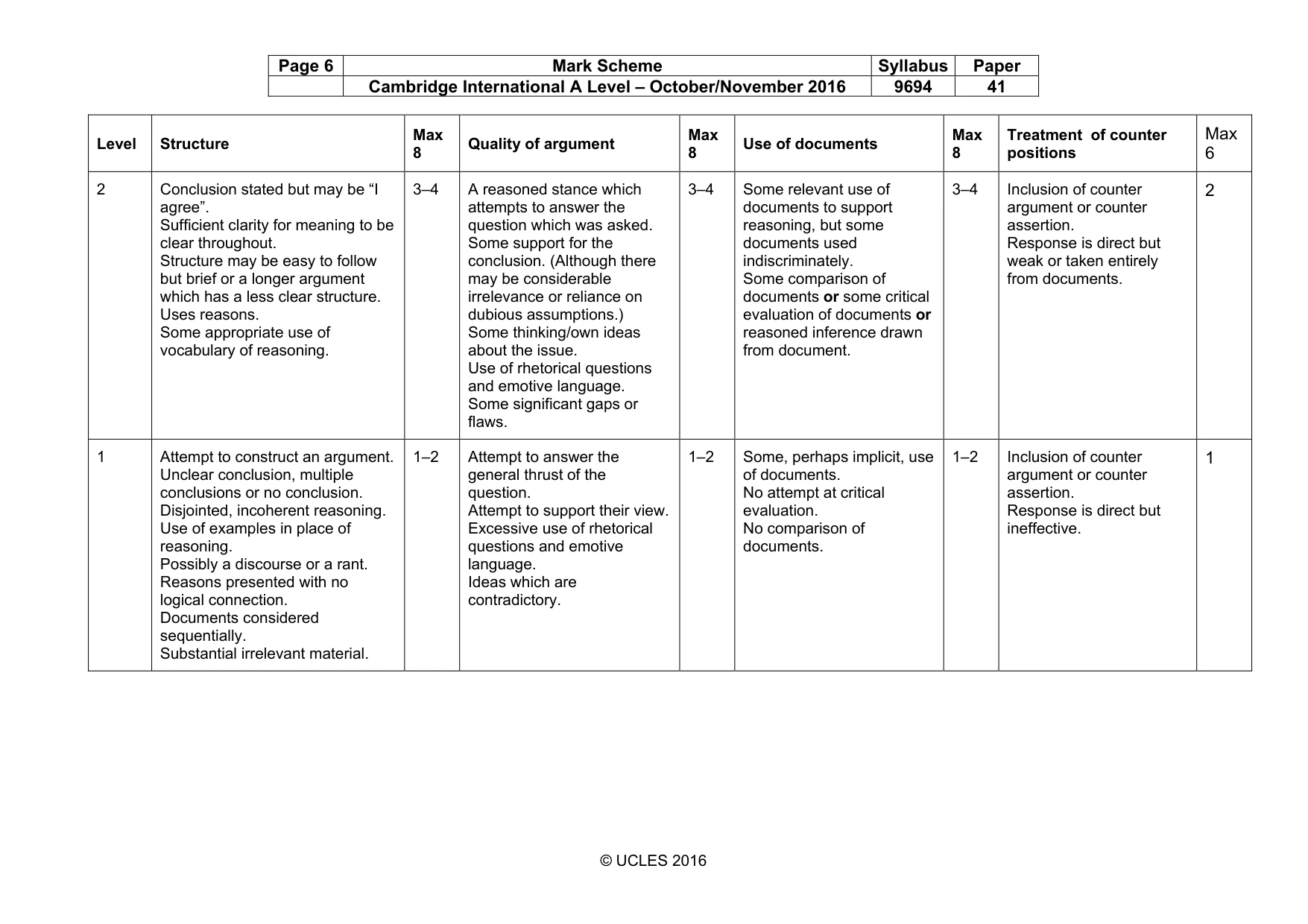
Page 6 Mark Scheme Syllabus Paper Cambridge International A Level – October/November 2016 9694 41 © UCLES 2016 Level Structure Max 8 Quality of argument Max 8 Use of documents Max 8 Treatment of counter positions Max 6 2 Conclusion stated but may be “I agree”. Sufficient clarity for meaning to be clear throughout. Structure may be easy to follow but brief or a longer argument which has a less clear structure. Uses reasons. Some appropriate use of vocabulary of reasoning. 3–4 A reasoned stance which attempts to answer the question which was asked. Some support for the conclusion. (Although there may be considerable irrelevance or reliance on dubious assumptions.) Some thinking/own ideas about the issue. Use of rhetorical questions and emotive language. Some significant gaps or flaws. 3–4 Some relevant use of documents to support reasoning, but some documents used indiscriminately. Some comparison of documents or some critical evaluation of documents or reasoned inference drawn from document. 3–4 Inclusion of counter argument or counter assertion. Response is direct but weak or taken entirely from documents. 2 1 Attempt to construct an argument. Unclear conclusion, multiple conclusions or no conclusion. Disjointed, incoherent reasoning. Use of examples in place of reasoning. Possibly a discourse or a rant. Reasons presented with no logical connection. Documents considered sequentially. Substantial irrelevant material. 1–2 Attempt to answer the general thrust of the question. Attempt to support their view. Excessive use of rhetorical questions and emotive language. Ideas which are contradictory. 1–2 Some, perhaps implicit, use of documents. No attempt at critical evaluation. No comparison of documents. 1–2 Inclusion of counter argument or counter assertion. Response is direct but ineffective. 1
Mark scheme, page 7
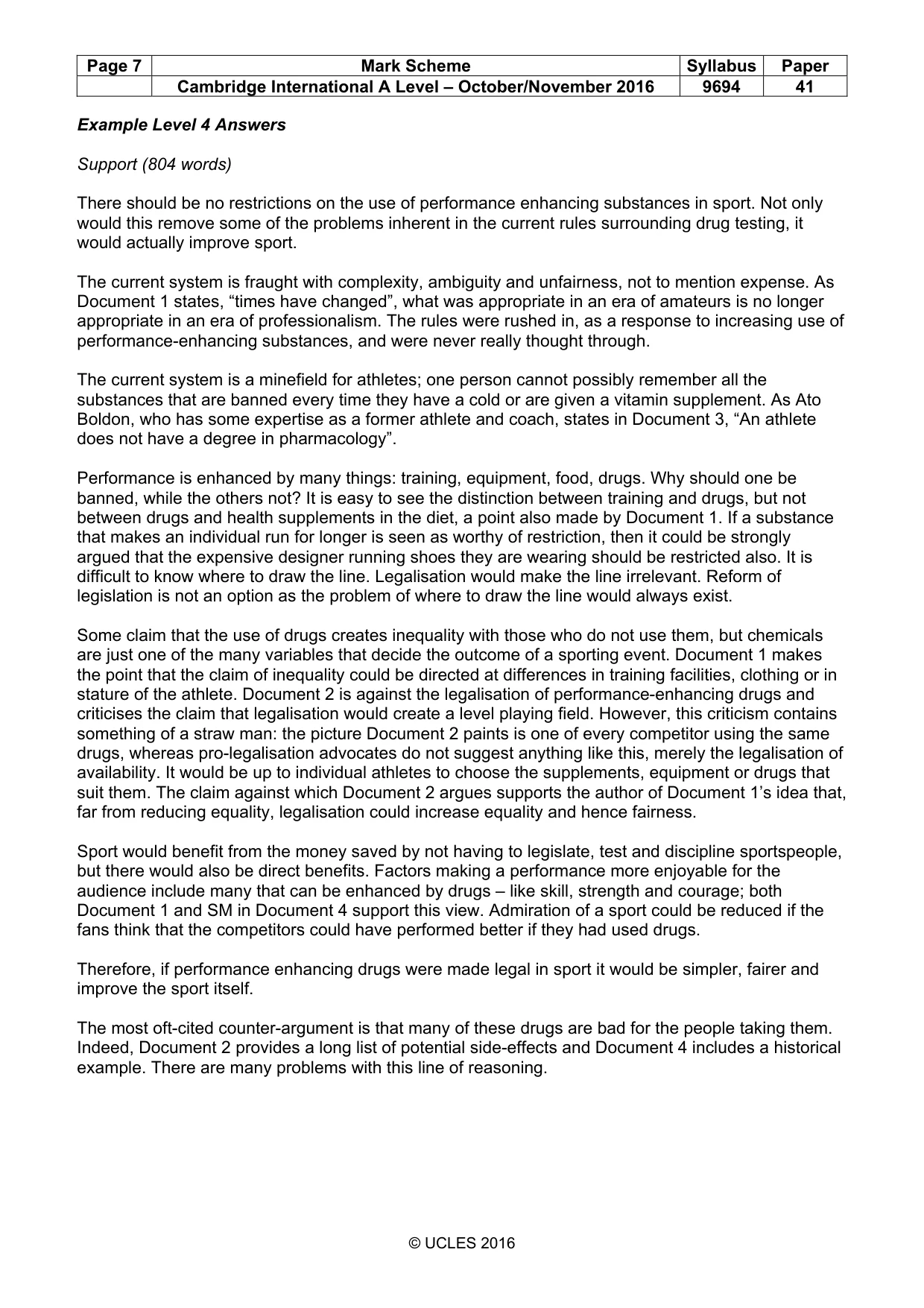
Page 7 Mark Scheme Syllabus Paper Cambridge International A Level – October/November 2016 9694 41 © UCLES 2016 Example Level 4 Answers Support (804 words) There should be no restrictions on the use of performance enhancing substances in sport. Not only would this remove some of the problems inherent in the current rules surrounding drug testing, it would actually improve sport. The current system is fraught with complexity, ambiguity and unfairness, not to mention expense. As Document 1 states, “times have changed”, what was appropriate in an era of amateurs is no longer appropriate in an era of professionalism. The rules were rushed in, as a response to increasing use of performance-enhancing substances, and were never really thought through. The current system is a minefield for athletes; one person cannot possibly remember all the substances that are banned every time they have a cold or are given a vitamin supplement. As Ato Boldon, who has some expertise as a former athlete and coach, states in Document 3, “An athlete does not have a degree in pharmacology”. Performance is enhanced by many things: training, equipment, food, drugs. Why should one be banned, while the others not? It is easy to see the distinction between training and drugs, but not between drugs and health supplements in the diet, a point also made by Document 1. If a substance that makes an individual run for longer is seen as worthy of restriction, then it could be strongly argued that the expensive designer running shoes they are wearing should be restricted also. It is difficult to know where to draw the line. Legalisation would make the line irrelevant. Reform of legislation is not an option as the problem of where to draw the line would always exist. Some claim that the use of drugs creates inequality with those who do not use them, but chemicals are just one of the many variables that decide the outcome of a sporting event. Document 1 makes the point that the claim of inequality could be directed at differences in training facilities, clothing or in stature of the athlete. Document 2 is against the legalisation of performance-enhancing drugs and criticises the claim that legalisation would create a level playing field. However, this criticism contains something of a straw man: the picture Document 2 paints is one of every competitor using the same drugs, whereas pro-legalisation advocates do not suggest anything like this, merely the legalisation of availability. It would be up to individual athletes to choose the supplements, equipment or drugs that suit them. The claim against which Document 2 argues supports the author of Document 1’s idea that, far from reducing equality, legalisation could increase equality and hence fairness. Sport would benefit from the money saved by not having to legislate, test and discipline sportspeople, but there would also be direct benefits. Factors making a performance more enjoyable for the audience include many that can be enhanced by drugs – like skill, strength and courage; both Document 1 and SM in Document 4 support this view. Admiration of a sport could be reduced if the fans think that the competitors could have performed better if they had used drugs. Therefore, if performance enhancing drugs were made legal in sport it would be simpler, fairer and improve the sport itself. The most oft-cited counter-argument is that many of these drugs are bad for the people taking them. Indeed, Document 2 provides a long list of potential side-effects and Document 4 includes a historical example. There are many problems with this line of reasoning.
Mark scheme, page 8
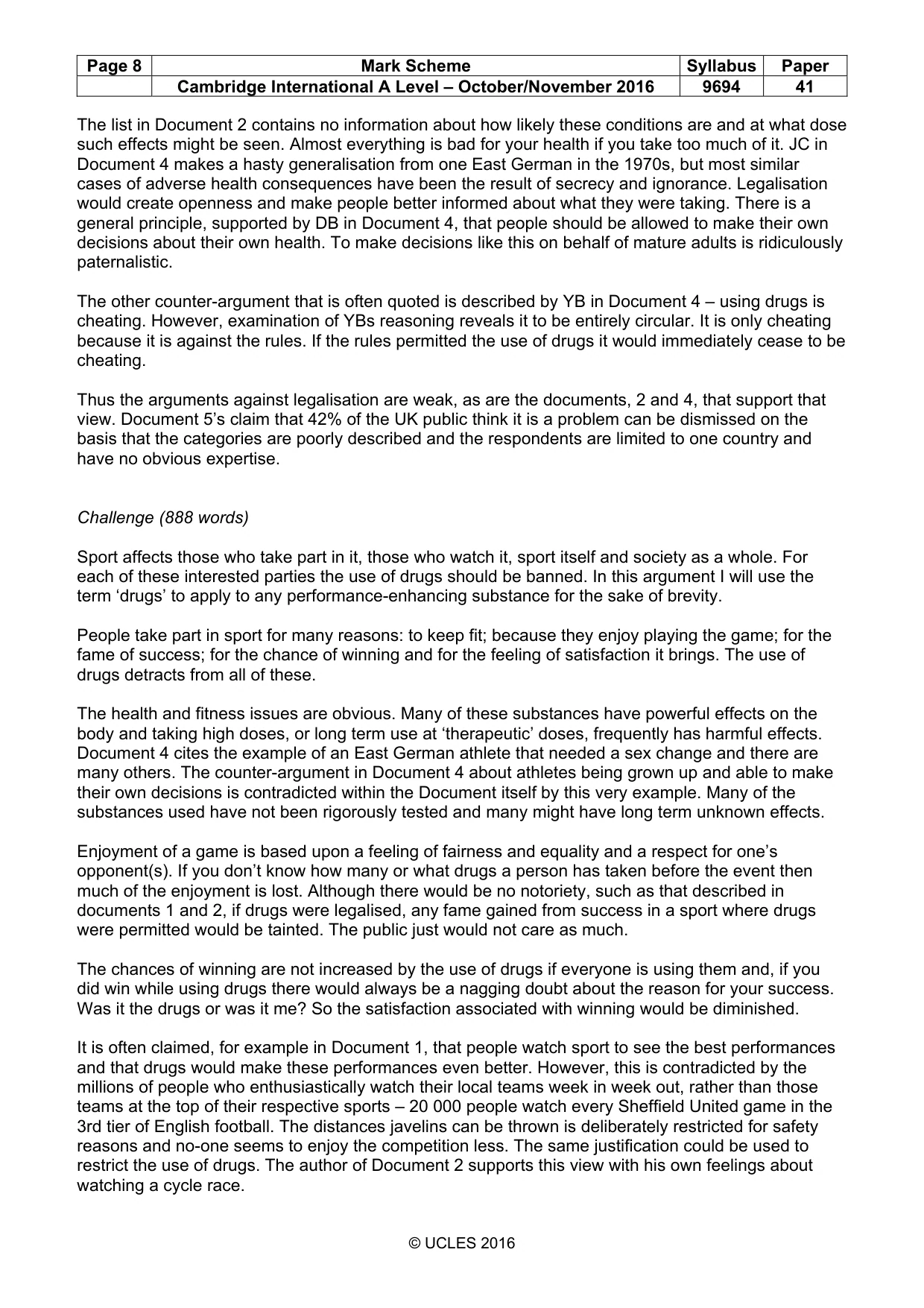
Page 8 Mark Scheme Syllabus Paper Cambridge International A Level – October/November 2016 9694 41 © UCLES 2016 The list in Document 2 contains no information about how likely these conditions are and at what dose such effects might be seen. Almost everything is bad for your health if you take too much of it. JC in Document 4 makes a hasty generalisation from one East German in the 1970s, but most similar cases of adverse health consequences have been the result of secrecy and ignorance. Legalisation would create openness and make people better informed about what they were taking. There is a general principle, supported by DB in Document 4, that people should be allowed to make their own decisions about their own health. To make decisions like this on behalf of mature adults is ridiculously paternalistic. The other counter-argument that is often quoted is described by YB in Document 4 – using drugs is cheating. However, examination of YBs reasoning reveals it to be entirely circular. It is only cheating because it is against the rules. If the rules permitted the use of drugs it would immediately cease to be cheating. Thus the arguments against legalisation are weak, as are the documents, 2 and 4, that support that view. Document 5’s claim that 42% of the UK public think it is a problem can be dismissed on the basis that the categories are poorly described and the respondents are limited to one country and have no obvious expertise. Challenge (888 words) Sport affects those who take part in it, those who watch it, sport itself and society as a whole. For each of these interested parties the use of drugs should be banned. In this argument I will use the term ‘drugs’ to apply to any performance-enhancing substance for the sake of brevity. People take part in sport for many reasons: to keep fit; because they enjoy playing the game; for the fame of success; for the chance of winning and for the feeling of satisfaction it brings. The use of drugs detracts from all of these. The health and fitness issues are obvious. Many of these substances have powerful effects on the body and taking high doses, or long term use at ‘therapeutic’ doses, frequently has harmful effects. Document 4 cites the example of an East German athlete that needed a sex change and there are many others. The counter-argument in Document 4 about athletes being grown up and able to make their own decisions is contradicted within the Document itself by this very example. Many of the substances used have not been rigorously tested and many might have long term unknown effects. Enjoyment of a game is based upon a feeling of fairness and equality and a respect for one’s opponent(s). If you don’t know how many or what drugs a person has taken before the event then much of the enjoyment is lost. Although there would be no notoriety, such as that described in documents 1 and 2, if drugs were legalised, any fame gained from success in a sport where drugs were permitted would be tainted. The public just would not care as much. The chances of winning are not increased by the use of drugs if everyone is using them and, if you did win while using drugs there would always be a nagging doubt about the reason for your success. Was it the drugs or was it me? So the satisfaction associated with winning would be diminished. It is often claimed, for example in Document 1, that people watch sport to see the best performances and that drugs would make these performances even better. However, this is contradicted by the millions of people who enthusiastically watch their local teams week in week out, rather than those teams at the top of their respective sports – 20 000 people watch every Sheffield United game in the 3rd tier of English football. The distances javelins can be thrown is deliberately restricted for safety reasons and no-one seems to enjoy the competition less. The same justification could be used to restrict the use of drugs. The author of Document 2 supports this view with his own feelings about watching a cycle race.
Mark scheme, page 9
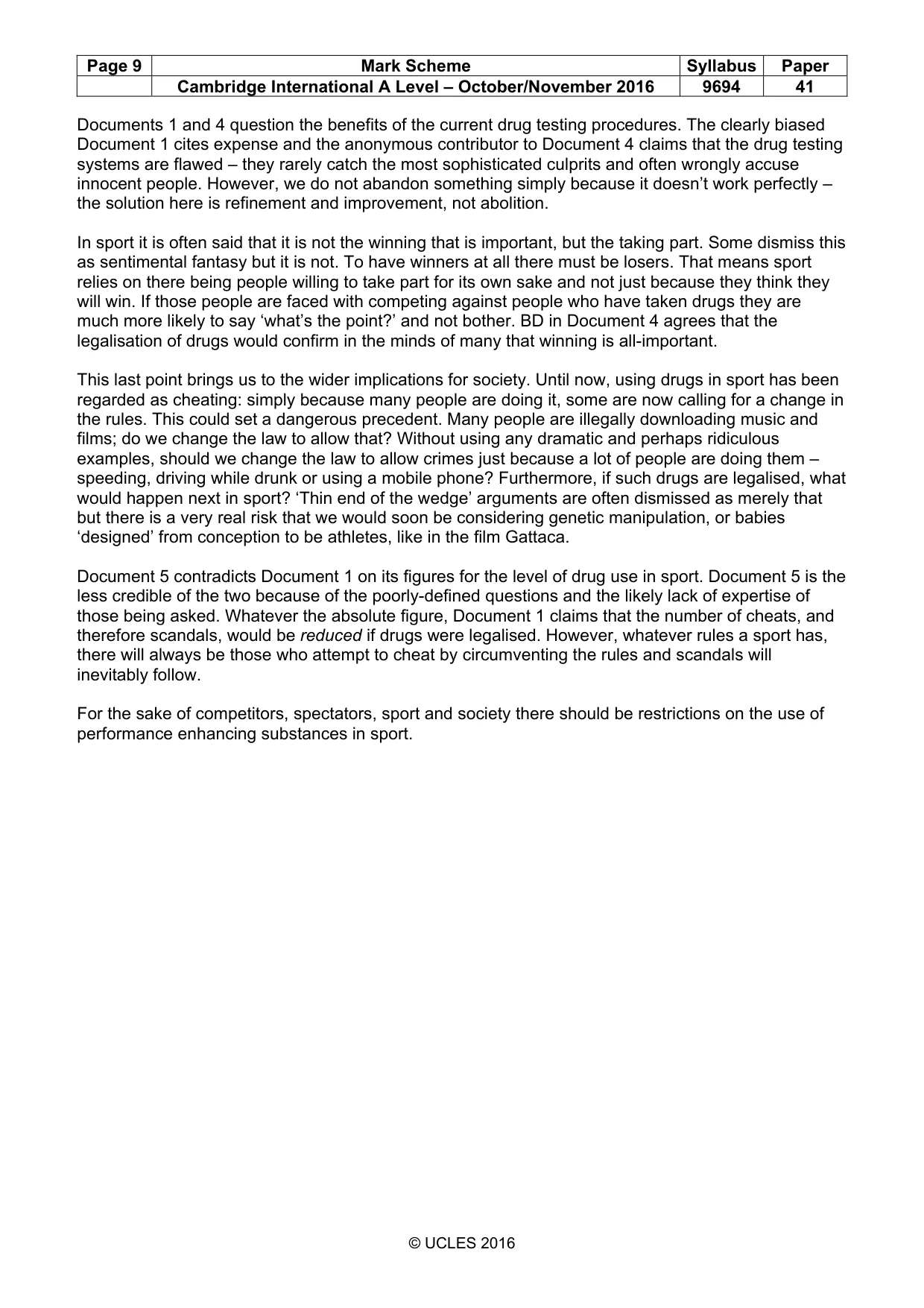
Page 9 Mark Scheme Syllabus Paper Cambridge International A Level – October/November 2016 9694 41 © UCLES 2016 Documents 1 and 4 question the benefits of the current drug testing procedures. The clearly biased Document 1 cites expense and the anonymous contributor to Document 4 claims that the drug testing systems are flawed – they rarely catch the most sophisticated culprits and often wrongly accuse innocent people. However, we do not abandon something simply because it doesn’t work perfectly – the solution here is refinement and improvement, not abolition. In sport it is often said that it is not the winning that is important, but the taking part. Some dismiss this as sentimental fantasy but it is not. To have winners at all there must be losers. That means sport relies on there being people willing to take part for its own sake and not just because they think they will win. If those people are faced with competing against people who have taken drugs they are much more likely to say ‘what’s the point?’ and not bother. BD in Document 4 agrees that the legalisation of drugs would confirm in the minds of many that winning is all-important. This last point brings us to the wider implications for society. Until now, using drugs in sport has been regarded as cheating: simply because many people are doing it, some are now calling for a change in the rules. This could set a dangerous precedent. Many people are illegally downloading music and films; do we change the law to allow that? Without using any dramatic and perhaps ridiculous examples, should we change the law to allow crimes just because a lot of people are doing them – speeding, driving while drunk or using a mobile phone? Furthermore, if such drugs are legalised, what would happen next in sport? ‘Thin end of the wedge’ arguments are often dismissed as merely that but there is a very real risk that we would soon be considering genetic manipulation, or babies ‘designed’ from conception to be athletes, like in the film Gattaca. Document 5 contradicts Document 1 on its figures for the level of drug use in sport. Document 5 is the less credible of the two because of the poorly-defined questions and the likely lack of expertise of those being asked. Whatever the absolute figure, Document 1 claims that the number of cheats, and therefore scandals, would be reduced if drugs were legalised. However, whatever rules a sport has, there will always be those who attempt to cheat by circumventing the rules and scandals will inevitably follow. For the sake of competitors, spectators, sport and society there should be restrictions on the use of performance enhancing substances in sport.
What you needed in this session
Cambridge’s own grade thresholds for 2016 Oct/Nov, Paper 4 · Variant 1. A higher threshold means an easier paper — the bar moves with how the cohort did.