Cambridge A Level Thinking Skills 9694 — 2016 Oct/Nov Paper 4 · Variant 2
9694/42/O/N/16 · 50 marks · ≈56 min
The question paper and its mark scheme, free to read here and free to download. This is Cambridge’s own paper, exactly as it was sat.
Question paper8 pages

Mark scheme9 pages
Answers below. Sit the paper first if you are practising.
Paper as text
Question paper, page 1
This document consists of 7 printed pages, 1 blank page and 1 insert. DC (LEG/JG) 117042/2 © UCLES 2016 [Turn over Cambridge International Examinations Cambridge International Advanced Level * 0 8 2 6 2 0 4 6 5 2 * THINKING SKILLS 9694/42 Paper 4 Applied Reasoning October/November 2016 1 hour 30 minutes No Additional Materials are required. READ THESE INSTRUCTIONS FIRST An answer booklet is provided inside this question paper. You should follow the instructions on the front cover of the answer booklet. If you need additional answer paper ask the invigilator for a continuation booklet. Answer all the questions. The number of marks is given in brackets [ ] at the end of each question.
Question paper, page 2
2 9694/42/O/N/16 © UCLES 2016 1 Study the information below and answer the question that follows. Whole building abandoned in cancer scare An office building in Australia was abandoned after it became associated with a higher than average incidence of breast cancer. The average incidence of breast cancer in Australia is 60 per 100 000 population per year. However, 12 women from a single building, where only 200 people worked, were diagnosed with breast cancer over a period of 11 years. The causes of the outbreak were tested in a five-month investigation by an independent review panel. They tested for known cancer-causing chemicals in the water supply and air-conditioning as well as building radiation levels and all were within normal safe levels. Since there was no other obvious explanation, it was decided to abandon the building completely. Make five criticisms of the decision to abandon the building on the basis of the statistics and other information presented in the passage. [5] Questions 2, 3 and 4 refer to Documents 1 to 5. 2 Briefly analyse Trib’s argument in Document 1: Who gets to vote?, by identifying its main conclusion, intermediate conclusions and counter-assertions. [6] 3 Give a critical evaluation of the strength of Trib’s argument in Document 1: Who gets to vote?, by identifying and explaining any flaws, implicit assumptions and other weaknesses. [9] 4 ‘The age at which people are allowed to vote in elections should be 21.’ Construct a reasoned argument to support or challenge this claim, commenting critically on some or all of Documents 1 to 5 and introducing ideas of your own. [30]
Question paper, page 3
3 9694/42/O/N/16 © UCLES 2016 [Turn over DOCUMENT 1 Who gets to vote? People often look forward with excitement to their 16th, 17th, 18th or 21st birthday. Depending on which country you live in, this could be the age at which you can drive, get married, or buy alcohol – at least legally. We do have these laws for a reason – nobody wants to see a toddler behind the wheel of a car – but age should not be used as a criterion in deciding who should select the next government. Our obsession with age has distorted our reasoning in so many areas of life. Voting is different from other issues and far too important to be based on such an arbitrary measure as a person’s age. Drinking, relationships and driving are personal matters but voting affects other people. Governments are responsible for law and order, education, prosperity, international peace and the environment, and these things apply to you, your neighbours and people on the other side of the planet. In deciding who should govern us we need to take into account politics, economics, science and human nature. We do not suddenly develop a full understanding of these things when we wake up on our 18th birthday. Many politicians have advocated lowering the voting age in an attempt to show that they are ‘in touch with young people’, but young people care less about voting and more about fashion and music. As a less dangerous alternative to these vote-grabbing measures, many areas have set up ‘youth parliaments’. In the town of Middlesbrough in the north of England most of the local schools entered a candidate to be Youth Mayor of Middlesbrough. Unsurprisingly, the candidate from the school that cast the most votes won the election. This just shows that teenagers will vote for the candidate they perceive to be on their team, rather than consider the policies on offer. Imagine you have applied for an important job, such as running a school, hospital or large corporation. You turn up for the job interview, and there on the panel are two 18-year-olds. Are you going to think, “This company has its finger on the pulse, I’d like to work here”? Or would you make your excuses and leave? In terms of deciding anything, age is largely meaningless anyway. We might as well separate people based on height. Everyone knows people of the same age with wildly differing abilities, or people of different ages with the same ability. There is no upper age limit for voting. Nobody says “Sorry granddad, take your opinion elsewhere.” So there should not be a lower age limit. Of course there has to be some way of deciding who votes. Babies cannot do it and age is at least easy to apply. Alternative systems are practical, though. A basic questionnaire, similar to an IQ test, would be straightforward to administer. People registering to vote could complete the test, which would include questions on general knowledge as well as cognitive ability. Those who get above a certain score are registered to vote; those who do not can try again next time. That way the people who get to vote are those who deserve to. Trib
Question paper, page 4
4 9694/42/O/N/16 © UCLES 2016 DOCUMENT 2 The minimum legal voting age of 25 years and its consequences in Italy When asked about the minimum legal voting age in the world, your answer would probably be 18 years. You would be right, as this is the average and most common minimum legal voting age across the globe, with only 27 exceptions where it varies between 16 and 21 years. Only one country goes outside this range: the minimum legal voting age for the Senate in Italy is 25. The political, societal and economic consequences of this unusual constraint in Italy may well affect the whole of Europe. Out of the 50.3 million 18-year-old and older Italian citizens who are entitled to vote for the Chamber of Deputies, 4.3 million (8%) are not allowed to vote for the Senate. Given the substantially different electorates of the two chambers, the political make-up of the Senate and that of the Chamber of Deputies are often different. This was the case in Italy’s elections in February, which have led to the formation of an odd coalition of left, right and middle parties, the 62nd government in just 68 years. The minimum legal voting age of 25 is both the cause and the consequence of other imbalances in Italy, most often to the disadvantage of the young. In Italy, social spending on the elderly is more than twice as high as in Europe’s most successful economies. Italy has the fifth-highest poverty rate among young people. The public debt per young person is €220 000, compared with just €4600 in Estonia. In Italy, the interests of the elderly are well defended by pensioners’ lobby groups, but young people do not have a similar voice. Lastly, many Italian senior citizens have greater power than senior citizens living elsewhere. In Italy, most influential positions in politics and business are often occupied by men who could be the fathers or grandfathers of their counterparts in other nations. The President of the Republic, Giorgio Napolitano, is 88 years old. The former (and perhaps returning) prime minister, Silvio Berlusconi, is almost 77 years old. With one in two adults under 25 unemployed, it is ironic that the group most in need of political change is without full voting rights. The younger generation deserves a stronger role in politics to secure a better future. Despite decades of active debate surrounding this issue, the desperately needed reforms of Italian institutions are unlikely to be realised in the near future. Lowering the voting age from 25 to 18 is a simple measure that could be done immediately and at zero cost. The resulting intergenerational balance would offer more political stability in Italy, which could, in turn, relax Italy’s burden on Europe.
Question paper, page 5
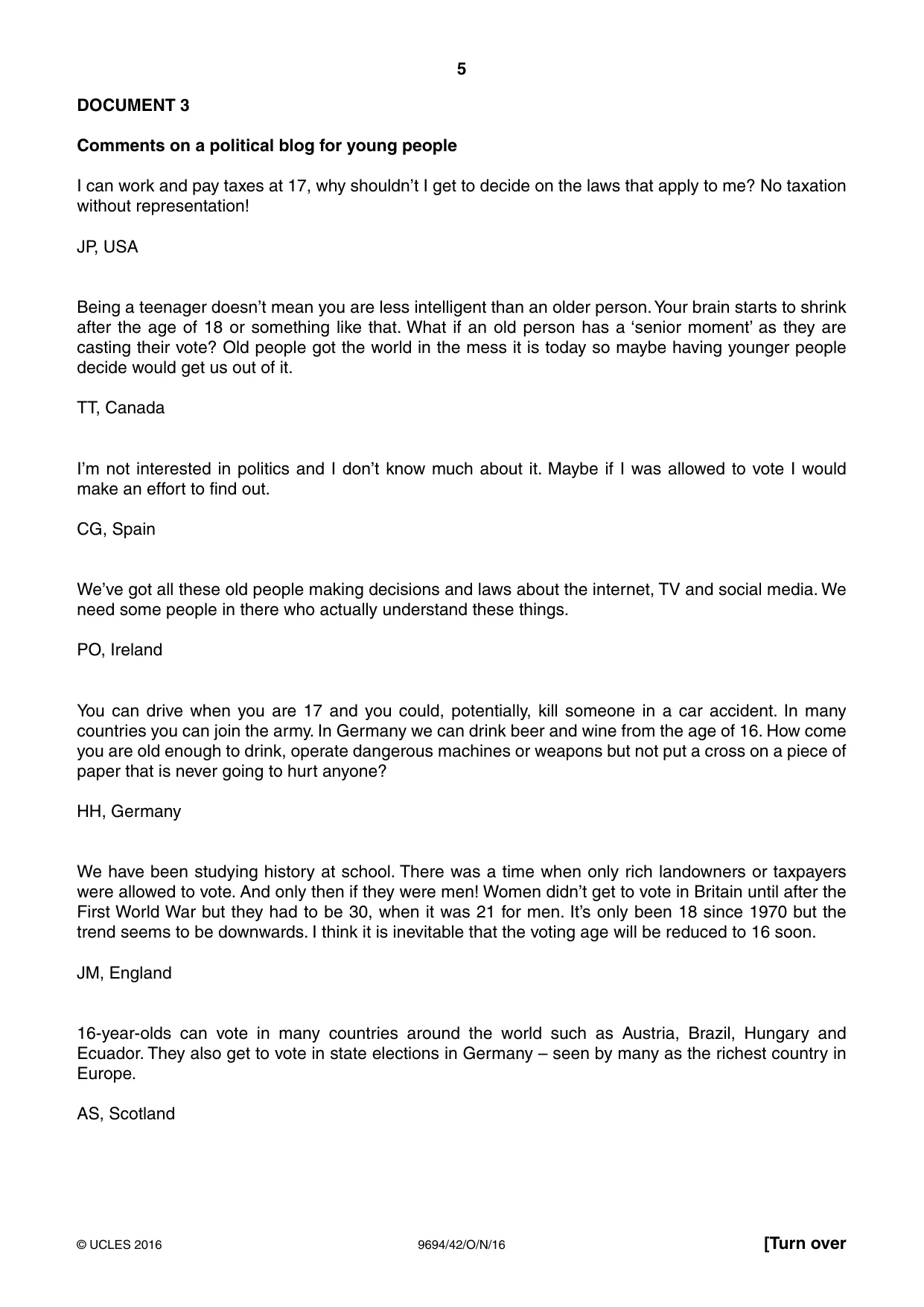
5 9694/42/O/N/16 © UCLES 2016 [Turn over DOCUMENT 3 Comments on a political blog for young people I can work and pay taxes at 17, why shouldn’t I get to decide on the laws that apply to me? No taxation without representation! JP, USA Being a teenager doesn’t mean you are less intelligent than an older person. Your brain starts to shrink after the age of 18 or something like that. What if an old person has a ‘senior moment’ as they are casting their vote? Old people got the world in the mess it is today so maybe having younger people decide would get us out of it. TT, Canada I’m not interested in politics and I don’t know much about it. Maybe if I was allowed to vote I would make an effort to find out. CG, Spain We’ve got all these old people making decisions and laws about the internet, TV and social media. We need some people in there who actually understand these things. PO, Ireland You can drive when you are 17 and you could, potentially, kill someone in a car accident. In many countries you can join the army. In Germany we can drink beer and wine from the age of 16. How come you are old enough to drink, operate dangerous machines or weapons but not put a cross on a piece of paper that is never going to hurt anyone? HH, Germany We have been studying history at school. There was a time when only rich landowners or taxpayers were allowed to vote. And only then if they were men! Women didn’t get to vote in Britain until after the First World War but they had to be 30, when it was 21 for men. It’s only been 18 since 1970 but the trend seems to be downwards. I think it is inevitable that the voting age will be reduced to 16 soon. JM, England 16-year-olds can vote in many countries around the world such as Austria, Brazil, Hungary and Ecuador. They also get to vote in state elections in Germany – seen by many as the richest country in Europe. AS, Scotland
Question paper, page 6
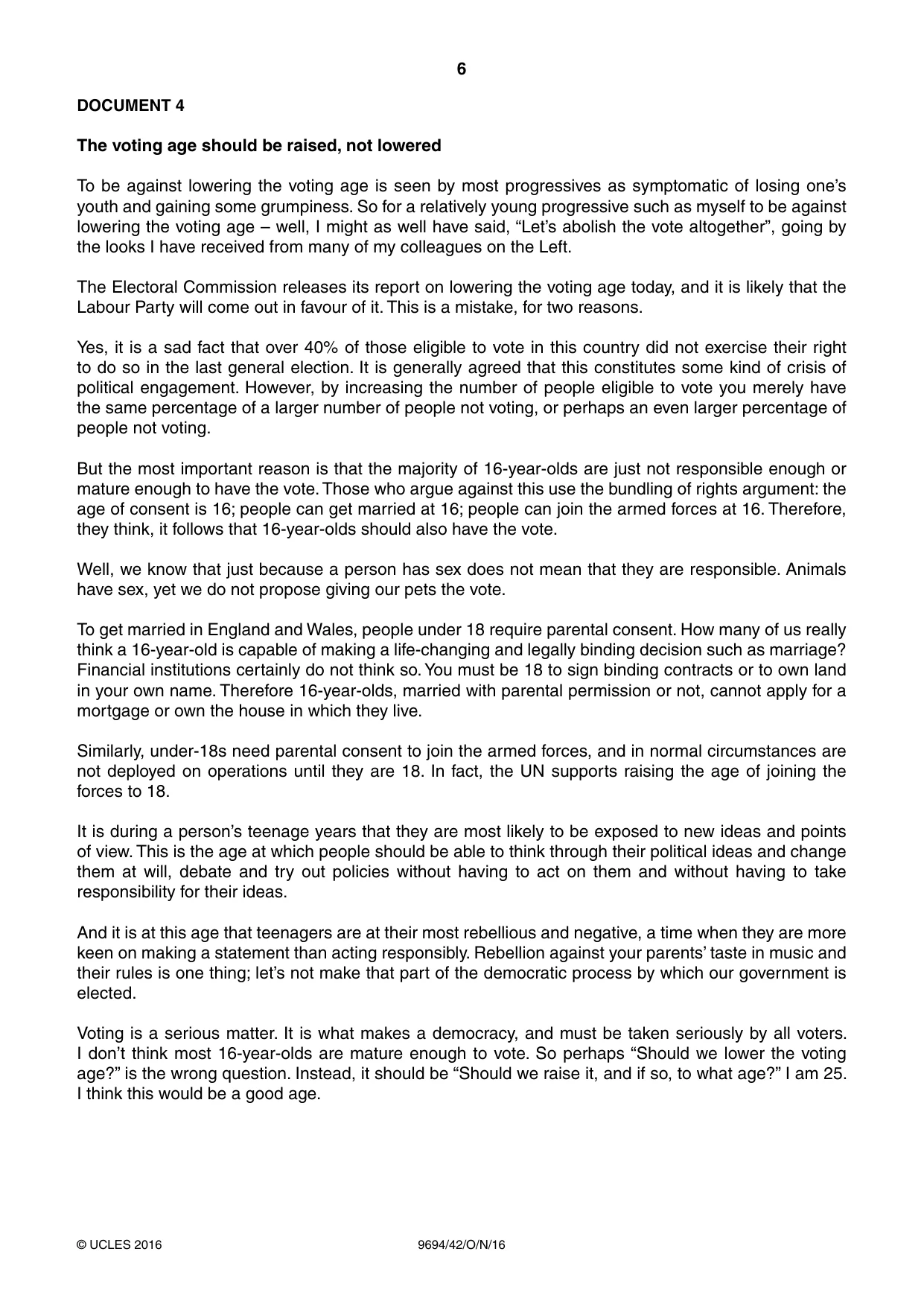
6 9694/42/O/N/16 © UCLES 2016 DOCUMENT 4 The voting age should be raised, not lowered To be against lowering the voting age is seen by most progressives as symptomatic of losing one’s youth and gaining some grumpiness. So for a relatively young progressive such as myself to be against lowering the voting age – well, I might as well have said, “Let’s abolish the vote altogether”, going by the looks I have received from many of my colleagues on the Left. The Electoral Commission releases its report on lowering the voting age today, and it is likely that the Labour Party will come out in favour of it. This is a mistake, for two reasons. Yes, it is a sad fact that over 40% of those eligible to vote in this country did not exercise their right to do so in the last general election. It is generally agreed that this constitutes some kind of crisis of political engagement. However, by increasing the number of people eligible to vote you merely have the same percentage of a larger number of people not voting, or perhaps an even larger percentage of people not voting. But the most important reason is that the majority of 16-year-olds are just not responsible enough or mature enough to have the vote. Those who argue against this use the bundling of rights argument: the age of consent is 16; people can get married at 16; people can join the armed forces at 16. Therefore, they think, it follows that 16-year-olds should also have the vote. Well, we know that just because a person has sex does not mean that they are responsible. Animals have sex, yet we do not propose giving our pets the vote. To get married in England and Wales, people under 18 require parental consent. How many of us really think a 16-year-old is capable of making a life-changing and legally binding decision such as marriage? Financial institutions certainly do not think so. You must be 18 to sign binding contracts or to own land in your own name. Therefore 16-year-olds, married with parental permission or not, cannot apply for a mortgage or own the house in which they live. Similarly, under-18s need parental consent to join the armed forces, and in normal circumstances are not deployed on operations until they are 18. In fact, the UN supports raising the age of joining the forces to 18. It is during a person’s teenage years that they are most likely to be exposed to new ideas and points of view. This is the age at which people should be able to think through their political ideas and change them at will, debate and try out policies without having to act on them and without having to take responsibility for their ideas. And it is at this age that teenagers are at their most rebellious and negative, a time when they are more keen on making a statement than acting responsibly. Rebellion against your parents’ taste in music and their rules is one thing; let’s not make that part of the democratic process by which our government is elected. Voting is a serious matter. It is what makes a democracy, and must be taken seriously by all voters. I don’t think most 16-year-olds are mature enough to vote. So perhaps “Should we lower the voting age?” is the wrong question. Instead, it should be “Should we raise it, and if so, to what age?” I am 25. I think this would be a good age.
Question paper, page 7
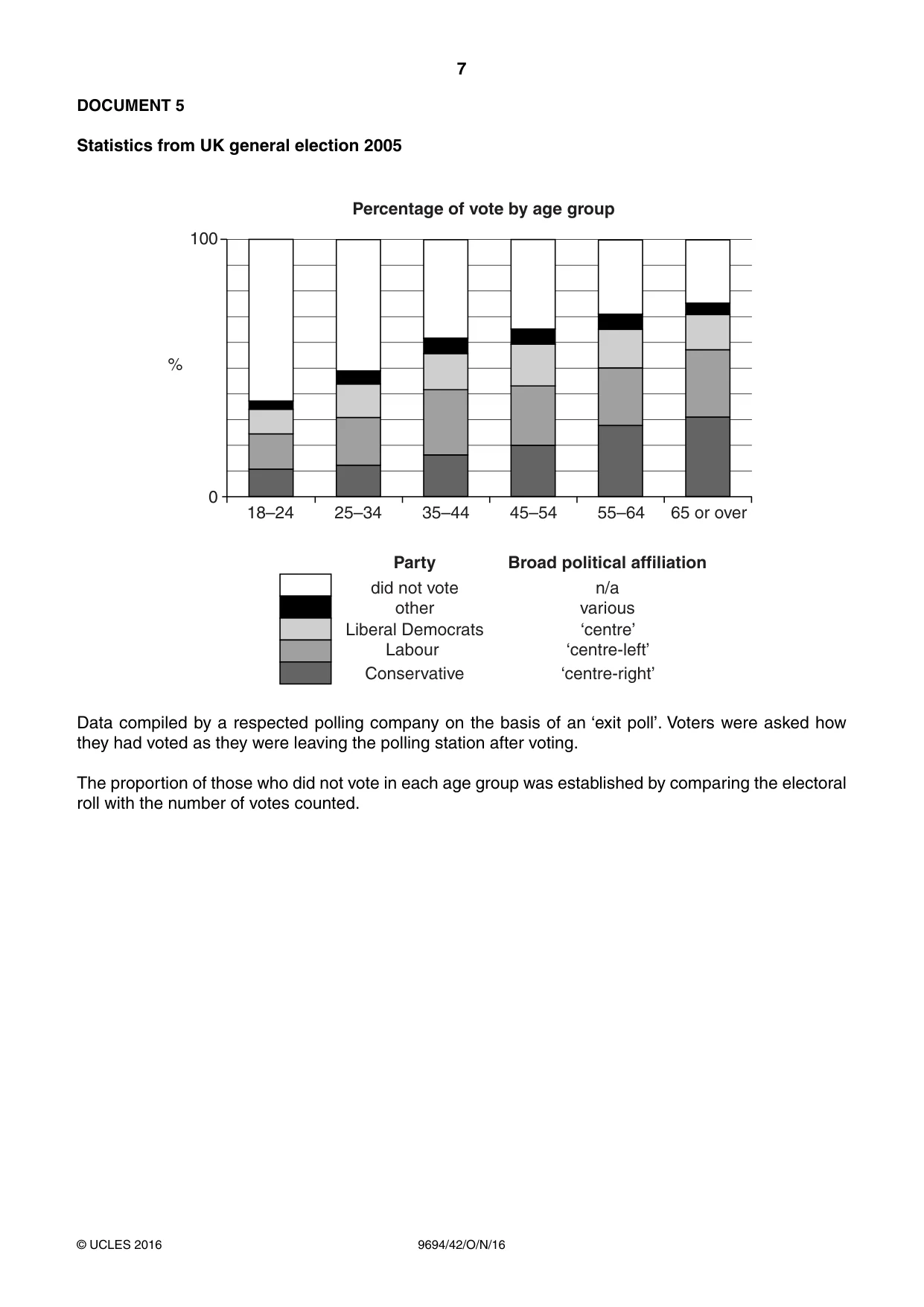
7 9694/42/O/N/16 © UCLES 2016 DOCUMENT 5 Statistics from UK general election 2005 18–24 100 0 % 25–34 35–44 45–54 55–64 65 or over did not vote Percentage of vote by age group Party other Liberal Democrats Labour Conservative n/a Broad political affiliation various ‘centre’ ‘centre-left’ ‘centre-right’ D ata compiled by a respected polling company on the basis of an ‘exit poll’. Voters were asked how they had voted as they were leaving the polling station after voting. The proportion of those who did not vote in each age group was established by comparing the electoral roll with the number of votes counted.
Question paper, page 8
8 9694/42/O/N/16 © UCLES 2016 BLANK PAGE Permission to reproduce items where third-party owned material protected by copyright is included has been sought and cleared where possible. Every reasonable effort has been made by the publisher (UCLES) to trace copyright holders, but if any items requiring clearance have unwittingly been included, the publisher will be pleased to make amends at the earliest possible opportunity. To avoid the issue of disclosure of answer-related information to candidates, all copyright acknowledgements are reproduced online in the Cambridge International Examinations Copyright Acknowledgements Booklet. This is produced for each series of examinations and is freely available to download at www.cie.org.uk after the live examination series. Cambridge International Examinations is part of the Cambridge Assessment Group. Cambridge Assessment is the brand name of University of Cambridge Local Examinations Syndicate (UCLES), which is itself a department of the University of Cambridge.
Mark scheme, page 1
® IGCSE is the registered trademark of Cambridge International Examinations. This document consists of 9 printed pages. © UCLES 2016 [Turn over Cambridge International Examinations Cambridge International Advanced Level THINKING SKILLS 9694/42 Paper 4 Applied Reasoning October/November 2016 MARK SCHEME Maximum Mark: 50 Published This mark scheme is published as an aid to teachers and candidates, to indicate the requirements of the examination. It shows the basis on which Examiners were instructed to award marks. It does not indicate the details of the discussions that took place at an Examiners’ meeting before marking began, which would have considered the acceptability of alternative answers. Mark schemes should be read in conjunction with the question paper and the Principal Examiner Report for Teachers. Cambridge will not enter into discussions about these mark schemes. Cambridge is publishing the mark schemes for the October/November 2016 series for most Cambridge IGCSE®, Cambridge International A and AS Level components and some Cambridge O Level components.
Mark scheme, page 2
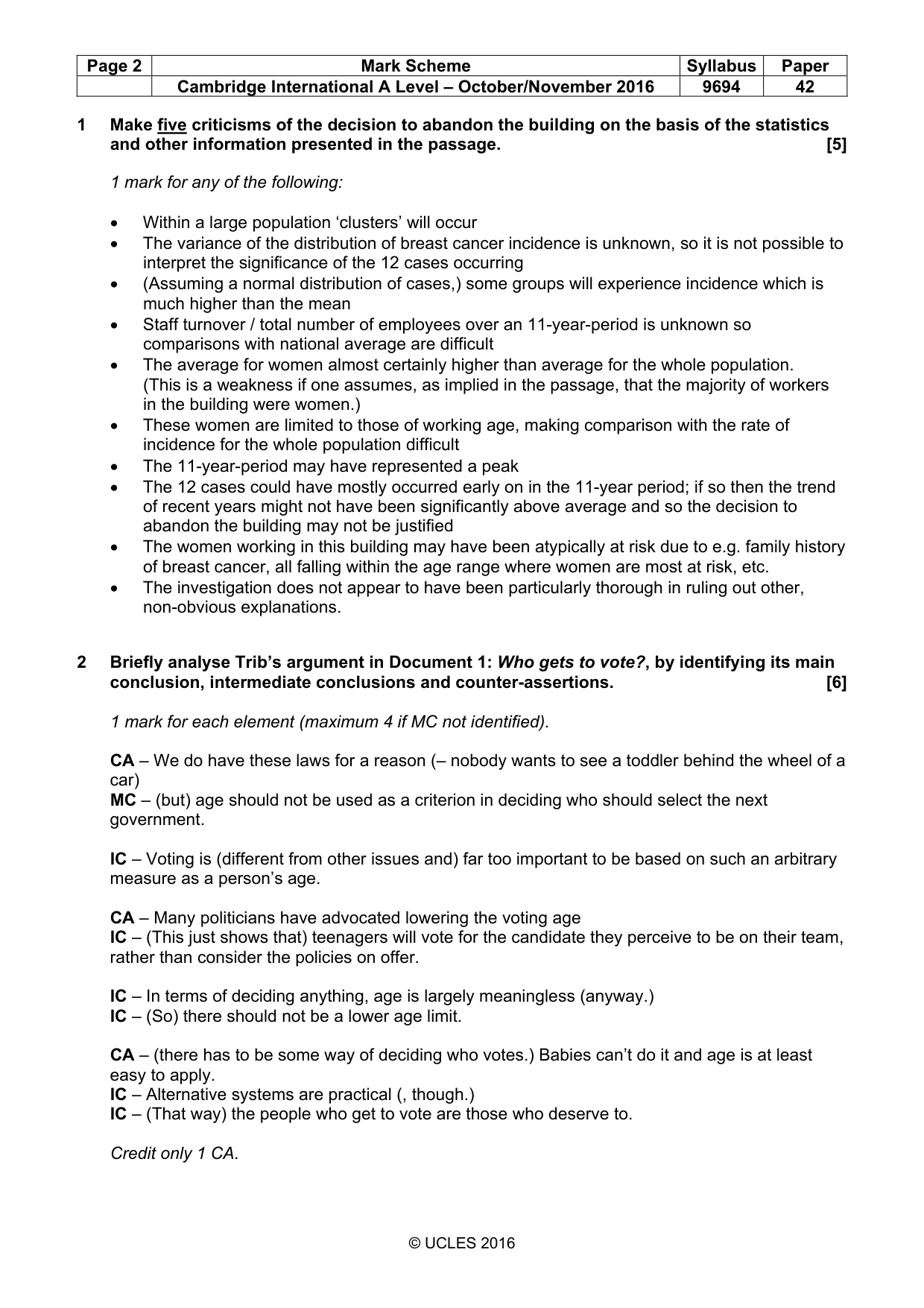
Page 2 Mark Scheme Syllabus Paper Cambridge International A Level – October/November 2016 9694 42 © UCLES 2016 1 Make five criticisms of the decision to abandon the building on the basis of the statistics and other information presented in the passage. [5] 1 mark for any of the following: • Within a large population ‘clusters’ will occur • The variance of the distribution of breast cancer incidence is unknown, so it is not possible to interpret the significance of the 12 cases occurring • (Assuming a normal distribution of cases,) some groups will experience incidence which is much higher than the mean • Staff turnover / total number of employees over an 11-year-period is unknown so comparisons with national average are difficult • The average for women almost certainly higher than average for the whole population. (This is a weakness if one assumes, as implied in the passage, that the majority of workers in the building were women.) • These women are limited to those of working age, making comparison with the rate of incidence for the whole population difficult • The 11-year-period may have represented a peak • The 12 cases could have mostly occurred early on in the 11-year period; if so then the trend of recent years might not have been significantly above average and so the decision to abandon the building may not be justified • The women working in this building may have been atypically at risk due to e.g. family history of breast cancer, all falling within the age range where women are most at risk, etc. • The investigation does not appear to have been particularly thorough in ruling out other, non-obvious explanations. 2 Briefly analyse Trib’s argument in Document 1: Who gets to vote?, by identifying its main conclusion, intermediate conclusions and counter-assertions. [6] 1 mark for each element (maximum 4 if MC not identified). CA – We do have these laws for a reason (– nobody wants to see a toddler behind the wheel of a car) MC – (but) age should not be used as a criterion in deciding who should select the next government. IC – Voting is (different from other issues and) far too important to be based on such an arbitrary measure as a person’s age. CA – Many politicians have advocated lowering the voting age IC – (This just shows that) teenagers will vote for the candidate they perceive to be on their team, rather than consider the policies on offer. IC – In terms of deciding anything, age is largely meaningless (anyway.) IC – (So) there should not be a lower age limit. CA – (there has to be some way of deciding who votes.) Babies can’t do it and age is at least easy to apply. IC – Alternative systems are practical (, though.) IC – (That way) the people who get to vote are those who deserve to. Credit only 1 CA.
Mark scheme, page 3
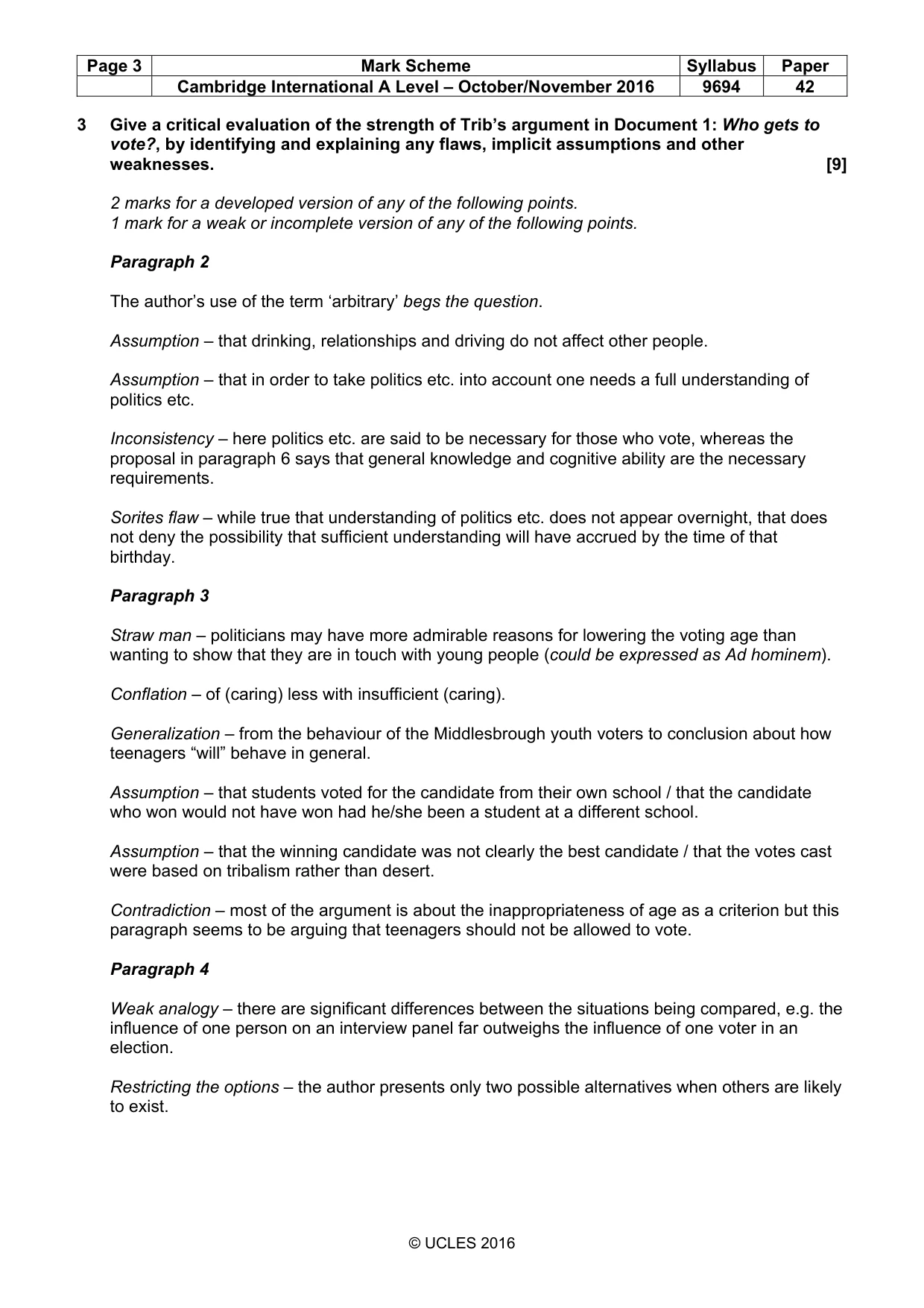
Page 3 Mark Scheme Syllabus Paper Cambridge International A Level – October/November 2016 9694 42 © UCLES 2016 3 Give a critical evaluation of the strength of Trib’s argument in Document 1: Who gets to vote?, by identifying and explaining any flaws, implicit assumptions and other weaknesses. [9] 2 marks for a developed version of any of the following points. 1 mark for a weak or incomplete version of any of the following points. Paragraph 2 The author’s use of the term ‘arbitrary’ begs the question. Assumption – that drinking, relationships and driving do not affect other people. Assumption – that in order to take politics etc. into account one needs a full understanding of politics etc. Inconsistency – here politics etc. are said to be necessary for those who vote, whereas the proposal in paragraph 6 says that general knowledge and cognitive ability are the necessary requirements. Sorites flaw – while true that understanding of politics etc. does not appear overnight, that does not deny the possibility that sufficient understanding will have accrued by the time of that birthday. Paragraph 3 Straw man – politicians may have more admirable reasons for lowering the voting age than wanting to show that they are in touch with young people (could be expressed as Ad hominem). Conflation – of (caring) less with insufficient (caring). Generalization – from the behaviour of the Middlesbrough youth voters to conclusion about how teenagers “will” behave in general. Assumption – that students voted for the candidate from their own school / that the candidate who won would not have won had he/she been a student at a different school. Assumption – that the winning candidate was not clearly the best candidate / that the votes cast were based on tribalism rather than desert. Contradiction – most of the argument is about the inappropriateness of age as a criterion but this paragraph seems to be arguing that teenagers should not be allowed to vote. Paragraph 4 Weak analogy – there are significant differences between the situations being compared, e.g. the influence of one person on an interview panel far outweighs the influence of one voter in an election. Restricting the options – the author presents only two possible alternatives when others are likely to exist.
Mark scheme, page 4
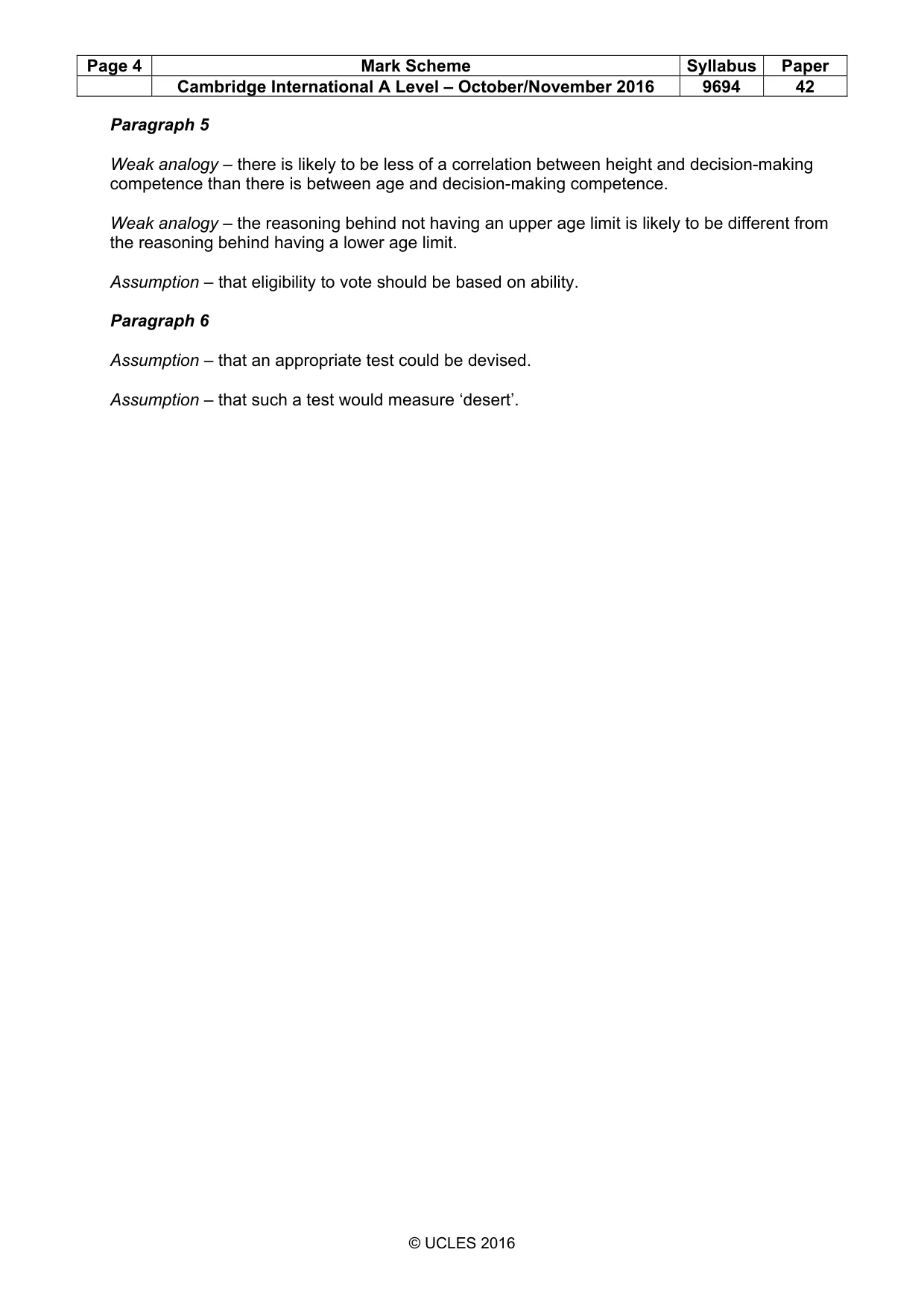
Page 4 Mark Scheme Syllabus Paper Cambridge International A Level – October/November 2016 9694 42 © UCLES 2016 Paragraph 5 Weak analogy – there is likely to be less of a correlation between height and decision-making competence than there is between age and decision-making competence. Weak analogy – the reasoning behind not having an upper age limit is likely to be different from the reasoning behind having a lower age limit. Assumption – that eligibility to vote should be based on ability. Paragraph 6 Assumption – that an appropriate test could be devised. Assumption – that such a test would measure ‘desert’.
Mark scheme, page 5
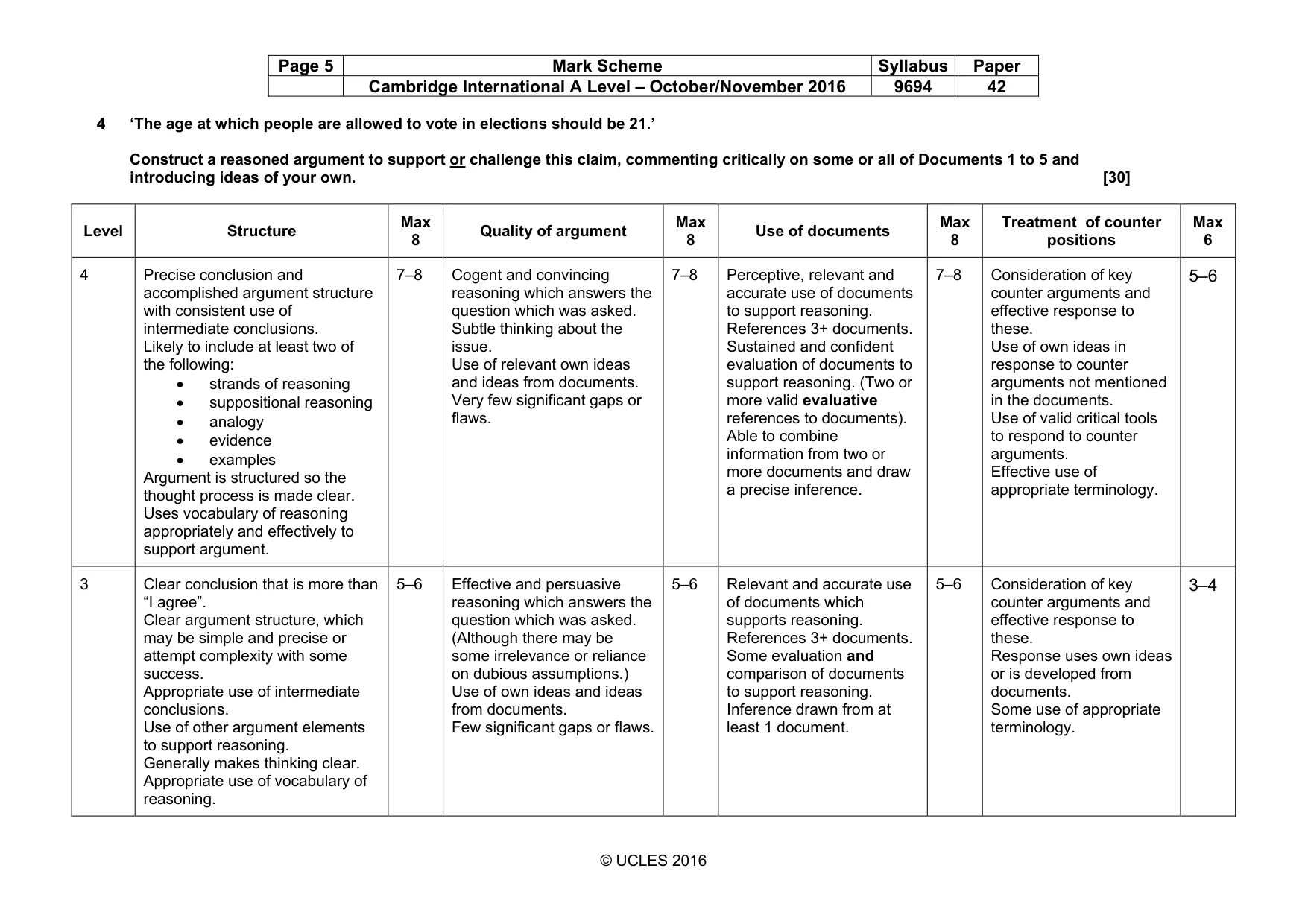
Page 5 Mark Scheme Syllabus Paper Cambridge International A Level – October/November 2016 9694 42 © UCLES 2016 4 ‘The age at which people are allowed to vote in elections should be 21.’ Construct a reasoned argument to support or challenge this claim, commenting critically on some or all of Documents 1 to 5 and introducing ideas of your own. [30] Level Structure Max 8 Quality of argument Max 8 Use of documents Max 8 Treatment of counter positions Max 6 4 Precise conclusion and accomplished argument structure with consistent use of intermediate conclusions. Likely to include at least two of the following: • strands of reasoning • suppositional reasoning • analogy • evidence • examples Argument is structured so the thought process is made clear. Uses vocabulary of reasoning appropriately and effectively to support argument. 7–8 Cogent and convincing reasoning which answers the question which was asked. Subtle thinking about the issue. Use of relevant own ideas and ideas from documents. Very few significant gaps or flaws. 7–8 Perceptive, relevant and accurate use of documents to support reasoning. References 3+ documents. Sustained and confident evaluation of documents to support reasoning. (Two or more valid evaluative references to documents). Able to combine information from two or more documents and draw a precise inference. 7–8 Consideration of key counter arguments and effective response to these. Use of own ideas in response to counter arguments not mentioned in the documents. Use of valid critical tools to respond to counter arguments. Effective use of appropriate terminology. 5–6 3 Clear conclusion that is more than “I agree”. Clear argument structure, which may be simple and precise or attempt complexity with some success. Appropriate use of intermediate conclusions. Use of other argument elements to support reasoning. Generally makes thinking clear. Appropriate use of vocabulary of reasoning. 5–6 Effective and persuasive reasoning which answers the question which was asked. (Although there may be some irrelevance or reliance on dubious assumptions.) Use of own ideas and ideas from documents. Few significant gaps or flaws. 5–6 Relevant and accurate use of documents which supports reasoning. References 3+ documents. Some evaluation and comparison of documents to support reasoning. Inference drawn from at least 1 document. 5–6 Consideration of key counter arguments and effective response to these. Response uses own ideas or is developed from documents. Some use of appropriate terminology. 3–4
Mark scheme, page 6
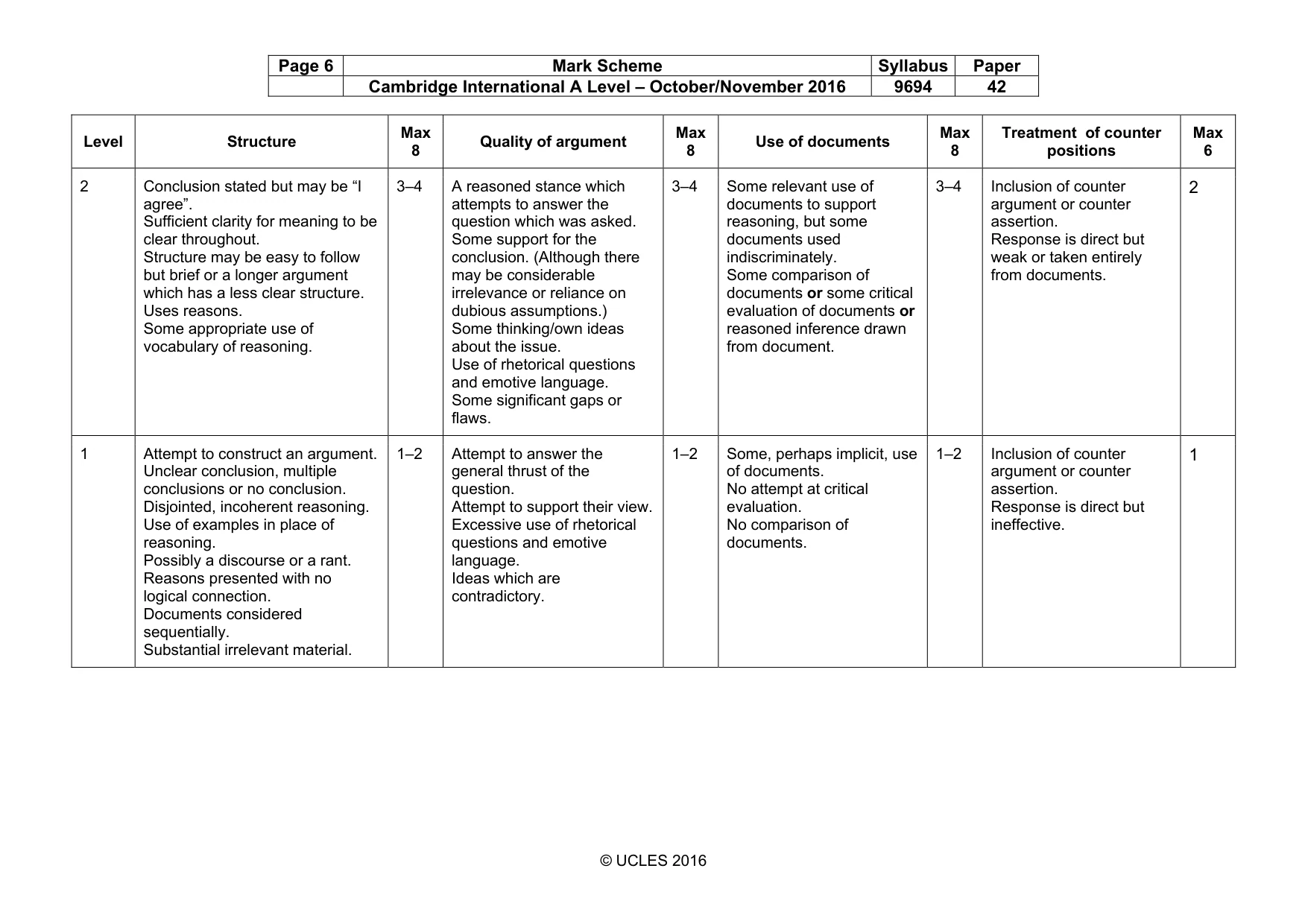
Page 6 Mark Scheme Syllabus Paper Cambridge International A Level – October/November 2016 9694 42 © UCLES 2016 Level Structure Max 8 Quality of argument Max 8 Use of documents Max 8 Treatment of counter positions Max 6 2 Conclusion stated but may be “I agree”. Sufficient clarity for meaning to be clear throughout. Structure may be easy to follow but brief or a longer argument which has a less clear structure. Uses reasons. Some appropriate use of vocabulary of reasoning. 3–4 A reasoned stance which attempts to answer the question which was asked. Some support for the conclusion. (Although there may be considerable irrelevance or reliance on dubious assumptions.) Some thinking/own ideas about the issue. Use of rhetorical questions and emotive language. Some significant gaps or flaws. 3–4 Some relevant use of documents to support reasoning, but some documents used indiscriminately. Some comparison of documents or some critical evaluation of documents or reasoned inference drawn from document. 3–4 Inclusion of counter argument or counter assertion. Response is direct but weak or taken entirely from documents. 2 1 Attempt to construct an argument. Unclear conclusion, multiple conclusions or no conclusion. Disjointed, incoherent reasoning. Use of examples in place of reasoning. Possibly a discourse or a rant. Reasons presented with no logical connection. Documents considered sequentially. Substantial irrelevant material. 1–2 Attempt to answer the general thrust of the question. Attempt to support their view. Excessive use of rhetorical questions and emotive language. Ideas which are contradictory. 1–2 Some, perhaps implicit, use of documents. No attempt at critical evaluation. No comparison of documents. 1–2 Inclusion of counter argument or counter assertion. Response is direct but ineffective. 1
Mark scheme, page 7
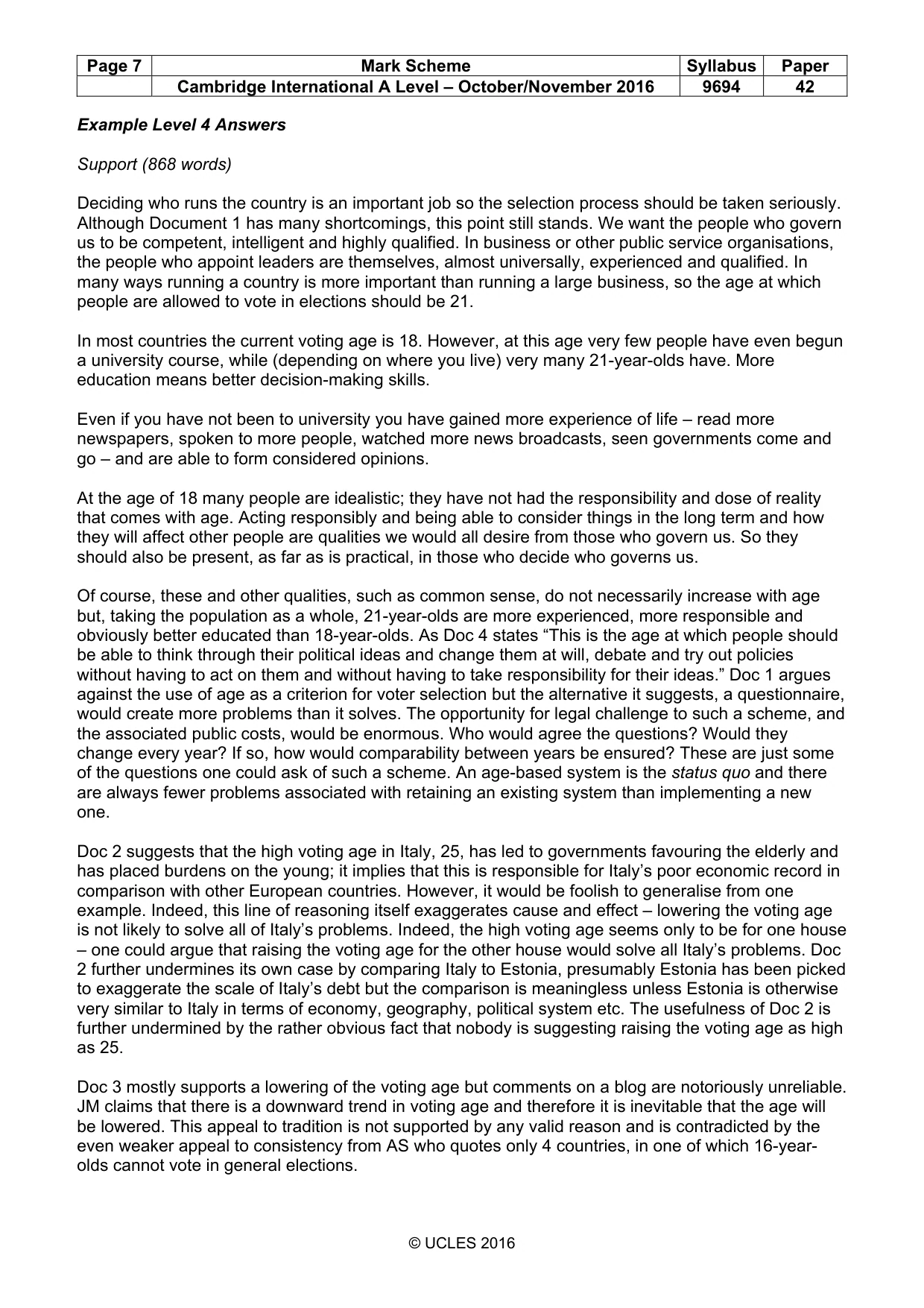
Page 7 Mark Scheme Syllabus Paper Cambridge International A Level – October/November 2016 9694 42 © UCLES 2016 Example Level 4 Answers Support (868 words) Deciding who runs the country is an important job so the selection process should be taken seriously. Although Document 1 has many shortcomings, this point still stands. We want the people who govern us to be competent, intelligent and highly qualified. In business or other public service organisations, the people who appoint leaders are themselves, almost universally, experienced and qualified. In many ways running a country is more important than running a large business, so the age at which people are allowed to vote in elections should be 21. In most countries the current voting age is 18. However, at this age very few people have even begun a university course, while (depending on where you live) very many 21-year-olds have. More education means better decision-making skills. Even if you have not been to university you have gained more experience of life – read more newspapers, spoken to more people, watched more news broadcasts, seen governments come and go – and are able to form considered opinions. At the age of 18 many people are idealistic; they have not had the responsibility and dose of reality that comes with age. Acting responsibly and being able to consider things in the long term and how they will affect other people are qualities we would all desire from those who govern us. So they should also be present, as far as is practical, in those who decide who governs us. Of course, these and other qualities, such as common sense, do not necessarily increase with age but, taking the population as a whole, 21-year-olds are more experienced, more responsible and obviously better educated than 18-year-olds. As Doc 4 states “This is the age at which people should be able to think through their political ideas and change them at will, debate and try out policies without having to act on them and without having to take responsibility for their ideas.” Doc 1 argues against the use of age as a criterion for voter selection but the alternative it suggests, a questionnaire, would create more problems than it solves. The opportunity for legal challenge to such a scheme, and the associated public costs, would be enormous. Who would agree the questions? Would they change every year? If so, how would comparability between years be ensured? These are just some of the questions one could ask of such a scheme. An age-based system is the status quo and there are always fewer problems associated with retaining an existing system than implementing a new one. Doc 2 suggests that the high voting age in Italy, 25, has led to governments favouring the elderly and has placed burdens on the young; it implies that this is responsible for Italy’s poor economic record in comparison with other European countries. However, it would be foolish to generalise from one example. Indeed, this line of reasoning itself exaggerates cause and effect – lowering the voting age is not likely to solve all of Italy’s problems. Indeed, the high voting age seems only to be for one house – one could argue that raising the voting age for the other house would solve all Italy’s problems. Doc 2 further undermines its own case by comparing Italy to Estonia, presumably Estonia has been picked to exaggerate the scale of Italy’s debt but the comparison is meaningless unless Estonia is otherwise very similar to Italy in terms of economy, geography, political system etc. The usefulness of Doc 2 is further undermined by the rather obvious fact that nobody is suggesting raising the voting age as high as 25. Doc 3 mostly supports a lowering of the voting age but comments on a blog are notoriously unreliable. JM claims that there is a downward trend in voting age and therefore it is inevitable that the age will be lowered. This appeal to tradition is not supported by any valid reason and is contradicted by the even weaker appeal to consistency from AS who quotes only 4 countries, in one of which 16-year- olds cannot vote in general elections.
Mark scheme, page 8
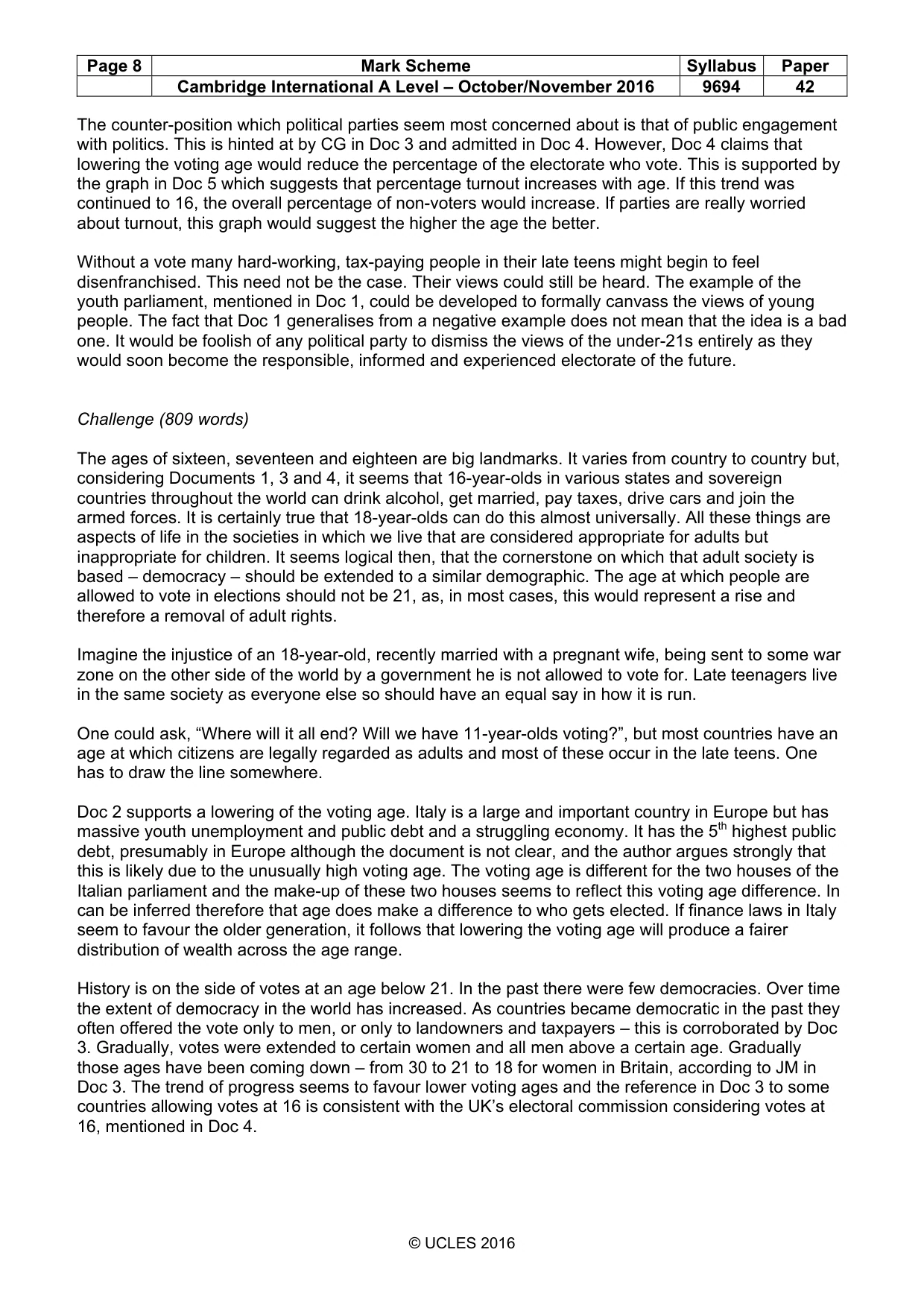
Page 8 Mark Scheme Syllabus Paper Cambridge International A Level – October/November 2016 9694 42 © UCLES 2016 The counter-position which political parties seem most concerned about is that of public engagement with politics. This is hinted at by CG in Doc 3 and admitted in Doc 4. However, Doc 4 claims that lowering the voting age would reduce the percentage of the electorate who vote. This is supported by the graph in Doc 5 which suggests that percentage turnout increases with age. If this trend was continued to 16, the overall percentage of non-voters would increase. If parties are really worried about turnout, this graph would suggest the higher the age the better. Without a vote many hard-working, tax-paying people in their late teens might begin to feel disenfranchised. This need not be the case. Their views could still be heard. The example of the youth parliament, mentioned in Doc 1, could be developed to formally canvass the views of young people. The fact that Doc 1 generalises from a negative example does not mean that the idea is a bad one. It would be foolish of any political party to dismiss the views of the under-21s entirely as they would soon become the responsible, informed and experienced electorate of the future. Challenge (809 words) The ages of sixteen, seventeen and eighteen are big landmarks. It varies from country to country but, considering Documents 1, 3 and 4, it seems that 16-year-olds in various states and sovereign countries throughout the world can drink alcohol, get married, pay taxes, drive cars and join the armed forces. It is certainly true that 18-year-olds can do this almost universally. All these things are aspects of life in the societies in which we live that are considered appropriate for adults but inappropriate for children. It seems logical then, that the cornerstone on which that adult society is based – democracy – should be extended to a similar demographic. The age at which people are allowed to vote in elections should not be 21, as, in most cases, this would represent a rise and therefore a removal of adult rights. Imagine the injustice of an 18-year-old, recently married with a pregnant wife, being sent to some war zone on the other side of the world by a government he is not allowed to vote for. Late teenagers live in the same society as everyone else so should have an equal say in how it is run. One could ask, “Where will it all end? Will we have 11-year-olds voting?”, but most countries have an age at which citizens are legally regarded as adults and most of these occur in the late teens. One has to draw the line somewhere. Doc 2 supports a lowering of the voting age. Italy is a large and important country in Europe but has massive youth unemployment and public debt and a struggling economy. It has the 5th highest public debt, presumably in Europe although the document is not clear, and the author argues strongly that this is likely due to the unusually high voting age. The voting age is different for the two houses of the Italian parliament and the make-up of these two houses seems to reflect this voting age difference. In can be inferred therefore that age does make a difference to who gets elected. If finance laws in Italy seem to favour the older generation, it follows that lowering the voting age will produce a fairer distribution of wealth across the age range. History is on the side of votes at an age below 21. In the past there were few democracies. Over time the extent of democracy in the world has increased. As countries became democratic in the past they often offered the vote only to men, or only to landowners and taxpayers – this is corroborated by Doc 3. Gradually, votes were extended to certain women and all men above a certain age. Gradually those ages have been coming down – from 30 to 21 to 18 for women in Britain, according to JM in Doc 3. The trend of progress seems to favour lower voting ages and the reference in Doc 3 to some countries allowing votes at 16 is consistent with the UK’s electoral commission considering votes at 16, mentioned in Doc 4.
Mark scheme, page 9
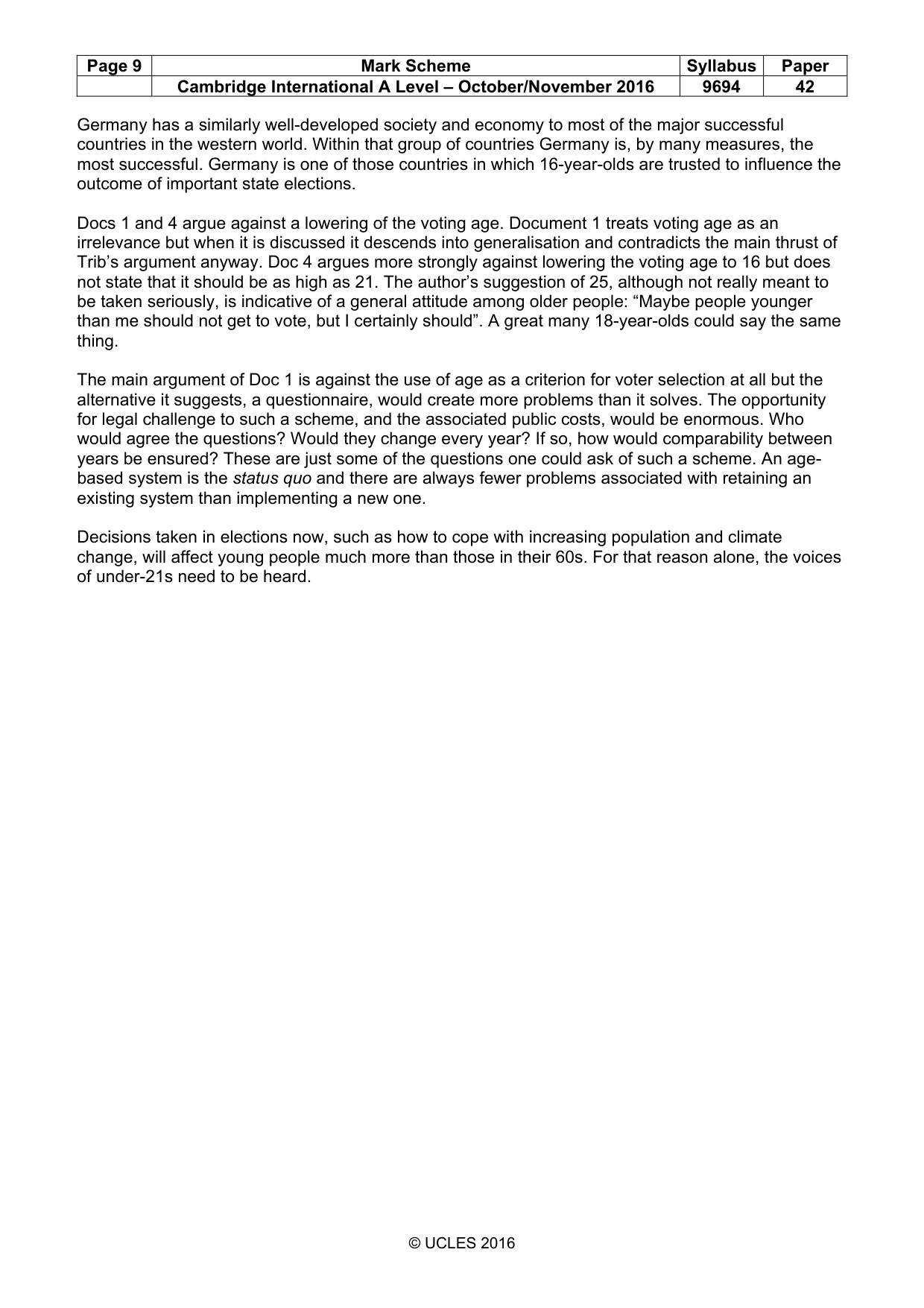
Page 9 Mark Scheme Syllabus Paper Cambridge International A Level – October/November 2016 9694 42 © UCLES 2016 Germany has a similarly well-developed society and economy to most of the major successful countries in the western world. Within that group of countries Germany is, by many measures, the most successful. Germany is one of those countries in which 16-year-olds are trusted to influence the outcome of important state elections. Docs 1 and 4 argue against a lowering of the voting age. Document 1 treats voting age as an irrelevance but when it is discussed it descends into generalisation and contradicts the main thrust of Trib’s argument anyway. Doc 4 argues more strongly against lowering the voting age to 16 but does not state that it should be as high as 21. The author’s suggestion of 25, although not really meant to be taken seriously, is indicative of a general attitude among older people: “Maybe people younger than me should not get to vote, but I certainly should”. A great many 18-year-olds could say the same thing. The main argument of Doc 1 is against the use of age as a criterion for voter selection at all but the alternative it suggests, a questionnaire, would create more problems than it solves. The opportunity for legal challenge to such a scheme, and the associated public costs, would be enormous. Who would agree the questions? Would they change every year? If so, how would comparability between years be ensured? These are just some of the questions one could ask of such a scheme. An age- based system is the status quo and there are always fewer problems associated with retaining an existing system than implementing a new one. Decisions taken in elections now, such as how to cope with increasing population and climate change, will affect young people much more than those in their 60s. For that reason alone, the voices of under-21s need to be heard.
What you needed in this session
Cambridge’s own grade thresholds for 2016 Oct/Nov, Paper 4 · Variant 2. A higher threshold means an easier paper — the bar moves with how the cohort did.