Cambridge A Level Thinking Skills 9694 — 2016 May/June Paper 4 · Variant 1
9694/41/M/J/16 · 50 marks · ≈56 min
The question paper and its mark scheme, free to read here and free to download. This is Cambridge’s own paper, exactly as it was sat.
Question paper8 pages
Mark scheme9 pages
Answers below. Sit the paper first if you are practising.
Paper as text
Question paper, page 1
This document consists of 7 printed pages, 1 blank page and 1 insert. DC (LEG/JG) 117039/2 © UCLES 2016 [Turn over Cambridge International Examinations Cambridge International Advanced Level * 3 9 7 8 4 1 5 6 0 0 * THINKING SKILLS 9694/41 Paper 4 Applied Reasoning May/June 2016 1 hour 30 minutes No Additional Materials are required. READ THESE INSTRUCTIONS FIRST An answer booklet is provided inside this question paper. You should follow the instructions on the front cover of the answer booklet. If you need additional answer paper ask the invigilator for a continuation booklet. Answer all the questions. The number of marks is given in brackets [ ] at the end of each question.
Question paper, page 2
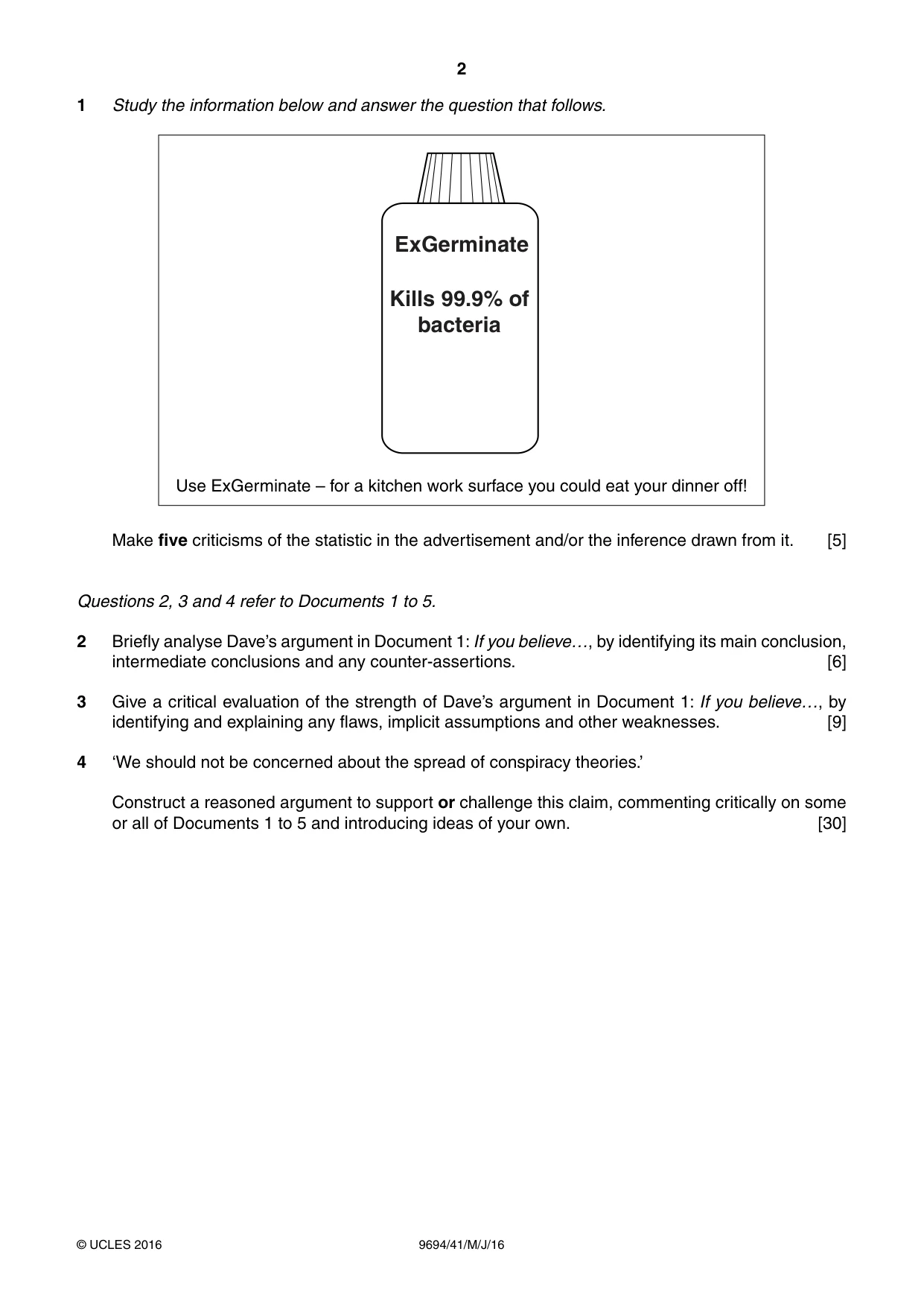
2 9694/41/M/J/16 © UCLES 2016 1 Study the information below and answer the question that follows. ExGerminate Kills 99.9% of bacteria Use ExGerminate – for a kitchen work surface you could eat your dinner off! Make five criticisms of the statistic in the advertisement and/or the inference drawn from it. [5] Questions 2, 3 and 4 refer to Documents 1 to 5. 2 Briefly analyse Dave’s argument in Document 1: If you believe…, by identifying its main conclusion, intermediate conclusions and any counter-assertions. [6] 3 Give a critical evaluation of the strength of Dave’s argument in Document 1: If you believe…, by identifying and explaining any flaws, implicit assumptions and other weaknesses. [9] 4 ‘We should not be concerned about the spread of conspiracy theories.’ Construct a reasoned argument to support or challenge this claim, commenting critically on some or all of Documents 1 to 5 and introducing ideas of your own. [30]
Question paper, page 3
3 9694/41/M/J/16 © UCLES 2016 [Turn over DOCUMENT 1 If you believe… When we think of the great achievements of humanity we think of the fight against disease, the works of Shakespeare or global electronic communication. But some gullible people still think of the Apollo 11 ‘mission to the moon’. However, it was clearly a hoax. In the 1960s we were still struggling with colour TV; mobile phones and video recorders were twenty years away, and no one even dreamed of the internet. It is impossible that something as complex as a manned mission to the moon could have been carried out using the technology of the time. Over thirty years later we could not reliably send a space shuttle into near-earth orbit – as we found out to our cost in 1986 and 2003, when two of the four operational shuttles, Challenger and Columbia (that’s 50%) crashed, killing everyone on board. Sixties technology was just not up to the job. A hoax makes sense in view of the political climate of the Cold War. Getting one over on the Soviet Union was mission number 1. What better way to do it than to beat them to the moon? Any presidential administration that managed to do that would be guaranteed a second term. In order to achieve this, the costs involved would have been unaffordable. A fraction of the money could be spent on an elaborate hoax, allowing the rest to be diverted to other ‘top secret’ missions. We can send people into orbit and we can send hardware to the moon, but people never went to the moon. The first few attempts to send animals into space were not successful. Had this been a trial for a new drug, it would have been abandoned at this point. For some reason, NASA jumped to sending men to the moon and, surprise, surprise, they returned unharmed. People were beginning to get suspicious of this remarkable ‘success’, so they faked the near disastrous Apollo 13 mission as well. Some of the evidence against the moon landings is undeniable. There is the flag that flutters even though there would be no wind on the moon. There are no stars in the background of any of the pictures. There are the well preserved ‘astronaut’ footprints that look like they are in wet sand, when there is no water on the moon – or sand, for that matter! People with a vested interest to distort the truth think they can explain away such evidence with science, but they are not convincing. It is interesting that Neil Armstrong, the supposed first man on the moon, became a near recluse after the mission and rarely spoke about it. He was clearly ashamed of something. Look at the film footage: when he is being congratulated as he emerges from the capsule he does not smile but looks down at the ground. You only have to study the evidence to realise the mission has all the hallmarks of a magician’s illusion. When we sit in an audience and with our own eyes watch someone being sawn in half, no-one calls for an ambulance. We just know it is not real. Dave
Question paper, page 4
4 9694/41/M/J/16 © UCLES 2016 DOCUMENT 2 What’s the harm? The body count of pseudoscientific conspiracy theories I’m often confronted by people who demand to know how sceptics dare to criticise other people’s ideas about medicine, biotech, and science: “You ought to respect their beliefs!” Others simply shrug off popular pseudoscience and say, “Why bother? What’s the harm?” The answer is that the cost of misinformation is too large to ignore. It is counted in billions of dollars wasted on junk cures, in billions spent on treating preventable diseases. It is measured in lifetimes shortened, bodies crippled, eyes blinded, and children lost. We are facing nothing less than genocidal stupidity, on a worldwide scale. • In the United States, far from being a fringe phenomenon, conspiratorial beliefs about medicine are mainstream. A study published in JAMA Internal Medicine showed that half of the American public believes at least one medical conspiracy theory and 18% believe three or more. 20% believe that vaccines are linked to autism, and doctors are covering it up. 37% believe the government and drug companies are suppressing “natural cures” for various diseases. • Conspiratorial beliefs also help fuel the $28 billion organic food sector and $34 billion alternative medicine industry. For instance, people who believe three or more conspiracy theories are three times more likely to use herbal supplements, compared to those who believe none. • Conspiracy theories about AIDS are rampant. At one clinic, 21% of HIV positive patients thought that HIV was created by the CIA. • Large outbreaks of measles have hit the US in recent years. 3 000 000 people die every year from vaccine-preventable diseases. Conspiracy theorists in the developed world have stoked baseless fears about vaccines causing autism; this has led to plummeting vaccination rates and a resurgence in the West of diseases like measles and whooping cough – diseases that were nearly stamped out a decade ago. In Nigeria, Pakistan, and Afghanistan, aid workers trying to vaccinate children against polio (and hopefully eradicate the disease) have been attacked and murdered by groups suspicious of their motives. • The government of Zambia rejected 35 000 tons of food aid because they thought it might be genetically modified. Since then, dozens of countries have caved in to fear-mongering by banning GM crops, despite the overwhelming evidence they are safe and can greatly increase crop yields. Meanwhile, 870 million people worldwide suffer from chronic undernourishment, including a third of children in developing countries.
Question paper, page 5
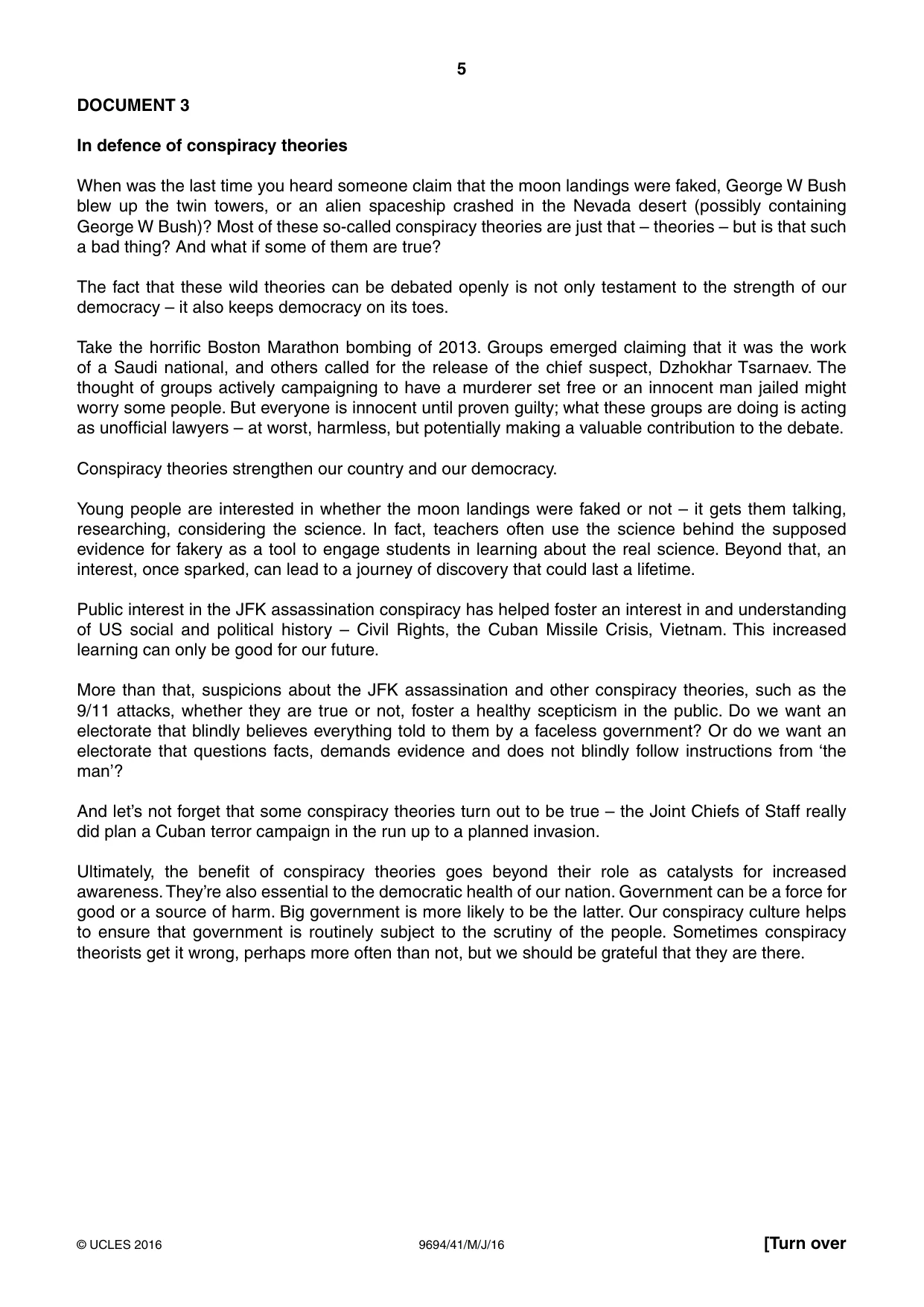
5 9694/41/M/J/16 © UCLES 2016 [Turn over DOCUMENT 3 In defence of conspiracy theories When was the last time you heard someone claim that the moon landings were faked, George W Bush blew up the twin towers, or an alien spaceship crashed in the Nevada desert (possibly containing George W Bush)? Most of these so-called conspiracy theories are just that – theories – but is that such a bad thing? And what if some of them are true? The fact that these wild theories can be debated openly is not only testament to the strength of our democracy – it also keeps democracy on its toes. Take the horrific Boston Marathon bombing of 2013. Groups emerged claiming that it was the work of a Saudi national, and others called for the release of the chief suspect, Dzhokhar Tsarnaev. The thought of groups actively campaigning to have a murderer set free or an innocent man jailed might worry some people. But everyone is innocent until proven guilty; what these groups are doing is acting as unofficial lawyers – at worst, harmless, but potentially making a valuable contribution to the debate. Conspiracy theories strengthen our country and our democracy. Young people are interested in whether the moon landings were faked or not – it gets them talking, researching, considering the science. In fact, teachers often use the science behind the supposed evidence for fakery as a tool to engage students in learning about the real science. Beyond that, an interest, once sparked, can lead to a journey of discovery that could last a lifetime. Public interest in the JFK assassination conspiracy has helped foster an interest in and understanding of US social and political history – Civil Rights, the Cuban Missile Crisis, Vietnam. This increased learning can only be good for our future. More than that, suspicions about the JFK assassination and other conspiracy theories, such as the 9/11 attacks, whether they are true or not, foster a healthy scepticism in the public. Do we want an electorate that blindly believes everything told to them by a faceless government? Or do we want an electorate that questions facts, demands evidence and does not blindly follow instructions from ‘the man’? And let’s not forget that some conspiracy theories turn out to be true – the Joint Chiefs of Staff really did plan a Cuban terror campaign in the run up to a planned invasion. Ultimately, the benefit of conspiracy theories goes beyond their role as catalysts for increased awareness. They’re also essential to the democratic health of our nation. Government can be a force for good or a source of harm. Big government is more likely to be the latter. Our conspiracy culture helps to ensure that government is routinely subject to the scrutiny of the people. Sometimes conspiracy theorists get it wrong, perhaps more often than not, but we should be grateful that they are there.
Question paper, page 6
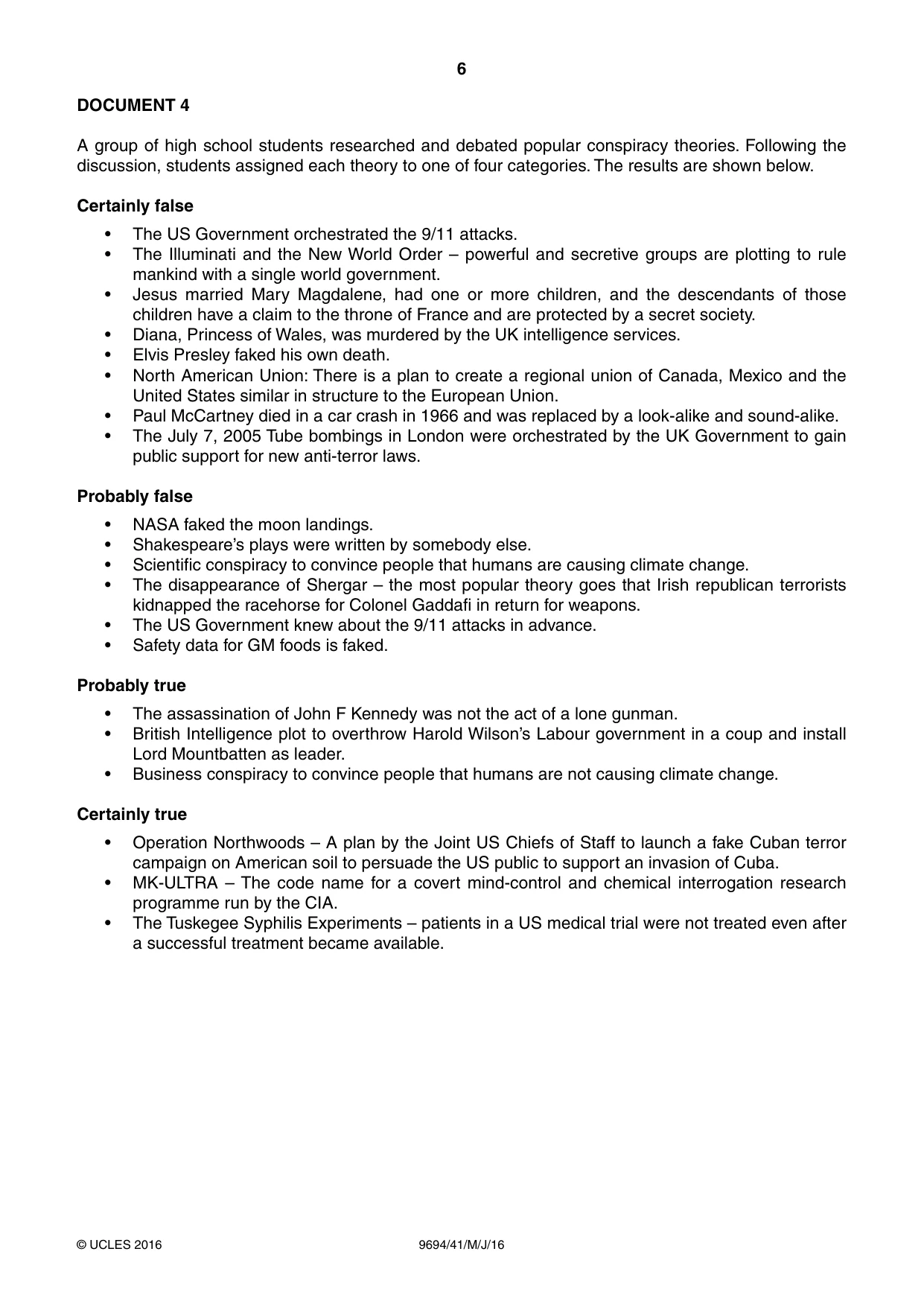
6 9694/41/M/J/16 © UCLES 2016 DOCUMENT 4 A group of high school students researched and debated popular conspiracy theories. Following the discussion, students assigned each theory to one of four categories. The results are shown below. Certainly false • The US Government orchestrated the 9/11 attacks. • The Illuminati and the New World Order – powerful and secretive groups are plotting to rule mankind with a single world government. • Jesus married Mary Magdalene, had one or more children, and the descendants of those children have a claim to the throne of France and are protected by a secret society. • Diana, Princess of Wales, was murdered by the UK intelligence services. • Elvis Presley faked his own death. • North American Union: There is a plan to create a regional union of Canada, Mexico and the United States similar in structure to the European Union. • Paul McCartney died in a car crash in 1966 and was replaced by a look-alike and sound-alike. • The July 7, 2005 Tube bombings in London were orchestrated by the UK Government to gain public support for new anti-terror laws. Probably false • NASA faked the moon landings. • Shakespeare’s plays were written by somebody else. • Scientific conspiracy to convince people that humans are causing climate change. • The disappearance of Shergar – the most popular theory goes that Irish republican terrorists kidnapped the racehorse for Colonel Gaddafi in return for weapons. • The US Government knew about the 9/11 attacks in advance. • Safety data for GM foods is faked. Probably true • The assassination of John F Kennedy was not the act of a lone gunman. • British Intelligence plot to overthrow Harold Wilson’s Labour government in a coup and install Lord Mountbatten as leader. • Business conspiracy to convince people that humans are not causing climate change. Certainly true • Operation Northwoods – A plan by the Joint US Chiefs of Staff to launch a fake Cuban terror campaign on American soil to persuade the US public to support an invasion of Cuba. • MK-ULTRA – The code name for a covert mind-control and chemical interrogation research programme run by the CIA. • The Tuskegee Syphilis Experiments – patients in a US medical trial were not treated even after a successful treatment became available.
Question paper, page 7
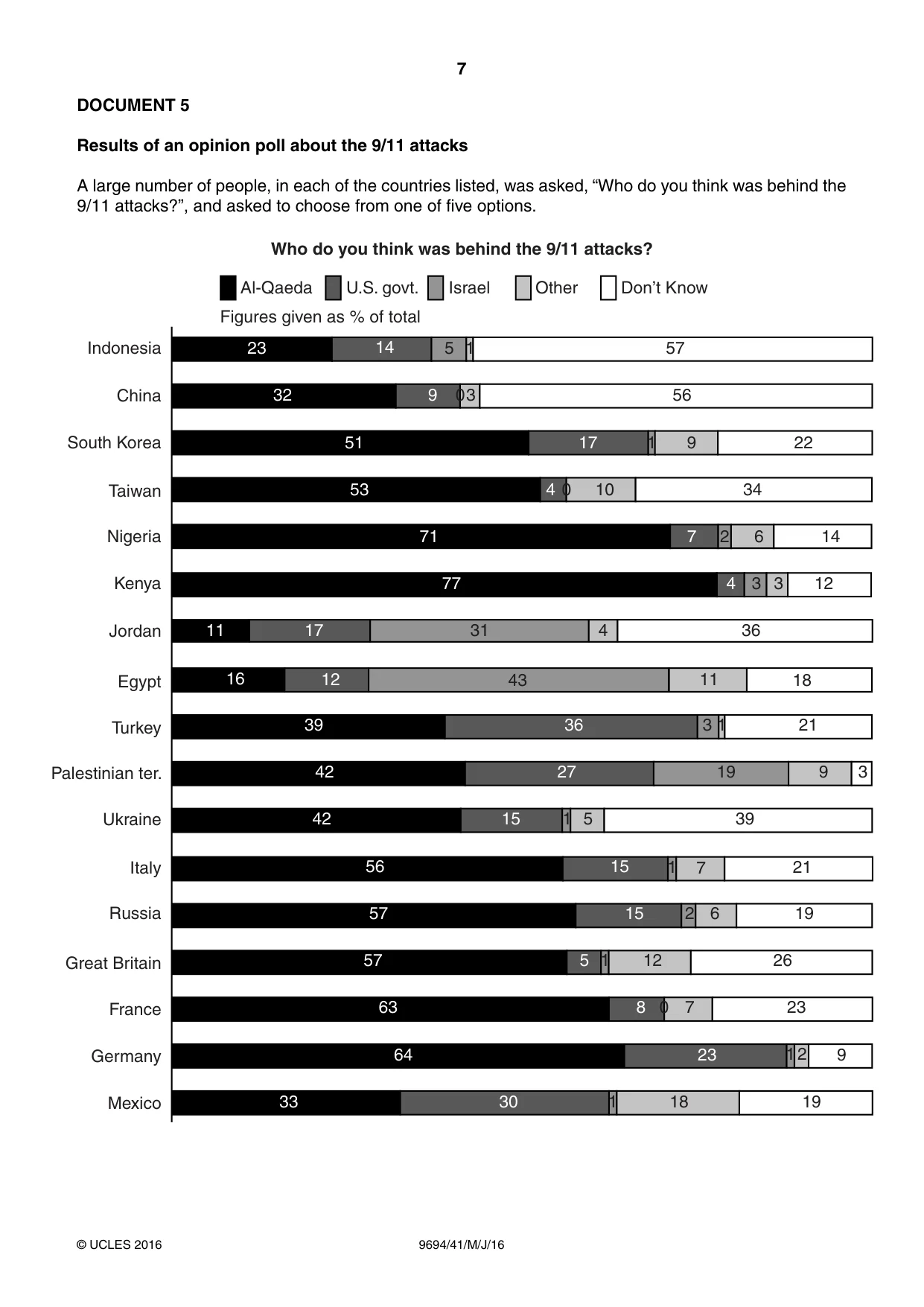
7 9694/41/M/J/16 © UCLES 2016 DOCUMENT 5 Results of an opinion poll about the 9/11 attacks A large number of people, in each of the countries listed, was asked, “Who do you think was behind the 9/11 attacks?”, and asked to choose from one of five options. Al-Qaeda Figures given as % of total Who do you think was behind the 9/11 attacks? Israel Other Don’t Know U.S. govt. 23 14 5 1 57 Indonesia China South Korea Taiwan Nigeria Kenya Jordan Egypt Turkey Ukraine Italy Russia Great Britain France Germany Mexico Palestinian ter. 32 9 03 56 51 17 9 1 22 53 4 10 0 34 71 7 6 2 14 77 4 3 3 12 11 17 31 4 36 16 12 43 11 18 39 36 3 21 1 42 27 19 9 3 42 15 5 1 39 56 15 1 7 21 57 6 19 2 15 57 26 5 1 12 12 63 8 0 23 7 64 9 23 33 30 18 1 19
Question paper, page 8
8 9694/41/M/J/16 © UCLES 2016 BLANK PAGE Permission to reproduce items where third-party owned material protected by copyright is included has been sought and cleared where possible. Every reasonable effort has been made by the publisher (UCLES) to trace copyright holders, but if any items requiring clearance have unwittingly been included, the publisher will be pleased to make amends at the earliest possible opportunity. To avoid the issue of disclosure of answer-related information to candidates, all copyright acknowledgements are reproduced online in the Cambridge International Examinations Copyright Acknowledgements Booklet. This is produced for each series of examinations and is freely available to download at www.cie.org.uk after the live examination series. Cambridge International Examinations is part of the Cambridge Assessment Group. Cambridge Assessment is the brand name of University of Cambridge Local Examinations Syndicate (UCLES), which is itself a department of the University of Cambridge.
Mark scheme, page 1
® IGCSE is the registered trademark of Cambridge International Examinations. This document consists of 9 printed pages. © UCLES 2016 [Turn over Cambridge International Examinations Cambridge International Advanced Level THINKING SKILLS 9694/41 Paper 4 Applied Reasoning May/June 2016 MARK SCHEME Maximum Mark: 50 Published This mark scheme is published as an aid to teachers and candidates, to indicate the requirements of the examination. It shows the basis on which Examiners were instructed to award marks. It does not indicate the details of the discussions that took place at an Examiners’ meeting before marking began, which would have considered the acceptability of alternative answers. Mark schemes should be read in conjunction with the question paper and the Principal Examiner Report for Teachers. Cambridge will not enter into discussions about these mark schemes. Cambridge is publishing the mark schemes for the May/June 2016 series for most Cambridge IGCSE®, Cambridge International A and AS Level components and some Cambridge O Level components.
Mark scheme, page 2
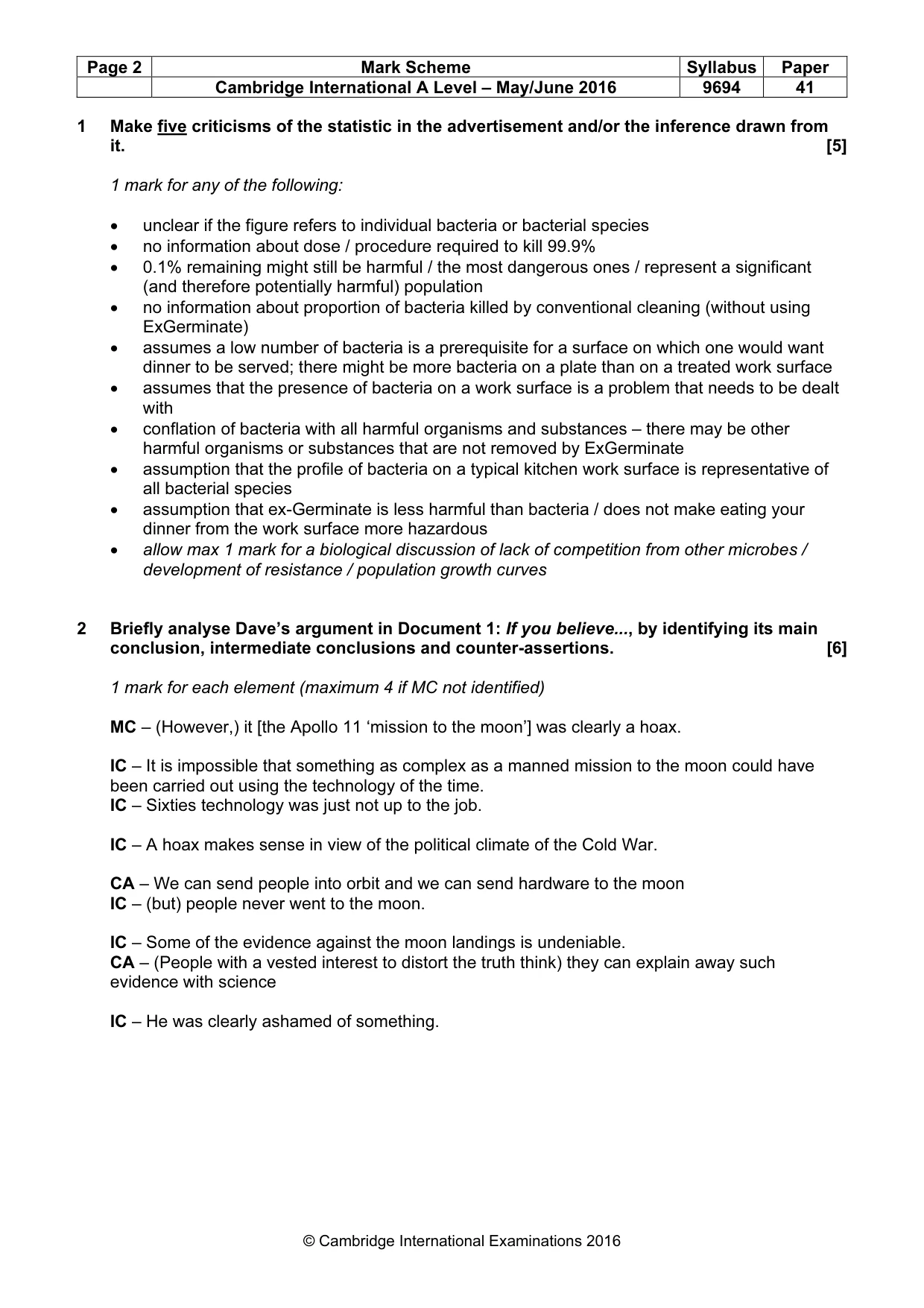
Page 2 Mark Scheme Syllabus Paper Cambridge International A Level – May/June 2016 9694 41 © Cambridge International Examinations 2016 1 Make five criticisms of the statistic in the advertisement and/or the inference drawn from it. [5] 1 mark for any of the following: • unclear if the figure refers to individual bacteria or bacterial species • no information about dose / procedure required to kill 99.9% • 0.1% remaining might still be harmful / the most dangerous ones / represent a significant (and therefore potentially harmful) population • no information about proportion of bacteria killed by conventional cleaning (without using ExGerminate) • assumes a low number of bacteria is a prerequisite for a surface on which one would want dinner to be served; there might be more bacteria on a plate than on a treated work surface • assumes that the presence of bacteria on a work surface is a problem that needs to be dealt with • conflation of bacteria with all harmful organisms and substances – there may be other harmful organisms or substances that are not removed by ExGerminate • assumption that the profile of bacteria on a typical kitchen work surface is representative of all bacterial species • assumption that ex-Germinate is less harmful than bacteria / does not make eating your dinner from the work surface more hazardous • allow max 1 mark for a biological discussion of lack of competition from other microbes / development of resistance / population growth curves 2 Briefly analyse Dave’s argument in Document 1: If you believe..., by identifying its main conclusion, intermediate conclusions and counter-assertions. [6] 1 mark for each element (maximum 4 if MC not identified) MC – (However,) it [the Apollo 11 ‘mission to the moon’] was clearly a hoax. IC – It is impossible that something as complex as a manned mission to the moon could have been carried out using the technology of the time. IC – Sixties technology was just not up to the job. IC – A hoax makes sense in view of the political climate of the Cold War. CA – We can send people into orbit and we can send hardware to the moon IC – (but) people never went to the moon. IC – Some of the evidence against the moon landings is undeniable. CA – (People with a vested interest to distort the truth think) they can explain away such evidence with science IC – He was clearly ashamed of something.
Mark scheme, page 3
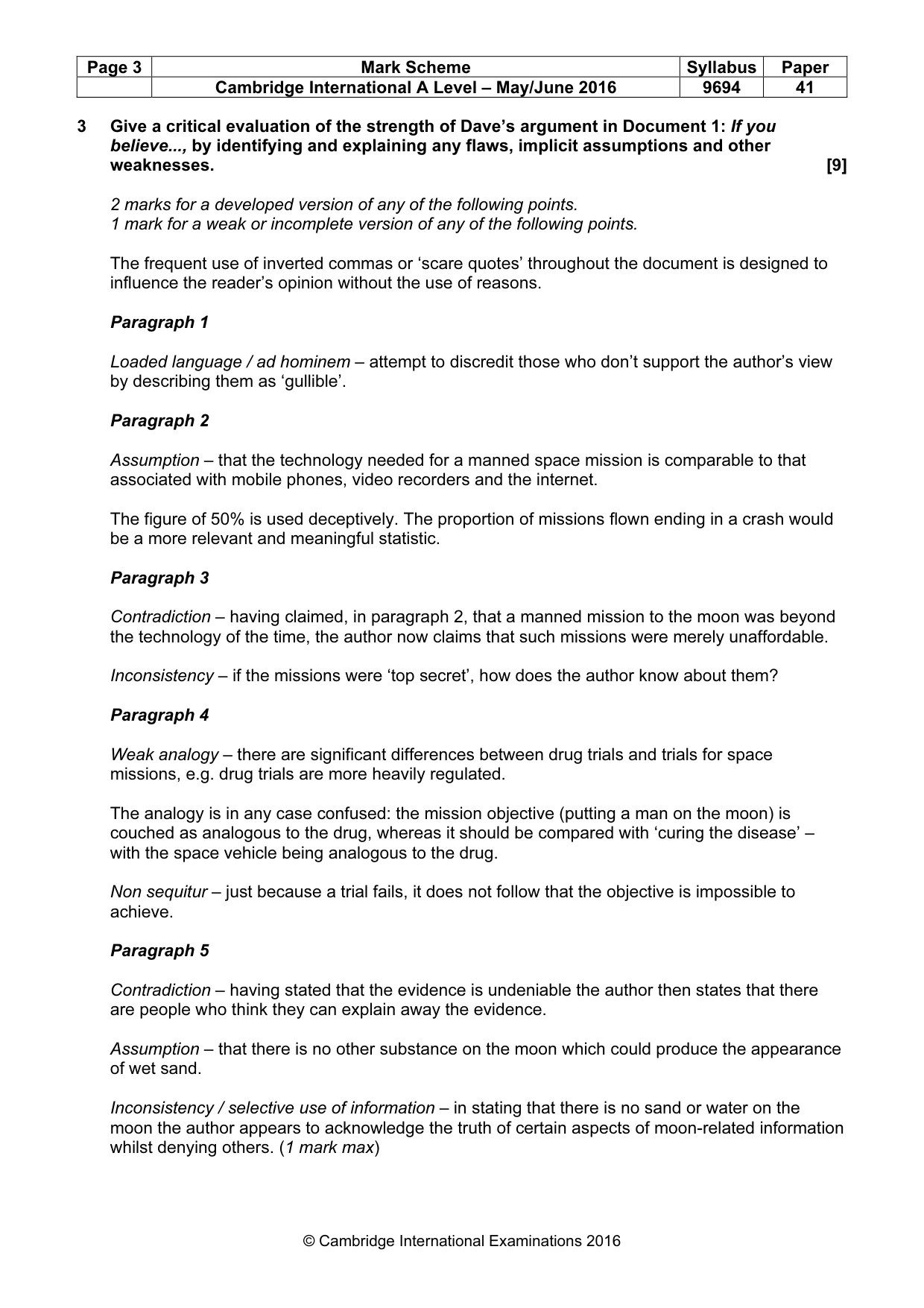
Page 3 Mark Scheme Syllabus Paper Cambridge International A Level – May/June 2016 9694 41 © Cambridge International Examinations 2016 3 Give a critical evaluation of the strength of Dave’s argument in Document 1: If you believe..., by identifying and explaining any flaws, implicit assumptions and other weaknesses. [9] 2 marks for a developed version of any of the following points. 1 mark for a weak or incomplete version of any of the following points. The frequent use of inverted commas or ‘scare quotes’ throughout the document is designed to influence the reader’s opinion without the use of reasons. Paragraph 1 Loaded language / ad hominem – attempt to discredit those who don’t support the author’s view by describing them as ‘gullible’. Paragraph 2 Assumption – that the technology needed for a manned space mission is comparable to that associated with mobile phones, video recorders and the internet. The figure of 50% is used deceptively. The proportion of missions flown ending in a crash would be a more relevant and meaningful statistic. Paragraph 3 Contradiction – having claimed, in paragraph 2, that a manned mission to the moon was beyond the technology of the time, the author now claims that such missions were merely unaffordable. Inconsistency – if the missions were ‘top secret’, how does the author know about them? Paragraph 4 Weak analogy – there are significant differences between drug trials and trials for space missions, e.g. drug trials are more heavily regulated. The analogy is in any case confused: the mission objective (putting a man on the moon) is couched as analogous to the drug, whereas it should be compared with ‘curing the disease’ – with the space vehicle being analogous to the drug. Non sequitur – just because a trial fails, it does not follow that the objective is impossible to achieve. Paragraph 5 Contradiction – having stated that the evidence is undeniable the author then states that there are people who think they can explain away the evidence. Assumption – that there is no other substance on the moon which could produce the appearance of wet sand. Inconsistency / selective use of information – in stating that there is no sand or water on the moon the author appears to acknowledge the truth of certain aspects of moon-related information whilst denying others. (1 mark max)
Mark scheme, page 4
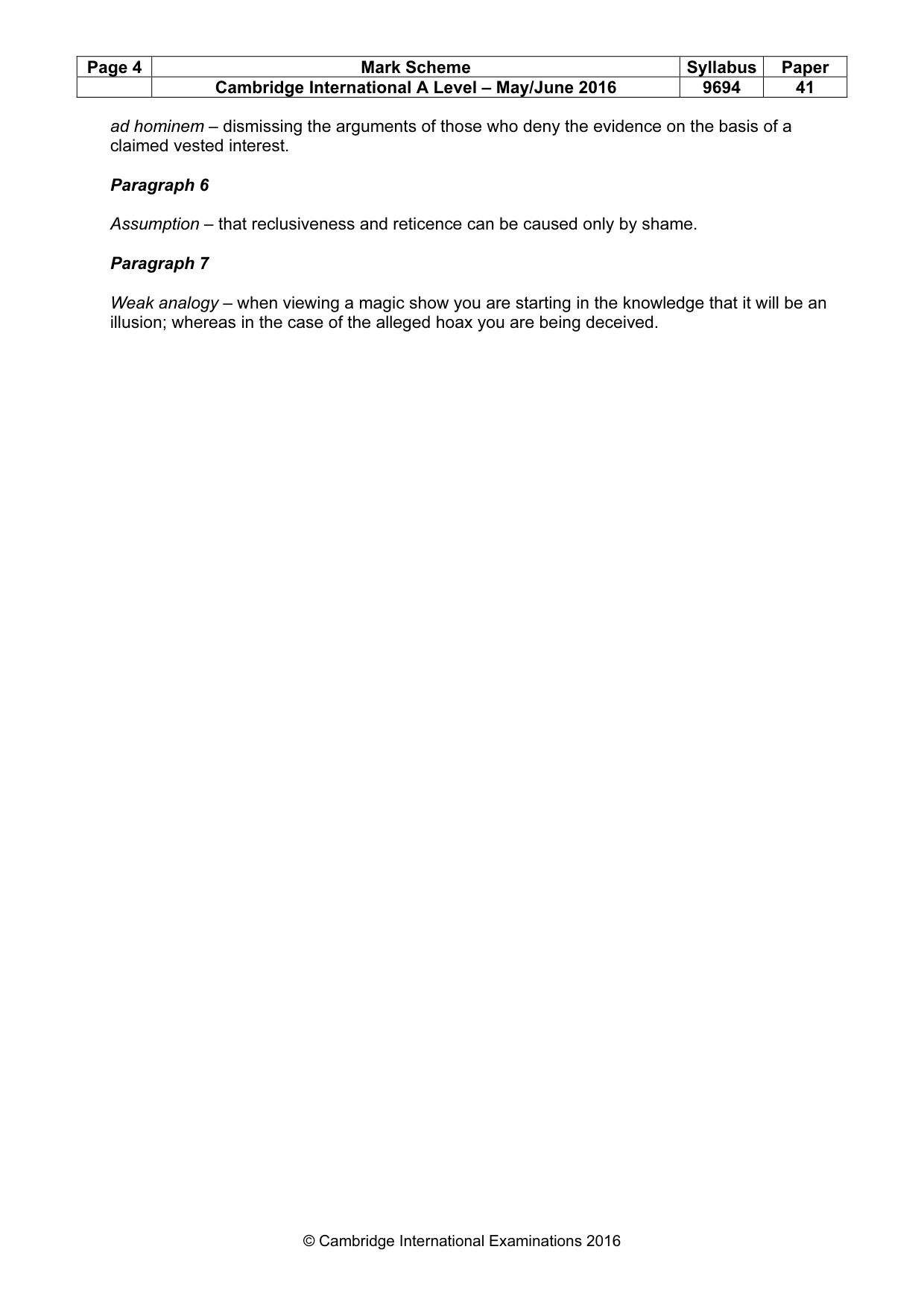
Page 4 Mark Scheme Syllabus Paper Cambridge International A Level – May/June 2016 9694 41 © Cambridge International Examinations 2016 ad hominem – dismissing the arguments of those who deny the evidence on the basis of a claimed vested interest. Paragraph 6 Assumption – that reclusiveness and reticence can be caused only by shame. Paragraph 7 Weak analogy – when viewing a magic show you are starting in the knowledge that it will be an illusion; whereas in the case of the alleged hoax you are being deceived.
Mark scheme, page 5
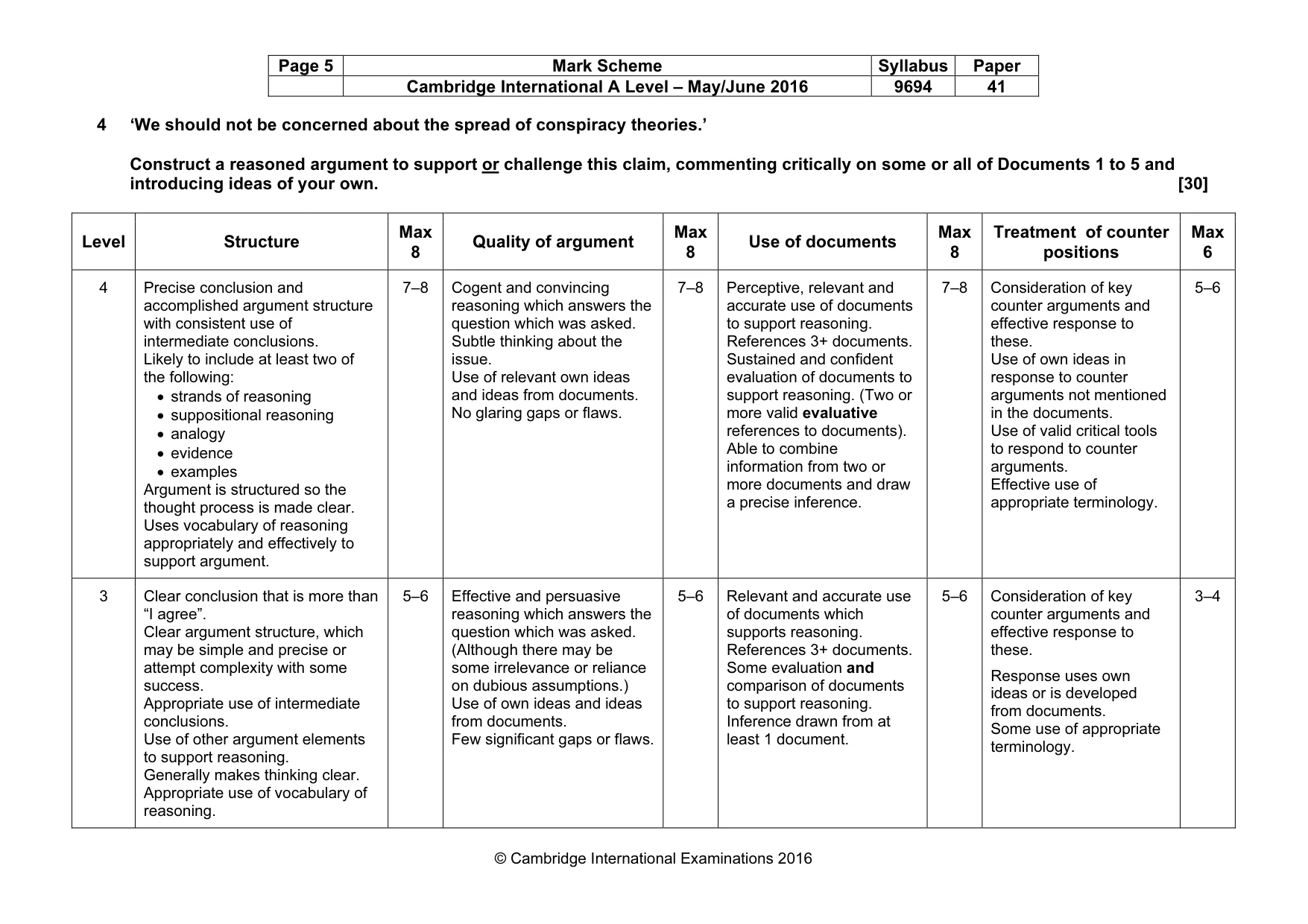
Page 5 Mark Scheme Syllabus Paper Cambridge International A Level – May/June 2016 9694 41 © Cambridge International Examinations 2016 4 ‘We should not be concerned about the spread of conspiracy theories.’ Construct a reasoned argument to support or challenge this claim, commenting critically on some or all of Documents 1 to 5 and introducing ideas of your own. [30] Level Structure Max 8 Quality of argument Max 8 Use of documents Max 8 Treatment of counter positions Max 6 4 Precise conclusion and accomplished argument structure with consistent use of intermediate conclusions. Likely to include at least two of the following: • strands of reasoning • suppositional reasoning • analogy • evidence • examples Argument is structured so the thought process is made clear. Uses vocabulary of reasoning appropriately and effectively to support argument. 7–8 Cogent and convincing reasoning which answers the question which was asked. Subtle thinking about the issue. Use of relevant own ideas and ideas from documents. No glaring gaps or flaws. 7–8 Perceptive, relevant and accurate use of documents to support reasoning. References 3+ documents. Sustained and confident evaluation of documents to support reasoning. (Two or more valid evaluative references to documents). Able to combine information from two or more documents and draw a precise inference. 7–8 Consideration of key counter arguments and effective response to these. Use of own ideas in response to counter arguments not mentioned in the documents. Use of valid critical tools to respond to counter arguments. Effective use of appropriate terminology. 5–6 3 Clear conclusion that is more than “I agree”. Clear argument structure, which may be simple and precise or attempt complexity with some success. Appropriate use of intermediate conclusions. Use of other argument elements to support reasoning. Generally makes thinking clear. Appropriate use of vocabulary of reasoning. 5–6 Effective and persuasive reasoning which answers the question which was asked. (Although there may be some irrelevance or reliance on dubious assumptions.) Use of own ideas and ideas from documents. Few significant gaps or flaws. 5–6 Relevant and accurate use of documents which supports reasoning. References 3+ documents. Some evaluation and comparison of documents to support reasoning. Inference drawn from at least 1 document. 5–6 Consideration of key counter arguments and effective response to these. Response uses own ideas or is developed from documents. Some use of appropriate terminology. 3–4
Mark scheme, page 6
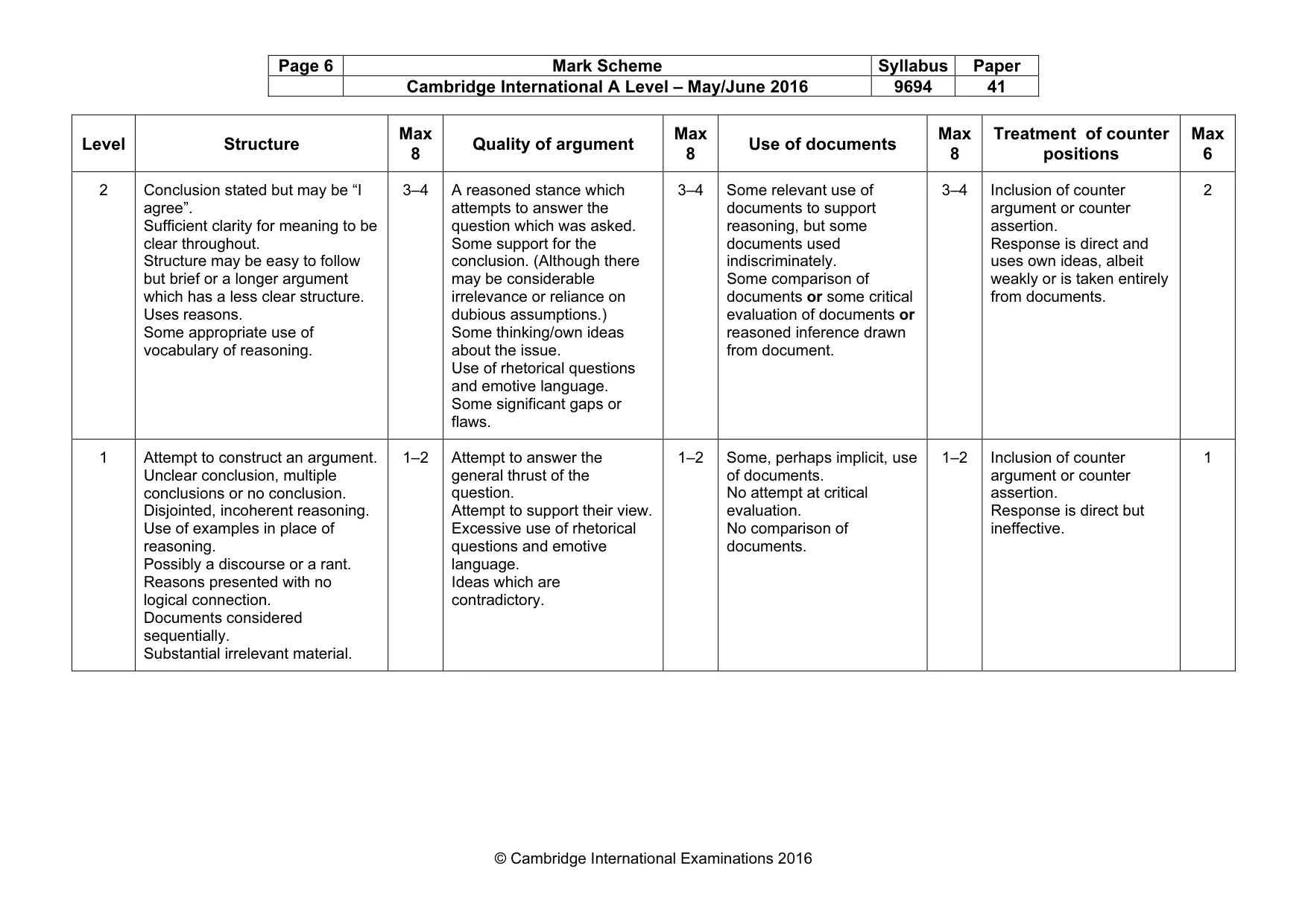
Page 6 Mark Scheme Syllabus Paper Cambridge International A Level – May/June 2016 9694 41 © Cambridge International Examinations 2016 Level Structure Max 8 Quality of argument Max 8 Use of documents Max 8 Treatment of counter positions Max 6 2 Conclusion stated but may be “I agree”. Sufficient clarity for meaning to be clear throughout. Structure may be easy to follow but brief or a longer argument which has a less clear structure. Uses reasons. Some appropriate use of vocabulary of reasoning. 3–4 A reasoned stance which attempts to answer the question which was asked. Some support for the conclusion. (Although there may be considerable irrelevance or reliance on dubious assumptions.) Some thinking/own ideas about the issue. Use of rhetorical questions and emotive language. Some significant gaps or flaws. 3–4 Some relevant use of documents to support reasoning, but some documents used indiscriminately. Some comparison of documents or some critical evaluation of documents or reasoned inference drawn from document. 3–4 Inclusion of counter argument or counter assertion. Response is direct and uses own ideas, albeit weakly or is taken entirely from documents. 2 1 Attempt to construct an argument. Unclear conclusion, multiple conclusions or no conclusion. Disjointed, incoherent reasoning. Use of examples in place of reasoning. Possibly a discourse or a rant. Reasons presented with no logical connection. Documents considered sequentially. Substantial irrelevant material. 1–2 Attempt to answer the general thrust of the question. Attempt to support their view. Excessive use of rhetorical questions and emotive language. Ideas which are contradictory. 1–2 Some, perhaps implicit, use of documents. No attempt at critical evaluation. No comparison of documents. 1–2 Inclusion of counter argument or counter assertion. Response is direct but ineffective. 1
Mark scheme, page 7
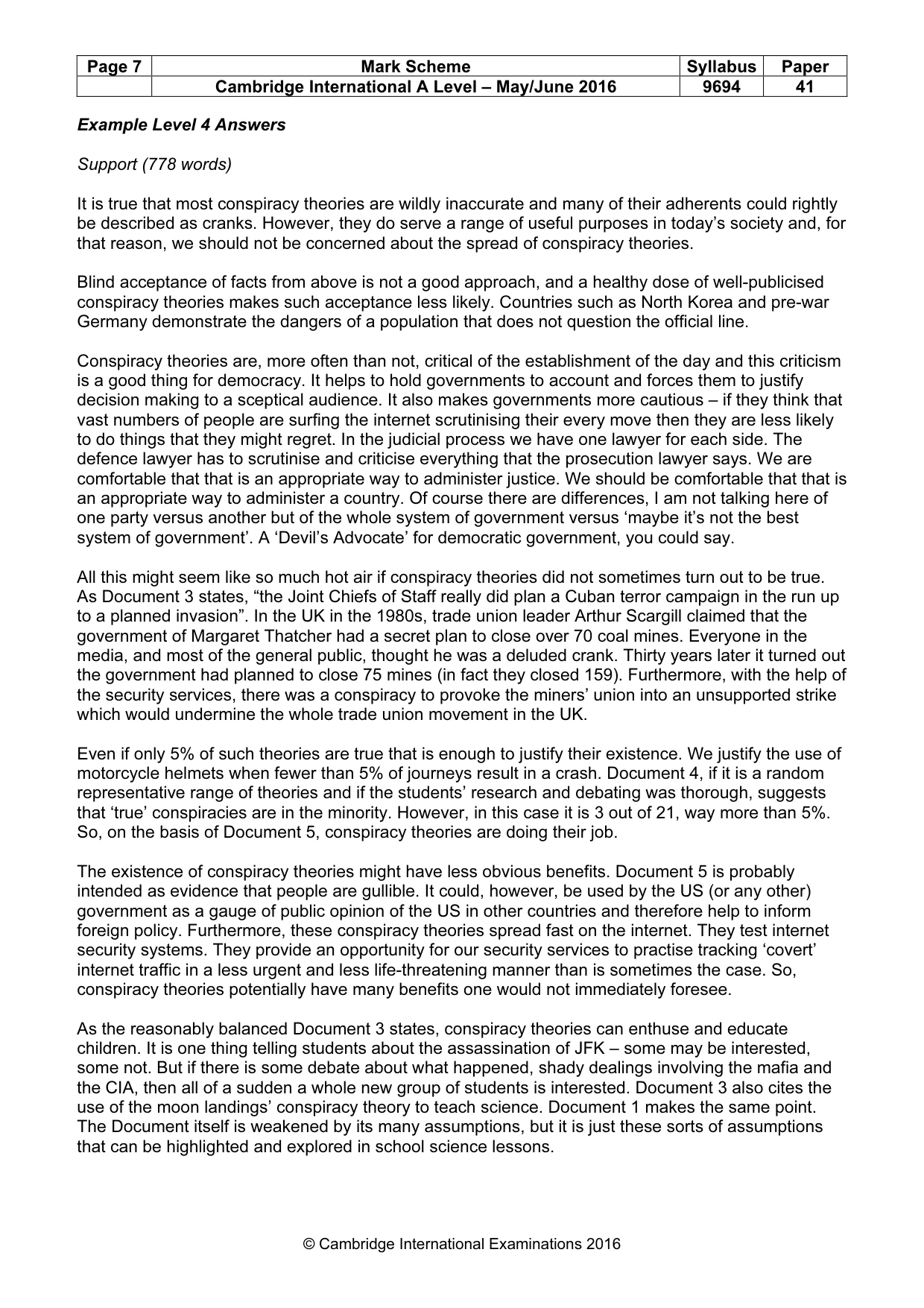
Page 7 Mark Scheme Syllabus Paper Cambridge International A Level – May/June 2016 9694 41 © Cambridge International Examinations 2016 Example Level 4 Answers Support (778 words) It is true that most conspiracy theories are wildly inaccurate and many of their adherents could rightly be described as cranks. However, they do serve a range of useful purposes in today’s society and, for that reason, we should not be concerned about the spread of conspiracy theories. Blind acceptance of facts from above is not a good approach, and a healthy dose of well-publicised conspiracy theories makes such acceptance less likely. Countries such as North Korea and pre-war Germany demonstrate the dangers of a population that does not question the official line. Conspiracy theories are, more often than not, critical of the establishment of the day and this criticism is a good thing for democracy. It helps to hold governments to account and forces them to justify decision making to a sceptical audience. It also makes governments more cautious – if they think that vast numbers of people are surfing the internet scrutinising their every move then they are less likely to do things that they might regret. In the judicial process we have one lawyer for each side. The defence lawyer has to scrutinise and criticise everything that the prosecution lawyer says. We are comfortable that that is an appropriate way to administer justice. We should be comfortable that that is an appropriate way to administer a country. Of course there are differences, I am not talking here of one party versus another but of the whole system of government versus ‘maybe it’s not the best system of government’. A ‘Devil’s Advocate’ for democratic government, you could say. All this might seem like so much hot air if conspiracy theories did not sometimes turn out to be true. As Document 3 states, “the Joint Chiefs of Staff really did plan a Cuban terror campaign in the run up to a planned invasion”. In the UK in the 1980s, trade union leader Arthur Scargill claimed that the government of Margaret Thatcher had a secret plan to close over 70 coal mines. Everyone in the media, and most of the general public, thought he was a deluded crank. Thirty years later it turned out the government had planned to close 75 mines (in fact they closed 159). Furthermore, with the help of the security services, there was a conspiracy to provoke the miners’ union into an unsupported strike which would undermine the whole trade union movement in the UK. Even if only 5% of such theories are true that is enough to justify their existence. We justify the use of motorcycle helmets when fewer than 5% of journeys result in a crash. Document 4, if it is a random representative range of theories and if the students’ research and debating was thorough, suggests that ‘true’ conspiracies are in the minority. However, in this case it is 3 out of 21, way more than 5%. So, on the basis of Document 5, conspiracy theories are doing their job. The existence of conspiracy theories might have less obvious benefits. Document 5 is probably intended as evidence that people are gullible. It could, however, be used by the US (or any other) government as a gauge of public opinion of the US in other countries and therefore help to inform foreign policy. Furthermore, these conspiracy theories spread fast on the internet. They test internet security systems. They provide an opportunity for our security services to practise tracking ‘covert’ internet traffic in a less urgent and less life-threatening manner than is sometimes the case. So, conspiracy theories potentially have many benefits one would not immediately foresee. As the reasonably balanced Document 3 states, conspiracy theories can enthuse and educate children. It is one thing telling students about the assassination of JFK – some may be interested, some not. But if there is some debate about what happened, shady dealings involving the mafia and the CIA, then all of a sudden a whole new group of students is interested. Document 3 also cites the use of the moon landings’ conspiracy theory to teach science. Document 1 makes the same point. The Document itself is weakened by its many assumptions, but it is just these sorts of assumptions that can be highlighted and explored in school science lessons.
Mark scheme, page 8
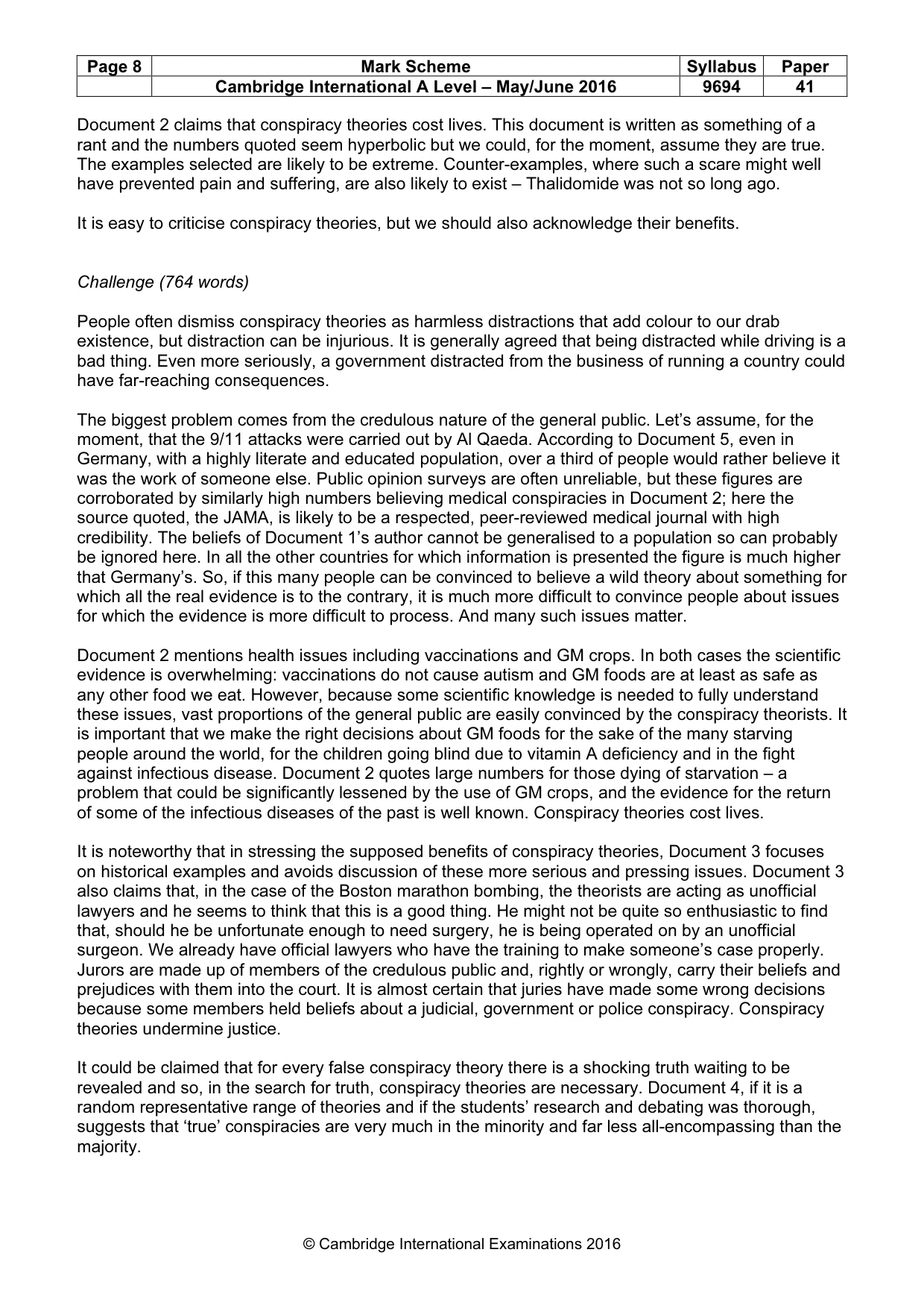
Page 8 Mark Scheme Syllabus Paper Cambridge International A Level – May/June 2016 9694 41 © Cambridge International Examinations 2016 Document 2 claims that conspiracy theories cost lives. This document is written as something of a rant and the numbers quoted seem hyperbolic but we could, for the moment, assume they are true. The examples selected are likely to be extreme. Counter-examples, where such a scare might well have prevented pain and suffering, are also likely to exist – Thalidomide was not so long ago. It is easy to criticise conspiracy theories, but we should also acknowledge their benefits. Challenge (764 words) People often dismiss conspiracy theories as harmless distractions that add colour to our drab existence, but distraction can be injurious. It is generally agreed that being distracted while driving is a bad thing. Even more seriously, a government distracted from the business of running a country could have far-reaching consequences. The biggest problem comes from the credulous nature of the general public. Let’s assume, for the moment, that the 9/11 attacks were carried out by Al Qaeda. According to Document 5, even in Germany, with a highly literate and educated population, over a third of people would rather believe it was the work of someone else. Public opinion surveys are often unreliable, but these figures are corroborated by similarly high numbers believing medical conspiracies in Document 2; here the source quoted, the JAMA, is likely to be a respected, peer-reviewed medical journal with high credibility. The beliefs of Document 1’s author cannot be generalised to a population so can probably be ignored here. In all the other countries for which information is presented the figure is much higher that Germany’s. So, if this many people can be convinced to believe a wild theory about something for which all the real evidence is to the contrary, it is much more difficult to convince people about issues for which the evidence is more difficult to process. And many such issues matter. Document 2 mentions health issues including vaccinations and GM crops. In both cases the scientific evidence is overwhelming: vaccinations do not cause autism and GM foods are at least as safe as any other food we eat. However, because some scientific knowledge is needed to fully understand these issues, vast proportions of the general public are easily convinced by the conspiracy theorists. It is important that we make the right decisions about GM foods for the sake of the many starving people around the world, for the children going blind due to vitamin A deficiency and in the fight against infectious disease. Document 2 quotes large numbers for those dying of starvation – a problem that could be significantly lessened by the use of GM crops, and the evidence for the return of some of the infectious diseases of the past is well known. Conspiracy theories cost lives. It is noteworthy that in stressing the supposed benefits of conspiracy theories, Document 3 focuses on historical examples and avoids discussion of these more serious and pressing issues. Document 3 also claims that, in the case of the Boston marathon bombing, the theorists are acting as unofficial lawyers and he seems to think that this is a good thing. He might not be quite so enthusiastic to find that, should he be unfortunate enough to need surgery, he is being operated on by an unofficial surgeon. We already have official lawyers who have the training to make someone’s case properly. Jurors are made up of members of the credulous public and, rightly or wrongly, carry their beliefs and prejudices with them into the court. It is almost certain that juries have made some wrong decisions because some members held beliefs about a judicial, government or police conspiracy. Conspiracy theories undermine justice. It could be claimed that for every false conspiracy theory there is a shocking truth waiting to be revealed and so, in the search for truth, conspiracy theories are necessary. Document 4, if it is a random representative range of theories and if the students’ research and debating was thorough, suggests that ‘true’ conspiracies are very much in the minority and far less all-encompassing than the majority.
Mark scheme, page 9
Page 9 Mark Scheme Syllabus Paper Cambridge International A Level – May/June 2016 9694 41 © Cambridge International Examinations 2016 Fundamentally, conspiracy theories are anti-truth. It is difficult for us to know the absolute truth of anything, but the best thing we have to go on is evidence. Conspiracy theories convince large sections of society that evidence is not to be believed and facts are not true. In a democratic society, governments need to be able to convince the electorate that their policies are the best ones and an electorate that does not believe in evidence is a problem. It makes it difficult for governments, with one eye on the next election, to convince people that the tough decisions they have to make are the right ones. It also opens up the political arena to charlatans who can persuade voters with a smile, some sleight of hand or claims about a government conspiracy. Far from being essential to democratic health, as claimed in Document 3, they undermine the democratic process itself. For the sake of lives, justice, democracy and truth, we should be concerned about the spread of conspiracy theories.
What you needed in this session
Cambridge’s own grade thresholds for 2016 May/June, Paper 4 · Variant 1. A higher threshold means an easier paper — the bar moves with how the cohort did.