Cambridge A Level Thinking Skills 9694 — 2016 May/June Paper 4 · Variant 2
9694/42/M/J/16 · 50 marks · ≈56 min
The question paper and its mark scheme, free to read here and free to download. This is Cambridge’s own paper, exactly as it was sat.
Question paper8 pages
Mark scheme8 pages
Answers below. Sit the paper first if you are practising.
Paper as text
Question paper, page 1
This document consists of 7 printed pages, 1 blank page and 1 insert. DC (LEG/JG) 117040/2 © UCLES 2016 [Turn over Cambridge International Examinations Cambridge International Advanced Level * 2 0 7 7 4 1 0 2 1 2 * THINKING SKILLS 9694/42 Paper 4 Applied Reasoning May/June 2016 1 hour 30 minutes No Additional Materials are required. READ THESE INSTRUCTIONS FIRST An answer booklet is provided inside this question paper. You should follow the instructions on the front cover of the answer booklet. If you need additional answer paper ask the invigilator for a continuation booklet. Answer all the questions. The number of marks is given in brackets [ ] at the end of each question.
Question paper, page 2
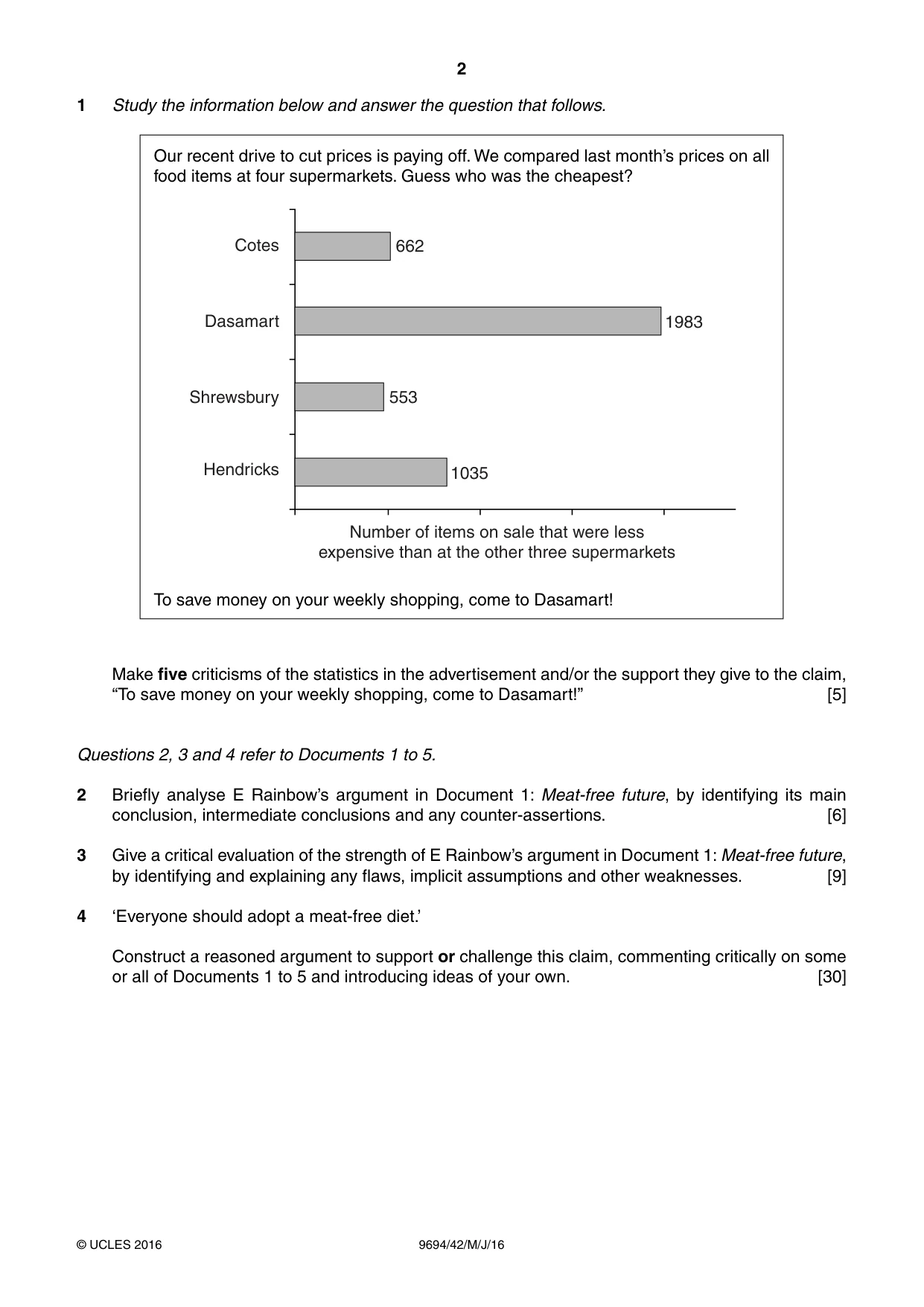
2 9694/42/M/J/16 © UCLES 2016 1 Study the information below and answer the question that follows. Our recent drive to cut prices is paying off. We compared last month’s prices on all food items at four supermarkets. Guess who was the cheapest? Cotes Dasamart Shrewsbury Hendricks 662 1983 553 1035 Number of items on sale that were less expensive than at the other three supermarkets To save money on your weekly shopping, come to Dasamart! Make five criticisms of the statistics in the advertisement and/or the support they give to the claim, “To save money on your weekly shopping, come to Dasamart!” [5] Questions 2, 3 and 4 refer to Documents 1 to 5. 2 Briefly analyse E Rainbow’s argument in Document 1: Meat-free future, by identifying its main conclusion, intermediate conclusions and any counter-assertions. [6] 3 Give a critical evaluation of the strength of E Rainbow’s argument in Document 1: Meat-free future, by identifying and explaining any flaws, implicit assumptions and other weaknesses. [9] 4 ‘Everyone should adopt a meat-free diet.’ Construct a reasoned argument to support or challenge this claim, commenting critically on some or all of Documents 1 to 5 and introducing ideas of your own. [30]
Question paper, page 3
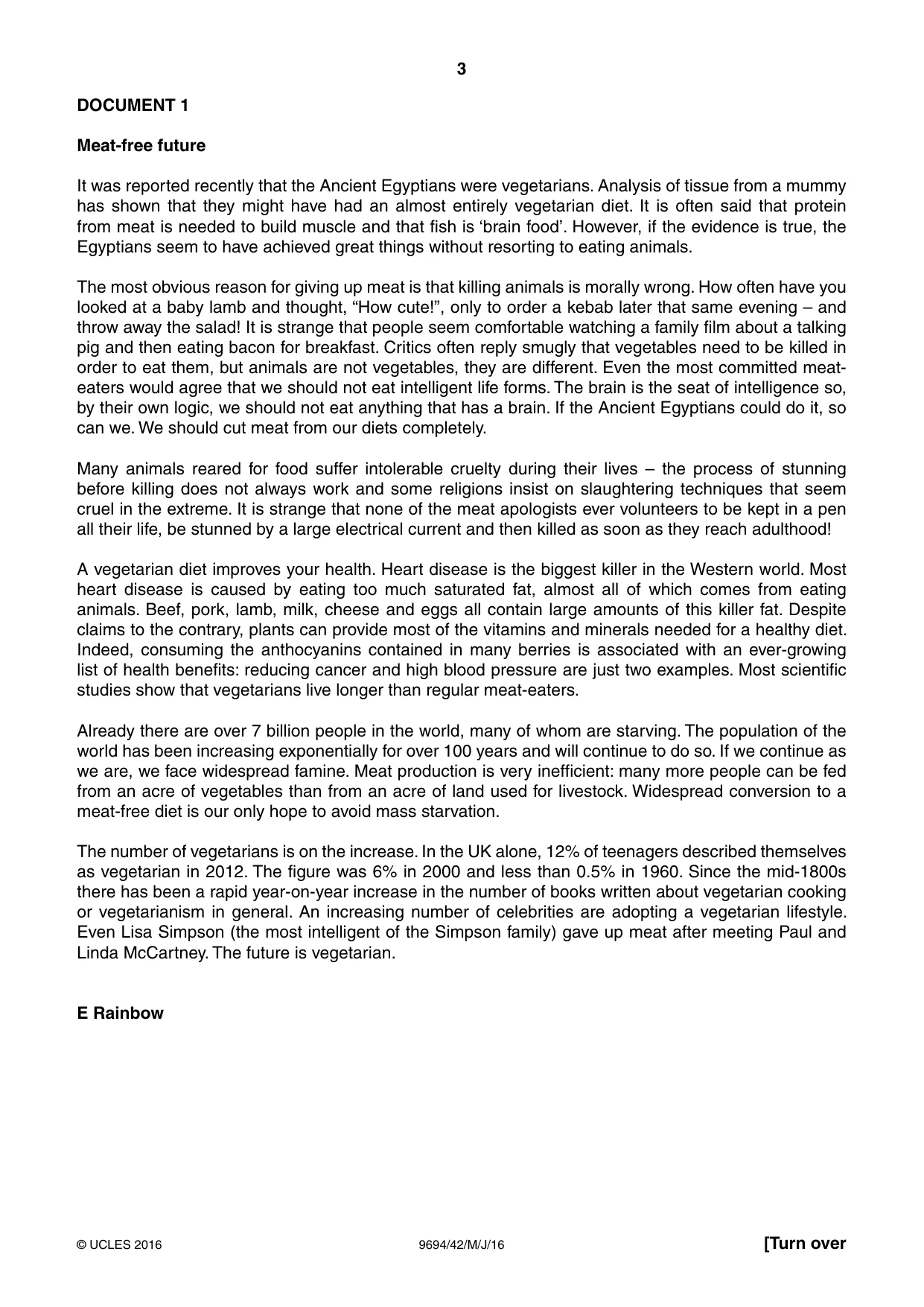
3 9694/42/M/J/16 © UCLES 2016 [Turn over DOCUMENT 1 Meat-free future It was reported recently that the Ancient Egyptians were vegetarians. Analysis of tissue from a mummy has shown that they might have had an almost entirely vegetarian diet. It is often said that protein from meat is needed to build muscle and that fish is ‘brain food’. However, if the evidence is true, the Egyptians seem to have achieved great things without resorting to eating animals. The most obvious reason for giving up meat is that killing animals is morally wrong. How often have you looked at a baby lamb and thought, “How cute!”, only to order a kebab later that same evening – and throw away the salad! It is strange that people seem comfortable watching a family film about a talking pig and then eating bacon for breakfast. Critics often reply smugly that vegetables need to be killed in order to eat them, but animals are not vegetables, they are different. Even the most committed meat- eaters would agree that we should not eat intelligent life forms. The brain is the seat of intelligence so, by their own logic, we should not eat anything that has a brain. If the Ancient Egyptians could do it, so can we. We should cut meat from our diets completely. Many animals reared for food suffer intolerable cruelty during their lives – the process of stunning before killing does not always work and some religions insist on slaughtering techniques that seem cruel in the extreme. It is strange that none of the meat apologists ever volunteers to be kept in a pen all their life, be stunned by a large electrical current and then killed as soon as they reach adulthood! A vegetarian diet improves your health. Heart disease is the biggest killer in the Western world. Most heart disease is caused by eating too much saturated fat, almost all of which comes from eating animals. Beef, pork, lamb, milk, cheese and eggs all contain large amounts of this killer fat. Despite claims to the contrary, plants can provide most of the vitamins and minerals needed for a healthy diet. Indeed, consuming the anthocyanins contained in many berries is associated with an ever-growing list of health benefits: reducing cancer and high blood pressure are just two examples. Most scientific studies show that vegetarians live longer than regular meat-eaters. Already there are over 7 billion people in the world, many of whom are starving. The population of the world has been increasing exponentially for over 100 years and will continue to do so. If we continue as we are, we face widespread famine. Meat production is very inefficient: many more people can be fed from an acre of vegetables than from an acre of land used for livestock. Widespread conversion to a meat-free diet is our only hope to avoid mass starvation. The number of vegetarians is on the increase. In the UK alone, 12% of teenagers described themselves as vegetarian in 2012. The figure was 6% in 2000 and less than 0.5% in 1960. Since the mid-1800s there has been a rapid year-on-year increase in the number of books written about vegetarian cooking or vegetarianism in general. An increasing number of celebrities are adopting a vegetarian lifestyle. Even Lisa Simpson (the most intelligent of the Simpson family) gave up meat after meeting Paul and Linda McCartney. The future is vegetarian. E Rainbow
Question paper, page 4
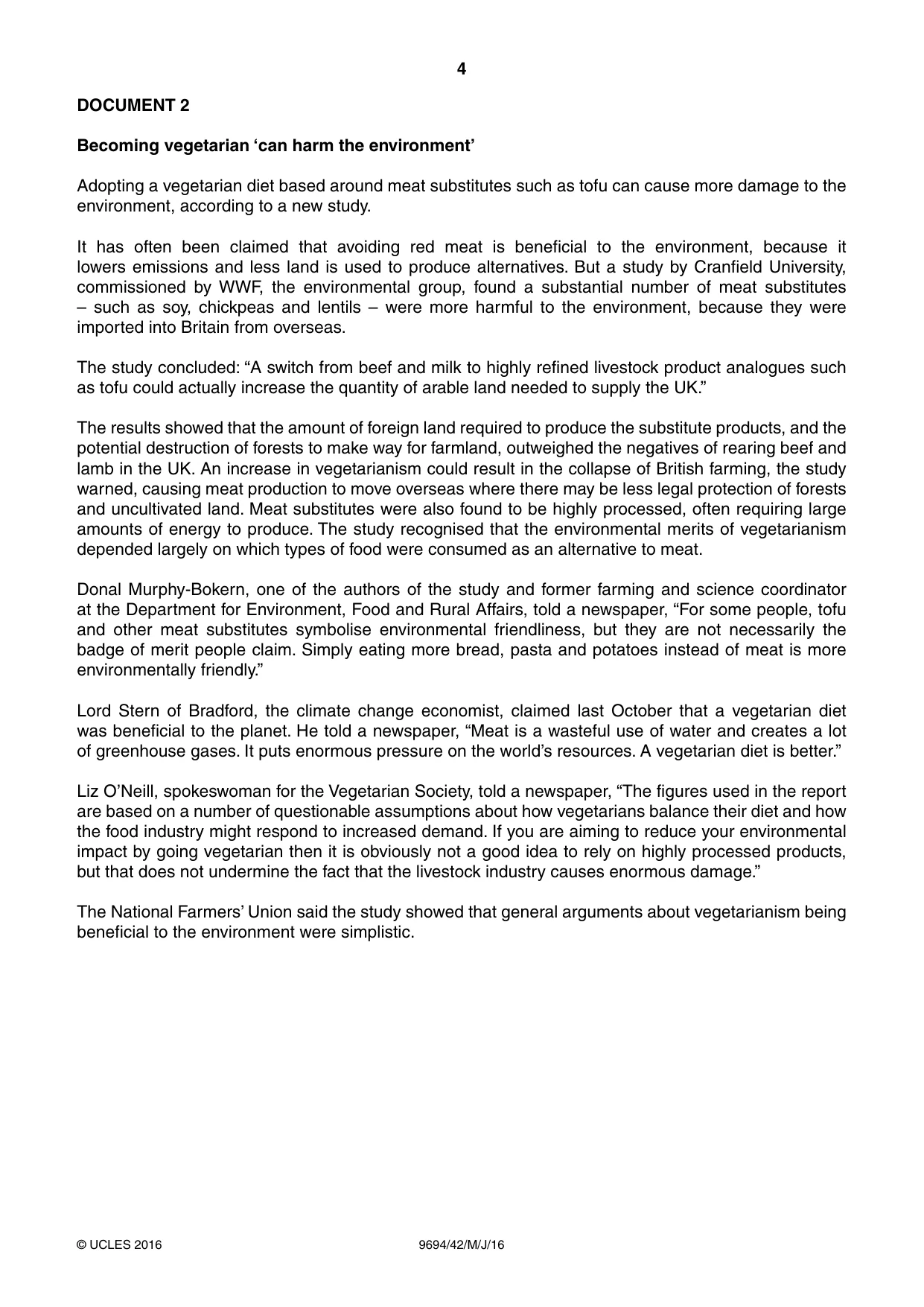
4 9694/42/M/J/16 © UCLES 2016 DOCUMENT 2 Becoming vegetarian ‘can harm the environment’ Adopting a vegetarian diet based around meat substitutes such as tofu can cause more damage to the environment, according to a new study. It has often been claimed that avoiding red meat is beneficial to the environment, because it lowers emissions and less land is used to produce alternatives. But a study by Cranfield University, commissioned by WWF, the environmental group, found a substantial number of meat substitutes – such as soy, chickpeas and lentils – were more harmful to the environment, because they were imported into Britain from overseas. The study concluded: “A switch from beef and milk to highly refined livestock product analogues such as tofu could actually increase the quantity of arable land needed to supply the UK.” The results showed that the amount of foreign land required to produce the substitute products, and the potential destruction of forests to make way for farmland, outweighed the negatives of rearing beef and lamb in the UK. An increase in vegetarianism could result in the collapse of British farming, the study warned, causing meat production to move overseas where there may be less legal protection of forests and uncultivated land. Meat substitutes were also found to be highly processed, often requiring large amounts of energy to produce. The study recognised that the environmental merits of vegetarianism depended largely on which types of food were consumed as an alternative to meat. Donal Murphy-Bokern, one of the authors of the study and former farming and science coordinator at the Department for Environment, Food and Rural Affairs, told a newspaper, “For some people, tofu and other meat substitutes symbolise environmental friendliness, but they are not necessarily the badge of merit people claim. Simply eating more bread, pasta and potatoes instead of meat is more environmentally friendly.” Lord Stern of Bradford, the climate change economist, claimed last October that a vegetarian diet was beneficial to the planet. He told a newspaper, “Meat is a wasteful use of water and creates a lot of greenhouse gases. It puts enormous pressure on the world’s resources. A vegetarian diet is better.” Liz O’Neill, spokeswoman for the Vegetarian Society, told a newspaper, “The figures used in the report are based on a number of questionable assumptions about how vegetarians balance their diet and how the food industry might respond to increased demand. If you are aiming to reduce your environmental impact by going vegetarian then it is obviously not a good idea to rely on highly processed products, but that does not undermine the fact that the livestock industry causes enormous damage.” The National Farmers’ Union said the study showed that general arguments about vegetarianism being beneficial to the environment were simplistic.
Question paper, page 5
5 9694/42/M/J/16 © UCLES 2016 [Turn over DOCUMENT 3 The health benefits of eating Quorn products You may know Quorn as a range of foods popular with vegetarians. What you may not know is that more and more non-vegetarians are incorporating Quorn products into their diets to help them follow a lighter, healthier lifestyle. What is Quorn? Quorn is the brand name for a versatile range of healthy foods. At the heart of all Quorn products is a unique ingredient called mycoprotein. Mycoprotein is made from a nutritious member of the fungi family which was discovered growing in a garden in Marlow, Buckinghamshire forty years ago. Today there are more than 100 products in the Quorn range, from burgers and sausages to ready meals and pies. Here we focus on the cooking ingredients in the range, Quorn Mince and Quorn Pieces, both of which are very high in mycoprotein. What are the benefits of replacing meat with Quorn Mince and Quorn Pieces? Like meat, Quorn Mince and Quorn Pieces are excellent sources of protein but they’re generally lower in saturated fat and calories than their meat equivalents. For example, Quorn Mince contains only 54% of the calories of beef mince, about 22% of the fat, and just 14% of the saturates. Quorn Mince and Quorn Pieces also contain no cholesterol and no trans-fats at all. They’re also good sources of dietary fibre. In fact you get more fibre from 100 g of Quorn Mince than from 100 g of baked beans. By the way, there is no dietary fibre at all in meat and poultry. Health benefits of Quorn products There have been a number of academic studies examining the health properties of mycoprotein, the special ingredient in all Quorn products. • Cholesterol: Most Quorn products contain no cholesterol, but in addition to that, research suggests that mycoprotein may have a valuable role to play in helping to maintain healthy cholesterol levels or even to lower LDL (bad) cholesterol, so helping to maintain a healthy heart. • Weight control: There is also evidence to suggest that mycoprotein can help improve what dieticians call ‘satiety’, the sense of feeling satisfied and full. Hence mycoprotein may help regulate energy intake among those looking to control or lose weight. Do Quorn products have all the same nutrients as meat and poultry? Quorn products have less of the things that most people need to cut down on, such as fat, saturates and calories. But broadly speaking, you can get all the good things from Quorn products that you get from meat. In fact, the quality of protein in Quorn Mince and Quorn Pieces is identical to chicken and a little better than beef. Being vegetable in origin, there is less iron in Quorn products than in red meat but this can be made up with foods such as leafy green vegetables, lentils, kidney beans and some dried fruits. How do I cook with Quorn products? In general, Quorn foods can be prepared using a conventional oven or microwave. They can be prepared in a similar fashion to their meat and poultry counterparts. They’re delicious and tasty grilled, baked, and sautéed and can be prepared quickly and easily, and there’s no preparation necessary and no waste. Cooking instructions appear on each pack and will of course vary depending on the product type. Extract from Quorn manufacturer’s website
Question paper, page 6
6 9694/42/M/J/16 © UCLES 2016 DOCUMENT 4 Comments on a social media site responding to criticisms of people who eat meat Many people wrongly assume that the increase in vegetarianism in recent years has been due to the advertised health benefits of a vegetarian diet – berries good, beef bad. However, the increase in vegetarianism happened around the same time that large numbers of children began watching cartoons of talking animals. This, and the ubiquity of furry, cuddly animal toys, is the real cause of the ‘vegetarian explosion’. Early-life exposure to fictional animals with human characteristics has led to a belief among the general population that animals are small furry people so we should not eat them! Maybe now we are seeing children’s animated films about talking cars and vegetables this worrying trend might be reversed. Whassupdoc “Turkeys wouldn’t vote for Christmas”, right? Wrong! There are millions of turkeys on farms all over the world. If people did not eat turkeys there would be, at best, a small population roaming free in North America, and, at worst, they could be extinct. If I was ‘Chief Turkey’ I would be pleased that there is a tradition of Christmas turkey in Britain and Thanksgiving turkey in the US. Turkeys, like other domesticated birds that we eat, flourish because humans look after them. Christmas will ensure that turkey genes are passed on to generations of turkeys for years to come. Being a domesticated animal has been a very successful evolutionary strategy for many species. Those animals that tasted good, and were tame enough for humans to easily keep, benefited from assured continuation of their genetic heritage. The wild cousins of these domestic animals have struggled to survive, with many succumbing to extinction. Wild horses are rare, domestic ones are common. Otis Humans are meant to eat meat. The Bible says so and so does evolution. In the book of Genesis, chapter 9, verse 3, we find the words “Every moving thing that liveth shall be meat for you; even as the green herb have I given you all things” – meaning that humans have the moral right to eat animals. Furthermore, human teeth are not specialized to eat meat and are not specialized to eat plants. We have the generalized teeth of an omnivore, something which can cope with food of plant, animal and indeed fungal origin. With God and science on your side – you have to be right. EM
Question paper, page 7
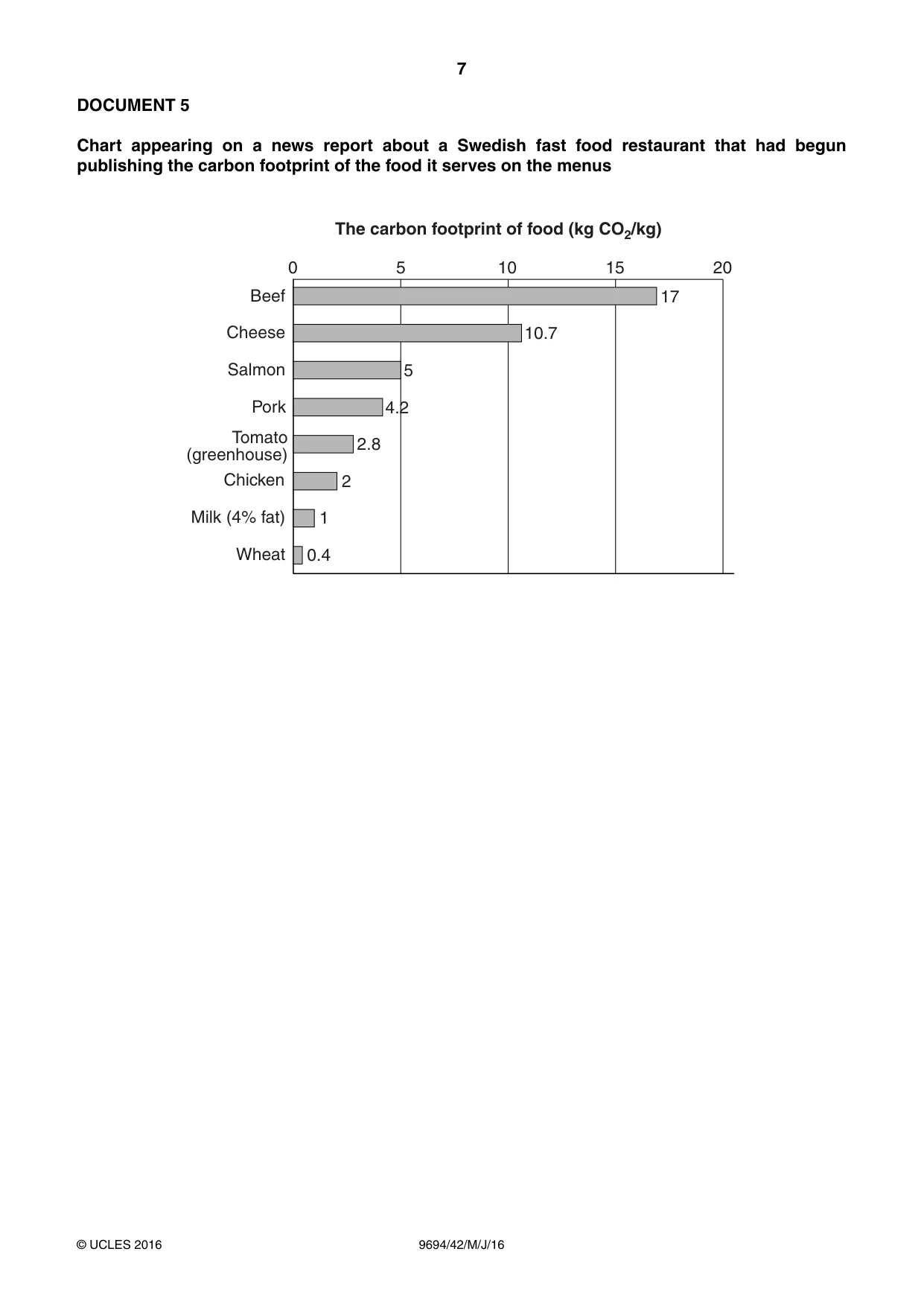
7 9694/42/M/J/16 © UCLES 2016 DOCUMENT 5 Chart appearing on a news report about a Swedish fast food restaurant that had begun publishing the carbon footprint of the food it serves on the menus Beef Cheese Salmon Pork Tomato (greenhouse) Chicken Milk (4% fat) Wheat 0 5 10 15 17 10.7 5 4.2 2.8 2 1 0.4 20 The carbon footprint of food (kg CO2/kg)
Question paper, page 8
8 9694/42/M/J/16 © UCLES 2016 BLANK PAGE Permission to reproduce items where third-party owned material protected by copyright is included has been sought and cleared where possible. Every reasonable effort has been made by the publisher (UCLES) to trace copyright holders, but if any items requiring clearance have unwittingly been included, the publisher will be pleased to make amends at the earliest possible opportunity. To avoid the issue of disclosure of answer-related information to candidates, all copyright acknowledgements are reproduced online in the Cambridge International Examinations Copyright Acknowledgements Booklet. This is produced for each series of examinations and is freely available to download at www.cie.org.uk after the live examination series. Cambridge International Examinations is part of the Cambridge Assessment Group. Cambridge Assessment is the brand name of University of Cambridge Local Examinations Syndicate (UCLES), which is itself a department of the University of Cambridge.
Mark scheme, page 1
® IGCSE is the registered trademark of Cambridge International Examinations. This document consists of 8 printed pages. © UCLES 2016 [Turn over Cambridge International Examinations Cambridge International Advanced Level THINKING SKILLS 9694/42 Paper 4 Applied Reasoning May/June 2016 MARK SCHEME Maximum Mark: 50 Published This mark scheme is published as an aid to teachers and candidates, to indicate the requirements of the examination. It shows the basis on which Examiners were instructed to award marks. It does not indicate the details of the discussions that took place at an Examiners’ meeting before marking began, which would have considered the acceptability of alternative answers. Mark schemes should be read in conjunction with the question paper and the Principal Examiner Report for Teachers. Cambridge will not enter into discussions about these mark schemes. Cambridge is publishing the mark schemes for the May/June 2016 series for most Cambridge IGCSE®, Cambridge International A and AS Level components and some Cambridge O Level components.
Mark scheme, page 2
Page 2 Mark Scheme Syllabus Paper Cambridge International A Level – May/June 2016 9694 42 © Cambridge International Examinations 2016 1 Make five criticisms of the statistics in the advertisement and/or the support they give to the claim, “To save money on your weekly shopping, come to Dasamart!” [5] 1 mark for any of the following: • 3 competitors could have been selected • Last month might have been an unusual month • Dasamart’s less expensive products may have been only slightly cheaper while competitors’ less expensive products could be much cheaper • “weekly shopping” likely to include non-food products, about which there is no information • Proportions of bars do not match numbers (Dasamart is exaggerated) • “weekly shopping” might not include a significant number of the ‘cheaper’ products • If the prices for all the other products not included in the comparison are substantially higher at Dasamart, then unlikely to “save money” • To “save money” one has to assume that all the products in the weekly shopping are absolutely necessary • It is not clear whether items only on sale at Dasamart are counted as being the cheapest. 2 Briefly analyse E Rainbow’s argument in Document 1: Meat-free Future, by identifying its main conclusion, intermediate conclusions and counter-assertions. [6] 1 mark for each element (maximum 4 if MC not identified). CA – (It is often said that) protein from meat is needed to build muscle and fish is ‘brain food’. IC – the Egyptians seem to have achieved great things without resorting to eating animals. IC – killing animals is morally wrong. CA – vegetables need to be killed in order to eat them IC – we should not eat anything that has a brain. MC – We should cut meat from our diets completely. IC – Many animals reared for food suffer intolerable cruelty during their lives IC – A vegetarian diet improves your health. IC – If we continue as we are we face widespread famine. IC – Widespread conversion to a meat-free diet is our only hope to avoid mass starvation. IC – The future is vegetarian.
Mark scheme, page 3
Page 3 Mark Scheme Syllabus Paper Cambridge International A Level – May/June 2016 9694 42 © Cambridge International Examinations 2016 3 Give a critical evaluation of the strength of E Rainbow’s argument in Document 1: Meat- free Future, by identifying and explaining any flaws, implicit assumptions and other weaknesses. [9] 2 marks for a developed version of any of the following points. 1 mark for a weak or incomplete version of any of the following points. Paragraph 1 Conflation – of “might have had an almost entirely vegetarian diet” with “were vegetarians”. Generalisation – from “a mummy” to “the Egyptians”. Paragraph 2 The accusation of hypocrisy associated with watching a film about a talking pig assumes that the family are unable to distinguish fact from fiction. Assumption – that the difference between animals and plants is significant enough to justify eating one but not the other. Straw man – the representation of the position of the “committed meat-eater” is unfair and illegitimately makes this position appear untenable. Equivocation – in the meaning of “intelligent”: intelligent life forms / anything with a brain Confusion of necessary and sufficient conditions – Possession of a brain might be a necessary condition for intelligence, but might not be sufficient. OR Assumption – that any being which possesses a brain should be regarded as intelligent Paragraph 3 “Many animals reared for food suffer intolerable cruelty” implies that some do not, and so does not support a complete end to eating animals. Assumption – that animals and “meat apologists” should be treated in a similar way, or that animals and “meat apologists” would share similar feelings about the same experiences. (Could be expressed in terms of an inappropriate application of the principle of universalizability, i.e. there is no reason to think that the same principles should apply to humans and animals.) Paragraph 4 “Heart disease is the biggest killer in the Western world.” implies that it is not the biggest killer in the non-Western world and hence only supports the conclusion if “you” live in the Western world (or, indeed, are typical of Westerners). Selective examples – there may be other animal-derived foods that do not contain “this killer fat”. OR Generalisation – from selected example to all animal-derived food
Mark scheme, page 4
Page 4 Mark Scheme Syllabus Paper Cambridge International A Level – May/June 2016 9694 42 © Cambridge International Examinations 2016 Conflation – of ‘eating animals’ with ‘animal products’ The author states that “plants can provide most of the vitamins and minerals needed for a healthy diet” but fails to say where the remainder can come from, if not from meat (or even animal products). Conflation – of “regular meat eaters” with people who eat any meat. The reasoning in this paragraph, and indeed most of the argument, supports the adoption of a diet with a reduced meat content but does not support the complete removal of meat from the diet. For example, “vegetarians live longer than regular meat-eaters” implies that vegetarians might not live longer than occasional meat eaters. Assumption – that longevity is of greater importance than the pleasures of meat-eating. Paragraph 5 Contradiction – in paragraph 4 the author argues that we should be vegetarian because we will live longer and then implies that increasing population is a concern. Contradiction – presumably if there is widespread famine then the world population will cease to grow exponentially. Assumption – that land used for livestock would be suitable for growing vegetables (efficiently). Assumption – that the main cause of food shortage is a lack of land. Paragraph 6 Significance – it is likely that the number of books written on almost any topic has increased steadily since the mid-1800s; the specific “year-on-year” claim is almost certainly inaccurate. Appeal – to a (fictitious) celebrity as an authority. Appeal – implies that if you want to be part of the future, you had better be vegetarian.
Mark scheme, page 5
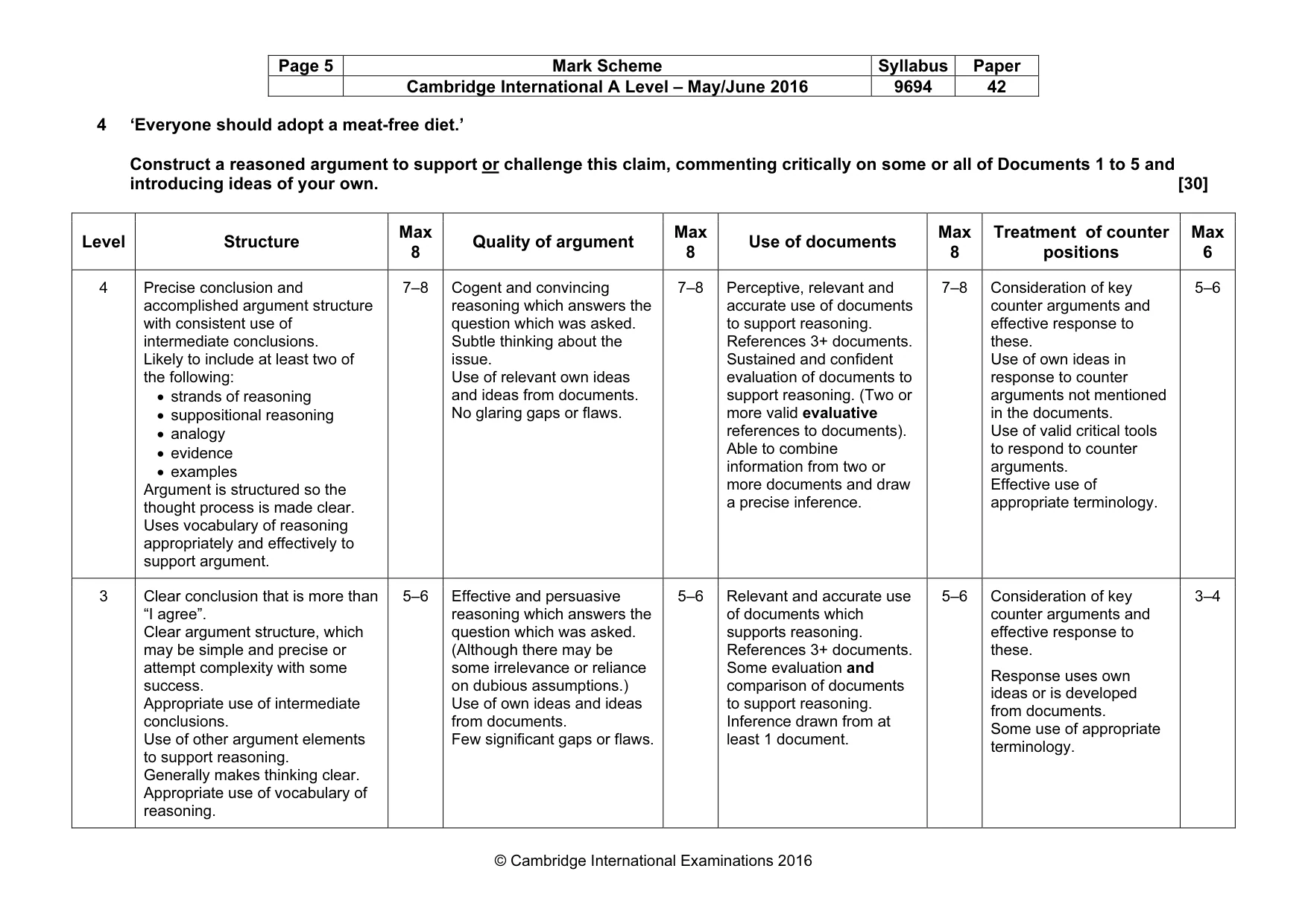
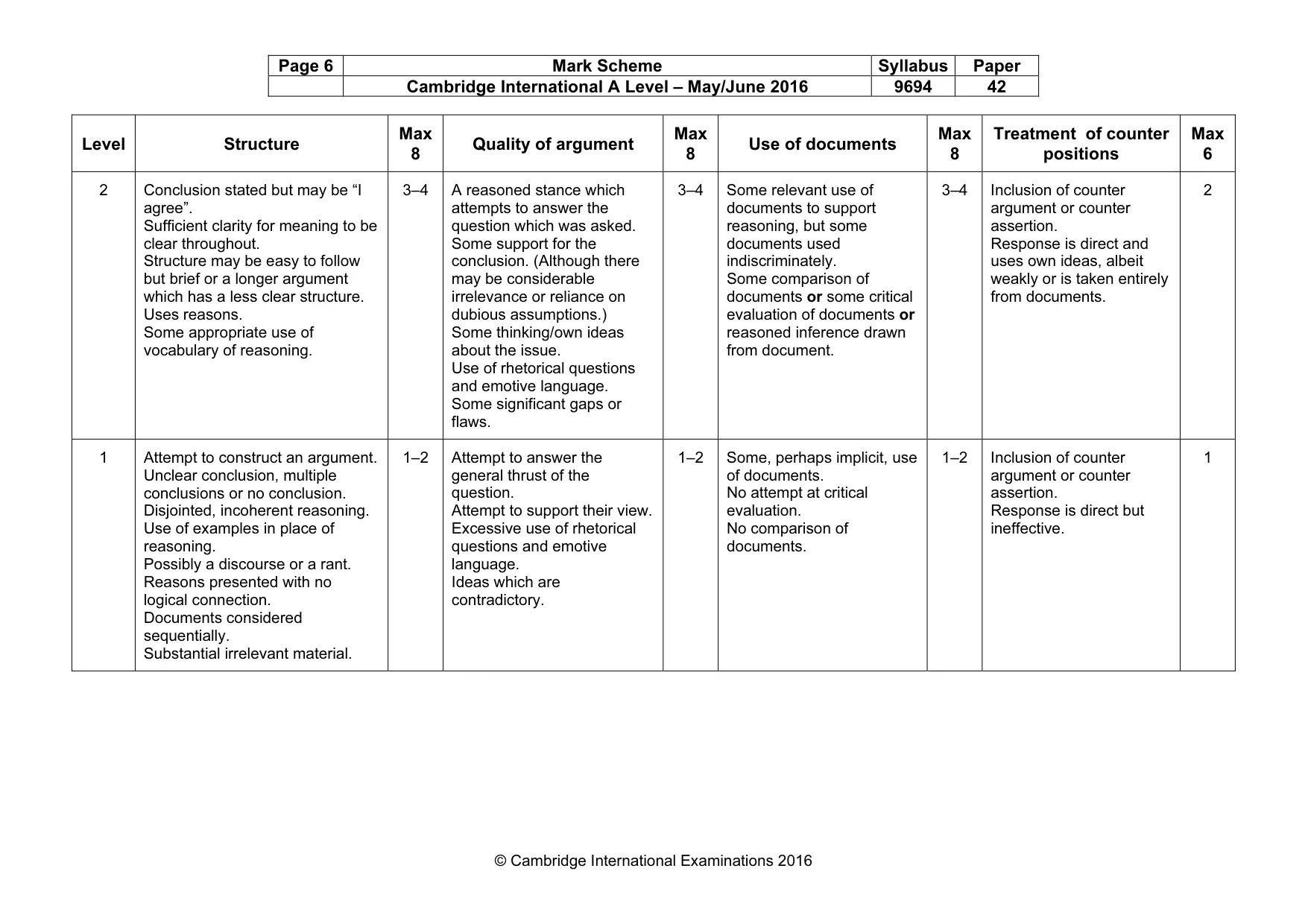
Page 5 Mark Scheme Syllabus Paper Cambridge International A Level – May/June 2016 9694 42 © Cambridge International Examinations 2016 4 ‘Everyone should adopt a meat-free diet.’ Construct a reasoned argument to support or challenge this claim, commenting critically on some or all of Documents 1 to 5 and introducing ideas of your own. [30] Level Structure Max 8 Quality of argument Max 8 Use of documents Max 8 Treatment of counter positions Max 6 4 Precise conclusion and accomplished argument structure with consistent use of intermediate conclusions. Likely to include at least two of the following: • strands of reasoning • suppositional reasoning • analogy • evidence • examples Argument is structured so the thought process is made clear. Uses vocabulary of reasoning appropriately and effectively to support argument. 7–8 Cogent and convincing reasoning which answers the question which was asked. Subtle thinking about the issue. Use of relevant own ideas and ideas from documents. No glaring gaps or flaws. 7–8 Perceptive, relevant and accurate use of documents to support reasoning. References 3+ documents. Sustained and confident evaluation of documents to support reasoning. (Two or more valid evaluative references to documents). Able to combine information from two or more documents and draw a precise inference. 7–8 Consideration of key counter arguments and effective response to these. Use of own ideas in response to counter arguments not mentioned in the documents. Use of valid critical tools to respond to counter arguments. Effective use of appropriate terminology. 5–6 3 Clear conclusion that is more than “I agree”. Clear argument structure, which may be simple and precise or attempt complexity with some success. Appropriate use of intermediate conclusions. Use of other argument elements to support reasoning. Generally makes thinking clear. Appropriate use of vocabulary of reasoning. 5–6 Effective and persuasive reasoning which answers the question which was asked. (Although there may be some irrelevance or reliance on dubious assumptions.) Use of own ideas and ideas from documents. Few significant gaps or flaws. 5–6 Relevant and accurate use of documents which supports reasoning. References 3+ documents. Some evaluation and comparison of documents to support reasoning. Inference drawn from at least 1 document. 5–6 Consideration of key counter arguments and effective response to these. Response uses own ideas or is developed from documents. Some use of appropriate terminology. 3–4
Mark scheme, page 6
Page 6 Mark Scheme Syllabus Paper Cambridge International A Level – May/June 2016 9694 42 © Cambridge International Examinations 2016 Level Structure Max 8 Quality of argument Max 8 Use of documents Max 8 Treatment of counter positions Max 6 2 Conclusion stated but may be “I agree”. Sufficient clarity for meaning to be clear throughout. Structure may be easy to follow but brief or a longer argument which has a less clear structure. Uses reasons. Some appropriate use of vocabulary of reasoning. 3–4 A reasoned stance which attempts to answer the question which was asked. Some support for the conclusion. (Although there may be considerable irrelevance or reliance on dubious assumptions.) Some thinking/own ideas about the issue. Use of rhetorical questions and emotive language. Some significant gaps or flaws. 3–4 Some relevant use of documents to support reasoning, but some documents used indiscriminately. Some comparison of documents or some critical evaluation of documents or reasoned inference drawn from document. 3–4 Inclusion of counter argument or counter assertion. Response is direct and uses own ideas, albeit weakly or is taken entirely from documents. 2 1 Attempt to construct an argument. Unclear conclusion, multiple conclusions or no conclusion. Disjointed, incoherent reasoning. Use of examples in place of reasoning. Possibly a discourse or a rant. Reasons presented with no logical connection. Documents considered sequentially. Substantial irrelevant material. 1–2 Attempt to answer the general thrust of the question. Attempt to support their view. Excessive use of rhetorical questions and emotive language. Ideas which are contradictory. 1–2 Some, perhaps implicit, use of documents. No attempt at critical evaluation. No comparison of documents. 1–2 Inclusion of counter argument or counter assertion. Response is direct but ineffective. 1
Mark scheme, page 7
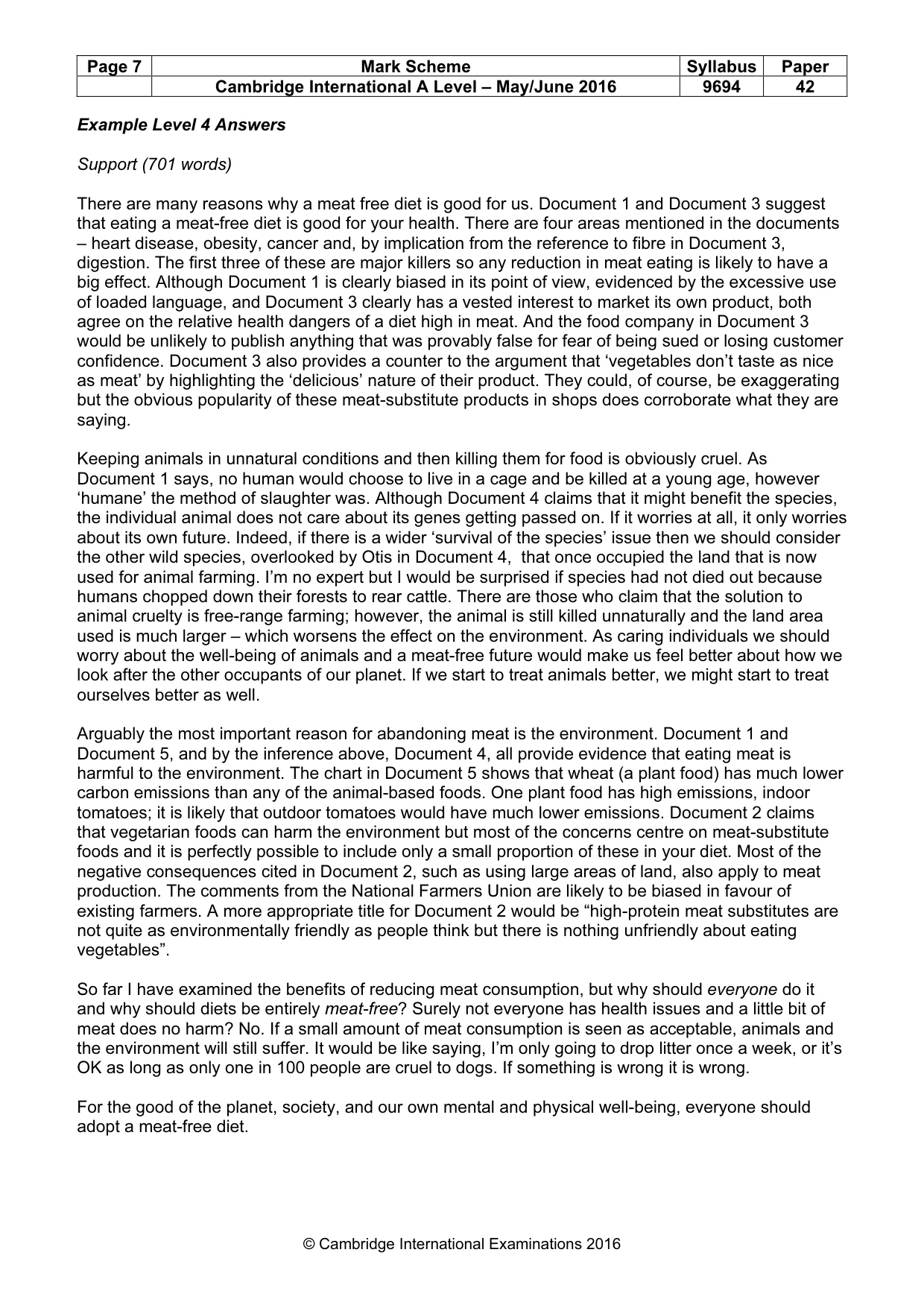
Page 7 Mark Scheme Syllabus Paper Cambridge International A Level – May/June 2016 9694 42 © Cambridge International Examinations 2016 Example Level 4 Answers Support (701 words) There are many reasons why a meat free diet is good for us. Document 1 and Document 3 suggest that eating a meat-free diet is good for your health. There are four areas mentioned in the documents – heart disease, obesity, cancer and, by implication from the reference to fibre in Document 3, digestion. The first three of these are major killers so any reduction in meat eating is likely to have a big effect. Although Document 1 is clearly biased in its point of view, evidenced by the excessive use of loaded language, and Document 3 clearly has a vested interest to market its own product, both agree on the relative health dangers of a diet high in meat. And the food company in Document 3 would be unlikely to publish anything that was provably false for fear of being sued or losing customer confidence. Document 3 also provides a counter to the argument that ‘vegetables don’t taste as nice as meat’ by highlighting the ‘delicious’ nature of their product. They could, of course, be exaggerating but the obvious popularity of these meat-substitute products in shops does corroborate what they are saying. Keeping animals in unnatural conditions and then killing them for food is obviously cruel. As Document 1 says, no human would choose to live in a cage and be killed at a young age, however ‘humane’ the method of slaughter was. Although Document 4 claims that it might benefit the species, the individual animal does not care about its genes getting passed on. If it worries at all, it only worries about its own future. Indeed, if there is a wider ‘survival of the species’ issue then we should consider the other wild species, overlooked by Otis in Document 4, that once occupied the land that is now used for animal farming. I’m no expert but I would be surprised if species had not died out because humans chopped down their forests to rear cattle. There are those who claim that the solution to animal cruelty is free-range farming; however, the animal is still killed unnaturally and the land area used is much larger – which worsens the effect on the environment. As caring individuals we should worry about the well-being of animals and a meat-free future would make us feel better about how we look after the other occupants of our planet. If we start to treat animals better, we might start to treat ourselves better as well. Arguably the most important reason for abandoning meat is the environment. Document 1 and Document 5, and by the inference above, Document 4, all provide evidence that eating meat is harmful to the environment. The chart in Document 5 shows that wheat (a plant food) has much lower carbon emissions than any of the animal-based foods. One plant food has high emissions, indoor tomatoes; it is likely that outdoor tomatoes would have much lower emissions. Document 2 claims that vegetarian foods can harm the environment but most of the concerns centre on meat-substitute foods and it is perfectly possible to include only a small proportion of these in your diet. Most of the negative consequences cited in Document 2, such as using large areas of land, also apply to meat production. The comments from the National Farmers Union are likely to be biased in favour of existing farmers. A more appropriate title for Document 2 would be “high-protein meat substitutes are not quite as environmentally friendly as people think but there is nothing unfriendly about eating vegetables”. So far I have examined the benefits of reducing meat consumption, but why should everyone do it and why should diets be entirely meat-free? Surely not everyone has health issues and a little bit of meat does no harm? No. If a small amount of meat consumption is seen as acceptable, animals and the environment will still suffer. It would be like saying, I’m only going to drop litter once a week, or it’s OK as long as only one in 100 people are cruel to dogs. If something is wrong it is wrong. For the good of the planet, society, and our own mental and physical well-being, everyone should adopt a meat-free diet.
Mark scheme, page 8
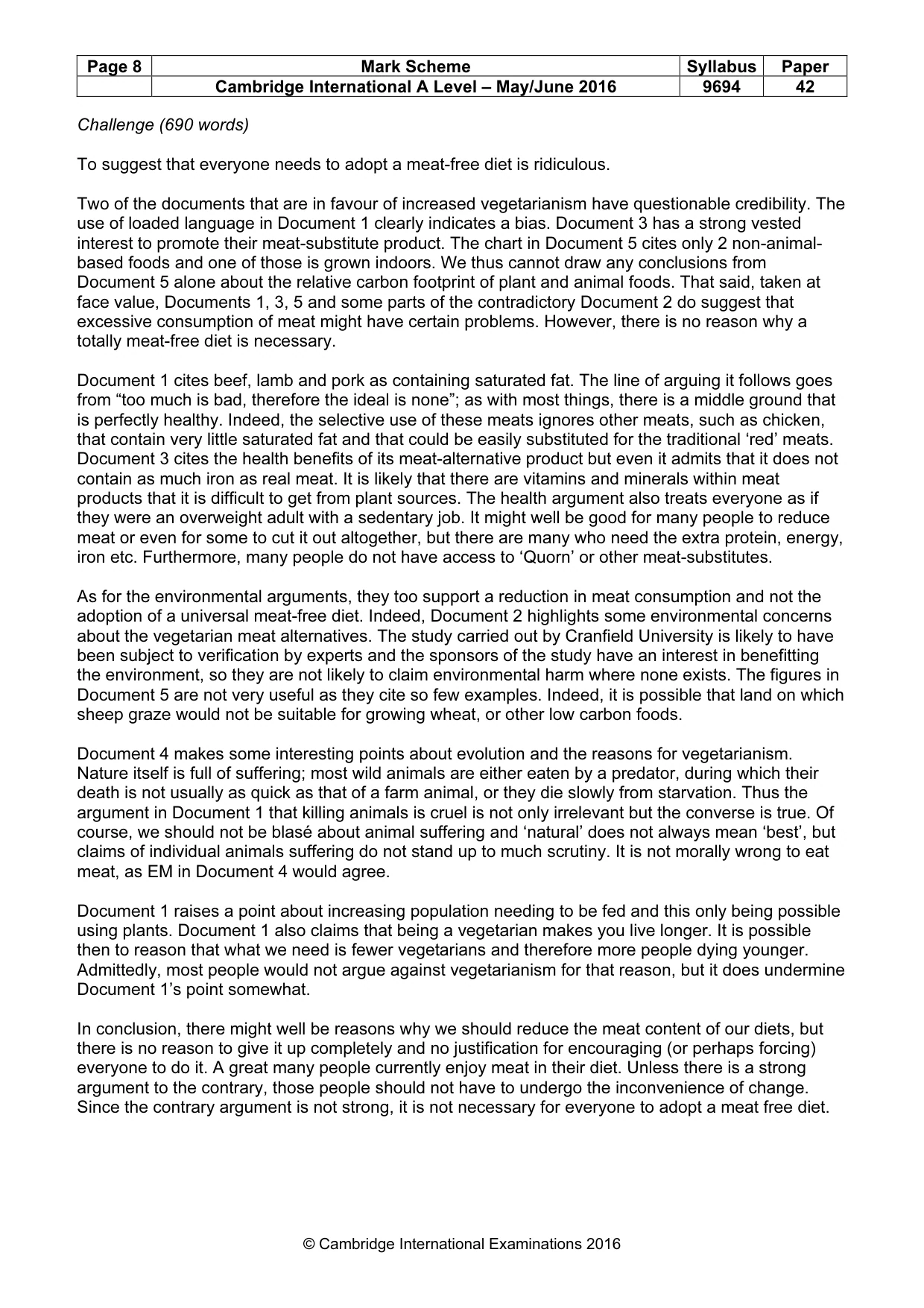
Page 8 Mark Scheme Syllabus Paper Cambridge International A Level – May/June 2016 9694 42 © Cambridge International Examinations 2016 Challenge (690 words) To suggest that everyone needs to adopt a meat-free diet is ridiculous. Two of the documents that are in favour of increased vegetarianism have questionable credibility. The use of loaded language in Document 1 clearly indicates a bias. Document 3 has a strong vested interest to promote their meat-substitute product. The chart in Document 5 cites only 2 non-animal- based foods and one of those is grown indoors. We thus cannot draw any conclusions from Document 5 alone about the relative carbon footprint of plant and animal foods. That said, taken at face value, Documents 1, 3, 5 and some parts of the contradictory Document 2 do suggest that excessive consumption of meat might have certain problems. However, there is no reason why a totally meat-free diet is necessary. Document 1 cites beef, lamb and pork as containing saturated fat. The line of arguing it follows goes from “too much is bad, therefore the ideal is none”; as with most things, there is a middle ground that is perfectly healthy. Indeed, the selective use of these meats ignores other meats, such as chicken, that contain very little saturated fat and that could be easily substituted for the traditional ‘red’ meats. Document 3 cites the health benefits of its meat-alternative product but even it admits that it does not contain as much iron as real meat. It is likely that there are vitamins and minerals within meat products that it is difficult to get from plant sources. The health argument also treats everyone as if they were an overweight adult with a sedentary job. It might well be good for many people to reduce meat or even for some to cut it out altogether, but there are many who need the extra protein, energy, iron etc. Furthermore, many people do not have access to ‘Quorn’ or other meat-substitutes. As for the environmental arguments, they too support a reduction in meat consumption and not the adoption of a universal meat-free diet. Indeed, Document 2 highlights some environmental concerns about the vegetarian meat alternatives. The study carried out by Cranfield University is likely to have been subject to verification by experts and the sponsors of the study have an interest in benefitting the environment, so they are not likely to claim environmental harm where none exists. The figures in Document 5 are not very useful as they cite so few examples. Indeed, it is possible that land on which sheep graze would not be suitable for growing wheat, or other low carbon foods. Document 4 makes some interesting points about evolution and the reasons for vegetarianism. Nature itself is full of suffering; most wild animals are either eaten by a predator, during which their death is not usually as quick as that of a farm animal, or they die slowly from starvation. Thus the argument in Document 1 that killing animals is cruel is not only irrelevant but the converse is true. Of course, we should not be blasé about animal suffering and ‘natural’ does not always mean ‘best’, but claims of individual animals suffering do not stand up to much scrutiny. It is not morally wrong to eat meat, as EM in Document 4 would agree. Document 1 raises a point about increasing population needing to be fed and this only being possible using plants. Document 1 also claims that being a vegetarian makes you live longer. It is possible then to reason that what we need is fewer vegetarians and therefore more people dying younger. Admittedly, most people would not argue against vegetarianism for that reason, but it does undermine Document 1’s point somewhat. In conclusion, there might well be reasons why we should reduce the meat content of our diets, but there is no reason to give it up completely and no justification for encouraging (or perhaps forcing) everyone to do it. A great many people currently enjoy meat in their diet. Unless there is a strong argument to the contrary, those people should not have to undergo the inconvenience of change. Since the contrary argument is not strong, it is not necessary for everyone to adopt a meat free diet.
What you needed in this session
Cambridge’s own grade thresholds for 2016 May/June, Paper 4 · Variant 2. A higher threshold means an easier paper — the bar moves with how the cohort did.