Cambridge A Level Thinking Skills 9694 — 2015 Oct/Nov Paper 4 · Variant 1
9694/41/O/N/15 · 50 marks · ≈56 min
The question paper and its mark scheme, free to read here and free to download. This is Cambridge’s own paper, exactly as it was sat.
Question paper8 pages
Mark scheme7 pages
Answers below. Sit the paper first if you are practising.
Paper as text
Question paper, page 1
This document consists of 8 printed pages and 1 insert. IB15 11_9694_41/2RP © UCLES 2015 [Turn over *6792862971* Cambridge International Examinations Cambridge International Advanced Level THINKING SKILLS 9694/41 Paper 4 Applied Reasoning October/November 2015 1 hour 30 minutes No Additional Materials are required. READ THESE INSTRUCTIONS FIRST An answer booklet is provided inside this question paper. You should follow the instructions on the front cover of the answer booklet. If you need additional answer paper ask the invigilator for a continuation booklet. Answer all the questions. The number of marks is given in brackets [ ] at the end of each question.
Question paper, page 2
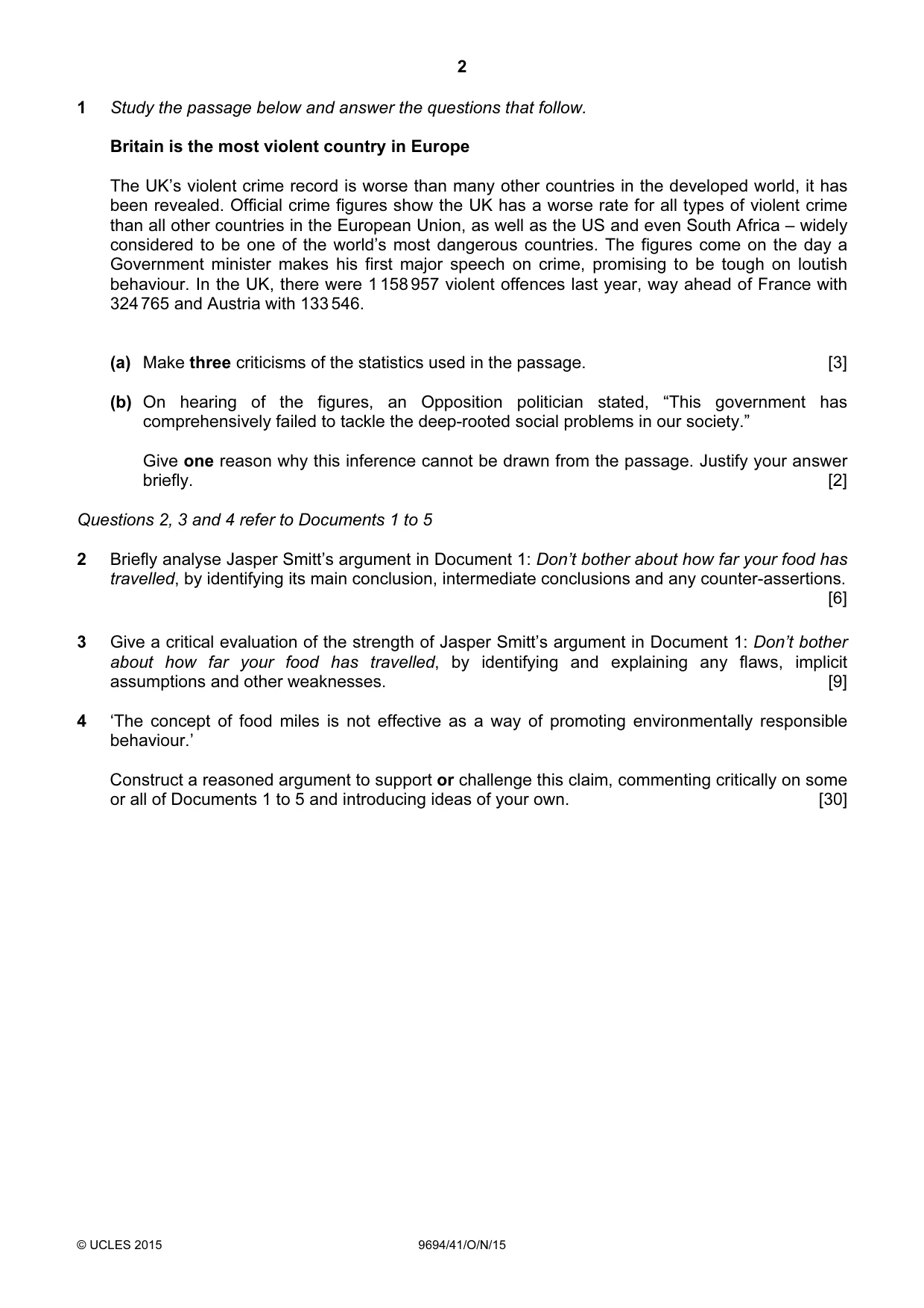
2 © UCLES 2015 9694/41/O/N/15 1 Study the passage below and answer the questions that follow. Britain is the most violent country in Europe The UK’s violent crime record is worse than many other countries in the developed world, it has been revealed. Official crime figures show the UK has a worse rate for all types of violent crime than all other countries in the European Union, as well as the US and even South Africa – widely considered to be one of the world’s most dangerous countries. The figures come on the day a Government minister makes his first major speech on crime, promising to be tough on loutish behaviour. In the UK, there were 1 158 957 violent offences last year, way ahead of France with 324 765 and Austria with 133 546. (a) Make three criticisms of the statistics used in the passage. [3] (b) On hearing of the figures, an Opposition politician stated, “This government has comprehensively failed to tackle the deep-rooted social problems in our society.” Give one reason why this inference cannot be drawn from the passage. Justify your answer briefly. [2] Questions 2, 3 and 4 refer to Documents 1 to 5 2 Briefly analyse Jasper Smitt’s argument in Document 1: Don’t bother about how far your food has travelled, by identifying its main conclusion, intermediate conclusions and any counter-assertions. [6] 3 Give a critical evaluation of the strength of Jasper Smitt’s argument in Document 1: Don’t bother about how far your food has travelled, by identifying and explaining any flaws, implicit assumptions and other weaknesses. [9] 4 ‘The concept of food miles is not effective as a way of promoting environmentally responsible behaviour.’ Construct a reasoned argument to support or challenge this claim, commenting critically on some or all of Documents 1 to 5 and introducing ideas of your own. [30]
Question paper, page 3
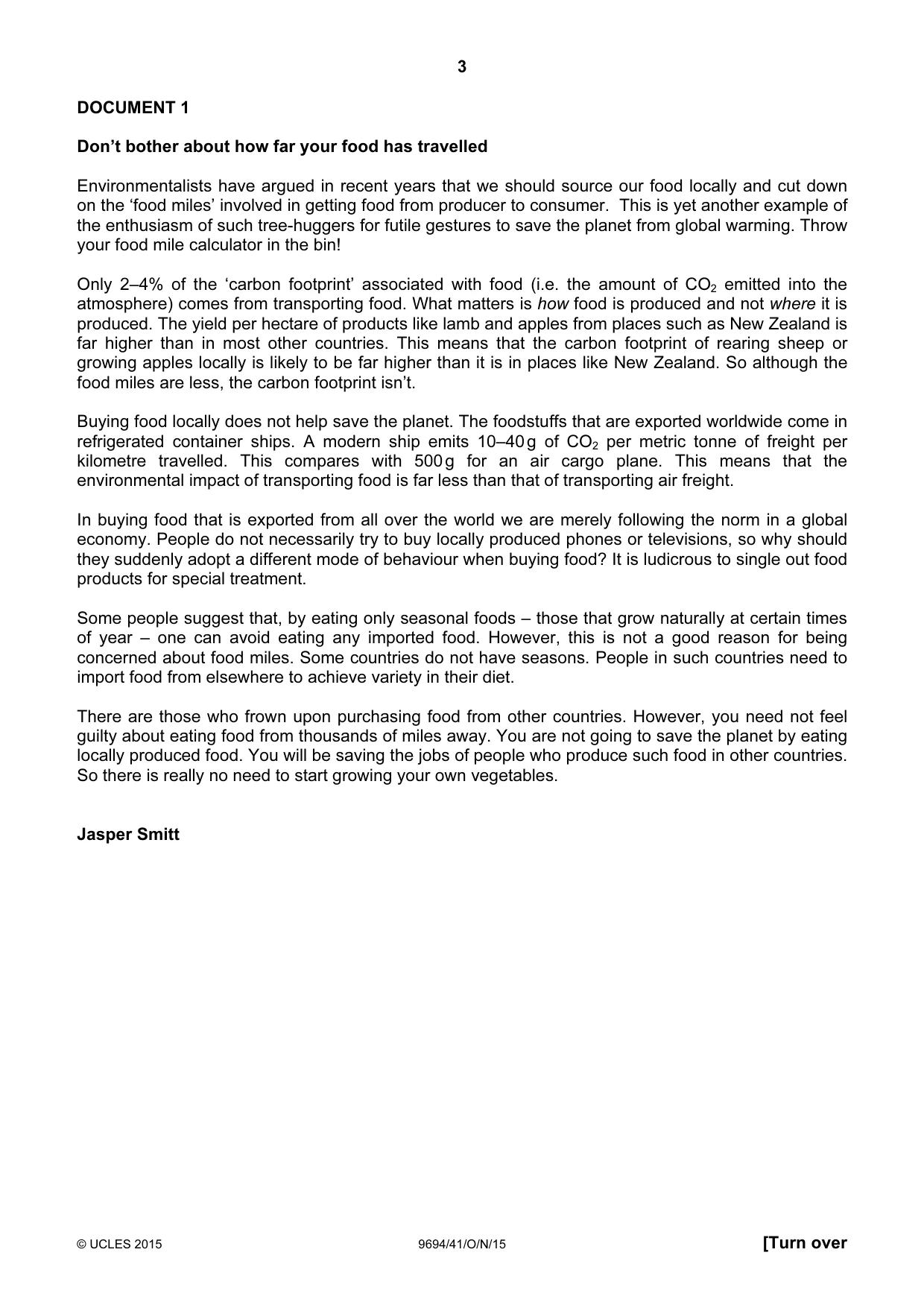
3 © UCLES 2015 9694/41/O/N/15 [Turn over DOCUMENT 1 Don’t bother about how far your food has travelled Environmentalists have argued in recent years that we should source our food locally and cut down on the ‘food miles’ involved in getting food from producer to consumer. This is yet another example of the enthusiasm of such tree-huggers for futile gestures to save the planet from global warming. Throw your food mile calculator in the bin! Only 2–4% of the ‘carbon footprint’ associated with food (i.e. the amount of CO2 emitted into the atmosphere) comes from transporting food. What matters is how food is produced and not where it is produced. The yield per hectare of products like lamb and apples from places such as New Zealand is far higher than in most other countries. This means that the carbon footprint of rearing sheep or growing apples locally is likely to be far higher than it is in places like New Zealand. So although the food miles are less, the carbon footprint isn’t. Buying food locally does not help save the planet. The foodstuffs that are exported worldwide come in refrigerated container ships. A modern ship emits 10–40 g of CO2 per metric tonne of freight per kilometre travelled. This compares with 500 g for an air cargo plane. This means that the environmental impact of transporting food is far less than that of transporting air freight. In buying food that is exported from all over the world we are merely following the norm in a global economy. People do not necessarily try to buy locally produced phones or televisions, so why should they suddenly adopt a different mode of behaviour when buying food? It is ludicrous to single out food products for special treatment. Some people suggest that, by eating only seasonal foods – those that grow naturally at certain times of year – one can avoid eating any imported food. However, this is not a good reason for being concerned about food miles. Some countries do not have seasons. People in such countries need to import food from elsewhere to achieve variety in their diet. There are those who frown upon purchasing food from other countries. However, you need not feel guilty about eating food from thousands of miles away. You are not going to save the planet by eating locally produced food. You will be saving the jobs of people who produce such food in other countries. So there is really no need to start growing your own vegetables. Jasper Smitt
Question paper, page 4
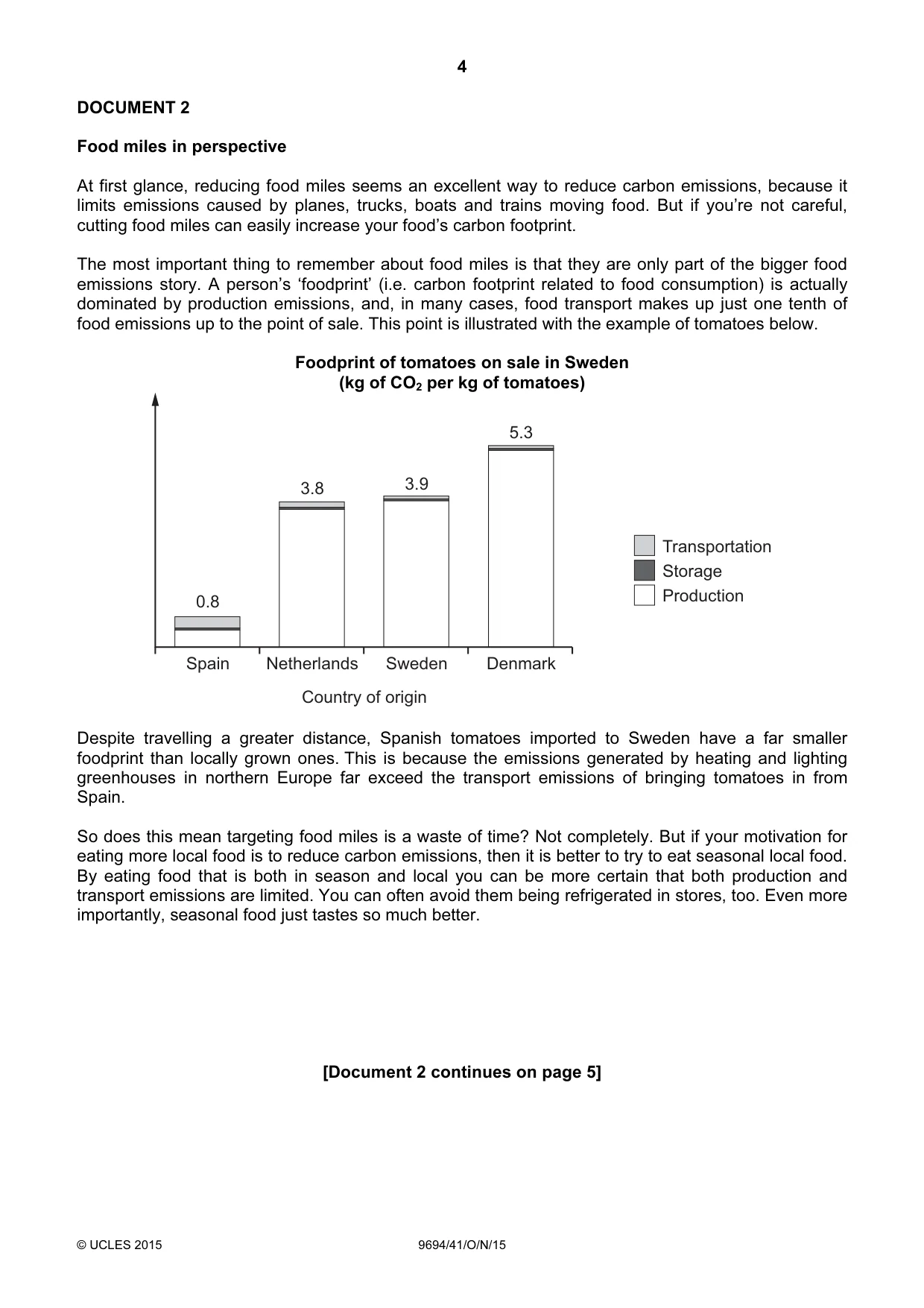
4 © UCLES 2015 9694/41/O/N/15 DOCUMENT 2 Food miles in perspective At first glance, reducing food miles seems an excellent way to reduce carbon emissions, because it limits emissions caused by planes, trucks, boats and trains moving food. But if you’re not careful, cutting food miles can easily increase your food’s carbon footprint. The most important thing to remember about food miles is that they are only part of the bigger food emissions story. A person’s ‘foodprint’ (i.e. carbon footprint related to food consumption) is actually dominated by production emissions, and, in many cases, food transport makes up just one tenth of food emissions up to the point of sale. This point is illustrated with the example of tomatoes below. Foodprint of tomatoes on sale in Sweden (kg of CO2 per kg of tomatoes) Spain Netherlands Sweden Denmark 0.8 3.8 3.9 5.3 Country of origin Transportation Storage Production Despite travelling a greater distance, Spanish tomatoes imported to Sweden have a far smaller foodprint than locally grown ones. This is because the emissions generated by heating and lighting greenhouses in northern Europe far exceed the transport emissions of bringing tomatoes in from Spain. So does this mean targeting food miles is a waste of time? Not completely. But if your motivation for eating more local food is to reduce carbon emissions, then it is better to try to eat seasonal local food. By eating food that is both in season and local you can be more certain that both production and transport emissions are limited. You can often avoid them being refrigerated in stores, too. Even more importantly, seasonal food just tastes so much better. [Document 2 continues on page 5]
Question paper, page 5
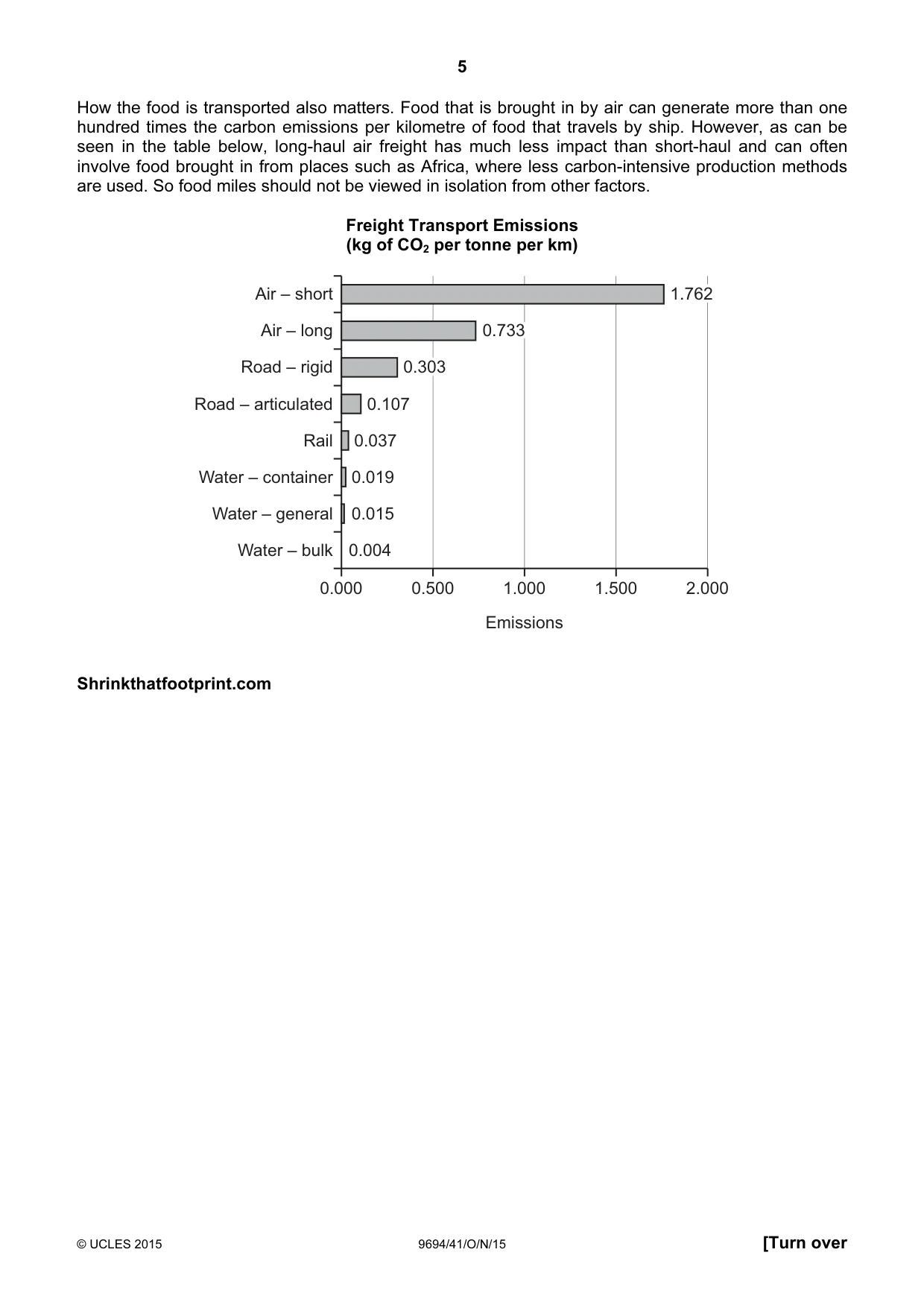
5 © UCLES 2015 9694/41/O/N/15 [Turn over How the food is transported also matters. Food that is brought in by air can generate more than one hundred times the carbon emissions per kilometre of food that travels by ship. However, as can be seen in the table below, long-haul air freight has much less impact than short-haul and can often involve food brought in from places such as Africa, where less carbon-intensive production methods are used. So food miles should not be viewed in isolation from other factors. Freight Transport Emissions (kg of CO2 per tonne per km) 1.762 1.762 0.733 0.733 0.303 0.303 Air – short Air – long Road – rigid Road – articulated Rail Water – container Water – general Water – bulk 1.762 0.733 0.303 0.107 0.037 0.019 0.015 0.004 0.000 0.500 1.000 Emissions 1.500 2.000 Shrinkthatfootprint.com
Question paper, page 6
6 © UCLES 2015 9694/41/O/N/15 DOCUMENT 3 A defence of buying food locally In looking at food miles, it is important to understand the impact of transportation by sea, which is not the benign form of transport some have presented it as. Transportation by sea produces 1 billion tonnes of CO2 emissions and uses 11 billion gallons of fuel per year internationally. In fact, the amount of sulphur oxide pollution that comes from the 15 largest ships equals the combined amount from all the cars in the world. However, there are good reasons to buy locally-produced food other than cutting down on carbon emissions. Freshness is one. Knowing how the food is produced is another (a recent scandal in Europe revealed that many products labelled as beef contained horsemeat). You will also be supporting local farmers and helping to create financially sustainable local economies. The emphasis on yield, which is a key aspect of the anti-food-miles argument, is also misplaced, as such high yields are based on a system of monoculture. This modern form of agriculture is as bad for the environment as the effects of food transportation. Monocultures are large areas of land cultivated with a single crop, using methods that have a high use of chemicals toxic to plants and animals and a great use of machinery. The social impacts of large-scale monocultures are often disastrous for communities which continue to grow local foods using sustainable practices. Small-scale farmers often cultivate local species, which not only contain important minerals for the soils and for human health, but also have adapted to the local environment over many years. When small-scale farmers are confronted with large-scale industrial monocultures in their area, they are faced with shortage of water and other resources and contamination from pesticide spraying and from GM crops. The takeover of land by monocultures also causes rural depopulation, destroying local community life and local economies. Monoculture plantations usually provide only temporary labour, for which workers are often hired from outside the region. Fife Diet
Question paper, page 7
7 © UCLES 2015 9694/41/O/N/15 [Turn over DOCUMENT 4 How the myth of food miles hurts the planet Many people have decided to reject foods that have been transported to their dinner plates over long distances by road, air or sea. They even have their own name for themselves – ‘locavores’ – and insist that their way is the only one to save the planet. But the idea that ‘only local is good’ has come under attack. For a start, food grown locally in areas where there is high use of fertilisers and tractors is likely to be anything but carbon-friendly. By contrast, beans in, for example, Kenya are produced in a highly environmentally-friendly manner. “Beans there are grown using manual labour – nothing is mechanised,” says Professor Gareth Edwards-Jones of Bangor University, an expert on African agriculture. “They don’t use tractors, they use cow muck as fertiliser; and they have low-tech irrigation systems in Kenya.” It is not that the concept of food miles is wrong; it is just simplistic. For example, locally-grown apples that have been stored for several months may produce more carbon as a result of the storage process than those that have been shipped in, or even flown in. However, if eaten when in season then their carbon footprint will be lower. “Working out carbon footprints is horribly complicated,” says an expert. “It is not just where something is grown and how far it has to travel, but also how it is grown, how it is stored, how it is prepared.” A more extreme position suggests that the only way of being sure that you cut down on your carbon emissions when buying food is to stop eating meat, milk, butter and cheese. These come from ruminants (sheep and cattle) that produce a great deal of harmful methane. Moreover, the longer the food chain, the more energy is lost. Food chains involving animals are inherently longer (plant– animal–human, as opposed to plant–human). This means there are more energy losses. Therefore one needs a larger area of land in order to feed the same number of people. In other words, it is not how far the food travels that matters, but the kind of food you eat. The Guardian
Question paper, page 8
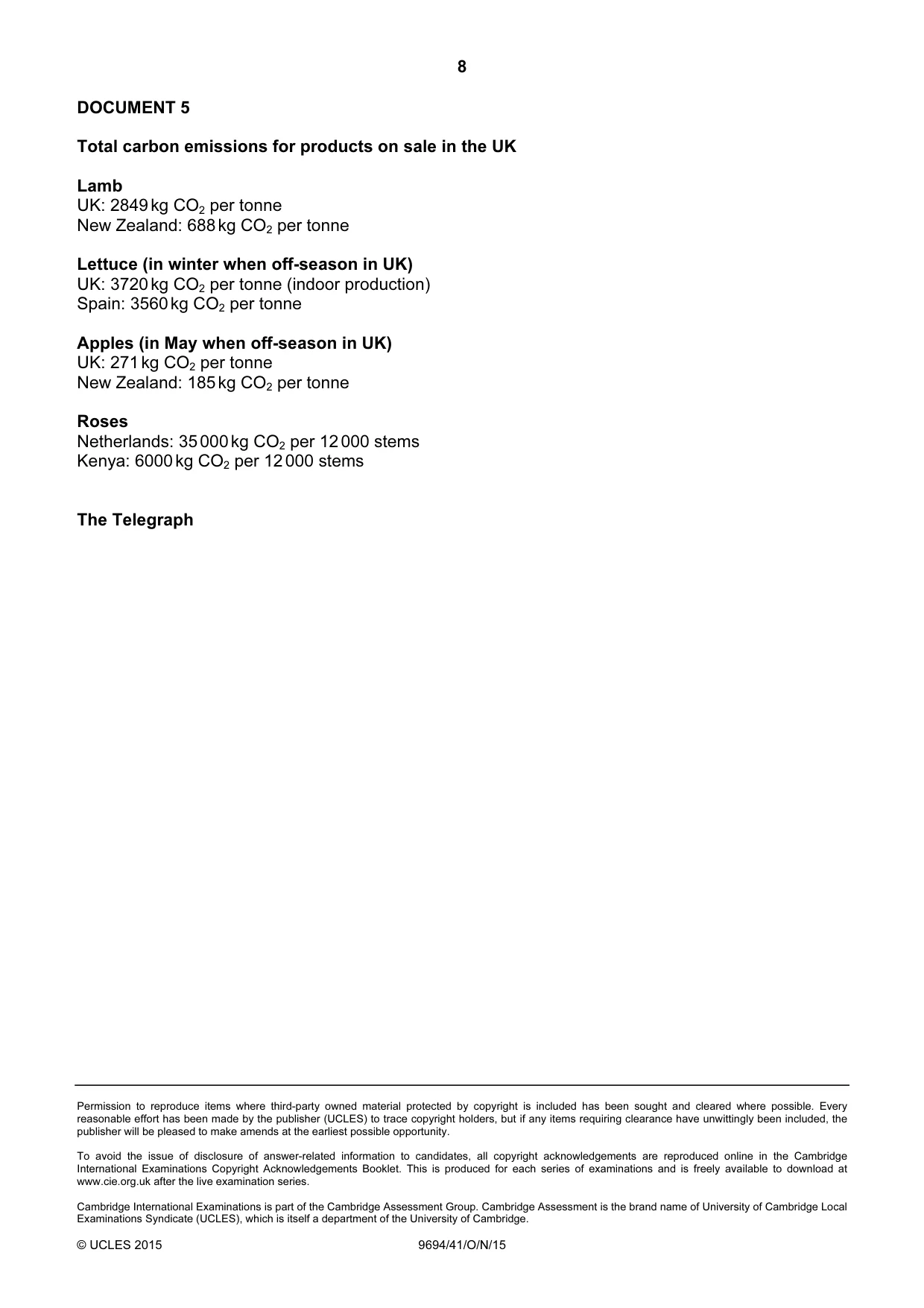
8 Permission to reproduce items where third-party owned material protected by copyright is included has been sought and cleared where possible. Every reasonable effort has been made by the publisher (UCLES) to trace copyright holders, but if any items requiring clearance have unwittingly been included, the publisher will be pleased to make amends at the earliest possible opportunity. To avoid the issue of disclosure of answer-related information to candidates, all copyright acknowledgements are reproduced online in the Cambridge International Examinations Copyright Acknowledgements Booklet. This is produced for each series of examinations and is freely available to download at www.cie.org.uk after the live examination series. Cambridge International Examinations is part of the Cambridge Assessment Group. Cambridge Assessment is the brand name of University of Cambridge Local Examinations Syndicate (UCLES), which is itself a department of the University of Cambridge. © UCLES 2015 9694/41/O/N/15 DOCUMENT 5 Total carbon emissions for products on sale in the UK Lamb UK: 2849 kg CO2 per tonne New Zealand: 688 kg CO2 per tonne Lettuce (in winter when off-season in UK) UK: 3720 kg CO2 per tonne (indoor production) Spain: 3560 kg CO2 per tonne Apples (in May when off-season in UK) UK: 271 kg CO2 per tonne New Zealand: 185 kg CO2 per tonne Roses Netherlands: 35 000 kg CO2 per 12 000 stems Kenya: 6000 kg CO2 per 12 000 stems The Telegraph
Mark scheme, page 1
® IGCSE is the registered trademark of Cambridge International Examinations. CAMBRIDGE INTERNATIONAL EXAMINATIONS Cambridge International Advanced Level MARK SCHEME for the October/November 2015 series 9694 THINKING SKILLS 9694/41 Paper 4 (Applied Reasoning), maximum raw mark 50 This mark scheme is published as an aid to teachers and candidates, to indicate the requirements of the examination. It shows the basis on which Examiners were instructed to award marks. It does not indicate the details of the discussions that took place at an Examiners’ meeting before marking began, which would have considered the acceptability of alternative answers. Mark schemes should be read in conjunction with the question paper and the Principal Examiner Report for Teachers. Cambridge will not enter into discussions about these mark schemes. Cambridge is publishing the mark schemes for the October/November 2015 series for most Cambridge IGCSE®, Cambridge International A and AS Level components and some Cambridge O Level components.
Mark scheme, page 2
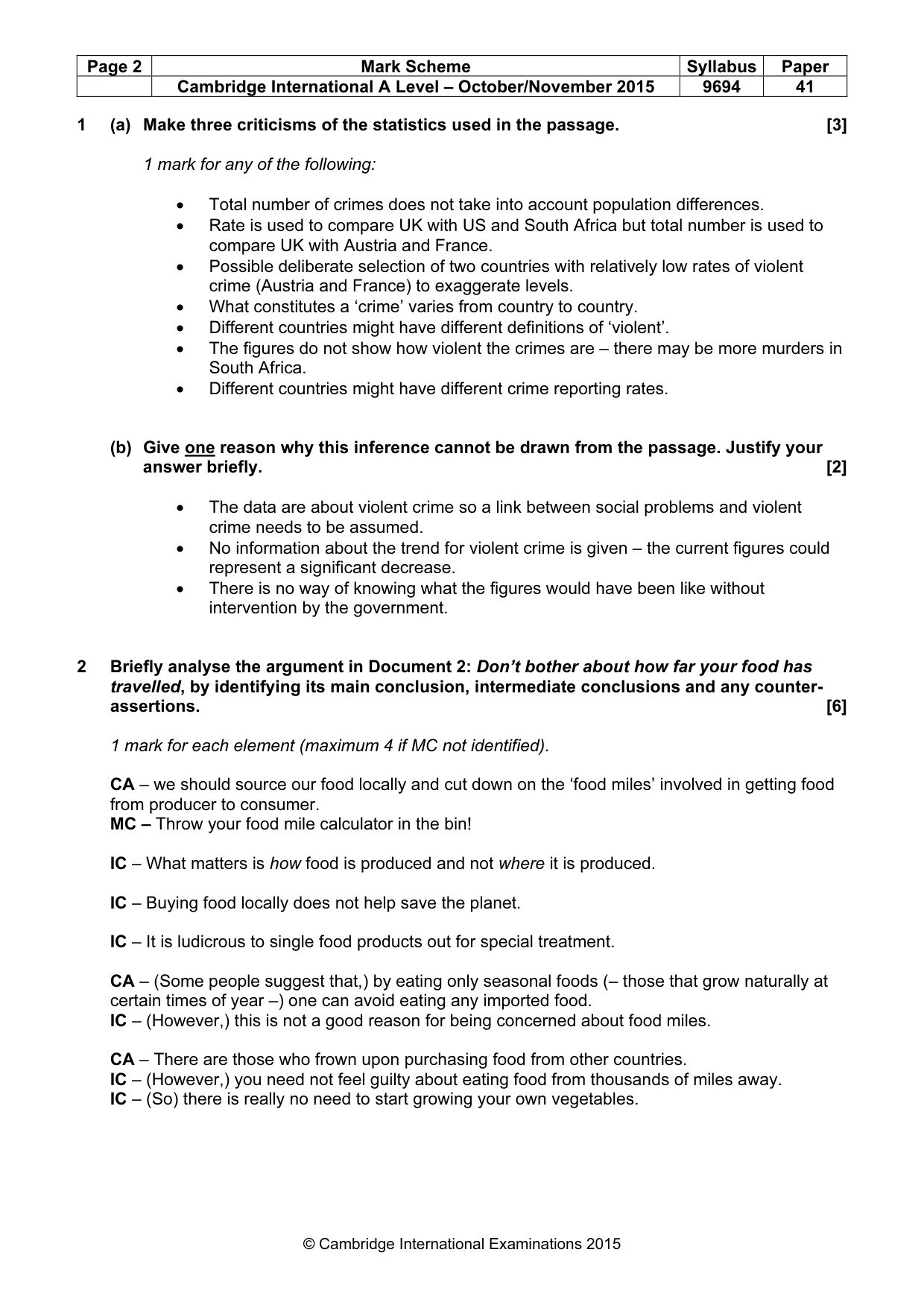
Page 2 Mark Scheme Syllabus Paper Cambridge International A Level – October/November 2015 9694 41 © Cambridge International Examinations 2015 1 (a) Make three criticisms of the statistics used in the passage. [3] 1 mark for any of the following: • Total number of crimes does not take into account population differences. • Rate is used to compare UK with US and South Africa but total number is used to compare UK with Austria and France. • Possible deliberate selection of two countries with relatively low rates of violent crime (Austria and France) to exaggerate levels. • What constitutes a ‘crime’ varies from country to country. • Different countries might have different definitions of ‘violent’. • The figures do not show how violent the crimes are – there may be more murders in South Africa. • Different countries might have different crime reporting rates. (b) Give one reason why this inference cannot be drawn from the passage. Justify your answer briefly. [2] • The data are about violent crime so a link between social problems and violent crime needs to be assumed. • No information about the trend for violent crime is given – the current figures could represent a significant decrease. • There is no way of knowing what the figures would have been like without intervention by the government. 2 Briefly analyse the argument in Document 2: Don’t bother about how far your food has travelled, by identifying its main conclusion, intermediate conclusions and any counter- assertions. [6] 1 mark for each element (maximum 4 if MC not identified). CA – we should source our food locally and cut down on the ‘food miles’ involved in getting food from producer to consumer. MC – Throw your food mile calculator in the bin! IC – What matters is how food is produced and not where it is produced. IC – Buying food locally does not help save the planet. IC – It is ludicrous to single food products out for special treatment. CA – (Some people suggest that,) by eating only seasonal foods (– those that grow naturally at certain times of year –) one can avoid eating any imported food. IC – (However,) this is not a good reason for being concerned about food miles. CA – There are those who frown upon purchasing food from other countries. IC – (However,) you need not feel guilty about eating food from thousands of miles away. IC – (So) there is really no need to start growing your own vegetables.
Mark scheme, page 3
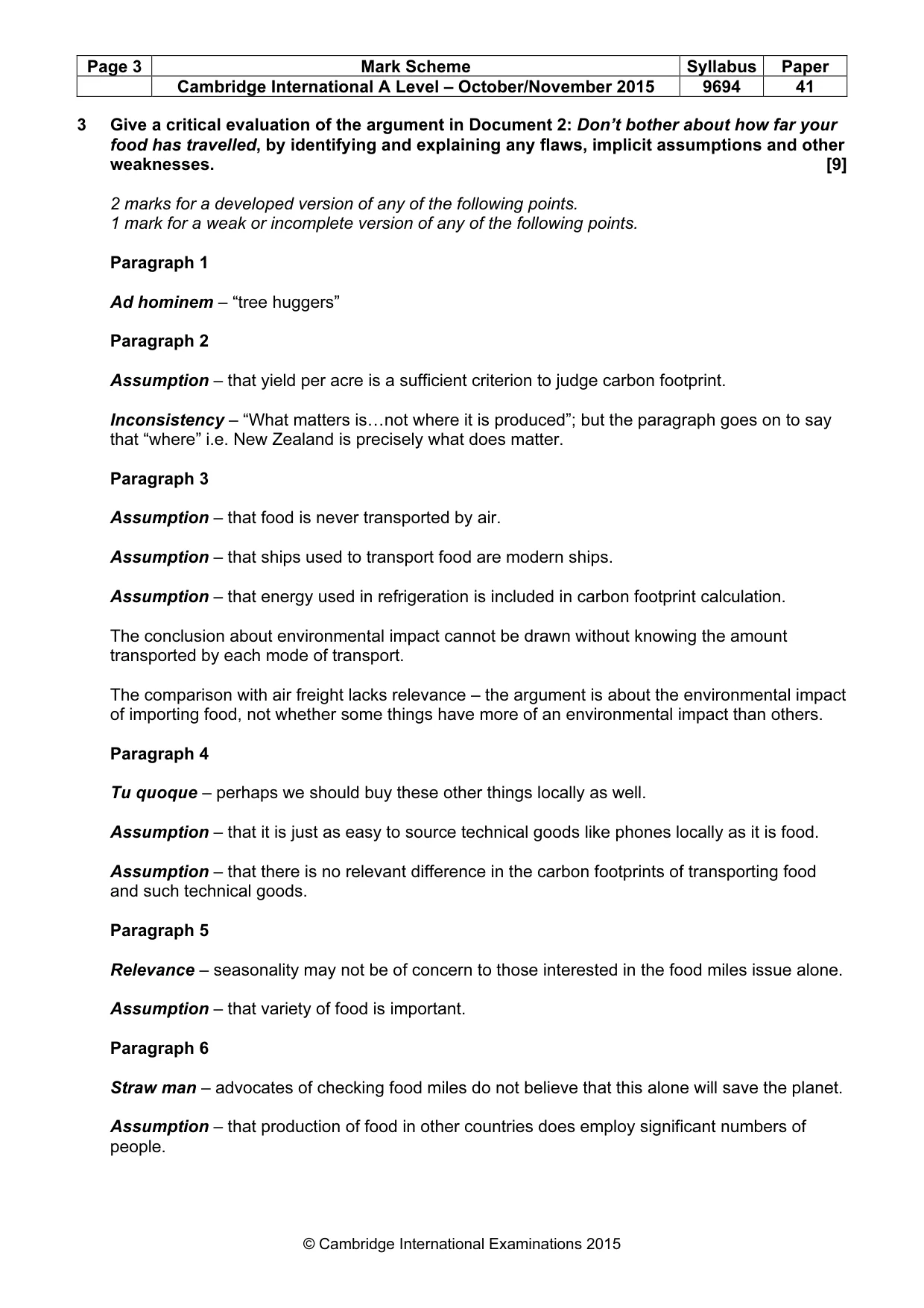
Page 3 Mark Scheme Syllabus Paper Cambridge International A Level – October/November 2015 9694 41 © Cambridge International Examinations 2015 3 Give a critical evaluation of the argument in Document 2: Don’t bother about how far your food has travelled, by identifying and explaining any flaws, implicit assumptions and other weaknesses. [9] 2 marks for a developed version of any of the following points. 1 mark for a weak or incomplete version of any of the following points. Paragraph 1 Ad hominem – “tree huggers” Paragraph 2 Assumption – that yield per acre is a sufficient criterion to judge carbon footprint. Inconsistency – “What matters is…not where it is produced”; but the paragraph goes on to say that “where” i.e. New Zealand is precisely what does matter. Paragraph 3 Assumption – that food is never transported by air. Assumption – that ships used to transport food are modern ships. Assumption – that energy used in refrigeration is included in carbon footprint calculation. The conclusion about environmental impact cannot be drawn without knowing the amount transported by each mode of transport. The comparison with air freight lacks relevance – the argument is about the environmental impact of importing food, not whether some things have more of an environmental impact than others. Paragraph 4 Tu quoque – perhaps we should buy these other things locally as well. Assumption – that it is just as easy to source technical goods like phones locally as it is food. Assumption – that there is no relevant difference in the carbon footprints of transporting food and such technical goods. Paragraph 5 Relevance – seasonality may not be of concern to those interested in the food miles issue alone. Assumption – that variety of food is important. Paragraph 6 Straw man – advocates of checking food miles do not believe that this alone will save the planet. Assumption – that production of food in other countries does employ significant numbers of people.
Mark scheme, page 4
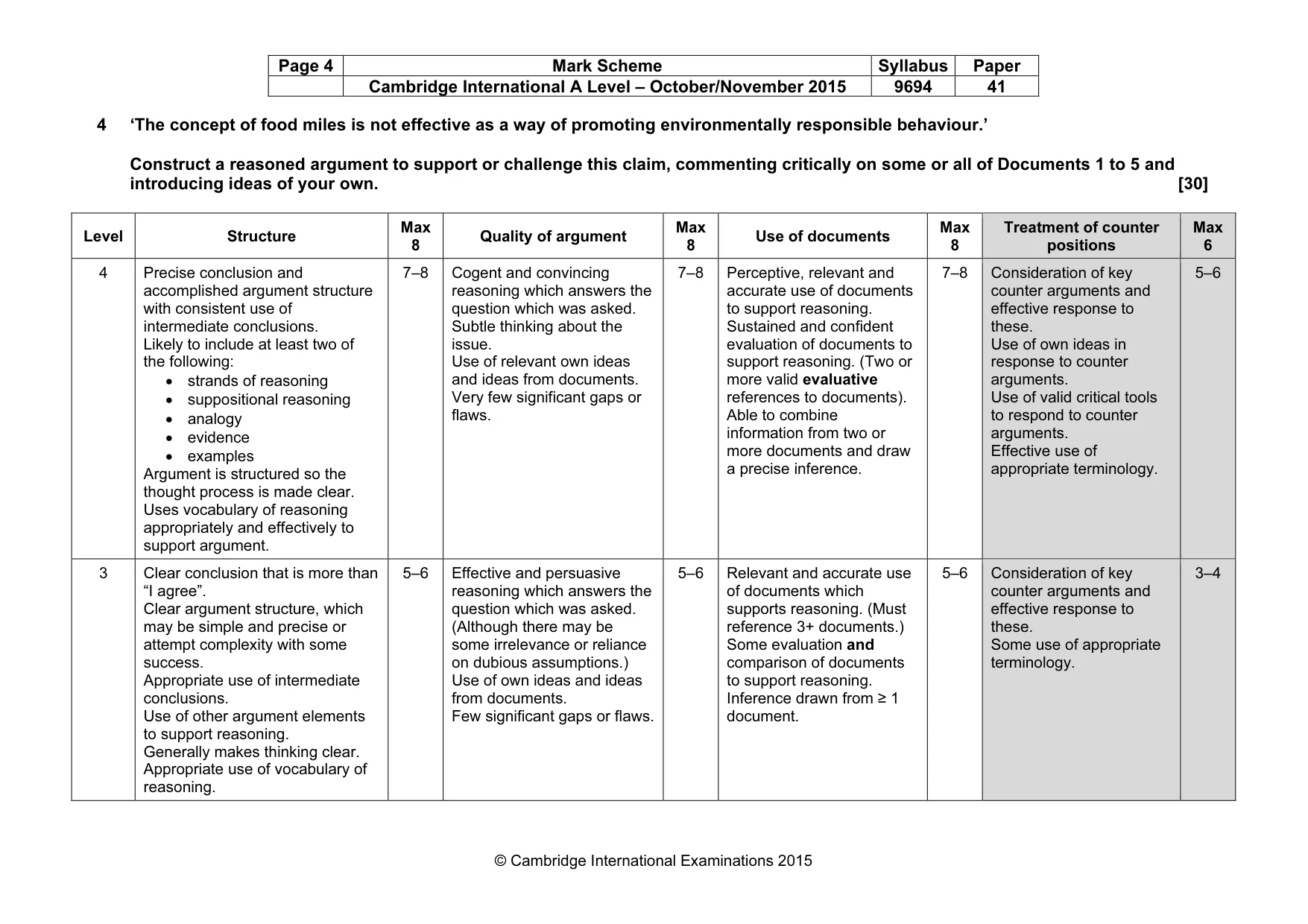
Page 4 Mark Scheme Syllabus Paper Cambridge International A Level – October/November 2015 9694 41 © Cambridge International Examinations 2015 4 ‘The concept of food miles is not effective as a way of promoting environmentally responsible behaviour.’ Construct a reasoned argument to support or challenge this claim, commenting critically on some or all of Documents 1 to 5 and introducing ideas of your own. [30] Level Structure Max 8 Quality of argument Max 8 Use of documents Max 8 Treatment of counter positions Max 6 4 Precise conclusion and accomplished argument structure with consistent use of intermediate conclusions. Likely to include at least two of the following: • strands of reasoning • suppositional reasoning • analogy • evidence • examples Argument is structured so the thought process is made clear. Uses vocabulary of reasoning appropriately and effectively to support argument. 7–8 Cogent and convincing reasoning which answers the question which was asked. Subtle thinking about the issue. Use of relevant own ideas and ideas from documents. Very few significant gaps or flaws. 7–8 Perceptive, relevant and accurate use of documents to support reasoning. Sustained and confident evaluation of documents to support reasoning. (Two or more valid evaluative references to documents). Able to combine information from two or more documents and draw a precise inference. 7–8 Consideration of key counter arguments and effective response to these. Use of own ideas in response to counter arguments. Use of valid critical tools to respond to counter arguments. Effective use of appropriate terminology. 5–6 3 Clear conclusion that is more than “I agree”. Clear argument structure, which may be simple and precise or attempt complexity with some success. Appropriate use of intermediate conclusions. Use of other argument elements to support reasoning. Generally makes thinking clear. Appropriate use of vocabulary of reasoning. 5–6 Effective and persuasive reasoning which answers the question which was asked. (Although there may be some irrelevance or reliance on dubious assumptions.) Use of own ideas and ideas from documents. Few significant gaps or flaws. 5–6 Relevant and accurate use of documents which supports reasoning. (Must reference 3+ documents.) Some evaluation and comparison of documents to support reasoning. Inference drawn from ≥ 1 document. 5–6 Consideration of key counter arguments and effective response to these. Some use of appropriate terminology. 3–4
Mark scheme, page 5
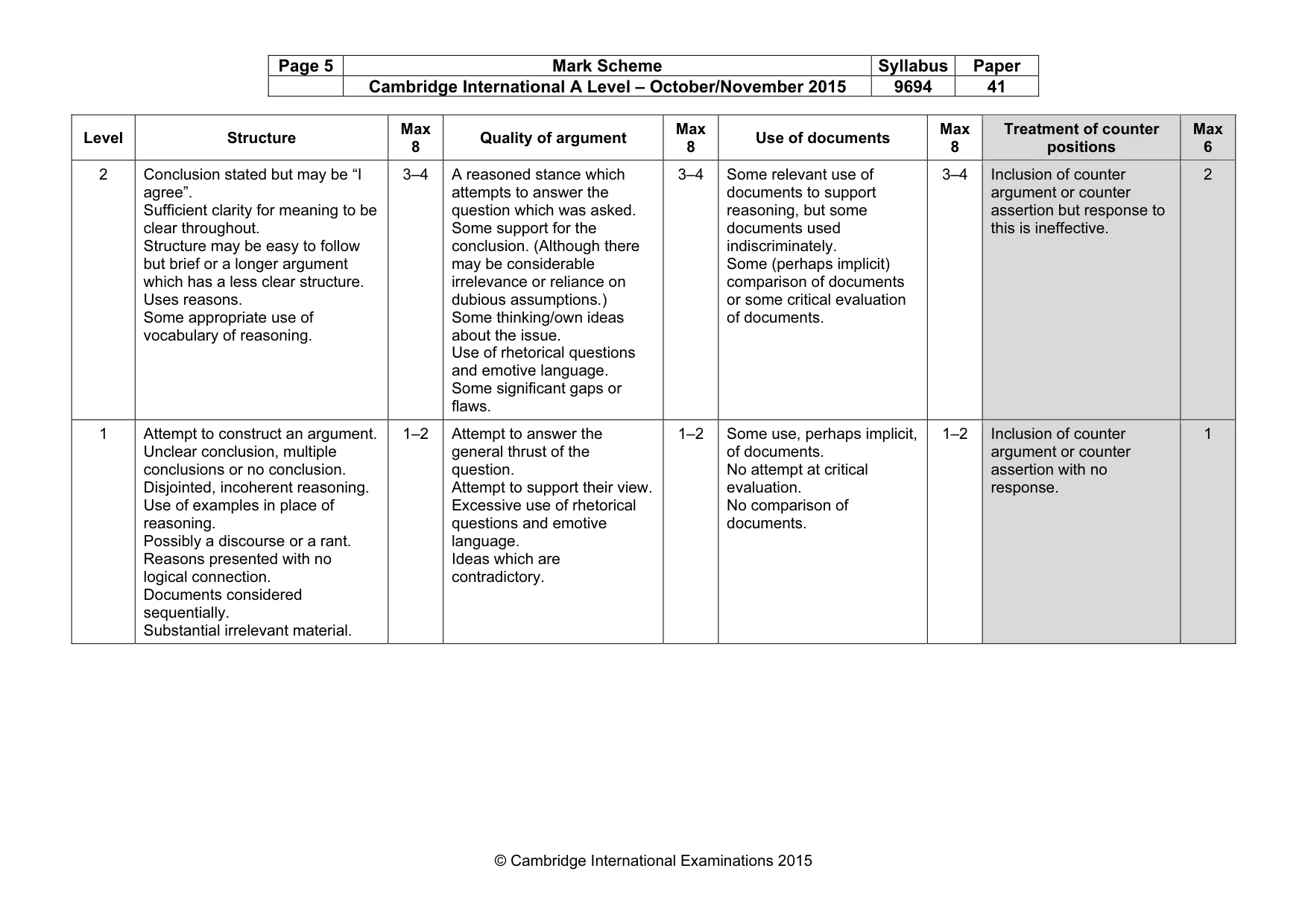
Page 5 Mark Scheme Syllabus Paper Cambridge International A Level – October/November 2015 9694 41 © Cambridge International Examinations 2015 Level Structure Max 8 Quality of argument Max 8 Use of documents Max 8 Treatment of counter positions Max 6 2 Conclusion stated but may be “I agree”. Sufficient clarity for meaning to be clear throughout. Structure may be easy to follow but brief or a longer argument which has a less clear structure. Uses reasons. Some appropriate use of vocabulary of reasoning. 3–4 A reasoned stance which attempts to answer the question which was asked. Some support for the conclusion. (Although there may be considerable irrelevance or reliance on dubious assumptions.) Some thinking/own ideas about the issue. Use of rhetorical questions and emotive language. Some significant gaps or flaws. 3–4 Some relevant use of documents to support reasoning, but some documents used indiscriminately. Some (perhaps implicit) comparison of documents or some critical evaluation of documents. 3–4 Inclusion of counter argument or counter assertion but response to this is ineffective. 2 1 Attempt to construct an argument. Unclear conclusion, multiple conclusions or no conclusion. Disjointed, incoherent reasoning. Use of examples in place of reasoning. Possibly a discourse or a rant. Reasons presented with no logical connection. Documents considered sequentially. Substantial irrelevant material. 1–2 Attempt to answer the general thrust of the question. Attempt to support their view. Excessive use of rhetorical questions and emotive language. Ideas which are contradictory. 1–2 Some use, perhaps implicit, of documents. No attempt at critical evaluation. No comparison of documents. 1–2 Inclusion of counter argument or counter assertion with no response. 1
Mark scheme, page 6
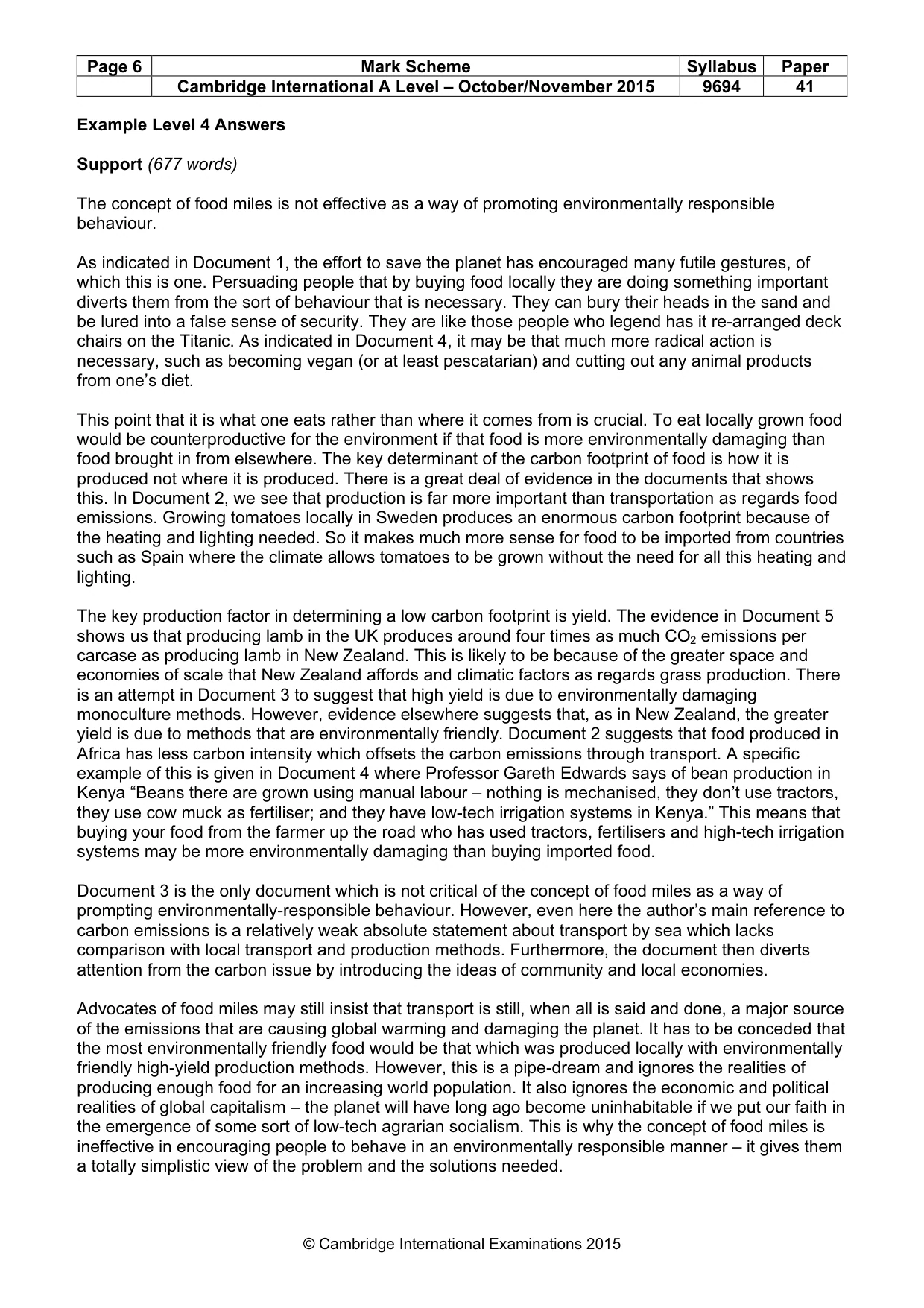
Page 6 Mark Scheme Syllabus Paper Cambridge International A Level – October/November 2015 9694 41 © Cambridge International Examinations 2015 Example Level 4 Answers Support (677 words) The concept of food miles is not effective as a way of promoting environmentally responsible behaviour. As indicated in Document 1, the effort to save the planet has encouraged many futile gestures, of which this is one. Persuading people that by buying food locally they are doing something important diverts them from the sort of behaviour that is necessary. They can bury their heads in the sand and be lured into a false sense of security. They are like those people who legend has it re-arranged deck chairs on the Titanic. As indicated in Document 4, it may be that much more radical action is necessary, such as becoming vegan (or at least pescatarian) and cutting out any animal products from one’s diet. This point that it is what one eats rather than where it comes from is crucial. To eat locally grown food would be counterproductive for the environment if that food is more environmentally damaging than food brought in from elsewhere. The key determinant of the carbon footprint of food is how it is produced not where it is produced. There is a great deal of evidence in the documents that shows this. In Document 2, we see that production is far more important than transportation as regards food emissions. Growing tomatoes locally in Sweden produces an enormous carbon footprint because of the heating and lighting needed. So it makes much more sense for food to be imported from countries such as Spain where the climate allows tomatoes to be grown without the need for all this heating and lighting. The key production factor in determining a low carbon footprint is yield. The evidence in Document 5 shows us that producing lamb in the UK produces around four times as much CO2 emissions per carcase as producing lamb in New Zealand. This is likely to be because of the greater space and economies of scale that New Zealand affords and climatic factors as regards grass production. There is an attempt in Document 3 to suggest that high yield is due to environmentally damaging monoculture methods. However, evidence elsewhere suggests that, as in New Zealand, the greater yield is due to methods that are environmentally friendly. Document 2 suggests that food produced in Africa has less carbon intensity which offsets the carbon emissions through transport. A specific example of this is given in Document 4 where Professor Gareth Edwards says of bean production in Kenya “Beans there are grown using manual labour – nothing is mechanised, they don’t use tractors, they use cow muck as fertiliser; and they have low-tech irrigation systems in Kenya.” This means that buying your food from the farmer up the road who has used tractors, fertilisers and high-tech irrigation systems may be more environmentally damaging than buying imported food. Document 3 is the only document which is not critical of the concept of food miles as a way of prompting environmentally-responsible behaviour. However, even here the author’s main reference to carbon emissions is a relatively weak absolute statement about transport by sea which lacks comparison with local transport and production methods. Furthermore, the document then diverts attention from the carbon issue by introducing the ideas of community and local economies. Advocates of food miles may still insist that transport is still, when all is said and done, a major source of the emissions that are causing global warming and damaging the planet. It has to be conceded that the most environmentally friendly food would be that which was produced locally with environmentally friendly high-yield production methods. However, this is a pipe-dream and ignores the realities of producing enough food for an increasing world population. It also ignores the economic and political realities of global capitalism – the planet will have long ago become uninhabitable if we put our faith in the emergence of some sort of low-tech agrarian socialism. This is why the concept of food miles is ineffective in encouraging people to behave in an environmentally responsible manner – it gives them a totally simplistic view of the problem and the solutions needed.
Mark scheme, page 7
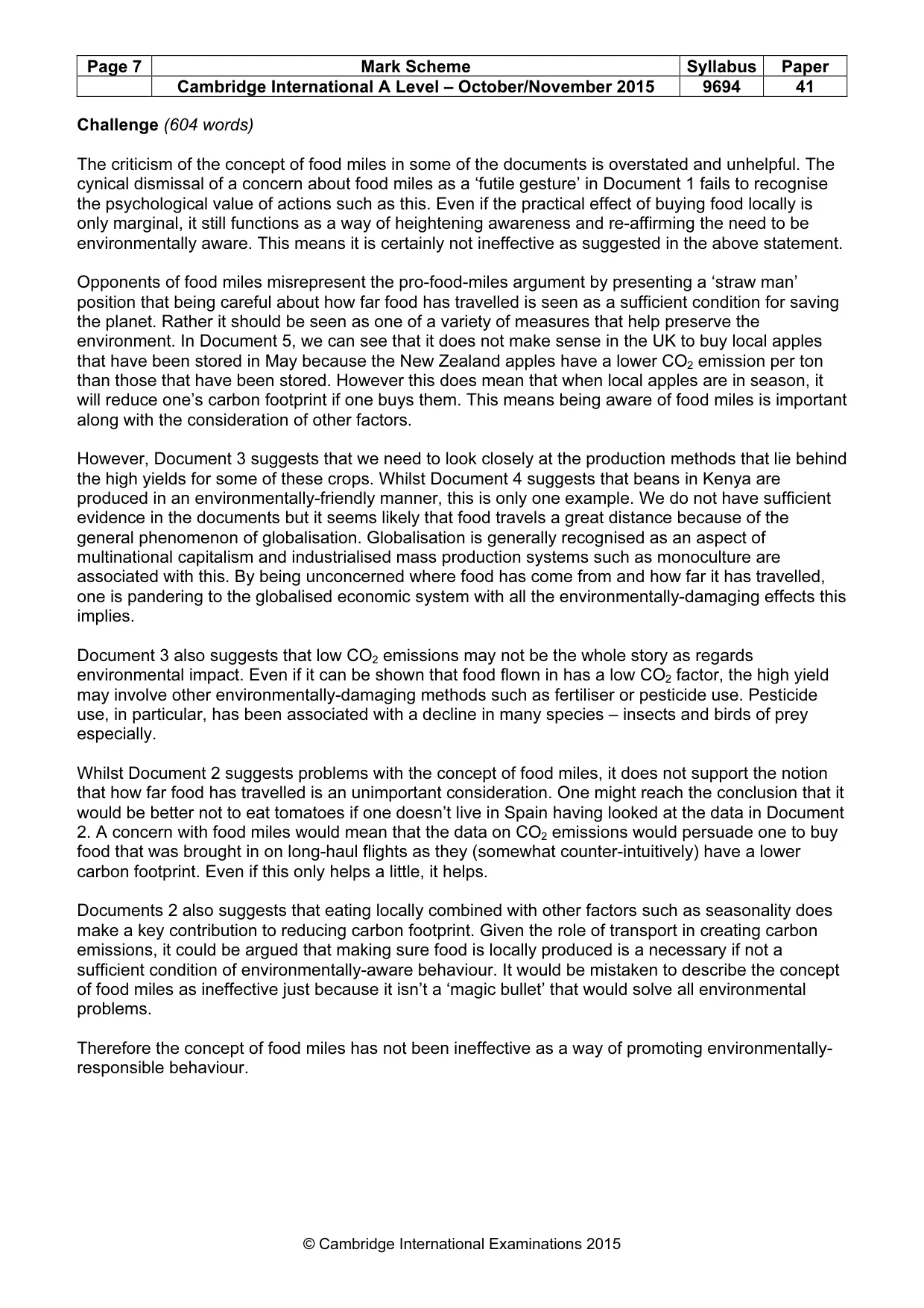
Page 7 Mark Scheme Syllabus Paper Cambridge International A Level – October/November 2015 9694 41 © Cambridge International Examinations 2015 Challenge (604 words) The criticism of the concept of food miles in some of the documents is overstated and unhelpful. The cynical dismissal of a concern about food miles as a ‘futile gesture’ in Document 1 fails to recognise the psychological value of actions such as this. Even if the practical effect of buying food locally is only marginal, it still functions as a way of heightening awareness and re-affirming the need to be environmentally aware. This means it is certainly not ineffective as suggested in the above statement. Opponents of food miles misrepresent the pro-food-miles argument by presenting a ‘straw man’ position that being careful about how far food has travelled is seen as a sufficient condition for saving the planet. Rather it should be seen as one of a variety of measures that help preserve the environment. In Document 5, we can see that it does not make sense in the UK to buy local apples that have been stored in May because the New Zealand apples have a lower CO2 emission per ton than those that have been stored. However this does mean that when local apples are in season, it will reduce one’s carbon footprint if one buys them. This means being aware of food miles is important along with the consideration of other factors. However, Document 3 suggests that we need to look closely at the production methods that lie behind the high yields for some of these crops. Whilst Document 4 suggests that beans in Kenya are produced in an environmentally-friendly manner, this is only one example. We do not have sufficient evidence in the documents but it seems likely that food travels a great distance because of the general phenomenon of globalisation. Globalisation is generally recognised as an aspect of multinational capitalism and industrialised mass production systems such as monoculture are associated with this. By being unconcerned where food has come from and how far it has travelled, one is pandering to the globalised economic system with all the environmentally-damaging effects this implies. Document 3 also suggests that low CO2 emissions may not be the whole story as regards environmental impact. Even if it can be shown that food flown in has a low CO2 factor, the high yield may involve other environmentally-damaging methods such as fertiliser or pesticide use. Pesticide use, in particular, has been associated with a decline in many species – insects and birds of prey especially. Whilst Document 2 suggests problems with the concept of food miles, it does not support the notion that how far food has travelled is an unimportant consideration. One might reach the conclusion that it would be better not to eat tomatoes if one doesn’t live in Spain having looked at the data in Document 2. A concern with food miles would mean that the data on CO2 emissions would persuade one to buy food that was brought in on long-haul flights as they (somewhat counter-intuitively) have a lower carbon footprint. Even if this only helps a little, it helps. Documents 2 also suggests that eating locally combined with other factors such as seasonality does make a key contribution to reducing carbon footprint. Given the role of transport in creating carbon emissions, it could be argued that making sure food is locally produced is a necessary if not a sufficient condition of environmentally-aware behaviour. It would be mistaken to describe the concept of food miles as ineffective just because it isn’t a ‘magic bullet’ that would solve all environmental problems. Therefore the concept of food miles has not been ineffective as a way of promoting environmentally- responsible behaviour.
What you needed in this session
Cambridge’s own grade thresholds for 2015 Oct/Nov, Paper 4 · Variant 1. A higher threshold means an easier paper — the bar moves with how the cohort did.