Cambridge A Level Thinking Skills 9694 — 2015 Oct/Nov Paper 4 · Variant 2
9694/42/O/N/15 · 50 marks · ≈56 min
The question paper and its mark scheme, free to read here and free to download. This is Cambridge’s own paper, exactly as it was sat.
Question paper8 pages

Mark scheme9 pages
Answers below. Sit the paper first if you are practising.
Paper as text
Question paper, page 1
This document consists of 7 printed pages, 1 blank page and 1 insert. IB15 11_9694_42/RP © UCLES 2015 [Turn over *6727810614* Cambridge International Examinations Cambridge International Advanced Level THINKING SKILLS 9694/42 Paper 4 Applied Reasoning October/November 2015 1 hour 30 minutes No Additional Materials are required. READ THESE INSTRUCTIONS FIRST An answer booklet is provided inside this question paper. You should follow the instructions on the front cover of the answer booklet. If you need additional answer paper ask the invigilator for a continuation booklet. Answer all the questions. The number of marks is given in brackets [ ] at the end of each question.
Question paper, page 2
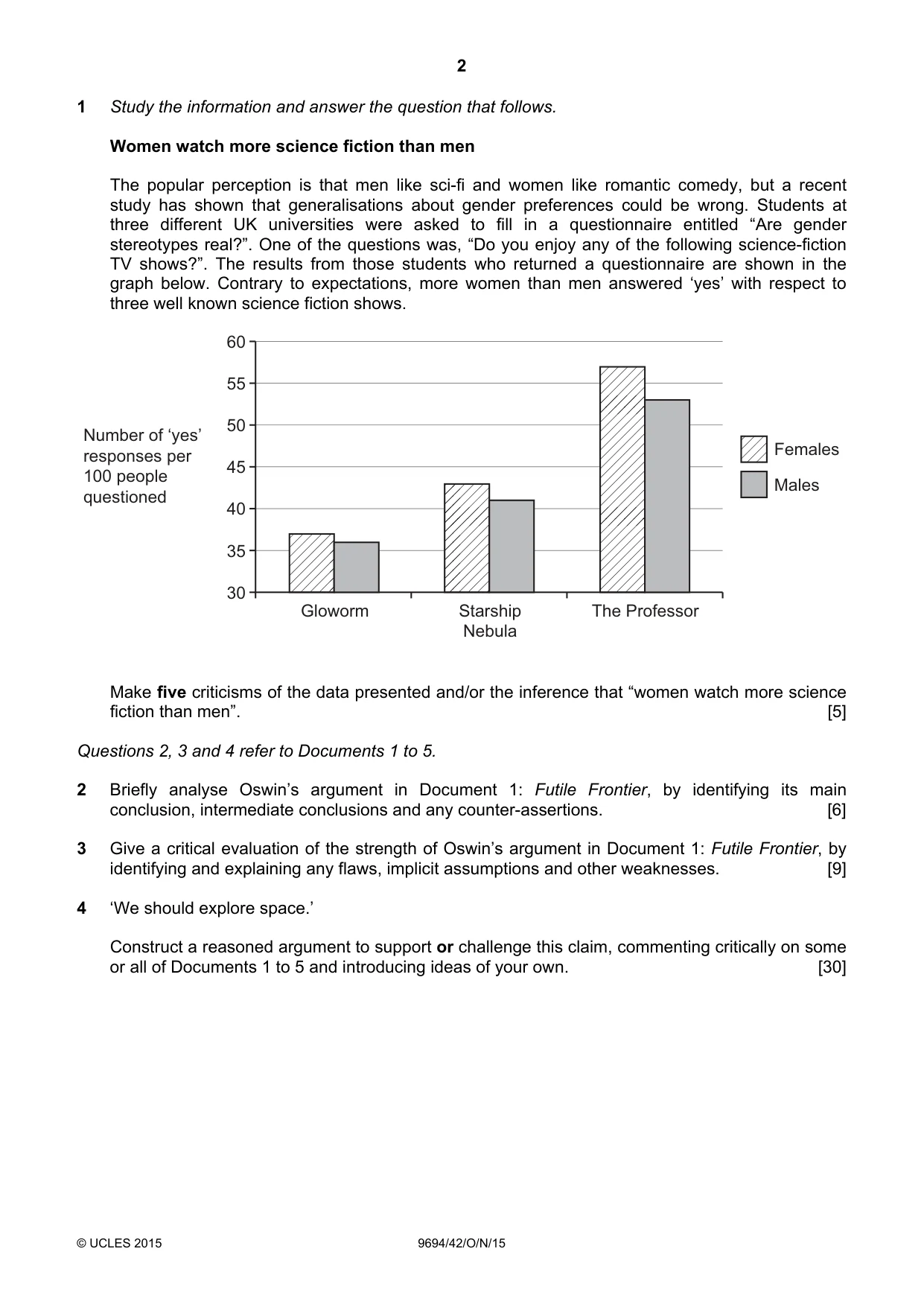
2 © UCLES 2015 9694/42/O/N/15 1 Study the information and answer the question that follows. Women watch more science fiction than men The popular perception is that men like sci-fi and women like romantic comedy, but a recent study has shown that generalisations about gender preferences could be wrong. Students at three different UK universities were asked to fill in a questionnaire entitled “Are gender stereotypes real?”. One of the questions was, “Do you enjoy any of the following science-fiction TV shows?”. The results from those students who returned a questionnaire are shown in the graph below. Contrary to expectations, more women than men answered ‘yes’ with respect to three well known science fiction shows. 60 55 50 45 40 35 30 Number of ‘yes’ responses per 100 people questioned Gloworm Starship Nebula The Professor Females Males Make five criticisms of the data presented and/or the inference that “women watch more science fiction than men”. [5] Questions 2, 3 and 4 refer to Documents 1 to 5. 2 Briefly analyse Oswin’s argument in Document 1: Futile Frontier, by identifying its main conclusion, intermediate conclusions and any counter-assertions. [6] 3 Give a critical evaluation of the strength of Oswin’s argument in Document 1: Futile Frontier, by identifying and explaining any flaws, implicit assumptions and other weaknesses. [9] 4 ‘We should explore space.’ Construct a reasoned argument to support or challenge this claim, commenting critically on some or all of Documents 1 to 5 and introducing ideas of your own. [30]
Question paper, page 3
3 © UCLES 2015 9694/42/O/N/15 [Turn over DOCUMENT 1 Futile Frontier Space exploration is seen by some as the next step in human scientific evolution – the “final frontier”. Those that support it claim that Earth is no longer a mystery and, since mankind needs constant challenges, space becomes the obvious next step. But there is no reason to look beyond Earth for challenges. There is still much to discover about our planet. The deep oceans and Antarctica are still largely unexplored and new species are discovered in the rainforests every week. Even in basic lab research there is still a lot to do: diseases to cure, pollution to control, crops to improve – our increasing population needs to be fed! Many people highlight glory and fame as sufficient reasons to explore space. However, there are more pressing problems that have to be solved down here, such as war and famine – problems that are often dirty, expensive and not very glamorous. These are the kind of jobs that we tend to avoid doing until it’s too late. Artificial satellites are useful, productive and lucrative tools, but no visit to Mars is necessary for these benefits. The costs of the various space exploration programmes are staggering. The Apollo programme, a political stunt whose sole purpose was to upstage the Soviet Union, had no practical results and cost $20 billion forty years ago; the development of the Saturn V rocket alone cost $9.3 billion. The new International Space Station is intended as a base for future long-duration missions – missions which might never happen. Its budget has increased dramatically since its first design and is already at $60 billion. The Voyager probe, a lump of scientific hardware fired off into deep space, cost a total of $895 million. What benefits has it brought? Maybe some aliens have been entertained by Earth music. All of these projects amount to nothing more than an expensive folly. The Hubble Space Telescope is another example. This flying telescope, that does nothing but gaze at stars, was sent up faulty! How, with all the advanced technology involved, could something like this happen? Millions of dollars had to be spent to repair it. Then there is SETI, the Search for Extra- Terrestrial Intelligence. The budget for this is about $5 million per year and all it does is listen out for little green men! Hundreds of millions of dollars are being wasted by a few rich countries, while elsewhere millions live in poverty or die of starvation, disease and war. This money would be much better spent funding organisations that improve life on Earth, like the World Wide Fund for Nature or Oxfam. The various space programmes represent a significant cost in human life. Ever since Gagarin stepped into his rocket, men and women have been dying for the sake of space exploration. When the space shuttle Columbia disintegrated over Texas in 2003 the cumulative death toll rose to at least 120. How many more will die, or come close to dying? Space exploration serves no useful purpose. It should be curtailed. If we don’t stop spending money on dreams and start taking care of the planet, pretty soon we won’t have anywhere to live. Oswin
Question paper, page 4
4 © UCLES 2015 9694/42/O/N/15 DOCUMENT 2 Why We Explore Human Space Exploration Humanity’s interest in the heavens has been universal and enduring. Humans are driven to explore the unknown, discover new worlds, push the boundaries of our scientific and technical limits, and then push further. The intangible desire to explore and challenge the boundaries of what we know and where we have been has provided benefits to our society for centuries. Human space exploration helps to address fundamental questions about our place in the Universe and the history of our solar system. Through addressing the challenges related to human space exploration we expand technology, create new industries, and help to foster a peaceful connection with other nations. Curiosity and exploration are vital to the human spirit, and accepting the challenge of going deeper into space will invite the citizens of the world today and the generations of tomorrow to join NASA on this exciting journey. Why the International Space Station? The first step in embarking on a long and challenging journey involves laying solid groundwork for a successful endeavour. The International Space Station serves as a laboratory for human health, biological and materials research, as a technology test-bed, and as a stepping stone for going further into the solar system. On the International Space Station we will learn new ways to ensure astronauts are safe, healthy and productive while exploring, and we will continue to expand our knowledge about how materials and biological systems behave outside of the influence of gravity. NASA will continue its unprecedented work with the commercial industry, and expand an entire industry as private companies develop and operate safe, reliable and affordable commercial systems to transport crew and cargo to and from the International Space Station and low Earth orbit. Why Mars? Mars has always been a source of inspiration for explorers and scientists. Robotic missions have found evidence of water, but whether life exists beyond Earth still remains a mystery. Scientific robotic missions have shown that Mars has characteristics and a history similar to those of Earth, but we know that there are striking differences that we have yet to begin to understand. Humans can build upon this knowledge, look for signs of life and investigate Mars’s geological evolution, resulting in research and methods that could be applied here on Earth. A mission to our nearest planetary neighbour provides the best opportunity to demonstrate that humans can live for extended, even permanent, stays beyond low Earth orbit. The technology and space systems required to transport and sustain explorers will drive innovation and encourage creative ways to address challenges. As previous space endeavours have demonstrated, the resulting ingenuity and technologies will have long lasting benefits and applications. The challenge of travelling to Mars and learning how to live there will encourage nations around the world to work together to achieve such an ambitious undertaking. The International Space Station has shown that opportunities for collaboration will highlight our common interests and provide a global sense of community. NASA
Question paper, page 5
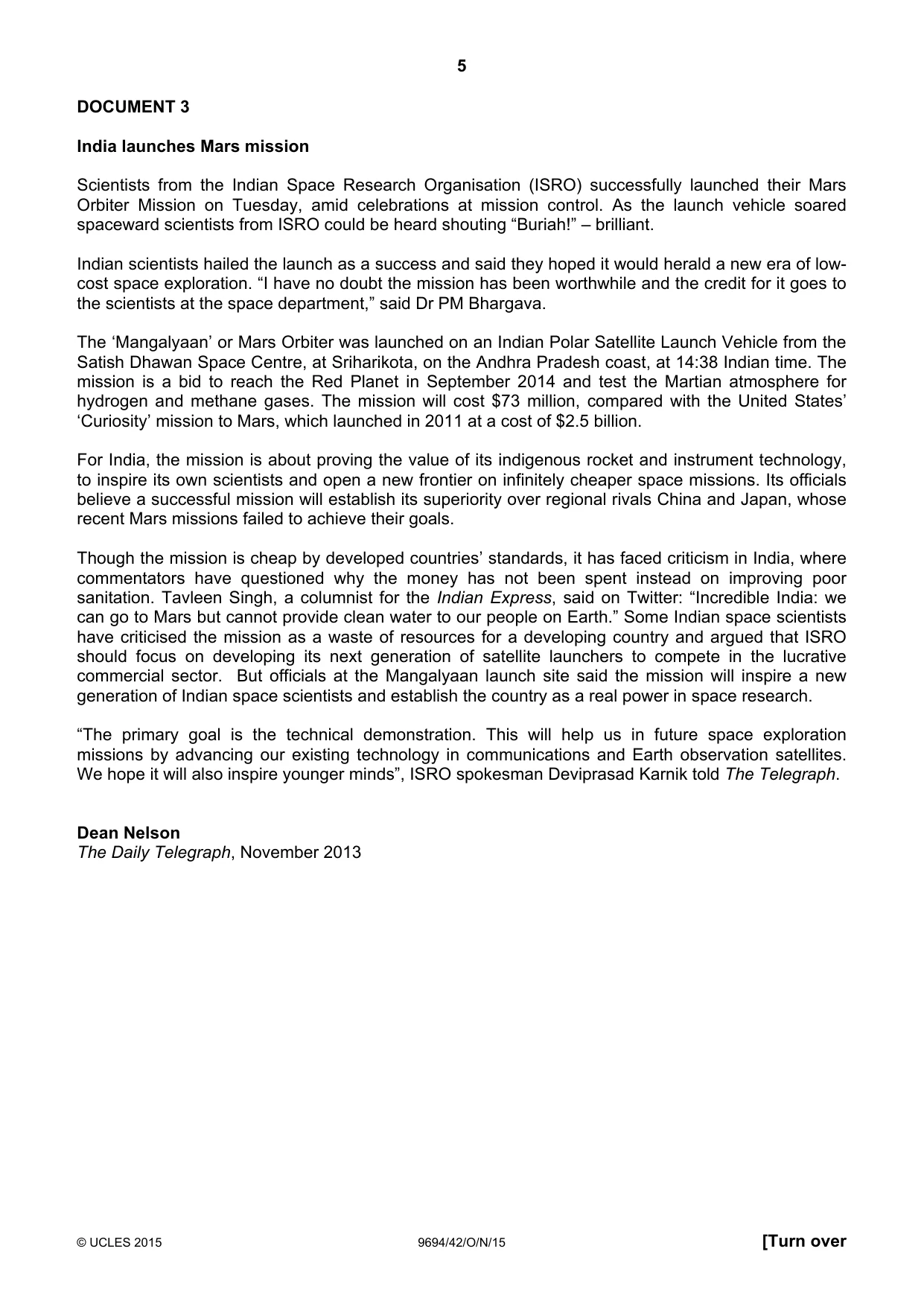
5 © UCLES 2015 9694/42/O/N/15 [Turn over DOCUMENT 3 India launches Mars mission Scientists from the Indian Space Research Organisation (ISRO) successfully launched their Mars Orbiter Mission on Tuesday, amid celebrations at mission control. As the launch vehicle soared spaceward scientists from ISRO could be heard shouting “Buriah!” – brilliant. Indian scientists hailed the launch as a success and said they hoped it would herald a new era of low- cost space exploration. “I have no doubt the mission has been worthwhile and the credit for it goes to the scientists at the space department,” said Dr PM Bhargava. The ‘Mangalyaan’ or Mars Orbiter was launched on an Indian Polar Satellite Launch Vehicle from the Satish Dhawan Space Centre, at Sriharikota, on the Andhra Pradesh coast, at 14:38 Indian time. The mission is a bid to reach the Red Planet in September 2014 and test the Martian atmosphere for hydrogen and methane gases. The mission will cost $73 million, compared with the United States’ ‘Curiosity’ mission to Mars, which launched in 2011 at a cost of $2.5 billion. For India, the mission is about proving the value of its indigenous rocket and instrument technology, to inspire its own scientists and open a new frontier on infinitely cheaper space missions. Its officials believe a successful mission will establish its superiority over regional rivals China and Japan, whose recent Mars missions failed to achieve their goals. Though the mission is cheap by developed countries’ standards, it has faced criticism in India, where commentators have questioned why the money has not been spent instead on improving poor sanitation. Tavleen Singh, a columnist for the Indian Express, said on Twitter: “Incredible India: we can go to Mars but cannot provide clean water to our people on Earth.” Some Indian space scientists have criticised the mission as a waste of resources for a developing country and argued that ISRO should focus on developing its next generation of satellite launchers to compete in the lucrative commercial sector. But officials at the Mangalyaan launch site said the mission will inspire a new generation of Indian space scientists and establish the country as a real power in space research. “The primary goal is the technical demonstration. This will help us in future space exploration missions by advancing our existing technology in communications and Earth observation satellites. We hope it will also inspire younger minds”, ISRO spokesman Deviprasad Karnik told The Telegraph. Dean Nelson The Daily Telegraph, November 2013
Question paper, page 6
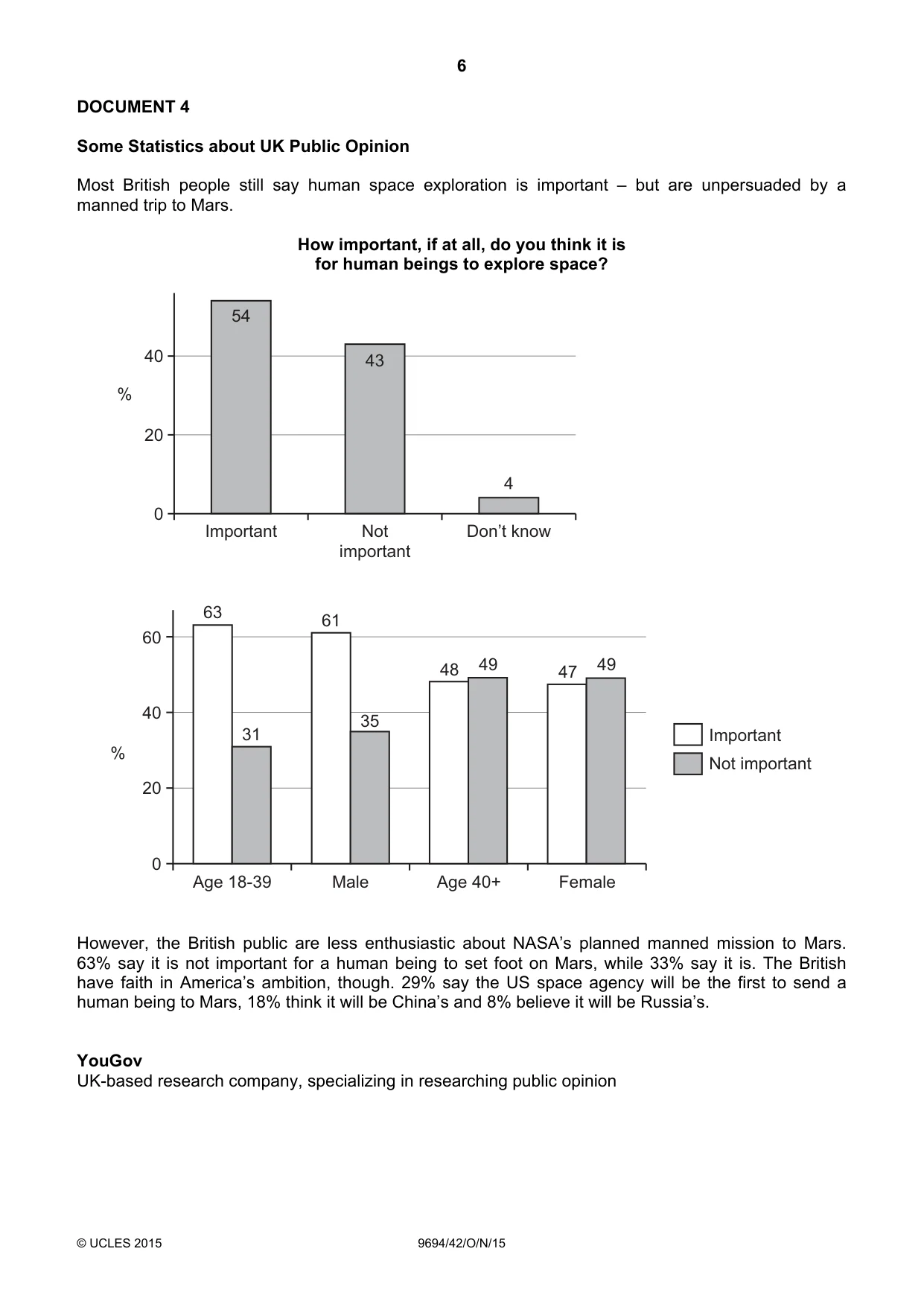
6 © UCLES 2015 9694/42/O/N/15 DOCUMENT 4 Some Statistics about UK Public Opinion Most British people still say human space exploration is important – but are unpersuaded by a manned trip to Mars. How important, if at all, do you think it is for human beings to explore space? Important Not important Don’t know 54 43 4 40 20 0 % 60 40 20 0 % Age 18-39 Male Age 40+ Female 63 31 61 35 48 49 47 49 Important Not important However, the British public are less enthusiastic about NASA’s planned manned mission to Mars. 63% say it is not important for a human being to set foot on Mars, while 33% say it is. The British have faith in America’s ambition, though. 29% say the US space agency will be the first to send a human being to Mars, 18% think it will be China’s and 8% believe it will be Russia’s. YouGov UK-based research company, specializing in researching public opinion
Question paper, page 7
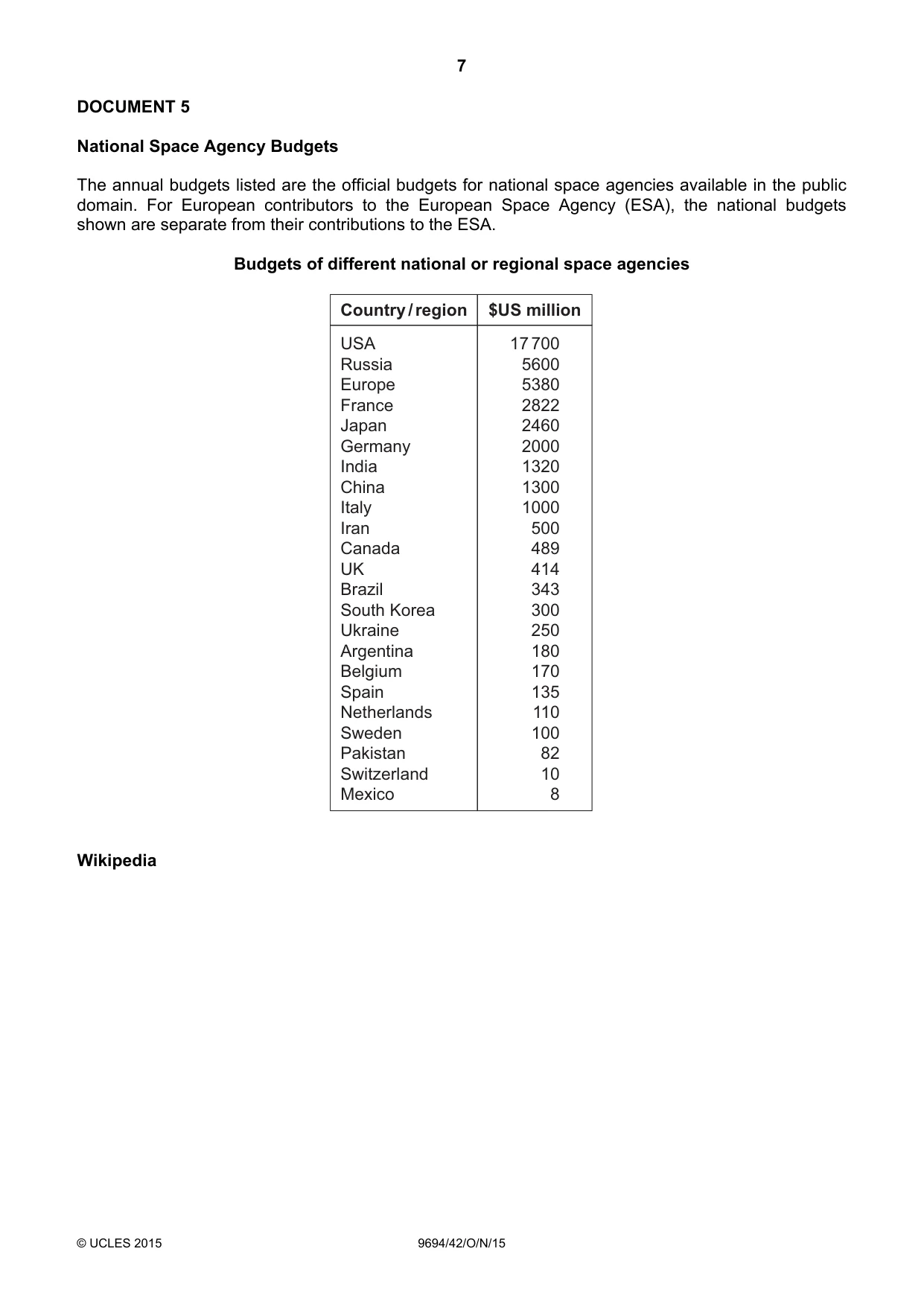
7 © UCLES 2015 9694/42/O/N/15 DOCUMENT 5 National Space Agency Budgets The annual budgets listed are the official budgets for national space agencies available in the public domain. For European contributors to the European Space Agency (ESA), the national budgets shown are separate from their contributions to the ESA. Budgets of different national or regional space agencies USA Russia Europe France Japan Germany India China Italy Iran Canada UK Brazil South Korea Ukraine Argentina Belgium Spain Netherlands Sweden Pakistan Switzerland Mexico Country / region 17 700 5600 5380 2822 2460 2000 1320 1300 1000 500 489 414 343 300 250 180 170 135 110 100 82 10 8 $US million Wikipedia
Question paper, page 8
8 Permission to reproduce items where third-party owned material protected by copyright is included has been sought and cleared where possible. Every reasonable effort has been made by the publisher (UCLES) to trace copyright holders, but if any items requiring clearance have unwittingly been included, the publisher will be pleased to make amends at the earliest possible opportunity. To avoid the issue of disclosure of answer-related information to candidates, all copyright acknowledgements are reproduced online in the Cambridge International Examinations Copyright Acknowledgements Booklet. This is produced for each series of examinations and is freely available to download at www.cie.org.uk after the live examination series. Cambridge International Examinations is part of the Cambridge Assessment Group. Cambridge Assessment is the brand name of University of Cambridge Local Examinations Syndicate (UCLES), which is itself a department of the University of Cambridge. © UCLES 2015 9694/42/O/N/15 BLANK PAGE
Mark scheme, page 1
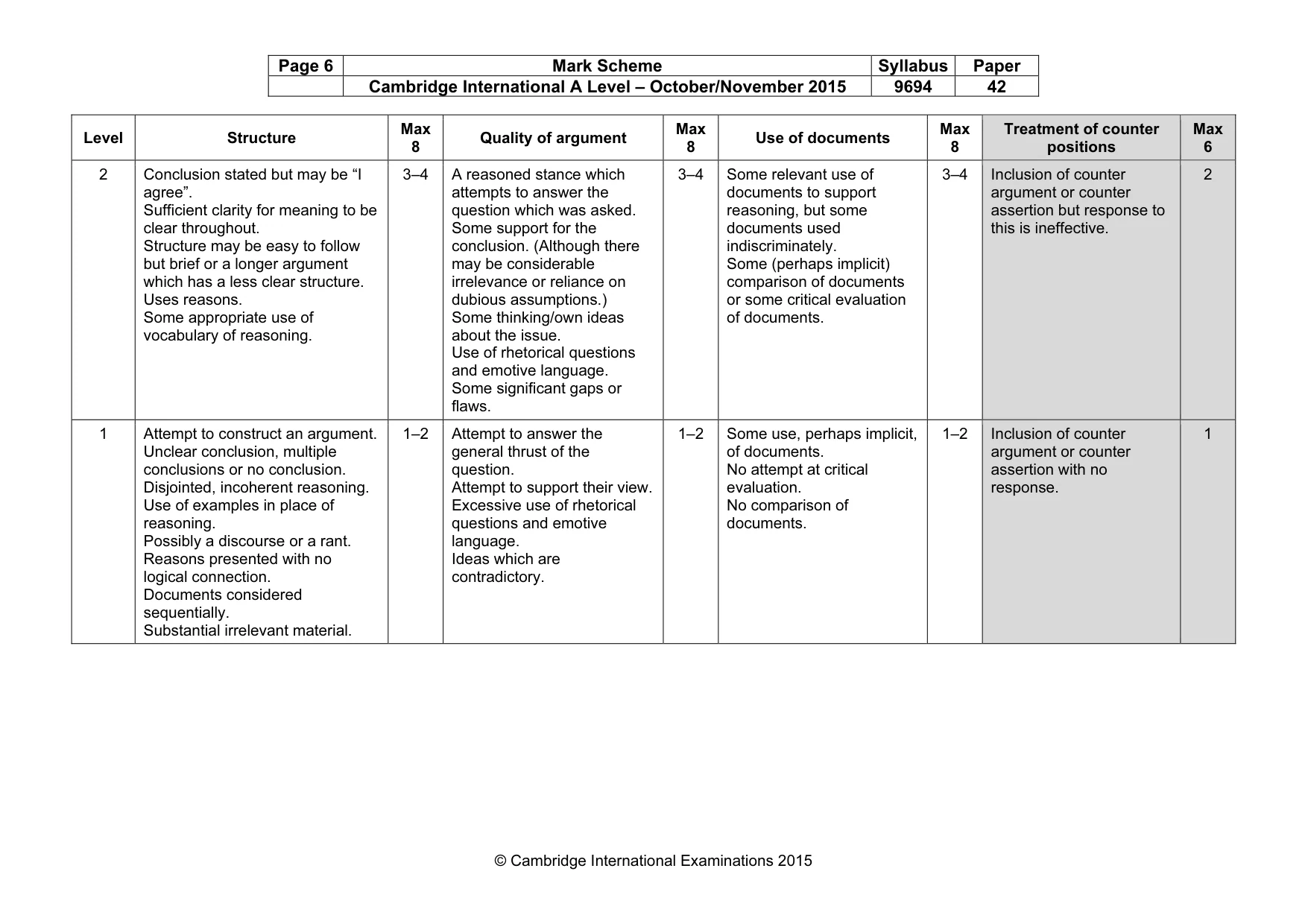
® IGCSE is the registered trademark of Cambridge International Examinations. CAMBRIDGE INTERNATIONAL EXAMINATIONS Cambridge International Advanced Level MARK SCHEME for the October/November 2015 series 9694 THINKING SKILLS 9694/42 Paper 4 (Applied Reasoning), maximum raw mark 50 This mark scheme is published as an aid to teachers and candidates, to indicate the requirements of the examination. It shows the basis on which Examiners were instructed to award marks. It does not indicate the details of the discussions that took place at an Examiners’ meeting before marking began, which would have considered the acceptability of alternative answers. Mark schemes should be read in conjunction with the question paper and the Principal Examiner Report for Teachers. Cambridge will not enter into discussions about these mark schemes. Cambridge is publishing the mark schemes for the October/November 2015 series for most Cambridge IGCSE®, Cambridge International A and AS Level components and some Cambridge O Level components.
Mark scheme, page 2
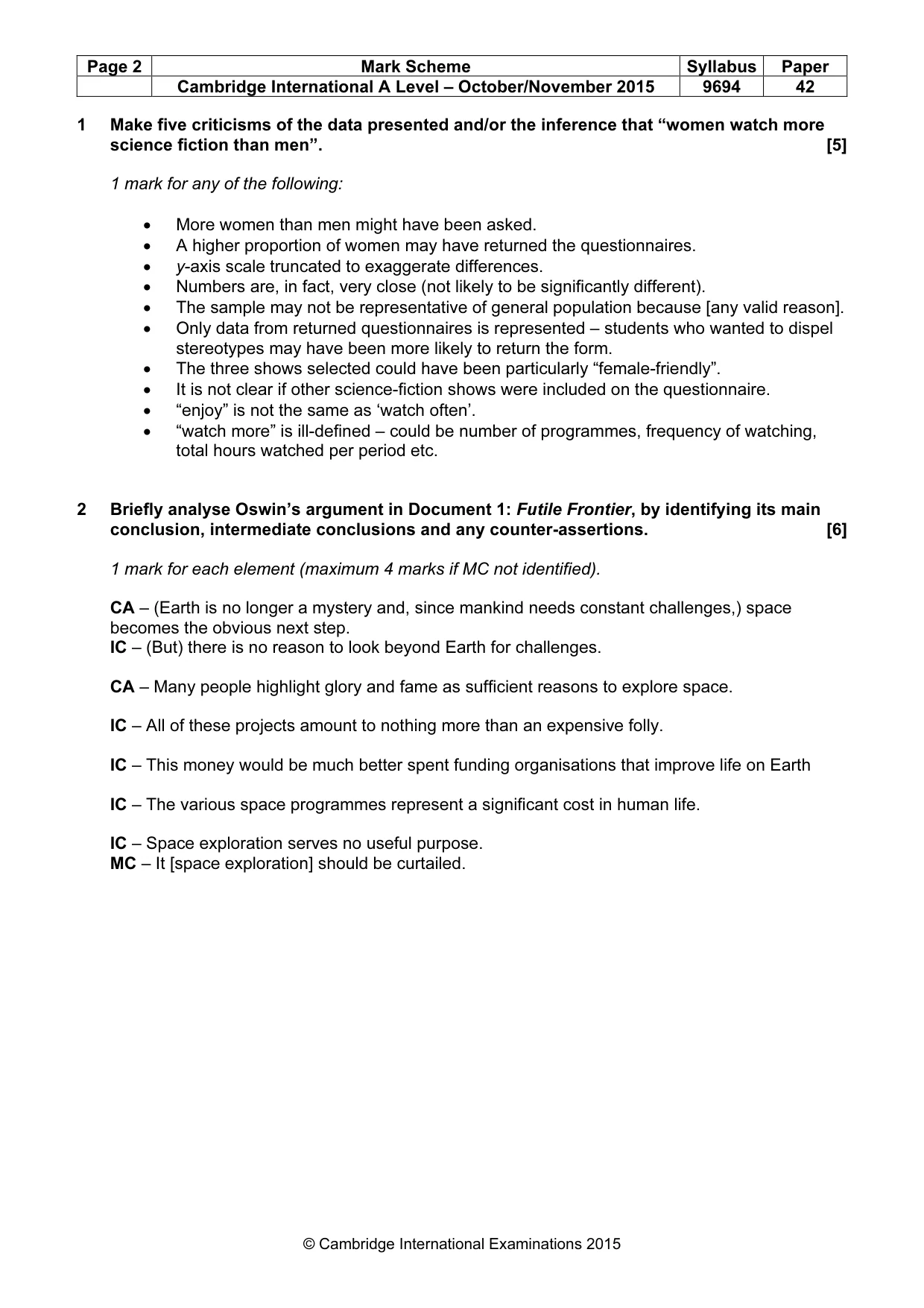
Page 2 Mark Scheme Syllabus Paper Cambridge International A Level – October/November 2015 9694 42 © Cambridge International Examinations 2015 1 Make five criticisms of the data presented and/or the inference that “women watch more science fiction than men”. [5] 1 mark for any of the following: • More women than men might have been asked. • A higher proportion of women may have returned the questionnaires. • y-axis scale truncated to exaggerate differences. • Numbers are, in fact, very close (not likely to be significantly different). • The sample may not be representative of general population because [any valid reason]. • Only data from returned questionnaires is represented – students who wanted to dispel stereotypes may have been more likely to return the form. • The three shows selected could have been particularly “female-friendly”. • It is not clear if other science-fiction shows were included on the questionnaire. • “enjoy” is not the same as ‘watch often’. • “watch more” is ill-defined – could be number of programmes, frequency of watching, total hours watched per period etc. 2 Briefly analyse Oswin’s argument in Document 1: Futile Frontier, by identifying its main conclusion, intermediate conclusions and any counter-assertions. [6] 1 mark for each element (maximum 4 marks if MC not identified). CA – (Earth is no longer a mystery and, since mankind needs constant challenges,) space becomes the obvious next step. IC – (But) there is no reason to look beyond Earth for challenges. CA – Many people highlight glory and fame as sufficient reasons to explore space. IC – All of these projects amount to nothing more than an expensive folly. IC – This money would be much better spent funding organisations that improve life on Earth IC – The various space programmes represent a significant cost in human life. IC – Space exploration serves no useful purpose. MC – It [space exploration] should be curtailed.
Mark scheme, page 3
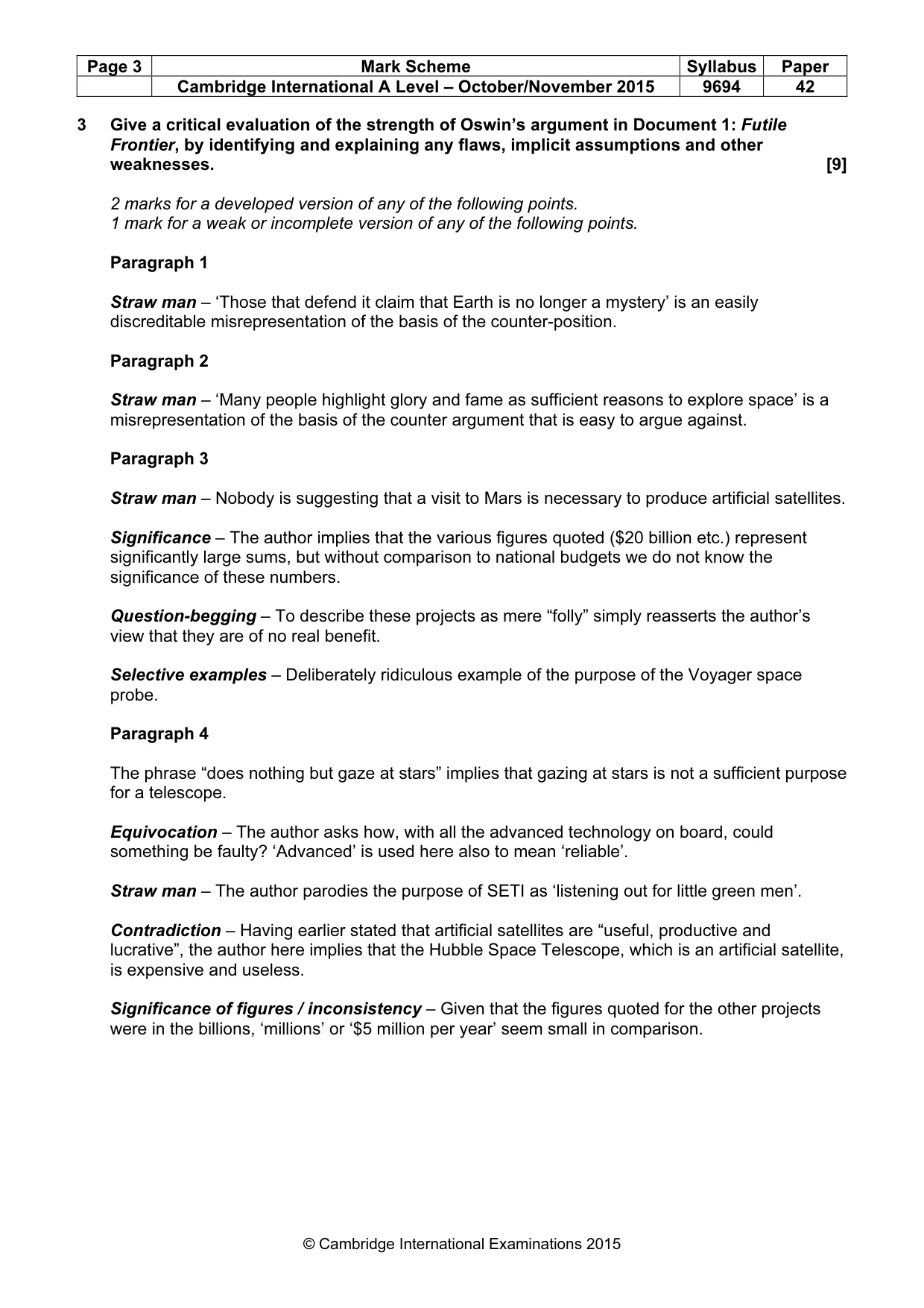
Page 3 Mark Scheme Syllabus Paper Cambridge International A Level – October/November 2015 9694 42 © Cambridge International Examinations 2015 3 Give a critical evaluation of the strength of Oswin’s argument in Document 1: Futile Frontier, by identifying and explaining any flaws, implicit assumptions and other weaknesses. [9] 2 marks for a developed version of any of the following points. 1 mark for a weak or incomplete version of any of the following points. Paragraph 1 Straw man – ‘Those that defend it claim that Earth is no longer a mystery’ is an easily discreditable misrepresentation of the basis of the counter-position. Paragraph 2 Straw man – ‘Many people highlight glory and fame as sufficient reasons to explore space’ is a misrepresentation of the basis of the counter argument that is easy to argue against. Paragraph 3 Straw man – Nobody is suggesting that a visit to Mars is necessary to produce artificial satellites. Significance – The author implies that the various figures quoted ($20 billion etc.) represent significantly large sums, but without comparison to national budgets we do not know the significance of these numbers. Question-begging – To describe these projects as mere “folly” simply reasserts the author’s view that they are of no real benefit. Selective examples – Deliberately ridiculous example of the purpose of the Voyager space probe. Paragraph 4 The phrase “does nothing but gaze at stars” implies that gazing at stars is not a sufficient purpose for a telescope. Equivocation – The author asks how, with all the advanced technology on board, could something be faulty? ‘Advanced’ is used here also to mean ‘reliable’. Straw man – The author parodies the purpose of SETI as ‘listening out for little green men’. Contradiction – Having earlier stated that artificial satellites are “useful, productive and lucrative”, the author here implies that the Hubble Space Telescope, which is an artificial satellite, is expensive and useless. Significance of figures / inconsistency – Given that the figures quoted for the other projects were in the billions, ‘millions’ or ‘$5 million per year’ seem small in comparison.
Mark scheme, page 4
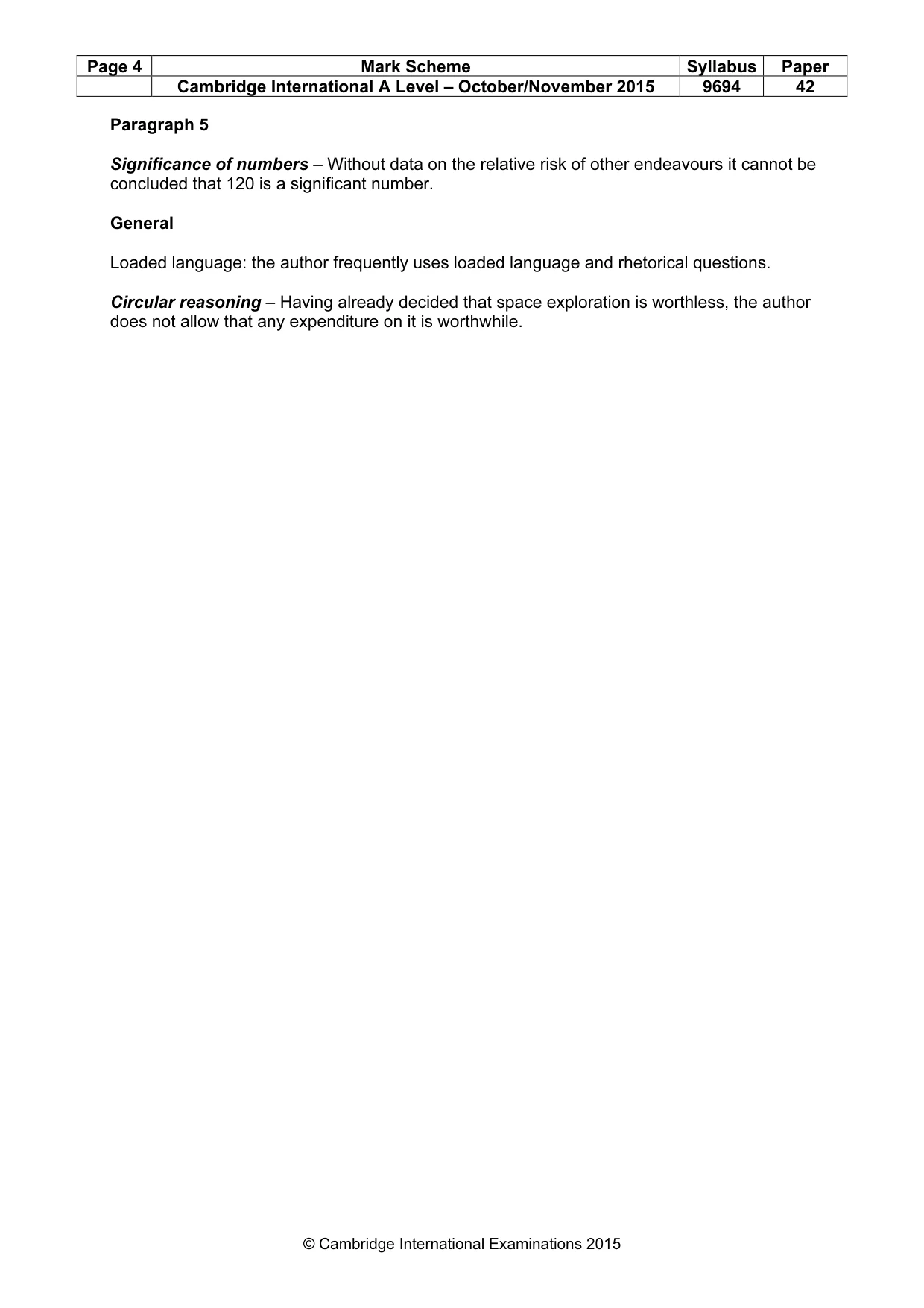
Page 4 Mark Scheme Syllabus Paper Cambridge International A Level – October/November 2015 9694 42 © Cambridge International Examinations 2015 Paragraph 5 Significance of numbers – Without data on the relative risk of other endeavours it cannot be concluded that 120 is a significant number. General Loaded language: the author frequently uses loaded language and rhetorical questions. Circular reasoning – Having already decided that space exploration is worthless, the author does not allow that any expenditure on it is worthwhile.
Mark scheme, page 5
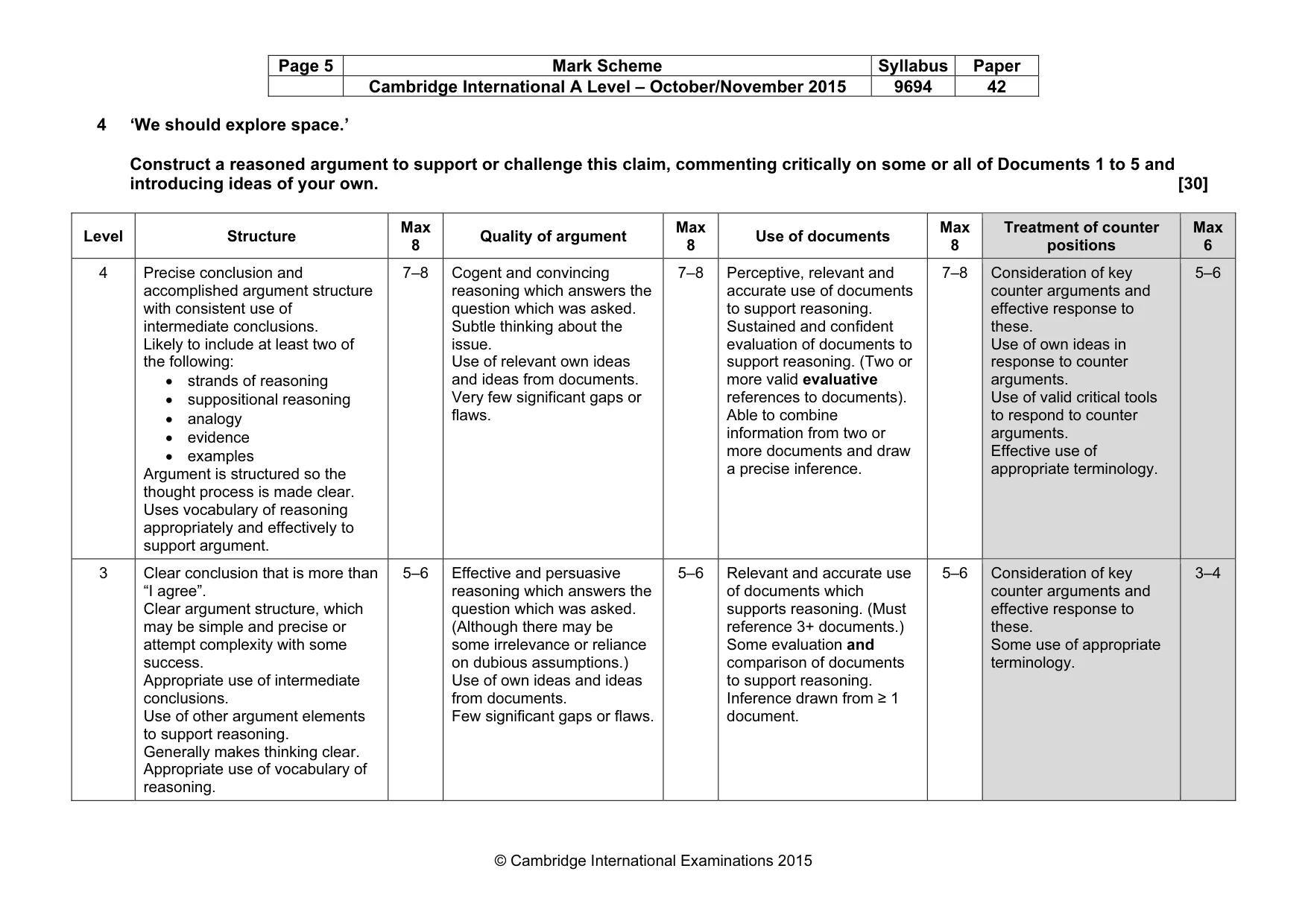
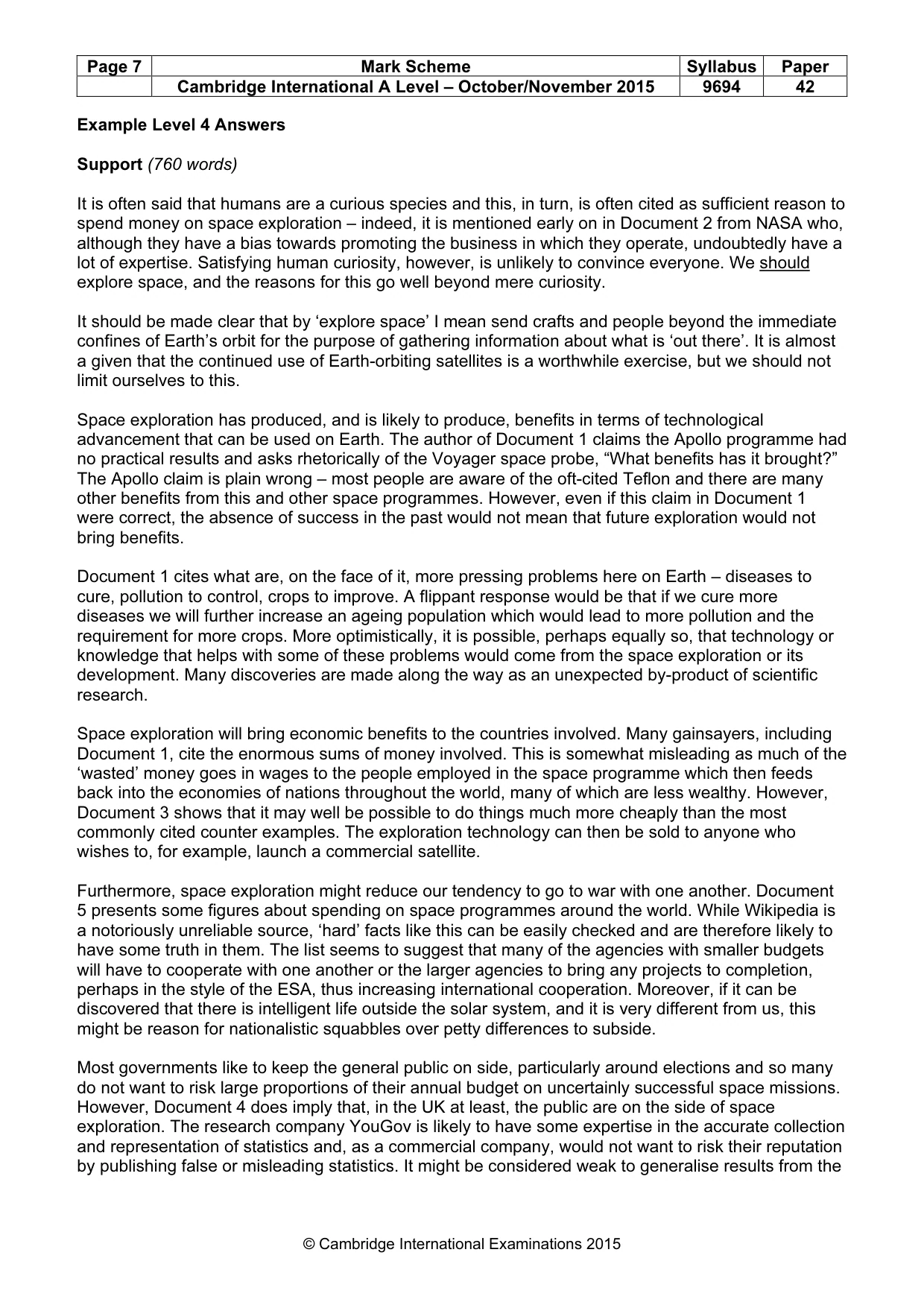
Page 5 Mark Scheme Syllabus Paper Cambridge International A Level – October/November 2015 9694 42 © Cambridge International Examinations 2015 4 ‘We should explore space.’ Construct a reasoned argument to support or challenge this claim, commenting critically on some or all of Documents 1 to 5 and introducing ideas of your own. [30] Level Structure Max 8 Quality of argument Max 8 Use of documents Max 8 Treatment of counter positions Max 6 4 Precise conclusion and accomplished argument structure with consistent use of intermediate conclusions. Likely to include at least two of the following: • strands of reasoning • suppositional reasoning • analogy • evidence • examples Argument is structured so the thought process is made clear. Uses vocabulary of reasoning appropriately and effectively to support argument. 7–8 Cogent and convincing reasoning which answers the question which was asked. Subtle thinking about the issue. Use of relevant own ideas and ideas from documents. Very few significant gaps or flaws. 7–8 Perceptive, relevant and accurate use of documents to support reasoning. Sustained and confident evaluation of documents to support reasoning. (Two or more valid evaluative references to documents). Able to combine information from two or more documents and draw a precise inference. 7–8 Consideration of key counter arguments and effective response to these. Use of own ideas in response to counter arguments. Use of valid critical tools to respond to counter arguments. Effective use of appropriate terminology. 5–6 3 Clear conclusion that is more than “I agree”. Clear argument structure, which may be simple and precise or attempt complexity with some success. Appropriate use of intermediate conclusions. Use of other argument elements to support reasoning. Generally makes thinking clear. Appropriate use of vocabulary of reasoning. 5–6 Effective and persuasive reasoning which answers the question which was asked. (Although there may be some irrelevance or reliance on dubious assumptions.) Use of own ideas and ideas from documents. Few significant gaps or flaws. 5–6 Relevant and accurate use of documents which supports reasoning. (Must reference 3+ documents.) Some evaluation and comparison of documents to support reasoning. Inference drawn from ≥ 1 document. 5–6 Consideration of key counter arguments and effective response to these. Some use of appropriate terminology. 3–4
Mark scheme, page 6
Page 6 Mark Scheme Syllabus Paper Cambridge International A Level – October/November 2015 9694 42 © Cambridge International Examinations 2015 Level Structure Max 8 Quality of argument Max 8 Use of documents Max 8 Treatment of counter positions Max 6 2 Conclusion stated but may be “I agree”. Sufficient clarity for meaning to be clear throughout. Structure may be easy to follow but brief or a longer argument which has a less clear structure. Uses reasons. Some appropriate use of vocabulary of reasoning. 3–4 A reasoned stance which attempts to answer the question which was asked. Some support for the conclusion. (Although there may be considerable irrelevance or reliance on dubious assumptions.) Some thinking/own ideas about the issue. Use of rhetorical questions and emotive language. Some significant gaps or flaws. 3–4 Some relevant use of documents to support reasoning, but some documents used indiscriminately. Some (perhaps implicit) comparison of documents or some critical evaluation of documents. 3–4 Inclusion of counter argument or counter assertion but response to this is ineffective. 2 1 Attempt to construct an argument. Unclear conclusion, multiple conclusions or no conclusion. Disjointed, incoherent reasoning. Use of examples in place of reasoning. Possibly a discourse or a rant. Reasons presented with no logical connection. Documents considered sequentially. Substantial irrelevant material. 1–2 Attempt to answer the general thrust of the question. Attempt to support their view. Excessive use of rhetorical questions and emotive language. Ideas which are contradictory. 1–2 Some use, perhaps implicit, of documents. No attempt at critical evaluation. No comparison of documents. 1–2 Inclusion of counter argument or counter assertion with no response. 1
Mark scheme, page 7
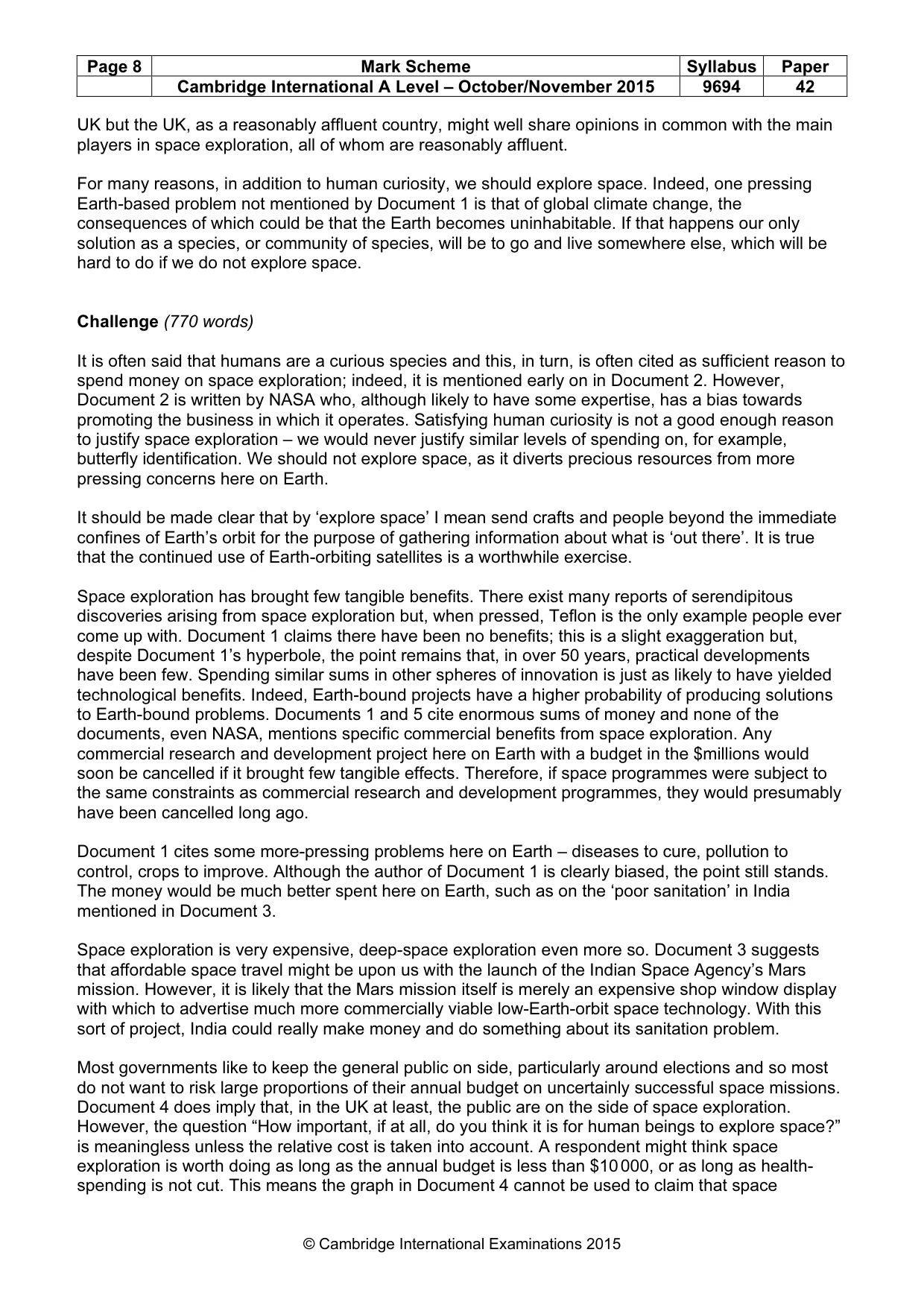
Page 7 Mark Scheme Syllabus Paper Cambridge International A Level – October/November 2015 9694 42 © Cambridge International Examinations 2015 Example Level 4 Answers Support (760 words) It is often said that humans are a curious species and this, in turn, is often cited as sufficient reason to spend money on space exploration – indeed, it is mentioned early on in Document 2 from NASA who, although they have a bias towards promoting the business in which they operate, undoubtedly have a lot of expertise. Satisfying human curiosity, however, is unlikely to convince everyone. We should explore space, and the reasons for this go well beyond mere curiosity. It should be made clear that by ‘explore space’ I mean send crafts and people beyond the immediate confines of Earth’s orbit for the purpose of gathering information about what is ‘out there’. It is almost a given that the continued use of Earth-orbiting satellites is a worthwhile exercise, but we should not limit ourselves to this. Space exploration has produced, and is likely to produce, benefits in terms of technological advancement that can be used on Earth. The author of Document 1 claims the Apollo programme had no practical results and asks rhetorically of the Voyager space probe, “What benefits has it brought?” The Apollo claim is plain wrong – most people are aware of the oft-cited Teflon and there are many other benefits from this and other space programmes. However, even if this claim in Document 1 were correct, the absence of success in the past would not mean that future exploration would not bring benefits. Document 1 cites what are, on the face of it, more pressing problems here on Earth – diseases to cure, pollution to control, crops to improve. A flippant response would be that if we cure more diseases we will further increase an ageing population which would lead to more pollution and the requirement for more crops. More optimistically, it is possible, perhaps equally so, that technology or knowledge that helps with some of these problems would come from the space exploration or its development. Many discoveries are made along the way as an unexpected by-product of scientific research. Space exploration will bring economic benefits to the countries involved. Many gainsayers, including Document 1, cite the enormous sums of money involved. This is somewhat misleading as much of the ‘wasted’ money goes in wages to the people employed in the space programme which then feeds back into the economies of nations throughout the world, many of which are less wealthy. However, Document 3 shows that it may well be possible to do things much more cheaply than the most commonly cited counter examples. The exploration technology can then be sold to anyone who wishes to, for example, launch a commercial satellite. Furthermore, space exploration might reduce our tendency to go to war with one another. Document 5 presents some figures about spending on space programmes around the world. While Wikipedia is a notoriously unreliable source, ‘hard’ facts like this can be easily checked and are therefore likely to have some truth in them. The list seems to suggest that many of the agencies with smaller budgets will have to cooperate with one another or the larger agencies to bring any projects to completion, perhaps in the style of the ESA, thus increasing international cooperation. Moreover, if it can be discovered that there is intelligent life outside the solar system, and it is very different from us, this might be reason for nationalistic squabbles over petty differences to subside. Most governments like to keep the general public on side, particularly around elections and so many do not want to risk large proportions of their annual budget on uncertainly successful space missions. However, Document 4 does imply that, in the UK at least, the public are on the side of space exploration. The research company YouGov is likely to have some expertise in the accurate collection and representation of statistics and, as a commercial company, would not want to risk their reputation by publishing false or misleading statistics. It might be considered weak to generalise results from the
Mark scheme, page 8
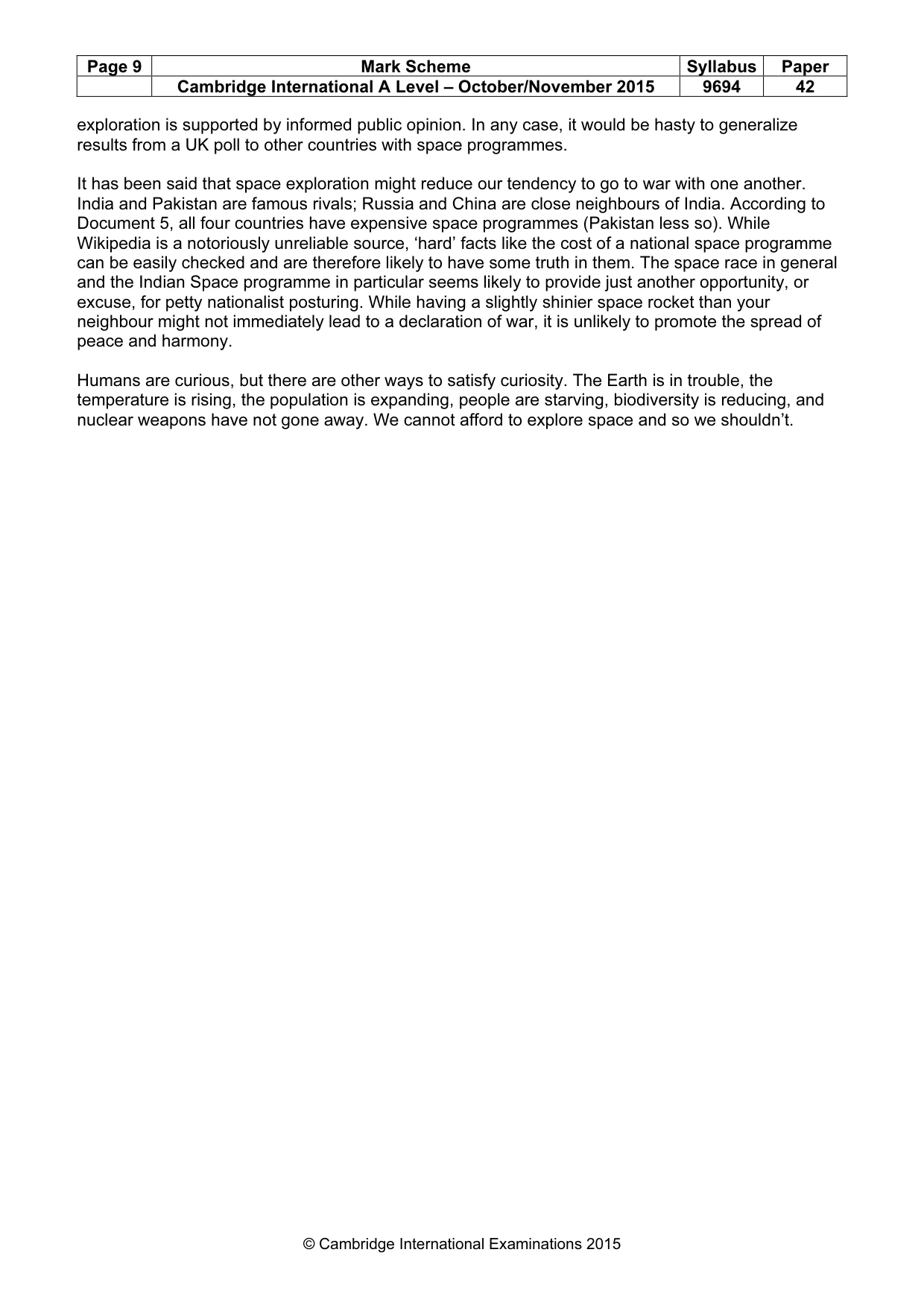
Page 8 Mark Scheme Syllabus Paper Cambridge International A Level – October/November 2015 9694 42 © Cambridge International Examinations 2015 UK but the UK, as a reasonably affluent country, might well share opinions in common with the main players in space exploration, all of whom are reasonably affluent. For many reasons, in addition to human curiosity, we should explore space. Indeed, one pressing Earth-based problem not mentioned by Document 1 is that of global climate change, the consequences of which could be that the Earth becomes uninhabitable. If that happens our only solution as a species, or community of species, will be to go and live somewhere else, which will be hard to do if we do not explore space. Challenge (770 words) It is often said that humans are a curious species and this, in turn, is often cited as sufficient reason to spend money on space exploration; indeed, it is mentioned early on in Document 2. However, Document 2 is written by NASA who, although likely to have some expertise, has a bias towards promoting the business in which it operates. Satisfying human curiosity is not a good enough reason to justify space exploration – we would never justify similar levels of spending on, for example, butterfly identification. We should not explore space, as it diverts precious resources from more pressing concerns here on Earth. It should be made clear that by ‘explore space’ I mean send crafts and people beyond the immediate confines of Earth’s orbit for the purpose of gathering information about what is ‘out there’. It is true that the continued use of Earth-orbiting satellites is a worthwhile exercise. Space exploration has brought few tangible benefits. There exist many reports of serendipitous discoveries arising from space exploration but, when pressed, Teflon is the only example people ever come up with. Document 1 claims there have been no benefits; this is a slight exaggeration but, despite Document 1’s hyperbole, the point remains that, in over 50 years, practical developments have been few. Spending similar sums in other spheres of innovation is just as likely to have yielded technological benefits. Indeed, Earth-bound projects have a higher probability of producing solutions to Earth-bound problems. Documents 1 and 5 cite enormous sums of money and none of the documents, even NASA, mentions specific commercial benefits from space exploration. Any commercial research and development project here on Earth with a budget in the $millions would soon be cancelled if it brought few tangible effects. Therefore, if space programmes were subject to the same constraints as commercial research and development programmes, they would presumably have been cancelled long ago. Document 1 cites some more-pressing problems here on Earth – diseases to cure, pollution to control, crops to improve. Although the author of Document 1 is clearly biased, the point still stands. The money would be much better spent here on Earth, such as on the ‘poor sanitation’ in India mentioned in Document 3. Space exploration is very expensive, deep-space exploration even more so. Document 3 suggests that affordable space travel might be upon us with the launch of the Indian Space Agency’s Mars mission. However, it is likely that the Mars mission itself is merely an expensive shop window display with which to advertise much more commercially viable low-Earth-orbit space technology. With this sort of project, India could really make money and do something about its sanitation problem. Most governments like to keep the general public on side, particularly around elections and so most do not want to risk large proportions of their annual budget on uncertainly successful space missions. Document 4 does imply that, in the UK at least, the public are on the side of space exploration. However, the question “How important, if at all, do you think it is for human beings to explore space?” is meaningless unless the relative cost is taken into account. A respondent might think space exploration is worth doing as long as the annual budget is less than $10 000, or as long as health- spending is not cut. This means the graph in Document 4 cannot be used to claim that space
Mark scheme, page 9
Page 9 Mark Scheme Syllabus Paper Cambridge International A Level – October/November 2015 9694 42 © Cambridge International Examinations 2015 exploration is supported by informed public opinion. In any case, it would be hasty to generalize results from a UK poll to other countries with space programmes. It has been said that space exploration might reduce our tendency to go to war with one another. India and Pakistan are famous rivals; Russia and China are close neighbours of India. According to Document 5, all four countries have expensive space programmes (Pakistan less so). While Wikipedia is a notoriously unreliable source, ‘hard’ facts like the cost of a national space programme can be easily checked and are therefore likely to have some truth in them. The space race in general and the Indian Space programme in particular seems likely to provide just another opportunity, or excuse, for petty nationalist posturing. While having a slightly shinier space rocket than your neighbour might not immediately lead to a declaration of war, it is unlikely to promote the spread of peace and harmony. Humans are curious, but there are other ways to satisfy curiosity. The Earth is in trouble, the temperature is rising, the population is expanding, people are starving, biodiversity is reducing, and nuclear weapons have not gone away. We cannot afford to explore space and so we shouldn’t.
What you needed in this session
Cambridge’s own grade thresholds for 2015 Oct/Nov, Paper 4 · Variant 2. A higher threshold means an easier paper — the bar moves with how the cohort did.