Cambridge A Level Thinking Skills 9694 — 2015 Oct/Nov Paper 3 · Variant 1
9694/31/O/N/15 · 50 marks · ≈56 min
The question paper and its mark scheme, free to read here and free to download. This is Cambridge’s own paper, exactly as it was sat.
Question paper8 pages

Mark scheme7 pages
Answers below. Sit the paper first if you are practising.
Paper as text
Question paper, page 1
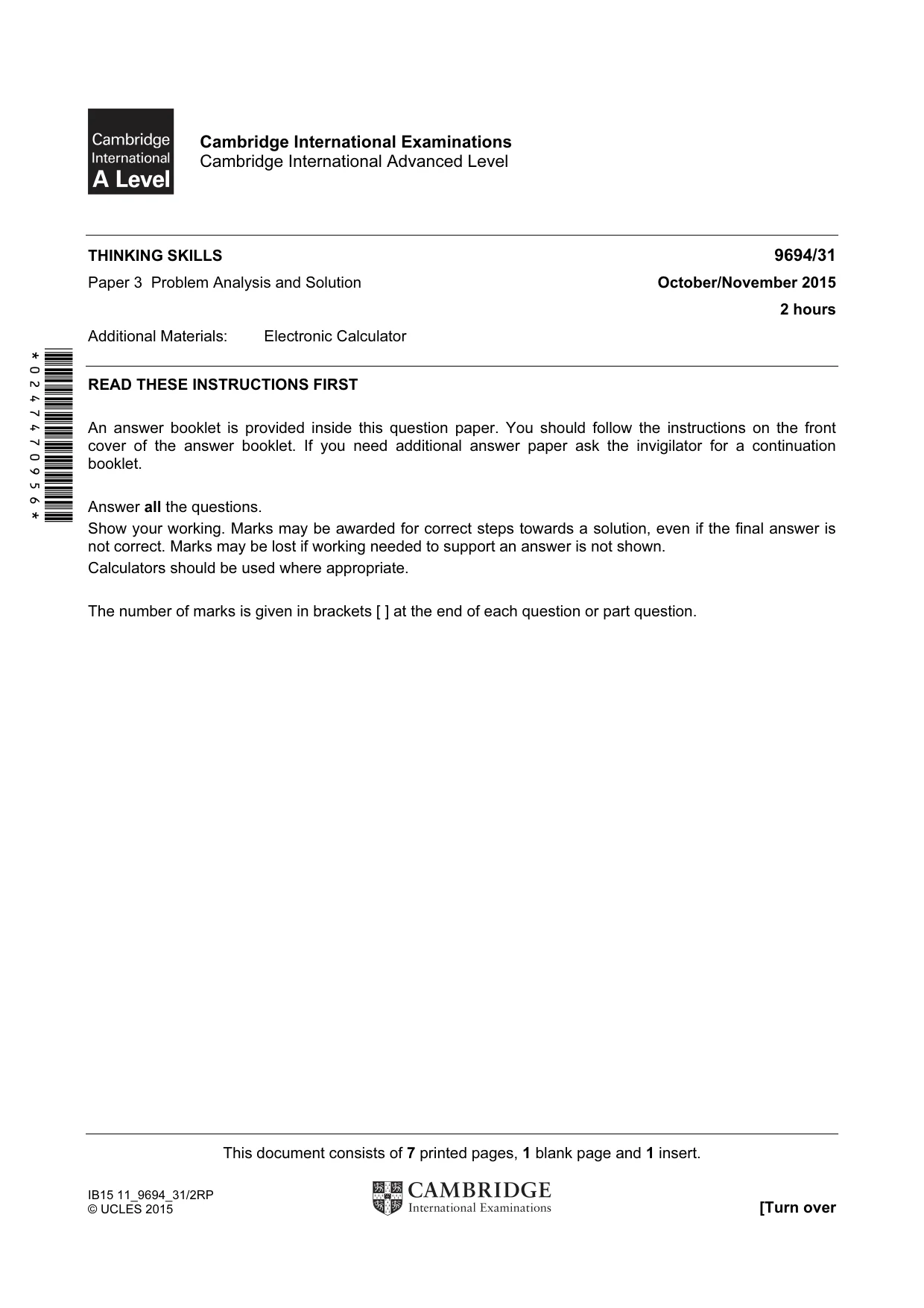
This document consists of 7 printed pages, 1 blank page and 1 insert. IB15 11_9694_31/2RP © UCLES 2015 [Turn over *0247470956* Cambridge International Examinations Cambridge International Advanced Level THINKING SKILLS 9694/31 Paper 3 Problem Analysis and Solution October/November 2015 2 hours Additional Materials: Electronic Calculator READ THESE INSTRUCTIONS FIRST An answer booklet is provided inside this question paper. You should follow the instructions on the front cover of the answer booklet. If you need additional answer paper ask the invigilator for a continuation booklet. Answer all the questions. Show your working. Marks may be awarded for correct steps towards a solution, even if the final answer is not correct. Marks may be lost if working needed to support an answer is not shown. Calculators should be used where appropriate. The number of marks is given in brackets [ ] at the end of each question or part question.
Question paper, page 2
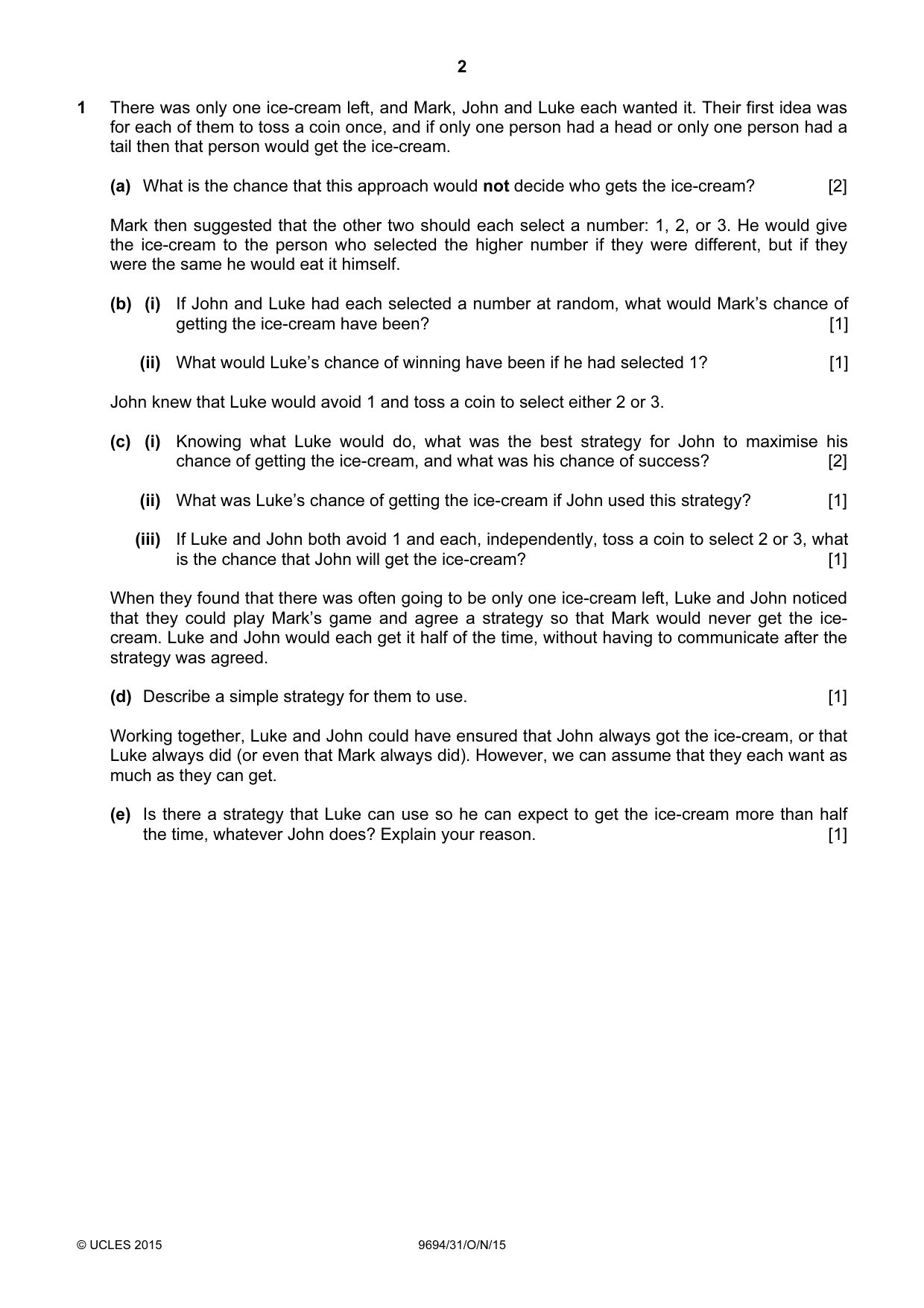
2 © UCLES 2015 9694/31/O/N/15 1 There was only one ice-cream left, and Mark, John and Luke each wanted it. Their first idea was for each of them to toss a coin once, and if only one person had a head or only one person had a tail then that person would get the ice-cream. (a) What is the chance that this approach would not decide who gets the ice-cream? [2] Mark then suggested that the other two should each select a number: 1, 2, or 3. He would give the ice-cream to the person who selected the higher number if they were different, but if they were the same he would eat it himself. (b) (i) If John and Luke had each selected a number at random, what would Mark’s chance of getting the ice-cream have been? [1] (ii) What would Luke’s chance of winning have been if he had selected 1? [1] John knew that Luke would avoid 1 and toss a coin to select either 2 or 3. (c) (i) Knowing what Luke would do, what was the best strategy for John to maximise his chance of getting the ice-cream, and what was his chance of success? [2] (ii) What was Luke’s chance of getting the ice-cream if John used this strategy? [1] (iii) If Luke and John both avoid 1 and each, independently, toss a coin to select 2 or 3, what is the chance that John will get the ice-cream? [1] When they found that there was often going to be only one ice-cream left, Luke and John noticed that they could play Mark’s game and agree a strategy so that Mark would never get the ice- cream. Luke and John would each get it half of the time, without having to communicate after the strategy was agreed. (d) Describe a simple strategy for them to use. [1] Working together, Luke and John could have ensured that John always got the ice-cream, or that Luke always did (or even that Mark always did). However, we can assume that they each want as much as they can get. (e) Is there a strategy that Luke can use so he can expect to get the ice-cream more than half the time, whatever John does? Explain your reason. [1]
Question paper, page 3
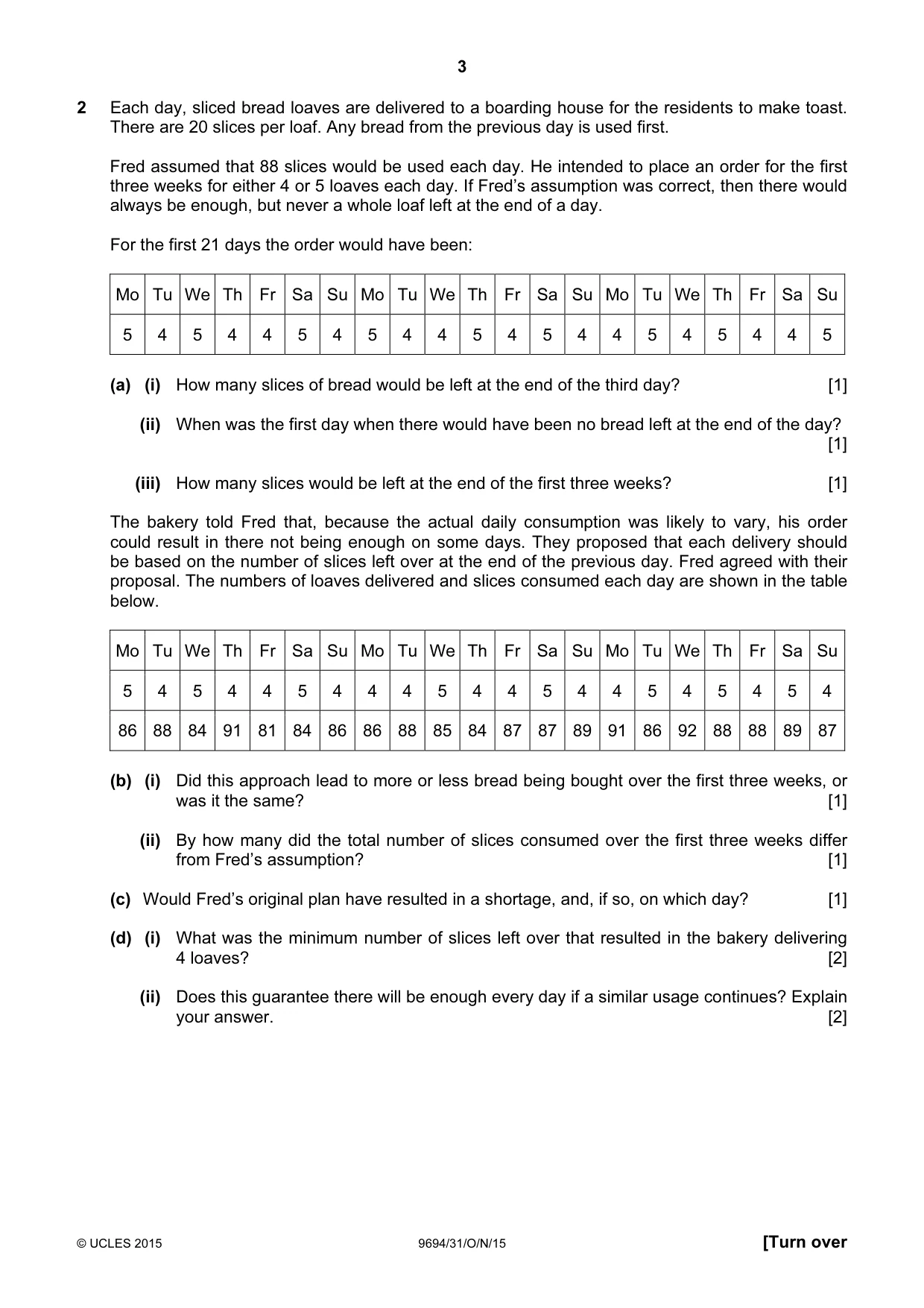
3 © UCLES 2015 9694/31/O/N/15 [Turn over 2 Each day, sliced bread loaves are delivered to a boarding house for the residents to make toast. There are 20 slices per loaf. Any bread from the previous day is used first. Fred assumed that 88 slices would be used each day. He intended to place an order for the first three weeks for either 4 or 5 loaves each day. If Fred’s assumption was correct, then there would always be enough, but never a whole loaf left at the end of a day. For the first 21 days the order would have been: Mo Tu We Th Fr Sa Su Mo Tu We Th Fr Sa Su Mo Tu We Th Fr Sa Su 5 4 5 4 4 5 4 5 4 4 5 4 5 4 4 5 4 5 4 4 5 (a) (i) How many slices of bread would be left at the end of the third day? [1] (ii) When was the first day when there would have been no bread left at the end of the day? [1] (iii) How many slices would be left at the end of the first three weeks? [1] The bakery told Fred that, because the actual daily consumption was likely to vary, his order could result in there not being enough on some days. They proposed that each delivery should be based on the number of slices left over at the end of the previous day. Fred agreed with their proposal. The numbers of loaves delivered and slices consumed each day are shown in the table below. Mo Tu We Th Fr Sa Su Mo Tu We Th Fr Sa Su Mo Tu We Th Fr Sa Su 5 4 5 4 4 5 4 4 4 5 4 4 5 4 4 5 4 5 4 5 4 86 88 84 91 81 84 86 86 88 85 84 87 87 89 91 86 92 88 88 89 87 (b) (i) Did this approach lead to more or less bread being bought over the first three weeks, or was it the same? [1] (ii) By how many did the total number of slices consumed over the first three weeks differ from Fred’s assumption? [1] (c) Would Fred’s original plan have resulted in a shortage, and, if so, on which day? [1] (d) (i) What was the minimum number of slices left over that resulted in the bakery delivering 4 loaves? [2] (ii) Does this guarantee there will be enough every day if a similar usage continues? Explain your answer. [2]
Question paper, page 4
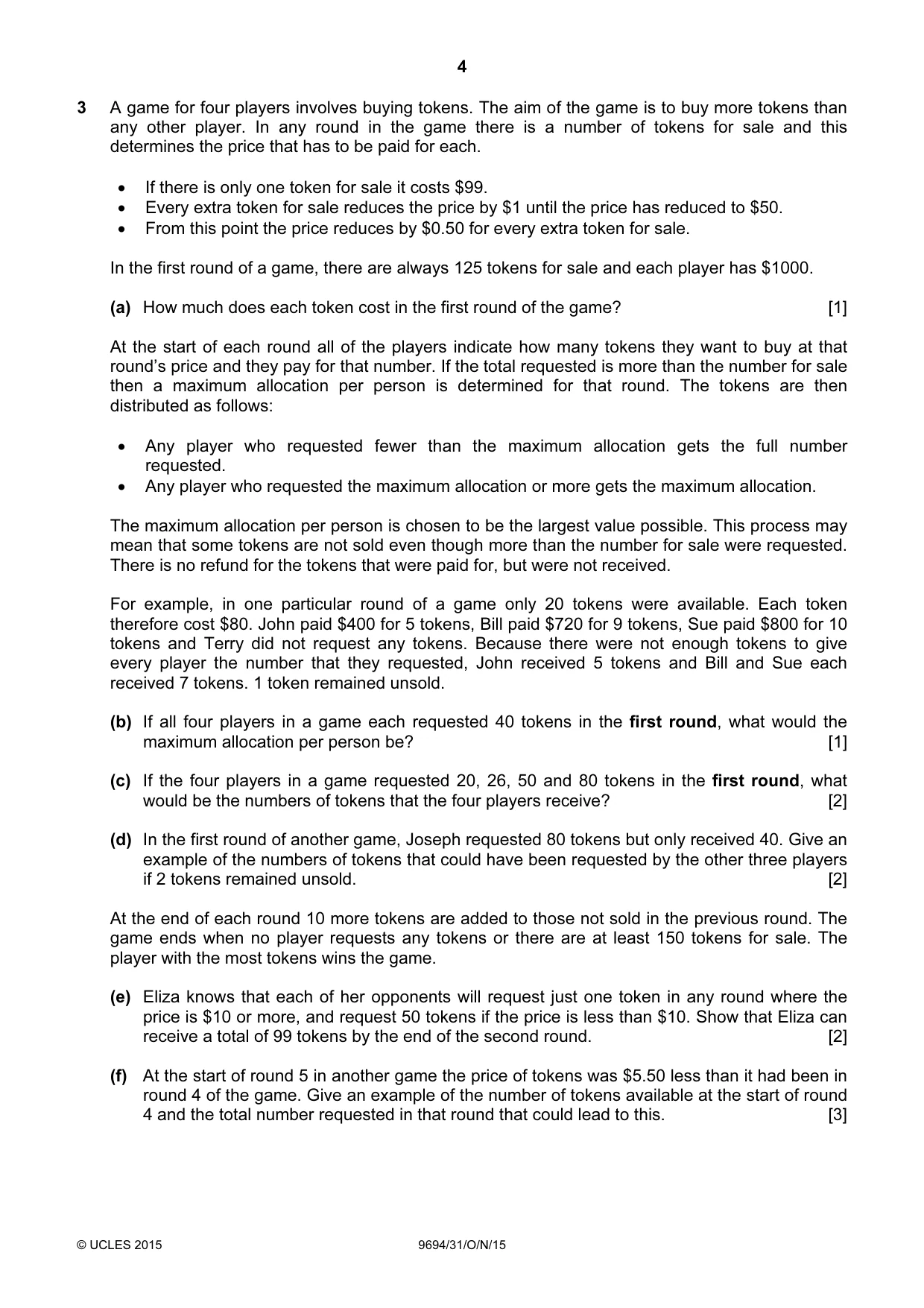
4 © UCLES 2015 9694/31/O/N/15 3 A game for four players involves buying tokens. The aim of the game is to buy more tokens than any other player. In any round in the game there is a number of tokens for sale and this determines the price that has to be paid for each. • If there is only one token for sale it costs $99. • Every extra token for sale reduces the price by $1 until the price has reduced to $50. • From this point the price reduces by $0.50 for every extra token for sale. In the first round of a game, there are always 125 tokens for sale and each player has $1000. (a) How much does each token cost in the first round of the game? [1] At the start of each round all of the players indicate how many tokens they want to buy at that round’s price and they pay for that number. If the total requested is more than the number for sale then a maximum allocation per person is determined for that round. The tokens are then distributed as follows: • Any player who requested fewer than the maximum allocation gets the full number requested. • Any player who requested the maximum allocation or more gets the maximum allocation. The maximum allocation per person is chosen to be the largest value possible. This process may mean that some tokens are not sold even though more than the number for sale were requested. There is no refund for the tokens that were paid for, but were not received. For example, in one particular round of a game only 20 tokens were available. Each token therefore cost $80. John paid $400 for 5 tokens, Bill paid $720 for 9 tokens, Sue paid $800 for 10 tokens and Terry did not request any tokens. Because there were not enough tokens to give every player the number that they requested, John received 5 tokens and Bill and Sue each received 7 tokens. 1 token remained unsold. (b) If all four players in a game each requested 40 tokens in the first round, what would the maximum allocation per person be? [1] (c) If the four players in a game requested 20, 26, 50 and 80 tokens in the first round, what would be the numbers of tokens that the four players receive? [2] (d) In the first round of another game, Joseph requested 80 tokens but only received 40. Give an example of the numbers of tokens that could have been requested by the other three players if 2 tokens remained unsold. [2] At the end of each round 10 more tokens are added to those not sold in the previous round. The game ends when no player requests any tokens or there are at least 150 tokens for sale. The player with the most tokens wins the game. (e) Eliza knows that each of her opponents will request just one token in any round where the price is $10 or more, and request 50 tokens if the price is less than $10. Show that Eliza can receive a total of 99 tokens by the end of the second round. [2] (f) At the start of round 5 in another game the price of tokens was $5.50 less than it had been in round 4 of the game. Give an example of the number of tokens available at the start of round 4 and the total number requested in that round that could lead to this. [3]
Question paper, page 5
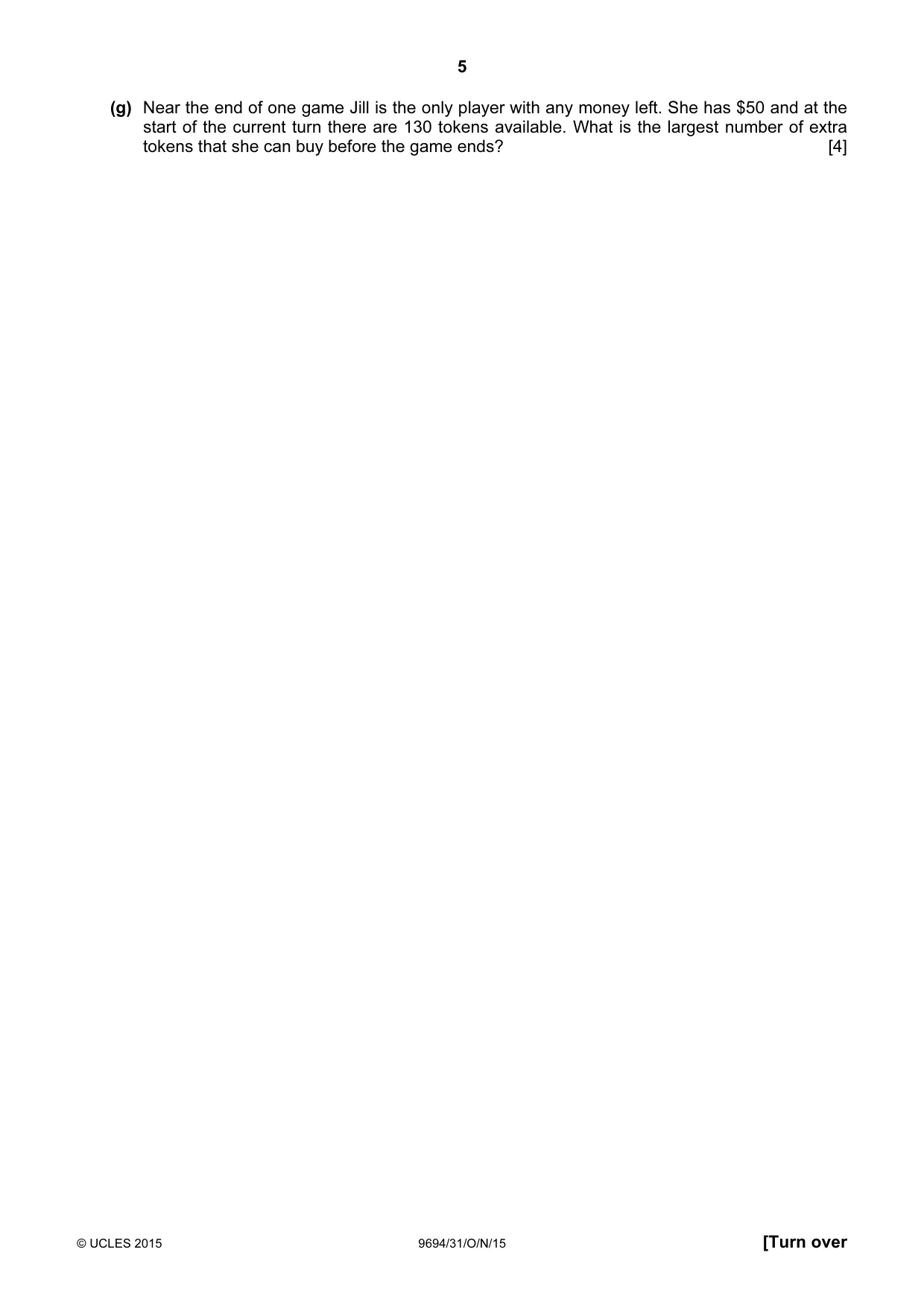
5 © UCLES 2015 9694/31/O/N/15 [Turn over (g) Near the end of one game Jill is the only player with any money left. She has $50 and at the start of the current turn there are 130 tokens available. What is the largest number of extra tokens that she can buy before the game ends? [4]
Question paper, page 6
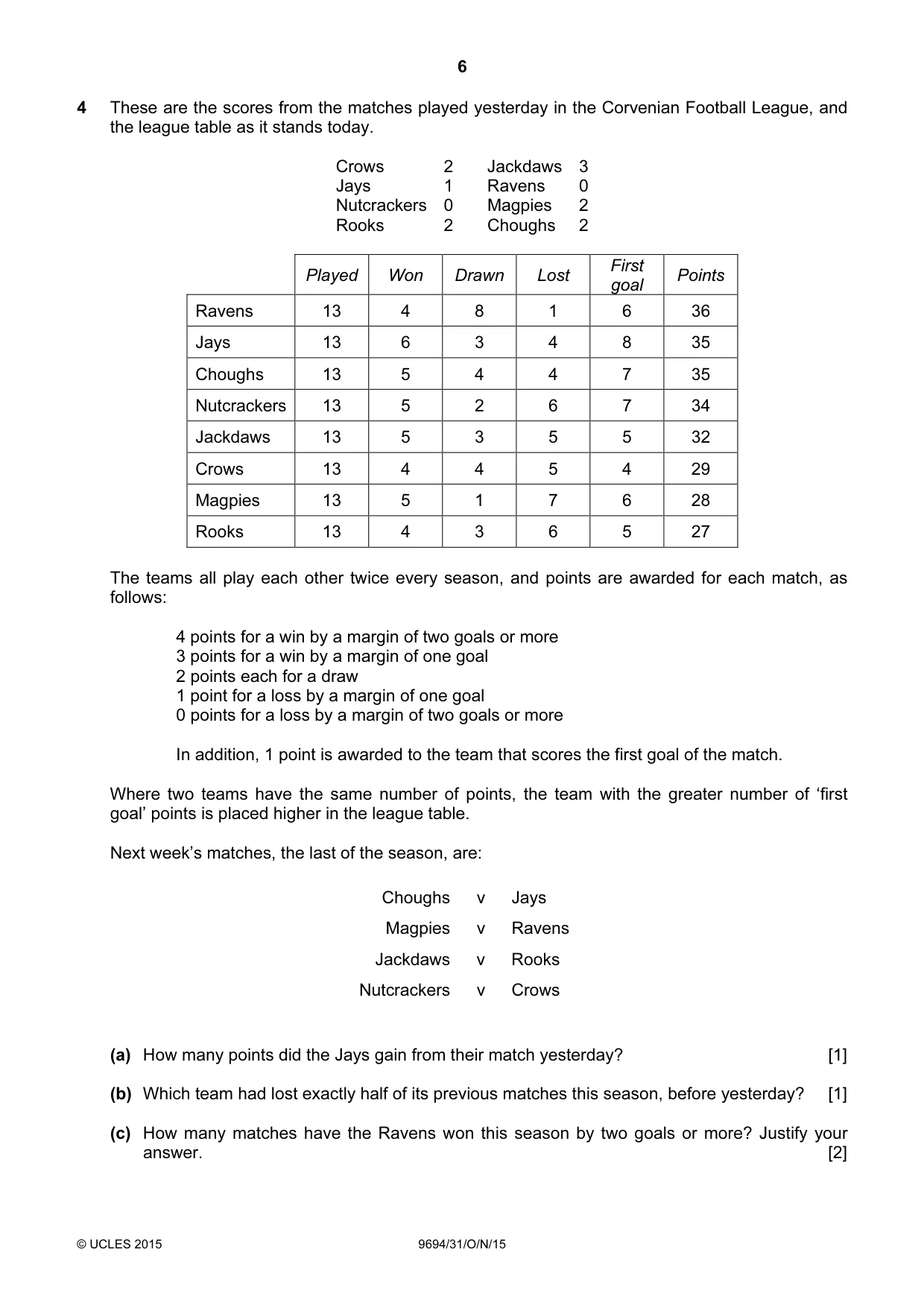
6 © UCLES 2015 9694/31/O/N/15 4 These are the scores from the matches played yesterday in the Corvenian Football League, and the league table as it stands today. Crows 2 Jackdaws 3 Jays 1 Ravens 0 Nutcrackers 0 Magpies 2 Rooks 2 Choughs 2 Played Won Drawn Lost First goal Points Ravens 13 4 8 1 6 36 Jays 13 6 3 4 8 35 Choughs 13 5 4 4 7 35 Nutcrackers 13 5 2 6 7 34 Jackdaws 13 5 3 5 5 32 Crows 13 4 4 5 4 29 Magpies 13 5 1 7 6 28 Rooks 13 4 3 6 5 27 The teams all play each other twice every season, and points are awarded for each match, as follows: 4 points for a win by a margin of two goals or more 3 points for a win by a margin of one goal 2 points each for a draw 1 point for a loss by a margin of one goal 0 points for a loss by a margin of two goals or more In addition, 1 point is awarded to the team that scores the first goal of the match. Where two teams have the same number of points, the team with the greater number of ‘first goal’ points is placed higher in the league table. Next week’s matches, the last of the season, are: Choughs v Jays Magpies v Ravens Jackdaws v Rooks Nutcrackers v Crows (a) How many points did the Jays gain from their match yesterday? [1] (b) Which team had lost exactly half of its previous matches this season, before yesterday? [1] (c) How many matches have the Ravens won this season by two goals or more? Justify your answer. [2]
Question paper, page 7
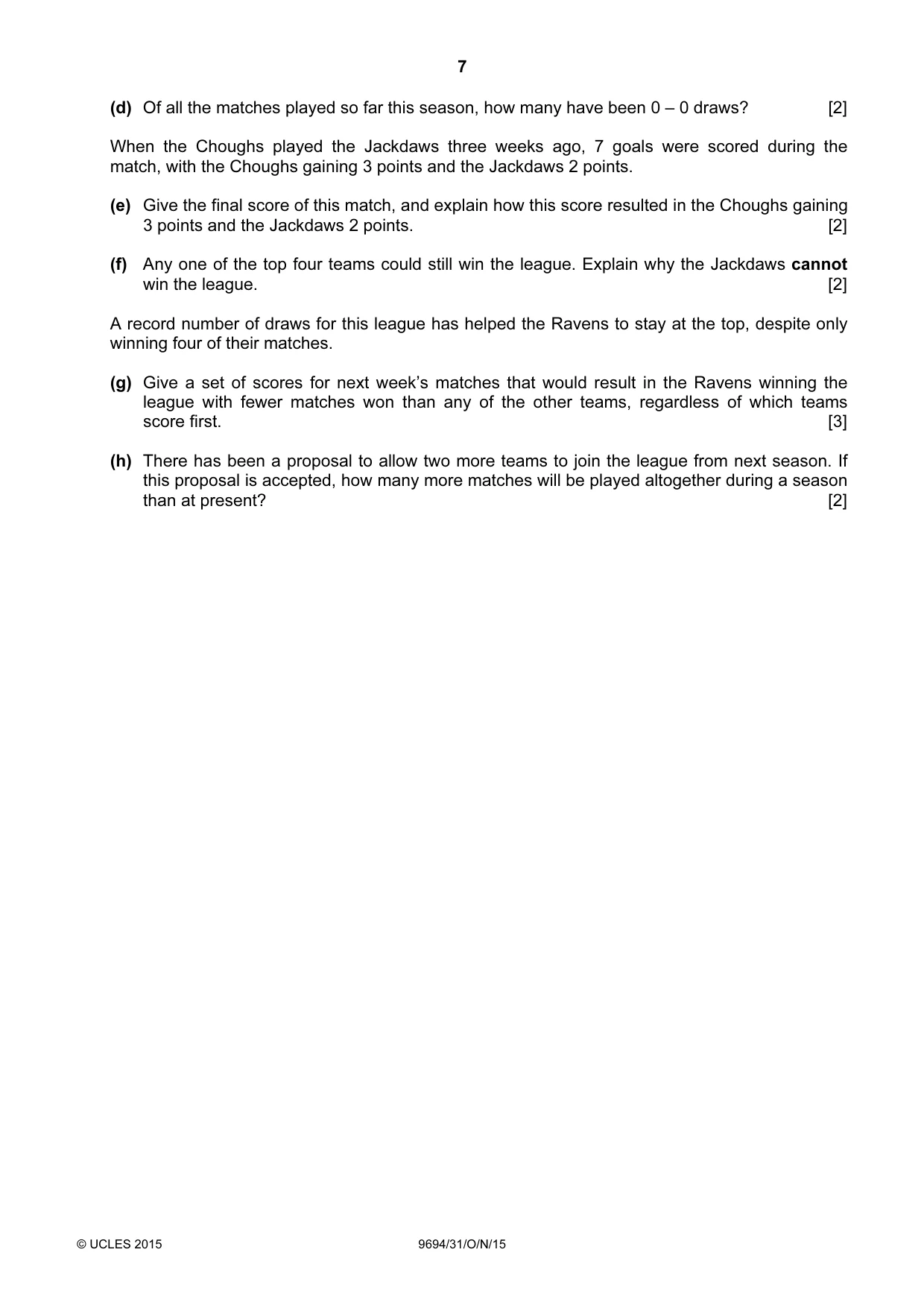
7 © UCLES 2015 9694/31/O/N/15 (d) Of all the matches played so far this season, how many have been 0 – 0 draws? [2] When the Choughs played the Jackdaws three weeks ago, 7 goals were scored during the match, with the Choughs gaining 3 points and the Jackdaws 2 points. (e) Give the final score of this match, and explain how this score resulted in the Choughs gaining 3 points and the Jackdaws 2 points. [2] (f) Any one of the top four teams could still win the league. Explain why the Jackdaws cannot win the league. [2] A record number of draws for this league has helped the Ravens to stay at the top, despite only winning four of their matches. (g) Give a set of scores for next week’s matches that would result in the Ravens winning the league with fewer matches won than any of the other teams, regardless of which teams score first. [3] (h) There has been a proposal to allow two more teams to join the league from next season. If this proposal is accepted, how many more matches will be played altogether during a season than at present? [2]
Question paper, page 8
8 Permission to reproduce items where third-party owned material protected by copyright is included has been sought and cleared where possible. Every reasonable effort has been made by the publisher (UCLES) to trace copyright holders, but if any items requiring clearance have unwittingly been included, the publisher will be pleased to make amends at the earliest possible opportunity. To avoid the issue of disclosure of answer-related information to candidates, all copyright acknowledgements are reproduced online in the Cambridge International Examinations Copyright Acknowledgements Booklet. This is produced for each series of examinations and is freely available to download at www.cie.org.uk after the live examination series. Cambridge International Examinations is part of the Cambridge Assessment Group. Cambridge Assessment is the brand name of University of Cambridge Local Examinations Syndicate (UCLES), which is itself a department of the University of Cambridge. © UCLES 2015 9694/31/O/N/15 BLANK PAGE
Mark scheme, page 1
CAMBRIDGE INTERNATIONAL EXAMINATIONS Cambridge International Advanced Level MARK SCHEME for the October/November 2015 series 9694 THINKING SKILLS 9694/31 Paper 3 (Problem Analysis and Solution), maximum raw mark 50 This mark scheme is published as an aid to teachers and candidates, to indicate the requirements of the examination. It shows the basis on which Examiners were instructed to award marks. It does not indicate the details of the discussions that took place at an Examiners’ meeting before marking began, which would have considered the acceptability of alternative answers. Mark schemes should be read in conjunction with the question paper and the Principal Examiner Report for Teachers. Cambridge will not enter into discussions about these mark schemes. Cambridge is publishing the mark schemes for the October/November 2015 series for most Cambridge IGCSE®, Cambridge International A and AS Level components and some Cambridge O Level components.
Mark scheme, page 2
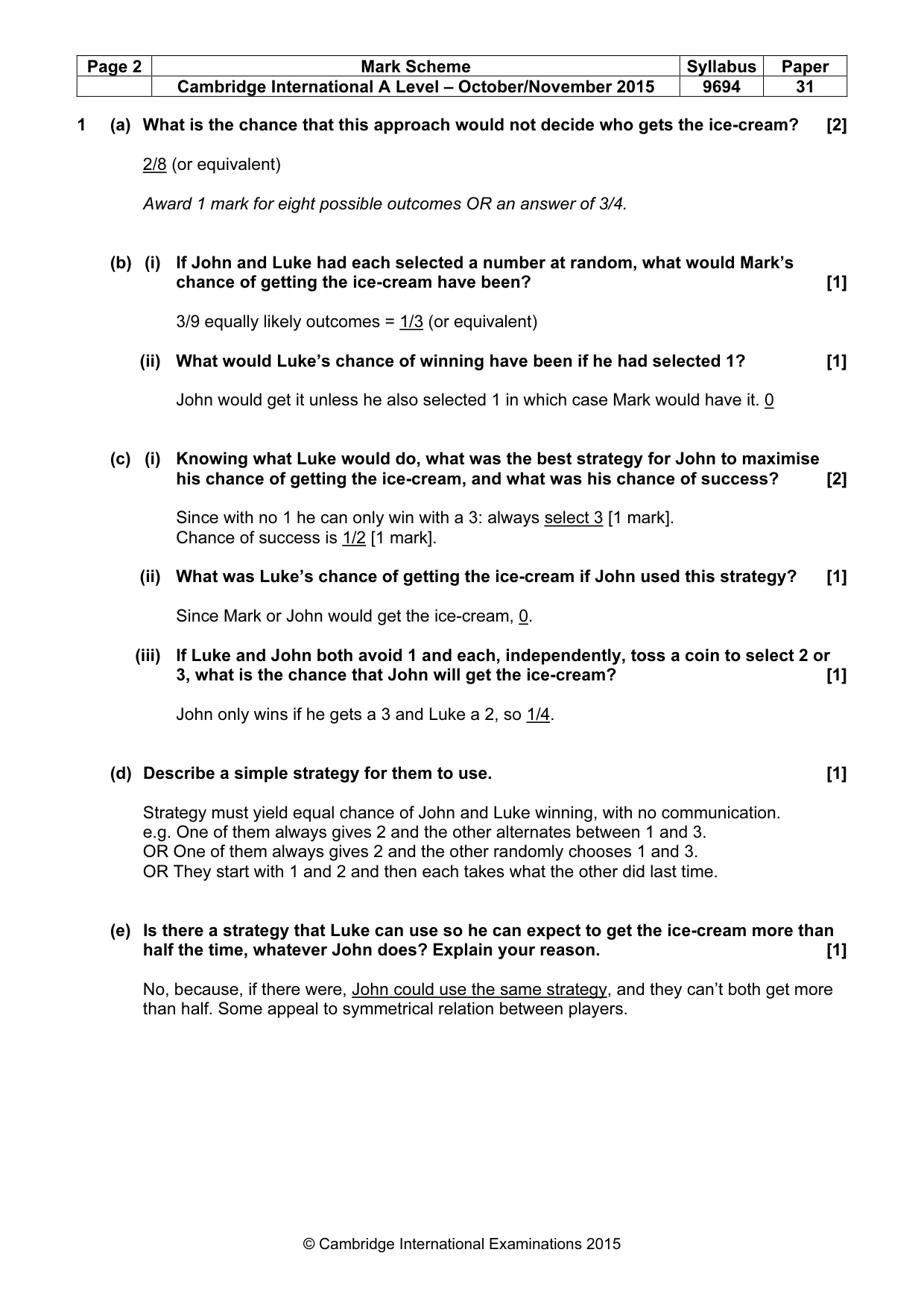
Page 2 Mark Scheme Syllabus Paper Cambridge International A Level – October/November 2015 9694 31 © Cambridge International Examinations 2015 1 (a) What is the chance that this approach would not decide who gets the ice-cream? [2] 2/8 (or equivalent) Award 1 mark for eight possible outcomes OR an answer of 3/4. (b) (i) If John and Luke had each selected a number at random, what would Mark’s chance of getting the ice-cream have been? [1] 3/9 equally likely outcomes = 1/3 (or equivalent) (ii) What would Luke’s chance of winning have been if he had selected 1? [1] John would get it unless he also selected 1 in which case Mark would have it. 0 (c) (i) Knowing what Luke would do, what was the best strategy for John to maximise his chance of getting the ice-cream, and what was his chance of success? [2] Since with no 1 he can only win with a 3: always select 3 [1 mark]. Chance of success is 1/2 [1 mark]. (ii) What was Luke’s chance of getting the ice-cream if John used this strategy? [1] Since Mark or John would get the ice-cream, 0. (iii) If Luke and John both avoid 1 and each, independently, toss a coin to select 2 or 3, what is the chance that John will get the ice-cream? [1] John only wins if he gets a 3 and Luke a 2, so 1/4. (d) Describe a simple strategy for them to use. [1] Strategy must yield equal chance of John and Luke winning, with no communication. e.g. One of them always gives 2 and the other alternates between 1 and 3. OR One of them always gives 2 and the other randomly chooses 1 and 3. OR They start with 1 and 2 and then each takes what the other did last time. (e) Is there a strategy that Luke can use so he can expect to get the ice-cream more than half the time, whatever John does? Explain your reason. [1] No, because, if there were, John could use the same strategy, and they can’t both get more than half. Some appeal to symmetrical relation between players.
Mark scheme, page 3
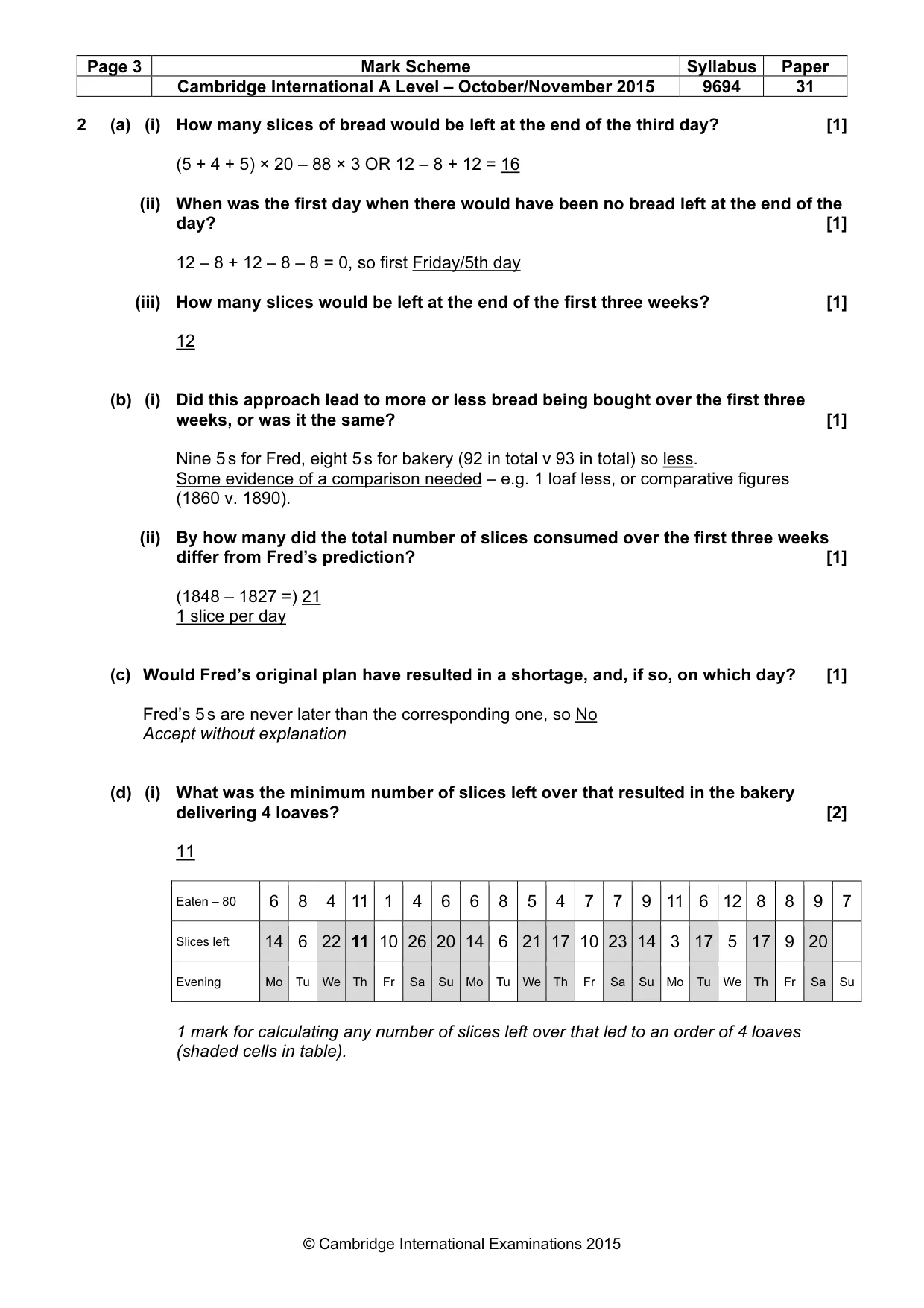
Page 3 Mark Scheme Syllabus Paper Cambridge International A Level – October/November 2015 9694 31 © Cambridge International Examinations 2015 2 (a) (i) How many slices of bread would be left at the end of the third day? [1] (5 + 4 + 5) × 20 – 88 × 3 OR 12 – 8 + 12 = 16 (ii) When was the first day when there would have been no bread left at the end of the day? [1] 12 – 8 + 12 – 8 – 8 = 0, so first Friday/5th day (iii) How many slices would be left at the end of the first three weeks? [1] 12 (b) (i) Did this approach lead to more or less bread being bought over the first three weeks, or was it the same? [1] Nine 5 s for Fred, eight 5 s for bakery (92 in total v 93 in total) so less. Some evidence of a comparison needed – e.g. 1 loaf less, or comparative figures (1860 v. 1890). (ii) By how many did the total number of slices consumed over the first three weeks differ from Fred’s prediction? [1] (1848 – 1827 =) 21 1 slice per day (c) Would Fred’s original plan have resulted in a shortage, and, if so, on which day? [1] Fred’s 5 s are never later than the corresponding one, so No Accept without explanation (d) (i) What was the minimum number of slices left over that resulted in the bakery delivering 4 loaves? [2] 11 Eaten – 80 6 8 4 11 1 4 6 6 8 5 4 7 7 9 11 6 12 8 8 9 7 Slices left 14 6 22 11 10 26 20 14 6 21 17 10 23 14 3 17 5 17 9 20 Evening Mo Tu We Th Fr Sa Su Mo Tu We Th Fr Sa Su Mo Tu We Th Fr Sa Su 1 mark for calculating any number of slices left over that led to an order of 4 loaves (shaded cells in table).
Mark scheme, page 4
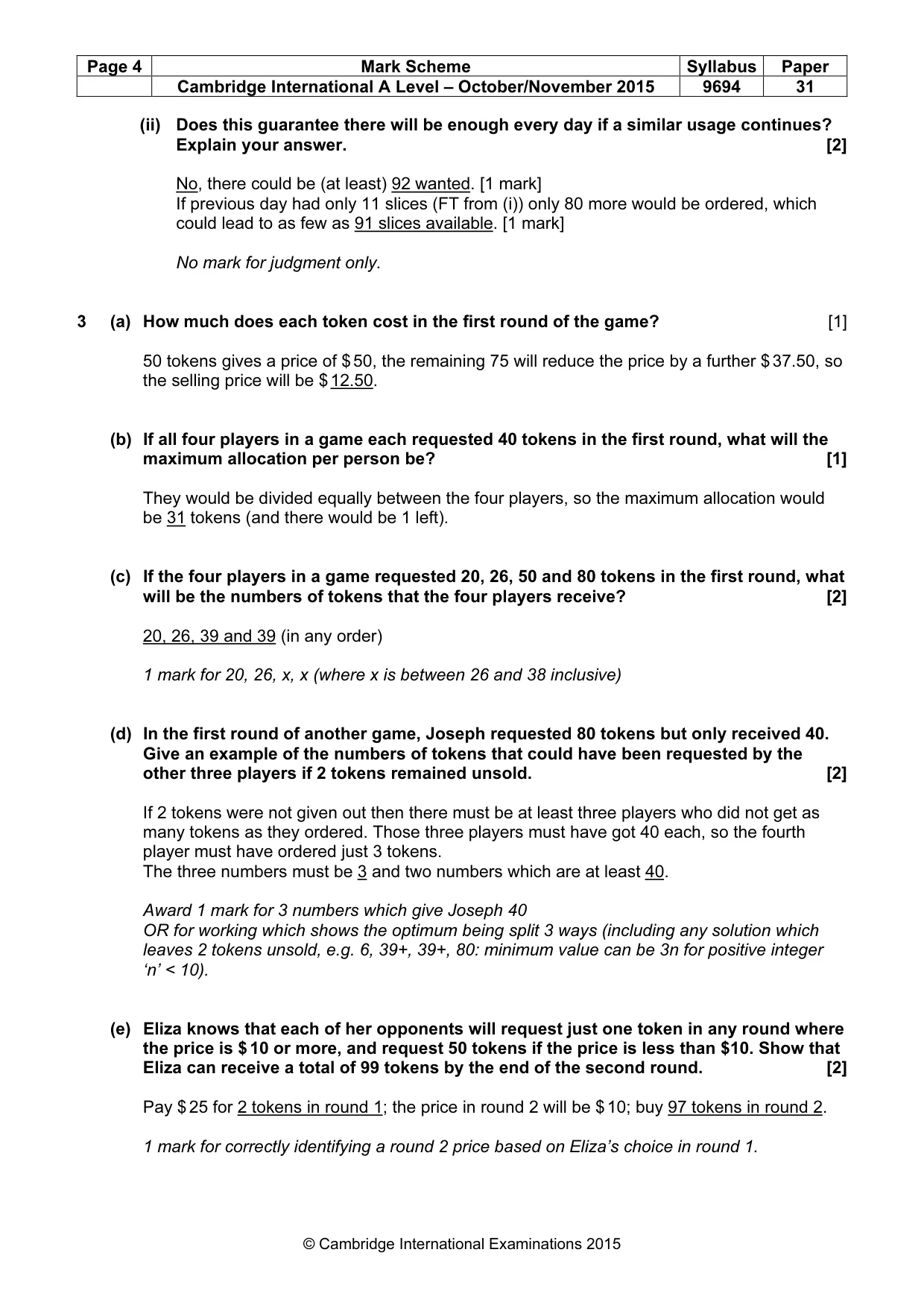
Page 4 Mark Scheme Syllabus Paper Cambridge International A Level – October/November 2015 9694 31 © Cambridge International Examinations 2015 (ii) Does this guarantee there will be enough every day if a similar usage continues? Explain your answer. [2] No, there could be (at least) 92 wanted. [1 mark] If previous day had only 11 slices (FT from (i)) only 80 more would be ordered, which could lead to as few as 91 slices available. [1 mark] No mark for judgment only. 3 (a) How much does each token cost in the first round of the game? [1] 50 tokens gives a price of $ 50, the remaining 75 will reduce the price by a further $ 37.50, so the selling price will be $ 12.50. (b) If all four players in a game each requested 40 tokens in the first round, what will the maximum allocation per person be? [1] They would be divided equally between the four players, so the maximum allocation would be 31 tokens (and there would be 1 left). (c) If the four players in a game requested 20, 26, 50 and 80 tokens in the first round, what will be the numbers of tokens that the four players receive? [2] 20, 26, 39 and 39 (in any order) 1 mark for 20, 26, x, x (where x is between 26 and 38 inclusive) (d) In the first round of another game, Joseph requested 80 tokens but only received 40. Give an example of the numbers of tokens that could have been requested by the other three players if 2 tokens remained unsold. [2] If 2 tokens were not given out then there must be at least three players who did not get as many tokens as they ordered. Those three players must have got 40 each, so the fourth player must have ordered just 3 tokens. The three numbers must be 3 and two numbers which are at least 40. Award 1 mark for 3 numbers which give Joseph 40 OR for working which shows the optimum being split 3 ways (including any solution which leaves 2 tokens unsold, e.g. 6, 39+, 39+, 80: minimum value can be 3n for positive integer ‘n’ < 10). (e) Eliza knows that each of her opponents will request just one token in any round where the price is $ 10 or more, and request 50 tokens if the price is less than $10. Show that Eliza can receive a total of 99 tokens by the end of the second round. [2] Pay $ 25 for 2 tokens in round 1; the price in round 2 will be $ 10; buy 97 tokens in round 2. 1 mark for correctly identifying a round 2 price based on Eliza’s choice in round 1.
Mark scheme, page 5
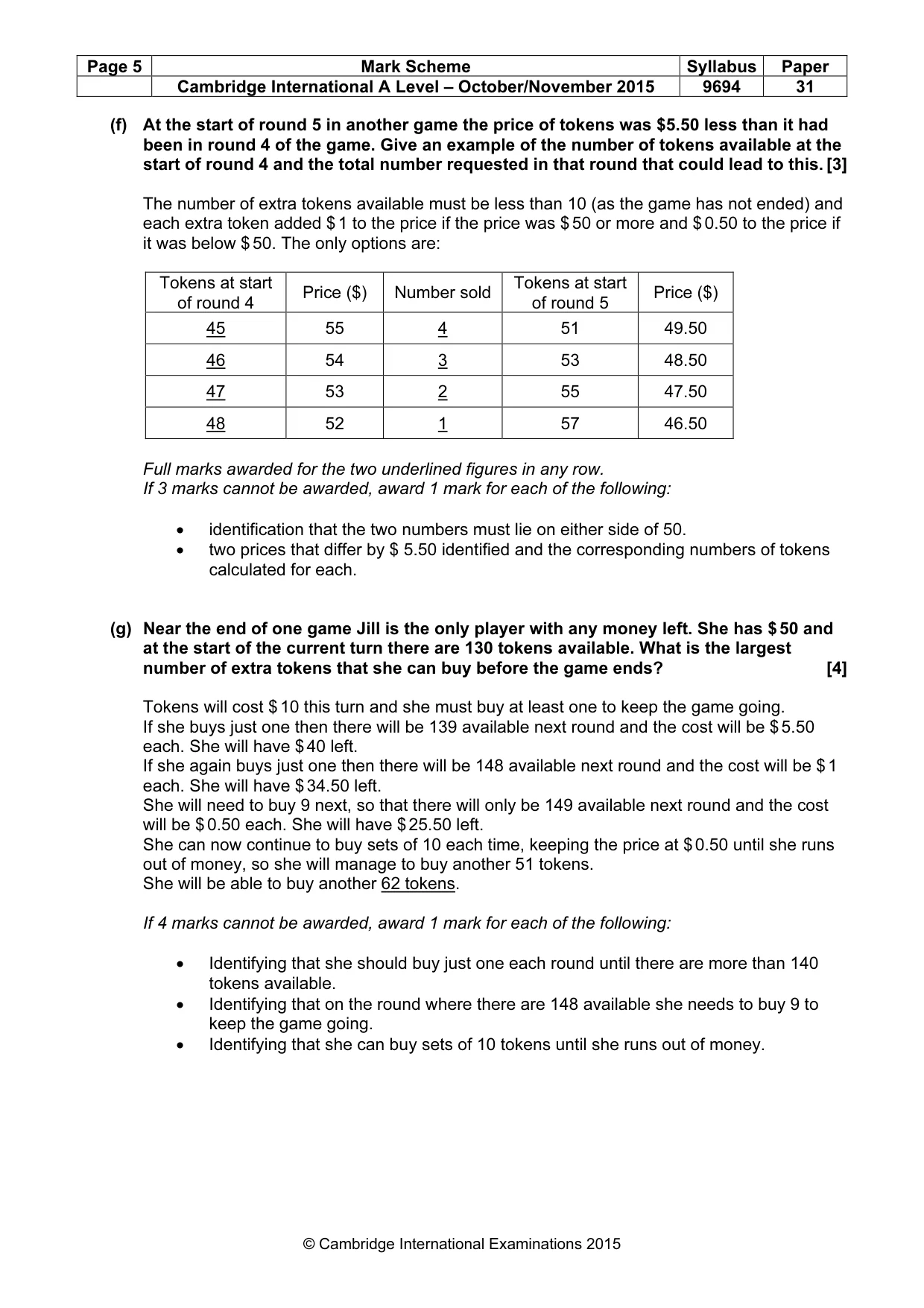
Page 5 Mark Scheme Syllabus Paper Cambridge International A Level – October/November 2015 9694 31 © Cambridge International Examinations 2015 (f) At the start of round 5 in another game the price of tokens was $5.50 less than it had been in round 4 of the game. Give an example of the number of tokens available at the start of round 4 and the total number requested in that round that could lead to this. [3] The number of extra tokens available must be less than 10 (as the game has not ended) and each extra token added $ 1 to the price if the price was $ 50 or more and $ 0.50 to the price if it was below $ 50. The only options are: Tokens at start of round 4 Price ($) Number sold Tokens at start of round 5 Price ($) 45 55 4 51 49.50 46 54 3 53 48.50 47 53 2 55 47.50 48 52 1 57 46.50 Full marks awarded for the two underlined figures in any row. If 3 marks cannot be awarded, award 1 mark for each of the following: • identification that the two numbers must lie on either side of 50. • two prices that differ by $ 5.50 identified and the corresponding numbers of tokens calculated for each. (g) Near the end of one game Jill is the only player with any money left. She has $ 50 and at the start of the current turn there are 130 tokens available. What is the largest number of extra tokens that she can buy before the game ends? [4] Tokens will cost $ 10 this turn and she must buy at least one to keep the game going. If she buys just one then there will be 139 available next round and the cost will be $ 5.50 each. She will have $ 40 left. If she again buys just one then there will be 148 available next round and the cost will be $ 1 each. She will have $ 34.50 left. She will need to buy 9 next, so that there will only be 149 available next round and the cost will be $ 0.50 each. She will have $ 25.50 left. She can now continue to buy sets of 10 each time, keeping the price at $ 0.50 until she runs out of money, so she will manage to buy another 51 tokens. She will be able to buy another 62 tokens. If 4 marks cannot be awarded, award 1 mark for each of the following: • Identifying that she should buy just one each round until there are more than 140 tokens available. • Identifying that on the round where there are 148 available she needs to buy 9 to keep the game going. • Identifying that she can buy sets of 10 tokens until she runs out of money.
Mark scheme, page 6
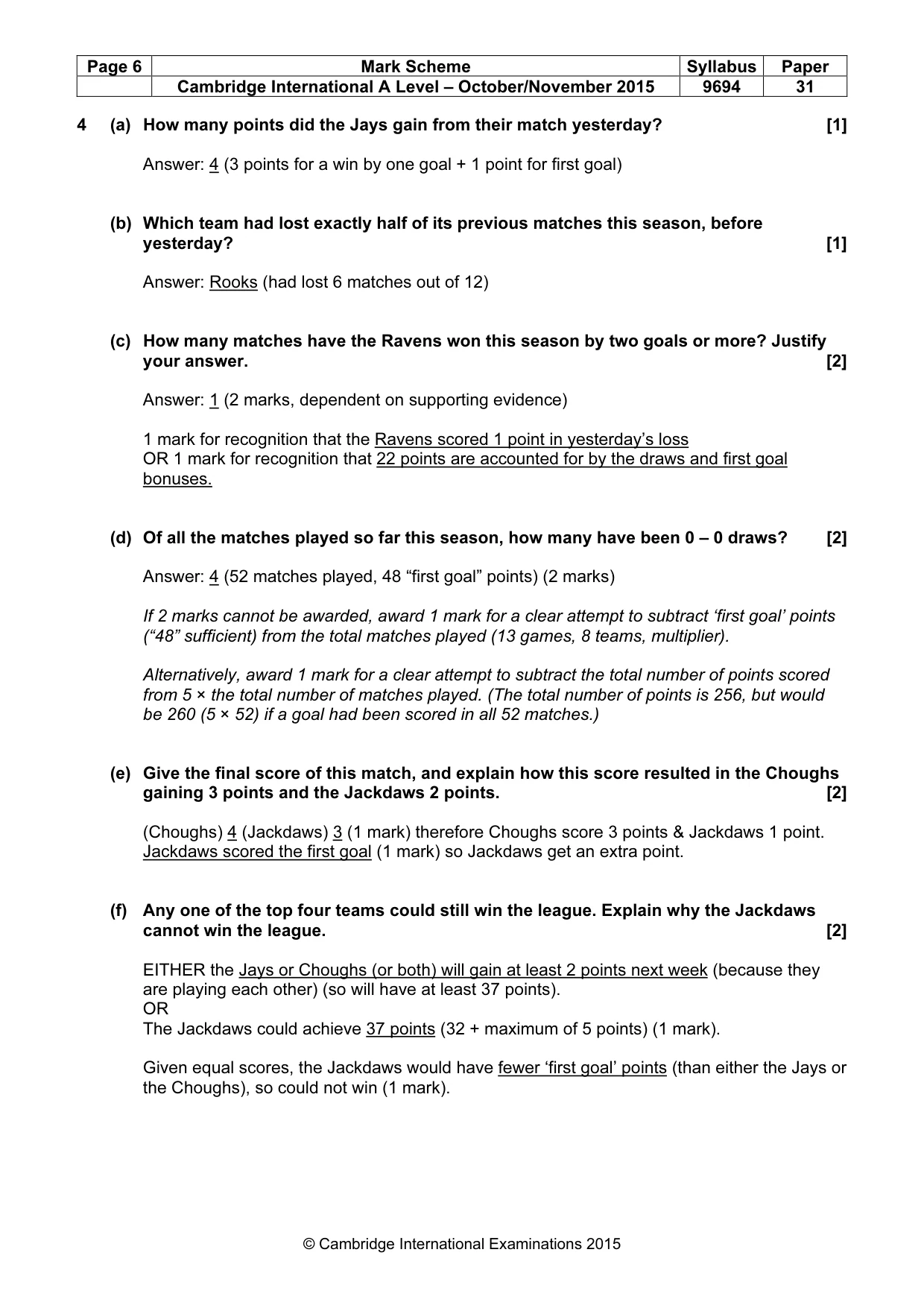
Page 6 Mark Scheme Syllabus Paper Cambridge International A Level – October/November 2015 9694 31 © Cambridge International Examinations 2015 4 (a) How many points did the Jays gain from their match yesterday? [1] Answer: 4 (3 points for a win by one goal + 1 point for first goal) (b) Which team had lost exactly half of its previous matches this season, before yesterday? [1] Answer: Rooks (had lost 6 matches out of 12) (c) How many matches have the Ravens won this season by two goals or more? Justify your answer. [2] Answer: 1 (2 marks, dependent on supporting evidence) 1 mark for recognition that the Ravens scored 1 point in yesterday’s loss OR 1 mark for recognition that 22 points are accounted for by the draws and first goal bonuses. (d) Of all the matches played so far this season, how many have been 0 – 0 draws? [2] Answer: 4 (52 matches played, 48 “first goal” points) (2 marks) If 2 marks cannot be awarded, award 1 mark for a clear attempt to subtract ‘first goal’ points (“48” sufficient) from the total matches played (13 games, 8 teams, multiplier). Alternatively, award 1 mark for a clear attempt to subtract the total number of points scored from 5 × the total number of matches played. (The total number of points is 256, but would be 260 (5 × 52) if a goal had been scored in all 52 matches.) (e) Give the final score of this match, and explain how this score resulted in the Choughs gaining 3 points and the Jackdaws 2 points. [2] (Choughs) 4 (Jackdaws) 3 (1 mark) therefore Choughs score 3 points & Jackdaws 1 point. Jackdaws scored the first goal (1 mark) so Jackdaws get an extra point. (f) Any one of the top four teams could still win the league. Explain why the Jackdaws cannot win the league. [2] EITHER the Jays or Choughs (or both) will gain at least 2 points next week (because they are playing each other) (so will have at least 37 points). OR The Jackdaws could achieve 37 points (32 + maximum of 5 points) (1 mark). Given equal scores, the Jackdaws would have fewer ‘first goal’ points (than either the Jays or the Choughs), so could not win (1 mark).
Mark scheme, page 7
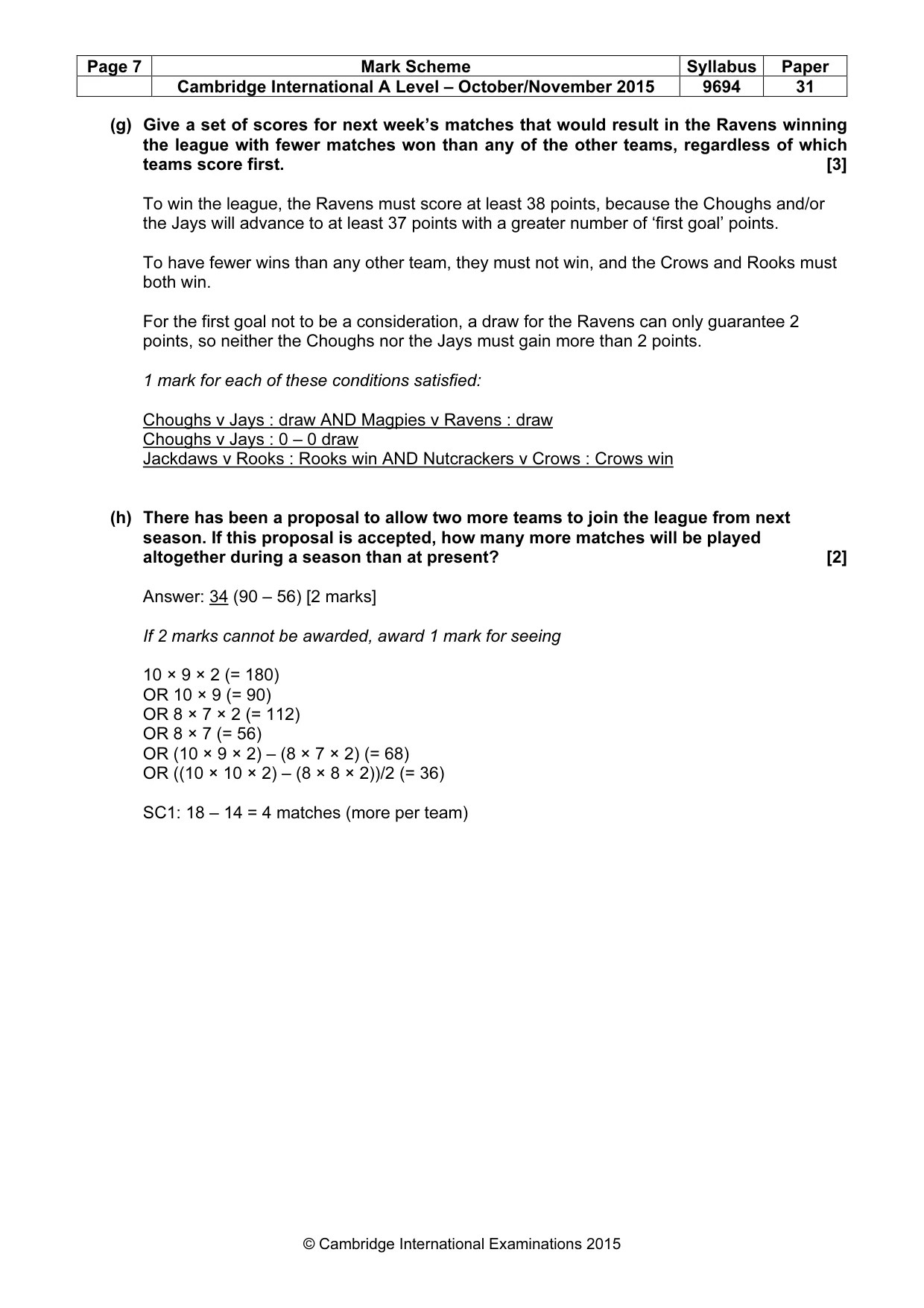
Page 7 Mark Scheme Syllabus Paper Cambridge International A Level – October/November 2015 9694 31 © Cambridge International Examinations 2015 (g) Give a set of scores for next week’s matches that would result in the Ravens winning the league with fewer matches won than any of the other teams, regardless of which teams score first. [3] To win the league, the Ravens must score at least 38 points, because the Choughs and/or the Jays will advance to at least 37 points with a greater number of ‘first goal’ points. To have fewer wins than any other team, they must not win, and the Crows and Rooks must both win. For the first goal not to be a consideration, a draw for the Ravens can only guarantee 2 points, so neither the Choughs nor the Jays must gain more than 2 points. 1 mark for each of these conditions satisfied: Choughs v Jays : draw AND Magpies v Ravens : draw Choughs v Jays : 0 – 0 draw Jackdaws v Rooks : Rooks win AND Nutcrackers v Crows : Crows win (h) There has been a proposal to allow two more teams to join the league from next season. If this proposal is accepted, how many more matches will be played altogether during a season than at present? [2] Answer: 34 (90 – 56) [2 marks] If 2 marks cannot be awarded, award 1 mark for seeing 10 × 9 × 2 (= 180) OR 10 × 9 (= 90) OR 8 × 7 × 2 (= 112) OR 8 × 7 (= 56) OR (10 × 9 × 2) – (8 × 7 × 2) (= 68) OR ((10 × 10 × 2) – (8 × 8 × 2))/2 (= 36) SC1: 18 – 14 = 4 matches (more per team)
What you needed in this session
Cambridge’s own grade thresholds for 2015 Oct/Nov, Paper 3 · Variant 1. A higher threshold means an easier paper — the bar moves with how the cohort did.