Cambridge A Level Thinking Skills 9694 — 2014 Oct/Nov Paper 4 · Variant 3
9694/43/O/N/14 · 50 marks · ≈56 min
The question paper and its mark scheme, free to read here and free to download. This is Cambridge’s own paper, exactly as it was sat.
Question paper8 pages

Mark scheme6 pages
Answers below. Sit the paper first if you are practising.
Paper as text
Question paper, page 1
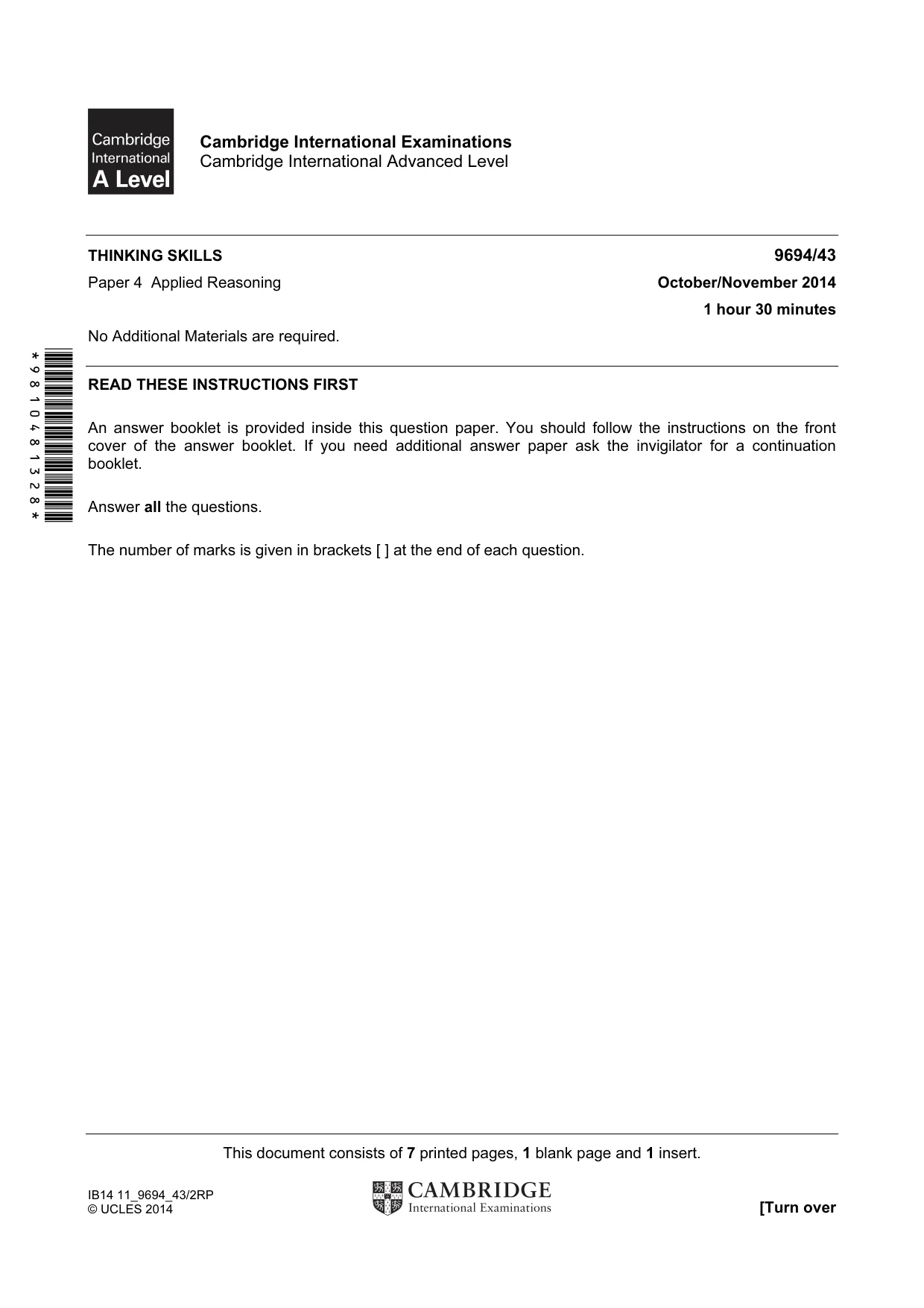
This document consists of 7 printed pages, 1 blank page and 1 insert. IB14 11_9694_43/2RP © UCLES 2014 [Turn over *9810481328* Cambridge International Examinations Cambridge International Advanced Level THINKING SKILLS 9694/43 Paper 4 Applied Reasoning October/November 2014 1 hour 30 minutes No Additional Materials are required. READ THESE INSTRUCTIONS FIRST An answer booklet is provided inside this question paper. You should follow the instructions on the front cover of the answer booklet. If you need additional answer paper ask the invigilator for a continuation booklet. Answer all the questions. The number of marks is given in brackets [ ] at the end of each question.
Question paper, page 2
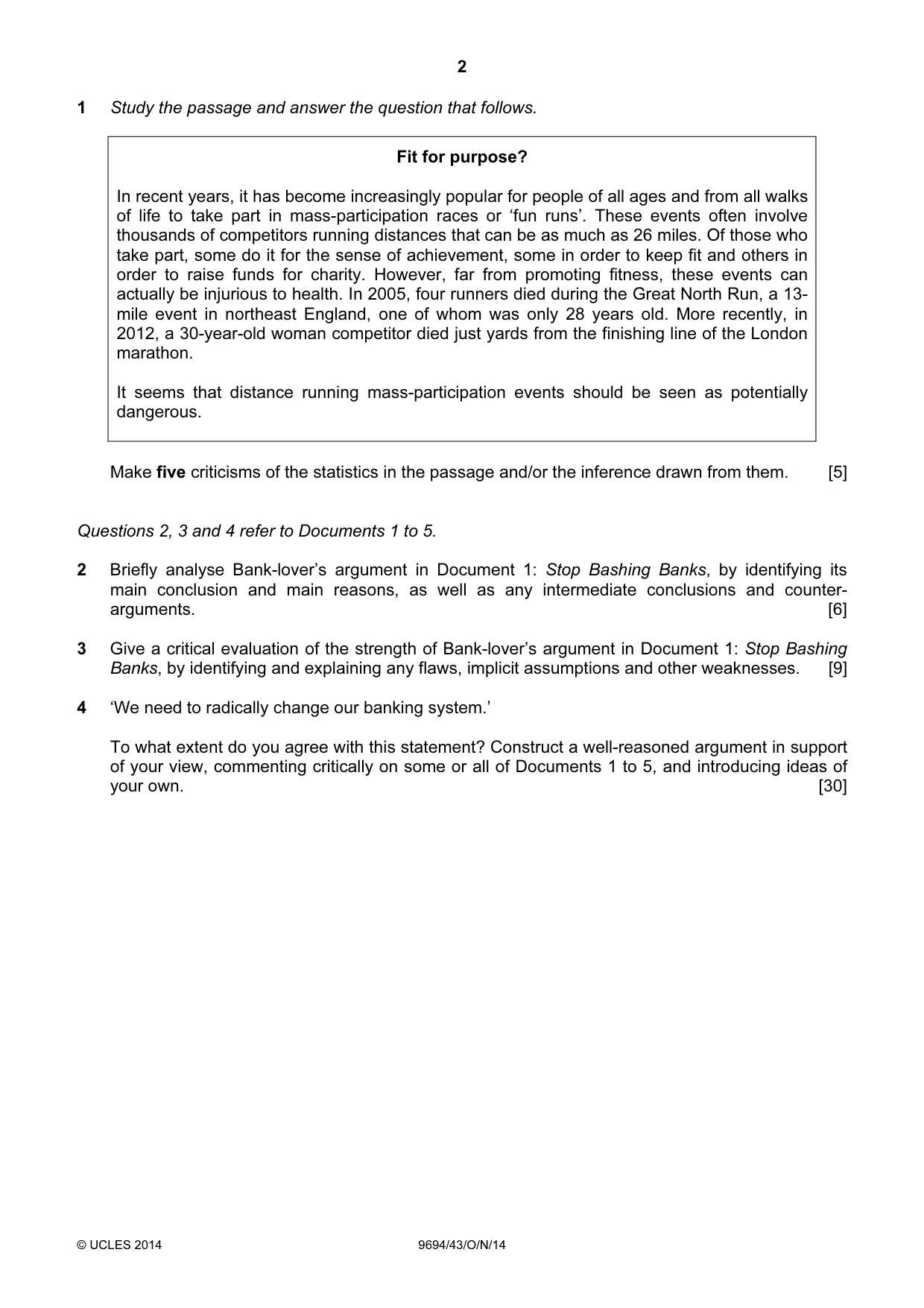
2 © UCLES 2014 9694/43/O/N/14 1 Study the passage and answer the question that follows. Fit for purpose? In recent years, it has become increasingly popular for people of all ages and from all walks of life to take part in mass-participation races or ‘fun runs’. These events often involve thousands of competitors running distances that can be as much as 26 miles. Of those who take part, some do it for the sense of achievement, some in order to keep fit and others in order to raise funds for charity. However, far from promoting fitness, these events can actually be injurious to health. In 2005, four runners died during the Great North Run, a 13- mile event in northeast England, one of whom was only 28 years old. More recently, in 2012, a 30-year-old woman competitor died just yards from the finishing line of the London marathon. It seems that distance running mass-participation events should be seen as potentially dangerous. Make five criticisms of the statistics in the passage and/or the inference drawn from them. [5] Questions 2, 3 and 4 refer to Documents 1 to 5. 2 Briefly analyse Bank-lover’s argument in Document 1: Stop Bashing Banks, by identifying its main conclusion and main reasons, as well as any intermediate conclusions and counter- arguments. [6] 3 Give a critical evaluation of the strength of Bank-lover’s argument in Document 1: Stop Bashing Banks, by identifying and explaining any flaws, implicit assumptions and other weaknesses. [9] 4 ‘We need to radically change our banking system.’ To what extent do you agree with this statement? Construct a well-reasoned argument in support of your view, commenting critically on some or all of Documents 1 to 5, and introducing ideas of your own. [30]
Question paper, page 3
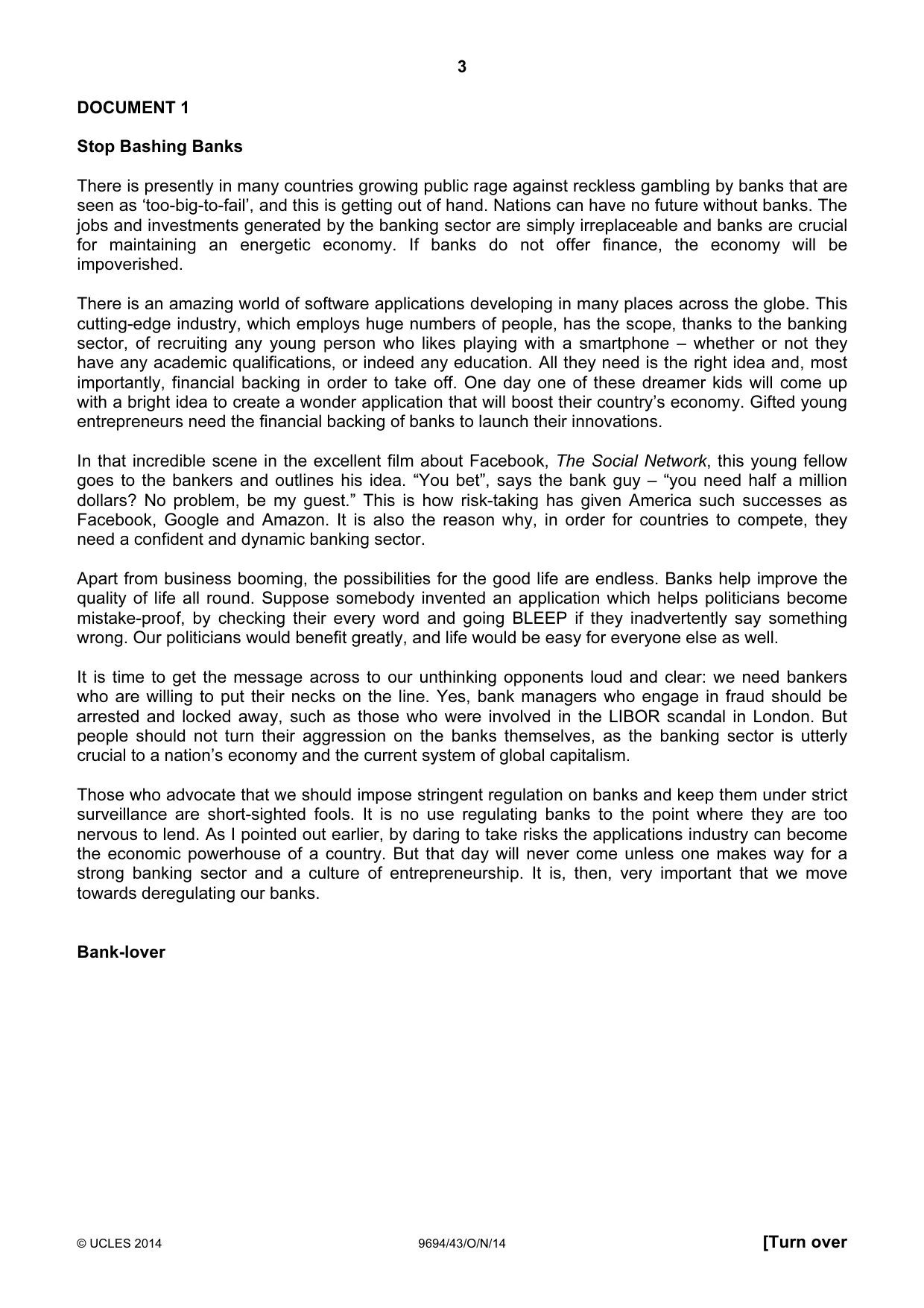
3 © UCLES 2014 9694/43/O/N/14 [Turn over DOCUMENT 1 Stop Bashing Banks There is presently in many countries growing public rage against reckless gambling by banks that are seen as ‘too-big-to-fail’, and this is getting out of hand. Nations can have no future without banks. The jobs and investments generated by the banking sector are simply irreplaceable and banks are crucial for maintaining an energetic economy. If banks do not offer finance, the economy will be impoverished. There is an amazing world of software applications developing in many places across the globe. This cutting-edge industry, which employs huge numbers of people, has the scope, thanks to the banking sector, of recruiting any young person who likes playing with a smartphone – whether or not they have any academic qualifications, or indeed any education. All they need is the right idea and, most importantly, financial backing in order to take off. One day one of these dreamer kids will come up with a bright idea to create a wonder application that will boost their country’s economy. Gifted young entrepreneurs need the financial backing of banks to launch their innovations. In that incredible scene in the excellent film about Facebook, The Social Network, this young fellow goes to the bankers and outlines his idea. “You bet”, says the bank guy – “you need half a million dollars? No problem, be my guest.” This is how risk-taking has given America such successes as Facebook, Google and Amazon. It is also the reason why, in order for countries to compete, they need a confident and dynamic banking sector. Apart from business booming, the possibilities for the good life are endless. Banks help improve the quality of life all round. Suppose somebody invented an application which helps politicians become mistake-proof, by checking their every word and going BLEEP if they inadvertently say something wrong. Our politicians would benefit greatly, and life would be easy for everyone else as well. It is time to get the message across to our unthinking opponents loud and clear: we need bankers who are willing to put their necks on the line. Yes, bank managers who engage in fraud should be arrested and locked away, such as those who were involved in the LIBOR scandal in London. But people should not turn their aggression on the banks themselves, as the banking sector is utterly crucial to a nation’s economy and the current system of global capitalism. Those who advocate that we should impose stringent regulation on banks and keep them under strict surveillance are short-sighted fools. It is no use regulating banks to the point where they are too nervous to lend. As I pointed out earlier, by daring to take risks the applications industry can become the economic powerhouse of a country. But that day will never come unless one makes way for a strong banking sector and a culture of entrepreneurship. It is, then, very important that we move towards deregulating our banks. Bank-lover
Question paper, page 4
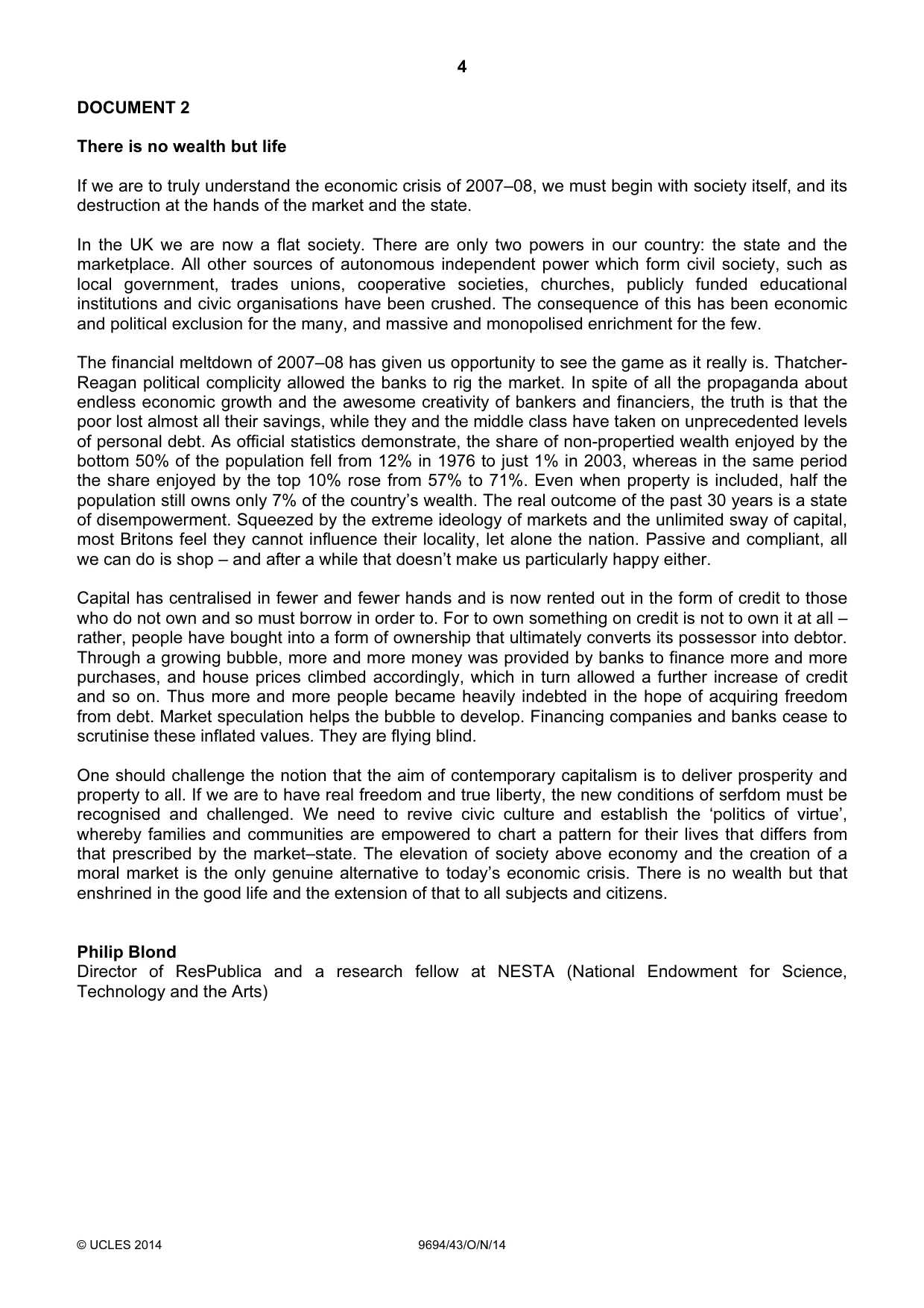
4 © UCLES 2014 9694/43/O/N/14 DOCUMENT 2 There is no wealth but life If we are to truly understand the economic crisis of 2007–08, we must begin with society itself, and its destruction at the hands of the market and the state. In the UK we are now a flat society. There are only two powers in our country: the state and the marketplace. All other sources of autonomous independent power which form civil society, such as local government, trades unions, cooperative societies, churches, publicly funded educational institutions and civic organisations have been crushed. The consequence of this has been economic and political exclusion for the many, and massive and monopolised enrichment for the few. The financial meltdown of 2007–08 has given us opportunity to see the game as it really is. Thatcher- Reagan political complicity allowed the banks to rig the market. In spite of all the propaganda about endless economic growth and the awesome creativity of bankers and financiers, the truth is that the poor lost almost all their savings, while they and the middle class have taken on unprecedented levels of personal debt. As official statistics demonstrate, the share of non-propertied wealth enjoyed by the bottom 50% of the population fell from 12% in 1976 to just 1% in 2003, whereas in the same period the share enjoyed by the top 10% rose from 57% to 71%. Even when property is included, half the population still owns only 7% of the country’s wealth. The real outcome of the past 30 years is a state of disempowerment. Squeezed by the extreme ideology of markets and the unlimited sway of capital, most Britons feel they cannot influence their locality, let alone the nation. Passive and compliant, all we can do is shop – and after a while that doesn’t make us particularly happy either. Capital has centralised in fewer and fewer hands and is now rented out in the form of credit to those who do not own and so must borrow in order to. For to own something on credit is not to own it at all – rather, people have bought into a form of ownership that ultimately converts its possessor into debtor. Through a growing bubble, more and more money was provided by banks to finance more and more purchases, and house prices climbed accordingly, which in turn allowed a further increase of credit and so on. Thus more and more people became heavily indebted in the hope of acquiring freedom from debt. Market speculation helps the bubble to develop. Financing companies and banks cease to scrutinise these inflated values. They are flying blind. One should challenge the notion that the aim of contemporary capitalism is to deliver prosperity and property to all. If we are to have real freedom and true liberty, the new conditions of serfdom must be recognised and challenged. We need to revive civic culture and establish the ‘politics of virtue’, whereby families and communities are empowered to chart a pattern for their lives that differs from that prescribed by the market–state. The elevation of society above economy and the creation of a moral market is the only genuine alternative to today’s economic crisis. There is no wealth but that enshrined in the good life and the extension of that to all subjects and citizens. Philip Blond Director of ResPublica and a research fellow at NESTA (National Endowment for Science, Technology and the Arts)
Question paper, page 5
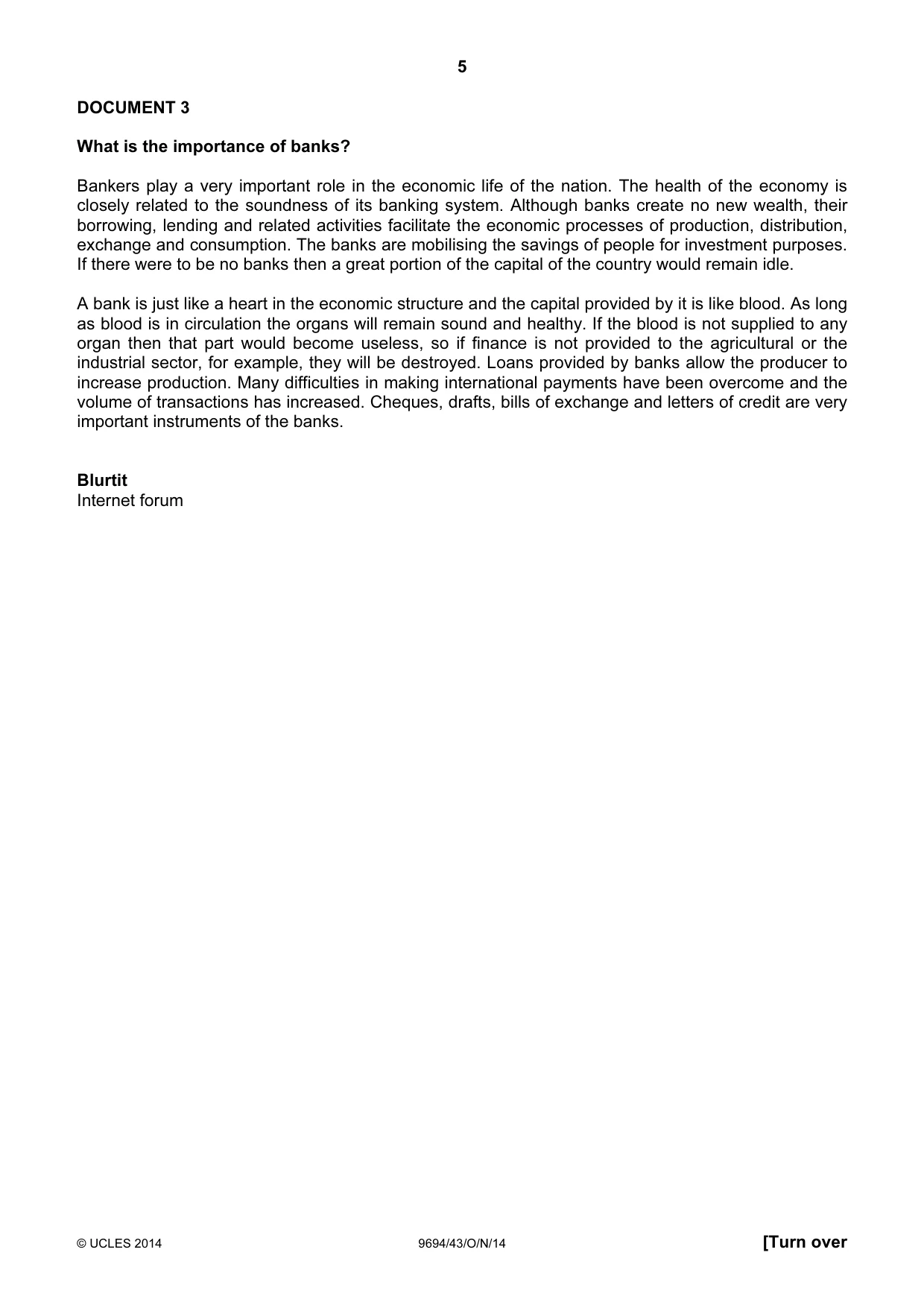
5 © UCLES 2014 9694/43/O/N/14 [Turn over DOCUMENT 3 What is the importance of banks? Bankers play a very important role in the economic life of the nation. The health of the economy is closely related to the soundness of its banking system. Although banks create no new wealth, their borrowing, lending and related activities facilitate the economic processes of production, distribution, exchange and consumption. The banks are mobilising the savings of people for investment purposes. If there were to be no banks then a great portion of the capital of the country would remain idle. A bank is just like a heart in the economic structure and the capital provided by it is like blood. As long as blood is in circulation the organs will remain sound and healthy. If the blood is not supplied to any organ then that part would become useless, so if finance is not provided to the agricultural or the industrial sector, for example, they will be destroyed. Loans provided by banks allow the producer to increase production. Many difficulties in making international payments have been overcome and the volume of transactions has increased. Cheques, drafts, bills of exchange and letters of credit are very important instruments of the banks. Blurtit Internet forum
Question paper, page 6
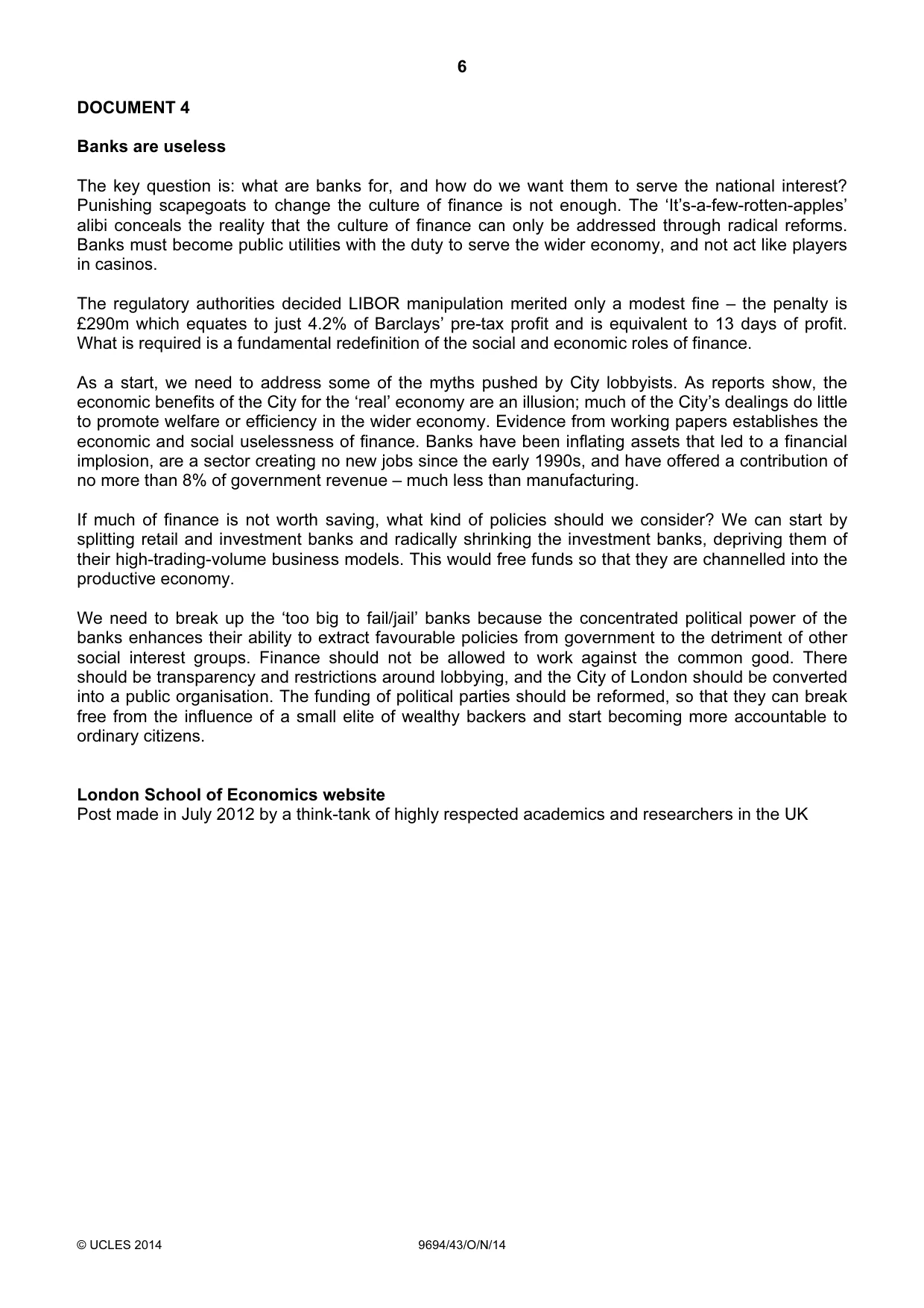
6 © UCLES 2014 9694/43/O/N/14 DOCUMENT 4 Banks are useless The key question is: what are banks for, and how do we want them to serve the national interest? Punishing scapegoats to change the culture of finance is not enough. The ‘It’s-a-few-rotten-apples’ alibi conceals the reality that the culture of finance can only be addressed through radical reforms. Banks must become public utilities with the duty to serve the wider economy, and not act like players in casinos. The regulatory authorities decided LIBOR manipulation merited only a modest fine – the penalty is £290m which equates to just 4.2% of Barclays’ pre-tax profit and is equivalent to 13 days of profit. What is required is a fundamental redefinition of the social and economic roles of finance. As a start, we need to address some of the myths pushed by City lobbyists. As reports show, the economic benefits of the City for the ‘real’ economy are an illusion; much of the City’s dealings do little to promote welfare or efficiency in the wider economy. Evidence from working papers establishes the economic and social uselessness of finance. Banks have been inflating assets that led to a financial implosion, are a sector creating no new jobs since the early 1990s, and have offered a contribution of no more than 8% of government revenue – much less than manufacturing. If much of finance is not worth saving, what kind of policies should we consider? We can start by splitting retail and investment banks and radically shrinking the investment banks, depriving them of their high-trading-volume business models. This would free funds so that they are channelled into the productive economy. We need to break up the ‘too big to fail/jail’ banks because the concentrated political power of the banks enhances their ability to extract favourable policies from government to the detriment of other social interest groups. Finance should not be allowed to work against the common good. There should be transparency and restrictions around lobbying, and the City of London should be converted into a public organisation. The funding of political parties should be reformed, so that they can break free from the influence of a small elite of wealthy backers and start becoming more accountable to ordinary citizens. London School of Economics website Post made in July 2012 by a think-tank of highly respected academics and researchers in the UK
Question paper, page 7
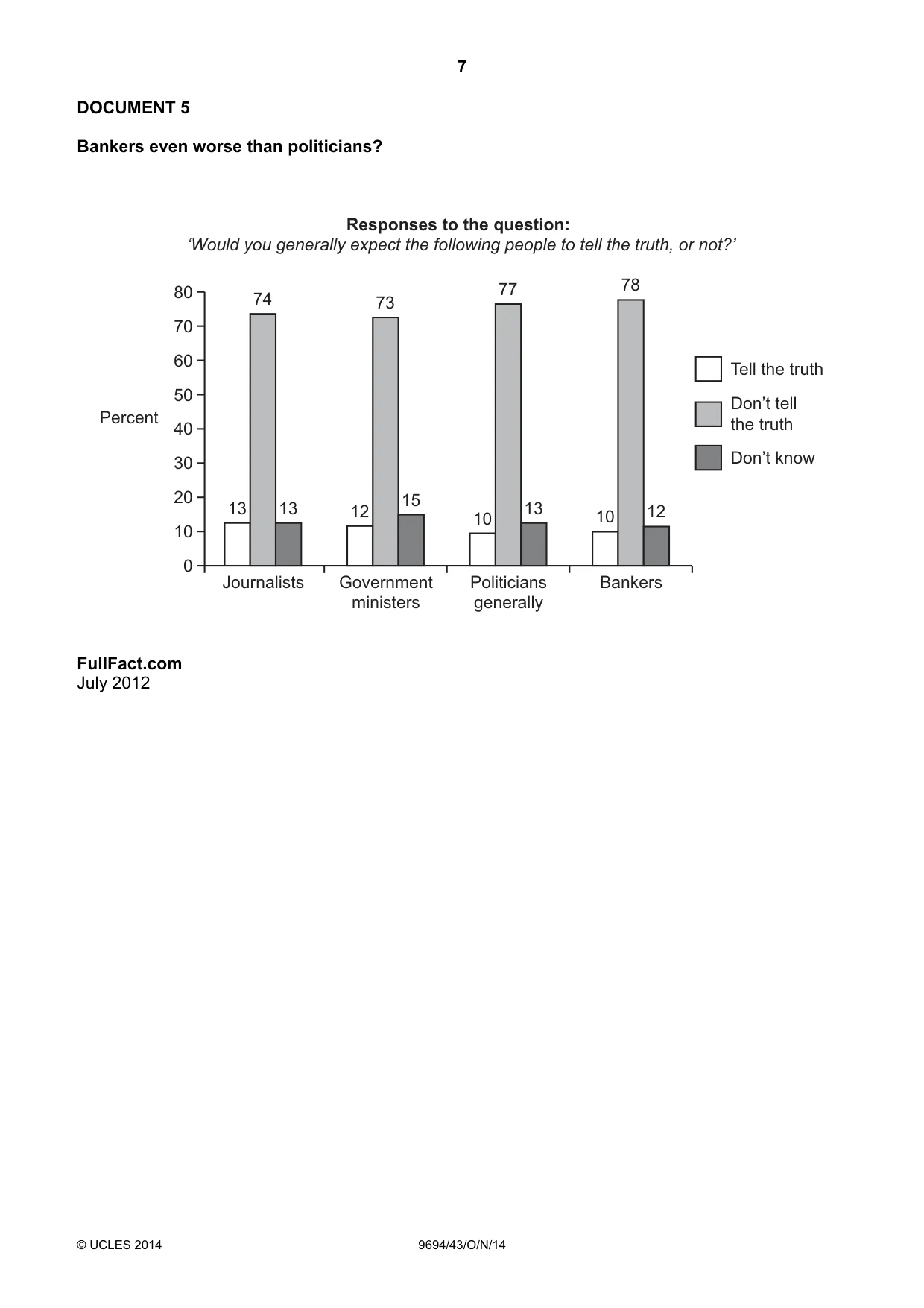
7 © UCLES 2014 9694/43/O/N/14 DOCUMENT 5 Bankers even worse than politicians? Journalists 13 74 13 Government ministers 15 73 12 Politicians generally 13 77 10 Bankers 12 78 10 80 70 60 50 40 30 20 10 0 Percent Tell the truth Don’t tell the truth Don’t know Responses to the question: ‘Would you generally expect the following people to tell the truth, or not?’ FullFact.com July 2012
Question paper, page 8
8 Copyright Acknowledgements: Document 2 Document 3 Document 4 Document 5 © ed. Williams et al; Philip Blond; Crisis and Recovery, in Ethics, Economics and Justice; Palgrave Macmillan; 2010. © http://www.blurtit.com/q197532.html. © Bowman et al; http://blogs.lse.ac.uk/politicsandpolicy/2012/07/04/banking-on-change-bowman-et-al/. © http://fullfact.org/articles/have_bankers_displaced_politicians_and_journalists_as_the_least_trusted_profession-27514; 5 July 2012. Permission to reproduce items where third-party owned material protected by copyright is included has been sought and cleared where possible. Every reasonable effort has been made by the publisher (UCLES) to trace copyright holders, but if any items requiring clearance have unwittingly been included, the publisher will be pleased to make amends at the earliest possible opportunity. Cambridge International Examinations is part of the Cambridge Assessment Group. Cambridge Assessment is the brand name of University of Cambridge Local Examinations Syndicate (UCLES), which is itself a department of the University of Cambridge. © UCLES 2014 9694/43/O/N/14 BLANK PAGE
Mark scheme, page 1
® IGCSE is the registered trademark of Cambridge International Examinations. CAMBRIDGE INTERNATIONAL EXAMINATIONS Cambridge International Advanced Level MARK SCHEME for the October/November 2014 series 9694 THINKING SKILLS 9694/43 Paper 4 (Applied Reasoning), maximum raw mark 50 This mark scheme is published as an aid to teachers and candidates, to indicate the requirements of the examination. It shows the basis on which Examiners were instructed to award marks. It does not indicate the details of the discussions that took place at an Examiners’ meeting before marking began, which would have considered the acceptability of alternative answers. Mark schemes should be read in conjunction with the question paper and the Principal Examiner Report for Teachers. Cambridge will not enter into discussions about these mark schemes. Cambridge is publishing the mark schemes for the October/November 2014 series for most Cambridge IGCSE®, Cambridge International A and AS Level components and some Cambridge O Level components.
Mark scheme, page 2
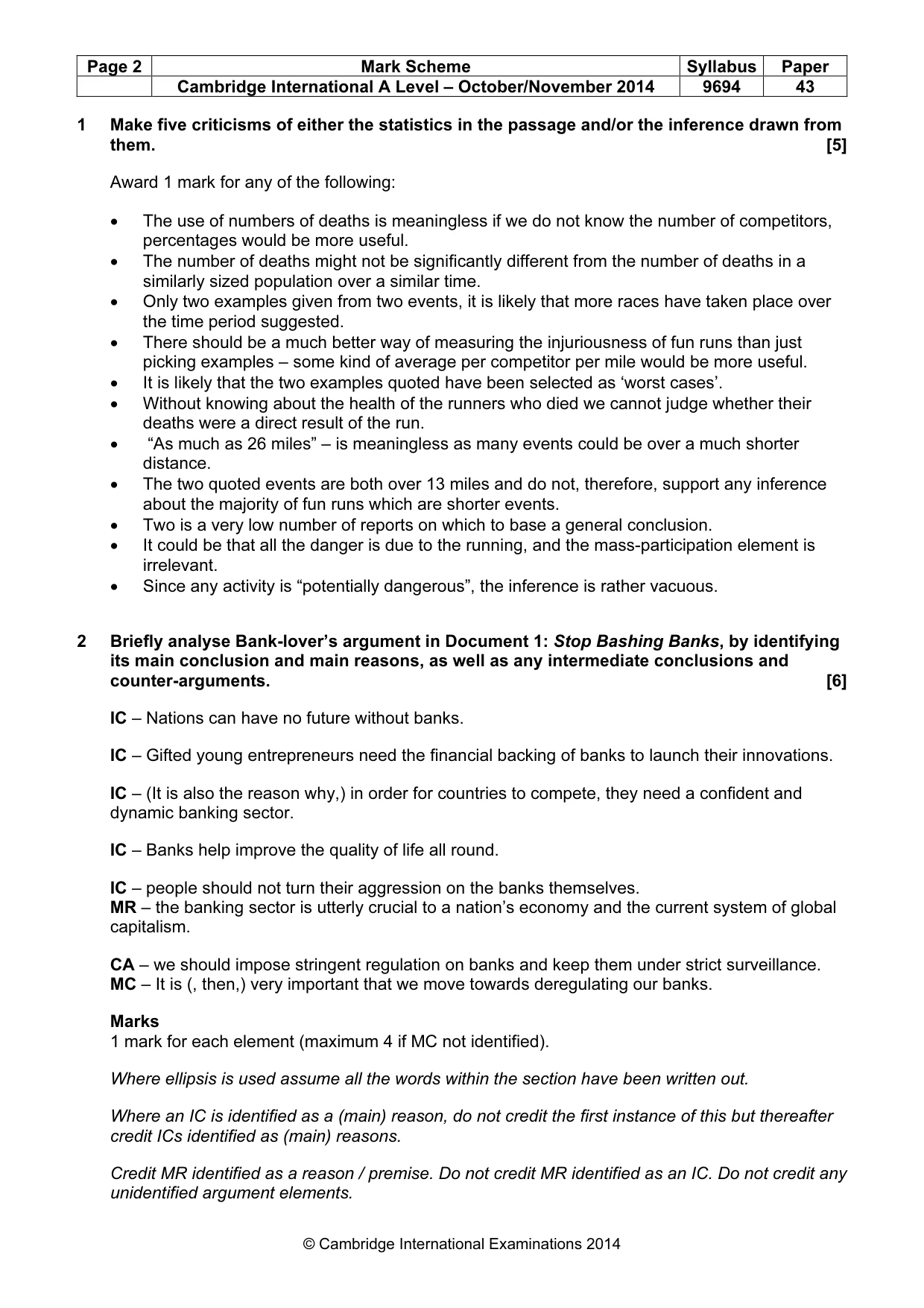
Page 2 Mark Scheme Syllabus Paper Cambridge International A Level – October/November 2014 9694 43 © Cambridge International Examinations 2014 1 Make five criticisms of either the statistics in the passage and/or the inference drawn from them. [5] Award 1 mark for any of the following: • The use of numbers of deaths is meaningless if we do not know the number of competitors, percentages would be more useful. • The number of deaths might not be significantly different from the number of deaths in a similarly sized population over a similar time. • Only two examples given from two events, it is likely that more races have taken place over the time period suggested. • There should be a much better way of measuring the injuriousness of fun runs than just picking examples – some kind of average per competitor per mile would be more useful. • It is likely that the two examples quoted have been selected as ‘worst cases’. • Without knowing about the health of the runners who died we cannot judge whether their deaths were a direct result of the run. • “As much as 26 miles” – is meaningless as many events could be over a much shorter distance. • The two quoted events are both over 13 miles and do not, therefore, support any inference about the majority of fun runs which are shorter events. • Two is a very low number of reports on which to base a general conclusion. • It could be that all the danger is due to the running, and the mass-participation element is irrelevant. • Since any activity is “potentially dangerous”, the inference is rather vacuous. 2 Briefly analyse Bank-lover’s argument in Document 1: Stop Bashing Banks, by identifying its main conclusion and main reasons, as well as any intermediate conclusions and counter-arguments. [6] IC – Nations can have no future without banks. IC – Gifted young entrepreneurs need the financial backing of banks to launch their innovations. IC – (It is also the reason why,) in order for countries to compete, they need a confident and dynamic banking sector. IC – Banks help improve the quality of life all round. IC – people should not turn their aggression on the banks themselves. MR – the banking sector is utterly crucial to a nation’s economy and the current system of global capitalism. CA – we should impose stringent regulation on banks and keep them under strict surveillance. MC – It is (, then,) very important that we move towards deregulating our banks. Marks 1 mark for each element (maximum 4 if MC not identified). Where ellipsis is used assume all the words within the section have been written out. Where an IC is identified as a (main) reason, do not credit the first instance of this but thereafter credit ICs identified as (main) reasons. Credit MR identified as a reason / premise. Do not credit MR identified as an IC. Do not credit any unidentified argument elements.
Mark scheme, page 3
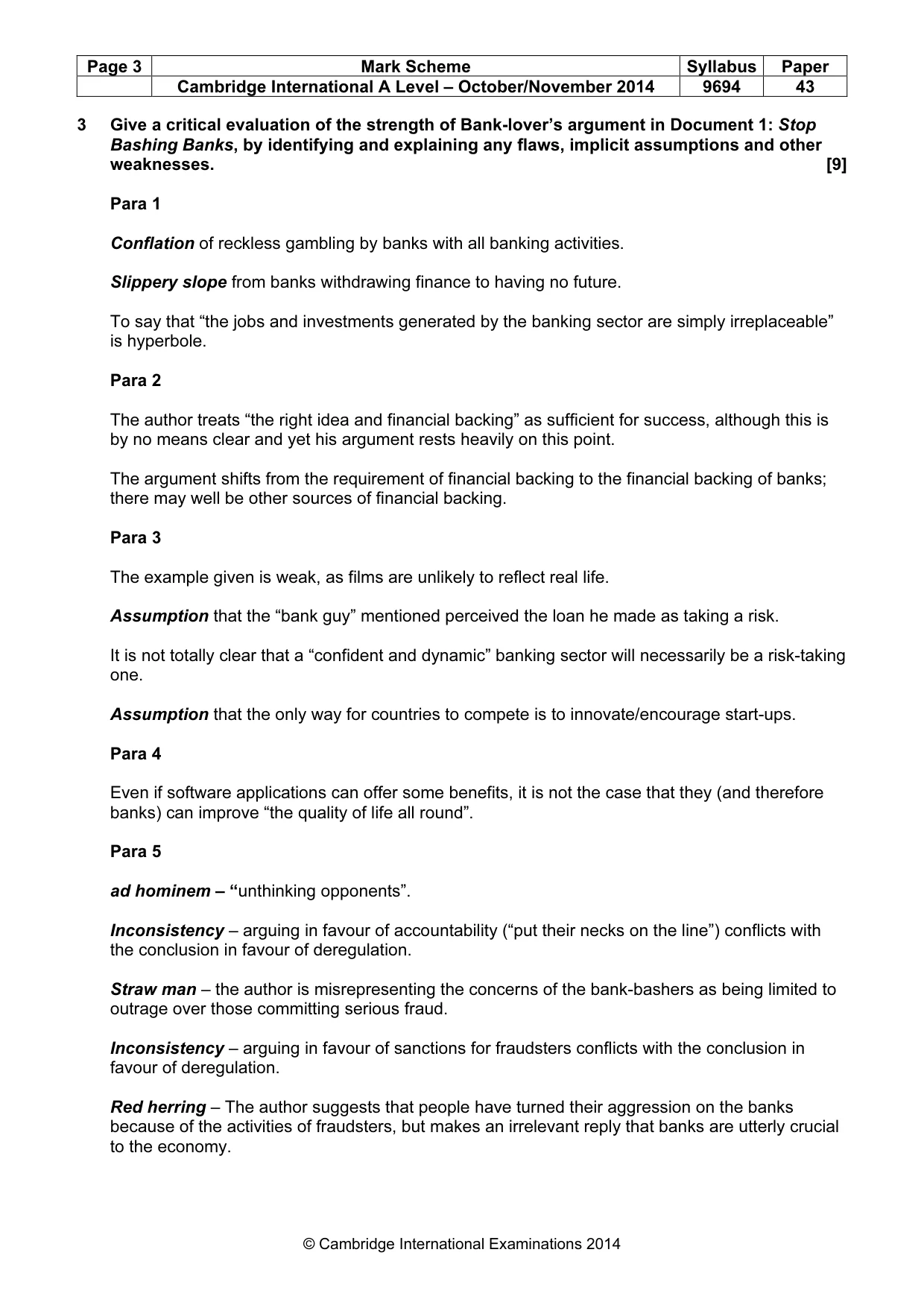
Page 3 Mark Scheme Syllabus Paper Cambridge International A Level – October/November 2014 9694 43 © Cambridge International Examinations 2014 3 Give a critical evaluation of the strength of Bank-lover’s argument in Document 1: Stop Bashing Banks, by identifying and explaining any flaws, implicit assumptions and other weaknesses. [9] Para 1 Conflation of reckless gambling by banks with all banking activities. Slippery slope from banks withdrawing finance to having no future. To say that “the jobs and investments generated by the banking sector are simply irreplaceable” is hyperbole. Para 2 The author treats “the right idea and financial backing” as sufficient for success, although this is by no means clear and yet his argument rests heavily on this point. The argument shifts from the requirement of financial backing to the financial backing of banks; there may well be other sources of financial backing. Para 3 The example given is weak, as films are unlikely to reflect real life. Assumption that the “bank guy” mentioned perceived the loan he made as taking a risk. It is not totally clear that a “confident and dynamic” banking sector will necessarily be a risk-taking one. Assumption that the only way for countries to compete is to innovate/encourage start-ups. Para 4 Even if software applications can offer some benefits, it is not the case that they (and therefore banks) can improve “the quality of life all round”. Para 5 ad hominem – “unthinking opponents”. Inconsistency – arguing in favour of accountability (“put their necks on the line”) conflicts with the conclusion in favour of deregulation. Straw man – the author is misrepresenting the concerns of the bank-bashers as being limited to outrage over those committing serious fraud. Inconsistency – arguing in favour of sanctions for fraudsters conflicts with the conclusion in favour of deregulation. Red herring – The author suggests that people have turned their aggression on the banks because of the activities of fraudsters, but makes an irrelevant reply that banks are utterly crucial to the economy.
Mark scheme, page 4
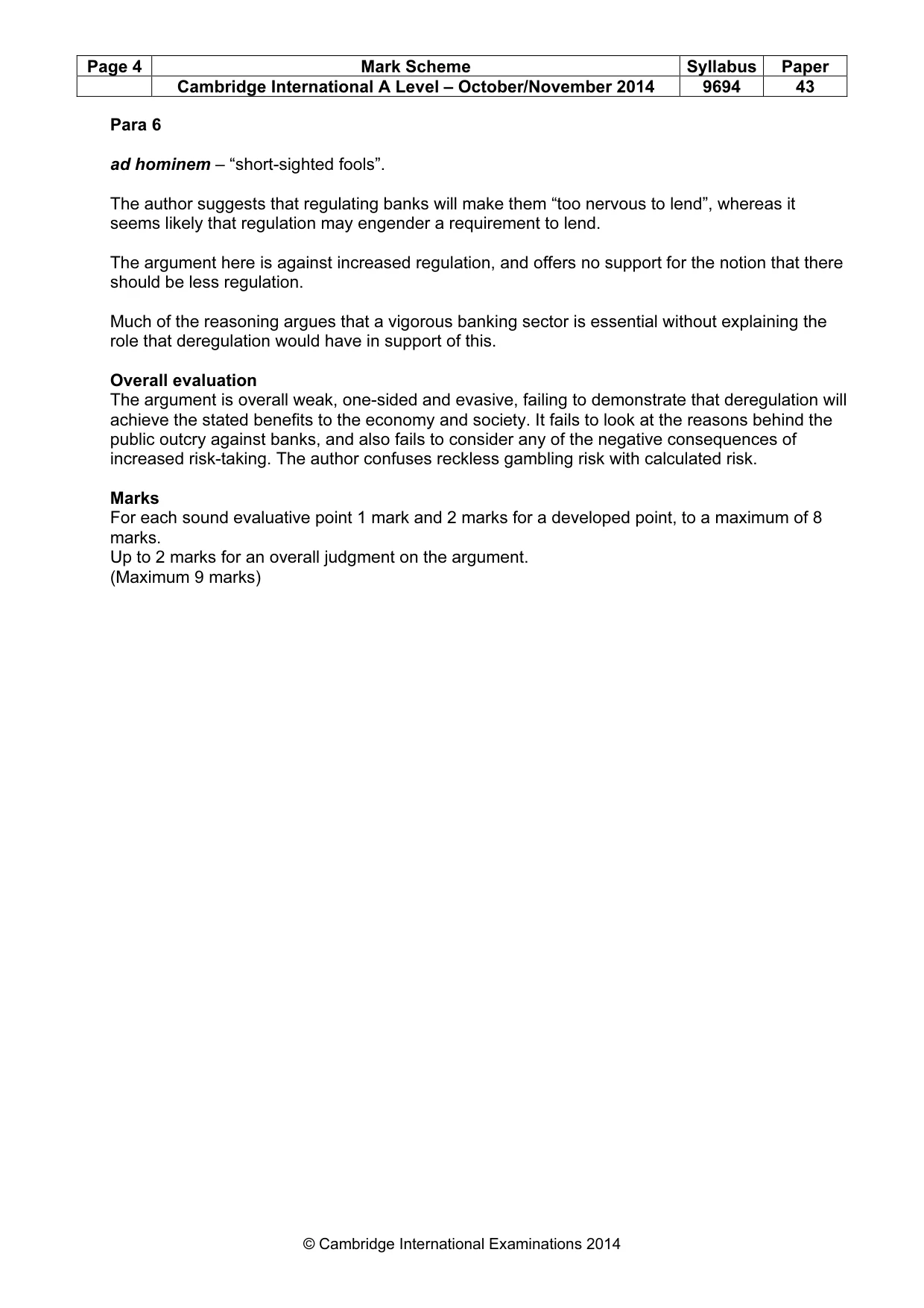
Page 4 Mark Scheme Syllabus Paper Cambridge International A Level – October/November 2014 9694 43 © Cambridge International Examinations 2014 Para 6 ad hominem – “short-sighted fools”. The author suggests that regulating banks will make them “too nervous to lend”, whereas it seems likely that regulation may engender a requirement to lend. The argument here is against increased regulation, and offers no support for the notion that there should be less regulation. Much of the reasoning argues that a vigorous banking sector is essential without explaining the role that deregulation would have in support of this. Overall evaluation The argument is overall weak, one-sided and evasive, failing to demonstrate that deregulation will achieve the stated benefits to the economy and society. It fails to look at the reasons behind the public outcry against banks, and also fails to consider any of the negative consequences of increased risk-taking. The author confuses reckless gambling risk with calculated risk. Marks For each sound evaluative point 1 mark and 2 marks for a developed point, to a maximum of 8 marks. Up to 2 marks for an overall judgment on the argument. (Maximum 9 marks)
Mark scheme, page 5
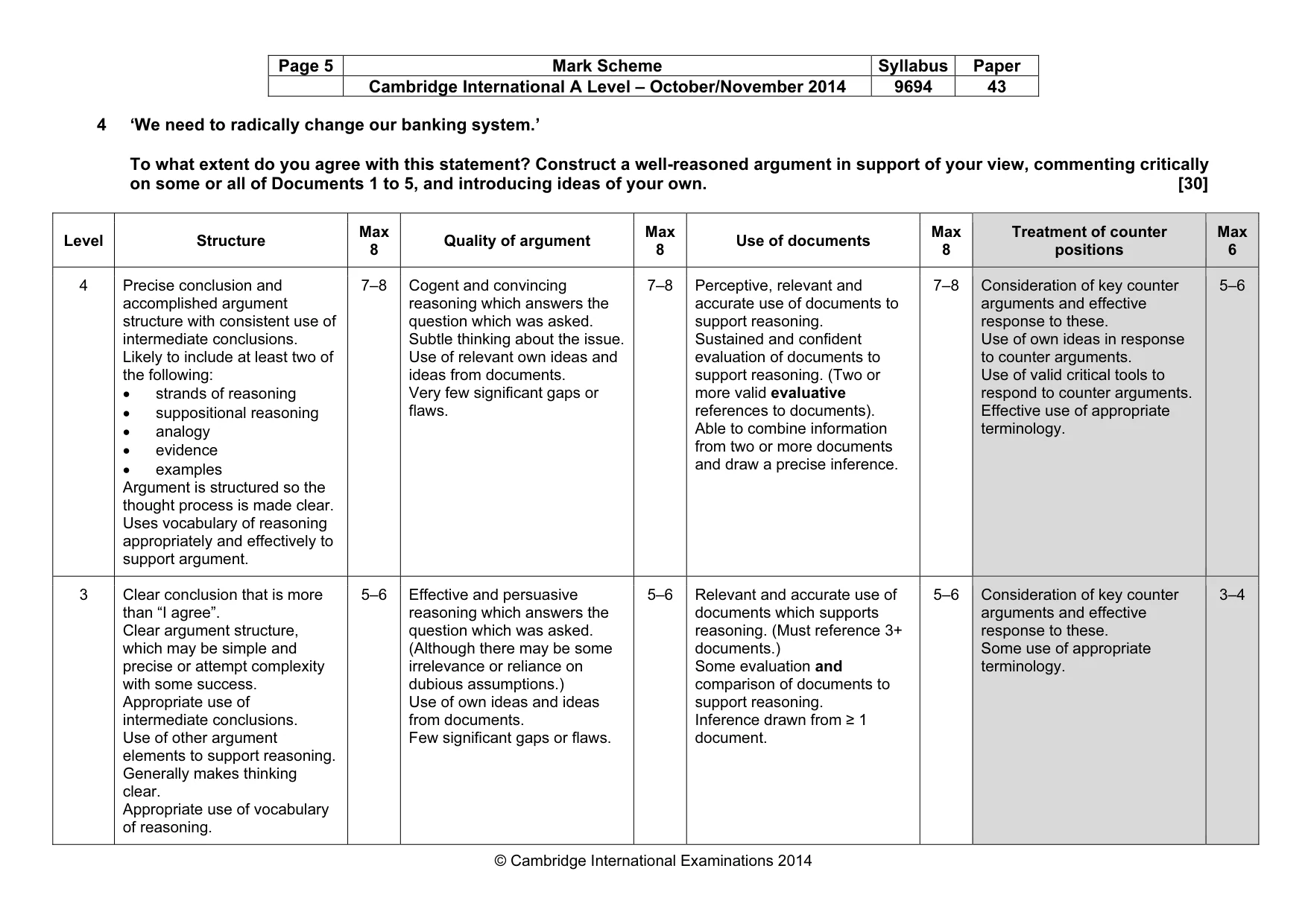
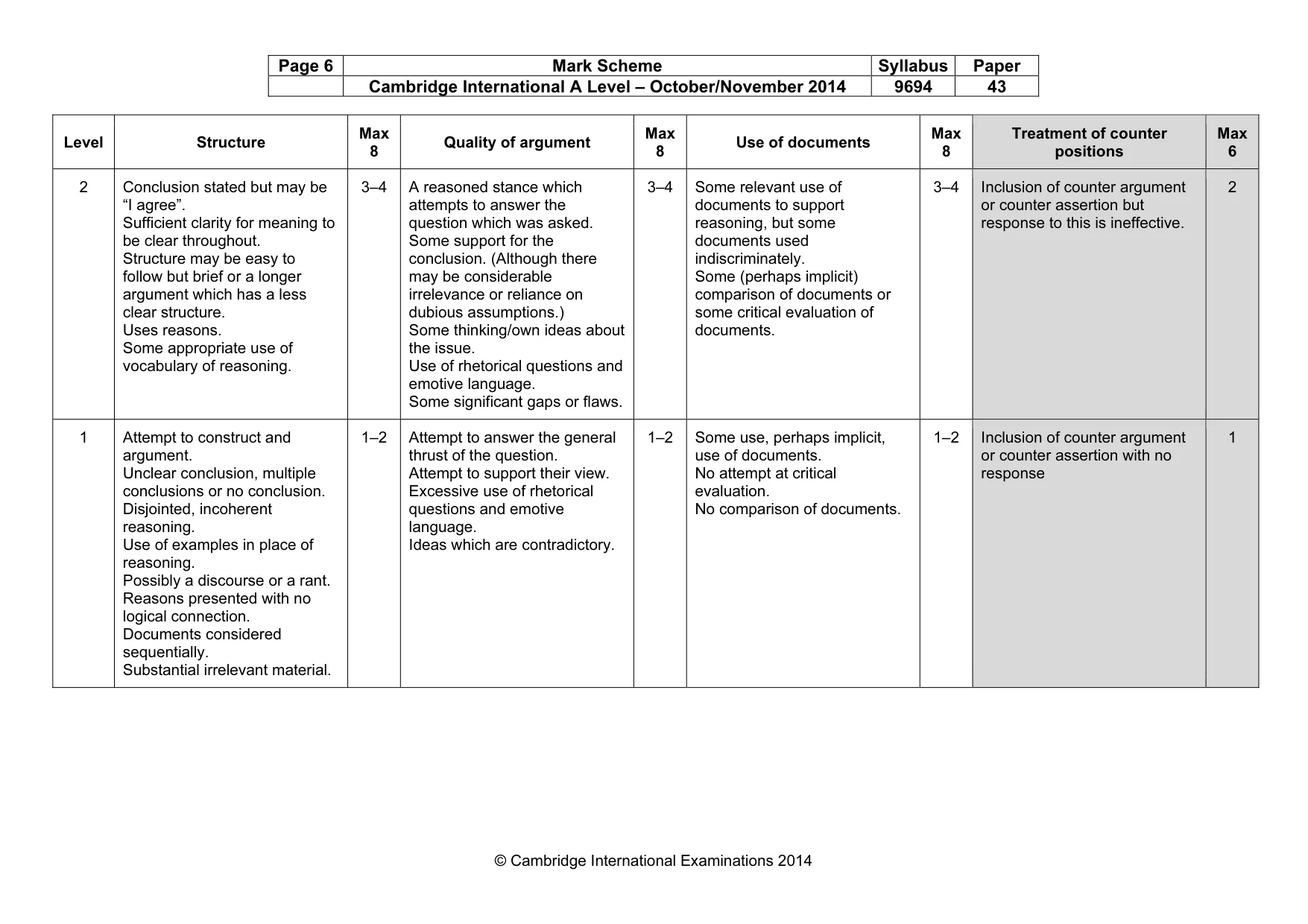
Page 5 Mark Scheme Syllabus Paper Cambridge International A Level – October/November 2014 9694 43 © Cambridge International Examinations 2014 4 ‘We need to radically change our banking system.’ To what extent do you agree with this statement? Construct a well-reasoned argument in support of your view, commenting critically on some or all of Documents 1 to 5, and introducing ideas of your own. [30] Level Structure Max 8 Quality of argument Max 8 Use of documents Max 8 Treatment of counter positions Max 6 4 Precise conclusion and accomplished argument structure with consistent use of intermediate conclusions. Likely to include at least two of the following: • strands of reasoning • suppositional reasoning • analogy • evidence • examples Argument is structured so the thought process is made clear. Uses vocabulary of reasoning appropriately and effectively to support argument. 7–8 Cogent and convincing reasoning which answers the question which was asked. Subtle thinking about the issue. Use of relevant own ideas and ideas from documents. Very few significant gaps or flaws. 7–8 Perceptive, relevant and accurate use of documents to support reasoning. Sustained and confident evaluation of documents to support reasoning. (Two or more valid evaluative references to documents). Able to combine information from two or more documents and draw a precise inference. 7–8 Consideration of key counter arguments and effective response to these. Use of own ideas in response to counter arguments. Use of valid critical tools to respond to counter arguments. Effective use of appropriate terminology. 5–6 3 Clear conclusion that is more than “I agree”. Clear argument structure, which may be simple and precise or attempt complexity with some success. Appropriate use of intermediate conclusions. Use of other argument elements to support reasoning. Generally makes thinking clear. Appropriate use of vocabulary of reasoning. 5–6 Effective and persuasive reasoning which answers the question which was asked. (Although there may be some irrelevance or reliance on dubious assumptions.) Use of own ideas and ideas from documents. Few significant gaps or flaws. 5–6 Relevant and accurate use of documents which supports reasoning. (Must reference 3+ documents.) Some evaluation and comparison of documents to support reasoning. Inference drawn from ≥ 1 document. 5–6 Consideration of key counter arguments and effective response to these. Some use of appropriate terminology. 3–4
Mark scheme, page 6
Page 6 Mark Scheme Syllabus Paper Cambridge International A Level – October/November 2014 9694 43 © Cambridge International Examinations 2014 Level Structure Max 8 Quality of argument Max 8 Use of documents Max 8 Treatment of counter positions Max 6 2 Conclusion stated but may be “I agree”. Sufficient clarity for meaning to be clear throughout. Structure may be easy to follow but brief or a longer argument which has a less clear structure. Uses reasons. Some appropriate use of vocabulary of reasoning. 3–4 A reasoned stance which attempts to answer the question which was asked. Some support for the conclusion. (Although there may be considerable irrelevance or reliance on dubious assumptions.) Some thinking/own ideas about the issue. Use of rhetorical questions and emotive language. Some significant gaps or flaws. 3–4 Some relevant use of documents to support reasoning, but some documents used indiscriminately. Some (perhaps implicit) comparison of documents or some critical evaluation of documents. 3–4 Inclusion of counter argument or counter assertion but response to this is ineffective. 2 1 Attempt to construct and argument. Unclear conclusion, multiple conclusions or no conclusion. Disjointed, incoherent reasoning. Use of examples in place of reasoning. Possibly a discourse or a rant. Reasons presented with no logical connection. Documents considered sequentially. Substantial irrelevant material. 1–2 Attempt to answer the general thrust of the question. Attempt to support their view. Excessive use of rhetorical questions and emotive language. Ideas which are contradictory. 1–2 Some use, perhaps implicit, use of documents. No attempt at critical evaluation. No comparison of documents. 1–2 Inclusion of counter argument or counter assertion with no response 1
What you needed in this session
Cambridge’s own grade thresholds for 2014 Oct/Nov, Paper 4 · Variant 3. A higher threshold means an easier paper — the bar moves with how the cohort did.