Cambridge A Level Thinking Skills 9694 — 2014 Oct/Nov Paper 4 · Variant 2
9694/42/O/N/14 · 50 marks · ≈56 min
The question paper and its mark scheme, free to read here and free to download. This is Cambridge’s own paper, exactly as it was sat.
Question paper8 pages
Mark scheme5 pages
Answers below. Sit the paper first if you are practising.
Paper as text
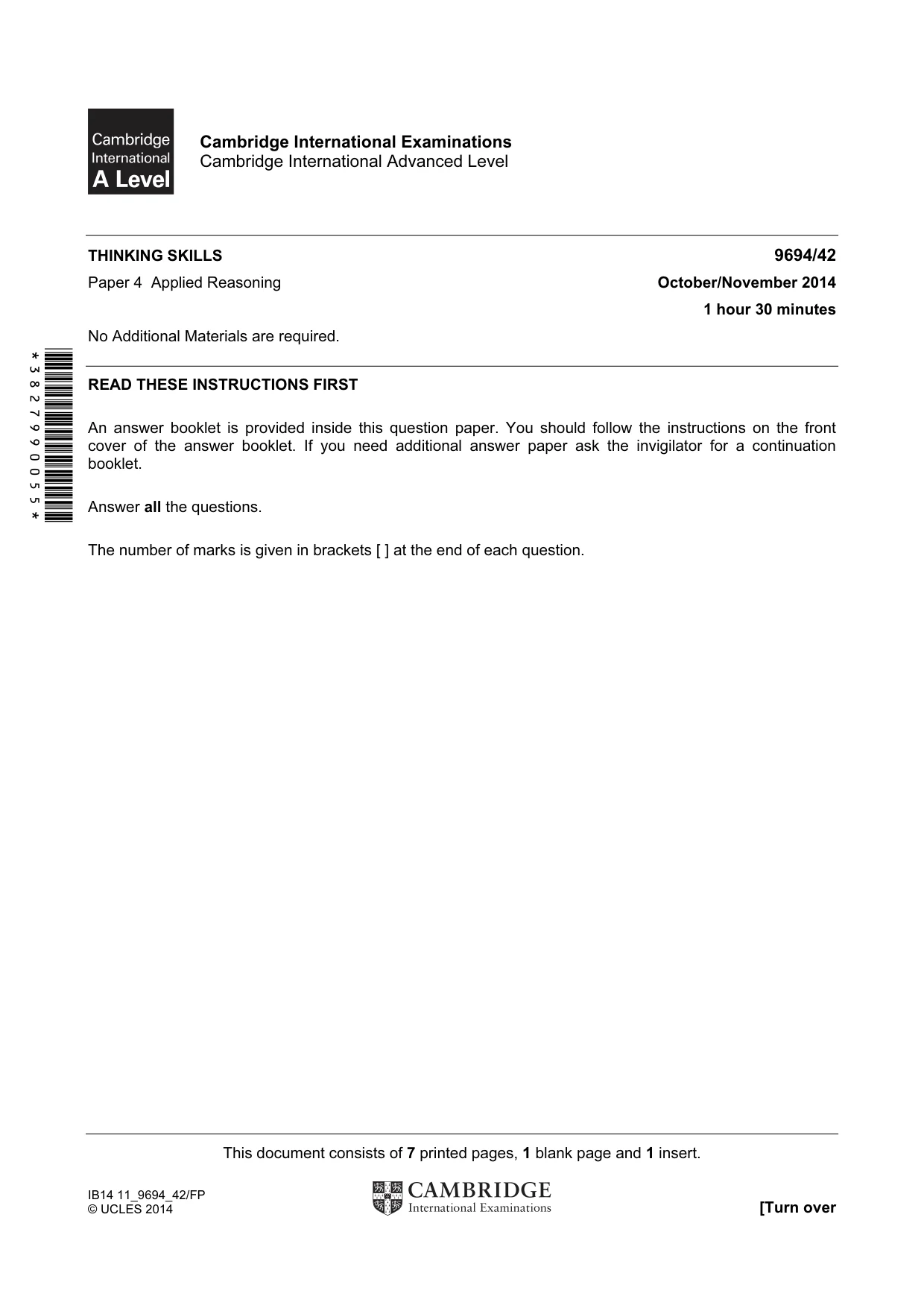
Question paper, page 1
This document consists of 7 printed pages, 1 blank page and 1 insert. IB14 11_9694_42/FP © UCLES 2014 [Turn over *3827990055* Cambridge International Examinations Cambridge International Advanced Level THINKING SKILLS 9694/42 Paper 4 Applied Reasoning October/November 2014 1 hour 30 minutes No Additional Materials are required. READ THESE INSTRUCTIONS FIRST An answer booklet is provided inside this question paper. You should follow the instructions on the front cover of the answer booklet. If you need additional answer paper ask the invigilator for a continuation booklet. Answer all the questions. The number of marks is given in brackets [ ] at the end of each question.
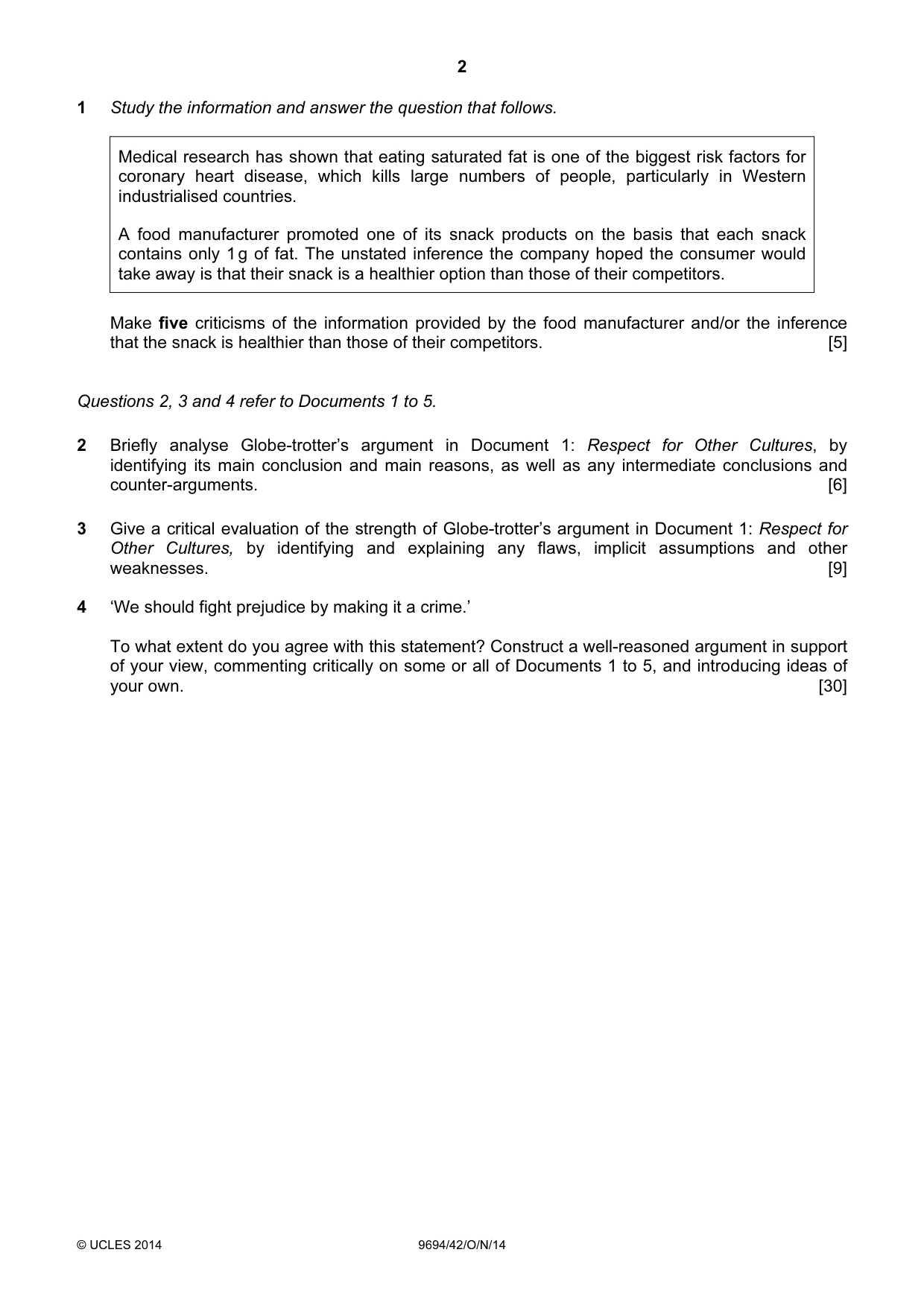
Question paper, page 2
2 © UCLES 2014 9694/42/O/N/14 1 Study the information and answer the question that follows. Medical research has shown that eating saturated fat is one of the biggest risk factors for coronary heart disease, which kills large numbers of people, particularly in Western industrialised countries. A food manufacturer promoted one of its snack products on the basis that each snack contains only 1 g of fat. The unstated inference the company hoped the consumer would take away is that their snack is a healthier option than those of their competitors. Make five criticisms of the information provided by the food manufacturer and/or the inference that the snack is healthier than those of their competitors. [5] Questions 2, 3 and 4 refer to Documents 1 to 5. 2 Briefly analyse Globe-trotter’s argument in Document 1: Respect for Other Cultures, by identifying its main conclusion and main reasons, as well as any intermediate conclusions and counter-arguments. [6] 3 Give a critical evaluation of the strength of Globe-trotter’s argument in Document 1: Respect for Other Cultures, by identifying and explaining any flaws, implicit assumptions and other weaknesses. [9] 4 ‘We should fight prejudice by making it a crime.’ To what extent do you agree with this statement? Construct a well-reasoned argument in support of your view, commenting critically on some or all of Documents 1 to 5, and introducing ideas of your own. [30]
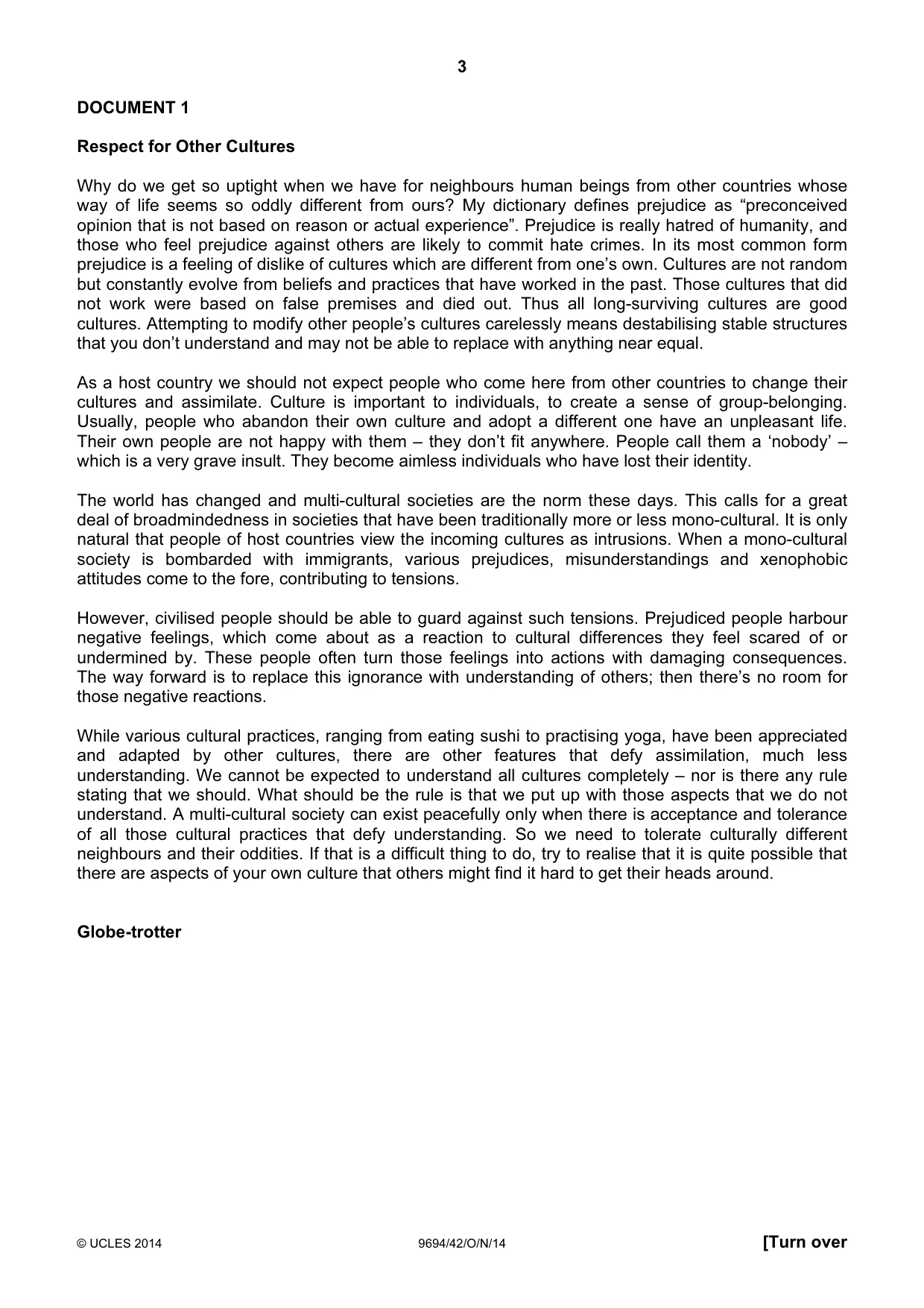
Question paper, page 3
3 © UCLES 2014 9694/42/O/N/14 [Turn over DOCUMENT 1 Respect for Other Cultures Why do we get so uptight when we have for neighbours human beings from other countries whose way of life seems so oddly different from ours? My dictionary defines prejudice as “preconceived opinion that is not based on reason or actual experience”. Prejudice is really hatred of humanity, and those who feel prejudice against others are likely to commit hate crimes. In its most common form prejudice is a feeling of dislike of cultures which are different from one’s own. Cultures are not random but constantly evolve from beliefs and practices that have worked in the past. Those cultures that did not work were based on false premises and died out. Thus all long-surviving cultures are good cultures. Attempting to modify other people’s cultures carelessly means destabilising stable structures that you don’t understand and may not be able to replace with anything near equal. As a host country we should not expect people who come here from other countries to change their cultures and assimilate. Culture is important to individuals, to create a sense of group-belonging. Usually, people who abandon their own culture and adopt a different one have an unpleasant life. Their own people are not happy with them – they don’t fit anywhere. People call them a ‘nobody’ – which is a very grave insult. They become aimless individuals who have lost their identity. The world has changed and multi-cultural societies are the norm these days. This calls for a great deal of broadmindedness in societies that have been traditionally more or less mono-cultural. It is only natural that people of host countries view the incoming cultures as intrusions. When a mono-cultural society is bombarded with immigrants, various prejudices, misunderstandings and xenophobic attitudes come to the fore, contributing to tensions. However, civilised people should be able to guard against such tensions. Prejudiced people harbour negative feelings, which come about as a reaction to cultural differences they feel scared of or undermined by. These people often turn those feelings into actions with damaging consequences. The way forward is to replace this ignorance with understanding of others; then there’s no room for those negative reactions. While various cultural practices, ranging from eating sushi to practising yoga, have been appreciated and adapted by other cultures, there are other features that defy assimilation, much less understanding. We cannot be expected to understand all cultures completely – nor is there any rule stating that we should. What should be the rule is that we put up with those aspects that we do not understand. A multi-cultural society can exist peacefully only when there is acceptance and tolerance of all those cultural practices that defy understanding. So we need to tolerate culturally different neighbours and their oddities. If that is a difficult thing to do, try to realise that it is quite possible that there are aspects of your own culture that others might find it hard to get their heads around. Globe-trotter
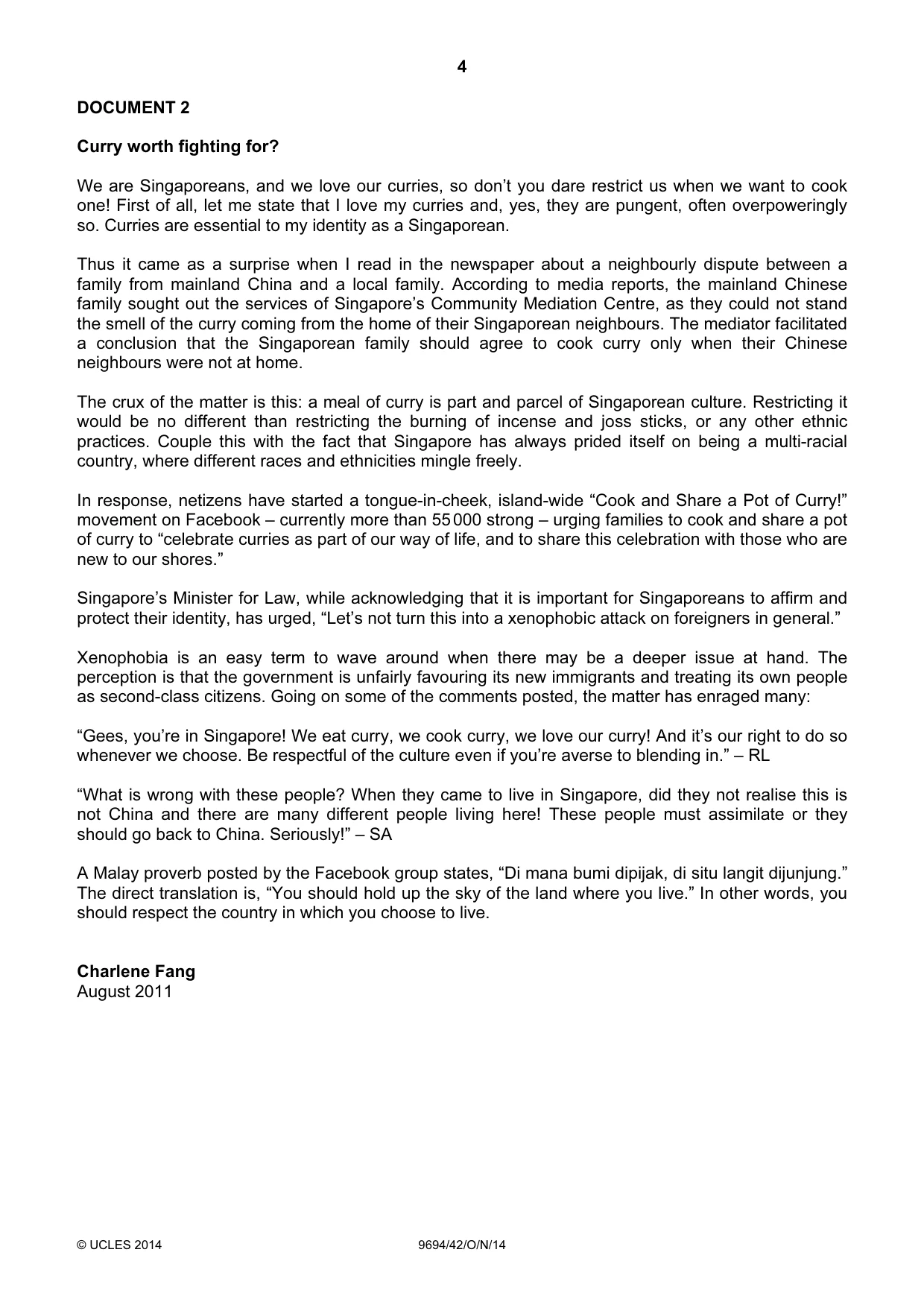
Question paper, page 4
4 © UCLES 2014 9694/42/O/N/14 DOCUMENT 2 Curry worth fighting for? We are Singaporeans, and we love our curries, so don’t you dare restrict us when we want to cook one! First of all, let me state that I love my curries and, yes, they are pungent, often overpoweringly so. Curries are essential to my identity as a Singaporean. Thus it came as a surprise when I read in the newspaper about a neighbourly dispute between a family from mainland China and a local family. According to media reports, the mainland Chinese family sought out the services of Singapore’s Community Mediation Centre, as they could not stand the smell of the curry coming from the home of their Singaporean neighbours. The mediator facilitated a conclusion that the Singaporean family should agree to cook curry only when their Chinese neighbours were not at home. The crux of the matter is this: a meal of curry is part and parcel of Singaporean culture. Restricting it would be no different than restricting the burning of incense and joss sticks, or any other ethnic practices. Couple this with the fact that Singapore has always prided itself on being a multi-racial country, where different races and ethnicities mingle freely. In response, netizens have started a tongue-in-cheek, island-wide “Cook and Share a Pot of Curry!” movement on Facebook – currently more than 55 000 strong – urging families to cook and share a pot of curry to “celebrate curries as part of our way of life, and to share this celebration with those who are new to our shores.” Singapore’s Minister for Law, while acknowledging that it is important for Singaporeans to affirm and protect their identity, has urged, “Let’s not turn this into a xenophobic attack on foreigners in general.” Xenophobia is an easy term to wave around when there may be a deeper issue at hand. The perception is that the government is unfairly favouring its new immigrants and treating its own people as second-class citizens. Going on some of the comments posted, the matter has enraged many: “Gees, you’re in Singapore! We eat curry, we cook curry, we love our curry! And it’s our right to do so whenever we choose. Be respectful of the culture even if you’re averse to blending in.” – RL “What is wrong with these people? When they came to live in Singapore, did they not realise this is not China and there are many different people living here! These people must assimilate or they should go back to China. Seriously!” – SA A Malay proverb posted by the Facebook group states, “Di mana bumi dipijak, di situ langit dijunjung.” The direct translation is, “You should hold up the sky of the land where you live.” In other words, you should respect the country in which you choose to live. Charlene Fang August 2011
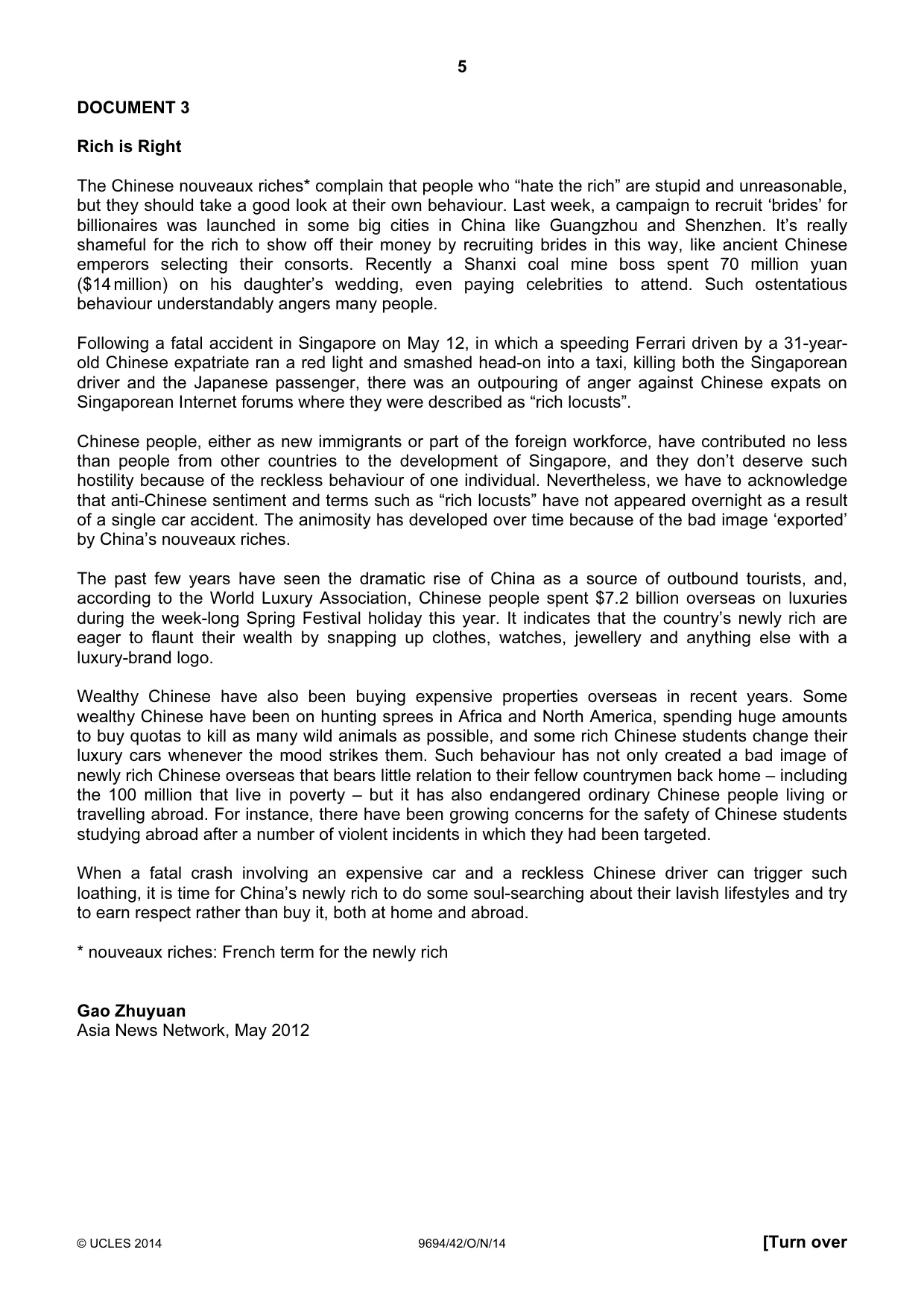
Question paper, page 5
5 © UCLES 2014 9694/42/O/N/14 [Turn over DOCUMENT 3 Rich is Right The Chinese nouveaux riches* complain that people who “hate the rich” are stupid and unreasonable, but they should take a good look at their own behaviour. Last week, a campaign to recruit ‘brides’ for billionaires was launched in some big cities in China like Guangzhou and Shenzhen. It’s really shameful for the rich to show off their money by recruiting brides in this way, like ancient Chinese emperors selecting their consorts. Recently a Shanxi coal mine boss spent 70 million yuan ($14 million) on his daughter’s wedding, even paying celebrities to attend. Such ostentatious behaviour understandably angers many people. Following a fatal accident in Singapore on May 12, in which a speeding Ferrari driven by a 31-year- old Chinese expatriate ran a red light and smashed head-on into a taxi, killing both the Singaporean driver and the Japanese passenger, there was an outpouring of anger against Chinese expats on Singaporean Internet forums where they were described as “rich locusts”. Chinese people, either as new immigrants or part of the foreign workforce, have contributed no less than people from other countries to the development of Singapore, and they don’t deserve such hostility because of the reckless behaviour of one individual. Nevertheless, we have to acknowledge that anti-Chinese sentiment and terms such as “rich locusts” have not appeared overnight as a result of a single car accident. The animosity has developed over time because of the bad image ‘exported’ by China’s nouveaux riches. The past few years have seen the dramatic rise of China as a source of outbound tourists, and, according to the World Luxury Association, Chinese people spent $7.2 billion overseas on luxuries during the week-long Spring Festival holiday this year. It indicates that the country’s newly rich are eager to flaunt their wealth by snapping up clothes, watches, jewellery and anything else with a luxury-brand logo. Wealthy Chinese have also been buying expensive properties overseas in recent years. Some wealthy Chinese have been on hunting sprees in Africa and North America, spending huge amounts to buy quotas to kill as many wild animals as possible, and some rich Chinese students change their luxury cars whenever the mood strikes them. Such behaviour has not only created a bad image of newly rich Chinese overseas that bears little relation to their fellow countrymen back home – including the 100 million that live in poverty – but it has also endangered ordinary Chinese people living or travelling abroad. For instance, there have been growing concerns for the safety of Chinese students studying abroad after a number of violent incidents in which they had been targeted. When a fatal crash involving an expensive car and a reckless Chinese driver can trigger such loathing, it is time for China’s newly rich to do some soul-searching about their lavish lifestyles and try to earn respect rather than buy it, both at home and abroad. * nouveaux riches: French term for the newly rich Gao Zhuyuan Asia News Network, May 2012
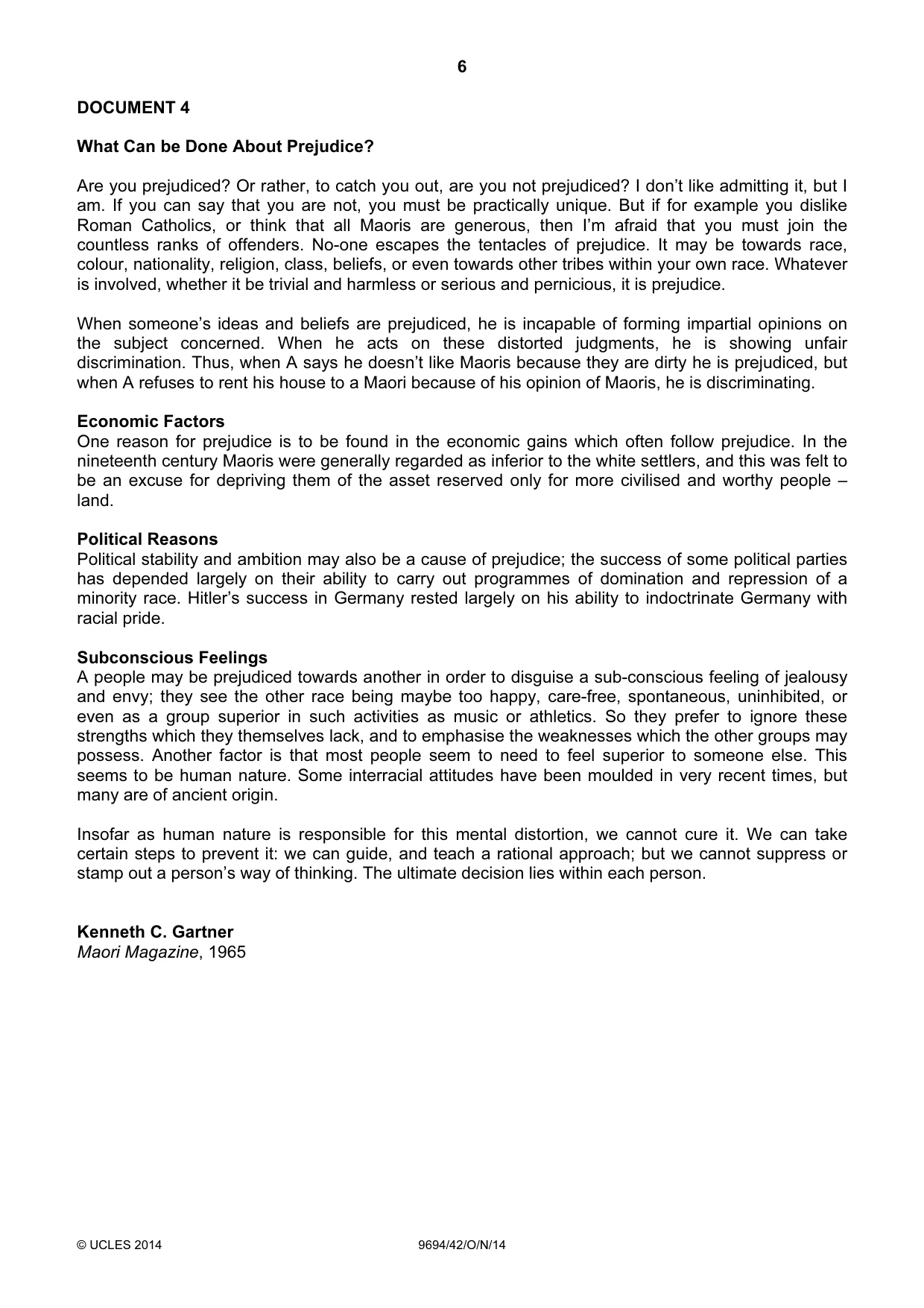
Question paper, page 6
6 © UCLES 2014 9694/42/O/N/14 DOCUMENT 4 What Can be Done About Prejudice? Are you prejudiced? Or rather, to catch you out, are you not prejudiced? I don’t like admitting it, but I am. If you can say that you are not, you must be practically unique. But if for example you dislike Roman Catholics, or think that all Maoris are generous, then I’m afraid that you must join the countless ranks of offenders. No-one escapes the tentacles of prejudice. It may be towards race, colour, nationality, religion, class, beliefs, or even towards other tribes within your own race. Whatever is involved, whether it be trivial and harmless or serious and pernicious, it is prejudice. When someone’s ideas and beliefs are prejudiced, he is incapable of forming impartial opinions on the subject concerned. When he acts on these distorted judgments, he is showing unfair discrimination. Thus, when A says he doesn’t like Maoris because they are dirty he is prejudiced, but when A refuses to rent his house to a Maori because of his opinion of Maoris, he is discriminating. Economic Factors One reason for prejudice is to be found in the economic gains which often follow prejudice. In the nineteenth century Maoris were generally regarded as inferior to the white settlers, and this was felt to be an excuse for depriving them of the asset reserved only for more civilised and worthy people – land. Political Reasons Political stability and ambition may also be a cause of prejudice; the success of some political parties has depended largely on their ability to carry out programmes of domination and repression of a minority race. Hitler’s success in Germany rested largely on his ability to indoctrinate Germany with racial pride. Subconscious Feelings A people may be prejudiced towards another in order to disguise a sub-conscious feeling of jealousy and envy; they see the other race being maybe too happy, care-free, spontaneous, uninhibited, or even as a group superior in such activities as music or athletics. So they prefer to ignore these strengths which they themselves lack, and to emphasise the weaknesses which the other groups may possess. Another factor is that most people seem to need to feel superior to someone else. This seems to be human nature. Some interracial attitudes have been moulded in very recent times, but many are of ancient origin. Insofar as human nature is responsible for this mental distortion, we cannot cure it. We can take certain steps to prevent it: we can guide, and teach a rational approach; but we cannot suppress or stamp out a person’s way of thinking. The ultimate decision lies within each person. Kenneth C. Gartner Maori Magazine, 1965
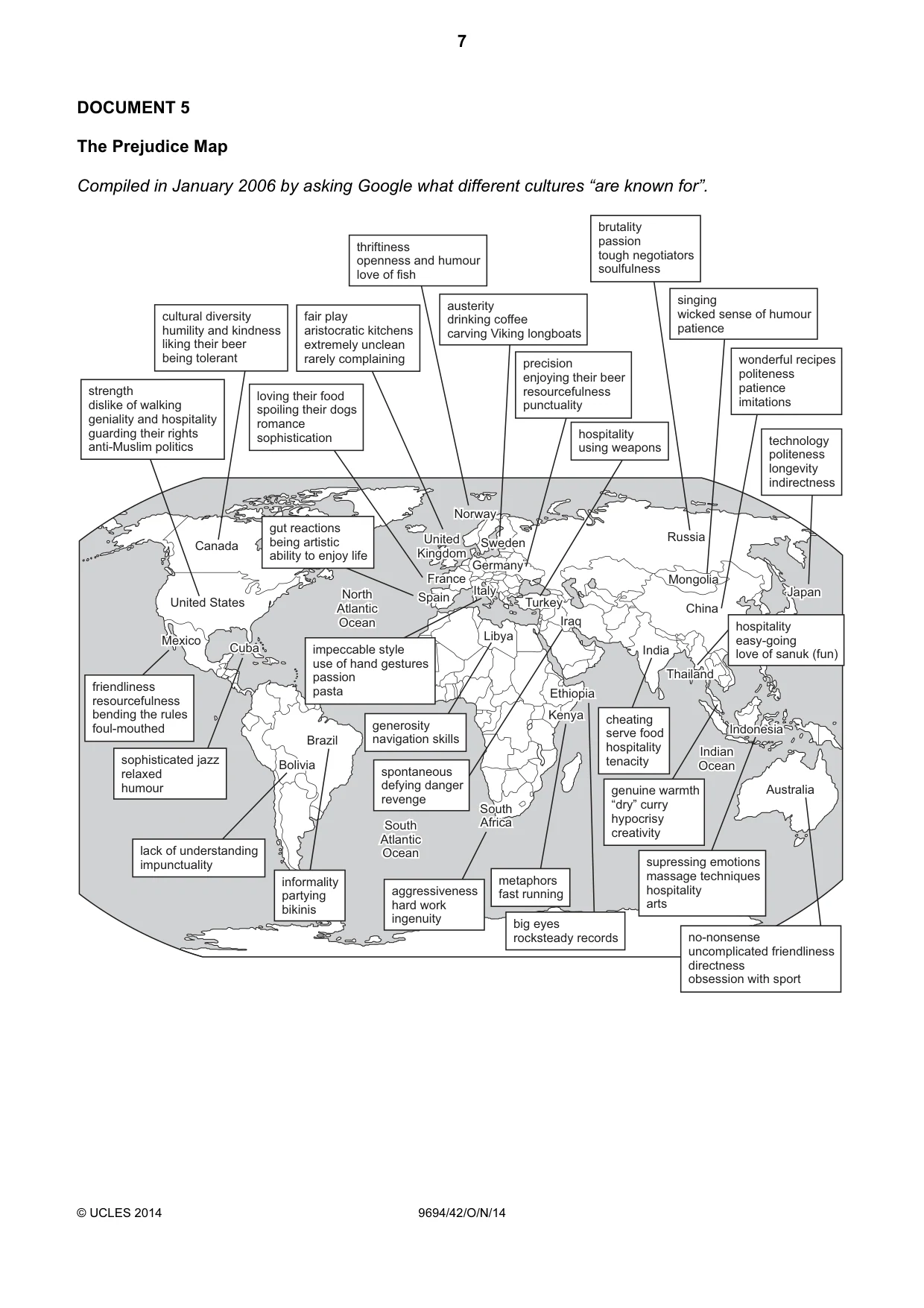
Question paper, page 7
7 © UCLES 2014 9694/42/O/N/14 DOCUMENT 5 The Prejudice Map Compiled in January 2006 by asking Google what different cultures “are known for”. United United Kingdom Kingdom Norway Norway Sweden Sweden Japan Japan Thailand Thailand Indonesia Indonesia Germany Germany France France Spain Spain Italy Italy Turkey Turkey Canada Canada United States United States Mexico Mexico Cuba Cuba Bolivia Bolivia South South Africa Africa Kenya Kenya Ethiopia Ethiopia Iraq Iraq Russia Mongolia China India Australia United Kingdom Norway Sweden Japan Thailand Indonesia Germany France Spain Italy Turkey Canada United States Mexico Cuba Brazil Bolivia Libya South Africa Kenya Ethiopia Iraq North North Atlantic Atlantic Ocean Ocean North Atlantic Ocean South South Atlantic Atlantic Ocean Ocean South Atlantic Ocean Indian Indian Ocean Ocean Indian Ocean strength dislike of walking geniality and hospitality guarding their rights anti-Muslim politics cultural diversity humility and kindness liking their beer being tolerant wonderful recipes politeness patience imitations technology politeness longevity indirectness precision enjoying their beer resourcefulness punctuality brutality passion tough negotiators soulfulness fair play aristocratic kitchens extremely unclean rarely complaining thriftiness openness and humour love of fish hospitality using weapons austerity drinking coffee carving Viking longboats singing wicked sense of humour patience loving their food spoiling their dogs romance sophistication gut reactions being artistic ability to enjoy life friendliness resourcefulness bending the rules foul-mouthed genuine warmth “dry” curry hypocrisy creativity supressing emotions massage techniques hospitality arts cheating serve food hospitality tenacity no-nonsense uncomplicated friendliness directness obsession with sport impeccable style use of hand gestures passion pasta sophisticated jazz relaxed humour hospitality easy-going love of sanuk (fun) spontaneous defying danger revenge aggressiveness hard work ingenuity informality partying bikinis lack of understanding impunctuality big eyes rocksteady records metaphors fast running generosity navigation skills
Question paper, page 8
8 Copyright Acknowledgements: Document 2 Document 3 Document 4 Document 5 © Charlene Fang; Singapore curry debate on the nose; http://www.cnngo.com/singapore/life/charlene-fang-much-ado-about-curry-267551. © Gao Zhuyuan; My Paper; China Daily/Asia News Network; 30 May 2012. © Kenneth C. Gartner; Te Ao Hou; The Maori Magazine; http://teaohou.natlib.govt.nz /journals/teahou/issue/Mao52TeA/c4.html; No.52, September 1965; © http://kottke.org/06/01/a-world-map-of-cultural-prejudices-compiled; http://blogoscoped.com/archive/2006-01-11-n83.html. Permission to reproduce items where third-party owned material protected by copyright is included has been sought and cleared where possible. Every reasonable effort has been made by the publisher (UCLES) to trace copyright holders, but if any items requiring clearance have unwittingly been included, the publisher will be pleased to make amends at the earliest possible opportunity. Cambridge International Examinations is part of the Cambridge Assessment Group. Cambridge Assessment is the brand name of University of Cambridge Local Examinations Syndicate (UCLES), which is itself a department of the University of Cambridge. © UCLES 2014 9694/42/O/N/14 BLANK PAGE
Mark scheme, page 1
® IGCSE is the registered trademark of Cambridge International Examinations. CAMBRIDGE INTERNATIONAL EXAMINATIONS Cambridge International Advanced Level MARK SCHEME for the October/November 2014 series 9694 THINKING SKILLS 9694/42 Paper 4 (Applied Reasoning), maximum raw mark 50 This mark scheme is published as an aid to teachers and candidates, to indicate the requirements of the examination. It shows the basis on which Examiners were instructed to award marks. It does not indicate the details of the discussions that took place at an Examiners’ meeting before marking began, which would have considered the acceptability of alternative answers. Mark schemes should be read in conjunction with the question paper and the Principal Examiner Report for Teachers. Cambridge will not enter into discussions about these mark schemes. Cambridge is publishing the mark schemes for the October/November 2014 series for most Cambridge IGCSE®, Cambridge International A and AS Level components and some Cambridge O Level components.
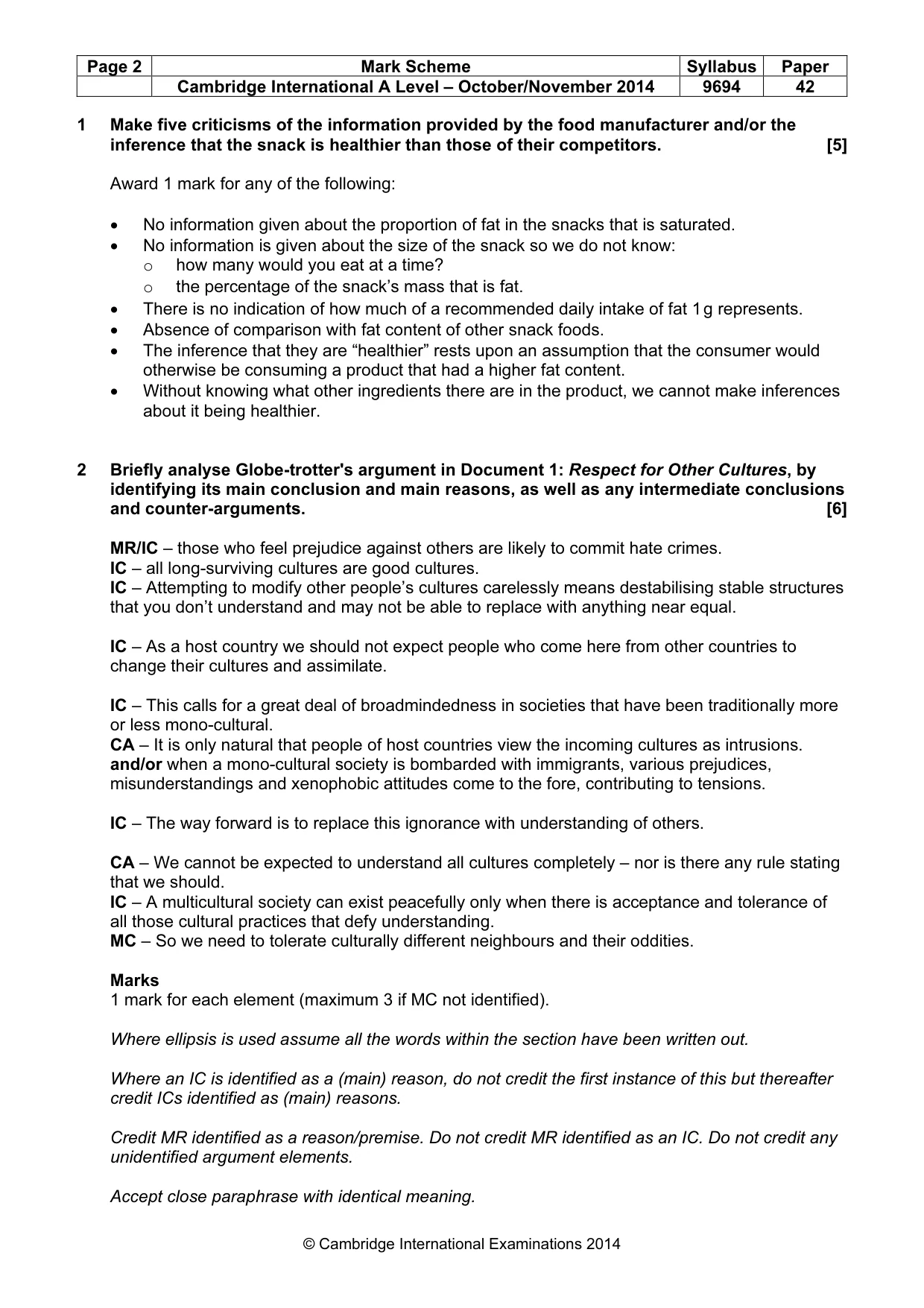
Mark scheme, page 2
Page 2 Mark Scheme Syllabus Paper Cambridge International A Level – October/November 2014 9694 42 © Cambridge International Examinations 2014 1 Make five criticisms of the information provided by the food manufacturer and/or the inference that the snack is healthier than those of their competitors. [5] Award 1 mark for any of the following: • No information given about the proportion of fat in the snacks that is saturated. • No information is given about the size of the snack so we do not know: o how many would you eat at a time? o the percentage of the snack’s mass that is fat. • There is no indication of how much of a recommended daily intake of fat 1 g represents. • Absence of comparison with fat content of other snack foods. • The inference that they are “healthier” rests upon an assumption that the consumer would otherwise be consuming a product that had a higher fat content. • Without knowing what other ingredients there are in the product, we cannot make inferences about it being healthier. 2 Briefly analyse Globe-trotter's argument in Document 1: Respect for Other Cultures, by identifying its main conclusion and main reasons, as well as any intermediate conclusions and counter-arguments. [6] MR/IC – those who feel prejudice against others are likely to commit hate crimes. IC – all long-surviving cultures are good cultures. IC – Attempting to modify other people’s cultures carelessly means destabilising stable structures that you don’t understand and may not be able to replace with anything near equal. IC – As a host country we should not expect people who come here from other countries to change their cultures and assimilate. IC – This calls for a great deal of broadmindedness in societies that have been traditionally more or less mono-cultural. CA – It is only natural that people of host countries view the incoming cultures as intrusions. and/or when a mono-cultural society is bombarded with immigrants, various prejudices, misunderstandings and xenophobic attitudes come to the fore, contributing to tensions. IC – The way forward is to replace this ignorance with understanding of others. CA – We cannot be expected to understand all cultures completely – nor is there any rule stating that we should. IC – A multicultural society can exist peacefully only when there is acceptance and tolerance of all those cultural practices that defy understanding. MC – So we need to tolerate culturally different neighbours and their oddities. Marks 1 mark for each element (maximum 3 if MC not identified). Where ellipsis is used assume all the words within the section have been written out. Where an IC is identified as a (main) reason, do not credit the first instance of this but thereafter credit ICs identified as (main) reasons. Credit MR identified as a reason/premise. Do not credit MR identified as an IC. Do not credit any unidentified argument elements. Accept close paraphrase with identical meaning.
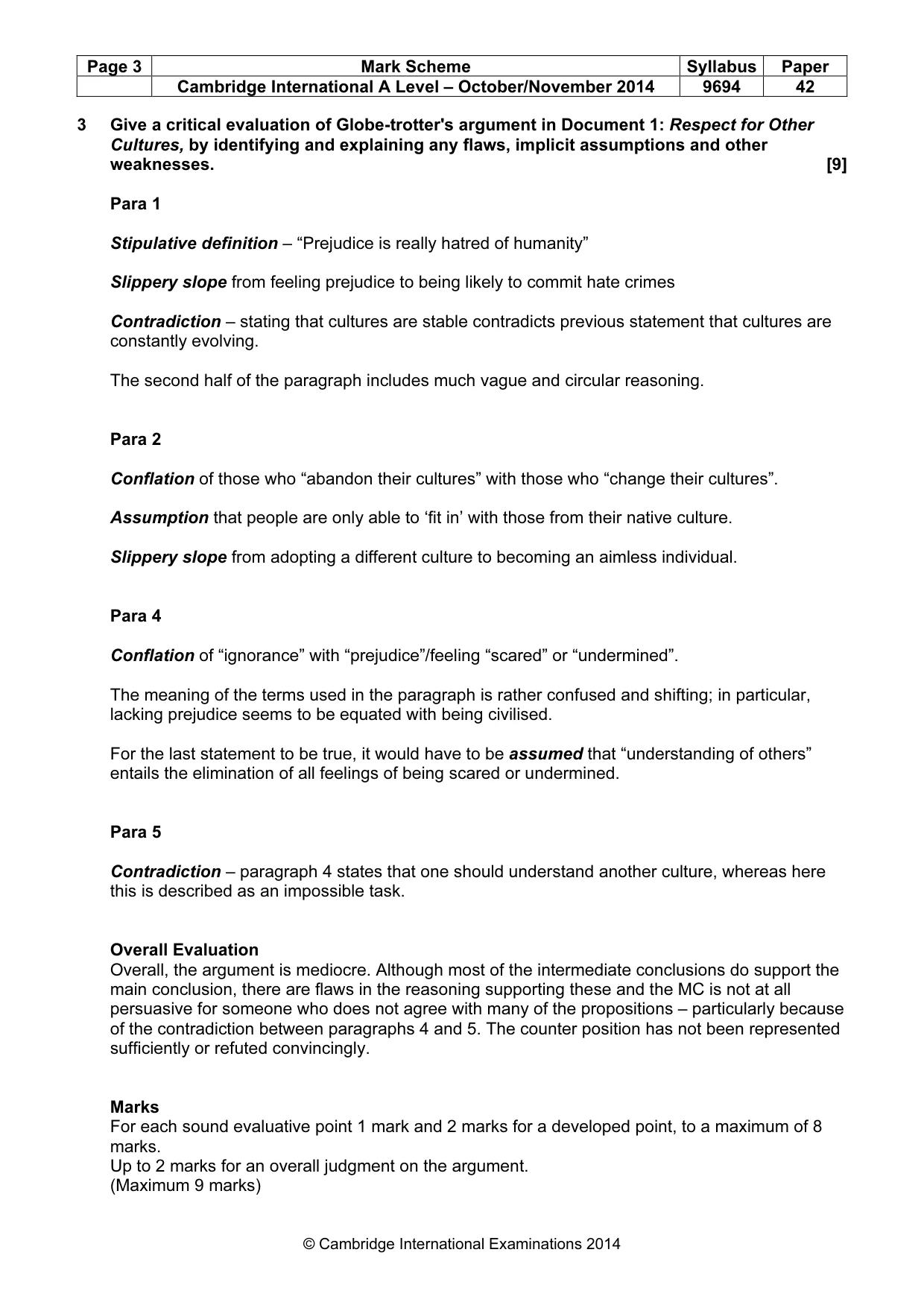
Mark scheme, page 3
Page 3 Mark Scheme Syllabus Paper Cambridge International A Level – October/November 2014 9694 42 © Cambridge International Examinations 2014 3 Give a critical evaluation of Globe-trotter's argument in Document 1: Respect for Other Cultures, by identifying and explaining any flaws, implicit assumptions and other weaknesses. [9] Para 1 Stipulative definition – “Prejudice is really hatred of humanity” Slippery slope from feeling prejudice to being likely to commit hate crimes Contradiction – stating that cultures are stable contradicts previous statement that cultures are constantly evolving. The second half of the paragraph includes much vague and circular reasoning. Para 2 Conflation of those who “abandon their cultures” with those who “change their cultures”. Assumption that people are only able to ‘fit in’ with those from their native culture. Slippery slope from adopting a different culture to becoming an aimless individual. Para 4 Conflation of “ignorance” with “prejudice”/feeling “scared” or “undermined”. The meaning of the terms used in the paragraph is rather confused and shifting; in particular, lacking prejudice seems to be equated with being civilised. For the last statement to be true, it would have to be assumed that “understanding of others” entails the elimination of all feelings of being scared or undermined. Para 5 Contradiction – paragraph 4 states that one should understand another culture, whereas here this is described as an impossible task. Overall Evaluation Overall, the argument is mediocre. Although most of the intermediate conclusions do support the main conclusion, there are flaws in the reasoning supporting these and the MC is not at all persuasive for someone who does not agree with many of the propositions – particularly because of the contradiction between paragraphs 4 and 5. The counter position has not been represented sufficiently or refuted convincingly. Marks For each sound evaluative point 1 mark and 2 marks for a developed point, to a maximum of 8 marks. Up to 2 marks for an overall judgment on the argument. (Maximum 9 marks)
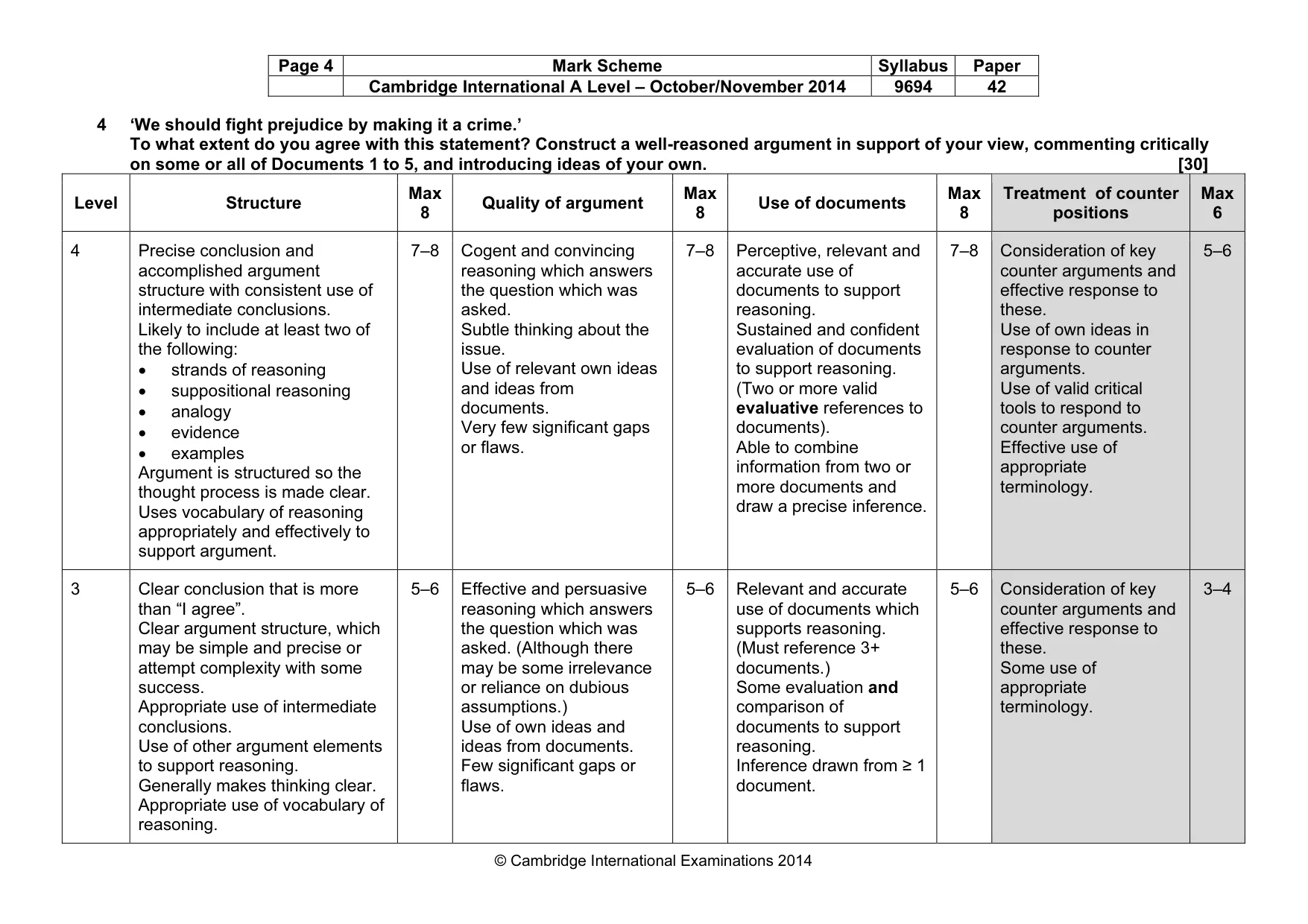
Mark scheme, page 4
Page 4 Mark Scheme Syllabus Paper Cambridge International A Level – October/November 2014 9694 42 © Cambridge International Examinations 2014 4 ‘We should fight prejudice by making it a crime.’ To what extent do you agree with this statement? Construct a well-reasoned argument in support of your view, commenting critically on some or all of Documents 1 to 5, and introducing ideas of your own. [30] Level Structure Max 8 Quality of argument Max 8 Use of documents Max 8 Treatment of counter positions Max 6 4 Precise conclusion and accomplished argument structure with consistent use of intermediate conclusions. Likely to include at least two of the following: • strands of reasoning • suppositional reasoning • analogy • evidence • examples Argument is structured so the thought process is made clear. Uses vocabulary of reasoning appropriately and effectively to support argument. 7–8 Cogent and convincing reasoning which answers the question which was asked. Subtle thinking about the issue. Use of relevant own ideas and ideas from documents. Very few significant gaps or flaws. 7–8 Perceptive, relevant and accurate use of documents to support reasoning. Sustained and confident evaluation of documents to support reasoning. (Two or more valid evaluative references to documents). Able to combine information from two or more documents and draw a precise inference. 7–8 Consideration of key counter arguments and effective response to these. Use of own ideas in response to counter arguments. Use of valid critical tools to respond to counter arguments. Effective use of appropriate terminology. 5–6 3 Clear conclusion that is more than “I agree”. Clear argument structure, which may be simple and precise or attempt complexity with some success. Appropriate use of intermediate conclusions. Use of other argument elements to support reasoning. Generally makes thinking clear. Appropriate use of vocabulary of reasoning. 5–6 Effective and persuasive reasoning which answers the question which was asked. (Although there may be some irrelevance or reliance on dubious assumptions.) Use of own ideas and ideas from documents. Few significant gaps or flaws. 5–6 Relevant and accurate use of documents which supports reasoning. (Must reference 3+ documents.) Some evaluation and comparison of documents to support reasoning. Inference drawn from ≥ 1 document. 5–6 Consideration of key counter arguments and effective response to these. Some use of appropriate terminology. 3–4
Mark scheme, page 5
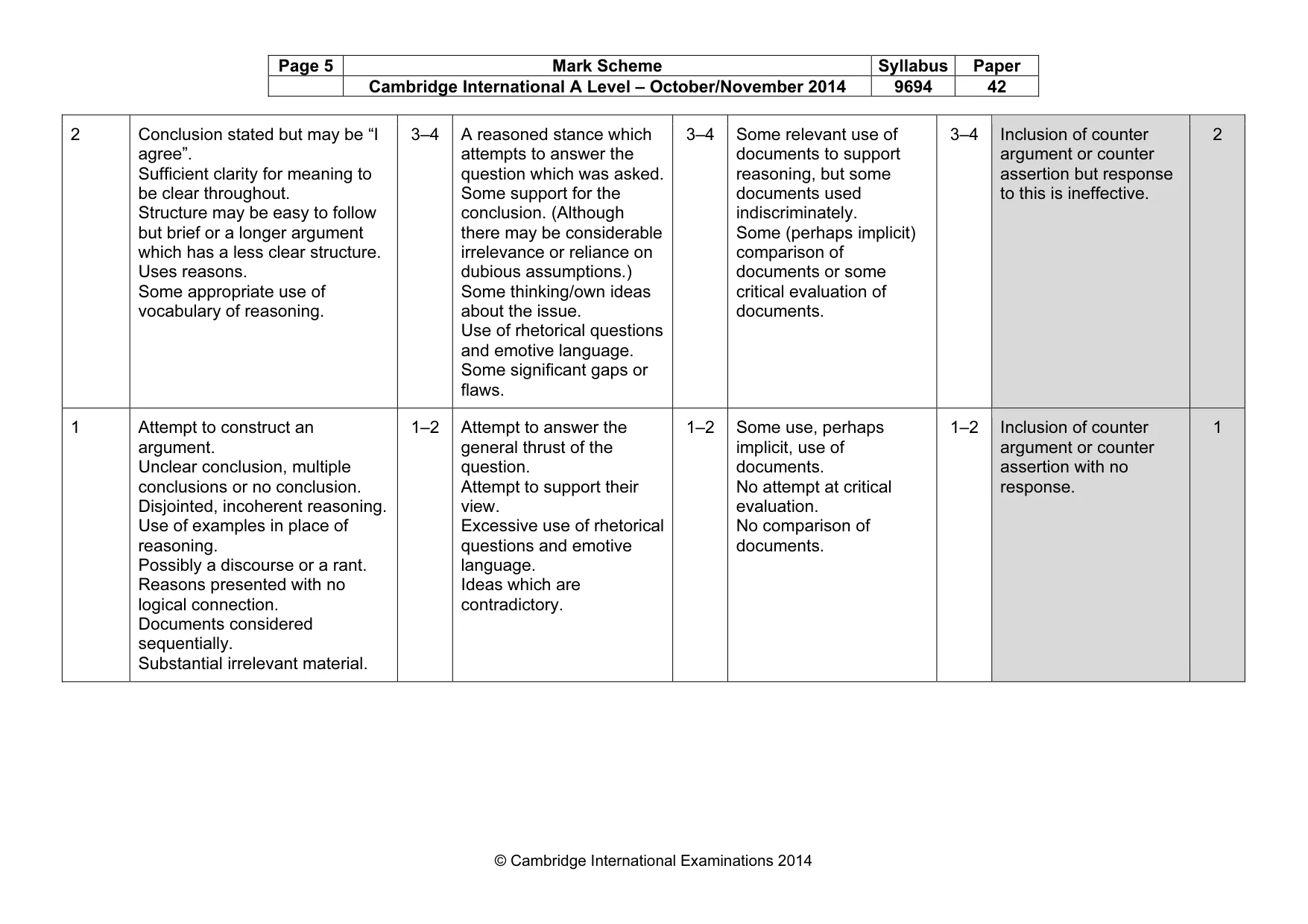
Page 5 Mark Scheme Syllabus Paper Cambridge International A Level – October/November 2014 9694 42 © Cambridge International Examinations 2014 2 Conclusion stated but may be “I agree”. Sufficient clarity for meaning to be clear throughout. Structure may be easy to follow but brief or a longer argument which has a less clear structure. Uses reasons. Some appropriate use of vocabulary of reasoning. 3–4 A reasoned stance which attempts to answer the question which was asked. Some support for the conclusion. (Although there may be considerable irrelevance or reliance on dubious assumptions.) Some thinking/own ideas about the issue. Use of rhetorical questions and emotive language. Some significant gaps or flaws. 3–4 Some relevant use of documents to support reasoning, but some documents used indiscriminately. Some (perhaps implicit) comparison of documents or some critical evaluation of documents. 3–4 Inclusion of counter argument or counter assertion but response to this is ineffective. 2 1 Attempt to construct an argument. Unclear conclusion, multiple conclusions or no conclusion. Disjointed, incoherent reasoning. Use of examples in place of reasoning. Possibly a discourse or a rant. Reasons presented with no logical connection. Documents considered sequentially. Substantial irrelevant material. 1–2 Attempt to answer the general thrust of the question. Attempt to support their view. Excessive use of rhetorical questions and emotive language. Ideas which are contradictory. 1–2 Some use, perhaps implicit, use of documents. No attempt at critical evaluation. No comparison of documents. 1–2 Inclusion of counter argument or counter assertion with no response. 1
What you needed in this session
Cambridge’s own grade thresholds for 2014 Oct/Nov, Paper 4 · Variant 2. A higher threshold means an easier paper — the bar moves with how the cohort did.