Cambridge A Level Thinking Skills 9694 — 2013 Oct/Nov Paper 4 · Variant 1
9694/41/O/N/13 · 50 marks · ≈56 min
The question paper and its mark scheme, free to read here and free to download. This is Cambridge’s own paper, exactly as it was sat.
Question paper8 pages
Mark scheme6 pages
Answers below. Sit the paper first if you are practising.
Paper as text
Question paper, page 1
This document consists of 7 printed pages and 1 blank page. IB13 11_9694_41/2RP © UCLES 2013 [Turn over *8674622715* UNIVERSITY OF CAMBRIDGE INTERNATIONAL EXAMINATIONS General Certificate of Education Advanced Level THINKING SKILLS 9694/41 Paper 4 Applied Reasoning October/November 2013 1 hour 30 minutes Additional Materials: Answer Booklet/Paper READ THESE INSTRUCTIONS FIRST If you have been given an Answer Booklet, follow the instructions on the front cover of the booklet. Write your Centre number, candidate number and name on all the work you hand in. Write in dark blue or black pen. Do not use staples, paper clips, highlighters, glue or correction fluid. DO NOT WRITE IN ANY BARCODES. Answer all the questions. Start each question on a new answer sheet. At the end of the examination, fasten all your work securely together. The number of marks is given in brackets [ ] at the end of each question.
Question paper, page 2
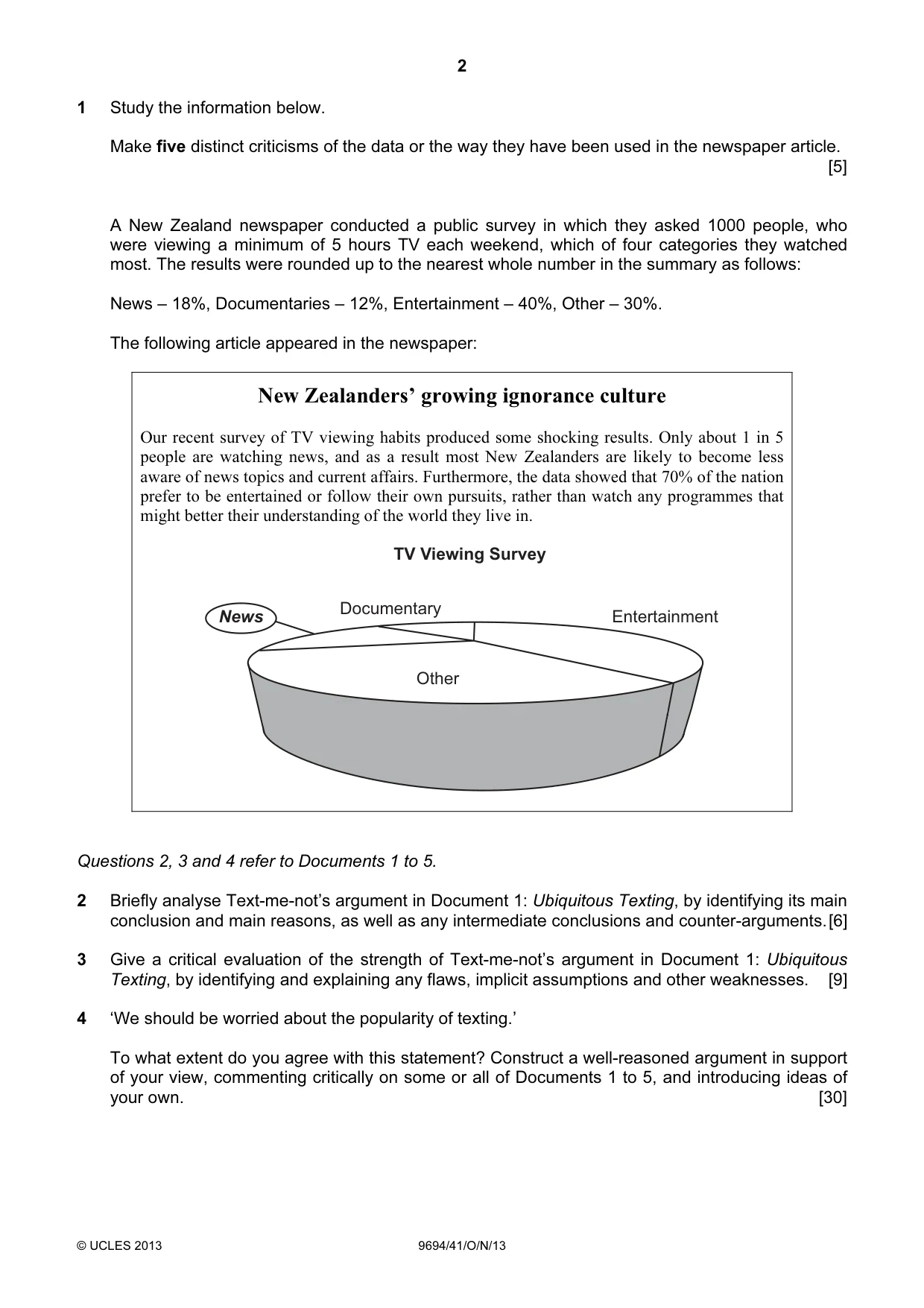
2 © UCLES 2013 9694/41/O/N/13 1 Study the information below. Make five distinct criticisms of the data or the way they have been used in the newspaper article. [5] A New Zealand newspaper conducted a public survey in which they asked 1000 people, who were viewing a minimum of 5 hours TV each weekend, which of four categories they watched most. The results were rounded up to the nearest whole number in the summary as follows: News – 18%, Documentaries – 12%, Entertainment – 40%, Other – 30%. The following article appeared in the newspaper: New Zealanders’ growing ignorance culture Our recent survey of TV viewing habits produced some shocking results. Only about 1 in 5 people are watching news, and as a result most New Zealanders are likely to become less aware of news topics and current affairs. Furthermore, the data showed that 70% of the nation prefer to be entertained or follow their own pursuits, rather than watch any programmes that might better their understanding of the world they live in. TV Viewing Survey Other Documentary Entertainment News Questions 2, 3 and 4 refer to Documents 1 to 5. 2 Briefly analyse Text-me-not’s argument in Document 1: Ubiquitous Texting, by identifying its main conclusion and main reasons, as well as any intermediate conclusions and counter-arguments. [6] 3 Give a critical evaluation of the strength of Text-me-not’s argument in Document 1: Ubiquitous Texting, by identifying and explaining any flaws, implicit assumptions and other weaknesses. [9] 4 ‘We should be worried about the popularity of texting.’ To what extent do you agree with this statement? Construct a well-reasoned argument in support of your view, commenting critically on some or all of Documents 1 to 5, and introducing ideas of your own. [30]
Question paper, page 3
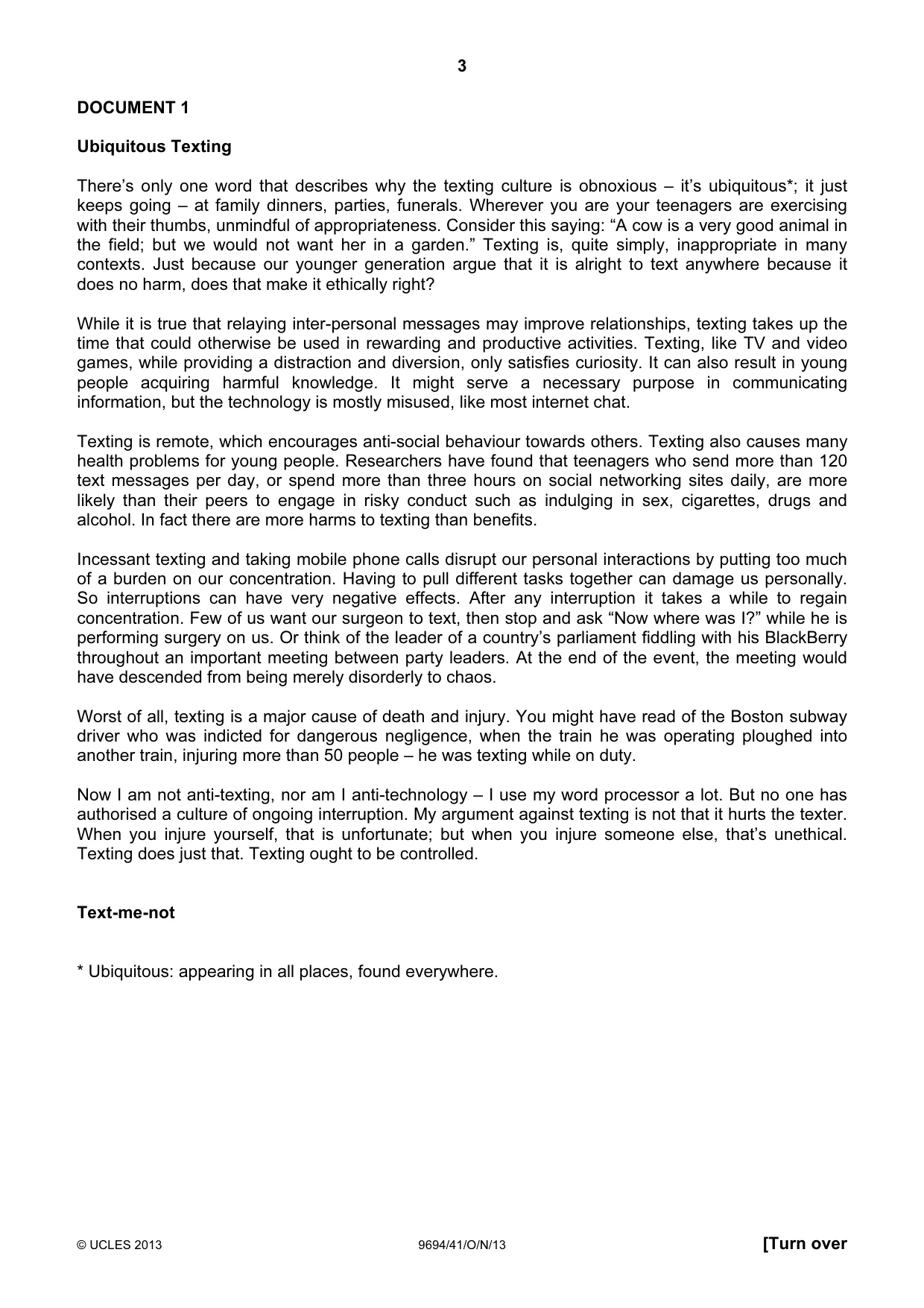
3 © UCLES 2013 9694/41/O/N/13 [Turn over DOCUMENT 1 Ubiquitous Texting There’s only one word that describes why the texting culture is obnoxious – it’s ubiquitous*; it just keeps going – at family dinners, parties, funerals. Wherever you are your teenagers are exercising with their thumbs, unmindful of appropriateness. Consider this saying: “A cow is a very good animal in the field; but we would not want her in a garden.” Texting is, quite simply, inappropriate in many contexts. Just because our younger generation argue that it is alright to text anywhere because it does no harm, does that make it ethically right? While it is true that relaying inter-personal messages may improve relationships, texting takes up the time that could otherwise be used in rewarding and productive activities. Texting, like TV and video games, while providing a distraction and diversion, only satisfies curiosity. It can also result in young people acquiring harmful knowledge. It might serve a necessary purpose in communicating information, but the technology is mostly misused, like most internet chat. Texting is remote, which encourages anti-social behaviour towards others. Texting also causes many health problems for young people. Researchers have found that teenagers who send more than 120 text messages per day, or spend more than three hours on social networking sites daily, are more likely than their peers to engage in risky conduct such as indulging in sex, cigarettes, drugs and alcohol. In fact there are more harms to texting than benefits. Incessant texting and taking mobile phone calls disrupt our personal interactions by putting too much of a burden on our concentration. Having to pull different tasks together can damage us personally. So interruptions can have very negative effects. After any interruption it takes a while to regain concentration. Few of us want our surgeon to text, then stop and ask “Now where was I?” while he is performing surgery on us. Or think of the leader of a country’s parliament fiddling with his BlackBerry throughout an important meeting between party leaders. At the end of the event, the meeting would have descended from being merely disorderly to chaos. Worst of all, texting is a major cause of death and injury. You might have read of the Boston subway driver who was indicted for dangerous negligence, when the train he was operating ploughed into another train, injuring more than 50 people – he was texting while on duty. Now I am not anti-texting, nor am I anti-technology – I use my word processor a lot. But no one has authorised a culture of ongoing interruption. My argument against texting is not that it hurts the texter. When you injure yourself, that is unfortunate; but when you injure someone else, that’s unethical. Texting does just that. Texting ought to be controlled. Text-me-not * Ubiquitous: appearing in all places, found everywhere.
Question paper, page 4
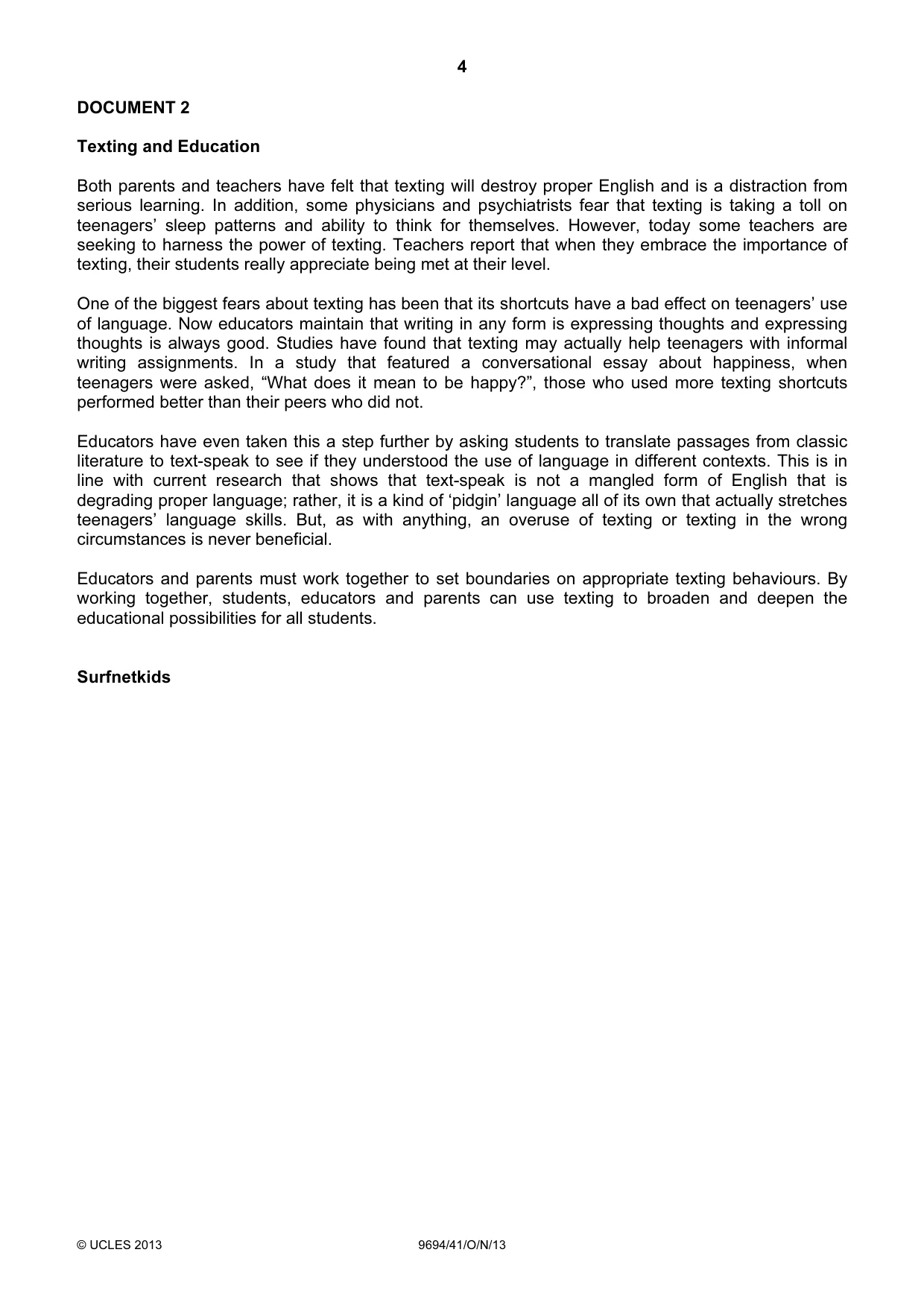
4 © UCLES 2013 9694/41/O/N/13 DOCUMENT 2 Texting and Education Both parents and teachers have felt that texting will destroy proper English and is a distraction from serious learning. In addition, some physicians and psychiatrists fear that texting is taking a toll on teenagers’ sleep patterns and ability to think for themselves. However, today some teachers are seeking to harness the power of texting. Teachers report that when they embrace the importance of texting, their students really appreciate being met at their level. One of the biggest fears about texting has been that its shortcuts have a bad effect on teenagers’ use of language. Now educators maintain that writing in any form is expressing thoughts and expressing thoughts is always good. Studies have found that texting may actually help teenagers with informal writing assignments. In a study that featured a conversational essay about happiness, when teenagers were asked, “What does it mean to be happy?”, those who used more texting shortcuts performed better than their peers who did not. Educators have even taken this a step further by asking students to translate passages from classic literature to text-speak to see if they understood the use of language in different contexts. This is in line with current research that shows that text-speak is not a mangled form of English that is degrading proper language; rather, it is a kind of ‘pidgin’ language all of its own that actually stretches teenagers’ language skills. But, as with anything, an overuse of texting or texting in the wrong circumstances is never beneficial. Educators and parents must work together to set boundaries on appropriate texting behaviours. By working together, students, educators and parents can use texting to broaden and deepen the educational possibilities for all students. Surfnetkids
Question paper, page 5
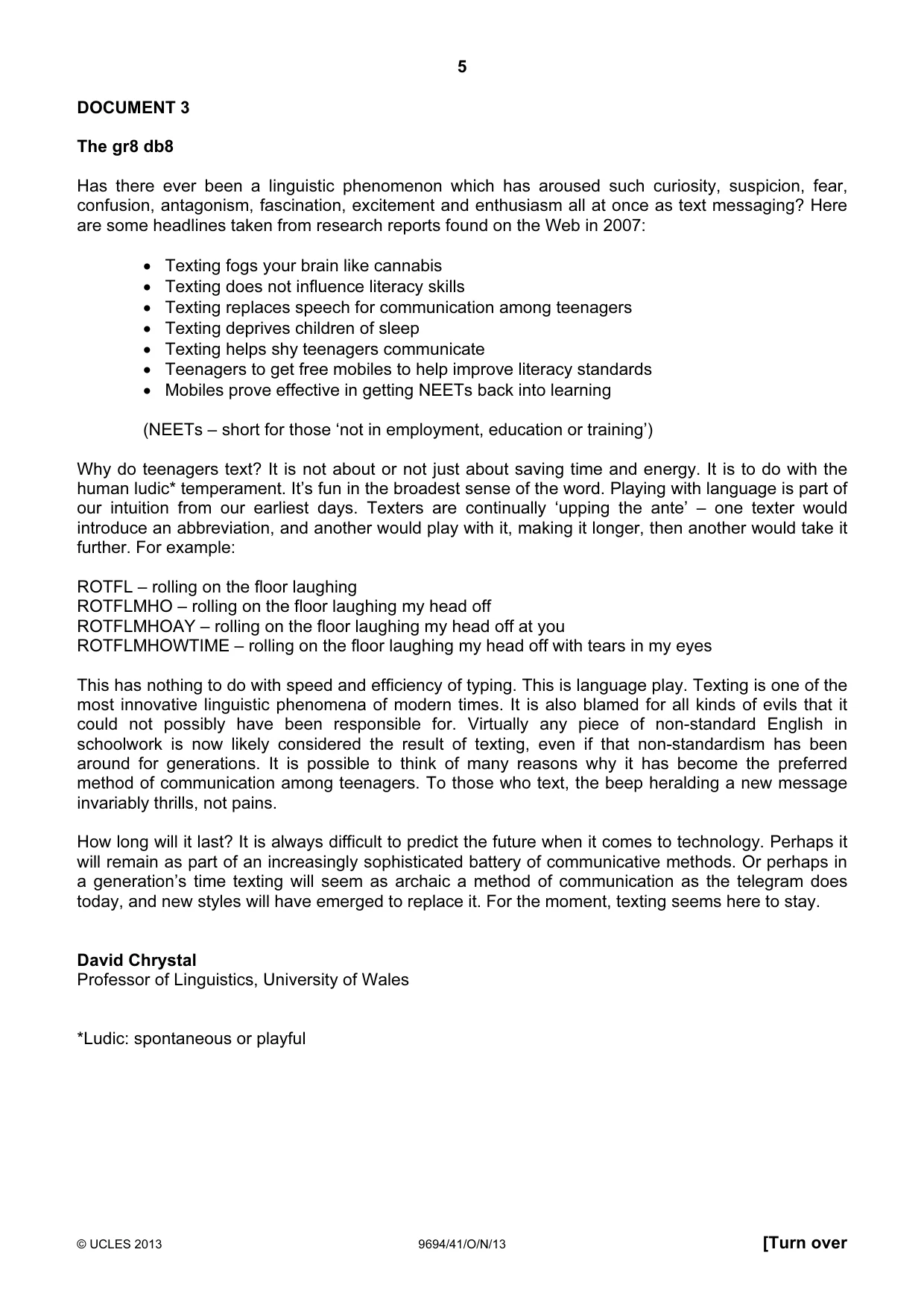
5 © UCLES 2013 9694/41/O/N/13 [Turn over DOCUMENT 3 The gr8 db8 Has there ever been a linguistic phenomenon which has aroused such curiosity, suspicion, fear, confusion, antagonism, fascination, excitement and enthusiasm all at once as text messaging? Here are some headlines taken from research reports found on the Web in 2007: • Texting fogs your brain like cannabis • Texting does not influence literacy skills • Texting replaces speech for communication among teenagers • Texting deprives children of sleep • Texting helps shy teenagers communicate • Teenagers to get free mobiles to help improve literacy standards • Mobiles prove effective in getting NEETs back into learning (NEETs – short for those ‘not in employment, education or training’) Why do teenagers text? It is not about or not just about saving time and energy. It is to do with the human ludic* temperament. It’s fun in the broadest sense of the word. Playing with language is part of our intuition from our earliest days. Texters are continually ‘upping the ante’ – one texter would introduce an abbreviation, and another would play with it, making it longer, then another would take it further. For example: ROTFL – rolling on the floor laughing ROTFLMHO – rolling on the floor laughing my head off ROTFLMHOAY – rolling on the floor laughing my head off at you ROTFLMHOWTIME – rolling on the floor laughing my head off with tears in my eyes This has nothing to do with speed and efficiency of typing. This is language play. Texting is one of the most innovative linguistic phenomena of modern times. It is also blamed for all kinds of evils that it could not possibly have been responsible for. Virtually any piece of non-standard English in schoolwork is now likely considered the result of texting, even if that non-standardism has been around for generations. It is possible to think of many reasons why it has become the preferred method of communication among teenagers. To those who text, the beep heralding a new message invariably thrills, not pains. How long will it last? It is always difficult to predict the future when it comes to technology. Perhaps it will remain as part of an increasingly sophisticated battery of communicative methods. Or perhaps in a generation’s time texting will seem as archaic a method of communication as the telegram does today, and new styles will have emerged to replace it. For the moment, texting seems here to stay. David Chrystal Professor of Linguistics, University of Wales *Ludic: spontaneous or playful
Question paper, page 6
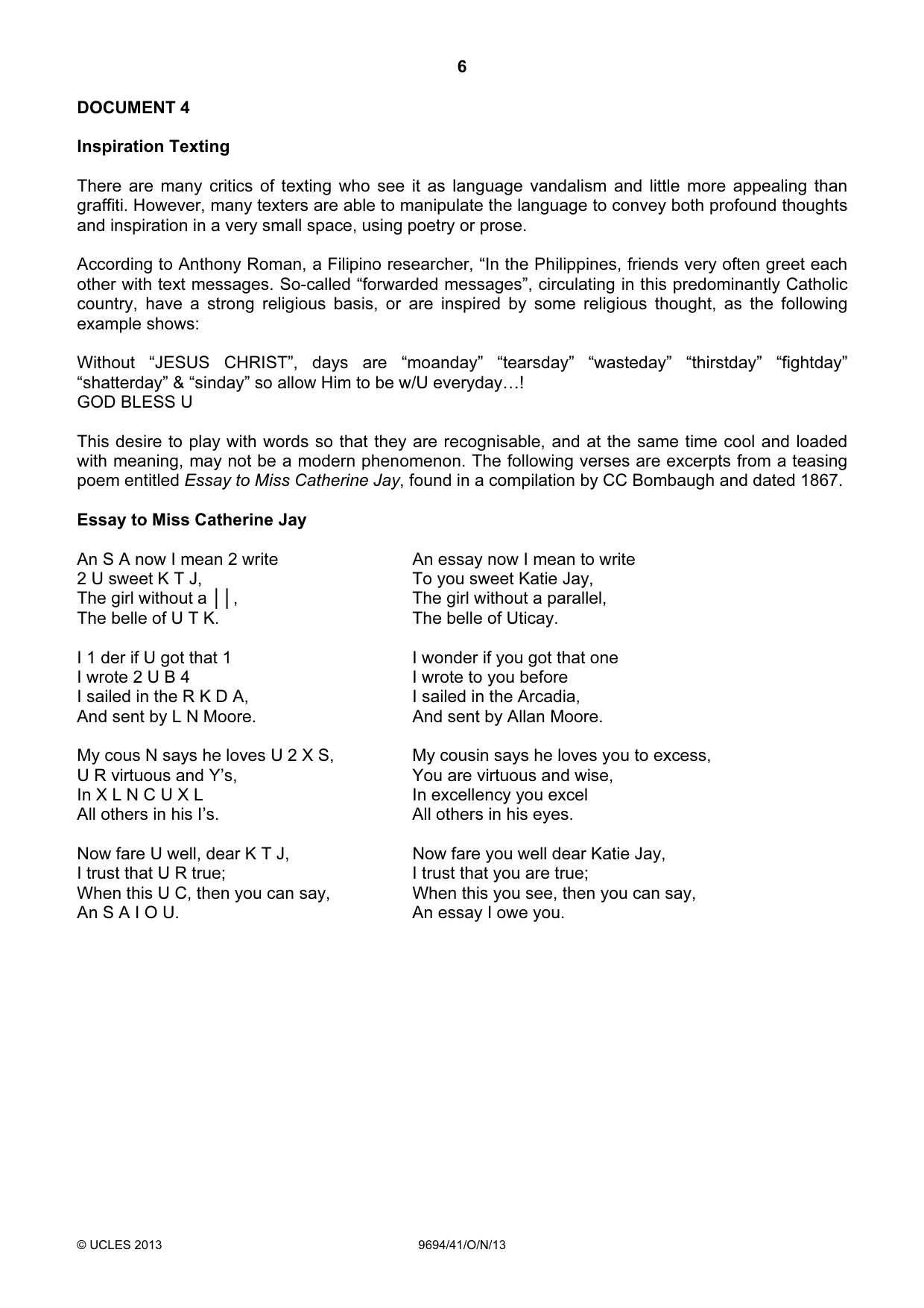
6 © UCLES 2013 9694/41/O/N/13 DOCUMENT 4 Inspiration Texting There are many critics of texting who see it as language vandalism and little more appealing than graffiti. However, many texters are able to manipulate the language to convey both profound thoughts and inspiration in a very small space, using poetry or prose. According to Anthony Roman, a Filipino researcher, “In the Philippines, friends very often greet each other with text messages. So-called “forwarded messages”, circulating in this predominantly Catholic country, have a strong religious basis, or are inspired by some religious thought, as the following example shows: Without “JESUS CHRIST”, days are “moanday” “tearsday” “wasteday” “thirstday” “fightday” “shatterday” & “sinday” so allow Him to be w/U everyday…! GOD BLESS U This desire to play with words so that they are recognisable, and at the same time cool and loaded with meaning, may not be a modern phenomenon. The following verses are excerpts from a teasing poem entitled Essay to Miss Catherine Jay, found in a compilation by CC Bombaugh and dated 1867. Essay to Miss Catherine Jay An S A now I mean 2 write An essay now I mean to write 2 U sweet K T J, To you sweet Katie Jay, The girl without a ││, The girl without a parallel, The belle of U T K. The belle of Uticay. I 1 der if U got that 1 I wonder if you got that one I wrote 2 U B 4 I wrote to you before I sailed in the R K D A, I sailed in the Arcadia, And sent by L N Moore. And sent by Allan Moore. My cous N says he loves U 2 X S, My cousin says he loves you to excess, U R virtuous and Y’s, You are virtuous and wise, In X L N C U X L In excellency you excel All others in his I’s. All others in his eyes. Now fare U well, dear K T J, Now fare you well dear Katie Jay, I trust that U R true; I trust that you are true; When this U C, then you can say, When this you see, then you can say, An S A I O U. An essay I owe you.
Question paper, page 7
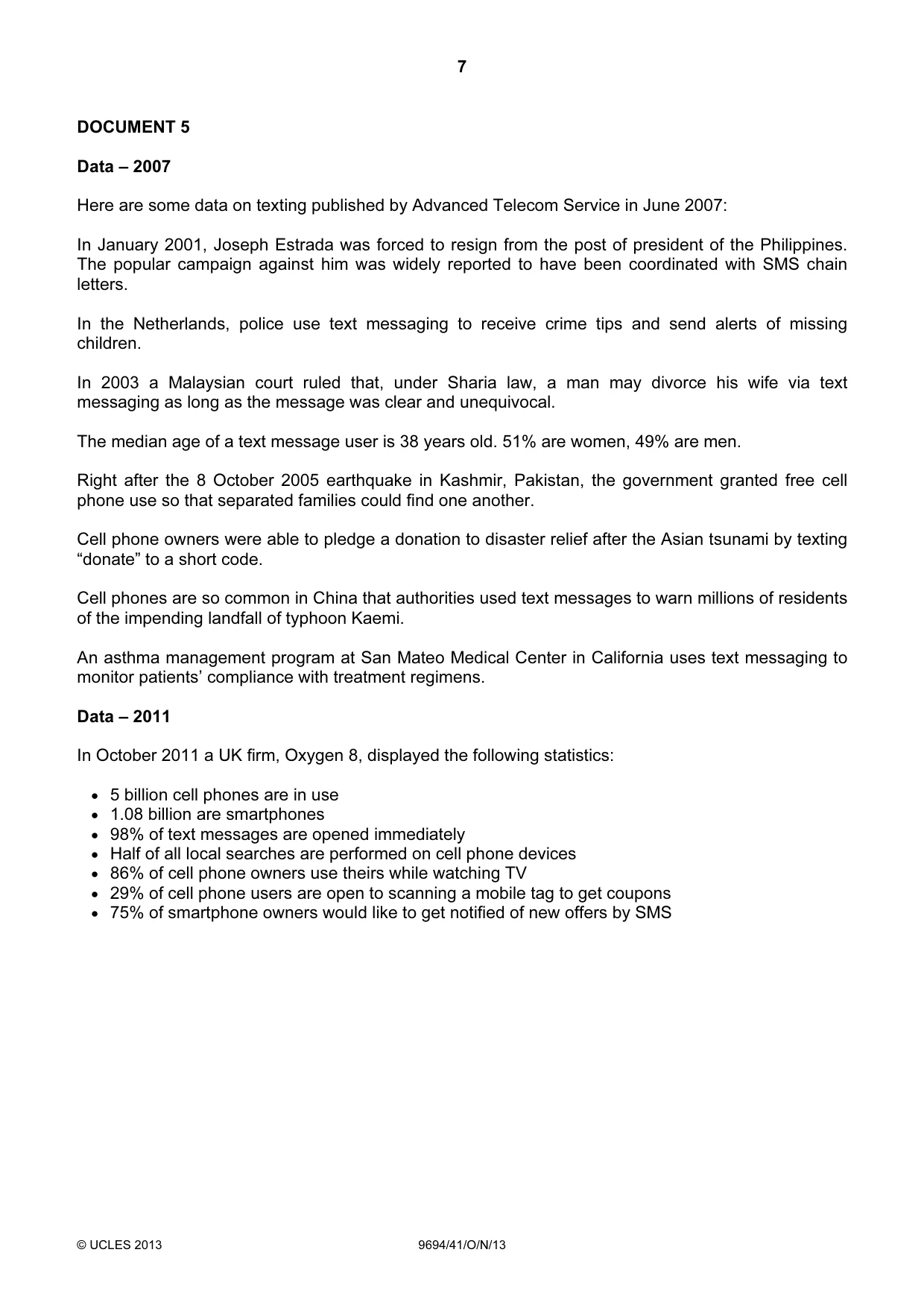
7 © UCLES 2013 9694/41/O/N/13 DOCUMENT 5 Data – 2007 Here are some data on texting published by Advanced Telecom Service in June 2007: In January 2001, Joseph Estrada was forced to resign from the post of president of the Philippines. The popular campaign against him was widely reported to have been coordinated with SMS chain letters. In the Netherlands, police use text messaging to receive crime tips and send alerts of missing children. In 2003 a Malaysian court ruled that, under Sharia law, a man may divorce his wife via text messaging as long as the message was clear and unequivocal. The median age of a text message user is 38 years old. 51% are women, 49% are men. Right after the 8 October 2005 earthquake in Kashmir, Pakistan, the government granted free cell phone use so that separated families could find one another. Cell phone owners were able to pledge a donation to disaster relief after the Asian tsunami by texting “donate” to a short code. Cell phones are so common in China that authorities used text messages to warn millions of residents of the impending landfall of typhoon Kaemi. An asthma management program at San Mateo Medical Center in California uses text messaging to monitor patients’ compliance with treatment regimens. Data – 2011 In October 2011 a UK firm, Oxygen 8, displayed the following statistics: • 5 billion cell phones are in use • 1.08 billion are smartphones • 98% of text messages are opened immediately • Half of all local searches are performed on cell phone devices • 86% of cell phone owners use theirs while watching TV • 29% of cell phone users are open to scanning a mobile tag to get coupons • 75% of smartphone owners would like to get notified of new offers by SMS
Question paper, page 8
8 Copyright Acknowledgements: Document 2 Document 3 Document 4 Source 1 Document 5 Source 1 Document 5 Source 2 © http://www.surfnetkids.com/go/safety/673/texting-and-education-what-teachers-are-saying-about-kids-who-text/. © adapted: David Chrystal; Txtng: The gr8db8; Oxford University Press; 2008. © Anthony G Roman; Texting God – SMS and Religion in the Philippines; http://www.freinademetzcenter.org/pdf/Texting%20God%20SMS%20and%20Religion%20in%20the%20Philippines.pdf. © The Text Message Blog; http://www.textmessageblog.mobi/2007/06/29/cell-phone-statistics/. © http://www.advancedtele.com/blog/. Permission to reproduce items where third-party owned material protected by copyright is included has been sought and cleared where possible. Every reasonable effort has been made by the publisher (UCLES) to trace copyright holders, but if any items requiring clearance have unwittingly been included, the publisher will be pleased to make amends at the earliest possible opportunity. University of Cambridge International Examinations is part of the Cambridge Assessment Group. Cambridge Assessment is the brand name of University of Cambridge Local Examinations Syndicate (UCLES), which is itself a department of the University of Cambridge. © UCLES 2013 9694/41/O/N/13 BLANK PAGE
Mark scheme, page 1
CAMBRIDGE INTERNATIONAL EXAMINATIONS GCE Advanced Level MARK SCHEME for the October/November 2013 series 9694 THINKING SKILLS 9694/41 Paper 4 (Applied Reasoning), maximum raw mark 50 This mark scheme is published as an aid to teachers and candidates, to indicate the requirements of the examination. It shows the basis on which Examiners were instructed to award marks. It does not indicate the details of the discussions that took place at an Examiners’ meeting before marking began, which would have considered the acceptability of alternative answers. Mark schemes should be read in conjunction with the question paper and the Principal Examiner Report for Teachers. Cambridge will not enter into discussions about these mark schemes. Cambridge is publishing the mark schemes for the October/November 2013 series for most IGCSE, GCE Advanced Level and Advanced Subsidiary Level components and some Ordinary Level components.
Mark scheme, page 2
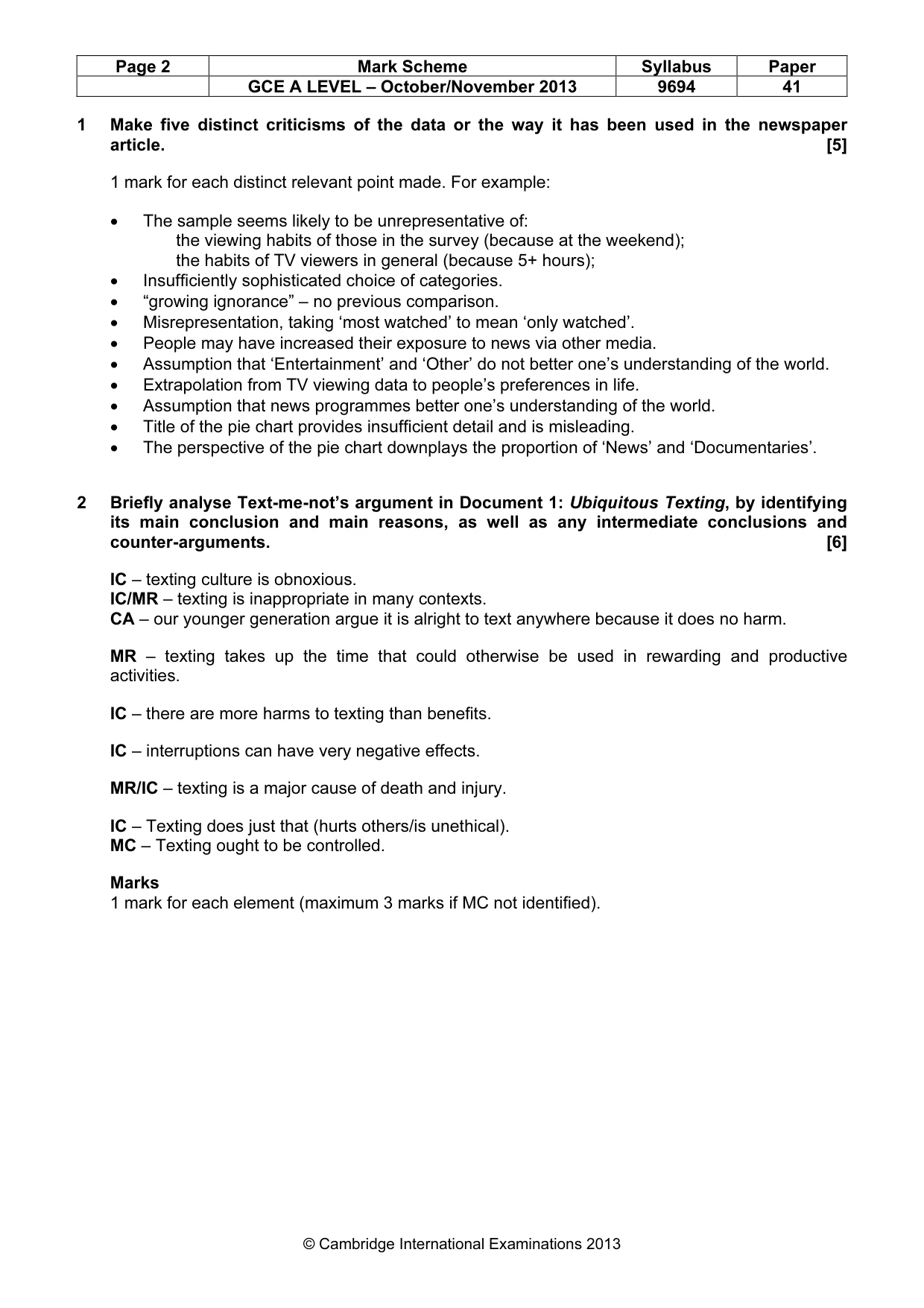
Page 2 Mark Scheme Syllabus Paper GCE A LEVEL – October/November 2013 9694 41 © Cambridge International Examinations 2013 1 Make five distinct criticisms of the data or the way it has been used in the newspaper article. [5] 1 mark for each distinct relevant point made. For example: • The sample seems likely to be unrepresentative of: the viewing habits of those in the survey (because at the weekend); the habits of TV viewers in general (because 5+ hours); • Insufficiently sophisticated choice of categories. • “growing ignorance” – no previous comparison. • Misrepresentation, taking ‘most watched’ to mean ‘only watched’. • People may have increased their exposure to news via other media. • Assumption that ‘Entertainment’ and ‘Other’ do not better one’s understanding of the world. • Extrapolation from TV viewing data to people’s preferences in life. • Assumption that news programmes better one’s understanding of the world. • Title of the pie chart provides insufficient detail and is misleading. • The perspective of the pie chart downplays the proportion of ‘News’ and ‘Documentaries’. 2 Briefly analyse Text-me-not’s argument in Document 1: Ubiquitous Texting, by identifying its main conclusion and main reasons, as well as any intermediate conclusions and counter-arguments. [6] IC – texting culture is obnoxious. IC/MR – texting is inappropriate in many contexts. CA – our younger generation argue it is alright to text anywhere because it does no harm. MR – texting takes up the time that could otherwise be used in rewarding and productive activities. IC – there are more harms to texting than benefits. IC – interruptions can have very negative effects. MR/IC – texting is a major cause of death and injury. IC – Texting does just that (hurts others/is unethical). MC – Texting ought to be controlled. Marks 1 mark for each element (maximum 3 marks if MC not identified).
Mark scheme, page 3
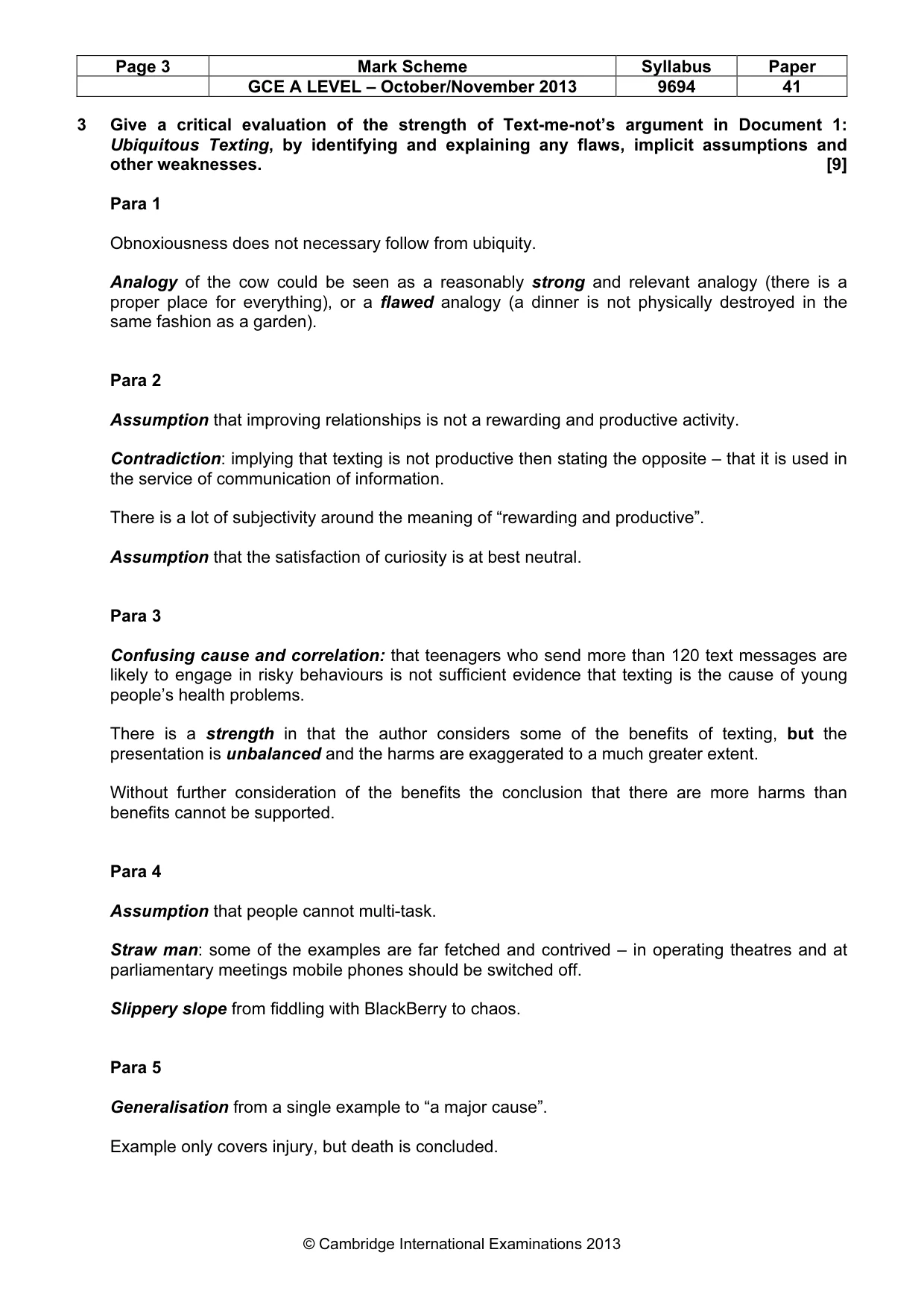
Page 3 Mark Scheme Syllabus Paper GCE A LEVEL – October/November 2013 9694 41 © Cambridge International Examinations 2013 3 Give a critical evaluation of the strength of Text-me-not’s argument in Document 1: Ubiquitous Texting, by identifying and explaining any flaws, implicit assumptions and other weaknesses. [9] Para 1 Obnoxiousness does not necessary follow from ubiquity. Analogy of the cow could be seen as a reasonably strong and relevant analogy (there is a proper place for everything), or a flawed analogy (a dinner is not physically destroyed in the same fashion as a garden). Para 2 Assumption that improving relationships is not a rewarding and productive activity. Contradiction: implying that texting is not productive then stating the opposite – that it is used in the service of communication of information. There is a lot of subjectivity around the meaning of “rewarding and productive”. Assumption that the satisfaction of curiosity is at best neutral. Para 3 Confusing cause and correlation: that teenagers who send more than 120 text messages are likely to engage in risky behaviours is not sufficient evidence that texting is the cause of young people’s health problems. There is a strength in that the author considers some of the benefits of texting, but the presentation is unbalanced and the harms are exaggerated to a much greater extent. Without further consideration of the benefits the conclusion that there are more harms than benefits cannot be supported. Para 4 Assumption that people cannot multi-task. Straw man: some of the examples are far fetched and contrived – in operating theatres and at parliamentary meetings mobile phones should be switched off. Slippery slope from fiddling with BlackBerry to chaos. Para 5 Generalisation from a single example to “a major cause”. Example only covers injury, but death is concluded.
Mark scheme, page 4
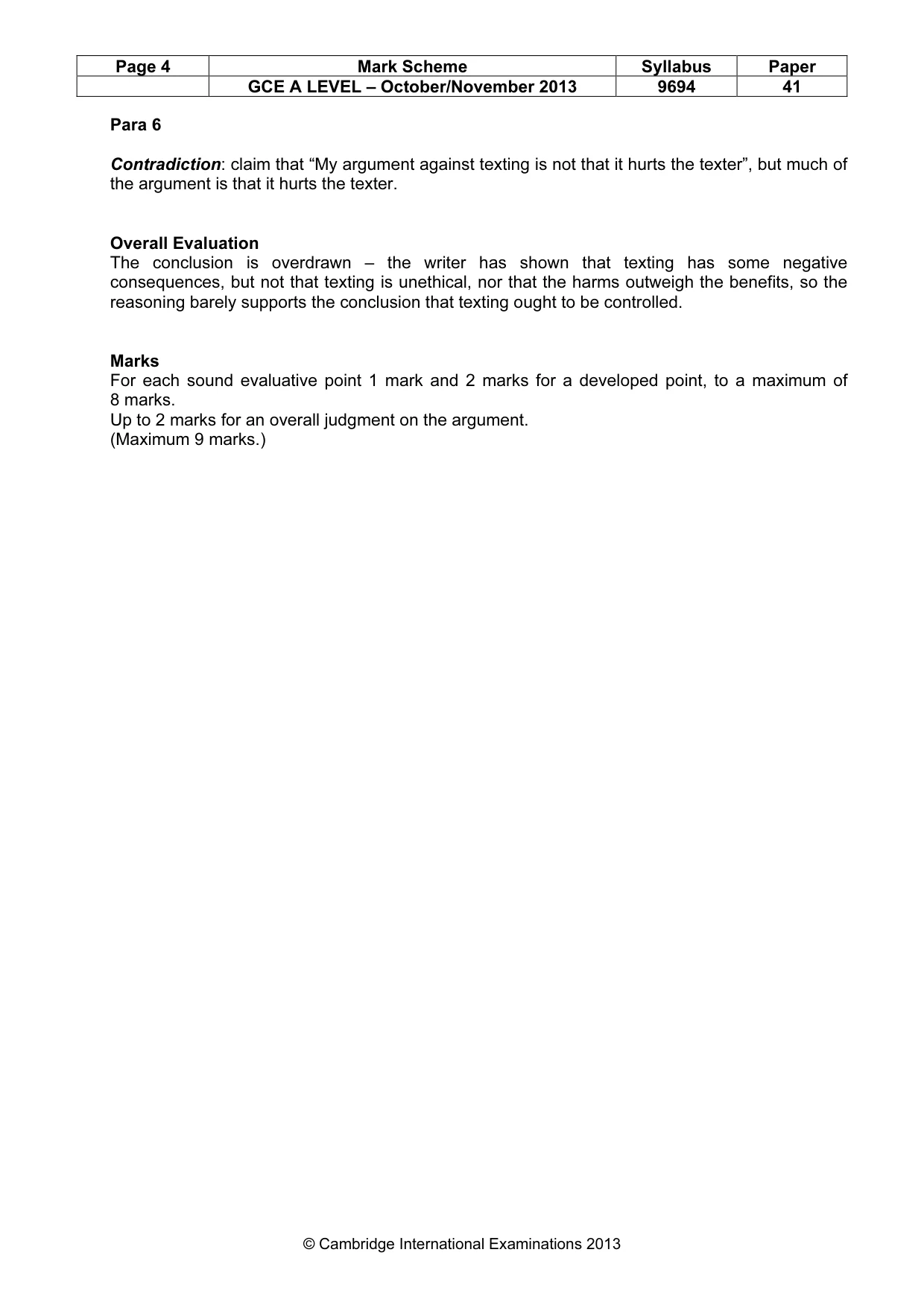
Page 4 Mark Scheme Syllabus Paper GCE A LEVEL – October/November 2013 9694 41 © Cambridge International Examinations 2013 Para 6 Contradiction: claim that “My argument against texting is not that it hurts the texter”, but much of the argument is that it hurts the texter. Overall Evaluation The conclusion is overdrawn – the writer has shown that texting has some negative consequences, but not that texting is unethical, nor that the harms outweigh the benefits, so the reasoning barely supports the conclusion that texting ought to be controlled. Marks For each sound evaluative point 1 mark and 2 marks for a developed point, to a maximum of 8 marks. Up to 2 marks for an overall judgment on the argument. (Maximum 9 marks.)
Mark scheme, page 5
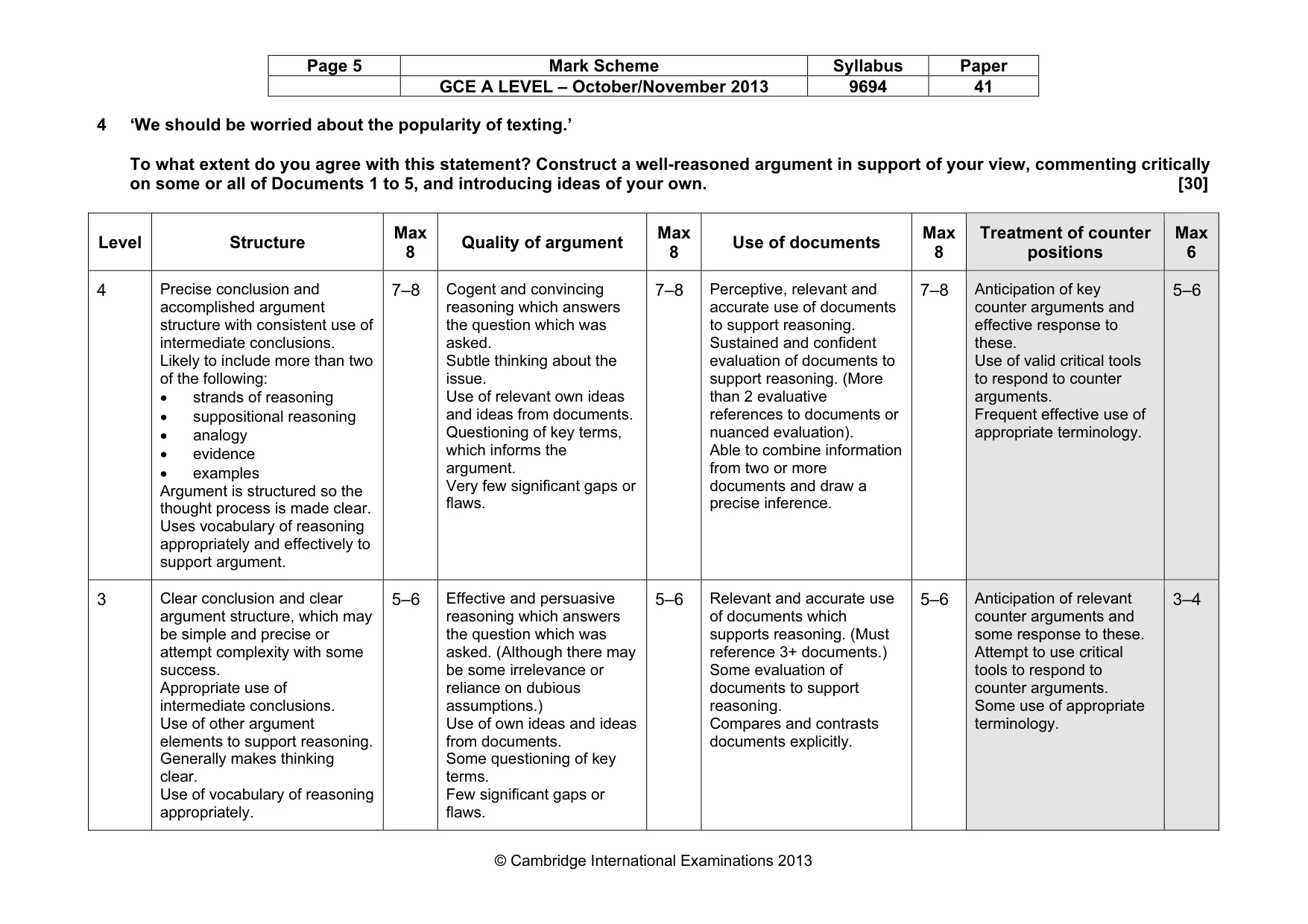
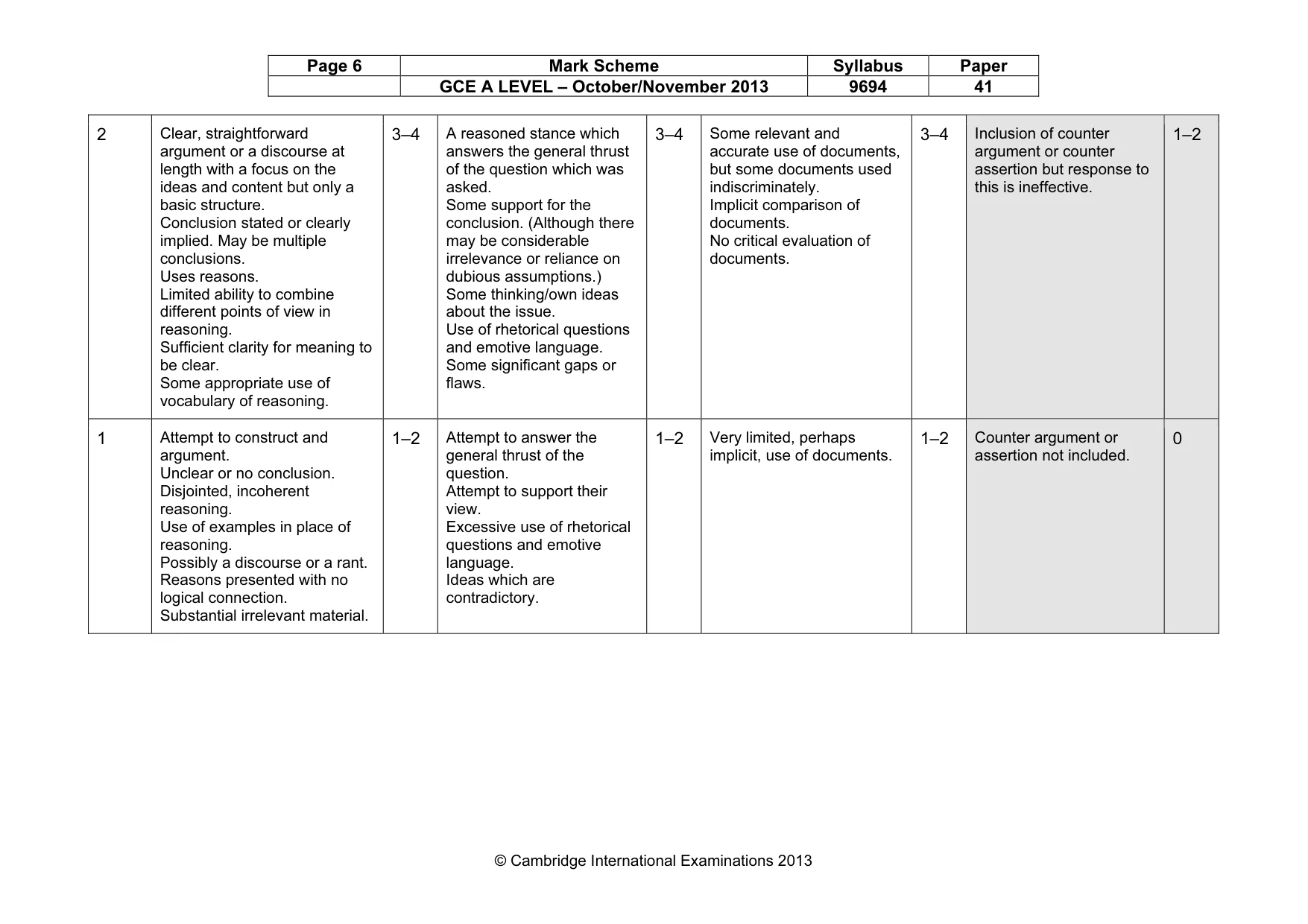
Page 5 Mark Scheme Syllabus Paper GCE A LEVEL – October/November 2013 9694 41 © Cambridge International Examinations 2013 4 ‘We should be worried about the popularity of texting.’ To what extent do you agree with this statement? Construct a well-reasoned argument in support of your view, commenting critically on some or all of Documents 1 to 5, and introducing ideas of your own. [30] Level Structure Max 8 Quality of argument Max 8 Use of documents Max 8 Treatment of counter positions Max 6 4 Precise conclusion and accomplished argument structure with consistent use of intermediate conclusions. Likely to include more than two of the following: • strands of reasoning • suppositional reasoning • analogy • evidence • examples Argument is structured so the thought process is made clear. Uses vocabulary of reasoning appropriately and effectively to support argument. 7–8 Cogent and convincing reasoning which answers the question which was asked. Subtle thinking about the issue. Use of relevant own ideas and ideas from documents. Questioning of key terms, which informs the argument. Very few significant gaps or flaws. 7–8 Perceptive, relevant and accurate use of documents to support reasoning. Sustained and confident evaluation of documents to support reasoning. (More than 2 evaluative references to documents or nuanced evaluation). Able to combine information from two or more documents and draw a precise inference. 7–8 Anticipation of key counter arguments and effective response to these. Use of valid critical tools to respond to counter arguments. Frequent effective use of appropriate terminology. 5–6 3 Clear conclusion and clear argument structure, which may be simple and precise or attempt complexity with some success. Appropriate use of intermediate conclusions. Use of other argument elements to support reasoning. Generally makes thinking clear. Use of vocabulary of reasoning appropriately. 5–6 Effective and persuasive reasoning which answers the question which was asked. (Although there may be some irrelevance or reliance on dubious assumptions.) Use of own ideas and ideas from documents. Some questioning of key terms. Few significant gaps or flaws. 5–6 Relevant and accurate use of documents which supports reasoning. (Must reference 3+ documents.) Some evaluation of documents to support reasoning. Compares and contrasts documents explicitly. 5–6 Anticipation of relevant counter arguments and some response to these. Attempt to use critical tools to respond to counter arguments. Some use of appropriate terminology. 3–4
Mark scheme, page 6
Page 6 Mark Scheme Syllabus Paper GCE A LEVEL – October/November 2013 9694 41 © Cambridge International Examinations 2013 2 Clear, straightforward argument or a discourse at length with a focus on the ideas and content but only a basic structure. Conclusion stated or clearly implied. May be multiple conclusions. Uses reasons. Limited ability to combine different points of view in reasoning. Sufficient clarity for meaning to be clear. Some appropriate use of vocabulary of reasoning. 3–4 A reasoned stance which answers the general thrust of the question which was asked. Some support for the conclusion. (Although there may be considerable irrelevance or reliance on dubious assumptions.) Some thinking/own ideas about the issue. Use of rhetorical questions and emotive language. Some significant gaps or flaws. 3–4 Some relevant and accurate use of documents, but some documents used indiscriminately. Implicit comparison of documents. No critical evaluation of documents. 3–4 Inclusion of counter argument or counter assertion but response to this is ineffective. 1–2 1 Attempt to construct and argument. Unclear or no conclusion. Disjointed, incoherent reasoning. Use of examples in place of reasoning. Possibly a discourse or a rant. Reasons presented with no logical connection. Substantial irrelevant material. 1–2 Attempt to answer the general thrust of the question. Attempt to support their view. Excessive use of rhetorical questions and emotive language. Ideas which are contradictory. 1–2 Very limited, perhaps implicit, use of documents. 1–2 Counter argument or assertion not included. 0
What you needed in this session
Cambridge’s own grade thresholds for 2013 Oct/Nov, Paper 4 · Variant 1. A higher threshold means an easier paper — the bar moves with how the cohort did.