Cambridge A Level Thinking Skills 9694 — 2013 Oct/Nov Paper 4 · Variant 2
9694/42/O/N/13 · 50 marks · ≈56 min
The question paper and its mark scheme, free to read here and free to download. This is Cambridge’s own paper, exactly as it was sat.
Question paper8 pages
Mark scheme6 pages
Answers below. Sit the paper first if you are practising.
Paper as text
Question paper, page 1
This document consists of 7 printed pages and 1 blank page. IB13 11_9694_42/3RP © UCLES 2013 [Turn over *3006793713* UNIVERSITY OF CAMBRIDGE INTERNATIONAL EXAMINATIONS General Certificate of Education Advanced Level THINKING SKILLS 9694/42 Paper 4 Applied Reasoning October/November 2013 1 hour 30 minutes Additional Materials: Answer Booklet/Paper READ THESE INSTRUCTIONS FIRST If you have been given an Answer Booklet, follow the instructions on the front cover of the booklet. Write your Centre number, candidate number and name on all the work you hand in. Write in dark blue or black pen. Do not use staples, paper clips, highlighters, glue or correction fluid. DO NOT WRITE IN ANY BARCODES. Answer all the questions. Start each question on a new answer sheet. At the end of the examination, fasten all your work securely together. The number of marks is given in brackets [ ] at the end of each question.
Question paper, page 2
2 © UCLES 2013 9694/42/O/N/13 1 Suggest five criticisms of the statistics presented in the passage below and/or the inferences drawn from them. [5] Despite years of research showing the links between smoking and lung cancer, over one in five British adults smoke. Smoking is thought to be the cause of 28% of all deaths from cancer. 90% of people who die from lung cancer are smokers. The proportion of British men who smoke has decreased from 82% in 1948 to 30% in 2002. Deaths from lung cancer in UK adults have also decreased by 50% over the same period. From this we can conclude that smokers have a high risk of developing lung cancer, and that giving up smoking saves lives. Questions 2, 3 and 4 refer to Documents 1 to 5. 2 Briefly analyse G9’s argument in Document 1: Science and Society, by identifying its main conclusion and main reasons, as well as any intermediate conclusions and counter-arguments. [6] 3 Give a critical evaluation of the strength of G9’s argument in Document 1: Science and Society, by identifying and explaining any flaws, implicit assumptions and other weaknesses. [9] 4 ‘Religious convictions ought not to enter discussions about scientific claims.’ To what extent do you agree with this statement? Construct a well-reasoned argument in support of your view, commenting critically on some or all of Documents 1 to 5, and introducing ideas of your own. [30]
Question paper, page 3
3 © UCLES 2013 9694/42/O/N/13 [Turn over DOCUMENT 1 Science and Society Why bring God into science? The role of science in society is being undermined by the scientific illiteracy that permeates the world. It is argued that the two great areas of human intellectual activity, ‘science’ and ‘the arts’ (or the study of humanities), should have dialogue with each other and build bridges to further the progress of human knowledge and to benefit society. This would be a worthwhile enterprise, but in reality few efforts have been made in this direction. Scientists continue to communicate their work to the public without resorting to literary aids; and those dedicated to humanities, arts and politics remain content living within the walls of scientific illiteracy. What is very clear is that the stand-off between science and the arts is set to continue. Scientific illiteracy is not seen as an impediment to success in business, politics and the arts. Individuals often proudly proclaim that science is not their thing, almost as if that gives them some additional credit for their cultural bent. The importance of science in society is further threatened by introducing discussions on the relationship between science and religion at such important events as the World Science Festival. It is alright to accord a special place to religion, and for much of society that is important, but why suggest that science and religious belief have any connection with each other and should be treated as equals? Such discussions should not be taking place in the midst of events on the cosmos, embryonic and stem cell research, quantum mechanics, artificial intelligence and other cutting-edge scientific fields. This is because they are not on an equal footing either in subject matter or of importance. Religious fundamentalism, and the notion of a personal God, has made people hostile to the concepts of evolution and the Big Bang. So science is consistent only with a God that does not intervene in the daily operations of the cosmos. In any case, most people who tend to call themselves religious only adhere to those parts of scripture that appeal to them. If we give undue respect to ancient religious beliefs we will end up overthrowing conclusions drawn from centuries of rational empirical investigations. It is not religion, but indifference to science that has made people so ignorant. In any discussion between religion and science, it takes a critically intelligent inquirer no more than an hour to understand that the only concepts of God that are compatible with science are those which show that God is irrelevant for our understanding of the laws of nature and how we live our lives. Attempts at dialogue between science and other disciplines up till now have been unhelpful. We should accept the world as it is, and reject beliefs that distort our understanding of the world. If we do not, we will not be ready to meet the urgent technological challenges facing the world community. G9
Question paper, page 4
4 © UCLES 2013 9694/42/O/N/13 DOCUMENT 2 Science as the Enemy of Reason Richard Dawkins, the celebrated atheist biologist, has turned away from bashing people who believe in God to bashing people who believe in alternative therapies such as those offered by faith healers, psychic mediums, ‘angel therapists’, ‘aura photographers’, astrologers and others. It is true these trends are not just nutty but sinister. But where Dawkins goes wrong is to assume that believing in God is as irrational as these trends. The truth is that it is the collapse of religious faith that has prompted the rise of such irrationality. We are living in a scientific, largely post-religious age in which faith is presented as scientific superstition. In reality, we have replaced such faith with demonstrable nonsense. The big mistake is to see religion and reason as polar opposites. Our post-religious age has proclaimed that there is no such thing as objective truth, only what is ‘true for me’. How we feel about things has become all- important. So reason has been knocked off its perch by emotion, and thinking has been replaced by feelings. But science cannot answer all the questions about human existence. Our society can no longer distinguish between truth and lies by using evidence and logic. This undermines science itself. Science cannot explain the origin of the universe. When it attempts to do so it descends into irrationality. For example, Dawkins claims that Darwin’s theory of evolution, which sought to explain how complex organisms evolved through random natural selection, also accounts for the origin of life itself. There is no evidence or logic to this. After all, if people say God could not have created the universe because this gives rise to the question ‘Who created God?’, it follows that if scientists say the universe started with a Big Bang, this prompts the question ‘What created the Big Bang?’ Moreover, 50 years of DNA research have revealed the almost unbelievable complexity of the arrangements that are needed to produce life. This has thrown into doubt the theory that life emerged spontaneously in a random universe. These findings have given rise to a school of scientists promoting the theory of Intelligent Design, which suggests that some force embodying purpose and foresight lay behind the origin of the universe. While this theory is, of course, open to vigorous counter-argument, people such as Richard Dawkins have gone to great lengths to stop the debate on grounds that it denies scientific evidence, such as fossil records, and is therefore worthless. Scientists who argue against there being evidence that life spontaneously created itself are being stifled – on the totally perverse grounds that this argument does not conform to the rules of science which require evidence to support a theory. Far from upholding reason, science itself has become unreasonable. Melanie Phillips The Daily Mail (UK), August 2007
Question paper, page 5
5 © UCLES 2013 9694/42/O/N/13 [Turn over DOCUMENT 3 The Religion–Science Debate We need to seek a thoughtful position on the relationship between religion and science. There are four basic models for understanding this relationship. Conflict Model: In this model science and religion set themselves up against each other as polar opposites, leading to direct conflict and competition. Scientists who take this approach would claim that science is the only way to gain reliable knowledge of the universe and for describing reality. They insist that religion or acceptance of the idea of God is threatening to the scientific method. On the other side are the practitioners of religious fundamentalism, who reject scientific concepts, such as the theory of evolution, or insist they have scientific evidence that can prove the scriptures to be literally true, such as that put forward by creation science. Independence model: These are intellectual movements that treat science and religion as having very different aims, objectives and methods, so that there can be no common ground whatsoever between them. Each field of inquiry – religion and science – should stick to its own business. This ensures that there is no possibility of interaction or conflict in such a model. Dialogue Model: In this model religious thinkers interact with science to answer profound boundary questions of existence. For example, if the universe expanded from an initial infinitely tiny point, and science is unable to see beyond the boundary when nothing existed, the question has to be addressed: how did the fundamental laws of science first come into existence, if they arose from a point where nothing had existed? Such questions open the door for religion to say something about God as the creative grounds for the existence and structure of the universe. Integration Model: This goes beyond the dialogue model and holds that science and religion are capable of integrating to answer boundary questions of existence. It argues for a close relationship between religion and science. Religious thinkers are prepared to revise, rethink and reinterpret religious theories in the light of modern scientific findings, and construct new theories of understanding the universe and nature. RRB Reason and Religious Belief, Oxford University Press, 1998
Question paper, page 6
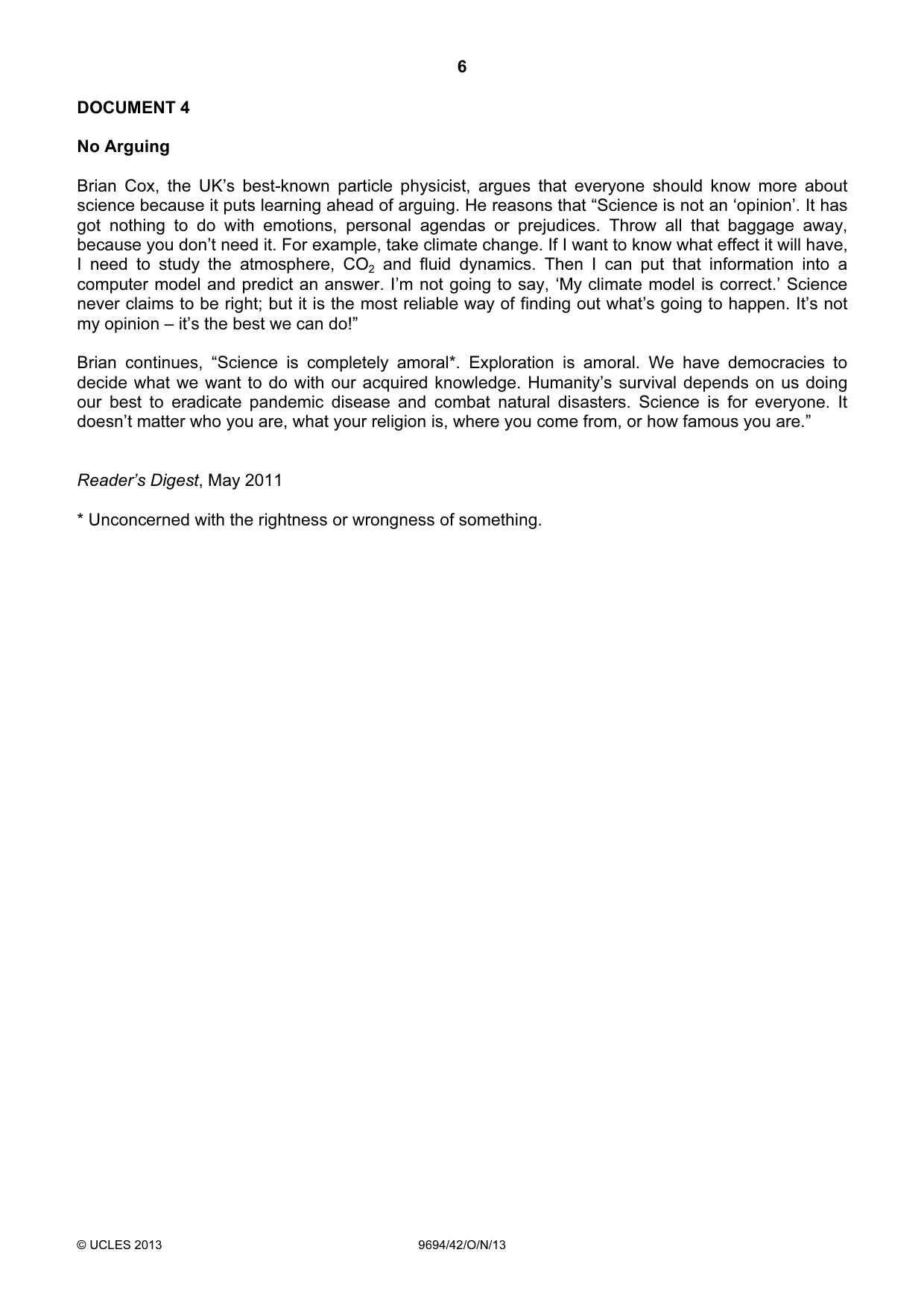
6 © UCLES 2013 9694/42/O/N/13 DOCUMENT 4 No Arguing Brian Cox, the UK’s best-known particle physicist, argues that everyone should know more about science because it puts learning ahead of arguing. He reasons that “Science is not an ‘opinion’. It has got nothing to do with emotions, personal agendas or prejudices. Throw all that baggage away, because you don’t need it. For example, take climate change. If I want to know what effect it will have, I need to study the atmosphere, CO2 and fluid dynamics. Then I can put that information into a computer model and predict an answer. I’m not going to say, ‘My climate model is correct.’ Science never claims to be right; but it is the most reliable way of finding out what’s going to happen. It’s not my opinion – it’s the best we can do!” Brian continues, “Science is completely amoral*. Exploration is amoral. We have democracies to decide what we want to do with our acquired knowledge. Humanity’s survival depends on us doing our best to eradicate pandemic disease and combat natural disasters. Science is for everyone. It doesn’t matter who you are, what your religion is, where you come from, or how famous you are.” Reader’s Digest, May 2011 * Unconcerned with the rightness or wrongness of something.
Question paper, page 7
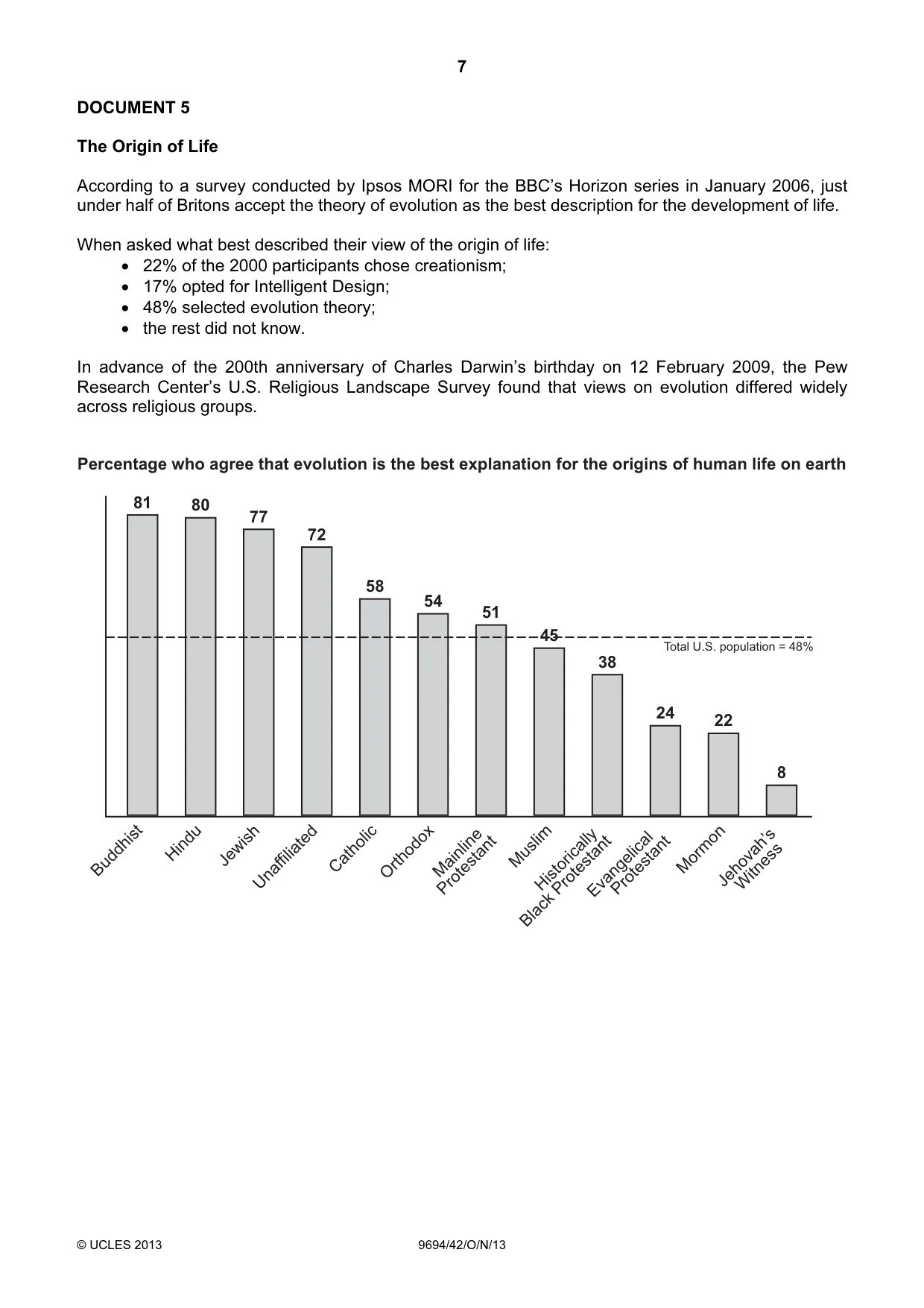
7 © UCLES 2013 9694/42/O/N/13 DOCUMENT 5 The Origin of Life According to a survey conducted by Ipsos MORI for the BBC’s Horizon series in January 2006, just under half of Britons accept the theory of evolution as the best description for the development of life. When asked what best described their view of the origin of life: • 22% of the 2000 participants chose creationism; • 17% opted for Intelligent Design; • 48% selected evolution theory; • the rest did not know. In advance of the 200th anniversary of Charles Darwin’s birthday on 12 February 2009, the Pew Research Center’s U.S. Religious Landscape Survey found that views on evolution differed widely across religious groups. Buddhist Mormon Jehovah’s Witness Evangelical Protestant Historically Black Protestant Muslim Mainline Protestant Orthodox Catholic Unaffiliated Jewish Hindu 81 80 77 72 58 54 51 45 38 24 22 8 Total U.S. population = 48% Percentage who agree that evolution is the best explanation for the origins of human life on earth
Question paper, page 8
8 Copyright Acknowledgements: Question 1 Document 2 Document 3 Document 4 Document 5 Source 1 Document 5 Source 2 Document 5 Source 3 © adapted: http://info.cancerresearchuk.org/healthyliving/smokingandtobacco/. © Melanie Phillips; The Daily Mail; 6 August 2007. © adapted: Peterson et al; Reason and Religious Belief; Oxford University Press; 1998. © Danny Scott; Readers Digest; May 2011. © http://campaigndirector.moodia.com/Client/Theos/Files/FaithandDarwin.pdf. © http://www.ipsos-mori.com/researchpublications/researcharchive/262/BBC-Survey-On-The-Origins-Of-Life.aspx © http://www.pewforum.org/Science-and-Bioethics/Religious-Differences-on-the-Question-of-Evolution.aspx. Permission to reproduce items where third-party owned material protected by copyright is included has been sought and cleared where possible. Every reasonable effort has been made by the publisher (UCLES) to trace copyright holders, but if any items requiring clearance have unwittingly been included, the publisher will be pleased to make amends at the earliest possible opportunity. University of Cambridge International Examinations is part of the Cambridge Assessment Group. Cambridge Assessment is the brand name of University of Cambridge Local Examinations Syndicate (UCLES), which is itself a department of the University of Cambridge. © UCLES 2013 9694/42/O/N/13 BLANK PAGE
Mark scheme, page 1
CAMBRIDGE INTERNATIONAL EXAMINATIONS GCE Advanced Level MARK SCHEME for the October/November 2013 series 9694 THINKING SKILLS 9694/42 Paper 4 (Applied Reasoning), maximum raw mark 50 This mark scheme is published as an aid to teachers and candidates, to indicate the requirements of the examination. It shows the basis on which Examiners were instructed to award marks. It does not indicate the details of the discussions that took place at an Examiners’ meeting before marking began, which would have considered the acceptability of alternative answers. Mark schemes should be read in conjunction with the question paper and the Principal Examiner Report for Teachers. Cambridge will not enter into discussions about these mark schemes. Cambridge is publishing the mark schemes for the October/November 2013 series for most IGCSE, GCE Advanced Level and Advanced Subsidiary Level components and some Ordinary Level components.
Mark scheme, page 2
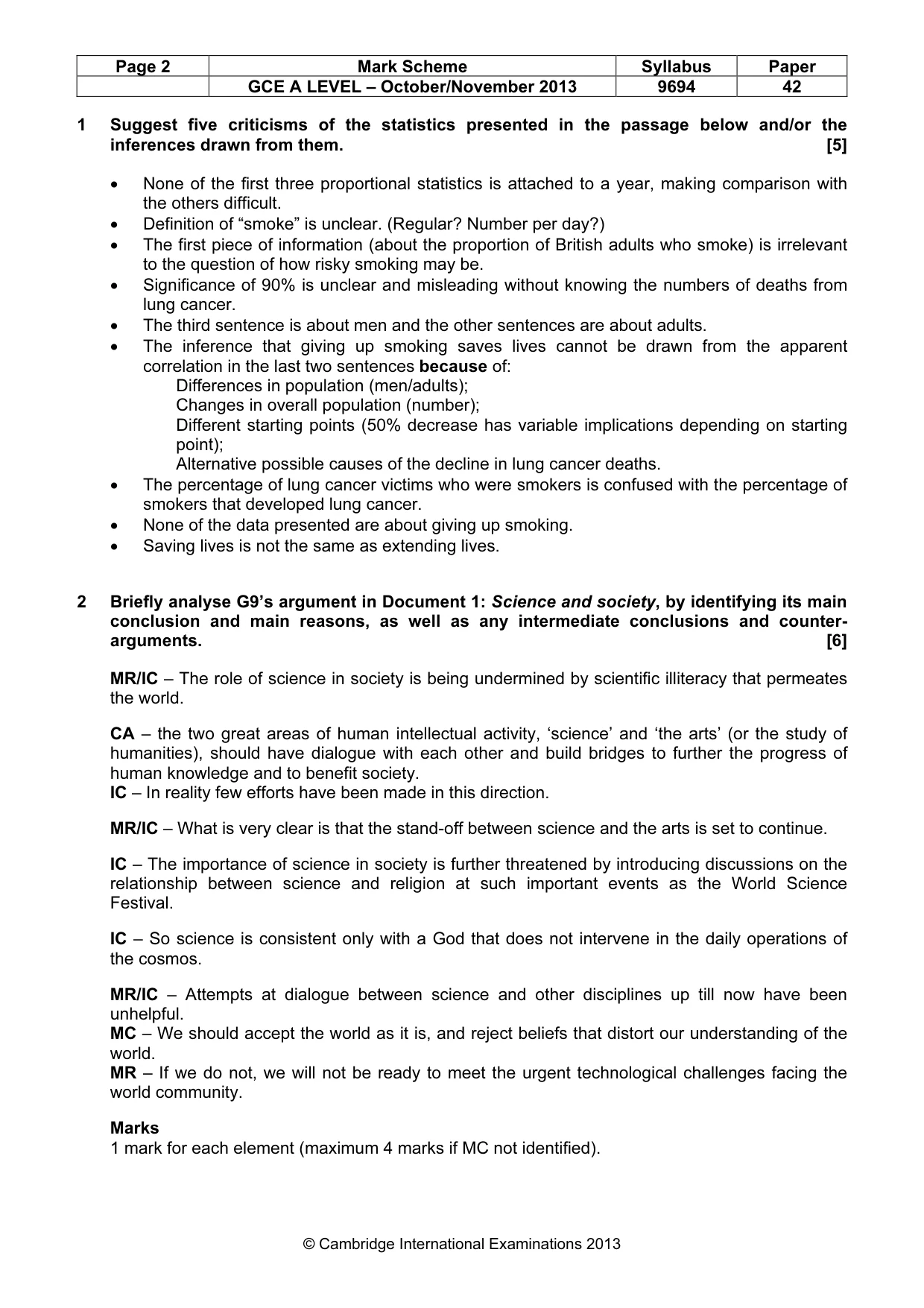
Page 2 Mark Scheme Syllabus Paper GCE A LEVEL – October/November 2013 9694 42 © Cambridge International Examinations 2013 1 Suggest five criticisms of the statistics presented in the passage below and/or the inferences drawn from them. [5] • None of the first three proportional statistics is attached to a year, making comparison with the others difficult. • Definition of “smoke” is unclear. (Regular? Number per day?) • The first piece of information (about the proportion of British adults who smoke) is irrelevant to the question of how risky smoking may be. • Significance of 90% is unclear and misleading without knowing the numbers of deaths from lung cancer. • The third sentence is about men and the other sentences are about adults. • The inference that giving up smoking saves lives cannot be drawn from the apparent correlation in the last two sentences because of: Differences in population (men/adults); Changes in overall population (number); Different starting points (50% decrease has variable implications depending on starting point); Alternative possible causes of the decline in lung cancer deaths. • The percentage of lung cancer victims who were smokers is confused with the percentage of smokers that developed lung cancer. • None of the data presented are about giving up smoking. • Saving lives is not the same as extending lives. 2 Briefly analyse G9’s argument in Document 1: Science and society, by identifying its main conclusion and main reasons, as well as any intermediate conclusions and counter- arguments. [6] MR/IC – The role of science in society is being undermined by scientific illiteracy that permeates the world. CA – the two great areas of human intellectual activity, ‘science’ and ‘the arts’ (or the study of humanities), should have dialogue with each other and build bridges to further the progress of human knowledge and to benefit society. IC – In reality few efforts have been made in this direction. MR/IC – What is very clear is that the stand-off between science and the arts is set to continue. IC – The importance of science in society is further threatened by introducing discussions on the relationship between science and religion at such important events as the World Science Festival. IC – So science is consistent only with a God that does not intervene in the daily operations of the cosmos. MR/IC – Attempts at dialogue between science and other disciplines up till now have been unhelpful. MC – We should accept the world as it is, and reject beliefs that distort our understanding of the world. MR – If we do not, we will not be ready to meet the urgent technological challenges facing the world community. Marks 1 mark for each element (maximum 4 marks if MC not identified).
Mark scheme, page 3
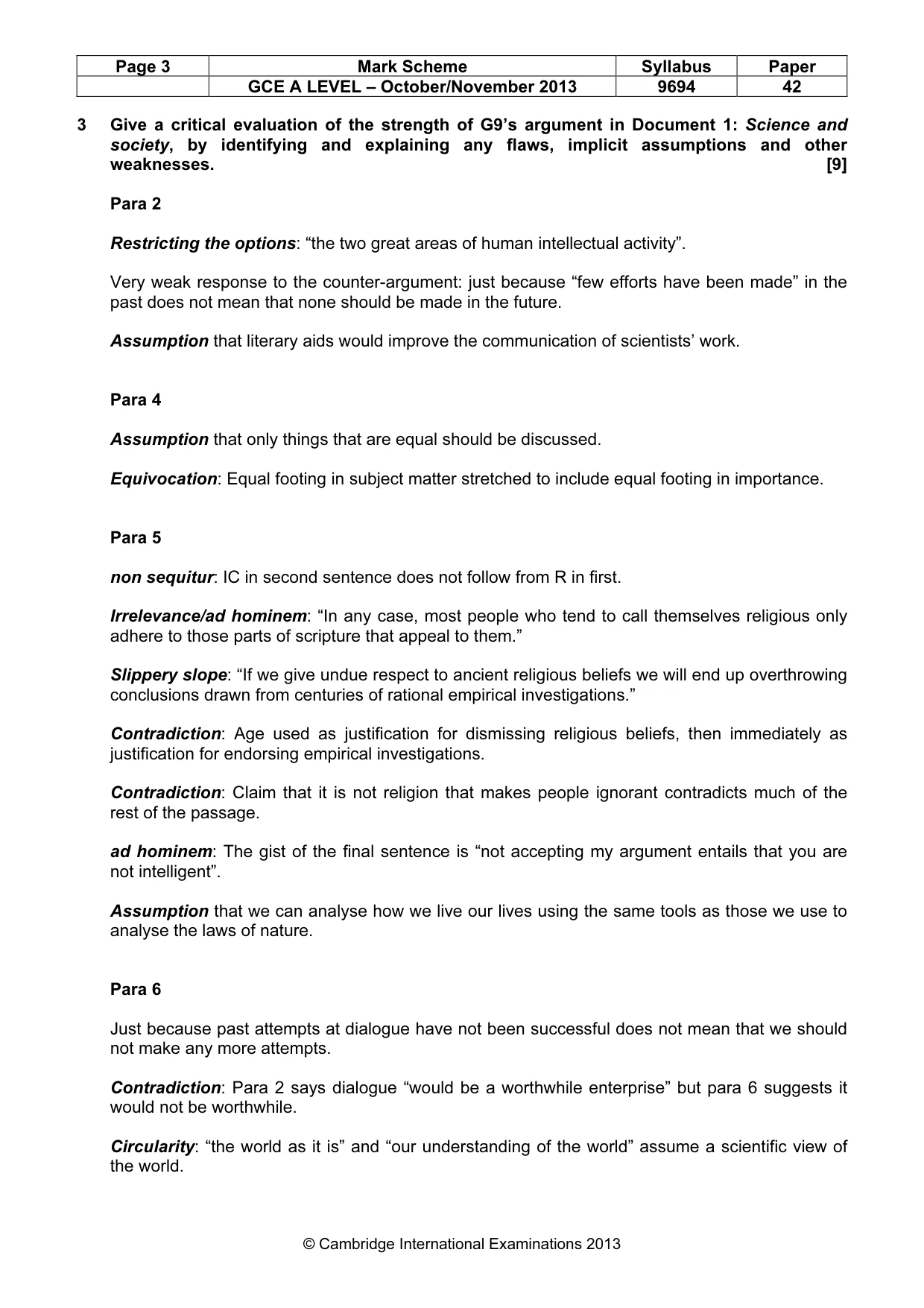
Page 3 Mark Scheme Syllabus Paper GCE A LEVEL – October/November 2013 9694 42 © Cambridge International Examinations 2013 3 Give a critical evaluation of the strength of G9’s argument in Document 1: Science and society, by identifying and explaining any flaws, implicit assumptions and other weaknesses. [9] Para 2 Restricting the options: “the two great areas of human intellectual activity”. Very weak response to the counter-argument: just because “few efforts have been made” in the past does not mean that none should be made in the future. Assumption that literary aids would improve the communication of scientists’ work. Para 4 Assumption that only things that are equal should be discussed. Equivocation: Equal footing in subject matter stretched to include equal footing in importance. Para 5 non sequitur: IC in second sentence does not follow from R in first. Irrelevance/ad hominem: “In any case, most people who tend to call themselves religious only adhere to those parts of scripture that appeal to them.” Slippery slope: “If we give undue respect to ancient religious beliefs we will end up overthrowing conclusions drawn from centuries of rational empirical investigations.” Contradiction: Age used as justification for dismissing religious beliefs, then immediately as justification for endorsing empirical investigations. Contradiction: Claim that it is not religion that makes people ignorant contradicts much of the rest of the passage. ad hominem: The gist of the final sentence is “not accepting my argument entails that you are not intelligent”. Assumption that we can analyse how we live our lives using the same tools as those we use to analyse the laws of nature. Para 6 Just because past attempts at dialogue have not been successful does not mean that we should not make any more attempts. Contradiction: Para 2 says dialogue “would be a worthwhile enterprise” but para 6 suggests it would not be worthwhile. Circularity: “the world as it is” and “our understanding of the world” assume a scientific view of the world.
Mark scheme, page 4
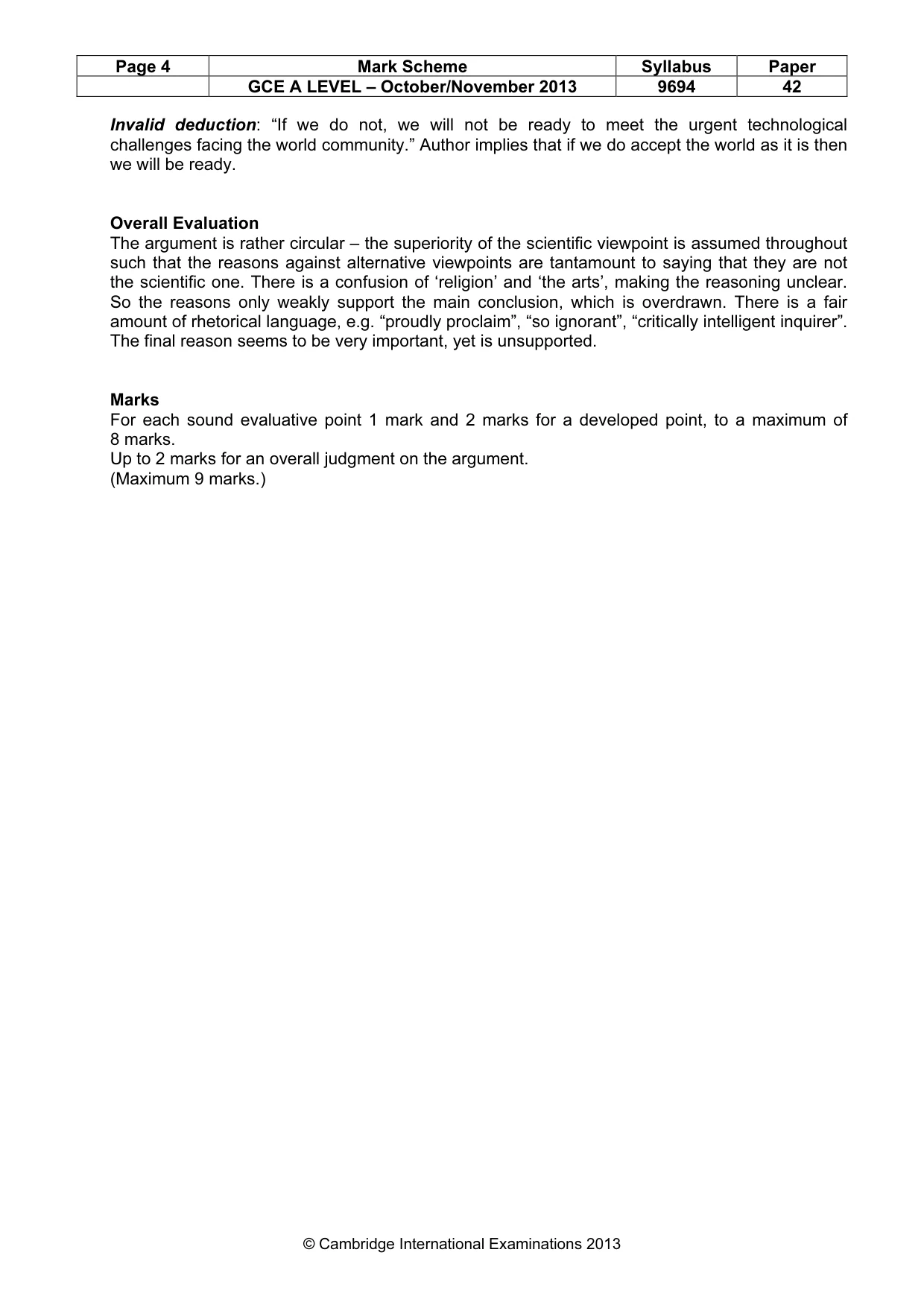
Page 4 Mark Scheme Syllabus Paper GCE A LEVEL – October/November 2013 9694 42 © Cambridge International Examinations 2013 Invalid deduction: “If we do not, we will not be ready to meet the urgent technological challenges facing the world community.” Author implies that if we do accept the world as it is then we will be ready. Overall Evaluation The argument is rather circular – the superiority of the scientific viewpoint is assumed throughout such that the reasons against alternative viewpoints are tantamount to saying that they are not the scientific one. There is a confusion of ‘religion’ and ‘the arts’, making the reasoning unclear. So the reasons only weakly support the main conclusion, which is overdrawn. There is a fair amount of rhetorical language, e.g. “proudly proclaim”, “so ignorant”, “critically intelligent inquirer”. The final reason seems to be very important, yet is unsupported. Marks For each sound evaluative point 1 mark and 2 marks for a developed point, to a maximum of 8 marks. Up to 2 marks for an overall judgment on the argument. (Maximum 9 marks.)
Mark scheme, page 5
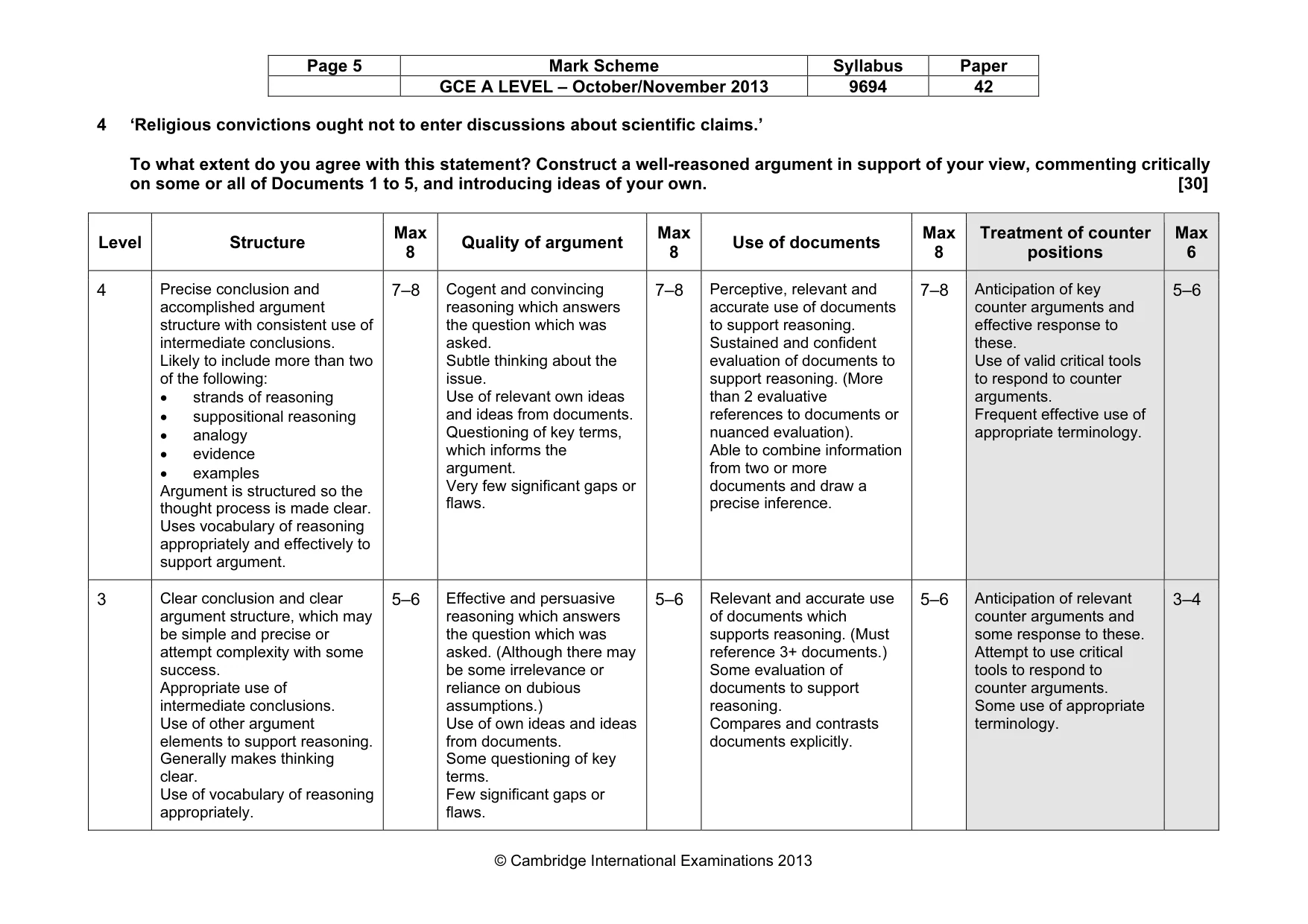
Page 5 Mark Scheme Syllabus Paper GCE A LEVEL – October/November 2013 9694 42 © Cambridge International Examinations 2013 4 ‘Religious convictions ought not to enter discussions about scientific claims.’ To what extent do you agree with this statement? Construct a well-reasoned argument in support of your view, commenting critically on some or all of Documents 1 to 5, and introducing ideas of your own. [30] Level Structure Max 8 Quality of argument Max 8 Use of documents Max 8 Treatment of counter positions Max 6 4 Precise conclusion and accomplished argument structure with consistent use of intermediate conclusions. Likely to include more than two of the following: • strands of reasoning • suppositional reasoning • analogy • evidence • examples Argument is structured so the thought process is made clear. Uses vocabulary of reasoning appropriately and effectively to support argument. 7–8 Cogent and convincing reasoning which answers the question which was asked. Subtle thinking about the issue. Use of relevant own ideas and ideas from documents. Questioning of key terms, which informs the argument. Very few significant gaps or flaws. 7–8 Perceptive, relevant and accurate use of documents to support reasoning. Sustained and confident evaluation of documents to support reasoning. (More than 2 evaluative references to documents or nuanced evaluation). Able to combine information from two or more documents and draw a precise inference. 7–8 Anticipation of key counter arguments and effective response to these. Use of valid critical tools to respond to counter arguments. Frequent effective use of appropriate terminology. 5–6 3 Clear conclusion and clear argument structure, which may be simple and precise or attempt complexity with some success. Appropriate use of intermediate conclusions. Use of other argument elements to support reasoning. Generally makes thinking clear. Use of vocabulary of reasoning appropriately. 5–6 Effective and persuasive reasoning which answers the question which was asked. (Although there may be some irrelevance or reliance on dubious assumptions.) Use of own ideas and ideas from documents. Some questioning of key terms. Few significant gaps or flaws. 5–6 Relevant and accurate use of documents which supports reasoning. (Must reference 3+ documents.) Some evaluation of documents to support reasoning. Compares and contrasts documents explicitly. 5–6 Anticipation of relevant counter arguments and some response to these. Attempt to use critical tools to respond to counter arguments. Some use of appropriate terminology. 3–4
Mark scheme, page 6
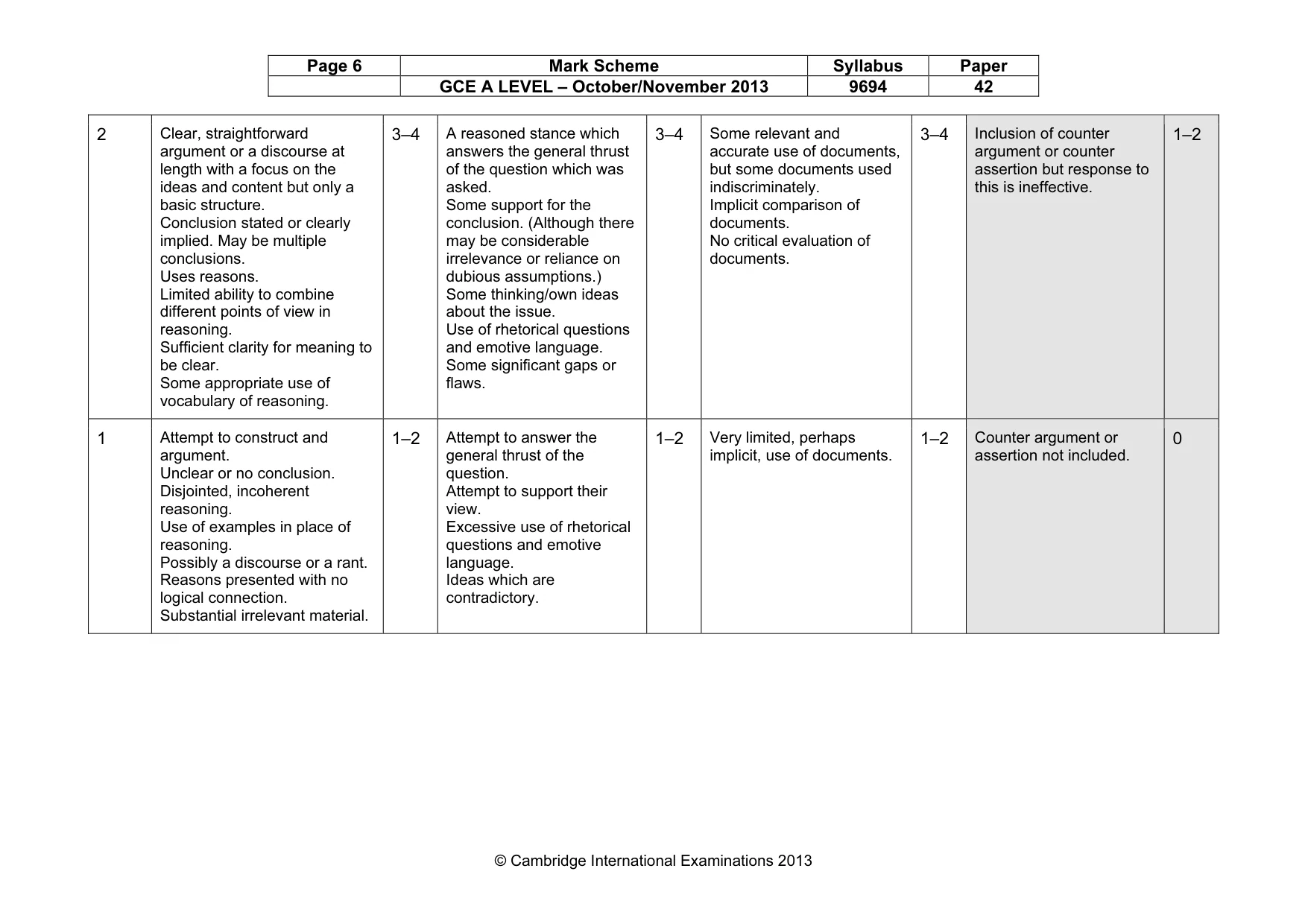
Page 6 Mark Scheme Syllabus Paper GCE A LEVEL – October/November 2013 9694 42 © Cambridge International Examinations 2013 2 Clear, straightforward argument or a discourse at length with a focus on the ideas and content but only a basic structure. Conclusion stated or clearly implied. May be multiple conclusions. Uses reasons. Limited ability to combine different points of view in reasoning. Sufficient clarity for meaning to be clear. Some appropriate use of vocabulary of reasoning. 3–4 A reasoned stance which answers the general thrust of the question which was asked. Some support for the conclusion. (Although there may be considerable irrelevance or reliance on dubious assumptions.) Some thinking/own ideas about the issue. Use of rhetorical questions and emotive language. Some significant gaps or flaws. 3–4 Some relevant and accurate use of documents, but some documents used indiscriminately. Implicit comparison of documents. No critical evaluation of documents. 3–4 Inclusion of counter argument or counter assertion but response to this is ineffective. 1–2 1 Attempt to construct and argument. Unclear or no conclusion. Disjointed, incoherent reasoning. Use of examples in place of reasoning. Possibly a discourse or a rant. Reasons presented with no logical connection. Substantial irrelevant material. 1–2 Attempt to answer the general thrust of the question. Attempt to support their view. Excessive use of rhetorical questions and emotive language. Ideas which are contradictory. 1–2 Very limited, perhaps implicit, use of documents. 1–2 Counter argument or assertion not included. 0
What you needed in this session
Cambridge’s own grade thresholds for 2013 Oct/Nov, Paper 4 · Variant 2. A higher threshold means an easier paper — the bar moves with how the cohort did.