Cambridge A Level Thinking Skills 9694 — 2013 May/June Paper 4 · Variant 3
9694/43/M/J/13 · 50 marks · ≈56 min
The question paper and its mark scheme, free to read here and free to download. This is Cambridge’s own paper, exactly as it was sat.
Question paper8 pages
Mark scheme7 pages
Answers below. Sit the paper first if you are practising.
Paper as text
Question paper, page 1
This document consists of 7 printed pages and 1 blank page. IB13 06_9694_43/RP © UCLES 2013 [Turn over *5933456888* UNIVERSITY OF CAMBRIDGE INTERNATIONAL EXAMINATIONS General Certificate of Education Advanced Level THINKING SKILLS 9694/43 Paper 4 Applied Reasoning May/June 2013 1 hour 30 minutes Additional Materials: Answer Booklet/Paper READ THESE INSTRUCTIONS FIRST If you have been given an Answer Booklet, follow the instructions on the front cover of the booklet. Write your Centre number, candidate number and name on all the work you hand in. Write in dark blue or black pen. Do not use staples, paper clips, highlighters, glue or correction fluid. DO NOT WRITE IN ANY BARCODES. Answer all the questions. Start each question on a new answer sheet. At the end of the examination, fasten all your work securely together. The number of marks is given in brackets [ ] at the end of each question.
Question paper, page 2
2 © UCLES 2013 9694/43/M/J/13 1 Study the passage below and answer the questions that follow. E4U – the energy company that’s kind to the environment and YOUR WALLET! As part of the Government’s Reduce Energy Usage Scheme (REUS), E4U are leading the field in strategies to reduce CO2 emissions and save you money. The Government gives energy companies $170 for every household they supply, in order to help us reduce fuel bills and cut carbon emissions. We at E4U care about you so much – we want to give away even more money! E4U will pay half the cost of property insulation for every one of our customers. According to the Government’s own figures, the cost of insulating the average home is $700, so our offer represents a saving per household of $350! Once insulated, heating bills can be reduced by as much as $500 per year. We will also give you five free energy-saving light bulbs, worth $10, that can save you $30 per year. That’s an initial saving of $360 and an annual saving of $530. (a) Make three criticisms of the data presented in the passage. [3] (b) A Government spokesman commented, “The E4U strategy could save $890 in one year alone and shows that the REUS represents great value for money to the taxpayer.” Is this claim supported by the evidence presented? Justify your answer. [2] Questions 2, 3 and 4 refer to Documents 1 to 5. 2 Briefly analyse Buddy2u’s argument in Document 1: Watch Your Waste, by identifying its main conclusion and main reasons, as well as any intermediate conclusions and counter-arguments. [6] 3 Give a critical evaluation of the strength of Buddy2u’s argument in Document 1: Watch Your Waste, by identifying and explaining any flaws, implicit assumptions and other weaknesses. [9] 4 ‘Those who waste food should be held morally accountable for the hunger of others.’ To what extent do you agree with this statement? Construct a well-reasoned argument in support of your view, commenting critically on some or all of Documents 1 to 5, and introducing ideas of your own. [30]
Question paper, page 3
3 © UCLES 2013 9694/43/M/J/13 [Turn over DOCUMENT 1 Watch Your Waste Food waste is a huge topic for global debate, especially in the light of the growing divide between the profligate rich and the hungry poor. There are those who say food waste is an inevitable by-product in an age of mass production and busy lifestyles. It is time to establish once and for all that modern food waste culture is inexcusable. In the minds of people, food has become so abundant that the easy solution to excess food is to bin it. Buying food simply to throw it out is a waste of all those precious resources – land, water, energy – that were put into growing, processing and transporting it. In countries like Burma, China and India, rice, the staple grain, is revered traditionally as a life-sustainer, and wasting it is seen as sinful. There is a great contrast in attitudes towards food between a person from a developed country and one from the developing world. In order for residents of the developed world to appreciate food, they need to know what it is like to go without it for several days. Overbuying by the rich has led to food shortages for others. The supply of grain produced by the Earth is finite. Grain shortages are caused when rich countries waste lots of it. If they waste grain it is because they are buying more of it than they need. This unnecessarily high demand pushes the price up, making grain less affordable for poor people in less fortunate parts of the world. Corporations and marketing have to take the blame for creating the culture of huge wasteful portions. Most food waste occurs in restaurants which serve up huge portions beyond one’s eating capacity. I very rarely have a starter, as I am not very fond of savoury food, which comes in portions too huge to appeal to me anyway. I therefore skip it in favour of a dessert. But then I have to sit there while my companion eats his starter, and works his way through a three-course meal (which he often manages anyway). I get very annoyed when I see people wasting good food by over-ordering. Parents let children pile food on their plates and don’t mind what they leave behind, thus creating a throw-away society. Large portions are, to some extent, behind the global obesity epidemic, and this is now extremely bad in the UK, particularly amongst women – many of whom are just disgustingly fat. It is a disgrace that obese people consume food to excess without a thought for the malnourished and starving elsewhere. Suppliers and manufacturers have some responsibility in the problem of society wasting food. Everything has a ‘use by’ date. But isn’t this a ruse to make us buy more food? Most foods will keep quite well beyond these dates. In bygone ages there never was such a thing as a ‘use by’ date. Finally, but most importantly, food wastage is environmentally harmful. A high proportion of food that is thrown away gets sent to landfill, where it decomposes into methane – contributing to global warming and worsening poverty in developing nations. Buddy2u
Question paper, page 4
4 © UCLES 2013 9694/43/M/J/13 DOCUMENT 2 Duties to the Less Fortunate? Some people have much more than they need to live; others don’t have enough. Peter Singer, in his essay “Famine, Affluence, and Morality” (1971) asks: what are the obligations of the ‘haves’ toward the ‘have-nots’ in these cases? Singer asks us to consider this simple argument: • Suffering and death from lack of food, shelter, and medical care are bad. • If it is in our power to prevent something bad from happening, without thereby sacrificing anything of comparable moral importance, we ought, morally, to do it. (This is Singer’s Greater Moral Evil Principle.) • It is in our power to prevent suffering and death by giving money to causes such as famine relief. • Therefore, we have a moral obligation to give money to causes such as famine relief. We should give and it is wrong not to give. The next question is: how much are we obliged to give? The following argument outlines Singer’s controversial answer: • If it is in our power to prevent something bad from happening, without thereby sacrificing anything of comparable moral importance, we ought, morally, to do it. • Our interests and those of our dependants matter only to the degree that they are of comparable moral importance. • ‘Interests’ such as cars, clothes, cool shoes, stereos, CDs, fancy food, excessive rent, eating out, going to movies, concerts, or sports events, partying, goofing off, earning unnecessary money etc. are clearly not of comparable moral importance to the plight of desperately suffering people. • People in affluent countries are morally obliged to do everything in their power to relieve the suffering of the famine victims, even if this means drastically changing their lives. If we spend extra money solely for our own pleasure, we are in effect killing innocent poor people. Furthermore, our obligation to the poor lasts as long as we are not also suffering and dying from lack of food, shelter, and medical care. We are obliged to give to the point of ‘marginal utility’; that is, until our situation is as bad as that of the victims. Below are some objections to Singer’s views: 1 The suffering people live far away from me. 2 Other people are not helping. 3 Singer’s proposals are ‘too different’; they demand a drastic revision of many traditional moral views. 4 If we adopt Singer’s views, we’d all have to be working full-time to relieve the great suffering of the innocent from famines, wars, and other disasters. 5 It is okay not to give, because giving my time and money to poor and suffering people is not demanded by morality. Certainly I would be a better person if I did help, but there is nothing wrong with not helping. Not everybody is expected to be Mother Teresa. 6 Singer is right that we should help, but his proposal that we give money is not the best way to help. So – how morally acceptable are these excuses? WVC
Question paper, page 5
5 © UCLES 2013 9694/43/M/J/13 [Turn over DOCUMENT 3 Hunger Study 2010 Hunger in America 2010 is the largest study of domestic hunger, providing comprehensive data on our emergency food distribution system and the people Feeding America serves. • Feeding America is annually providing food to 37 million Americans, including 14 million children. • One in eight Americans now relies on Feeding America for food and groceries. • Feeding America’s nationwide network of food banks is feeding 1 million more Americans each week than we did in 2006. • Thirty-six percent of the households we serve have at least one person working. • More than one third of client households report having to choose between food and other basic necessities, such as rent, utilities and medical care. • The number of children the Feeding America network serves has increased by 50% since 2006. Rally for hunger relief by doing three simple tasks this September: watch, share, and act! Feeding America
Question paper, page 6
6 © UCLES 2013 9694/43/M/J/13 DOCUMENT 4 Unlock the Gates of the Food Godowns* In light of the recent Supreme Court order to distribute food grains to the poor rather than letting them rot in the Food Corporation of India (FCI) godowns, we announce a week of action and protests in the State. This will be part of National Action Week, which will be held across the country on behalf of the Right to Food Campaign. Our Reasons: India is going through an unprecedented food crisis. Two thirds of our women are anaemic, half our children are malnourished, and almost one third of adult men and women have a low body mass index. Our malnutrition rates are higher than in some of the war-torn countries of Africa, and India is ranked 66 out of 88 countries by the Global Hunger Index. While on the one hand we have hunger, spiralling food prices and declining food availability, on the other hand our so-called welfarist Government has aggravated the situation by becoming a hoarder of food grains. Stocks now far exceed the storage capacity of the FCI and other State agencies. As a result, food grain in vast quantities is currently lying in the open across the country. A significant quantity of these food grains is likely to go to waste if urgent measures are not taken by the Government of India to release these stocks to the poor immediately. The Government of India has specifically instructed the FCI to not create storage infrastructure while offering huge subsidies to private players to create their own godowns. As far as the hungry and poor go, the Government has been far less generous. In these circumstances we demand: UNLOCK THE GATES OF THE FOOD GODOWNS AND GIVE THE FOOD TO THE POOR, either freely or at subsidised prices. The poor here are the landless, agriculture labourers, marginal and small farmers, rural artisans/craftsmen, slum-dwellers, daily wage earners in rural and urban areas, dalits†, tribals, single-woman-headed households, homeless, children, terminally ill persons and disabled persons. Sanhati Political Economy Research blog (India) * Godown – warehouse. † Dalits – label for low-caste.
Question paper, page 7
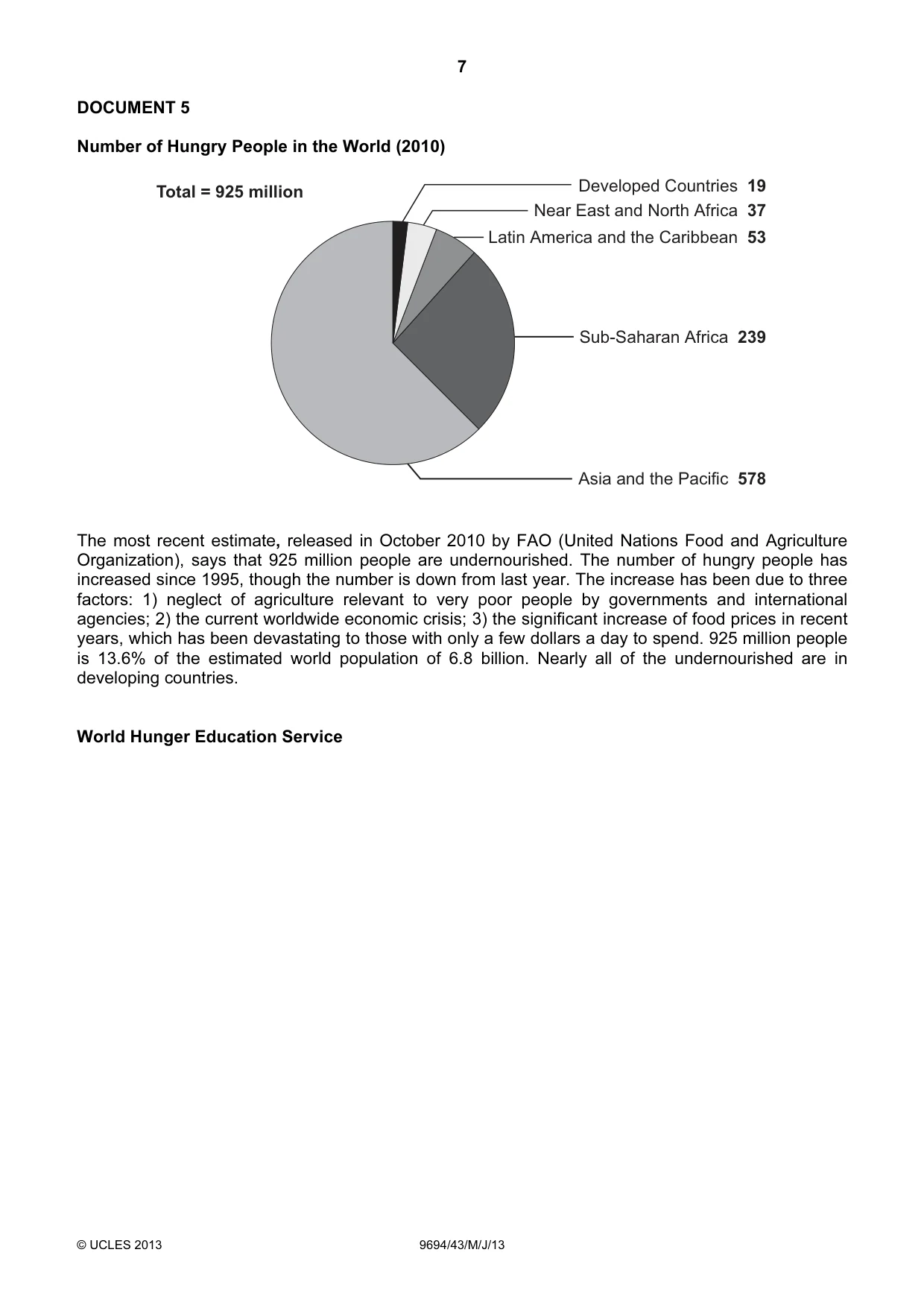
7 © UCLES 2013 9694/43/M/J/13 DOCUMENT 5 Number of Hungry People in the World (2010) Asia and the Pacific 578 Sub-Saharan Africa 239 Latin America and the Caribbean 53 Near East and North Africa 37 Developed Countries 19 Total = 925 million The most recent estimate, released in October 2010 by FAO (United Nations Food and Agriculture Organization), says that 925 million people are undernourished. The number of hungry people has increased since 1995, though the number is down from last year. The increase has been due to three factors: 1) neglect of agriculture relevant to very poor people by governments and international agencies; 2) the current worldwide economic crisis; 3) the significant increase of food prices in recent years, which has been devastating to those with only a few dollars a day to spend. 925 million people is 13.6% of the estimated world population of 6.8 billion. Nearly all of the undernourished are in developing countries. World Hunger Education Service
Question paper, page 8
8 Copyright Acknowledgements: Document 2 Document 3 Source 1 Document 3 Source 2 Document 4 Document 5 © WVC Philosophy; http://instruct.westvalley.edu/lafave/FAMINE.html. © http://feedingamerica.org/hunger-in-america.aspx. © http://feedingamerica.org/press-room/press-releases/feeding-america-launches-hunger-action-month.aspx. © Sanhati; http://democracyandclassstruggle.blogspot.com/2010/09/unlock-gates-of-food-godowns.html; 23 September 2010. © World Hunger Education Service (Hunger Notes); http://www.worldhunger.org/articles/Learn/world%20hunger%20facts%202002.htm. Permission to reproduce items where third-party owned material protected by copyright is included has been sought and cleared where possible. Every reasonable effort has been made by the publisher (UCLES) to trace copyright holders, but if any items requiring clearance have unwittingly been included, the publisher will be pleased to make amends at the earliest possible opportunity. University of Cambridge International Examinations is part of the Cambridge Assessment Group. Cambridge Assessment is the brand name of University of Cambridge Local Examinations Syndicate (UCLES), which is itself a department of the University of Cambridge. © UCLES 2013 9694/43/M/J/13 BLANK PAGE
Mark scheme, page 1
CAMBRIDGE INTERNATIONAL EXAMINATIONS GCE Advanced Level MARK SCHEME for the May/June 2013 series 9694 THINKING SKILLS 9694/43 Paper 4 (Applied Reasoning), maximum raw mark 50 This mark scheme is published as an aid to teachers and candidates, to indicate the requirements of the examination. It shows the basis on which Examiners were instructed to award marks. It does not indicate the details of the discussions that took place at an Examiners’ meeting before marking began, which would have considered the acceptability of alternative answers. Mark schemes should be read in conjunction with the question paper and the Principal Examiner Report for Teachers. Cambridge will not enter into discussions about these mark schemes. Cambridge is publishing the mark schemes for the May/June 2013 series for most IGCSE, GCE Advanced Level and Advanced Subsidiary Level components and some Ordinary Level components.
Mark scheme, page 2
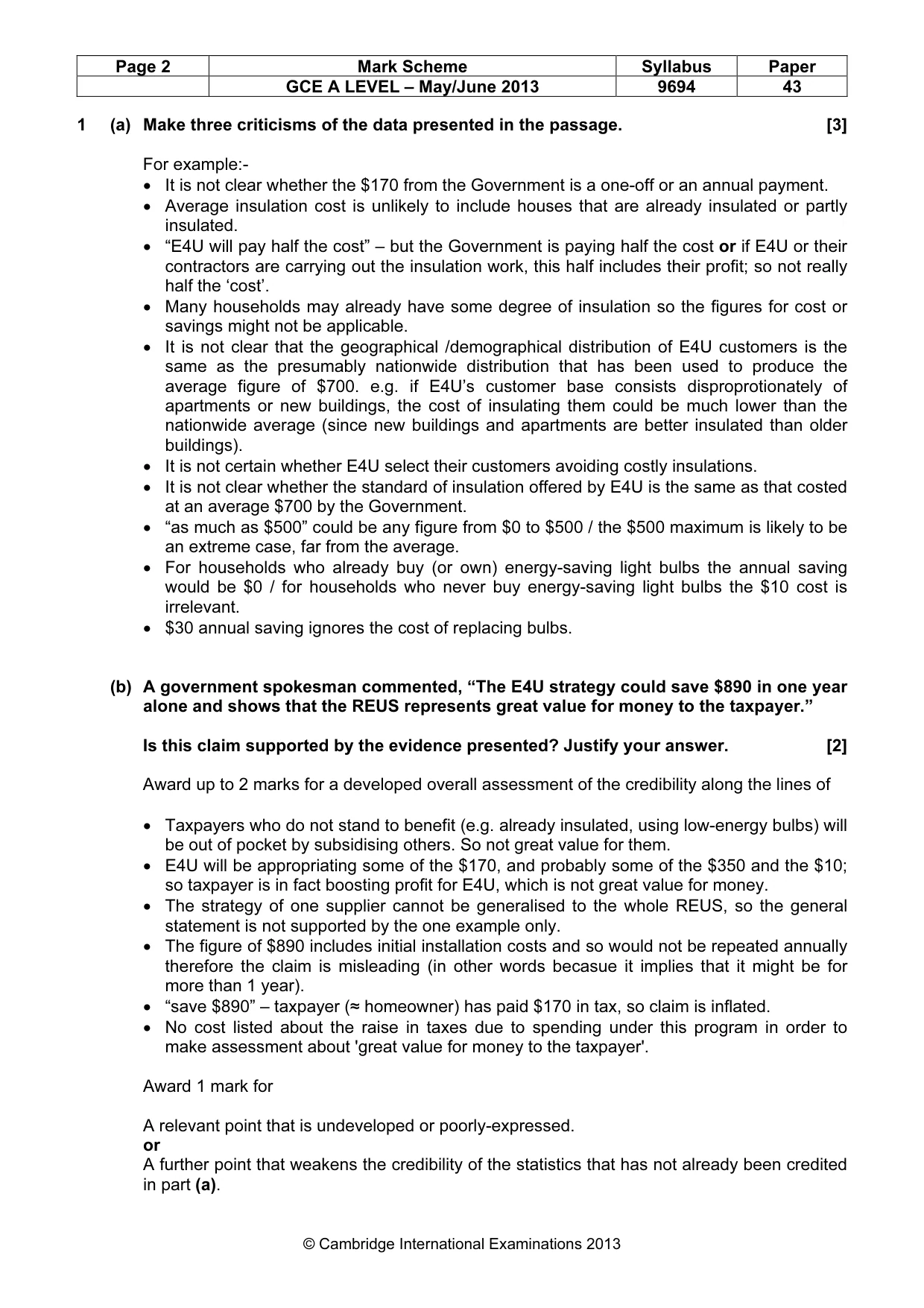
Page 2 Mark Scheme Syllabus Paper GCE A LEVEL – May/June 2013 9694 43 © Cambridge International Examinations 2013 1 (a) Make three criticisms of the data presented in the passage. [3] For example:- • It is not clear whether the $170 from the Government is a one-off or an annual payment. • Average insulation cost is unlikely to include houses that are already insulated or partly insulated. • “E4U will pay half the cost” – but the Government is paying half the cost or if E4U or their contractors are carrying out the insulation work, this half includes their profit; so not really half the ‘cost’. • Many households may already have some degree of insulation so the figures for cost or savings might not be applicable. • It is not clear that the geographical /demographical distribution of E4U customers is the same as the presumably nationwide distribution that has been used to produce the average figure of $700. e.g. if E4U’s customer base consists disproprotionately of apartments or new buildings, the cost of insulating them could be much lower than the nationwide average (since new buildings and apartments are better insulated than older buildings). • It is not certain whether E4U select their customers avoiding costly insulations. • It is not clear whether the standard of insulation offered by E4U is the same as that costed at an average $700 by the Government. • “as much as $500” could be any figure from $0 to $500 / the $500 maximum is likely to be an extreme case, far from the average. • For households who already buy (or own) energy-saving light bulbs the annual saving would be $0 / for households who never buy energy-saving light bulbs the $10 cost is irrelevant. • $30 annual saving ignores the cost of replacing bulbs. (b) A government spokesman commented, “The E4U strategy could save $890 in one year alone and shows that the REUS represents great value for money to the taxpayer.” Is this claim supported by the evidence presented? Justify your answer. [2] Award up to 2 marks for a developed overall assessment of the credibility along the lines of • Taxpayers who do not stand to benefit (e.g. already insulated, using low-energy bulbs) will be out of pocket by subsidising others. So not great value for them. • E4U will be appropriating some of the $170, and probably some of the $350 and the $10; so taxpayer is in fact boosting profit for E4U, which is not great value for money. • The strategy of one supplier cannot be generalised to the whole REUS, so the general statement is not supported by the one example only. • The figure of $890 includes initial installation costs and so would not be repeated annually therefore the claim is misleading (in other words becasue it implies that it might be for more than 1 year). • “save $890” – taxpayer (≈ homeowner) has paid $170 in tax, so claim is inflated. • No cost listed about the raise in taxes due to spending under this program in order to make assessment about 'great value for money to the taxpayer'. Award 1 mark for A relevant point that is undeveloped or poorly-expressed. or A further point that weakens the credibility of the statistics that has not already been credited in part (a).
Mark scheme, page 3
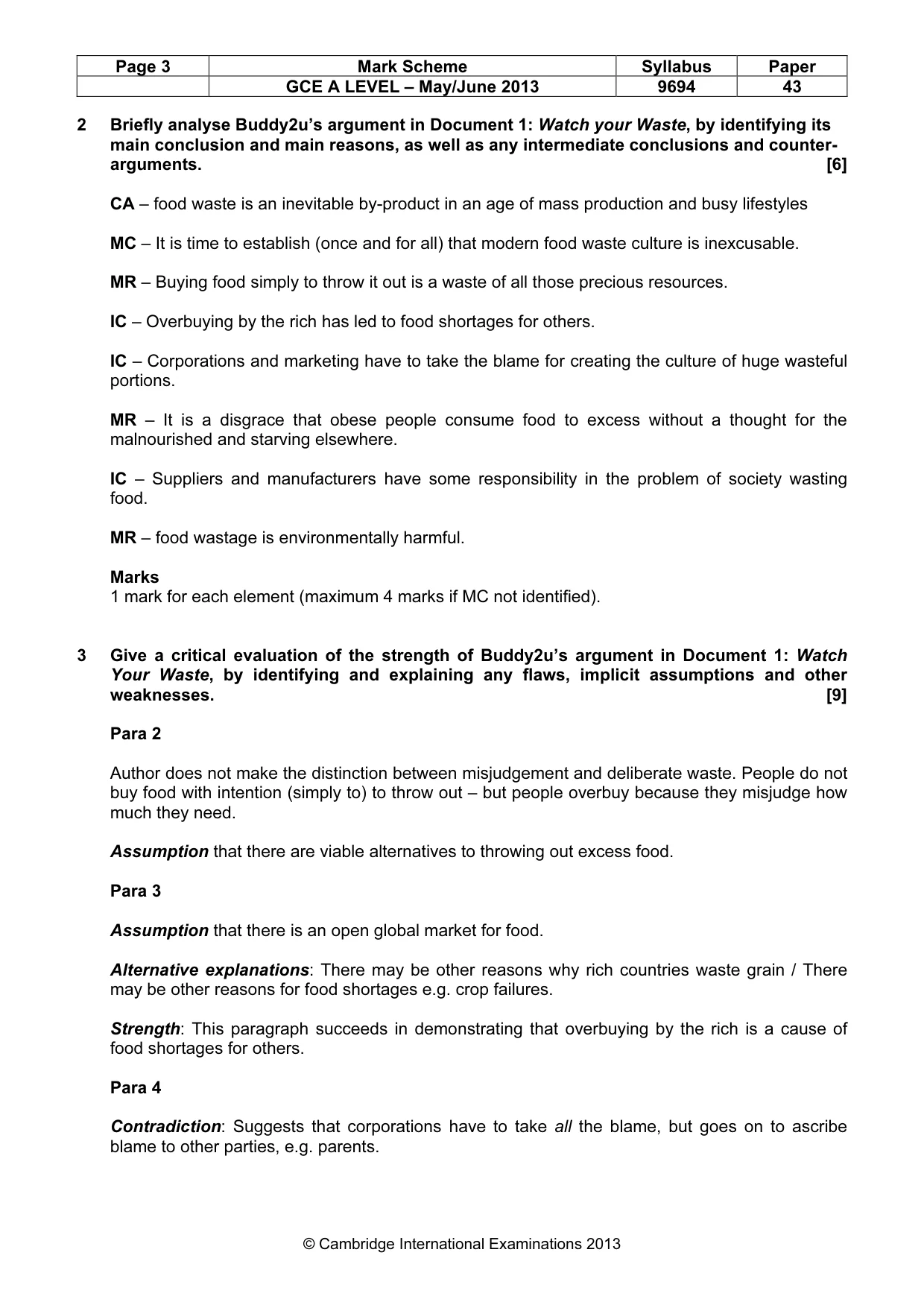
Page 3 Mark Scheme Syllabus Paper GCE A LEVEL – May/June 2013 9694 43 © Cambridge International Examinations 2013 2 Briefly analyse Buddy2u’s argument in Document 1: Watch your Waste, by identifying its main conclusion and main reasons, as well as any intermediate conclusions and counter- arguments. [6] CA – food waste is an inevitable by-product in an age of mass production and busy lifestyles MC – It is time to establish (once and for all) that modern food waste culture is inexcusable. MR – Buying food simply to throw it out is a waste of all those precious resources. IC – Overbuying by the rich has led to food shortages for others. IC – Corporations and marketing have to take the blame for creating the culture of huge wasteful portions. MR – It is a disgrace that obese people consume food to excess without a thought for the malnourished and starving elsewhere. IC – Suppliers and manufacturers have some responsibility in the problem of society wasting food. MR – food wastage is environmentally harmful. Marks 1 mark for each element (maximum 4 marks if MC not identified). 3 Give a critical evaluation of the strength of Buddy2u’s argument in Document 1: Watch Your Waste, by identifying and explaining any flaws, implicit assumptions and other weaknesses. [9] Para 2 Author does not make the distinction between misjudgement and deliberate waste. People do not buy food with intention (simply to) to throw out – but people overbuy because they misjudge how much they need. Assumption that there are viable alternatives to throwing out excess food. Para 3 Assumption that there is an open global market for food. Alternative explanations: There may be other reasons why rich countries waste grain / There may be other reasons for food shortages e.g. crop failures. Strength: This paragraph succeeds in demonstrating that overbuying by the rich is a cause of food shortages for others. Para 4 Contradiction: Suggests that corporations have to take all the blame, but goes on to ascribe blame to other parties, e.g. parents.
Mark scheme, page 4
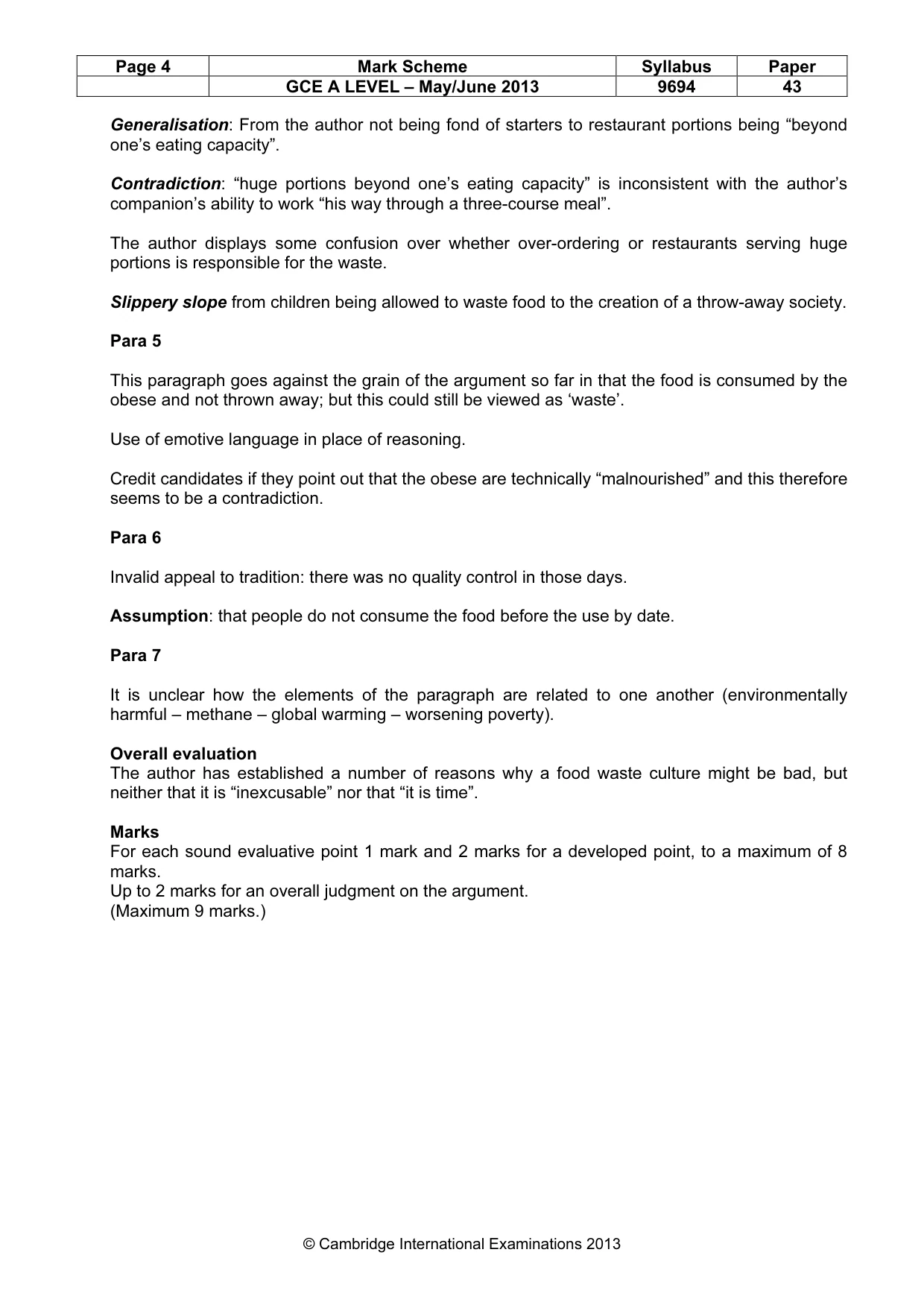
Page 4 Mark Scheme Syllabus Paper GCE A LEVEL – May/June 2013 9694 43 © Cambridge International Examinations 2013 Generalisation: From the author not being fond of starters to restaurant portions being “beyond one’s eating capacity”. Contradiction: “huge portions beyond one’s eating capacity” is inconsistent with the author’s companion’s ability to work “his way through a three-course meal”. The author displays some confusion over whether over-ordering or restaurants serving huge portions is responsible for the waste. Slippery slope from children being allowed to waste food to the creation of a throw-away society. Para 5 This paragraph goes against the grain of the argument so far in that the food is consumed by the obese and not thrown away; but this could still be viewed as ‘waste’. Use of emotive language in place of reasoning. Credit candidates if they point out that the obese are technically “malnourished” and this therefore seems to be a contradiction. Para 6 Invalid appeal to tradition: there was no quality control in those days. Assumption: that people do not consume the food before the use by date. Para 7 It is unclear how the elements of the paragraph are related to one another (environmentally harmful – methane – global warming – worsening poverty). Overall evaluation The author has established a number of reasons why a food waste culture might be bad, but neither that it is “inexcusable” nor that “it is time”. Marks For each sound evaluative point 1 mark and 2 marks for a developed point, to a maximum of 8 marks. Up to 2 marks for an overall judgment on the argument. (Maximum 9 marks.)
Mark scheme, page 5
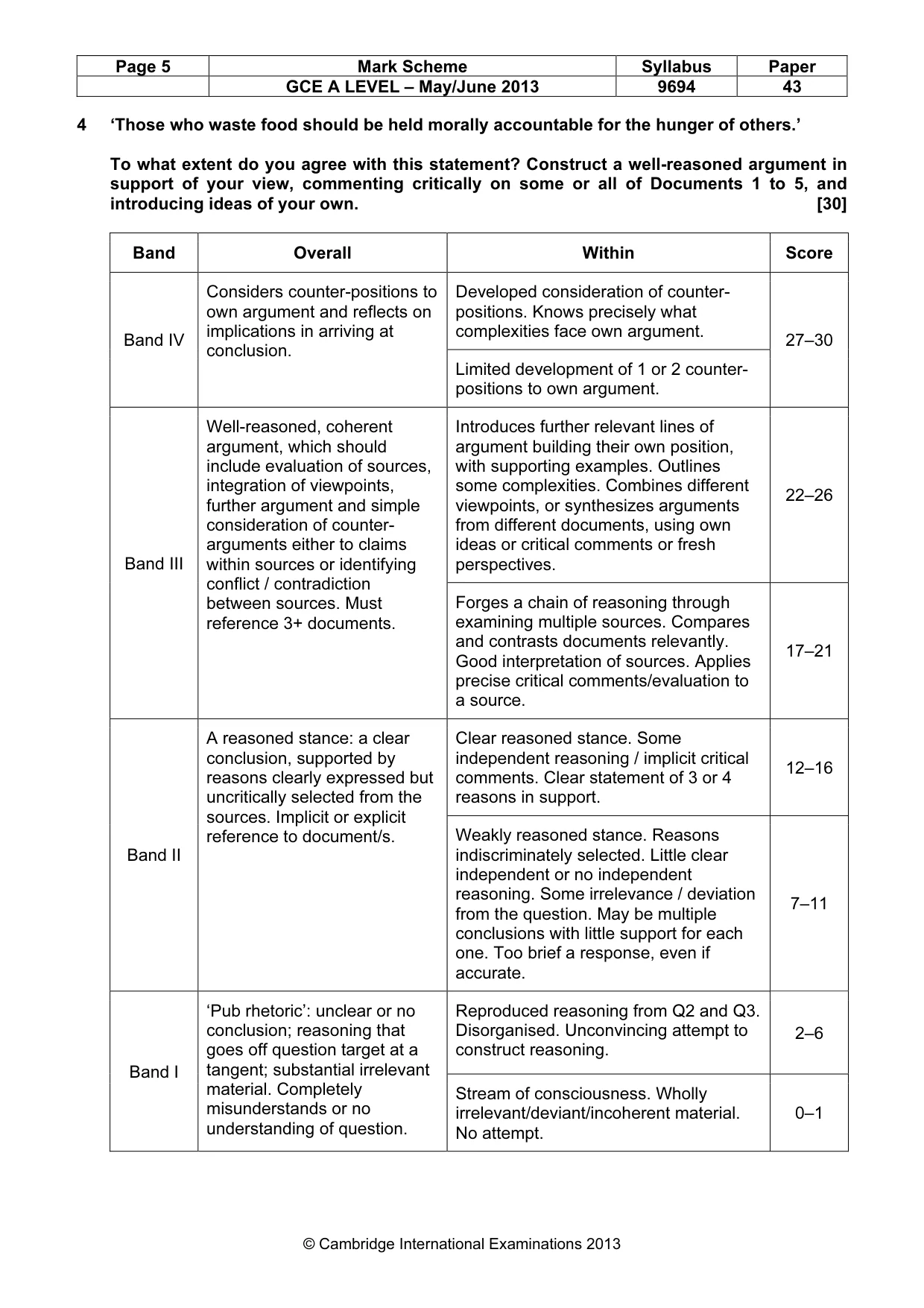
Page 5 Mark Scheme Syllabus Paper GCE A LEVEL – May/June 2013 9694 43 © Cambridge International Examinations 2013 4 ‘Those who waste food should be held morally accountable for the hunger of others.’ To what extent do you agree with this statement? Construct a well-reasoned argument in support of your view, commenting critically on some or all of Documents 1 to 5, and introducing ideas of your own. [30] Band Overall Within Score Band IV Considers counter-positions to own argument and reflects on implications in arriving at conclusion. Developed consideration of counter- positions. Knows precisely what complexities face own argument. 27–30 Limited development of 1 or 2 counter- positions to own argument. Band III Well-reasoned, coherent argument, which should include evaluation of sources, integration of viewpoints, further argument and simple consideration of counter- arguments either to claims within sources or identifying conflict / contradiction between sources. Must reference 3+ documents. Introduces further relevant lines of argument building their own position, with supporting examples. Outlines some complexities. Combines different viewpoints, or synthesizes arguments from different documents, using own ideas or critical comments or fresh perspectives. 22–26 Forges a chain of reasoning through examining multiple sources. Compares and contrasts documents relevantly. Good interpretation of sources. Applies precise critical comments/evaluation to a source. 17–21 Band II A reasoned stance: a clear conclusion, supported by reasons clearly expressed but uncritically selected from the sources. Implicit or explicit reference to document/s. Clear reasoned stance. Some independent reasoning / implicit critical comments. Clear statement of 3 or 4 reasons in support. 12–16 Weakly reasoned stance. Reasons indiscriminately selected. Little clear independent or no independent reasoning. Some irrelevance / deviation from the question. May be multiple conclusions with little support for each one. Too brief a response, even if accurate. 7–11 Band I ‘Pub rhetoric’: unclear or no conclusion; reasoning that goes off question target at a tangent; substantial irrelevant material. Completely misunderstands or no understanding of question. Reproduced reasoning from Q2 and Q3. Disorganised. Unconvincing attempt to construct reasoning. 2–6 Stream of consciousness. Wholly irrelevant/deviant/incoherent material. No attempt. 0–1
Mark scheme, page 6
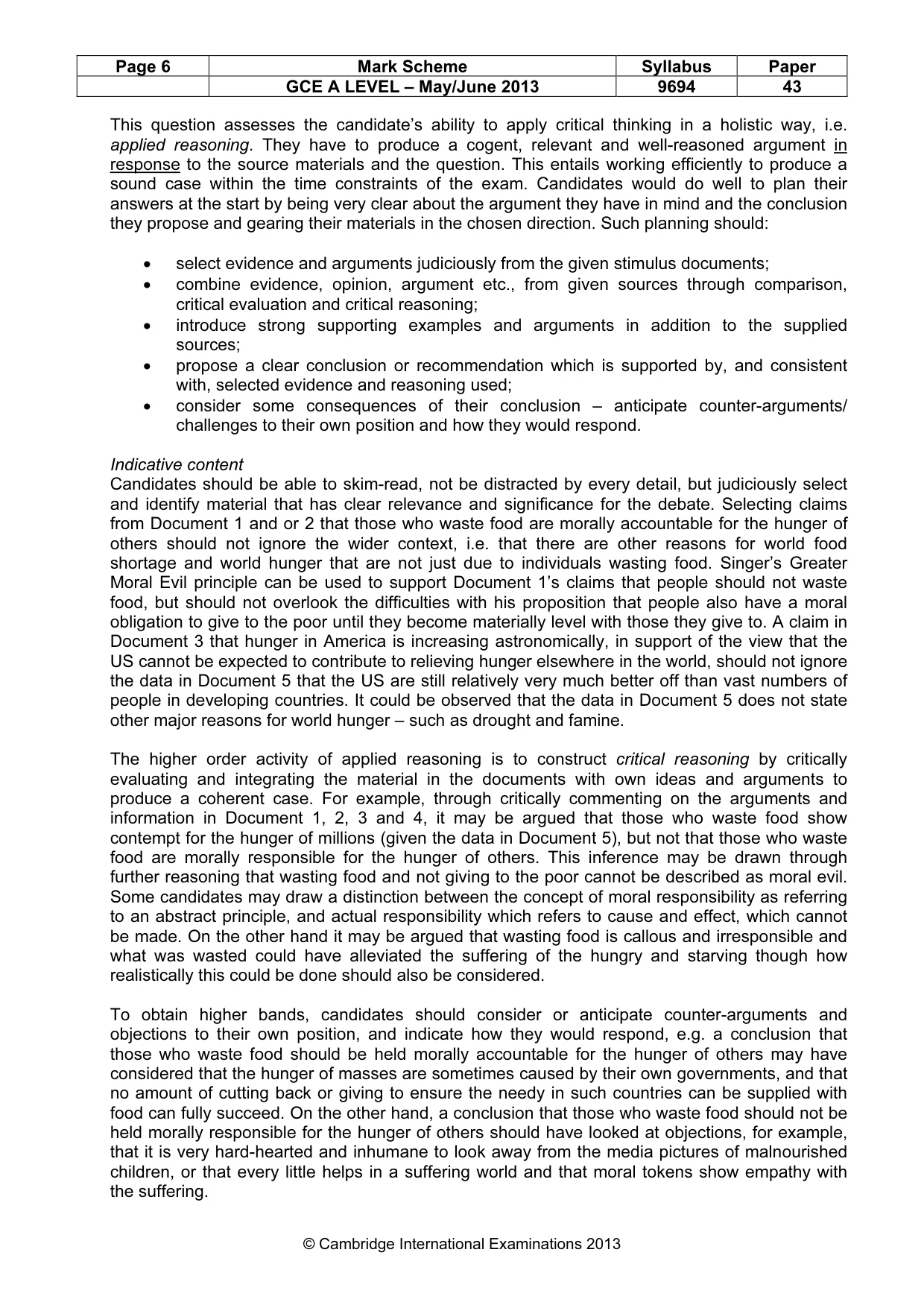
Page 6 Mark Scheme Syllabus Paper GCE A LEVEL – May/June 2013 9694 43 © Cambridge International Examinations 2013 This question assesses the candidate’s ability to apply critical thinking in a holistic way, i.e. applied reasoning. They have to produce a cogent, relevant and well-reasoned argument in response to the source materials and the question. This entails working efficiently to produce a sound case within the time constraints of the exam. Candidates would do well to plan their answers at the start by being very clear about the argument they have in mind and the conclusion they propose and gearing their materials in the chosen direction. Such planning should: • select evidence and arguments judiciously from the given stimulus documents; • combine evidence, opinion, argument etc., from given sources through comparison, critical evaluation and critical reasoning; • introduce strong supporting examples and arguments in addition to the supplied sources; • propose a clear conclusion or recommendation which is supported by, and consistent with, selected evidence and reasoning used; • consider some consequences of their conclusion – anticipate counter-arguments/ challenges to their own position and how they would respond. Indicative content Candidates should be able to skim-read, not be distracted by every detail, but judiciously select and identify material that has clear relevance and significance for the debate. Selecting claims from Document 1 and or 2 that those who waste food are morally accountable for the hunger of others should not ignore the wider context, i.e. that there are other reasons for world food shortage and world hunger that are not just due to individuals wasting food. Singer’s Greater Moral Evil principle can be used to support Document 1’s claims that people should not waste food, but should not overlook the difficulties with his proposition that people also have a moral obligation to give to the poor until they become materially level with those they give to. A claim in Document 3 that hunger in America is increasing astronomically, in support of the view that the US cannot be expected to contribute to relieving hunger elsewhere in the world, should not ignore the data in Document 5 that the US are still relatively very much better off than vast numbers of people in developing countries. It could be observed that the data in Document 5 does not state other major reasons for world hunger – such as drought and famine. The higher order activity of applied reasoning is to construct critical reasoning by critically evaluating and integrating the material in the documents with own ideas and arguments to produce a coherent case. For example, through critically commenting on the arguments and information in Document 1, 2, 3 and 4, it may be argued that those who waste food show contempt for the hunger of millions (given the data in Document 5), but not that those who waste food are morally responsible for the hunger of others. This inference may be drawn through further reasoning that wasting food and not giving to the poor cannot be described as moral evil. Some candidates may draw a distinction between the concept of moral responsibility as referring to an abstract principle, and actual responsibility which refers to cause and effect, which cannot be made. On the other hand it may be argued that wasting food is callous and irresponsible and what was wasted could have alleviated the suffering of the hungry and starving though how realistically this could be done should also be considered. To obtain higher bands, candidates should consider or anticipate counter-arguments and objections to their own position, and indicate how they would respond, e.g. a conclusion that those who waste food should be held morally accountable for the hunger of others may have considered that the hunger of masses are sometimes caused by their own governments, and that no amount of cutting back or giving to ensure the needy in such countries can be supplied with food can fully succeed. On the other hand, a conclusion that those who waste food should not be held morally responsible for the hunger of others should have looked at objections, for example, that it is very hard-hearted and inhumane to look away from the media pictures of malnourished children, or that every little helps in a suffering world and that moral tokens show empathy with the suffering.
Mark scheme, page 7
Page 7 Mark Scheme Syllabus Paper GCE A LEVEL – May/June 2013 9694 43 © Cambridge International Examinations 2013 No marks are reserved for the quality of written English or specialist knowledge of philosophy or ethical theories. It is the quality of critical thinking and reasoning alone which is under assessment.
What you needed in this session
Cambridge’s own grade thresholds for 2013 May/June, Paper 4 · Variant 3. A higher threshold means an easier paper — the bar moves with how the cohort did.