Cambridge A Level Thinking Skills 9694 — 2013 May/June Paper 4 · Variant 2
9694/42/M/J/13 · 50 marks · ≈56 min
The question paper and its mark scheme, free to read here and free to download. This is Cambridge’s own paper, exactly as it was sat.
Question paper8 pages
Mark scheme7 pages
Answers below. Sit the paper first if you are practising.
Paper as text
Question paper, page 1
This document consists of 7 printed pages and 1 blank page. IB13 06_9694_42/3RP © UCLES 2013 [Turn over *8030747547* UNIVERSITY OF CAMBRIDGE INTERNATIONAL EXAMINATIONS General Certificate of Education Advanced Level THINKING SKILLS 9694/42 Paper 4 Applied Reasoning May/June 2013 1 hour 30 minutes Additional Materials: Answer Booklet/Paper READ THESE INSTRUCTIONS FIRST If you have been given an Answer Booklet, follow the instructions on the front cover of the booklet. Write your Centre number, candidate number and name on all the work you hand in. Write in dark blue or black pen. Do not use staples, paper clips, highlighters, glue or correction fluid. DO NOT WRITE IN ANY BARCODES. Answer all the questions. Start each question on a new answer sheet. At the end of the examination, fasten all your work securely together. The number of marks is given in brackets [ ] at the end of each question.
Question paper, page 2
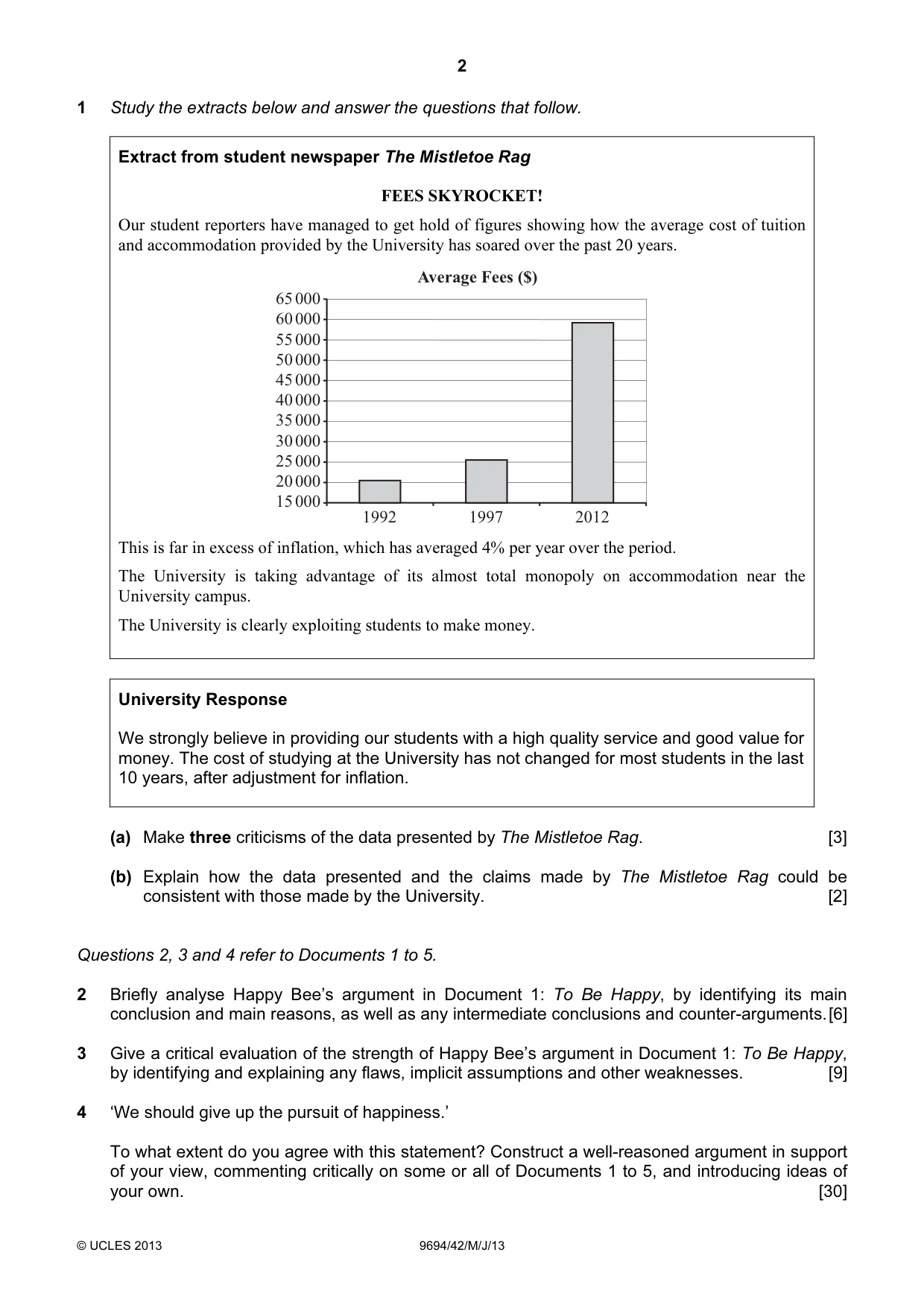
2 © UCLES 2013 9694/42/M/J/13 1 Study the extracts below and answer the questions that follow. Extract from student newspaper The Mistletoe Rag FEES SKYROCKET! Our student reporters have managed to get hold of figures showing how the average cost of tuition and accommodation provided by the University has soared over the past 20 years. 65 000 60 000 55 000 50 000 45 000 40 000 35 000 30 000 25 000 20 000 15 000 1992 2012 1997 Average Fees ($) This is far in excess of inflation, which has averaged 4% per year over the period. The University is taking advantage of its almost total monopoly on accommodation near the University campus. The University is clearly exploiting students to make money. University Response We strongly believe in providing our students with a high quality service and good value for money. The cost of studying at the University has not changed for most students in the last 10 years, after adjustment for inflation. (a) Make three criticisms of the data presented by The Mistletoe Rag. [3] (b) Explain how the data presented and the claims made by The Mistletoe Rag could be consistent with those made by the University. [2] Questions 2, 3 and 4 refer to Documents 1 to 5. 2 Briefly analyse Happy Bee’s argument in Document 1: To Be Happy, by identifying its main conclusion and main reasons, as well as any intermediate conclusions and counter-arguments. [6] 3 Give a critical evaluation of the strength of Happy Bee’s argument in Document 1: To Be Happy, by identifying and explaining any flaws, implicit assumptions and other weaknesses. [9] 4 ‘We should give up the pursuit of happiness.’ To what extent do you agree with this statement? Construct a well-reasoned argument in support of your view, commenting critically on some or all of Documents 1 to 5, and introducing ideas of your own. [30]
Question paper, page 3
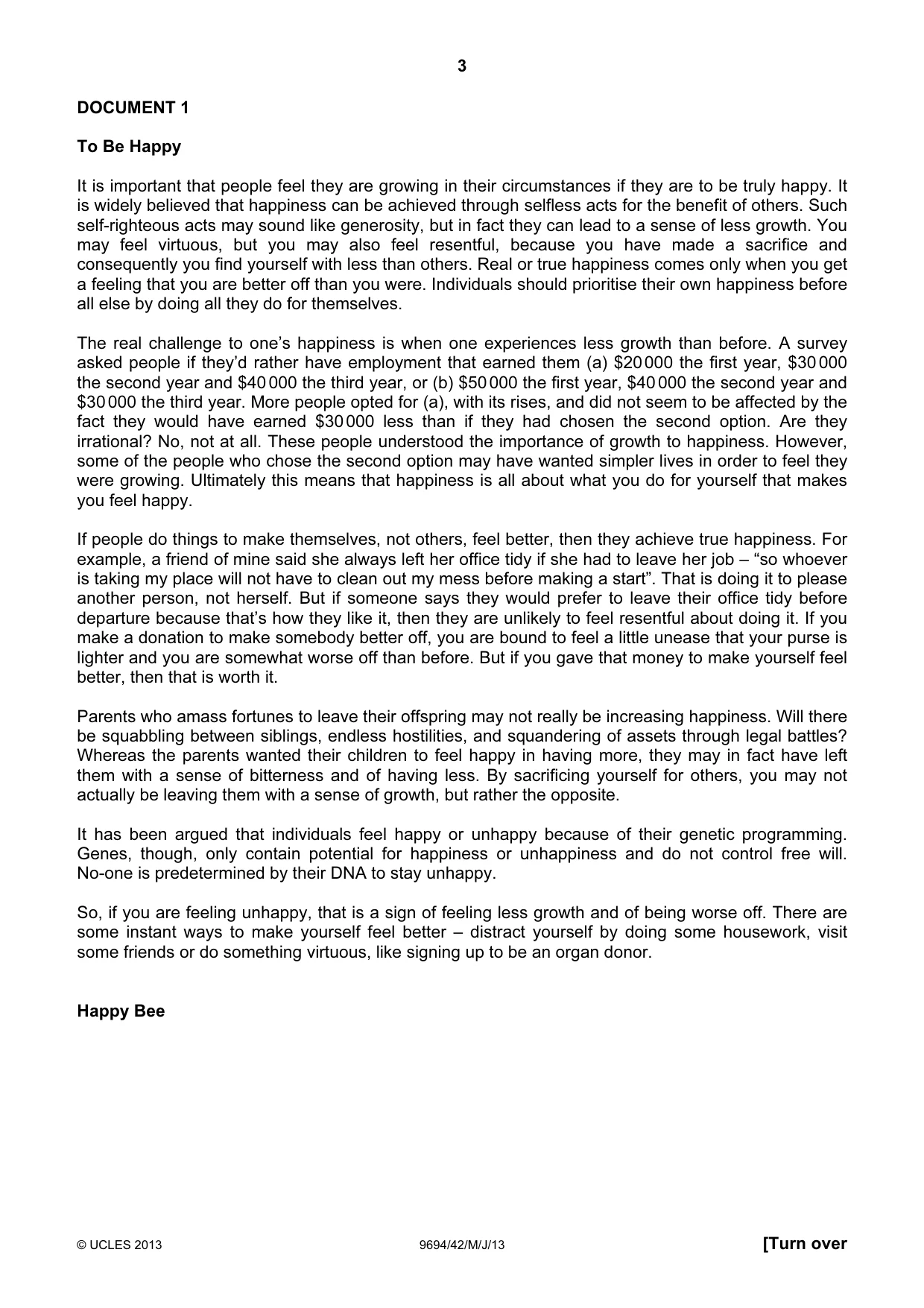
3 © UCLES 2013 9694/42/M/J/13 [Turn over DOCUMENT 1 To Be Happy It is important that people feel they are growing in their circumstances if they are to be truly happy. It is widely believed that happiness can be achieved through selfless acts for the benefit of others. Such self-righteous acts may sound like generosity, but in fact they can lead to a sense of less growth. You may feel virtuous, but you may also feel resentful, because you have made a sacrifice and consequently you find yourself with less than others. Real or true happiness comes only when you get a feeling that you are better off than you were. Individuals should prioritise their own happiness before all else by doing all they do for themselves. The real challenge to one’s happiness is when one experiences less growth than before. A survey asked people if they’d rather have employment that earned them (a) $20 000 the first year, $30 000 the second year and $40 000 the third year, or (b) $50 000 the first year, $40 000 the second year and $30 000 the third year. More people opted for (a), with its rises, and did not seem to be affected by the fact they would have earned $30 000 less than if they had chosen the second option. Are they irrational? No, not at all. These people understood the importance of growth to happiness. However, some of the people who chose the second option may have wanted simpler lives in order to feel they were growing. Ultimately this means that happiness is all about what you do for yourself that makes you feel happy. If people do things to make themselves, not others, feel better, then they achieve true happiness. For example, a friend of mine said she always left her office tidy if she had to leave her job – “so whoever is taking my place will not have to clean out my mess before making a start”. That is doing it to please another person, not herself. But if someone says they would prefer to leave their office tidy before departure because that’s how they like it, then they are unlikely to feel resentful about doing it. If you make a donation to make somebody better off, you are bound to feel a little unease that your purse is lighter and you are somewhat worse off than before. But if you gave that money to make yourself feel better, then that is worth it. Parents who amass fortunes to leave their offspring may not really be increasing happiness. Will there be squabbling between siblings, endless hostilities, and squandering of assets through legal battles? Whereas the parents wanted their children to feel happy in having more, they may in fact have left them with a sense of bitterness and of having less. By sacrificing yourself for others, you may not actually be leaving them with a sense of growth, but rather the opposite. It has been argued that individuals feel happy or unhappy because of their genetic programming. Genes, though, only contain potential for happiness or unhappiness and do not control free will. No-one is predetermined by their DNA to stay unhappy. So, if you are feeling unhappy, that is a sign of feeling less growth and of being worse off. There are some instant ways to make yourself feel better – distract yourself by doing some housework, visit some friends or do something virtuous, like signing up to be an organ donor. Happy Bee
Question paper, page 4
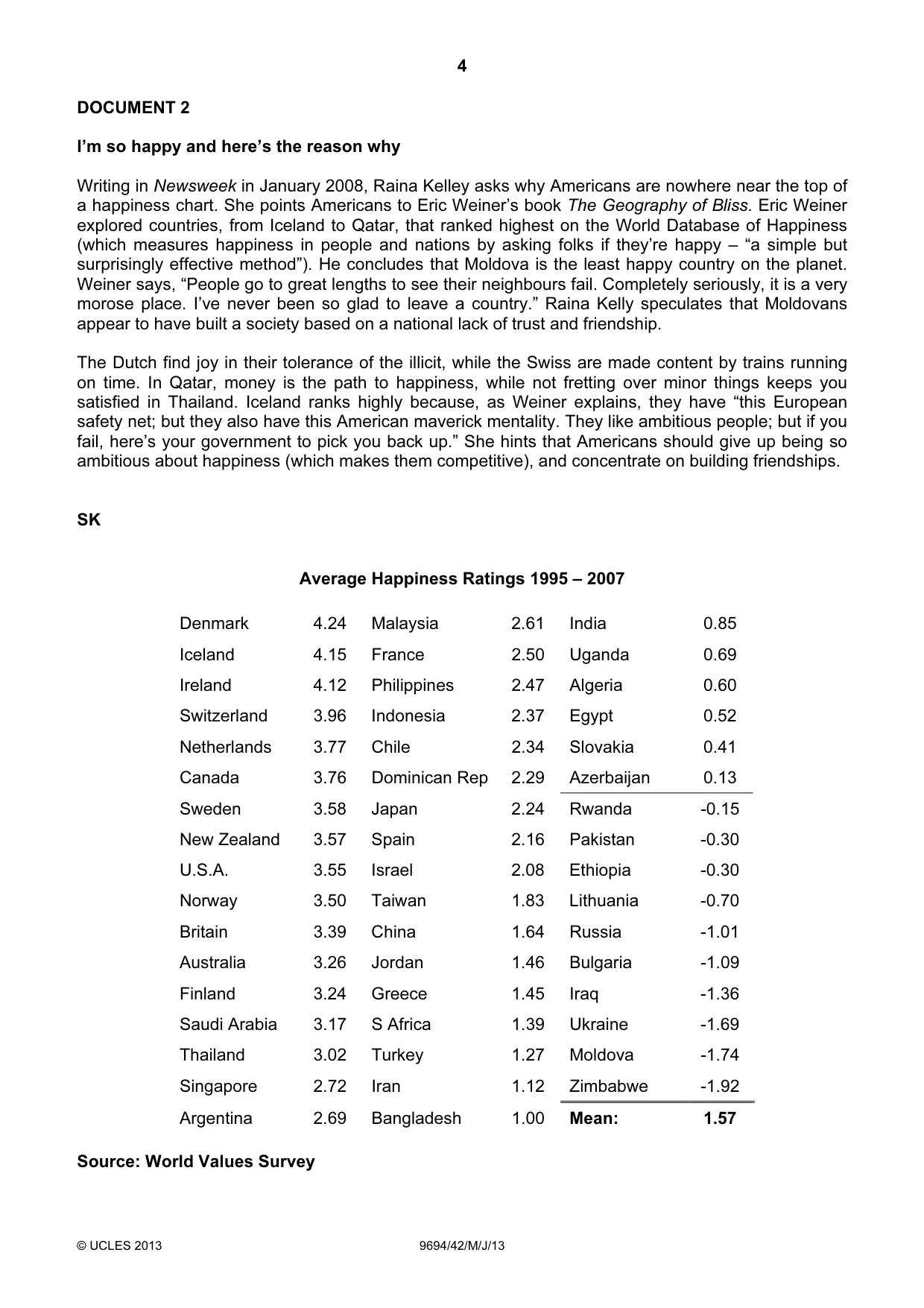
4 © UCLES 2013 9694/42/M/J/13 DOCUMENT 2 I’m so happy and here’s the reason why Writing in Newsweek in January 2008, Raina Kelley asks why Americans are nowhere near the top of a happiness chart. She points Americans to Eric Weiner’s book The Geography of Bliss. Eric Weiner explored countries, from Iceland to Qatar, that ranked highest on the World Database of Happiness (which measures happiness in people and nations by asking folks if they’re happy – “a simple but surprisingly effective method”). He concludes that Moldova is the least happy country on the planet. Weiner says, “People go to great lengths to see their neighbours fail. Completely seriously, it is a very morose place. I’ve never been so glad to leave a country.” Raina Kelly speculates that Moldovans appear to have built a society based on a national lack of trust and friendship. The Dutch find joy in their tolerance of the illicit, while the Swiss are made content by trains running on time. In Qatar, money is the path to happiness, while not fretting over minor things keeps you satisfied in Thailand. Iceland ranks highly because, as Weiner explains, they have “this European safety net; but they also have this American maverick mentality. They like ambitious people; but if you fail, here’s your government to pick you back up.” She hints that Americans should give up being so ambitious about happiness (which makes them competitive), and concentrate on building friendships. SK Average Happiness Ratings 1995 – 2007 Denmark 4.24 Malaysia 2.61 India 0.85 Iceland 4.15 France 2.50 Uganda 0.69 Ireland 4.12 Philippines 2.47 Algeria 0.60 Switzerland 3.96 Indonesia 2.37 Egypt 0.52 Netherlands 3.77 Chile 2.34 Slovakia 0.41 Canada 3.76 Dominican Rep 2.29 Azerbaijan 0.13 Sweden 3.58 Japan 2.24 Rwanda -0.15 New Zealand 3.57 Spain 2.16 Pakistan -0.30 U.S.A. 3.55 Israel 2.08 Ethiopia -0.30 Norway 3.50 Taiwan 1.83 Lithuania -0.70 Britain 3.39 China 1.64 Russia -1.01 Australia 3.26 Jordan 1.46 Bulgaria -1.09 Finland 3.24 Greece 1.45 Iraq -1.36 Saudi Arabia 3.17 S Africa 1.39 Ukraine -1.69 Thailand 3.02 Turkey 1.27 Moldova -1.74 Singapore 2.72 Iran 1.12 Zimbabwe -1.92 Argentina 2.69 Bangladesh 1.00 Mean: 1.57 Source: World Values Survey
Question paper, page 5
5 © UCLES 2013 9694/42/M/J/13 [Turn over DOCUMENT 3 Iceland’s new poor line up for food “I don’t tell my children where I get the food, I’m too ashamed”, said Iris Aegisdottir, an Icelander who has been going to a food bank every week for a year to feed her three children. In a small, close-knit country of just 317 000 people, the stigma of accepting a hand-out is hard to live down, and out of the dozens of people waiting outside the food bank in the snow on a dreary March afternoon, Iris is the only one willing to talk. The crisis that brought down Iceland’s economy in late 2008 threw thousands of formerly well-off families into poverty, forcing people like Iris to turn to charity to survive. Each week, up to 550 families queue up at a small white brick warehouse in Reykjavik to receive free food from the Icelandic Aid To Families organisation, three times more than before the crisis. There is a brutal contrast with the ostentatious wealth that was on display across the island just two years ago, when a hyperactive banking sector flooded the small, formerly fishing-based economy with fast cash. Back then, the biggest worry for many Icelanders was who had the nicest SUV, or the most luxurious flat. But today visible signs of poverty are quickly multiplying, despite the generous welfare state, as the middle class is increasingly hit by a skyrocketing unemployment, up from 1.0% to 9.0% in about a year, and soaring defaults on mortgages. To avoid resorting to charity, many other Icelanders are choosing to pack their bags and try for a new future abroad, with official statistics showing that the country’s biggest emigration wave in more than a century is under way. “There isn’t going to be any future in this country for the next 20 years”, laments Anna Margret Bjoernsdottir, a 46-year-old single mother who is preparing to move to Norway in June if she is unable to ward off eviction from her home near Reykjavik. “I must admit that with the hike in food prices, my two sons eat most of what my husband and I bring home”, Arna Borgthorsdottir Cors confessed in a Reykjavik cafe. “We get what is left over”, she says. Marc Preel Sydney Morning Herald, 11 April 2010
Question paper, page 6
6 © UCLES 2013 9694/42/M/J/13 DOCUMENT 4 Unnatural Selection Adam Smith, the famous 18th century economist, argued that any bit of sudden good fortune, monetary or otherwise, was likely to backfire. The story of Johnny Ace is a case in point. Johnny Ace was a rock-and-roll star who shot to fame when his first single reached number one in 1952. Suddenly, this obscure preacher’s son had become a rock star. Then his luck ran out. His sixth record did not even get into the charts. On Christmas Eve 1954, Johnny put a revolver to his head and blew his brains out. It seems likely that the sudden rise to fame left him ill-prepared for the setbacks that most other musicians get used to dealing with early on in their careers. If material wealth and sudden good fortune do not lead to happiness, what does? According to the Happiness Database, the things that are most likely to make you happy are the things we have known about all along – good health, good friends, and, above all, good family relationships. Getting on well with parents and partners is the key to a happy life. The old clichés are remarkably accurate. This shows that the things that make us happy are the things that help us to pass our genes to the next generation. For millions of years this was the case. In the Stone Age and before, the only way for our ancestors to be happy was by doing the things that helped them pass on their genes, such as having friends and lovers. However, the development of technology has changed all that. Alone among all animal species, humans have invented artificial means of inducing pleasurable moods. These technologies of mood short circuit the routes to happiness designed by natural selection. Instead of wasting months or years looking for a romantic partner, we can get an instant high by taking a drug. In order to be happy, we no longer need to do the things that help us pass on our genes. It appears we have outsmarted natural selection. Dylan Evans Emotion: A very short introduction, OUP, 2003
Question paper, page 7
7 © UCLES 2013 9694/42/M/J/13 DOCUMENT 5 Happiness Gene Forget money, fame and looks. The best chance of happiness comes from two copies of a particular gene. That’s true – at least for 2574 people enrolled in the US National Longitudinal Study of Adolescent Health, who answered a questionnaire about their satisfaction with life and underwent genomic tests. This allowed Jan-Emmanuel de Neve of the London School of Economics to establish that respondents who had two long versions of the 5-HTTLPR gene were twice as likely to say they were satisfied with life as those with two shorter versions of the gene. 5-HTTLPR makes a transporter molecule for serotonin, a chemical that brain cells use to communicate with each other, and the long version speeds up its processing. “It’s the first formal finding of a happiness gene”, says de Neve, but he expects others will be found. He also stresses that many other factors play into happiness. “If you are unlucky throughout life, it will be a more important source of unhappiness than any particular genes.” The New Scientist
Question paper, page 8
8 Copyright Acknowledgements: Document 2 Source 1 Document 2 Source 2 Document 3 Document 4 Document 5 © Raina Kelley; The Pursuit of the Blissful; Newsweek; http://www.thedailybeast.com/newsweek/2008/01/21/the-pursuit-of-the- blissful.html; 21 January 2008. © adapted: Subjective well-being in 97 countries; 1995 – 2007 World Values Surveys; http://www.nsf.gov/news/newsmedia/pr111725/pr111725.pdf. © Marc Preel; Sydney Morning Herald; http://news.smh.com.au/breaking-news-world/icelands-new-poor-line-up-for- food20100411-s0hy.html; 11 April 2010. © Dylan Evans; Emotion: A very short introduction; Oxford University Press; 2003. © New Scientist; 14 May 2011. Permission to reproduce items where third-party owned material protected by copyright is included has been sought and cleared where possible. Every reasonable effort has been made by the publisher (UCLES) to trace copyright holders, but if any items requiring clearance have unwittingly been included, the publisher will be pleased to make amends at the earliest possible opportunity. University of Cambridge International Examinations is part of the Cambridge Assessment Group. Cambridge Assessment is the brand name of University of Cambridge Local Examinations Syndicate (UCLES), which is itself a department of the University of Cambridge. © UCLES 2013 9694/42/M/J/13 BLANK PAGE
Mark scheme, page 1
CAMBRIDGE INTERNATIONAL EXAMINATIONS GCE Advanced Level MARK SCHEME for the May/June 2013 series 9694 THINKING SKILLS 9694/42 Paper 4 (Applied Reasoning), maximum raw mark 50 This mark scheme is published as an aid to teachers and candidates, to indicate the requirements of the examination. It shows the basis on which Examiners were instructed to award marks. It does not indicate the details of the discussions that took place at an Examiners’ meeting before marking began, which would have considered the acceptability of alternative answers. Mark schemes should be read in conjunction with the question paper and the Principal Examiner Report for Teachers. Cambridge will not enter into discussions about these mark schemes. Cambridge is publishing the mark schemes for the May/June 2013 series for most IGCSE, GCE Advanced Level and Advanced Subsidiary Level components and some Ordinary Level components.
Mark scheme, page 2
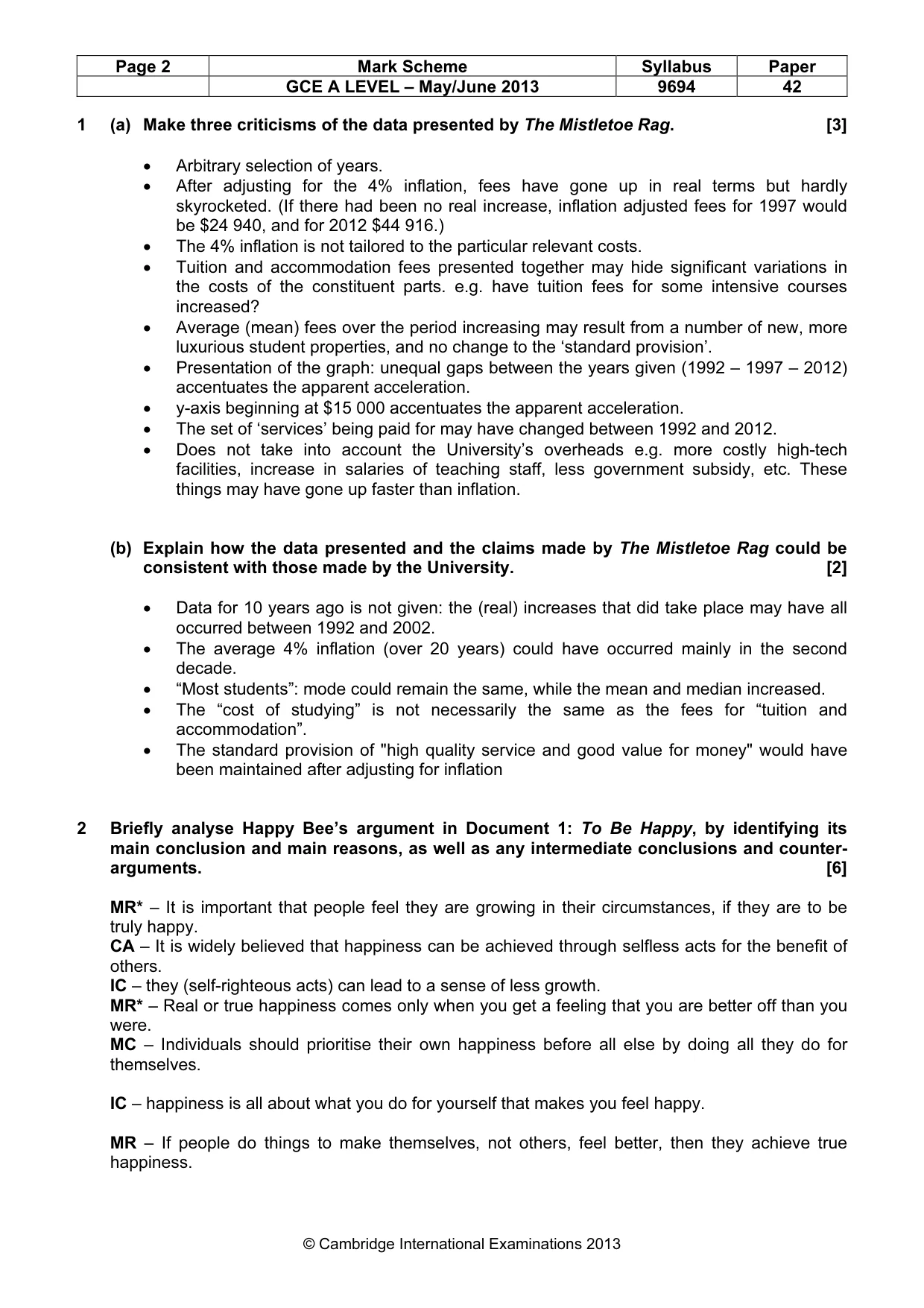
Page 2 Mark Scheme Syllabus Paper GCE A LEVEL – May/June 2013 9694 42 © Cambridge International Examinations 2013 1 (a) Make three criticisms of the data presented by The Mistletoe Rag. [3] • Arbitrary selection of years. • After adjusting for the 4% inflation, fees have gone up in real terms but hardly skyrocketed. (If there had been no real increase, inflation adjusted fees for 1997 would be $24 940, and for 2012 $44 916.) • The 4% inflation is not tailored to the particular relevant costs. • Tuition and accommodation fees presented together may hide significant variations in the costs of the constituent parts. e.g. have tuition fees for some intensive courses increased? • Average (mean) fees over the period increasing may result from a number of new, more luxurious student properties, and no change to the ‘standard provision’. • Presentation of the graph: unequal gaps between the years given (1992 – 1997 – 2012) accentuates the apparent acceleration. • y-axis beginning at $15 000 accentuates the apparent acceleration. • The set of ‘services’ being paid for may have changed between 1992 and 2012. • Does not take into account the University’s overheads e.g. more costly high-tech facilities, increase in salaries of teaching staff, less government subsidy, etc. These things may have gone up faster than inflation. (b) Explain how the data presented and the claims made by The Mistletoe Rag could be consistent with those made by the University. [2] • Data for 10 years ago is not given: the (real) increases that did take place may have all occurred between 1992 and 2002. • The average 4% inflation (over 20 years) could have occurred mainly in the second decade. • “Most students”: mode could remain the same, while the mean and median increased. • The “cost of studying” is not necessarily the same as the fees for “tuition and accommodation”. • The standard provision of "high quality service and good value for money" would have been maintained after adjusting for inflation 2 Briefly analyse Happy Bee’s argument in Document 1: To Be Happy, by identifying its main conclusion and main reasons, as well as any intermediate conclusions and counter- arguments. [6] MR* – It is important that people feel they are growing in their circumstances, if they are to be truly happy. CA – It is widely believed that happiness can be achieved through selfless acts for the benefit of others. IC – they (self-righteous acts) can lead to a sense of less growth. MR* – Real or true happiness comes only when you get a feeling that you are better off than you were. MC – Individuals should prioritise their own happiness before all else by doing all they do for themselves. IC – happiness is all about what you do for yourself that makes you feel happy. MR – If people do things to make themselves, not others, feel better, then they achieve true happiness.
Mark scheme, page 3
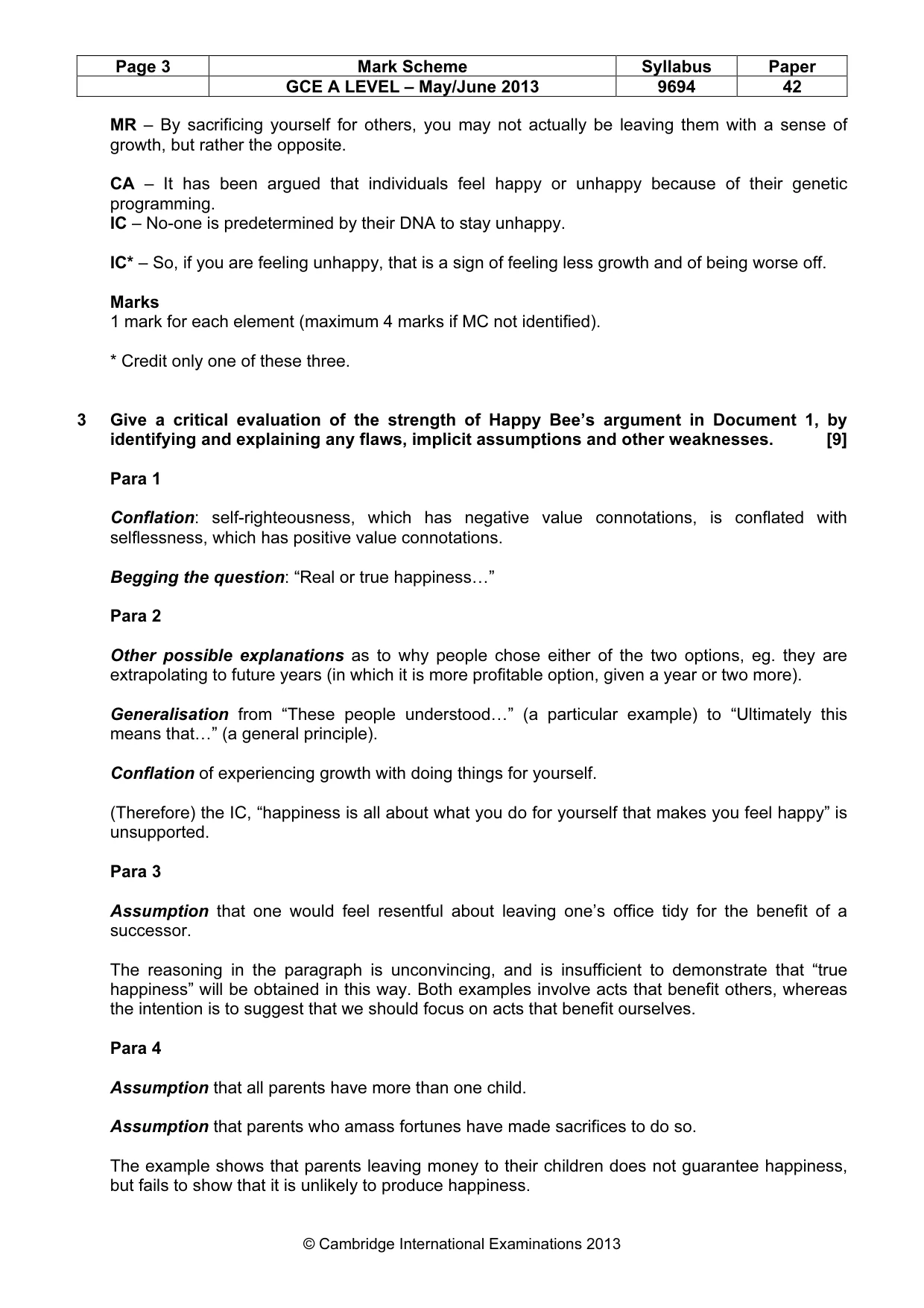
Page 3 Mark Scheme Syllabus Paper GCE A LEVEL – May/June 2013 9694 42 © Cambridge International Examinations 2013 MR – By sacrificing yourself for others, you may not actually be leaving them with a sense of growth, but rather the opposite. CA – It has been argued that individuals feel happy or unhappy because of their genetic programming. IC – No-one is predetermined by their DNA to stay unhappy. IC* – So, if you are feeling unhappy, that is a sign of feeling less growth and of being worse off. Marks 1 mark for each element (maximum 4 marks if MC not identified). * Credit only one of these three. 3 Give a critical evaluation of the strength of Happy Bee’s argument in Document 1, by identifying and explaining any flaws, implicit assumptions and other weaknesses. [9] Para 1 Conflation: self-righteousness, which has negative value connotations, is conflated with selflessness, which has positive value connotations. Begging the question: “Real or true happiness…” Para 2 Other possible explanations as to why people chose either of the two options, eg. they are extrapolating to future years (in which it is more profitable option, given a year or two more). Generalisation from “These people understood…” (a particular example) to “Ultimately this means that…” (a general principle). Conflation of experiencing growth with doing things for yourself. (Therefore) the IC, “happiness is all about what you do for yourself that makes you feel happy” is unsupported. Para 3 Assumption that one would feel resentful about leaving one’s office tidy for the benefit of a successor. The reasoning in the paragraph is unconvincing, and is insufficient to demonstrate that “true happiness” will be obtained in this way. Both examples involve acts that benefit others, whereas the intention is to suggest that we should focus on acts that benefit ourselves. Para 4 Assumption that all parents have more than one child. Assumption that parents who amass fortunes have made sacrifices to do so. The example shows that parents leaving money to their children does not guarantee happiness, but fails to show that it is unlikely to produce happiness.
Mark scheme, page 4
Page 4 Mark Scheme Syllabus Paper GCE A LEVEL – May/June 2013 9694 42 © Cambridge International Examinations 2013 Para 5 The CA “individuals feel happy or unhappy because of their genetic programming” has only very limited relevance to the issue of whether individuals should prioritise their own happiness. Straw man: “individuals feel happy or unhappy because of their genetic programming” overstates the CA and thereby makes it easier to oppose. Para 6 Contradiction: the ways to make yourself feel better are not about growth and the suggestion of signing up to be an organ donor is couched in terms of virtuous (= altruistic) motives rather than selfish ones. Overall evaluation The argument is, overall, very weak. The reasons given support the notion that it might be good to do things for oneself, but fail to demonstrate that one should prioritise one’s own happiness before all else. In particular, the concepts of personal growth and happiness upon which the argument depends are extremely vague and ill-defined. Because of the shifting meaning of these terms the whole argument is circular and many of the claims made are non-falsifiable. Marks For each sound evaluative point 1 mark and 2 marks for a developed point, to a maximum of 8 marks. Up to 2 marks for an overall judgment on the argument. (Maximum 9 marks.)
Mark scheme, page 5
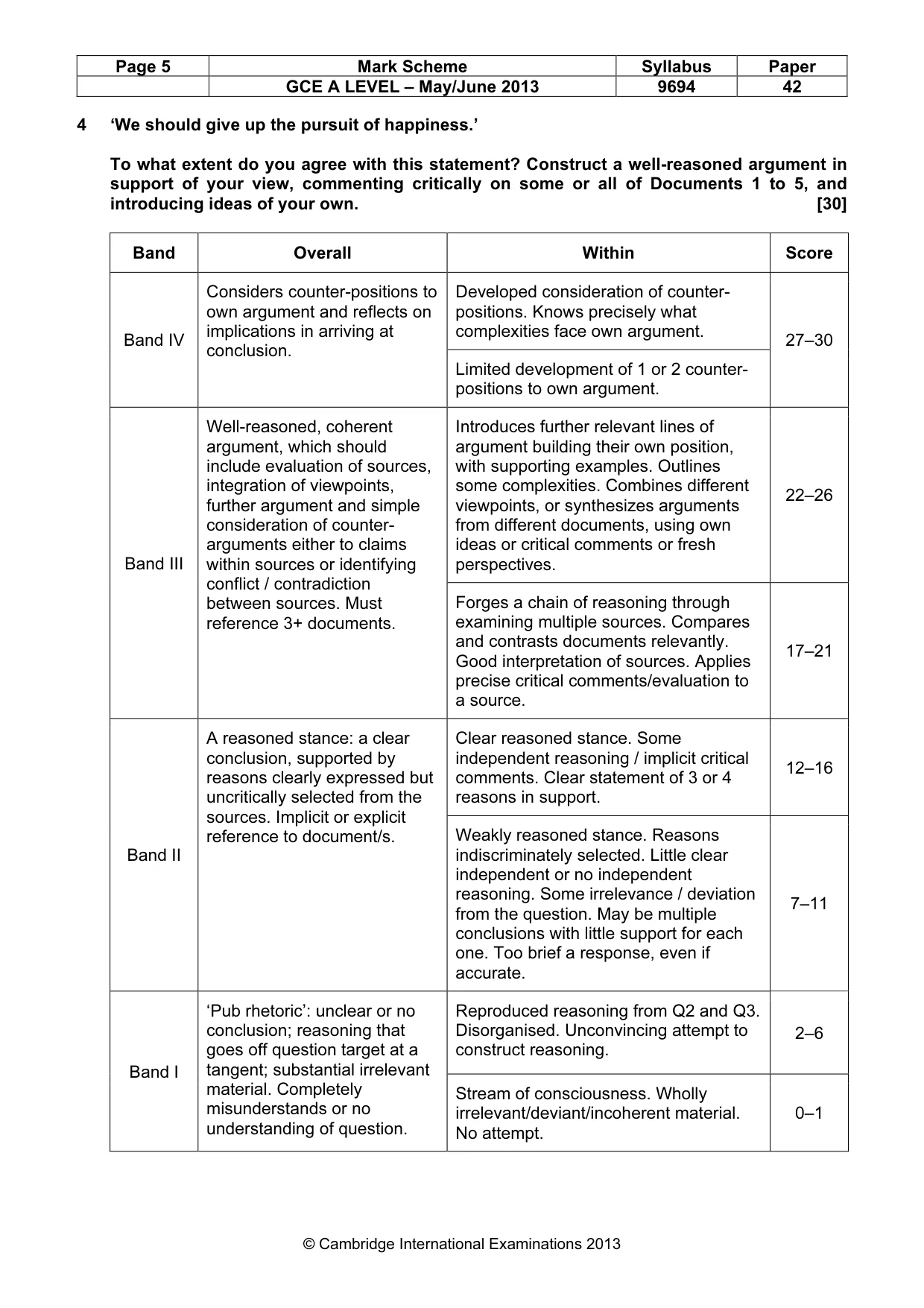
Page 5 Mark Scheme Syllabus Paper GCE A LEVEL – May/June 2013 9694 42 © Cambridge International Examinations 2013 4 ‘We should give up the pursuit of happiness.’ To what extent do you agree with this statement? Construct a well-reasoned argument in support of your view, commenting critically on some or all of Documents 1 to 5, and introducing ideas of your own. [30] Band Overall Within Score Band IV Considers counter-positions to own argument and reflects on implications in arriving at conclusion. Developed consideration of counter- positions. Knows precisely what complexities face own argument. 27–30 Limited development of 1 or 2 counter- positions to own argument. Band III Well-reasoned, coherent argument, which should include evaluation of sources, integration of viewpoints, further argument and simple consideration of counter- arguments either to claims within sources or identifying conflict / contradiction between sources. Must reference 3+ documents. Introduces further relevant lines of argument building their own position, with supporting examples. Outlines some complexities. Combines different viewpoints, or synthesizes arguments from different documents, using own ideas or critical comments or fresh perspectives. 22–26 Forges a chain of reasoning through examining multiple sources. Compares and contrasts documents relevantly. Good interpretation of sources. Applies precise critical comments/evaluation to a source. 17–21 Band II A reasoned stance: a clear conclusion, supported by reasons clearly expressed but uncritically selected from the sources. Implicit or explicit reference to document/s. Clear reasoned stance. Some independent reasoning / implicit critical comments. Clear statement of 3 or 4 reasons in support. 12–16 Weakly reasoned stance. Reasons indiscriminately selected. Little clear independent or no independent reasoning. Some irrelevance / deviation from the question. May be multiple conclusions with little support for each one. Too brief a response, even if accurate. 7–11 Band I ‘Pub rhetoric’: unclear or no conclusion; reasoning that goes off question target at a tangent; substantial irrelevant material. Completely misunderstands or no understanding of question. Reproduced reasoning from Q2 and Q3. Disorganised. Unconvincing attempt to construct reasoning. 2–6 Stream of consciousness. Wholly irrelevant/deviant/incoherent material. No attempt. 0–1
Mark scheme, page 6
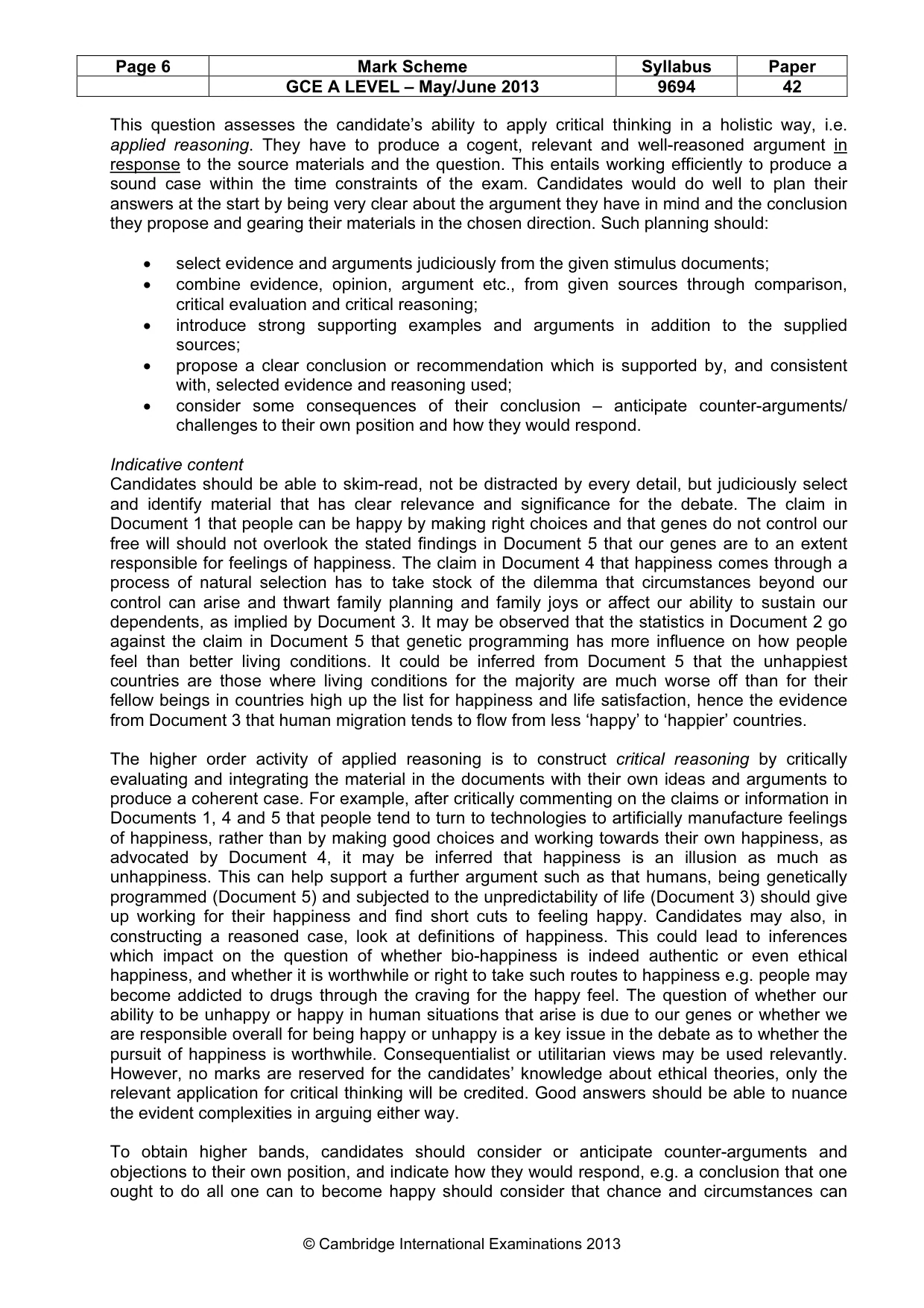
Page 6 Mark Scheme Syllabus Paper GCE A LEVEL – May/June 2013 9694 42 © Cambridge International Examinations 2013 This question assesses the candidate’s ability to apply critical thinking in a holistic way, i.e. applied reasoning. They have to produce a cogent, relevant and well-reasoned argument in response to the source materials and the question. This entails working efficiently to produce a sound case within the time constraints of the exam. Candidates would do well to plan their answers at the start by being very clear about the argument they have in mind and the conclusion they propose and gearing their materials in the chosen direction. Such planning should: • select evidence and arguments judiciously from the given stimulus documents; • combine evidence, opinion, argument etc., from given sources through comparison, critical evaluation and critical reasoning; • introduce strong supporting examples and arguments in addition to the supplied sources; • propose a clear conclusion or recommendation which is supported by, and consistent with, selected evidence and reasoning used; • consider some consequences of their conclusion – anticipate counter-arguments/ challenges to their own position and how they would respond. Indicative content Candidates should be able to skim-read, not be distracted by every detail, but judiciously select and identify material that has clear relevance and significance for the debate. The claim in Document 1 that people can be happy by making right choices and that genes do not control our free will should not overlook the stated findings in Document 5 that our genes are to an extent responsible for feelings of happiness. The claim in Document 4 that happiness comes through a process of natural selection has to take stock of the dilemma that circumstances beyond our control can arise and thwart family planning and family joys or affect our ability to sustain our dependents, as implied by Document 3. It may be observed that the statistics in Document 2 go against the claim in Document 5 that genetic programming has more influence on how people feel than better living conditions. It could be inferred from Document 5 that the unhappiest countries are those where living conditions for the majority are much worse off than for their fellow beings in countries high up the list for happiness and life satisfaction, hence the evidence from Document 3 that human migration tends to flow from less ‘happy’ to ‘happier’ countries. The higher order activity of applied reasoning is to construct critical reasoning by critically evaluating and integrating the material in the documents with their own ideas and arguments to produce a coherent case. For example, after critically commenting on the claims or information in Documents 1, 4 and 5 that people tend to turn to technologies to artificially manufacture feelings of happiness, rather than by making good choices and working towards their own happiness, as advocated by Document 4, it may be inferred that happiness is an illusion as much as unhappiness. This can help support a further argument such as that humans, being genetically programmed (Document 5) and subjected to the unpredictability of life (Document 3) should give up working for their happiness and find short cuts to feeling happy. Candidates may also, in constructing a reasoned case, look at definitions of happiness. This could lead to inferences which impact on the question of whether bio-happiness is indeed authentic or even ethical happiness, and whether it is worthwhile or right to take such routes to happiness e.g. people may become addicted to drugs through the craving for the happy feel. The question of whether our ability to be unhappy or happy in human situations that arise is due to our genes or whether we are responsible overall for being happy or unhappy is a key issue in the debate as to whether the pursuit of happiness is worthwhile. Consequentialist or utilitarian views may be used relevantly. However, no marks are reserved for the candidates’ knowledge about ethical theories, only the relevant application for critical thinking will be credited. Good answers should be able to nuance the evident complexities in arguing either way. To obtain higher bands, candidates should consider or anticipate counter-arguments and objections to their own position, and indicate how they would respond, e.g. a conclusion that one ought to do all one can to become happy should consider that chance and circumstances can
Mark scheme, page 7
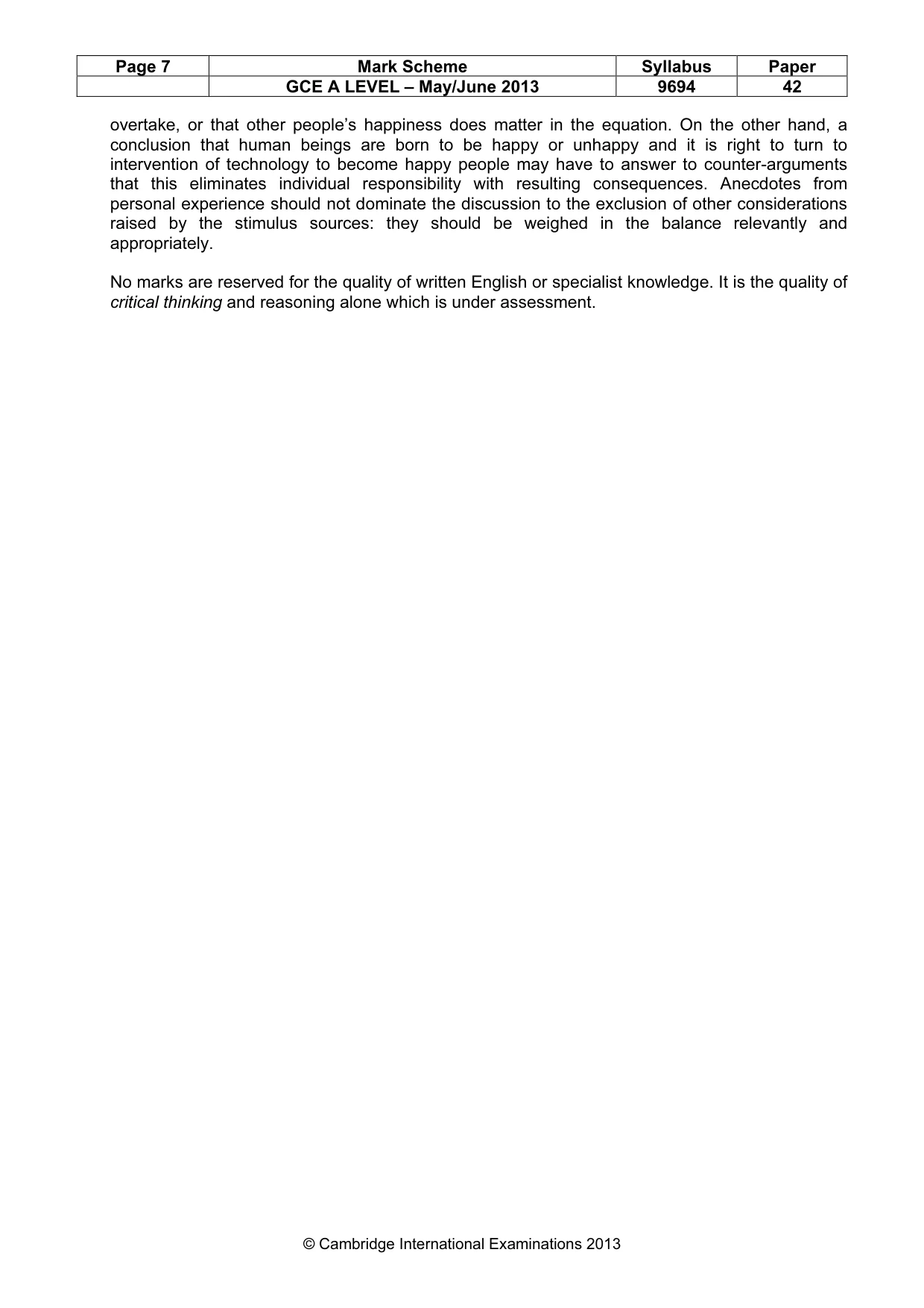
Page 7 Mark Scheme Syllabus Paper GCE A LEVEL – May/June 2013 9694 42 © Cambridge International Examinations 2013 overtake, or that other people’s happiness does matter in the equation. On the other hand, a conclusion that human beings are born to be happy or unhappy and it is right to turn to intervention of technology to become happy people may have to answer to counter-arguments that this eliminates individual responsibility with resulting consequences. Anecdotes from personal experience should not dominate the discussion to the exclusion of other considerations raised by the stimulus sources: they should be weighed in the balance relevantly and appropriately. No marks are reserved for the quality of written English or specialist knowledge. It is the quality of critical thinking and reasoning alone which is under assessment.
What you needed in this session
Cambridge’s own grade thresholds for 2013 May/June, Paper 4 · Variant 2. A higher threshold means an easier paper — the bar moves with how the cohort did.