Cambridge A Level Thinking Skills 9694 — 2012 May/June Paper 4 · Variant 3
9694/43/M/J/12 · 50 marks · ≈56 min
The question paper and its mark scheme, free to read here and free to download. This is Cambridge’s own paper, exactly as it was sat.
Question paper8 pages
Mark scheme7 pages
Answers below. Sit the paper first if you are practising.
Paper as text
Question paper, page 1
This document consists of 7 printed pages and 1 blank page. IB12 06_9694_43/FP © UCLES 2012 [Turn over *4537542979* UNIVERSITY OF CAMBRIDGE INTERNATIONAL EXAMINATIONS General Certificate of Education Advanced Level THINKING SKILLS 9694/43 Paper 4 Applied Reasoning May/June 2012 1 hour 30 minutes Additional Materials: Answer Booklet/Paper READ THESE INSTRUCTIONS FIRST If you have been given an Answer Booklet, follow the instructions on the front cover of the booklet. Write your Centre number, candidate number and name on all the work you hand in. Write in dark blue or black pen. Do not use staples, paper clips, highlighters, glue or correction fluid. DO NOT WRITE ON ANY BARCODES. Answer all the questions. Start each question on a new answer sheet. At the end of the examination, fasten all your work securely together. The number of marks is given in brackets [ ] at the end of each question.
Question paper, page 2
2 © UCLES 2012 9694/43/M/J/12 1 Study the advertisement below and answer the questions that follow. More than 98% of all Chase trucks sold in the last 10 years are still on the road - no other truck is that reliable. SOLID AS A ROCK! Research shows that Chase trucks are the most recognised and the highest-prized brand of automobiles in some parts of the country. 100 % 99 % 98 % 97 % 96 % 95 % CHASE HARRISON DINKY MIYAMOTO Chase – the most reliable, longest-lasting trucks. Our satisfied customers say: “Best full-size pickup in initial quality” – A Flintoff & Co. “Best truck line overall in sales satisfaction” – A Flintoff & Co. Percentage of trucks sold over the last 10 years that are still on the road (a) Suggest three criticisms of the data used in the advertisement and/or their presentation in the bar chart. [3] (b) “Chase – the most reliable, longest-lasting trucks. Solid as a rock!” From the information given in the advertisement, how reasonably can this claim be inferred? Briefly explain your answer. [2] Questions 2, 3 and 4 refer to Documents 1 to 4. 2 Briefly analyse Thomas Hazlett’s argument in Document 1: Slipping Rank, by identifying its main conclusion and main reasons, as well as any intermediate conclusions and counter-arguments. [6] 3 Give a critical evaluation of Hazlett’s argument in Document 1: Slipping Rank, by identifying and explaining strengths, weaknesses, implicit assumptions and flaws. [9] 4 ‘The US must lead the world in innovation if it is to keep its place as the world’s biggest economy’. To what extent do you agree with this statement? Construct a well-reasoned argument in support of your view, commenting critically on some or all of Documents 1 to 4, and introducing ideas of your own. [30]
Question paper, page 3
3 © UCLES 2012 9694/43/M/J/12 [Turn over DOCUMENT 1 Slipping Rank The US has fallen so badly behind in the global broadband race it now has Third World status – it ranks 15th in the world in broadband adoption, according to the Organisation for Economic Cooperation and Development (OECD). But wait a minute – isn’t that what the English say about their broadband in England? This is all plain scaremongering. We should be believing that our children are all above-average world-achievers, but instead we believe that we are lagging behind. These statistical snapshots are not helpful – often the proffered ranking is a spurious correlation, known as ‘lying with statistics’. The “we’re falling behind” hysteria should really have been seen as ludicrous, but rather it became a reason for this administration to pour colossal amounts of public money into a crisis that did not exist. They bought the argument that without universal high-speed access to the Internet, American children would not receive the quality education they deserve. Launching a $787 billion “stimulus” package to boost broadband networks, President Obama proclaimed, “It is unacceptable that the United States ranks 15th in the world in broadband adoption. Here, in the country that invented the Internet, every child should have the chance to get online... – because that’s how we’ll strengthen America’s competitiveness in the world.” The OECD ranking of the US is flawed. They used a per capita method, focusing on subscriptions per 100 persons throughout the world nations, which ignores differences in the average size of households. By using subscriptions per 100 households, and comparing our broadband provision with large economies similar to ours (like Japan or Canada), the ranking has been shown to alter significantly. According to the Federal Communication Commission, the US ranks joint first among the five wealthiest countries. Making out that America is in a desperate international position has always been a useful rhetorical weapon for those who seek political advantage. This kind of global-ranking panic, even when false, can be very effective. For example, Senator John F Kennedy used similar scare tactics during his presidential campaign in 1960: he argued that the Eisenhower-Nixon policies were causes for the US’s apparent failure in “losing the satellite–missile race with the Soviet Union”. What justification is there for throwing public money after a higher broadband penetration rate, when the money could be used to improve programs with much higher social value such as, say, America’s infant mortality rate? Americans need to stop finding such race-to-the-bottom arguments in order to claim that their country is sinking fast. Thomas W Hazlett (US academic)
Question paper, page 4
4 © UCLES 2012 9694/43/M/J/12 DOCUMENT 2 Flat Earth The world is today as flat as the screen of your laptop. And in a flat world you can innovate without having to emigrate. A 14-year-old in Romania or Bangalore or Russia or Vietnam can access all the information, all the tools, all the software to apply knowledge however they want. Today, broadband has shrunk the world and empowered individuals beyond all expectations. People-to-people connectivity has peaked to a whole new level. Take India. Dinakar Singh, one of the most respected hedge fund managers on Wall Street, whose parents had earned doctoral degrees in biochemistry before emigrating to the US, says, “India had no resources and no infrastructure. It produced people with quality and by quantity. But many of them rotted on the docks of India like vegetables – only a few could afford to get out. Not anymore; we Americans built this ocean-crosser called fibre-optic cable. Now you can plug into the world from India. You don’t have to go to Yale and go to work for Goldman Sachs.” India could never have afforded to pay for the bandwidth to connect brainy India with high-tech America, so American shareholders paid for it. Yes, crazy overinvestment can be good. In building these digital railroads, foreigners and their enterprises benefitted, and India got a free ride. Take China. Through e-connectivity, I can simply sit at a keyboard and transact business through such processes as “offshoring” (e.g. send my whole factory from Canton, Ohio to Canton, China) and “supply chaining” (if I sell an item in Arkansas, another is immediately made in China). So in 30 years’ time we’ll have gone from “sold in China” to “made in China” to “designed in China” to “dreamed up in China”. Says Rajesh Rao of Bangalore, “Once we saw we had an infrastructure that made the world a very small place, we promptly tried to make the best use of it. We went ahead and today we see the results. But there is no time to rest. There are dozens of people who are doing the same things that you are doing, and they are trying to do them better. It is like water in a tray: you shake it and it will find the path of least resistance. That is what is going to happen to many jobs. They will go to the part of the world where there is least resistance and the most opportunity.” So, instead of complaining about outsourcing, Americans and Western Europeans would be “better off thinking about how you can raise your bar and raise yourselves into doing something better.” Americans have consistently led in innovation over the last century. When it comes to responding to the challenges of the flat world, there is no helpline we can call. We have to dig ourselves out. We in America have all the basic economic and educational tools to do that, but there is an ‘ambition gap’ plaguing American society. Compared with young, energetic Indians and Chinese, too many Americans have become lazy. We need to get going immediately. So, parents, throw away the Game Boy, turn off the television and get your kids to work. I am now telling my own daughters, “Girls, finish your homework – people in China and India are starving for your jobs.” Thomas L Friedman (US journalist)
Question paper, page 5
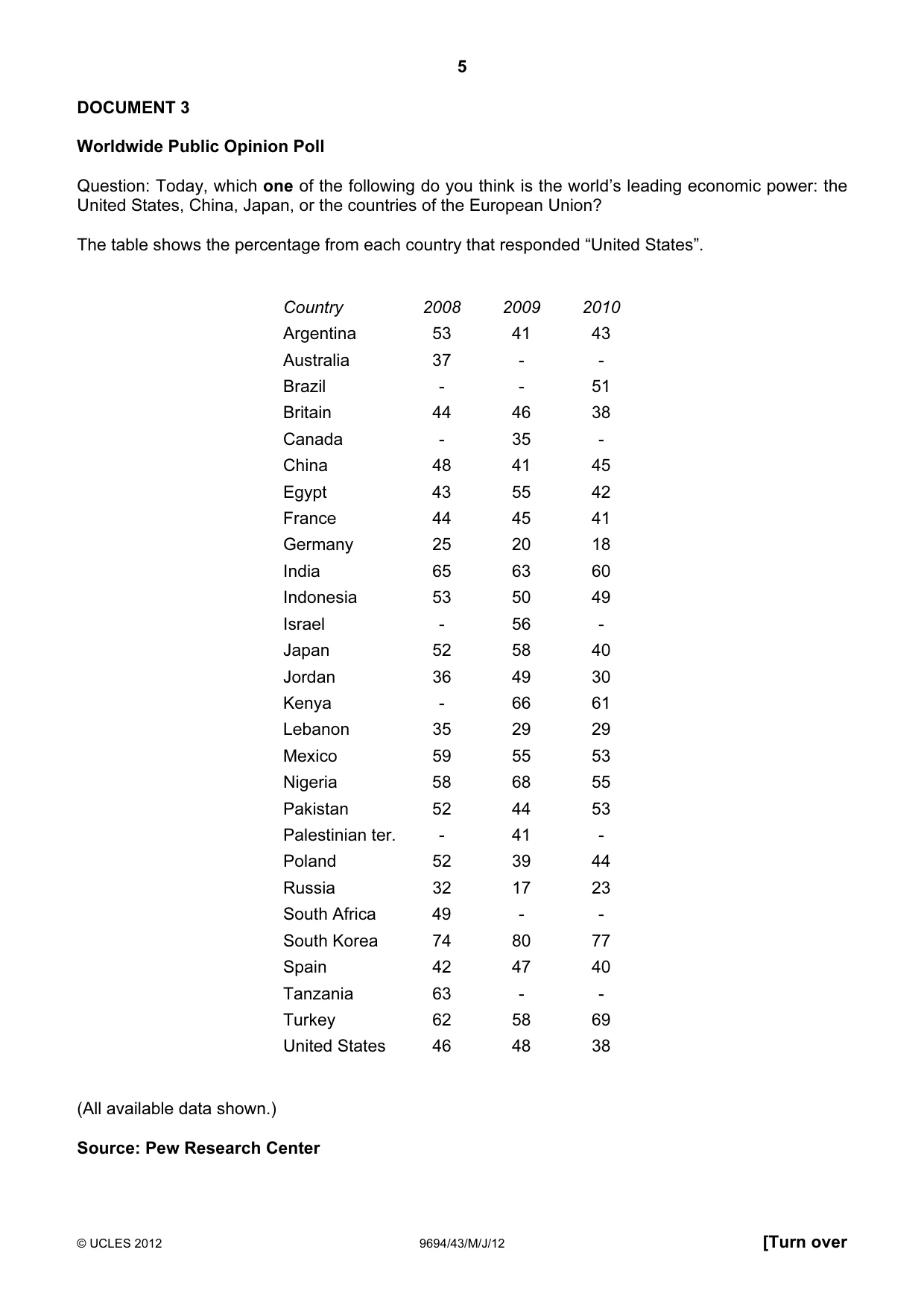
5 © UCLES 2012 9694/43/M/J/12 [Turn over DOCUMENT 3 Worldwide Public Opinion Poll Question: Today, which one of the following do you think is the world’s leading economic power: the United States, China, Japan, or the countries of the European Union? The table shows the percentage from each country that responded “United States”. Country 2008 2009 2010 Argentina 53 41 43 Australia 37 - - Brazil - - 51 Britain 44 46 38 Canada - 35 - China 48 41 45 Egypt 43 55 42 France 44 45 41 Germany 25 20 18 India 65 63 60 Indonesia 53 50 49 Israel - 56 - Japan 52 58 40 Jordan 36 49 30 Kenya - 66 61 Lebanon 35 29 29 Mexico 59 55 53 Nigeria 58 68 55 Pakistan 52 44 53 Palestinian ter. - 41 - Poland 52 39 44 Russia 32 17 23 South Africa 49 - - South Korea 74 80 77 Spain 42 47 40 Tanzania 63 - - Turkey 62 58 69 United States 46 48 38 (All available data shown.) Source: Pew Research Center
Question paper, page 6
6 © UCLES 2012 9694/43/M/J/12 DOCUMENT 4 The Great Innovators Think of the world economy as a ladder. On the bottom rungs are the countries producing mainly textiles and other low-tech goods. Towards the top are the US and other leading economies, which make sophisticated electronics, software, and pharmaceuticals. Up and down the middle rungs are all the other nations, manufacturing everything from steel to cars to memory chips. Viewed in this way, economic development is simple: everyone tries to climb to the next rung. This works well if the topmost countries can create new industries and products. Such invention allows older industries to move overseas while fresh jobs are generated at home. But if innovation stalls at the highest rung – well, that’s bad news for Americans, who must compete with lower-wage workers elsewhere. Today, many are worried that the US has reached the top of the ladder and run out of rungs. A growing number of high-tech and other white-collar jobs are moving to India, China, and other places. At the same time, there’s nothing readily apparent to replace those exported jobs. What’s more, the countries snatching jobs are producing large numbers of college graduates for the first time. The fear is that the US educated class will be ground down by globalisation, just as blue-collar workers were in the 1970s and 1980s. It’s a scenario that shouldn’t be dismissed out of hand – but it’s not likely to happen. The US still has a distinct competitive advantage in innovation. If there’s any country well suited to find a new rung for the economic ladder, it’s America. America’s strongest suit is innovation, which will always create new high-paying positions. Despite anecdotes of well-paying jobs being sucked overseas, there’s little evidence that educated workers, overall, are worse off than they were after the last recession. Moreover, the number of jobs held by college-educated workers who are 25 years old and above has risen by 2.2% over the past year, compared with a 0.4% gain for the less educated. The jobless rate for college-educated workers has been around 3% since the end of 2001, while the unemployment rate for other workers has increased by half a percentage point, to 5.7%. Wage growth has also been stronger for better jobs. Over the past year, median earnings for managers and professionals are up by 2.8%. Blue-collar and service workers showed no gain. “I think people are overreacting a little bit,” says Steven P Jobs, CEO of Apple Computer Inc., “since big chunks of the tech labour market – including the most innovative parts – are not going to move overseas.” Still, history does offer cause for worry. There was a period, from 1973 to 1985, when technological change contributed almost nothing to growth, according to government data. Not coincidentally, that was also the same stretch when US manufacturing became vulnerable to foreign competitors. That’s why the American economy needs a boost from innovation if it is to continue creating the next generation of leading-edge industries and new high-paying jobs. By its nature, technology leaps are unpredictable and risky – yet that’s where the US shines. It has the biggest economy on Earth, enabling America to make technological bets that would crush other nations. The US has by far the best-developed financial markets in the world, including venture-capital and high-yield bond markets for financing new businesses. And, for the foreseeable future, the US still has the best-educated workforce among the major economies – a plus for invention. The latest figures from the Organization for Economic Cooperation and Development show that 30% of Americans aged 25 to 34 have a college degree, compared with 24% for Japan and 14% for Germany. That’s essential: better-educated workers can better cope with rapid change, adjust on the fly, and imagine and develop fresh products and strategies.
Question paper, page 7
7 © UCLES 2012 9694/43/M/J/12 Where will the next big innovation come from? It could be telecoms, or biotech, or energy. Nobody knows. Nobody knew in 1994, either, when real wage growth was still slow, unemployment was above 6%, and Netscape’s initial public offering, which marked the start of the Internet revolution, was a year away. The biggest danger to US workers isn’t overseas competition. It’s that we worry too much about other countries climbing up the ladder and not enough about finding the next higher rung for ourselves. Michael J Mandel Source: Bloomberg Business Week
Question paper, page 8
8 Copyright Acknowledgements: Document 1 Document 2 Document 3 Document 4 © ADAPTED; Thomas W Hazlett; Commentary Magazine; 2010; http://www.commentarymagazine.com/article/were-number-two/ © Thomas L Friedman; Global Newsbank; New York Times Magazine; 3 April 2005. © ‘Obama More Popular Abroad than at Home, Global Image of U.S. Continues to Benefit’; Pew Global Attitudes Project, a project of the Pew Research Center; http://pewglobal.org/database/?indicator=17&survey=9&response=The United States&mode=table; 17 June 2010. © Michael J Mandel; Bloomberg Business Week; http://www.businessweek.com/magazine/content/03_34/b3846027.htm. Permission to reproduce items where third-party owned material protected by copyright is included has been sought and cleared where possible. Every reasonable effort has been made by the publisher (UCLES) to trace copyright holders, but if any items requiring clearance have unwittingly been included, the publisher will be pleased to make amends at the earliest possible opportunity. University of Cambridge International Examinations is part of the Cambridge Assessment Group. Cambridge Assessment is the brand name of University of Cambridge Local Examinations Syndicate (UCLES), which is itself a department of the University of Cambridge. © UCLES 2012 9694/43/M/J/12 BLANK PAGE
Mark scheme, page 1
UNIVERSITY OF CAMBRIDGE INTERNATIONAL EXAMINATIONS GCE Advanced Level MARK SCHEME for the May/June 2012 question paper for the guidance of teachers 9694 THINKING SKILLS 9694/43 Paper 4 (Applied Reasoning), maximum raw mark 50 This mark scheme is published as an aid to teachers and candidates, to indicate the requirements of the examination. It shows the basis on which Examiners were instructed to award marks. It does not indicate the details of the discussions that took place at an Examiners’ meeting before marking began, which would have considered the acceptability of alternative answers. Mark schemes must be read in conjunction with the question papers and the report on the examination. • Cambridge will not enter into discussions or correspondence in connection with these mark schemes. Cambridge is publishing the mark schemes for the May/June 2012 question papers for most IGCSE, GCE Advanced Level and Advanced Subsidiary Level syllabuses and some Ordinary Level syllabuses.
Mark scheme, page 2
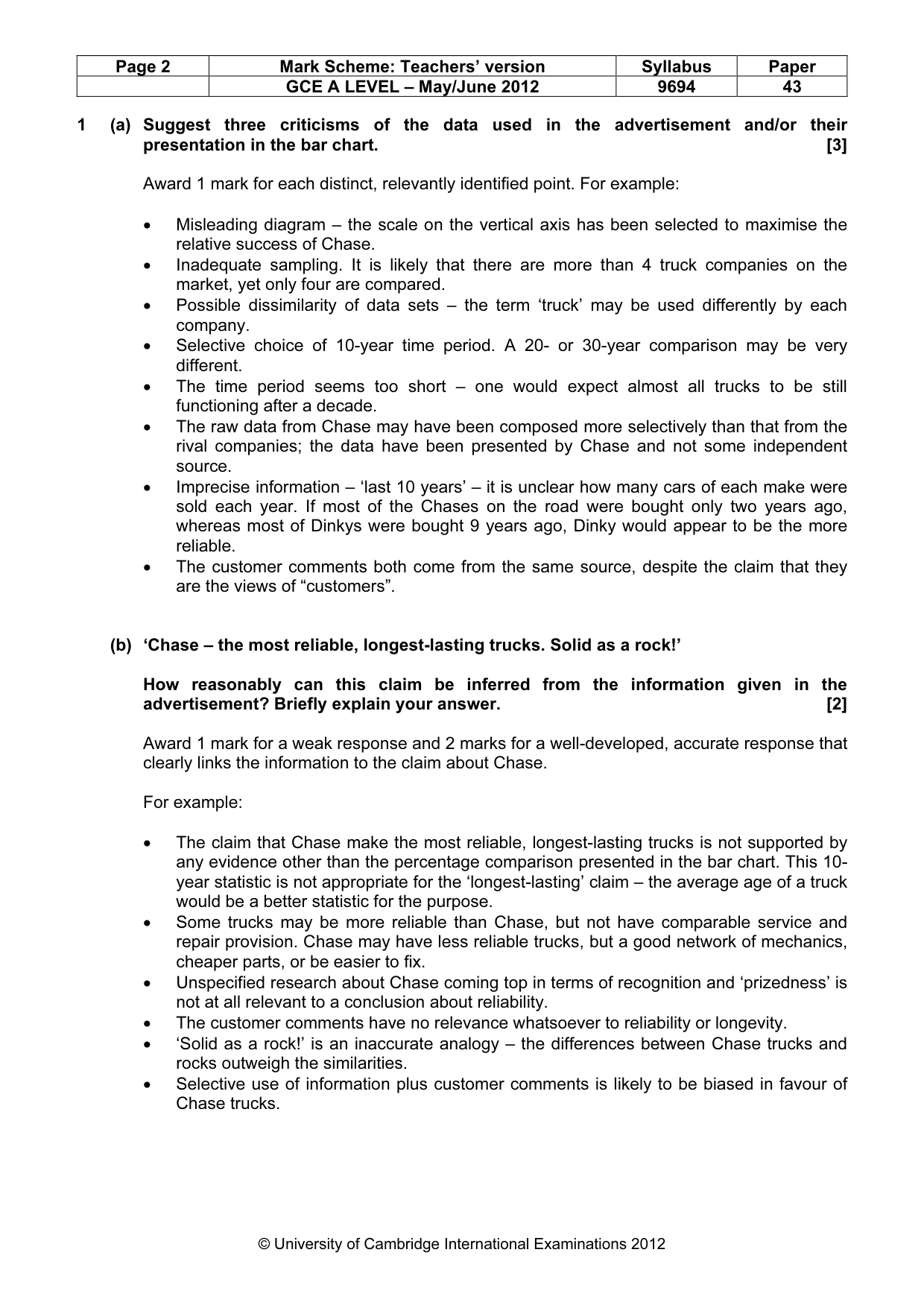
Page 2 Mark Scheme: Teachers’ version Syllabus Paper GCE A LEVEL – May/June 2012 9694 43 © University of Cambridge International Examinations 2012 1 (a) Suggest three criticisms of the data used in the advertisement and/or their presentation in the bar chart. [3] Award 1 mark for each distinct, relevantly identified point. For example: • Misleading diagram – the scale on the vertical axis has been selected to maximise the relative success of Chase. • Inadequate sampling. It is likely that there are more than 4 truck companies on the market, yet only four are compared. • Possible dissimilarity of data sets – the term ‘truck’ may be used differently by each company. • Selective choice of 10-year time period. A 20- or 30-year comparison may be very different. • The time period seems too short – one would expect almost all trucks to be still functioning after a decade. • The raw data from Chase may have been composed more selectively than that from the rival companies; the data have been presented by Chase and not some independent source. • Imprecise information – ‘last 10 years’ – it is unclear how many cars of each make were sold each year. If most of the Chases on the road were bought only two years ago, whereas most of Dinkys were bought 9 years ago, Dinky would appear to be the more reliable. • The customer comments both come from the same source, despite the claim that they are the views of “customers”. (b) ‘Chase – the most reliable, longest-lasting trucks. Solid as a rock!’ How reasonably can this claim be inferred from the information given in the advertisement? Briefly explain your answer. [2] Award 1 mark for a weak response and 2 marks for a well-developed, accurate response that clearly links the information to the claim about Chase. For example: • The claim that Chase make the most reliable, longest-lasting trucks is not supported by any evidence other than the percentage comparison presented in the bar chart. This 10- year statistic is not appropriate for the ‘longest-lasting’ claim – the average age of a truck would be a better statistic for the purpose. • Some trucks may be more reliable than Chase, but not have comparable service and repair provision. Chase may have less reliable trucks, but a good network of mechanics, cheaper parts, or be easier to fix. • Unspecified research about Chase coming top in terms of recognition and ‘prizedness’ is not at all relevant to a conclusion about reliability. • The customer comments have no relevance whatsoever to reliability or longevity. • ‘Solid as a rock!’ is an inaccurate analogy – the differences between Chase trucks and rocks outweigh the similarities. • Selective use of information plus customer comments is likely to be biased in favour of Chase trucks.
Mark scheme, page 3
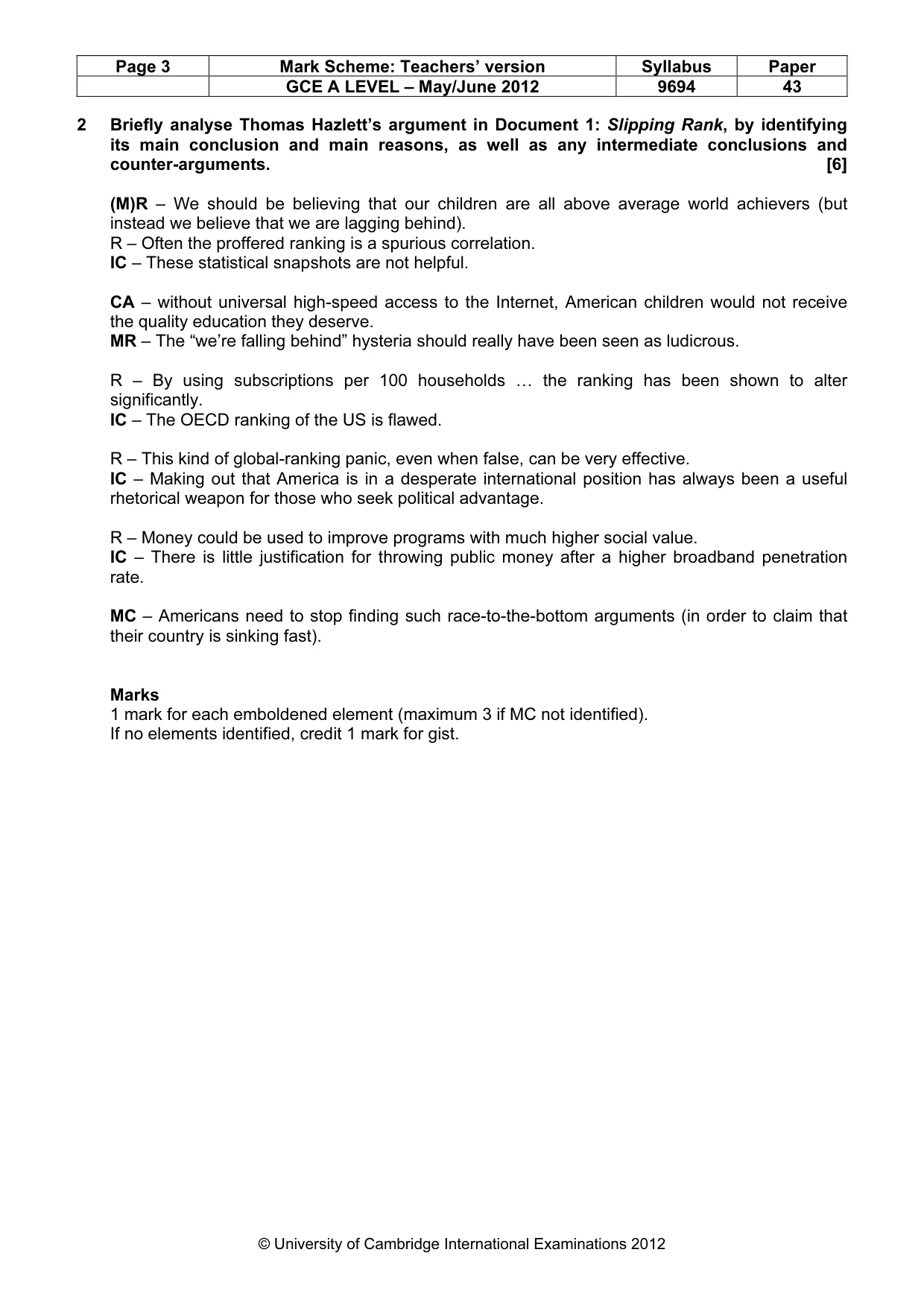
Page 3 Mark Scheme: Teachers’ version Syllabus Paper GCE A LEVEL – May/June 2012 9694 43 © University of Cambridge International Examinations 2012 2 Briefly analyse Thomas Hazlett’s argument in Document 1: Slipping Rank, by identifying its main conclusion and main reasons, as well as any intermediate conclusions and counter-arguments. [6] (M)R – We should be believing that our children are all above average world achievers (but instead we believe that we are lagging behind). R – Often the proffered ranking is a spurious correlation. IC – These statistical snapshots are not helpful. CA – without universal high-speed access to the Internet, American children would not receive the quality education they deserve. MR – The “we’re falling behind” hysteria should really have been seen as ludicrous. R – By using subscriptions per 100 households … the ranking has been shown to alter significantly. IC – The OECD ranking of the US is flawed. R – This kind of global-ranking panic, even when false, can be very effective. IC – Making out that America is in a desperate international position has always been a useful rhetorical weapon for those who seek political advantage. R – Money could be used to improve programs with much higher social value. IC – There is little justification for throwing public money after a higher broadband penetration rate. MC – Americans need to stop finding such race-to-the-bottom arguments (in order to claim that their country is sinking fast). Marks 1 mark for each emboldened element (maximum 3 if MC not identified). If no elements identified, credit 1 mark for gist.
Mark scheme, page 4
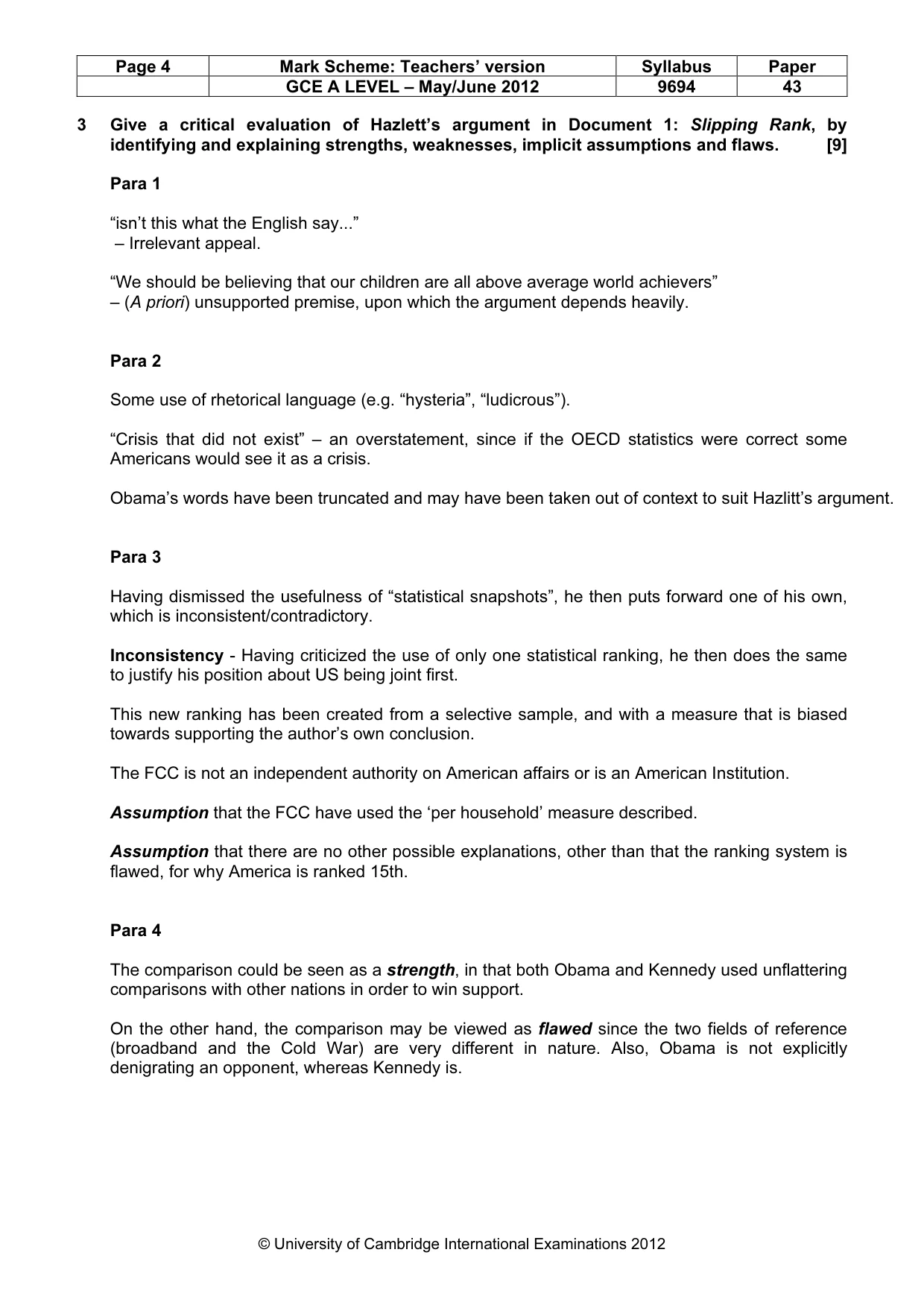
Page 4 Mark Scheme: Teachers’ version Syllabus Paper GCE A LEVEL – May/June 2012 9694 43 © University of Cambridge International Examinations 2012 3 Give a critical evaluation of Hazlett’s argument in Document 1: Slipping Rank, by identifying and explaining strengths, weaknesses, implicit assumptions and flaws. [9] Para 1 “isn’t this what the English say...” – Irrelevant appeal. “We should be believing that our children are all above average world achievers” – (A priori) unsupported premise, upon which the argument depends heavily. Para 2 Some use of rhetorical language (e.g. “hysteria”, “ludicrous”). “Crisis that did not exist” – an overstatement, since if the OECD statistics were correct some Americans would see it as a crisis. Obama’s words have been truncated and may have been taken out of context to suit Hazlitt’s argument. Para 3 Having dismissed the usefulness of “statistical snapshots”, he then puts forward one of his own, which is inconsistent/contradictory. Inconsistency - Having criticized the use of only one statistical ranking, he then does the same to justify his position about US being joint first. This new ranking has been created from a selective sample, and with a measure that is biased towards supporting the author’s own conclusion. The FCC is not an independent authority on American affairs or is an American Institution. Assumption that the FCC have used the ‘per household’ measure described. Assumption that there are no other possible explanations, other than that the ranking system is flawed, for why America is ranked 15th. Para 4 The comparison could be seen as a strength, in that both Obama and Kennedy used unflattering comparisons with other nations in order to win support. On the other hand, the comparison may be viewed as flawed since the two fields of reference (broadband and the Cold War) are very different in nature. Also, Obama is not explicitly denigrating an opponent, whereas Kennedy is.
Mark scheme, page 5
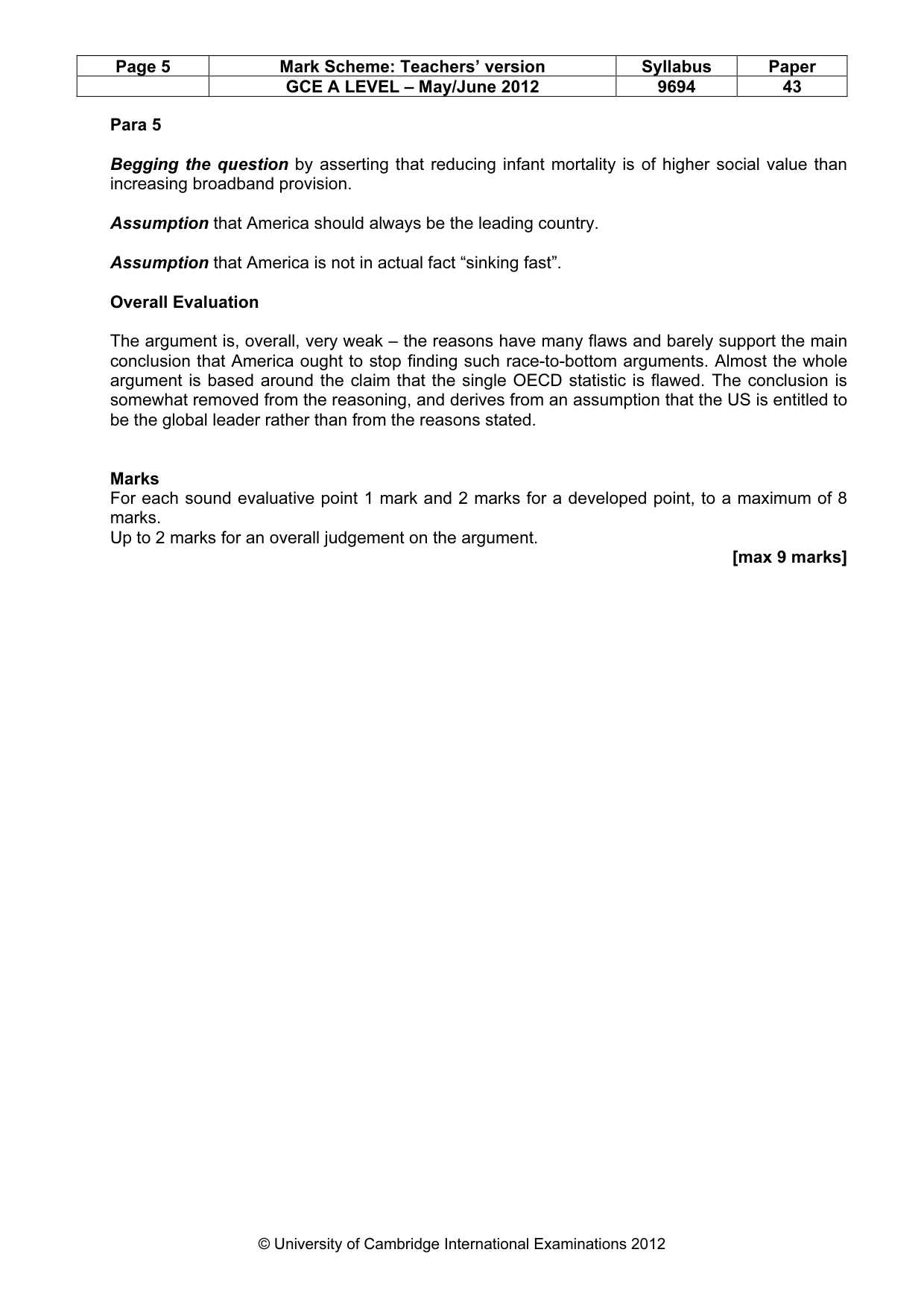
Page 5 Mark Scheme: Teachers’ version Syllabus Paper GCE A LEVEL – May/June 2012 9694 43 © University of Cambridge International Examinations 2012 Para 5 Begging the question by asserting that reducing infant mortality is of higher social value than increasing broadband provision. Assumption that America should always be the leading country. Assumption that America is not in actual fact “sinking fast”. Overall Evaluation The argument is, overall, very weak – the reasons have many flaws and barely support the main conclusion that America ought to stop finding such race-to-bottom arguments. Almost the whole argument is based around the claim that the single OECD statistic is flawed. The conclusion is somewhat removed from the reasoning, and derives from an assumption that the US is entitled to be the global leader rather than from the reasons stated. Marks For each sound evaluative point 1 mark and 2 marks for a developed point, to a maximum of 8 marks. Up to 2 marks for an overall judgement on the argument. [max 9 marks]
Mark scheme, page 6
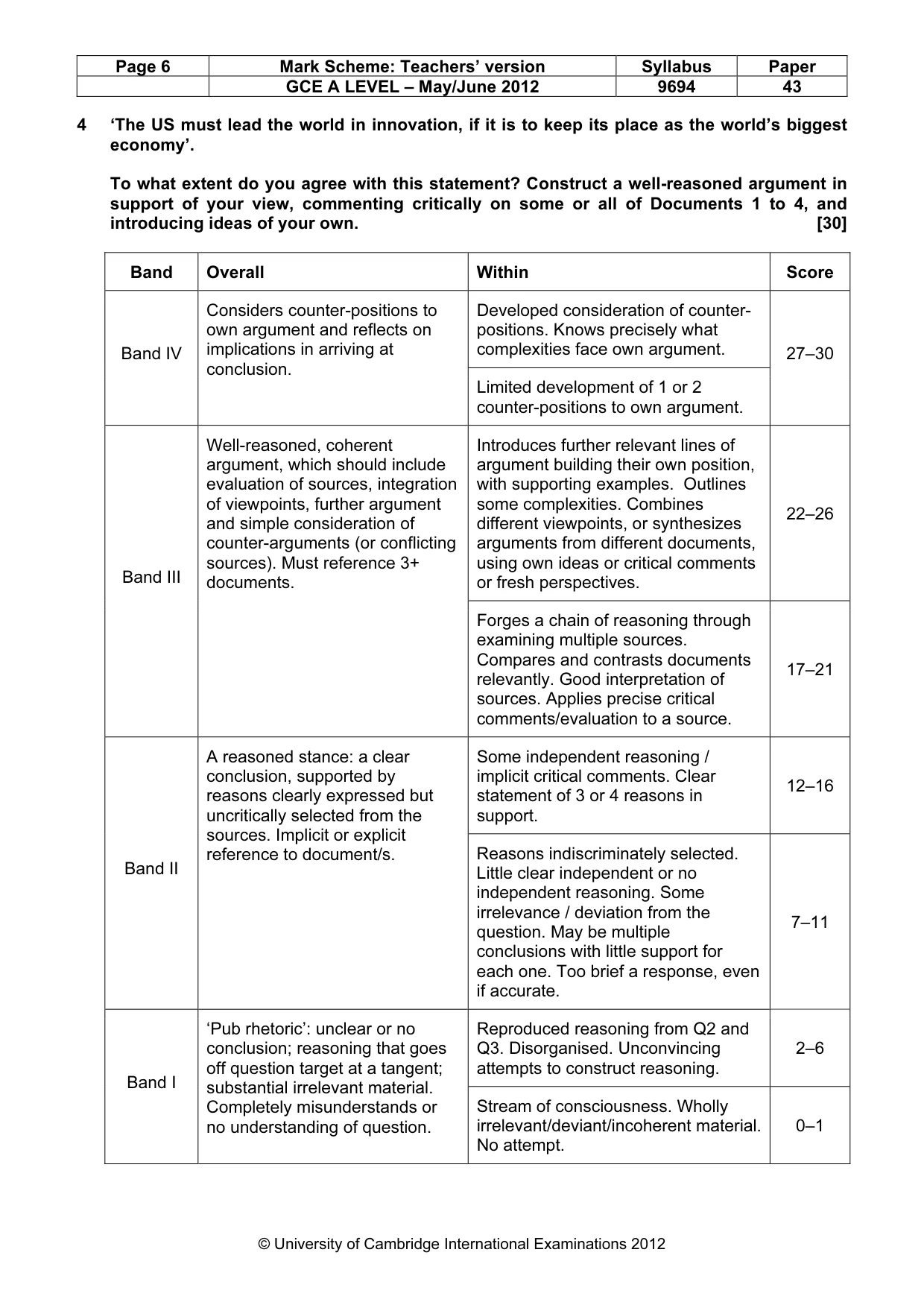
Page 6 Mark Scheme: Teachers’ version Syllabus Paper GCE A LEVEL – May/June 2012 9694 43 © University of Cambridge International Examinations 2012 4 ‘The US must lead the world in innovation, if it is to keep its place as the world’s biggest economy’. To what extent do you agree with this statement? Construct a well-reasoned argument in support of your view, commenting critically on some or all of Documents 1 to 4, and introducing ideas of your own. [30] Band Overall Within Score Developed consideration of counter- positions. Knows precisely what complexities face own argument. Band IV Considers counter-positions to own argument and reflects on implications in arriving at conclusion. Limited development of 1 or 2 counter-positions to own argument. 27–30 Introduces further relevant lines of argument building their own position, with supporting examples. Outlines some complexities. Combines different viewpoints, or synthesizes arguments from different documents, using own ideas or critical comments or fresh perspectives. 22–26 Band III Well-reasoned, coherent argument, which should include evaluation of sources, integration of viewpoints, further argument and simple consideration of counter-arguments (or conflicting sources). Must reference 3+ documents. Forges a chain of reasoning through examining multiple sources. Compares and contrasts documents relevantly. Good interpretation of sources. Applies precise critical comments/evaluation to a source. 17–21 Some independent reasoning / implicit critical comments. Clear statement of 3 or 4 reasons in support. 12–16 Band II A reasoned stance: a clear conclusion, supported by reasons clearly expressed but uncritically selected from the sources. Implicit or explicit reference to document/s. Reasons indiscriminately selected. Little clear independent or no independent reasoning. Some irrelevance / deviation from the question. May be multiple conclusions with little support for each one. Too brief a response, even if accurate. 7–11 Reproduced reasoning from Q2 and Q3. Disorganised. Unconvincing attempts to construct reasoning. 2–6 Band I ‘Pub rhetoric’: unclear or no conclusion; reasoning that goes off question target at a tangent; substantial irrelevant material. Completely misunderstands or no understanding of question. Stream of consciousness. Wholly irrelevant/deviant/incoherent material. No attempt. 0–1
Mark scheme, page 7
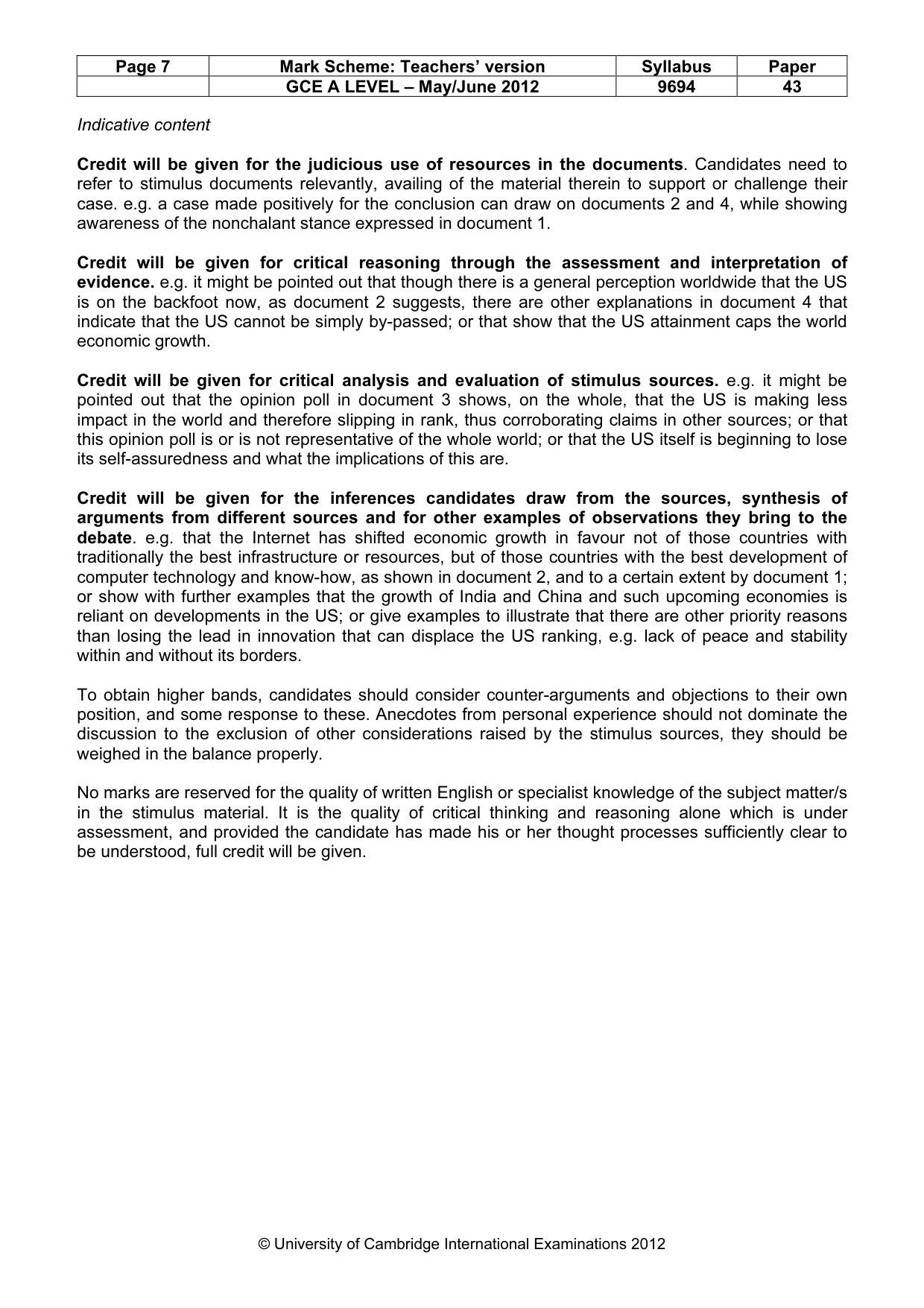
Page 7 Mark Scheme: Teachers’ version Syllabus Paper GCE A LEVEL – May/June 2012 9694 43 © University of Cambridge International Examinations 2012 Indicative content Credit will be given for the judicious use of resources in the documents. Candidates need to refer to stimulus documents relevantly, availing of the material therein to support or challenge their case. e.g. a case made positively for the conclusion can draw on documents 2 and 4, while showing awareness of the nonchalant stance expressed in document 1. Credit will be given for critical reasoning through the assessment and interpretation of evidence. e.g. it might be pointed out that though there is a general perception worldwide that the US is on the backfoot now, as document 2 suggests, there are other explanations in document 4 that indicate that the US cannot be simply by-passed; or that show that the US attainment caps the world economic growth. Credit will be given for critical analysis and evaluation of stimulus sources. e.g. it might be pointed out that the opinion poll in document 3 shows, on the whole, that the US is making less impact in the world and therefore slipping in rank, thus corroborating claims in other sources; or that this opinion poll is or is not representative of the whole world; or that the US itself is beginning to lose its self-assuredness and what the implications of this are. Credit will be given for the inferences candidates draw from the sources, synthesis of arguments from different sources and for other examples of observations they bring to the debate. e.g. that the Internet has shifted economic growth in favour not of those countries with traditionally the best infrastructure or resources, but of those countries with the best development of computer technology and know-how, as shown in document 2, and to a certain extent by document 1; or show with further examples that the growth of India and China and such upcoming economies is reliant on developments in the US; or give examples to illustrate that there are other priority reasons than losing the lead in innovation that can displace the US ranking, e.g. lack of peace and stability within and without its borders. To obtain higher bands, candidates should consider counter-arguments and objections to their own position, and some response to these. Anecdotes from personal experience should not dominate the discussion to the exclusion of other considerations raised by the stimulus sources, they should be weighed in the balance properly. No marks are reserved for the quality of written English or specialist knowledge of the subject matter/s in the stimulus material. It is the quality of critical thinking and reasoning alone which is under assessment, and provided the candidate has made his or her thought processes sufficiently clear to be understood, full credit will be given.
What you needed in this session
Cambridge’s own grade thresholds for 2012 May/June, Paper 4 · Variant 3. A higher threshold means an easier paper — the bar moves with how the cohort did.