Cambridge A Level Thinking Skills 9694 — 2012 May/June Paper 4 · Variant 2
9694/42/M/J/12 · 50 marks · ≈56 min
The question paper and its mark scheme, free to read here and free to download. This is Cambridge’s own paper, exactly as it was sat.
Question paper7 pages
Mark scheme7 pages
Answers below. Sit the paper first if you are practising.
Paper as text
Question paper, page 1
This document consists of 7 printed pages and 1 blank page. IB12 06_9694_42/2RP © UCLES 2012 [Turn over *8232461677* UNIVERSITY OF CAMBRIDGE INTERNATIONAL EXAMINATIONS General Certificate of Education Advanced Level THINKING SKILLS 9694/42 Paper 4 Applied Reasoning May/June 2012 1 hour 30 minutes Additional Materials: Answer Booklet/Paper READ THESE INSTRUCTIONS FIRST If you have been given an Answer Booklet, follow the instructions on the front cover of the booklet. Write your Centre number, candidate number and name on all the work you hand in. Write in dark blue or black pen. Do not use staples, paper clips, highlighters, glue or correction fluid. DO NOT WRITE ON ANY BARCODES. Answer all the questions. Start each question on a new answer sheet. At the end of the examination, fasten all your work securely together. The number of marks is given in brackets [ ] at the end of each question.
Question paper, page 2
2 © UCLES 2012 9694/42/M/J/12 1 Suggest five criticisms of the statistics presented in the passage below and/or the inferences drawn from them. [5] A leaflet produced by a vegan pressure group was headlined, “Up to 100 million pus cells in every glass! If that doesn’t shake you, nothing will.” The centre pages of the leaflet were headlined “White Lies” and stated, “…milk is presented almost as a wonder food, essential to health – strange, considering that Americans lap it up and have some of the worst health statistics going, while the Japanese barely touch it and are some of the healthiest, longest-living people on Earth.” A section of the leaflet was entitled “Milk – magnificent for kids?” and stated, “Childhood diabetes (Type 1), for which insulin injections are needed, is dramatically on the up in under-fives. Cow’s milk formulae and early milk-drinking can be important triggers, particularly in genetically susceptible children. Type 2 diabetes is also skyrocketing. It used to affect only adults but is now being found in children. Research in 40 countries shows the more milk and meat kids consume the higher their risk.” In a section entitled “Milk – fat of the land?” the leaflet stated, “Sure is, and particularly the most damaging kind – saturated fat. Breast cancer in the UK is up 80% since 1971 and hits one in nine women. It’s one in 10 000 in rural China, where dairy produce is a rarity. The difference is due to diet, not genes.” Questions 2, 3 and 4 refer to Documents 1 to 5 2 Briefly analyse Baik’s argument in Document 1: Democracy – the best form of government, by identifying its main conclusion, main reasons and intermediate conclusions as well as any counter-arguments. [6] 3 Give a critical evaluation of Baik’s argument in Document 1: Democracy – the best form of government, by identifying and explaining strengths, weaknesses, implicit assumptions and flaws. [9] 4 ‘Democracy should be defended at all costs.’ To what extent do you agree with this statement? Construct a well-reasoned argument in support of your view, commenting critically on some or all of Documents 1 to 5, and introducing ideas of your own. [30]
Question paper, page 3
3 © UCLES 2012 9694/42/M/J/12 [Turn over DOCUMENT 1 Democracy – the best form of government Does the concept of democracy need to be defended? Abraham Lincoln defined democracy as “Government of the people, by the people and for the people”, making it a morally superior concept. Winston Churchill said, “Democracy is the worst form of government, except for all the others”. Mahatma Gandhi said, “My notion of democracy is that under it the weakest should have the same opportunity as the strongest”. The words of these great world leaders make the concept of democracy unchallengeable. A government empowered by its people to rule over them is the best form of government and worth defending at all costs. Democracy provides peace internally and externally. Democratic states do not go to war with each other. It stops tyrants from coming to power as rulers are chosen by the people. The classical example of democracy is that of ancient Athens, where all the male citizens would meet in the marketplace to vote on decisions. The underlying principle is that if groups of people are involved in discussions they are likely to arrive at wiser decisions than individuals who think by themselves. We all know that discussion is a good thing. That is why democracy is desirable – because it works by popular consent. Democracy is based on the principle that all human beings should have equal rights, so no one has a right to lord it over others. Therefore, by the democratic process, every human being can be in control of their own affairs. This is because, in a democracy, people have a direct say in who governs them via the votes cast by every adult member of the population. As such, it ensures that a government is made up of those who are truly representative of the people. It is the masses who understand what kind of leader they truly need, and in a democratic country they will have the ability to vote for them. They can have the satisfaction of electing a government that will think about them, care about them and provide for them. Furthermore, when the responsibility of electing government is given to the people, the people will be careful when using their power to vote, as they will have to bear the consequences if the leader elected is corrupt or not a wise leader. An elected government will represent the people’s wishes and make decisions according to the will of the people. A democracy allows full freedom of the media, and the people will not be misled because the media will expose everything. Dissatisfied minorities cannot use violence to overturn the government because they will not get majority support. Thus, we can see how democracy safeguards peace and stability within the country. Furthermore, the will of the people is far more representative of different groups in society than if they were ruled by influential elites, who have no understanding of ordinary people. Moreover, democratic nations allow citizens to criticise leaders, their policies and laws. In this way a democratic nation can improve its affairs and progress towards prosperity, unlike totalitarian regimes which crush dissent and rule with a heavy hand. Baik
Question paper, page 4
5 © UCLES 2012 9694/42/M/J/12 [Turn over DOCUMENT 3 Better off under communism Why do I think a nation would be better off under communism? Well, to start with, democracy champions capitalism. Capitalism causes unequal distribution of wealth, and can uphold or create class divisions. Next, democracies are vulnerable to easy manipulation by those with power and/or vast financial resources. For example, lobbyists can manipulate the system to give themselves unfair advantages. Capitalists, whatever their persuasion, have made big money to run the election campaigns, and with so many of these competing with each other politics descends into meaningless competitions. We all know how politicians have become accustomed to lying and cheating to get ahead. We’re not really ever sure of their real intentions: are they funded by lobbyists for certain policies the public would have no sympathy for? Are they secret admirers of communism trying to take over the democratic government? We have no way of knowing, as we would if it were a communist system. Respecting the privacy of individuals also means you can never tell if some party leader is an imposter or genuine, until we have put him/her in office. Then the honeymoon is over for us and them, and we start finding out that they never actually meant most of their election manifesto. People will have to take to strikes and demonstrations to protest and make their voice heard, causing a lot of unrest and unhappiness. You don’t get that in communist regimes. People know what the governing party stand for from the start. Nor do communist leaders need to hide their agenda from the public. There is nothing that the public can do about it if they don’t like what they get, as the leaders most probably already have a very strong system in place to protect themselves. Communism treats all its lesser citizens as equals. Everyone is offered the same health care, the same basic entitlements etc. There can be no dog-eat- dog fight to get ahead economically, yet there are some communist countries in the world today with a surging market economy, the envy of many struggling democracies. According to Plato’s Republic the vast majority of the population aren’t clued up enough to make political decisions anyway, which makes communism a legitimate intervention. After all, it’s really releasing the worry of having to find a government. And, to be honest, looking at voter turnout in some Western countries, how many citizens want to participate in government anyway? Communism also gives the ruling party such absolute power they can move reforms and concentrate on policy matters in an environment of stability. Whereas, in democracy, there is so much diversity of opinion and so many different options to consider that progress is slowed down, because consensus is not obtained easily. People are looking for leadership, not squabbling among politicians as to who might have got it right. However, with communism the government can dictate that the entire country pull all its resources in a single direction, for the benefit of all. Some may say this is dangerous, but you may be sure those who are empowered to be in the driving seat are also intelligent enough to know what they’re doing is right. Look at the Chinese leadership, which is winning accolades on the world stage now. Premier Wen Jiabao was named the “Man of the People” by Newsweek in August 2010 – what does that say about the intelligence of a communist leader? Kumar
Question paper, page 5
6 © UCLES 2012 9694/42/M/J/12 DOCUMENT 4 Democratic exclusion Across the world millions of people have joined public demonstrations showing opposition to war against Iraq. Even though, in addition, opinion polls may show a majority against war in Iraq, this evidence of opposition to their policies is by no means guaranteed to cause governments to change their course. In none of the countries involved is there a procedure which formally allows citizens to propose policy or law for their country. There is no way in which they can demand a binding referendum on a policy question. They must wait until the next election in order to express their dissatisfaction. And what if the major parties agree on substantial areas of policy, such as defence? Where then is the voter’s choice? In Britain and in most other countries there are grave deficiencies of democracy. The House of Lords, the election system and the European Union have been criticised in this regard. What is missing is an awareness of procedures which enable the electorate to propose for consideration, and to decide directly upon, some public issues. The solution is to introduce partial direct democracy in the form of citizens’ law initiatives and referenda. The system is already very well tried in Switzerland, many states of the USA and elsewhere. This allows a proposal, if it can gather support from hundreds of thousands of people, to be put before parliament, and, if necessary, to go before the whole electorate in a binding referendum. The million who demonstrated in London against the war in Iraq could trigger such a referendum. Wallace Macpherson, 2003 (from the Citizens’ Initiative and Referendum)
Question paper, page 6
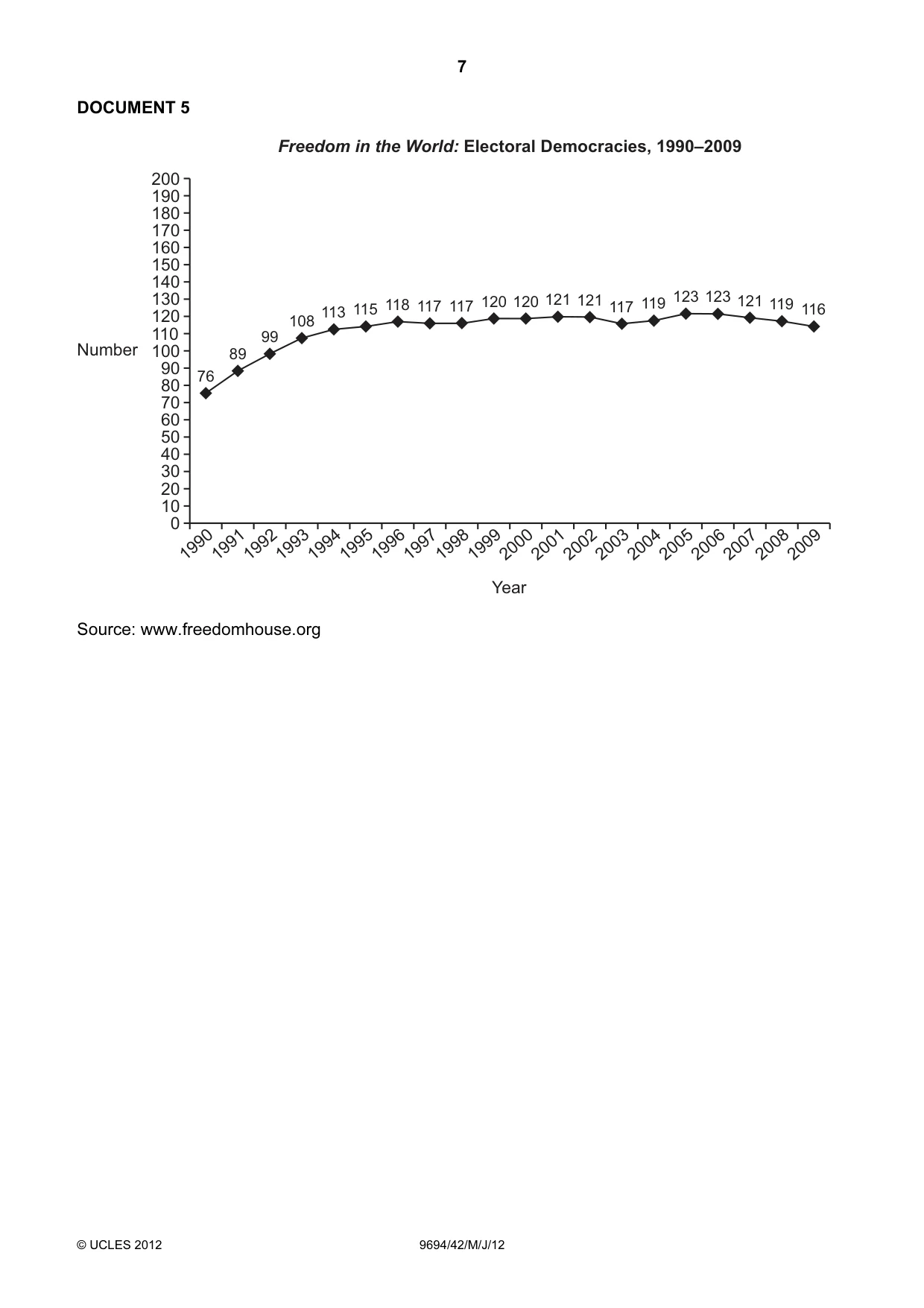
7 © UCLES 2012 9694/42/M/J/12 DOCUMENT 5 200 190 180 170 160 150 140 130 120 110 100 90 80 70 60 50 40 30 20 10 0 Number 1990 2009 2008 2007 2006 2005 2004 2003 2002 2001 2000 1999 1998 1997 1996 1995 1994 1993 1992 1991 Year 76 89 99 108 113 115 118 117 117 120 120 121 121 117 119 123 123 121 119 116 Freedom in the World: Electoral Democracies, 1990–2009 Source: www.freedomhouse.org
Question paper, page 7
8 Copyright Acknowledgements: Question 1 Document 2 Document 4 Document 5 © http://www.asa.org.uk/ASA-action/Adjudications/2008/5/The-Vegetarian-and-Vegan-Foundation/TF_ADJ_44459.aspx © The Economist; October 2009. © Wallace-Macpherson; Citizens’ Initiative and Referendum I&R; http://www.iniref.org; http://www.sztaki.hu/servlets/voting/call. © Chart; Freedom House; http://www.freedomhouse.org/uploads/press_release/fiw07_charts.pdf. Permission to reproduce items where third-party owned material protected by copyright is included has been sought and cleared where possible. Every reasonable effort has been made by the publisher (UCLES) to trace copyright holders, but if any items requiring clearance have unwittingly been included, the publisher will be pleased to make amends at the earliest possible opportunity. University of Cambridge International Examinations is part of the Cambridge Assessment Group. Cambridge Assessment is the brand name of University of Cambridge Local Examinations Syndicate (UCLES), which is itself a department of the University of Cambridge. © UCLES 2012 9694/42/M/J/12 BLANK PAGE
Mark scheme, page 1
UNIVERSITY OF CAMBRIDGE INTERNATIONAL EXAMINATIONS GCE Advanced Level MARK SCHEME for the May/June 2012 question paper for the guidance of teachers 9694 THINKING SKILLS 9694/42 Paper 4 (Applied Reasoning), maximum raw mark 50 This mark scheme is published as an aid to teachers and candidates, to indicate the requirements of the examination. It shows the basis on which Examiners were instructed to award marks. It does not indicate the details of the discussions that took place at an Examiners’ meeting before marking began, which would have considered the acceptability of alternative answers. Mark schemes must be read in conjunction with the question papers and the report on the examination. • Cambridge will not enter into discussions or correspondence in connection with these mark schemes. Cambridge is publishing the mark schemes for the May/June 2012 question papers for most IGCSE, GCE Advanced Level and Advanced Subsidiary Level syllabuses and some Ordinary Level syllabuses.
Mark scheme, page 2
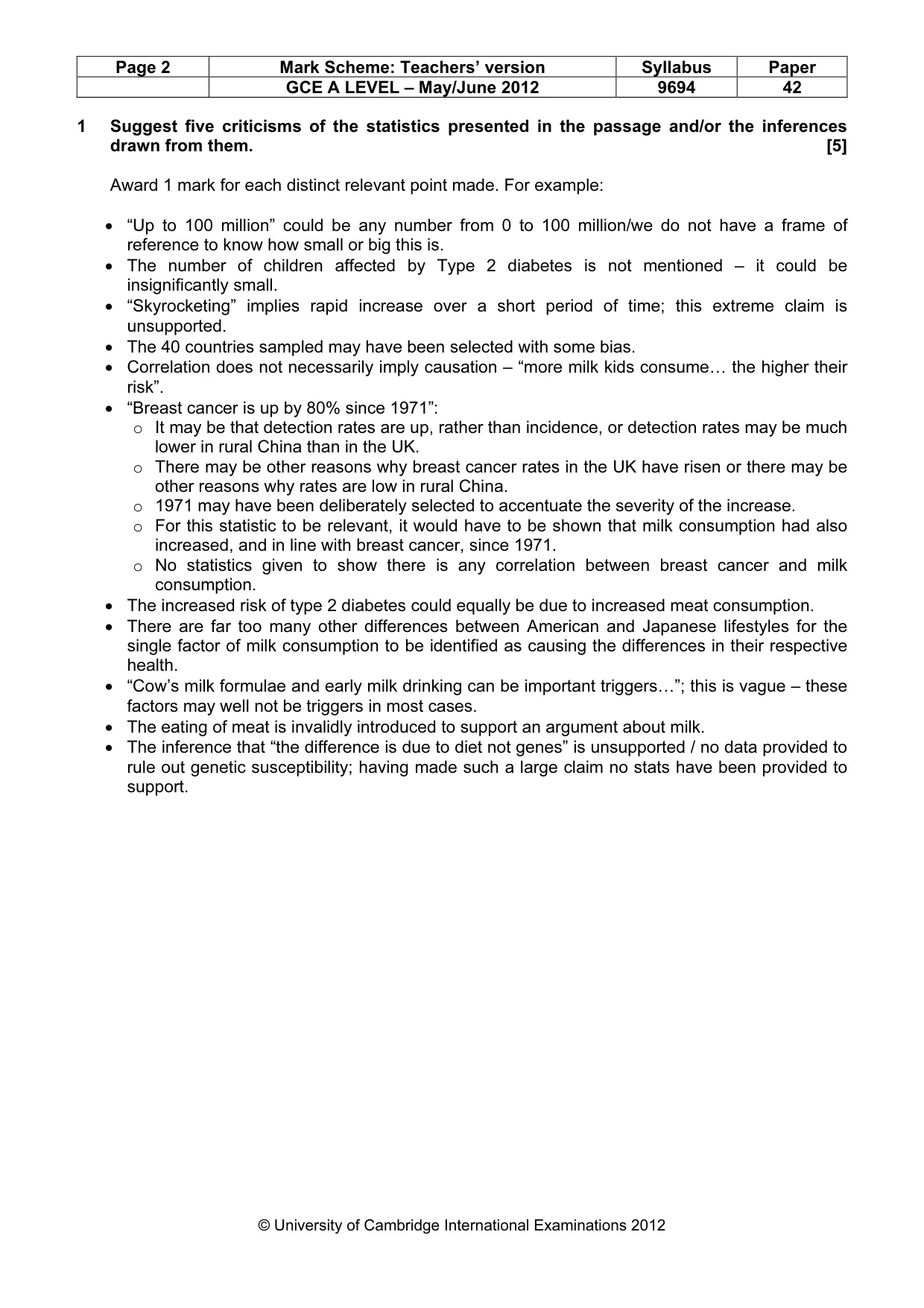
Page 2 Mark Scheme: Teachers’ version Syllabus Paper GCE A LEVEL – May/June 2012 9694 42 © University of Cambridge International Examinations 2012 1 Suggest five criticisms of the statistics presented in the passage and/or the inferences drawn from them. [5] Award 1 mark for each distinct relevant point made. For example: • “Up to 100 million” could be any number from 0 to 100 million/we do not have a frame of reference to know how small or big this is. • The number of children affected by Type 2 diabetes is not mentioned – it could be insignificantly small. • “Skyrocketing” implies rapid increase over a short period of time; this extreme claim is unsupported. • The 40 countries sampled may have been selected with some bias. • Correlation does not necessarily imply causation – “more milk kids consume… the higher their risk”. • “Breast cancer is up by 80% since 1971”: o It may be that detection rates are up, rather than incidence, or detection rates may be much lower in rural China than in the UK. o There may be other reasons why breast cancer rates in the UK have risen or there may be other reasons why rates are low in rural China. o 1971 may have been deliberately selected to accentuate the severity of the increase. o For this statistic to be relevant, it would have to be shown that milk consumption had also increased, and in line with breast cancer, since 1971. o No statistics given to show there is any correlation between breast cancer and milk consumption. • The increased risk of type 2 diabetes could equally be due to increased meat consumption. • There are far too many other differences between American and Japanese lifestyles for the single factor of milk consumption to be identified as causing the differences in their respective health. • “Cow’s milk formulae and early milk drinking can be important triggers…”; this is vague – these factors may well not be triggers in most cases. • The eating of meat is invalidly introduced to support an argument about milk. • The inference that “the difference is due to diet not genes” is unsupported / no data provided to rule out genetic susceptibility; having made such a large claim no stats have been provided to support.
Mark scheme, page 3
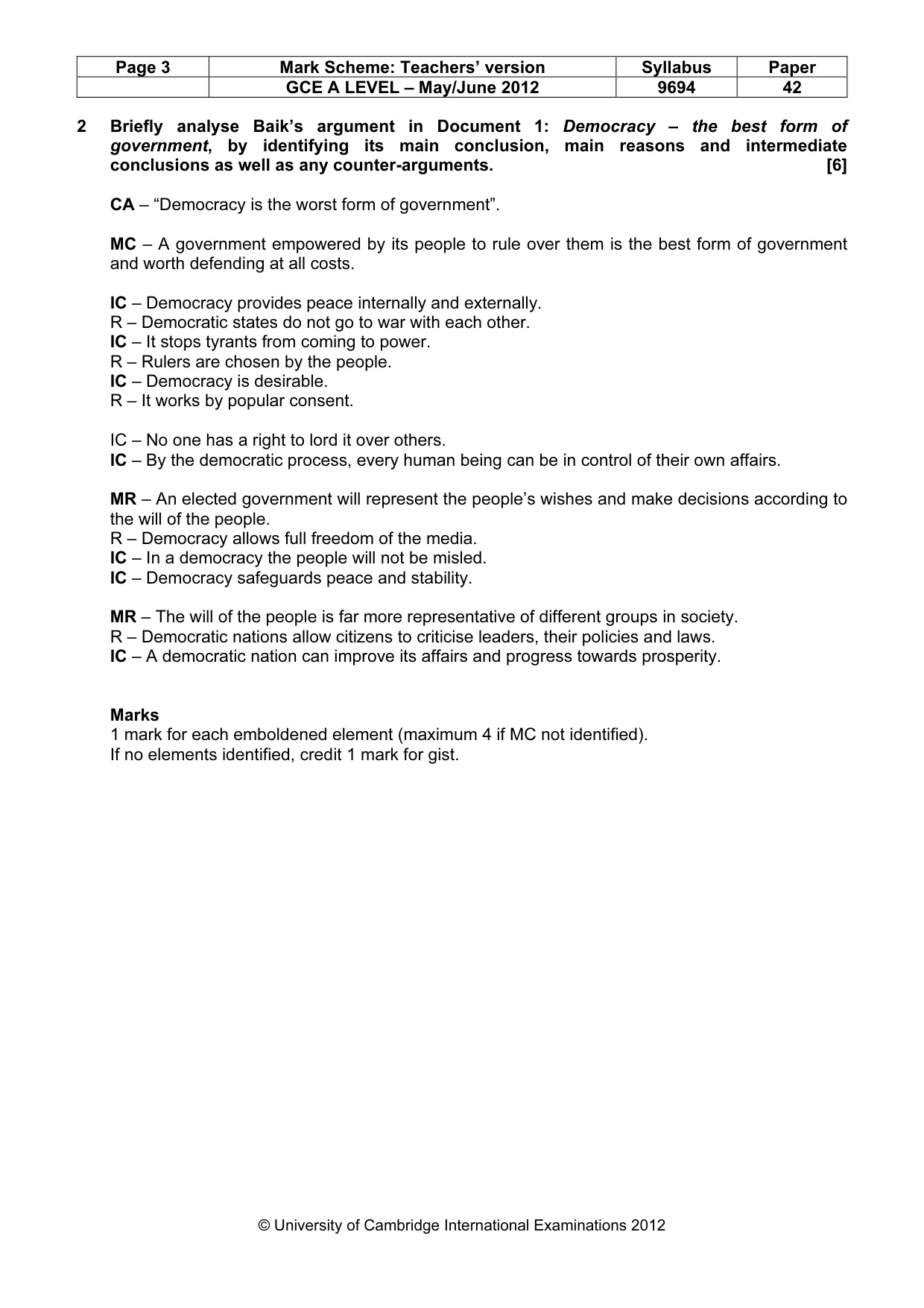
Page 3 Mark Scheme: Teachers’ version Syllabus Paper GCE A LEVEL – May/June 2012 9694 42 © University of Cambridge International Examinations 2012 2 Briefly analyse Baik’s argument in Document 1: Democracy – the best form of government, by identifying its main conclusion, main reasons and intermediate conclusions as well as any counter-arguments. [6] CA – “Democracy is the worst form of government”. MC – A government empowered by its people to rule over them is the best form of government and worth defending at all costs. IC – Democracy provides peace internally and externally. R – Democratic states do not go to war with each other. IC – It stops tyrants from coming to power. R – Rulers are chosen by the people. IC – Democracy is desirable. R – It works by popular consent. IC – No one has a right to lord it over others. IC – By the democratic process, every human being can be in control of their own affairs. MR – An elected government will represent the people’s wishes and make decisions according to the will of the people. R – Democracy allows full freedom of the media. IC – In a democracy the people will not be misled. IC – Democracy safeguards peace and stability. MR – The will of the people is far more representative of different groups in society. R – Democratic nations allow citizens to criticise leaders, their policies and laws. IC – A democratic nation can improve its affairs and progress towards prosperity. Marks 1 mark for each emboldened element (maximum 4 if MC not identified). If no elements identified, credit 1 mark for gist.
Mark scheme, page 4
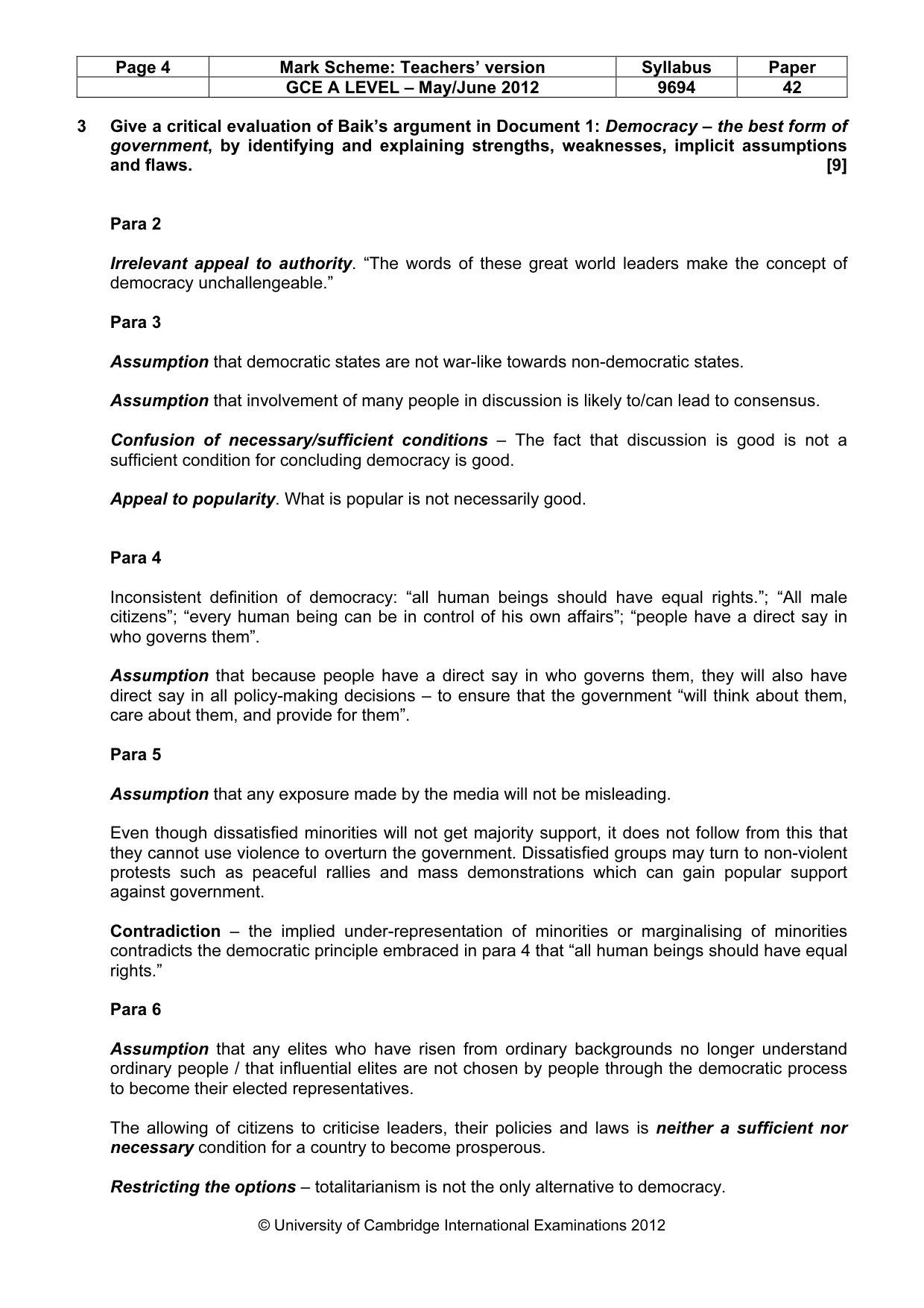
Page 4 Mark Scheme: Teachers’ version Syllabus Paper GCE A LEVEL – May/June 2012 9694 42 © University of Cambridge International Examinations 2012 3 Give a critical evaluation of Baik’s argument in Document 1: Democracy – the best form of government, by identifying and explaining strengths, weaknesses, implicit assumptions and flaws. [9] Para 2 Irrelevant appeal to authority. “The words of these great world leaders make the concept of democracy unchallengeable.” Para 3 Assumption that democratic states are not war-like towards non-democratic states. Assumption that involvement of many people in discussion is likely to/can lead to consensus. Confusion of necessary/sufficient conditions – The fact that discussion is good is not a sufficient condition for concluding democracy is good. Appeal to popularity. What is popular is not necessarily good. Para 4 Inconsistent definition of democracy: “all human beings should have equal rights.”; “All male citizens”; “every human being can be in control of his own affairs”; “people have a direct say in who governs them”. Assumption that because people have a direct say in who governs them, they will also have direct say in all policy-making decisions – to ensure that the government “will think about them, care about them, and provide for them”. Para 5 Assumption that any exposure made by the media will not be misleading. Even though dissatisfied minorities will not get majority support, it does not follow from this that they cannot use violence to overturn the government. Dissatisfied groups may turn to non-violent protests such as peaceful rallies and mass demonstrations which can gain popular support against government. Contradiction – the implied under-representation of minorities or marginalising of minorities contradicts the democratic principle embraced in para 4 that “all human beings should have equal rights.” Para 6 Assumption that any elites who have risen from ordinary backgrounds no longer understand ordinary people / that influential elites are not chosen by people through the democratic process to become their elected representatives. The allowing of citizens to criticise leaders, their policies and laws is neither a sufficient nor necessary condition for a country to become prosperous. Restricting the options – totalitarianism is not the only alternative to democracy.
Mark scheme, page 5
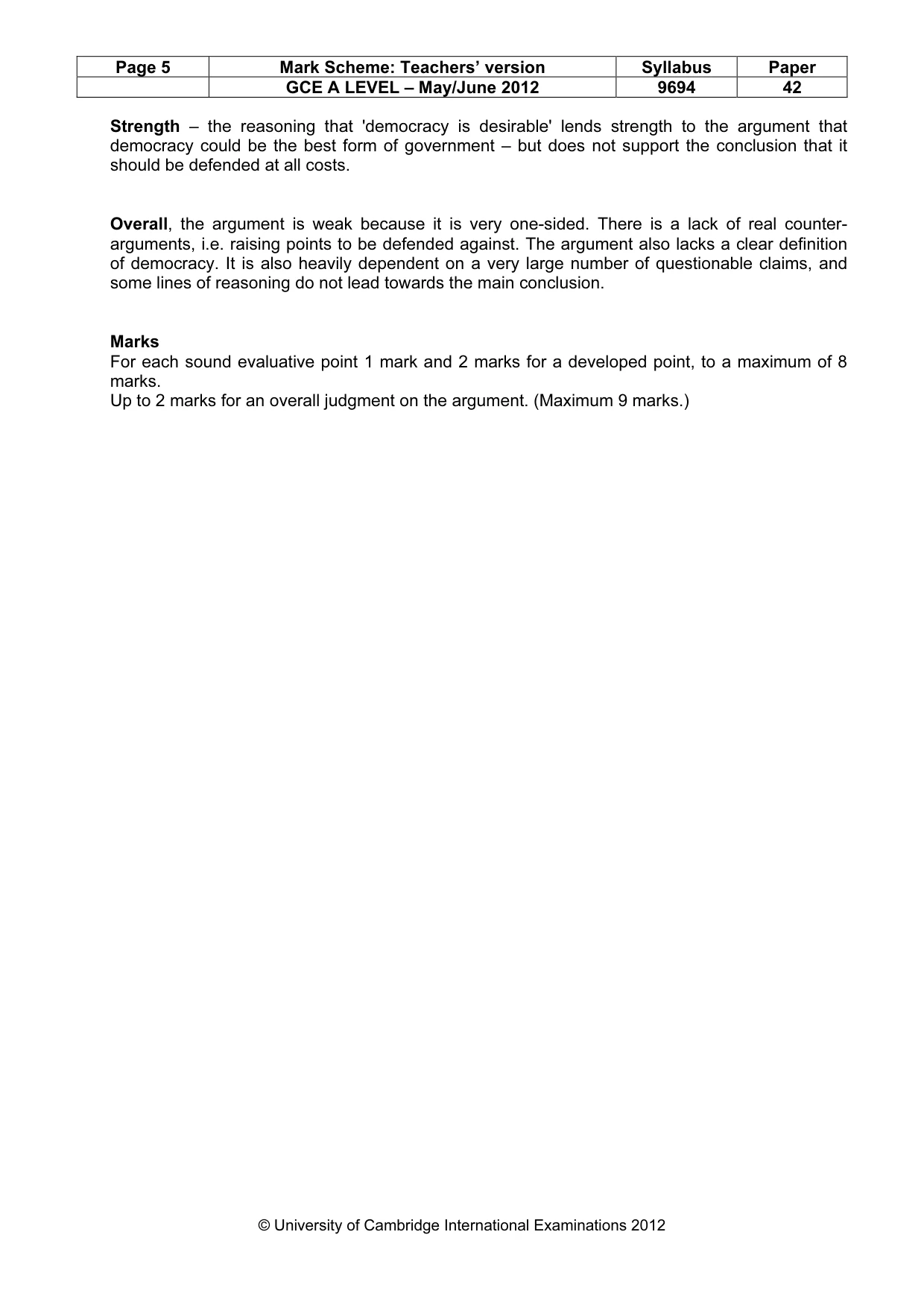
Page 5 Mark Scheme: Teachers’ version Syllabus Paper GCE A LEVEL – May/June 2012 9694 42 © University of Cambridge International Examinations 2012 Strength – the reasoning that 'democracy is desirable' lends strength to the argument that democracy could be the best form of government – but does not support the conclusion that it should be defended at all costs. Overall, the argument is weak because it is very one-sided. There is a lack of real counter- arguments, i.e. raising points to be defended against. The argument also lacks a clear definition of democracy. It is also heavily dependent on a very large number of questionable claims, and some lines of reasoning do not lead towards the main conclusion. Marks For each sound evaluative point 1 mark and 2 marks for a developed point, to a maximum of 8 marks. Up to 2 marks for an overall judgment on the argument. (Maximum 9 marks.)
Mark scheme, page 6
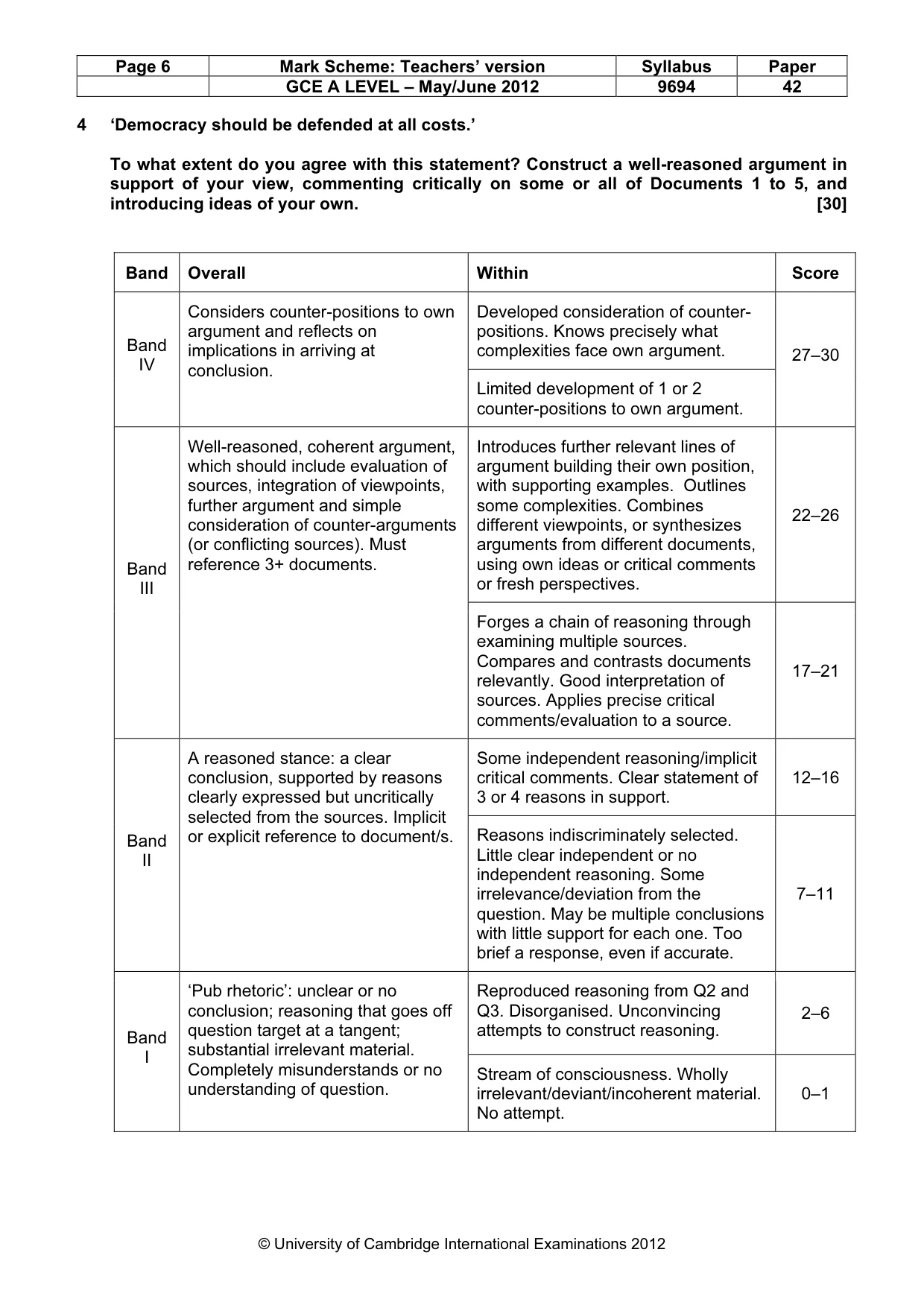
Page 6 Mark Scheme: Teachers’ version Syllabus Paper GCE A LEVEL – May/June 2012 9694 42 © University of Cambridge International Examinations 2012 4 ‘Democracy should be defended at all costs.’ To what extent do you agree with this statement? Construct a well-reasoned argument in support of your view, commenting critically on some or all of Documents 1 to 5, and introducing ideas of your own. [30] Band Overall Within Score Developed consideration of counter- positions. Knows precisely what complexities face own argument. Band IV Considers counter-positions to own argument and reflects on implications in arriving at conclusion. Limited development of 1 or 2 counter-positions to own argument. 27–30 Introduces further relevant lines of argument building their own position, with supporting examples. Outlines some complexities. Combines different viewpoints, or synthesizes arguments from different documents, using own ideas or critical comments or fresh perspectives. 22–26 Band III Well-reasoned, coherent argument, which should include evaluation of sources, integration of viewpoints, further argument and simple consideration of counter-arguments (or conflicting sources). Must reference 3+ documents. Forges a chain of reasoning through examining multiple sources. Compares and contrasts documents relevantly. Good interpretation of sources. Applies precise critical comments/evaluation to a source. 17–21 Some independent reasoning/implicit critical comments. Clear statement of 3 or 4 reasons in support. 12–16 Band II A reasoned stance: a clear conclusion, supported by reasons clearly expressed but uncritically selected from the sources. Implicit or explicit reference to document/s. Reasons indiscriminately selected. Little clear independent or no independent reasoning. Some irrelevance/deviation from the question. May be multiple conclusions with little support for each one. Too brief a response, even if accurate. 7–11 Reproduced reasoning from Q2 and Q3. Disorganised. Unconvincing attempts to construct reasoning. 2–6 Band I ‘Pub rhetoric’: unclear or no conclusion; reasoning that goes off question target at a tangent; substantial irrelevant material. Completely misunderstands or no understanding of question. Stream of consciousness. Wholly irrelevant/deviant/incoherent material. No attempt. 0–1
Mark scheme, page 7
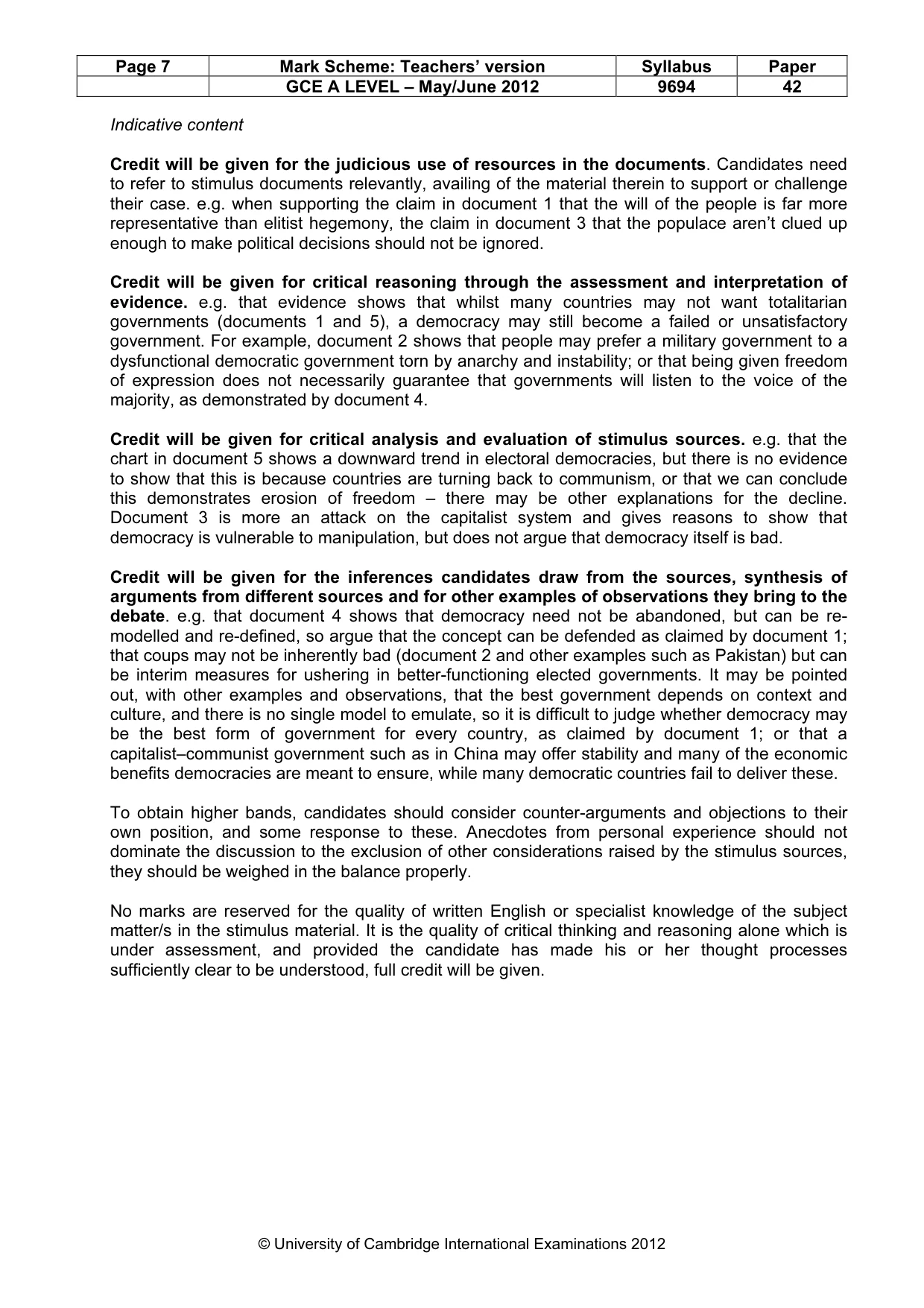
Page 7 Mark Scheme: Teachers’ version Syllabus Paper GCE A LEVEL – May/June 2012 9694 42 © University of Cambridge International Examinations 2012 Indicative content Credit will be given for the judicious use of resources in the documents. Candidates need to refer to stimulus documents relevantly, availing of the material therein to support or challenge their case. e.g. when supporting the claim in document 1 that the will of the people is far more representative than elitist hegemony, the claim in document 3 that the populace aren’t clued up enough to make political decisions should not be ignored. Credit will be given for critical reasoning through the assessment and interpretation of evidence. e.g. that evidence shows that whilst many countries may not want totalitarian governments (documents 1 and 5), a democracy may still become a failed or unsatisfactory government. For example, document 2 shows that people may prefer a military government to a dysfunctional democratic government torn by anarchy and instability; or that being given freedom of expression does not necessarily guarantee that governments will listen to the voice of the majority, as demonstrated by document 4. Credit will be given for critical analysis and evaluation of stimulus sources. e.g. that the chart in document 5 shows a downward trend in electoral democracies, but there is no evidence to show that this is because countries are turning back to communism, or that we can conclude this demonstrates erosion of freedom – there may be other explanations for the decline. Document 3 is more an attack on the capitalist system and gives reasons to show that democracy is vulnerable to manipulation, but does not argue that democracy itself is bad. Credit will be given for the inferences candidates draw from the sources, synthesis of arguments from different sources and for other examples of observations they bring to the debate. e.g. that document 4 shows that democracy need not be abandoned, but can be re- modelled and re-defined, so argue that the concept can be defended as claimed by document 1; that coups may not be inherently bad (document 2 and other examples such as Pakistan) but can be interim measures for ushering in better-functioning elected governments. It may be pointed out, with other examples and observations, that the best government depends on context and culture, and there is no single model to emulate, so it is difficult to judge whether democracy may be the best form of government for every country, as claimed by document 1; or that a capitalist–communist government such as in China may offer stability and many of the economic benefits democracies are meant to ensure, while many democratic countries fail to deliver these. To obtain higher bands, candidates should consider counter-arguments and objections to their own position, and some response to these. Anecdotes from personal experience should not dominate the discussion to the exclusion of other considerations raised by the stimulus sources, they should be weighed in the balance properly. No marks are reserved for the quality of written English or specialist knowledge of the subject matter/s in the stimulus material. It is the quality of critical thinking and reasoning alone which is under assessment, and provided the candidate has made his or her thought processes sufficiently clear to be understood, full credit will be given.
What you needed in this session
Cambridge’s own grade thresholds for 2012 May/June, Paper 4 · Variant 2. A higher threshold means an easier paper — the bar moves with how the cohort did.