Cambridge A Level Psychology 9698 — 2018 Oct/Nov Paper 3 · Variant 2
9698/32/O/N/18 · 20 questions · 80 marks · ≈90 min
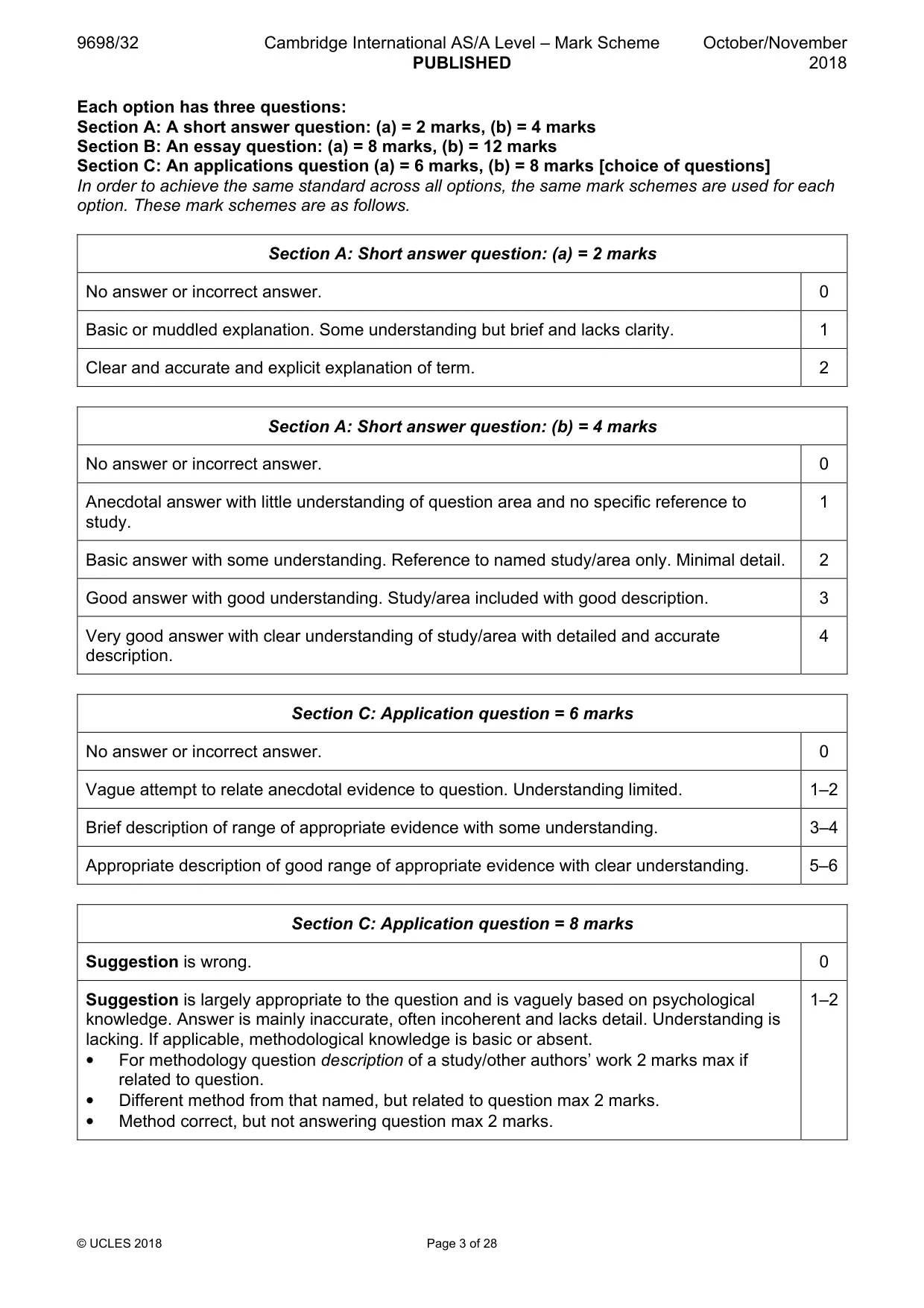
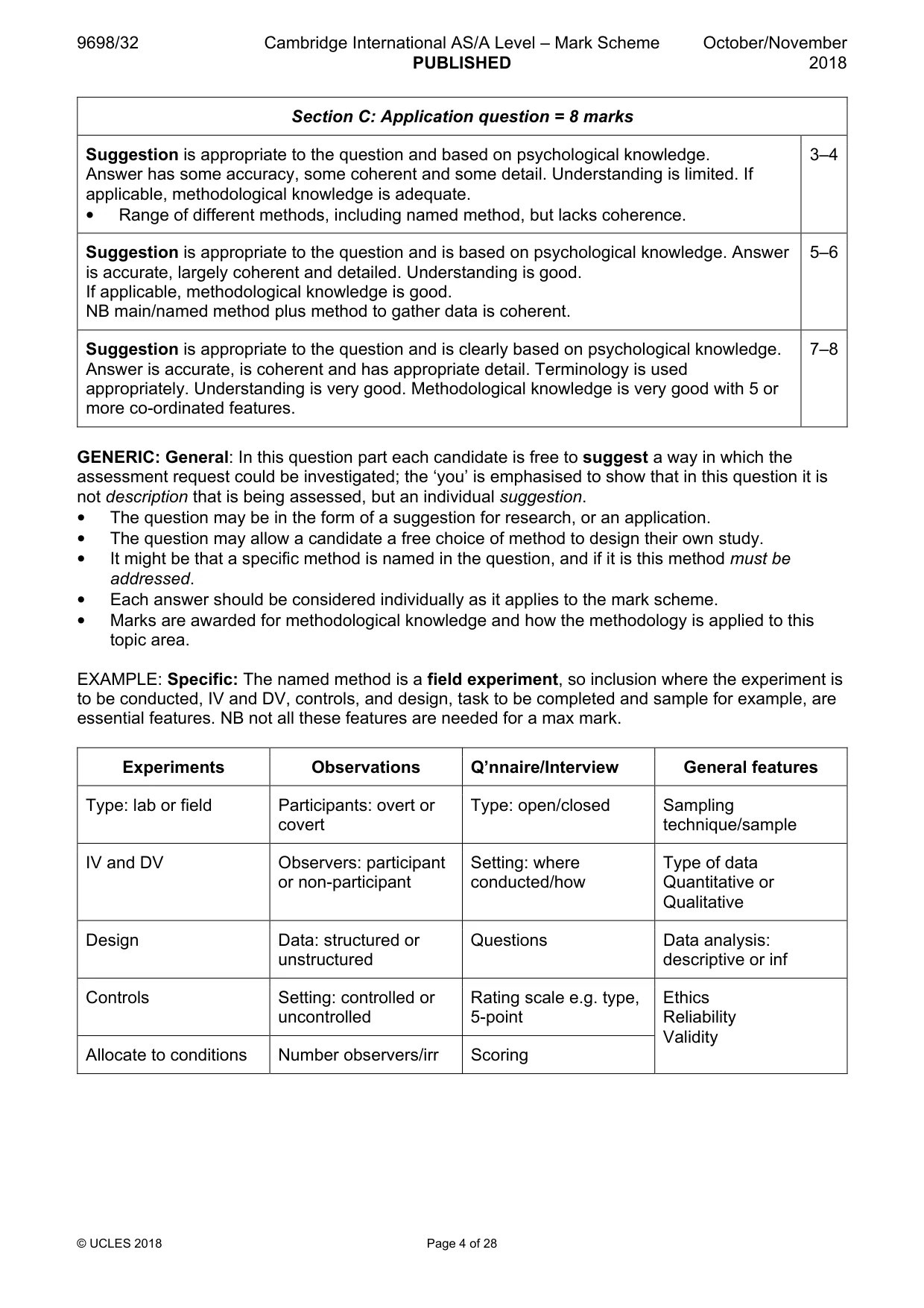
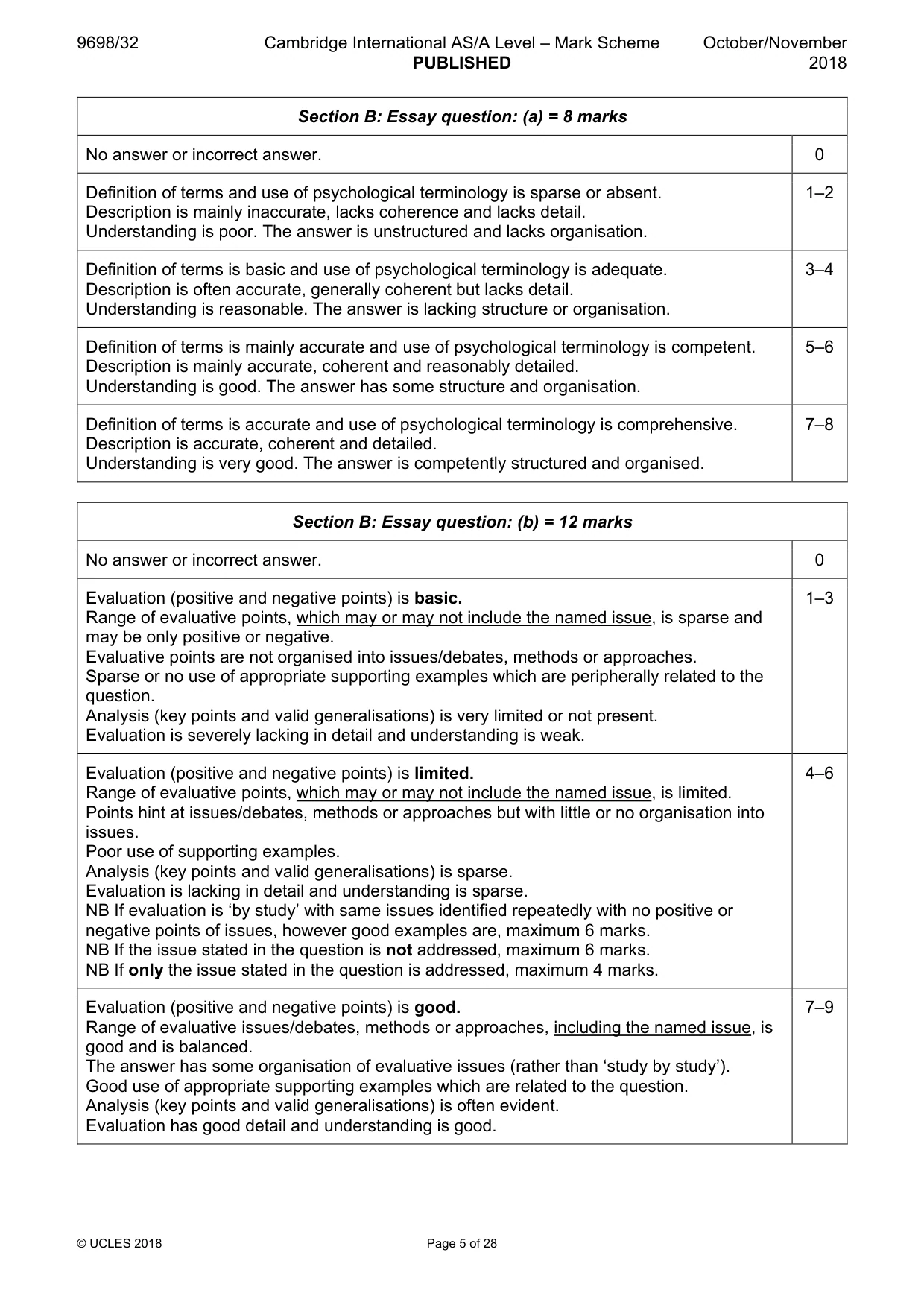
The question paper and its mark scheme, free to read here and free to download. This is Cambridge’s own paper, exactly as it was sat.
Question paper8 pages
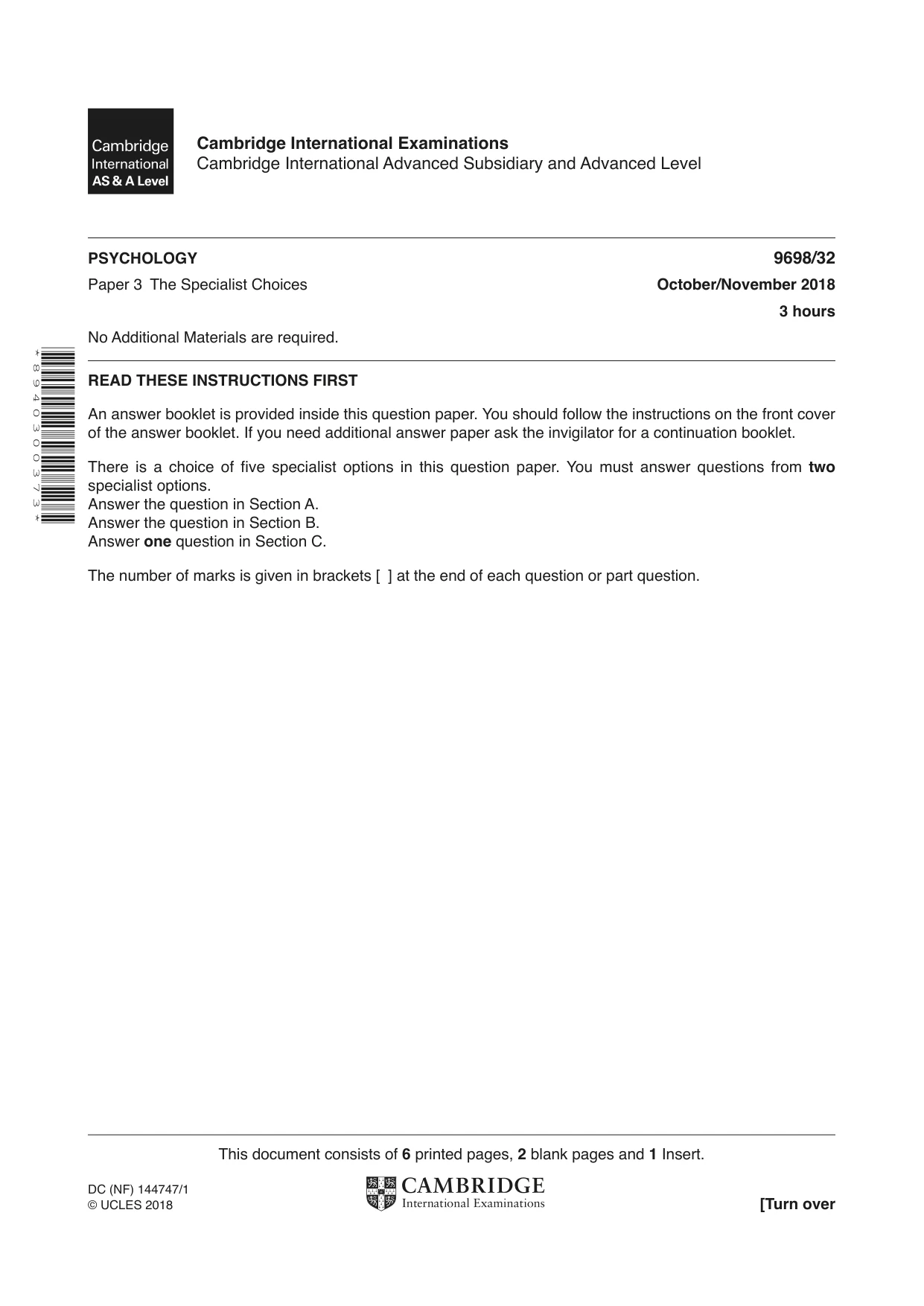
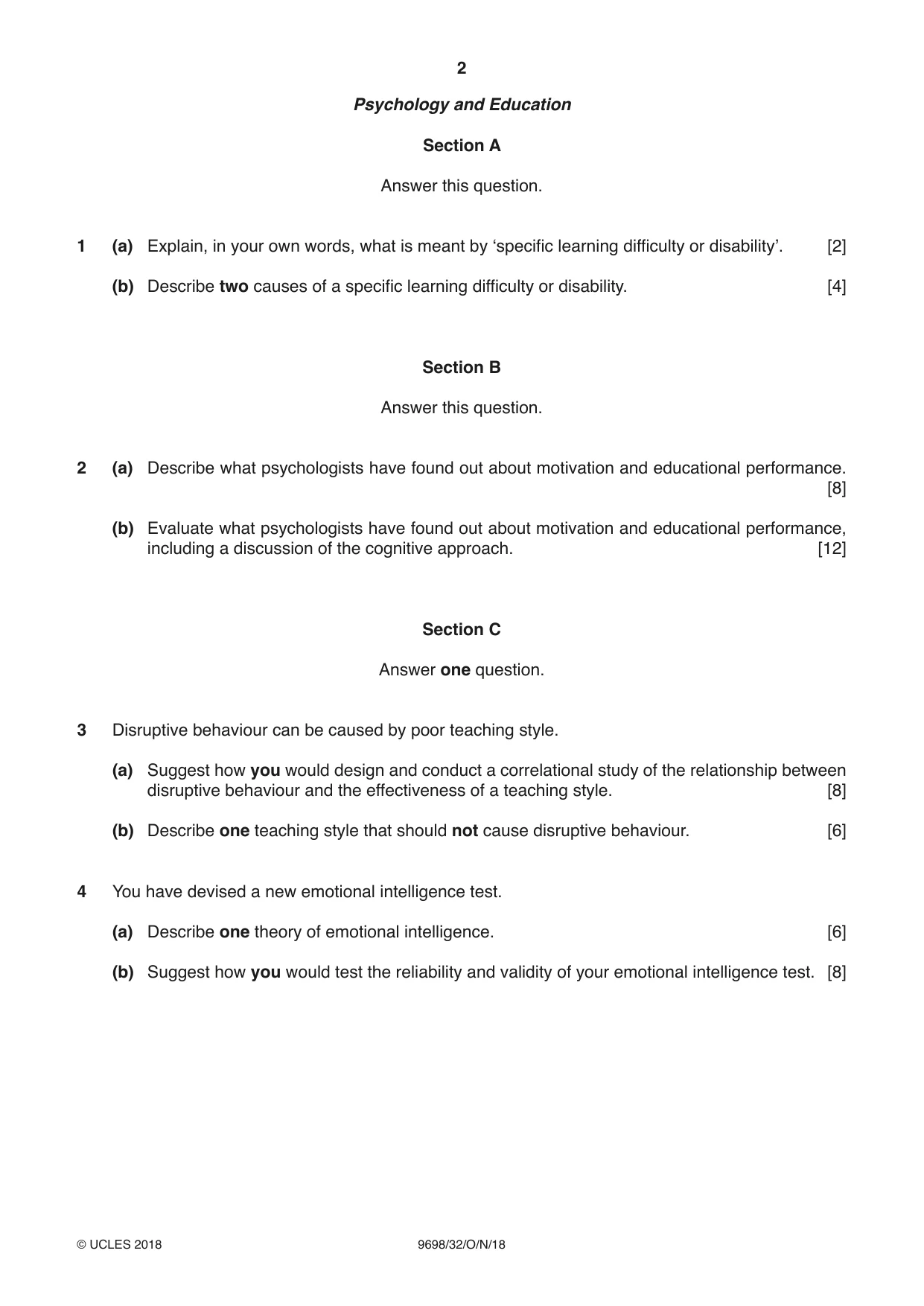
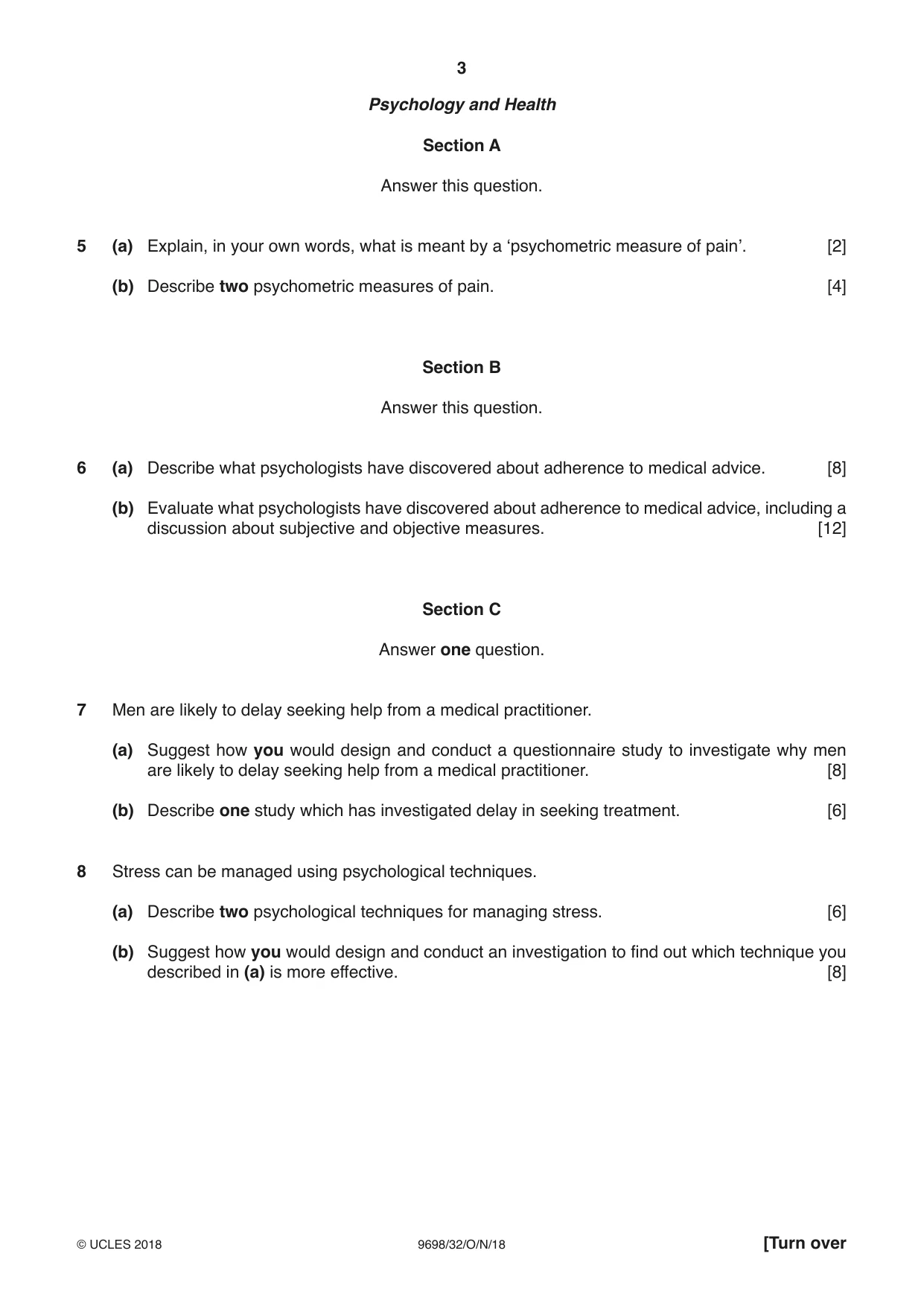
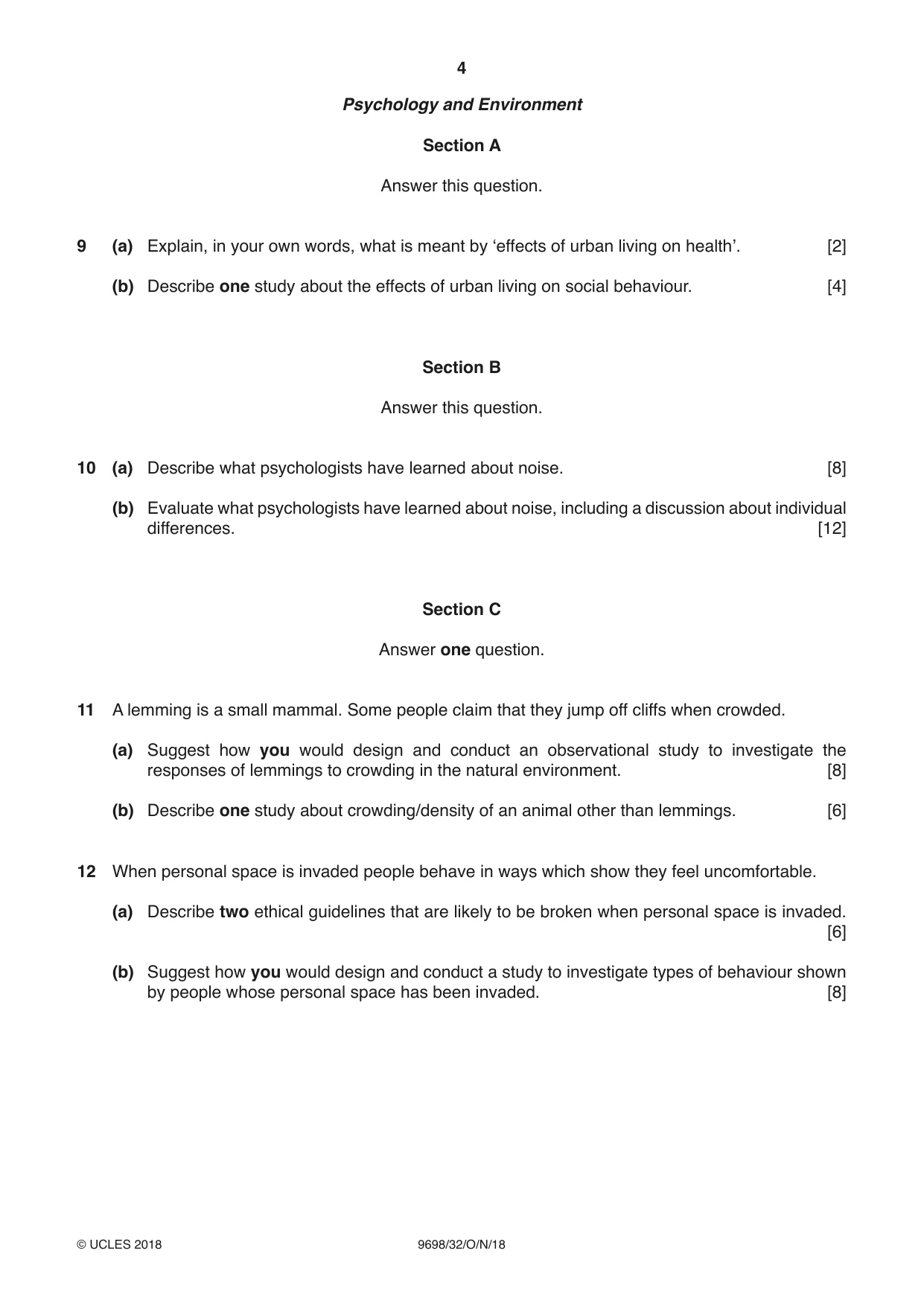


Mark scheme28 pages
Answers below. Sit the paper first if you are practising.

Questions as text
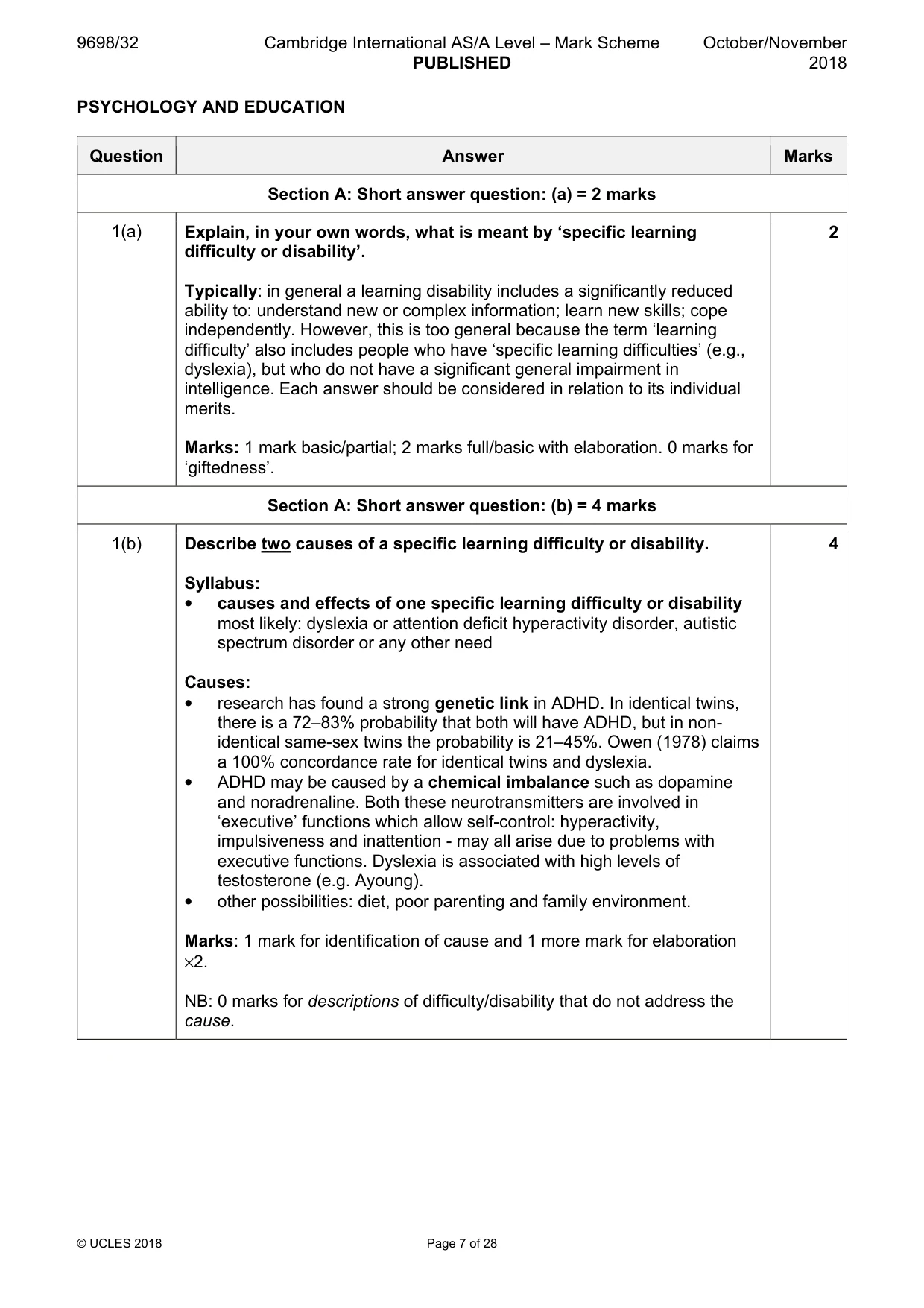
Q1 · Explain, in your own words, what is meant by ‘specific learning difficulty or disability’
1 (a) Explain, in your own words, what is meant by ‘specific learning difficulty or disability’. [2] (b) Describe two causes of a specific learning difficulty or disability. [4]
Mark scheme: Question Answer Marks Section A: Short answer question: (a) = 2 marks 1(a) Explain, in your own words, what is meant by ‘specific learning 2 difficulty or disability’. Typically: in general a learning disability includes a significantly reduced ability to: understand new or complex information; learn new skills; cope independently. However, this is too general because the term ‘learning difficulty’ also includes people who have ‘specific learning difficulties’ (e.g., dyslexia), but who do not have a significant general impairment in intelligence. Each answer should be considered in relation to its individual merits. Marks: 1 mark basic/partial; 2 marks full/basic with elaboration. 0 marks for ‘giftedness’. Section A: Short answer question: (b) = 4 marks 1(b) Describe two causes of a specific learning difficulty or disability. 4 Syllabus: • causes and effects of one specific learning difficulty or disability most likely: dyslexia or attention deficit hyperactivity disorder, autistic spectrum disorder or any other need Causes: • research has found a strong genetic link in ADHD. In identical twins, there is a 72–83% probability that both will have ADHD, but in non- identical same-sex twins the probability is 21–45%. Owen (1978) claims a 100% concordance rate for identical twins and dyslexia. • ADHD may be caused by a chemical imbalance such as dopamine and noradrenaline. Both these neurotransmitters are involved in ‘executive’ functions which allow self-control: hyperactivity, impulsiveness and inattention - may all arise due to problems with executive functions. Dyslexia is associated with high levels of testosterone (e.g. Ayoung). • other possibilities: diet, poor parenting and family environment. Marks: 1 mark for identification of cause and 1 more mark for elaboration ×2. NB: 0 marks for descriptions of difficulty/disability that do not address the cause.
Q2 · Describe what psychologists have found out about motivation and educational performance
2 (a) Describe what psychologists have found out about motivation and educational performance. [8] (b) Evaluate what psychologists have found out about motivation and educational performance, including a discussion of the cognitive approach. [12] Section C Answer one question.
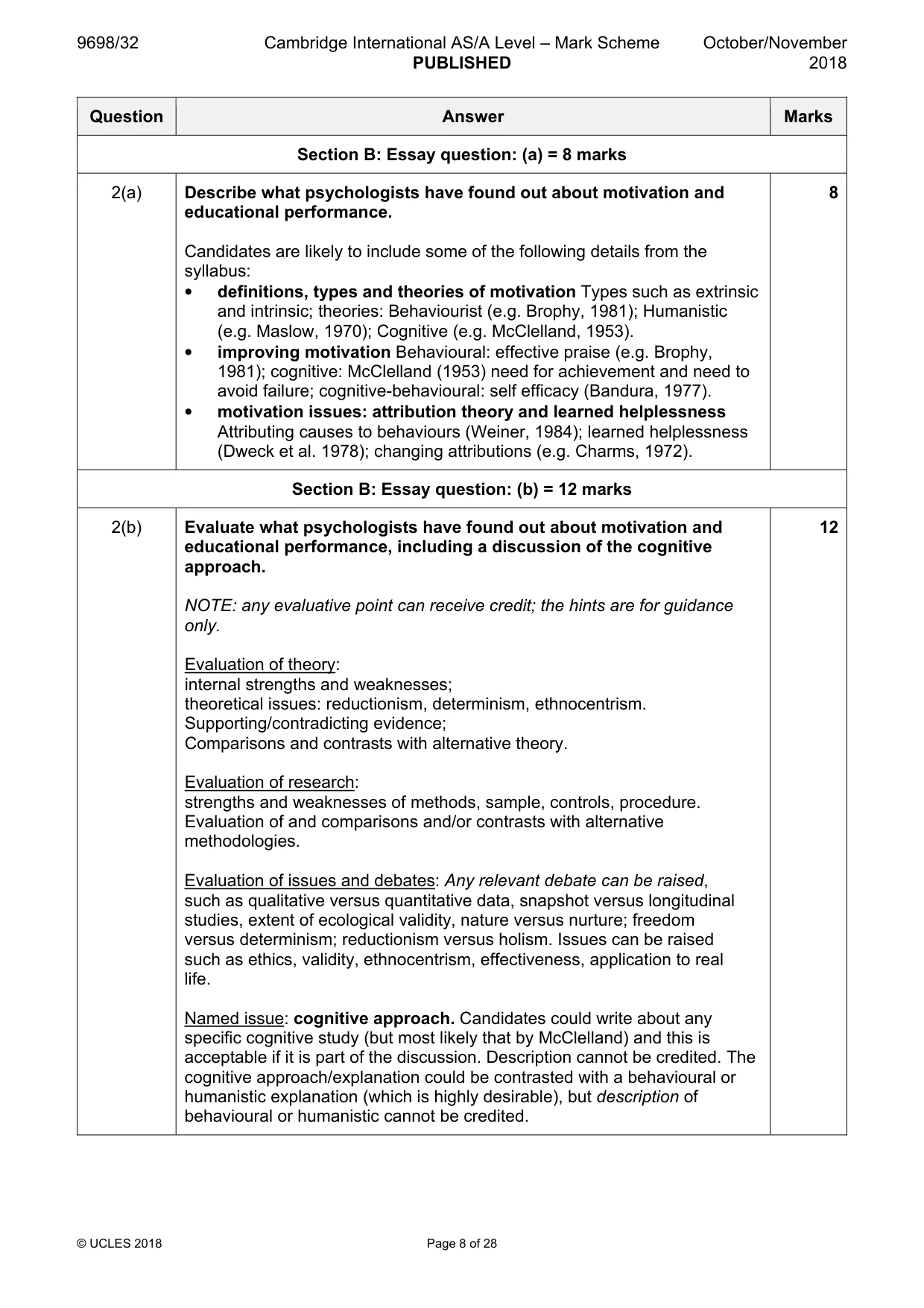
Mark scheme: 2(a) Describe what psychologists have found out about motivation and 8 educational performance. Candidates are likely to include some of the following details from the syllabus: • definitions, types and theories of motivation Types such as extrinsic and intrinsic; theories: Behaviourist (e.g. Brophy, 1981); Humanistic (e.g. Maslow, 1970); Cognitive (e.g. McClelland, 1953). • improving motivation Behavioural: effective praise (e.g. Brophy, 1981); cognitive: McClelland (1953) need for achievement and need to avoid failure; cognitive-behavioural: self efficacy (Bandura, 1977). • motivation issues: attribution theory and learned helplessness Attributing causes to behaviours (Weiner, 1984); learned helplessness (Dweck et al. 1978); changing attributions (e.g. Charms, 1972). Section B: Essay question: (b) = 12 marks 2(b) Evaluate what psychologists have found out about motivation and 12 educational performance, including a discussion of the cognitive approach. NOTE: any evaluative point can receive credit; the hints are for guidance only. Evaluation of theory: internal strengths and weaknesses; theoretical issues: reductionism, determinism, ethnocentrism. Supporting/contradicting evidence; Comparisons and contrasts with alternative theory. Evaluation of research: strengths and weaknesses of methods, sample, controls, procedure. Evaluation of and comparisons and/or contrasts with alternative methodologies. Evaluation of issues and debates: Any relevant debate can be raised, such as qualitative versus quantitative data, snapshot versus longitudinal studies, extent of ecological validity, nature versus nurture; freedom versus determinism; reductionism versus holism. Issues can be raised such as ethics, validity, ethnocentrism, effectiveness, application to real life. Named issue: cognitive approach. Candidates could write about any specific cognitive study (but most likely that by McClelland) and this is acceptable if it is part of the discussion. Description cannot be credited. The cognitive approach/explanation could be contrasted with a behavioural or humanistic explanation (which is highly desirable), but description of behavioural or humanistic cannot be credited.
Q3 · Disruptive behaviour can be caused by poor teaching style
3 Disruptive behaviour can be caused by poor teaching style. (a) Suggest how you would design and conduct a correlational study of the relationship between disruptive behaviour and the effectiveness of a teaching style. [8] (b) Describe one teaching style that should not cause disruptive behaviour. [6]
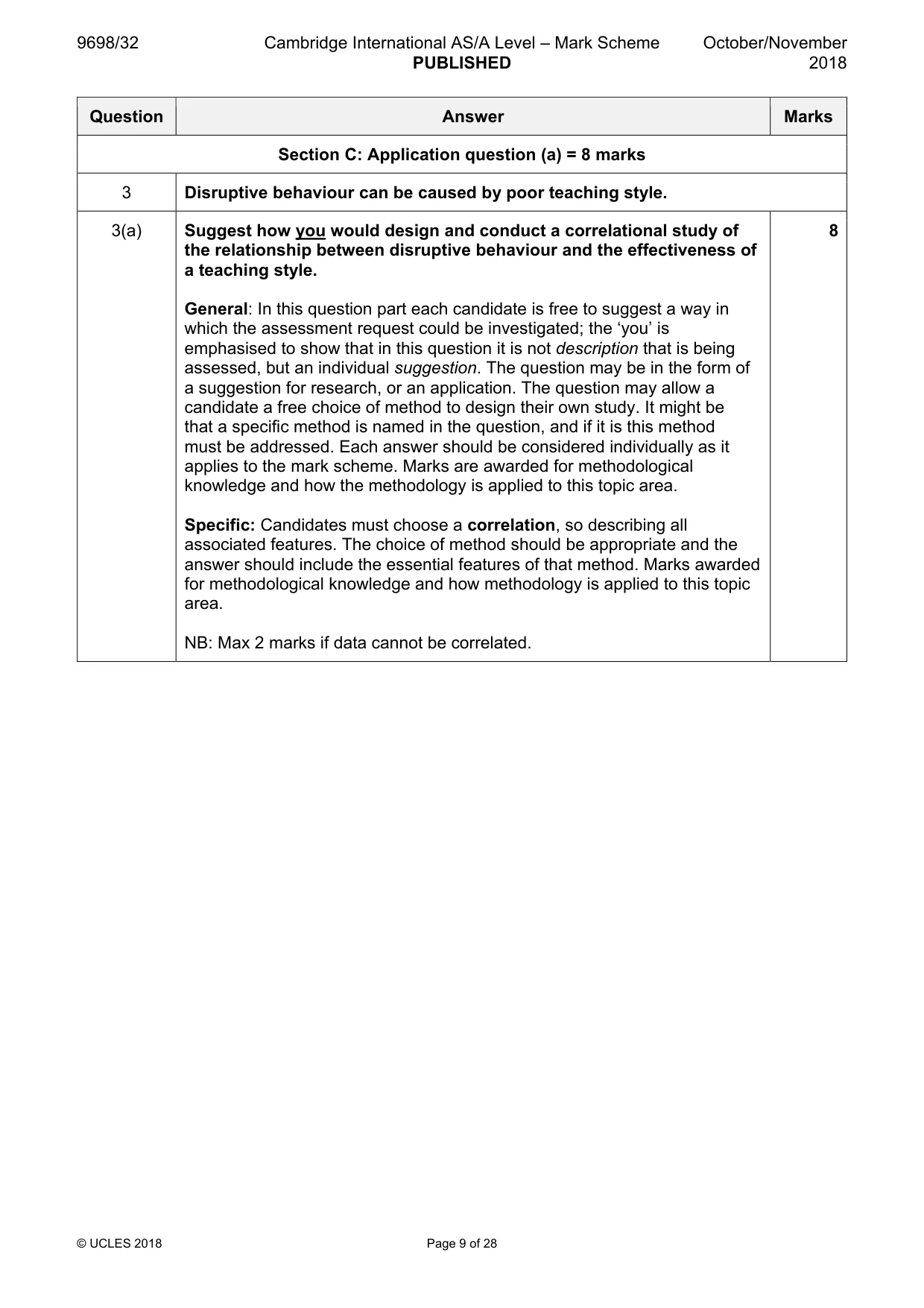
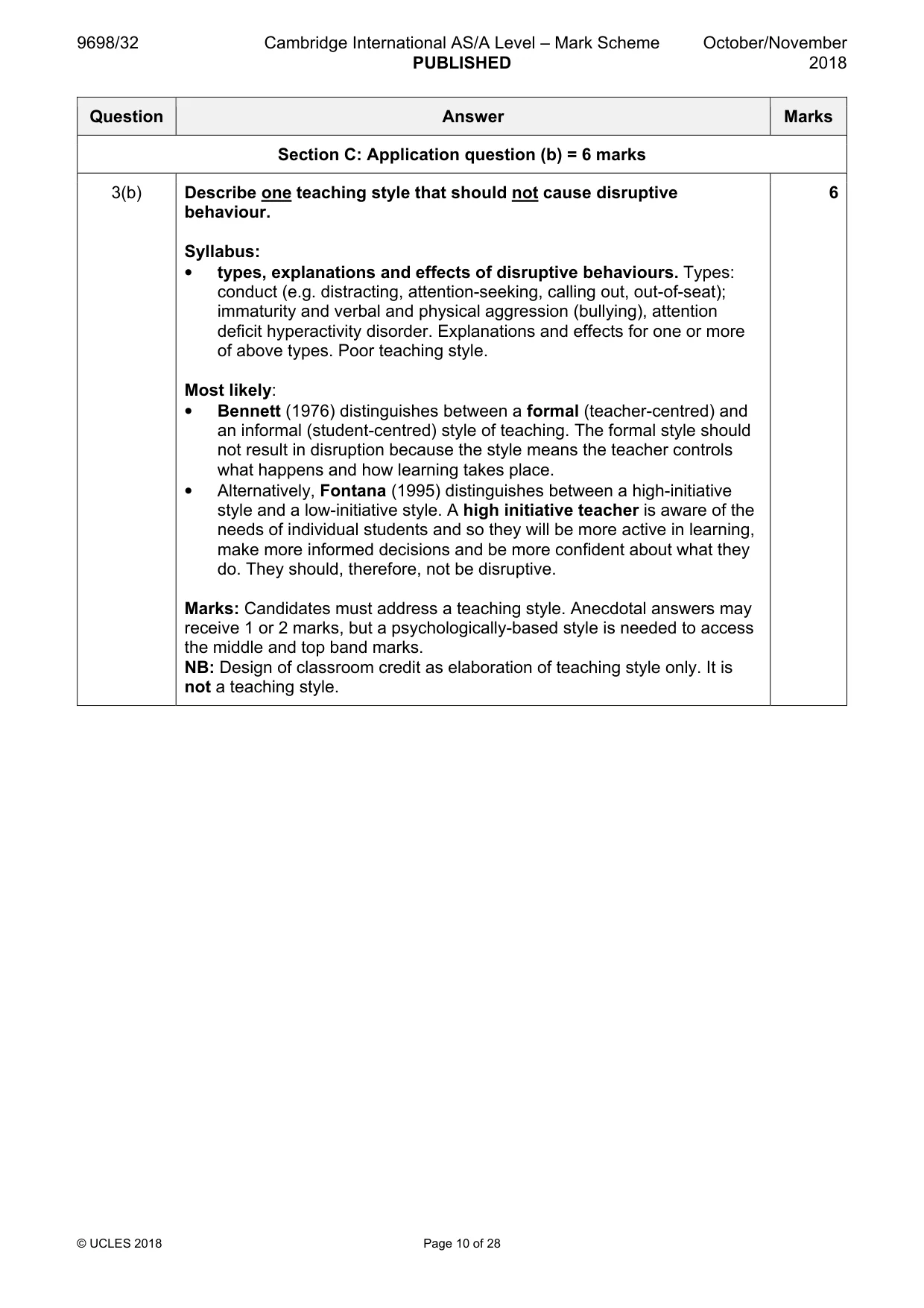
Mark scheme: 3(a) Suggest how you would design and conduct a correlational study of 8 the relationship between disruptive behaviour and the effectiveness of a teaching style. General: In this question part each candidate is free to suggest a way in which the assessment request could be investigated; the ‘you’ is emphasised to show that in this question it is not description that is being assessed, but an individual suggestion. The question may be in the form of a suggestion for research, or an application. The question may allow a candidate a free choice of method to design their own study. It might be that a specific method is named in the question, and if it is this method must be addressed. Each answer should be considered individually as it applies to the mark scheme. Marks are awarded for methodological knowledge and how the methodology is applied to this topic area. Specific: Candidates must choose a correlation, so describing all associated features. The choice of method should be appropriate and the answer should include the essential features of that method. Marks awarded for methodological knowledge and how methodology is applied to this topic area. NB: Max 2 marks if data cannot be correlated. Section C: Application question (b) = 6 marks 3(b) Describe one teaching style that should not cause disruptive 6 behaviour. Syllabus: • types, explanations and effects of disruptive behaviours. Types: conduct (e.g. distracting, attention-seeking, calling out, out-of-seat); immaturity and verbal and physical aggression (bullying), attention deficit hyperactivity disorder. Explanations and effects for one or more of above types. Poor teaching style. Most likely: • Bennett (1976) distinguishes between a formal (teacher-centred) and an informal (student-centred) style of teaching. The formal style should not result in disruption because the style means the teacher controls what happens and how learning takes place. • Alternatively, Fontana (1995) distinguishes between a high-initiative style and a low-initiative style. A high initiative teacher is aware of the needs of individual students and so they will be more active in learning, make more informed decisions and be more confident about what they do. They should, therefore, not be disruptive. Marks: Candidates must address a teaching style. Anecdotal answers may receive 1 or 2 marks, but a psychologically-based style is needed to access the middle and top band marks. NB: Design of classroom credit as elaboration of teaching style only. It is not a teaching style.
Q4 · You have devised a new emotional intelligence test
4 You have devised a new emotional intelligence test. (a) Describe one theory of emotional intelligence. [6] (b) Suggest how you would test the reliability and validity of your emotional intelligence test. [8] Psychology and Health Section A Answer this question.
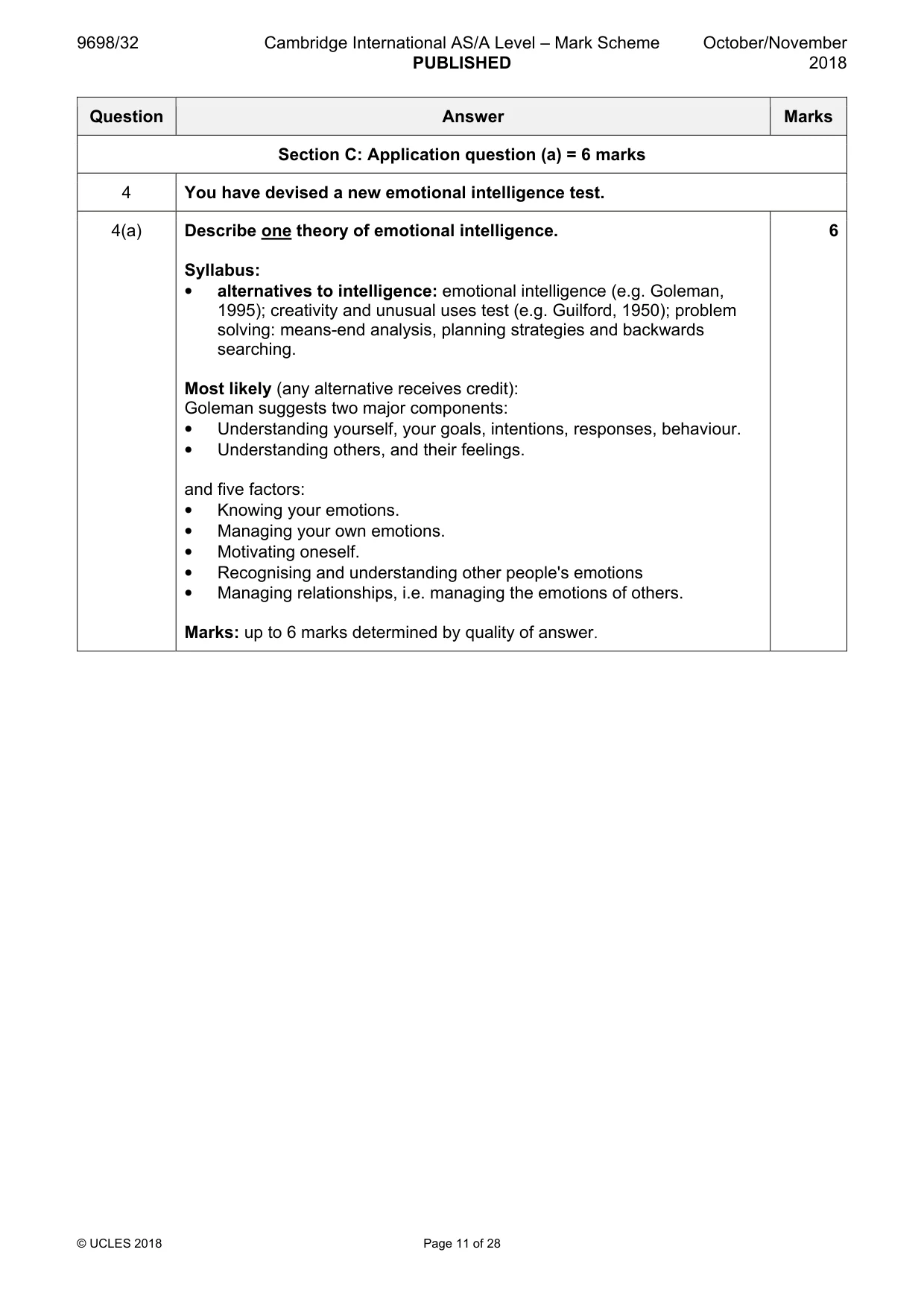
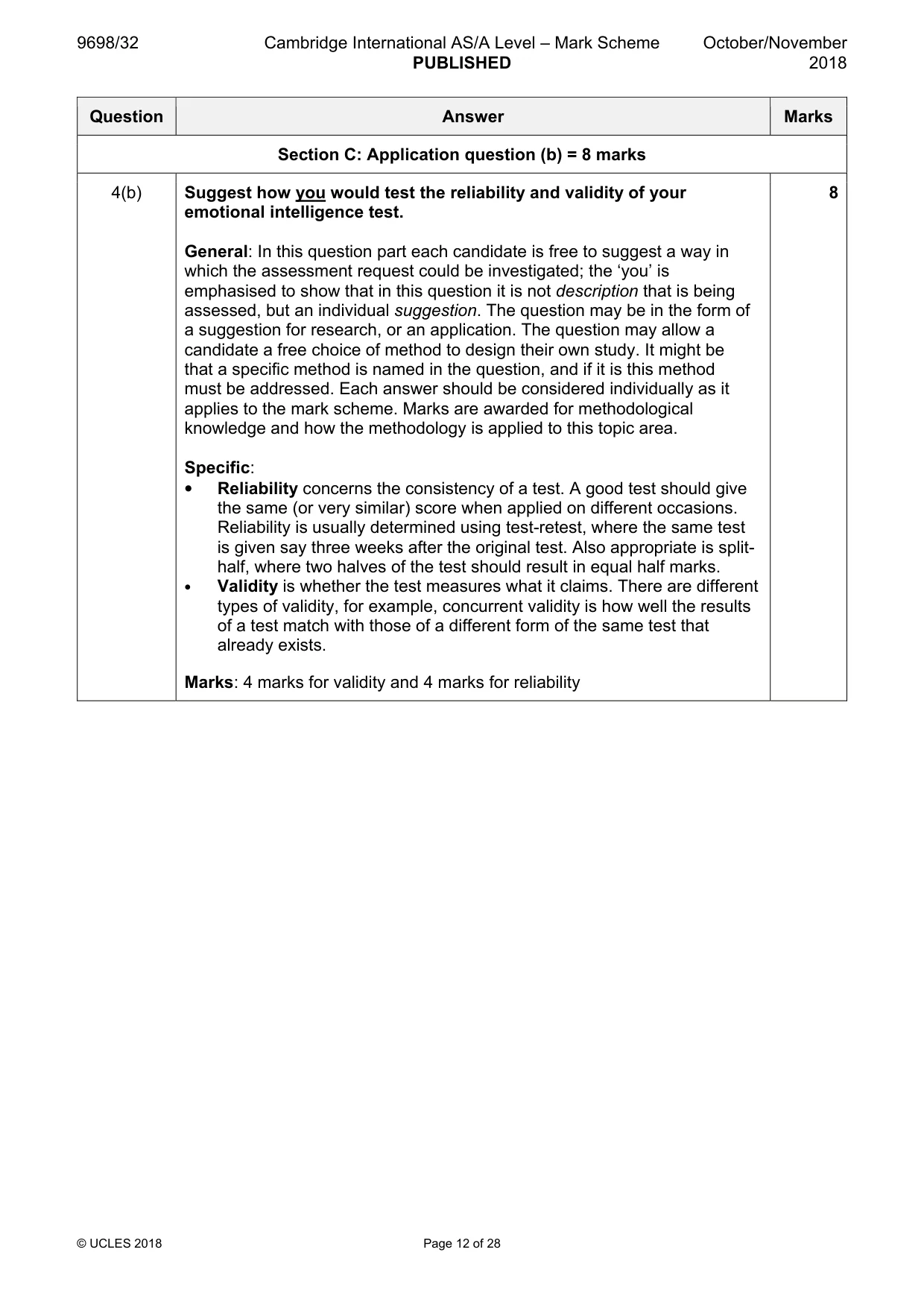
Mark scheme: 4(a) Describe one theory of emotional intelligence. 6 Syllabus: • alternatives to intelligence: emotional intelligence (e.g. Goleman, 1995); creativity and unusual uses test (e.g. Guilford, 1950); problem solving: means-end analysis, planning strategies and backwards searching. Most likely (any alternative receives credit): Goleman suggests two major components: • Understanding yourself, your goals, intentions, responses, behaviour. • Understanding others, and their feelings. and five factors: • Knowing your emotions. • Managing your own emotions. • Motivating oneself. • Recognising and understanding other people's emotions • Managing relationships, i.e. managing the emotions of others. Marks: up to 6 marks determined by quality of answer. Section C: Application question (b) = 8 marks 4(b) Suggest how you would test the reliability and validity of your 8 emotional intelligence test. General: In this question part each candidate is free to suggest a way in which the assessment request could be investigated; the ‘you’ is emphasised to show that in this question it is not description that is being assessed, but an individual suggestion. The question may be in the form of a suggestion for research, or an application. The question may allow a candidate a free choice of method to design their own study. It might be that a specific method is named in the question, and if it is this method must be addressed. Each answer should be considered individually as it applies to the mark scheme. Marks are awarded for methodological knowledge and how the methodology is applied to this topic area. Specific: • Reliability concerns the consistency of a test. A good test should give the same (or very similar) score when applied on different occasions. Reliability is usually determined using test-retest, where the same test is given say three weeks after the original test. Also appropriate is split- half, where two halves of the test should result in equal half marks. • Validity is whether the test measures what it claims. There are different types of validity, for example, concurrent validity is how well the results of a test match with those of a different form of the same test that already exists. Marks: 4 marks for validity and 4 marks for reliability PSYCHOLOGY AND HEALTH
Q5 · Explain, in your own words, what is meant by a ‘psychometric measure of pain’
5 (a) Explain, in your own words, what is meant by a ‘psychometric measure of pain’. [2] (b) Describe two psychometric measures of pain. [4]
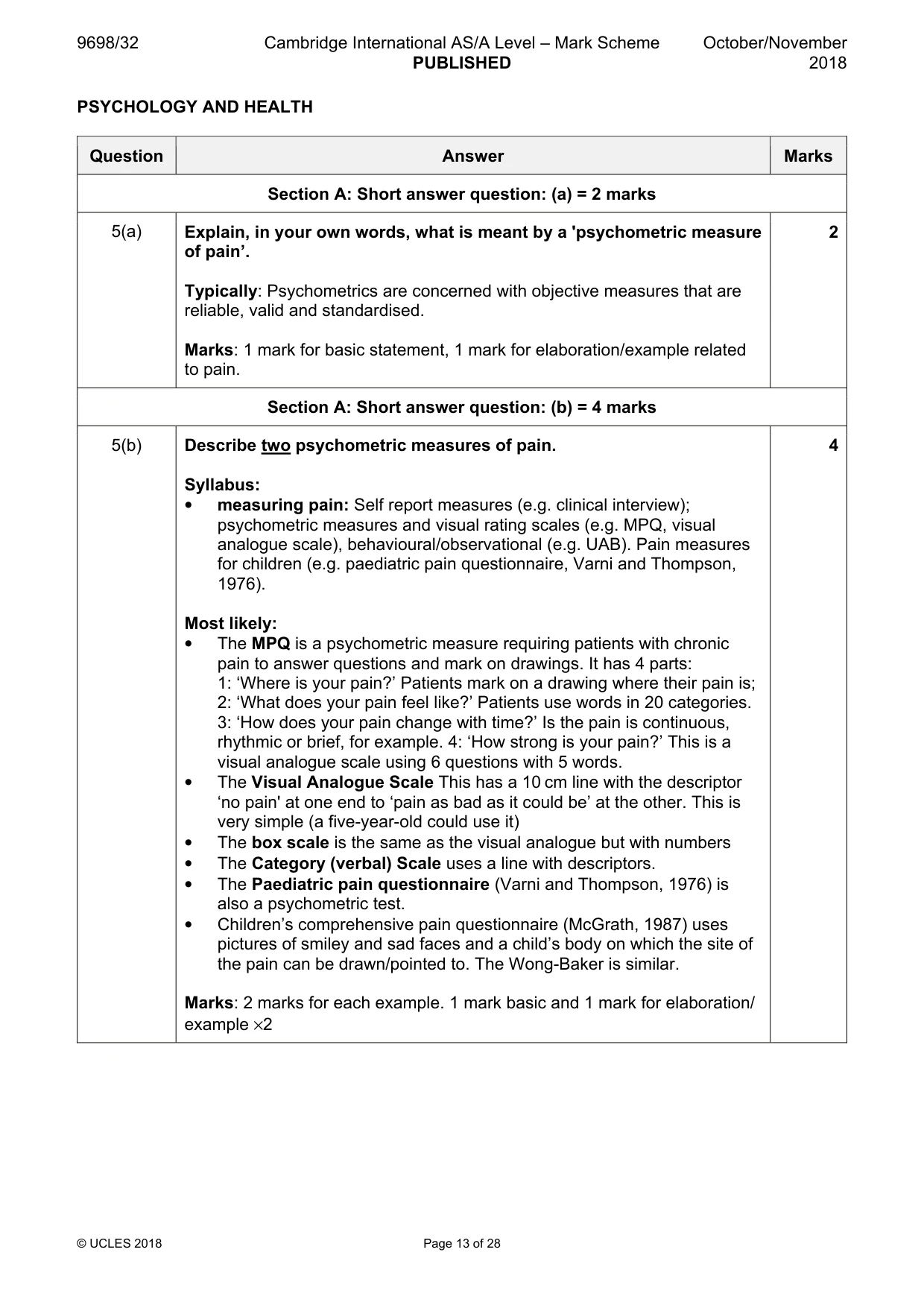
Mark scheme: 5(a) Explain, in your own words, what is meant by a 'psychometric measure 2 of pain’. Typically: Psychometrics are concerned with objective measures that are reliable, valid and standardised. Marks: 1 mark for basic statement, 1 mark for elaboration/example related to pain. Section A: Short answer question: (b) = 4 marks 5(b) Describe two psychometric measures of pain. 4 Syllabus: • measuring pain: Self report measures (e.g. clinical interview); psychometric measures and visual rating scales (e.g. MPQ, visual analogue scale), behavioural/observational (e.g. UAB). Pain measures for children (e.g. paediatric pain questionnaire, Varni and Thompson, 1976). Most likely: • The MPQ is a psychometric measure requiring patients with chronic pain to answer questions and mark on drawings. It has 4 parts: 1: ‘Where is your pain?’ Patients mark on a drawing where their pain is; 2: ‘What does your pain feel like?’ Patients use words in 20 categories. 3: ‘How does your pain change with time?’ Is the pain is continuous, rhythmic or brief, for example. 4: ‘How strong is your pain?’ This is a visual analogue scale using 6 questions with 5 words. • The Visual Analogue Scale This has a 10 cm line with the descriptor ‘no pain' at one end to ‘pain as bad as it could be’ at the other. This is very simple (a five-year-old could use it) • The box scale is the same as the visual analogue but with numbers • The Category (verbal) Scale uses a line with descriptors. • The Paediatric pain questionnaire (Varni and Thompson, 1976) is also a psychometric test. • Children’s comprehensive pain questionnaire (McGrath, 1987) uses pictures of smiley and sad faces and a child’s body on which the site of the pain can be drawn/pointed to. The Wong-Baker is similar. Marks: 2 marks for each example. 1 mark basic and 1 mark for elaboration/ example ×2
Q6 · Describe what psychologists have discovered about adherence to medical advice
6 (a) Describe what psychologists have discovered about adherence to medical advice. [8] (b) Evaluate what psychologists have discovered about adherence to medical advice, including a discussion about subjective and objective measures. [12] Section C Answer one question.
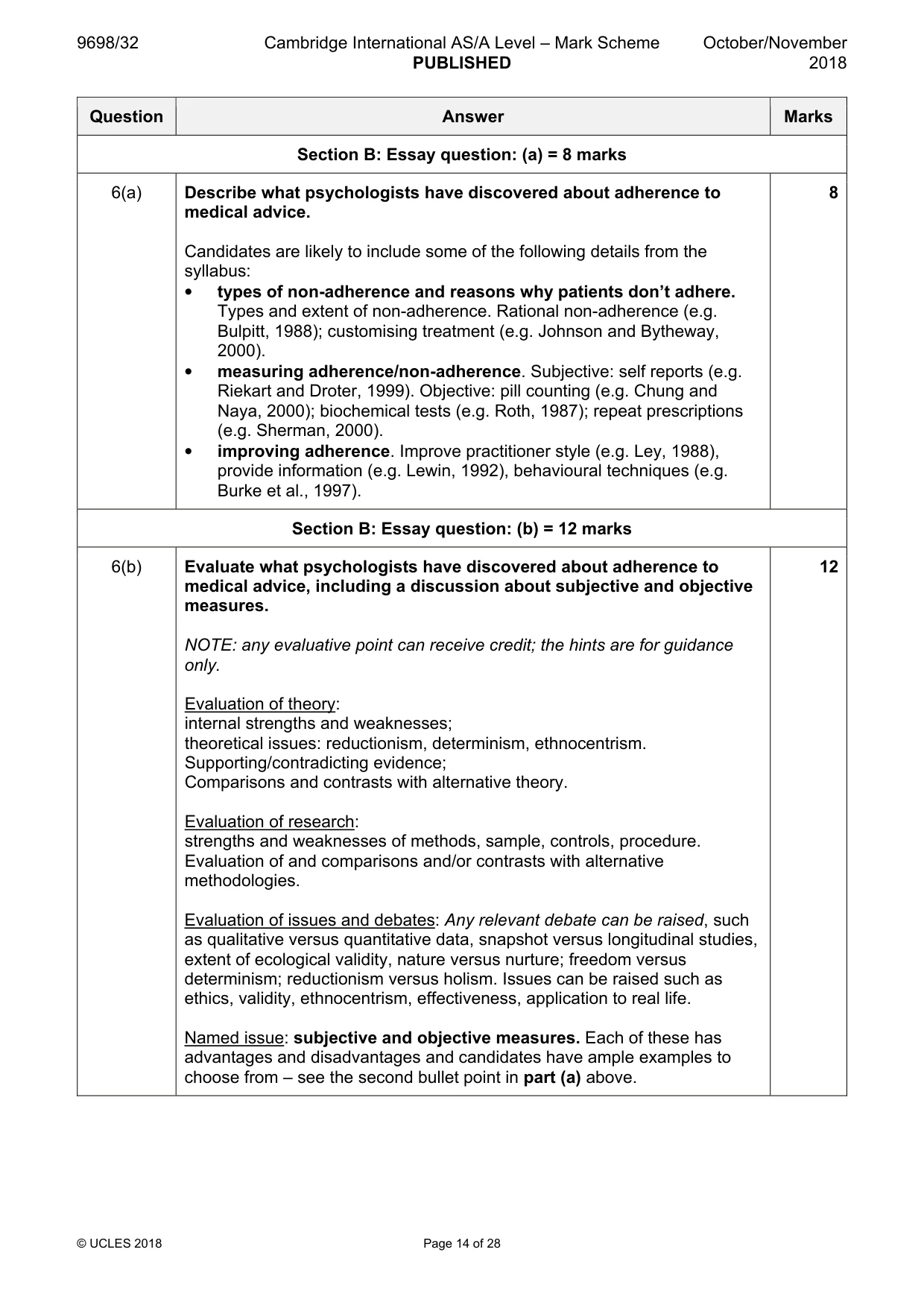
Mark scheme: 6(a) Describe what psychologists have discovered about adherence to 8 medical advice. Candidates are likely to include some of the following details from the syllabus: • types of non-adherence and reasons why patients don’t adhere. Types and extent of non-adherence. Rational non-adherence (e.g. Bulpitt, 1988); customising treatment (e.g. Johnson and Bytheway, 2000). • measuring adherence/non-adherence. Subjective: self reports (e.g. Riekart and Droter, 1999). Objective: pill counting (e.g. Chung and Naya, 2000); biochemical tests (e.g. Roth, 1987); repeat prescriptions (e.g. Sherman, 2000). • improving adherence. Improve practitioner style (e.g. Ley, 1988), provide information (e.g. Lewin, 1992), behavioural techniques (e.g. Burke et al., 1997). Section B: Essay question: (b) = 12 marks 6(b) Evaluate what psychologists have discovered about adherence to 12 medical advice, including a discussion about subjective and objective measures. NOTE: any evaluative point can receive credit; the hints are for guidance only. Evaluation of theory: internal strengths and weaknesses; theoretical issues: reductionism, determinism, ethnocentrism. Supporting/contradicting evidence; Comparisons and contrasts with alternative theory. Evaluation of research: strengths and weaknesses of methods, sample, controls, procedure. Evaluation of and comparisons and/or contrasts with alternative methodologies. Evaluation of issues and debates: Any relevant debate can be raised, such as qualitative versus quantitative data, snapshot versus longitudinal studies, extent of ecological validity, nature versus nurture; freedom versus determinism; reductionism versus holism. Issues can be raised such as ethics, validity, ethnocentrism, effectiveness, application to real life. Named issue: subjective and objective measures. Each of these has advantages and disadvantages and candidates have ample examples to choose from – see the second bullet point in part (a) above.
Q7 · Men are likely to delay seeking help from a medical practitioner
7 Men are likely to delay seeking help from a medical practitioner. (a) Suggest how you would design and conduct a questionnaire study to investigate why men are likely to delay seeking help from a medical practitioner. [8] (b) Describe one study which has investigated delay in seeking treatment. [6]
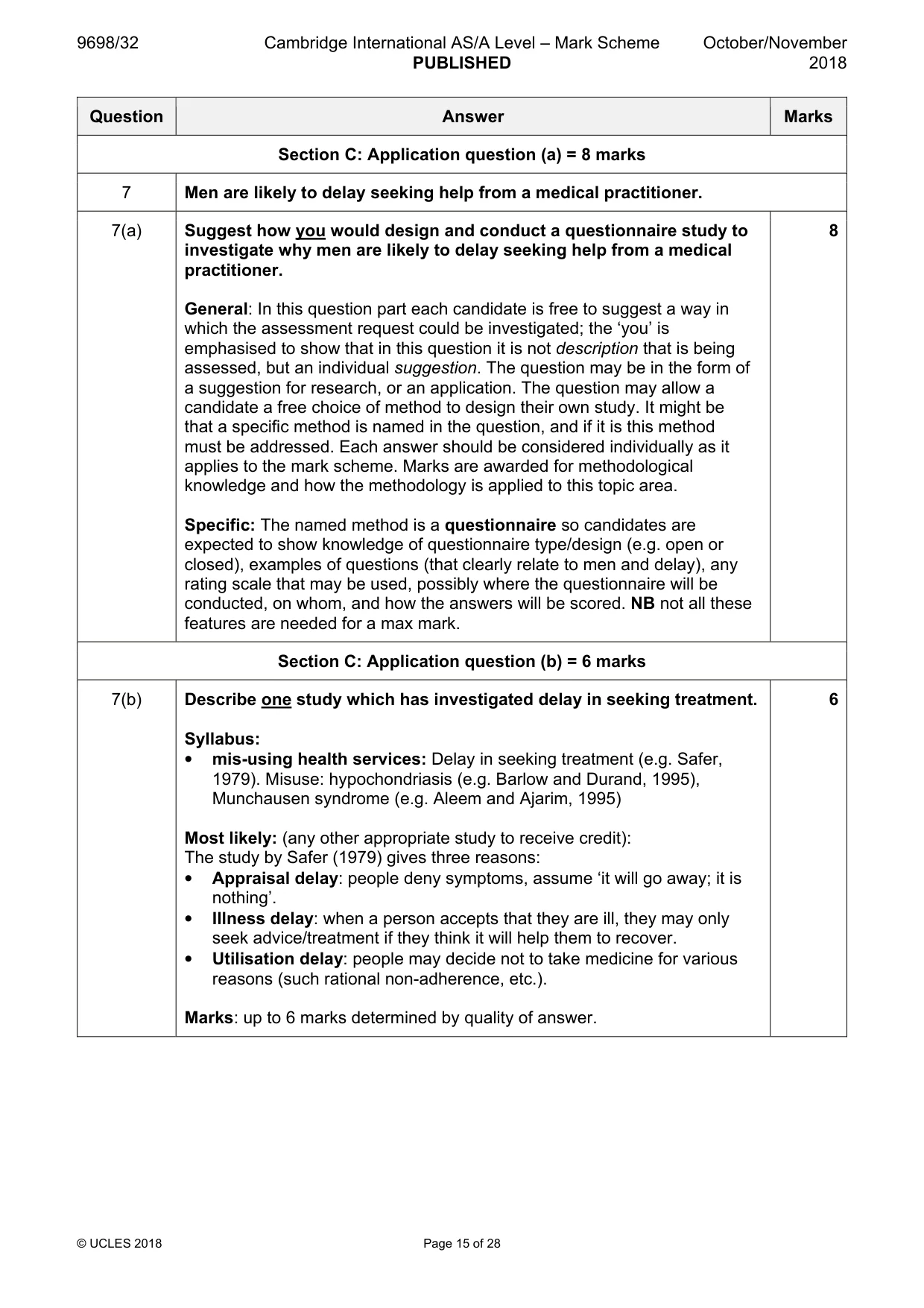
Mark scheme: 7(a) Suggest how you would design and conduct a questionnaire study to 8 investigate why men are likely to delay seeking help from a medical practitioner. General: In this question part each candidate is free to suggest a way in which the assessment request could be investigated; the ‘you’ is emphasised to show that in this question it is not description that is being assessed, but an individual suggestion. The question may be in the form of a suggestion for research, or an application. The question may allow a candidate a free choice of method to design their own study. It might be that a specific method is named in the question, and if it is this method must be addressed. Each answer should be considered individually as it applies to the mark scheme. Marks are awarded for methodological knowledge and how the methodology is applied to this topic area. Specific: The named method is a questionnaire so candidates are expected to show knowledge of questionnaire type/design (e.g. open or closed), examples of questions (that clearly relate to men and delay), any rating scale that may be used, possibly where the questionnaire will be conducted, on whom, and how the answers will be scored. NB not all these features are needed for a max mark. Section C: Application question (b) = 6 marks 7(b) Describe one study which has investigated delay in seeking treatment. 6 Syllabus: • mis-using health services: Delay in seeking treatment (e.g. Safer, 1979). Misuse: hypochondriasis (e.g. Barlow and Durand, 1995), Munchausen syndrome (e.g. Aleem and Ajarim, 1995) Most likely: (any other appropriate study to receive credit): The study by Safer (1979) gives three reasons: • Appraisal delay: people deny symptoms, assume ‘it will go away; it is nothing’. • Illness delay: when a person accepts that they are ill, they may only seek advice/treatment if they think it will help them to recover. • Utilisation delay: people may decide not to take medicine for various reasons (such rational non-adherence, etc.). Marks: up to 6 marks determined by quality of answer.
Q8 · Stress can be managed using psychological techniques
8 Stress can be managed using psychological techniques. (a) Describe two psychological techniques for managing stress. [6] (b) Suggest how you would design and conduct an investigation to find out which technique you described in (a) is more effective. [8] Psychology and Environment Section A Answer this question.
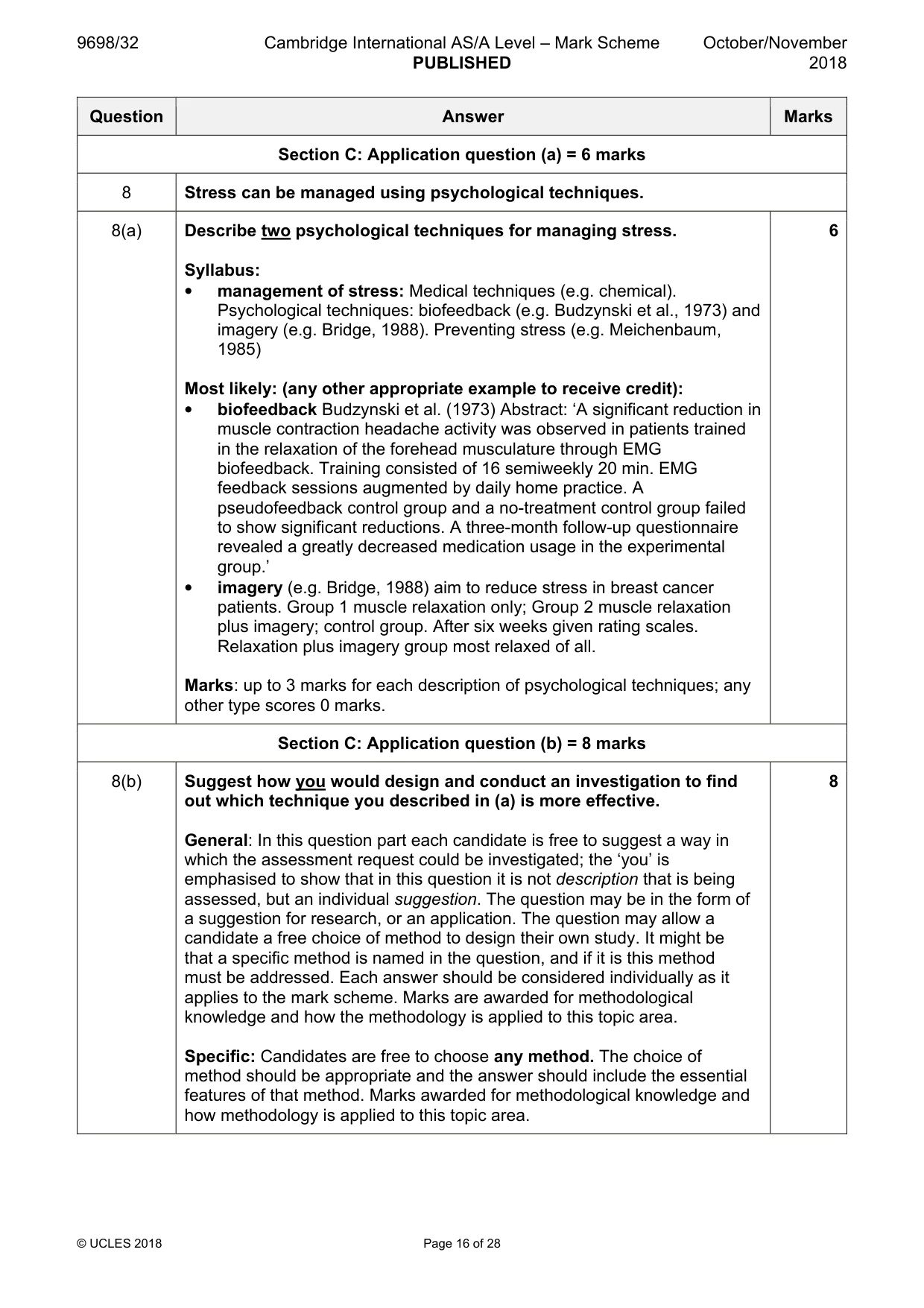
Mark scheme: 8(a) Describe two psychological techniques for managing stress. 6 Syllabus: • management of stress: Medical techniques (e.g. chemical). Psychological techniques: biofeedback (e.g. Budzynski et al., 1973) and imagery (e.g. Bridge, 1988). Preventing stress (e.g. Meichenbaum, 1985) Most likely: (any other appropriate example to receive credit): • biofeedback Budzynski et al. (1973) Abstract: ‘A significant reduction in muscle contraction headache activity was observed in patients trained in the relaxation of the forehead musculature through EMG biofeedback. Training consisted of 16 semiweekly 20 min. EMG feedback sessions augmented by daily home practice. A pseudofeedback control group and a no-treatment control group failed to show significant reductions. A three-month follow-up questionnaire revealed a greatly decreased medication usage in the experimental group.’ • imagery (e.g. Bridge, 1988) aim to reduce stress in breast cancer patients. Group 1 muscle relaxation only; Group 2 muscle relaxation plus imagery; control group. After six weeks given rating scales. Relaxation plus imagery group most relaxed of all. Marks: up to 3 marks for each description of psychological techniques; any other type scores 0 marks. Section C: Application question (b) = 8 marks 8(b) Suggest how you would design and conduct an investigation to find 8 out which technique you described in (a) is more effective. General: In this question part each candidate is free to suggest a way in which the assessment request could be investigated; the ‘you’ is emphasised to show that in this question it is not description that is being assessed, but an individual suggestion. The question may be in the form of a suggestion for research, or an application. The question may allow a candidate a free choice of method to design their own study. It might be that a specific method is named in the question, and if it is this method must be addressed. Each answer should be considered individually as it applies to the mark scheme. Marks are awarded for methodological knowledge and how the methodology is applied to this topic area. Specific: Candidates are free to choose any method. The choice of method should be appropriate and the answer should include the essential features of that method. Marks awarded for methodological knowledge and how methodology is applied to this topic area. PSYCHOLOGY AND ENVIRONMENT
Q9 · Explain, in your own words, what is meant by ‘effects of urban living on health’
9 (a) Explain, in your own words, what is meant by ‘effects of urban living on health’. [2] (b) Describe one study about the effects of urban living on social behaviour. [4]
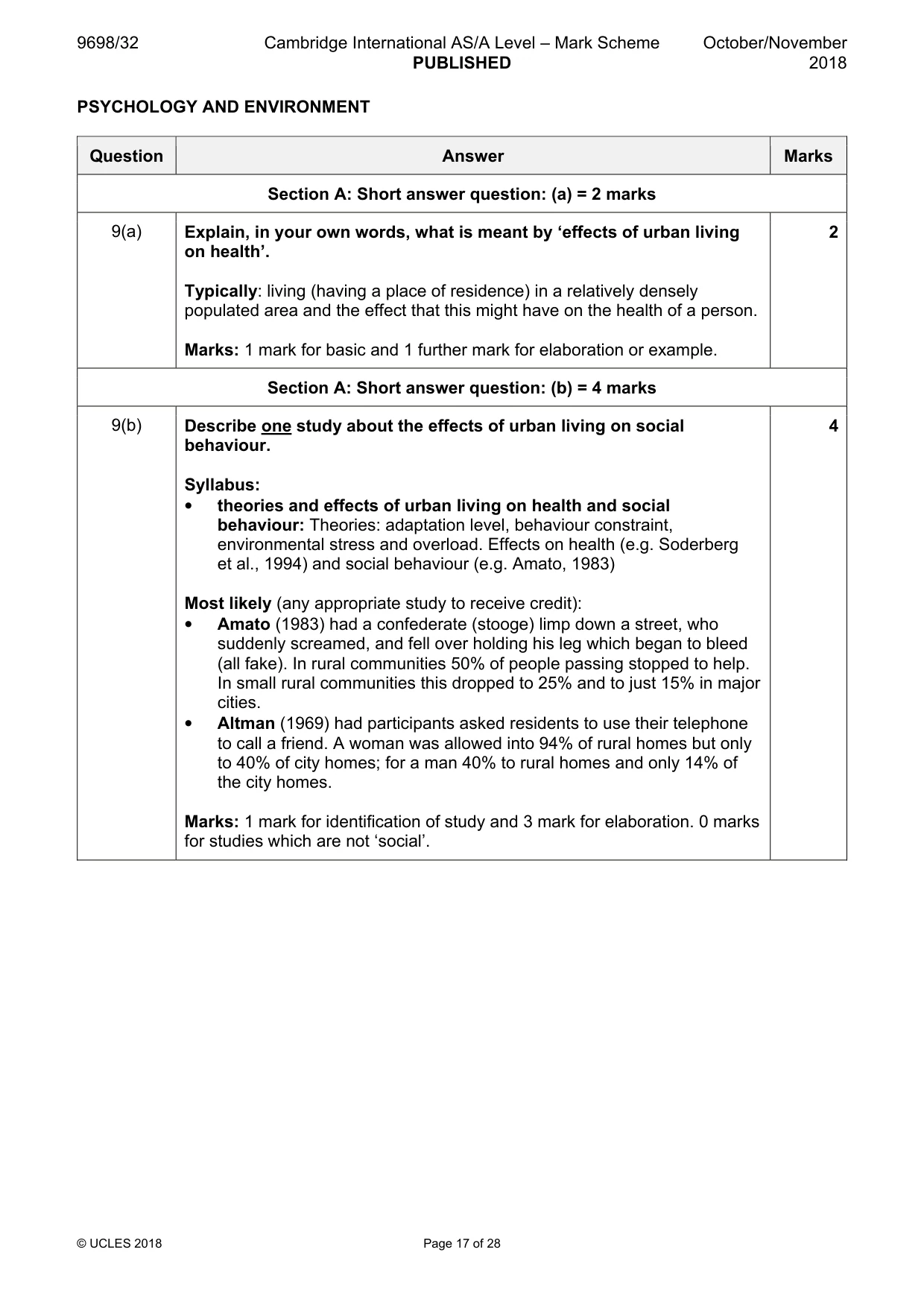
Mark scheme: 9(a) Explain, in your own words, what is meant by ‘effects of urban living 2 on health’. Typically: living (having a place of residence) in a relatively densely populated area and the effect that this might have on the health of a person. Marks: 1 mark for basic and 1 further mark for elaboration or example. Section A: Short answer question: (b) = 4 marks 9(b) Describe one study about the effects of urban living on social 4 behaviour. Syllabus: • theories and effects of urban living on health and social behaviour: Theories: adaptation level, behaviour constraint, environmental stress and overload. Effects on health (e.g. Soderberg et al., 1994) and social behaviour (e.g. Amato, 1983) Most likely (any appropriate study to receive credit): • Amato (1983) had a confederate (stooge) limp down a street, who suddenly screamed, and fell over holding his leg which began to bleed (all fake). In rural communities 50% of people passing stopped to help. In small rural communities this dropped to 25% and to just 15% in major cities. • Altman (1969) had participants asked residents to use their telephone to call a friend. A woman was allowed into 94% of rural homes but only to 40% of city homes; for a man 40% to rural homes and only 14% of the city homes. Marks: 1 mark for identification of study and 3 mark for elaboration. 0 marks for studies which are not ‘social’.
Q10 · Describe what psychologists have learned about noise
10 (a) Describe what psychologists have learned about noise. [8] (b) Evaluate what psychologists have learned about noise, including a discussion about individual differences. [12] Section C Answer one question.
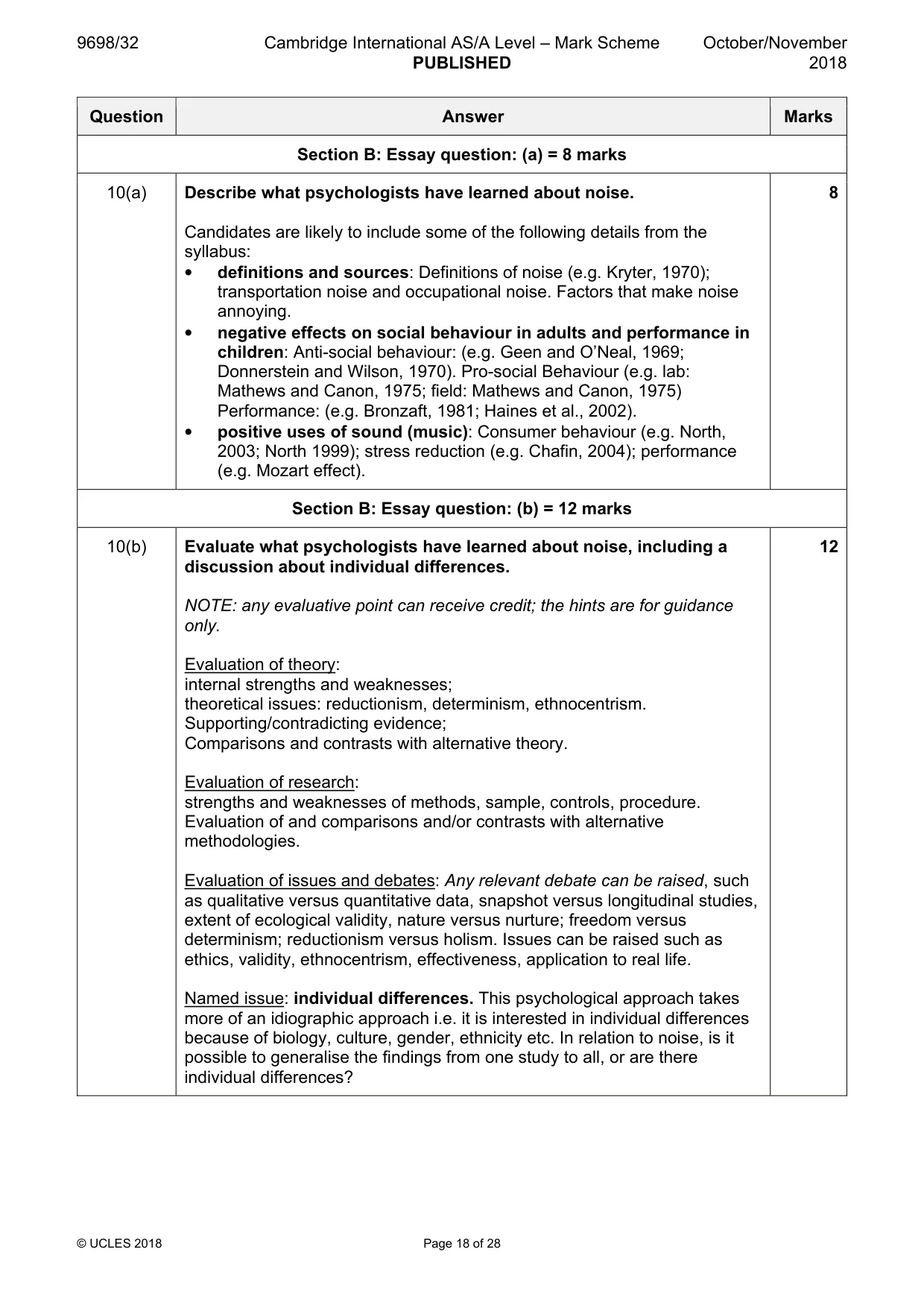
Mark scheme: 10(a) Describe what psychologists have learned about noise. 8 Candidates are likely to include some of the following details from the syllabus: • definitions and sources: Definitions of noise (e.g. Kryter, 1970); transportation noise and occupational noise. Factors that make noise annoying. • negative effects on social behaviour in adults and performance in children: Anti-social behaviour: (e.g. Geen and O’Neal, 1969; Donnerstein and Wilson, 1970). Pro-social Behaviour (e.g. lab: Mathews and Canon, 1975; field: Mathews and Canon, 1975) Performance: (e.g. Bronzaft, 1981; Haines et al., 2002). • positive uses of sound (music): Consumer behaviour (e.g. North, 2003; North 1999); stress reduction (e.g. Chafin, 2004); performance (e.g. Mozart effect). Section B: Essay question: (b) = 12 marks 10(b) Evaluate what psychologists have learned about noise, including a 12 discussion about individual differences. NOTE: any evaluative point can receive credit; the hints are for guidance only. Evaluation of theory: internal strengths and weaknesses; theoretical issues: reductionism, determinism, ethnocentrism. Supporting/contradicting evidence; Comparisons and contrasts with alternative theory. Evaluation of research: strengths and weaknesses of methods, sample, controls, procedure. Evaluation of and comparisons and/or contrasts with alternative methodologies. Evaluation of issues and debates: Any relevant debate can be raised, such as qualitative versus quantitative data, snapshot versus longitudinal studies, extent of ecological validity, nature versus nurture; freedom versus determinism; reductionism versus holism. Issues can be raised such as ethics, validity, ethnocentrism, effectiveness, application to real life. Named issue: individual differences. This psychological approach takes more of an idiographic approach i.e. it is interested in individual differences because of biology, culture, gender, ethnicity etc. In relation to noise, is it possible to generalise the findings from one study to all, or are there individual differences?
Q11 · A lemming is a small mammal
11 A lemming is a small mammal. Some people claim that they jump off cliffs when crowded. (a) Suggest how you would design and conduct an observational study to investigate the responses of lemmings to crowding in the natural environment. [8] (b) Describe one study about crowding/density of an animal other than lemmings. [6]
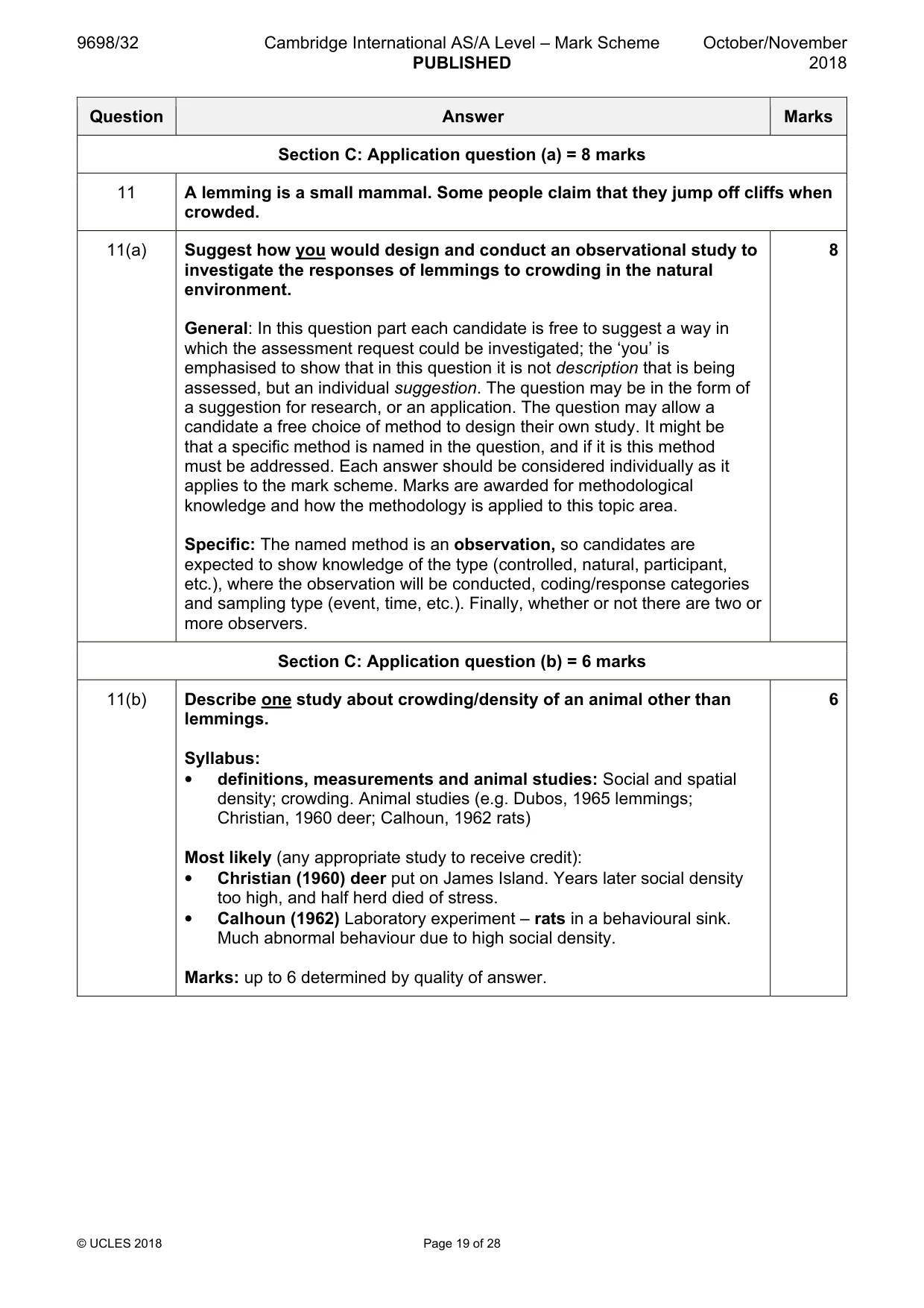
Mark scheme: 11(a) Suggest how you would design and conduct an observational study to 8 investigate the responses of lemmings to crowding in the natural environment. General: In this question part each candidate is free to suggest a way in which the assessment request could be investigated; the ‘you’ is emphasised to show that in this question it is not description that is being assessed, but an individual suggestion. The question may be in the form of a suggestion for research, or an application. The question may allow a candidate a free choice of method to design their own study. It might be that a specific method is named in the question, and if it is this method must be addressed. Each answer should be considered individually as it applies to the mark scheme. Marks are awarded for methodological knowledge and how the methodology is applied to this topic area. Specific: The named method is an observation, so candidates are expected to show knowledge of the type (controlled, natural, participant, etc.), where the observation will be conducted, coding/response categories and sampling type (event, time, etc.). Finally, whether or not there are two or more observers. Section C: Application question (b) = 6 marks 11(b) Describe one study about crowding/density of an animal other than 6 lemmings. Syllabus: • definitions, measurements and animal studies: Social and spatial density; crowding. Animal studies (e.g. Dubos, 1965 lemmings; Christian, 1960 deer; Calhoun, 1962 rats) Most likely (any appropriate study to receive credit): • Christian (1960) deer put on James Island. Years later social density too high, and half herd died of stress. • Calhoun (1962) Laboratory experiment – rats in a behavioural sink. Much abnormal behaviour due to high social density. Marks: up to 6 determined by quality of answer.
Q12 · When personal space is invaded people behave in ways which show they feel uncomfortable
12 When personal space is invaded people behave in ways which show they feel uncomfortable. (a) Describe two ethical guidelines that are likely to be broken when personal space is invaded. [6] (b) Suggest how you would design and conduct a study to investigate types of behaviour shown by people whose personal space has been invaded. [8] Psychology and Abnormality Section A Answer this question.
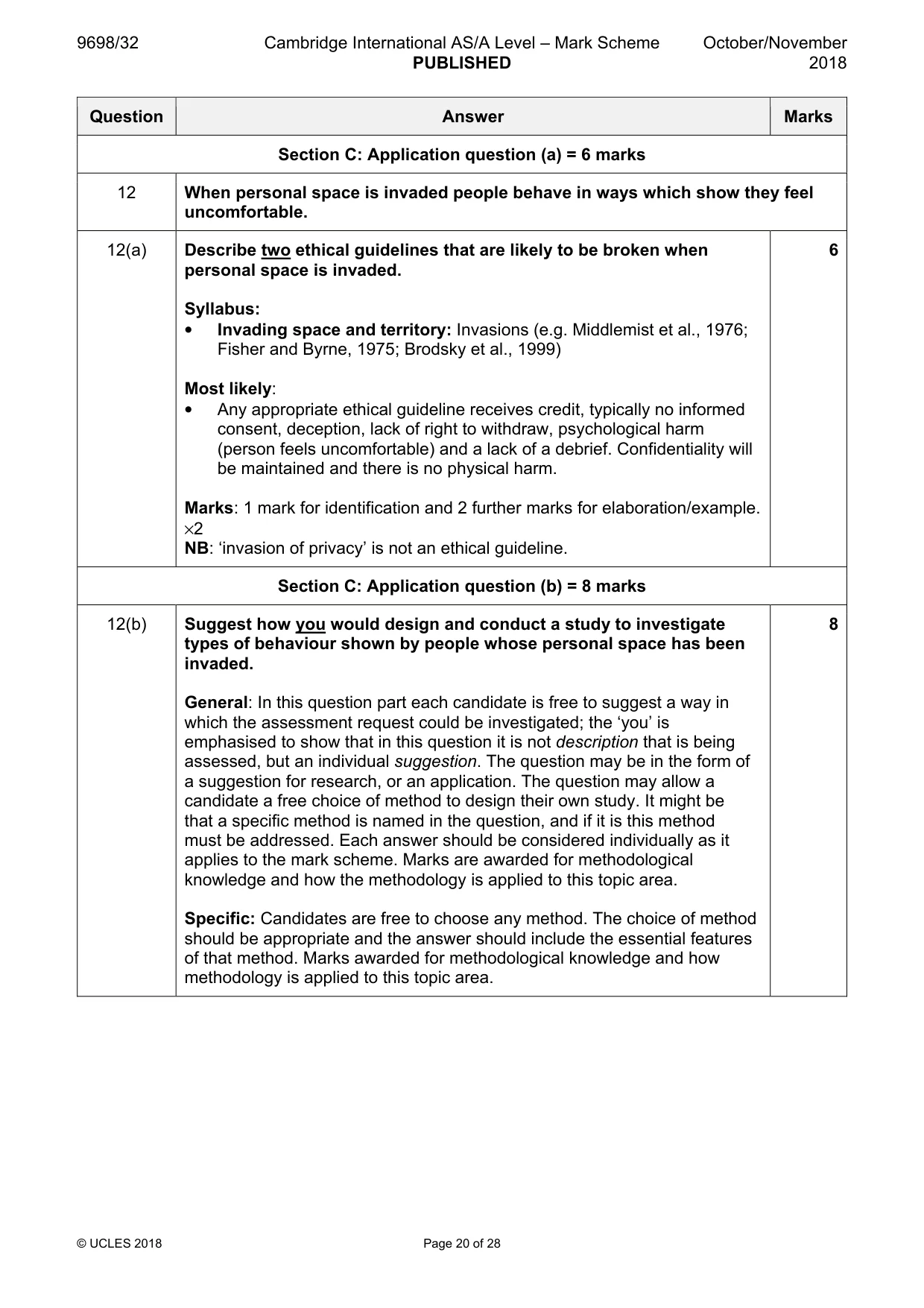
Mark scheme: 12(a) Describe two ethical guidelines that are likely to be broken when 6 personal space is invaded. Syllabus: • Invading space and territory: Invasions (e.g. Middlemist et al., 1976; Fisher and Byrne, 1975; Brodsky et al., 1999) Most likely: • Any appropriate ethical guideline receives credit, typically no informed consent, deception, lack of right to withdraw, psychological harm (person feels uncomfortable) and a lack of a debrief. Confidentiality will be maintained and there is no physical harm. Marks: 1 mark for identification and 2 further marks for elaboration/example. ×2 NB: ‘invasion of privacy’ is not an ethical guideline. Section C: Application question (b) = 8 marks 12(b) Suggest how you would design and conduct a study to investigate 8 types of behaviour shown by people whose personal space has been invaded. General: In this question part each candidate is free to suggest a way in which the assessment request could be investigated; the ‘you’ is emphasised to show that in this question it is not description that is being assessed, but an individual suggestion. The question may be in the form of a suggestion for research, or an application. The question may allow a candidate a free choice of method to design their own study. It might be that a specific method is named in the question, and if it is this method must be addressed. Each answer should be considered individually as it applies to the mark scheme. Marks are awarded for methodological knowledge and how the methodology is applied to this topic area. Specific: Candidates are free to choose any method. The choice of method should be appropriate and the answer should include the essential features of that method. Marks awarded for methodological knowledge and how methodology is applied to this topic area. PSYCHOLOGY AND ABNORMALITY
Q13 · Explain, in your own words, what is meant by an ‘impulse control disorder’
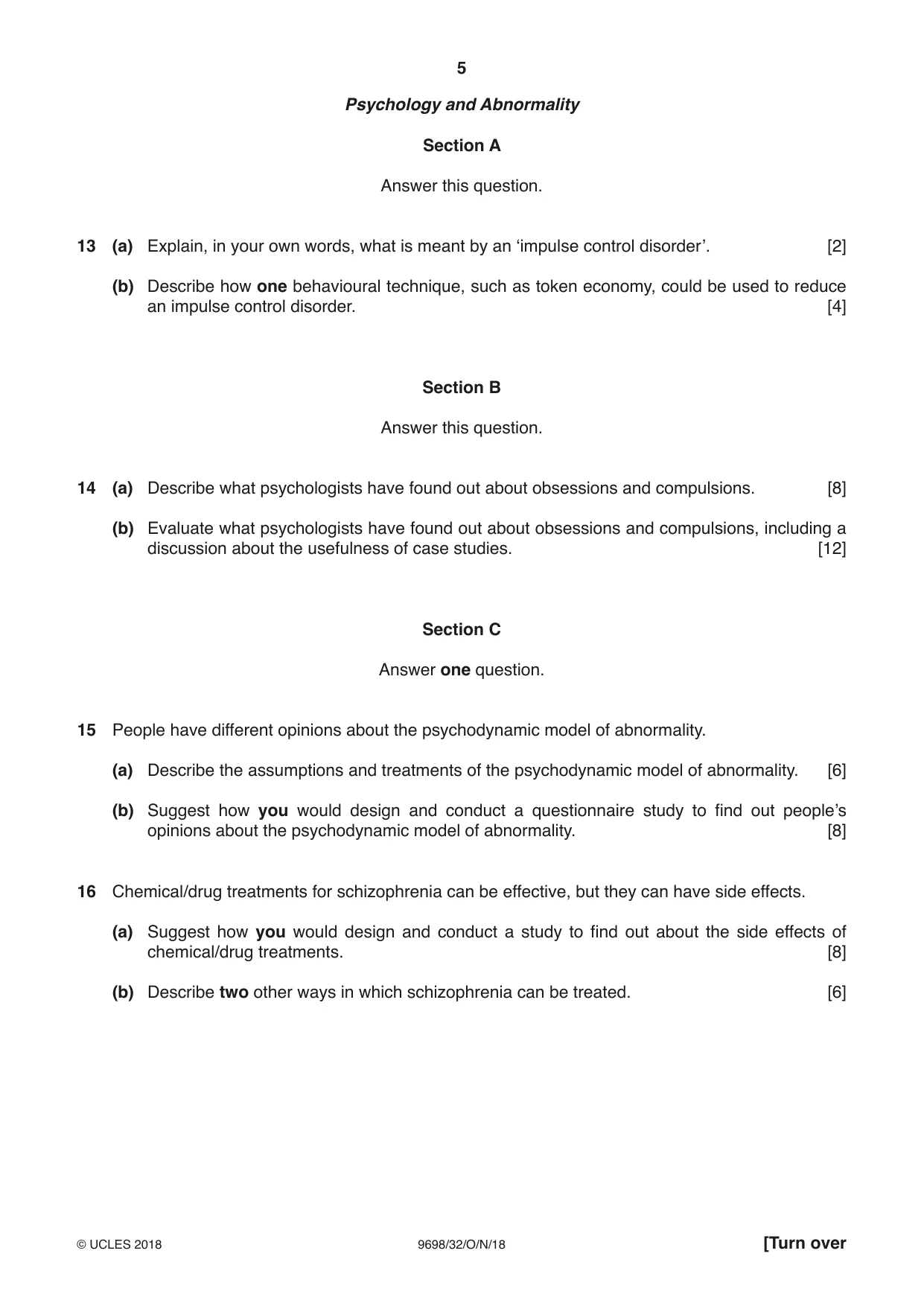
13 (a) Explain, in your own words, what is meant by an ‘impulse control disorder’. [2] (b) Describe how one behavioural technique, such as token economy, could be used to reduce an impulse control disorder. [4]
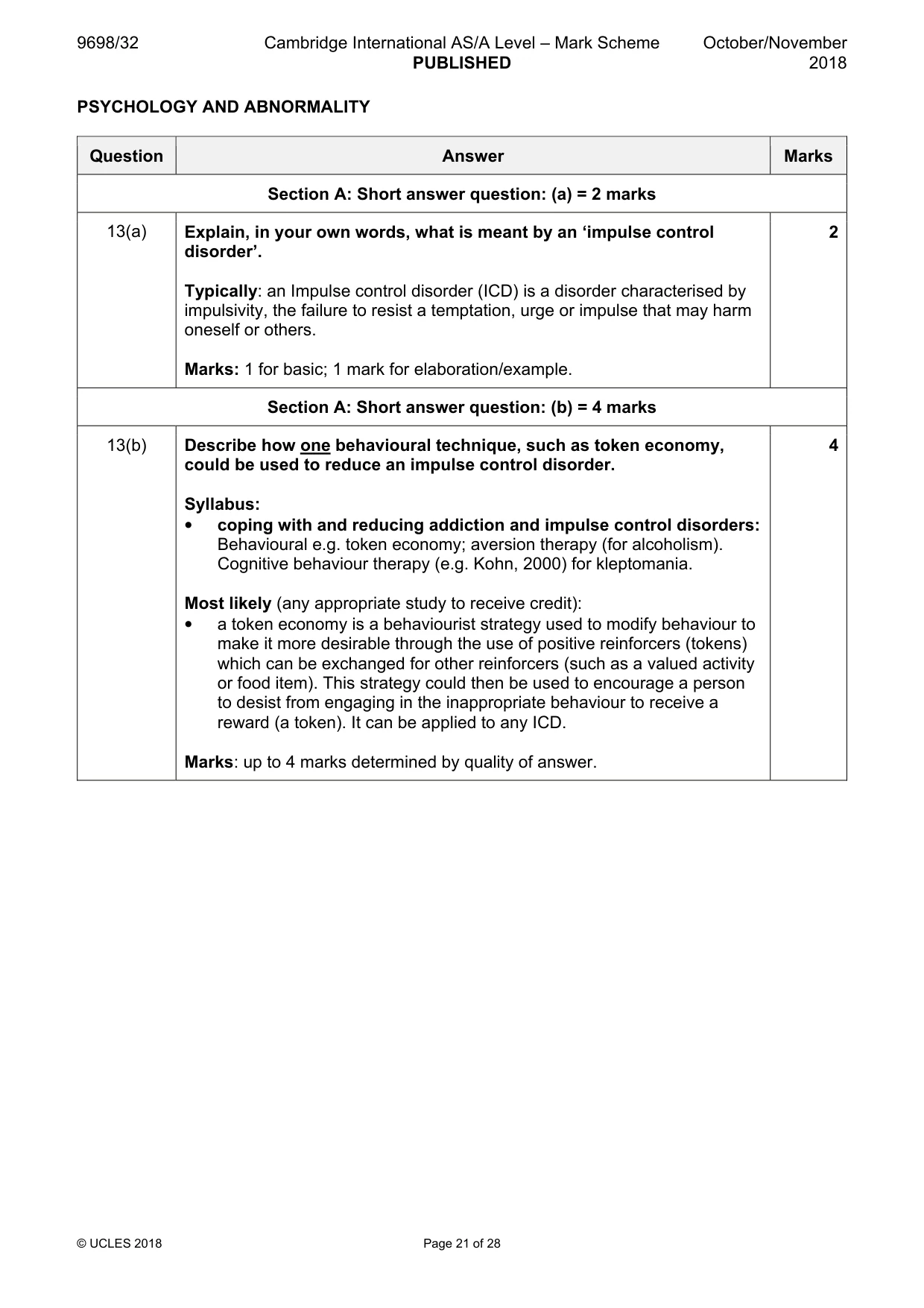
Mark scheme: 13(a) Explain, in your own words, what is meant by an ‘impulse control 2 disorder’. Typically: an Impulse control disorder (ICD) is a disorder characterised by impulsivity, the failure to resist a temptation, urge or impulse that may harm oneself or others. Marks: 1 for basic; 1 mark for elaboration/example. Section A: Short answer question: (b) = 4 marks 13(b) Describe how one behavioural technique, such as token economy, 4 could be used to reduce an impulse control disorder. Syllabus: • coping with and reducing addiction and impulse control disorders: Behavioural e.g. token economy; aversion therapy (for alcoholism). Cognitive behaviour therapy (e.g. Kohn, 2000) for kleptomania. Most likely (any appropriate study to receive credit): • a token economy is a behaviourist strategy used to modify behaviour to make it more desirable through the use of positive reinforcers (tokens) which can be exchanged for other reinforcers (such as a valued activity or food item). This strategy could then be used to encourage a person to desist from engaging in the inappropriate behaviour to receive a reward (a token). It can be applied to any ICD. Marks: up to 4 marks determined by quality of answer.
Q14 · Describe what psychologists have found out about obsessions and compulsions
14 (a) Describe what psychologists have found out about obsessions and compulsions. [8] (b) Evaluate what psychologists have found out about obsessions and compulsions, including a discussion about the usefulness of case studies. [12] Section C Answer one question.
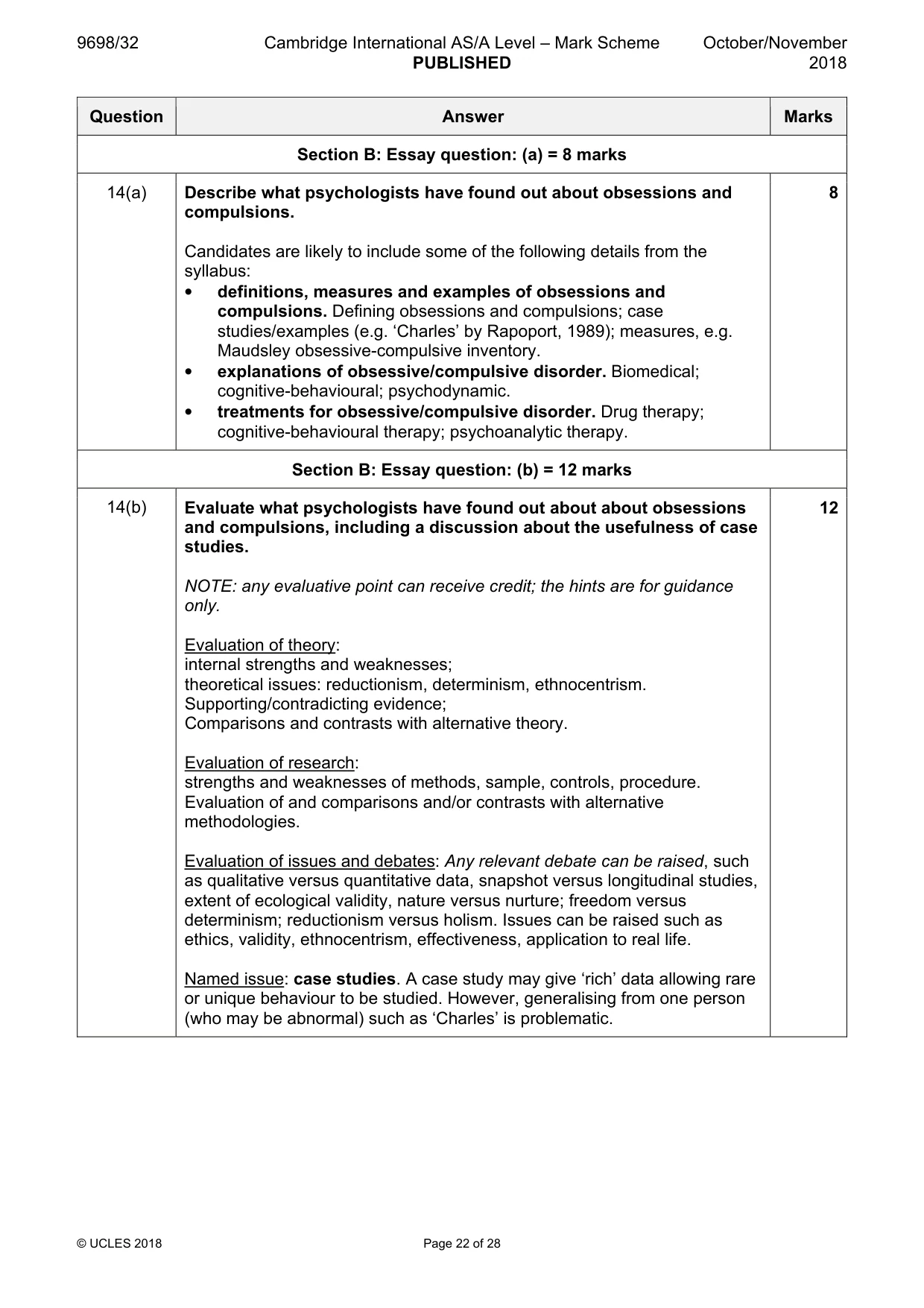
Mark scheme: 14(a) Describe what psychologists have found out about obsessions and 8 compulsions. Candidates are likely to include some of the following details from the syllabus: • definitions, measures and examples of obsessions and compulsions. Defining obsessions and compulsions; case studies/examples (e.g. ‘Charles’ by Rapoport, 1989); measures, e.g. Maudsley obsessive-compulsive inventory. • explanations of obsessive/compulsive disorder. Biomedical; cognitive-behavioural; psychodynamic. • treatments for obsessive/compulsive disorder. Drug therapy; cognitive-behavioural therapy; psychoanalytic therapy. Section B: Essay question: (b) = 12 marks 14(b) Evaluate what psychologists have found out about about obsessions 12 and compulsions, including a discussion about the usefulness of case studies. NOTE: any evaluative point can receive credit; the hints are for guidance only. Evaluation of theory: internal strengths and weaknesses; theoretical issues: reductionism, determinism, ethnocentrism. Supporting/contradicting evidence; Comparisons and contrasts with alternative theory. Evaluation of research: strengths and weaknesses of methods, sample, controls, procedure. Evaluation of and comparisons and/or contrasts with alternative methodologies. Evaluation of issues and debates: Any relevant debate can be raised, such as qualitative versus quantitative data, snapshot versus longitudinal studies, extent of ecological validity, nature versus nurture; freedom versus determinism; reductionism versus holism. Issues can be raised such as ethics, validity, ethnocentrism, effectiveness, application to real life. Named issue: case studies. A case study may give ‘rich’ data allowing rare or unique behaviour to be studied. However, generalising from one person (who may be abnormal) such as ‘Charles’ is problematic.
Q15 · People have different opinions about the psychodynamic model of abnormality
15 People have different opinions about the psychodynamic model of abnormality. (a) Describe the assumptions and treatments of the psychodynamic model of abnormality. [6] (b) Suggest how you would design and conduct a questionnaire study to find out people’s opinions about the psychodynamic model of abnormality. [8]
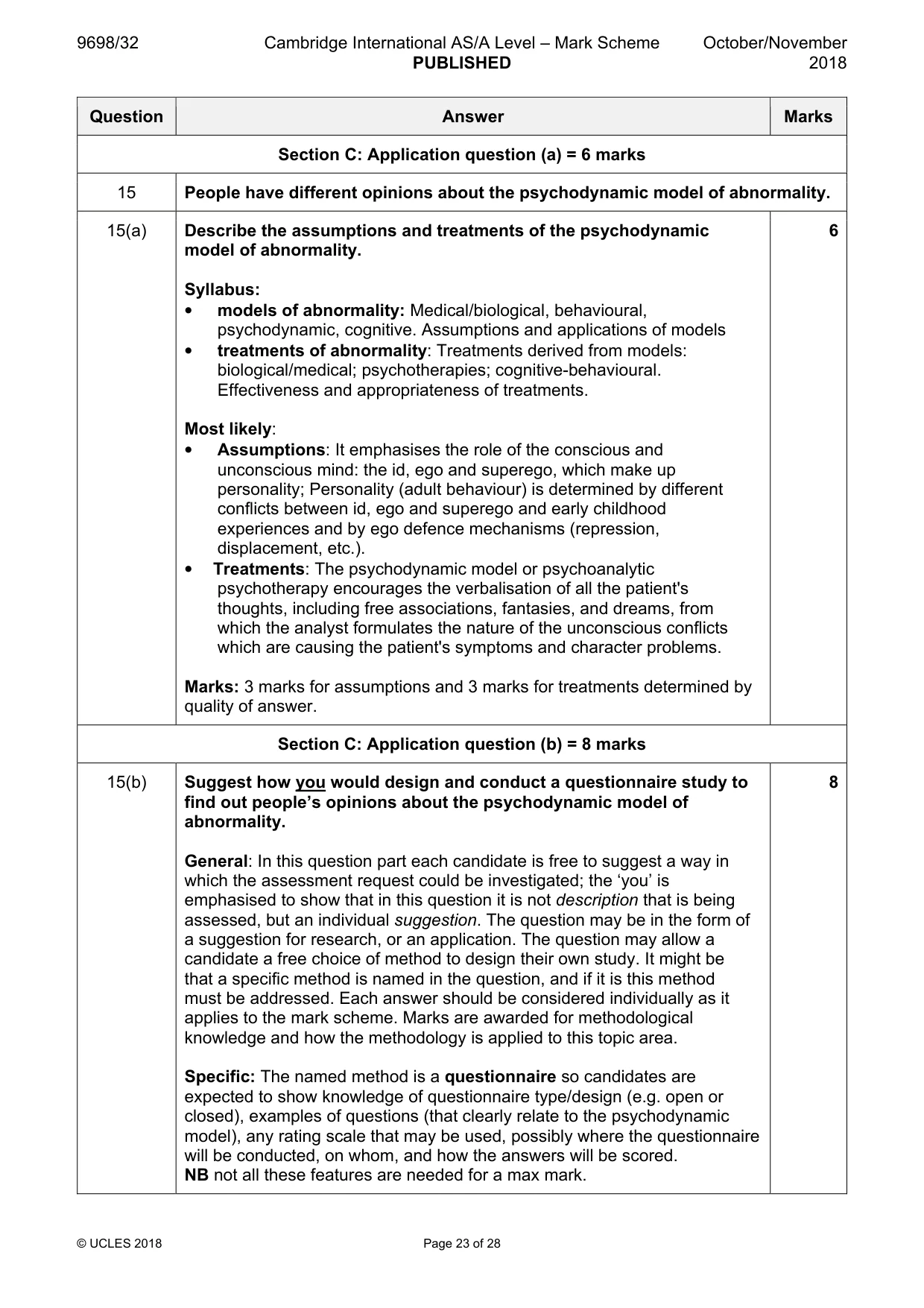
Mark scheme: 15(a) Describe the assumptions and treatments of the psychodynamic 6 model of abnormality. Syllabus: • models of abnormality: Medical/biological, behavioural, psychodynamic, cognitive. Assumptions and applications of models • treatments of abnormality: Treatments derived from models: biological/medical; psychotherapies; cognitive-behavioural. Effectiveness and appropriateness of treatments. Most likely: • Assumptions: It emphasises the role of the conscious and unconscious mind: the id, ego and superego, which make up personality; Personality (adult behaviour) is determined by different conflicts between id, ego and superego and early childhood experiences and by ego defence mechanisms (repression, displacement, etc.). • Treatments: The psychodynamic model or psychoanalytic psychotherapy encourages the verbalisation of all the patient's thoughts, including free associations, fantasies, and dreams, from which the analyst formulates the nature of the unconscious conflicts which are causing the patient's symptoms and character problems. Marks: 3 marks for assumptions and 3 marks for treatments determined by quality of answer. Section C: Application question (b) = 8 marks 15(b) Suggest how you would design and conduct a questionnaire study to 8 find out people’s opinions about the psychodynamic model of abnormality. General: In this question part each candidate is free to suggest a way in which the assessment request could be investigated; the ‘you’ is emphasised to show that in this question it is not description that is being assessed, but an individual suggestion. The question may be in the form of a suggestion for research, or an application. The question may allow a candidate a free choice of method to design their own study. It might be that a specific method is named in the question, and if it is this method must be addressed. Each answer should be considered individually as it applies to the mark scheme. Marks are awarded for methodological knowledge and how the methodology is applied to this topic area. Specific: The named method is a questionnaire so candidates are expected to show knowledge of questionnaire type/design (e.g. open or closed), examples of questions (that clearly relate to the psychodynamic model), any rating scale that may be used, possibly where the questionnaire will be conducted, on whom, and how the answers will be scored. NB not all these features are needed for a max mark.
Q16 · Chemical/drug treatments for schizophrenia can be effective, but they can have side…
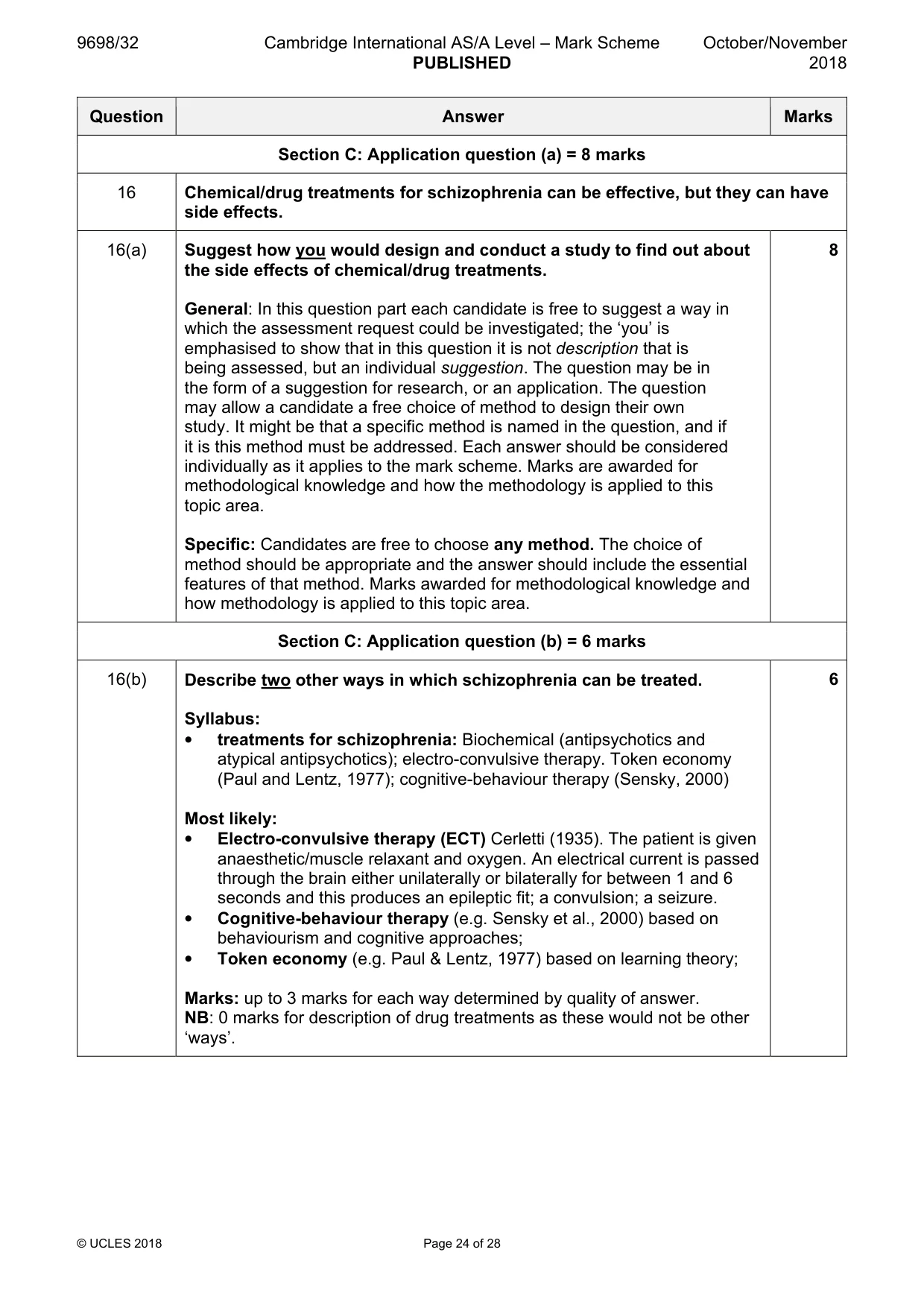
16 Chemical/drug treatments for schizophrenia can be effective, but they can have side effects. (a) Suggest how you would design and conduct a study to find out about the side effects of chemical/drug treatments. [8] (b) Describe two other ways in which schizophrenia can be treated. [6] Psychology and Organisations Section A Answer this question.
Mark scheme: 16(a) Suggest how you would design and conduct a study to find out about 8 the side effects of chemical/drug treatments. General: In this question part each candidate is free to suggest a way in which the assessment request could be investigated; the ‘you’ is emphasised to show that in this question it is not description that is being assessed, but an individual suggestion. The question may be in the form of a suggestion for research, or an application. The question may allow a candidate a free choice of method to design their own study. It might be that a specific method is named in the question, and if it is this method must be addressed. Each answer should be considered individually as it applies to the mark scheme. Marks are awarded for methodological knowledge and how the methodology is applied to this topic area. Specific: Candidates are free to choose any method. The choice of method should be appropriate and the answer should include the essential features of that method. Marks awarded for methodological knowledge and how methodology is applied to this topic area. Section C: Application question (b) = 6 marks 16(b) Describe two other ways in which schizophrenia can be treated. 6 Syllabus: • treatments for schizophrenia: Biochemical (antipsychotics and atypical antipsychotics); electro-convulsive therapy. Token economy (Paul and Lentz, 1977); cognitive-behaviour therapy (Sensky, 2000) Most likely: • Electro-convulsive therapy (ECT) Cerletti (1935). The patient is given anaesthetic/muscle relaxant and oxygen. An electrical current is passed through the brain either unilaterally or bilaterally for between 1 and 6 seconds and this produces an epileptic fit; a convulsion; a seizure. • Cognitive-behaviour therapy (e.g. Sensky et al., 2000) based on behaviourism and cognitive approaches; • Token economy (e.g. Paul & Lentz, 1977) based on learning theory; Marks: up to 3 marks for each way determined by quality of answer. NB: 0 marks for description of drug treatments as these would not be other ‘ways’. PSYCHOLOGY AND ORGANISATIONS
Q17 · Explain, in your own words, what is meant by the term ‘group conflict’
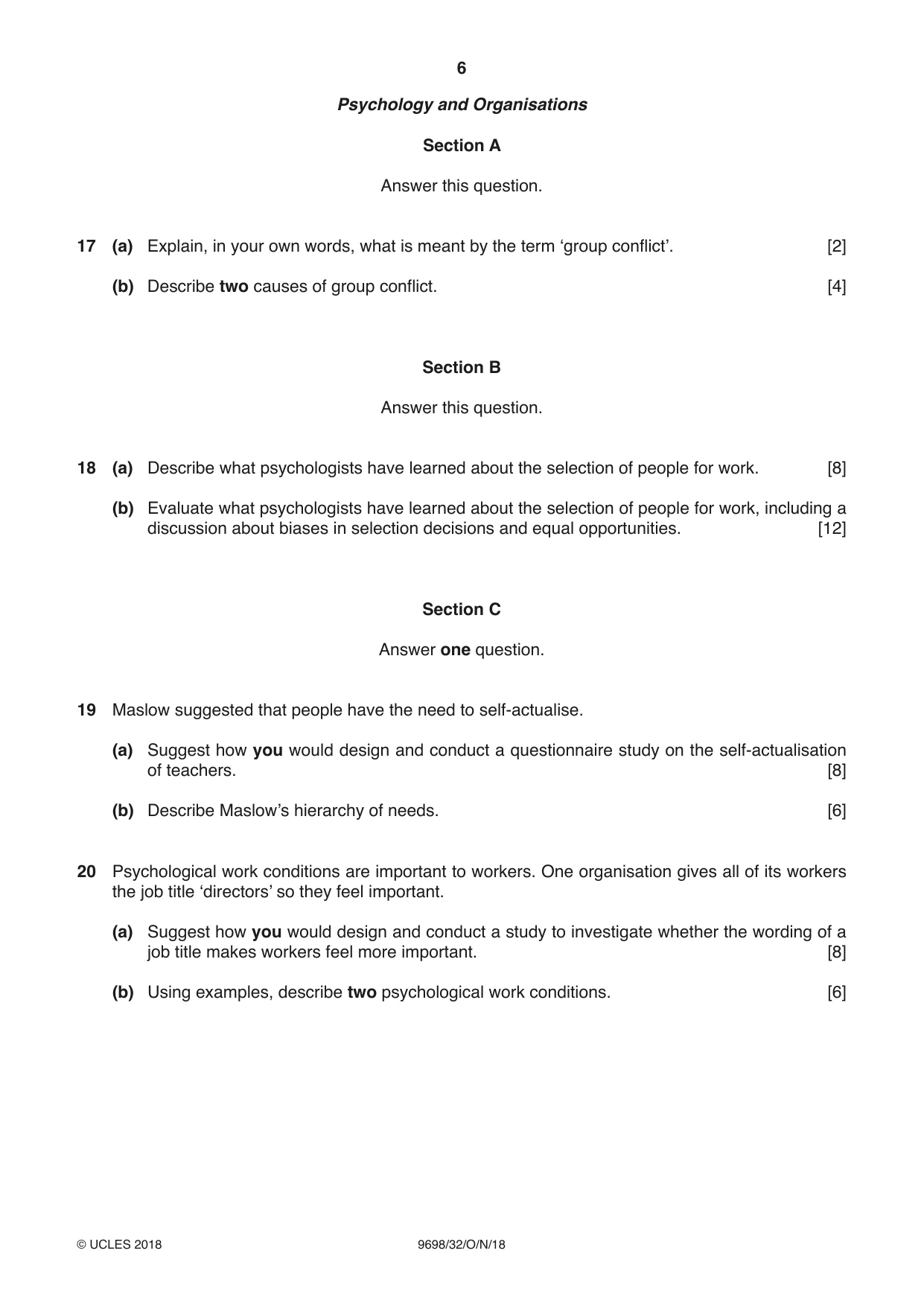
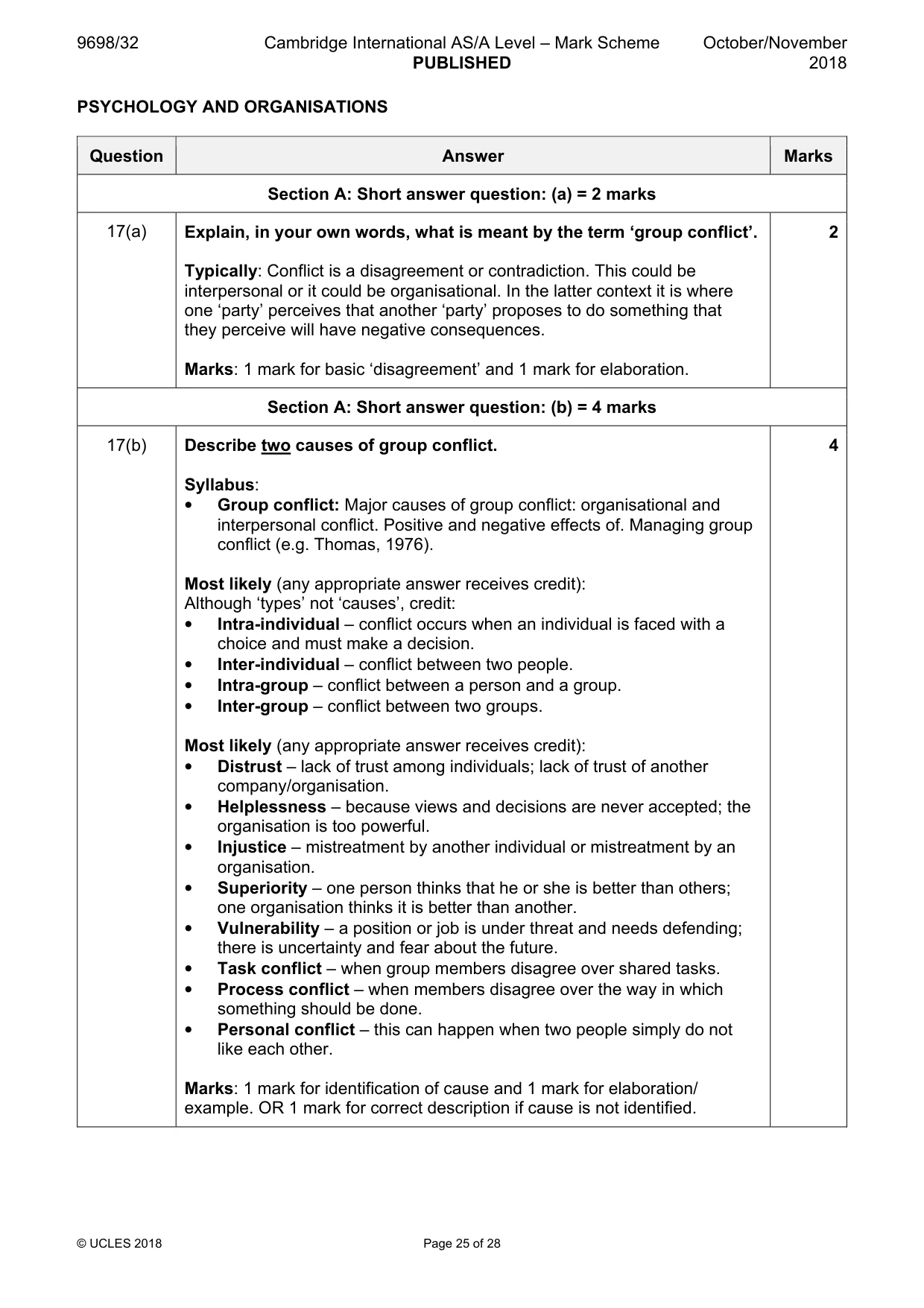
17 (a) Explain, in your own words, what is meant by the term ‘group conflict’. [2] (b) Describe two causes of group conflict. [4]
Mark scheme: 17(a) Explain, in your own words, what is meant by the term ‘group conflict’. 2 Typically: Conflict is a disagreement or contradiction. This could be interpersonal or it could be organisational. In the latter context it is where one ‘party’ perceives that another ‘party’ proposes to do something that they perceive will have negative consequences. Marks: 1 mark for basic ‘disagreement’ and 1 mark for elaboration. Section A: Short answer question: (b) = 4 marks 17(b) Describe two causes of group conflict. 4 Syllabus: • Group conflict: Major causes of group conflict: organisational and interpersonal conflict. Positive and negative effects of. Managing group conflict (e.g. Thomas, 1976). Most likely (any appropriate answer receives credit): Although ‘types’ not ‘causes’, credit: • Intra-individual – conflict occurs when an individual is faced with a choice and must make a decision. • Inter-individual – conflict between two people. • Intra-group – conflict between a person and a group. • Inter-group – conflict between two groups. Most likely (any appropriate answer receives credit): • Distrust – lack of trust among individuals; lack of trust of another company/organisation. • Helplessness – because views and decisions are never accepted; the organisation is too powerful. • Injustice – mistreatment by another individual or mistreatment by an organisation. • Superiority – one person thinks that he or she is better than others; one organisation thinks it is better than another. • Vulnerability – a position or job is under threat and needs defending; there is uncertainty and fear about the future. • Task conflict – when group members disagree over shared tasks. • Process conflict – when members disagree over the way in which something should be done. • Personal conflict – this can happen when two people simply do not like each other. Marks: 1 mark for identification of cause and 1 mark for elaboration/ example. OR 1 mark for correct description if cause is not identified.
Q18 · Describe what psychologists have learned about the selection of people for work
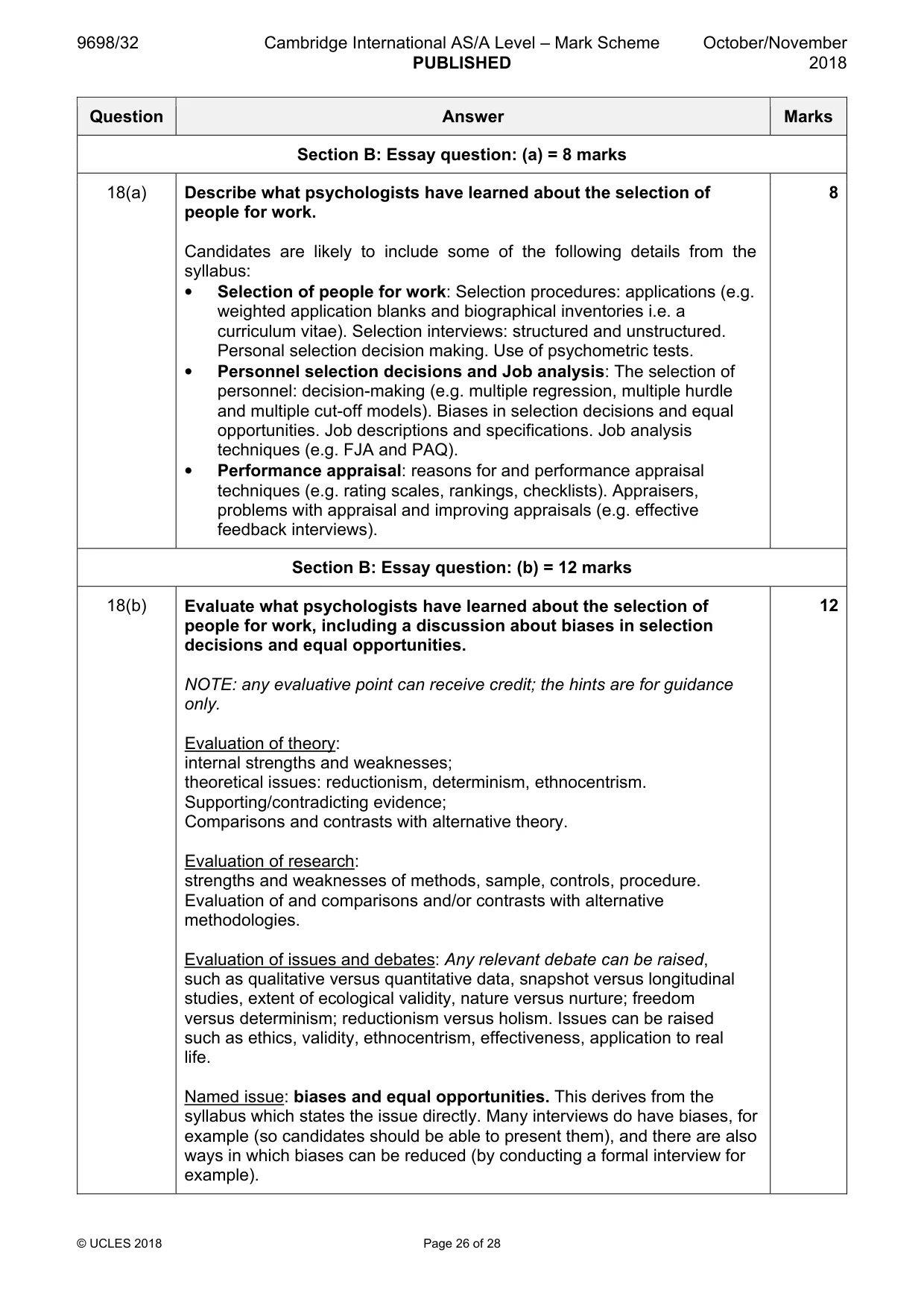
18 (a) Describe what psychologists have learned about the selection of people for work. [8] (b) Evaluate what psychologists have learned about the selection of people for work, including a discussion about biases in selection decisions and equal opportunities. [12] Section C Answer one question.
Mark scheme: 18(a) Describe what psychologists have learned about the selection of 8 people for work. Candidates are likely to include some of the following details from the syllabus: • Selection of people for work: Selection procedures: applications (e.g. weighted application blanks and biographical inventories i.e. a curriculum vitae). Selection interviews: structured and unstructured. Personal selection decision making. Use of psychometric tests. • Personnel selection decisions and Job analysis: The selection of personnel: decision-making (e.g. multiple regression, multiple hurdle and multiple cut-off models). Biases in selection decisions and equal opportunities. Job descriptions and specifications. Job analysis techniques (e.g. FJA and PAQ). • Performance appraisal: reasons for and performance appraisal techniques (e.g. rating scales, rankings, checklists). Appraisers, problems with appraisal and improving appraisals (e.g. effective feedback interviews). Section B: Essay question: (b) = 12 marks 18(b) Evaluate what psychologists have learned about the selection of 12 people for work, including a discussion about biases in selection decisions and equal opportunities. NOTE: any evaluative point can receive credit; the hints are for guidance only. Evaluation of theory: internal strengths and weaknesses; theoretical issues: reductionism, determinism, ethnocentrism. Supporting/contradicting evidence; Comparisons and contrasts with alternative theory. Evaluation of research: strengths and weaknesses of methods, sample, controls, procedure. Evaluation of and comparisons and/or contrasts with alternative methodologies. Evaluation of issues and debates: Any relevant debate can be raised, such as qualitative versus quantitative data, snapshot versus longitudinal studies, extent of ecological validity, nature versus nurture; freedom versus determinism; reductionism versus holism. Issues can be raised such as ethics, validity, ethnocentrism, effectiveness, application to real life. Named issue: biases and equal opportunities. This derives from the syllabus which states the issue directly. Many interviews do have biases, for example (so candidates should be able to present them), and there are also ways in which biases can be reduced (by conducting a formal interview for example).
Q19 · Maslow suggested that people have the need to self-actualise
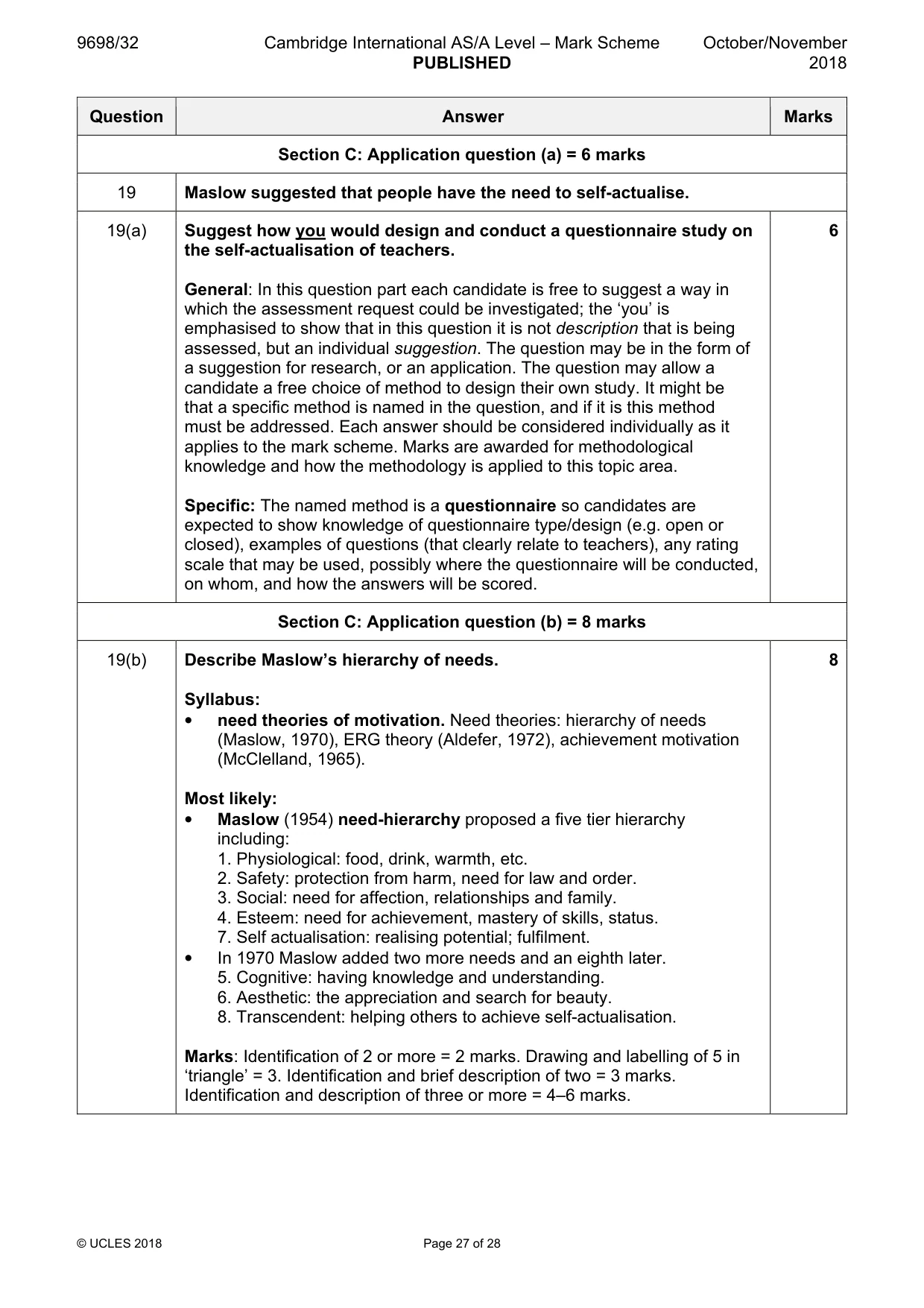
19 Maslow suggested that people have the need to self-actualise. (a) Suggest how you would design and conduct a questionnaire study on the self-actualisation of teachers. [8] (b) Describe Maslow’s hierarchy of needs. [6]
Mark scheme: 19(a) Suggest how you would design and conduct a questionnaire study on 6 the self-actualisation of teachers. General: In this question part each candidate is free to suggest a way in which the assessment request could be investigated; the ‘you’ is emphasised to show that in this question it is not description that is being assessed, but an individual suggestion. The question may be in the form of a suggestion for research, or an application. The question may allow a candidate a free choice of method to design their own study. It might be that a specific method is named in the question, and if it is this method must be addressed. Each answer should be considered individually as it applies to the mark scheme. Marks are awarded for methodological knowledge and how the methodology is applied to this topic area. Specific: The named method is a questionnaire so candidates are expected to show knowledge of questionnaire type/design (e.g. open or closed), examples of questions (that clearly relate to teachers), any rating scale that may be used, possibly where the questionnaire will be conducted, on whom, and how the answers will be scored. Section C: Application question (b) = 8 marks 19(b) Describe Maslow’s hierarchy of needs. 8 Syllabus: • need theories of motivation. Need theories: hierarchy of needs (Maslow, 1970), ERG theory (Aldefer, 1972), achievement motivation (McClelland, 1965). Most likely: • Maslow (1954) need-hierarchy proposed a five tier hierarchy including: 1. Physiological: food, drink, warmth, etc. 2. Safety: protection from harm, need for law and order. 3. Social: need for affection, relationships and family. 4. Esteem: need for achievement, mastery of skills, status. 7. Self actualisation: realising potential; fulfilment. • In 1970 Maslow added two more needs and an eighth later. 5. Cognitive: having knowledge and understanding. 6. Aesthetic: the appreciation and search for beauty. 8. Transcendent: helping others to achieve self-actualisation. Marks: Identification of 2 or more = 2 marks. Drawing and labelling of 5 in ‘triangle’ = 3. Identification and brief description of two = 3 marks. Identification and description of three or more = 4–6 marks.
Q20 · Psychological work conditions are important to workers
20 Psychological work conditions are important to workers. One organisation gives all of its workers the job title ‘directors’ so they feel important. (a) Suggest how you would design and conduct a study to investigate whether the wording of a job title makes workers feel more important. [8] (b) Using examples, describe two psychological work conditions. [6]
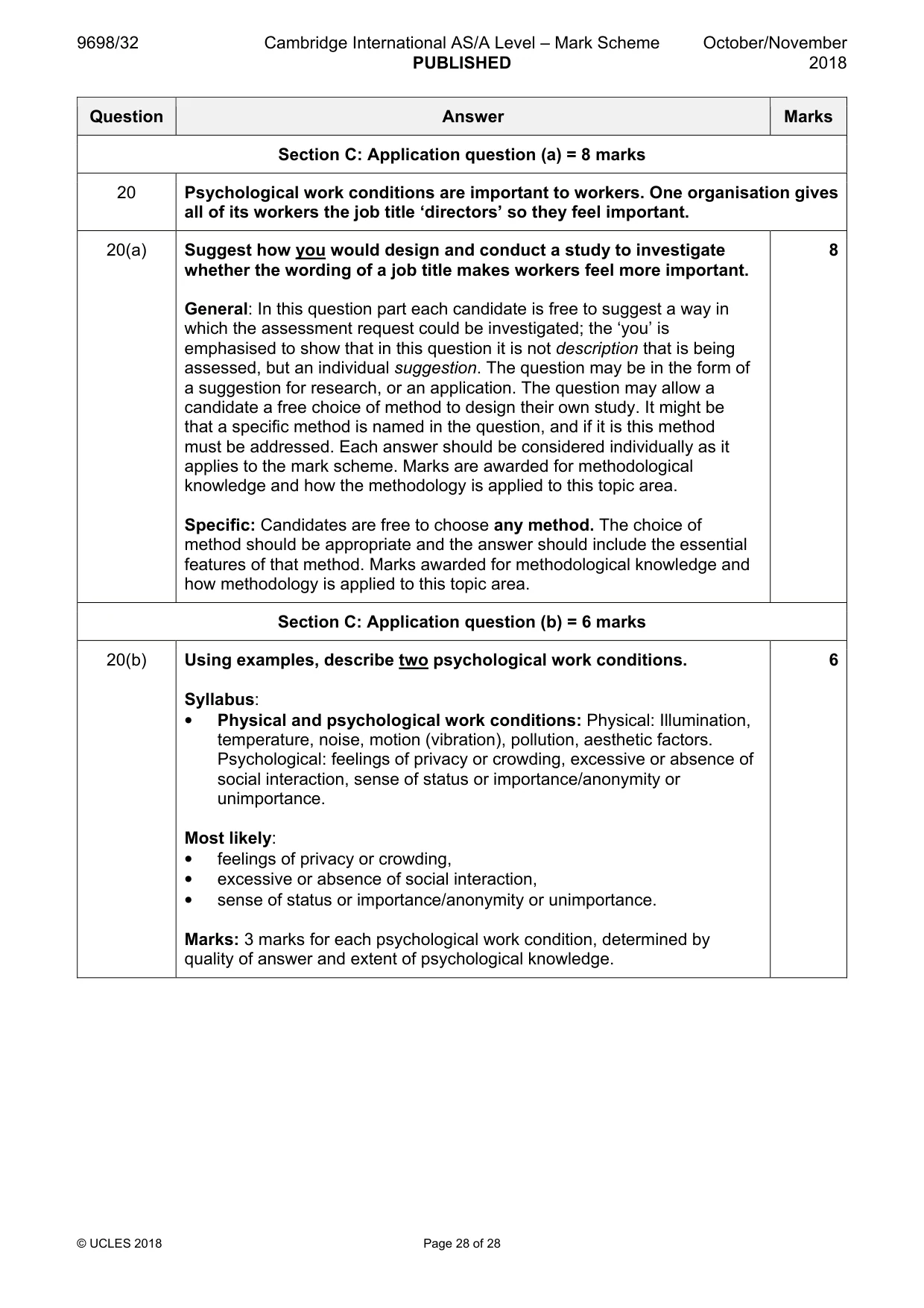
Mark scheme: 20(a) Suggest how you would design and conduct a study to investigate 8 whether the wording of a job title makes workers feel more important. General: In this question part each candidate is free to suggest a way in which the assessment request could be investigated; the ‘you’ is emphasised to show that in this question it is not description that is being assessed, but an individual suggestion. The question may be in the form of a suggestion for research, or an application. The question may allow a candidate a free choice of method to design their own study. It might be that a specific method is named in the question, and if it is this method must be addressed. Each answer should be considered individually as it applies to the mark scheme. Marks are awarded for methodological knowledge and how the methodology is applied to this topic area. Specific: Candidates are free to choose any method. The choice of method should be appropriate and the answer should include the essential features of that method. Marks awarded for methodological knowledge and how methodology is applied to this topic area. Section C: Application question (b) = 6 marks 20(b) Using examples, describe two psychological work conditions. 6 Syllabus: • Physical and psychological work conditions: Physical: Illumination, temperature, noise, motion (vibration), pollution, aesthetic factors. Psychological: feelings of privacy or crowding, excessive or absence of social interaction, sense of status or importance/anonymity or unimportance. Most likely: • feelings of privacy or crowding, • excessive or absence of social interaction, • sense of status or importance/anonymity or unimportance. Marks: 3 marks for each psychological work condition, determined by quality of answer and extent of psychological knowledge.
What you needed in this session
Cambridge’s own grade thresholds for 2018 Oct/Nov, Paper 3 · Variant 2. A higher threshold means an easier paper — the bar moves with how the cohort did.