Cambridge A Level Psychology 9698 — 2018 Oct/Nov Paper 3 · Variant 1
9698/31/O/N/18 · 20 questions · 80 marks · ≈90 min
The question paper and its mark scheme, free to read here and free to download. This is Cambridge’s own paper, exactly as it was sat.
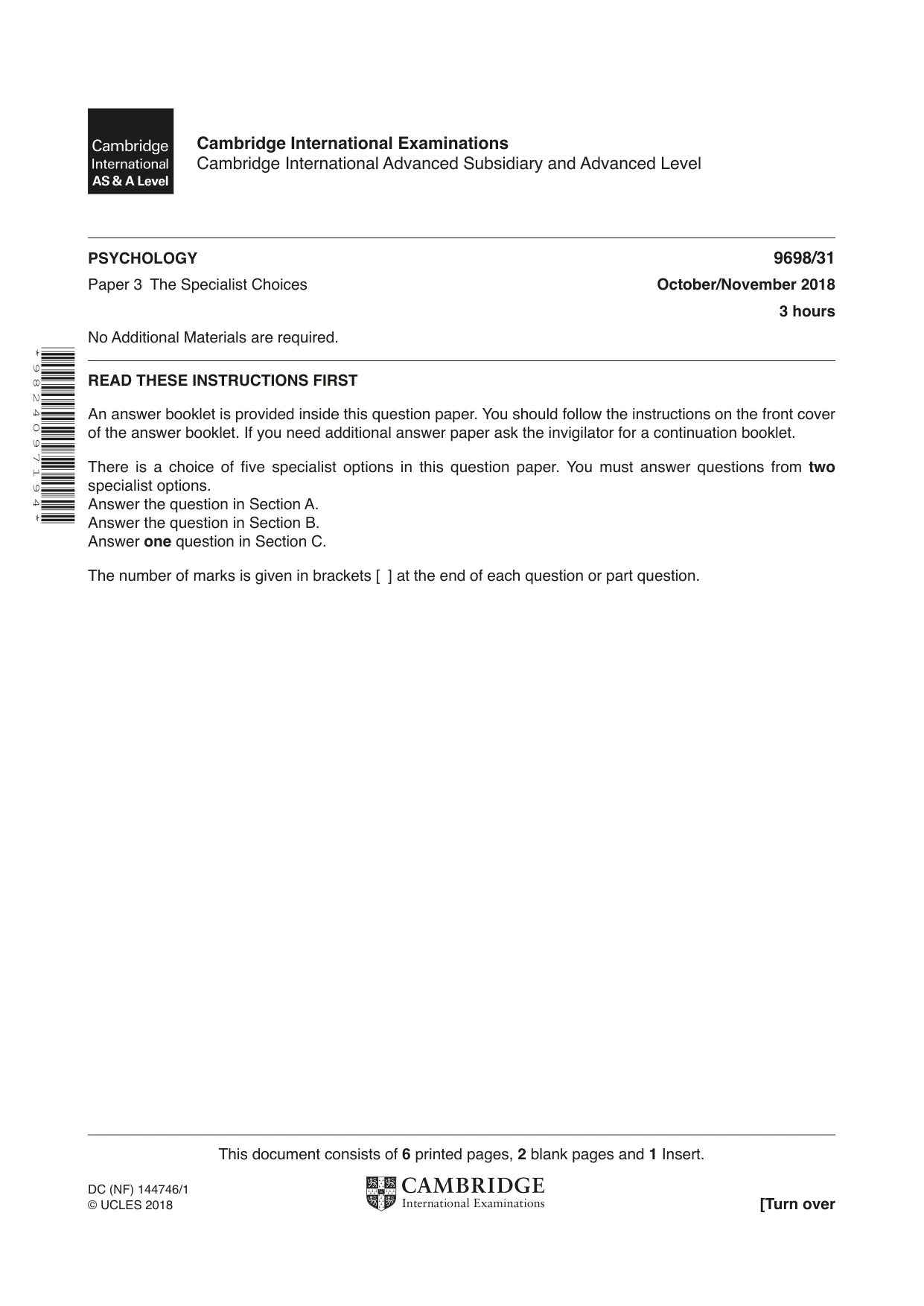
Question paper8 pages
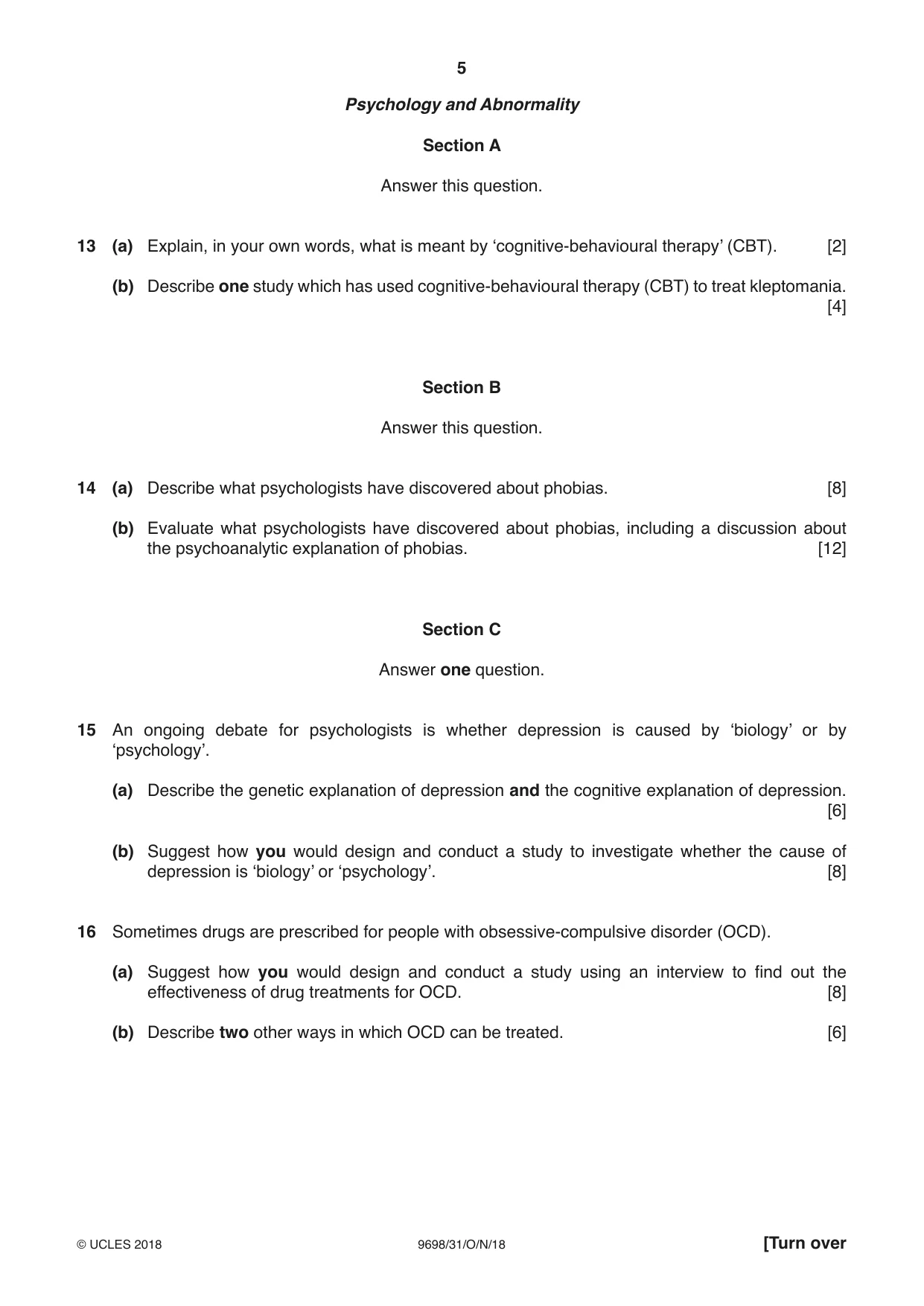
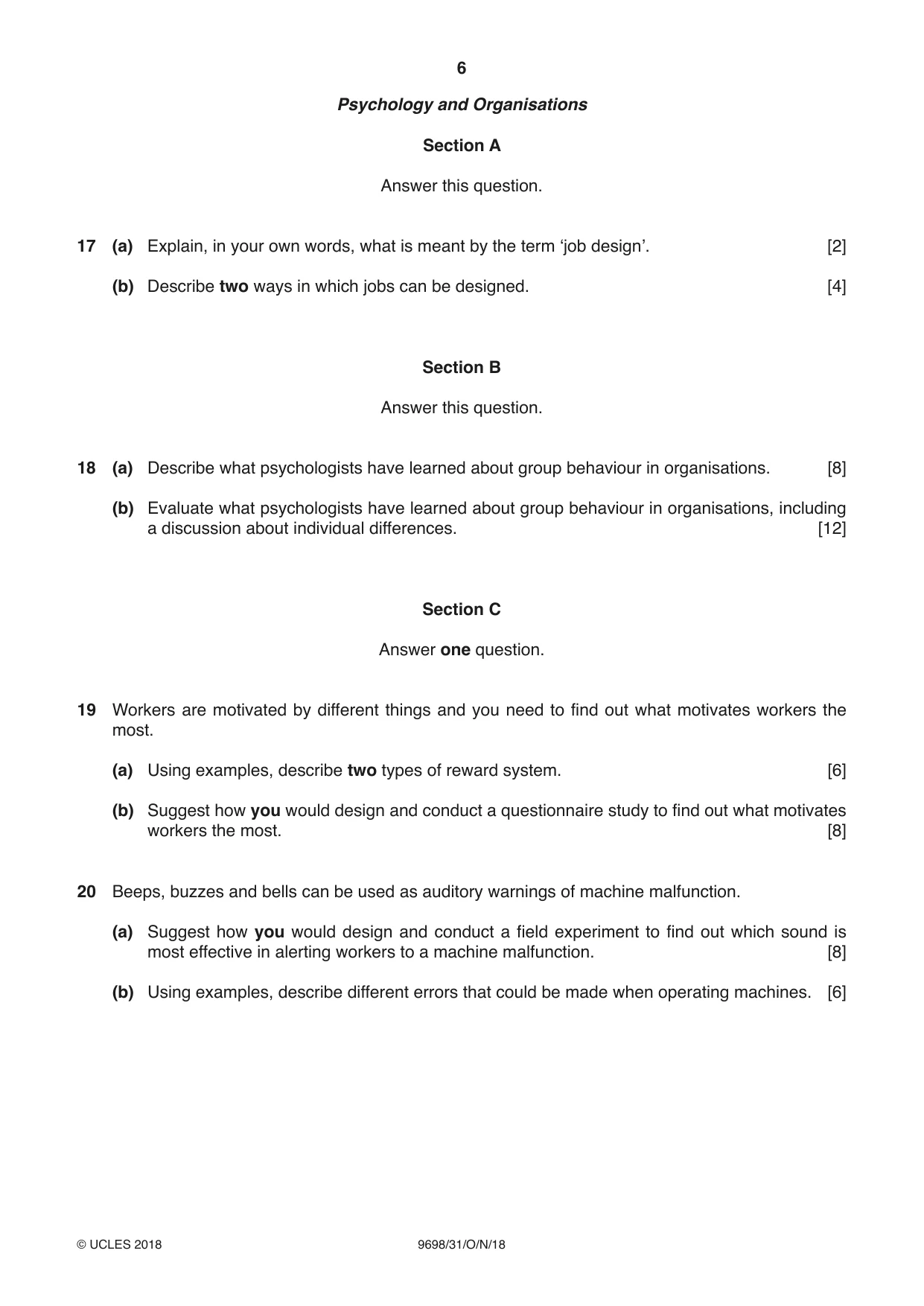


Mark scheme28 pages
Answers below. Sit the paper first if you are practising.

Questions as text
Q1 · Explain, in your own words, what is meant by ‘special educational needs’
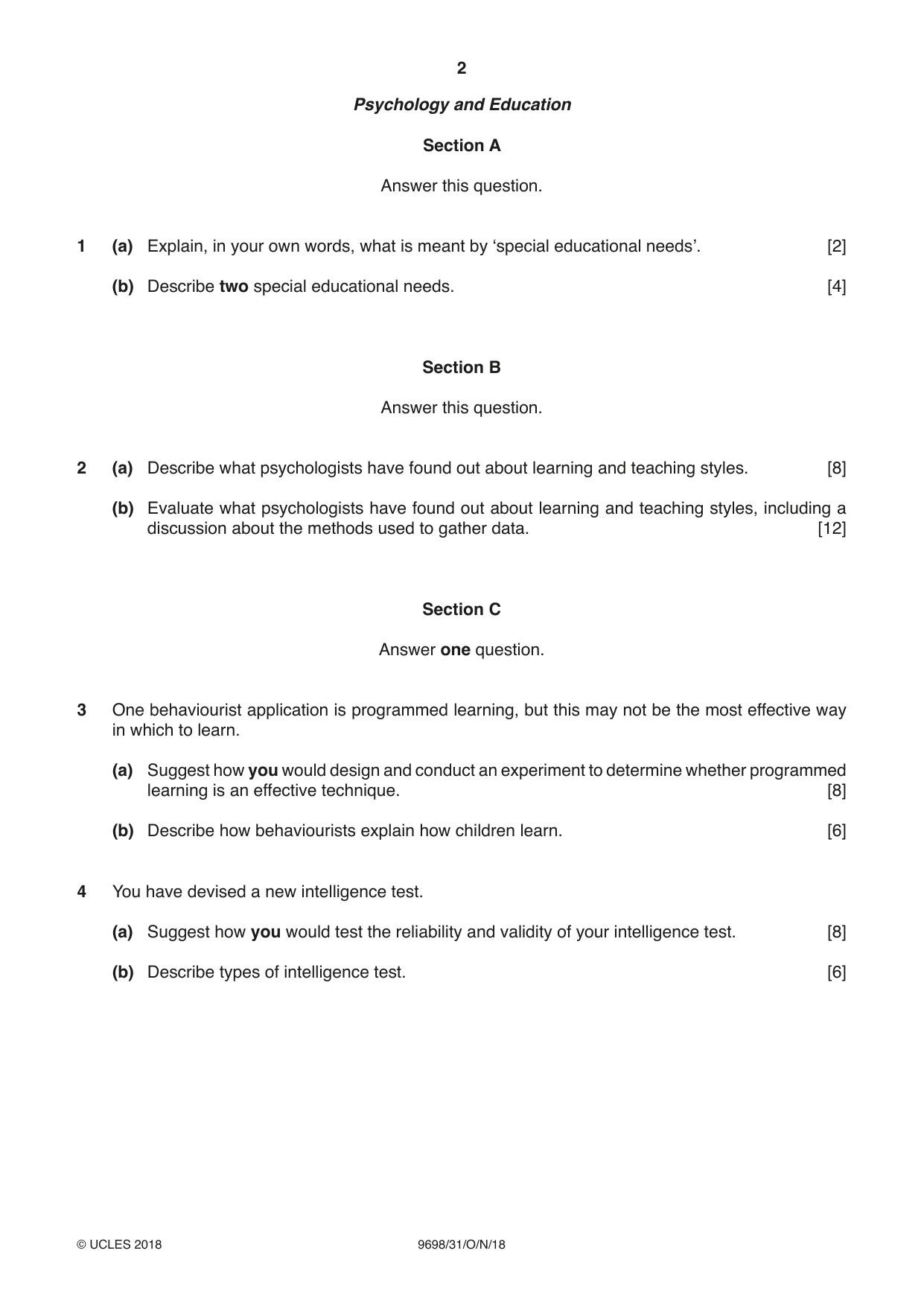
1 (a) Explain, in your own words, what is meant by ‘special educational needs’. [2] (b) Describe two special educational needs. [4]
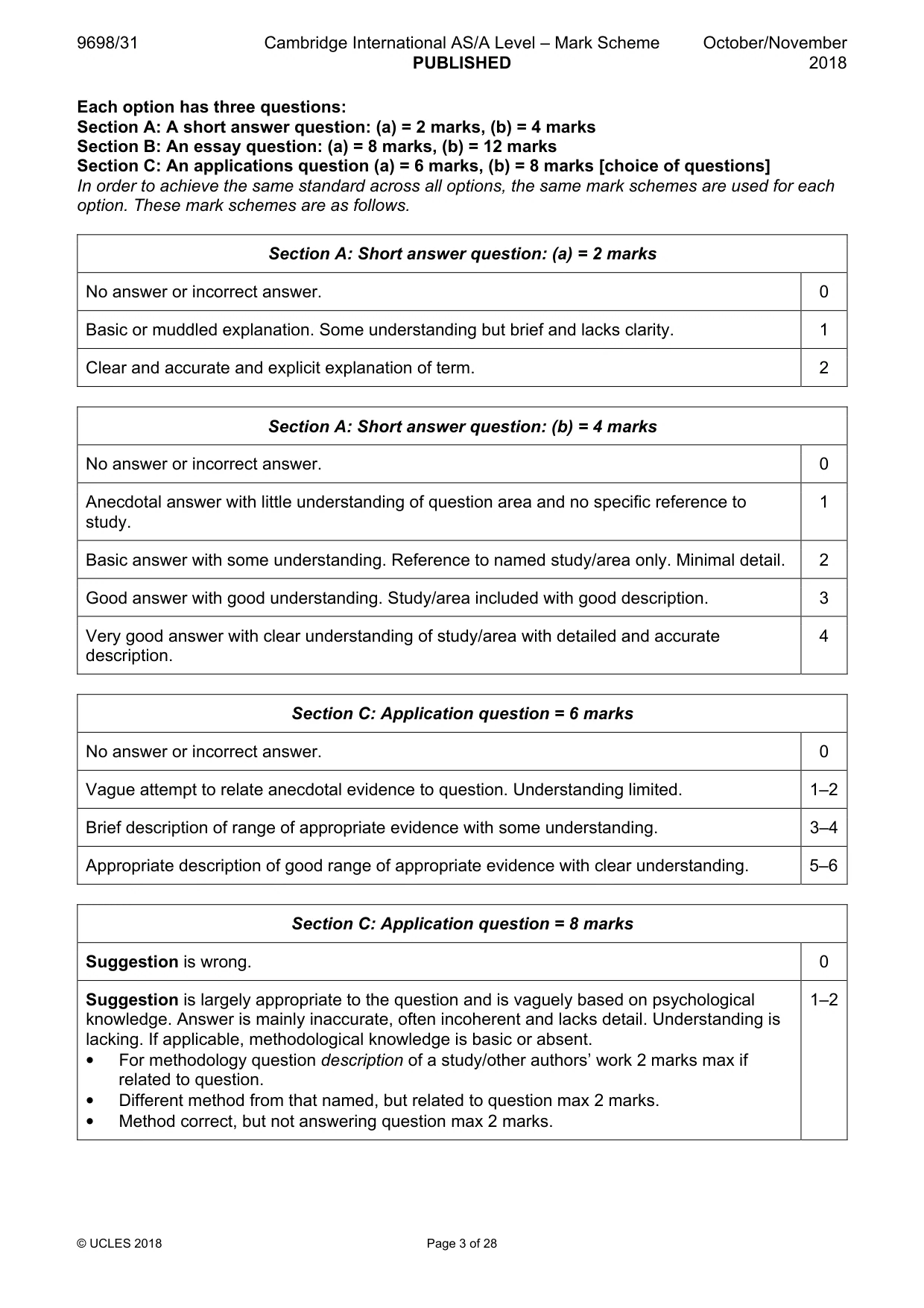
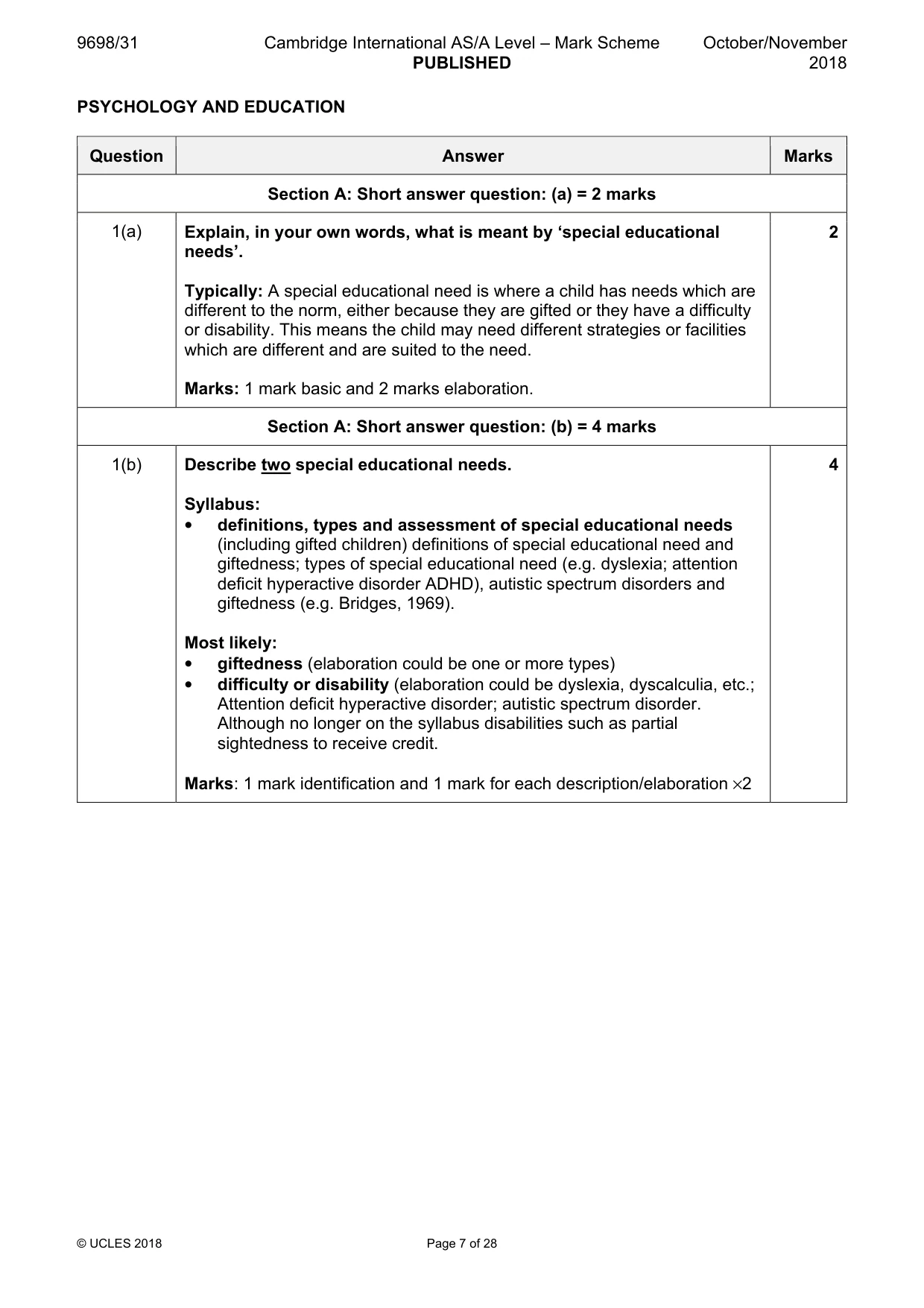
Mark scheme: Question Answer Marks Section A: Short answer question: (a) = 2 marks 1(a) Explain, in your own words, what is meant by ‘special educational 2 needs’. Typically: A special educational need is where a child has needs which are different to the norm, either because they are gifted or they have a difficulty or disability. This means the child may need different strategies or facilities which are different and are suited to the need. Marks: 1 mark basic and 2 marks elaboration. Section A: Short answer question: (b) = 4 marks 1(b) Describe two special educational needs. 4 Syllabus: • definitions, types and assessment of special educational needs (including gifted children) definitions of special educational need and giftedness; types of special educational need (e.g. dyslexia; attention deficit hyperactive disorder ADHD), autistic spectrum disorders and giftedness (e.g. Bridges, 1969). Most likely: • giftedness (elaboration could be one or more types) • difficulty or disability (elaboration could be dyslexia, dyscalculia, etc.; Attention deficit hyperactive disorder; autistic spectrum disorder. Although no longer on the syllabus disabilities such as partial sightedness to receive credit. Marks: 1 mark identification and 1 mark for each description/elaboration ×2
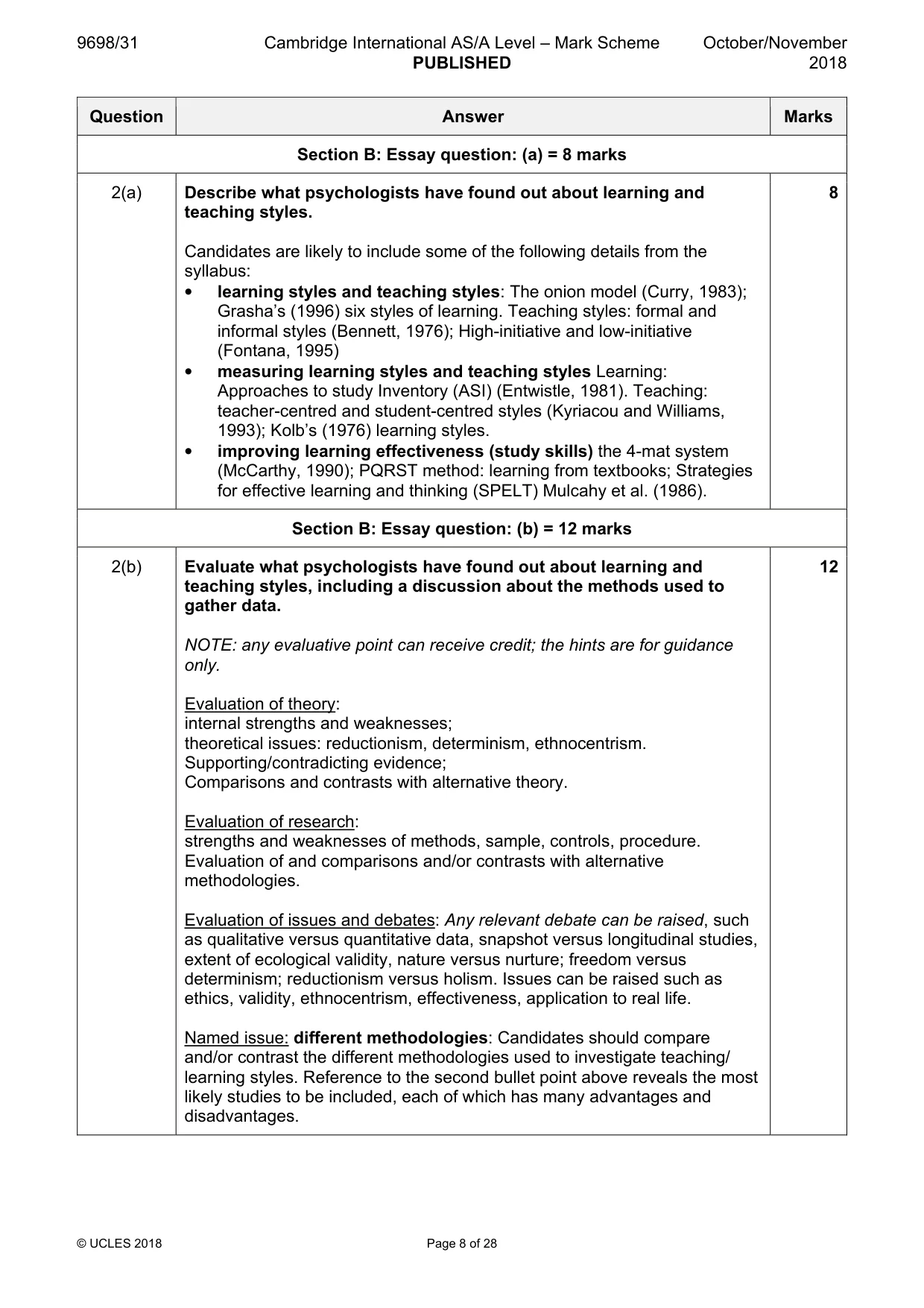
Q2 · Describe what psychologists have found out about learning and teaching styles
2 (a) Describe what psychologists have found out about learning and teaching styles. [8] (b) Evaluate what psychologists have found out about learning and teaching styles, including a discussion about the methods used to gather data. [12] Section C Answer one question.
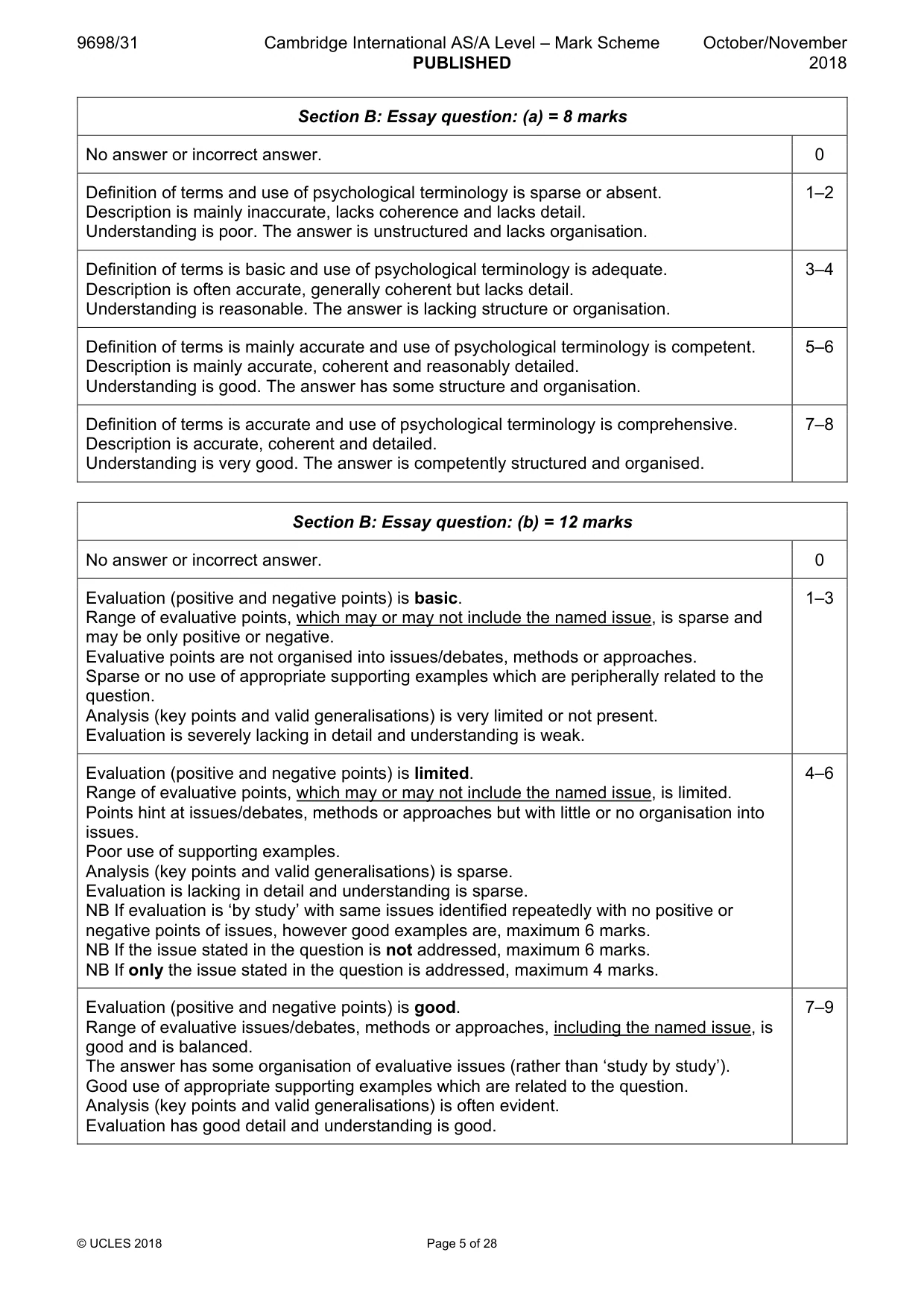
Mark scheme: 2(a) Describe what psychologists have found out about learning and 8 teaching styles. Candidates are likely to include some of the following details from the syllabus: • learning styles and teaching styles: The onion model (Curry, 1983); Grasha’s (1996) six styles of learning. Teaching styles: formal and informal styles (Bennett, 1976); High-initiative and low-initiative (Fontana, 1995) • measuring learning styles and teaching styles Learning: Approaches to study Inventory (ASI) (Entwistle, 1981). Teaching: teacher-centred and student-centred styles (Kyriacou and Williams, 1993); Kolb’s (1976) learning styles. • improving learning effectiveness (study skills) the 4-mat system (McCarthy, 1990); PQRST method: learning from textbooks; Strategies for effective learning and thinking (SPELT) Mulcahy et al. (1986). Section B: Essay question: (b) = 12 marks 2(b) Evaluate what psychologists have found out about learning and 12 teaching styles, including a discussion about the methods used to gather data. NOTE: any evaluative point can receive credit; the hints are for guidance only. Evaluation of theory: internal strengths and weaknesses; theoretical issues: reductionism, determinism, ethnocentrism. Supporting/contradicting evidence; Comparisons and contrasts with alternative theory. Evaluation of research: strengths and weaknesses of methods, sample, controls, procedure. Evaluation of and comparisons and/or contrasts with alternative methodologies. Evaluation of issues and debates: Any relevant debate can be raised, such as qualitative versus quantitative data, snapshot versus longitudinal studies, extent of ecological validity, nature versus nurture; freedom versus determinism; reductionism versus holism. Issues can be raised such as ethics, validity, ethnocentrism, effectiveness, application to real life. Named issue: different methodologies: Candidates should compare and/or contrast the different methodologies used to investigate teaching/ learning styles. Reference to the second bullet point above reveals the most likely studies to be included, each of which has many advantages and disadvantages.
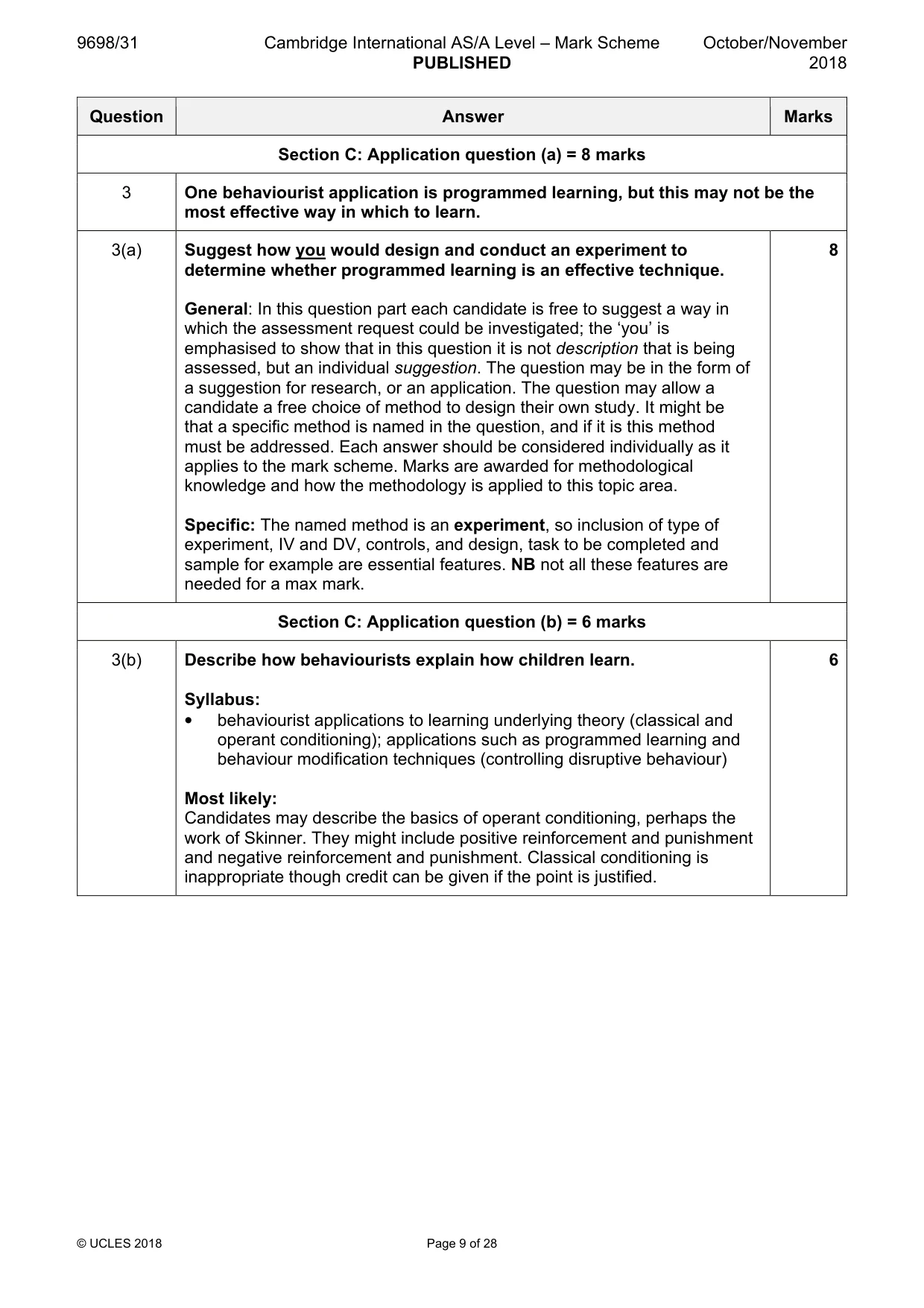
Q3 · One behaviourist application is programmed learning, but this may not be the most…
3 One behaviourist application is programmed learning, but this may not be the most effective way in which to learn. (a) Suggest how you would design and conduct an experiment to determine whether programmed learning is an effective technique. [8] (b) Describe how behaviourists explain how children learn. [6]
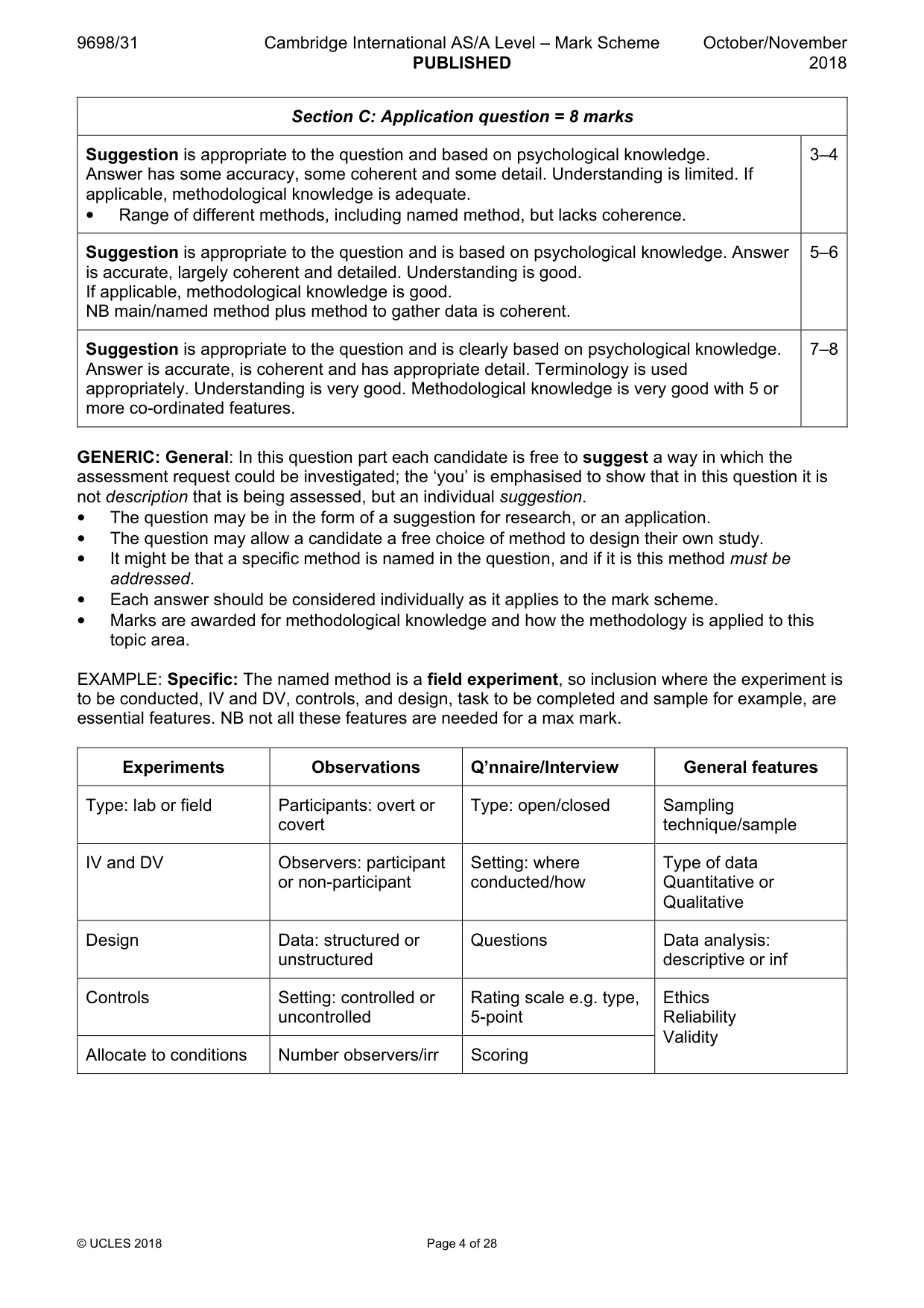
Mark scheme: 3(a) Suggest how you would design and conduct an experiment to 8 determine whether programmed learning is an effective technique. General: In this question part each candidate is free to suggest a way in which the assessment request could be investigated; the ‘you’ is emphasised to show that in this question it is not description that is being assessed, but an individual suggestion. The question may be in the form of a suggestion for research, or an application. The question may allow a candidate a free choice of method to design their own study. It might be that a specific method is named in the question, and if it is this method must be addressed. Each answer should be considered individually as it applies to the mark scheme. Marks are awarded for methodological knowledge and how the methodology is applied to this topic area. Specific: The named method is an experiment, so inclusion of type of experiment, IV and DV, controls, and design, task to be completed and sample for example are essential features. NB not all these features are needed for a max mark. Section C: Application question (b) = 6 marks 3(b) Describe how behaviourists explain how children learn. 6 Syllabus: • behaviourist applications to learning underlying theory (classical and operant conditioning); applications such as programmed learning and behaviour modification techniques (controlling disruptive behaviour) Most likely: Candidates may describe the basics of operant conditioning, perhaps the work of Skinner. They might include positive reinforcement and punishment and negative reinforcement and punishment. Classical conditioning is inappropriate though credit can be given if the point is justified.
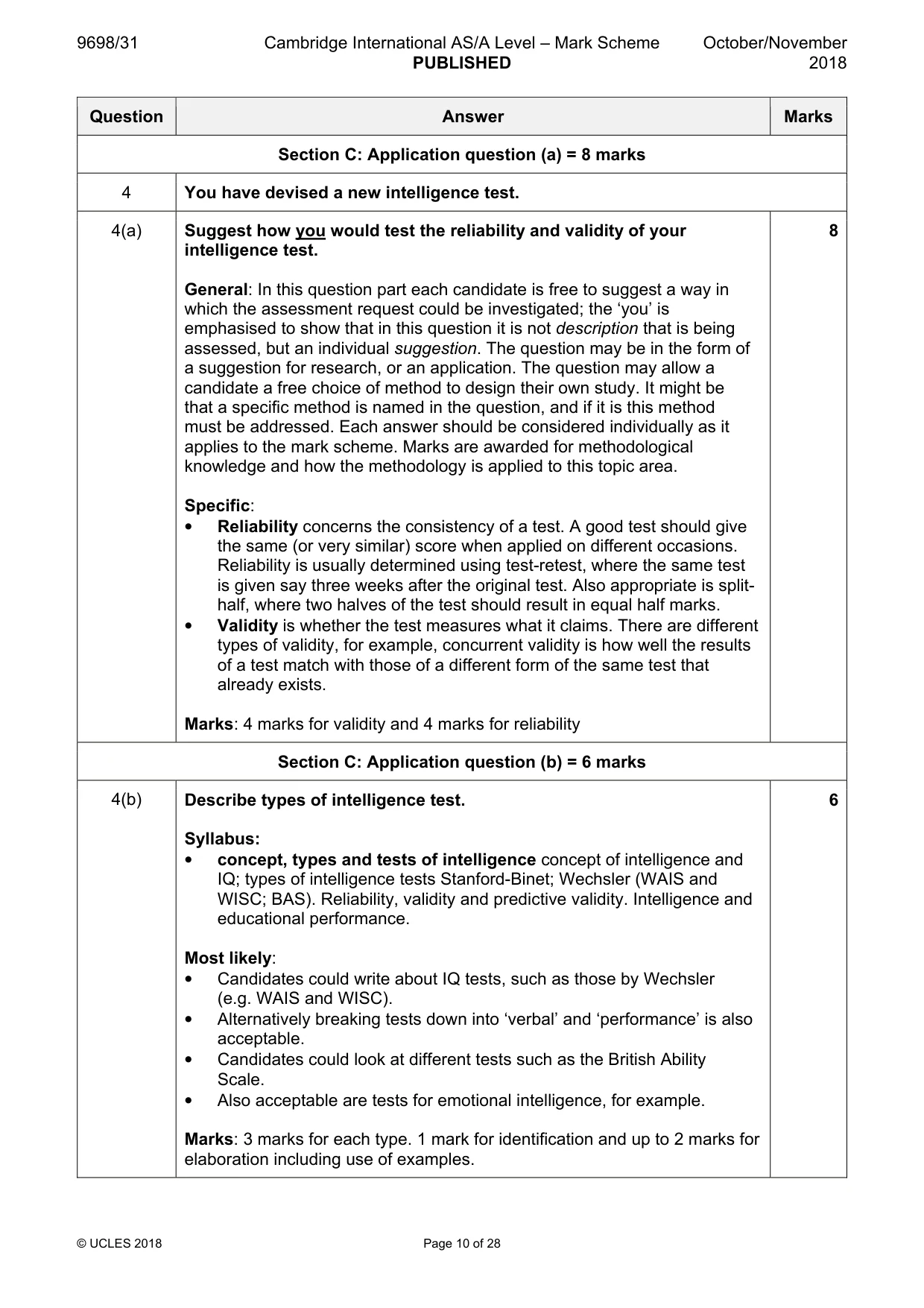
Q4 · You have devised a new intelligence test
4 You have devised a new intelligence test. (a) Suggest how you would test the reliability and validity of your intelligence test. [8] (b) Describe types of intelligence test. [6] Psychology and Health Section A Answer this question.
Mark scheme: 4(a) Suggest how you would test the reliability and validity of your 8 intelligence test. General: In this question part each candidate is free to suggest a way in which the assessment request could be investigated; the ‘you’ is emphasised to show that in this question it is not description that is being assessed, but an individual suggestion. The question may be in the form of a suggestion for research, or an application. The question may allow a candidate a free choice of method to design their own study. It might be that a specific method is named in the question, and if it is this method must be addressed. Each answer should be considered individually as it applies to the mark scheme. Marks are awarded for methodological knowledge and how the methodology is applied to this topic area. Specific: • Reliability concerns the consistency of a test. A good test should give the same (or very similar) score when applied on different occasions. Reliability is usually determined using test-retest, where the same test is given say three weeks after the original test. Also appropriate is split- half, where two halves of the test should result in equal half marks. • Validity is whether the test measures what it claims. There are different types of validity, for example, concurrent validity is how well the results of a test match with those of a different form of the same test that already exists. Marks: 4 marks for validity and 4 marks for reliability Section C: Application question (b) = 6 marks 4(b) Describe types of intelligence test. 6 Syllabus: • concept, types and tests of intelligence concept of intelligence and IQ; types of intelligence tests Stanford-Binet; Wechsler (WAIS and WISC; BAS). Reliability, validity and predictive validity. Intelligence and educational performance. Most likely: • Candidates could write about IQ tests, such as those by Wechsler (e.g. WAIS and WISC). • Alternatively breaking tests down into ‘verbal’ and ‘performance’ is also acceptable. • Candidates could look at different tests such as the British Ability Scale. • Also acceptable are tests for emotional intelligence, for example. Marks: 3 marks for each type. 1 mark for identification and up to 2 marks for elaboration including use of examples. PSYCHOLOGY AND HEALTH
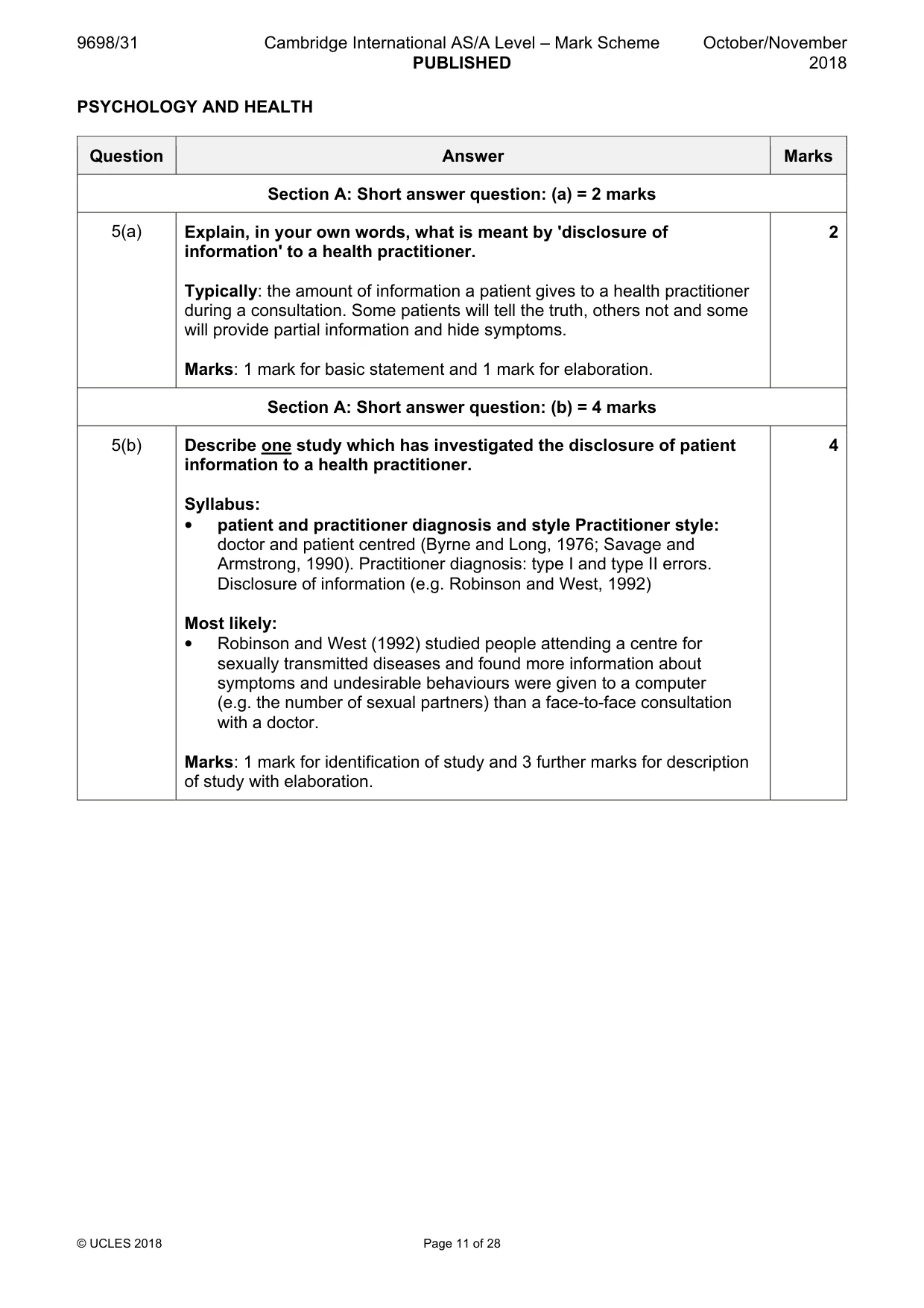
Q5 · Explain, in your own words, what is meant by ‘disclosure of information’ to a health…
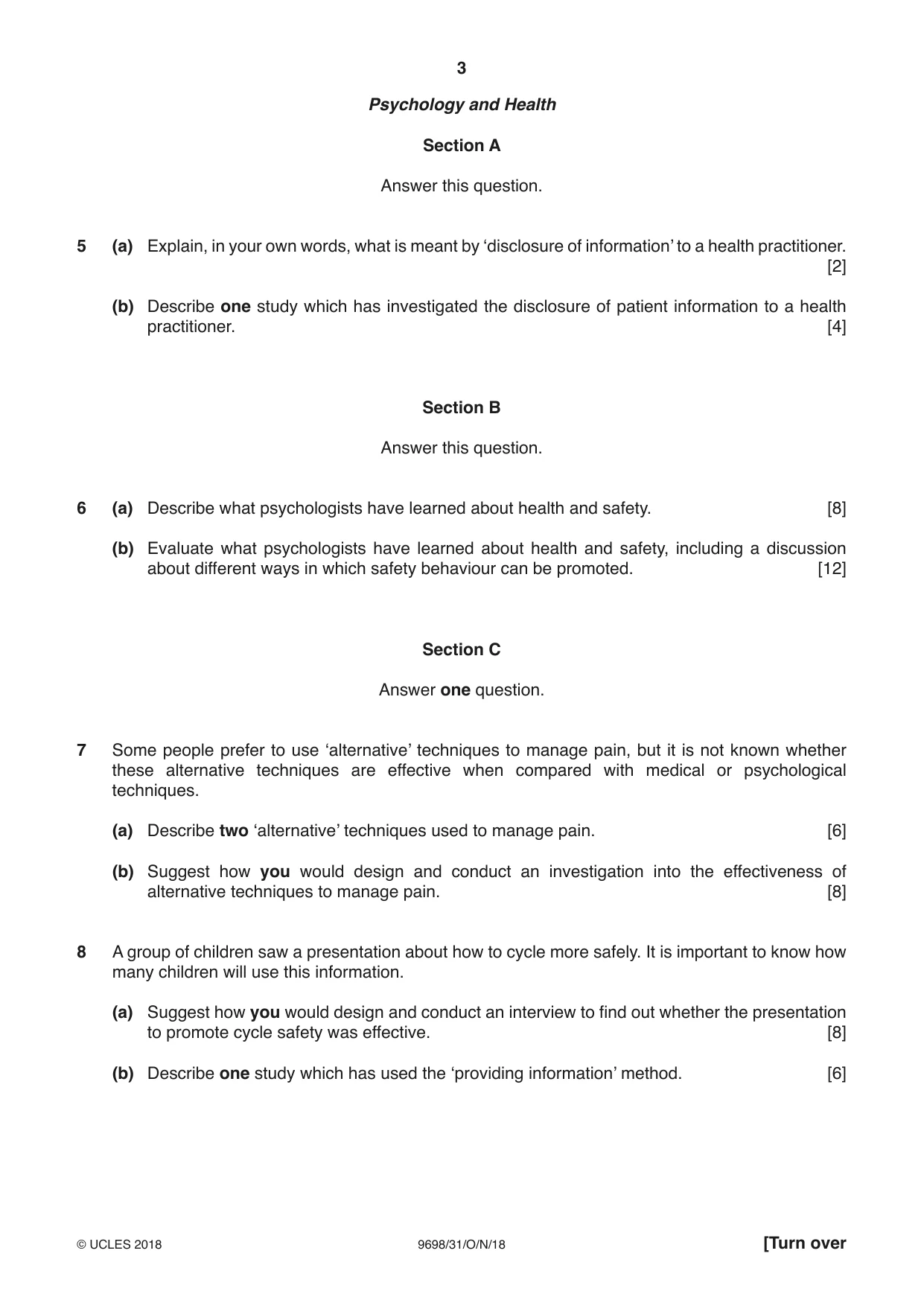
5 (a) Explain, in your own words, what is meant by ‘disclosure of information’ to a health practitioner. [2] (b) Describe one study which has investigated the disclosure of patient information to a health practitioner. [4]
Mark scheme: 5(a) Explain, in your own words, what is meant by 'disclosure of 2 information' to a health practitioner. Typically: the amount of information a patient gives to a health practitioner during a consultation. Some patients will tell the truth, others not and some will provide partial information and hide symptoms. Marks: 1 mark for basic statement and 1 mark for elaboration. Section A: Short answer question: (b) = 4 marks 5(b) Describe one study which has investigated the disclosure of patient 4 information to a health practitioner. Syllabus: • patient and practitioner diagnosis and style Practitioner style: doctor and patient centred (Byrne and Long, 1976; Savage and Armstrong, 1990). Practitioner diagnosis: type I and type II errors. Disclosure of information (e.g. Robinson and West, 1992) Most likely: • Robinson and West (1992) studied people attending a centre for sexually transmitted diseases and found more information about symptoms and undesirable behaviours were given to a computer (e.g. the number of sexual partners) than a face-to-face consultation with a doctor. Marks: 1 mark for identification of study and 3 further marks for description of study with elaboration.
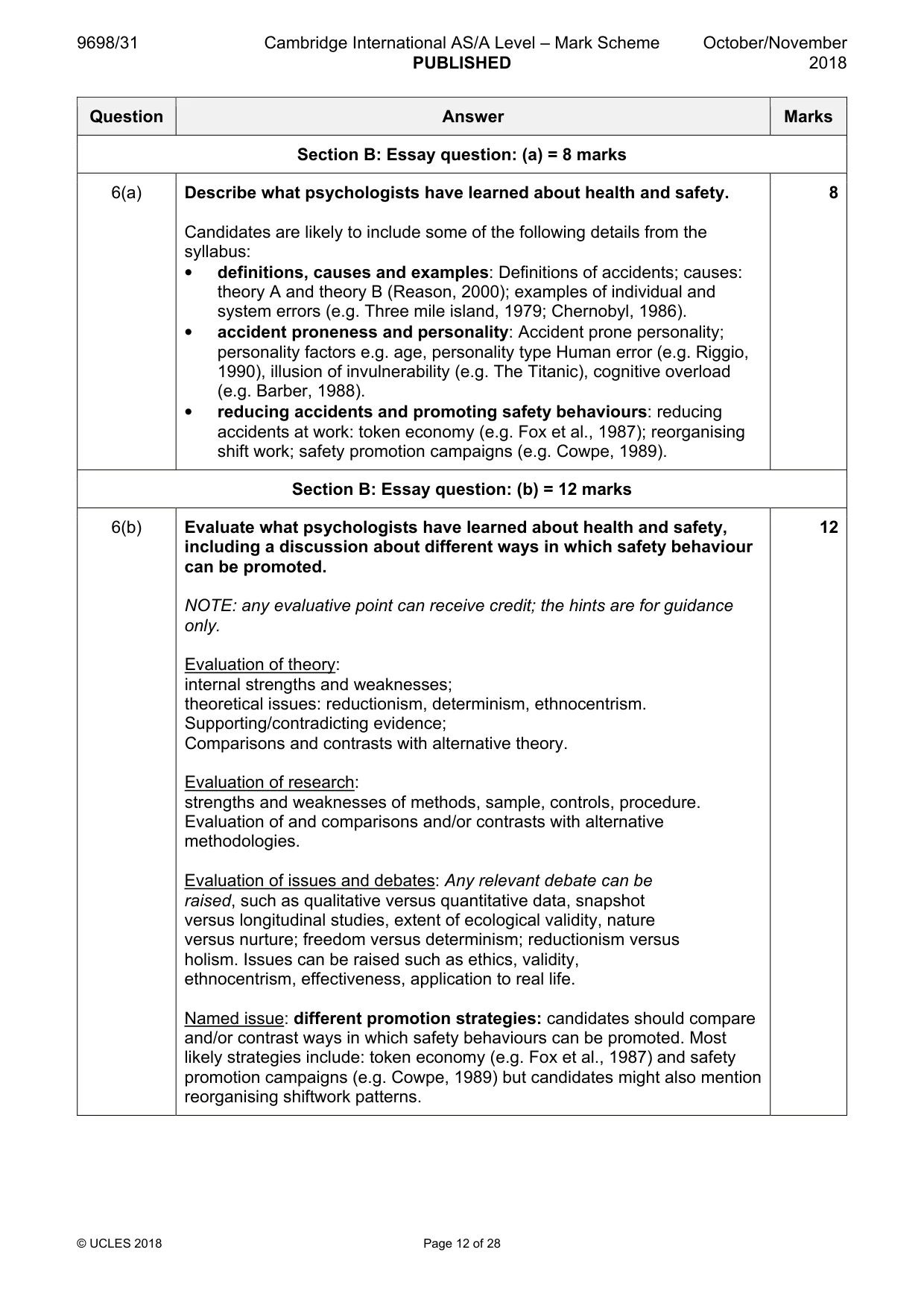
Q6 · Describe what psychologists have learned about health and safety
6 (a) Describe what psychologists have learned about health and safety. [8] (b) Evaluate what psychologists have learned about health and safety, including a discussion about different ways in which safety behaviour can be promoted. [12] Section C Answer one question.
Mark scheme: 6(a) Describe what psychologists have learned about health and safety. 8 Candidates are likely to include some of the following details from the syllabus: • definitions, causes and examples: Definitions of accidents; causes: theory A and theory B (Reason, 2000); examples of individual and system errors (e.g. Three mile island, 1979; Chernobyl, 1986). • accident proneness and personality: Accident prone personality; personality factors e.g. age, personality type Human error (e.g. Riggio, 1990), illusion of invulnerability (e.g. The Titanic), cognitive overload (e.g. Barber, 1988). • reducing accidents and promoting safety behaviours: reducing accidents at work: token economy (e.g. Fox et al., 1987); reorganising shift work; safety promotion campaigns (e.g. Cowpe, 1989). Section B: Essay question: (b) = 12 marks 6(b) Evaluate what psychologists have learned about health and safety, 12 including a discussion about different ways in which safety behaviour can be promoted. NOTE: any evaluative point can receive credit; the hints are for guidance only. Evaluation of theory: internal strengths and weaknesses; theoretical issues: reductionism, determinism, ethnocentrism. Supporting/contradicting evidence; Comparisons and contrasts with alternative theory. Evaluation of research: strengths and weaknesses of methods, sample, controls, procedure. Evaluation of and comparisons and/or contrasts with alternative methodologies. Evaluation of issues and debates: Any relevant debate can be raised, such as qualitative versus quantitative data, snapshot versus longitudinal studies, extent of ecological validity, nature versus nurture; freedom versus determinism; reductionism versus holism. Issues can be raised such as ethics, validity, ethnocentrism, effectiveness, application to real life. Named issue: different promotion strategies: candidates should compare and/or contrast ways in which safety behaviours can be promoted. Most likely strategies include: token economy (e.g. Fox et al., 1987) and safety promotion campaigns (e.g. Cowpe, 1989) but candidates might also mention reorganising shiftwork patterns.
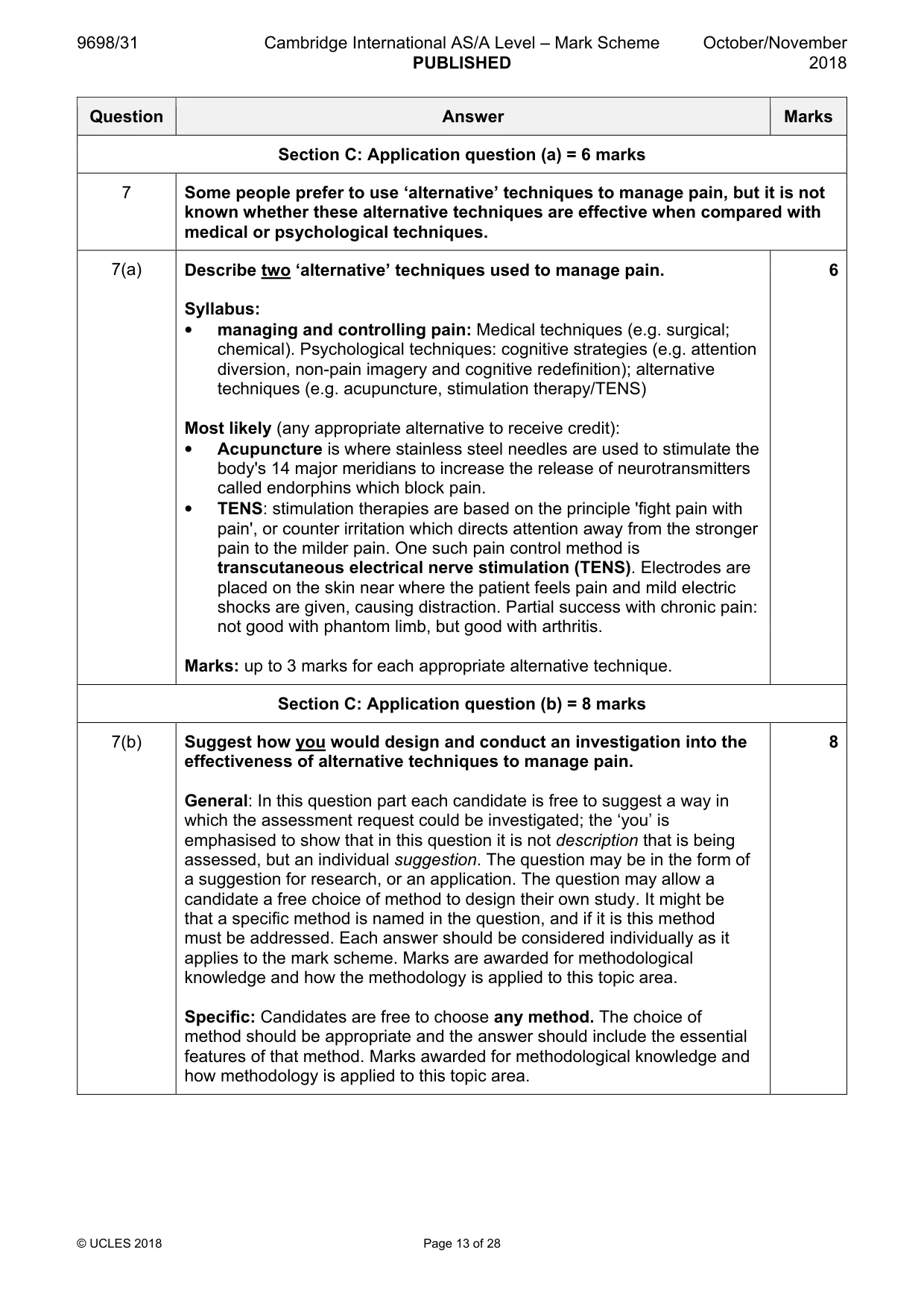
Q7 · Some people prefer to use ‘alternative’ techniques to manage pain, but it is not known…
7 Some people prefer to use ‘alternative’ techniques to manage pain, but it is not known whether these alternative techniques are effective when compared with medical or psychological techniques. (a) Describe two ‘alternative’ techniques used to manage pain. [6] (b) Suggest how you would design and conduct an investigation into the effectiveness of alternative techniques to manage pain. [8]
Mark scheme: 7(a) Describe two ‘alternative’ techniques used to manage pain. 6 Syllabus: • managing and controlling pain: Medical techniques (e.g. surgical; chemical). Psychological techniques: cognitive strategies (e.g. attention diversion, non-pain imagery and cognitive redefinition); alternative techniques (e.g. acupuncture, stimulation therapy/TENS) Most likely (any appropriate alternative to receive credit): • Acupuncture is where stainless steel needles are used to stimulate the body's 14 major meridians to increase the release of neurotransmitters called endorphins which block pain. • TENS: stimulation therapies are based on the principle 'fight pain with pain', or counter irritation which directs attention away from the stronger pain to the milder pain. One such pain control method is transcutaneous electrical nerve stimulation (TENS). Electrodes are placed on the skin near where the patient feels pain and mild electric shocks are given, causing distraction. Partial success with chronic pain: not good with phantom limb, but good with arthritis. Marks: up to 3 marks for each appropriate alternative technique. Section C: Application question (b) = 8 marks 7(b) Suggest how you would design and conduct an investigation into the 8 effectiveness of alternative techniques to manage pain. General: In this question part each candidate is free to suggest a way in which the assessment request could be investigated; the ‘you’ is emphasised to show that in this question it is not description that is being assessed, but an individual suggestion. The question may be in the form of a suggestion for research, or an application. The question may allow a candidate a free choice of method to design their own study. It might be that a specific method is named in the question, and if it is this method must be addressed. Each answer should be considered individually as it applies to the mark scheme. Marks are awarded for methodological knowledge and how the methodology is applied to this topic area. Specific: Candidates are free to choose any method. The choice of method should be appropriate and the answer should include the essential features of that method. Marks awarded for methodological knowledge and how methodology is applied to this topic area.
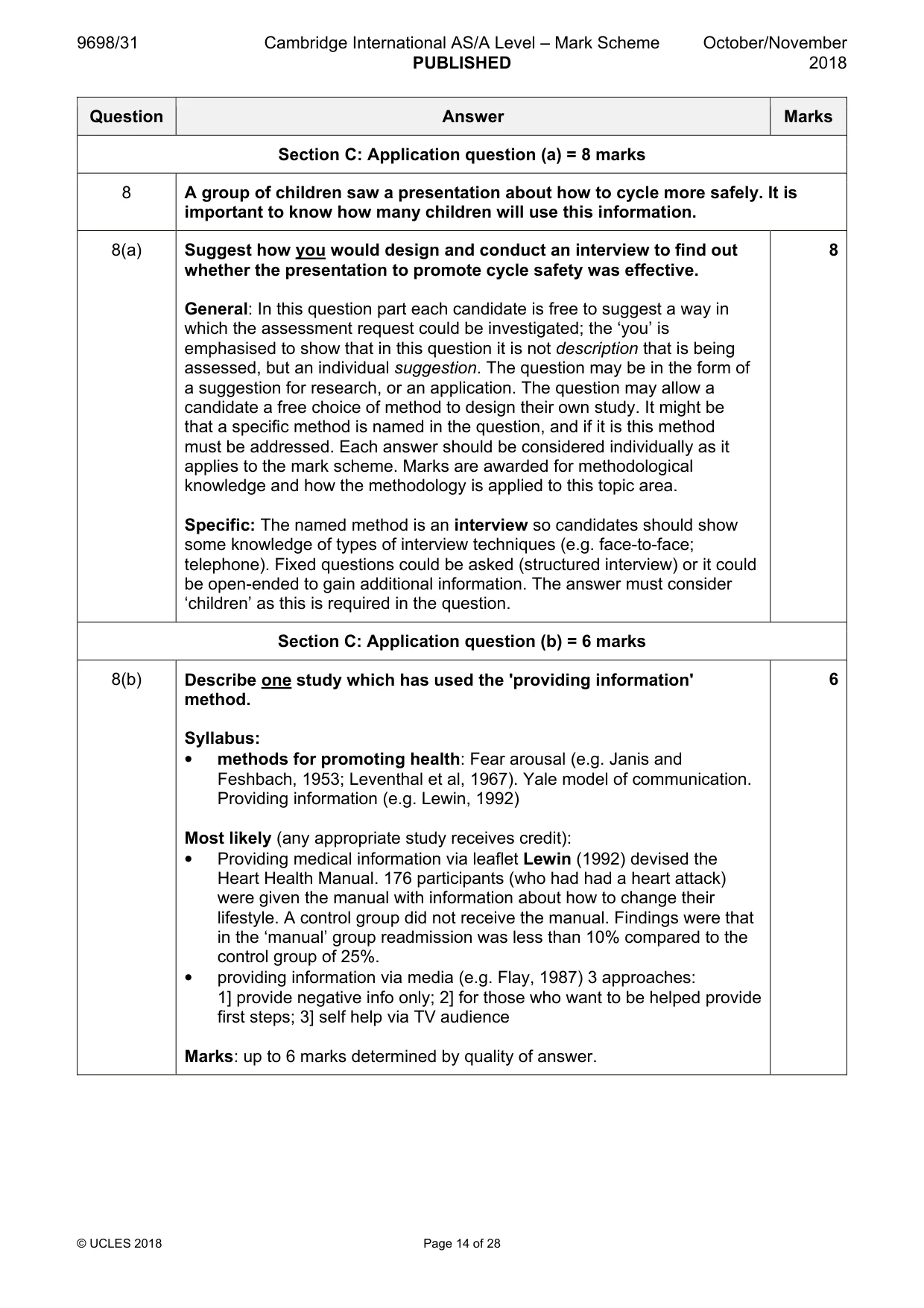
Q8 · A group of children saw a presentation about how to cycle more safely
8 A group of children saw a presentation about how to cycle more safely. It is important to know how many children will use this information. (a) Suggest how you would design and conduct an interview to find out whether the presentation to promote cycle safety was effective. [8] (b) Describe one study which has used the ‘providing information’ method. [6] Psychology and Environment Section A Answer this question.
Mark scheme: 8(a) Suggest how you would design and conduct an interview to find out 8 whether the presentation to promote cycle safety was effective. General: In this question part each candidate is free to suggest a way in which the assessment request could be investigated; the ‘you’ is emphasised to show that in this question it is not description that is being assessed, but an individual suggestion. The question may be in the form of a suggestion for research, or an application. The question may allow a candidate a free choice of method to design their own study. It might be that a specific method is named in the question, and if it is this method must be addressed. Each answer should be considered individually as it applies to the mark scheme. Marks are awarded for methodological knowledge and how the methodology is applied to this topic area. Specific: The named method is an interview so candidates should show some knowledge of types of interview techniques (e.g. face-to-face; telephone). Fixed questions could be asked (structured interview) or it could be open-ended to gain additional information. The answer must consider ‘children’ as this is required in the question. Section C: Application question (b) = 6 marks 8(b) Describe one study which has used the 'providing information' 6 method. Syllabus: • methods for promoting health: Fear arousal (e.g. Janis and Feshbach, 1953; Leventhal et al, 1967). Yale model of communication. Providing information (e.g. Lewin, 1992) Most likely (any appropriate study receives credit): • Providing medical information via leaflet Lewin (1992) devised the Heart Health Manual. 176 participants (who had had a heart attack) were given the manual with information about how to change their lifestyle. A control group did not receive the manual. Findings were that in the ‘manual’ group readmission was less than 10% compared to the control group of 25%. • providing information via media (e.g. Flay, 1987) 3 approaches: 1] provide negative info only; 2] for those who want to be helped provide first steps; 3] self help via TV audience Marks: up to 6 marks determined by quality of answer. PSYCHOLOGY AND ENVIRONMENT
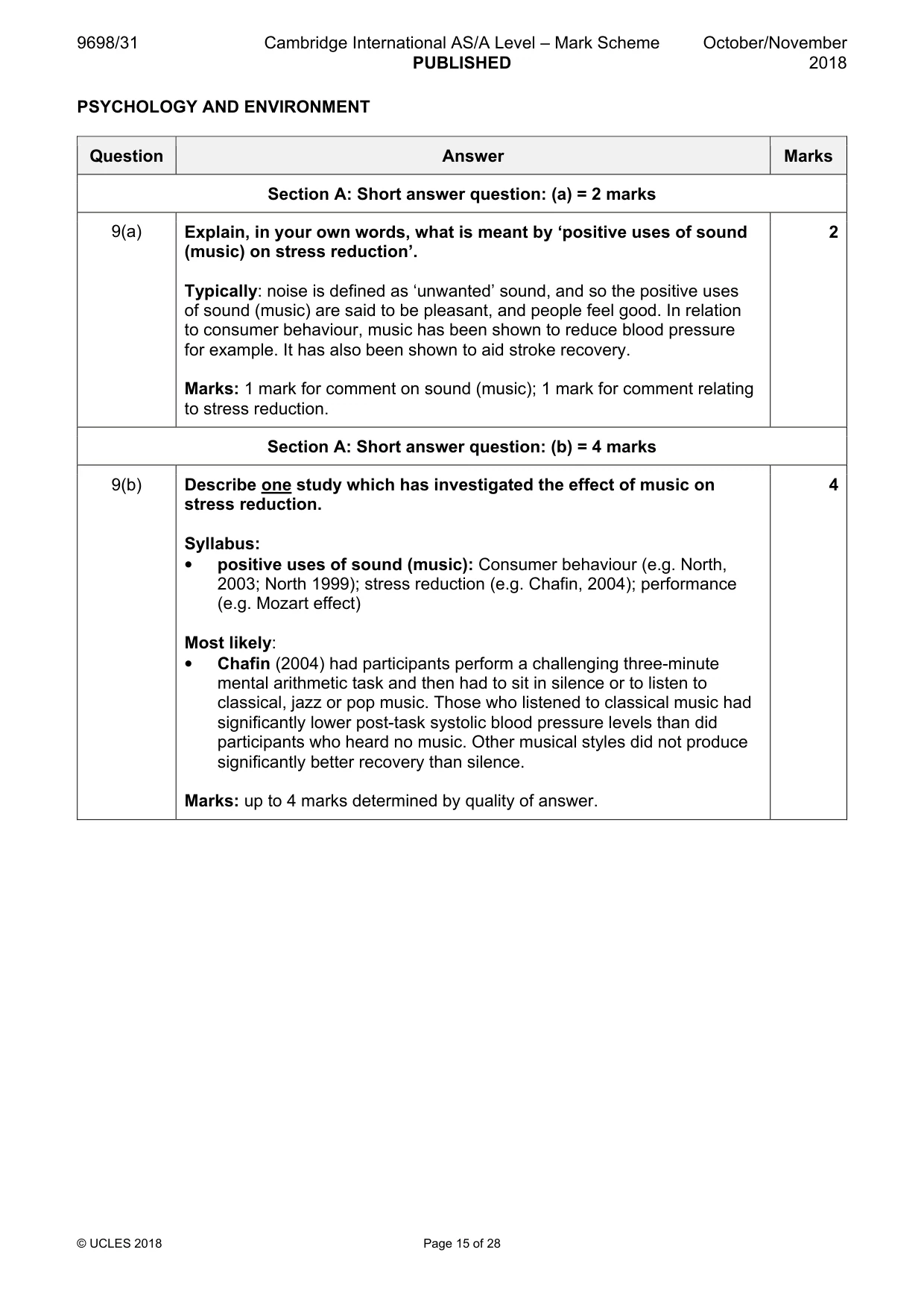
Q9 · Explain, in your own words, what is meant by ‘positive uses of sound (music) on stress…
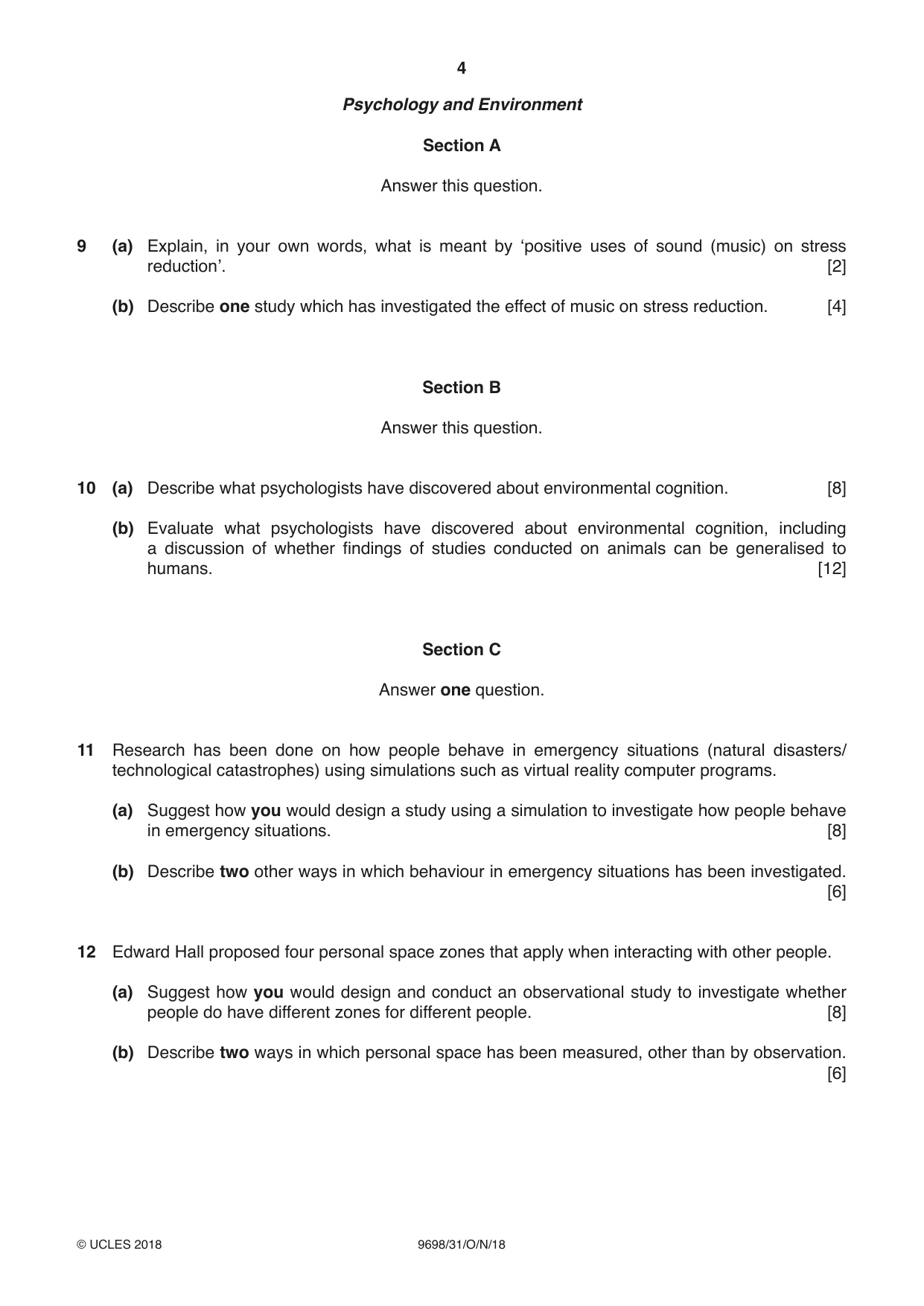
9 (a) Explain, in your own words, what is meant by ‘positive uses of sound (music) on stress reduction’. [2] (b) Describe one study which has investigated the effect of music on stress reduction. [4]
Mark scheme: 9(a) Explain, in your own words, what is meant by ‘positive uses of sound 2 (music) on stress reduction’. Typically: noise is defined as ‘unwanted’ sound, and so the positive uses of sound (music) are said to be pleasant, and people feel good. In relation to consumer behaviour, music has been shown to reduce blood pressure for example. It has also been shown to aid stroke recovery. Marks: 1 mark for comment on sound (music); 1 mark for comment relating to stress reduction. Section A: Short answer question: (b) = 4 marks 9(b) Describe one study which has investigated the effect of music on 4 stress reduction. Syllabus: • positive uses of sound (music): Consumer behaviour (e.g. North, 2003; North 1999); stress reduction (e.g. Chafin, 2004); performance (e.g. Mozart effect) Most likely: • Chafin (2004) had participants perform a challenging three-minute mental arithmetic task and then had to sit in silence or to listen to classical, jazz or pop music. Those who listened to classical music had significantly lower post-task systolic blood pressure levels than did participants who heard no music. Other musical styles did not produce significantly better recovery than silence. Marks: up to 4 marks determined by quality of answer.
Q10 · Describe what psychologists have discovered about environmental cognition
10 (a) Describe what psychologists have discovered about environmental cognition. [8] (b) Evaluate what psychologists have discovered about environmental cognition, including a discussion of whether findings of studies conducted on animals can be generalised to humans. [12] Section C Answer one question.
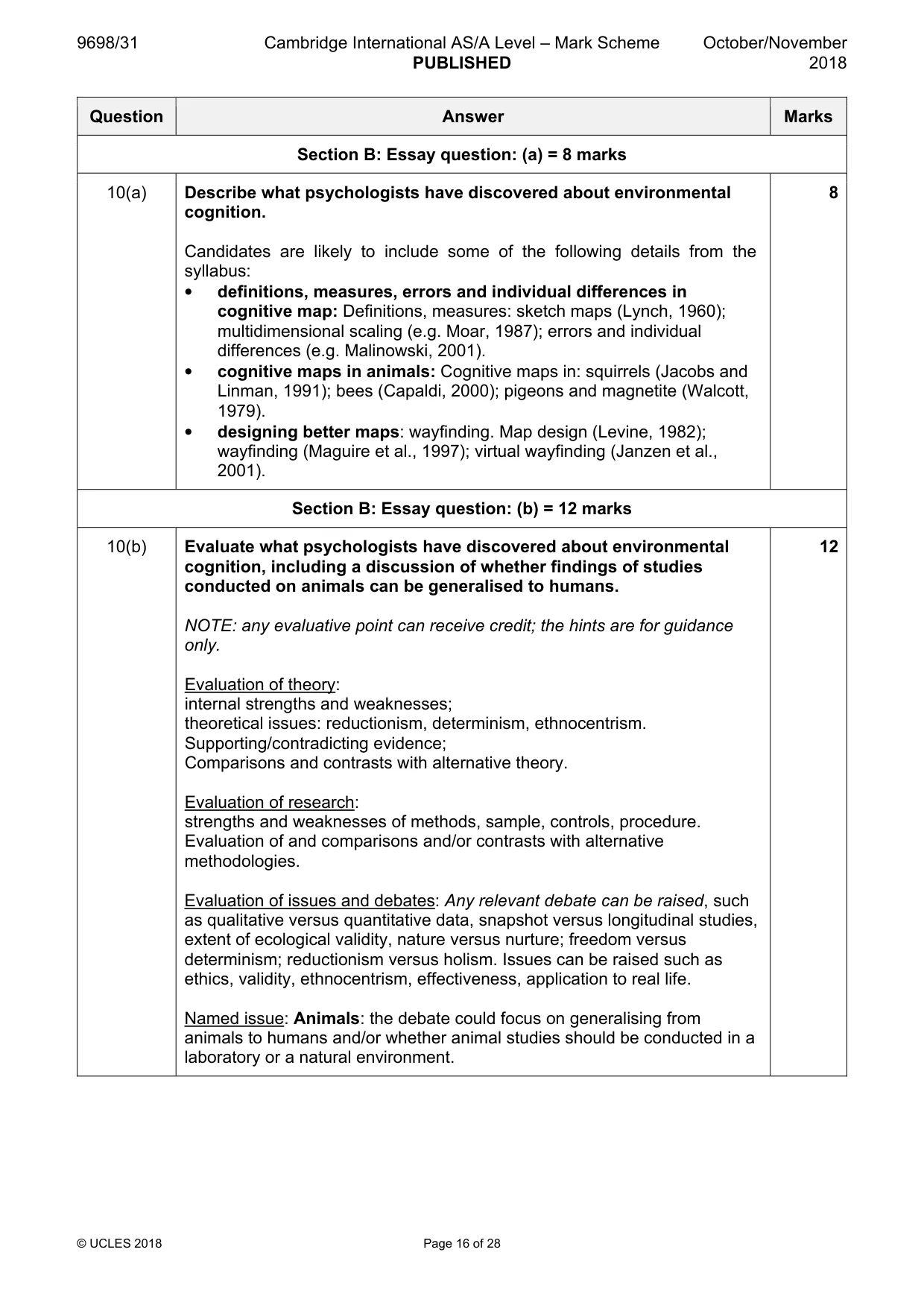
Mark scheme: 10(a) Describe what psychologists have discovered about environmental 8 cognition. Candidates are likely to include some of the following details from the syllabus: • definitions, measures, errors and individual differences in cognitive map: Definitions, measures: sketch maps (Lynch, 1960); multidimensional scaling (e.g. Moar, 1987); errors and individual differences (e.g. Malinowski, 2001). • cognitive maps in animals: Cognitive maps in: squirrels (Jacobs and Linman, 1991); bees (Capaldi, 2000); pigeons and magnetite (Walcott, 1979). • designing better maps: wayfinding. Map design (Levine, 1982); wayfinding (Maguire et al., 1997); virtual wayfinding (Janzen et al., 2001). Section B: Essay question: (b) = 12 marks 10(b) Evaluate what psychologists have discovered about environmental 12 cognition, including a discussion of whether findings of studies conducted on animals can be generalised to humans. NOTE: any evaluative point can receive credit; the hints are for guidance only. Evaluation of theory: internal strengths and weaknesses; theoretical issues: reductionism, determinism, ethnocentrism. Supporting/contradicting evidence; Comparisons and contrasts with alternative theory. Evaluation of research: strengths and weaknesses of methods, sample, controls, procedure. Evaluation of and comparisons and/or contrasts with alternative methodologies. Evaluation of issues and debates: Any relevant debate can be raised, such as qualitative versus quantitative data, snapshot versus longitudinal studies, extent of ecological validity, nature versus nurture; freedom versus determinism; reductionism versus holism. Issues can be raised such as ethics, validity, ethnocentrism, effectiveness, application to real life. Named issue: Animals: the debate could focus on generalising from animals to humans and/or whether animal studies should be conducted in a laboratory or a natural environment.
Q11 · Research has been done on how people behave in emergency situations (natural disasters/…
11 Research has been done on how people behave in emergency situations (natural disasters/ technological catastrophes) using simulations such as virtual reality computer programs. (a) Suggest how you would design a study using a simulation to investigate how people behave in emergency situations. [8] (b) Describe two other ways in which behaviour in emergency situations has been investigated. [6]
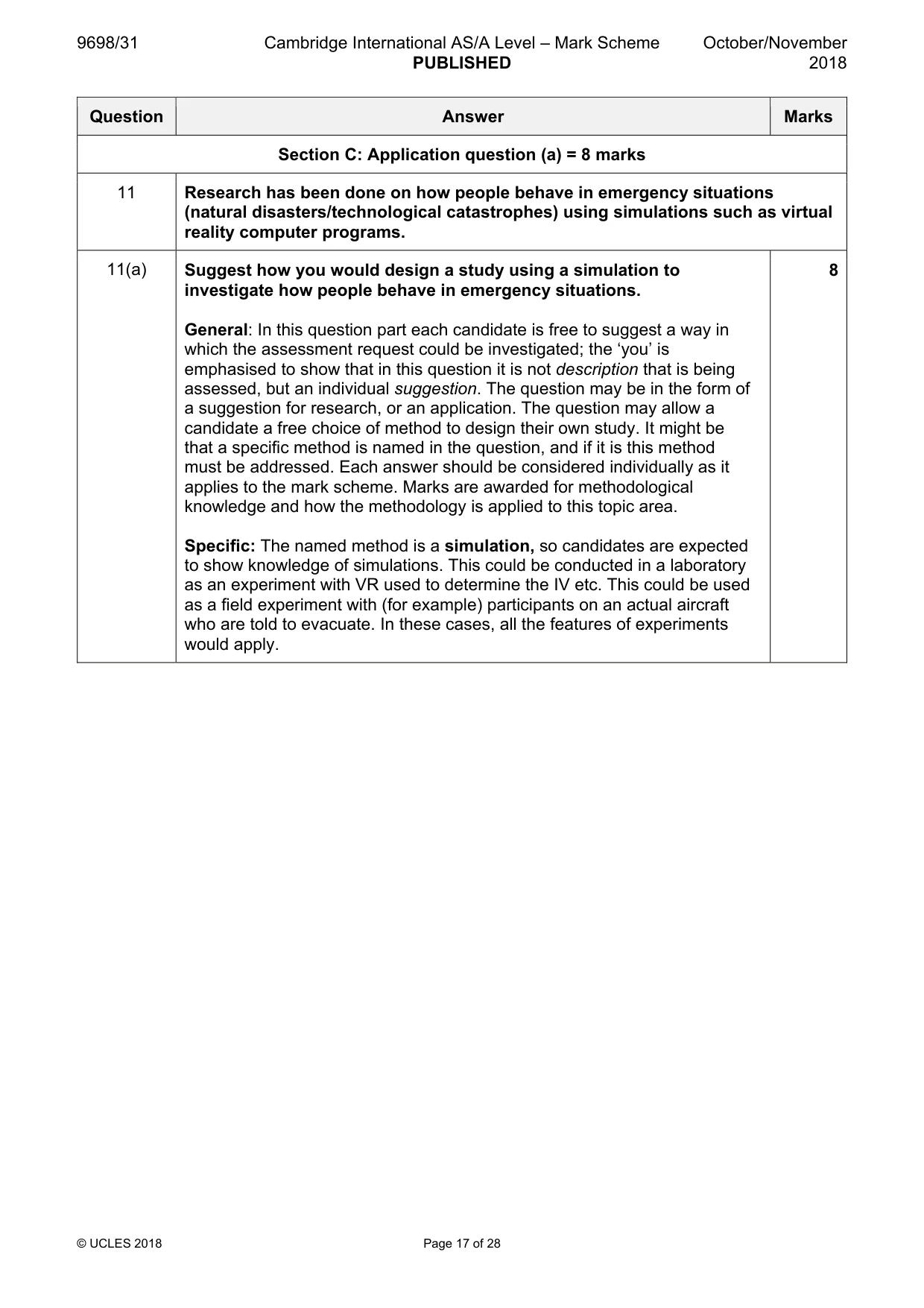
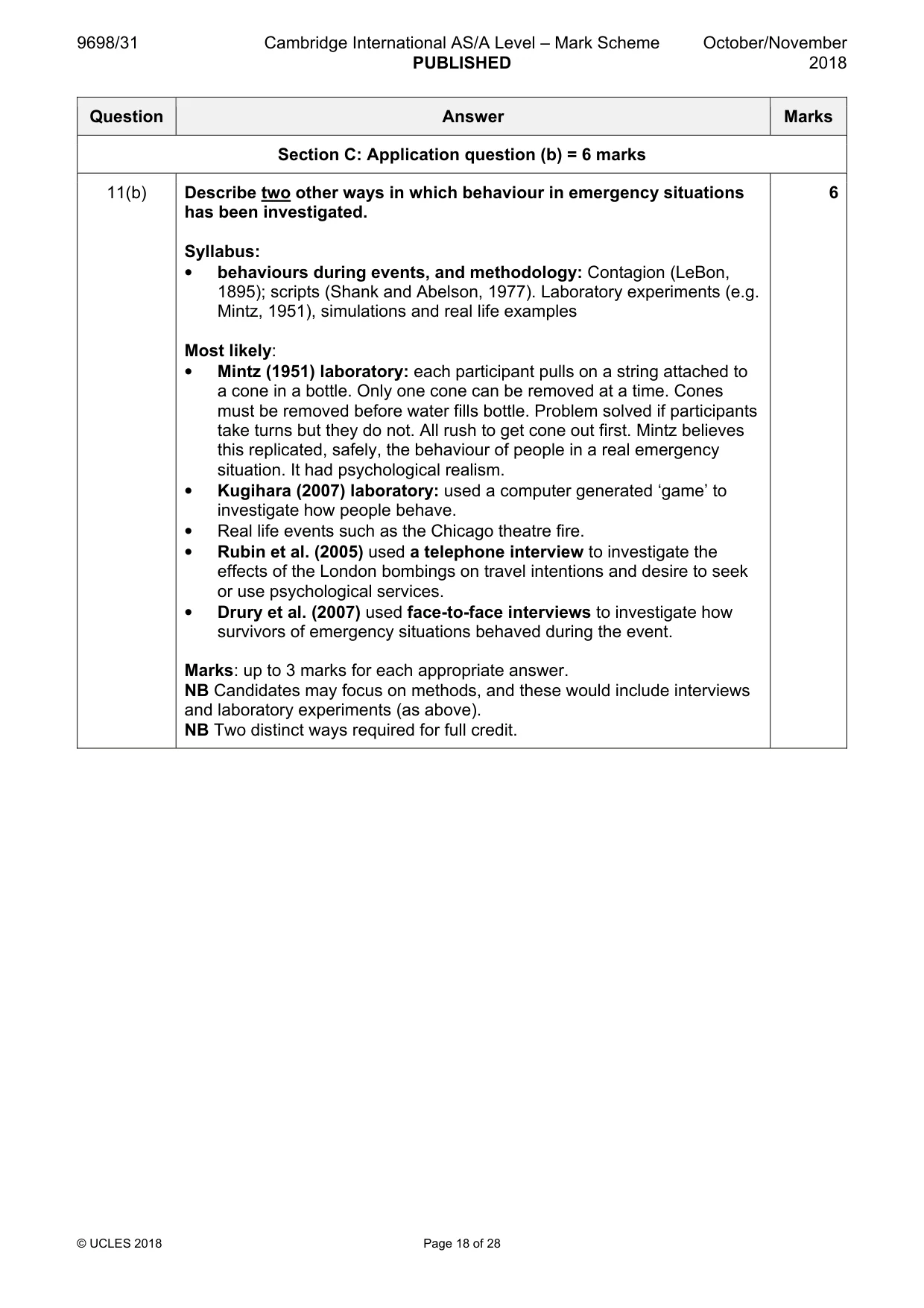
Mark scheme: 11(a) Suggest how you would design a study using a simulation to 8 investigate how people behave in emergency situations. General: In this question part each candidate is free to suggest a way in which the assessment request could be investigated; the ‘you’ is emphasised to show that in this question it is not description that is being assessed, but an individual suggestion. The question may be in the form of a suggestion for research, or an application. The question may allow a candidate a free choice of method to design their own study. It might be that a specific method is named in the question, and if it is this method must be addressed. Each answer should be considered individually as it applies to the mark scheme. Marks are awarded for methodological knowledge and how the methodology is applied to this topic area. Specific: The named method is a simulation, so candidates are expected to show knowledge of simulations. This could be conducted in a laboratory as an experiment with VR used to determine the IV etc. This could be used as a field experiment with (for example) participants on an actual aircraft who are told to evacuate. In these cases, all the features of experiments would apply. Section C: Application question (b) = 6 marks 11(b) Describe two other ways in which behaviour in emergency situations 6 has been investigated. Syllabus: • behaviours during events, and methodology: Contagion (LeBon, 1895); scripts (Shank and Abelson, 1977). Laboratory experiments (e.g. Mintz, 1951), simulations and real life examples Most likely: • Mintz (1951) laboratory: each participant pulls on a string attached to a cone in a bottle. Only one cone can be removed at a time. Cones must be removed before water fills bottle. Problem solved if participants take turns but they do not. All rush to get cone out first. Mintz believes this replicated, safely, the behaviour of people in a real emergency situation. It had psychological realism. • Kugihara (2007) laboratory: used a computer generated ‘game’ to investigate how people behave. • Real life events such as the Chicago theatre fire. • Rubin et al. (2005) used a telephone interview to investigate the effects of the London bombings on travel intentions and desire to seek or use psychological services. • Drury et al. (2007) used face-to-face interviews to investigate how survivors of emergency situations behaved during the event. Marks: up to 3 marks for each appropriate answer. NB Candidates may focus on methods, and these would include interviews and laboratory experiments (as above). NB Two distinct ways required for full credit.
Q12 · Edward Hall proposed four personal space zones that apply when interacting with other…
12 Edward Hall proposed four personal space zones that apply when interacting with other people. (a) Suggest how you would design and conduct an observational study to investigate whether people do have different zones for different people. [8] (b) Describe two ways in which personal space has been measured, other than by observation. [6] Psychology and Abnormality Section A Answer this question.
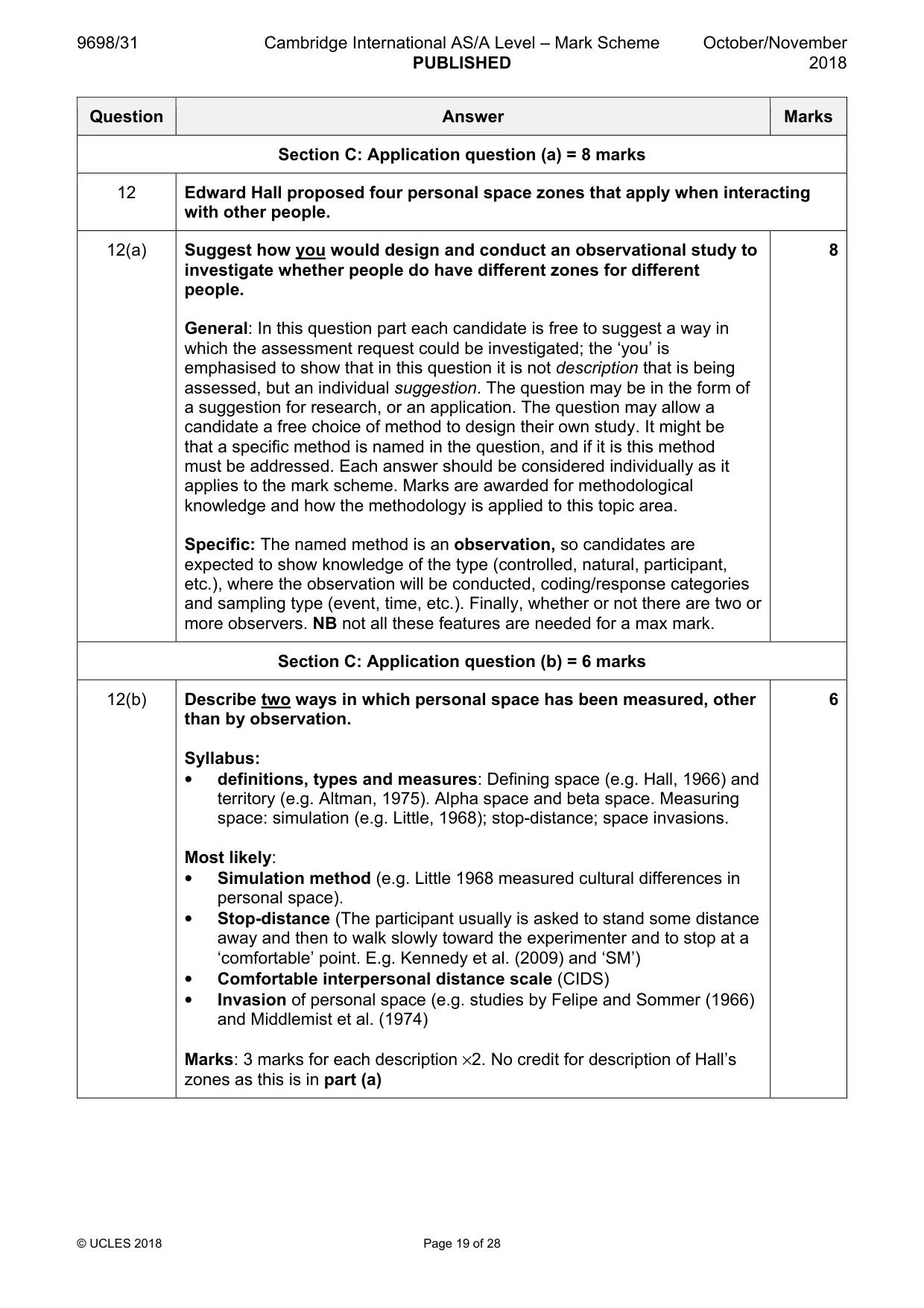
Mark scheme: 12(a) Suggest how you would design and conduct an observational study to 8 investigate whether people do have different zones for different people. General: In this question part each candidate is free to suggest a way in which the assessment request could be investigated; the ‘you’ is emphasised to show that in this question it is not description that is being assessed, but an individual suggestion. The question may be in the form of a suggestion for research, or an application. The question may allow a candidate a free choice of method to design their own study. It might be that a specific method is named in the question, and if it is this method must be addressed. Each answer should be considered individually as it applies to the mark scheme. Marks are awarded for methodological knowledge and how the methodology is applied to this topic area. Specific: The named method is an observation, so candidates are expected to show knowledge of the type (controlled, natural, participant, etc.), where the observation will be conducted, coding/response categories and sampling type (event, time, etc.). Finally, whether or not there are two or more observers. NB not all these features are needed for a max mark. Section C: Application question (b) = 6 marks 12(b) Describe two ways in which personal space has been measured, other 6 than by observation. Syllabus: • definitions, types and measures: Defining space (e.g. Hall, 1966) and territory (e.g. Altman, 1975). Alpha space and beta space. Measuring space: simulation (e.g. Little, 1968); stop-distance; space invasions. Most likely: • Simulation method (e.g. Little 1968 measured cultural differences in personal space). • Stop-distance (The participant usually is asked to stand some distance away and then to walk slowly toward the experimenter and to stop at a ‘comfortable’ point. E.g. Kennedy et al. (2009) and ‘SM’) • Comfortable interpersonal distance scale (CIDS) • Invasion of personal space (e.g. studies by Felipe and Sommer (1966) and Middlemist et al. (1974) Marks: 3 marks for each description ×2. No credit for description of Hall’s zones as this is in part (a) PSYCHOLOGY AND ABNORMALITY
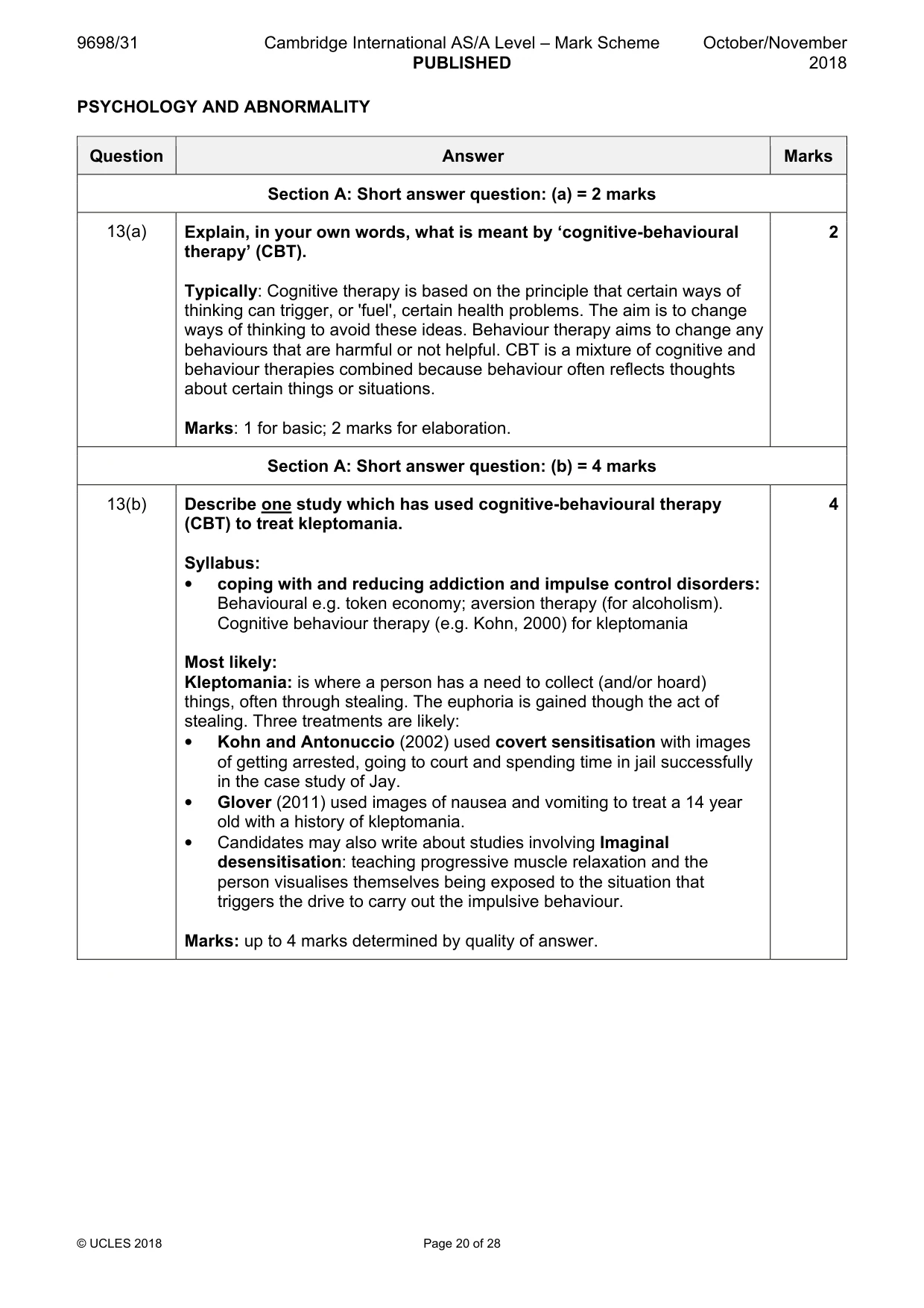
Q13 · Explain, in your own words, what is meant by ‘cognitive-behavioural therapy’ (CBT)
13 (a) Explain, in your own words, what is meant by ‘cognitive-behavioural therapy’ (CBT). [2] (b) Describe one study which has used cognitive-behavioural therapy (CBT) to treat kleptomania. [4]
Mark scheme: 13(a) Explain, in your own words, what is meant by ‘cognitive-behavioural 2 therapy’ (CBT). Typically: Cognitive therapy is based on the principle that certain ways of thinking can trigger, or 'fuel', certain health problems. The aim is to change ways of thinking to avoid these ideas. Behaviour therapy aims to change any behaviours that are harmful or not helpful. CBT is a mixture of cognitive and behaviour therapies combined because behaviour often reflects thoughts about certain things or situations. Marks: 1 for basic; 2 marks for elaboration. Section A: Short answer question: (b) = 4 marks 13(b) Describe one study which has used cognitive-behavioural therapy 4 (CBT) to treat kleptomania. Syllabus: • coping with and reducing addiction and impulse control disorders: Behavioural e.g. token economy; aversion therapy (for alcoholism). Cognitive behaviour therapy (e.g. Kohn, 2000) for kleptomania Most likely: Kleptomania: is where a person has a need to collect (and/or hoard) things, often through stealing. The euphoria is gained though the act of stealing. Three treatments are likely: • Kohn and Antonuccio (2002) used covert sensitisation with images of getting arrested, going to court and spending time in jail successfully in the case study of Jay. • Glover (2011) used images of nausea and vomiting to treat a 14 year old with a history of kleptomania. • Candidates may also write about studies involving Imaginal desensitisation: teaching progressive muscle relaxation and the person visualises themselves being exposed to the situation that triggers the drive to carry out the impulsive behaviour. Marks: up to 4 marks determined by quality of answer.
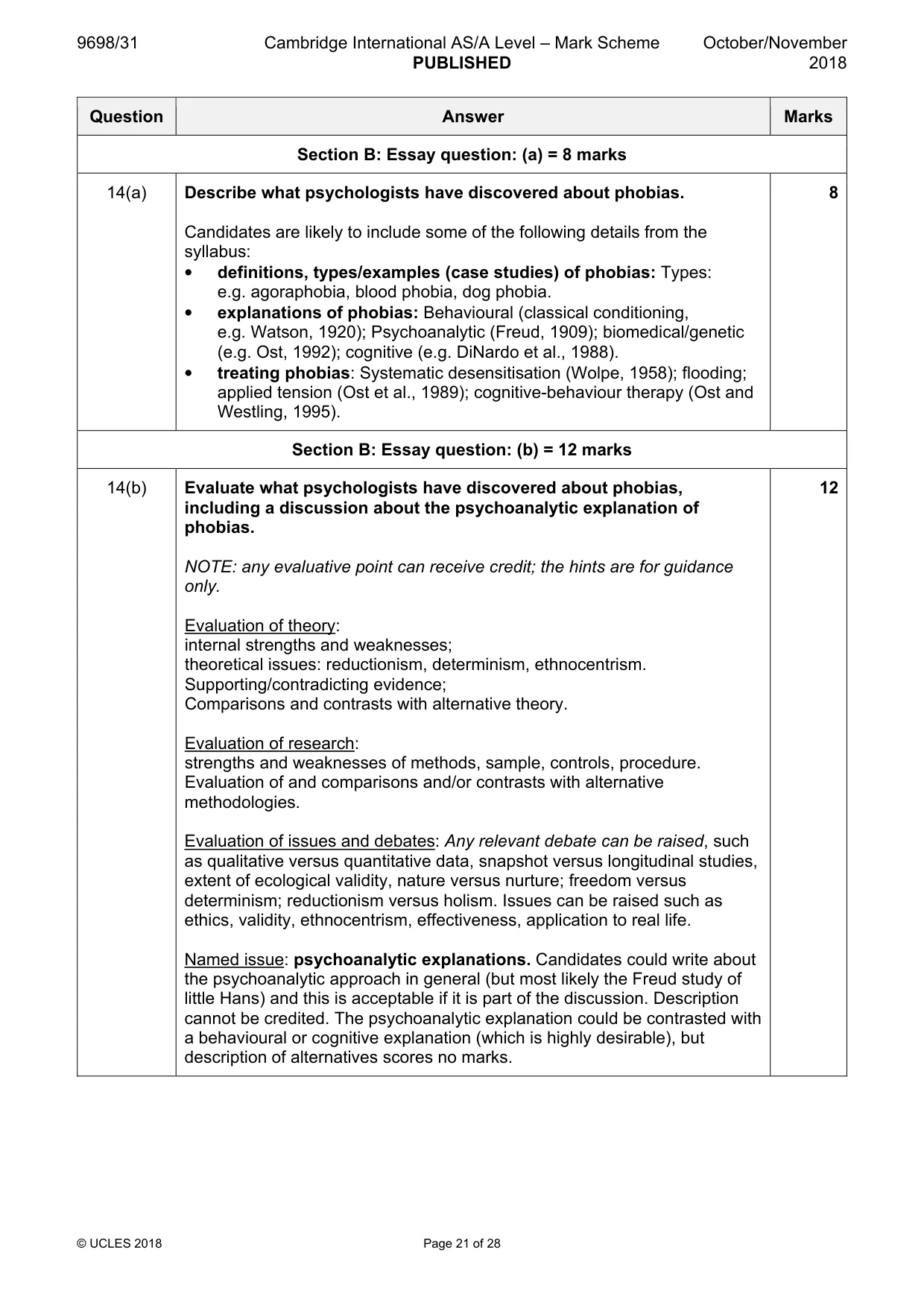
Q14 · Describe what psychologists have discovered about phobias
14 (a) Describe what psychologists have discovered about phobias. [8] (b) Evaluate what psychologists have discovered about phobias, including a discussion about the psychoanalytic explanation of phobias. [12] Section C Answer one question.
Mark scheme: 14(a) Describe what psychologists have discovered about phobias. 8 Candidates are likely to include some of the following details from the syllabus: • definitions, types/examples (case studies) of phobias: Types: e.g. agoraphobia, blood phobia, dog phobia. • explanations of phobias: Behavioural (classical conditioning, e.g. Watson, 1920); Psychoanalytic (Freud, 1909); biomedical/genetic (e.g. Ost, 1992); cognitive (e.g. DiNardo et al., 1988). • treating phobias: Systematic desensitisation (Wolpe, 1958); flooding; applied tension (Ost et al., 1989); cognitive-behaviour therapy (Ost and Westling, 1995). Section B: Essay question: (b) = 12 marks 14(b) Evaluate what psychologists have discovered about phobias, 12 including a discussion about the psychoanalytic explanation of phobias. NOTE: any evaluative point can receive credit; the hints are for guidance only. Evaluation of theory: internal strengths and weaknesses; theoretical issues: reductionism, determinism, ethnocentrism. Supporting/contradicting evidence; Comparisons and contrasts with alternative theory. Evaluation of research: strengths and weaknesses of methods, sample, controls, procedure. Evaluation of and comparisons and/or contrasts with alternative methodologies. Evaluation of issues and debates: Any relevant debate can be raised, such as qualitative versus quantitative data, snapshot versus longitudinal studies, extent of ecological validity, nature versus nurture; freedom versus determinism; reductionism versus holism. Issues can be raised such as ethics, validity, ethnocentrism, effectiveness, application to real life. Named issue: psychoanalytic explanations. Candidates could write about the psychoanalytic approach in general (but most likely the Freud study of little Hans) and this is acceptable if it is part of the discussion. Description cannot be credited. The psychoanalytic explanation could be contrasted with a behavioural or cognitive explanation (which is highly desirable), but description of alternatives scores no marks.
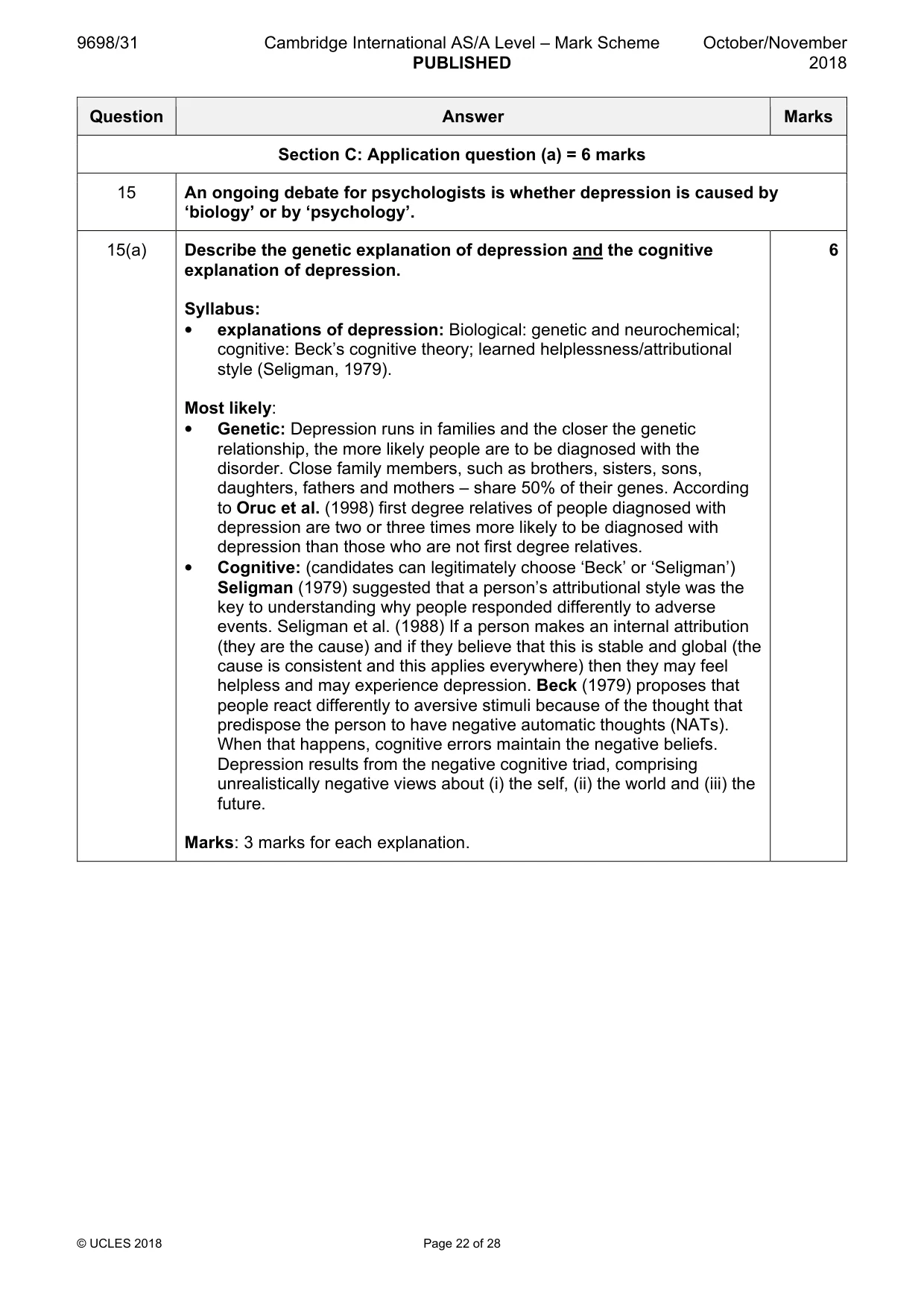
Q15 · An ongoing debate for psychologists is whether depression is caused by ‘biology’ or by…
15 An ongoing debate for psychologists is whether depression is caused by ‘biology’ or by ‘psychology’. (a) Describe the genetic explanation of depression and the cognitive explanation of depression. [6] (b) Suggest how you would design and conduct a study to investigate whether the cause of depression is ‘biology’ or ‘psychology’. [8]
Mark scheme: 15(a) Describe the genetic explanation of depression and the cognitive 6 explanation of depression. Syllabus: • explanations of depression: Biological: genetic and neurochemical; cognitive: Beck’s cognitive theory; learned helplessness/attributional style (Seligman, 1979). Most likely: • Genetic: Depression runs in families and the closer the genetic relationship, the more likely people are to be diagnosed with the disorder. Close family members, such as brothers, sisters, sons, daughters, fathers and mothers – share 50% of their genes. According to Oruc et al. (1998) first degree relatives of people diagnosed with depression are two or three times more likely to be diagnosed with depression than those who are not first degree relatives. • Cognitive: (candidates can legitimately choose ‘Beck’ or ‘Seligman’) Seligman (1979) suggested that a person’s attributional style was the key to understanding why people responded differently to adverse events. Seligman et al. (1988) If a person makes an internal attribution (they are the cause) and if they believe that this is stable and global (the cause is consistent and this applies everywhere) then they may feel helpless and may experience depression. Beck (1979) proposes that people react differently to aversive stimuli because of the thought that predispose the person to have negative automatic thoughts (NATs). When that happens, cognitive errors maintain the negative beliefs. Depression results from the negative cognitive triad, comprising unrealistically negative views about (i) the self, (ii) the world and (iii) the future. Marks: 3 marks for each explanation. Section C: Application question (b) = 8 marks 15(b) Suggest how you would design and conduct a study to investigate 8 whether the cause of depression is ‘biology’ or ‘psychology’. General: In this question part each candidate is free to suggest a way in which the assessment request could be investigated; the ‘you’ is emphasised to show that in this question it is not description that is being assessed, but an individual suggestion. The question may be in the form of a suggestion for research, or an application. The question may allow a candidate a free choice of method to design their own study. It might be that a specific method is named in the question, and if it is this method must be addressed. Each answer should be considered individually as it applies to the mark scheme. Marks are awarded for methodological knowledge and how the methodology is applied to this topic area. Specific: Candidates are free to choose any method. The choice of method should be appropriate and the answer should include the essential features of that method. Marks awarded for methodological knowledge and how methodology is applied to this topic area.
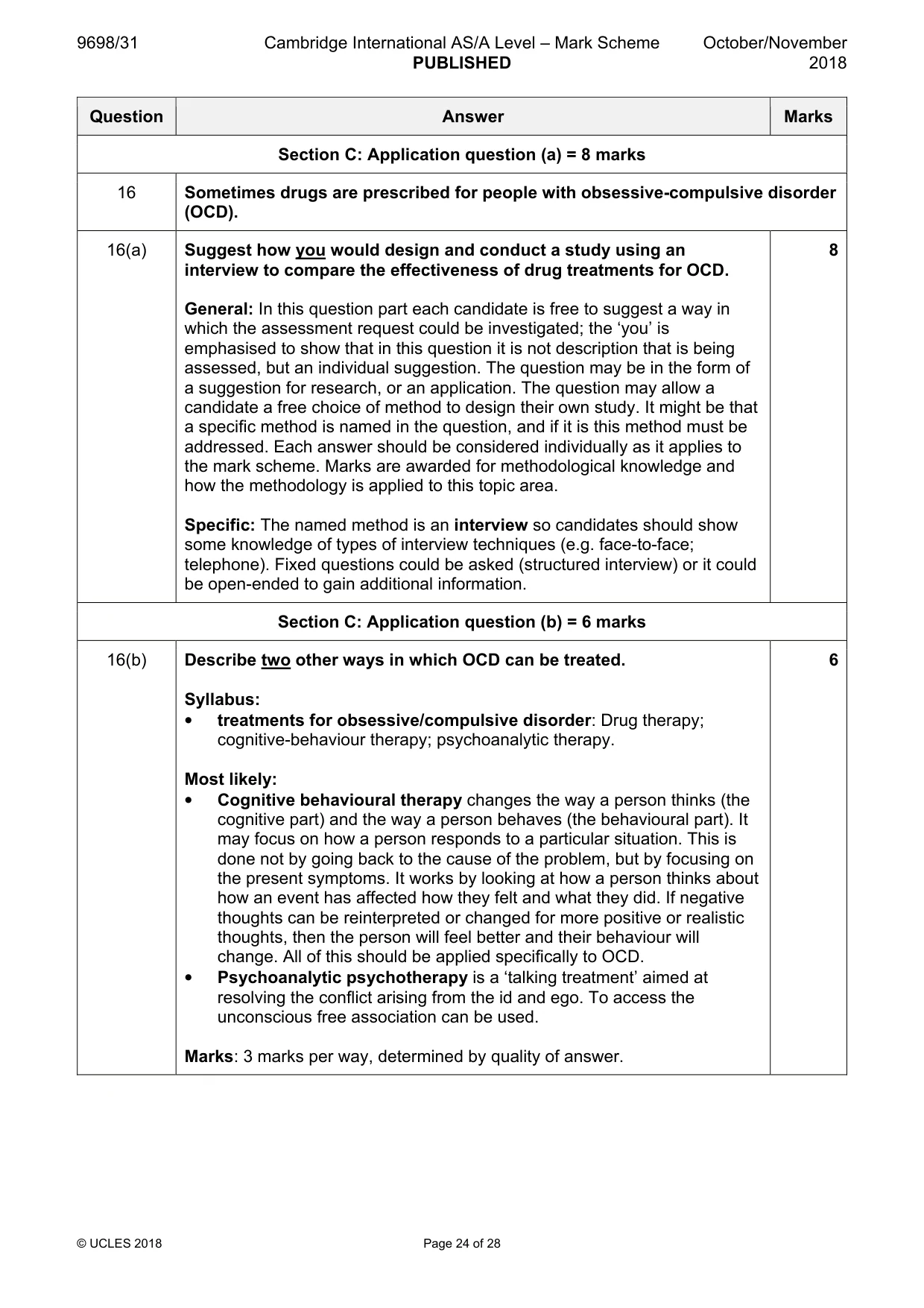
Q16 · Sometimes drugs are prescribed for people with obsessive-compulsive disorder (OCD)
16 Sometimes drugs are prescribed for people with obsessive-compulsive disorder (OCD). (a) Suggest how you would design and conduct a study using an interview to find out the effectiveness of drug treatments for OCD. [8] (b) Describe two other ways in which OCD can be treated. [6] Psychology and Organisations Section A Answer this question.
Mark scheme: 16(a) Suggest how you would design and conduct a study using an 8 interview to compare the effectiveness of drug treatments for OCD. General: In this question part each candidate is free to suggest a way in which the assessment request could be investigated; the ‘you’ is emphasised to show that in this question it is not description that is being assessed, but an individual suggestion. The question may be in the form of a suggestion for research, or an application. The question may allow a candidate a free choice of method to design their own study. It might be that a specific method is named in the question, and if it is this method must be addressed. Each answer should be considered individually as it applies to the mark scheme. Marks are awarded for methodological knowledge and how the methodology is applied to this topic area. Specific: The named method is an interview so candidates should show some knowledge of types of interview techniques (e.g. face-to-face; telephone). Fixed questions could be asked (structured interview) or it could be open-ended to gain additional information. Section C: Application question (b) = 6 marks 16(b) Describe two other ways in which OCD can be treated. 6 Syllabus: • treatments for obsessive/compulsive disorder: Drug therapy; cognitive-behaviour therapy; psychoanalytic therapy. Most likely: • Cognitive behavioural therapy changes the way a person thinks (the cognitive part) and the way a person behaves (the behavioural part). It may focus on how a person responds to a particular situation. This is done not by going back to the cause of the problem, but by focusing on the present symptoms. It works by looking at how a person thinks about how an event has affected how they felt and what they did. If negative thoughts can be reinterpreted or changed for more positive or realistic thoughts, then the person will feel better and their behaviour will change. All of this should be applied specifically to OCD. • Psychoanalytic psychotherapy is a ‘talking treatment’ aimed at resolving the conflict arising from the id and ego. To access the unconscious free association can be used. Marks: 3 marks per way, determined by quality of answer. PSYCHOLOGY AND ORGANISATIONS
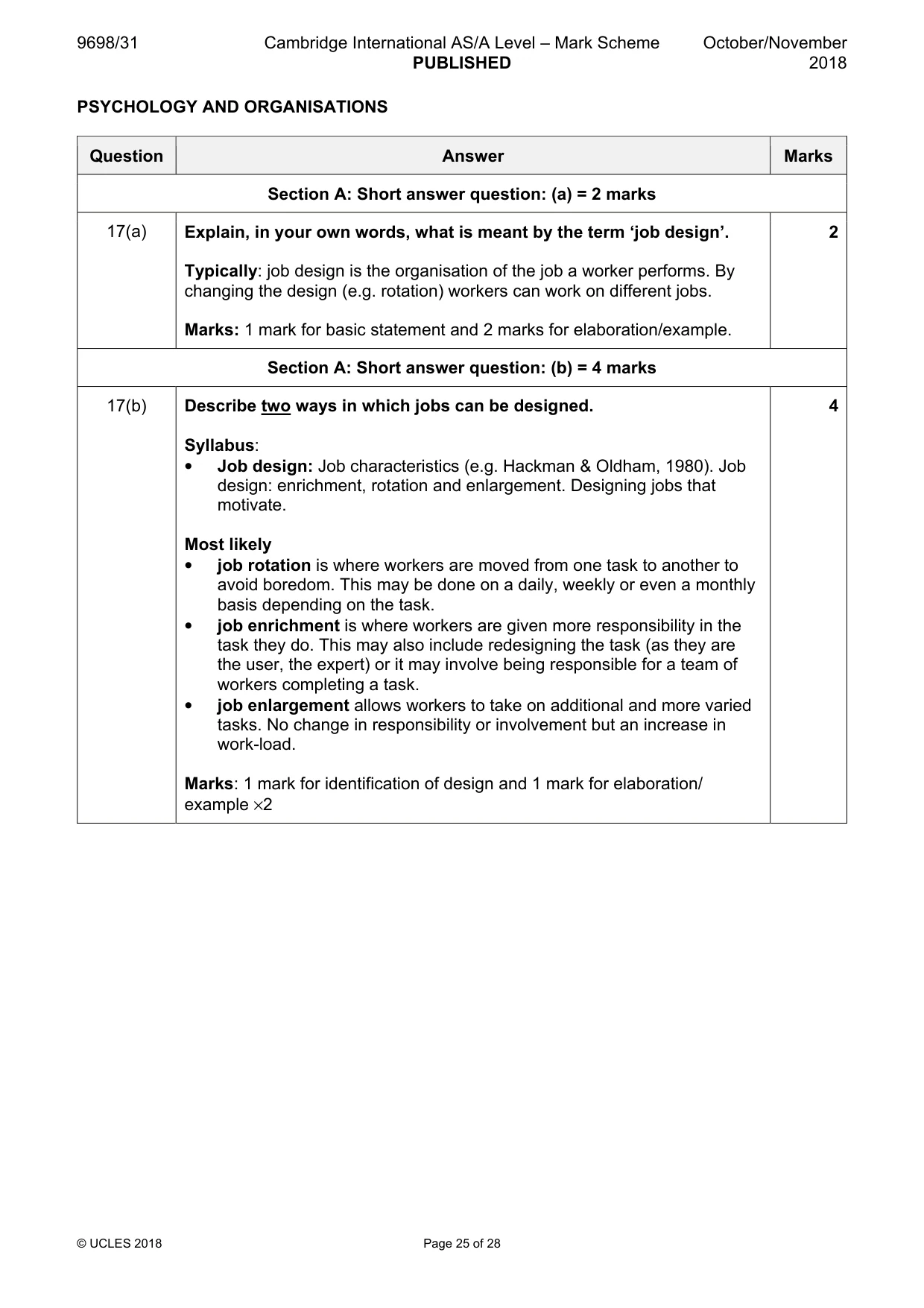
Q17 · Explain, in your own words, what is meant by the term ‘job design’
17 (a) Explain, in your own words, what is meant by the term ‘job design’. [2] (b) Describe two ways in which jobs can be designed. [4]
Mark scheme: 17(a) Explain, in your own words, what is meant by the term ‘job design’. 2 Typically: job design is the organisation of the job a worker performs. By changing the design (e.g. rotation) workers can work on different jobs. Marks: 1 mark for basic statement and 2 marks for elaboration/example. Section A: Short answer question: (b) = 4 marks 17(b) Describe two ways in which jobs can be designed. 4 Syllabus: • Job design: Job characteristics (e.g. Hackman & Oldham, 1980). Job design: enrichment, rotation and enlargement. Designing jobs that motivate. Most likely • job rotation is where workers are moved from one task to another to avoid boredom. This may be done on a daily, weekly or even a monthly basis depending on the task. • job enrichment is where workers are given more responsibility in the task they do. This may also include redesigning the task (as they are the user, the expert) or it may involve being responsible for a team of workers completing a task. • job enlargement allows workers to take on additional and more varied tasks. No change in responsibility or involvement but an increase in work-load. Marks: 1 mark for identification of design and 1 mark for elaboration/ example ×2
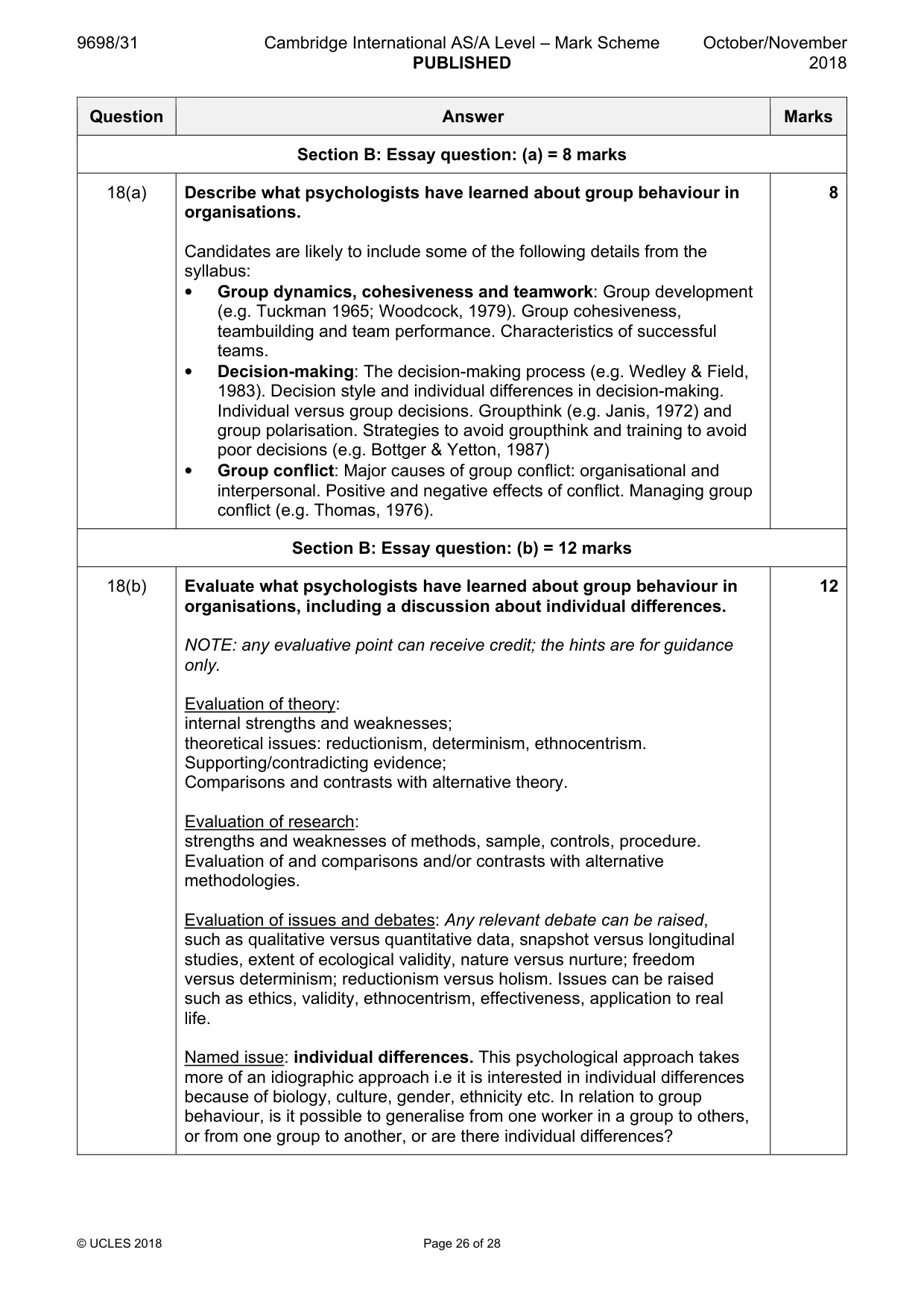
Q18 · Describe what psychologists have learned about group behaviour in organisations
18 (a) Describe what psychologists have learned about group behaviour in organisations. [8] (b) Evaluate what psychologists have learned about group behaviour in organisations, including a discussion about individual differences. [12] Section C Answer one question.
Mark scheme: 18(a) Describe what psychologists have learned about group behaviour in 8 organisations. Candidates are likely to include some of the following details from the syllabus: • Group dynamics, cohesiveness and teamwork: Group development (e.g. Tuckman 1965; Woodcock, 1979). Group cohesiveness, teambuilding and team performance. Characteristics of successful teams. • Decision-making: The decision-making process (e.g. Wedley & Field, 1983). Decision style and individual differences in decision-making. Individual versus group decisions. Groupthink (e.g. Janis, 1972) and group polarisation. Strategies to avoid groupthink and training to avoid poor decisions (e.g. Bottger & Yetton, 1987) • Group conflict: Major causes of group conflict: organisational and interpersonal. Positive and negative effects of conflict. Managing group conflict (e.g. Thomas, 1976). Section B: Essay question: (b) = 12 marks 18(b) Evaluate what psychologists have learned about group behaviour in 12 organisations, including a discussion about individual differences. NOTE: any evaluative point can receive credit; the hints are for guidance only. Evaluation of theory: internal strengths and weaknesses; theoretical issues: reductionism, determinism, ethnocentrism. Supporting/contradicting evidence; Comparisons and contrasts with alternative theory. Evaluation of research: strengths and weaknesses of methods, sample, controls, procedure. Evaluation of and comparisons and/or contrasts with alternative methodologies. Evaluation of issues and debates: Any relevant debate can be raised, such as qualitative versus quantitative data, snapshot versus longitudinal studies, extent of ecological validity, nature versus nurture; freedom versus determinism; reductionism versus holism. Issues can be raised such as ethics, validity, ethnocentrism, effectiveness, application to real life. Named issue: individual differences. This psychological approach takes more of an idiographic approach i.e it is interested in individual differences because of biology, culture, gender, ethnicity etc. In relation to group behaviour, is it possible to generalise from one worker in a group to others, or from one group to another, or are there individual differences?
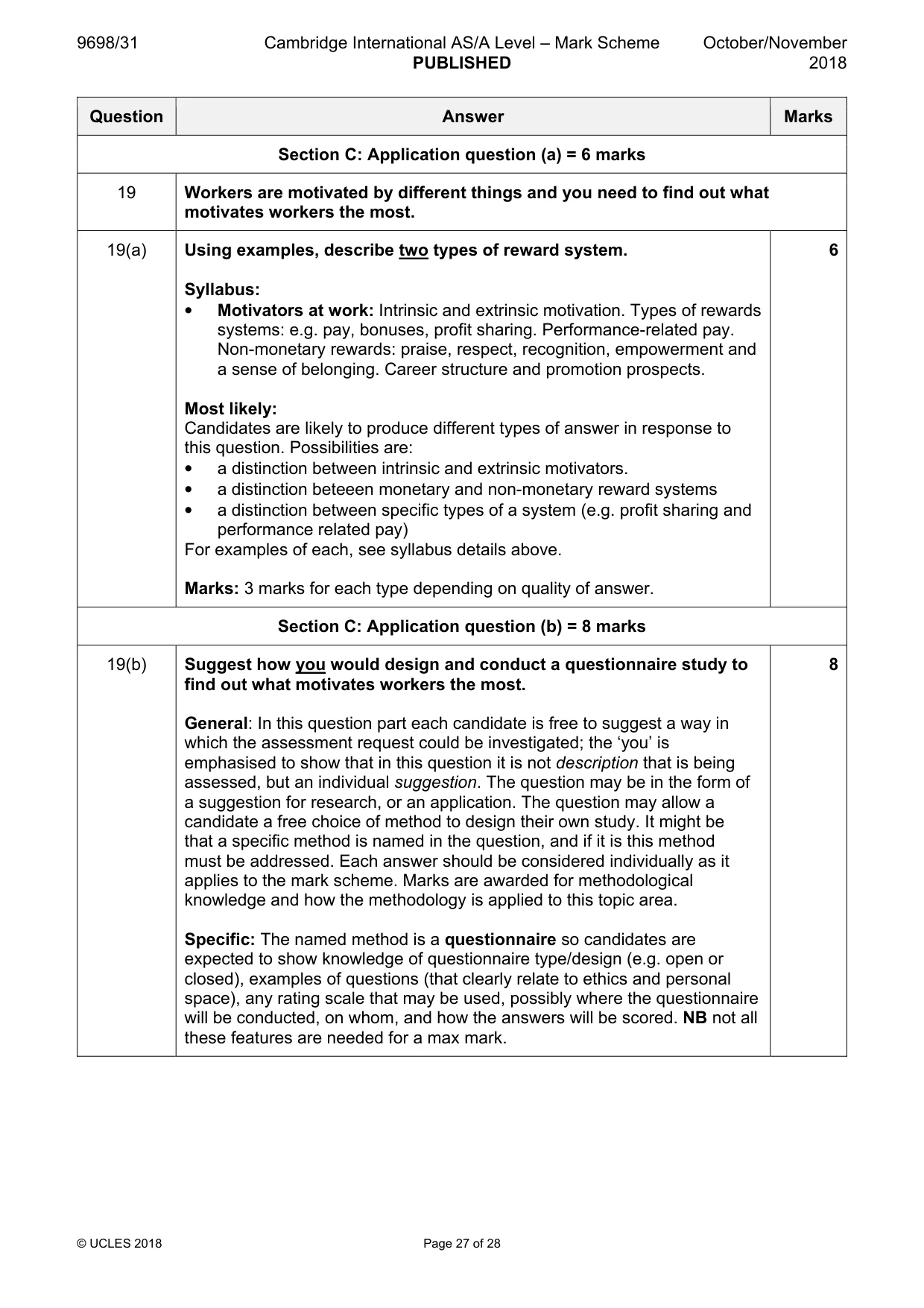
Q19 · Workers are motivated by different things and you need to find out what motivates workers…
19 Workers are motivated by different things and you need to find out what motivates workers the most. (a) Using examples, describe two types of reward system. [6] (b) Suggest how you would design and conduct a questionnaire study to find out what motivates workers the most. [8]
Mark scheme: 19(a) Using examples, describe two types of reward system. 6 Syllabus: • Motivators at work: Intrinsic and extrinsic motivation. Types of rewards systems: e.g. pay, bonuses, profit sharing. Performance-related pay. Non-monetary rewards: praise, respect, recognition, empowerment and a sense of belonging. Career structure and promotion prospects. Most likely: Candidates are likely to produce different types of answer in response to this question. Possibilities are: • a distinction between intrinsic and extrinsic motivators. • a distinction beteeen monetary and non-monetary reward systems • a distinction between specific types of a system (e.g. profit sharing and performance related pay) For examples of each, see syllabus details above. Marks: 3 marks for each type depending on quality of answer. Section C: Application question (b) = 8 marks 19(b) Suggest how you would design and conduct a questionnaire study to 8 find out what motivates workers the most. General: In this question part each candidate is free to suggest a way in which the assessment request could be investigated; the ‘you’ is emphasised to show that in this question it is not description that is being assessed, but an individual suggestion. The question may be in the form of a suggestion for research, or an application. The question may allow a candidate a free choice of method to design their own study. It might be that a specific method is named in the question, and if it is this method must be addressed. Each answer should be considered individually as it applies to the mark scheme. Marks are awarded for methodological knowledge and how the methodology is applied to this topic area. Specific: The named method is a questionnaire so candidates are expected to show knowledge of questionnaire type/design (e.g. open or closed), examples of questions (that clearly relate to ethics and personal space), any rating scale that may be used, possibly where the questionnaire will be conducted, on whom, and how the answers will be scored. NB not all these features are needed for a max mark.
Q20 · Beeps, buzzes and bells can be used as auditory warnings of machine malfunction
20 Beeps, buzzes and bells can be used as auditory warnings of machine malfunction. (a) Suggest how you would design and conduct a field experiment to find out which sound is most effective in alerting workers to a machine malfunction. [8] (b) Using examples, describe different errors that could be made when operating machines. [6]
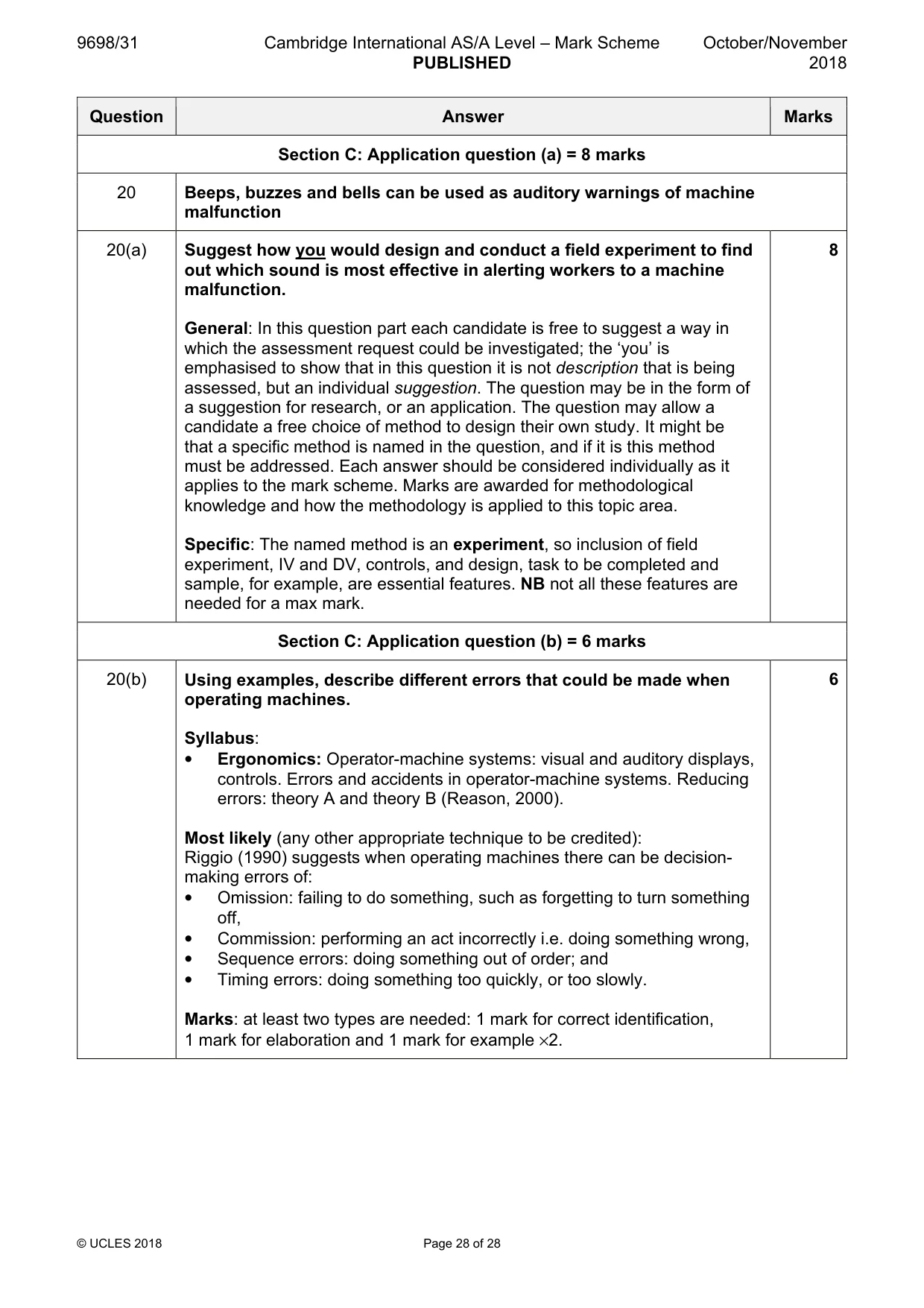
Mark scheme: 20(a) Suggest how you would design and conduct a field experiment to find 8 out which sound is most effective in alerting workers to a machine malfunction. General: In this question part each candidate is free to suggest a way in which the assessment request could be investigated; the ‘you’ is emphasised to show that in this question it is not description that is being assessed, but an individual suggestion. The question may be in the form of a suggestion for research, or an application. The question may allow a candidate a free choice of method to design their own study. It might be that a specific method is named in the question, and if it is this method must be addressed. Each answer should be considered individually as it applies to the mark scheme. Marks are awarded for methodological knowledge and how the methodology is applied to this topic area. Specific: The named method is an experiment, so inclusion of field experiment, IV and DV, controls, and design, task to be completed and sample, for example, are essential features. NB not all these features are needed for a max mark. Section C: Application question (b) = 6 marks 20(b) Using examples, describe different errors that could be made when 6 operating machines. Syllabus: • Ergonomics: Operator-machine systems: visual and auditory displays, controls. Errors and accidents in operator-machine systems. Reducing errors: theory A and theory B (Reason, 2000). Most likely (any other appropriate technique to be credited): Riggio (1990) suggests when operating machines there can be decision- making errors of: • Omission: failing to do something, such as forgetting to turn something off, • Commission: performing an act incorrectly i.e. doing something wrong, • Sequence errors: doing something out of order; and • Timing errors: doing something too quickly, or too slowly. Marks: at least two types are needed: 1 mark for correct identification, 1 mark for elaboration and 1 mark for example ×2.
What you needed in this session
Cambridge’s own grade thresholds for 2018 Oct/Nov, Paper 3 · Variant 1. A higher threshold means an easier paper — the bar moves with how the cohort did.