Cambridge A Level Psychology 9698 — 2018 May/June Paper 3 · Variant 2
9698/32/M/J/18 · 20 questions · 80 marks · ≈90 min
The question paper and its mark scheme, free to read here and free to download. This is Cambridge’s own paper, exactly as it was sat.
Question paper8 pages
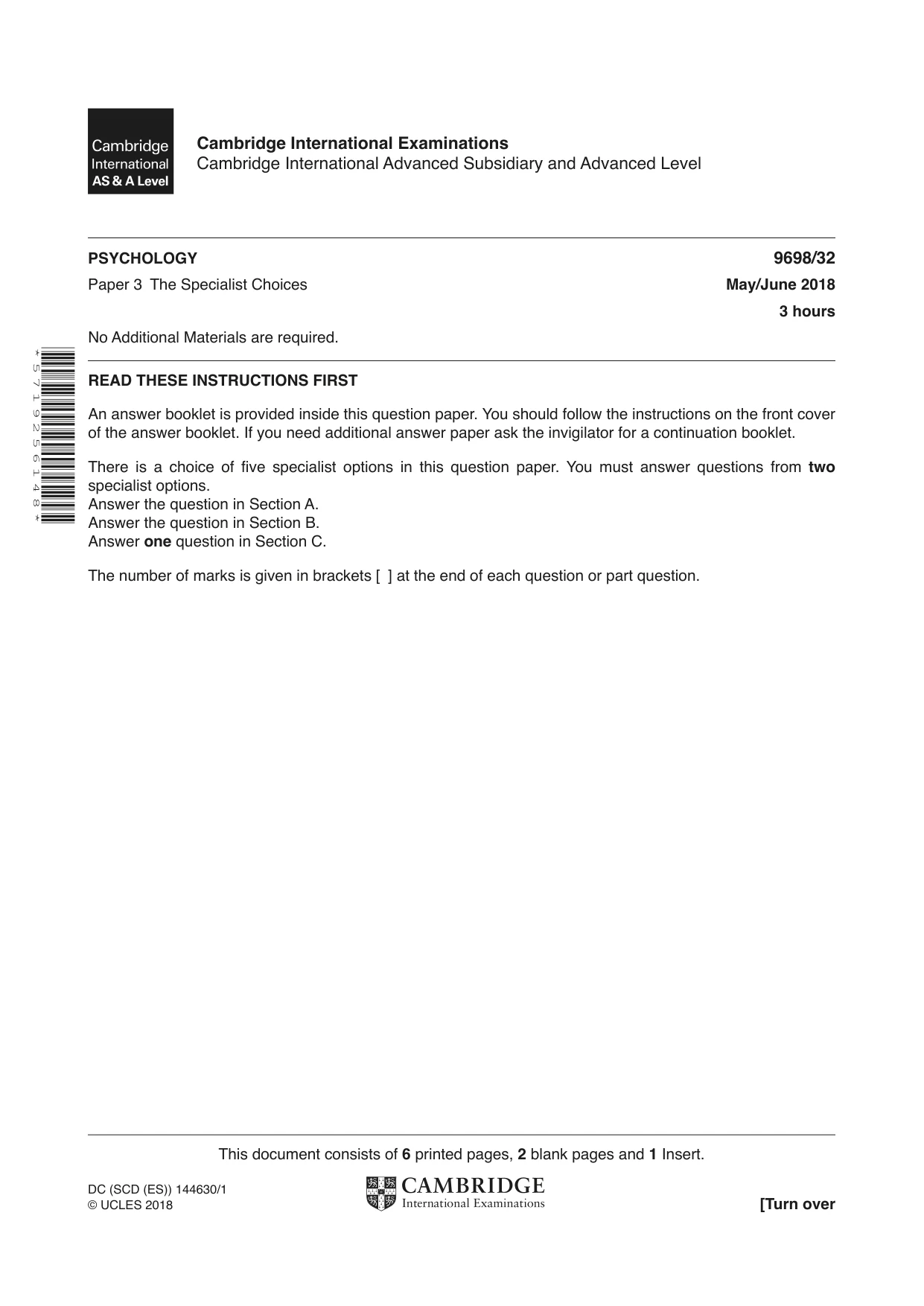
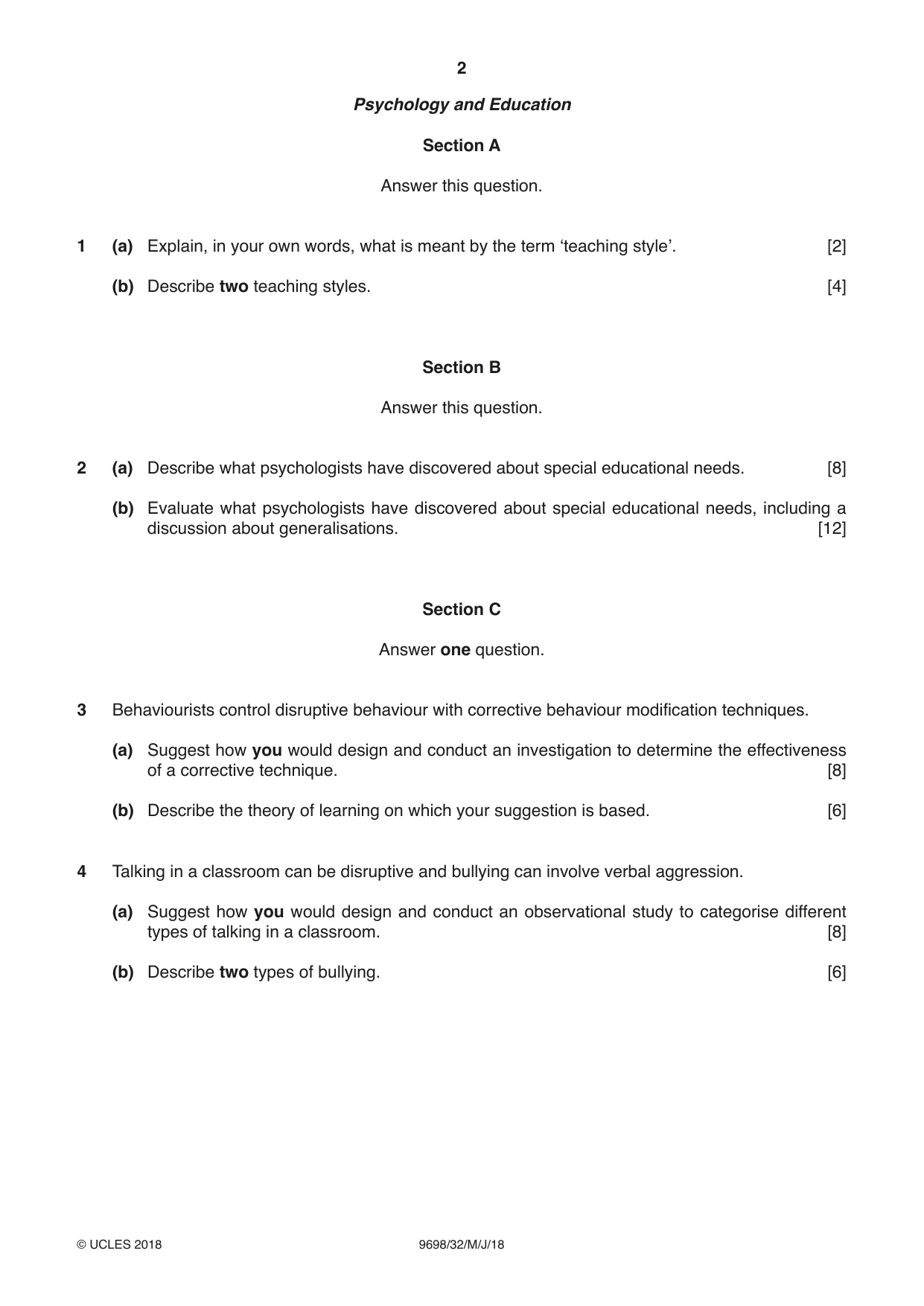
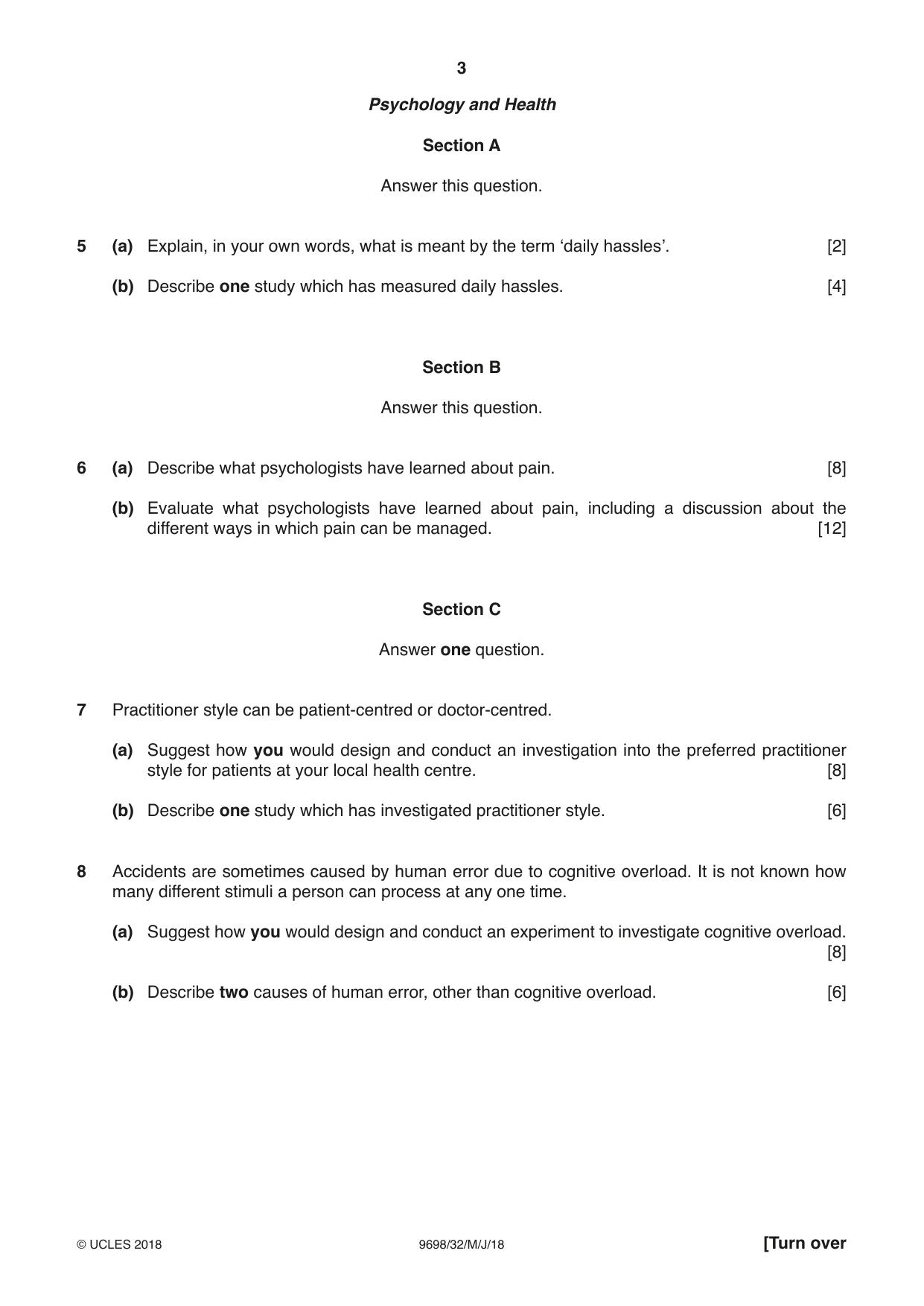
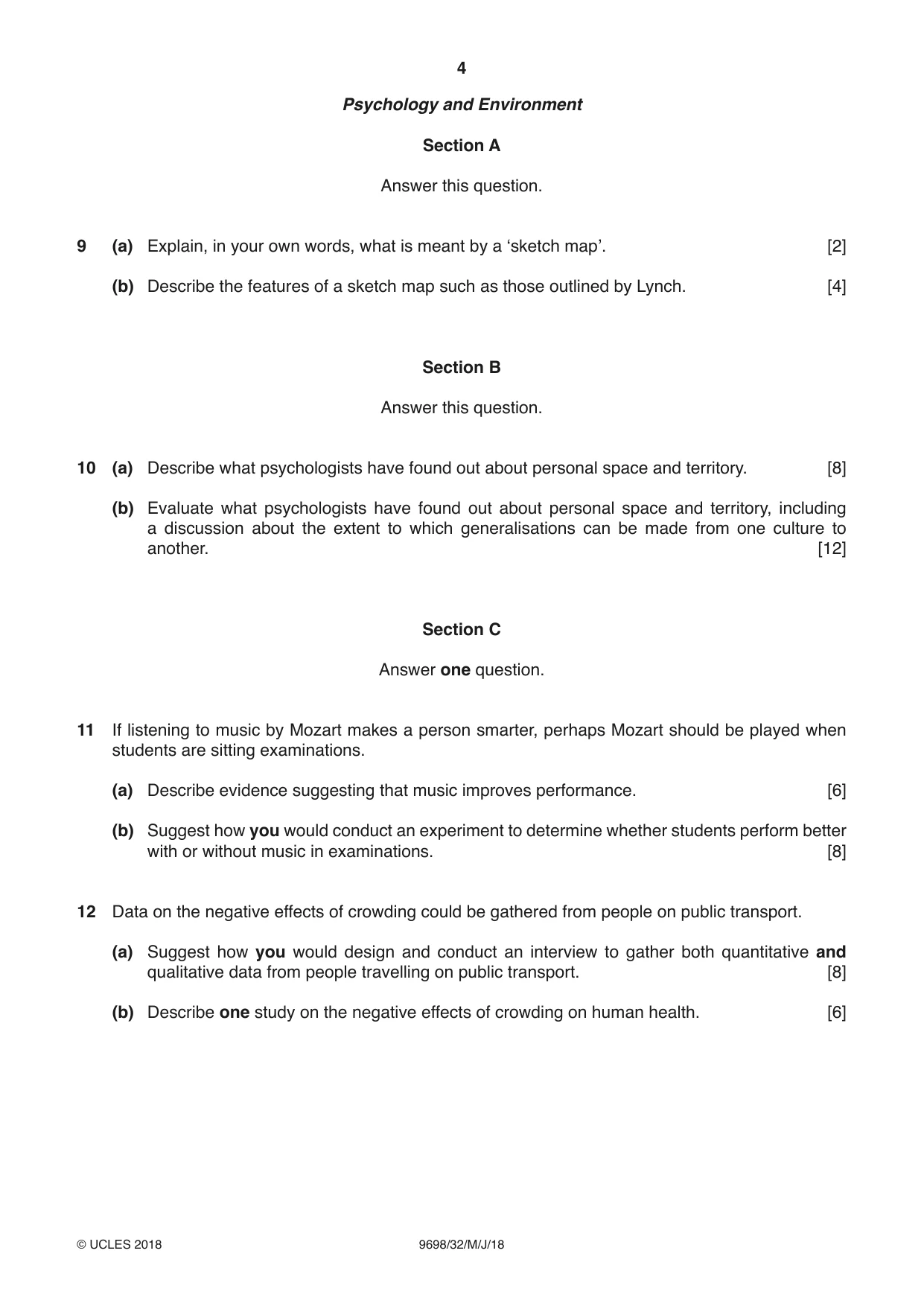


Mark scheme28 pages
Answers below. Sit the paper first if you are practising.
Questions as text
Q1 · Explain, in your own words, what is meant by the term ‘teaching style’
1 (a) Explain, in your own words, what is meant by the term ‘teaching style’. [2] (b) Describe two teaching styles. [4]
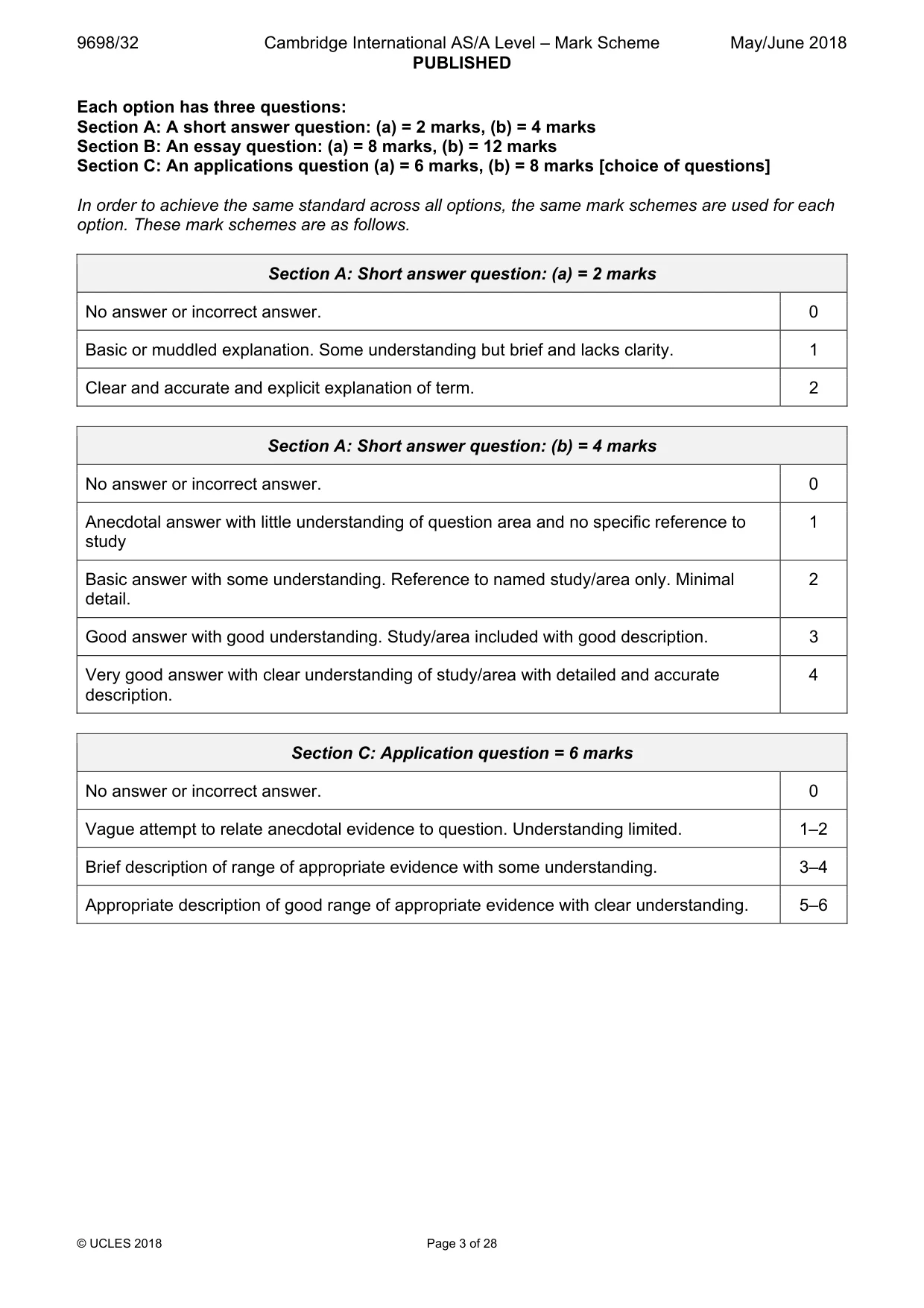
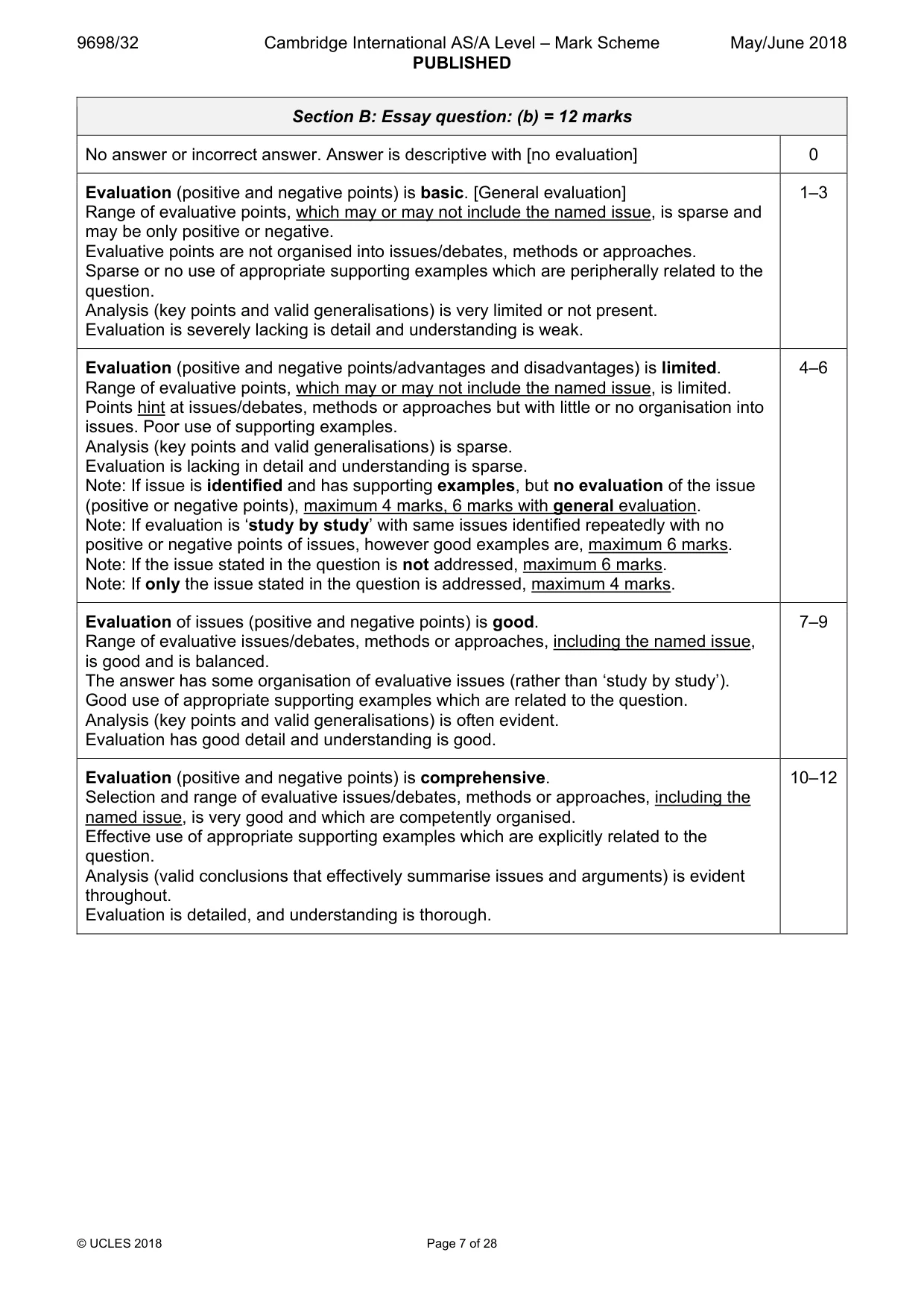
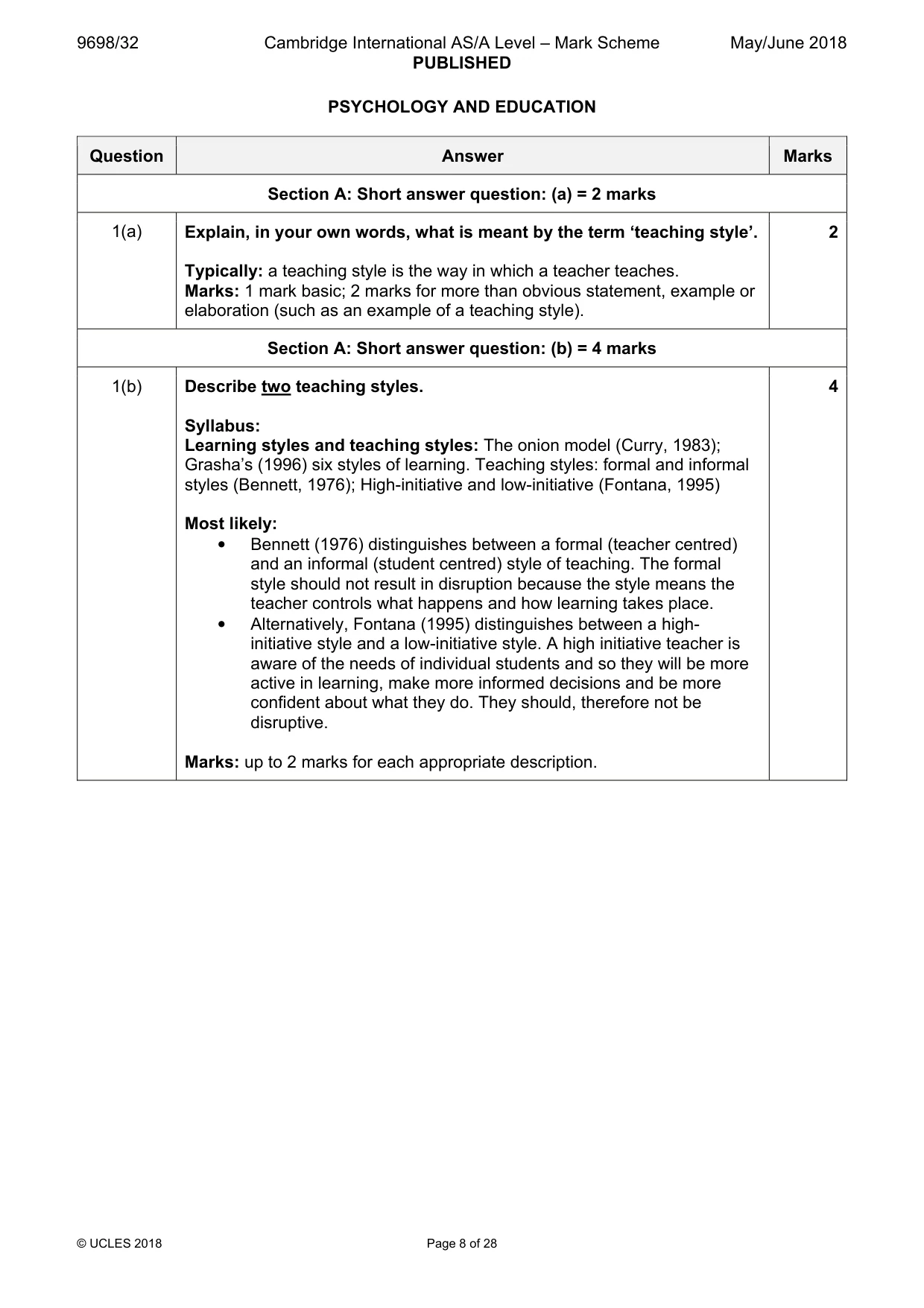
Mark scheme: Question Answer Marks Section A: Short answer question: (a) = 2 marks 1(a) Explain, in your own words, what is meant by the term ‘teaching style’. 2 Typically: a teaching style is the way in which a teacher teaches. Marks: 1 mark basic; 2 marks for more than obvious statement, example or elaboration (such as an example of a teaching style). Section A: Short answer question: (b) = 4 marks 1(b) Describe two teaching styles. 4 Syllabus: Learning styles and teaching styles: The onion model (Curry, 1983); Grasha’s (1996) six styles of learning. Teaching styles: formal and informal styles (Bennett, 1976); High-initiative and low-initiative (Fontana, 1995) Most likely: • Bennett (1976) distinguishes between a formal (teacher centred) and an informal (student centred) style of teaching. The formal style should not result in disruption because the style means the teacher controls what happens and how learning takes place. • Alternatively, Fontana (1995) distinguishes between a high- initiative style and a low-initiative style. A high initiative teacher is aware of the needs of individual students and so they will be more active in learning, make more informed decisions and be more confident about what they do. They should, therefore not be disruptive. Marks: up to 2 marks for each appropriate description.
Q2 · Describe what psychologists have discovered about special educational needs
2 (a) Describe what psychologists have discovered about special educational needs. [8] (b) Evaluate what psychologists have discovered about special educational needs, including a discussion about generalisations. [12] Section C Answer one question.
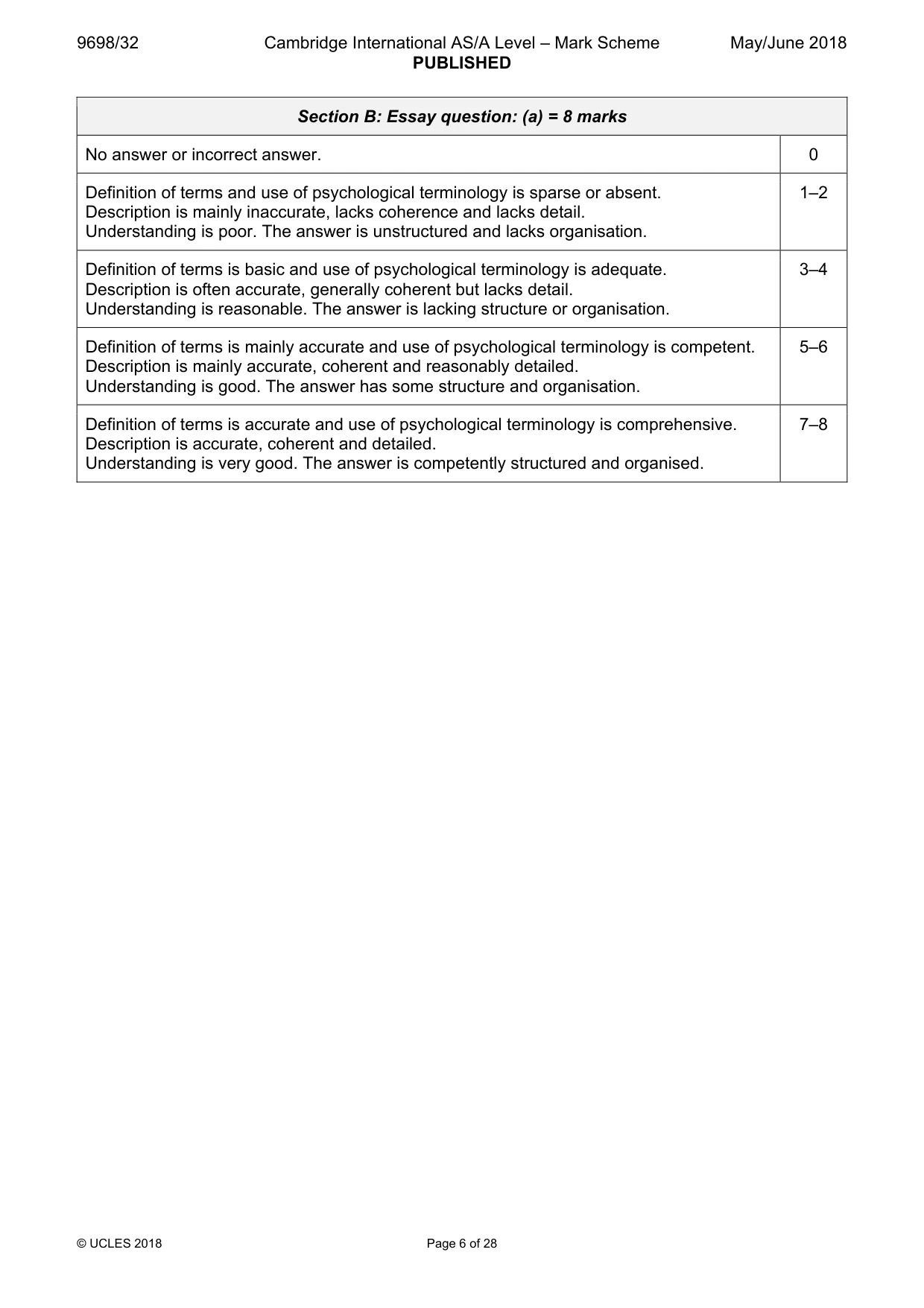
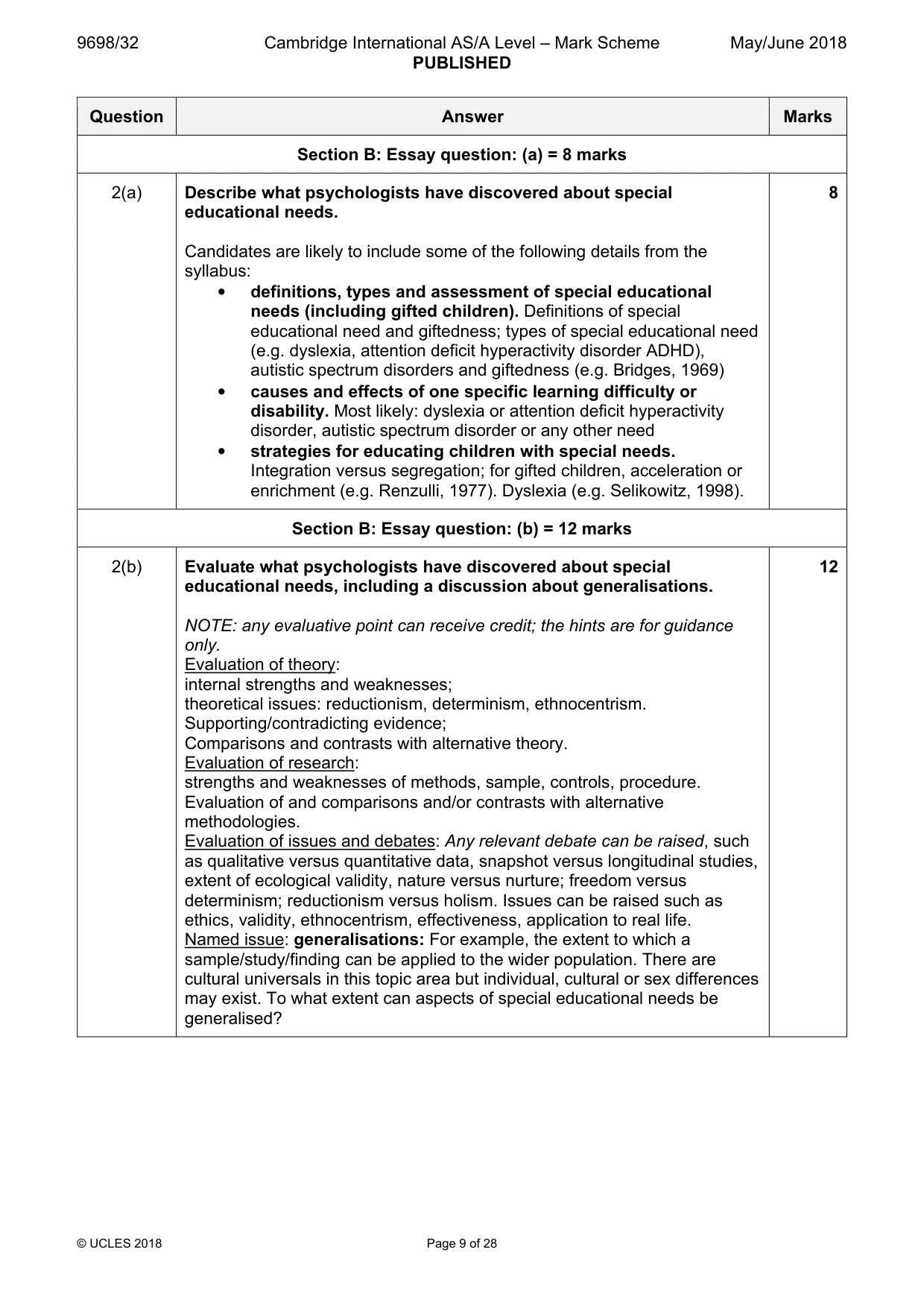
Mark scheme: 2(a) Describe what psychologists have discovered about special 8 educational needs. Candidates are likely to include some of the following details from the syllabus: • definitions, types and assessment of special educational needs (including gifted children). Definitions of special educational need and giftedness; types of special educational need (e.g. dyslexia, attention deficit hyperactivity disorder ADHD), autistic spectrum disorders and giftedness (e.g. Bridges, 1969) • causes and effects of one specific learning difficulty or disability. Most likely: dyslexia or attention deficit hyperactivity disorder, autistic spectrum disorder or any other need • strategies for educating children with special needs. Integration versus segregation; for gifted children, acceleration or enrichment (e.g. Renzulli, 1977). Dyslexia (e.g. Selikowitz, 1998). Section B: Essay question: (b) = 12 marks 2(b) Evaluate what psychologists have discovered about special 12 educational needs, including a discussion about generalisations. NOTE: any evaluative point can receive credit; the hints are for guidance only. Evaluation of theory: internal strengths and weaknesses; theoretical issues: reductionism, determinism, ethnocentrism. Supporting/contradicting evidence; Comparisons and contrasts with alternative theory. Evaluation of research: strengths and weaknesses of methods, sample, controls, procedure. Evaluation of and comparisons and/or contrasts with alternative methodologies. Evaluation of issues and debates: Any relevant debate can be raised, such as qualitative versus quantitative data, snapshot versus longitudinal studies, extent of ecological validity, nature versus nurture; freedom versus determinism; reductionism versus holism. Issues can be raised such as ethics, validity, ethnocentrism, effectiveness, application to real life. Named issue: generalisations: For example, the extent to which a sample/study/finding can be applied to the wider population. There are cultural universals in this topic area but individual, cultural or sex differences may exist. To what extent can aspects of special educational needs be generalised?
Q3 · Behaviourists control disruptive behaviour with corrective behaviour modification…
3 Behaviourists control disruptive behaviour with corrective behaviour modification techniques. (a) Suggest how you would design and conduct an investigation to determine the effectiveness of a corrective technique. [8] (b) Describe the theory of learning on which your suggestion is based. [6]
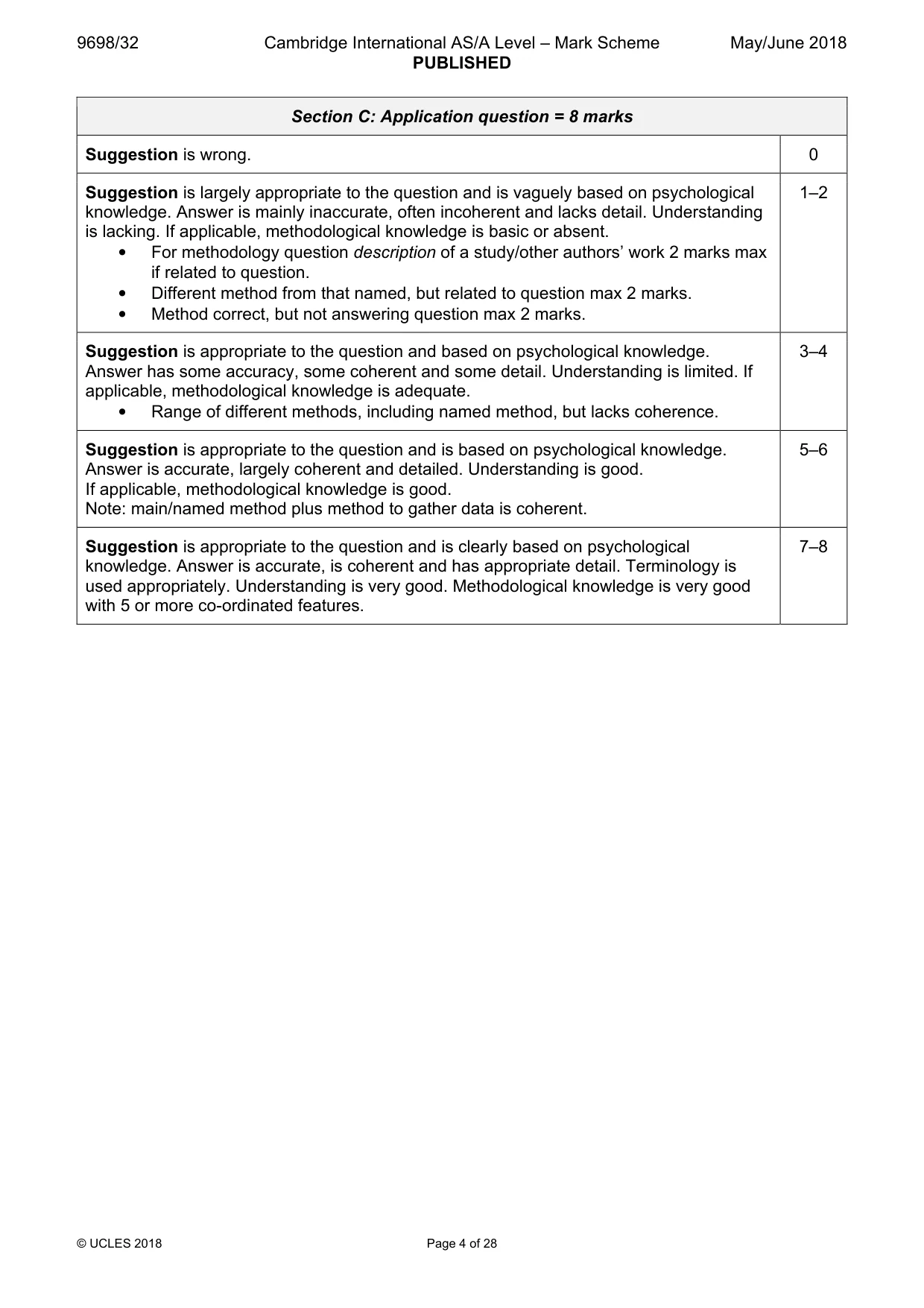
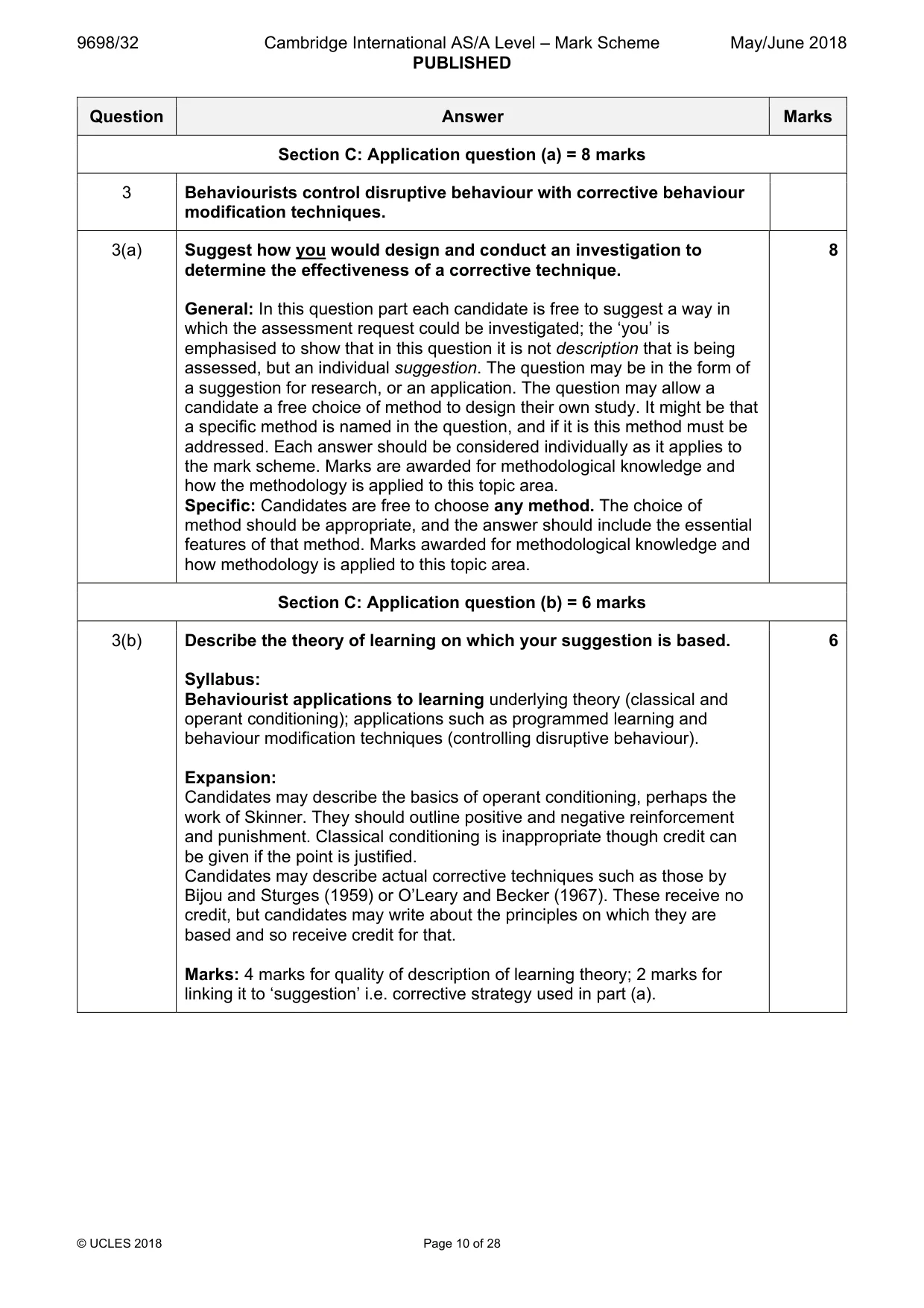
Mark scheme: 3 Behaviourists control disruptive behaviour with corrective behaviour modification techniques. 3(a) Suggest how you would design and conduct an investigation to 8 determine the effectiveness of a corrective technique. General: In this question part each candidate is free to suggest a way in which the assessment request could be investigated; the ‘you’ is emphasised to show that in this question it is not description that is being assessed, but an individual suggestion. The question may be in the form of a suggestion for research, or an application. The question may allow a candidate a free choice of method to design their own study. It might be that a specific method is named in the question, and if it is this method must be addressed. Each answer should be considered individually as it applies to the mark scheme. Marks are awarded for methodological knowledge and how the methodology is applied to this topic area. Specific: Candidates are free to choose any method. The choice of method should be appropriate, and the answer should include the essential features of that method. Marks awarded for methodological knowledge and how methodology is applied to this topic area. Section C: Application question (b) = 6 marks 3(b) Describe the theory of learning on which your suggestion is based. 6 Syllabus: Behaviourist applications to learning underlying theory (classical and operant conditioning); applications such as programmed learning and behaviour modification techniques (controlling disruptive behaviour). Expansion: Candidates may describe the basics of operant conditioning, perhaps the work of Skinner. They should outline positive and negative reinforcement and punishment. Classical conditioning is inappropriate though credit can be given if the point is justified. Candidates may describe actual corrective techniques such as those by Bijou and Sturges (1959) or O’Leary and Becker (1967). These receive no credit, but candidates may write about the principles on which they are based and so receive credit for that. Marks: 4 marks for quality of description of learning theory; 2 marks for linking it to ‘suggestion’ i.e. corrective strategy used in part (a).
Q4 · Talking in a classroom can be disruptive and bullying can involve verbal aggression
4 Talking in a classroom can be disruptive and bullying can involve verbal aggression. (a) Suggest how you would design and conduct an observational study to categorise different types of talking in a classroom. [8] (b) Describe two types of bullying. [6] Psychology and Health Section A Answer this question.
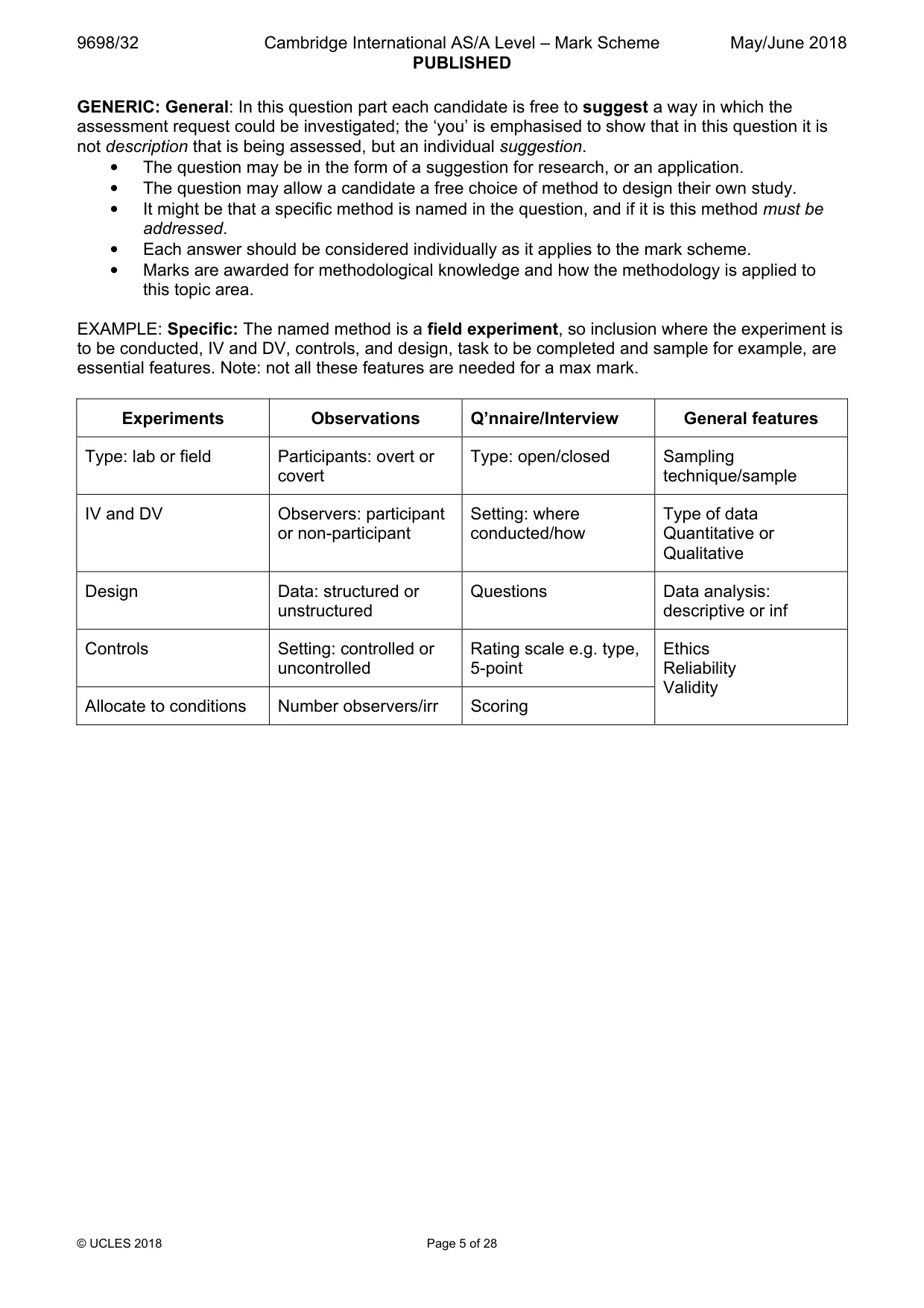
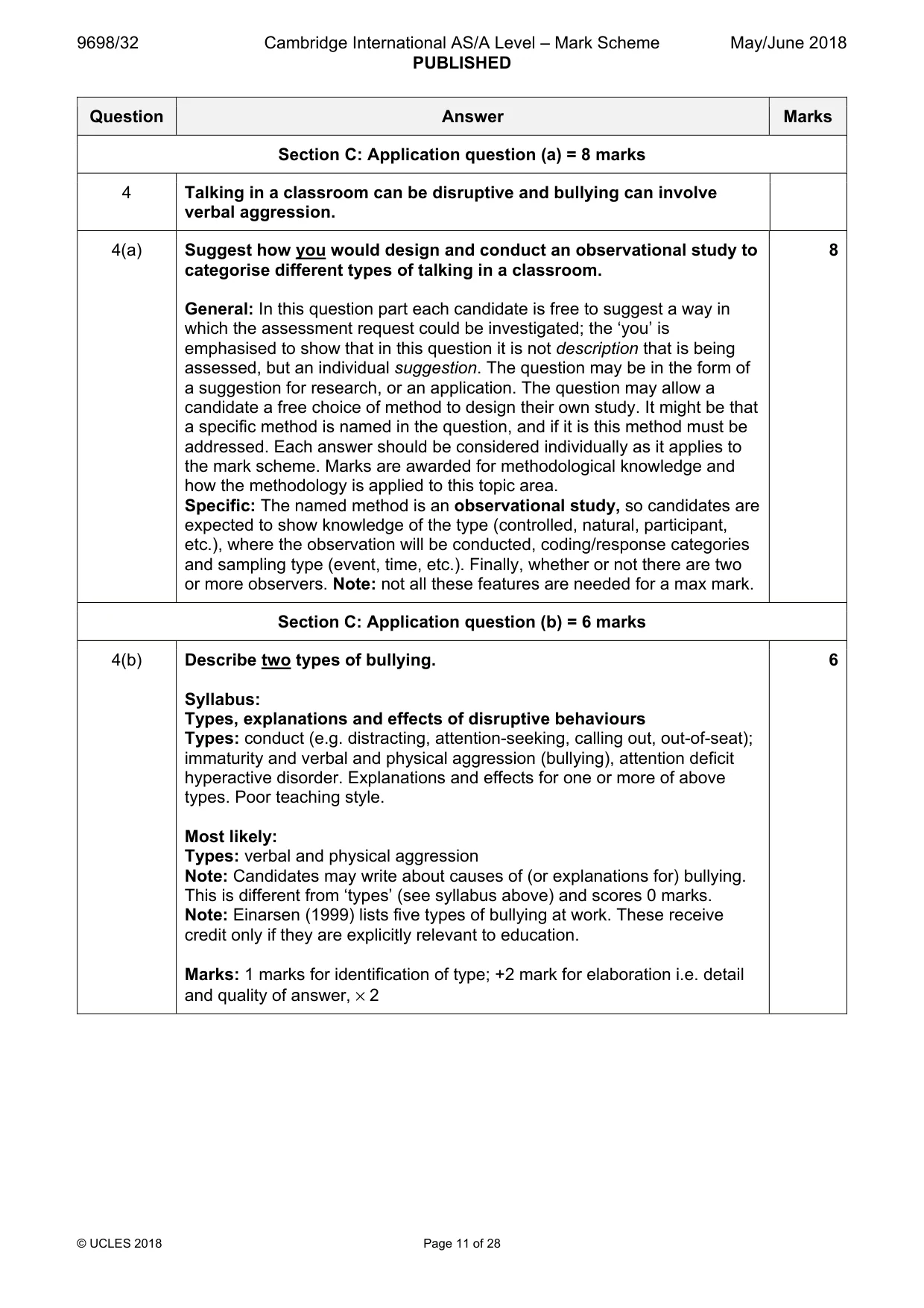
Mark scheme: 4 Talking in a classroom can be disruptive and bullying can involve verbal aggression. 4(a) Suggest how you would design and conduct an observational study to 8 categorise different types of talking in a classroom. General: In this question part each candidate is free to suggest a way in which the assessment request could be investigated; the ‘you’ is emphasised to show that in this question it is not description that is being assessed, but an individual suggestion. The question may be in the form of a suggestion for research, or an application. The question may allow a candidate a free choice of method to design their own study. It might be that a specific method is named in the question, and if it is this method must be addressed. Each answer should be considered individually as it applies to the mark scheme. Marks are awarded for methodological knowledge and how the methodology is applied to this topic area. Specific: The named method is an observational study, so candidates are expected to show knowledge of the type (controlled, natural, participant, etc.), where the observation will be conducted, coding/response categories and sampling type (event, time, etc.). Finally, whether or not there are two or more observers. Note: not all these features are needed for a max mark. Section C: Application question (b) = 6 marks 4(b) Describe two types of bullying. 6 Syllabus: Types, explanations and effects of disruptive behaviours Types: conduct (e.g. distracting, attention-seeking, calling out, out-of-seat); immaturity and verbal and physical aggression (bullying), attention deficit hyperactive disorder. Explanations and effects for one or more of above types. Poor teaching style. Most likely: Types: verbal and physical aggression Note: Candidates may write about causes of (or explanations for) bullying. This is different from ‘types’ (see syllabus above) and scores 0 marks. Note: Einarsen (1999) lists five types of bullying at work. These receive credit only if they are explicitly relevant to education. Marks: 1 marks for identification of type; +2 mark for elaboration i.e. detail and quality of answer, × 2 PSYCHOLOGY AND HEALTH
Q5 · Explain, in your own words, what is meant by the term ‘daily hassles’
5 (a) Explain, in your own words, what is meant by the term ‘daily hassles’. [2] (b) Describe one study which has measured daily hassles. [4]
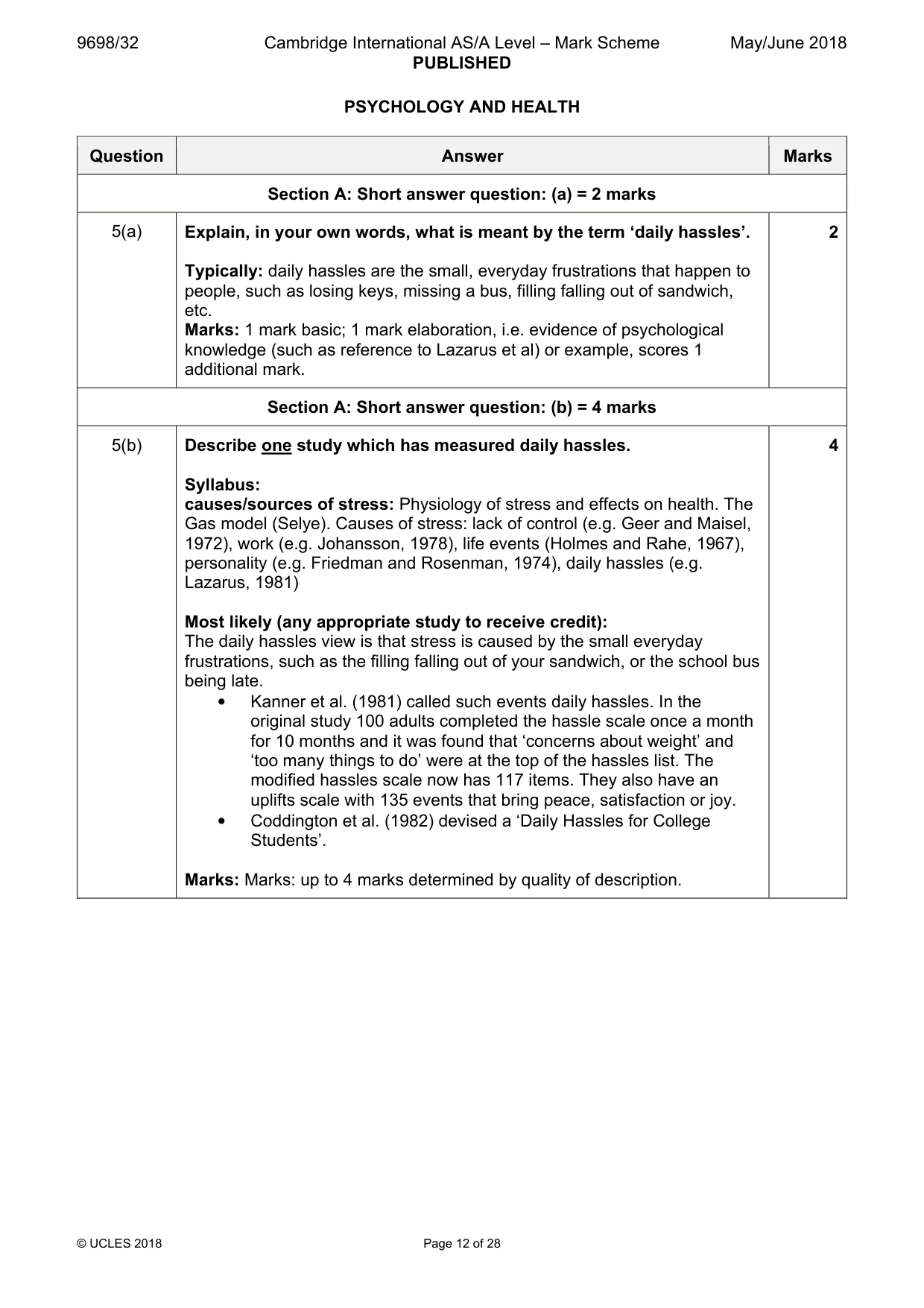
Mark scheme: 5(a) Explain, in your own words, what is meant by the term ‘daily hassles’. 2 Typically: daily hassles are the small, everyday frustrations that happen to people, such as losing keys, missing a bus, filling falling out of sandwich, etc. Marks: 1 mark basic; 1 mark elaboration, i.e. evidence of psychological knowledge (such as reference to Lazarus et al) or example, scores 1 additional mark. Section A: Short answer question: (b) = 4 marks 5(b) Describe one study which has measured daily hassles. 4 Syllabus: causes/sources of stress: Physiology of stress and effects on health. The Gas model (Selye). Causes of stress: lack of control (e.g. Geer and Maisel, 1972), work (e.g. Johansson, 1978), life events (Holmes and Rahe, 1967), personality (e.g. Friedman and Rosenman, 1974), daily hassles (e.g. Lazarus, 1981) Most likely (any appropriate study to receive credit): The daily hassles view is that stress is caused by the small everyday frustrations, such as the filling falling out of your sandwich, or the school bus being late. • Kanner et al. (1981) called such events daily hassles. In the original study 100 adults completed the hassle scale once a month for 10 months and it was found that ‘concerns about weight’ and ‘too many things to do’ were at the top of the hassles list. The modified hassles scale now has 117 items. They also have an uplifts scale with 135 events that bring peace, satisfaction or joy. • Coddington et al. (1982) devised a ‘Daily Hassles for College Students’. Marks: Marks: up to 4 marks determined by quality of description.
Q6 · Describe what psychologists have learned about pain
6 (a) Describe what psychologists have learned about pain. [8] (b) Evaluate what psychologists have learned about pain, including a discussion about the different ways in which pain can be managed. [12] Section C Answer one question.
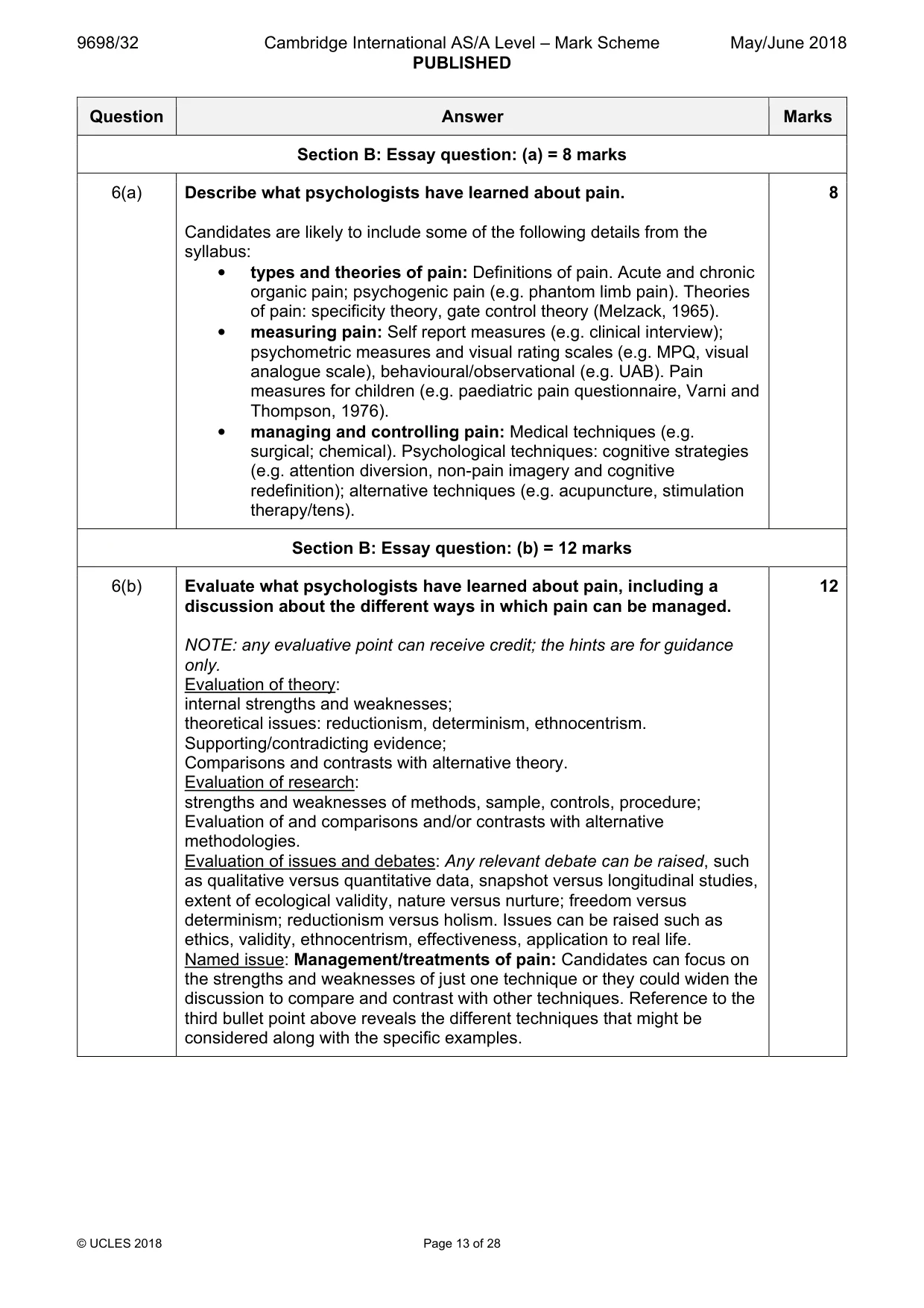
Mark scheme: 6(a) Describe what psychologists have learned about pain. 8 Candidates are likely to include some of the following details from the syllabus: • types and theories of pain: Definitions of pain. Acute and chronic organic pain; psychogenic pain (e.g. phantom limb pain). Theories of pain: specificity theory, gate control theory (Melzack, 1965). • measuring pain: Self report measures (e.g. clinical interview); psychometric measures and visual rating scales (e.g. MPQ, visual analogue scale), behavioural/observational (e.g. UAB). Pain measures for children (e.g. paediatric pain questionnaire, Varni and Thompson, 1976). • managing and controlling pain: Medical techniques (e.g. surgical; chemical). Psychological techniques: cognitive strategies (e.g. attention diversion, non-pain imagery and cognitive redefinition); alternative techniques (e.g. acupuncture, stimulation therapy/tens). Section B: Essay question: (b) = 12 marks 6(b) Evaluate what psychologists have learned about pain, including a 12 discussion about the different ways in which pain can be managed. NOTE: any evaluative point can receive credit; the hints are for guidance only. Evaluation of theory: internal strengths and weaknesses; theoretical issues: reductionism, determinism, ethnocentrism. Supporting/contradicting evidence; Comparisons and contrasts with alternative theory. Evaluation of research: strengths and weaknesses of methods, sample, controls, procedure; Evaluation of and comparisons and/or contrasts with alternative methodologies. Evaluation of issues and debates: Any relevant debate can be raised, such as qualitative versus quantitative data, snapshot versus longitudinal studies, extent of ecological validity, nature versus nurture; freedom versus determinism; reductionism versus holism. Issues can be raised such as ethics, validity, ethnocentrism, effectiveness, application to real life. Named issue: Management/treatments of pain: Candidates can focus on the strengths and weaknesses of just one technique or they could widen the discussion to compare and contrast with other techniques. Reference to the third bullet point above reveals the different techniques that might be considered along with the specific examples.
Q7 · Practitioner style can be patient-centred or doctor-centred
7 Practitioner style can be patient-centred or doctor-centred. (a) Suggest how you would design and conduct an investigation into the preferred practitioner style for patients at your local health centre. [8] (b) Describe one study which has investigated practitioner style. [6]
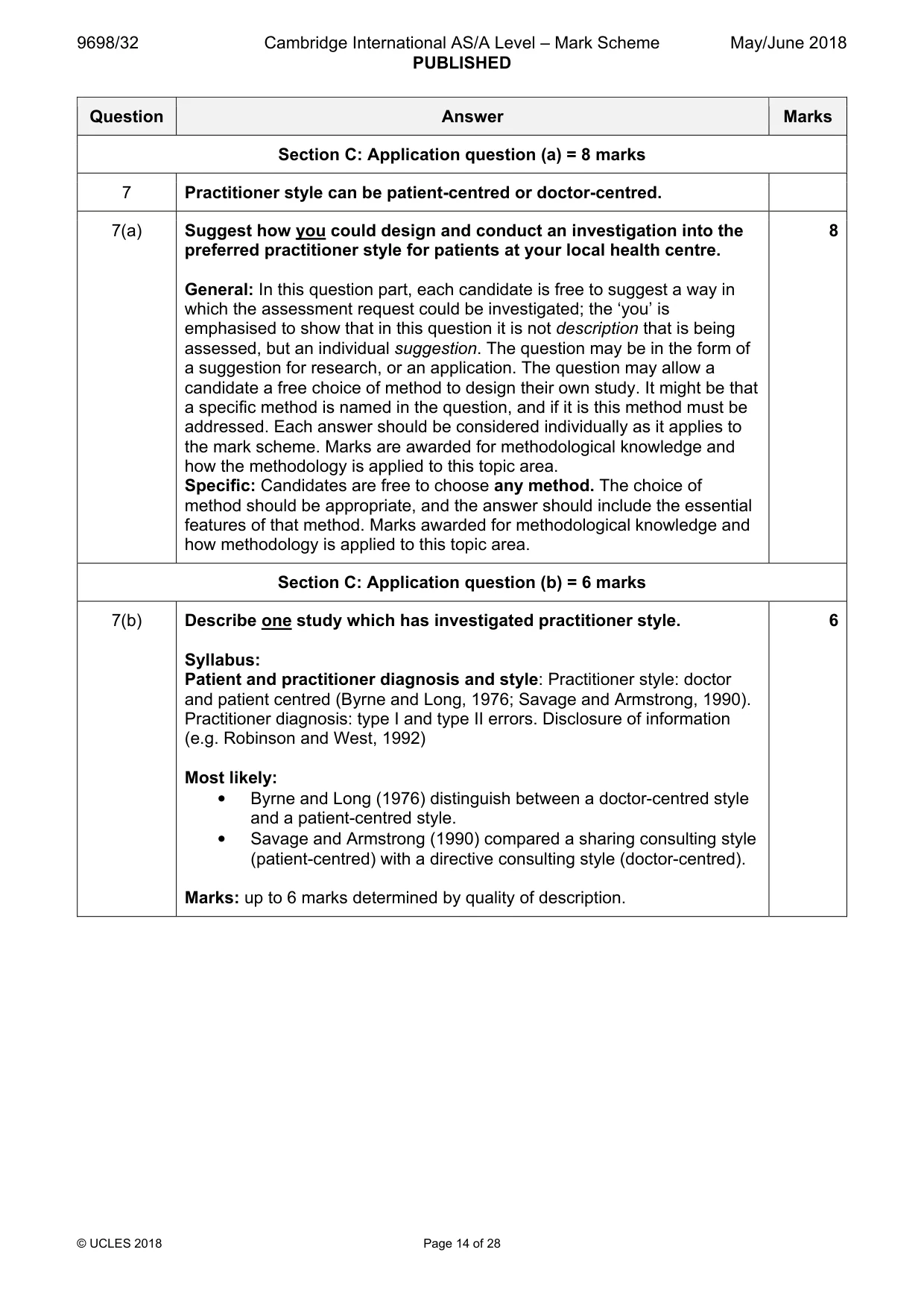
Mark scheme: 7(a) Suggest how you could design and conduct an investigation into the 8 preferred practitioner style for patients at your local health centre. General: In this question part, each candidate is free to suggest a way in which the assessment request could be investigated; the ‘you’ is emphasised to show that in this question it is not description that is being assessed, but an individual suggestion. The question may be in the form of a suggestion for research, or an application. The question may allow a candidate a free choice of method to design their own study. It might be that a specific method is named in the question, and if it is this method must be addressed. Each answer should be considered individually as it applies to the mark scheme. Marks are awarded for methodological knowledge and how the methodology is applied to this topic area. Specific: Candidates are free to choose any method. The choice of method should be appropriate, and the answer should include the essential features of that method. Marks awarded for methodological knowledge and how methodology is applied to this topic area. Section C: Application question (b) = 6 marks 7(b) Describe one study which has investigated practitioner style. 6 Syllabus: Patient and practitioner diagnosis and style: Practitioner style: doctor and patient centred (Byrne and Long, 1976; Savage and Armstrong, 1990). Practitioner diagnosis: type I and type II errors. Disclosure of information (e.g. Robinson and West, 1992) Most likely: • Byrne and Long (1976) distinguish between a doctor-centred style and a patient-centred style. • Savage and Armstrong (1990) compared a sharing consulting style (patient-centred) with a directive consulting style (doctor-centred). Marks: up to 6 marks determined by quality of description.
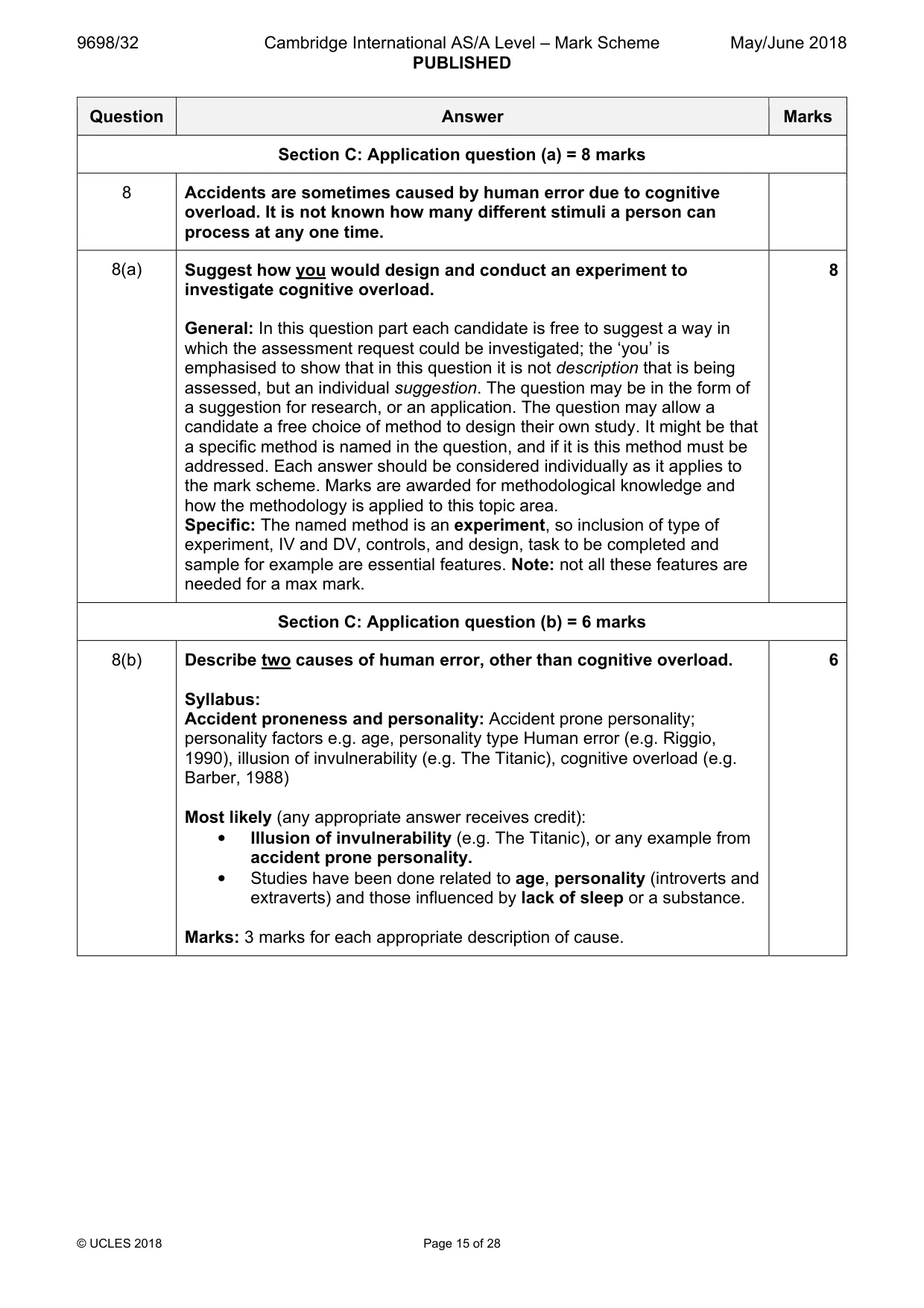
Q8 · Accidents are sometimes caused by human error due to cognitive overload
8 Accidents are sometimes caused by human error due to cognitive overload. It is not known how many different stimuli a person can process at any one time. (a) Suggest how you would design and conduct an experiment to investigate cognitive overload. [8] (b) Describe two causes of human error, other than cognitive overload. [6] Psychology and Environment Section A Answer this question.
Mark scheme: 8(a) Suggest how you would design and conduct an experiment to 8 investigate cognitive overload. General: In this question part each candidate is free to suggest a way in which the assessment request could be investigated; the ‘you’ is emphasised to show that in this question it is not description that is being assessed, but an individual suggestion. The question may be in the form of a suggestion for research, or an application. The question may allow a candidate a free choice of method to design their own study. It might be that a specific method is named in the question, and if it is this method must be addressed. Each answer should be considered individually as it applies to the mark scheme. Marks are awarded for methodological knowledge and how the methodology is applied to this topic area. Specific: The named method is an experiment, so inclusion of type of experiment, IV and DV, controls, and design, task to be completed and sample for example are essential features. Note: not all these features are needed for a max mark. Section C: Application question (b) = 6 marks 8(b) Describe two causes of human error, other than cognitive overload. 6 Syllabus: Accident proneness and personality: Accident prone personality; personality factors e.g. age, personality type Human error (e.g. Riggio, 1990), illusion of invulnerability (e.g. The Titanic), cognitive overload (e.g. Barber, 1988) Most likely (any appropriate answer receives credit): • Illusion of invulnerability (e.g. The Titanic), or any example from accident prone personality. • Studies have been done related to age, personality (introverts and extraverts) and those influenced by lack of sleep or a substance. Marks: 3 marks for each appropriate description of cause. PSYCHOLOGY AND ENVIRONMENT
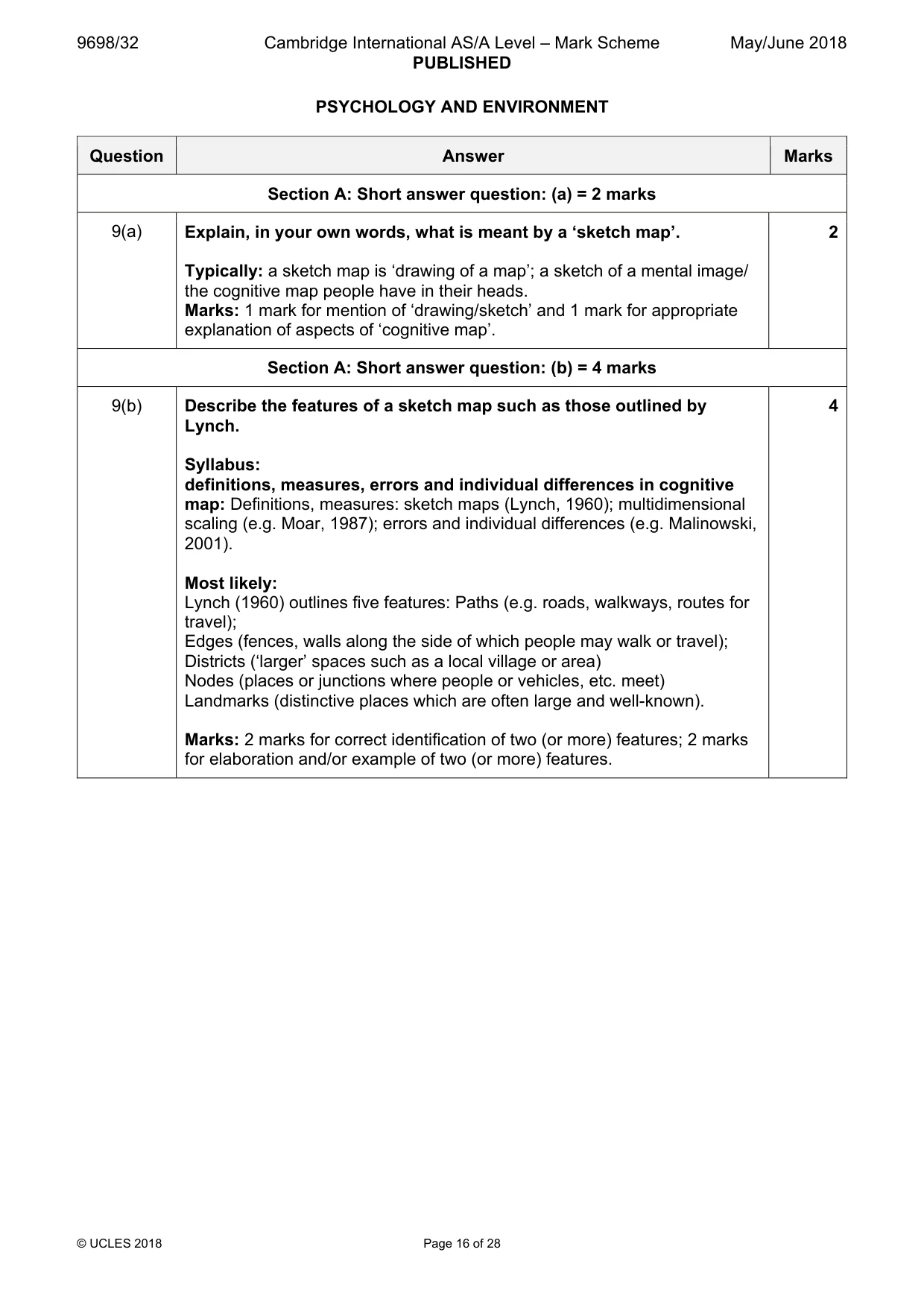
Q9 · Explain, in your own words, what is meant by a ‘sketch map’
9 (a) Explain, in your own words, what is meant by a ‘sketch map’. [2] (b) Describe the features of a sketch map such as those outlined by Lynch. [4]
Mark scheme: 9(a) Explain, in your own words, what is meant by a ‘sketch map’. 2 Typically: a sketch map is ‘drawing of a map’; a sketch of a mental image/ the cognitive map people have in their heads. Marks: 1 mark for mention of ‘drawing/sketch’ and 1 mark for appropriate explanation of aspects of ‘cognitive map’. Section A: Short answer question: (b) = 4 marks 9(b) Describe the features of a sketch map such as those outlined by 4 Lynch. Syllabus: definitions, measures, errors and individual differences in cognitive map: Definitions, measures: sketch maps (Lynch, 1960); multidimensional scaling (e.g. Moar, 1987); errors and individual differences (e.g. Malinowski, 2001). Most likely: Lynch (1960) outlines five features: Paths (e.g. roads, walkways, routes for travel); Edges (fences, walls along the side of which people may walk or travel); Districts (‘larger’ spaces such as a local village or area) Nodes (places or junctions where people or vehicles, etc. meet) Landmarks (distinctive places which are often large and well-known). Marks: 2 marks for correct identification of two (or more) features; 2 marks for elaboration and/or example of two (or more) features.
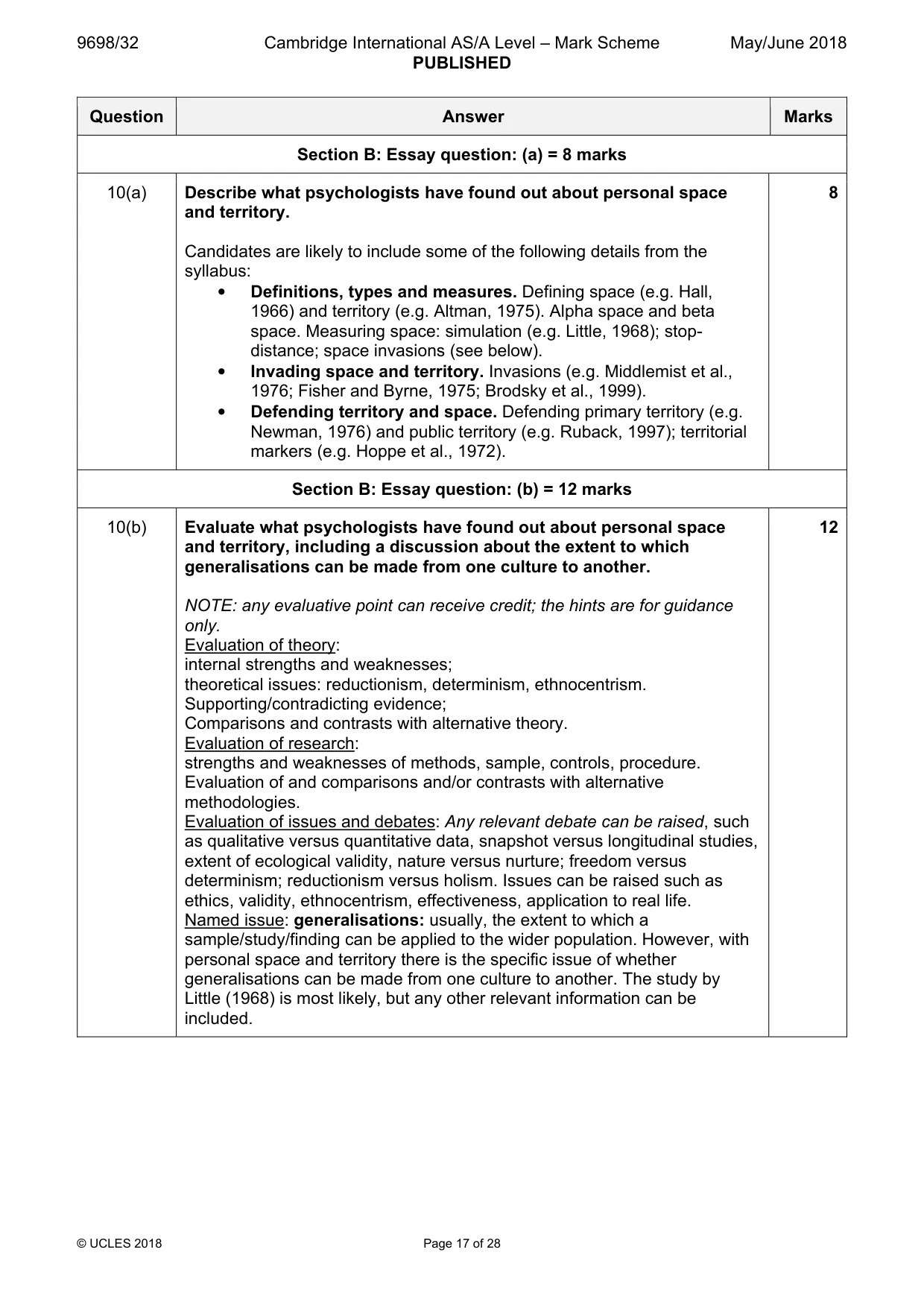
Q10 · Describe what psychologists have found out about personal space and territory
10 (a) Describe what psychologists have found out about personal space and territory. [8] (b) Evaluate what psychologists have found out about personal space and territory, including a discussion about the extent to which generalisations can be made from one culture to another. [12] Section C Answer one question.
Mark scheme: 10(a) Describe what psychologists have found out about personal space 8 and territory. Candidates are likely to include some of the following details from the syllabus: • Definitions, types and measures. Defining space (e.g. Hall, 1966) and territory (e.g. Altman, 1975). Alpha space and beta space. Measuring space: simulation (e.g. Little, 1968); stop- distance; space invasions (see below). • Invading space and territory. Invasions (e.g. Middlemist et al., 1976; Fisher and Byrne, 1975; Brodsky et al., 1999). • Defending territory and space. Defending primary territory (e.g. Newman, 1976) and public territory (e.g. Ruback, 1997); territorial markers (e.g. Hoppe et al., 1972). Section B: Essay question: (b) = 12 marks 10(b) Evaluate what psychologists have found out about personal space 12 and territory, including a discussion about the extent to which generalisations can be made from one culture to another. NOTE: any evaluative point can receive credit; the hints are for guidance only. Evaluation of theory: internal strengths and weaknesses; theoretical issues: reductionism, determinism, ethnocentrism. Supporting/contradicting evidence; Comparisons and contrasts with alternative theory. Evaluation of research: strengths and weaknesses of methods, sample, controls, procedure. Evaluation of and comparisons and/or contrasts with alternative methodologies. Evaluation of issues and debates: Any relevant debate can be raised, such as qualitative versus quantitative data, snapshot versus longitudinal studies, extent of ecological validity, nature versus nurture; freedom versus determinism; reductionism versus holism. Issues can be raised such as ethics, validity, ethnocentrism, effectiveness, application to real life. Named issue: generalisations: usually, the extent to which a sample/study/finding can be applied to the wider population. However, with personal space and territory there is the specific issue of whether generalisations can be made from one culture to another. The study by Little (1968) is most likely, but any other relevant information can be included.
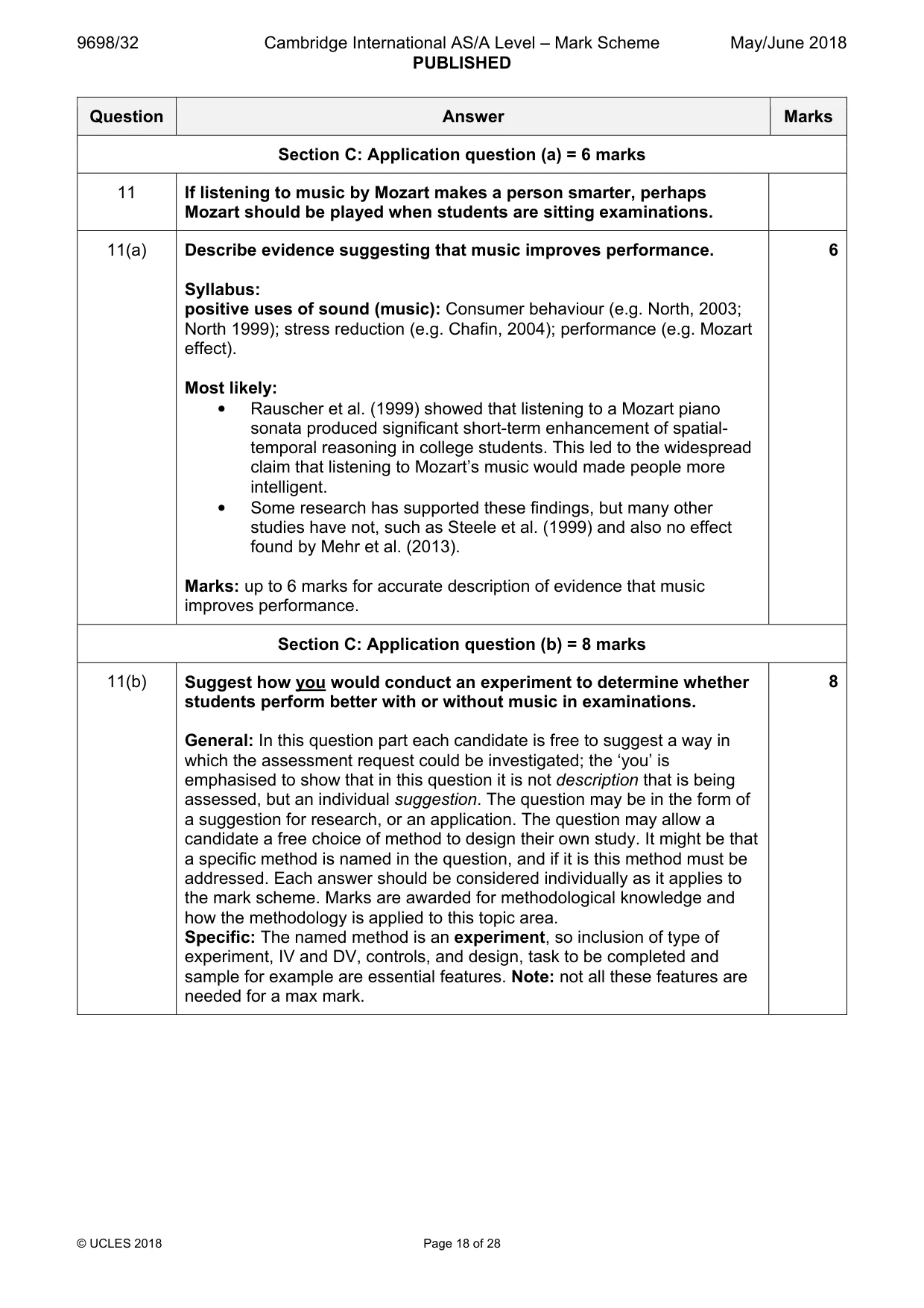
Q11 · If listening to music by Mozart makes a person smarter, perhaps Mozart should be played…
11 If listening to music by Mozart makes a person smarter, perhaps Mozart should be played when students are sitting examinations. (a) Describe evidence suggesting that music improves performance. [6] (b) Suggest how you would conduct an experiment to determine whether students perform better with or without music in examinations. [8]
Mark scheme: 11(a) Describe evidence suggesting that music improves performance. 6 Syllabus: positive uses of sound (music): Consumer behaviour (e.g. North, 2003; North 1999); stress reduction (e.g. Chafin, 2004); performance (e.g. Mozart effect). Most likely: • Rauscher et al. (1999) showed that listening to a Mozart piano sonata produced significant short-term enhancement of spatial- temporal reasoning in college students. This led to the widespread claim that listening to Mozart’s music would made people more intelligent. • Some research has supported these findings, but many other studies have not, such as Steele et al. (1999) and also no effect found by Mehr et al. (2013). Marks: up to 6 marks for accurate description of evidence that music improves performance. Section C: Application question (b) = 8 marks 11(b) Suggest how you would conduct an experiment to determine whether 8 students perform better with or without music in examinations. General: In this question part each candidate is free to suggest a way in which the assessment request could be investigated; the ‘you’ is emphasised to show that in this question it is not description that is being assessed, but an individual suggestion. The question may be in the form of a suggestion for research, or an application. The question may allow a candidate a free choice of method to design their own study. It might be that a specific method is named in the question, and if it is this method must be addressed. Each answer should be considered individually as it applies to the mark scheme. Marks are awarded for methodological knowledge and how the methodology is applied to this topic area. Specific: The named method is an experiment, so inclusion of type of experiment, IV and DV, controls, and design, task to be completed and sample for example are essential features. Note: not all these features are needed for a max mark.
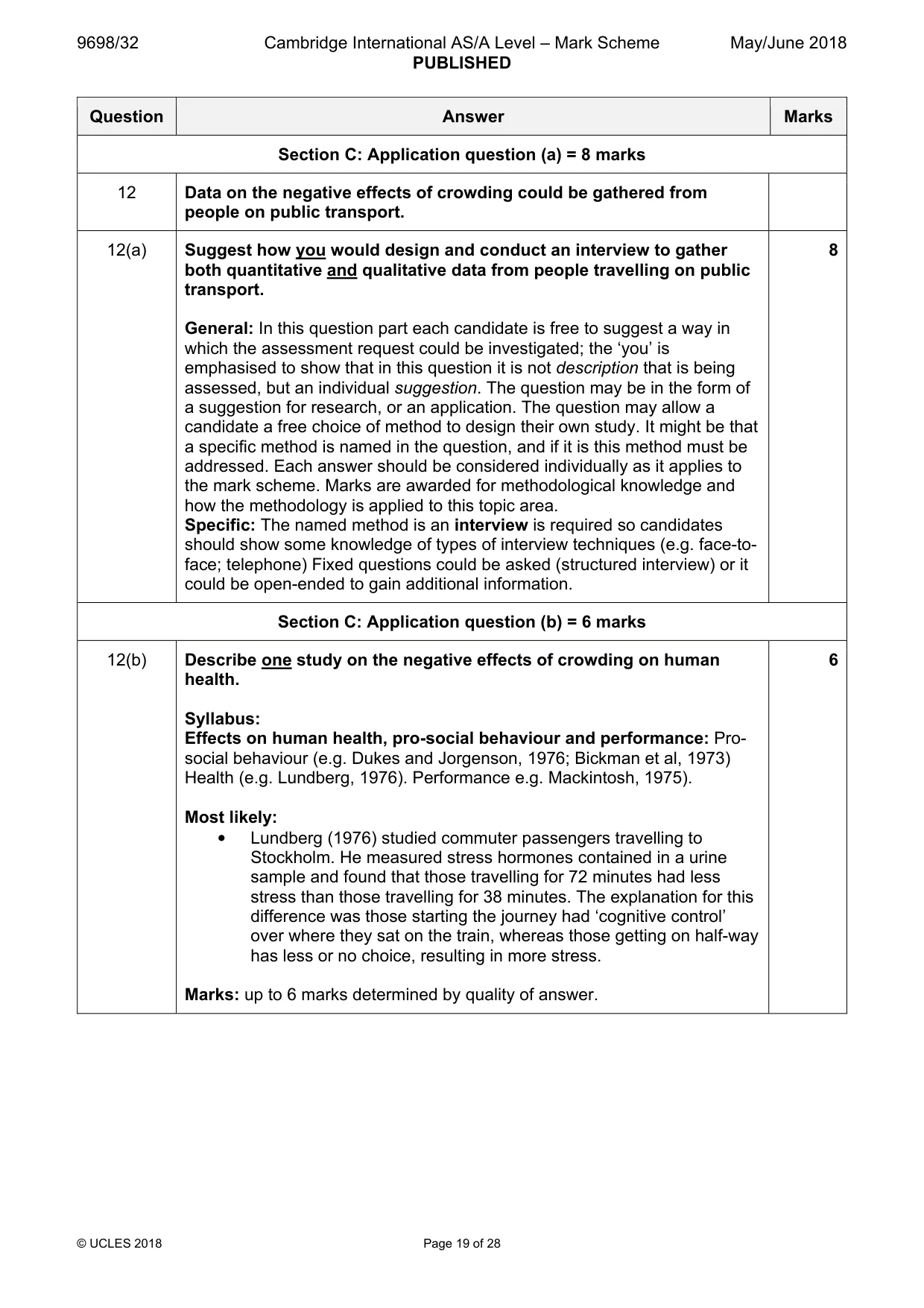
Q12 · Data on the negative effects of crowding could be gathered from people on public transport
12 Data on the negative effects of crowding could be gathered from people on public transport. (a) Suggest how you would design and conduct an interview to gather both quantitative and qualitative data from people travelling on public transport. [8] (b) Describe one study on the negative effects of crowding on human health. [6] Psychology and Abnormality Section A Answer this question.
Mark scheme: 12(a) Suggest how you would design and conduct an interview to gather 8 both quantitative and qualitative data from people travelling on public transport. General: In this question part each candidate is free to suggest a way in which the assessment request could be investigated; the ‘you’ is emphasised to show that in this question it is not description that is being assessed, but an individual suggestion. The question may be in the form of a suggestion for research, or an application. The question may allow a candidate a free choice of method to design their own study. It might be that a specific method is named in the question, and if it is this method must be addressed. Each answer should be considered individually as it applies to the mark scheme. Marks are awarded for methodological knowledge and how the methodology is applied to this topic area. Specific: The named method is an interview is required so candidates should show some knowledge of types of interview techniques (e.g. face-to- face; telephone) Fixed questions could be asked (structured interview) or it could be open-ended to gain additional information. Section C: Application question (b) = 6 marks 12(b) Describe one study on the negative effects of crowding on human 6 health. Syllabus: Effects on human health, pro-social behaviour and performance: Pro- social behaviour (e.g. Dukes and Jorgenson, 1976; Bickman et al, 1973) Health (e.g. Lundberg, 1976). Performance e.g. Mackintosh, 1975). Most likely: • Lundberg (1976) studied commuter passengers travelling to Stockholm. He measured stress hormones contained in a urine sample and found that those travelling for 72 minutes had less stress than those travelling for 38 minutes. The explanation for this difference was those starting the journey had ‘cognitive control’ over where they sat on the train, whereas those getting on half-way has less or no choice, resulting in more stress. Marks: up to 6 marks determined by quality of answer. PSYCHOLOGY AND ABNORMALITY
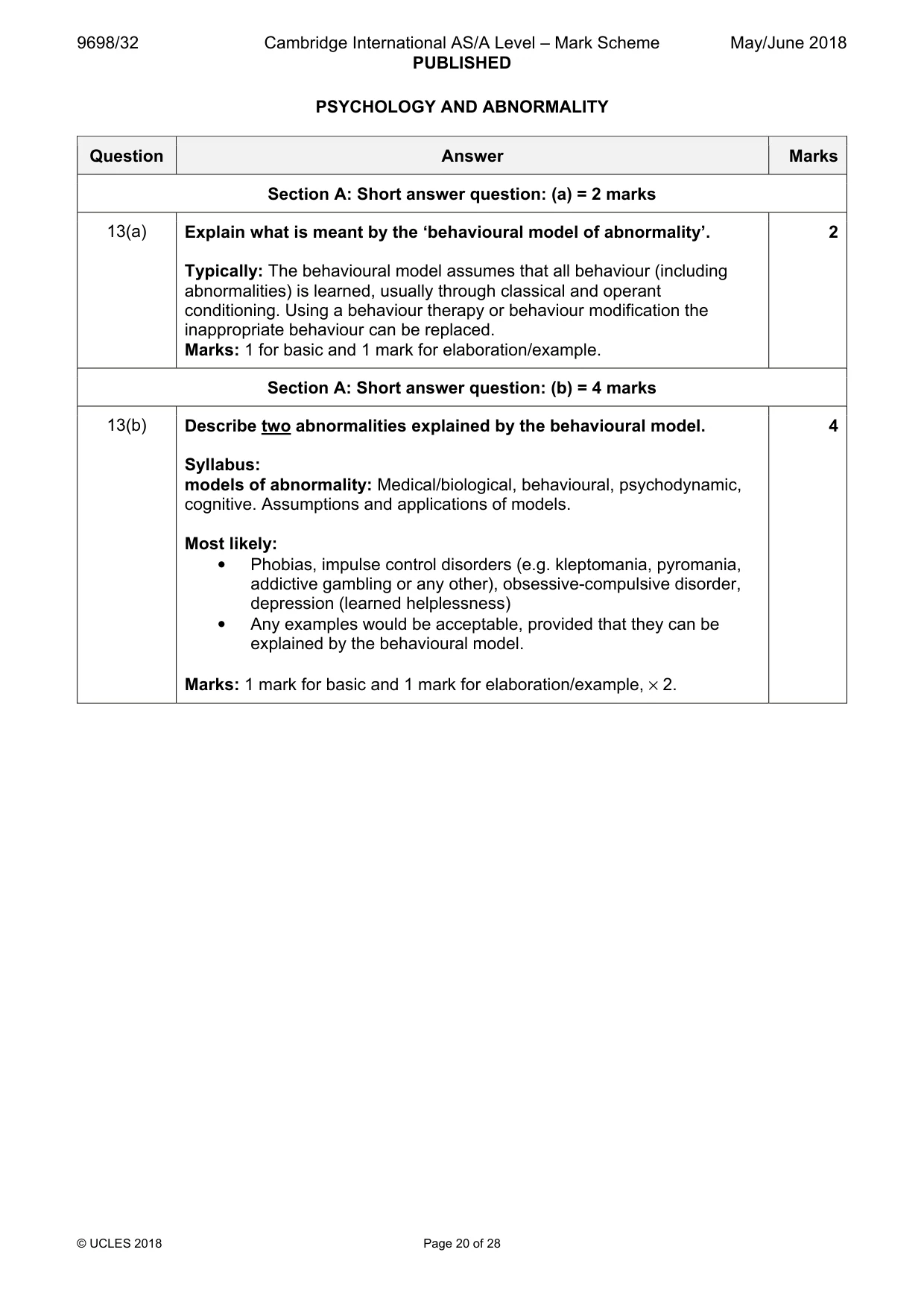
Q13 · Explain what is meant by the ‘behavioural model of abnormality’
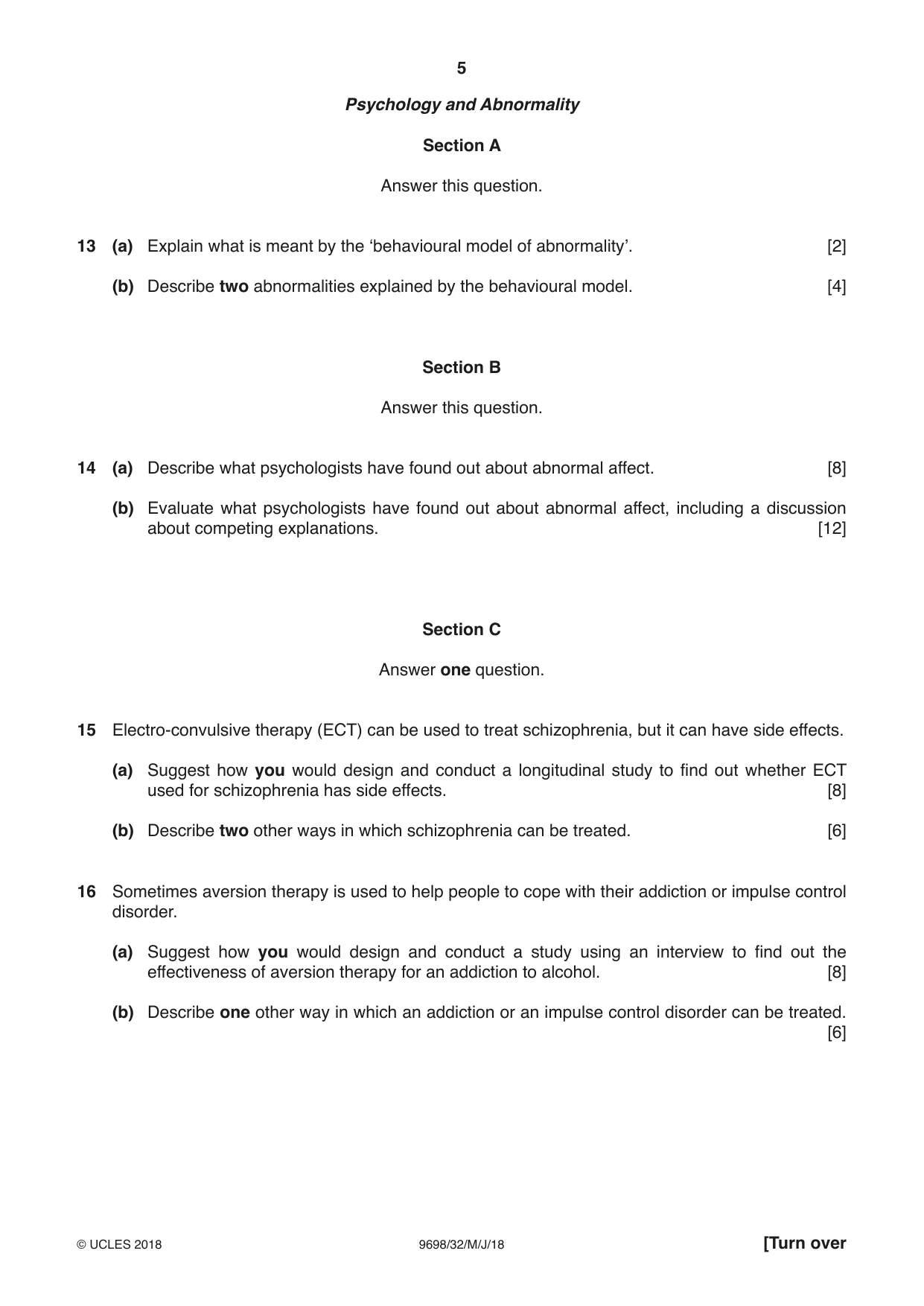
13 (a) Explain what is meant by the ‘behavioural model of abnormality’. [2] (b) Describe two abnormalities explained by the behavioural model. [4]
Mark scheme: 13(a) Explain what is meant by the ‘behavioural model of abnormality’. 2 Typically: The behavioural model assumes that all behaviour (including abnormalities) is learned, usually through classical and operant conditioning. Using a behaviour therapy or behaviour modification the inappropriate behaviour can be replaced. Marks: 1 for basic and 1 mark for elaboration/example. Section A: Short answer question: (b) = 4 marks 13(b) Describe two abnormalities explained by the behavioural model. 4 Syllabus: models of abnormality: Medical/biological, behavioural, psychodynamic, cognitive. Assumptions and applications of models. Most likely: • Phobias, impulse control disorders (e.g. kleptomania, pyromania, addictive gambling or any other), obsessive-compulsive disorder, depression (learned helplessness) • Any examples would be acceptable, provided that they can be explained by the behavioural model. Marks: 1 mark for basic and 1 mark for elaboration/example, × 2.
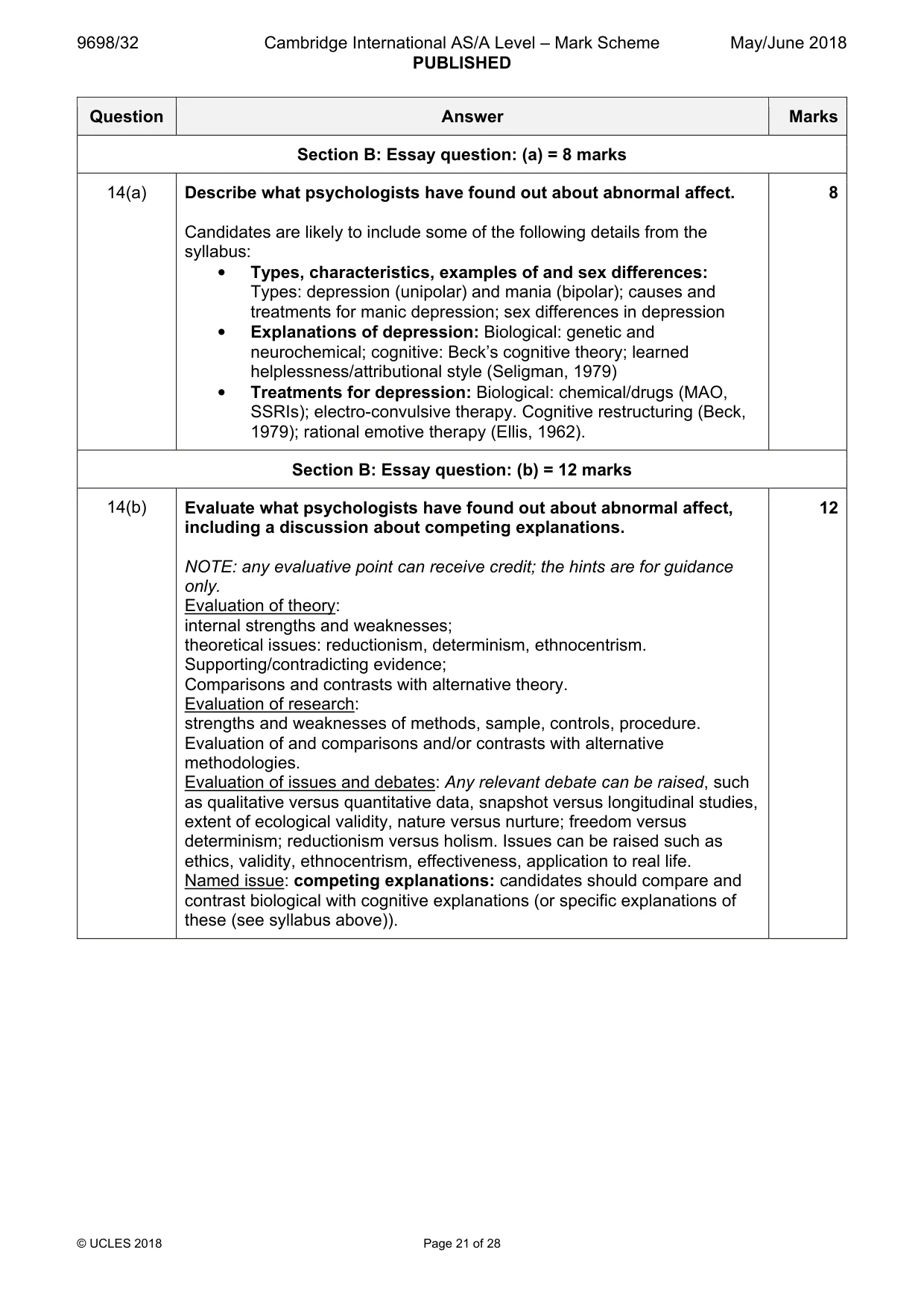
Q14 · Describe what psychologists have found out about abnormal affect
14 (a) Describe what psychologists have found out about abnormal affect. [8] (b) Evaluate what psychologists have found out about abnormal affect, including a discussion about competing explanations. [12] Section C Answer one question.
Mark scheme: 14(a) Describe what psychologists have found out about abnormal affect. 8 Candidates are likely to include some of the following details from the syllabus: • Types, characteristics, examples of and sex differences: Types: depression (unipolar) and mania (bipolar); causes and treatments for manic depression; sex differences in depression • Explanations of depression: Biological: genetic and neurochemical; cognitive: Beck’s cognitive theory; learned helplessness/attributional style (Seligman, 1979) • Treatments for depression: Biological: chemical/drugs (MAO, SSRIs); electro-convulsive therapy. Cognitive restructuring (Beck, 1979); rational emotive therapy (Ellis, 1962). Section B: Essay question: (b) = 12 marks 14(b) Evaluate what psychologists have found out about abnormal affect, 12 including a discussion about competing explanations. NOTE: any evaluative point can receive credit; the hints are for guidance only. Evaluation of theory: internal strengths and weaknesses; theoretical issues: reductionism, determinism, ethnocentrism. Supporting/contradicting evidence; Comparisons and contrasts with alternative theory. Evaluation of research: strengths and weaknesses of methods, sample, controls, procedure. Evaluation of and comparisons and/or contrasts with alternative methodologies. Evaluation of issues and debates: Any relevant debate can be raised, such as qualitative versus quantitative data, snapshot versus longitudinal studies, extent of ecological validity, nature versus nurture; freedom versus determinism; reductionism versus holism. Issues can be raised such as ethics, validity, ethnocentrism, effectiveness, application to real life. Named issue: competing explanations: candidates should compare and contrast biological with cognitive explanations (or specific explanations of these (see syllabus above)).
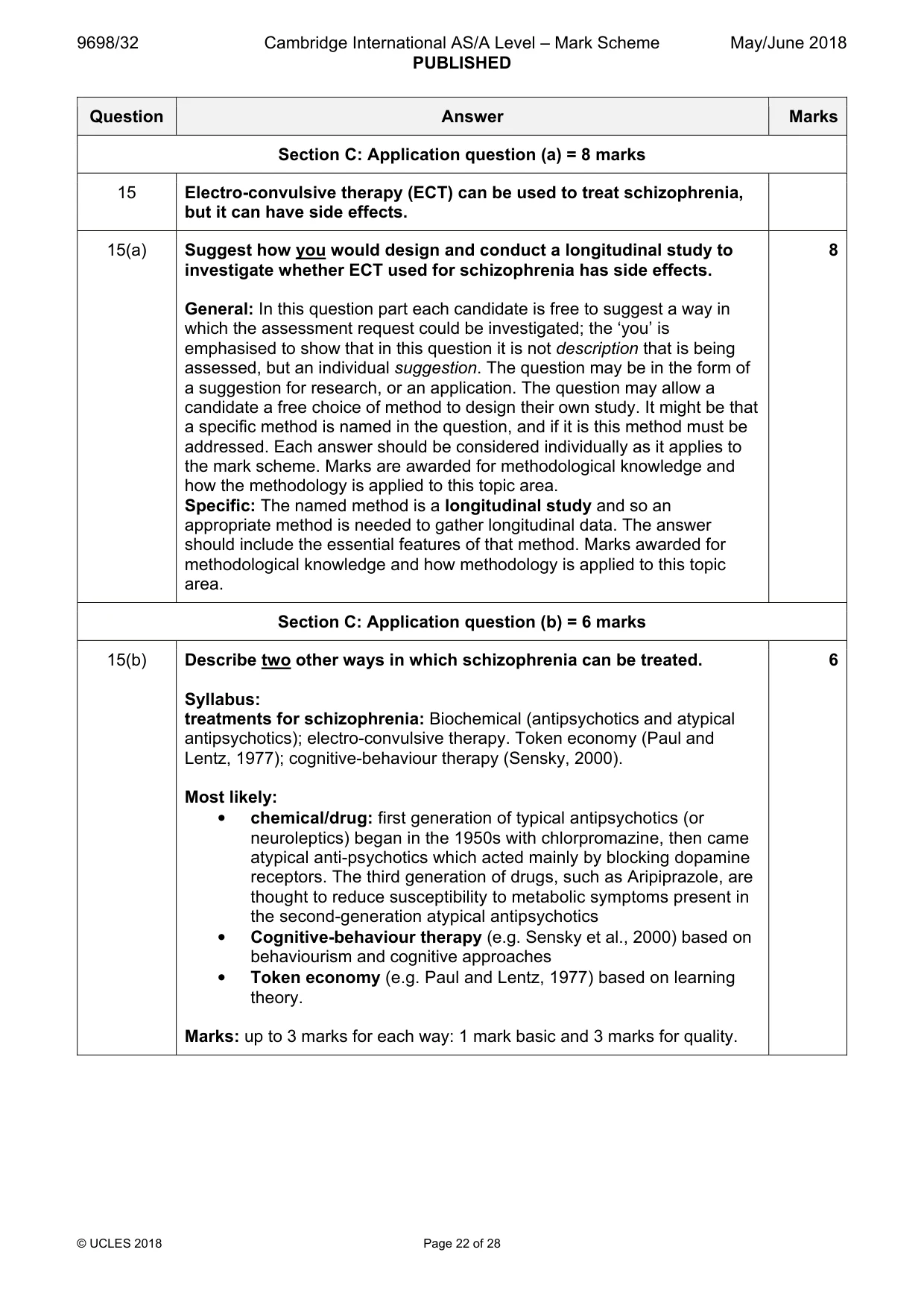
Q15 · Electro-convulsive therapy (ECT) can be used to treat schizophrenia, but it can have side…
15 Electro-convulsive therapy (ECT) can be used to treat schizophrenia, but it can have side effects. (a) Suggest how you would design and conduct a longitudinal study to find out whether ECT used for schizophrenia has side effects. [8] (b) Describe two other ways in which schizophrenia can be treated. [6]
Mark scheme: 15(a) Suggest how you would design and conduct a longitudinal study to 8 investigate whether ECT used for schizophrenia has side effects. General: In this question part each candidate is free to suggest a way in which the assessment request could be investigated; the ‘you’ is emphasised to show that in this question it is not description that is being assessed, but an individual suggestion. The question may be in the form of a suggestion for research, or an application. The question may allow a candidate a free choice of method to design their own study. It might be that a specific method is named in the question, and if it is this method must be addressed. Each answer should be considered individually as it applies to the mark scheme. Marks are awarded for methodological knowledge and how the methodology is applied to this topic area. Specific: The named method is a longitudinal study and so an appropriate method is needed to gather longitudinal data. The answer should include the essential features of that method. Marks awarded for methodological knowledge and how methodology is applied to this topic area. Section C: Application question (b) = 6 marks 15(b) Describe two other ways in which schizophrenia can be treated. 6 Syllabus: treatments for schizophrenia: Biochemical (antipsychotics and atypical antipsychotics); electro-convulsive therapy. Token economy (Paul and Lentz, 1977); cognitive-behaviour therapy (Sensky, 2000). Most likely: • chemical/drug: first generation of typical antipsychotics (or neuroleptics) began in the 1950s with chlorpromazine, then came atypical anti-psychotics which acted mainly by blocking dopamine receptors. The third generation of drugs, such as Aripiprazole, are thought to reduce susceptibility to metabolic symptoms present in the second-generation atypical antipsychotics • Cognitive-behaviour therapy (e.g. Sensky et al., 2000) based on behaviourism and cognitive approaches • Token economy (e.g. Paul and Lentz, 1977) based on learning theory. Marks: up to 3 marks for each way: 1 mark basic and 3 marks for quality.
Q16 · Sometimes aversion therapy is used to help people to cope with their addiction or impulse…
16 Sometimes aversion therapy is used to help people to cope with their addiction or impulse control disorder. (a) Suggest how you would design and conduct a study using an interview to find out the effectiveness of aversion therapy for an addiction to alcohol. [8] (b) Describe one other way in which an addiction or an impulse control disorder can be treated. [6] Psychology and Organisations Section A Answer this question.
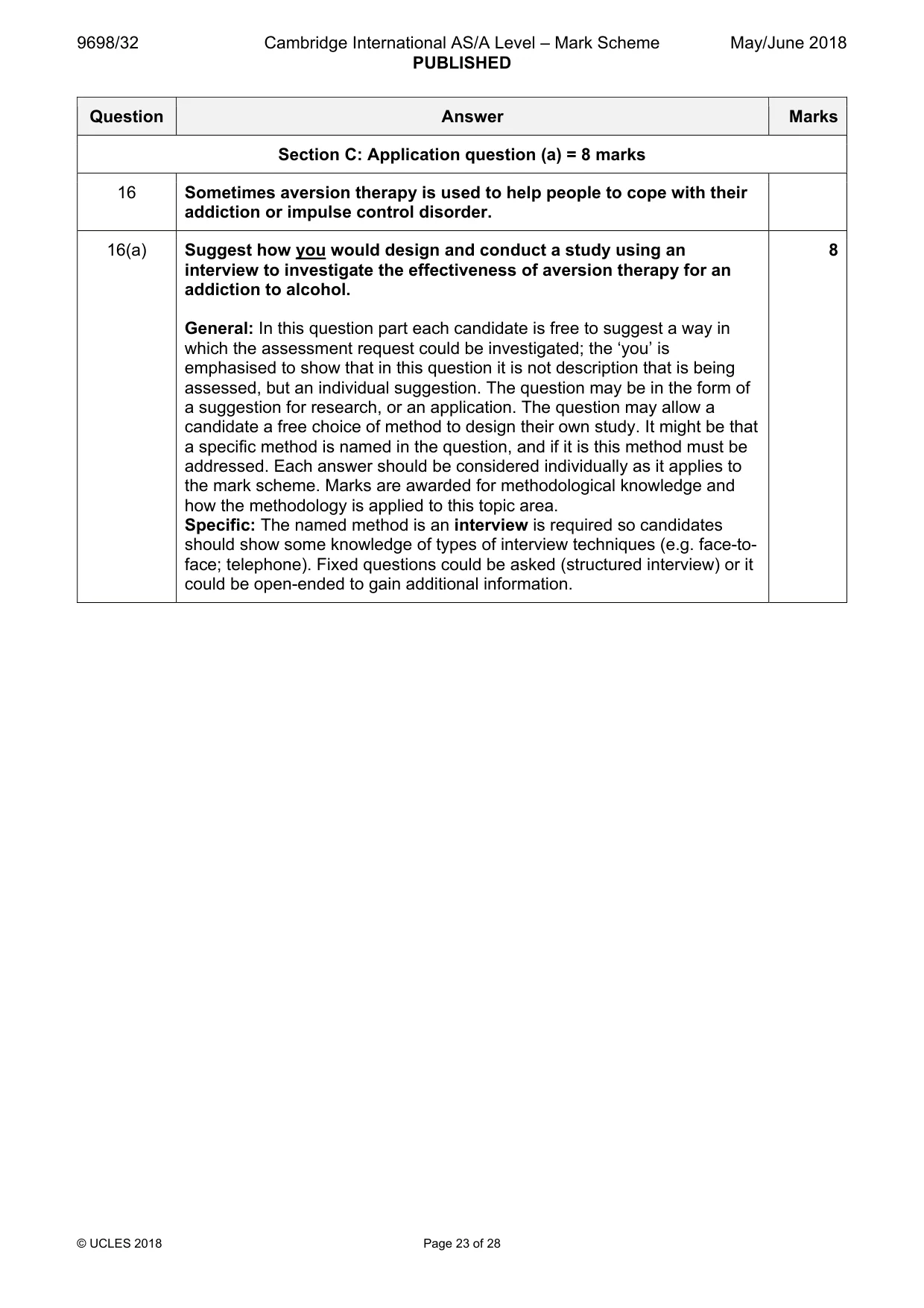
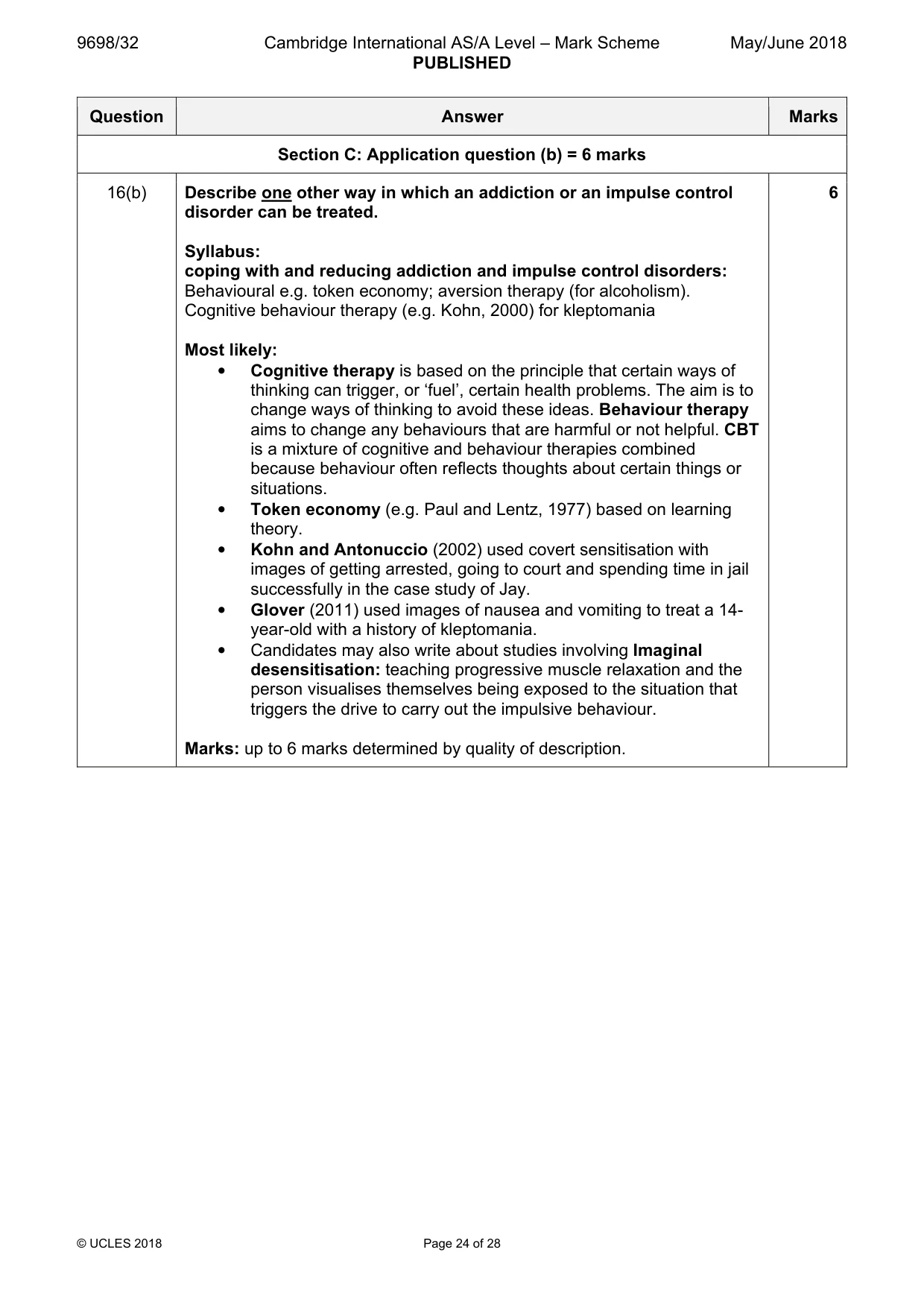
Mark scheme: 16(a) Suggest how you would design and conduct a study using an 8 interview to investigate the effectiveness of aversion therapy for an addiction to alcohol. General: In this question part each candidate is free to suggest a way in which the assessment request could be investigated; the ‘you’ is emphasised to show that in this question it is not description that is being assessed, but an individual suggestion. The question may be in the form of a suggestion for research, or an application. The question may allow a candidate a free choice of method to design their own study. It might be that a specific method is named in the question, and if it is this method must be addressed. Each answer should be considered individually as it applies to the mark scheme. Marks are awarded for methodological knowledge and how the methodology is applied to this topic area. Specific: The named method is an interview is required so candidates should show some knowledge of types of interview techniques (e.g. face-to- face; telephone). Fixed questions could be asked (structured interview) or it could be open-ended to gain additional information. Section C: Application question (b) = 6 marks 16(b) Describe one other way in which an addiction or an impulse control 6 disorder can be treated. Syllabus: coping with and reducing addiction and impulse control disorders: Behavioural e.g. token economy; aversion therapy (for alcoholism). Cognitive behaviour therapy (e.g. Kohn, 2000) for kleptomania Most likely: • Cognitive therapy is based on the principle that certain ways of thinking can trigger, or ‘fuel’, certain health problems. The aim is to change ways of thinking to avoid these ideas. Behaviour therapy aims to change any behaviours that are harmful or not helpful. CBT is a mixture of cognitive and behaviour therapies combined because behaviour often reflects thoughts about certain things or situations. • Token economy (e.g. Paul and Lentz, 1977) based on learning theory. • Kohn and Antonuccio (2002) used covert sensitisation with images of getting arrested, going to court and spending time in jail successfully in the case study of Jay. • Glover (2011) used images of nausea and vomiting to treat a 14- year-old with a history of kleptomania. • Candidates may also write about studies involving Imaginal desensitisation: teaching progressive muscle relaxation and the person visualises themselves being exposed to the situation that triggers the drive to carry out the impulsive behaviour. Marks: up to 6 marks determined by quality of description. PSYCHOLOGY AND ORGANISATIONS
Q17 · Explain, in your own words, what is meant by the term ‘operator-machine system’
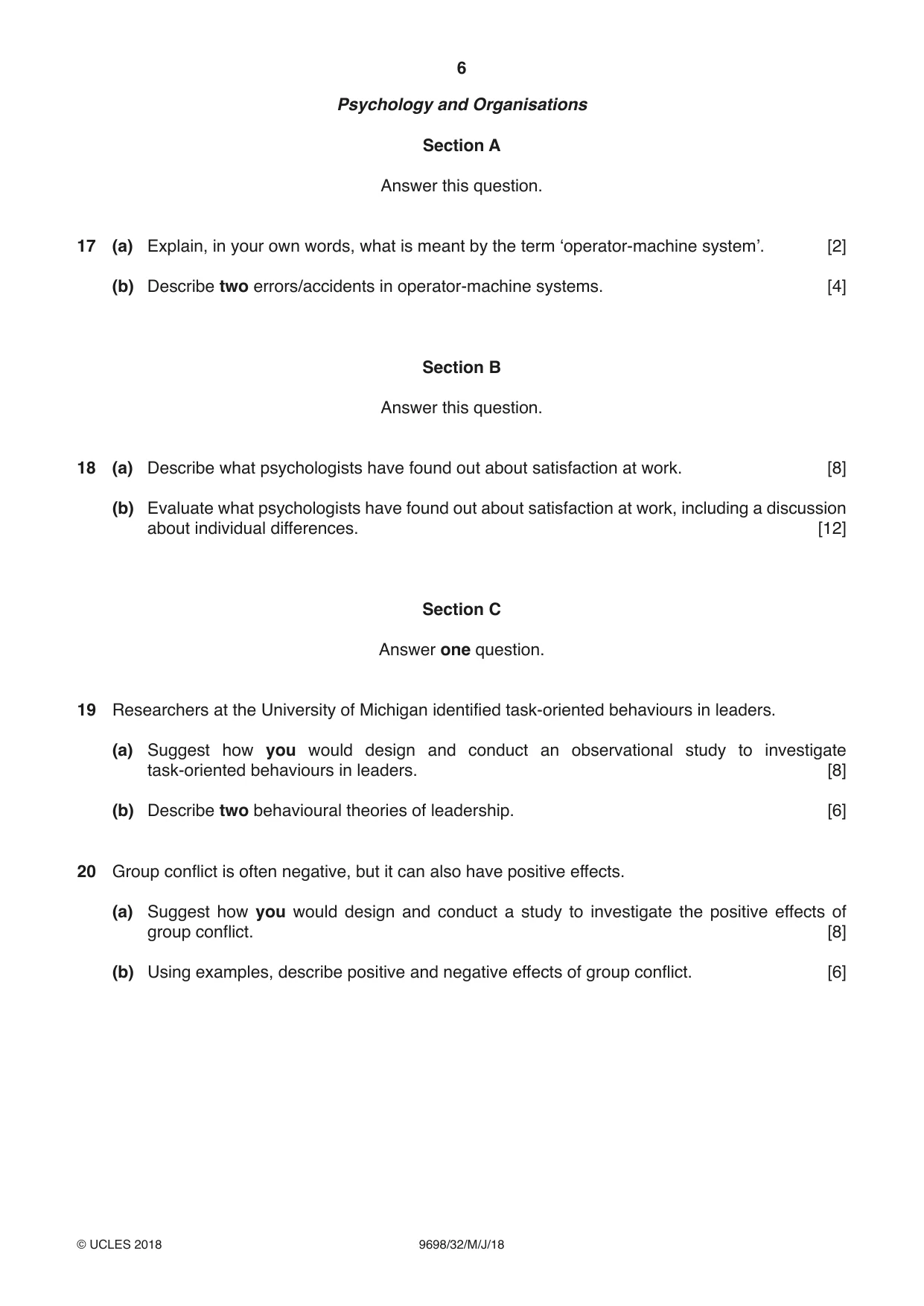
17 (a) Explain, in your own words, what is meant by the term ‘operator-machine system’. [2] (b) Describe two errors/accidents in operator-machine systems. [4]
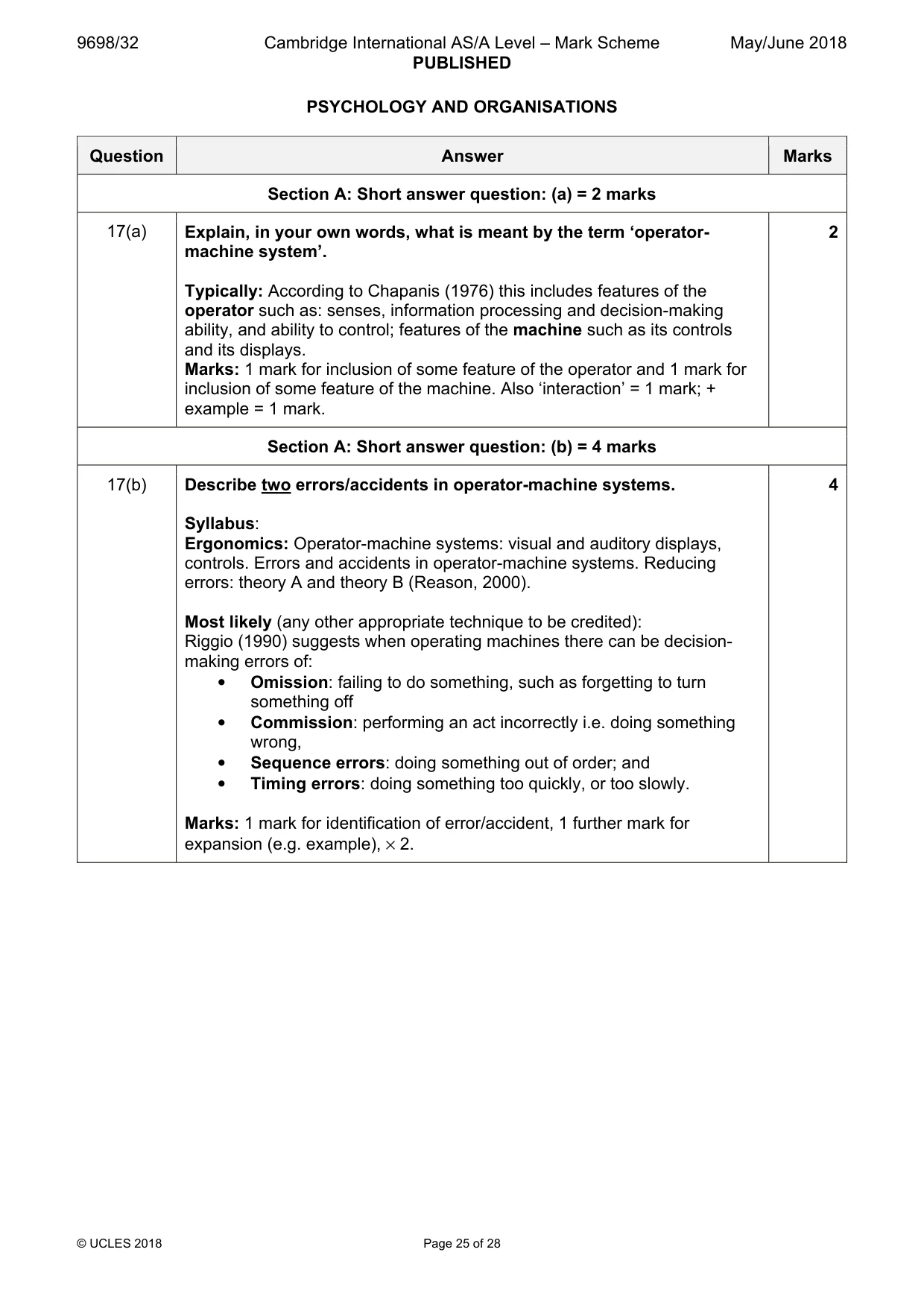
Mark scheme: 17(a) Explain, in your own words, what is meant by the term ‘operator- 2 machine system’. Typically: According to Chapanis (1976) this includes features of the operator such as: senses, information processing and decision-making ability, and ability to control; features of the machine such as its controls and its displays. Marks: 1 mark for inclusion of some feature of the operator and 1 mark for inclusion of some feature of the machine. Also ‘interaction’ = 1 mark; + example = 1 mark. Section A: Short answer question: (b) = 4 marks 17(b) Describe two errors/accidents in operator-machine systems. 4 Syllabus: Ergonomics: Operator-machine systems: visual and auditory displays, controls. Errors and accidents in operator-machine systems. Reducing errors: theory A and theory B (Reason, 2000). Most likely (any other appropriate technique to be credited): Riggio (1990) suggests when operating machines there can be decision- making errors of: • Omission: failing to do something, such as forgetting to turn something off • Commission: performing an act incorrectly i.e. doing something wrong, • Sequence errors: doing something out of order; and • Timing errors: doing something too quickly, or too slowly. Marks: 1 mark for identification of error/accident, 1 further mark for expansion (e.g. example), × 2.
Q18 · Describe what psychologists have found out about satisfaction at work
18 (a) Describe what psychologists have found out about satisfaction at work. [8] (b) Evaluate what psychologists have found out about satisfaction at work, including a discussion about individual differences. [12] Section C Answer one question.
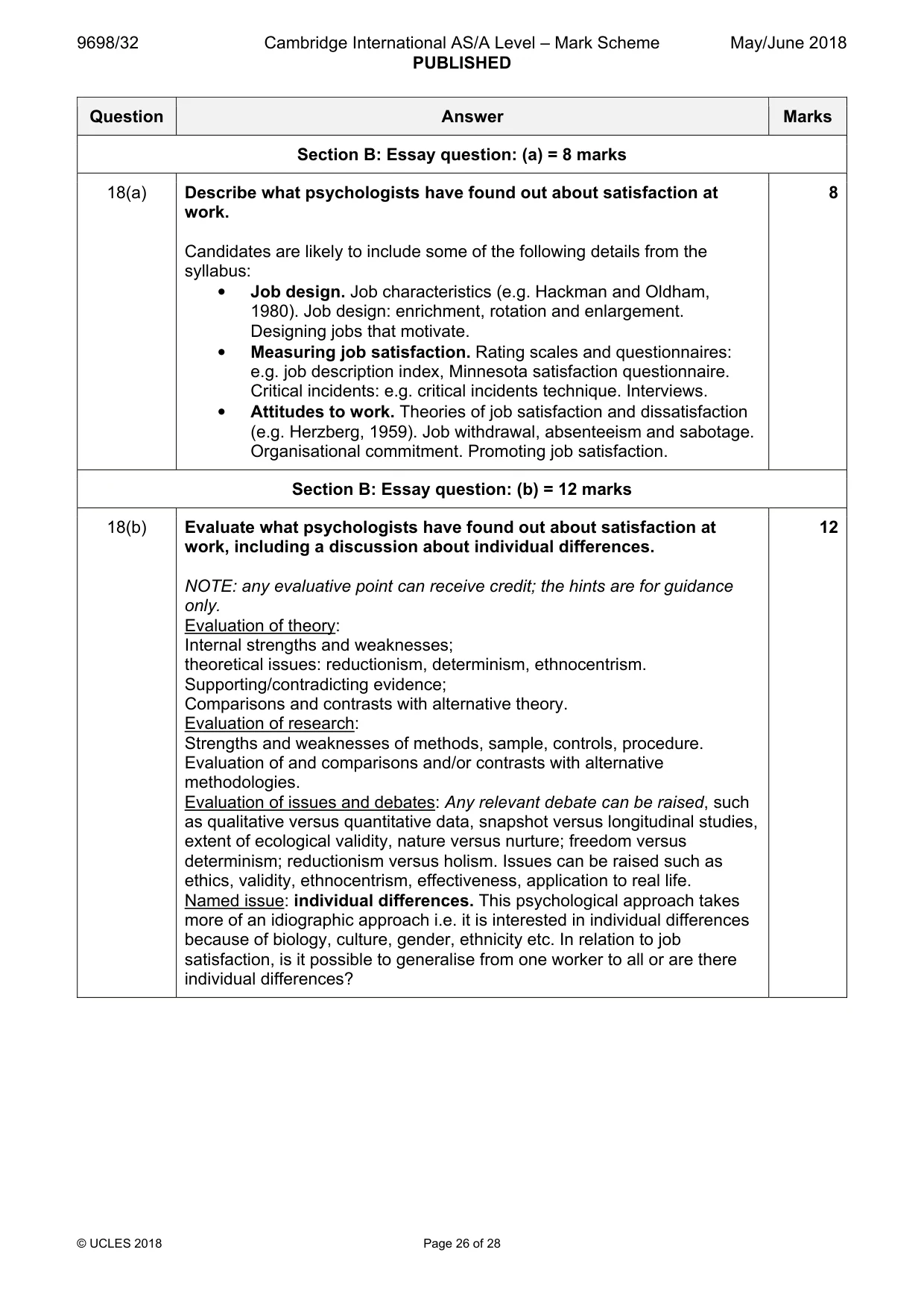
Mark scheme: 18(a) Describe what psychologists have found out about satisfaction at 8 work. Candidates are likely to include some of the following details from the syllabus: • Job design. Job characteristics (e.g. Hackman and Oldham, 1980). Job design: enrichment, rotation and enlargement. Designing jobs that motivate. • Measuring job satisfaction. Rating scales and questionnaires: e.g. job description index, Minnesota satisfaction questionnaire. Critical incidents: e.g. critical incidents technique. Interviews. • Attitudes to work. Theories of job satisfaction and dissatisfaction (e.g. Herzberg, 1959). Job withdrawal, absenteeism and sabotage. Organisational commitment. Promoting job satisfaction. Section B: Essay question: (b) = 12 marks 18(b) Evaluate what psychologists have found out about satisfaction at 12 work, including a discussion about individual differences. NOTE: any evaluative point can receive credit; the hints are for guidance only. Evaluation of theory: Internal strengths and weaknesses; theoretical issues: reductionism, determinism, ethnocentrism. Supporting/contradicting evidence; Comparisons and contrasts with alternative theory. Evaluation of research: Strengths and weaknesses of methods, sample, controls, procedure. Evaluation of and comparisons and/or contrasts with alternative methodologies. Evaluation of issues and debates: Any relevant debate can be raised, such as qualitative versus quantitative data, snapshot versus longitudinal studies, extent of ecological validity, nature versus nurture; freedom versus determinism; reductionism versus holism. Issues can be raised such as ethics, validity, ethnocentrism, effectiveness, application to real life. Named issue: individual differences. This psychological approach takes more of an idiographic approach i.e. it is interested in individual differences because of biology, culture, gender, ethnicity etc. In relation to job satisfaction, is it possible to generalise from one worker to all or are there individual differences?
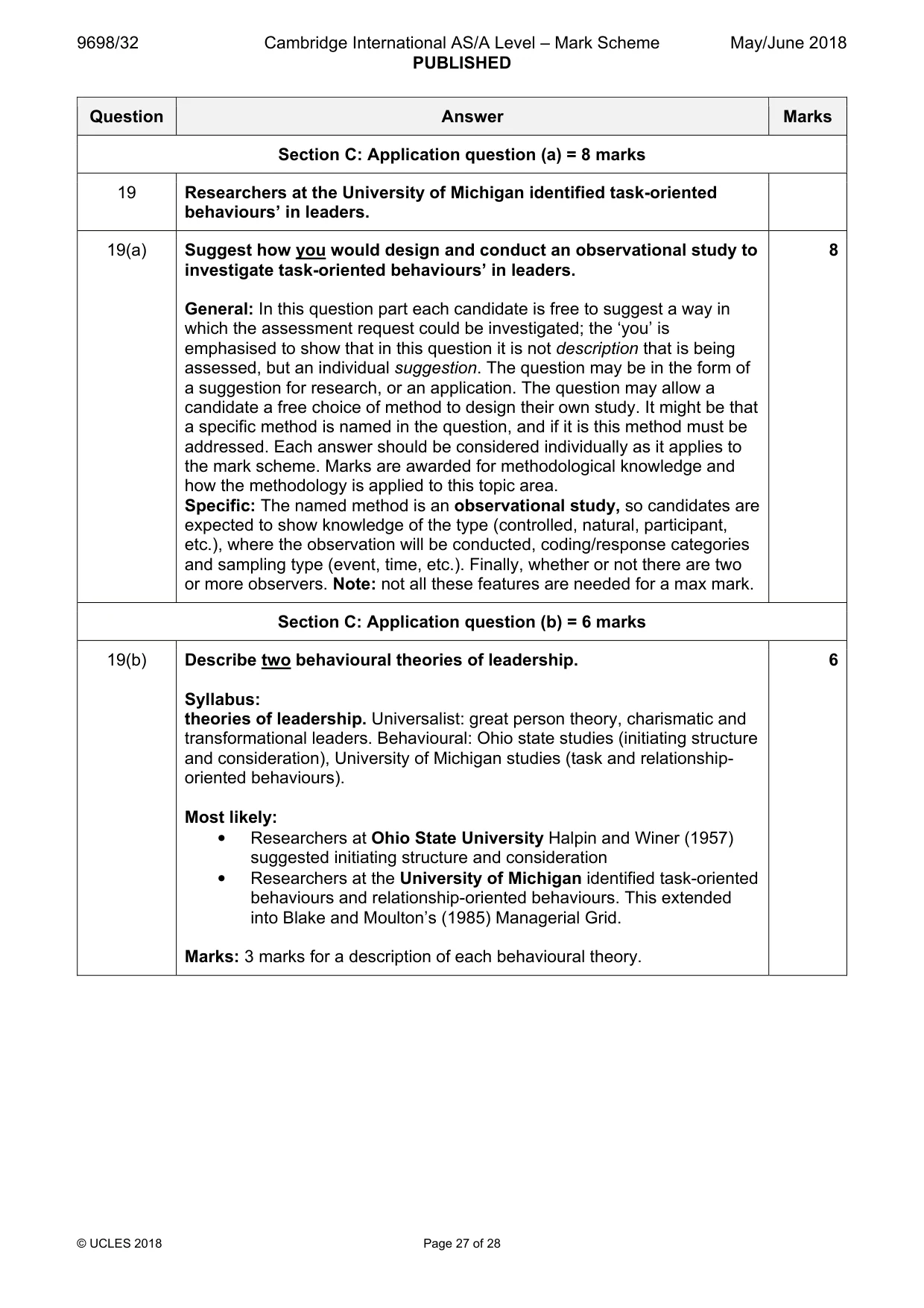
Q19 · Researchers at the University of Michigan identified task-oriented behaviours in leaders
19 Researchers at the University of Michigan identified task-oriented behaviours in leaders. (a) Suggest how you would design and conduct an observational study to investigate task-oriented behaviours in leaders. [8] (b) Describe two behavioural theories of leadership. [6]
Mark scheme: 19(a) Suggest how you would design and conduct an observational study to 8 investigate task-oriented behaviours’ in leaders. General: In this question part each candidate is free to suggest a way in which the assessment request could be investigated; the ‘you’ is emphasised to show that in this question it is not description that is being assessed, but an individual suggestion. The question may be in the form of a suggestion for research, or an application. The question may allow a candidate a free choice of method to design their own study. It might be that a specific method is named in the question, and if it is this method must be addressed. Each answer should be considered individually as it applies to the mark scheme. Marks are awarded for methodological knowledge and how the methodology is applied to this topic area. Specific: The named method is an observational study, so candidates are expected to show knowledge of the type (controlled, natural, participant, etc.), where the observation will be conducted, coding/response categories and sampling type (event, time, etc.). Finally, whether or not there are two or more observers. Note: not all these features are needed for a max mark. Section C: Application question (b) = 6 marks 19(b) Describe two behavioural theories of leadership. 6 Syllabus: theories of leadership. Universalist: great person theory, charismatic and transformational leaders. Behavioural: Ohio state studies (initiating structure and consideration), University of Michigan studies (task and relationship- oriented behaviours). Most likely: • Researchers at Ohio State University Halpin and Winer (1957) suggested initiating structure and consideration • Researchers at the University of Michigan identified task-oriented behaviours and relationship-oriented behaviours. This extended into Blake and Moulton’s (1985) Managerial Grid. Marks: 3 marks for a description of each behavioural theory.
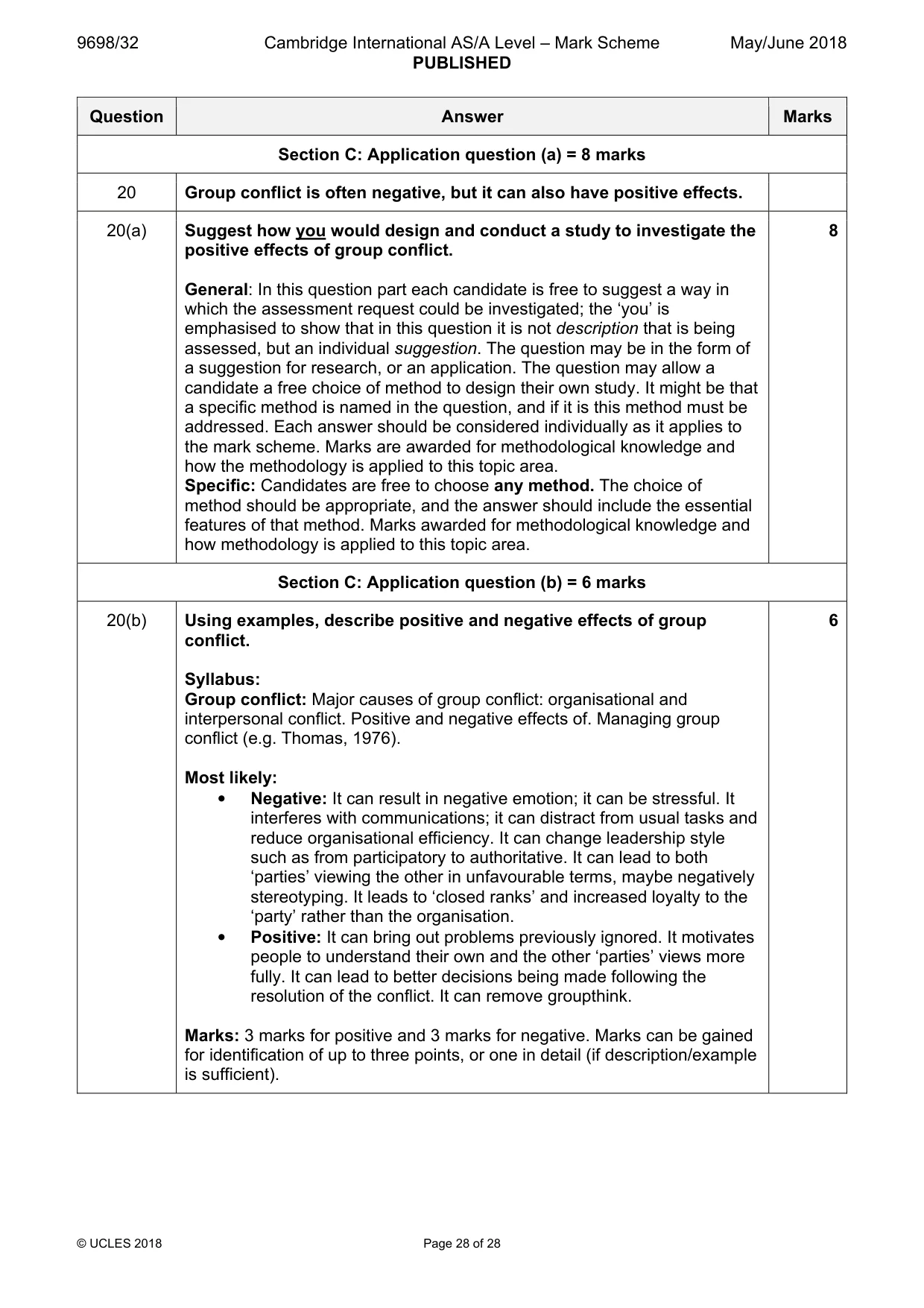
Q20 · Group conflict is often negative, but it can also have positive effects
20 Group conflict is often negative, but it can also have positive effects. (a) Suggest how you would design and conduct a study to investigate the positive effects of group conflict. [8] (b) Using examples, describe positive and negative effects of group conflict. [6]
Mark scheme: 20(a) Suggest how you would design and conduct a study to investigate the 8 positive effects of group conflict. General: In this question part each candidate is free to suggest a way in which the assessment request could be investigated; the ‘you’ is emphasised to show that in this question it is not description that is being assessed, but an individual suggestion. The question may be in the form of a suggestion for research, or an application. The question may allow a candidate a free choice of method to design their own study. It might be that a specific method is named in the question, and if it is this method must be addressed. Each answer should be considered individually as it applies to the mark scheme. Marks are awarded for methodological knowledge and how the methodology is applied to this topic area. Specific: Candidates are free to choose any method. The choice of method should be appropriate, and the answer should include the essential features of that method. Marks awarded for methodological knowledge and how methodology is applied to this topic area. Section C: Application question (b) = 6 marks 20(b) Using examples, describe positive and negative effects of group 6 conflict. Syllabus: Group conflict: Major causes of group conflict: organisational and interpersonal conflict. Positive and negative effects of. Managing group conflict (e.g. Thomas, 1976). Most likely: • Negative: It can result in negative emotion; it can be stressful. It interferes with communications; it can distract from usual tasks and reduce organisational efficiency. It can change leadership style such as from participatory to authoritative. It can lead to both ‘parties’ viewing the other in unfavourable terms, maybe negatively stereotyping. It leads to ‘closed ranks’ and increased loyalty to the ‘party’ rather than the organisation. • Positive: It can bring out problems previously ignored. It motivates people to understand their own and the other ‘parties’ views more fully. It can lead to better decisions being made following the resolution of the conflict. It can remove groupthink. Marks: 3 marks for positive and 3 marks for negative. Marks can be gained for identification of up to three points, or one in detail (if description/example is sufficient).
What you needed in this session
Cambridge’s own grade thresholds for 2018 May/June, Paper 3 · Variant 2. A higher threshold means an easier paper — the bar moves with how the cohort did.