Cambridge A Level Psychology 9698 — 2016 Oct/Nov Paper 3 · Variant 2
9698/32/O/N/16 · 80 marks · ≈90 min
The question paper and its mark scheme, free to read here and free to download. This is Cambridge’s own paper, exactly as it was sat.
Question paper8 pages


Mark scheme21 pages
Answers below. Sit the paper first if you are practising.
Paper as text
Question paper, page 1
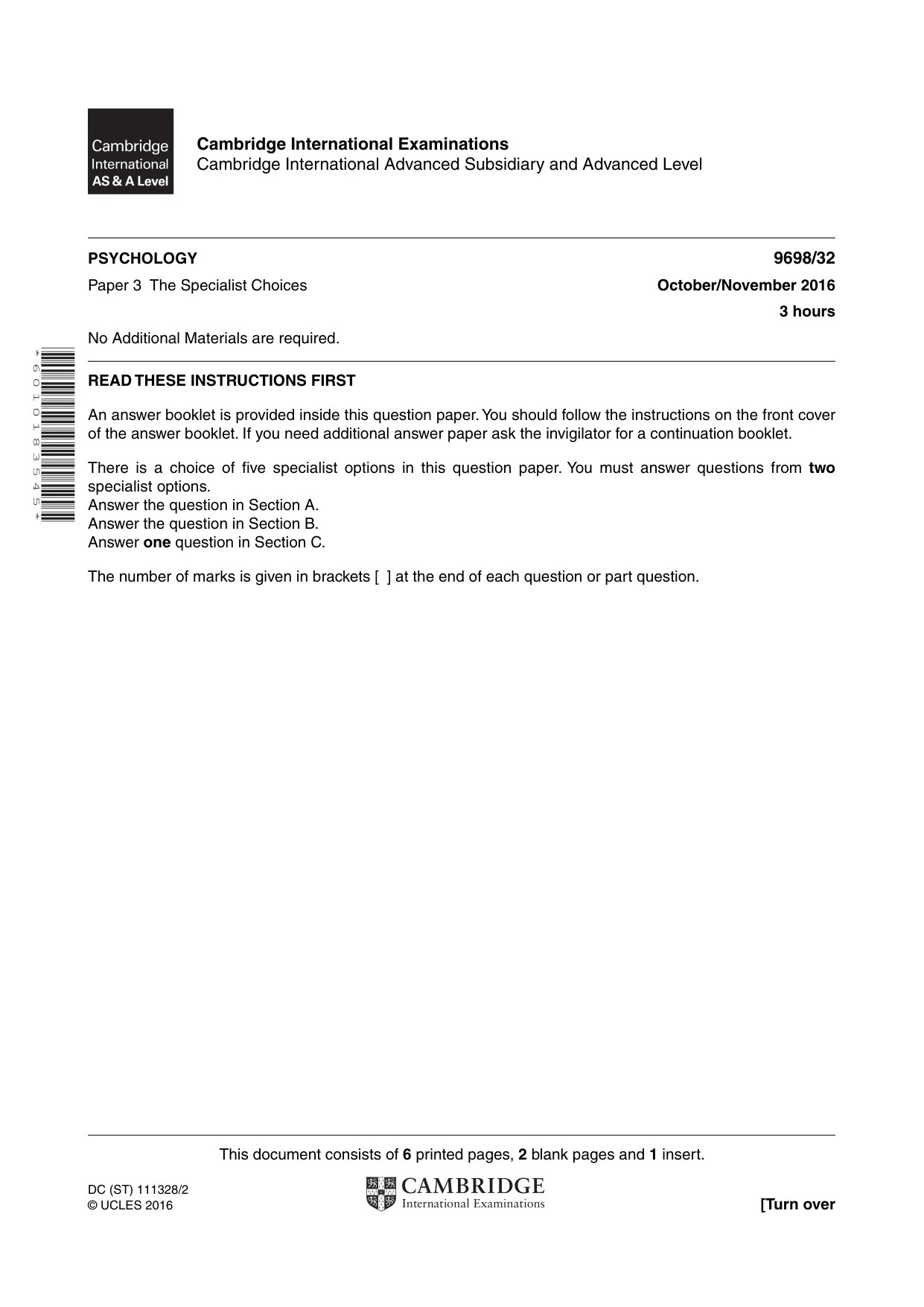
This document consists of 6 printed pages, 2 blank pages and 1 insert. DC (ST) 111328/2 © UCLES 2016 [Turn over Cambridge International Examinations Cambridge International Advanced Subsidiary and Advanced Level * 6 0 1 0 1 8 3 5 4 5 * PSYCHOLOGY 9698/32 Paper 3 The Specialist Choices October/November 2016 3 hours No Additional Materials are required. READ THESE INSTRUCTIONS FIRST An answer booklet is provided inside this question paper. You should follow the instructions on the front cover of the answer booklet. If you need additional answer paper ask the invigilator for a continuation booklet. There is a choice of five specialist options in this question paper. You must answer questions from two specialist options. Answer the question in Section A. Answer the question in Section B. Answer one question in Section C. The number of marks is given in brackets [ ] at the end of each question or part question.
Question paper, page 2
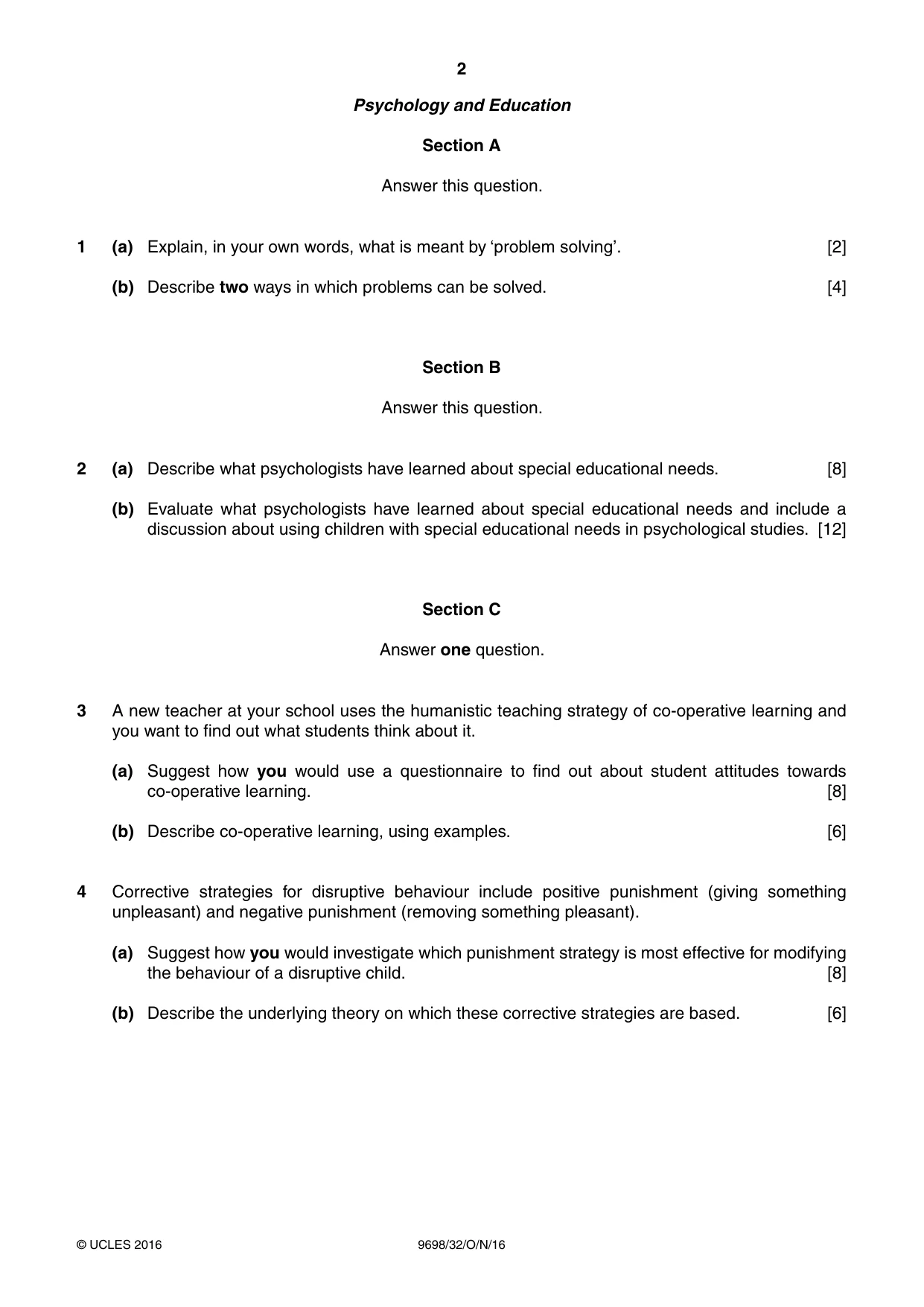
2 9698/32/O/N/16 © UCLES 2016 Psychology and Education Section A Answer this question. 1 (a) Explain, in your own words, what is meant by ‘problem solving’. [2] (b) Describe two ways in which problems can be solved. [4] Section B Answer this question. 2 (a) Describe what psychologists have learned about special educational needs. [8] (b) Evaluate what psychologists have learned about special educational needs and include a discussion about using children with special educational needs in psychological studies. [12] Section C Answer one question. 3 A new teacher at your school uses the humanistic teaching strategy of co-operative learning and you want to find out what students think about it. (a) Suggest how you would use a questionnaire to find out about student attitudes towards co-operative learning. [8] (b) Describe co-operative learning, using examples. [6] 4 Corrective strategies for disruptive behaviour include positive punishment (giving something unpleasant) and negative punishment (removing something pleasant). (a) Suggest how you would investigate which punishment strategy is most effective for modifying the behaviour of a disruptive child. [8] (b) Describe the underlying theory on which these corrective strategies are based. [6]
Question paper, page 3
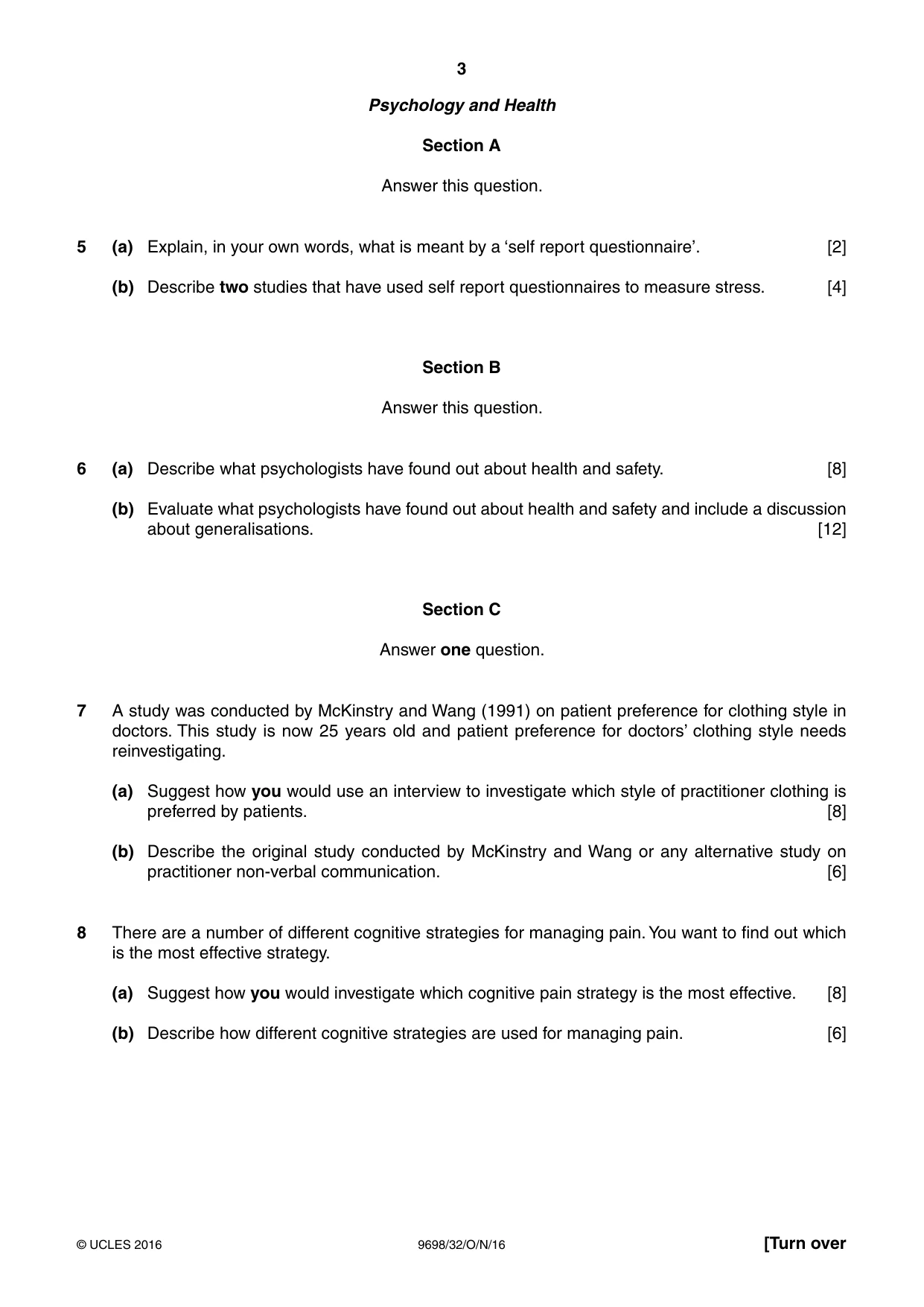
3 9698/32/O/N/16 © UCLES 2016 [Turn over Psychology and Health Section A Answer this question. 5 (a) Explain, in your own words, what is meant by a ‘self report questionnaire’. [2] (b) Describe two studies that have used self report questionnaires to measure stress. [4] Section B Answer this question. 6 (a) Describe what psychologists have found out about health and safety. [8] (b) Evaluate what psychologists have found out about health and safety and include a discussion about generalisations. [12] Section C Answer one question. 7 A study was conducted by McKinstry and Wang (1991) on patient preference for clothing style in doctors. This study is now 25 years old and patient preference for doctors’ clothing style needs reinvestigating. (a) Suggest how you would use an interview to investigate which style of practitioner clothing is preferred by patients. [8] (b) Describe the original study conducted by McKinstry and Wang or any alternative study on practitioner non-verbal communication. [6] 8 There are a number of different cognitive strategies for managing pain. You want to find out which is the most effective strategy. (a) Suggest how you would investigate which cognitive pain strategy is the most effective. [8] (b) Describe how different cognitive strategies are used for managing pain. [6]
Question paper, page 4
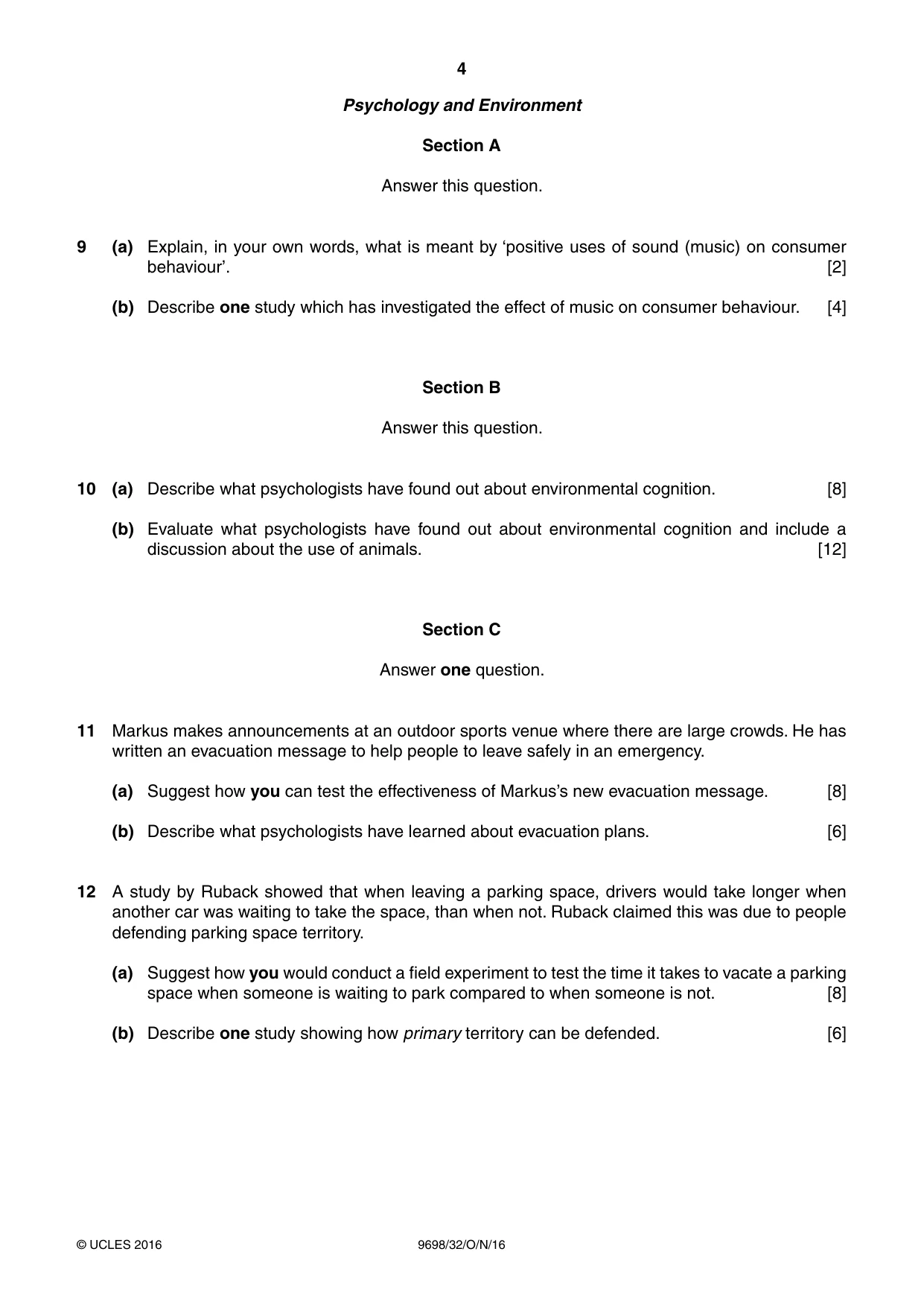
4 9698/32/O/N/16 © UCLES 2016 Psychology and Environment Section A Answer this question. 9 (a) Explain, in your own words, what is meant by ‘positive uses of sound (music) on consumer behaviour’. [2] (b) Describe one study which has investigated the effect of music on consumer behaviour. [4] Section B Answer this question. 10 (a) Describe what psychologists have found out about environmental cognition. [8] (b) Evaluate what psychologists have found out about environmental cognition and include a discussion about the use of animals. [12] Section C Answer one question. 11 Markus makes announcements at an outdoor sports venue where there are large crowds. He has written an evacuation message to help people to leave safely in an emergency. (a) Suggest how you can test the effectiveness of Markus’s new evacuation message. [8] (b) Describe what psychologists have learned about evacuation plans. [6] 12 A study by Ruback showed that when leaving a parking space, drivers would take longer when another car was waiting to take the space, than when not. Ruback claimed this was due to people defending parking space territory. (a) Suggest how you would conduct a field experiment to test the time it takes to vacate a parking space when someone is waiting to park compared to when someone is not. [8] (b) Describe one study showing how primary territory can be defended. [6]
Question paper, page 5
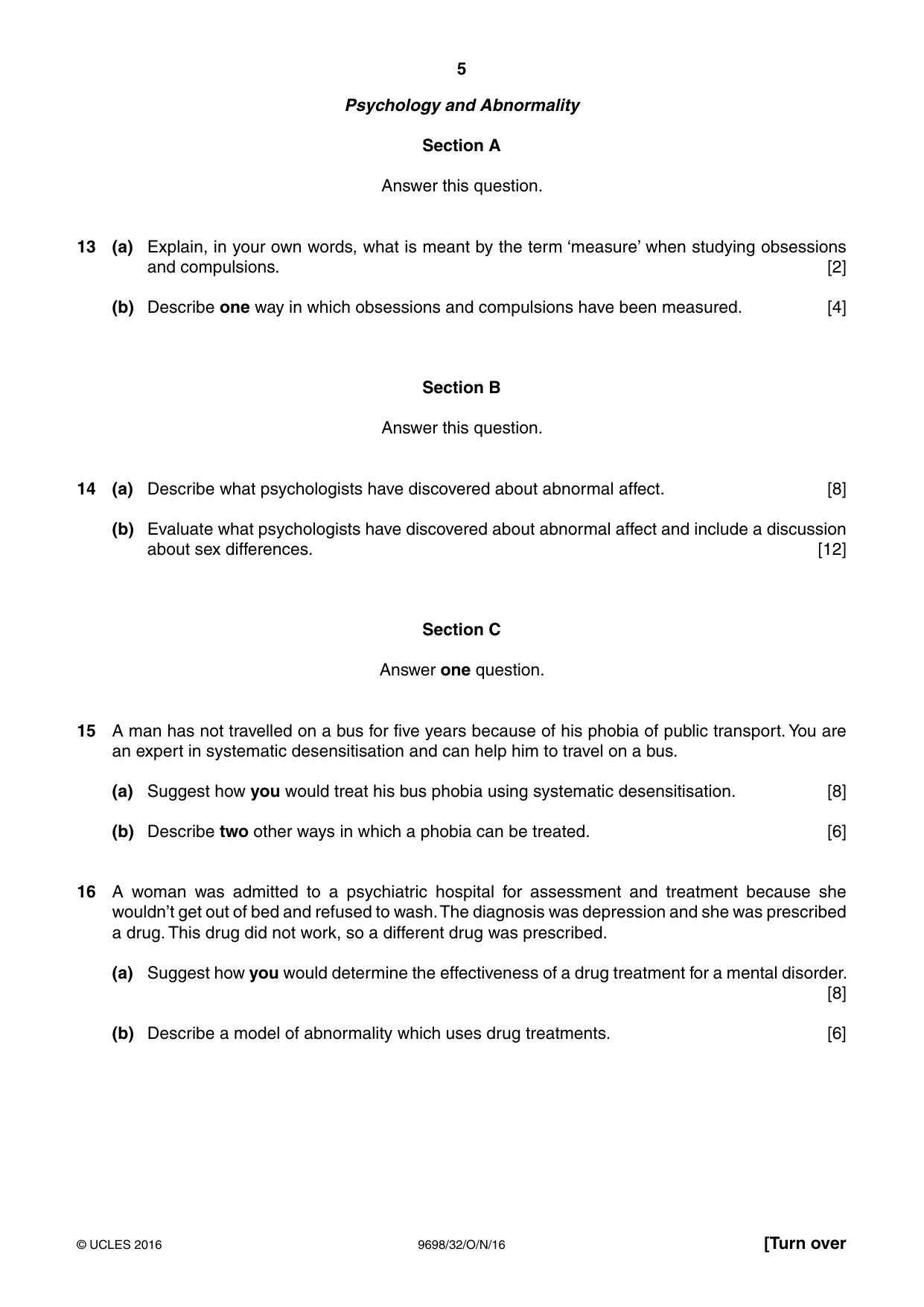
5 9698/32/O/N/16 © UCLES 2016 [Turn over Psychology and Abnormality Section A Answer this question. 13 (a) Explain, in your own words, what is meant by the term ‘measure’ when studying obsessions and compulsions. [2] (b) Describe one way in which obsessions and compulsions have been measured. [4] Section B Answer this question. 14 (a) Describe what psychologists have discovered about abnormal affect. [8] (b) Evaluate what psychologists have discovered about abnormal affect and include a discussion about sex differences. [12] Section C Answer one question. 15 A man has not travelled on a bus for five years because of his phobia of public transport. You are an expert in systematic desensitisation and can help him to travel on a bus. (a) Suggest how you would treat his bus phobia using systematic desensitisation. [8] (b) Describe two other ways in which a phobia can be treated. [6] 16 A woman was admitted to a psychiatric hospital for assessment and treatment because she wouldn’t get out of bed and refused to wash. The diagnosis was depression and she was prescribed a drug. This drug did not work, so a different drug was prescribed. (a) Suggest how you would determine the effectiveness of a drug treatment for a mental disorder. [8] (b) Describe a model of abnormality which uses drug treatments. [6]
Question paper, page 6
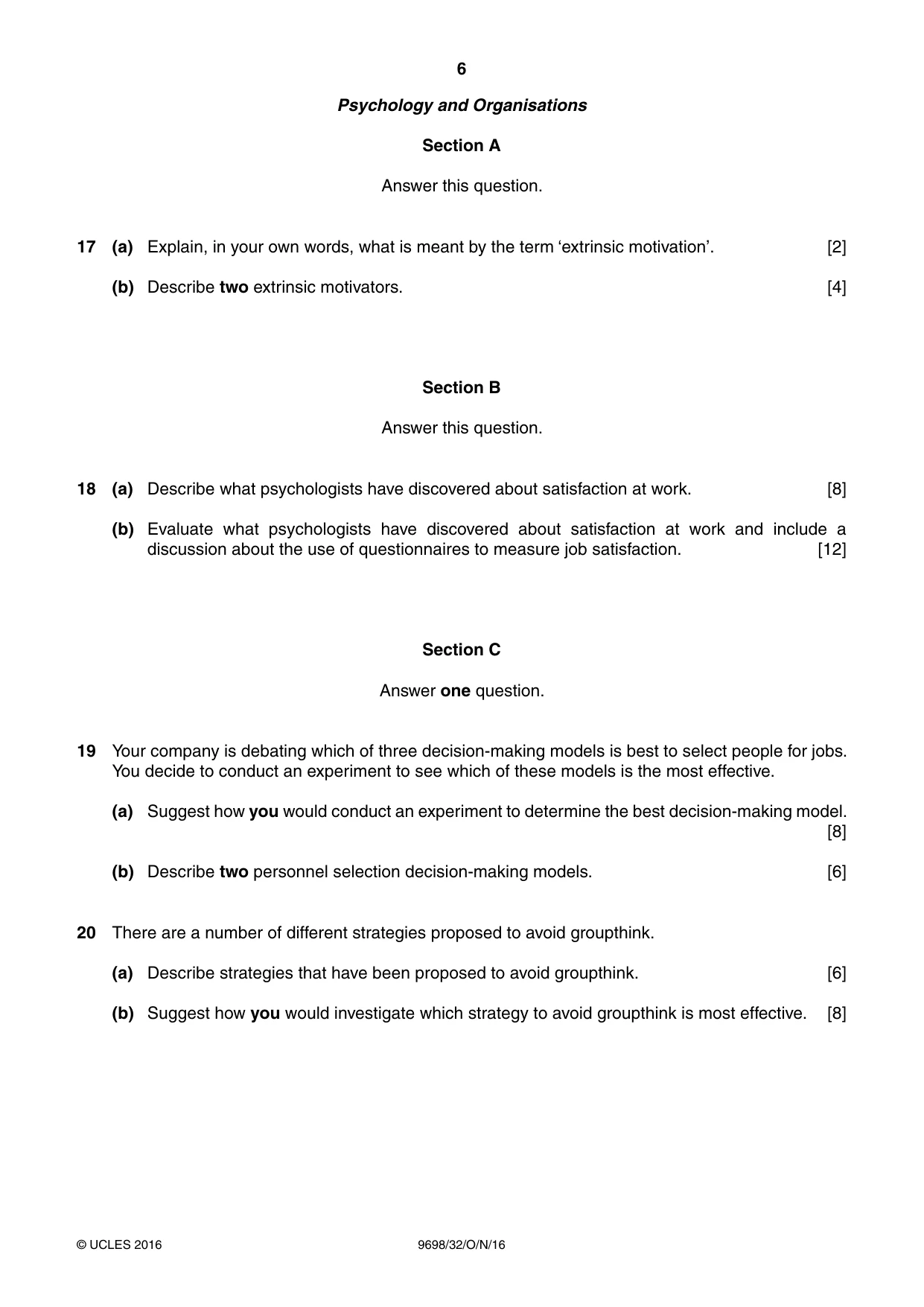
6 9698/32/O/N/16 © UCLES 2016 Psychology and Organisations Section A Answer this question. 17 (a) Explain, in your own words, what is meant by the term ‘extrinsic motivation’. [2] (b) Describe two extrinsic motivators. [4] Section B Answer this question. 18 (a) Describe what psychologists have discovered about satisfaction at work. [8] (b) Evaluate what psychologists have discovered about satisfaction at work and include a discussion about the use of questionnaires to measure job satisfaction. [12] Section C Answer one question. 19 Your company is debating which of three decision-making models is best to select people for jobs. You decide to conduct an experiment to see which of these models is the most effective. (a) Suggest how you would conduct an experiment to determine the best decision-making model. [8] (b) Describe two personnel selection decision-making models. [6] 20 There are a number of different strategies proposed to avoid groupthink. (a) Describe strategies that have been proposed to avoid groupthink. [6] (b) Suggest how you would investigate which strategy to avoid groupthink is most effective. [8]
Question paper, page 7
7 9698/32/O/N/16 © UCLES 2016 BLANK PAGE
Question paper, page 8
8 9698/32/O/N/16 © UCLES 2016 BLANK PAGE Permission to reproduce items where third-party owned material protected by copyright is included has been sought and cleared where possible. Every reasonable effort has been made by the publisher (UCLES) to trace copyright holders, but if any items requiring clearance have unwittingly been included, the publisher will be pleased to make amends at the earliest possible opportunity. To avoid the issue of disclosure of answer-related information to candidates, all copyright acknowledgements are reproduced online in the Cambridge International Examinations Copyright Acknowledgements Booklet. This is produced for each series of examinations and is freely available to download at www.cie.org.uk after the live examination series. Cambridge International Examinations is part of the Cambridge Assessment Group. Cambridge Assessment is the brand name of University of Cambridge Local Examinations Syndicate (UCLES), which is itself a department of the University of Cambridge.
Mark scheme, page 1
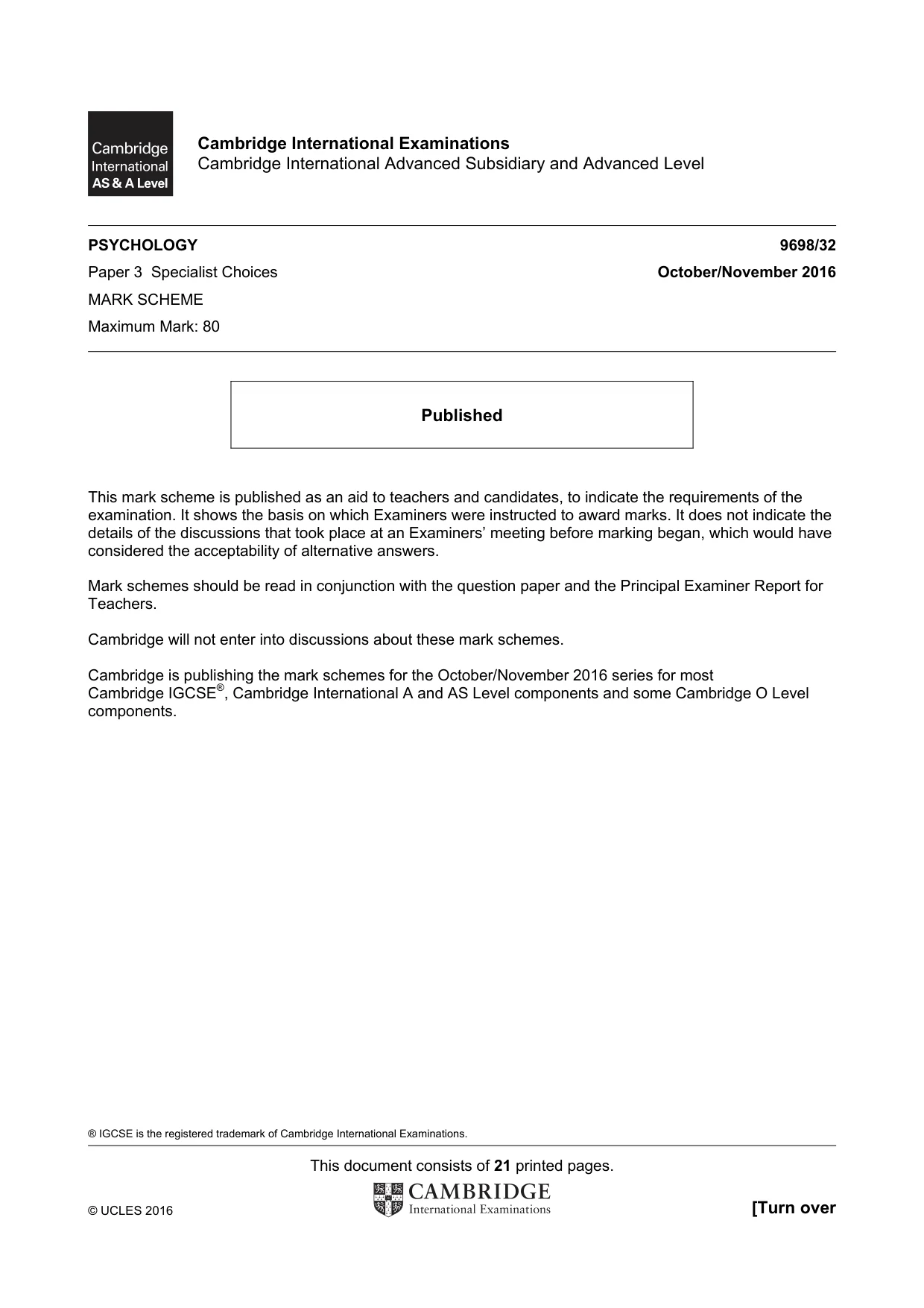
® IGCSE is the registered trademark of Cambridge International Examinations. This document consists of 21 printed pages. © UCLES 2016 [Turn over Cambridge International Examinations Cambridge International Advanced Subsidiary and Advanced Level PSYCHOLOGY 9698/32 Paper 3 Specialist Choices October/November 2016 MARK SCHEME Maximum Mark: 80 Published This mark scheme is published as an aid to teachers and candidates, to indicate the requirements of the examination. It shows the basis on which Examiners were instructed to award marks. It does not indicate the details of the discussions that took place at an Examiners’ meeting before marking began, which would have considered the acceptability of alternative answers. Mark schemes should be read in conjunction with the question paper and the Principal Examiner Report for Teachers. Cambridge will not enter into discussions about these mark schemes. Cambridge is publishing the mark schemes for the October/November 2016 series for most Cambridge IGCSE®, Cambridge International A and AS Level components and some Cambridge O Level components.
Mark scheme, page 2
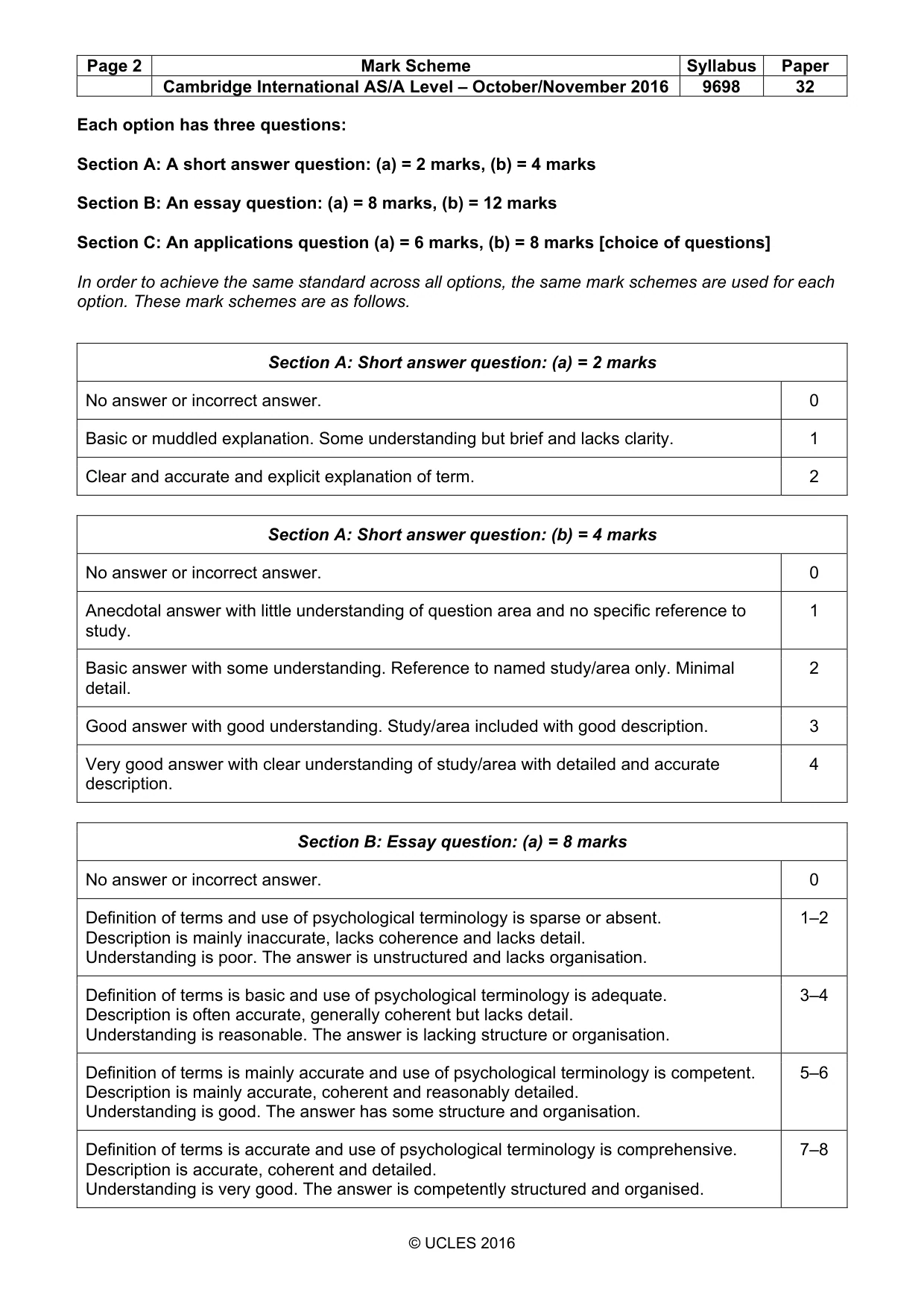
Page 2 Mark Scheme Syllabus Paper Cambridge International AS/A Level – October/November 2016 9698 32 © UCLES 2016 Each option has three questions: Section A: A short answer question: (a) = 2 marks, (b) = 4 marks Section B: An essay question: (a) = 8 marks, (b) = 12 marks Section C: An applications question (a) = 6 marks, (b) = 8 marks [choice of questions] In order to achieve the same standard across all options, the same mark schemes are used for each option. These mark schemes are as follows. Section A: Short answer question: (a) = 2 marks No answer or incorrect answer. 0 Basic or muddled explanation. Some understanding but brief and lacks clarity. 1 Clear and accurate and explicit explanation of term. 2 Section A: Short answer question: (b) = 4 marks No answer or incorrect answer. 0 Anecdotal answer with little understanding of question area and no specific reference to study. 1 Basic answer with some understanding. Reference to named study/area only. Minimal detail. 2 Good answer with good understanding. Study/area included with good description. 3 Very good answer with clear understanding of study/area with detailed and accurate description. 4 Section B: Essay question: (a) = 8 marks No answer or incorrect answer. 0 Definition of terms and use of psychological terminology is sparse or absent. Description is mainly inaccurate, lacks coherence and lacks detail. Understanding is poor. The answer is unstructured and lacks organisation. 1–2 Definition of terms is basic and use of psychological terminology is adequate. Description is often accurate, generally coherent but lacks detail. Understanding is reasonable. The answer is lacking structure or organisation. 3–4 Definition of terms is mainly accurate and use of psychological terminology is competent. Description is mainly accurate, coherent and reasonably detailed. Understanding is good. The answer has some structure and organisation. 5–6 Definition of terms is accurate and use of psychological terminology is comprehensive. Description is accurate, coherent and detailed. Understanding is very good. The answer is competently structured and organised. 7–8
Mark scheme, page 3
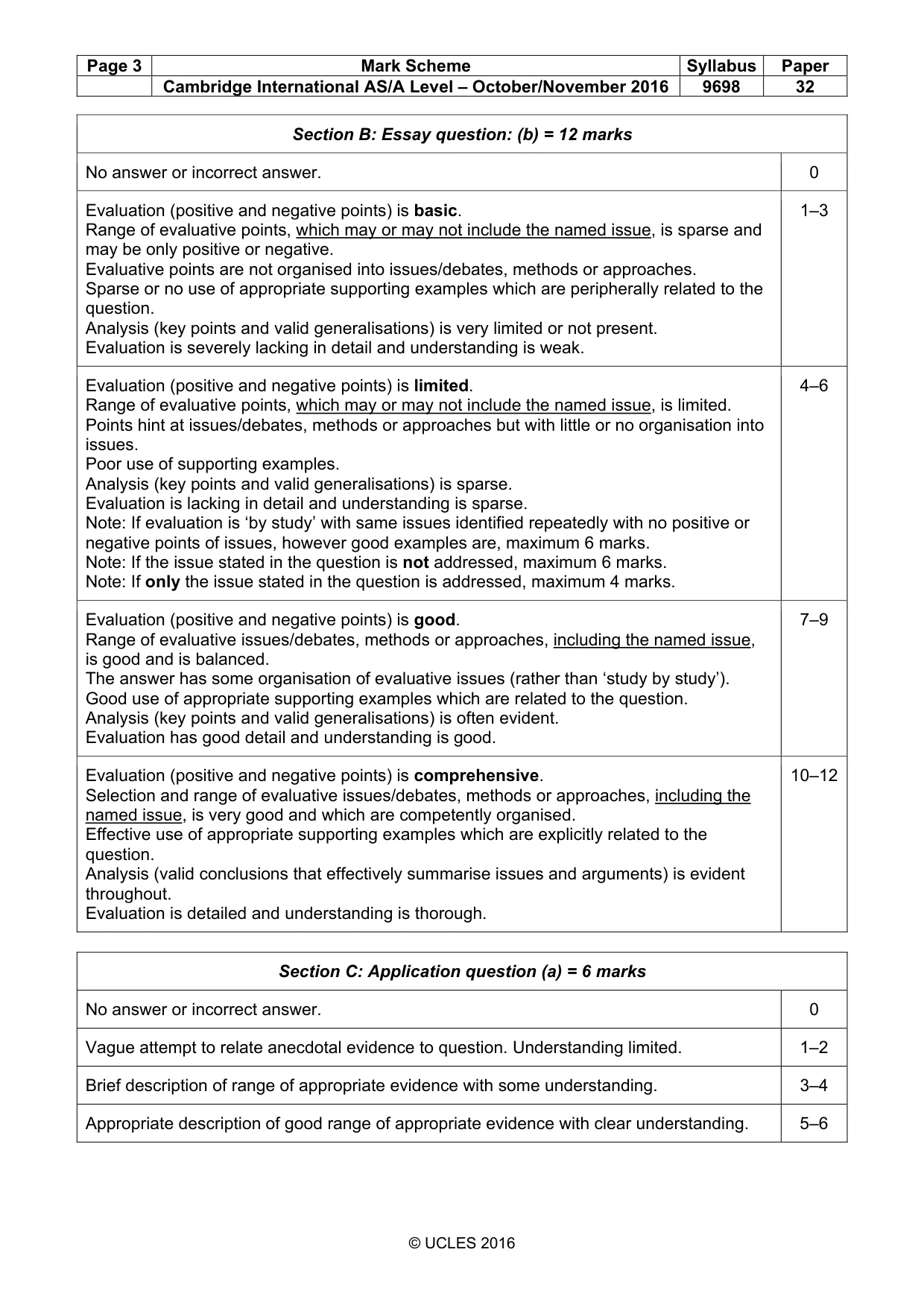
Page 3 Mark Scheme Syllabus Paper Cambridge International AS/A Level – October/November 2016 9698 32 © UCLES 2016 Section B: Essay question: (b) = 12 marks No answer or incorrect answer. 0 Evaluation (positive and negative points) is basic. Range of evaluative points, which may or may not include the named issue, is sparse and may be only positive or negative. Evaluative points are not organised into issues/debates, methods or approaches. Sparse or no use of appropriate supporting examples which are peripherally related to the question. Analysis (key points and valid generalisations) is very limited or not present. Evaluation is severely lacking in detail and understanding is weak. 1–3 Evaluation (positive and negative points) is limited. Range of evaluative points, which may or may not include the named issue, is limited. Points hint at issues/debates, methods or approaches but with little or no organisation into issues. Poor use of supporting examples. Analysis (key points and valid generalisations) is sparse. Evaluation is lacking in detail and understanding is sparse. Note: If evaluation is ‘by study’ with same issues identified repeatedly with no positive or negative points of issues, however good examples are, maximum 6 marks. Note: If the issue stated in the question is not addressed, maximum 6 marks. Note: If only the issue stated in the question is addressed, maximum 4 marks. 4–6 Evaluation (positive and negative points) is good. Range of evaluative issues/debates, methods or approaches, including the named issue, is good and is balanced. The answer has some organisation of evaluative issues (rather than ‘study by study’). Good use of appropriate supporting examples which are related to the question. Analysis (key points and valid generalisations) is often evident. Evaluation has good detail and understanding is good. 7–9 Evaluation (positive and negative points) is comprehensive. Selection and range of evaluative issues/debates, methods or approaches, including the named issue, is very good and which are competently organised. Effective use of appropriate supporting examples which are explicitly related to the question. Analysis (valid conclusions that effectively summarise issues and arguments) is evident throughout. Evaluation is detailed and understanding is thorough. 10–12 Section C: Application question (a) = 6 marks No answer or incorrect answer. 0 Vague attempt to relate anecdotal evidence to question. Understanding limited. 1–2 Brief description of range of appropriate evidence with some understanding. 3–4 Appropriate description of good range of appropriate evidence with clear understanding. 5–6
Mark scheme, page 4
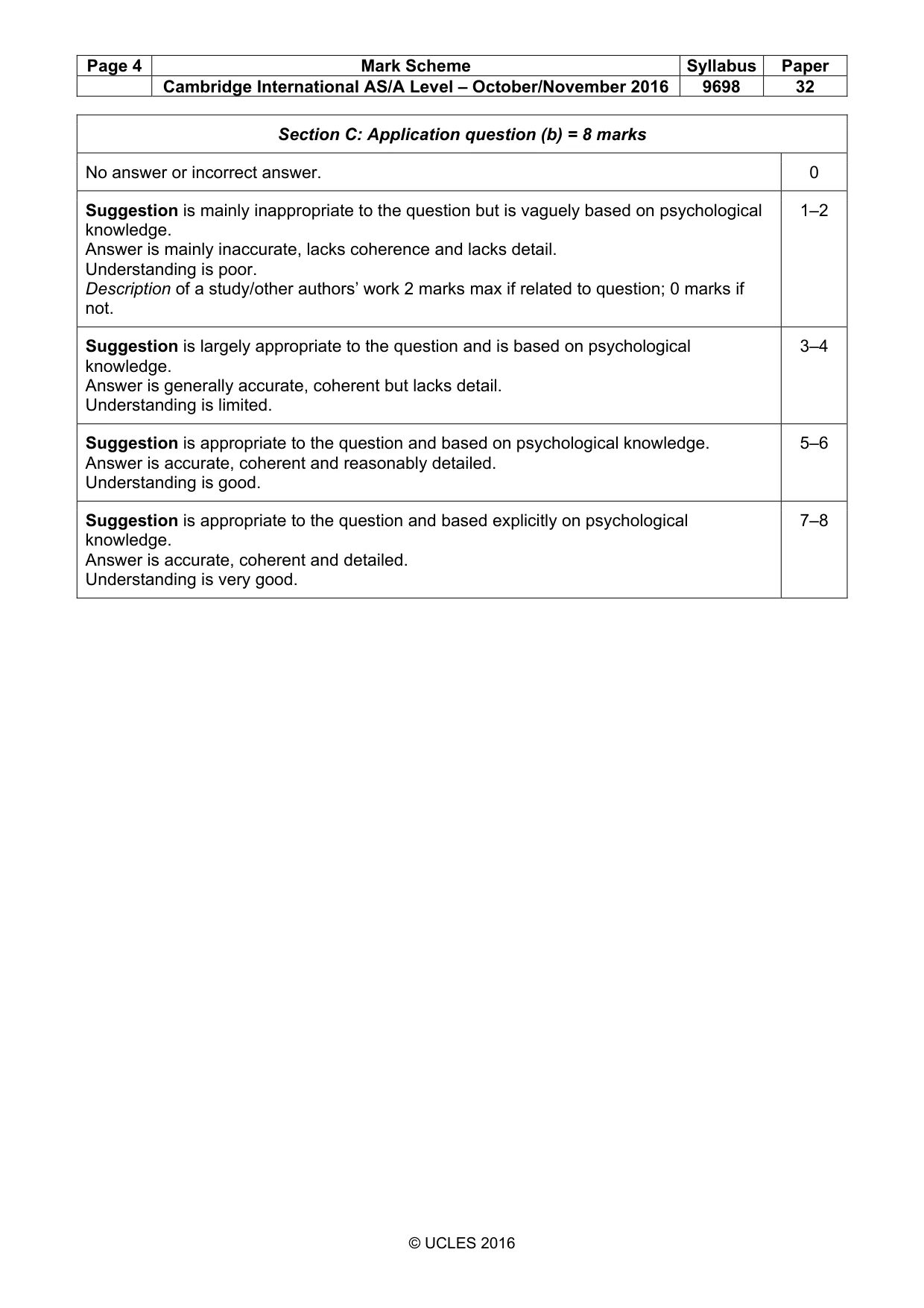
Page 4 Mark Scheme Syllabus Paper Cambridge International AS/A Level – October/November 2016 9698 32 © UCLES 2016 Section C: Application question (b) = 8 marks No answer or incorrect answer. 0 Suggestion is mainly inappropriate to the question but is vaguely based on psychological knowledge. Answer is mainly inaccurate, lacks coherence and lacks detail. Understanding is poor. Description of a study/other authors’ work 2 marks max if related to question; 0 marks if not. 1–2 Suggestion is largely appropriate to the question and is based on psychological knowledge. Answer is generally accurate, coherent but lacks detail. Understanding is limited. 3–4 Suggestion is appropriate to the question and based on psychological knowledge. Answer is accurate, coherent and reasonably detailed. Understanding is good. 5–6 Suggestion is appropriate to the question and based explicitly on psychological knowledge. Answer is accurate, coherent and detailed. Understanding is very good. 7–8
Mark scheme, page 5
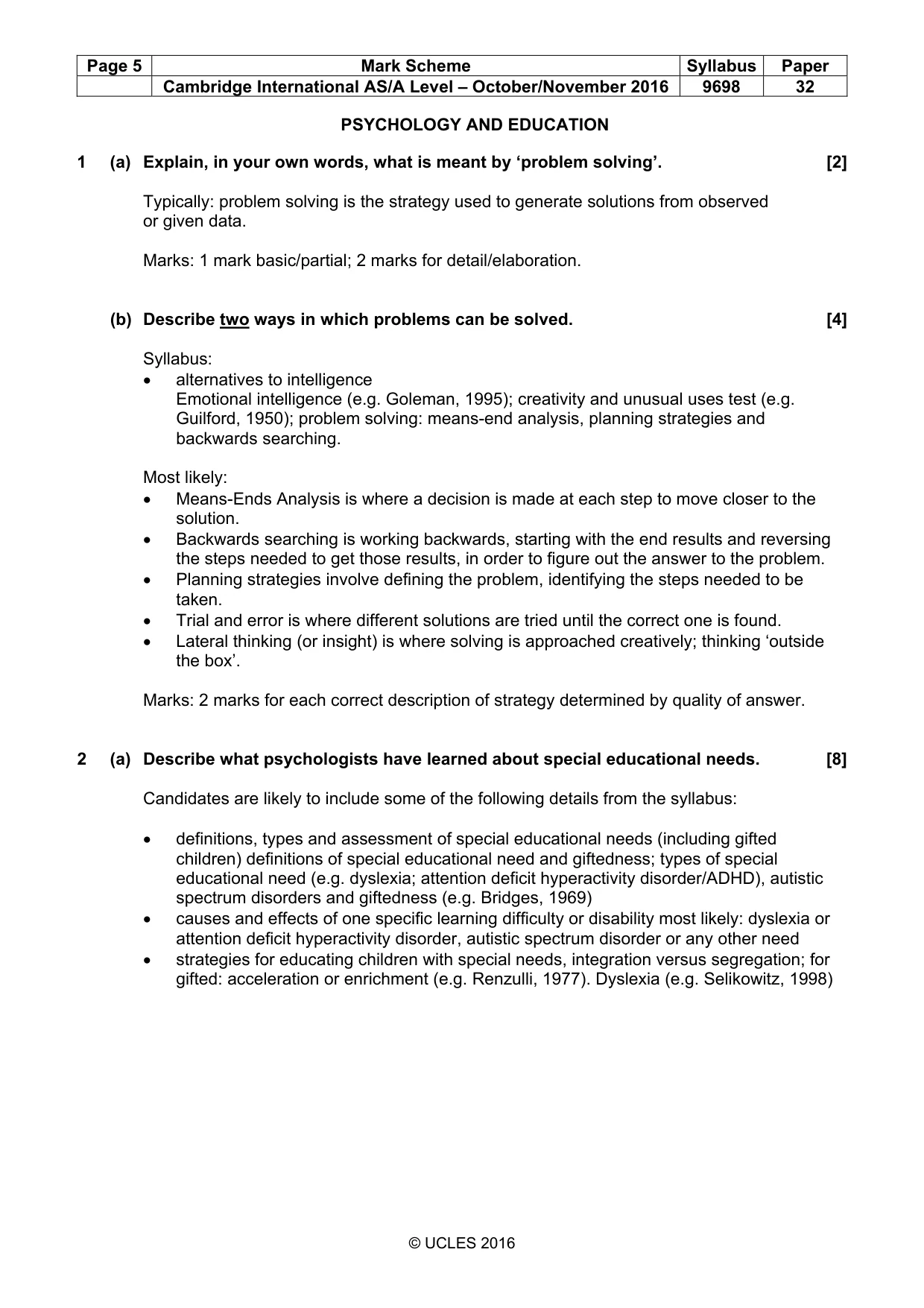
Page 5 Mark Scheme Syllabus Paper Cambridge International AS/A Level – October/November 2016 9698 32 © UCLES 2016 PSYCHOLOGY AND EDUCATION 1 (a) Explain, in your own words, what is meant by ‘problem solving’. [2] Typically: problem solving is the strategy used to generate solutions from observed or given data. Marks: 1 mark basic/partial; 2 marks for detail/elaboration. (b) Describe two ways in which problems can be solved. [4] Syllabus: • alternatives to intelligence Emotional intelligence (e.g. Goleman, 1995); creativity and unusual uses test (e.g. Guilford, 1950); problem solving: means-end analysis, planning strategies and backwards searching. Most likely: • Means-Ends Analysis is where a decision is made at each step to move closer to the solution. • Backwards searching is working backwards, starting with the end results and reversing the steps needed to get those results, in order to figure out the answer to the problem. • Planning strategies involve defining the problem, identifying the steps needed to be taken. • Trial and error is where different solutions are tried until the correct one is found. • Lateral thinking (or insight) is where solving is approached creatively; thinking ‘outside the box’. Marks: 2 marks for each correct description of strategy determined by quality of answer. 2 (a) Describe what psychologists have learned about special educational needs. [8] Candidates are likely to include some of the following details from the syllabus: • definitions, types and assessment of special educational needs (including gifted children) definitions of special educational need and giftedness; types of special educational need (e.g. dyslexia; attention deficit hyperactivity disorder/ADHD), autistic spectrum disorders and giftedness (e.g. Bridges, 1969) • causes and effects of one specific learning difficulty or disability most likely: dyslexia or attention deficit hyperactivity disorder, autistic spectrum disorder or any other need • strategies for educating children with special needs, integration versus segregation; for gifted: acceleration or enrichment (e.g. Renzulli, 1977). Dyslexia (e.g. Selikowitz, 1998)
Mark scheme, page 6
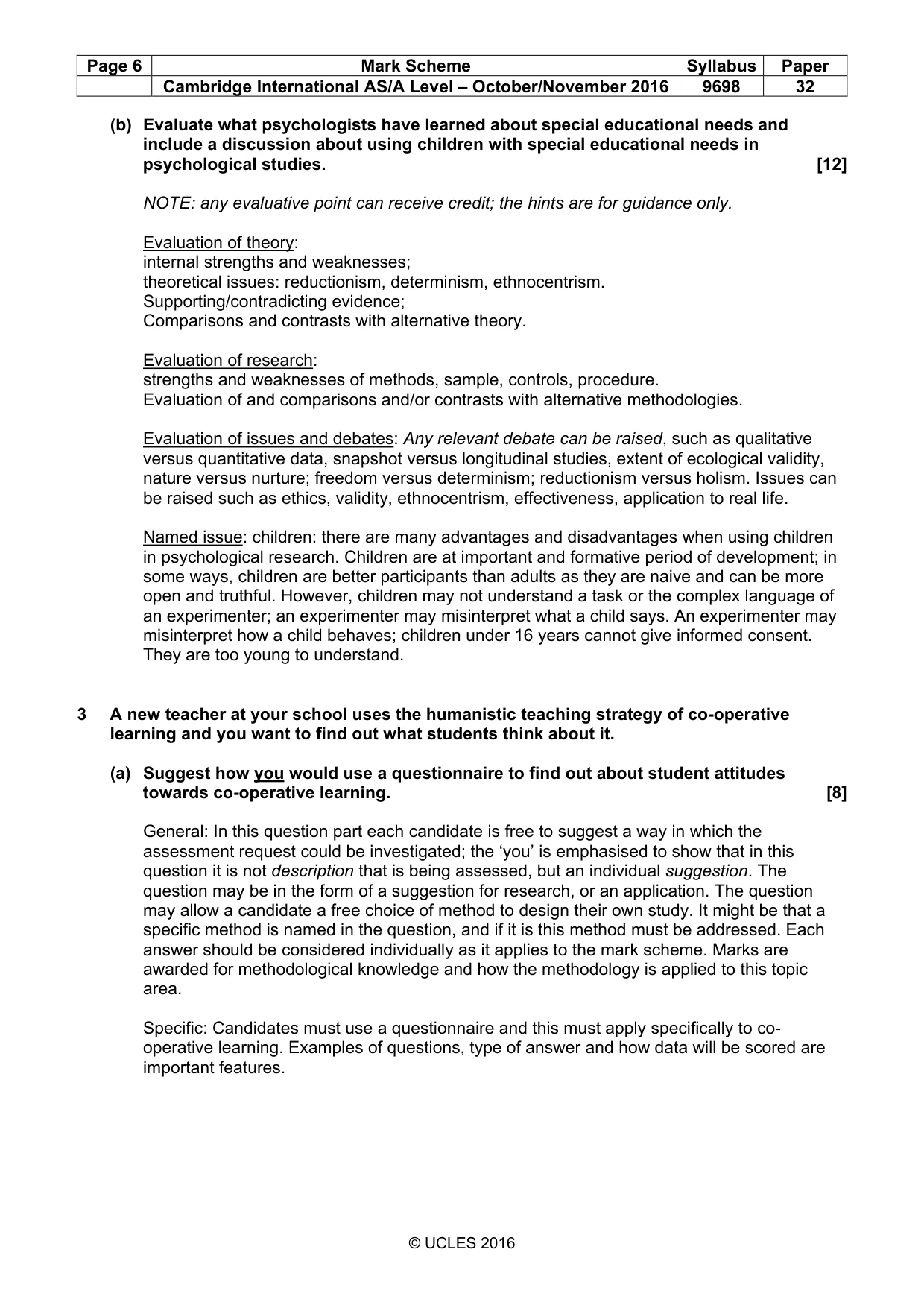
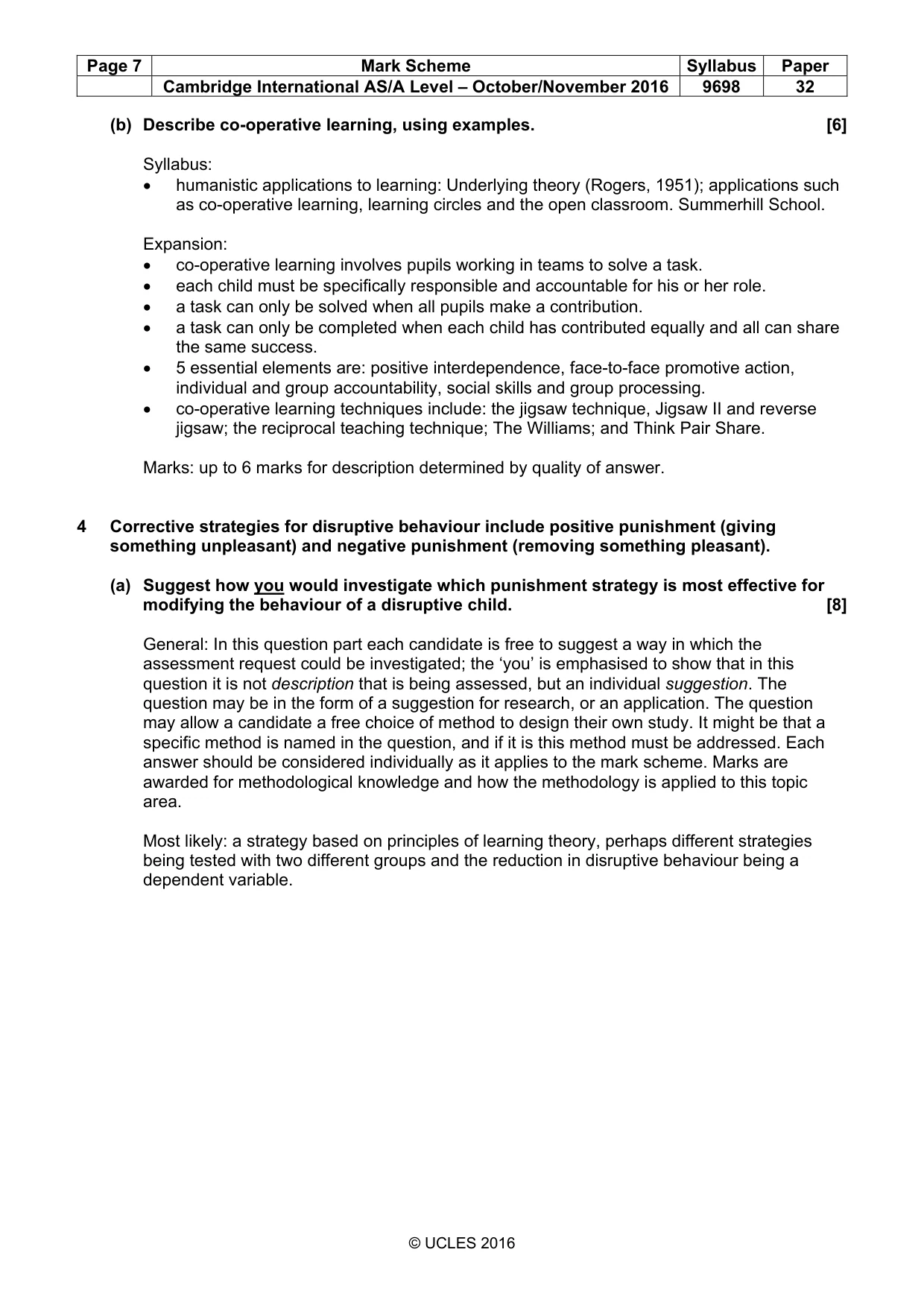
Page 6 Mark Scheme Syllabus Paper Cambridge International AS/A Level – October/November 2016 9698 32 © UCLES 2016 (b) Evaluate what psychologists have learned about special educational needs and include a discussion about using children with special educational needs in psychological studies. [12] NOTE: any evaluative point can receive credit; the hints are for guidance only. Evaluation of theory: internal strengths and weaknesses; theoretical issues: reductionism, determinism, ethnocentrism. Supporting/contradicting evidence; Comparisons and contrasts with alternative theory. Evaluation of research: strengths and weaknesses of methods, sample, controls, procedure. Evaluation of and comparisons and/or contrasts with alternative methodologies. Evaluation of issues and debates: Any relevant debate can be raised, such as qualitative versus quantitative data, snapshot versus longitudinal studies, extent of ecological validity, nature versus nurture; freedom versus determinism; reductionism versus holism. Issues can be raised such as ethics, validity, ethnocentrism, effectiveness, application to real life. Named issue: children: there are many advantages and disadvantages when using children in psychological research. Children are at important and formative period of development; in some ways, children are better participants than adults as they are naive and can be more open and truthful. However, children may not understand a task or the complex language of an experimenter; an experimenter may misinterpret what a child says. An experimenter may misinterpret how a child behaves; children under 16 years cannot give informed consent. They are too young to understand. 3 A new teacher at your school uses the humanistic teaching strategy of co-operative learning and you want to find out what students think about it. (a) Suggest how you would use a questionnaire to find out about student attitudes towards co-operative learning. [8] General: In this question part each candidate is free to suggest a way in which the assessment request could be investigated; the ‘you’ is emphasised to show that in this question it is not description that is being assessed, but an individual suggestion. The question may be in the form of a suggestion for research, or an application. The question may allow a candidate a free choice of method to design their own study. It might be that a specific method is named in the question, and if it is this method must be addressed. Each answer should be considered individually as it applies to the mark scheme. Marks are awarded for methodological knowledge and how the methodology is applied to this topic area. Specific: Candidates must use a questionnaire and this must apply specifically to co- operative learning. Examples of questions, type of answer and how data will be scored are important features.
Mark scheme, page 7
Page 7 Mark Scheme Syllabus Paper Cambridge International AS/A Level – October/November 2016 9698 32 © UCLES 2016 (b) Describe co-operative learning, using examples. [6] Syllabus: • humanistic applications to learning: Underlying theory (Rogers, 1951); applications such as co-operative learning, learning circles and the open classroom. Summerhill School. Expansion: • co-operative learning involves pupils working in teams to solve a task. • each child must be specifically responsible and accountable for his or her role. • a task can only be solved when all pupils make a contribution. • a task can only be completed when each child has contributed equally and all can share the same success. • 5 essential elements are: positive interdependence, face-to-face promotive action, individual and group accountability, social skills and group processing. • co-operative learning techniques include: the jigsaw technique, Jigsaw II and reverse jigsaw; the reciprocal teaching technique; The Williams; and Think Pair Share. Marks: up to 6 marks for description determined by quality of answer. 4 Corrective strategies for disruptive behaviour include positive punishment (giving something unpleasant) and negative punishment (removing something pleasant). (a) Suggest how you would investigate which punishment strategy is most effective for modifying the behaviour of a disruptive child. [8] General: In this question part each candidate is free to suggest a way in which the assessment request could be investigated; the ‘you’ is emphasised to show that in this question it is not description that is being assessed, but an individual suggestion. The question may be in the form of a suggestion for research, or an application. The question may allow a candidate a free choice of method to design their own study. It might be that a specific method is named in the question, and if it is this method must be addressed. Each answer should be considered individually as it applies to the mark scheme. Marks are awarded for methodological knowledge and how the methodology is applied to this topic area. Most likely: a strategy based on principles of learning theory, perhaps different strategies being tested with two different groups and the reduction in disruptive behaviour being a dependent variable.
Mark scheme, page 8
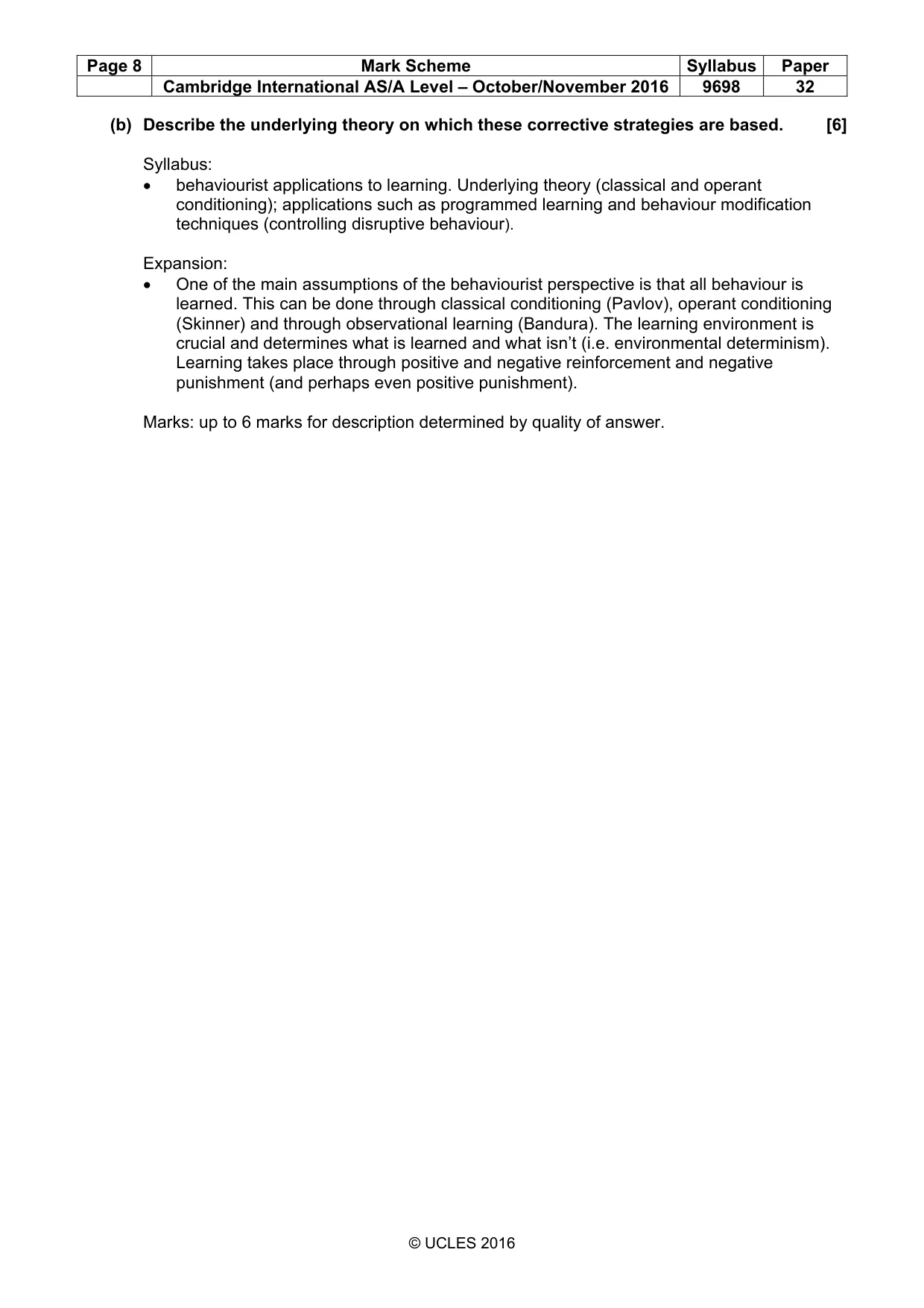
Page 8 Mark Scheme Syllabus Paper Cambridge International AS/A Level – October/November 2016 9698 32 © UCLES 2016 (b) Describe the underlying theory on which these corrective strategies are based. [6] Syllabus: • behaviourist applications to learning. Underlying theory (classical and operant conditioning); applications such as programmed learning and behaviour modification techniques (controlling disruptive behaviour). Expansion: • One of the main assumptions of the behaviourist perspective is that all behaviour is learned. This can be done through classical conditioning (Pavlov), operant conditioning (Skinner) and through observational learning (Bandura). The learning environment is crucial and determines what is learned and what isn’t (i.e. environmental determinism). Learning takes place through positive and negative reinforcement and negative punishment (and perhaps even positive punishment). Marks: up to 6 marks for description determined by quality of answer.
Mark scheme, page 9
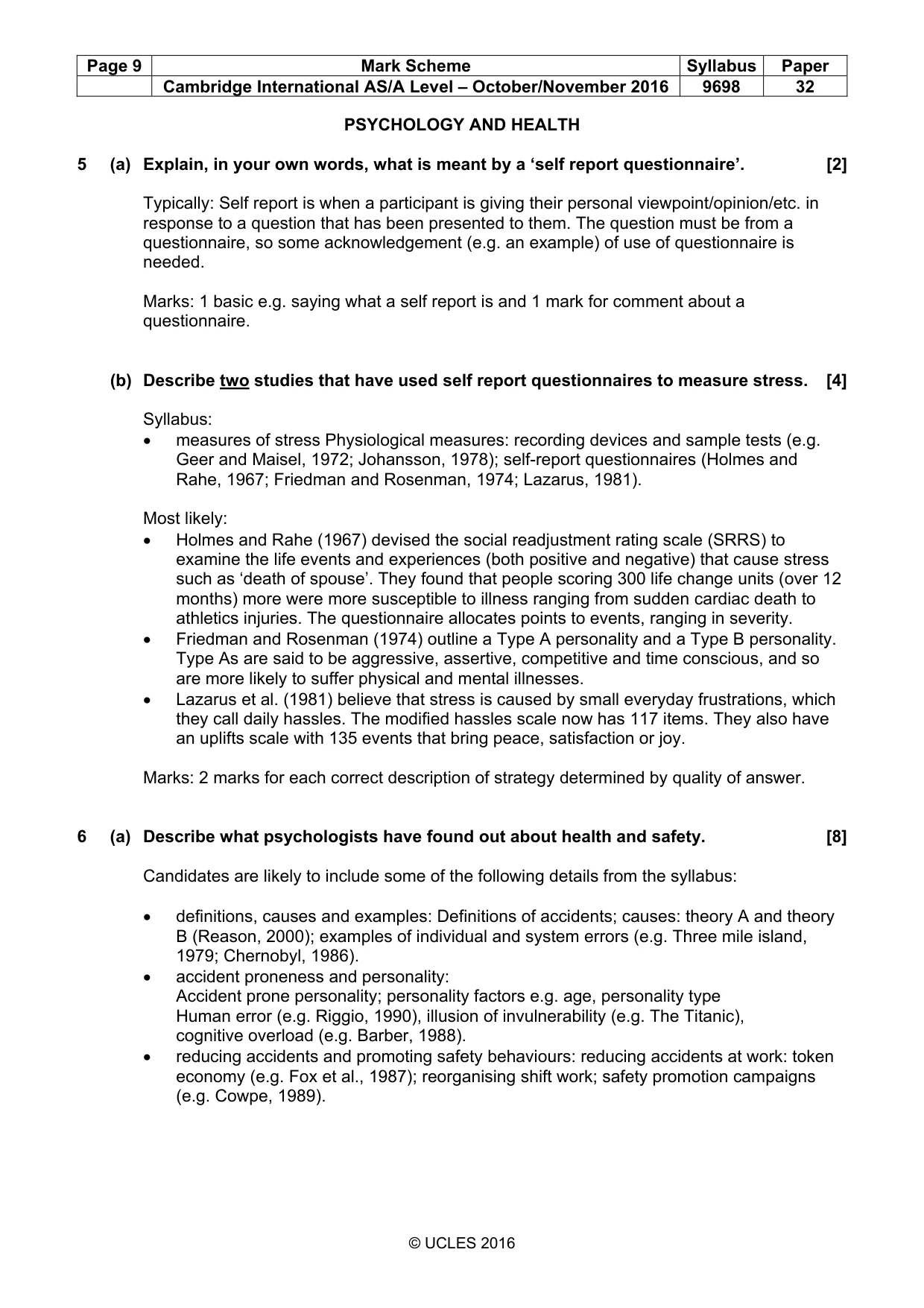
Page 9 Mark Scheme Syllabus Paper Cambridge International AS/A Level – October/November 2016 9698 32 © UCLES 2016 PSYCHOLOGY AND HEALTH 5 (a) Explain, in your own words, what is meant by a ‘self report questionnaire’. [2] Typically: Self report is when a participant is giving their personal viewpoint/opinion/etc. in response to a question that has been presented to them. The question must be from a questionnaire, so some acknowledgement (e.g. an example) of use of questionnaire is needed. Marks: 1 basic e.g. saying what a self report is and 1 mark for comment about a questionnaire. (b) Describe two studies that have used self report questionnaires to measure stress. [4] Syllabus: • measures of stress Physiological measures: recording devices and sample tests (e.g. Geer and Maisel, 1972; Johansson, 1978); self-report questionnaires (Holmes and Rahe, 1967; Friedman and Rosenman, 1974; Lazarus, 1981). Most likely: • Holmes and Rahe (1967) devised the social readjustment rating scale (SRRS) to examine the life events and experiences (both positive and negative) that cause stress such as ‘death of spouse’. They found that people scoring 300 life change units (over 12 months) more were more susceptible to illness ranging from sudden cardiac death to athletics injuries. The questionnaire allocates points to events, ranging in severity. • Friedman and Rosenman (1974) outline a Type A personality and a Type B personality. Type As are said to be aggressive, assertive, competitive and time conscious, and so are more likely to suffer physical and mental illnesses. • Lazarus et al. (1981) believe that stress is caused by small everyday frustrations, which they call daily hassles. The modified hassles scale now has 117 items. They also have an uplifts scale with 135 events that bring peace, satisfaction or joy. Marks: 2 marks for each correct description of strategy determined by quality of answer. 6 (a) Describe what psychologists have found out about health and safety. [8] Candidates are likely to include some of the following details from the syllabus: • definitions, causes and examples: Definitions of accidents; causes: theory A and theory B (Reason, 2000); examples of individual and system errors (e.g. Three mile island, 1979; Chernobyl, 1986). • accident proneness and personality: Accident prone personality; personality factors e.g. age, personality type Human error (e.g. Riggio, 1990), illusion of invulnerability (e.g. The Titanic), cognitive overload (e.g. Barber, 1988). • reducing accidents and promoting safety behaviours: reducing accidents at work: token economy (e.g. Fox et al., 1987); reorganising shift work; safety promotion campaigns (e.g. Cowpe, 1989).
Mark scheme, page 10
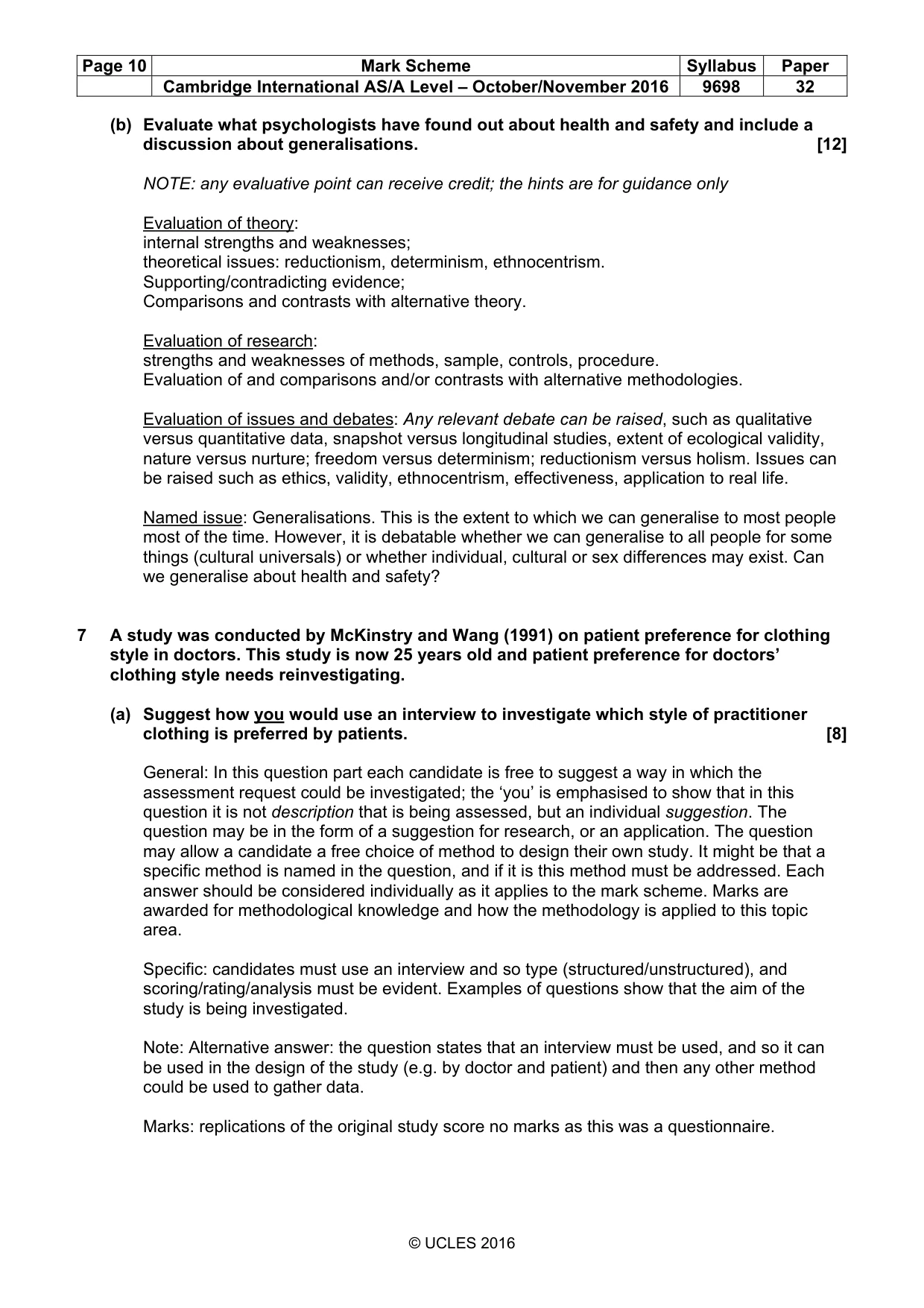
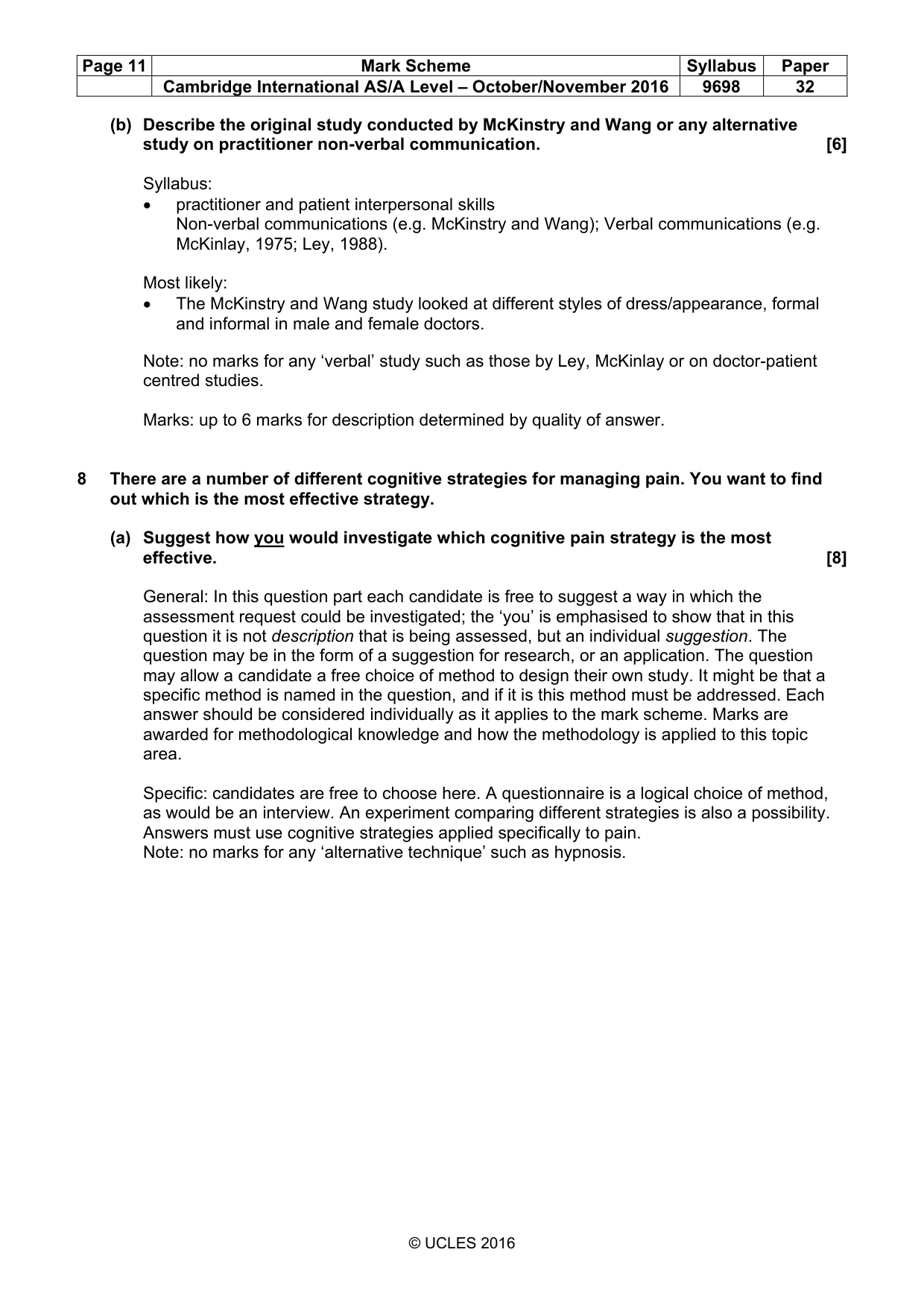
Page 10 Mark Scheme Syllabus Paper Cambridge International AS/A Level – October/November 2016 9698 32 © UCLES 2016 (b) Evaluate what psychologists have found out about health and safety and include a discussion about generalisations. [12] NOTE: any evaluative point can receive credit; the hints are for guidance only Evaluation of theory: internal strengths and weaknesses; theoretical issues: reductionism, determinism, ethnocentrism. Supporting/contradicting evidence; Comparisons and contrasts with alternative theory. Evaluation of research: strengths and weaknesses of methods, sample, controls, procedure. Evaluation of and comparisons and/or contrasts with alternative methodologies. Evaluation of issues and debates: Any relevant debate can be raised, such as qualitative versus quantitative data, snapshot versus longitudinal studies, extent of ecological validity, nature versus nurture; freedom versus determinism; reductionism versus holism. Issues can be raised such as ethics, validity, ethnocentrism, effectiveness, application to real life. Named issue: Generalisations. This is the extent to which we can generalise to most people most of the time. However, it is debatable whether we can generalise to all people for some things (cultural universals) or whether individual, cultural or sex differences may exist. Can we generalise about health and safety? 7 A study was conducted by McKinstry and Wang (1991) on patient preference for clothing style in doctors. This study is now 25 years old and patient preference for doctors’ clothing style needs reinvestigating. (a) Suggest how you would use an interview to investigate which style of practitioner clothing is preferred by patients. [8] General: In this question part each candidate is free to suggest a way in which the assessment request could be investigated; the ‘you’ is emphasised to show that in this question it is not description that is being assessed, but an individual suggestion. The question may be in the form of a suggestion for research, or an application. The question may allow a candidate a free choice of method to design their own study. It might be that a specific method is named in the question, and if it is this method must be addressed. Each answer should be considered individually as it applies to the mark scheme. Marks are awarded for methodological knowledge and how the methodology is applied to this topic area. Specific: candidates must use an interview and so type (structured/unstructured), and scoring/rating/analysis must be evident. Examples of questions show that the aim of the study is being investigated. Note: Alternative answer: the question states that an interview must be used, and so it can be used in the design of the study (e.g. by doctor and patient) and then any other method could be used to gather data. Marks: replications of the original study score no marks as this was a questionnaire.
Mark scheme, page 11
Page 11 Mark Scheme Syllabus Paper Cambridge International AS/A Level – October/November 2016 9698 32 © UCLES 2016 (b) Describe the original study conducted by McKinstry and Wang or any alternative study on practitioner non-verbal communication. [6] Syllabus: • practitioner and patient interpersonal skills Non-verbal communications (e.g. McKinstry and Wang); Verbal communications (e.g. McKinlay, 1975; Ley, 1988). Most likely: • The McKinstry and Wang study looked at different styles of dress/appearance, formal and informal in male and female doctors. Note: no marks for any ‘verbal’ study such as those by Ley, McKinlay or on doctor-patient centred studies. Marks: up to 6 marks for description determined by quality of answer. 8 There are a number of different cognitive strategies for managing pain. You want to find out which is the most effective strategy. (a) Suggest how you would investigate which cognitive pain strategy is the most effective. [8] General: In this question part each candidate is free to suggest a way in which the assessment request could be investigated; the ‘you’ is emphasised to show that in this question it is not description that is being assessed, but an individual suggestion. The question may be in the form of a suggestion for research, or an application. The question may allow a candidate a free choice of method to design their own study. It might be that a specific method is named in the question, and if it is this method must be addressed. Each answer should be considered individually as it applies to the mark scheme. Marks are awarded for methodological knowledge and how the methodology is applied to this topic area. Specific: candidates are free to choose here. A questionnaire is a logical choice of method, as would be an interview. An experiment comparing different strategies is also a possibility. Answers must use cognitive strategies applied specifically to pain. Note: no marks for any ‘alternative technique’ such as hypnosis.
Mark scheme, page 12
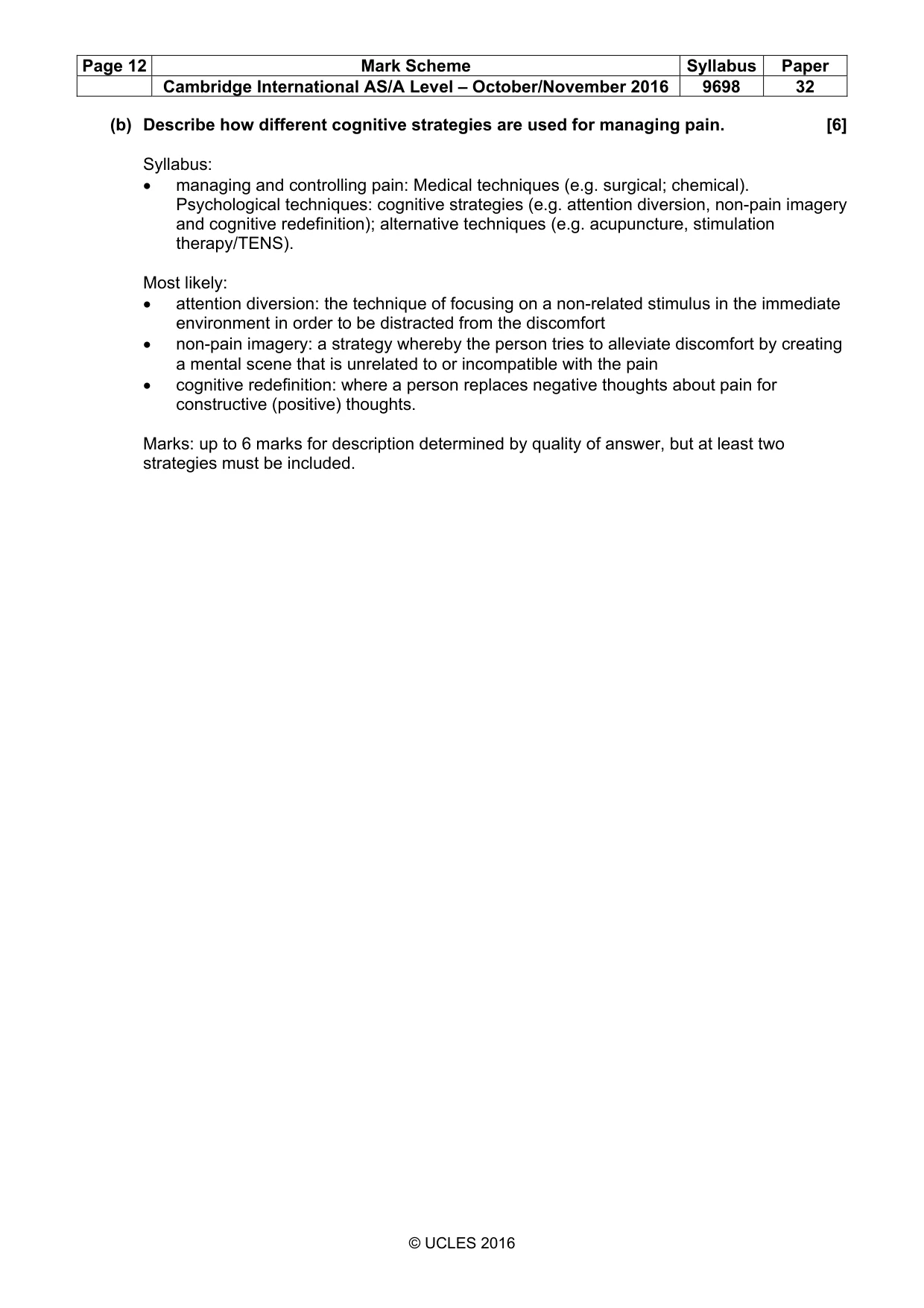
Page 12 Mark Scheme Syllabus Paper Cambridge International AS/A Level – October/November 2016 9698 32 © UCLES 2016 (b) Describe how different cognitive strategies are used for managing pain. [6] Syllabus: • managing and controlling pain: Medical techniques (e.g. surgical; chemical). Psychological techniques: cognitive strategies (e.g. attention diversion, non-pain imagery and cognitive redefinition); alternative techniques (e.g. acupuncture, stimulation therapy/TENS). Most likely: • attention diversion: the technique of focusing on a non-related stimulus in the immediate environment in order to be distracted from the discomfort • non-pain imagery: a strategy whereby the person tries to alleviate discomfort by creating a mental scene that is unrelated to or incompatible with the pain • cognitive redefinition: where a person replaces negative thoughts about pain for constructive (positive) thoughts. Marks: up to 6 marks for description determined by quality of answer, but at least two strategies must be included.
Mark scheme, page 13
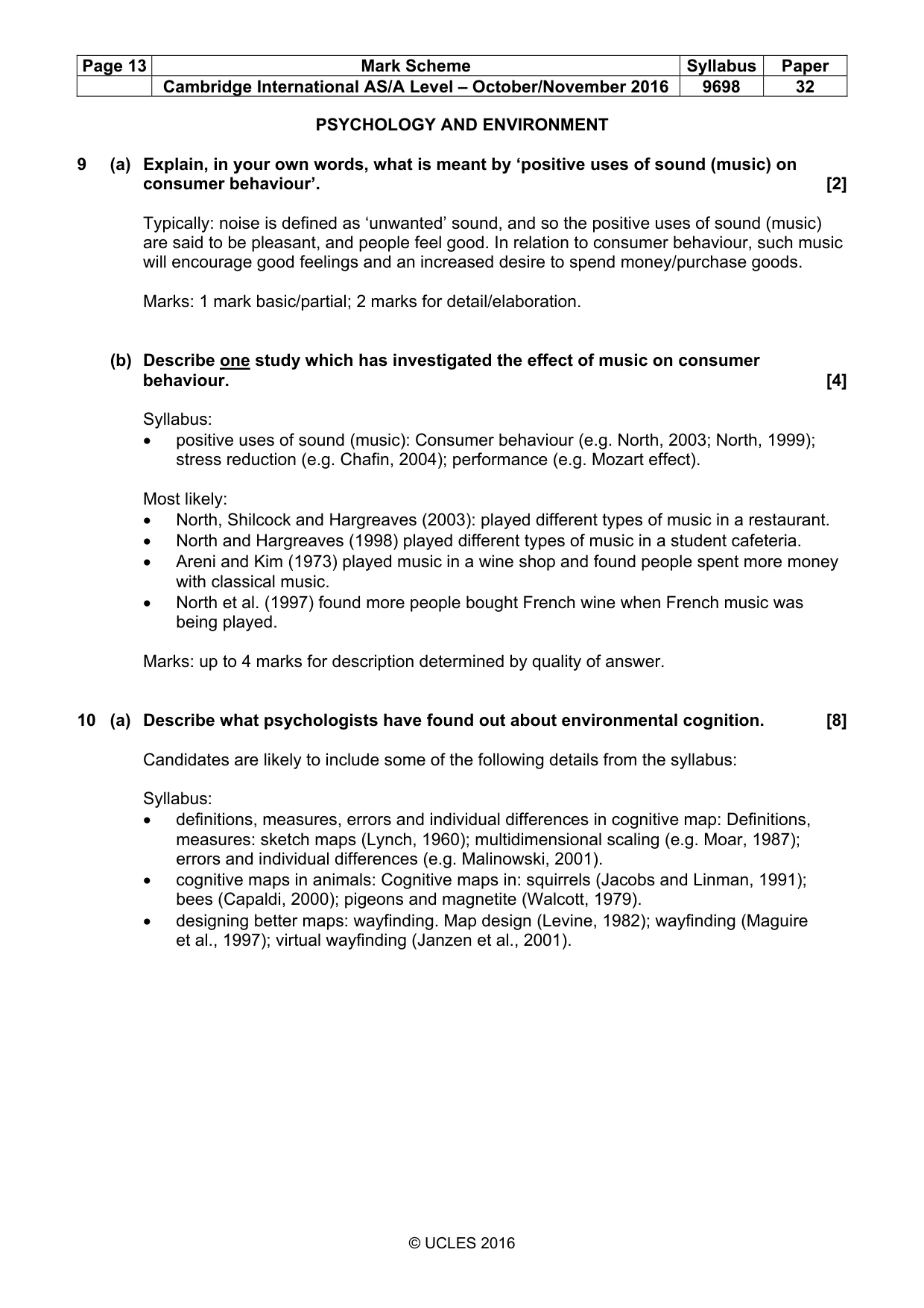
Page 13 Mark Scheme Syllabus Paper Cambridge International AS/A Level – October/November 2016 9698 32 © UCLES 2016 PSYCHOLOGY AND ENVIRONMENT 9 (a) Explain, in your own words, what is meant by ‘positive uses of sound (music) on consumer behaviour’. [2] Typically: noise is defined as ‘unwanted’ sound, and so the positive uses of sound (music) are said to be pleasant, and people feel good. In relation to consumer behaviour, such music will encourage good feelings and an increased desire to spend money/purchase goods. Marks: 1 mark basic/partial; 2 marks for detail/elaboration. (b) Describe one study which has investigated the effect of music on consumer behaviour. [4] Syllabus: • positive uses of sound (music): Consumer behaviour (e.g. North, 2003; North, 1999); stress reduction (e.g. Chafin, 2004); performance (e.g. Mozart effect). Most likely: • North, Shilcock and Hargreaves (2003): played different types of music in a restaurant. • North and Hargreaves (1998) played different types of music in a student cafeteria. • Areni and Kim (1973) played music in a wine shop and found people spent more money with classical music. • North et al. (1997) found more people bought French wine when French music was being played. Marks: up to 4 marks for description determined by quality of answer. 10 (a) Describe what psychologists have found out about environmental cognition. [8] Candidates are likely to include some of the following details from the syllabus: Syllabus: • definitions, measures, errors and individual differences in cognitive map: Definitions, measures: sketch maps (Lynch, 1960); multidimensional scaling (e.g. Moar, 1987); errors and individual differences (e.g. Malinowski, 2001). • cognitive maps in animals: Cognitive maps in: squirrels (Jacobs and Linman, 1991); bees (Capaldi, 2000); pigeons and magnetite (Walcott, 1979). • designing better maps: wayfinding. Map design (Levine, 1982); wayfinding (Maguire et al., 1997); virtual wayfinding (Janzen et al., 2001).
Mark scheme, page 14
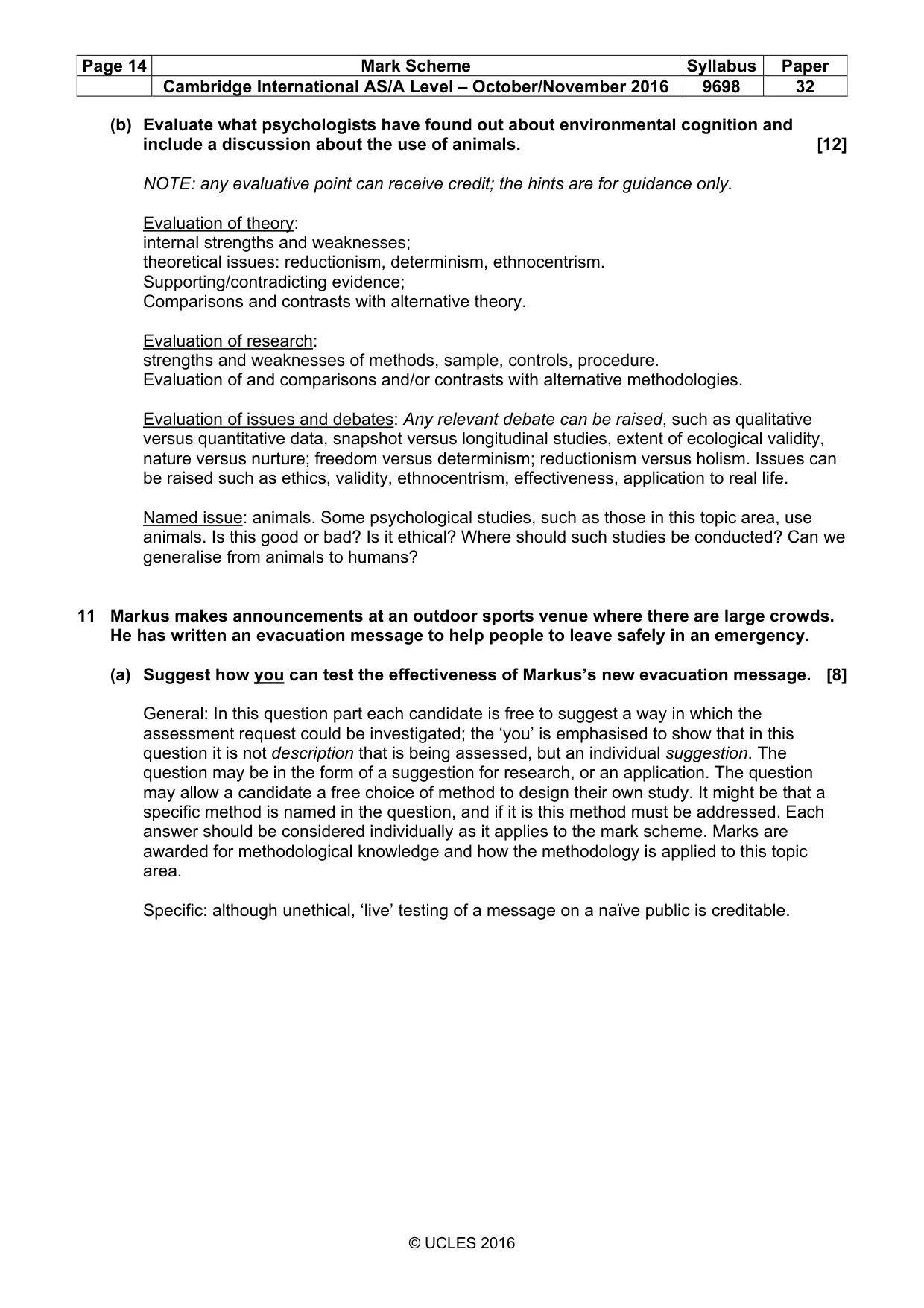
Page 14 Mark Scheme Syllabus Paper Cambridge International AS/A Level – October/November 2016 9698 32 © UCLES 2016 (b) Evaluate what psychologists have found out about environmental cognition and include a discussion about the use of animals. [12] NOTE: any evaluative point can receive credit; the hints are for guidance only. Evaluation of theory: internal strengths and weaknesses; theoretical issues: reductionism, determinism, ethnocentrism. Supporting/contradicting evidence; Comparisons and contrasts with alternative theory. Evaluation of research: strengths and weaknesses of methods, sample, controls, procedure. Evaluation of and comparisons and/or contrasts with alternative methodologies. Evaluation of issues and debates: Any relevant debate can be raised, such as qualitative versus quantitative data, snapshot versus longitudinal studies, extent of ecological validity, nature versus nurture; freedom versus determinism; reductionism versus holism. Issues can be raised such as ethics, validity, ethnocentrism, effectiveness, application to real life. Named issue: animals. Some psychological studies, such as those in this topic area, use animals. Is this good or bad? Is it ethical? Where should such studies be conducted? Can we generalise from animals to humans? 11 Markus makes announcements at an outdoor sports venue where there are large crowds. He has written an evacuation message to help people to leave safely in an emergency. (a) Suggest how you can test the effectiveness of Markus’s new evacuation message. [8] General: In this question part each candidate is free to suggest a way in which the assessment request could be investigated; the ‘you’ is emphasised to show that in this question it is not description that is being assessed, but an individual suggestion. The question may be in the form of a suggestion for research, or an application. The question may allow a candidate a free choice of method to design their own study. It might be that a specific method is named in the question, and if it is this method must be addressed. Each answer should be considered individually as it applies to the mark scheme. Marks are awarded for methodological knowledge and how the methodology is applied to this topic area. Specific: although unethical, ‘live’ testing of a message on a naïve public is creditable.
Mark scheme, page 15
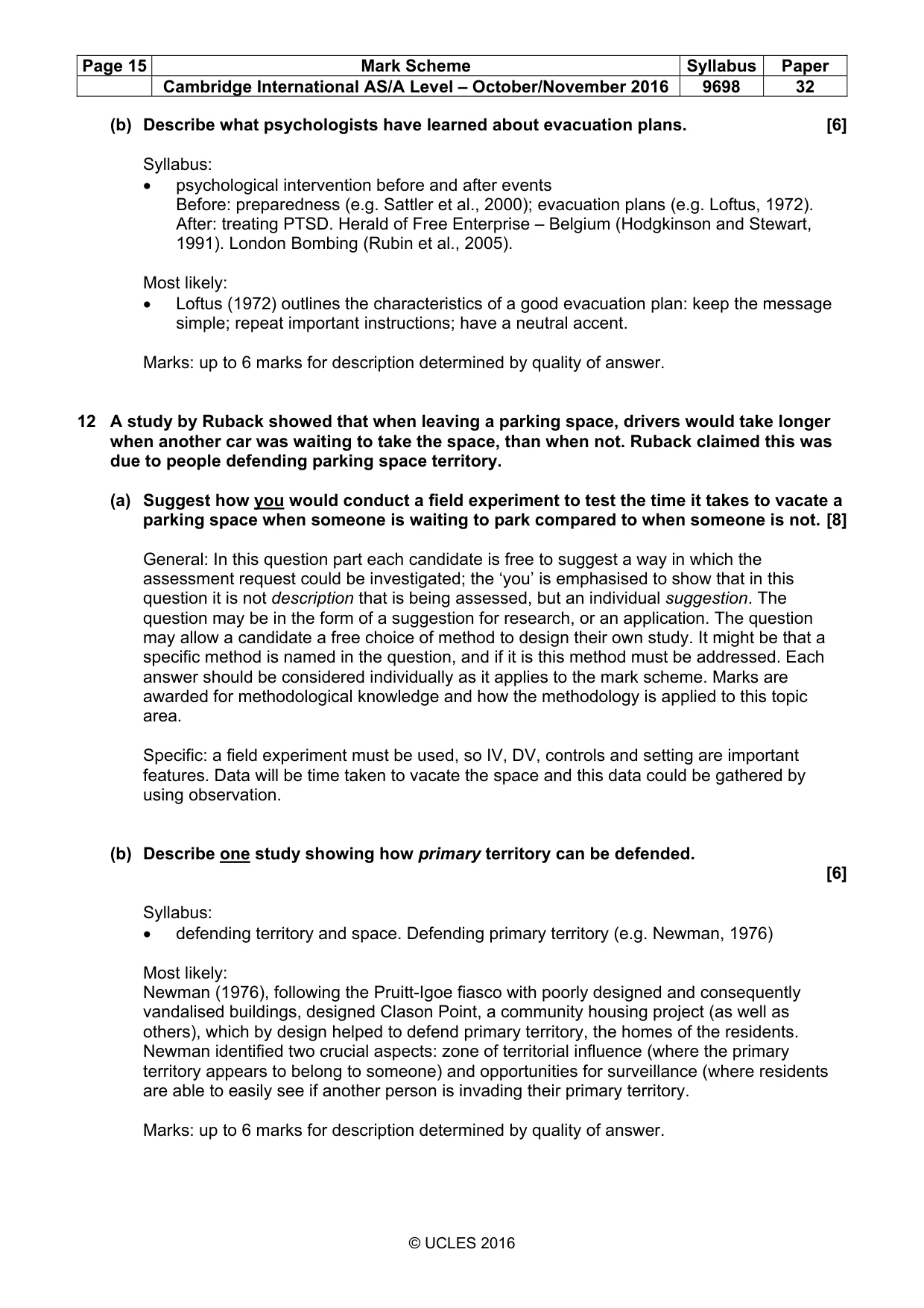
Page 15 Mark Scheme Syllabus Paper Cambridge International AS/A Level – October/November 2016 9698 32 © UCLES 2016 (b) Describe what psychologists have learned about evacuation plans. [6] Syllabus: • psychological intervention before and after events Before: preparedness (e.g. Sattler et al., 2000); evacuation plans (e.g. Loftus, 1972). After: treating PTSD. Herald of Free Enterprise – Belgium (Hodgkinson and Stewart, 1991). London Bombing (Rubin et al., 2005). Most likely: • Loftus (1972) outlines the characteristics of a good evacuation plan: keep the message simple; repeat important instructions; have a neutral accent. Marks: up to 6 marks for description determined by quality of answer. 12 A study by Ruback showed that when leaving a parking space, drivers would take longer when another car was waiting to take the space, than when not. Ruback claimed this was due to people defending parking space territory. (a) Suggest how you would conduct a field experiment to test the time it takes to vacate a parking space when someone is waiting to park compared to when someone is not. [8] General: In this question part each candidate is free to suggest a way in which the assessment request could be investigated; the ‘you’ is emphasised to show that in this question it is not description that is being assessed, but an individual suggestion. The question may be in the form of a suggestion for research, or an application. The question may allow a candidate a free choice of method to design their own study. It might be that a specific method is named in the question, and if it is this method must be addressed. Each answer should be considered individually as it applies to the mark scheme. Marks are awarded for methodological knowledge and how the methodology is applied to this topic area. Specific: a field experiment must be used, so IV, DV, controls and setting are important features. Data will be time taken to vacate the space and this data could be gathered by using observation. (b) Describe one study showing how primary territory can be defended. [6] Syllabus: • defending territory and space. Defending primary territory (e.g. Newman, 1976) Most likely: Newman (1976), following the Pruitt-Igoe fiasco with poorly designed and consequently vandalised buildings, designed Clason Point, a community housing project (as well as others), which by design helped to defend primary territory, the homes of the residents. Newman identified two crucial aspects: zone of territorial influence (where the primary territory appears to belong to someone) and opportunities for surveillance (where residents are able to easily see if another person is invading their primary territory. Marks: up to 6 marks for description determined by quality of answer.
Mark scheme, page 16
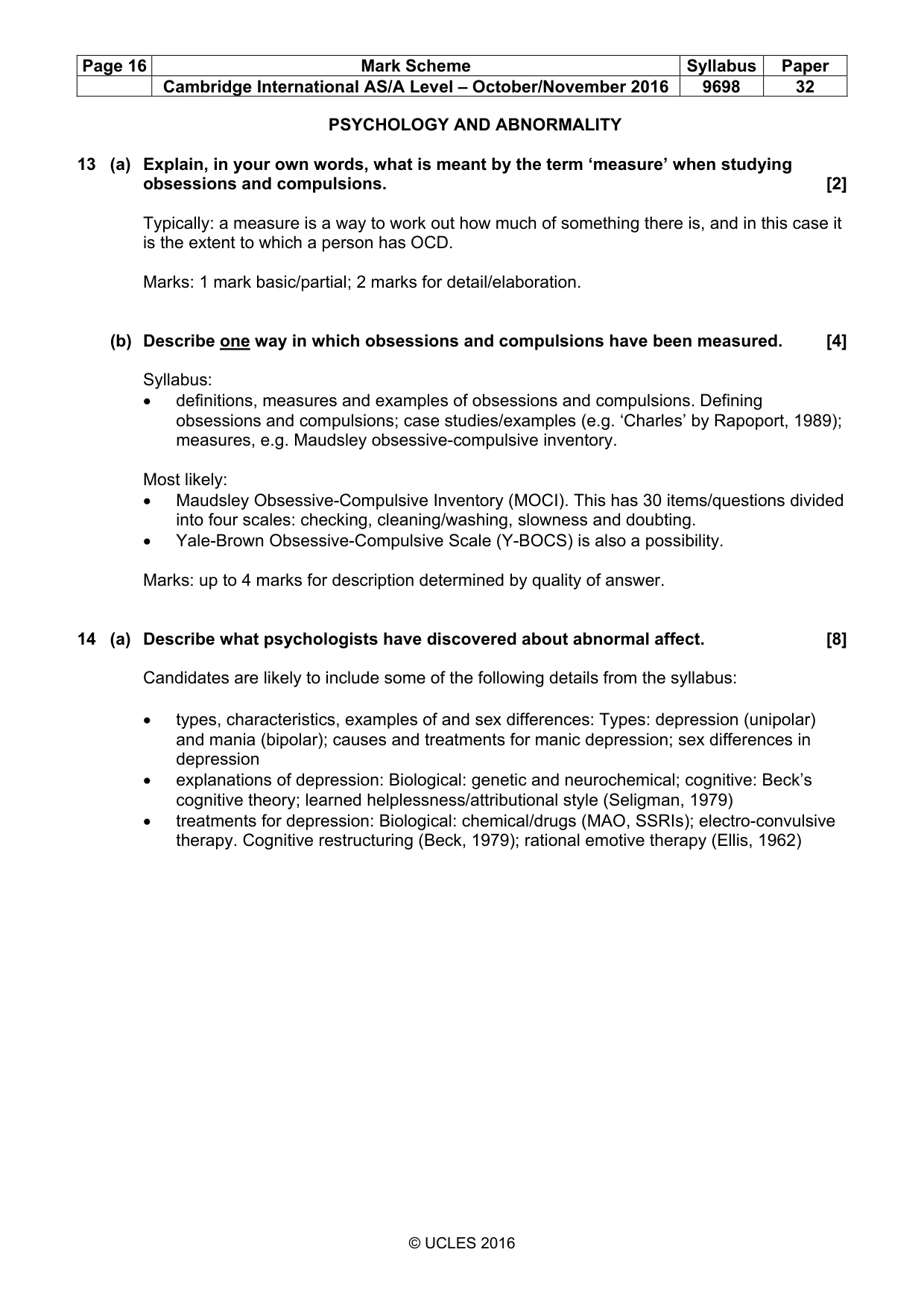
Page 16 Mark Scheme Syllabus Paper Cambridge International AS/A Level – October/November 2016 9698 32 © UCLES 2016 PSYCHOLOGY AND ABNORMALITY 13 (a) Explain, in your own words, what is meant by the term ‘measure’ when studying obsessions and compulsions. [2] Typically: a measure is a way to work out how much of something there is, and in this case it is the extent to which a person has OCD. Marks: 1 mark basic/partial; 2 marks for detail/elaboration. (b) Describe one way in which obsessions and compulsions have been measured. [4] Syllabus: • definitions, measures and examples of obsessions and compulsions. Defining obsessions and compulsions; case studies/examples (e.g. ‘Charles’ by Rapoport, 1989); measures, e.g. Maudsley obsessive-compulsive inventory. Most likely: • Maudsley Obsessive-Compulsive Inventory (MOCI). This has 30 items/questions divided into four scales: checking, cleaning/washing, slowness and doubting. • Yale-Brown Obsessive-Compulsive Scale (Y-BOCS) is also a possibility. Marks: up to 4 marks for description determined by quality of answer. 14 (a) Describe what psychologists have discovered about abnormal affect. [8] Candidates are likely to include some of the following details from the syllabus: • types, characteristics, examples of and sex differences: Types: depression (unipolar) and mania (bipolar); causes and treatments for manic depression; sex differences in depression • explanations of depression: Biological: genetic and neurochemical; cognitive: Beck’s cognitive theory; learned helplessness/attributional style (Seligman, 1979) • treatments for depression: Biological: chemical/drugs (MAO, SSRIs); electro-convulsive therapy. Cognitive restructuring (Beck, 1979); rational emotive therapy (Ellis, 1962)
Mark scheme, page 17
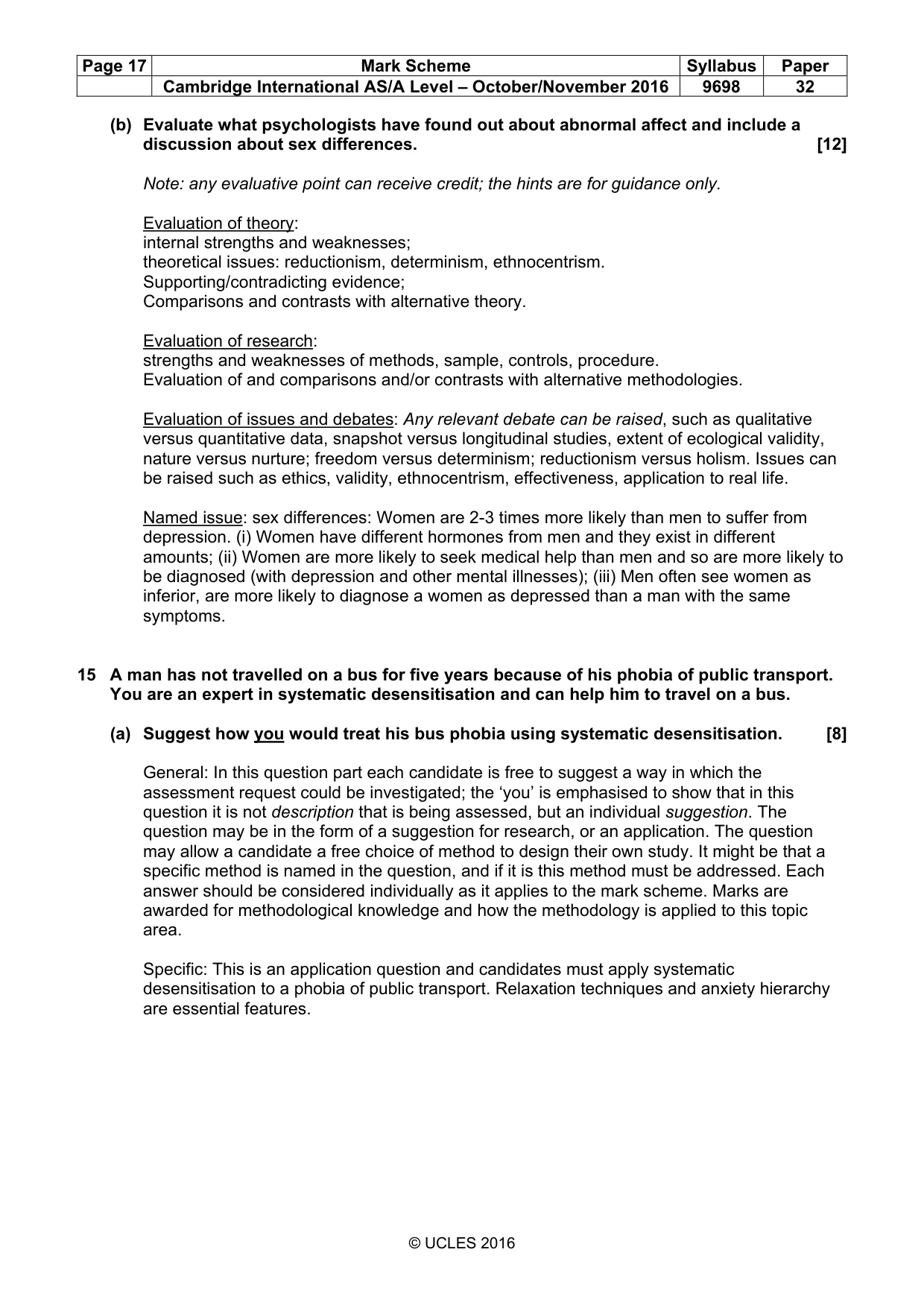
Page 17 Mark Scheme Syllabus Paper Cambridge International AS/A Level – October/November 2016 9698 32 © UCLES 2016 (b) Evaluate what psychologists have found out about abnormal affect and include a discussion about sex differences. [12] Note: any evaluative point can receive credit; the hints are for guidance only. Evaluation of theory: internal strengths and weaknesses; theoretical issues: reductionism, determinism, ethnocentrism. Supporting/contradicting evidence; Comparisons and contrasts with alternative theory. Evaluation of research: strengths and weaknesses of methods, sample, controls, procedure. Evaluation of and comparisons and/or contrasts with alternative methodologies. Evaluation of issues and debates: Any relevant debate can be raised, such as qualitative versus quantitative data, snapshot versus longitudinal studies, extent of ecological validity, nature versus nurture; freedom versus determinism; reductionism versus holism. Issues can be raised such as ethics, validity, ethnocentrism, effectiveness, application to real life. Named issue: sex differences: Women are 2-3 times more likely than men to suffer from depression. (i) Women have different hormones from men and they exist in different amounts; (ii) Women are more likely to seek medical help than men and so are more likely to be diagnosed (with depression and other mental illnesses); (iii) Men often see women as inferior, are more likely to diagnose a women as depressed than a man with the same symptoms. 15 A man has not travelled on a bus for five years because of his phobia of public transport. You are an expert in systematic desensitisation and can help him to travel on a bus. (a) Suggest how you would treat his bus phobia using systematic desensitisation. [8] General: In this question part each candidate is free to suggest a way in which the assessment request could be investigated; the ‘you’ is emphasised to show that in this question it is not description that is being assessed, but an individual suggestion. The question may be in the form of a suggestion for research, or an application. The question may allow a candidate a free choice of method to design their own study. It might be that a specific method is named in the question, and if it is this method must be addressed. Each answer should be considered individually as it applies to the mark scheme. Marks are awarded for methodological knowledge and how the methodology is applied to this topic area. Specific: This is an application question and candidates must apply systematic desensitisation to a phobia of public transport. Relaxation techniques and anxiety hierarchy are essential features.
Mark scheme, page 18
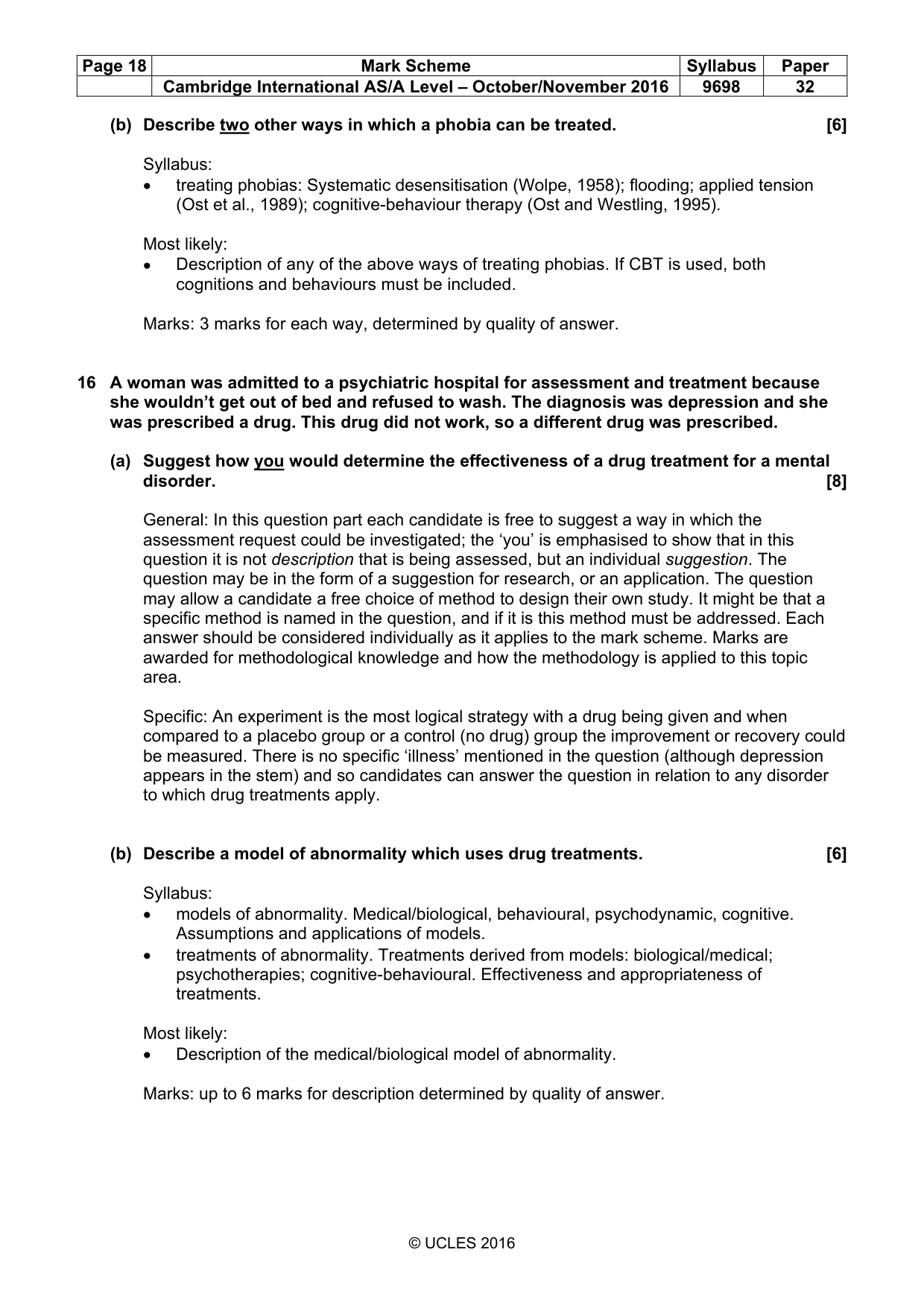
Page 18 Mark Scheme Syllabus Paper Cambridge International AS/A Level – October/November 2016 9698 32 © UCLES 2016 (b) Describe two other ways in which a phobia can be treated. [6] Syllabus: • treating phobias: Systematic desensitisation (Wolpe, 1958); flooding; applied tension (Ost et al., 1989); cognitive-behaviour therapy (Ost and Westling, 1995). Most likely: • Description of any of the above ways of treating phobias. If CBT is used, both cognitions and behaviours must be included. Marks: 3 marks for each way, determined by quality of answer. 16 A woman was admitted to a psychiatric hospital for assessment and treatment because she wouldn’t get out of bed and refused to wash. The diagnosis was depression and she was prescribed a drug. This drug did not work, so a different drug was prescribed. (a) Suggest how you would determine the effectiveness of a drug treatment for a mental disorder. [8] General: In this question part each candidate is free to suggest a way in which the assessment request could be investigated; the ‘you’ is emphasised to show that in this question it is not description that is being assessed, but an individual suggestion. The question may be in the form of a suggestion for research, or an application. The question may allow a candidate a free choice of method to design their own study. It might be that a specific method is named in the question, and if it is this method must be addressed. Each answer should be considered individually as it applies to the mark scheme. Marks are awarded for methodological knowledge and how the methodology is applied to this topic area. Specific: An experiment is the most logical strategy with a drug being given and when compared to a placebo group or a control (no drug) group the improvement or recovery could be measured. There is no specific ‘illness’ mentioned in the question (although depression appears in the stem) and so candidates can answer the question in relation to any disorder to which drug treatments apply. (b) Describe a model of abnormality which uses drug treatments. [6] Syllabus: • models of abnormality. Medical/biological, behavioural, psychodynamic, cognitive. Assumptions and applications of models. • treatments of abnormality. Treatments derived from models: biological/medical; psychotherapies; cognitive-behavioural. Effectiveness and appropriateness of treatments. Most likely: • Description of the medical/biological model of abnormality. Marks: up to 6 marks for description determined by quality of answer.
Mark scheme, page 19
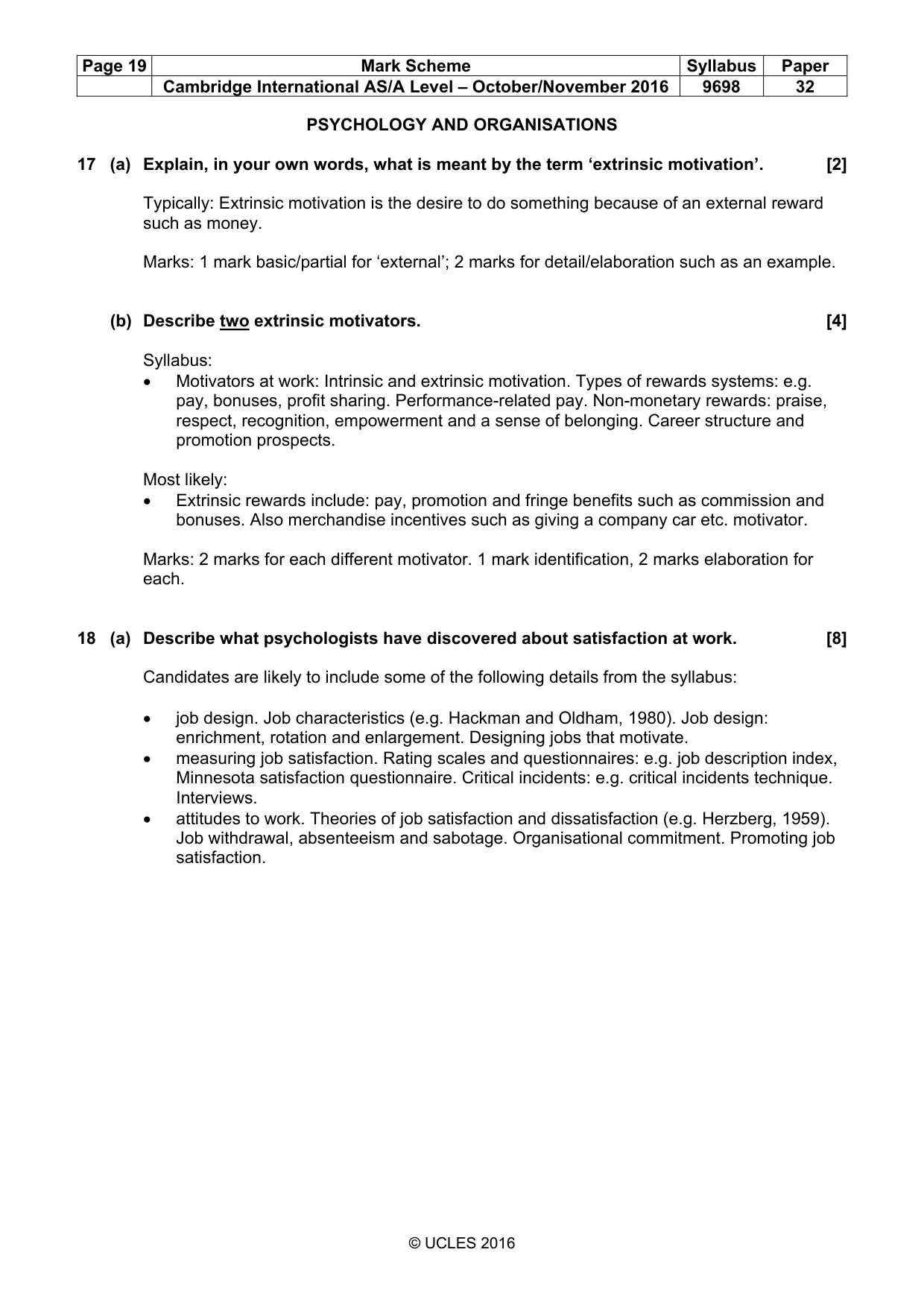
Page 19 Mark Scheme Syllabus Paper Cambridge International AS/A Level – October/November 2016 9698 32 © UCLES 2016 PSYCHOLOGY AND ORGANISATIONS 17 (a) Explain, in your own words, what is meant by the term ‘extrinsic motivation’. [2] Typically: Extrinsic motivation is the desire to do something because of an external reward such as money. Marks: 1 mark basic/partial for ‘external’; 2 marks for detail/elaboration such as an example. (b) Describe two extrinsic motivators. [4] Syllabus: • Motivators at work: Intrinsic and extrinsic motivation. Types of rewards systems: e.g. pay, bonuses, profit sharing. Performance-related pay. Non-monetary rewards: praise, respect, recognition, empowerment and a sense of belonging. Career structure and promotion prospects. Most likely: • Extrinsic rewards include: pay, promotion and fringe benefits such as commission and bonuses. Also merchandise incentives such as giving a company car etc. motivator. Marks: 2 marks for each different motivator. 1 mark identification, 2 marks elaboration for each. 18 (a) Describe what psychologists have discovered about satisfaction at work. [8] Candidates are likely to include some of the following details from the syllabus: • job design. Job characteristics (e.g. Hackman and Oldham, 1980). Job design: enrichment, rotation and enlargement. Designing jobs that motivate. • measuring job satisfaction. Rating scales and questionnaires: e.g. job description index, Minnesota satisfaction questionnaire. Critical incidents: e.g. critical incidents technique. Interviews. • attitudes to work. Theories of job satisfaction and dissatisfaction (e.g. Herzberg, 1959). Job withdrawal, absenteeism and sabotage. Organisational commitment. Promoting job satisfaction.
Mark scheme, page 20
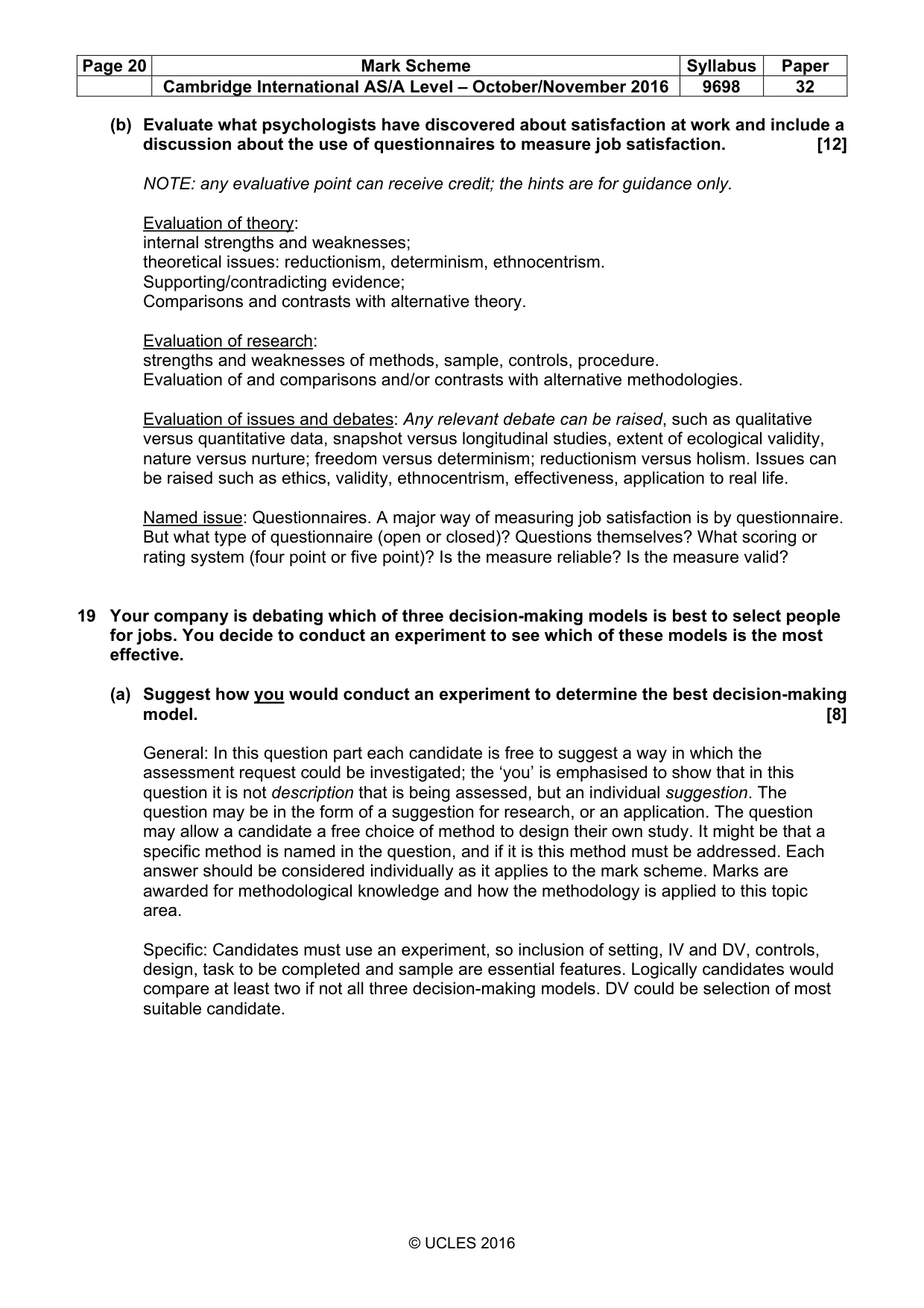
Page 20 Mark Scheme Syllabus Paper Cambridge International AS/A Level – October/November 2016 9698 32 © UCLES 2016 (b) Evaluate what psychologists have discovered about satisfaction at work and include a discussion about the use of questionnaires to measure job satisfaction. [12] NOTE: any evaluative point can receive credit; the hints are for guidance only. Evaluation of theory: internal strengths and weaknesses; theoretical issues: reductionism, determinism, ethnocentrism. Supporting/contradicting evidence; Comparisons and contrasts with alternative theory. Evaluation of research: strengths and weaknesses of methods, sample, controls, procedure. Evaluation of and comparisons and/or contrasts with alternative methodologies. Evaluation of issues and debates: Any relevant debate can be raised, such as qualitative versus quantitative data, snapshot versus longitudinal studies, extent of ecological validity, nature versus nurture; freedom versus determinism; reductionism versus holism. Issues can be raised such as ethics, validity, ethnocentrism, effectiveness, application to real life. Named issue: Questionnaires. A major way of measuring job satisfaction is by questionnaire. But what type of questionnaire (open or closed)? Questions themselves? What scoring or rating system (four point or five point)? Is the measure reliable? Is the measure valid? 19 Your company is debating which of three decision-making models is best to select people for jobs. You decide to conduct an experiment to see which of these models is the most effective. (a) Suggest how you would conduct an experiment to determine the best decision-making model. [8] General: In this question part each candidate is free to suggest a way in which the assessment request could be investigated; the ‘you’ is emphasised to show that in this question it is not description that is being assessed, but an individual suggestion. The question may be in the form of a suggestion for research, or an application. The question may allow a candidate a free choice of method to design their own study. It might be that a specific method is named in the question, and if it is this method must be addressed. Each answer should be considered individually as it applies to the mark scheme. Marks are awarded for methodological knowledge and how the methodology is applied to this topic area. Specific: Candidates must use an experiment, so inclusion of setting, IV and DV, controls, design, task to be completed and sample are essential features. Logically candidates would compare at least two if not all three decision-making models. DV could be selection of most suitable candidate.
Mark scheme, page 21
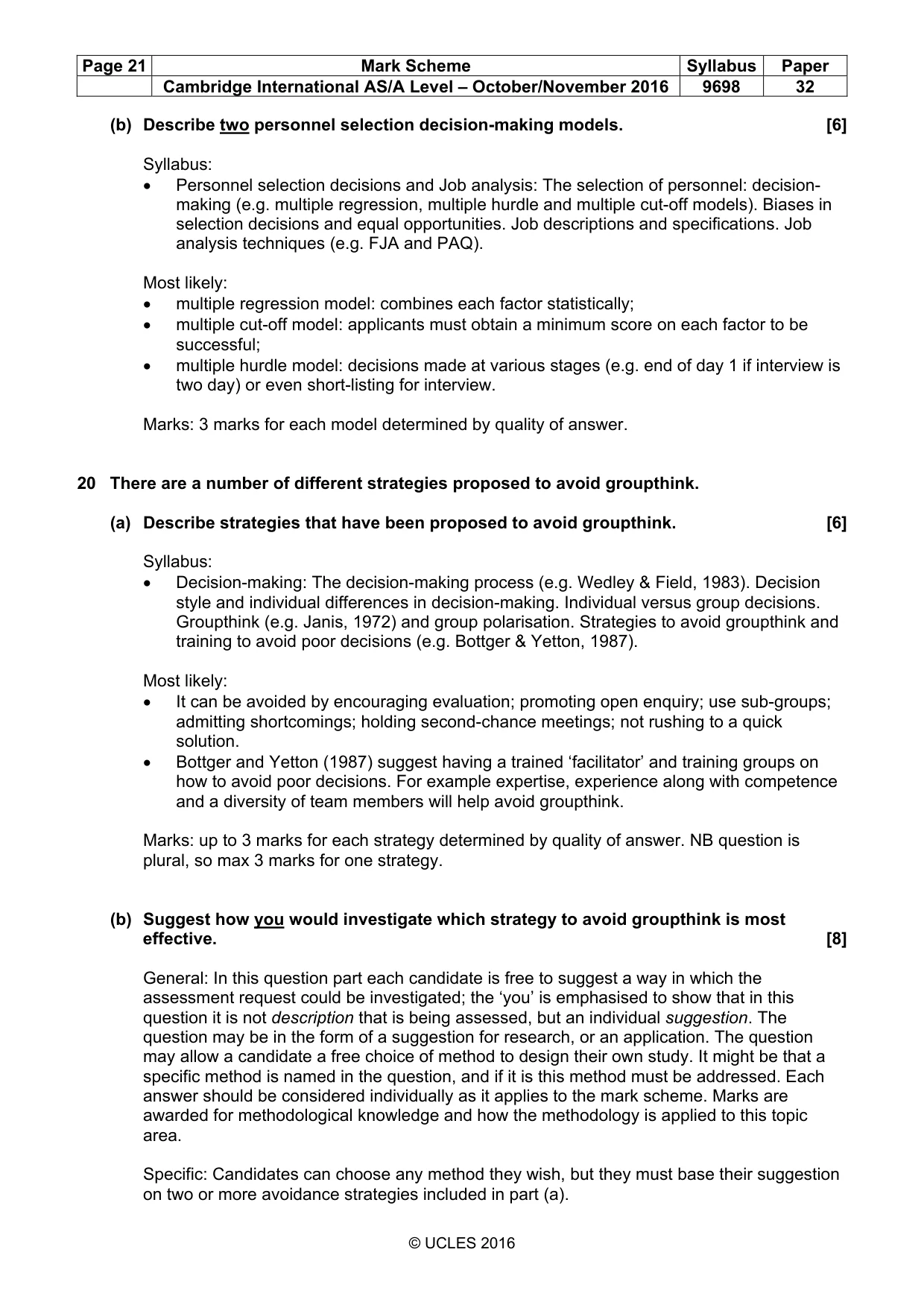
Page 21 Mark Scheme Syllabus Paper Cambridge International AS/A Level – October/November 2016 9698 32 © UCLES 2016 (b) Describe two personnel selection decision-making models. [6] Syllabus: • Personnel selection decisions and Job analysis: The selection of personnel: decision- making (e.g. multiple regression, multiple hurdle and multiple cut-off models). Biases in selection decisions and equal opportunities. Job descriptions and specifications. Job analysis techniques (e.g. FJA and PAQ). Most likely: • multiple regression model: combines each factor statistically; • multiple cut-off model: applicants must obtain a minimum score on each factor to be successful; • multiple hurdle model: decisions made at various stages (e.g. end of day 1 if interview is two day) or even short-listing for interview. Marks: 3 marks for each model determined by quality of answer. 20 There are a number of different strategies proposed to avoid groupthink. (a) Describe strategies that have been proposed to avoid groupthink. [6] Syllabus: • Decision-making: The decision-making process (e.g. Wedley & Field, 1983). Decision style and individual differences in decision-making. Individual versus group decisions. Groupthink (e.g. Janis, 1972) and group polarisation. Strategies to avoid groupthink and training to avoid poor decisions (e.g. Bottger & Yetton, 1987). Most likely: • It can be avoided by encouraging evaluation; promoting open enquiry; use sub-groups; admitting shortcomings; holding second-chance meetings; not rushing to a quick solution. • Bottger and Yetton (1987) suggest having a trained ‘facilitator’ and training groups on how to avoid poor decisions. For example expertise, experience along with competence and a diversity of team members will help avoid groupthink. Marks: up to 3 marks for each strategy determined by quality of answer. NB question is plural, so max 3 marks for one strategy. (b) Suggest how you would investigate which strategy to avoid groupthink is most effective. [8] General: In this question part each candidate is free to suggest a way in which the assessment request could be investigated; the ‘you’ is emphasised to show that in this question it is not description that is being assessed, but an individual suggestion. The question may be in the form of a suggestion for research, or an application. The question may allow a candidate a free choice of method to design their own study. It might be that a specific method is named in the question, and if it is this method must be addressed. Each answer should be considered individually as it applies to the mark scheme. Marks are awarded for methodological knowledge and how the methodology is applied to this topic area. Specific: Candidates can choose any method they wish, but they must base their suggestion on two or more avoidance strategies included in part (a).
What you needed in this session
Cambridge’s own grade thresholds for 2016 Oct/Nov, Paper 3 · Variant 2. A higher threshold means an easier paper — the bar moves with how the cohort did.