Cambridge A Level Psychology 9698 — 2017 Oct/Nov Paper 3 · Variant 2
9698/32/O/N/17 · 20 questions · 80 marks · ≈90 min
The question paper and its mark scheme, free to read here and free to download. This is Cambridge’s own paper, exactly as it was sat.
Question paper8 pages
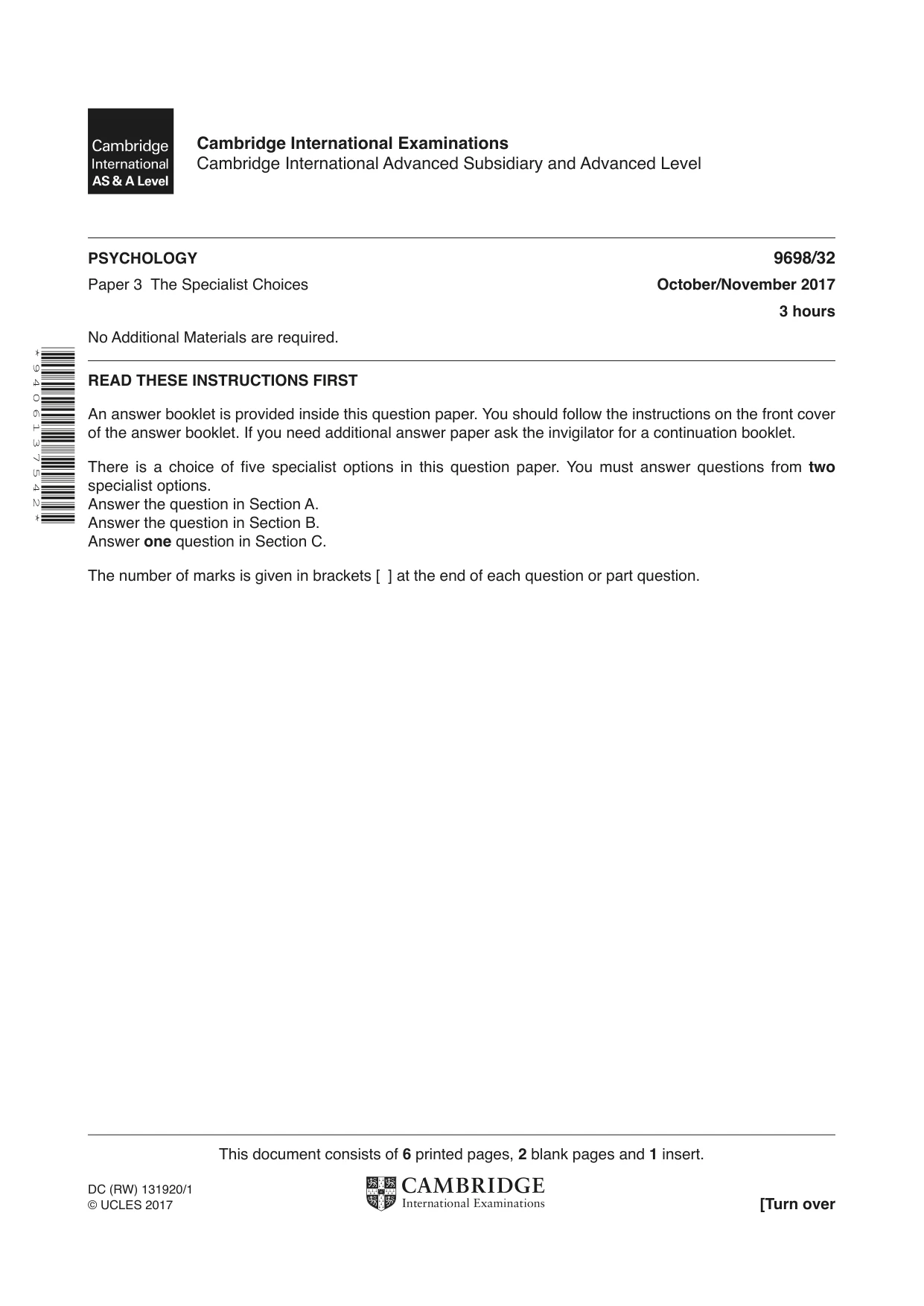
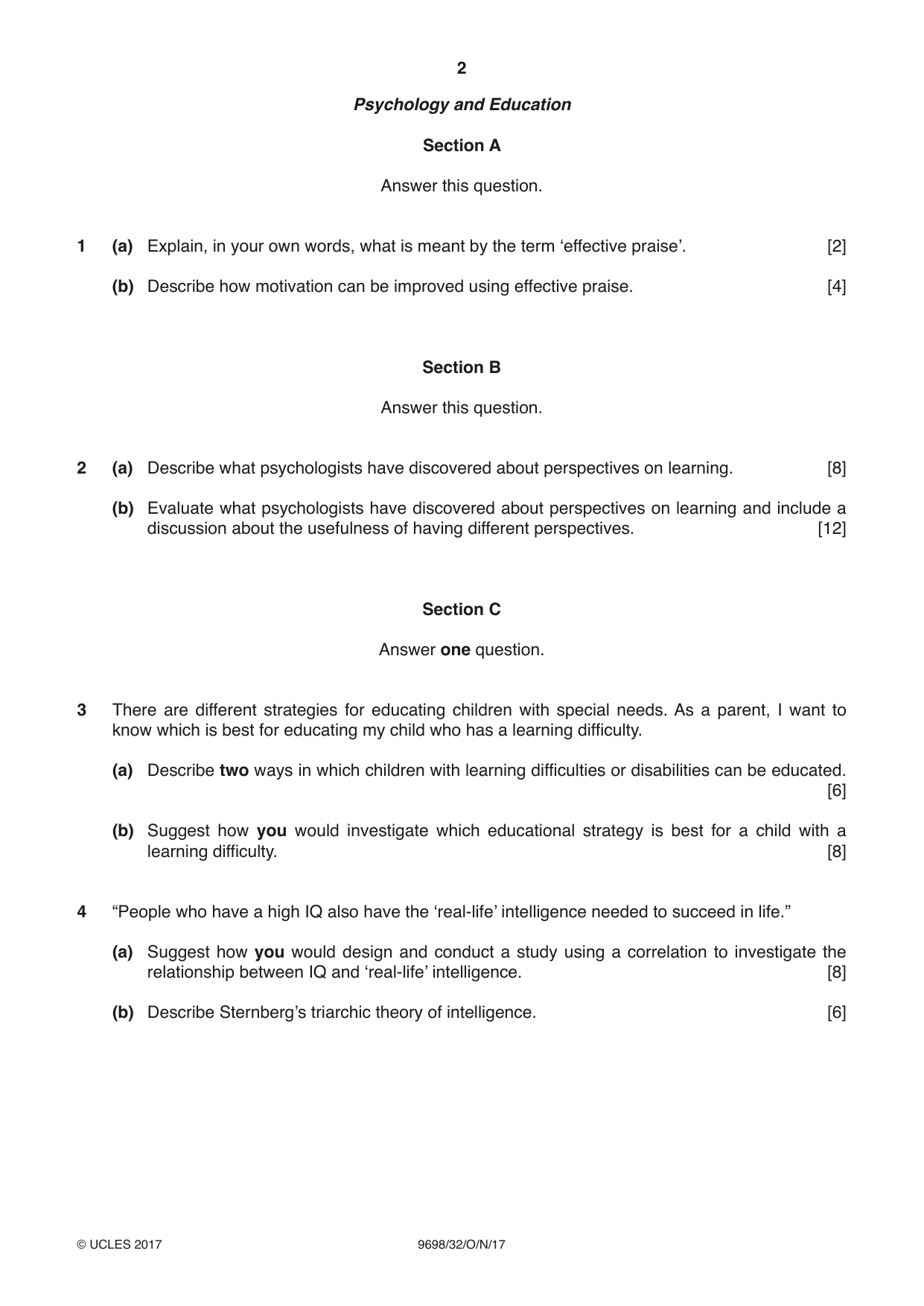
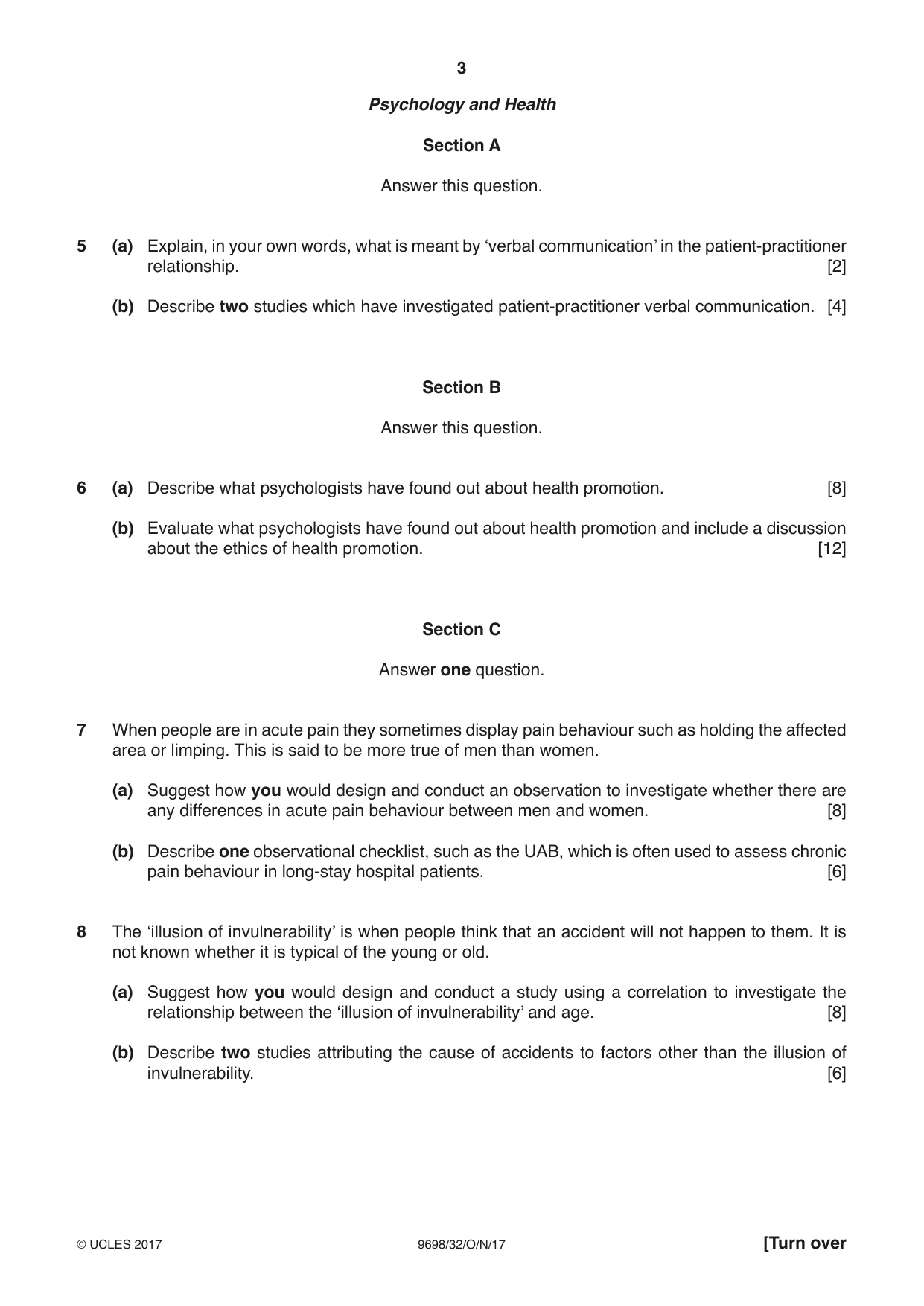
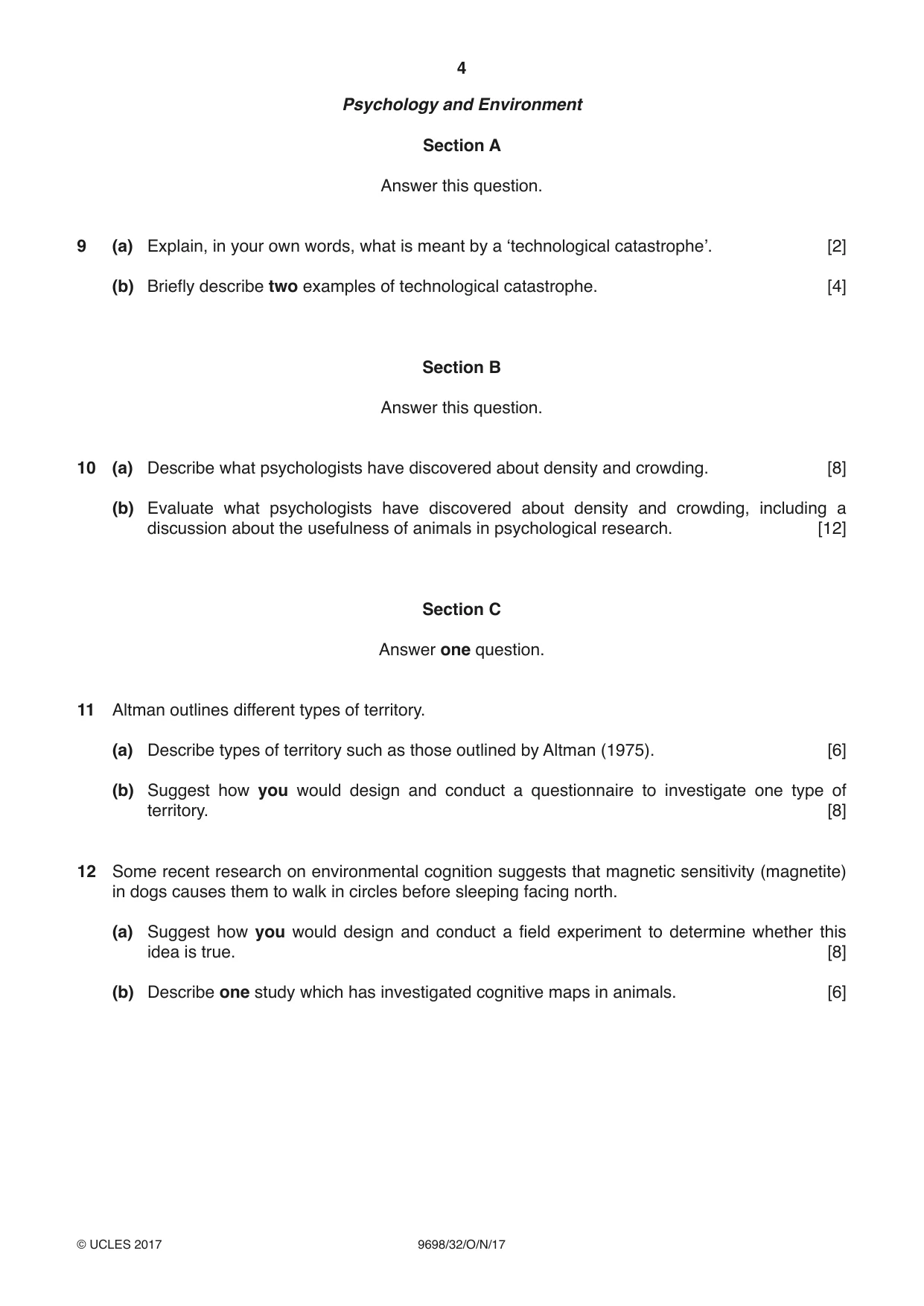


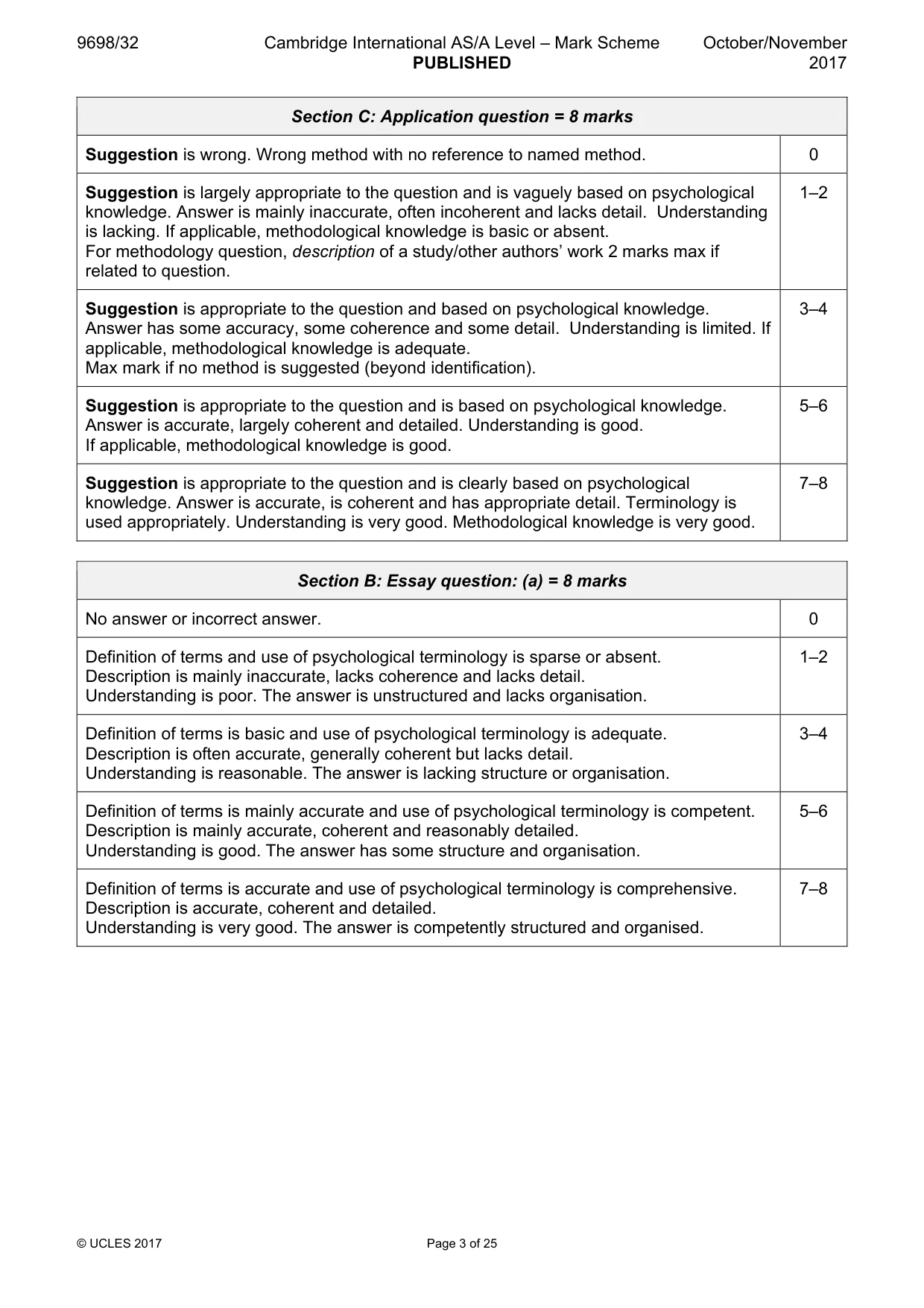
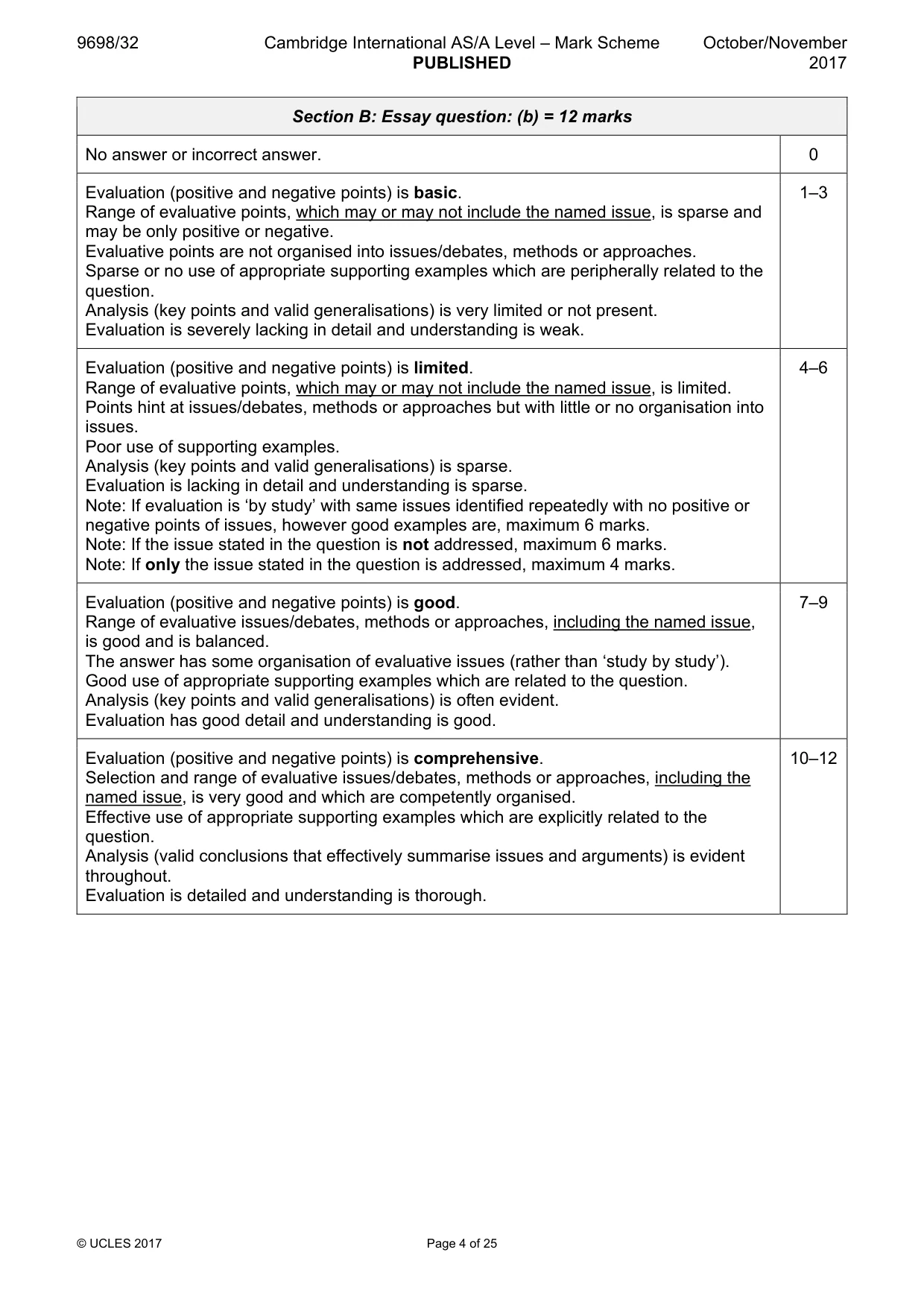
Mark scheme25 pages
Answers below. Sit the paper first if you are practising.
Questions as text
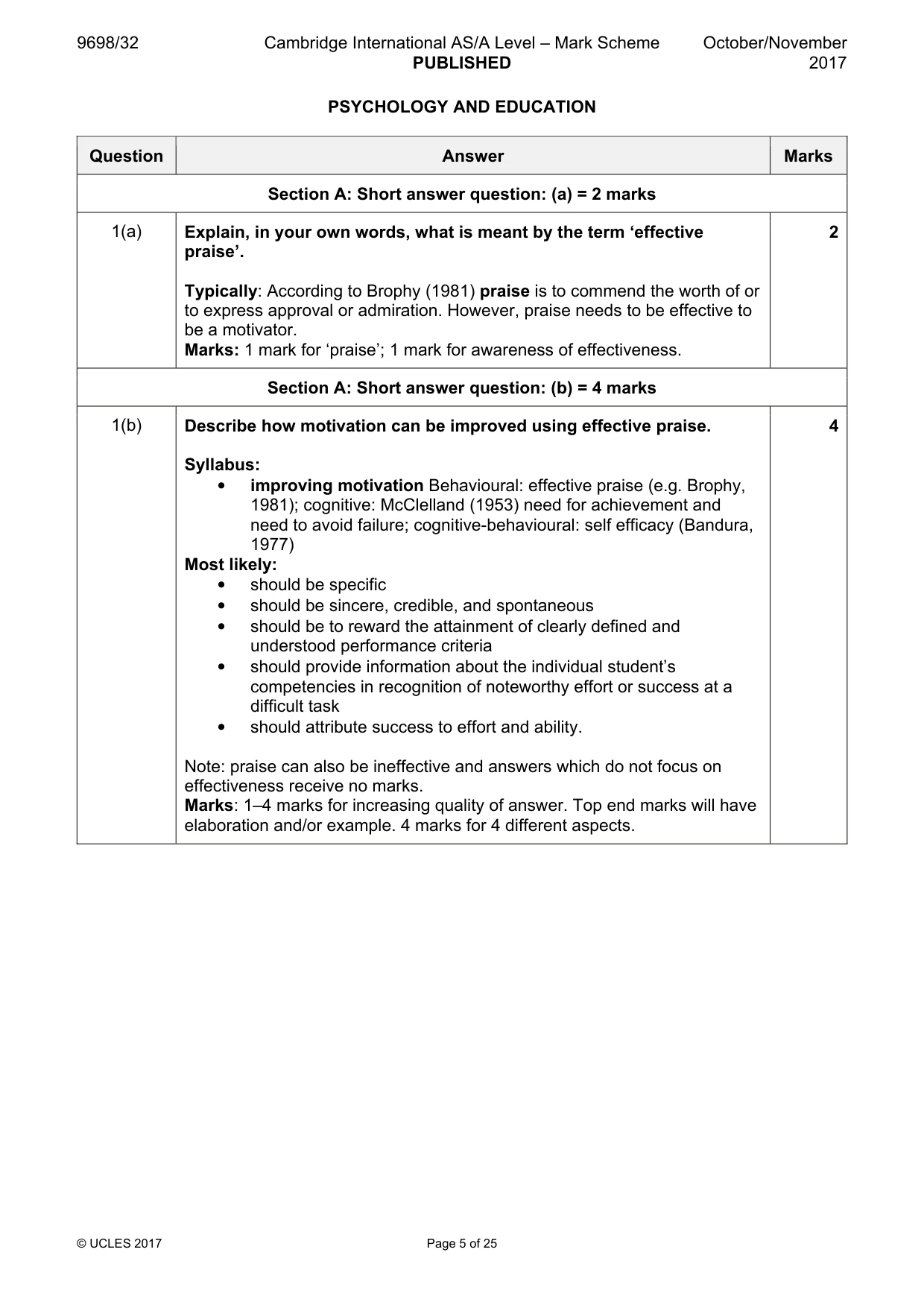
Q1 · Explain, in your own words, what is meant by the term ‘effective praise’
1 (a) Explain, in your own words, what is meant by the term ‘effective praise’. [2] (b) Describe how motivation can be improved using effective praise. [4]
Mark scheme: Question Answer Marks Section A: Short answer question: (a) = 2 marks 1(a) Explain, in your own words, what is meant by the term ‘effective 2 praise’. Typically: According to Brophy (1981) praise is to commend the worth of or to express approval or admiration. However, praise needs to be effective to be a motivator. Marks: 1 mark for ‘praise’; 1 mark for awareness of effectiveness. Section A: Short answer question: (b) = 4 marks 1(b) Describe how motivation can be improved using effective praise. 4 Syllabus: • improving motivation Behavioural: effective praise (e.g. Brophy, 1981); cognitive: McClelland (1953) need for achievement and need to avoid failure; cognitive-behavioural: self efficacy (Bandura, 1977) Most likely: • should be specific • should be sincere, credible, and spontaneous • should be to reward the attainment of clearly defined and understood performance criteria • should provide information about the individual student’s competencies in recognition of noteworthy effort or success at a difficult task • should attribute success to effort and ability. Note: praise can also be ineffective and answers which do not focus on effectiveness receive no marks. Marks: 1–4 marks for increasing quality of answer. Top end marks will have elaboration and/or example. 4 marks for 4 different aspects.
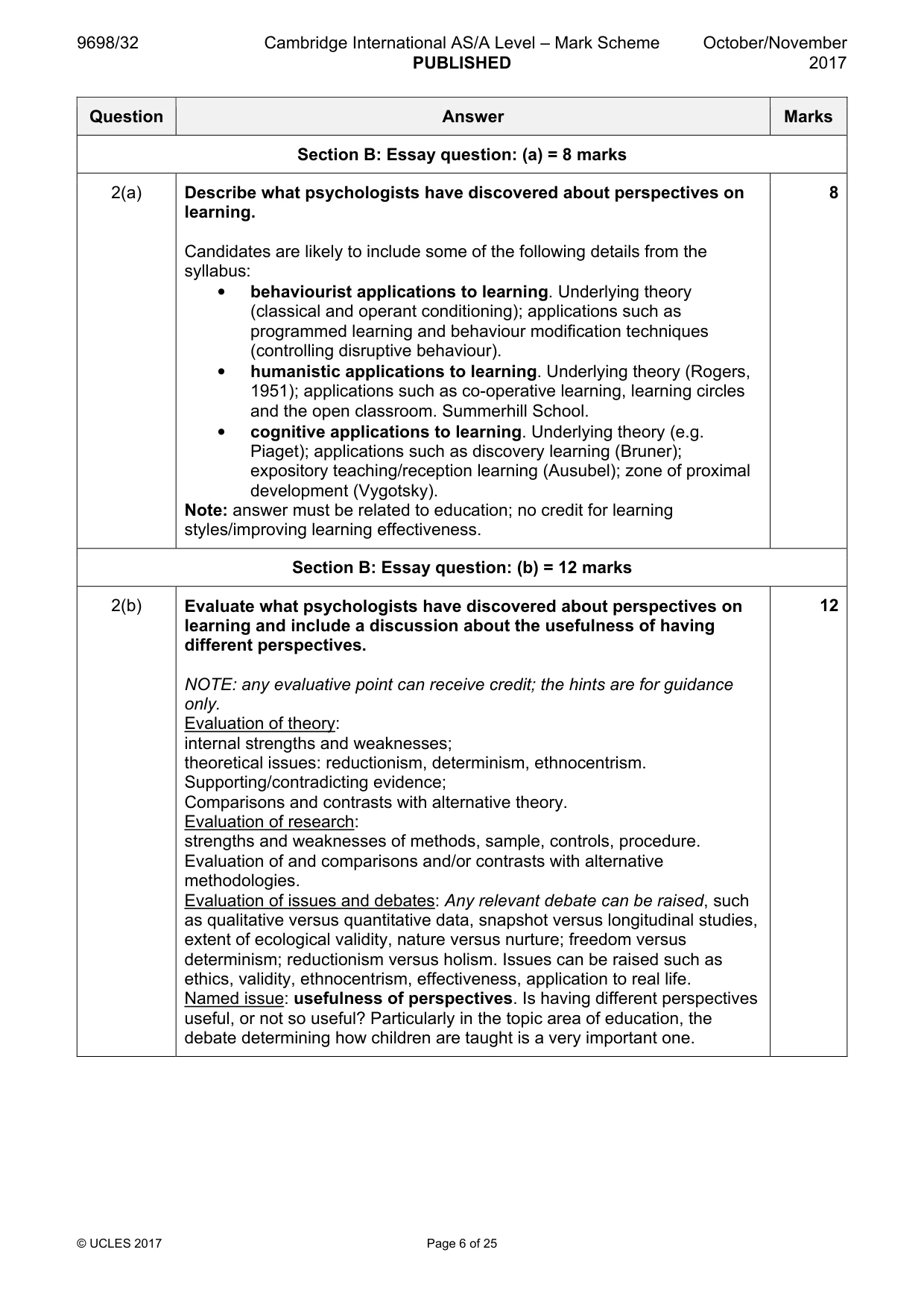
Q2 · Describe what psychologists have discovered about perspectives on learning
2 (a) Describe what psychologists have discovered about perspectives on learning. [8] (b) Evaluate what psychologists have discovered about perspectives on learning and include a discussion about the usefulness of having different perspectives. [12] Section C Answer one question.
Mark scheme: 2(a) Describe what psychologists have discovered about perspectives on 8 learning. Candidates are likely to include some of the following details from the syllabus: • behaviourist applications to learning. Underlying theory (classical and operant conditioning); applications such as programmed learning and behaviour modification techniques (controlling disruptive behaviour). • humanistic applications to learning. Underlying theory (Rogers, 1951); applications such as co-operative learning, learning circles and the open classroom. Summerhill School. • cognitive applications to learning. Underlying theory (e.g. Piaget); applications such as discovery learning (Bruner); expository teaching/reception learning (Ausubel); zone of proximal development (Vygotsky). Note: answer must be related to education; no credit for learning styles/improving learning effectiveness. Section B: Essay question: (b) = 12 marks 2(b) Evaluate what psychologists have discovered about perspectives on 12 learning and include a discussion about the usefulness of having different perspectives. NOTE: any evaluative point can receive credit; the hints are for guidance only. Evaluation of theory: internal strengths and weaknesses; theoretical issues: reductionism, determinism, ethnocentrism. Supporting/contradicting evidence; Comparisons and contrasts with alternative theory. Evaluation of research: strengths and weaknesses of methods, sample, controls, procedure. Evaluation of and comparisons and/or contrasts with alternative methodologies. Evaluation of issues and debates: Any relevant debate can be raised, such as qualitative versus quantitative data, snapshot versus longitudinal studies, extent of ecological validity, nature versus nurture; freedom versus determinism; reductionism versus holism. Issues can be raised such as ethics, validity, ethnocentrism, effectiveness, application to real life. Named issue: usefulness of perspectives. Is having different perspectives useful, or not so useful? Particularly in the topic area of education, the debate determining how children are taught is a very important one.
Q3 · There are different strategies for educating children with special needs
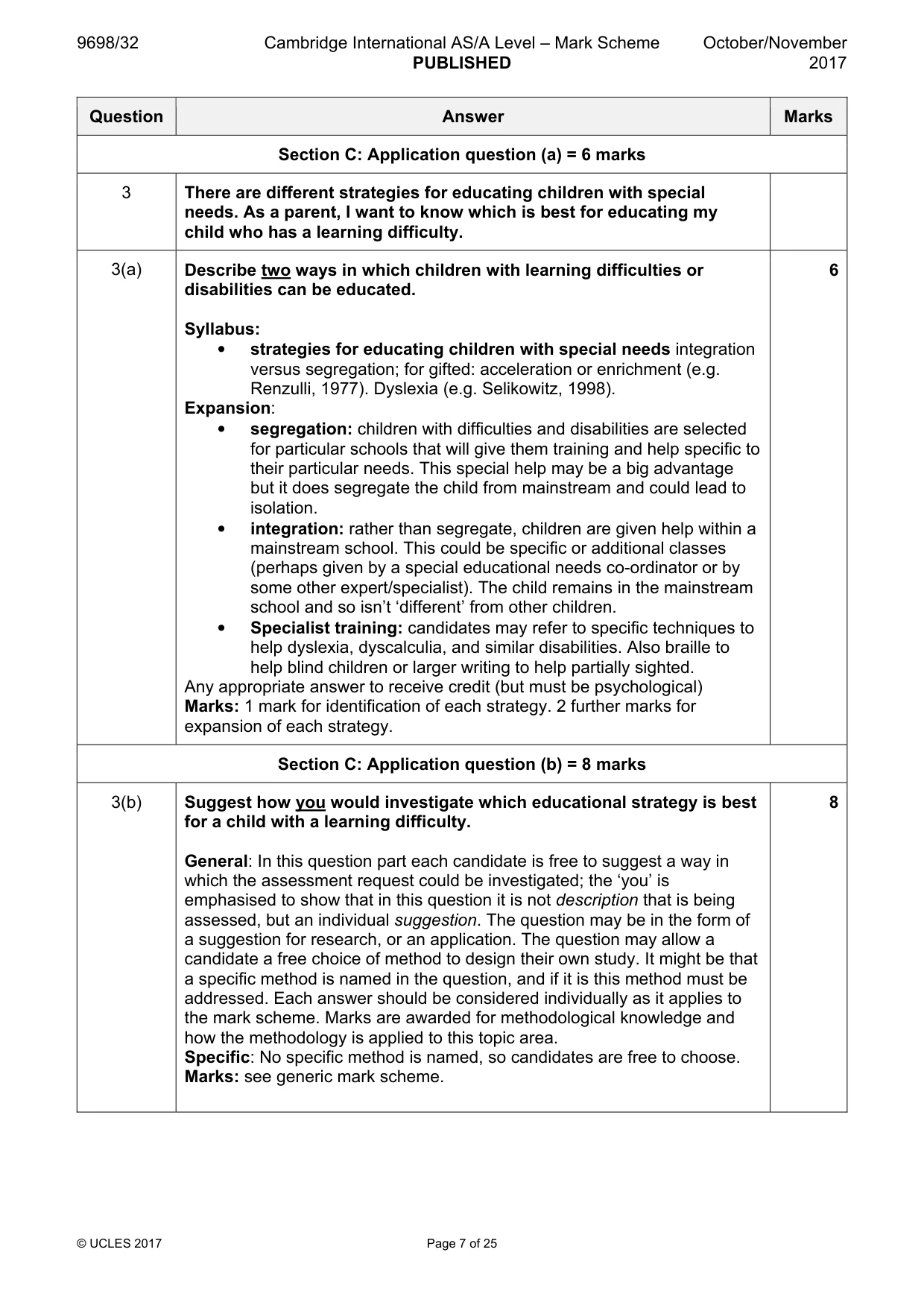
3 There are different strategies for educating children with special needs. As a parent, I want to know which is best for educating my child who has a learning difficulty. (a) Describe two ways in which children with learning difficulties or disabilities can be educated. [6] (b) Suggest how you would investigate which educational strategy is best for a child with a learning difficulty. [8]
Mark scheme: 3(a) Describe two ways in which children with learning difficulties or 6 disabilities can be educated. Syllabus: • strategies for educating children with special needs integration versus segregation; for gifted: acceleration or enrichment (e.g. Renzulli, 1977). Dyslexia (e.g. Selikowitz, 1998). Expansion: • segregation: children with difficulties and disabilities are selected for particular schools that will give them training and help specific to their particular needs. This special help may be a big advantage but it does segregate the child from mainstream and could lead to isolation. • integration: rather than segregate, children are given help within a mainstream school. This could be specific or additional classes (perhaps given by a special educational needs co-ordinator or by some other expert/specialist). The child remains in the mainstream school and so isn’t ‘different’ from other children. • Specialist training: candidates may refer to specific techniques to help dyslexia, dyscalculia, and similar disabilities. Also braille to help blind children or larger writing to help partially sighted. Any appropriate answer to receive credit (but must be psychological) Marks: 1 mark for identification of each strategy. 2 further marks for expansion of each strategy. Section C: Application question (b) = 8 marks 3(b) Suggest how you would investigate which educational strategy is best 8 for a child with a learning difficulty. General: In this question part each candidate is free to suggest a way in which the assessment request could be investigated; the ‘you’ is emphasised to show that in this question it is not description that is being assessed, but an individual suggestion. The question may be in the form of a suggestion for research, or an application. The question may allow a candidate a free choice of method to design their own study. It might be that a specific method is named in the question, and if it is this method must be addressed. Each answer should be considered individually as it applies to the mark scheme. Marks are awarded for methodological knowledge and how the methodology is applied to this topic area. Specific: No specific method is named, so candidates are free to choose. Marks: see generic mark scheme.
Q4 · “People who have a high IQ also have the ‘real-life’ intelligence needed to succeed in…
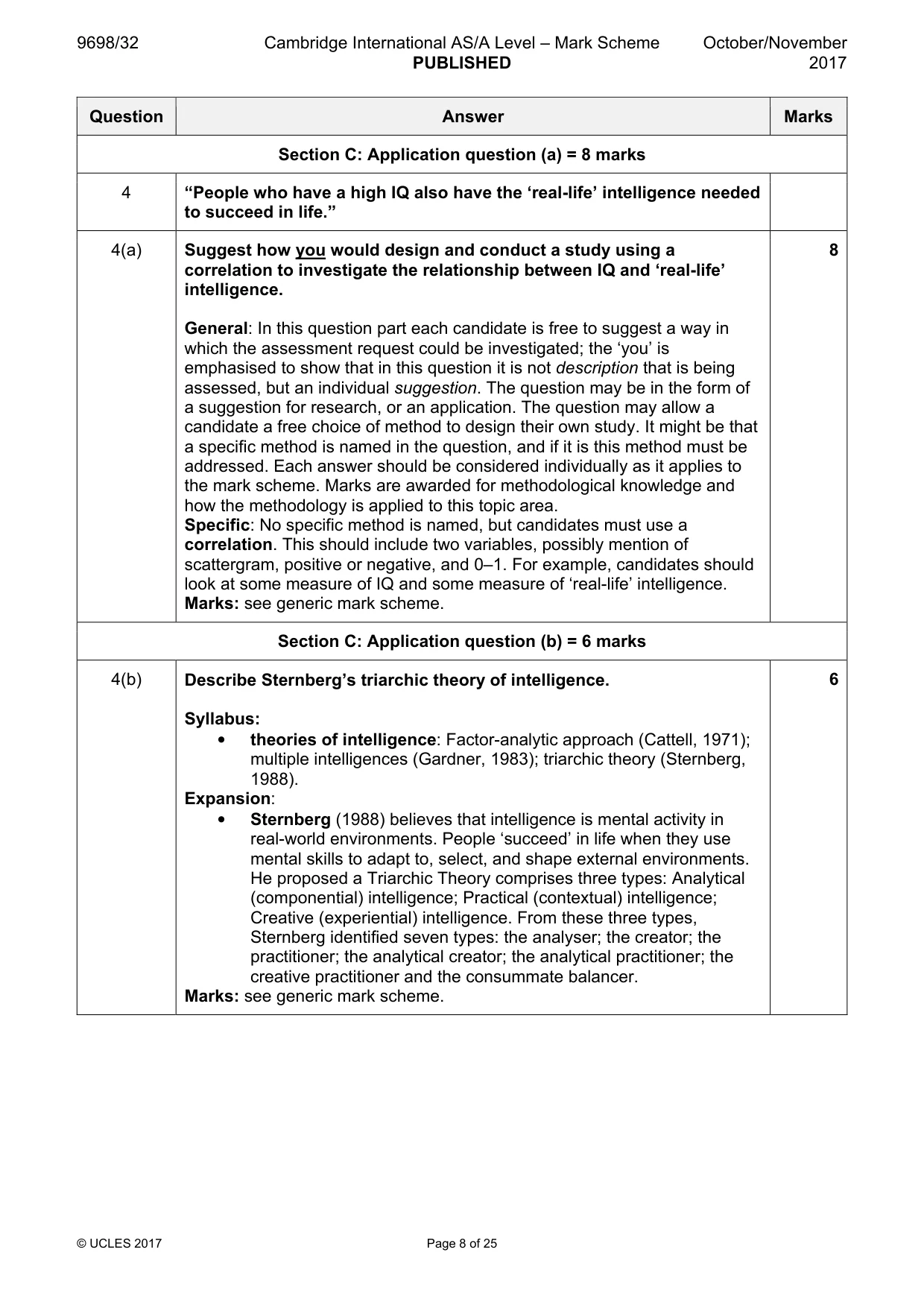
4 “People who have a high IQ also have the ‘real-life’ intelligence needed to succeed in life.” (a) Suggest how you would design and conduct a study using a correlation to investigate the relationship between IQ and ‘real-life’ intelligence. [8] (b) Describe Sternberg’s triarchic theory of intelligence. [6] Psychology and Health Section A Answer this question.
Mark scheme: 4(a) Suggest how you would design and conduct a study using a 8 correlation to investigate the relationship between IQ and ‘real-life’ intelligence. General: In this question part each candidate is free to suggest a way in which the assessment request could be investigated; the ‘you’ is emphasised to show that in this question it is not description that is being assessed, but an individual suggestion. The question may be in the form of a suggestion for research, or an application. The question may allow a candidate a free choice of method to design their own study. It might be that a specific method is named in the question, and if it is this method must be addressed. Each answer should be considered individually as it applies to the mark scheme. Marks are awarded for methodological knowledge and how the methodology is applied to this topic area. Specific: No specific method is named, but candidates must use a correlation. This should include two variables, possibly mention of scattergram, positive or negative, and 0–1. For example, candidates should look at some measure of IQ and some measure of ‘real-life’ intelligence. Marks: see generic mark scheme. Section C: Application question (b) = 6 marks 4(b) Describe Sternberg’s triarchic theory of intelligence. 6 Syllabus: • theories of intelligence: Factor-analytic approach (Cattell, 1971); multiple intelligences (Gardner, 1983); triarchic theory (Sternberg, 1988). Expansion: • Sternberg (1988) believes that intelligence is mental activity in real-world environments. People ‘succeed’ in life when they use mental skills to adapt to, select, and shape external environments. He proposed a Triarchic Theory comprises three types: Analytical (componential) intelligence; Practical (contextual) intelligence; Creative (experiential) intelligence. From these three types, Sternberg identified seven types: the analyser; the creator; the practitioner; the analytical creator; the analytical practitioner; the creative practitioner and the consummate balancer. Marks: see generic mark scheme. PSYCHOLOGY AND HEALTH
Q5 · Explain, in your own words, what is meant by ‘verbal communication’ in the…
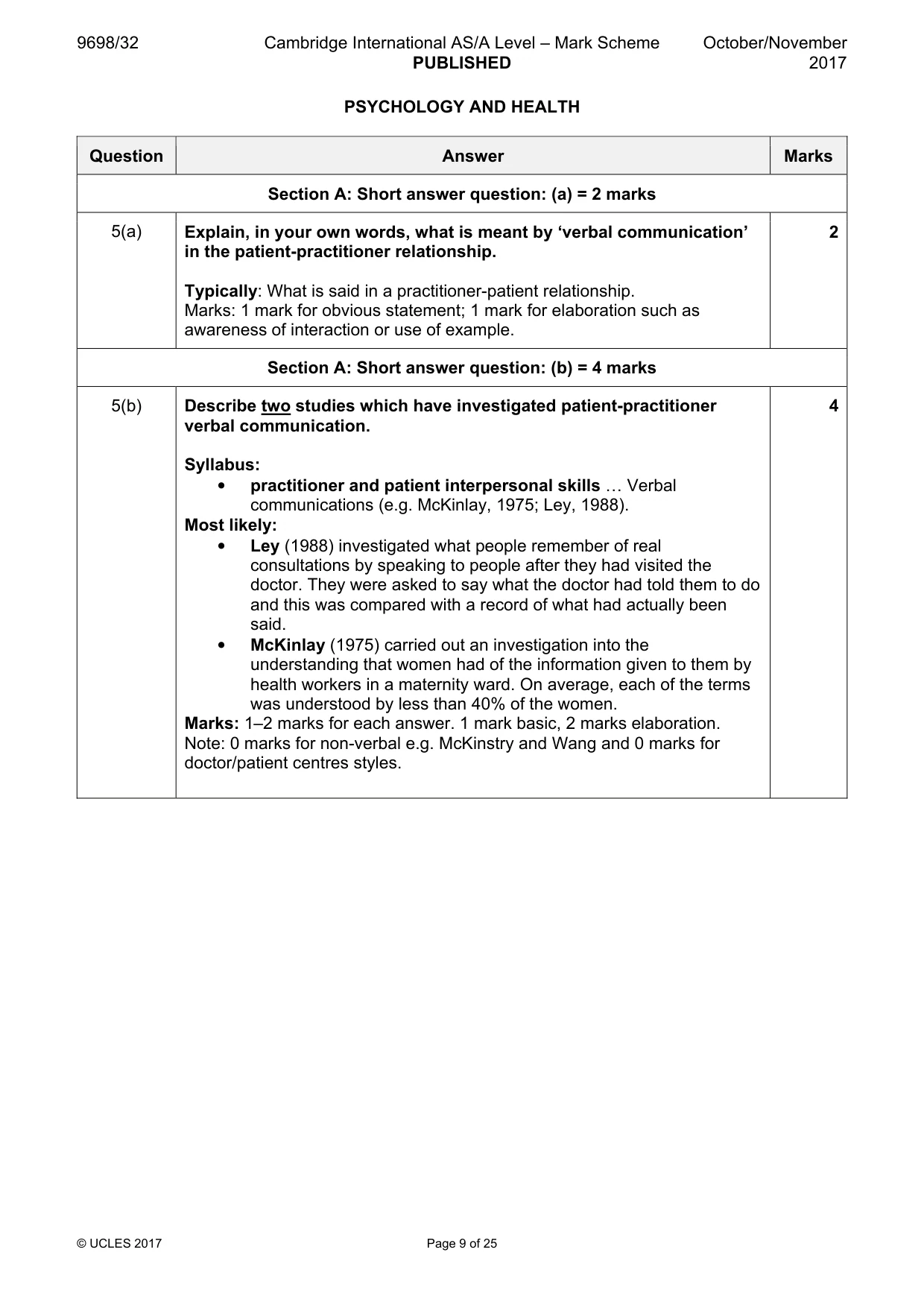
5 (a) Explain, in your own words, what is meant by ‘verbal communication’ in the patient-practitioner relationship. [2] (b) Describe two studies which have investigated patient-practitioner verbal communication. [4]
Mark scheme: 5(a) Explain, in your own words, what is meant by ‘verbal communication’ 2 in the patient-practitioner relationship. Typically: What is said in a practitioner-patient relationship. Marks: 1 mark for obvious statement; 1 mark for elaboration such as awareness of interaction or use of example. Section A: Short answer question: (b) = 4 marks 5(b) Describe two studies which have investigated patient-practitioner 4 verbal communication. Syllabus: • practitioner and patient interpersonal skills « Verbal communications (e.g. McKinlay, 1975; Ley, 1988). Most likely: • Ley (1988) investigated what people remember of real consultations by speaking to people after they had visited the doctor. They were asked to say what the doctor had told them to do and this was compared with a record of what had actually been said. • McKinlay (1975) carried out an investigation into the understanding that women had of the information given to them by health workers in a maternity ward. On average, each of the terms was understood by less than 40% of the women. Marks: 1–2 marks for each answer. 1 mark basic, 2 marks elaboration. Note: 0 marks for non-verbal e.g. McKinstry and Wang and 0 marks for doctor/patient centres styles.
Q6 · Describe what psychologists have found out about health promotion
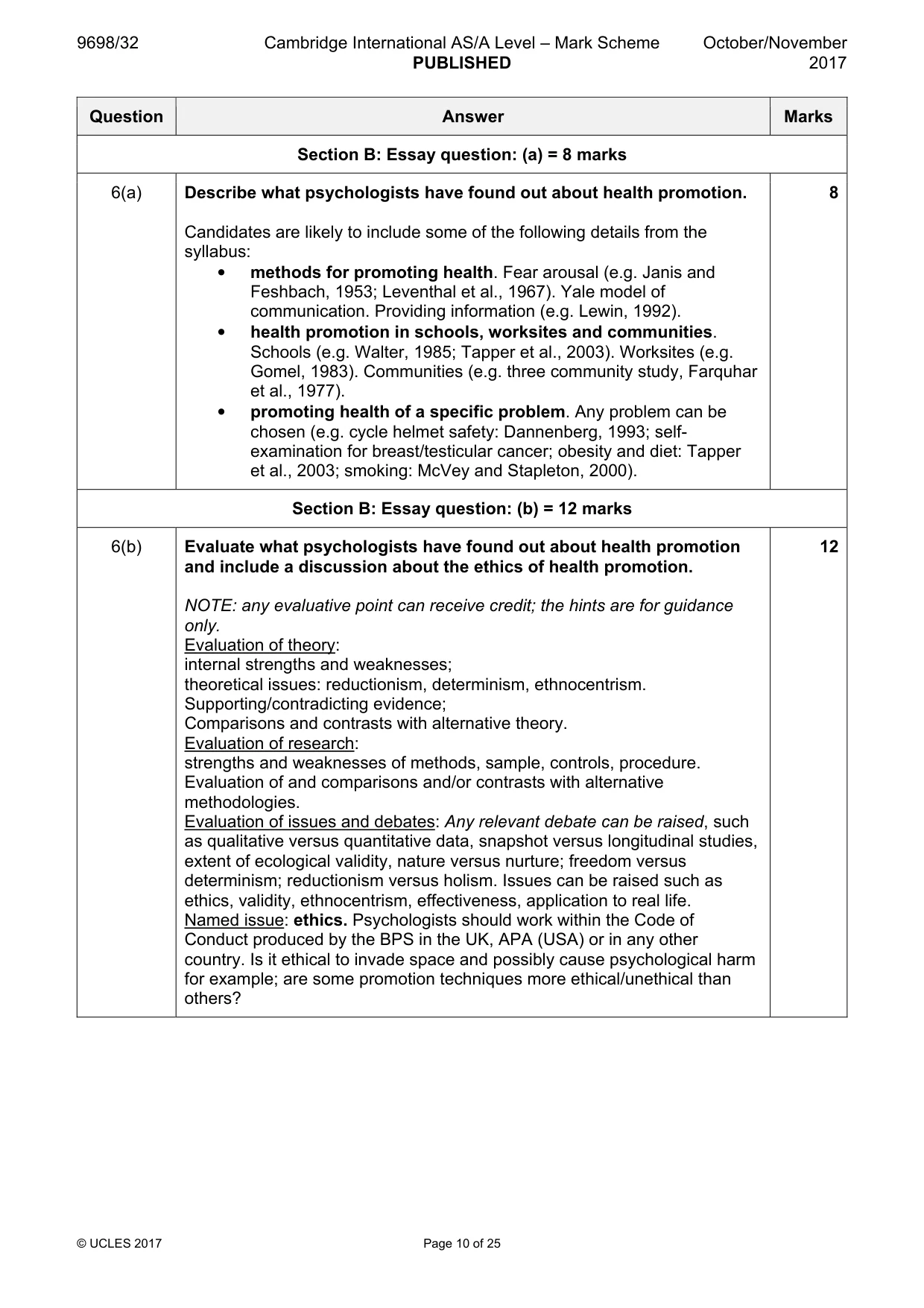
6 (a) Describe what psychologists have found out about health promotion. [8] (b) Evaluate what psychologists have found out about health promotion and include a discussion about the ethics of health promotion. [12] Section C Answer one question.
Mark scheme: 6(a) Describe what psychologists have found out about health promotion. 8 Candidates are likely to include some of the following details from the syllabus: • methods for promoting health. Fear arousal (e.g. Janis and Feshbach, 1953; Leventhal et al., 1967). Yale model of communication. Providing information (e.g. Lewin, 1992). • health promotion in schools, worksites and communities. Schools (e.g. Walter, 1985; Tapper et al., 2003). Worksites (e.g. Gomel, 1983). Communities (e.g. three community study, Farquhar et al., 1977). • promoting health of a specific problem. Any problem can be chosen (e.g. cycle helmet safety: Dannenberg, 1993; self- examination for breast/testicular cancer; obesity and diet: Tapper et al., 2003; smoking: McVey and Stapleton, 2000). Section B: Essay question: (b) = 12 marks 6(b) Evaluate what psychologists have found out about health promotion 12 and include a discussion about the ethics of health promotion. NOTE: any evaluative point can receive credit; the hints are for guidance only. Evaluation of theory: internal strengths and weaknesses; theoretical issues: reductionism, determinism, ethnocentrism. Supporting/contradicting evidence; Comparisons and contrasts with alternative theory. Evaluation of research: strengths and weaknesses of methods, sample, controls, procedure. Evaluation of and comparisons and/or contrasts with alternative methodologies. Evaluation of issues and debates: Any relevant debate can be raised, such as qualitative versus quantitative data, snapshot versus longitudinal studies, extent of ecological validity, nature versus nurture; freedom versus determinism; reductionism versus holism. Issues can be raised such as ethics, validity, ethnocentrism, effectiveness, application to real life. Named issue: ethics. Psychologists should work within the Code of Conduct produced by the BPS in the UK, APA (USA) or in any other country. Is it ethical to invade space and possibly cause psychological harm for example; are some promotion techniques more ethical/unethical than others?
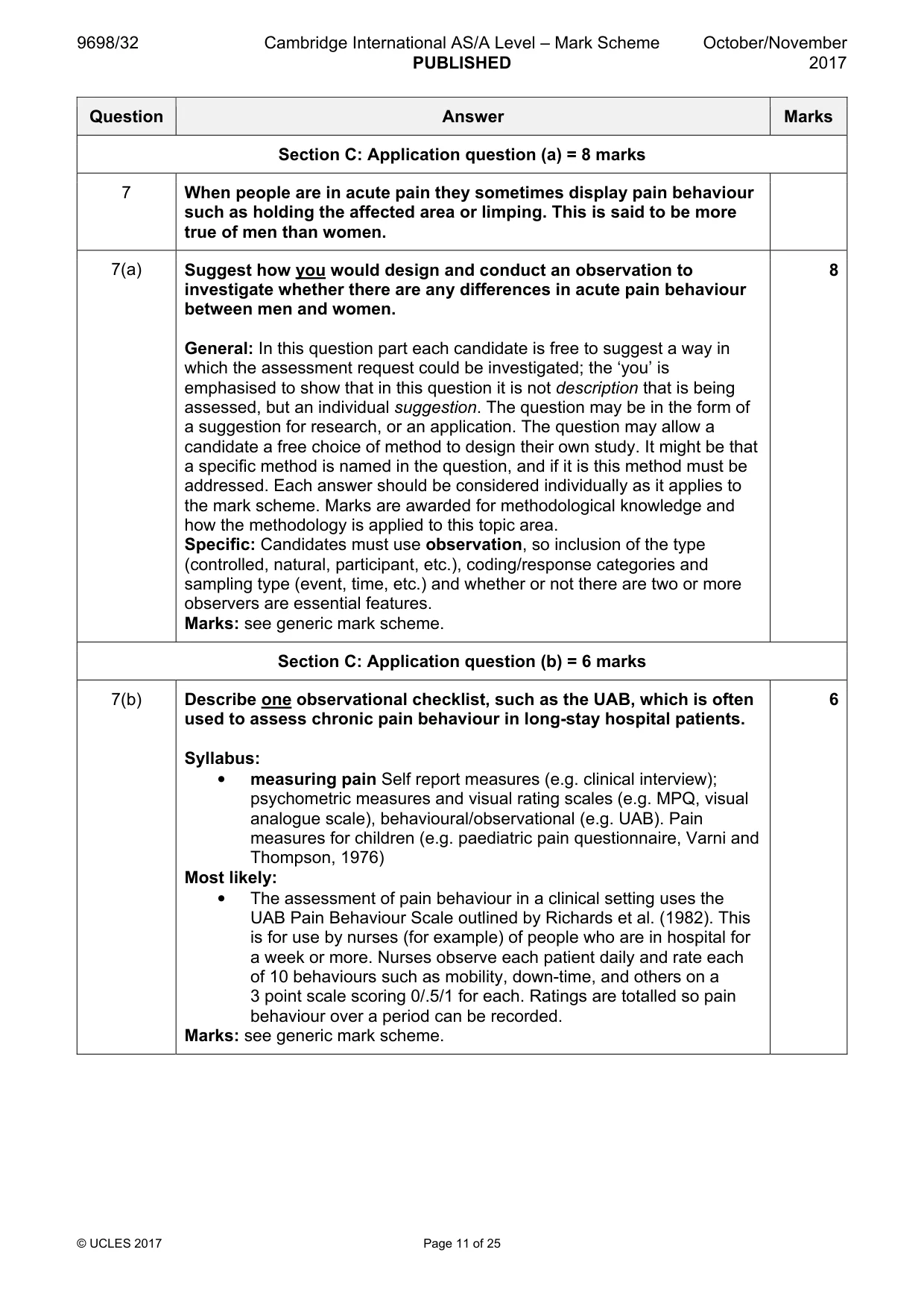
Q7 · When people are in acute pain they sometimes display pain behaviour such as holding the…
7 When people are in acute pain they sometimes display pain behaviour such as holding the affected area or limping. This is said to be more true of men than women. (a) Suggest how you would design and conduct an observation to investigate whether there are any differences in acute pain behaviour between men and women. [8] (b) Describe one observational checklist, such as the UAB, which is often used to assess chronic pain behaviour in long-stay hospital patients. [6]
Mark scheme: 7(a) Suggest how you would design and conduct an observation to 8 investigate whether there are any differences in acute pain behaviour between men and women. General: In this question part each candidate is free to suggest a way in which the assessment request could be investigated; the ‘you’ is emphasised to show that in this question it is not description that is being assessed, but an individual suggestion. The question may be in the form of a suggestion for research, or an application. The question may allow a candidate a free choice of method to design their own study. It might be that a specific method is named in the question, and if it is this method must be addressed. Each answer should be considered individually as it applies to the mark scheme. Marks are awarded for methodological knowledge and how the methodology is applied to this topic area. Specific: Candidates must use observation, so inclusion of the type (controlled, natural, participant, etc.), coding/response categories and sampling type (event, time, etc.) and whether or not there are two or more observers are essential features. Marks: see generic mark scheme. Section C: Application question (b) = 6 marks 7(b) Describe one observational checklist, such as the UAB, which is often 6 used to assess chronic pain behaviour in long-stay hospital patients. Syllabus: • measuring pain Self report measures (e.g. clinical interview); psychometric measures and visual rating scales (e.g. MPQ, visual analogue scale), behavioural/observational (e.g. UAB). Pain measures for children (e.g. paediatric pain questionnaire, Varni and Thompson, 1976) Most likely: • The assessment of pain behaviour in a clinical setting uses the UAB Pain Behaviour Scale outlined by Richards et al. (1982). This is for use by nurses (for example) of people who are in hospital for a week or more. Nurses observe each patient daily and rate each of 10 behaviours such as mobility, down-time, and others on a 3 point scale scoring 0/.5/1 for each. Ratings are totalled so pain behaviour over a period can be recorded. Marks: see generic mark scheme.
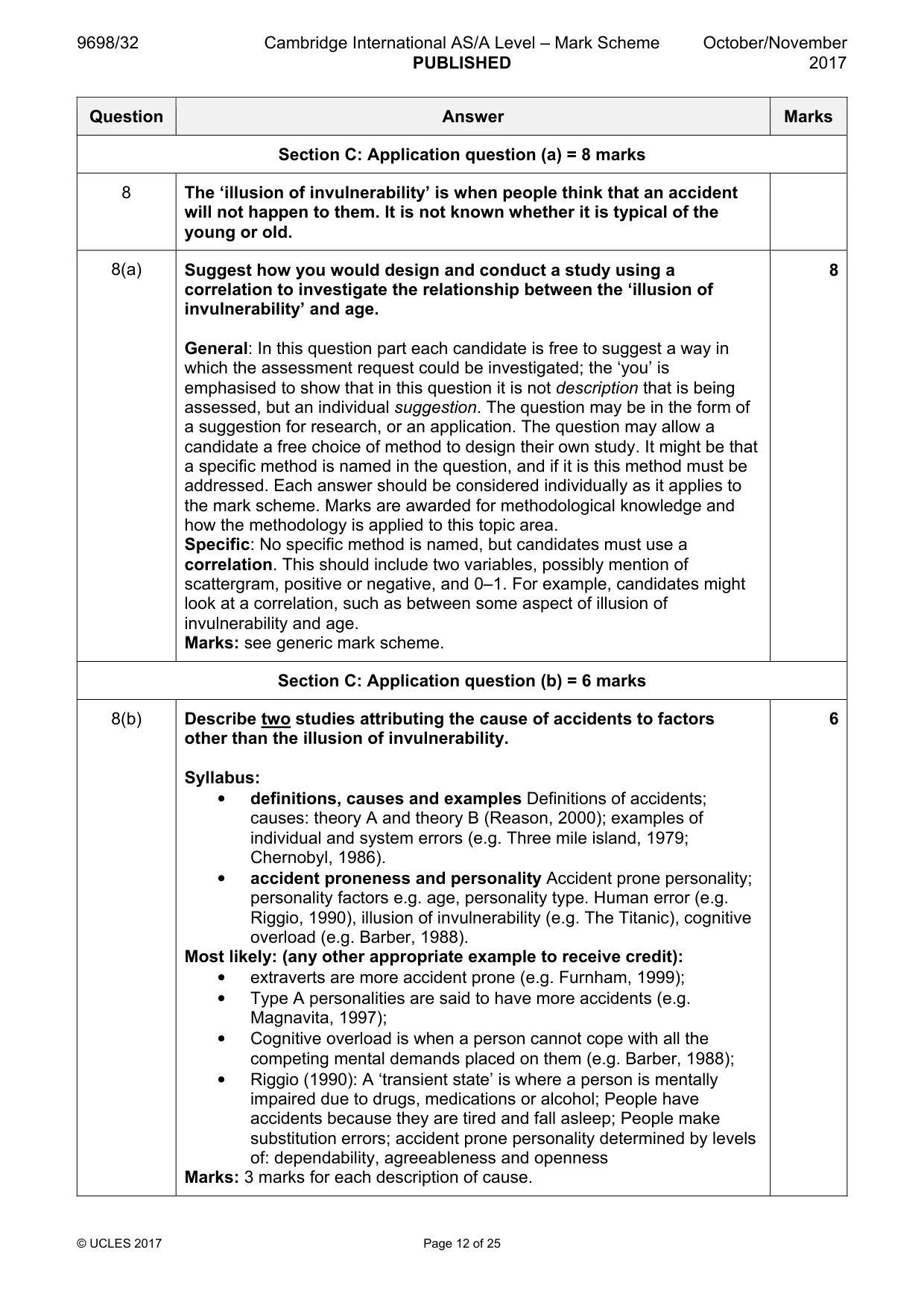
Q8 · The ‘illusion of invulnerability’ is when people think that an accident will not happen…
8 The ‘illusion of invulnerability’ is when people think that an accident will not happen to them. It is not known whether it is typical of the young or old. (a) Suggest how you would design and conduct a study using a correlation to investigate the relationship between the ‘illusion of invulnerability’ and age. [8] (b) Describe two studies attributing the cause of accidents to factors other than the illusion of invulnerability. [6] Psychology and Environment Section A Answer this question.
Mark scheme: 8(a) Suggest how you would design and conduct a study using a 8 correlation to investigate the relationship between the ‘illusion of invulnerability’ and age. General: In this question part each candidate is free to suggest a way in which the assessment request could be investigated; the ‘you’ is emphasised to show that in this question it is not description that is being assessed, but an individual suggestion. The question may be in the form of a suggestion for research, or an application. The question may allow a candidate a free choice of method to design their own study. It might be that a specific method is named in the question, and if it is this method must be addressed. Each answer should be considered individually as it applies to the mark scheme. Marks are awarded for methodological knowledge and how the methodology is applied to this topic area. Specific: No specific method is named, but candidates must use a correlation. This should include two variables, possibly mention of scattergram, positive or negative, and 0–1. For example, candidates might look at a correlation, such as between some aspect of illusion of invulnerability and age. Marks: see generic mark scheme. Section C: Application question (b) = 6 marks 8(b) Describe two studies attributing the cause of accidents to factors 6 other than the illusion of invulnerability. Syllabus: • definitions, causes and examples Definitions of accidents; causes: theory A and theory B (Reason, 2000); examples of individual and system errors (e.g. Three mile island, 1979; Chernobyl, 1986). • accident proneness and personality Accident prone personality; personality factors e.g. age, personality type. Human error (e.g. Riggio, 1990), illusion of invulnerability (e.g. The Titanic), cognitive overload (e.g. Barber, 1988). Most likely: (any other appropriate example to receive credit): • extraverts are more accident prone (e.g. Furnham, 1999); • Type A personalities are said to have more accidents (e.g. Magnavita, 1997); • Cognitive overload is when a person cannot cope with all the competing mental demands placed on them (e.g. Barber, 1988); • Riggio (1990): A ‘transient state’ is where a person is mentally impaired due to drugs, medications or alcohol; People have accidents because they are tired and fall asleep; People make substitution errors; accident prone personality determined by levels of: dependability, agreeableness and openness Marks: 3 marks for each description of cause. PSYCHOLOGY AND ENVIRONMENT
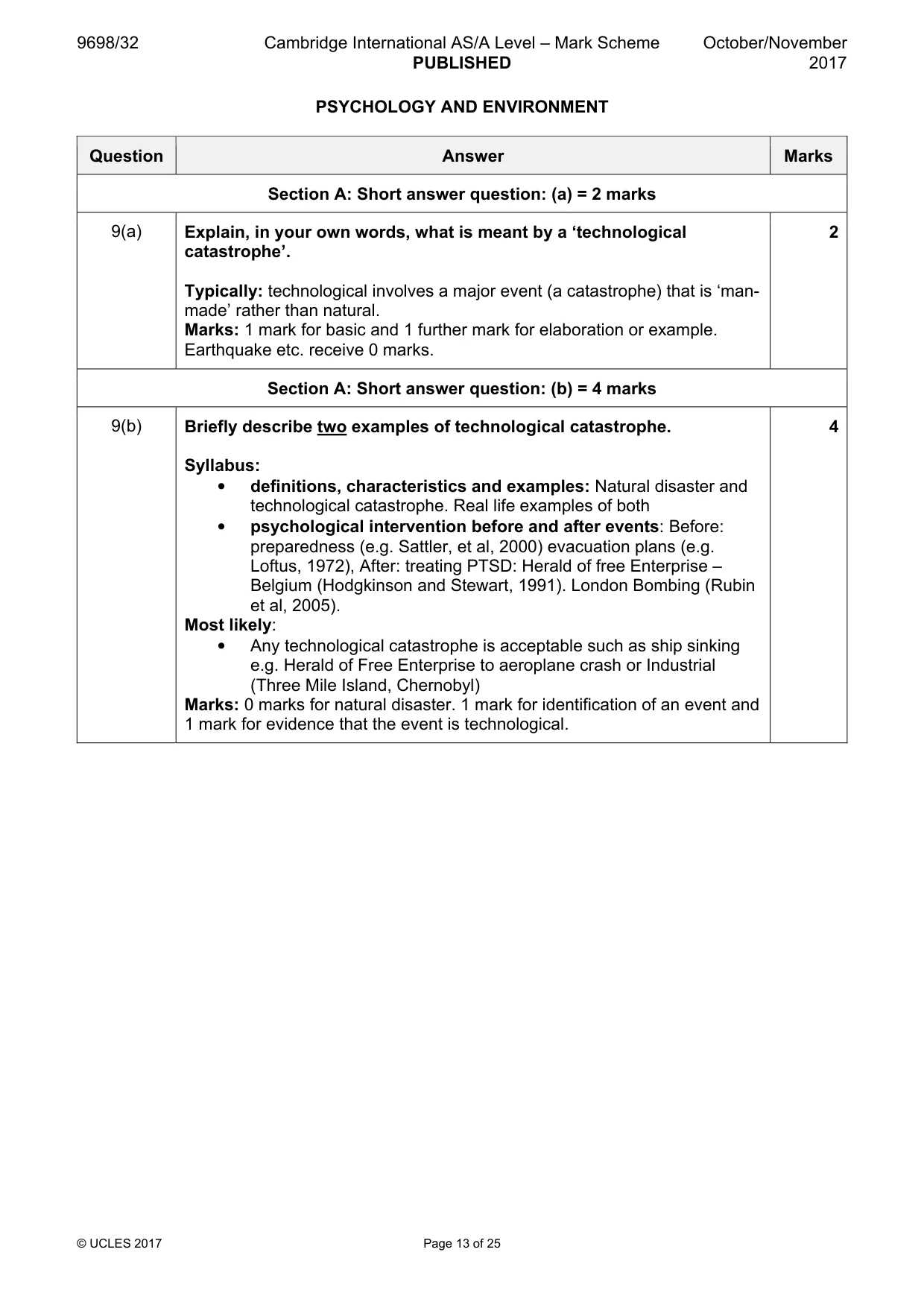
Q9 · Explain, in your own words, what is meant by a ‘technological catastrophe’
9 (a) Explain, in your own words, what is meant by a ‘technological catastrophe’. [2] (b) Briefly describe two examples of technological catastrophe. [4]
Mark scheme: 9(a) Explain, in your own words, what is meant by a ‘technological 2 catastrophe’. Typically: technological involves a major event (a catastrophe) that is ‘man- made’ rather than natural. Marks: 1 mark for basic and 1 further mark for elaboration or example. Earthquake etc. receive 0 marks. Section A: Short answer question: (b) = 4 marks 9(b) Briefly describe two examples of technological catastrophe. 4 Syllabus: • definitions, characteristics and examples: Natural disaster and technological catastrophe. Real life examples of both • psychological intervention before and after events: Before: preparedness (e.g. Sattler, et al, 2000) evacuation plans (e.g. Loftus, 1972), After: treating PTSD: Herald of free Enterprise – Belgium (Hodgkinson and Stewart, 1991). London Bombing (Rubin et al, 2005). Most likely: • Any technological catastrophe is acceptable such as ship sinking e.g. Herald of Free Enterprise to aeroplane crash or Industrial (Three Mile Island, Chernobyl) Marks: 0 marks for natural disaster. 1 mark for identification of an event and 1 mark for evidence that the event is technological.
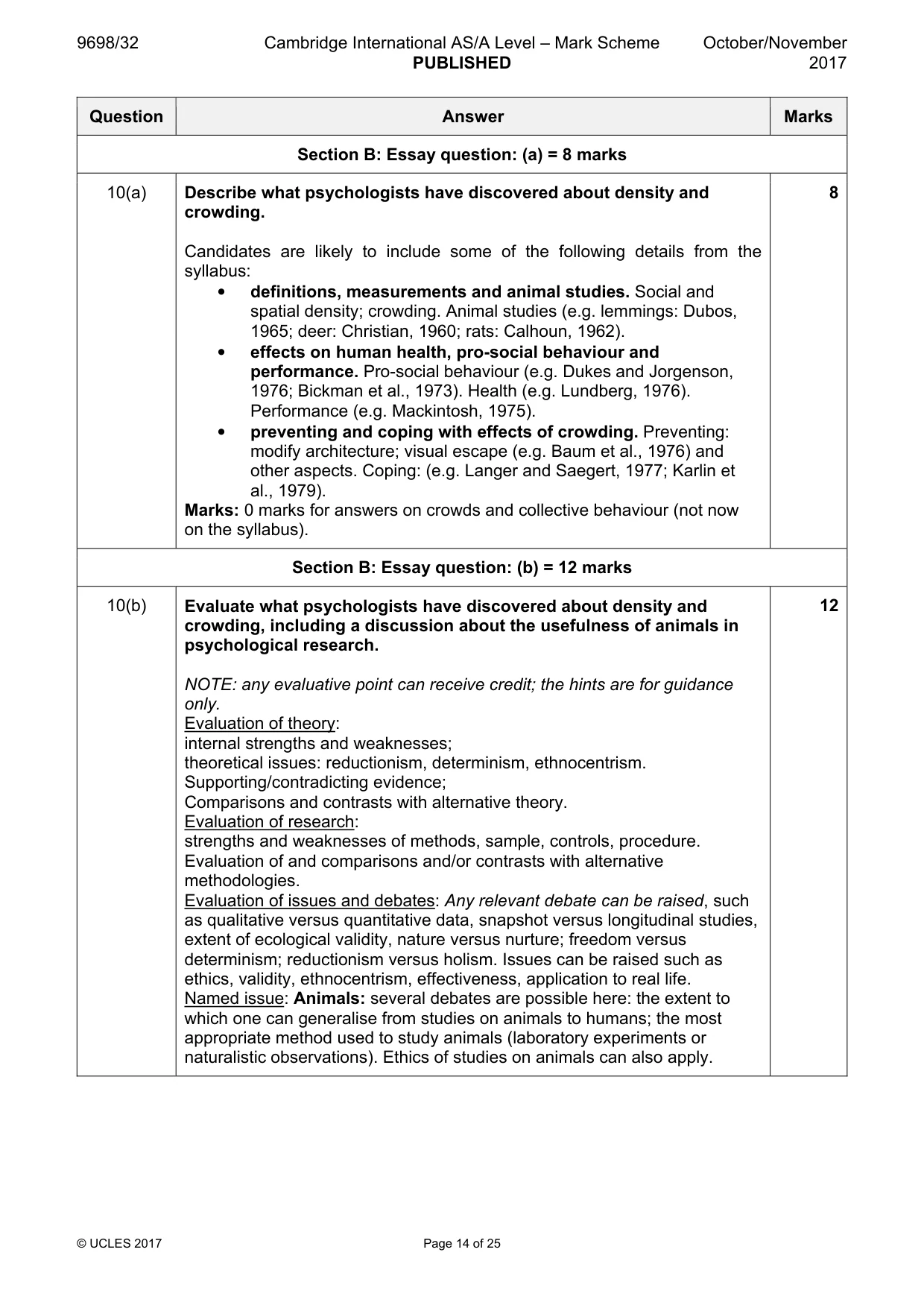
Q10 · Describe what psychologists have discovered about density and crowding
10 (a) Describe what psychologists have discovered about density and crowding. [8] (b) Evaluate what psychologists have discovered about density and crowding, including a discussion about the usefulness of animals in psychological research. [12] Section C Answer one question.
Mark scheme: 10(a) Describe what psychologists have discovered about density and 8 crowding. Candidates are likely to include some of the following details from the syllabus: • definitions, measurements and animal studies. Social and spatial density; crowding. Animal studies (e.g. lemmings: Dubos, 1965; deer: Christian, 1960; rats: Calhoun, 1962). • effects on human health, pro-social behaviour and performance. Pro-social behaviour (e.g. Dukes and Jorgenson, 1976; Bickman et al., 1973). Health (e.g. Lundberg, 1976). Performance (e.g. Mackintosh, 1975). • preventing and coping with effects of crowding. Preventing: modify architecture; visual escape (e.g. Baum et al., 1976) and other aspects. Coping: (e.g. Langer and Saegert, 1977; Karlin et al., 1979). Marks: 0 marks for answers on crowds and collective behaviour (not now on the syllabus). Section B: Essay question: (b) = 12 marks 10(b) Evaluate what psychologists have discovered about density and 12 crowding, including a discussion about the usefulness of animals in psychological research. NOTE: any evaluative point can receive credit; the hints are for guidance only. Evaluation of theory: internal strengths and weaknesses; theoretical issues: reductionism, determinism, ethnocentrism. Supporting/contradicting evidence; Comparisons and contrasts with alternative theory. Evaluation of research: strengths and weaknesses of methods, sample, controls, procedure. Evaluation of and comparisons and/or contrasts with alternative methodologies. Evaluation of issues and debates: Any relevant debate can be raised, such as qualitative versus quantitative data, snapshot versus longitudinal studies, extent of ecological validity, nature versus nurture; freedom versus determinism; reductionism versus holism. Issues can be raised such as ethics, validity, ethnocentrism, effectiveness, application to real life. Named issue: Animals: several debates are possible here: the extent to which one can generalise from studies on animals to humans; the most appropriate method used to study animals (laboratory experiments or naturalistic observations). Ethics of studies on animals can also apply.
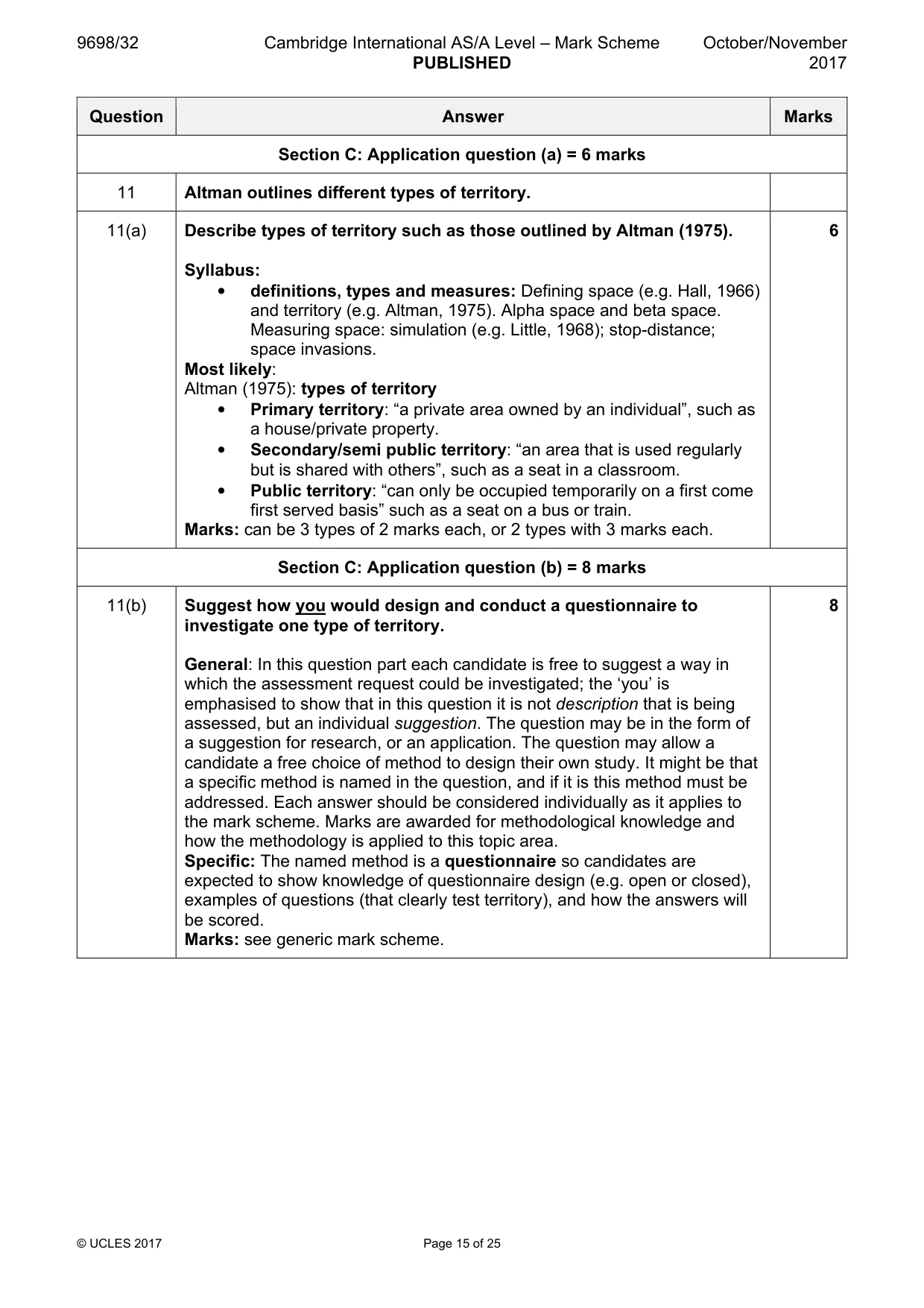
Q11 · Altman outlines different types of territory
11 Altman outlines different types of territory. (a) Describe types of territory such as those outlined by Altman (1975). [6] (b) Suggest how you would design and conduct a questionnaire to investigate one type of territory. [8]
Mark scheme: 11(a) Describe types of territory such as those outlined by Altman (1975). 6 Syllabus: • definitions, types and measures: Defining space (e.g. Hall, 1966) and territory (e.g. Altman, 1975). Alpha space and beta space. Measuring space: simulation (e.g. Little, 1968); stop-distance; space invasions. Most likely: Altman (1975): types of territory • Primary territory: “a private area owned by an individual”, such as a house/private property. • Secondary/semi public territory: “an area that is used regularly but is shared with others”, such as a seat in a classroom. • Public territory: “can only be occupied temporarily on a first come first served basis” such as a seat on a bus or train. Marks: can be 3 types of 2 marks each, or 2 types with 3 marks each. Section C: Application question (b) = 8 marks 11(b) Suggest how you would design and conduct a questionnaire to 8 investigate one type of territory. General: In this question part each candidate is free to suggest a way in which the assessment request could be investigated; the ‘you’ is emphasised to show that in this question it is not description that is being assessed, but an individual suggestion. The question may be in the form of a suggestion for research, or an application. The question may allow a candidate a free choice of method to design their own study. It might be that a specific method is named in the question, and if it is this method must be addressed. Each answer should be considered individually as it applies to the mark scheme. Marks are awarded for methodological knowledge and how the methodology is applied to this topic area. Specific: The named method is a questionnaire so candidates are expected to show knowledge of questionnaire design (e.g. open or closed), examples of questions (that clearly test territory), and how the answers will be scored. Marks: see generic mark scheme.
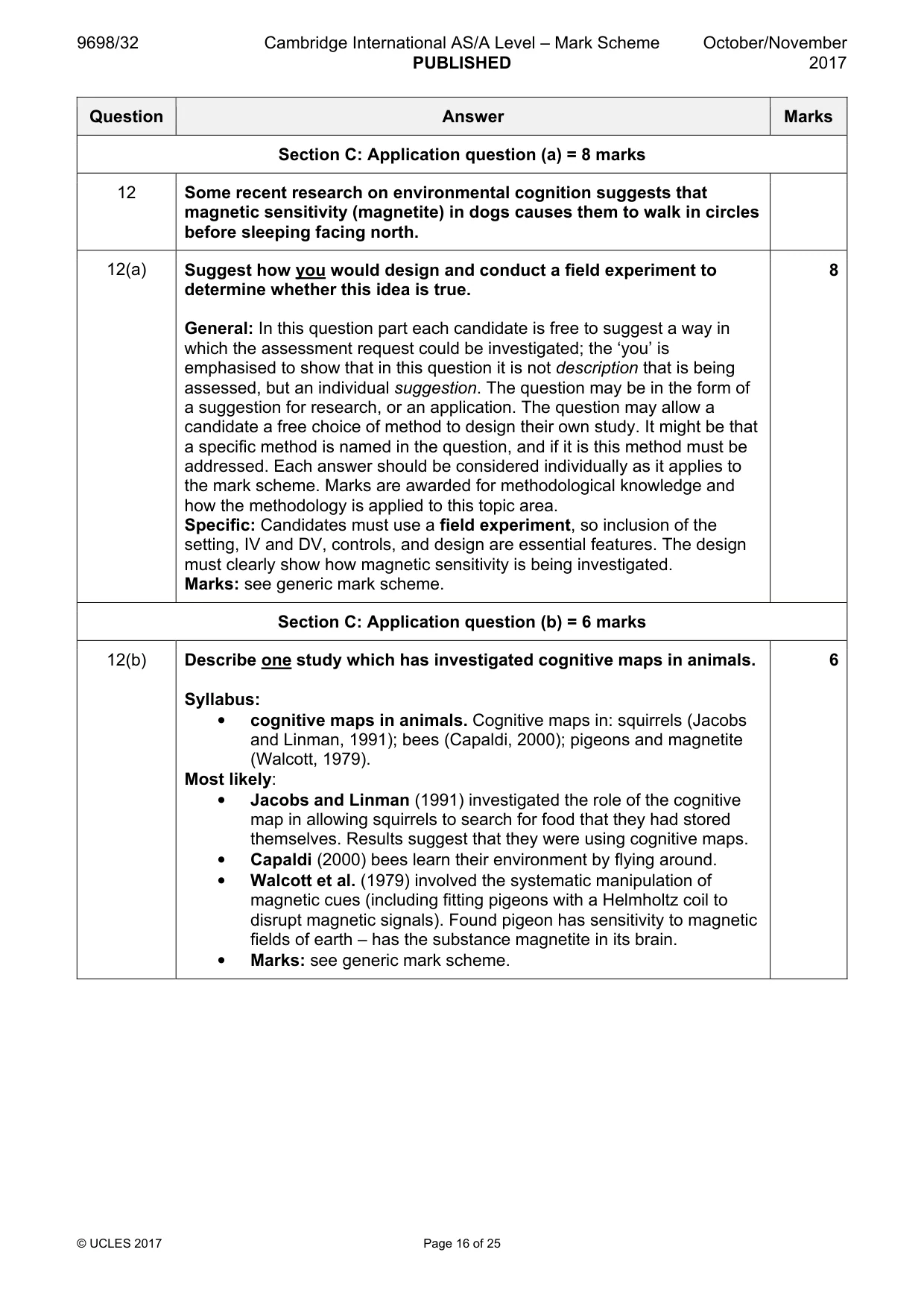
Q12 · Some recent research on environmental cognition suggests that magnetic sensitivity…
12 Some recent research on environmental cognition suggests that magnetic sensitivity (magnetite) in dogs causes them to walk in circles before sleeping facing north. (a) Suggest how you would design and conduct a field experiment to determine whether this idea is true. [8] (b) Describe one study which has investigated cognitive maps in animals. [6] Psychology and Abnormality Section A Answer this question.
Mark scheme: 12(a) Suggest how you would design and conduct a field experiment to 8 determine whether this idea is true. General: In this question part each candidate is free to suggest a way in which the assessment request could be investigated; the ‘you’ is emphasised to show that in this question it is not description that is being assessed, but an individual suggestion. The question may be in the form of a suggestion for research, or an application. The question may allow a candidate a free choice of method to design their own study. It might be that a specific method is named in the question, and if it is this method must be addressed. Each answer should be considered individually as it applies to the mark scheme. Marks are awarded for methodological knowledge and how the methodology is applied to this topic area. Specific: Candidates must use a field experiment, so inclusion of the setting, IV and DV, controls, and design are essential features. The design must clearly show how magnetic sensitivity is being investigated. Marks: see generic mark scheme. Section C: Application question (b) = 6 marks 12(b) Describe one study which has investigated cognitive maps in animals. 6 Syllabus: • cognitive maps in animals. Cognitive maps in: squirrels (Jacobs and Linman, 1991); bees (Capaldi, 2000); pigeons and magnetite (Walcott, 1979). Most likely: • Jacobs and Linman (1991) investigated the role of the cognitive map in allowing squirrels to search for food that they had stored themselves. Results suggest that they were using cognitive maps. • Capaldi (2000) bees learn their environment by flying around. • Walcott et al. (1979) involved the systematic manipulation of magnetic cues (including fitting pigeons with a Helmholtz coil to disrupt magnetic signals). Found pigeon has sensitivity to magnetic fields of earth – has the substance magnetite in its brain. • Marks: see generic mark scheme. PSYCHOLOGY AND ABNORMALITY
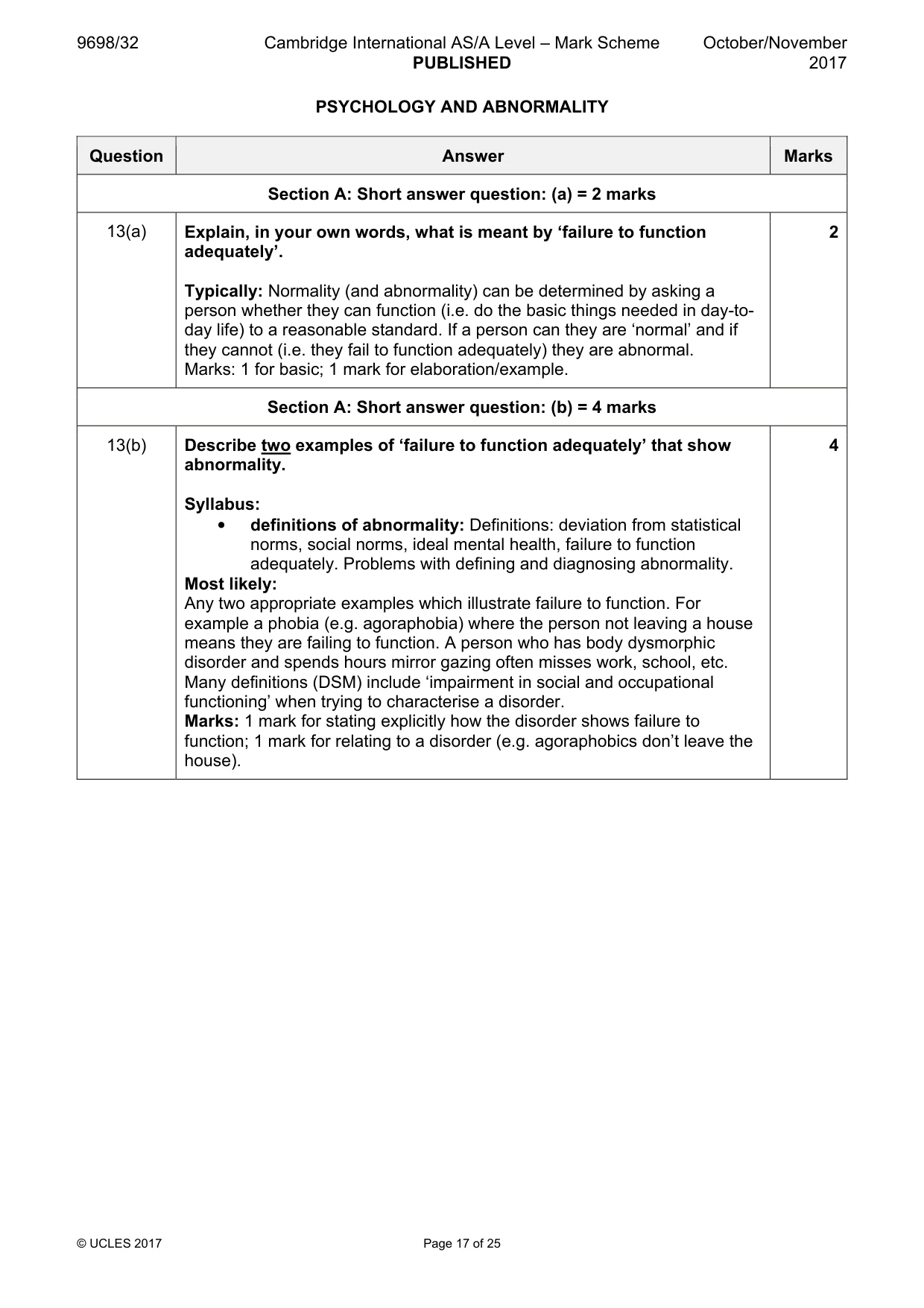
Q13 · Explain, in your own words, what is meant by ‘failure to function adequately’
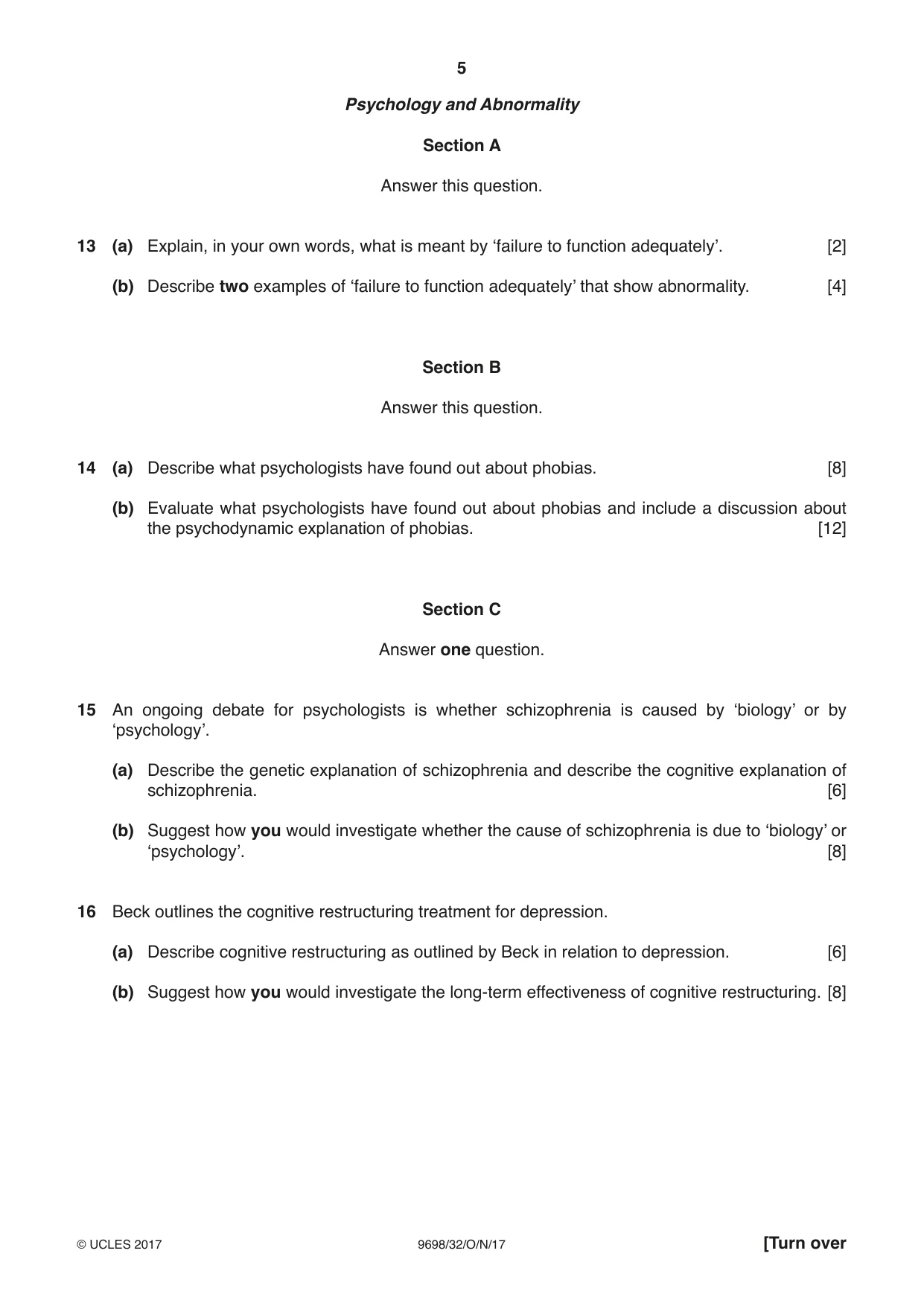
13 (a) Explain, in your own words, what is meant by ‘failure to function adequately’. [2] (b) Describe two examples of ‘failure to function adequately’ that show abnormality. [4]
Mark scheme: 13(a) Explain, in your own words, what is meant by ‘failure to function 2 adequately’. Typically: Normality (and abnormality) can be determined by asking a person whether they can function (i.e. do the basic things needed in day-to- day life) to a reasonable standard. If a person can they are ‘normal’ and if they cannot (i.e. they fail to function adequately) they are abnormal. Marks: 1 for basic; 1 mark for elaboration/example. Section A: Short answer question: (b) = 4 marks 13(b) Describe two examples of ‘failure to function adequately’ that show 4 abnormality. Syllabus: • definitions of abnormality: Definitions: deviation from statistical norms, social norms, ideal mental health, failure to function adequately. Problems with defining and diagnosing abnormality. Most likely: Any two appropriate examples which illustrate failure to function. For example a phobia (e.g. agoraphobia) where the person not leaving a house means they are failing to function. A person who has body dysmorphic disorder and spends hours mirror gazing often misses work, school, etc. Many definitions (DSM) include ‘impairment in social and occupational functioning’ when trying to characterise a disorder. Marks: 1 mark for stating explicitly how the disorder shows failure to function; 1 mark for relating to a disorder (e.g. agoraphobics don’t leave the house).
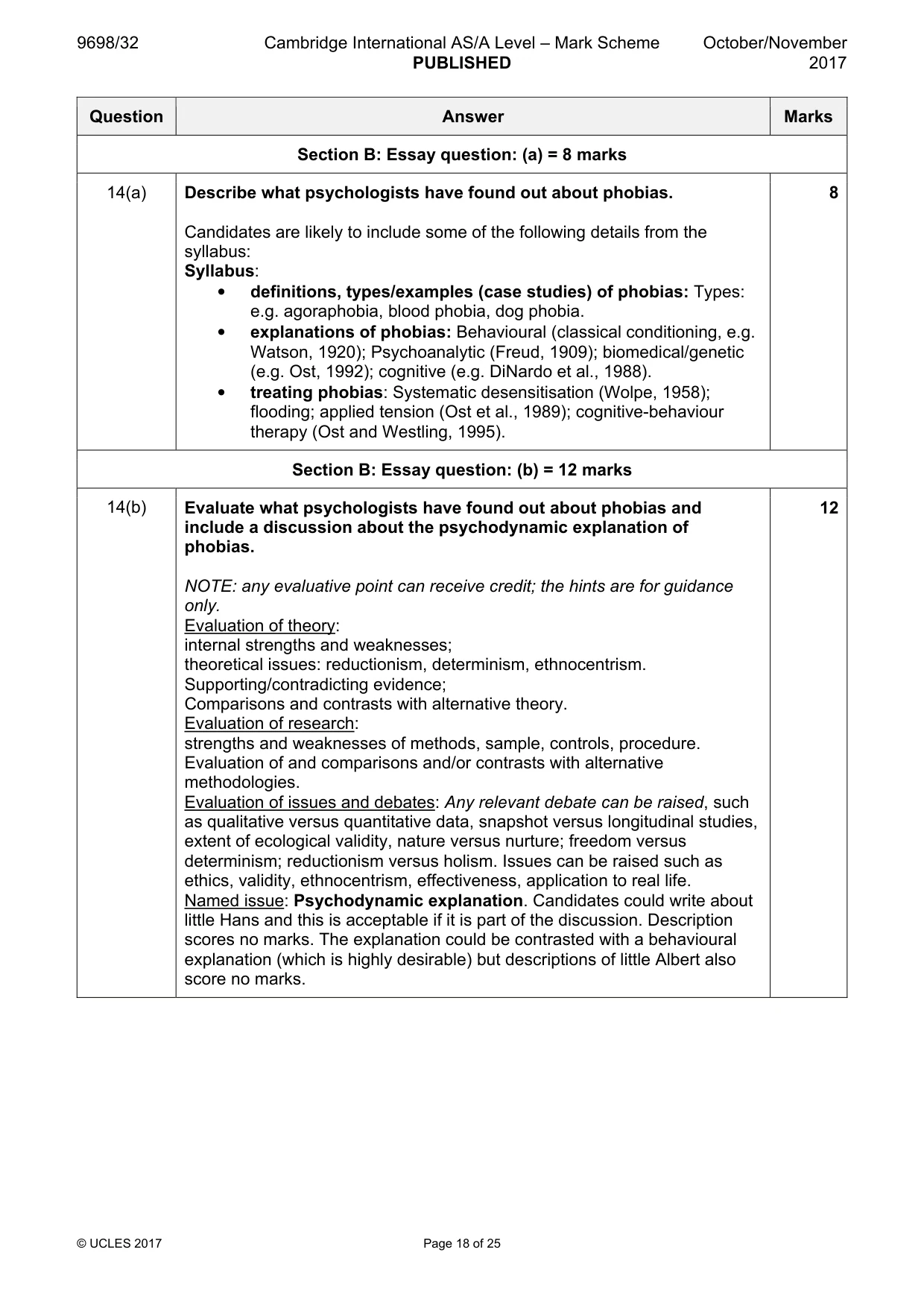
Q14 · Describe what psychologists have found out about phobias
14 (a) Describe what psychologists have found out about phobias. [8] (b) Evaluate what psychologists have found out about phobias and include a discussion about the psychodynamic explanation of phobias. [12] Section C Answer one question.
Mark scheme: 14(a) Describe what psychologists have found out about phobias. 8 Candidates are likely to include some of the following details from the syllabus: Syllabus: • definitions, types/examples (case studies) of phobias: Types: e.g. agoraphobia, blood phobia, dog phobia. • explanations of phobias: Behavioural (classical conditioning, e.g. Watson, 1920); Psychoanalytic (Freud, 1909); biomedical/genetic (e.g. Ost, 1992); cognitive (e.g. DiNardo et al., 1988). • treating phobias: Systematic desensitisation (Wolpe, 1958); flooding; applied tension (Ost et al., 1989); cognitive-behaviour therapy (Ost and Westling, 1995). Section B: Essay question: (b) = 12 marks 14(b) Evaluate what psychologists have found out about phobias and 12 include a discussion about the psychodynamic explanation of phobias. NOTE: any evaluative point can receive credit; the hints are for guidance only. Evaluation of theory: internal strengths and weaknesses; theoretical issues: reductionism, determinism, ethnocentrism. Supporting/contradicting evidence; Comparisons and contrasts with alternative theory. Evaluation of research: strengths and weaknesses of methods, sample, controls, procedure. Evaluation of and comparisons and/or contrasts with alternative methodologies. Evaluation of issues and debates: Any relevant debate can be raised, such as qualitative versus quantitative data, snapshot versus longitudinal studies, extent of ecological validity, nature versus nurture; freedom versus determinism; reductionism versus holism. Issues can be raised such as ethics, validity, ethnocentrism, effectiveness, application to real life. Named issue: Psychodynamic explanation. Candidates could write about little Hans and this is acceptable if it is part of the discussion. Description scores no marks. The explanation could be contrasted with a behavioural explanation (which is highly desirable) but descriptions of little Albert also score no marks.
Q15 · An ongoing debate for psychologists is whether schizophrenia is caused by ‘biology’ or by…
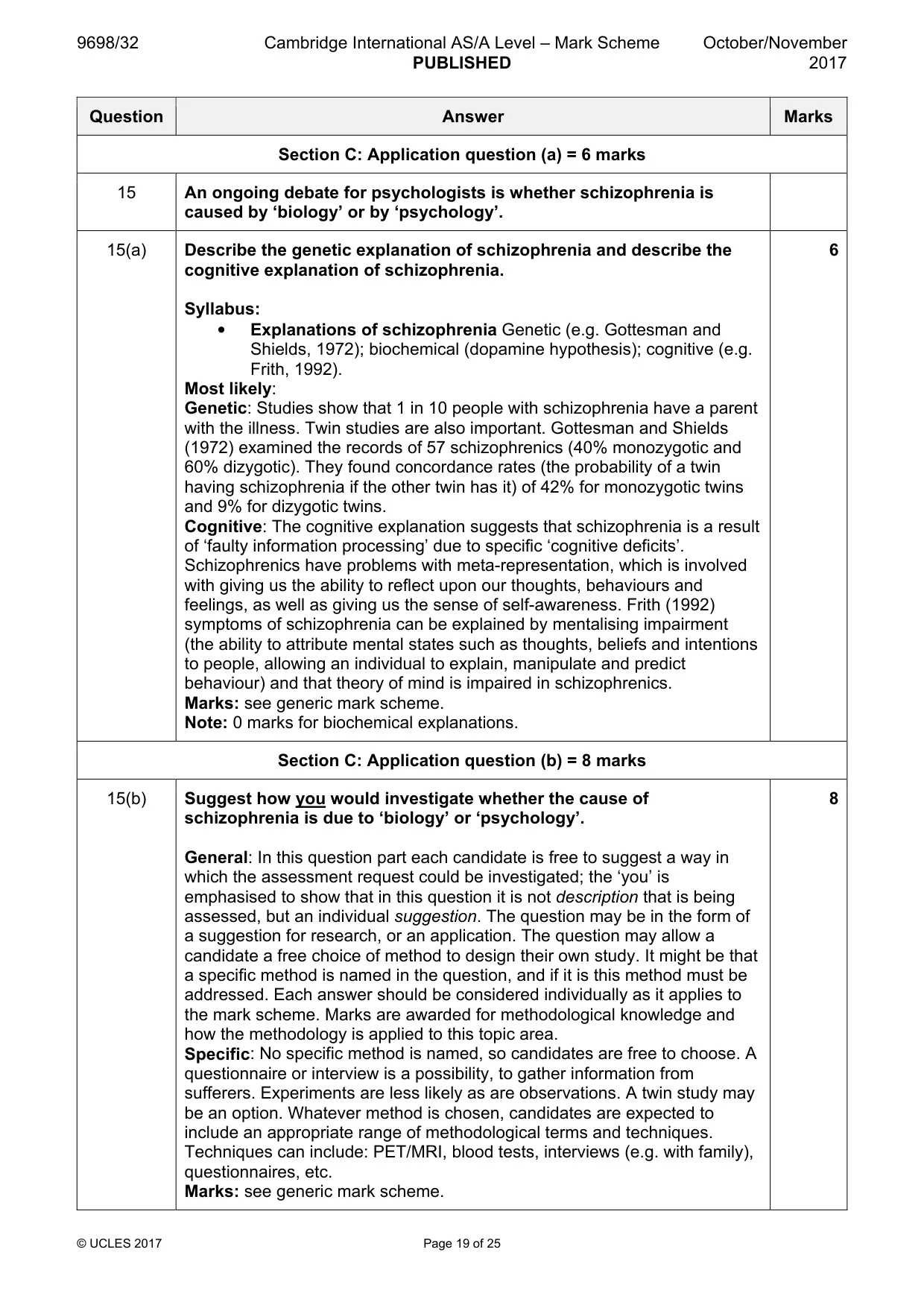
15 An ongoing debate for psychologists is whether schizophrenia is caused by ‘biology’ or by ‘psychology’. (a) Describe the genetic explanation of schizophrenia and describe the cognitive explanation of schizophrenia. [6] (b) Suggest how you would investigate whether the cause of schizophrenia is due to ‘biology’ or ‘psychology’. [8]
Mark scheme: 15(a) Describe the genetic explanation of schizophrenia and describe the 6 cognitive explanation of schizophrenia. Syllabus: • Explanations of schizophrenia Genetic (e.g. Gottesman and Shields, 1972); biochemical (dopamine hypothesis); cognitive (e.g. Frith, 1992). Most likely: Genetic: Studies show that 1 in 10 people with schizophrenia have a parent with the illness. Twin studies are also important. Gottesman and Shields (1972) examined the records of 57 schizophrenics (40% monozygotic and 60% dizygotic). They found concordance rates (the probability of a twin having schizophrenia if the other twin has it) of 42% for monozygotic twins and 9% for dizygotic twins. Cognitive: The cognitive explanation suggests that schizophrenia is a result of ‘faulty information processing’ due to specific ‘cognitive deficits’. Schizophrenics have problems with meta-representation, which is involved with giving us the ability to reflect upon our thoughts, behaviours and feelings, as well as giving us the sense of self-awareness. Frith (1992) symptoms of schizophrenia can be explained by mentalising impairment (the ability to attribute mental states such as thoughts, beliefs and intentions to people, allowing an individual to explain, manipulate and predict behaviour) and that theory of mind is impaired in schizophrenics. Marks: see generic mark scheme. Note: 0 marks for biochemical explanations. Section C: Application question (b) = 8 marks 15(b) Suggest how you would investigate whether the cause of 8 schizophrenia is due to ‘biology’ or ‘psychology’. General: In this question part each candidate is free to suggest a way in which the assessment request could be investigated; the ‘you’ is emphasised to show that in this question it is not description that is being assessed, but an individual suggestion. The question may be in the form of a suggestion for research, or an application. The question may allow a candidate a free choice of method to design their own study. It might be that a specific method is named in the question, and if it is this method must be addressed. Each answer should be considered individually as it applies to the mark scheme. Marks are awarded for methodological knowledge and how the methodology is applied to this topic area. Specific: No specific method is named, so candidates are free to choose. A questionnaire or interview is a possibility, to gather information from sufferers. Experiments are less likely as are observations. A twin study may be an option. Whatever method is chosen, candidates are expected to include an appropriate range of methodological terms and techniques. Techniques can include: PET/MRI, blood tests, interviews (e.g. with family), questionnaires, etc. Marks: see generic mark scheme.
Q16 · Beck outlines the cognitive restructuring treatment for depression
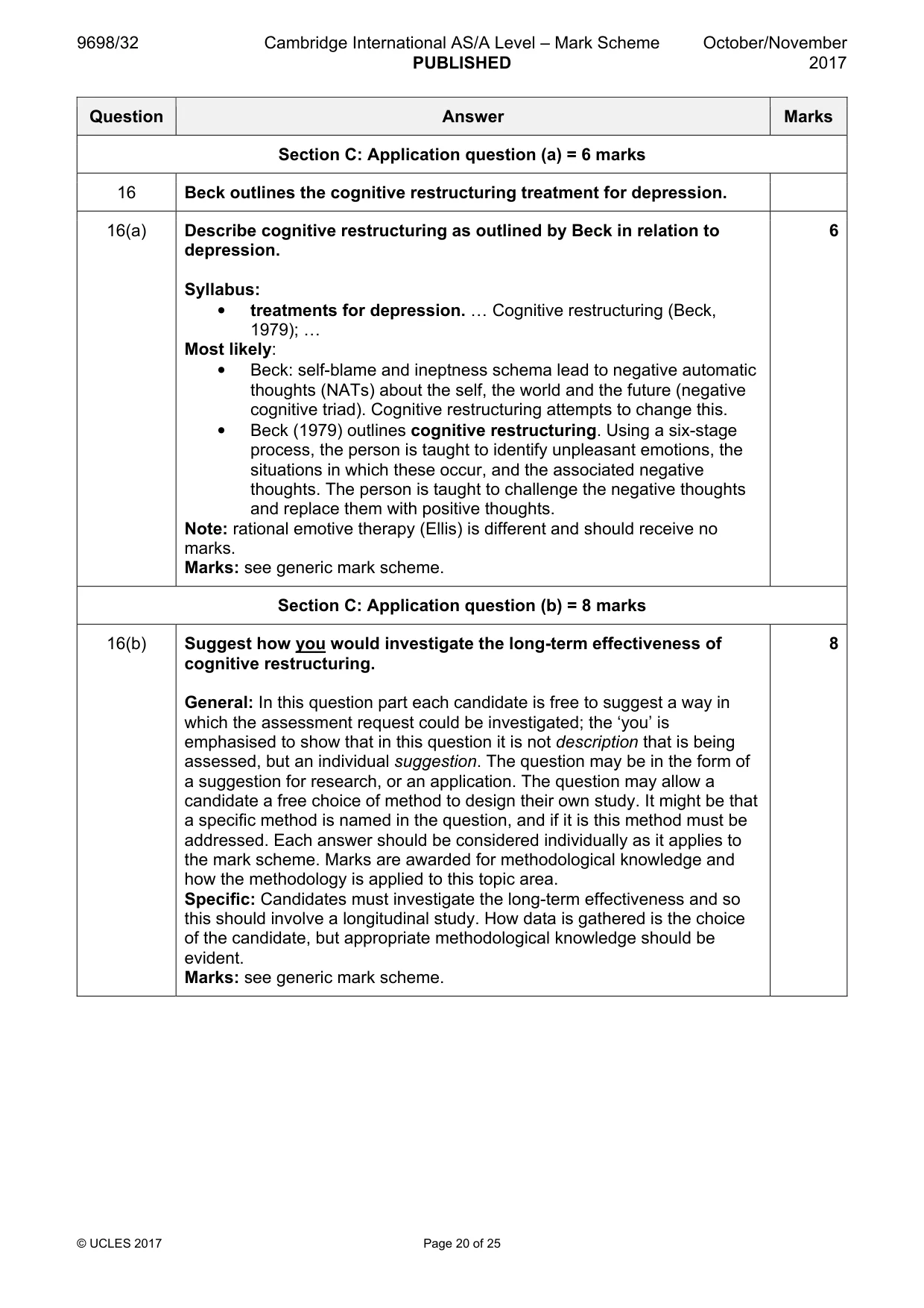
16 Beck outlines the cognitive restructuring treatment for depression. (a) Describe cognitive restructuring as outlined by Beck in relation to depression. [6] (b) Suggest how you would investigate the long-term effectiveness of cognitive restructuring. [8] Psychology and Organisations Section A Answer this question.
Mark scheme: 16(a) Describe cognitive restructuring as outlined by Beck in relation to 6 depression. Syllabus: • treatments for depression. « Cognitive restructuring (Beck, 1979); « Most likely: • Beck: self-blame and ineptness schema lead to negative automatic thoughts (NATs) about the self, the world and the future (negative cognitive triad). Cognitive restructuring attempts to change this. • Beck (1979) outlines cognitive restructuring. Using a six-stage process, the person is taught to identify unpleasant emotions, the situations in which these occur, and the associated negative thoughts. The person is taught to challenge the negative thoughts and replace them with positive thoughts. Note: rational emotive therapy (Ellis) is different and should receive no marks. Marks: see generic mark scheme. Section C: Application question (b) = 8 marks 16(b) Suggest how you would investigate the long-term effectiveness of 8 cognitive restructuring. General: In this question part each candidate is free to suggest a way in which the assessment request could be investigated; the ‘you’ is emphasised to show that in this question it is not description that is being assessed, but an individual suggestion. The question may be in the form of a suggestion for research, or an application. The question may allow a candidate a free choice of method to design their own study. It might be that a specific method is named in the question, and if it is this method must be addressed. Each answer should be considered individually as it applies to the mark scheme. Marks are awarded for methodological knowledge and how the methodology is applied to this topic area. Specific: Candidates must investigate the long-term effectiveness and so this should involve a longitudinal study. How data is gathered is the choice of the candidate, but appropriate methodological knowledge should be evident. Marks: see generic mark scheme. PSYCHOLOGY AND ORGANISATIONS
Q17 · Explain, in your own words, what is meant by the term ‘motivation to work’
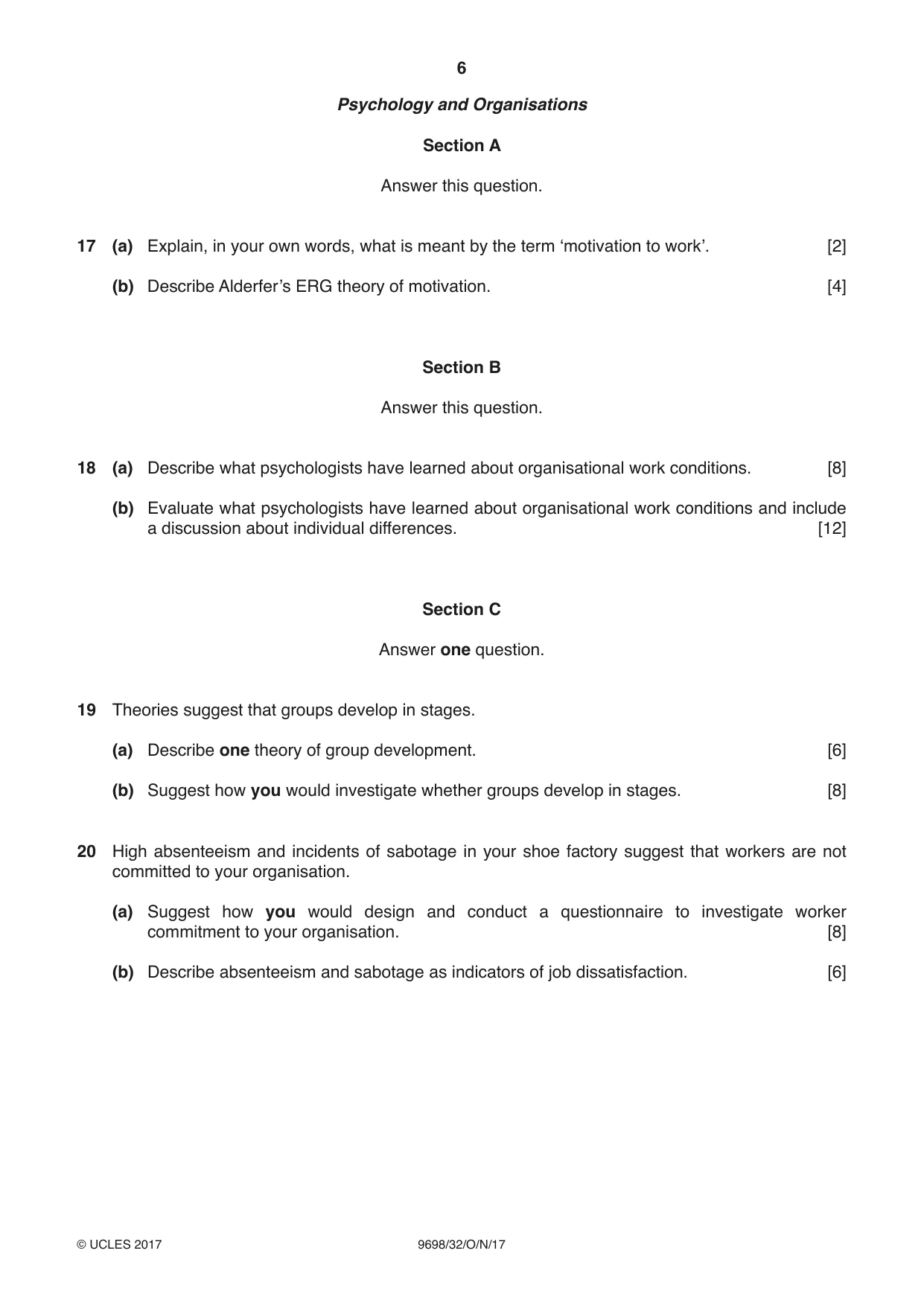
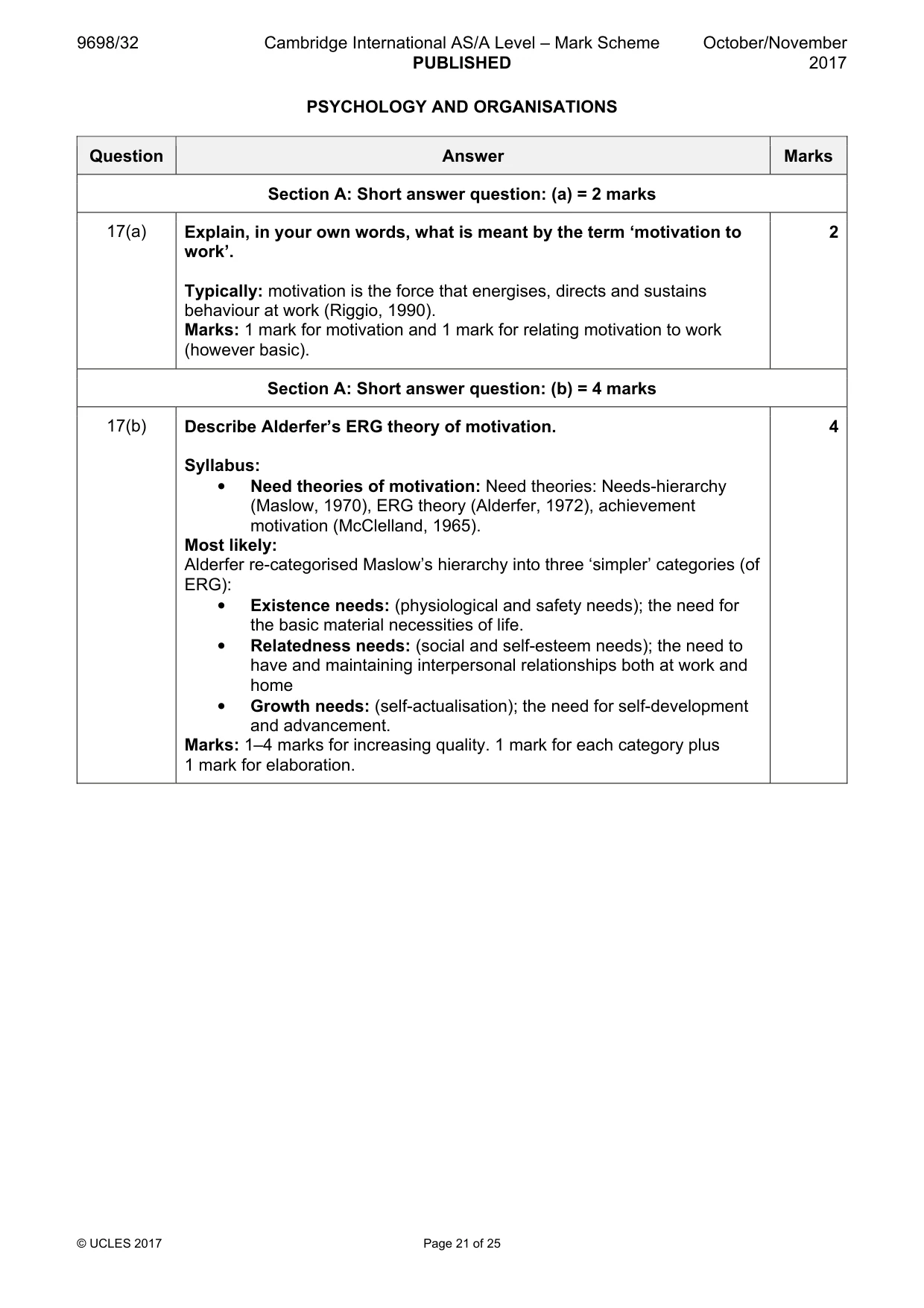
17 (a) Explain, in your own words, what is meant by the term ‘motivation to work’. [2] (b) Describe Alderfer’s ERG theory of motivation. [4]
Mark scheme: 17(a) Explain, in your own words, what is meant by the term ‘motivation to 2 work’. Typically: motivation is the force that energises, directs and sustains behaviour at work (Riggio, 1990). Marks: 1 mark for motivation and 1 mark for relating motivation to work (however basic). Section A: Short answer question: (b) = 4 marks 17(b) Describe Alderfer’s ERG theory of motivation. 4 Syllabus: • Need theories of motivation: Need theories: Needs-hierarchy (Maslow, 1970), ERG theory (Alderfer, 1972), achievement motivation (McClelland, 1965). Most likely: Alderfer re-categorised Maslow’s hierarchy into three ‘simpler’ categories (of ERG): • Existence needs: (physiological and safety needs); the need for the basic material necessities of life. • Relatedness needs: (social and self-esteem needs); the need to have and maintaining interpersonal relationships both at work and home • Growth needs: (self-actualisation); the need for self-development and advancement. Marks: 1–4 marks for increasing quality. 1 mark for each category plus 1 mark for elaboration.
Q18 · Describe what psychologists have learned about organisational work conditions
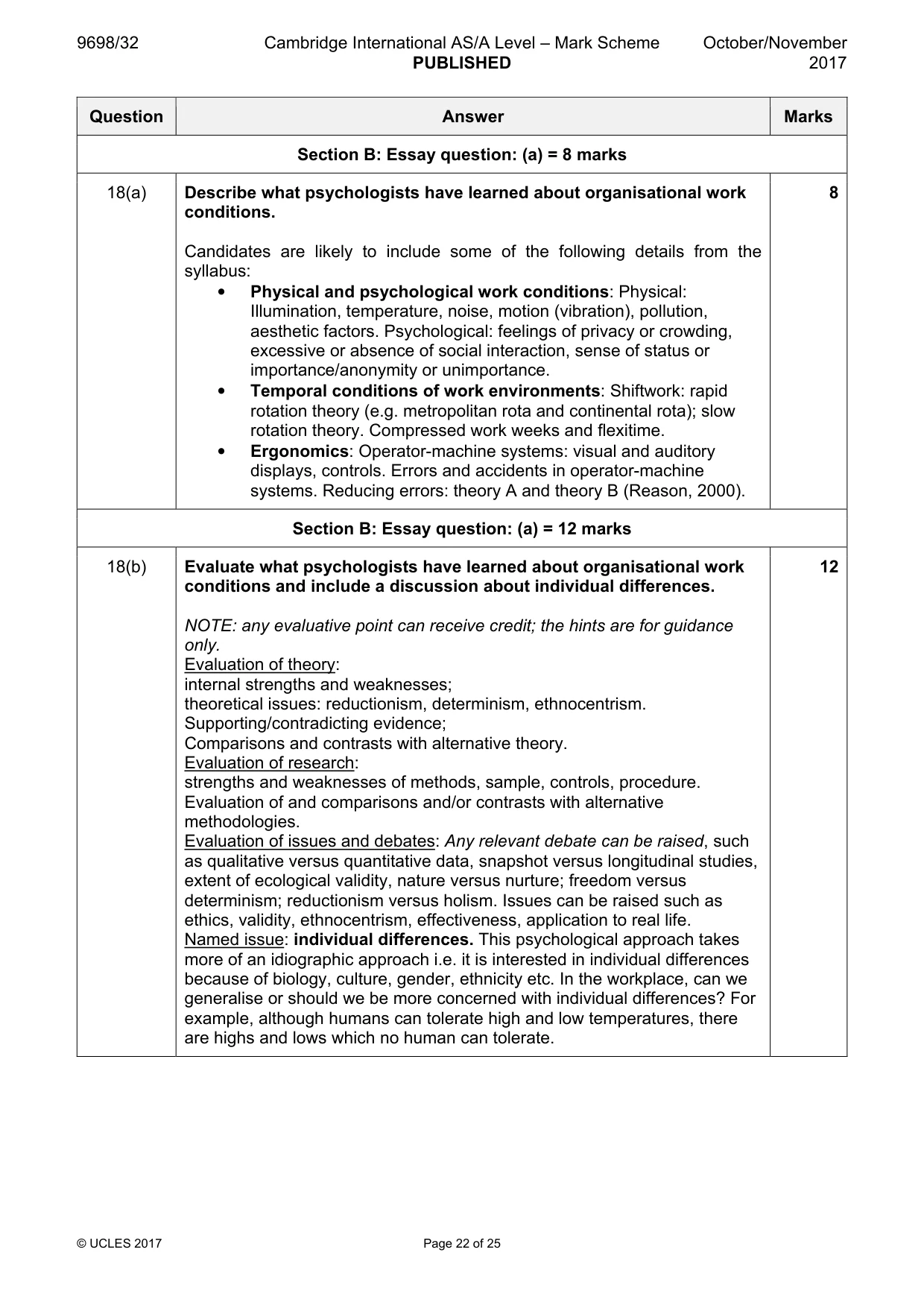
18 (a) Describe what psychologists have learned about organisational work conditions. [8] (b) Evaluate what psychologists have learned about organisational work conditions and include a discussion about individual differences. [12] Section C Answer one question.
Mark scheme: 18(a) Describe what psychologists have learned about organisational work 8 conditions. Candidates are likely to include some of the following details from the syllabus: • Physical and psychological work conditions: Physical: Illumination, temperature, noise, motion (vibration), pollution, aesthetic factors. Psychological: feelings of privacy or crowding, excessive or absence of social interaction, sense of status or importance/anonymity or unimportance. • Temporal conditions of work environments: Shiftwork: rapid rotation theory (e.g. metropolitan rota and continental rota); slow rotation theory. Compressed work weeks and flexitime. • Ergonomics: Operator-machine systems: visual and auditory displays, controls. Errors and accidents in operator-machine systems. Reducing errors: theory A and theory B (Reason, 2000). Section B: Essay question: (a) = 12 marks 18(b) Evaluate what psychologists have learned about organisational work 12 conditions and include a discussion about individual differences. NOTE: any evaluative point can receive credit; the hints are for guidance only. Evaluation of theory: internal strengths and weaknesses; theoretical issues: reductionism, determinism, ethnocentrism. Supporting/contradicting evidence; Comparisons and contrasts with alternative theory. Evaluation of research: strengths and weaknesses of methods, sample, controls, procedure. Evaluation of and comparisons and/or contrasts with alternative methodologies. Evaluation of issues and debates: Any relevant debate can be raised, such as qualitative versus quantitative data, snapshot versus longitudinal studies, extent of ecological validity, nature versus nurture; freedom versus determinism; reductionism versus holism. Issues can be raised such as ethics, validity, ethnocentrism, effectiveness, application to real life. Named issue: individual differences. This psychological approach takes more of an idiographic approach i.e. it is interested in individual differences because of biology, culture, gender, ethnicity etc. In the workplace, can we generalise or should we be more concerned with individual differences? For example, although humans can tolerate high and low temperatures, there are highs and lows which no human can tolerate.
Q19 · Theories suggest that groups develop in stages
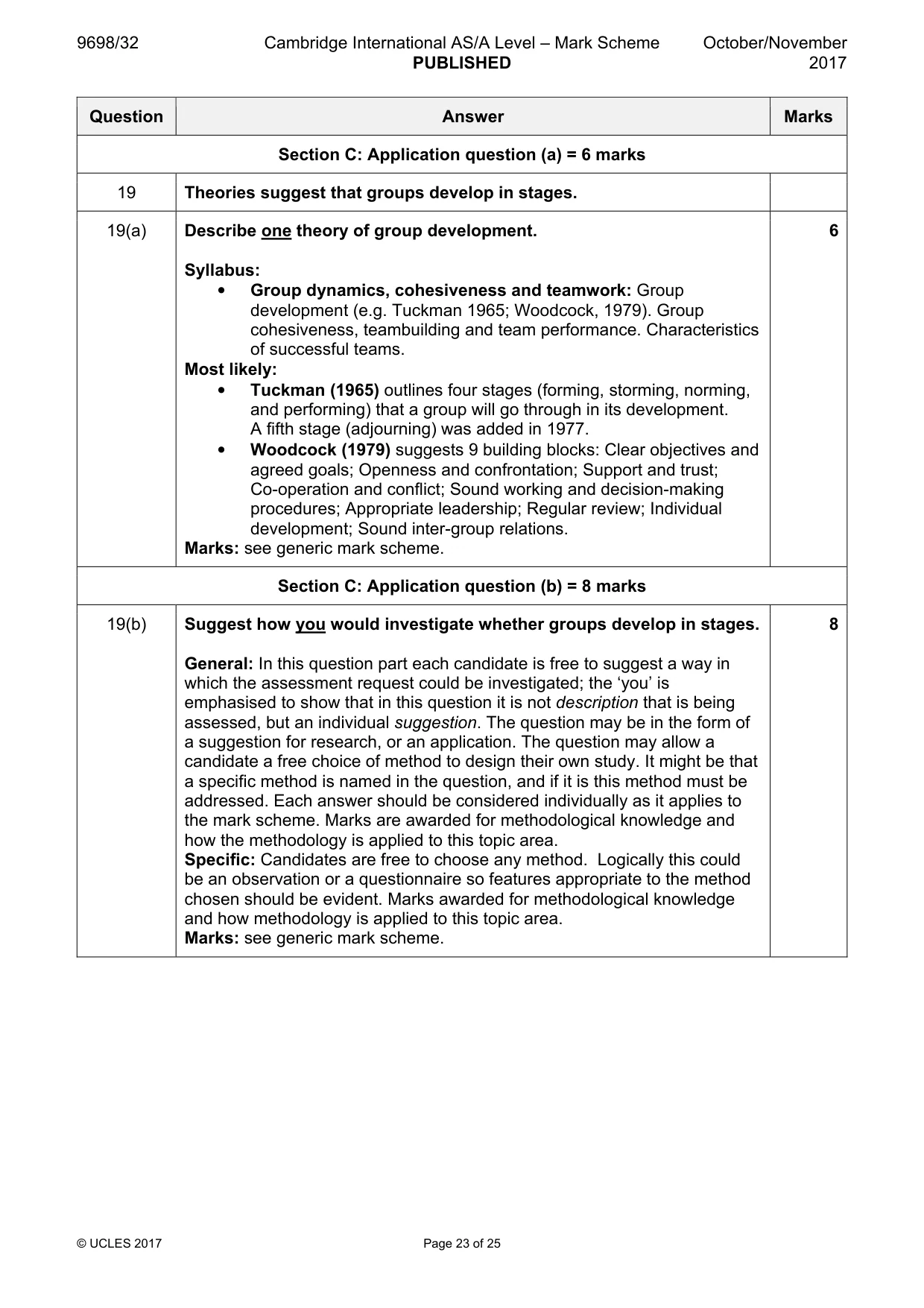
19 Theories suggest that groups develop in stages. (a) Describe one theory of group development. [6] (b) Suggest how you would investigate whether groups develop in stages. [8]
Mark scheme: 19(a) Describe one theory of group development. 6 Syllabus: • Group dynamics, cohesiveness and teamwork: Group development (e.g. Tuckman 1965; Woodcock, 1979). Group cohesiveness, teambuilding and team performance. Characteristics of successful teams. Most likely: • Tuckman (1965) outlines four stages (forming, storming, norming, and performing) that a group will go through in its development. A fifth stage (adjourning) was added in 1977. • Woodcock (1979) suggests 9 building blocks: Clear objectives and agreed goals; Openness and confrontation; Support and trust; Co-operation and conflict; Sound working and decision-making procedures; Appropriate leadership; Regular review; Individual development; Sound inter-group relations. Marks: see generic mark scheme. Section C: Application question (b) = 8 marks 19(b) Suggest how you would investigate whether groups develop in stages. 8 General: In this question part each candidate is free to suggest a way in which the assessment request could be investigated; the ‘you’ is emphasised to show that in this question it is not description that is being assessed, but an individual suggestion. The question may be in the form of a suggestion for research, or an application. The question may allow a candidate a free choice of method to design their own study. It might be that a specific method is named in the question, and if it is this method must be addressed. Each answer should be considered individually as it applies to the mark scheme. Marks are awarded for methodological knowledge and how the methodology is applied to this topic area. Specific: Candidates are free to choose any method. Logically this could be an observation or a questionnaire so features appropriate to the method chosen should be evident. Marks awarded for methodological knowledge and how methodology is applied to this topic area. Marks: see generic mark scheme.
Q20 · High absenteeism and incidents of sabotage in your shoe factory suggest that workers are…
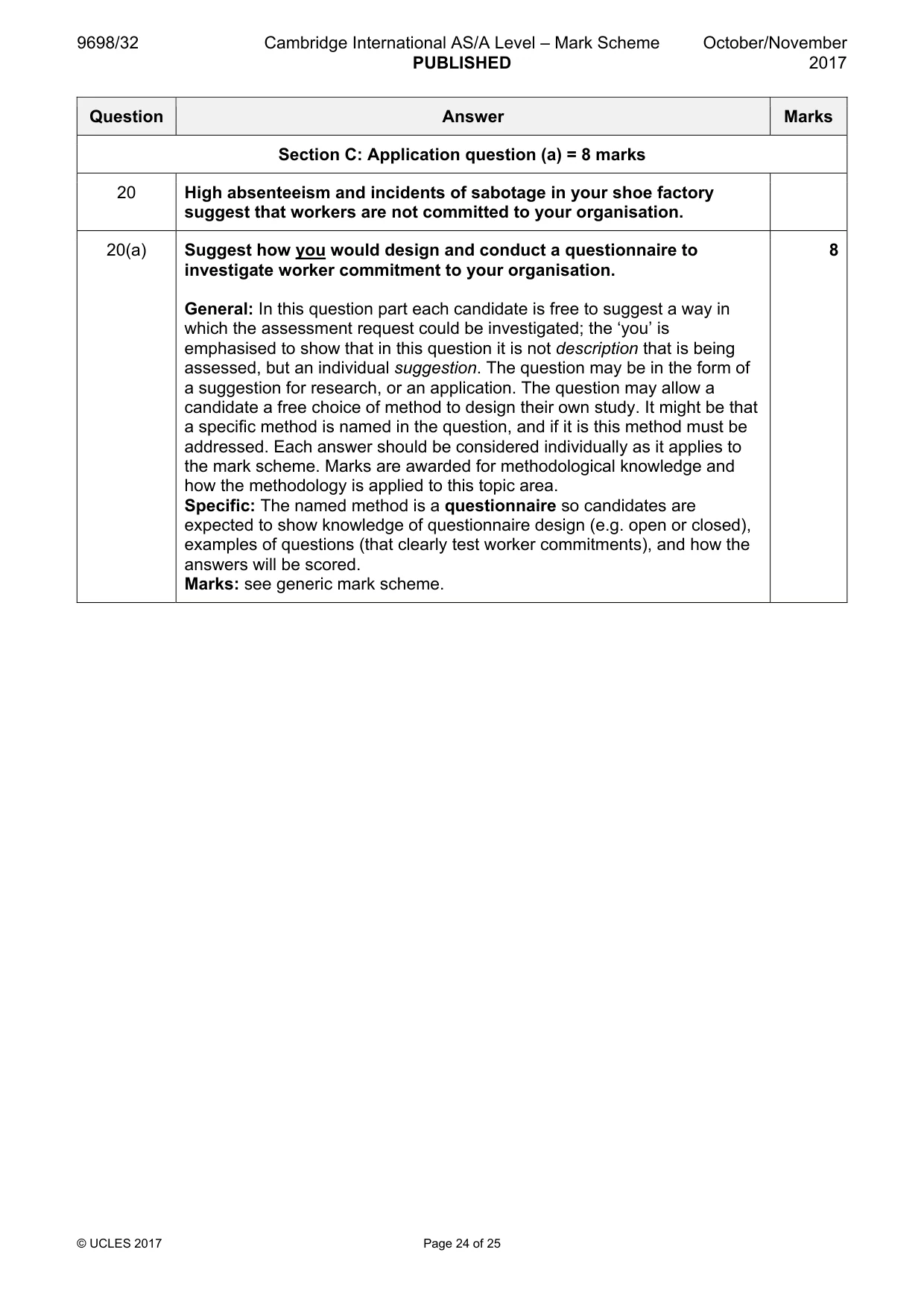
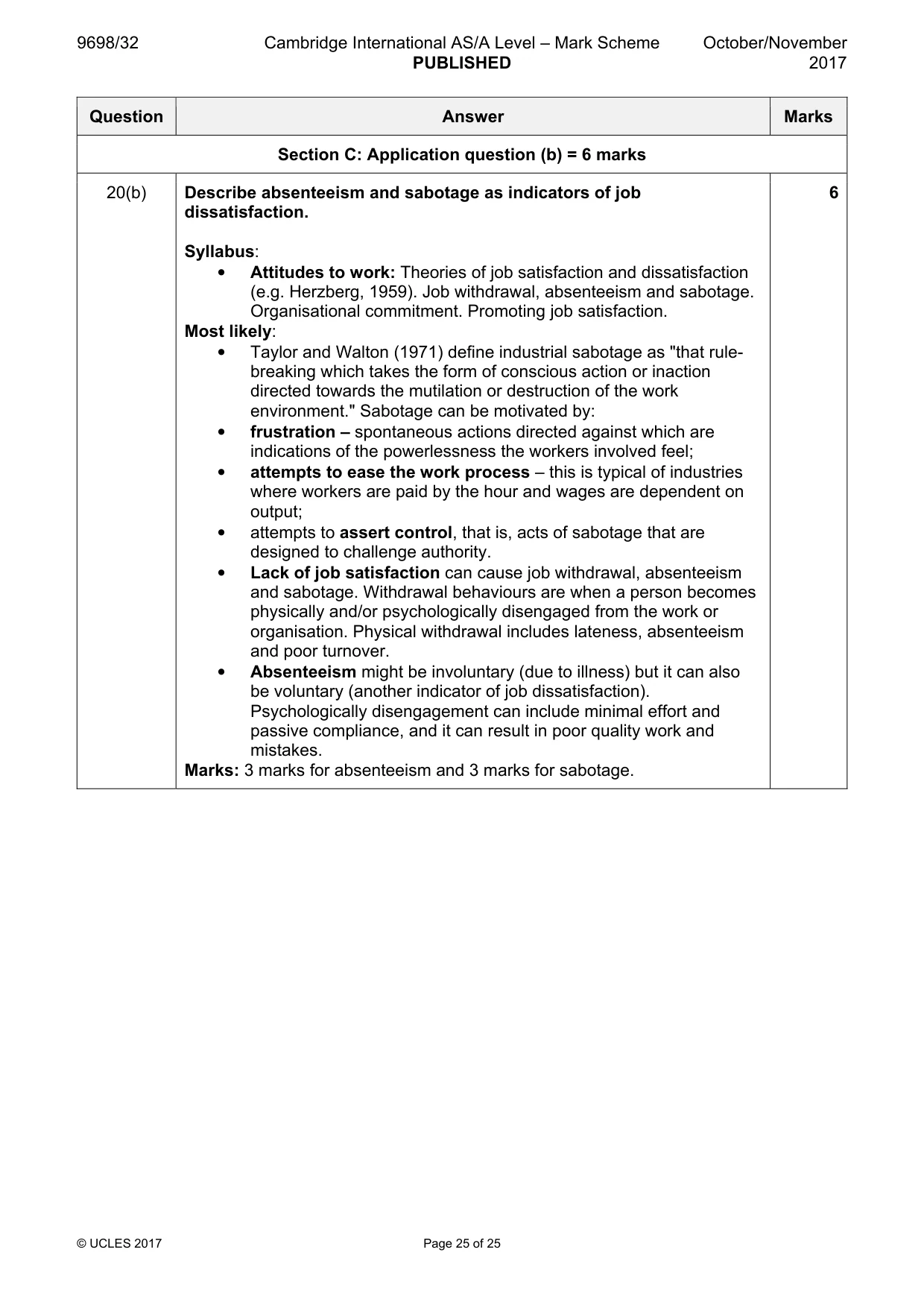
20 High absenteeism and incidents of sabotage in your shoe factory suggest that workers are not committed to your organisation. (a) Suggest how you would design and conduct a questionnaire to investigate worker commitment to your organisation. [8] (b) Describe absenteeism and sabotage as indicators of job dissatisfaction. [6]
Mark scheme: 20(a) Suggest how you would design and conduct a questionnaire to 8 investigate worker commitment to your organisation. General: In this question part each candidate is free to suggest a way in which the assessment request could be investigated; the ‘you’ is emphasised to show that in this question it is not description that is being assessed, but an individual suggestion. The question may be in the form of a suggestion for research, or an application. The question may allow a candidate a free choice of method to design their own study. It might be that a specific method is named in the question, and if it is this method must be addressed. Each answer should be considered individually as it applies to the mark scheme. Marks are awarded for methodological knowledge and how the methodology is applied to this topic area. Specific: The named method is a questionnaire so candidates are expected to show knowledge of questionnaire design (e.g. open or closed), examples of questions (that clearly test worker commitments), and how the answers will be scored. Marks: see generic mark scheme. Section C: Application question (b) = 6 marks 20(b) Describe absenteeism and sabotage as indicators of job 6 dissatisfaction. Syllabus: • Attitudes to work: Theories of job satisfaction and dissatisfaction (e.g. Herzberg, 1959). Job withdrawal, absenteeism and sabotage. Organisational commitment. Promoting job satisfaction. Most likely: • Taylor and Walton (1971) define industrial sabotage as "that rule- breaking which takes the form of conscious action or inaction directed towards the mutilation or destruction of the work environment." Sabotage can be motivated by: • frustration – spontaneous actions directed against which are indications of the powerlessness the workers involved feel; • attempts to ease the work process – this is typical of industries where workers are paid by the hour and wages are dependent on output; • attempts to assert control, that is, acts of sabotage that are designed to challenge authority. • Lack of job satisfaction can cause job withdrawal, absenteeism and sabotage. Withdrawal behaviours are when a person becomes physically and/or psychologically disengaged from the work or organisation. Physical withdrawal includes lateness, absenteeism and poor turnover. • Absenteeism might be involuntary (due to illness) but it can also be voluntary (another indicator of job dissatisfaction). Psychologically disengagement can include minimal effort and passive compliance, and it can result in poor quality work and mistakes. Marks: 3 marks for absenteeism and 3 marks for sabotage.
What you needed in this session
Cambridge’s own grade thresholds for 2017 Oct/Nov, Paper 3 · Variant 2. A higher threshold means an easier paper — the bar moves with how the cohort did.