Cambridge A Level Psychology 9698 — 2018 Oct/Nov Paper 3 · Variant 3
9698/33/O/N/18 · 20 questions · 80 marks · ≈90 min
The question paper and its mark scheme, free to read here and free to download. This is Cambridge’s own paper, exactly as it was sat.
Question paper8 pages


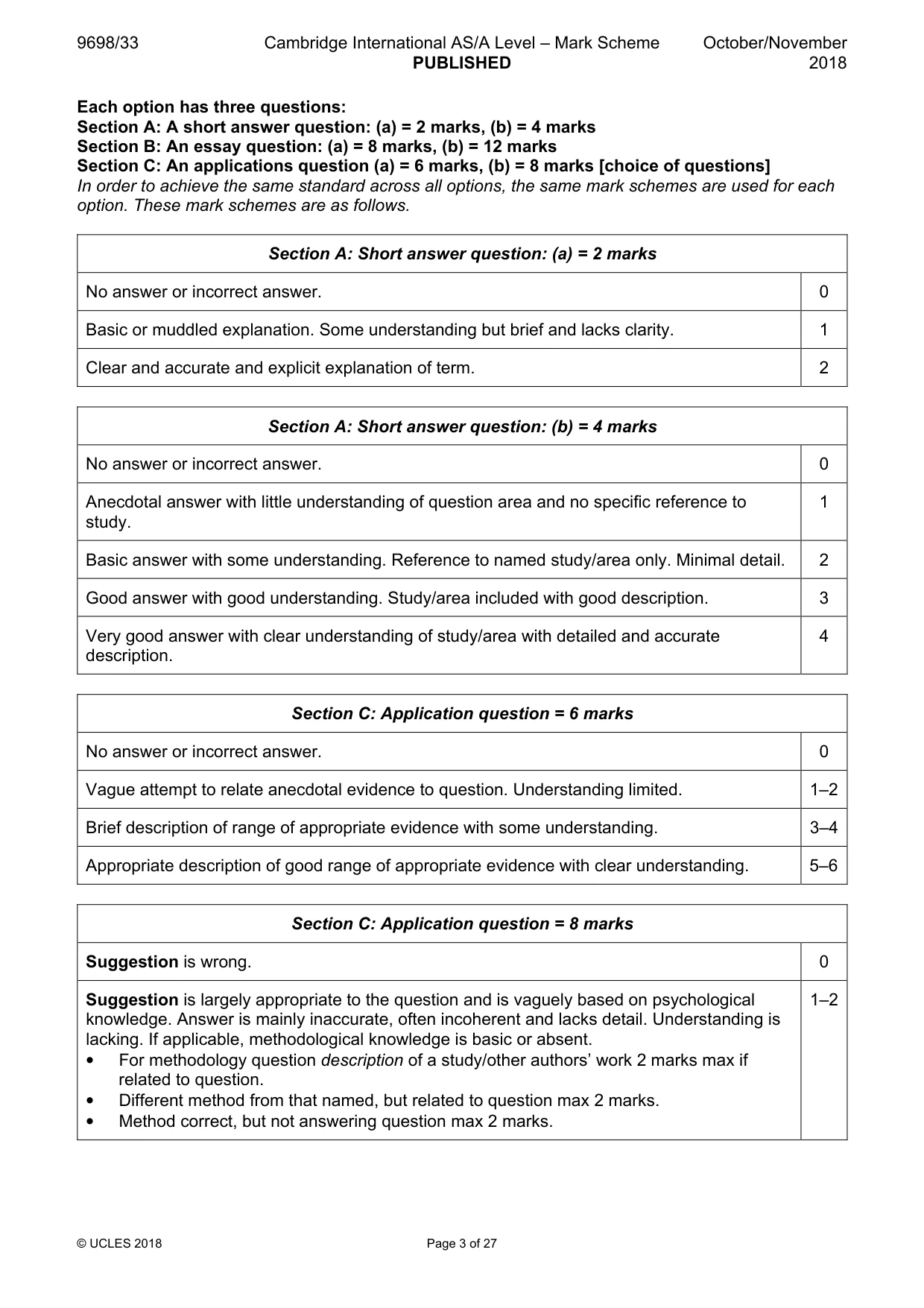
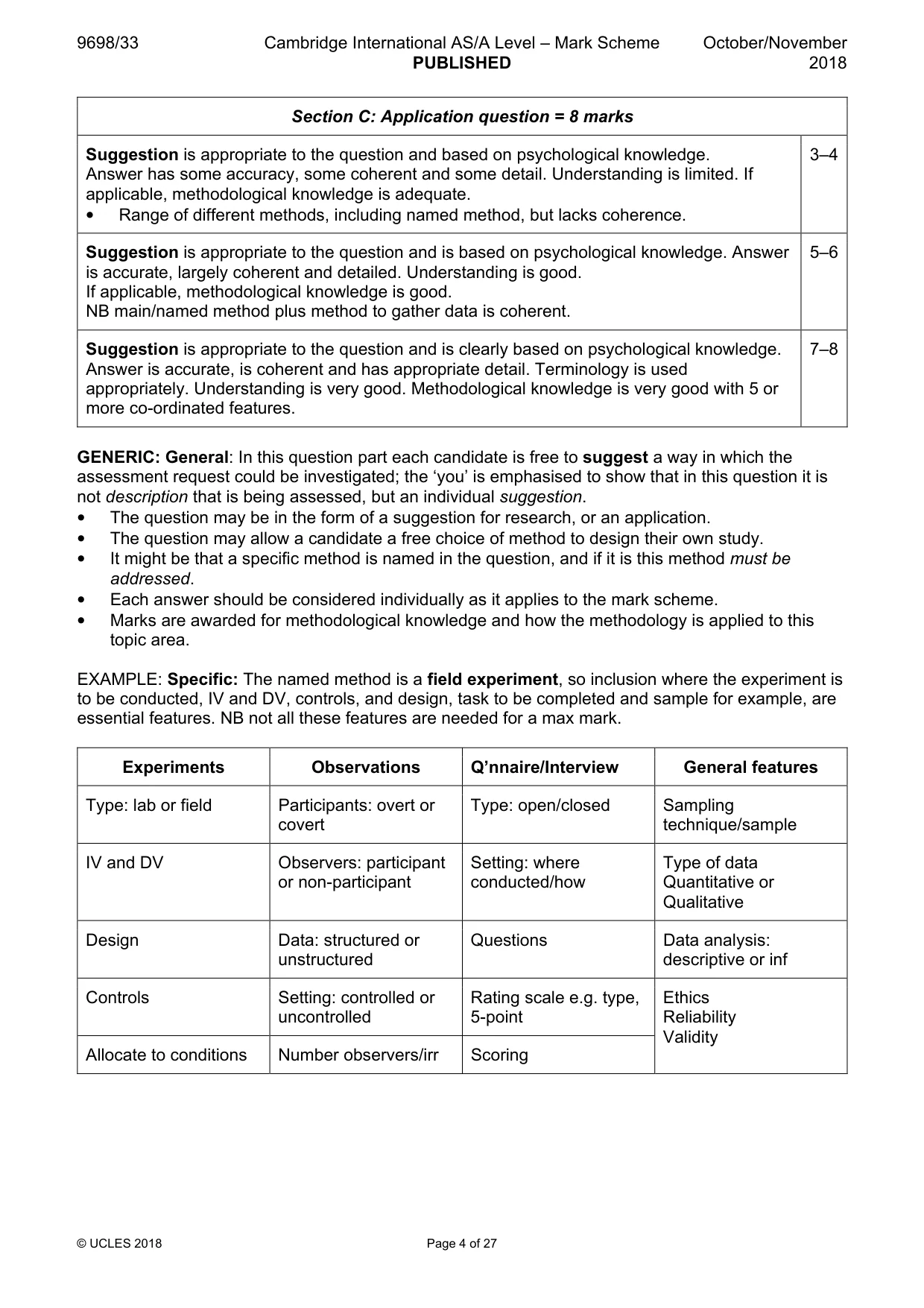
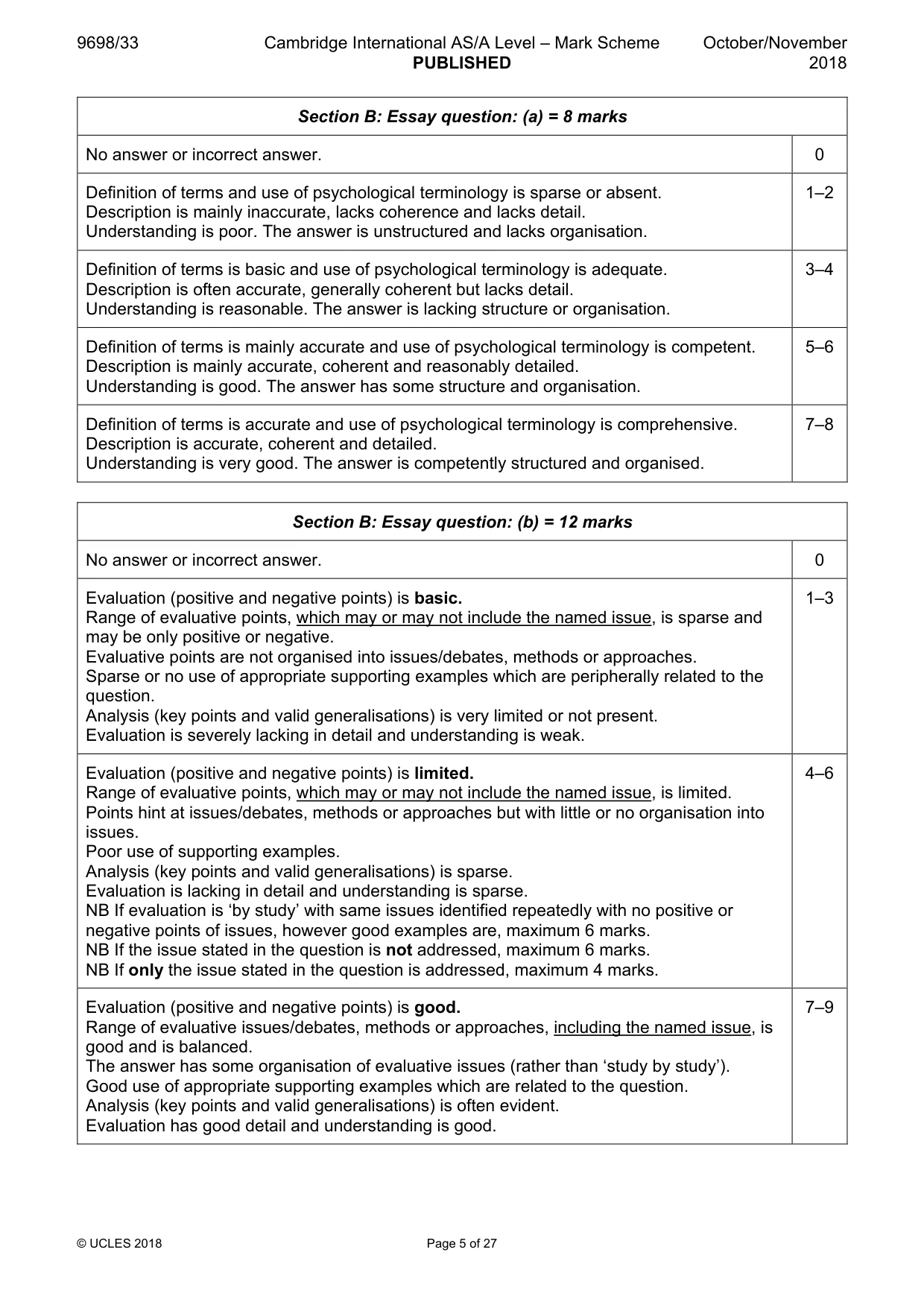
Mark scheme27 pages
Answers below. Sit the paper first if you are practising.

Questions as text
Q1 · Explain, in your own words, what is meant by a ‘humanistic application to learning’
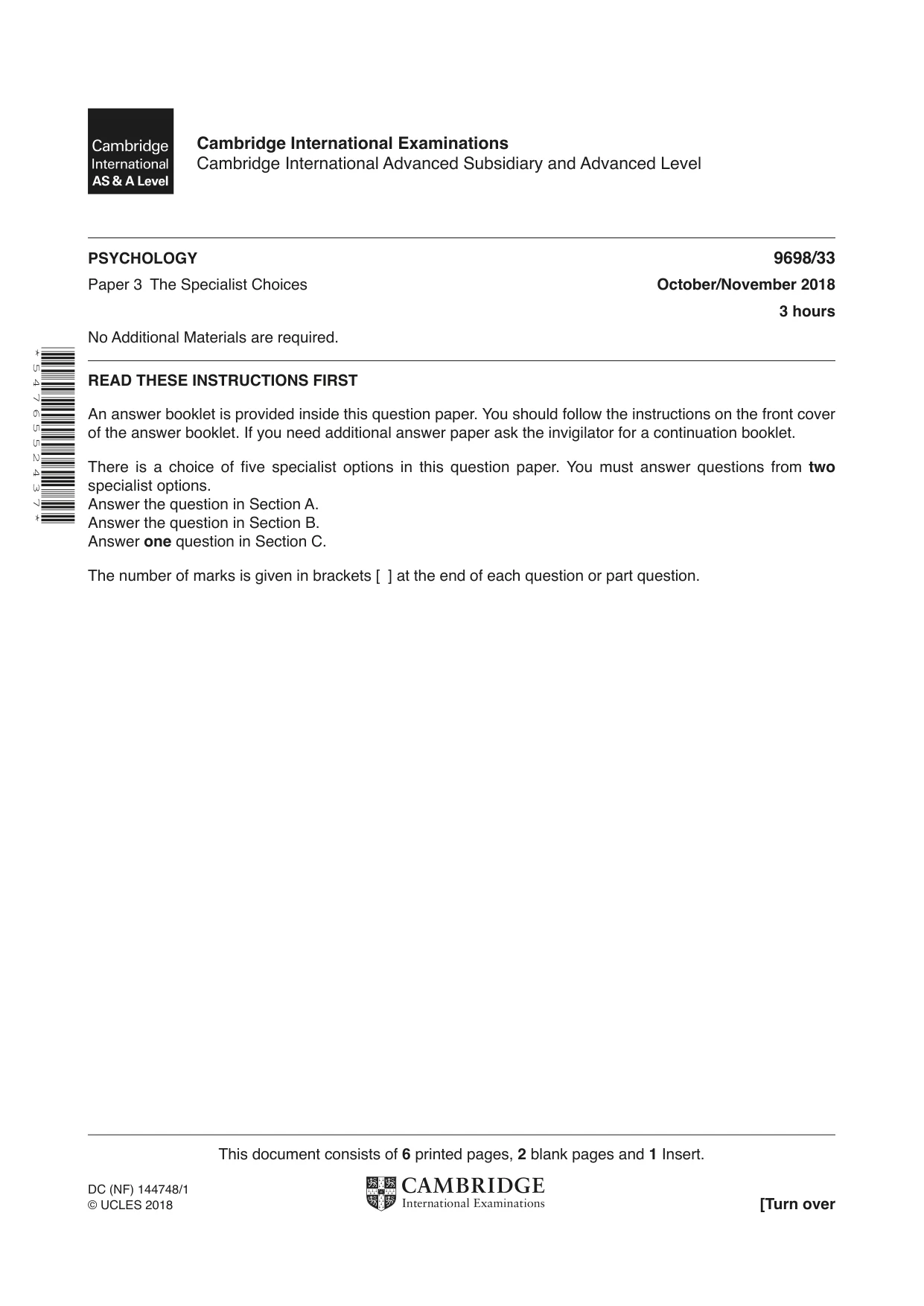
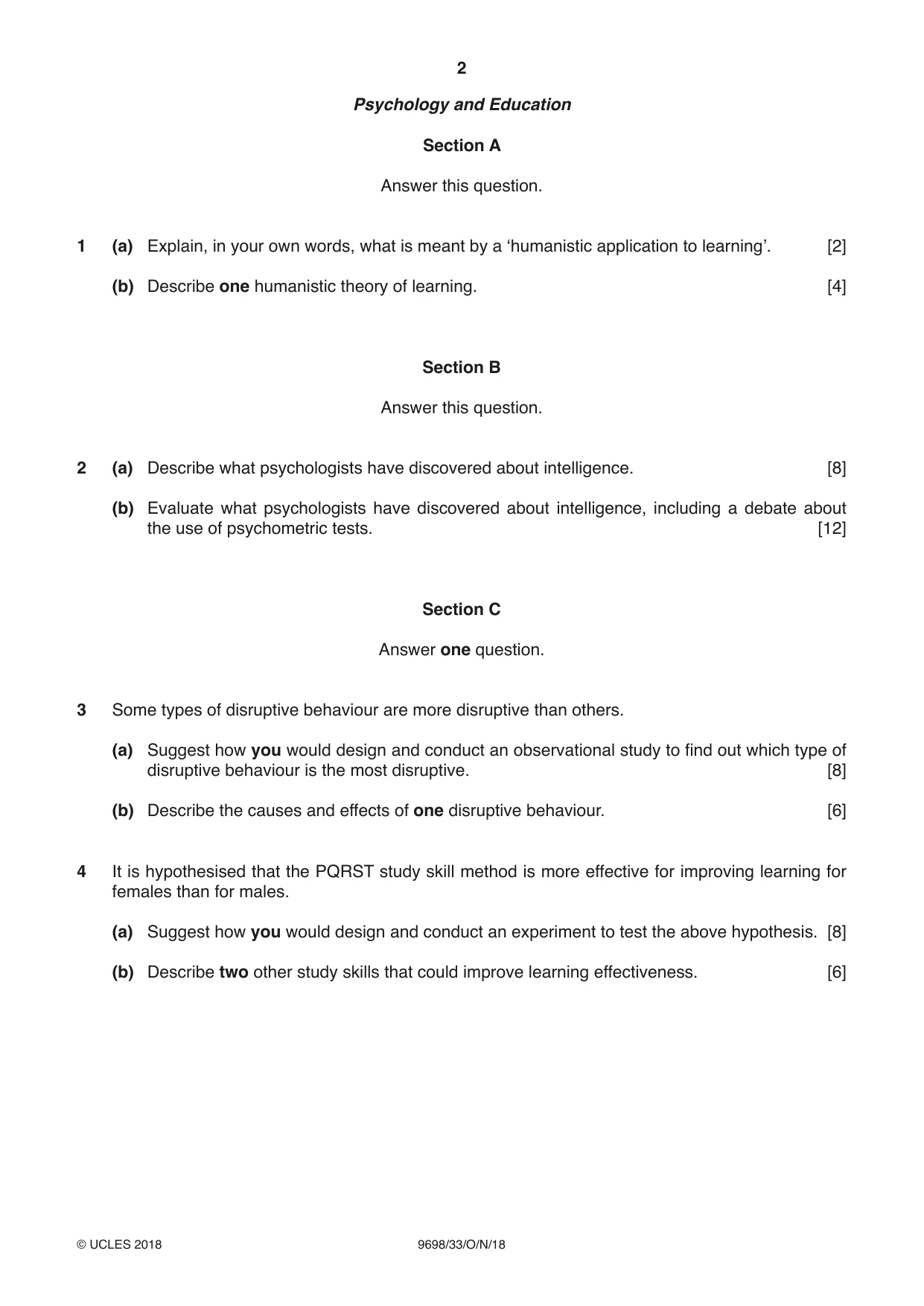
1 (a) Explain, in your own words, what is meant by a ‘humanistic application to learning’. [2] (b) Describe one humanistic theory of learning. [4]
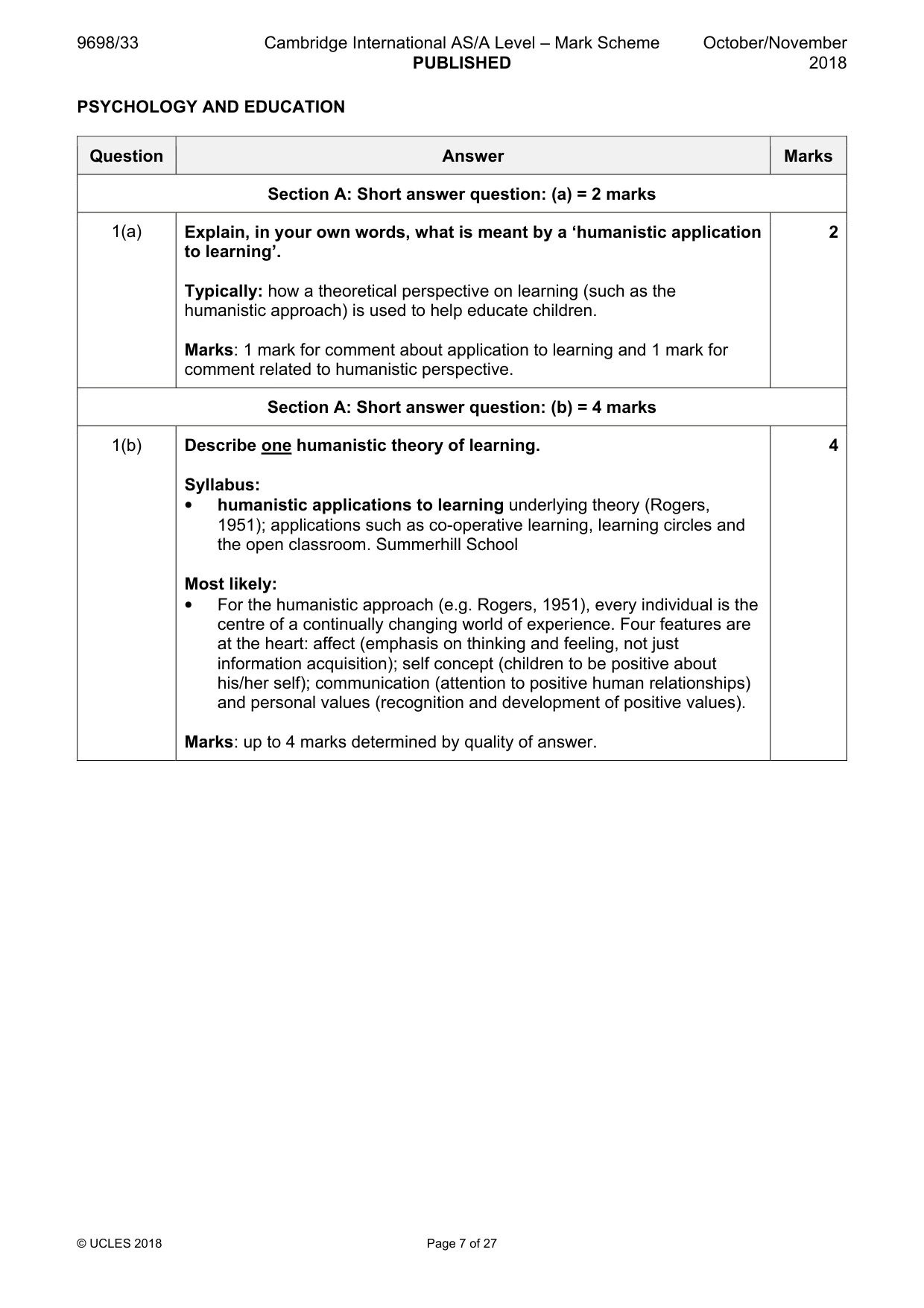
Mark scheme: Question Answer Marks Section A: Short answer question: (a) = 2 marks 1(a) Explain, in your own words, what is meant by a ‘humanistic application 2 to learning’. Typically: how a theoretical perspective on learning (such as the humanistic approach) is used to help educate children. Marks: 1 mark for comment about application to learning and 1 mark for comment related to humanistic perspective. Section A: Short answer question: (b) = 4 marks 1(b) Describe one humanistic theory of learning. 4 Syllabus: • humanistic applications to learning underlying theory (Rogers, 1951); applications such as co-operative learning, learning circles and the open classroom. Summerhill School Most likely: • For the humanistic approach (e.g. Rogers, 1951), every individual is the centre of a continually changing world of experience. Four features are at the heart: affect (emphasis on thinking and feeling, not just information acquisition); self concept (children to be positive about his/her self); communication (attention to positive human relationships) and personal values (recognition and development of positive values). Marks: up to 4 marks determined by quality of answer.
Q2 · Describe what psychologists have discovered about intelligence
2 (a) Describe what psychologists have discovered about intelligence. [8] (b) Evaluate what psychologists have discovered about intelligence, including a debate about the use of psychometric tests. [12] Section C Answer one question.
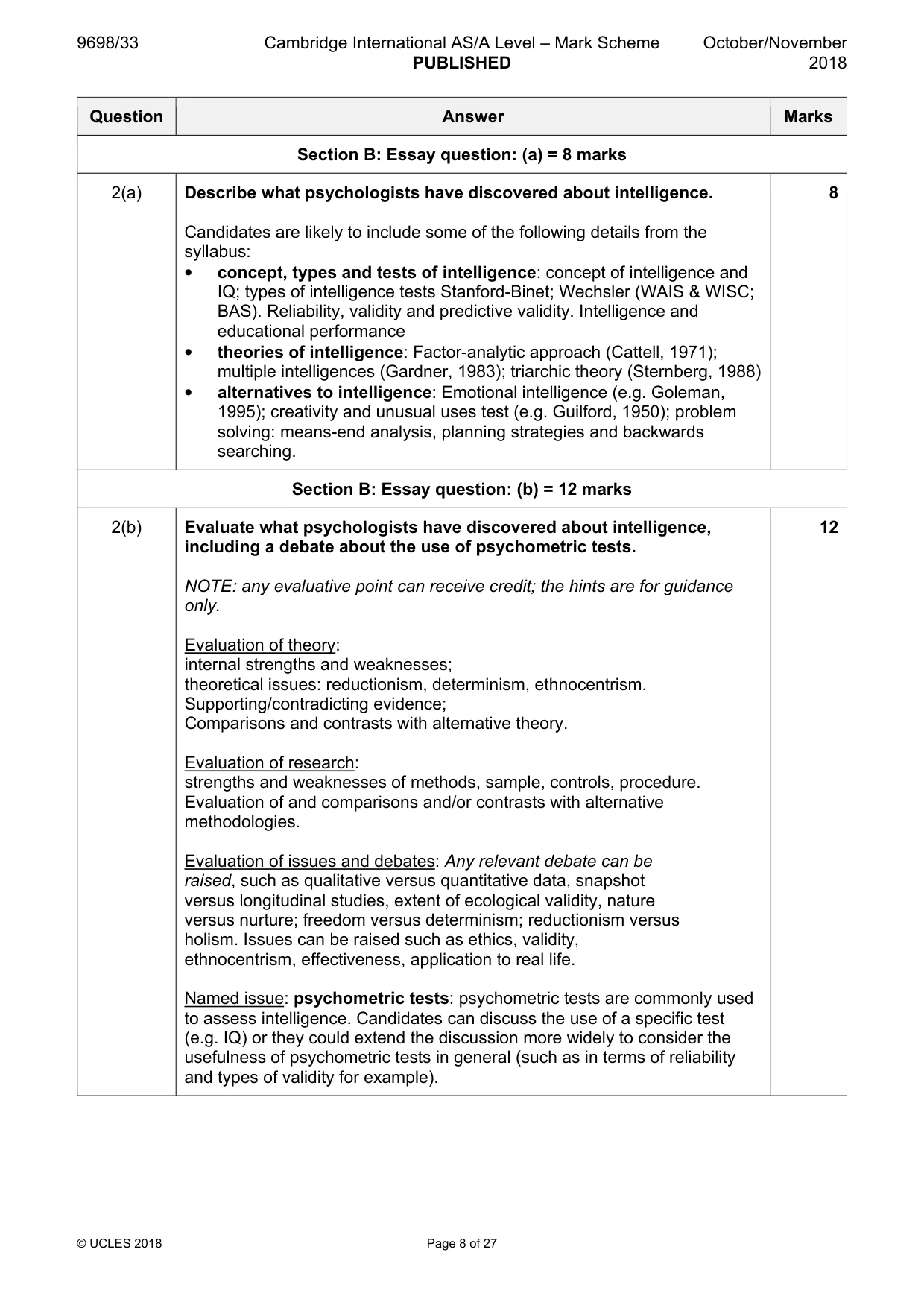
Mark scheme: 2(a) Describe what psychologists have discovered about intelligence. 8 Candidates are likely to include some of the following details from the syllabus: • concept, types and tests of intelligence: concept of intelligence and IQ; types of intelligence tests Stanford-Binet; Wechsler (WAIS & WISC; BAS). Reliability, validity and predictive validity. Intelligence and educational performance • theories of intelligence: Factor-analytic approach (Cattell, 1971); multiple intelligences (Gardner, 1983); triarchic theory (Sternberg, 1988) • alternatives to intelligence: Emotional intelligence (e.g. Goleman, 1995); creativity and unusual uses test (e.g. Guilford, 1950); problem solving: means-end analysis, planning strategies and backwards searching. Section B: Essay question: (b) = 12 marks 2(b) Evaluate what psychologists have discovered about intelligence, 12 including a debate about the use of psychometric tests. NOTE: any evaluative point can receive credit; the hints are for guidance only. Evaluation of theory: internal strengths and weaknesses; theoretical issues: reductionism, determinism, ethnocentrism. Supporting/contradicting evidence; Comparisons and contrasts with alternative theory. Evaluation of research: strengths and weaknesses of methods, sample, controls, procedure. Evaluation of and comparisons and/or contrasts with alternative methodologies. Evaluation of issues and debates: Any relevant debate can be raised, such as qualitative versus quantitative data, snapshot versus longitudinal studies, extent of ecological validity, nature versus nurture; freedom versus determinism; reductionism versus holism. Issues can be raised such as ethics, validity, ethnocentrism, effectiveness, application to real life. Named issue: psychometric tests: psychometric tests are commonly used to assess intelligence. Candidates can discuss the use of a specific test (e.g. IQ) or they could extend the discussion more widely to consider the usefulness of psychometric tests in general (such as in terms of reliability and types of validity for example).
Q3 · Some types of disruptive behaviour are more disruptive than others
3 Some types of disruptive behaviour are more disruptive than others. (a) Suggest how you would design and conduct an observational study to find out which type of disruptive behaviour is the most disruptive. [8] (b) Describe the causes and effects of one disruptive behaviour. [6]
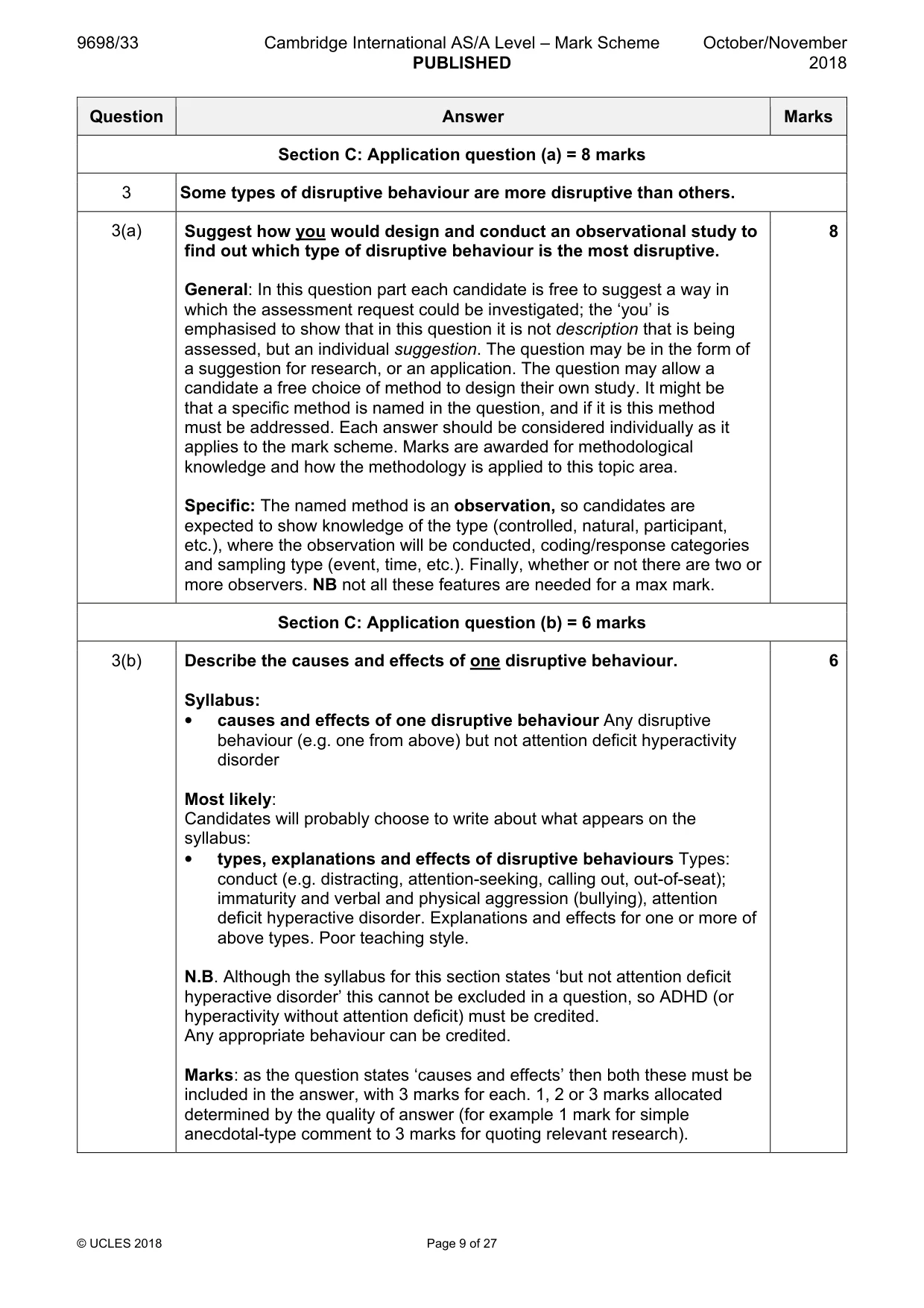
Mark scheme: 3 Some types of disruptive behaviour are more disruptive than others. 3(a) Suggest how you would design and conduct an observational study to 8 find out which type of disruptive behaviour is the most disruptive. General: In this question part each candidate is free to suggest a way in which the assessment request could be investigated; the ‘you’ is emphasised to show that in this question it is not description that is being assessed, but an individual suggestion. The question may be in the form of a suggestion for research, or an application. The question may allow a candidate a free choice of method to design their own study. It might be that a specific method is named in the question, and if it is this method must be addressed. Each answer should be considered individually as it applies to the mark scheme. Marks are awarded for methodological knowledge and how the methodology is applied to this topic area. Specific: The named method is an observation, so candidates are expected to show knowledge of the type (controlled, natural, participant, etc.), where the observation will be conducted, coding/response categories and sampling type (event, time, etc.). Finally, whether or not there are two or more observers. NB not all these features are needed for a max mark. Section C: Application question (b) = 6 marks 3(b) Describe the causes and effects of one disruptive behaviour. 6 Syllabus: • causes and effects of one disruptive behaviour Any disruptive behaviour (e.g. one from above) but not attention deficit hyperactivity disorder Most likely: Candidates will probably choose to write about what appears on the syllabus: • types, explanations and effects of disruptive behaviours Types: conduct (e.g. distracting, attention-seeking, calling out, out-of-seat); immaturity and verbal and physical aggression (bullying), attention deficit hyperactive disorder. Explanations and effects for one or more of above types. Poor teaching style. N.B. Although the syllabus for this section states ‘but not attention deficit hyperactive disorder’ this cannot be excluded in a question, so ADHD (or hyperactivity without attention deficit) must be credited. Any appropriate behaviour can be credited. Marks: as the question states ‘causes and effects’ then both these must be included in the answer, with 3 marks for each. 1, 2 or 3 marks allocated determined by the quality of answer (for example 1 mark for simple anecdotal-type comment to 3 marks for quoting relevant research).
Q4 · It is hypothesised that the PQRST study skill method is more effective for improving…
4 It is hypothesised that the PQRST study skill method is more effective for improving learning for females than for males. (a) Suggest how you would design and conduct an experiment to test the above hypothesis. [8] (b) Describe two other study skills that could improve learning effectiveness. [6] Psychology and Health Section A Answer this question.
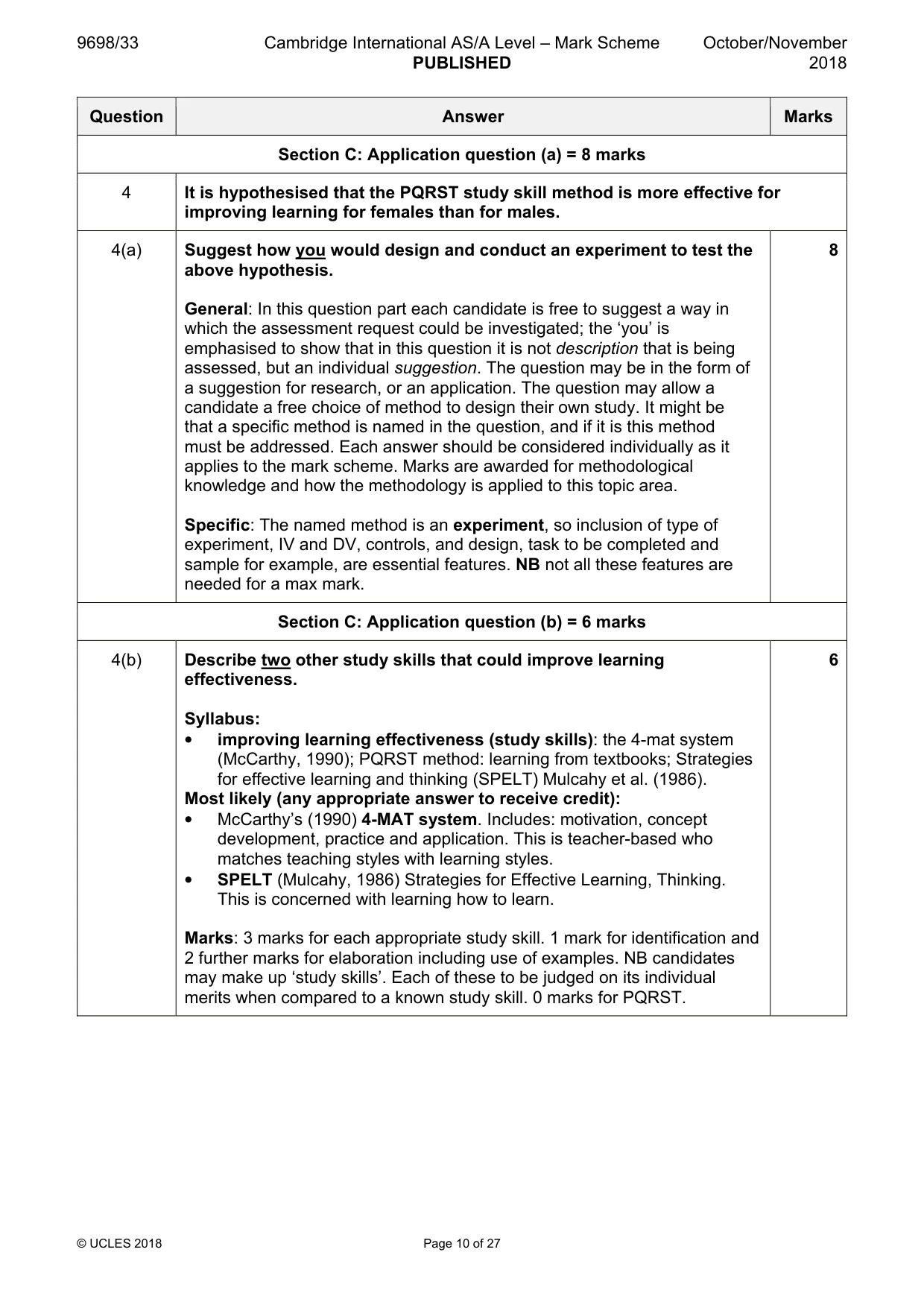
Mark scheme: 4(a) Suggest how you would design and conduct an experiment to test the 8 above hypothesis. General: In this question part each candidate is free to suggest a way in which the assessment request could be investigated; the ‘you’ is emphasised to show that in this question it is not description that is being assessed, but an individual suggestion. The question may be in the form of a suggestion for research, or an application. The question may allow a candidate a free choice of method to design their own study. It might be that a specific method is named in the question, and if it is this method must be addressed. Each answer should be considered individually as it applies to the mark scheme. Marks are awarded for methodological knowledge and how the methodology is applied to this topic area. Specific: The named method is an experiment, so inclusion of type of experiment, IV and DV, controls, and design, task to be completed and sample for example, are essential features. NB not all these features are needed for a max mark. Section C: Application question (b) = 6 marks 4(b) Describe two other study skills that could improve learning 6 effectiveness. Syllabus: • improving learning effectiveness (study skills): the 4-mat system (McCarthy, 1990); PQRST method: learning from textbooks; Strategies for effective learning and thinking (SPELT) Mulcahy et al. (1986). Most likely (any appropriate answer to receive credit): • McCarthy’s (1990) 4-MAT system. Includes: motivation, concept development, practice and application. This is teacher-based who matches teaching styles with learning styles. • SPELT (Mulcahy, 1986) Strategies for Effective Learning, Thinking. This is concerned with learning how to learn. Marks: 3 marks for each appropriate study skill. 1 mark for identification and 2 further marks for elaboration including use of examples. NB candidates may make up ‘study skills’. Each of these to be judged on its individual merits when compared to a known study skill. 0 marks for PQRST. PSYCHOLOGY AND HEALTH
Q5 · Explain, in your own words, what is meant by ‘providing information’ to improve adherence…
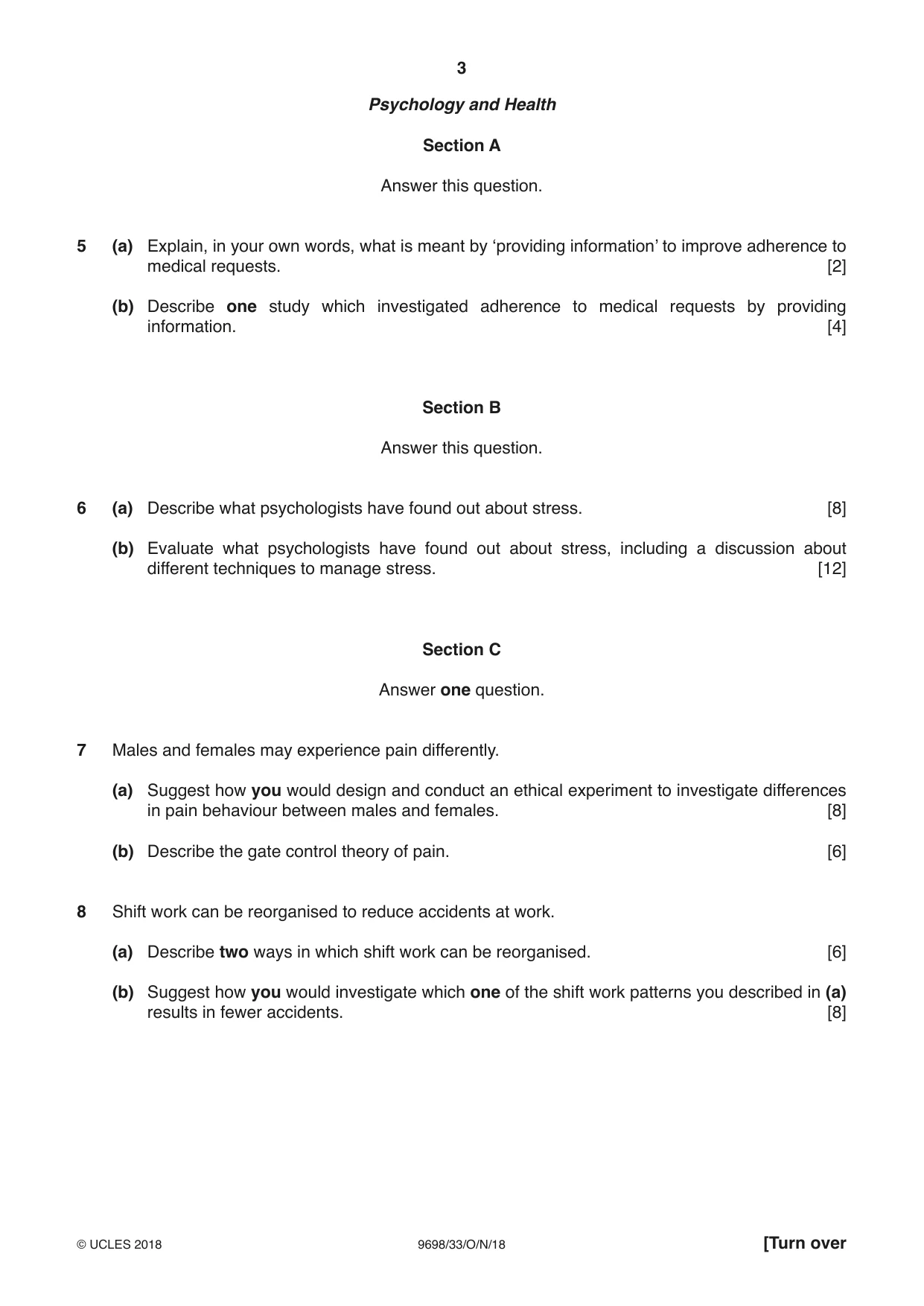
5 (a) Explain, in your own words, what is meant by ‘providing information’ to improve adherence to medical requests. [2] (b) Describe one study which investigated adherence to medical requests by providing information. [4]
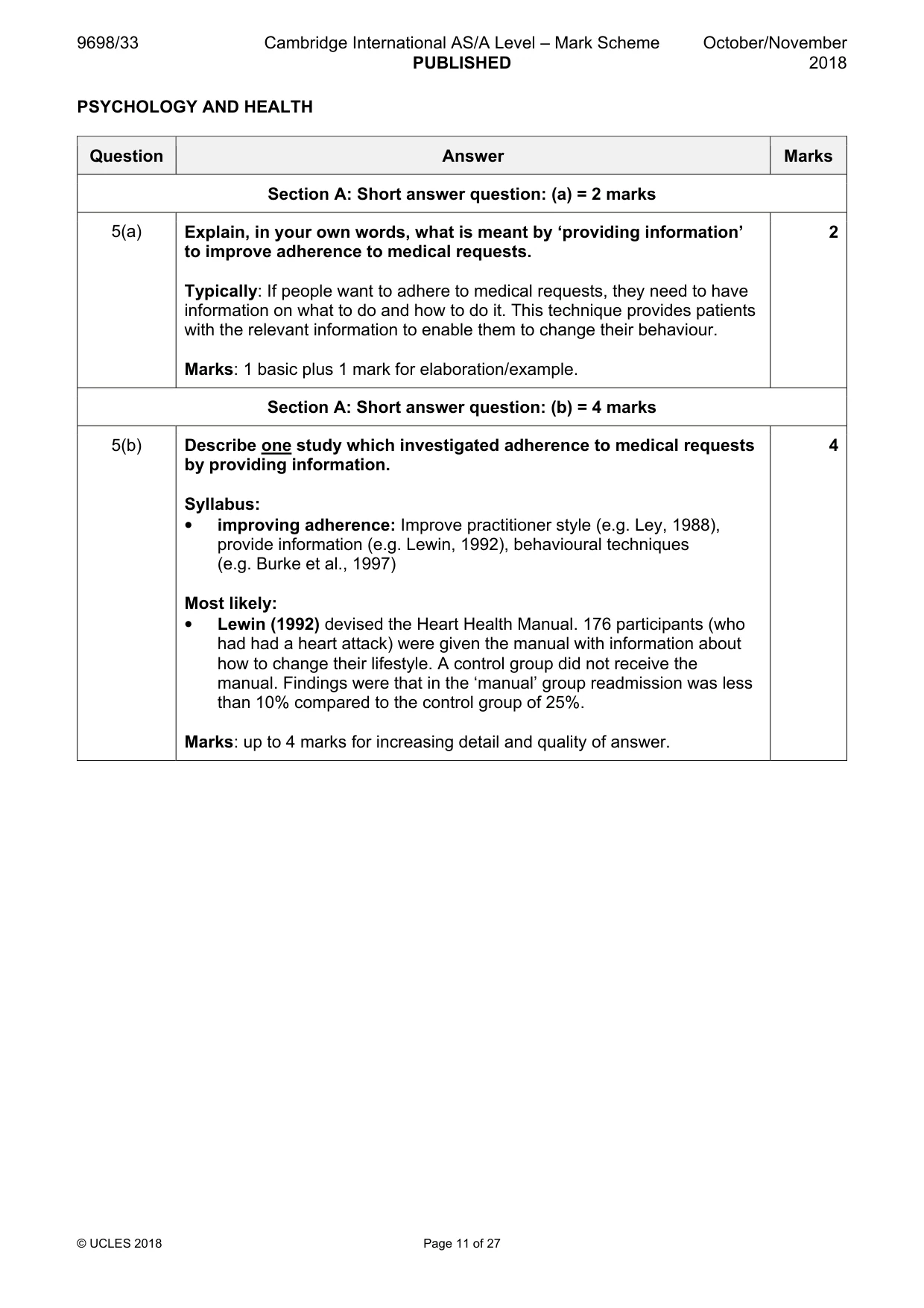
Mark scheme: 5(a) Explain, in your own words, what is meant by ‘providing information’ 2 to improve adherence to medical requests. Typically: If people want to adhere to medical requests, they need to have information on what to do and how to do it. This technique provides patients with the relevant information to enable them to change their behaviour. Marks: 1 basic plus 1 mark for elaboration/example. Section A: Short answer question: (b) = 4 marks 5(b) Describe one study which investigated adherence to medical requests 4 by providing information. Syllabus: • improving adherence: Improve practitioner style (e.g. Ley, 1988), provide information (e.g. Lewin, 1992), behavioural techniques (e.g. Burke et al., 1997) Most likely: • Lewin (1992) devised the Heart Health Manual. 176 participants (who had had a heart attack) were given the manual with information about how to change their lifestyle. A control group did not receive the manual. Findings were that in the ‘manual’ group readmission was less than 10% compared to the control group of 25%. Marks: up to 4 marks for increasing detail and quality of answer.
Q6 · Describe what psychologists have found out about stress
6 (a) Describe what psychologists have found out about stress. [8] (b) Evaluate what psychologists have found out about stress, including a discussion about different techniques to manage stress. [12] Section C Answer one question.
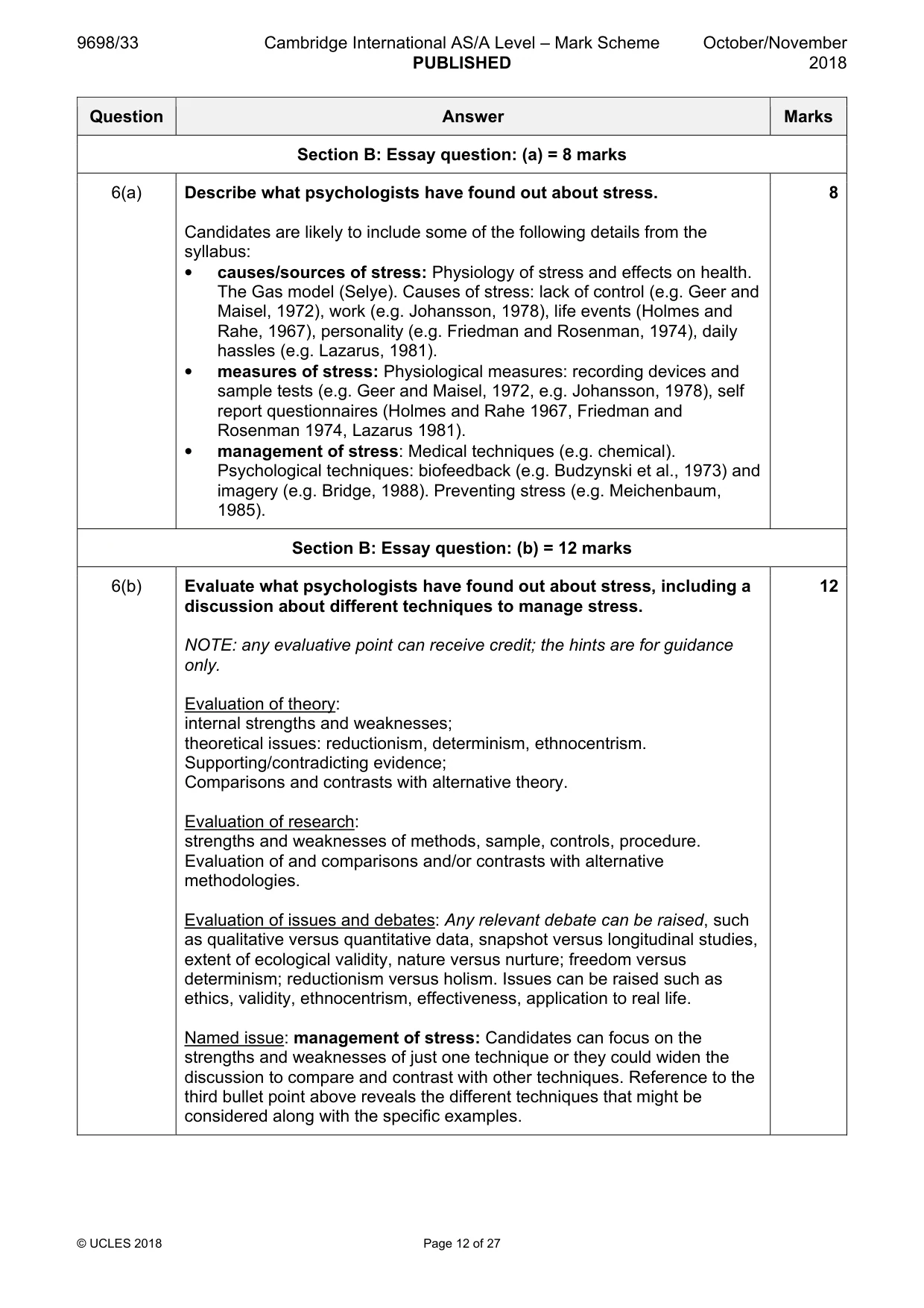
Mark scheme: 6(a) Describe what psychologists have found out about stress. 8 Candidates are likely to include some of the following details from the syllabus: • causes/sources of stress: Physiology of stress and effects on health. The Gas model (Selye). Causes of stress: lack of control (e.g. Geer and Maisel, 1972), work (e.g. Johansson, 1978), life events (Holmes and Rahe, 1967), personality (e.g. Friedman and Rosenman, 1974), daily hassles (e.g. Lazarus, 1981). • measures of stress: Physiological measures: recording devices and sample tests (e.g. Geer and Maisel, 1972, e.g. Johansson, 1978), self report questionnaires (Holmes and Rahe 1967, Friedman and Rosenman 1974, Lazarus 1981). • management of stress: Medical techniques (e.g. chemical). Psychological techniques: biofeedback (e.g. Budzynski et al., 1973) and imagery (e.g. Bridge, 1988). Preventing stress (e.g. Meichenbaum, 1985). Section B: Essay question: (b) = 12 marks 6(b) Evaluate what psychologists have found out about stress, including a 12 discussion about different techniques to manage stress. NOTE: any evaluative point can receive credit; the hints are for guidance only. Evaluation of theory: internal strengths and weaknesses; theoretical issues: reductionism, determinism, ethnocentrism. Supporting/contradicting evidence; Comparisons and contrasts with alternative theory. Evaluation of research: strengths and weaknesses of methods, sample, controls, procedure. Evaluation of and comparisons and/or contrasts with alternative methodologies. Evaluation of issues and debates: Any relevant debate can be raised, such as qualitative versus quantitative data, snapshot versus longitudinal studies, extent of ecological validity, nature versus nurture; freedom versus determinism; reductionism versus holism. Issues can be raised such as ethics, validity, ethnocentrism, effectiveness, application to real life. Named issue: management of stress: Candidates can focus on the strengths and weaknesses of just one technique or they could widen the discussion to compare and contrast with other techniques. Reference to the third bullet point above reveals the different techniques that might be considered along with the specific examples.
Q7 · Males and females may experience pain differently
7 Males and females may experience pain differently. (a) Suggest how you would design and conduct an ethical experiment to investigate differences in pain behaviour between males and females. [8] (b) Describe the gate control theory of pain. [6]
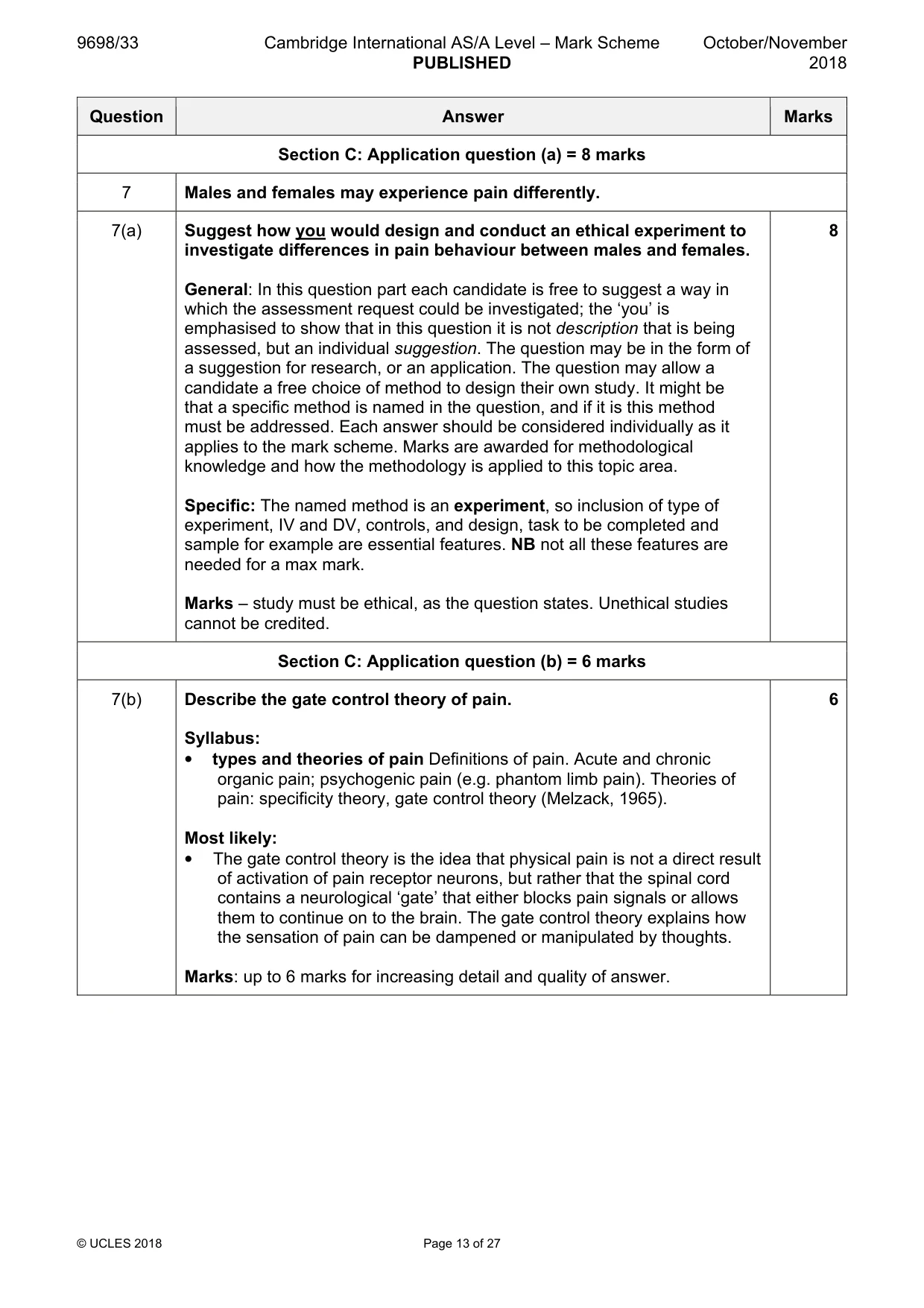
Mark scheme: 7(a) Suggest how you would design and conduct an ethical experiment to 8 investigate differences in pain behaviour between males and females. General: In this question part each candidate is free to suggest a way in which the assessment request could be investigated; the ‘you’ is emphasised to show that in this question it is not description that is being assessed, but an individual suggestion. The question may be in the form of a suggestion for research, or an application. The question may allow a candidate a free choice of method to design their own study. It might be that a specific method is named in the question, and if it is this method must be addressed. Each answer should be considered individually as it applies to the mark scheme. Marks are awarded for methodological knowledge and how the methodology is applied to this topic area. Specific: The named method is an experiment, so inclusion of type of experiment, IV and DV, controls, and design, task to be completed and sample for example are essential features. NB not all these features are needed for a max mark. Marks – study must be ethical, as the question states. Unethical studies cannot be credited. Section C: Application question (b) = 6 marks 7(b) Describe the gate control theory of pain. 6 Syllabus: • types and theories of pain Definitions of pain. Acute and chronic organic pain; psychogenic pain (e.g. phantom limb pain). Theories of pain: specificity theory, gate control theory (Melzack, 1965). Most likely: • The gate control theory is the idea that physical pain is not a direct result of activation of pain receptor neurons, but rather that the spinal cord contains a neurological ‘gate’ that either blocks pain signals or allows them to continue on to the brain. The gate control theory explains how the sensation of pain can be dampened or manipulated by thoughts. Marks: up to 6 marks for increasing detail and quality of answer.
Q8 · Shift work can be reorganised to reduce accidents at work
8 Shift work can be reorganised to reduce accidents at work. (a) Describe two ways in which shift work can be reorganised. [6] (b) Suggest how you would investigate which one of the shift work patterns you described in (a) results in fewer accidents. [8] Psychology and Environment Section A Answer this question.
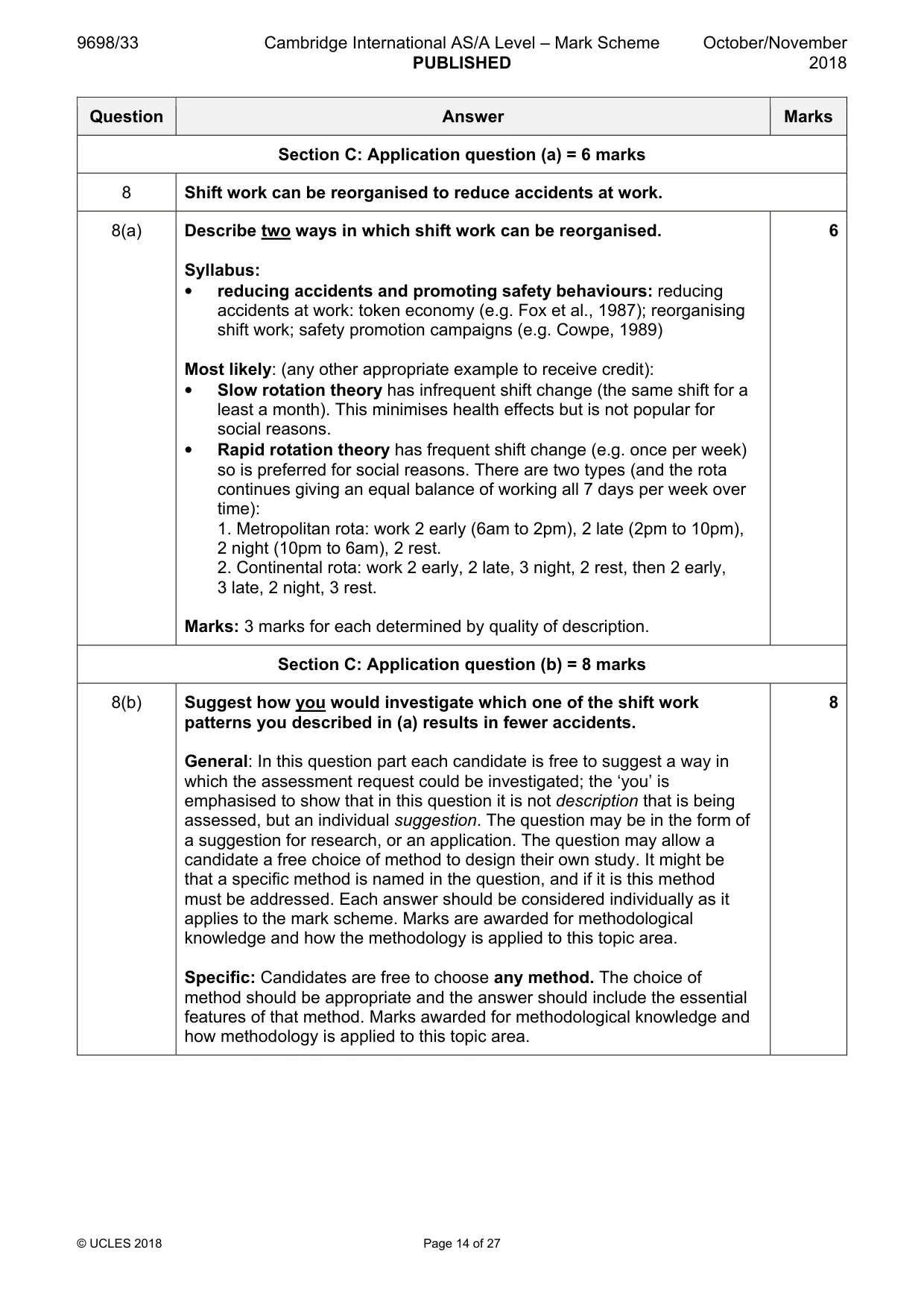
Mark scheme: 8(a) Describe two ways in which shift work can be reorganised. 6 Syllabus: • reducing accidents and promoting safety behaviours: reducing accidents at work: token economy (e.g. Fox et al., 1987); reorganising shift work; safety promotion campaigns (e.g. Cowpe, 1989) Most likely: (any other appropriate example to receive credit): • Slow rotation theory has infrequent shift change (the same shift for a least a month). This minimises health effects but is not popular for social reasons. • Rapid rotation theory has frequent shift change (e.g. once per week) so is preferred for social reasons. There are two types (and the rota continues giving an equal balance of working all 7 days per week over time): 1. Metropolitan rota: work 2 early (6am to 2pm), 2 late (2pm to 10pm), 2 night (10pm to 6am), 2 rest. 2. Continental rota: work 2 early, 2 late, 3 night, 2 rest, then 2 early, 3 late, 2 night, 3 rest. Marks: 3 marks for each determined by quality of description. Section C: Application question (b) = 8 marks 8(b) Suggest how you would investigate which one of the shift work 8 patterns you described in (a) results in fewer accidents. General: In this question part each candidate is free to suggest a way in which the assessment request could be investigated; the ‘you’ is emphasised to show that in this question it is not description that is being assessed, but an individual suggestion. The question may be in the form of a suggestion for research, or an application. The question may allow a candidate a free choice of method to design their own study. It might be that a specific method is named in the question, and if it is this method must be addressed. Each answer should be considered individually as it applies to the mark scheme. Marks are awarded for methodological knowledge and how the methodology is applied to this topic area. Specific: Candidates are free to choose any method. The choice of method should be appropriate and the answer should include the essential features of that method. Marks awarded for methodological knowledge and how methodology is applied to this topic area. PSYCHOLOGY AND ENVIRONMENT
Q9 · Explain, in your own words, what is meant by the term ‘negative effects of noise on the…
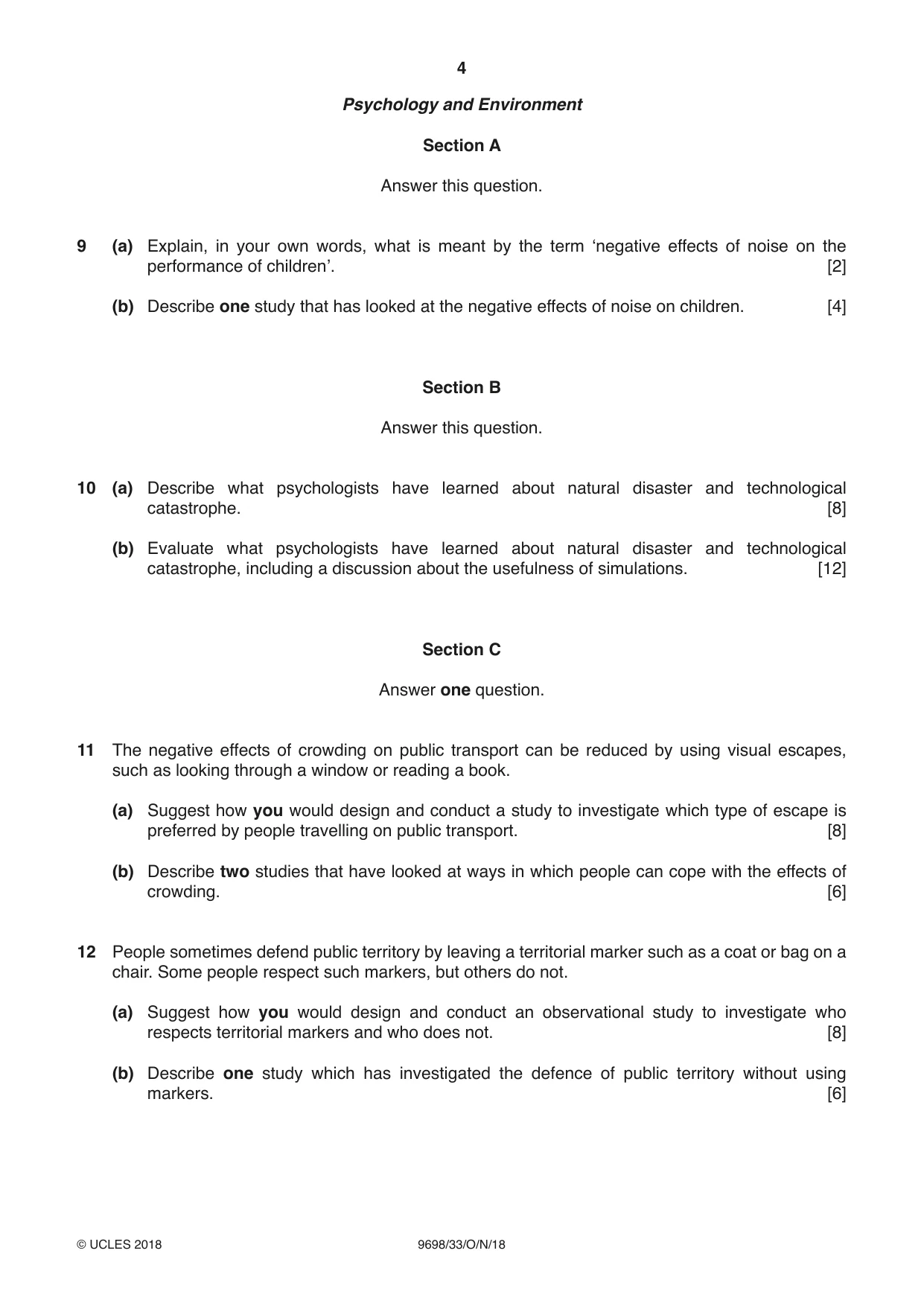
9 (a) Explain, in your own words, what is meant by the term ‘negative effects of noise on the performance of children’. [2] (b) Describe one study that has looked at the negative effects of noise on children. [4]
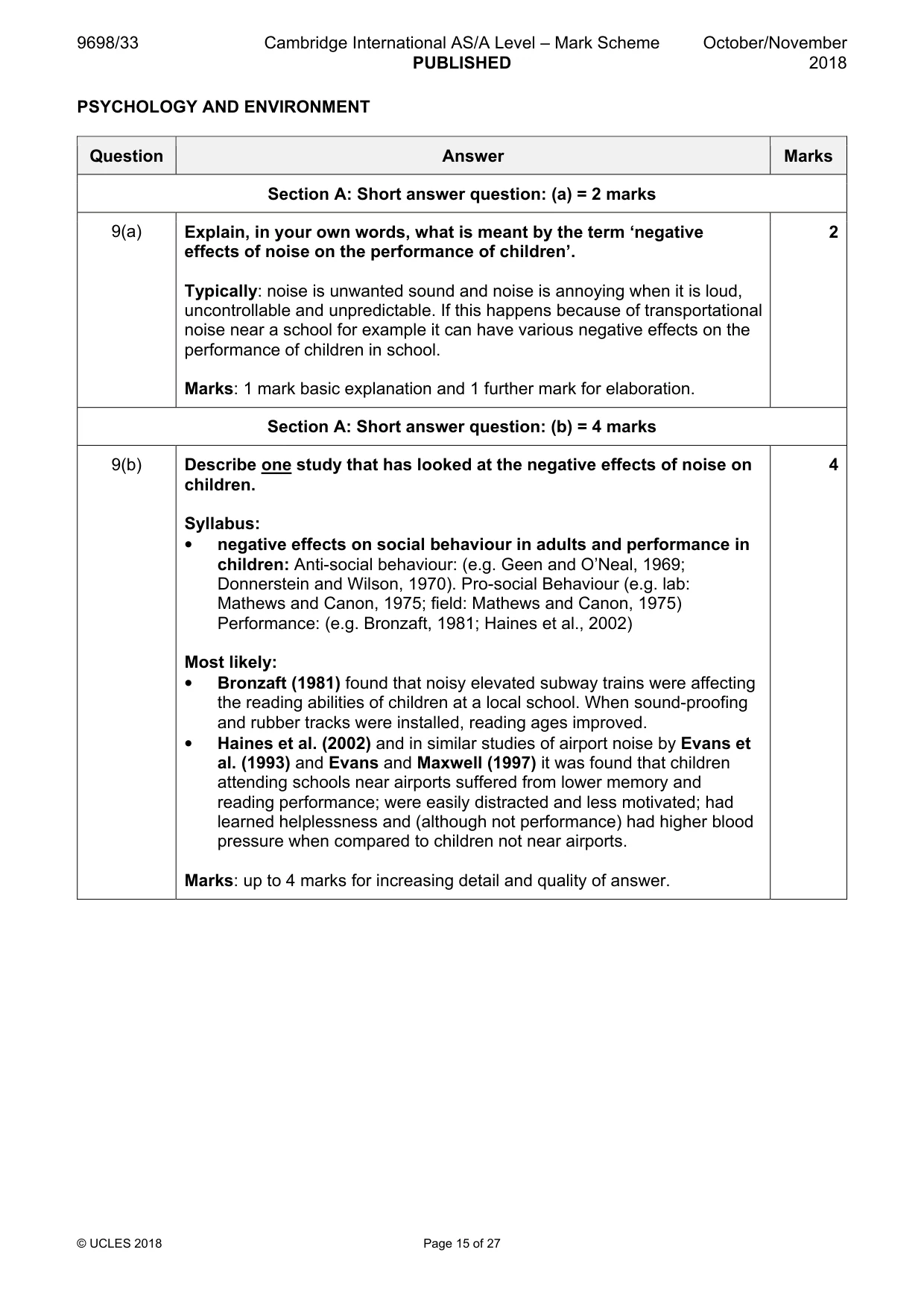
Mark scheme: 9(a) Explain, in your own words, what is meant by the term ‘negative 2 effects of noise on the performance of children’. Typically: noise is unwanted sound and noise is annoying when it is loud, uncontrollable and unpredictable. If this happens because of transportational noise near a school for example it can have various negative effects on the performance of children in school. Marks: 1 mark basic explanation and 1 further mark for elaboration. Section A: Short answer question: (b) = 4 marks 9(b) Describe one study that has looked at the negative effects of noise on 4 children. Syllabus: • negative effects on social behaviour in adults and performance in children: Anti-social behaviour: (e.g. Geen and O’Neal, 1969; Donnerstein and Wilson, 1970). Pro-social Behaviour (e.g. lab: Mathews and Canon, 1975; field: Mathews and Canon, 1975) Performance: (e.g. Bronzaft, 1981; Haines et al., 2002) Most likely: • Bronzaft (1981) found that noisy elevated subway trains were affecting the reading abilities of children at a local school. When sound-proofing and rubber tracks were installed, reading ages improved. • Haines et al. (2002) and in similar studies of airport noise by Evans et al. (1993) and Evans and Maxwell (1997) it was found that children attending schools near airports suffered from lower memory and reading performance; were easily distracted and less motivated; had learned helplessness and (although not performance) had higher blood pressure when compared to children not near airports. Marks: up to 4 marks for increasing detail and quality of answer.
Q10 · Describe what psychologists have learned about natural disaster and technological…
10 (a) Describe what psychologists have learned about natural disaster and technological catastrophe. [8] (b) Evaluate what psychologists have learned about natural disaster and technological catastrophe, including a discussion about the usefulness of simulations. [12] Section C Answer one question.
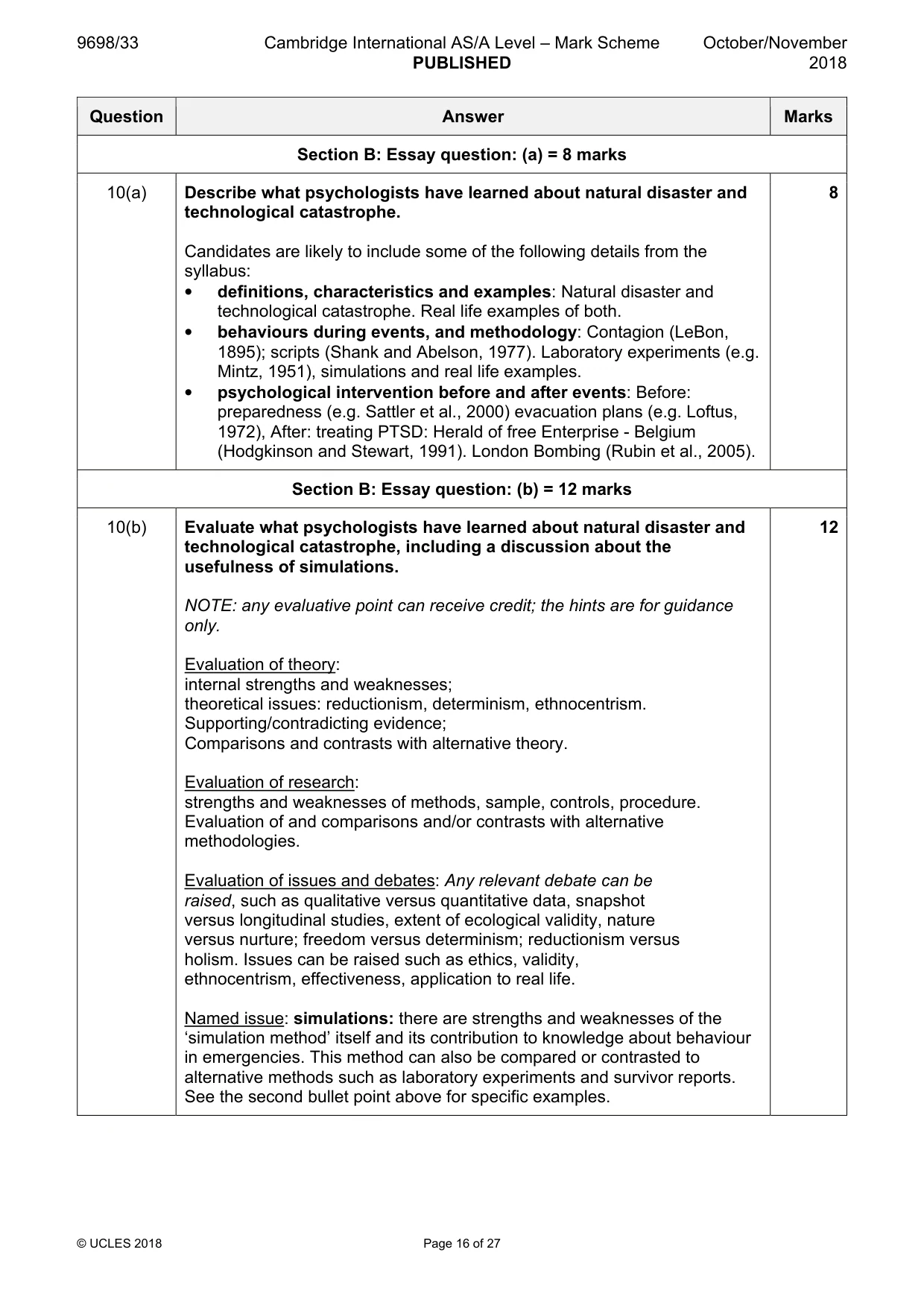
Mark scheme: 10(a) Describe what psychologists have learned about natural disaster and 8 technological catastrophe. Candidates are likely to include some of the following details from the syllabus: • definitions, characteristics and examples: Natural disaster and technological catastrophe. Real life examples of both. • behaviours during events, and methodology: Contagion (LeBon, 1895); scripts (Shank and Abelson, 1977). Laboratory experiments (e.g. Mintz, 1951), simulations and real life examples. • psychological intervention before and after events: Before: preparedness (e.g. Sattler et al., 2000) evacuation plans (e.g. Loftus, 1972), After: treating PTSD: Herald of free Enterprise - Belgium (Hodgkinson and Stewart, 1991). London Bombing (Rubin et al., 2005). Section B: Essay question: (b) = 12 marks 10(b) Evaluate what psychologists have learned about natural disaster and 12 technological catastrophe, including a discussion about the usefulness of simulations. NOTE: any evaluative point can receive credit; the hints are for guidance only. Evaluation of theory: internal strengths and weaknesses; theoretical issues: reductionism, determinism, ethnocentrism. Supporting/contradicting evidence; Comparisons and contrasts with alternative theory. Evaluation of research: strengths and weaknesses of methods, sample, controls, procedure. Evaluation of and comparisons and/or contrasts with alternative methodologies. Evaluation of issues and debates: Any relevant debate can be raised, such as qualitative versus quantitative data, snapshot versus longitudinal studies, extent of ecological validity, nature versus nurture; freedom versus determinism; reductionism versus holism. Issues can be raised such as ethics, validity, ethnocentrism, effectiveness, application to real life. Named issue: simulations: there are strengths and weaknesses of the ‘simulation method’ itself and its contribution to knowledge about behaviour in emergencies. This method can also be compared or contrasted to alternative methods such as laboratory experiments and survivor reports. See the second bullet point above for specific examples.
Q11 · The negative effects of crowding on public transport can be reduced by using visual…
11 The negative effects of crowding on public transport can be reduced by using visual escapes, such as looking through a window or reading a book. (a) Suggest how you would design and conduct a study to investigate which type of escape is preferred by people travelling on public transport. [8] (b) Describe two studies that have looked at ways in which people can cope with the effects of crowding. [6]
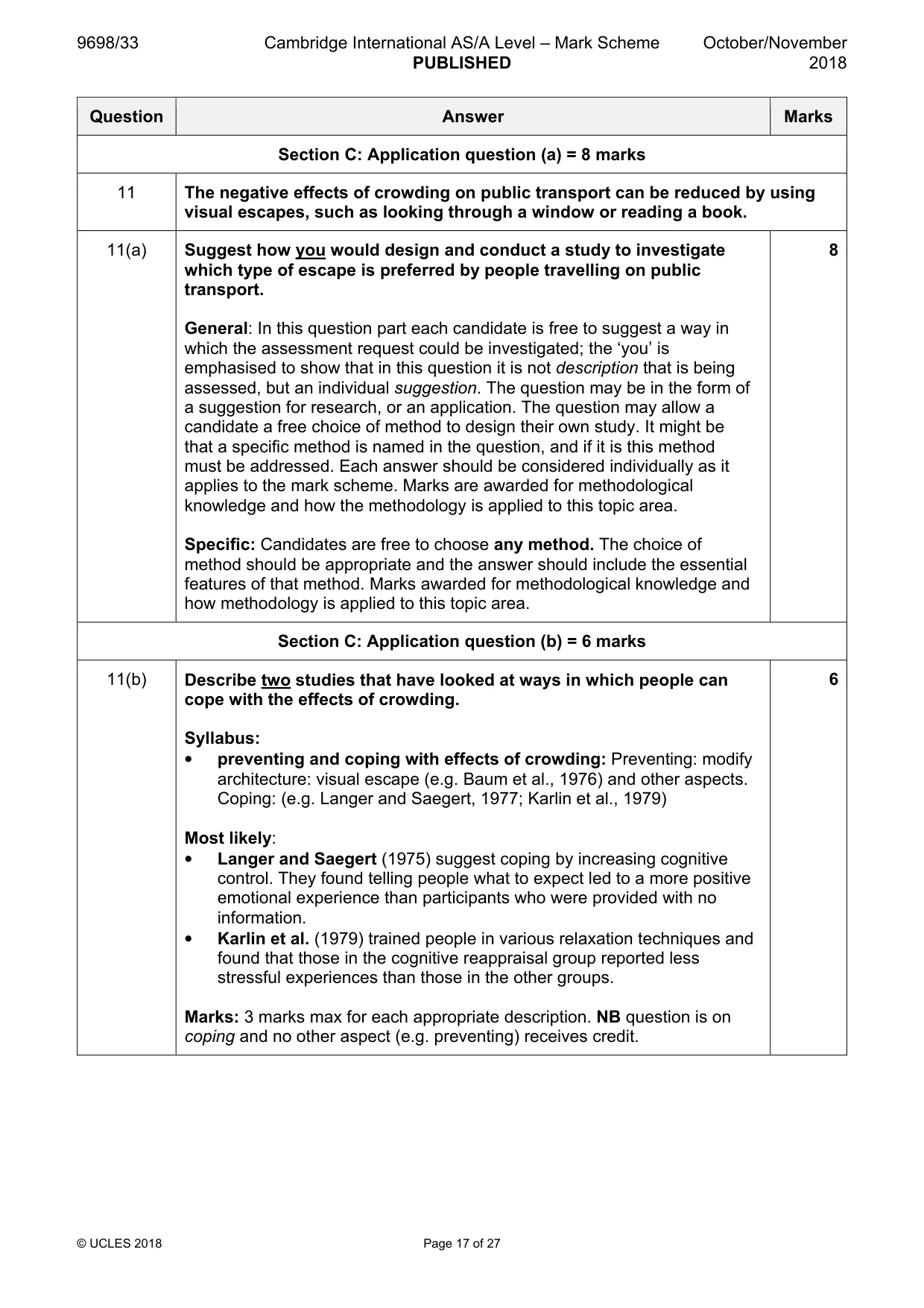
Mark scheme: 11(a) Suggest how you would design and conduct a study to investigate 8 which type of escape is preferred by people travelling on public transport. General: In this question part each candidate is free to suggest a way in which the assessment request could be investigated; the ‘you’ is emphasised to show that in this question it is not description that is being assessed, but an individual suggestion. The question may be in the form of a suggestion for research, or an application. The question may allow a candidate a free choice of method to design their own study. It might be that a specific method is named in the question, and if it is this method must be addressed. Each answer should be considered individually as it applies to the mark scheme. Marks are awarded for methodological knowledge and how the methodology is applied to this topic area. Specific: Candidates are free to choose any method. The choice of method should be appropriate and the answer should include the essential features of that method. Marks awarded for methodological knowledge and how methodology is applied to this topic area. Section C: Application question (b) = 6 marks 11(b) Describe two studies that have looked at ways in which people can 6 cope with the effects of crowding. Syllabus: • preventing and coping with effects of crowding: Preventing: modify architecture: visual escape (e.g. Baum et al., 1976) and other aspects. Coping: (e.g. Langer and Saegert, 1977; Karlin et al., 1979) Most likely: • Langer and Saegert (1975) suggest coping by increasing cognitive control. They found telling people what to expect led to a more positive emotional experience than participants who were provided with no information. • Karlin et al. (1979) trained people in various relaxation techniques and found that those in the cognitive reappraisal group reported less stressful experiences than those in the other groups. Marks: 3 marks max for each appropriate description. NB question is on coping and no other aspect (e.g. preventing) receives credit.
Q12 · People sometimes defend public territory by leaving a territorial marker such as a coat…
12 People sometimes defend public territory by leaving a territorial marker such as a coat or bag on a chair. Some people respect such markers, but others do not. (a) Suggest how you would design and conduct an observational study to investigate who respects territorial markers and who does not. [8] (b) Describe one study which has investigated the defence of public territory without using markers. [6] Psychology and Abnormality Section A Answer this question.
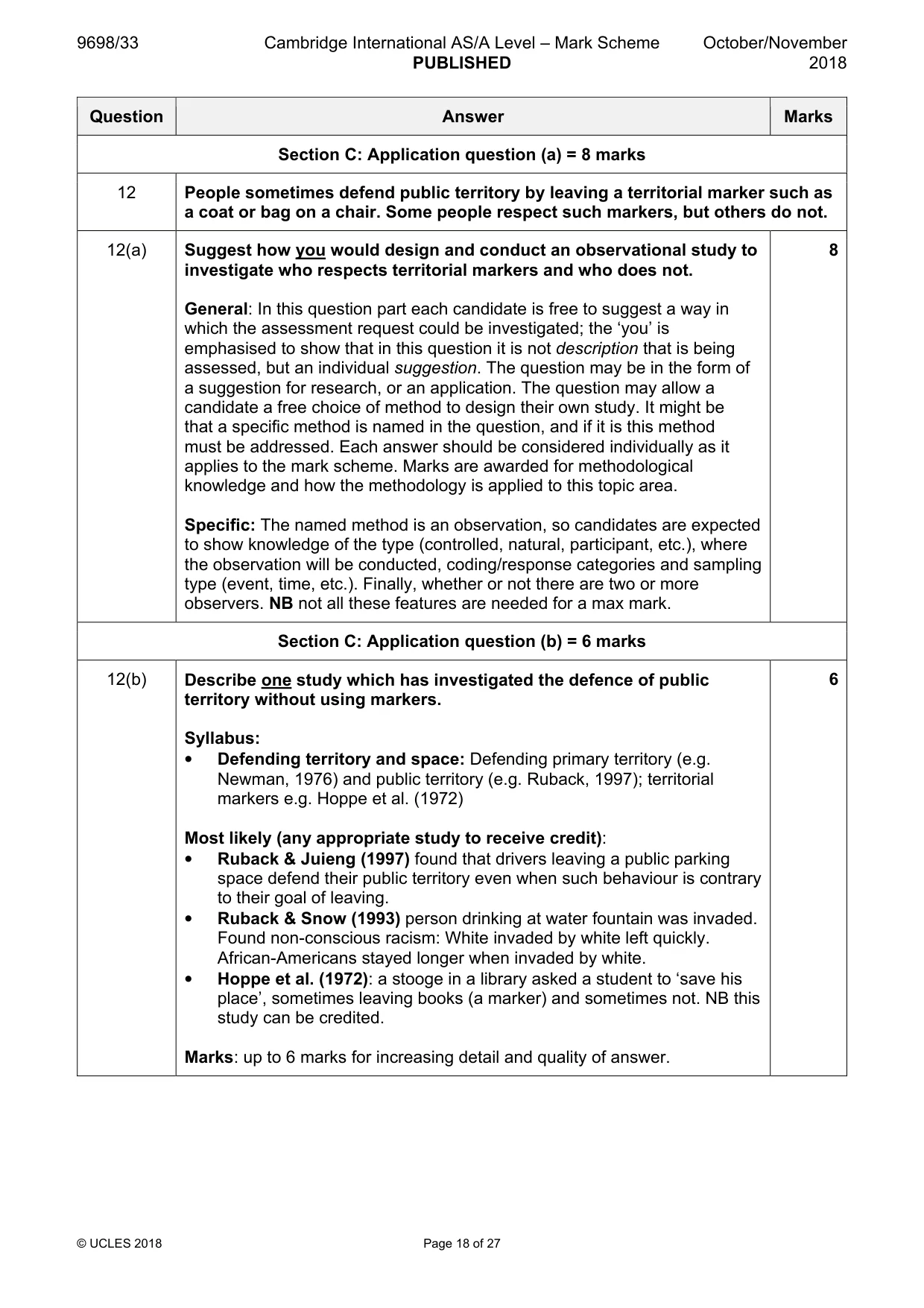
Mark scheme: 12(a) Suggest how you would design and conduct an observational study to 8 investigate who respects territorial markers and who does not. General: In this question part each candidate is free to suggest a way in which the assessment request could be investigated; the ‘you’ is emphasised to show that in this question it is not description that is being assessed, but an individual suggestion. The question may be in the form of a suggestion for research, or an application. The question may allow a candidate a free choice of method to design their own study. It might be that a specific method is named in the question, and if it is this method must be addressed. Each answer should be considered individually as it applies to the mark scheme. Marks are awarded for methodological knowledge and how the methodology is applied to this topic area. Specific: The named method is an observation, so candidates are expected to show knowledge of the type (controlled, natural, participant, etc.), where the observation will be conducted, coding/response categories and sampling type (event, time, etc.). Finally, whether or not there are two or more observers. NB not all these features are needed for a max mark. Section C: Application question (b) = 6 marks 12(b) Describe one study which has investigated the defence of public 6 territory without using markers. Syllabus: • Defending territory and space: Defending primary territory (e.g. Newman, 1976) and public territory (e.g. Ruback, 1997); territorial markers e.g. Hoppe et al. (1972) Most likely (any appropriate study to receive credit): • Ruback & Juieng (1997) found that drivers leaving a public parking space defend their public territory even when such behaviour is contrary to their goal of leaving. • Ruback & Snow (1993) person drinking at water fountain was invaded. Found non-conscious racism: White invaded by white left quickly. African-Americans stayed longer when invaded by white. • Hoppe et al. (1972): a stooge in a library asked a student to ‘save his place’, sometimes leaving books (a marker) and sometimes not. NB this study can be credited. Marks: up to 6 marks for increasing detail and quality of answer. PSYCHOLOGY AND ABNORMALITY
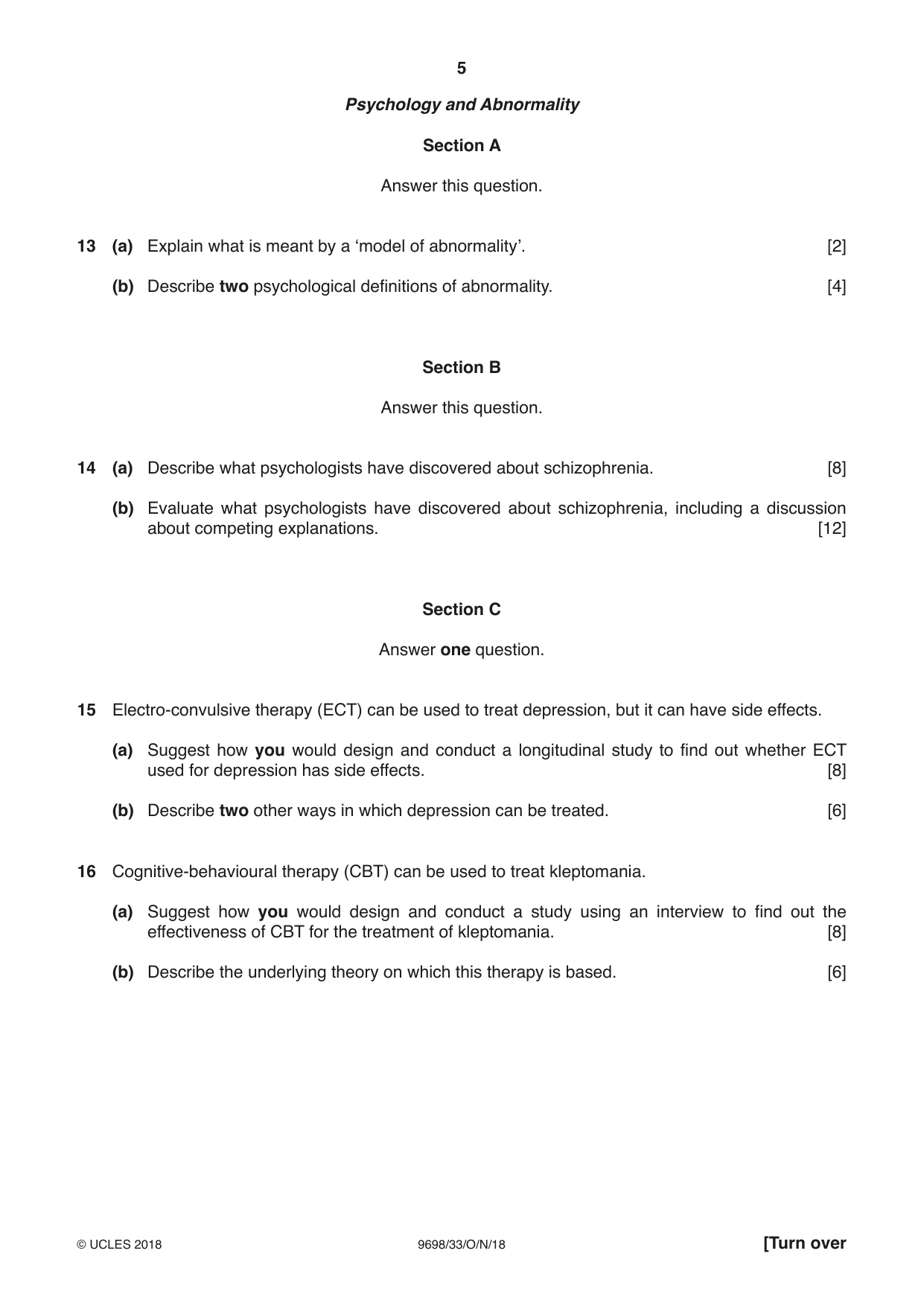
Q13 · Explain what is meant by a ‘model of abnormality’
13 (a) Explain what is meant by a ‘model of abnormality’. [2] (b) Describe two psychological definitions of abnormality. [4]
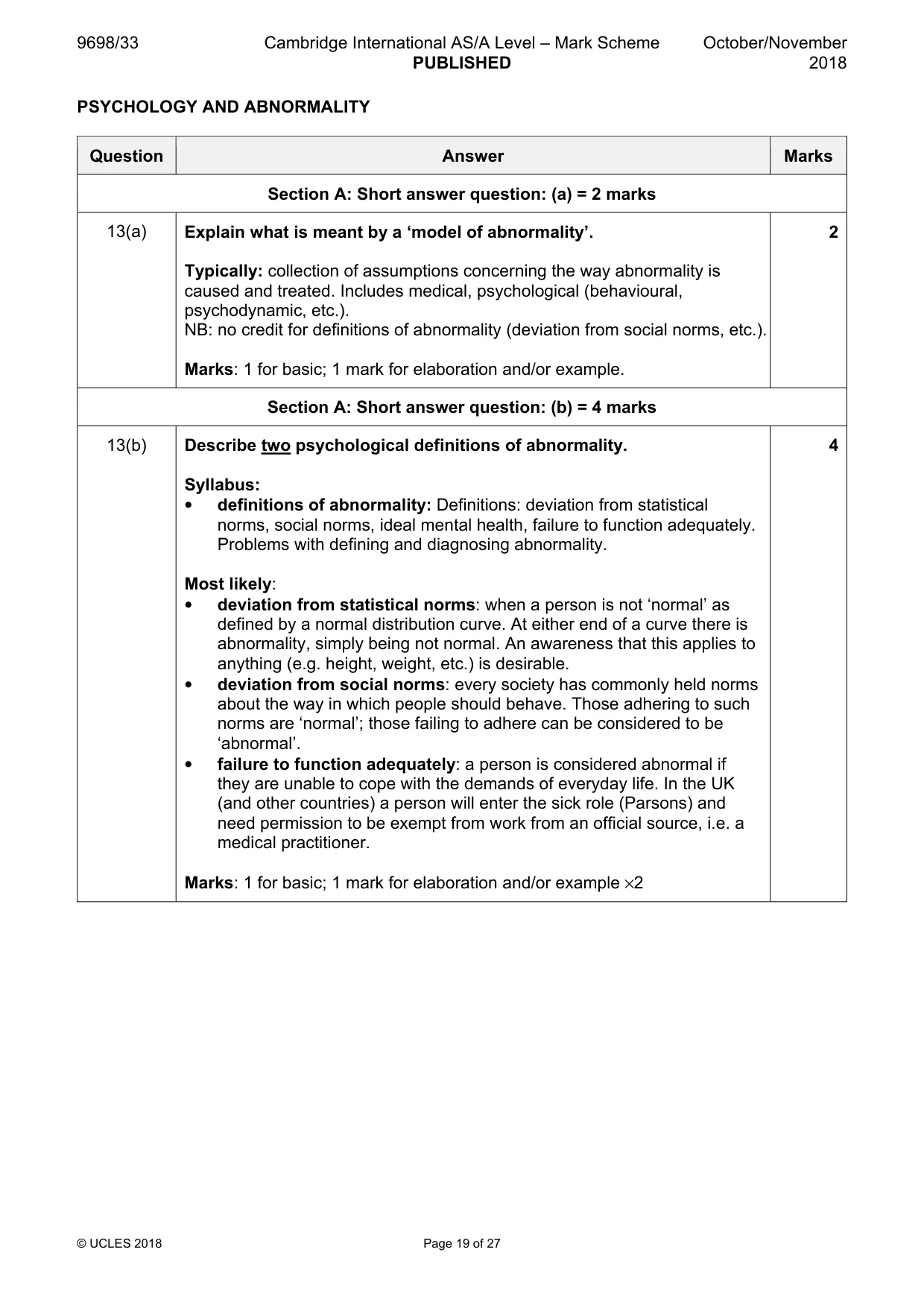
Mark scheme: 13(a) Explain what is meant by a ‘model of abnormality’. 2 Typically: collection of assumptions concerning the way abnormality is caused and treated. Includes medical, psychological (behavioural, psychodynamic, etc.). NB: no credit for definitions of abnormality (deviation from social norms, etc.). Marks: 1 for basic; 1 mark for elaboration and/or example. Section A: Short answer question: (b) = 4 marks 13(b) Describe two psychological definitions of abnormality. 4 Syllabus: • definitions of abnormality: Definitions: deviation from statistical norms, social norms, ideal mental health, failure to function adequately. Problems with defining and diagnosing abnormality. Most likely: • deviation from statistical norms: when a person is not ‘normal’ as defined by a normal distribution curve. At either end of a curve there is abnormality, simply being not normal. An awareness that this applies to anything (e.g. height, weight, etc.) is desirable. • deviation from social norms: every society has commonly held norms about the way in which people should behave. Those adhering to such norms are ‘normal’; those failing to adhere can be considered to be ‘abnormal’. • failure to function adequately: a person is considered abnormal if they are unable to cope with the demands of everyday life. In the UK (and other countries) a person will enter the sick role (Parsons) and need permission to be exempt from work from an official source, i.e. a medical practitioner. Marks: 1 for basic; 1 mark for elaboration and/or example ×2
Q14 · Describe what psychologists have discovered about schizophrenia
14 (a) Describe what psychologists have discovered about schizophrenia. [8] (b) Evaluate what psychologists have discovered about schizophrenia, including a discussion about competing explanations. [12] Section C Answer one question.
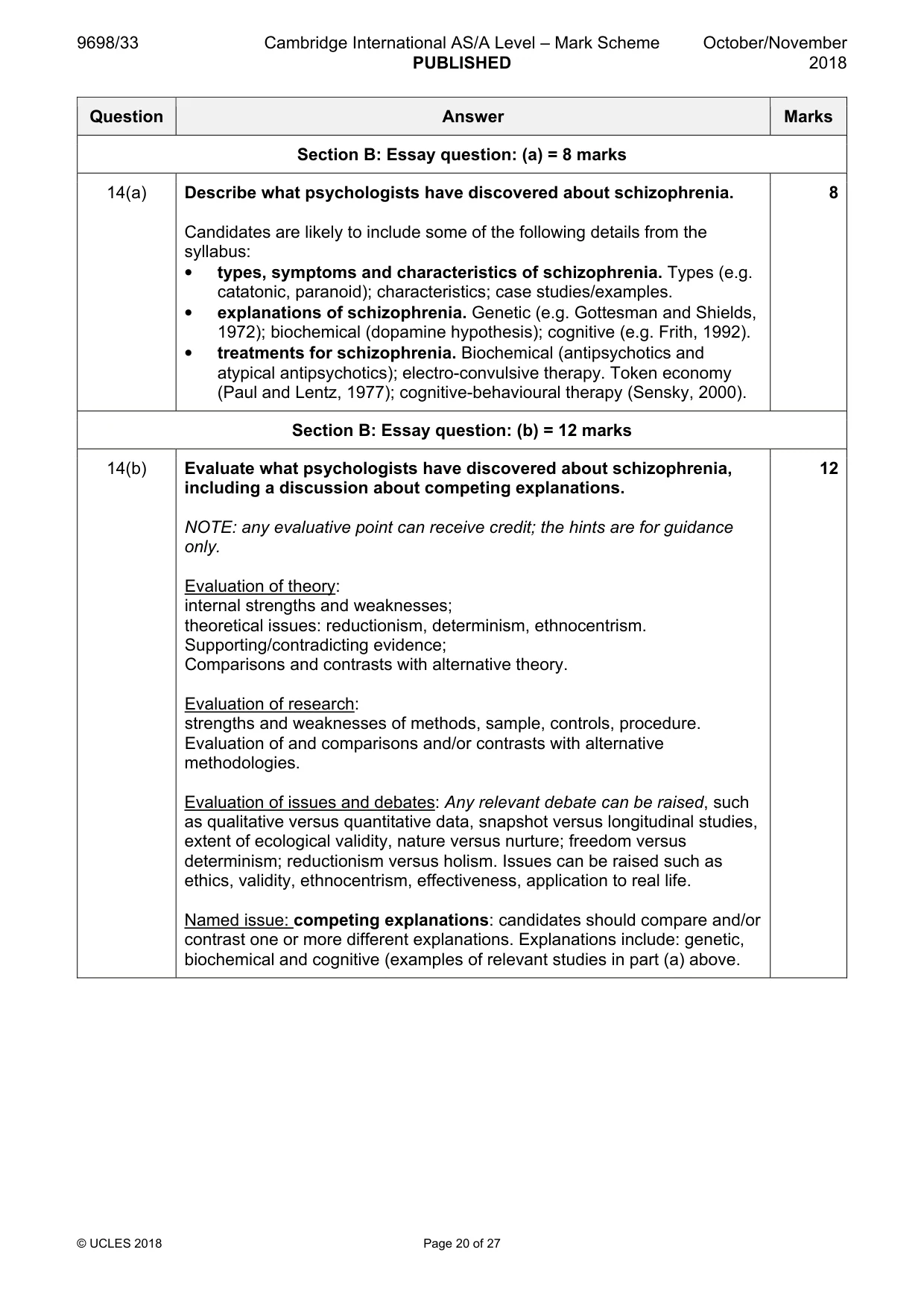
Mark scheme: 14(a) Describe what psychologists have discovered about schizophrenia. 8 Candidates are likely to include some of the following details from the syllabus: • types, symptoms and characteristics of schizophrenia. Types (e.g. catatonic, paranoid); characteristics; case studies/examples. • explanations of schizophrenia. Genetic (e.g. Gottesman and Shields, 1972); biochemical (dopamine hypothesis); cognitive (e.g. Frith, 1992). • treatments for schizophrenia. Biochemical (antipsychotics and atypical antipsychotics); electro-convulsive therapy. Token economy (Paul and Lentz, 1977); cognitive-behavioural therapy (Sensky, 2000). Section B: Essay question: (b) = 12 marks 14(b) Evaluate what psychologists have discovered about schizophrenia, 12 including a discussion about competing explanations. NOTE: any evaluative point can receive credit; the hints are for guidance only. Evaluation of theory: internal strengths and weaknesses; theoretical issues: reductionism, determinism, ethnocentrism. Supporting/contradicting evidence; Comparisons and contrasts with alternative theory. Evaluation of research: strengths and weaknesses of methods, sample, controls, procedure. Evaluation of and comparisons and/or contrasts with alternative methodologies. Evaluation of issues and debates: Any relevant debate can be raised, such as qualitative versus quantitative data, snapshot versus longitudinal studies, extent of ecological validity, nature versus nurture; freedom versus determinism; reductionism versus holism. Issues can be raised such as ethics, validity, ethnocentrism, effectiveness, application to real life. Named issue: competing explanations: candidates should compare and/or contrast one or more different explanations. Explanations include: genetic, biochemical and cognitive (examples of relevant studies in part (a) above.
Q15 · Electro-convulsive therapy (ECT) can be used to treat depression, but it can have side…
15 Electro-convulsive therapy (ECT) can be used to treat depression, but it can have side effects. (a) Suggest how you would design and conduct a longitudinal study to find out whether ECT used for depression has side effects. [8] (b) Describe two other ways in which depression can be treated. [6]
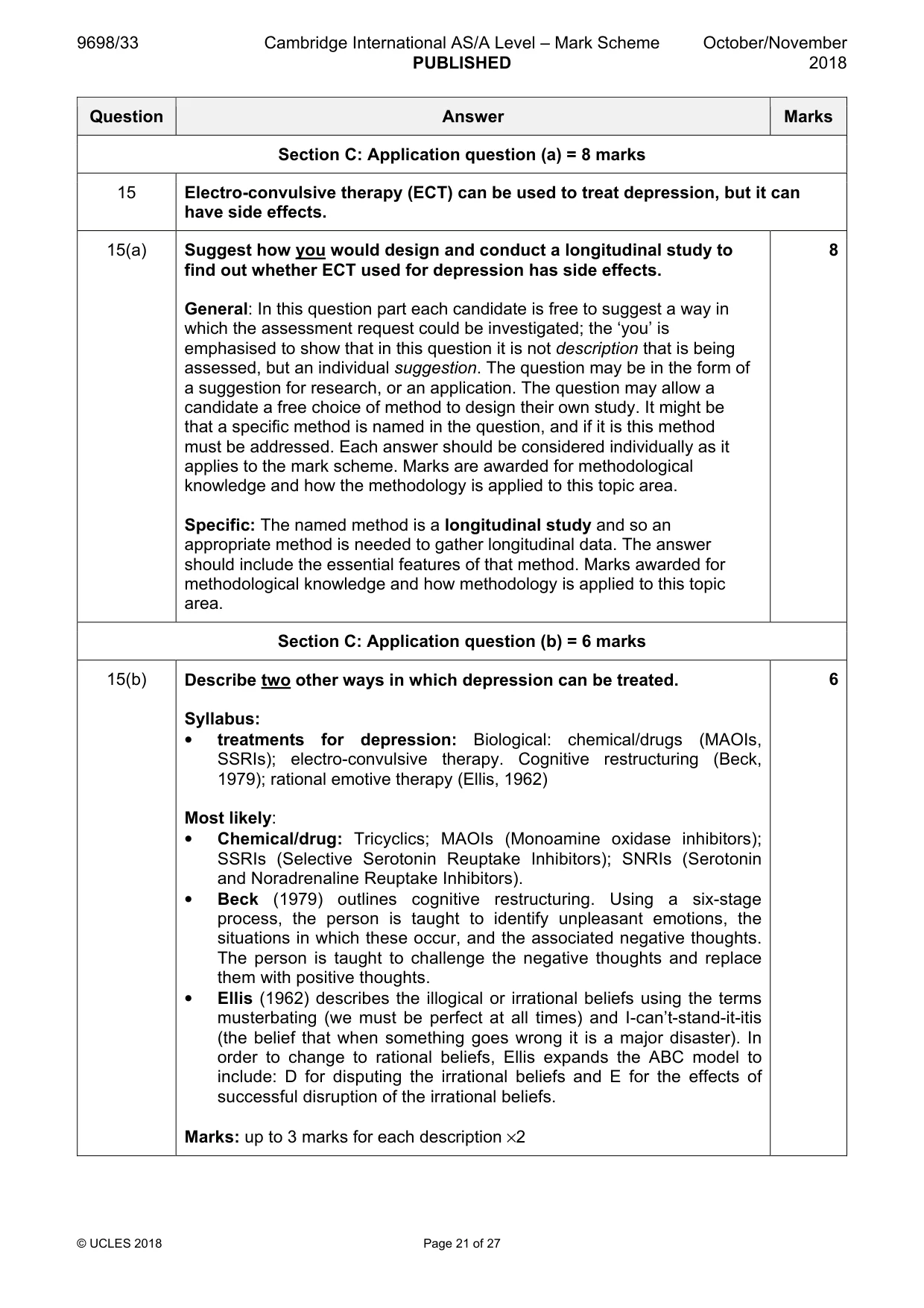
Mark scheme: 15(a) Suggest how you would design and conduct a longitudinal study to 8 find out whether ECT used for depression has side effects. General: In this question part each candidate is free to suggest a way in which the assessment request could be investigated; the ‘you’ is emphasised to show that in this question it is not description that is being assessed, but an individual suggestion. The question may be in the form of a suggestion for research, or an application. The question may allow a candidate a free choice of method to design their own study. It might be that a specific method is named in the question, and if it is this method must be addressed. Each answer should be considered individually as it applies to the mark scheme. Marks are awarded for methodological knowledge and how the methodology is applied to this topic area. Specific: The named method is a longitudinal study and so an appropriate method is needed to gather longitudinal data. The answer should include the essential features of that method. Marks awarded for methodological knowledge and how methodology is applied to this topic area. Section C: Application question (b) = 6 marks 15(b) Describe two other ways in which depression can be treated. 6 Syllabus: • treatments for depression: Biological: chemical/drugs (MAOIs, SSRIs); electro-convulsive therapy. Cognitive restructuring (Beck, 1979); rational emotive therapy (Ellis, 1962) Most likely: • Chemical/drug: Tricyclics; MAOIs (Monoamine oxidase inhibitors); SSRIs (Selective Serotonin Reuptake Inhibitors); SNRIs (Serotonin and Noradrenaline Reuptake Inhibitors). • Beck (1979) outlines cognitive restructuring. Using a six-stage process, the person is taught to identify unpleasant emotions, the situations in which these occur, and the associated negative thoughts. The person is taught to challenge the negative thoughts and replace them with positive thoughts. • Ellis (1962) describes the illogical or irrational beliefs using the terms musterbating (we must be perfect at all times) and I-can’t-stand-it-itis (the belief that when something goes wrong it is a major disaster). In order to change to rational beliefs, Ellis expands the ABC model to include: D for disputing the irrational beliefs and E for the effects of successful disruption of the irrational beliefs. Marks: up to 3 marks for each description ×2
Q16 · Cognitive-behavioural therapy (CBT) can be used to treat kleptomania
16 Cognitive-behavioural therapy (CBT) can be used to treat kleptomania. (a) Suggest how you would design and conduct a study using an interview to find out the effectiveness of CBT for the treatment of kleptomania. [8] (b) Describe the underlying theory on which this therapy is based. [6] Psychology and Organisations Section A Answer this question.
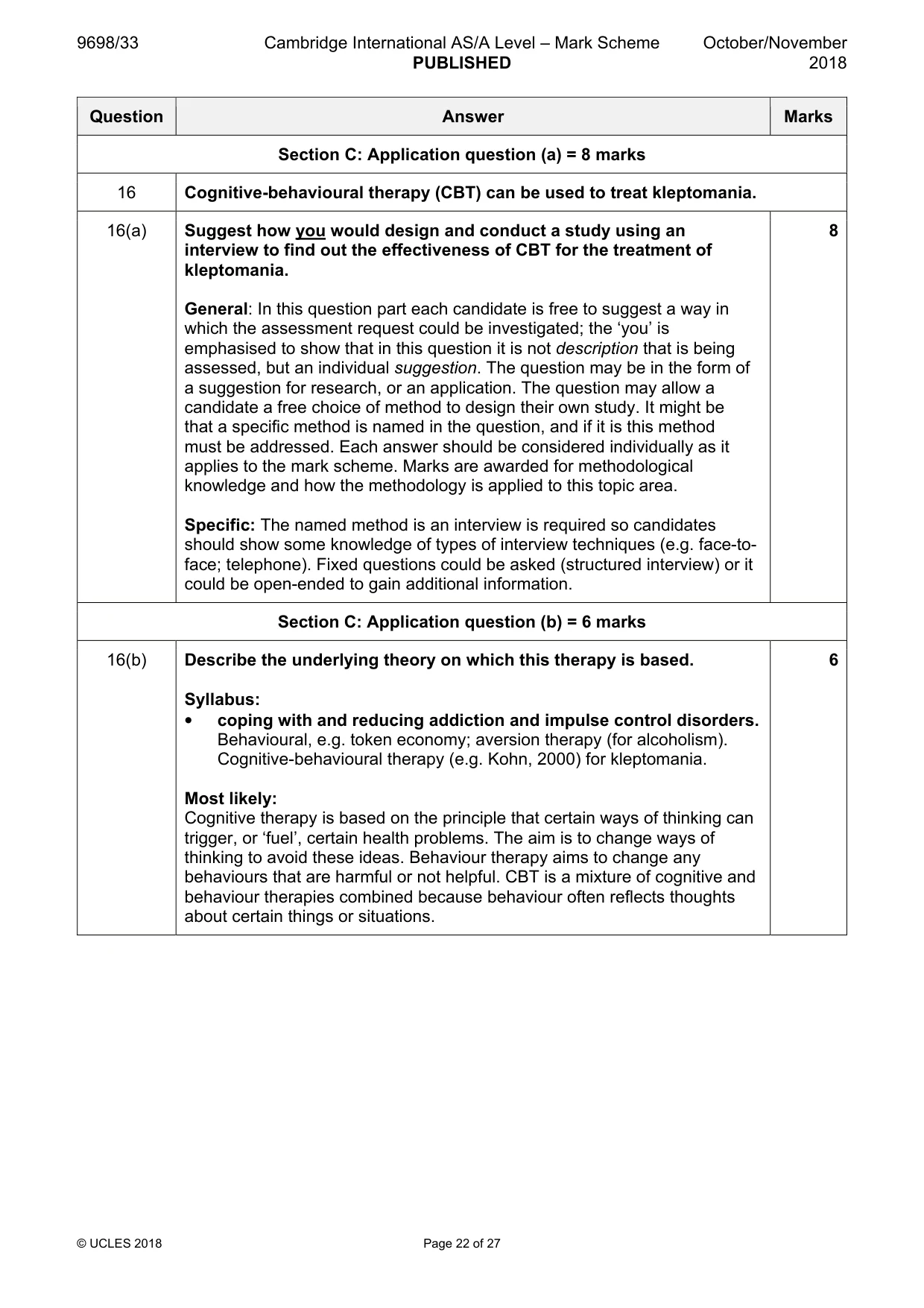
Mark scheme: 16(a) Suggest how you would design and conduct a study using an 8 interview to find out the effectiveness of CBT for the treatment of kleptomania. General: In this question part each candidate is free to suggest a way in which the assessment request could be investigated; the ‘you’ is emphasised to show that in this question it is not description that is being assessed, but an individual suggestion. The question may be in the form of a suggestion for research, or an application. The question may allow a candidate a free choice of method to design their own study. It might be that a specific method is named in the question, and if it is this method must be addressed. Each answer should be considered individually as it applies to the mark scheme. Marks are awarded for methodological knowledge and how the methodology is applied to this topic area. Specific: The named method is an interview is required so candidates should show some knowledge of types of interview techniques (e.g. face-to- face; telephone). Fixed questions could be asked (structured interview) or it could be open-ended to gain additional information. Section C: Application question (b) = 6 marks 16(b) Describe the underlying theory on which this therapy is based. 6 Syllabus: • coping with and reducing addiction and impulse control disorders. Behavioural, e.g. token economy; aversion therapy (for alcoholism). Cognitive-behavioural therapy (e.g. Kohn, 2000) for kleptomania. Most likely: Cognitive therapy is based on the principle that certain ways of thinking can trigger, or ‘fuel’, certain health problems. The aim is to change ways of thinking to avoid these ideas. Behaviour therapy aims to change any behaviours that are harmful or not helpful. CBT is a mixture of cognitive and behaviour therapies combined because behaviour often reflects thoughts about certain things or situations. PSYCHOLOGY AND ORGANISATIONS
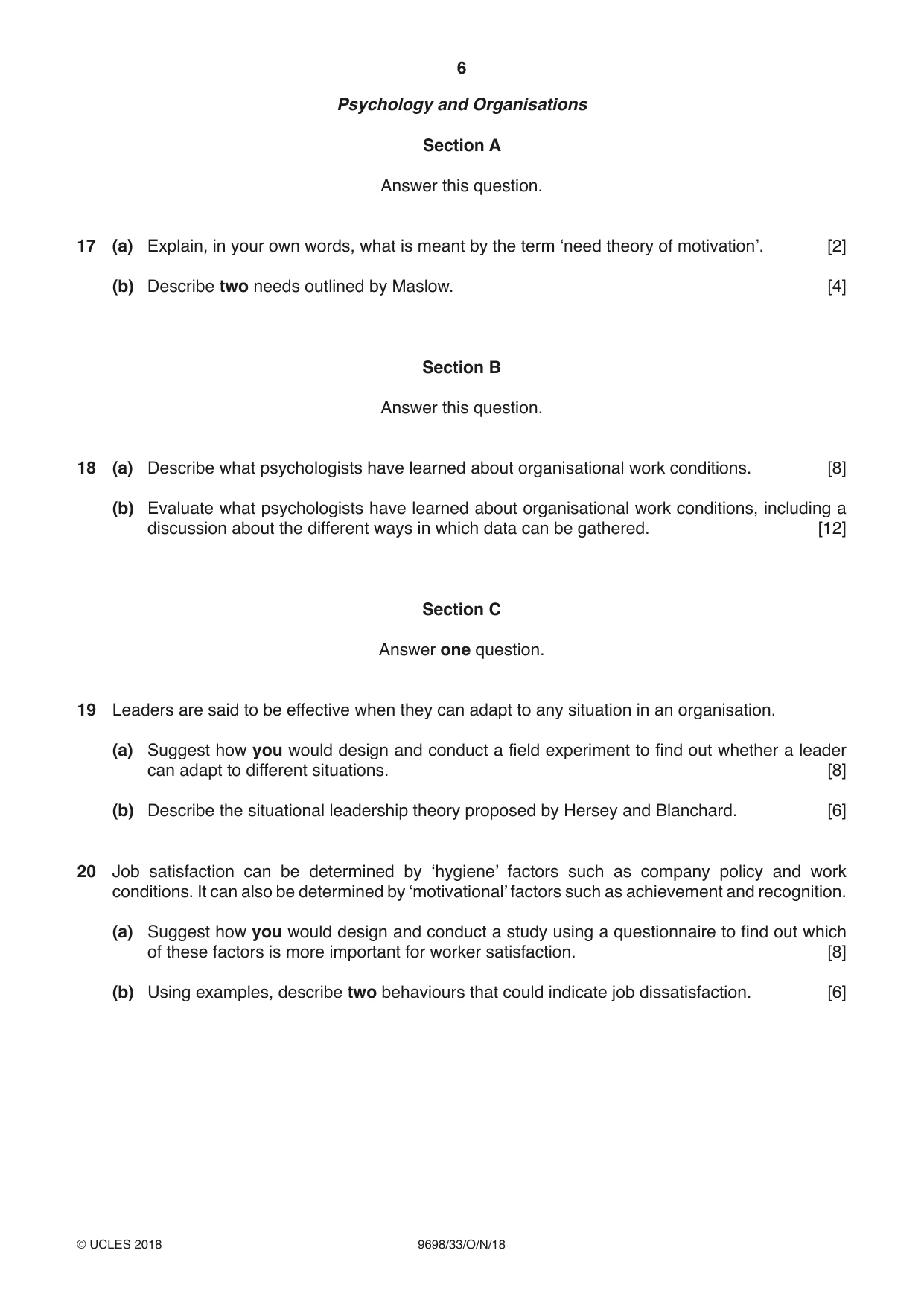
Q17 · Explain, in your own words, what is meant by the term ‘need theory of motivation’
17 (a) Explain, in your own words, what is meant by the term ‘need theory of motivation’. [2] (b) Describe two needs outlined by Maslow. [4]
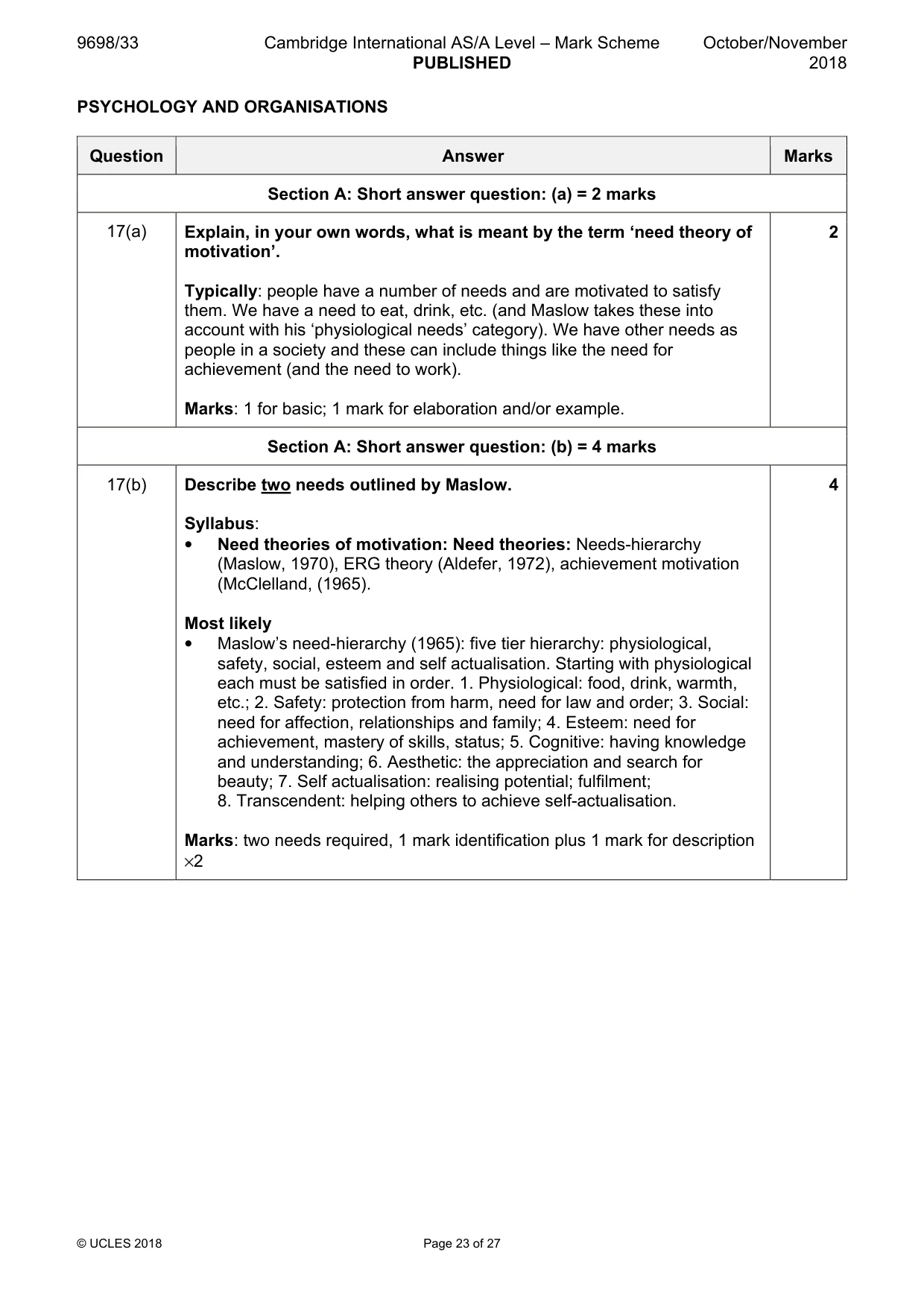
Mark scheme: 17(a) Explain, in your own words, what is meant by the term ‘need theory of 2 motivation’. Typically: people have a number of needs and are motivated to satisfy them. We have a need to eat, drink, etc. (and Maslow takes these into account with his ‘physiological needs’ category). We have other needs as people in a society and these can include things like the need for achievement (and the need to work). Marks: 1 for basic; 1 mark for elaboration and/or example. Section A: Short answer question: (b) = 4 marks 17(b) Describe two needs outlined by Maslow. 4 Syllabus: • Need theories of motivation: Need theories: Needs-hierarchy (Maslow, 1970), ERG theory (Aldefer, 1972), achievement motivation (McClelland, (1965). Most likely • Maslow’s need-hierarchy (1965): five tier hierarchy: physiological, safety, social, esteem and self actualisation. Starting with physiological each must be satisfied in order. 1. Physiological: food, drink, warmth, etc.; 2. Safety: protection from harm, need for law and order; 3. Social: need for affection, relationships and family; 4. Esteem: need for achievement, mastery of skills, status; 5. Cognitive: having knowledge and understanding; 6. Aesthetic: the appreciation and search for beauty; 7. Self actualisation: realising potential; fulfilment; 8. Transcendent: helping others to achieve self-actualisation. Marks: two needs required, 1 mark identification plus 1 mark for description ×2
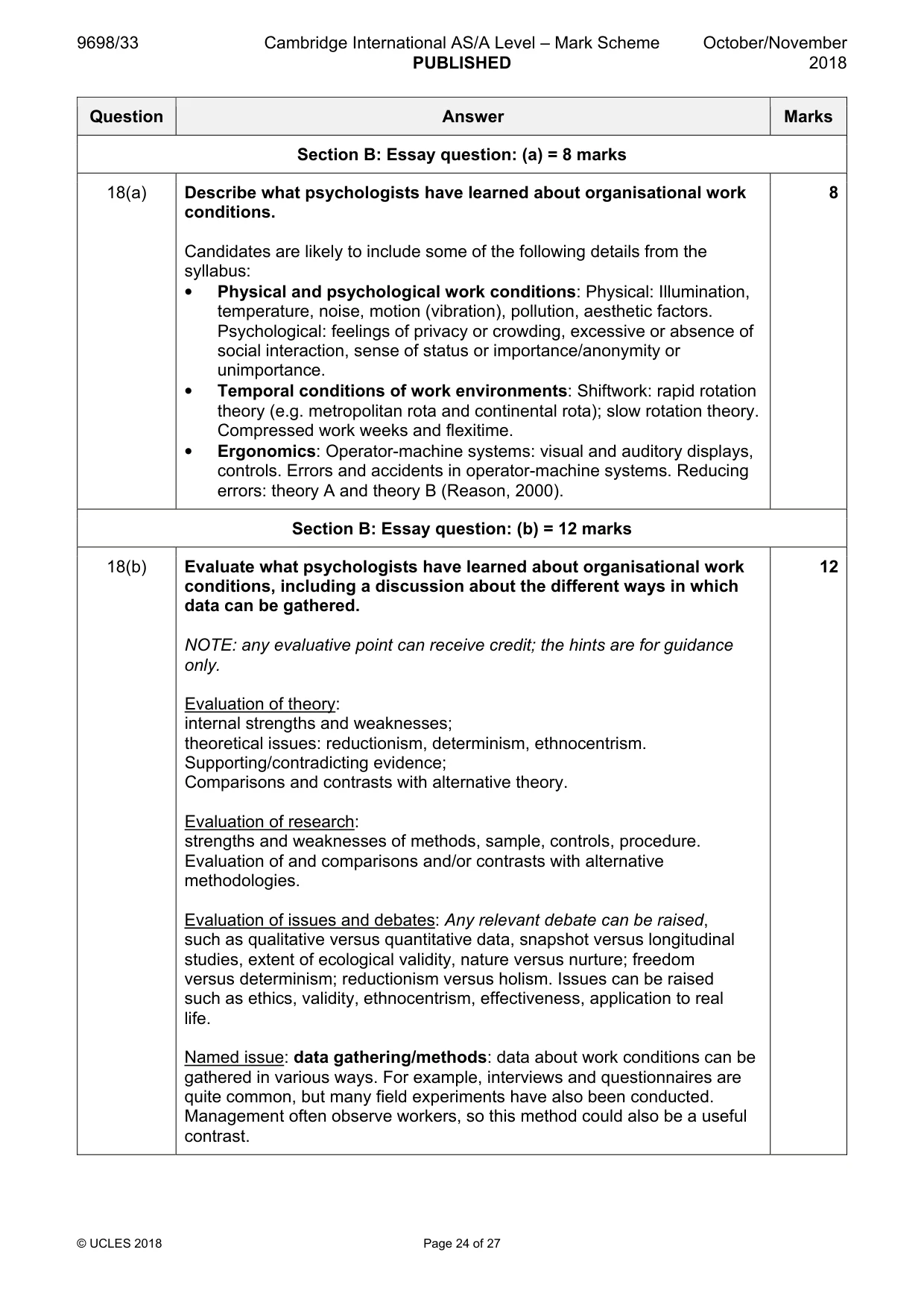
Q18 · Describe what psychologists have learned about organisational work conditions
18 (a) Describe what psychologists have learned about organisational work conditions. [8] (b) Evaluate what psychologists have learned about organisational work conditions, including a discussion about the different ways in which data can be gathered. [12] Section C Answer one question.
Mark scheme: 18(a) Describe what psychologists have learned about organisational work 8 conditions. Candidates are likely to include some of the following details from the syllabus: • Physical and psychological work conditions: Physical: Illumination, temperature, noise, motion (vibration), pollution, aesthetic factors. Psychological: feelings of privacy or crowding, excessive or absence of social interaction, sense of status or importance/anonymity or unimportance. • Temporal conditions of work environments: Shiftwork: rapid rotation theory (e.g. metropolitan rota and continental rota); slow rotation theory. Compressed work weeks and flexitime. • Ergonomics: Operator-machine systems: visual and auditory displays, controls. Errors and accidents in operator-machine systems. Reducing errors: theory A and theory B (Reason, 2000). Section B: Essay question: (b) = 12 marks 18(b) Evaluate what psychologists have learned about organisational work 12 conditions, including a discussion about the different ways in which data can be gathered. NOTE: any evaluative point can receive credit; the hints are for guidance only. Evaluation of theory: internal strengths and weaknesses; theoretical issues: reductionism, determinism, ethnocentrism. Supporting/contradicting evidence; Comparisons and contrasts with alternative theory. Evaluation of research: strengths and weaknesses of methods, sample, controls, procedure. Evaluation of and comparisons and/or contrasts with alternative methodologies. Evaluation of issues and debates: Any relevant debate can be raised, such as qualitative versus quantitative data, snapshot versus longitudinal studies, extent of ecological validity, nature versus nurture; freedom versus determinism; reductionism versus holism. Issues can be raised such as ethics, validity, ethnocentrism, effectiveness, application to real life. Named issue: data gathering/methods: data about work conditions can be gathered in various ways. For example, interviews and questionnaires are quite common, but many field experiments have also been conducted. Management often observe workers, so this method could also be a useful contrast.
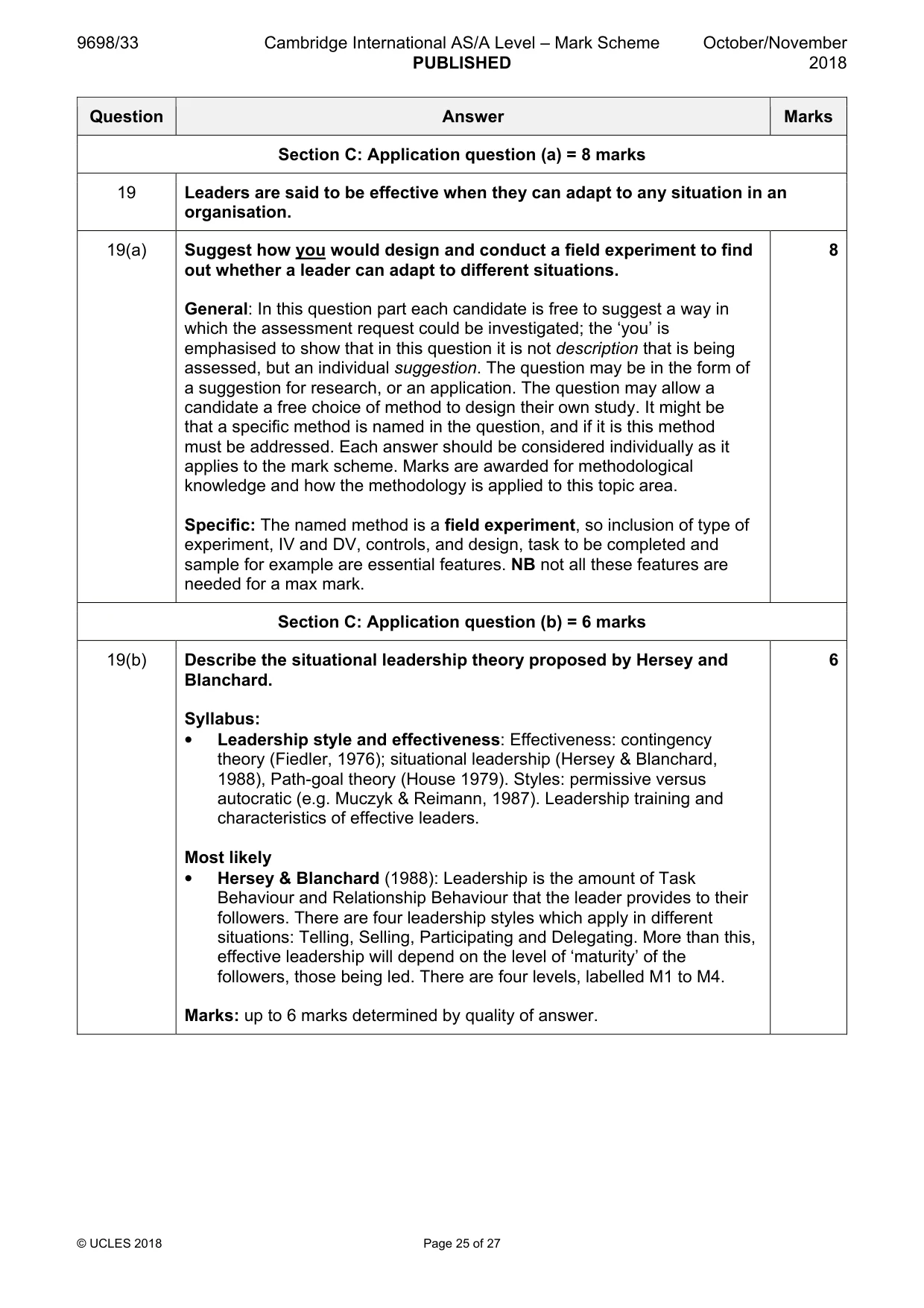
Q19 · Leaders are said to be effective when they can adapt to any situation in an organisation
19 Leaders are said to be effective when they can adapt to any situation in an organisation. (a) Suggest how you would design and conduct a field experiment to find out whether a leader can adapt to different situations. [8] (b) Describe the situational leadership theory proposed by Hersey and Blanchard. [6]
Mark scheme: 19(a) Suggest how you would design and conduct a field experiment to find 8 out whether a leader can adapt to different situations. General: In this question part each candidate is free to suggest a way in which the assessment request could be investigated; the ‘you’ is emphasised to show that in this question it is not description that is being assessed, but an individual suggestion. The question may be in the form of a suggestion for research, or an application. The question may allow a candidate a free choice of method to design their own study. It might be that a specific method is named in the question, and if it is this method must be addressed. Each answer should be considered individually as it applies to the mark scheme. Marks are awarded for methodological knowledge and how the methodology is applied to this topic area. Specific: The named method is a field experiment, so inclusion of type of experiment, IV and DV, controls, and design, task to be completed and sample for example are essential features. NB not all these features are needed for a max mark. Section C: Application question (b) = 6 marks 19(b) Describe the situational leadership theory proposed by Hersey and 6 Blanchard. Syllabus: • Leadership style and effectiveness: Effectiveness: contingency theory (Fiedler, 1976); situational leadership (Hersey & Blanchard, 1988), Path-goal theory (House 1979). Styles: permissive versus autocratic (e.g. Muczyk & Reimann, 1987). Leadership training and characteristics of effective leaders. Most likely • Hersey & Blanchard (1988): Leadership is the amount of Task Behaviour and Relationship Behaviour that the leader provides to their followers. There are four leadership styles which apply in different situations: Telling, Selling, Participating and Delegating. More than this, effective leadership will depend on the level of ‘maturity’ of the followers, those being led. There are four levels, labelled M1 to M4. Marks: up to 6 marks determined by quality of answer.
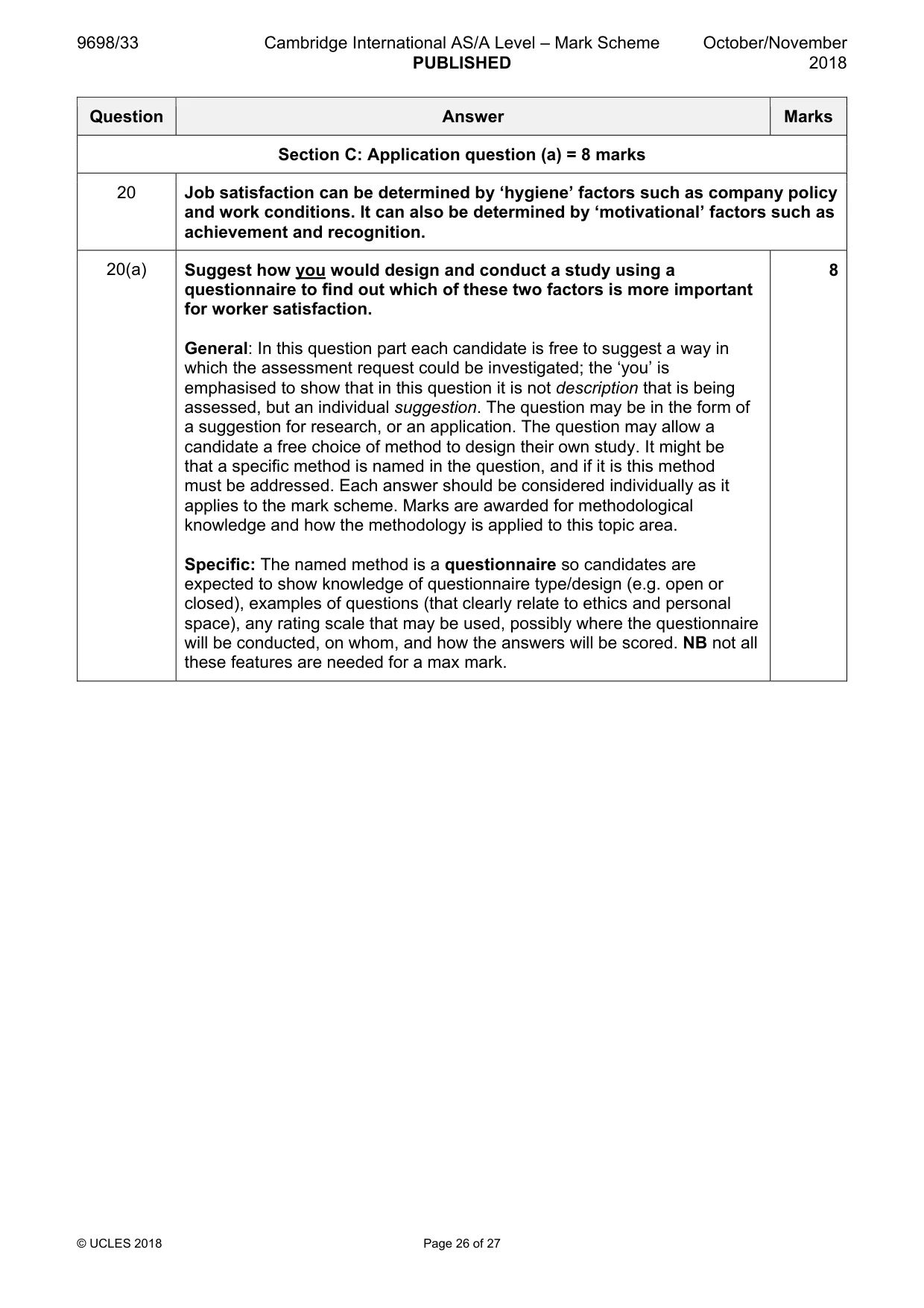
Q20 · Job satisfaction can be determined by ‘hygiene’ factors such as company policy and work…
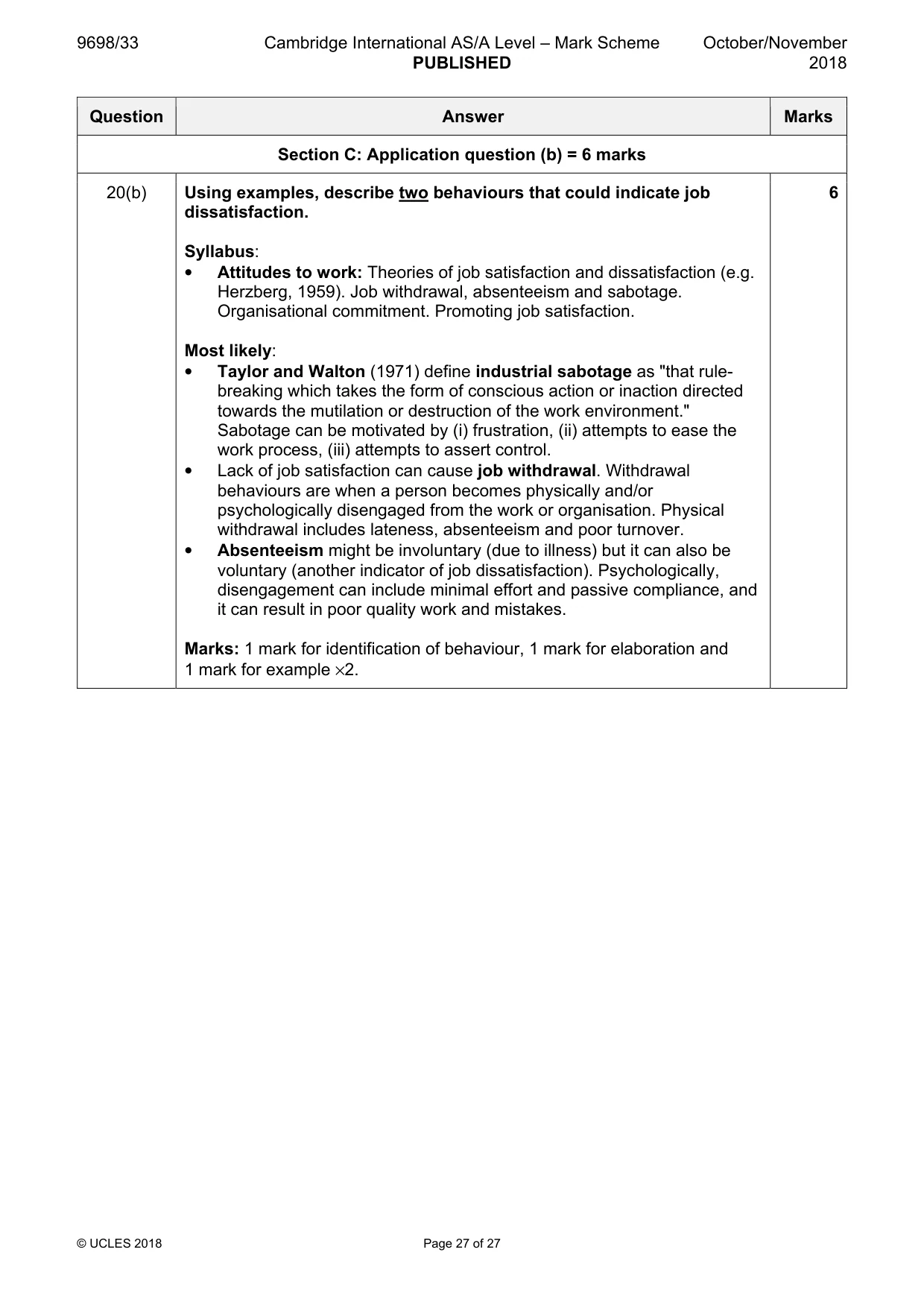
20 Job satisfaction can be determined by ‘hygiene’ factors such as company policy and work conditions. It can also be determined by ‘motivational’ factors such as achievement and recognition. (a) Suggest how you would design and conduct a study using a questionnaire to find out which of these factors is more important for worker satisfaction. [8] (b) Using examples, describe two behaviours that could indicate job dissatisfaction. [6]
Mark scheme: 20(a) Suggest how you would design and conduct a study using a 8 questionnaire to find out which of these two factors is more important for worker satisfaction. General: In this question part each candidate is free to suggest a way in which the assessment request could be investigated; the ‘you’ is emphasised to show that in this question it is not description that is being assessed, but an individual suggestion. The question may be in the form of a suggestion for research, or an application. The question may allow a candidate a free choice of method to design their own study. It might be that a specific method is named in the question, and if it is this method must be addressed. Each answer should be considered individually as it applies to the mark scheme. Marks are awarded for methodological knowledge and how the methodology is applied to this topic area. Specific: The named method is a questionnaire so candidates are expected to show knowledge of questionnaire type/design (e.g. open or closed), examples of questions (that clearly relate to ethics and personal space), any rating scale that may be used, possibly where the questionnaire will be conducted, on whom, and how the answers will be scored. NB not all these features are needed for a max mark. Section C: Application question (b) = 6 marks 20(b) Using examples, describe two behaviours that could indicate job 6 dissatisfaction. Syllabus: • Attitudes to work: Theories of job satisfaction and dissatisfaction (e.g. Herzberg, 1959). Job withdrawal, absenteeism and sabotage. Organisational commitment. Promoting job satisfaction. Most likely: • Taylor and Walton (1971) define industrial sabotage as "that rule- breaking which takes the form of conscious action or inaction directed towards the mutilation or destruction of the work environment." Sabotage can be motivated by (i) frustration, (ii) attempts to ease the work process, (iii) attempts to assert control. • Lack of job satisfaction can cause job withdrawal. Withdrawal behaviours are when a person becomes physically and/or psychologically disengaged from the work or organisation. Physical withdrawal includes lateness, absenteeism and poor turnover. • Absenteeism might be involuntary (due to illness) but it can also be voluntary (another indicator of job dissatisfaction). Psychologically, disengagement can include minimal effort and passive compliance, and it can result in poor quality work and mistakes. Marks: 1 mark for identification of behaviour, 1 mark for elaboration and 1 mark for example ×2.
What you needed in this session
Cambridge’s own grade thresholds for 2018 Oct/Nov, Paper 3 · Variant 3. A higher threshold means an easier paper — the bar moves with how the cohort did.