Cambridge A Level Psychology 9698 — 2017 Oct/Nov Paper 3 · Variant 1
9698/31/O/N/17 · 80 marks · ≈90 min
The question paper and its mark scheme, free to read here and free to download. This is Cambridge’s own paper, exactly as it was sat.
Question paper8 pages


Mark scheme26 pages
Answers below. Sit the paper first if you are practising.
Paper as text
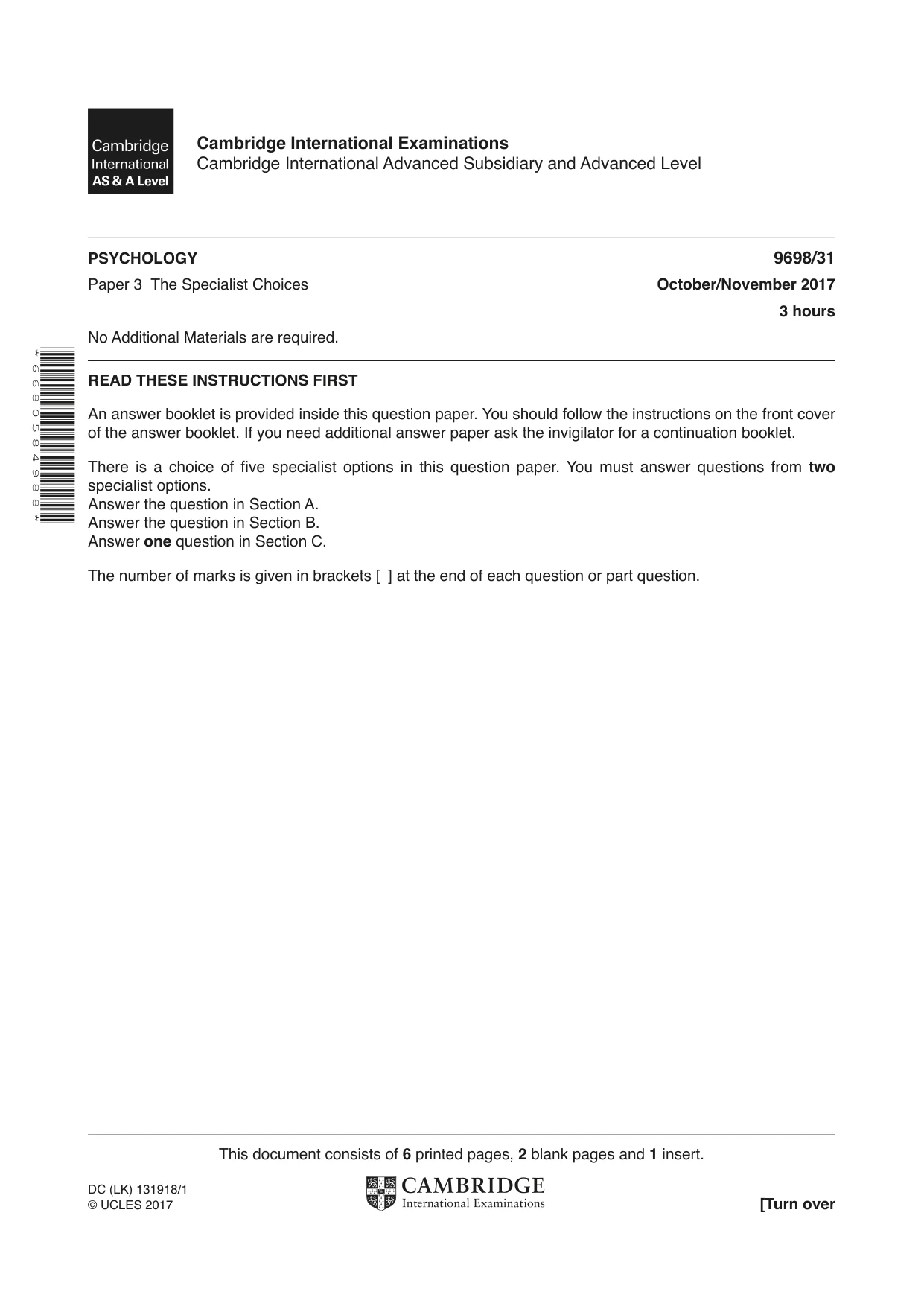
Question paper, page 1
This document consists of 6 printed pages, 2 blank pages and 1 insert. DC (LK) 131918/1 © UCLES 2017 [Turn over Cambridge International Examinations Cambridge International Advanced Subsidiary and Advanced Level * 6 6 8 0 5 8 4 9 8 8 * PSYCHOLOGY 9698/31 Paper 3 The Specialist Choices October/November 2017 3 hours No Additional Materials are required. READ THESE INSTRUCTIONS FIRST An answer booklet is provided inside this question paper. You should follow the instructions on the front cover of the answer booklet. If you need additional answer paper ask the invigilator for a continuation booklet. There is a choice of five specialist options in this question paper. You must answer questions from two specialist options. Answer the question in Section A. Answer the question in Section B. Answer one question in Section C. The number of marks is given in brackets [ ] at the end of each question or part question.
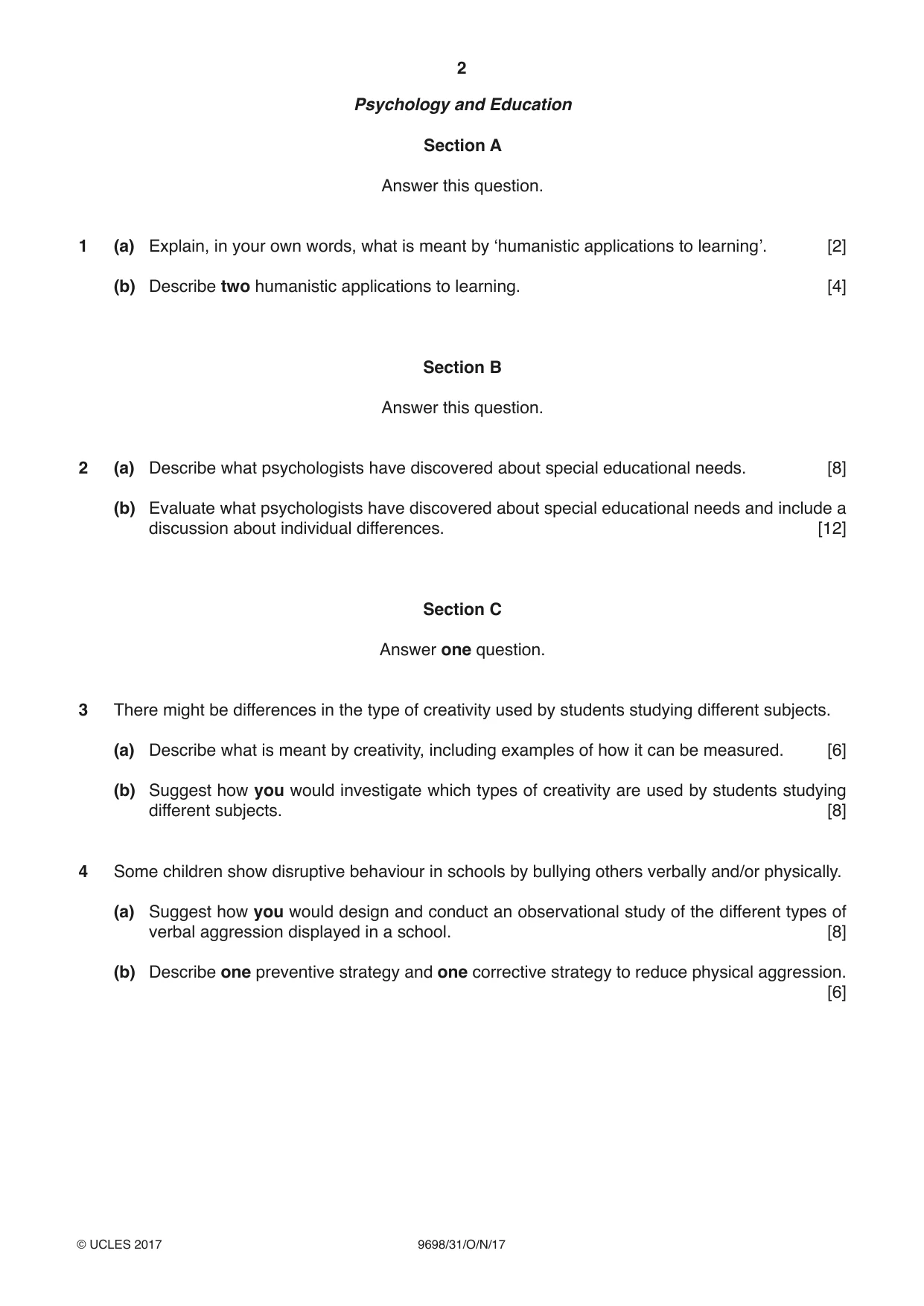
Question paper, page 2
2 9698/31/O/N/17 © UCLES 2017 Psychology and Education Section A Answer this question. 1 (a) Explain, in your own words, what is meant by ‘humanistic applications to learning’. [2] (b) Describe two humanistic applications to learning. [4] Section B Answer this question. 2 (a) Describe what psychologists have discovered about special educational needs. [8] (b) Evaluate what psychologists have discovered about special educational needs and include a discussion about individual differences. [12] Section C Answer one question. 3 There might be differences in the type of creativity used by students studying different subjects. (a) Describe what is meant by creativity, including examples of how it can be measured. [6] (b) Suggest how you would investigate which types of creativity are used by students studying different subjects. [8] 4 Some children show disruptive behaviour in schools by bullying others verbally and/or physically. (a) Suggest how you would design and conduct an observational study of the different types of verbal aggression displayed in a school. [8] (b) Describe one preventive strategy and one corrective strategy to reduce physical aggression. [6]
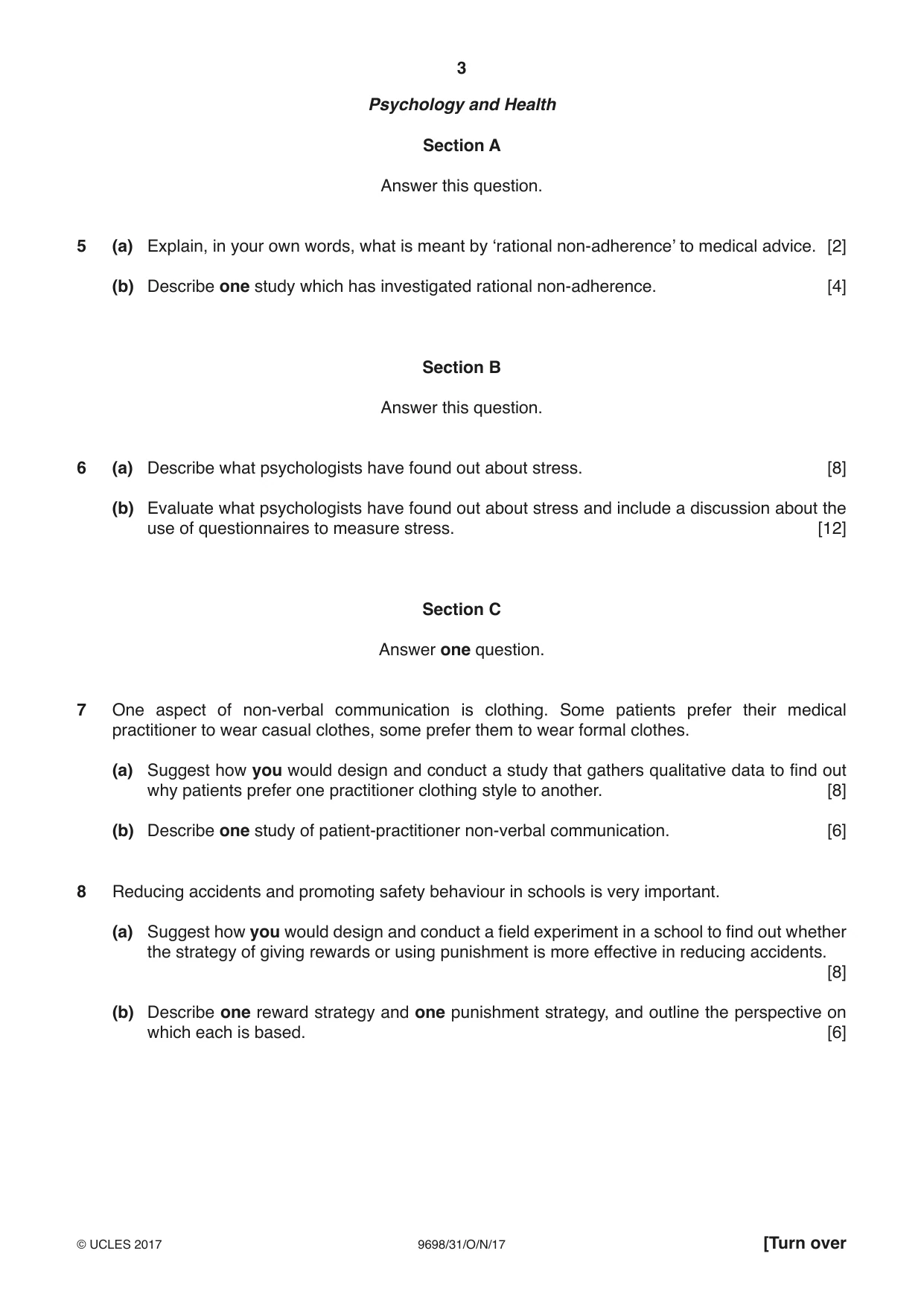
Question paper, page 3
3 9698/31/O/N/17 © UCLES 2017 [Turn over Psychology and Health Section A Answer this question. 5 (a) Explain, in your own words, what is meant by ‘rational non-adherence’ to medical advice. [2] (b) Describe one study which has investigated rational non-adherence. [4] Section B Answer this question. 6 (a) Describe what psychologists have found out about stress. [8] (b) Evaluate what psychologists have found out about stress and include a discussion about the use of questionnaires to measure stress. [12] Section C Answer one question. 7 One aspect of non-verbal communication is clothing. Some patients prefer their medical practitioner to wear casual clothes, some prefer them to wear formal clothes. (a) Suggest how you would design and conduct a study that gathers qualitative data to find out why patients prefer one practitioner clothing style to another. [8] (b) Describe one study of patient-practitioner non-verbal communication. [6] 8 Reducing accidents and promoting safety behaviour in schools is very important. (a) Suggest how you would design and conduct a field experiment in a school to find out whether the strategy of giving rewards or using punishment is more effective in reducing accidents. [8] (b) Describe one reward strategy and one punishment strategy, and outline the perspective on which each is based. [6]
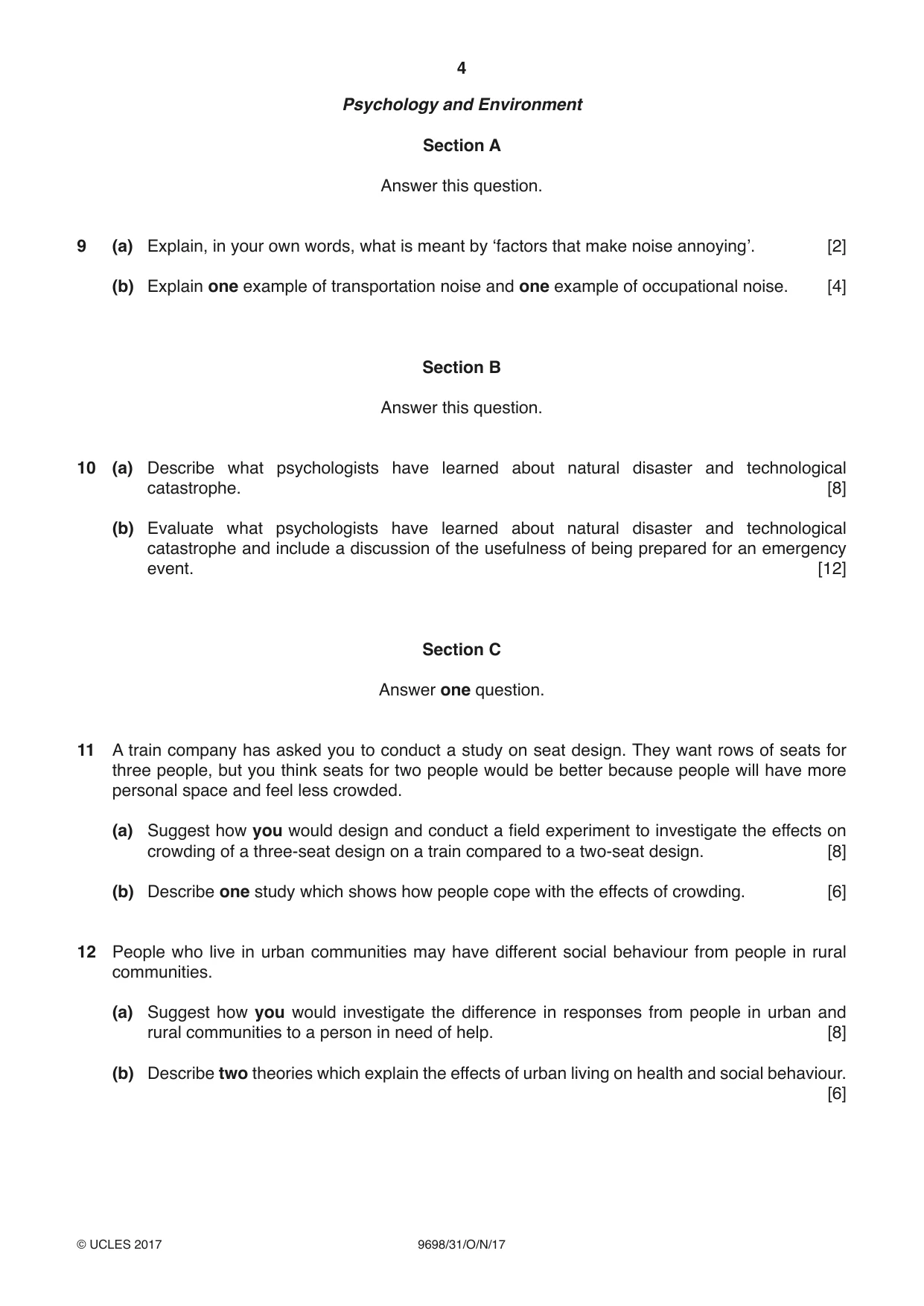
Question paper, page 4
4 9698/31/O/N/17 © UCLES 2017 Psychology and Environment Section A Answer this question. 9 (a) Explain, in your own words, what is meant by ‘factors that make noise annoying’. [2] (b) Explain one example of transportation noise and one example of occupational noise. [4] Section B Answer this question. 10 (a) Describe what psychologists have learned about natural disaster and technological catastrophe. [8] (b) Evaluate what psychologists have learned about natural disaster and technological catastrophe and include a discussion of the usefulness of being prepared for an emergency event. [12] Section C Answer one question. 11 A train company has asked you to conduct a study on seat design. They want rows of seats for three people, but you think seats for two people would be better because people will have more personal space and feel less crowded. (a) Suggest how you would design and conduct a field experiment to investigate the effects on crowding of a three-seat design on a train compared to a two-seat design. [8] (b) Describe one study which shows how people cope with the effects of crowding. [6] 12 People who live in urban communities may have different social behaviour from people in rural communities. (a) Suggest how you would investigate the difference in responses from people in urban and rural communities to a person in need of help. [8] (b) Describe two theories which explain the effects of urban living on health and social behaviour. [6]
Question paper, page 5
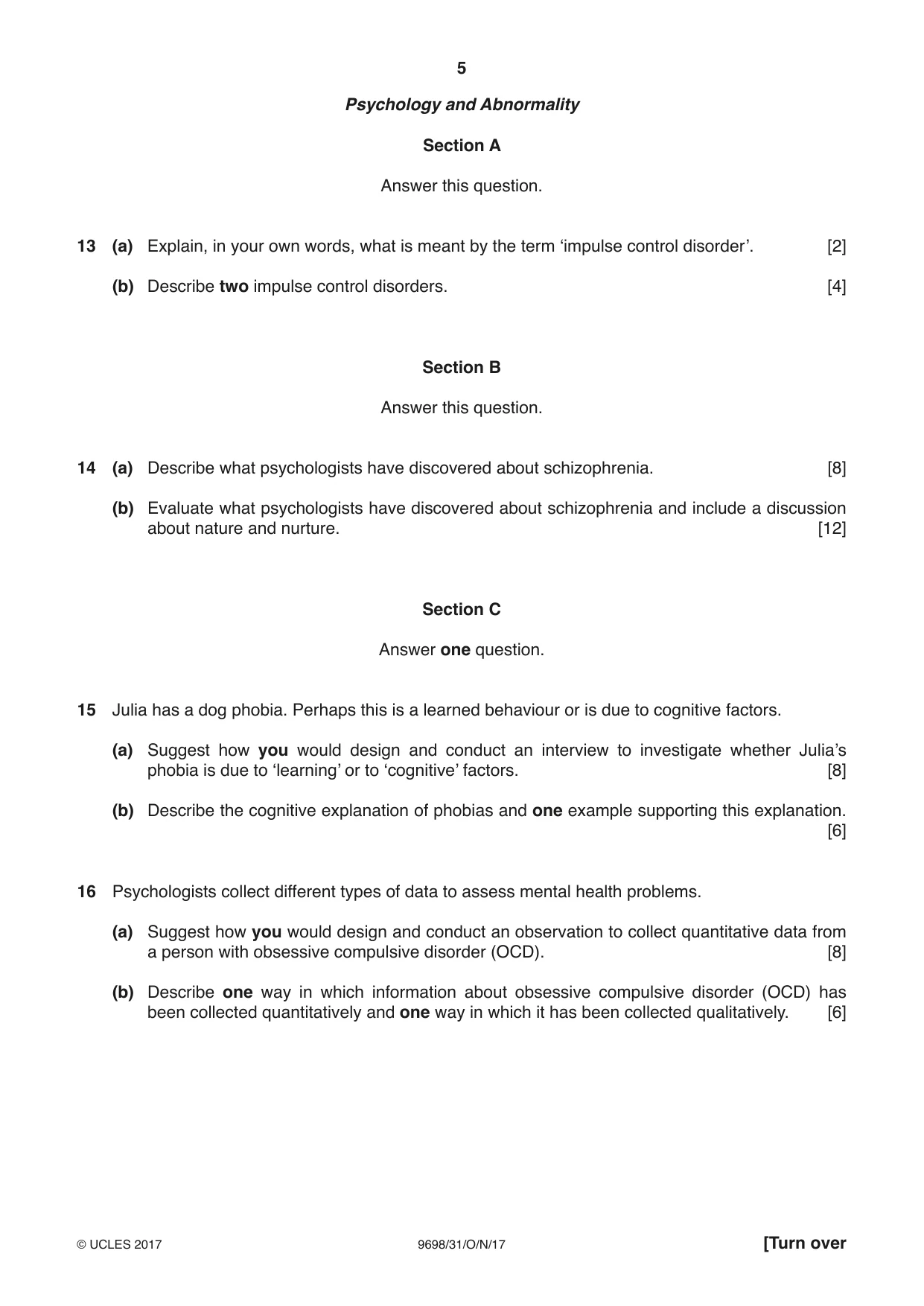
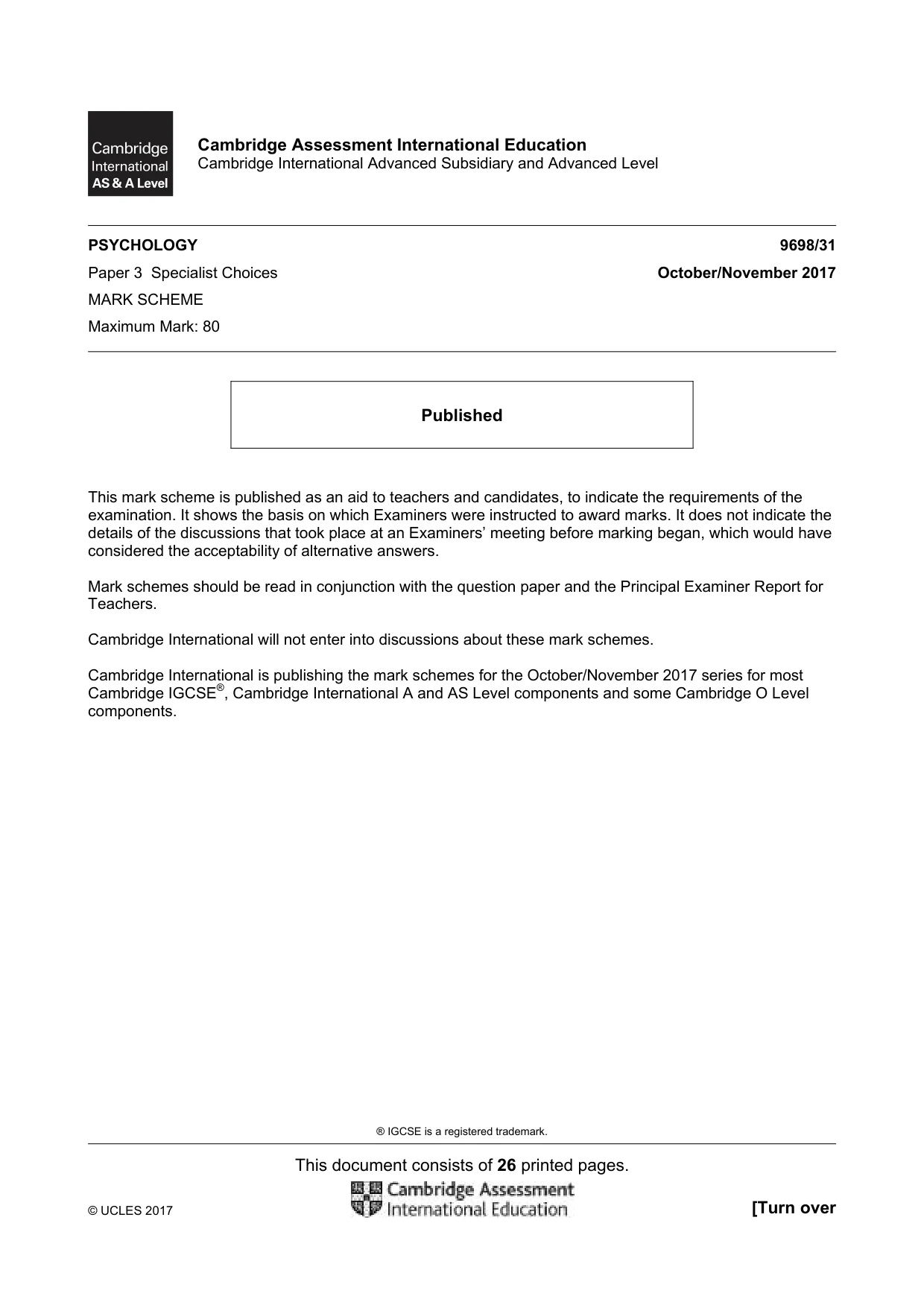
5 9698/31/O/N/17 © UCLES 2017 [Turn over Psychology and Abnormality Section A Answer this question. 13 (a) Explain, in your own words, what is meant by the term ‘impulse control disorder’. [2] (b) Describe two impulse control disorders. [4] Section B Answer this question. 14 (a) Describe what psychologists have discovered about schizophrenia. [8] (b) Evaluate what psychologists have discovered about schizophrenia and include a discussion about nature and nurture. [12] Section C Answer one question. 15 Julia has a dog phobia. Perhaps this is a learned behaviour or is due to cognitive factors. (a) Suggest how you would design and conduct an interview to investigate whether Julia’s phobia is due to ‘learning’ or to ‘cognitive’ factors. [8] (b) Describe the cognitive explanation of phobias and one example supporting this explanation. [6] 16 Psychologists collect different types of data to assess mental health problems. (a) Suggest how you would design and conduct an observation to collect quantitative data from a person with obsessive compulsive disorder (OCD). [8] (b) Describe one way in which information about obsessive compulsive disorder (OCD) has been collected quantitatively and one way in which it has been collected qualitatively. [6]
Question paper, page 6
6 9698/31/O/N/17 © UCLES 2017 Psychology and Organisations Section A Answer this question. 17 (a) Explain, in your own words, what is meant by a ‘contingency theory’ of leadership. [2] (b) Describe Fiedler’s contingency theory of leadership. [4] Section B Answer this question. 18 (a) Describe what psychologists have found out about satisfaction at work. [8] (b) Evaluate what psychologists have found out about satisfaction at work and include a discussion about the use of interviews to measure job satisfaction. [12] Section C Answer one question. 19 The managers at your company are discussing different ways to select new personnel. You are sending out a questionnaire to other companies to see which procedure/model they use for personnel selection. (a) Describe two personnel selection decision-making procedures/models. [6] (b) Suggest how you would design and conduct a questionnaire study to investigate the best personnel selection decision-making procedure/model. [8] 20 McClelland proposed that people are motivated by a ‘need for achievement’. (a) Suggest how you would design and conduct an investigation into ‘need for achievement’ differences in males and females. [8] (b) Describe McClelland’s need theory of achievement motivation. [6]
Question paper, page 7
7 9698/31/O/N/17 © UCLES 2017 BLANK PAGE
Question paper, page 8
8 9698/31/O/N/17 © UCLES 2017 Permission to reproduce items where third-party owned material protected by copyright is included has been sought and cleared where possible. Every reasonable effort has been made by the publisher (UCLES) to trace copyright holders, but if any items requiring clearance have unwittingly been included, the publisher will be pleased to make amends at the earliest possible opportunity. To avoid the issue of disclosure of answer-related information to candidates, all copyright acknowledgements are reproduced online in the Cambridge International Examinations Copyright Acknowledgements Booklet. This is produced for each series of examinations and is freely available to download at www.cie.org.uk after the live examination series. Cambridge International Examinations is part of the Cambridge Assessment Group. Cambridge Assessment is the brand name of University of Cambridge Local Examinations Syndicate (UCLES), which is itself a department of the University of Cambridge. BLANK PAGE
Mark scheme, page 1
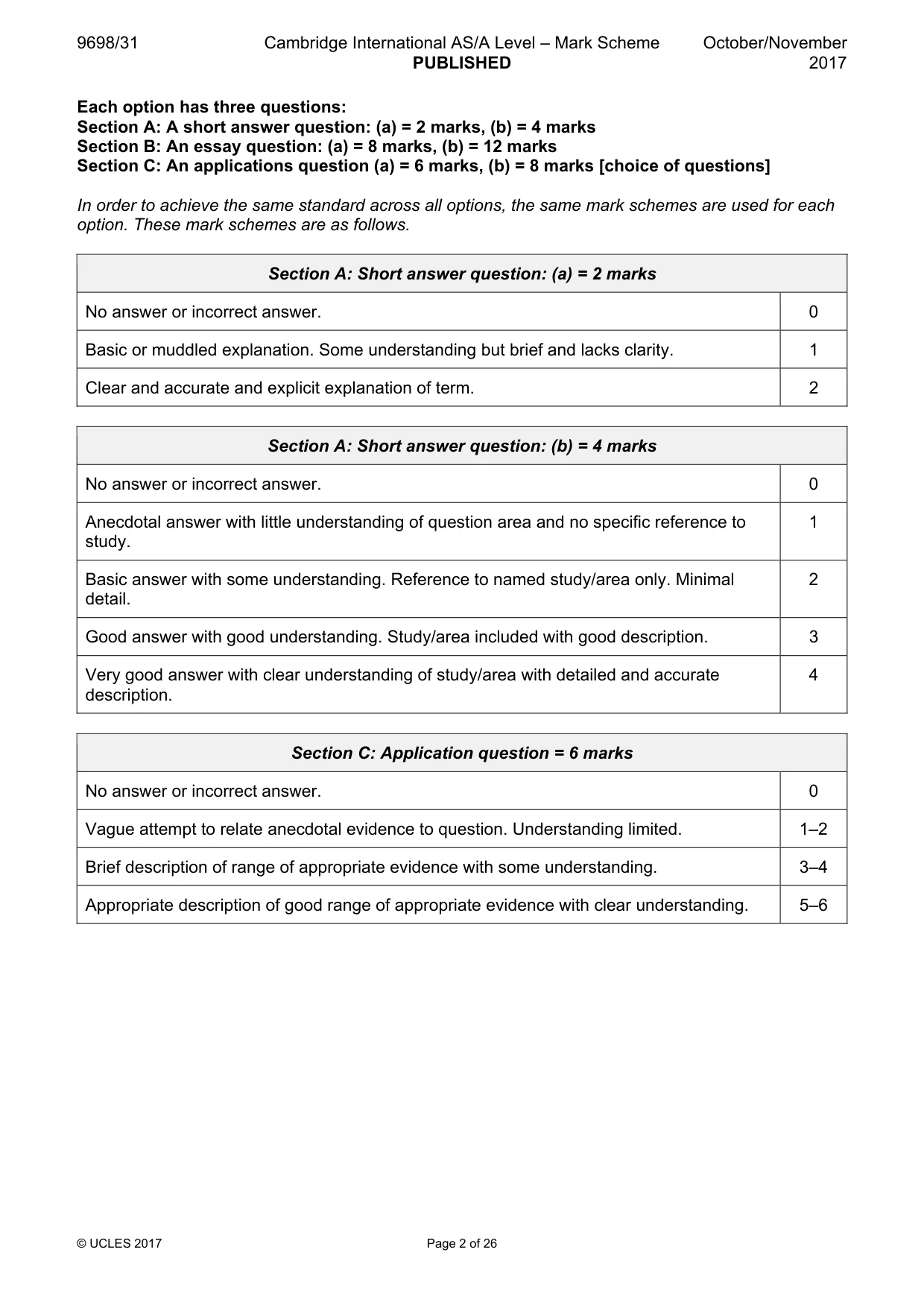
® IGCSE is a registered trademark. This document consists of 26 printed pages. © UCLES 2017 [Turn over Cambridge Assessment International Education Cambridge International Advanced Subsidiary and Advanced Level PSYCHOLOGY 9698/31 Paper 3 Specialist Choices October/November 2017 MARK SCHEME Maximum Mark: 80 Published This mark scheme is published as an aid to teachers and candidates, to indicate the requirements of the examination. It shows the basis on which Examiners were instructed to award marks. It does not indicate the details of the discussions that took place at an Examiners’ meeting before marking began, which would have considered the acceptability of alternative answers. Mark schemes should be read in conjunction with the question paper and the Principal Examiner Report for Teachers. Cambridge International will not enter into discussions about these mark schemes. Cambridge International is publishing the mark schemes for the October/November 2017 series for most Cambridge IGCSE®, Cambridge International A and AS Level components and some Cambridge O Level components.
Mark scheme, page 2
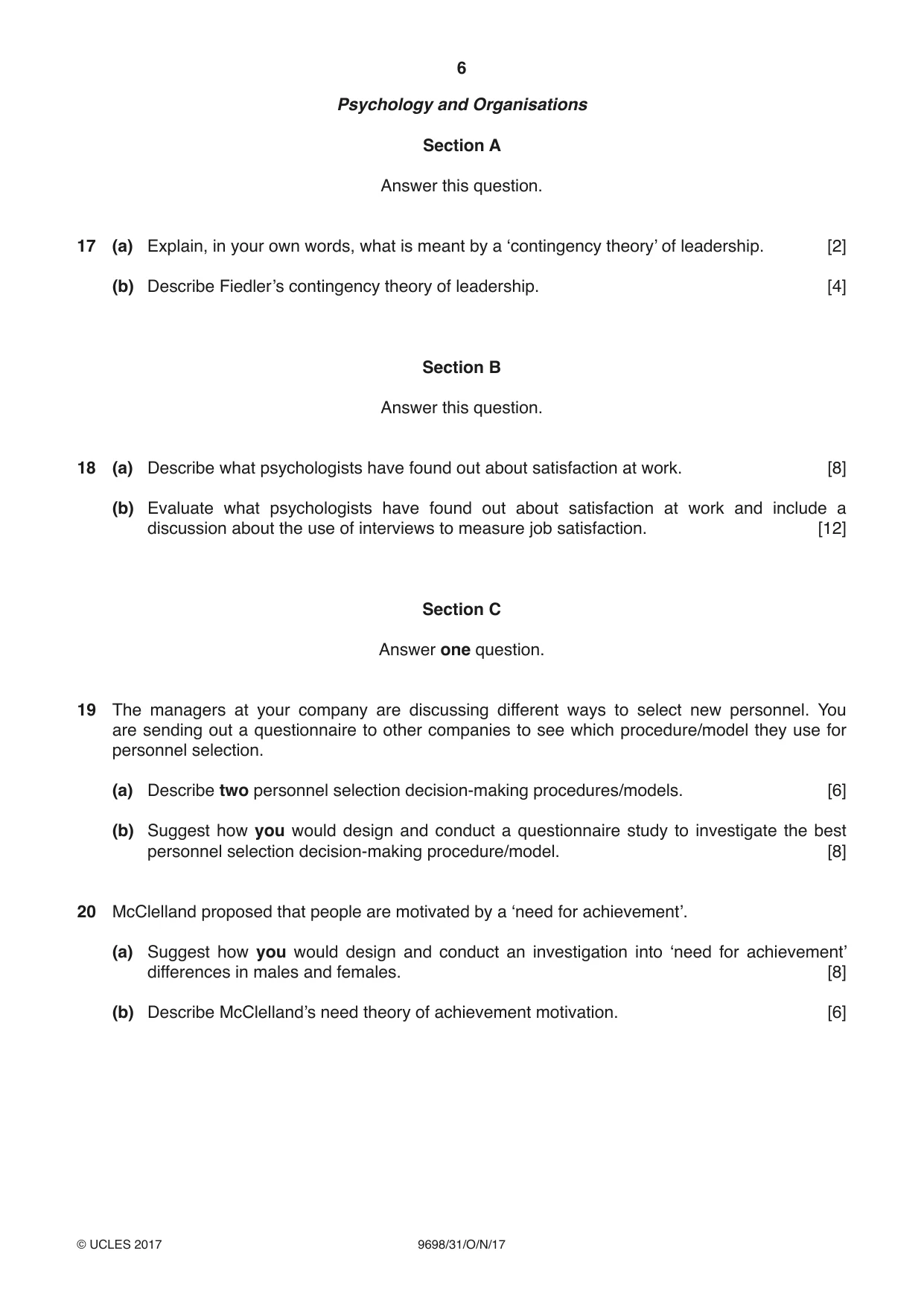
9698/31 Cambridge International AS/A Level – Mark Scheme PUBLISHED October/November 2017 © UCLES 2017 Page 2 of 26 Each option has three questions: Section A: A short answer question: (a) = 2 marks, (b) = 4 marks Section B: An essay question: (a) = 8 marks, (b) = 12 marks Section C: An applications question (a) = 6 marks, (b) = 8 marks [choice of questions] In order to achieve the same standard across all options, the same mark schemes are used for each option. These mark schemes are as follows. Section A: Short answer question: (a) = 2 marks No answer or incorrect answer. 0 Basic or muddled explanation. Some understanding but brief and lacks clarity. 1 Clear and accurate and explicit explanation of term. 2 Section A: Short answer question: (b) = 4 marks No answer or incorrect answer. 0 Anecdotal answer with little understanding of question area and no specific reference to study. 1 Basic answer with some understanding. Reference to named study/area only. Minimal detail. 2 Good answer with good understanding. Study/area included with good description. 3 Very good answer with clear understanding of study/area with detailed and accurate description. 4 Section C: Application question = 6 marks No answer or incorrect answer. 0 Vague attempt to relate anecdotal evidence to question. Understanding limited. 1–2 Brief description of range of appropriate evidence with some understanding. 3–4 Appropriate description of good range of appropriate evidence with clear understanding. 5–6
Mark scheme, page 3
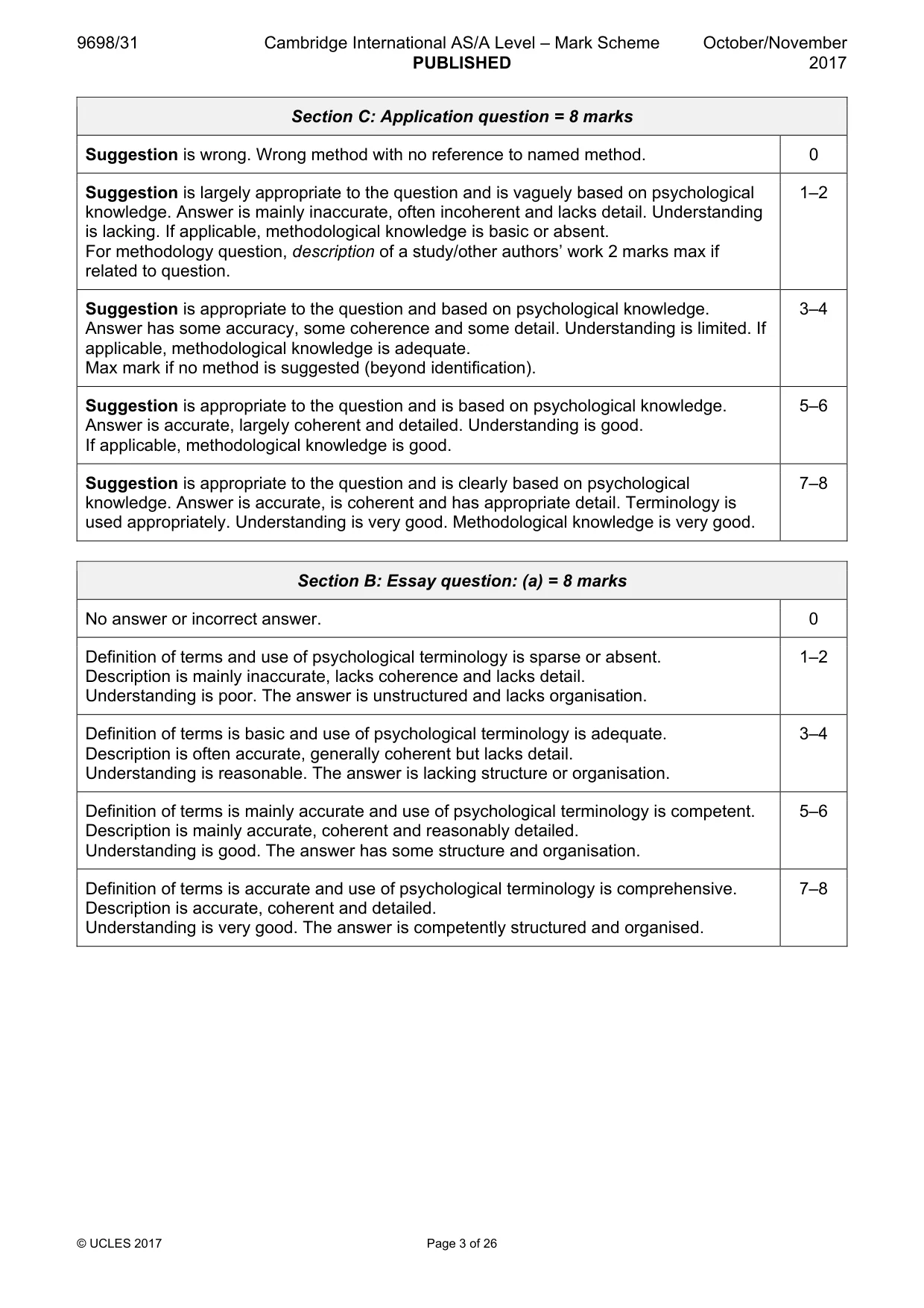
9698/31 Cambridge International AS/A Level – Mark Scheme PUBLISHED October/November 2017 © UCLES 2017 Page 3 of 26 Section C: Application question = 8 marks Suggestion is wrong. Wrong method with no reference to named method. 0 Suggestion is largely appropriate to the question and is vaguely based on psychological knowledge. Answer is mainly inaccurate, often incoherent and lacks detail. Understanding is lacking. If applicable, methodological knowledge is basic or absent. For methodology question, description of a study/other authors’ work 2 marks max if related to question. 1–2 Suggestion is appropriate to the question and based on psychological knowledge. Answer has some accuracy, some coherence and some detail. Understanding is limited. If applicable, methodological knowledge is adequate. Max mark if no method is suggested (beyond identification). 3–4 Suggestion is appropriate to the question and is based on psychological knowledge. Answer is accurate, largely coherent and detailed. Understanding is good. If applicable, methodological knowledge is good. 5–6 Suggestion is appropriate to the question and is clearly based on psychological knowledge. Answer is accurate, is coherent and has appropriate detail. Terminology is used appropriately. Understanding is very good. Methodological knowledge is very good. 7–8 Section B: Essay question: (a) = 8 marks No answer or incorrect answer. 0 Definition of terms and use of psychological terminology is sparse or absent. Description is mainly inaccurate, lacks coherence and lacks detail. Understanding is poor. The answer is unstructured and lacks organisation. 1–2 Definition of terms is basic and use of psychological terminology is adequate. Description is often accurate, generally coherent but lacks detail. Understanding is reasonable. The answer is lacking structure or organisation. 3–4 Definition of terms is mainly accurate and use of psychological terminology is competent. Description is mainly accurate, coherent and reasonably detailed. Understanding is good. The answer has some structure and organisation. 5–6 Definition of terms is accurate and use of psychological terminology is comprehensive. Description is accurate, coherent and detailed. Understanding is very good. The answer is competently structured and organised. 7–8
Mark scheme, page 4
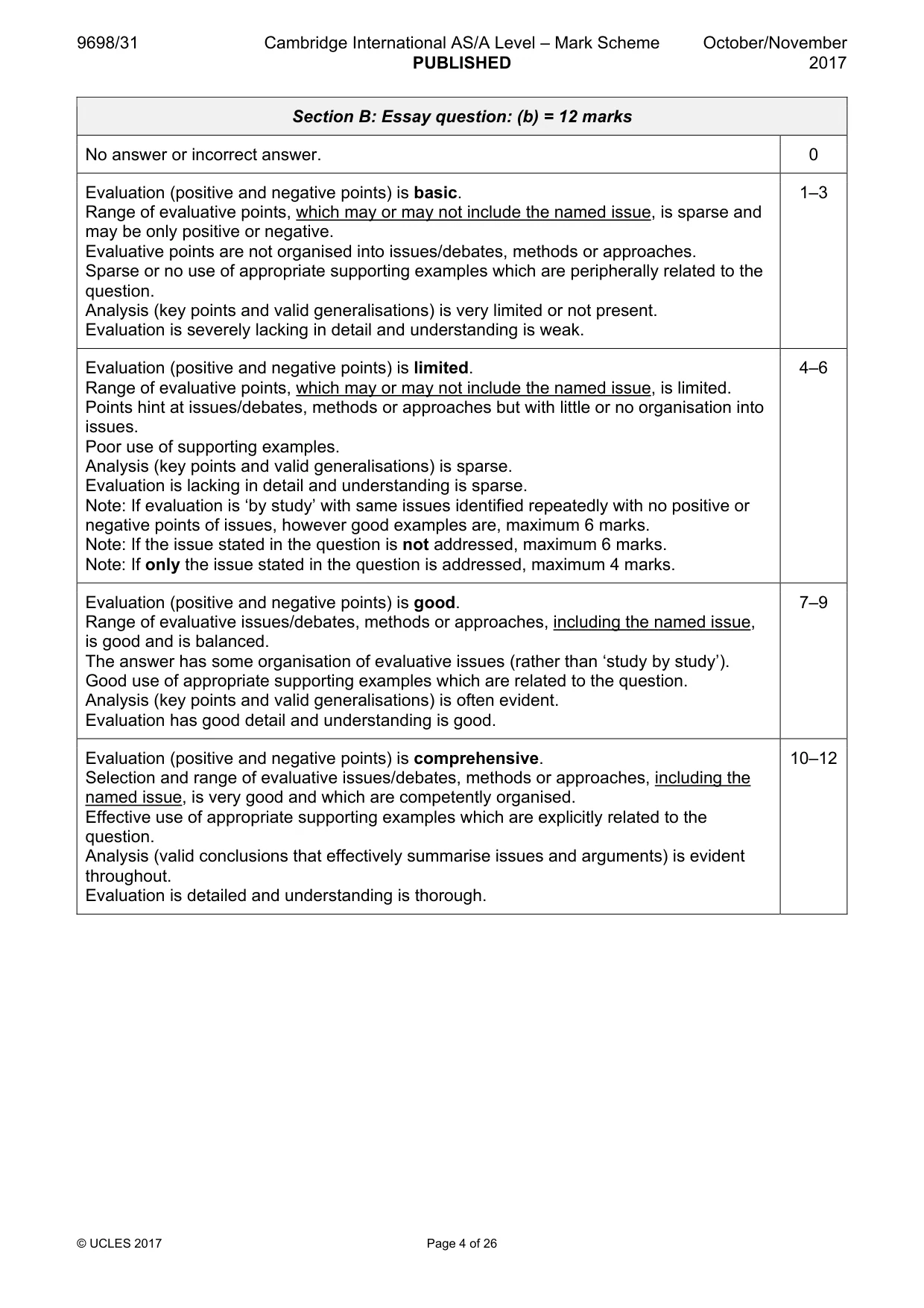
9698/31 Cambridge International AS/A Level – Mark Scheme PUBLISHED October/November 2017 © UCLES 2017 Page 4 of 26 Section B: Essay question: (b) = 12 marks No answer or incorrect answer. 0 Evaluation (positive and negative points) is basic. Range of evaluative points, which may or may not include the named issue, is sparse and may be only positive or negative. Evaluative points are not organised into issues/debates, methods or approaches. Sparse or no use of appropriate supporting examples which are peripherally related to the question. Analysis (key points and valid generalisations) is very limited or not present. Evaluation is severely lacking in detail and understanding is weak. 1–3 Evaluation (positive and negative points) is limited. Range of evaluative points, which may or may not include the named issue, is limited. Points hint at issues/debates, methods or approaches but with little or no organisation into issues. Poor use of supporting examples. Analysis (key points and valid generalisations) is sparse. Evaluation is lacking in detail and understanding is sparse. Note: If evaluation is ‘by study’ with same issues identified repeatedly with no positive or negative points of issues, however good examples are, maximum 6 marks. Note: If the issue stated in the question is not addressed, maximum 6 marks. Note: If only the issue stated in the question is addressed, maximum 4 marks. 4–6 Evaluation (positive and negative points) is good. Range of evaluative issues/debates, methods or approaches, including the named issue, is good and is balanced. The answer has some organisation of evaluative issues (rather than ‘study by study’). Good use of appropriate supporting examples which are related to the question. Analysis (key points and valid generalisations) is often evident. Evaluation has good detail and understanding is good. 7–9 Evaluation (positive and negative points) is comprehensive. Selection and range of evaluative issues/debates, methods or approaches, including the named issue, is very good and which are competently organised. Effective use of appropriate supporting examples which are explicitly related to the question. Analysis (valid conclusions that effectively summarise issues and arguments) is evident throughout. Evaluation is detailed and understanding is thorough. 10–12
Mark scheme, page 5
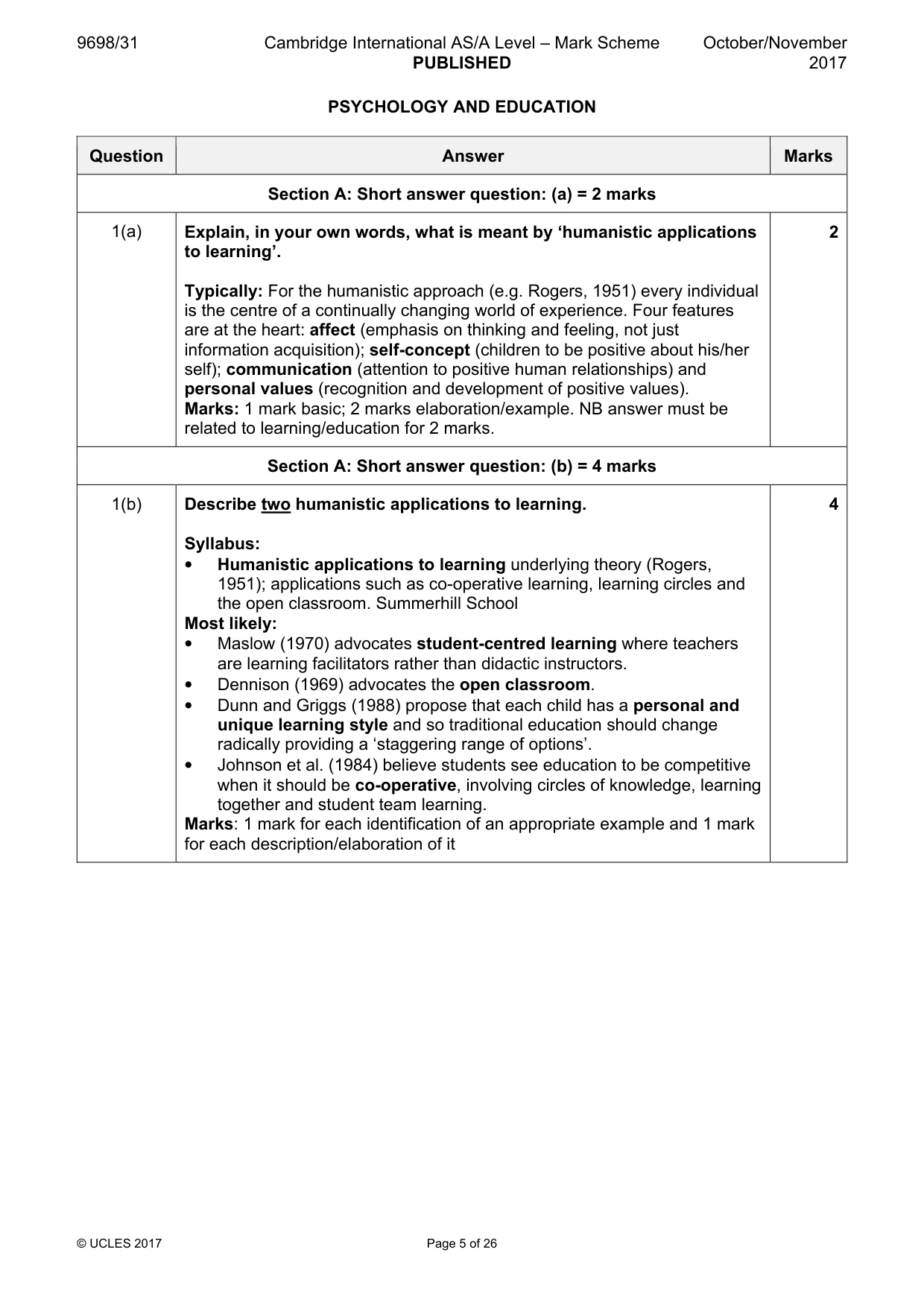
9698/31 Cambridge International AS/A Level – Mark Scheme PUBLISHED October/November 2017 © UCLES 2017 Page 5 of 26 PSYCHOLOGY AND EDUCATION Question Answer Marks Section A: Short answer question: (a) = 2 marks 1(a) Explain, in your own words, what is meant by ‘humanistic applications to learning’. Typically: For the humanistic approach (e.g. Rogers, 1951) every individual is the centre of a continually changing world of experience. Four features are at the heart: affect (emphasis on thinking and feeling, not just information acquisition); self-concept (children to be positive about his/her self); communication (attention to positive human relationships) and personal values (recognition and development of positive values). Marks: 1 mark basic; 2 marks elaboration/example. NB answer must be related to learning/education for 2 marks. 2 Section A: Short answer question: (b) = 4 marks 1(b) Describe two humanistic applications to learning. Syllabus: • Humanistic applications to learning underlying theory (Rogers, 1951); applications such as co-operative learning, learning circles and the open classroom. Summerhill School Most likely: • Maslow (1970) advocates student-centred learning where teachers are learning facilitators rather than didactic instructors. • Dennison (1969) advocates the open classroom. • Dunn and Griggs (1988) propose that each child has a personal and unique learning style and so traditional education should change radically providing a ‘staggering range of options’. • Johnson et al. (1984) believe students see education to be competitive when it should be co-operative, involving circles of knowledge, learning together and student team learning. Marks: 1 mark for each identification of an appropriate example and 1 mark for each description/elaboration of it 4
Mark scheme, page 6
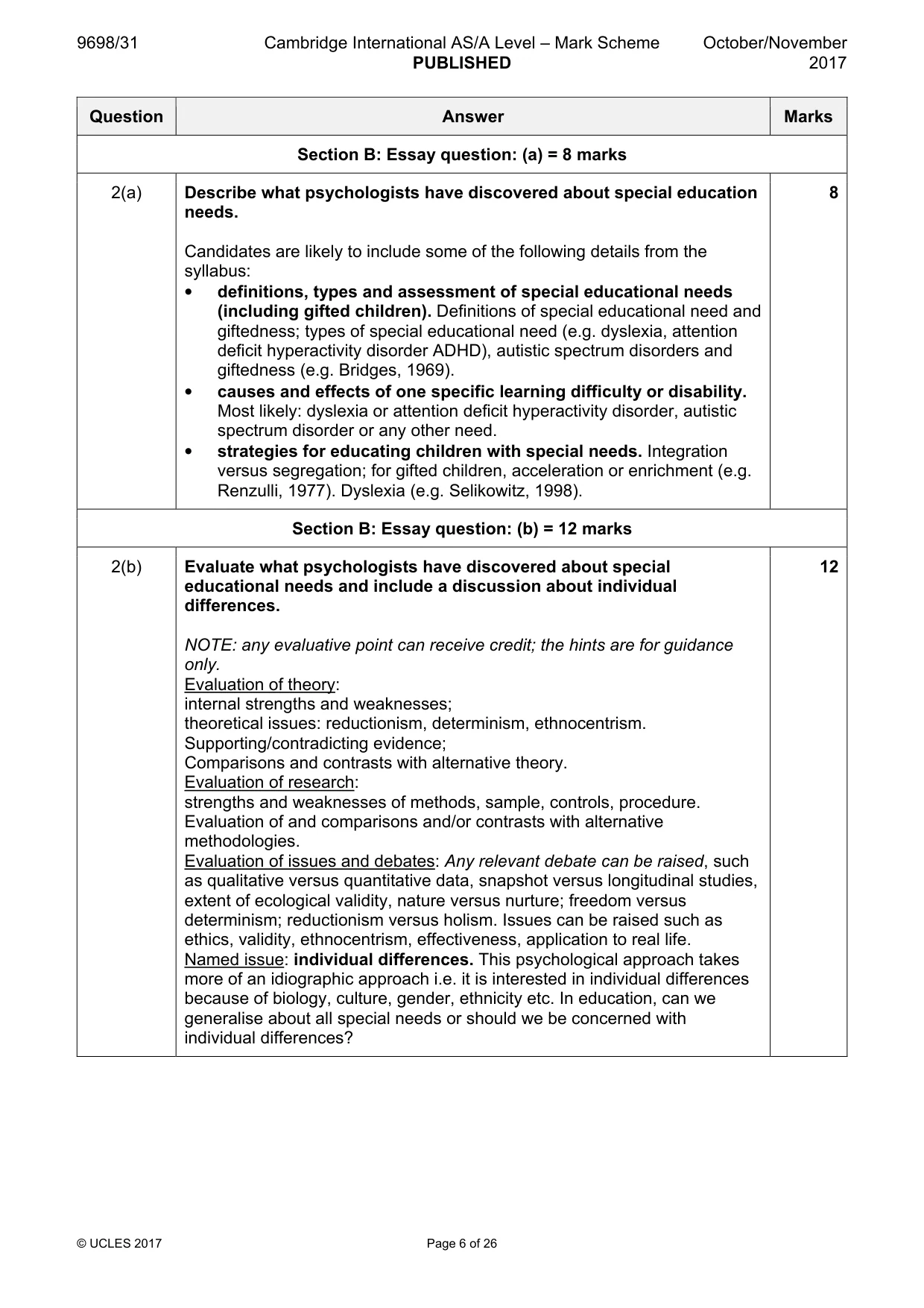
9698/31 Cambridge International AS/A Level – Mark Scheme PUBLISHED October/November 2017 © UCLES 2017 Page 6 of 26 Question Answer Marks Section B: Essay question: (a) = 8 marks 2(a) Describe what psychologists have discovered about special education needs. Candidates are likely to include some of the following details from the syllabus: • definitions, types and assessment of special educational needs (including gifted children). Definitions of special educational need and giftedness; types of special educational need (e.g. dyslexia, attention deficit hyperactivity disorder ADHD), autistic spectrum disorders and giftedness (e.g. Bridges, 1969). • causes and effects of one specific learning difficulty or disability. Most likely: dyslexia or attention deficit hyperactivity disorder, autistic spectrum disorder or any other need. • strategies for educating children with special needs. Integration versus segregation; for gifted children, acceleration or enrichment (e.g. Renzulli, 1977). Dyslexia (e.g. Selikowitz, 1998). 8 Section B: Essay question: (b) = 12 marks 2(b) Evaluate what psychologists have discovered about special educational needs and include a discussion about individual differences. NOTE: any evaluative point can receive credit; the hints are for guidance only. Evaluation of theory: internal strengths and weaknesses; theoretical issues: reductionism, determinism, ethnocentrism. Supporting/contradicting evidence; Comparisons and contrasts with alternative theory. Evaluation of research: strengths and weaknesses of methods, sample, controls, procedure. Evaluation of and comparisons and/or contrasts with alternative methodologies. Evaluation of issues and debates: Any relevant debate can be raised, such as qualitative versus quantitative data, snapshot versus longitudinal studies, extent of ecological validity, nature versus nurture; freedom versus determinism; reductionism versus holism. Issues can be raised such as ethics, validity, ethnocentrism, effectiveness, application to real life. Named issue: individual differences. This psychological approach takes more of an idiographic approach i.e. it is interested in individual differences because of biology, culture, gender, ethnicity etc. In education, can we generalise about all special needs or should we be concerned with individual differences? 12
Mark scheme, page 7
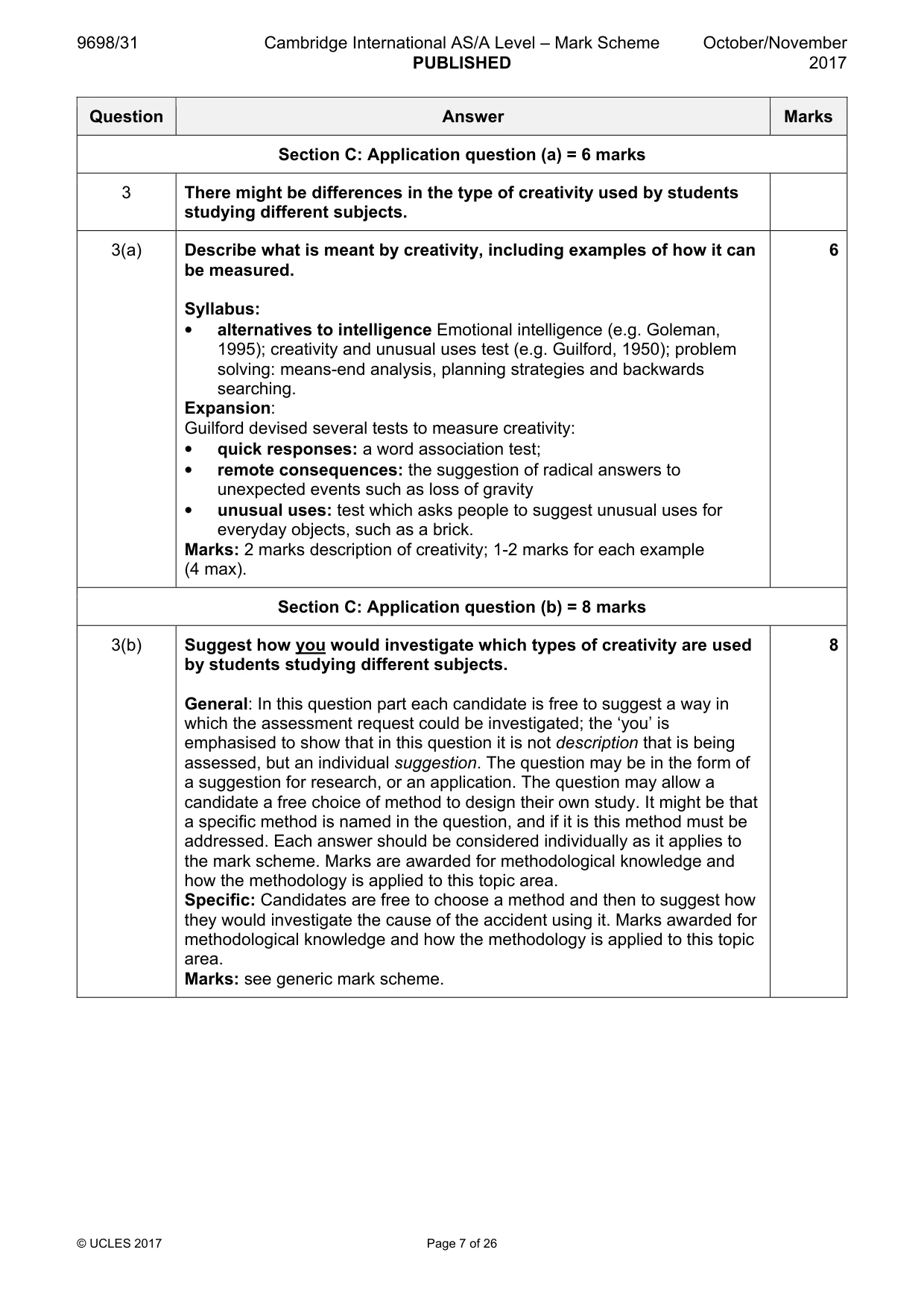
9698/31 Cambridge International AS/A Level – Mark Scheme PUBLISHED October/November 2017 © UCLES 2017 Page 7 of 26 Question Answer Marks Section C: Application question (a) = 6 marks 3 There might be differences in the type of creativity used by students studying different subjects. 3(a) Describe what is meant by creativity, including examples of how it can be measured. Syllabus: • alternatives to intelligence Emotional intelligence (e.g. Goleman, 1995); creativity and unusual uses test (e.g. Guilford, 1950); problem solving: means-end analysis, planning strategies and backwards searching. Expansion: Guilford devised several tests to measure creativity: • quick responses: a word association test; • remote consequences: the suggestion of radical answers to unexpected events such as loss of gravity • unusual uses: test which asks people to suggest unusual uses for everyday objects, such as a brick. Marks: 2 marks description of creativity; 1-2 marks for each example (4 max). 6 Section C: Application question (b) = 8 marks 3(b) Suggest how you would investigate which types of creativity are used by students studying different subjects. General: In this question part each candidate is free to suggest a way in which the assessment request could be investigated; the ‘you’ is emphasised to show that in this question it is not description that is being assessed, but an individual suggestion. The question may be in the form of a suggestion for research, or an application. The question may allow a candidate a free choice of method to design their own study. It might be that a specific method is named in the question, and if it is this method must be addressed. Each answer should be considered individually as it applies to the mark scheme. Marks are awarded for methodological knowledge and how the methodology is applied to this topic area. Specific: Candidates are free to choose a method and then to suggest how they would investigate the cause of the accident using it. Marks awarded for methodological knowledge and how the methodology is applied to this topic area. Marks: see generic mark scheme. 8
Mark scheme, page 8
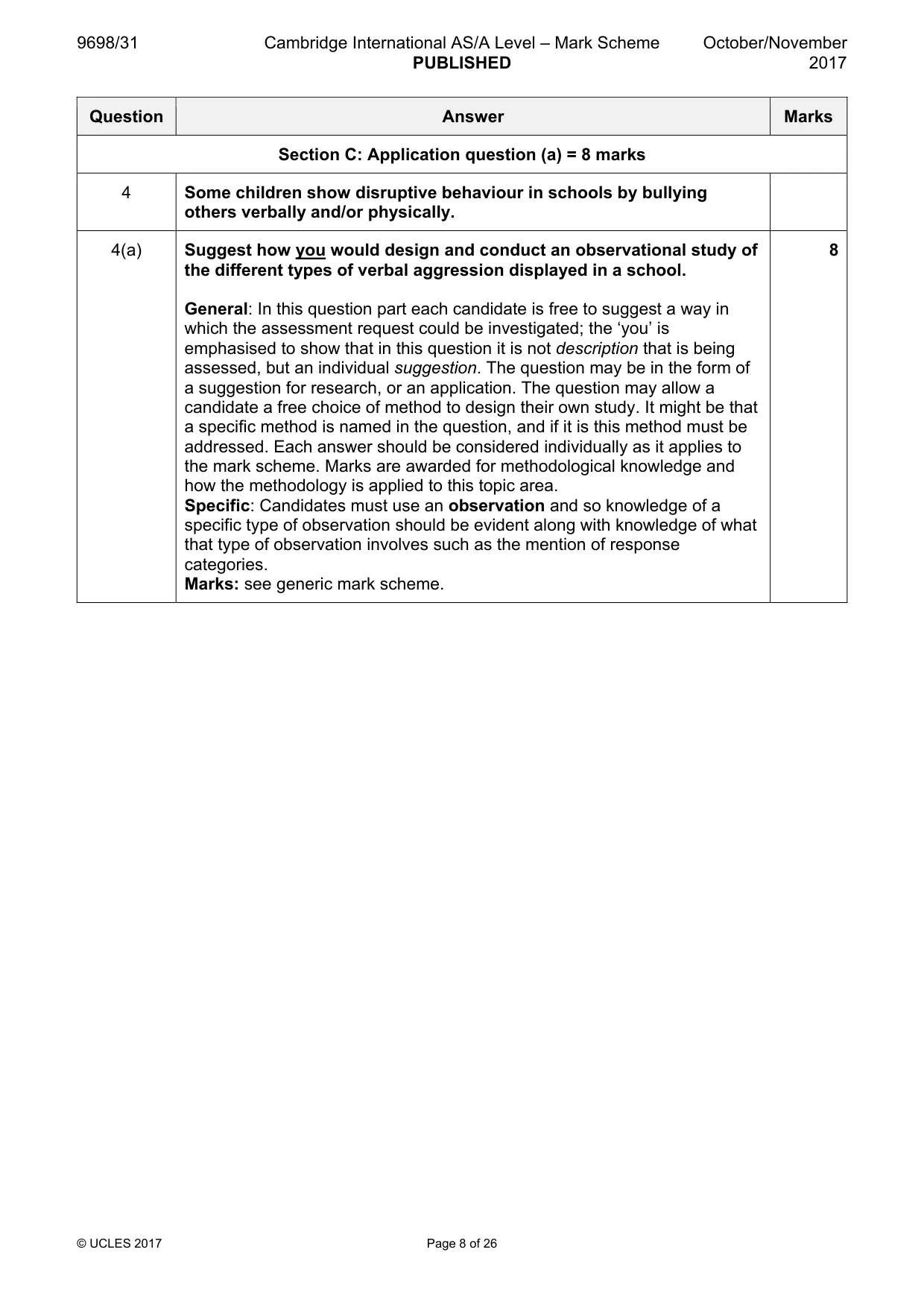
9698/31 Cambridge International AS/A Level – Mark Scheme PUBLISHED October/November 2017 © UCLES 2017 Page 8 of 26 Question Answer Marks Section C: Application question (a) = 8 marks 4 Some children show disruptive behaviour in schools by bullying others verbally and/or physically. 4(a) Suggest how you would design and conduct an observational study of the different types of verbal aggression displayed in a school. General: In this question part each candidate is free to suggest a way in which the assessment request could be investigated; the ‘you’ is emphasised to show that in this question it is not description that is being assessed, but an individual suggestion. The question may be in the form of a suggestion for research, or an application. The question may allow a candidate a free choice of method to design their own study. It might be that a specific method is named in the question, and if it is this method must be addressed. Each answer should be considered individually as it applies to the mark scheme. Marks are awarded for methodological knowledge and how the methodology is applied to this topic area. Specific: Candidates must use an observation and so knowledge of a specific type of observation should be evident along with knowledge of what that type of observation involves such as the mention of response categories. Marks: see generic mark scheme. 8
Mark scheme, page 9
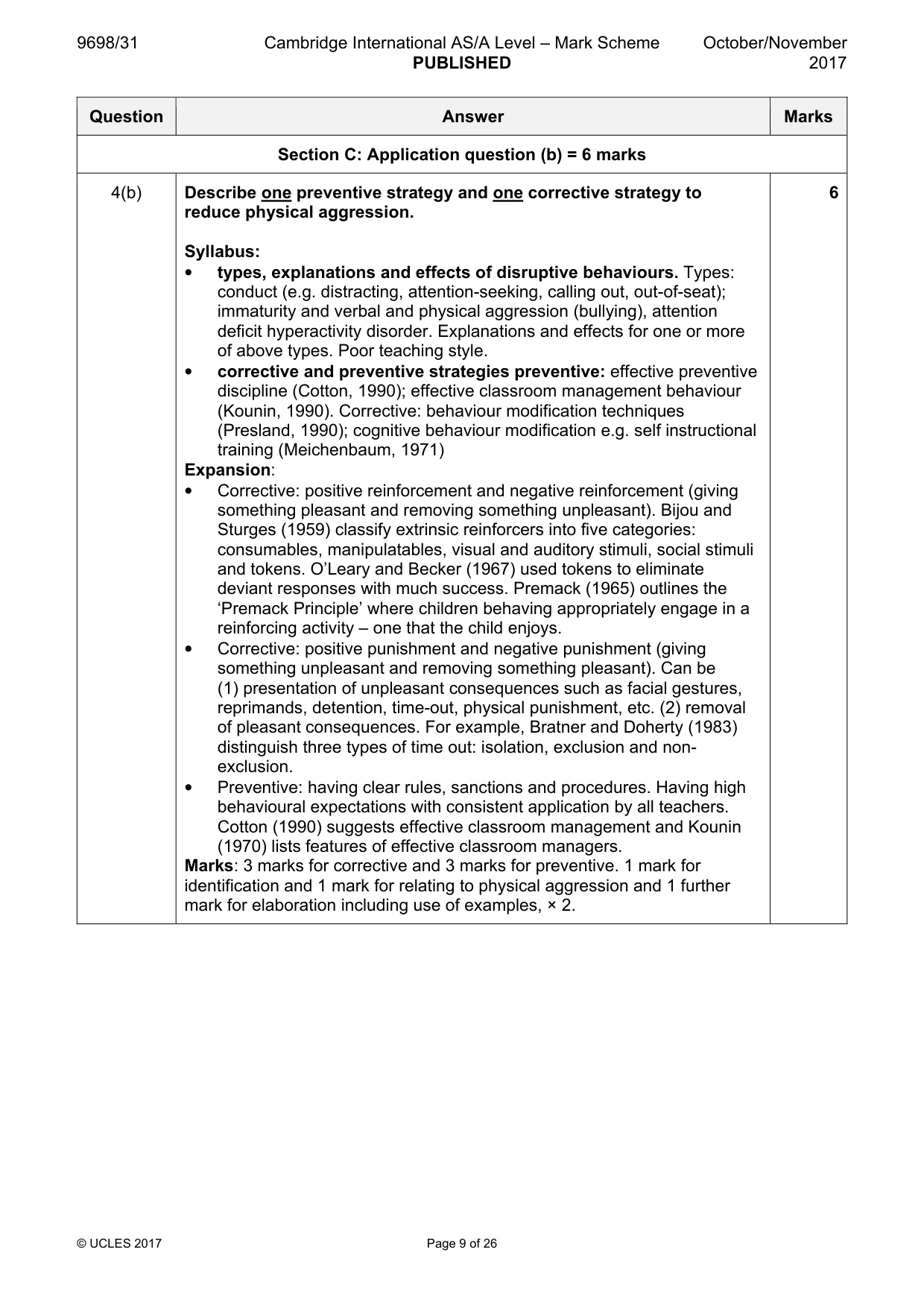
9698/31 Cambridge International AS/A Level – Mark Scheme PUBLISHED October/November 2017 © UCLES 2017 Page 9 of 26 Question Answer Marks Section C: Application question (b) = 6 marks 4(b) Describe one preventive strategy and one corrective strategy to reduce physical aggression. Syllabus: • types, explanations and effects of disruptive behaviours. Types: conduct (e.g. distracting, attention-seeking, calling out, out-of-seat); immaturity and verbal and physical aggression (bullying), attention deficit hyperactivity disorder. Explanations and effects for one or more of above types. Poor teaching style. • corrective and preventive strategies preventive: effective preventive discipline (Cotton, 1990); effective classroom management behaviour (Kounin, 1990). Corrective: behaviour modification techniques (Presland, 1990); cognitive behaviour modification e.g. self instructional training (Meichenbaum, 1971) Expansion: • Corrective: positive reinforcement and negative reinforcement (giving something pleasant and removing something unpleasant). Bijou and Sturges (1959) classify extrinsic reinforcers into five categories: consumables, manipulatables, visual and auditory stimuli, social stimuli and tokens. O’Leary and Becker (1967) used tokens to eliminate deviant responses with much success. Premack (1965) outlines the ‘Premack Principle’ where children behaving appropriately engage in a reinforcing activity – one that the child enjoys. • Corrective: positive punishment and negative punishment (giving something unpleasant and removing something pleasant). Can be (1) presentation of unpleasant consequences such as facial gestures, reprimands, detention, time-out, physical punishment, etc. (2) removal of pleasant consequences. For example, Bratner and Doherty (1983) distinguish three types of time out: isolation, exclusion and non- exclusion. • Preventive: having clear rules, sanctions and procedures. Having high behavioural expectations with consistent application by all teachers. Cotton (1990) suggests effective classroom management and Kounin (1970) lists features of effective classroom managers. Marks: 3 marks for corrective and 3 marks for preventive. 1 mark for identification and 1 mark for relating to physical aggression and 1 further mark for elaboration including use of examples, × 2. 6
Mark scheme, page 10
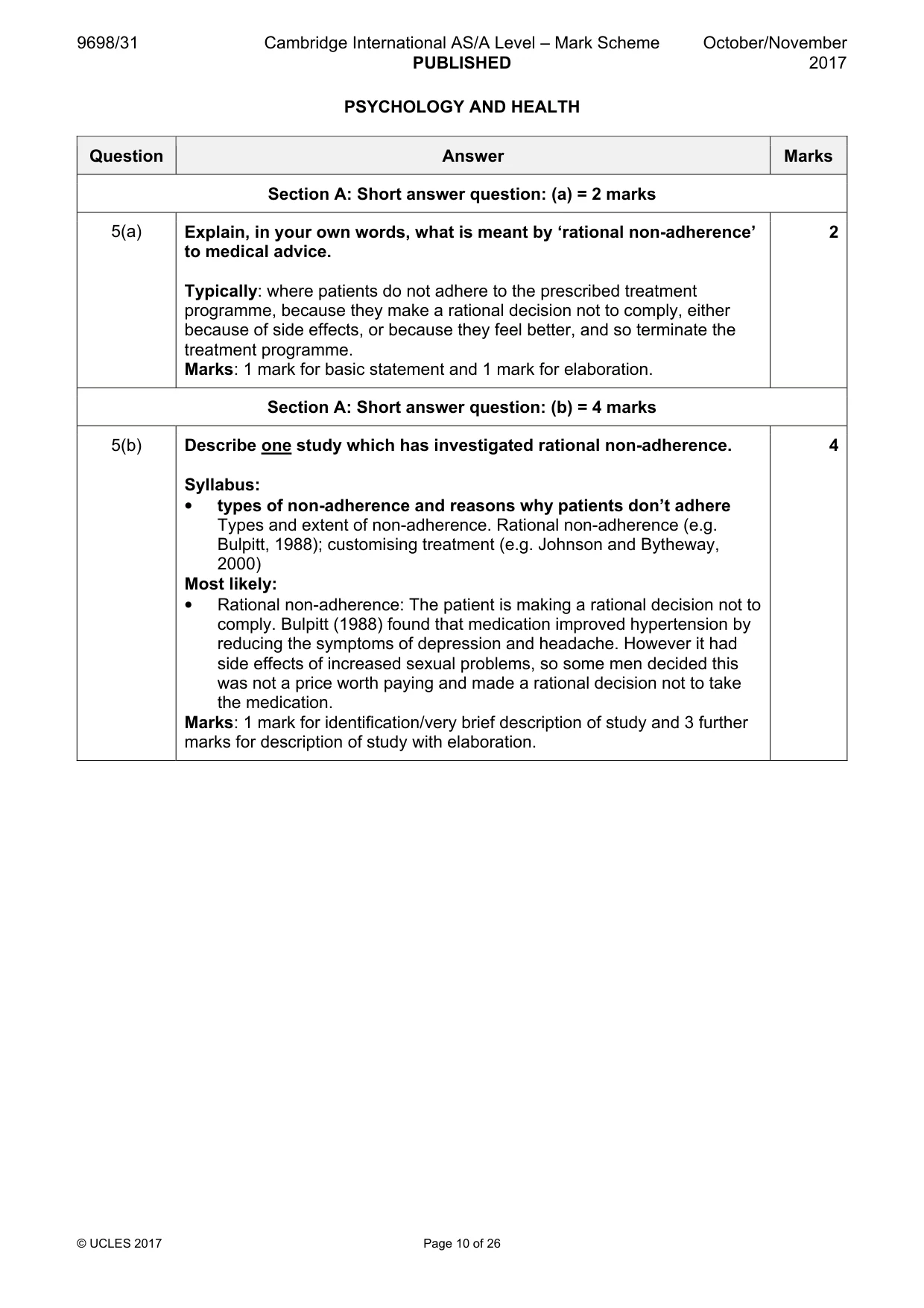
9698/31 Cambridge International AS/A Level – Mark Scheme PUBLISHED October/November 2017 © UCLES 2017 Page 10 of 26 PSYCHOLOGY AND HEALTH Question Answer Marks Section A: Short answer question: (a) = 2 marks 5(a) Explain, in your own words, what is meant by ‘rational non-adherence’ to medical advice. Typically: where patients do not adhere to the prescribed treatment programme, because they make a rational decision not to comply, either because of side effects, or because they feel better, and so terminate the treatment programme. Marks: 1 mark for basic statement and 1 mark for elaboration. 2 Section A: Short answer question: (b) = 4 marks 5(b) Describe one study which has investigated rational non-adherence. Syllabus: • types of non-adherence and reasons why patients don’t adhere Types and extent of non-adherence. Rational non-adherence (e.g. Bulpitt, 1988); customising treatment (e.g. Johnson and Bytheway, 2000) Most likely: • Rational non-adherence: The patient is making a rational decision not to comply. Bulpitt (1988) found that medication improved hypertension by reducing the symptoms of depression and headache. However it had side effects of increased sexual problems, so some men decided this was not a price worth paying and made a rational decision not to take the medication. Marks: 1 mark for identification/very brief description of study and 3 further marks for description of study with elaboration. 4
Mark scheme, page 11
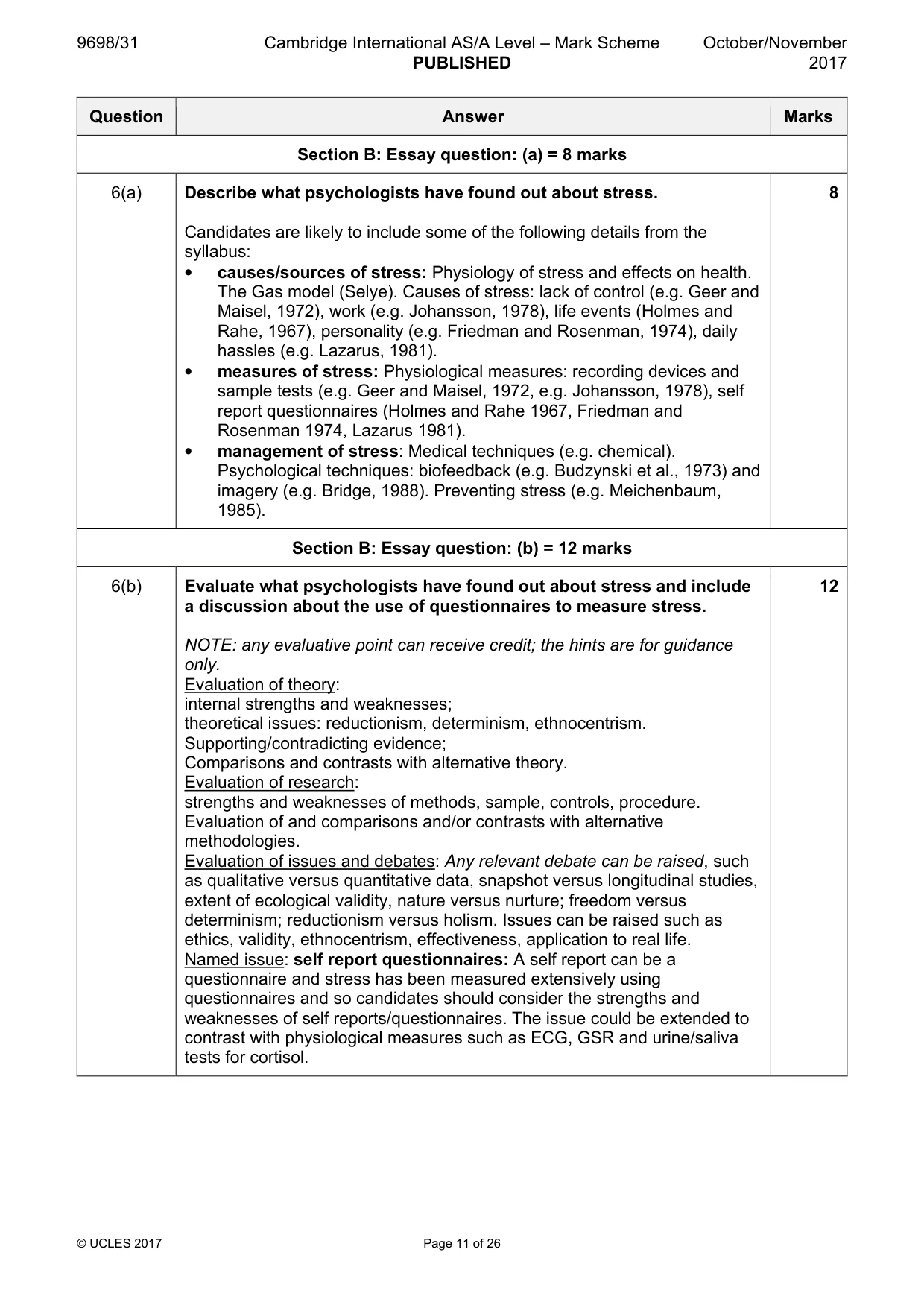
9698/31 Cambridge International AS/A Level – Mark Scheme PUBLISHED October/November 2017 © UCLES 2017 Page 11 of 26 Question Answer Marks Section B: Essay question: (a) = 8 marks 6(a) Describe what psychologists have found out about stress. Candidates are likely to include some of the following details from the syllabus: • causes/sources of stress: Physiology of stress and effects on health. The Gas model (Selye). Causes of stress: lack of control (e.g. Geer and Maisel, 1972), work (e.g. Johansson, 1978), life events (Holmes and Rahe, 1967), personality (e.g. Friedman and Rosenman, 1974), daily hassles (e.g. Lazarus, 1981). • measures of stress: Physiological measures: recording devices and sample tests (e.g. Geer and Maisel, 1972, e.g. Johansson, 1978), self report questionnaires (Holmes and Rahe 1967, Friedman and Rosenman 1974, Lazarus 1981). • management of stress: Medical techniques (e.g. chemical). Psychological techniques: biofeedback (e.g. Budzynski et al., 1973) and imagery (e.g. Bridge, 1988). Preventing stress (e.g. Meichenbaum, 1985). 8 Section B: Essay question: (b) = 12 marks 6(b) Evaluate what psychologists have found out about stress and include a discussion about the use of questionnaires to measure stress. NOTE: any evaluative point can receive credit; the hints are for guidance only. Evaluation of theory: internal strengths and weaknesses; theoretical issues: reductionism, determinism, ethnocentrism. Supporting/contradicting evidence; Comparisons and contrasts with alternative theory. Evaluation of research: strengths and weaknesses of methods, sample, controls, procedure. Evaluation of and comparisons and/or contrasts with alternative methodologies. Evaluation of issues and debates: Any relevant debate can be raised, such as qualitative versus quantitative data, snapshot versus longitudinal studies, extent of ecological validity, nature versus nurture; freedom versus determinism; reductionism versus holism. Issues can be raised such as ethics, validity, ethnocentrism, effectiveness, application to real life. Named issue: self report questionnaires: A self report can be a questionnaire and stress has been measured extensively using questionnaires and so candidates should consider the strengths and weaknesses of self reports/questionnaires. The issue could be extended to contrast with physiological measures such as ECG, GSR and urine/saliva tests for cortisol. 12
Mark scheme, page 12
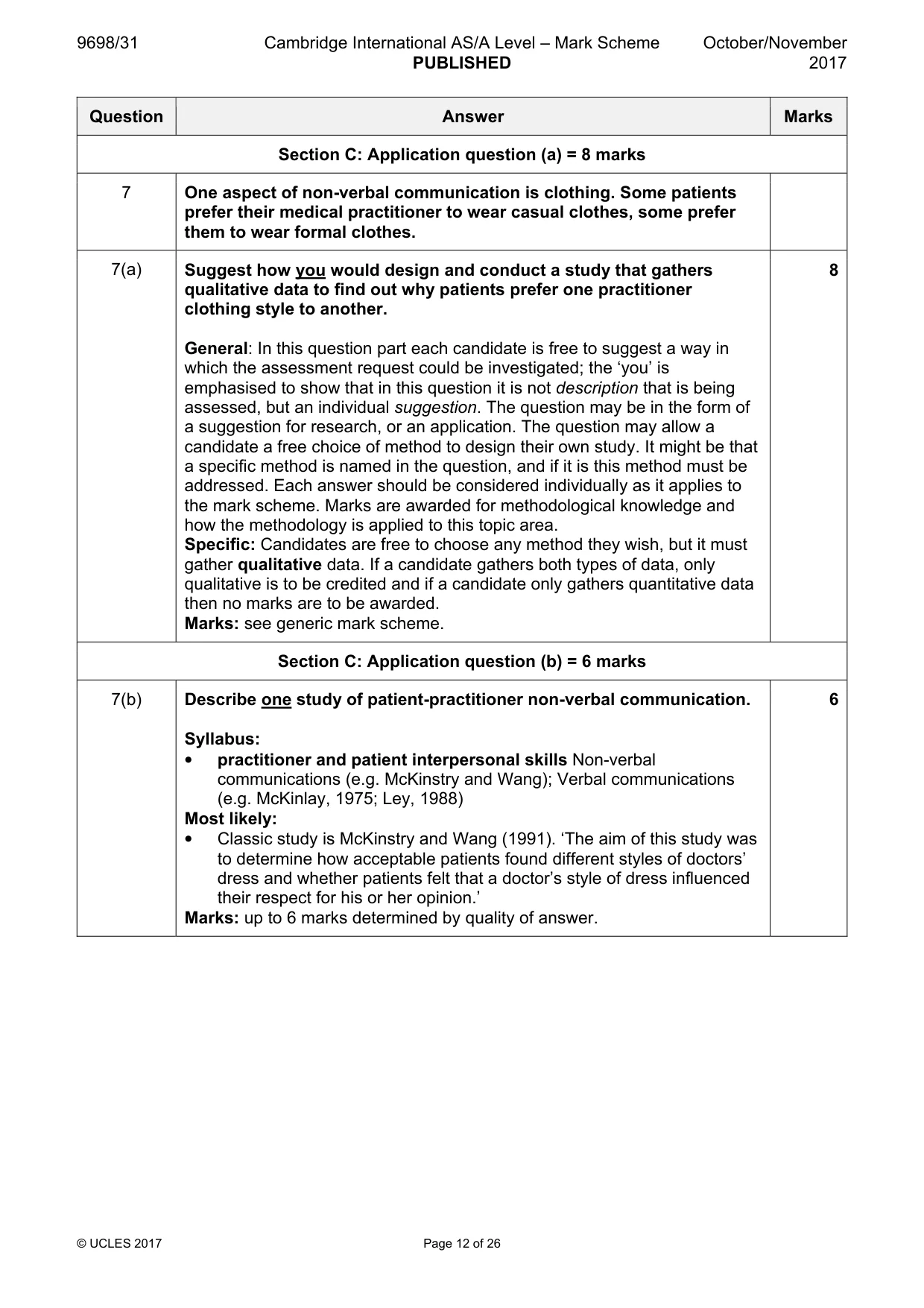
9698/31 Cambridge International AS/A Level – Mark Scheme PUBLISHED October/November 2017 © UCLES 2017 Page 12 of 26 Question Answer Marks Section C: Application question (a) = 8 marks 7 One aspect of non-verbal communication is clothing. Some patients prefer their medical practitioner to wear casual clothes, some prefer them to wear formal clothes. 7(a) Suggest how you would design and conduct a study that gathers qualitative data to find out why patients prefer one practitioner clothing style to another. General: In this question part each candidate is free to suggest a way in which the assessment request could be investigated; the ‘you’ is emphasised to show that in this question it is not description that is being assessed, but an individual suggestion. The question may be in the form of a suggestion for research, or an application. The question may allow a candidate a free choice of method to design their own study. It might be that a specific method is named in the question, and if it is this method must be addressed. Each answer should be considered individually as it applies to the mark scheme. Marks are awarded for methodological knowledge and how the methodology is applied to this topic area. Specific: Candidates are free to choose any method they wish, but it must gather qualitative data. If a candidate gathers both types of data, only qualitative is to be credited and if a candidate only gathers quantitative data then no marks are to be awarded. Marks: see generic mark scheme. 8 Section C: Application question (b) = 6 marks 7(b) Describe one study of patient-practitioner non-verbal communication. Syllabus: • practitioner and patient interpersonal skills Non-verbal communications (e.g. McKinstry and Wang); Verbal communications (e.g. McKinlay, 1975; Ley, 1988) Most likely: • Classic study is McKinstry and Wang (1991). ‘The aim of this study was to determine how acceptable patients found different styles of doctors’ dress and whether patients felt that a doctor’s style of dress influenced their respect for his or her opinion.’ Marks: up to 6 marks determined by quality of answer. 6
Mark scheme, page 13
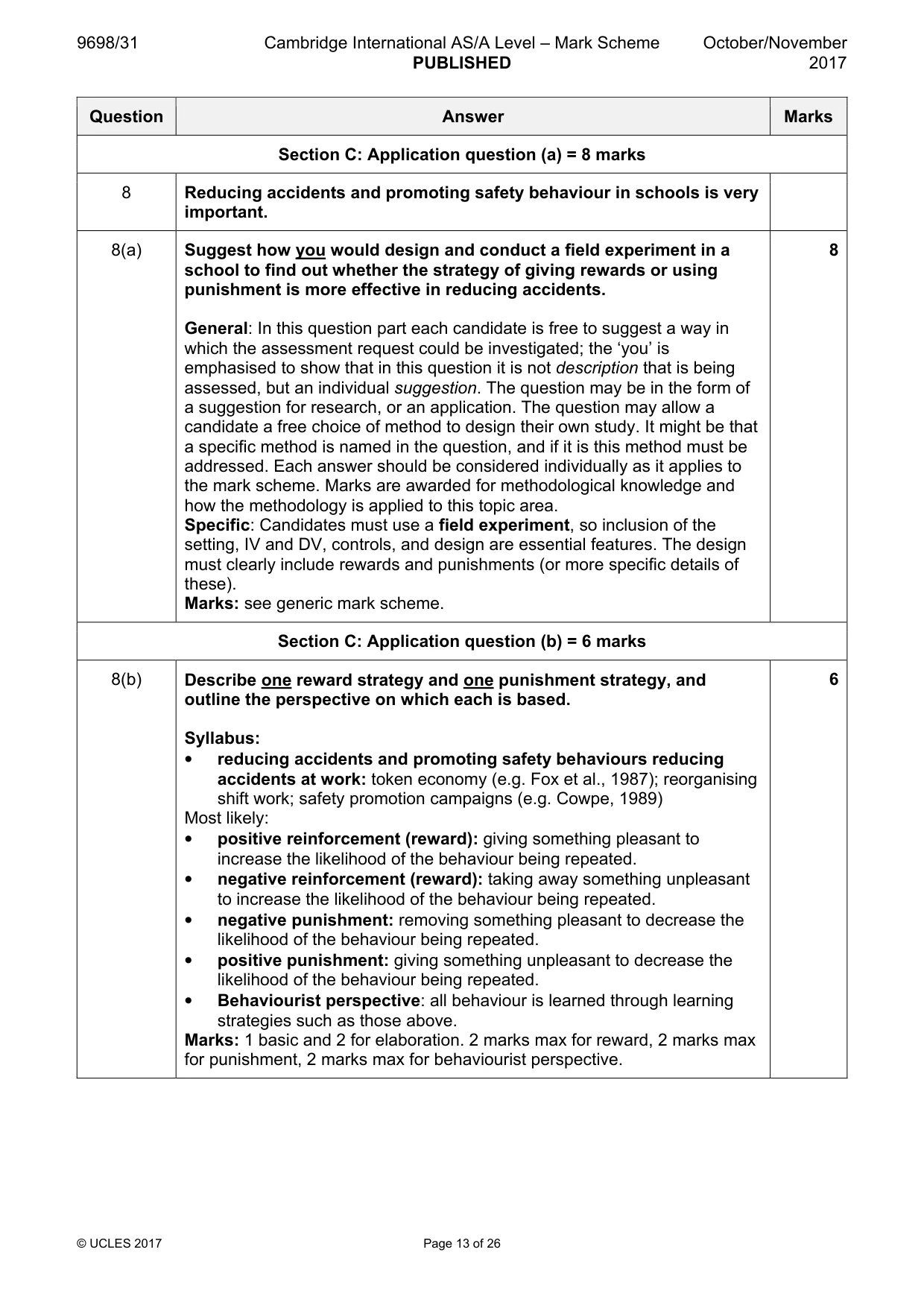
9698/31 Cambridge International AS/A Level – Mark Scheme PUBLISHED October/November 2017 © UCLES 2017 Page 13 of 26 Question Answer Marks Section C: Application question (a) = 8 marks 8 Reducing accidents and promoting safety behaviour in schools is very important. 8(a) Suggest how you would design and conduct a field experiment in a school to find out whether the strategy of giving rewards or using punishment is more effective in reducing accidents. General: In this question part each candidate is free to suggest a way in which the assessment request could be investigated; the ‘you’ is emphasised to show that in this question it is not description that is being assessed, but an individual suggestion. The question may be in the form of a suggestion for research, or an application. The question may allow a candidate a free choice of method to design their own study. It might be that a specific method is named in the question, and if it is this method must be addressed. Each answer should be considered individually as it applies to the mark scheme. Marks are awarded for methodological knowledge and how the methodology is applied to this topic area. Specific: Candidates must use a field experiment, so inclusion of the setting, IV and DV, controls, and design are essential features. The design must clearly include rewards and punishments (or more specific details of these). Marks: see generic mark scheme. 8 Section C: Application question (b) = 6 marks 8(b) Describe one reward strategy and one punishment strategy, and outline the perspective on which each is based. Syllabus: • reducing accidents and promoting safety behaviours reducing accidents at work: token economy (e.g. Fox et al., 1987); reorganising shift work; safety promotion campaigns (e.g. Cowpe, 1989) Most likely: • positive reinforcement (reward): giving something pleasant to increase the likelihood of the behaviour being repeated. • negative reinforcement (reward): taking away something unpleasant to increase the likelihood of the behaviour being repeated. • negative punishment: removing something pleasant to decrease the likelihood of the behaviour being repeated. • positive punishment: giving something unpleasant to decrease the likelihood of the behaviour being repeated. • Behaviourist perspective: all behaviour is learned through learning strategies such as those above. Marks: 1 basic and 2 for elaboration. 2 marks max for reward, 2 marks max for punishment, 2 marks max for behaviourist perspective. 6
Mark scheme, page 14
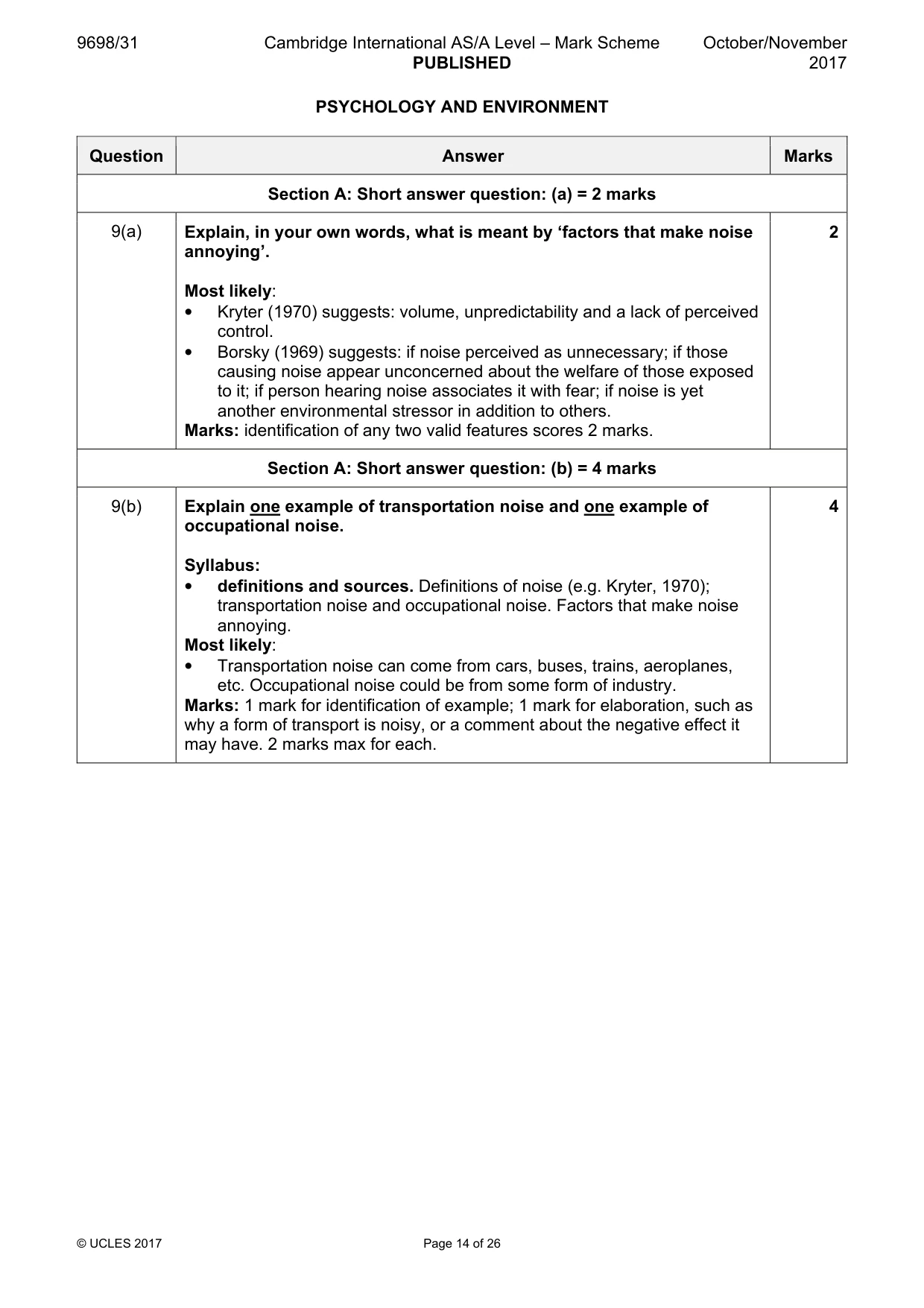
9698/31 Cambridge International AS/A Level – Mark Scheme PUBLISHED October/November 2017 © UCLES 2017 Page 14 of 26 PSYCHOLOGY AND ENVIRONMENT Question Answer Marks Section A: Short answer question: (a) = 2 marks 9(a) Explain, in your own words, what is meant by ‘factors that make noise annoying’. Most likely: • Kryter (1970) suggests: volume, unpredictability and a lack of perceived control. • Borsky (1969) suggests: if noise perceived as unnecessary; if those causing noise appear unconcerned about the welfare of those exposed to it; if person hearing noise associates it with fear; if noise is yet another environmental stressor in addition to others. Marks: identification of any two valid features scores 2 marks. 2 Section A: Short answer question: (b) = 4 marks 9(b) Explain one example of transportation noise and one example of occupational noise. Syllabus: • definitions and sources. Definitions of noise (e.g. Kryter, 1970); transportation noise and occupational noise. Factors that make noise annoying. Most likely: • Transportation noise can come from cars, buses, trains, aeroplanes, etc. Occupational noise could be from some form of industry. Marks: 1 mark for identification of example; 1 mark for elaboration, such as why a form of transport is noisy, or a comment about the negative effect it may have. 2 marks max for each. 4
Mark scheme, page 15
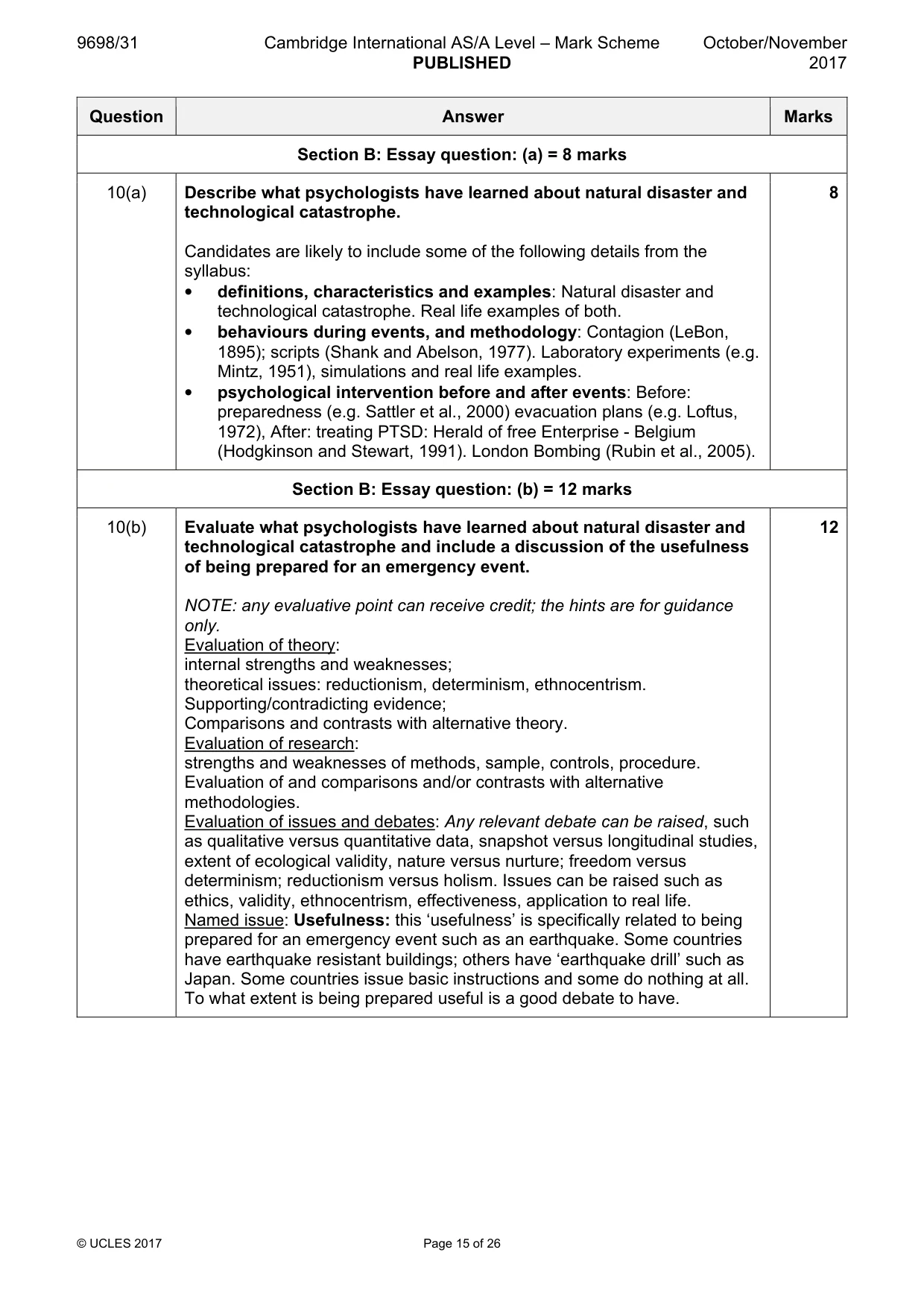
9698/31 Cambridge International AS/A Level – Mark Scheme PUBLISHED October/November 2017 © UCLES 2017 Page 15 of 26 Question Answer Marks Section B: Essay question: (a) = 8 marks 10(a) Describe what psychologists have learned about natural disaster and technological catastrophe. Candidates are likely to include some of the following details from the syllabus: • definitions, characteristics and examples: Natural disaster and technological catastrophe. Real life examples of both. • behaviours during events, and methodology: Contagion (LeBon, 1895); scripts (Shank and Abelson, 1977). Laboratory experiments (e.g. Mintz, 1951), simulations and real life examples. • psychological intervention before and after events: Before: preparedness (e.g. Sattler et al., 2000) evacuation plans (e.g. Loftus, 1972), After: treating PTSD: Herald of free Enterprise - Belgium (Hodgkinson and Stewart, 1991). London Bombing (Rubin et al., 2005). 8 Section B: Essay question: (b) = 12 marks 10(b) Evaluate what psychologists have learned about natural disaster and technological catastrophe and include a discussion of the usefulness of being prepared for an emergency event. NOTE: any evaluative point can receive credit; the hints are for guidance only. Evaluation of theory: internal strengths and weaknesses; theoretical issues: reductionism, determinism, ethnocentrism. Supporting/contradicting evidence; Comparisons and contrasts with alternative theory. Evaluation of research: strengths and weaknesses of methods, sample, controls, procedure. Evaluation of and comparisons and/or contrasts with alternative methodologies. Evaluation of issues and debates: Any relevant debate can be raised, such as qualitative versus quantitative data, snapshot versus longitudinal studies, extent of ecological validity, nature versus nurture; freedom versus determinism; reductionism versus holism. Issues can be raised such as ethics, validity, ethnocentrism, effectiveness, application to real life. Named issue: Usefulness: this ‘usefulness’ is specifically related to being prepared for an emergency event such as an earthquake. Some countries have earthquake resistant buildings; others have ‘earthquake drill’ such as Japan. Some countries issue basic instructions and some do nothing at all. To what extent is being prepared useful is a good debate to have. 12
Mark scheme, page 16
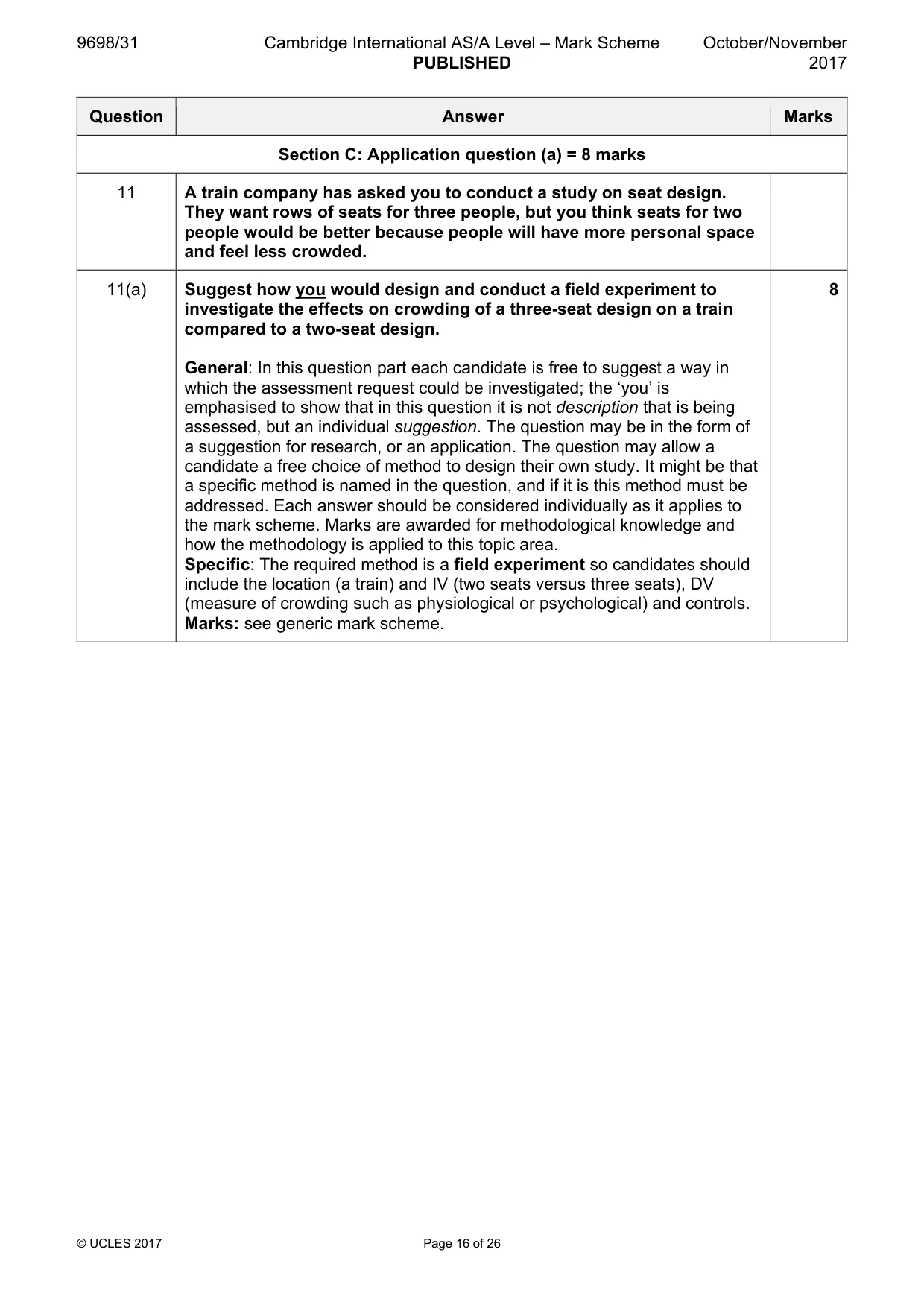
9698/31 Cambridge International AS/A Level – Mark Scheme PUBLISHED October/November 2017 © UCLES 2017 Page 16 of 26 Question Answer Marks Section C: Application question (a) = 8 marks 11 A train company has asked you to conduct a study on seat design. They want rows of seats for three people, but you think seats for two people would be better because people will have more personal space and feel less crowded. 11(a) Suggest how you would design and conduct a field experiment to investigate the effects on crowding of a three-seat design on a train compared to a two-seat design. General: In this question part each candidate is free to suggest a way in which the assessment request could be investigated; the ‘you’ is emphasised to show that in this question it is not description that is being assessed, but an individual suggestion. The question may be in the form of a suggestion for research, or an application. The question may allow a candidate a free choice of method to design their own study. It might be that a specific method is named in the question, and if it is this method must be addressed. Each answer should be considered individually as it applies to the mark scheme. Marks are awarded for methodological knowledge and how the methodology is applied to this topic area. Specific: The required method is a field experiment so candidates should include the location (a train) and IV (two seats versus three seats), DV (measure of crowding such as physiological or psychological) and controls. Marks: see generic mark scheme. 8
Mark scheme, page 17
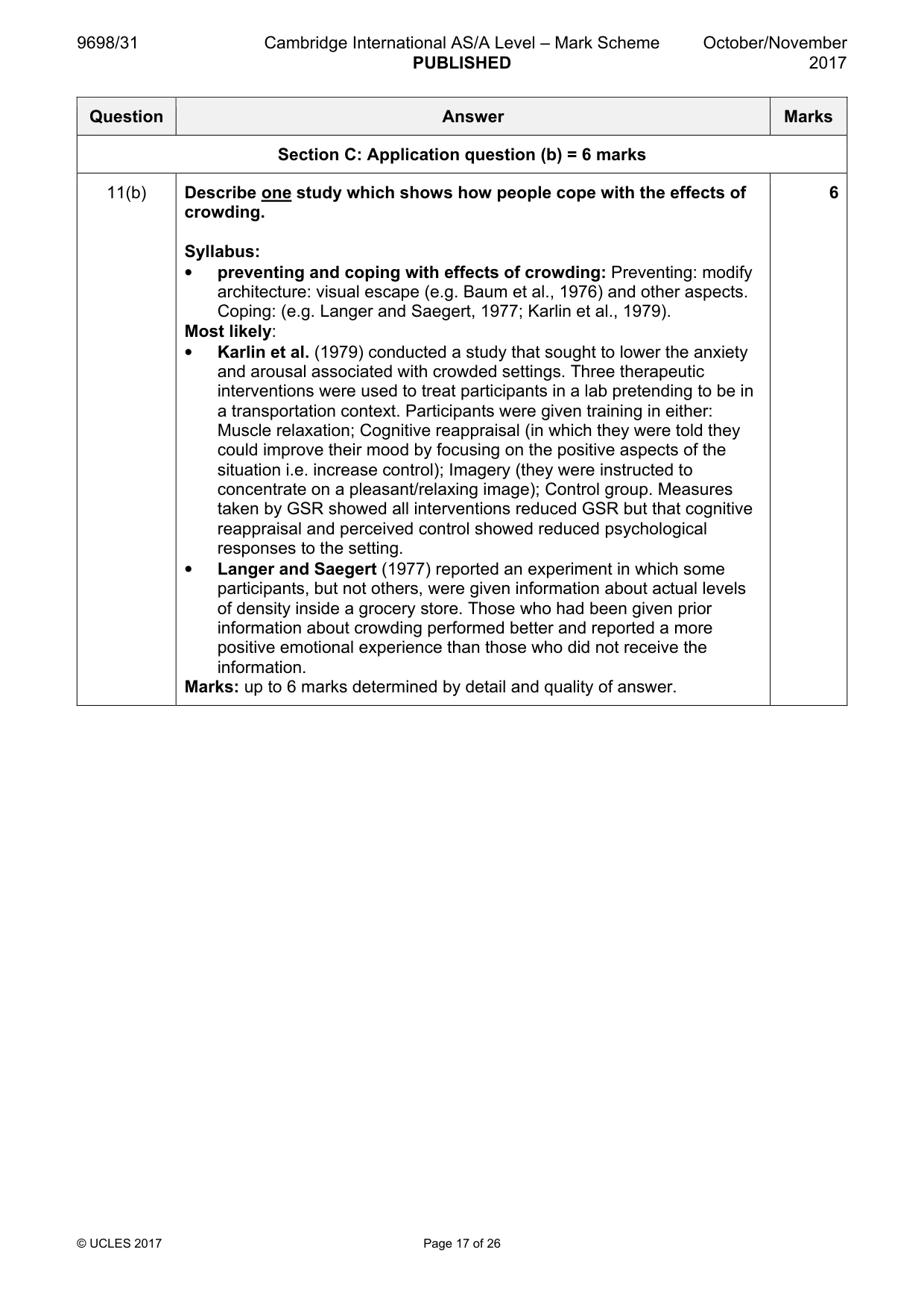
9698/31 Cambridge International AS/A Level – Mark Scheme PUBLISHED October/November 2017 © UCLES 2017 Page 17 of 26 Question Answer Marks Section C: Application question (b) = 6 marks 11(b) Describe one study which shows how people cope with the effects of crowding. Syllabus: • preventing and coping with effects of crowding: Preventing: modify architecture: visual escape (e.g. Baum et al., 1976) and other aspects. Coping: (e.g. Langer and Saegert, 1977; Karlin et al., 1979). Most likely: • Karlin et al. (1979) conducted a study that sought to lower the anxiety and arousal associated with crowded settings. Three therapeutic interventions were used to treat participants in a lab pretending to be in a transportation context. Participants were given training in either: Muscle relaxation; Cognitive reappraisal (in which they were told they could improve their mood by focusing on the positive aspects of the situation i.e. increase control); Imagery (they were instructed to concentrate on a pleasant/relaxing image); Control group. Measures taken by GSR showed all interventions reduced GSR but that cognitive reappraisal and perceived control showed reduced psychological responses to the setting. • Langer and Saegert (1977) reported an experiment in which some participants, but not others, were given information about actual levels of density inside a grocery store. Those who had been given prior information about crowding performed better and reported a more positive emotional experience than those who did not receive the information. Marks: up to 6 marks determined by detail and quality of answer. 6
Mark scheme, page 18
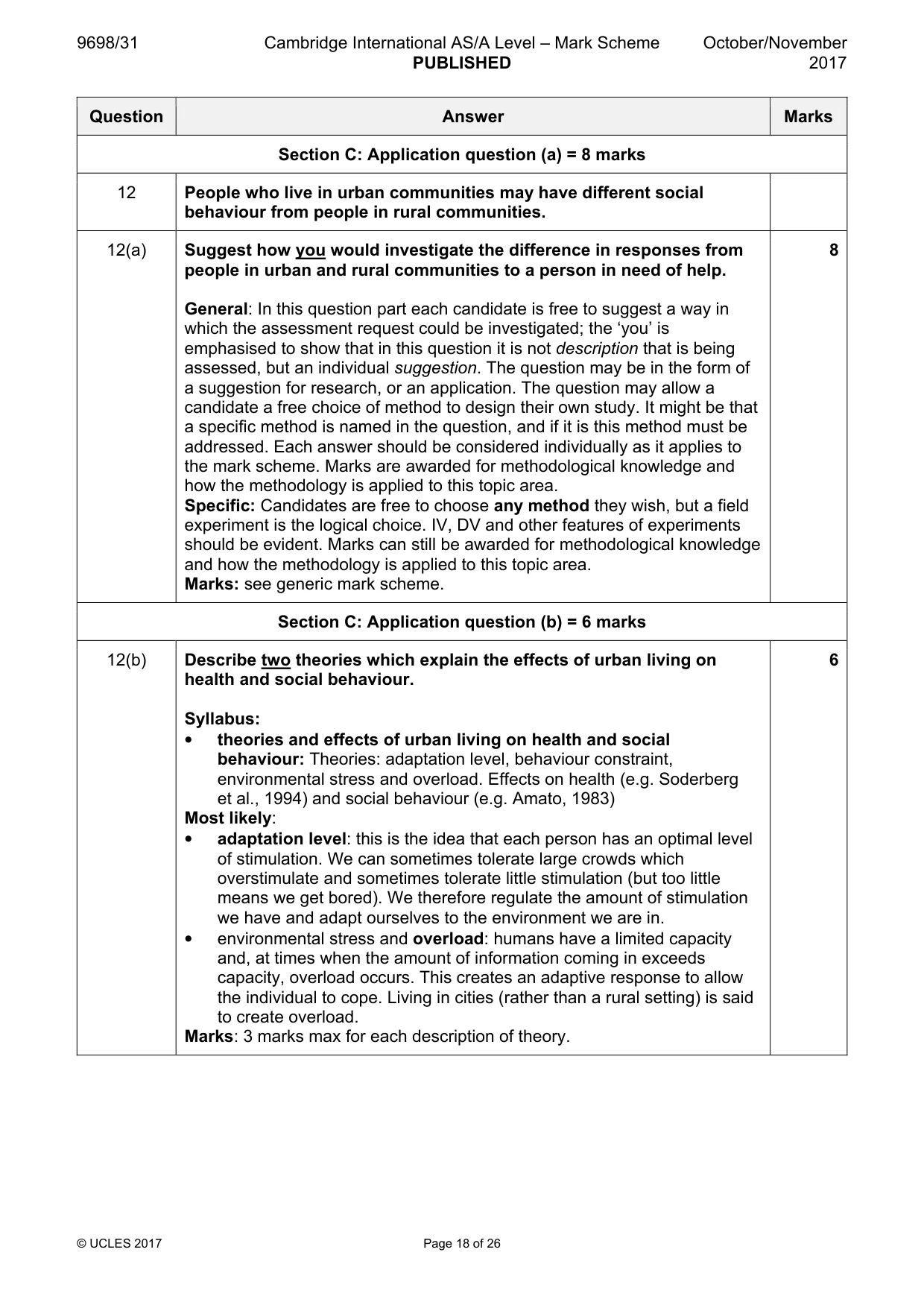
9698/31 Cambridge International AS/A Level – Mark Scheme PUBLISHED October/November 2017 © UCLES 2017 Page 18 of 26 Question Answer Marks Section C: Application question (a) = 8 marks 12 People who live in urban communities may have different social behaviour from people in rural communities. 12(a) Suggest how you would investigate the difference in responses from people in urban and rural communities to a person in need of help. General: In this question part each candidate is free to suggest a way in which the assessment request could be investigated; the ‘you’ is emphasised to show that in this question it is not description that is being assessed, but an individual suggestion. The question may be in the form of a suggestion for research, or an application. The question may allow a candidate a free choice of method to design their own study. It might be that a specific method is named in the question, and if it is this method must be addressed. Each answer should be considered individually as it applies to the mark scheme. Marks are awarded for methodological knowledge and how the methodology is applied to this topic area. Specific: Candidates are free to choose any method they wish, but a field experiment is the logical choice. IV, DV and other features of experiments should be evident. Marks can still be awarded for methodological knowledge and how the methodology is applied to this topic area. Marks: see generic mark scheme. 8 Section C: Application question (b) = 6 marks 12(b) Describe two theories which explain the effects of urban living on health and social behaviour. Syllabus: • theories and effects of urban living on health and social behaviour: Theories: adaptation level, behaviour constraint, environmental stress and overload. Effects on health (e.g. Soderberg et al., 1994) and social behaviour (e.g. Amato, 1983) Most likely: • adaptation level: this is the idea that each person has an optimal level of stimulation. We can sometimes tolerate large crowds which overstimulate and sometimes tolerate little stimulation (but too little means we get bored). We therefore regulate the amount of stimulation we have and adapt ourselves to the environment we are in. • environmental stress and overload: humans have a limited capacity and, at times when the amount of information coming in exceeds capacity, overload occurs. This creates an adaptive response to allow the individual to cope. Living in cities (rather than a rural setting) is said to create overload. Marks: 3 marks max for each description of theory. 6
Mark scheme, page 19
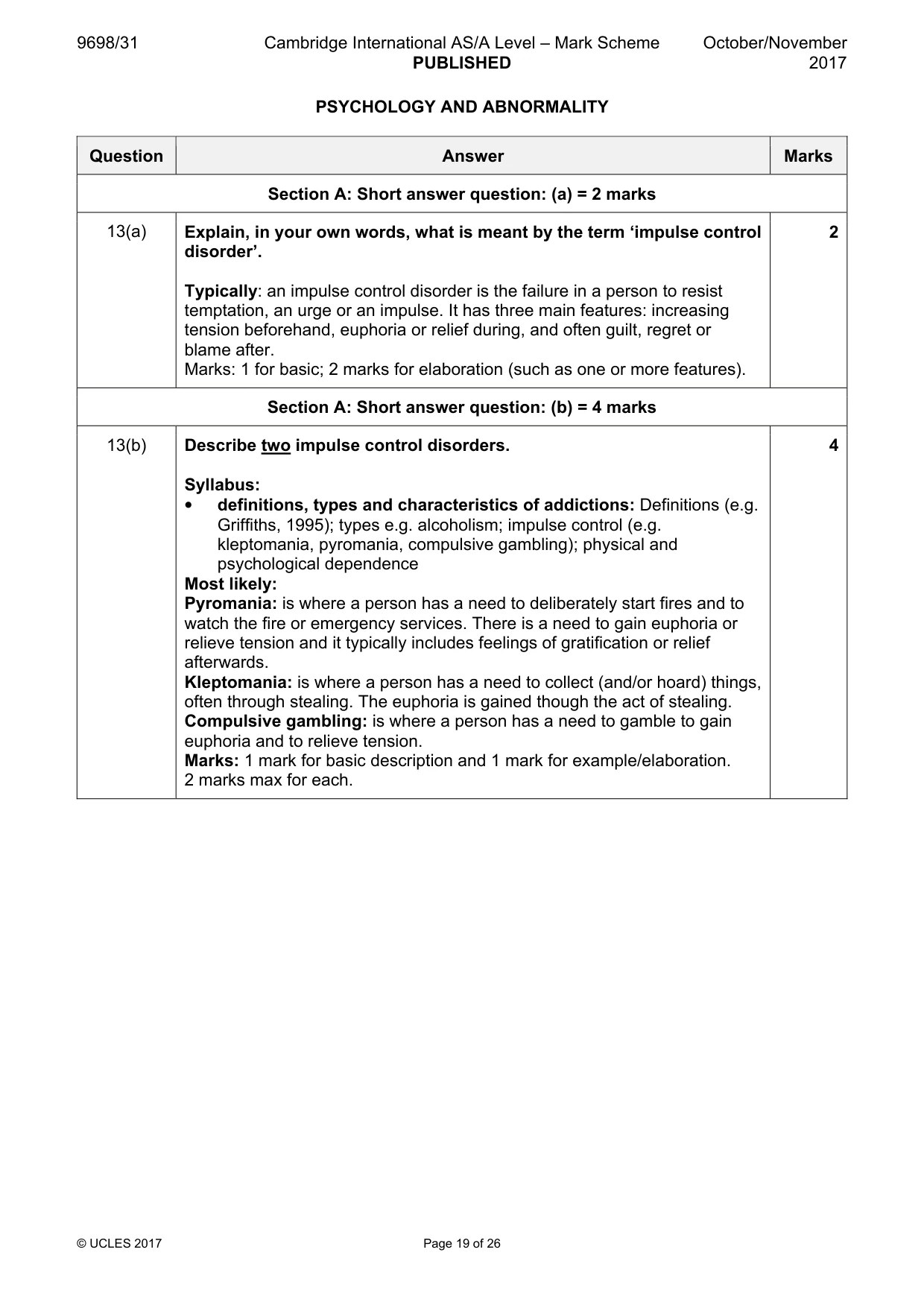
9698/31 Cambridge International AS/A Level – Mark Scheme PUBLISHED October/November 2017 © UCLES 2017 Page 19 of 26 PSYCHOLOGY AND ABNORMALITY Question Answer Marks Section A: Short answer question: (a) = 2 marks 13(a) Explain, in your own words, what is meant by the term ‘impulse control disorder’. Typically: an impulse control disorder is the failure in a person to resist temptation, an urge or an impulse. It has three main features: increasing tension beforehand, euphoria or relief during, and often guilt, regret or blame after. Marks: 1 for basic; 2 marks for elaboration (such as one or more features). 2 Section A: Short answer question: (b) = 4 marks 13(b) Describe two impulse control disorders. Syllabus: • definitions, types and characteristics of addictions: Definitions (e.g. Griffiths, 1995); types e.g. alcoholism; impulse control (e.g. kleptomania, pyromania, compulsive gambling); physical and psychological dependence Most likely: Pyromania: is where a person has a need to deliberately start fires and to watch the fire or emergency services. There is a need to gain euphoria or relieve tension and it typically includes feelings of gratification or relief afterwards. Kleptomania: is where a person has a need to collect (and/or hoard) things, often through stealing. The euphoria is gained though the act of stealing. Compulsive gambling: is where a person has a need to gamble to gain euphoria and to relieve tension. Marks: 1 mark for basic description and 1 mark for example/elaboration. 2 marks max for each. 4
Mark scheme, page 20
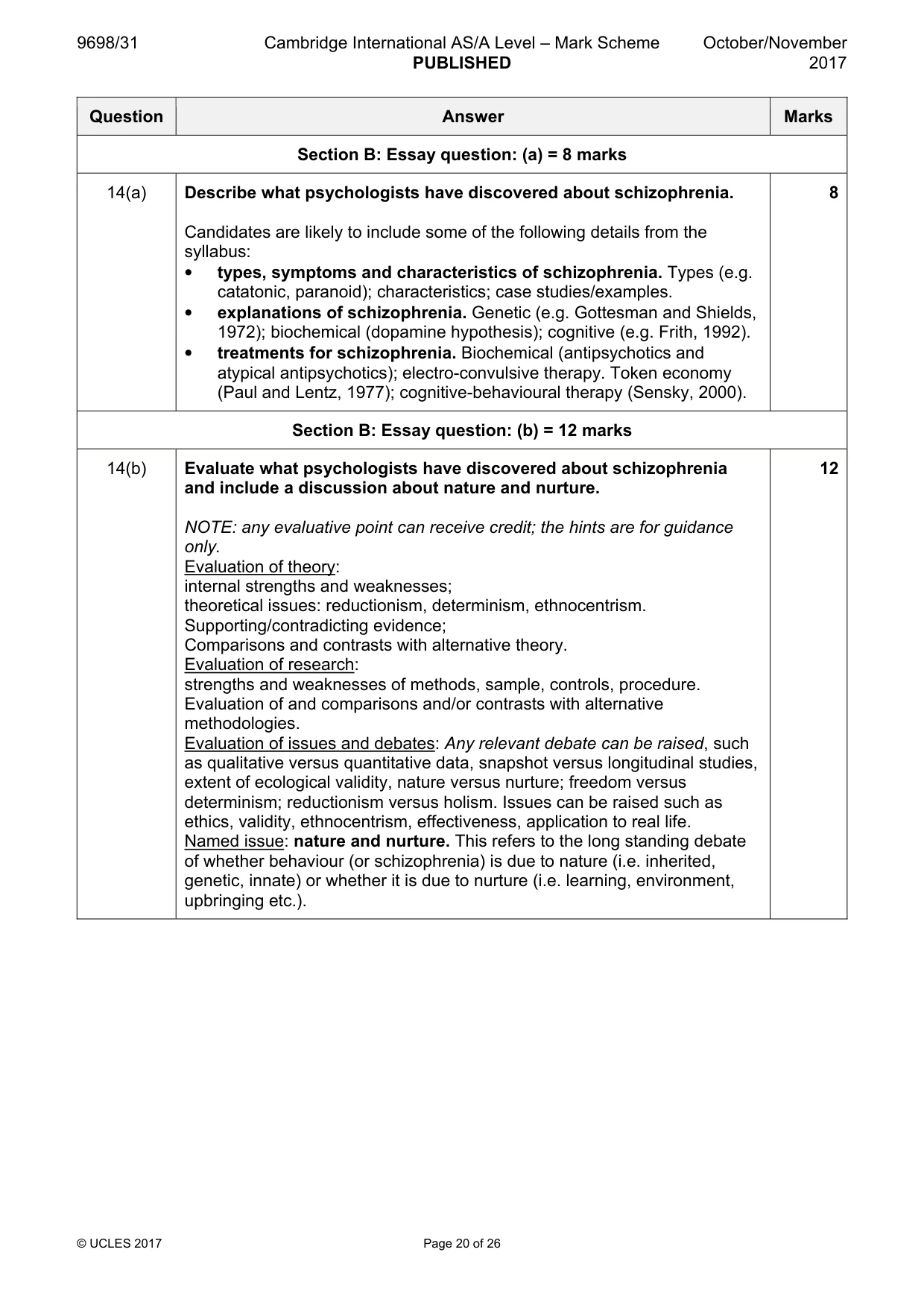
9698/31 Cambridge International AS/A Level – Mark Scheme PUBLISHED October/November 2017 © UCLES 2017 Page 20 of 26 Question Answer Marks Section B: Essay question: (a) = 8 marks 14(a) Describe what psychologists have discovered about schizophrenia. Candidates are likely to include some of the following details from the syllabus: • types, symptoms and characteristics of schizophrenia. Types (e.g. catatonic, paranoid); characteristics; case studies/examples. • explanations of schizophrenia. Genetic (e.g. Gottesman and Shields, 1972); biochemical (dopamine hypothesis); cognitive (e.g. Frith, 1992). • treatments for schizophrenia. Biochemical (antipsychotics and atypical antipsychotics); electro-convulsive therapy. Token economy (Paul and Lentz, 1977); cognitive-behavioural therapy (Sensky, 2000). 8 Section B: Essay question: (b) = 12 marks 14(b) Evaluate what psychologists have discovered about schizophrenia and include a discussion about nature and nurture. NOTE: any evaluative point can receive credit; the hints are for guidance only. Evaluation of theory: internal strengths and weaknesses; theoretical issues: reductionism, determinism, ethnocentrism. Supporting/contradicting evidence; Comparisons and contrasts with alternative theory. Evaluation of research: strengths and weaknesses of methods, sample, controls, procedure. Evaluation of and comparisons and/or contrasts with alternative methodologies. Evaluation of issues and debates: Any relevant debate can be raised, such as qualitative versus quantitative data, snapshot versus longitudinal studies, extent of ecological validity, nature versus nurture; freedom versus determinism; reductionism versus holism. Issues can be raised such as ethics, validity, ethnocentrism, effectiveness, application to real life. Named issue: nature and nurture. This refers to the long standing debate of whether behaviour (or schizophrenia) is due to nature (i.e. inherited, genetic, innate) or whether it is due to nurture (i.e. learning, environment, upbringing etc.). 12
Mark scheme, page 21
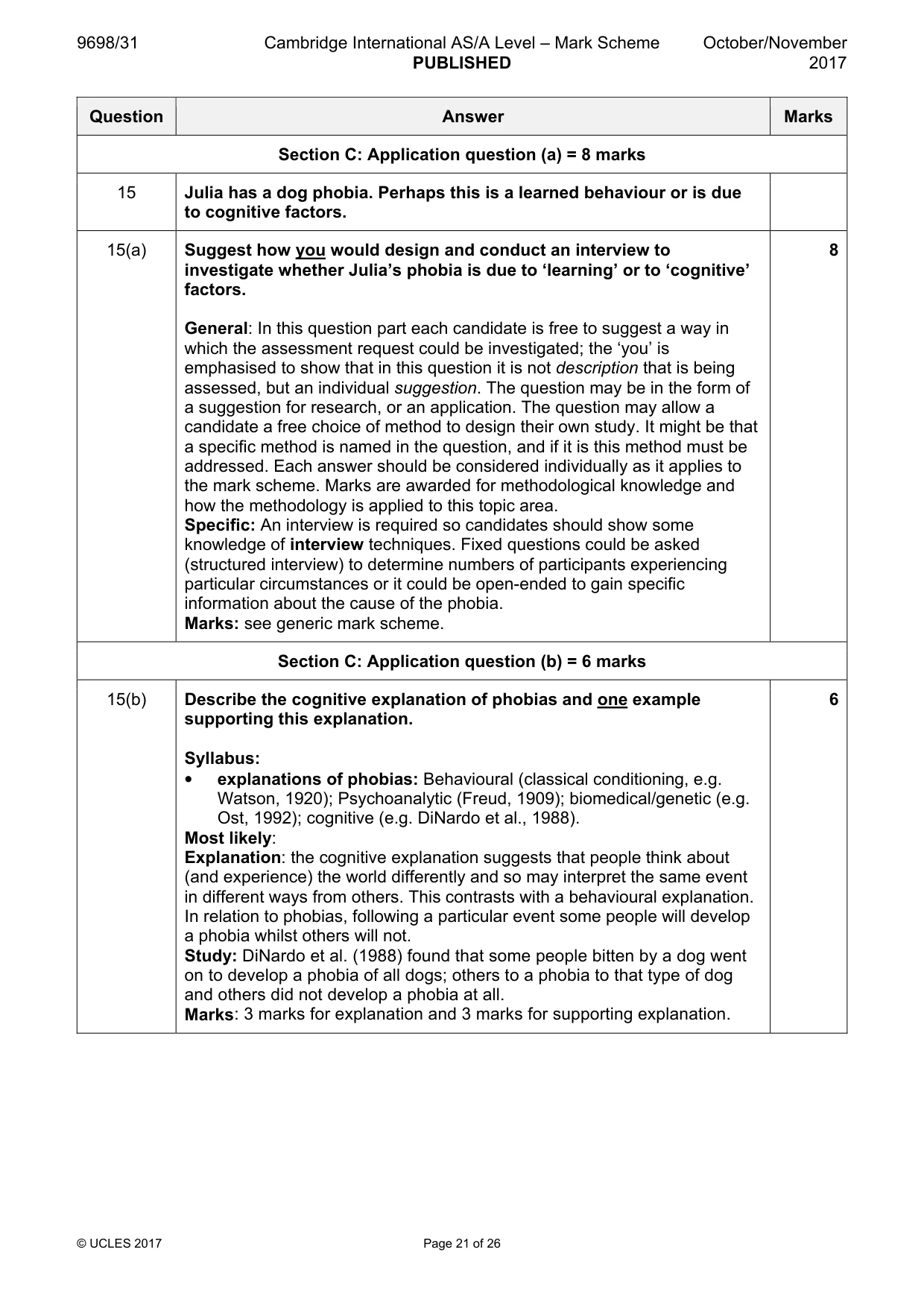
9698/31 Cambridge International AS/A Level – Mark Scheme PUBLISHED October/November 2017 © UCLES 2017 Page 21 of 26 Question Answer Marks Section C: Application question (a) = 8 marks 15 Julia has a dog phobia. Perhaps this is a learned behaviour or is due to cognitive factors. 15(a) Suggest how you would design and conduct an interview to investigate whether Julia’s phobia is due to ‘learning’ or to ‘cognitive’ factors. General: In this question part each candidate is free to suggest a way in which the assessment request could be investigated; the ‘you’ is emphasised to show that in this question it is not description that is being assessed, but an individual suggestion. The question may be in the form of a suggestion for research, or an application. The question may allow a candidate a free choice of method to design their own study. It might be that a specific method is named in the question, and if it is this method must be addressed. Each answer should be considered individually as it applies to the mark scheme. Marks are awarded for methodological knowledge and how the methodology is applied to this topic area. Specific: An interview is required so candidates should show some knowledge of interview techniques. Fixed questions could be asked (structured interview) to determine numbers of participants experiencing particular circumstances or it could be open-ended to gain specific information about the cause of the phobia. Marks: see generic mark scheme. 8 Section C: Application question (b) = 6 marks 15(b) Describe the cognitive explanation of phobias and one example supporting this explanation. Syllabus: • explanations of phobias: Behavioural (classical conditioning, e.g. Watson, 1920); Psychoanalytic (Freud, 1909); biomedical/genetic (e.g. Ost, 1992); cognitive (e.g. DiNardo et al., 1988). Most likely: Explanation: the cognitive explanation suggests that people think about (and experience) the world differently and so may interpret the same event in different ways from others. This contrasts with a behavioural explanation. In relation to phobias, following a particular event some people will develop a phobia whilst others will not. Study: DiNardo et al. (1988) found that some people bitten by a dog went on to develop a phobia of all dogs; others to a phobia to that type of dog and others did not develop a phobia at all. Marks: 3 marks for explanation and 3 marks for supporting explanation. 6
Mark scheme, page 22
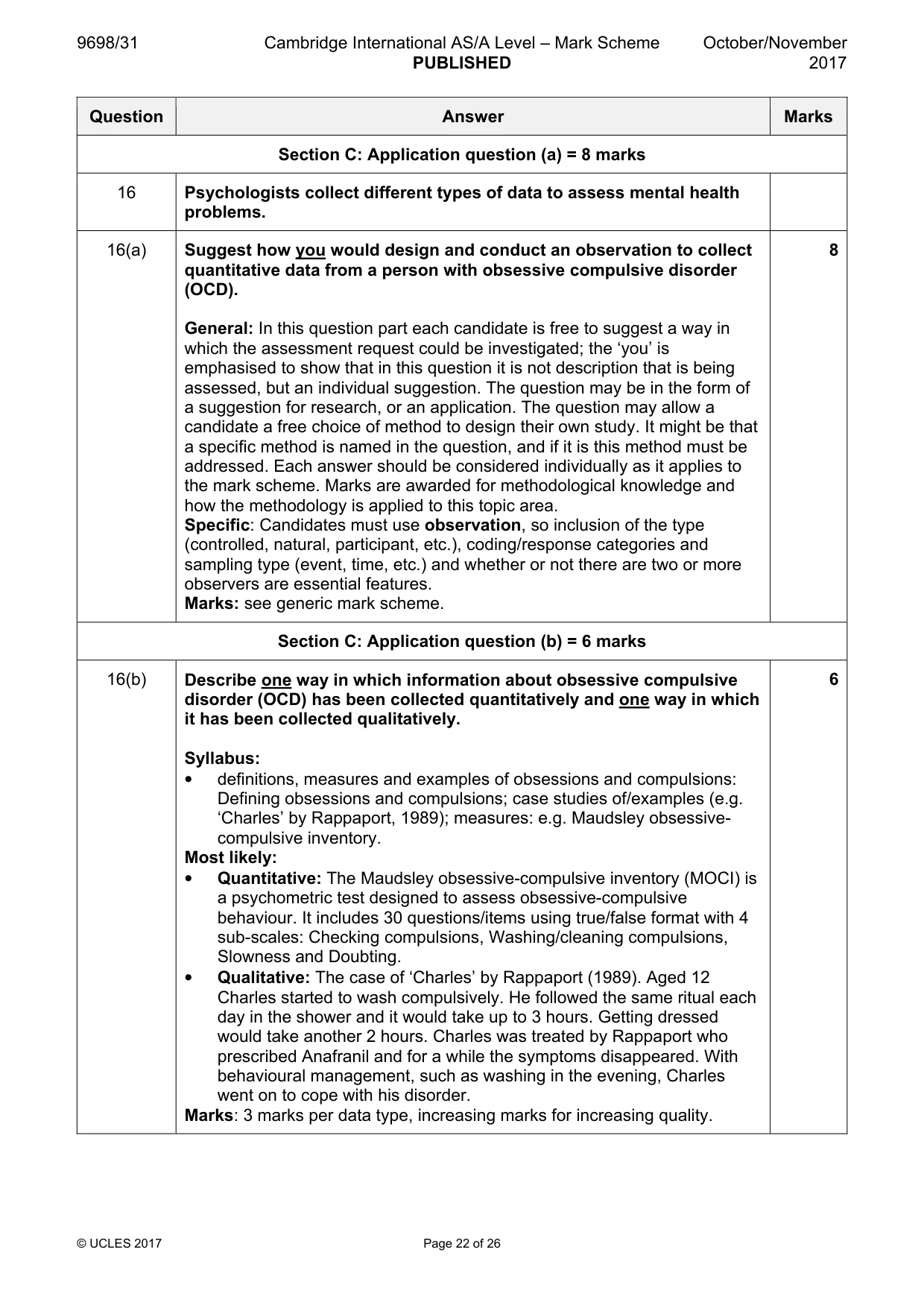
9698/31 Cambridge International AS/A Level – Mark Scheme PUBLISHED October/November 2017 © UCLES 2017 Page 22 of 26 Question Answer Marks Section C: Application question (a) = 8 marks 16 Psychologists collect different types of data to assess mental health problems. 16(a) Suggest how you would design and conduct an observation to collect quantitative data from a person with obsessive compulsive disorder (OCD). General: In this question part each candidate is free to suggest a way in which the assessment request could be investigated; the ‘you’ is emphasised to show that in this question it is not description that is being assessed, but an individual suggestion. The question may be in the form of a suggestion for research, or an application. The question may allow a candidate a free choice of method to design their own study. It might be that a specific method is named in the question, and if it is this method must be addressed. Each answer should be considered individually as it applies to the mark scheme. Marks are awarded for methodological knowledge and how the methodology is applied to this topic area. Specific: Candidates must use observation, so inclusion of the type (controlled, natural, participant, etc.), coding/response categories and sampling type (event, time, etc.) and whether or not there are two or more observers are essential features. Marks: see generic mark scheme. 8 Section C: Application question (b) = 6 marks 16(b) Describe one way in which information about obsessive compulsive disorder (OCD) has been collected quantitatively and one way in which it has been collected qualitatively. Syllabus: • definitions, measures and examples of obsessions and compulsions: Defining obsessions and compulsions; case studies of/examples (e.g. ‘Charles’ by Rappaport, 1989); measures: e.g. Maudsley obsessive- compulsive inventory. Most likely: • Quantitative: The Maudsley obsessive-compulsive inventory (MOCI) is a psychometric test designed to assess obsessive-compulsive behaviour. It includes 30 questions/items using true/false format with 4 sub-scales: Checking compulsions, Washing/cleaning compulsions, Slowness and Doubting. • Qualitative: The case of ‘Charles’ by Rappaport (1989). Aged 12 Charles started to wash compulsively. He followed the same ritual each day in the shower and it would take up to 3 hours. Getting dressed would take another 2 hours. Charles was treated by Rappaport who prescribed Anafranil and for a while the symptoms disappeared. With behavioural management, such as washing in the evening, Charles went on to cope with his disorder. Marks: 3 marks per data type, increasing marks for increasing quality. 6
Mark scheme, page 23
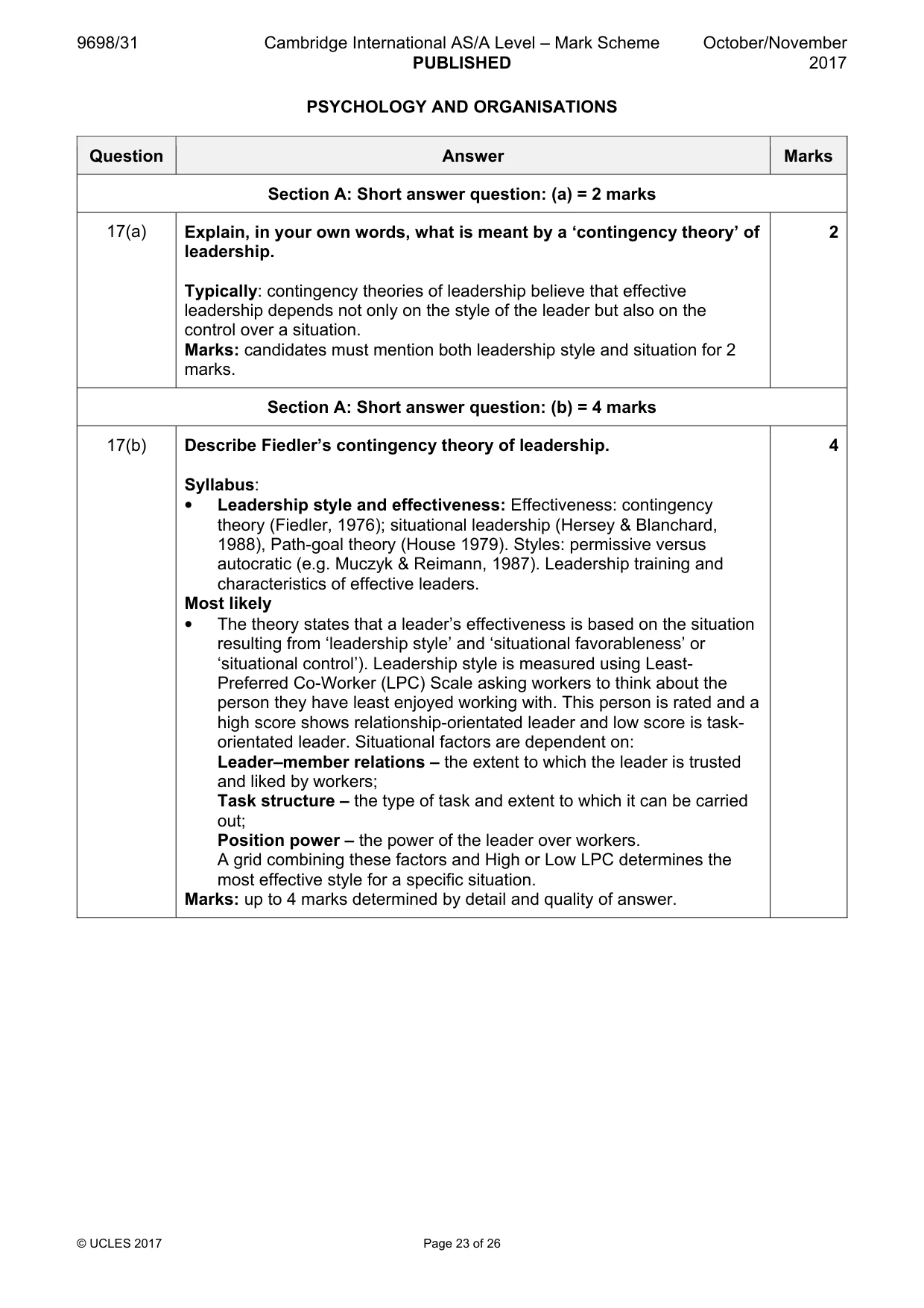
9698/31 Cambridge International AS/A Level – Mark Scheme PUBLISHED October/November 2017 © UCLES 2017 Page 23 of 26 PSYCHOLOGY AND ORGANISATIONS Question Answer Marks Section A: Short answer question: (a) = 2 marks 17(a) Explain, in your own words, what is meant by a ‘contingency theory’ of leadership. Typically: contingency theories of leadership believe that effective leadership depends not only on the style of the leader but also on the control over a situation. Marks: candidates must mention both leadership style and situation for 2 marks. 2 Section A: Short answer question: (b) = 4 marks 17(b) Describe Fiedler’s contingency theory of leadership. Syllabus: • Leadership style and effectiveness: Effectiveness: contingency theory (Fiedler, 1976); situational leadership (Hersey & Blanchard, 1988), Path-goal theory (House 1979). Styles: permissive versus autocratic (e.g. Muczyk & Reimann, 1987). Leadership training and characteristics of effective leaders. Most likely • The theory states that a leader’s effectiveness is based on the situation resulting from ‘leadership style’ and ‘situational favorableness’ or ‘situational control’). Leadership style is measured using Least- Preferred Co-Worker (LPC) Scale asking workers to think about the person they have least enjoyed working with. This person is rated and a high score shows relationship-orientated leader and low score is task- orientated leader. Situational factors are dependent on: Leader–member relations – the extent to which the leader is trusted and liked by workers; Task structure – the type of task and extent to which it can be carried out; Position power – the power of the leader over workers. A grid combining these factors and High or Low LPC determines the most effective style for a specific situation. Marks: up to 4 marks determined by detail and quality of answer. 4
Mark scheme, page 24
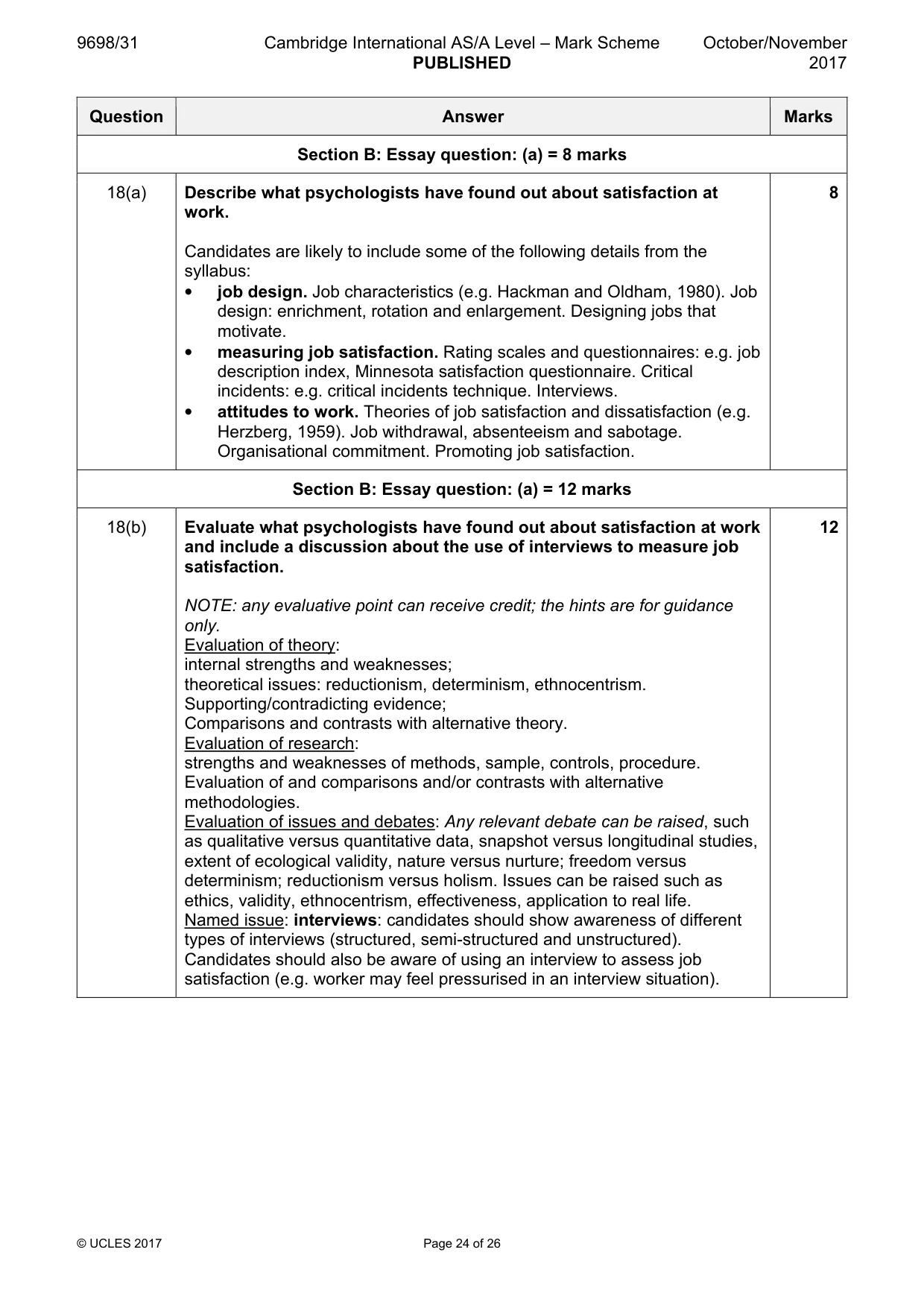
9698/31 Cambridge International AS/A Level – Mark Scheme PUBLISHED October/November 2017 © UCLES 2017 Page 24 of 26 Question Answer Marks Section B: Essay question: (a) = 8 marks 18(a) Describe what psychologists have found out about satisfaction at work. Candidates are likely to include some of the following details from the syllabus: • job design. Job characteristics (e.g. Hackman and Oldham, 1980). Job design: enrichment, rotation and enlargement. Designing jobs that motivate. • measuring job satisfaction. Rating scales and questionnaires: e.g. job description index, Minnesota satisfaction questionnaire. Critical incidents: e.g. critical incidents technique. Interviews. • attitudes to work. Theories of job satisfaction and dissatisfaction (e.g. Herzberg, 1959). Job withdrawal, absenteeism and sabotage. Organisational commitment. Promoting job satisfaction. 8 Section B: Essay question: (a) = 12 marks 18(b) Evaluate what psychologists have found out about satisfaction at work and include a discussion about the use of interviews to measure job satisfaction. NOTE: any evaluative point can receive credit; the hints are for guidance only. Evaluation of theory: internal strengths and weaknesses; theoretical issues: reductionism, determinism, ethnocentrism. Supporting/contradicting evidence; Comparisons and contrasts with alternative theory. Evaluation of research: strengths and weaknesses of methods, sample, controls, procedure. Evaluation of and comparisons and/or contrasts with alternative methodologies. Evaluation of issues and debates: Any relevant debate can be raised, such as qualitative versus quantitative data, snapshot versus longitudinal studies, extent of ecological validity, nature versus nurture; freedom versus determinism; reductionism versus holism. Issues can be raised such as ethics, validity, ethnocentrism, effectiveness, application to real life. Named issue: interviews: candidates should show awareness of different types of interviews (structured, semi-structured and unstructured). Candidates should also be aware of using an interview to assess job satisfaction (e.g. worker may feel pressurised in an interview situation). 12
Mark scheme, page 25
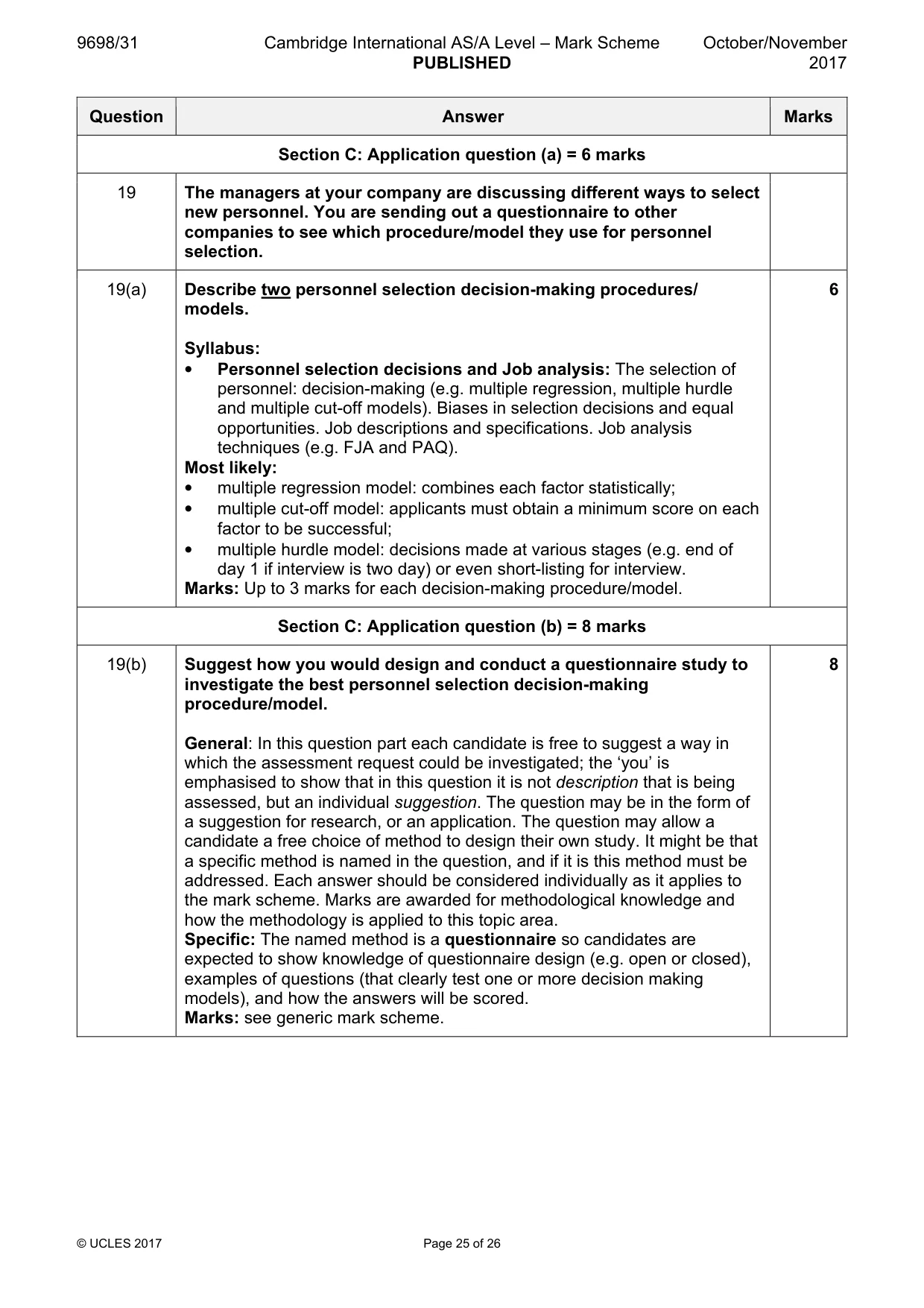
9698/31 Cambridge International AS/A Level – Mark Scheme PUBLISHED October/November 2017 © UCLES 2017 Page 25 of 26 Question Answer Marks Section C: Application question (a) = 6 marks 19 The managers at your company are discussing different ways to select new personnel. You are sending out a questionnaire to other companies to see which procedure/model they use for personnel selection. 19(a) Describe two personnel selection decision-making procedures/ models. Syllabus: • Personnel selection decisions and Job analysis: The selection of personnel: decision-making (e.g. multiple regression, multiple hurdle and multiple cut-off models). Biases in selection decisions and equal opportunities. Job descriptions and specifications. Job analysis techniques (e.g. FJA and PAQ). Most likely: • multiple regression model: combines each factor statistically; • multiple cut-off model: applicants must obtain a minimum score on each factor to be successful; • multiple hurdle model: decisions made at various stages (e.g. end of day 1 if interview is two day) or even short-listing for interview. Marks: Up to 3 marks for each decision-making procedure/model. 6 Section C: Application question (b) = 8 marks 19(b) Suggest how you would design and conduct a questionnaire study to investigate the best personnel selection decision-making procedure/model. General: In this question part each candidate is free to suggest a way in which the assessment request could be investigated; the ‘you’ is emphasised to show that in this question it is not description that is being assessed, but an individual suggestion. The question may be in the form of a suggestion for research, or an application. The question may allow a candidate a free choice of method to design their own study. It might be that a specific method is named in the question, and if it is this method must be addressed. Each answer should be considered individually as it applies to the mark scheme. Marks are awarded for methodological knowledge and how the methodology is applied to this topic area. Specific: The named method is a questionnaire so candidates are expected to show knowledge of questionnaire design (e.g. open or closed), examples of questions (that clearly test one or more decision making models), and how the answers will be scored. Marks: see generic mark scheme. 8
Mark scheme, page 26
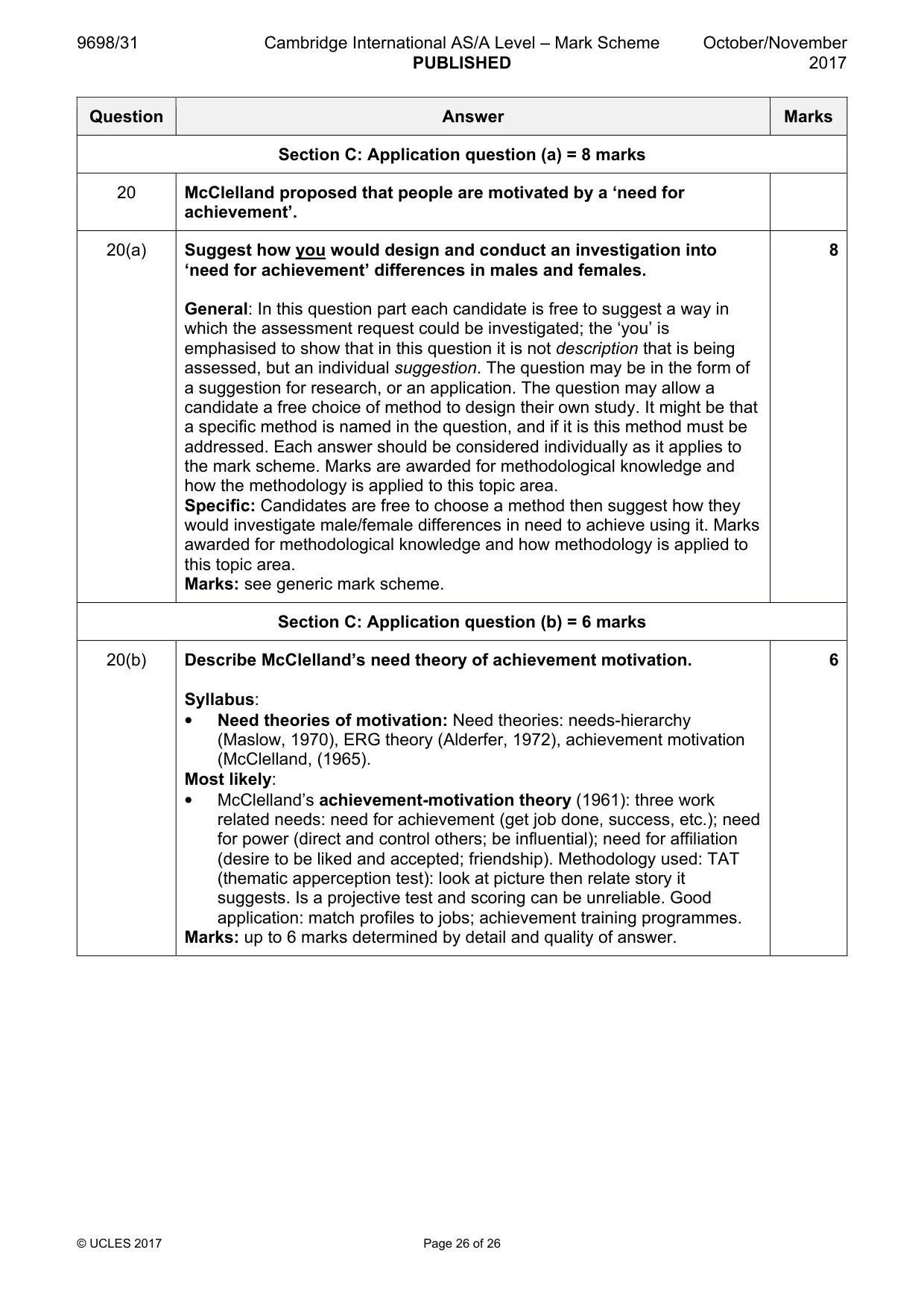
9698/31 Cambridge International AS/A Level – Mark Scheme PUBLISHED October/November 2017 © UCLES 2017 Page 26 of 26 Question Answer Marks Section C: Application question (a) = 8 marks 20 McClelland proposed that people are motivated by a ‘need for achievement’. 20(a) Suggest how you would design and conduct an investigation into ‘need for achievement’ differences in males and females. General: In this question part each candidate is free to suggest a way in which the assessment request could be investigated; the ‘you’ is emphasised to show that in this question it is not description that is being assessed, but an individual suggestion. The question may be in the form of a suggestion for research, or an application. The question may allow a candidate a free choice of method to design their own study. It might be that a specific method is named in the question, and if it is this method must be addressed. Each answer should be considered individually as it applies to the mark scheme. Marks are awarded for methodological knowledge and how the methodology is applied to this topic area. Specific: Candidates are free to choose a method then suggest how they would investigate male/female differences in need to achieve using it. Marks awarded for methodological knowledge and how methodology is applied to this topic area. Marks: see generic mark scheme. 8 Section C: Application question (b) = 6 marks 20(b) Describe McClelland’s need theory of achievement motivation. Syllabus: • Need theories of motivation: Need theories: needs-hierarchy (Maslow, 1970), ERG theory (Alderfer, 1972), achievement motivation (McClelland, (1965). Most likely: • McClelland’s achievement-motivation theory (1961): three work related needs: need for achievement (get job done, success, etc.); need for power (direct and control others; be influential); need for affiliation (desire to be liked and accepted; friendship). Methodology used: TAT (thematic apperception test): look at picture then relate story it suggests. Is a projective test and scoring can be unreliable. Good application: match profiles to jobs; achievement training programmes. Marks: up to 6 marks determined by detail and quality of answer. 6
What you needed in this session
Cambridge’s own grade thresholds for 2017 Oct/Nov, Paper 3 · Variant 1. A higher threshold means an easier paper — the bar moves with how the cohort did.