Cambridge A Level Psychology 9698 — 2017 May/June Paper 3 · Variant 1
9698/31/M/J/17 · 20 questions · 80 marks · ≈90 min
The question paper and its mark scheme, free to read here and free to download. This is Cambridge’s own paper, exactly as it was sat.
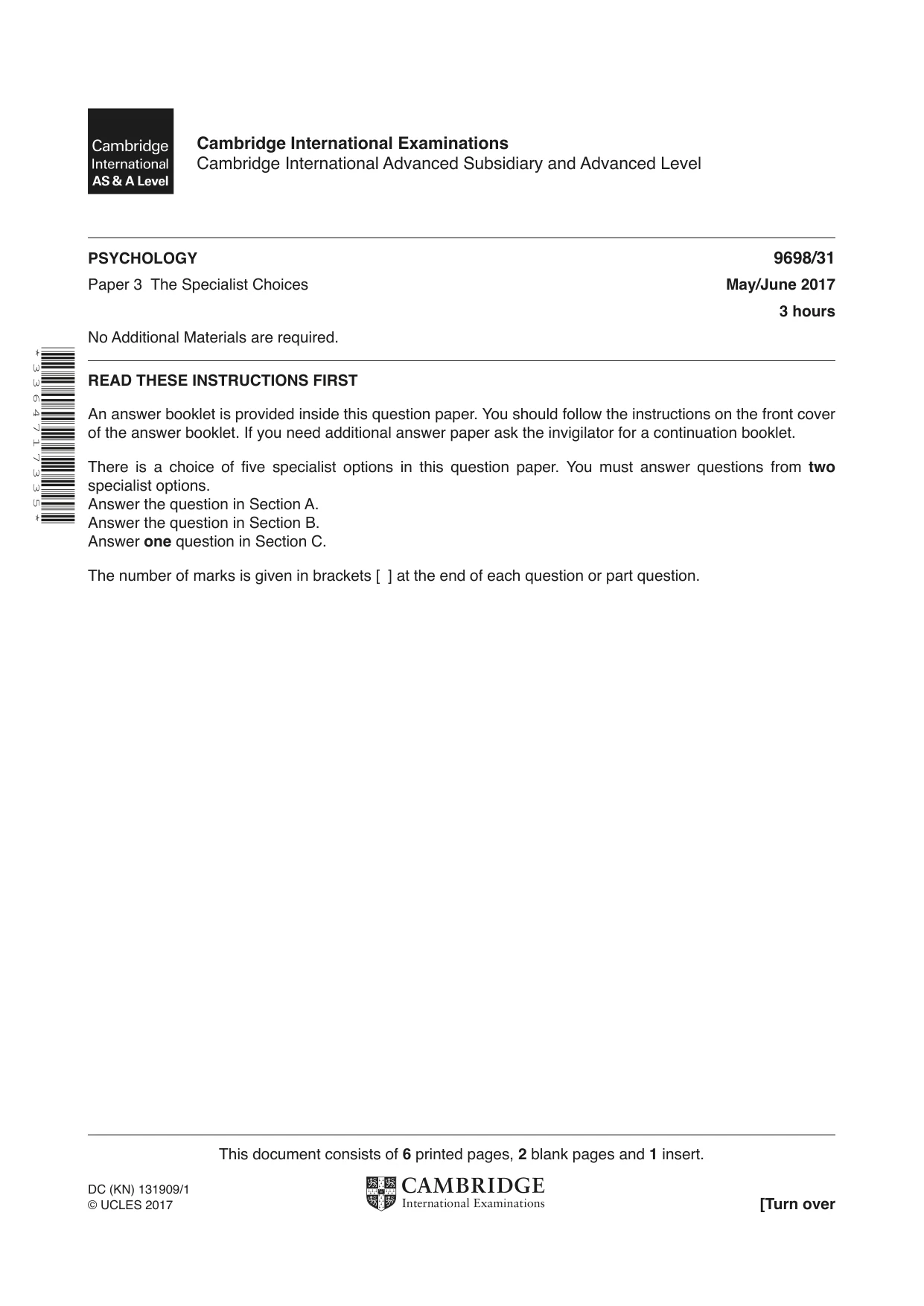
Question paper8 pages


Mark scheme25 pages
Answers below. Sit the paper first if you are practising.
Questions as text
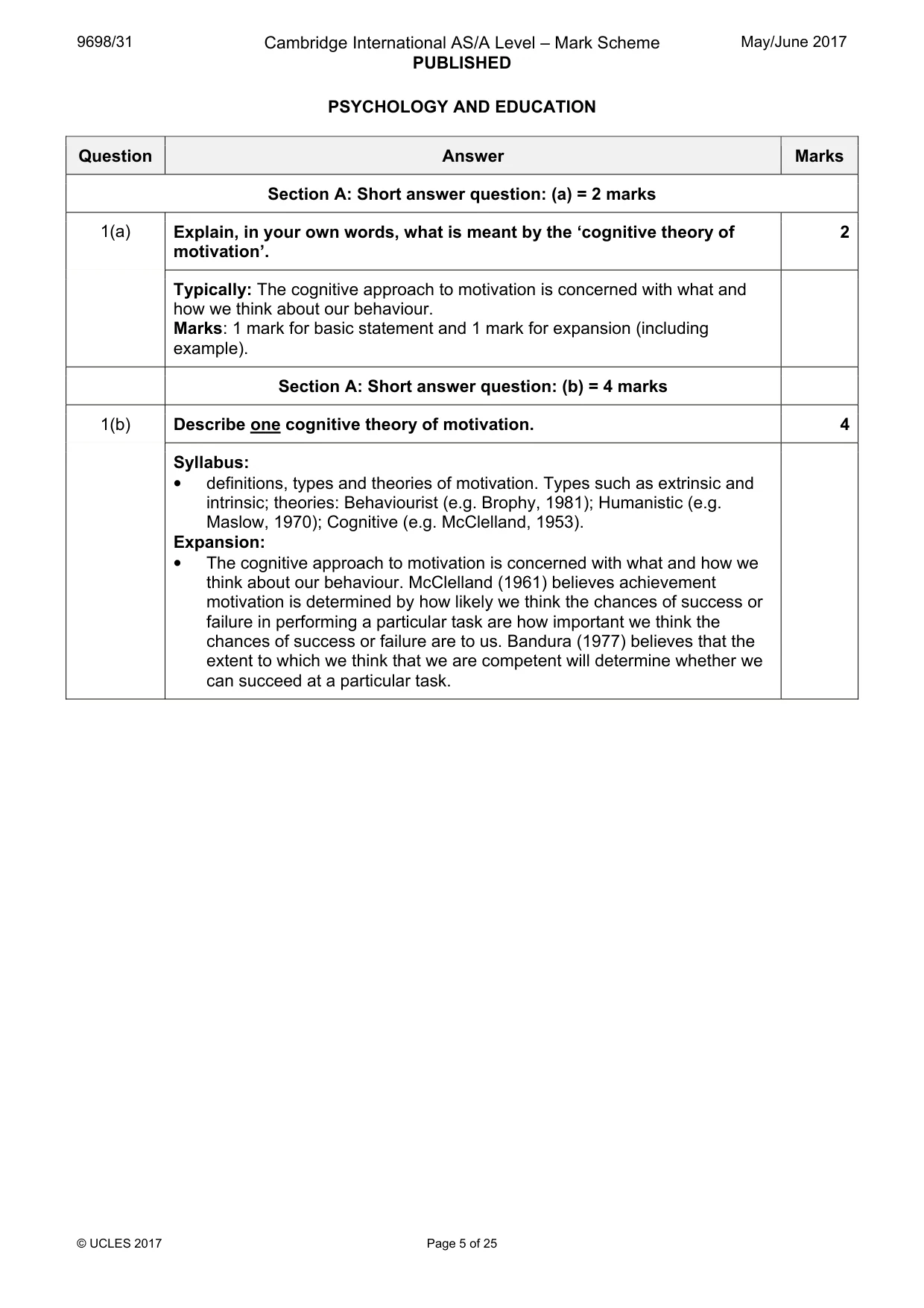
Q1 · Explain, in your own words, what is meant by the ‘cognitive theory of motivation’
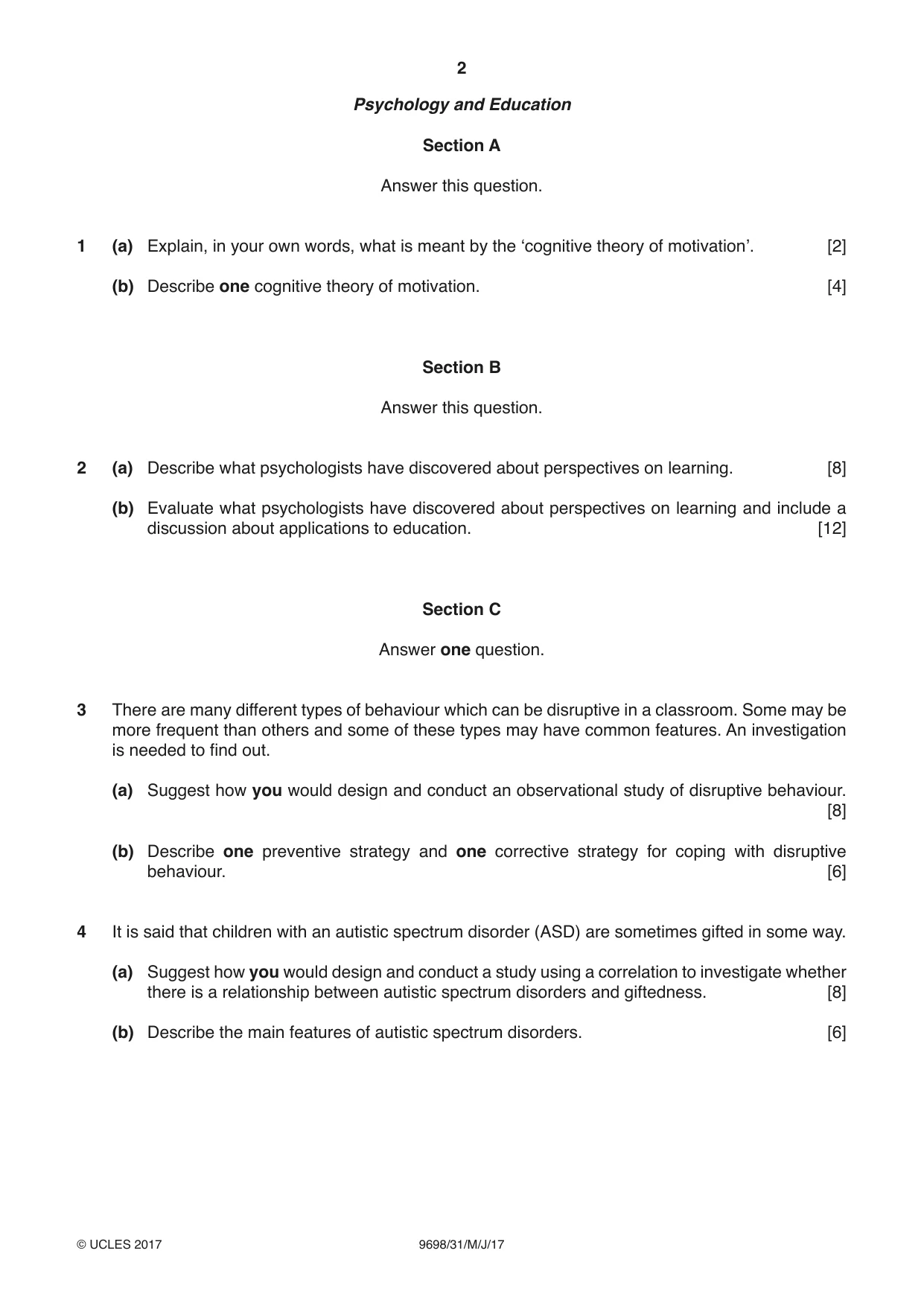
1 (a) Explain, in your own words, what is meant by the ‘cognitive theory of motivation’. [2] (b) Describe one cognitive theory of motivation. [4]
Mark scheme: Question Answer Marks Section A: Short answer question: (a) = 2 marks 1(a) Explain, in your own words, what is meant by the ‘cognitive theory of 2 motivation’. Typically: The cognitive approach to motivation is concerned with what and how we think about our behaviour. Marks: 1 mark for basic statement and 1 mark for expansion (including example). Section A: Short answer question: (b) = 4 marks 1(b) Describe one cognitive theory of motivation. 4 Syllabus: • definitions, types and theories of motivation. Types such as extrinsic and intrinsic; theories: Behaviourist (e.g. Brophy, 1981); Humanistic (e.g. Maslow, 1970); Cognitive (e.g. McClelland, 1953). Expansion: • The cognitive approach to motivation is concerned with what and how we think about our behaviour. McClelland (1961) believes achievement motivation is determined by how likely we think the chances of success or failure in performing a particular task are how important we think the chances of success or failure are to us. Bandura (1977) believes that the extent to which we think that we are competent will determine whether we can succeed at a particular task.
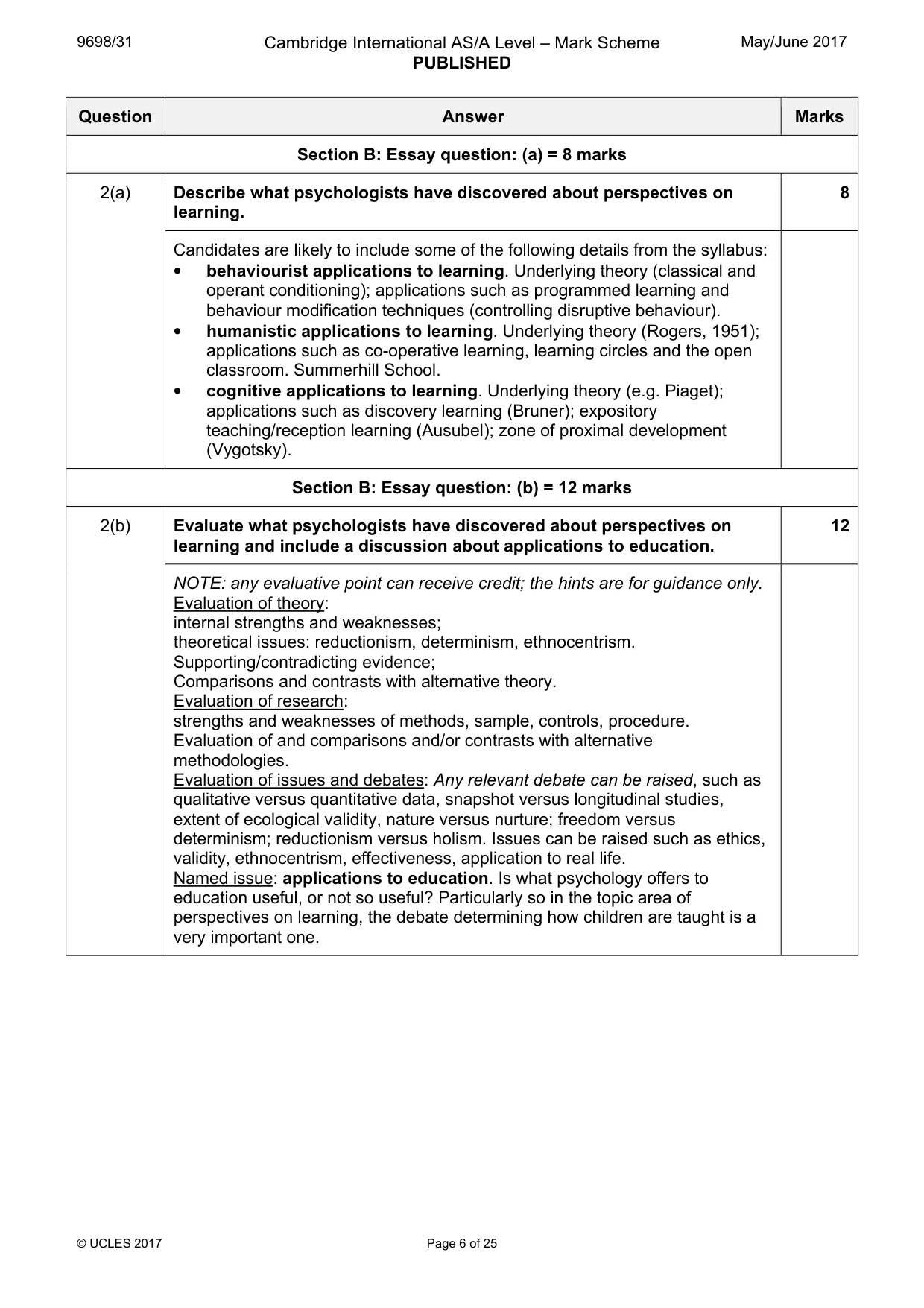
Q2 · Describe what psychologists have discovered about perspectives on learning
2 (a) Describe what psychologists have discovered about perspectives on learning. [8] (b) Evaluate what psychologists have discovered about perspectives on learning and include a discussion about applications to education. [12] Section C Answer one question.
Mark scheme: 2(a) Describe what psychologists have discovered about perspectives on 8 learning. Candidates are likely to include some of the following details from the syllabus: • behaviourist applications to learning. Underlying theory (classical and operant conditioning); applications such as programmed learning and behaviour modification techniques (controlling disruptive behaviour). • humanistic applications to learning. Underlying theory (Rogers, 1951); applications such as co-operative learning, learning circles and the open classroom. Summerhill School. • cognitive applications to learning. Underlying theory (e.g. Piaget); applications such as discovery learning (Bruner); expository teaching/reception learning (Ausubel); zone of proximal development (Vygotsky). Section B: Essay question: (b) = 12 marks 2(b) Evaluate what psychologists have discovered about perspectives on 12 learning and include a discussion about applications to education. NOTE: any evaluative point can receive credit; the hints are for guidance only. Evaluation of theory: internal strengths and weaknesses; theoretical issues: reductionism, determinism, ethnocentrism. Supporting/contradicting evidence; Comparisons and contrasts with alternative theory. Evaluation of research: strengths and weaknesses of methods, sample, controls, procedure. Evaluation of and comparisons and/or contrasts with alternative methodologies. Evaluation of issues and debates: Any relevant debate can be raised, such as qualitative versus quantitative data, snapshot versus longitudinal studies, extent of ecological validity, nature versus nurture; freedom versus determinism; reductionism versus holism. Issues can be raised such as ethics, validity, ethnocentrism, effectiveness, application to real life. Named issue: applications to education. Is what psychology offers to education useful, or not so useful? Particularly so in the topic area of perspectives on learning, the debate determining how children are taught is a very important one.
Q3 · There are many different types of behaviour which can be disruptive in a classroom
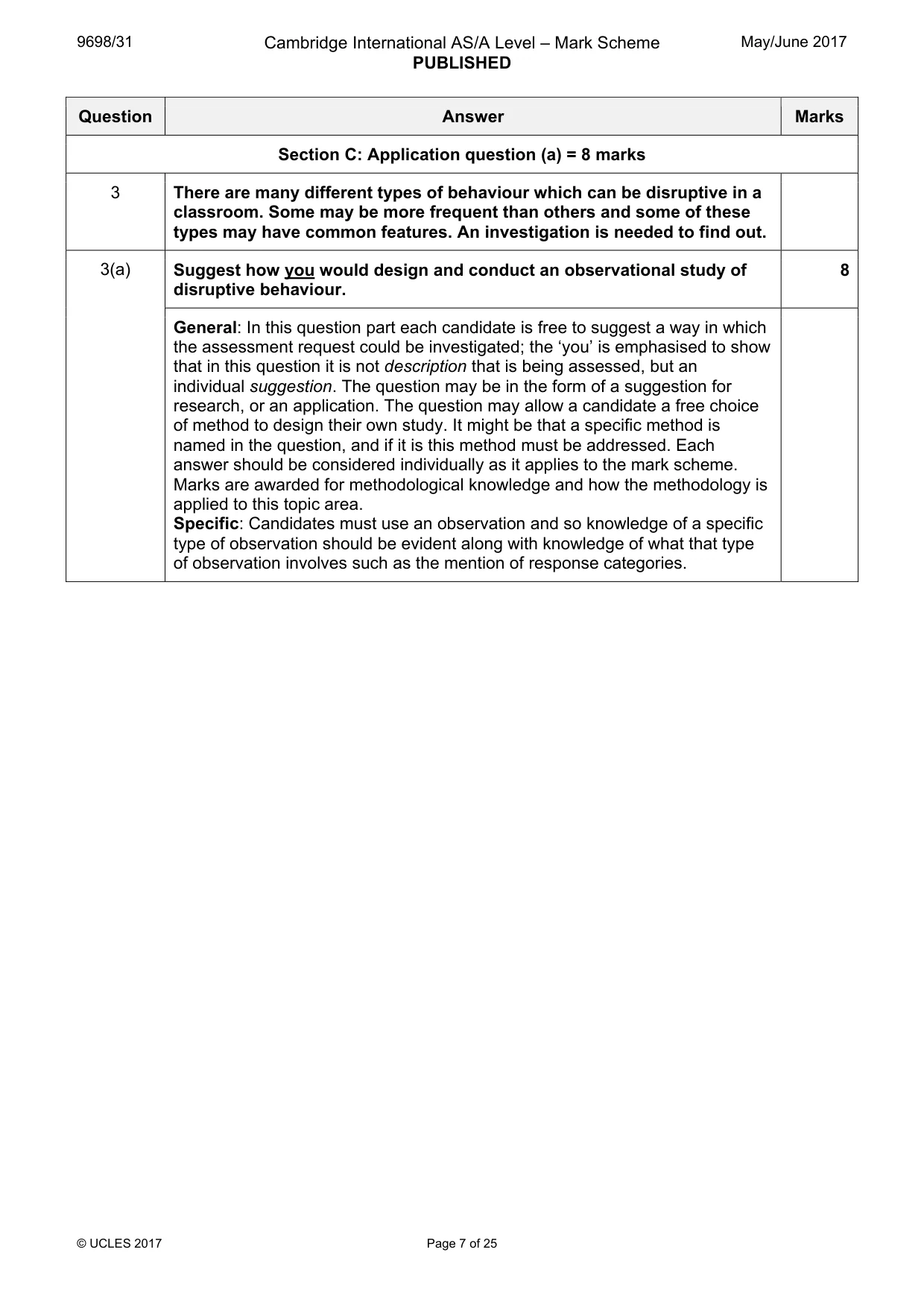
3 There are many different types of behaviour which can be disruptive in a classroom. Some may be more frequent than others and some of these types may have common features. An investigation is needed to find out. (a) Suggest how you would design and conduct an observational study of disruptive behaviour. [8] (b) Describe one preventive strategy and one corrective strategy for coping with disruptive behaviour. [6]
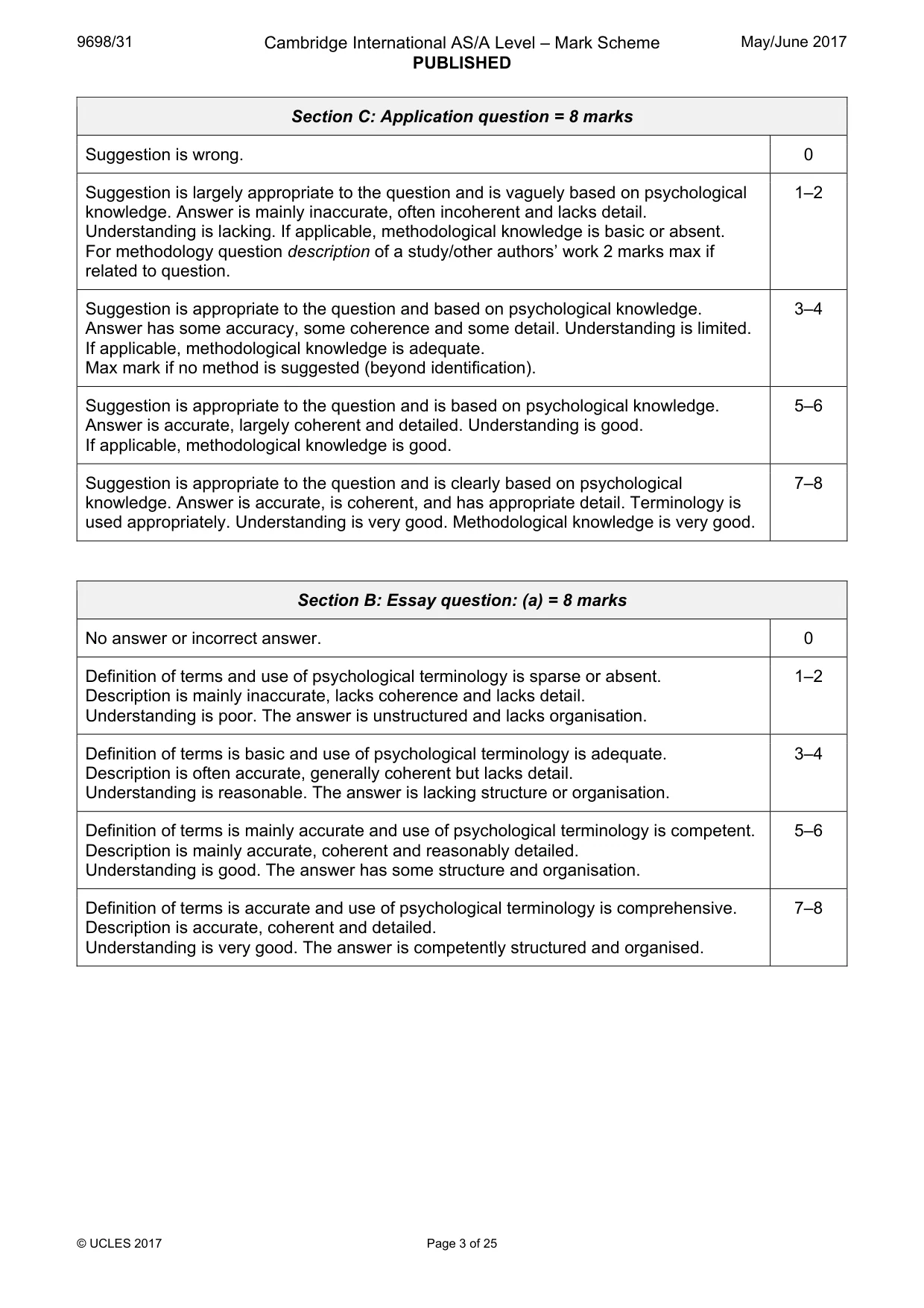
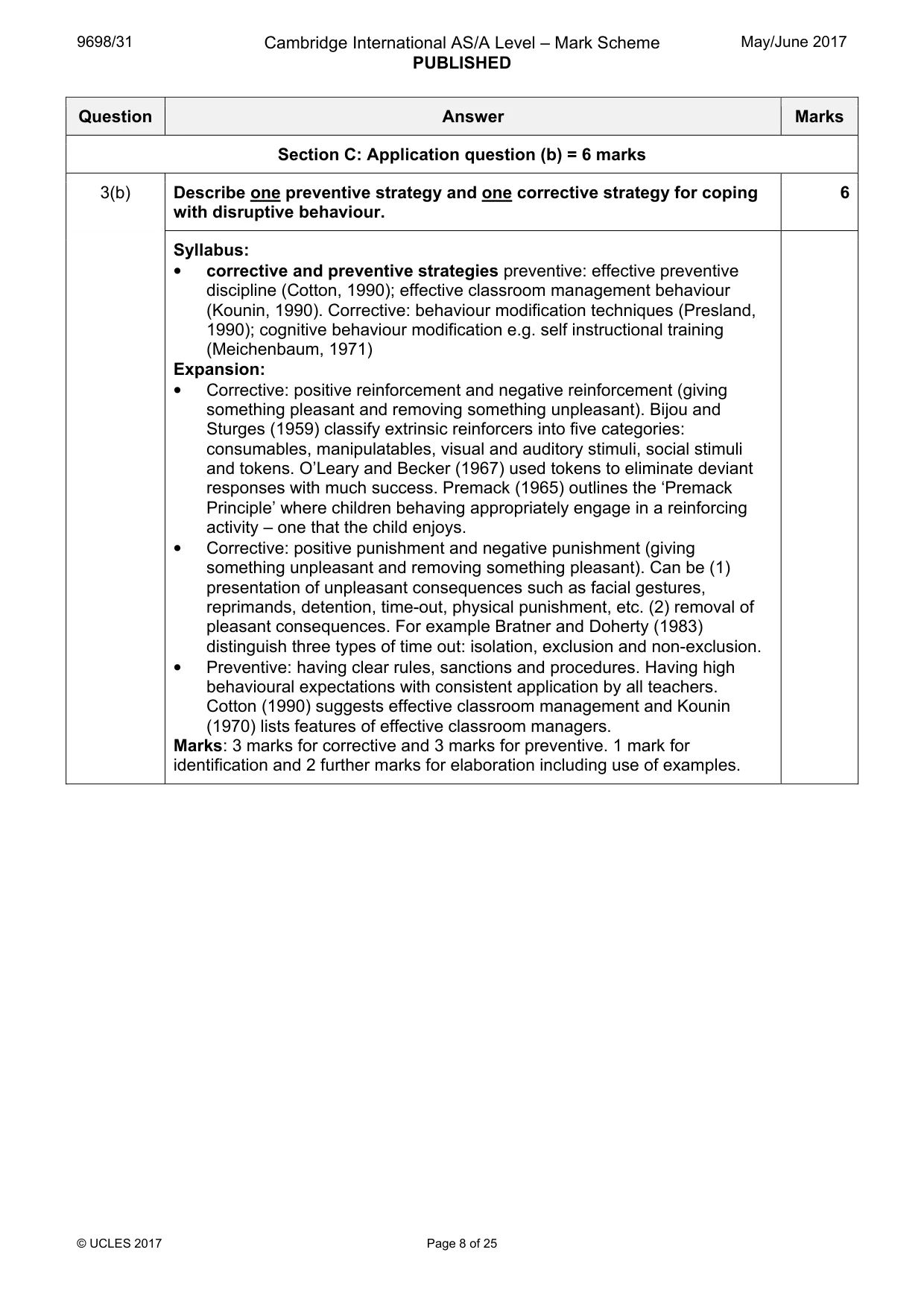
Mark scheme: 3(a) Suggest how you would design and conduct an observational study of 8 disruptive behaviour. General: In this question part each candidate is free to suggest a way in which the assessment request could be investigated; the ‘you’ is emphasised to show that in this question it is not description that is being assessed, but an individual suggestion. The question may be in the form of a suggestion for research, or an application. The question may allow a candidate a free choice of method to design their own study. It might be that a specific method is named in the question, and if it is this method must be addressed. Each answer should be considered individually as it applies to the mark scheme. Marks are awarded for methodological knowledge and how the methodology is applied to this topic area. Specific: Candidates must use an observation and so knowledge of a specific type of observation should be evident along with knowledge of what that type of observation involves such as the mention of response categories. Section C: Application question (b) = 6 marks 3(b) Describe one preventive strategy and one corrective strategy for coping 6 with disruptive behaviour. Syllabus: • corrective and preventive strategies preventive: effective preventive discipline (Cotton, 1990); effective classroom management behaviour (Kounin, 1990). Corrective: behaviour modification techniques (Presland, 1990); cognitive behaviour modification e.g. self instructional training (Meichenbaum, 1971) Expansion: • Corrective: positive reinforcement and negative reinforcement (giving something pleasant and removing something unpleasant). Bijou and Sturges (1959) classify extrinsic reinforcers into five categories: consumables, manipulatables, visual and auditory stimuli, social stimuli and tokens. O’Leary and Becker (1967) used tokens to eliminate deviant responses with much success. Premack (1965) outlines the ‘Premack Principle’ where children behaving appropriately engage in a reinforcing activity – one that the child enjoys. • Corrective: positive punishment and negative punishment (giving something unpleasant and removing something pleasant). Can be (1) presentation of unpleasant consequences such as facial gestures, reprimands, detention, time-out, physical punishment, etc. (2) removal of pleasant consequences. For example Bratner and Doherty (1983) distinguish three types of time out: isolation, exclusion and non-exclusion. • Preventive: having clear rules, sanctions and procedures. Having high behavioural expectations with consistent application by all teachers. Cotton (1990) suggests effective classroom management and Kounin (1970) lists features of effective classroom managers. Marks: 3 marks for corrective and 3 marks for preventive. 1 mark for identification and 2 further marks for elaboration including use of examples.
Q4 · It is said that children with an autistic spectrum disorder (ASD) are sometimes gifted in…
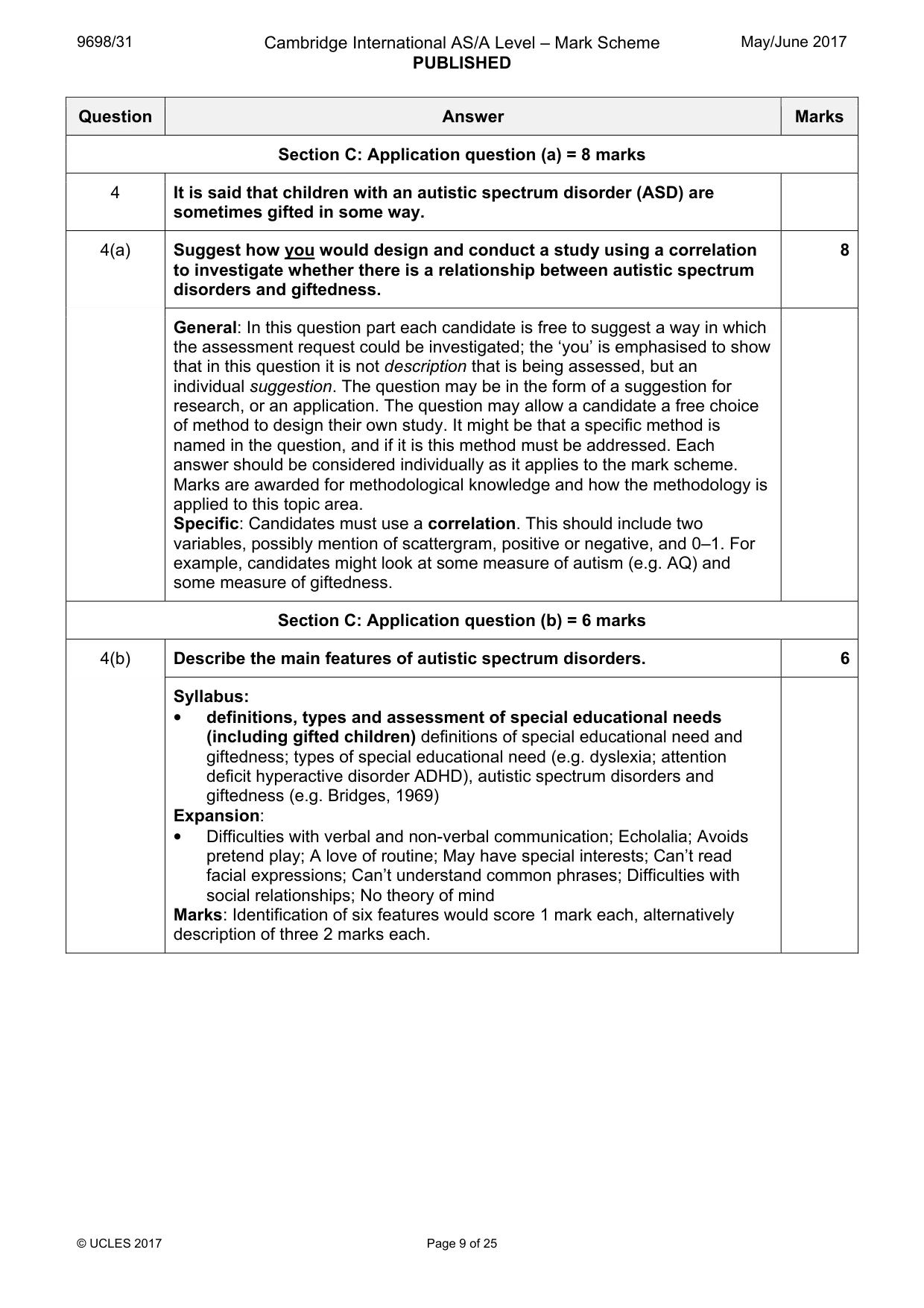
4 It is said that children with an autistic spectrum disorder (ASD) are sometimes gifted in some way. (a) Suggest how you would design and conduct a study using a correlation to investigate whether there is a relationship between autistic spectrum disorders and giftedness. [8] (b) Describe the main features of autistic spectrum disorders. [6] Psychology and Health Section A Answer this question.
Mark scheme: 4(a) Suggest how you would design and conduct a study using a correlation 8 to investigate whether there is a relationship between autistic spectrum disorders and giftedness. General: In this question part each candidate is free to suggest a way in which the assessment request could be investigated; the ‘you’ is emphasised to show that in this question it is not description that is being assessed, but an individual suggestion. The question may be in the form of a suggestion for research, or an application. The question may allow a candidate a free choice of method to design their own study. It might be that a specific method is named in the question, and if it is this method must be addressed. Each answer should be considered individually as it applies to the mark scheme. Marks are awarded for methodological knowledge and how the methodology is applied to this topic area. Specific: Candidates must use a correlation. This should include two variables, possibly mention of scattergram, positive or negative, and 0–1. For example, candidates might look at some measure of autism (e.g. AQ) and some measure of giftedness. Section C: Application question (b) = 6 marks 4(b) Describe the main features of autistic spectrum disorders. 6 Syllabus: • definitions, types and assessment of special educational needs (including gifted children) definitions of special educational need and giftedness; types of special educational need (e.g. dyslexia; attention deficit hyperactive disorder ADHD), autistic spectrum disorders and giftedness (e.g. Bridges, 1969) Expansion: • Difficulties with verbal and non-verbal communication; Echolalia; Avoids pretend play; A love of routine; May have special interests; Can’t read facial expressions; Can’t understand common phrases; Difficulties with social relationships; No theory of mind Marks: Identification of six features would score 1 mark each, alternatively description of three 2 marks each. PSYCHOLOGY AND HEALTH
Q5 · Explain, in your own words, what is meant by ‘chronic pain’
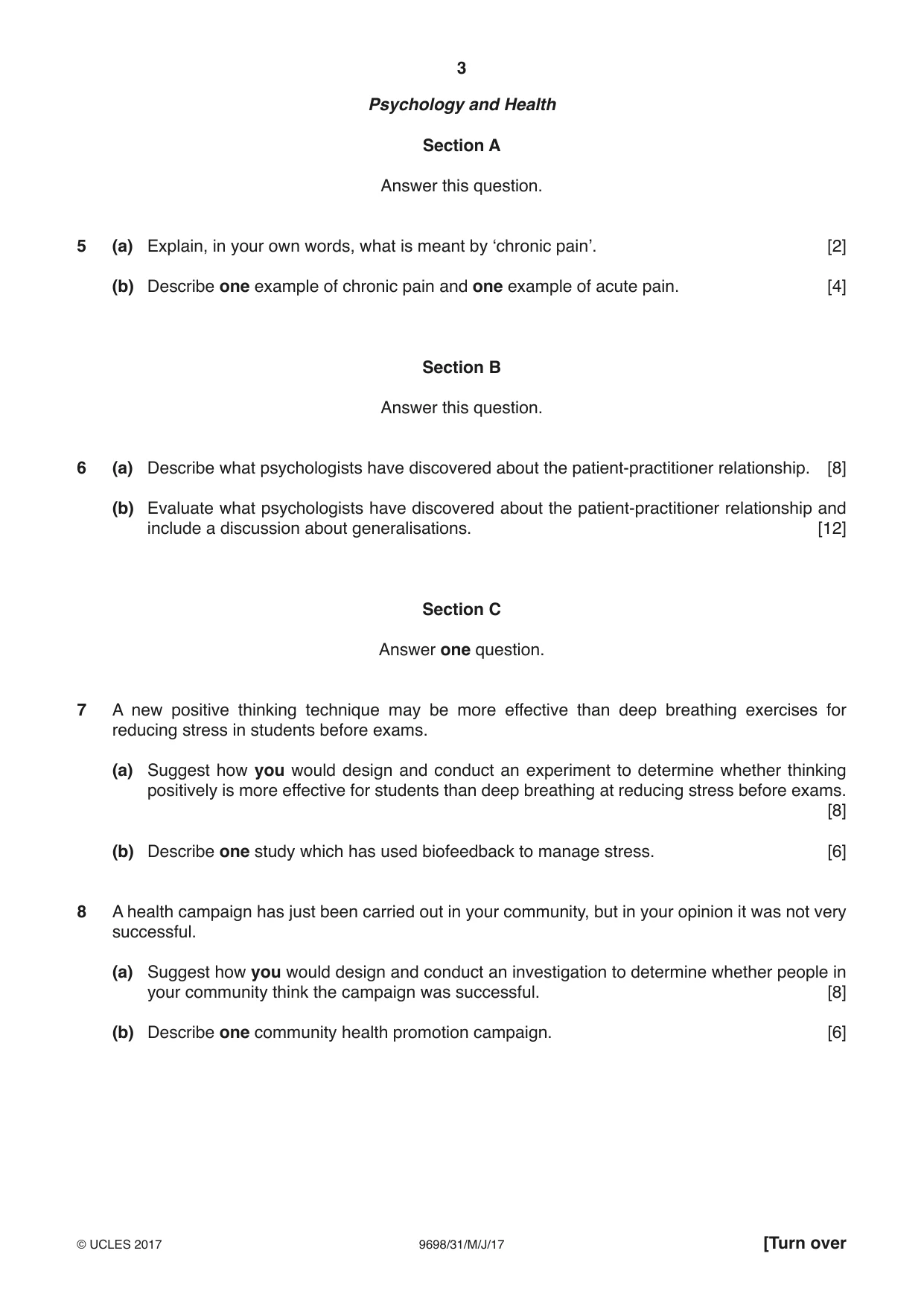
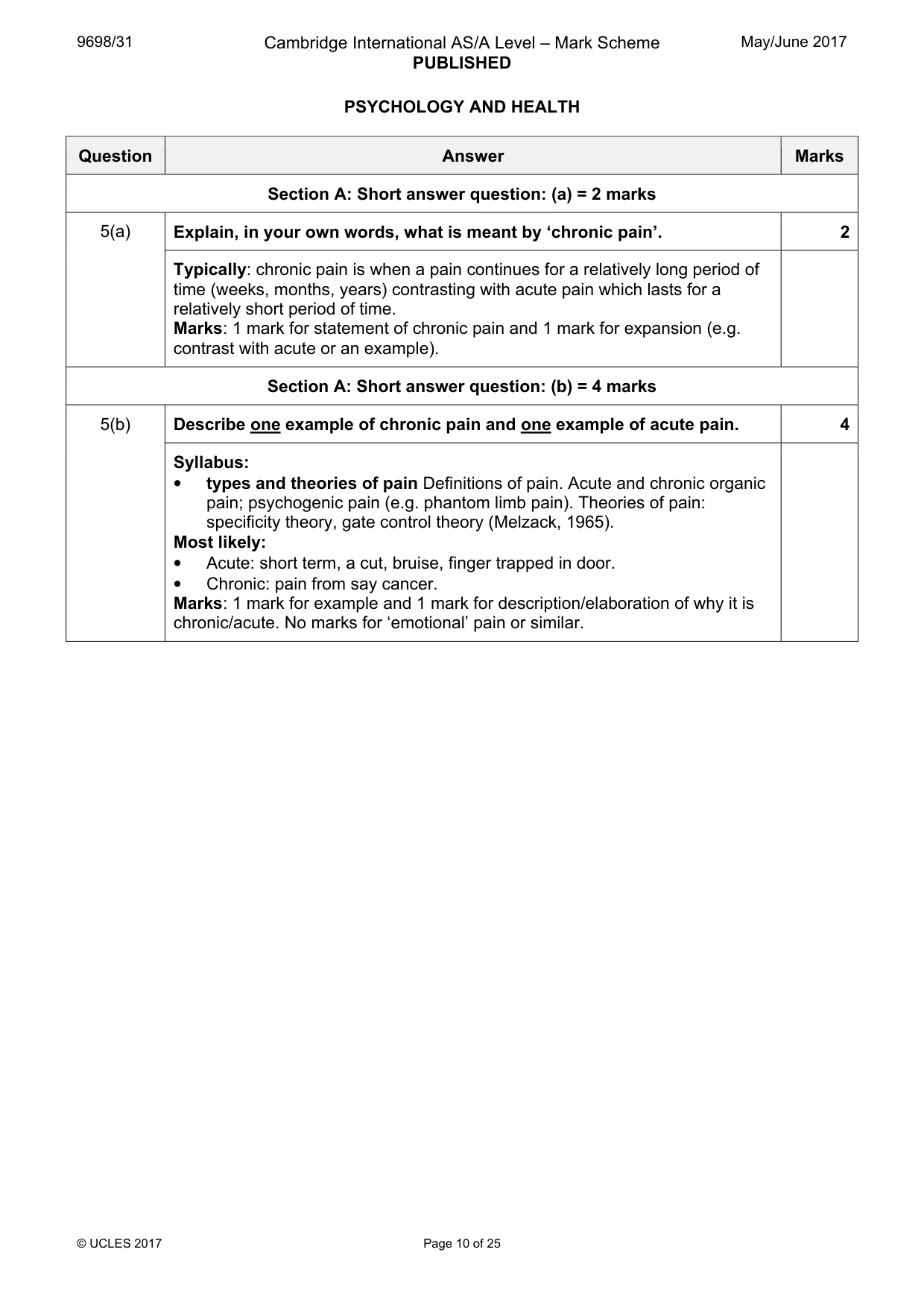
5 (a) Explain, in your own words, what is meant by ‘chronic pain’. [2] (b) Describe one example of chronic pain and one example of acute pain. [4]
Mark scheme: 5(a) Explain, in your own words, what is meant by ‘chronic pain’. 2 Typically: chronic pain is when a pain continues for a relatively long period of time (weeks, months, years) contrasting with acute pain which lasts for a relatively short period of time. Marks: 1 mark for statement of chronic pain and 1 mark for expansion (e.g. contrast with acute or an example). Section A: Short answer question: (b) = 4 marks 5(b) Describe one example of chronic pain and one example of acute pain. 4 Syllabus: • types and theories of pain Definitions of pain. Acute and chronic organic pain; psychogenic pain (e.g. phantom limb pain). Theories of pain: specificity theory, gate control theory (Melzack, 1965). Most likely: • Acute: short term, a cut, bruise, finger trapped in door. • Chronic: pain from say cancer. Marks: 1 mark for example and 1 mark for description/elaboration of why it is chronic/acute. No marks for ‘emotional’ pain or similar.
Q6 · Describe what psychologists have discovered about the patient-practitioner relationship
6 (a) Describe what psychologists have discovered about the patient-practitioner relationship. [8] (b) Evaluate what psychologists have discovered about the patient-practitioner relationship and include a discussion about generalisations. [12] Section C Answer one question.
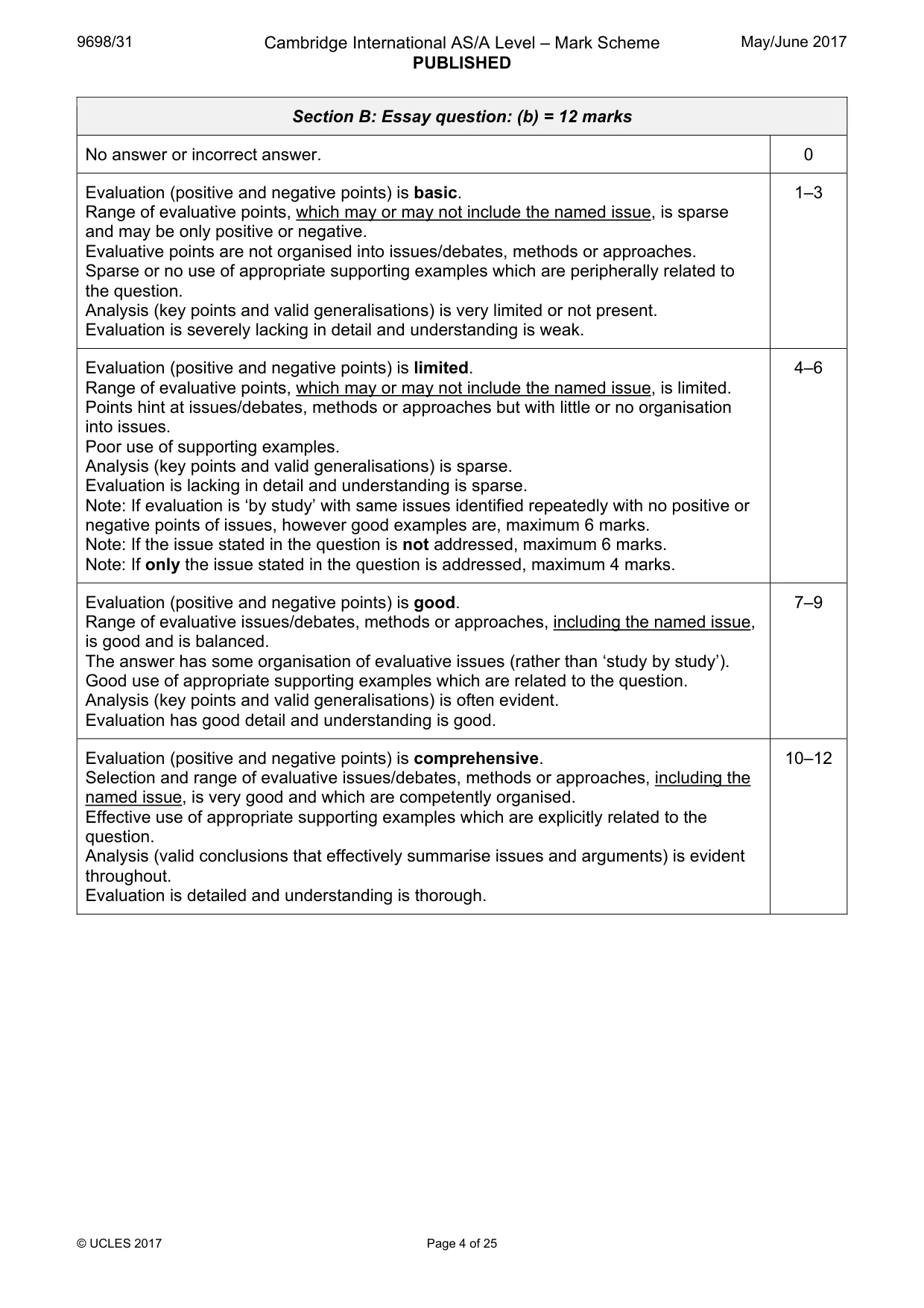
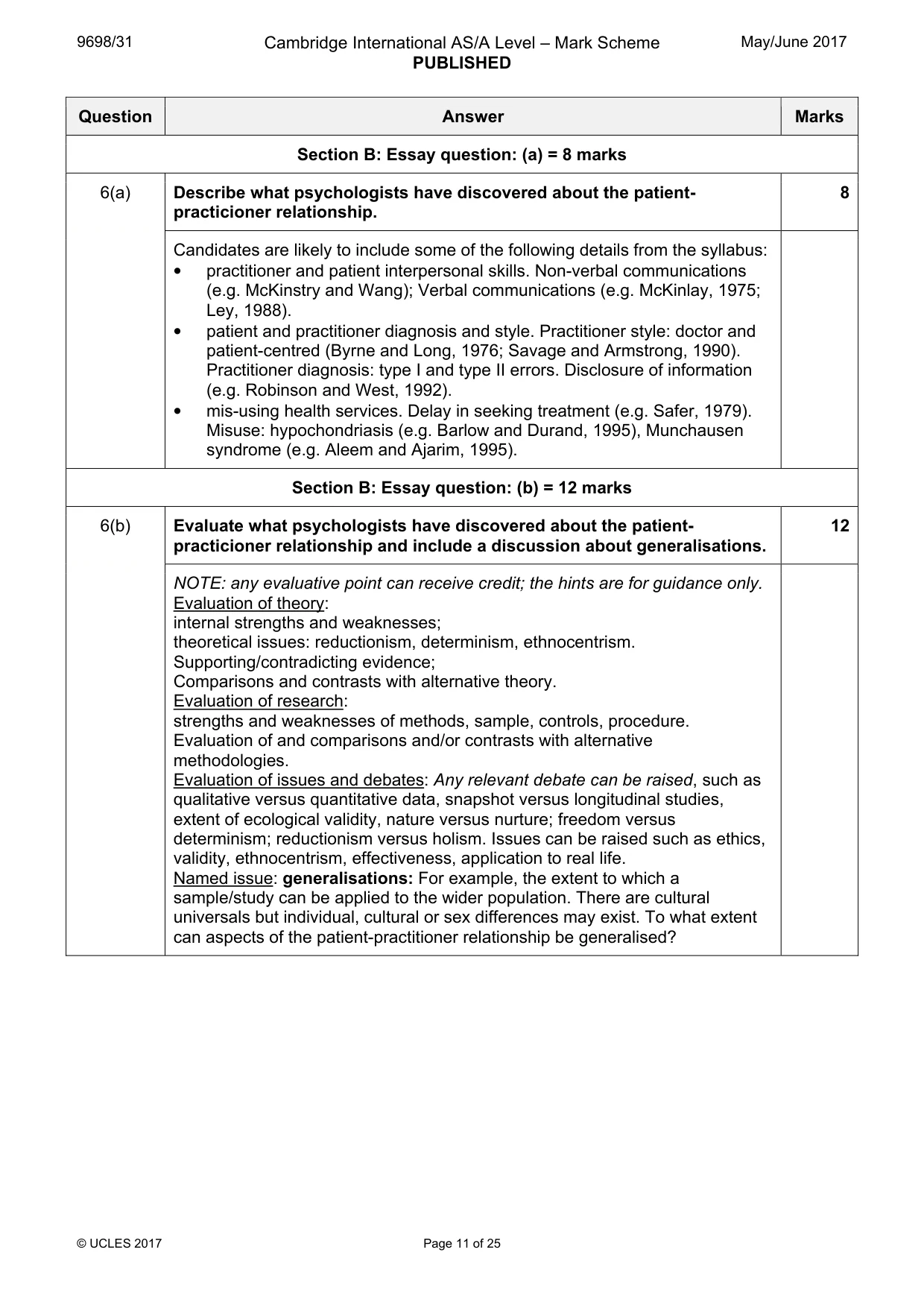
Mark scheme: 6(a) Describe what psychologists have discovered about the patient- 8 practicioner relationship. Candidates are likely to include some of the following details from the syllabus: • practitioner and patient interpersonal skills. Non-verbal communications (e.g. McKinstry and Wang); Verbal communications (e.g. McKinlay, 1975; Ley, 1988). • patient and practitioner diagnosis and style. Practitioner style: doctor and patient-centred (Byrne and Long, 1976; Savage and Armstrong, 1990). Practitioner diagnosis: type I and type II errors. Disclosure of information (e.g. Robinson and West, 1992). • mis-using health services. Delay in seeking treatment (e.g. Safer, 1979). Misuse: hypochondriasis (e.g. Barlow and Durand, 1995), Munchausen syndrome (e.g. Aleem and Ajarim, 1995). Section B: Essay question: (b) = 12 marks 6(b) Evaluate what psychologists have discovered about the patient- 12 practicioner relationship and include a discussion about generalisations. NOTE: any evaluative point can receive credit; the hints are for guidance only. Evaluation of theory: internal strengths and weaknesses; theoretical issues: reductionism, determinism, ethnocentrism. Supporting/contradicting evidence; Comparisons and contrasts with alternative theory. Evaluation of research: strengths and weaknesses of methods, sample, controls, procedure. Evaluation of and comparisons and/or contrasts with alternative methodologies. Evaluation of issues and debates: Any relevant debate can be raised, such as qualitative versus quantitative data, snapshot versus longitudinal studies, extent of ecological validity, nature versus nurture; freedom versus determinism; reductionism versus holism. Issues can be raised such as ethics, validity, ethnocentrism, effectiveness, application to real life. Named issue: generalisations: For example, the extent to which a sample/study can be applied to the wider population. There are cultural universals but individual, cultural or sex differences may exist. To what extent can aspects of the patient-practitioner relationship be generalised?
Q7 · A new positive thinking technique may be more effective than deep breathing exercises for…
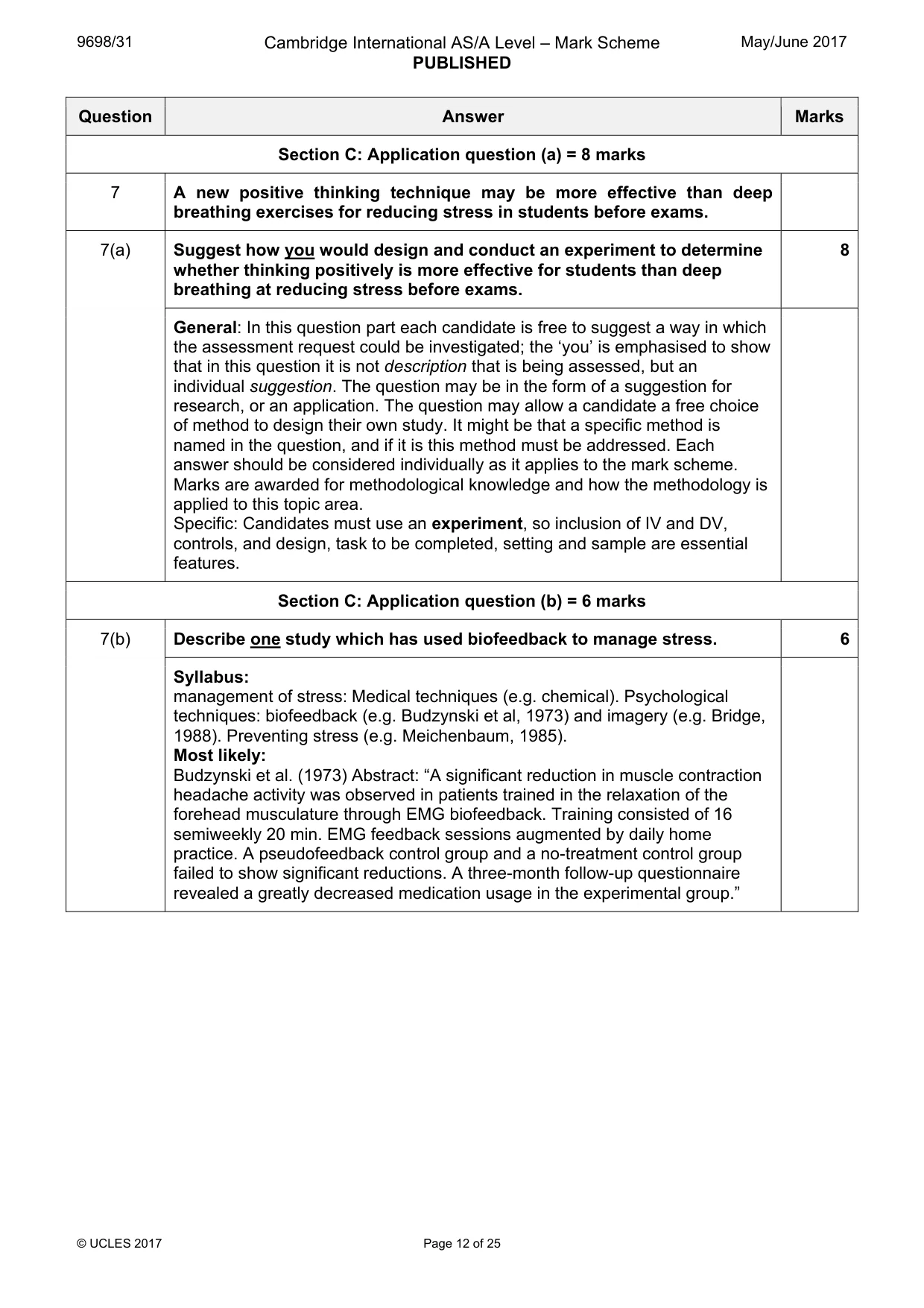
7 A new positive thinking technique may be more effective than deep breathing exercises for reducing stress in students before exams. (a) Suggest how you would design and conduct an experiment to determine whether thinking positively is more effective for students than deep breathing at reducing stress before exams. [8] (b) Describe one study which has used biofeedback to manage stress. [6]
Mark scheme: 7(a) Suggest how you would design and conduct an experiment to determine 8 whether thinking positively is more effective for students than deep breathing at reducing stress before exams. General: In this question part each candidate is free to suggest a way in which the assessment request could be investigated; the ‘you’ is emphasised to show that in this question it is not description that is being assessed, but an individual suggestion. The question may be in the form of a suggestion for research, or an application. The question may allow a candidate a free choice of method to design their own study. It might be that a specific method is named in the question, and if it is this method must be addressed. Each answer should be considered individually as it applies to the mark scheme. Marks are awarded for methodological knowledge and how the methodology is applied to this topic area. Specific: Candidates must use an experiment, so inclusion of IV and DV, controls, and design, task to be completed, setting and sample are essential features. Section C: Application question (b) = 6 marks 7(b) Describe one study which has used biofeedback to manage stress. 6 Syllabus: management of stress: Medical techniques (e.g. chemical). Psychological techniques: biofeedback (e.g. Budzynski et al, 1973) and imagery (e.g. Bridge, 1988). Preventing stress (e.g. Meichenbaum, 1985). Most likely: Budzynski et al. (1973) Abstract: “A significant reduction in muscle contraction headache activity was observed in patients trained in the relaxation of the forehead musculature through EMG biofeedback. Training consisted of 16 semiweekly 20 min. EMG feedback sessions augmented by daily home practice. A pseudofeedback control group and a no-treatment control group failed to show significant reductions. A three-month follow-up questionnaire revealed a greatly decreased medication usage in the experimental group.”
Q8 · A health campaign has just been carried out in your community, but in your opinion it was…
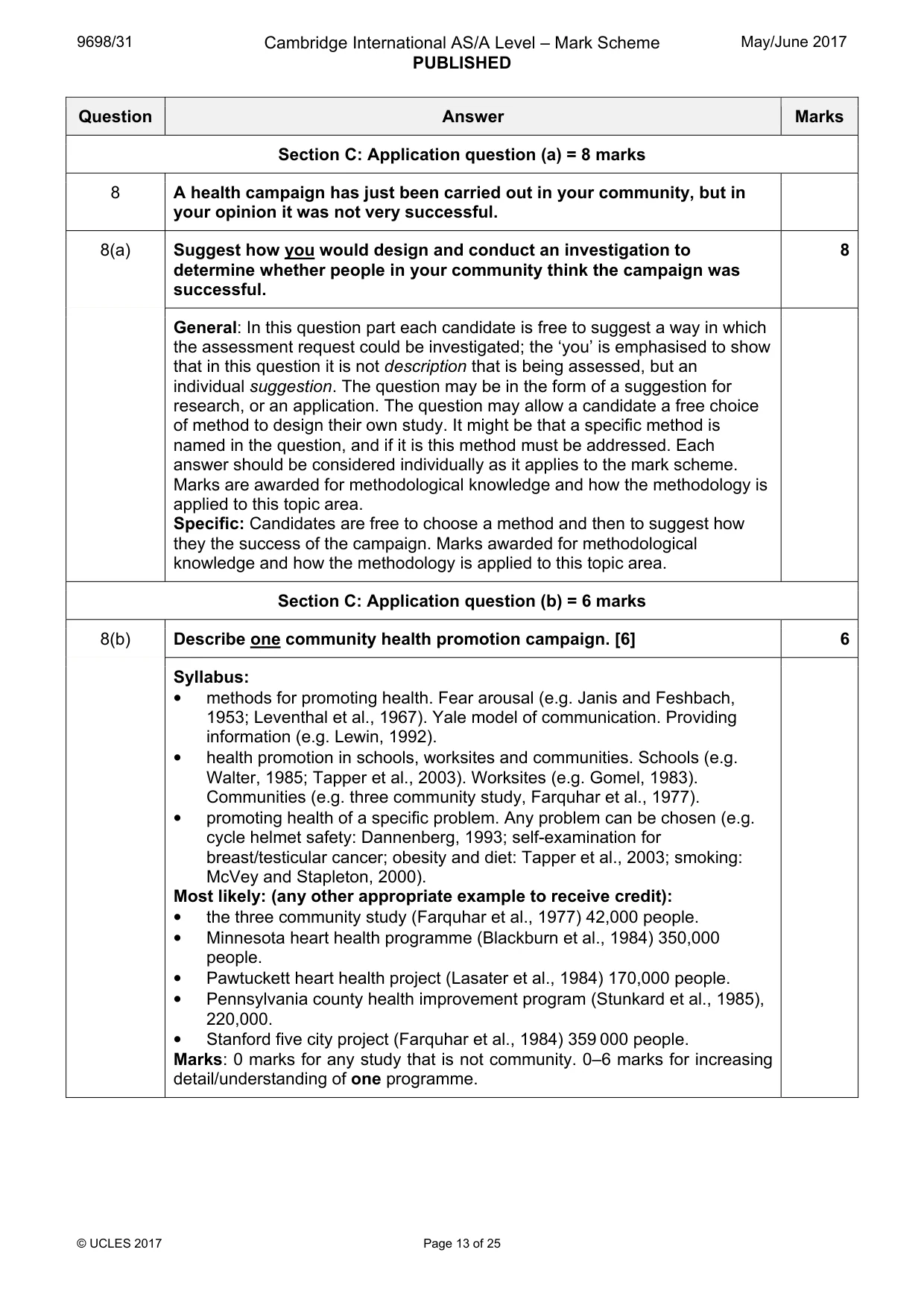
8 A health campaign has just been carried out in your community, but in your opinion it was not very successful. (a) Suggest how you would design and conduct an investigation to determine whether people in your community think the campaign was successful. [8] (b) Describe one community health promotion campaign. [6] Psychology and Environment Section A Answer this question.
Mark scheme: 8(a) Suggest how you would design and conduct an investigation to 8 determine whether people in your community think the campaign was successful. General: In this question part each candidate is free to suggest a way in which the assessment request could be investigated; the ‘you’ is emphasised to show that in this question it is not description that is being assessed, but an individual suggestion. The question may be in the form of a suggestion for research, or an application. The question may allow a candidate a free choice of method to design their own study. It might be that a specific method is named in the question, and if it is this method must be addressed. Each answer should be considered individually as it applies to the mark scheme. Marks are awarded for methodological knowledge and how the methodology is applied to this topic area. Specific: Candidates are free to choose a method and then to suggest how they the success of the campaign. Marks awarded for methodological knowledge and how the methodology is applied to this topic area. Section C: Application question (b) = 6 marks 8(b) Describe one community health promotion campaign. [6] 6 Syllabus: • methods for promoting health. Fear arousal (e.g. Janis and Feshbach, 1953; Leventhal et al., 1967). Yale model of communication. Providing information (e.g. Lewin, 1992). • health promotion in schools, worksites and communities. Schools (e.g. Walter, 1985; Tapper et al., 2003). Worksites (e.g. Gomel, 1983). Communities (e.g. three community study, Farquhar et al., 1977). • promoting health of a specific problem. Any problem can be chosen (e.g. cycle helmet safety: Dannenberg, 1993; self-examination for breast/testicular cancer; obesity and diet: Tapper et al., 2003; smoking: McVey and Stapleton, 2000). Most likely: (any other appropriate example to receive credit): • the three community study (Farquhar et al., 1977) 42,000 people. • Minnesota heart health programme (Blackburn et al., 1984) 350,000 people. • Pawtuckett heart health project (Lasater et al., 1984) 170,000 people. • Pennsylvania county health improvement program (Stunkard et al., 1985), 220,000. • Stanford five city project (Farquhar et al., 1984) 359 000 people. Marks: 0 marks for any study that is not community. 0–6 marks for increasing detail/understanding of one programme. PSYCHOLOGY AND ENVIRONMENT
Q9 · Explain, in your own words, what is meant by the term ‘effects of crowding on pro-social…
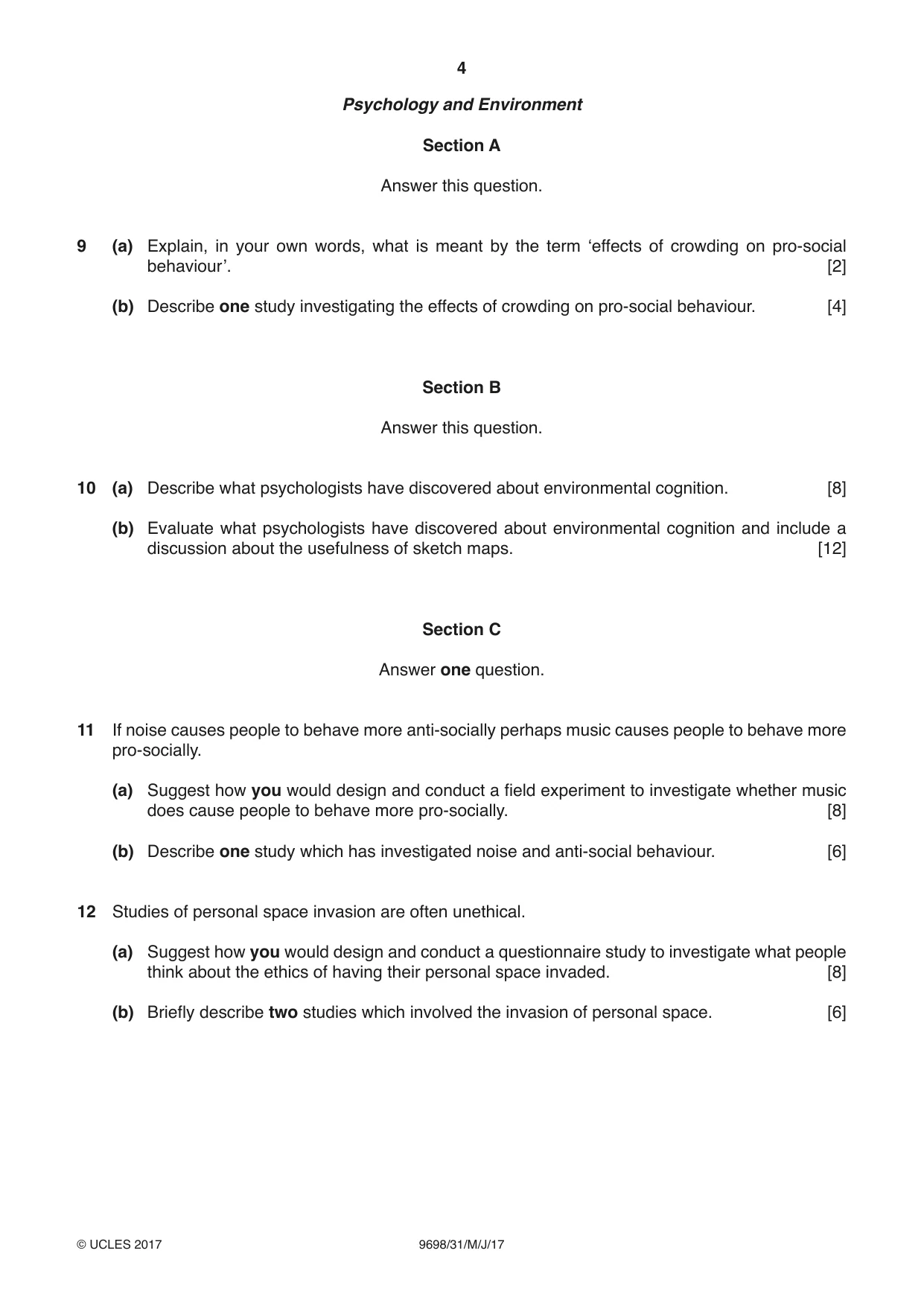
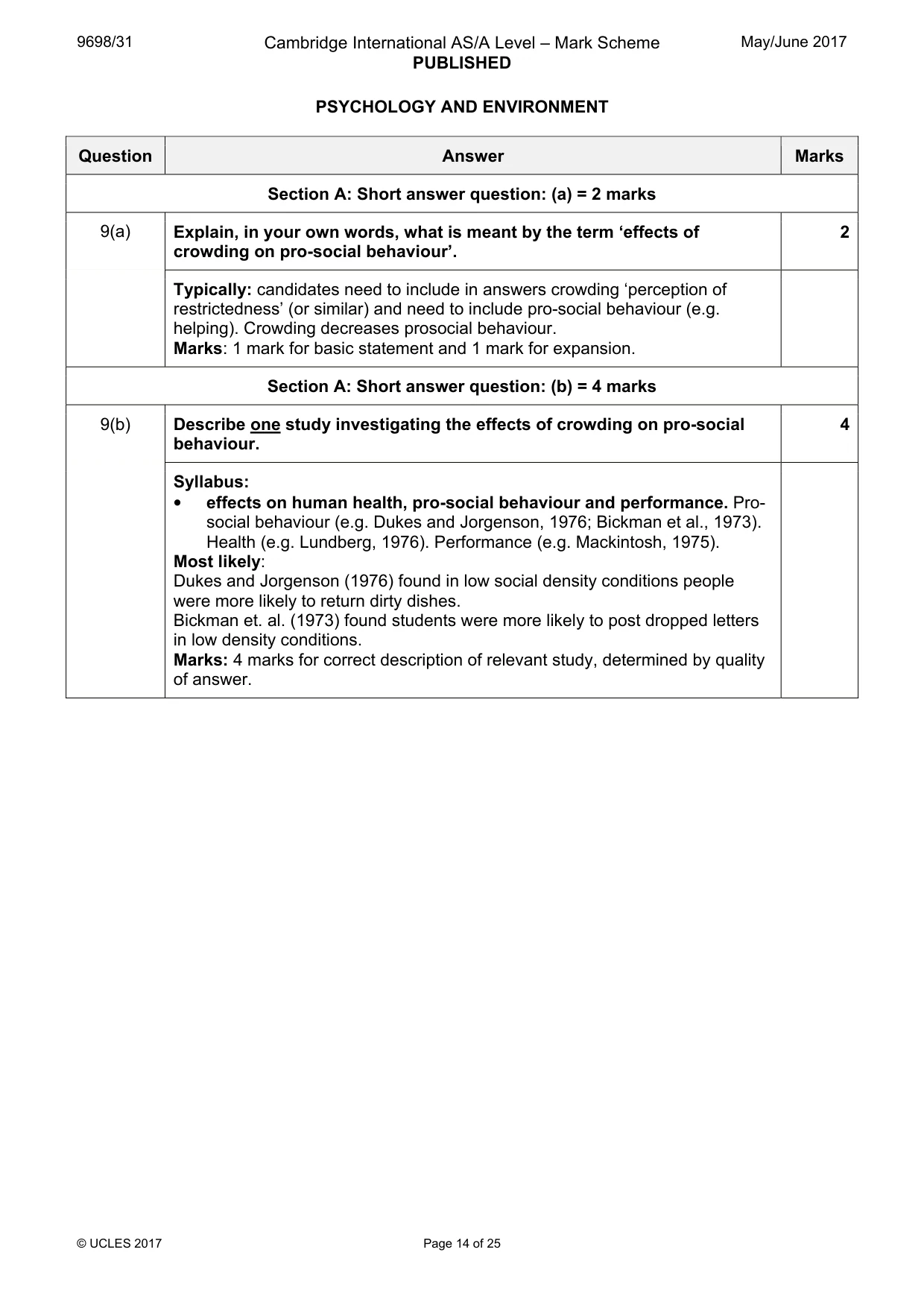
9 (a) Explain, in your own words, what is meant by the term ‘effects of crowding on pro-social behaviour’. [2] (b) Describe one study investigating the effects of crowding on pro-social behaviour. [4]
Mark scheme: 9(a) Explain, in your own words, what is meant by the term ‘effects of 2 crowding on pro-social behaviour’. Typically: candidates need to include in answers crowding ‘perception of restrictedness’ (or similar) and need to include pro-social behaviour (e.g. helping). Crowding decreases prosocial behaviour. Marks: 1 mark for basic statement and 1 mark for expansion. Section A: Short answer question: (b) = 4 marks 9(b) Describe one study investigating the effects of crowding on pro-social 4 behaviour. Syllabus: • effects on human health, pro-social behaviour and performance. Pro- social behaviour (e.g. Dukes and Jorgenson, 1976; Bickman et al., 1973). Health (e.g. Lundberg, 1976). Performance (e.g. Mackintosh, 1975). Most likely: Dukes and Jorgenson (1976) found in low social density conditions people were more likely to return dirty dishes. Bickman et. al. (1973) found students were more likely to post dropped letters in low density conditions. Marks: 4 marks for correct description of relevant study, determined by quality of answer.
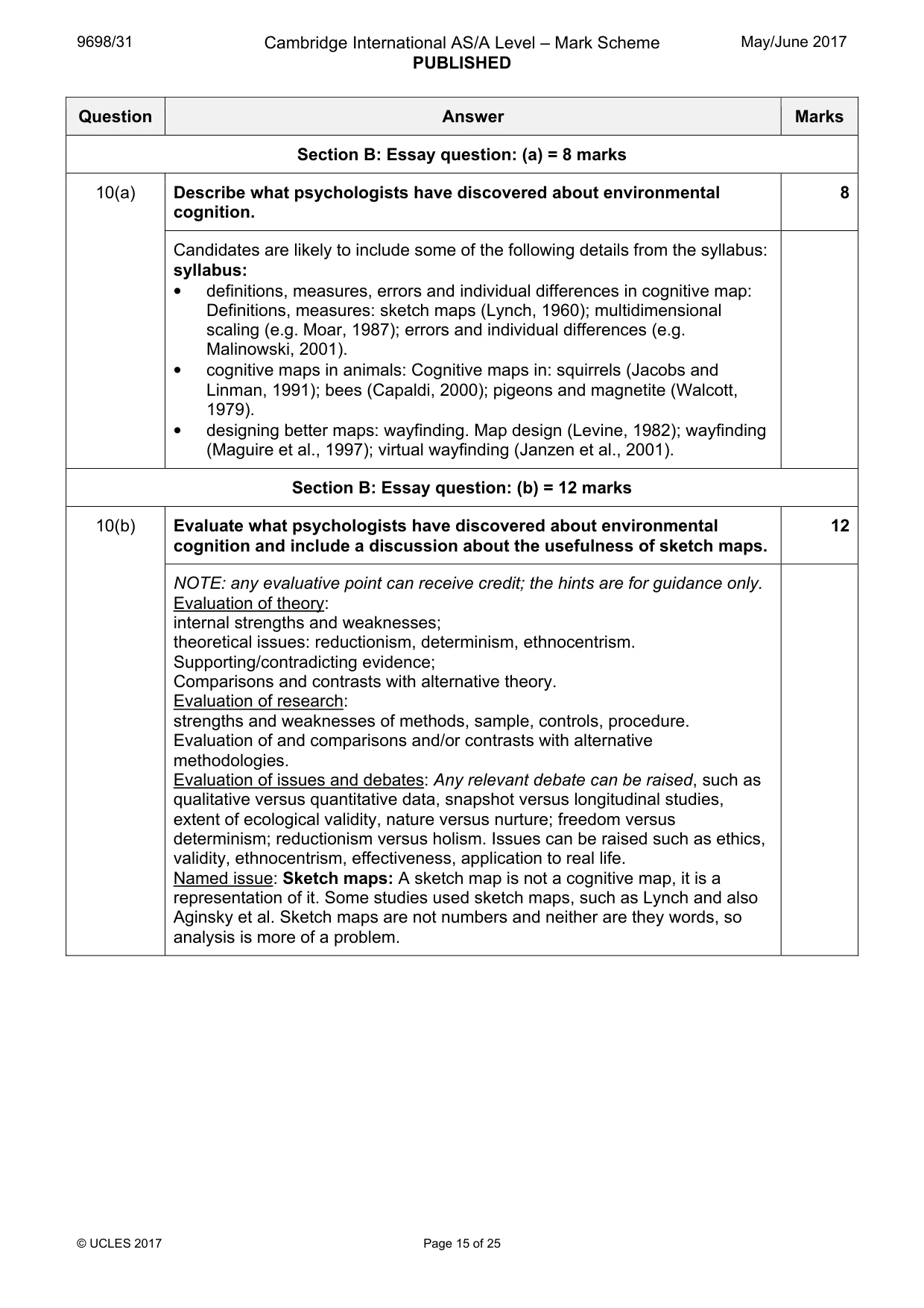
Q10 · Describe what psychologists have discovered about environmental cognition
10 (a) Describe what psychologists have discovered about environmental cognition. [8] (b) Evaluate what psychologists have discovered about environmental cognition and include a discussion about the usefulness of sketch maps. [12] Section C Answer one question.
Mark scheme: 10(a) Describe what psychologists have discovered about environmental 8 cognition. Candidates are likely to include some of the following details from the syllabus: syllabus: • definitions, measures, errors and individual differences in cognitive map: Definitions, measures: sketch maps (Lynch, 1960); multidimensional scaling (e.g. Moar, 1987); errors and individual differences (e.g. Malinowski, 2001). • cognitive maps in animals: Cognitive maps in: squirrels (Jacobs and Linman, 1991); bees (Capaldi, 2000); pigeons and magnetite (Walcott, 1979). • designing better maps: wayfinding. Map design (Levine, 1982); wayfinding (Maguire et al., 1997); virtual wayfinding (Janzen et al., 2001). Section B: Essay question: (b) = 12 marks 10(b) Evaluate what psychologists have discovered about environmental 12 cognition and include a discussion about the usefulness of sketch maps. NOTE: any evaluative point can receive credit; the hints are for guidance only. Evaluation of theory: internal strengths and weaknesses; theoretical issues: reductionism, determinism, ethnocentrism. Supporting/contradicting evidence; Comparisons and contrasts with alternative theory. Evaluation of research: strengths and weaknesses of methods, sample, controls, procedure. Evaluation of and comparisons and/or contrasts with alternative methodologies. Evaluation of issues and debates: Any relevant debate can be raised, such as qualitative versus quantitative data, snapshot versus longitudinal studies, extent of ecological validity, nature versus nurture; freedom versus determinism; reductionism versus holism. Issues can be raised such as ethics, validity, ethnocentrism, effectiveness, application to real life. Named issue: Sketch maps: A sketch map is not a cognitive map, it is a representation of it. Some studies used sketch maps, such as Lynch and also Aginsky et al. Sketch maps are not numbers and neither are they words, so analysis is more of a problem.
Q11 · If noise causes people to behave more anti-socially perhaps music causes people to behave…
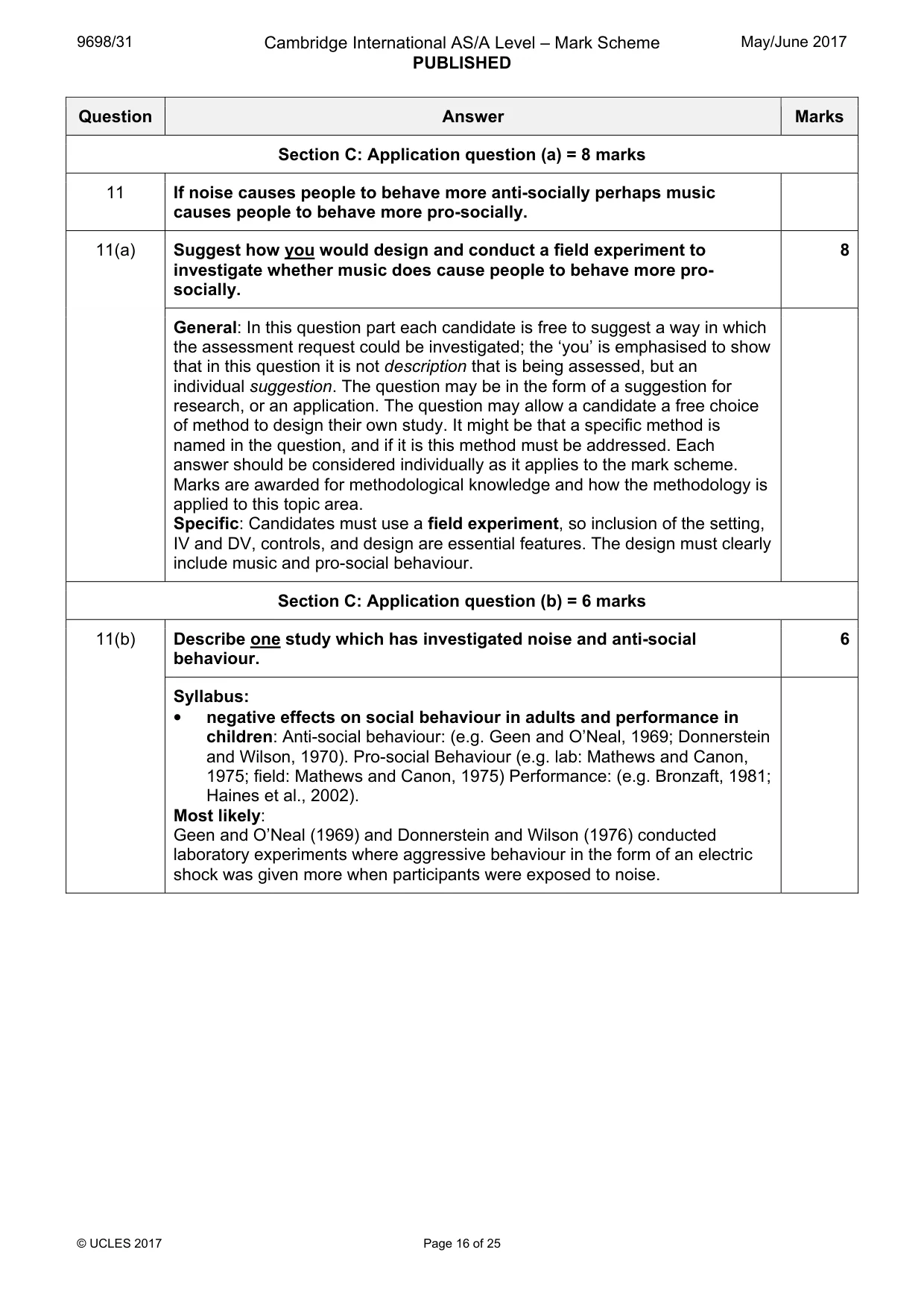
11 If noise causes people to behave more anti-socially perhaps music causes people to behave more pro-socially. (a) Suggest how you would design and conduct a field experiment to investigate whether music does cause people to behave more pro-socially. [8] (b) Describe one study which has investigated noise and anti-social behaviour. [6]
Mark scheme: 11(a) Suggest how you would design and conduct a field experiment to 8 investigate whether music does cause people to behave more pro- socially. General: In this question part each candidate is free to suggest a way in which the assessment request could be investigated; the ‘you’ is emphasised to show that in this question it is not description that is being assessed, but an individual suggestion. The question may be in the form of a suggestion for research, or an application. The question may allow a candidate a free choice of method to design their own study. It might be that a specific method is named in the question, and if it is this method must be addressed. Each answer should be considered individually as it applies to the mark scheme. Marks are awarded for methodological knowledge and how the methodology is applied to this topic area. Specific: Candidates must use a field experiment, so inclusion of the setting, IV and DV, controls, and design are essential features. The design must clearly include music and pro-social behaviour. Section C: Application question (b) = 6 marks 11(b) Describe one study which has investigated noise and anti-social 6 behaviour. Syllabus: • negative effects on social behaviour in adults and performance in children: Anti-social behaviour: (e.g. Geen and O’Neal, 1969; Donnerstein and Wilson, 1970). Pro-social Behaviour (e.g. lab: Mathews and Canon, 1975; field: Mathews and Canon, 1975) Performance: (e.g. Bronzaft, 1981; Haines et al., 2002). Most likely: Geen and O’Neal (1969) and Donnerstein and Wilson (1976) conducted laboratory experiments where aggressive behaviour in the form of an electric shock was given more when participants were exposed to noise.
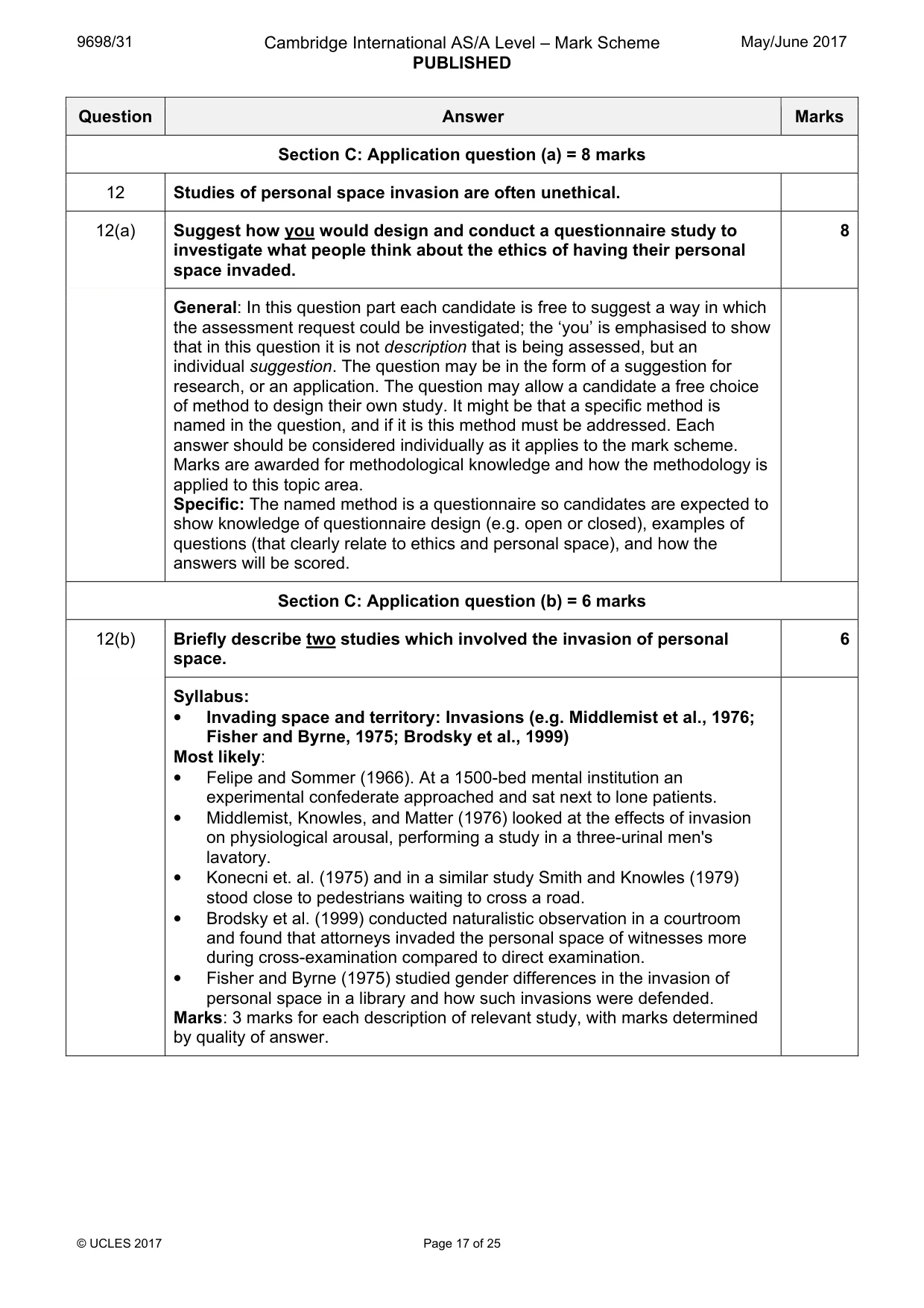
Q12 · Studies of personal space invasion are often unethical
12 Studies of personal space invasion are often unethical. (a) Suggest how you would design and conduct a questionnaire study to investigate what people think about the ethics of having their personal space invaded. [8] (b) Briefly describe two studies which involved the invasion of personal space. [6] Psychology and Abnormality Section A Answer this question.
Mark scheme: 12(a) Suggest how you would design and conduct a questionnaire study to 8 investigate what people think about the ethics of having their personal space invaded. General: In this question part each candidate is free to suggest a way in which the assessment request could be investigated; the ‘you’ is emphasised to show that in this question it is not description that is being assessed, but an individual suggestion. The question may be in the form of a suggestion for research, or an application. The question may allow a candidate a free choice of method to design their own study. It might be that a specific method is named in the question, and if it is this method must be addressed. Each answer should be considered individually as it applies to the mark scheme. Marks are awarded for methodological knowledge and how the methodology is applied to this topic area. Specific: The named method is a questionnaire so candidates are expected to show knowledge of questionnaire design (e.g. open or closed), examples of questions (that clearly relate to ethics and personal space), and how the answers will be scored. Section C: Application question (b) = 6 marks 12(b) Briefly describe two studies which involved the invasion of personal 6 space. Syllabus: • Invading space and territory: Invasions (e.g. Middlemist et al., 1976; Fisher and Byrne, 1975; Brodsky et al., 1999) Most likely: • Felipe and Sommer (1966). At a 1500-bed mental institution an experimental confederate approached and sat next to lone patients. • Middlemist, Knowles, and Matter (1976) looked at the effects of invasion on physiological arousal, performing a study in a three-urinal men's lavatory. • Konecni et. al. (1975) and in a similar study Smith and Knowles (1979) stood close to pedestrians waiting to cross a road. • Brodsky et al. (1999) conducted naturalistic observation in a courtroom and found that attorneys invaded the personal space of witnesses more during cross-examination compared to direct examination. • Fisher and Byrne (1975) studied gender differences in the invasion of personal space in a library and how such invasions were defended. Marks: 3 marks for each description of relevant study, with marks determined by quality of answer. PSYCHOLOGY AND ABNORMALITY
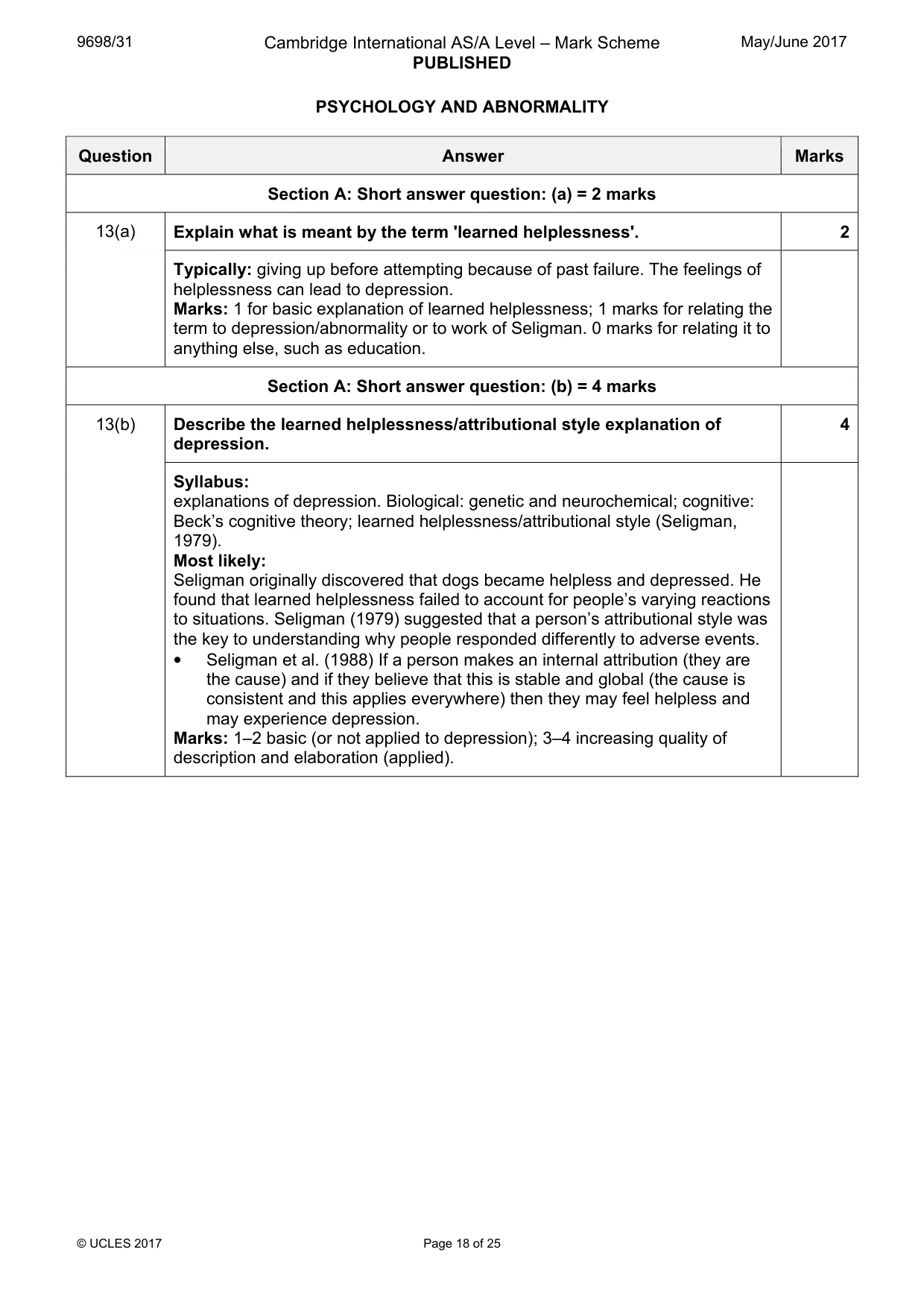
Q13 · Explain what is meant by the term ‘learned helplessness’
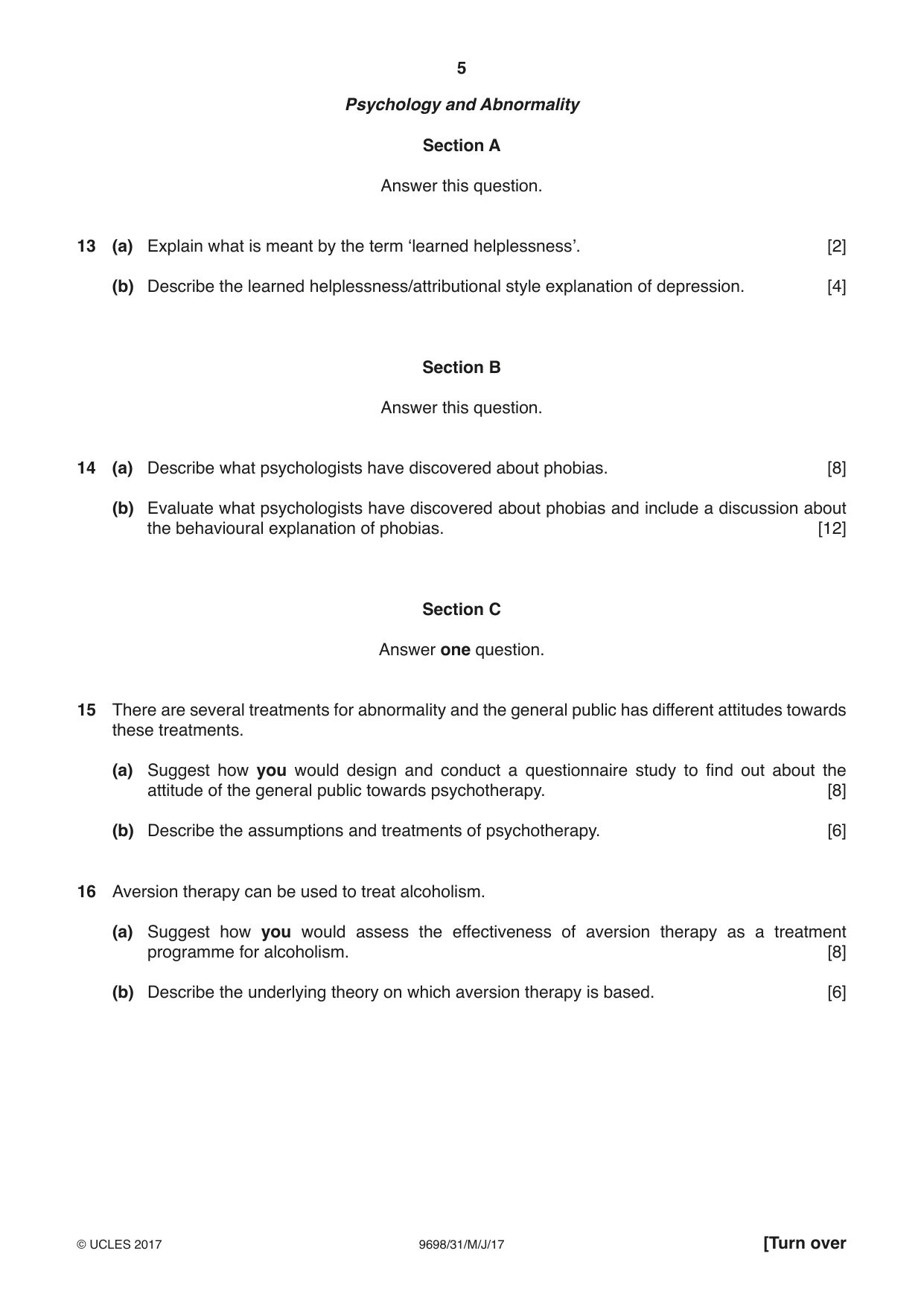
13 (a) Explain what is meant by the term ‘learned helplessness’. [2] (b) Describe the learned helplessness/attributional style explanation of depression. [4]
Mark scheme: 13(a) Explain what is meant by the term 'learned helplessness'. 2 Typically: giving up before attempting because of past failure. The feelings of helplessness can lead to depression. Marks: 1 for basic explanation of learned helplessness; 1 marks for relating the term to depression/abnormality or to work of Seligman. 0 marks for relating it to anything else, such as education. Section A: Short answer question: (b) = 4 marks 13(b) Describe the learned helplessness/attributional style explanation of 4 depression. Syllabus: explanations of depression. Biological: genetic and neurochemical; cognitive: Beck’s cognitive theory; learned helplessness/attributional style (Seligman, 1979). Most likely: Seligman originally discovered that dogs became helpless and depressed. He found that learned helplessness failed to account for people’s varying reactions to situations. Seligman (1979) suggested that a person’s attributional style was the key to understanding why people responded differently to adverse events. • Seligman et al. (1988) If a person makes an internal attribution (they are the cause) and if they believe that this is stable and global (the cause is consistent and this applies everywhere) then they may feel helpless and may experience depression. Marks: 1–2 basic (or not applied to depression); 3–4 increasing quality of description and elaboration (applied).
Q14 · Describe what psychologists have discovered about phobias
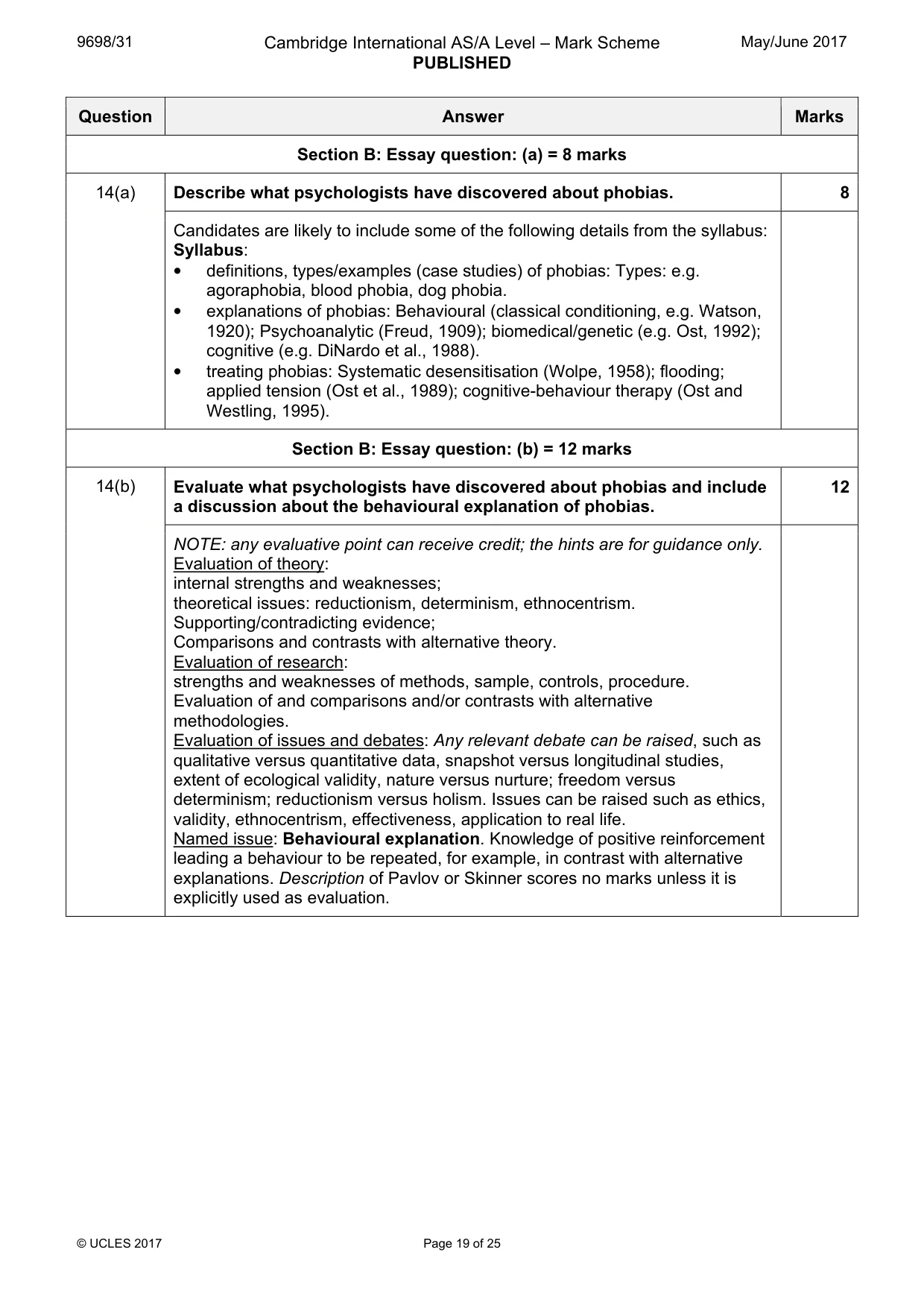
14 (a) Describe what psychologists have discovered about phobias. [8] (b) Evaluate what psychologists have discovered about phobias and include a discussion about the behavioural explanation of phobias. [12] Section C Answer one question.
Mark scheme: 14(a) Describe what psychologists have discovered about phobias. 8 Candidates are likely to include some of the following details from the syllabus: Syllabus: • definitions, types/examples (case studies) of phobias: Types: e.g. agoraphobia, blood phobia, dog phobia. • explanations of phobias: Behavioural (classical conditioning, e.g. Watson, 1920); Psychoanalytic (Freud, 1909); biomedical/genetic (e.g. Ost, 1992); cognitive (e.g. DiNardo et al., 1988). • treating phobias: Systematic desensitisation (Wolpe, 1958); flooding; applied tension (Ost et al., 1989); cognitive-behaviour therapy (Ost and Westling, 1995). Section B: Essay question: (b) = 12 marks 14(b) Evaluate what psychologists have discovered about phobias and include 12 a discussion about the behavioural explanation of phobias. NOTE: any evaluative point can receive credit; the hints are for guidance only. Evaluation of theory: internal strengths and weaknesses; theoretical issues: reductionism, determinism, ethnocentrism. Supporting/contradicting evidence; Comparisons and contrasts with alternative theory. Evaluation of research: strengths and weaknesses of methods, sample, controls, procedure. Evaluation of and comparisons and/or contrasts with alternative methodologies. Evaluation of issues and debates: Any relevant debate can be raised, such as qualitative versus quantitative data, snapshot versus longitudinal studies, extent of ecological validity, nature versus nurture; freedom versus determinism; reductionism versus holism. Issues can be raised such as ethics, validity, ethnocentrism, effectiveness, application to real life. Named issue: Behavioural explanation. Knowledge of positive reinforcement leading a behaviour to be repeated, for example, in contrast with alternative explanations. Description of Pavlov or Skinner scores no marks unless it is explicitly used as evaluation.
Q15 · There are several treatments for abnormality and the general public has different…
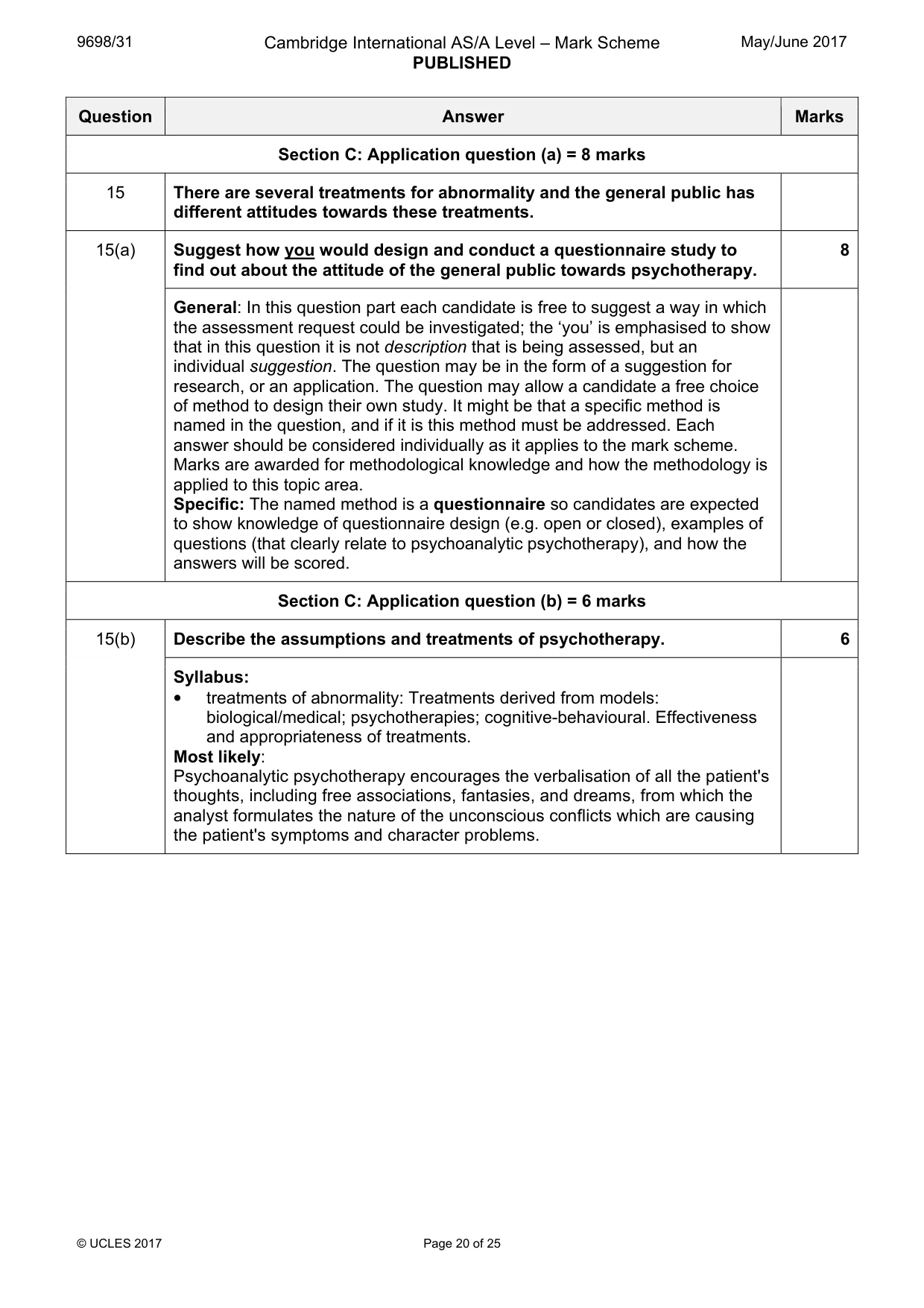
15 There are several treatments for abnormality and the general public has different attitudes towards these treatments. (a) Suggest how you would design and conduct a questionnaire study to find out about the attitude of the general public towards psychotherapy. [8] (b) Describe the assumptions and treatments of psychotherapy. [6]
Mark scheme: 15(a) Suggest how you would design and conduct a questionnaire study to 8 find out about the attitude of the general public towards psychotherapy. General: In this question part each candidate is free to suggest a way in which the assessment request could be investigated; the ‘you’ is emphasised to show that in this question it is not description that is being assessed, but an individual suggestion. The question may be in the form of a suggestion for research, or an application. The question may allow a candidate a free choice of method to design their own study. It might be that a specific method is named in the question, and if it is this method must be addressed. Each answer should be considered individually as it applies to the mark scheme. Marks are awarded for methodological knowledge and how the methodology is applied to this topic area. Specific: The named method is a questionnaire so candidates are expected to show knowledge of questionnaire design (e.g. open or closed), examples of questions (that clearly relate to psychoanalytic psychotherapy), and how the answers will be scored. Section C: Application question (b) = 6 marks 15(b) Describe the assumptions and treatments of psychotherapy. 6 Syllabus: • treatments of abnormality: Treatments derived from models: biological/medical; psychotherapies; cognitive-behavioural. Effectiveness and appropriateness of treatments. Most likely: Psychoanalytic psychotherapy encourages the verbalisation of all the patient's thoughts, including free associations, fantasies, and dreams, from which the analyst formulates the nature of the unconscious conflicts which are causing the patient's symptoms and character problems.
Q16 · Aversion therapy can be used to treat alcoholism
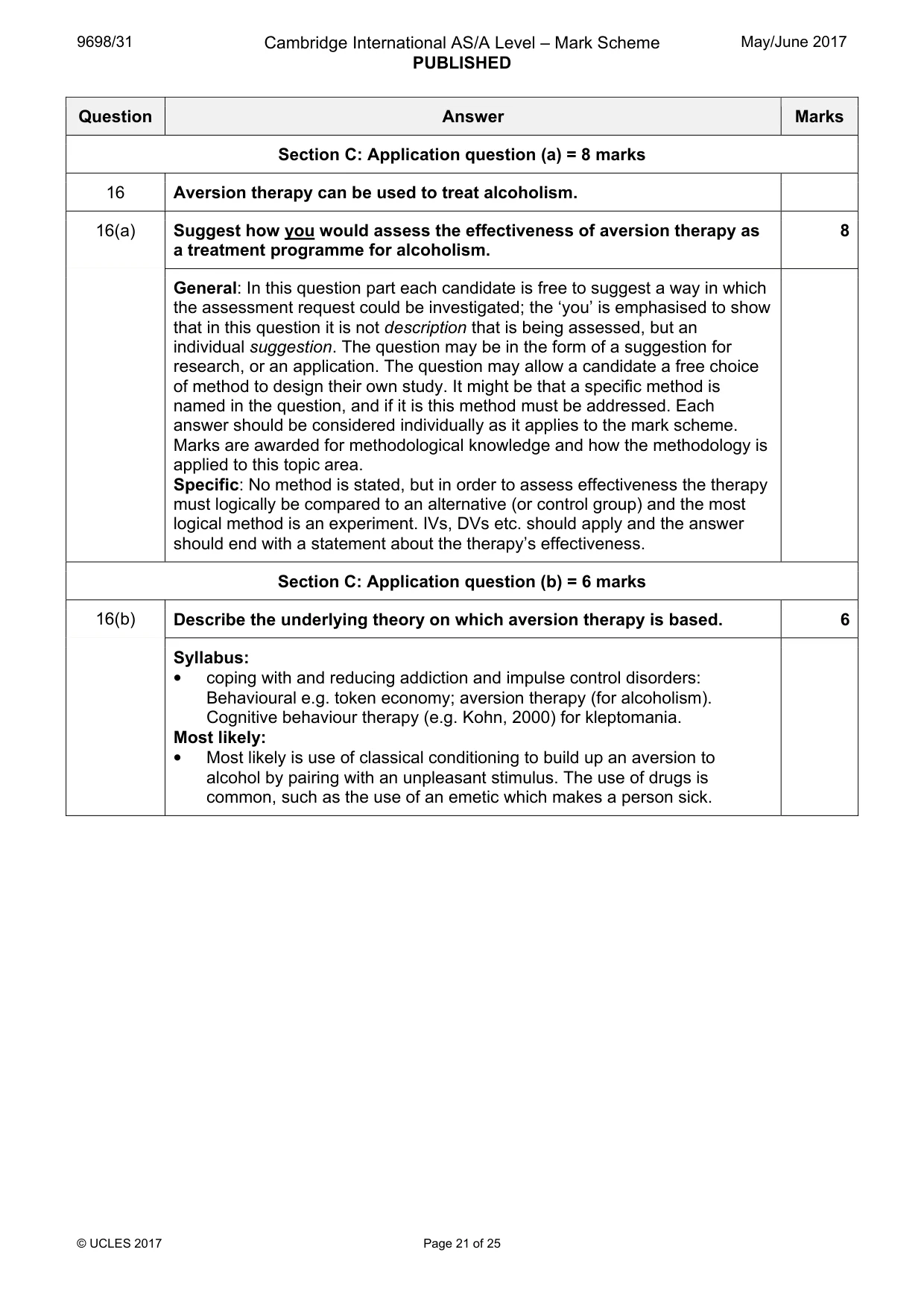
16 Aversion therapy can be used to treat alcoholism. (a) Suggest how you would assess the effectiveness of aversion therapy as a treatment programme for alcoholism. [8] (b) Describe the underlying theory on which aversion therapy is based. [6] Psychology and Organisations Section A Answer this question.
Mark scheme: 16(a) Suggest how you would assess the effectiveness of aversion therapy as 8 a treatment programme for alcoholism. General: In this question part each candidate is free to suggest a way in which the assessment request could be investigated; the ‘you’ is emphasised to show that in this question it is not description that is being assessed, but an individual suggestion. The question may be in the form of a suggestion for research, or an application. The question may allow a candidate a free choice of method to design their own study. It might be that a specific method is named in the question, and if it is this method must be addressed. Each answer should be considered individually as it applies to the mark scheme. Marks are awarded for methodological knowledge and how the methodology is applied to this topic area. Specific: No method is stated, but in order to assess effectiveness the therapy must logically be compared to an alternative (or control group) and the most logical method is an experiment. IVs, DVs etc. should apply and the answer should end with a statement about the therapy’s effectiveness. Section C: Application question (b) = 6 marks 16(b) Describe the underlying theory on which aversion therapy is based. 6 Syllabus: • coping with and reducing addiction and impulse control disorders: Behavioural e.g. token economy; aversion therapy (for alcoholism). Cognitive behaviour therapy (e.g. Kohn, 2000) for kleptomania. Most likely: • Most likely is use of classical conditioning to build up an aversion to alcohol by pairing with an unpleasant stimulus. The use of drugs is common, such as the use of an emetic which makes a person sick. PSYCHOLOGY AND ORGANISATIONS
Q17 · Explain, in your own words, what is meant by the term ‘equal opportunities’
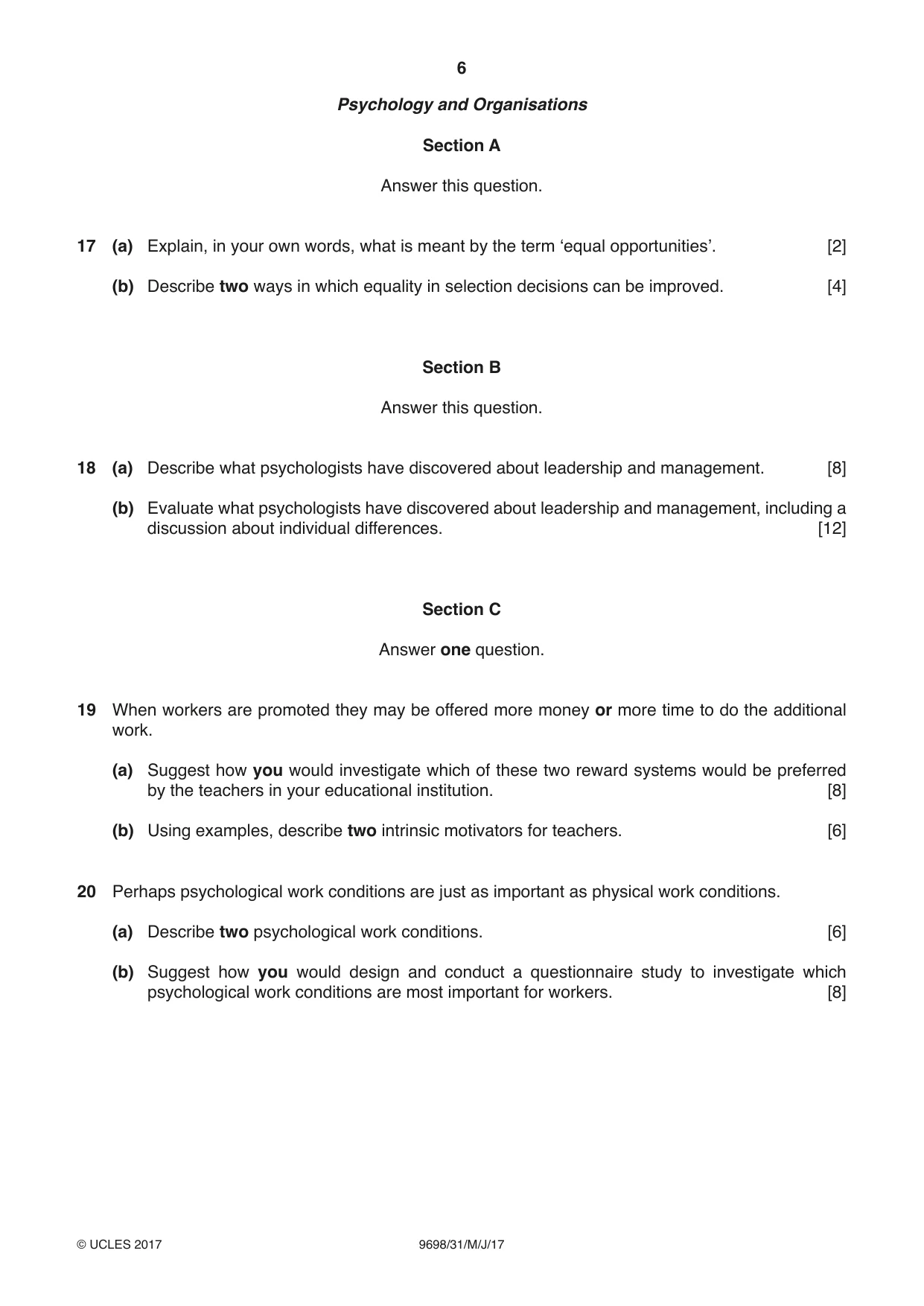
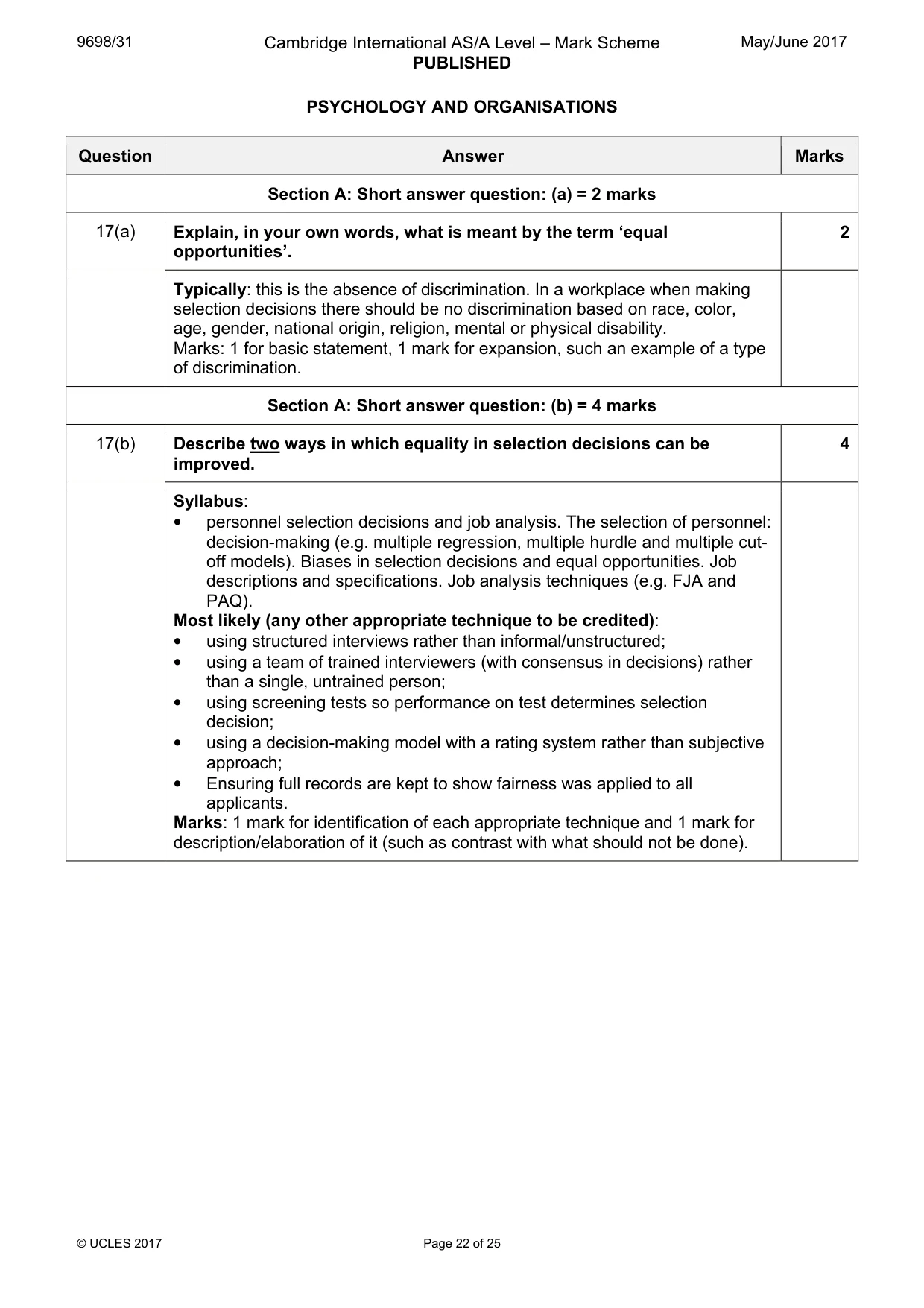
17 (a) Explain, in your own words, what is meant by the term ‘equal opportunities’. [2] (b) Describe two ways in which equality in selection decisions can be improved. [4]
Mark scheme: 17(a) Explain, in your own words, what is meant by the term ‘equal 2 opportunities’. Typically: this is the absence of discrimination. In a workplace when making selection decisions there should be no discrimination based on race, color, age, gender, national origin, religion, mental or physical disability. Marks: 1 for basic statement, 1 mark for expansion, such an example of a type of discrimination. Section A: Short answer question: (b) = 4 marks 17(b) Describe two ways in which equality in selection decisions can be 4 improved. Syllabus: • personnel selection decisions and job analysis. The selection of personnel: decision-making (e.g. multiple regression, multiple hurdle and multiple cut- off models). Biases in selection decisions and equal opportunities. Job descriptions and specifications. Job analysis techniques (e.g. FJA and PAQ). Most likely (any other appropriate technique to be credited): • using structured interviews rather than informal/unstructured; • using a team of trained interviewers (with consensus in decisions) rather than a single, untrained person; • using screening tests so performance on test determines selection decision; • using a decision-making model with a rating system rather than subjective approach; • Ensuring full records are kept to show fairness was applied to all applicants. Marks: 1 mark for identification of each appropriate technique and 1 mark for description/elaboration of it (such as contrast with what should not be done).
Q18 · Describe what psychologists have discovered about leadership and management
18 (a) Describe what psychologists have discovered about leadership and management. [8] (b) Evaluate what psychologists have discovered about leadership and management, including a discussion about individual differences. [12] Section C Answer one question.
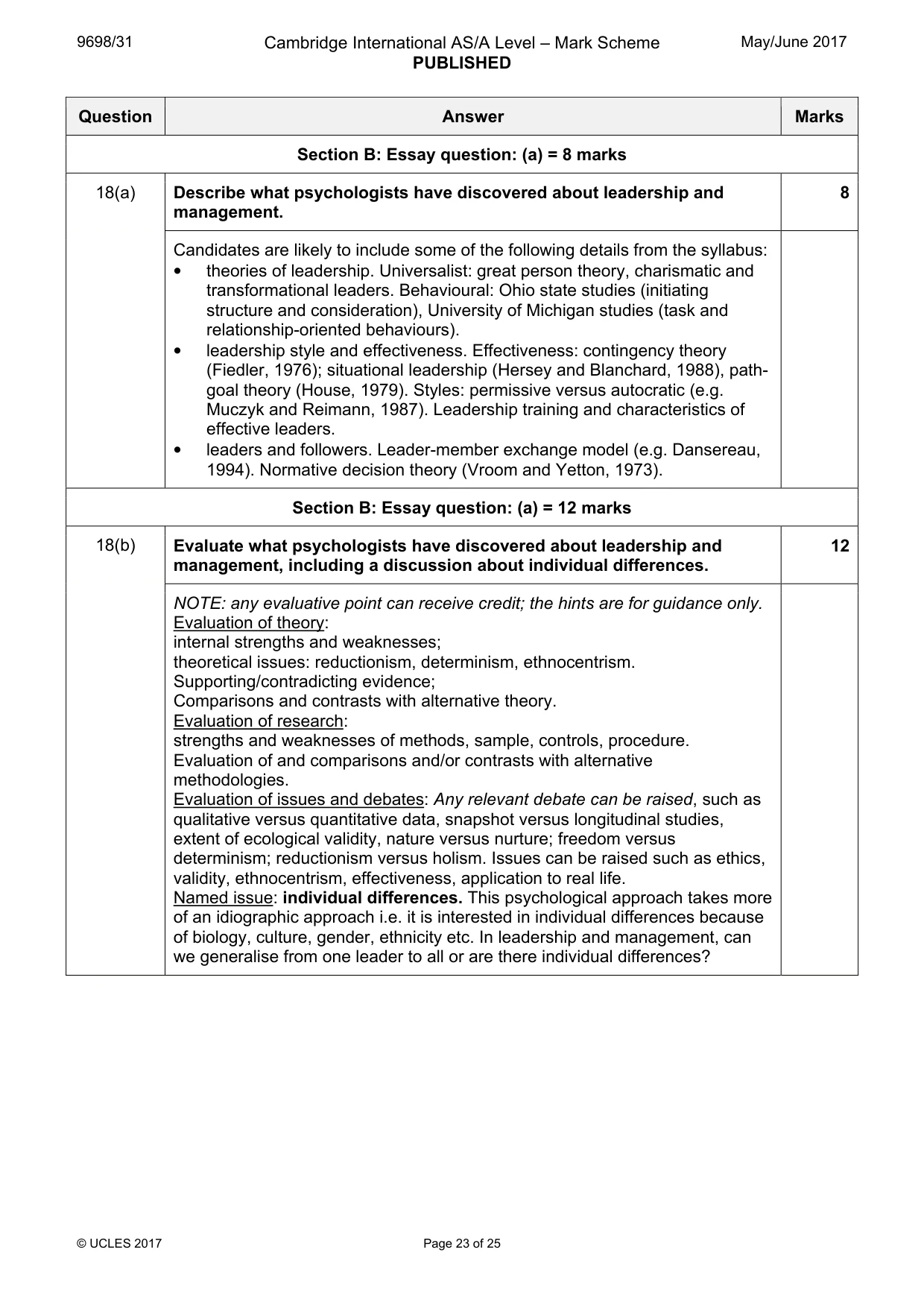
Mark scheme: 18(a) Describe what psychologists have discovered about leadership and 8 management. Candidates are likely to include some of the following details from the syllabus: • theories of leadership. Universalist: great person theory, charismatic and transformational leaders. Behavioural: Ohio state studies (initiating structure and consideration), University of Michigan studies (task and relationship-oriented behaviours). • leadership style and effectiveness. Effectiveness: contingency theory (Fiedler, 1976); situational leadership (Hersey and Blanchard, 1988), path- goal theory (House, 1979). Styles: permissive versus autocratic (e.g. Muczyk and Reimann, 1987). Leadership training and characteristics of effective leaders. • leaders and followers. Leader-member exchange model (e.g. Dansereau, 1994). Normative decision theory (Vroom and Yetton, 1973). Section B: Essay question: (a) = 12 marks 18(b) Evaluate what psychologists have discovered about leadership and 12 management, including a discussion about individual differences. NOTE: any evaluative point can receive credit; the hints are for guidance only. Evaluation of theory: internal strengths and weaknesses; theoretical issues: reductionism, determinism, ethnocentrism. Supporting/contradicting evidence; Comparisons and contrasts with alternative theory. Evaluation of research: strengths and weaknesses of methods, sample, controls, procedure. Evaluation of and comparisons and/or contrasts with alternative methodologies. Evaluation of issues and debates: Any relevant debate can be raised, such as qualitative versus quantitative data, snapshot versus longitudinal studies, extent of ecological validity, nature versus nurture; freedom versus determinism; reductionism versus holism. Issues can be raised such as ethics, validity, ethnocentrism, effectiveness, application to real life. Named issue: individual differences. This psychological approach takes more of an idiographic approach i.e. it is interested in individual differences because of biology, culture, gender, ethnicity etc. In leadership and management, can we generalise from one leader to all or are there individual differences?
Q19 · When workers are promoted they may be offered more money or more time to do the…
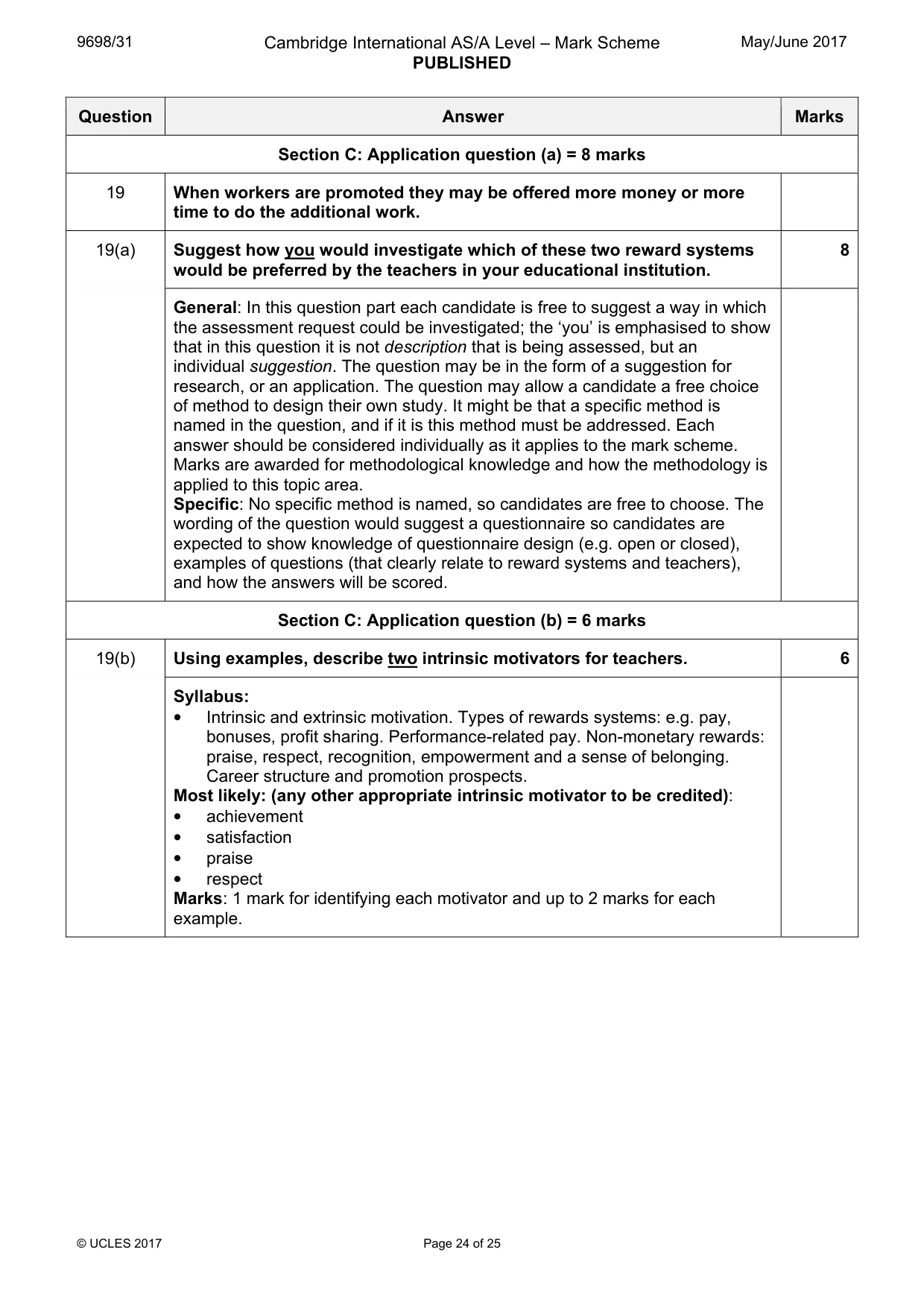
19 When workers are promoted they may be offered more money or more time to do the additional work. (a) Suggest how you would investigate which of these two reward systems would be preferred by the teachers in your educational institution. [8] (b) Using examples, describe two intrinsic motivators for teachers. [6]
Mark scheme: 19(a) Suggest how you would investigate which of these two reward systems 8 would be preferred by the teachers in your educational institution. General: In this question part each candidate is free to suggest a way in which the assessment request could be investigated; the ‘you’ is emphasised to show that in this question it is not description that is being assessed, but an individual suggestion. The question may be in the form of a suggestion for research, or an application. The question may allow a candidate a free choice of method to design their own study. It might be that a specific method is named in the question, and if it is this method must be addressed. Each answer should be considered individually as it applies to the mark scheme. Marks are awarded for methodological knowledge and how the methodology is applied to this topic area. Specific: No specific method is named, so candidates are free to choose. The wording of the question would suggest a questionnaire so candidates are expected to show knowledge of questionnaire design (e.g. open or closed), examples of questions (that clearly relate to reward systems and teachers), and how the answers will be scored. Section C: Application question (b) = 6 marks 19(b) Using examples, describe two intrinsic motivators for teachers. 6 Syllabus: • Intrinsic and extrinsic motivation. Types of rewards systems: e.g. pay, bonuses, profit sharing. Performance-related pay. Non-monetary rewards: praise, respect, recognition, empowerment and a sense of belonging. Career structure and promotion prospects. Most likely: (any other appropriate intrinsic motivator to be credited): • achievement • satisfaction • praise • respect Marks: 1 mark for identifying each motivator and up to 2 marks for each example.
Q20 · Perhaps psychological work conditions are just as important as physical work conditions
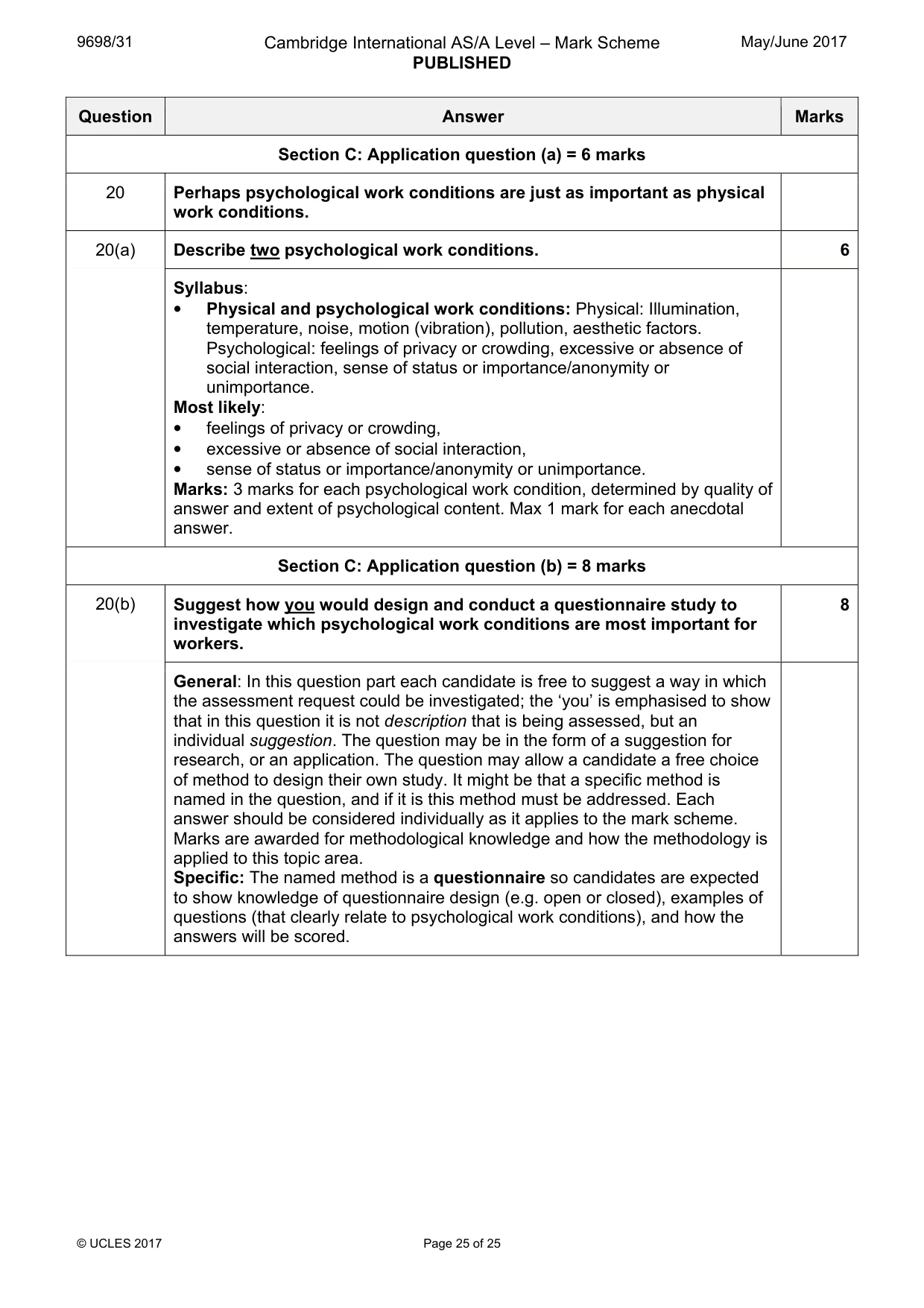
20 Perhaps psychological work conditions are just as important as physical work conditions. (a) Describe two psychological work conditions. [6] (b) Suggest how you would design and conduct a questionnaire study to investigate which psychological work conditions are most important for workers. [8]
Mark scheme: 20(a) Describe two psychological work conditions. 6 Syllabus: • Physical and psychological work conditions: Physical: Illumination, temperature, noise, motion (vibration), pollution, aesthetic factors. Psychological: feelings of privacy or crowding, excessive or absence of social interaction, sense of status or importance/anonymity or unimportance. Most likely: • feelings of privacy or crowding, • excessive or absence of social interaction, • sense of status or importance/anonymity or unimportance. Marks: 3 marks for each psychological work condition, determined by quality of answer and extent of psychological content. Max 1 mark for each anecdotal answer. Section C: Application question (b) = 8 marks 20(b) Suggest how you would design and conduct a questionnaire study to 8 investigate which psychological work conditions are most important for workers. General: In this question part each candidate is free to suggest a way in which the assessment request could be investigated; the ‘you’ is emphasised to show that in this question it is not description that is being assessed, but an individual suggestion. The question may be in the form of a suggestion for research, or an application. The question may allow a candidate a free choice of method to design their own study. It might be that a specific method is named in the question, and if it is this method must be addressed. Each answer should be considered individually as it applies to the mark scheme. Marks are awarded for methodological knowledge and how the methodology is applied to this topic area. Specific: The named method is a questionnaire so candidates are expected to show knowledge of questionnaire design (e.g. open or closed), examples of questions (that clearly relate to psychological work conditions), and how the answers will be scored.
What you needed in this session
Cambridge’s own grade thresholds for 2017 May/June, Paper 3 · Variant 1. A higher threshold means an easier paper — the bar moves with how the cohort did.