Cambridge A Level Psychology 9698 — 2018 May/June Paper 3 · Variant 1
9698/31/M/J/18 · 20 questions · 80 marks · ≈90 min
The question paper and its mark scheme, free to read here and free to download. This is Cambridge’s own paper, exactly as it was sat.
Question paper8 pages


Mark scheme27 pages
Answers below. Sit the paper first if you are practising.
Questions as text
Q1 · Explain, in your own words, what is meant by ‘improving learning effectiveness’
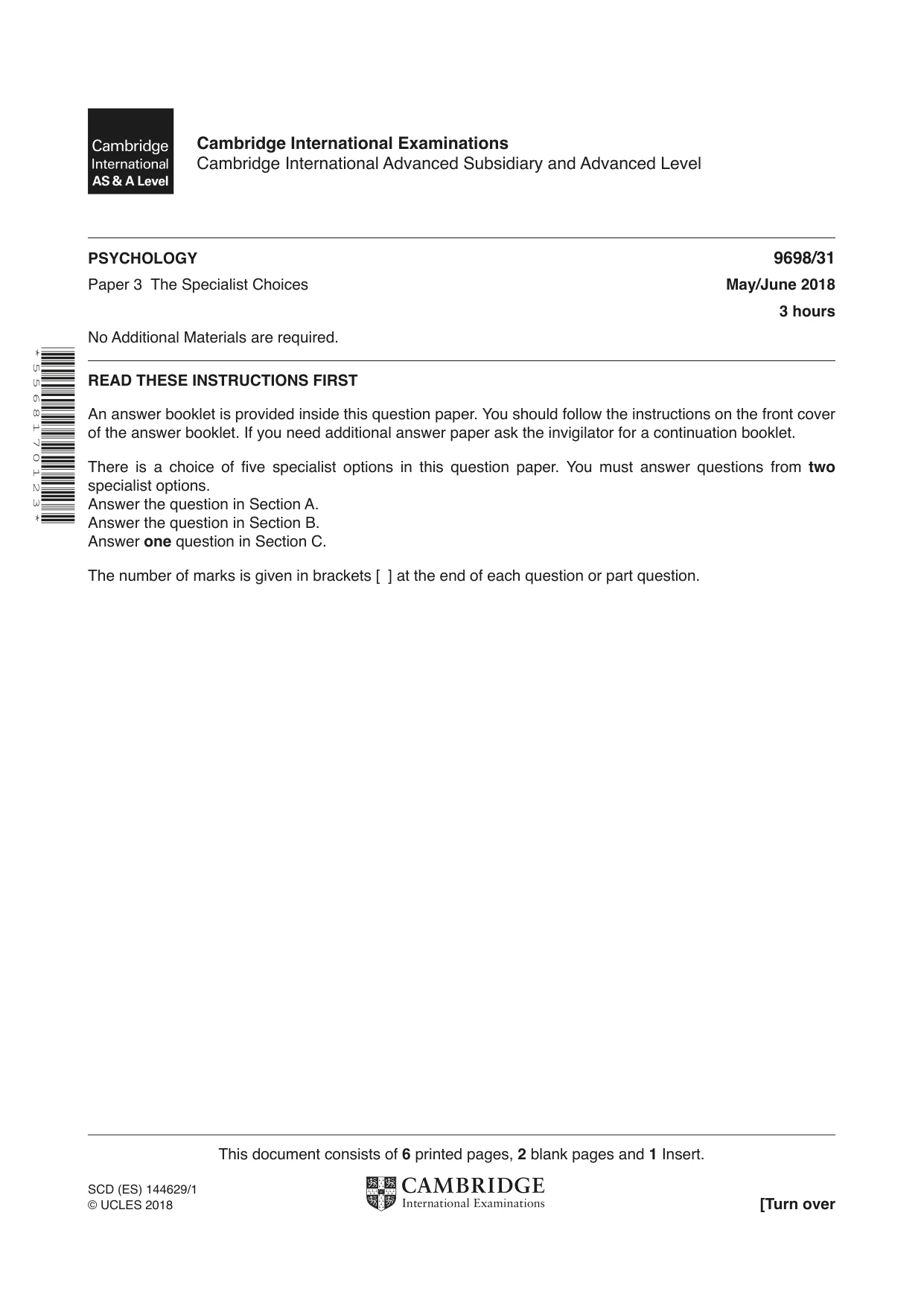
1 (a) Explain, in your own words, what is meant by ‘improving learning effectiveness’. [2] (b) Describe the ‘4-mat system’ study skill technique. [4]
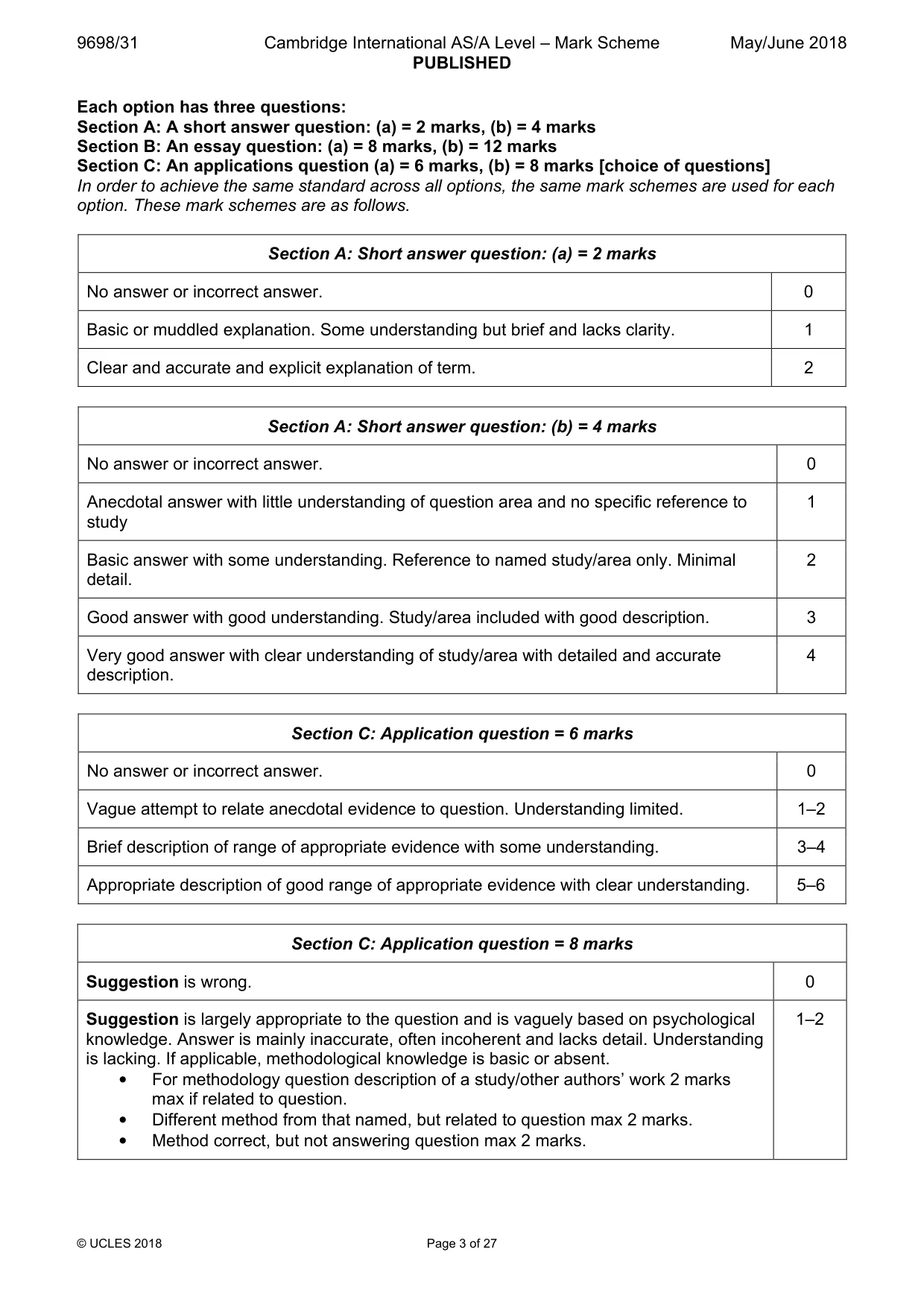
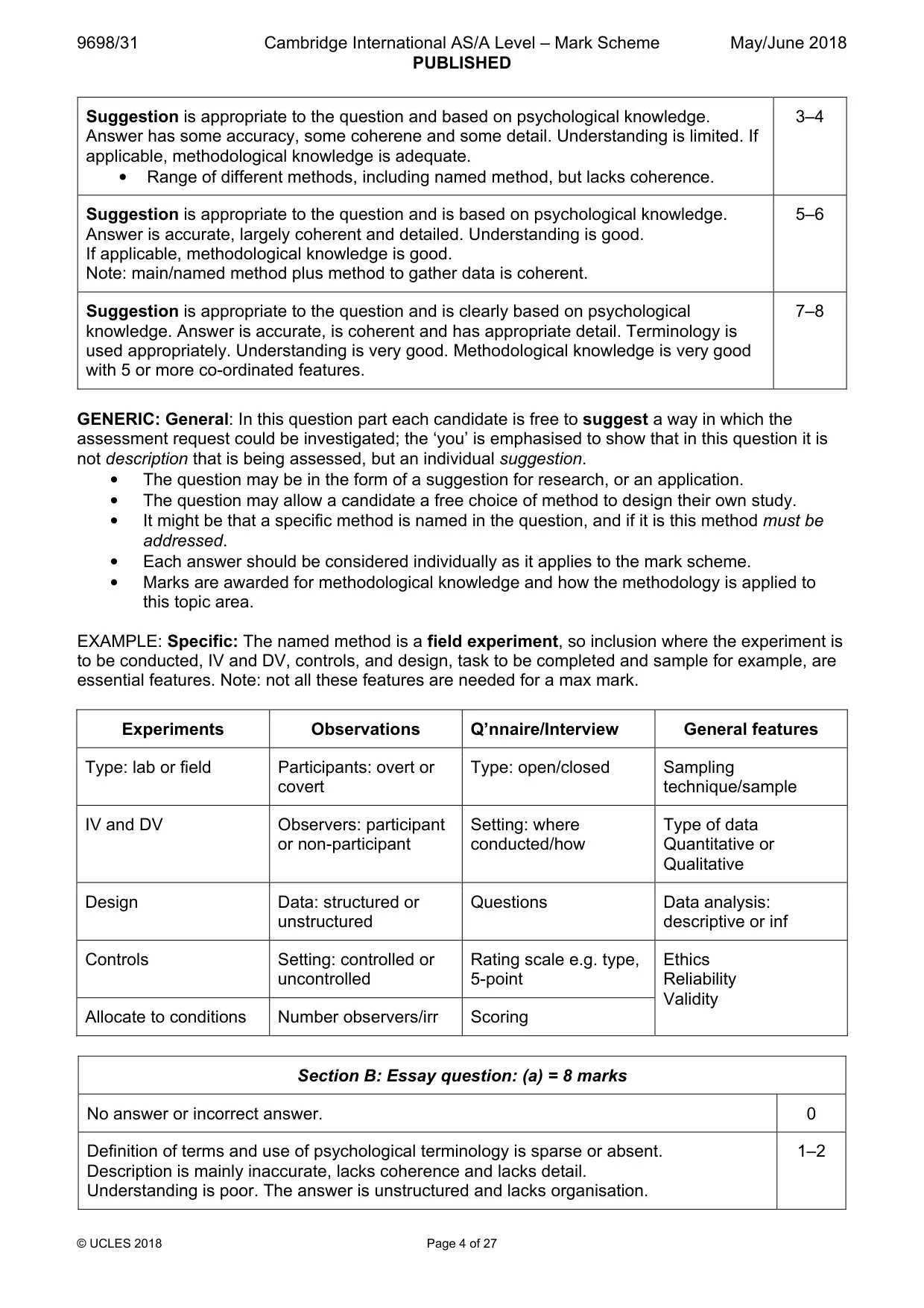
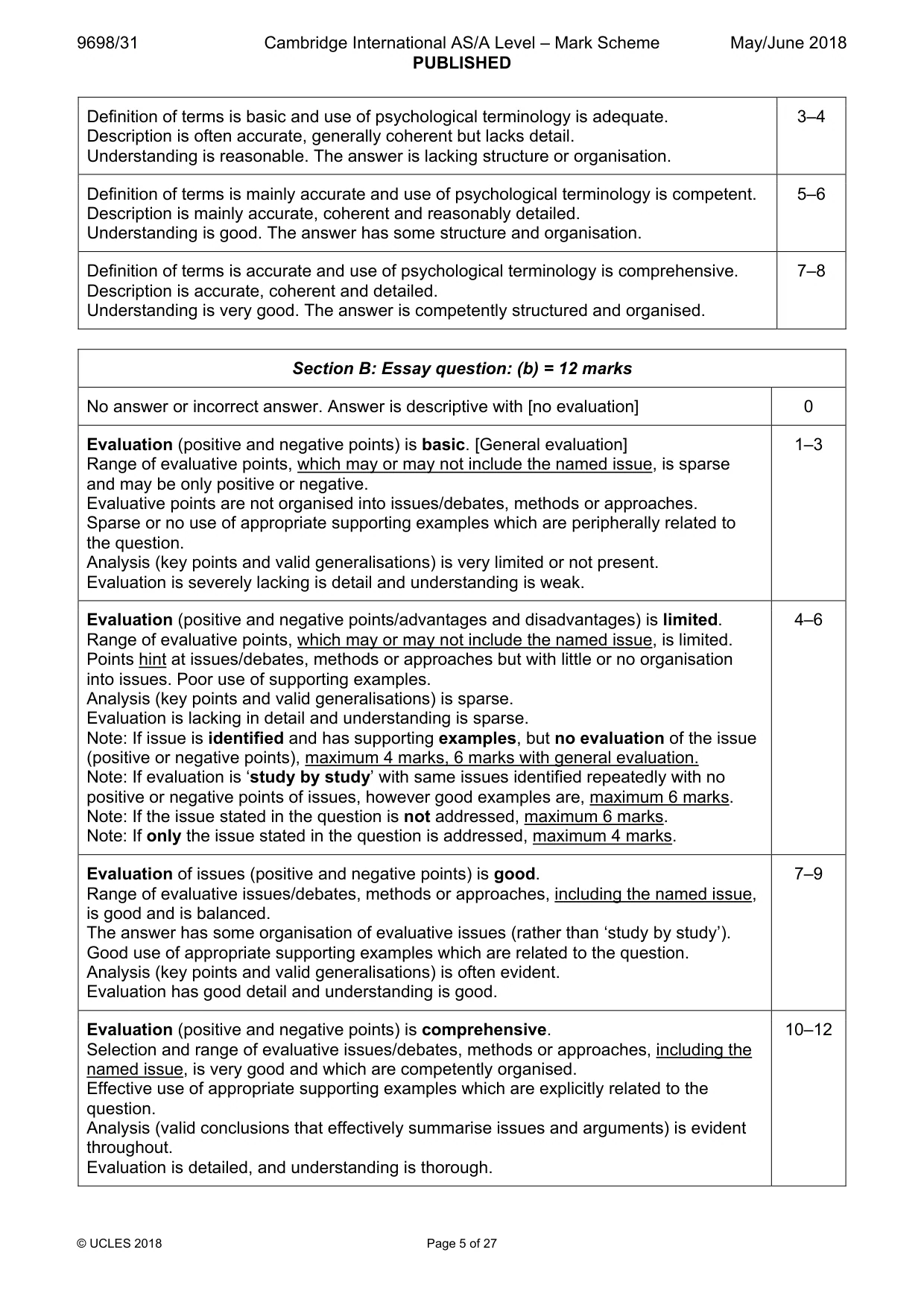
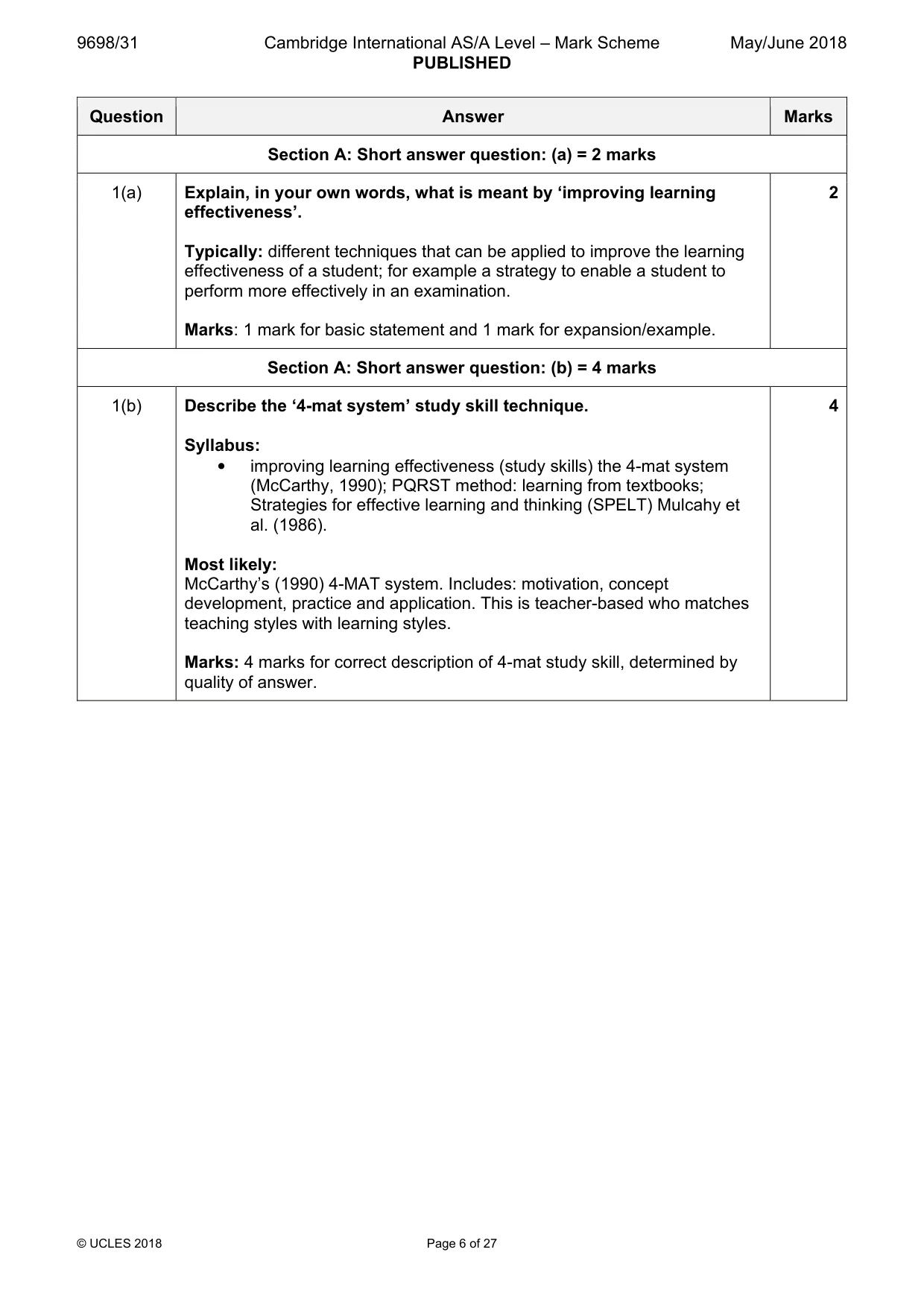
Mark scheme: Question Answer Marks Section A: Short answer question: (a) = 2 marks 1(a) Explain, in your own words, what is meant by ‘improving learning 2 effectiveness’. Typically: different techniques that can be applied to improve the learning effectiveness of a student; for example a strategy to enable a student to perform more effectively in an examination. Marks: 1 mark for basic statement and 1 mark for expansion/example. Section A: Short answer question: (b) = 4 marks 1(b) Describe the ‘4-mat system’ study skill technique. 4 Syllabus: • improving learning effectiveness (study skills) the 4-mat system (McCarthy, 1990); PQRST method: learning from textbooks; Strategies for effective learning and thinking (SPELT) Mulcahy et al. (1986). Most likely: McCarthy’s (1990) 4-MAT system. Includes: motivation, concept development, practice and application. This is teacher-based who matches teaching styles with learning styles. Marks: 4 marks for correct description of 4-mat study skill, determined by quality of answer.
Q2 · Describe what psychologists have discovered about disruptive behaviour in schools
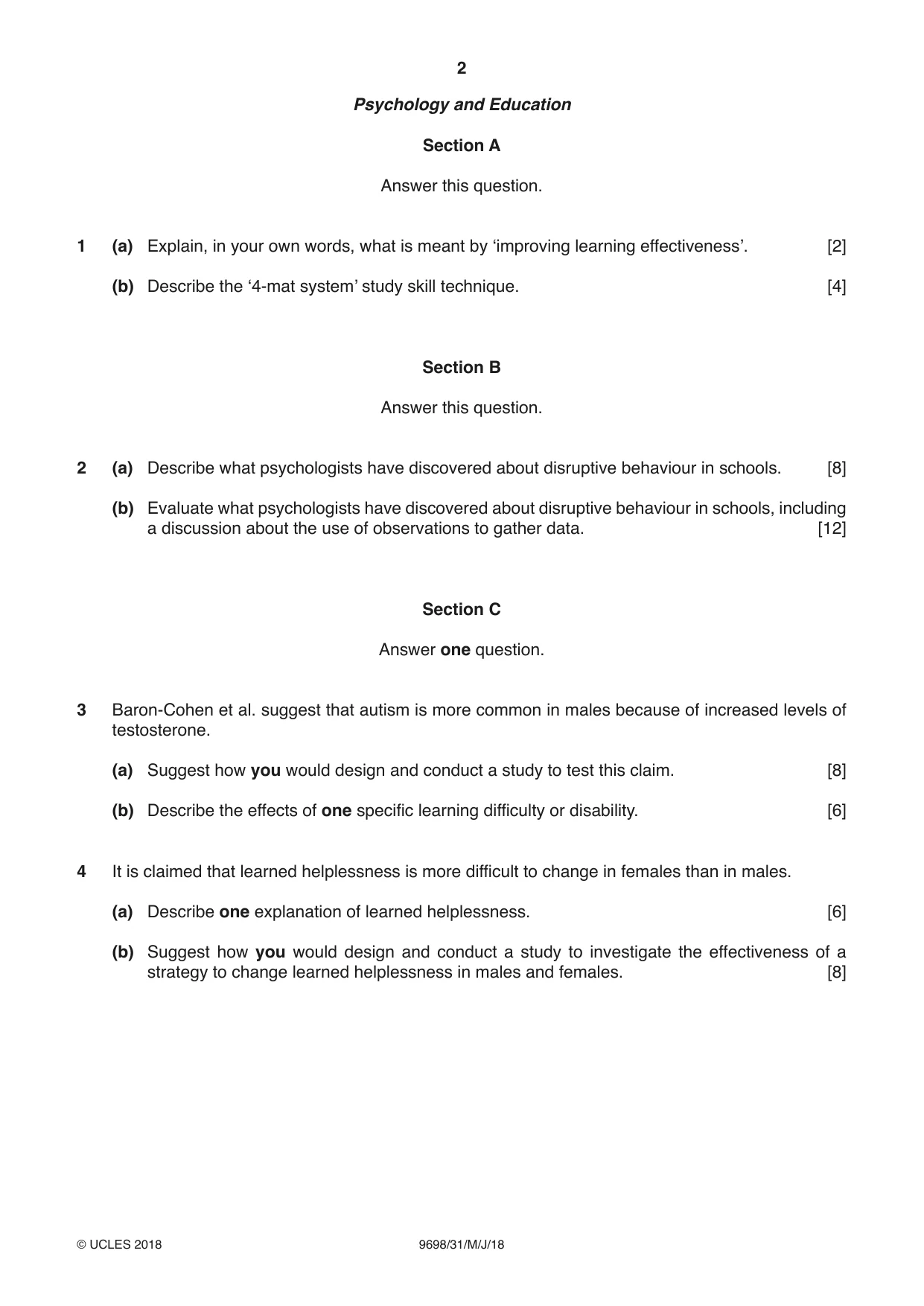
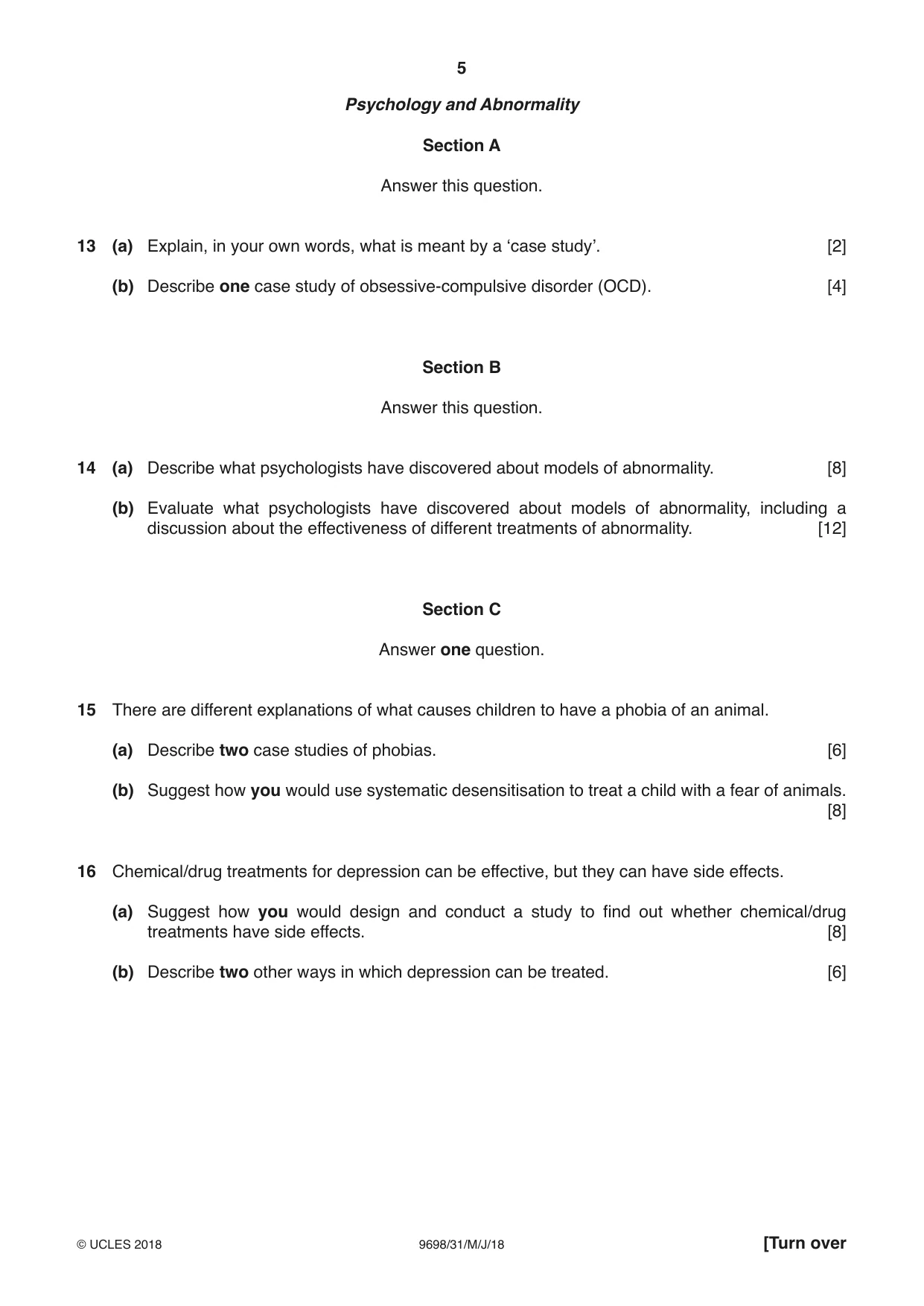
2 (a) Describe what psychologists have discovered about disruptive behaviour in schools. [8] (b) Evaluate what psychologists have discovered about disruptive behaviour in schools, including a discussion about the use of observations to gather data. [12] Section C Answer one question.
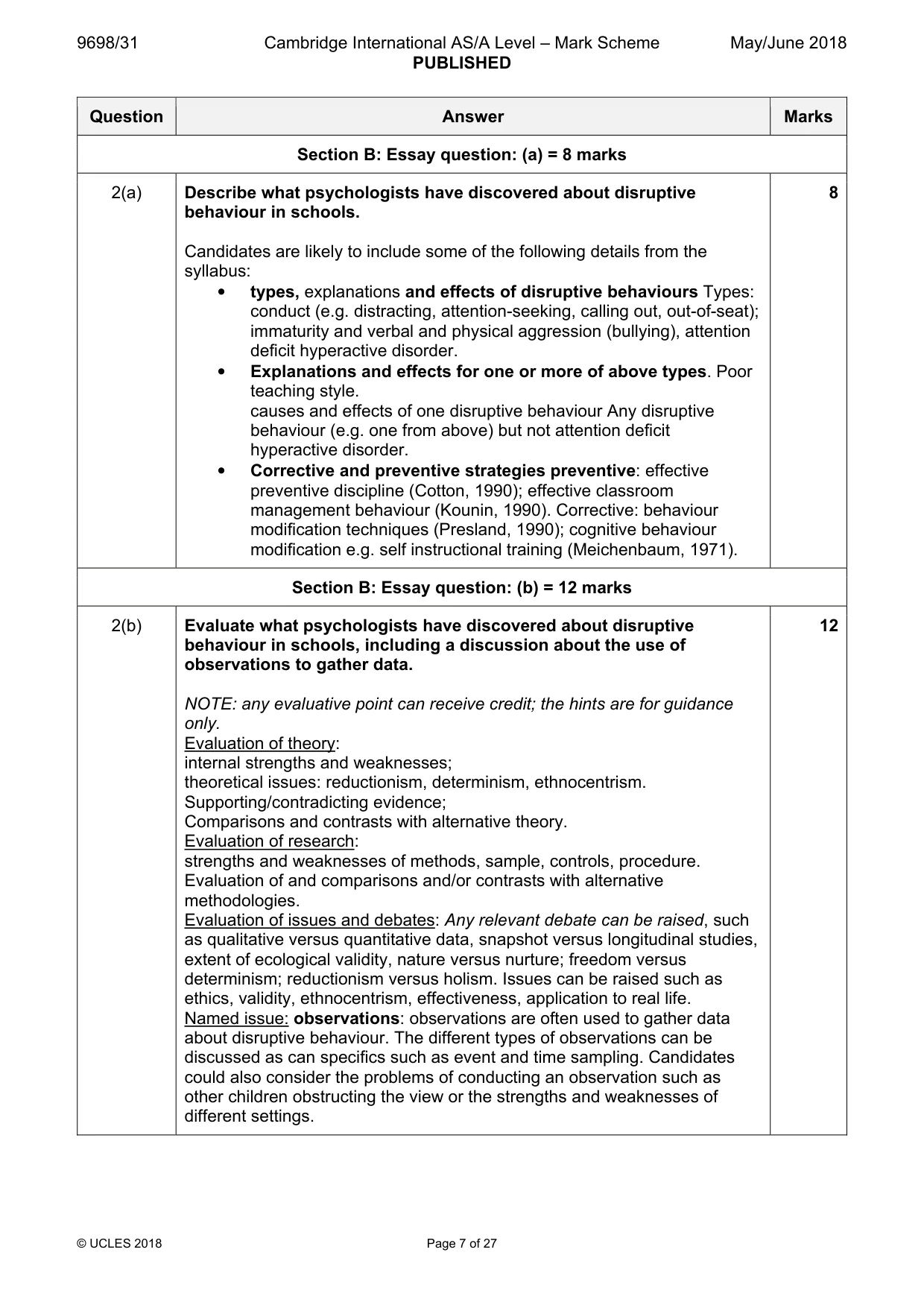
Mark scheme: 2(a) Describe what psychologists have discovered about disruptive 8 behaviour in schools. Candidates are likely to include some of the following details from the syllabus: • types, explanations and effects of disruptive behaviours Types: conduct (e.g. distracting, attention-seeking, calling out, out-of-seat); immaturity and verbal and physical aggression (bullying), attention deficit hyperactive disorder. • Explanations and effects for one or more of above types. Poor teaching style. causes and effects of one disruptive behaviour Any disruptive behaviour (e.g. one from above) but not attention deficit hyperactive disorder. • Corrective and preventive strategies preventive: effective preventive discipline (Cotton, 1990); effective classroom management behaviour (Kounin, 1990). Corrective: behaviour modification techniques (Presland, 1990); cognitive behaviour modification e.g. self instructional training (Meichenbaum, 1971). Section B: Essay question: (b) = 12 marks 2(b) Evaluate what psychologists have discovered about disruptive 12 behaviour in schools, including a discussion about the use of observations to gather data. NOTE: any evaluative point can receive credit; the hints are for guidance only. Evaluation of theory: internal strengths and weaknesses; theoretical issues: reductionism, determinism, ethnocentrism. Supporting/contradicting evidence; Comparisons and contrasts with alternative theory. Evaluation of research: strengths and weaknesses of methods, sample, controls, procedure. Evaluation of and comparisons and/or contrasts with alternative methodologies. Evaluation of issues and debates: Any relevant debate can be raised, such as qualitative versus quantitative data, snapshot versus longitudinal studies, extent of ecological validity, nature versus nurture; freedom versus determinism; reductionism versus holism. Issues can be raised such as ethics, validity, ethnocentrism, effectiveness, application to real life. Named issue: observations: observations are often used to gather data about disruptive behaviour. The different types of observations can be discussed as can specifics such as event and time sampling. Candidates could also consider the problems of conducting an observation such as other children obstructing the view or the strengths and weaknesses of different settings.
Question 3
3 Baron-Cohen et al. suggest that autism is more common in males because of increased levels of testosterone. (a) Suggest how you would design and conduct a study to test this claim. [8] (b) Describe the effects of one specific learning difficulty or disability. [6]
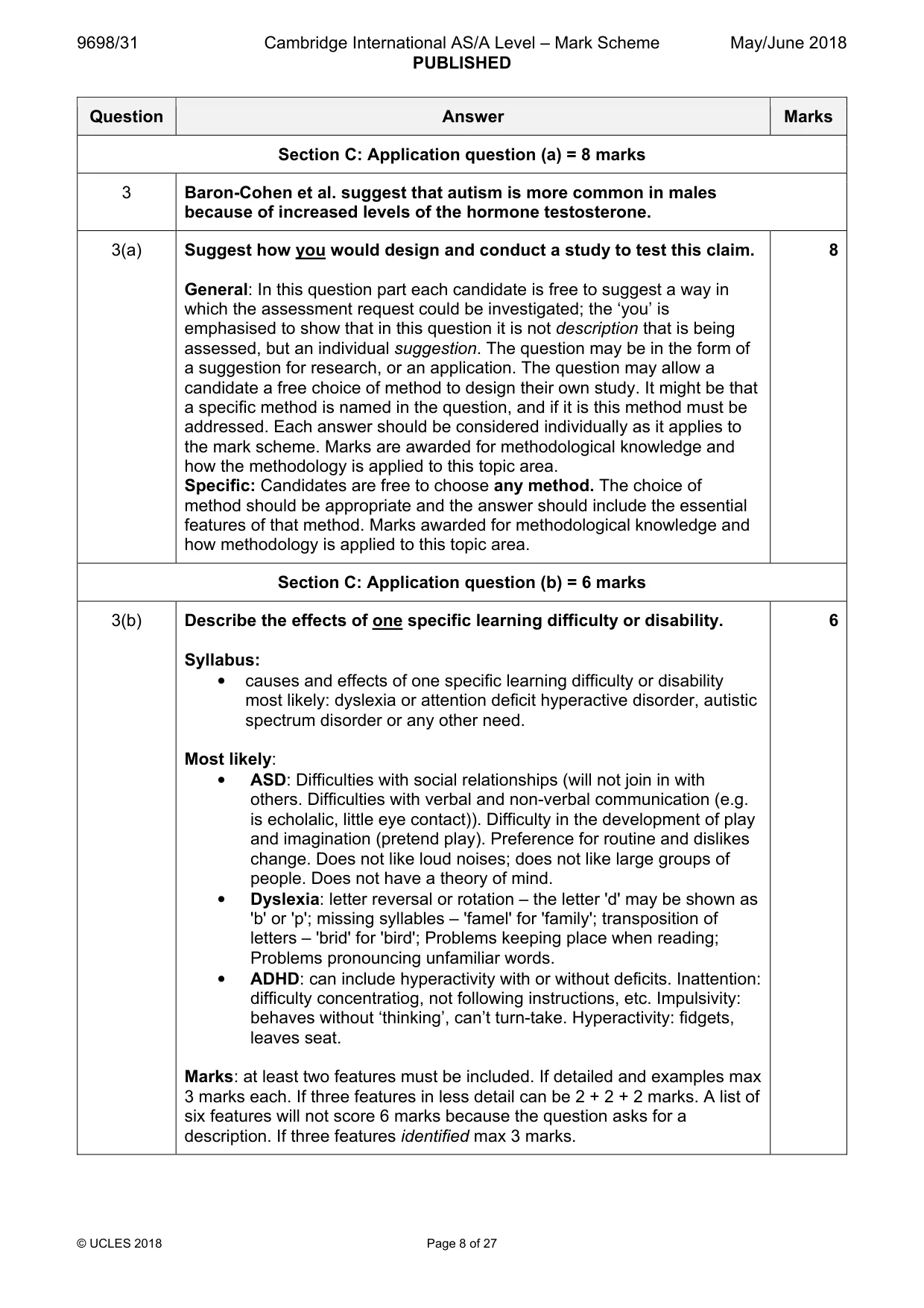
Mark scheme: 3 Baron-Cohen et al. suggest that autism is more common in males because of increased levels of the hormone testosterone. 3(a) Suggest how you would design and conduct a study to test this claim. 8 General: In this question part each candidate is free to suggest a way in which the assessment request could be investigated; the ‘you’ is emphasised to show that in this question it is not description that is being assessed, but an individual suggestion. The question may be in the form of a suggestion for research, or an application. The question may allow a candidate a free choice of method to design their own study. It might be that a specific method is named in the question, and if it is this method must be addressed. Each answer should be considered individually as it applies to the mark scheme. Marks are awarded for methodological knowledge and how the methodology is applied to this topic area. Specific: Candidates are free to choose any method. The choice of method should be appropriate and the answer should include the essential features of that method. Marks awarded for methodological knowledge and how methodology is applied to this topic area. Section C: Application question (b) = 6 marks 3(b) Describe the effects of one specific learning difficulty or disability. 6 Syllabus: • causes and effects of one specific learning difficulty or disability most likely: dyslexia or attention deficit hyperactive disorder, autistic spectrum disorder or any other need. Most likely: • ASD: Difficulties with social relationships (will not join in with others. Difficulties with verbal and non-verbal communication (e.g. is echolalic, little eye contact)). Difficulty in the development of play and imagination (pretend play). Preference for routine and dislikes change. Does not like loud noises; does not like large groups of people. Does not have a theory of mind. • Dyslexia: letter reversal or rotation – the letter 'd' may be shown as 'b' or 'p'; missing syllables – 'famel' for 'family'; transposition of letters – 'brid' for 'bird'; Problems keeping place when reading; Problems pronouncing unfamiliar words. • ADHD: can include hyperactivity with or without deficits. Inattention: difficulty concentratiog, not following instructions, etc. Impulsivity: behaves without ‘thinking’, can’t turn-take. Hyperactivity: fidgets, leaves seat. Marks: at least two features must be included. If detailed and examples max 3 marks each. If three features in less detail can be 2 + 2 + 2 marks. A list of six features will not score 6 marks because the question asks for a description. If three features identified max 3 marks.
Q4 · It is claimed that learned helplessness is more difficult to change in females than in…
4 It is claimed that learned helplessness is more difficult to change in females than in males. (a) Describe one explanation of learned helplessness. [6] (b) Suggest how you would design and conduct a study to investigate the effectiveness of a strategy to change learned helplessness in males and females. [8] Psychology and Health Section A Answer this question.
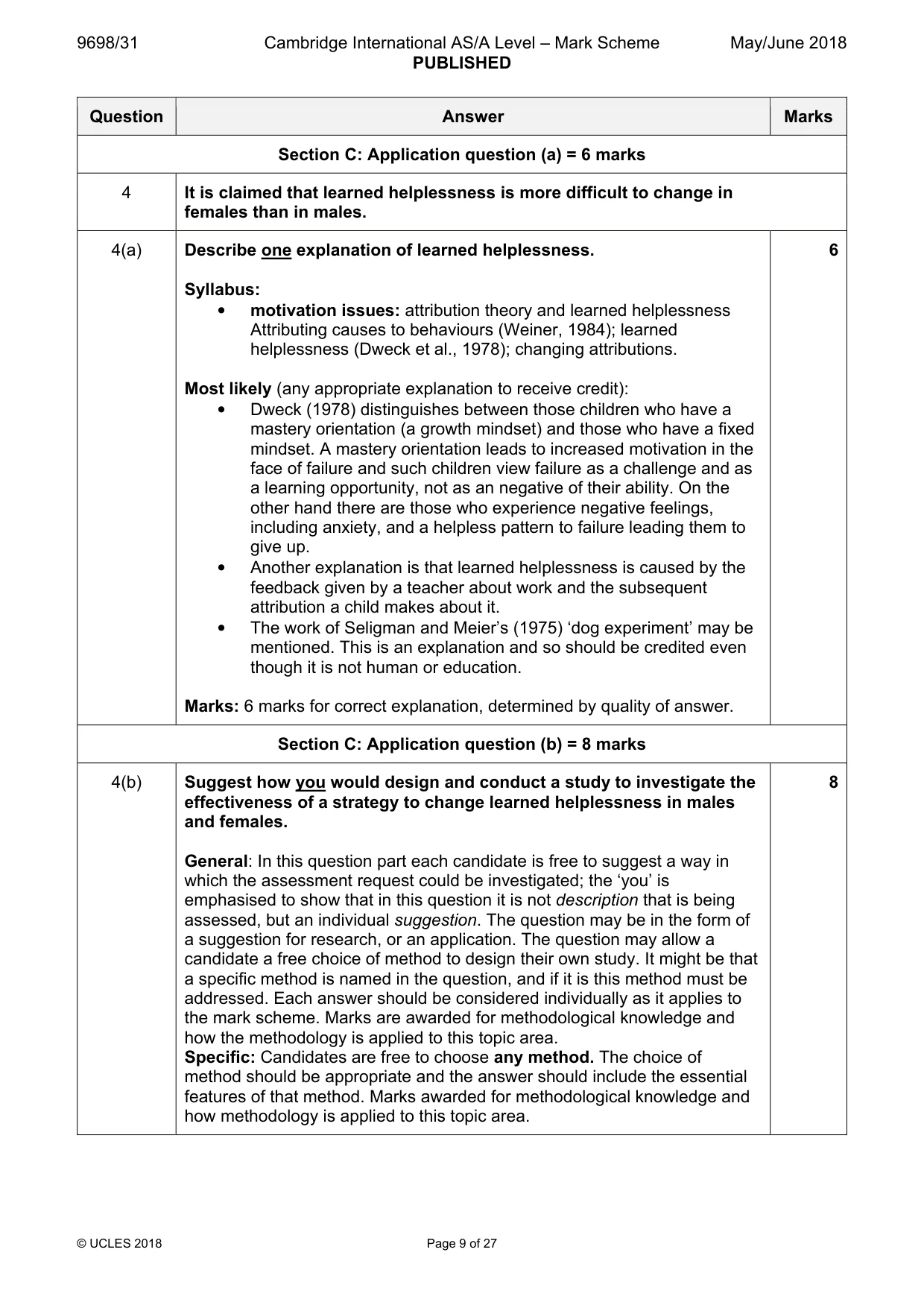
Mark scheme: 4 It is claimed that learned helplessness is more difficult to change in females than in males. 4(a) Describe one explanation of learned helplessness. 6 Syllabus: • motivation issues: attribution theory and learned helplessness Attributing causes to behaviours (Weiner, 1984); learned helplessness (Dweck et al., 1978); changing attributions. Most likely (any appropriate explanation to receive credit): • Dweck (1978) distinguishes between those children who have a mastery orientation (a growth mindset) and those who have a fixed mindset. A mastery orientation leads to increased motivation in the face of failure and such children view failure as a challenge and as a learning opportunity, not as an negative of their ability. On the other hand there are those who experience negative feelings, including anxiety, and a helpless pattern to failure leading them to give up. • Another explanation is that learned helplessness is caused by the feedback given by a teacher about work and the subsequent attribution a child makes about it. • The work of Seligman and Meier’s (1975) ‘dog experiment’ may be mentioned. This is an explanation and so should be credited even though it is not human or education. Marks: 6 marks for correct explanation, determined by quality of answer. Section C: Application question (b) = 8 marks 4(b) Suggest how you would design and conduct a study to investigate the 8 effectiveness of a strategy to change learned helplessness in males and females. General: In this question part each candidate is free to suggest a way in which the assessment request could be investigated; the ‘you’ is emphasised to show that in this question it is not description that is being assessed, but an individual suggestion. The question may be in the form of a suggestion for research, or an application. The question may allow a candidate a free choice of method to design their own study. It might be that a specific method is named in the question, and if it is this method must be addressed. Each answer should be considered individually as it applies to the mark scheme. Marks are awarded for methodological knowledge and how the methodology is applied to this topic area. Specific: Candidates are free to choose any method. The choice of method should be appropriate and the answer should include the essential features of that method. Marks awarded for methodological knowledge and how methodology is applied to this topic area.
Q5 · Explain, in your own words, what is meant by ‘promoting health in schools’
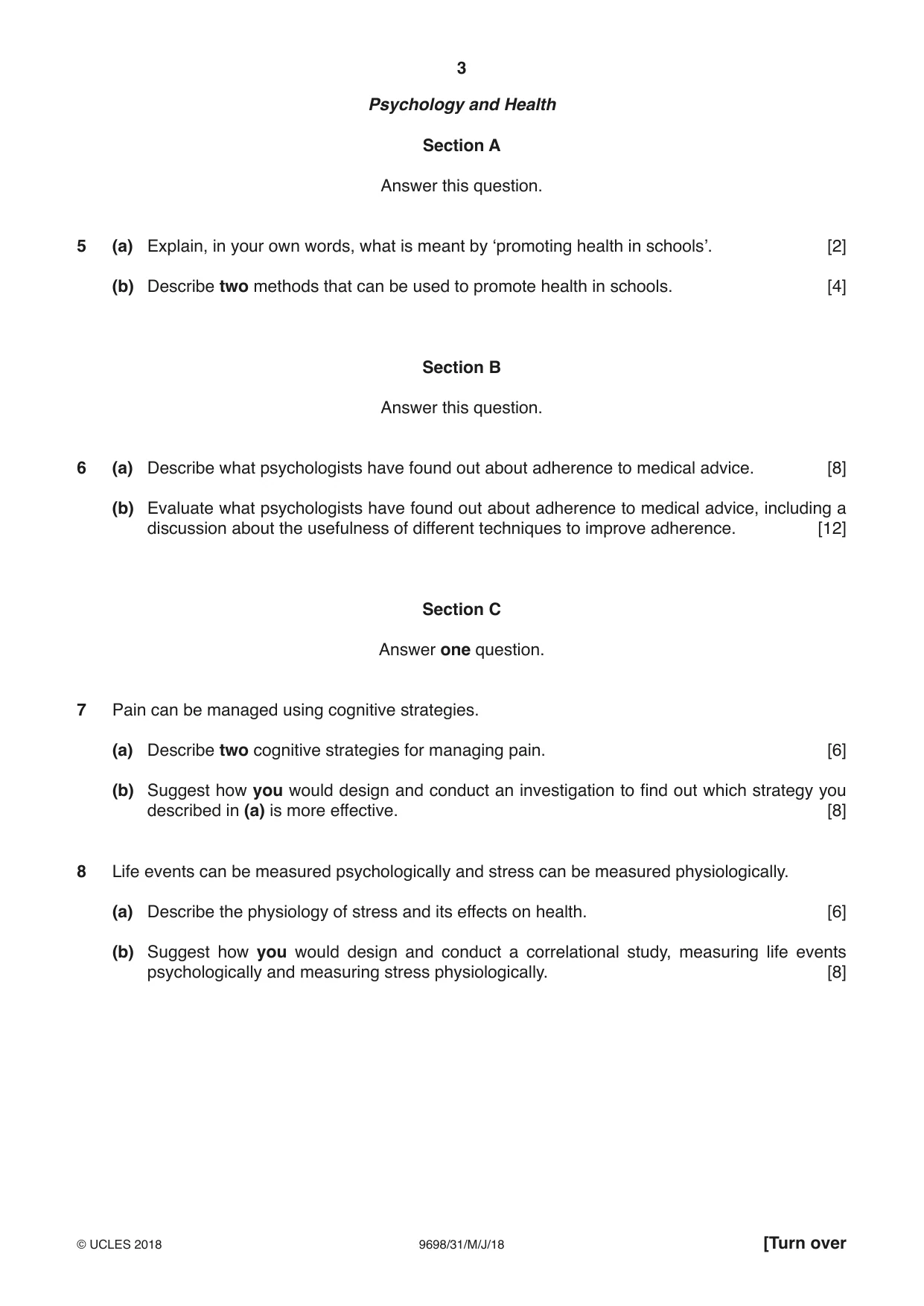
5 (a) Explain, in your own words, what is meant by ‘promoting health in schools’. [2] (b) Describe two methods that can be used to promote health in schools. [4]
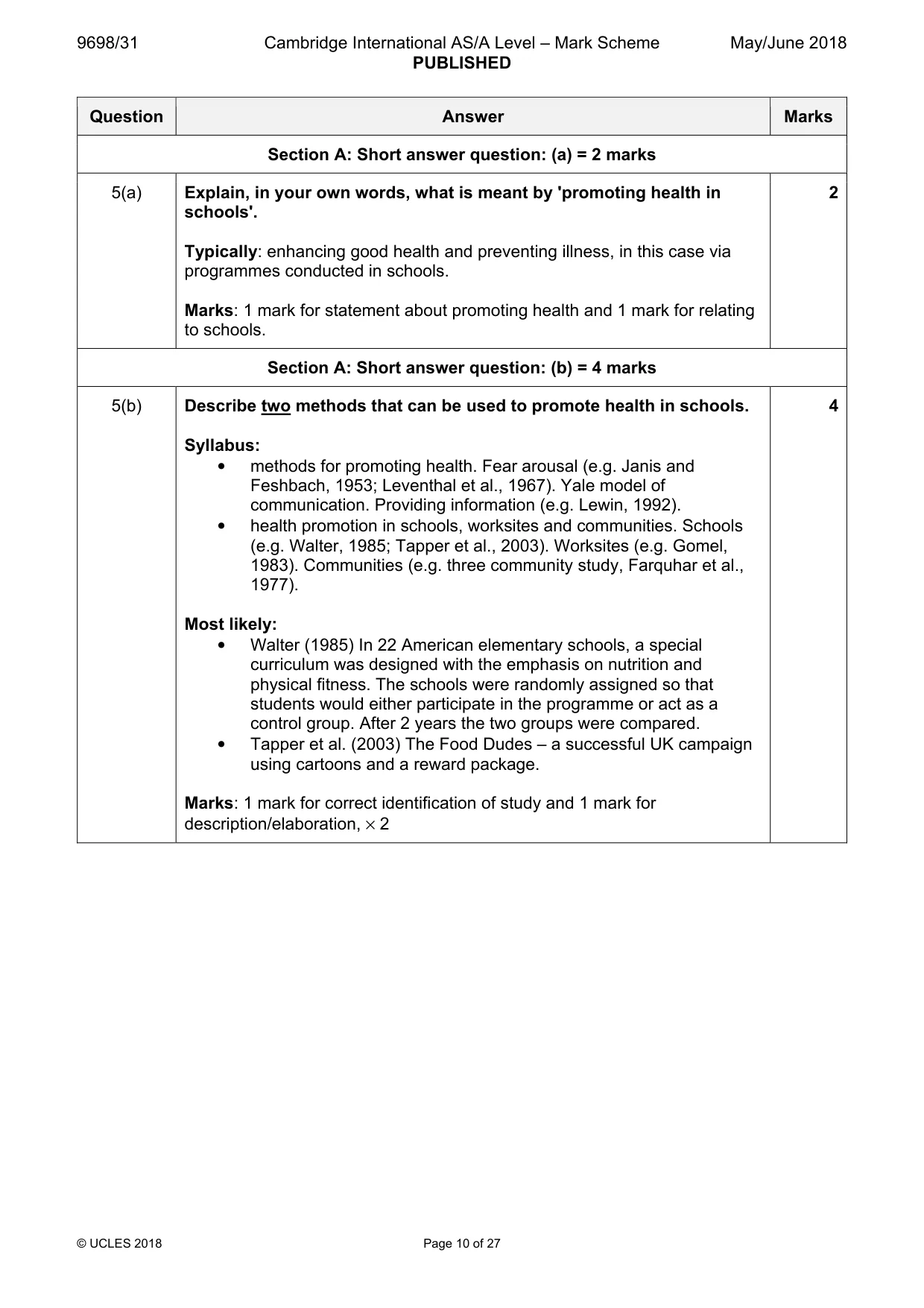
Mark scheme: 5(a) Explain, in your own words, what is meant by 'promoting health in 2 schools'. Typically: enhancing good health and preventing illness, in this case via programmes conducted in schools. Marks: 1 mark for statement about promoting health and 1 mark for relating to schools. Section A: Short answer question: (b) = 4 marks 5(b) Describe two methods that can be used to promote health in schools. 4 Syllabus: • methods for promoting health. Fear arousal (e.g. Janis and Feshbach, 1953; Leventhal et al., 1967). Yale model of communication. Providing information (e.g. Lewin, 1992). • health promotion in schools, worksites and communities. Schools (e.g. Walter, 1985; Tapper et al., 2003). Worksites (e.g. Gomel, 1983). Communities (e.g. three community study, Farquhar et al., 1977). Most likely: • Walter (1985) In 22 American elementary schools, a special curriculum was designed with the emphasis on nutrition and physical fitness. The schools were randomly assigned so that students would either participate in the programme or act as a control group. After 2 years the two groups were compared. • Tapper et al. (2003) The Food Dudes – a successful UK campaign using cartoons and a reward package. Marks: 1 mark for correct identification of study and 1 mark for description/elaboration, × 2
Q6 · Describe what psychologists have found out about adherence to medical advice
6 (a) Describe what psychologists have found out about adherence to medical advice. [8] (b) Evaluate what psychologists have found out about adherence to medical advice, including a discussion about the usefulness of different techniques to improve adherence. [12] Section C Answer one question.
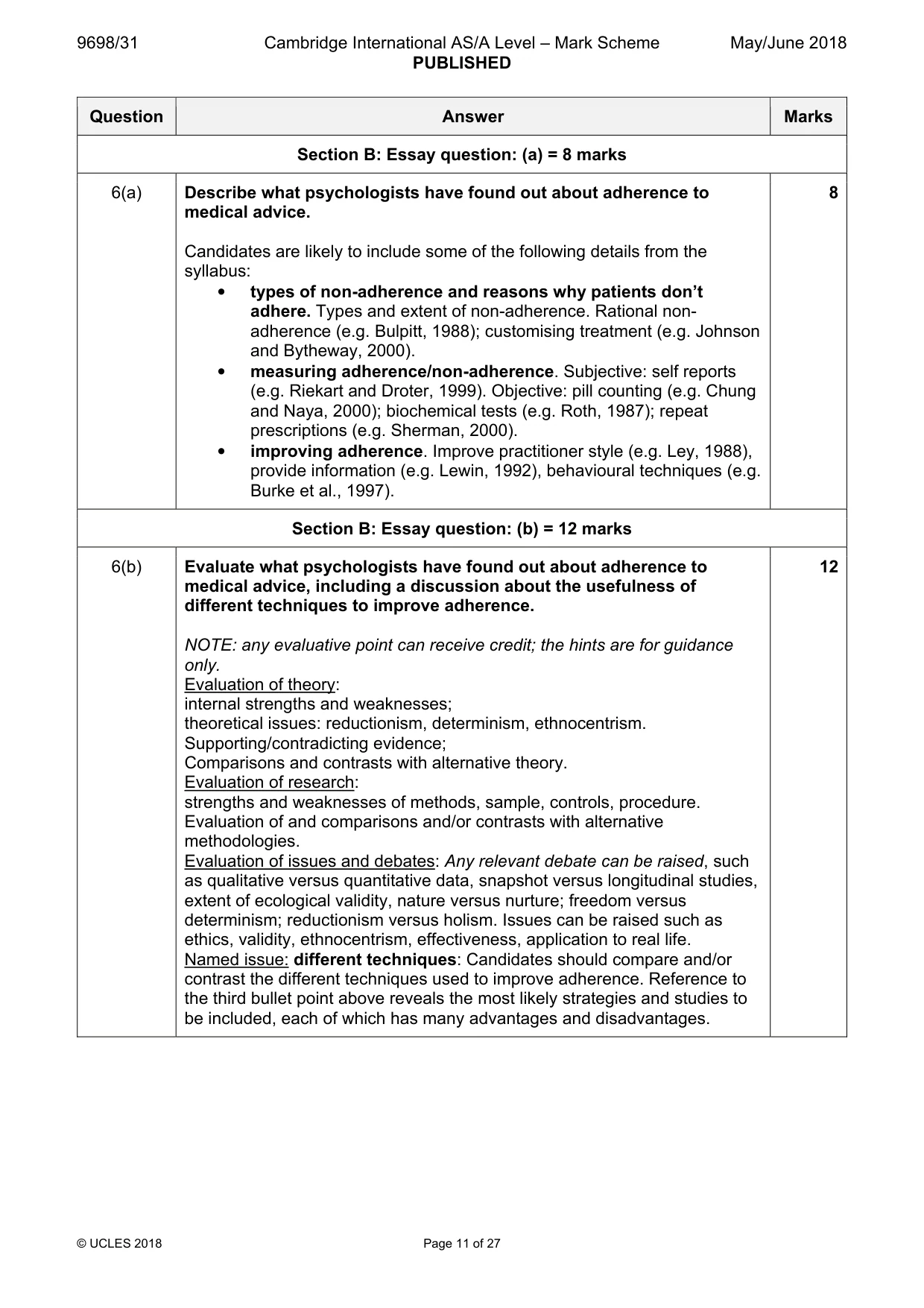
Mark scheme: 6(a) Describe what psychologists have found out about adherence to 8 medical advice. Candidates are likely to include some of the following details from the syllabus: • types of non-adherence and reasons why patients don’t adhere. Types and extent of non-adherence. Rational non- adherence (e.g. Bulpitt, 1988); customising treatment (e.g. Johnson and Bytheway, 2000). • measuring adherence/non-adherence. Subjective: self reports (e.g. Riekart and Droter, 1999). Objective: pill counting (e.g. Chung and Naya, 2000); biochemical tests (e.g. Roth, 1987); repeat prescriptions (e.g. Sherman, 2000). • improving adherence. Improve practitioner style (e.g. Ley, 1988), provide information (e.g. Lewin, 1992), behavioural techniques (e.g. Burke et al., 1997). Section B: Essay question: (b) = 12 marks 6(b) Evaluate what psychologists have found out about adherence to 12 medical advice, including a discussion about the usefulness of different techniques to improve adherence. NOTE: any evaluative point can receive credit; the hints are for guidance only. Evaluation of theory: internal strengths and weaknesses; theoretical issues: reductionism, determinism, ethnocentrism. Supporting/contradicting evidence; Comparisons and contrasts with alternative theory. Evaluation of research: strengths and weaknesses of methods, sample, controls, procedure. Evaluation of and comparisons and/or contrasts with alternative methodologies. Evaluation of issues and debates: Any relevant debate can be raised, such as qualitative versus quantitative data, snapshot versus longitudinal studies, extent of ecological validity, nature versus nurture; freedom versus determinism; reductionism versus holism. Issues can be raised such as ethics, validity, ethnocentrism, effectiveness, application to real life. Named issue: different techniques: Candidates should compare and/or contrast the different techniques used to improve adherence. Reference to the third bullet point above reveals the most likely strategies and studies to be included, each of which has many advantages and disadvantages.
Q7 · Pain can be managed using cognitive strategies
7 Pain can be managed using cognitive strategies. (a) Describe two cognitive strategies for managing pain. [6] (b) Suggest how you would design and conduct an investigation to find out which strategy you described in (a) is more effective. [8]
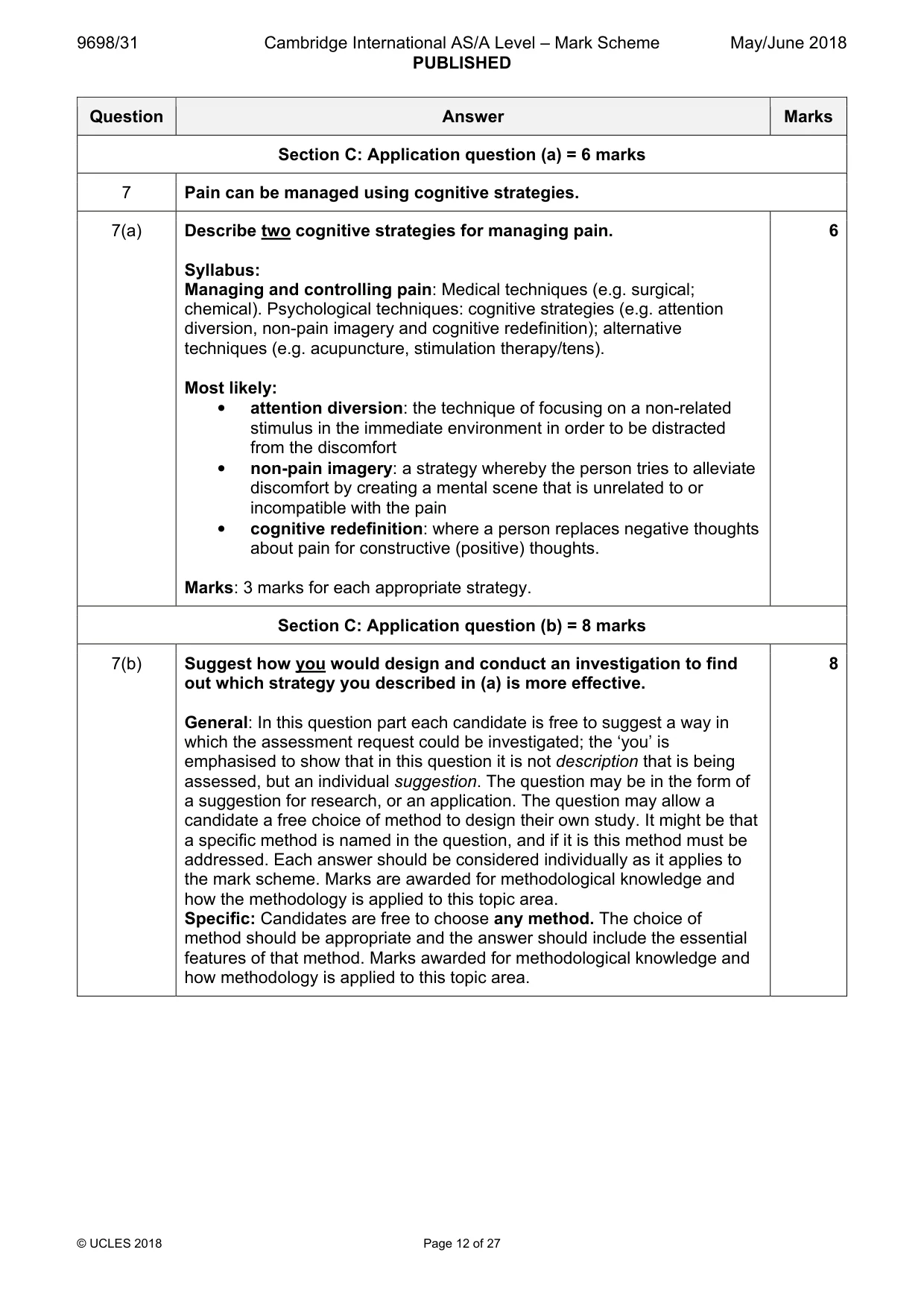
Mark scheme: 7 Pain can be managed using cognitive strategies. 7(a) Describe two cognitive strategies for managing pain. 6 Syllabus: Managing and controlling pain: Medical techniques (e.g. surgical; chemical). Psychological techniques: cognitive strategies (e.g. attention diversion, non-pain imagery and cognitive redefinition); alternative techniques (e.g. acupuncture, stimulation therapy/tens). Most likely: • attention diversion: the technique of focusing on a non-related stimulus in the immediate environment in order to be distracted from the discomfort • non-pain imagery: a strategy whereby the person tries to alleviate discomfort by creating a mental scene that is unrelated to or incompatible with the pain • cognitive redefinition: where a person replaces negative thoughts about pain for constructive (positive) thoughts. Marks: 3 marks for each appropriate strategy. Section C: Application question (b) = 8 marks 7(b) Suggest how you would design and conduct an investigation to find 8 out which strategy you described in (a) is more effective. General: In this question part each candidate is free to suggest a way in which the assessment request could be investigated; the ‘you’ is emphasised to show that in this question it is not description that is being assessed, but an individual suggestion. The question may be in the form of a suggestion for research, or an application. The question may allow a candidate a free choice of method to design their own study. It might be that a specific method is named in the question, and if it is this method must be addressed. Each answer should be considered individually as it applies to the mark scheme. Marks are awarded for methodological knowledge and how the methodology is applied to this topic area. Specific: Candidates are free to choose any method. The choice of method should be appropriate and the answer should include the essential features of that method. Marks awarded for methodological knowledge and how methodology is applied to this topic area.
Q8 · Life events can be measured psychologically and stress can be measured physiologically
8 Life events can be measured psychologically and stress can be measured physiologically. (a) Describe the physiology of stress and its effects on health. [6] (b) Suggest how you would design and conduct a correlational study, measuring life events psychologically and measuring stress physiologically. [8] Psychology and Environment Section A Answer this question.
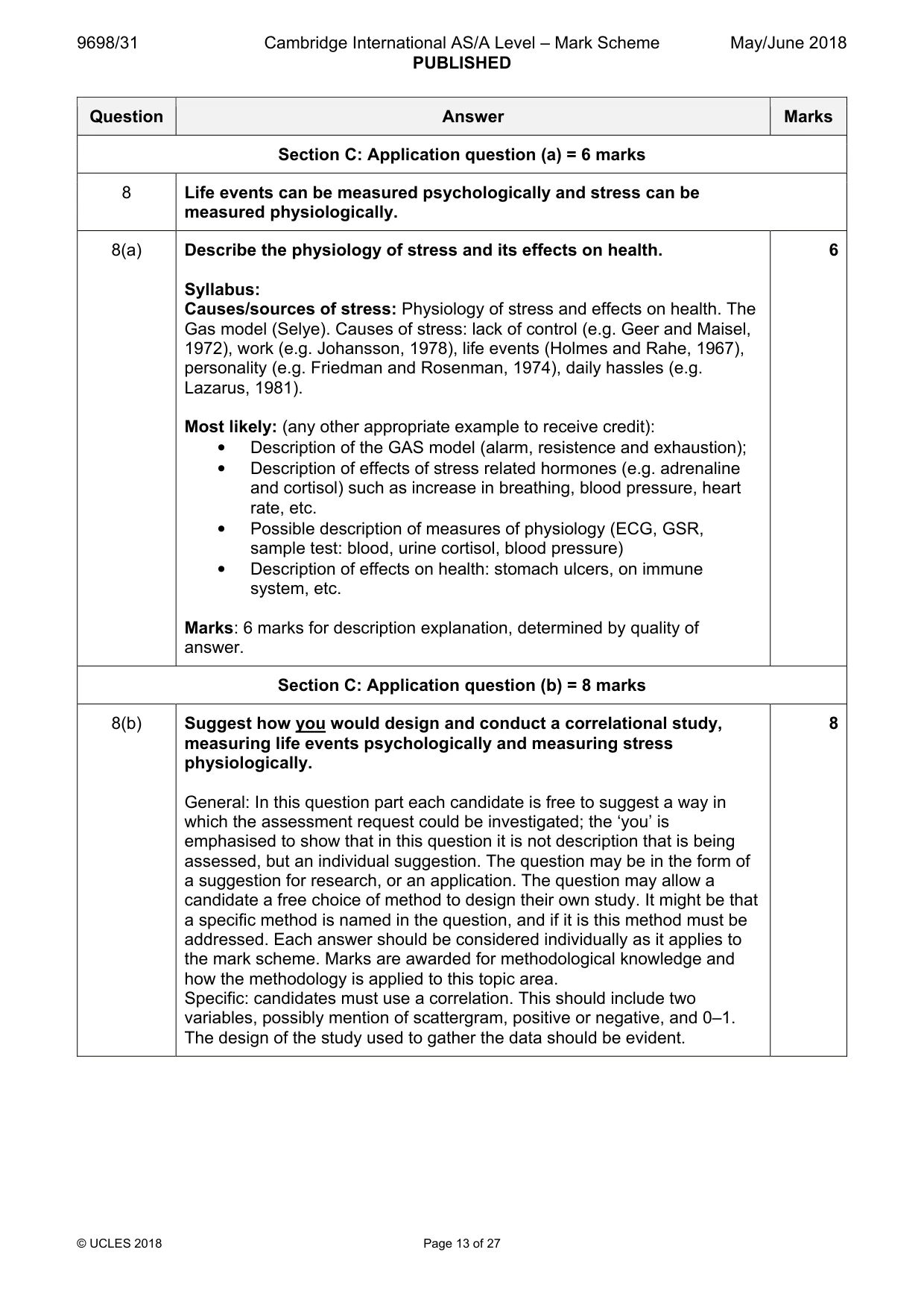
Mark scheme: 8 Life events can be measured psychologically and stress can be measured physiologically. 8(a) Describe the physiology of stress and its effects on health. 6 Syllabus: Causes/sources of stress: Physiology of stress and effects on health. The Gas model (Selye). Causes of stress: lack of control (e.g. Geer and Maisel, 1972), work (e.g. Johansson, 1978), life events (Holmes and Rahe, 1967), personality (e.g. Friedman and Rosenman, 1974), daily hassles (e.g. Lazarus, 1981). Most likely: (any other appropriate example to receive credit): • Description of the GAS model (alarm, resistence and exhaustion); • Description of effects of stress related hormones (e.g. adrenaline and cortisol) such as increase in breathing, blood pressure, heart rate, etc. • Possible description of measures of physiology (ECG, GSR, sample test: blood, urine cortisol, blood pressure) • Description of effects on health: stomach ulcers, on immune system, etc. Marks: 6 marks for description explanation, determined by quality of answer. Section C: Application question (b) = 8 marks 8(b) Suggest how you would design and conduct a correlational study, 8 measuring life events psychologically and measuring stress physiologically. General: In this question part each candidate is free to suggest a way in which the assessment request could be investigated; the ‘you’ is emphasised to show that in this question it is not description that is being assessed, but an individual suggestion. The question may be in the form of a suggestion for research, or an application. The question may allow a candidate a free choice of method to design their own study. It might be that a specific method is named in the question, and if it is this method must be addressed. Each answer should be considered individually as it applies to the mark scheme. Marks are awarded for methodological knowledge and how the methodology is applied to this topic area. Specific: candidates must use a correlation. This should include two variables, possibly mention of scattergram, positive or negative, and 0–1. The design of the study used to gather the data should be evident.
Q9 · Explain, in your own words, what is meant by the simulation method to measure personal…
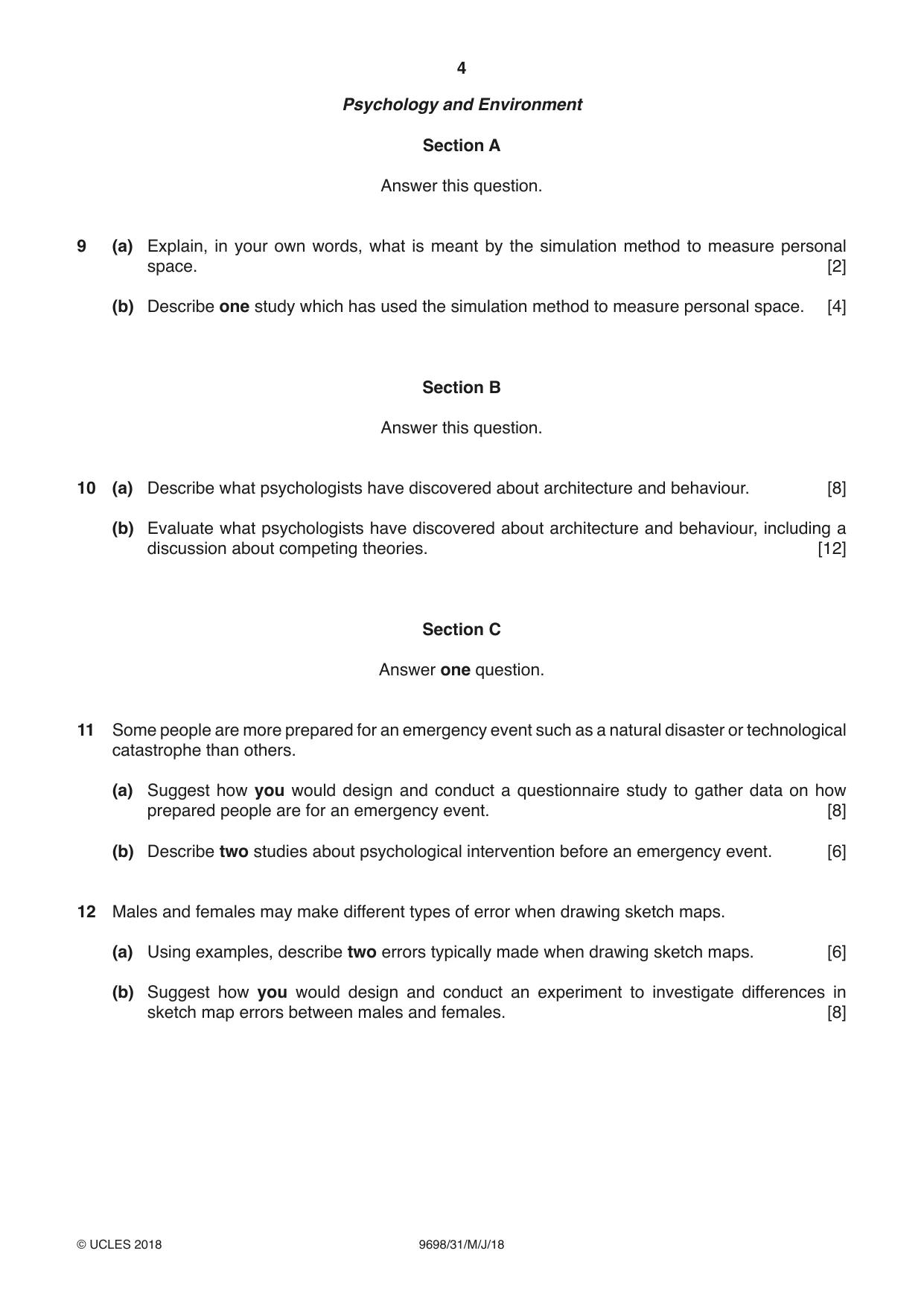
9 (a) Explain, in your own words, what is meant by the simulation method to measure personal space. [2] (b) Describe one study which has used the simulation method to measure personal space. [4]
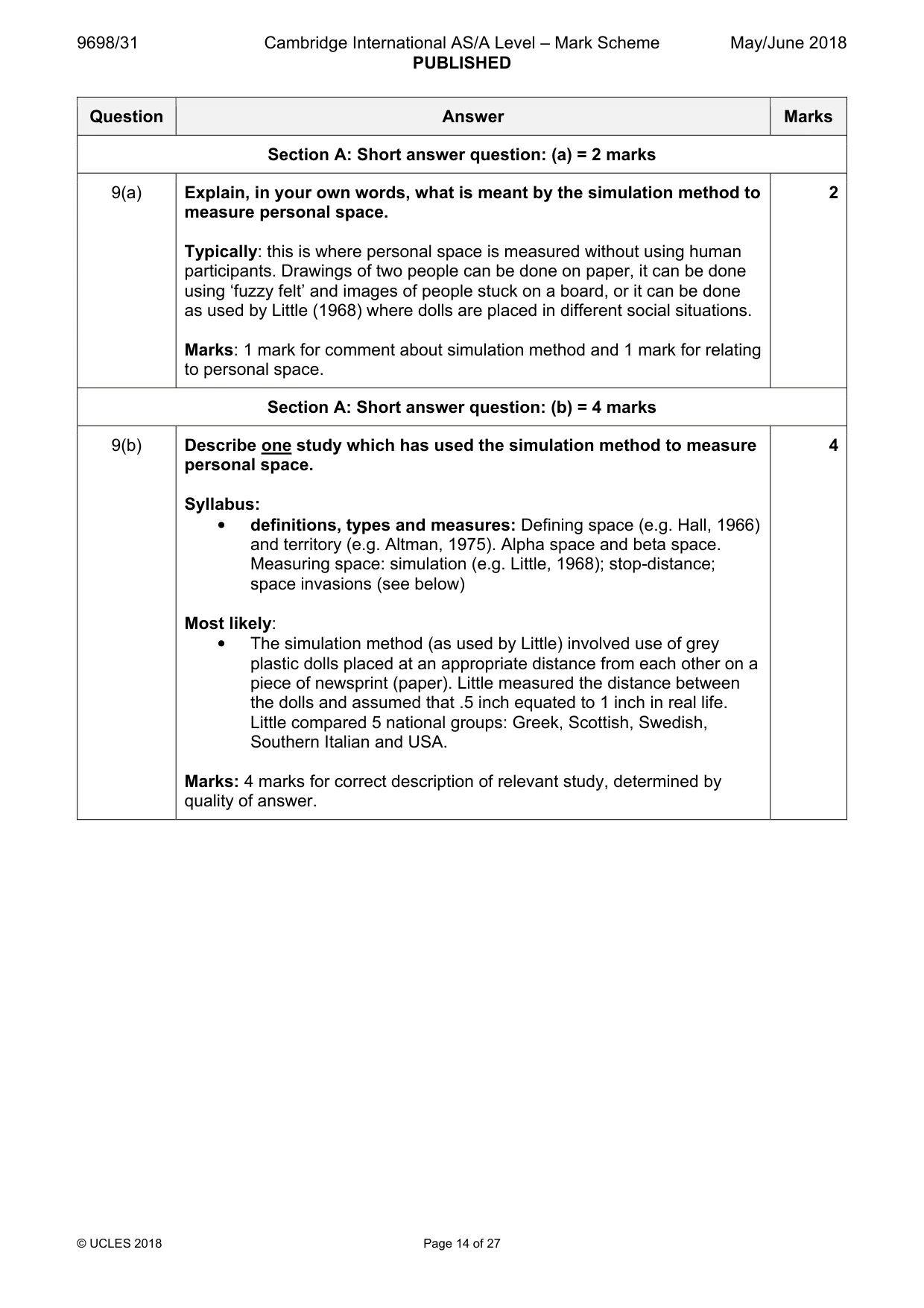
Mark scheme: 9(a) Explain, in your own words, what is meant by the simulation method to 2 measure personal space. Typically: this is where personal space is measured without using human participants. Drawings of two people can be done on paper, it can be done using ‘fuzzy felt’ and images of people stuck on a board, or it can be done as used by Little (1968) where dolls are placed in different social situations. Marks: 1 mark for comment about simulation method and 1 mark for relating to personal space. Section A: Short answer question: (b) = 4 marks 9(b) Describe one study which has used the simulation method to measure 4 personal space. Syllabus: • definitions, types and measures: Defining space (e.g. Hall, 1966) and territory (e.g. Altman, 1975). Alpha space and beta space. Measuring space: simulation (e.g. Little, 1968); stop-distance; space invasions (see below) Most likely: • The simulation method (as used by Little) involved use of grey plastic dolls placed at an appropriate distance from each other on a piece of newsprint (paper). Little measured the distance between the dolls and assumed that .5 inch equated to 1 inch in real life. Little compared 5 national groups: Greek, Scottish, Swedish, Southern Italian and USA. Marks: 4 marks for correct description of relevant study, determined by quality of answer.
Q10 · Describe what psychologists have discovered about architecture and behaviour
10 (a) Describe what psychologists have discovered about architecture and behaviour. [8] (b) Evaluate what psychologists have discovered about architecture and behaviour, including a discussion about competing theories. [12] Section C Answer one question.
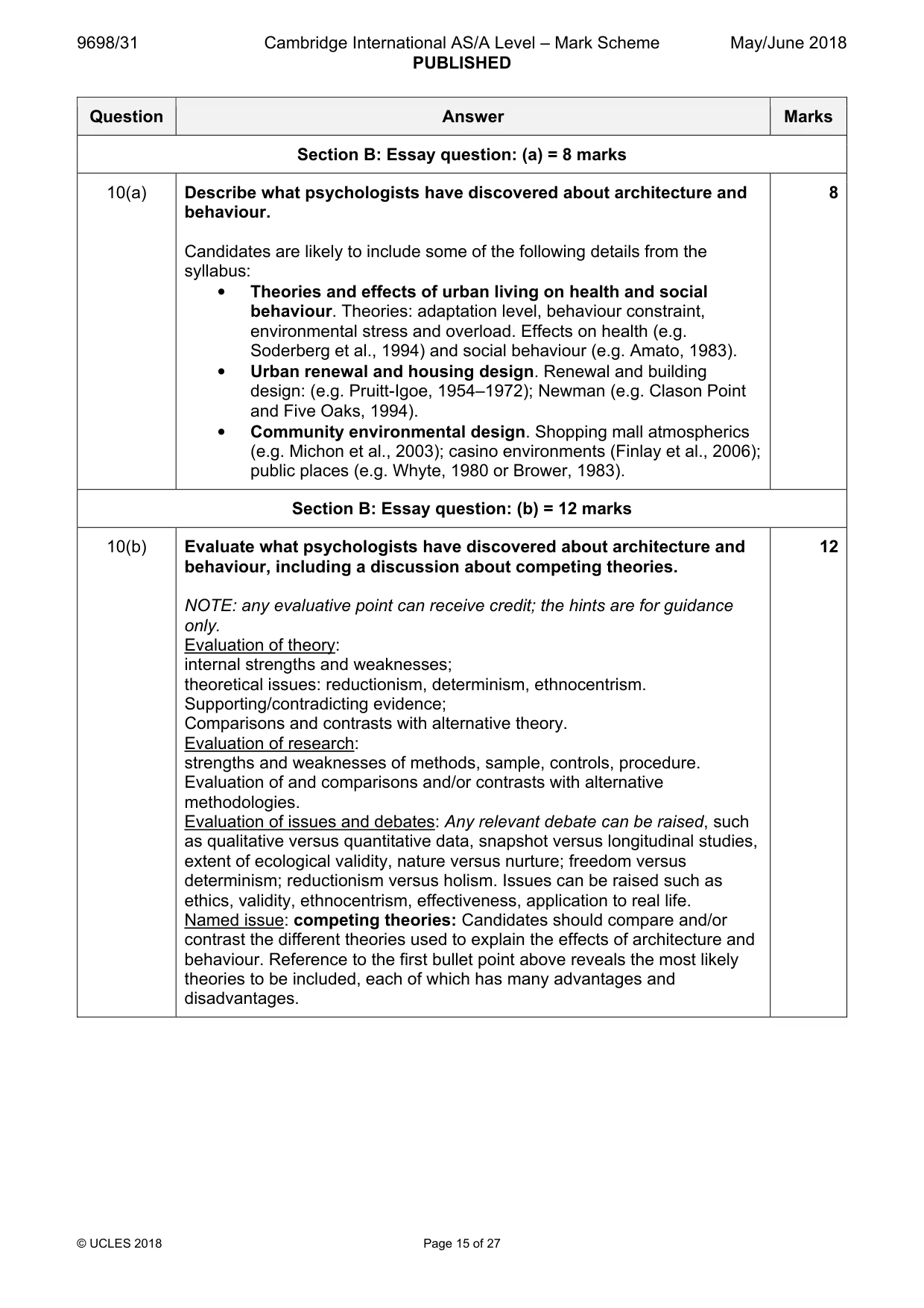
Mark scheme: 10(a) Describe what psychologists have discovered about architecture and 8 behaviour. Candidates are likely to include some of the following details from the syllabus: • Theories and effects of urban living on health and social behaviour. Theories: adaptation level, behaviour constraint, environmental stress and overload. Effects on health (e.g. Soderberg et al., 1994) and social behaviour (e.g. Amato, 1983). • Urban renewal and housing design. Renewal and building design: (e.g. Pruitt-Igoe, 1954–1972); Newman (e.g. Clason Point and Five Oaks, 1994). • Community environmental design. Shopping mall atmospherics (e.g. Michon et al., 2003); casino environments (Finlay et al., 2006); public places (e.g. Whyte, 1980 or Brower, 1983). Section B: Essay question: (b) = 12 marks 10(b) Evaluate what psychologists have discovered about architecture and 12 behaviour, including a discussion about competing theories. NOTE: any evaluative point can receive credit; the hints are for guidance only. Evaluation of theory: internal strengths and weaknesses; theoretical issues: reductionism, determinism, ethnocentrism. Supporting/contradicting evidence; Comparisons and contrasts with alternative theory. Evaluation of research: strengths and weaknesses of methods, sample, controls, procedure. Evaluation of and comparisons and/or contrasts with alternative methodologies. Evaluation of issues and debates: Any relevant debate can be raised, such as qualitative versus quantitative data, snapshot versus longitudinal studies, extent of ecological validity, nature versus nurture; freedom versus determinism; reductionism versus holism. Issues can be raised such as ethics, validity, ethnocentrism, effectiveness, application to real life. Named issue: competing theories: Candidates should compare and/or contrast the different theories used to explain the effects of architecture and behaviour. Reference to the first bullet point above reveals the most likely theories to be included, each of which has many advantages and disadvantages.
Q11 · Some people are more prepared for an emergency event such as a natural disaster or…
11 Some people are more prepared for an emergency event such as a natural disaster or technological catastrophe than others. (a) Suggest how you would design and conduct a questionnaire study to gather data on how prepared people are for an emergency event. [8] (b) Describe two studies about psychological intervention before an emergency event. [6]
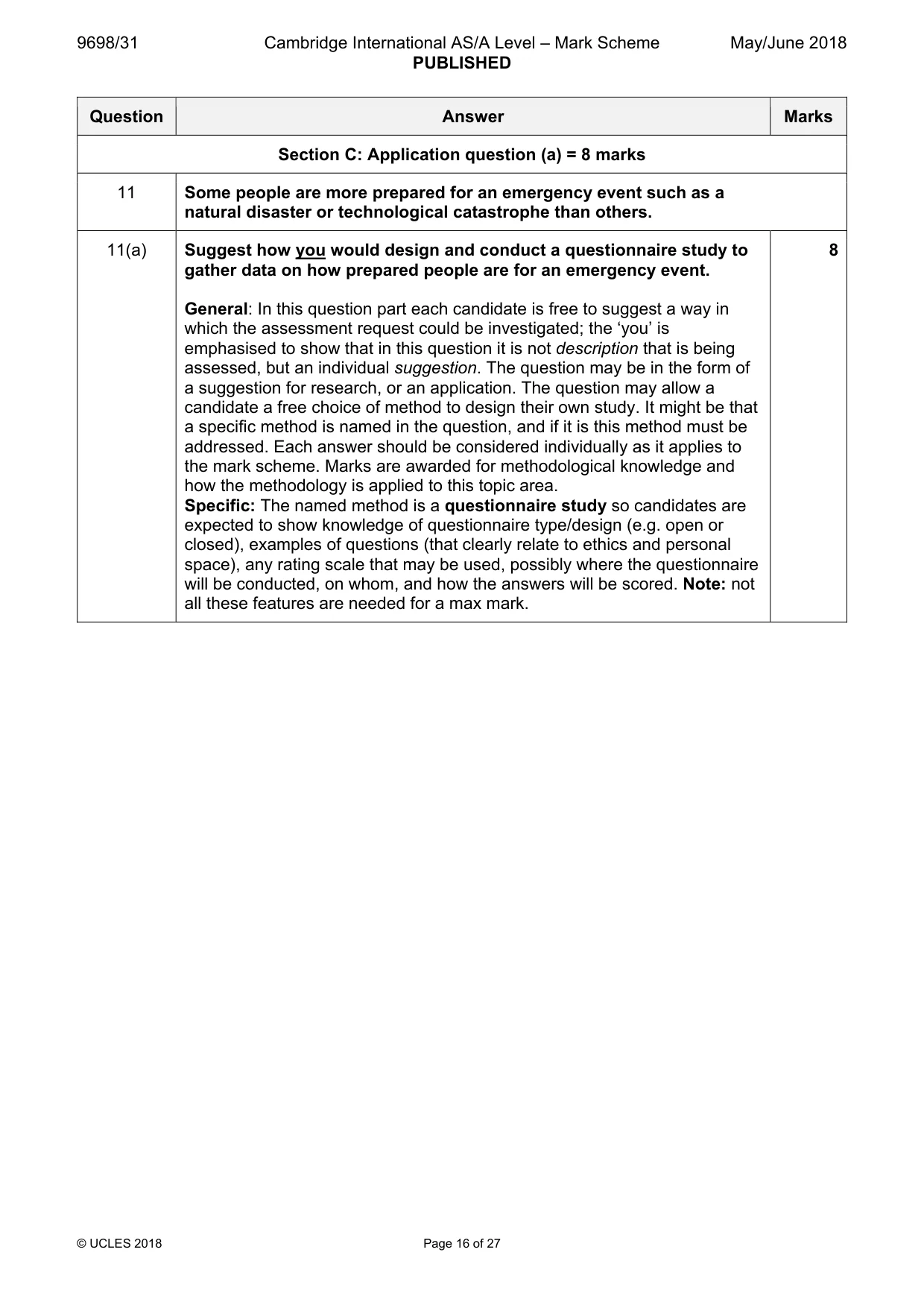
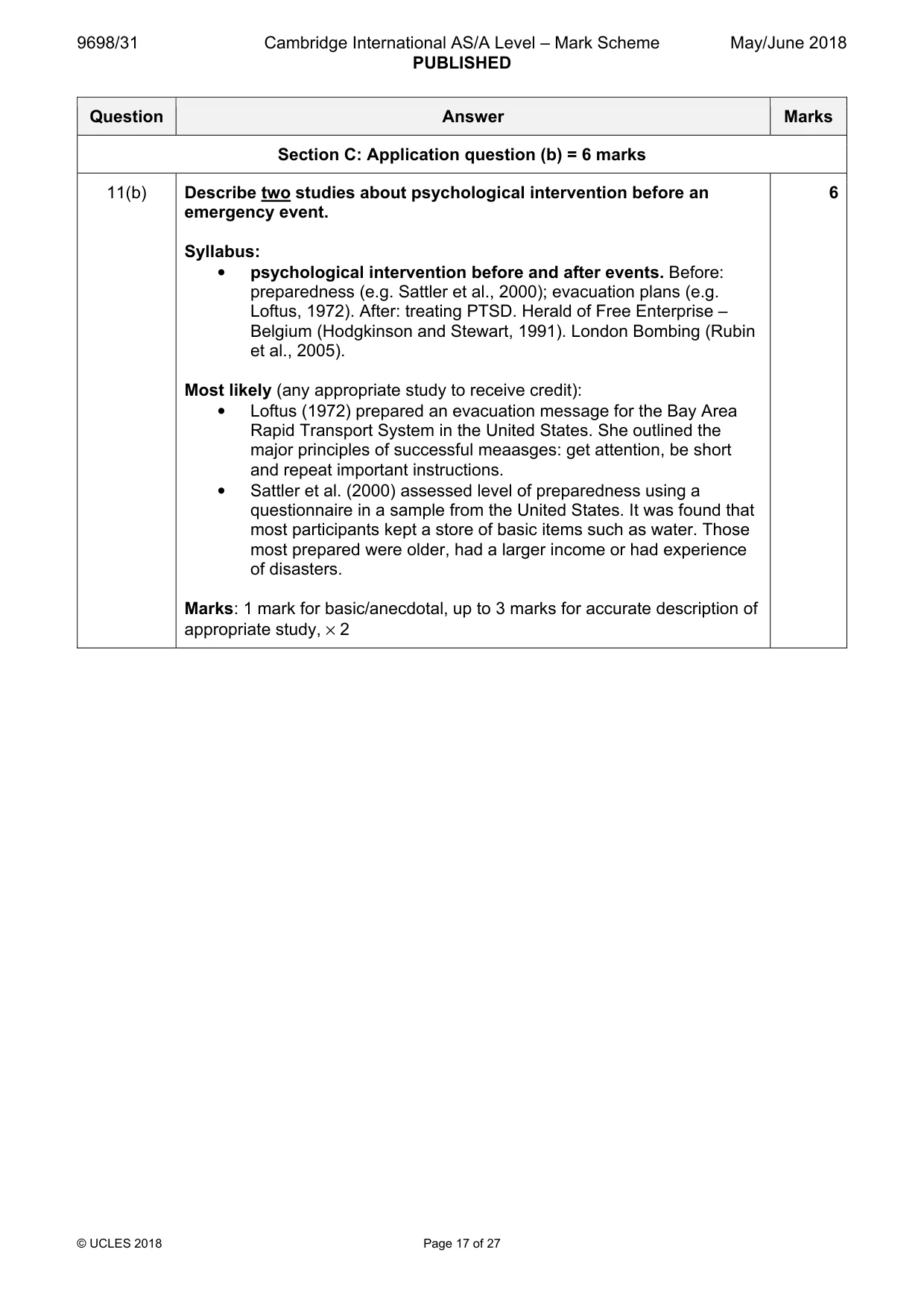
Mark scheme: 11 Some people are more prepared for an emergency event such as a natural disaster or technological catastrophe than others. 11(a) Suggest how you would design and conduct a questionnaire study to 8 gather data on how prepared people are for an emergency event. General: In this question part each candidate is free to suggest a way in which the assessment request could be investigated; the ‘you’ is emphasised to show that in this question it is not description that is being assessed, but an individual suggestion. The question may be in the form of a suggestion for research, or an application. The question may allow a candidate a free choice of method to design their own study. It might be that a specific method is named in the question, and if it is this method must be addressed. Each answer should be considered individually as it applies to the mark scheme. Marks are awarded for methodological knowledge and how the methodology is applied to this topic area. Specific: The named method is a questionnaire study so candidates are expected to show knowledge of questionnaire type/design (e.g. open or closed), examples of questions (that clearly relate to ethics and personal space), any rating scale that may be used, possibly where the questionnaire will be conducted, on whom, and how the answers will be scored. Note: not all these features are needed for a max mark. Section C: Application question (b) = 6 marks 11(b) Describe two studies about psychological intervention before an 6 emergency event. Syllabus: • psychological intervention before and after events. Before: preparedness (e.g. Sattler et al., 2000); evacuation plans (e.g. Loftus, 1972). After: treating PTSD. Herald of Free Enterprise – Belgium (Hodgkinson and Stewart, 1991). London Bombing (Rubin et al., 2005). Most likely (any appropriate study to receive credit): • Loftus (1972) prepared an evacuation message for the Bay Area Rapid Transport System in the United States. She outlined the major principles of successful meaasges: get attention, be short and repeat important instructions. • Sattler et al. (2000) assessed level of preparedness using a questionnaire in a sample from the United States. It was found that most participants kept a store of basic items such as water. Those most prepared were older, had a larger income or had experience of disasters. Marks: 1 mark for basic/anecdotal, up to 3 marks for accurate description of appropriate study, × 2
Q12 · Males and females may make different types of error when drawing sketch maps
12 Males and females may make different types of error when drawing sketch maps. (a) Using examples, describe two errors typically made when drawing sketch maps. [6] (b) Suggest how you would design and conduct an experiment to investigate differences in sketch map errors between males and females. [8] Psychology and Abnormality Section A Answer this question.
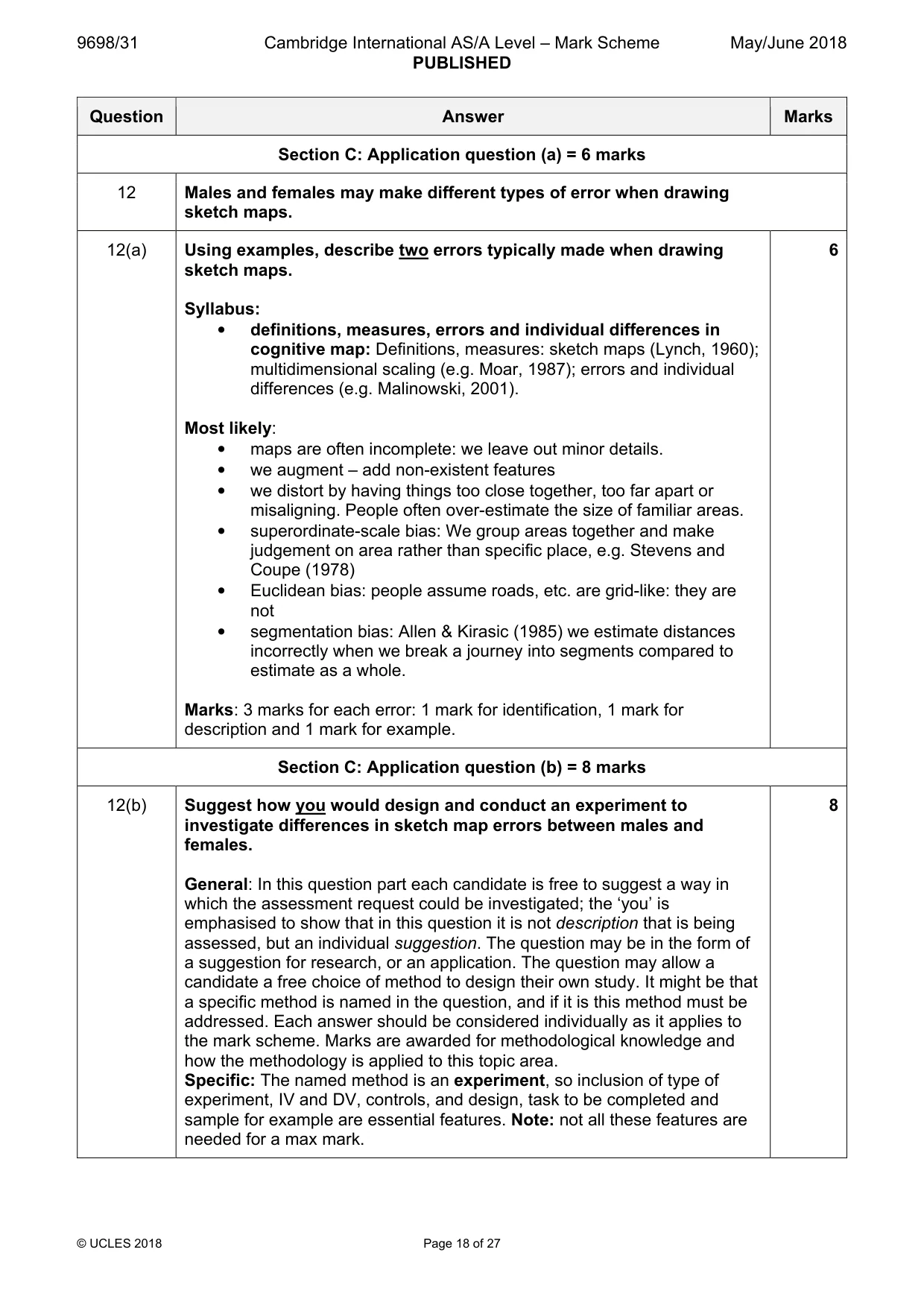
Mark scheme: 12 Males and females may make different types of error when drawing sketch maps. 12(a) Using examples, describe two errors typically made when drawing 6 sketch maps. Syllabus: • definitions, measures, errors and individual differences in cognitive map: Definitions, measures: sketch maps (Lynch, 1960); multidimensional scaling (e.g. Moar, 1987); errors and individual differences (e.g. Malinowski, 2001). Most likely: • maps are often incomplete: we leave out minor details. • we augment – add non-existent features • we distort by having things too close together, too far apart or misaligning. People often over-estimate the size of familiar areas. • superordinate-scale bias: We group areas together and make judgement on area rather than specific place, e.g. Stevens and Coupe (1978) • Euclidean bias: people assume roads, etc. are grid-like: they are not • segmentation bias: Allen & Kirasic (1985) we estimate distances incorrectly when we break a journey into segments compared to estimate as a whole. Marks: 3 marks for each error: 1 mark for identification, 1 mark for description and 1 mark for example. Section C: Application question (b) = 8 marks 12(b) Suggest how you would design and conduct an experiment to 8 investigate differences in sketch map errors between males and females. General: In this question part each candidate is free to suggest a way in which the assessment request could be investigated; the ‘you’ is emphasised to show that in this question it is not description that is being assessed, but an individual suggestion. The question may be in the form of a suggestion for research, or an application. The question may allow a candidate a free choice of method to design their own study. It might be that a specific method is named in the question, and if it is this method must be addressed. Each answer should be considered individually as it applies to the mark scheme. Marks are awarded for methodological knowledge and how the methodology is applied to this topic area. Specific: The named method is an experiment, so inclusion of type of experiment, IV and DV, controls, and design, task to be completed and sample for example are essential features. Note: not all these features are needed for a max mark.
Q13 · Explain, in your own words, what is meant by a ‘case study’
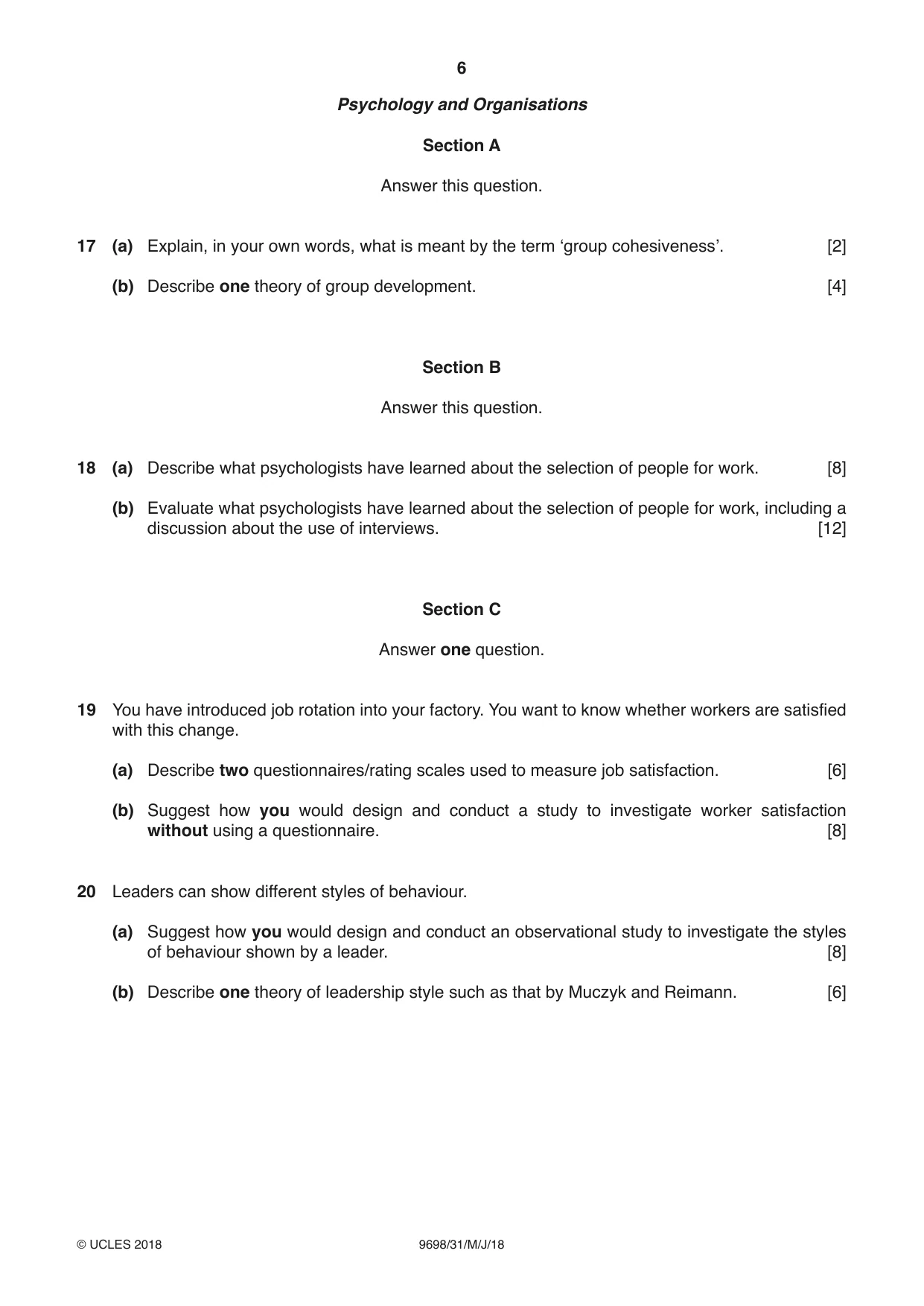
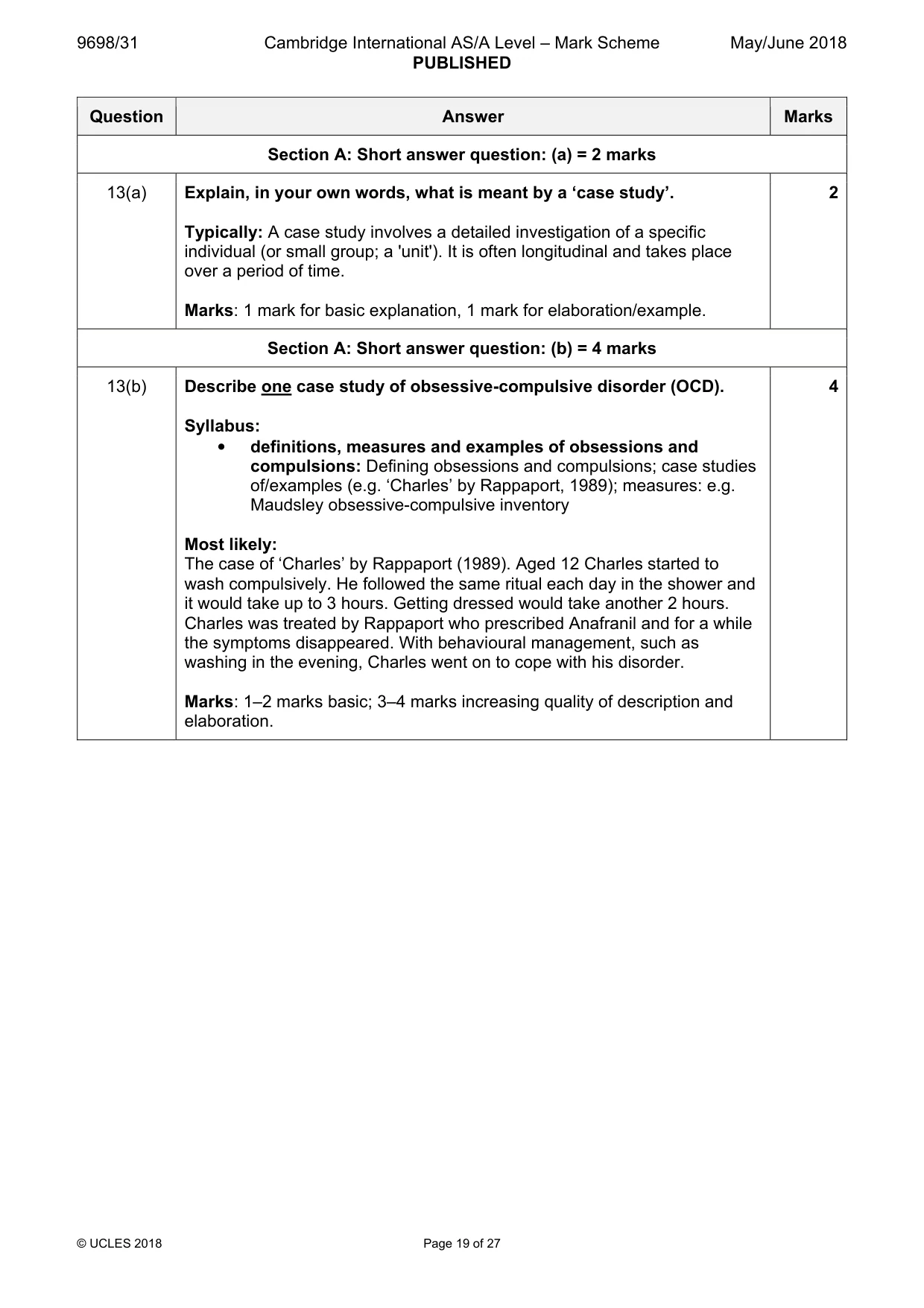
13 (a) Explain, in your own words, what is meant by a ‘case study’. [2] (b) Describe one case study of obsessive-compulsive disorder (OCD). [4]
Mark scheme: 13(a) Explain, in your own words, what is meant by a ‘case study’. 2 Typically: A case study involves a detailed investigation of a specific individual (or small group; a 'unit'). It is often longitudinal and takes place over a period of time. Marks: 1 mark for basic explanation, 1 mark for elaboration/example. Section A: Short answer question: (b) = 4 marks 13(b) Describe one case study of obsessive-compulsive disorder (OCD). 4 Syllabus: • definitions, measures and examples of obsessions and compulsions: Defining obsessions and compulsions; case studies of/examples (e.g. ‘Charles’ by Rappaport, 1989); measures: e.g. Maudsley obsessive-compulsive inventory Most likely: The case of ‘Charles’ by Rappaport (1989). Aged 12 Charles started to wash compulsively. He followed the same ritual each day in the shower and it would take up to 3 hours. Getting dressed would take another 2 hours. Charles was treated by Rappaport who prescribed Anafranil and for a while the symptoms disappeared. With behavioural management, such as washing in the evening, Charles went on to cope with his disorder. Marks: 1–2 marks basic; 3–4 marks increasing quality of description and elaboration.
Q14 · Describe what psychologists have discovered about models of abnormality
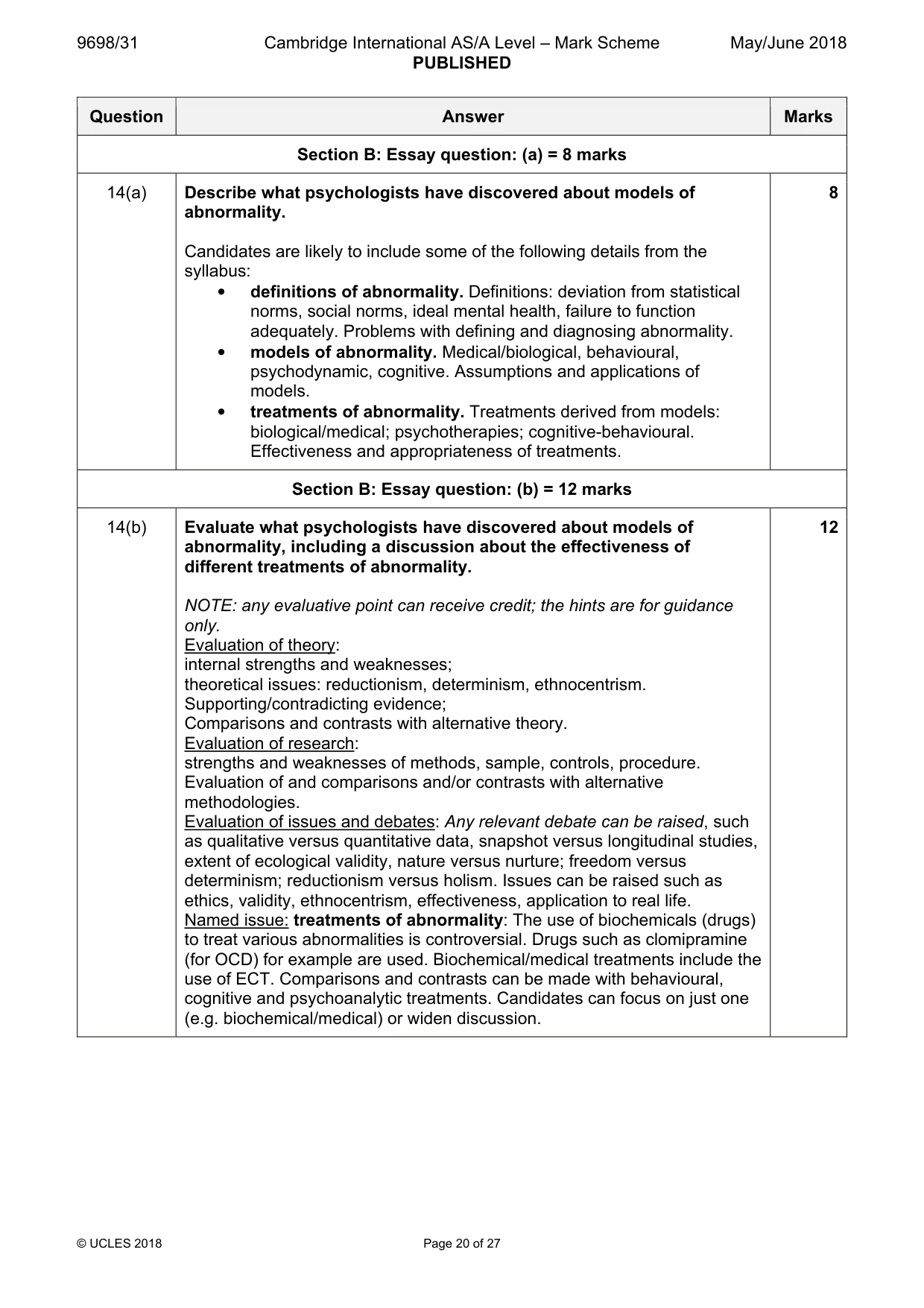
14 (a) Describe what psychologists have discovered about models of abnormality. [8] (b) Evaluate what psychologists have discovered about models of abnormality, including a discussion about the effectiveness of different treatments of abnormality. [12] Section C Answer one question.
Mark scheme: 14(a) Describe what psychologists have discovered about models of 8 abnormality. Candidates are likely to include some of the following details from the syllabus: • definitions of abnormality. Definitions: deviation from statistical norms, social norms, ideal mental health, failure to function adequately. Problems with defining and diagnosing abnormality. • models of abnormality. Medical/biological, behavioural, psychodynamic, cognitive. Assumptions and applications of models. • treatments of abnormality. Treatments derived from models: biological/medical; psychotherapies; cognitive-behavioural. Effectiveness and appropriateness of treatments. Section B: Essay question: (b) = 12 marks 14(b) Evaluate what psychologists have discovered about models of 12 abnormality, including a discussion about the effectiveness of different treatments of abnormality. NOTE: any evaluative point can receive credit; the hints are for guidance only. Evaluation of theory: internal strengths and weaknesses; theoretical issues: reductionism, determinism, ethnocentrism. Supporting/contradicting evidence; Comparisons and contrasts with alternative theory. Evaluation of research: strengths and weaknesses of methods, sample, controls, procedure. Evaluation of and comparisons and/or contrasts with alternative methodologies. Evaluation of issues and debates: Any relevant debate can be raised, such as qualitative versus quantitative data, snapshot versus longitudinal studies, extent of ecological validity, nature versus nurture; freedom versus determinism; reductionism versus holism. Issues can be raised such as ethics, validity, ethnocentrism, effectiveness, application to real life. Named issue: treatments of abnormality: The use of biochemicals (drugs) to treat various abnormalities is controversial. Drugs such as clomipramine (for OCD) for example are used. Biochemical/medical treatments include the use of ECT. Comparisons and contrasts can be made with behavioural, cognitive and psychoanalytic treatments. Candidates can focus on just one (e.g. biochemical/medical) or widen discussion.
Q15 · There are different explanations of what causes children to have a phobia of an animal
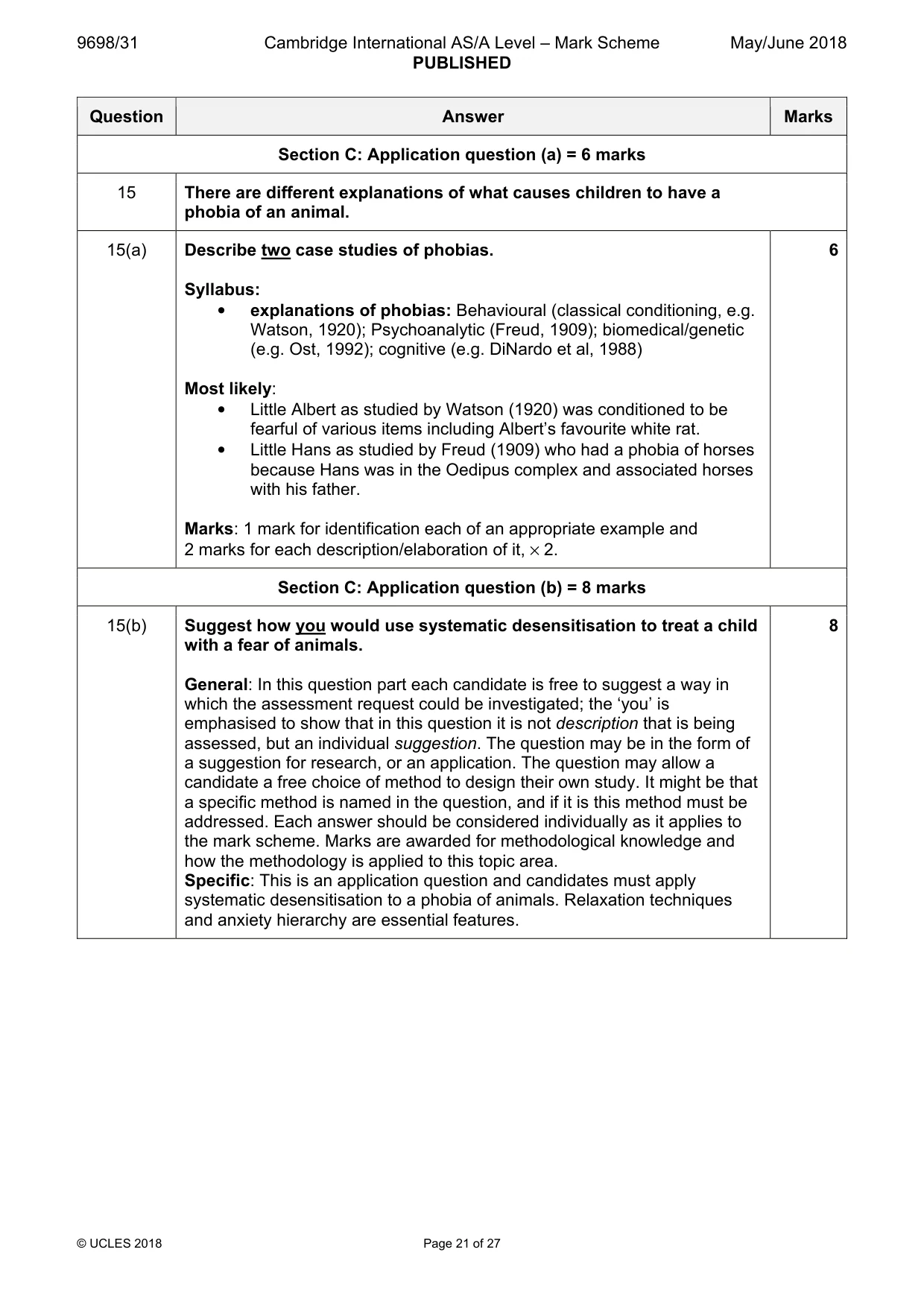
15 There are different explanations of what causes children to have a phobia of an animal. (a) Describe two case studies of phobias. [6] (b) Suggest how you would use systematic desensitisation to treat a child with a fear of animals. [8]
Mark scheme: 15 There are different explanations of what causes children to have a phobia of an animal. 15(a) Describe two case studies of phobias. 6 Syllabus: • explanations of phobias: Behavioural (classical conditioning, e.g. Watson, 1920); Psychoanalytic (Freud, 1909); biomedical/genetic (e.g. Ost, 1992); cognitive (e.g. DiNardo et al, 1988) Most likely: • Little Albert as studied by Watson (1920) was conditioned to be fearful of various items including Albert’s favourite white rat. • Little Hans as studied by Freud (1909) who had a phobia of horses because Hans was in the Oedipus complex and associated horses with his father. Marks: 1 mark for identification each of an appropriate example and 2 marks for each description/elaboration of it, × 2. Section C: Application question (b) = 8 marks 15(b) Suggest how you would use systematic desensitisation to treat a child 8 with a fear of animals. General: In this question part each candidate is free to suggest a way in which the assessment request could be investigated; the ‘you’ is emphasised to show that in this question it is not description that is being assessed, but an individual suggestion. The question may be in the form of a suggestion for research, or an application. The question may allow a candidate a free choice of method to design their own study. It might be that a specific method is named in the question, and if it is this method must be addressed. Each answer should be considered individually as it applies to the mark scheme. Marks are awarded for methodological knowledge and how the methodology is applied to this topic area. Specific: This is an application question and candidates must apply systematic desensitisation to a phobia of animals. Relaxation techniques and anxiety hierarchy are essential features.
Q16 · Chemical/drug treatments for depression can be effective, but they can have side effects
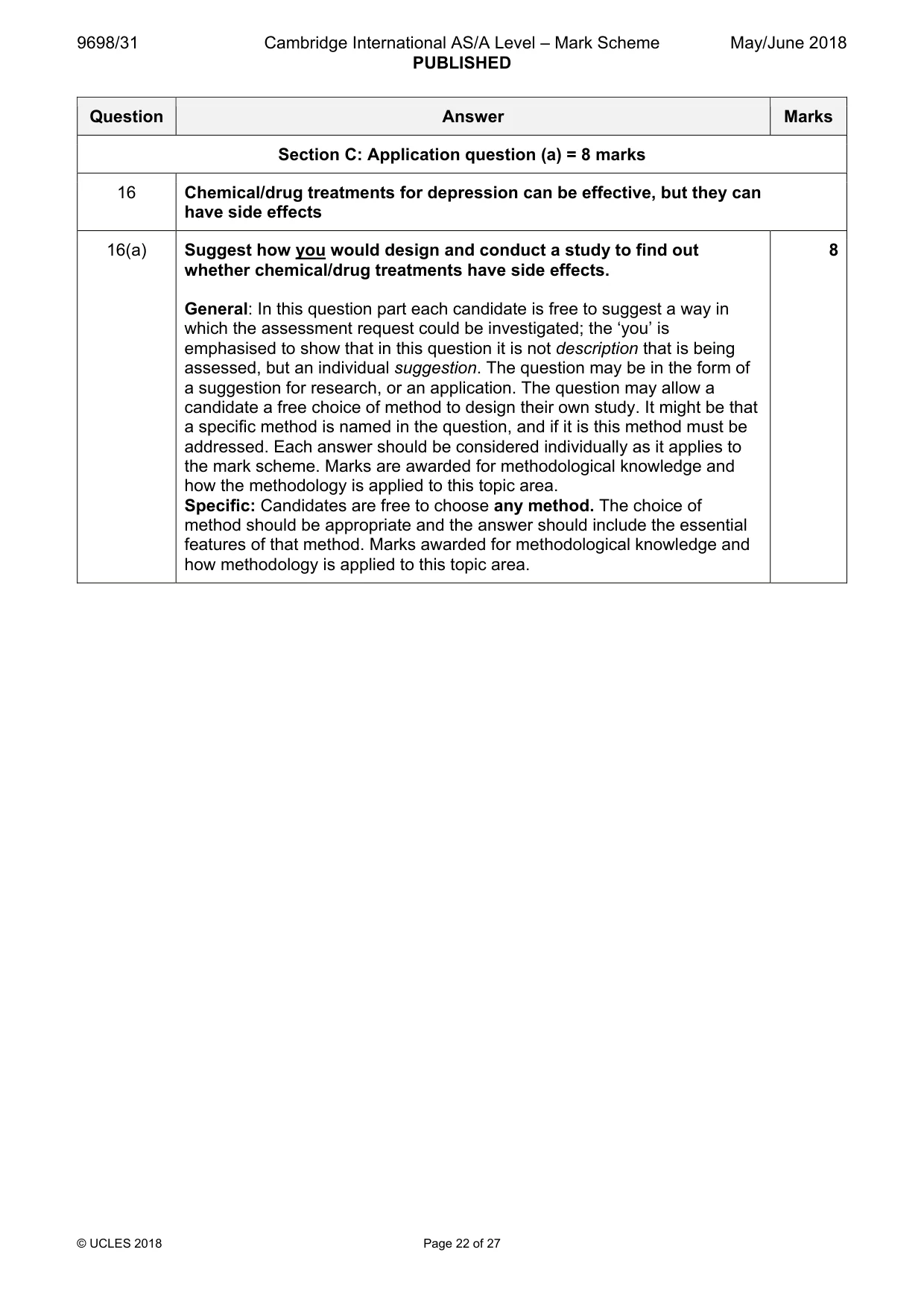
16 Chemical/drug treatments for depression can be effective, but they can have side effects. (a) Suggest how you would design and conduct a study to find out whether chemical/drug treatments have side effects. [8] (b) Describe two other ways in which depression can be treated. [6] Psychology and Organisations Section A Answer this question.
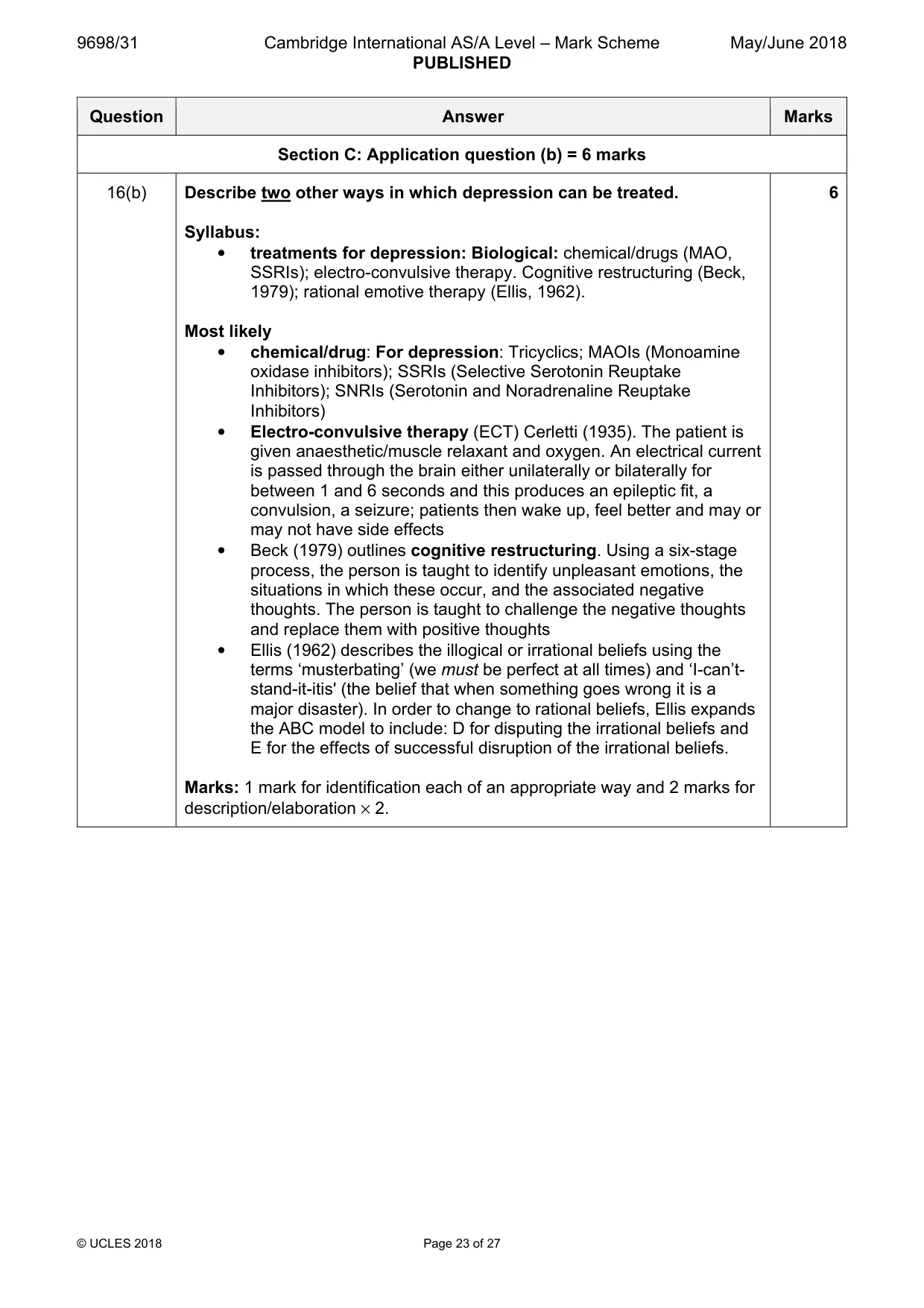
Mark scheme: 16 Chemical/drug treatments for depression can be effective, but they can have side effects 16(a) Suggest how you would design and conduct a study to find out 8 whether chemical/drug treatments have side effects. General: In this question part each candidate is free to suggest a way in which the assessment request could be investigated; the ‘you’ is emphasised to show that in this question it is not description that is being assessed, but an individual suggestion. The question may be in the form of a suggestion for research, or an application. The question may allow a candidate a free choice of method to design their own study. It might be that a specific method is named in the question, and if it is this method must be addressed. Each answer should be considered individually as it applies to the mark scheme. Marks are awarded for methodological knowledge and how the methodology is applied to this topic area. Specific: Candidates are free to choose any method. The choice of method should be appropriate and the answer should include the essential features of that method. Marks awarded for methodological knowledge and how methodology is applied to this topic area. Section C: Application question (b) = 6 marks 16(b) Describe two other ways in which depression can be treated. 6 Syllabus: • treatments for depression: Biological: chemical/drugs (MAO, SSRIs); electro-convulsive therapy. Cognitive restructuring (Beck, 1979); rational emotive therapy (Ellis, 1962). Most likely • chemical/drug: For depression: Tricyclics; MAOIs (Monoamine oxidase inhibitors); SSRIs (Selective Serotonin Reuptake Inhibitors); SNRIs (Serotonin and Noradrenaline Reuptake Inhibitors) • Electro-convulsive therapy (ECT) Cerletti (1935). The patient is given anaesthetic/muscle relaxant and oxygen. An electrical current is passed through the brain either unilaterally or bilaterally for between 1 and 6 seconds and this produces an epileptic fit, a convulsion, a seizure; patients then wake up, feel better and may or may not have side effects • Beck (1979) outlines cognitive restructuring. Using a six-stage process, the person is taught to identify unpleasant emotions, the situations in which these occur, and the associated negative thoughts. The person is taught to challenge the negative thoughts and replace them with positive thoughts • Ellis (1962) describes the illogical or irrational beliefs using the terms ‘musterbating’ (we must be perfect at all times) and ‘I-can’t- stand-it-itis' (the belief that when something goes wrong it is a major disaster). In order to change to rational beliefs, Ellis expands the ABC model to include: D for disputing the irrational beliefs and E for the effects of successful disruption of the irrational beliefs. Marks: 1 mark for identification each of an appropriate way and 2 marks for description/elaboration × 2.
Q17 · Explain, in your own words, what is meant by the term ‘group cohesiveness’
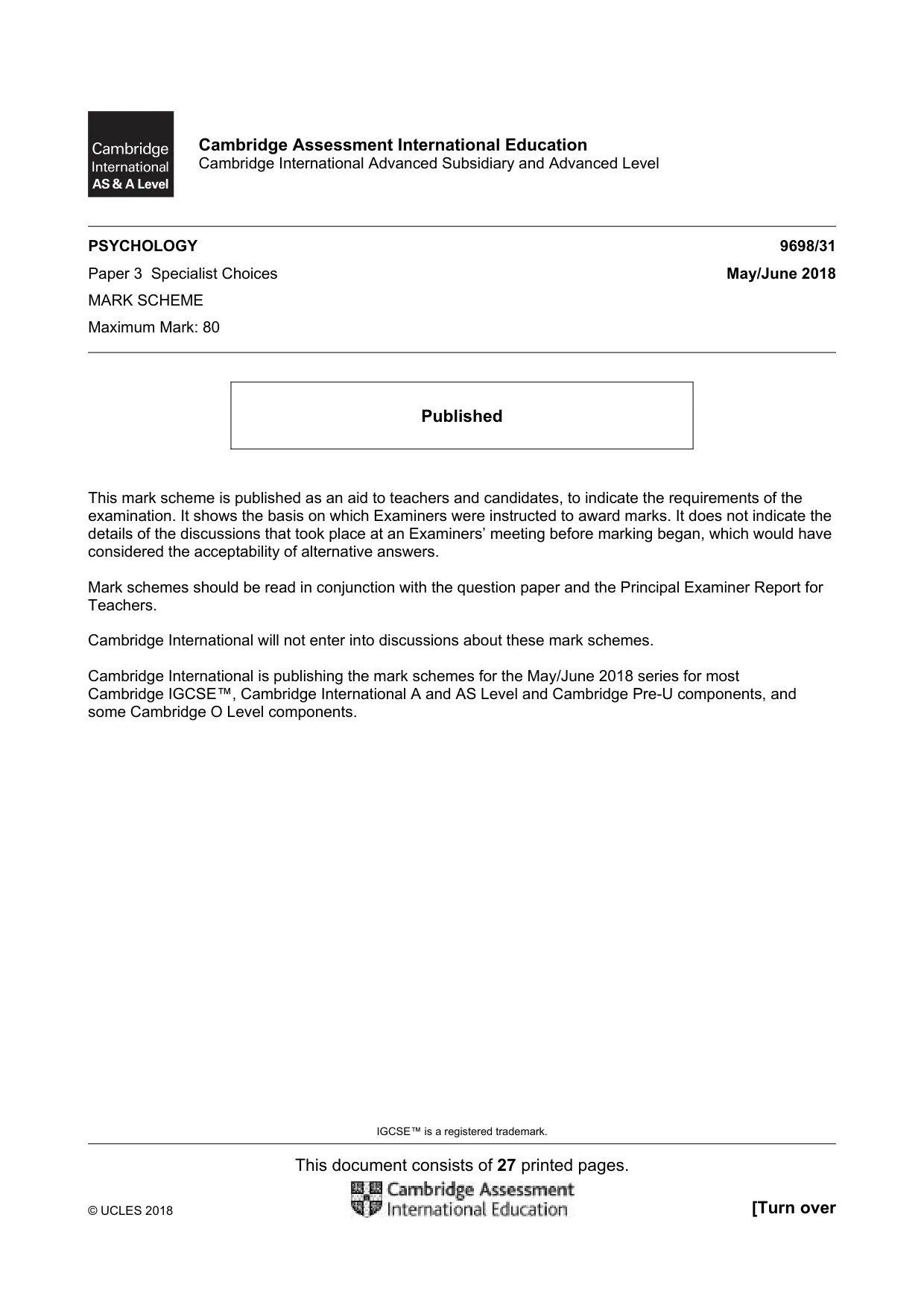
17 (a) Explain, in your own words, what is meant by the term ‘group cohesiveness’. [2] (b) Describe one theory of group development. [4]
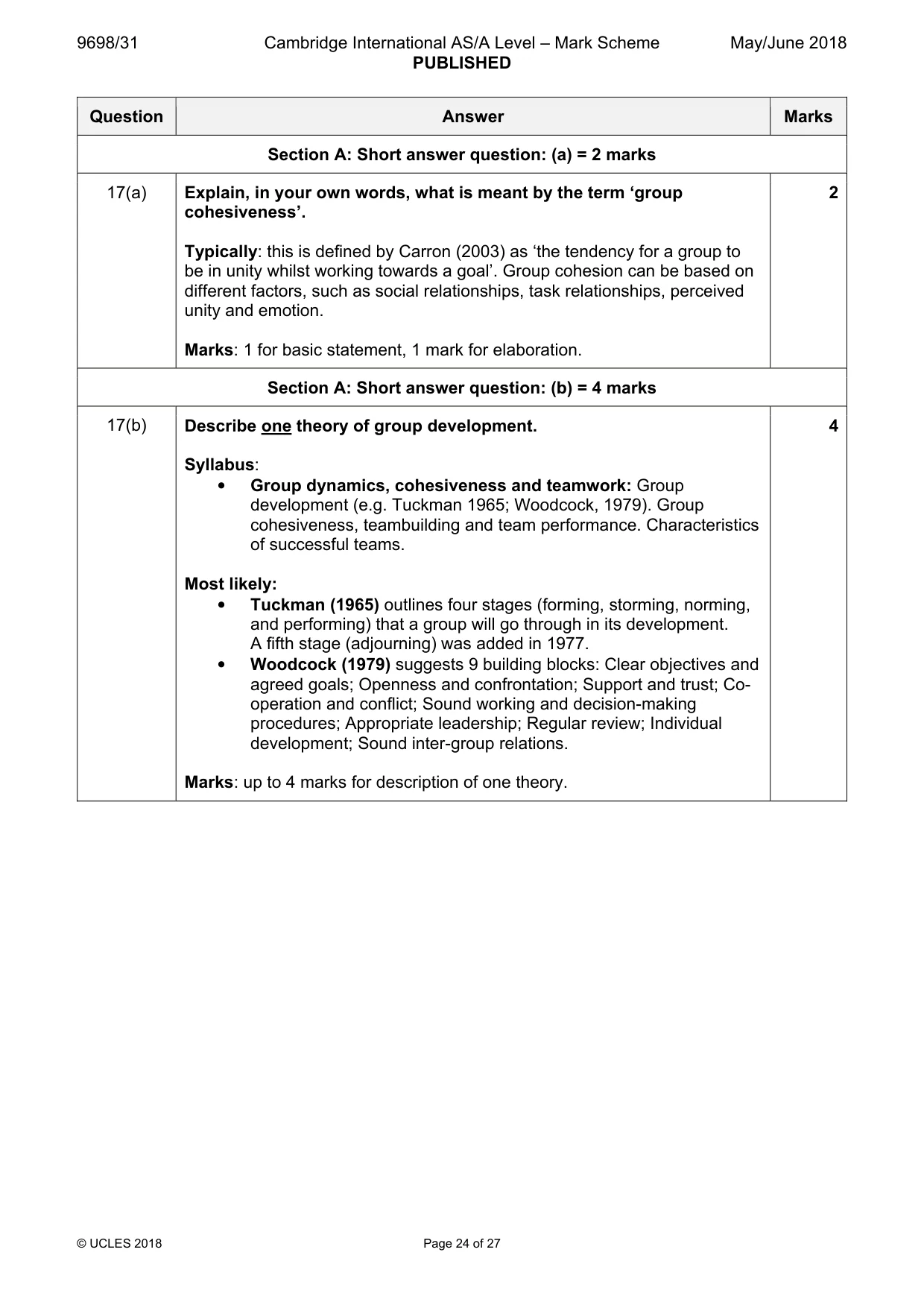
Mark scheme: 17(a) Explain, in your own words, what is meant by the term ‘group 2 cohesiveness’. Typically: this is defined by Carron (2003) as ‘the tendency for a group to be in unity whilst working towards a goal’. Group cohesion can be based on different factors, such as social relationships, task relationships, perceived unity and emotion. Marks: 1 for basic statement, 1 mark for elaboration. Section A: Short answer question: (b) = 4 marks 17(b) Describe one theory of group development. 4 Syllabus: • Group dynamics, cohesiveness and teamwork: Group development (e.g. Tuckman 1965; Woodcock, 1979). Group cohesiveness, teambuilding and team performance. Characteristics of successful teams. Most likely: • Tuckman (1965) outlines four stages (forming, storming, norming, and performing) that a group will go through in its development. A fifth stage (adjourning) was added in 1977. • Woodcock (1979) suggests 9 building blocks: Clear objectives and agreed goals; Openness and confrontation; Support and trust; Co- operation and conflict; Sound working and decision-making procedures; Appropriate leadership; Regular review; Individual development; Sound inter-group relations. Marks: up to 4 marks for description of one theory.
Q18 · Describe what psychologists have learned about the selection of people for work
18 (a) Describe what psychologists have learned about the selection of people for work. [8] (b) Evaluate what psychologists have learned about the selection of people for work, including a discussion about the use of interviews. [12] Section C Answer one question.
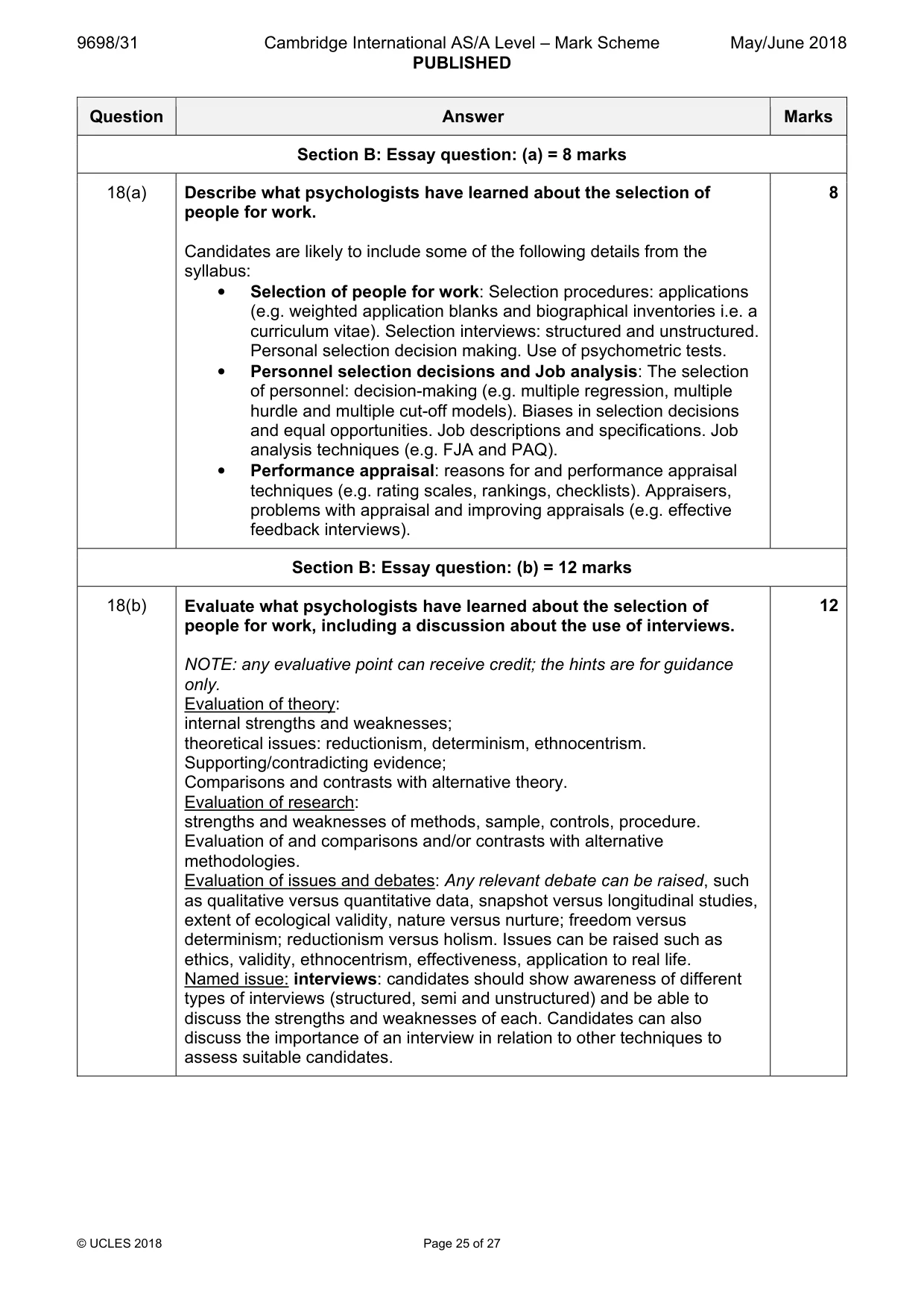
Mark scheme: 18(a) Describe what psychologists have learned about the selection of 8 people for work. Candidates are likely to include some of the following details from the syllabus: • Selection of people for work: Selection procedures: applications (e.g. weighted application blanks and biographical inventories i.e. a curriculum vitae). Selection interviews: structured and unstructured. Personal selection decision making. Use of psychometric tests. • Personnel selection decisions and Job analysis: The selection of personnel: decision-making (e.g. multiple regression, multiple hurdle and multiple cut-off models). Biases in selection decisions and equal opportunities. Job descriptions and specifications. Job analysis techniques (e.g. FJA and PAQ). • Performance appraisal: reasons for and performance appraisal techniques (e.g. rating scales, rankings, checklists). Appraisers, problems with appraisal and improving appraisals (e.g. effective feedback interviews). Section B: Essay question: (b) = 12 marks 18(b) Evaluate what psychologists have learned about the selection of 12 people for work, including a discussion about the use of interviews. NOTE: any evaluative point can receive credit; the hints are for guidance only. Evaluation of theory: internal strengths and weaknesses; theoretical issues: reductionism, determinism, ethnocentrism. Supporting/contradicting evidence; Comparisons and contrasts with alternative theory. Evaluation of research: strengths and weaknesses of methods, sample, controls, procedure. Evaluation of and comparisons and/or contrasts with alternative methodologies. Evaluation of issues and debates: Any relevant debate can be raised, such as qualitative versus quantitative data, snapshot versus longitudinal studies, extent of ecological validity, nature versus nurture; freedom versus determinism; reductionism versus holism. Issues can be raised such as ethics, validity, ethnocentrism, effectiveness, application to real life. Named issue: interviews: candidates should show awareness of different types of interviews (structured, semi and unstructured) and be able to discuss the strengths and weaknesses of each. Candidates can also discuss the importance of an interview in relation to other techniques to assess suitable candidates.
Q19 · You have introduced job rotation into your factory
19 You have introduced job rotation into your factory. You want to know whether workers are satisfied with this change. (a) Describe two questionnaires/rating scales used to measure job satisfaction. [6] (b) Suggest how you would design and conduct a study to investigate worker satisfaction without using a questionnaire. [8]
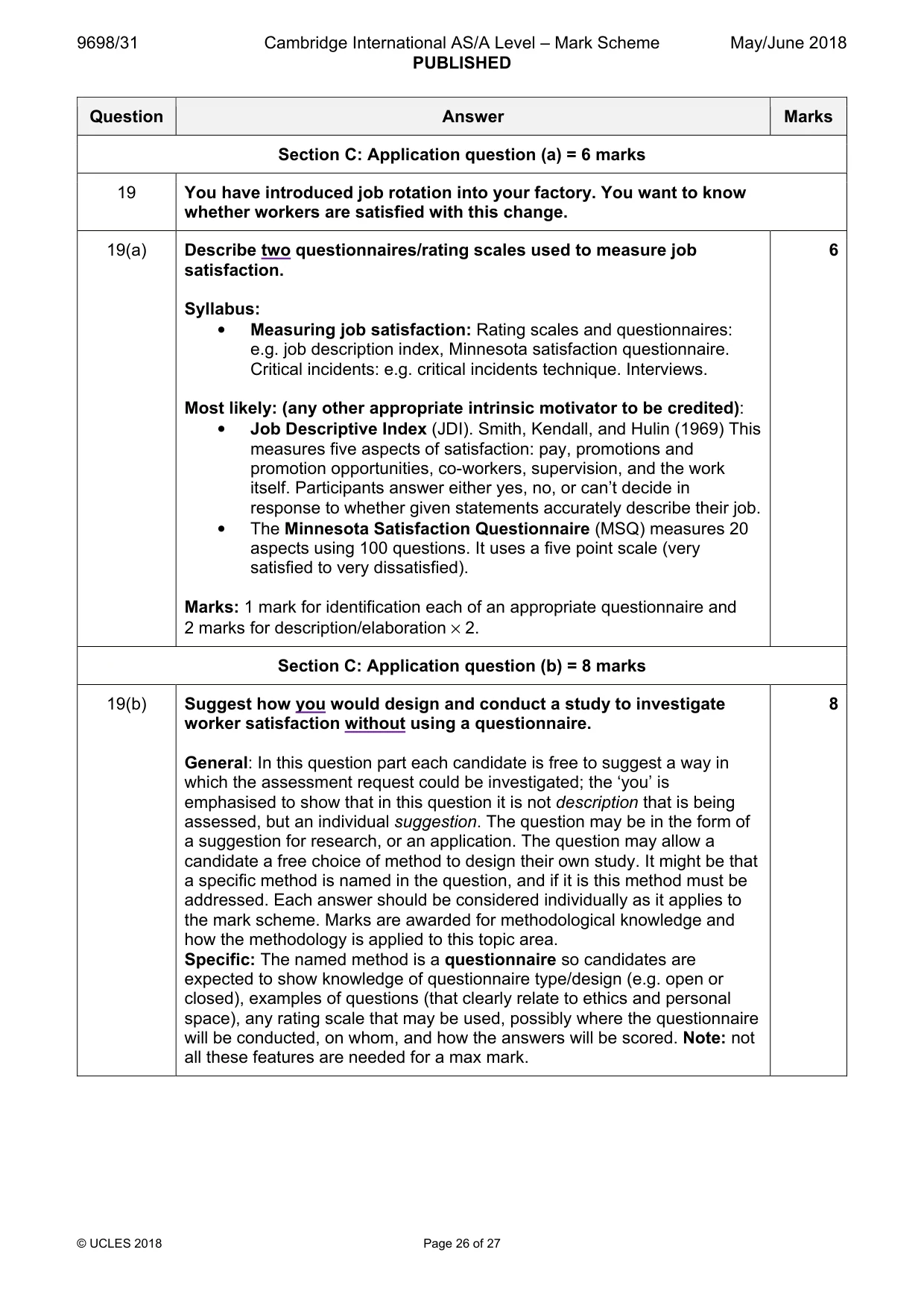
Mark scheme: 19 You have introduced job rotation into your factory. You want to know whether workers are satisfied with this change. 19(a) Describe two questionnaires/rating scales used to measure job 6 satisfaction. Syllabus: • Measuring job satisfaction: Rating scales and questionnaires: e.g. job description index, Minnesota satisfaction questionnaire. Critical incidents: e.g. critical incidents technique. Interviews. Most likely: (any other appropriate intrinsic motivator to be credited): • Job Descriptive Index (JDI). Smith, Kendall, and Hulin (1969) This measures five aspects of satisfaction: pay, promotions and promotion opportunities, co-workers, supervision, and the work itself. Participants answer either yes, no, or can’t decide in response to whether given statements accurately describe their job. • The Minnesota Satisfaction Questionnaire (MSQ) measures 20 aspects using 100 questions. It uses a five point scale (very satisfied to very dissatisfied). Marks: 1 mark for identification each of an appropriate questionnaire and 2 marks for description/elaboration × 2. Section C: Application question (b) = 8 marks 19(b) Suggest how you would design and conduct a study to investigate 8 worker satisfaction without using a questionnaire. General: In this question part each candidate is free to suggest a way in which the assessment request could be investigated; the ‘you’ is emphasised to show that in this question it is not description that is being assessed, but an individual suggestion. The question may be in the form of a suggestion for research, or an application. The question may allow a candidate a free choice of method to design their own study. It might be that a specific method is named in the question, and if it is this method must be addressed. Each answer should be considered individually as it applies to the mark scheme. Marks are awarded for methodological knowledge and how the methodology is applied to this topic area. Specific: The named method is a questionnaire so candidates are expected to show knowledge of questionnaire type/design (e.g. open or closed), examples of questions (that clearly relate to ethics and personal space), any rating scale that may be used, possibly where the questionnaire will be conducted, on whom, and how the answers will be scored. Note: not all these features are needed for a max mark.
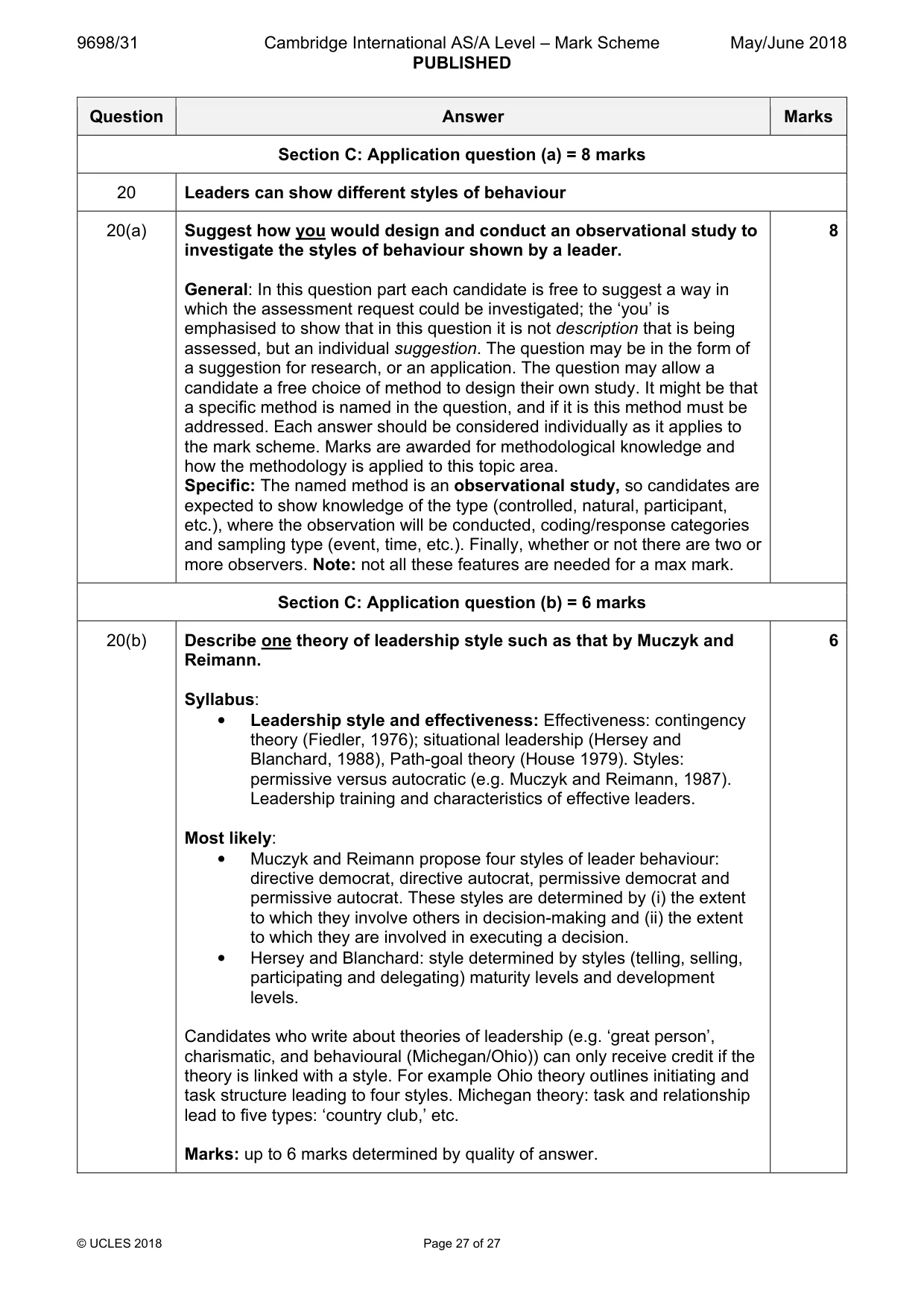
Q20 · Leaders can show different styles of behaviour
20 Leaders can show different styles of behaviour. (a) Suggest how you would design and conduct an observational study to investigate the styles of behaviour shown by a leader. [8] (b) Describe one theory of leadership style such as that by Muczyk and Reimann. [6]
Mark scheme: 20 Leaders can show different styles of behaviour 20(a) Suggest how you would design and conduct an observational study to 8 investigate the styles of behaviour shown by a leader. General: In this question part each candidate is free to suggest a way in which the assessment request could be investigated; the ‘you’ is emphasised to show that in this question it is not description that is being assessed, but an individual suggestion. The question may be in the form of a suggestion for research, or an application. The question may allow a candidate a free choice of method to design their own study. It might be that a specific method is named in the question, and if it is this method must be addressed. Each answer should be considered individually as it applies to the mark scheme. Marks are awarded for methodological knowledge and how the methodology is applied to this topic area. Specific: The named method is an observational study, so candidates are expected to show knowledge of the type (controlled, natural, participant, etc.), where the observation will be conducted, coding/response categories and sampling type (event, time, etc.). Finally, whether or not there are two or more observers. Note: not all these features are needed for a max mark. Section C: Application question (b) = 6 marks 20(b) Describe one theory of leadership style such as that by Muczyk and 6 Reimann. Syllabus: • Leadership style and effectiveness: Effectiveness: contingency theory (Fiedler, 1976); situational leadership (Hersey and Blanchard, 1988), Path-goal theory (House 1979). Styles: permissive versus autocratic (e.g. Muczyk and Reimann, 1987). Leadership training and characteristics of effective leaders. Most likely: • Muczyk and Reimann propose four styles of leader behaviour: directive democrat, directive autocrat, permissive democrat and permissive autocrat. These styles are determined by (i) the extent to which they involve others in decision-making and (ii) the extent to which they are involved in executing a decision. • Hersey and Blanchard: style determined by styles (telling, selling, participating and delegating) maturity levels and development levels. Candidates who write about theories of leadership (e.g. ‘great person’, charismatic, and behavioural (Michegan/Ohio)) can only receive credit if the theory is linked with a style. For example Ohio theory outlines initiating and task structure leading to four styles. Michegan theory: task and relationship lead to five types: ‘country club,’ etc. Marks: up to 6 marks determined by quality of answer.
What you needed in this session
Cambridge’s own grade thresholds for 2018 May/June, Paper 3 · Variant 1. A higher threshold means an easier paper — the bar moves with how the cohort did.