Cambridge A Level Psychology 9698 — 2017 Oct/Nov Paper 3 · Variant 3
9698/33/O/N/17 · 20 questions · 80 marks · ≈90 min
The question paper and its mark scheme, free to read here and free to download. This is Cambridge’s own paper, exactly as it was sat.
Question paper8 pages
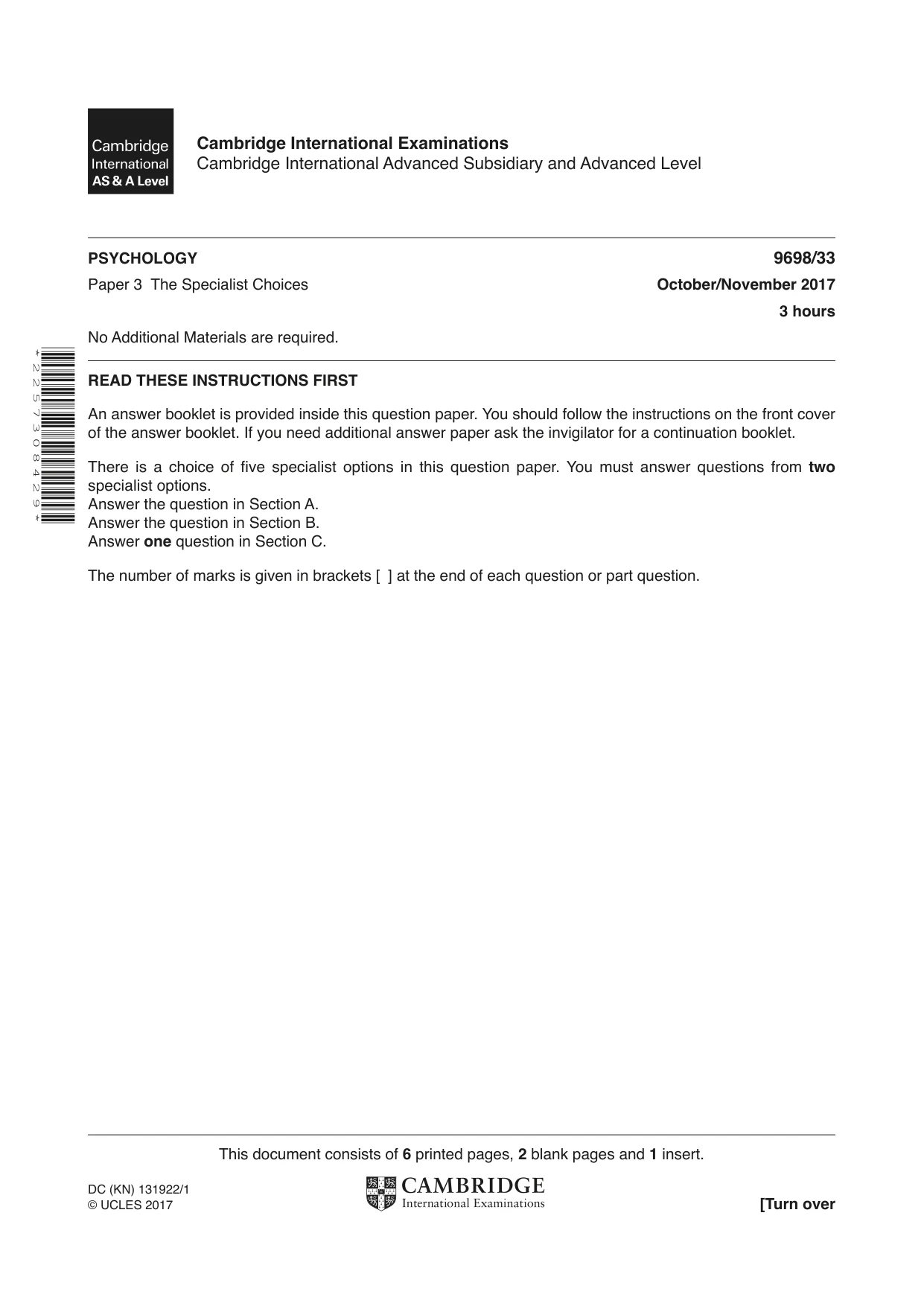
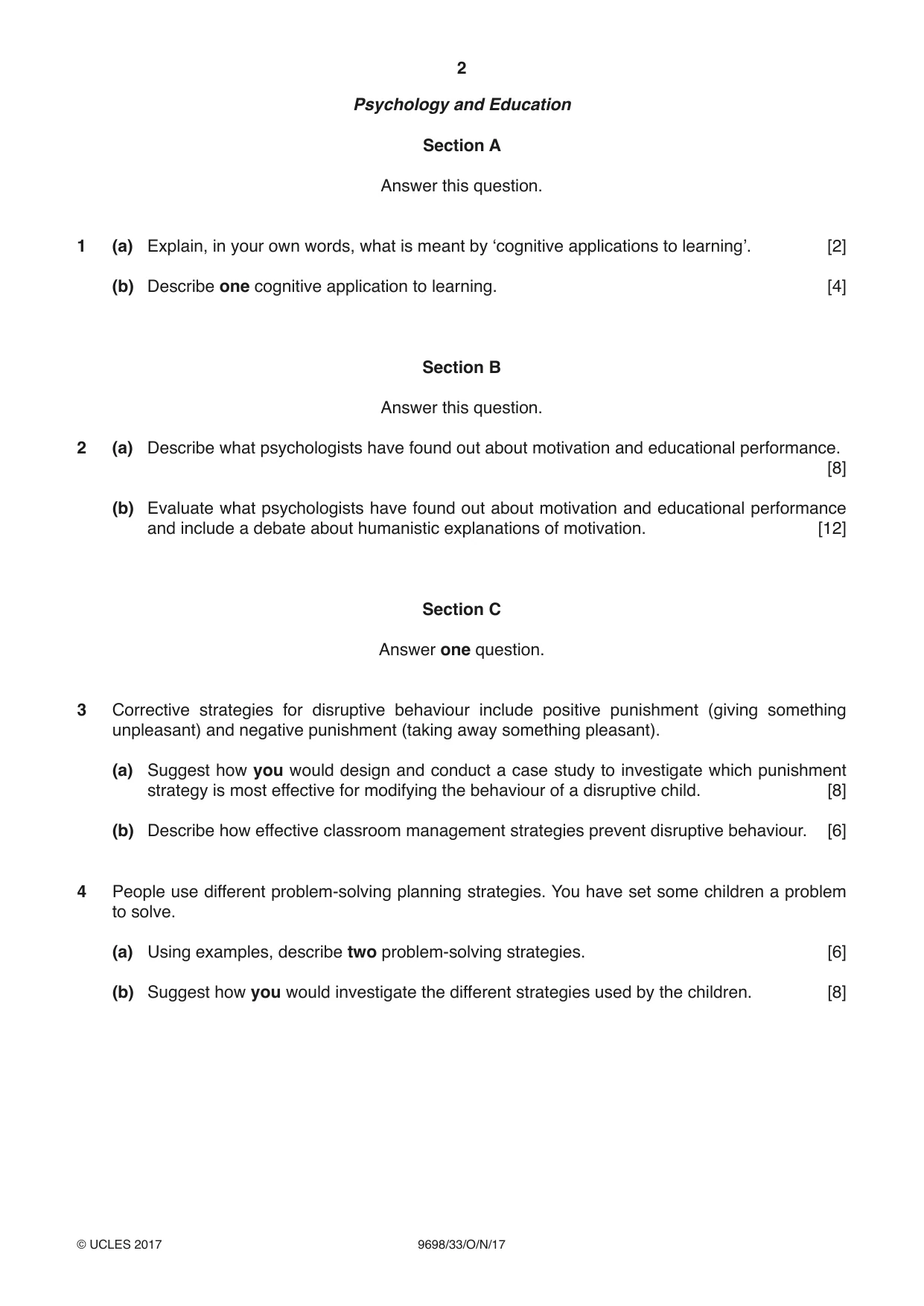
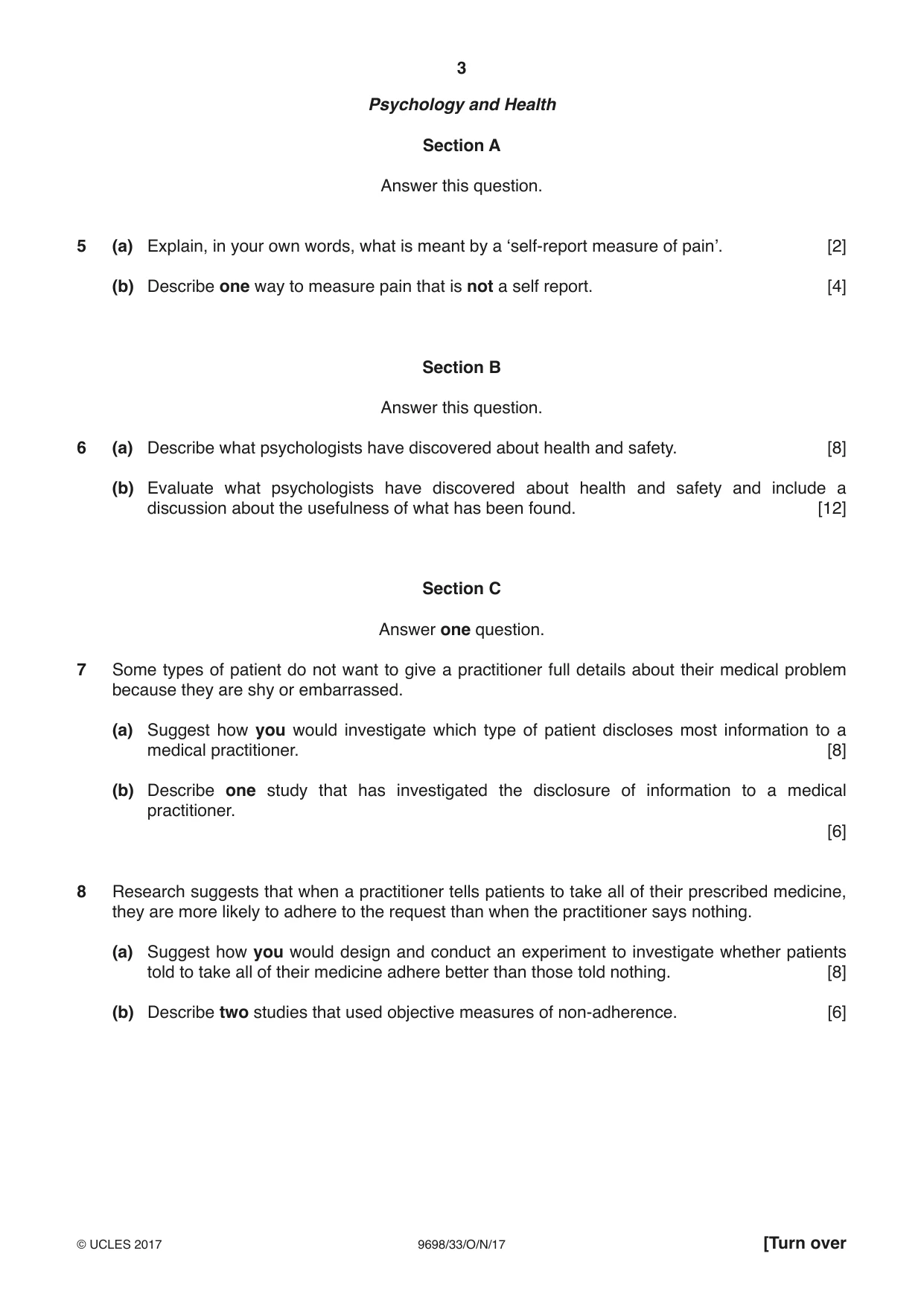
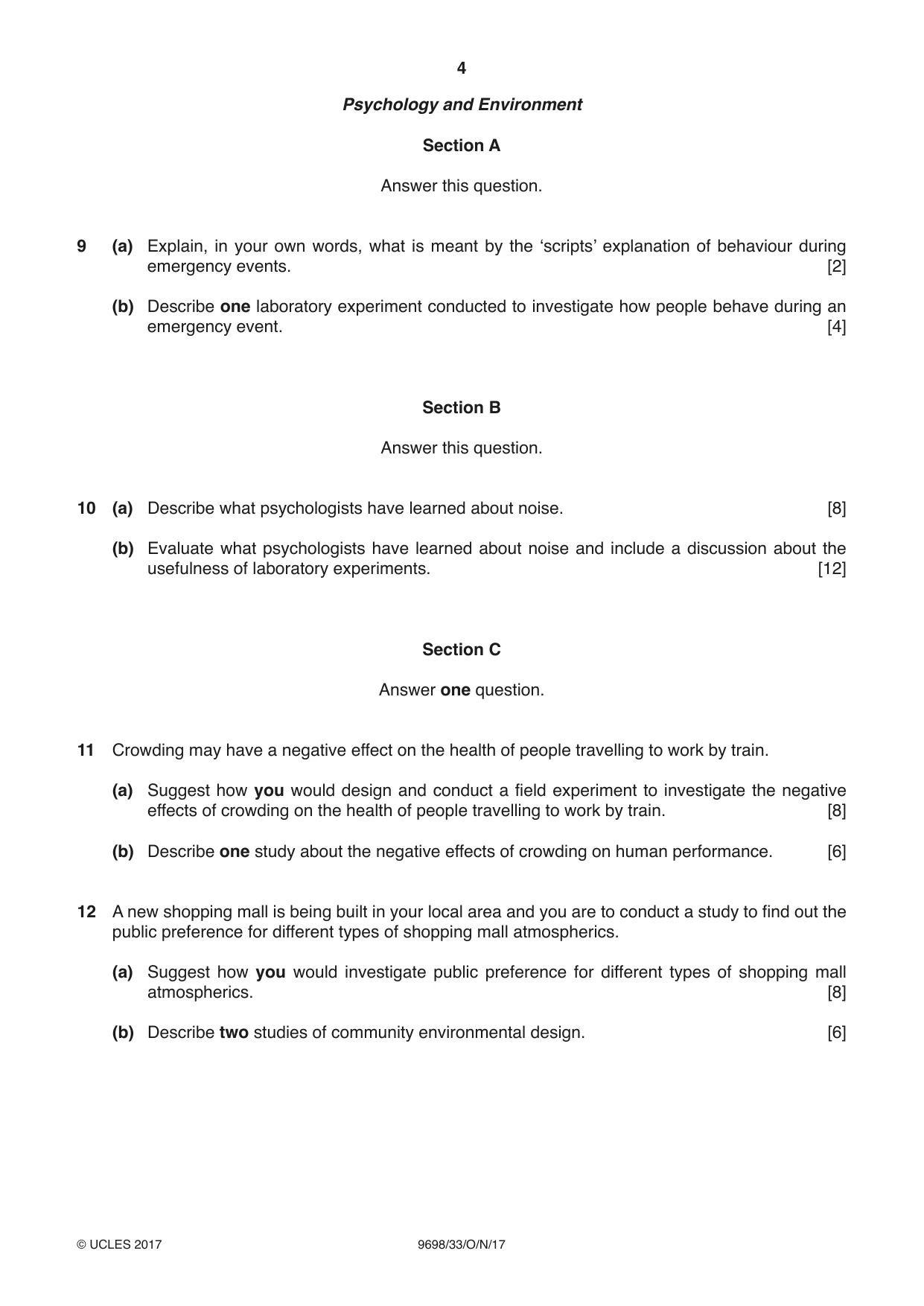


Mark scheme25 pages
Answers below. Sit the paper first if you are practising.
Questions as text
Q1 · Explain, in your own words, what is meant by ‘cognitive applications to learning’
1 (a) Explain, in your own words, what is meant by ‘cognitive applications to learning’. [2] (b) Describe one cognitive application to learning. [4]
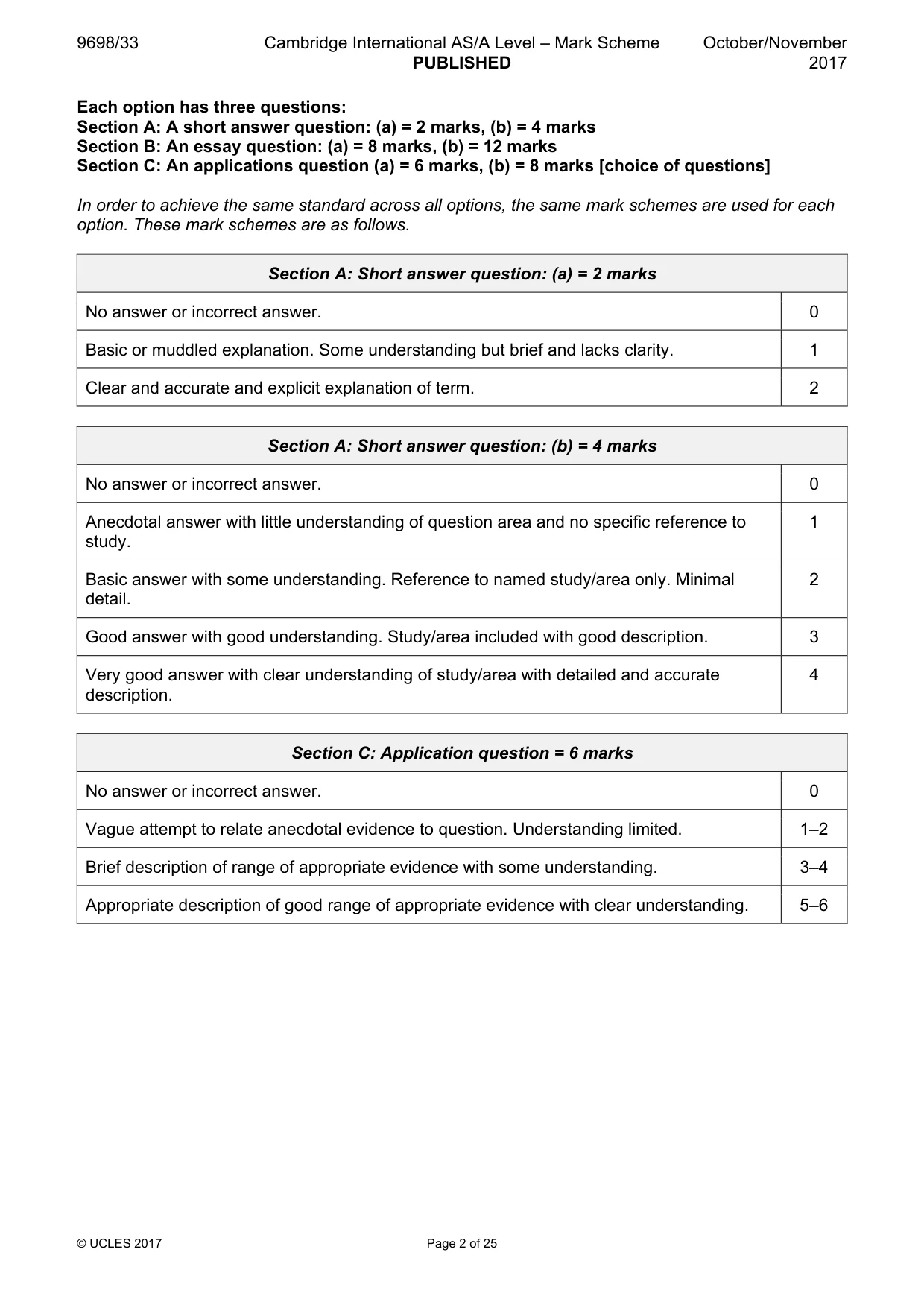
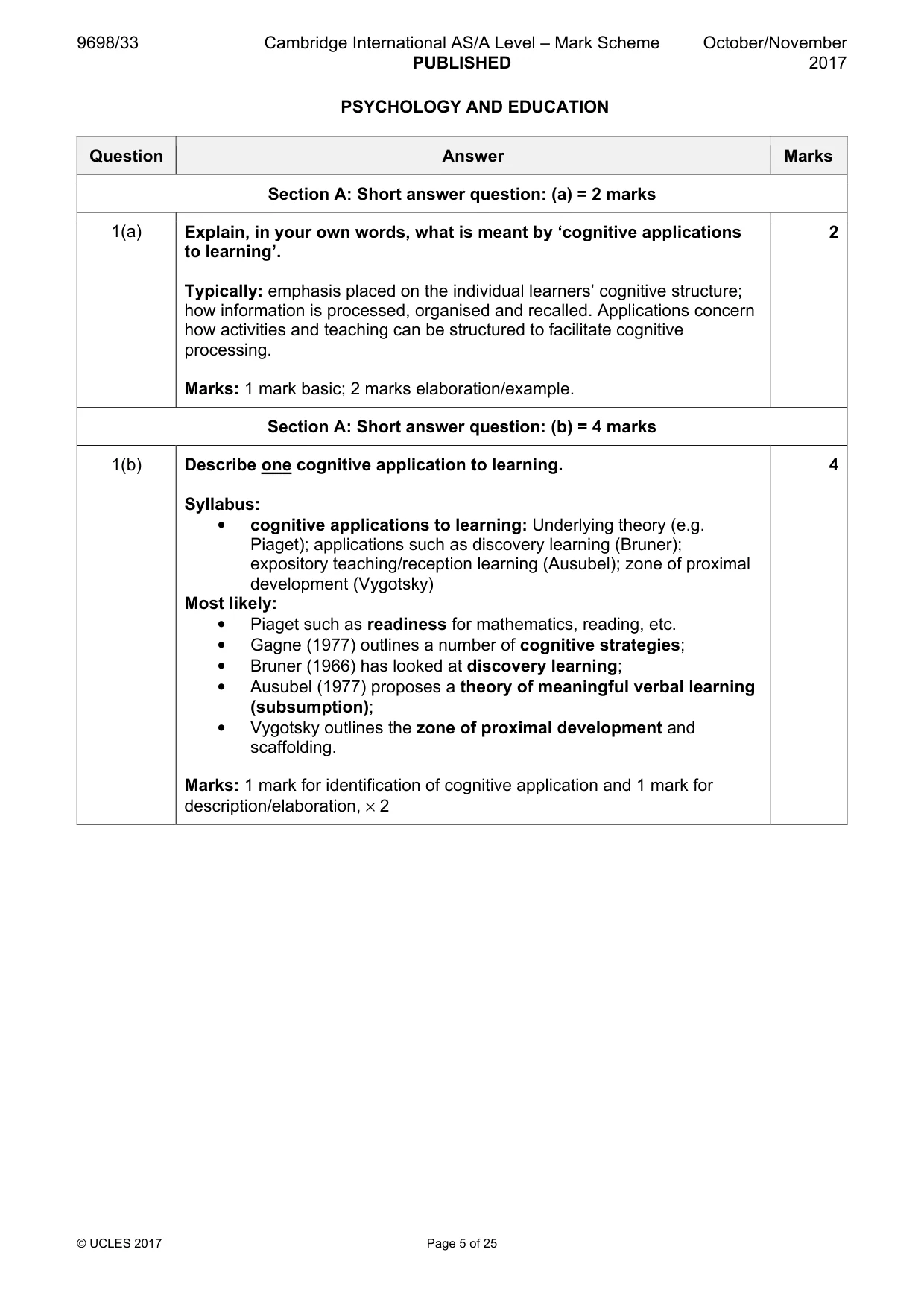
Mark scheme: Question Answer Marks Section A: Short answer question: (a) = 2 marks 1(a) Explain, in your own words, what is meant by ‘cognitive applications 2 to learning’. Typically: emphasis placed on the individual learners’ cognitive structure; how information is processed, organised and recalled. Applications concern how activities and teaching can be structured to facilitate cognitive processing. Marks: 1 mark basic; 2 marks elaboration/example. Section A: Short answer question: (b) = 4 marks 1(b) Describe one cognitive application to learning. 4 Syllabus: • cognitive applications to learning: Underlying theory (e.g. Piaget); applications such as discovery learning (Bruner); expository teaching/reception learning (Ausubel); zone of proximal development (Vygotsky) Most likely: • Piaget such as readiness for mathematics, reading, etc. • Gagne (1977) outlines a number of cognitive strategies; • Bruner (1966) has looked at discovery learning; • Ausubel (1977) proposes a theory of meaningful verbal learning (subsumption); • Vygotsky outlines the zone of proximal development and scaffolding. Marks: 1 mark for identification of cognitive application and 1 mark for description/elaboration, × 2
Q2 · Describe what psychologists have found out about motivation and educational performance
2 (a) Describe what psychologists have found out about motivation and educational performance. [8] (b) Evaluate what psychologists have found out about motivation and educational performance and include a debate about humanistic explanations of motivation. [12] Section C Answer one question.
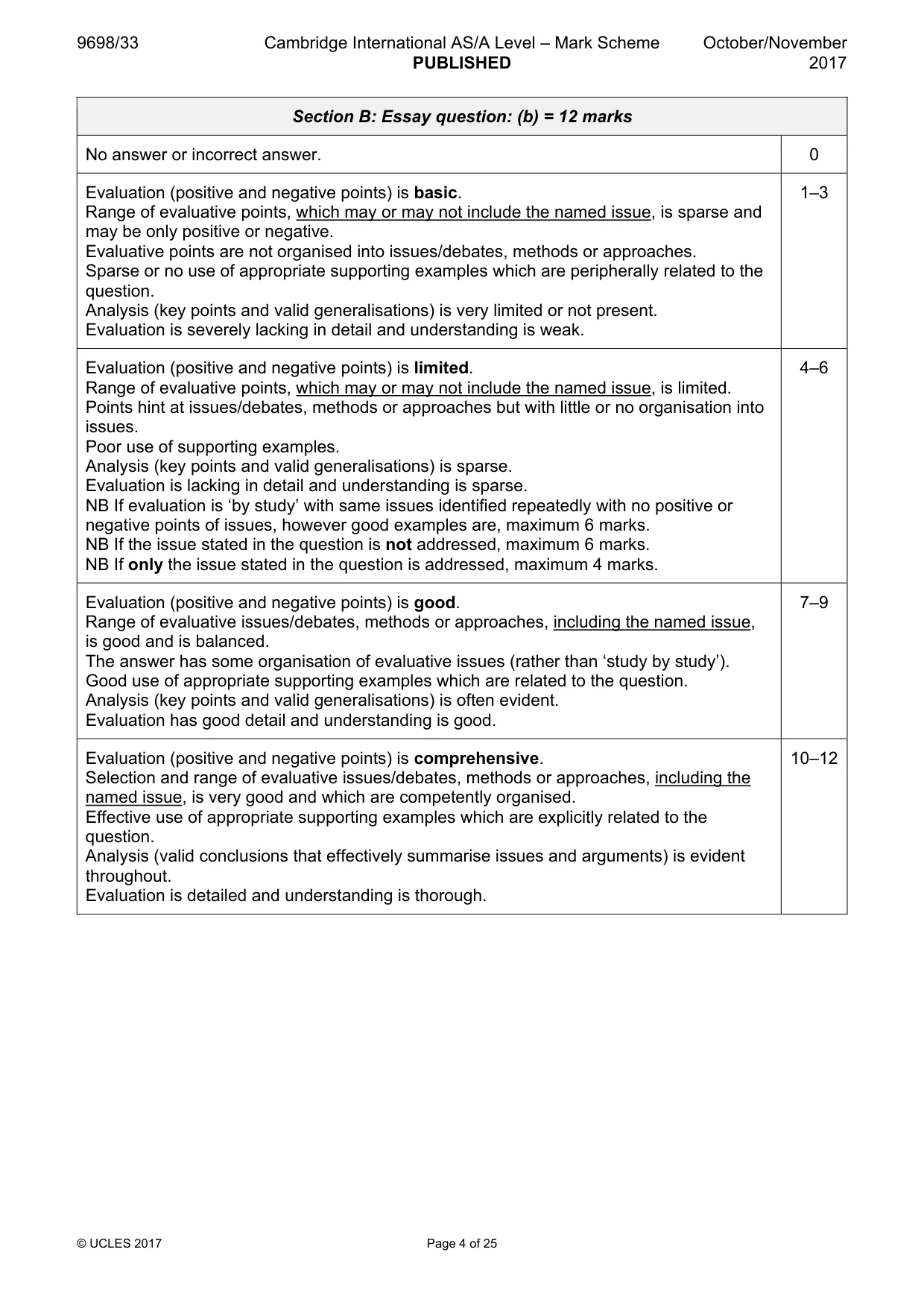
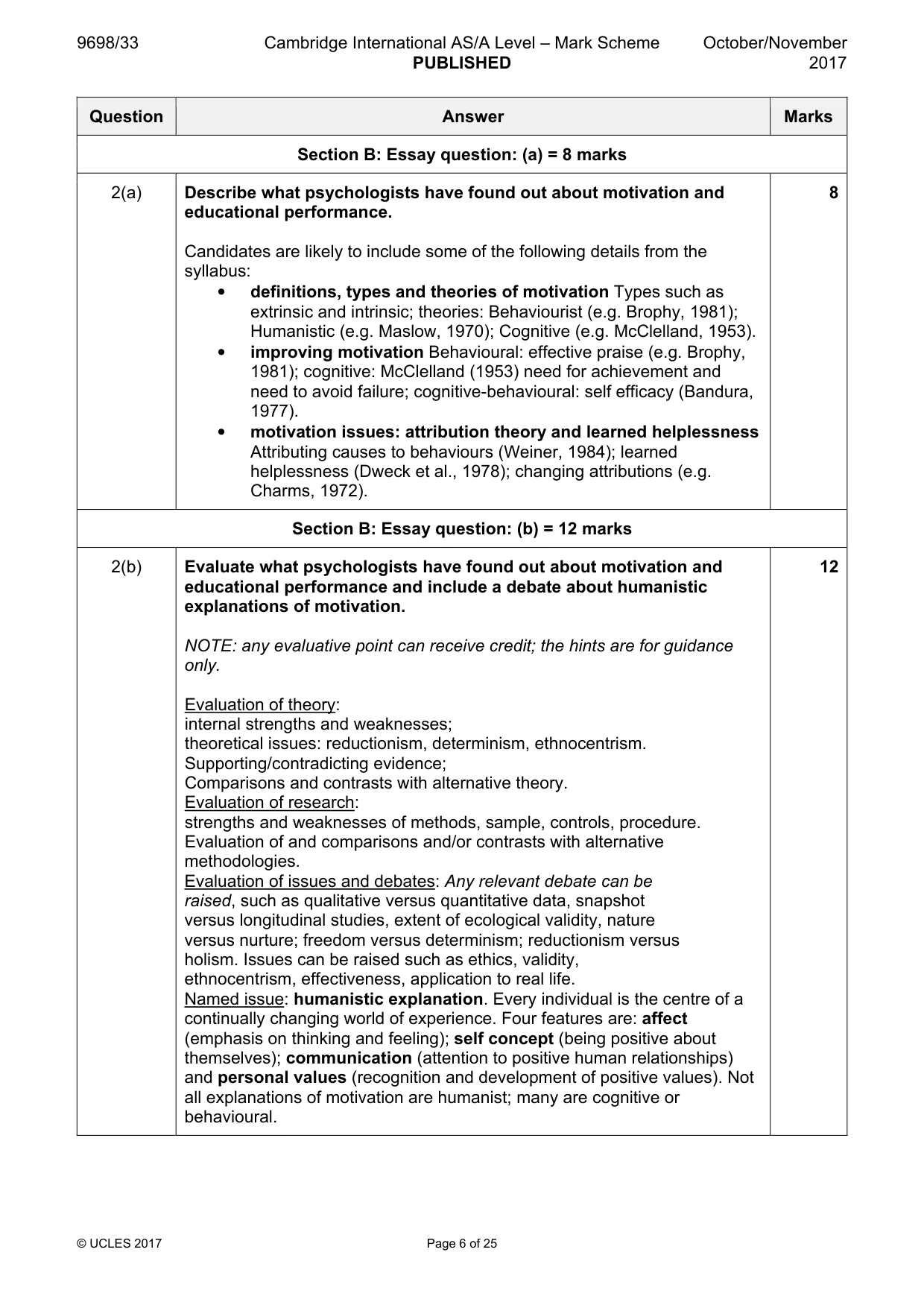
Mark scheme: 2(a) Describe what psychologists have found out about motivation and 8 educational performance. Candidates are likely to include some of the following details from the syllabus: • definitions, types and theories of motivation Types such as extrinsic and intrinsic; theories: Behaviourist (e.g. Brophy, 1981); Humanistic (e.g. Maslow, 1970); Cognitive (e.g. McClelland, 1953). • improving motivation Behavioural: effective praise (e.g. Brophy, 1981); cognitive: McClelland (1953) need for achievement and need to avoid failure; cognitive-behavioural: self efficacy (Bandura, 1977). • motivation issues: attribution theory and learned helplessness Attributing causes to behaviours (Weiner, 1984); learned helplessness (Dweck et al., 1978); changing attributions (e.g. Charms, 1972). Section B: Essay question: (b) = 12 marks 2(b) Evaluate what psychologists have found out about motivation and 12 educational performance and include a debate about humanistic explanations of motivation. NOTE: any evaluative point can receive credit; the hints are for guidance only. Evaluation of theory: internal strengths and weaknesses; theoretical issues: reductionism, determinism, ethnocentrism. Supporting/contradicting evidence; Comparisons and contrasts with alternative theory. Evaluation of research: strengths and weaknesses of methods, sample, controls, procedure. Evaluation of and comparisons and/or contrasts with alternative methodologies. Evaluation of issues and debates: Any relevant debate can be raised, such as qualitative versus quantitative data, snapshot versus longitudinal studies, extent of ecological validity, nature versus nurture; freedom versus determinism; reductionism versus holism. Issues can be raised such as ethics, validity, ethnocentrism, effectiveness, application to real life. Named issue: humanistic explanation. Every individual is the centre of a continually changing world of experience. Four features are: affect (emphasis on thinking and feeling); self concept (being positive about themselves); communication (attention to positive human relationships) and personal values (recognition and development of positive values). Not all explanations of motivation are humanist; many are cognitive or behavioural.
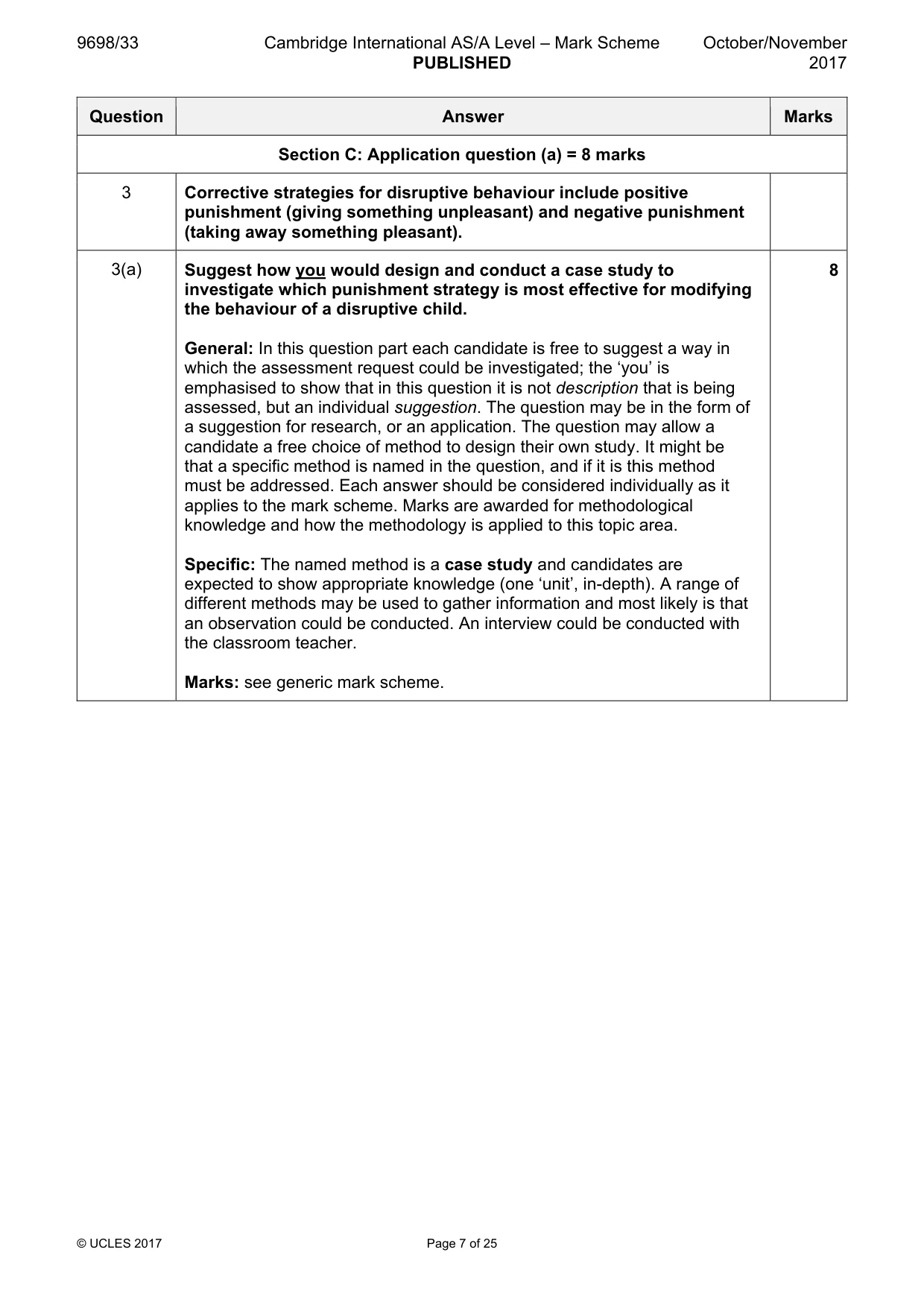
Q3 · Corrective strategies for disruptive behaviour include positive punishment (giving…
3 Corrective strategies for disruptive behaviour include positive punishment (giving something unpleasant) and negative punishment (taking away something pleasant). (a) Suggest how you would design and conduct a case study to investigate which punishment strategy is most effective for modifying the behaviour of a disruptive child. [8] (b) Describe how effective classroom management strategies prevent disruptive behaviour. [6]
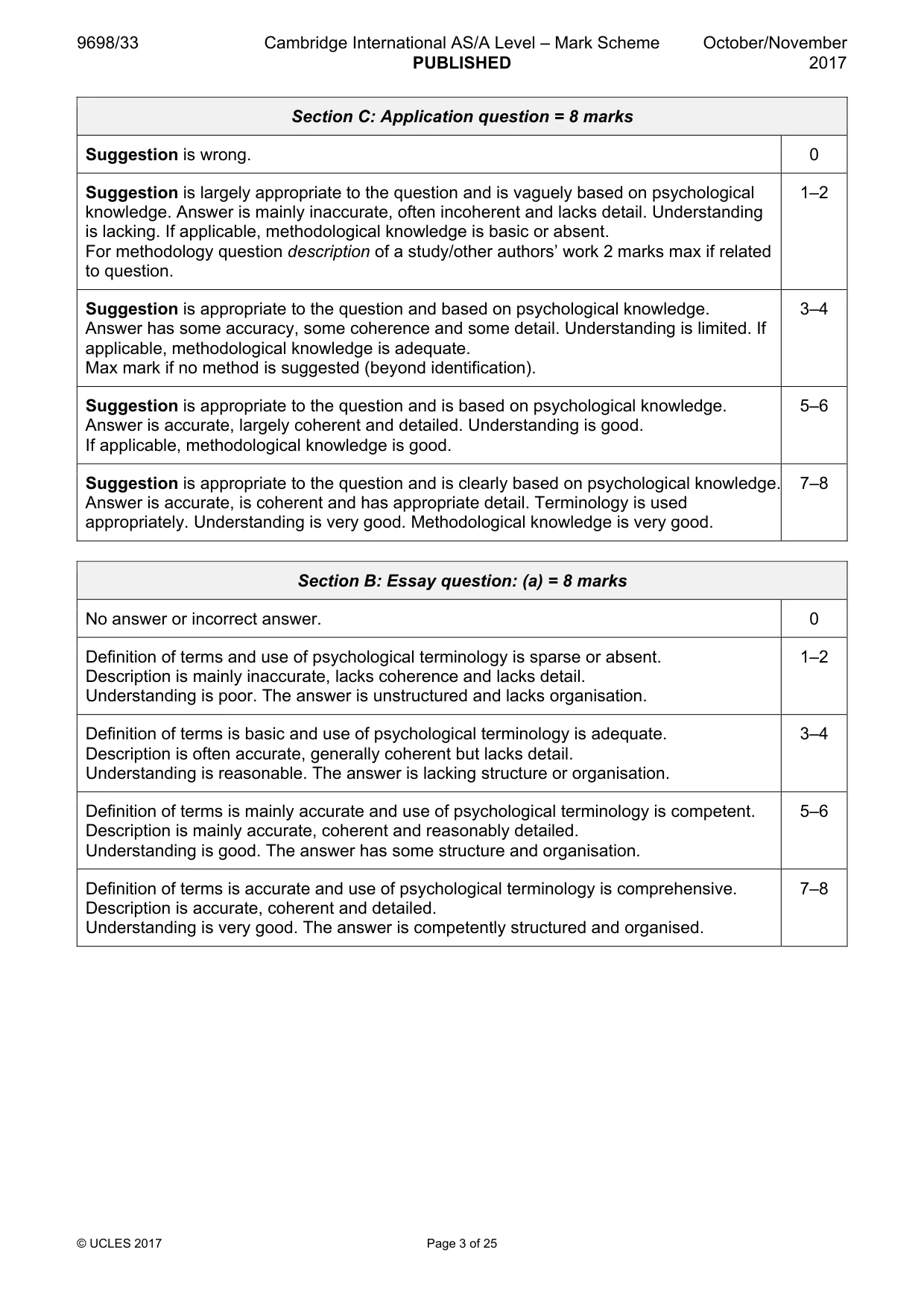
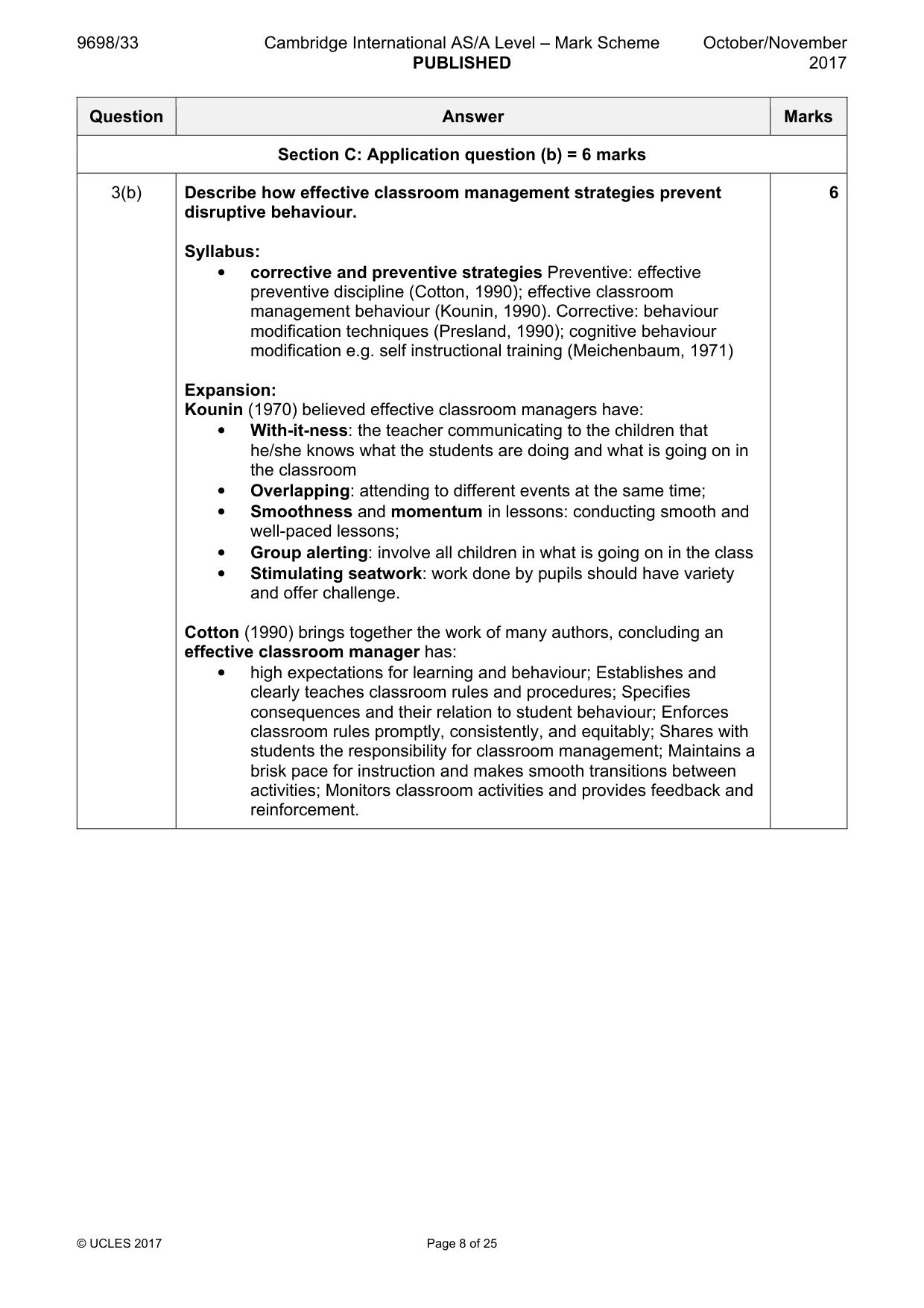
Mark scheme: 3(a) Suggest how you would design and conduct a case study to 8 investigate which punishment strategy is most effective for modifying the behaviour of a disruptive child. General: In this question part each candidate is free to suggest a way in which the assessment request could be investigated; the ‘you’ is emphasised to show that in this question it is not description that is being assessed, but an individual suggestion. The question may be in the form of a suggestion for research, or an application. The question may allow a candidate a free choice of method to design their own study. It might be that a specific method is named in the question, and if it is this method must be addressed. Each answer should be considered individually as it applies to the mark scheme. Marks are awarded for methodological knowledge and how the methodology is applied to this topic area. Specific: The named method is a case study and candidates are expected to show appropriate knowledge (one ‘unit’, in-depth). A range of different methods may be used to gather information and most likely is that an observation could be conducted. An interview could be conducted with the classroom teacher. Marks: see generic mark scheme. Section C: Application question (b) = 6 marks 3(b) Describe how effective classroom management strategies prevent 6 disruptive behaviour. Syllabus: • corrective and preventive strategies Preventive: effective preventive discipline (Cotton, 1990); effective classroom management behaviour (Kounin, 1990). Corrective: behaviour modification techniques (Presland, 1990); cognitive behaviour modification e.g. self instructional training (Meichenbaum, 1971) Expansion: Kounin (1970) believed effective classroom managers have: • With-it-ness: the teacher communicating to the children that he/she knows what the students are doing and what is going on in the classroom • Overlapping: attending to different events at the same time; • Smoothness and momentum in lessons: conducting smooth and well-paced lessons; • Group alerting: involve all children in what is going on in the class • Stimulating seatwork: work done by pupils should have variety and offer challenge. Cotton (1990) brings together the work of many authors, concluding an effective classroom manager has: • high expectations for learning and behaviour; Establishes and clearly teaches classroom rules and procedures; Specifies consequences and their relation to student behaviour; Enforces classroom rules promptly, consistently, and equitably; Shares with students the responsibility for classroom management; Maintains a brisk pace for instruction and makes smooth transitions between activities; Monitors classroom activities and provides feedback and reinforcement.
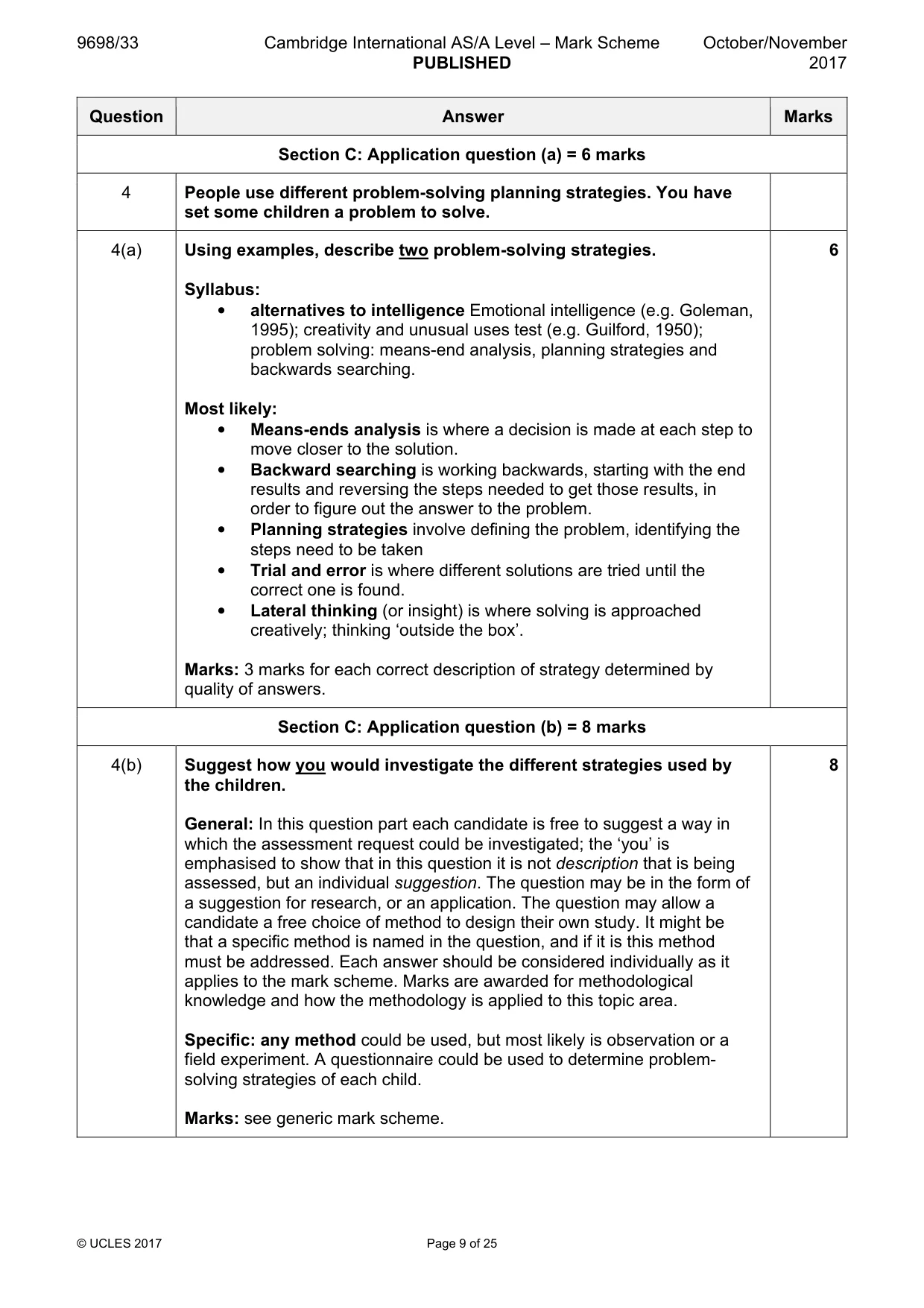
Q4 · People use different problem-solving planning strategies
4 People use different problem-solving planning strategies. You have set some children a problem to solve. (a) Using examples, describe two problem-solving strategies. [6] (b) Suggest how you would investigate the different strategies used by the children. [8] Psychology and Health Section A Answer this question.
Mark scheme: 4(a) Using examples, describe two problem-solving strategies. 6 Syllabus: • alternatives to intelligence Emotional intelligence (e.g. Goleman, 1995); creativity and unusual uses test (e.g. Guilford, 1950); problem solving: means-end analysis, planning strategies and backwards searching. Most likely: • Means-ends analysis is where a decision is made at each step to move closer to the solution. • Backward searching is working backwards, starting with the end results and reversing the steps needed to get those results, in order to figure out the answer to the problem. • Planning strategies involve defining the problem, identifying the steps need to be taken • Trial and error is where different solutions are tried until the correct one is found. • Lateral thinking (or insight) is where solving is approached creatively; thinking ‘outside the box’. Marks: 3 marks for each correct description of strategy determined by quality of answers. Section C: Application question (b) = 8 marks 4(b) Suggest how you would investigate the different strategies used by 8 the children. General: In this question part each candidate is free to suggest a way in which the assessment request could be investigated; the ‘you’ is emphasised to show that in this question it is not description that is being assessed, but an individual suggestion. The question may be in the form of a suggestion for research, or an application. The question may allow a candidate a free choice of method to design their own study. It might be that a specific method is named in the question, and if it is this method must be addressed. Each answer should be considered individually as it applies to the mark scheme. Marks are awarded for methodological knowledge and how the methodology is applied to this topic area. Specific: any method could be used, but most likely is observation or a field experiment. A questionnaire could be used to determine problem- solving strategies of each child. Marks: see generic mark scheme. PSYCHOLOGY AND HEALTH
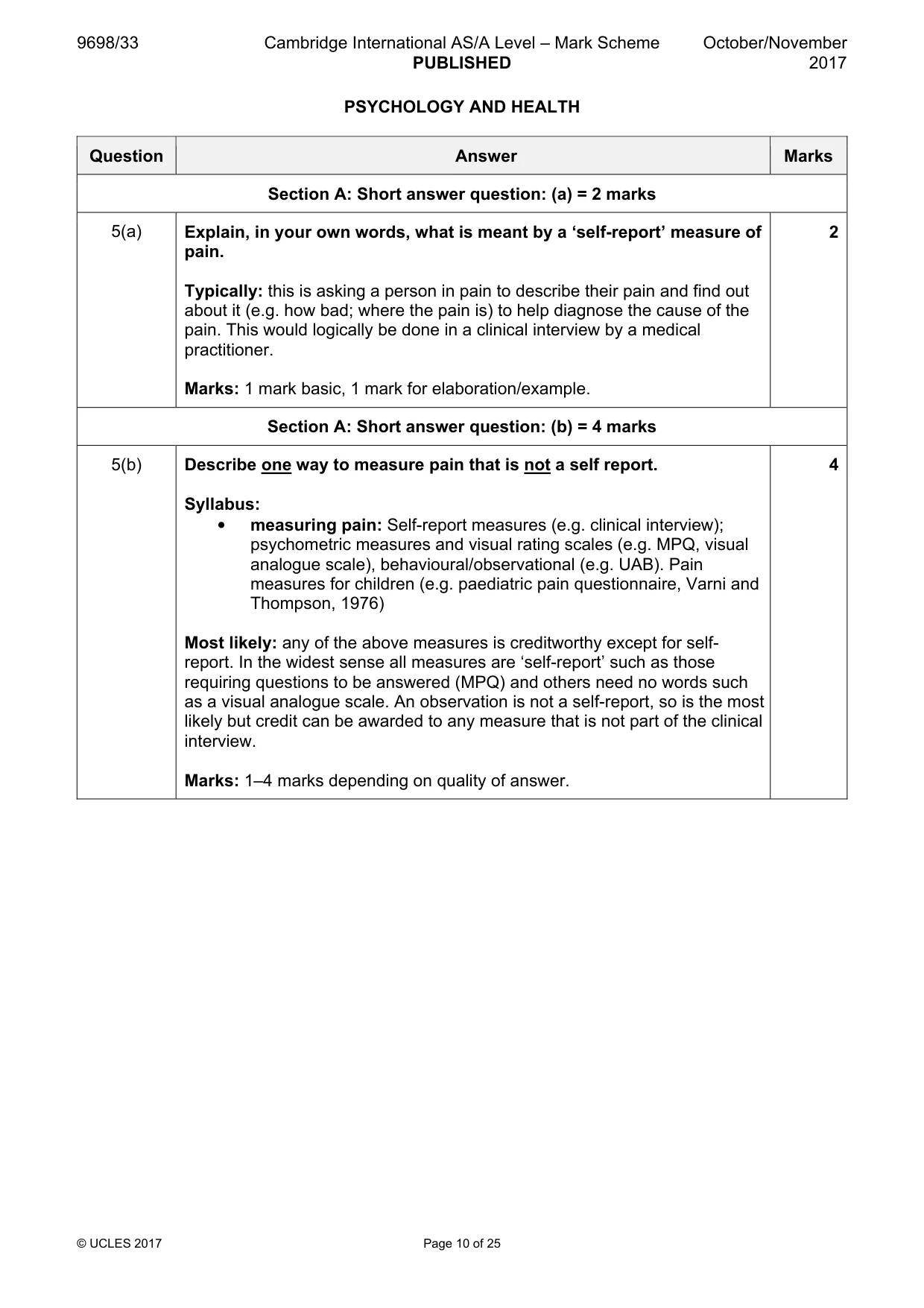
Q5 · Explain, in your own words, what is meant by a ‘self-report measure of pain’
5 (a) Explain, in your own words, what is meant by a ‘self-report measure of pain’. [2] (b) Describe one way to measure pain that is not a self report. [4]
Mark scheme: 5(a) Explain, in your own words, what is meant by a ‘self-report’ measure of 2 pain. Typically: this is asking a person in pain to describe their pain and find out about it (e.g. how bad; where the pain is) to help diagnose the cause of the pain. This would logically be done in a clinical interview by a medical practitioner. Marks: 1 mark basic, 1 mark for elaboration/example. Section A: Short answer question: (b) = 4 marks 5(b) Describe one way to measure pain that is not a self report. 4 Syllabus: • measuring pain: Self-report measures (e.g. clinical interview); psychometric measures and visual rating scales (e.g. MPQ, visual analogue scale), behavioural/observational (e.g. UAB). Pain measures for children (e.g. paediatric pain questionnaire, Varni and Thompson, 1976) Most likely: any of the above measures is creditworthy except for self- report. In the widest sense all measures are ‘self-report’ such as those requiring questions to be answered (MPQ) and others need no words such as a visual analogue scale. An observation is not a self-report, so is the most likely but credit can be awarded to any measure that is not part of the clinical interview. Marks: 1–4 marks depending on quality of answer.
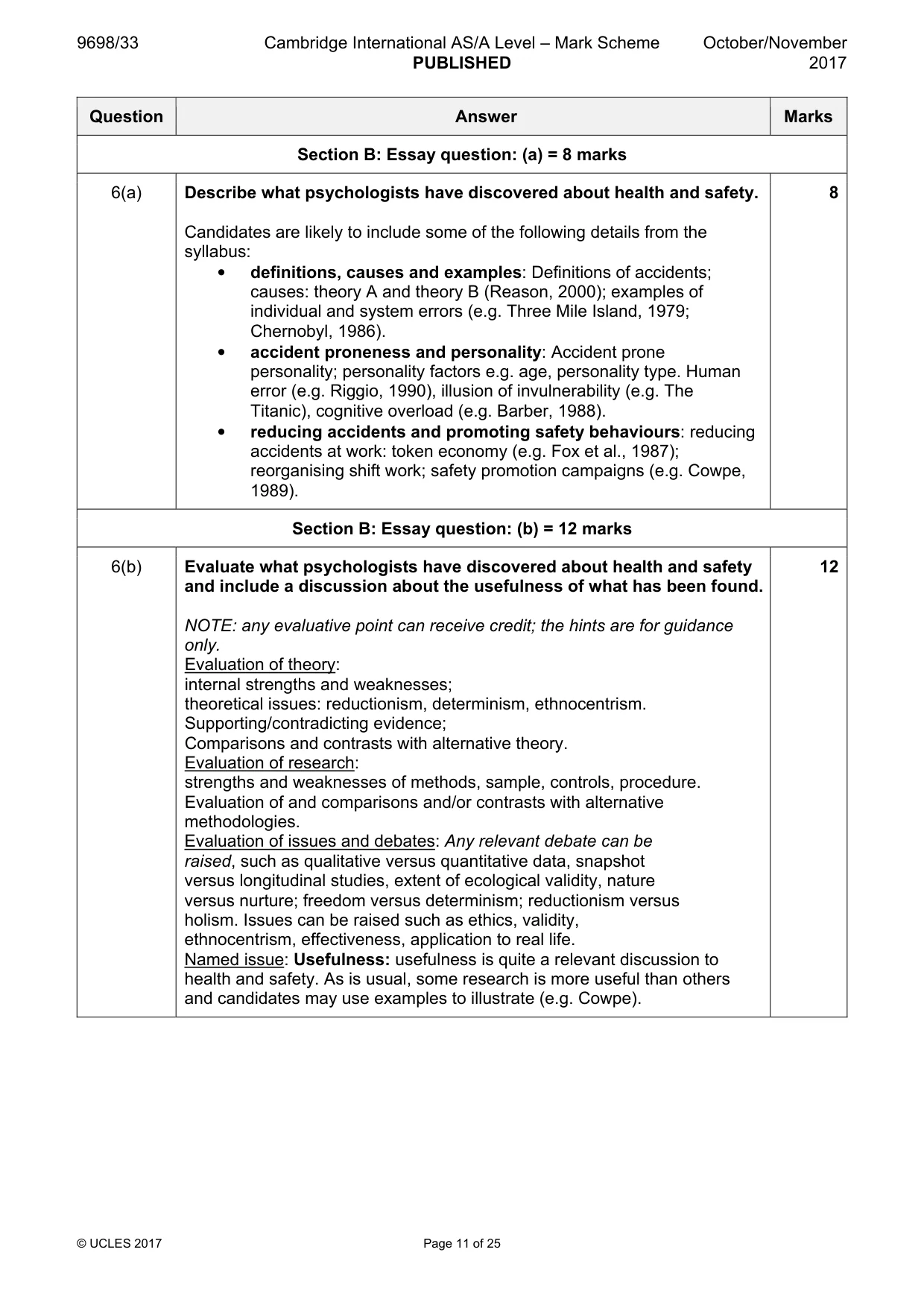
Q6 · Describe what psychologists have discovered about health and safety
6 (a) Describe what psychologists have discovered about health and safety. [8] (b) Evaluate what psychologists have discovered about health and safety and include a discussion about the usefulness of what has been found. [12] Section C Answer one question.
Mark scheme: 6(a) Describe what psychologists have discovered about health and safety. 8 Candidates are likely to include some of the following details from the syllabus: • definitions, causes and examples: Definitions of accidents; causes: theory A and theory B (Reason, 2000); examples of individual and system errors (e.g. Three Mile Island, 1979; Chernobyl, 1986). • accident proneness and personality: Accident prone personality; personality factors e.g. age, personality type. Human error (e.g. Riggio, 1990), illusion of invulnerability (e.g. The Titanic), cognitive overload (e.g. Barber, 1988). • reducing accidents and promoting safety behaviours: reducing accidents at work: token economy (e.g. Fox et al., 1987); reorganising shift work; safety promotion campaigns (e.g. Cowpe, 1989). Section B: Essay question: (b) = 12 marks 6(b) Evaluate what psychologists have discovered about health and safety 12 and include a discussion about the usefulness of what has been found. NOTE: any evaluative point can receive credit; the hints are for guidance only. Evaluation of theory: internal strengths and weaknesses; theoretical issues: reductionism, determinism, ethnocentrism. Supporting/contradicting evidence; Comparisons and contrasts with alternative theory. Evaluation of research: strengths and weaknesses of methods, sample, controls, procedure. Evaluation of and comparisons and/or contrasts with alternative methodologies. Evaluation of issues and debates: Any relevant debate can be raised, such as qualitative versus quantitative data, snapshot versus longitudinal studies, extent of ecological validity, nature versus nurture; freedom versus determinism; reductionism versus holism. Issues can be raised such as ethics, validity, ethnocentrism, effectiveness, application to real life. Named issue: Usefulness: usefulness is quite a relevant discussion to health and safety. As is usual, some research is more useful than others and candidates may use examples to illustrate (e.g. Cowpe).
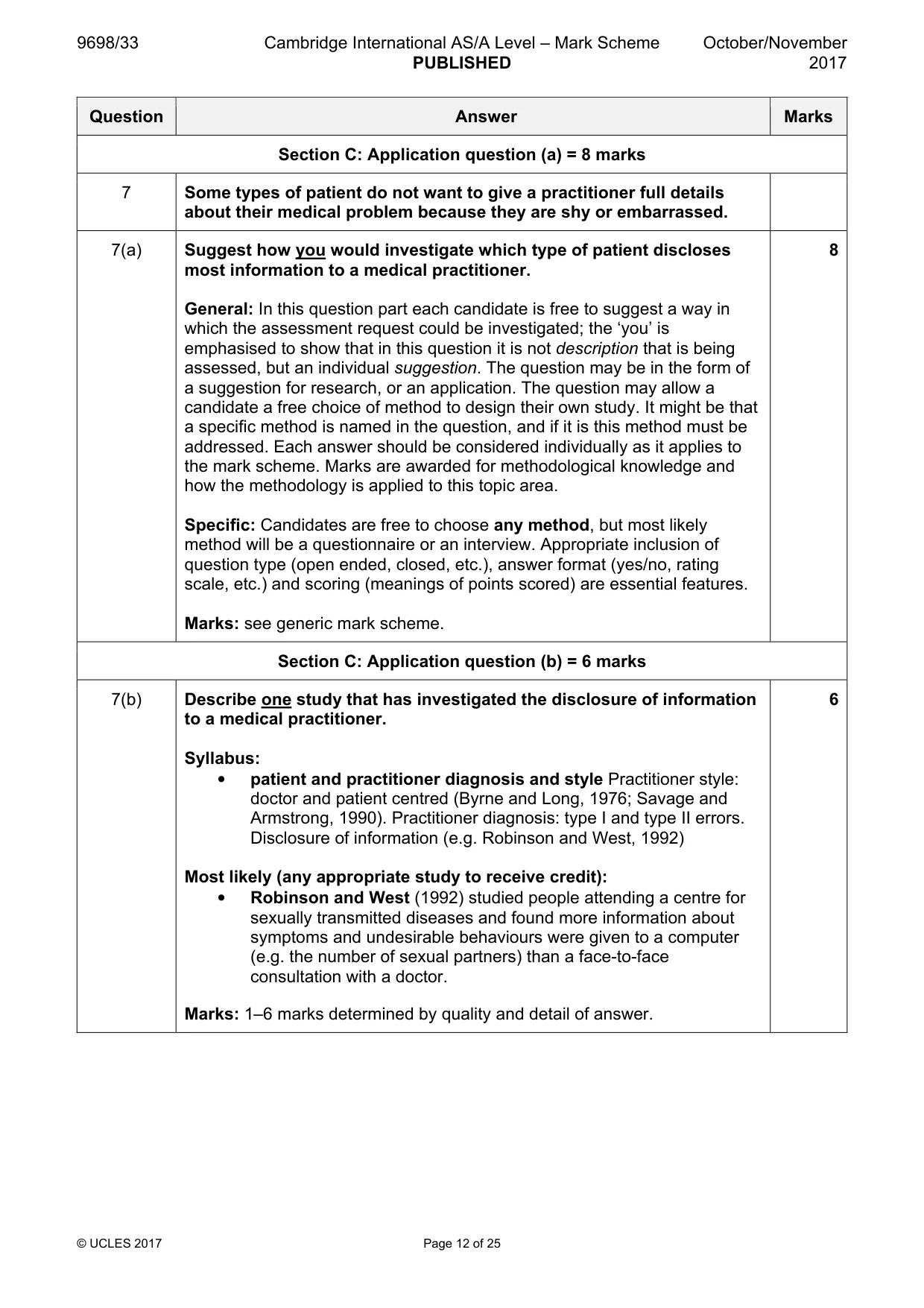
Q7 · Some types of patient do not want to give a practitioner full details about their medical…
7 Some types of patient do not want to give a practitioner full details about their medical problem because they are shy or embarrassed. (a) Suggest how you would investigate which type of patient discloses most information to a medical practitioner. [8] (b) Describe one study that has investigated the disclosure of information to a medical practitioner. [6]
Mark scheme: 7(a) Suggest how you would investigate which type of patient discloses 8 most information to a medical practitioner. General: In this question part each candidate is free to suggest a way in which the assessment request could be investigated; the ‘you’ is emphasised to show that in this question it is not description that is being assessed, but an individual suggestion. The question may be in the form of a suggestion for research, or an application. The question may allow a candidate a free choice of method to design their own study. It might be that a specific method is named in the question, and if it is this method must be addressed. Each answer should be considered individually as it applies to the mark scheme. Marks are awarded for methodological knowledge and how the methodology is applied to this topic area. Specific: Candidates are free to choose any method, but most likely method will be a questionnaire or an interview. Appropriate inclusion of question type (open ended, closed, etc.), answer format (yes/no, rating scale, etc.) and scoring (meanings of points scored) are essential features. Marks: see generic mark scheme. Section C: Application question (b) = 6 marks 7(b) Describe one study that has investigated the disclosure of information 6 to a medical practitioner. Syllabus: • patient and practitioner diagnosis and style Practitioner style: doctor and patient centred (Byrne and Long, 1976; Savage and Armstrong, 1990). Practitioner diagnosis: type I and type II errors. Disclosure of information (e.g. Robinson and West, 1992) Most likely (any appropriate study to receive credit): • Robinson and West (1992) studied people attending a centre for sexually transmitted diseases and found more information about symptoms and undesirable behaviours were given to a computer (e.g. the number of sexual partners) than a face-to-face consultation with a doctor. Marks: 1–6 marks determined by quality and detail of answer.
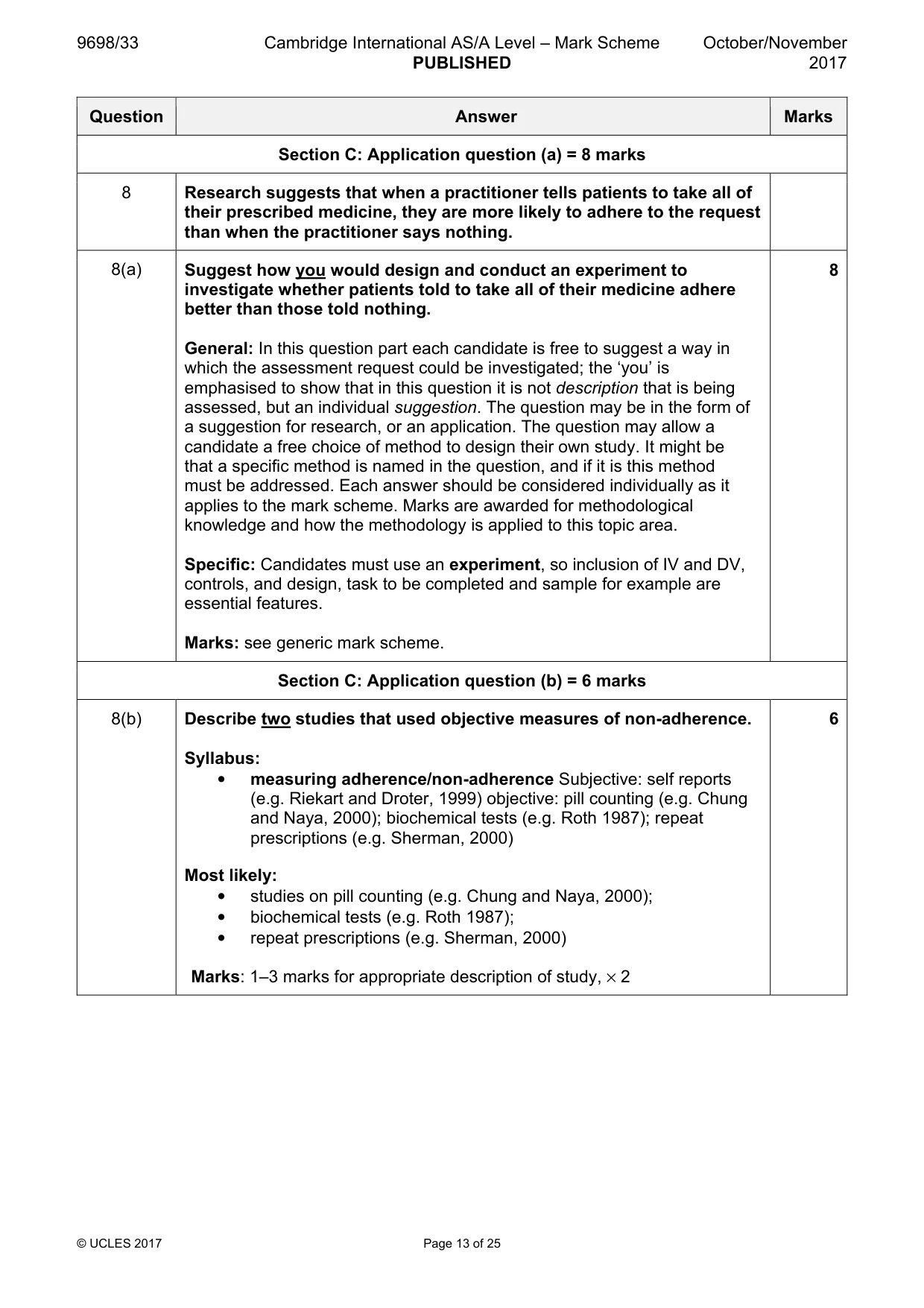
Q8 · Research suggests that when a practitioner tells patients to take all of their prescribed…
8 Research suggests that when a practitioner tells patients to take all of their prescribed medicine, they are more likely to adhere to the request than when the practitioner says nothing. (a) Suggest how you would design and conduct an experiment to investigate whether patients told to take all of their medicine adhere better than those told nothing. [8] (b) Describe two studies that used objective measures of non-adherence. [6] Psychology and Environment Section A Answer this question.
Mark scheme: 8(a) Suggest how you would design and conduct an experiment to 8 investigate whether patients told to take all of their medicine adhere better than those told nothing. General: In this question part each candidate is free to suggest a way in which the assessment request could be investigated; the ‘you’ is emphasised to show that in this question it is not description that is being assessed, but an individual suggestion. The question may be in the form of a suggestion for research, or an application. The question may allow a candidate a free choice of method to design their own study. It might be that a specific method is named in the question, and if it is this method must be addressed. Each answer should be considered individually as it applies to the mark scheme. Marks are awarded for methodological knowledge and how the methodology is applied to this topic area. Specific: Candidates must use an experiment, so inclusion of IV and DV, controls, and design, task to be completed and sample for example are essential features. Marks: see generic mark scheme. Section C: Application question (b) = 6 marks 8(b) Describe two studies that used objective measures of non-adherence. 6 Syllabus: • measuring adherence/non-adherence Subjective: self reports (e.g. Riekart and Droter, 1999) objective: pill counting (e.g. Chung and Naya, 2000); biochemical tests (e.g. Roth 1987); repeat prescriptions (e.g. Sherman, 2000) Most likely: • studies on pill counting (e.g. Chung and Naya, 2000); • biochemical tests (e.g. Roth 1987); • repeat prescriptions (e.g. Sherman, 2000) Marks: 1–3 marks for appropriate description of study, × 2 PSYCHOLOGY AND ENVIRONMENT
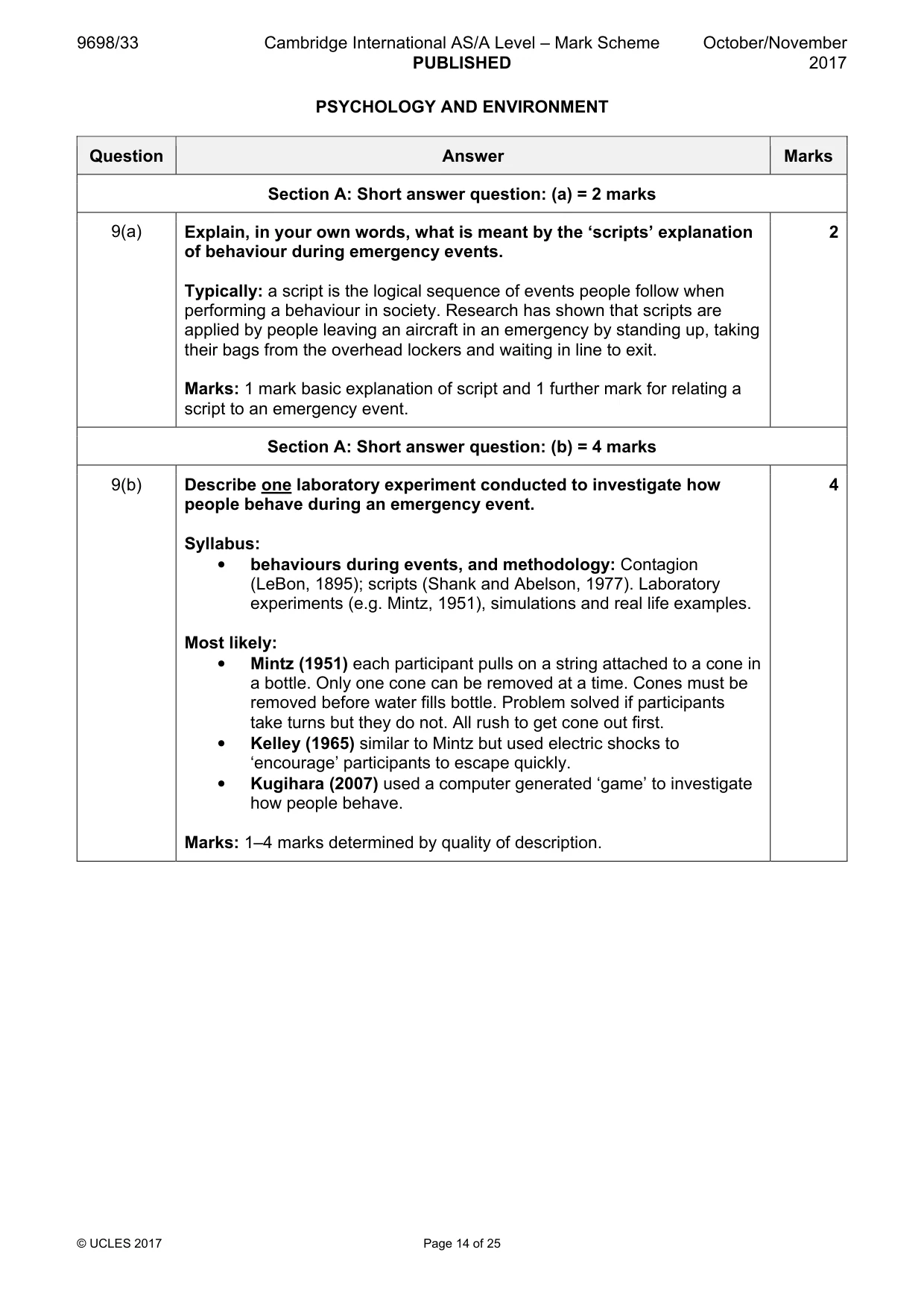
Q9 · Explain, in your own words, what is meant by the ‘scripts’ explanation of behaviour…
9 (a) Explain, in your own words, what is meant by the ‘scripts’ explanation of behaviour during emergency events. [2] (b) Describe one laboratory experiment conducted to investigate how people behave during an emergency event. [4]
Mark scheme: 9(a) Explain, in your own words, what is meant by the ‘scripts’ explanation 2 of behaviour during emergency events. Typically: a script is the logical sequence of events people follow when performing a behaviour in society. Research has shown that scripts are applied by people leaving an aircraft in an emergency by standing up, taking their bags from the overhead lockers and waiting in line to exit. Marks: 1 mark basic explanation of script and 1 further mark for relating a script to an emergency event. Section A: Short answer question: (b) = 4 marks 9(b) Describe one laboratory experiment conducted to investigate how 4 people behave during an emergency event. Syllabus: • behaviours during events, and methodology: Contagion (LeBon, 1895); scripts (Shank and Abelson, 1977). Laboratory experiments (e.g. Mintz, 1951), simulations and real life examples. Most likely: • Mintz (1951) each participant pulls on a string attached to a cone in a bottle. Only one cone can be removed at a time. Cones must be removed before water fills bottle. Problem solved if participants take turns but they do not. All rush to get cone out first. • Kelley (1965) similar to Mintz but used electric shocks to ‘encourage’ participants to escape quickly. • Kugihara (2007) used a computer generated ‘game’ to investigate how people behave. Marks: 1–4 marks determined by quality of description.
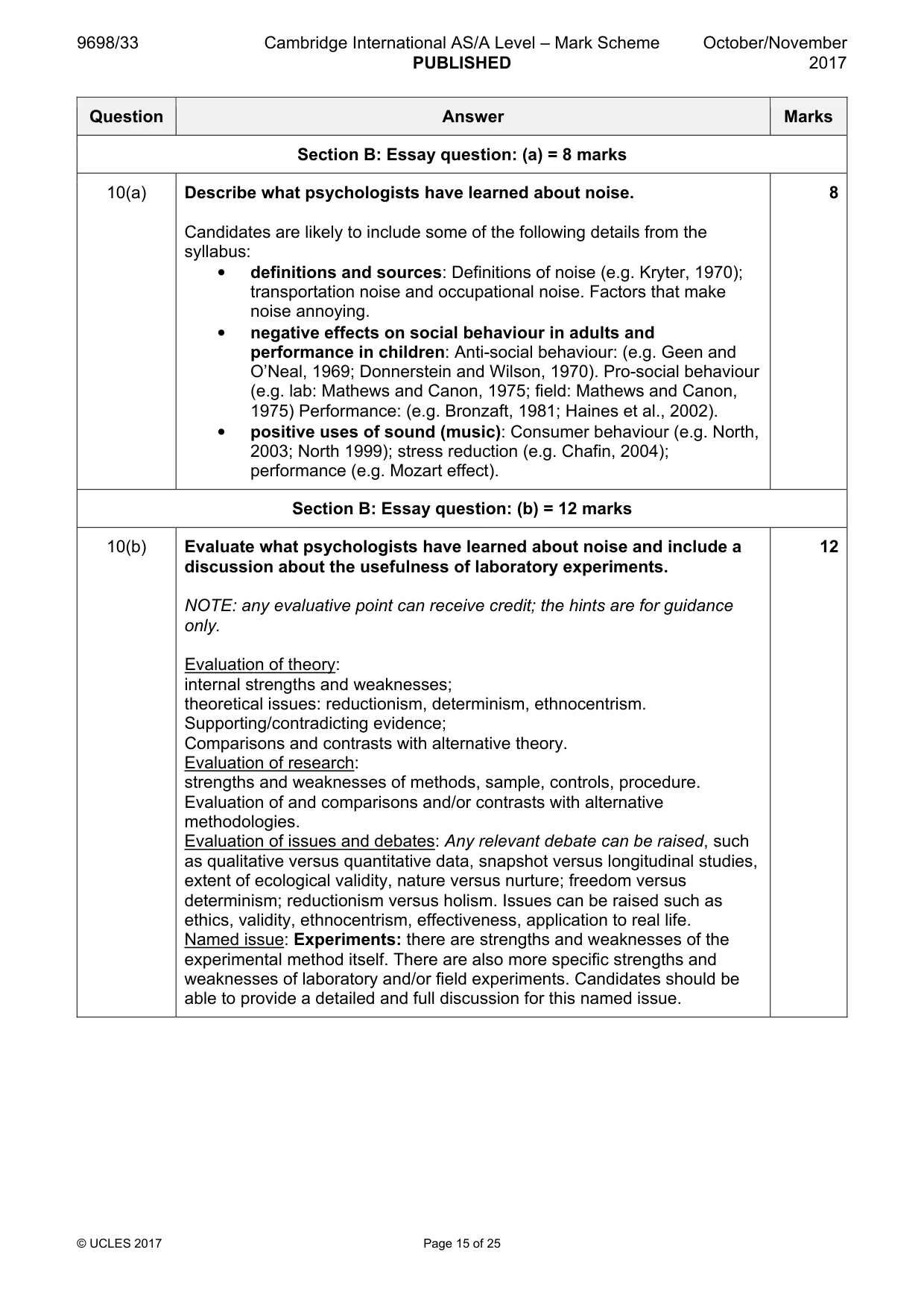
Q10 · Describe what psychologists have learned about noise
10 (a) Describe what psychologists have learned about noise. [8] (b) Evaluate what psychologists have learned about noise and include a discussion about the usefulness of laboratory experiments. [12] Section C Answer one question.
Mark scheme: 10(a) Describe what psychologists have learned about noise. 8 Candidates are likely to include some of the following details from the syllabus: • definitions and sources: Definitions of noise (e.g. Kryter, 1970); transportation noise and occupational noise. Factors that make noise annoying. • negative effects on social behaviour in adults and performance in children: Anti-social behaviour: (e.g. Geen and O’Neal, 1969; Donnerstein and Wilson, 1970). Pro-social behaviour (e.g. lab: Mathews and Canon, 1975; field: Mathews and Canon, 1975) Performance: (e.g. Bronzaft, 1981; Haines et al., 2002). • positive uses of sound (music): Consumer behaviour (e.g. North, 2003; North 1999); stress reduction (e.g. Chafin, 2004); performance (e.g. Mozart effect). Section B: Essay question: (b) = 12 marks 10(b) Evaluate what psychologists have learned about noise and include a 12 discussion about the usefulness of laboratory experiments. NOTE: any evaluative point can receive credit; the hints are for guidance only. Evaluation of theory: internal strengths and weaknesses; theoretical issues: reductionism, determinism, ethnocentrism. Supporting/contradicting evidence; Comparisons and contrasts with alternative theory. Evaluation of research: strengths and weaknesses of methods, sample, controls, procedure. Evaluation of and comparisons and/or contrasts with alternative methodologies. Evaluation of issues and debates: Any relevant debate can be raised, such as qualitative versus quantitative data, snapshot versus longitudinal studies, extent of ecological validity, nature versus nurture; freedom versus determinism; reductionism versus holism. Issues can be raised such as ethics, validity, ethnocentrism, effectiveness, application to real life. Named issue: Experiments: there are strengths and weaknesses of the experimental method itself. There are also more specific strengths and weaknesses of laboratory and/or field experiments. Candidates should be able to provide a detailed and full discussion for this named issue.
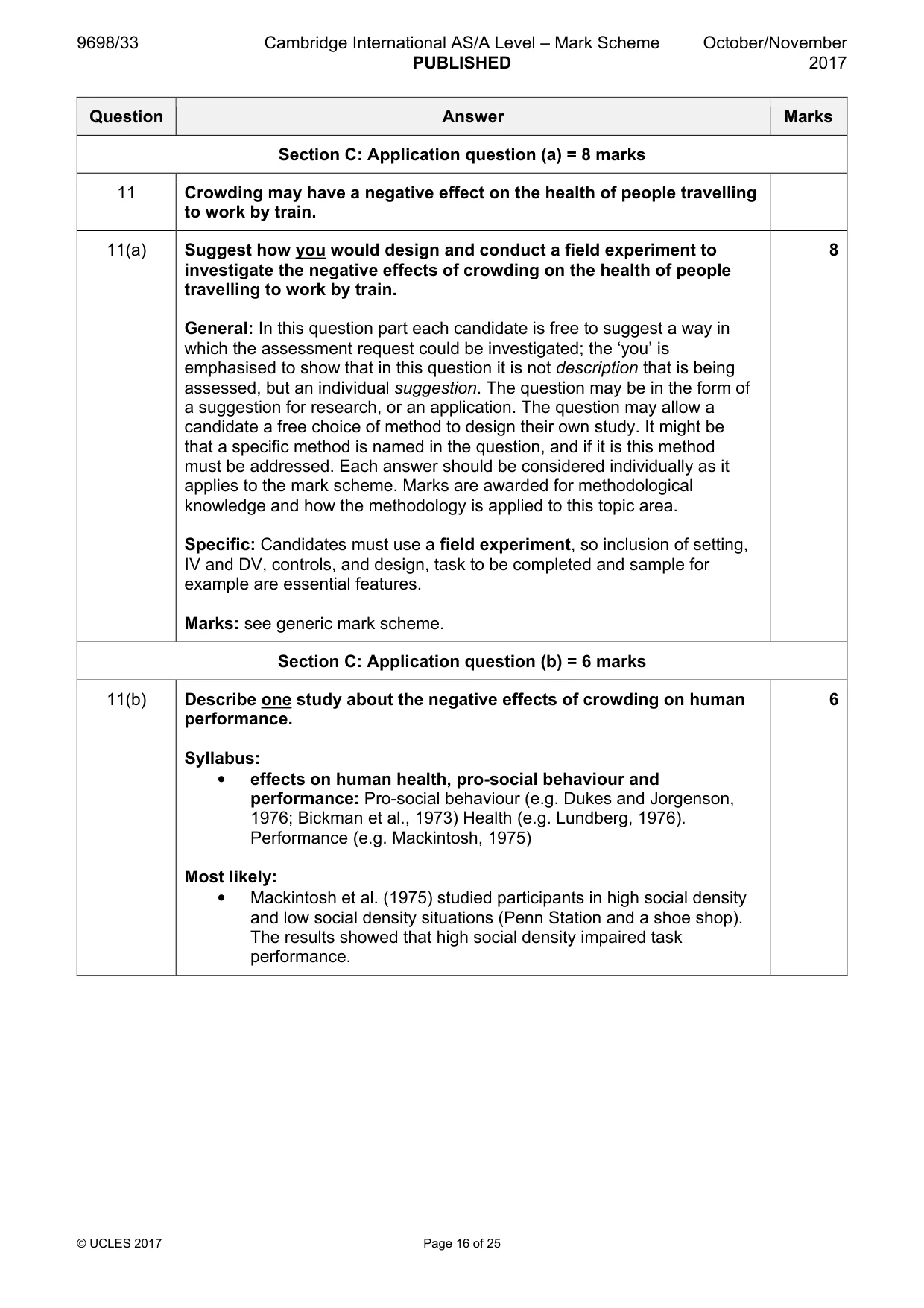
Q11 · Crowding may have a negative effect on the health of people travelling to work by train
11 Crowding may have a negative effect on the health of people travelling to work by train. (a) Suggest how you would design and conduct a field experiment to investigate the negative effects of crowding on the health of people travelling to work by train. [8] (b) Describe one study about the negative effects of crowding on human performance. [6]
Mark scheme: 11(a) Suggest how you would design and conduct a field experiment to 8 investigate the negative effects of crowding on the health of people travelling to work by train. General: In this question part each candidate is free to suggest a way in which the assessment request could be investigated; the ‘you’ is emphasised to show that in this question it is not description that is being assessed, but an individual suggestion. The question may be in the form of a suggestion for research, or an application. The question may allow a candidate a free choice of method to design their own study. It might be that a specific method is named in the question, and if it is this method must be addressed. Each answer should be considered individually as it applies to the mark scheme. Marks are awarded for methodological knowledge and how the methodology is applied to this topic area. Specific: Candidates must use a field experiment, so inclusion of setting, IV and DV, controls, and design, task to be completed and sample for example are essential features. Marks: see generic mark scheme. Section C: Application question (b) = 6 marks 11(b) Describe one study about the negative effects of crowding on human 6 performance. Syllabus: • effects on human health, pro-social behaviour and performance: Pro-social behaviour (e.g. Dukes and Jorgenson, 1976; Bickman et al., 1973) Health (e.g. Lundberg, 1976). Performance (e.g. Mackintosh, 1975) Most likely: • Mackintosh et al. (1975) studied participants in high social density and low social density situations (Penn Station and a shoe shop). The results showed that high social density impaired task performance.
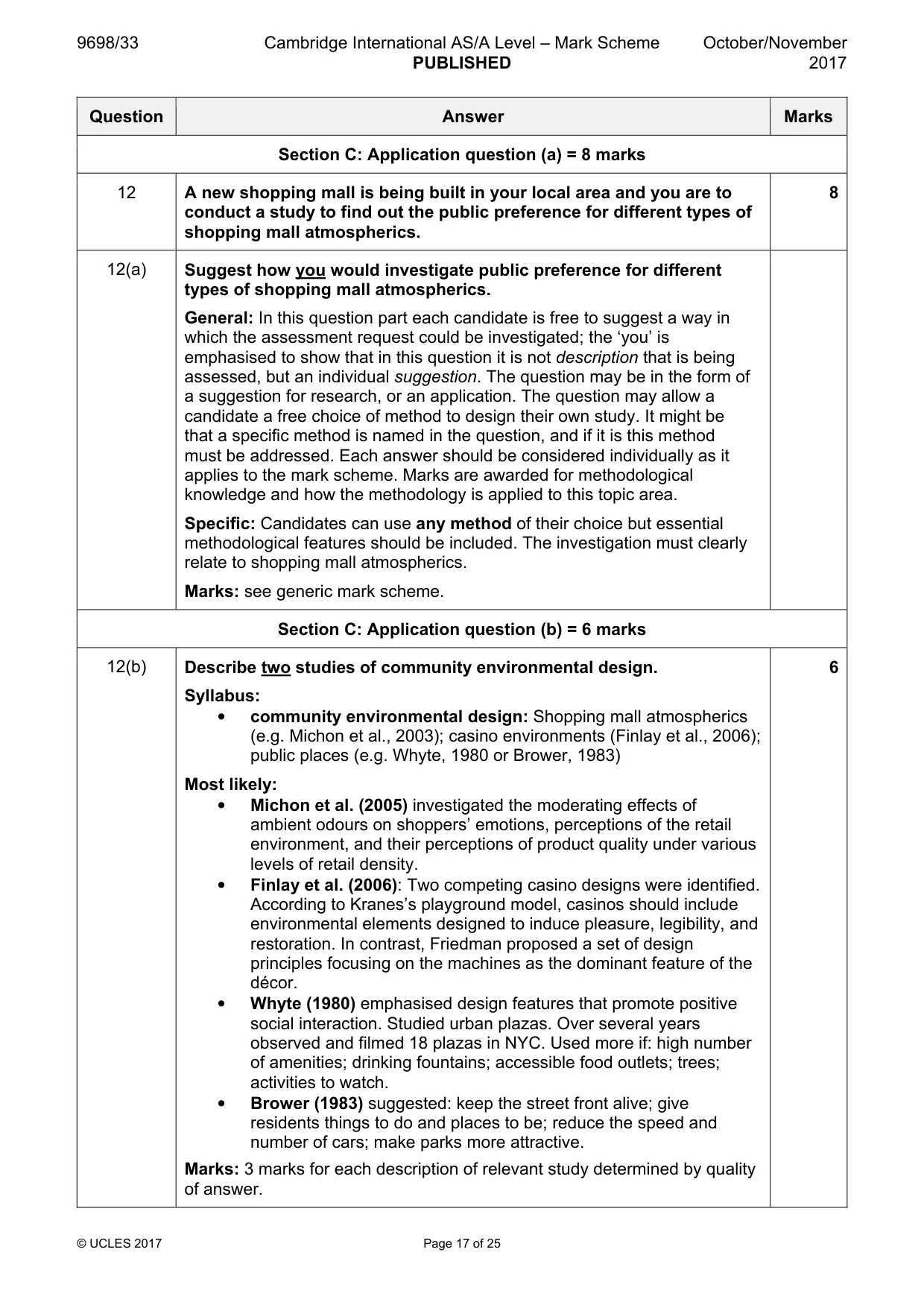
Q12 · A new shopping mall is being built in your local area and you are to conduct a study to…
12 A new shopping mall is being built in your local area and you are to conduct a study to find out the public preference for different types of shopping mall atmospherics. (a) Suggest how you would investigate public preference for different types of shopping mall atmospherics. [8] (b) Describe two studies of community environmental design. [6] Psychology and Abnormality Section A Answer this question.
Mark scheme: 12 A new shopping mall is being built in your local area and you are to 8 conduct a study to find out the public preference for different types of shopping mall atmospherics. 12(a) Suggest how you would investigate public preference for different types of shopping mall atmospherics. General: In this question part each candidate is free to suggest a way in which the assessment request could be investigated; the ‘you’ is emphasised to show that in this question it is not description that is being assessed, but an individual suggestion. The question may be in the form of a suggestion for research, or an application. The question may allow a candidate a free choice of method to design their own study. It might be that a specific method is named in the question, and if it is this method must be addressed. Each answer should be considered individually as it applies to the mark scheme. Marks are awarded for methodological knowledge and how the methodology is applied to this topic area. Specific: Candidates can use any method of their choice but essential methodological features should be included. The investigation must clearly relate to shopping mall atmospherics. Marks: see generic mark scheme. Section C: Application question (b) = 6 marks 12(b) Describe two studies of community environmental design. 6 Syllabus: • community environmental design: Shopping mall atmospherics (e.g. Michon et al., 2003); casino environments (Finlay et al., 2006); public places (e.g. Whyte, 1980 or Brower, 1983) Most likely: • Michon et al. (2005) investigated the moderating effects of ambient odours on shoppers’ emotions, perceptions of the retail environment, and their perceptions of product quality under various levels of retail density. • Finlay et al. (2006): Two competing casino designs were identified. According to Kranes’s playground model, casinos should include environmental elements designed to induce pleasure, legibility, and restoration. In contrast, Friedman proposed a set of design principles focusing on the machines as the dominant feature of the décor. • Whyte (1980) emphasised design features that promote positive social interaction. Studied urban plazas. Over several years observed and filmed 18 plazas in NYC. Used more if: high number of amenities; drinking fountains; accessible food outlets; trees; activities to watch. • Brower (1983) suggested: keep the street front alive; give residents things to do and places to be; reduce the speed and number of cars; make parks more attractive. Marks: 3 marks for each description of relevant study determined by quality of answer. PSYCHOLOGY AND ABNORMALITY
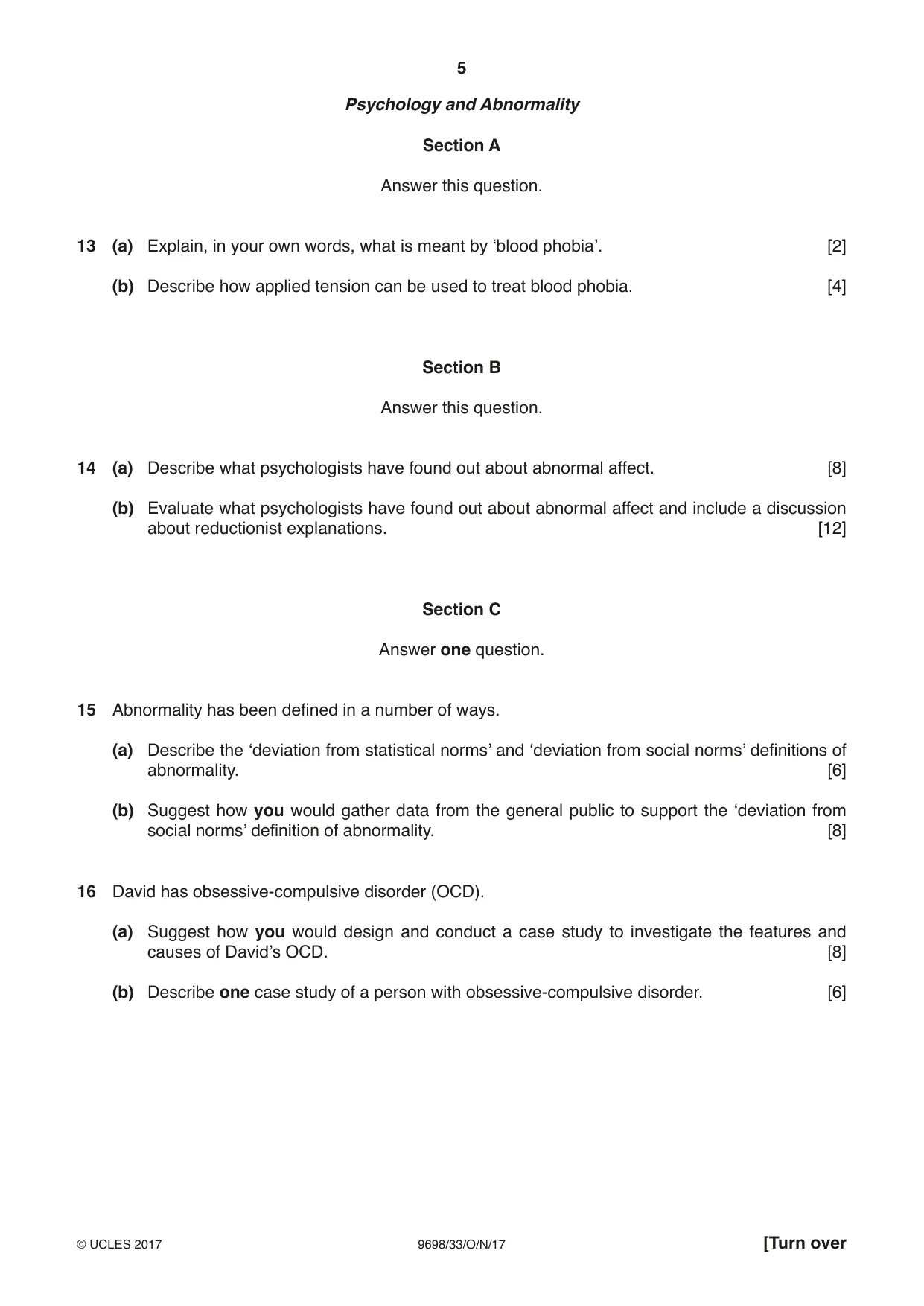
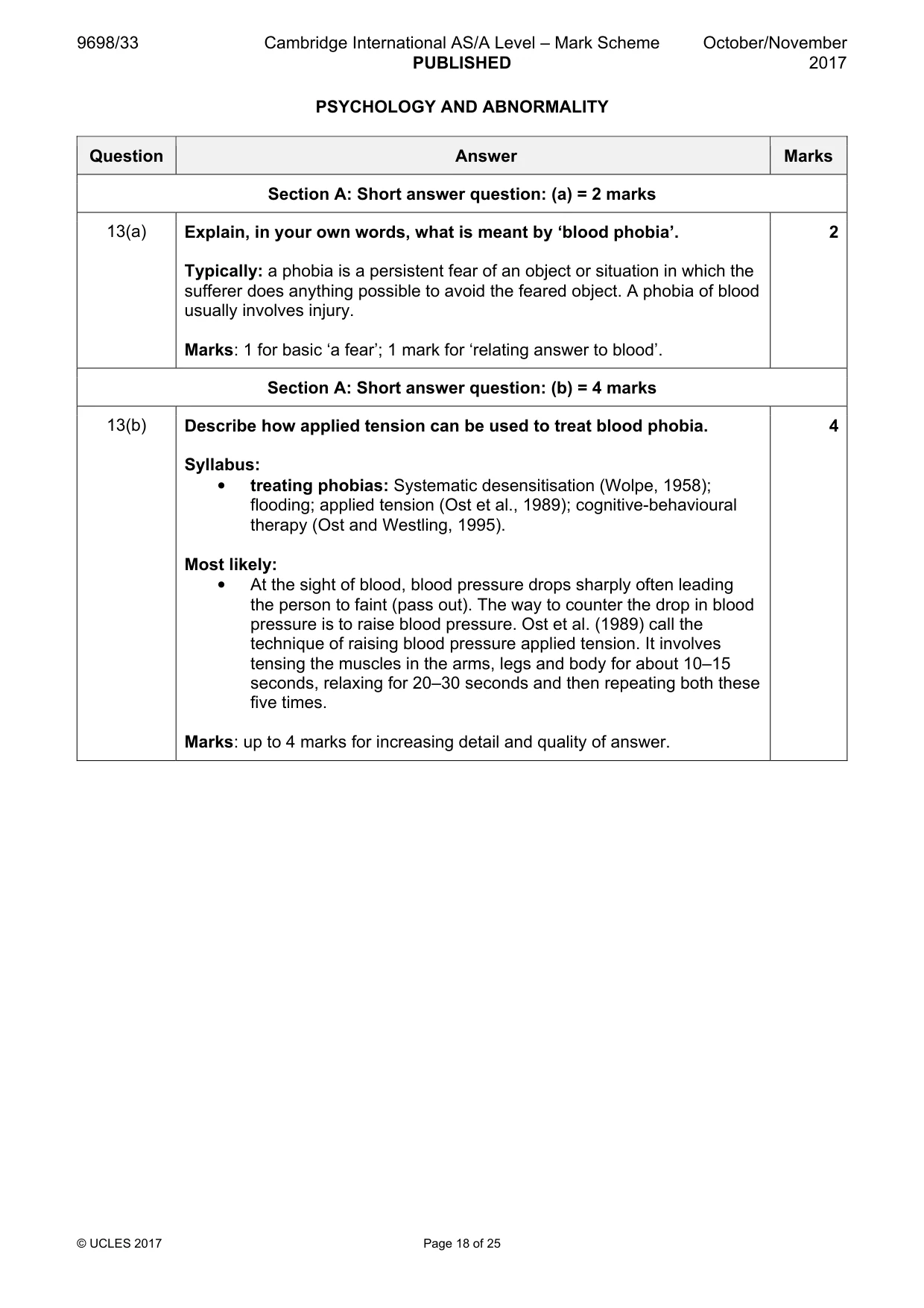
Q13 · Explain, in your own words, what is meant by ‘blood phobia’
13 (a) Explain, in your own words, what is meant by ‘blood phobia’. [2] (b) Describe how applied tension can be used to treat blood phobia. [4]
Mark scheme: 13(a) Explain, in your own words, what is meant by ‘blood phobia’. 2 Typically: a phobia is a persistent fear of an object or situation in which the sufferer does anything possible to avoid the feared object. A phobia of blood usually involves injury. Marks: 1 for basic ‘a fear’; 1 mark for ‘relating answer to blood’. Section A: Short answer question: (b) = 4 marks 13(b) Describe how applied tension can be used to treat blood phobia. 4 Syllabus: • treating phobias: Systematic desensitisation (Wolpe, 1958); flooding; applied tension (Ost et al., 1989); cognitive-behavioural therapy (Ost and Westling, 1995). Most likely: • At the sight of blood, blood pressure drops sharply often leading the person to faint (pass out). The way to counter the drop in blood pressure is to raise blood pressure. Ost et al. (1989) call the technique of raising blood pressure applied tension. It involves tensing the muscles in the arms, legs and body for about 10–15 seconds, relaxing for 20–30 seconds and then repeating both these five times. Marks: up to 4 marks for increasing detail and quality of answer.
Q14 · Describe what psychologists have found out about abnormal affect
14 (a) Describe what psychologists have found out about abnormal affect. [8] (b) Evaluate what psychologists have found out about abnormal affect and include a discussion about reductionist explanations. [12] Section C Answer one question.
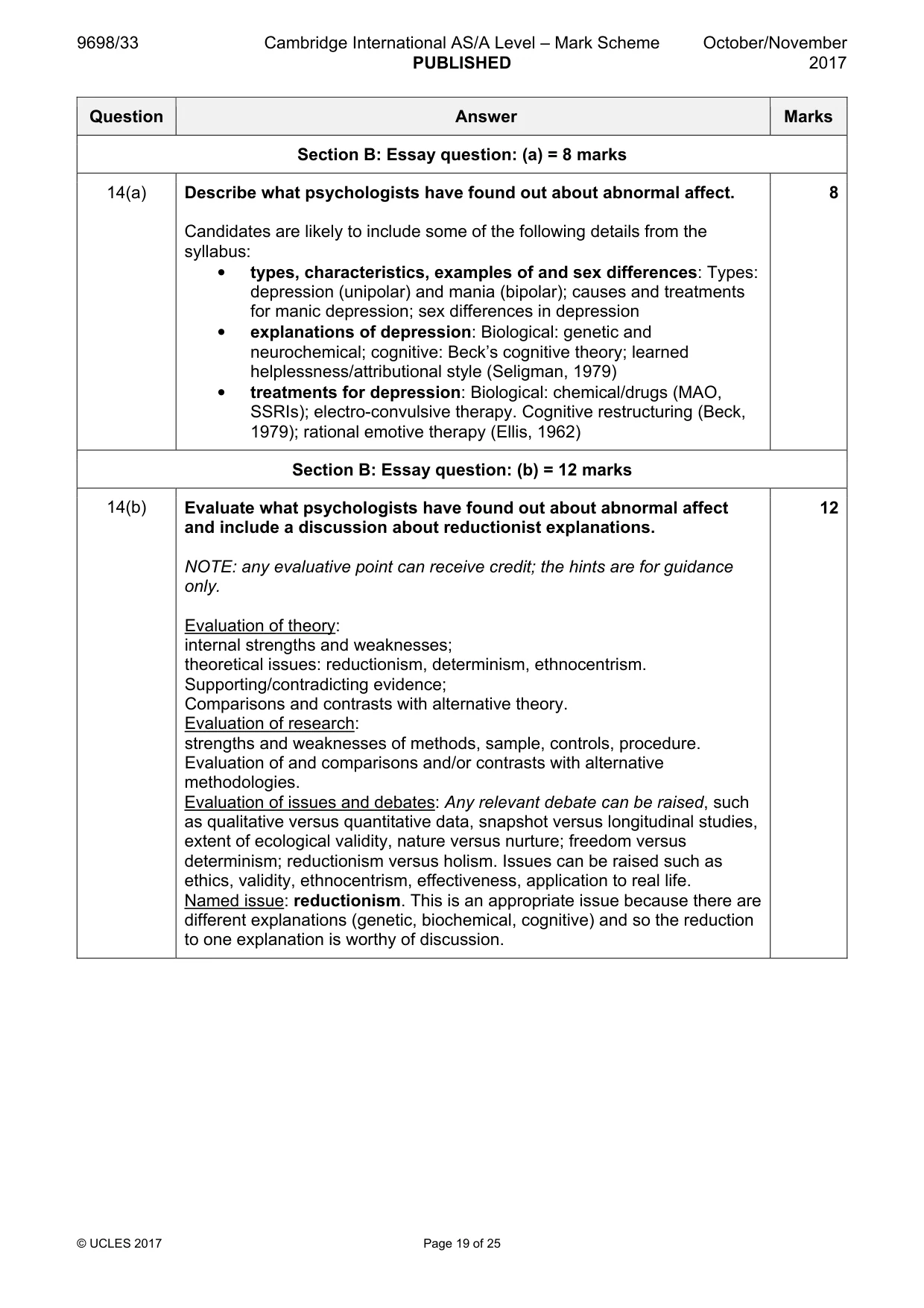
Mark scheme: 14(a) Describe what psychologists have found out about abnormal affect. 8 Candidates are likely to include some of the following details from the syllabus: • types, characteristics, examples of and sex differences: Types: depression (unipolar) and mania (bipolar); causes and treatments for manic depression; sex differences in depression • explanations of depression: Biological: genetic and neurochemical; cognitive: Beck’s cognitive theory; learned helplessness/attributional style (Seligman, 1979) • treatments for depression: Biological: chemical/drugs (MAO, SSRIs); electro-convulsive therapy. Cognitive restructuring (Beck, 1979); rational emotive therapy (Ellis, 1962) Section B: Essay question: (b) = 12 marks 14(b) Evaluate what psychologists have found out about abnormal affect 12 and include a discussion about reductionist explanations. NOTE: any evaluative point can receive credit; the hints are for guidance only. Evaluation of theory: internal strengths and weaknesses; theoretical issues: reductionism, determinism, ethnocentrism. Supporting/contradicting evidence; Comparisons and contrasts with alternative theory. Evaluation of research: strengths and weaknesses of methods, sample, controls, procedure. Evaluation of and comparisons and/or contrasts with alternative methodologies. Evaluation of issues and debates: Any relevant debate can be raised, such as qualitative versus quantitative data, snapshot versus longitudinal studies, extent of ecological validity, nature versus nurture; freedom versus determinism; reductionism versus holism. Issues can be raised such as ethics, validity, ethnocentrism, effectiveness, application to real life. Named issue: reductionism. This is an appropriate issue because there are different explanations (genetic, biochemical, cognitive) and so the reduction to one explanation is worthy of discussion.
Q15 · Abnormality has been defined in a number of ways
15 Abnormality has been defined in a number of ways. (a) Describe the ‘deviation from statistical norms’ and ‘deviation from social norms’ definitions of abnormality. [6] (b) Suggest how you would gather data from the general public to support the ‘deviation from social norms’ definition of abnormality. [8]
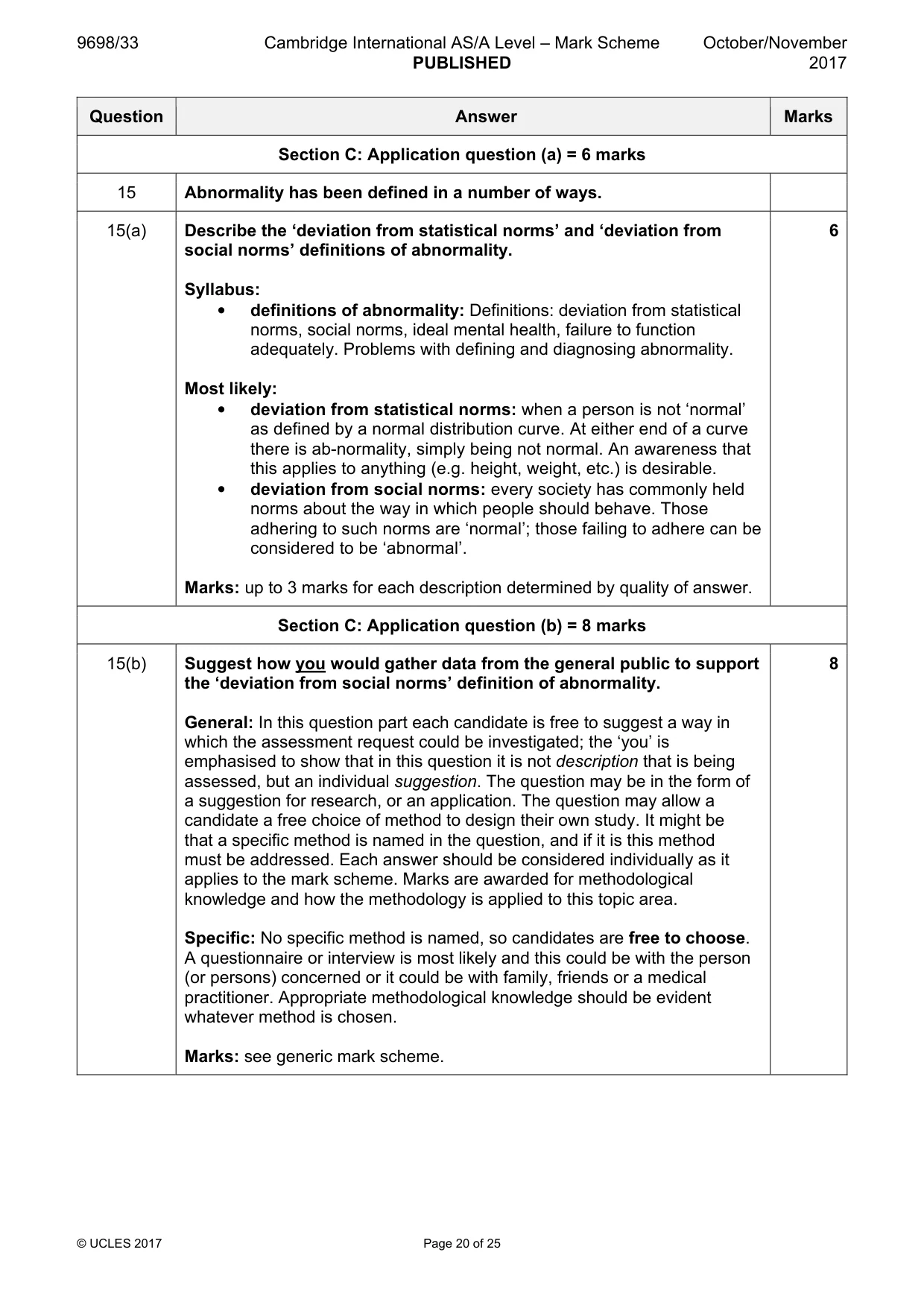
Mark scheme: 15(a) Describe the ‘deviation from statistical norms’ and ‘deviation from 6 social norms’ definitions of abnormality. Syllabus: • definitions of abnormality: Definitions: deviation from statistical norms, social norms, ideal mental health, failure to function adequately. Problems with defining and diagnosing abnormality. Most likely: • deviation from statistical norms: when a person is not ‘normal’ as defined by a normal distribution curve. At either end of a curve there is ab-normality, simply being not normal. An awareness that this applies to anything (e.g. height, weight, etc.) is desirable. • deviation from social norms: every society has commonly held norms about the way in which people should behave. Those adhering to such norms are ‘normal’; those failing to adhere can be considered to be ‘abnormal’. Marks: up to 3 marks for each description determined by quality of answer. Section C: Application question (b) = 8 marks 15(b) Suggest how you would gather data from the general public to support 8 the ‘deviation from social norms’ definition of abnormality. General: In this question part each candidate is free to suggest a way in which the assessment request could be investigated; the ‘you’ is emphasised to show that in this question it is not description that is being assessed, but an individual suggestion. The question may be in the form of a suggestion for research, or an application. The question may allow a candidate a free choice of method to design their own study. It might be that a specific method is named in the question, and if it is this method must be addressed. Each answer should be considered individually as it applies to the mark scheme. Marks are awarded for methodological knowledge and how the methodology is applied to this topic area. Specific: No specific method is named, so candidates are free to choose. A questionnaire or interview is most likely and this could be with the person (or persons) concerned or it could be with family, friends or a medical practitioner. Appropriate methodological knowledge should be evident whatever method is chosen. Marks: see generic mark scheme.
Q16 · David has obsessive-compulsive disorder (OCD)
16 David has obsessive-compulsive disorder (OCD). (a) Suggest how you would design and conduct a case study to investigate the features and causes of David’s OCD. [8] (b) Describe one case study of a person with obsessive-compulsive disorder. [6] Psychology and Organisations Section A Answer this question.
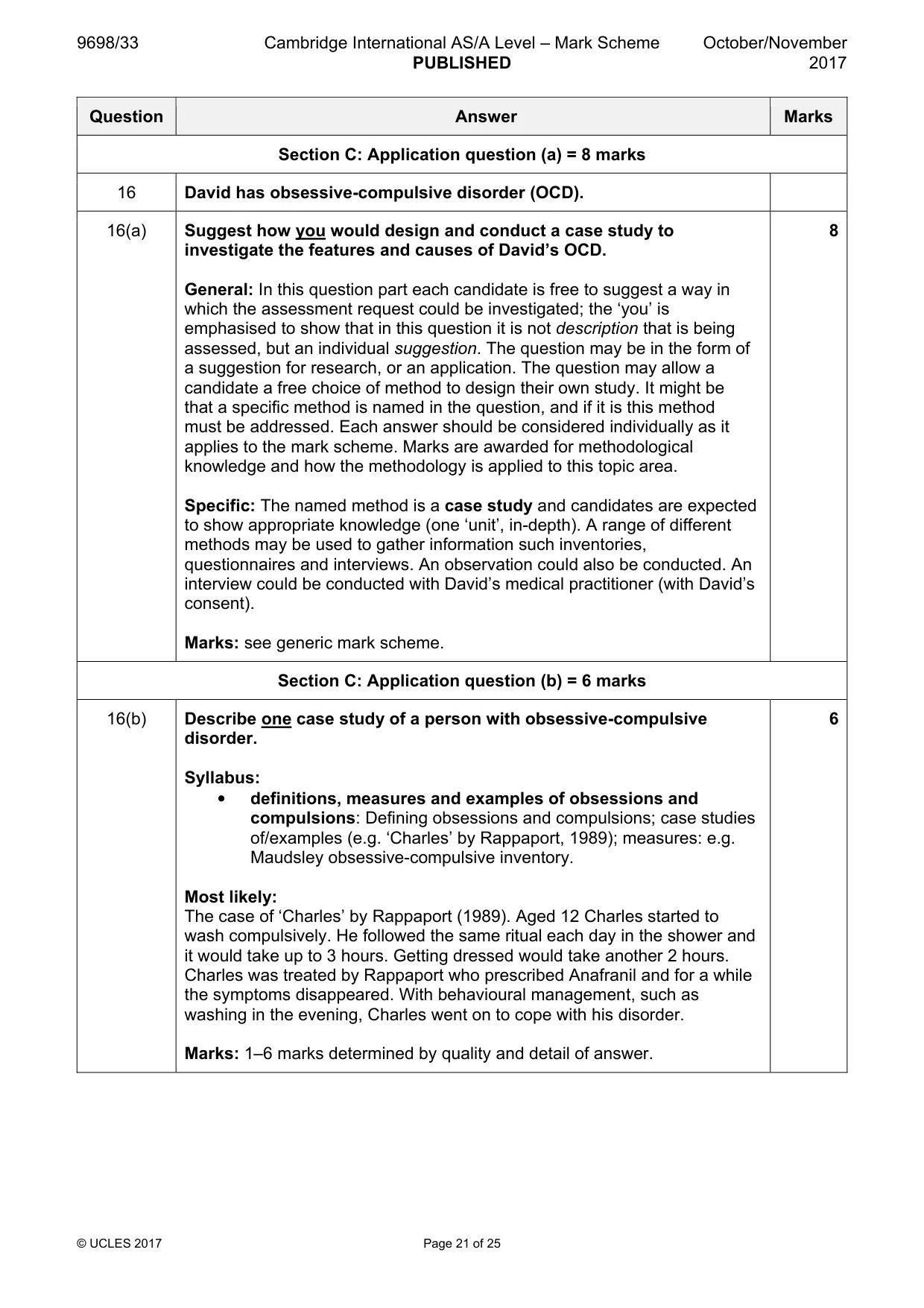
Mark scheme: 16(a) Suggest how you would design and conduct a case study to 8 investigate the features and causes of David’s OCD. General: In this question part each candidate is free to suggest a way in which the assessment request could be investigated; the ‘you’ is emphasised to show that in this question it is not description that is being assessed, but an individual suggestion. The question may be in the form of a suggestion for research, or an application. The question may allow a candidate a free choice of method to design their own study. It might be that a specific method is named in the question, and if it is this method must be addressed. Each answer should be considered individually as it applies to the mark scheme. Marks are awarded for methodological knowledge and how the methodology is applied to this topic area. Specific: The named method is a case study and candidates are expected to show appropriate knowledge (one ‘unit’, in-depth). A range of different methods may be used to gather information such inventories, questionnaires and interviews. An observation could also be conducted. An interview could be conducted with David’s medical practitioner (with David’s consent). Marks: see generic mark scheme. Section C: Application question (b) = 6 marks 16(b) Describe one case study of a person with obsessive-compulsive 6 disorder. Syllabus: • definitions, measures and examples of obsessions and compulsions: Defining obsessions and compulsions; case studies of/examples (e.g. ‘Charles’ by Rappaport, 1989); measures: e.g. Maudsley obsessive-compulsive inventory. Most likely: The case of ‘Charles’ by Rappaport (1989). Aged 12 Charles started to wash compulsively. He followed the same ritual each day in the shower and it would take up to 3 hours. Getting dressed would take another 2 hours. Charles was treated by Rappaport who prescribed Anafranil and for a while the symptoms disappeared. With behavioural management, such as washing in the evening, Charles went on to cope with his disorder. Marks: 1–6 marks determined by quality and detail of answer. PSYCHOLOGY AND ORGANISATIONS
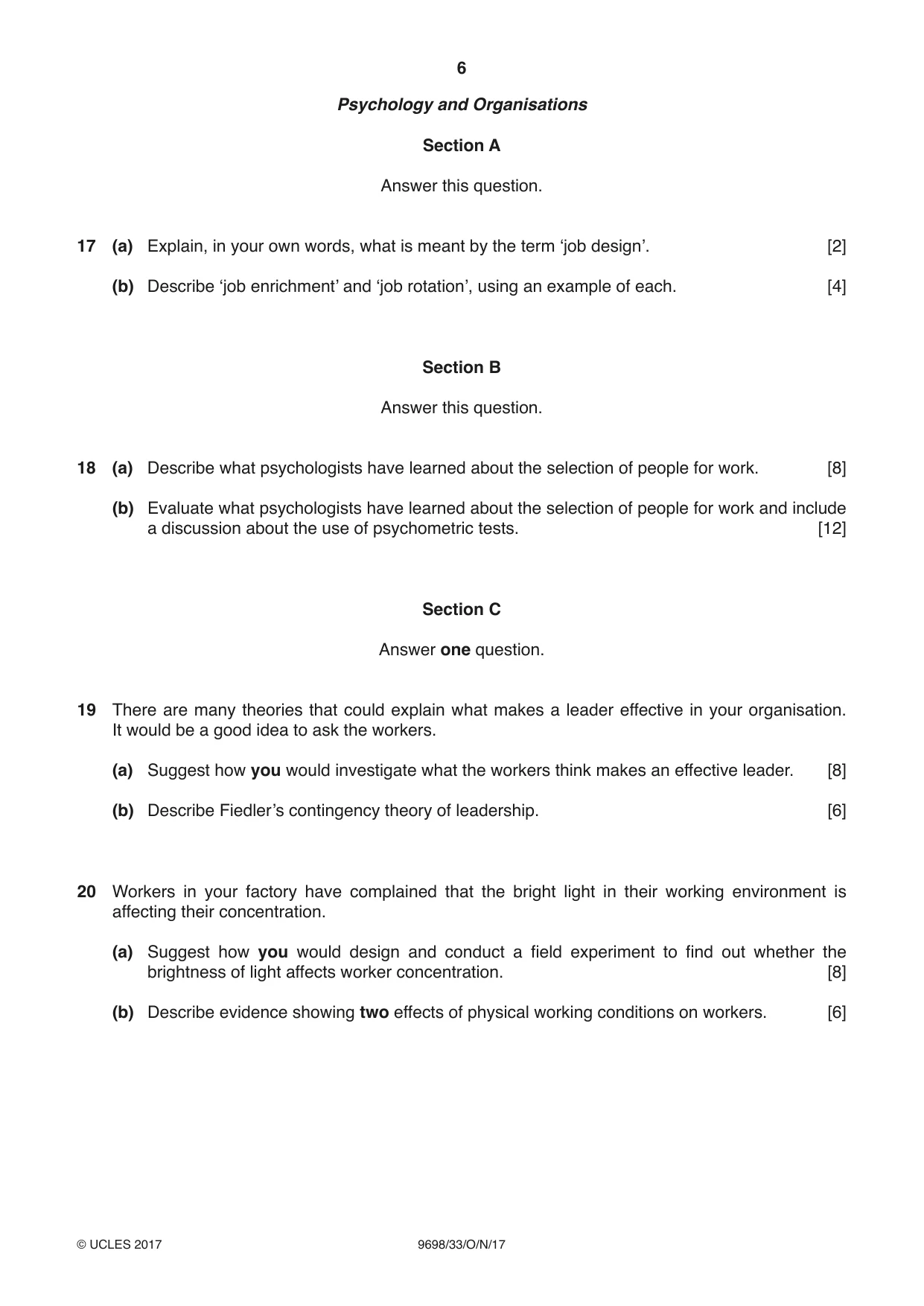
Q17 · Explain, in your own words, what is meant by the term ‘job design’
17 (a) Explain, in your own words, what is meant by the term ‘job design’. [2] (b) Describe ‘job enrichment’ and ‘job rotation’, using an example of each. [4]
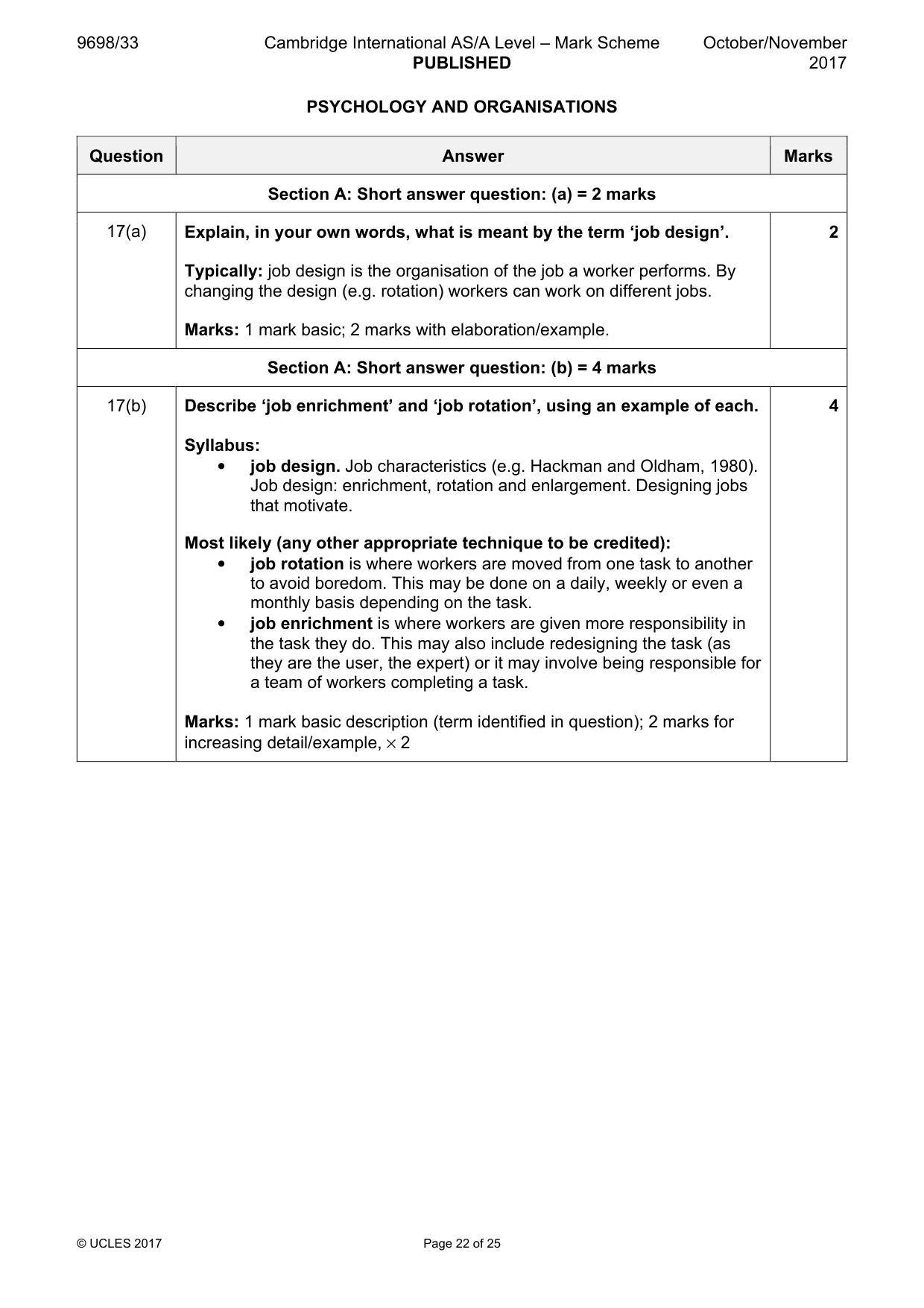
Mark scheme: 17(a) Explain, in your own words, what is meant by the term ‘job design’. 2 Typically: job design is the organisation of the job a worker performs. By changing the design (e.g. rotation) workers can work on different jobs. Marks: 1 mark basic; 2 marks with elaboration/example. Section A: Short answer question: (b) = 4 marks 17(b) Describe ‘job enrichment’ and ‘job rotation’, using an example of each. 4 Syllabus: • job design. Job characteristics (e.g. Hackman and Oldham, 1980). Job design: enrichment, rotation and enlargement. Designing jobs that motivate. Most likely (any other appropriate technique to be credited): • job rotation is where workers are moved from one task to another to avoid boredom. This may be done on a daily, weekly or even a monthly basis depending on the task. • job enrichment is where workers are given more responsibility in the task they do. This may also include redesigning the task (as they are the user, the expert) or it may involve being responsible for a team of workers completing a task. Marks: 1 mark basic description (term identified in question); 2 marks for increasing detail/example, × 2
Q18 · Describe what psychologists have learned about the selection of people for work
18 (a) Describe what psychologists have learned about the selection of people for work. [8] (b) Evaluate what psychologists have learned about the selection of people for work and include a discussion about the use of psychometric tests. [12] Section C Answer one question.
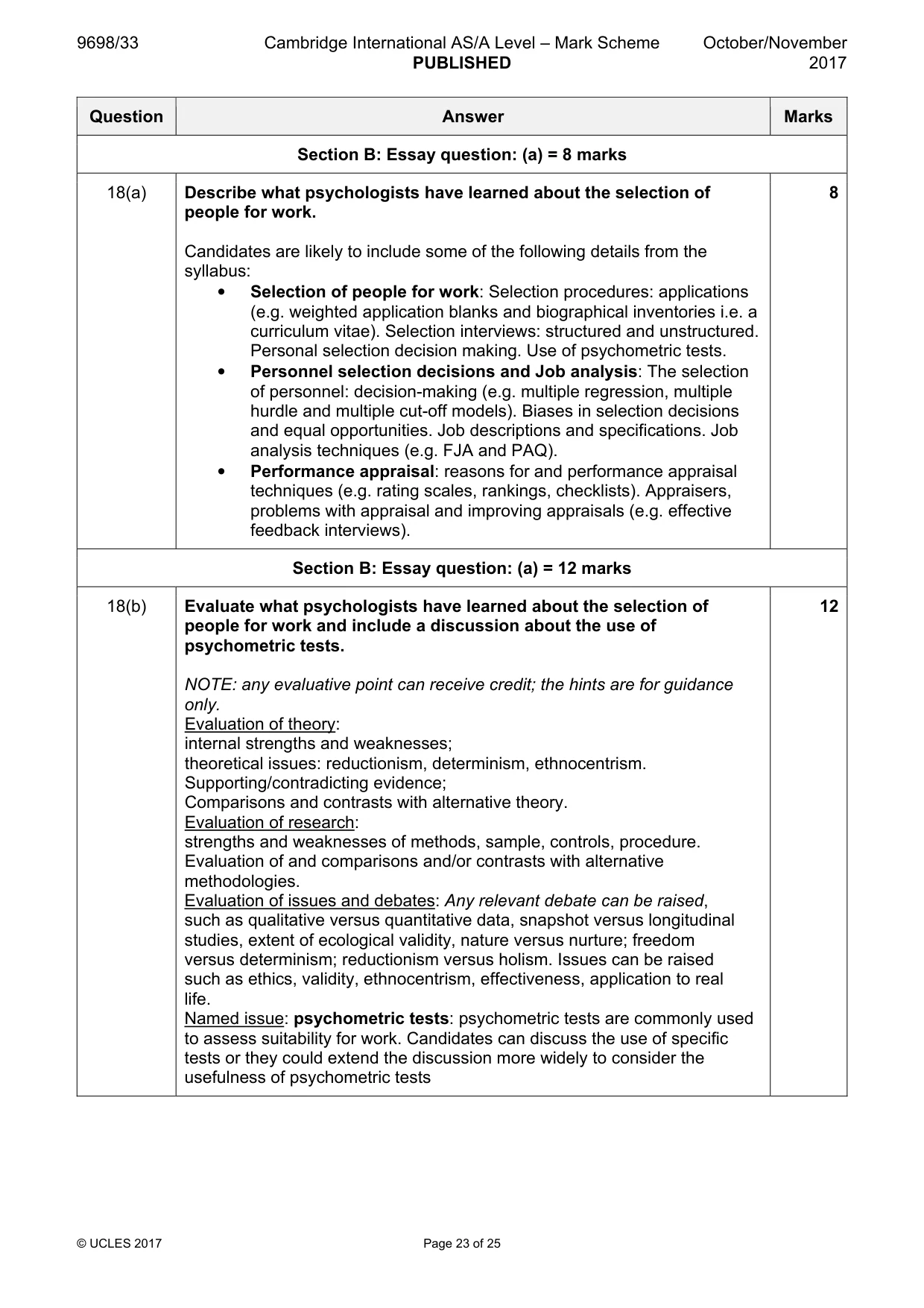
Mark scheme: 18(a) Describe what psychologists have learned about the selection of 8 people for work. Candidates are likely to include some of the following details from the syllabus: • Selection of people for work: Selection procedures: applications (e.g. weighted application blanks and biographical inventories i.e. a curriculum vitae). Selection interviews: structured and unstructured. Personal selection decision making. Use of psychometric tests. • Personnel selection decisions and Job analysis: The selection of personnel: decision-making (e.g. multiple regression, multiple hurdle and multiple cut-off models). Biases in selection decisions and equal opportunities. Job descriptions and specifications. Job analysis techniques (e.g. FJA and PAQ). • Performance appraisal: reasons for and performance appraisal techniques (e.g. rating scales, rankings, checklists). Appraisers, problems with appraisal and improving appraisals (e.g. effective feedback interviews). Section B: Essay question: (a) = 12 marks 18(b) Evaluate what psychologists have learned about the selection of 12 people for work and include a discussion about the use of psychometric tests. NOTE: any evaluative point can receive credit; the hints are for guidance only. Evaluation of theory: internal strengths and weaknesses; theoretical issues: reductionism, determinism, ethnocentrism. Supporting/contradicting evidence; Comparisons and contrasts with alternative theory. Evaluation of research: strengths and weaknesses of methods, sample, controls, procedure. Evaluation of and comparisons and/or contrasts with alternative methodologies. Evaluation of issues and debates: Any relevant debate can be raised, such as qualitative versus quantitative data, snapshot versus longitudinal studies, extent of ecological validity, nature versus nurture; freedom versus determinism; reductionism versus holism. Issues can be raised such as ethics, validity, ethnocentrism, effectiveness, application to real life. Named issue: psychometric tests: psychometric tests are commonly used to assess suitability for work. Candidates can discuss the use of specific tests or they could extend the discussion more widely to consider the usefulness of psychometric tests
Q19 · There are many theories that could explain what makes a leader effective in your…
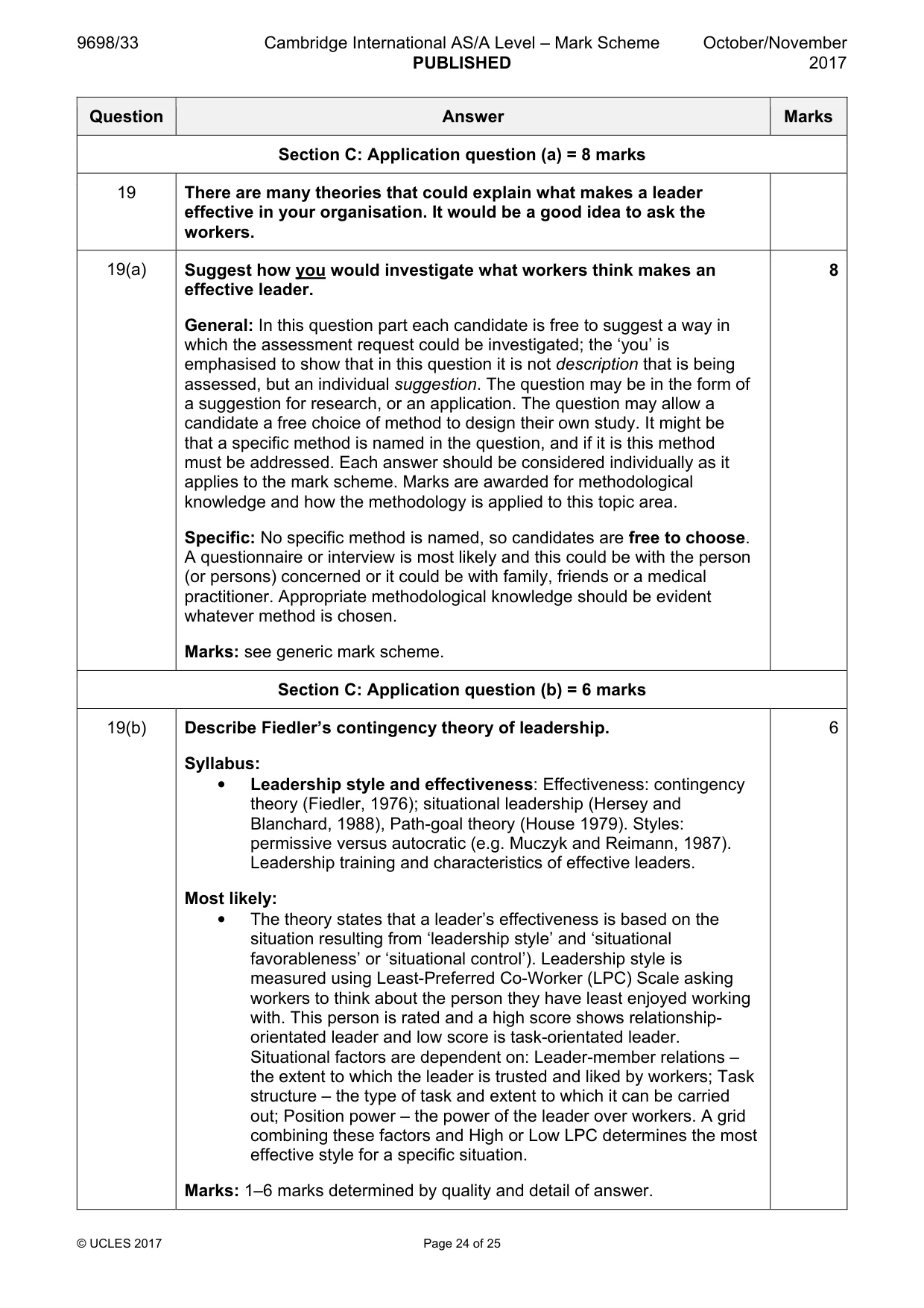
19 There are many theories that could explain what makes a leader effective in your organisation. It would be a good idea to ask the workers. (a) Suggest how you would investigate what the workers think makes an effective leader. [8] (b) Describe Fiedler’s contingency theory of leadership. [6]
Mark scheme: 19(a) Suggest how you would investigate what workers think makes an 8 effective leader. General: In this question part each candidate is free to suggest a way in which the assessment request could be investigated; the ‘you’ is emphasised to show that in this question it is not description that is being assessed, but an individual suggestion. The question may be in the form of a suggestion for research, or an application. The question may allow a candidate a free choice of method to design their own study. It might be that a specific method is named in the question, and if it is this method must be addressed. Each answer should be considered individually as it applies to the mark scheme. Marks are awarded for methodological knowledge and how the methodology is applied to this topic area. Specific: No specific method is named, so candidates are free to choose. A questionnaire or interview is most likely and this could be with the person (or persons) concerned or it could be with family, friends or a medical practitioner. Appropriate methodological knowledge should be evident whatever method is chosen. Marks: see generic mark scheme. Section C: Application question (b) = 6 marks 19(b) Describe Fiedler’s contingency theory of leadership. 6 Syllabus: • Leadership style and effectiveness: Effectiveness: contingency theory (Fiedler, 1976); situational leadership (Hersey and Blanchard, 1988), Path-goal theory (House 1979). Styles: permissive versus autocratic (e.g. Muczyk and Reimann, 1987). Leadership training and characteristics of effective leaders. Most likely: • The theory states that a leader’s effectiveness is based on the situation resulting from ‘leadership style’ and ‘situational favorableness’ or ‘situational control’). Leadership style is measured using Least-Preferred Co-Worker (LPC) Scale asking workers to think about the person they have least enjoyed working with. This person is rated and a high score shows relationship- orientated leader and low score is task-orientated leader. Situational factors are dependent on: Leader-member relations – the extent to which the leader is trusted and liked by workers; Task structure – the type of task and extent to which it can be carried out; Position power – the power of the leader over workers. A grid combining these factors and High or Low LPC determines the most effective style for a specific situation. Marks: 1–6 marks determined by quality and detail of answer.
Q20 · Workers in your factory have complained that the bright light in their working…
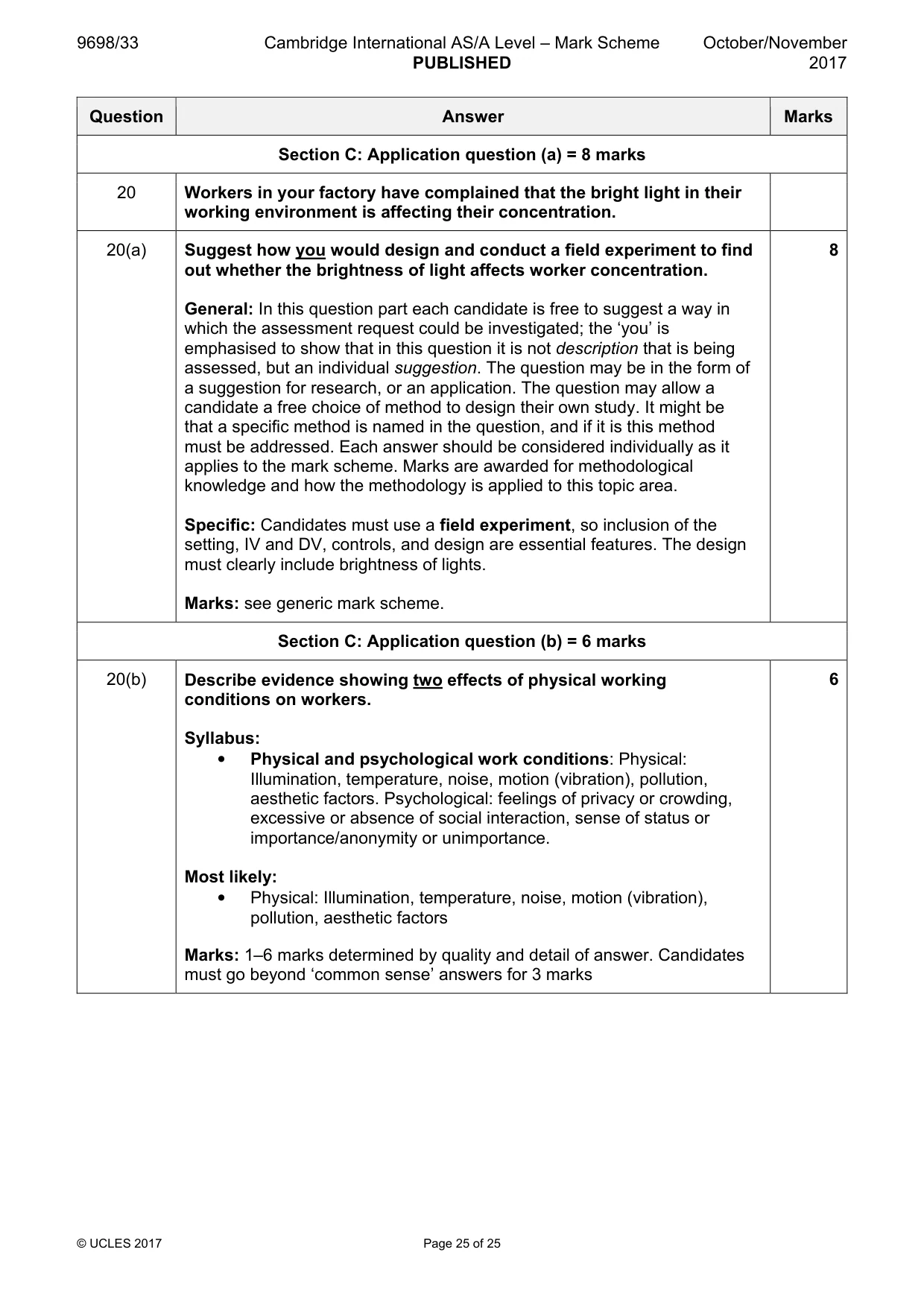
20 Workers in your factory have complained that the bright light in their working environment is affecting their concentration. (a) Suggest how you would design and conduct a field experiment to find out whether the brightness of light affects worker concentration. [8] (b) Describe evidence showing two effects of physical working conditions on workers. [6]
Mark scheme: 20(a) Suggest how you would design and conduct a field experiment to find 8 out whether the brightness of light affects worker concentration. General: In this question part each candidate is free to suggest a way in which the assessment request could be investigated; the ‘you’ is emphasised to show that in this question it is not description that is being assessed, but an individual suggestion. The question may be in the form of a suggestion for research, or an application. The question may allow a candidate a free choice of method to design their own study. It might be that a specific method is named in the question, and if it is this method must be addressed. Each answer should be considered individually as it applies to the mark scheme. Marks are awarded for methodological knowledge and how the methodology is applied to this topic area. Specific: Candidates must use a field experiment, so inclusion of the setting, IV and DV, controls, and design are essential features. The design must clearly include brightness of lights. Marks: see generic mark scheme. Section C: Application question (b) = 6 marks 20(b) Describe evidence showing two effects of physical working 6 conditions on workers. Syllabus: • Physical and psychological work conditions: Physical: Illumination, temperature, noise, motion (vibration), pollution, aesthetic factors. Psychological: feelings of privacy or crowding, excessive or absence of social interaction, sense of status or importance/anonymity or unimportance. Most likely: • Physical: Illumination, temperature, noise, motion (vibration), pollution, aesthetic factors Marks: 1–6 marks determined by quality and detail of answer. Candidates must go beyond ‘common sense’ answers for 3 marks
What you needed in this session
Cambridge’s own grade thresholds for 2017 Oct/Nov, Paper 3 · Variant 3. A higher threshold means an easier paper — the bar moves with how the cohort did.