Questions as text
Q1 · State Wien’s displacement law 9702/41 May/June 2022
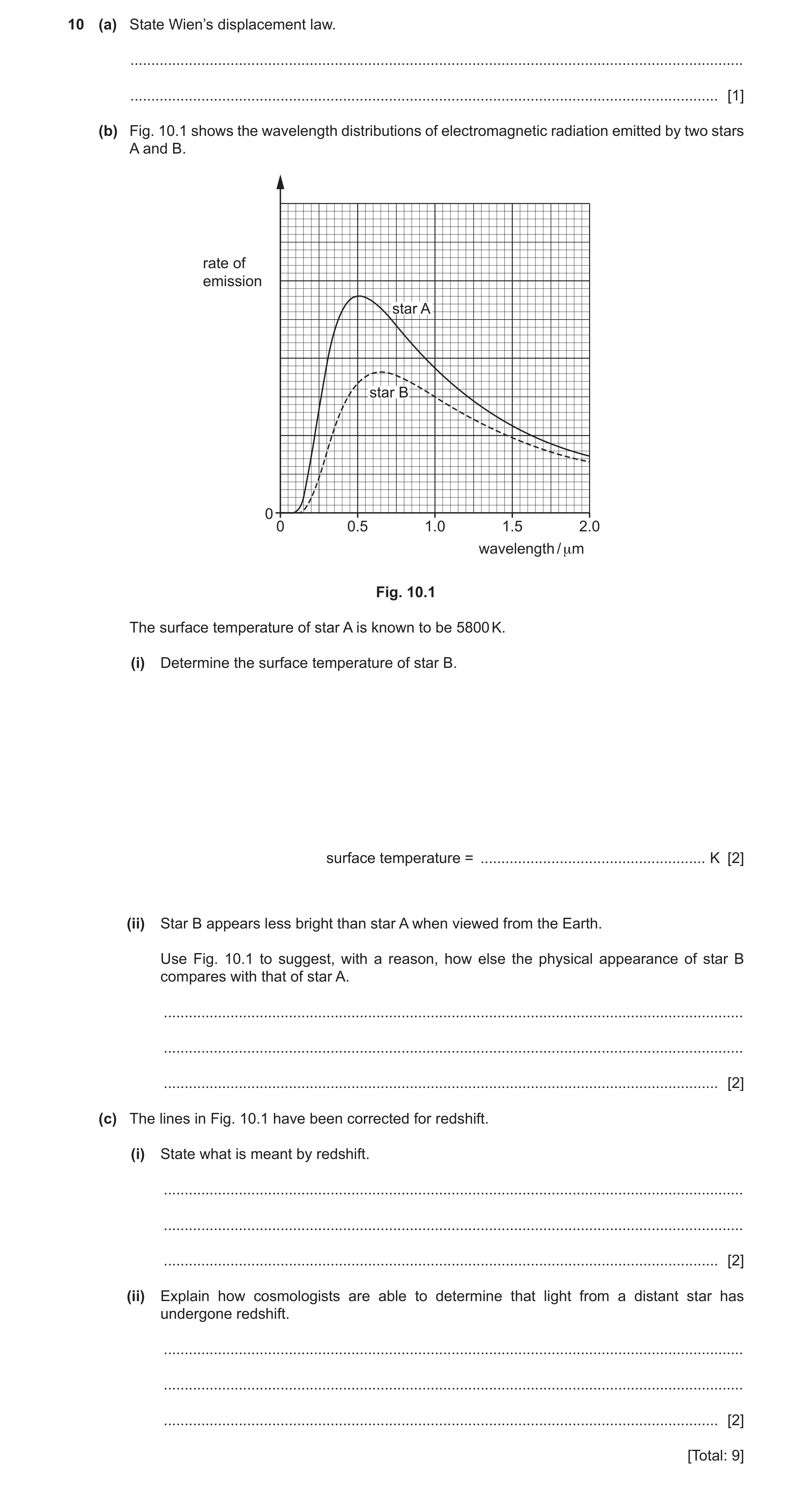
10 (a) State Wien’s displacement law. … … [1] (b) Fig. 10.1 shows the wavelength distributions of electromagnetic radiation emitted by two stars A and B. rate of emission star A star B 0 0 0.5 1.0 1.5 2.0 wavelength / μm Fig. 10.1 The surface temperature of star A is known to be 5800 K. (i) Determine the surface temperature of star B. surface temperature = … K [2] (ii) Star B appears less bright than star A when viewed from the Earth. Use Fig. 10.1 to suggest, with a reason, how else the physical appearance of star B compares with that of star A. … … … [2] (c) The lines in Fig. 10.1 have been corrected for redshift. (i) State what is meant by redshift. … … … [2] (ii) Explain how cosmologists are able to determine that light from a distant star has undergone redshift. … … … [2] [Total: 9]
9 marks
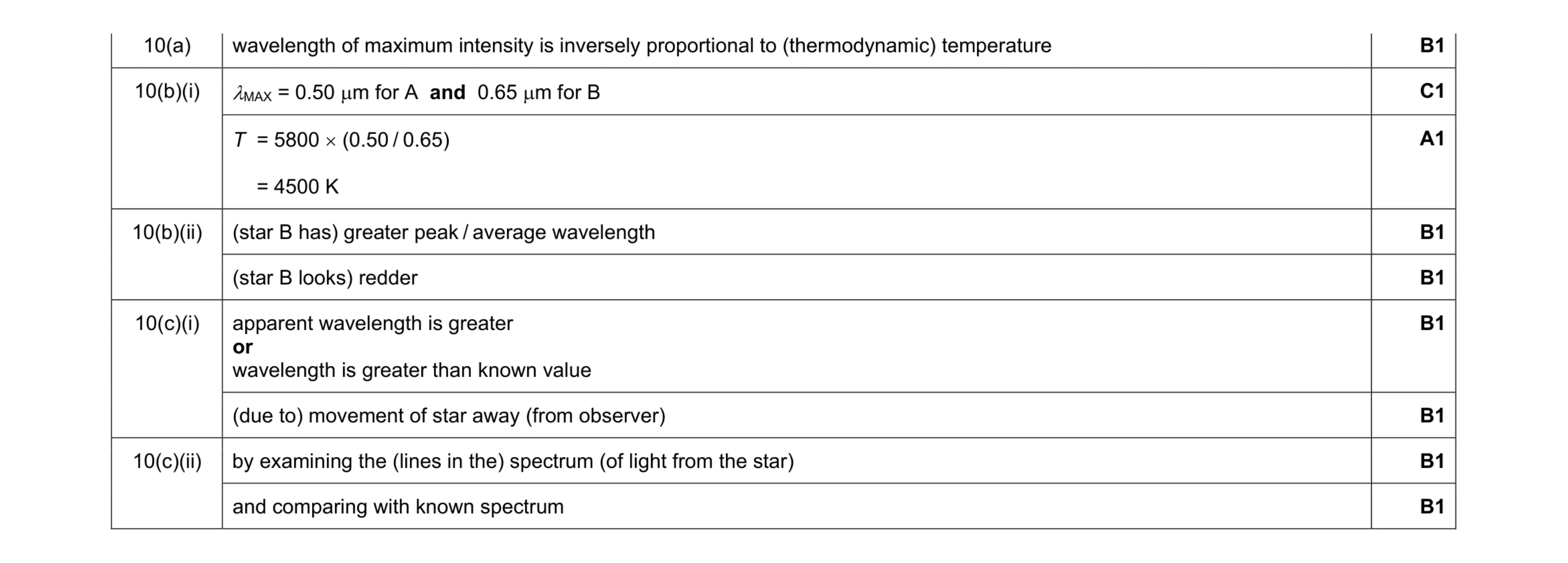
Mark scheme: 10(a) wavelength of maximum intensity is inversely proportional to (thermodynamic) temperature B1 10(b)(i) MAX = 0.50 m for A and 0.65 m for B C1 T = 5800 (0.50 / 0.65) = 4500 K A1 10(b)(ii) (star B has) greater peak / average wavelength B1 (star B looks) redder B1 10(c)(i) apparent wavelength is greater or wavelength is greater than known value B1 (due to) movement of star away (from observer) B1 10(c)(ii) by examining the (lines in the) spectrum (of light from the star) B1 and comparing with known spectrum B1
This question in 9702/41 May/June 2022
Question 2 9702/42 May/June 2022
9 (a) (i) State Hubble’s law. … … … [2] (ii) Explain how cosmologists use observations of emission spectra from stars in distant galaxies to determine that the Universe is expanding. … … … … [2] (b) Explain how Hubble’s law and the idea of the expanding Universe lead to the Big Bang theory of the origin of the Universe. … … … … [3] [Total: 7]
7 marks
Mark scheme: 9(a)(i) speed is (directly) proportional to distance M1 where speed is speed of recession of galaxy (from observer) and distance is distance of galaxy away from observer A1 9(a)(ii) wavelengths (of spectral lines) are greater (than their known values) B1 redshift shows stars (in distant galaxies) moving away from Earth B1 9(b) (all) parts of Universe moving away from each other B1 more distant objects are moving away faster B1 matter must have been close together / very dense in the past B1
This question in 9702/42 May/June 2022
Q3 · State Wien’s displacement law 9702/43 May/June 2022
10 (a) State Wien’s displacement law. … … [1] (b) Fig. 10.1 shows the wavelength distributions of electromagnetic radiation emitted by two stars A and B. rate of emission star A star B 0 0 0.5 1.0 1.5 2.0 wavelength / μm Fig. 10.1 The surface temperature of star A is known to be 5800 K. (i) Determine the surface temperature of star B. surface temperature = … K [2] (ii) Star B appears less bright than star A when viewed from the Earth. Use Fig. 10.1 to suggest, with a reason, how else the physical appearance of star B compares with that of star A. … … … [2] (c) The lines in Fig. 10.1 have been corrected for redshift. (i) State what is meant by redshift. … … … [2] (ii) Explain how cosmologists are able to determine that light from a distant star has undergone redshift. … … … [2] [Total: 9]
9 marks
Mark scheme: 10(a) wavelength of maximum intensity is inversely proportional to (thermodynamic) temperature B1 10(b)(i) MAX = 0.50 m for A and 0.65 m for B C1 T = 5800 (0.50 / 0.65) = 4500 K A1 10(b)(ii) (star B has) greater peak / average wavelength B1 (star B looks) redder B1 10(c)(i) apparent wavelength is greater or wavelength is greater than known value B1 (due to) movement of star away (from observer) B1 10(c)(ii) by examining the (lines in the) spectrum (of light from the star) B1 and comparing with known spectrum B1
This question in 9702/43 May/June 2022
Q4 · The visible part of the emission spectrum from hydrogen gas in a laboratory on the Earth 9702/42 Oct/Nov 2022
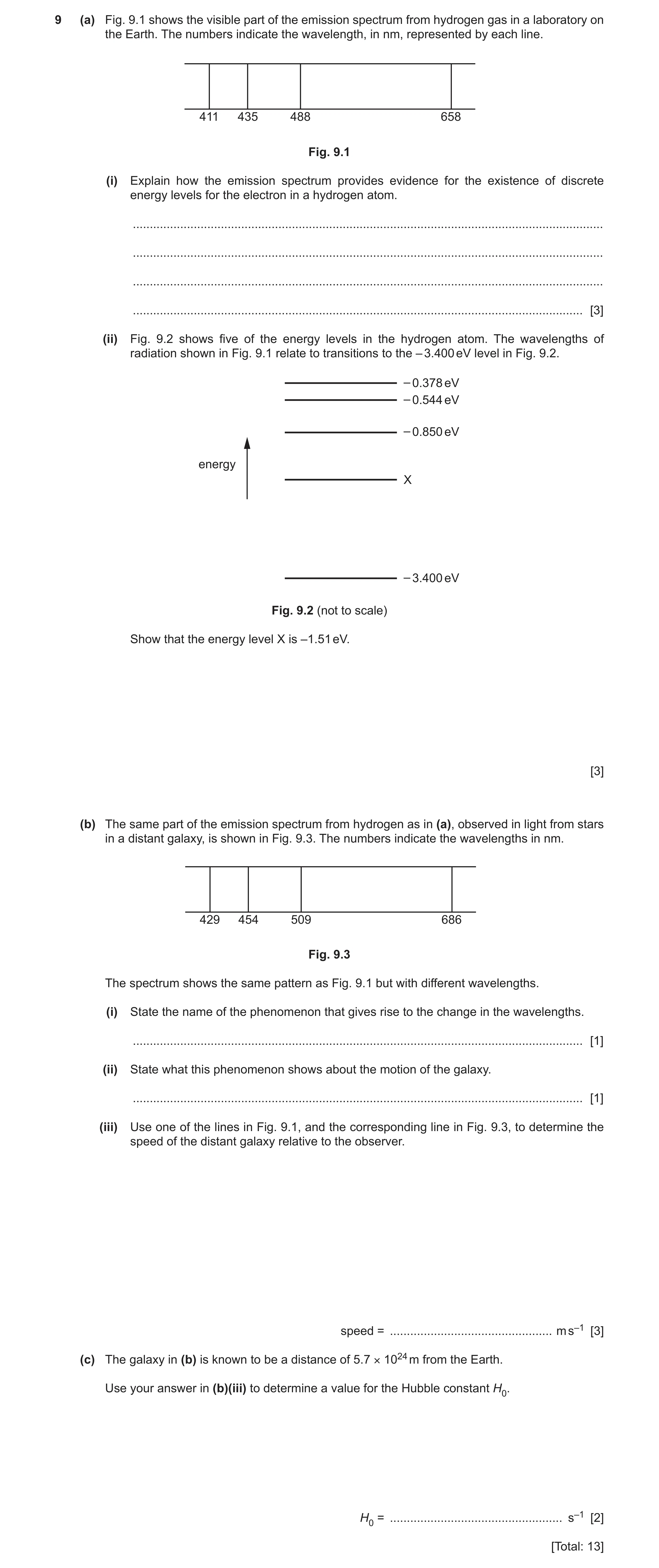
9 (a) Fig. 9.1 shows the visible part of the emission spectrum from hydrogen gas in a laboratory on the Earth. The numbers indicate the wavelength, in nm, represented by each line. 411 435 488 658 Fig. 9.1 (i) Explain how the emission spectrum provides evidence for the existence of discrete energy levels for the electron in a hydrogen atom. … … … … [3] (ii) Fig. 9.2 shows five of the energy levels in the hydrogen atom. The wavelengths of radiation shown in Fig. 9.1 relate to transitions to the – 3.400 eV level in Fig. 9.2. – 0.378 eV – 0.544 eV – 0.850 eV energy X – 3.400 eV Fig. 9.2 (not to scale) Show that the energy level X is –1.51 eV. [3] (b) The same part of the emission spectrum from hydrogen as in (a), observed in light from stars in a distant galaxy, is shown in Fig. 9.3. The numbers indicate the wavelengths in nm. 429 454 509 686 Fig. 9.3 The spectrum shows the same pattern as Fig. 9.1 but with different wavelengths. (i) State the name of the phenomenon that gives rise to the change in the wavelengths. … [1] (ii) State what this phenomenon shows about the motion of the galaxy. … [1] (iii) Use one of the lines in Fig. 9.1, and the corresponding line in Fig. 9.3, to determine the speed of the distant galaxy relative to the observer. speed = … m s–1 [3] (c) The galaxy in (b) is known to be a distance of 5.7 × 1024 m from the Earth. Use your answer in (b)(iii) to determine a value for the Hubble constant H0. H0 = … s–1 [2] [Total: 13]
13 marks
Mark scheme: 9(a)(i) • energy of photon has a corresponding frequency B3 • change in electron energy level emits a single photon • photon energy = difference in energy levels • discrete frequencies must have come from discrete energy gaps • discrete energy changes imply discrete energy levels Any three points, 1 mark each 9(a)(ii) transition (to – 3.400 eV) from X corresponds to 658 nm line C1 E1 – E2 = hc / C1 E1 – (– 3.400) = (6.63 10–34 3.00 108) / (658 10–9 1.60 10–19) A1 and so E1 = –1.51 eV (full substitution and answer needed) 9(b)(i) redshift B1 9(b)(ii) moving away (from observer) B1 9(b)(iii) / = v / c C1 e.g. for 658 nm line: = 686 – 658 ( = 28 nm) (other lines may be used) 28 / 658 = v / (3.00 108) (other lines may be used) C1 v = 1.3 107 m s–1 A1 9(c) v = H0d C1 H0 = (1.3 107) / (5.7 1024) A1 = 2.3 10–18 s–1
This question in 9702/42 Oct/Nov 2022
Q5 · A student observes different stars from the Earth 9702/42 Feb/March 2023
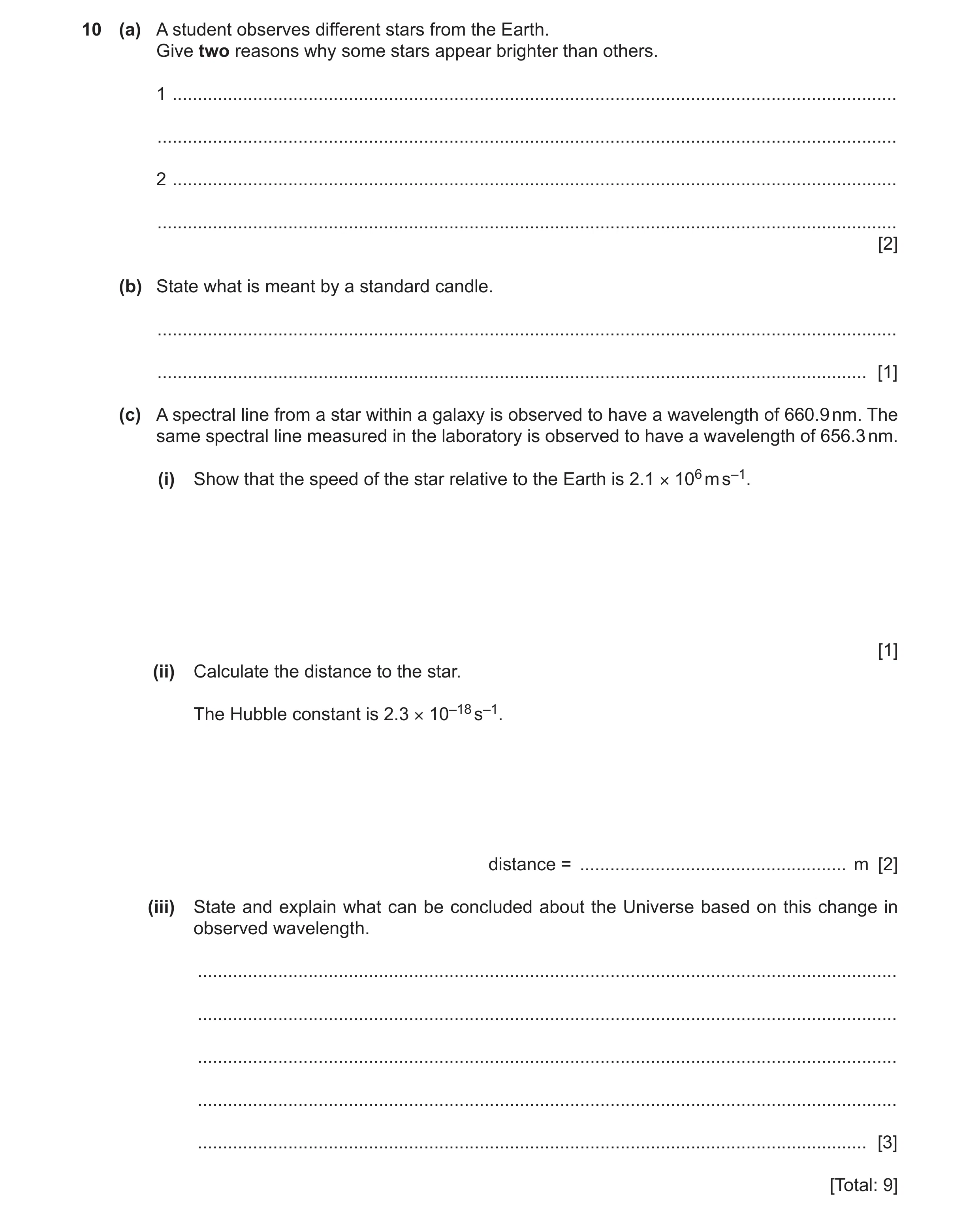
10 (a) A student observes different stars from the Earth. Give two reasons why some stars appear brighter than others. 1 … … 2 … … [2] (b) State what is meant by a standard candle. … … [1] (c) A spectral line from a star within a galaxy is observed to have a wavelength of 660.9 nm. The same spectral line measured in the laboratory is observed to have a wavelength of 656.3 nm. (i) Show that the speed of the star relative to the Earth is 2.1 × 10⁶ m s–1. [1] (ii) Calculate the distance to the star. The Hubble constant is 2.3 × 10⁻¹⁸ s–1. distance = … m [2] (iii) State and explain what can be concluded about the Universe based on this change in observed wavelength. … … … … … [3] [Total: 9]
9 marks
Mark scheme: 10(a) brighter star could be closer (to Earth) B1 brighter star could have a greater luminosity (in the visible wavelengths) B1 10(b) object with known luminosity B1 10(c)(i) 660.9 − 656.3 v B1 leading to 2.1 106 m s–1 656.3 3.0 108 10(c)(ii) v = Hod C1 d = 2.1 106 / 2.3 10–18 A1 = 9.1 1023 m 10(c)(iii) wavelength has increased / light is redshifted B1 star within galaxy is moving away / receding (from Earth) B1 Universe is expanding B1
This question in 9702/42 Feb/March 2023
Question 6 9702/41 May/June 2023
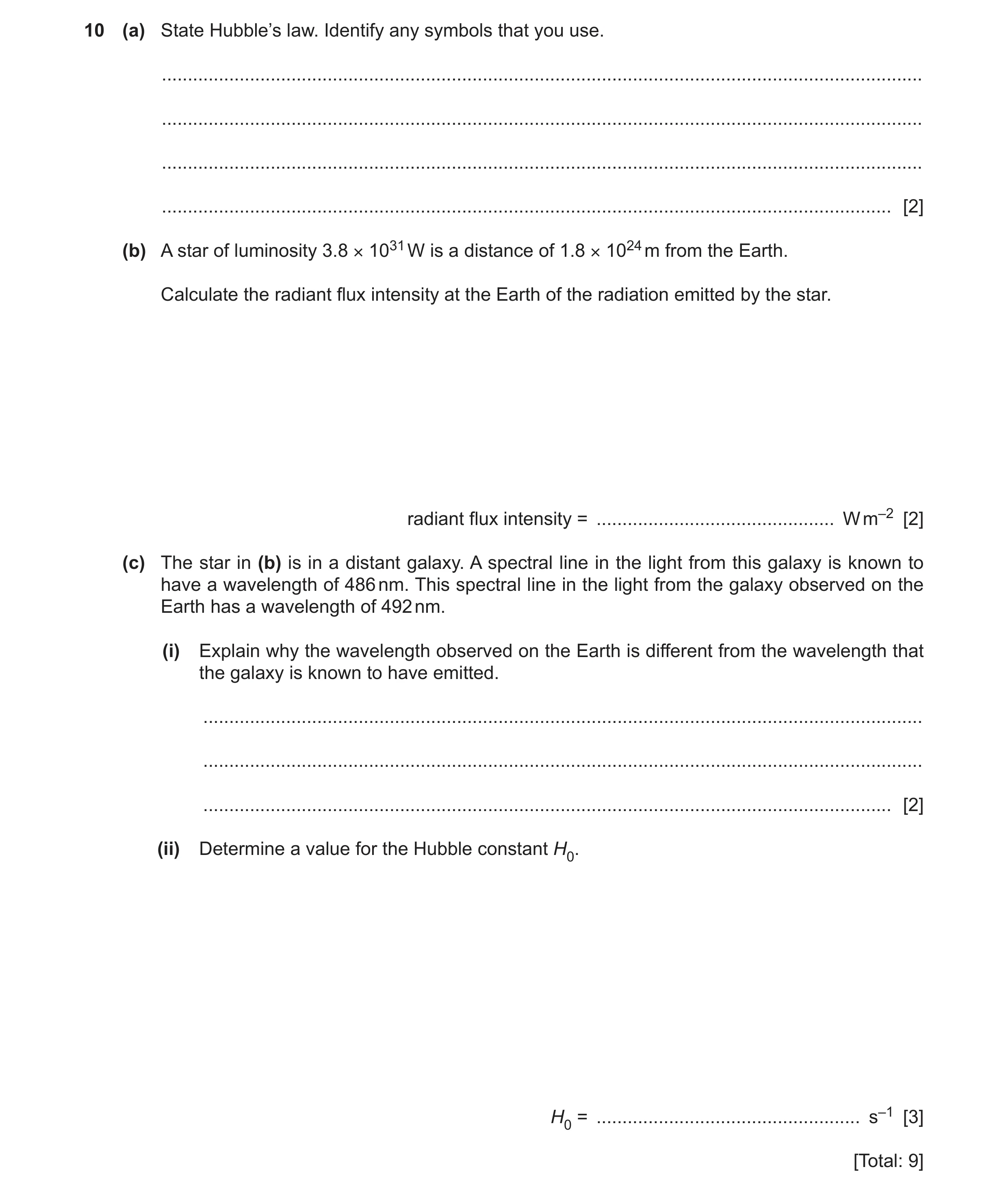
10 (a) State Hubble’s law. Identify any symbols that you use. … … … … [2] (b) A star of luminosity 3.8 × 1031 W is a distance of 1.8 × 1024 m from the Earth. Calculate the radiant flux intensity at the Earth of the radiation emitted by the star. radiant flux intensity = … W m–2 [2] (c) The star in (b) is in a distant galaxy. A spectral line in the light from this galaxy is known to have a wavelength of 486 nm. This spectral line in the light from the galaxy observed on the Earth has a wavelength of 492 nm. (i) Explain why the wavelength observed on the Earth is different from the wavelength that the galaxy is known to have emitted. … … … [2] (ii) Determine a value for the Hubble constant H0. H0 = … s–1 [3] [Total: 9]
9 marks
Mark scheme: 10(a) speed is (directly) proportional to distance M1 speed is speed of recession of galaxy from an observer, and distance is the distance of the galaxy from the observer A1 10(b) F = L / (4d2) C1 = (3.8 1031) / [4 (1.8 1024)2] = 9.3 10–19 W m–2 A1 10(c)(i) galaxy is moving away (from the Earth) B1 wavelength (of light from the galaxy) increased by the Doppler effect / due to redshift B1 10(c)(ii) / = v / c v = [(492 – 486) 3.00 108] / 486 (v = 3.7 106 m s–1) C1 H0 = v / d C1 = (3.7 106) / (1.8 1024) = 2.1 10–18 s–1 A1
This question in 9702/41 May/June 2023
Question 7 9702/43 May/June 2023
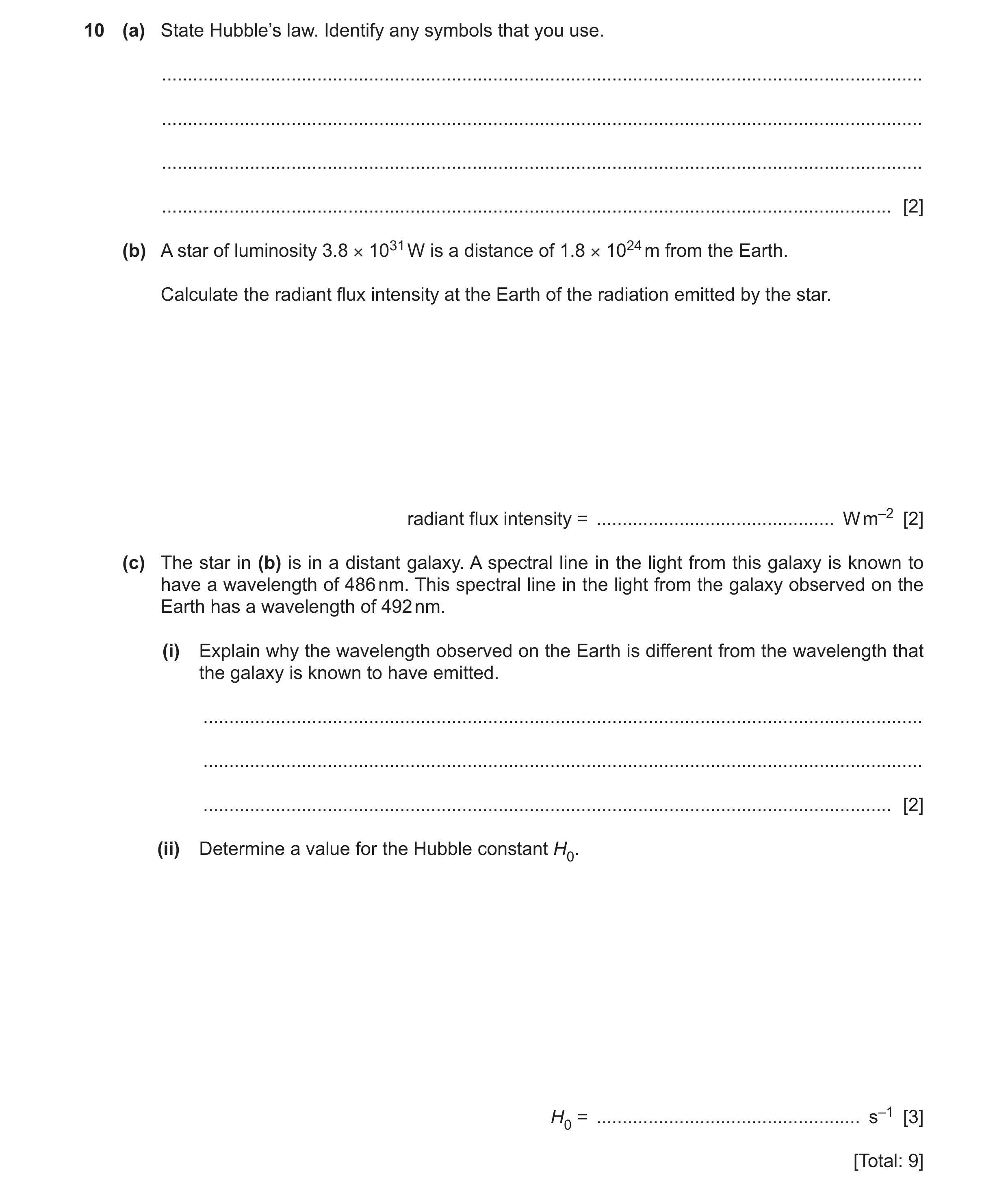
10 (a) State Hubble’s law. Identify any symbols that you use. … … … … [2] (b) A star of luminosity 3.8 × 1031 W is a distance of 1.8 × 1024 m from the Earth. Calculate the radiant flux intensity at the Earth of the radiation emitted by the star. radiant flux intensity = … W m–2 [2] (c) The star in (b) is in a distant galaxy. A spectral line in the light from this galaxy is known to have a wavelength of 486 nm. This spectral line in the light from the galaxy observed on the Earth has a wavelength of 492 nm. (i) Explain why the wavelength observed on the Earth is different from the wavelength that the galaxy is known to have emitted. … … … [2] (ii) Determine a value for the Hubble constant H0. H0 = … s–1 [3] [Total: 9]
9 marks
Mark scheme: 10(a) speed is (directly) proportional to distance M1 speed is speed of recession of galaxy from an observer, and distance is the distance of the galaxy from the observer A1 10(b) F = L / (4d2) C1 = (3.8 1031) / [4 (1.8 1024)2] = 9.3 10–19 W m–2 A1 10(c)(i) galaxy is moving away (from the Earth) B1 wavelength (of light from the galaxy) increased by the Doppler effect / due to redshift B1 10(c)(ii) / = v / c v = [(492 – 486) 3.00 108] / 486 (v = 3.7 106 m s–1) C1 H0 = v / d C1 = (3.7 106) / (1.8 1024) = 2.1 10–18 s–1 A1
This question in 9702/43 May/June 2023
Q8 · Part of the emission spectrum of visible radiation emitted by hydrogen gas in a star in a… 9702/42 May/June 2024
8 Fig. 8.1 shows part of the emission spectrum of visible radiation emitted by hydrogen gas in a star in a distant galaxy. increasing frequency Fig. 8.1 The galaxy is moving away from the Earth at a speed of 6.2 × 10⁶ m s–1. (a) (i) Explain how the positions of the lines in the emission spectrum seen by an observer on the Earth differ from the positions shown in Fig. 8.1. … … … [2] (ii) On Fig. 8.1, draw the three lines in possible positions in the spectrum seen by the observer. [2] (b) The lines in Fig. 8.1 correspond to electron transitions down to the energy level –3.40 eV. One of the lines represents emitted radiation of wavelength 488 nm. (i) Calculate the energy of a photon of this radiation. photon energy = … J [2] (ii) Determine the energy, in eV, of the energy level from which the electron transition originates to cause the emission of this radiation. energy level = … eV [2] (iii) Determine the wavelength, in nm, of this radiation as detected by the observer on the Earth. wavelength = … nm [2] (c) A value for the Hubble constant is 2.3 × 10⁻¹⁸ s–1. Determine the distance of the galaxy from the Earth. distance = … m [2] [Total: 12]
12 marks
Mark scheme: 8(a)(i) movement of star causes change in (observed) frequency or movement of star causes redshift B1 observed frequency is lower (than emitted frequency) B1 8(a)(ii) all three lines shown to left of corresponding printed lines B1 distance between drawn line and corresponding printed line approximately the same for all three lines B1 8(b)(i) E = hf and = c / f C1 E = (6.63 10–34 3.00 108) / (488 10–9) = 4.08 10–19 J A1 8(b)(ii) photon energy = (4.08 10–19) / (1.60 10–19) = 2.55 eV C1 energy level = –3.40 + 2.55 = –0.85 eV A1 8(b)(iii) = (v / c) = (488 6.2 106) / (3.00 108) ( = 10 nm) C1 observed wavelength = 488 + = 488 + 10 = 498 nm A1 Question Answer Marks 8(c) v = H0d C1 d = (6.2 106) / (2.3 10–18) = 2.7 1024 m A1
This question in 9702/42 May/June 2024
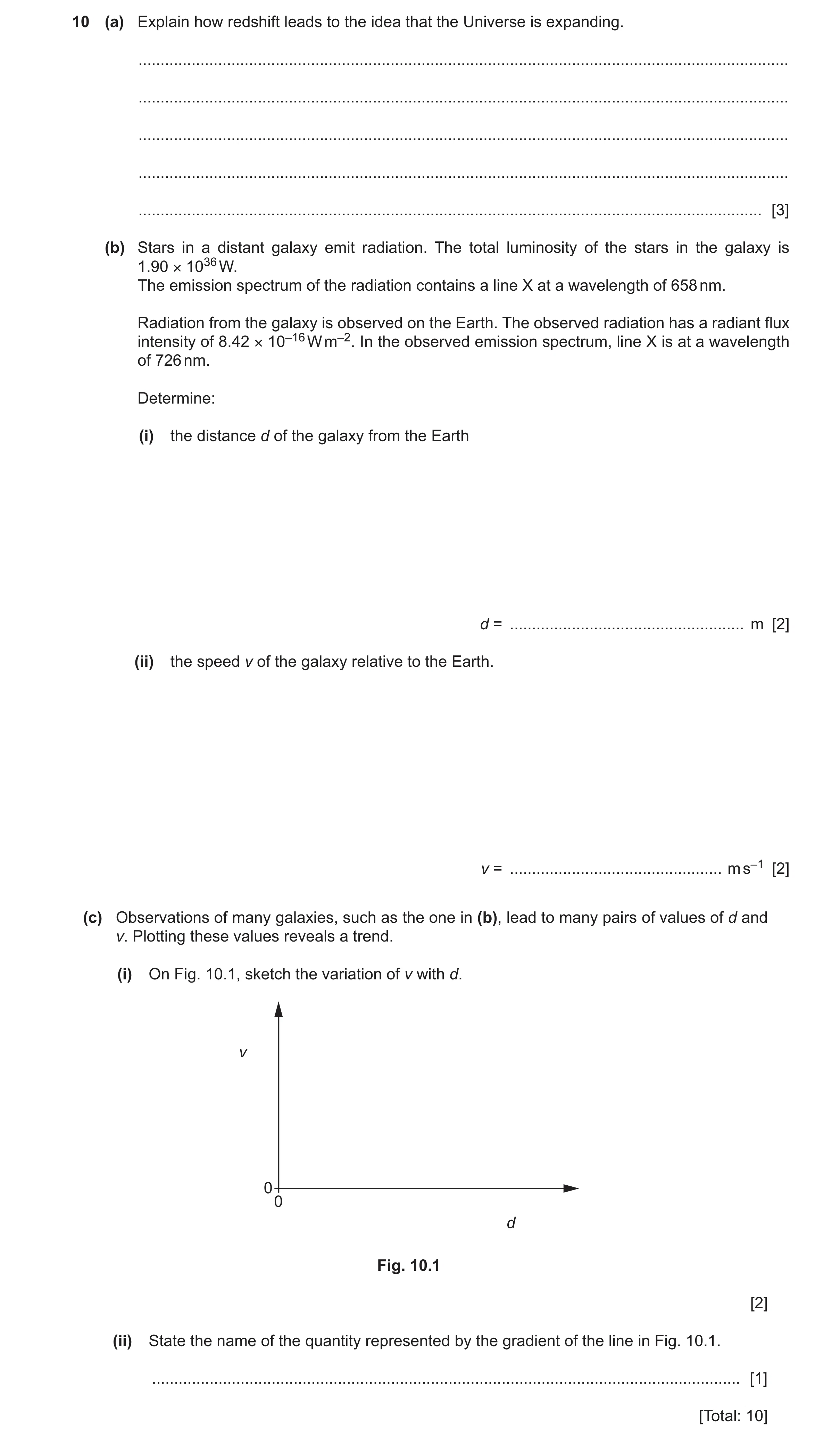
Q9 · Explain how redshift leads to the idea that the Universe is expanding 9702/41 Oct/Nov 2024
10 (a) Explain how redshift leads to the idea that the Universe is expanding. … … … … … [3] (b) Stars in a distant galaxy emit radiation. The total luminosity of the stars in the galaxy is 1.90 × 1036 W. The emission spectrum of the radiation contains a line X at a wavelength of 658 nm. Radiation from the galaxy is observed on the Earth. The observed radiation has a radiant flux intensity of 8.42 × 10⁻¹⁶ W m–2. In the observed emission spectrum, line X is at a wavelength of 726 nm. Determine: (i) the distance d of the galaxy from the Earth d = … m [2] (ii) the speed v of the galaxy relative to the Earth. v = … m s–1 [2] (c) Observations of many galaxies, such as the one in (b), lead to many pairs of values of d and v. Plotting these values reveals a trend. (i) On Fig. 10.1, sketch the variation of v with d. v 0 0 d Fig. 10.1 [2] (ii) State the name of the quantity represented by the gradient of the line in Fig. 10.1. … [1] [Total: 10]
10 marks
Mark scheme: 10(a) • redshift is the increase in observed wavelength / decrease in observed frequency (caused by Doppler effect) B3 • radiation from distant galaxies is observed to be redshifted • redshift provides evidence that galaxies are moving apart • galaxies moving apart means Universe must be expanding Any three points, 1 mark each 10(b)(i) F = L / 4d2 C1 d = √(1.90 1036 / [4 8.42 10–16]) A1 = 1.34 1025 m 10(b)(ii) / = v / c C1 (726 – 658) / 658 = v / (3.00 108) v = 3.1 107 m s–1 A1 10(c)(i) line with positive gradient passing through the origin B1 straight line with positive gradient B1 10(c)(ii) Hubble constant B1
This question in 9702/41 Oct/Nov 2024
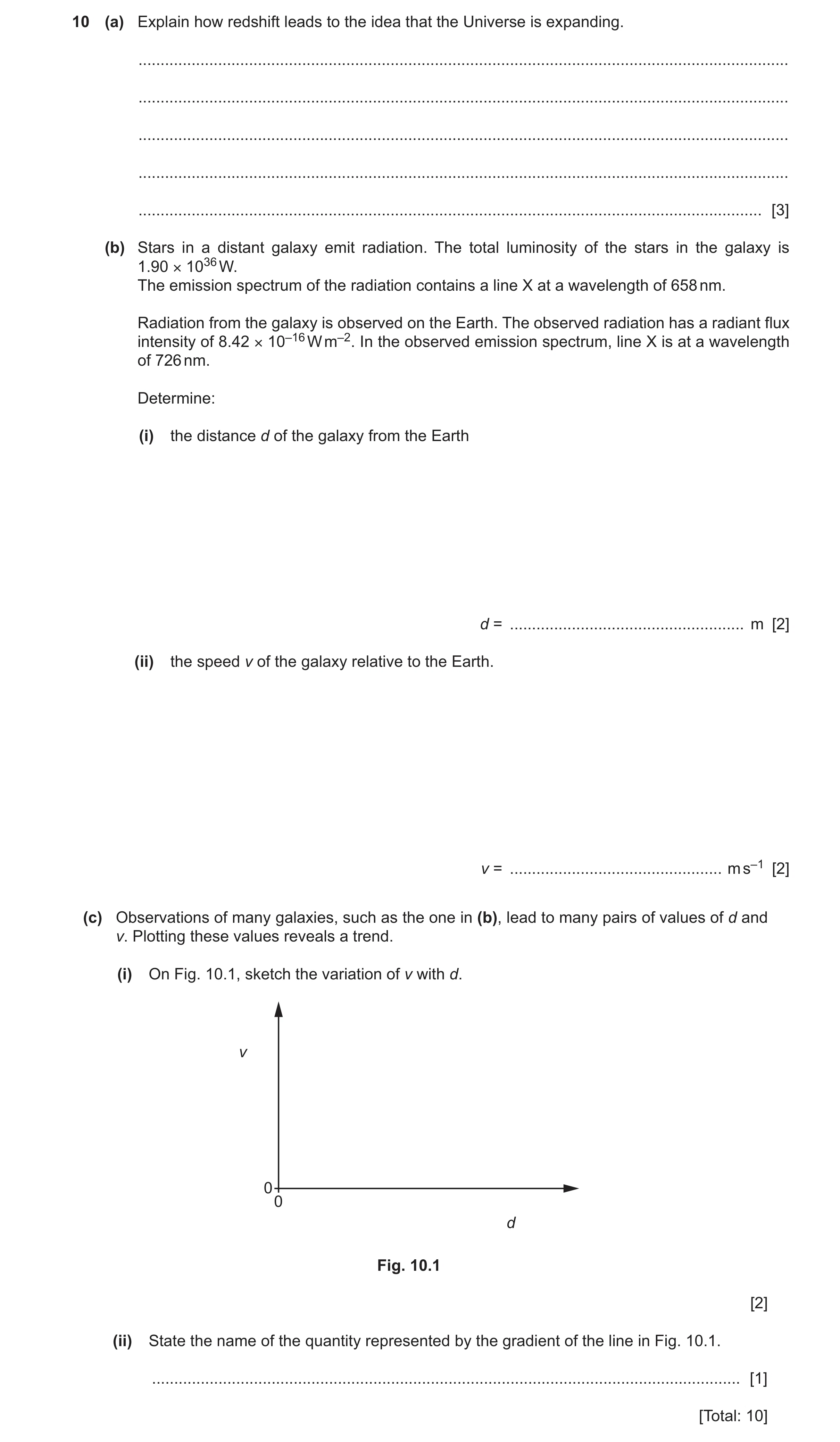
Q10 · Explain how redshift leads to the idea that the Universe is expanding 9702/43 Oct/Nov 2024
10 (a) Explain how redshift leads to the idea that the Universe is expanding. … … … … … [3] (b) Stars in a distant galaxy emit radiation. The total luminosity of the stars in the galaxy is 1.90 × 1036 W. The emission spectrum of the radiation contains a line X at a wavelength of 658 nm. Radiation from the galaxy is observed on the Earth. The observed radiation has a radiant flux intensity of 8.42 × 10⁻¹⁶ W m–2. In the observed emission spectrum, line X is at a wavelength of 726 nm. Determine: (i) the distance d of the galaxy from the Earth d = … m [2] (ii) the speed v of the galaxy relative to the Earth. v = … m s–1 [2] (c) Observations of many galaxies, such as the one in (b), lead to many pairs of values of d and v. Plotting these values reveals a trend. (i) On Fig. 10.1, sketch the variation of v with d. v 0 0 d Fig. 10.1 [2] (ii) State the name of the quantity represented by the gradient of the line in Fig. 10.1. … [1] [Total: 10]
10 marks
Mark scheme: 10(a) • redshift is the increase in observed wavelength / decrease in observed frequency (caused by Doppler effect) B3 • radiation from distant galaxies is observed to be redshifted • redshift provides evidence that galaxies are moving apart • galaxies moving apart means Universe must be expanding Any three points, 1 mark each 10(b)(i) F = L / 4d2 C1 d = √(1.90 1036 / [4 8.42 10–16]) A1 = 1.34 1025 m 10(b)(ii) / = v / c C1 (726 – 658) / 658 = v / (3.00 108) v = 3.1 107 m s–1 A1 10(c)(i) line with positive gradient passing through the origin B1 straight line with positive gradient B1 10(c)(ii) Hubble constant B1
This question in 9702/43 Oct/Nov 2024
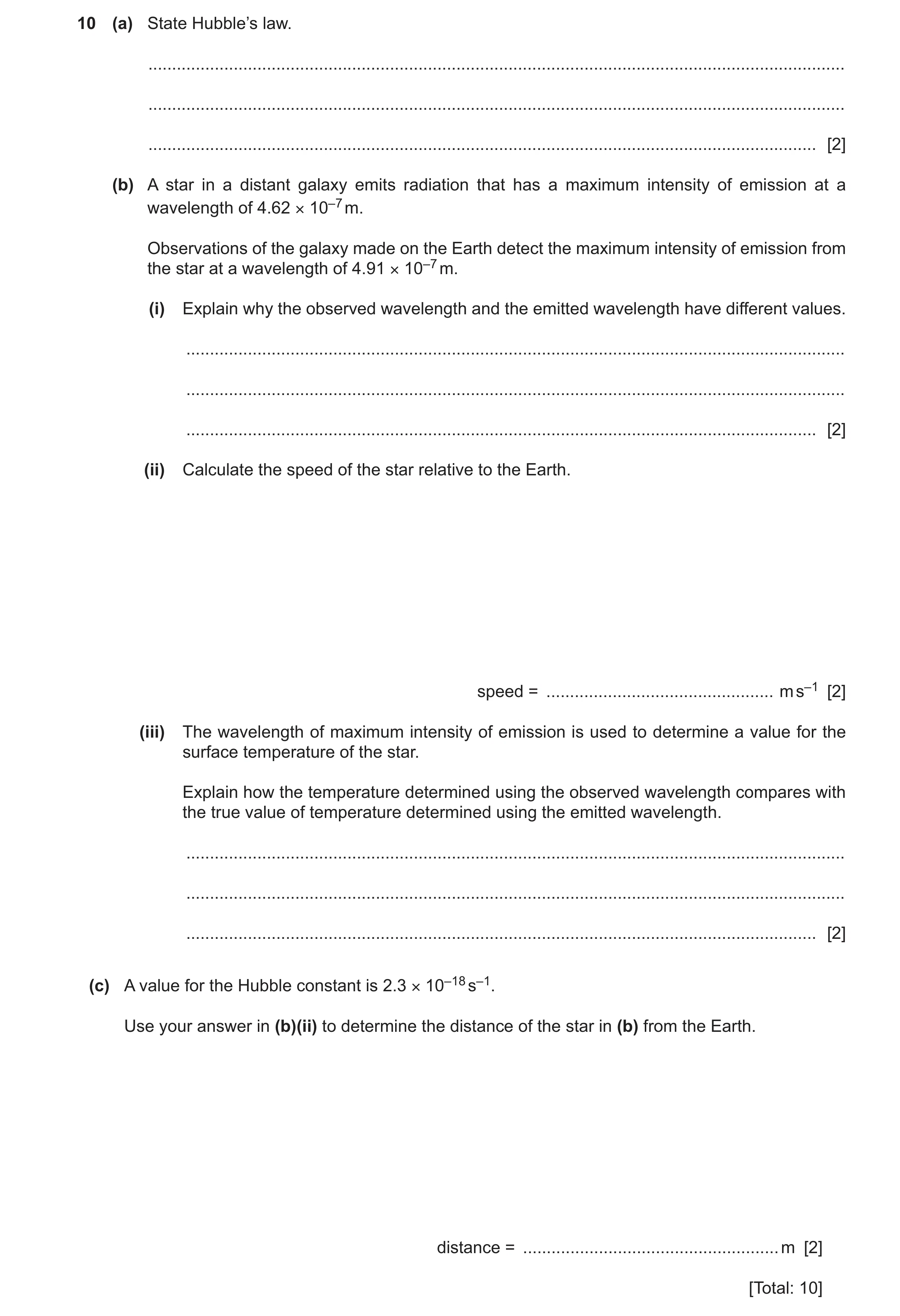
Question 11 9702/41 May/June 2025
10 (a) State Hubble’s law. … … … [2] (b) A star in a distant galaxy emits radiation that has a maximum intensity of emission at a wavelength of 4.62 × 10⁻⁷ m. Observations of the galaxy made on the Earth detect the maximum intensity of emission from the star at a wavelength of 4.91 × 10⁻⁷ m. (i) Explain why the observed wavelength and the emitted wavelength have different values. … … … [2] (ii) Calculate the speed of the star relative to the Earth. speed = … m s–1 [2] (iii) The wavelength of maximum intensity of emission is used to determine a value for the surface temperature of the star. Explain how the temperature determined using the observed wavelength compares with the true value of temperature determined using the emitted wavelength. … … … [2] (c) A value for the Hubble constant is 2.3 × 10⁻¹⁸ s–1. Use your answer in (b)(ii) to determine the distance of the star in (b) from the Earth. distance = … m [2] [Total: 10]
10 marks
Mark scheme: 10(a) speed is (directly) proportional to distance M1 speed is speed of recession of galaxy from an observer, and distance is the distance of the galaxy from the observer A1 10(b)(i) galaxy is receding from the Earth B1 observed wavelength is redshifted from emitted wavelength B1 10(b)(ii) / = v / c C1 (4.91 – 4.62) / 4.62 = v / (3.00 × 10⁸) v = 1.9 × 10⁷ m s–1 A1 10(b)(iii) wavelength (of maximum intensity) is inversely proportional to temperature B1 observed wavelength too high, so determined temperature too low B1 10(c) v = H0d C1 d = (1.9 × 10⁷) / (2.3 × 10⁻¹⁸) A1 = 8.3 × 1024 m
This question in 9702/41 May/June 2025
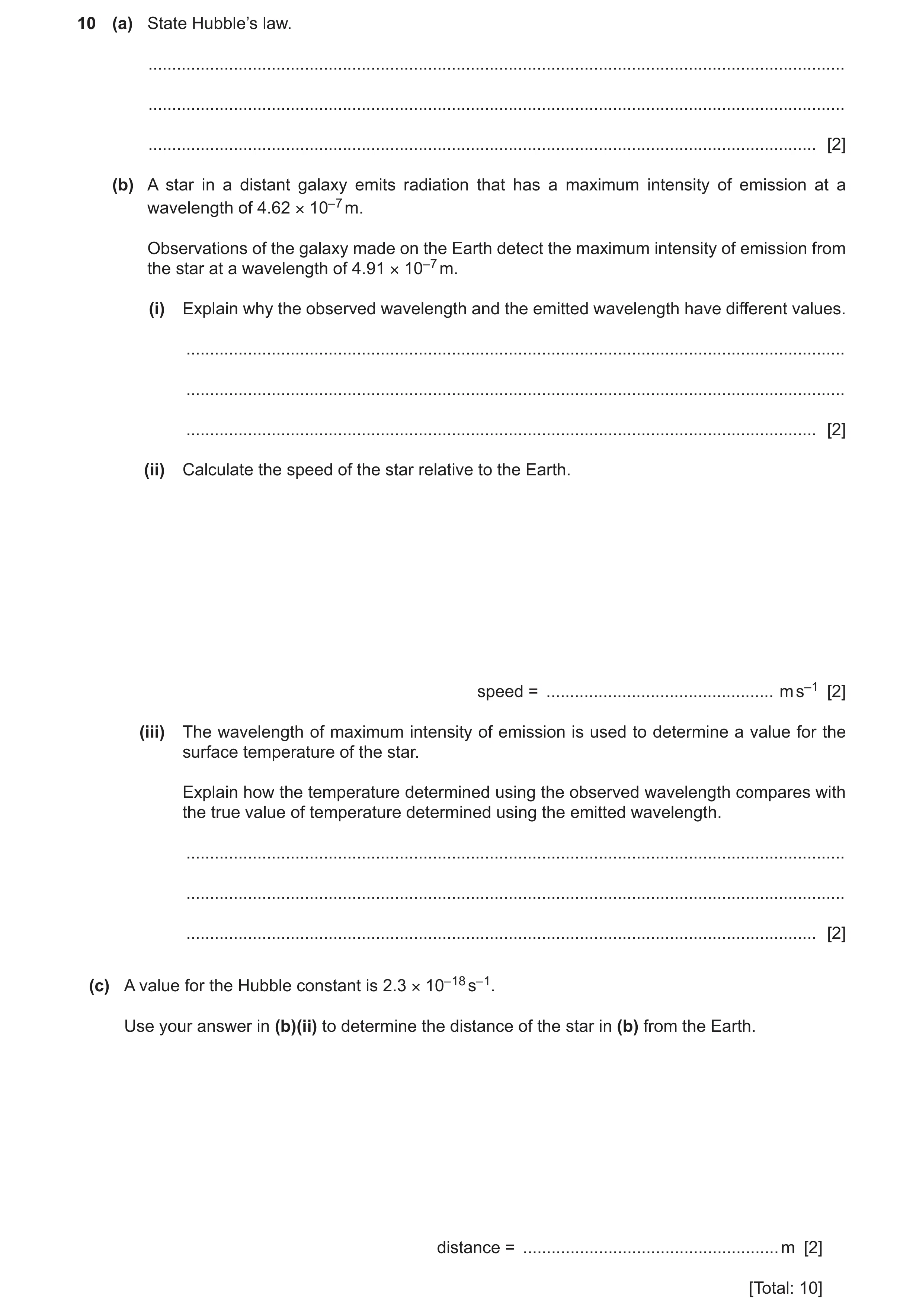
Question 12 9702/43 May/June 2025
10 (a) State Hubble’s law. … … … [2] (b) A star in a distant galaxy emits radiation that has a maximum intensity of emission at a wavelength of 4.62 × 10⁻⁷ m. Observations of the galaxy made on the Earth detect the maximum intensity of emission from the star at a wavelength of 4.91 × 10⁻⁷ m. (i) Explain why the observed wavelength and the emitted wavelength have different values. … … … [2] (ii) Calculate the speed of the star relative to the Earth. speed = … m s–1 [2] (iii) The wavelength of maximum intensity of emission is used to determine a value for the surface temperature of the star. Explain how the temperature determined using the observed wavelength compares with the true value of temperature determined using the emitted wavelength. … … … [2] (c) A value for the Hubble constant is 2.3 × 10⁻¹⁸ s–1. Use your answer in (b)(ii) to determine the distance of the star in (b) from the Earth. distance = … m [2] [Total: 10]
10 marks
Mark scheme: 10(a) speed is (directly) proportional to distance M1 speed is speed of recession of galaxy from an observer, and distance is the distance of the galaxy from the observer A1 10(b)(i) galaxy is receding from the Earth B1 observed wavelength is redshifted from emitted wavelength B1 10(b)(ii) / = v / c C1 (4.91 – 4.62) / 4.62 = v / (3.00 × 10⁸) v = 1.9 × 10⁷ m s–1 A1 10(b)(iii) wavelength (of maximum intensity) is inversely proportional to temperature B1 observed wavelength too high, so determined temperature too low B1 10(c) v = H0d C1 d = (1.9 × 10⁷) / (2.3 × 10⁻¹⁸) A1 = 8.3 × 1024 m
This question in 9702/43 May/June 2025
Q13 · State what is meant by redshift 9702/44 Oct/Nov 2025
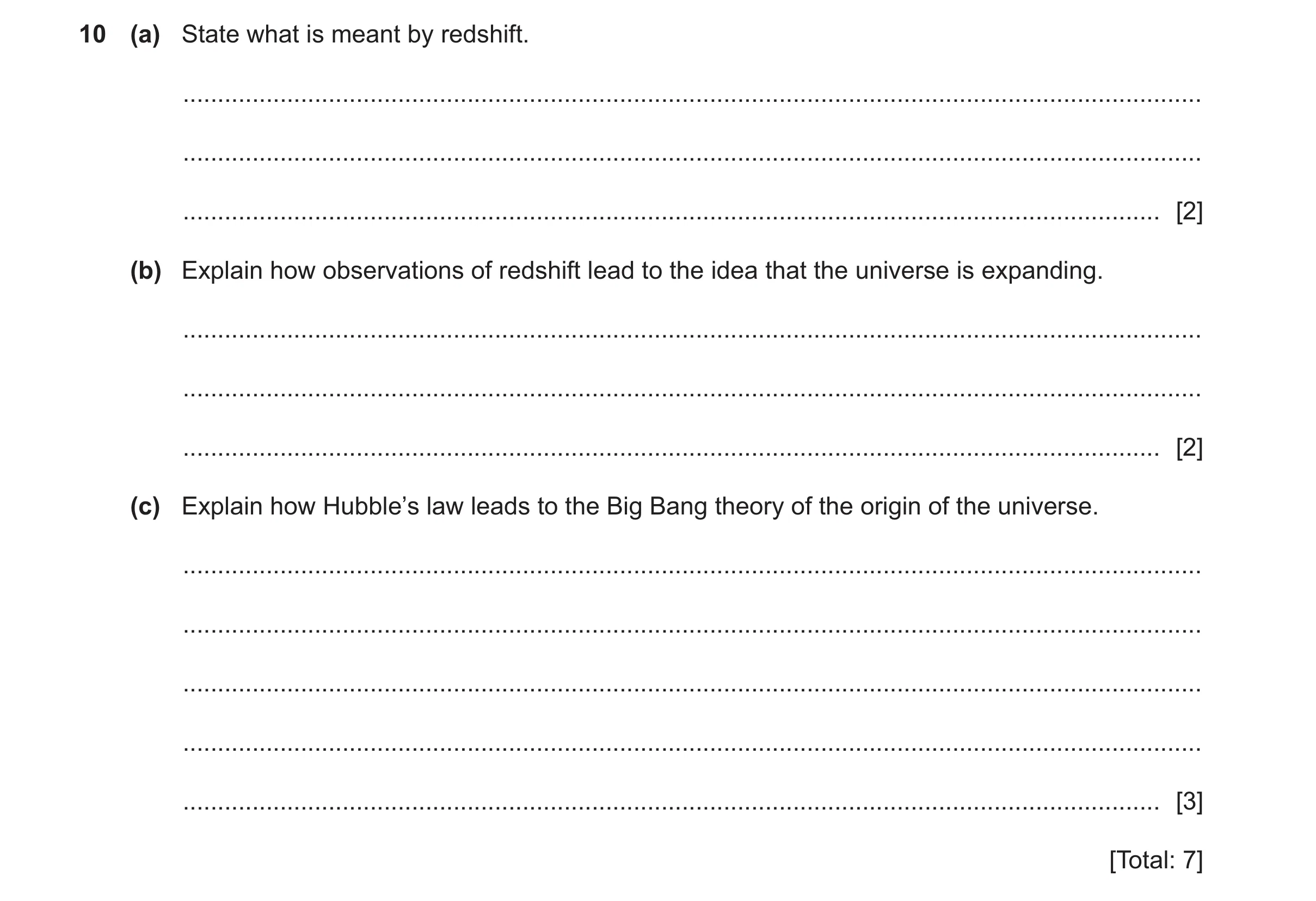
10 (a) State what is meant by redshift. … … … [2] (b) Explain how observations of redshift lead to the idea that the universe is expanding. … … … [2] (c) Explain how Hubble’s law leads to the Big Bang theory of the origin of the universe. … … … … … [3] [Total: 7]
7 marks
Mark scheme: 10(a) recession of galaxy (from observer) causes emitted light to have B1 increase in observed wavelength / decrease in observed frequency B1 10(b) (distant) galaxies show redshift so galaxies are moving apart B1 galaxies moving apart means universe must be expanding B1 10(c) the speed of recession is proportional to the distance of the galaxies from each other B1 or more distant galaxies are receding faster Any two points from: B2 • more distant galaxies represent further back in time • a long time ago, all matter in the universe must have been very close together • a long time ago, all matter in the universe must have been moving apart very fast
This question in 9702/44 Oct/Nov 2025
 2 / 15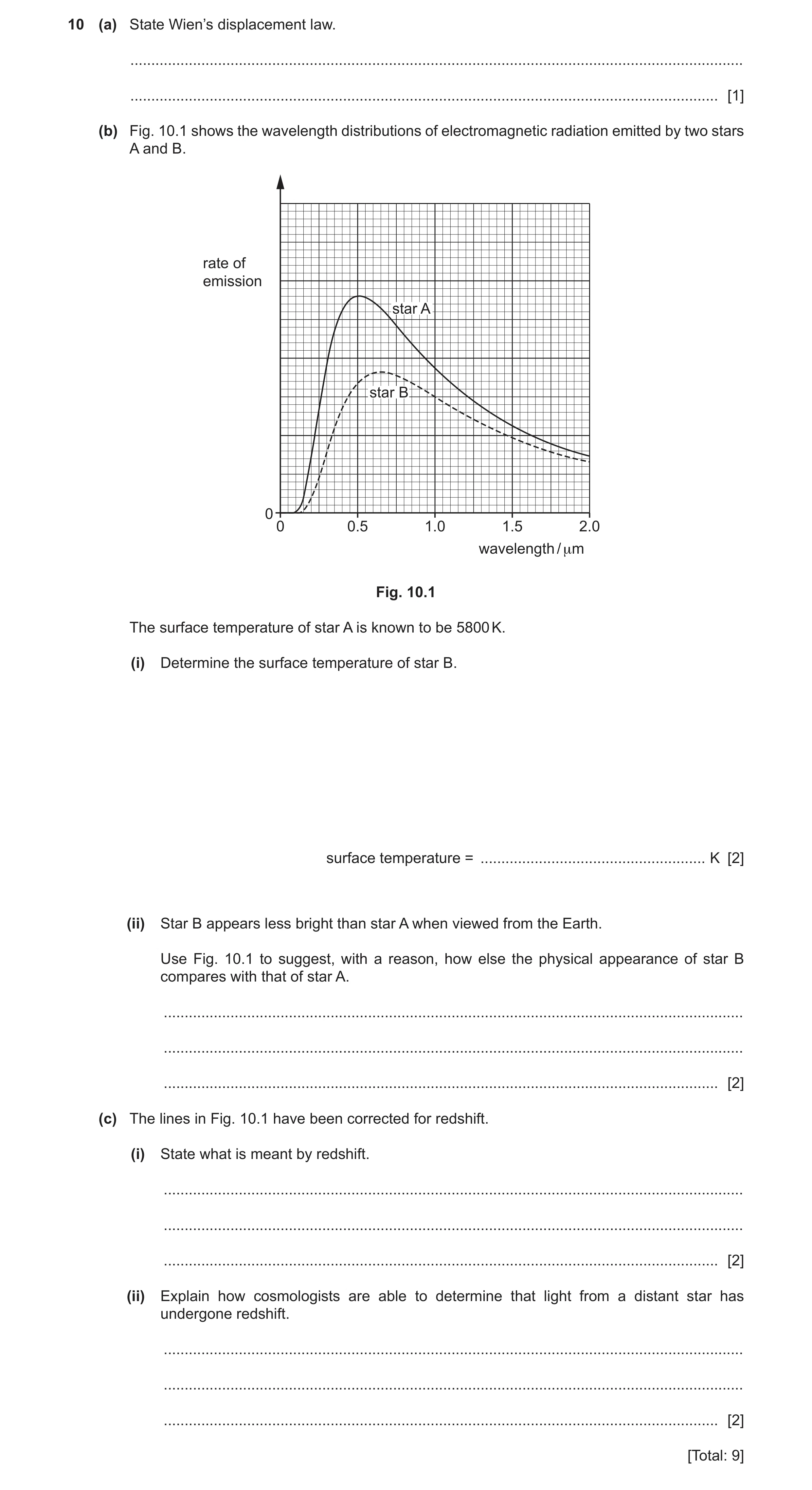
 6 / 15
 7 / 15
 8 / 15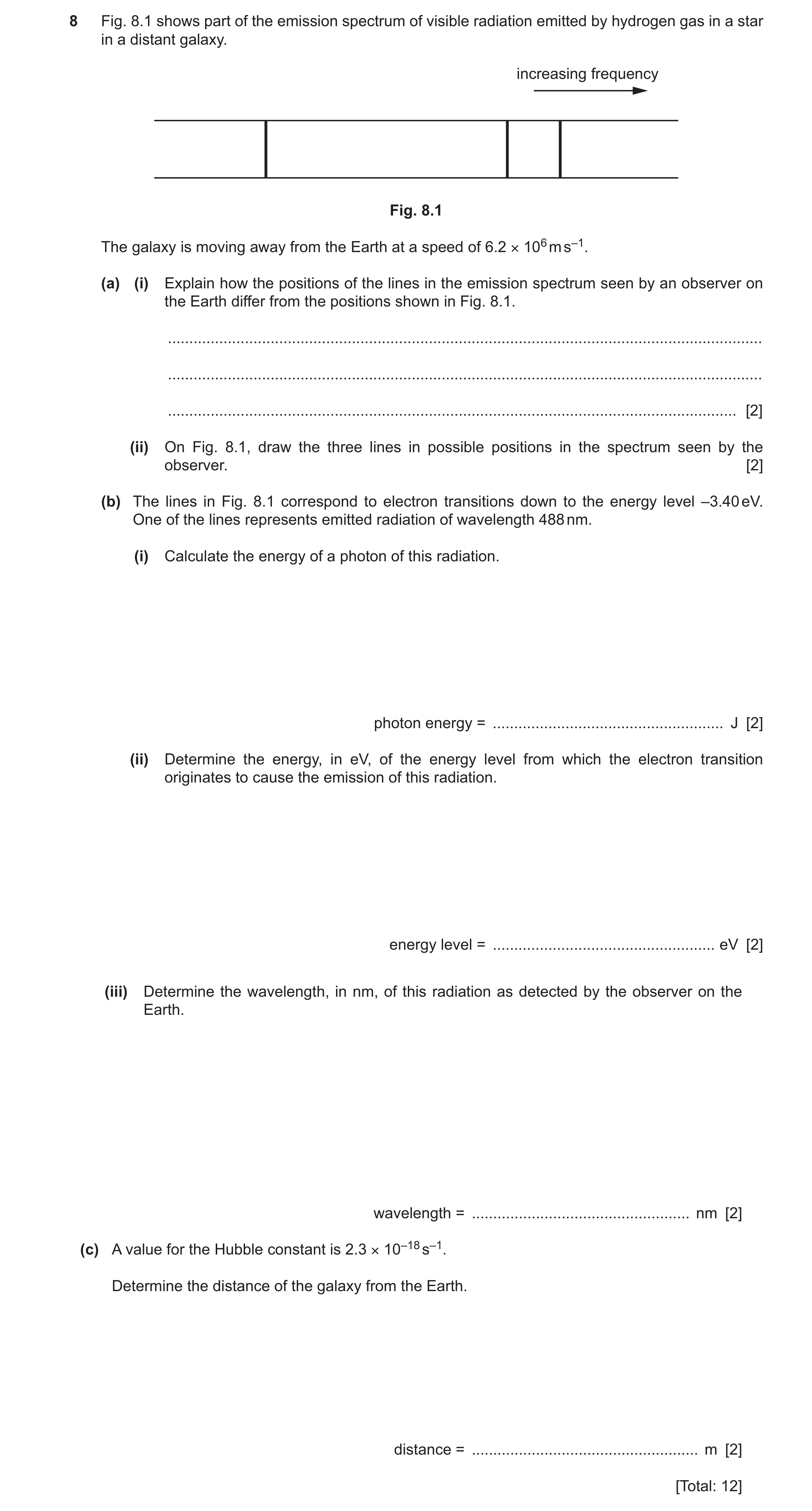
 15 / 15
 9
9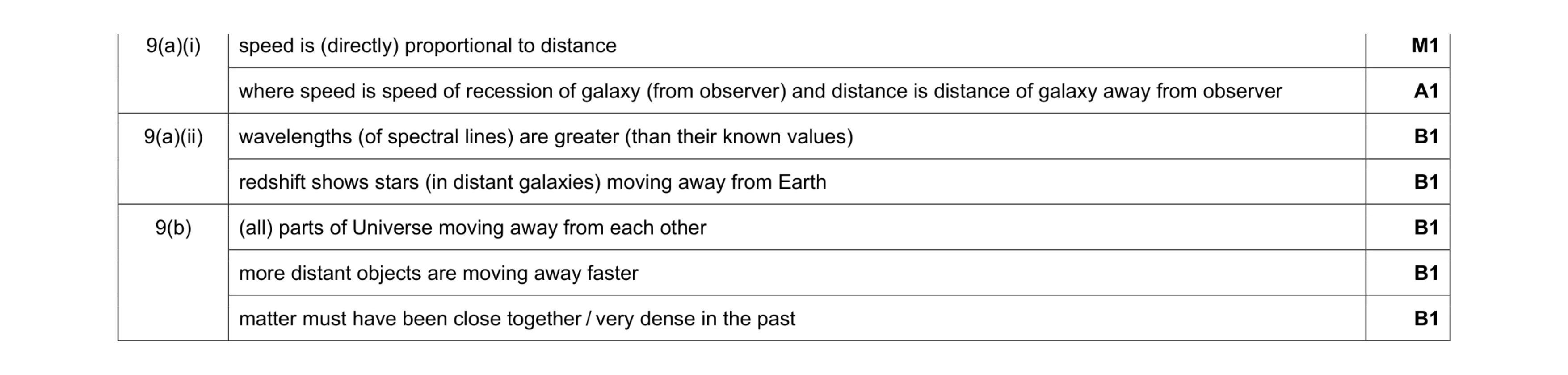 7
7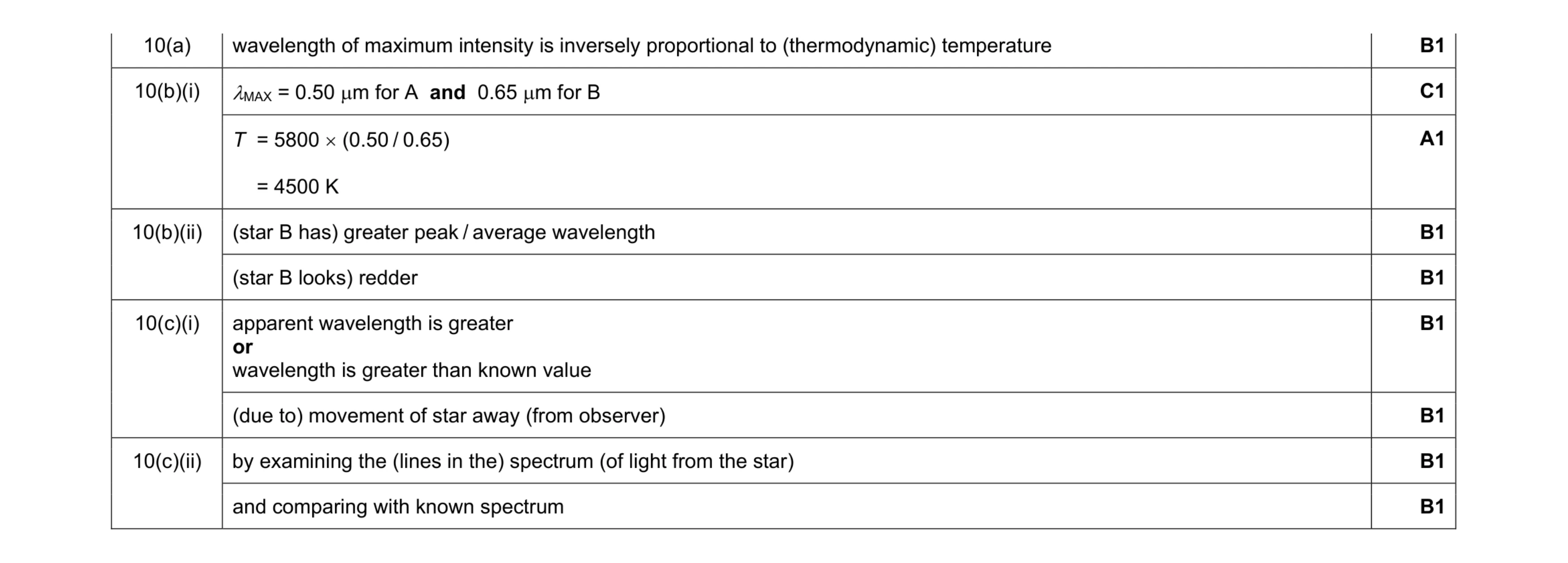 9
9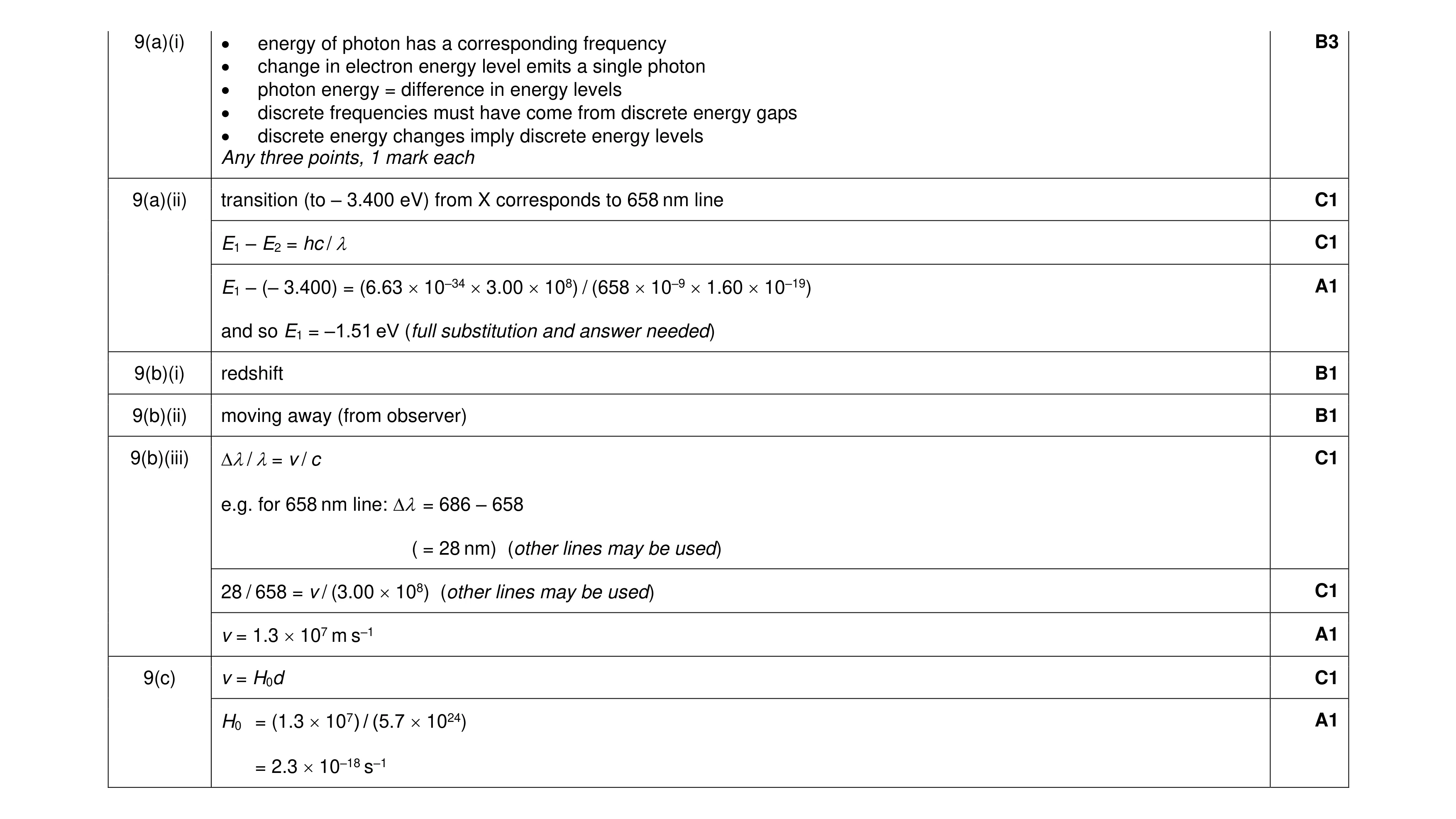 13
13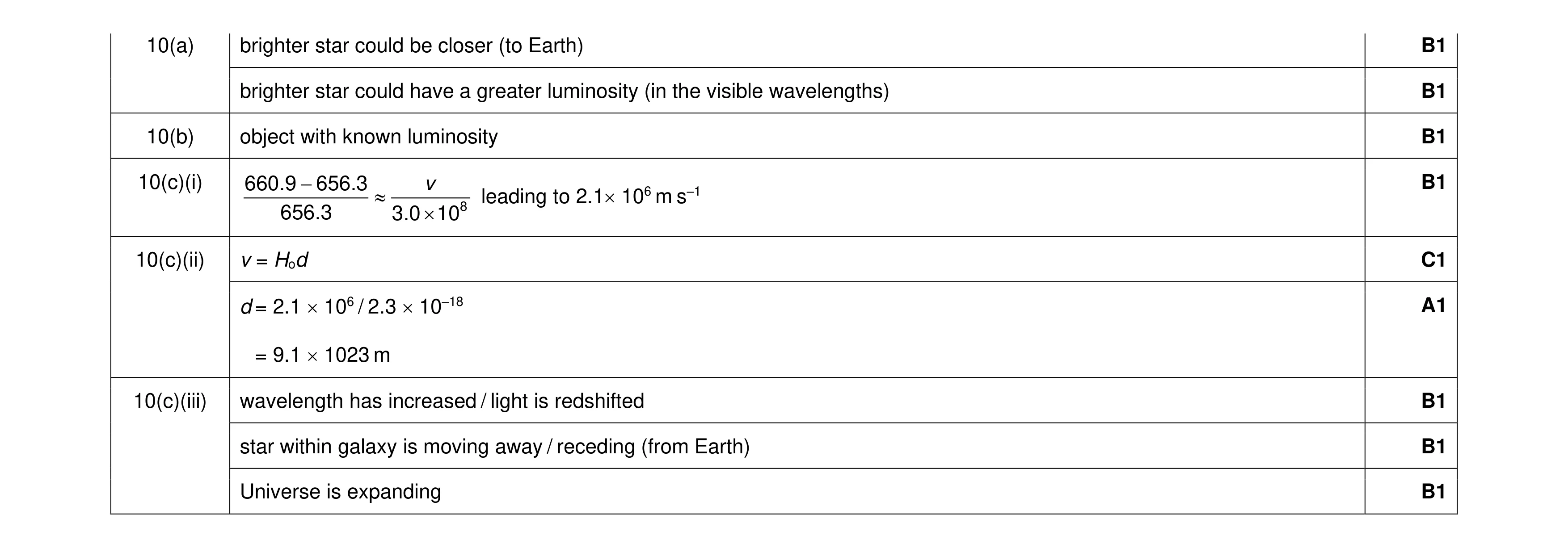 9
9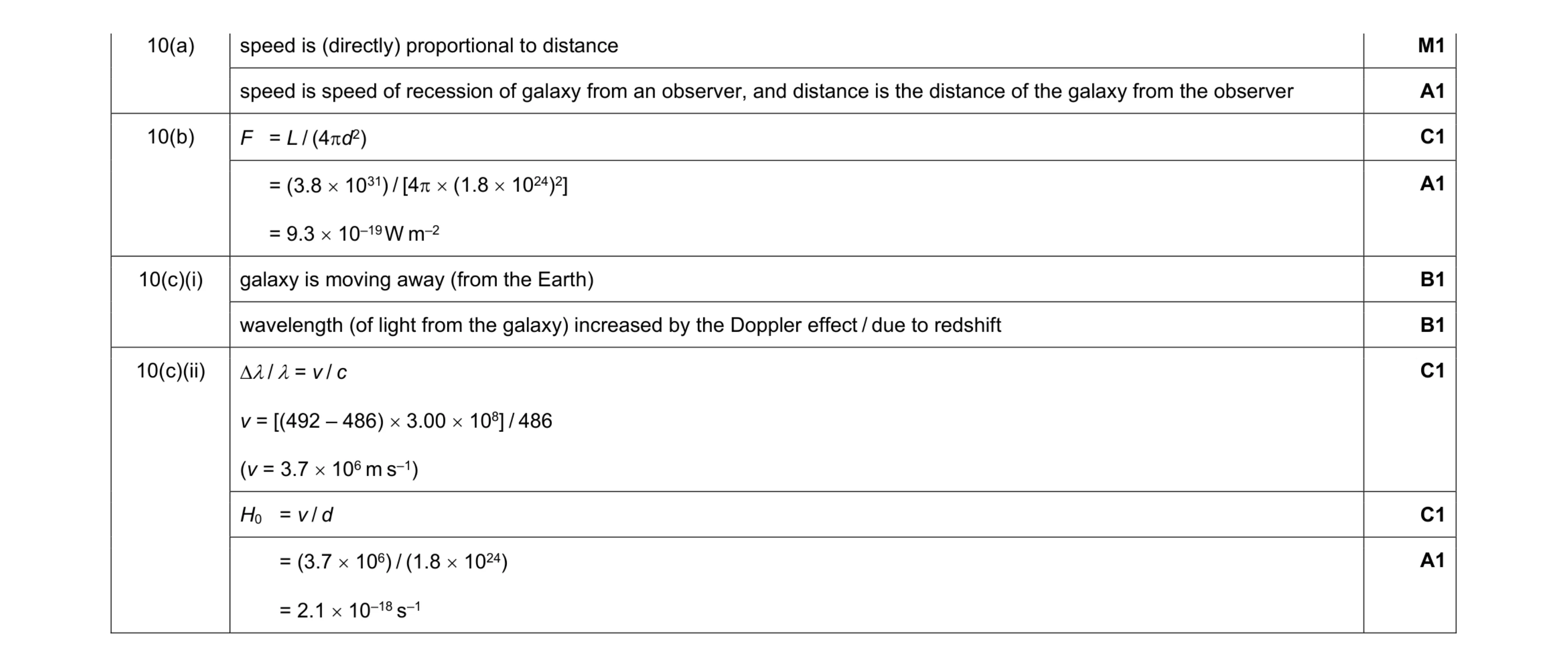 9
9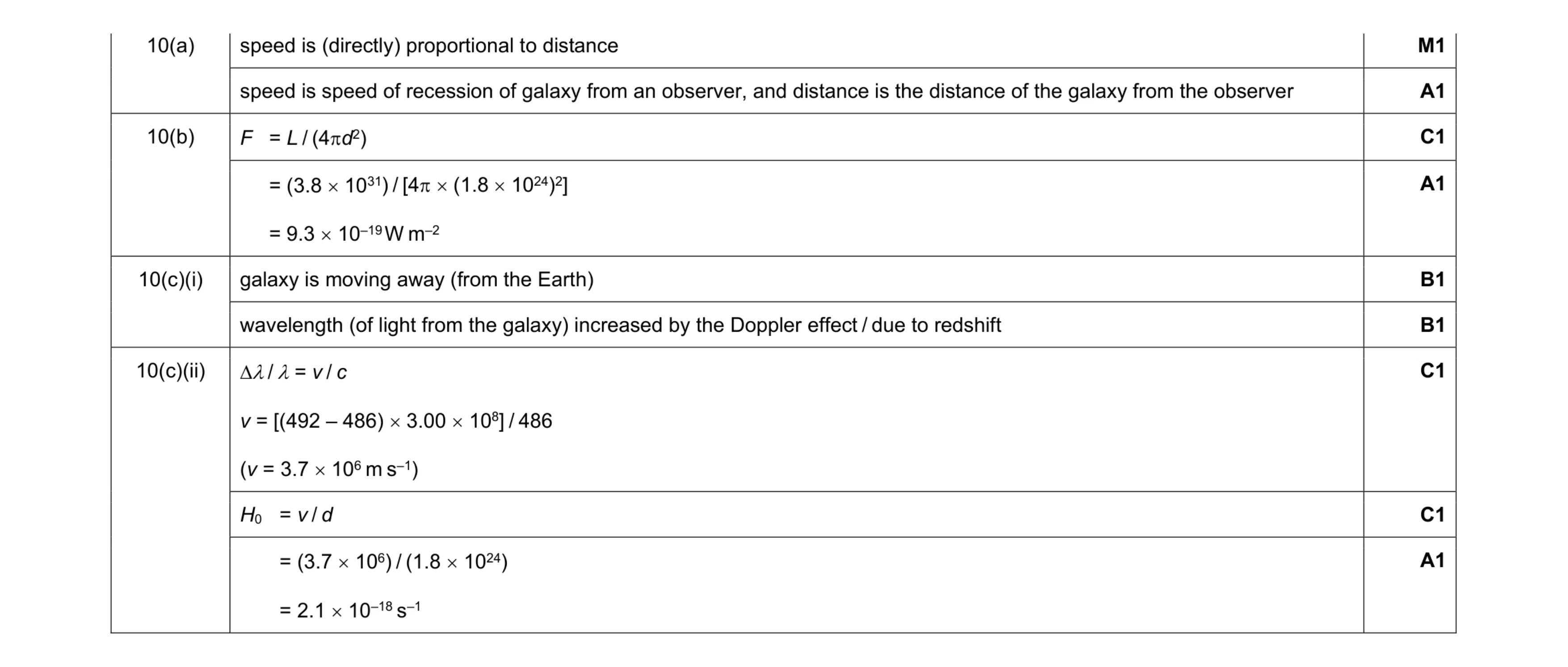 9
9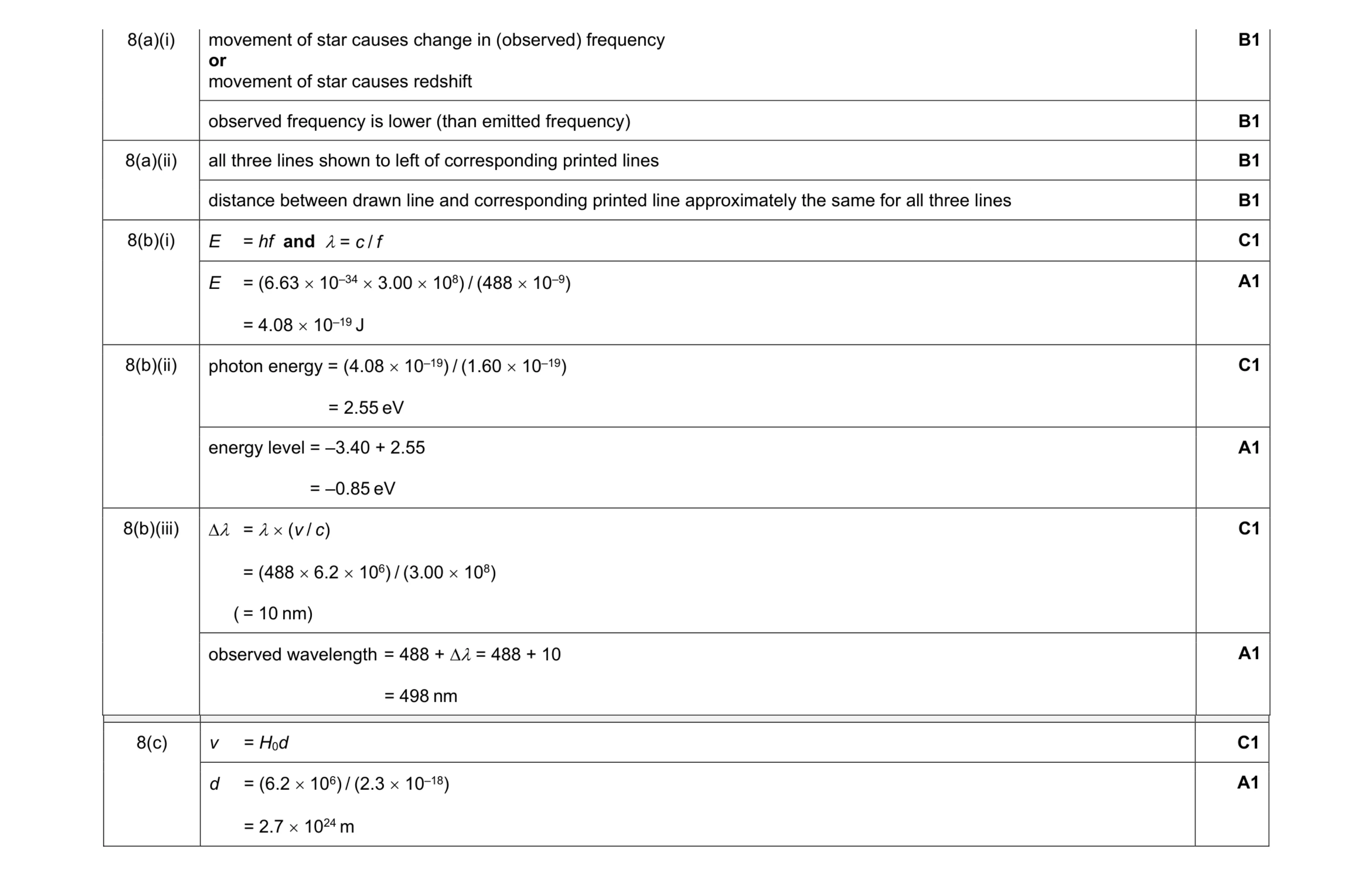 12
12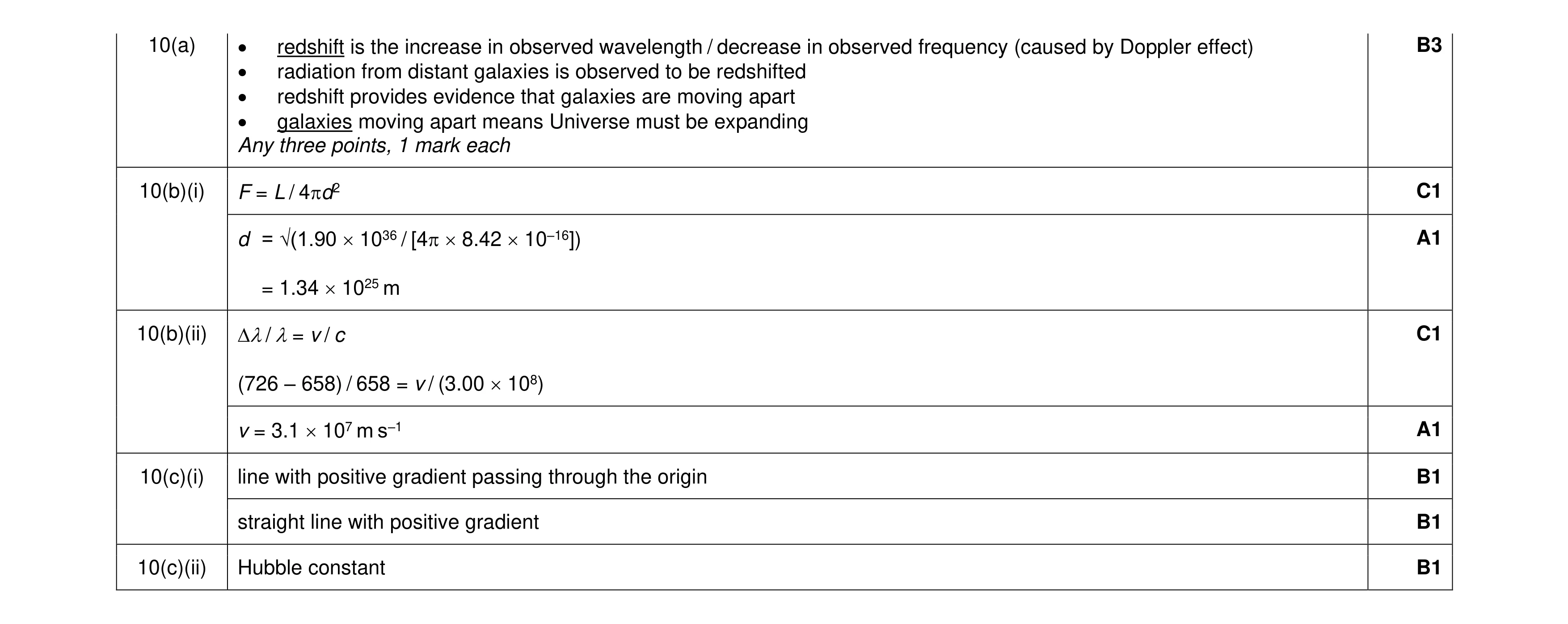 10
10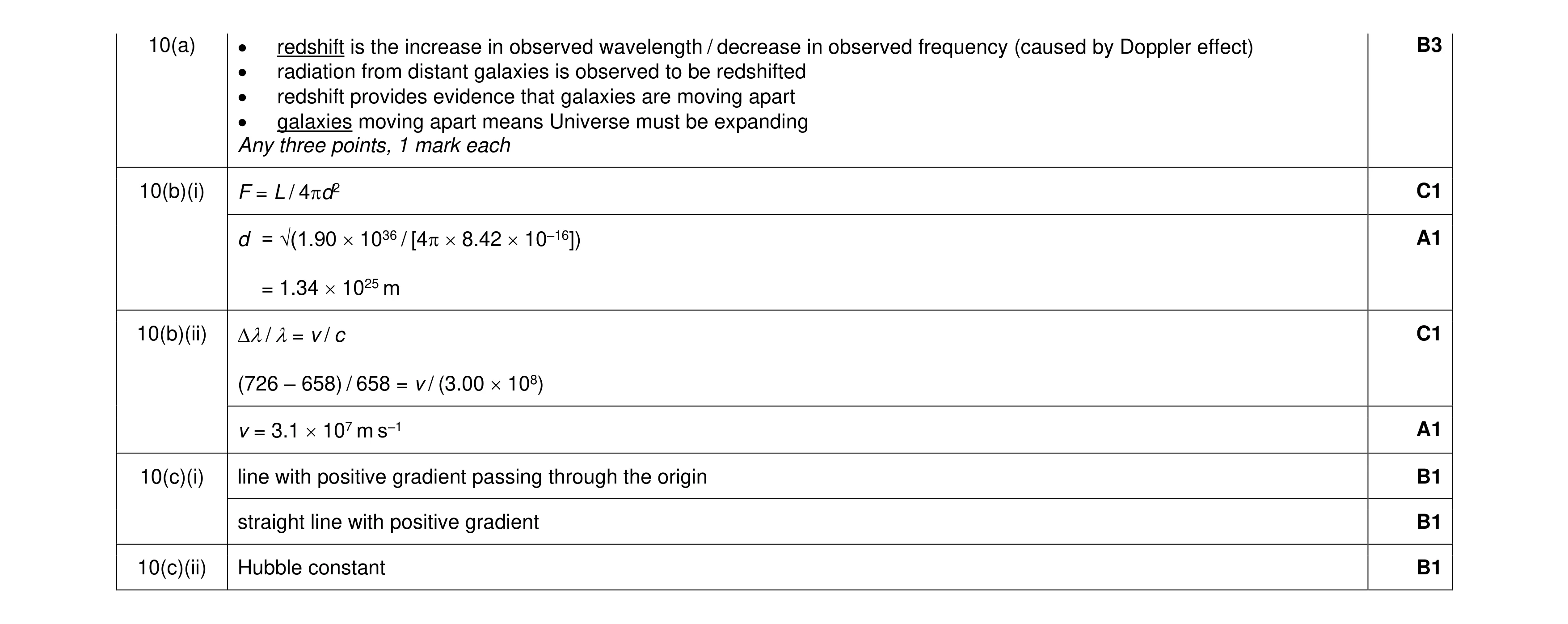 10
10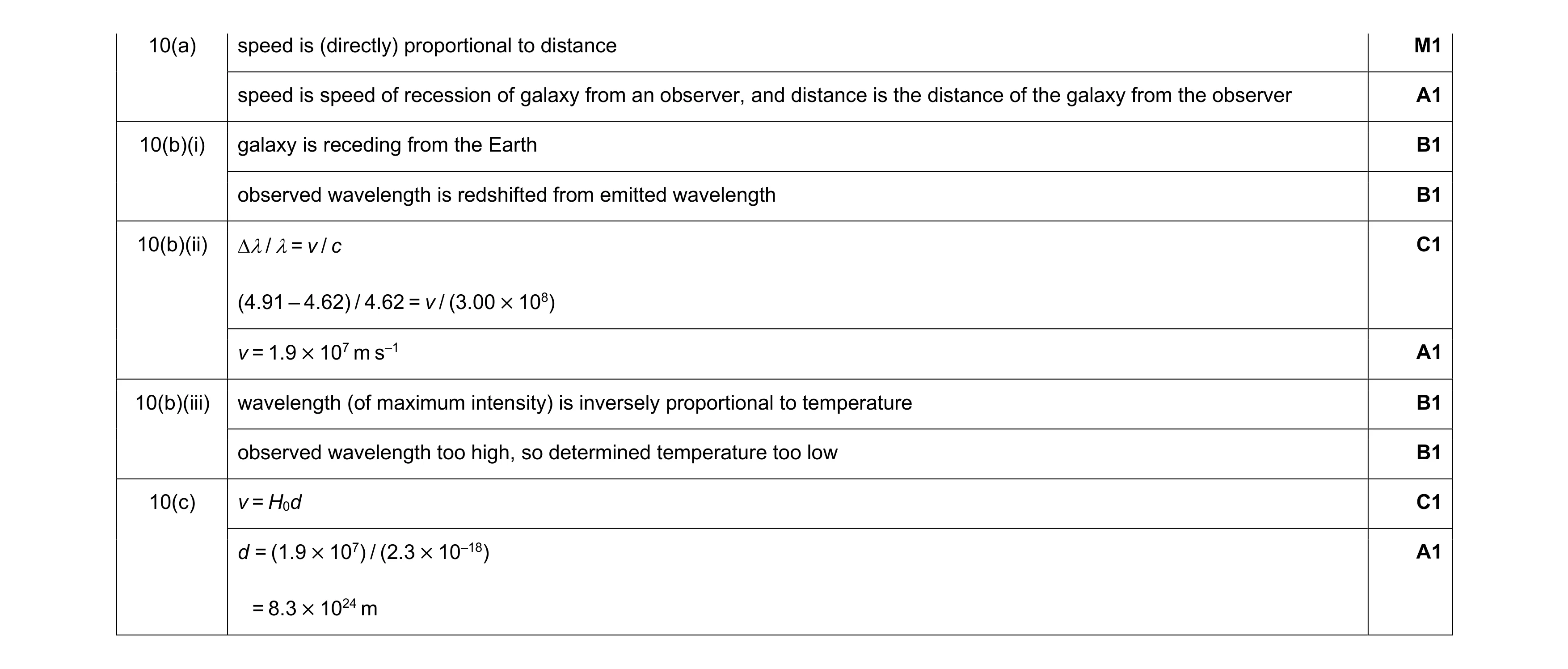 10
10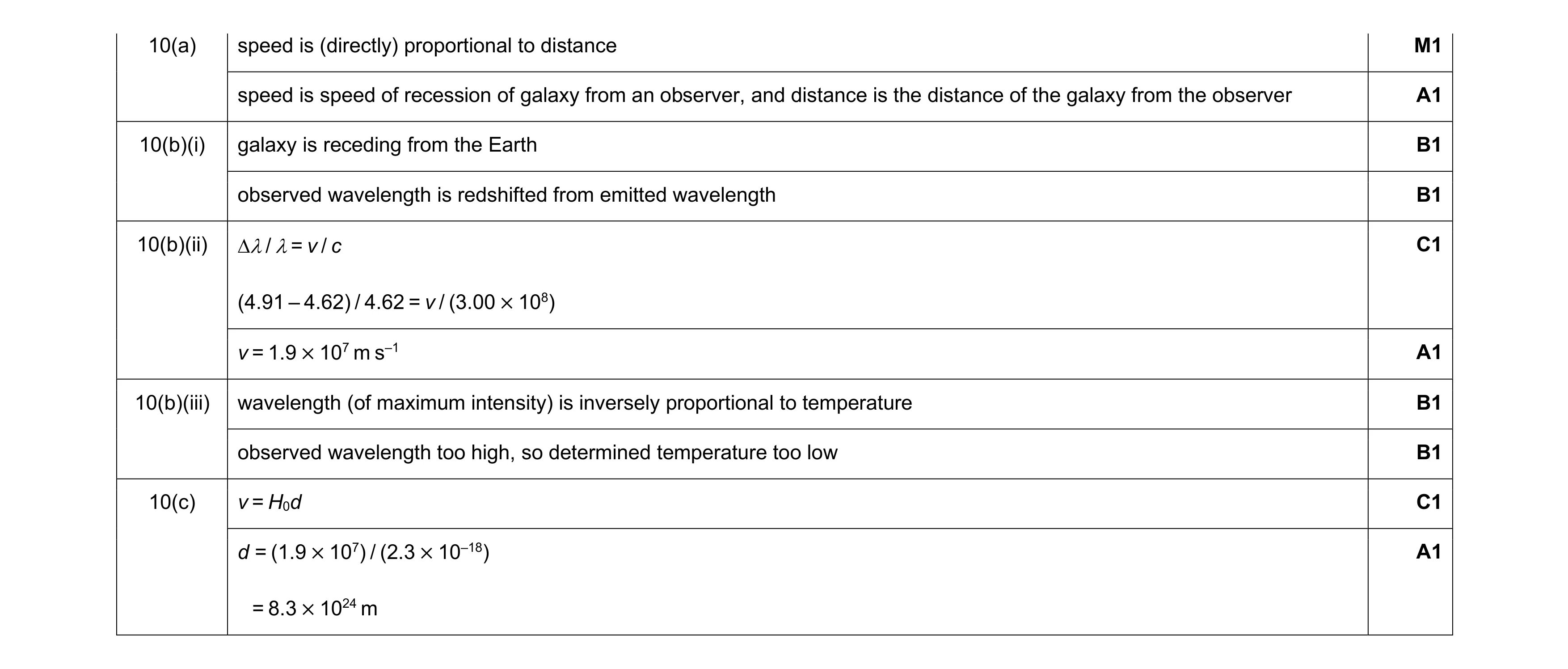 10
10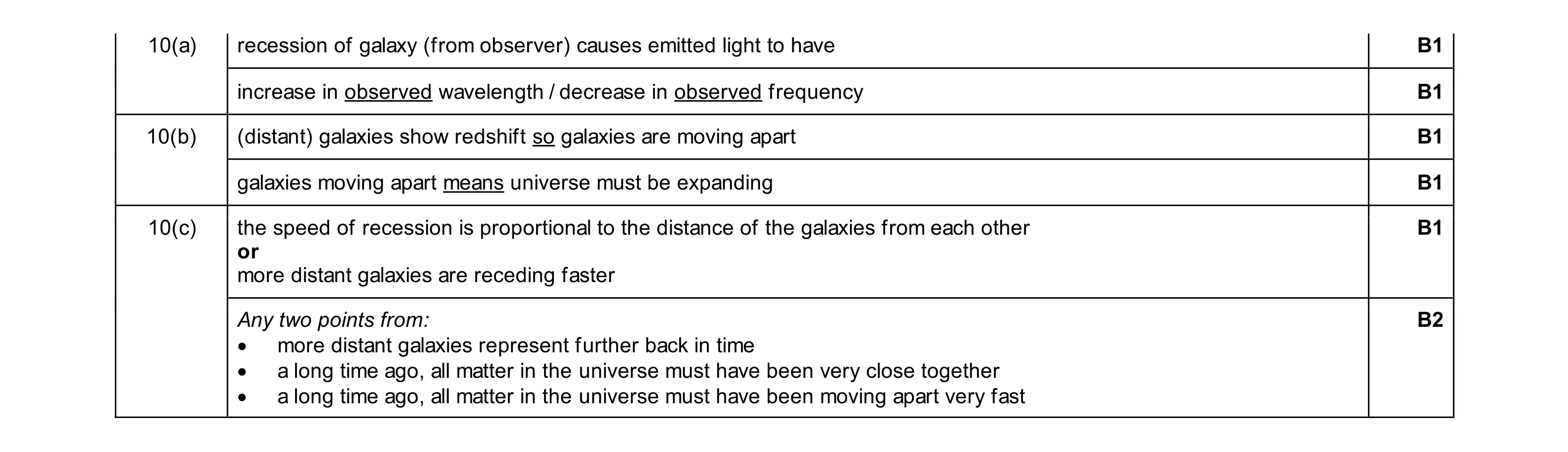 7
7