Questions as text
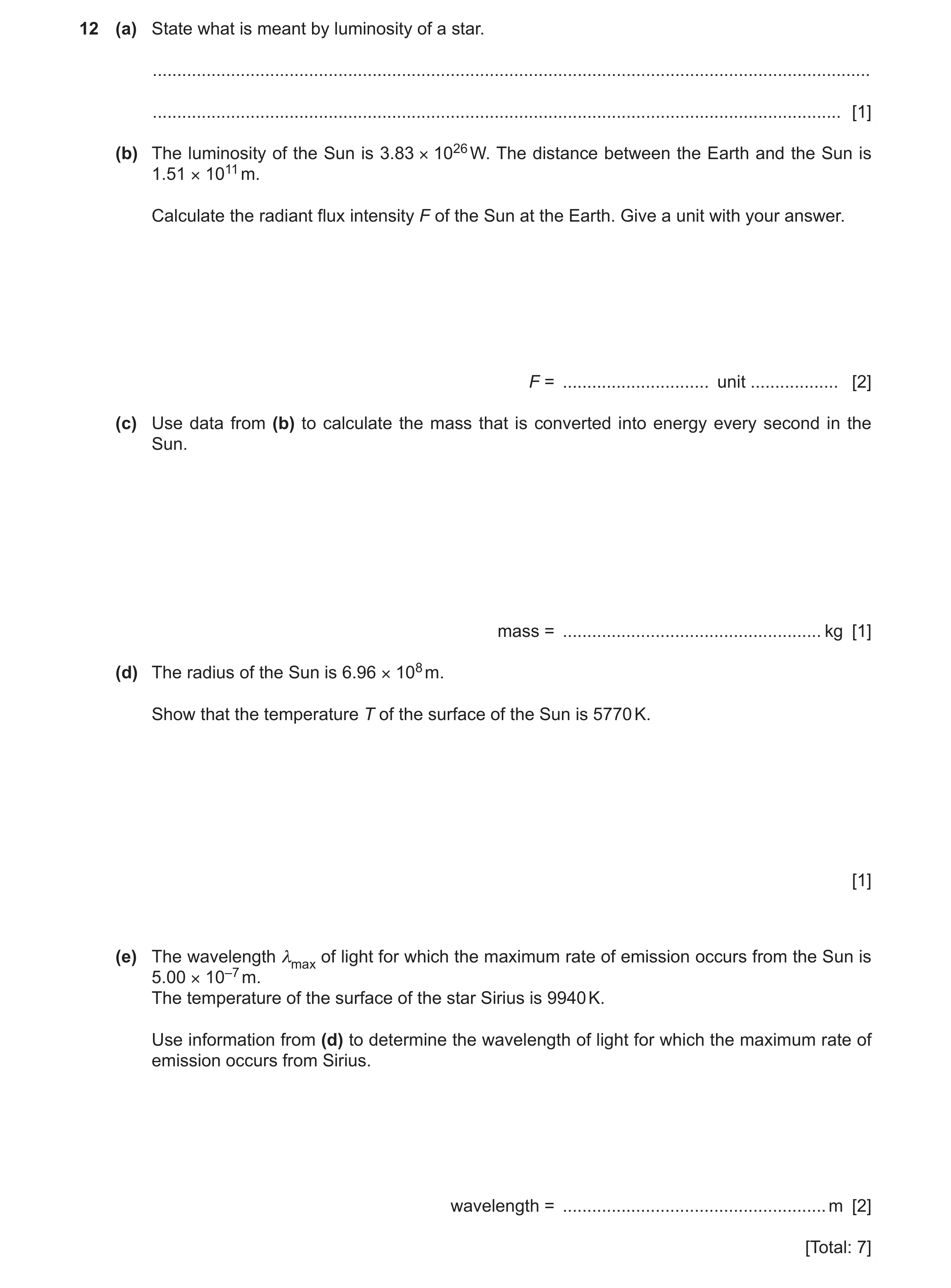
Q1 · State what is meant by luminosity of a star 9702/42 Feb/March 2022
12 (a) State what is meant by luminosity of a star. … … [1] (b) The luminosity of the Sun is 3.83 × 1026 W. The distance between the Earth and the Sun is 1.51 × 10¹¹ m. Calculate the radiant flux intensity F of the Sun at the Earth. Give a unit with your answer. F = … unit … [2] (c) Use data from (b) to calculate the mass that is converted into energy every second in the Sun. mass = … kg [1] (d) The radius of the Sun is 6.96 × 10⁸ m. Show that the temperature T of the surface of the Sun is 5770 K. [1] (e) The wavelength λmax of light for which the maximum rate of emission occurs from the Sun is 5.00 × 10⁻⁷ m. The temperature of the surface of the star Sirius is 9940 K. Use information from (d) to determine the wavelength of light for which the maximum rate of emission occurs from Sirius. wavelength = … m [2] [Total: 7]
7 marks
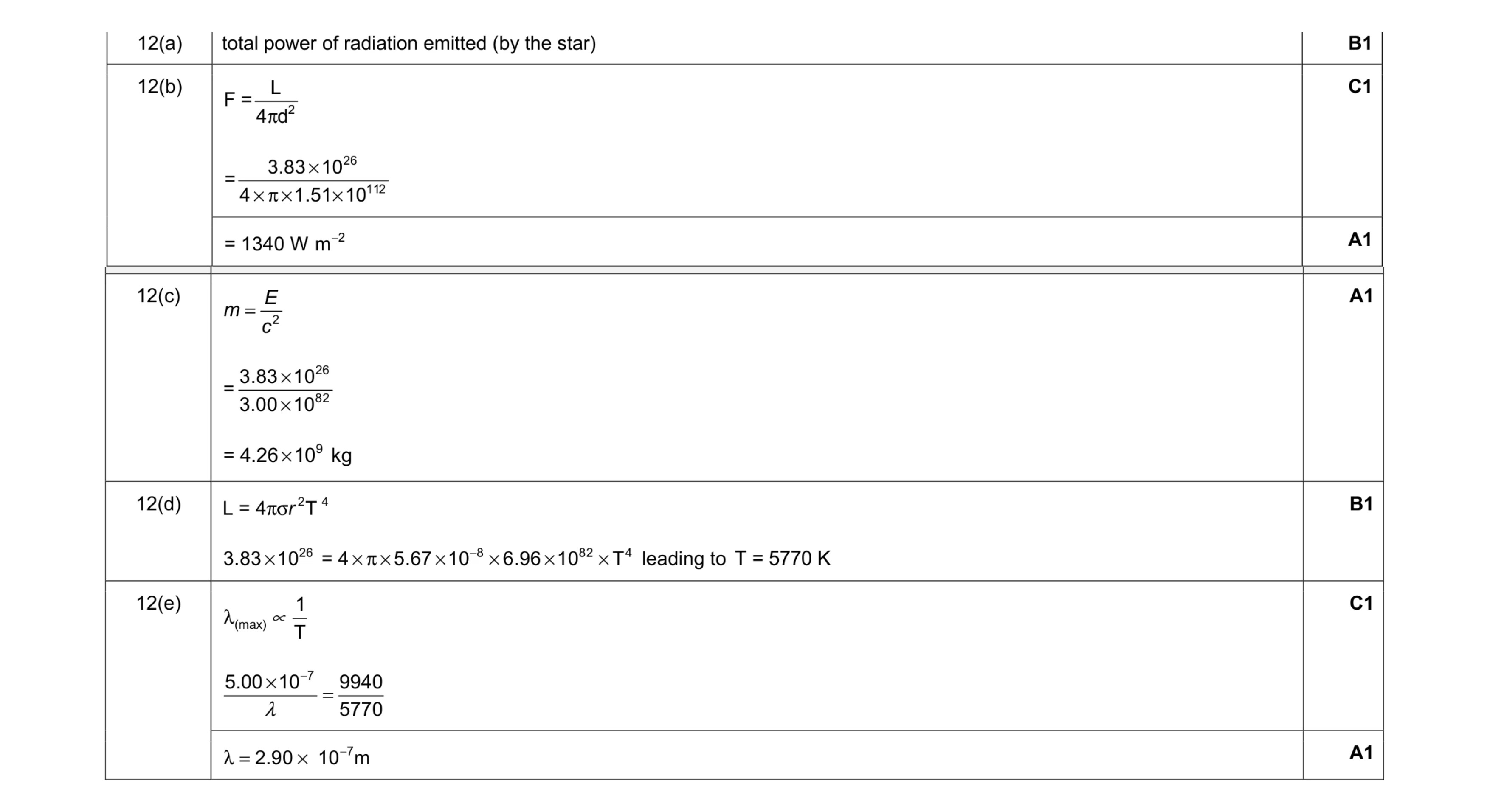
Mark scheme: 12(a) total power of radiation emitted (by the star) B1 12(b) 2 L F = 4 d π 26 112 3.83 10 = 4 1.51 10 × × π × × C1 2 = 1340 W m− A1 Question Answer Marks 12(c) 2 E m c = 26 82 3.83 10 = 3.00 10 × × 9 = 4.26 10 kg × A1 12(d) 2 4 L = 4 T r πσ 26 8 82 4 3.83 10 = 4 5.67 10 6.96 10 T − × × π× × × × × leading to T = 5770 K B1 12(e) (max) 1 T ∝ λ 7 5.00 10 9940 5770 λ − × = C1 7 2.90 10 m − λ = × A1
This question in 9702/42 Feb/March 2022
Q2 · State Wien’s displacement law 9702/41 May/June 2022
10 (a) State Wien’s displacement law. … … [1] (b) Fig. 10.1 shows the wavelength distributions of electromagnetic radiation emitted by two stars A and B. rate of emission star A star B 0 0 0.5 1.0 1.5 2.0 wavelength / μm Fig. 10.1 The surface temperature of star A is known to be 5800 K. (i) Determine the surface temperature of star B. surface temperature = … K [2] (ii) Star B appears less bright than star A when viewed from the Earth. Use Fig. 10.1 to suggest, with a reason, how else the physical appearance of star B compares with that of star A. … … … [2] (c) The lines in Fig. 10.1 have been corrected for redshift. (i) State what is meant by redshift. … … … [2] (ii) Explain how cosmologists are able to determine that light from a distant star has undergone redshift. … … … [2] [Total: 9]
9 marks
Mark scheme: 10(a) wavelength of maximum intensity is inversely proportional to (thermodynamic) temperature B1 10(b)(i) MAX = 0.50 m for A and 0.65 m for B C1 T = 5800 (0.50 / 0.65) = 4500 K A1 10(b)(ii) (star B has) greater peak / average wavelength B1 (star B looks) redder B1 10(c)(i) apparent wavelength is greater or wavelength is greater than known value B1 (due to) movement of star away (from observer) B1 10(c)(ii) by examining the (lines in the) spectrum (of light from the star) B1 and comparing with known spectrum B1
This question in 9702/41 May/June 2022
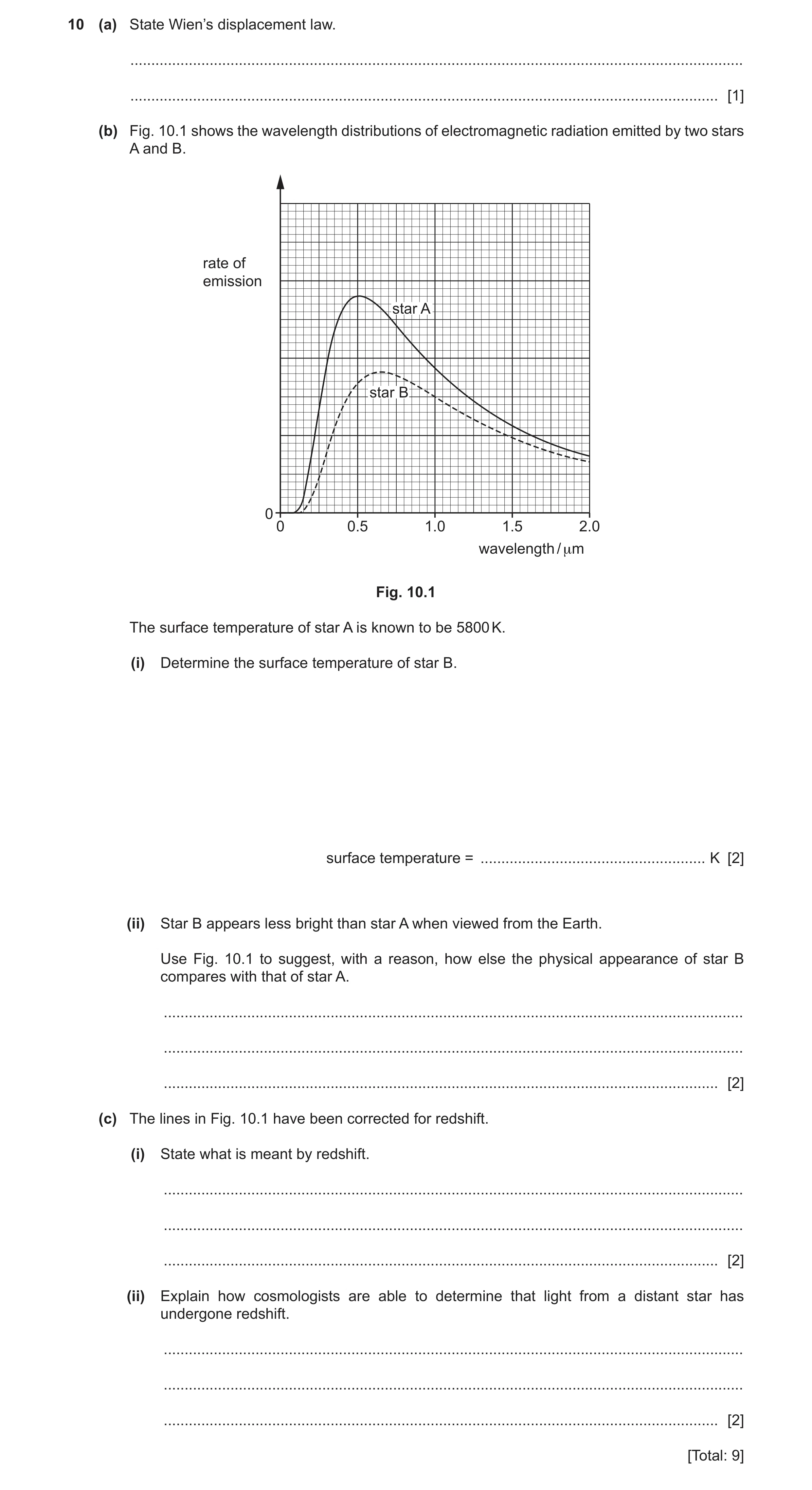
Q3 · State Wien’s displacement law 9702/43 May/June 2022
10 (a) State Wien’s displacement law. … … [1] (b) Fig. 10.1 shows the wavelength distributions of electromagnetic radiation emitted by two stars A and B. rate of emission star A star B 0 0 0.5 1.0 1.5 2.0 wavelength / μm Fig. 10.1 The surface temperature of star A is known to be 5800 K. (i) Determine the surface temperature of star B. surface temperature = … K [2] (ii) Star B appears less bright than star A when viewed from the Earth. Use Fig. 10.1 to suggest, with a reason, how else the physical appearance of star B compares with that of star A. … … … [2] (c) The lines in Fig. 10.1 have been corrected for redshift. (i) State what is meant by redshift. … … … [2] (ii) Explain how cosmologists are able to determine that light from a distant star has undergone redshift. … … … [2] [Total: 9]
9 marks
Mark scheme: 10(a) wavelength of maximum intensity is inversely proportional to (thermodynamic) temperature B1 10(b)(i) MAX = 0.50 m for A and 0.65 m for B C1 T = 5800 (0.50 / 0.65) = 4500 K A1 10(b)(ii) (star B has) greater peak / average wavelength B1 (star B looks) redder B1 10(c)(i) apparent wavelength is greater or wavelength is greater than known value B1 (due to) movement of star away (from observer) B1 10(c)(ii) by examining the (lines in the) spectrum (of light from the star) B1 and comparing with known spectrum B1
This question in 9702/43 May/June 2022
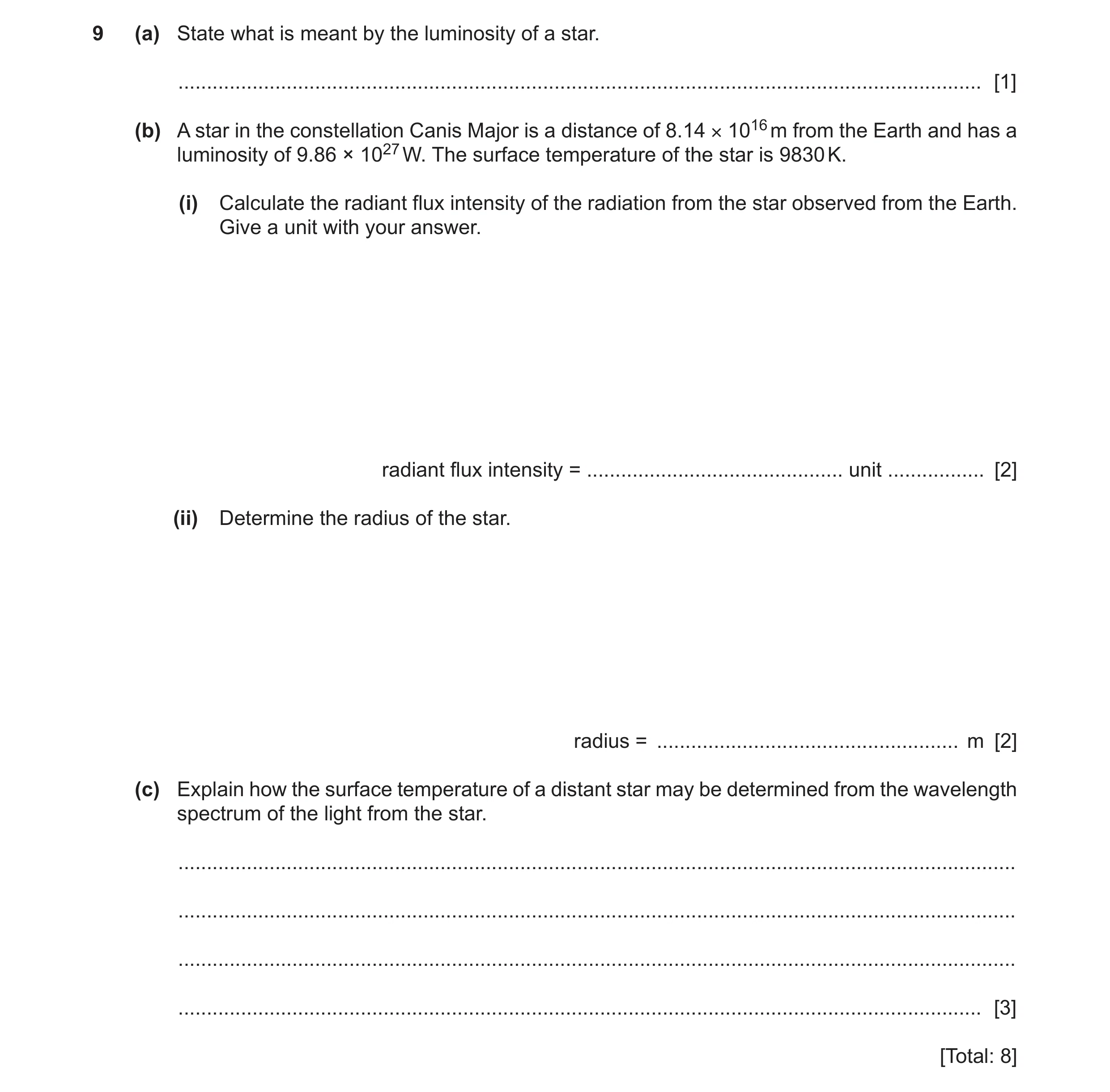
Q4 · State what is meant by the luminosity of a star 9702/41 Oct/Nov 2022
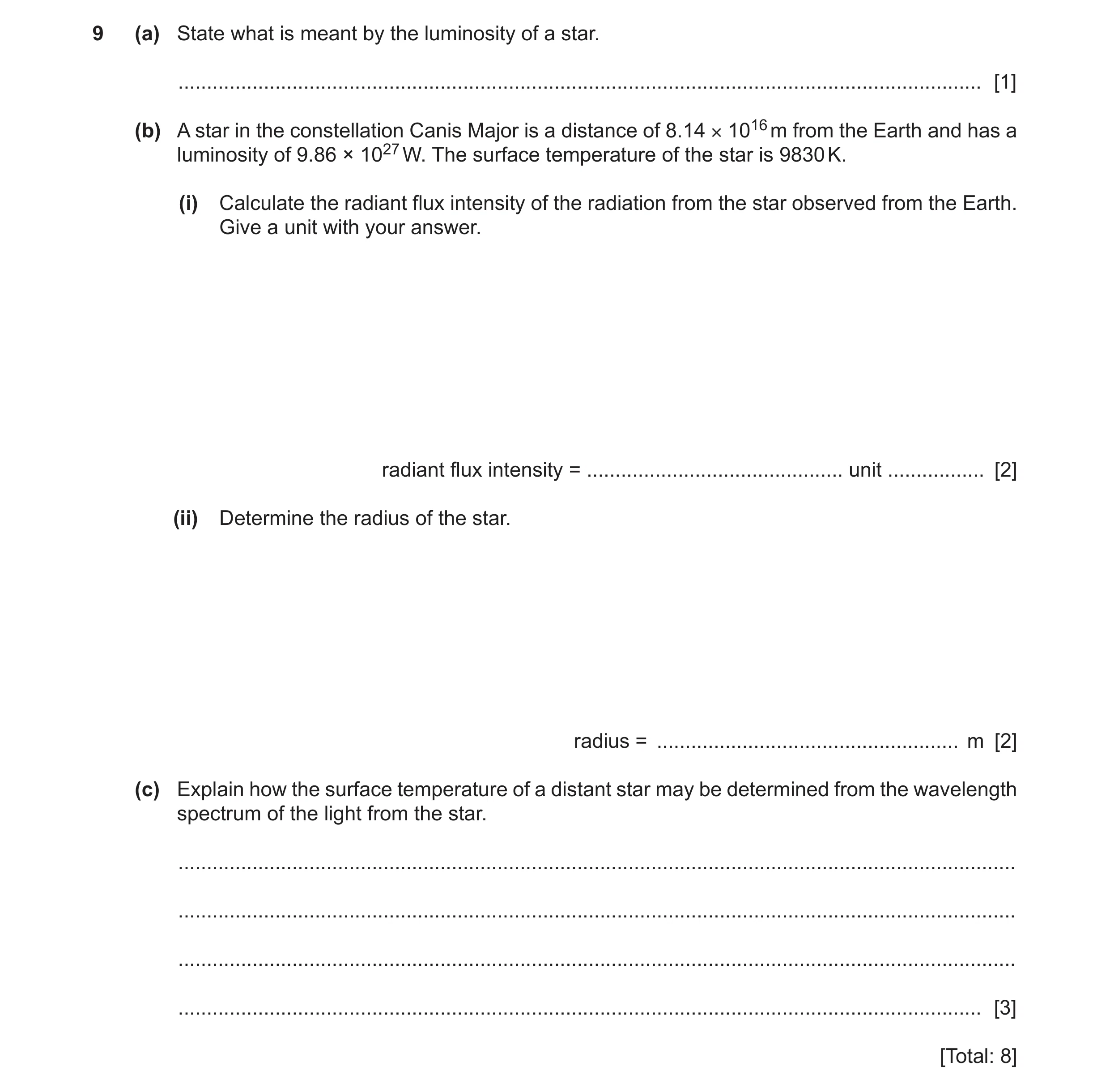
9 (a) State what is meant by the luminosity of a star. … [1] (b) A star in the constellation Canis Major is a distance of 8.14 × 10¹⁶ m from the Earth and has a luminosity of 9.86 × 1027 W. The surface temperature of the star is 9830 K. (i) Calculate the radiant flux intensity of the radiation from the star observed from the Earth. Give a unit with your answer. radiant flux intensity = … unit … [2] (ii) Determine the radius of the star. radius = … m [2] (c) Explain how the surface temperature of a distant star may be determined from the wavelength spectrum of the light from the star. … … … … [3] [Total: 8]
8 marks
Mark scheme: 9(a) total power of radiation emitted (by the star) B1 9(b)(i) F = L / (4d 2) C1 = 9.86 1027 / [4 (8.14 1016)2] A1 = 1.18 10–7 W m–2 9(b)(ii) L = 4 r 2T4 C1 9.86 1027 = 4 5.67 10–8 r 2 98304 radius = 1.22 109 m A1 9(c) wavelength of peak intensity determined (from spectrum of star) B1 wavelength of peak intensity from object of known temperature determined B1 Wien’s displacement law used B1 or wavelength of peak intensity inversely proportional to temperature
This question in 9702/41 Oct/Nov 2022
Q5 · State what is meant by the luminosity of a star 9702/43 Oct/Nov 2022
9 (a) State what is meant by the luminosity of a star. … [1] (b) A star in the constellation Canis Major is a distance of 8.14 × 10¹⁶ m from the Earth and has a luminosity of 9.86 × 1027 W. The surface temperature of the star is 9830 K. (i) Calculate the radiant flux intensity of the radiation from the star observed from the Earth. Give a unit with your answer. radiant flux intensity = … unit … [2] (ii) Determine the radius of the star. radius = … m [2] (c) Explain how the surface temperature of a distant star may be determined from the wavelength spectrum of the light from the star. … … … … [3] [Total: 8]
8 marks
Mark scheme: 9(a) total power of radiation emitted (by the star) B1 9(b)(i) F = L / (4d 2) C1 = 9.86 1027 / [4 (8.14 1016)2] A1 = 1.18 10–7 W m–2 9(b)(ii) L = 4 r 2T4 C1 9.86 1027 = 4 5.67 10–8 r 2 98304 radius = 1.22 109 m A1 9(c) wavelength of peak intensity determined (from spectrum of star) B1 wavelength of peak intensity from object of known temperature determined B1 Wien’s displacement law used B1 or wavelength of peak intensity inversely proportional to temperature
This question in 9702/43 Oct/Nov 2022
Question 6 9702/42 May/June 2023
9 (a) Define mass defect. … … … [2] (b) Table 9.1 shows the mass defects of three nuclei. Table 9.1 nucleus mass defect / u 21H 0.002 388 31H 0.009 105 42He 0.030 377 The nuclear fusion process in a particular star is described by 21H + 31H 42He + X where X is a particle that has no mass defect. (i) State the name of particle X. … [1] (ii) Show that the energy released when one nucleus of 42He is formed in this fusion reaction is 2.8 × 10⁻¹² J. [3] (c) The star in (b) has a radius of 2.3 × 10⁹ m and a luminosity of 1.4 × 1028 W. All the energy released from the formation of 42He is radiated away from the star. All the energy that is radiated from the star has been released in the formation of 42He. Determine: (i) the mass of 42He produced per unit time by the fusion process mass per unit time = … kg s–1 [3] (ii) the surface temperature of the star. temperature = … K [2] [Total: 11]
11 marks
Mark scheme: 9(a) difference between mass of nucleus and (total) mass of nucleons M1 when infinitely separated A1 9(b)(i) neutron B1 9(b)(ii) E = m c2 C1 m = (0.030377 – 0.002388 – 0.009105)u ( = 0.018884u) C1 energy release = (0.030377 – 0.002388 – 0.009105) 1.66 10–27 (3.00 108)2 = 2.8 10–12 J A1 9(c)(i) number of atoms per unit time = (1.4 1028) / (2.8 10–12) ( = 5.0 1039 s–1) C1 mass of one atom = 4 1.66 10–27 or (4 10–3) / (6.02 1023) ( = 6.64 10–27 kg) C1 mass per unit time = 6.64 10–27 5.0 1039 = 3.3 1013 kg s–1 A1 9(c)(ii) L = 4σr2T4 1.4 1028 = 4 5.67 10–8 (2.3 109)2 T4 C1 T = 7800 K A1
This question in 9702/42 May/June 2023
Q7 · State Wien’s displacement law 9702/42 Oct/Nov 2023
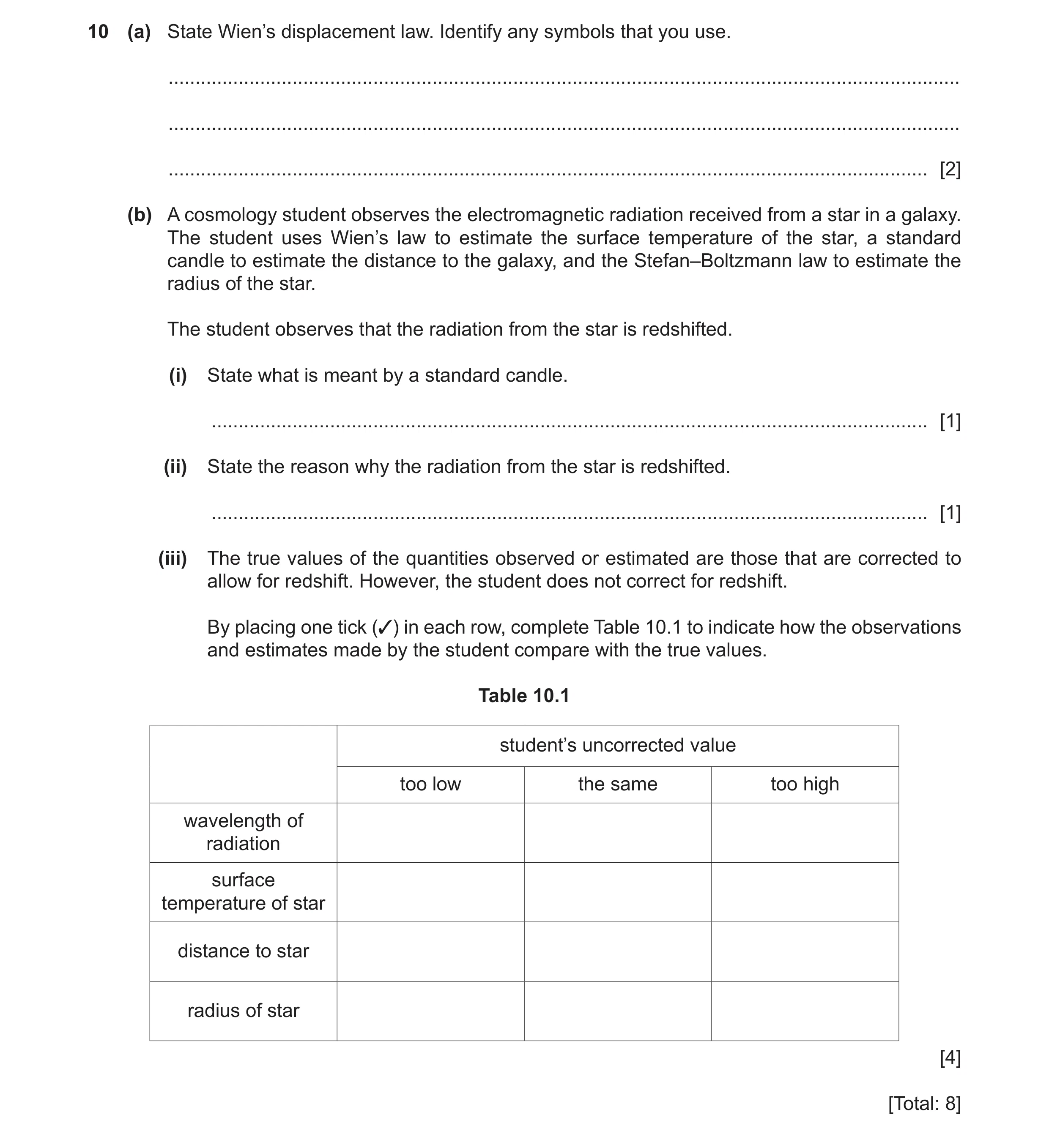
10 (a) State Wien’s displacement law. Identify any symbols that you use. … … … [2] (b) A cosmology student observes the electromagnetic radiation received from a star in a galaxy. The student uses Wien’s law to estimate the surface temperature of the star, a standard candle to estimate the distance to the galaxy, and the Stefan–Boltzmann law to estimate the radius of the star. The student observes that the radiation from the star is redshifted. (i) State what is meant by a standard candle. … [1] (ii) State the reason why the radiation from the star is redshifted. … [1] (iii) The true values of the quantities observed or estimated are those that are corrected to allow for redshift. However, the student does not correct for redshift. By placing one tick (3) in each row, complete Table 10.1 to indicate how the observations and estimates made by the student compare with the true values. Table 10.1 student’s uncorrected value too low the same too high wavelength of radiation surface temperature of star distance to star radius of star [4] [Total: 8]
8 marks
Mark scheme: 10(a) temperature inversely proportional to wavelength M1 temperature is thermodynamic temperature of surface, and wavelength is the wavelength at which maximum emission rate A1 occurs 10(b)(i) (astronomical) object of known luminosity B1 10(b)(ii) star / galaxy is moving away from the student B1 10(b)(iii) one tick placed in correct column in each row: B1 wavelength: too high surface temperature: too low B1 distance: unchanged B1 radius: too high B1
This question in 9702/42 Oct/Nov 2023
Q8 · State Wien’s displacement law 9702/41 Oct/Nov 2025
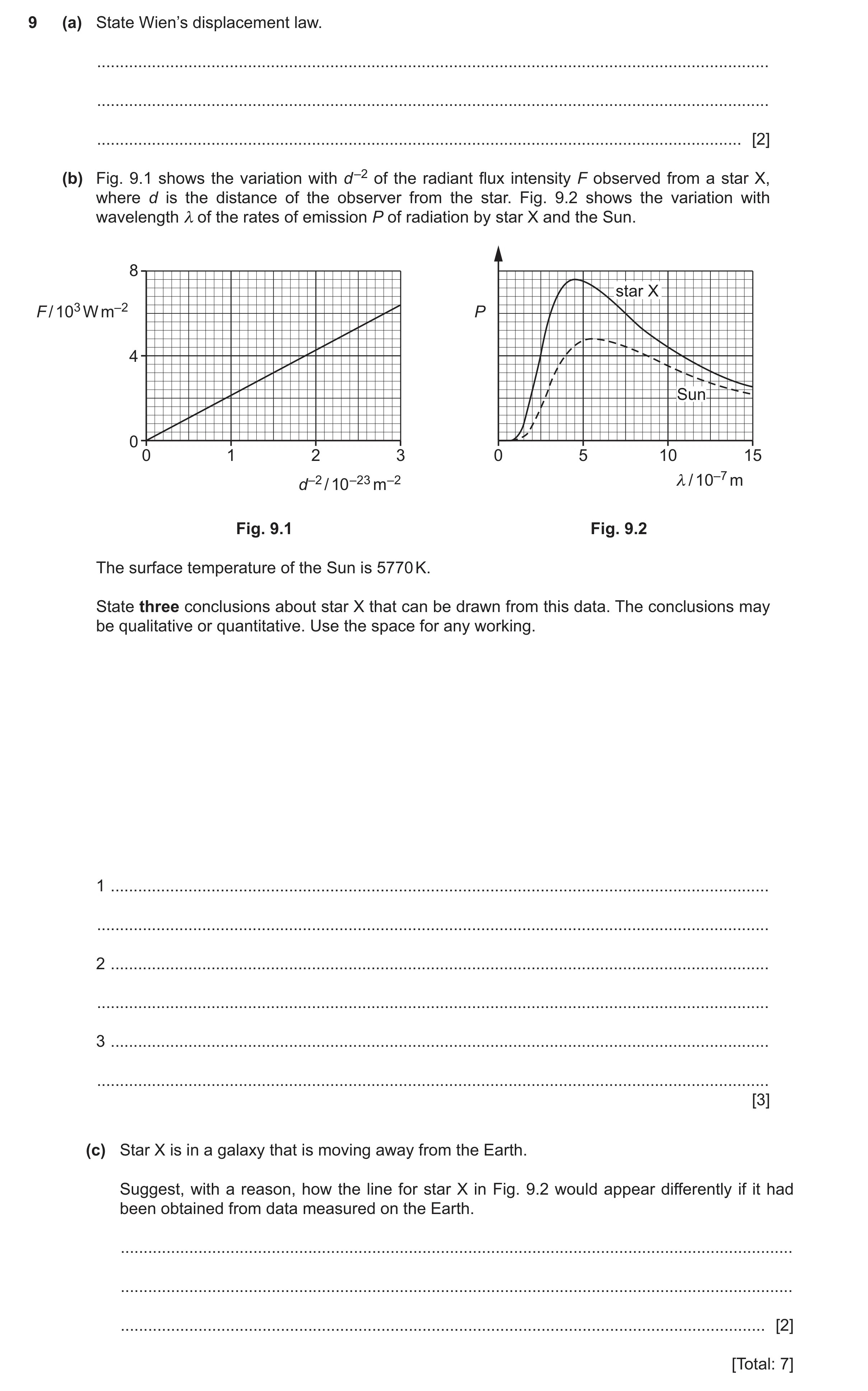
9 (a) State Wien’s displacement law. … … … [2] (b) Fig. 9.1 shows the variation with d –2 of the radiant flux intensity F observed from a star X, where d is the distance of the observer from the star. Fig. 9.2 shows the variation with wavelength λ of the rates of emission P of radiation by star X and the Sun. 8 star X F / 103 W m–2 P 4 Sun 0 0 1 2 3 0 5 10 15 d–2 / 10–23 m–2 λ / 10–7 m Fig. 9.1 Fig. 9.2 The surface temperature of the Sun is 5770 K. State three conclusions about star X that can be drawn from this data. The conclusions may be qualitative or quantitative. Use the space for any working. 1 … … 2 … … 3 … … [3] (c) Star X is in a galaxy that is moving away from the Earth. Suggest, with a reason, how the line for star X in Fig. 9.2 would appear differently if it had been obtained from data measured on the Earth. … … … [2] [Total: 7]
7 marks
Mark scheme: 9(a) temperature inversely proportional to wavelength M1 temperature is thermodynamic temperature of surface of star and wavelength is the wavelength at which maximum A1 emission rate from star occurs 9(b) Any three points from: B3 • (surface) temperature of star X = 7000 K or star X has a higher temperature than the Sun • star X has a higher luminosity than the Sun • luminosity of star X = 2.7 1027 W • radius of star X = 1.3 109 m 9(c) light (from star X) is redshifted B1 wavelength of peak emission rate would be greater (using observed data) B1
This question in 9702/41 Oct/Nov 2025
Q9 · State what is meant by the mass defect of a nucleus 9702/42 Oct/Nov 2025
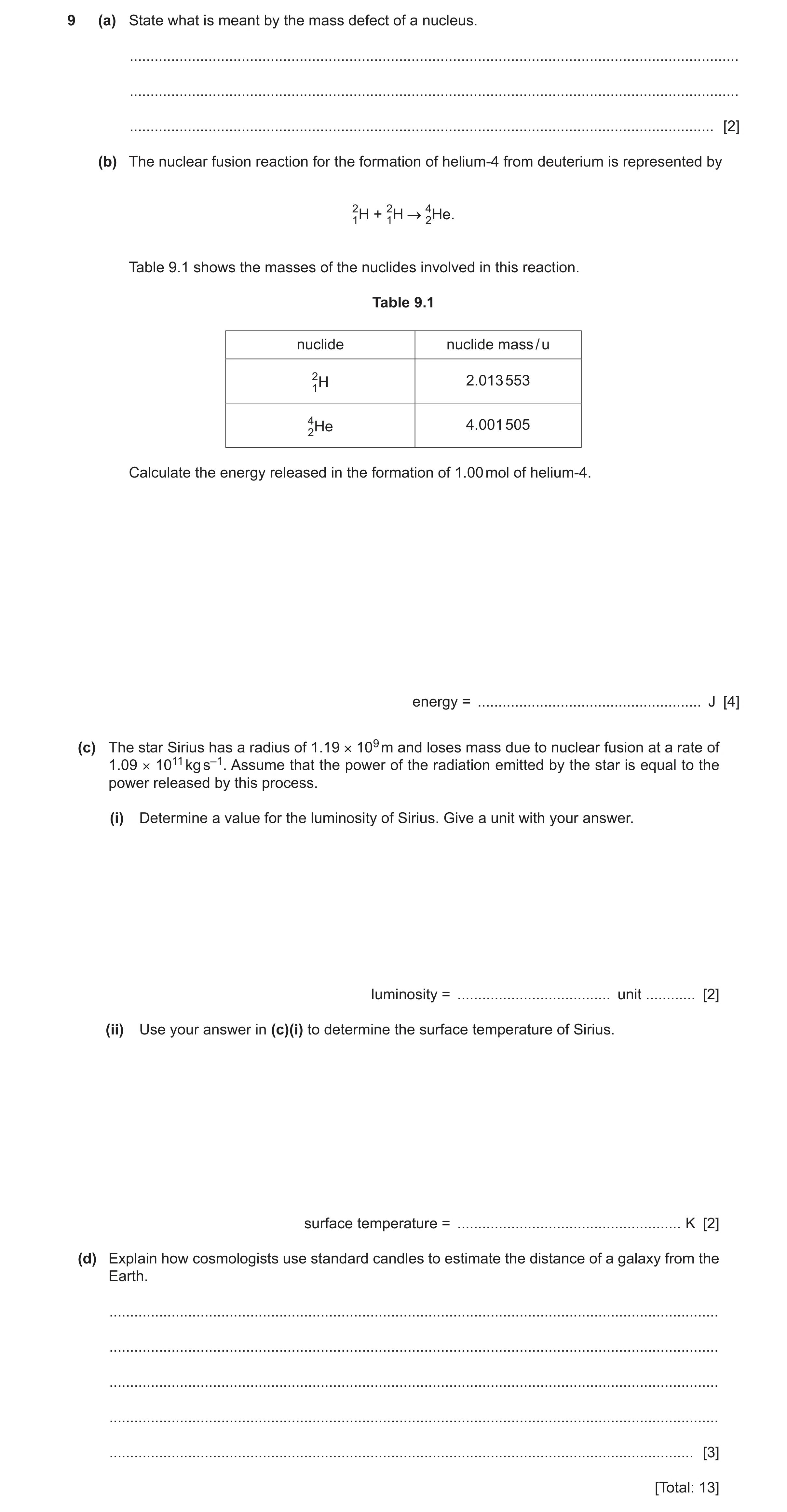
9 (a) State what is meant by the mass defect of a nucleus. … … … [2] (b) The nuclear fusion reaction for the formation of helium-4 from deuterium is represented by 21H + 21H 42He. Table 9.1 shows the masses of the nuclides involved in this reaction. Table 9.1 nuclide nuclide mass / u 21H 2.013 553 42He 4.001 505 Calculate the energy released in the formation of 1.00 mol of helium-4. energy = … J [4] (c) The star Sirius has a radius of 1.19 × 10⁹ m and loses mass due to nuclear fusion at a rate of 1.09 × 10¹¹ kg s–1. Assume that the power of the radiation emitted by the star is equal to the power released by this process. (i) Determine a value for the luminosity of Sirius. Give a unit with your answer. luminosity = … unit … [2] (ii) Use your answer in (c)(i) to determine the surface temperature of Sirius. surface temperature = … K [2] (d) Explain how cosmologists use standard candles to estimate the distance of a galaxy from the Earth. … … … … … [3] [Total: 13]
13 marks
Mark scheme: 9(a) difference between mass of nucleus and mass of (constituent) nucleons M1 when nucleons are separated to infinity A1 9(b) m = (2 2.013553) – (4.001505) (u) C1 ( = 0.025601 u) E = c2m C1 energy from one He-4 nucleus= 0.025601 1.66 10–27 (3.00 108)2 C1 (= 3.82 10–12 J) energy to form 1.00 mol= 3.82 10–12 6.02 1023 A1 = 2.30 1012 J 9(c)(i) L = 1.09 1011 (3.00 108)2 C1 = 9.81 1027 W A1 9(c)(ii) L = 4 r2T4 C1 9.81 1027 = 4 5.67 10–8 (1.19 109)2 T4 T = 9930 K A1 9(d) standard candles have known luminosity B1 radiant flux intensity (from star) measured (on the Earth) B1 distance found from F = L / (4d2) B1
This question in 9702/42 Oct/Nov 2025
Q10 · State Wien’s displacement law 9702/43 Oct/Nov 2025
9 (a) State Wien’s displacement law. … … … [2] (b) Fig. 9.1 shows the variation with d –2 of the radiant flux intensity F observed from a star X, where d is the distance of the observer from the star. Fig. 9.2 shows the variation with wavelength λ of the rates of emission P of radiation by star X and the Sun. 8 star X F / 103 W m–2 P 4 Sun 0 0 1 2 3 0 5 10 15 d–2 / 10–23 m–2 λ / 10–7 m Fig. 9.1 Fig. 9.2 The surface temperature of the Sun is 5770 K. State three conclusions about star X that can be drawn from this data. The conclusions may be qualitative or quantitative. Use the space for any working. 1 … … 2 … … 3 … … [3] (c) Star X is in a galaxy that is moving away from the Earth. Suggest, with a reason, how the line for star X in Fig. 9.2 would appear differently if it had been obtained from data measured on the Earth. … … … [2] [Total: 7]
7 marks
Mark scheme: 9(a) temperature inversely proportional to wavelength M1 temperature is thermodynamic temperature of surface of star and wavelength is the wavelength at which maximum A1 emission rate from star occurs 9(b) Any three points from: B3 • (surface) temperature of star X = 7000 K or star X has a higher temperature than the Sun • star X has a higher luminosity than the Sun • luminosity of star X = 2.7 1027 W • radius of star X = 1.3 109 m 9(c) light (from star X) is redshifted B1 wavelength of peak emission rate would be greater (using observed data) B1
This question in 9702/43 Oct/Nov 2025
 1 / 12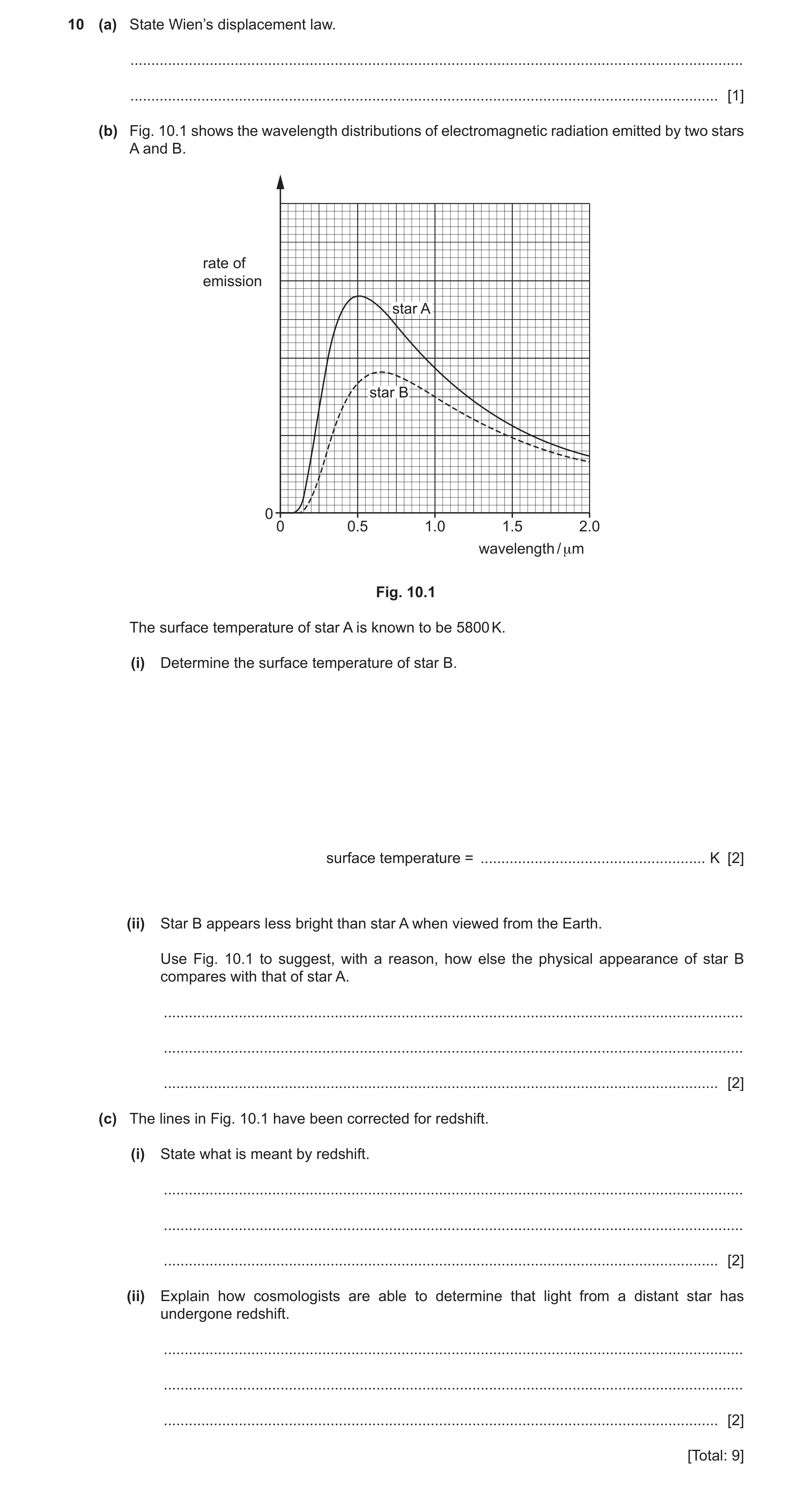
 5 / 12
 6 / 12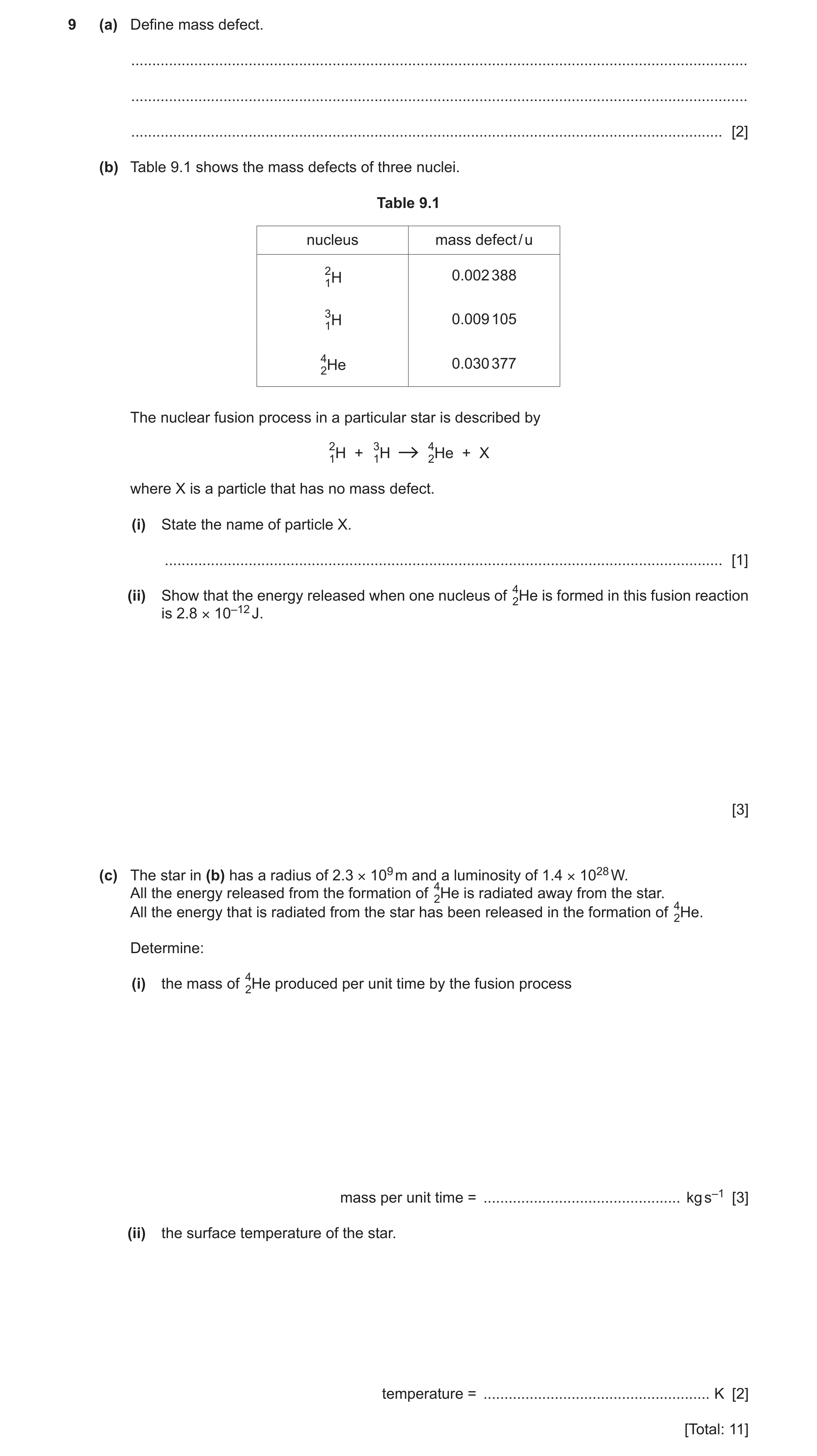
 8 / 12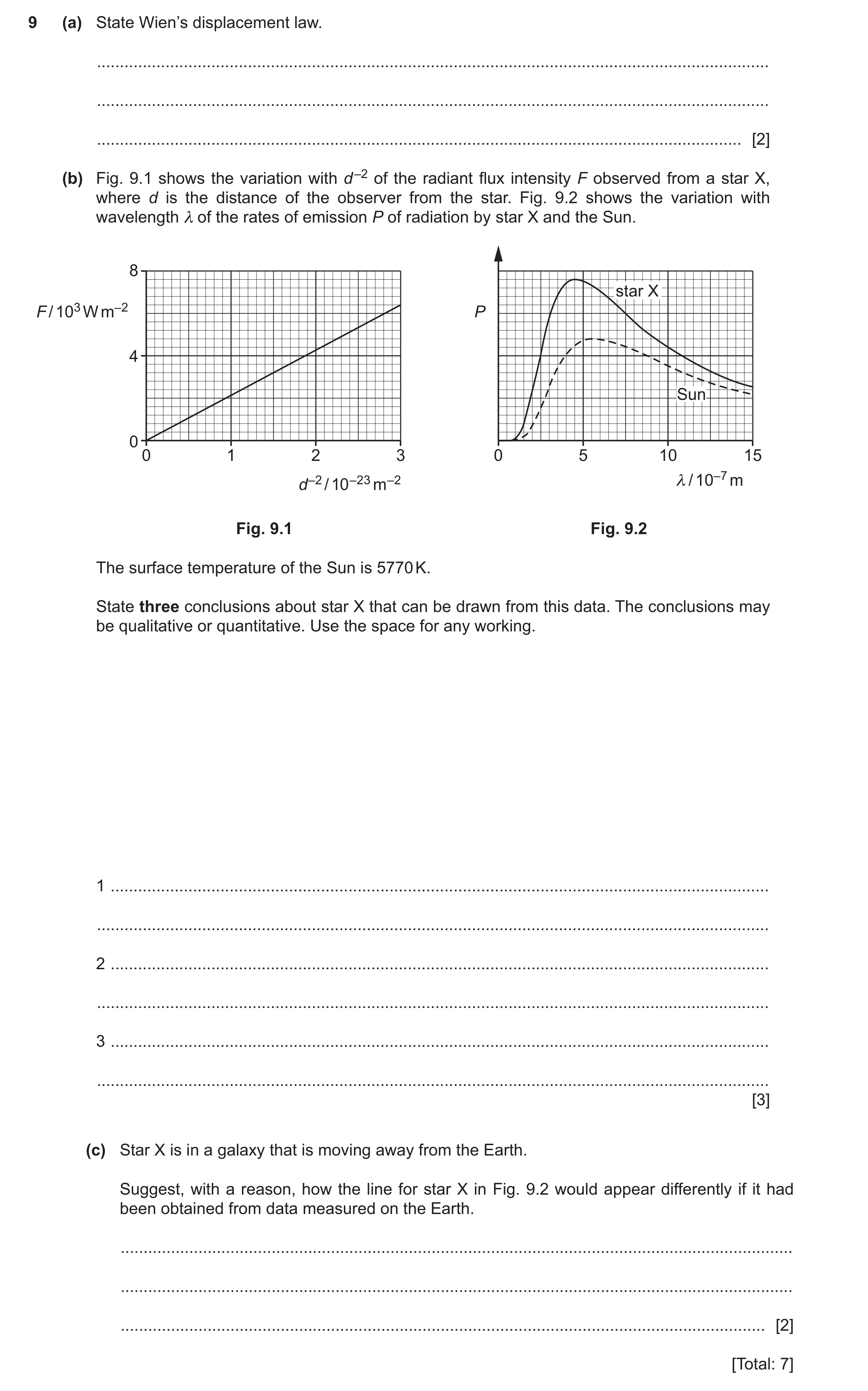
 7
7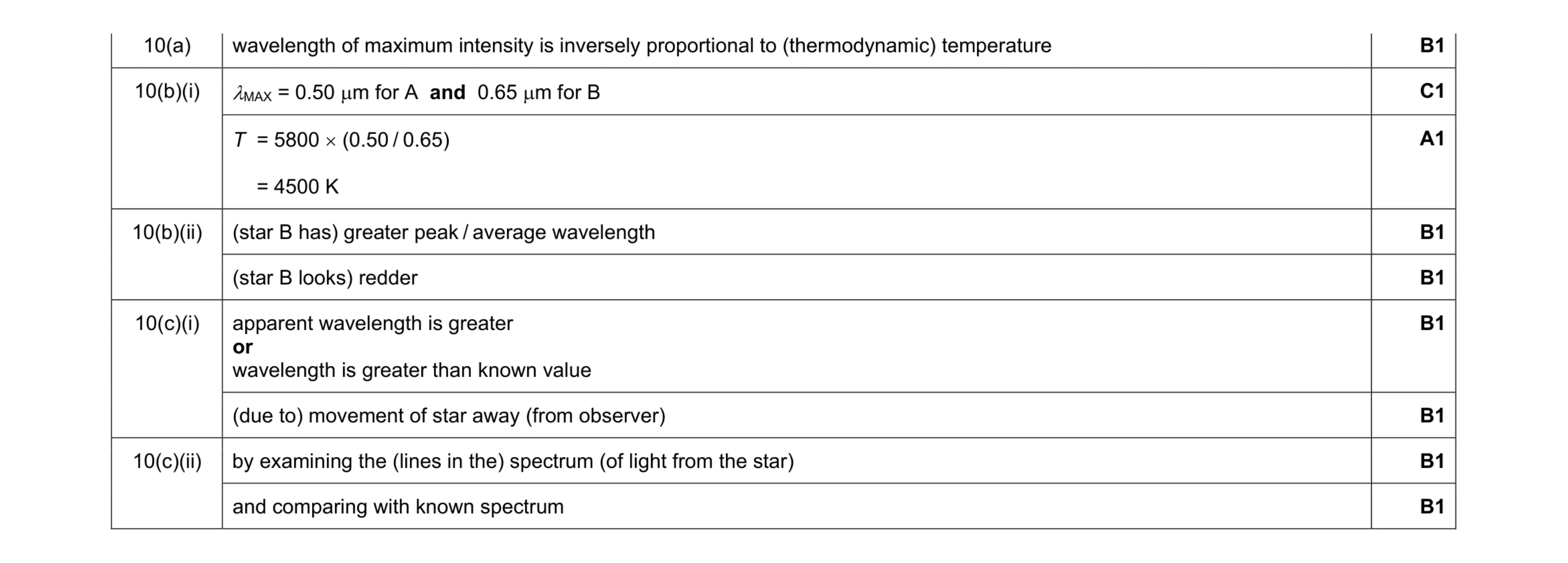 9
9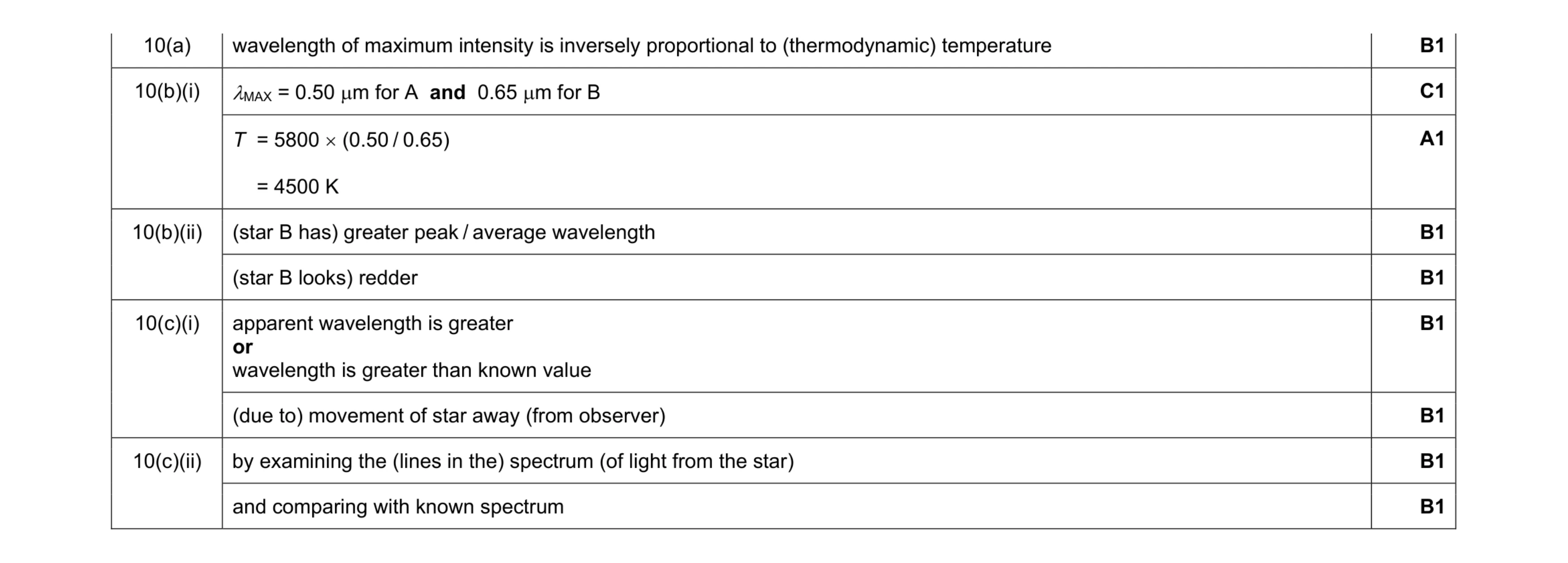 9
9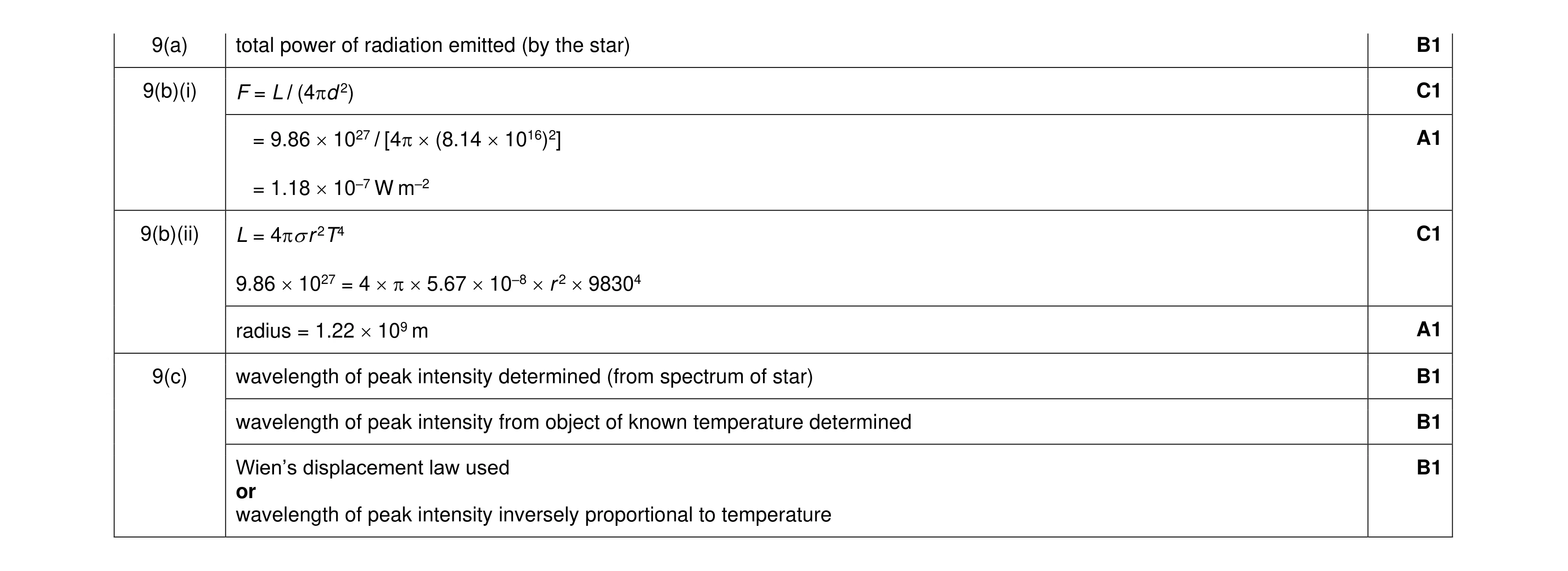 8
8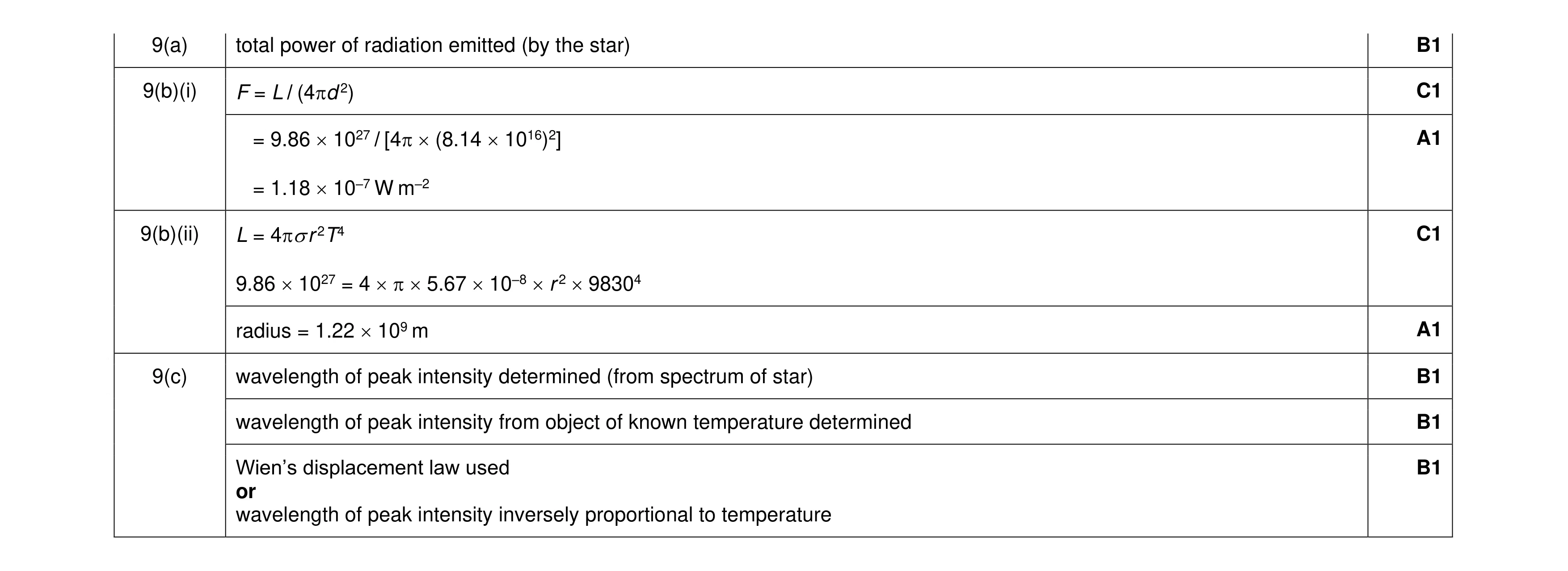 8
8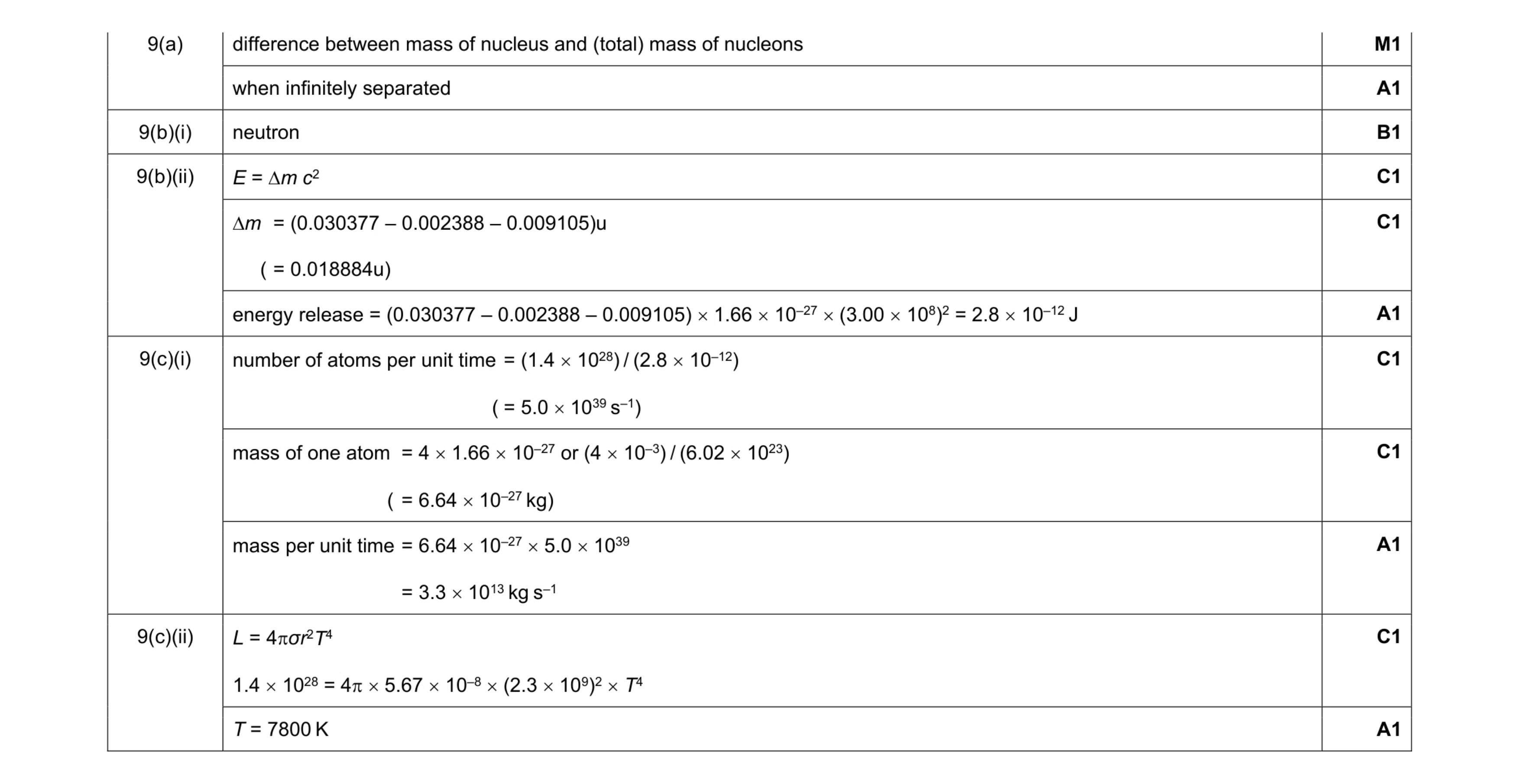 11
11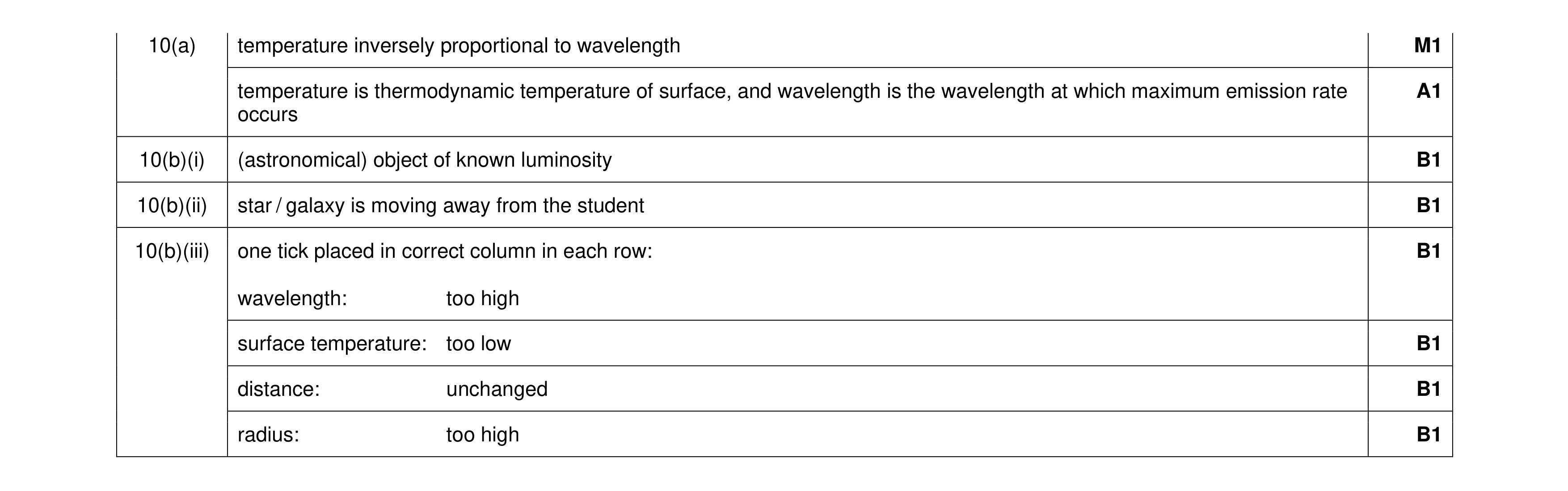 8
8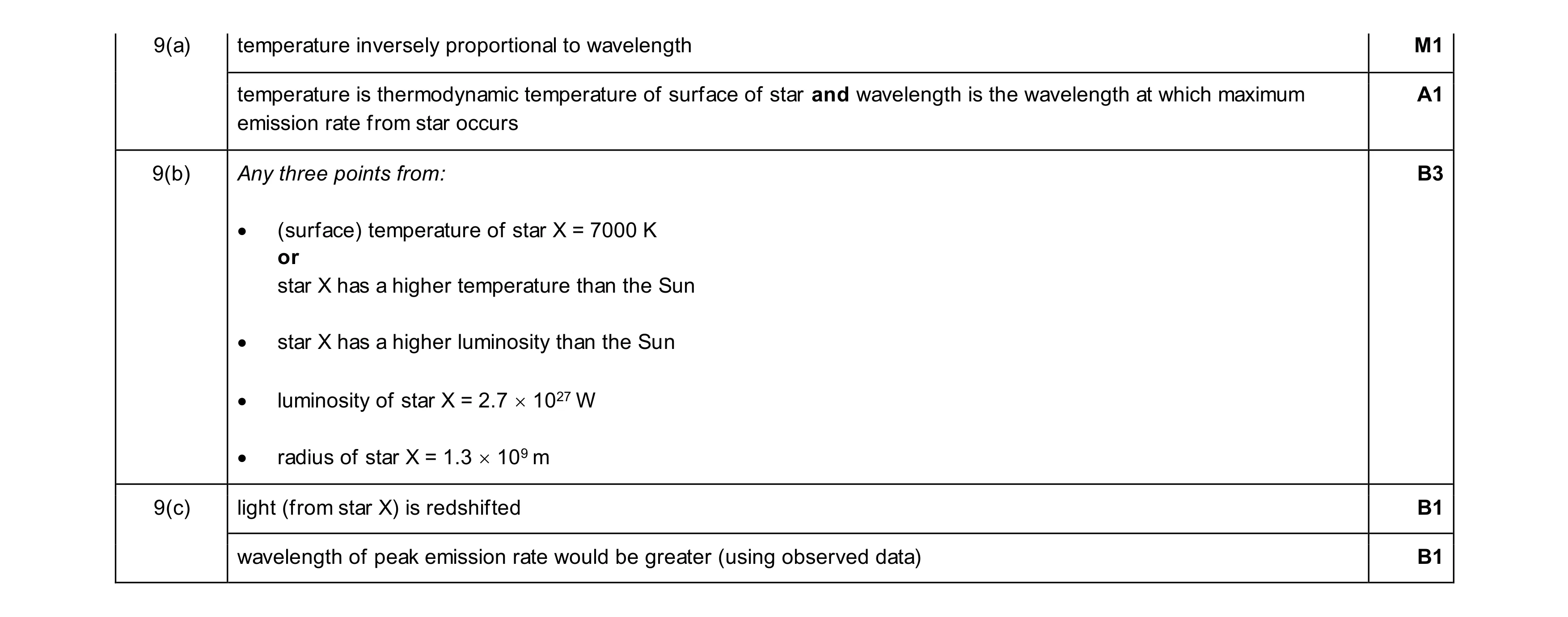 7
7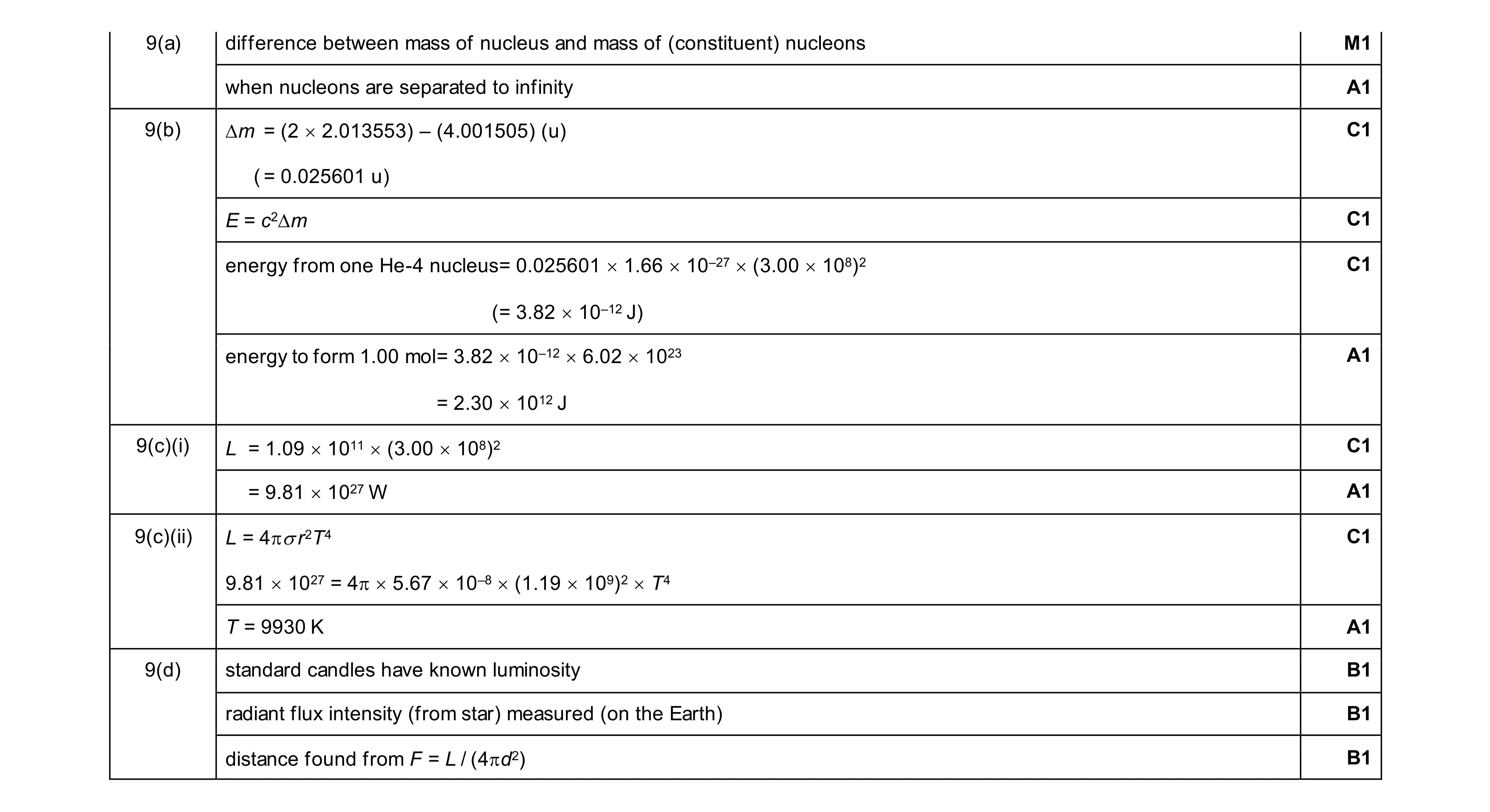 13
13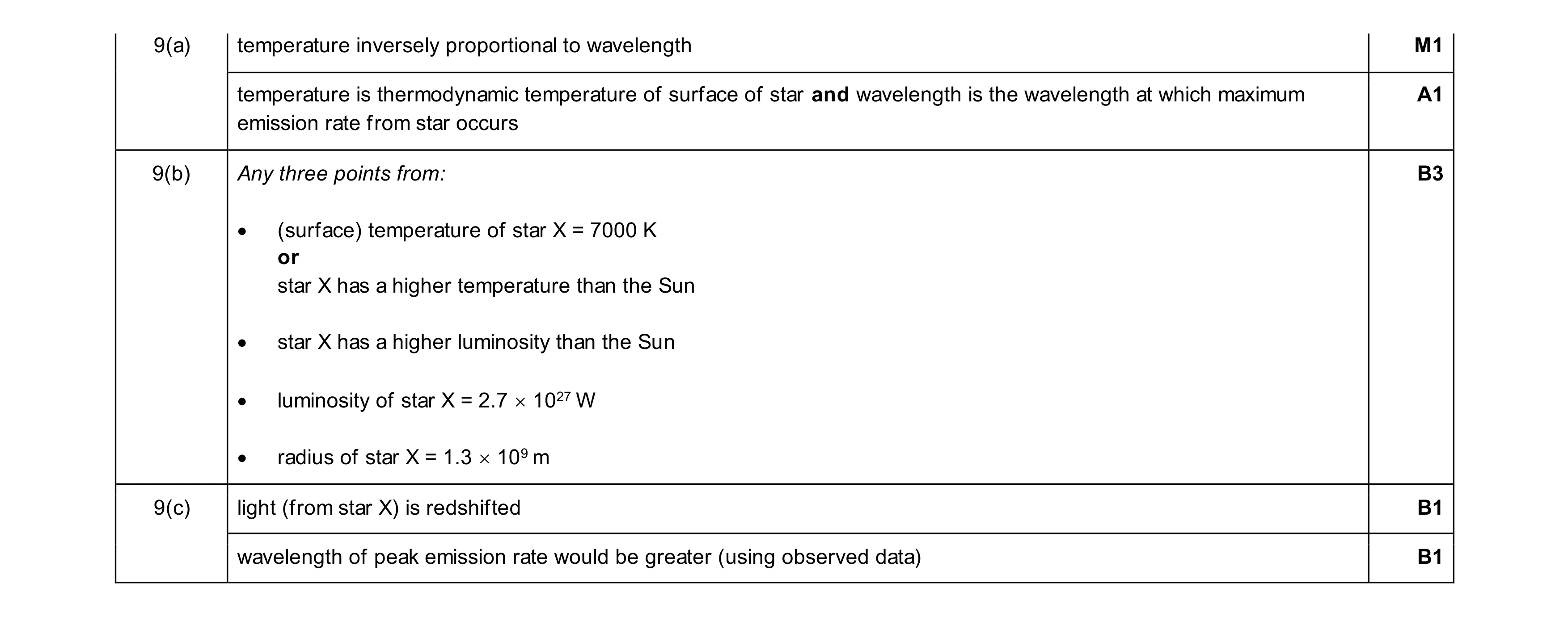 7
7