Cambridge A Level Physics 9702 — 2024 Feb/March Paper 4 · Variant 2
9702/42/F/M/24 · 100 marks · ≈113 min
The question paper and its mark scheme, free to read here and free to download. This is Cambridge’s own paper, exactly as it was sat.
Question paper28 pages



Mark scheme14 pages
Answers below. Sit the paper first if you are practising.
Paper as text
Question paper, page 1
This document has 28 pages. Any blank pages are indicated. [Turn over Cambridge International AS & A Level * 9 3 4 5 5 8 7 6 7 8 * PHYSICS 9702/42 Paper 4 A Level Structured Questions February/March 2024 2 hours You must answer on the question paper. No additional materials are needed. INSTRUCTIONS ● Answer all questions. ● Use a black or dark blue pen. You may use an HB pencil for any diagrams or graphs. ● Write your name, centre number and candidate number in the boxes at the top of the page. ● Write your answer to each question in the space provided. ● Do not use an erasable pen or correction fluid. ● Do not write on any bar codes. ● You may use a calculator. ● You should show all your working and use appropriate units. INFORMATION ● The total mark for this paper is 100. ● The number of marks for each question or part question is shown in brackets [ ]. DC (PB/FC) 331328/4 © UCLES 2024
Question paper, page 2
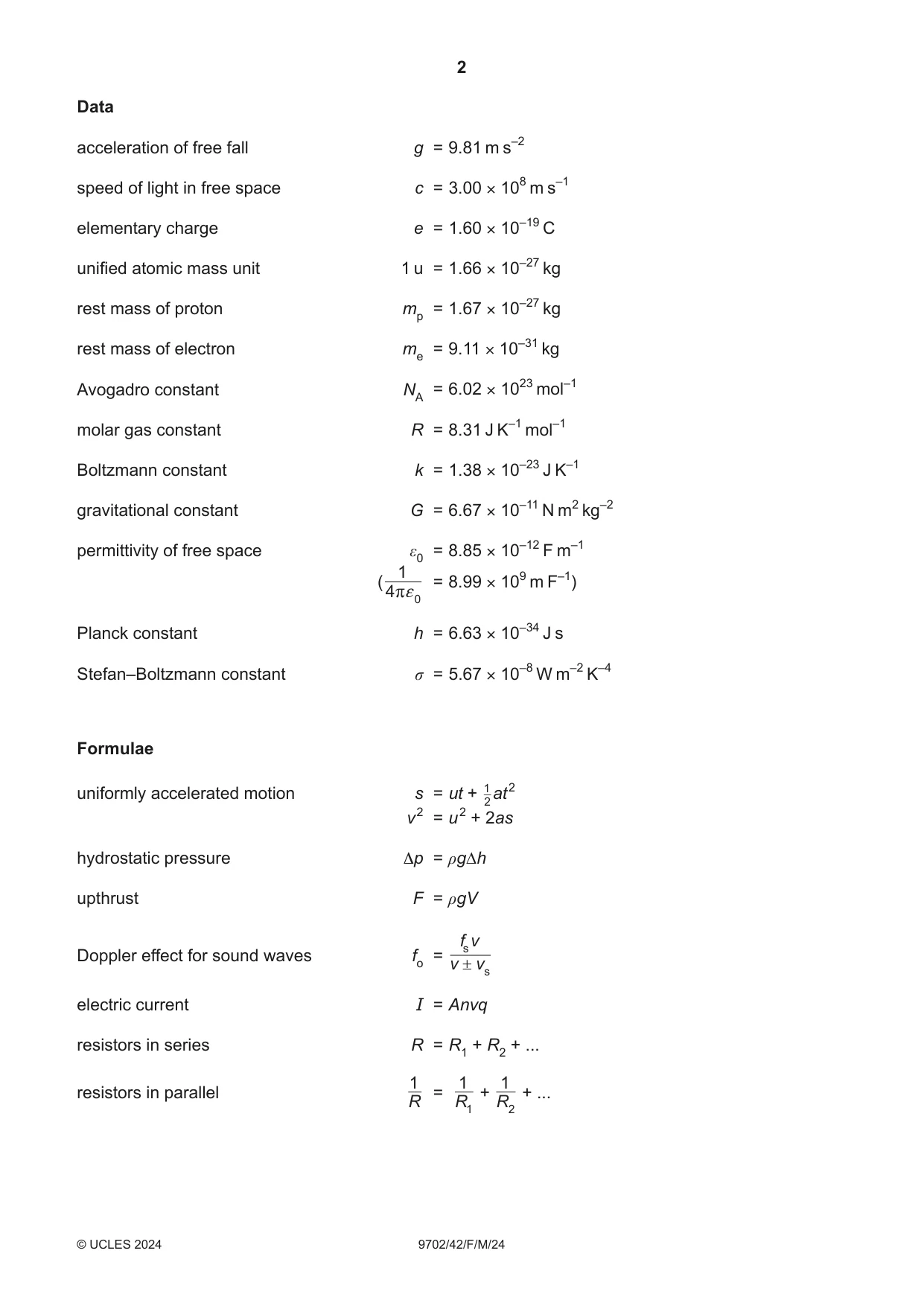
2 9702/42/F/M/24 © UCLES 2024 Data acceleration of free fall g = 9.81 m s–2 speed of light in free space c = 3.00 × 10⁸ m s–1 elementary charge e = 1.60 × 10⁻¹⁹ C unified atomic mass unit 1 u = 1.66 × 10⁻²⁷ kg rest mass of proton mp = 1.67 × 10⁻²⁷ kg rest mass of electron me = 9.11 × 10⁻³¹ kg Avogadro constant NA = 6.02 × 10²³ mol–1 molar gas constant R = 8.31 J K–1 mol–1 Boltzmann constant k = 1.38 × 10⁻²³ J K–1 gravitational constant G = 6.67 × 10⁻¹¹ N m2 kg–2 permittivity of free space ε0 = 8.85 × 10⁻¹² F m–1 (4 1 0 rf = 8.99 × 10⁹ m F–1) Planck constant h = 6.63 × 10⁻³⁴ J s Stefan–Boltzmann constant σ = 5.67 × 10⁻⁸ W m–2 K–4 Formulae uniformly accelerated motion s = ut + 2 1 at 2 v 2 = u 2 + 2as hydrostatic pressure ∆p = ρg∆h upthrust F = ρgV Doppler effect for sound waves fo = v v f v s s ! electric current I = Anvq resistors in series R = R1 + R2 + ... resistors in parallel R 1 = R 1 1 + R 1 2 + ...
Question paper, page 3
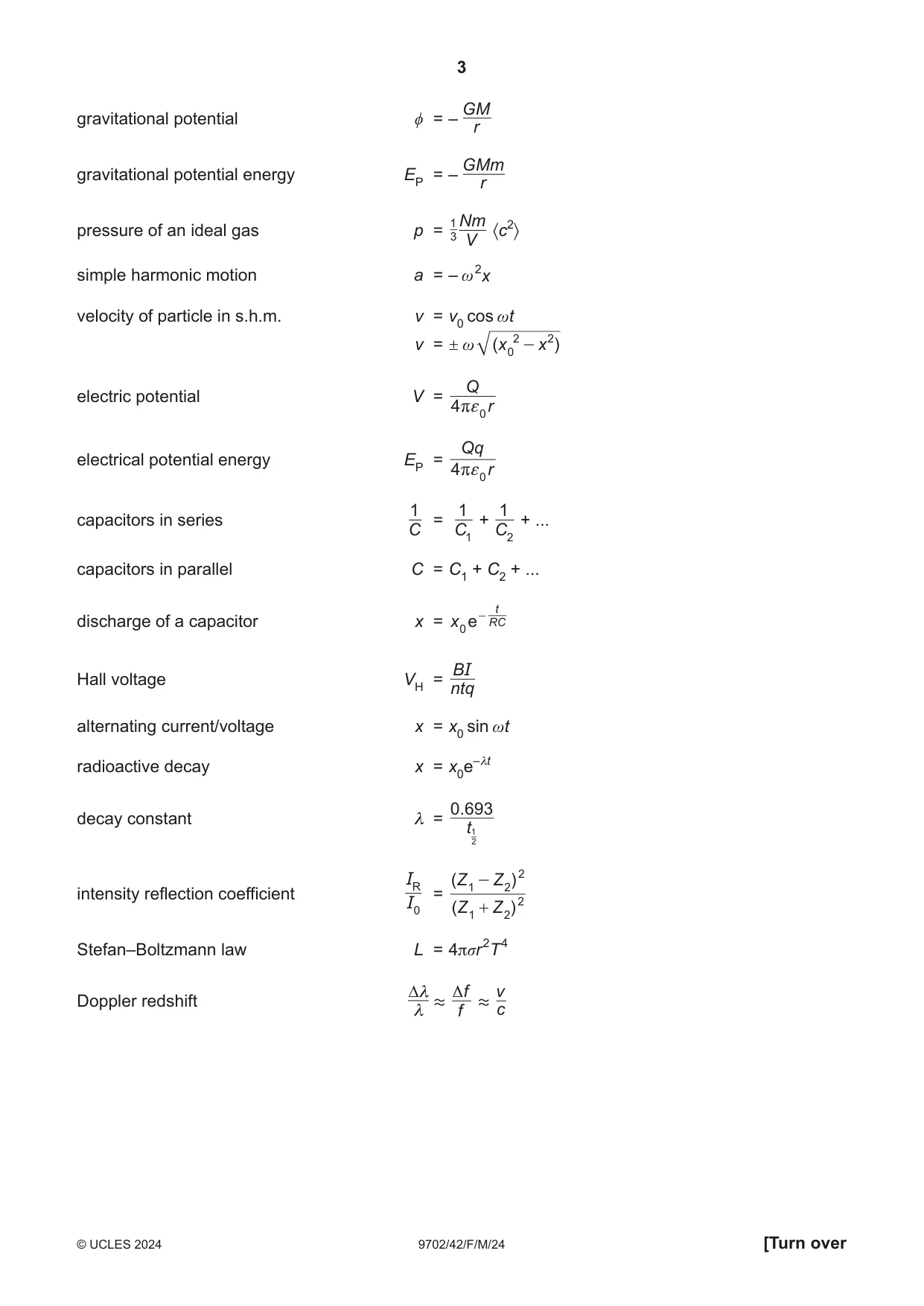
3 9702/42/F/M/24 © UCLES 2024 [Turn over gravitational potential ϕ = – r GM gravitational potential energy EP = – r GMm pressure of an ideal gas p = V Nm 3 1 〈c2〉 simple harmonic motion a = – ω 2x velocity of particle in s.h.m. v = v0 cos ωt v = ! ω ( ) x x 0 2 2 - electric potential V = r Q 4 0 rf electrical potential energy EP = r Qq 4 0 rf capacitors in series C 1 = C 1 1 + C 1 2 + ... capacitors in parallel C = C1 + C2 + ... discharge of a capacitor x = e x RC t 0 - Hall voltage VH = I ntq B alternating current/voltage x = x0 sin ωt radioactive decay x = x0e– λt decay constant λ = . t 0 693 2 1 intensity reflection coefficient I IR 0 = ( ) ( ) Z Z Z Z 1 2 2 1 2 2 + - Stefan–Boltzmann law L = 4πσr 2T 4 Doppler redshift ∆λ λ á f f D á c v
Question paper, page 4
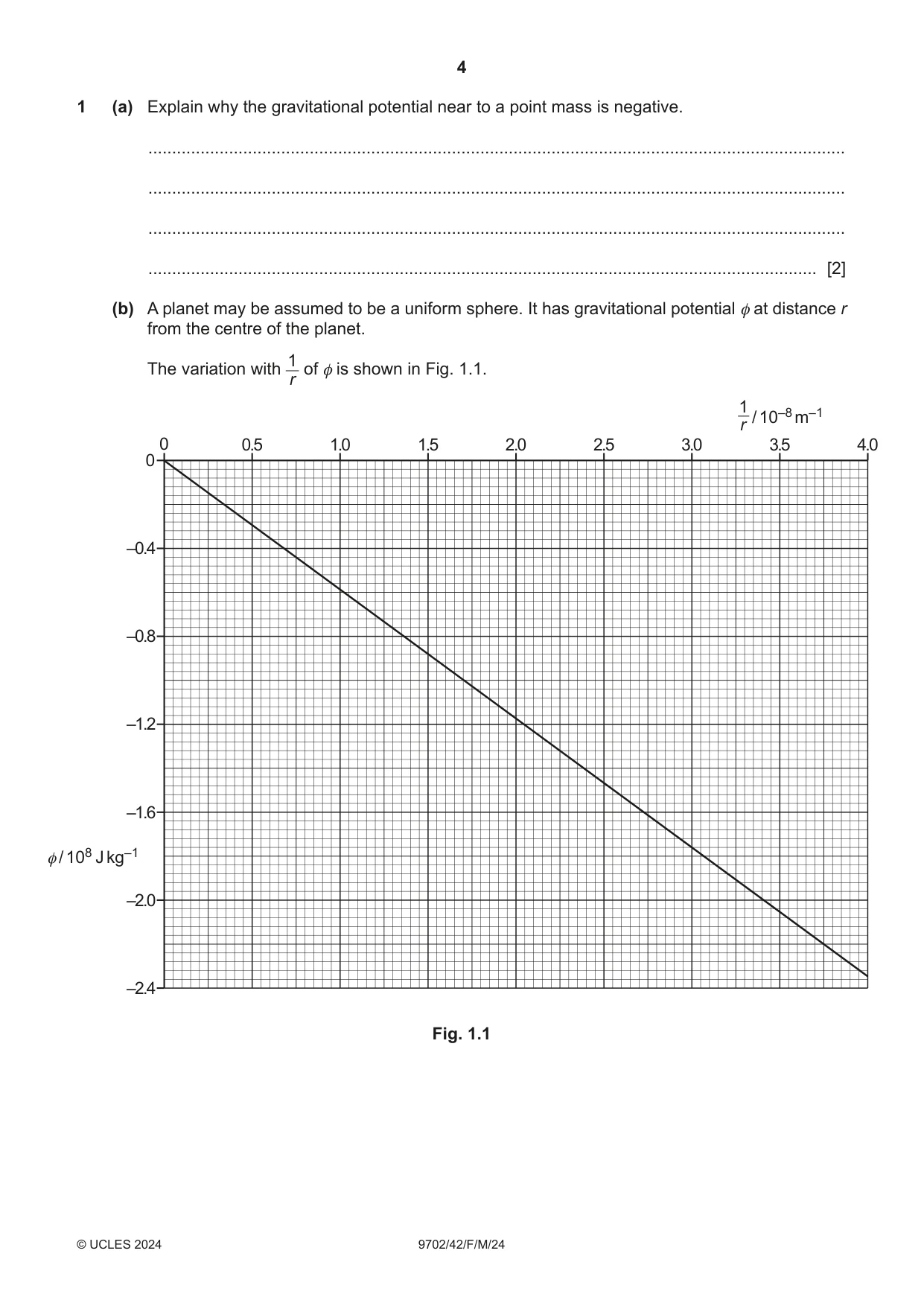
4 9702/42/F/M/24 © UCLES 2024 1 (a) Explain why the gravitational potential near to a point mass is negative. … … … … [2] (b) A planet may be assumed to be a uniform sphere. It has gravitational potential φ at distance r from the centre of the planet. The variation with 1 r of φ is shown in Fig. 1.1. –2.4 –2.0 –1.6 –1.2 –0.8 –0.4 / 108 J kg–1 0 0 0.5 1.0 1.5 2.0 2.5 3.0 / 10–8 m–1 3.5 4.0 φ r 1 Fig. 1.1
Question paper, page 5
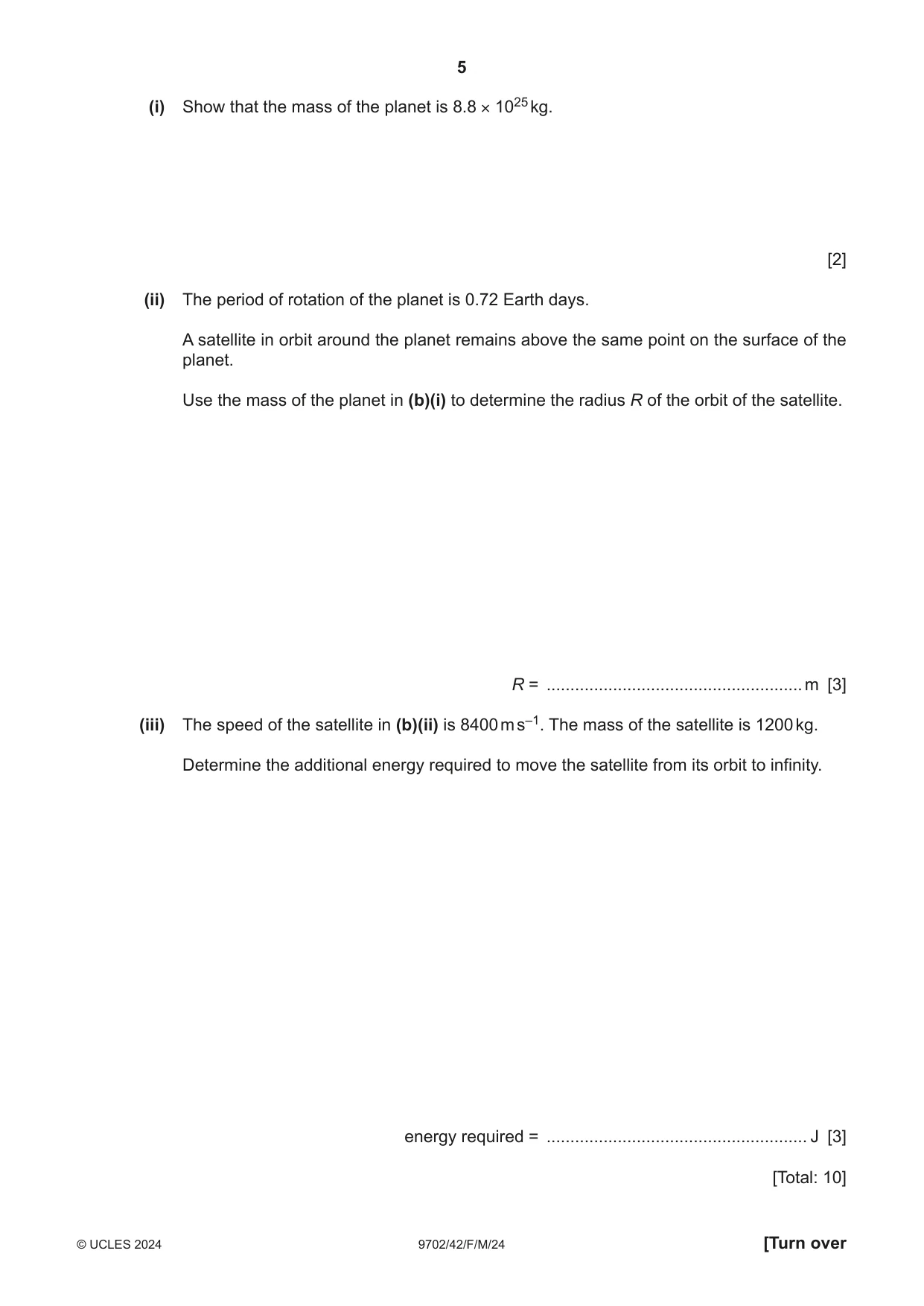
5 9702/42/F/M/24 © UCLES 2024 [Turn over (i) Show that the mass of the planet is 8.8 × 1025 kg. [2] (ii) The period of rotation of the planet is 0.72 Earth days. A satellite in orbit around the planet remains above the same point on the surface of the planet. Use the mass of the planet in (b)(i) to determine the radius R of the orbit of the satellite. R = … m [3] (iii) The speed of the satellite in (b)(ii) is 8400 m s–1. The mass of the satellite is 1200 kg. Determine the additional energy required to move the satellite from its orbit to infinity. energy required = … J [3] [Total: 10]
Question paper, page 6
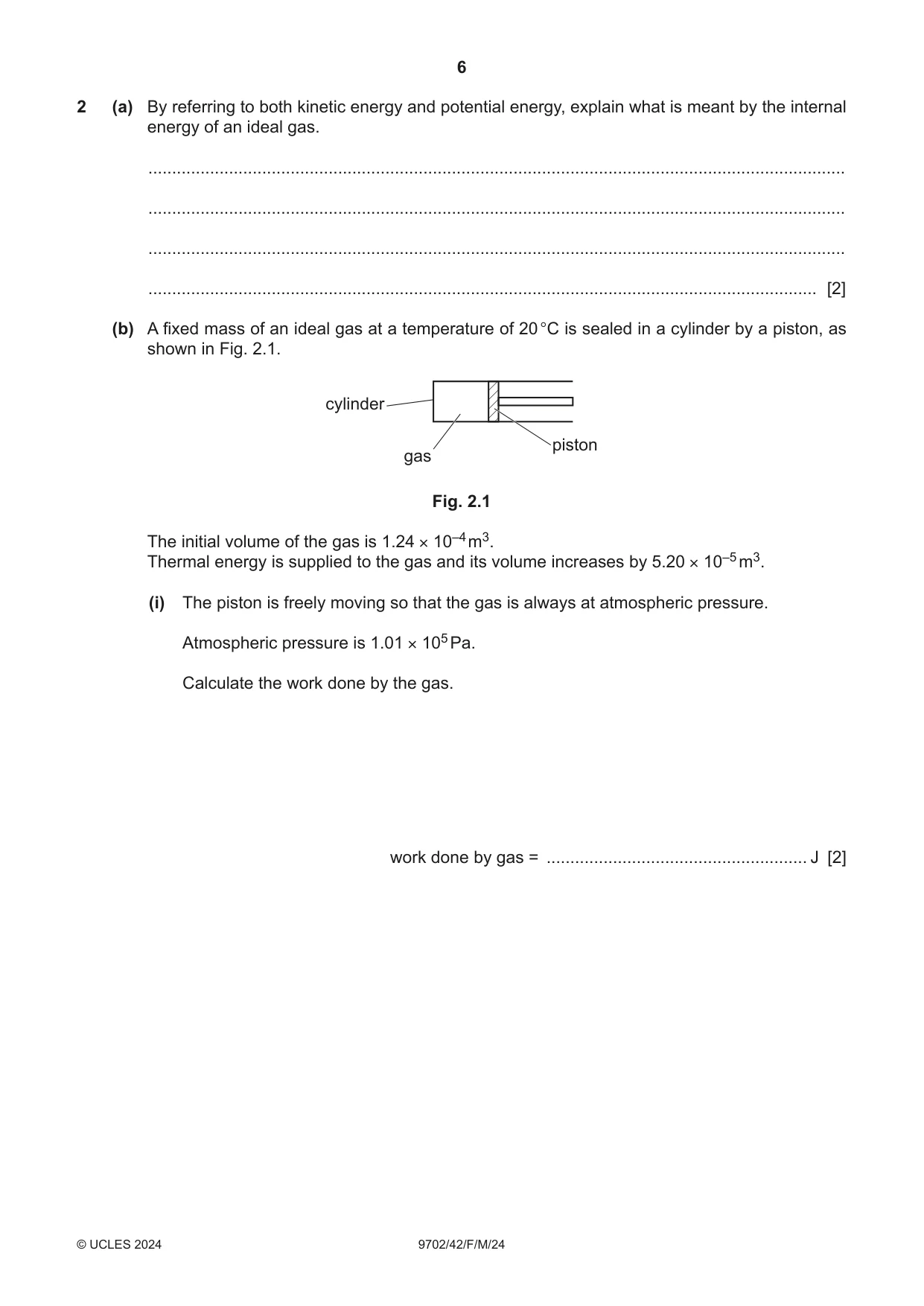
6 9702/42/F/M/24 © UCLES 2024 2 (a) By referring to both kinetic energy and potential energy, explain what is meant by the internal energy of an ideal gas. … … … … [2] (b) A fixed mass of an ideal gas at a temperature of 20 °C is sealed in a cylinder by a piston, as shown in Fig. 2.1. cylinder gas piston Fig. 2.1 The initial volume of the gas is 1.24 × 10⁻⁴ m3. Thermal energy is supplied to the gas and its volume increases by 5.20 × 10⁻⁵ m3. (i) The piston is freely moving so that the gas is always at atmospheric pressure. Atmospheric pressure is 1.01 × 10⁵ Pa. Calculate the work done by the gas. work done by gas = … J [2]
Question paper, page 7
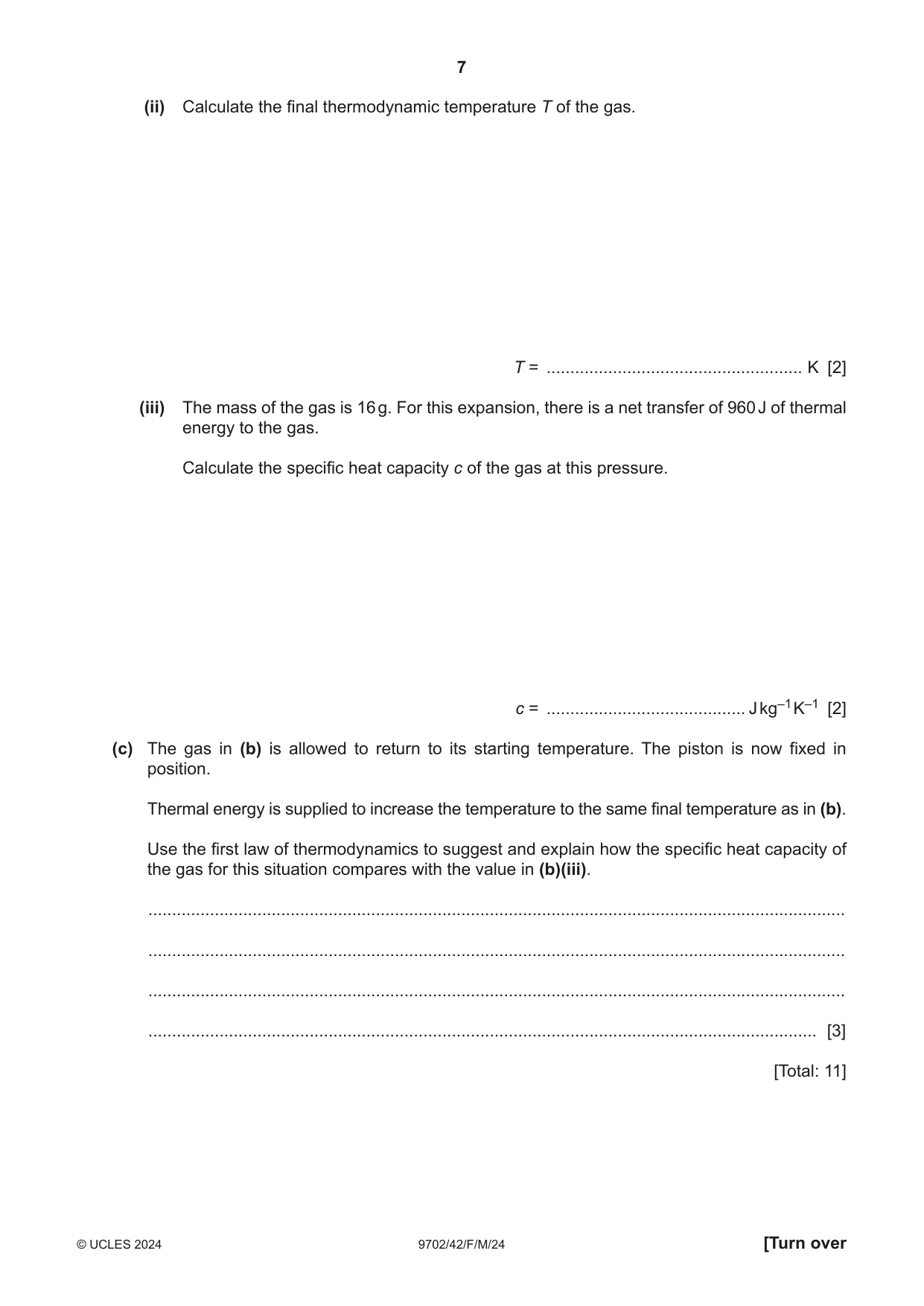
7 9702/42/F/M/24 © UCLES 2024 [Turn over (ii) Calculate the final thermodynamic temperature T of the gas. T = … K [2] (iii) The mass of the gas is 16 g. For this expansion, there is a net transfer of 960 J of thermal energy to the gas. Calculate the specific heat capacity c of the gas at this pressure. c = … J kg–1 K–1 [2] (c) The gas in (b) is allowed to return to its starting temperature. The piston is now fixed in position. Thermal energy is supplied to increase the temperature to the same final temperature as in (b). Use the first law of thermodynamics to suggest and explain how the specific heat capacity of the gas for this situation compares with the value in (b)(iii). … … … … [3] [Total: 11]
Question paper, page 8
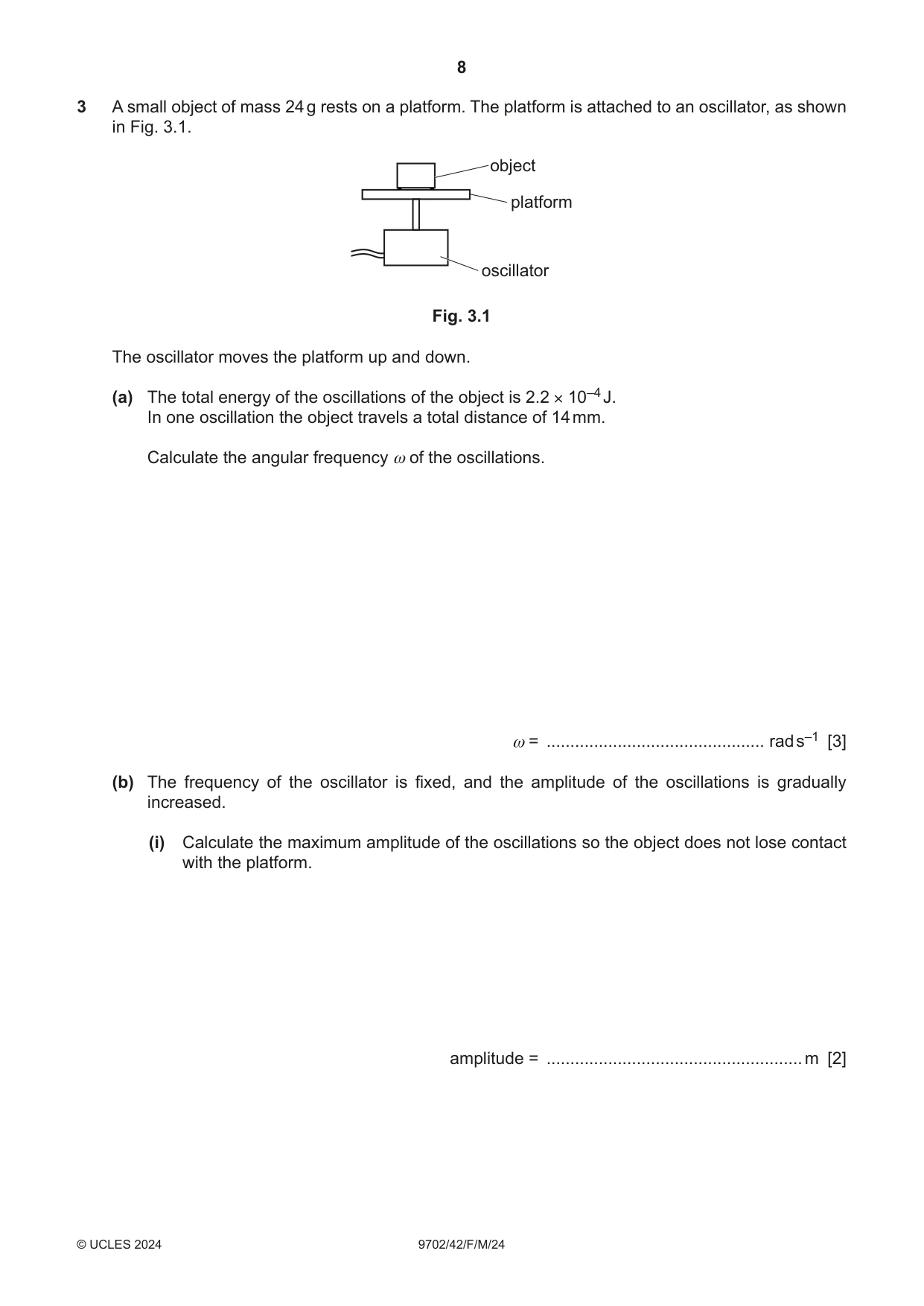
8 9702/42/F/M/24 © UCLES 2024 3 A small object of mass 24 g rests on a platform. The platform is attached to an oscillator, as shown in Fig. 3.1. platform oscillator object Fig. 3.1 The oscillator moves the platform up and down. (a) The total energy of the oscillations of the object is 2.2 × 10⁻⁴ J. In one oscillation the object travels a total distance of 14 mm. Calculate the angular frequency ω of the oscillations. ω = … rad s–1 [3] (b) The frequency of the oscillator is fixed, and the amplitude of the oscillations is gradually increased. (i) Calculate the maximum amplitude of the oscillations so the object does not lose contact with the platform. amplitude = … m [2]
Question paper, page 9
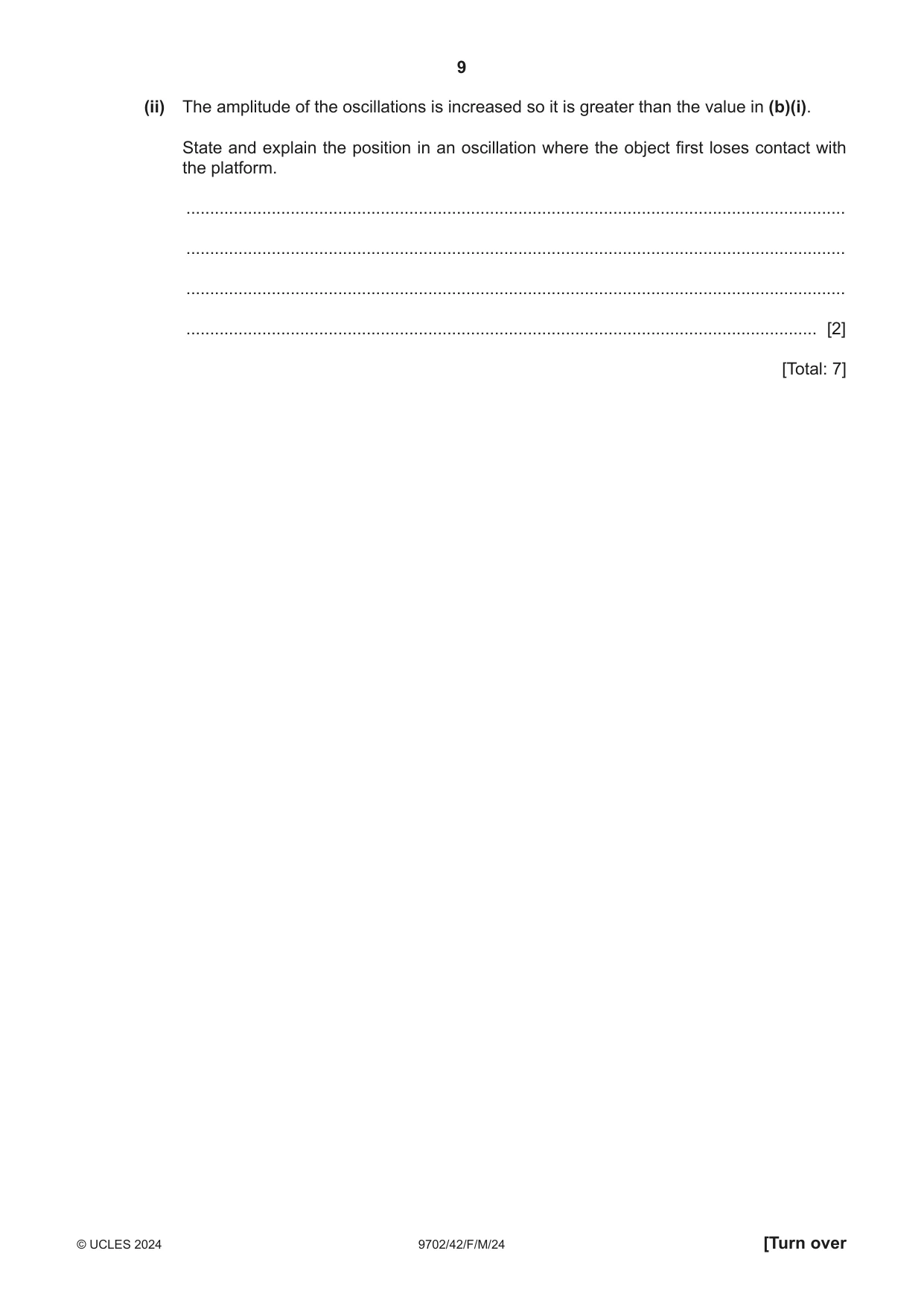
9 9702/42/F/M/24 © UCLES 2024 [Turn over (ii) The amplitude of the oscillations is increased so it is greater than the value in (b)(i). State and explain the position in an oscillation where the object first loses contact with the platform. … … … … [2] [Total: 7]
Question paper, page 10
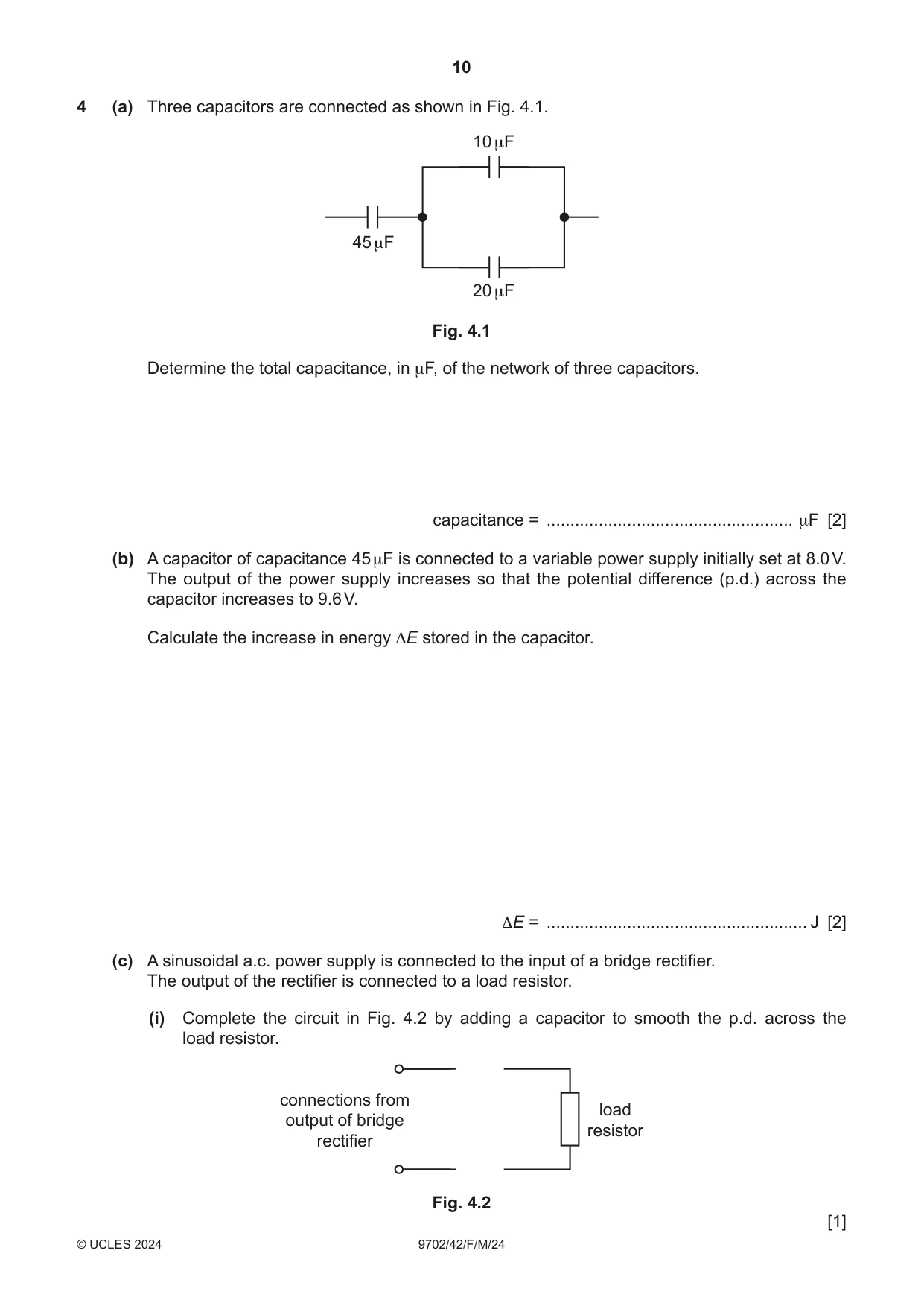
10 9702/42/F/M/24 © UCLES 2024 4 (a) Three capacitors are connected as shown in Fig. 4.1. 45 μF 10 μF 20 μF Fig. 4.1 Determine the total capacitance, in μF, of the network of three capacitors. capacitance = … μF [2] (b) A capacitor of capacitance 45 μF is connected to a variable power supply initially set at 8.0 V. The output of the power supply increases so that the potential difference (p.d.) across the capacitor increases to 9.6 V. Calculate the increase in energy ΔE stored in the capacitor. ΔE = … J [2] (c) A sinusoidal a.c. power supply is connected to the input of a bridge rectifier. The output of the rectifier is connected to a load resistor. (i) Complete the circuit in Fig. 4.2 by adding a capacitor to smooth the p.d. across the load resistor. connections from output of bridge rectifier load resistor Fig. 4.2 [1]
Question paper, page 11
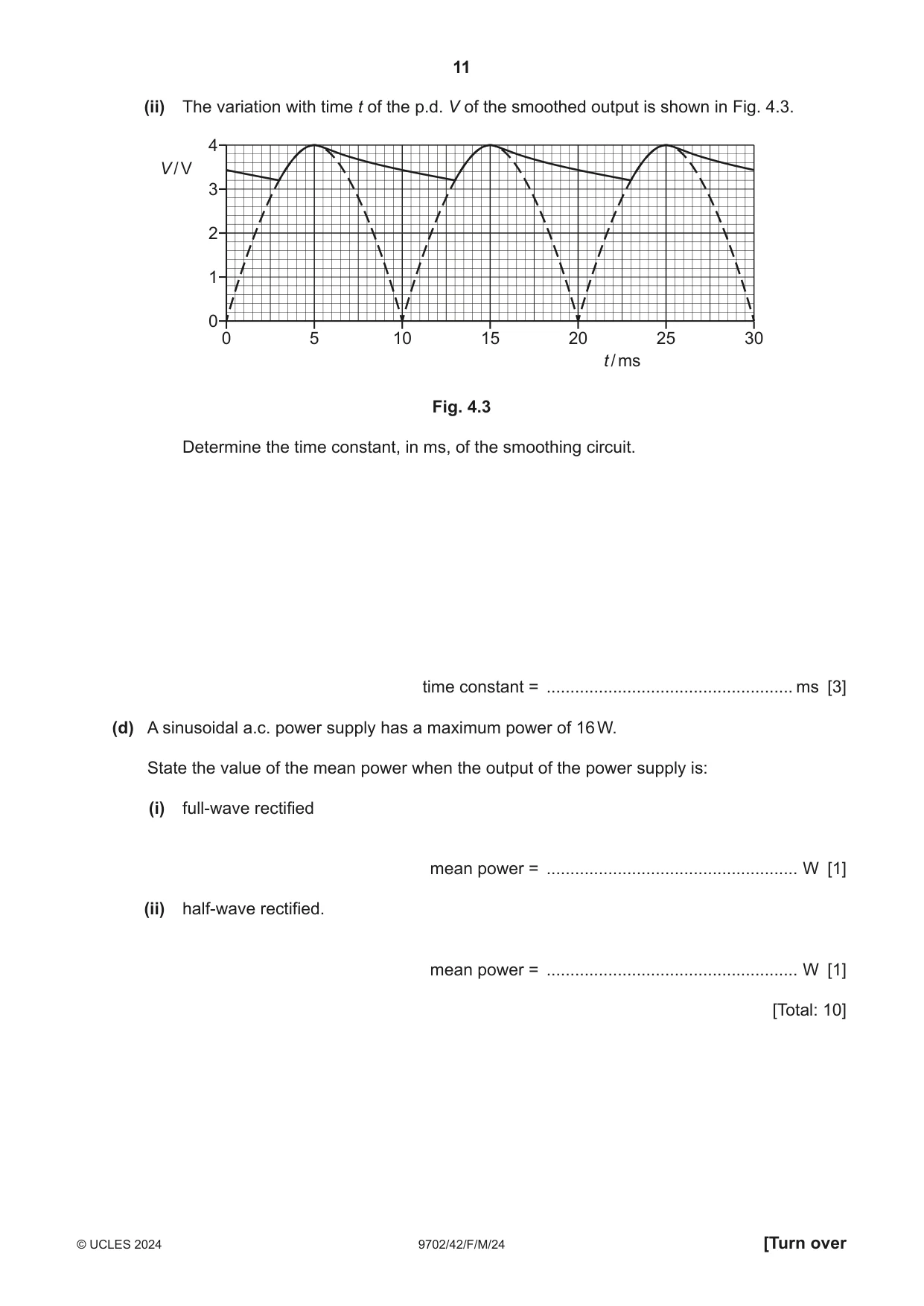
11 9702/42/F/M/24 © UCLES 2024 [Turn over (ii) The variation with time t of the p.d. V of the smoothed output is shown in Fig. 4.3. 0 0 2 4 1 3 V / V t / ms 5 10 15 20 25 30 Fig. 4.3 Determine the time constant, in ms, of the smoothing circuit. time constant = … ms [3] (d) A sinusoidal a.c. power supply has a maximum power of 16 W. State the value of the mean power when the output of the power supply is: (i) full‑wave rectified mean power = … W [1] (ii) half‑wave rectified. mean power = … W [1] [Total: 10]
Question paper, page 12
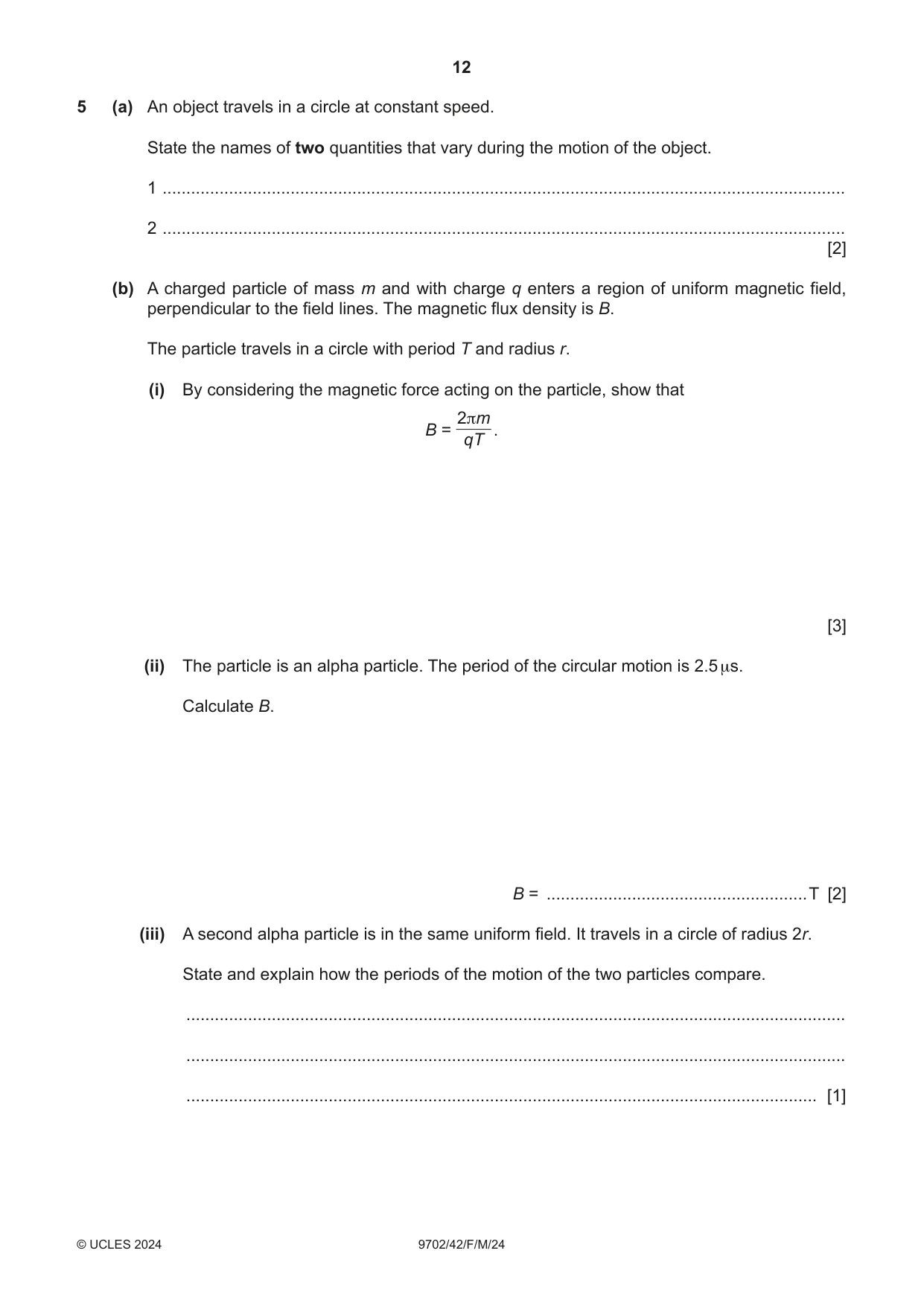
12 9702/42/F/M/24 © UCLES 2024 5 (a) An object travels in a circle at constant speed. State the names of two quantities that vary during the motion of the object. 1 … 2 … [2] (b) A charged particle of mass m and with charge q enters a region of uniform magnetic field, perpendicular to the field lines. The magnetic flux density is B. The particle travels in a circle with period T and radius r. (i) By considering the magnetic force acting on the particle, show that B = 2πm qT . [3] (ii) The particle is an alpha particle. The period of the circular motion is 2.5 μs. Calculate B. B = … T [2] (iii) A second alpha particle is in the same uniform field. It travels in a circle of radius 2r. State and explain how the periods of the motion of the two particles compare. … … … [1]
Question paper, page 13
13 9702/42/F/M/24 © UCLES 2024 [Turn over (iv) The speed of the alpha particle in (b)(ii) is 1.1 × 10⁶ m s–1. An electric field is applied so that this particle now moves with constant velocity. Use your answer in (b)(ii) to calculate the electric field strength E. Give the unit with your answer. E = … unit … [2] [Total: 10]
Question paper, page 14
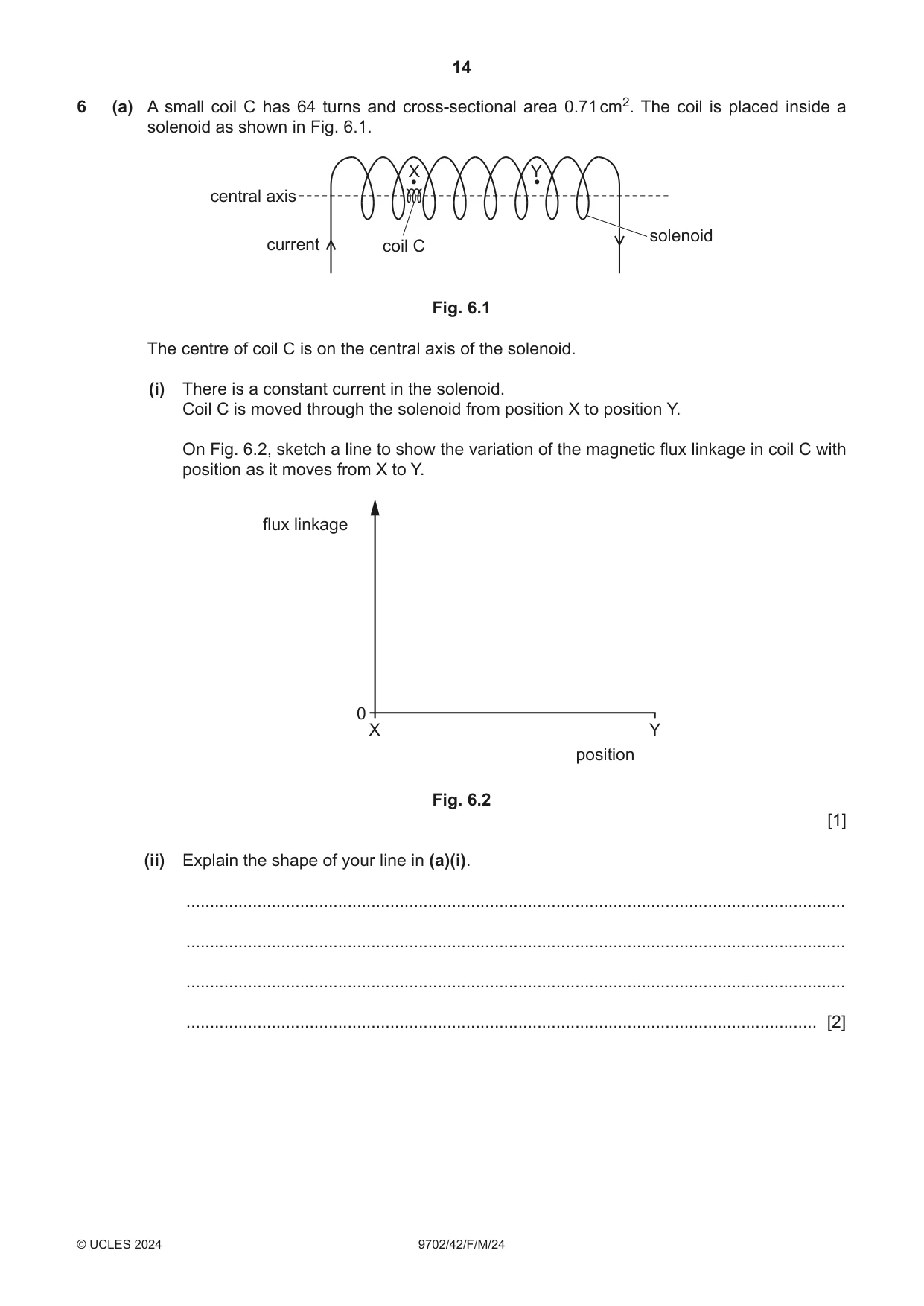
14 9702/42/F/M/24 © UCLES 2024 6 (a) A small coil C has 64 turns and cross‑sectional area 0.71 cm2. The coil is placed inside a solenoid as shown in Fig. 6.1. central axis solenoid current coil C X Y Fig. 6.1 The centre of coil C is on the central axis of the solenoid. (i) There is a constant current in the solenoid. Coil C is moved through the solenoid from position X to position Y. On Fig. 6.2, sketch a line to show the variation of the magnetic flux linkage in coil C with position as it moves from X to Y. flux linkage position X 0 Y Fig. 6.2 [1] (ii) Explain the shape of your line in (a)(i). … … … … [2]
Question paper, page 15
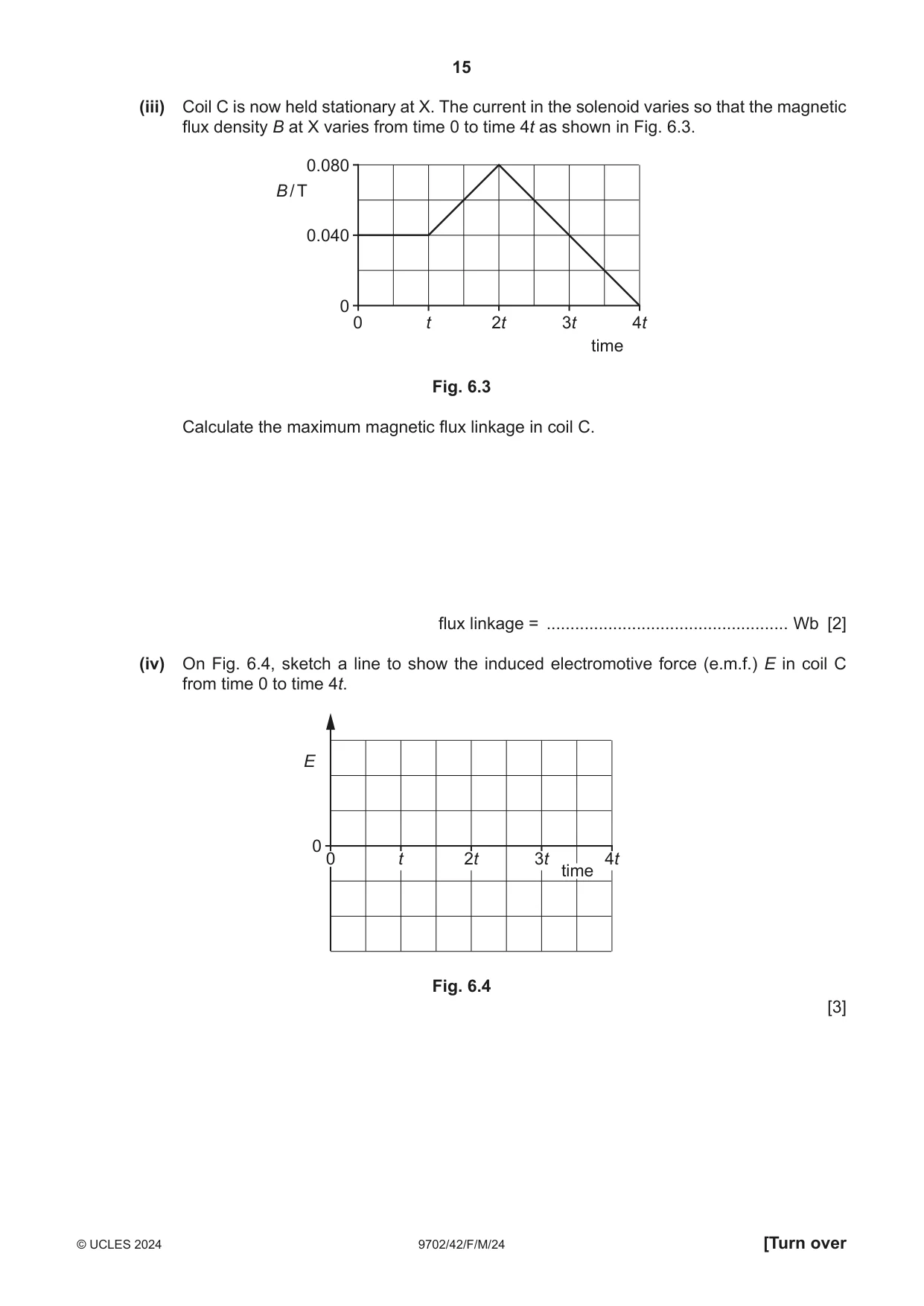
15 9702/42/F/M/24 © UCLES 2024 [Turn over (iii) Coil C is now held stationary at X. The current in the solenoid varies so that the magnetic flux density B at X varies from time 0 to time 4t as shown in Fig. 6.3. B / T time 0 0 4t 0.040 0.080 3t 2t t Fig. 6.3 Calculate the maximum magnetic flux linkage in coil C. flux linkage = … Wb [2] (iv) On Fig. 6.4, sketch a line to show the induced electromotive force (e.m.f.) E in coil C from time 0 to time 4t. E 0 4t 3t 2t t 0 time Fig. 6.4 [3]
Question paper, page 16
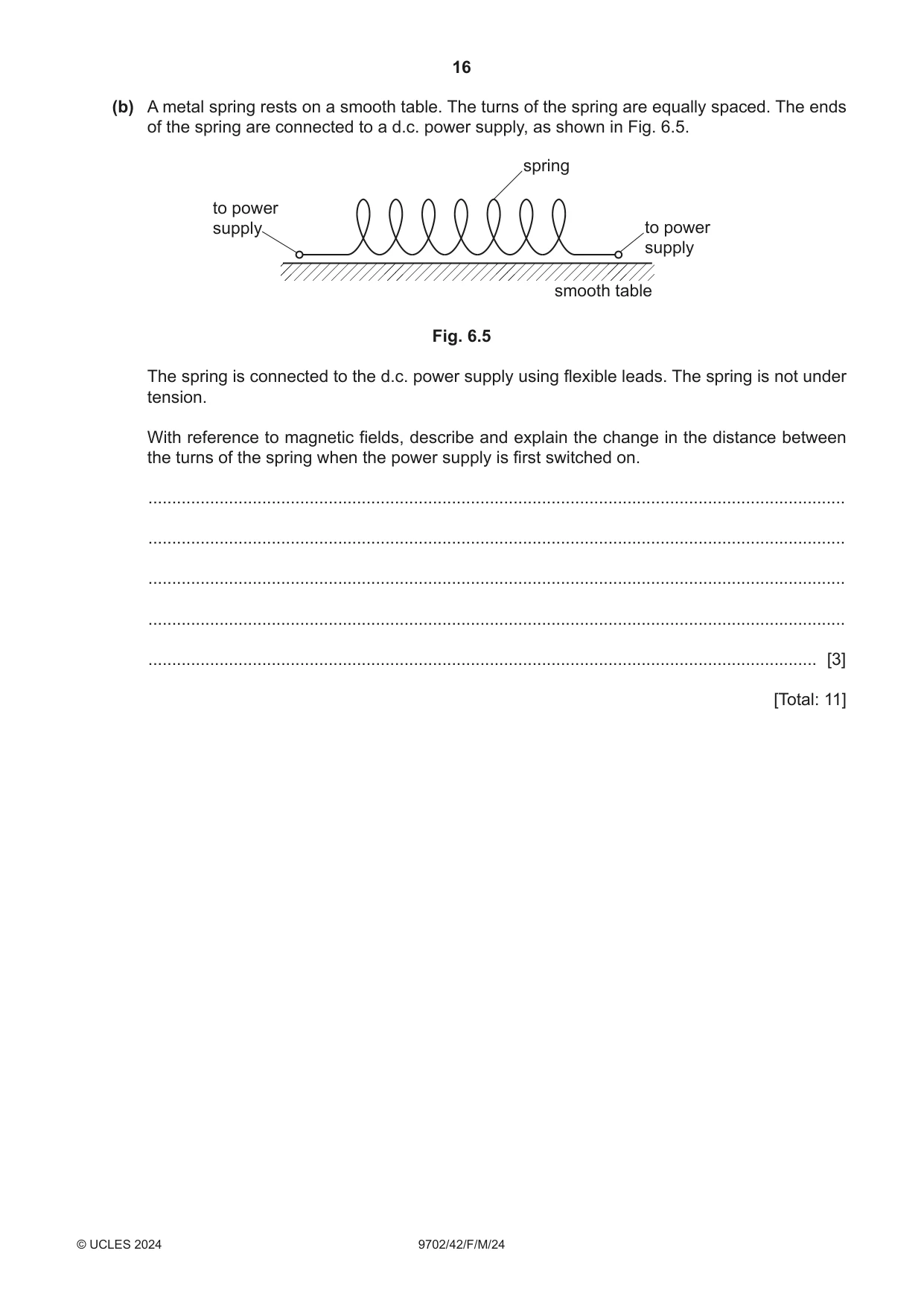
16 9702/42/F/M/24 © UCLES 2024 (b) A metal spring rests on a smooth table. The turns of the spring are equally spaced. The ends of the spring are connected to a d.c. power supply, as shown in Fig. 6.5. to power supply smooth table to power supply spring Fig. 6.5 The spring is connected to the d.c. power supply using flexible leads. The spring is not under tension. With reference to magnetic fields, describe and explain the change in the distance between the turns of the spring when the power supply is first switched on. … … … … … [3] [Total: 11]
Question paper, page 17
17 9702/42/F/M/24 © UCLES 2024 [Turn over BLANK PAGE
Question paper, page 18
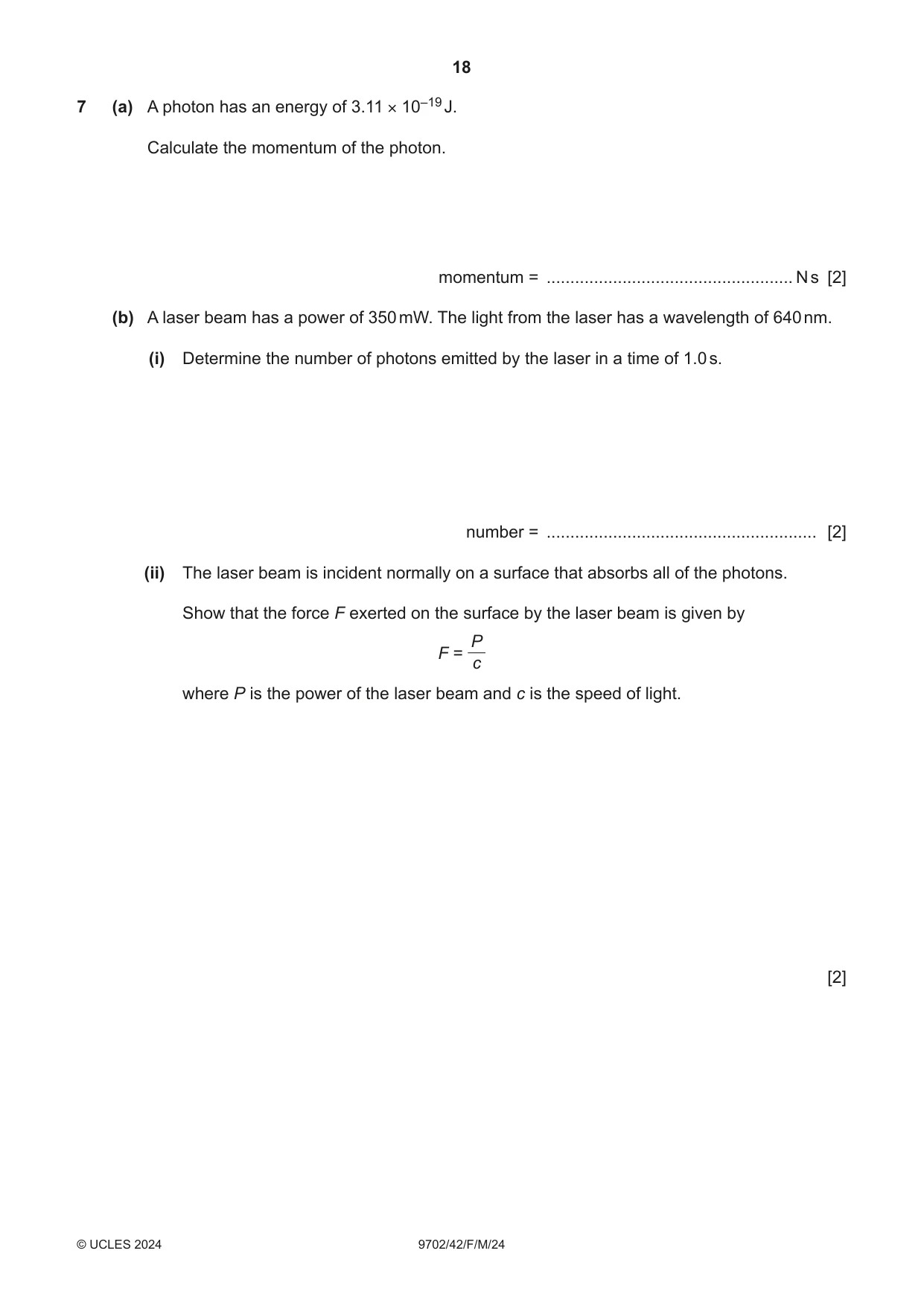
18 9702/42/F/M/24 © UCLES 2024 7 (a) A photon has an energy of 3.11 × 10⁻¹⁹ J. Calculate the momentum of the photon. momentum = … N s [2] (b) A laser beam has a power of 350 mW. The light from the laser has a wavelength of 640 nm. (i) Determine the number of photons emitted by the laser in a time of 1.0 s. number = … [2] (ii) The laser beam is incident normally on a surface that absorbs all of the photons. Show that the force F exerted on the surface by the laser beam is given by F = P c where P is the power of the laser beam and c is the speed of light. [2]
Question paper, page 19
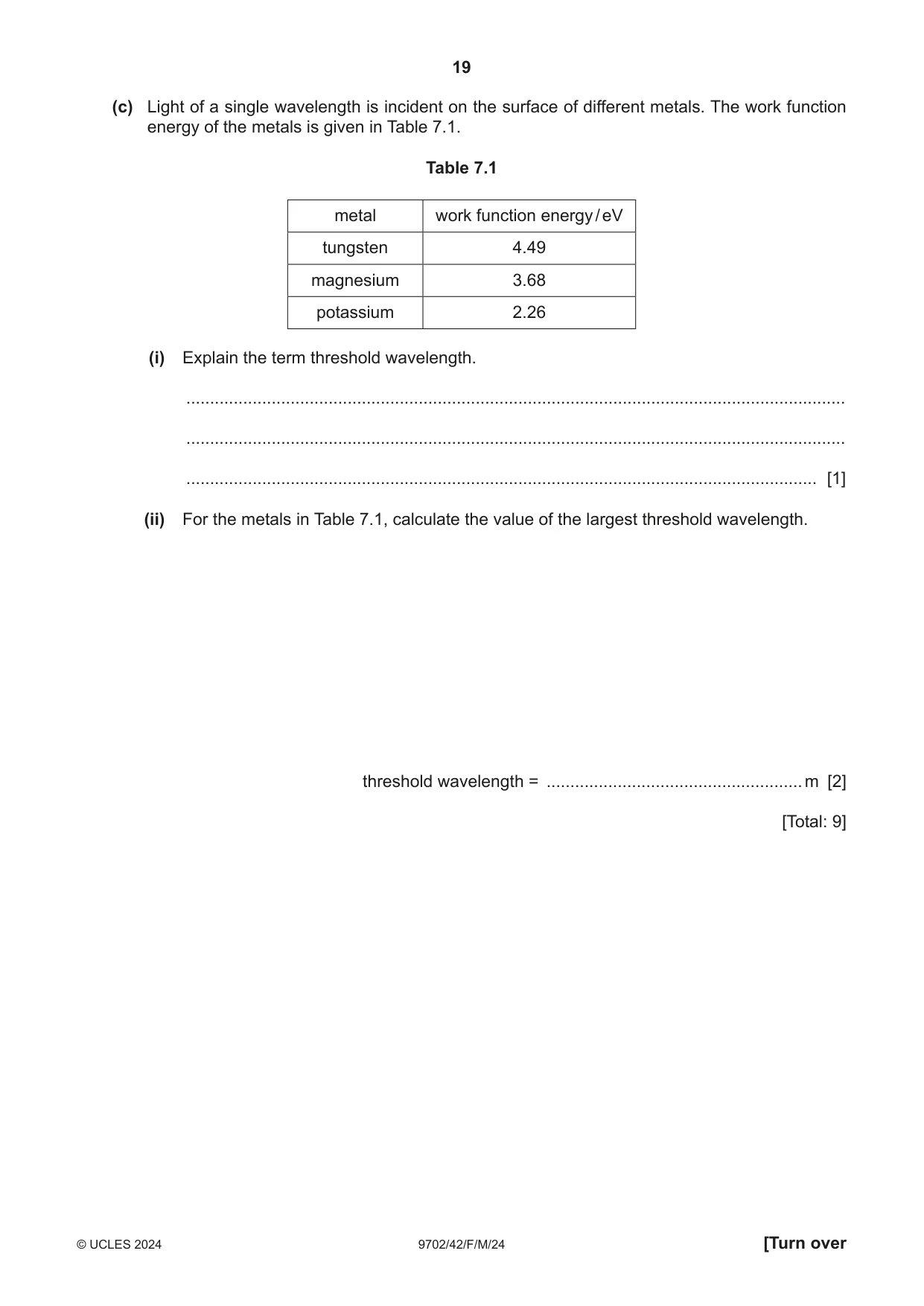
19 9702/42/F/M/24 © UCLES 2024 [Turn over (c) Light of a single wavelength is incident on the surface of different metals. The work function energy of the metals is given in Table 7.1. Table 7.1 metal work function energy / eV tungsten 4.49 magnesium 3.68 potassium 2.26 (i) Explain the term threshold wavelength. … … … [1] (ii) For the metals in Table 7.1, calculate the value of the largest threshold wavelength. threshold wavelength = … m [2] [Total: 9]
Question paper, page 20
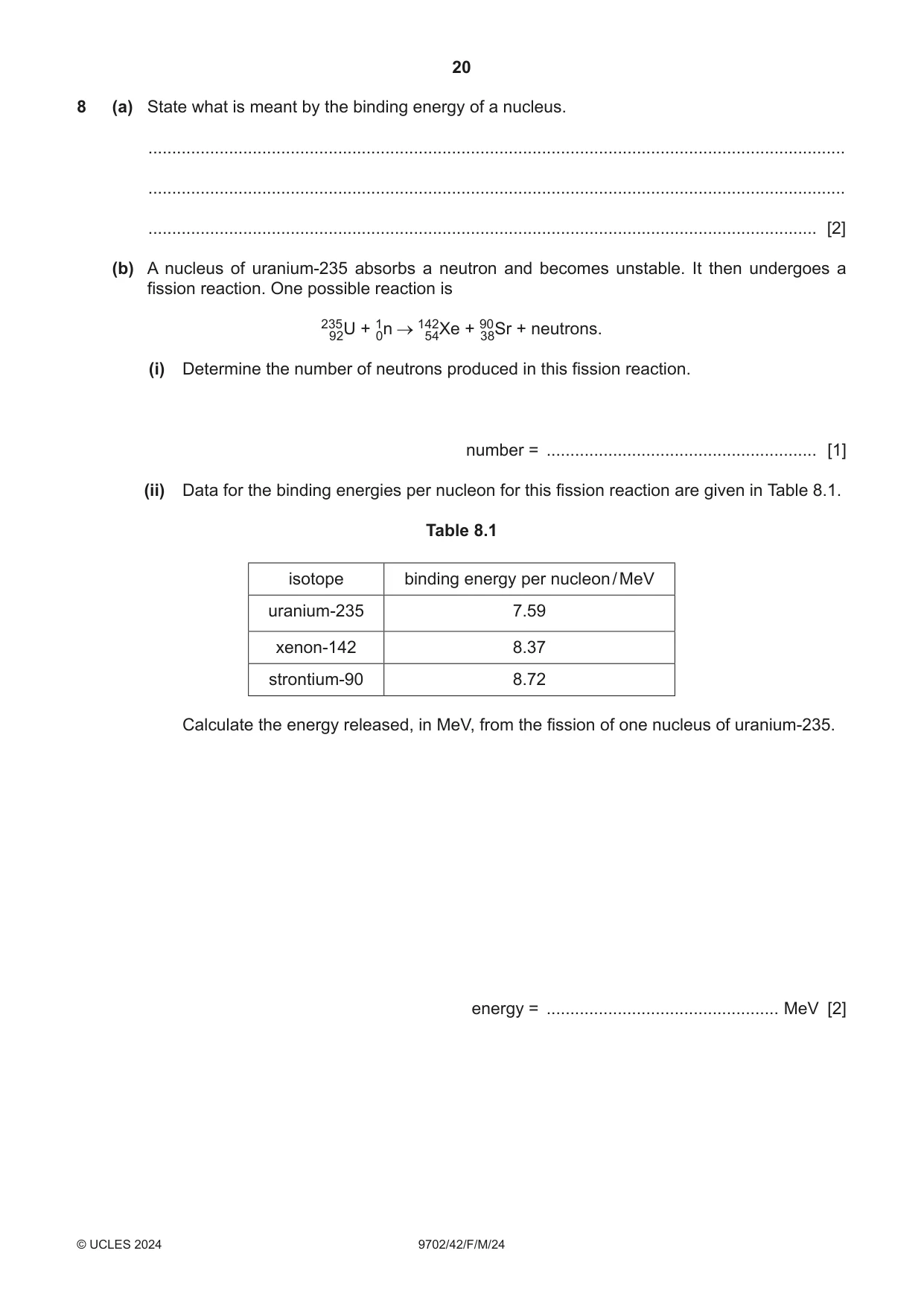
20 9702/42/F/M/24 © UCLES 2024 8 (a) State what is meant by the binding energy of a nucleus. … … … [2] (b) A nucleus of uranium‑235 absorbs a neutron and becomes unstable. It then undergoes a fission reaction. One possible reaction is 235 92U + 1 0n 142 54Xe + 90 38Sr + neutrons. (i) Determine the number of neutrons produced in this fission reaction. number = … [1] (ii) Data for the binding energies per nucleon for this fission reaction are given in Table 8.1. Table 8.1 isotope binding energy per nucleon / MeV uranium‑235 7.59 xenon‑142 8.37 strontium‑90 8.72 Calculate the energy released, in MeV, from the fission of one nucleus of uranium‑235. energy = … MeV [2]
Question paper, page 21
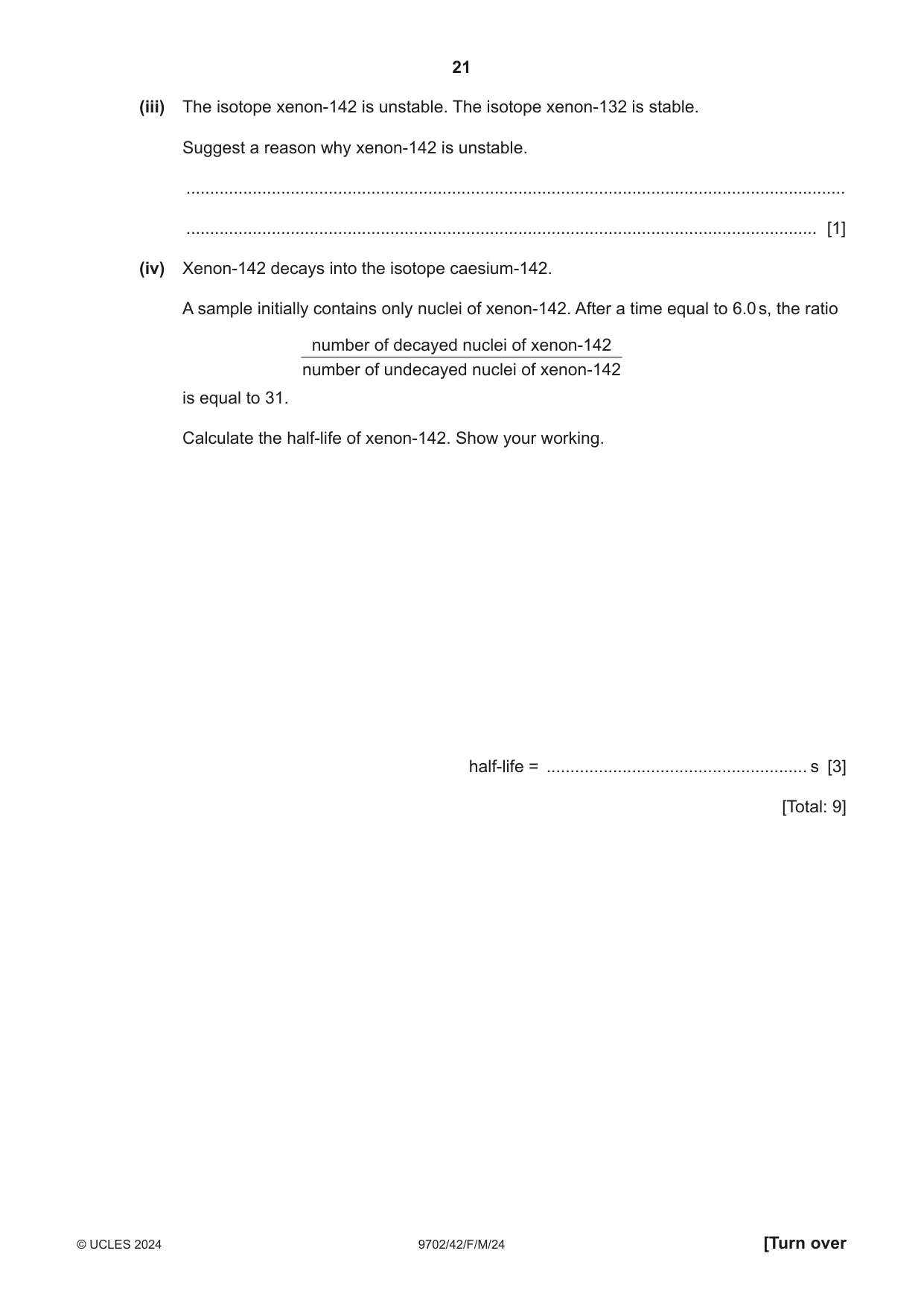
21 9702/42/F/M/24 © UCLES 2024 [Turn over (iii) The isotope xenon‑142 is unstable. The isotope xenon‑132 is stable. Suggest a reason why xenon‑142 is unstable. … … [1] (iv) Xenon‑142 decays into the isotope caesium‑142. A sample initially contains only nuclei of xenon‑142. After a time equal to 6.0 s, the ratio number of decayed nuclei of xenon‑142 number of undecayed nuclei of xenon‑142 is equal to 31. Calculate the half‑life of xenon‑142. Show your working. half‑life = … s [3] [Total: 9]
Question paper, page 22
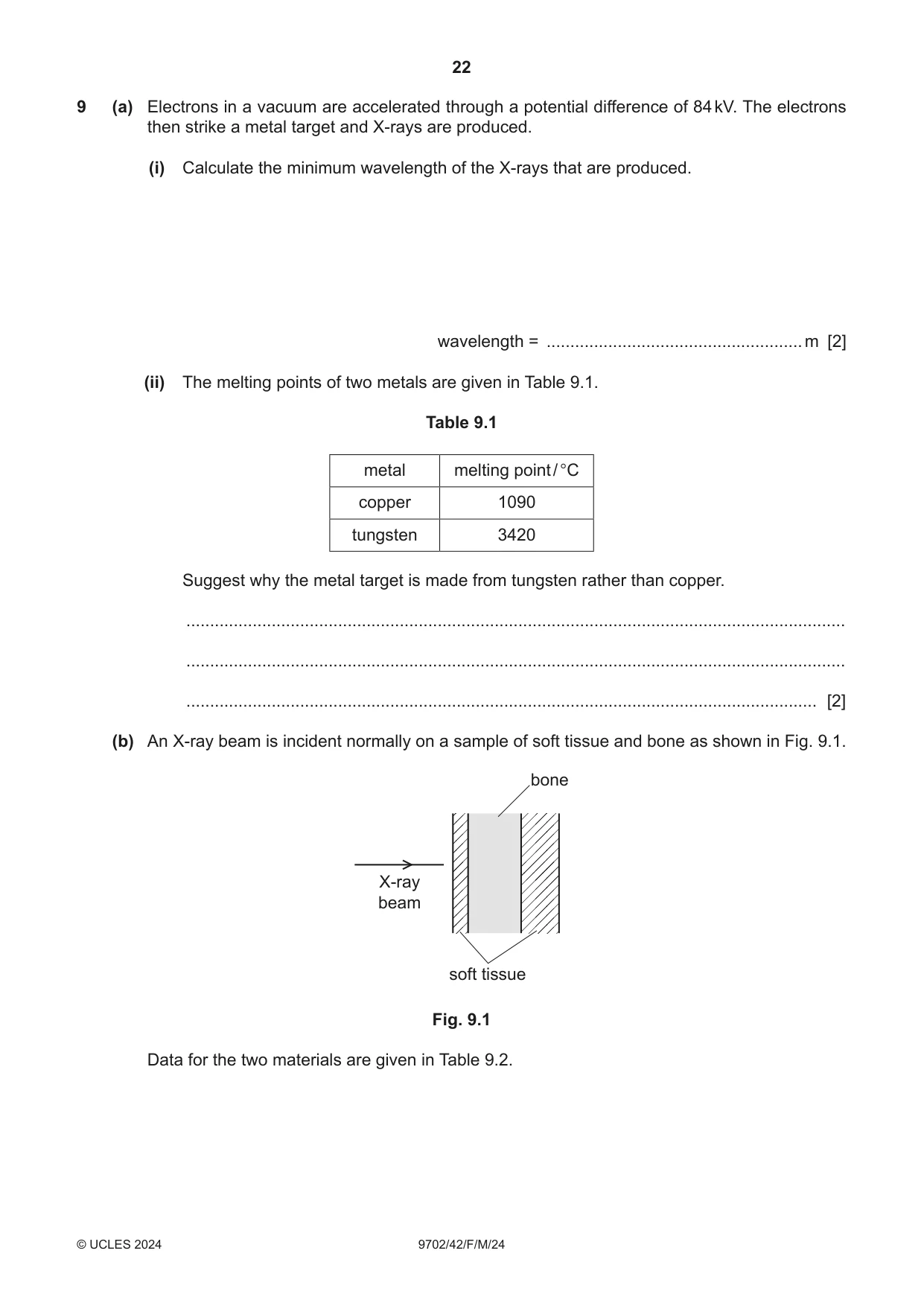
22 9702/42/F/M/24 © UCLES 2024 9 (a) Electrons in a vacuum are accelerated through a potential difference of 84 kV. The electrons then strike a metal target and X‑rays are produced. (i) Calculate the minimum wavelength of the X‑rays that are produced. wavelength = … m [2] (ii) The melting points of two metals are given in Table 9.1. Table 9.1 metal melting point / °C copper 1090 tungsten 3420 Suggest why the metal target is made from tungsten rather than copper. … … … [2] (b) An X‑ray beam is incident normally on a sample of soft tissue and bone as shown in Fig. 9.1. soft tissue X-ray beam bone Fig. 9.1 Data for the two materials are given in Table 9.2.
Question paper, page 23
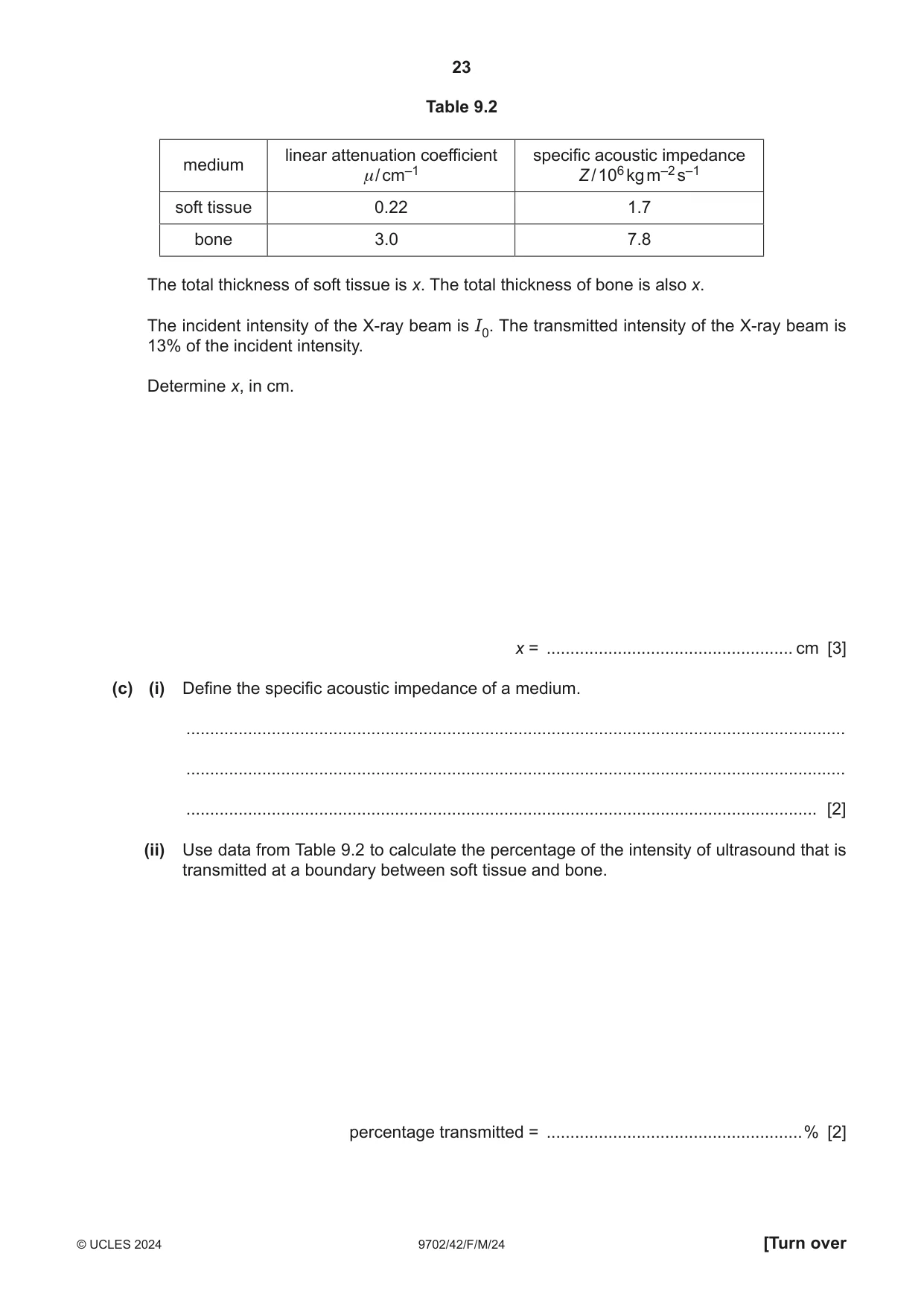
23 9702/42/F/M/24 © UCLES 2024 [Turn over Table 9.2 medium linear attenuation coefficient μ / cm–1 specific acoustic impedance Z / 106 kg m–2 s–1 soft tissue 0.22 1.7 bone 3.0 7.8 The total thickness of soft tissue is x. The total thickness of bone is also x. The incident intensity of the X‑ray beam is I0. The transmitted intensity of the X‑ray beam is 13% of the incident intensity. Determine x, in cm. x = … cm [3] (c) (i) Define the specific acoustic impedance of a medium. … … … [2] (ii) Use data from Table 9.2 to calculate the percentage of the intensity of ultrasound that is transmitted at a boundary between soft tissue and bone. percentage transmitted = …% [2]
Question paper, page 24
24 9702/42/F/M/24 © UCLES 2024 (iii) The ultrasound is now incident on the sample of soft tissue and bone shown in Fig. 9.1. Suggest two reasons why the transmitted intensity through the sample is less than the answer in (c)(ii). 1 … … 2 … … [2] [Total: 13]
Question paper, page 25
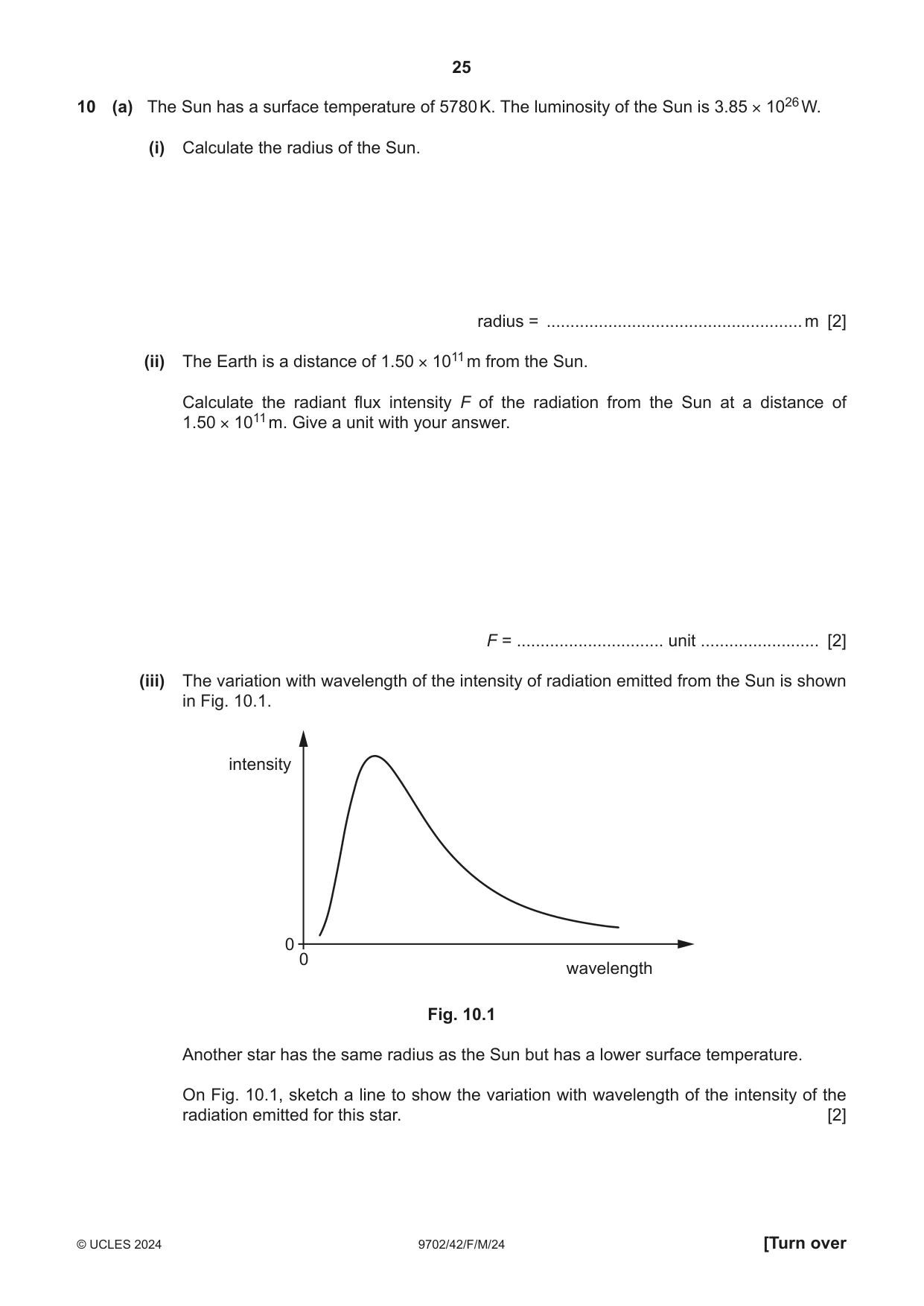
25 9702/42/F/M/24 © UCLES 2024 [Turn over 10 (a) The Sun has a surface temperature of 5780 K. The luminosity of the Sun is 3.85 × 1026 W. (i) Calculate the radius of the Sun. radius = … m [2] (ii) The Earth is a distance of 1.50 × 10¹¹ m from the Sun. Calculate the radiant flux intensity F of the radiation from the Sun at a distance of 1.50 × 10¹¹ m. Give a unit with your answer. F = … unit … [2] (iii) The variation with wavelength of the intensity of radiation emitted from the Sun is shown in Fig. 10.1. intensity wavelength 0 0 Fig. 10.1 Another star has the same radius as the Sun but has a lower surface temperature. On Fig. 10.1, sketch a line to show the variation with wavelength of the intensity of the radiation emitted for this star. [2]
Question paper, page 26
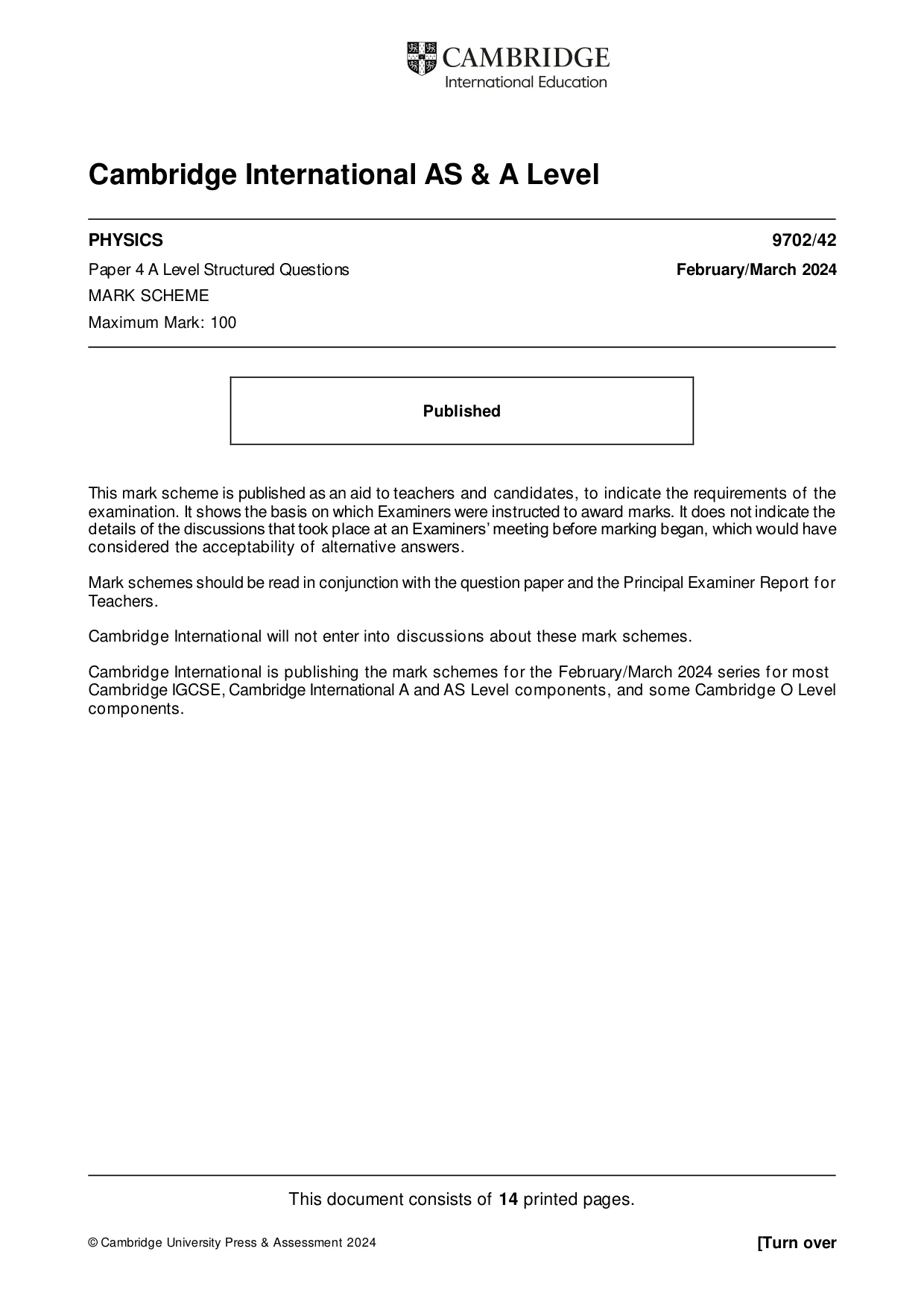
26 9702/42/F/M/24 © UCLES 2024 (b) A galaxy in the constellation Corona Borealis is moving away from the Earth. (i) The visible emission spectrum for the Sun is shown in Fig. 10.2. 350 400 450 500 550 wavelength / nm 600 650 700 Fig. 10.2 The lines are at wavelengths of 397 nm, 410 nm, 434 nm, 486 nm and 656 nm. The compositions of the Sun and a star in the Corona Borealis galaxy are similar. On Fig. 10.3, sketch the emission spectrum for the star in the Corona Borealis galaxy as observed from the Earth. No calculations are required. 350 400 450 500 550 wavelength / nm 600 650 700 Fig. 10.3 [1] (ii) The galaxy in Corona Borealis is moving away from the Earth at a speed of 21 400 km s–1. Use information from (b)(i) to calculate, in nm, the observed wavelength of the lowest visible energy emission for the star in the Corona Borealis galaxy. wavelength = … nm [2] (iii) The wavelength in (b)(ii) is used to calculate a value for the surface temperature of the star in the Corona Borealis galaxy. The calculation does not give an accurate value. State and explain whether this value of temperature is too high or too low. … … … [1] [Total: 10]
Question paper, page 27
27 9702/42/F/M/24 © UCLES 2024 BLANK PAGE
Question paper, page 28
28 9702/42/F/M/24 © UCLES 2024 BLANK PAGE Permission to reproduce items where third‑party owned material protected by copyright is included has been sought and cleared where possible. Every reasonable effort has been made by the publisher (UCLES) to trace copyright holders, but if any items requiring clearance have unwittingly been included, the publisher will be pleased to make amends at the earliest possible opportunity. To avoid the issue of disclosure of answer‑related information to candidates, all copyright acknowledgements are reproduced online in the Cambridge Assessment International Education Copyright Acknowledgements Booklet. This is produced for each series of examinations and is freely available to download at www.cambridgeinternational.org after the live examination series. Cambridge Assessment International Education is part of Cambridge Assessment. Cambridge Assessment is the brand name of the University of Cambridge Local Examinations Syndicate (UCLES), which is a department of the University of Cambridge.
Mark scheme, page 1
This document consists of 14 printed pages. © Cambridge University Press & Assessment 2024 [Turn over Cambridge International AS & A Level PHYSICS 9702/42 Paper 4 A Level Structured Questions February/March 2024 MARK SCHEME Maximum Mark: 100 Published This mark scheme is published as an aid to teachers and candidates, to indicate the requirements of the examination. It shows the basis on which Examiners were instructed to award marks. It does not indicate the details of the discussions that took place at an Examiners’ meeting before marking began, which would have considered the acceptability of alternative answers. Mark schemes should be read in conjunction with the question paper and the Principal Examiner Report for Teachers. Cambridge International will not enter into discussions about these mark schemes. Cambridge International is publishing the mark schemes for the February/March 2024 series for most Cambridge IGCSE, Cambridge International A and AS Level components, and some Cambridge O Level components.
Mark scheme, page 2
9702/42 Cambridge International AS & A Level – Mark Scheme PUBLISHED February/March 2024 © Cambridge University Press & Assessment 2024 Page 2 of 14 Generic Marking Principles These general marking principles must be applied by all examiners when marking candidate answers. They should be applied alon gside the specific content of the mark scheme or generic level descriptions for a question. Each question paper and mark scheme will also comply with these marking principles. GENERIC MARKING PRINCIPLE 1: Marks must be awarded in line with: • the specific content of the mark scheme or the generic level descriptors for the question • the specific skills defined in the mark scheme or in the generic level descriptors for the question • the standard of response required by a candidate as exemplified by the standardisation scripts. GENERIC MARKING PRINCIPLE 2: Marks awarded are always whole marks (not half marks, or other fractions). GENERIC MARKING PRINCIPLE 3: Marks must be awarded positively: • marks are awarded for correct/valid answers, as defined in the mark scheme. However, credit is given for valid answers which go beyond the scope of the syllabus and mark scheme, referring to your Team Leader as appropriate • marks are awarded when candidates clearly demonstrate what they know and can do • marks are not deducted for errors • marks are not deducted for omissions • answers should only be judged on the quality of spelling, punctuation and grammar when these features are specifically assessed by the question as indicated by the mark scheme. The meaning, however, should be unambiguous. GENERIC MARKING PRINCIPLE 4: Rules must be applied consistently, e.g. in situations where candidates have not followed instructions or in the application of generic level descriptors.
Mark scheme, page 3
9702/42 Cambridge International AS & A Level – Mark Scheme PUBLISHED February/March 2024 © Cambridge University Press & Assessment 2024 Page 3 of 14 GENERIC MARKING PRINCIPLE 5: Marks should be awarded using the full range of marks defined in the mark scheme for the question (however; the use of the full mark range may be limited according to the quality of the candidate responses seen). GENERIC MARKING PRINCIPLE 6: Marks awarded are based solely on the requirements as defined in the mark scheme. Marks should not be awarded with grade thre sholds or grade descriptors in mind. Science-Specific Marking Principles 1 Examiners should consider the context and scientific use of any keywords when awarding marks. Although keywords may be present, marks should not be awarded if the keywords are used incorrectly. 2 The examiner should not choose between contradictory statements given in the same question part, and credit should not be awarded for any correct statement that is contradicted within the same question part. Wrong science that is irrelevant to the question should be ignored. 3 Although spellings do not have to be correct, spellings of syllabus terms must allow for clear and unambiguous separation fro m other syllabus terms with which they may be confused (e.g. ethane / ethene, glucagon / glycogen, refraction / reflection). 4 The error carried forward (ecf) principle should be applied, where appropriate. If an incorrect answer is subsequently used in a scientifically correct way, the candidate should be awarded these subsequent marking points. Further guidance will be included in the mark scheme where necessary and any exceptions to this general principle will be noted. 5 ‘List rule’ guidance For questions that require n responses (e.g. State two reasons …): • The response should be read as continuous prose, even when numbered answer spaces are provided. • Any response marked ignore in the mark scheme should not count towards n. • Incorrect responses should not be awarded credit but will still count towards n. • Read the entire response to check for any responses that contradict those that would otherwise be credited. Credit should not be awarded for any responses that are contradicted within the rest of the response. Where two responses contradict one another, this should be treated as a single incorrect response. • Non-contradictory responses after the first n responses may be ignored even if they include incorrect science.
Mark scheme, page 4
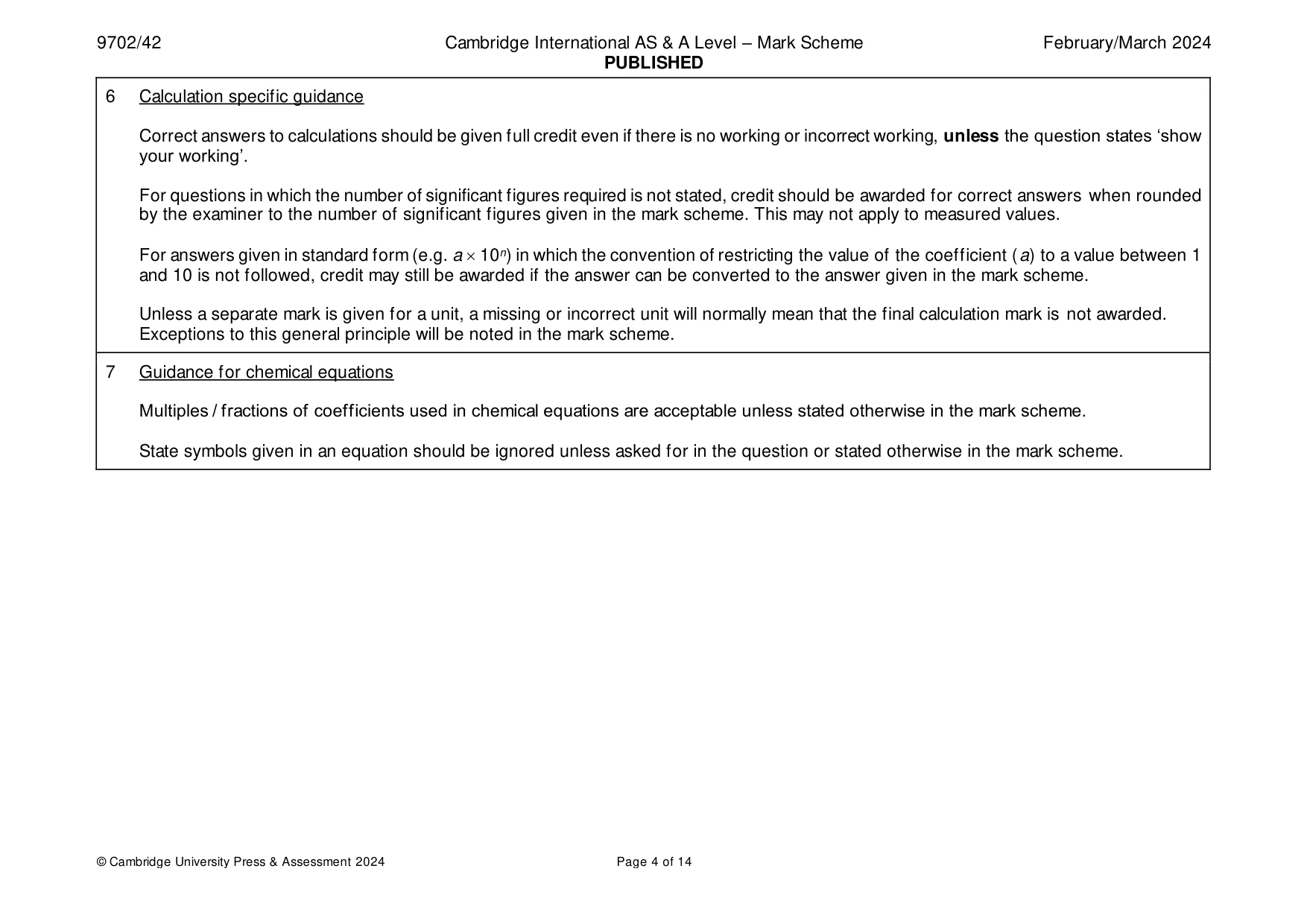
9702/42 Cambridge International AS & A Level – Mark Scheme PUBLISHED February/March 2024 © Cambridge University Press & Assessment 2024 Page 4 of 14 6 Calculation specific guidance Correct answers to calculations should be given full credit even if there is no working or incorrect working, unless the question states ‘show your working’. For questions in which the number of significant figures required is not stated, credit should be awarded for correct answers when rounded by the examiner to the number of significant figures given in the mark scheme. This may not apply to measured values. For answers given in standard form (e.g. a 10n) in which the convention of restricting the value of the coefficient (a) to a value between 1 and 10 is not followed, credit may still be awarded if the answer can be converted to the answer given in the mark scheme. Unless a separate mark is given for a unit, a missing or incorrect unit will normally mean that the final calculation mark is not awarded. Exceptions to this general principle will be noted in the mark scheme. 7 Guidance for chemical equations Multiples / fractions of coefficients used in chemical equations are acceptable unless stated otherwise in the mark scheme. State symbols given in an equation should be ignored unless asked for in the question or stated otherwise in the mark scheme.
Mark scheme, page 5
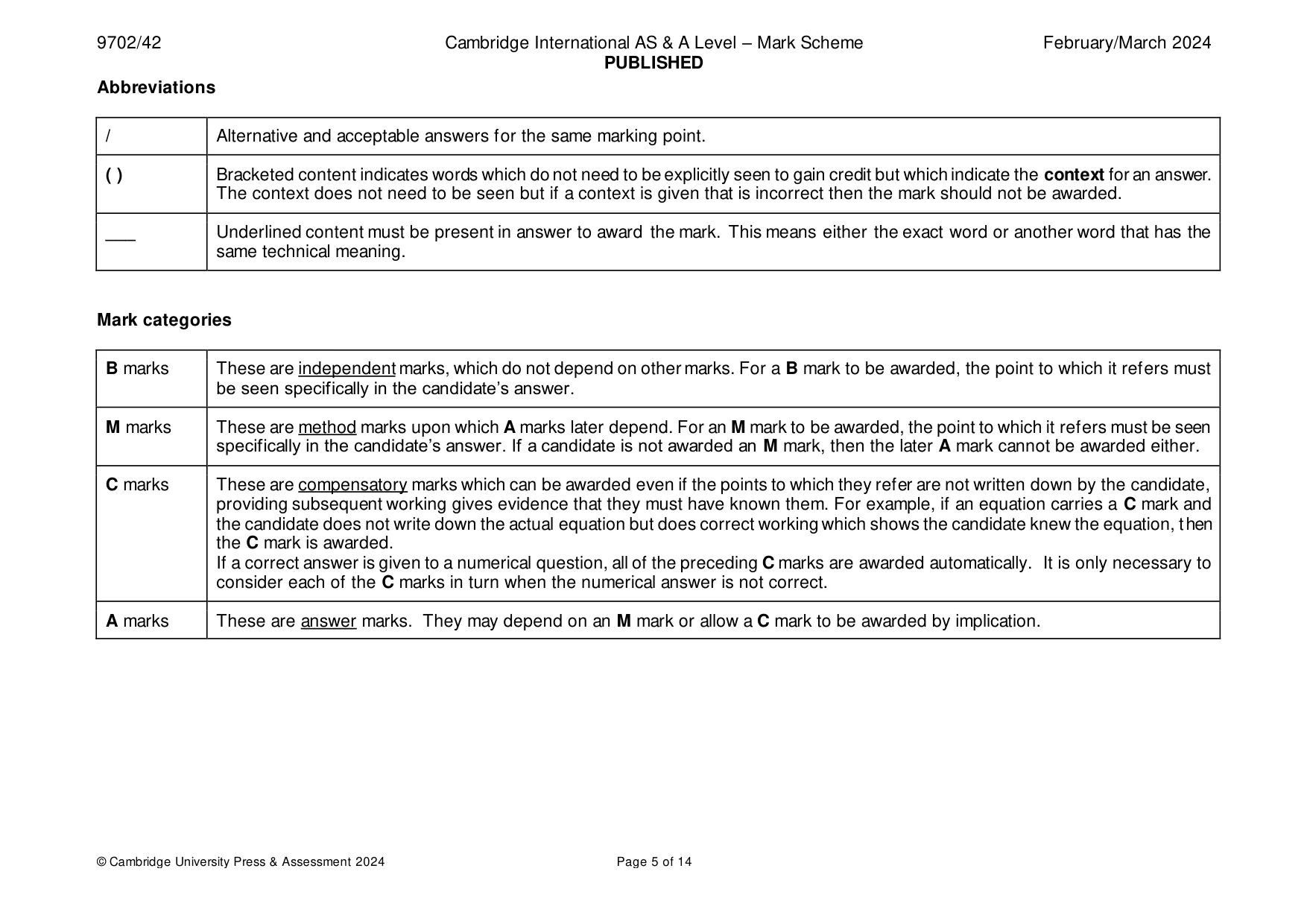
9702/42 Cambridge International AS & A Level – Mark Scheme PUBLISHED February/March 2024 © Cambridge University Press & Assessment 2024 Page 5 of 14 Abbreviations / Alternative and acceptable answers for the same marking point. ( ) Bracketed content indicates words which do not need to be explicitly seen to gain credit but which indicate the context for an answer. The context does not need to be seen but if a context is given that is incorrect then the mark should not be awarded. ___ Underlined content must be present in answer to award the mark. This means either the exact word or another word that has the same technical meaning. Mark categories B marks These are independent marks, which do not depend on other marks. For a B mark to be awarded, the point to which it refers must be seen specifically in the candidate’s answer. M marks These are method marks upon which A marks later depend. For an M mark to be awarded, the point to which it refers must be seen specifically in the candidate’s answer. If a candidate is not awarded an M mark, then the later A mark cannot be awarded either. C marks These are compensatory marks which can be awarded even if the points to which they refer are not written down by the candidate, providing subsequent working gives evidence that they must have known them. For example, if an equation carries a C mark and the candidate does not write down the actual equation but does correct working which shows the candidate knew the equation, then the C mark is awarded. If a correct answer is given to a numerical question, all of the preceding C marks are awarded automatically. It is only necessary to consider each of the C marks in turn when the numerical answer is not correct. A marks These are answer marks. They may depend on an M mark or allow a C mark to be awarded by implication.
Mark scheme, page 6
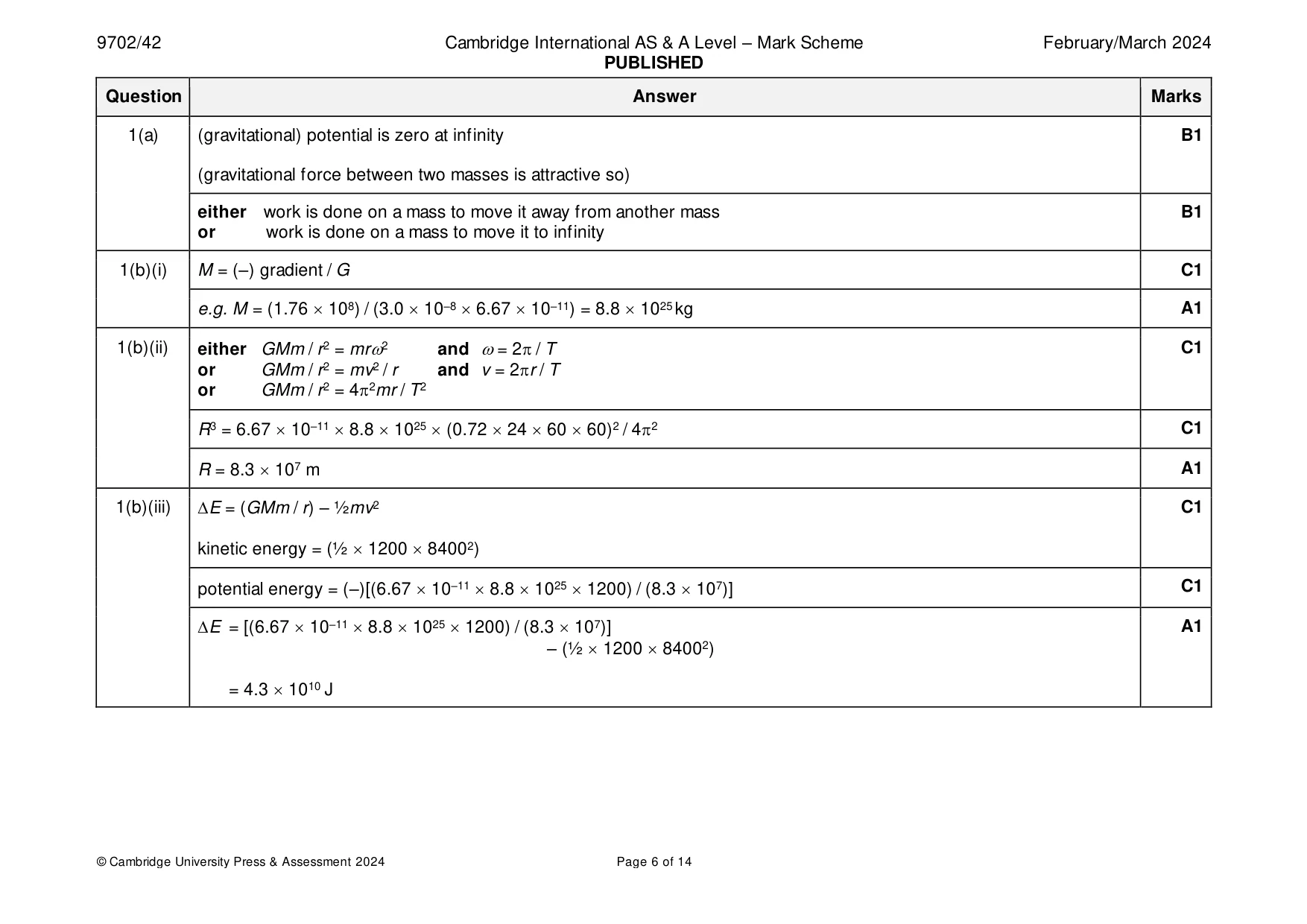
9702/42 Cambridge International AS & A Level – Mark Scheme PUBLISHED February/March 2024 © Cambridge University Press & Assessment 2024 Page 6 of 14 Question Answer Marks 1(a) (gravitational) potential is zero at infinity (gravitational force between two masses is attractive so) B1 either work is done on a mass to move it away from another mass or work is done on a mass to move it to infinity B1 1(b)(i) M = (–) gradient / G C1 e.g. M = (1.76 108) / (3.0 10–8 6.67 10–11) = 8.8 1025 kg A1 1(b)(ii) either GMm / r2 = mr2 and = 2 / T or GMm / r2 = mv2 / r and v = 2r / T or GMm / r2 = 42mr / T2 C1 R3 = 6.67 10–11 8.8 1025 (0.72 24 60 60)2 / 42 C1 R = 8.3 107 m A1 1(b)(iii) E = (GMm / r) – ½mv2 kinetic energy = (½ 1200 84002) C1 potential energy = (–)[(6.67 10–11 8.8 1025 1200) / (8.3 107)] C1 E = [(6.67 10–11 8.8 1025 1200) / (8.3 107)] – (½ 1200 84002) = 4.3 1010 J A1
Mark scheme, page 7
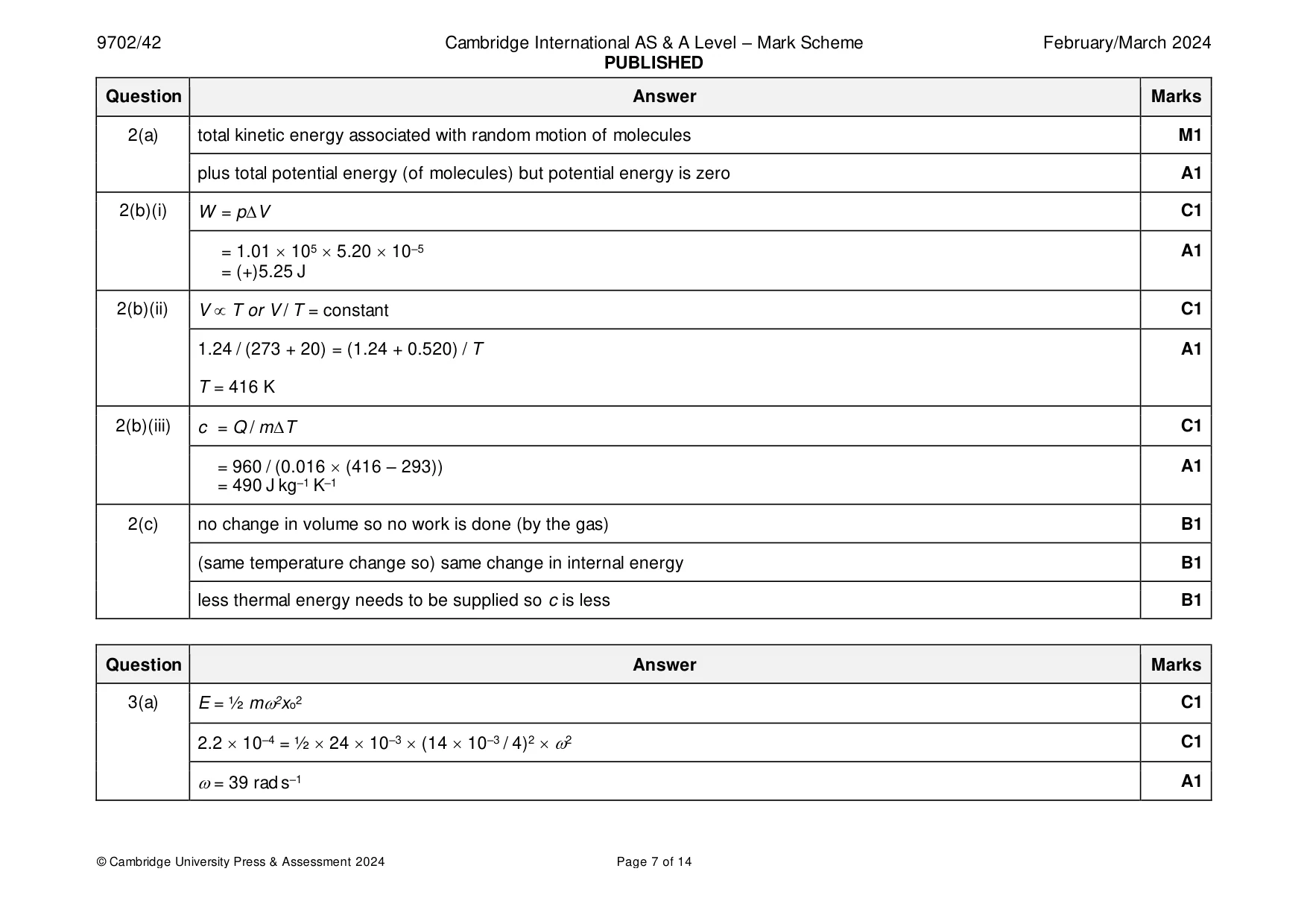
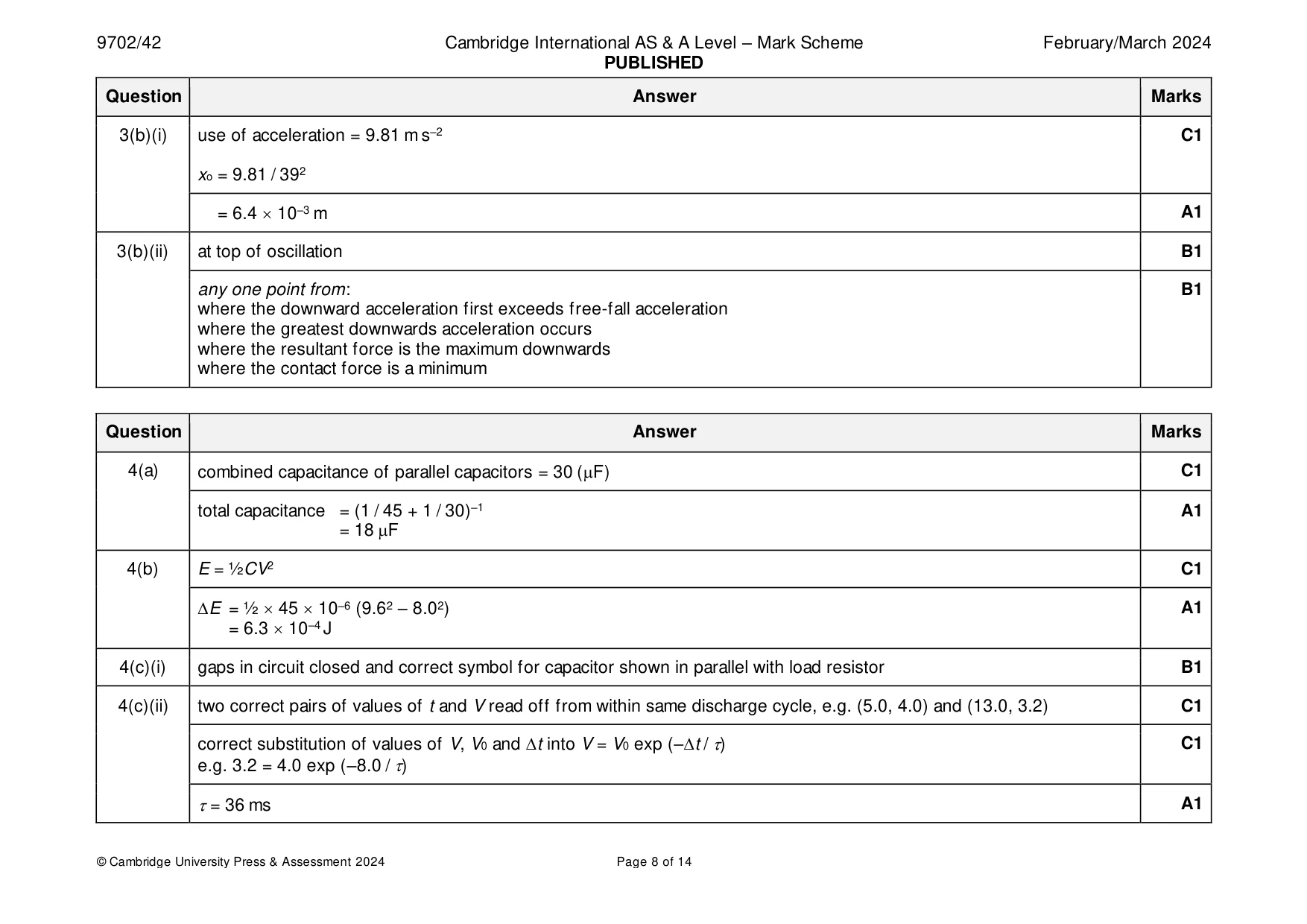
9702/42 Cambridge International AS & A Level – Mark Scheme PUBLISHED February/March 2024 © Cambridge University Press & Assessment 2024 Page 7 of 14 Question Answer Marks 2(a) total kinetic energy associated with random motion of molecules M1 plus total potential energy (of molecules) but potential energy is zero A1 2(b)(i) W = pV C1 = 1.01 105 5.20 10–5 = (+)5.25 J A1 2(b)(ii) V T or V / T = constant C1 1.24 / (273 + 20) = (1.24 + 0.520) / T T = 416 K A1 2(b)(iii) c = Q / mT C1 = 960 / (0.016 (416 – 293)) = 490 J kg–1 K–1 A1 2(c) no change in volume so no work is done (by the gas) B1 (same temperature change so) same change in internal energy B1 less thermal energy needs to be supplied so c is less B1 Question Answer Marks 3(a) E = ½ m2xo2 C1 2.2 10–4 = ½ 24 10–3 (14 10–3 / 4)2 2 C1 = 39 rad s–1 A1
Mark scheme, page 8
9702/42 Cambridge International AS & A Level – Mark Scheme PUBLISHED February/March 2024 © Cambridge University Press & Assessment 2024 Page 8 of 14 Question Answer Marks 3(b)(i) use of acceleration = 9.81 m s–2 xo = 9.81 / 392 C1 = 6.4 10–3 m A1 3(b)(ii) at top of oscillation B1 any one point from: where the downward acceleration first exceeds free-fall acceleration where the greatest downwards acceleration occurs where the resultant force is the maximum downwards where the contact force is a minimum B1 Question Answer Marks 4(a) combined capacitance of parallel capacitors = 30 (F) C1 total capacitance = (1 / 45 + 1 / 30)–1 = 18 F A1 4(b) E = ½CV2 C1 E = ½ 45 10–6 (9.62 – 8.02) = 6.3 10–4 J A1 4(c)(i) gaps in circuit closed and correct symbol for capacitor shown in parallel with load resistor B1 4(c)(ii) two correct pairs of values of t and V read off from within same discharge cycle, e.g. (5.0, 4.0) and (13.0, 3.2) C1 correct substitution of values of V, V0 and t into V = V0 exp (–t / ) e.g. 3.2 = 4.0 exp (–8.0 / ) C1 = 36 ms A1
Mark scheme, page 9
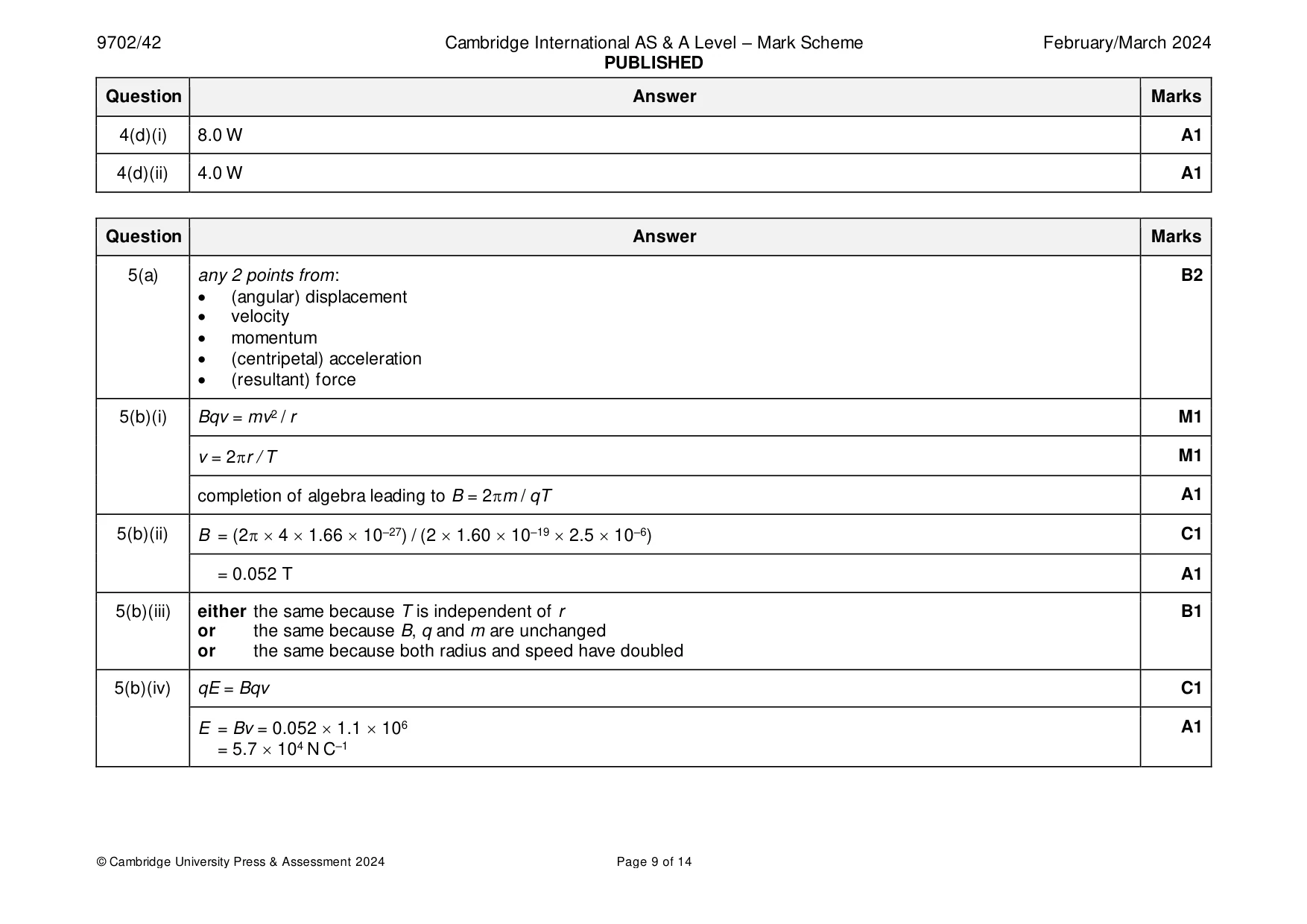
9702/42 Cambridge International AS & A Level – Mark Scheme PUBLISHED February/March 2024 © Cambridge University Press & Assessment 2024 Page 9 of 14 Question Answer Marks 4(d)(i) 8.0 W A1 4(d)(ii) 4.0 W A1 Question Answer Marks 5(a) any 2 points from: • (angular) displacement • velocity • momentum • (centripetal) acceleration • (resultant) force B2 5(b)(i) Bqv = mv2 / r M1 v = 2r / T M1 completion of algebra leading to B = 2m / qT A1 5(b)(ii) B = (2 4 1.66 10–27) / (2 1.60 10–19 2.5 10–6) C1 = 0.052 T A1 5(b)(iii) either the same because T is independent of r or the same because B, q and m are unchanged or the same because both radius and speed have doubled B1 5(b)(iv) qE = Bqv C1 E = Bv = 0.052 1.1 106 = 5.7 104 N C–1 A1
Mark scheme, page 10
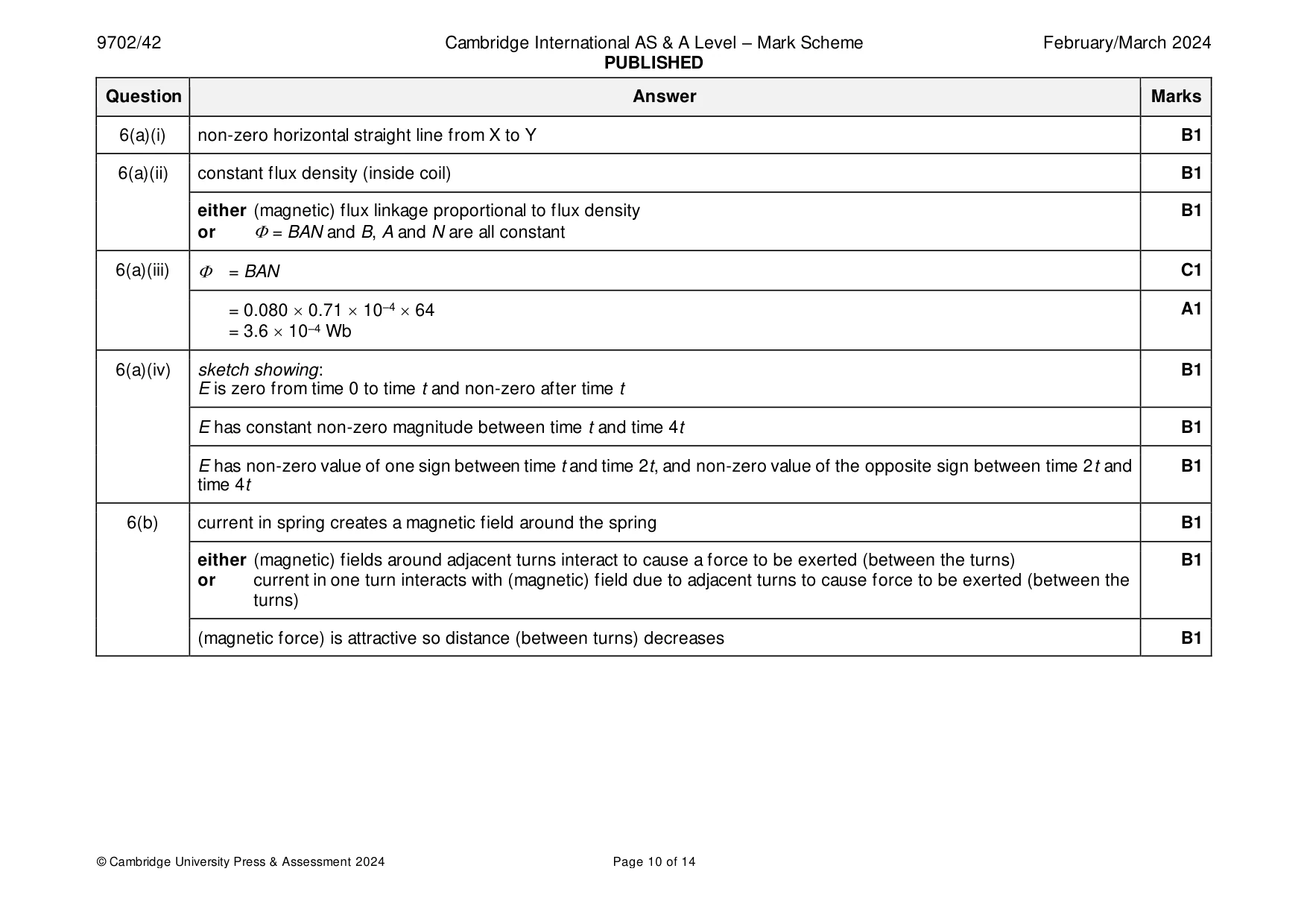
9702/42 Cambridge International AS & A Level – Mark Scheme PUBLISHED February/March 2024 © Cambridge University Press & Assessment 2024 Page 10 of 14 Question Answer Marks 6(a)(i) non-zero horizontal straight line from X to Y B1 6(a)(ii) constant flux density (inside coil) B1 either (magnetic) flux linkage proportional to flux density or = BAN and B, A and N are all constant B1 6(a)(iii) = BAN C1 = 0.080 0.71 10–4 64 = 3.6 10–4 Wb A1 6(a)(iv) sketch showing: E is zero from time 0 to time t and non-zero after time t B1 E has constant non-zero magnitude between time t and time 4t B1 E has non-zero value of one sign between time t and time 2t, and non-zero value of the opposite sign between time 2t and time 4t B1 6(b) current in spring creates a magnetic field around the spring B1 either (magnetic) fields around adjacent turns interact to cause a force to be exerted (between the turns) or current in one turn interacts with (magnetic) field due to adjacent turns to cause force to be exerted (between the turns) B1 (magnetic force) is attractive so distance (between turns) decreases B1
Mark scheme, page 11
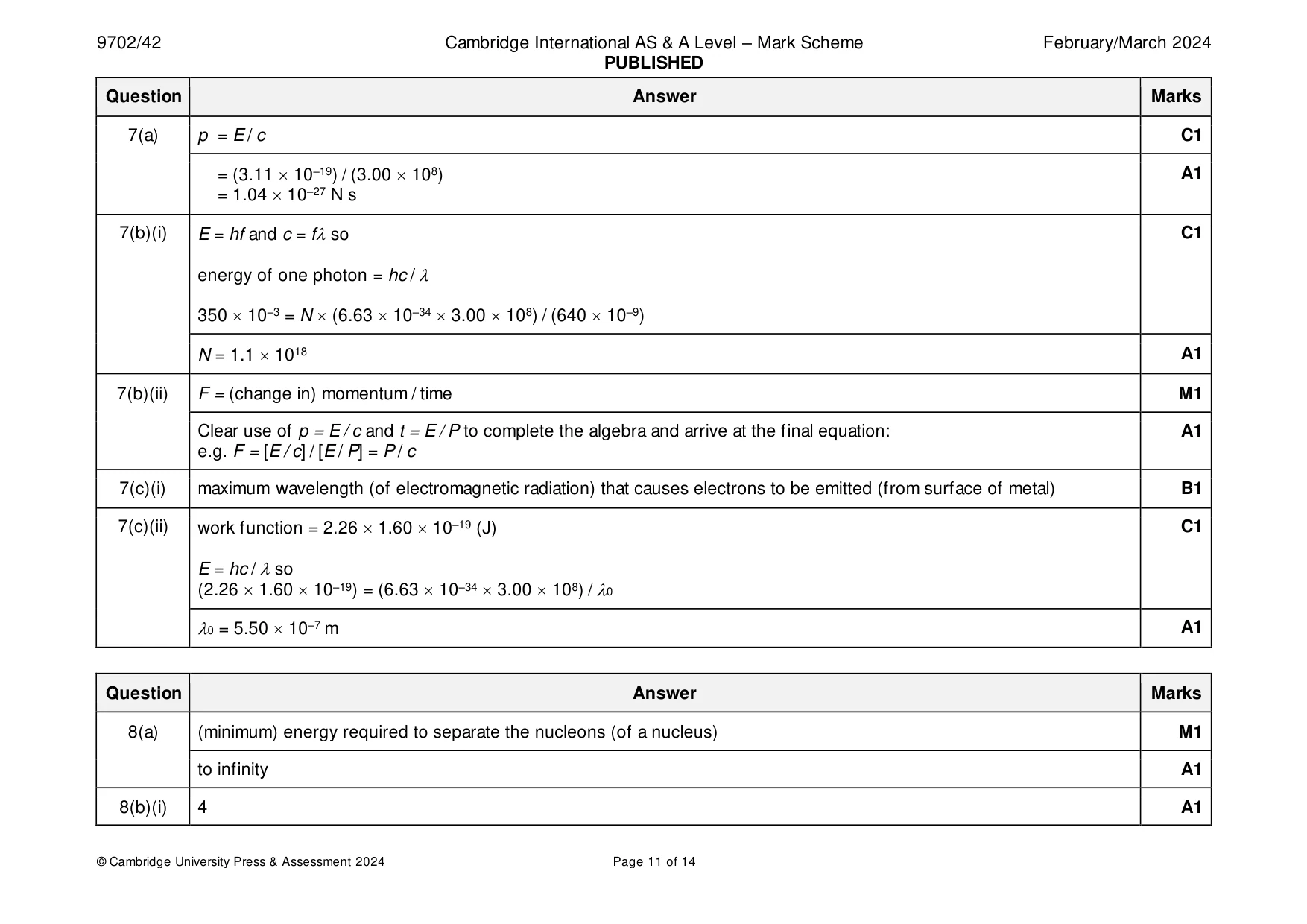
9702/42 Cambridge International AS & A Level – Mark Scheme PUBLISHED February/March 2024 © Cambridge University Press & Assessment 2024 Page 11 of 14 Question Answer Marks 7(a) p = E / c C1 = (3.11 10–19) / (3.00 108) = 1.04 10–27 N s A1 7(b)(i) E = hf and c = f so energy of one photon = hc / 350 10–3 = N (6.63 10–34 3.00 108) / (640 10–9) C1 N = 1.1 1018 A1 7(b)(ii) F = (change in) momentum / time M1 Clear use of p = E / c and t = E / P to complete the algebra and arrive at the final equation: e.g. F = [E / c] / [E / P] = P / c A1 7(c)(i) maximum wavelength (of electromagnetic radiation) that causes electrons to be emitted (from surface of metal) B1 7(c)(ii) work function = 2.26 1.60 10–19 (J) E = hc / so (2.26 1.60 10–19) = (6.63 10–34 3.00 108) / 0 C1 0 = 5.50 10–7 m A1 Question Answer Marks 8(a) (minimum) energy required to separate the nucleons (of a nucleus) M1 to infinity A1 8(b)(i) 4 A1
Mark scheme, page 12
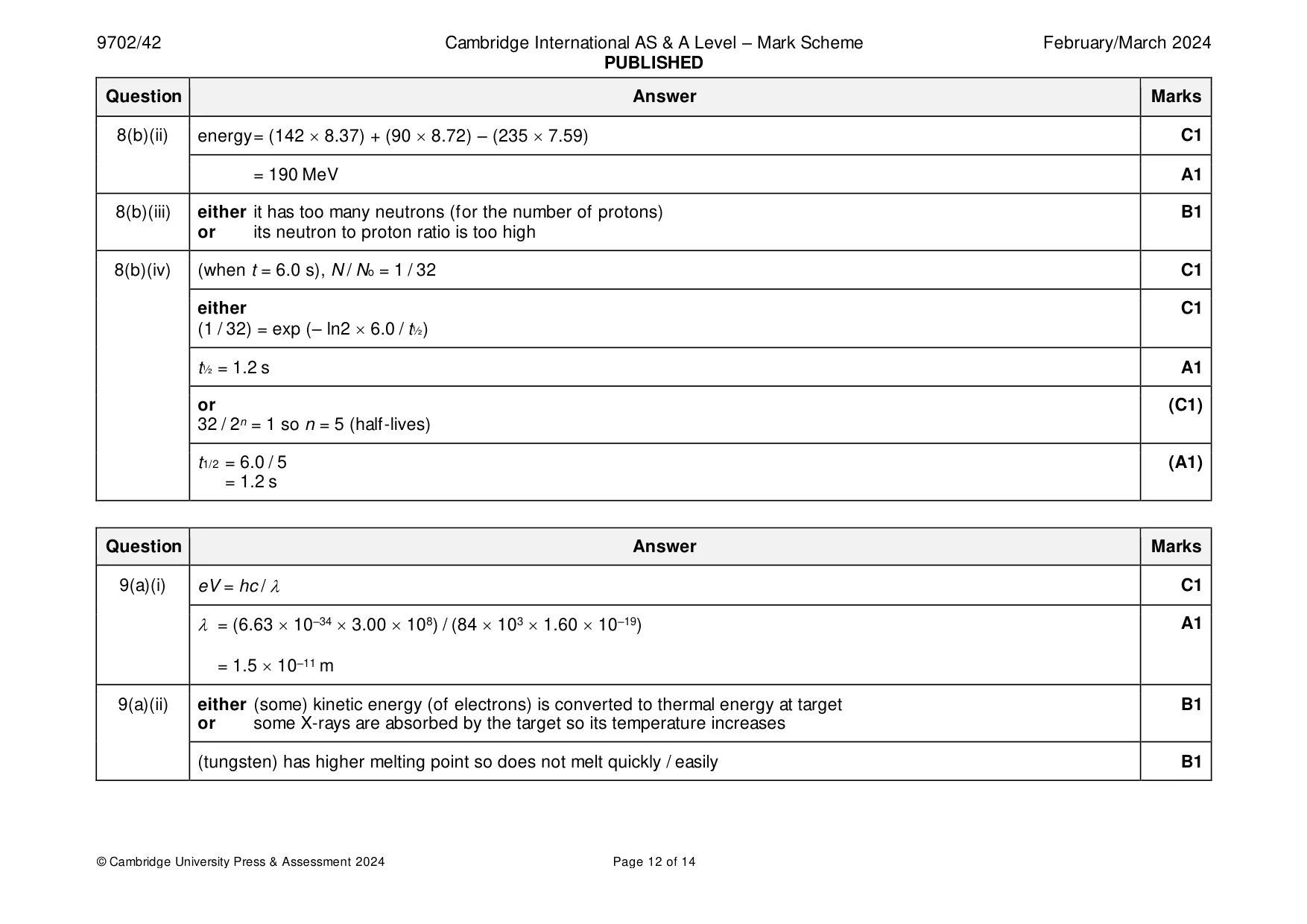
9702/42 Cambridge International AS & A Level – Mark Scheme PUBLISHED February/March 2024 © Cambridge University Press & Assessment 2024 Page 12 of 14 Question Answer Marks 8(b)(ii) energy = (142 8.37) + (90 8.72) – (235 7.59) C1 = 190 MeV A1 8(b)(iii) either it has too many neutrons (for the number of protons) or its neutron to proton ratio is too high B1 8(b)(iv) (when t = 6.0 s), N / No = 1 / 32 C1 either (1 / 32) = exp (– ln2 6.0 / t½) C1 t½ = 1.2 s A1 or 32 / 2n = 1 so n = 5 (half-lives) (C1) t1/2 = 6.0 / 5 = 1.2 s (A1) Question Answer Marks 9(a)(i) eV = hc / C1 = (6.63 10–34 3.00 108) / (84 103 1.60 10–19) = 1.5 10–11 m A1 9(a)(ii) either (some) kinetic energy (of electrons) is converted to thermal energy at target or some X-rays are absorbed by the target so its temperature increases B1 (tungsten) has higher melting point so does not melt quickly / easily B1
Mark scheme, page 13
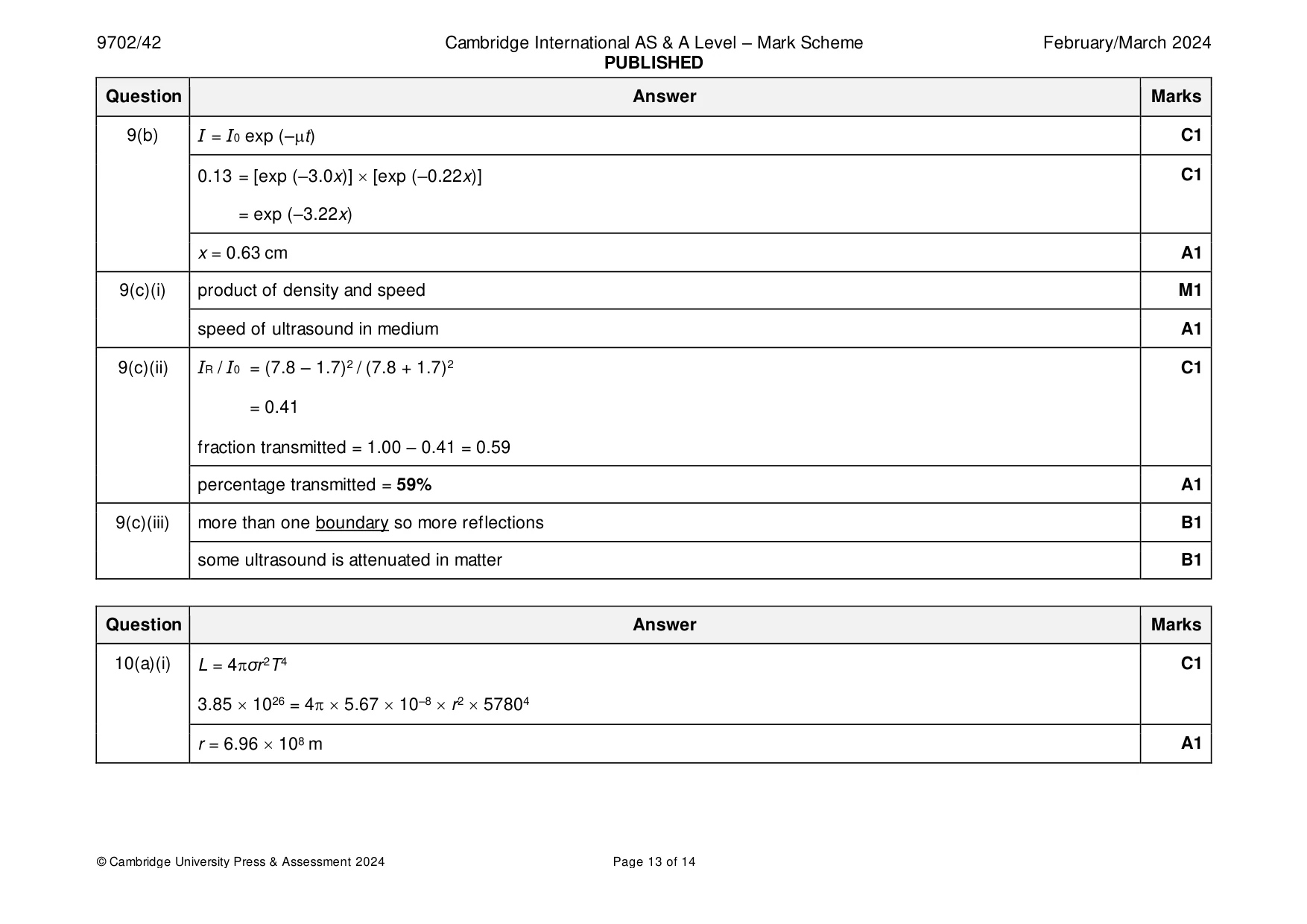
9702/42 Cambridge International AS & A Level – Mark Scheme PUBLISHED February/March 2024 © Cambridge University Press & Assessment 2024 Page 13 of 14 Question Answer Marks 9(b) I = I0 exp (–t) C1 0.13 = [exp (–3.0x)] [exp (–0.22x)] = exp (–3.22x) C1 x = 0.63 cm A1 9(c)(i) product of density and speed M1 speed of ultrasound in medium A1 9(c)(ii) IR / I0 = (7.8 – 1.7)2 / (7.8 + 1.7)2 = 0.41 fraction transmitted = 1.00 – 0.41 = 0.59 C1 percentage transmitted = 59% A1 9(c)(iii) more than one boundary so more reflections B1 some ultrasound is attenuated in matter B1 Question Answer Marks 10(a)(i) L = 4σr2T4 3.85 1026 = 4 5.67 10–8 r2 57804 C1 r = 6.96 108 m A1
Mark scheme, page 14
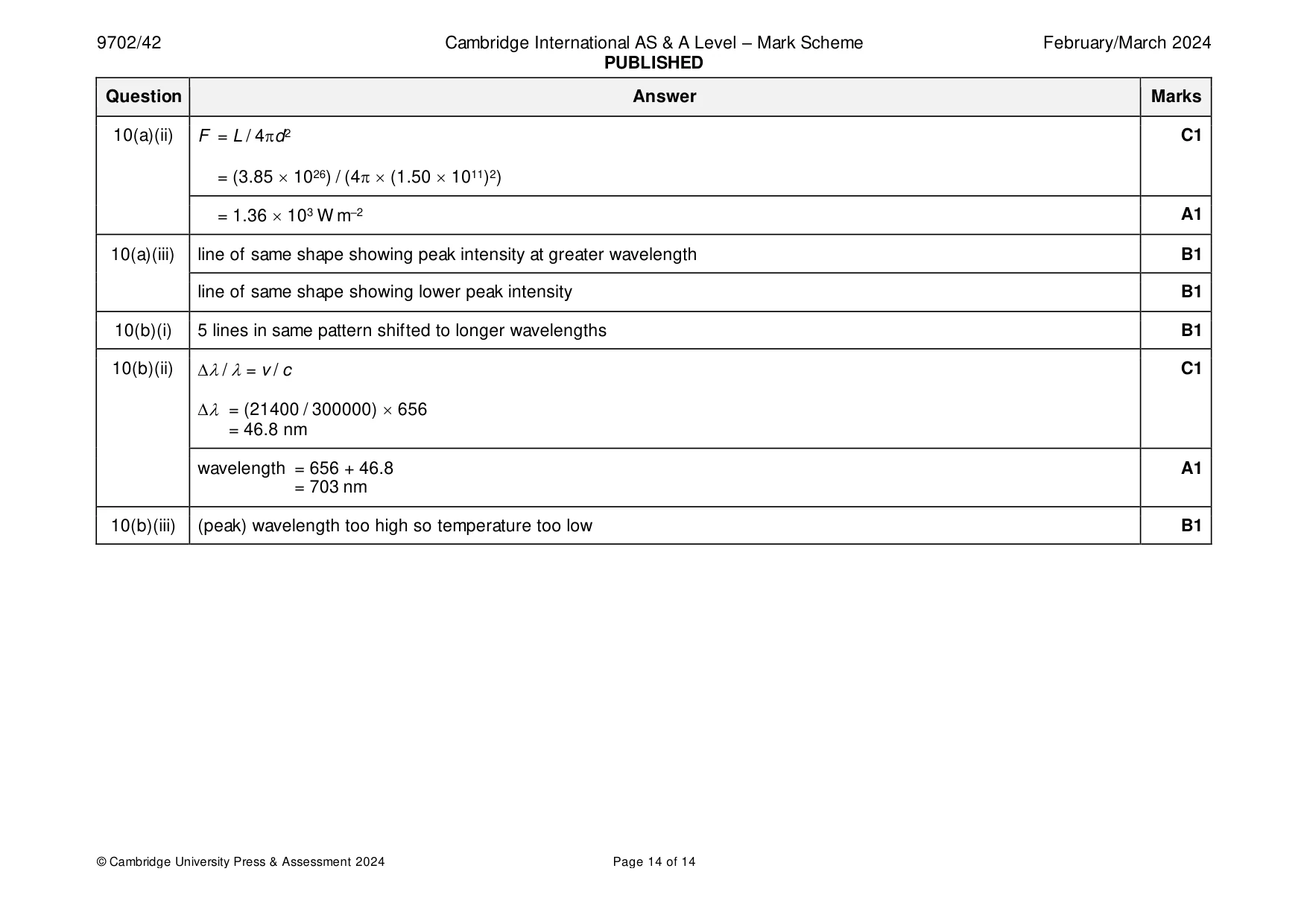
9702/42 Cambridge International AS & A Level – Mark Scheme PUBLISHED February/March 2024 © Cambridge University Press & Assessment 2024 Page 14 of 14 Question Answer Marks 10(a)(ii) F = L / 4d2 = (3.85 1026) / (4 (1.50 1011)2) C1 = 1.36 103 W m–2 A1 10(a)(iii) line of same shape showing peak intensity at greater wavelength B1 line of same shape showing lower peak intensity B1 10(b)(i) 5 lines in same pattern shifted to longer wavelengths B1 10(b)(ii) / = v / c = (21400 / 300000) 656 = 46.8 nm C1 wavelength = 656 + 46.8 = 703 nm A1 10(b)(iii) (peak) wavelength too high so temperature too low B1
What you needed in this session
Cambridge’s own grade thresholds for 2024 Feb/March, Paper 4 · Variant 2. A higher threshold means an easier paper — the bar moves with how the cohort did.