Cambridge A Level Physics 9702 — 2003 Oct/Nov Paper 2 · Variant 1
9702/21/O/N/03
The question paper and its mark scheme, free to read here and free to download. This is Cambridge’s own paper, exactly as it was sat.
Question paper20 pages
Mark scheme
No mark scheme is in the library for this paper.
Paper as text
Question paper, page 1
Centre Number Candidate Number | Name CAMBRIDGE INTERNATIONAL EXAMINATIONS General Certificate of Education Advanced Subsidiary Level and Advanced Level PHYSICS 9702/02 Paper 2 October/November 2003 1 hour Candidates answer on the Question Paper. No Additional Materials are required. READ THESE INSTRUCTIONS FIRST Write your Centre number, candidate number and name on all the work you hand in. Write in dark biue or black pen in the spaces provided on the Question Paper. You may use a soft pencil for any diagrams, graphs or rough working. Do not use staples, paper clips, highlighters, glue or correction fluid. Answer all questions. The number of marks is given in brackets [ ] at the end of each question or part question. You may lose marks if you do not show your working or if you do not use appropriate units. For Examiner’s Use a 2 3 If you have been given a labei, look at the 4 details. If any details are incorrect or missing, please fill in your correct details 5 in the space given at the top of this page. 6 Stick your personal label here, if 7 provided. ee | Total This document consists of 20 printed pages. Bas] University of CAMBRIDGE Local Examinations Syndicate [Turn over SPA SJF2605/CG $53612/2 © UCLES 2003
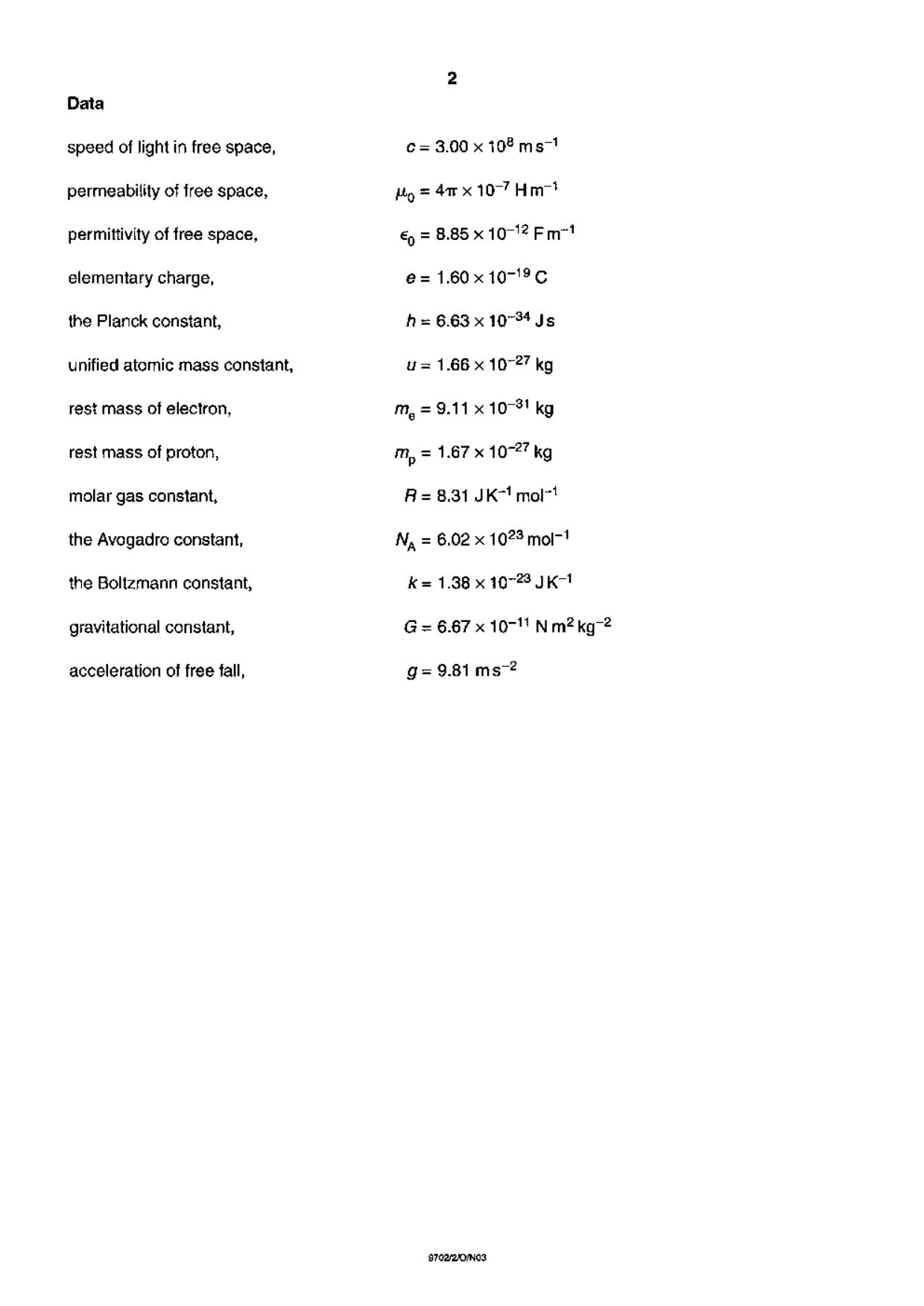
Question paper, page 2
Data speed of light in free space, permeability of free space, permittivity of free space, elementary charge, the Planck constant, unified atomic mass constant, rest mass of electron, rest mass of proton, molar gas constant, the Avogadro constant, the Boltzmann constant, gravitational constant, acceleration of free fall, c= 3.00x10⁸ms My = 4m x 1077 Hm €) = 8.85 x 10⁻¹? Fm? e= 1,60x 10⁷°C h= 6.63 x 10°84 Js u= 1.66 x 10°27 kg m, = 9.11 x 10⁻⁹! kg m, = 1.67 x 10⁷°? kg A= 8.31 JK" mol N, = 6.02 x 10⁷? mol"! k= 1.38 x 10°83 JK G = 6.67 x 107" Nm? kg? g= 9.81 ms? 9702/240NO3.
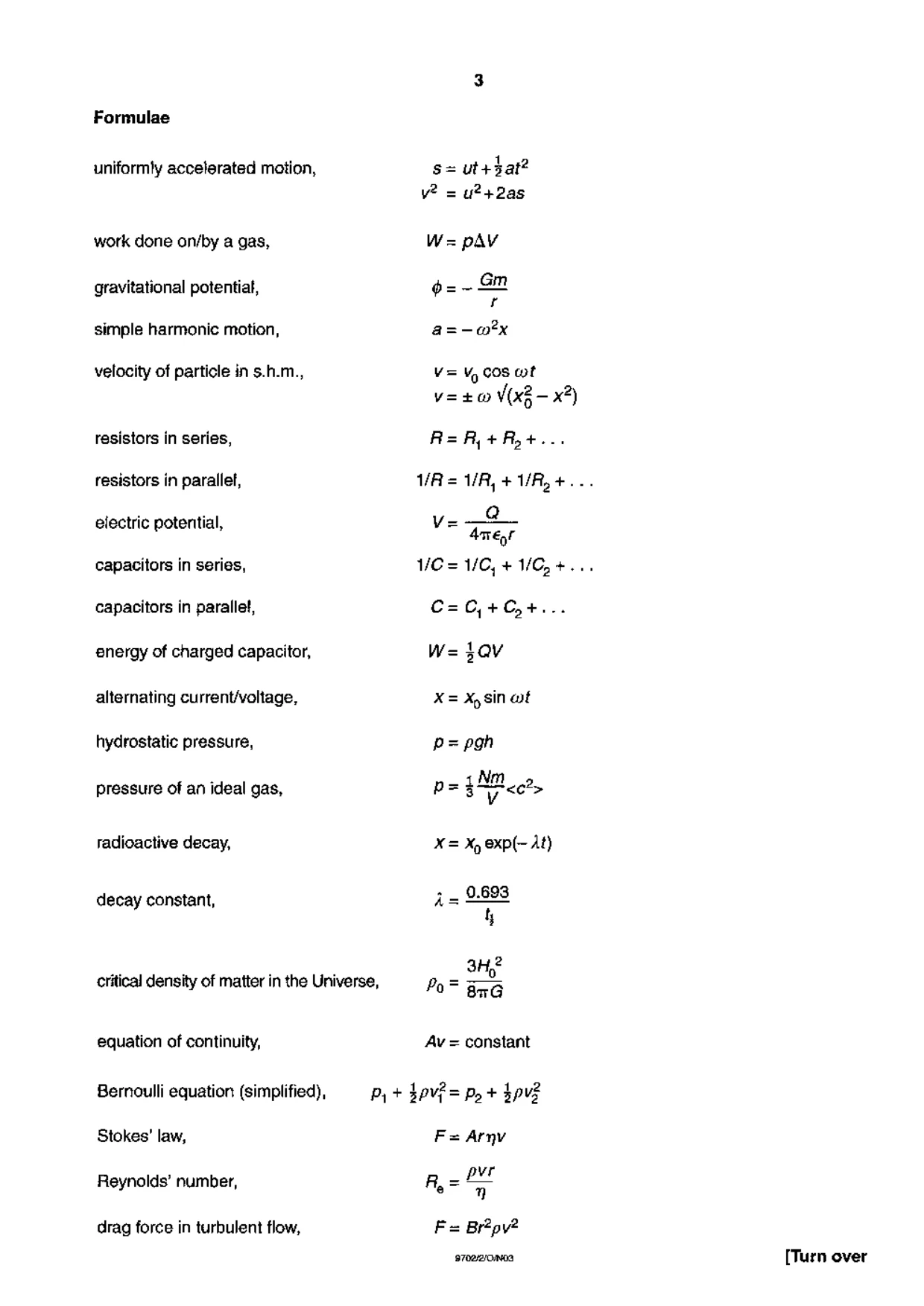
Question paper, page 3
Formulae uniformly accelerated mation, work done on/by a gas, gravitational potentiaf, simple harmonic motion, velocity of particle in s.h.m., resistors in series, resistors in parallet, electric potential, capacitors in series, capacitors in parallet, energy of charged capacitor, alternating current/voltage, hydrostatic pressure, pressure of an ideal gas, radioactive decay, decay constant, Critical density of matter in the Universe, equation of continuity, Bernoulli equation (simplified), Stokes’ law, Reynolds’ number, drag force in turbulent flow, $= ut+zat? v? = u?42as W= pAV =~Gm f a=-w*x V= ¥, COs wt vst V(x3 — x?) R=R,+h,+... VA = UR, + Ry +... __@ © Amége VO = UC, + WC, +... C=C, +Cy+... W= 3QV nis X= X,sin wt p=pgh oR = 1 NM. 22 p y <> X= X, exp(- At) j= 0.693 4 3H? Po- anG Av = constant Py + PVE= Po + SpvZ F=Arnv = pve s70ar2/0nw0a [Turn over
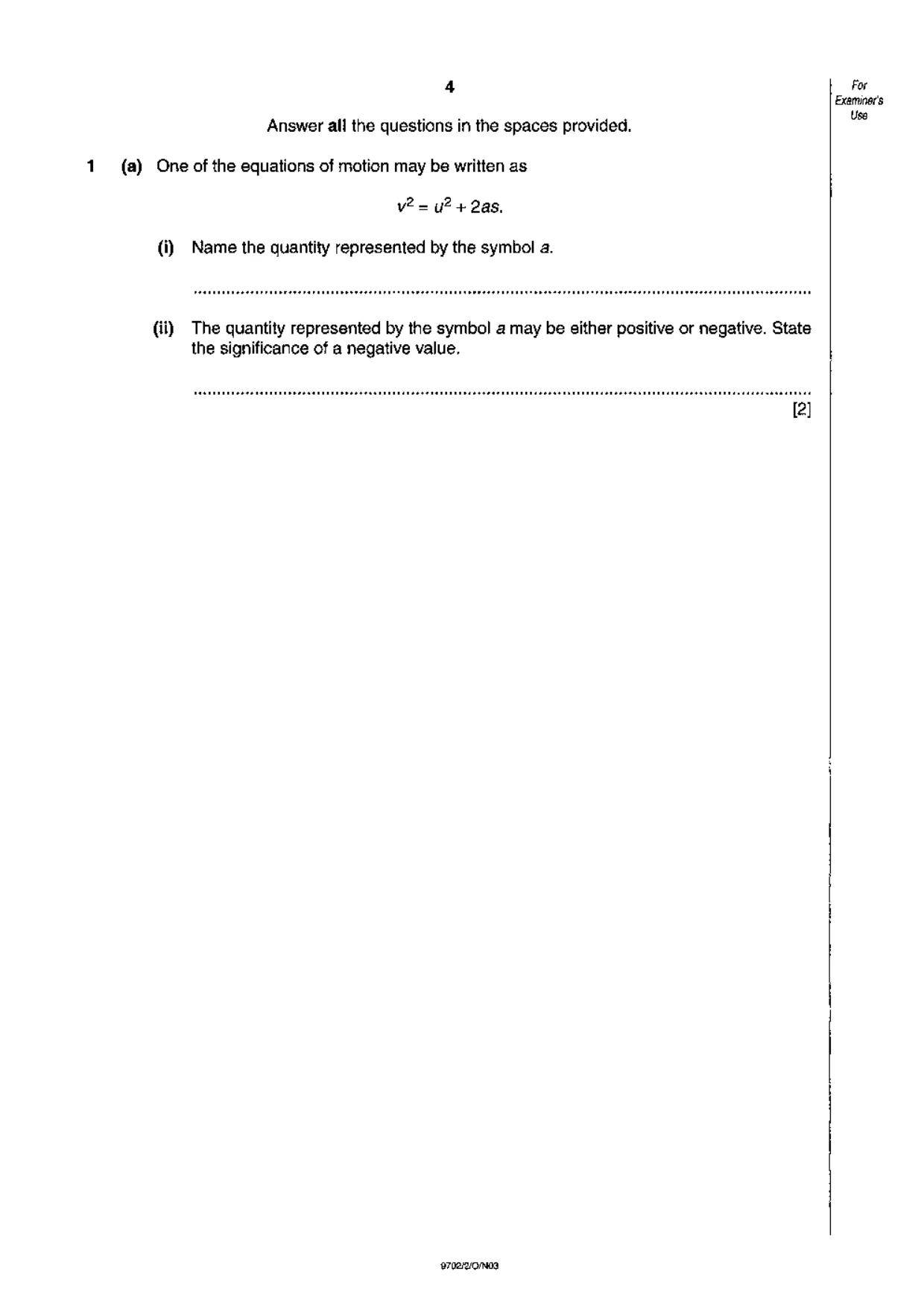
Question paper, page 4
4 For Examiner's Answer ali the questions in the spaces provided. “ 1 (a) One of the equations of motion may be written as v? = u? + 2as, (i) Name the quantity represented by the symbol a. (ii) The quantity represented by the symbol a may be either positive or negative. State the significance of a negative value, ‘e702HoMNGS
Question paper, page 5
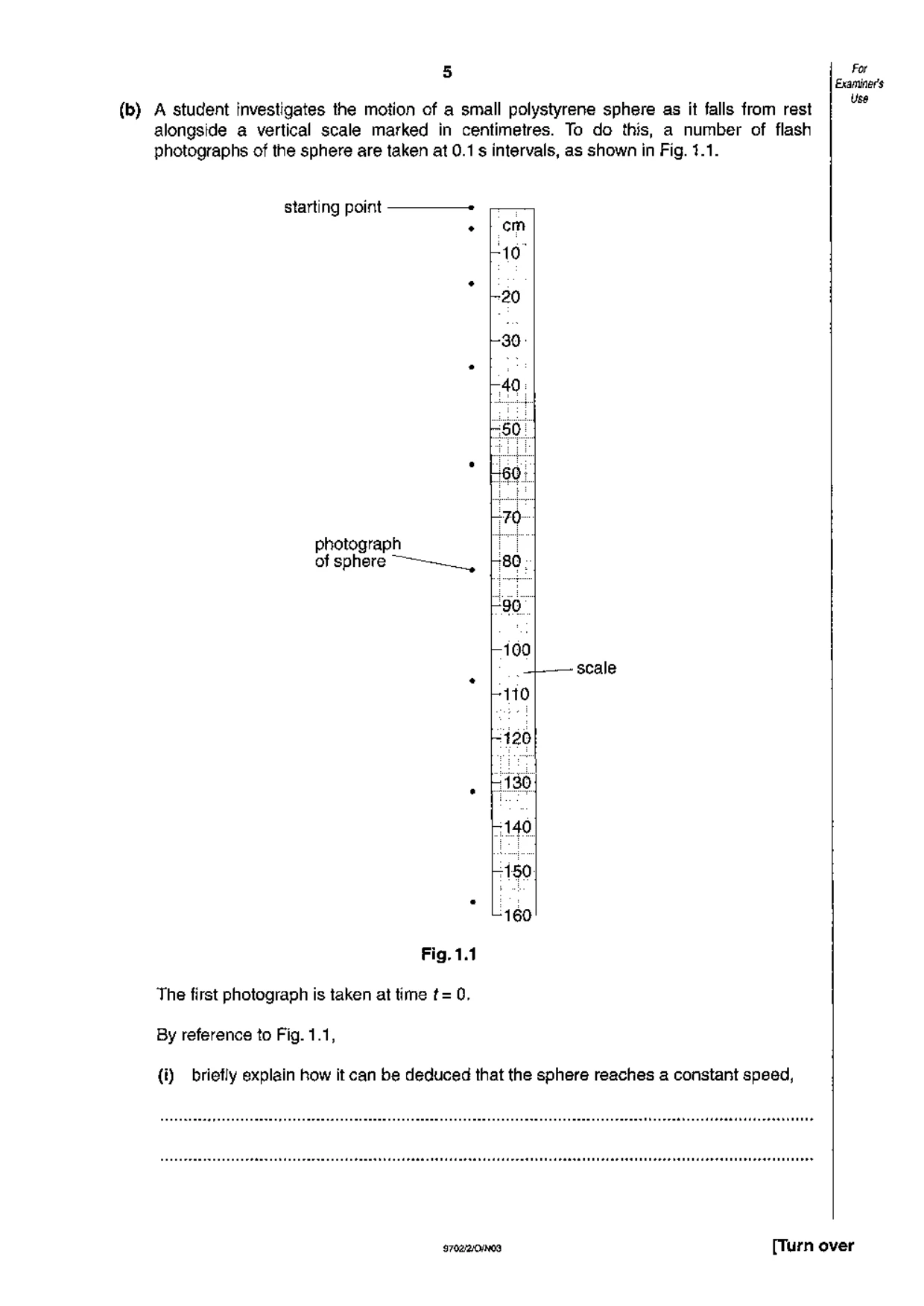
5 For Examiner's (b) A student investigates the motion of a small polystyrene sphere as it falls from rest “se alongside a vertical scale marked in centimetres. To do this, a number of flash photographs of the sphere are taken at 0.1 intervals, as shown in Fig. 1.1. starting point F10° 20 +30 40 photograph of sphere ~~, }-80; —+—— scale Fig. 1.1 The first photograph is taken at time f= 0. By reference to Fig. 1.1, {i) briefly explain how it can be deduced that the sphere reaches a constant speed, 9702/2:01N03 [Turn over
Question paper, page 6
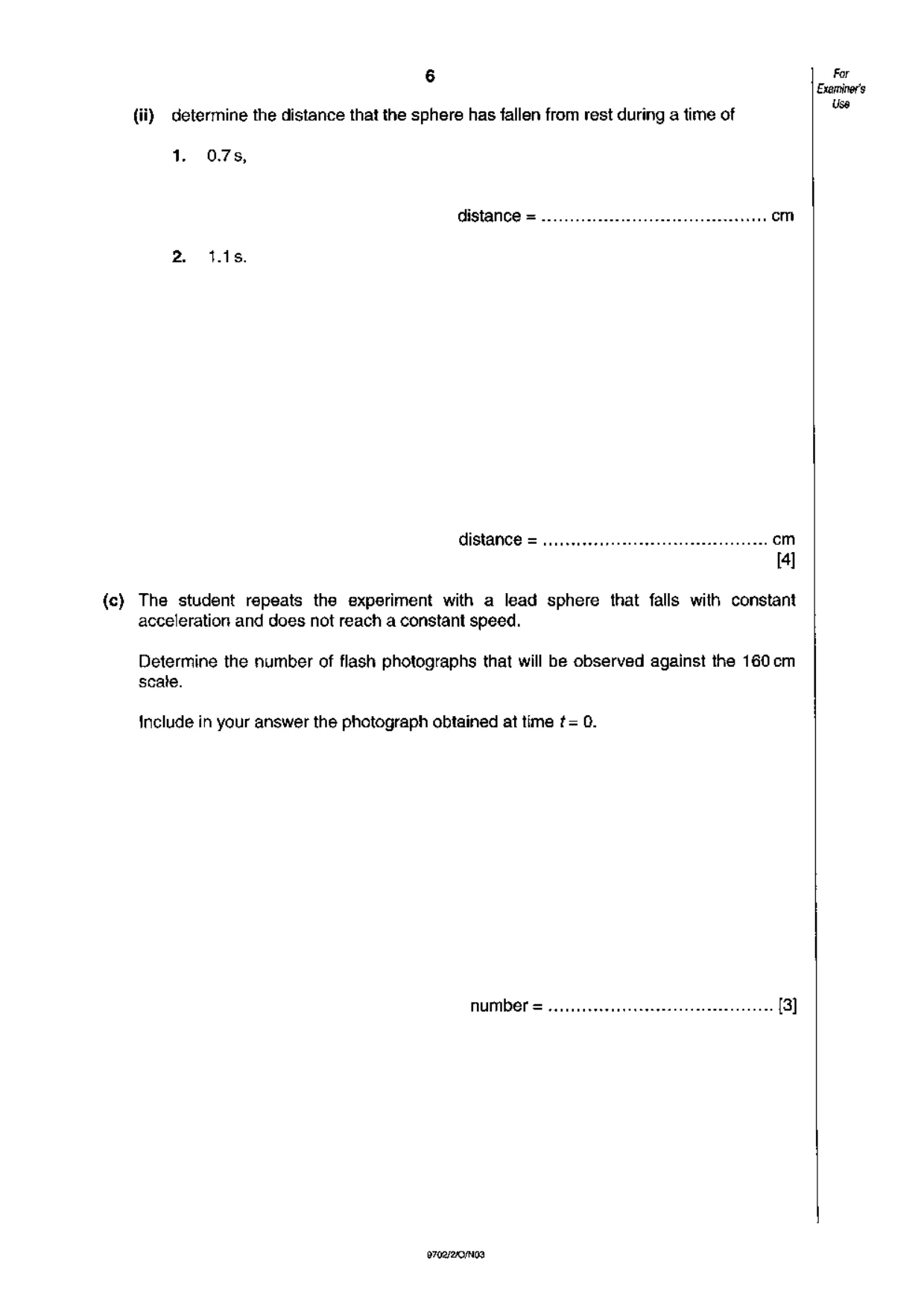
6 (ii) determine the distance that the sphere has fallen from rest during a time of 1. 07s, Gistance = … 2 cece ce ceeeeceeeeseeeeeseeeee CM CIStANCE = iii eeeeccesesesseeeeeeeeeeeeeeeeeeeeees CM [4] (c} The student repeats the experiment with a lead sphere that falls with constant acceleration and does not reach a constant speed. Determine the number of flash photographs that will be observed against the 160 cm scale. include in your answer the photograph obtained at time t= 0. number = 3) e702/20/NOa For Examiner's Use
Question paper, page 7
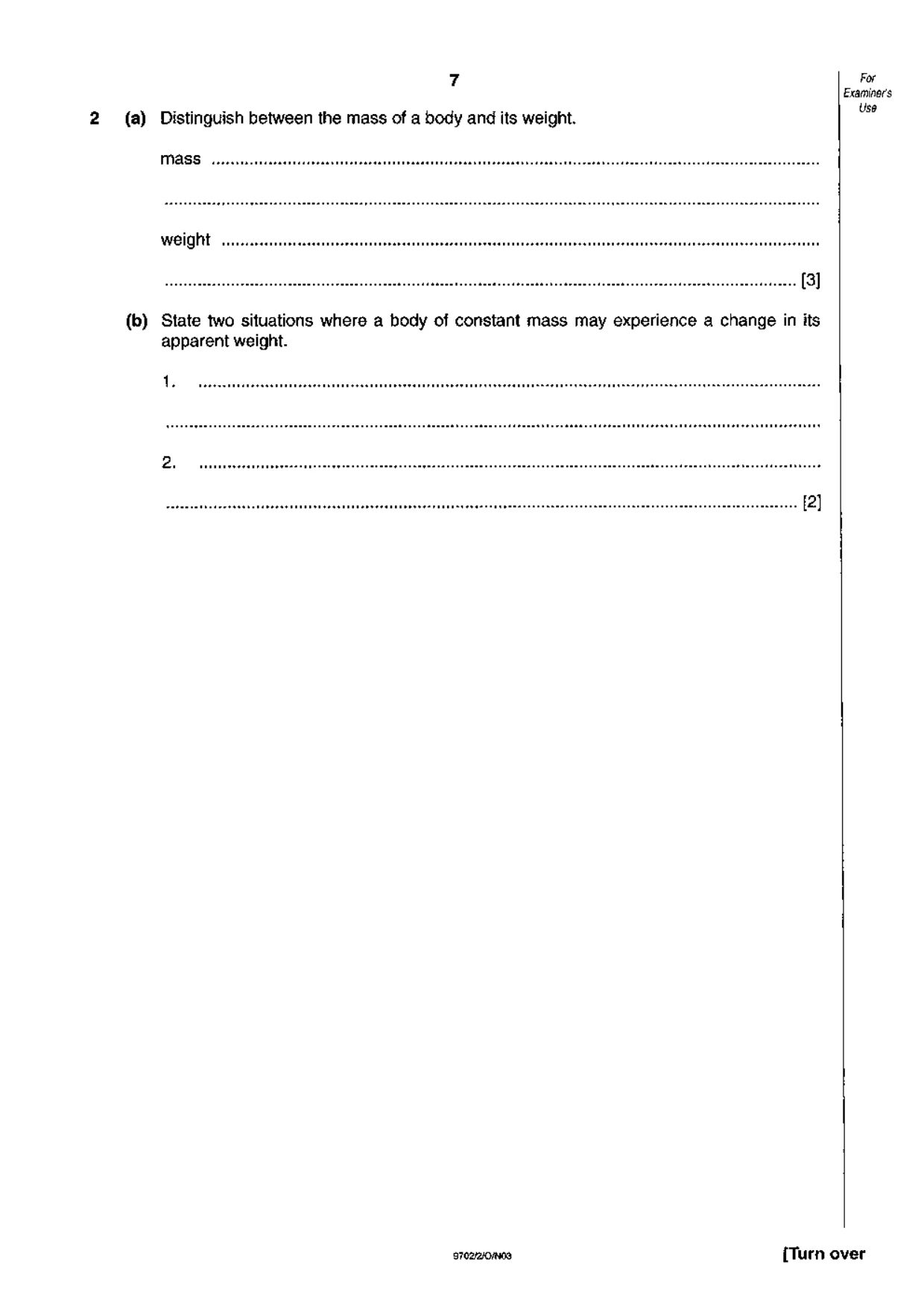
7 For Examiner's 2 (a) Distinguish between the mass of a body and its weight. oe mass ... WOIQKT sscscccssrssrsscsssrsseseresssteseserenssesaccsssnsseeeressaceeesarsnessseseseaceracsnsseserenesseceastanseesensnessenneeT ... (3] (b) State two situations where a body of constant mass may experience a change in its apparent weight. 1. .. 2] S702/2107N08 {Turn over
Question paper, page 8
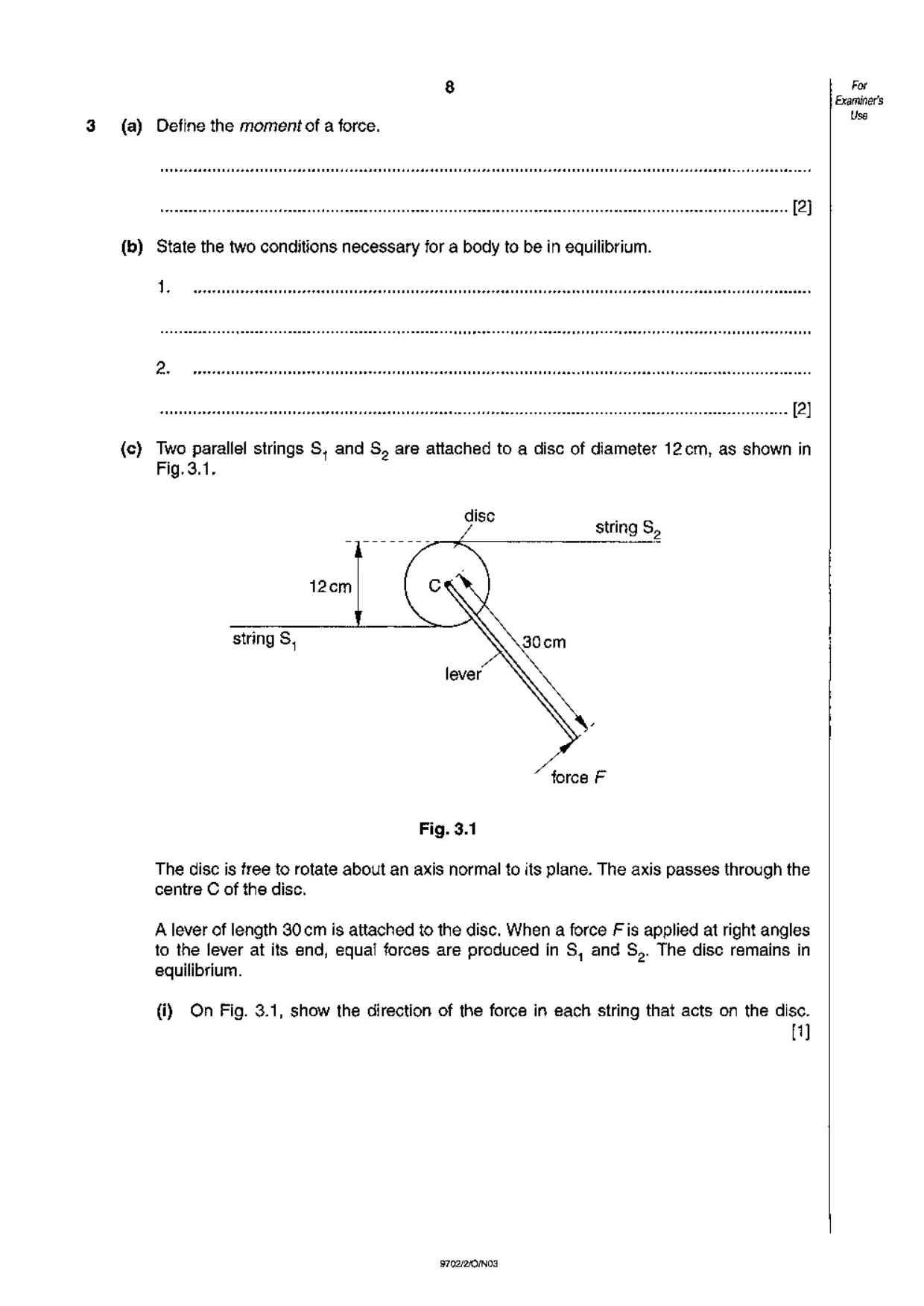
3 (a) Define the moment of a force. (b) State the two conditions necessary for a body to be in equilibrium. 1. 2] ({c) Two parallel strings S, and S, are attached to a disc of diameter 12cm, as shown in Fig. 3.1. disc string S, 12cm string S, lever force F Fig. 3.1 The disc is free to rotate about an axis normal to its plane. The axis passes through the centre C of the disc. A lever of length 30cm is attached to the disc. When a force Fis applied at right angles to the lever at its end, equai forces are produced in S, and S,. The disc remains in equilibrium. (i) On Fig. 3.1, show the direction of the force in each string that acts on the disc. {i s702/2K0/N03 For Examiner's
Question paper, page 9
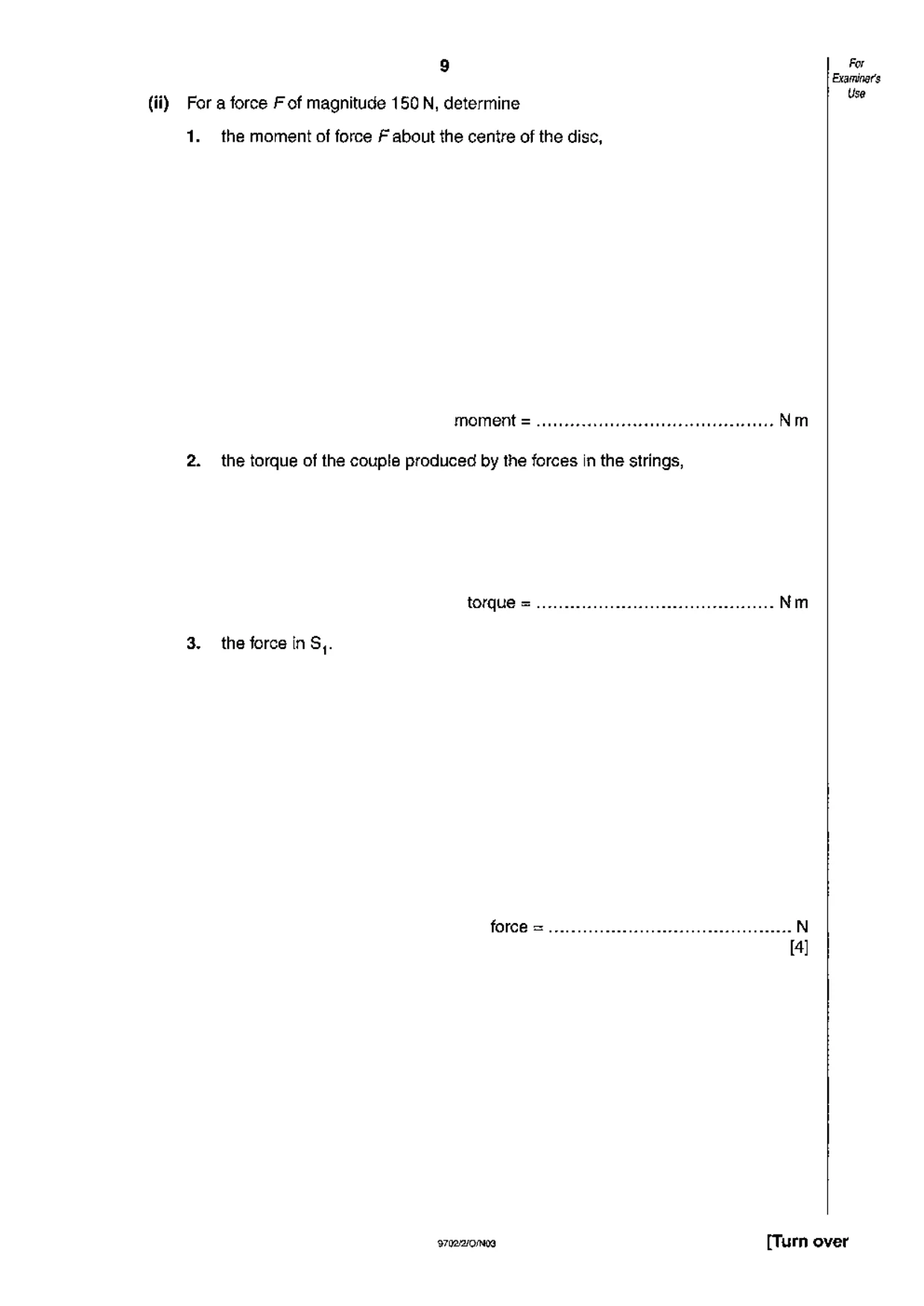
9 (ii) For a force F of magnitude 150 N, determine 1. the moment of force F about the centre of the disc, MOMENE = oo. cceeecesetsecseeeeeeeecsenteeeeneaneee Nm 2. the torque of the couple produced by the forces in the strings, TOMQUG = eee eee ce eee eeeseeeeeeeeeeeeeeee Nm 3. the force in S,. force = Examiner's Use 9702270"N08 [Turn over
Question paper, page 10
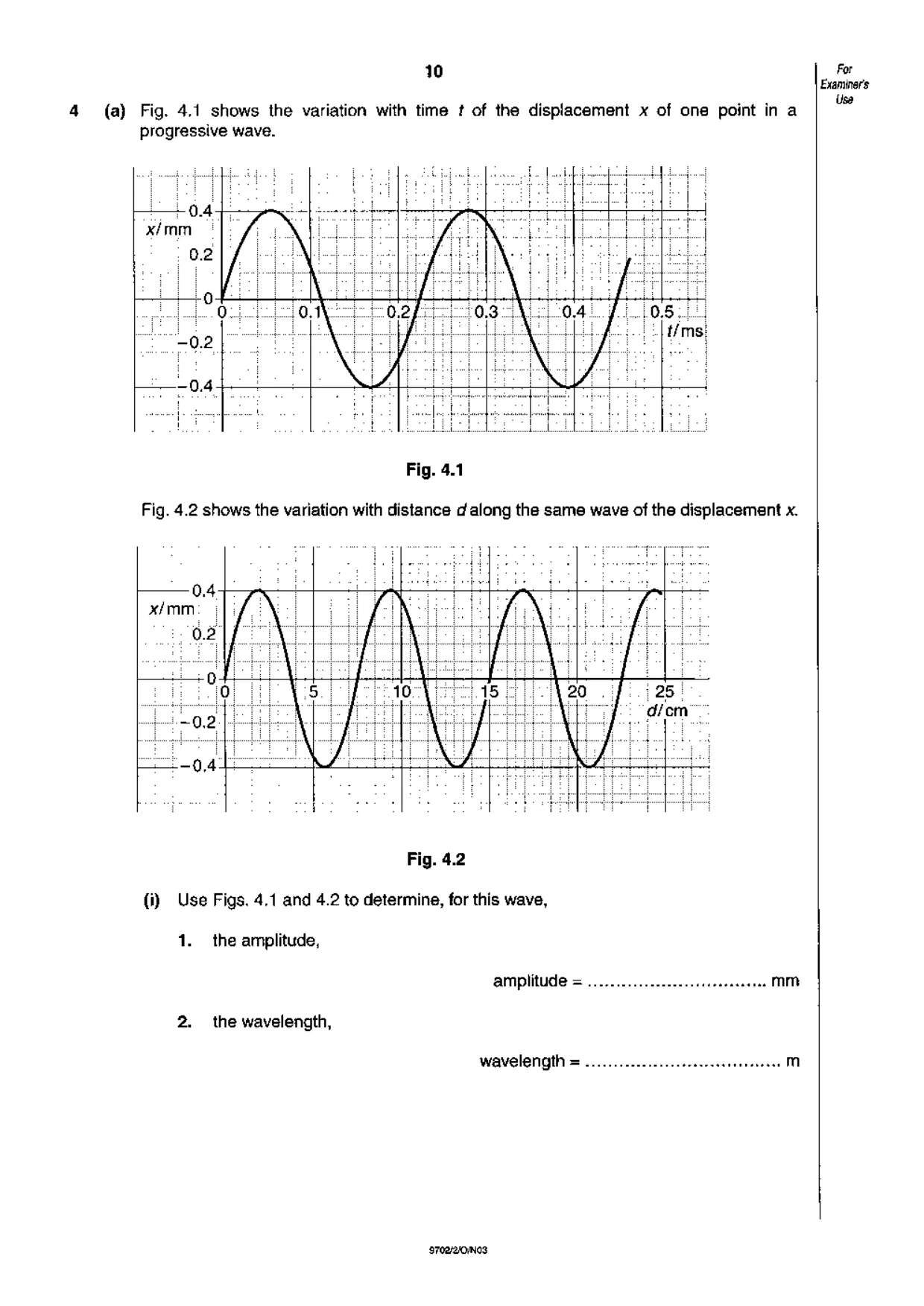
10 For Examiner's 4 (a) Fig. 4.1 shows the variation with time t of the displacement x of one point in a “se progressive wave. x/mm Fig. 4.1 Fig. 4.2 shows the variation with distance d along the same wave of the displacement x. 0.4 x/mm 0.2 Fig. 4.2 (i) Use Figs. 4,1 and 4.2 to determine, for this wave, 1. the amplitude, AMPHtUdE = oo... ec eceecesceseceseeseee MM 2. the wavelength, wavelength = …ccsecseeeeeeeereneeee M ‘9702/210NO3.
Question paper, page 11
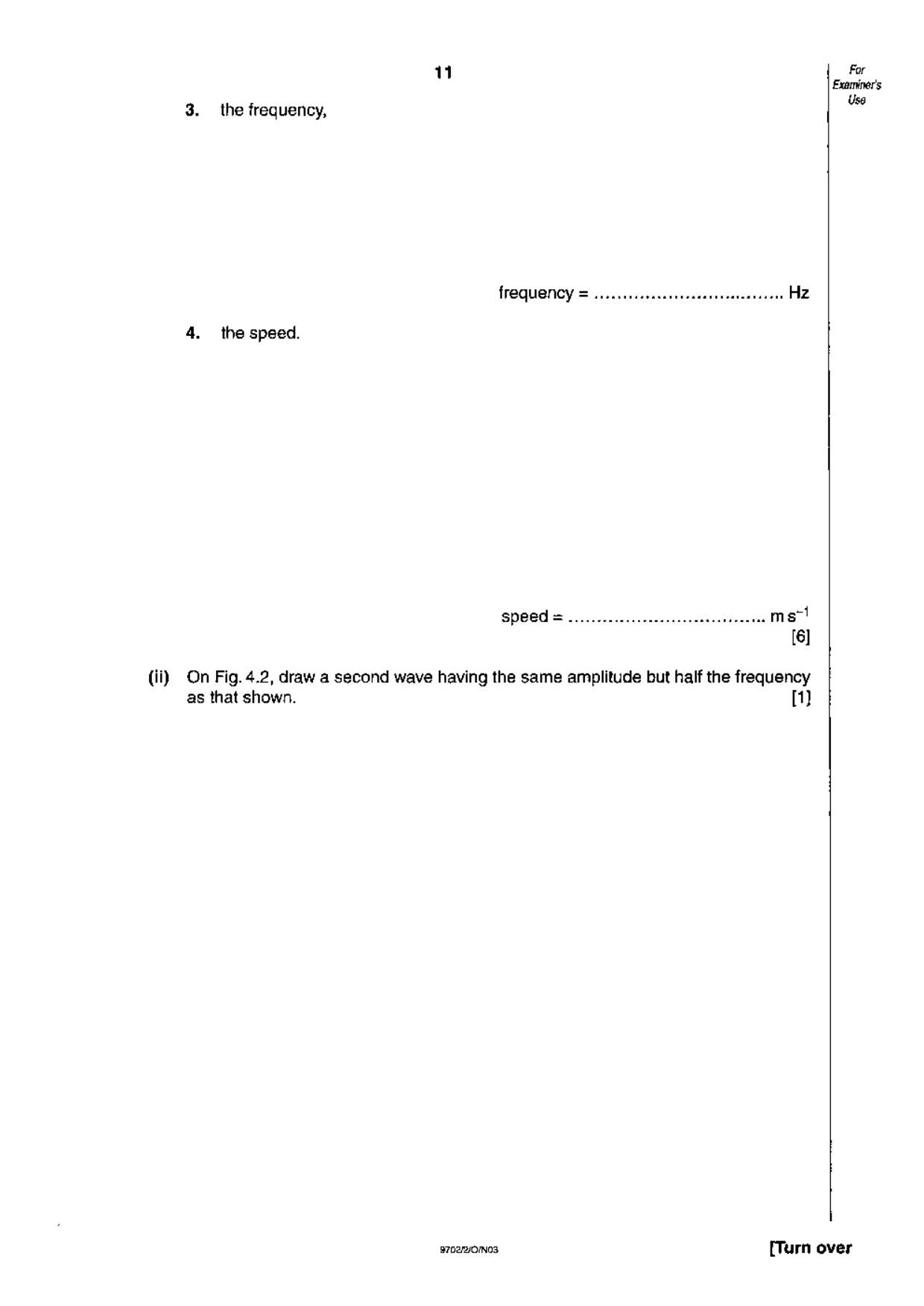
11 For Examiner's 3. the frequency, ve FPEQUENCY = vice eeececceee ceases sateereeees AZ 4. the speed. SPOOM = oo. cccceesceeeseeessteeeenee MST! [6] (ii) On Fig. 4.2, draw a second wave having the same amplitude but half the frequency as that shown. [1} 970272/0/NO3, [Turn over
Question paper, page 12
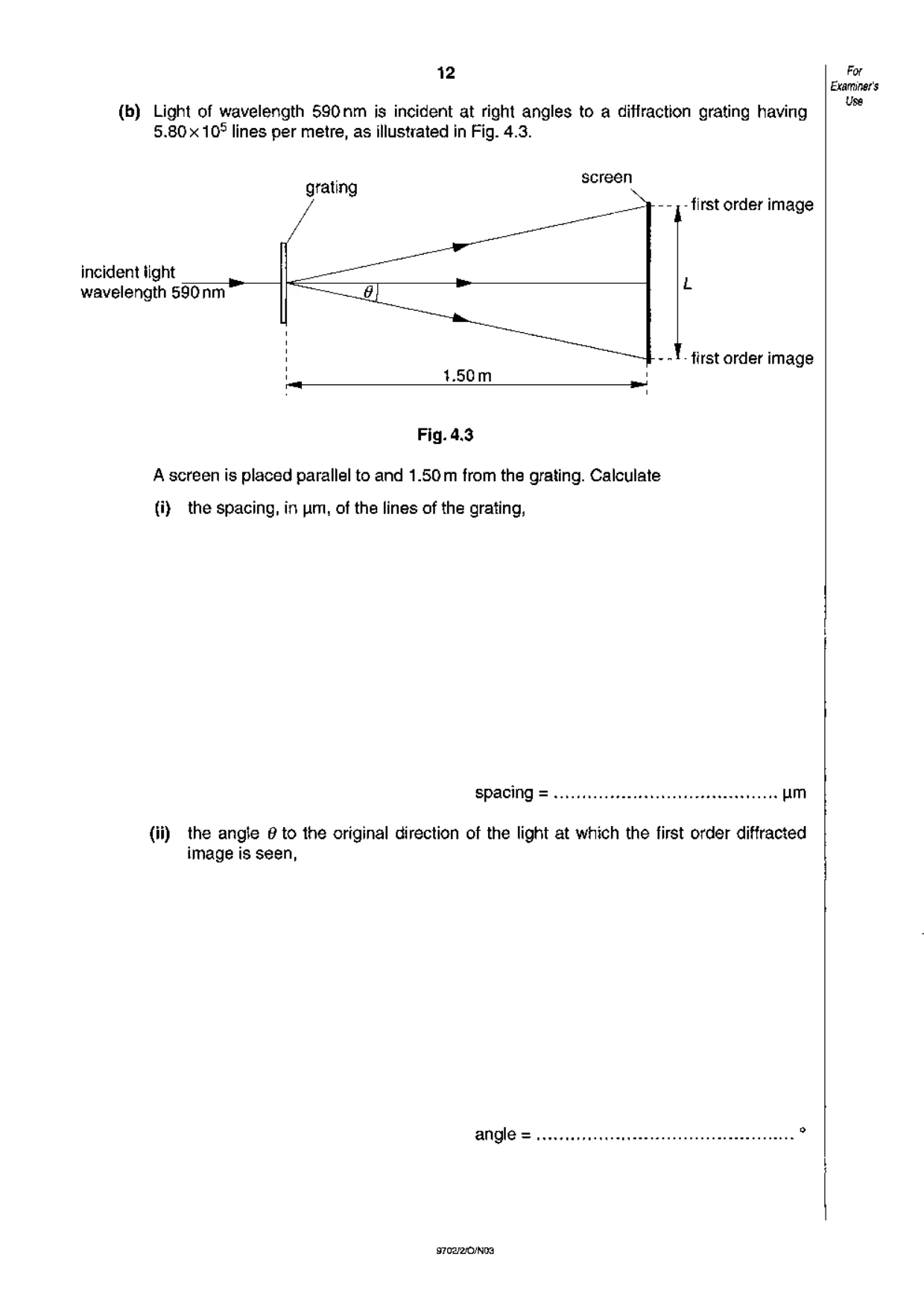
12 (b) Light of wavelength 590nm is incident at right angles to a diffraction grating having 5.80 x 10⁸ lines per metre, as illustrated in Fig. 4.3. grating screen --,-tirst order image incident tight wavelength 590nm em ~-1- first order image 1.50m a ' 1 — Fig. 4.3 A screen is placed parallel to and 1.50 m from the grating. Calculate {i} the spacing, in pm, of the lines of the grating, SPACING = oo. cicceeeseeceesescenseeesseeseeneeees ITT (ii) the angle @ to the original direction of the light at which the first order diffracted image is seen, ANGUS = veeeesereecstcensceeseecsseeeeseeseseeseeseeee % s70a2cvNO3 For Examiner's Use
Question paper, page 13
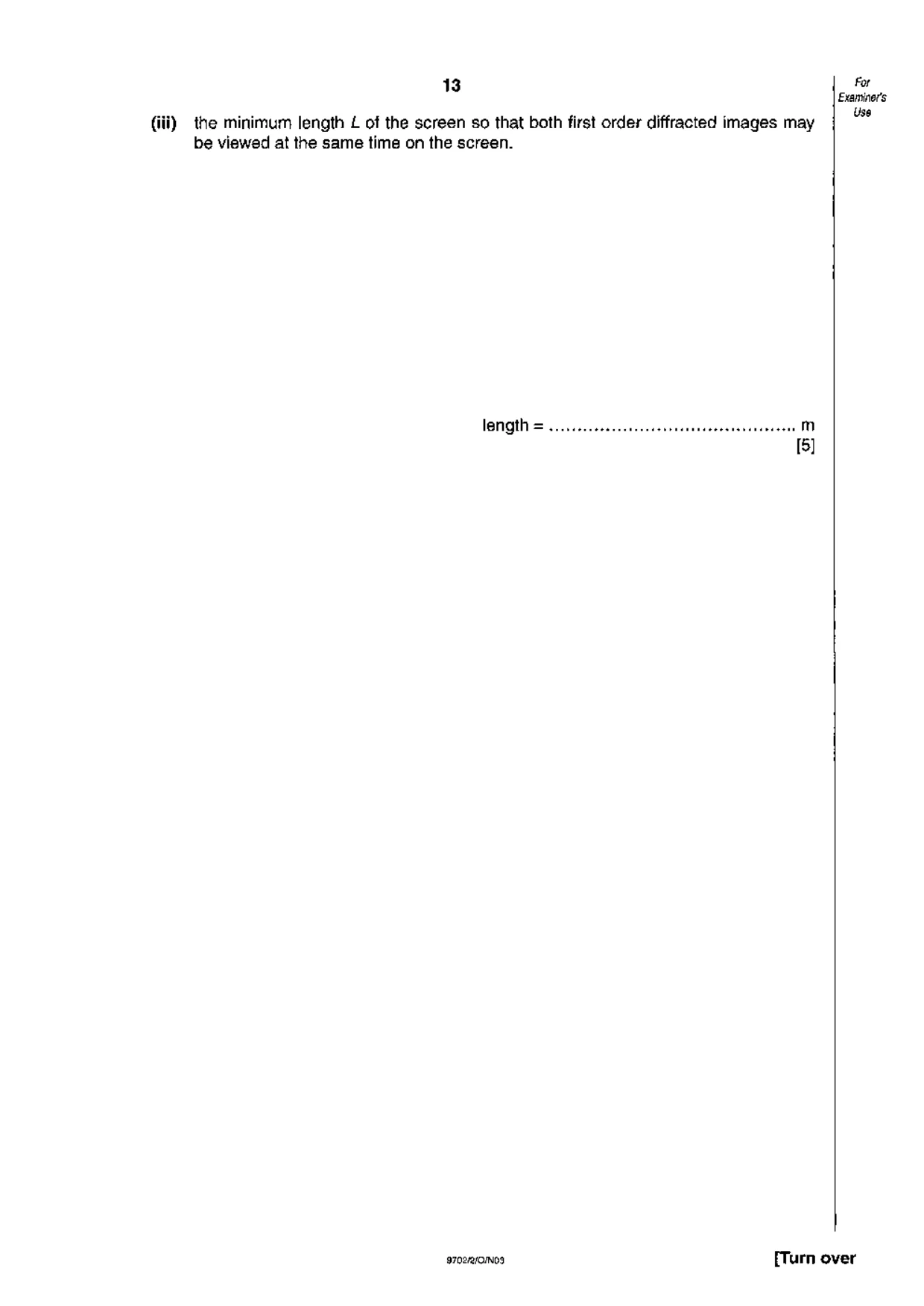
13 For Examiners iii) the minimum length L of the screen so that both first order diffracted images may | be viewed at the same time on the screen. VOMgth = eee ec eeeeeeeeneueeeseseereeesees m [5] 970272/0IN03 [Turn over
Question paper, page 14
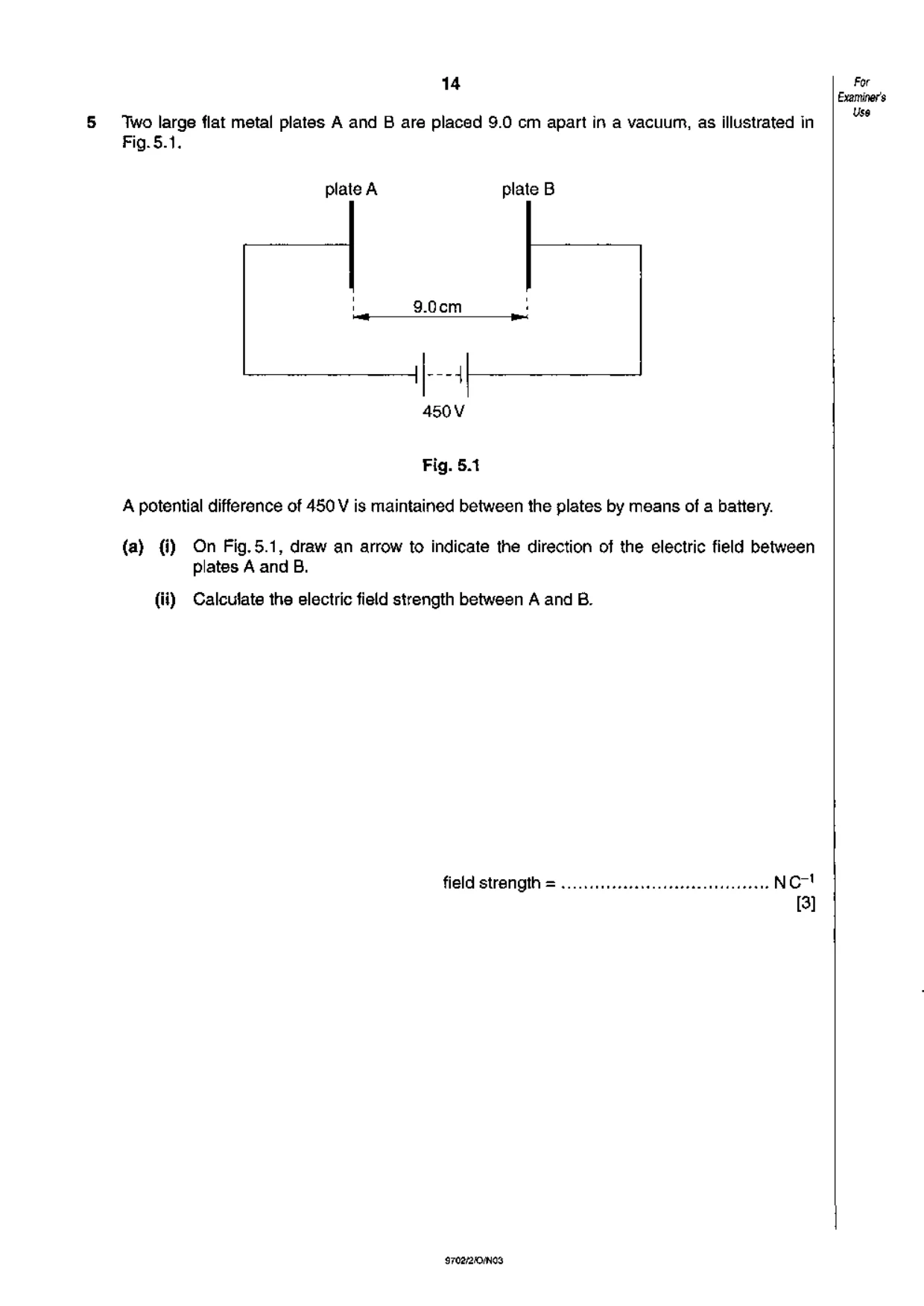
14 5 ‘Two large flat metal plates A and B are placed 9.0 cm apart in a vacuum, as illustrated in Fig.5.1. plate A plate B ' 9.0cm : 450V Fig. 5.1 A potential difference of 450 V is maintained between the plates by means of a battery. (a) (i) On Fig.5.1, draw an arrow to indicate the direction of the electric field between plates A and B. (ii) Calculate the electric field strength between A and B. field strength =... cise ccceeeeeceteeteeene Nc! [3] ‘9702/2500NO3 For Examiners Use
Question paper, page 15
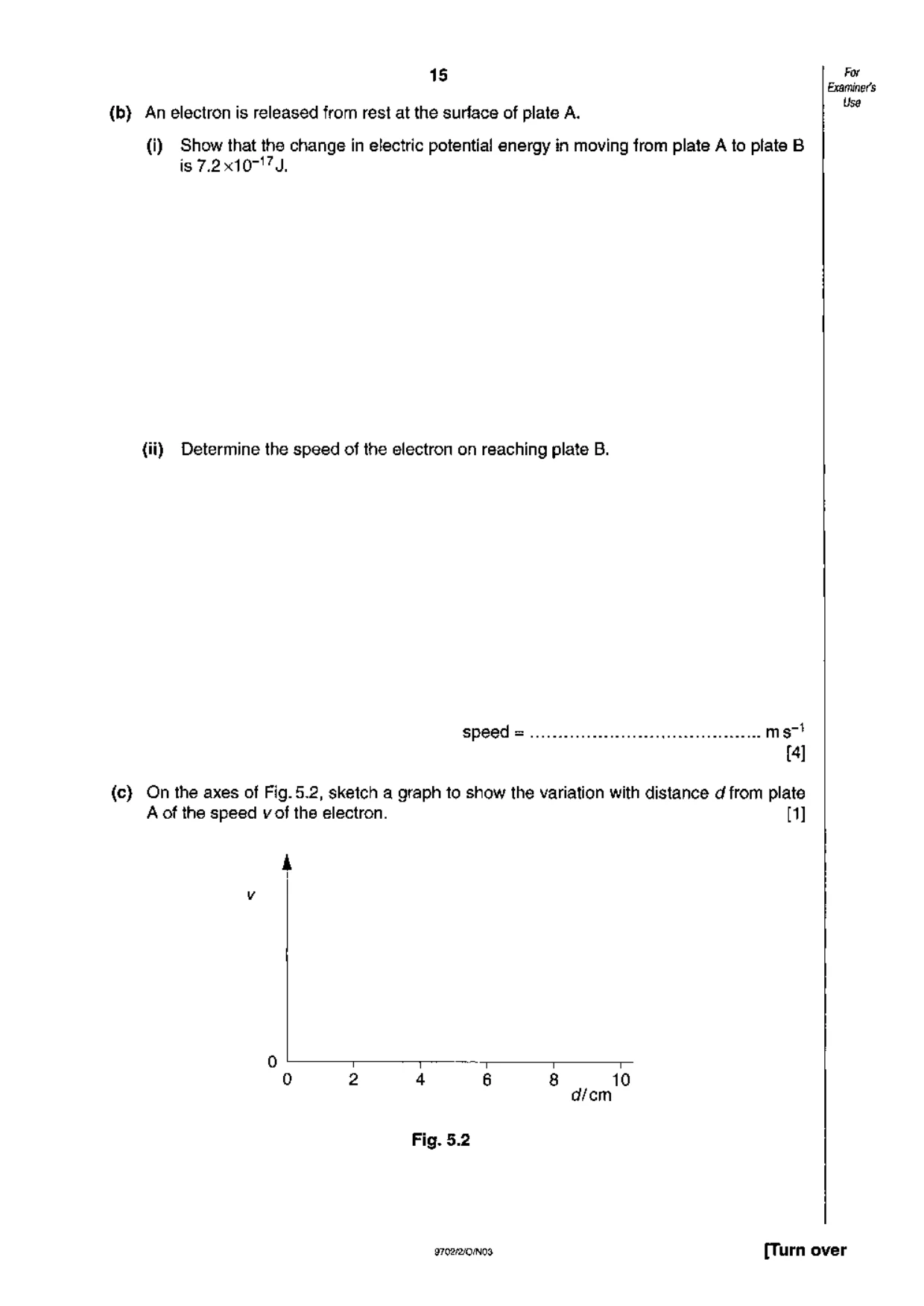
158 (b} An electron is released from rest at the surface of plate A. (i) Show that the change in electric potential energy in moving from plate A to plate B is 7.2x10717J, {ii) Determine the speed of the electron on reaching plate B. SPCC = oo. ceecesecseecsesseeesceseseecee MST? (4] (c} On the axes of Fig.5.2, sketch a graph to show the variation with distance d from plate A of the speed v of the electron. (1] A v 0 T T ann T T 0 2 4 10 d/cm Fig. 5.2 Examiner's @702/210(NOS [Turn over
Question paper, page 16
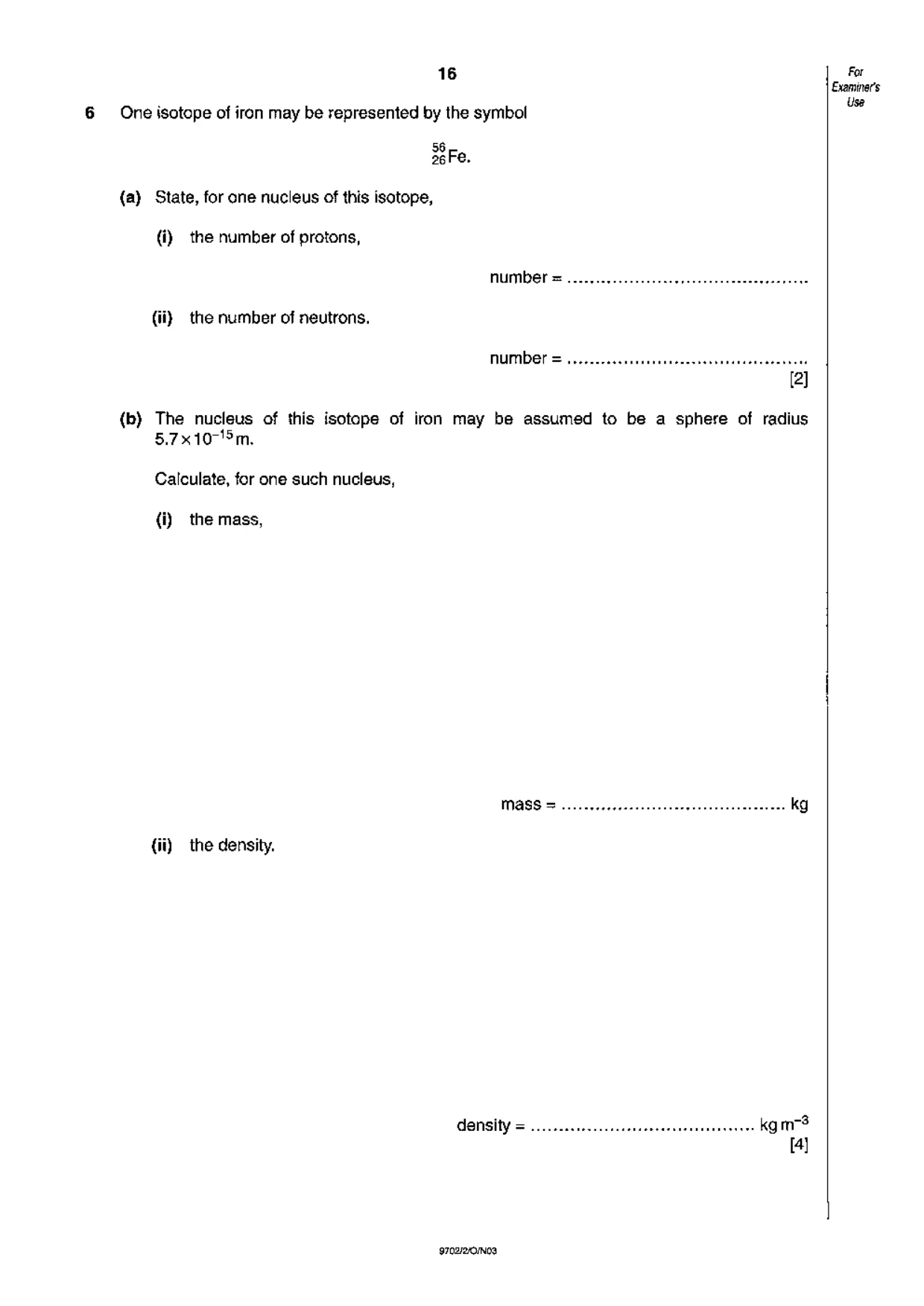
16 One isotope of iron may be represented by the symbol aeFe. (a) State, for one nucleus of this isotope, (i) the number of protons, NUMDEF = 0... cece eeeeecceepeeeeeesseeeeeeesereee (ii) the number of neutrons. NUMDET = 00... eeesseseteeeeeceesssesneeeeecaseneene (2) (b) The nucleus of this isotope of iron may be assumed to be a sphere of radius 5.7x10-m. Calculate, for one such nucleus, {i) the mass, MASS = oo ceecececescssseneeeseseesereneees kg {ii) the density. Density = oe cceeseecereteeeaeeacenees kgm=3 (4) 9702/2K0/NGR Examiner's Use
Question paper, page 17
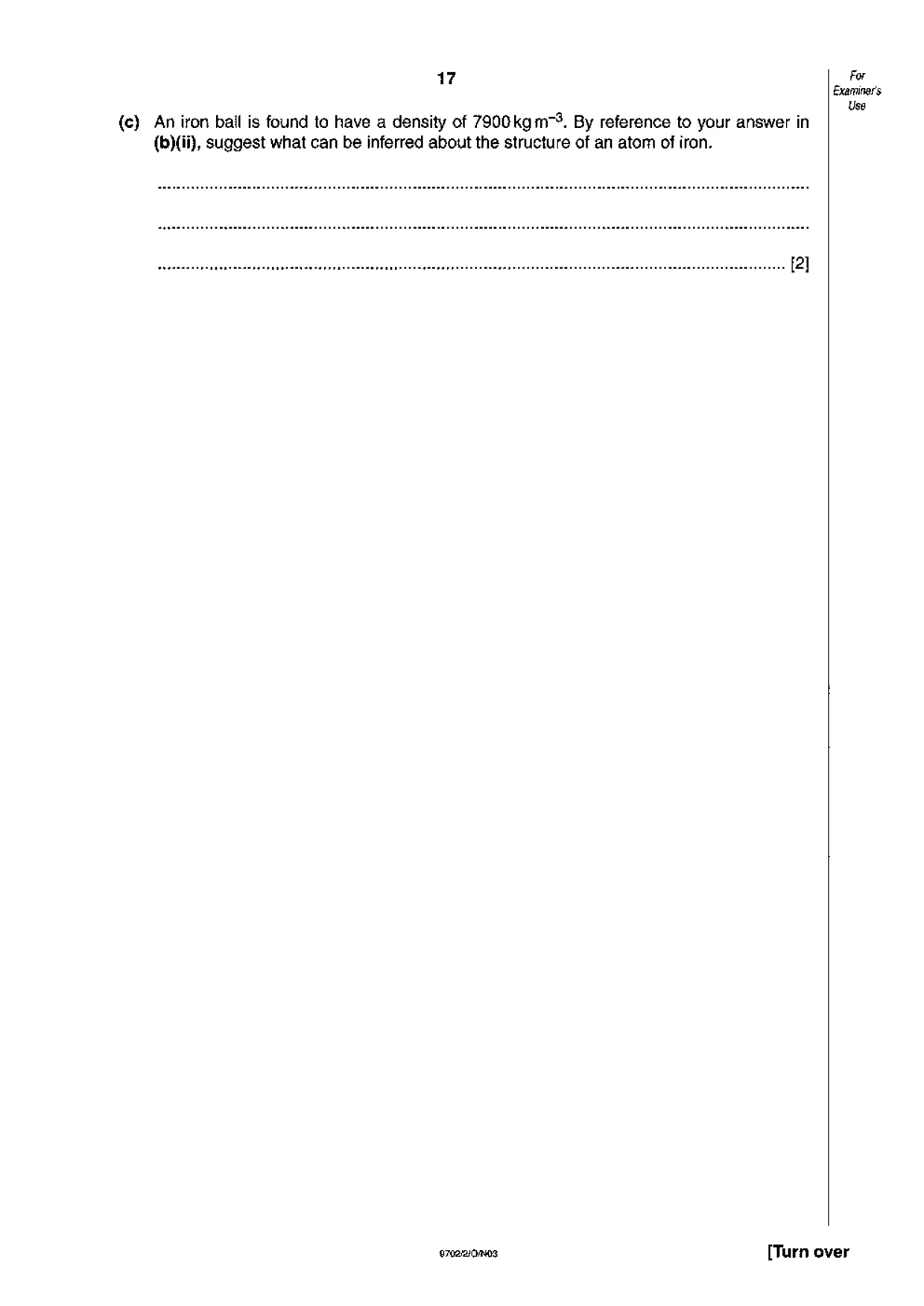
17 For Examiner's (c) An iron bail is found to have a density of 7900kgm=*. By reference to your answer in (b)(ii}, suggest what can be inferred about the structure of an atom of iron. 2] s70220Rv08 [Turn over
Question paper, page 18
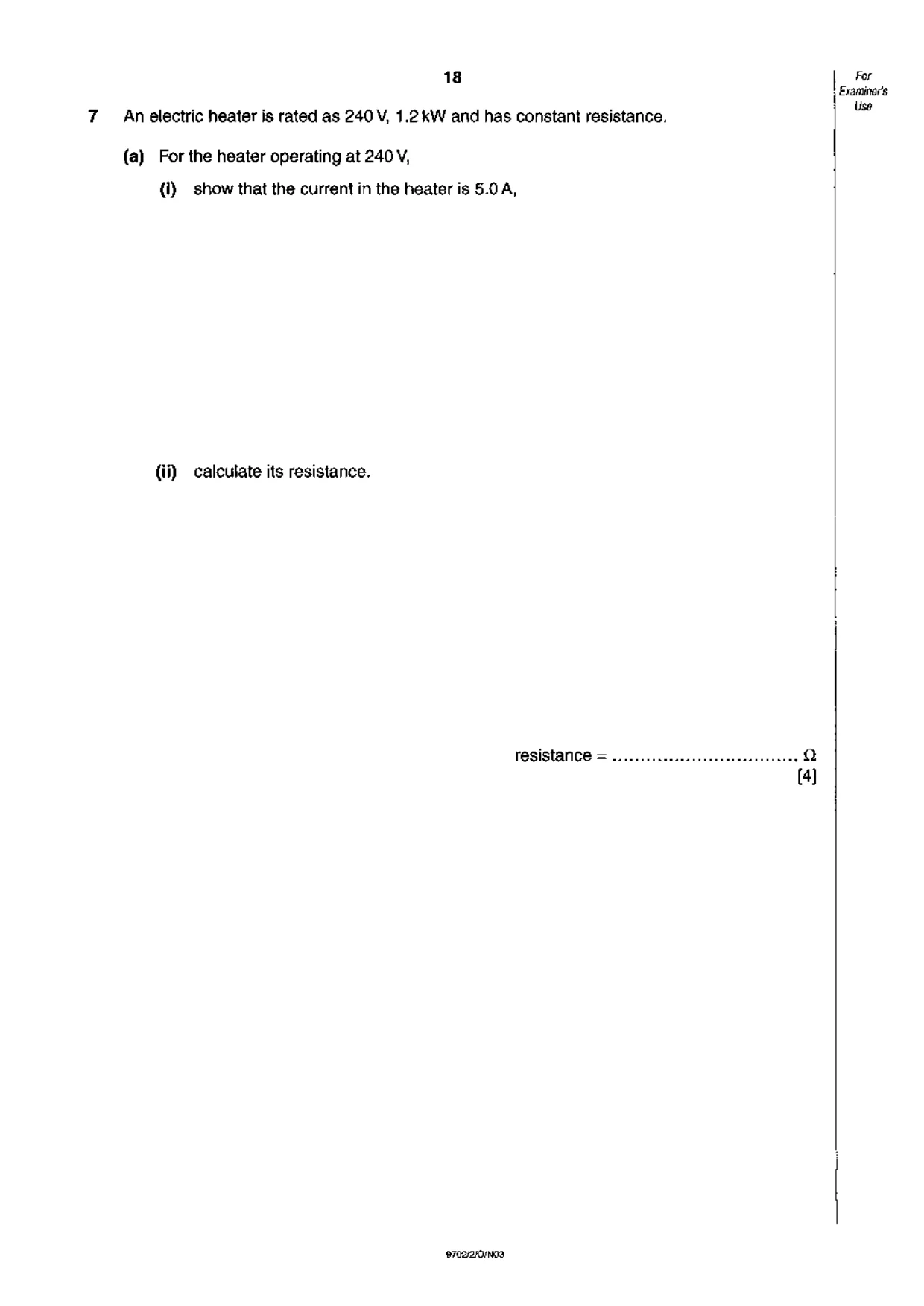
18 For i Examiner's 7 Anelectric heater is rated as 240 V, 1.2kW and has constant resistance. se (a) For the heater operating at 240 V, (i) show that the current in the heater is 5.0 A, (ii) calculate its resistance. TESISLANCE = 22... eee ereeeeeeeeees D (4) 9702/210/N09
Question paper, page 19
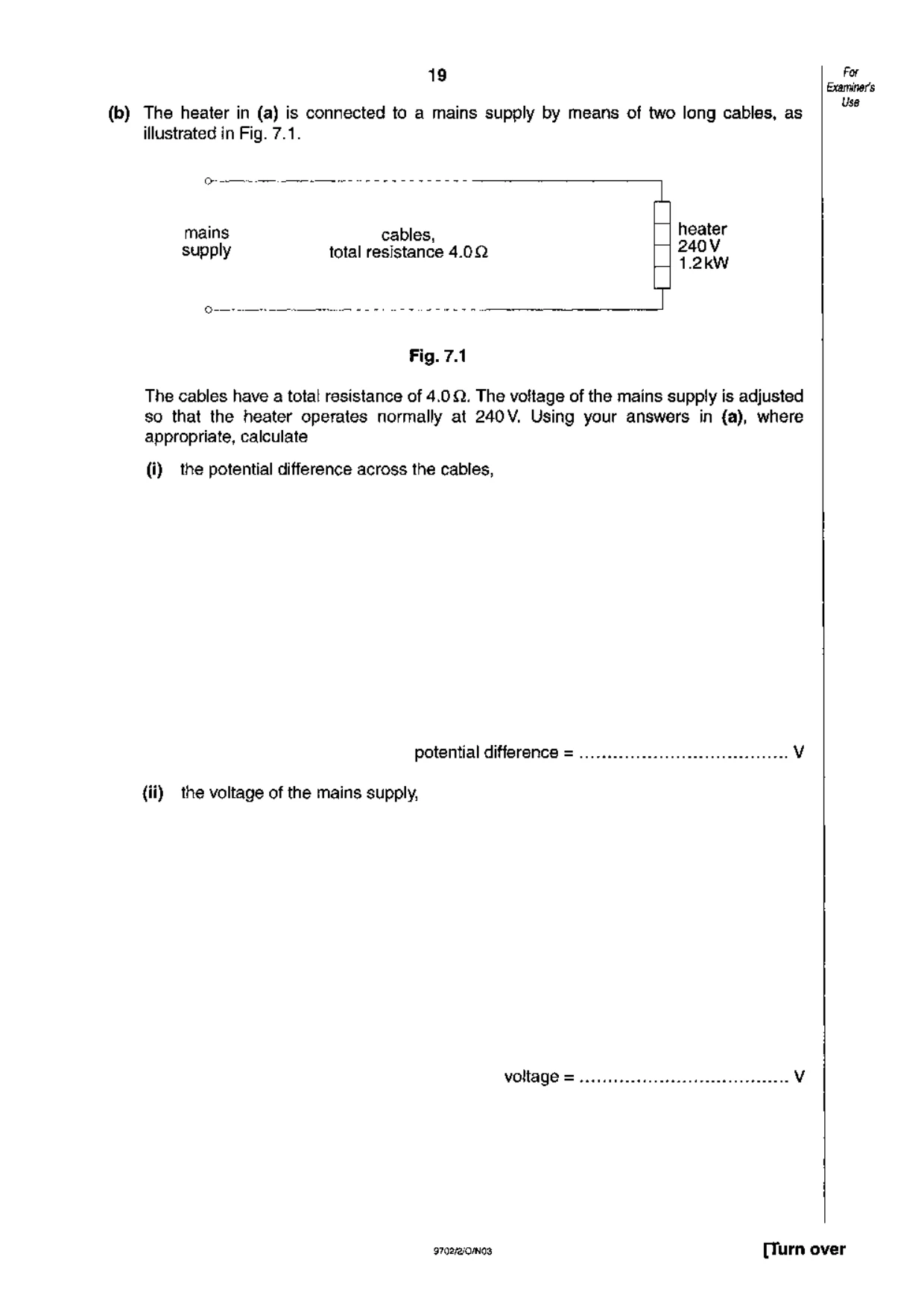
19 (b) The heater in (a) is connected to a mains supply by means of two long cables, as illustrated in Fig. 7.1. mains cables, heater supply total resistance 4.02 240 mr ar i er we ee Fig. 7.1 The cables have a total resistance of 4.0.9. The voltage of the mains supply is adjusted so that the heater operates normally at 240V. Using your answers in {a), where appropriate, calculate (i) the potential difference across the cables, potential difference = 0.2... eee eeeeeeeeee eee v {ii) the voltage of the mains supply, VONAGE = occ eee eeeeeeeeeeeeeneeeeee Vv For Examiners Use 9702720(NOS [Turn over
Question paper, page 20
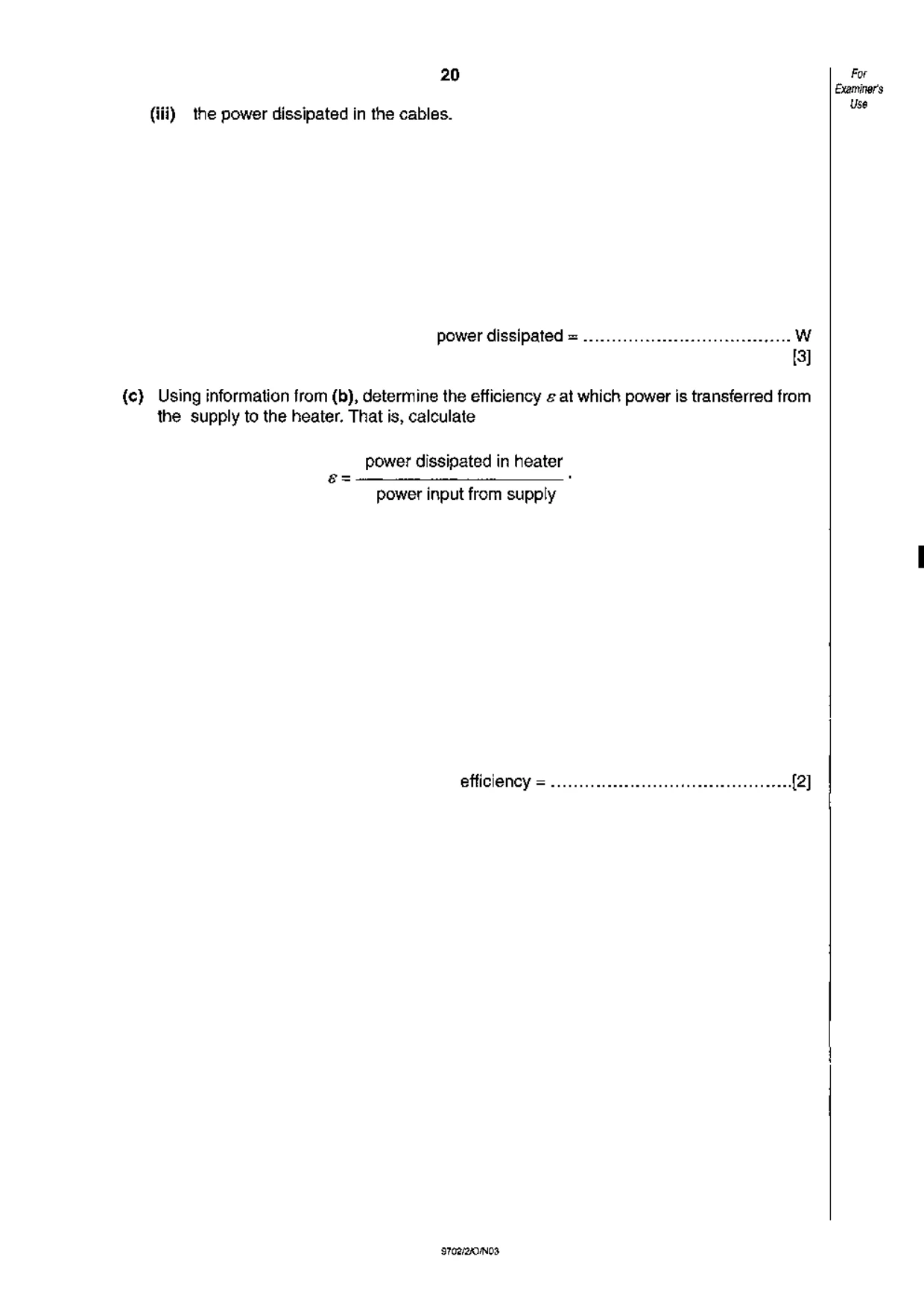
20 (iii) the power dissipated in the cables. power dissipated = … cece cee eeeeeeeeeeee eee ee WE {3] (c} Using information from (b), determine the efficiency ¢ at which power is transferred from the supply to the heater. That is, calculate power dissipated in heater BS power input from supply Officlency =o... eects sentseeeececeeeeerereed {2] S702/2K0NOS. For Examiners use