Cambridge A Level Physical Education 9396 — 2023 May/June Paper 3 · Variant 1
9396/31/M/J/23 · 90 marks · ≈101 min
The question paper and its mark scheme, free to read here and free to download. This is Cambridge’s own paper, exactly as it was sat.
Question paper4 pages
Mark scheme14 pages
Answers below. Sit the paper first if you are practising.
Paper as text
Question paper, page 1
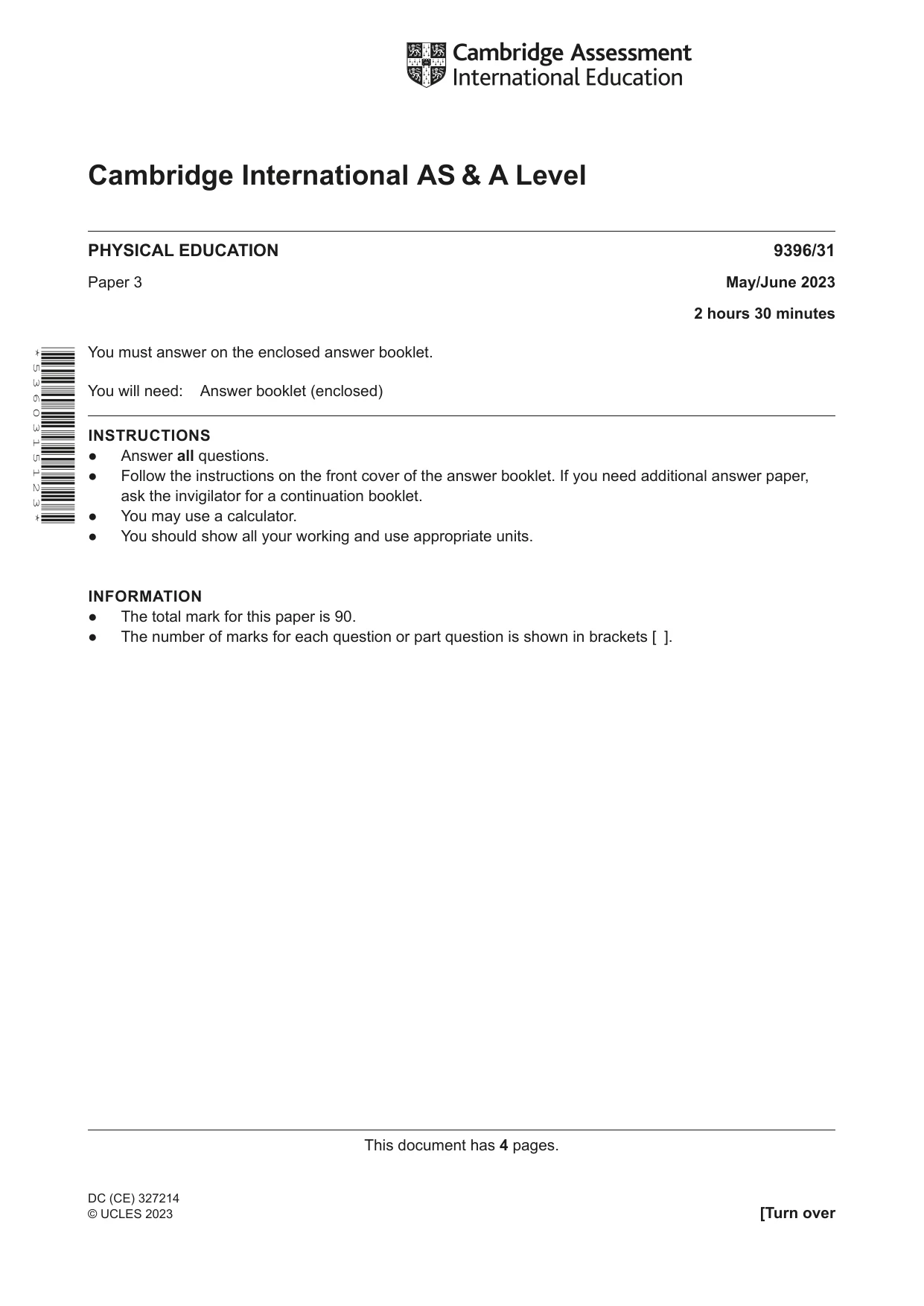
This document has 4 pages. [Turn over Cambridge International AS & A Level DC (CE) 327214 © UCLES 2023 PHYSICAL EDUCATION 9396/31 Paper 3 May/June 2023 2 hours 30 minutes You must answer on the enclosed answer booklet. You will need: Answer booklet (enclosed) INSTRUCTIONS ● Answer all questions. ● Follow the instructions on the front cover of the answer booklet. If you need additional answer paper, ask the invigilator for a continuation booklet. ● You may use a calculator. ● You should show all your working and use appropriate units. INFORMATION ● The total mark for this paper is 90. ● The number of marks for each question or part question is shown in brackets [ ]. * 5 3 6 0 3 1 5 1 2 3 *
Question paper, page 2
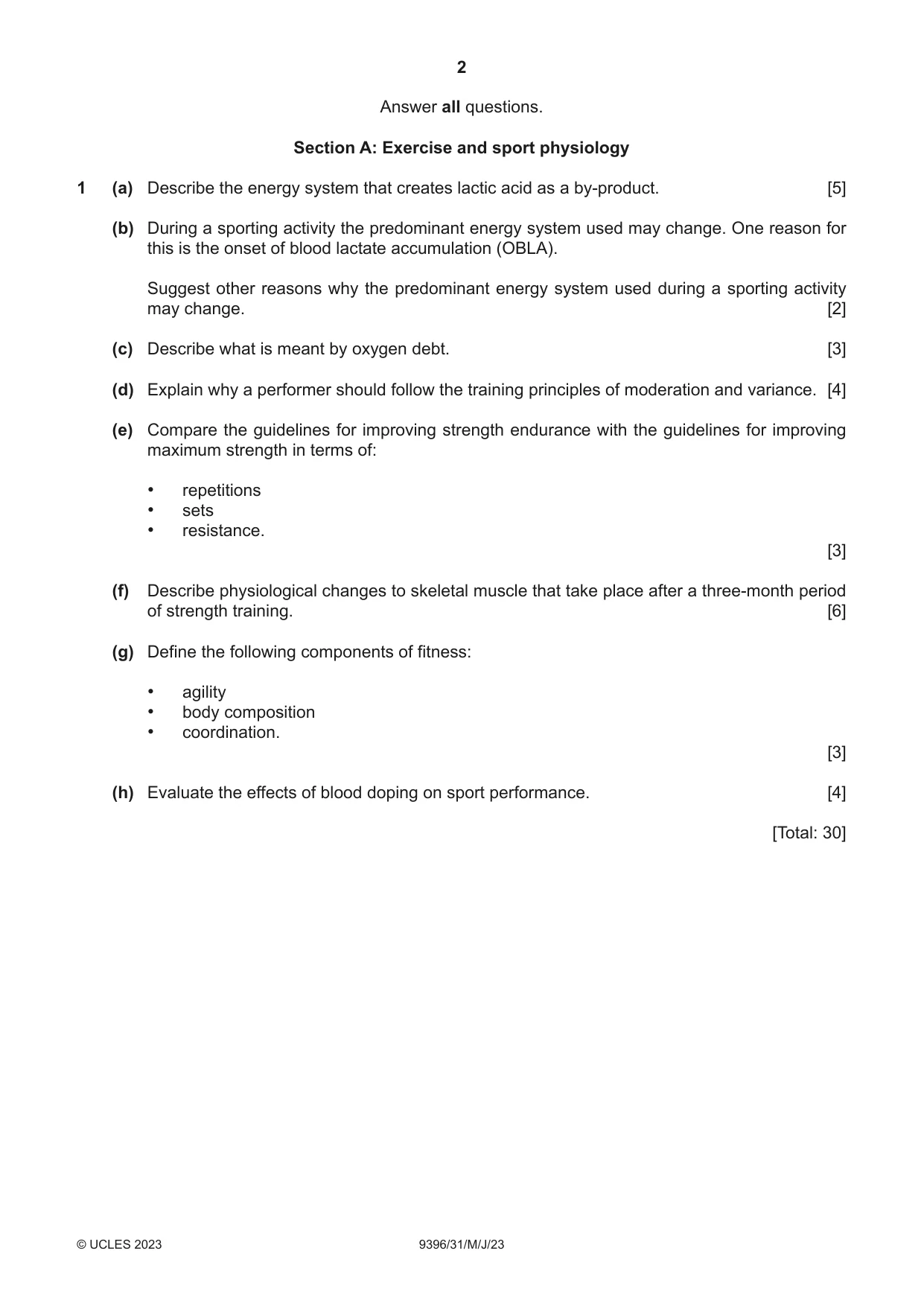
2 9396/31/M/J/23 © UCLES 2023 Answer all questions. Section A: Exercise and sport physiology 1 (a) Describe the energy system that creates lactic acid as a by-product. [5] (b) During a sporting activity the predominant energy system used may change. One reason for this is the onset of blood lactate accumulation (OBLA). Suggest other reasons why the predominant energy system used during a sporting activity may change. [2] (c) Describe what is meant by oxygen debt. [3] (d) Explain why a performer should follow the training principles of moderation and variance. [4] (e) Compare the guidelines for improving strength endurance with the guidelines for improving maximum strength in terms of: • repetitions • sets • resistance. [3] (f) Describe physiological changes to skeletal muscle that take place after a three-month period of strength training. [6] (g) Define the following components of fitness: • agility • body composition • coordination. [3] (h) Evaluate the effects of blood doping on sport performance. [4] [Total: 30]
Question paper, page 3
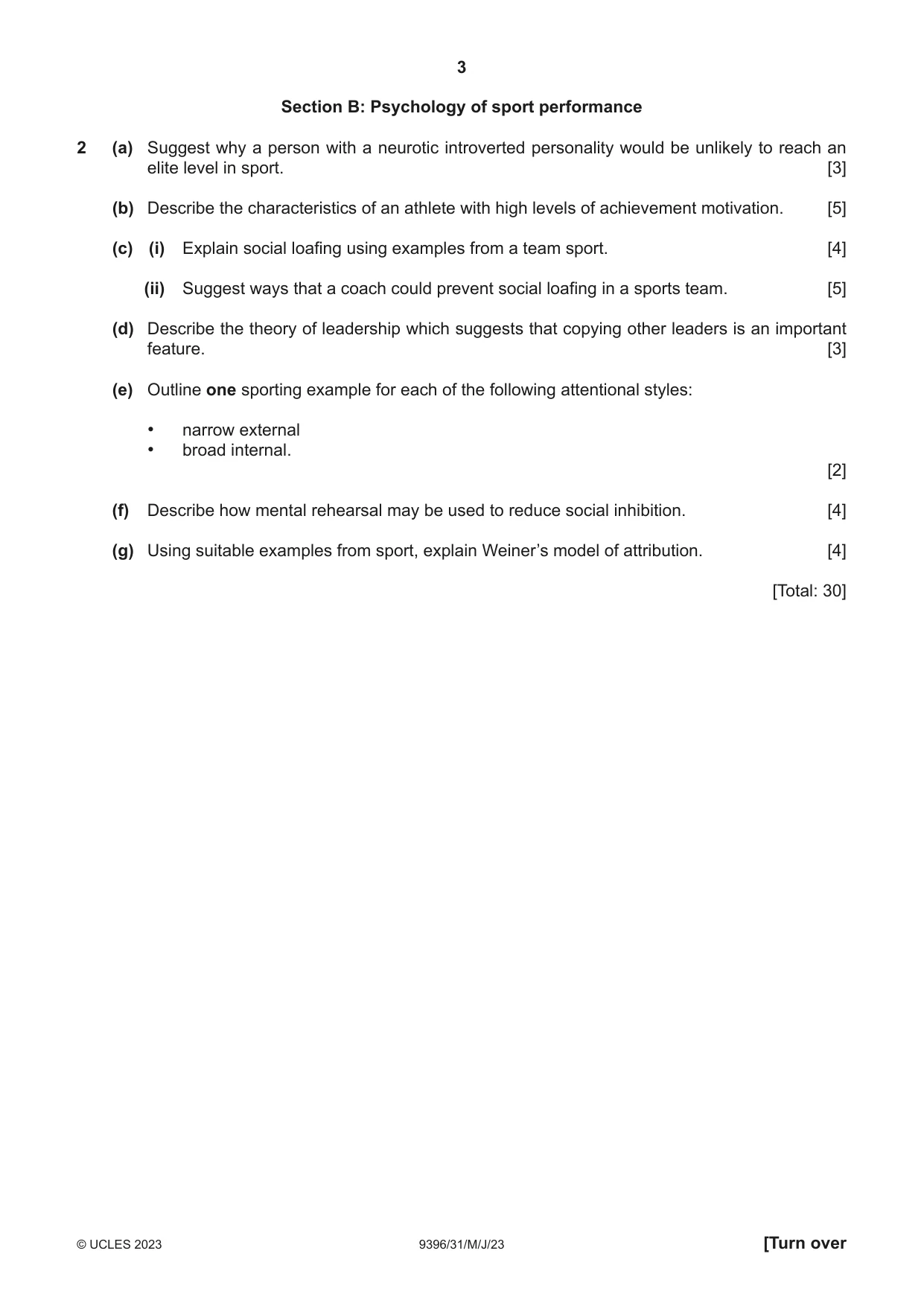
3 9396/31/M/J/23 © UCLES 2023 [Turn over Section B: Psychology of sport performance 2 (a) Suggest why a person with a neurotic introverted personality would be unlikely to reach an elite level in sport. [3] (b) Describe the characteristics of an athlete with high levels of achievement motivation. [5] (c) (i) Explain social loafing using examples from a team sport. [4] (ii) Suggest ways that a coach could prevent social loafing in a sports team. [5] (d) Describe the theory of leadership which suggests that copying other leaders is an important feature. [3] (e) Outline one sporting example for each of the following attentional styles: • narrow external • broad internal. [2] (f) Describe how mental rehearsal may be used to reduce social inhibition. [4] (g) Using suitable examples from sport, explain Weiner’s model of attribution. [4] [Total: 30]
Question paper, page 4
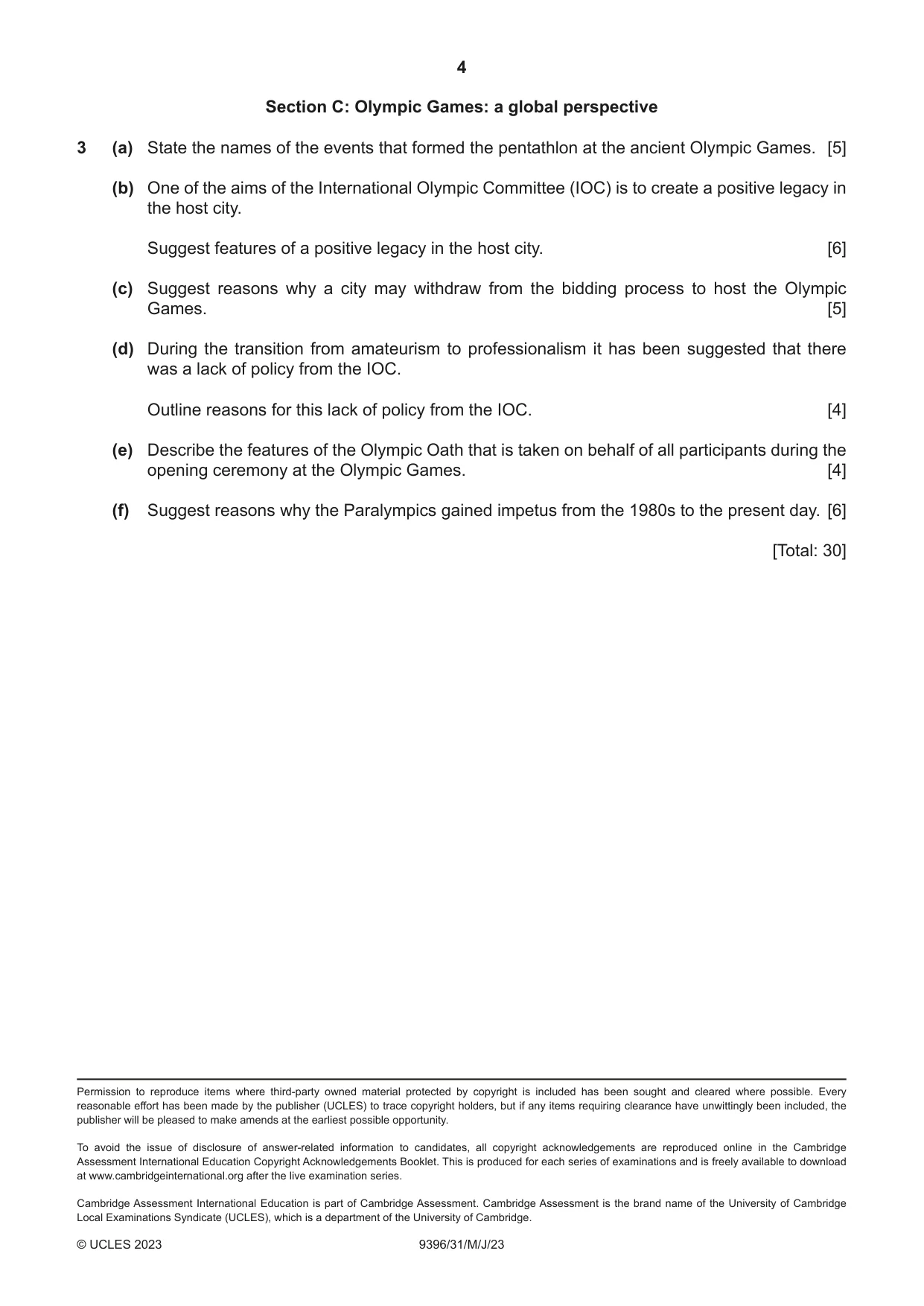
4 9396/31/M/J/23 © UCLES 2023 Permission to reproduce items where third-party owned material protected by copyright is included has been sought and cleared where possible. Every reasonable effort has been made by the publisher (UCLES) to trace copyright holders, but if any items requiring clearance have unwittingly been included, the publisher will be pleased to make amends at the earliest possible opportunity. To avoid the issue of disclosure of answer-related information to candidates, all copyright acknowledgements are reproduced online in the Cambridge Assessment International Education Copyright Acknowledgements Booklet. This is produced for each series of examinations and is freely available to download at www.cambridgeinternational.org after the live examination series. Cambridge Assessment International Education is part of Cambridge Assessment. Cambridge Assessment is the brand name of the University of Cambridge Local Examinations Syndicate (UCLES), which is a department of the University of Cambridge. Section C: Olympic Games: a global perspective 3 (a) State the names of the events that formed the pentathlon at the ancient Olympic Games. [5] (b) One of the aims of the International Olympic Committee (IOC) is to create a positive legacy in the host city. Suggest features of a positive legacy in the host city. [6] (c) Suggest reasons why a city may withdraw from the bidding process to host the Olympic Games. [5] (d) During the transition from amateurism to professionalism it has been suggested that there was a lack of policy from the IOC. Outline reasons for this lack of policy from the IOC. [4] (e) Describe the features of the Olympic Oath that is taken on behalf of all participants during the opening ceremony at the Olympic Games. [4] (f) Suggest reasons why the Paralympics gained impetus from the 1980s to the present day. [6] [Total: 30]
Mark scheme, page 1
This document consists of 14 printed pages. © UCLES 2023 [Turn over Cambridge International AS & A Level PHYSICAL EDUCATION 9396/31 Paper 3 May/June 2023 MARK SCHEME Maximum Mark: 90 Published This mark scheme is published as an aid to teachers and candidates, to indicate the requirements of the examination. It shows the basis on which Examiners were instructed to award marks. It does not indicate the details of the discussions that took place at an Examiners’ meeting before marking began, which would have considered the acceptability of alternative answers. Mark schemes should be read in conjunction with the question paper and the Principal Examiner Report for Teachers. Cambridge International will not enter into discussions about these mark schemes. Cambridge International is publishing the mark schemes for the May/June 2023 series for most Cambridge IGCSE, Cambridge International A and AS Level and Cambridge Pre-U components, and some Cambridge O Level components.
Mark scheme, page 2
9396/31 Cambridge International AS & A Level – Mark Scheme PUBLISHED May/June 2023 © UCLES 2023 Page 2 of 14 Generic Marking Principles These general marking principles must be applied by all examiners when marking candidate answers. They should be applied alongside the specific content of the mark scheme or generic level descriptors for a question. Each question paper and mark scheme will also comply with these marking principles. GENERIC MARKING PRINCIPLE 1: Marks must be awarded in line with: the specific content of the mark scheme or the generic level descriptors for the question the specific skills defined in the mark scheme or in the generic level descriptors for the question the standard of response required by a candidate as exemplified by the standardisation scripts. GENERIC MARKING PRINCIPLE 2: Marks awarded are always whole marks (not half marks, or other fractions). GENERIC MARKING PRINCIPLE 3: Marks must be awarded positively: marks are awarded for correct/valid answers, as defined in the mark scheme. However, credit is given for valid answers which go beyond the scope of the syllabus and mark scheme, referring to your Team Leader as appropriate marks are awarded when candidates clearly demonstrate what they know and can do marks are not deducted for errors marks are not deducted for omissions answers should only be judged on the quality of spelling, punctuation and grammar when these features are specifically assessed by the question as indicated by the mark scheme. The meaning, however, should be unambiguous. GENERIC MARKING PRINCIPLE 4: Rules must be applied consistently, e.g. in situations where candidates have not followed instructions or in the application of generic level descriptors.
Mark scheme, page 3
9396/31 Cambridge International AS & A Level – Mark Scheme PUBLISHED May/June 2023 © UCLES 2023 Page 3 of 14 GENERIC MARKING PRINCIPLE 5: Marks should be awarded using the full range of marks defined in the mark scheme for the question (however; the use of the full mark range may be limited according to the quality of the candidate responses seen). GENERIC MARKING PRINCIPLE 6: Marks awarded are based solely on the requirements as defined in the mark scheme. Marks should not be awarded with grade thresholds or grade descriptors in mind.
Mark scheme, page 4
9396/31 Cambridge International AS & A Level – Mark Scheme PUBLISHED May/June 2023 © UCLES 2023 Page 4 of 14 Science-Specific Marking Principles 1 Examiners should consider the context and scientific use of any keywords when awarding marks. Although keywords may be present, marks should not be awarded if the keywords are used incorrectly. 2 The examiner should not choose between contradictory statements given in the same question part, and credit should not be awarded for any correct statement that is contradicted within the same question part. Wrong science that is irrelevant to the question should be ignored. 3 Although spellings do not have to be correct, spellings of syllabus terms must allow for clear and unambiguous separation from other syllabus terms with which they may be confused (e.g. ethane / ethene, glucagon / glycogen, refraction / reflection). 4 The error carried forward (ecf) principle should be applied, where appropriate. If an incorrect answer is subsequently used in a scientifically correct way, the candidate should be awarded these subsequent marking points. Further guidance will be included in the mark scheme where necessary and any exceptions to this general principle will be noted. 5 ‘List rule’ guidance For questions that require n responses (e.g. State two reasons …): The response should be read as continuous prose, even when numbered answer spaces are provided. Any response marked ignore in the mark scheme should not count towards n. Incorrect responses should not be awarded credit but will still count towards n. Read the entire response to check for any responses that contradict those that would otherwise be credited. Credit should not be awarded for any responses that are contradicted within the rest of the response. Where two responses contradict one another, this should be treated as a single incorrect response. Non-contradictory responses after the first n responses may be ignored even if they include incorrect science.
Mark scheme, page 5
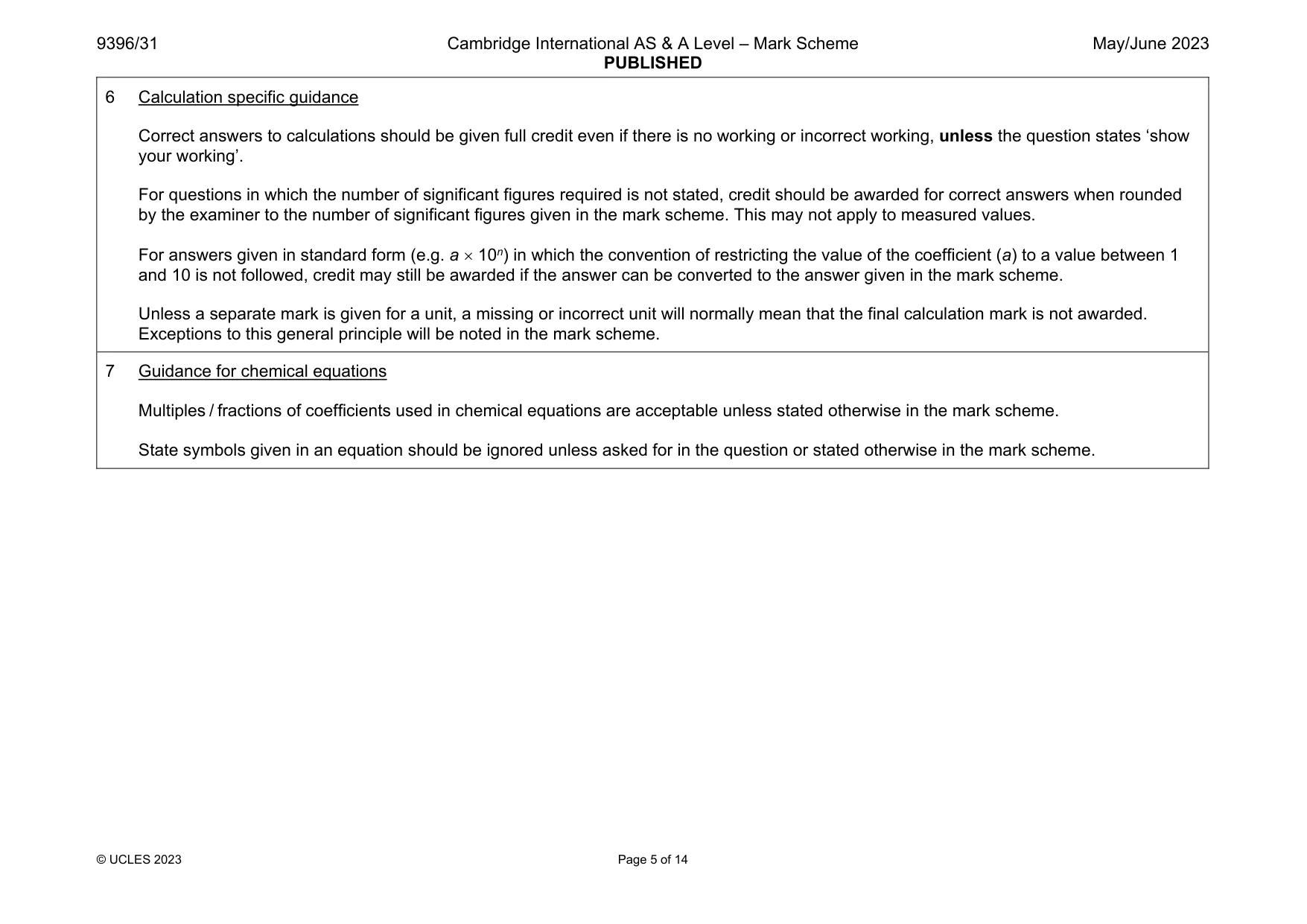
9396/31 Cambridge International AS & A Level – Mark Scheme PUBLISHED May/June 2023 © UCLES 2023 Page 5 of 14 6 Calculation specific guidance Correct answers to calculations should be given full credit even if there is no working or incorrect working, unless the question states ‘show your working’. For questions in which the number of significant figures required is not stated, credit should be awarded for correct answers when rounded by the examiner to the number of significant figures given in the mark scheme. This may not apply to measured values. For answers given in standard form (e.g. a 10n) in which the convention of restricting the value of the coefficient (a) to a value between 1 and 10 is not followed, credit may still be awarded if the answer can be converted to the answer given in the mark scheme. Unless a separate mark is given for a unit, a missing or incorrect unit will normally mean that the final calculation mark is not awarded. Exceptions to this general principle will be noted in the mark scheme. 7 Guidance for chemical equations Multiples / fractions of coefficients used in chemical equations are acceptable unless stated otherwise in the mark scheme. State symbols given in an equation should be ignored unless asked for in the question or stated otherwise in the mark scheme.
Mark scheme, page 6
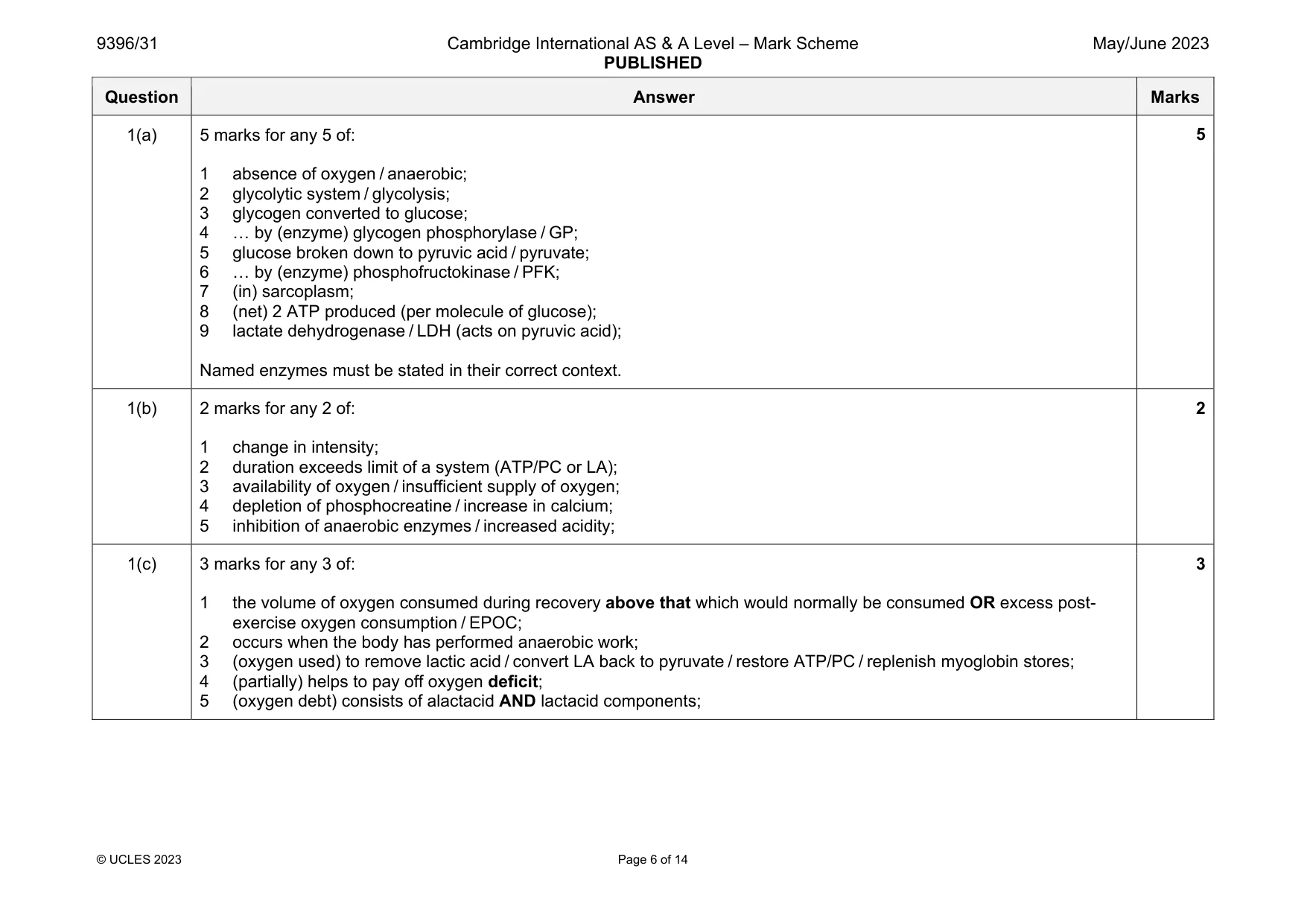
9396/31 Cambridge International AS & A Level – Mark Scheme PUBLISHED May/June 2023 © UCLES 2023 Page 6 of 14 Question Answer Marks 1(a) 5 marks for any 5 of: 1 absence of oxygen / anaerobic; 2 glycolytic system / glycolysis; 3 glycogen converted to glucose; 4 … by (enzyme) glycogen phosphorylase / GP; 5 glucose broken down to pyruvic acid / pyruvate; 6 … by (enzyme) phosphofructokinase / PFK; 7 (in) sarcoplasm; 8 (net) 2 ATP produced (per molecule of glucose); 9 lactate dehydrogenase / LDH (acts on pyruvic acid); Named enzymes must be stated in their correct context. 5 1(b) 2 marks for any 2 of: 1 change in intensity; 2 duration exceeds limit of a system (ATP/PC or LA); 3 availability of oxygen / insufficient supply of oxygen; 4 depletion of phosphocreatine / increase in calcium; 5 inhibition of anaerobic enzymes / increased acidity; 2 1(c) 3 marks for any 3 of: 1 the volume of oxygen consumed during recovery above that which would normally be consumed OR excess post- exercise oxygen consumption / EPOC; 2 occurs when the body has performed anaerobic work; 3 (oxygen used) to remove lactic acid / convert LA back to pyruvate / restore ATP/PC / replenish myoglobin stores; 4 (partially) helps to pay off oxygen deficit; 5 (oxygen debt) consists of alactacid AND lactacid components; 3
Mark scheme, page 7
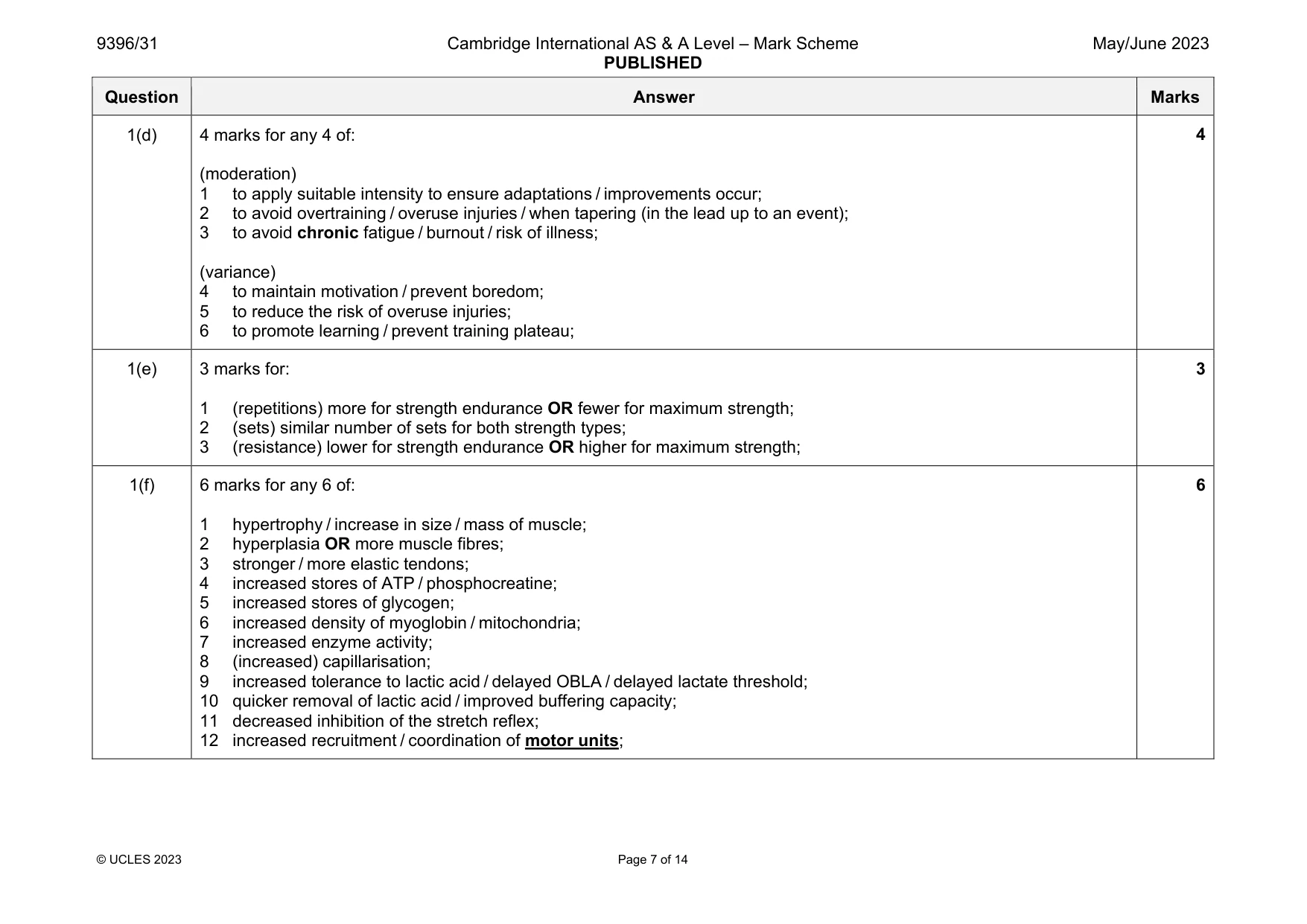
9396/31 Cambridge International AS & A Level – Mark Scheme PUBLISHED May/June 2023 © UCLES 2023 Page 7 of 14 Question Answer Marks 1(d) 4 marks for any 4 of: (moderation) 1 to apply suitable intensity to ensure adaptations / improvements occur; 2 to avoid overtraining / overuse injuries / when tapering (in the lead up to an event); 3 to avoid chronic fatigue / burnout / risk of illness; (variance) 4 to maintain motivation / prevent boredom; 5 to reduce the risk of overuse injuries; 6 to promote learning / prevent training plateau; 4 1(e) 3 marks for: 1 (repetitions) more for strength endurance OR fewer for maximum strength; 2 (sets) similar number of sets for both strength types; 3 (resistance) lower for strength endurance OR higher for maximum strength; 3 1(f) 6 marks for any 6 of: 1 hypertrophy / increase in size / mass of muscle; 2 hyperplasia OR more muscle fibres; 3 stronger / more elastic tendons; 4 increased stores of ATP / phosphocreatine; 5 increased stores of glycogen; 6 increased density of myoglobin / mitochondria; 7 increased enzyme activity; 8 (increased) capillarisation; 9 increased tolerance to lactic acid / delayed OBLA / delayed lactate threshold; 10 quicker removal of lactic acid / improved buffering capacity; 11 decreased inhibition of the stretch reflex; 12 increased recruitment / coordination of motor units; 6
Mark scheme, page 8
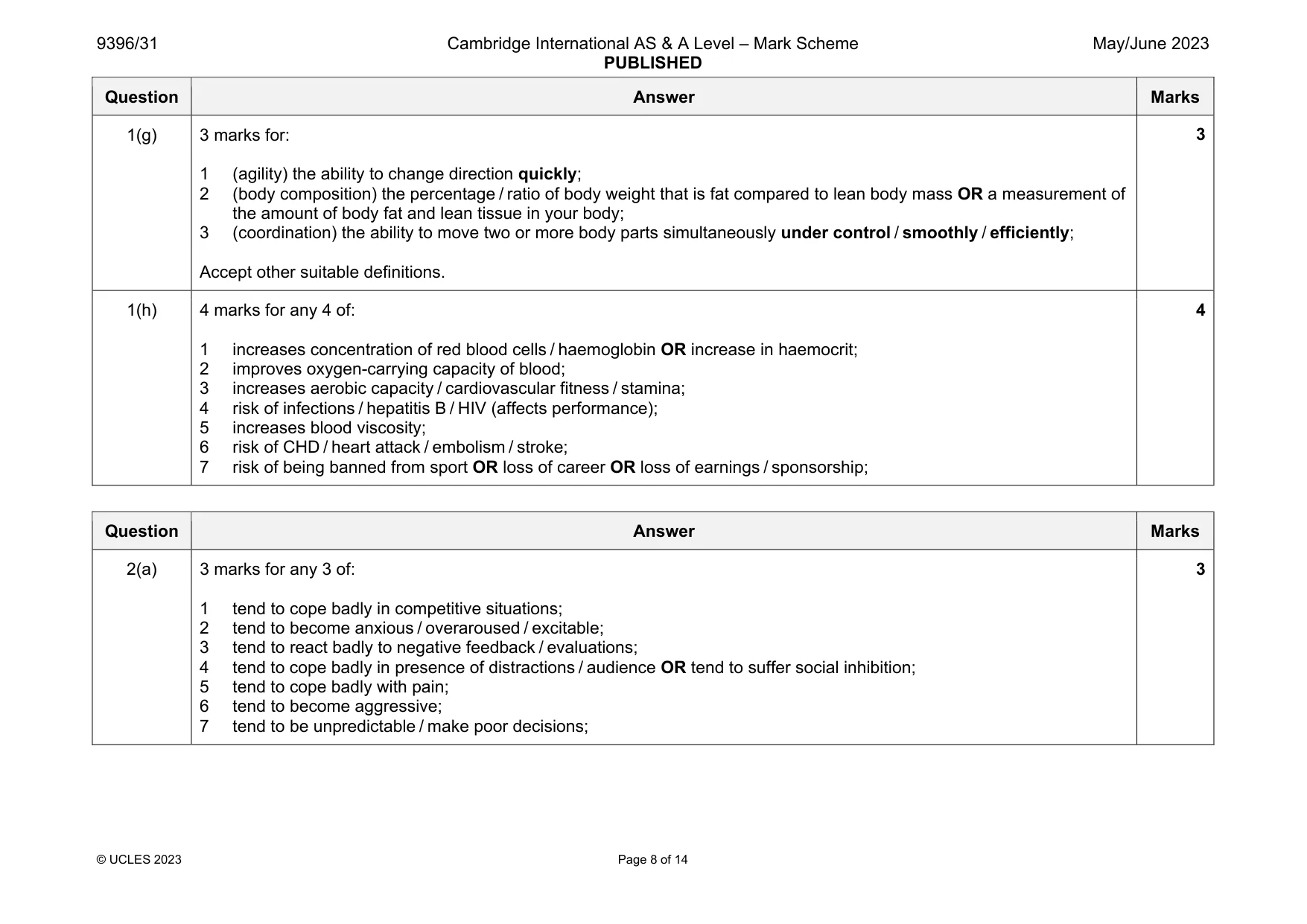
9396/31 Cambridge International AS & A Level – Mark Scheme PUBLISHED May/June 2023 © UCLES 2023 Page 8 of 14 Question Answer Marks 1(g) 3 marks for: 1 (agility) the ability to change direction quickly; 2 (body composition) the percentage / ratio of body weight that is fat compared to lean body mass OR a measurement of the amount of body fat and lean tissue in your body; 3 (coordination) the ability to move two or more body parts simultaneously under control / smoothly / efficiently; Accept other suitable definitions. 3 1(h) 4 marks for any 4 of: 1 increases concentration of red blood cells / haemoglobin OR increase in haemocrit; 2 improves oxygen-carrying capacity of blood; 3 increases aerobic capacity / cardiovascular fitness / stamina; 4 risk of infections / hepatitis B / HIV (affects performance); 5 increases blood viscosity; 6 risk of CHD / heart attack / embolism / stroke; 7 risk of being banned from sport OR loss of career OR loss of earnings / sponsorship; 4 Question Answer Marks 2(a) 3 marks for any 3 of: 1 tend to cope badly in competitive situations; 2 tend to become anxious / overaroused / excitable; 3 tend to react badly to negative feedback / evaluations; 4 tend to cope badly in presence of distractions / audience OR tend to suffer social inhibition; 5 tend to cope badly with pain; 6 tend to become aggressive; 7 tend to be unpredictable / make poor decisions; 3
Mark scheme, page 9
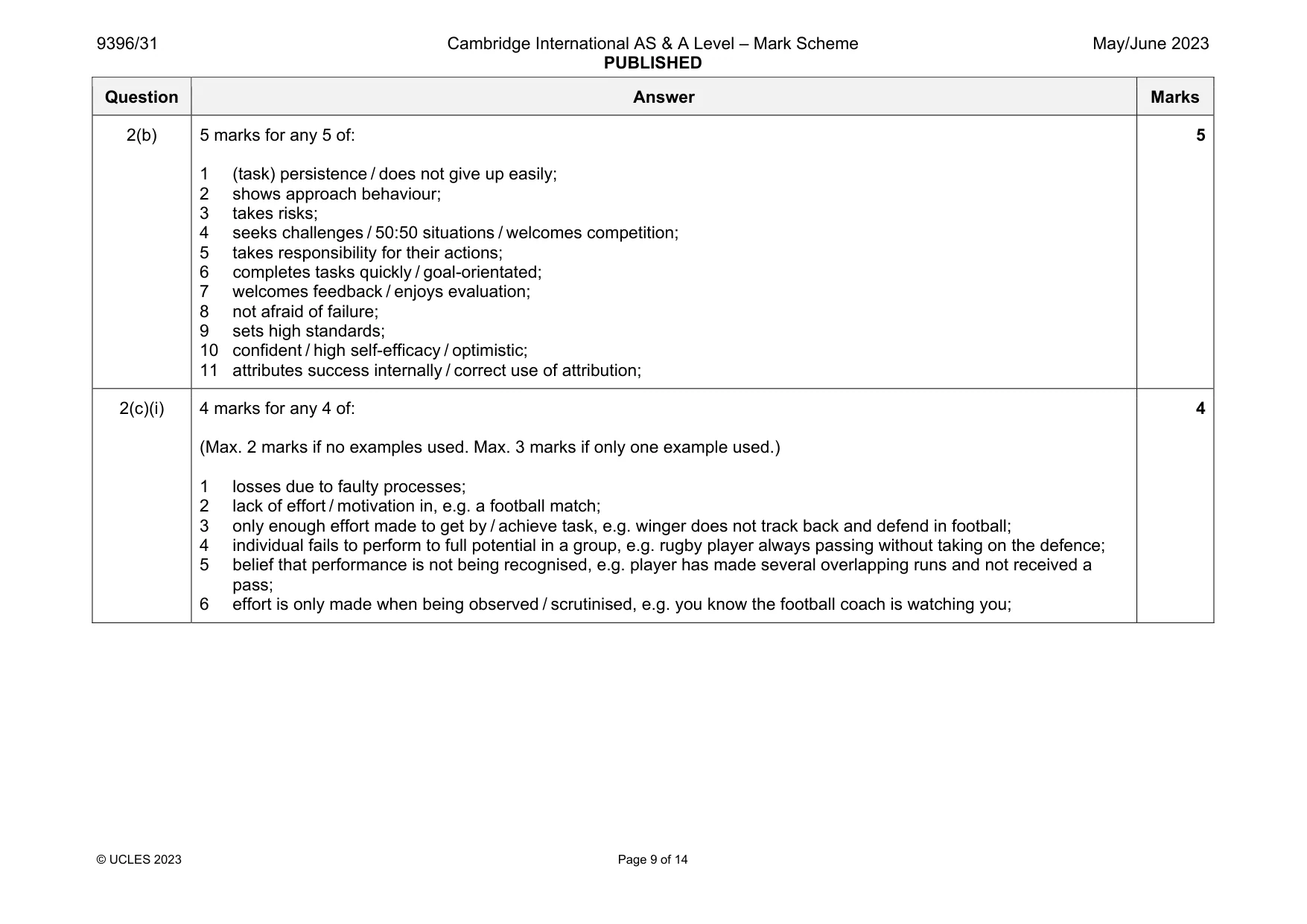
9396/31 Cambridge International AS & A Level – Mark Scheme PUBLISHED May/June 2023 © UCLES 2023 Page 9 of 14 Question Answer Marks 2(b) 5 marks for any 5 of: 1 (task) persistence / does not give up easily; 2 shows approach behaviour; 3 takes risks; 4 seeks challenges / 50:50 situations / welcomes competition; 5 takes responsibility for their actions; 6 completes tasks quickly / goal-orientated; 7 welcomes feedback / enjoys evaluation; 8 not afraid of failure; 9 sets high standards; 10 confident / high self-efficacy / optimistic; 11 attributes success internally / correct use of attribution; 5 2(c)(i) 4 marks for any 4 of: (Max. 2 marks if no examples used. Max. 3 marks if only one example used.) 1 losses due to faulty processes; 2 lack of effort / motivation in, e.g. a football match; 3 only enough effort made to get by / achieve task, e.g. winger does not track back and defend in football; 4 individual fails to perform to full potential in a group, e.g. rugby player always passing without taking on the defence; 5 belief that performance is not being recognised, e.g. player has made several overlapping runs and not received a pass; 6 effort is only made when being observed / scrutinised, e.g. you know the football coach is watching you; 4
Mark scheme, page 10
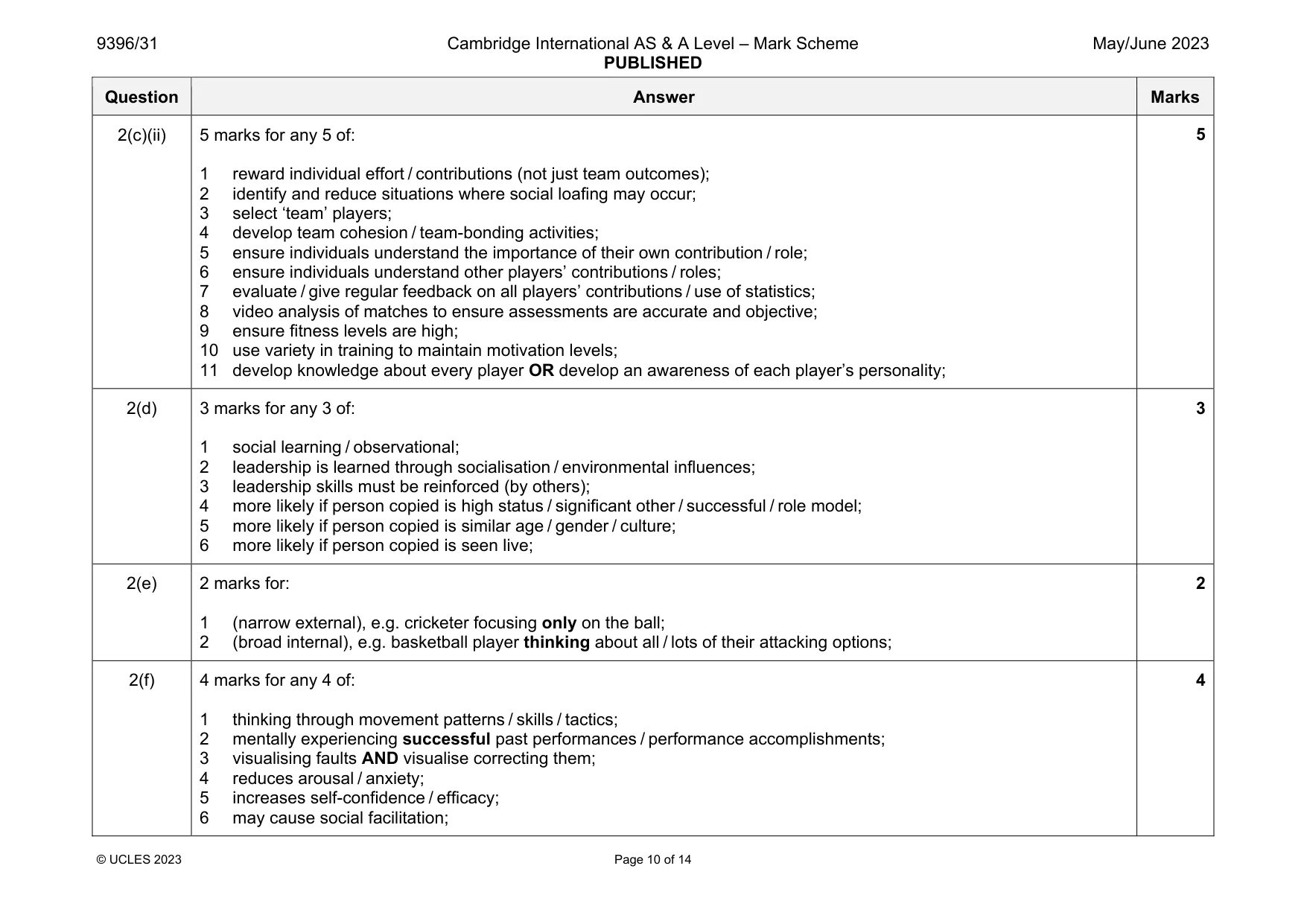
9396/31 Cambridge International AS & A Level – Mark Scheme PUBLISHED May/June 2023 © UCLES 2023 Page 10 of 14 Question Answer Marks 2(c)(ii) 5 marks for any 5 of: 1 reward individual effort / contributions (not just team outcomes); 2 identify and reduce situations where social loafing may occur; 3 select ‘team’ players; 4 develop team cohesion / team-bonding activities; 5 ensure individuals understand the importance of their own contribution / role; 6 ensure individuals understand other players’ contributions / roles; 7 evaluate / give regular feedback on all players’ contributions / use of statistics; 8 video analysis of matches to ensure assessments are accurate and objective; 9 ensure fitness levels are high; 10 use variety in training to maintain motivation levels; 11 develop knowledge about every player OR develop an awareness of each player’s personality; 5 2(d) 3 marks for any 3 of: 1 social learning / observational; 2 leadership is learned through socialisation / environmental influences; 3 leadership skills must be reinforced (by others); 4 more likely if person copied is high status / significant other / successful / role model; 5 more likely if person copied is similar age / gender / culture; 6 more likely if person copied is seen live; 3 2(e) 2 marks for: 1 (narrow external), e.g. cricketer focusing only on the ball; 2 (broad internal), e.g. basketball player thinking about all / lots of their attacking options; 2 2(f) 4 marks for any 4 of: 1 thinking through movement patterns / skills / tactics; 2 mentally experiencing successful past performances / performance accomplishments; 3 visualising faults AND visualise correcting them; 4 reduces arousal / anxiety; 5 increases self-confidence / efficacy; 6 may cause social facilitation; 4
Mark scheme, page 11
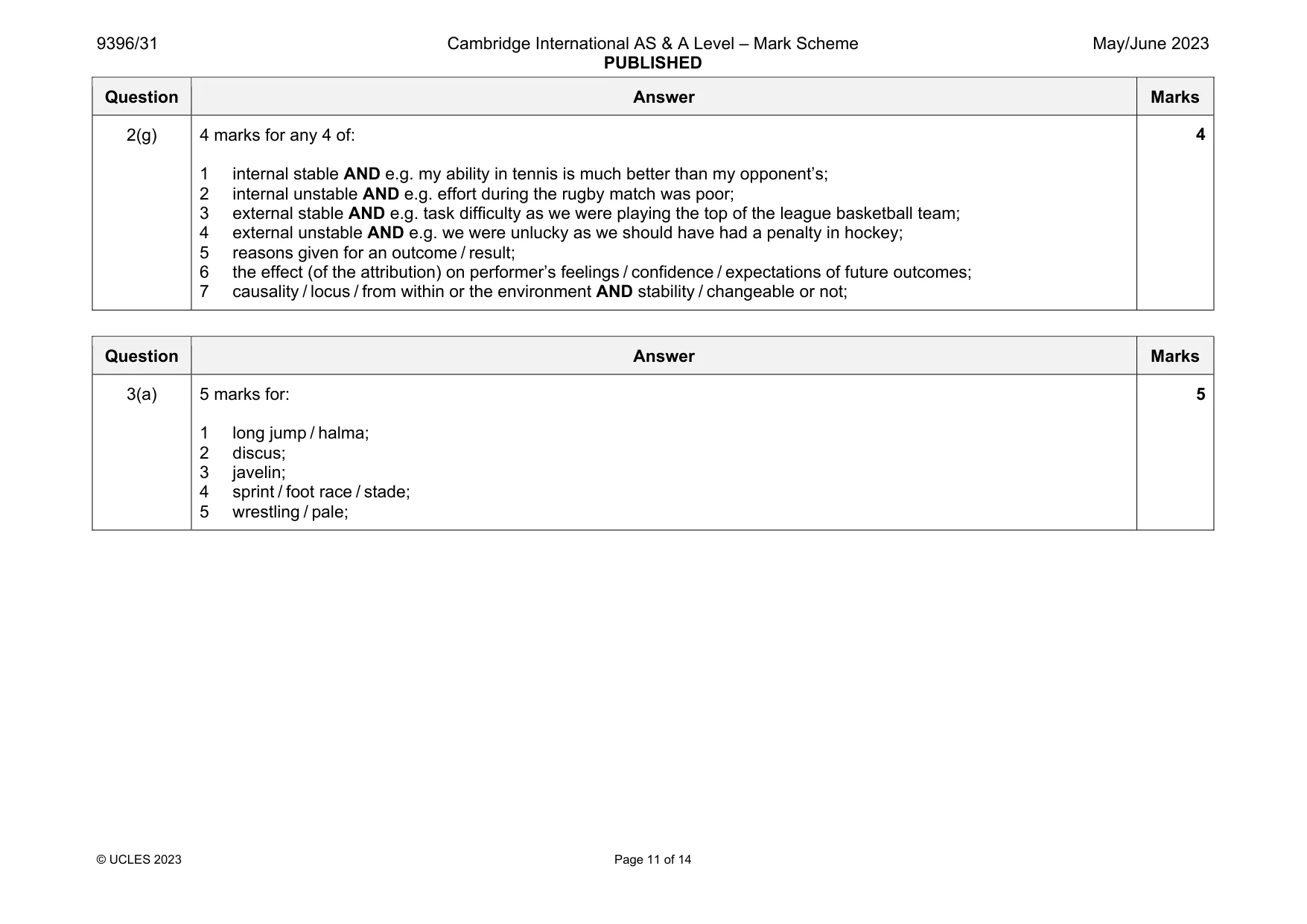
9396/31 Cambridge International AS & A Level – Mark Scheme PUBLISHED May/June 2023 © UCLES 2023 Page 11 of 14 Question Answer Marks 2(g) 4 marks for any 4 of: 1 internal stable AND e.g. my ability in tennis is much better than my opponent’s; 2 internal unstable AND e.g. effort during the rugby match was poor; 3 external stable AND e.g. task difficulty as we were playing the top of the league basketball team; 4 external unstable AND e.g. we were unlucky as we should have had a penalty in hockey; 5 reasons given for an outcome / result; 6 the effect (of the attribution) on performer’s feelings / confidence / expectations of future outcomes; 7 causality / locus / from within or the environment AND stability / changeable or not; 4 Question Answer Marks 3(a) 5 marks for: 1 long jump / halma; 2 discus; 3 javelin; 4 sprint / foot race / stade; 5 wrestling / pale; 5
Mark scheme, page 12
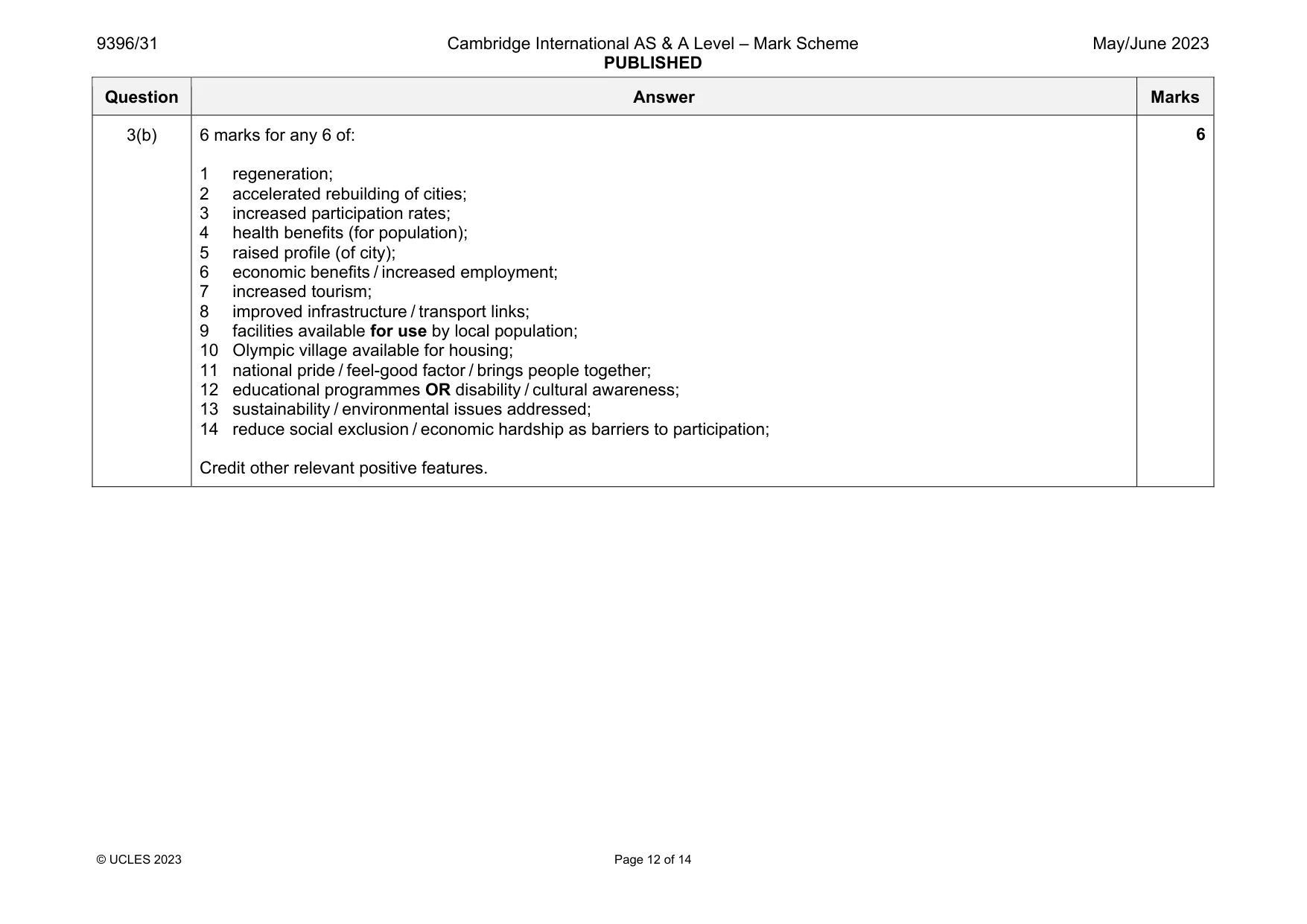
9396/31 Cambridge International AS & A Level – Mark Scheme PUBLISHED May/June 2023 © UCLES 2023 Page 12 of 14 Question Answer Marks 3(b) 6 marks for any 6 of: 1 regeneration; 2 accelerated rebuilding of cities; 3 increased participation rates; 4 health benefits (for population); 5 raised profile (of city); 6 economic benefits / increased employment; 7 increased tourism; 8 improved infrastructure / transport links; 9 facilities available for use by local population; 10 Olympic village available for housing; 11 national pride / feel-good factor / brings people together; 12 educational programmes OR disability / cultural awareness; 13 sustainability / environmental issues addressed; 14 reduce social exclusion / economic hardship as barriers to participation; Credit other relevant positive features. 6
Mark scheme, page 13
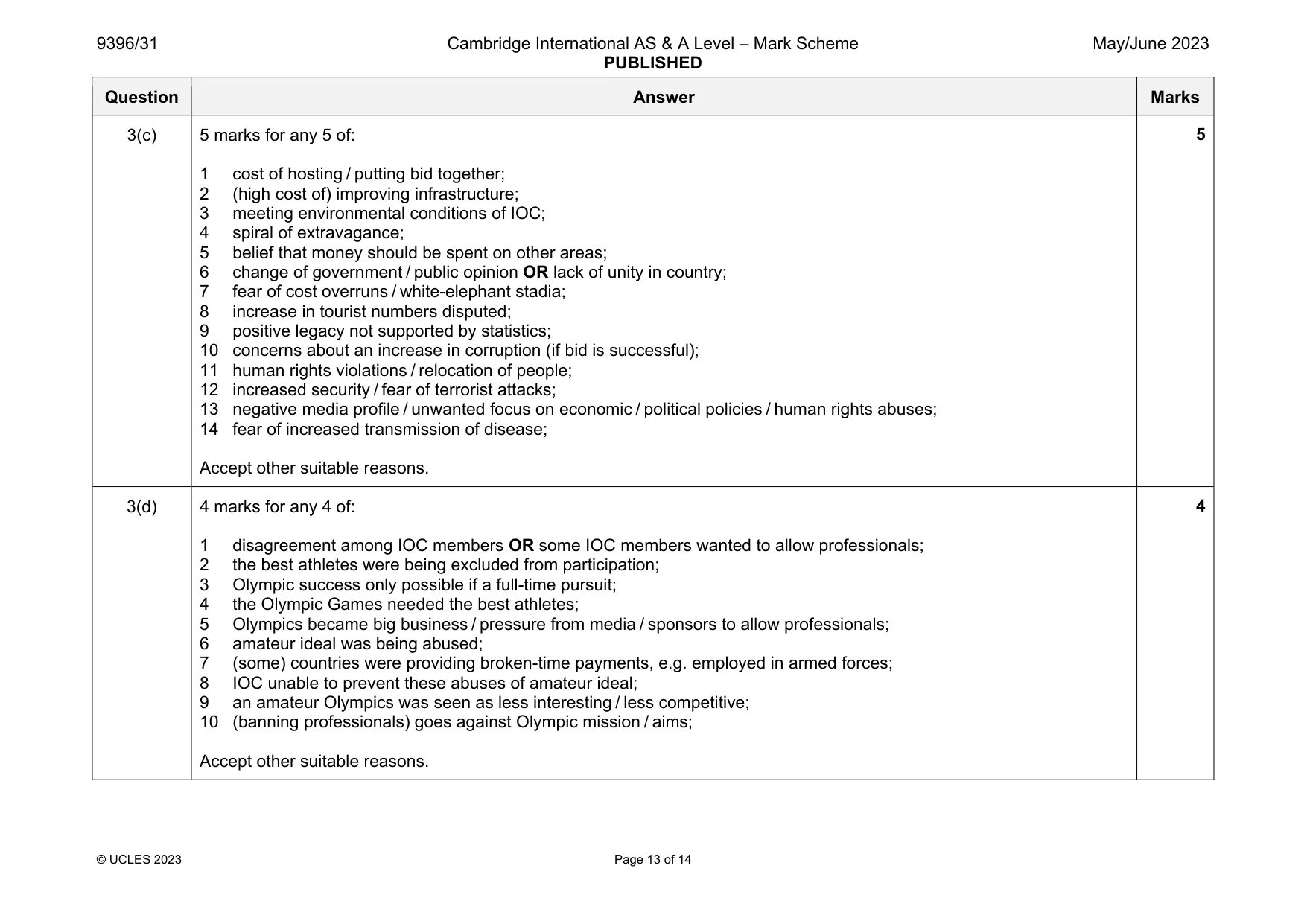
9396/31 Cambridge International AS & A Level – Mark Scheme PUBLISHED May/June 2023 © UCLES 2023 Page 13 of 14 Question Answer Marks 3(c) 5 marks for any 5 of: 1 cost of hosting / putting bid together; 2 (high cost of) improving infrastructure; 3 meeting environmental conditions of IOC; 4 spiral of extravagance; 5 belief that money should be spent on other areas; 6 change of government / public opinion OR lack of unity in country; 7 fear of cost overruns / white-elephant stadia; 8 increase in tourist numbers disputed; 9 positive legacy not supported by statistics; 10 concerns about an increase in corruption (if bid is successful); 11 human rights violations / relocation of people; 12 increased security / fear of terrorist attacks; 13 negative media profile / unwanted focus on economic / political policies / human rights abuses; 14 fear of increased transmission of disease; Accept other suitable reasons. 5 3(d) 4 marks for any 4 of: 1 disagreement among IOC members OR some IOC members wanted to allow professionals; 2 the best athletes were being excluded from participation; 3 Olympic success only possible if a full-time pursuit; 4 the Olympic Games needed the best athletes; 5 Olympics became big business / pressure from media / sponsors to allow professionals; 6 amateur ideal was being abused; 7 (some) countries were providing broken-time payments, e.g. employed in armed forces; 8 IOC unable to prevent these abuses of amateur ideal; 9 an amateur Olympics was seen as less interesting / less competitive; 10 (banning professionals) goes against Olympic mission / aims; Accept other suitable reasons. 4
Mark scheme, page 14
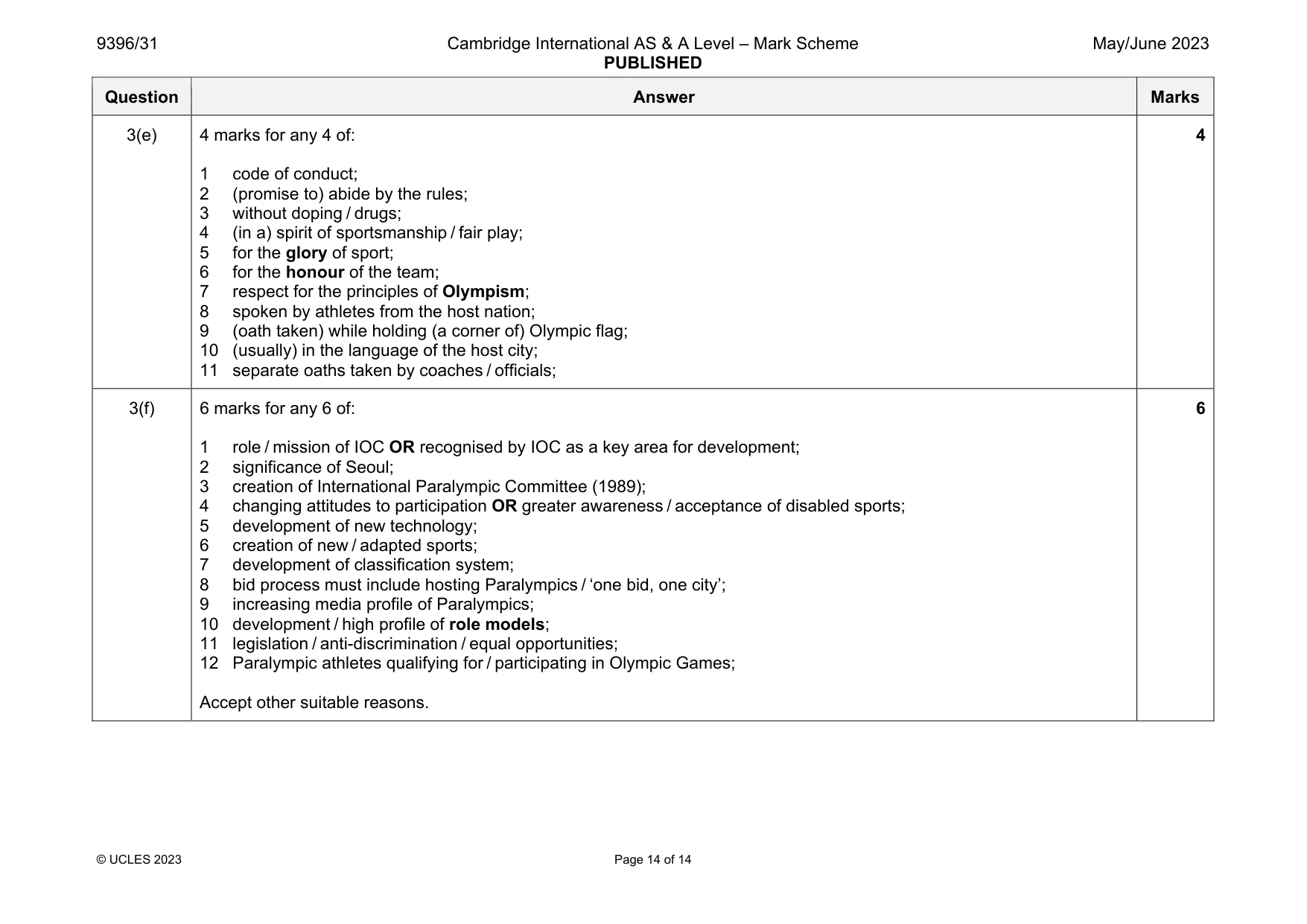
9396/31 Cambridge International AS & A Level – Mark Scheme PUBLISHED May/June 2023 © UCLES 2023 Page 14 of 14 Question Answer Marks 3(e) 4 marks for any 4 of: 1 code of conduct; 2 (promise to) abide by the rules; 3 without doping / drugs; 4 (in a) spirit of sportsmanship / fair play; 5 for the glory of sport; 6 for the honour of the team; 7 respect for the principles of Olympism; 8 spoken by athletes from the host nation; 9 (oath taken) while holding (a corner of) Olympic flag; 10 (usually) in the language of the host city; 11 separate oaths taken by coaches / officials; 4 3(f) 6 marks for any 6 of: 1 role / mission of IOC OR recognised by IOC as a key area for development; 2 significance of Seoul; 3 creation of International Paralympic Committee (1989); 4 changing attitudes to participation OR greater awareness / acceptance of disabled sports; 5 development of new technology; 6 creation of new / adapted sports; 7 development of classification system; 8 bid process must include hosting Paralympics / ‘one bid, one city’; 9 increasing media profile of Paralympics; 10 development / high profile of role models; 11 legislation / anti-discrimination / equal opportunities; 12 Paralympic athletes qualifying for / participating in Olympic Games; Accept other suitable reasons. 6
What you needed in this session
Cambridge’s own grade thresholds for 2023 May/June, Paper 3 · Variant 1. A higher threshold means an easier paper — the bar moves with how the cohort did.