Cambridge A Level Physical Education 9396 — 2022 Oct/Nov Paper 3 · Variant 3
9396/33/O/N/22 · 3 questions · 90 marks · ≈101 min
The question paper and its mark scheme, free to read here and free to download. This is Cambridge’s own paper, exactly as it was sat.
Question paper4 pages
Mark scheme15 pages
Answers below. Sit the paper first if you are practising.
Questions as text
Q1 · Describe the energy system that breaks down glucose anaerobically
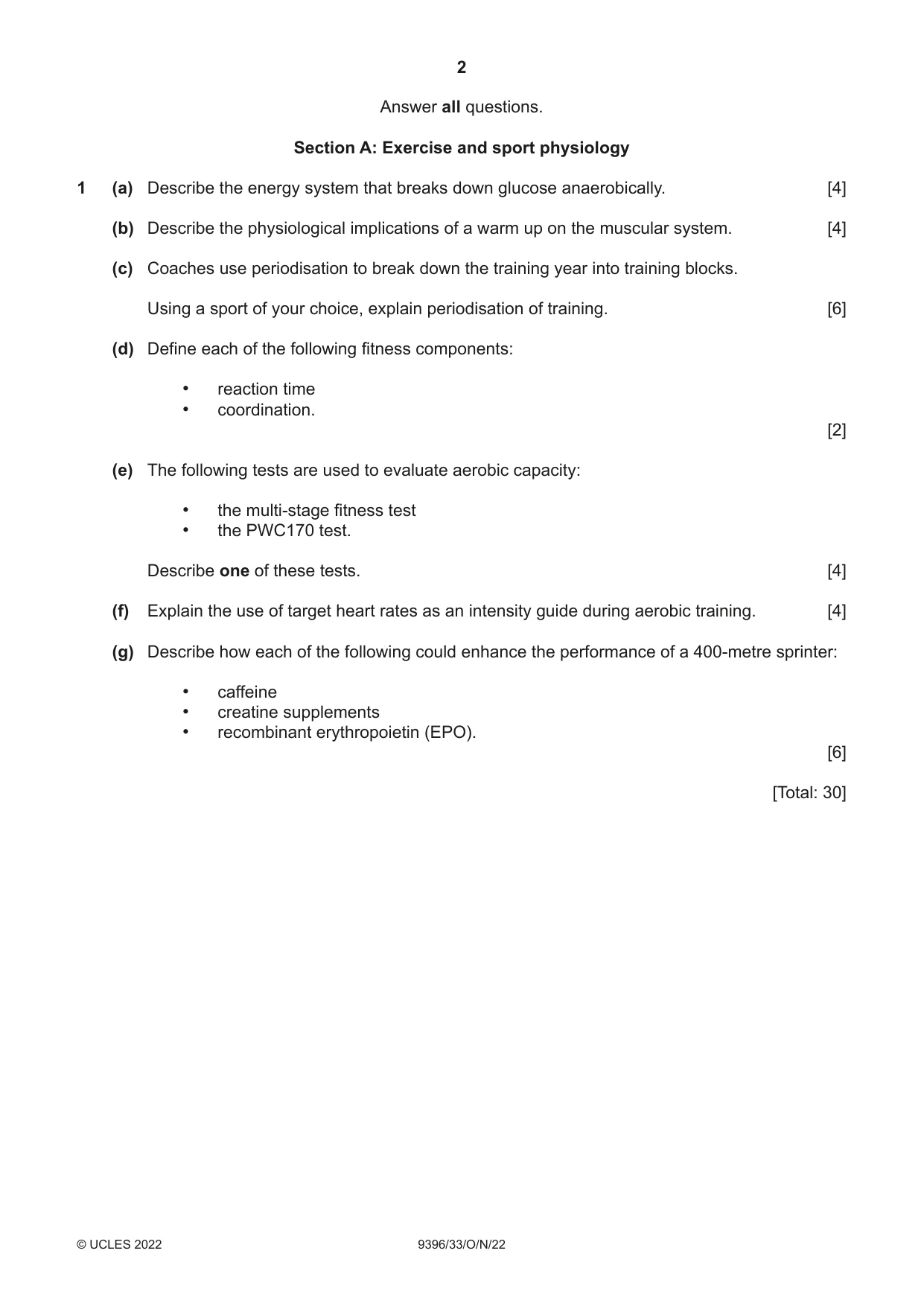
1 (a) Describe the energy system that breaks down glucose anaerobically. [4] (b) Describe the physiological implications of a warm up on the muscular system. [4] (c) Coaches use periodisation to break down the training year into training blocks. Using a sport of your choice, explain periodisation of training. [6] (d) Define each of the following fitness components: • reaction time • coordination. [2] (e) The following tests are used to evaluate aerobic capacity: • the multi-stage fitness test • the PWC170 test. Describe one of these tests. [4] (f) Explain the use of target heart rates as an intensity guide during aerobic training. [4] (g) Describe how each of the following could enhance the performance of a 400-metre sprinter: • caffeine • creatine supplements • recombinant erythropoietin (EPO). [6] [Total: 30]
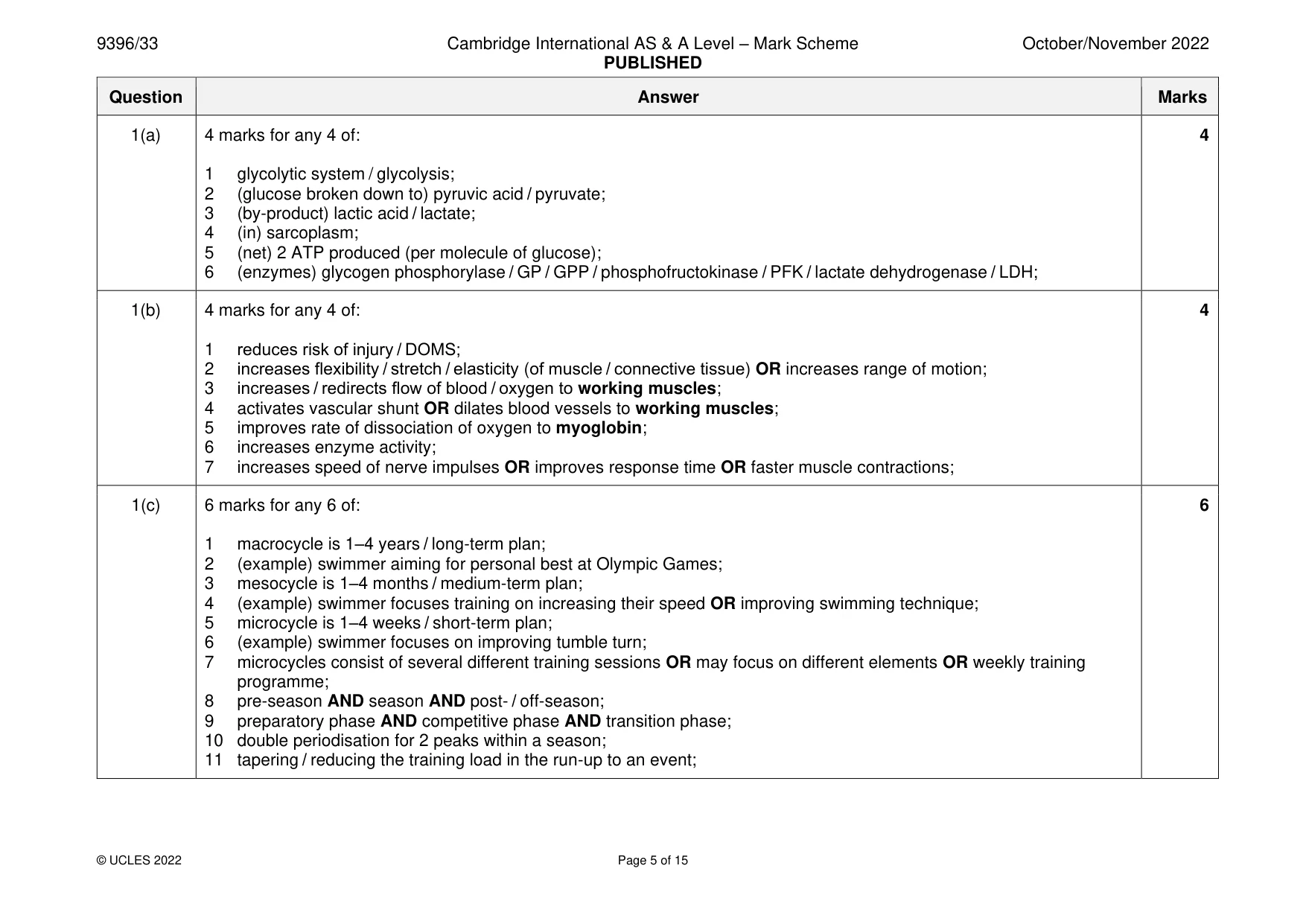
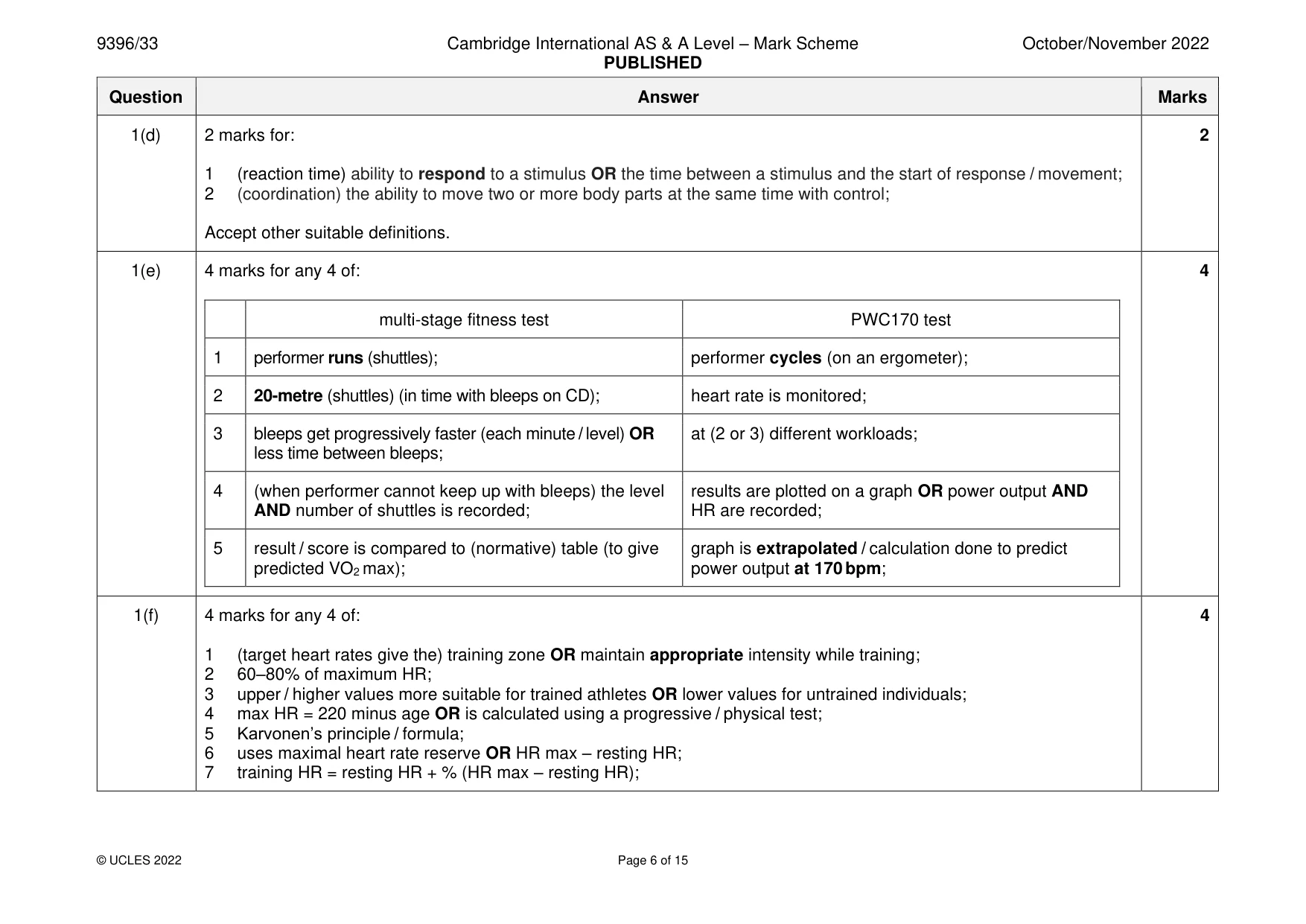
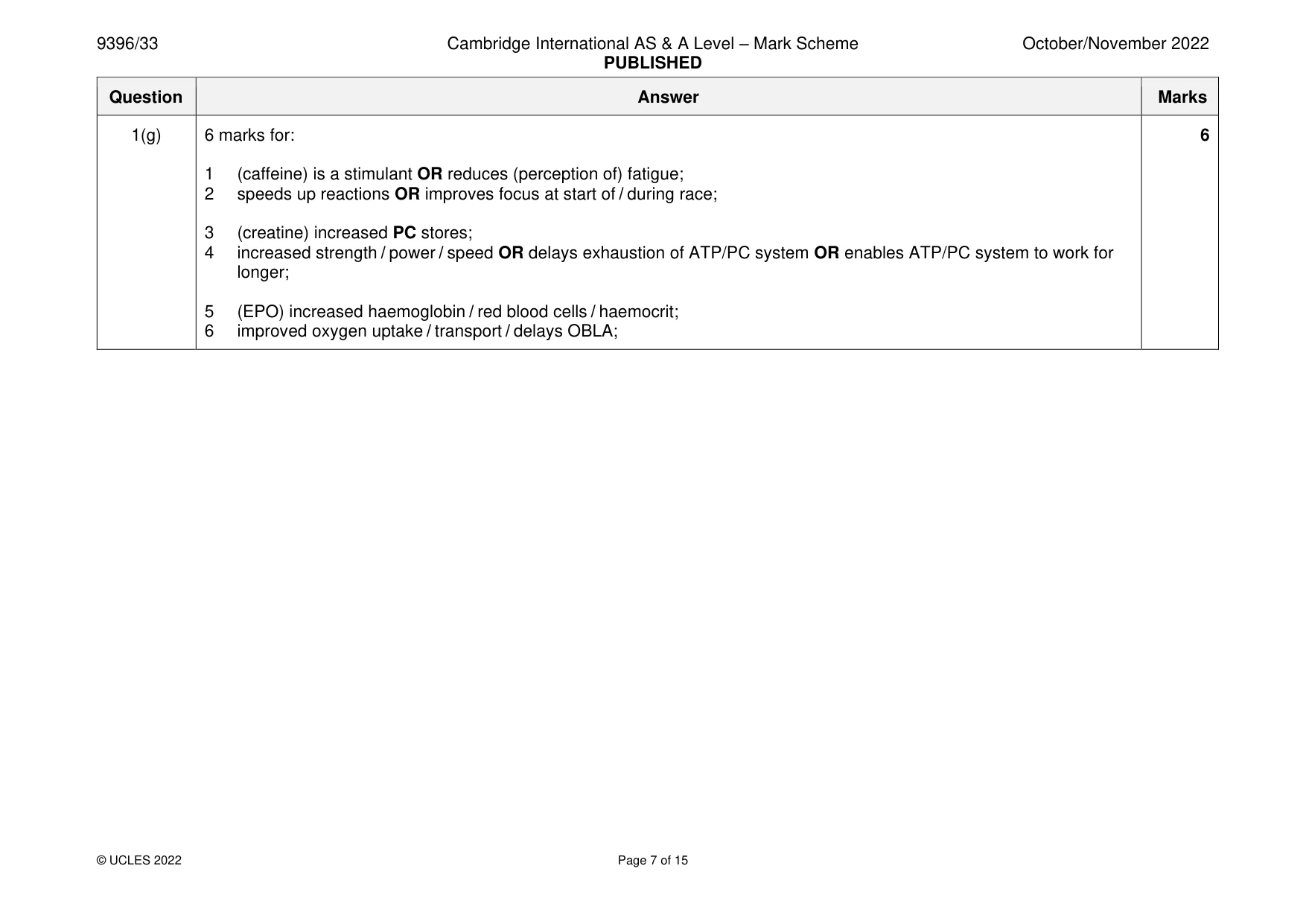
Mark scheme: Question Answer Marks 1(a) 4 marks for any 4 of: 4 1 glycolytic system / glycolysis; 2 (glucose broken down to) pyruvic acid / pyruvate; 3 (by-product) lactic acid / lactate; 4 (in) sarcoplasm; 5 (net) 2 ATP produced (per molecule of glucose); 6 (enzymes) glycogen phosphorylase / GP / GPP / phosphofructokinase / PFK / lactate dehydrogenase / LDH; 1(b) 4 marks for any 4 of: 4 1 reduces risk of injury / DOMS; 2 increases flexibility / stretch / elasticity (of muscle / connective tissue) OR increases range of motion; 3 increases / redirects flow of blood / oxygen to working muscles; 4 activates vascular shunt OR dilates blood vessels to working muscles; 5 improves rate of dissociation of oxygen to myoglobin; 6 increases enzyme activity; 7 increases speed of nerve impulses OR improves response time OR faster muscle contractions; 1(c) 6 marks for any 6 of: 6 1 macrocycle is 1–4 years / long-term plan; 2 (example) swimmer aiming for personal best at Olympic Games; 3 mesocycle is 1–4 months / medium-term plan; 4 (example) swimmer focuses training on increasing their speed OR improving swimming technique; 5 microcycle is 1–4 weeks / short-term plan; 6 (example) swimmer focuses on improving tumble turn; 7 microcycles consist of several different training sessions OR may focus on different elements OR weekly training programme; 8 pre-season AND season AND post- / off-season; 9 preparatory phase AND competitive phase AND transition phase; 10 double periodisation for 2 peaks within a season; 11 tapering / reducing the training load in the run-up to an event; 1(d) 2 marks for: 2 1 (reaction time) ability to respond to a stimulus OR the time between a stimulus and the start of response / movement; 2 (coordination) the ability to move two or more body parts at the same time with control; Accept other suitable definitions. 1(e) 4 marks for any 4 of: 4 multi-stage fitness test PWC170 test 1 performer runs (shuttles); performer cycles (on an ergometer); 2 20-metre (shuttles) (in time with bleeps on CD); heart rate is monitored; 3 bleeps get progressively faster (each minute / level) OR at (2 or 3) different workloads; less time between bleeps; 4 (when performer cannot keep up with bleeps) the level results are plotted on a graph OR power output AND AND number of shuttles is recorded; HR are recorded; 5 result / score is compared to (normative) table (to give graph is extrapolated / calculation done to predict predicted VO2 max); power output at 170 bpm; 1(f) 4 marks for any 4 of: 4 1 (target heart rates give the) training zone OR maintain appropriate intensity while training; 2 60–80% of maximum HR; 3 upper / higher values more suitable for trained athletes OR lower values for untrained individuals; 4 max HR = 220 minus age OR is calculated using a progressive / physical test; 5 Karvonen’s principle / formula; 6 uses maximal heart rate reserve OR HR max – resting HR; 7 training HR = resting HR + % (HR max – resting HR); 1(g) 6 marks for: 6 1 (caffeine) is a stimulant OR reduces (perception of) fatigue; 2 speeds up reactions OR improves focus at start of / during race; 3 (creatine) increased PC stores; 4 increased strength / power / speed OR delays exhaustion of ATP/PC system OR enables ATP/PC system to work for longer; 5 (EPO) increased haemoglobin / red blood cells / haemocrit; 6 improved oxygen uptake / transport / delays OBLA;
Q2 · Sports performers with a need to avoid failure tend to have low levels of achievement…
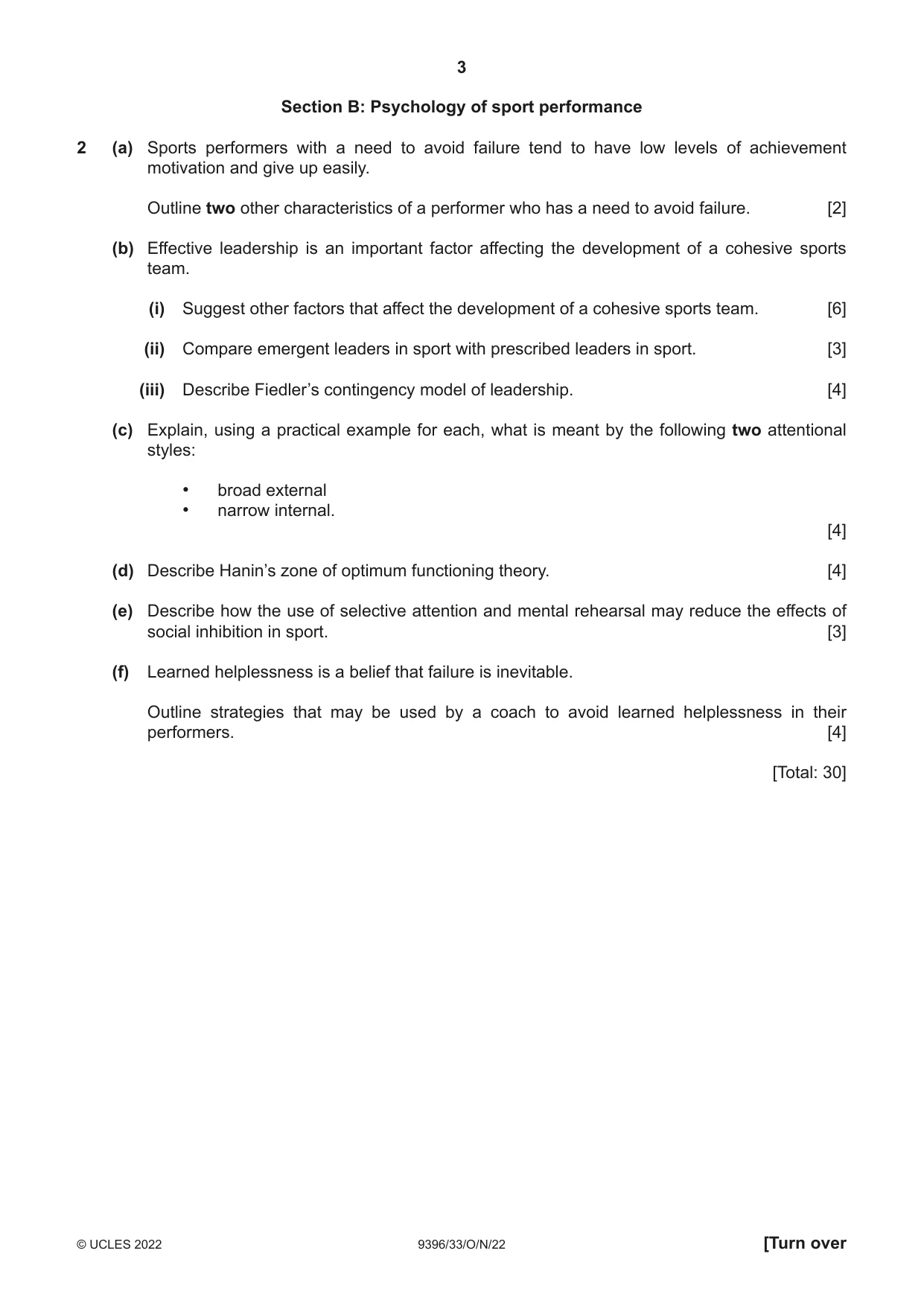
2 (a) Sports performers with a need to avoid failure tend to have low levels of achievement motivation and give up easily. Outline two other characteristics of a performer who has a need to avoid failure. [2] (b) Effective leadership is an important factor affecting the development of a cohesive sports team. (i) Suggest other factors that affect the development of a cohesive sports team. [6] (ii) Compare emergent leaders in sport with prescribed leaders in sport. [3] (iii) Describe Fiedler’s contingency model of leadership. [4] (c) Explain, using a practical example for each, what is meant by the following two attentional styles: • broad external • narrow internal. [4] (d) Describe Hanin’s zone of optimum functioning theory. [4] (e) Describe how the use of selective attention and mental rehearsal may reduce the effects of social inhibition in sport. [3] (f) Learned helplessness is a belief that failure is inevitable. Outline strategies that may be used by a coach to avoid learned helplessness in their performers. [4] [Total: 30] Section C: Olympic Games: a global perspective
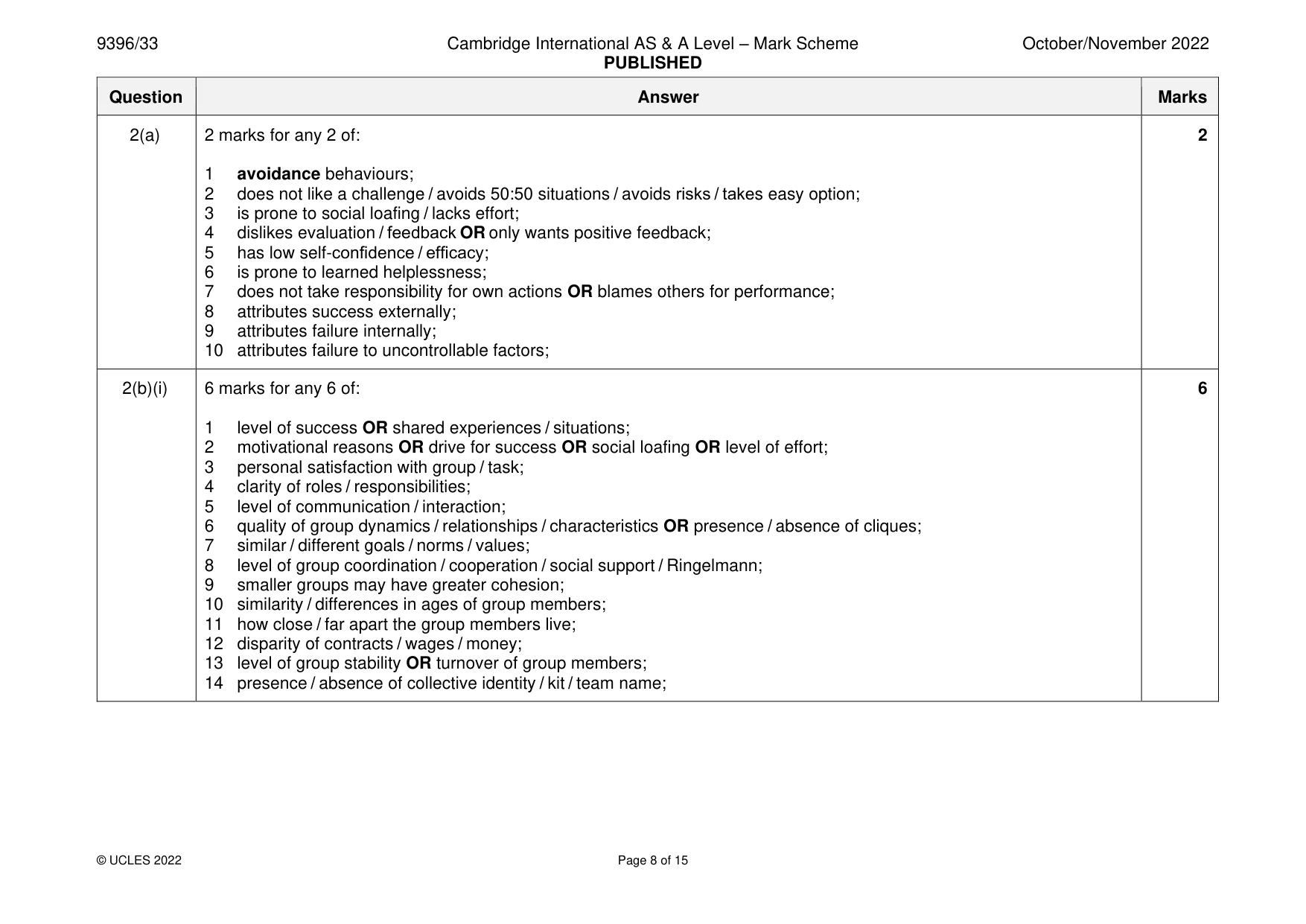
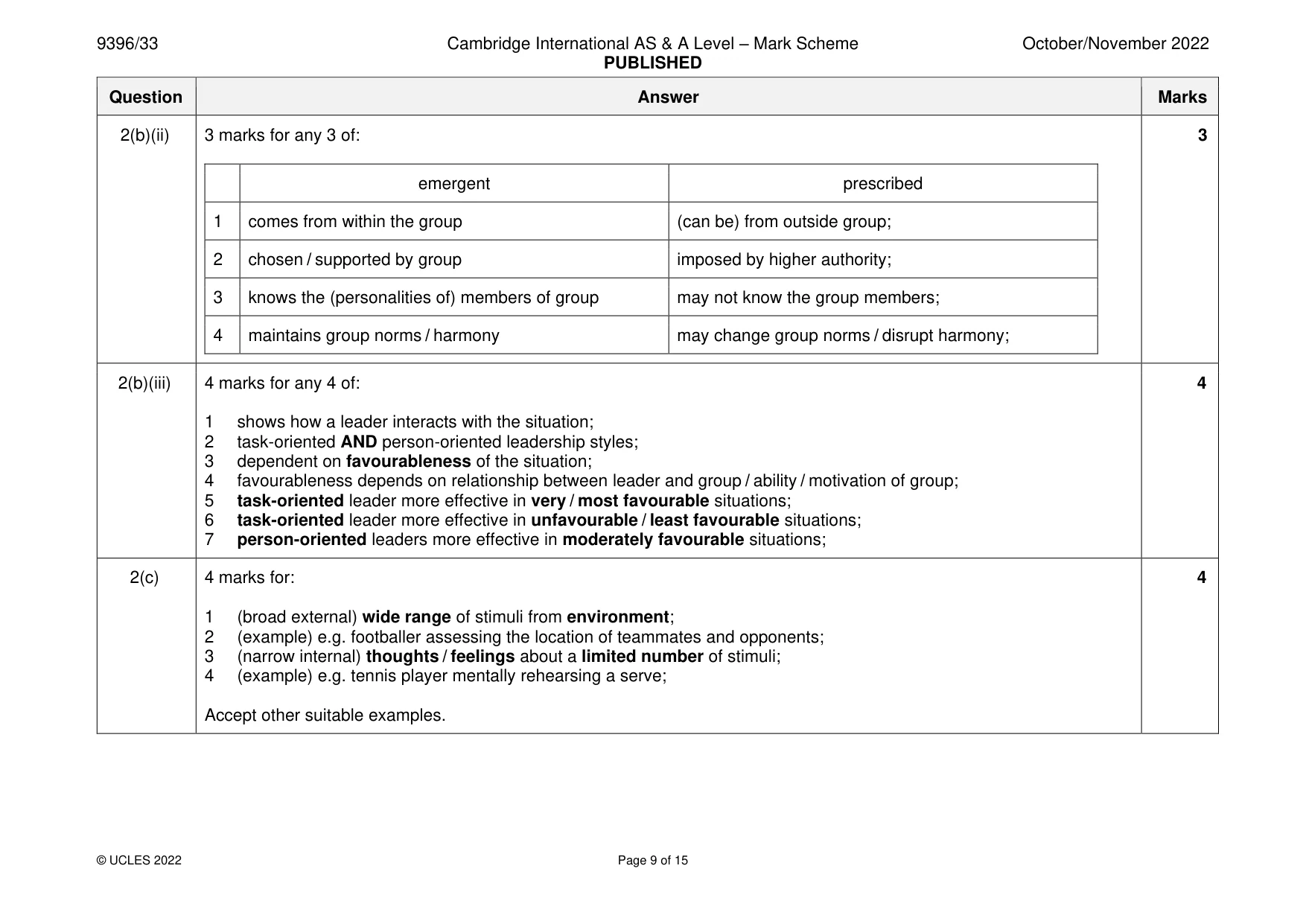
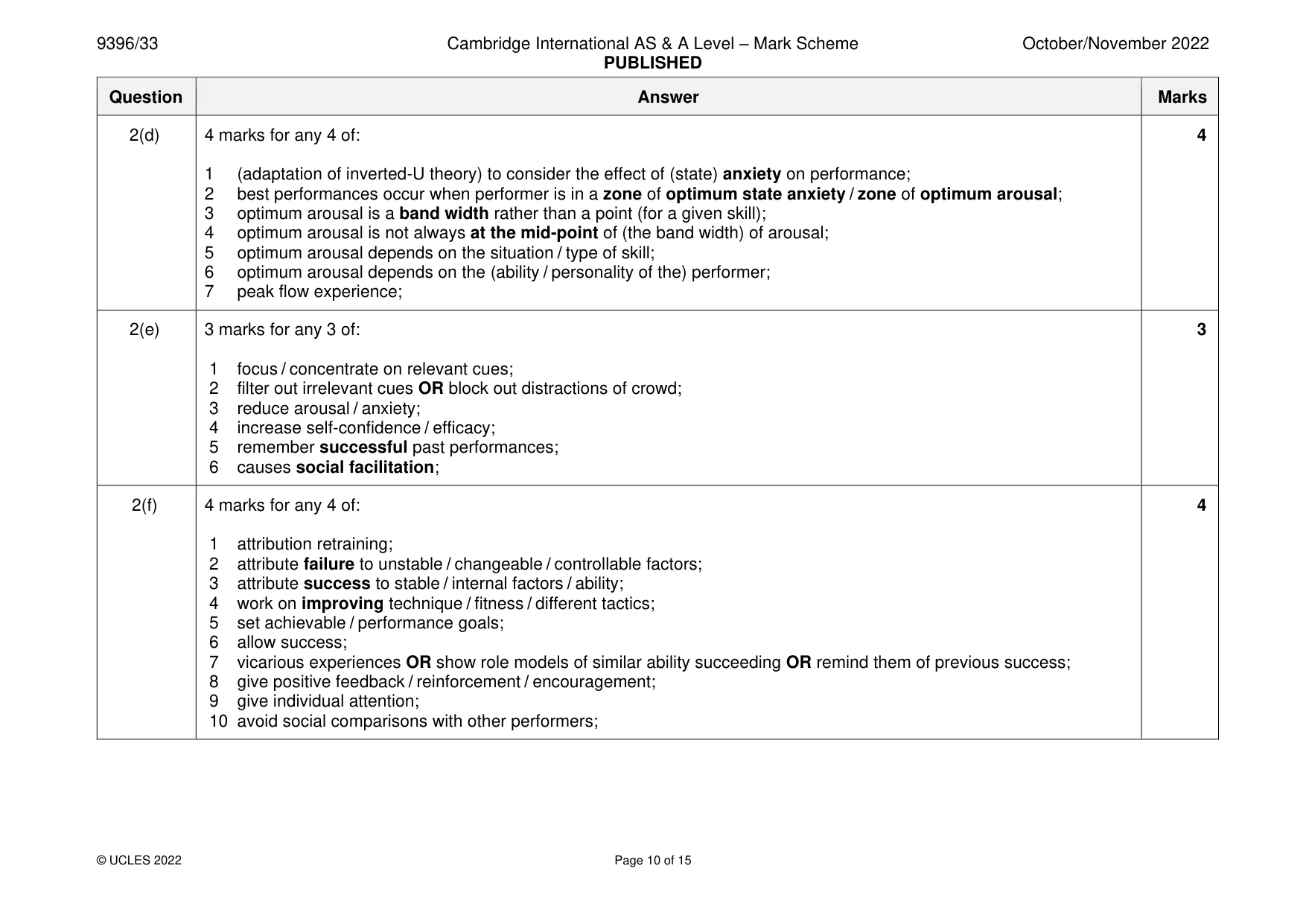
Mark scheme: 2(a) 2 marks for any 2 of: 2 1 avoidance behaviours; 2 does not like a challenge / avoids 50:50 situations / avoids risks / takes easy option; 3 is prone to social loafing / lacks effort; 4 dislikes evaluation / feedback OR only wants positive feedback; 5 has low self-confidence / efficacy; 6 is prone to learned helplessness; 7 does not take responsibility for own actions OR blames others for performance; 8 attributes success externally; 9 attributes failure internally; 10 attributes failure to uncontrollable factors; 2(b)(i) 6 marks for any 6 of: 6 1 level of success OR shared experiences / situations; 2 motivational reasons OR drive for success OR social loafing OR level of effort; 3 personal satisfaction with group / task; 4 clarity of roles / responsibilities; 5 level of communication / interaction; 6 quality of group dynamics / relationships / characteristics OR presence / absence of cliques; 7 similar / different goals / norms / values; 8 level of group coordination / cooperation / social support / Ringelmann; 9 smaller groups may have greater cohesion; 10 similarity / differences in ages of group members; 11 how close / far apart the group members live; 12 disparity of contracts / wages / money; 13 level of group stability OR turnover of group members; 14 presence / absence of collective identity / kit / team name; 2(b)(ii) 3 marks for any 3 of: 3 emergent prescribed 1 comes from within the group (can be) from outside group; 2 chosen / supported by group imposed by higher authority; 3 knows the (personalities of) members of group may not know the group members; 4 maintains group norms / harmony may change group norms / disrupt harmony; 2(b)(iii) 4 marks for any 4 of: 4 1 shows how a leader interacts with the situation; 2 task-oriented AND person-oriented leadership styles; 3 dependent on favourableness of the situation; 4 favourableness depends on relationship between leader and group / ability / motivation of group; 5 task-oriented leader more effective in very / most favourable situations; 6 task-oriented leader more effective in unfavourable / least favourable situations; 7 person-oriented leaders more effective in moderately favourable situations; 2(c) 4 marks for: 4 1 (broad external) wide range of stimuli from environment; 2 (example) e.g. footballer assessing the location of teammates and opponents; 3 (narrow internal) thoughts / feelings about a limited number of stimuli; 4 (example) e.g. tennis player mentally rehearsing a serve; Accept other suitable examples. 2(d) 4 marks for any 4 of: 4 1 (adaptation of inverted-U theory) to consider the effect of (state) anxiety on performance; 2 best performances occur when performer is in a zone of optimum state anxiety / zone of optimum arousal; 3 optimum arousal is a band width rather than a point (for a given skill); 4 optimum arousal is not always at the mid-point of (the band width) of arousal; 5 optimum arousal depends on the situation / type of skill; 6 optimum arousal depends on the (ability / personality of the) performer; 7 peak flow experience; 2(e) 3 marks for any 3 of: 3 1 focus / concentrate on relevant cues; 2 filter out irrelevant cues OR block out distractions of crowd; 3 reduce arousal / anxiety; 4 increase self-confidence / efficacy; 5 remember successful past performances; 6 causes social facilitation; 2(f) 4 marks for any 4 of: 4 1 attribution retraining; 2 attribute failure to unstable / changeable / controllable factors; 3 attribute success to stable / internal factors / ability; 4 work on improving technique / fitness / different tactics; 5 set achievable / performance goals; 6 allow success; 7 vicarious experiences OR show role models of similar ability succeeding OR remind them of previous success; 8 give positive feedback / reinforcement / encouragement; 9 give individual attention; 10 avoid social comparisons with other performers;
Q3 · Compare the ancient Olympic Games with the modern Olympic Games in terms of: • common…
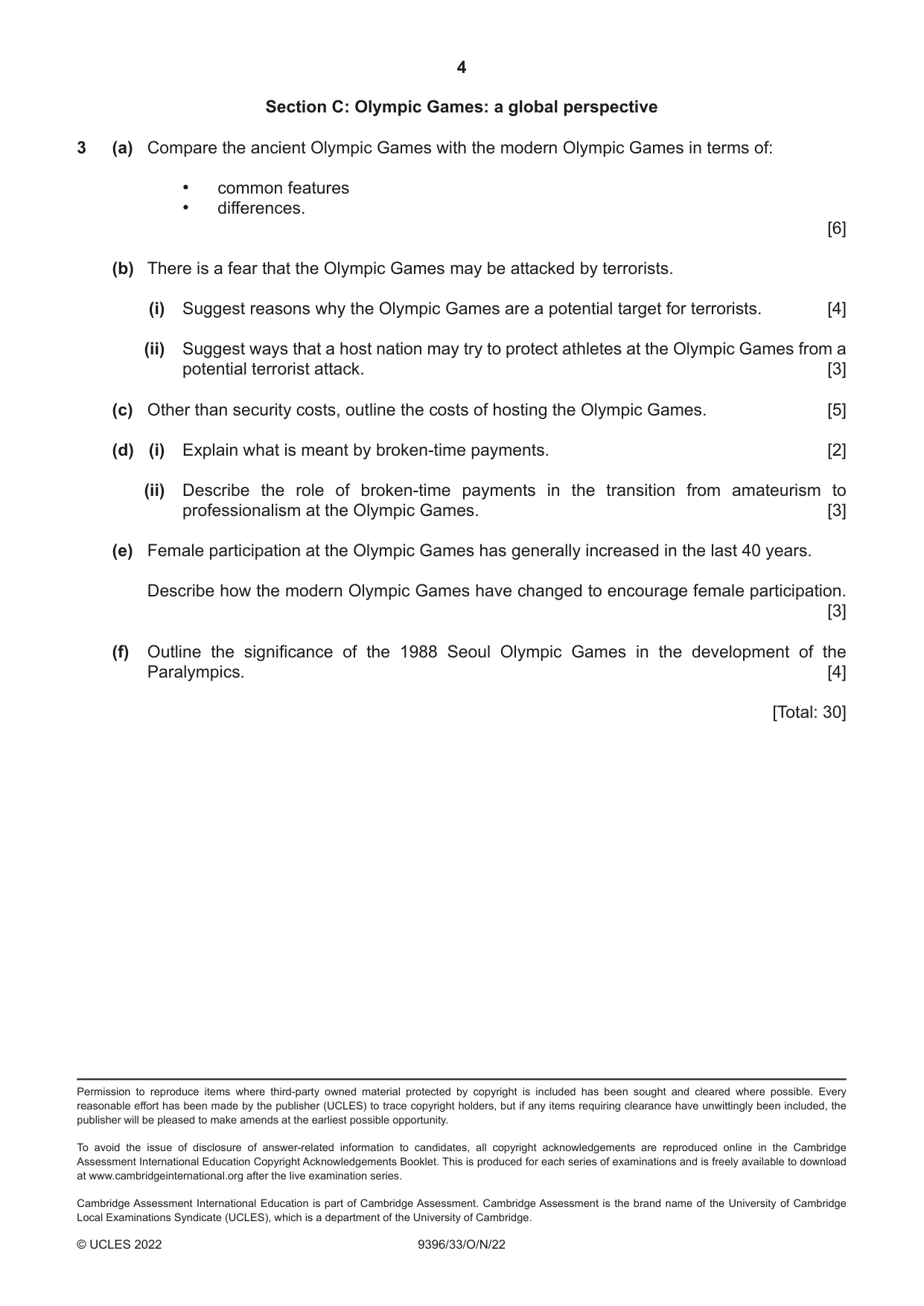
3 (a) Compare the ancient Olympic Games with the modern Olympic Games in terms of: • common features • differences. [6] (b) There is a fear that the Olympic Games may be attacked by terrorists. (i) Suggest reasons why the Olympic Games are a potential target for terrorists. [4] (ii) Suggest ways that a host nation may try to protect athletes at the Olympic Games from a potential terrorist attack. [3] (c) Other than security costs, outline the costs of hosting the Olympic Games. [5] (d) (i) Explain what is meant by broken-time payments. [2] (ii) Describe the role of broken-time payments in the transition from amateurism to professionalism at the Olympic Games. [3] (e) Female participation at the Olympic Games has generally increased in the last 40 years. Describe how the modern Olympic Games have changed to encourage female participation. [3] (f) Outline the significance of the 1988 Seoul Olympic Games in the development of the Paralympics. [4] [Total: 30]
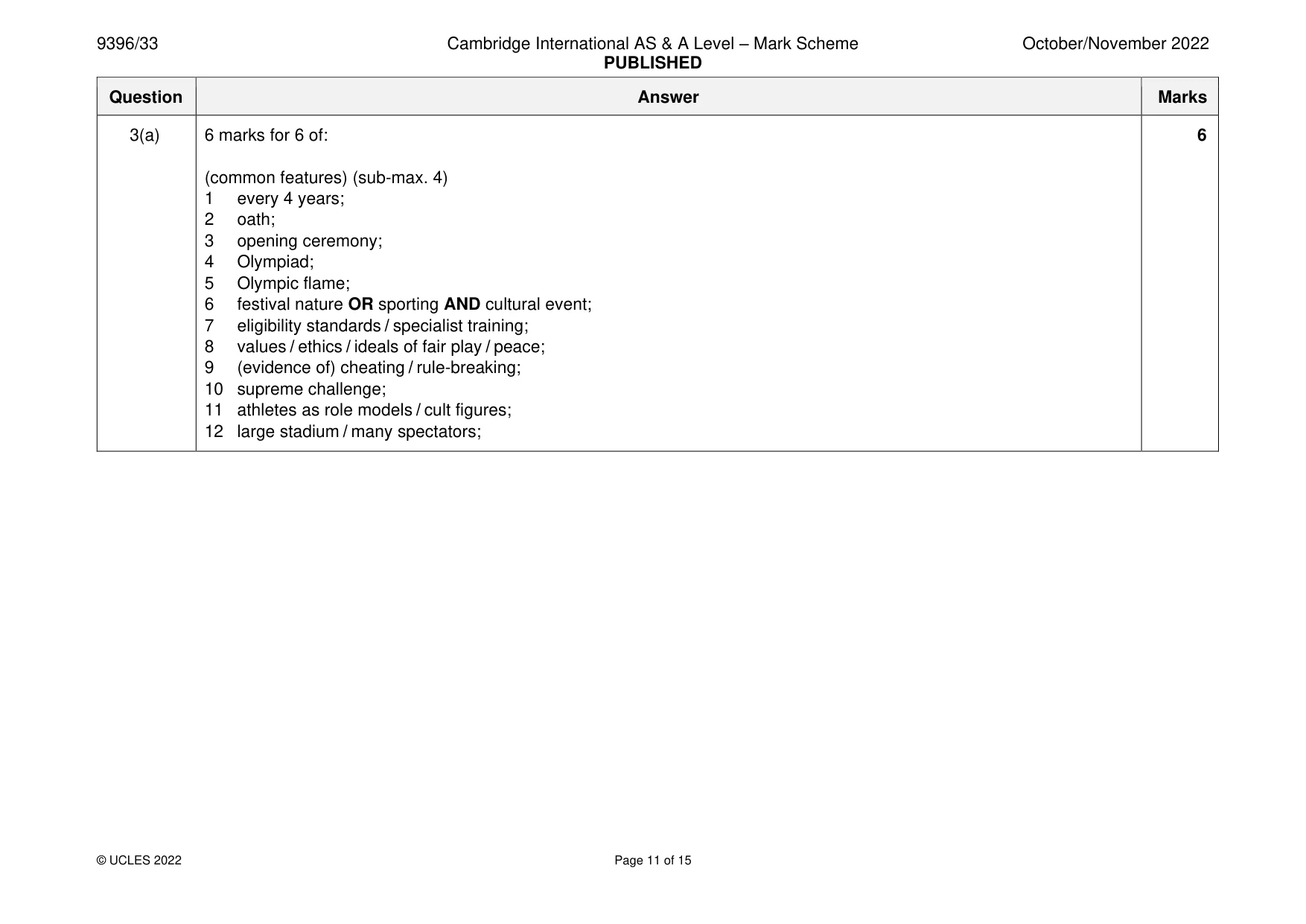
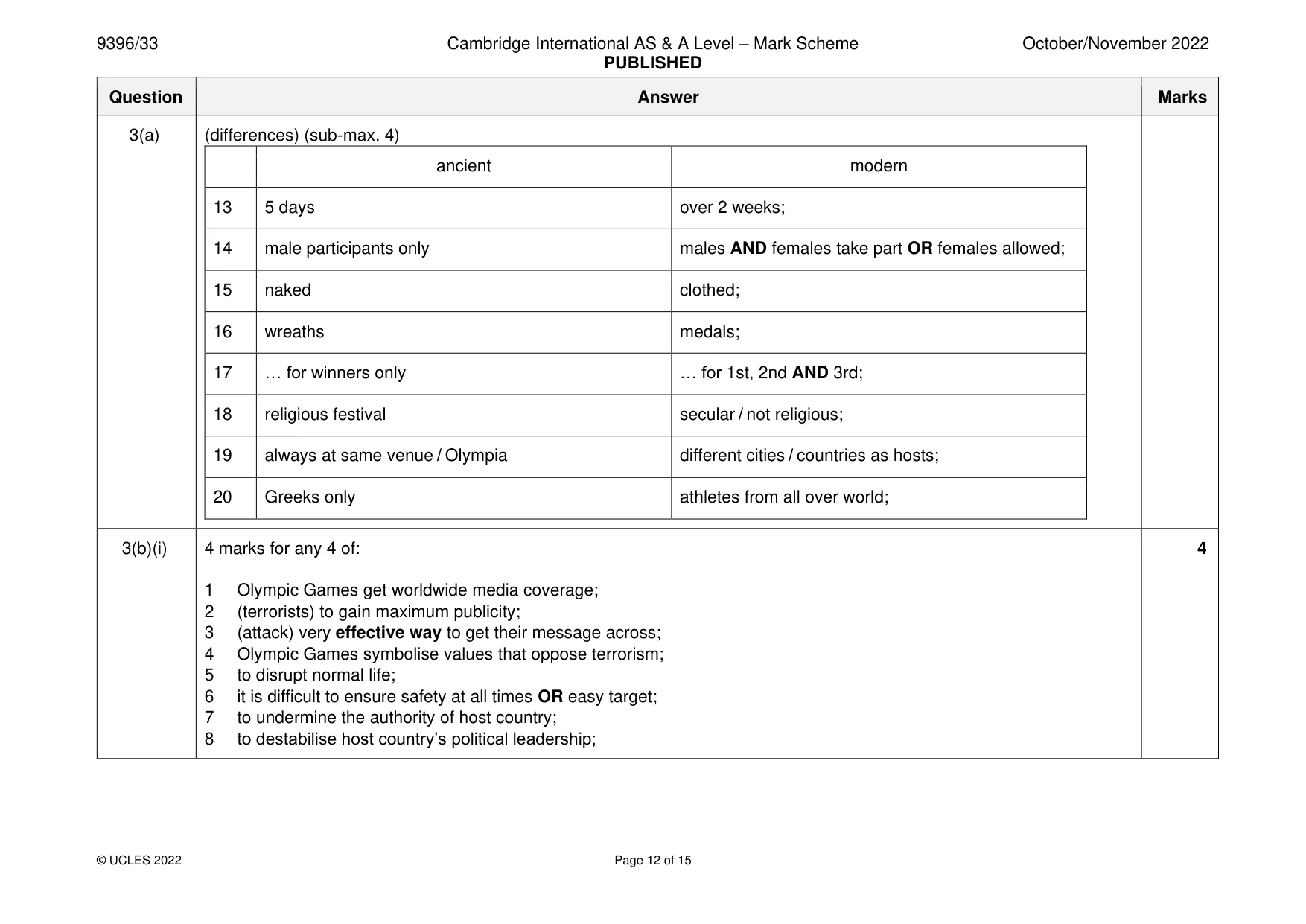
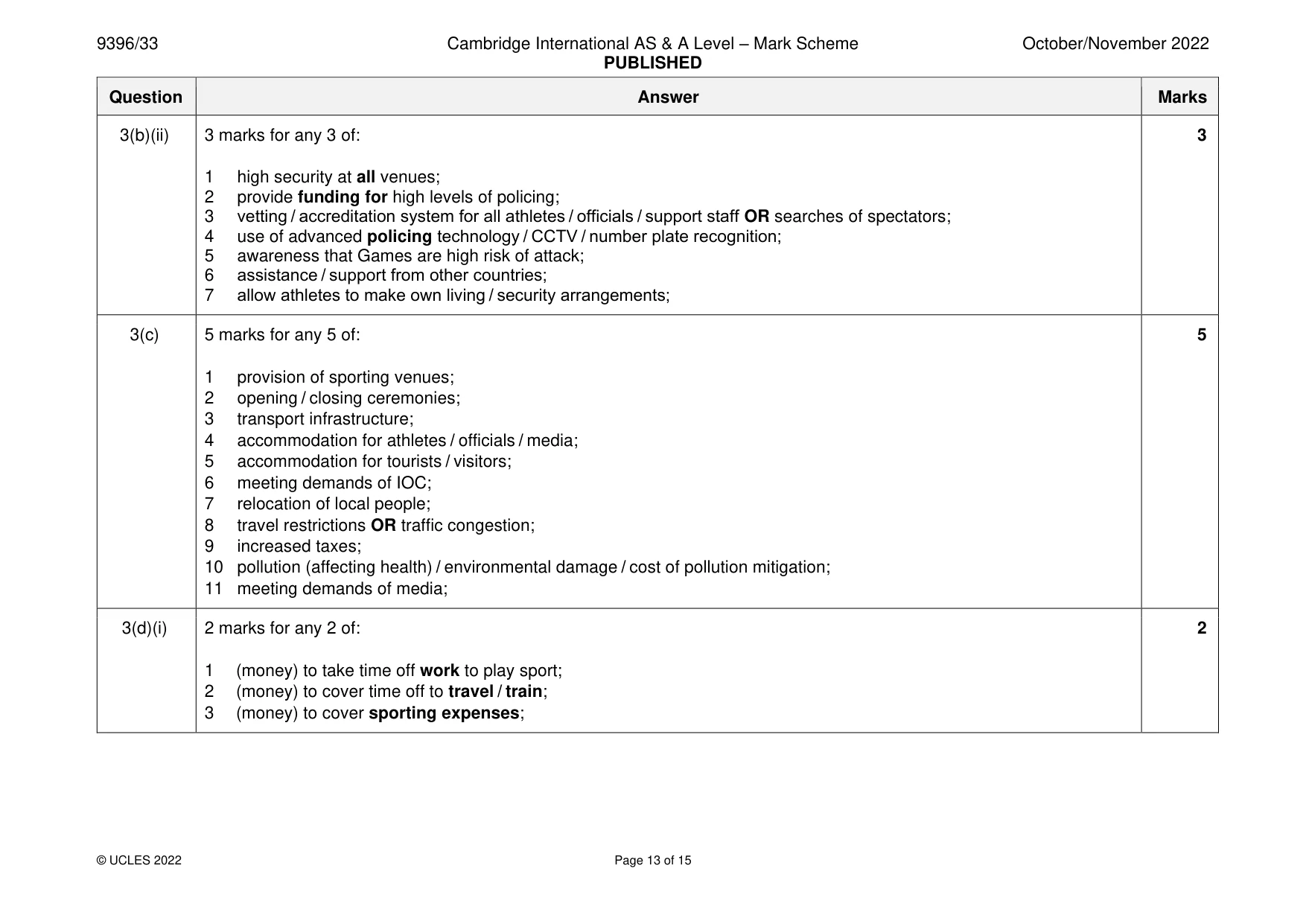
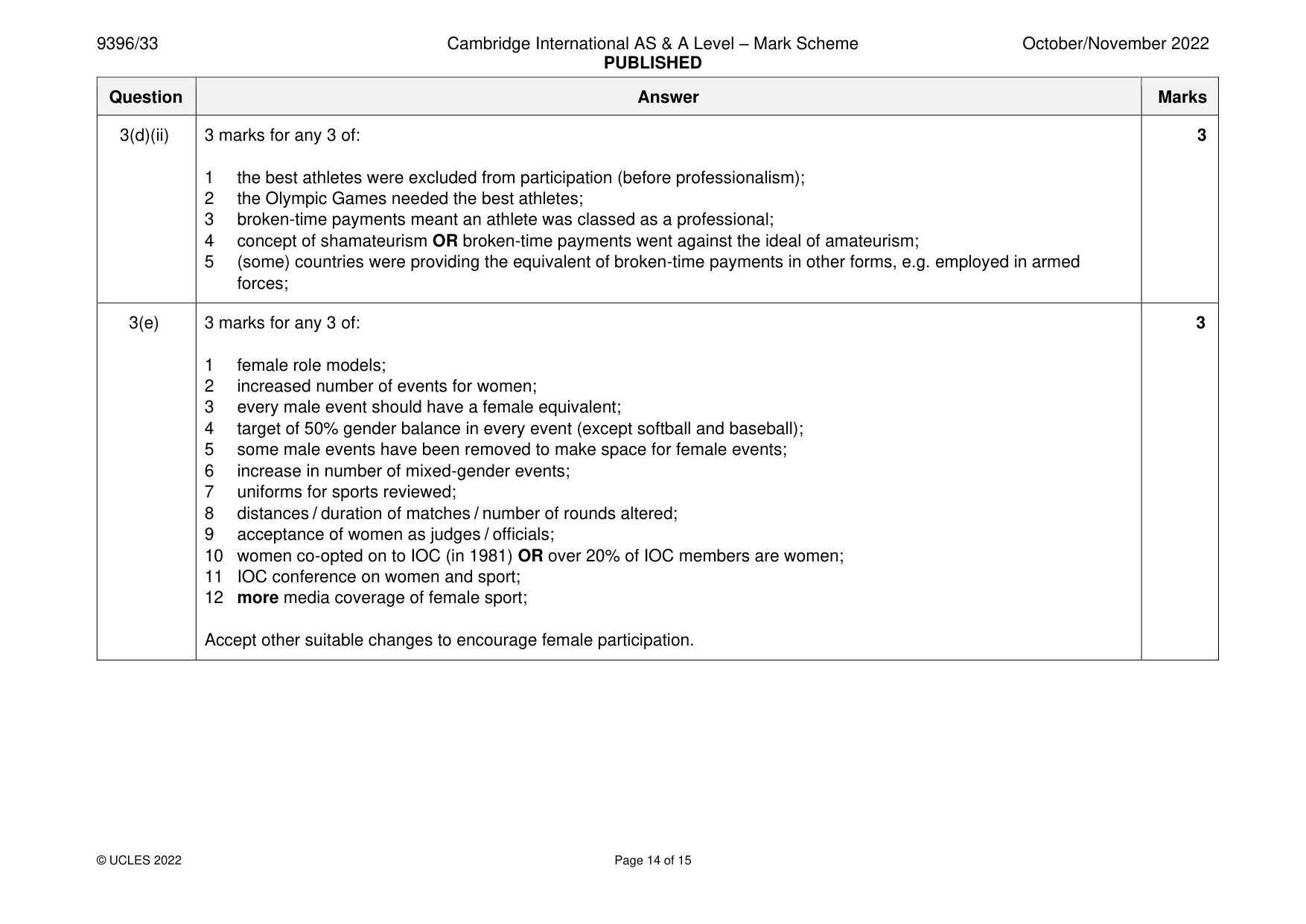
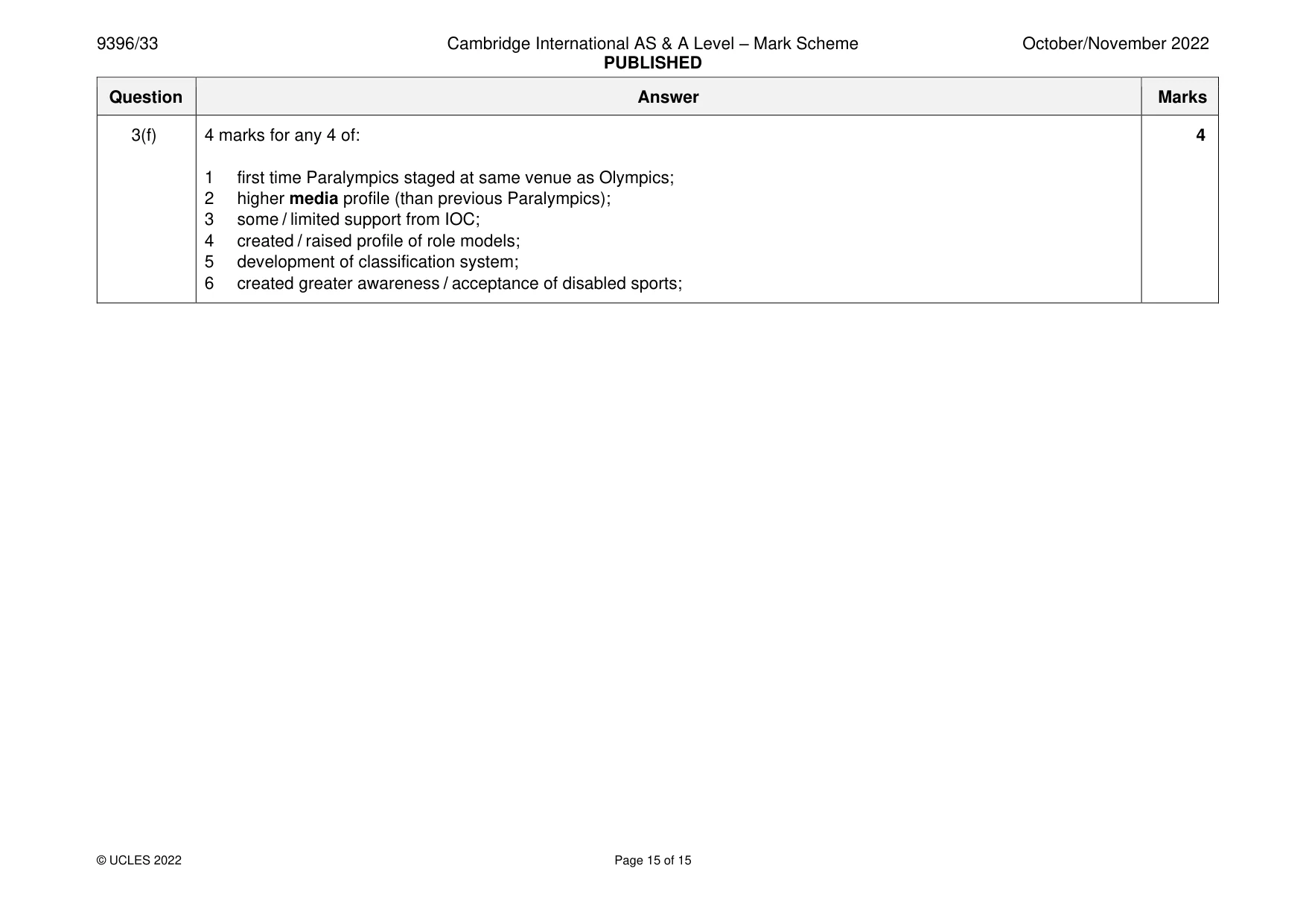
Mark scheme: 3(a) 6 marks for 6 of: 6 (common features) (sub-max. 4) 1 every 4 years; 2 oath; 3 opening ceremony; 4 Olympiad; 5 Olympic flame; 6 festival nature OR sporting AND cultural event; 7 eligibility standards / specialist training; 8 values / ethics / ideals of fair play / peace; 9 (evidence of) cheating / rule-breaking; 10 supreme challenge; 11 athletes as role models / cult figures; 12 large stadium / many spectators; 3(a) (differences) (sub-max. 4) ancient modern 13 5 days over 2 weeks; 14 male participants only males AND females take part OR females allowed; 15 naked clothed; 16 wreaths medals; 17 … for winners only … for 1st, 2nd AND 3rd; 18 religious festival secular / not religious; 19 always at same venue / Olympia different cities / countries as hosts; 20 Greeks only athletes from all over world; 3(b)(i) 4 marks for any 4 of: 4 1 Olympic Games get worldwide media coverage; 2 (terrorists) to gain maximum publicity; 3 (attack) very effective way to get their message across; 4 Olympic Games symbolise values that oppose terrorism; 5 to disrupt normal life; 6 it is difficult to ensure safety at all times OR easy target; 7 to undermine the authority of host country; 8 to destabilise host country’s political leadership; 3(b)(ii) 3 marks for any 3 of: 3 1 high security at all venues; 2 provide funding for high levels of policing; 3 vetting / accreditation system for all athletes / officials / support staff OR searches of spectators; 4 use of advanced policing technology / CCTV / number plate recognition; 5 awareness that Games are high risk of attack; 6 assistance / support from other countries; 7 allow athletes to make own living / security arrangements; 3(c) 5 marks for any 5 of: 5 1 provision of sporting venues; 2 opening / closing ceremonies; 3 transport infrastructure; 4 accommodation for athletes / officials / media; 5 accommodation for tourists / visitors; 6 meeting demands of IOC; 7 relocation of local people; 8 travel restrictions OR traffic congestion; 9 increased taxes; 10 pollution (affecting health) / environmental damage / cost of pollution mitigation; 11 meeting demands of media; 3(d)(i) 2 marks for any 2 of: 2 1 (money) to take time off work to play sport; 2 (money) to cover time off to travel / train; 3 (money) to cover sporting expenses; 3(d)(ii) 3 marks for any 3 of: 3 1 the best athletes were excluded from participation (before professionalism); 2 the Olympic Games needed the best athletes; 3 broken-time payments meant an athlete was classed as a professional; 4 concept of shamateurism OR broken-time payments went against the ideal of amateurism; 5 (some) countries were providing the equivalent of broken-time payments in other forms, e.g. employed in armed forces; 3(e) 3 marks for any 3 of: 3 1 female role models; 2 increased number of events for women; 3 every male event should have a female equivalent; 4 target of 50% gender balance in every event (except softball and baseball); 5 some male events have been removed to make space for female events; 6 increase in number of mixed-gender events; 7 uniforms for sports reviewed; 8 distances / duration of matches / number of rounds altered; 9 acceptance of women as judges / officials; 10 women co-opted on to IOC (in 1981) OR over 20% of IOC members are women; 11 IOC conference on women and sport; 12 more media coverage of female sport; Accept other suitable changes to encourage female participation. 3(f) 4 marks for any 4 of: 4 1 first time Paralympics staged at same venue as Olympics; 2 higher media profile (than previous Paralympics); 3 some / limited support from IOC; 4 created / raised profile of role models; 5 development of classification system; 6 created greater awareness / acceptance of disabled sports;
What you needed in this session
Cambridge’s own grade thresholds for 2022 Oct/Nov, Paper 3 · Variant 3. A higher threshold means an easier paper — the bar moves with how the cohort did.