Cambridge A Level Physical Education 9396 — 2022 May/June Paper 3 · Variant 1
9396/31/M/J/22 · 3 questions · 90 marks · ≈101 min
The question paper and its mark scheme, free to read here and free to download. This is Cambridge’s own paper, exactly as it was sat.
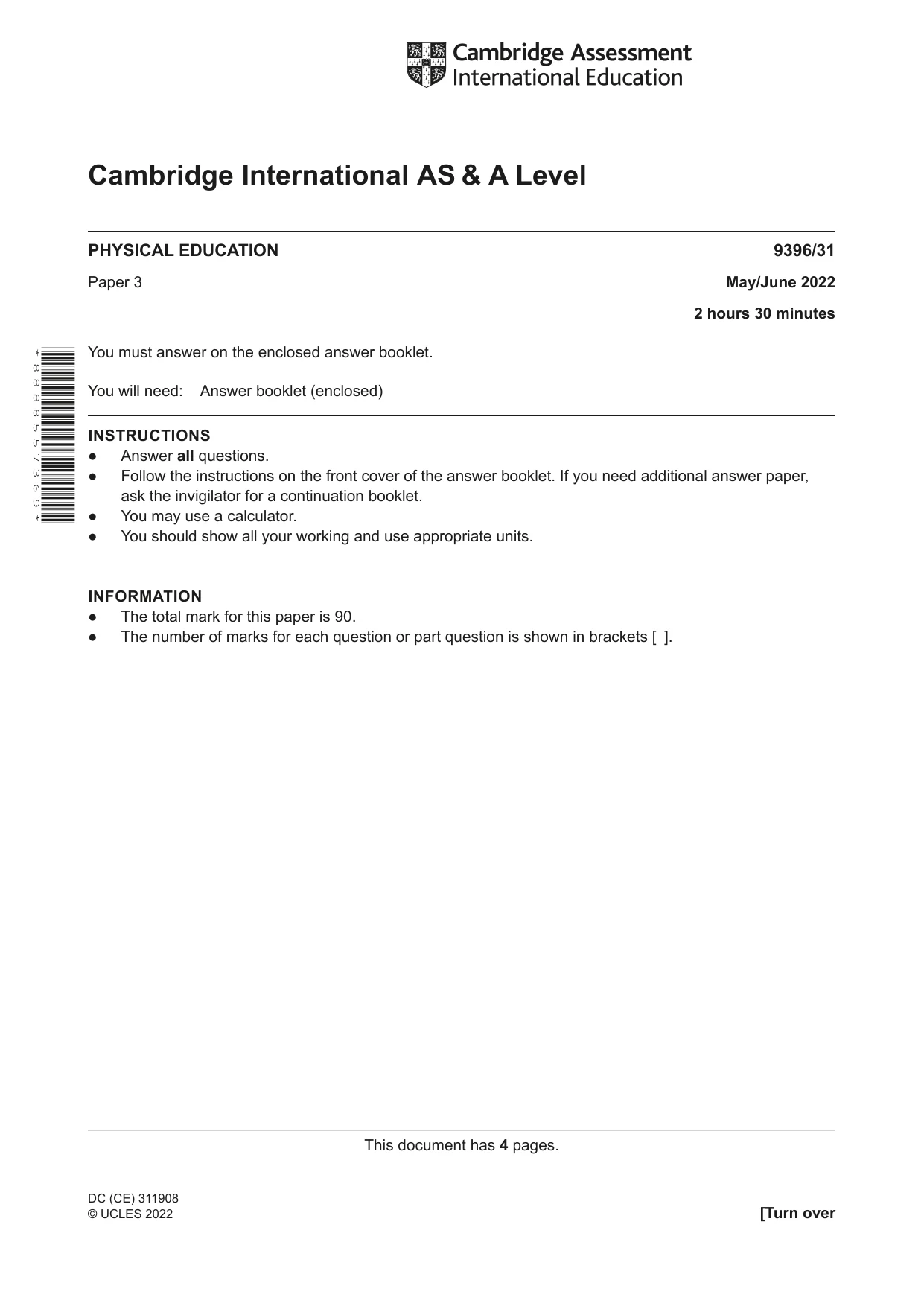
Question paper4 pages
Mark scheme15 pages
Answers below. Sit the paper first if you are practising.
Questions as text
Q1 · Define the following energy concepts: • work • power
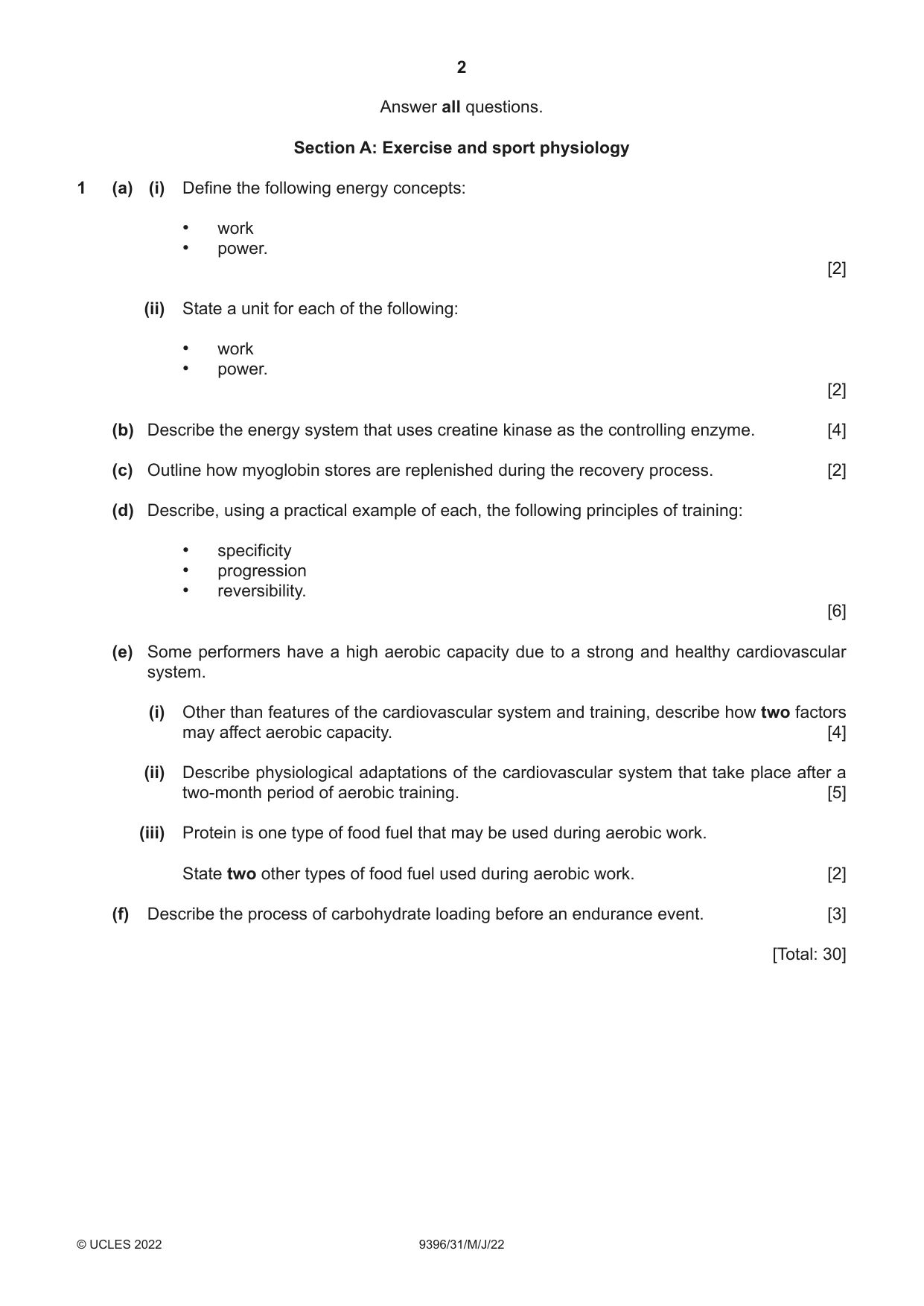
1 (a) (i) Define the following energy concepts: • work • power. [2] (ii) State a unit for each of the following: • work • power. [2] (b) Describe the energy system that uses creatine kinase as the controlling enzyme. [4] (c) Outline how myoglobin stores are replenished during the recovery process. [2] (d) Describe, using a practical example of each, the following principles of training: • specificity • progression • reversibility. [6] (e) Some performers have a high aerobic capacity due to a strong and healthy cardiovascular system. (i) Other than features of the cardiovascular system and training, describe how two factors may affect aerobic capacity. [4] (ii) Describe physiological adaptations of the cardiovascular system that take place after a two‑month period of aerobic training. [5] (iii) Protein is one type of food fuel that may be used during aerobic work. State two other types of food fuel used during aerobic work. [2] (f) Describe the process of carbohydrate loading before an endurance event. [3] [Total: 30]
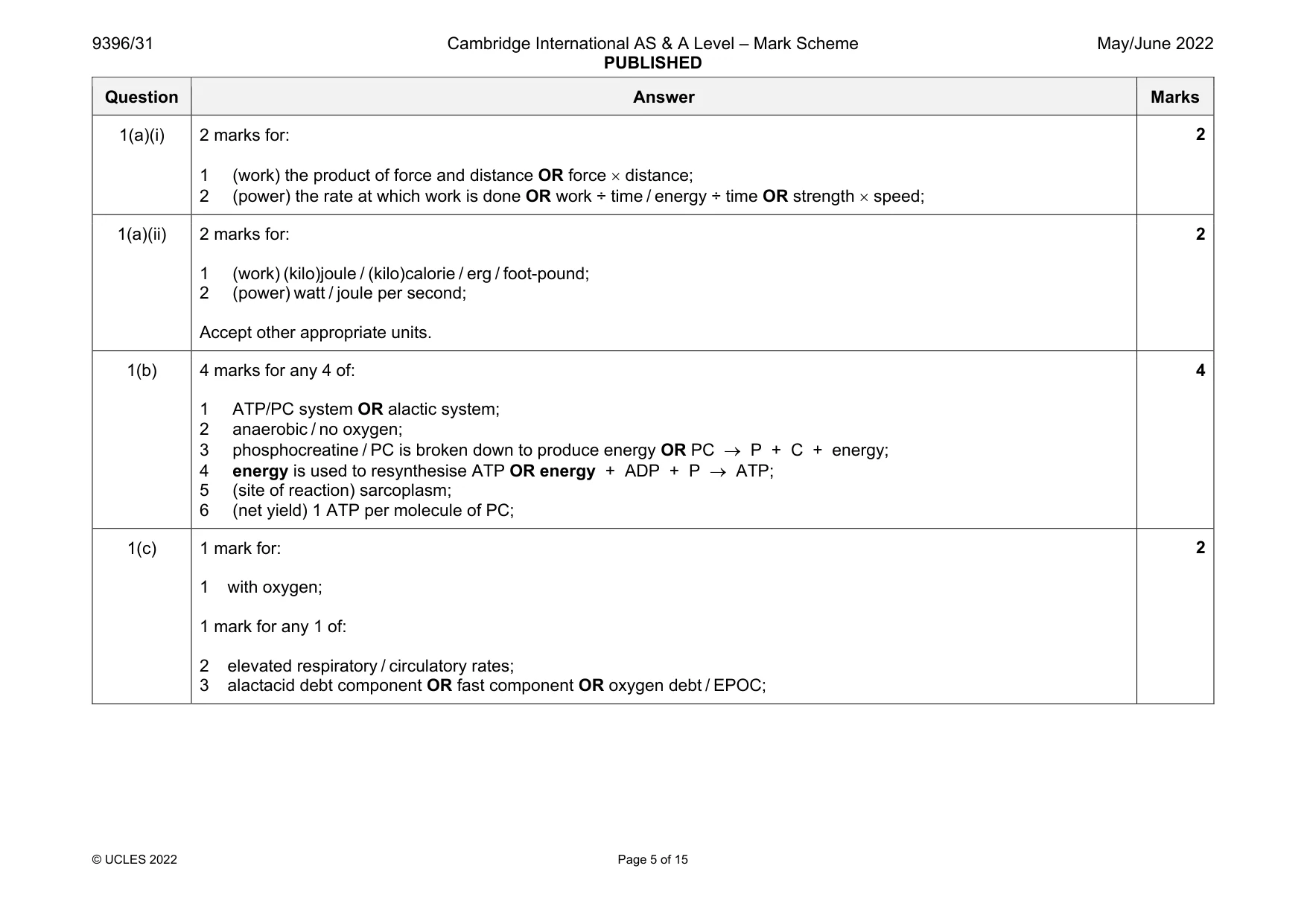
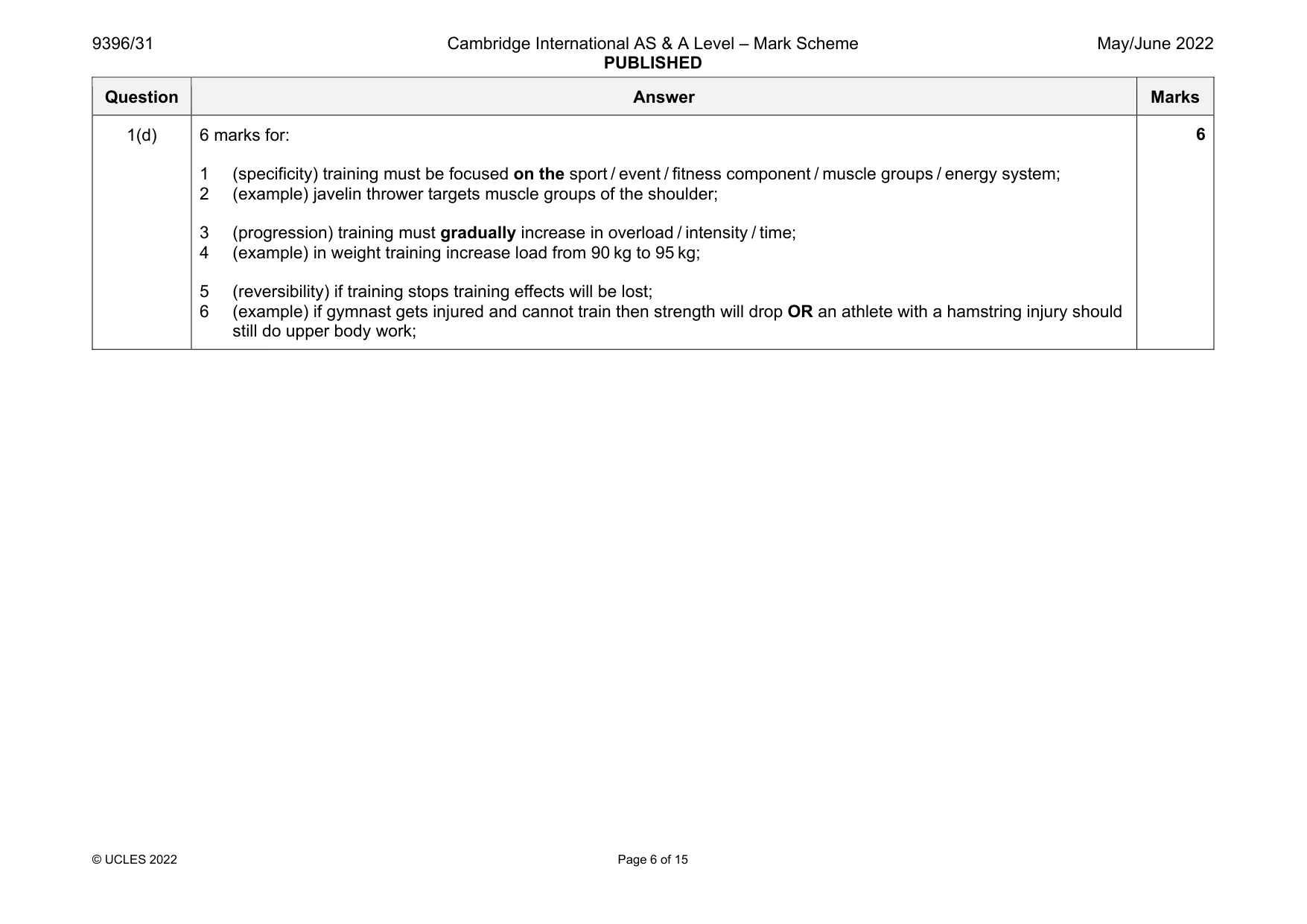
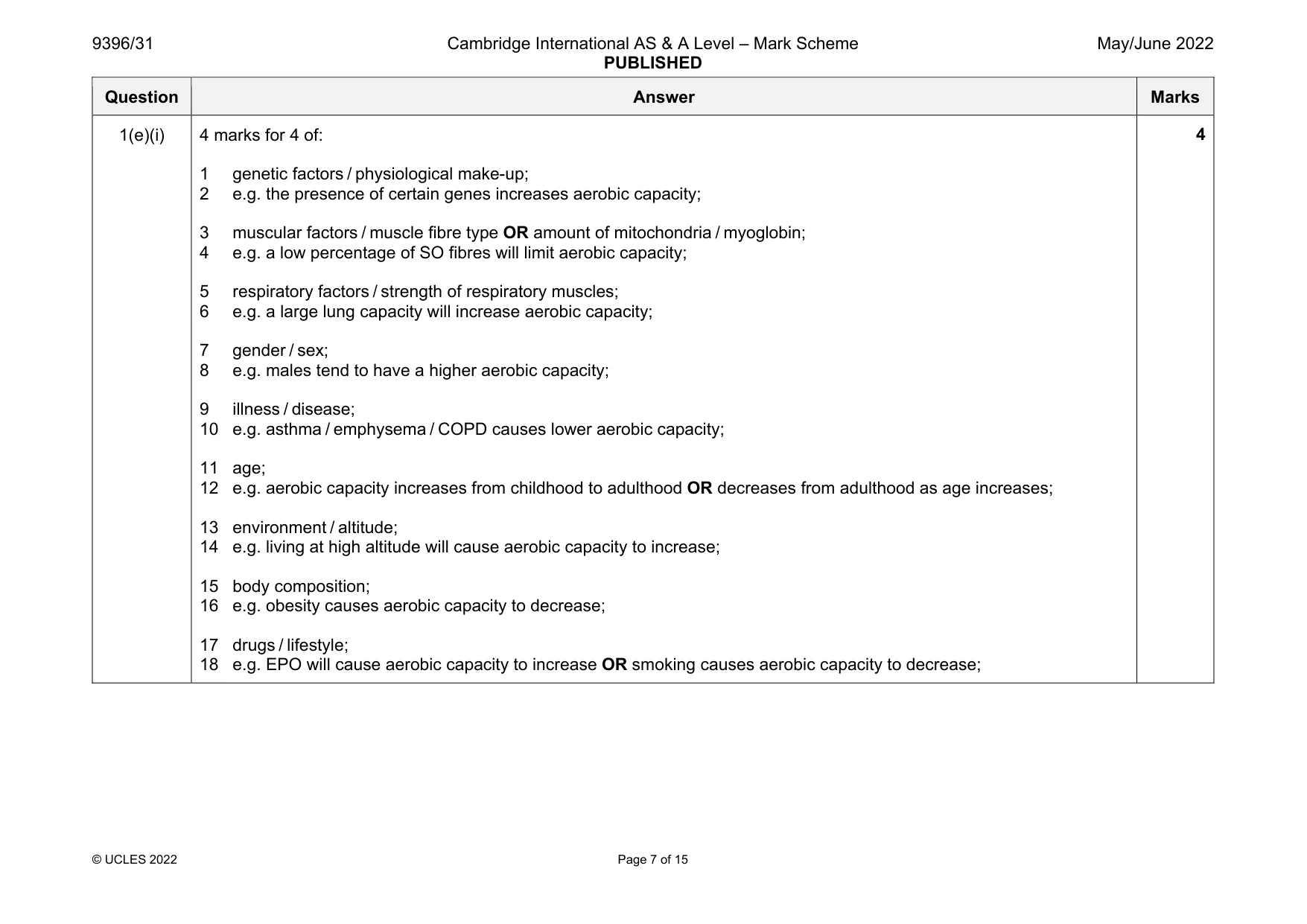
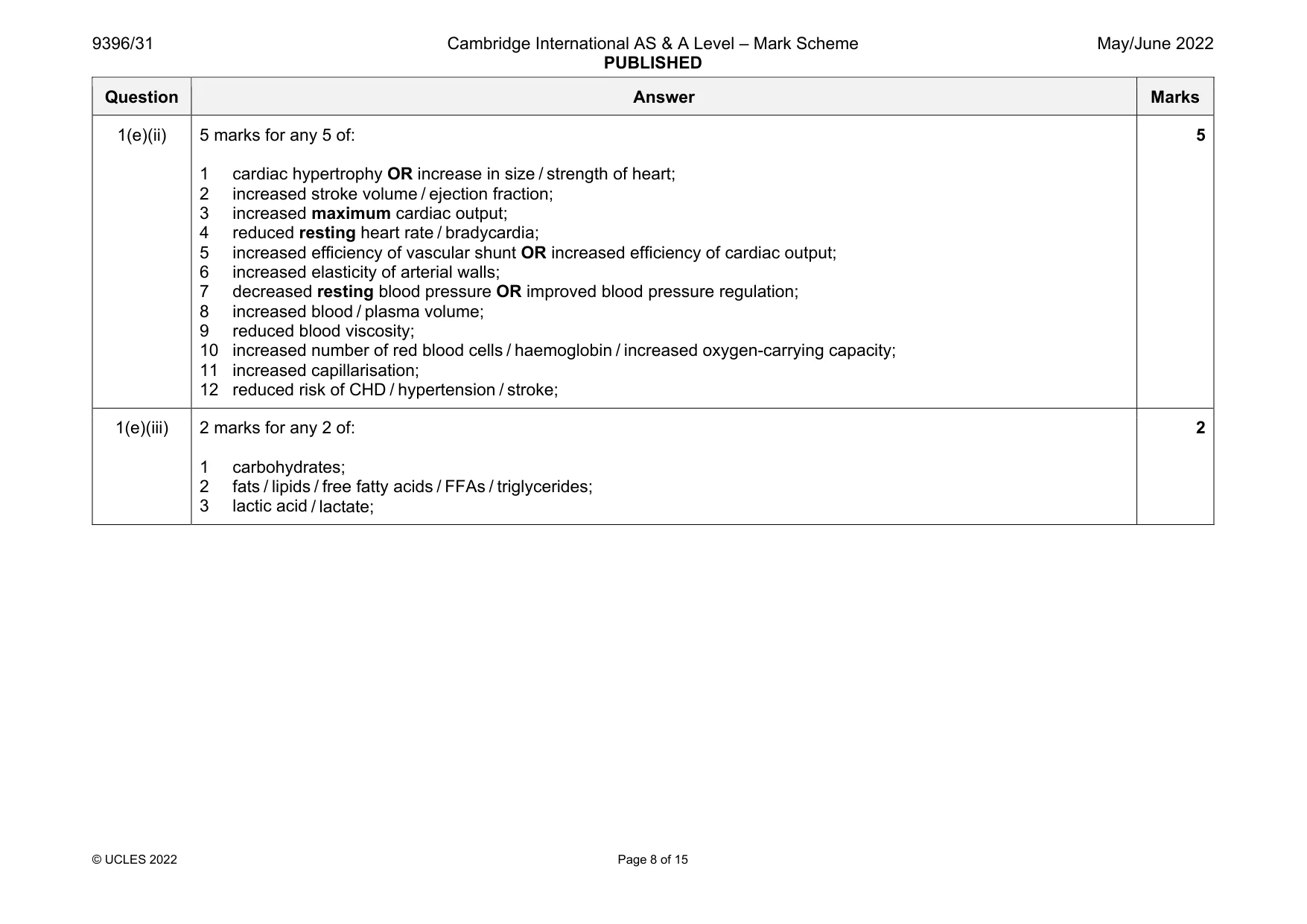
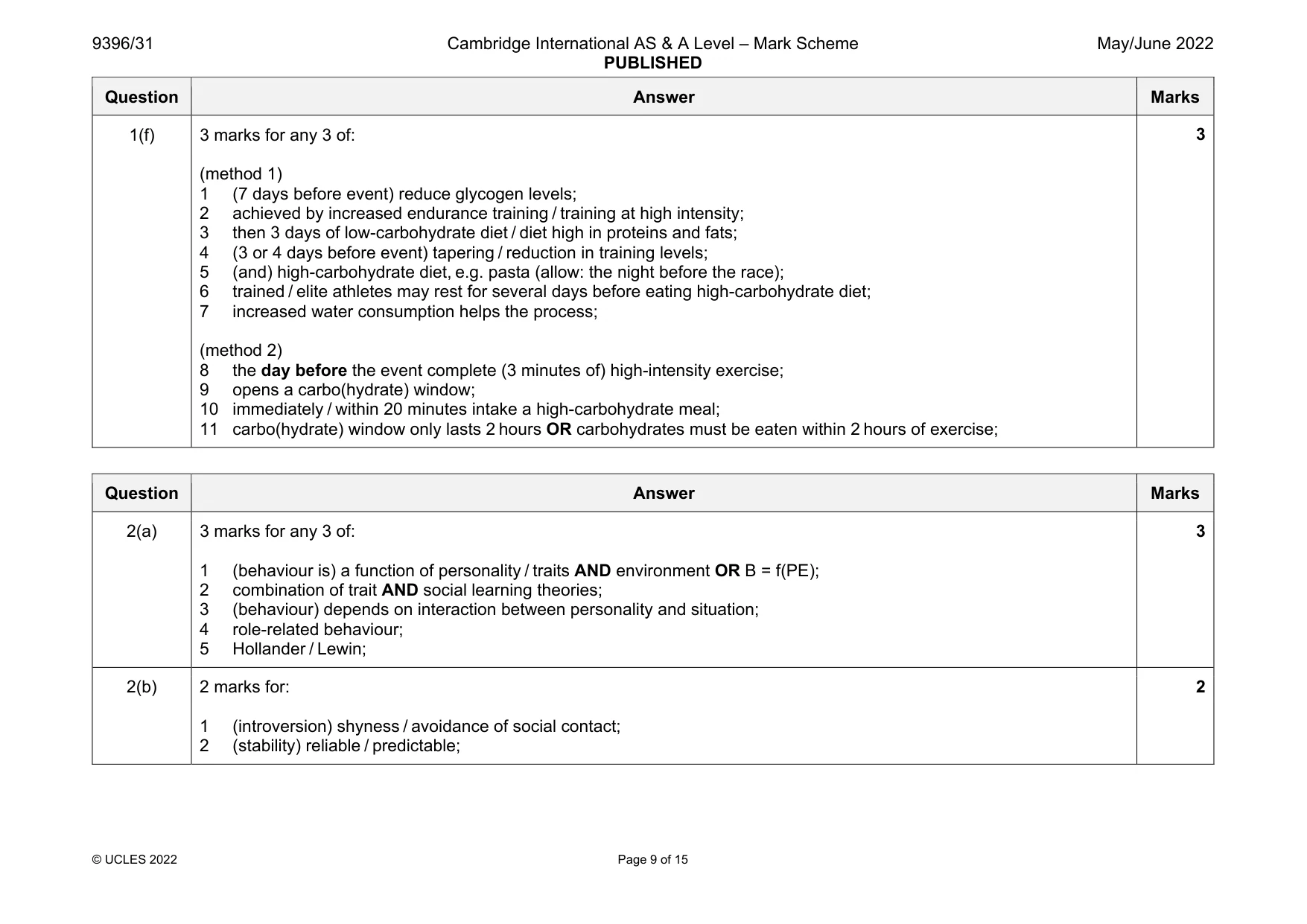
Mark scheme: 1(a)(i) 2 marks for: 1 (work) the product of force and distance OR force distance; 2 (power) the rate at which work is done OR work ÷ time / energy ÷ time OR strength speed; 1(a)(ii) 2 marks for: 1 (work) (kilo)joule / (kilo)calorie / erg / foot-pound; 2 (power) watt / joule per second; Accept other appropriate units. 2 1(b) 4 marks for any 4 of: 1 ATP/PC system OR alactic system; 2 anaerobic / no oxygen; 3 phosphocreatine / PC is broken down to produce energy OR PC P + C + energy; 4 energy is used to resynthesise ATP OR energy + ADP + P ATP; 5 (site of reaction) sarcoplasm; 6 (net yield) 1 ATP per molecule of PC; 4 1(c) 1 mark for: 1 with oxygen; 1 mark for any 1 of: 2 elevated respiratory / circulatory rates; 3 alactacid debt component OR fast component OR oxygen debt / EPOC; 2 Question Answer Marks 1(d) 6 marks for: 1 (specificity) training must be focused on the sport / event / fitness component / muscle groups / energy system; 2 (example) javelin thrower targets muscle groups of the shoulder; 3 (progression) training must gradually increase in overload / intensity / time; 4 (example) in weight training increase load from 90 kg to 95 kg; 5 (reversibility) if training stops training effects will be lost; 6 (example) if gymnast gets injured and cannot train then strength will drop OR an athlete with a hamstring injury should still do upper body work; 6 Question Answer Marks 1(e)(i) 4 marks for 4 of: 1 genetic factors / physiological make-up; 2 e.g. the presence of certain genes increases aerobic capacity; 3 muscular factors / muscle fibre type OR amount of mitochondria / myoglobin; 4 e.g. a low percentage of SO fibres will limit aerobic capacity; 5 respiratory factors / strength of respiratory muscles; 6 e.g. a large lung capacity will increase aerobic capacity; 7 gender / sex; 8 e.g. males tend to have a higher aerobic capacity; 9 illness / disease; 10 e.g. asthma / emphysema / COPD causes lower aerobic capacity; 11 age; 12 e.g. aerobic capacity increases from childhood to adulthood OR decreases from adulthood as age increases; 13 environment / altitude; 14 e.g. living at high altitude will cause aerobic capacity to increase; 15 body composition; 16 e.g. obesity causes aerobic capacity to decrease; 17 drugs / lifestyle; 18 e.g. EPO will cause aerobic capacity to increase OR smoking causes aerobic capacity to decrease; 4 Question Answer Marks 1(e)(ii) 5 marks for any 5 of: 1 cardiac hypertrophy OR increase in size / strength of heart; 2 increased stroke volume / ejection fraction; 3 increased maximum cardiac output; 4 reduced resting heart rate / bradycardia; 5 increased efficiency of vascular shunt OR increased efficiency of cardiac output; 6 increased elasticity of arterial walls; 7 decreased resting blood pressure OR improved blood pressure regulation; 8 increased blood / plasma volume; 9 reduced blood viscosity; 10 increased number of red blood cells / haemoglobin / increased oxygen-carrying capacity; 11 increased capillarisation; 12 reduced risk of CHD / hypertension / stroke; 5 1(e)(iii) 2 marks for any 2 of: 1 carbohydrates; 2 fats / lipids / free fatty acids / FFAs / triglycerides; 3 lactic acid / lactate; 2 Question Answer Marks 1(f) 3 marks for any 3 of: (method 1) 1 (7 days before event) reduce glycogen levels; 2 achieved by increased endurance training / training at high intensity; 3 then 3 days of low-carbohydrate diet / diet high in proteins and fats; 4 (3 or 4 days before event) tapering / reduction in training levels; 5 (and) high-carbohydrate diet, e.g. pasta (allow: the night before the race); 6 trained / elite athletes may rest for several days before eating high-carbohydrate diet; 7 increased water consumption helps the process; (method 2) 8 the day before the event complete (3 minutes of) high-intensity exercise; 9 opens a carbo(hydrate) window; 10 immediately / within 20 minutes intake a high-carbohydrate meal; 11 carbo(hydrate) window only lasts 2 hours OR carbohydrates must be eaten within 2 hours of exercise; 3
Q2 · Describe the interactionist approach to personality development
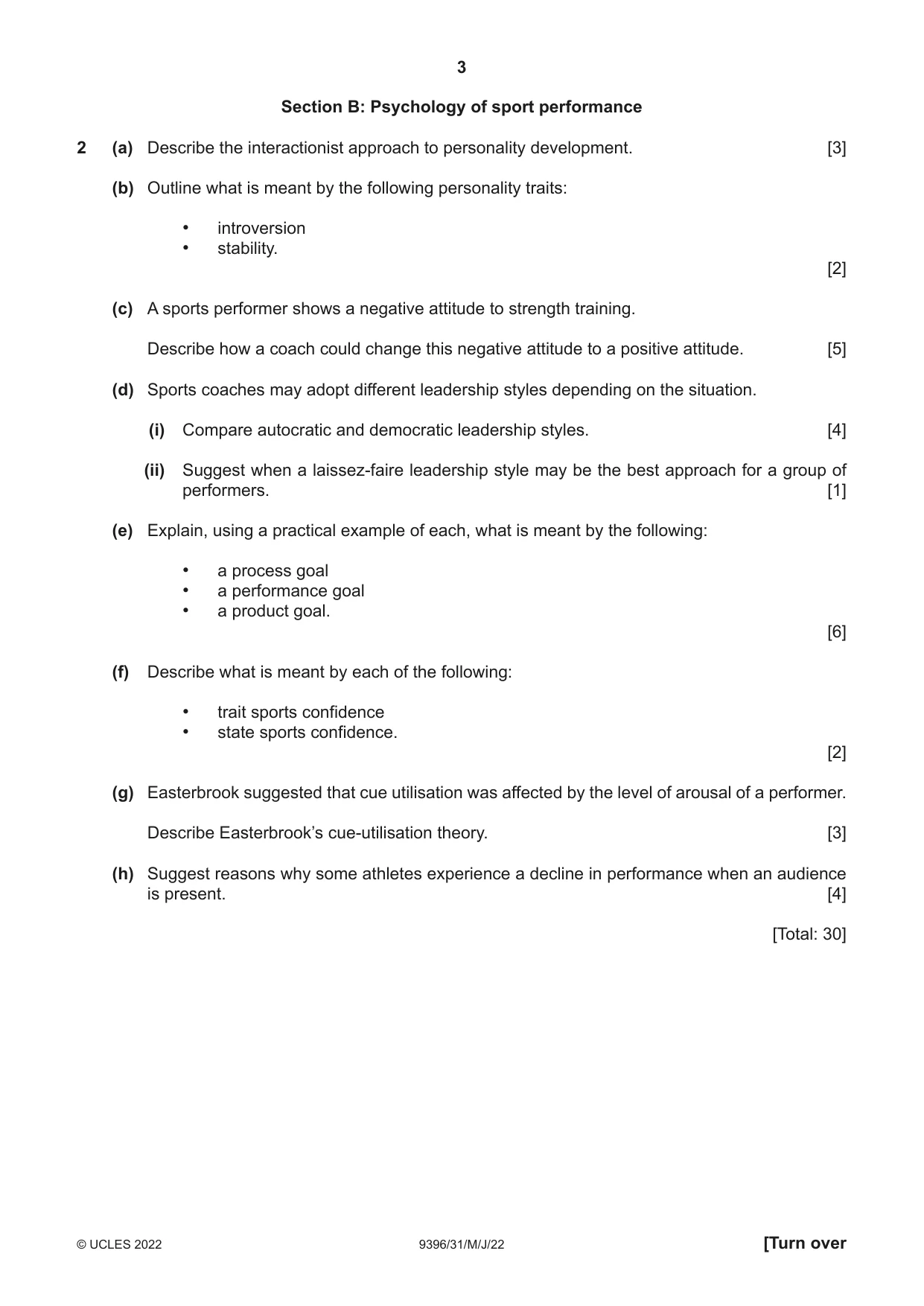
2 (a) Describe the interactionist approach to personality development. [3] (b) Outline what is meant by the following personality traits: • introversion • stability. [2] (c) A sports performer shows a negative attitude to strength training. Describe how a coach could change this negative attitude to a positive attitude. [5] (d) Sports coaches may adopt different leadership styles depending on the situation. (i) Compare autocratic and democratic leadership styles. [4] (ii) Suggest when a laissez‑faire leadership style may be the best approach for a group of performers. [1] (e) Explain, using a practical example of each, what is meant by the following: • a process goal • a performance goal • a product goal. [6] (f) Describe what is meant by each of the following: • trait sports confidence • state sports confidence. [2] (g) Easterbrook suggested that cue utilisation was affected by the level of arousal of a performer. Describe Easterbrook’s cue‑utilisation theory. [3] (h) Suggest reasons why some athletes experience a decline in performance when an audience is present. [4] [Total: 30] Section C: Olympic Games: a global perspective
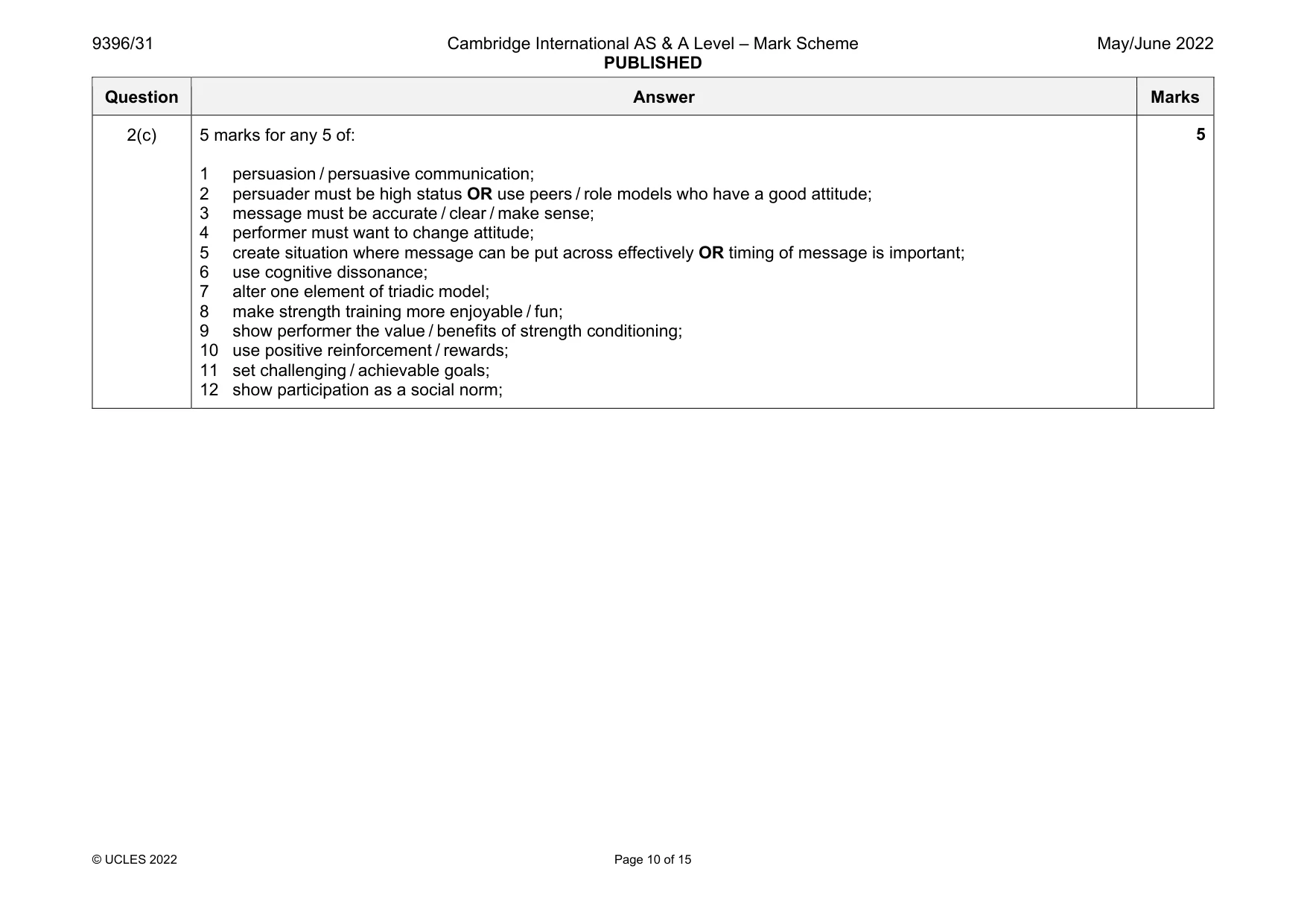
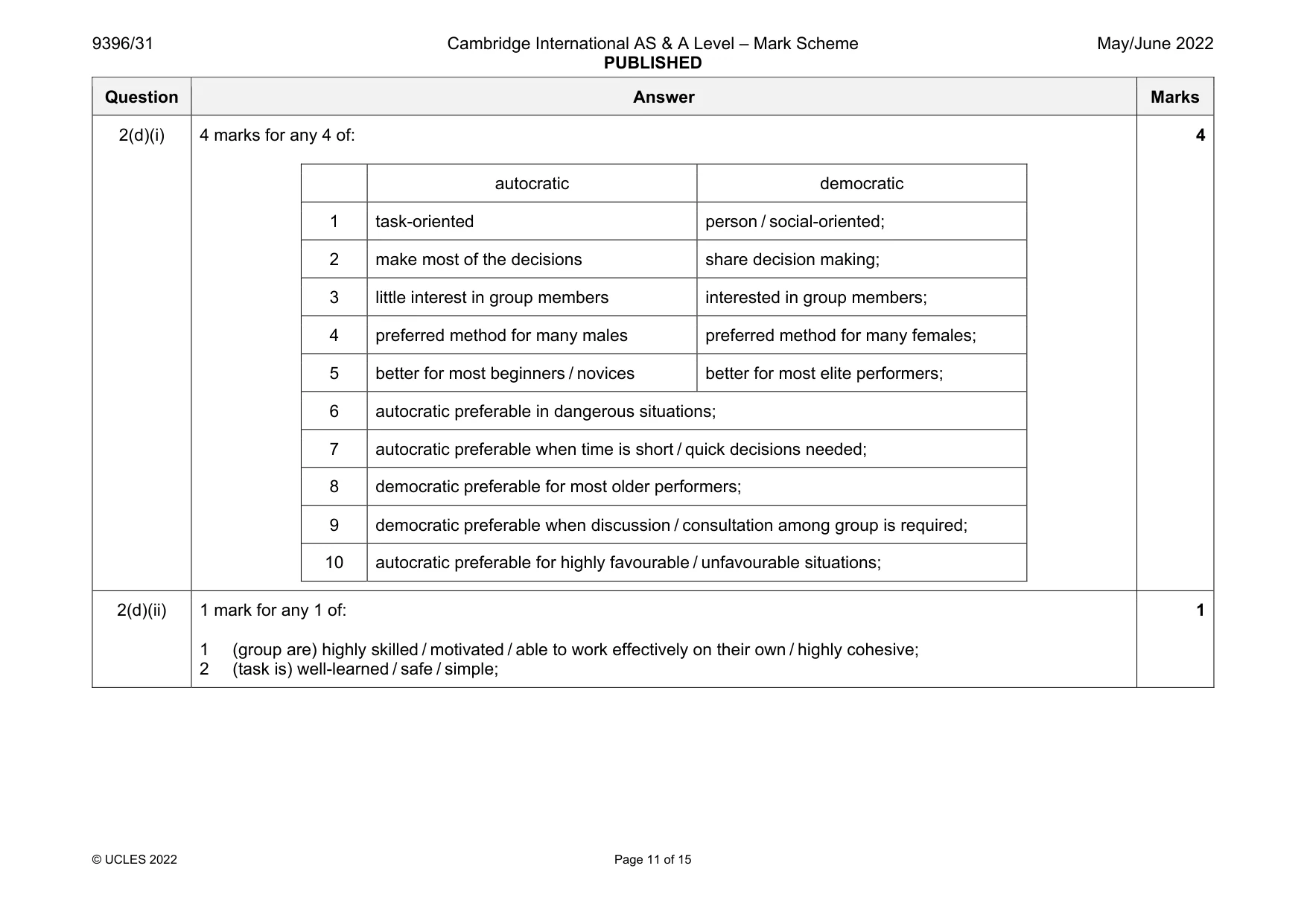
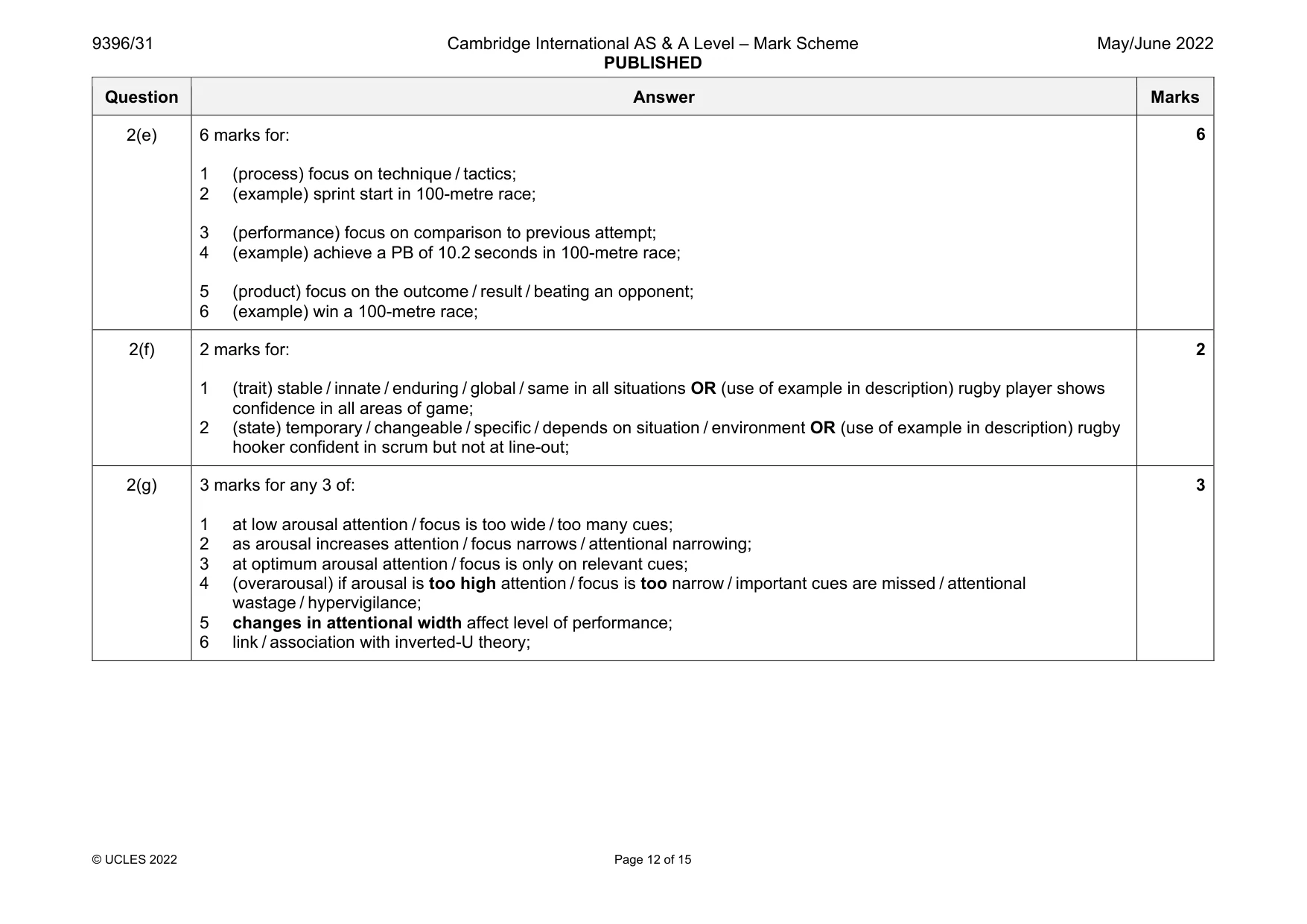
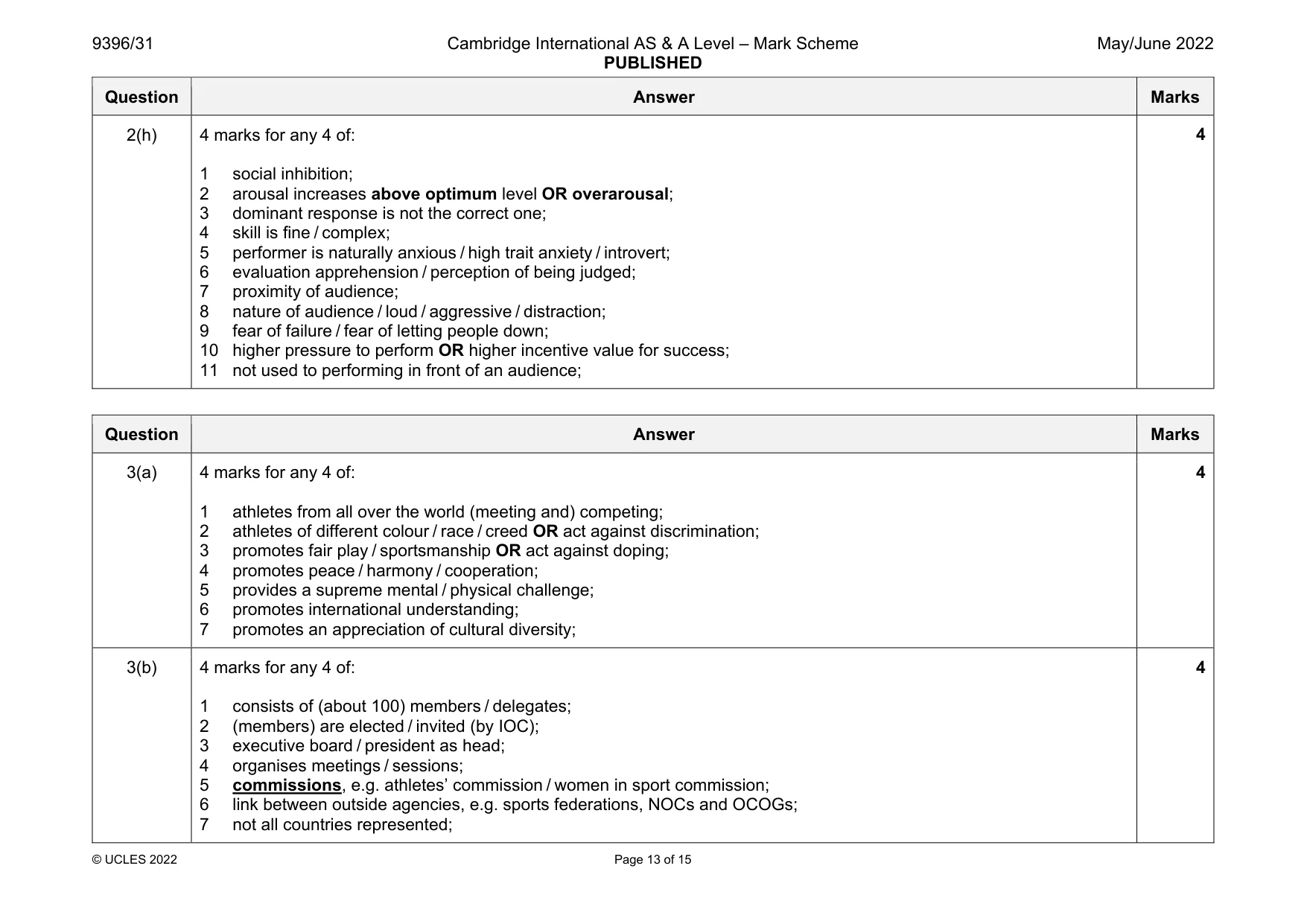
Mark scheme: 2(a) 3 marks for any 3 of: 1 (behaviour is) a function of personality / traits AND environment OR B = f(PE); 2 combination of trait AND social learning theories; 3 (behaviour) depends on interaction between personality and situation; 4 role-related behaviour; 5 Hollander / Lewin; 2(b) 2 marks for: 1 (introversion) shyness / avoidance of social contact; 2 (stability) reliable / predictable; 2 Question Answer Marks 2(c) 5 marks for any 5 of: 1 persuasion / persuasive communication; 2 persuader must be high status OR use peers / role models who have a good attitude; 3 message must be accurate / clear / make sense; 4 performer must want to change attitude; 5 create situation where message can be put across effectively OR timing of message is important; 6 use cognitive dissonance; 7 alter one element of triadic model; 8 make strength training more enjoyable / fun; 9 show performer the value / benefits of strength conditioning; 10 use positive reinforcement / rewards; 11 set challenging / achievable goals; 12 show participation as a social norm; 5 Question Answer Marks 2(d)(i) 4 marks for any 4 of: autocratic democratic 1 task-oriented person / social-oriented; 2 make most of the decisions share decision making; 3 little interest in group members interested in group members; 4 preferred method for many males preferred method for many females; 5 better for most beginners / novices better for most elite performers; 6 autocratic preferable in dangerous situations; 7 autocratic preferable when time is short / quick decisions needed; 8 democratic preferable for most older performers; 9 democratic preferable when discussion / consultation among group is required; 10 autocratic preferable for highly favourable / unfavourable situations; 4 2(d)(ii) 1 mark for any 1 of: 1 (group are) highly skilled / motivated / able to work effectively on their own / highly cohesive; 2 (task is) well-learned / safe / simple; 1 Question Answer Marks 2(e) 6 marks for: 1 (process) focus on technique / tactics; 2 (example) sprint start in 100-metre race; 3 (performance) focus on comparison to previous attempt; 4 (example) achieve a PB of 10.2 seconds in 100-metre race; 5 (product) focus on the outcome / result / beating an opponent; 6 (example) win a 100-metre race; 6 2(f) 2 marks for: 1 (trait) stable / innate / enduring / global / same in all situations OR (use of example in description) rugby player shows confidence in all areas of game; 2 (state) temporary / changeable / specific / depends on situation / environment OR (use of example in description) rugby hooker confident in scrum but not at line-out; 2 2(g) 3 marks for any 3 of: 1 at low arousal attention / focus is too wide / too many cues; 2 as arousal increases attention / focus narrows / attentional narrowing; 3 at optimum arousal attention / focus is only on relevant cues; 4 (overarousal) if arousal is too high attention / focus is too narrow / important cues are missed / attentional wastage / hypervigilance; 5 changes in attentional width affect level of performance; 6 link / association with inverted-U theory; 3 Question Answer Marks 2(h) 4 marks for any 4 of: 1 social inhibition; 2 arousal increases above optimum level OR overarousal; 3 dominant response is not the correct one; 4 skill is fine / complex; 5 performer is naturally anxious / high trait anxiety / introvert; 6 evaluation apprehension / perception of being judged; 7 proximity of audience; 8 nature of audience / loud / aggressive / distraction; 9 fear of failure / fear of letting people down; 10 higher pressure to perform OR higher incentive value for success; 11 not used to performing in front of an audience; 4
Q3 · The Olympic Games is an international athletic festival that acts as a social force to…
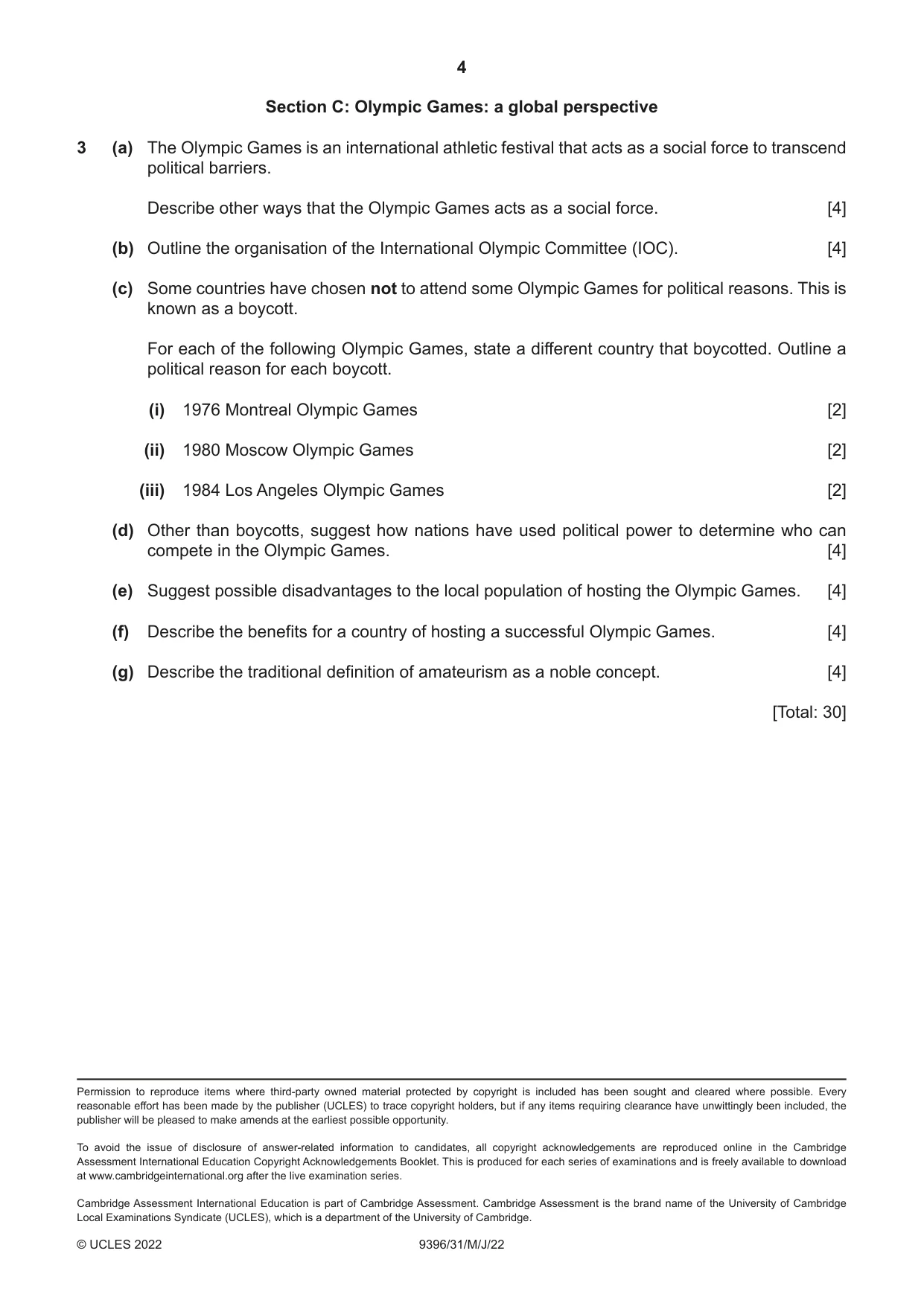
3 (a) The Olympic Games is an international athletic festival that acts as a social force to transcend political barriers. Describe other ways that the Olympic Games acts as a social force. [4] (b) Outline the organisation of the International Olympic Committee (IOC). [4] (c) Some countries have chosen not to attend some Olympic Games for political reasons. This is known as a boycott. For each of the following Olympic Games, state a different country that boycotted. Outline a political reason for each boycott. (i) 1976 Montreal Olympic Games [2] (ii) 1980 Moscow Olympic Games [2] (iii) 1984 Los Angeles Olympic Games [2] (d) Other than boycotts, suggest how nations have used political power to determine who can compete in the Olympic Games. [4] (e) Suggest possible disadvantages to the local population of hosting the Olympic Games. [4] (f) Describe the benefits for a country of hosting a successful Olympic Games. [4] (g) Describe the traditional definition of amateurism as a noble concept. [4] [Total: 30]
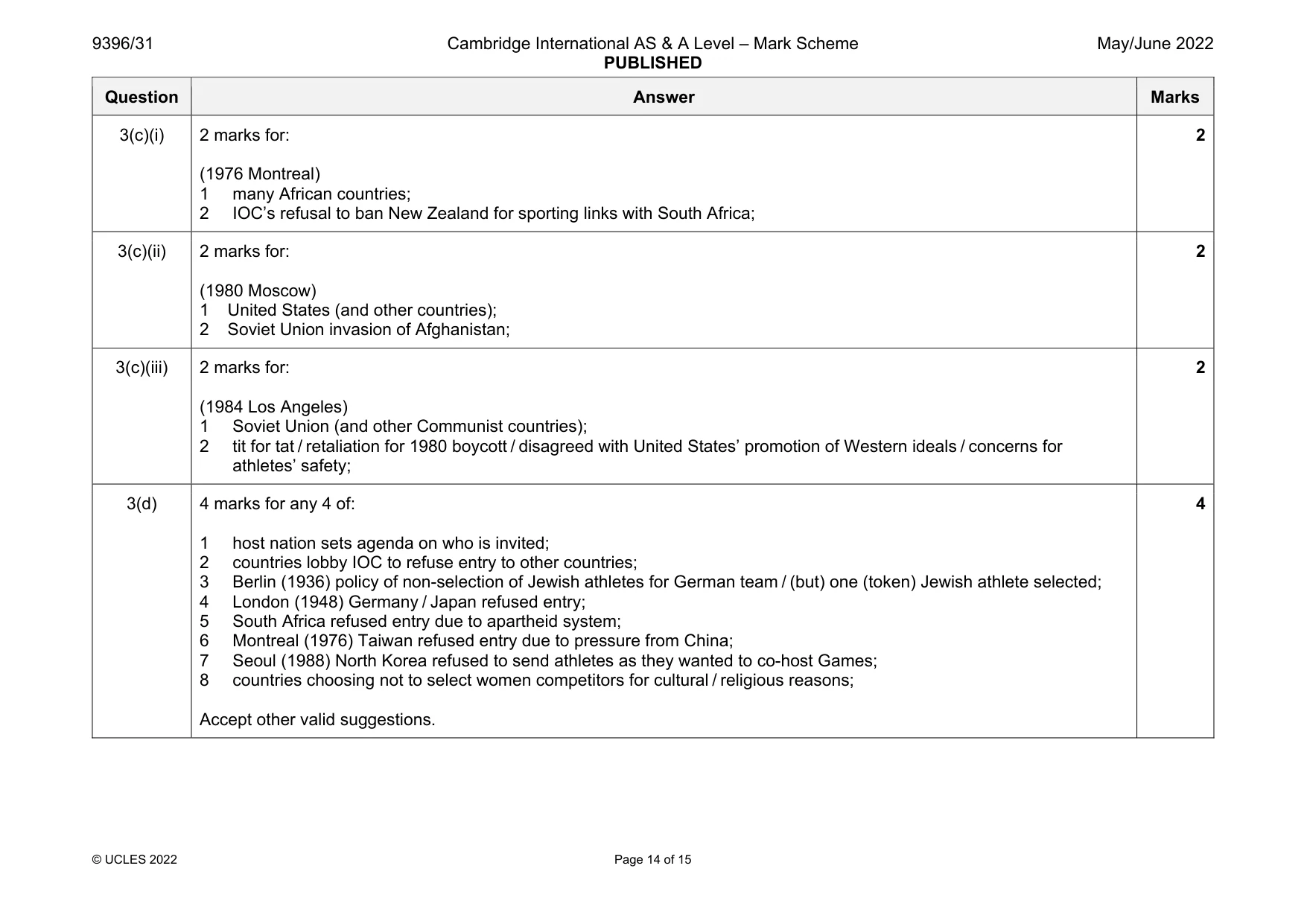
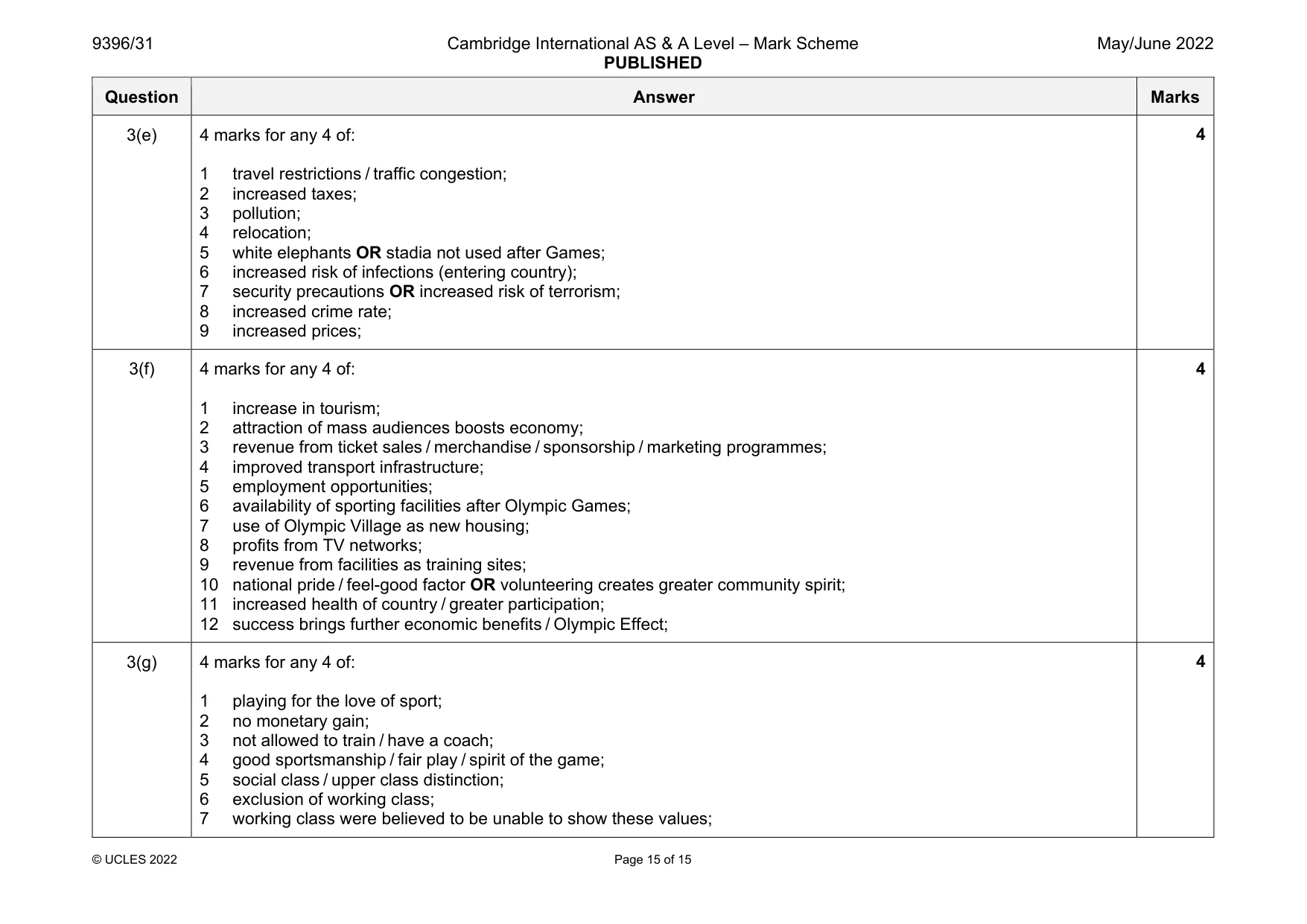
Mark scheme: 3(a) 4 marks for any 4 of: 1 athletes from all over the world (meeting and) competing; 2 athletes of different colour / race / creed OR act against discrimination; 3 promotes fair play / sportsmanship OR act against doping; 4 promotes peace / harmony / cooperation; 5 provides a supreme mental / physical challenge; 6 promotes international understanding; 7 promotes an appreciation of cultural diversity; 3(b) 4 marks for any 4 of: 1 consists of (about 100) members / delegates; 2 (members) are elected / invited (by IOC); 3 executive board / president as head; 4 organises meetings / sessions; 5 commissions, e.g. athletes’ commission / women in sport commission; 6 link between outside agencies, e.g. sports federations, NOCs and OCOGs; 7 not all countries represented; 4 Question Answer Marks 3(c)(i) 2 marks for: (1976 Montreal) 1 many African countries; 2 IOC’s refusal to ban New Zealand for sporting links with South Africa; 2 3(c)(ii) 2 marks for: (1980 Moscow) 1 United States (and other countries); 2 Soviet Union invasion of Afghanistan; 2 3(c)(iii) 2 marks for: (1984 Los Angeles) 1 Soviet Union (and other Communist countries); 2 tit for tat / retaliation for 1980 boycott / disagreed with United States’ promotion of Western ideals / concerns for athletes’ safety; 2 3(d) 4 marks for any 4 of: 1 host nation sets agenda on who is invited; 2 countries lobby IOC to refuse entry to other countries; 3 Berlin (1936) policy of non-selection of Jewish athletes for German team / (but) one (token) Jewish athlete selected; 4 London (1948) Germany / Japan refused entry; 5 South Africa refused entry due to apartheid system; 6 Montreal (1976) Taiwan refused entry due to pressure from China; 7 Seoul (1988) North Korea refused to send athletes as they wanted to co-host Games; 8 countries choosing not to select women competitors for cultural / religious reasons; Accept other valid suggestions. 4 Question Answer Marks 3(e) 4 marks for any 4 of: 1 travel restrictions / traffic congestion; 2 increased taxes; 3 pollution; 4 relocation; 5 white elephants OR stadia not used after Games; 6 increased risk of infections (entering country); 7 security precautions OR increased risk of terrorism; 8 increased crime rate; 9 increased prices; 4 3(f) 4 marks for any 4 of: 1 increase in tourism; 2 attraction of mass audiences boosts economy; 3 revenue from ticket sales / merchandise / sponsorship / marketing programmes; 4 improved transport infrastructure; 5 employment opportunities; 6 availability of sporting facilities after Olympic Games; 7 use of Olympic Village as new housing; 8 profits from TV networks; 9 revenue from facilities as training sites; 10 national pride / feel-good factor OR volunteering creates greater community spirit; 11 increased health of country / greater participation; 12 success brings further economic benefits / Olympic Effect; 4 3(g) 4 marks for any 4 of: 1 playing for the love of sport; 2 no monetary gain; 3 not allowed to train / have a coach; 4 good sportsmanship / fair play / spirit of the game; 5 social class / upper class distinction; 6 exclusion of working class; 7 working class were believed to be unable to show these values; 4
What you needed in this session
Cambridge’s own grade thresholds for 2022 May/June, Paper 3 · Variant 1. A higher threshold means an easier paper — the bar moves with how the cohort did.