Cambridge A Level Physical Education 9396 — 2021 May/June Paper 1 · Variant 2
9396/12/M/J/21 · 90 marks · ≈101 min
The question paper and its mark scheme, free to read here and free to download. This is Cambridge’s own paper, exactly as it was sat.
Question paper8 pages



Mark scheme15 pages
Answers below. Sit the paper first if you are practising.
Paper as text
Question paper, page 1
This document has 8 pages. Any blank pages are indicated. Cambridge International AS & A Level DC (MS/CT) 198361/1 © UCLES 2021 [Turn over PHYSICAL EDUCATION 9396/12 Paper 1 May/June 2021 2 hours 30 minutes You must answer on the enclosed answer booklet. You will need: Answer booklet (enclosed) INSTRUCTIONS ● Answer all questions. ● Follow the instructions on the front cover of the answer booklet. If you need additional answer paper, ask the invigilator for a continuation booklet. ● You may use a calculator. ● You should show all your working and use appropriate units. INFORMATION ● The total mark for this paper is 90. ● The number of marks for each question or part question is shown in brackets [ ]. * 8 7 2 6 2 1 9 1 3 7 *
Question paper, page 2
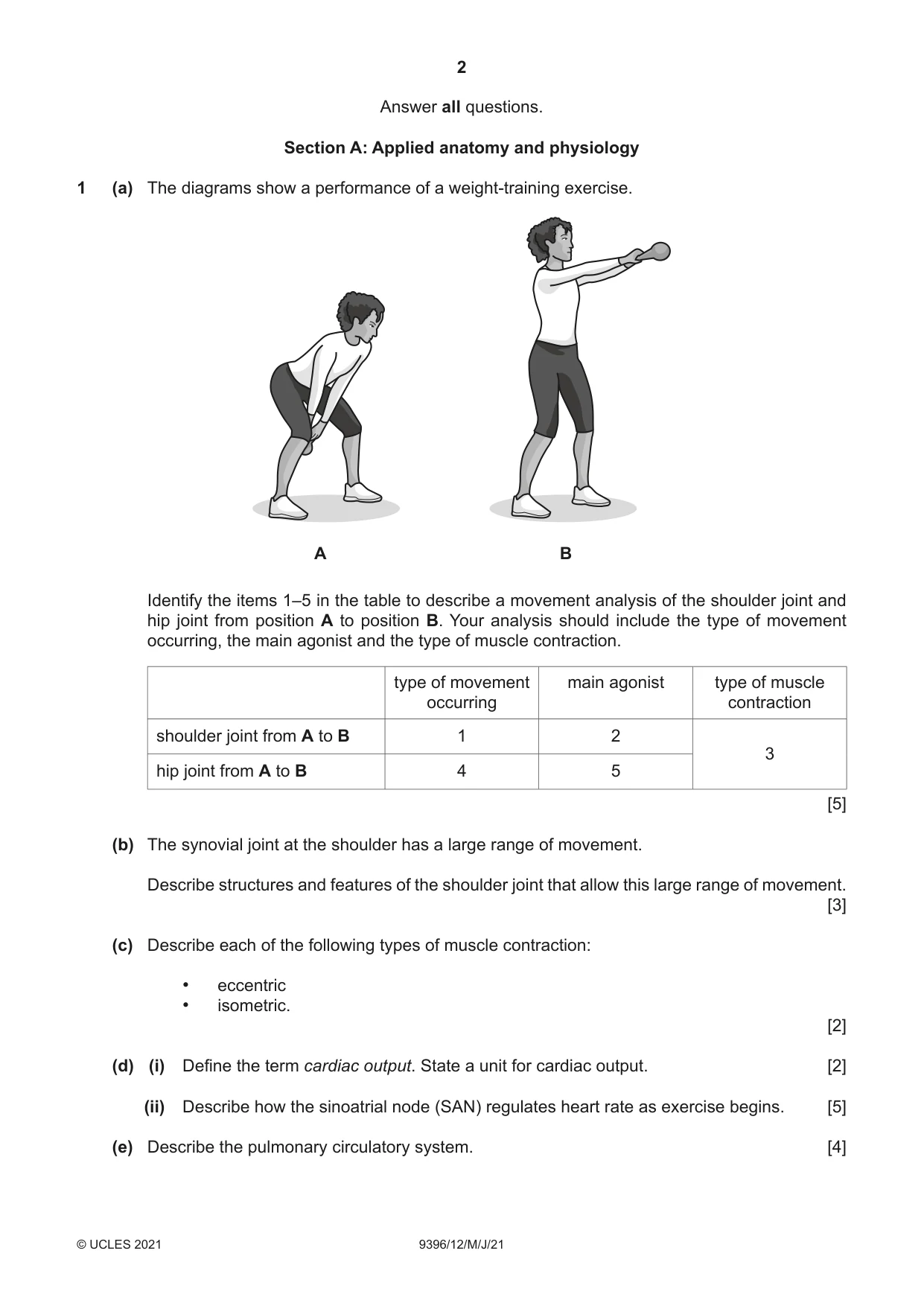
2 9396/12/M/J/21 © UCLES 2021 Answer all questions. Section A: Applied anatomy and physiology 1 (a) The diagrams show a performance of a weight-training exercise. B A Identify the items 1–5 in the table to describe a movement analysis of the shoulder joint and hip joint from position A to position B. Your analysis should include the type of movement occurring, the main agonist and the type of muscle contraction. type of movement occurring main agonist type of muscle contraction shoulder joint from A to B 1 2 3 hip joint from A to B 4 5 [5] (b) The synovial joint at the shoulder has a large range of movement. Describe structures and features of the shoulder joint that allow this large range of movement. [3] (c) Describe each of the following types of muscle contraction: • eccentric • isometric. [2] (d) (i) Define the term cardiac output. State a unit for cardiac output. [2] (ii) Describe how the sinoatrial node (SAN) regulates heart rate as exercise begins. [5] (e) Describe the pulmonary circulatory system. [4]
Question paper, page 3
3 9396/12/M/J/21 © UCLES 2021 [Turn over (f) (i) Identify features within the lungs, other than those of the bronchi, that assist gaseous exchange. [5] (ii) Explain how two structural features of the bronchi help the respiratory system to function efficiently. [4] [Total: 30]
Question paper, page 4
4 9396/12/M/J/21 © UCLES 2021 Section B: Acquiring, developing and performing movement skills 2 (a) Explain, using different practical examples for each, the following terms: • gross skill • discrete skill • complex skill • low organisation skill. [4] (b) Describe, using a practical example, each of the following elements of Bandura’s theory of observational learning: • attention • retention • motor reproduction • motivation. [4] (c) Identify and describe the two types of reinforcement that may be used during the learning of motor skills. [2] (d) Skilled movements are controlled by motor programmes. Describe, using a suitable example, how motor programmes are formed and stored. [4] (e) (i) Describe closed-loop control of motor programmes. [4] (ii) Explain why closed-loop control may not be applicable to all skills. [3] (f) Identify each of the three phases of learning. Describe a different characteristic of performance in each phase. [6] (g) Explain what is meant by drive-reduction theory. [3] [Total: 30]
Question paper, page 5
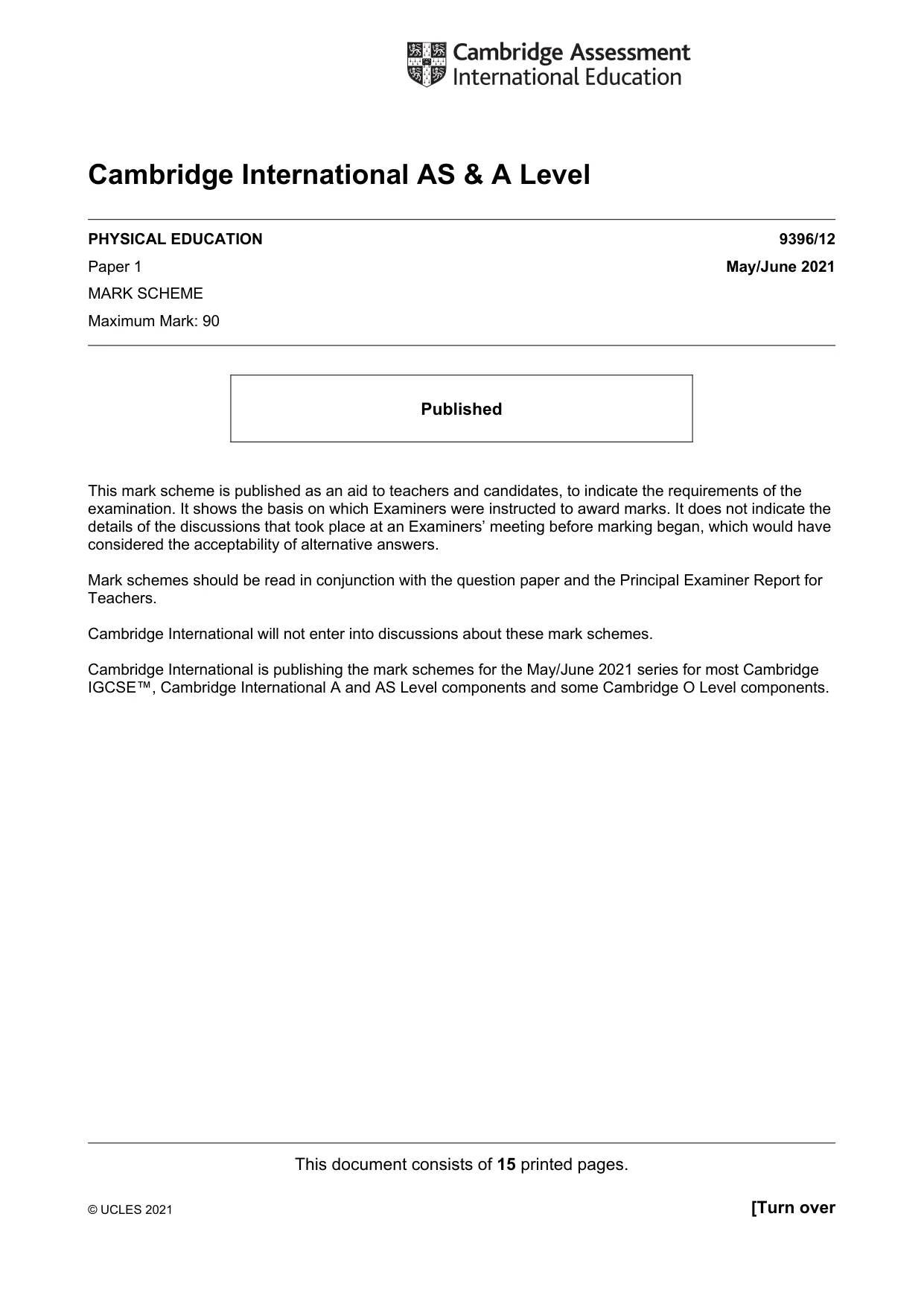
5 9396/12/M/J/21 © UCLES 2021 Section C: Contemporary studies in physical education and sport 3 (a) (i) Define what is meant by physical education in schools. [1] (ii) Describe the characteristics of physical education in schools. [4] (b) Compare cycling as physical recreation with cycling as a sport. [5] (c) Describe, using a country of your choice, how potential elite performers are identified and developed. [5] (d) Suggest ways that the base of the performance pyramid could be widened. [3] (e) Suggest benefits for a local community of private bodies providing leisure facilities. [3] (f) Suggest strategies to increase participation in physical activity by disabled people. [3] (g) Outline the advantages and disadvantages of the relationship between sport and sponsorship. [6] [Total: 30]
Question paper, page 6
6 9396/12/M/J/21 © UCLES 2021 BLANK PAGE
Question paper, page 7
7 9396/12/M/J/21 © UCLES 2021 BLANK PAGE
Question paper, page 8
8 9396/12/M/J/21 © UCLES 2021 Permission to reproduce items where third-party owned material protected by copyright is included has been sought and cleared where possible. Every reasonable effort has been made by the publisher (UCLES) to trace copyright holders, but if any items requiring clearance have unwittingly been included, the publisher will be pleased to make amends at the earliest possible opportunity. To avoid the issue of disclosure of answer-related information to candidates, all copyright acknowledgements are reproduced online in the Cambridge Assessment International Education Copyright Acknowledgements Booklet. This is produced for each series of examinations and is freely available to download at www.cambridgeinternational.org after the live examination series. Cambridge Assessment International Education is part of the Cambridge Assessment Group. Cambridge Assessment is the brand name of the University of Cambridge Local Examinations Syndicate (UCLES), which itself is a department of the University of Cambridge. BLANK PAGE
Mark scheme, page 1
This document consists of 15 printed pages. © UCLES 2021 [Turn over Cambridge International AS & A Level PHYSICAL EDUCATION 9396/12 Paper 1 May/June 2021 MARK SCHEME Maximum Mark: 90 Published This mark scheme is published as an aid to teachers and candidates, to indicate the requirements of the examination. It shows the basis on which Examiners were instructed to award marks. It does not indicate the details of the discussions that took place at an Examiners’ meeting before marking began, which would have considered the acceptability of alternative answers. Mark schemes should be read in conjunction with the question paper and the Principal Examiner Report for Teachers. Cambridge International will not enter into discussions about these mark schemes. Cambridge International is publishing the mark schemes for the May/June 2021 series for most Cambridge IGCSE™, Cambridge International A and AS Level components and some Cambridge O Level components.
Mark scheme, page 2
9396/12 Cambridge International AS & A Level – Mark Scheme PUBLISHED May/June 2021 © UCLES 2021 Page 2 of 15 Generic Marking Principles These general marking principles must be applied by all examiners when marking candidate answers. They should be applied alongside the specific content of the mark scheme or generic level descriptors for a question. Each question paper and mark scheme will also comply with these marking principles. GENERIC MARKING PRINCIPLE 1: Marks must be awarded in line with: • the specific content of the mark scheme or the generic level descriptors for the question • the specific skills defined in the mark scheme or in the generic level descriptors for the question • the standard of response required by a candidate as exemplified by the standardisation scripts. GENERIC MARKING PRINCIPLE 2: Marks awarded are always whole marks (not half marks, or other fractions). GENERIC MARKING PRINCIPLE 3: Marks must be awarded positively: • marks are awarded for correct/valid answers, as defined in the mark scheme. However, credit is given for valid answers which go beyond the scope of the syllabus and mark scheme, referring to your Team Leader as appropriate • marks are awarded when candidates clearly demonstrate what they know and can do • marks are not deducted for errors • marks are not deducted for omissions • answers should only be judged on the quality of spelling, punctuation and grammar when these features are specifically assessed by the question as indicated by the mark scheme. The meaning, however, should be unambiguous. GENERIC MARKING PRINCIPLE 4: Rules must be applied consistently, e.g. in situations where candidates have not followed instructions or in the application of generic level descriptors.
Mark scheme, page 3
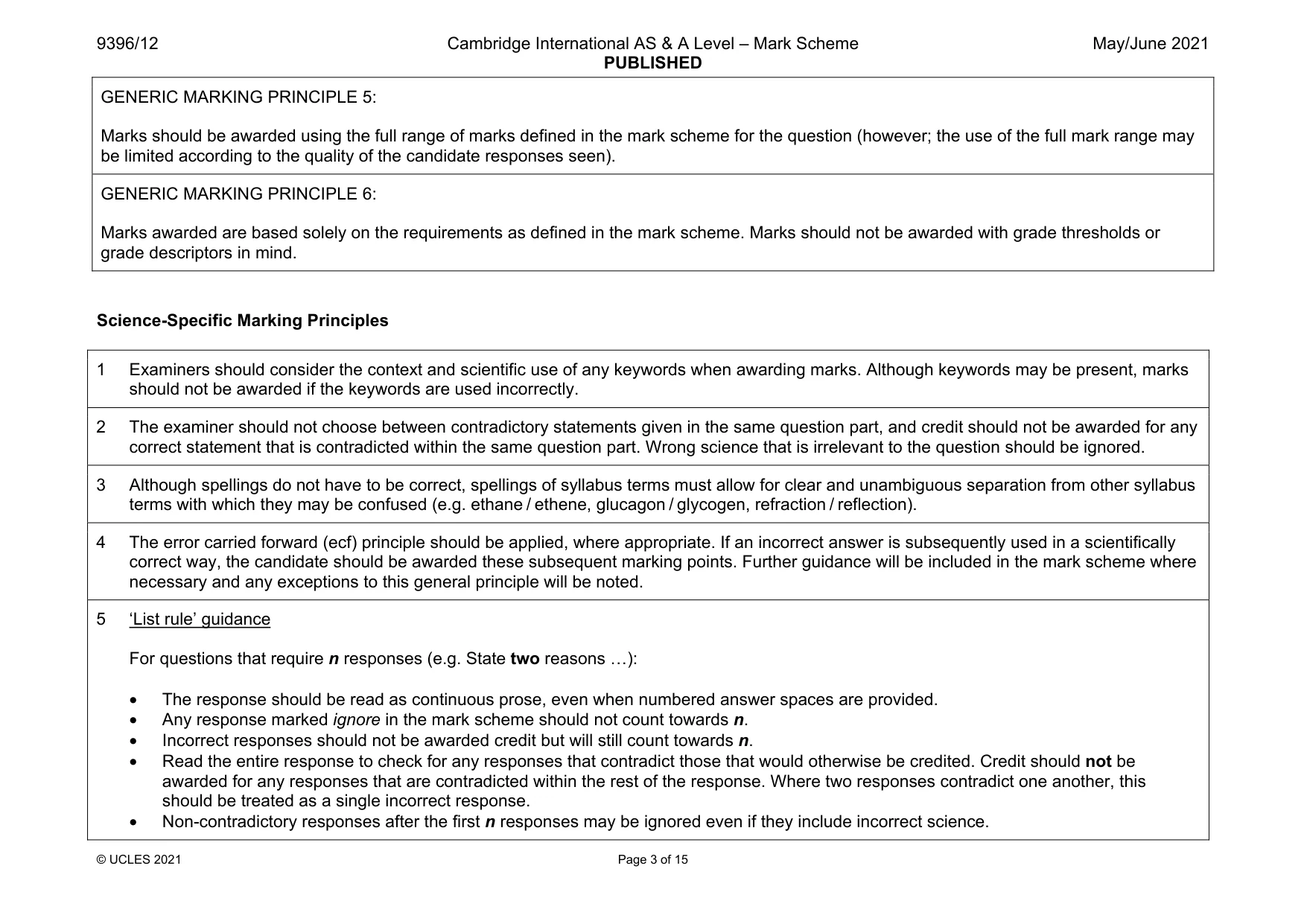
9396/12 Cambridge International AS & A Level – Mark Scheme PUBLISHED May/June 2021 © UCLES 2021 Page 3 of 15 GENERIC MARKING PRINCIPLE 5: Marks should be awarded using the full range of marks defined in the mark scheme for the question (however; the use of the full mark range may be limited according to the quality of the candidate responses seen). GENERIC MARKING PRINCIPLE 6: Marks awarded are based solely on the requirements as defined in the mark scheme. Marks should not be awarded with grade thresholds or grade descriptors in mind. Science-Specific Marking Principles 1 Examiners should consider the context and scientific use of any keywords when awarding marks. Although keywords may be present, marks should not be awarded if the keywords are used incorrectly. 2 The examiner should not choose between contradictory statements given in the same question part, and credit should not be awarded for any correct statement that is contradicted within the same question part. Wrong science that is irrelevant to the question should be ignored. 3 Although spellings do not have to be correct, spellings of syllabus terms must allow for clear and unambiguous separation from other syllabus terms with which they may be confused (e.g. ethane / ethene, glucagon / glycogen, refraction / reflection). 4 The error carried forward (ecf) principle should be applied, where appropriate. If an incorrect answer is subsequently used in a scientifically correct way, the candidate should be awarded these subsequent marking points. Further guidance will be included in the mark scheme where necessary and any exceptions to this general principle will be noted. 5 ‘List rule’ guidance For questions that require n responses (e.g. State two reasons …): • The response should be read as continuous prose, even when numbered answer spaces are provided. • Any response marked ignore in the mark scheme should not count towards n. • Incorrect responses should not be awarded credit but will still count towards n. • Read the entire response to check for any responses that contradict those that would otherwise be credited. Credit should not be awarded for any responses that are contradicted within the rest of the response. Where two responses contradict one another, this should be treated as a single incorrect response. • Non-contradictory responses after the first n responses may be ignored even if they include incorrect science.
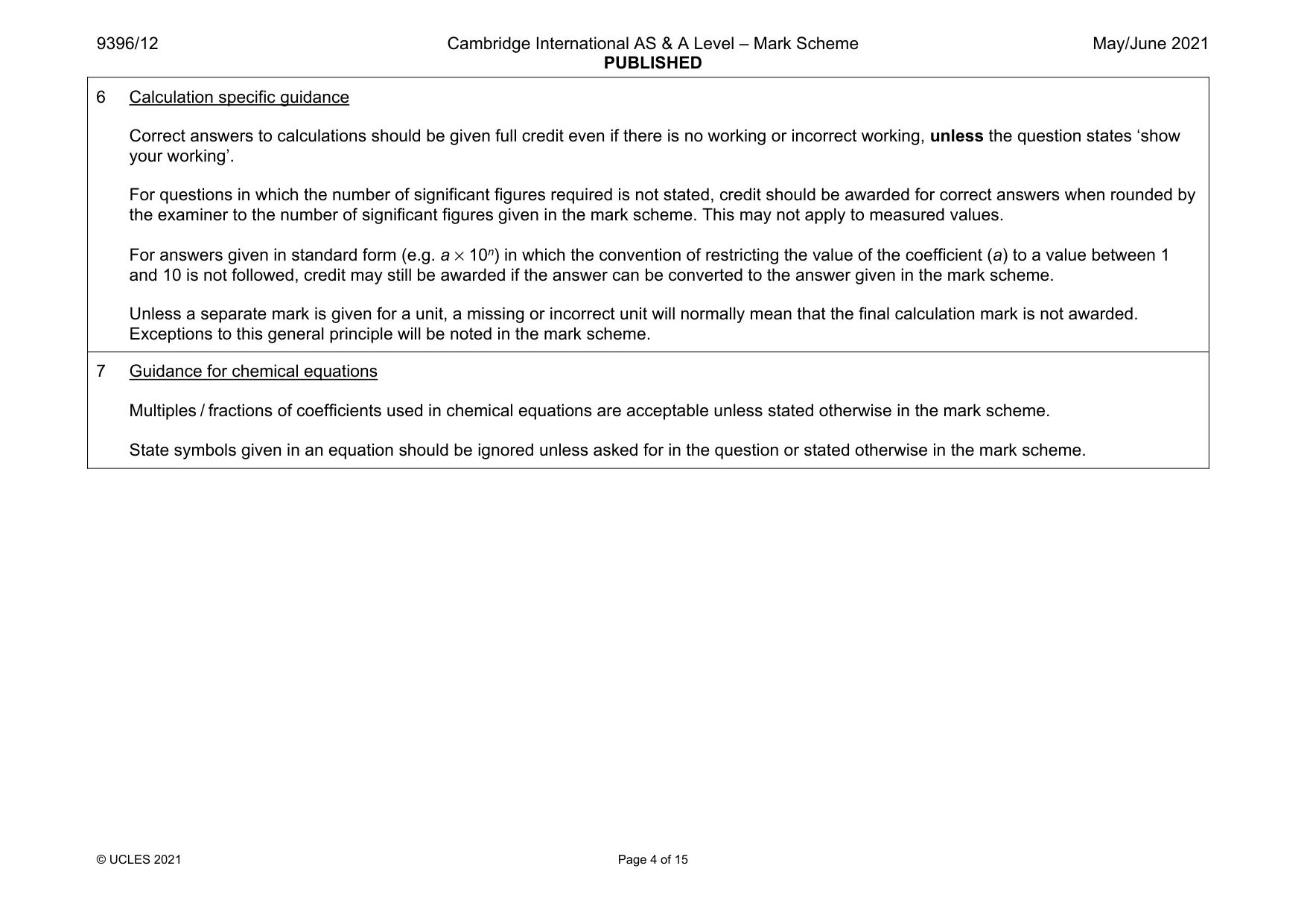
Mark scheme, page 4
9396/12 Cambridge International AS & A Level – Mark Scheme PUBLISHED May/June 2021 © UCLES 2021 Page 4 of 15 6 Calculation specific guidance Correct answers to calculations should be given full credit even if there is no working or incorrect working, unless the question states ‘show your working’. For questions in which the number of significant figures required is not stated, credit should be awarded for correct answers when rounded by the examiner to the number of significant figures given in the mark scheme. This may not apply to measured values. For answers given in standard form (e.g. a × 10n) in which the convention of restricting the value of the coefficient (a) to a value between 1 and 10 is not followed, credit may still be awarded if the answer can be converted to the answer given in the mark scheme. Unless a separate mark is given for a unit, a missing or incorrect unit will normally mean that the final calculation mark is not awarded. Exceptions to this general principle will be noted in the mark scheme. 7 Guidance for chemical equations Multiples / fractions of coefficients used in chemical equations are acceptable unless stated otherwise in the mark scheme. State symbols given in an equation should be ignored unless asked for in the question or stated otherwise in the mark scheme.
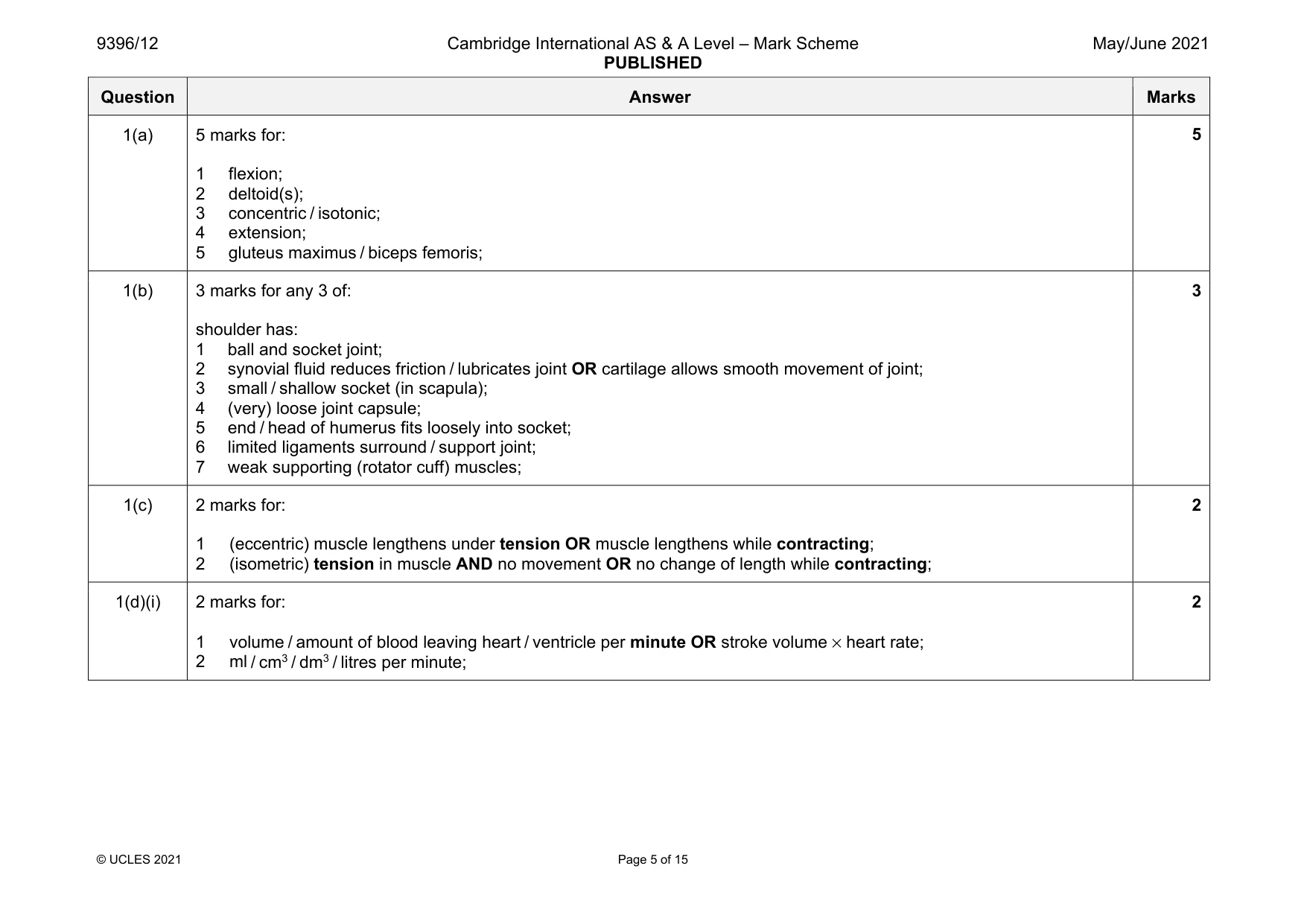
Mark scheme, page 5
9396/12 Cambridge International AS & A Level – Mark Scheme PUBLISHED May/June 2021 © UCLES 2021 Page 5 of 15 Question Answer Marks 1(a) 5 marks for: 1 flexion; 2 deltoid(s); 3 concentric / isotonic; 4 extension; 5 gluteus maximus / biceps femoris; 5 1(b) 3 marks for any 3 of: shoulder has: 1 ball and socket joint; 2 synovial fluid reduces friction / lubricates joint OR cartilage allows smooth movement of joint; 3 small / shallow socket (in scapula); 4 (very) loose joint capsule; 5 end / head of humerus fits loosely into socket; 6 limited ligaments surround / support joint; 7 weak supporting (rotator cuff) muscles; 3 1(c) 2 marks for: 1 (eccentric) muscle lengthens under tension OR muscle lengthens while contracting; 2 (isometric) tension in muscle AND no movement OR no change of length while contracting; 2 1(d)(i) 2 marks for: 1 volume / amount of blood leaving heart / ventricle per minute OR stroke volume × heart rate; 2 ml / cm3 / dm3 / litres per minute; 2
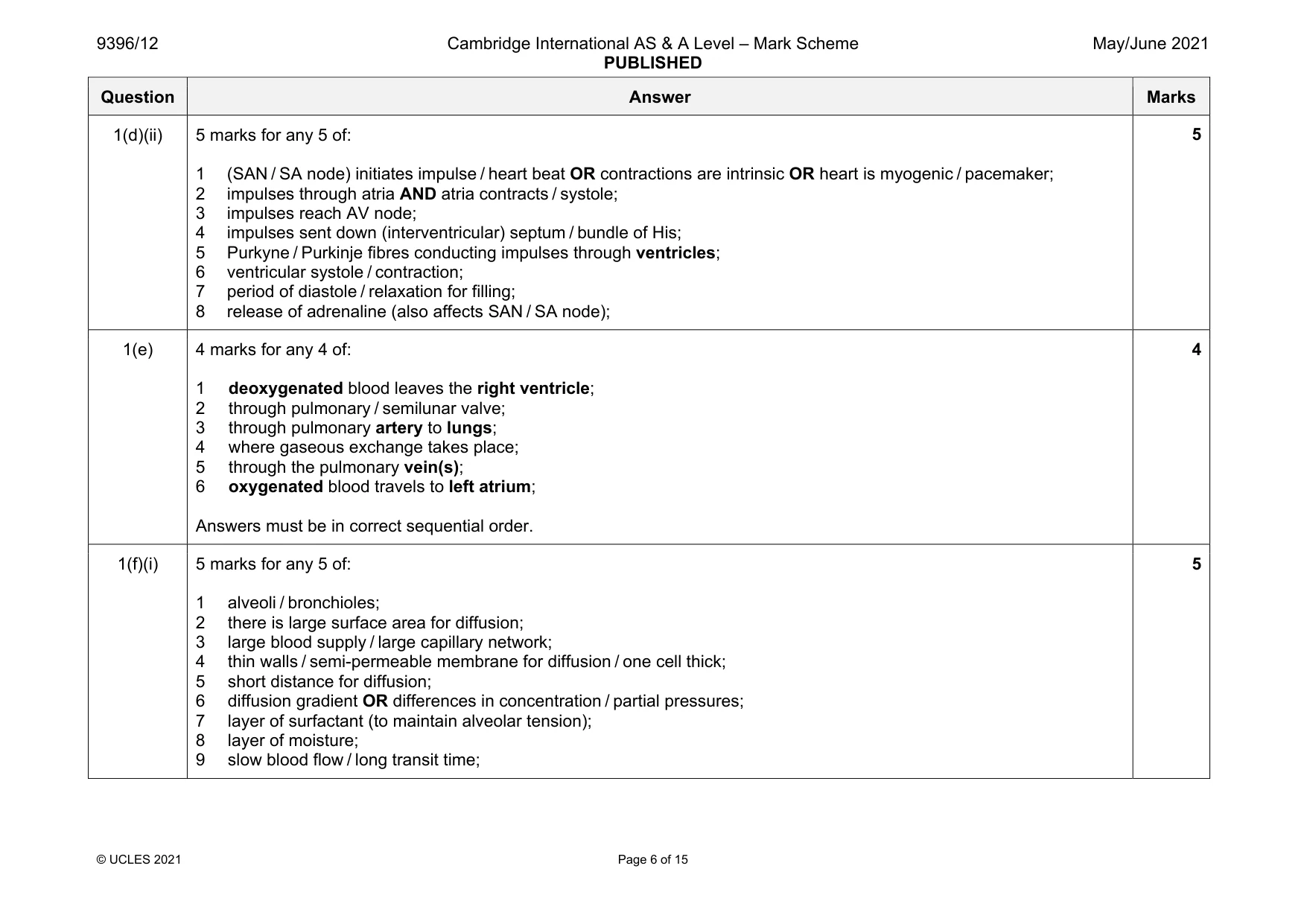
Mark scheme, page 6
9396/12 Cambridge International AS & A Level – Mark Scheme PUBLISHED May/June 2021 © UCLES 2021 Page 6 of 15 Question Answer Marks 1(d)(ii) 5 marks for any 5 of: 1 (SAN / SA node) initiates impulse / heart beat OR contractions are intrinsic OR heart is myogenic / pacemaker; 2 impulses through atria AND atria contracts / systole; 3 impulses reach AV node; 4 impulses sent down (interventricular) septum / bundle of His; 5 Purkyne / Purkinje fibres conducting impulses through ventricles; 6 ventricular systole / contraction; 7 period of diastole / relaxation for filling; 8 release of adrenaline (also affects SAN / SA node); 5 1(e) 4 marks for any 4 of: 1 deoxygenated blood leaves the right ventricle; 2 through pulmonary / semilunar valve; 3 through pulmonary artery to lungs; 4 where gaseous exchange takes place; 5 through the pulmonary vein(s); 6 oxygenated blood travels to left atrium; Answers must be in correct sequential order. 4 1(f)(i) 5 marks for any 5 of: 1 alveoli / bronchioles; 2 there is large surface area for diffusion; 3 large blood supply / large capillary network; 4 thin walls / semi-permeable membrane for diffusion / one cell thick; 5 short distance for diffusion; 6 diffusion gradient OR differences in concentration / partial pressures; 7 layer of surfactant (to maintain alveolar tension); 8 layer of moisture; 9 slow blood flow / long transit time; 5
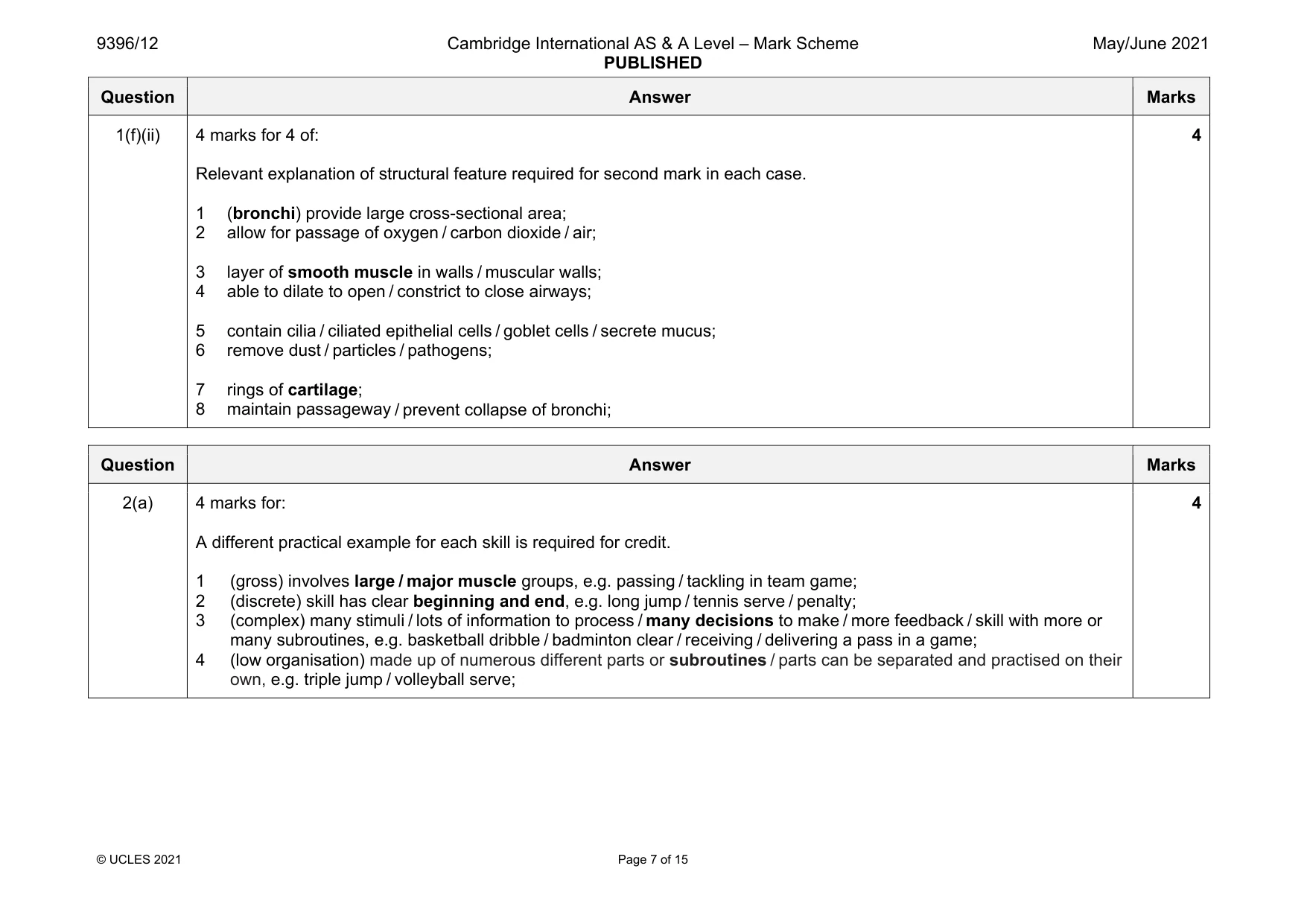
Mark scheme, page 7
9396/12 Cambridge International AS & A Level – Mark Scheme PUBLISHED May/June 2021 © UCLES 2021 Page 7 of 15 Question Answer Marks 1(f)(ii) 4 marks for 4 of: Relevant explanation of structural feature required for second mark in each case. 1 (bronchi) provide large cross-sectional area; 2 allow for passage of oxygen / carbon dioxide / air; 3 layer of smooth muscle in walls / muscular walls; 4 able to dilate to open / constrict to close airways; 5 contain cilia / ciliated epithelial cells / goblet cells / secrete mucus; 6 remove dust / particles / pathogens; 7 rings of cartilage; 8 maintain passageway / prevent collapse of bronchi; 4 Question Answer Marks 2(a) 4 marks for: A different practical example for each skill is required for credit. 1 (gross) involves large / major muscle groups, e.g. passing / tackling in team game; 2 (discrete) skill has clear beginning and end, e.g. long jump / tennis serve / penalty; 3 (complex) many stimuli / lots of information to process / many decisions to make / more feedback / skill with more or many subroutines, e.g. basketball dribble / badminton clear / receiving / delivering a pass in a game; 4 (low organisation) made up of numerous different parts or subroutines / parts can be separated and practised on their own, e.g. triple jump / volleyball serve; 4
Mark scheme, page 8
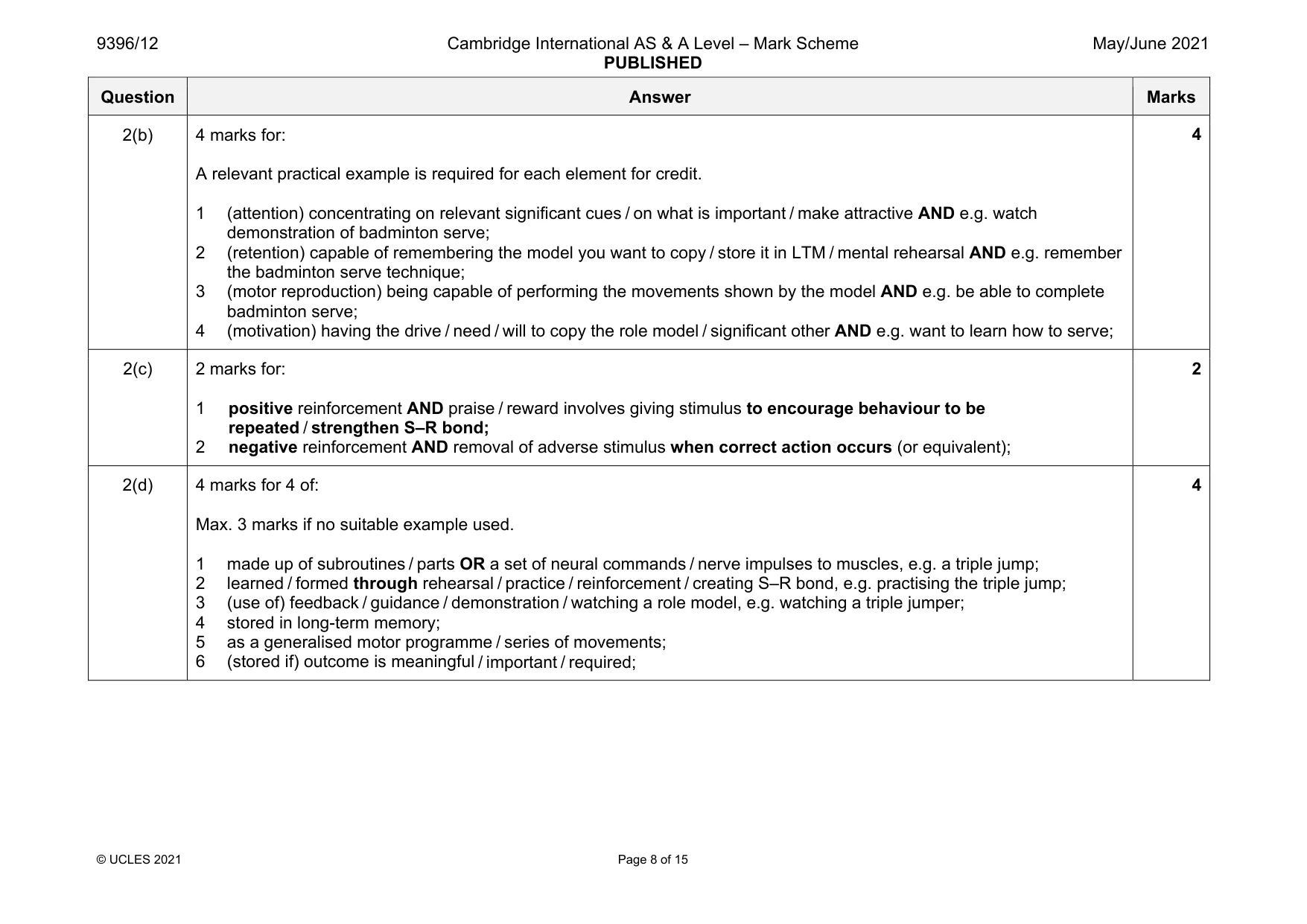
9396/12 Cambridge International AS & A Level – Mark Scheme PUBLISHED May/June 2021 © UCLES 2021 Page 8 of 15 Question Answer Marks 2(b) 4 marks for: A relevant practical example is required for each element for credit. 1 (attention) concentrating on relevant significant cues / on what is important / make attractive AND e.g. watch demonstration of badminton serve; 2 (retention) capable of remembering the model you want to copy / store it in LTM / mental rehearsal AND e.g. remember the badminton serve technique; 3 (motor reproduction) being capable of performing the movements shown by the model AND e.g. be able to complete badminton serve; 4 (motivation) having the drive / need / will to copy the role model / significant other AND e.g. want to learn how to serve; 4 2(c) 2 marks for: 1 positive reinforcement AND praise / reward involves giving stimulus to encourage behaviour to be repeated / strengthen S–R bond; 2 negative reinforcement AND removal of adverse stimulus when correct action occurs (or equivalent); 2 2(d) 4 marks for 4 of: Max. 3 marks if no suitable example used. 1 made up of subroutines / parts OR a set of neural commands / nerve impulses to muscles, e.g. a triple jump; 2 learned / formed through rehearsal / practice / reinforcement / creating S–R bond, e.g. practising the triple jump; 3 (use of) feedback / guidance / demonstration / watching a role model, e.g. watching a triple jumper; 4 stored in long-term memory; 5 as a generalised motor programme / series of movements; 6 (stored if) outcome is meaningful / important / required; 4
Mark scheme, page 9
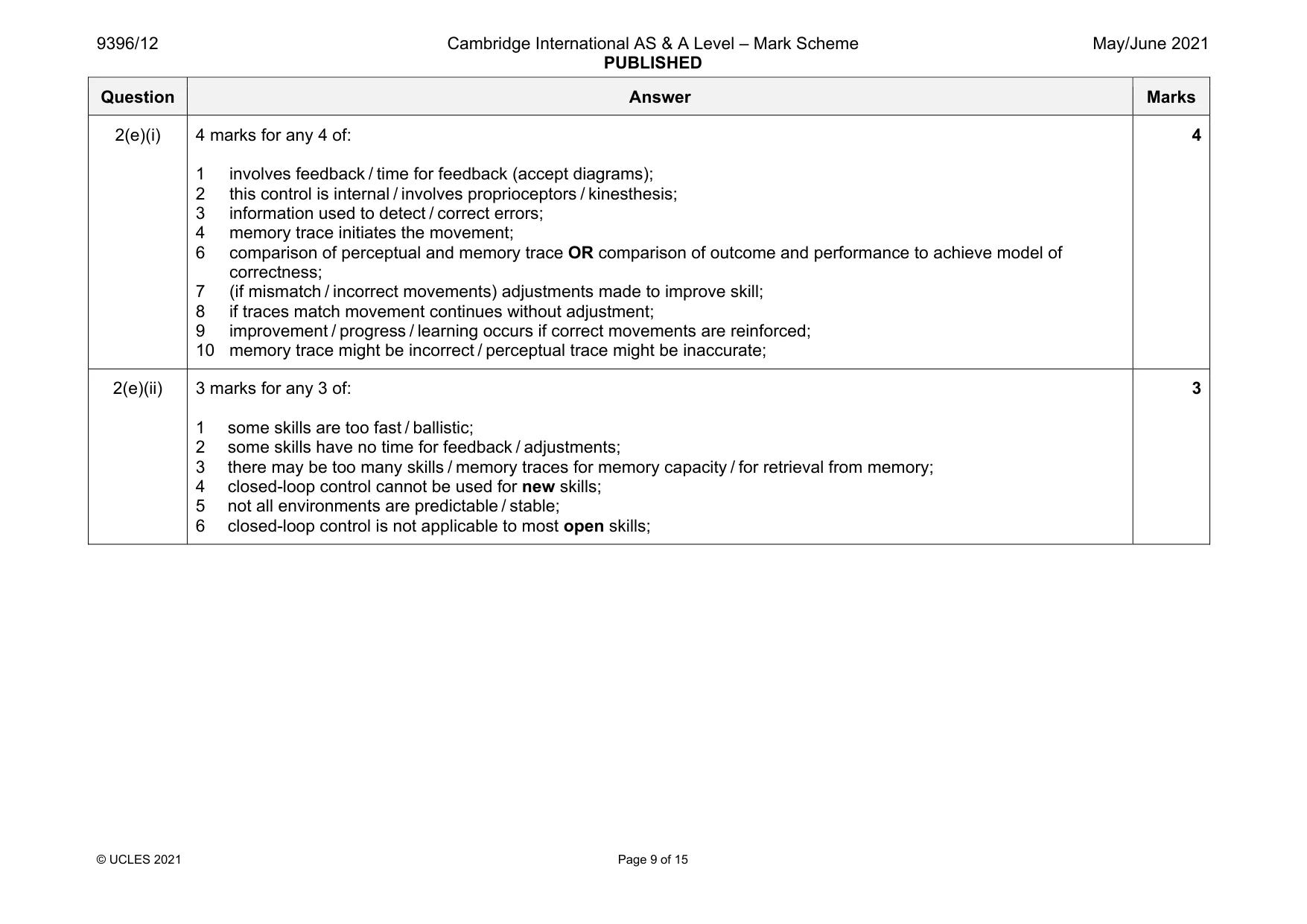
9396/12 Cambridge International AS & A Level – Mark Scheme PUBLISHED May/June 2021 © UCLES 2021 Page 9 of 15 Question Answer Marks 2(e)(i) 4 marks for any 4 of: 1 involves feedback / time for feedback (accept diagrams); 2 this control is internal / involves proprioceptors / kinesthesis; 3 information used to detect / correct errors; 4 memory trace initiates the movement; 6 comparison of perceptual and memory trace OR comparison of outcome and performance to achieve model of correctness; 7 (if mismatch / incorrect movements) adjustments made to improve skill; 8 if traces match movement continues without adjustment; 9 improvement / progress / learning occurs if correct movements are reinforced; 10 memory trace might be incorrect / perceptual trace might be inaccurate; 4 2(e)(ii) 3 marks for any 3 of: 1 some skills are too fast / ballistic; 2 some skills have no time for feedback / adjustments; 3 there may be too many skills / memory traces for memory capacity / for retrieval from memory; 4 closed-loop control cannot be used for new skills; 5 not all environments are predictable / stable; 6 closed-loop control is not applicable to most open skills; 3
Mark scheme, page 10
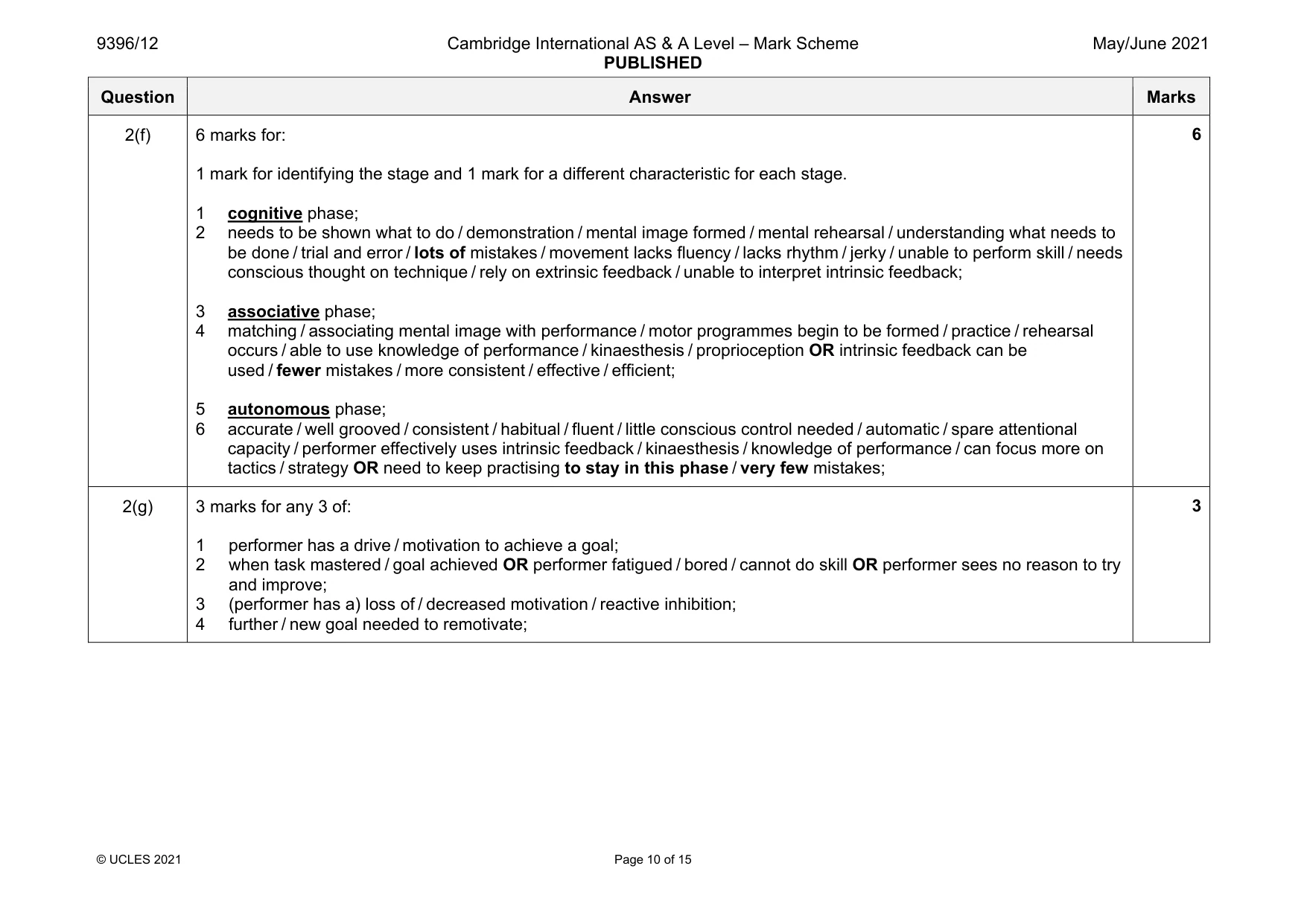
9396/12 Cambridge International AS & A Level – Mark Scheme PUBLISHED May/June 2021 © UCLES 2021 Page 10 of 15 Question Answer Marks 2(f) 6 marks for: 1 mark for identifying the stage and 1 mark for a different characteristic for each stage. 1 cognitive phase; 2 needs to be shown what to do / demonstration / mental image formed / mental rehearsal / understanding what needs to be done / trial and error / lots of mistakes / movement lacks fluency / lacks rhythm / jerky / unable to perform skill / needs conscious thought on technique / rely on extrinsic feedback / unable to interpret intrinsic feedback; 3 associative phase; 4 matching / associating mental image with performance / motor programmes begin to be formed / practice / rehearsal occurs / able to use knowledge of performance / kinaesthesis / proprioception OR intrinsic feedback can be used / fewer mistakes / more consistent / effective / efficient; 5 autonomous phase; 6 accurate / well grooved / consistent / habitual / fluent / little conscious control needed / automatic / spare attentional capacity / performer effectively uses intrinsic feedback / kinaesthesis / knowledge of performance / can focus more on tactics / strategy OR need to keep practising to stay in this phase / very few mistakes; 6 2(g) 3 marks for any 3 of: 1 performer has a drive / motivation to achieve a goal; 2 when task mastered / goal achieved OR performer fatigued / bored / cannot do skill OR performer sees no reason to try and improve; 3 (performer has a) loss of / decreased motivation / reactive inhibition; 4 further / new goal needed to remotivate; 3
Mark scheme, page 11
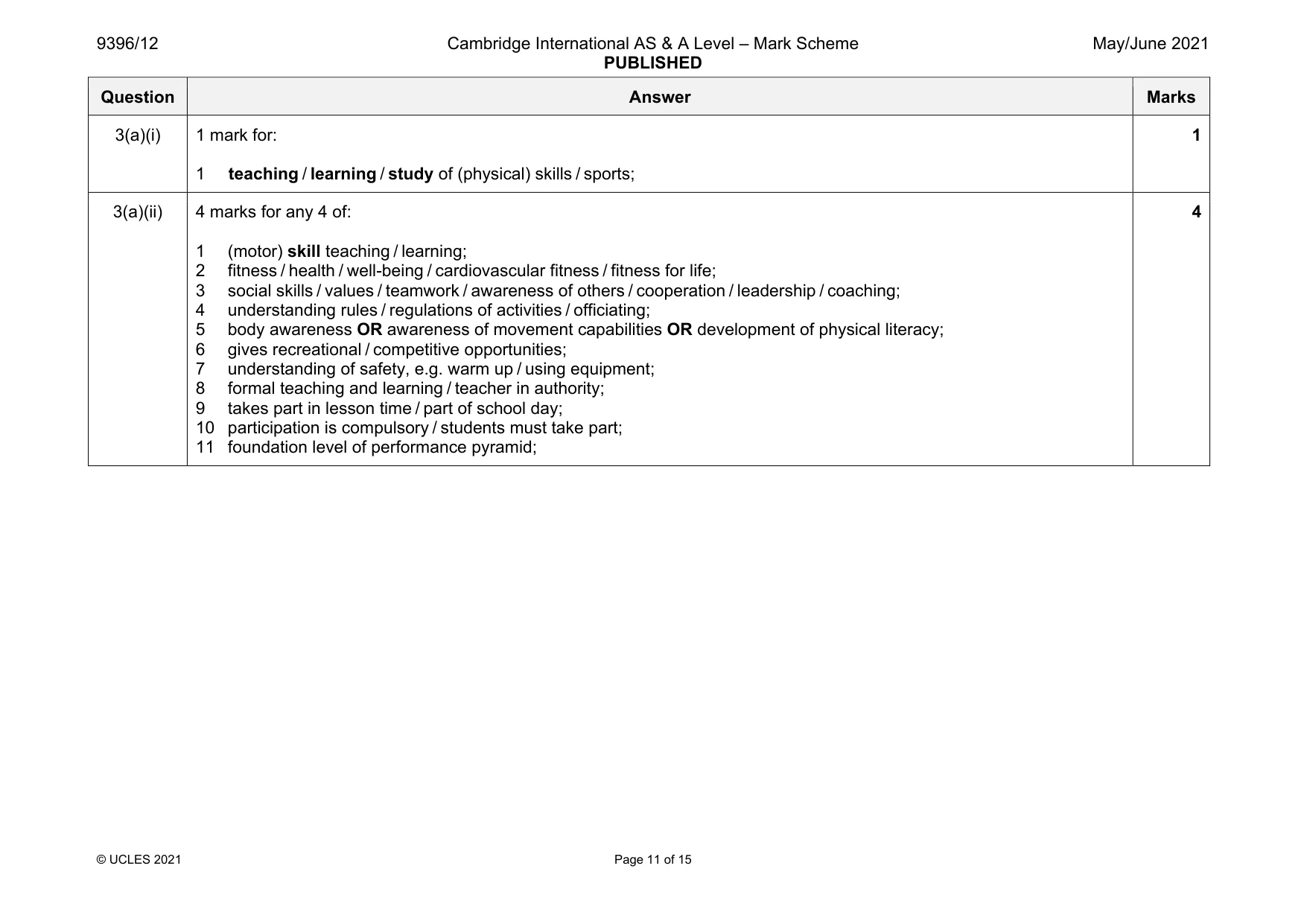
9396/12 Cambridge International AS & A Level – Mark Scheme PUBLISHED May/June 2021 © UCLES 2021 Page 11 of 15 Question Answer Marks 3(a)(i) 1 mark for: 1 teaching / learning / study of (physical) skills / sports; 1 3(a)(ii) 4 marks for any 4 of: 1 (motor) skill teaching / learning; 2 fitness / health / well-being / cardiovascular fitness / fitness for life; 3 social skills / values / teamwork / awareness of others / cooperation / leadership / coaching; 4 understanding rules / regulations of activities / officiating; 5 body awareness OR awareness of movement capabilities OR development of physical literacy; 6 gives recreational / competitive opportunities; 7 understanding of safety, e.g. warm up / using equipment; 8 formal teaching and learning / teacher in authority; 9 takes part in lesson time / part of school day; 10 participation is compulsory / students must take part; 11 foundation level of performance pyramid; 4
Mark scheme, page 12
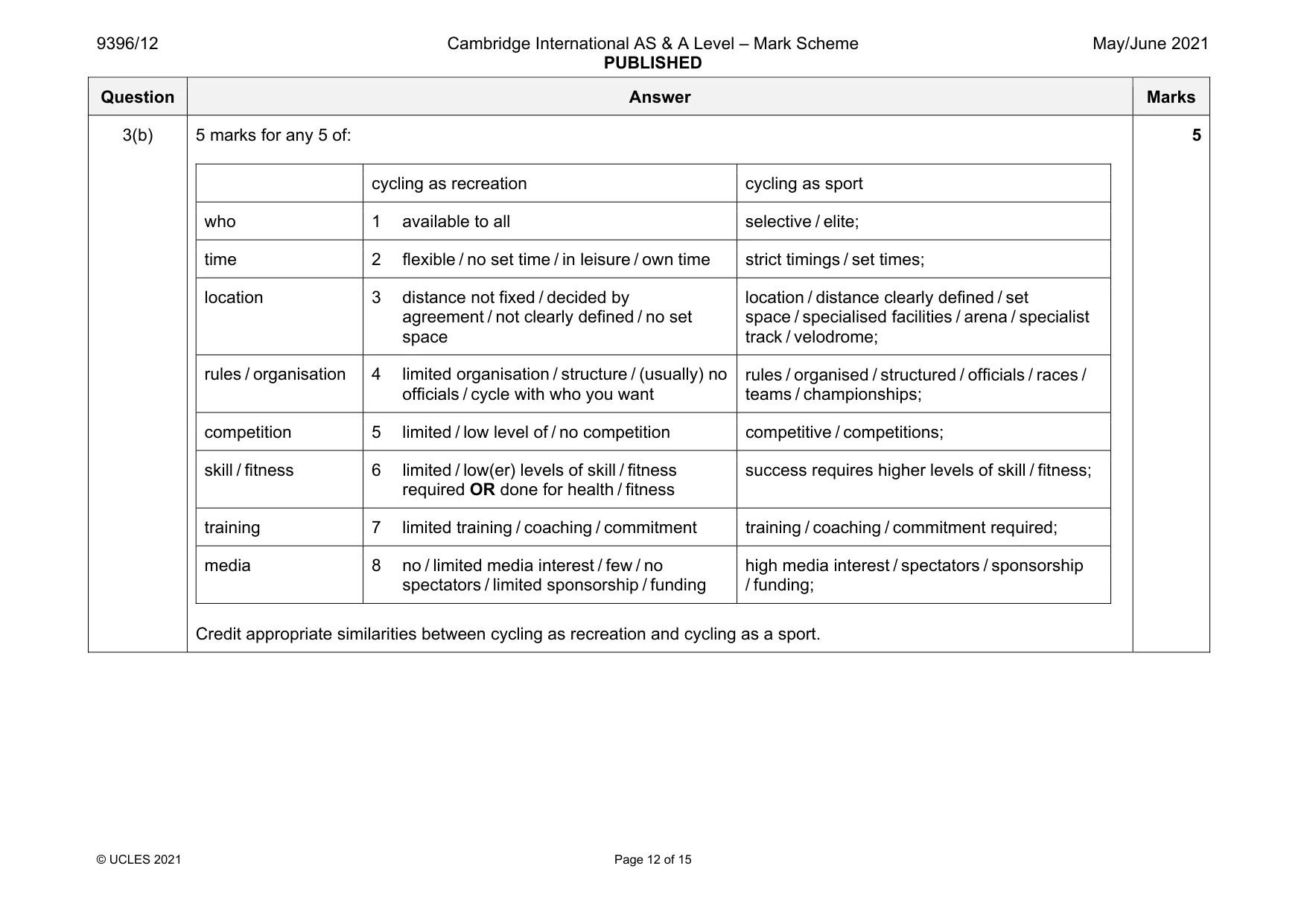
9396/12 Cambridge International AS & A Level – Mark Scheme PUBLISHED May/June 2021 © UCLES 2021 Page 12 of 15 Question Answer Marks 3(b) 5 marks for any 5 of: cycling as recreation cycling as sport who 1 available to all selective / elite; time 2 flexible / no set time / in leisure / own time strict timings / set times; location 3 distance not fixed / decided by agreement / not clearly defined / no set space location / distance clearly defined / set space / specialised facilities / arena / specialist track / velodrome; rules / organisation 4 limited organisation / structure / (usually) no officials / cycle with who you want rules / organised / structured / officials / races / teams / championships; competition 5 limited / low level of / no competition competitive / competitions; skill / fitness 6 limited / low(er) levels of skill / fitness required OR done for health / fitness success requires higher levels of skill / fitness; training 7 limited training / coaching / commitment training / coaching / commitment required; media 8 no / limited media interest / few / no spectators / limited sponsorship / funding high media interest / spectators / sponsorship / funding; Credit appropriate similarities between cycling as recreation and cycling as a sport. 5
Mark scheme, page 13
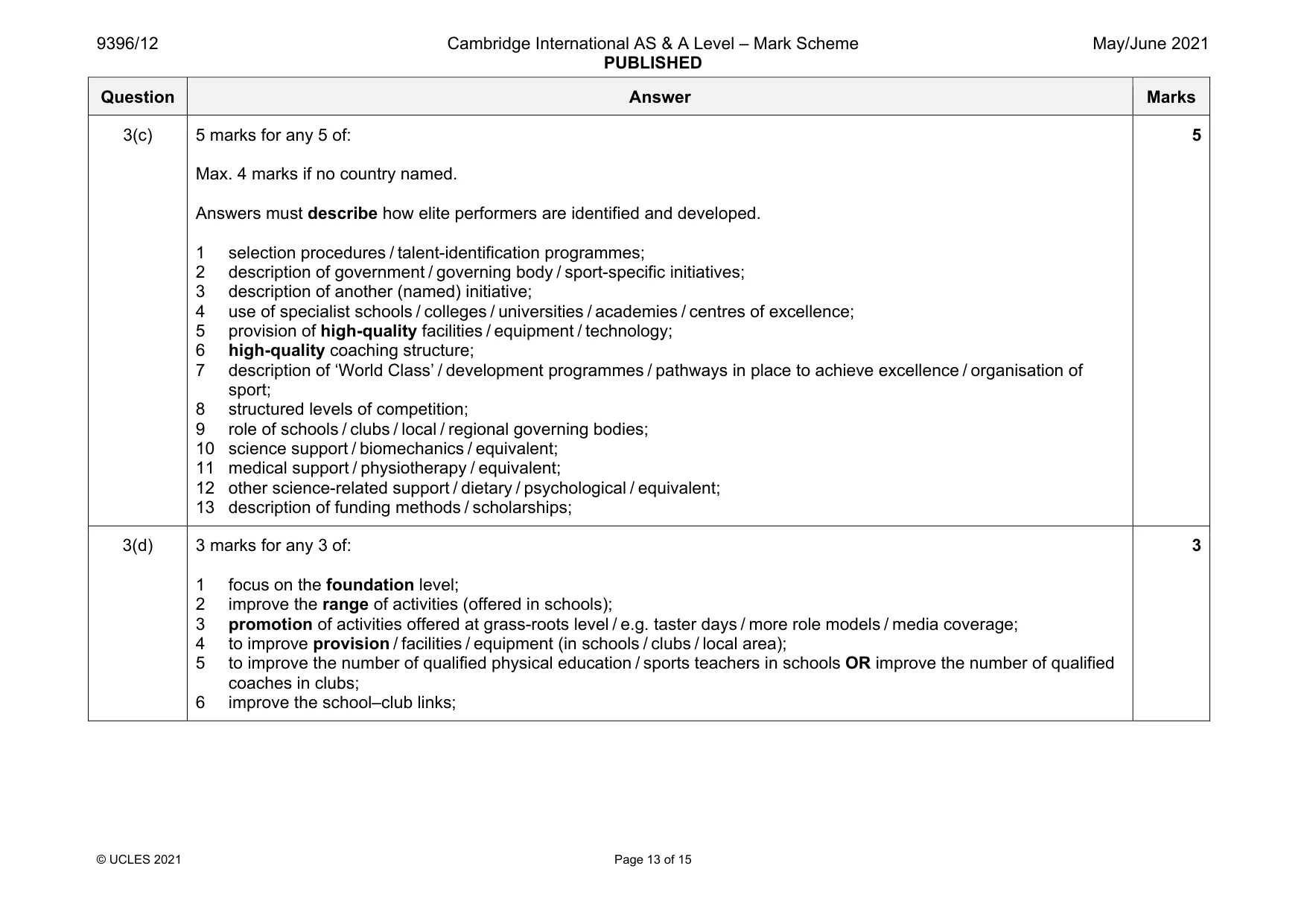
9396/12 Cambridge International AS & A Level – Mark Scheme PUBLISHED May/June 2021 © UCLES 2021 Page 13 of 15 Question Answer Marks 3(c) 5 marks for any 5 of: Max. 4 marks if no country named. Answers must describe how elite performers are identified and developed. 1 selection procedures / talent-identification programmes; 2 description of government / governing body / sport-specific initiatives; 3 description of another (named) initiative; 4 use of specialist schools / colleges / universities / academies / centres of excellence; 5 provision of high-quality facilities / equipment / technology; 6 high-quality coaching structure; 7 description of ‘World Class’ / development programmes / pathways in place to achieve excellence / organisation of sport; 8 structured levels of competition; 9 role of schools / clubs / local / regional governing bodies; 10 science support / biomechanics / equivalent; 11 medical support / physiotherapy / equivalent; 12 other science-related support / dietary / psychological / equivalent; 13 description of funding methods / scholarships; 5 3(d) 3 marks for any 3 of: 1 focus on the foundation level; 2 improve the range of activities (offered in schools); 3 promotion of activities offered at grass-roots level / e.g. taster days / more role models / media coverage; 4 to improve provision / facilities / equipment (in schools / clubs / local area); 5 to improve the number of qualified physical education / sports teachers in schools OR improve the number of qualified coaches in clubs; 6 improve the school–club links; 3
Mark scheme, page 14
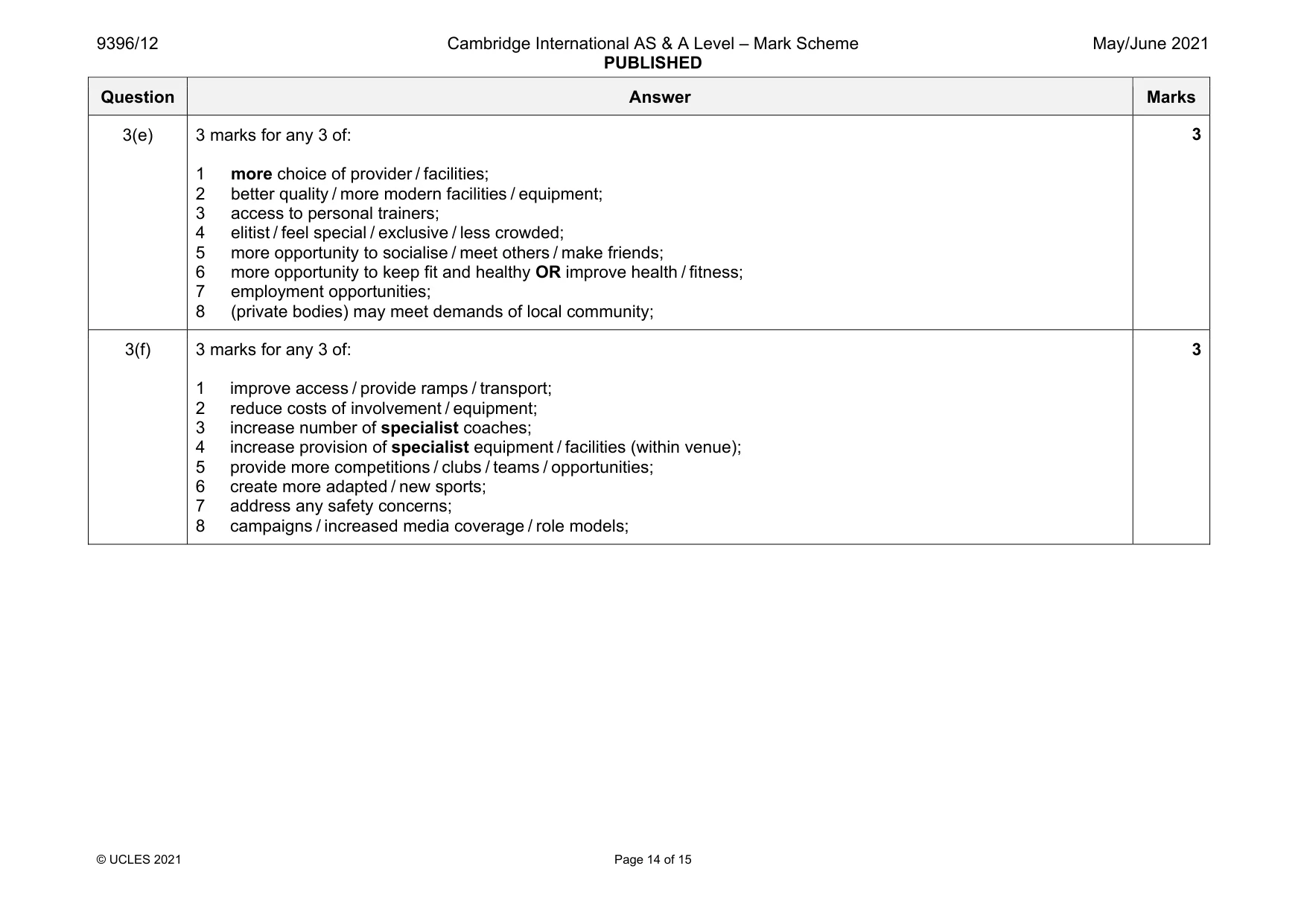
9396/12 Cambridge International AS & A Level – Mark Scheme PUBLISHED May/June 2021 © UCLES 2021 Page 14 of 15 Question Answer Marks 3(e) 3 marks for any 3 of: 1 more choice of provider / facilities; 2 better quality / more modern facilities / equipment; 3 access to personal trainers; 4 elitist / feel special / exclusive / less crowded; 5 more opportunity to socialise / meet others / make friends; 6 more opportunity to keep fit and healthy OR improve health / fitness; 7 employment opportunities; 8 (private bodies) may meet demands of local community; 3 3(f) 3 marks for any 3 of: 1 improve access / provide ramps / transport; 2 reduce costs of involvement / equipment; 3 increase number of specialist coaches; 4 increase provision of specialist equipment / facilities (within venue); 5 provide more competitions / clubs / teams / opportunities; 6 create more adapted / new sports; 7 address any safety concerns; 8 campaigns / increased media coverage / role models; 3
Mark scheme, page 15
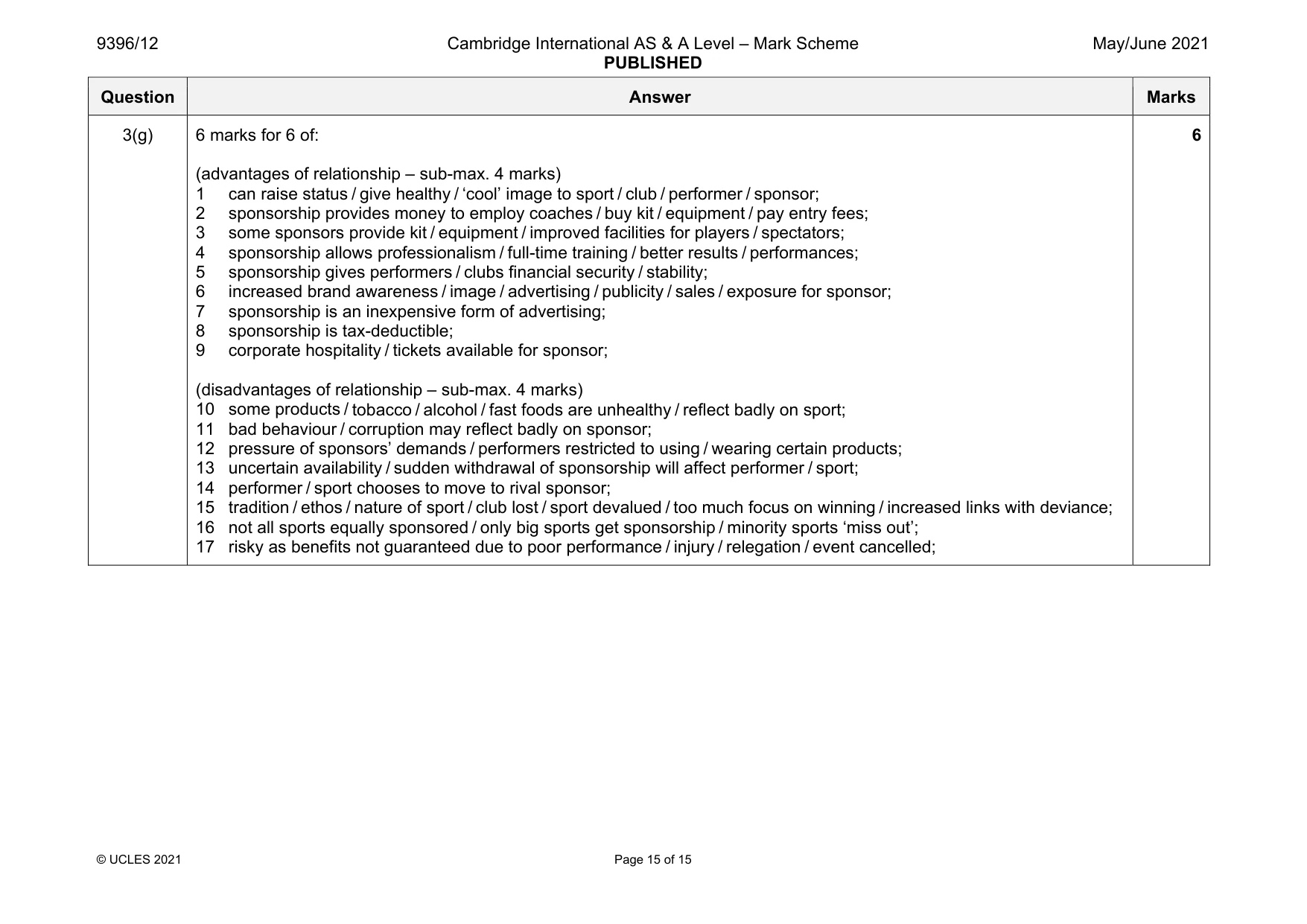
9396/12 Cambridge International AS & A Level – Mark Scheme PUBLISHED May/June 2021 © UCLES 2021 Page 15 of 15 Question Answer Marks 3(g) 6 marks for 6 of: (advantages of relationship – sub-max. 4 marks) 1 can raise status / give healthy / ‘cool’ image to sport / club / performer / sponsor; 2 sponsorship provides money to employ coaches / buy kit / equipment / pay entry fees; 3 some sponsors provide kit / equipment / improved facilities for players / spectators; 4 sponsorship allows professionalism / full-time training / better results / performances; 5 sponsorship gives performers / clubs financial security / stability; 6 increased brand awareness / image / advertising / publicity / sales / exposure for sponsor; 7 sponsorship is an inexpensive form of advertising; 8 sponsorship is tax-deductible; 9 corporate hospitality / tickets available for sponsor; (disadvantages of relationship – sub-max. 4 marks) 10 some products / tobacco / alcohol / fast foods are unhealthy / reflect badly on sport; 11 bad behaviour / corruption may reflect badly on sponsor; 12 pressure of sponsors’ demands / performers restricted to using / wearing certain products; 13 uncertain availability / sudden withdrawal of sponsorship will affect performer / sport; 14 performer / sport chooses to move to rival sponsor; 15 tradition / ethos / nature of sport / club lost / sport devalued / too much focus on winning / increased links with deviance; 16 not all sports equally sponsored / only big sports get sponsorship / minority sports ‘miss out’; 17 risky as benefits not guaranteed due to poor performance / injury / relegation / event cancelled; 6
What you needed in this session
Cambridge’s own grade thresholds for 2021 May/June, Paper 1 · Variant 2. A higher threshold means an easier paper — the bar moves with how the cohort did.