Cambridge A Level Physical Education 9396 — 2021 Oct/Nov Paper 1 · Variant 2
9396/12/O/N/21 · 90 marks · ≈101 min
The question paper and its mark scheme, free to read here and free to download. This is Cambridge’s own paper, exactly as it was sat.
Question paper8 pages



Mark scheme15 pages
Answers below. Sit the paper first if you are practising.
Paper as text
Question paper, page 1
This document has 8 pages. Any blank pages are indicated. Cambridge International AS & A Level DC (MS/CT) 198364/2 © UCLES 2021 [Turn over PHYSICAL EDUCATION 9396/12 Paper 1 October/November 2021 2 hours 30 minutes You must answer on the enclosed answer booklet. You will need: Answer booklet (enclosed) INSTRUCTIONS ● Answer all questions. ● Follow the instructions on the front cover of the answer booklet. If you need additional answer paper, ask the invigilator for a continuation booklet. ● You may use a calculator. ● You should show all your working and use appropriate units. INFORMATION ● The total mark for this paper is 90. ● The number of marks for each question or part question is shown in brackets [ ]. * 0 9 6 8 0 7 5 7 7 3 *
Question paper, page 2
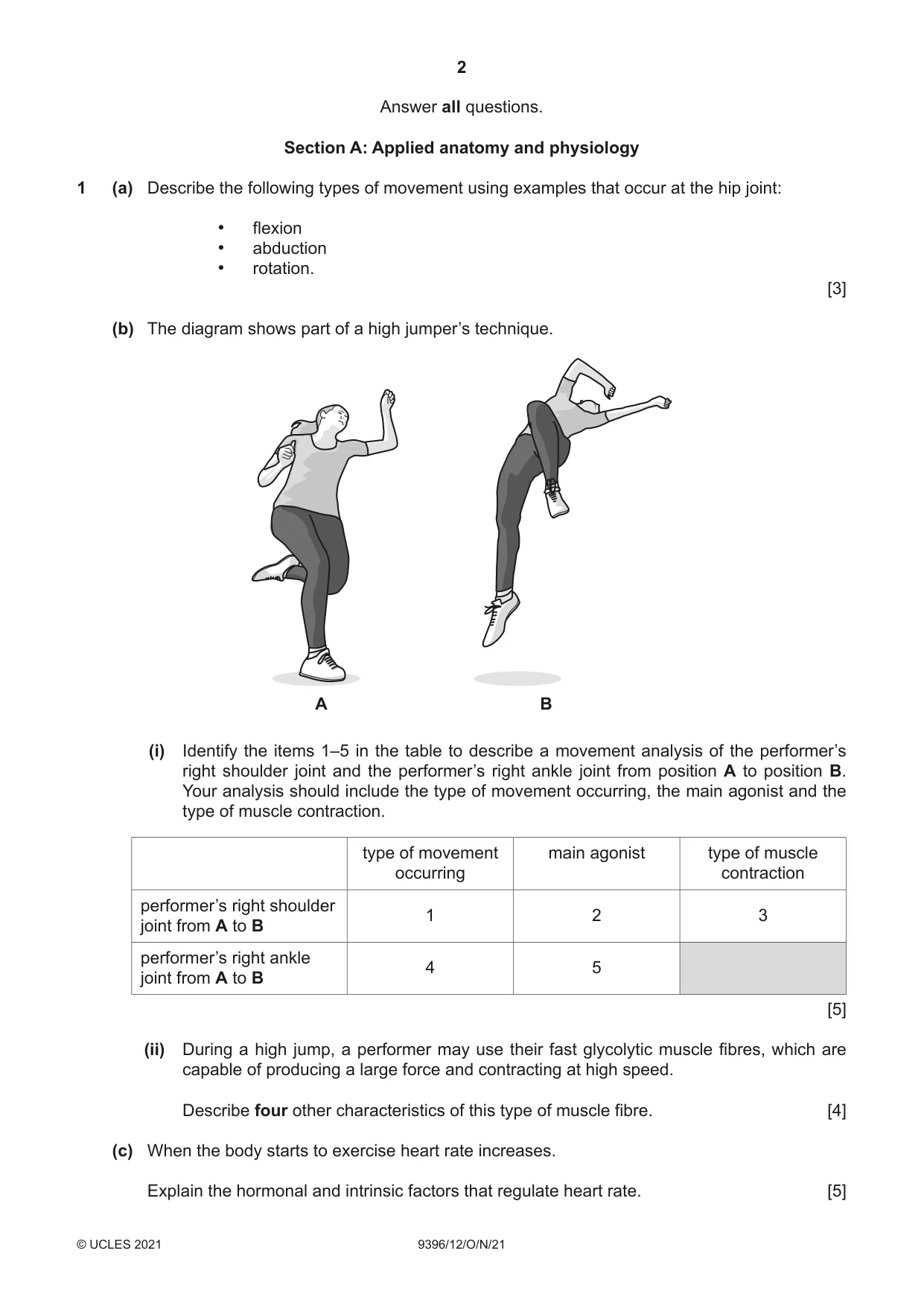
2 9396/12/O/N/21 © UCLES 2021 Answer all questions. Section A: Applied anatomy and physiology 1 (a) Describe the following types of movement using examples that occur at the hip joint: • flexion • abduction • rotation. [3] (b) The diagram shows part of a high jumper’s technique. A B (i) Identify the items 1–5 in the table to describe a movement analysis of the performer’s right shoulder joint and the performer’s right ankle joint from position A to position B. Your analysis should include the type of movement occurring, the main agonist and the type of muscle contraction. type of movement occurring main agonist type of muscle contraction performer’s right shoulder joint from A to B 1 2 3 performer’s right ankle joint from A to B 4 5 [5] (ii) During a high jump, a performer may use their fast glycolytic muscle fibres, which are capable of producing a large force and contracting at high speed. Describe four other characteristics of this type of muscle fibre. [4] (c) When the body starts to exercise heart rate increases. Explain the hormonal and intrinsic factors that regulate heart rate. [5]
Question paper, page 3
3 9396/12/O/N/21 © UCLES 2021 [Turn over (d) When running a performer will experience an increase in venous return. Describe how the skeletal muscle pump mechanism is assisted by running. [3] (e) Explain the effects of sub-maximal exercise on blood pressure. [4] (f) Describe how oxygen is transported to a muscle cell. [2] (g) Describe the mechanics of breathing during exercise. [4] [Total: 30]
Question paper, page 4
4 9396/12/O/N/21 © UCLES 2021 Section B: Acquiring, developing and performing movement skills 2 (a) Skilful performances are learned, aesthetically pleasing and follow a technical model. Identify three other characteristics of skilful performances. [3] (b) Explain how early childhood experiences and environmental exposure can affect the development of motor skills. [3] (c) Describe the operant conditioning theory of learning. [4] (d) Selective attention is a part of the basic model of the memory process. Suggest how a coach could improve a performer’s selective attention. [4] (e) Schema theory suggests that various sources of information are used to modify and evaluate motor programmes. (i) Explain the functions of recall schema. [3] (ii) Suggest how a coach may use schema theory to develop a performer’s skills. [3] (f) Explain, using a practical example, how the psychological refractory period can affect reaction time when performing a movement skill. [3] (g) Transfer of learning occurs when one skill affects the learning of another skill. (i) Describe a sporting example of positive transfer. [1] (ii) Explain how a coach could optimise the effects of positive transfer. [2] (h) Explain how excessive extrinsic motivation can have a negative effect on a performer. [4] [Total: 30]
Question paper, page 5
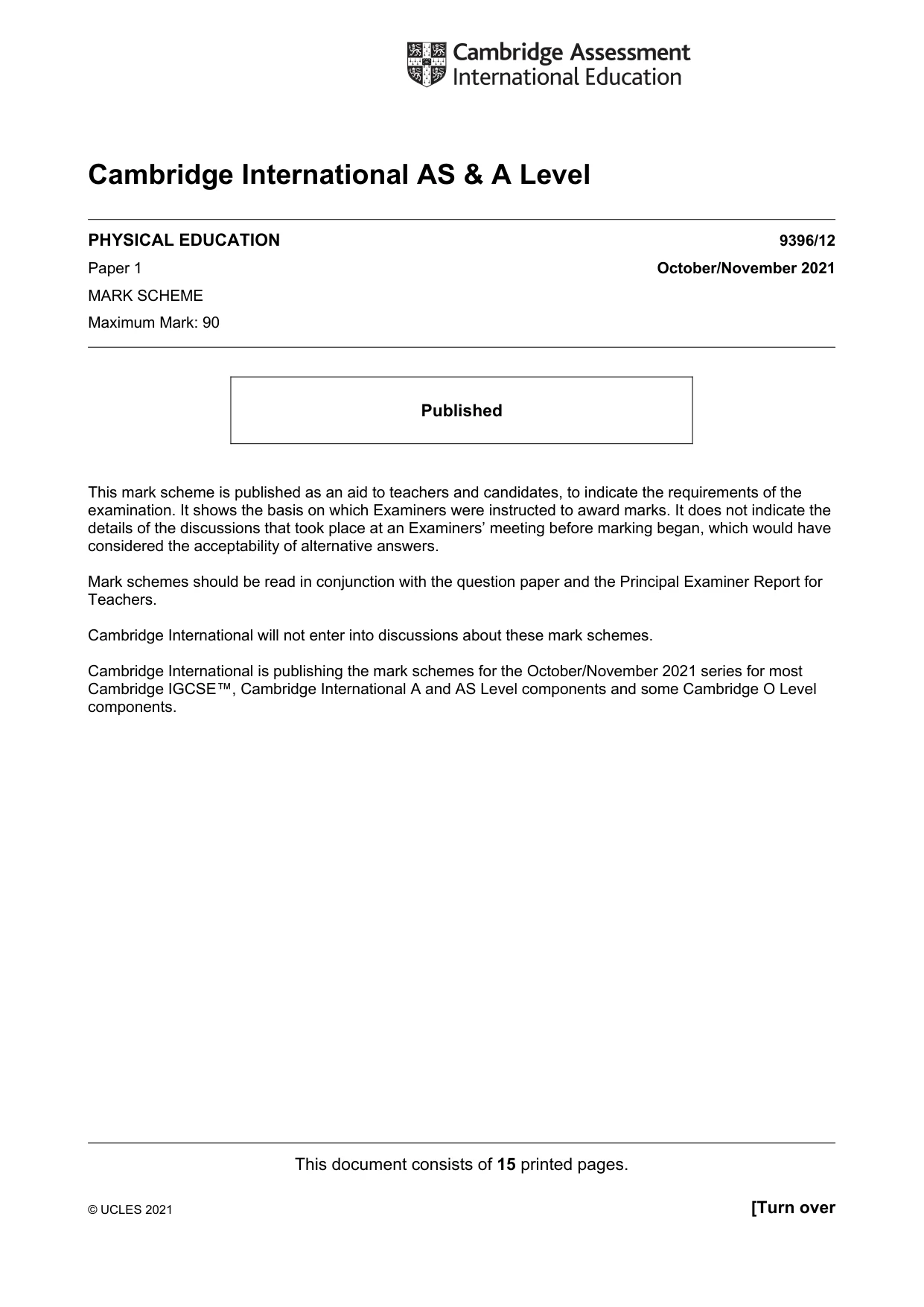
5 9396/12/O/N/21 © UCLES 2021 Section C: Contemporary studies in physical education and sport 3 (a) Outdoor education activities, such as hill walking and sailing, take place in the natural environment and involve an element of risk. (i) Explain, using examples from outdoor education, what is meant by the following: • real risk • perceived risk. [4] (ii) Suggest benefits for an individual of participating in outdoor education activities, such as hill walking and sailing. [4] (iii) Sailing is also a competitive sport. Other than being competitive, identify three characteristics of sport. [3] (b) Describe the provision required by a performer in order to achieve excellence in a sport. [5] (c) Compare public and private leisure facility provision. [3] (d) Suggest ways that more women can be encouraged to take part in physical activity. [4] (e) Describe how the ethic of fair play is encouraged and maintained in elite sport. [3] (f) Describe possible disadvantages for a performer of being sponsored. [4] [Total: 30]
Question paper, page 6
6 9396/12/O/N/21 © UCLES 2021 BLANK PAGE
Question paper, page 7
7 9396/12/O/N/21 © UCLES 2021 BLANK PAGE
Question paper, page 8
8 9396/12/O/N/21 © UCLES 2021 Permission to reproduce items where third-party owned material protected by copyright is included has been sought and cleared where possible. Every reasonable effort has been made by the publisher (UCLES) to trace copyright holders, but if any items requiring clearance have unwittingly been included, the publisher will be pleased to make amends at the earliest possible opportunity. To avoid the issue of disclosure of answer-related information to candidates, all copyright acknowledgements are reproduced online in the Cambridge Assessment International Education Copyright Acknowledgements Booklet. This is produced for each series of examinations and is freely available to download at www.cambridgeinternational.org after the live examination series. Cambridge Assessment International Education is part of the Cambridge Assessment Group. Cambridge Assessment is the brand name of the University of Cambridge Local Examinations Syndicate (UCLES), which itself is a department of the University of Cambridge. BLANK PAGE
Mark scheme, page 1
This document consists of 15 printed pages. © UCLES 2021 [Turn over Cambridge International AS & A Level PHYSICAL EDUCATION 9396/12 Paper 1 October/November 2021 MARK SCHEME Maximum Mark: 90 Published This mark scheme is published as an aid to teachers and candidates, to indicate the requirements of the examination. It shows the basis on which Examiners were instructed to award marks. It does not indicate the details of the discussions that took place at an Examiners’ meeting before marking began, which would have considered the acceptability of alternative answers. Mark schemes should be read in conjunction with the question paper and the Principal Examiner Report for Teachers. Cambridge International will not enter into discussions about these mark schemes. Cambridge International is publishing the mark schemes for the October/November 2021 series for most Cambridge IGCSE™, Cambridge International A and AS Level components and some Cambridge O Level components.
Mark scheme, page 2
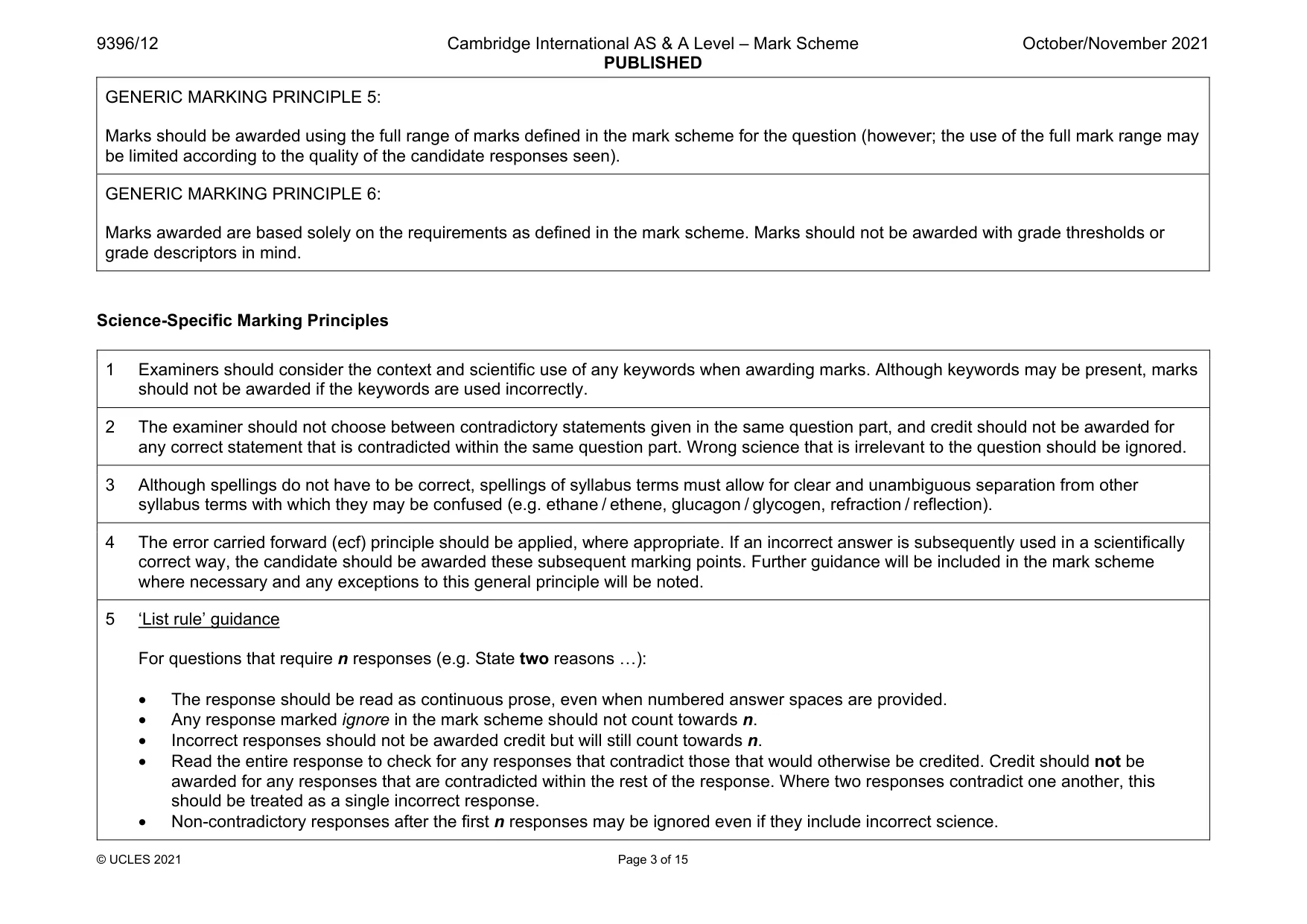
9396/12 Cambridge International AS & A Level – Mark Scheme PUBLISHED October/November 2021 © UCLES 2021 Page 2 of 15 Generic Marking Principles These general marking principles must be applied by all examiners when marking candidate answers. They should be applied alongside the specific content of the mark scheme or generic level descriptors for a question. Each question paper and mark scheme will also comply with these marking principles. GENERIC MARKING PRINCIPLE 1: Marks must be awarded in line with: • the specific content of the mark scheme or the generic level descriptors for the question • the specific skills defined in the mark scheme or in the generic level descriptors for the question • the standard of response required by a candidate as exemplified by the standardisation scripts. GENERIC MARKING PRINCIPLE 2: Marks awarded are always whole marks (not half marks, or other fractions). GENERIC MARKING PRINCIPLE 3: Marks must be awarded positively: • marks are awarded for correct/valid answers, as defined in the mark scheme. However, credit is given for valid answers which go beyond the scope of the syllabus and mark scheme, referring to your Team Leader as appropriate • marks are awarded when candidates clearly demonstrate what they know and can do • marks are not deducted for errors • marks are not deducted for omissions • answers should only be judged on the quality of spelling, punctuation and grammar when these features are specifically assessed by the question as indicated by the mark scheme. The meaning, however, should be unambiguous. GENERIC MARKING PRINCIPLE 4: Rules must be applied consistently, e.g. in situations where candidates have not followed instructions or in the application of generic level descriptors.
Mark scheme, page 3
9396/12 Cambridge International AS & A Level – Mark Scheme PUBLISHED October/November 2021 © UCLES 2021 Page 3 of 15 GENERIC MARKING PRINCIPLE 5: Marks should be awarded using the full range of marks defined in the mark scheme for the question (however; the use of the full mark range may be limited according to the quality of the candidate responses seen). GENERIC MARKING PRINCIPLE 6: Marks awarded are based solely on the requirements as defined in the mark scheme. Marks should not be awarded with grade thresholds or grade descriptors in mind. Science-Specific Marking Principles 1 Examiners should consider the context and scientific use of any keywords when awarding marks. Although keywords may be present, marks should not be awarded if the keywords are used incorrectly. 2 The examiner should not choose between contradictory statements given in the same question part, and credit should not be awarded for any correct statement that is contradicted within the same question part. Wrong science that is irrelevant to the question should be ignored. 3 Although spellings do not have to be correct, spellings of syllabus terms must allow for clear and unambiguous separation from other syllabus terms with which they may be confused (e.g. ethane / ethene, glucagon / glycogen, refraction / reflection). 4 The error carried forward (ecf) principle should be applied, where appropriate. If an incorrect answer is subsequently used in a scientifically correct way, the candidate should be awarded these subsequent marking points. Further guidance will be included in the mark scheme where necessary and any exceptions to this general principle will be noted. 5 ‘List rule’ guidance For questions that require n responses (e.g. State two reasons …): • The response should be read as continuous prose, even when numbered answer spaces are provided. • Any response marked ignore in the mark scheme should not count towards n. • Incorrect responses should not be awarded credit but will still count towards n. • Read the entire response to check for any responses that contradict those that would otherwise be credited. Credit should not be awarded for any responses that are contradicted within the rest of the response. Where two responses contradict one another, this should be treated as a single incorrect response. • Non-contradictory responses after the first n responses may be ignored even if they include incorrect science.
Mark scheme, page 4
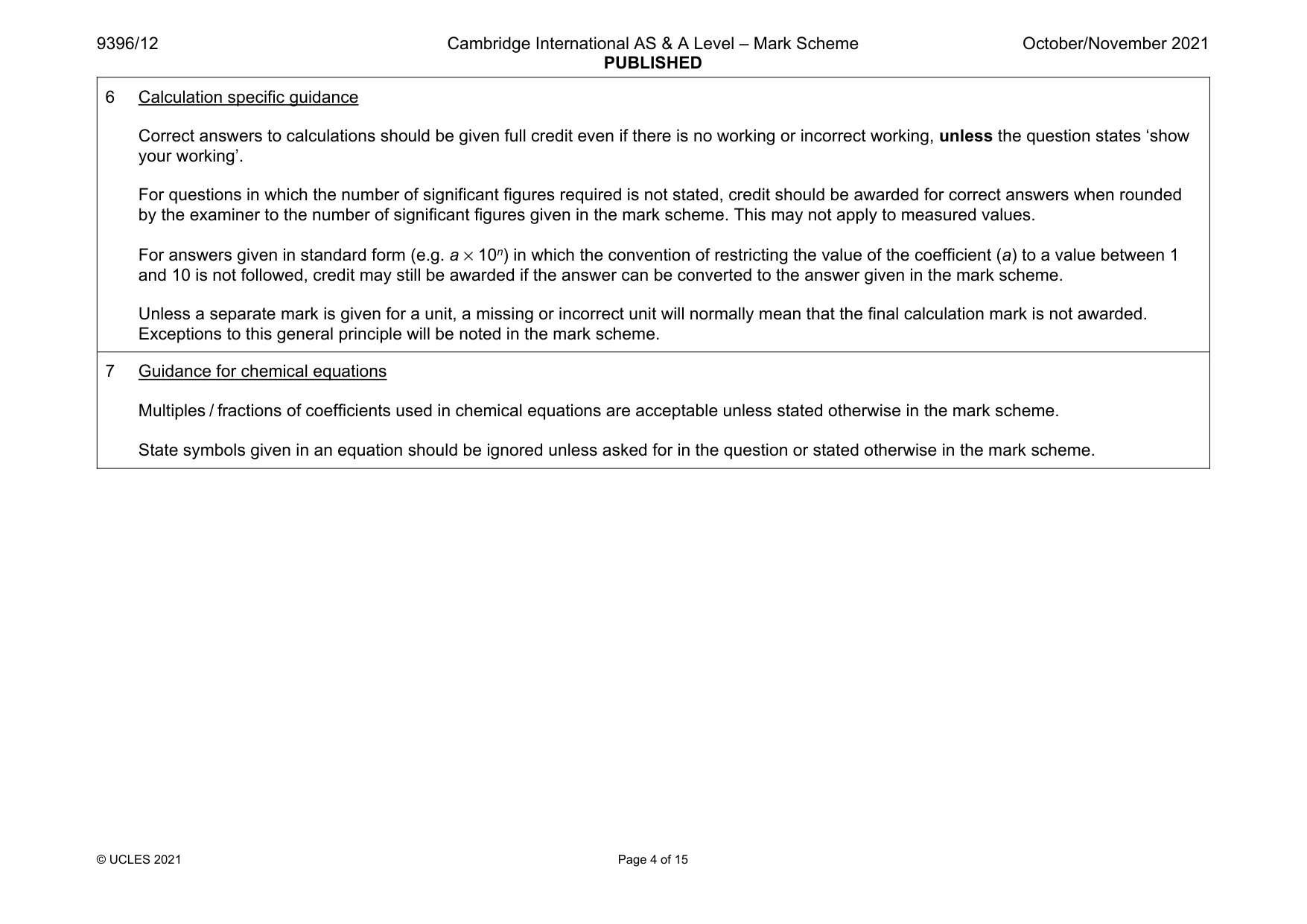
9396/12 Cambridge International AS & A Level – Mark Scheme PUBLISHED October/November 2021 © UCLES 2021 Page 4 of 15 6 Calculation specific guidance Correct answers to calculations should be given full credit even if there is no working or incorrect working, unless the question states ‘show your working’. For questions in which the number of significant figures required is not stated, credit should be awarded for correct answers when rounded by the examiner to the number of significant figures given in the mark scheme. This may not apply to measured values. For answers given in standard form (e.g. a × 10n) in which the convention of restricting the value of the coefficient (a) to a value between 1 and 10 is not followed, credit may still be awarded if the answer can be converted to the answer given in the mark scheme. Unless a separate mark is given for a unit, a missing or incorrect unit will normally mean that the final calculation mark is not awarded. Exceptions to this general principle will be noted in the mark scheme. 7 Guidance for chemical equations Multiples / fractions of coefficients used in chemical equations are acceptable unless stated otherwise in the mark scheme. State symbols given in an equation should be ignored unless asked for in the question or stated otherwise in the mark scheme.
Mark scheme, page 5
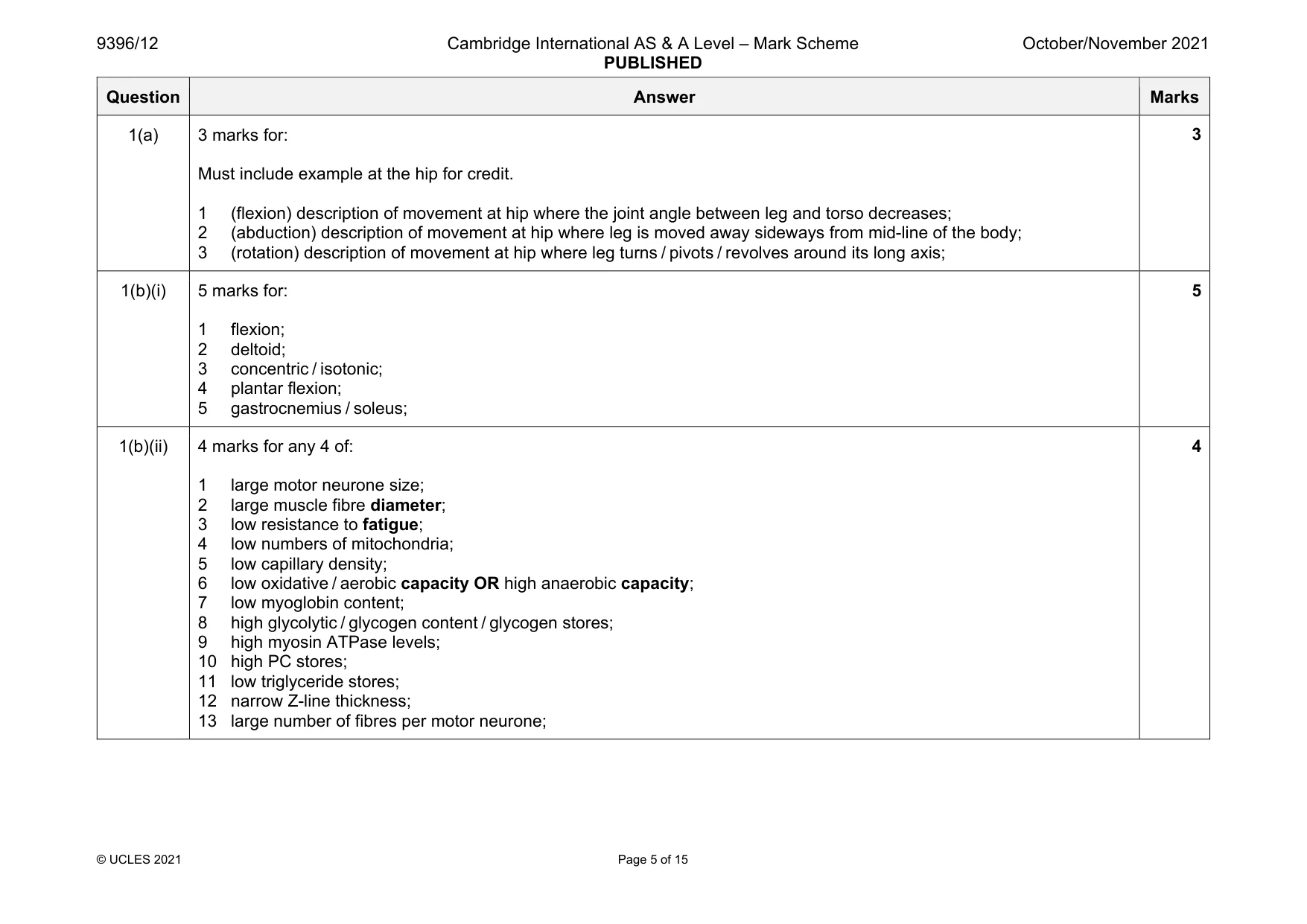
9396/12 Cambridge International AS & A Level – Mark Scheme PUBLISHED October/November 2021 © UCLES 2021 Page 5 of 15 Question Answer Marks 1(a) 3 marks for: Must include example at the hip for credit. 1 (flexion) description of movement at hip where the joint angle between leg and torso decreases; 2 (abduction) description of movement at hip where leg is moved away sideways from mid-line of the body; 3 (rotation) description of movement at hip where leg turns / pivots / revolves around its long axis; 3 1(b)(i) 5 marks for: 1 flexion; 2 deltoid; 3 concentric / isotonic; 4 plantar flexion; 5 gastrocnemius / soleus; 5 1(b)(ii) 4 marks for any 4 of: 1 large motor neurone size; 2 large muscle fibre diameter; 3 low resistance to fatigue; 4 low numbers of mitochondria; 5 low capillary density; 6 low oxidative / aerobic capacity OR high anaerobic capacity; 7 low myoglobin content; 8 high glycolytic / glycogen content / glycogen stores; 9 high myosin ATPase levels; 10 high PC stores; 11 low triglyceride stores; 12 narrow Z-line thickness; 13 large number of fibres per motor neurone; 4
Mark scheme, page 6
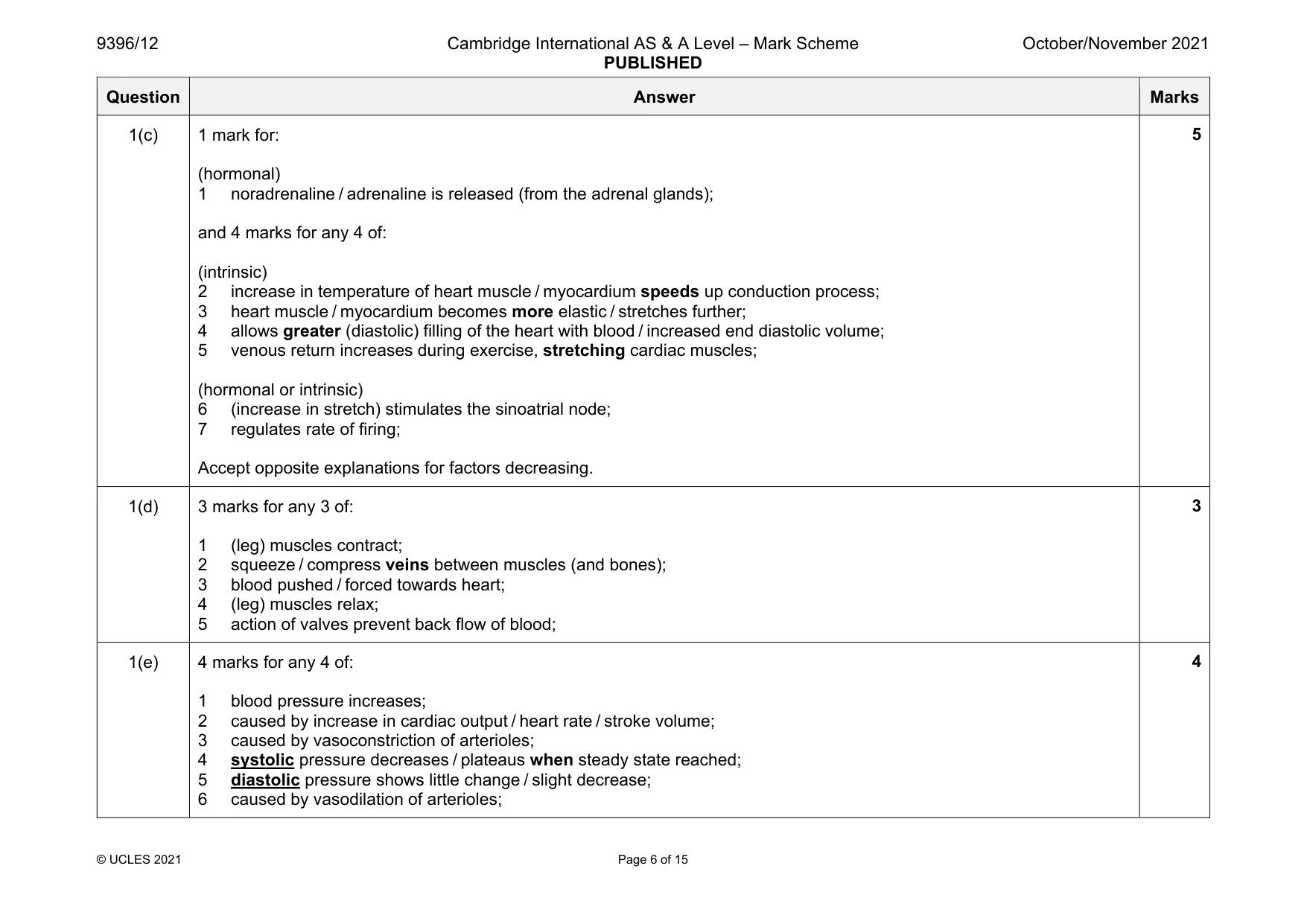
9396/12 Cambridge International AS & A Level – Mark Scheme PUBLISHED October/November 2021 © UCLES 2021 Page 6 of 15 Question Answer Marks 1(c) 1 mark for: (hormonal) 1 noradrenaline / adrenaline is released (from the adrenal glands); and 4 marks for any 4 of: (intrinsic) 2 increase in temperature of heart muscle / myocardium speeds up conduction process; 3 heart muscle / myocardium becomes more elastic / stretches further; 4 allows greater (diastolic) filling of the heart with blood / increased end diastolic volume; 5 venous return increases during exercise, stretching cardiac muscles; (hormonal or intrinsic) 6 (increase in stretch) stimulates the sinoatrial node; 7 regulates rate of firing; Accept opposite explanations for factors decreasing. 5 1(d) 3 marks for any 3 of: 1 (leg) muscles contract; 2 squeeze / compress veins between muscles (and bones); 3 blood pushed / forced towards heart; 4 (leg) muscles relax; 5 action of valves prevent back flow of blood; 3 1(e) 4 marks for any 4 of: 1 blood pressure increases; 2 caused by increase in cardiac output / heart rate / stroke volume; 3 caused by vasoconstriction of arterioles; 4 systolic pressure decreases / plateaus when steady state reached; 5 diastolic pressure shows little change / slight decrease; 6 caused by vasodilation of arterioles; 4
Mark scheme, page 7
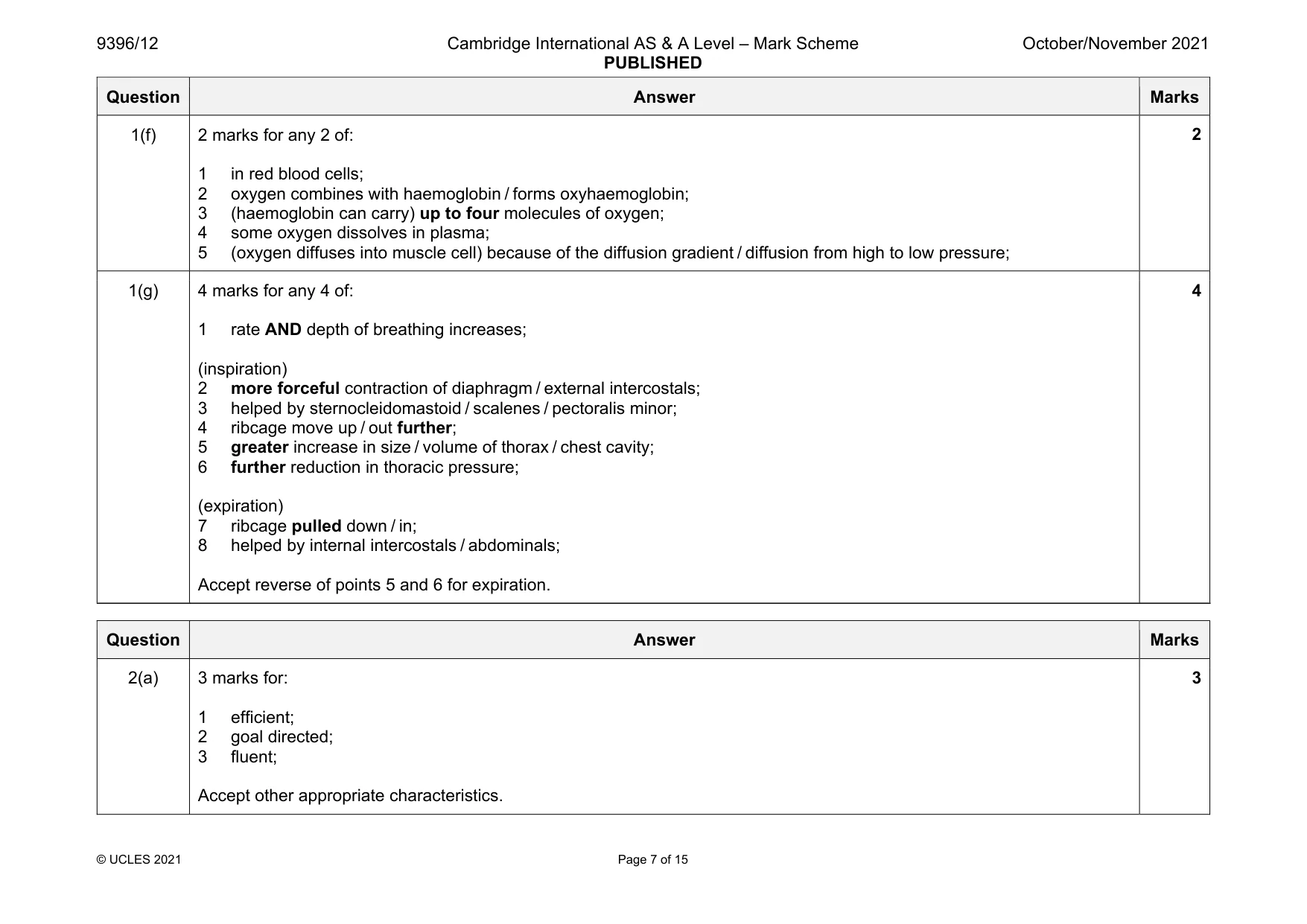
9396/12 Cambridge International AS & A Level – Mark Scheme PUBLISHED October/November 2021 © UCLES 2021 Page 7 of 15 Question Answer Marks 1(f) 2 marks for any 2 of: 1 in red blood cells; 2 oxygen combines with haemoglobin / forms oxyhaemoglobin; 3 (haemoglobin can carry) up to four molecules of oxygen; 4 some oxygen dissolves in plasma; 5 (oxygen diffuses into muscle cell) because of the diffusion gradient / diffusion from high to low pressure; 2 1(g) 4 marks for any 4 of: 1 rate AND depth of breathing increases; (inspiration) 2 more forceful contraction of diaphragm / external intercostals; 3 helped by sternocleidomastoid / scalenes / pectoralis minor; 4 ribcage move up / out further; 5 greater increase in size / volume of thorax / chest cavity; 6 further reduction in thoracic pressure; (expiration) 7 ribcage pulled down / in; 8 helped by internal intercostals / abdominals; Accept reverse of points 5 and 6 for expiration. 4 Question Answer Marks 2(a) 3 marks for: 1 efficient; 2 goal directed; 3 fluent; Accept other appropriate characteristics. 3
Mark scheme, page 8
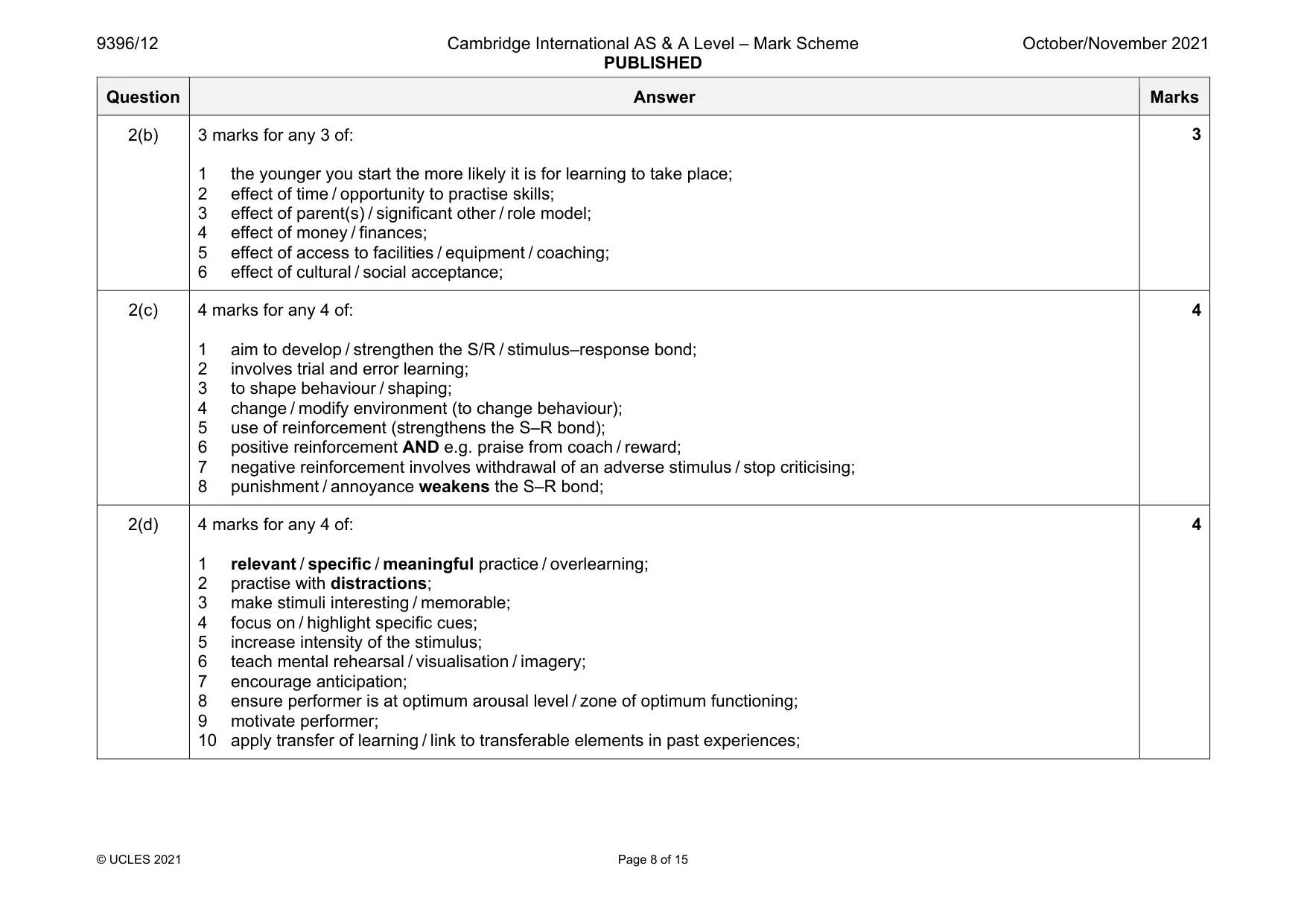
9396/12 Cambridge International AS & A Level – Mark Scheme PUBLISHED October/November 2021 © UCLES 2021 Page 8 of 15 Question Answer Marks 2(b) 3 marks for any 3 of: 1 the younger you start the more likely it is for learning to take place; 2 effect of time / opportunity to practise skills; 3 effect of parent(s) / significant other / role model; 4 effect of money / finances; 5 effect of access to facilities / equipment / coaching; 6 effect of cultural / social acceptance; 3 2(c) 4 marks for any 4 of: 1 aim to develop / strengthen the S/R / stimulus–response bond; 2 involves trial and error learning; 3 to shape behaviour / shaping; 4 change / modify environment (to change behaviour); 5 use of reinforcement (strengthens the S–R bond); 6 positive reinforcement AND e.g. praise from coach / reward; 7 negative reinforcement involves withdrawal of an adverse stimulus / stop criticising; 8 punishment / annoyance weakens the S–R bond; 4 2(d) 4 marks for any 4 of: 1 relevant / specific / meaningful practice / overlearning; 2 practise with distractions; 3 make stimuli interesting / memorable; 4 focus on / highlight specific cues; 5 increase intensity of the stimulus; 6 teach mental rehearsal / visualisation / imagery; 7 encourage anticipation; 8 ensure performer is at optimum arousal level / zone of optimum functioning; 9 motivate performer; 10 apply transfer of learning / link to transferable elements in past experiences; 4
Mark scheme, page 9
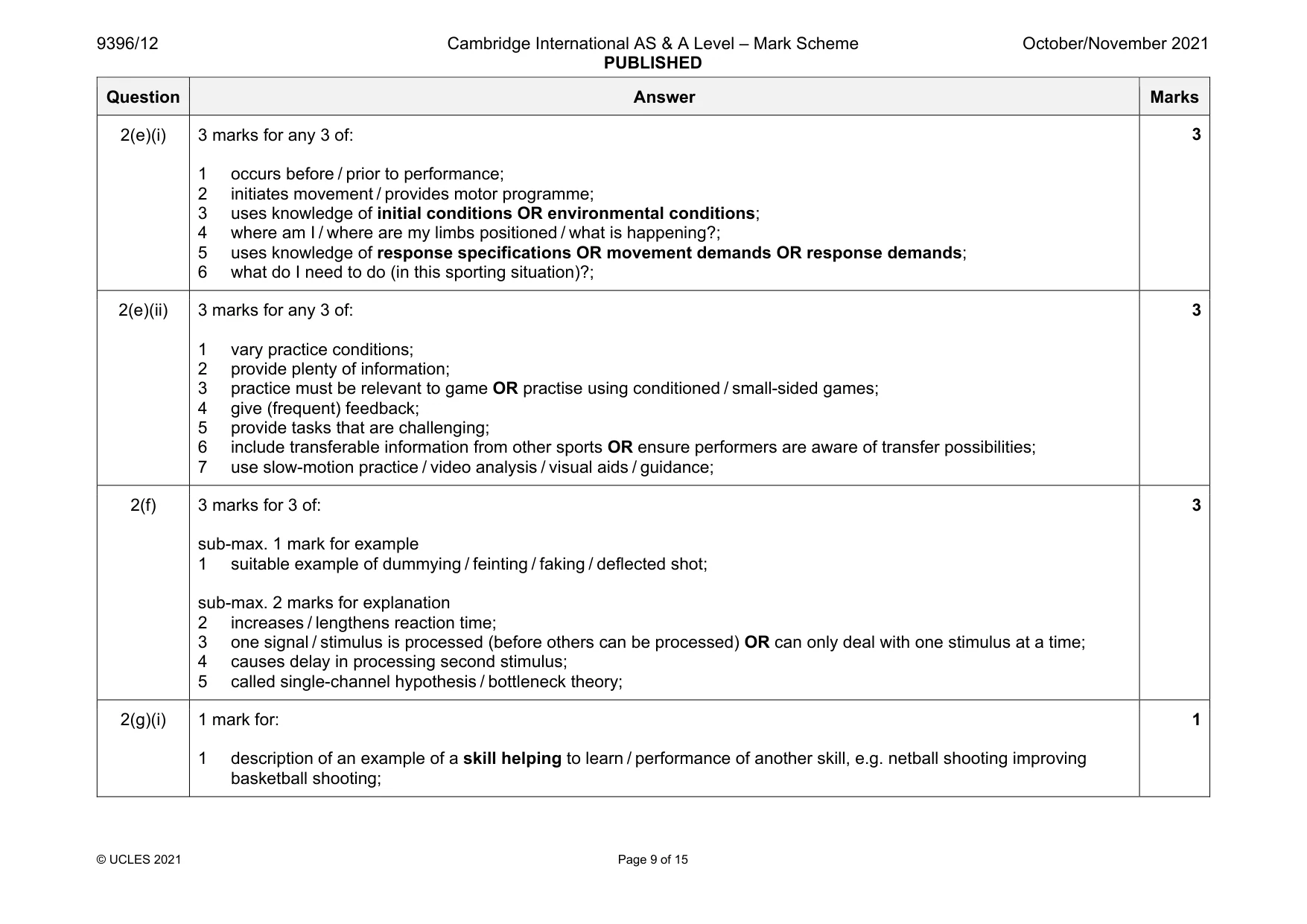
9396/12 Cambridge International AS & A Level – Mark Scheme PUBLISHED October/November 2021 © UCLES 2021 Page 9 of 15 Question Answer Marks 2(e)(i) 3 marks for any 3 of: 1 occurs before / prior to performance; 2 initiates movement / provides motor programme; 3 uses knowledge of initial conditions OR environmental conditions; 4 where am I / where are my limbs positioned / what is happening?; 5 uses knowledge of response specifications OR movement demands OR response demands; 6 what do I need to do (in this sporting situation)?; 3 2(e)(ii) 3 marks for any 3 of: 1 vary practice conditions; 2 provide plenty of information; 3 practice must be relevant to game OR practise using conditioned / small-sided games; 4 give (frequent) feedback; 5 provide tasks that are challenging; 6 include transferable information from other sports OR ensure performers are aware of transfer possibilities; 7 use slow-motion practice / video analysis / visual aids / guidance; 3 2(f) 3 marks for 3 of: sub-max. 1 mark for example 1 suitable example of dummying / feinting / faking / deflected shot; sub-max. 2 marks for explanation 2 increases / lengthens reaction time; 3 one signal / stimulus is processed (before others can be processed) OR can only deal with one stimulus at a time; 4 causes delay in processing second stimulus; 5 called single-channel hypothesis / bottleneck theory; 3 2(g)(i) 1 mark for: 1 description of an example of a skill helping to learn / performance of another skill, e.g. netball shooting improving basketball shooting; 1
Mark scheme, page 10
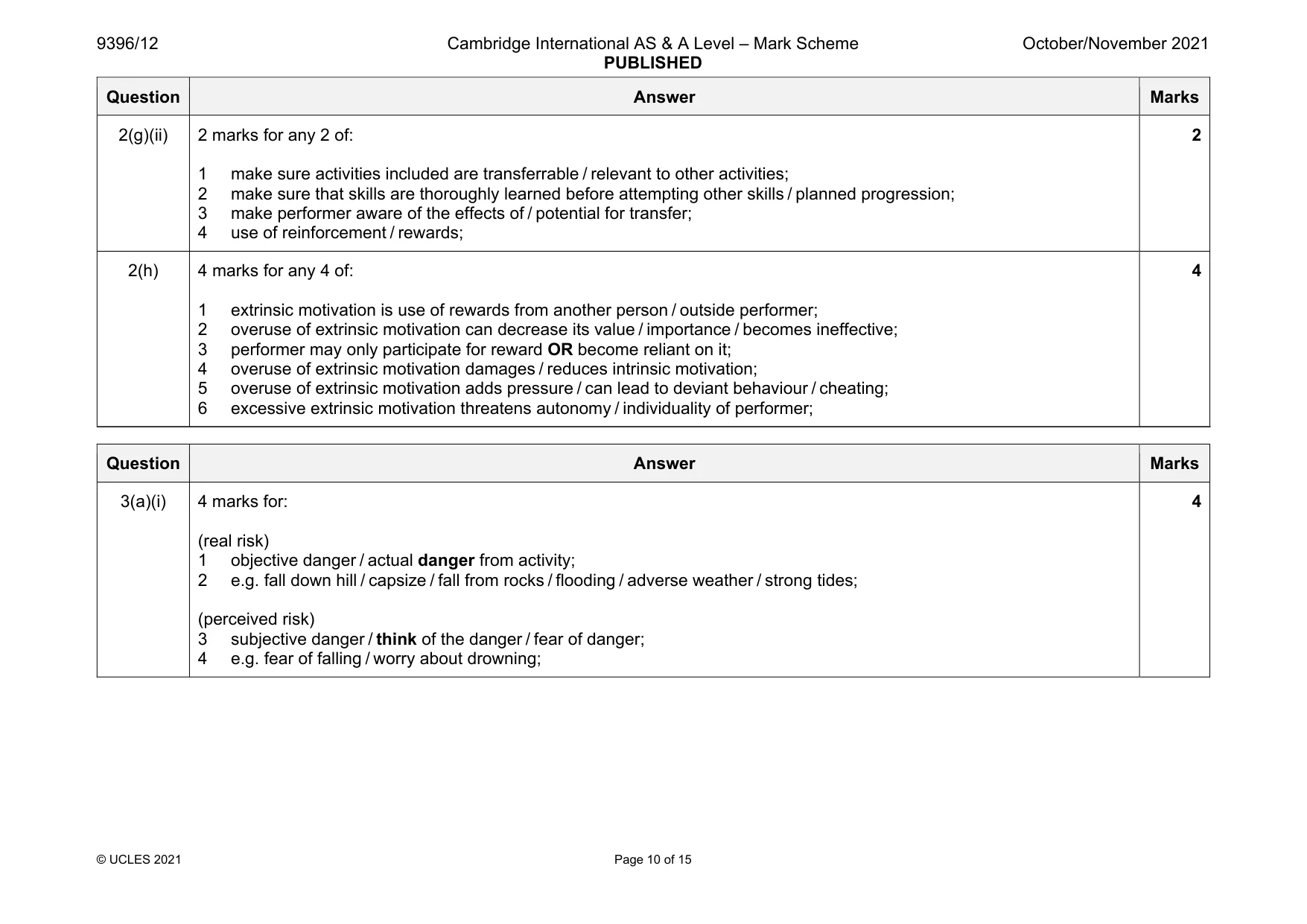
9396/12 Cambridge International AS & A Level – Mark Scheme PUBLISHED October/November 2021 © UCLES 2021 Page 10 of 15 Question Answer Marks 2(g)(ii) 2 marks for any 2 of: 1 make sure activities included are transferrable / relevant to other activities; 2 make sure that skills are thoroughly learned before attempting other skills / planned progression; 3 make performer aware of the effects of / potential for transfer; 4 use of reinforcement / rewards; 2 2(h) 4 marks for any 4 of: 1 extrinsic motivation is use of rewards from another person / outside performer; 2 overuse of extrinsic motivation can decrease its value / importance / becomes ineffective; 3 performer may only participate for reward OR become reliant on it; 4 overuse of extrinsic motivation damages / reduces intrinsic motivation; 5 overuse of extrinsic motivation adds pressure / can lead to deviant behaviour / cheating; 6 excessive extrinsic motivation threatens autonomy / individuality of performer; 4 Question Answer Marks 3(a)(i) 4 marks for: (real risk) 1 objective danger / actual danger from activity; 2 e.g. fall down hill / capsize / fall from rocks / flooding / adverse weather / strong tides; (perceived risk) 3 subjective danger / think of the danger / fear of danger; 4 e.g. fear of falling / worry about drowning; 4
Mark scheme, page 11
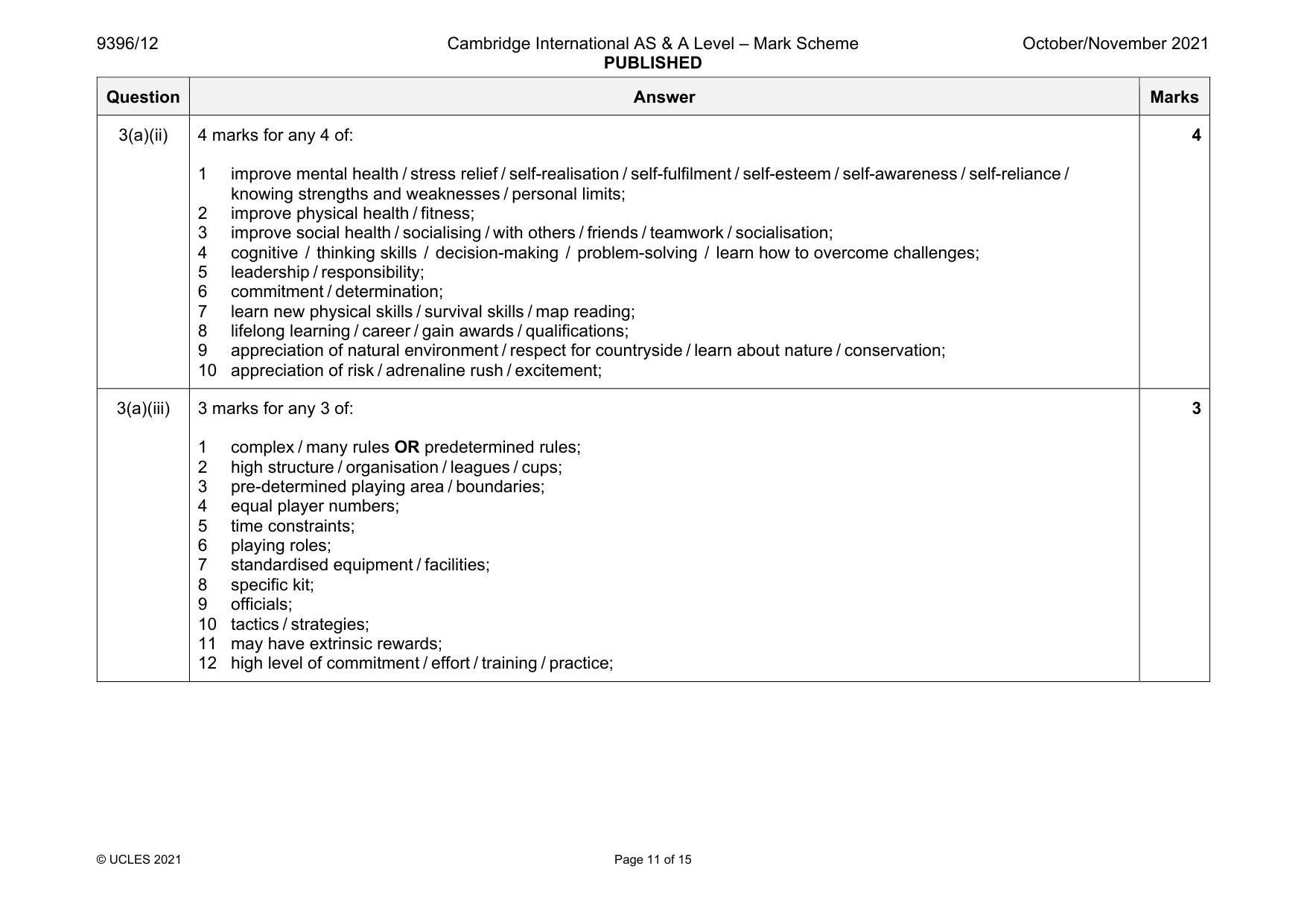
9396/12 Cambridge International AS & A Level – Mark Scheme PUBLISHED October/November 2021 © UCLES 2021 Page 11 of 15 Question Answer Marks 3(a)(ii) 4 marks for any 4 of: 1 improve mental health / stress relief / self-realisation / self-fulfilment / self-esteem / self-awareness / self-reliance / knowing strengths and weaknesses / personal limits; 2 improve physical health / fitness; 3 improve social health / socialising / with others / friends / teamwork / socialisation; 4 cognitive / thinking skills / decision-making / problem-solving / learn how to overcome challenges; 5 leadership / responsibility; 6 commitment / determination; 7 learn new physical skills / survival skills / map reading; 8 lifelong learning / career / gain awards / qualifications; 9 appreciation of natural environment / respect for countryside / learn about nature / conservation; 10 appreciation of risk / adrenaline rush / excitement; 4 3(a)(iii) 3 marks for any 3 of: 1 complex / many rules OR predetermined rules; 2 high structure / organisation / leagues / cups; 3 pre-determined playing area / boundaries; 4 equal player numbers; 5 time constraints; 6 playing roles; 7 standardised equipment / facilities; 8 specific kit; 9 officials; 10 tactics / strategies; 11 may have extrinsic rewards; 12 high level of commitment / effort / training / practice; 3
Mark scheme, page 12
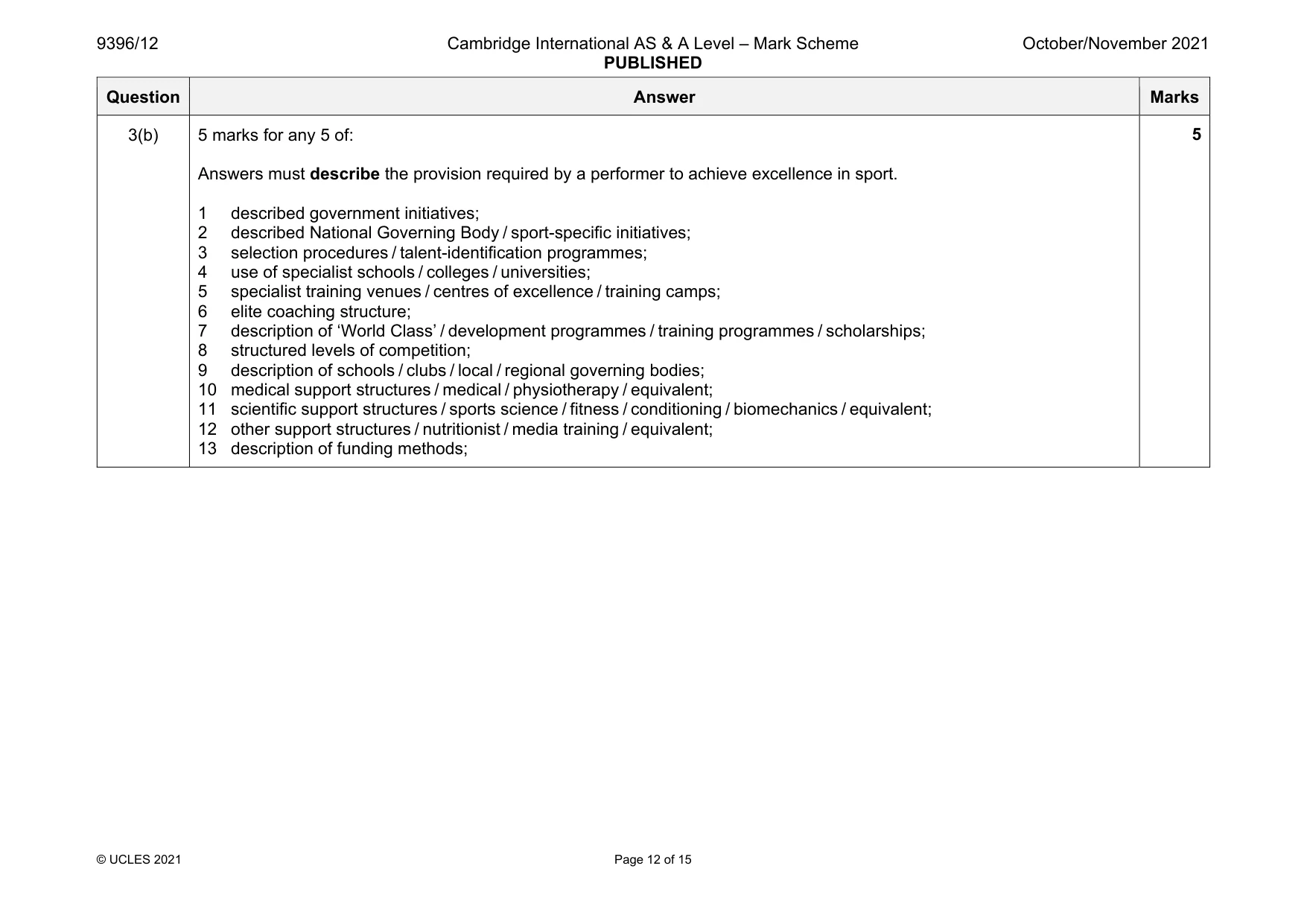
9396/12 Cambridge International AS & A Level – Mark Scheme PUBLISHED October/November 2021 © UCLES 2021 Page 12 of 15 Question Answer Marks 3(b) 5 marks for any 5 of: Answers must describe the provision required by a performer to achieve excellence in sport. 1 described government initiatives; 2 described National Governing Body / sport-specific initiatives; 3 selection procedures / talent-identification programmes; 4 use of specialist schools / colleges / universities; 5 specialist training venues / centres of excellence / training camps; 6 elite coaching structure; 7 description of ‘World Class’ / development programmes / training programmes / scholarships; 8 structured levels of competition; 9 description of schools / clubs / local / regional governing bodies; 10 medical support structures / medical / physiotherapy / equivalent; 11 scientific support structures / sports science / fitness / conditioning / biomechanics / equivalent; 12 other support structures / nutritionist / media training / equivalent; 13 description of funding methods; 5
Mark scheme, page 13
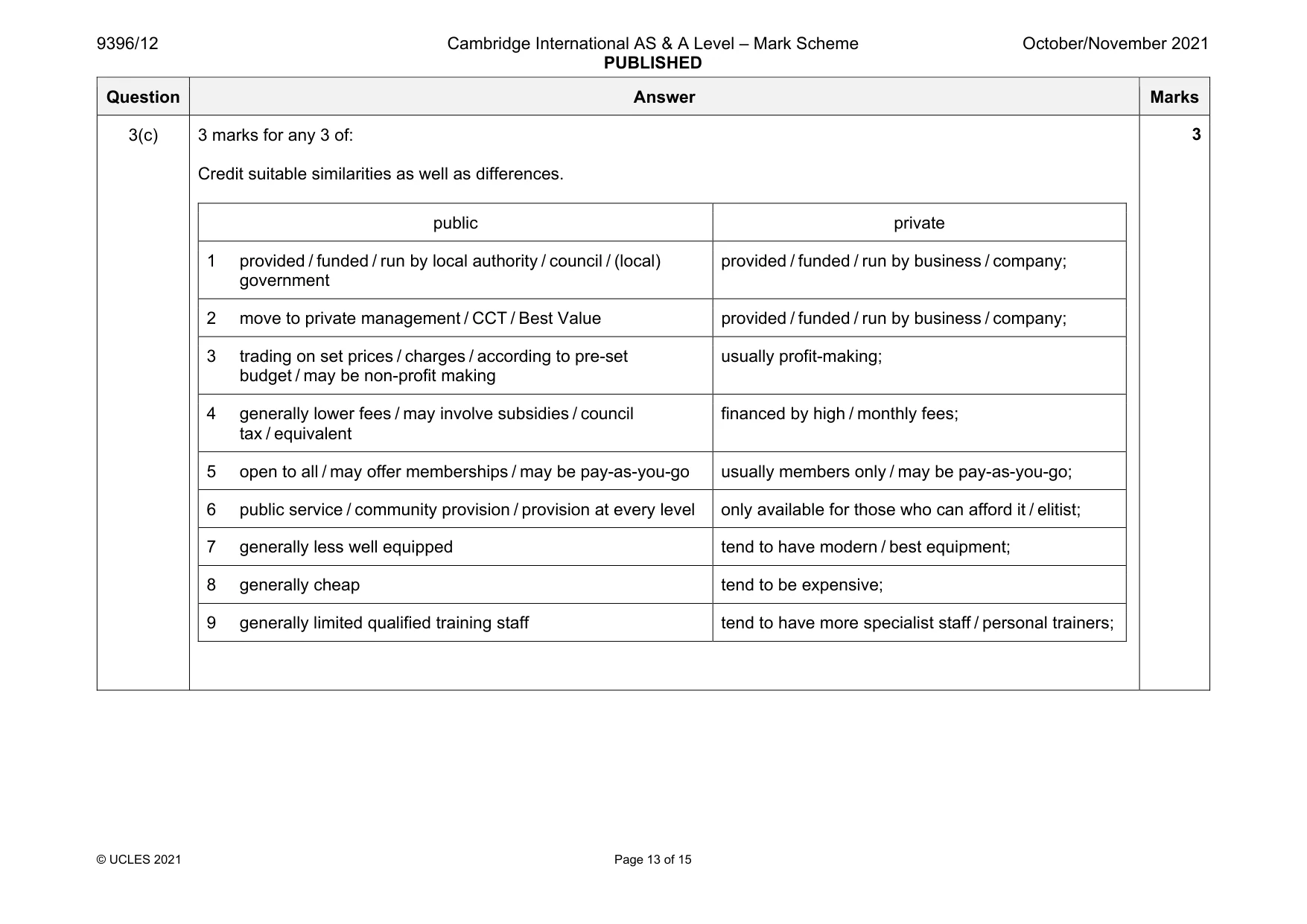
9396/12 Cambridge International AS & A Level – Mark Scheme PUBLISHED October/November 2021 © UCLES 2021 Page 13 of 15 Question Answer Marks 3(c) 3 marks for any 3 of: Credit suitable similarities as well as differences. public private 1 provided / funded / run by local authority / council / (local) government provided / funded / run by business / company; 2 move to private management / CCT / Best Value provided / funded / run by business / company; 3 trading on set prices / charges / according to pre-set budget / may be non-profit making usually profit-making; 4 generally lower fees / may involve subsidies / council tax / equivalent financed by high / monthly fees; 5 open to all / may offer memberships / may be pay-as-you-go usually members only / may be pay-as-you-go; 6 public service / community provision / provision at every level only available for those who can afford it / elitist; 7 generally less well equipped tend to have modern / best equipment; 8 generally cheap tend to be expensive; 9 generally limited qualified training staff tend to have more specialist staff / personal trainers; 3
Mark scheme, page 14
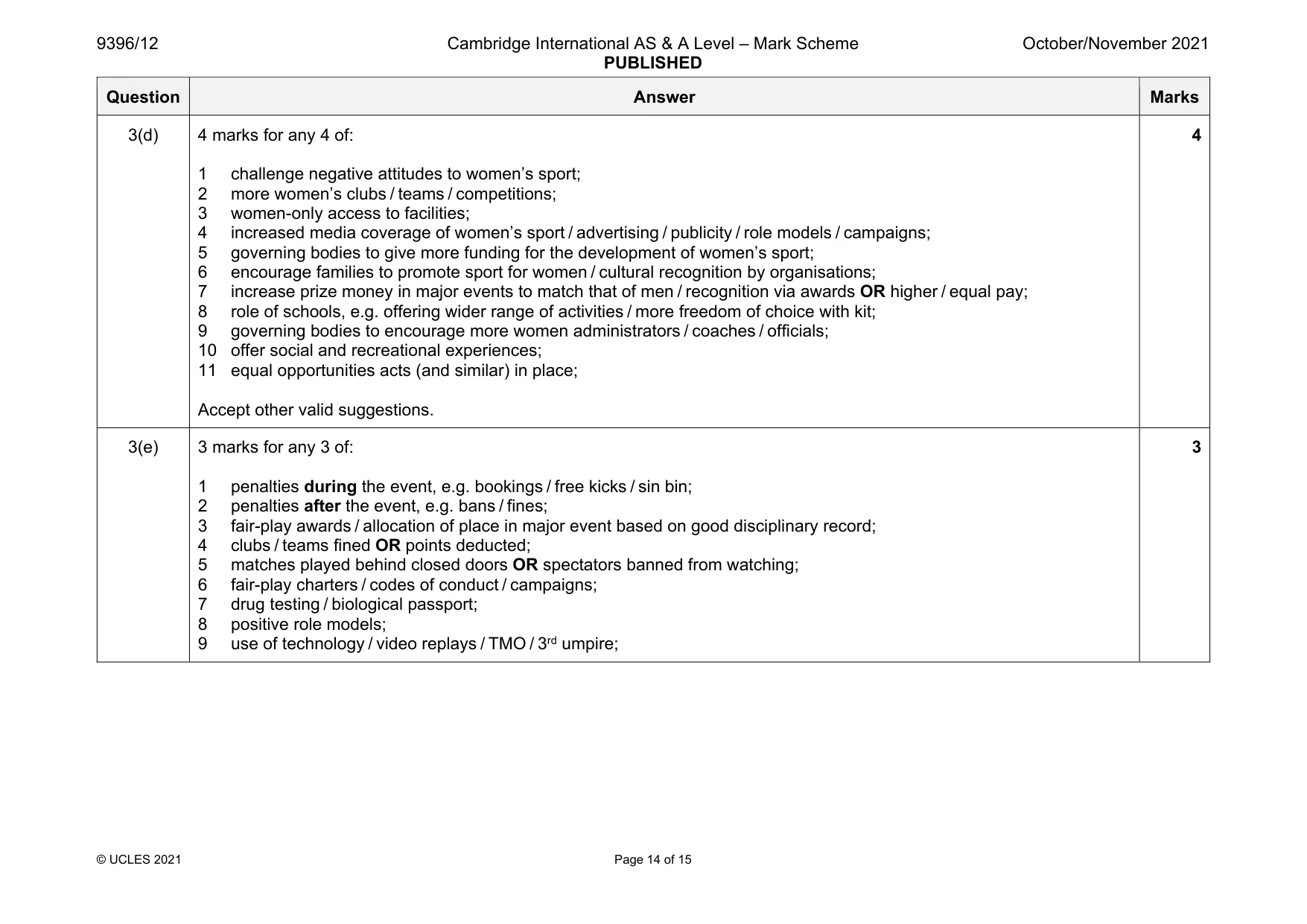
9396/12 Cambridge International AS & A Level – Mark Scheme PUBLISHED October/November 2021 © UCLES 2021 Page 14 of 15 Question Answer Marks 3(d) 4 marks for any 4 of: 1 challenge negative attitudes to women’s sport; 2 more women’s clubs / teams / competitions; 3 women-only access to facilities; 4 increased media coverage of women’s sport / advertising / publicity / role models / campaigns; 5 governing bodies to give more funding for the development of women’s sport; 6 encourage families to promote sport for women / cultural recognition by organisations; 7 increase prize money in major events to match that of men / recognition via awards OR higher / equal pay; 8 role of schools, e.g. offering wider range of activities / more freedom of choice with kit; 9 governing bodies to encourage more women administrators / coaches / officials; 10 offer social and recreational experiences; 11 equal opportunities acts (and similar) in place; Accept other valid suggestions. 4 3(e) 3 marks for any 3 of: 1 penalties during the event, e.g. bookings / free kicks / sin bin; 2 penalties after the event, e.g. bans / fines; 3 fair-play awards / allocation of place in major event based on good disciplinary record; 4 clubs / teams fined OR points deducted; 5 matches played behind closed doors OR spectators banned from watching; 6 fair-play charters / codes of conduct / campaigns; 7 drug testing / biological passport; 8 positive role models; 9 use of technology / video replays / TMO / 3rd umpire; 3
Mark scheme, page 15
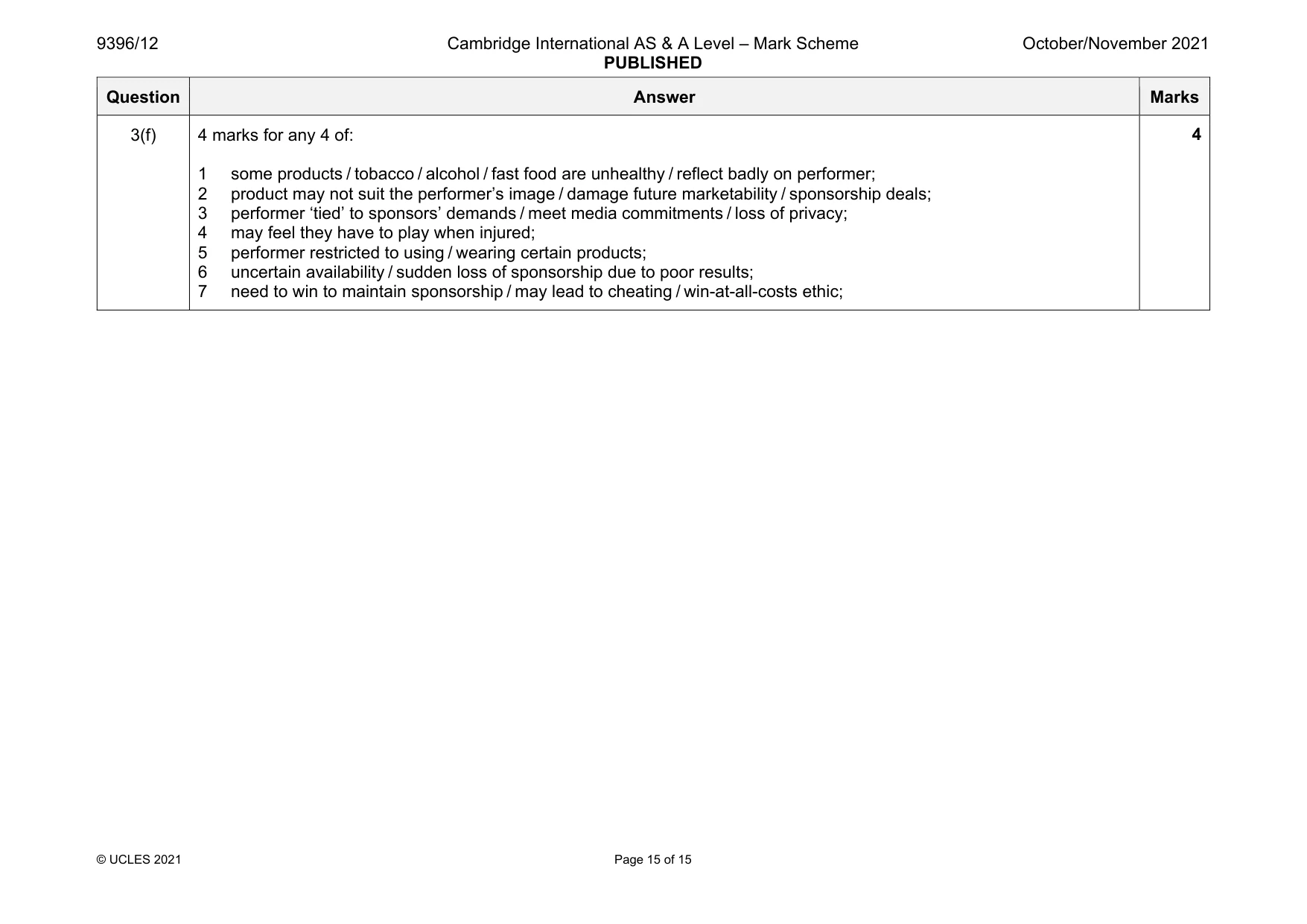
9396/12 Cambridge International AS & A Level – Mark Scheme PUBLISHED October/November 2021 © UCLES 2021 Page 15 of 15 Question Answer Marks 3(f) 4 marks for any 4 of: 1 some products / tobacco / alcohol / fast food are unhealthy / reflect badly on performer; 2 product may not suit the performer’s image / damage future marketability / sponsorship deals; 3 performer ‘tied’ to sponsors’ demands / meet media commitments / loss of privacy; 4 may feel they have to play when injured; 5 performer restricted to using / wearing certain products; 6 uncertain availability / sudden loss of sponsorship due to poor results; 7 need to win to maintain sponsorship / may lead to cheating / win-at-all-costs ethic; 4
What you needed in this session
Cambridge’s own grade thresholds for 2021 Oct/Nov, Paper 1 · Variant 2. A higher threshold means an easier paper — the bar moves with how the cohort did.