Cambridge A Level Physical Education 9396 — 2021 May/June Paper 1 · Variant 3
9396/13/M/J/21 · 90 marks · ≈101 min
The question paper and its mark scheme, free to read here and free to download. This is Cambridge’s own paper, exactly as it was sat.
Question paper8 pages



Mark scheme16 pages
Answers below. Sit the paper first if you are practising.
Paper as text
Question paper, page 1
This document has 8 pages. Any blank pages are indicated. Cambridge International AS & A Level DC (MS/CT) 198360/1 © UCLES 2021 [Turn over PHYSICAL EDUCATION 9396/13 Paper 1 May/June 2021 2 hours 30 minutes You must answer on the enclosed answer booklet. You will need: Answer booklet (enclosed) INSTRUCTIONS ● Answer all questions. ● Follow the instructions on the front cover of the answer booklet. If you need additional answer paper, ask the invigilator for a continuation booklet. ● You may use a calculator. ● You should show all your working and use appropriate units. INFORMATION ● The total mark for this paper is 90. ● The number of marks for each question or part question is shown in brackets [ ]. * 7 9 6 1 8 7 1 8 9 1 *
Question paper, page 2
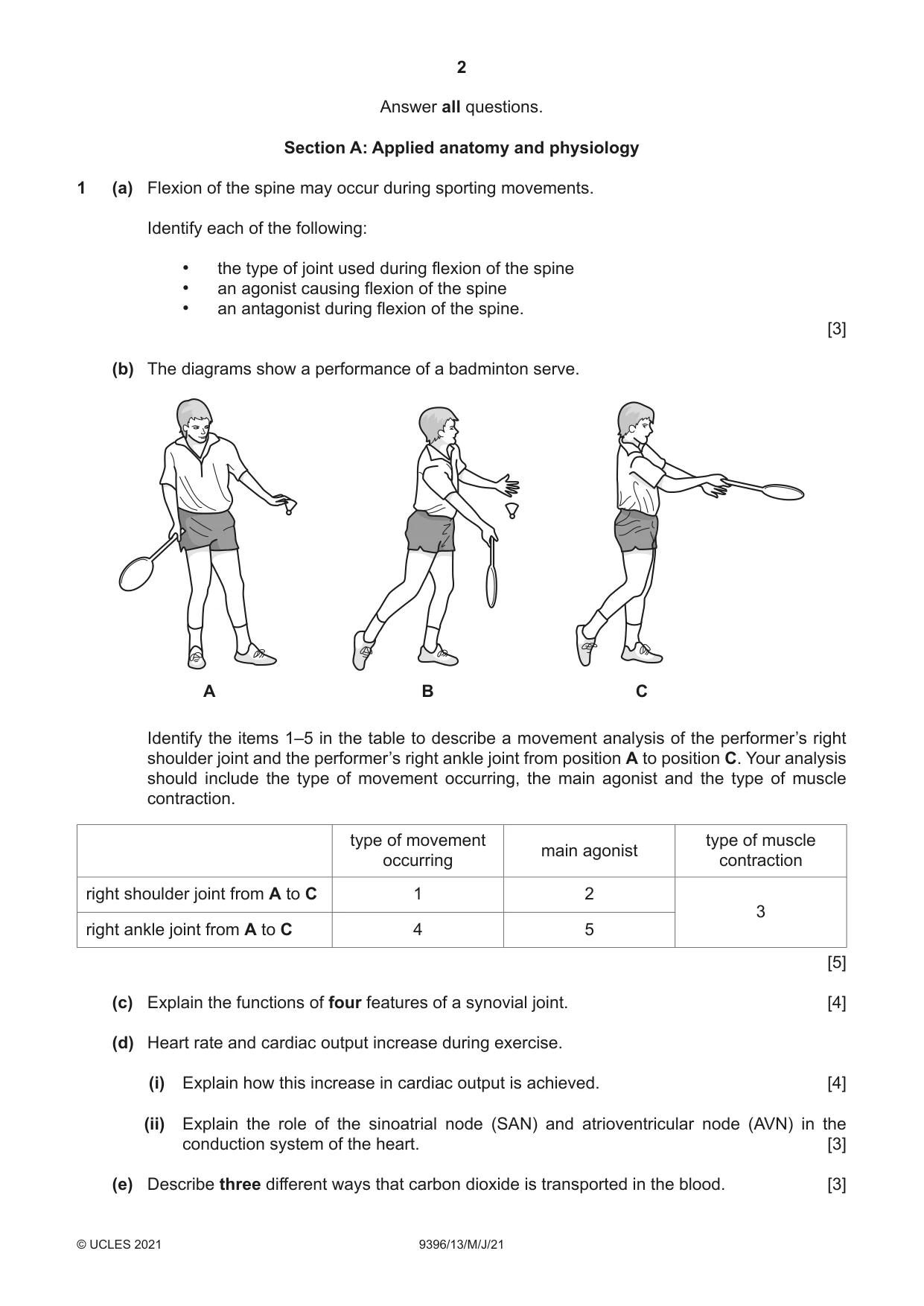
2 9396/13/M/J/21 © UCLES 2021 Answer all questions. Section A: Applied anatomy and physiology 1 (a) Flexion of the spine may occur during sporting movements. Identify each of the following: • the type of joint used during flexion of the spine • an agonist causing flexion of the spine • an antagonist during flexion of the spine. [3] (b) The diagrams show a performance of a badminton serve. A B C Identify the items 1–5 in the table to describe a movement analysis of the performer’s right shoulder joint and the performer’s right ankle joint from position A to position C. Your analysis should include the type of movement occurring, the main agonist and the type of muscle contraction. type of movement occurring main agonist type of muscle contraction right shoulder joint from A to C 1 2 3 right ankle joint from A to C 4 5 [5] (c) Explain the functions of four features of a synovial joint. [4] (d) Heart rate and cardiac output increase during exercise. (i) Explain how this increase in cardiac output is achieved. [4] (ii) Explain the role of the sinoatrial node (SAN) and atrioventricular node (AVN) in the conduction system of the heart. [3] (e) Describe three different ways that carbon dioxide is transported in the blood. [3]
Question paper, page 3
3 9396/13/M/J/21 © UCLES 2021 [Turn over (f) (i) The vital capacity of the lungs is made up of the following respiratory volumes: • tidal volume • expiratory reserve volume • inspiratory reserve volume. Describe the change to each of these three respiratory volumes when the body starts to exercise. [3] (ii) Explain the neural and chemical factors that control the ventilation rate of a performer during exercise. [5] [Total: 30]
Question paper, page 4
4 9396/13/M/J/21 © UCLES 2021 Section B: Acquiring, developing and performing movement skills 2 (a) Classify the athletic event of the long jump on each of the following four continua. Justify your answer for each classification. • open and closed • discrete, serial and continuous • externally and internally paced • high and low organisation [4] (b) Describe the cognitive theory of learning. [4] (c) Describe schema theory using a practical example. [5] (d) Selective attention is a component of information processing that allows skills to be completed. Suggest strategies that a coach could use to improve a performer’s selective attention. [3] (e) Explain how the short-term memory and the long-term memory are used when performing practical skills. [5] (f) During the development of movement skills, a performer may progress through three phases of learning. (i) Identify the second phase of learning. [1] (ii) Describe strategies a coach could use to help a performer progress from the second phase of learning to the third phase of learning. [4] (g) Explain, using the inverted-U theory, how different levels of arousal may affect the performance of movement skills. [4] [Total: 30]
Question paper, page 5
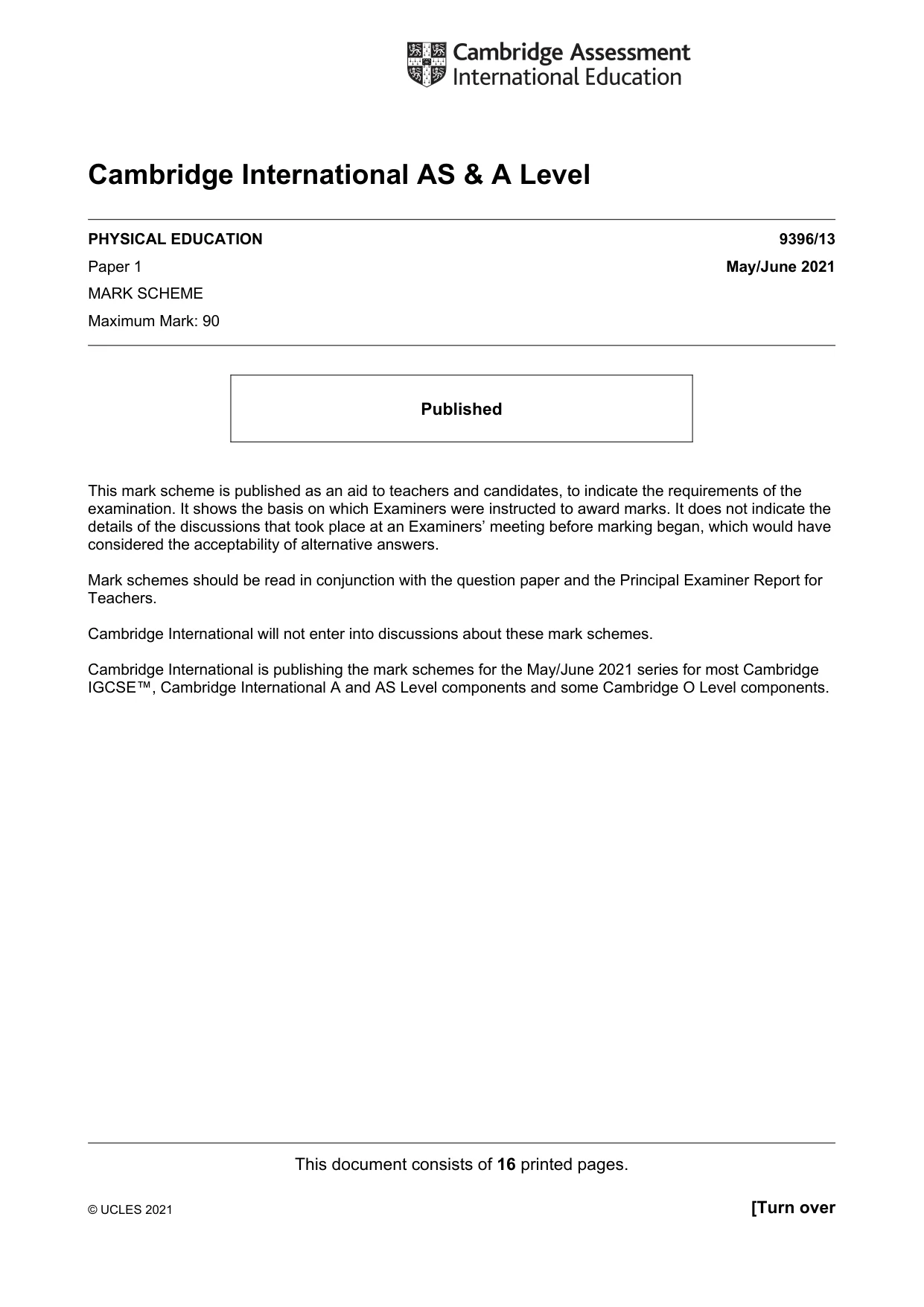
5 9396/13/M/J/21 © UCLES 2021 Section C: Contemporary studies in physical education and sport 3 (a) Describe differences between physical recreation and physical education. [4] (b) (i) Describe what is meant by the term elite sport. [3] (ii) Suggest the provision required by a performer to reach an elite level. [3] (c) (i) One benefit for an individual of regular participation in physical activity is increased health and fitness. Outline other benefits for an individual of regular participation in physical activity. [4] (ii) Describe two named initiatives from a country of your choice to increase participation in sport. [4] (d) Suggest possible solutions to the problem of increasing violence in sport caused by each of the following: • players • spectators. [6] (e) Outline the negative effects that the media may have on sport. [6] [Total: 30]
Question paper, page 6
6 9396/13/M/J/21 © UCLES 2021 BLANK PAGE
Question paper, page 7
7 9396/13/M/J/21 © UCLES 2021 BLANK PAGE
Question paper, page 8
8 9396/13/M/J/21 © UCLES 2021 Permission to reproduce items where third-party owned material protected by copyright is included has been sought and cleared where possible. Every reasonable effort has been made by the publisher (UCLES) to trace copyright holders, but if any items requiring clearance have unwittingly been included, the publisher will be pleased to make amends at the earliest possible opportunity. To avoid the issue of disclosure of answer-related information to candidates, all copyright acknowledgements are reproduced online in the Cambridge Assessment International Education Copyright Acknowledgements Booklet. This is produced for each series of examinations and is freely available to download at www.cambridgeinternational.org after the live examination series. Cambridge Assessment International Education is part of the Cambridge Assessment Group. Cambridge Assessment is the brand name of the University of Cambridge Local Examinations Syndicate (UCLES), which itself is a department of the University of Cambridge. BLANK PAGE
Mark scheme, page 1
This document consists of 16 printed pages. © UCLES 2021 [Turn over Cambridge International AS & A Level PHYSICAL EDUCATION 9396/13 Paper 1 May/June 2021 MARK SCHEME Maximum Mark: 90 Published This mark scheme is published as an aid to teachers and candidates, to indicate the requirements of the examination. It shows the basis on which Examiners were instructed to award marks. It does not indicate the details of the discussions that took place at an Examiners’ meeting before marking began, which would have considered the acceptability of alternative answers. Mark schemes should be read in conjunction with the question paper and the Principal Examiner Report for Teachers. Cambridge International will not enter into discussions about these mark schemes. Cambridge International is publishing the mark schemes for the May/June 2021 series for most Cambridge IGCSE™, Cambridge International A and AS Level components and some Cambridge O Level components.
Mark scheme, page 2
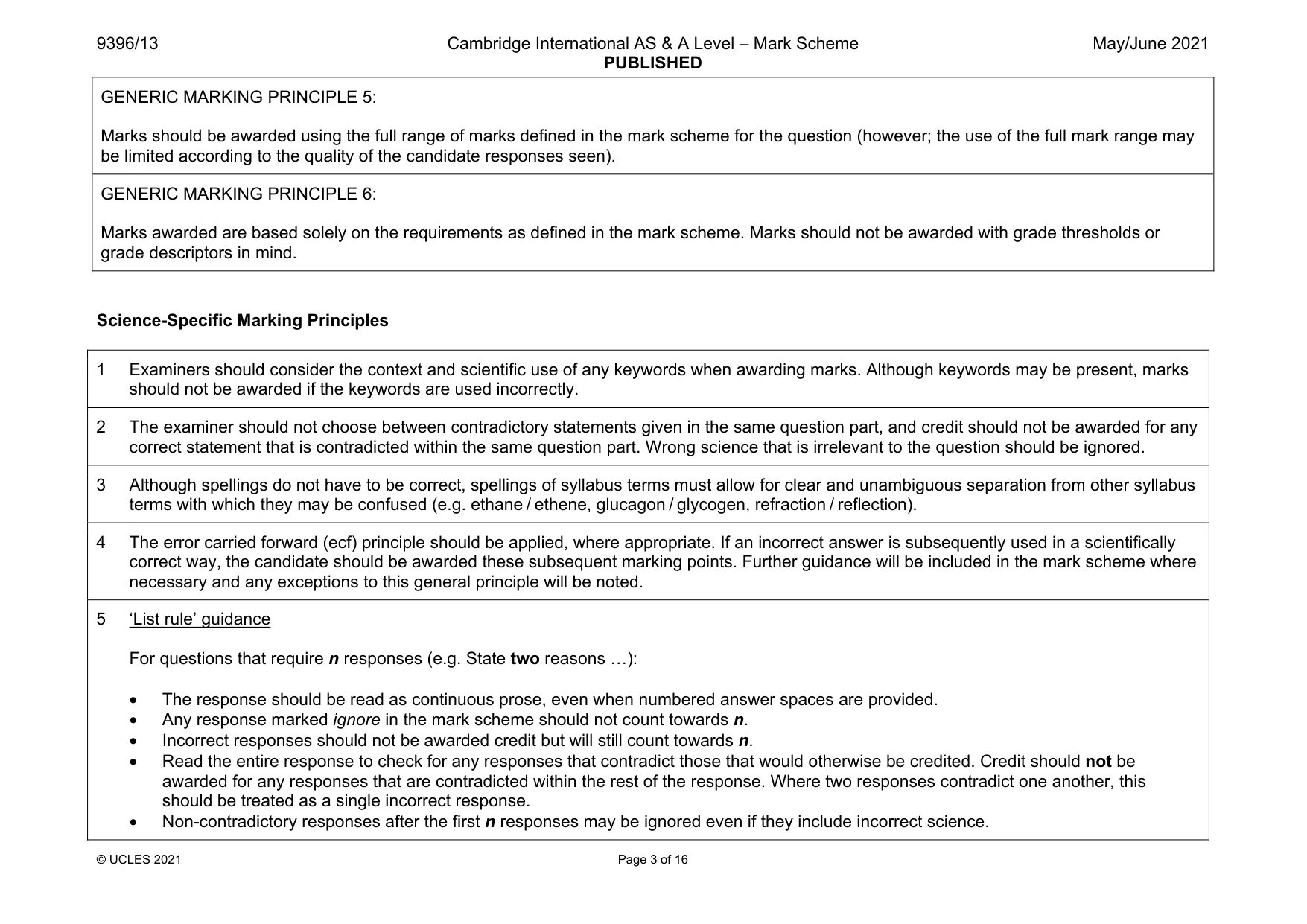
9396/13 Cambridge International AS & A Level – Mark Scheme PUBLISHED May/June 2021 © UCLES 2021 Page 2 of 16 Generic Marking Principles These general marking principles must be applied by all examiners when marking candidate answers. They should be applied alongside the specific content of the mark scheme or generic level descriptors for a question. Each question paper and mark scheme will also comply with these marking principles. GENERIC MARKING PRINCIPLE 1: Marks must be awarded in line with: • the specific content of the mark scheme or the generic level descriptors for the question • the specific skills defined in the mark scheme or in the generic level descriptors for the question • the standard of response required by a candidate as exemplified by the standardisation scripts. GENERIC MARKING PRINCIPLE 2: Marks awarded are always whole marks (not half marks, or other fractions). GENERIC MARKING PRINCIPLE 3: Marks must be awarded positively: • marks are awarded for correct/valid answers, as defined in the mark scheme. However, credit is given for valid answers which go beyond the scope of the syllabus and mark scheme, referring to your Team Leader as appropriate • marks are awarded when candidates clearly demonstrate what they know and can do • marks are not deducted for errors • marks are not deducted for omissions • answers should only be judged on the quality of spelling, punctuation and grammar when these features are specifically assessed by the question as indicated by the mark scheme. The meaning, however, should be unambiguous. GENERIC MARKING PRINCIPLE 4: Rules must be applied consistently, e.g. in situations where candidates have not followed instructions or in the application of generic level descriptors.
Mark scheme, page 3
9396/13 Cambridge International AS & A Level – Mark Scheme PUBLISHED May/June 2021 © UCLES 2021 Page 3 of 16 GENERIC MARKING PRINCIPLE 5: Marks should be awarded using the full range of marks defined in the mark scheme for the question (however; the use of the full mark range may be limited according to the quality of the candidate responses seen). GENERIC MARKING PRINCIPLE 6: Marks awarded are based solely on the requirements as defined in the mark scheme. Marks should not be awarded with grade thresholds or grade descriptors in mind. Science-Specific Marking Principles 1 Examiners should consider the context and scientific use of any keywords when awarding marks. Although keywords may be present, marks should not be awarded if the keywords are used incorrectly. 2 The examiner should not choose between contradictory statements given in the same question part, and credit should not be awarded for any correct statement that is contradicted within the same question part. Wrong science that is irrelevant to the question should be ignored. 3 Although spellings do not have to be correct, spellings of syllabus terms must allow for clear and unambiguous separation from other syllabus terms with which they may be confused (e.g. ethane / ethene, glucagon / glycogen, refraction / reflection). 4 The error carried forward (ecf) principle should be applied, where appropriate. If an incorrect answer is subsequently used in a scientifically correct way, the candidate should be awarded these subsequent marking points. Further guidance will be included in the mark scheme where necessary and any exceptions to this general principle will be noted. 5 ‘List rule’ guidance For questions that require n responses (e.g. State two reasons …): • The response should be read as continuous prose, even when numbered answer spaces are provided. • Any response marked ignore in the mark scheme should not count towards n. • Incorrect responses should not be awarded credit but will still count towards n. • Read the entire response to check for any responses that contradict those that would otherwise be credited. Credit should not be awarded for any responses that are contradicted within the rest of the response. Where two responses contradict one another, this should be treated as a single incorrect response. • Non-contradictory responses after the first n responses may be ignored even if they include incorrect science.
Mark scheme, page 4
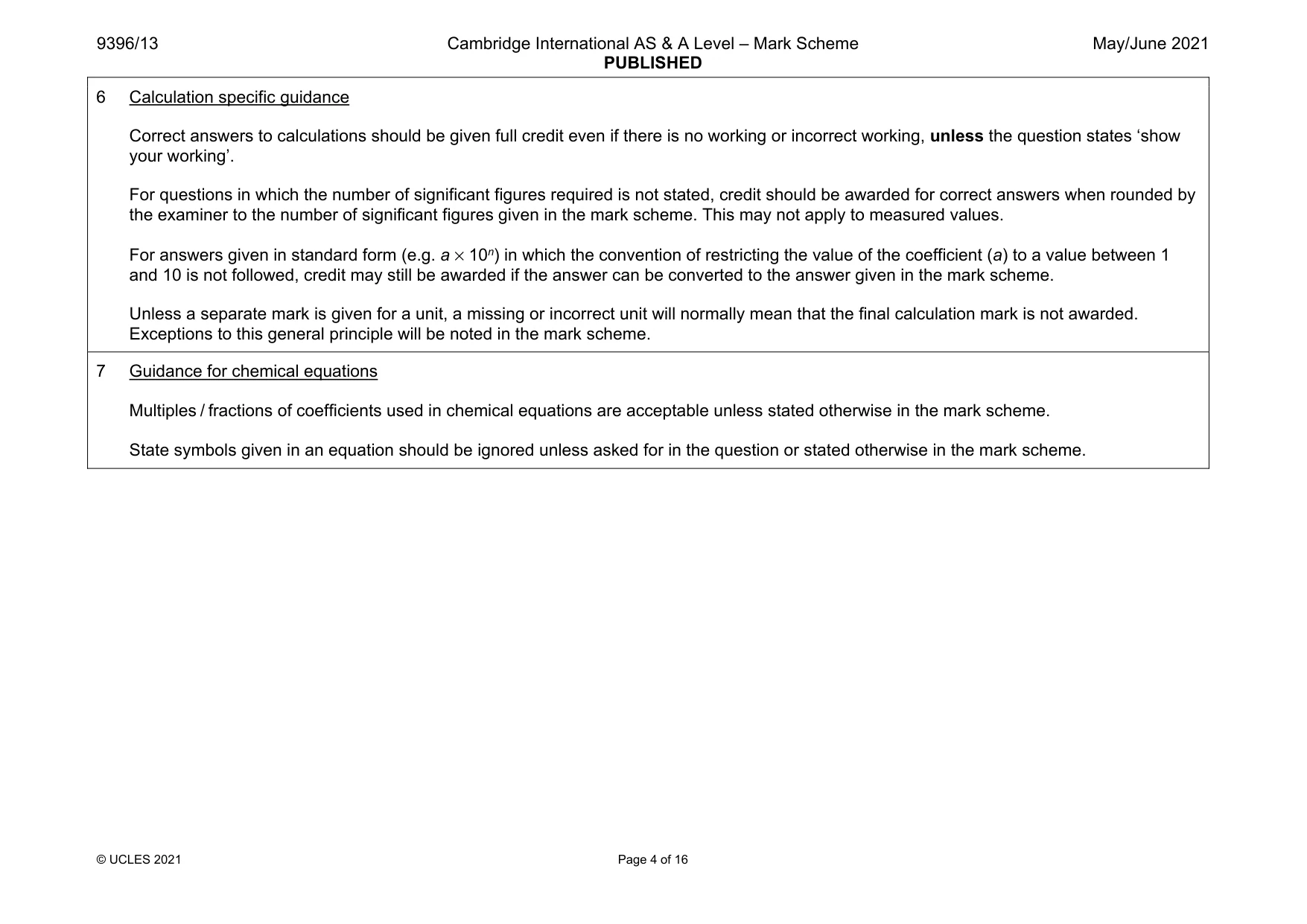
9396/13 Cambridge International AS & A Level – Mark Scheme PUBLISHED May/June 2021 © UCLES 2021 Page 4 of 16 6 Calculation specific guidance Correct answers to calculations should be given full credit even if there is no working or incorrect working, unless the question states ‘show your working’. For questions in which the number of significant figures required is not stated, credit should be awarded for correct answers when rounded by the examiner to the number of significant figures given in the mark scheme. This may not apply to measured values. For answers given in standard form (e.g. a × 10n) in which the convention of restricting the value of the coefficient (a) to a value between 1 and 10 is not followed, credit may still be awarded if the answer can be converted to the answer given in the mark scheme. Unless a separate mark is given for a unit, a missing or incorrect unit will normally mean that the final calculation mark is not awarded. Exceptions to this general principle will be noted in the mark scheme. 7 Guidance for chemical equations Multiples / fractions of coefficients used in chemical equations are acceptable unless stated otherwise in the mark scheme. State symbols given in an equation should be ignored unless asked for in the question or stated otherwise in the mark scheme.
Mark scheme, page 5
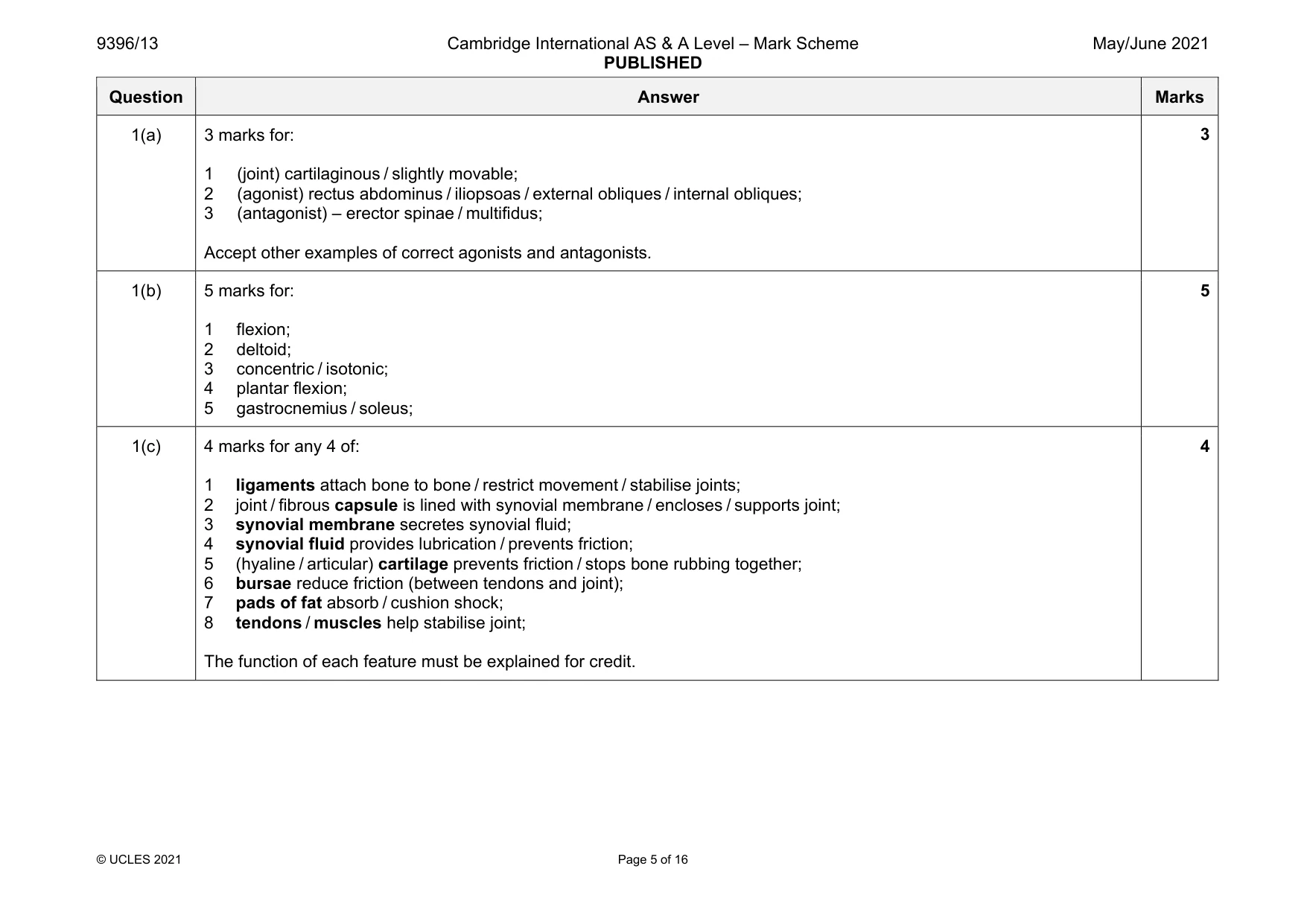
9396/13 Cambridge International AS & A Level – Mark Scheme PUBLISHED May/June 2021 © UCLES 2021 Page 5 of 16 Question Answer Marks 1(a) 3 marks for: 1 (joint) cartilaginous / slightly movable; 2 (agonist) rectus abdominus / iliopsoas / external obliques / internal obliques; 3 (antagonist) – erector spinae / multifidus; Accept other examples of correct agonists and antagonists. 3 1(b) 5 marks for: 1 flexion; 2 deltoid; 3 concentric / isotonic; 4 plantar flexion; 5 gastrocnemius / soleus; 5 1(c) 4 marks for any 4 of: 1 ligaments attach bone to bone / restrict movement / stabilise joints; 2 joint / fibrous capsule is lined with synovial membrane / encloses / supports joint; 3 synovial membrane secretes synovial fluid; 4 synovial fluid provides lubrication / prevents friction; 5 (hyaline / articular) cartilage prevents friction / stops bone rubbing together; 6 bursae reduce friction (between tendons and joint); 7 pads of fat absorb / cushion shock; 8 tendons / muscles help stabilise joint; The function of each feature must be explained for credit. 4
Mark scheme, page 6
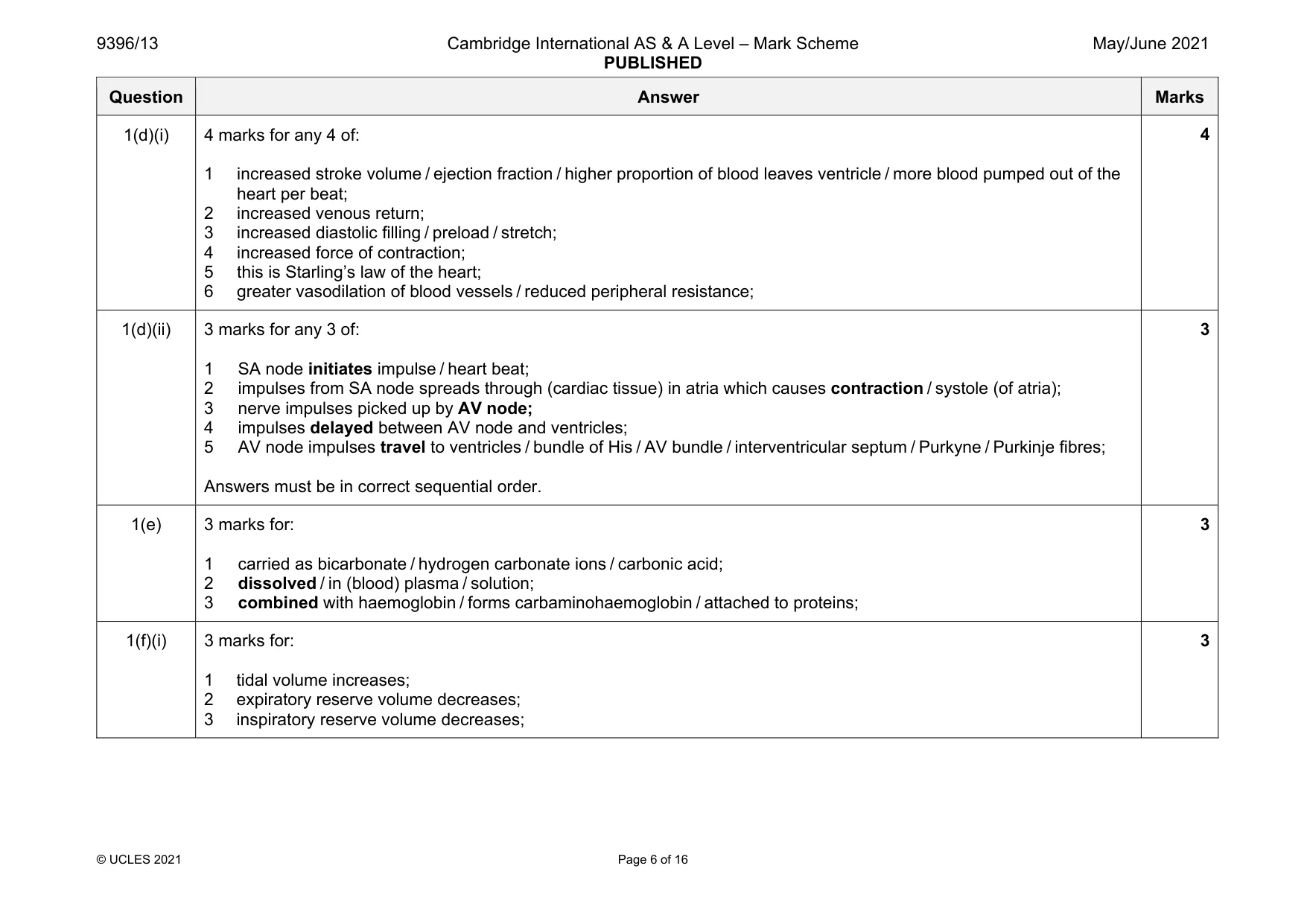
9396/13 Cambridge International AS & A Level – Mark Scheme PUBLISHED May/June 2021 © UCLES 2021 Page 6 of 16 Question Answer Marks 1(d)(i) 4 marks for any 4 of: 1 increased stroke volume / ejection fraction / higher proportion of blood leaves ventricle / more blood pumped out of the heart per beat; 2 increased venous return; 3 increased diastolic filling / preload / stretch; 4 increased force of contraction; 5 this is Starling’s law of the heart; 6 greater vasodilation of blood vessels / reduced peripheral resistance; 4 1(d)(ii) 3 marks for any 3 of: 1 SA node initiates impulse / heart beat; 2 impulses from SA node spreads through (cardiac tissue) in atria which causes contraction / systole (of atria); 3 nerve impulses picked up by AV node; 4 impulses delayed between AV node and ventricles; 5 AV node impulses travel to ventricles / bundle of His / AV bundle / interventricular septum / Purkyne / Purkinje fibres; Answers must be in correct sequential order. 3 1(e) 3 marks for: 1 carried as bicarbonate / hydrogen carbonate ions / carbonic acid; 2 dissolved / in (blood) plasma / solution; 3 combined with haemoglobin / forms carbaminohaemoglobin / attached to proteins; 3 1(f)(i) 3 marks for: 1 tidal volume increases; 2 expiratory reserve volume decreases; 3 inspiratory reserve volume decreases; 3
Mark scheme, page 7
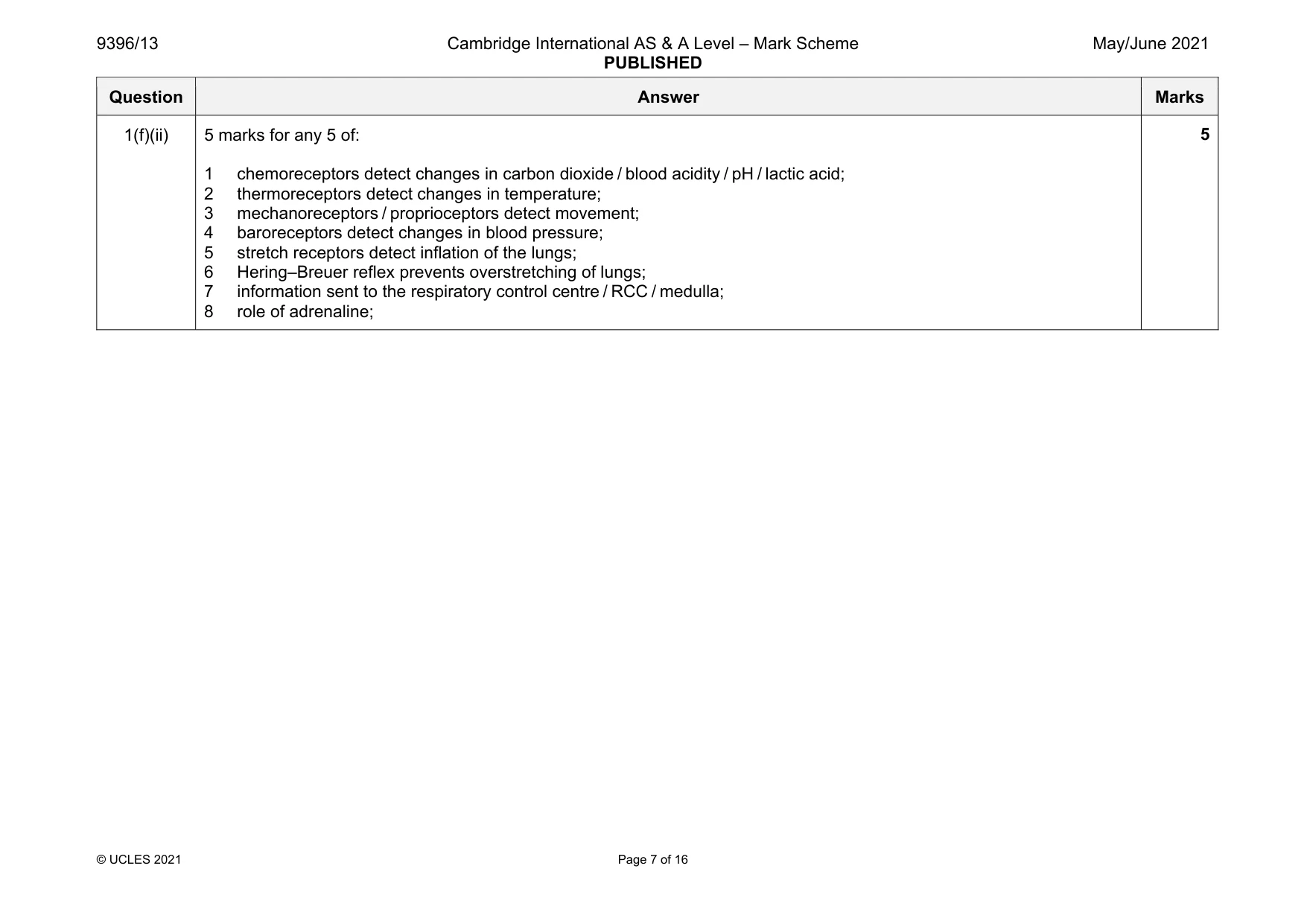
9396/13 Cambridge International AS & A Level – Mark Scheme PUBLISHED May/June 2021 © UCLES 2021 Page 7 of 16 Question Answer Marks 1(f)(ii) 5 marks for any 5 of: 1 chemoreceptors detect changes in carbon dioxide / blood acidity / pH / lactic acid; 2 thermoreceptors detect changes in temperature; 3 mechanoreceptors / proprioceptors detect movement; 4 baroreceptors detect changes in blood pressure; 5 stretch receptors detect inflation of the lungs; 6 Hering–Breuer reflex prevents overstretching of lungs; 7 information sent to the respiratory control centre / RCC / medulla; 8 role of adrenaline; 5
Mark scheme, page 8
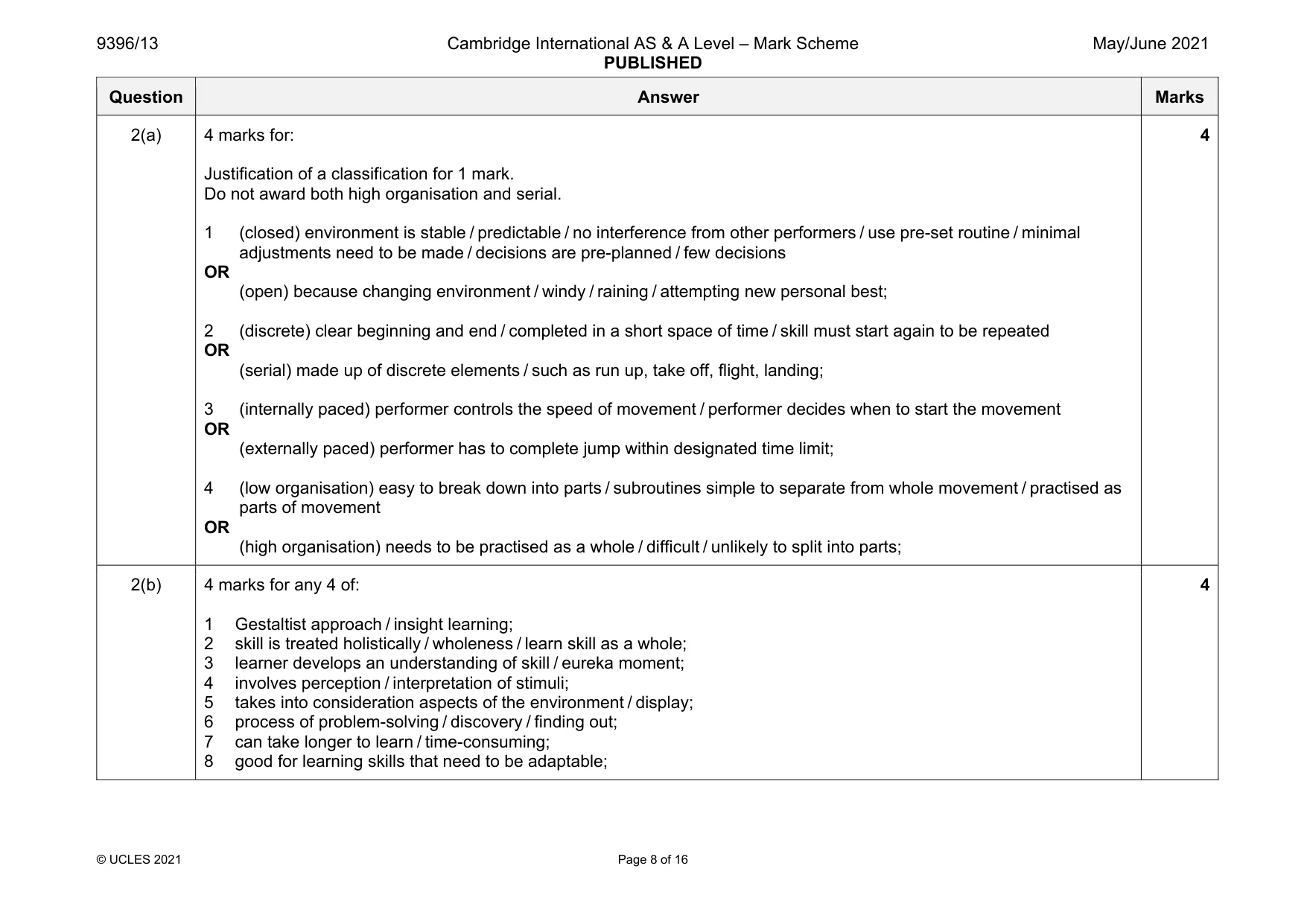
9396/13 Cambridge International AS & A Level – Mark Scheme PUBLISHED May/June 2021 © UCLES 2021 Page 8 of 16 Question Answer Marks 2(a) 4 marks for: Justification of a classification for 1 mark. Do not award both high organisation and serial. 1 (closed) environment is stable / predictable / no interference from other performers / use pre-set routine / minimal adjustments need to be made / decisions are pre-planned / few decisions OR (open) because changing environment / windy / raining / attempting new personal best; 2 (discrete) clear beginning and end / completed in a short space of time / skill must start again to be repeated OR (serial) made up of discrete elements / such as run up, take off, flight, landing; 3 (internally paced) performer controls the speed of movement / performer decides when to start the movement OR (externally paced) performer has to complete jump within designated time limit; 4 (low organisation) easy to break down into parts / subroutines simple to separate from whole movement / practised as parts of movement OR (high organisation) needs to be practised as a whole / difficult / unlikely to split into parts; 4 2(b) 4 marks for any 4 of: 1 Gestaltist approach / insight learning; 2 skill is treated holistically / wholeness / learn skill as a whole; 3 learner develops an understanding of skill / eureka moment; 4 involves perception / interpretation of stimuli; 5 takes into consideration aspects of the environment / display; 6 process of problem-solving / discovery / finding out; 7 can take longer to learn / time-consuming; 8 good for learning skills that need to be adaptable; 4
Mark scheme, page 9
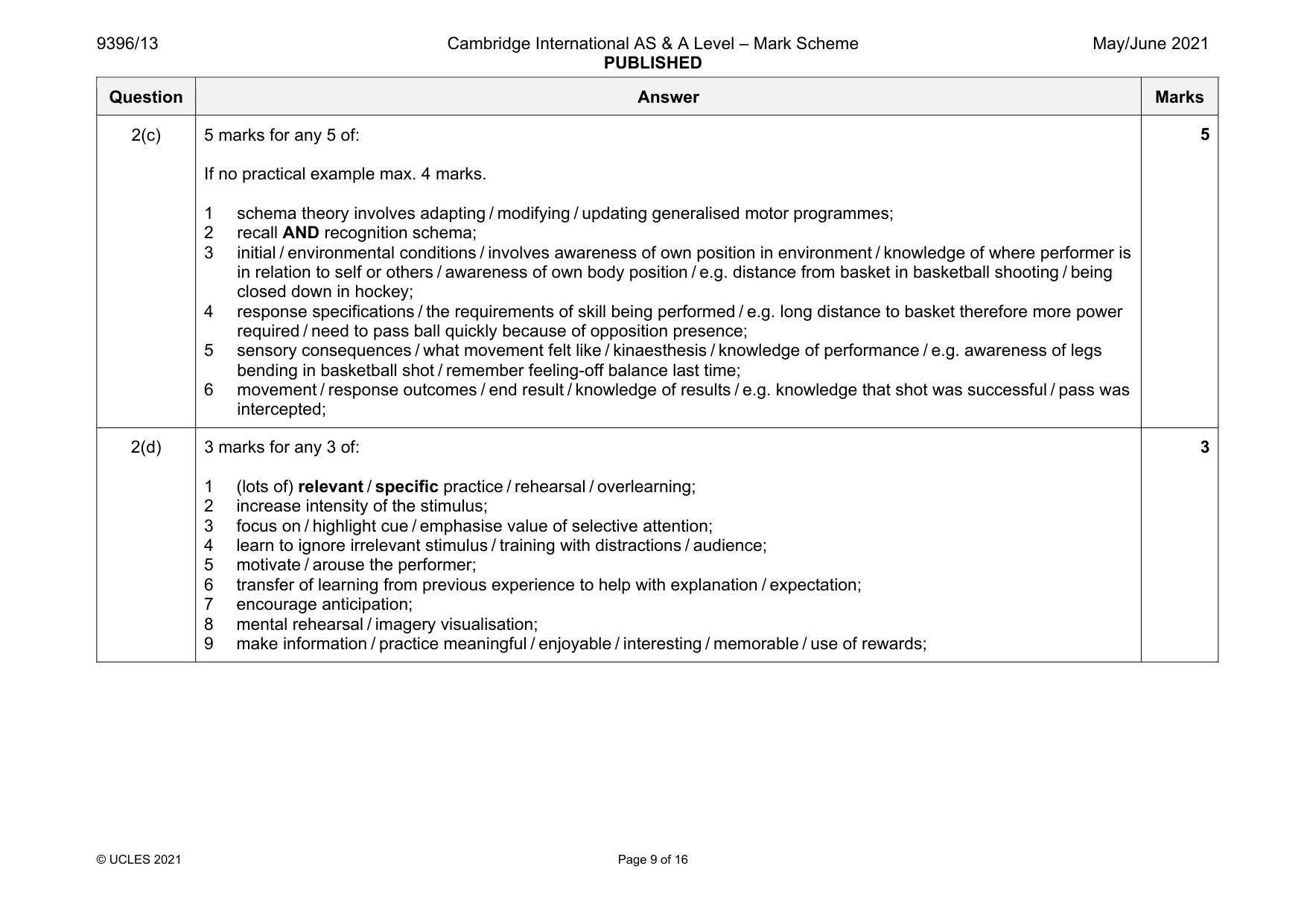
9396/13 Cambridge International AS & A Level – Mark Scheme PUBLISHED May/June 2021 © UCLES 2021 Page 9 of 16 Question Answer Marks 2(c) 5 marks for any 5 of: If no practical example max. 4 marks. 1 schema theory involves adapting / modifying / updating generalised motor programmes; 2 recall AND recognition schema; 3 initial / environmental conditions / involves awareness of own position in environment / knowledge of where performer is in relation to self or others / awareness of own body position / e.g. distance from basket in basketball shooting / being closed down in hockey; 4 response specifications / the requirements of skill being performed / e.g. long distance to basket therefore more power required / need to pass ball quickly because of opposition presence; 5 sensory consequences / what movement felt like / kinaesthesis / knowledge of performance / e.g. awareness of legs bending in basketball shot / remember feeling-off balance last time; 6 movement / response outcomes / end result / knowledge of results / e.g. knowledge that shot was successful / pass was intercepted; 5 2(d) 3 marks for any 3 of: 1 (lots of) relevant / specific practice / rehearsal / overlearning; 2 increase intensity of the stimulus; 3 focus on / highlight cue / emphasise value of selective attention; 4 learn to ignore irrelevant stimulus / training with distractions / audience; 5 motivate / arouse the performer; 6 transfer of learning from previous experience to help with explanation / expectation; 7 encourage anticipation; 8 mental rehearsal / imagery visualisation; 9 make information / practice meaningful / enjoyable / interesting / memorable / use of rewards; 3
Mark scheme, page 10
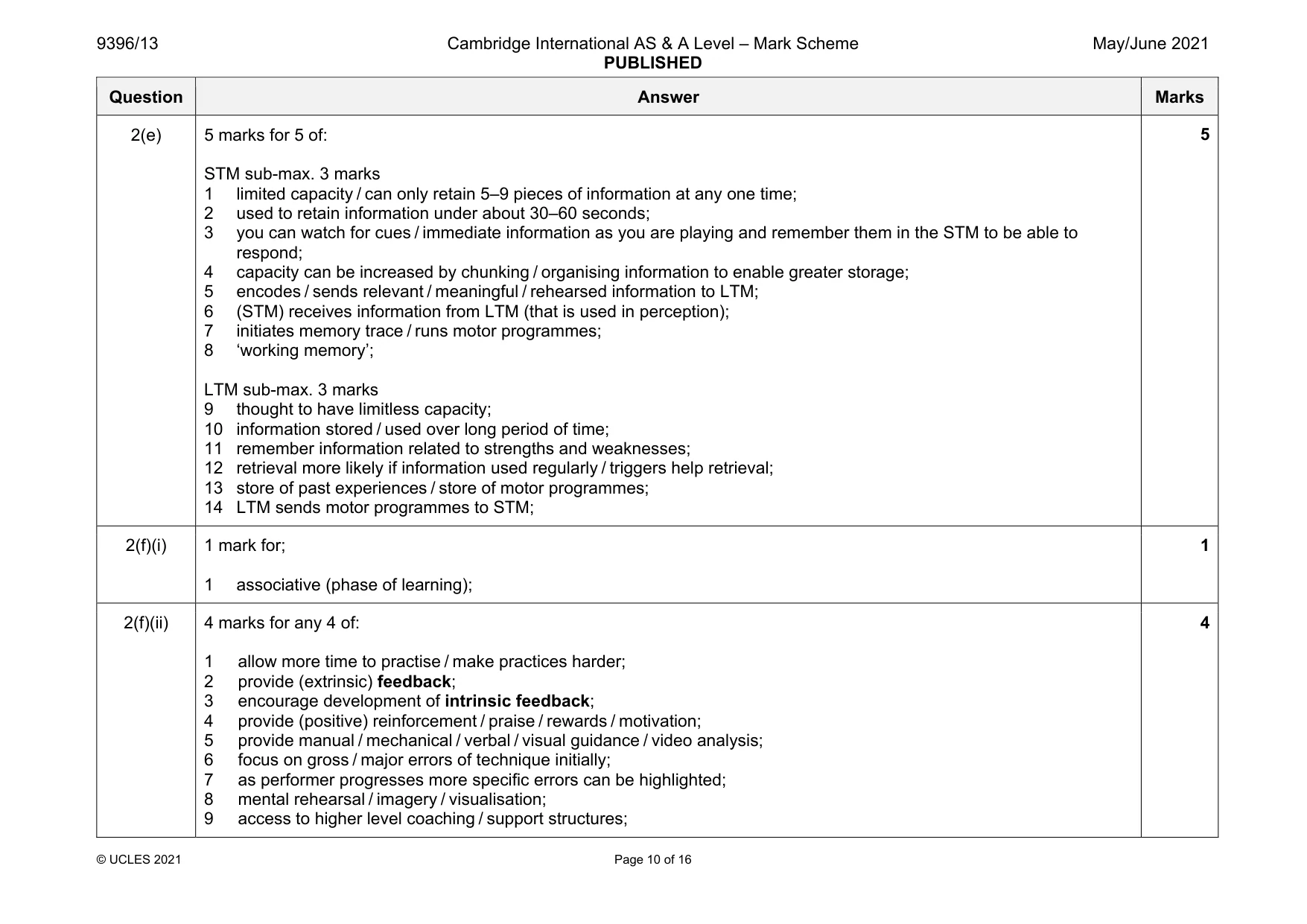
9396/13 Cambridge International AS & A Level – Mark Scheme PUBLISHED May/June 2021 © UCLES 2021 Page 10 of 16 Question Answer Marks 2(e) 5 marks for 5 of: STM sub-max. 3 marks 1 limited capacity / can only retain 5–9 pieces of information at any one time; 2 used to retain information under about 30–60 seconds; 3 you can watch for cues / immediate information as you are playing and remember them in the STM to be able to respond; 4 capacity can be increased by chunking / organising information to enable greater storage; 5 encodes / sends relevant / meaningful / rehearsed information to LTM; 6 (STM) receives information from LTM (that is used in perception); 7 initiates memory trace / runs motor programmes; 8 ‘working memory’; LTM sub-max. 3 marks 9 thought to have limitless capacity; 10 information stored / used over long period of time; 11 remember information related to strengths and weaknesses; 12 retrieval more likely if information used regularly / triggers help retrieval; 13 store of past experiences / store of motor programmes; 14 LTM sends motor programmes to STM; 5 2(f)(i) 1 mark for; 1 associative (phase of learning); 1 2(f)(ii) 4 marks for any 4 of: 1 allow more time to practise / make practices harder; 2 provide (extrinsic) feedback; 3 encourage development of intrinsic feedback; 4 provide (positive) reinforcement / praise / rewards / motivation; 5 provide manual / mechanical / verbal / visual guidance / video analysis; 6 focus on gross / major errors of technique initially; 7 as performer progresses more specific errors can be highlighted; 8 mental rehearsal / imagery / visualisation; 9 access to higher level coaching / support structures; 4
Mark scheme, page 11
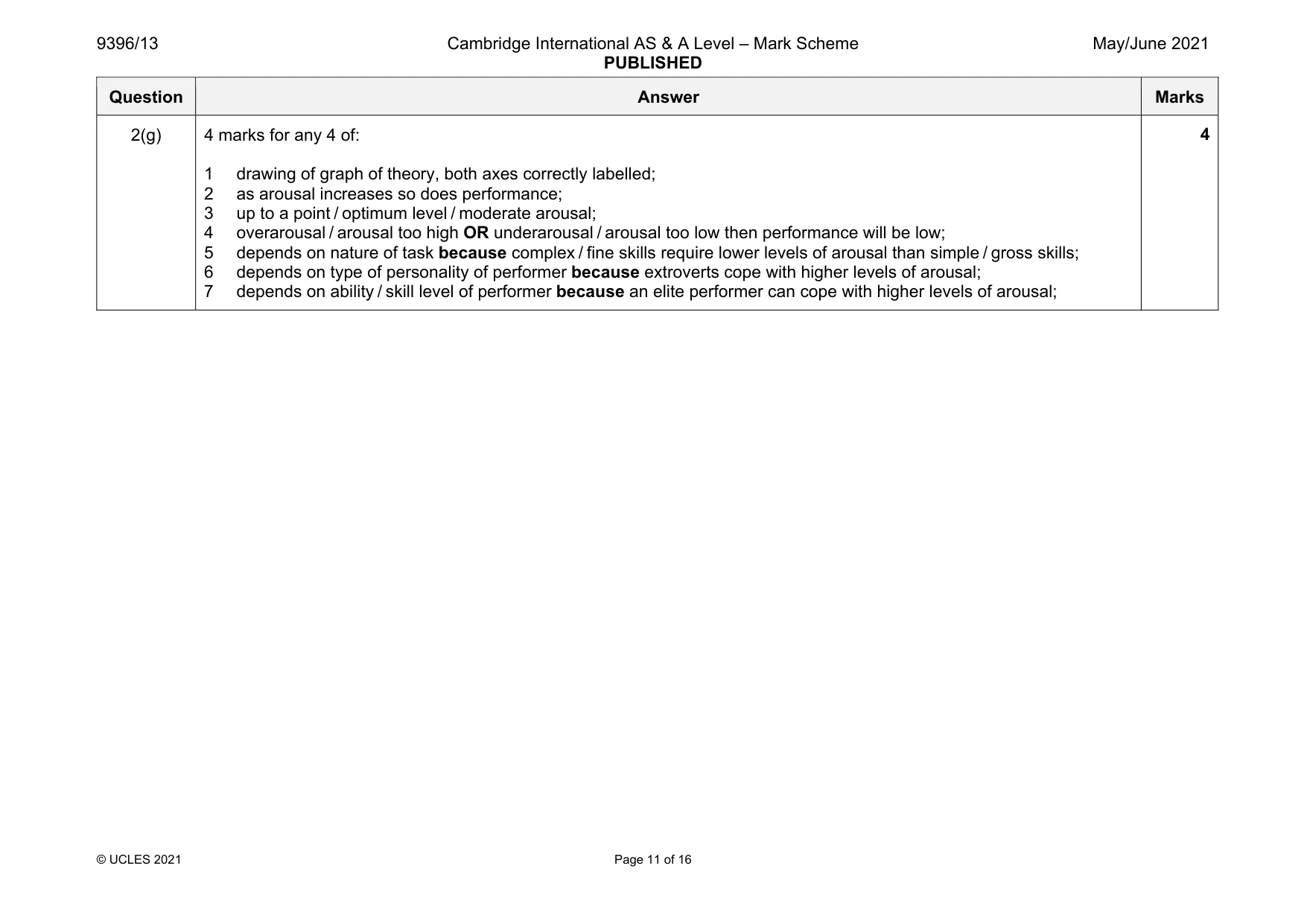
9396/13 Cambridge International AS & A Level – Mark Scheme PUBLISHED May/June 2021 © UCLES 2021 Page 11 of 16 Question Answer Marks 2(g) 4 marks for any 4 of: 1 drawing of graph of theory, both axes correctly labelled; 2 as arousal increases so does performance; 3 up to a point / optimum level / moderate arousal; 4 overarousal / arousal too high OR underarousal / arousal too low then performance will be low; 5 depends on nature of task because complex / fine skills require lower levels of arousal than simple / gross skills; 6 depends on type of personality of performer because extroverts cope with higher levels of arousal; 7 depends on ability / skill level of performer because an elite performer can cope with higher levels of arousal; 4
Mark scheme, page 12
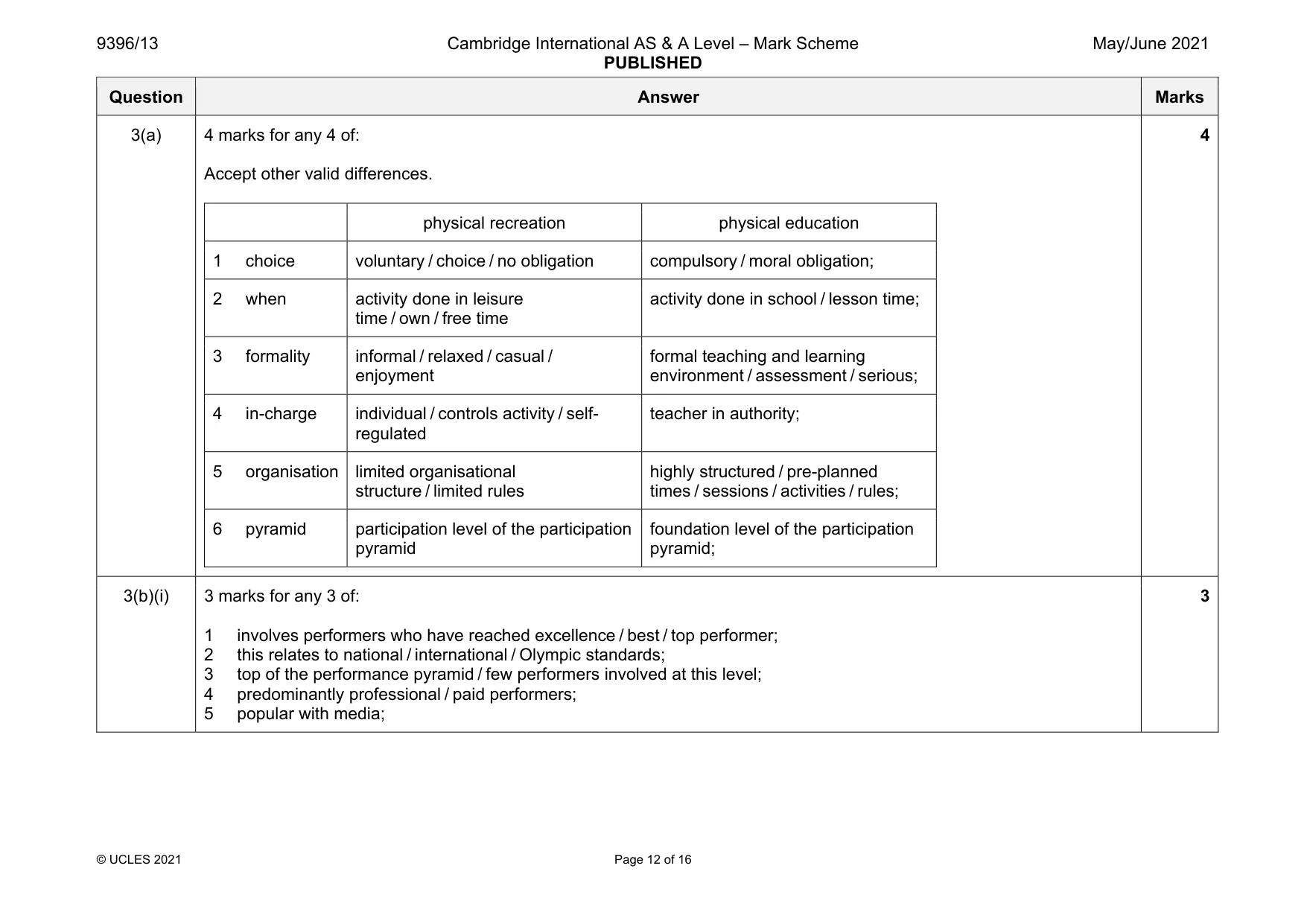
9396/13 Cambridge International AS & A Level – Mark Scheme PUBLISHED May/June 2021 © UCLES 2021 Page 12 of 16 Question Answer Marks 3(a) 4 marks for any 4 of: Accept other valid differences. physical recreation physical education 1 choice voluntary / choice / no obligation compulsory / moral obligation; 2 when activity done in leisure time / own / free time activity done in school / lesson time; 3 formality informal / relaxed / casual / enjoyment formal teaching and learning environment / assessment / serious; 4 in-charge individual / controls activity / self- regulated teacher in authority; 5 organisation limited organisational structure / limited rules highly structured / pre-planned times / sessions / activities / rules; 6 pyramid participation level of the participation pyramid foundation level of the participation pyramid; 4 3(b)(i) 3 marks for any 3 of: 1 involves performers who have reached excellence / best / top performer; 2 this relates to national / international / Olympic standards; 3 top of the performance pyramid / few performers involved at this level; 4 predominantly professional / paid performers; 5 popular with media; 3
Mark scheme, page 13
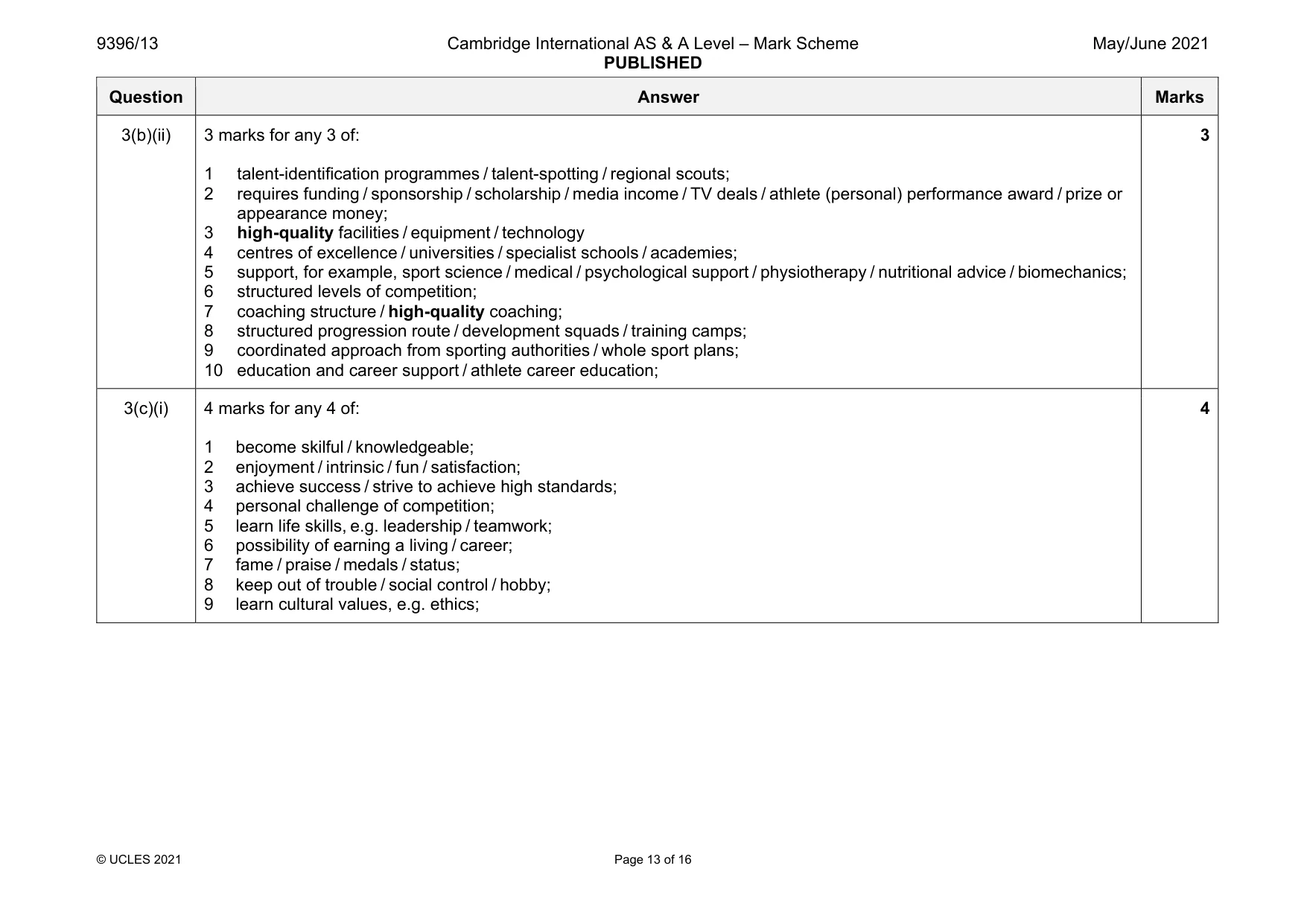
9396/13 Cambridge International AS & A Level – Mark Scheme PUBLISHED May/June 2021 © UCLES 2021 Page 13 of 16 Question Answer Marks 3(b)(ii) 3 marks for any 3 of: 1 talent-identification programmes / talent-spotting / regional scouts; 2 requires funding / sponsorship / scholarship / media income / TV deals / athlete (personal) performance award / prize or appearance money; 3 high-quality facilities / equipment / technology 4 centres of excellence / universities / specialist schools / academies; 5 support, for example, sport science / medical / psychological support / physiotherapy / nutritional advice / biomechanics; 6 structured levels of competition; 7 coaching structure / high-quality coaching; 8 structured progression route / development squads / training camps; 9 coordinated approach from sporting authorities / whole sport plans; 10 education and career support / athlete career education; 3 3(c)(i) 4 marks for any 4 of: 1 become skilful / knowledgeable; 2 enjoyment / intrinsic / fun / satisfaction; 3 achieve success / strive to achieve high standards; 4 personal challenge of competition; 5 learn life skills, e.g. leadership / teamwork; 6 possibility of earning a living / career; 7 fame / praise / medals / status; 8 keep out of trouble / social control / hobby; 9 learn cultural values, e.g. ethics; 4
Mark scheme, page 14
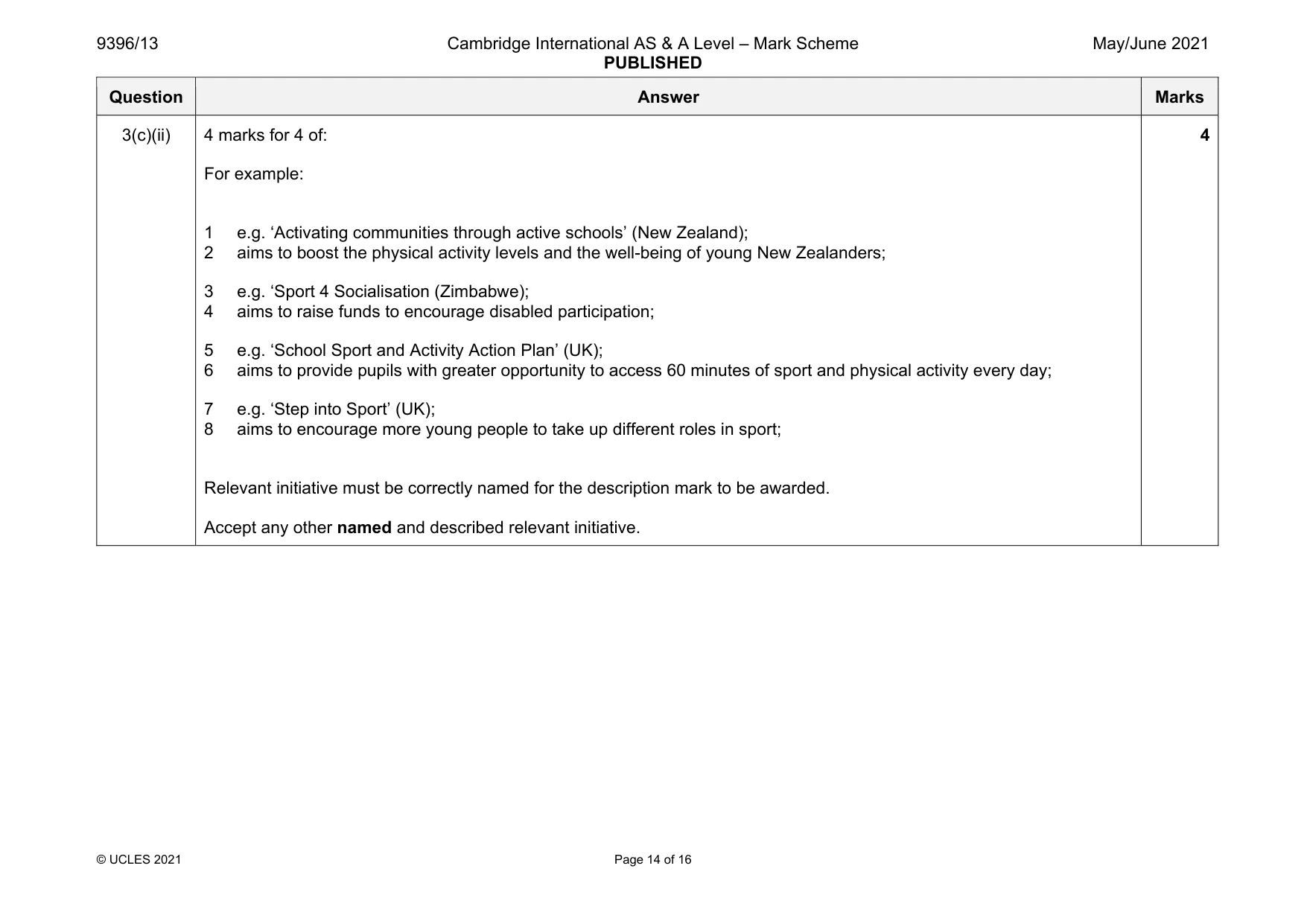
9396/13 Cambridge International AS & A Level – Mark Scheme PUBLISHED May/June 2021 © UCLES 2021 Page 14 of 16 Question Answer Marks 3(c)(ii) 4 marks for 4 of: For example: 1 e.g. ‘Activating communities through active schools’ (New Zealand); 2 aims to boost the physical activity levels and the well-being of young New Zealanders; 3 e.g. ‘Sport 4 Socialisation (Zimbabwe); 4 aims to raise funds to encourage disabled participation; 5 e.g. ‘School Sport and Activity Action Plan’ (UK); 6 aims to provide pupils with greater opportunity to access 60 minutes of sport and physical activity every day; 7 e.g. ‘Step into Sport’ (UK); 8 aims to encourage more young people to take up different roles in sport; Relevant initiative must be correctly named for the description mark to be awarded. Accept any other named and described relevant initiative. 4
Mark scheme, page 15
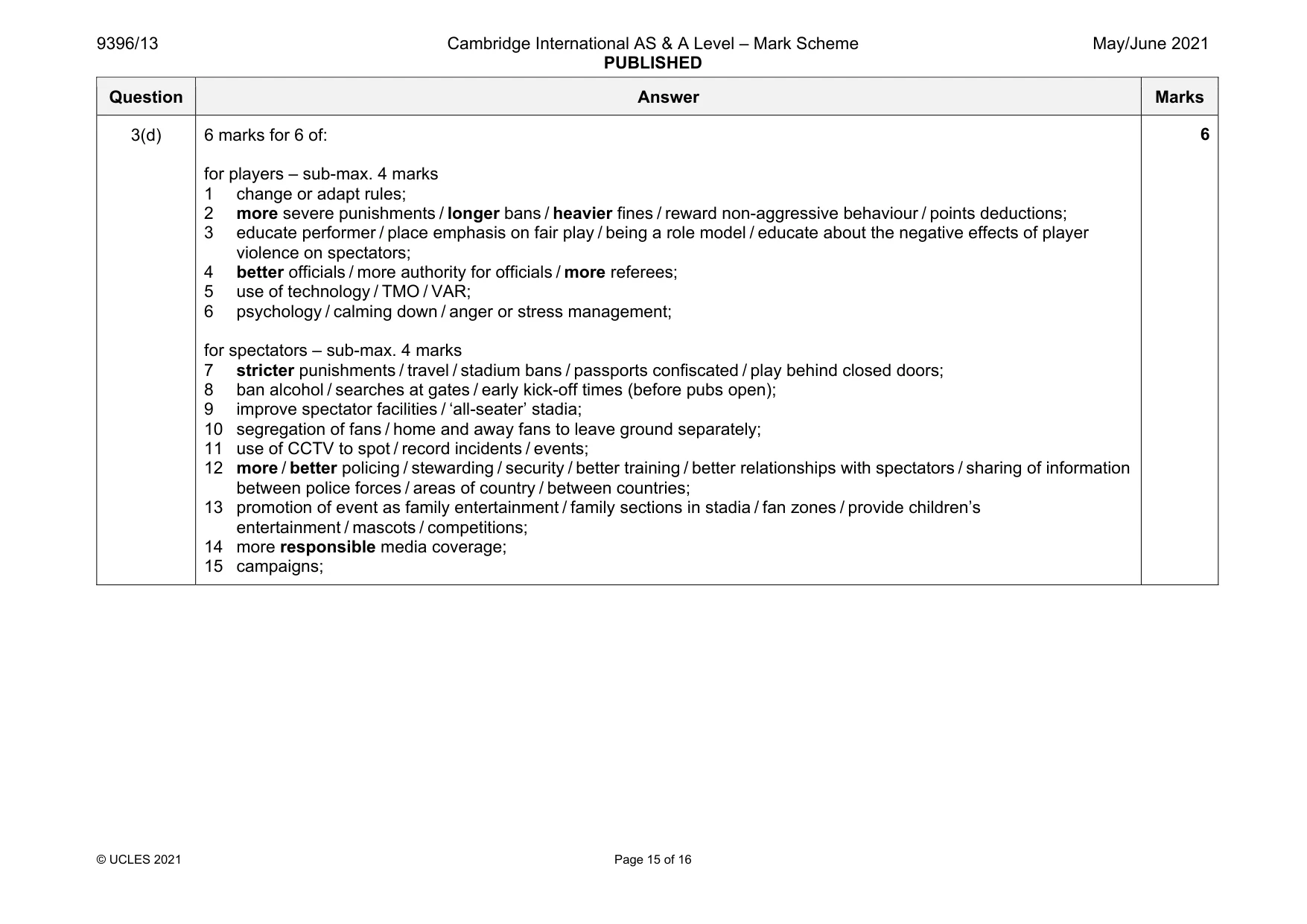
9396/13 Cambridge International AS & A Level – Mark Scheme PUBLISHED May/June 2021 © UCLES 2021 Page 15 of 16 Question Answer Marks 3(d) 6 marks for 6 of: for players – sub-max. 4 marks 1 change or adapt rules; 2 more severe punishments / longer bans / heavier fines / reward non-aggressive behaviour / points deductions; 3 educate performer / place emphasis on fair play / being a role model / educate about the negative effects of player violence on spectators; 4 better officials / more authority for officials / more referees; 5 use of technology / TMO / VAR; 6 psychology / calming down / anger or stress management; for spectators – sub-max. 4 marks 7 stricter punishments / travel / stadium bans / passports confiscated / play behind closed doors; 8 ban alcohol / searches at gates / early kick-off times (before pubs open); 9 improve spectator facilities / ‘all-seater’ stadia; 10 segregation of fans / home and away fans to leave ground separately; 11 use of CCTV to spot / record incidents / events; 12 more / better policing / stewarding / security / better training / better relationships with spectators / sharing of information between police forces / areas of country / between countries; 13 promotion of event as family entertainment / family sections in stadia / fan zones / provide children’s entertainment / mascots / competitions; 14 more responsible media coverage; 15 campaigns; 6
Mark scheme, page 16
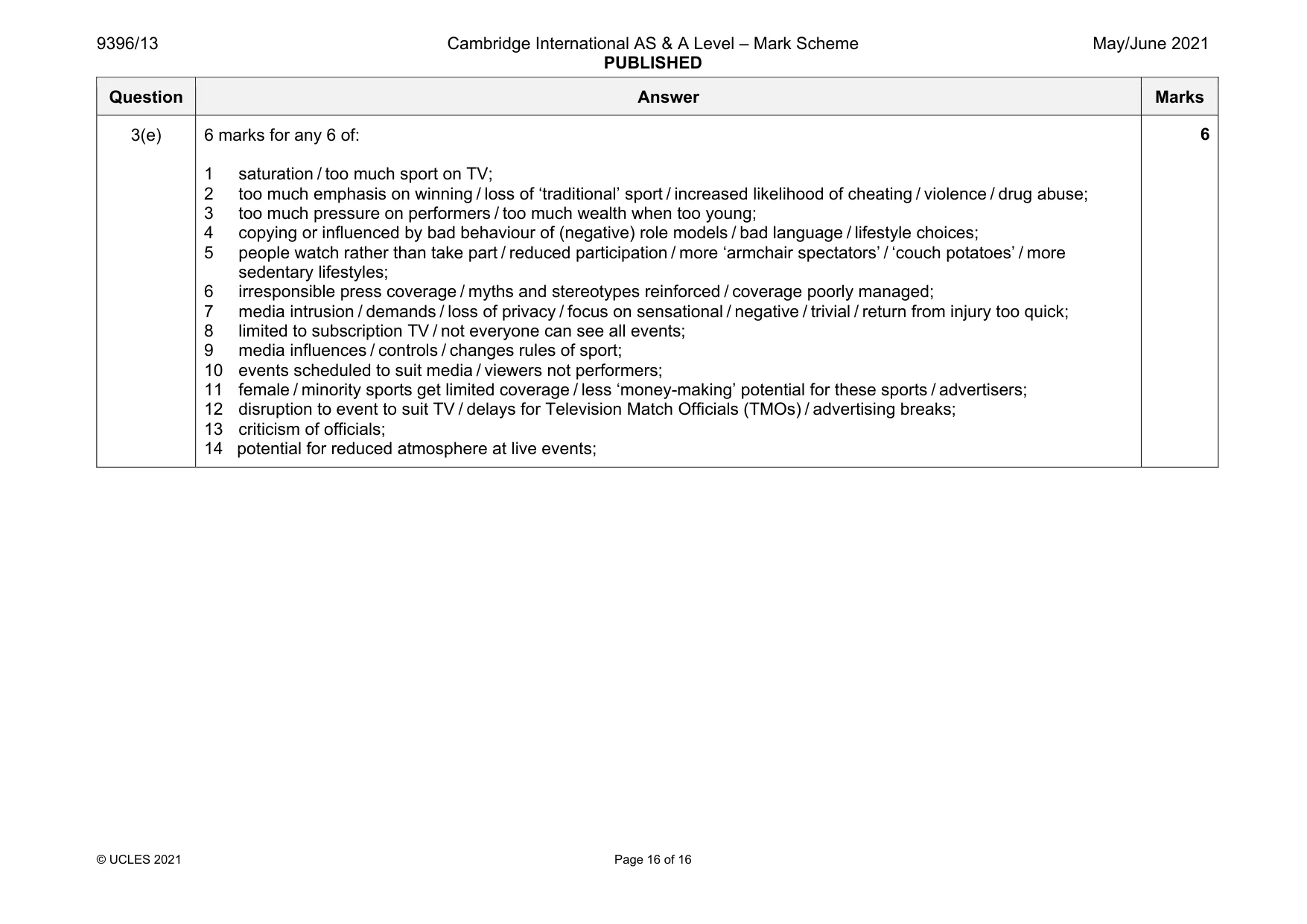
9396/13 Cambridge International AS & A Level – Mark Scheme PUBLISHED May/June 2021 © UCLES 2021 Page 16 of 16 Question Answer Marks 3(e) 6 marks for any 6 of: 1 saturation / too much sport on TV; 2 too much emphasis on winning / loss of ‘traditional’ sport / increased likelihood of cheating / violence / drug abuse; 3 too much pressure on performers / too much wealth when too young; 4 copying or influenced by bad behaviour of (negative) role models / bad language / lifestyle choices; 5 people watch rather than take part / reduced participation / more ‘armchair spectators’ / ‘couch potatoes’ / more sedentary lifestyles; 6 irresponsible press coverage / myths and stereotypes reinforced / coverage poorly managed; 7 media intrusion / demands / loss of privacy / focus on sensational / negative / trivial / return from injury too quick; 8 limited to subscription TV / not everyone can see all events; 9 media influences / controls / changes rules of sport; 10 events scheduled to suit media / viewers not performers; 11 female / minority sports get limited coverage / less ‘money-making’ potential for these sports / advertisers; 12 disruption to event to suit TV / delays for Television Match Officials (TMOs) / advertising breaks; 13 criticism of officials; 14 potential for reduced atmosphere at live events; 6
What you needed in this session
Cambridge’s own grade thresholds for 2021 May/June, Paper 1 · Variant 3. A higher threshold means an easier paper — the bar moves with how the cohort did.