Cambridge A Level Physical Education 9396 — 2020 Oct/Nov Paper 1 · Variant 2
9396/12/O/N/20 · 90 marks · ≈101 min
The question paper and its mark scheme, free to read here and free to download. This is Cambridge’s own paper, exactly as it was sat.
Question paper8 pages



Mark scheme12 pages
Answers below. Sit the paper first if you are practising.
Paper as text
Question paper, page 1
Cambridge International AS & A Level * 4 3 3 2 6 1 9 4 7 0 * PHYSICAL EDUCATION 9396/12 Paper 1 October/November 2020 2 hours 30 minutes You must answer on the enclosed answer booklet. You will need: Answer booklet (enclosed) INSTRUCTIONS ● Answer all questions. ● Follow the instructions on the front cover of the answer booklet. If you need additional answer paper, ask the invigilator for a continuation booklet. ● You may use a calculator. ● You should show all your working and use appropriate units. INFORMATION ● The total mark for this paper is 90. ● The number of marks for each question or part question is shown in brackets [ ]. This document has 8 pages. Blank pages are indicated. DC (KS/TP) 180772/1 © UCLES 2020 [Turn over
Question paper, page 2
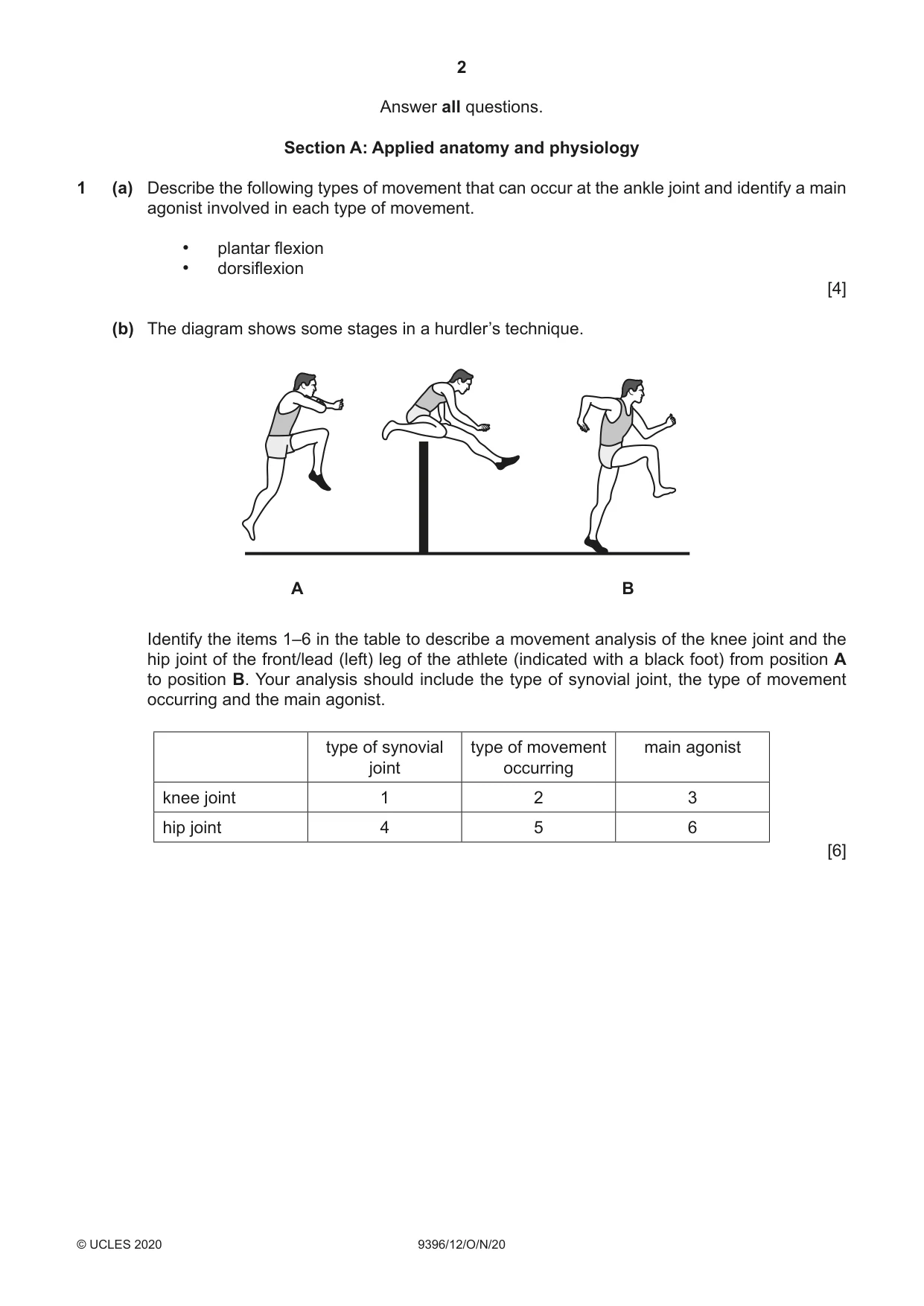
2 9396/12/O/N/20 © UCLES 2020 Answer all questions. Section A: Applied anatomy and physiology 1 (a) Describe the following types of movement that can occur at the ankle joint and identify a main agonist involved in each type of movement. • plantar flexion • dorsiflexion [4] (b) The diagram shows some stages in a hurdler’s technique. A B Identify the items 1–6 in the table to describe a movement analysis of the knee joint and the hip joint of the front/lead (left) leg of the athlete (indicated with a black foot) from position A to position B. Your analysis should include the type of synovial joint, the type of movement occurring and the main agonist. type of synovial joint type of movement occurring main agonist knee joint 1 2 3 hip joint 4 5 6 [6]
Question paper, page 3
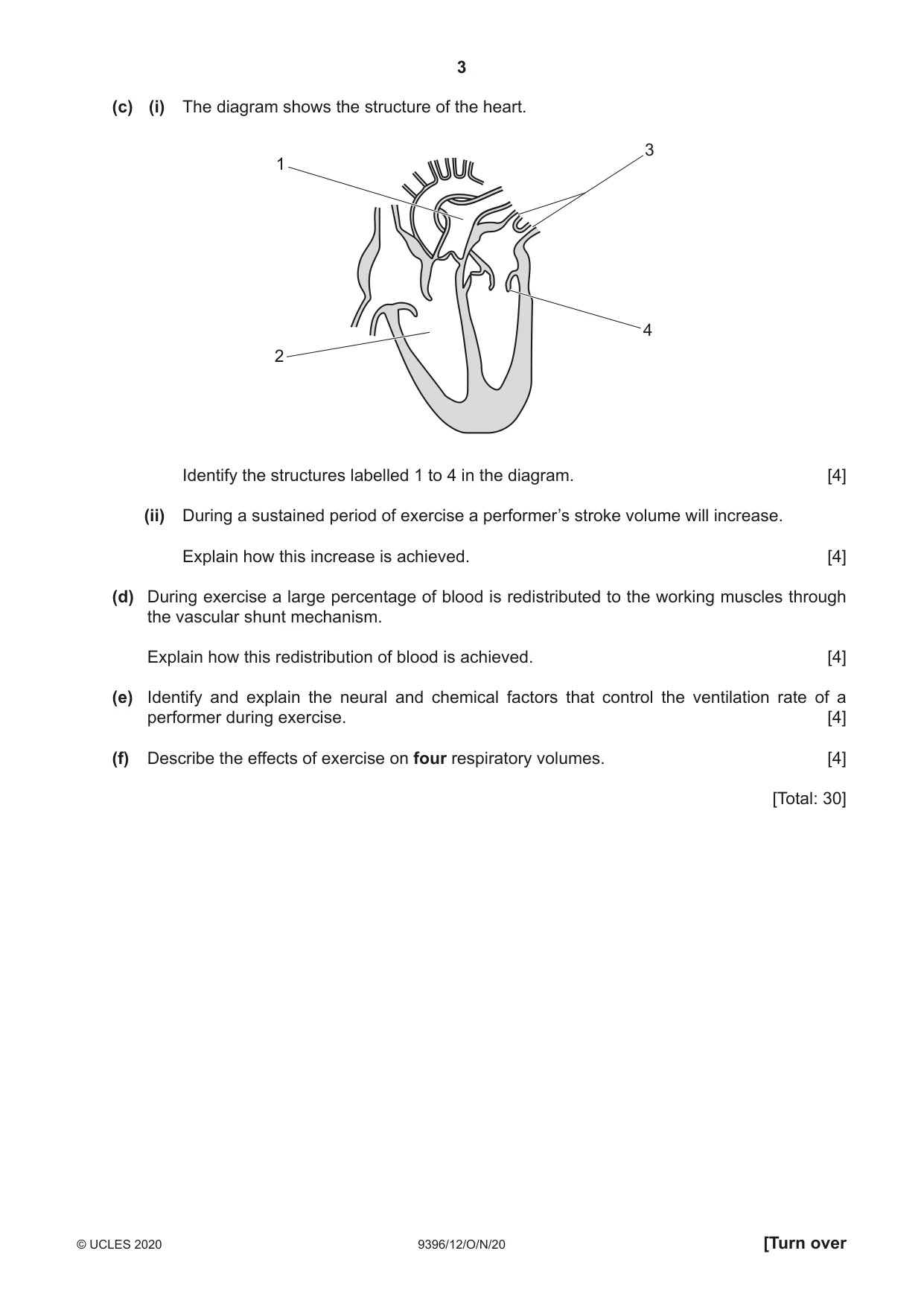
3 9396/12/O/N/20 © UCLES 2020 [Turn over (c) (i) The diagram shows the structure of the heart. 3 4 2 1 Identify the structures labelled 1 to 4 in the diagram. [4] (ii) During a sustained period of exercise a performer’s stroke volume will increase. Explain how this increase is achieved. [4] (d) During exercise a large percentage of blood is redistributed to the working muscles through the vascular shunt mechanism. Explain how this redistribution of blood is achieved. [4] (e) Identify and explain the neural and chemical factors that control the ventilation rate of a performer during exercise. [4] (f) Describe the effects of exercise on four respiratory volumes. [4] [Total: 30]
Question paper, page 4
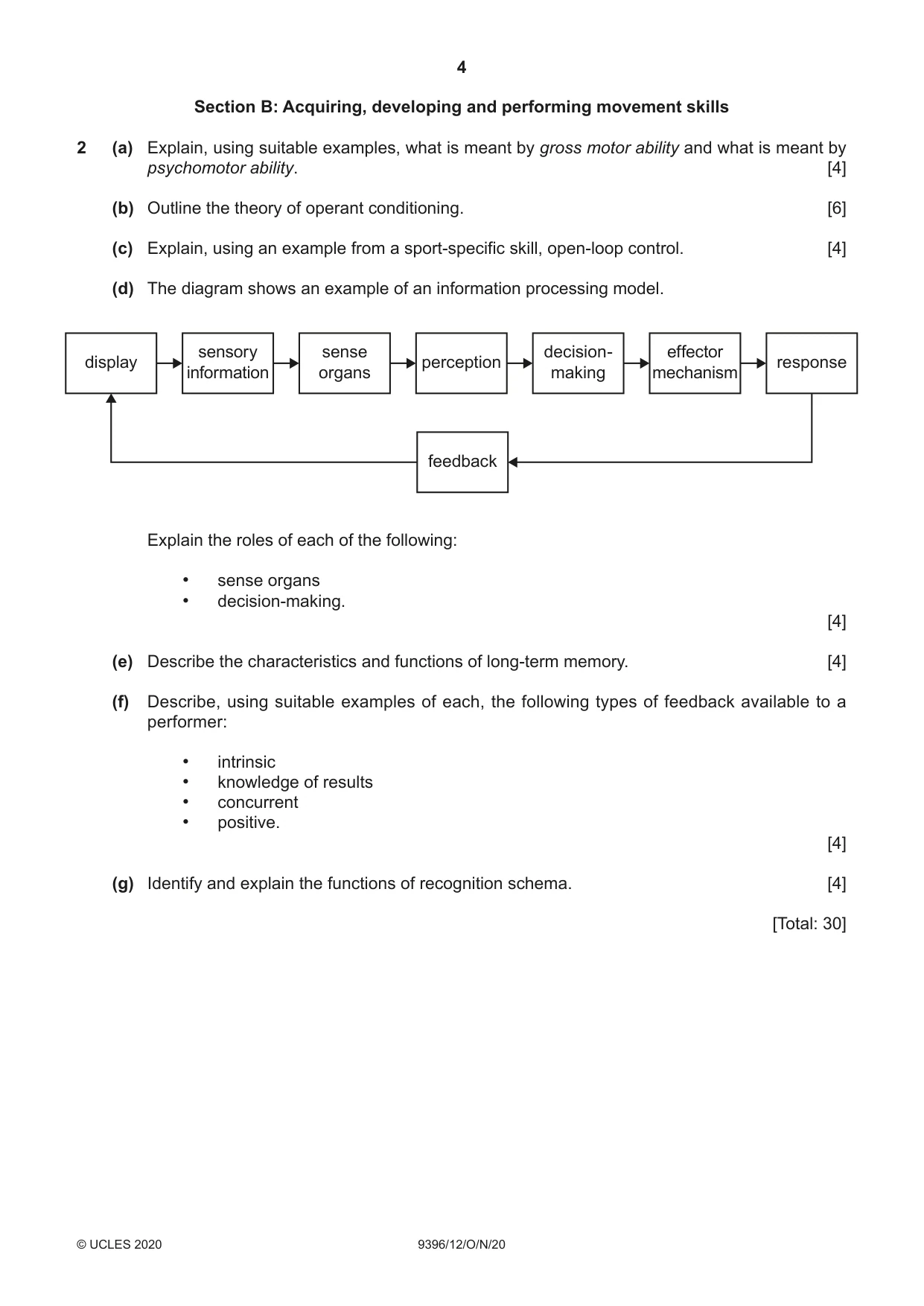
4 9396/12/O/N/20 © UCLES 2020 Section B: Acquiring, developing and performing movement skills 2 (a) Explain, using suitable examples, what is meant by gross motor ability and what is meant by psychomotor ability. [4] (b) Outline the theory of operant conditioning. [6] (c) Explain, using an example from a sport-specific skill, open-loop control. [4] (d) The diagram shows an example of an information processing model. feedback sensory information sense organs perception decision- making effector mechanism response display Explain the roles of each of the following: • sense organs • decision-making. [4] (e) Describe the characteristics and functions of long-term memory. [4] (f) Describe, using suitable examples of each, the following types of feedback available to a performer: • intrinsic • knowledge of results • concurrent • positive. [4] (g) Identify and explain the functions of recognition schema. [4] [Total: 30]
Question paper, page 5
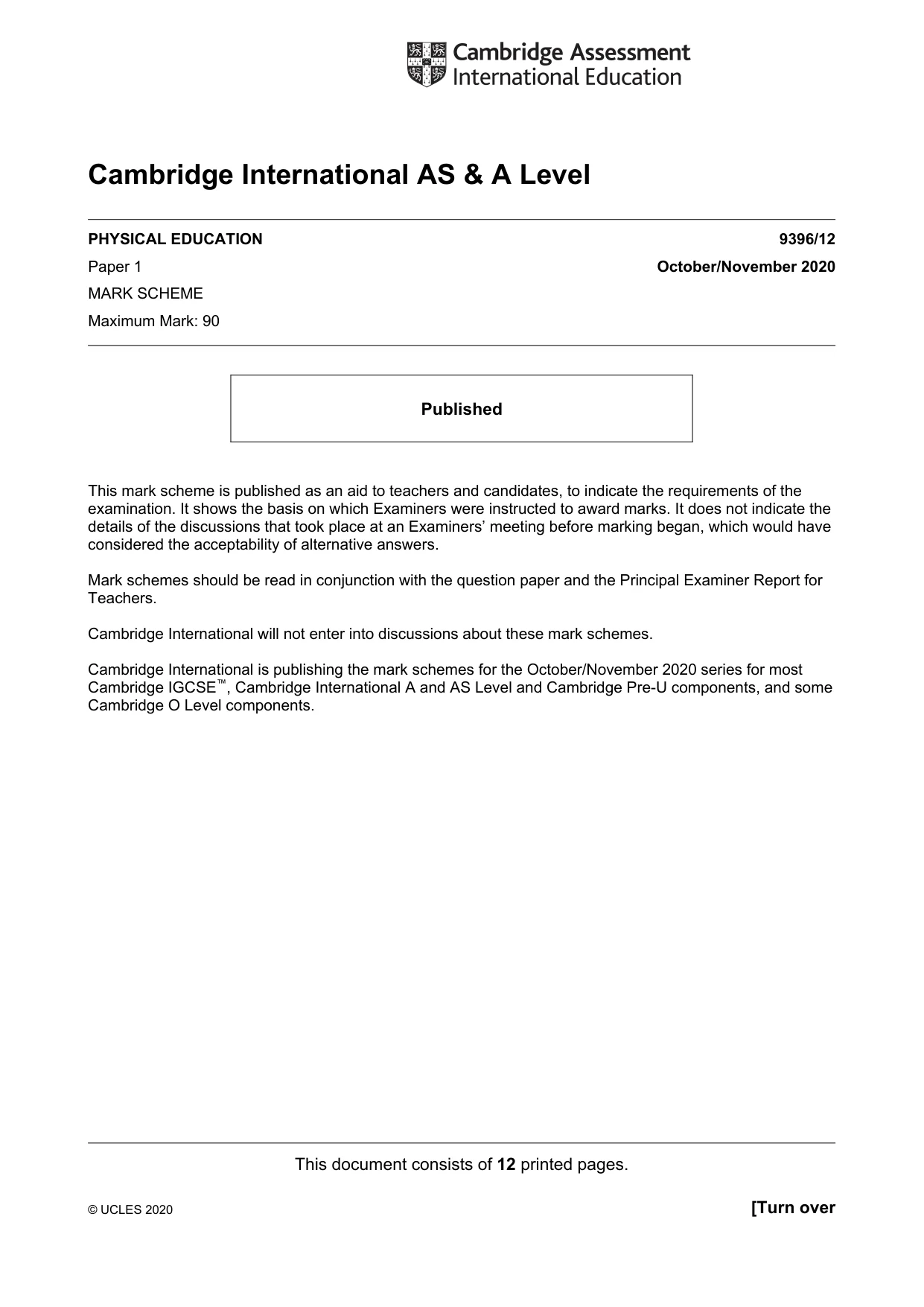
5 9396/12/O/N/20 © UCLES 2020 Section C: Contemporary studies in physical education and sport 3 (a) Describe the characteristics of play. [3] (b) Describe the terms equal opportunity and esteem in relation to sports participation. [2] (c) Describe, using suitable examples of each, the values of physical education in schools. [4] (d) Describe, using a country of your choice, the policies and initiatives that are in place to achieve excellence in sport. [5] (e) (i) Outline the benefits for society of regular participation in sport. [4] (ii) Explain factors that affect participation in sport. [4] (f) (i) Describe, using an example of each, the following terms: • sportsmanship • gamesmanship. [4] (ii) Suggest how the ethic of fair play is encouraged and maintained in elite sport. [4] [Total: 30]
Question paper, page 6
6 9396/12/O/N/20 © UCLES 2020 BLANK PAGE
Question paper, page 7
7 9396/12/O/N/20 © UCLES 2020 BLANK PAGE
Question paper, page 8
8 9396/12/O/N/20 © UCLES 2020 Permission to reproduce items where third-party owned material protected by copyright is included has been sought and cleared where possible. Every reasonable effort has been made by the publisher (UCLES) to trace copyright holders, but if any items requiring clearance have unwittingly been included, the publisher will be pleased to make amends at the earliest possible opportunity. To avoid the issue of disclosure of answer-related information to candidates, all copyright acknowledgements are reproduced online in the Cambridge Assessment International Education Copyright Acknowledgements Booklet. This is produced for each series of examinations and is freely available to download at www.cambridgeinternational.org after the live examination series. Cambridge Assessment International Education is part of the Cambridge Assessment Group. Cambridge Assessment is the brand name of the University of Cambridge Local Examinations Syndicate (UCLES), which itself is a department of the University of Cambridge. BLANK PAGE
Mark scheme, page 1
This document consists of 12 printed pages. © UCLES 2020 [Turn over Cambridge International AS & A Level PHYSICAL EDUCATION 9396/12 Paper 1 October/November 2020 MARK SCHEME Maximum Mark: 90 Published This mark scheme is published as an aid to teachers and candidates, to indicate the requirements of the examination. It shows the basis on which Examiners were instructed to award marks. It does not indicate the details of the discussions that took place at an Examiners’ meeting before marking began, which would have considered the acceptability of alternative answers. Mark schemes should be read in conjunction with the question paper and the Principal Examiner Report for Teachers. Cambridge International will not enter into discussions about these mark schemes. Cambridge International is publishing the mark schemes for the October/November 2020 series for most Cambridge IGCSE™, Cambridge International A and AS Level and Cambridge Pre-U components, and some Cambridge O Level components.
Mark scheme, page 2
9396/12 Cambridge International AS & A Level – Mark Scheme PUBLISHED October/November 2020 © UCLES 2020 Page 2 of 12 Generic Marking Principles These general marking principles must be applied by all examiners when marking candidate answers. They should be applied alongside the specific content of the mark scheme or generic level descriptors for a question. Each question paper and mark scheme will also comply with these marking principles. GENERIC MARKING PRINCIPLE 1: Marks must be awarded in line with: • the specific content of the mark scheme or the generic level descriptors for the question • the specific skills defined in the mark scheme or in the generic level descriptors for the question • the standard of response required by a candidate as exemplified by the standardisation scripts. GENERIC MARKING PRINCIPLE 2: Marks awarded are always whole marks (not half marks, or other fractions). GENERIC MARKING PRINCIPLE 3: Marks must be awarded positively: • marks are awarded for correct/valid answers, as defined in the mark scheme. However, credit is given for valid answers which go beyond the scope of the syllabus and mark scheme, referring to your Team Leader as appropriate • marks are awarded when candidates clearly demonstrate what they know and can do • marks are not deducted for errors • marks are not deducted for omissions • answers should only be judged on the quality of spelling, punctuation and grammar when these features are specifically assessed by the question as indicated by the mark scheme. The meaning, however, should be unambiguous. GENERIC MARKING PRINCIPLE 4: Rules must be applied consistently, e.g. in situations where candidates have not followed instructions or in the application of generic level descriptors.
Mark scheme, page 3
9396/12 Cambridge International AS & A Level – Mark Scheme PUBLISHED October/November 2020 © UCLES 2020 Page 3 of 12 GENERIC MARKING PRINCIPLE 5: Marks should be awarded using the full range of marks defined in the mark scheme for the question (however; the use of the full mark range may be limited according to the quality of the candidate responses seen). GENERIC MARKING PRINCIPLE 6: Marks awarded are based solely on the requirements as defined in the mark scheme. Marks should not be awarded with grade thresholds or grade descriptors in mind. Science-Specific Marking Principles 1 Examiners should consider the context and scientific use of any keywords when awarding marks. Although keywords may be present, marks should not be awarded if the keywords are used incorrectly. 2 The examiner should not choose between contradictory statements given in the same question part, and credit should not be awarded for any correct statement that is contradicted within the same question part. Wrong science that is irrelevant to the question should be ignored. 3 Although spellings do not have to be correct, spellings of syllabus terms must allow for clear and unambiguous separation from other syllabus terms with which they may be confused (e.g. ethane / ethene, glucagon / glycogen, refraction / reflection). 4 The error carried forward (ecf) principle should be applied, where appropriate. If an incorrect answer is subsequently used in a scientifically correct way, the candidate should be awarded these subsequent marking points. Further guidance will be included in the mark scheme where necessary and any exceptions to this general principle will be noted. 5 ‘List rule’ guidance For questions that require n responses (e.g. State two reasons …): • The response should be read as continuous prose, even when numbered answer spaces are provided. • Any response marked ignore in the mark scheme should not count towards n. • Incorrect responses should not be awarded credit but will still count towards n. • Read the entire response to check for any responses that contradict those that would otherwise be credited. Credit should not be awarded for any responses that are contradicted within the rest of the response. Where two responses contradict one another, this should be treated as a single incorrect response. • Non-contradictory responses after the first n responses may be ignored even if they include incorrect science.
Mark scheme, page 4
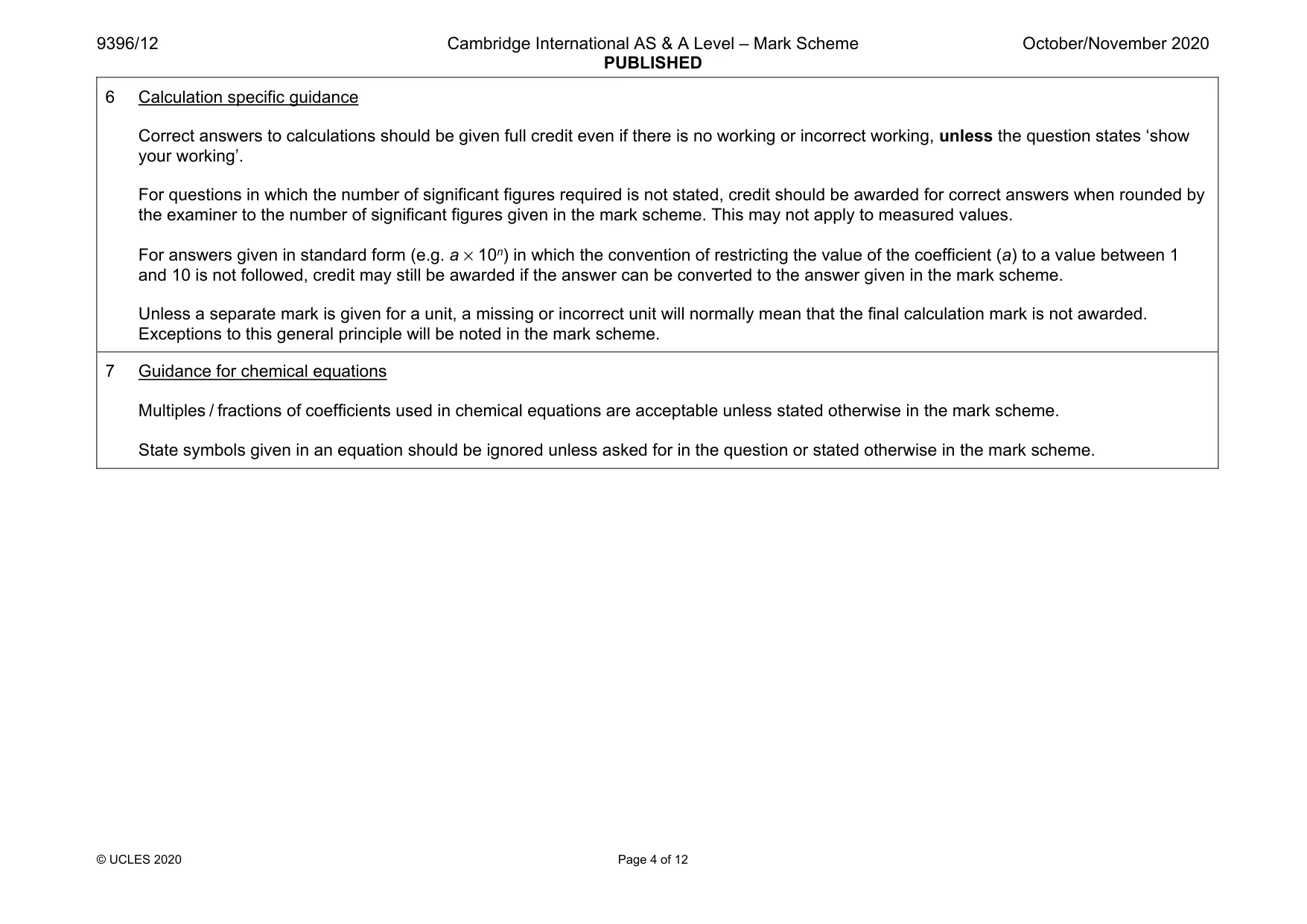
9396/12 Cambridge International AS & A Level – Mark Scheme PUBLISHED October/November 2020 © UCLES 2020 Page 4 of 12 6 Calculation specific guidance Correct answers to calculations should be given full credit even if there is no working or incorrect working, unless the question states ‘show your working’. For questions in which the number of significant figures required is not stated, credit should be awarded for correct answers when rounded by the examiner to the number of significant figures given in the mark scheme. This may not apply to measured values. For answers given in standard form (e.g. a × 10n) in which the convention of restricting the value of the coefficient (a) to a value between 1 and 10 is not followed, credit may still be awarded if the answer can be converted to the answer given in the mark scheme. Unless a separate mark is given for a unit, a missing or incorrect unit will normally mean that the final calculation mark is not awarded. Exceptions to this general principle will be noted in the mark scheme. 7 Guidance for chemical equations Multiples / fractions of coefficients used in chemical equations are acceptable unless stated otherwise in the mark scheme. State symbols given in an equation should be ignored unless asked for in the question or stated otherwise in the mark scheme.
Mark scheme, page 5
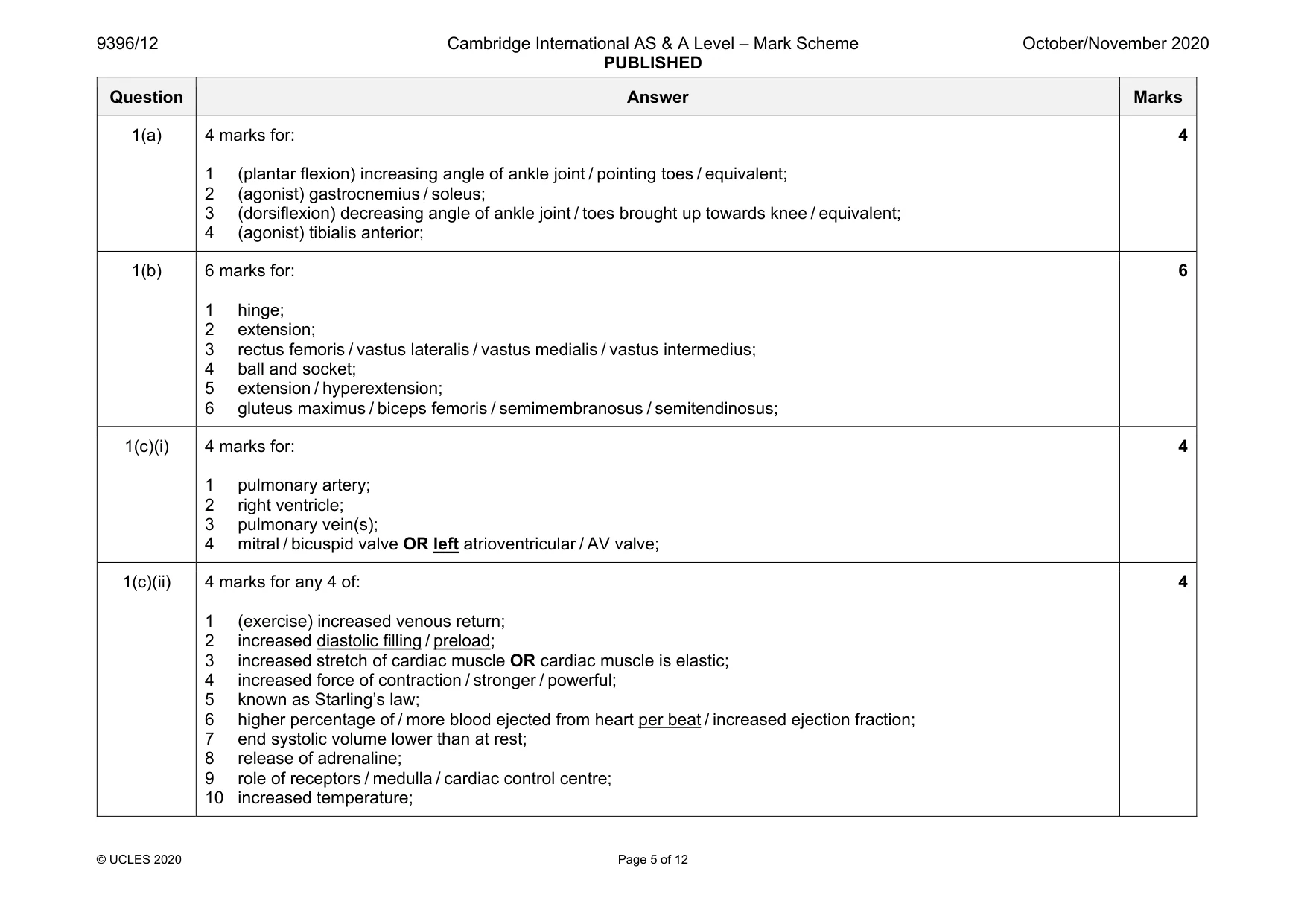
9396/12 Cambridge International AS & A Level – Mark Scheme PUBLISHED October/November 2020 © UCLES 2020 Page 5 of 12 Question Answer Marks 1(a) 4 marks for: 1 (plantar flexion) increasing angle of ankle joint / pointing toes / equivalent; 2 (agonist) gastrocnemius / soleus; 3 (dorsiflexion) decreasing angle of ankle joint / toes brought up towards knee / equivalent; 4 (agonist) tibialis anterior; 4 1(b) 6 marks for: 1 hinge; 2 extension; 3 rectus femoris / vastus lateralis / vastus medialis / vastus intermedius; 4 ball and socket; 5 extension / hyperextension; 6 gluteus maximus / biceps femoris / semimembranosus / semitendinosus; 6 1(c)(i) 4 marks for: 1 pulmonary artery; 2 right ventricle; 3 pulmonary vein(s); 4 mitral / bicuspid valve OR left atrioventricular / AV valve; 4 1(c)(ii) 4 marks for any 4 of: 1 (exercise) increased venous return; 2 increased diastolic filling / preload; 3 increased stretch of cardiac muscle OR cardiac muscle is elastic; 4 increased force of contraction / stronger / powerful; 5 known as Starling’s law; 6 higher percentage of / more blood ejected from heart per beat / increased ejection fraction; 7 end systolic volume lower than at rest; 8 release of adrenaline; 9 role of receptors / medulla / cardiac control centre; 10 increased temperature; 4
Mark scheme, page 6
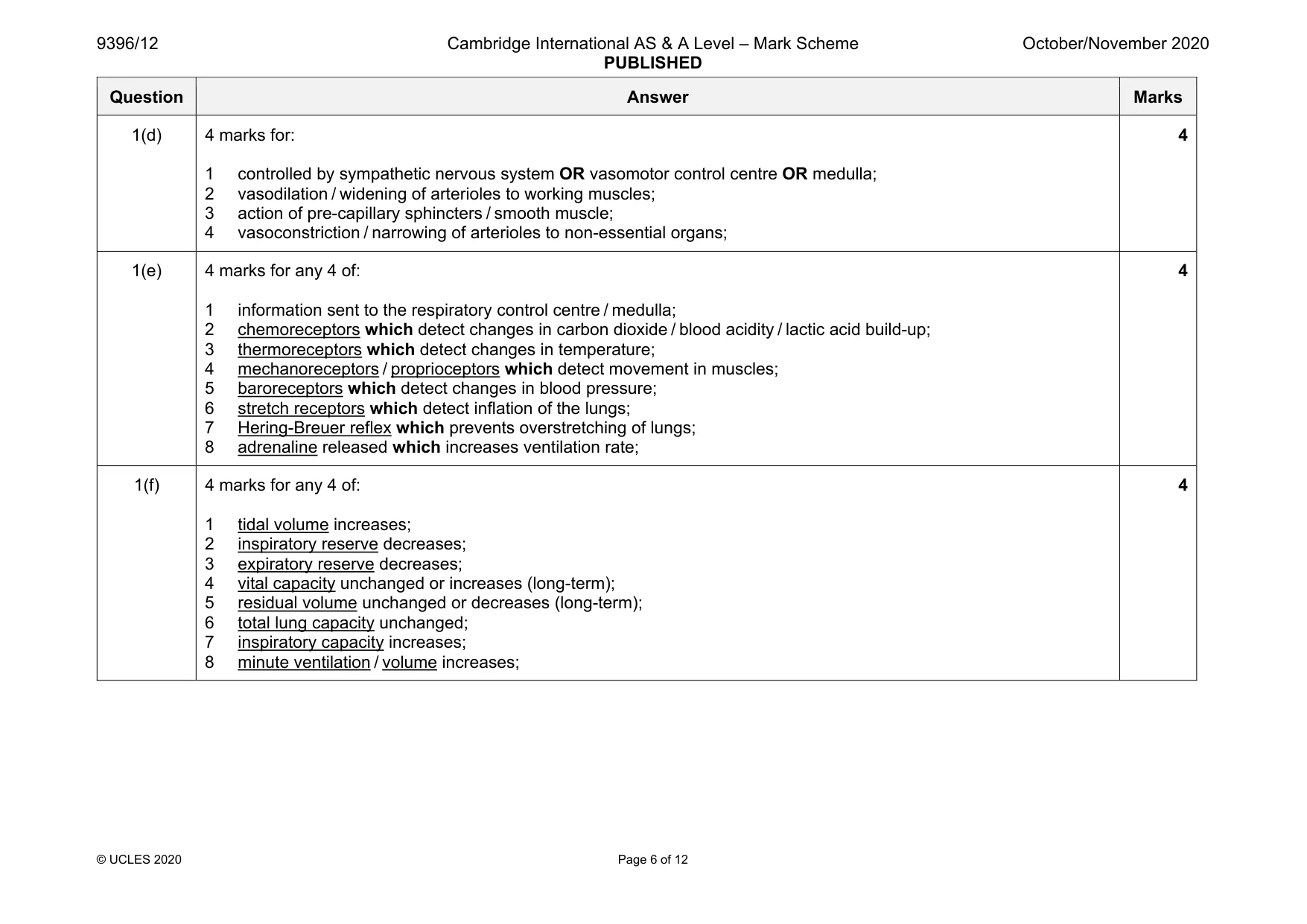
9396/12 Cambridge International AS & A Level – Mark Scheme PUBLISHED October/November 2020 © UCLES 2020 Page 6 of 12 Question Answer Marks 1(d) 4 marks for: 1 controlled by sympathetic nervous system OR vasomotor control centre OR medulla; 2 vasodilation / widening of arterioles to working muscles; 3 action of pre-capillary sphincters / smooth muscle; 4 vasoconstriction / narrowing of arterioles to non-essential organs; 4 1(e) 4 marks for any 4 of: 1 information sent to the respiratory control centre / medulla; 2 chemoreceptors which detect changes in carbon dioxide / blood acidity / lactic acid build-up; 3 thermoreceptors which detect changes in temperature; 4 mechanoreceptors / proprioceptors which detect movement in muscles; 5 baroreceptors which detect changes in blood pressure; 6 stretch receptors which detect inflation of the lungs; 7 Hering-Breuer reflex which prevents overstretching of lungs; 8 adrenaline released which increases ventilation rate; 4 1(f) 4 marks for any 4 of: 1 tidal volume increases; 2 inspiratory reserve decreases; 3 expiratory reserve decreases; 4 vital capacity unchanged or increases (long-term); 5 residual volume unchanged or decreases (long-term); 6 total lung capacity unchanged; 7 inspiratory capacity increases; 8 minute ventilation / volume increases; 4
Mark scheme, page 7
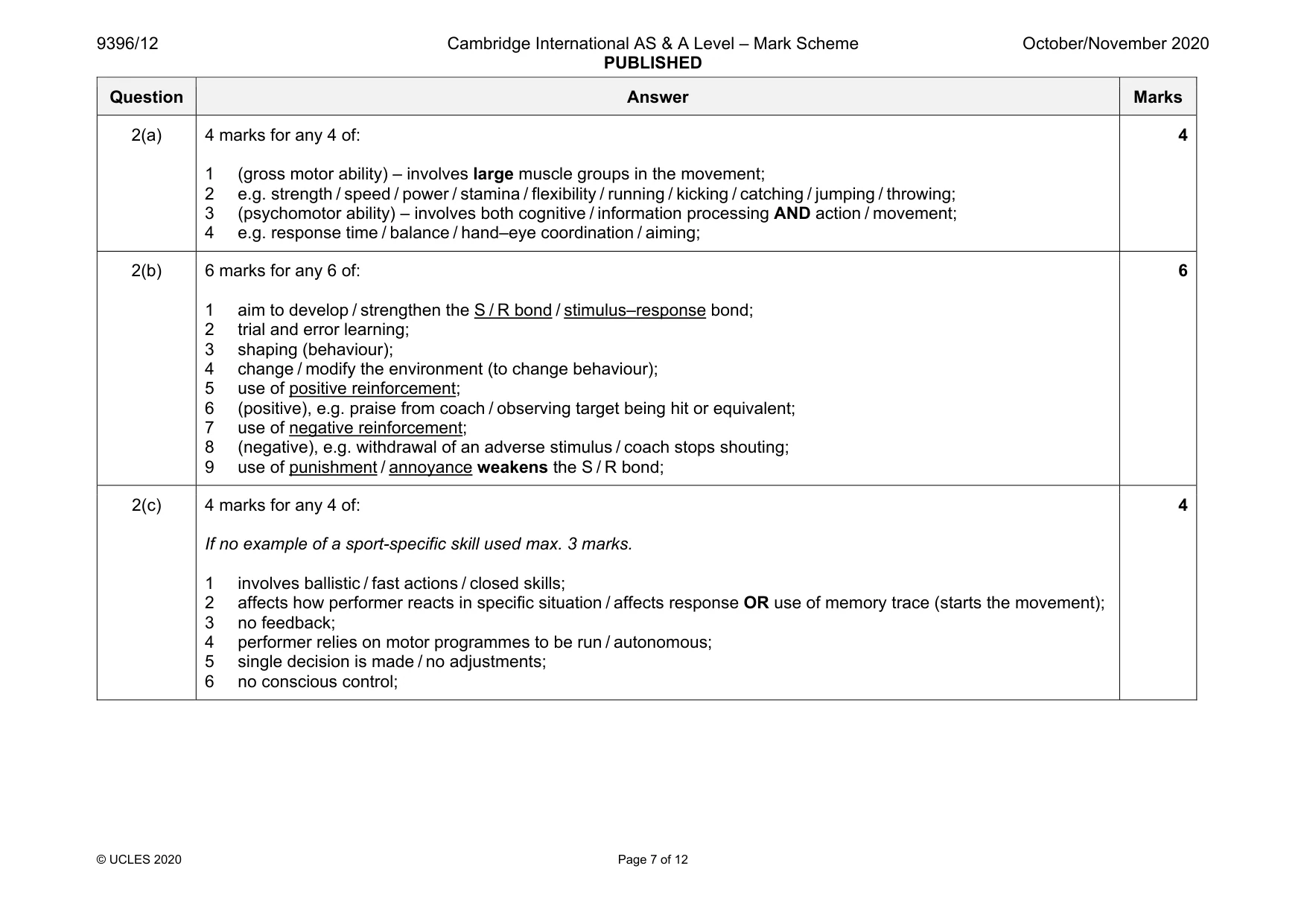
9396/12 Cambridge International AS & A Level – Mark Scheme PUBLISHED October/November 2020 © UCLES 2020 Page 7 of 12 Question Answer Marks 2(a) 4 marks for any 4 of: 1 (gross motor ability) – involves large muscle groups in the movement; 2 e.g. strength / speed / power / stamina / flexibility / running / kicking / catching / jumping / throwing; 3 (psychomotor ability) – involves both cognitive / information processing AND action / movement; 4 e.g. response time / balance / hand–eye coordination / aiming; 4 2(b) 6 marks for any 6 of: 1 aim to develop / strengthen the S / R bond / stimulus–response bond; 2 trial and error learning; 3 shaping (behaviour); 4 change / modify the environment (to change behaviour); 5 use of positive reinforcement; 6 (positive), e.g. praise from coach / observing target being hit or equivalent; 7 use of negative reinforcement; 8 (negative), e.g. withdrawal of an adverse stimulus / coach stops shouting; 9 use of punishment / annoyance weakens the S / R bond; 6 2(c) 4 marks for any 4 of: If no example of a sport-specific skill used max. 3 marks. 1 involves ballistic / fast actions / closed skills; 2 affects how performer reacts in specific situation / affects response OR use of memory trace (starts the movement); 3 no feedback; 4 performer relies on motor programmes to be run / autonomous; 5 single decision is made / no adjustments; 6 no conscious control; 4
Mark scheme, page 8
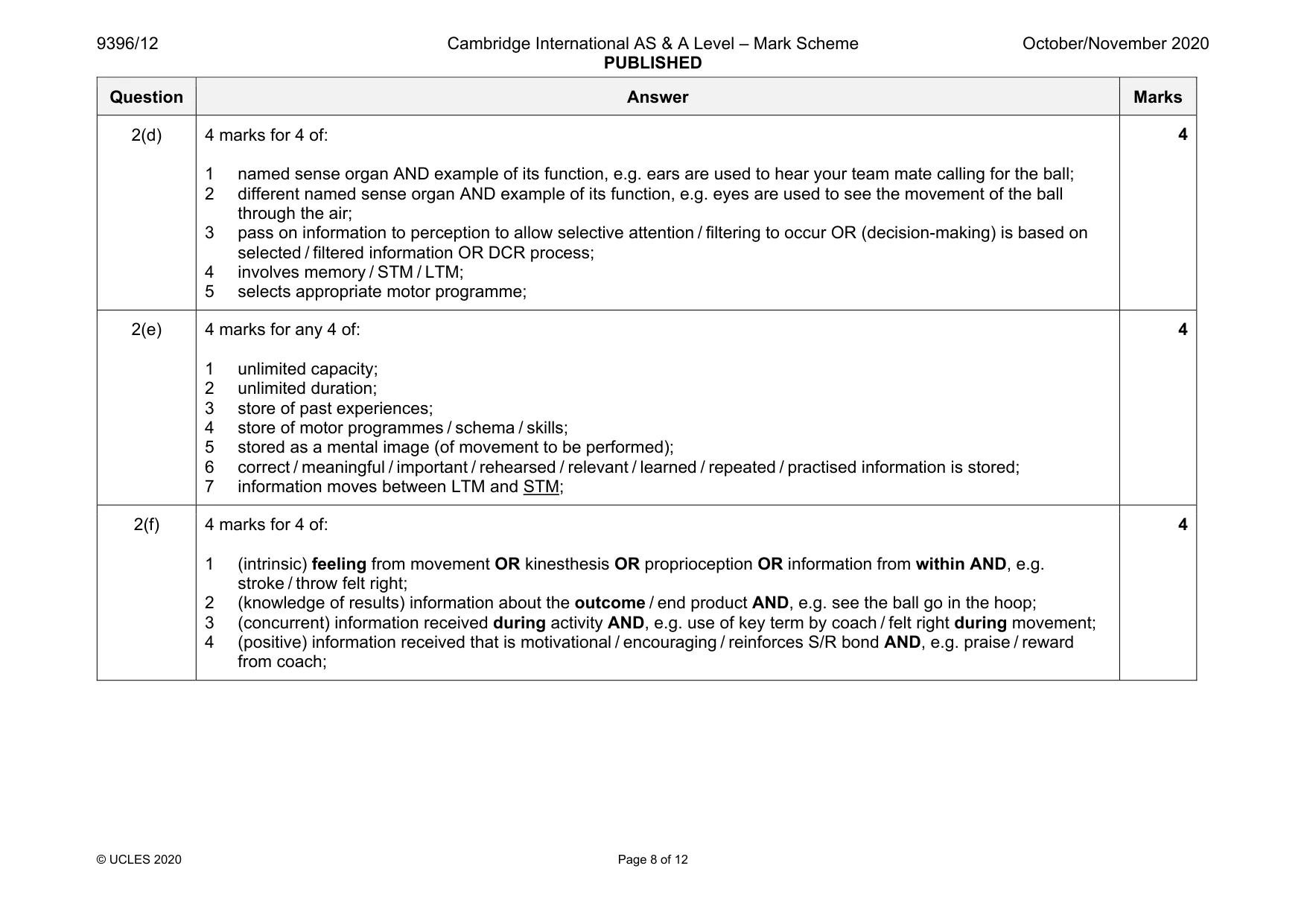
9396/12 Cambridge International AS & A Level – Mark Scheme PUBLISHED October/November 2020 © UCLES 2020 Page 8 of 12 Question Answer Marks 2(d) 4 marks for 4 of: 1 named sense organ AND example of its function, e.g. ears are used to hear your team mate calling for the ball; 2 different named sense organ AND example of its function, e.g. eyes are used to see the movement of the ball through the air; 3 pass on information to perception to allow selective attention / filtering to occur OR (decision-making) is based on selected / filtered information OR DCR process; 4 involves memory / STM / LTM; 5 selects appropriate motor programme; 4 2(e) 4 marks for any 4 of: 1 unlimited capacity; 2 unlimited duration; 3 store of past experiences; 4 store of motor programmes / schema / skills; 5 stored as a mental image (of movement to be performed); 6 correct / meaningful / important / rehearsed / relevant / learned / repeated / practised information is stored; 7 information moves between LTM and STM; 4 2(f) 4 marks for 4 of: 1 (intrinsic) feeling from movement OR kinesthesis OR proprioception OR information from within AND, e.g. stroke / throw felt right; 2 (knowledge of results) information about the outcome / end product AND, e.g. see the ball go in the hoop; 3 (concurrent) information received during activity AND, e.g. use of key term by coach / felt right during movement; 4 (positive) information received that is motivational / encouraging / reinforces S/R bond AND, e.g. praise / reward from coach; 4
Mark scheme, page 9
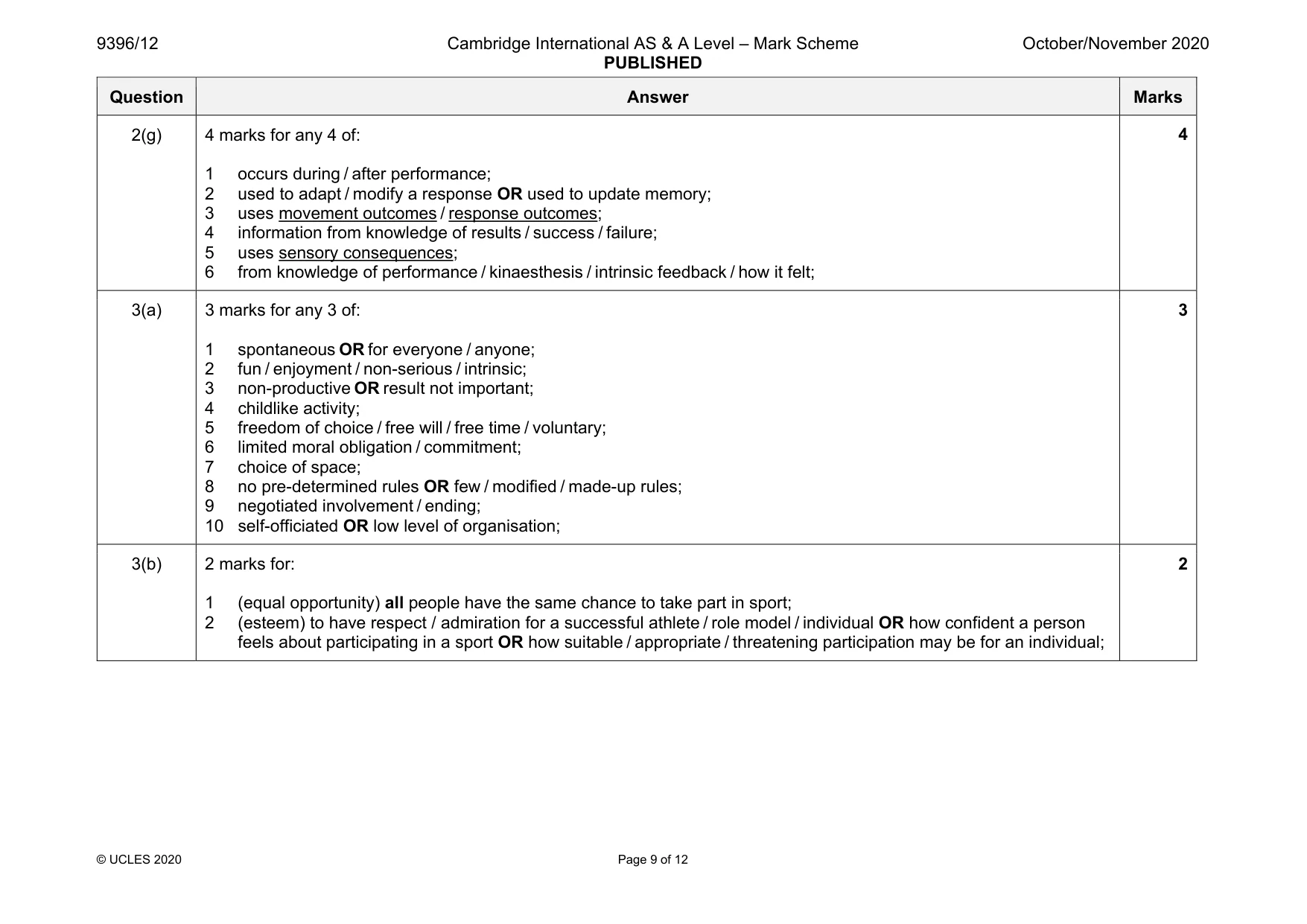
9396/12 Cambridge International AS & A Level – Mark Scheme PUBLISHED October/November 2020 © UCLES 2020 Page 9 of 12 Question Answer Marks 2(g) 4 marks for any 4 of: 1 occurs during / after performance; 2 used to adapt / modify a response OR used to update memory; 3 uses movement outcomes / response outcomes; 4 information from knowledge of results / success / failure; 5 uses sensory consequences; 6 from knowledge of performance / kinaesthesis / intrinsic feedback / how it felt; 4 3(a) 3 marks for any 3 of: 1 spontaneous OR for everyone / anyone; 2 fun / enjoyment / non-serious / intrinsic; 3 non-productive OR result not important; 4 childlike activity; 5 freedom of choice / free will / free time / voluntary; 6 limited moral obligation / commitment; 7 choice of space; 8 no pre-determined rules OR few / modified / made-up rules; 9 negotiated involvement / ending; 10 self-officiated OR low level of organisation; 3 3(b) 2 marks for: 1 (equal opportunity) all people have the same chance to take part in sport; 2 (esteem) to have respect / admiration for a successful athlete / role model / individual OR how confident a person feels about participating in a sport OR how suitable / appropriate / threatening participation may be for an individual; 2
Mark scheme, page 10
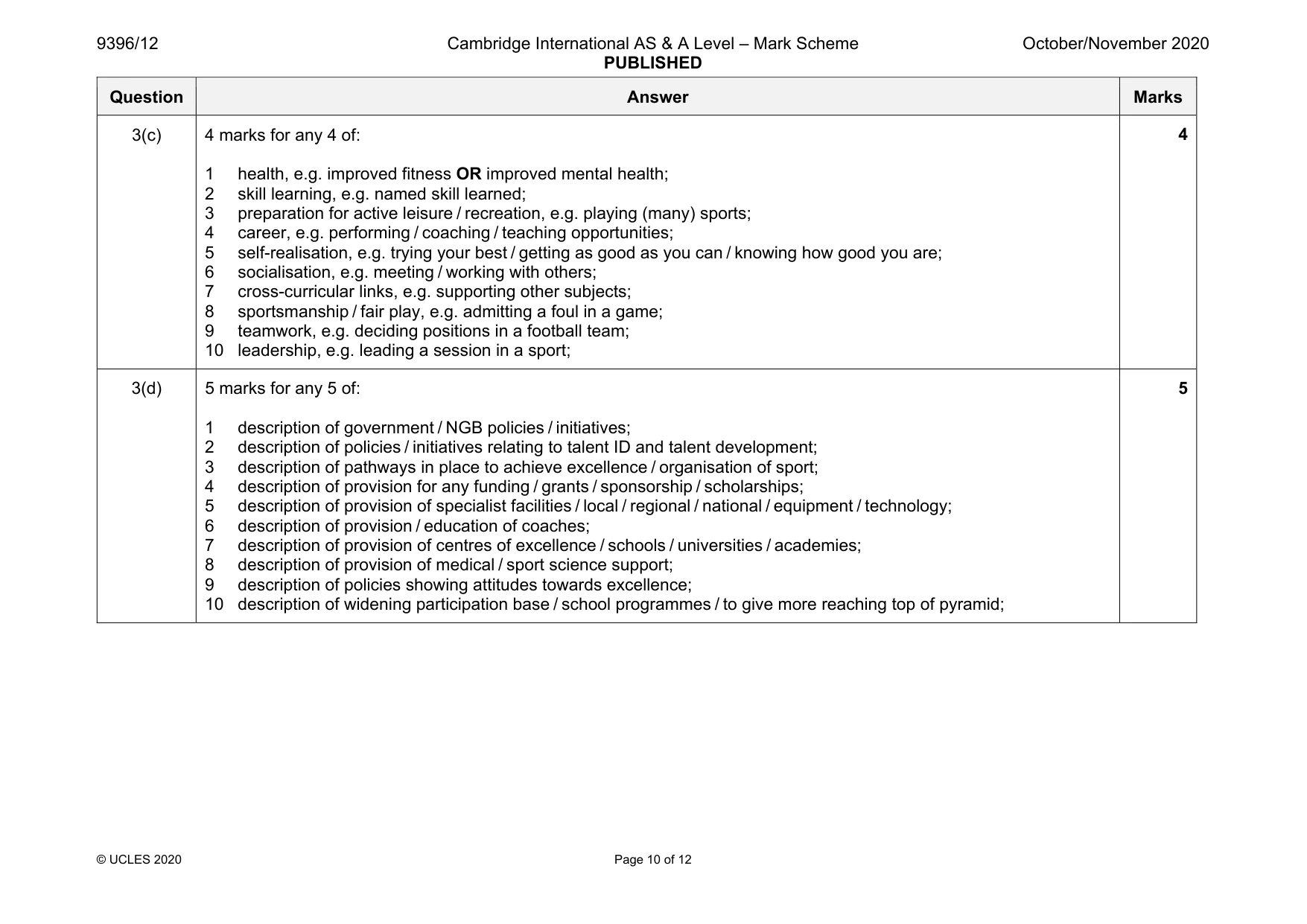
9396/12 Cambridge International AS & A Level – Mark Scheme PUBLISHED October/November 2020 © UCLES 2020 Page 10 of 12 Question Answer Marks 3(c) 4 marks for any 4 of: 1 health, e.g. improved fitness OR improved mental health; 2 skill learning, e.g. named skill learned; 3 preparation for active leisure / recreation, e.g. playing (many) sports; 4 career, e.g. performing / coaching / teaching opportunities; 5 self-realisation, e.g. trying your best / getting as good as you can / knowing how good you are; 6 socialisation, e.g. meeting / working with others; 7 cross-curricular links, e.g. supporting other subjects; 8 sportsmanship / fair play, e.g. admitting a foul in a game; 9 teamwork, e.g. deciding positions in a football team; 10 leadership, e.g. leading a session in a sport; 4 3(d) 5 marks for any 5 of: 1 description of government / NGB policies / initiatives; 2 description of policies / initiatives relating to talent ID and talent development; 3 description of pathways in place to achieve excellence / organisation of sport; 4 description of provision for any funding / grants / sponsorship / scholarships; 5 description of provision of specialist facilities / local / regional / national / equipment / technology; 6 description of provision / education of coaches; 7 description of provision of centres of excellence / schools / universities / academies; 8 description of provision of medical / sport science support; 9 description of policies showing attitudes towards excellence; 10 description of widening participation base / school programmes / to give more reaching top of pyramid; 5
Mark scheme, page 11
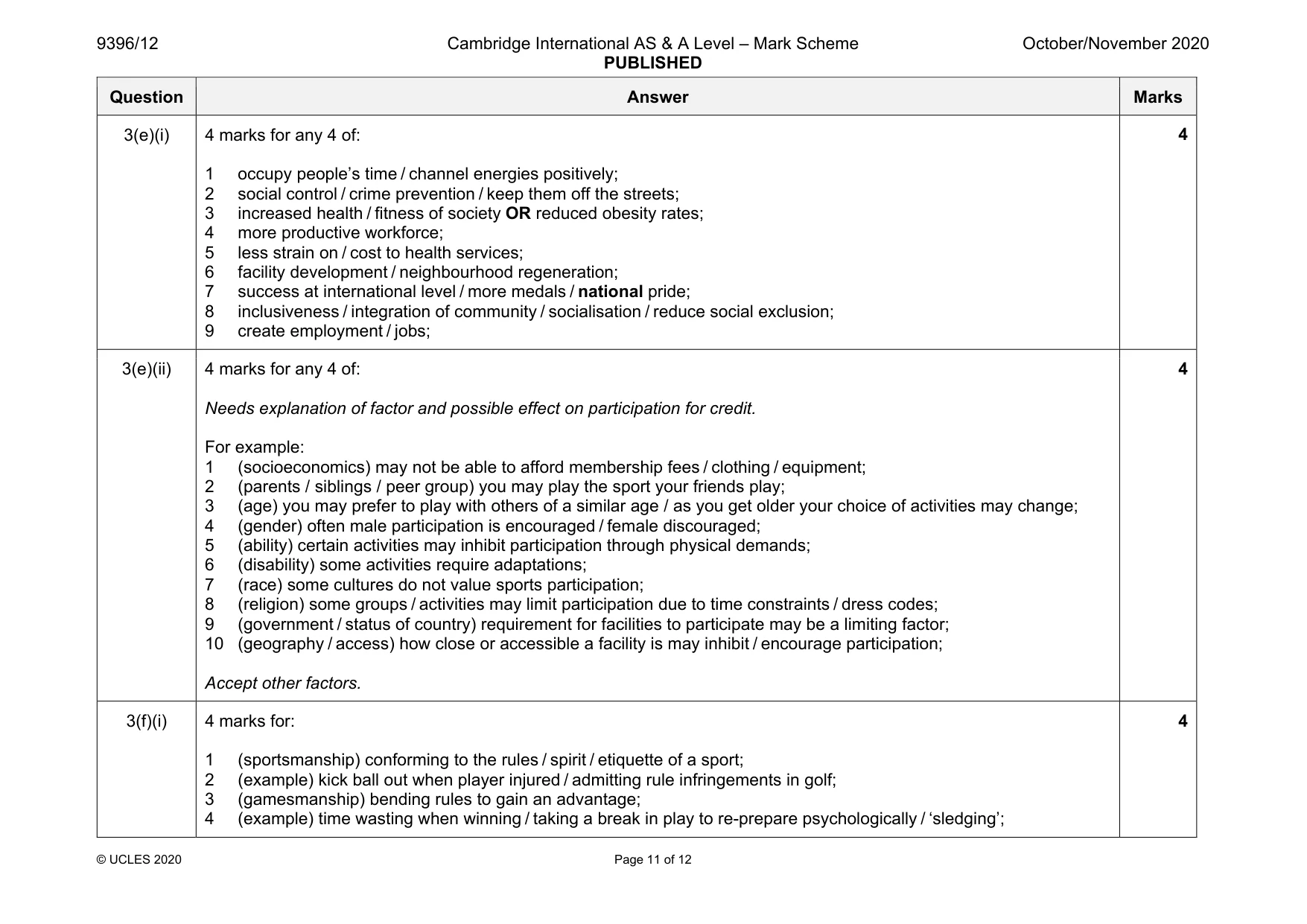
9396/12 Cambridge International AS & A Level – Mark Scheme PUBLISHED October/November 2020 © UCLES 2020 Page 11 of 12 Question Answer Marks 3(e)(i) 4 marks for any 4 of: 1 occupy people’s time / channel energies positively; 2 social control / crime prevention / keep them off the streets; 3 increased health / fitness of society OR reduced obesity rates; 4 more productive workforce; 5 less strain on / cost to health services; 6 facility development / neighbourhood regeneration; 7 success at international level / more medals / national pride; 8 inclusiveness / integration of community / socialisation / reduce social exclusion; 9 create employment / jobs; 4 3(e)(ii) 4 marks for any 4 of: Needs explanation of factor and possible effect on participation for credit. For example: 1 (socioeconomics) may not be able to afford membership fees / clothing / equipment; 2 (parents / siblings / peer group) you may play the sport your friends play; 3 (age) you may prefer to play with others of a similar age / as you get older your choice of activities may change; 4 (gender) often male participation is encouraged / female discouraged; 5 (ability) certain activities may inhibit participation through physical demands; 6 (disability) some activities require adaptations; 7 (race) some cultures do not value sports participation; 8 (religion) some groups / activities may limit participation due to time constraints / dress codes; 9 (government / status of country) requirement for facilities to participate may be a limiting factor; 10 (geography / access) how close or accessible a facility is may inhibit / encourage participation; Accept other factors. 4 3(f)(i) 4 marks for: 1 (sportsmanship) conforming to the rules / spirit / etiquette of a sport; 2 (example) kick ball out when player injured / admitting rule infringements in golf; 3 (gamesmanship) bending rules to gain an advantage; 4 (example) time wasting when winning / taking a break in play to re-prepare psychologically / ‘sledging’; 4
Mark scheme, page 12
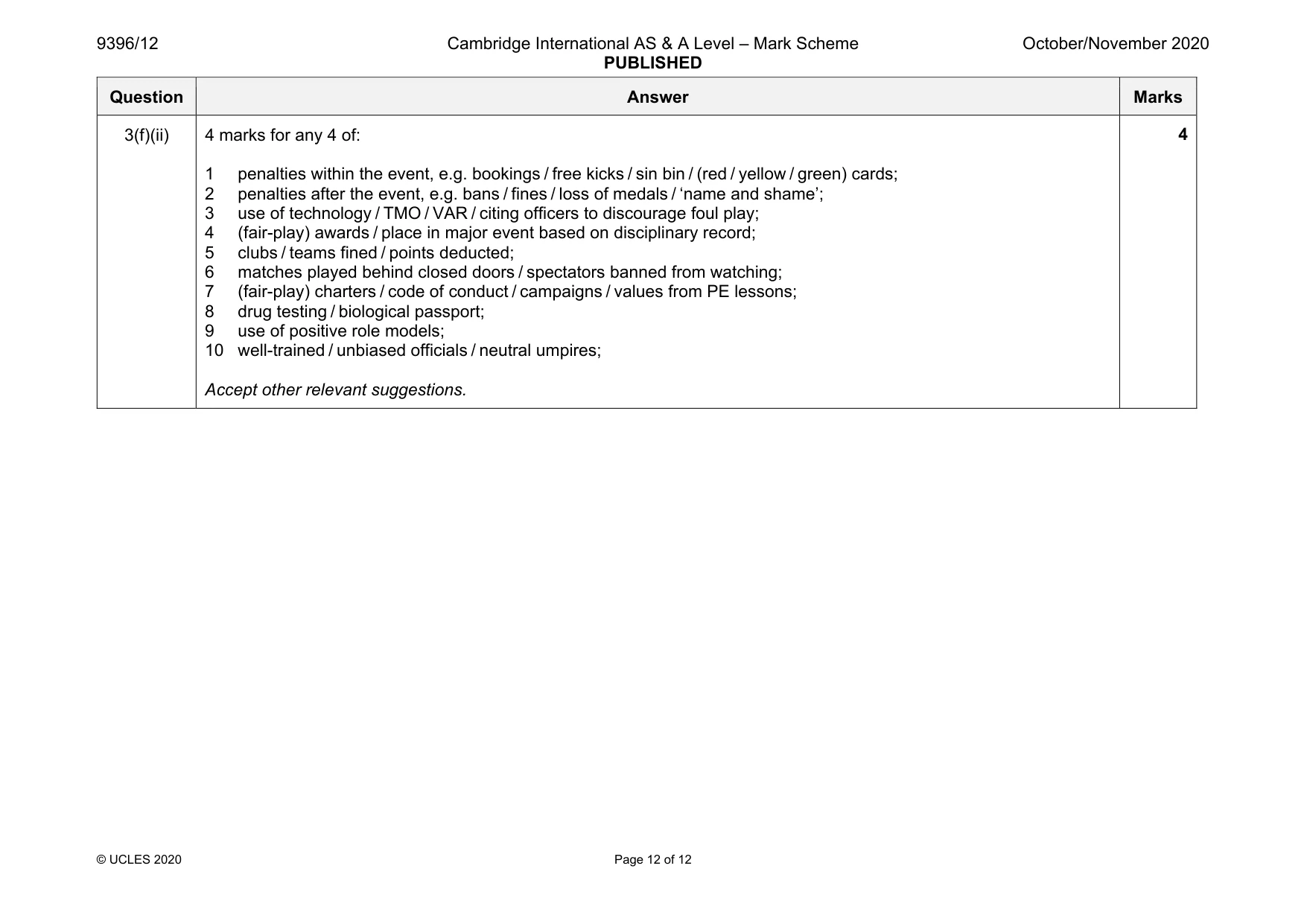
9396/12 Cambridge International AS & A Level – Mark Scheme PUBLISHED October/November 2020 © UCLES 2020 Page 12 of 12 Question Answer Marks 3(f)(ii) 4 marks for any 4 of: 1 penalties within the event, e.g. bookings / free kicks / sin bin / (red / yellow / green) cards; 2 penalties after the event, e.g. bans / fines / loss of medals / ‘name and shame’; 3 use of technology / TMO / VAR / citing officers to discourage foul play; 4 (fair-play) awards / place in major event based on disciplinary record; 5 clubs / teams fined / points deducted; 6 matches played behind closed doors / spectators banned from watching; 7 (fair-play) charters / code of conduct / campaigns / values from PE lessons; 8 drug testing / biological passport; 9 use of positive role models; 10 well-trained / unbiased officials / neutral umpires; Accept other relevant suggestions. 4
What you needed in this session
Cambridge’s own grade thresholds for 2020 Oct/Nov, Paper 1 · Variant 2. A higher threshold means an easier paper — the bar moves with how the cohort did.