Cambridge A Level Physical Education 9396 — 2023 May/June Paper 1 · Variant 2
9396/12/M/J/23 · 90 marks · ≈101 min
The question paper and its mark scheme, free to read here and free to download. This is Cambridge’s own paper, exactly as it was sat.
Question paper8 pages



Mark scheme15 pages
Answers below. Sit the paper first if you are practising.
Paper as text
Question paper, page 1
This document has 8 pages. Any blank pages are indicated. [Turn over Cambridge International AS & A Level PHYSICAL EDUCATION 9396/12 Paper 1 May/June 2023 2 hours 30 minutes You must answer on the enclosed answer booklet. You will need: Answer booklet (enclosed) INSTRUCTIONS ● Answer all questions. ● Follow the instructions on the front cover of the answer booklet. If you need additional answer paper, ask the invigilator for a continuation booklet. ● You may use a calculator. ● You should show all your working and use appropriate units. INFORMATION ● The total mark for this paper is 90. ● The number of marks for each question or part question is shown in brackets [ ]. * 9 8 6 6 6 0 5 3 6 7 * DC (CJ/FC) 312507/1 © UCLES 2023
Question paper, page 2
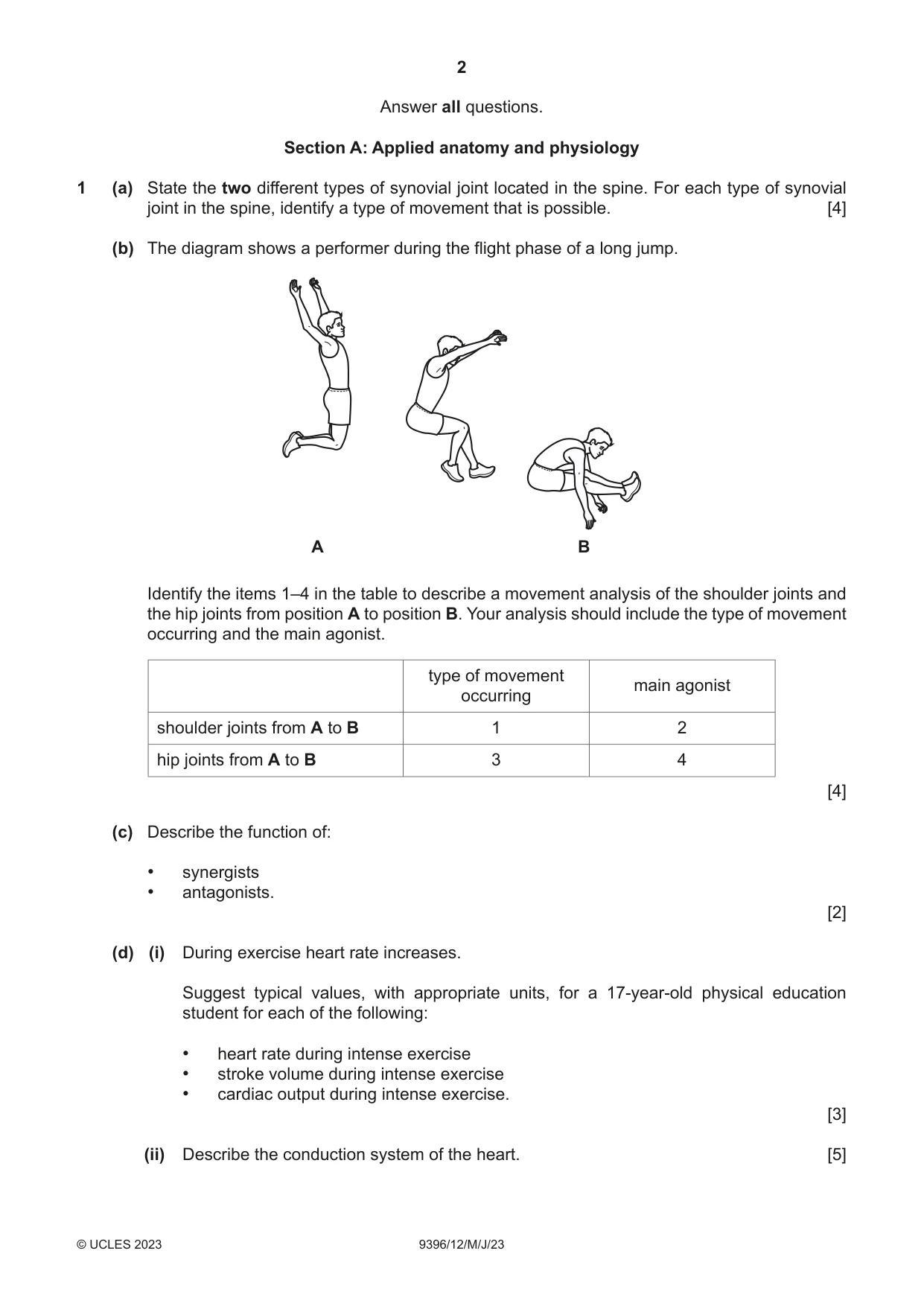
2 9396/12/M/J/23 © UCLES 2023 Answer all questions. Section A: Applied anatomy and physiology 1 (a) State the two different types of synovial joint located in the spine. For each type of synovial joint in the spine, identify a type of movement that is possible. [4] (b) The diagram shows a performer during the flight phase of a long jump. A B Identify the items 1–4 in the table to describe a movement analysis of the shoulder joints and the hip joints from position A to position B. Your analysis should include the type of movement occurring and the main agonist. type of movement occurring main agonist shoulder joints from A to B 1 2 hip joints from A to B 3 4 [4] (c) Describe the function of: • synergists • antagonists. [2] (d) (i) During exercise heart rate increases. Suggest typical values, with appropriate units, for a 17-year-old physical education student for each of the following: • heart rate during intense exercise • stroke volume during intense exercise • cardiac output during intense exercise. [3] (ii) Describe the conduction system of the heart. [5]
Question paper, page 3
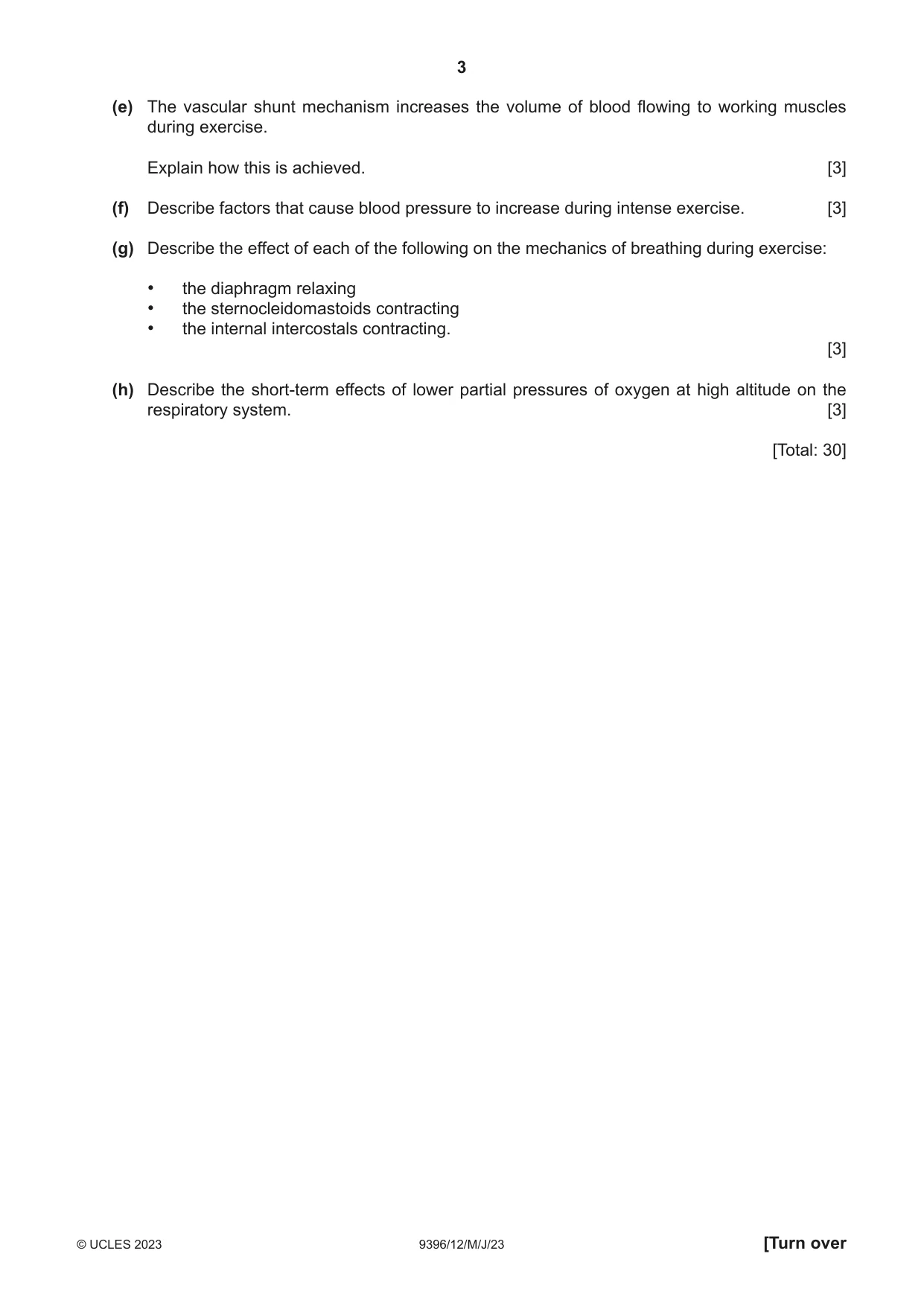
3 9396/12/M/J/23 © UCLES 2023 [Turn over (e) The vascular shunt mechanism increases the volume of blood flowing to working muscles during exercise. Explain how this is achieved. [3] (f) Describe factors that cause blood pressure to increase during intense exercise. [3] (g) Describe the effect of each of the following on the mechanics of breathing during exercise: • the diaphragm relaxing • the sternocleidomastoids contracting • the internal intercostals contracting. [3] (h) Describe the short-term effects of lower partial pressures of oxygen at high altitude on the respiratory system. [3] [Total: 30]
Question paper, page 4
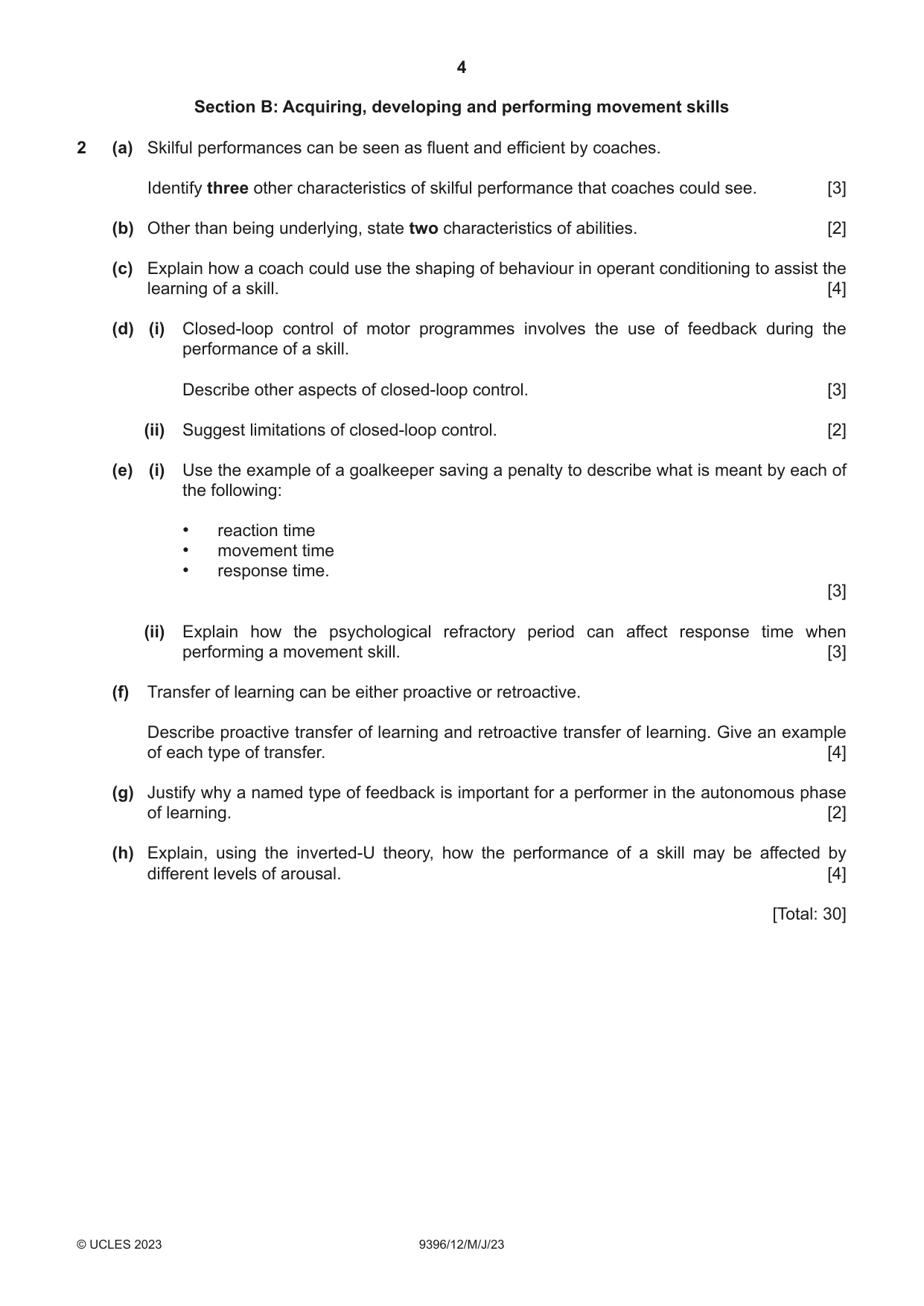
4 9396/12/M/J/23 © UCLES 2023 Section B: Acquiring, developing and performing movement skills 2 (a) Skilful performances can be seen as fluent and efficient by coaches. Identify three other characteristics of skilful performance that coaches could see. [3] (b) Other than being underlying, state two characteristics of abilities. [2] (c) Explain how a coach could use the shaping of behaviour in operant conditioning to assist the learning of a skill. [4] (d) (i) Closed-loop control of motor programmes involves the use of feedback during the performance of a skill. Describe other aspects of closed-loop control. [3] (ii) Suggest limitations of closed-loop control. [2] (e) (i) Use the example of a goalkeeper saving a penalty to describe what is meant by each of the following: • reaction time • movement time • response time. [3] (ii) Explain how the psychological refractory period can affect response time when performing a movement skill. [3] (f) Transfer of learning can be either proactive or retroactive. Describe proactive transfer of learning and retroactive transfer of learning. Give an example of each type of transfer. [4] (g) Justify why a named type of feedback is important for a performer in the autonomous phase of learning. [2] (h) Explain, using the inverted-U theory, how the performance of a skill may be affected by different levels of arousal. [4] [Total: 30]
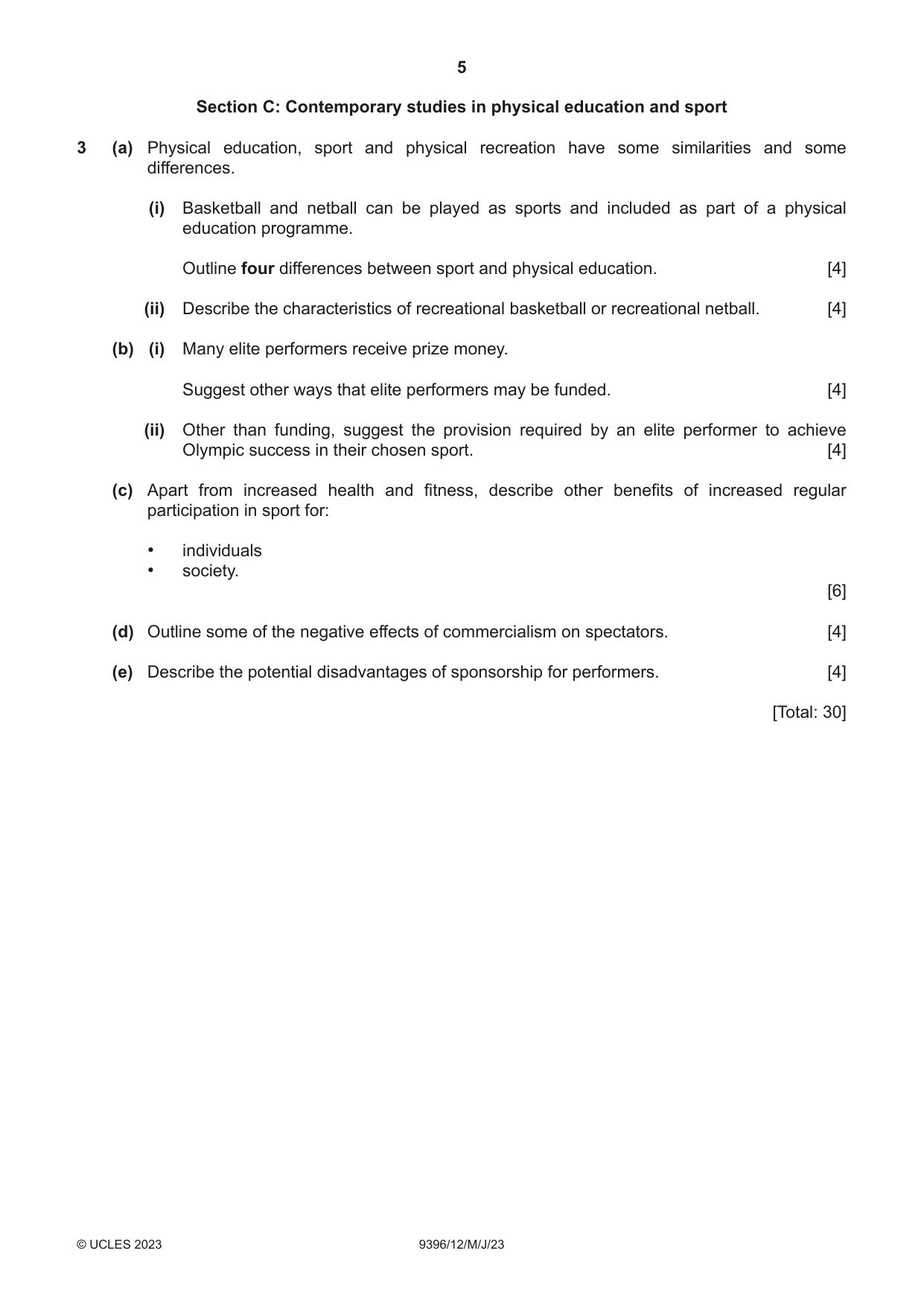
Question paper, page 5
5 9396/12/M/J/23 © UCLES 2023 Section C: Contemporary studies in physical education and sport 3 (a) Physical education, sport and physical recreation have some similarities and some differences. (i) Basketball and netball can be played as sports and included as part of a physical education programme. Outline four differences between sport and physical education. [4] (ii) Describe the characteristics of recreational basketball or recreational netball. [4] (b) (i) Many elite performers receive prize money. Suggest other ways that elite performers may be funded. [4] (ii) Other than funding, suggest the provision required by an elite performer to achieve Olympic success in their chosen sport. [4] (c) Apart from increased health and fitness, describe other benefits of increased regular participation in sport for: • individuals • society. [6] (d) Outline some of the negative effects of commercialism on spectators. [4] (e) Describe the potential disadvantages of sponsorship for performers. [4] [Total: 30]
Question paper, page 6
6 9396/12/M/J/23 © UCLES 2023 BLANK PAGE
Question paper, page 7
7 9396/12/M/J/23 © UCLES 2023 BLANK PAGE
Question paper, page 8
8 9396/12/M/J/23 © UCLES 2023 Permission to reproduce items where third-party owned material protected by copyright is included has been sought and cleared where possible. Every reasonable effort has been made by the publisher (UCLES) to trace copyright holders, but if any items requiring clearance have unwittingly been included, the publisher will be pleased to make amends at the earliest possible opportunity. To avoid the issue of disclosure of answer-related information to candidates, all copyright acknowledgements are reproduced online in the Cambridge Assessment International Education Copyright Acknowledgements Booklet. This is produced for each series of examinations and is freely available to download at www.cambridgeinternational.org after the live examination series. Cambridge Assessment International Education is part of Cambridge Assessment. Cambridge Assessment is the brand name of the University of Cambridge Local Examinations Syndicate (UCLES), which is a department of the University of Cambridge. BLANK PAGE
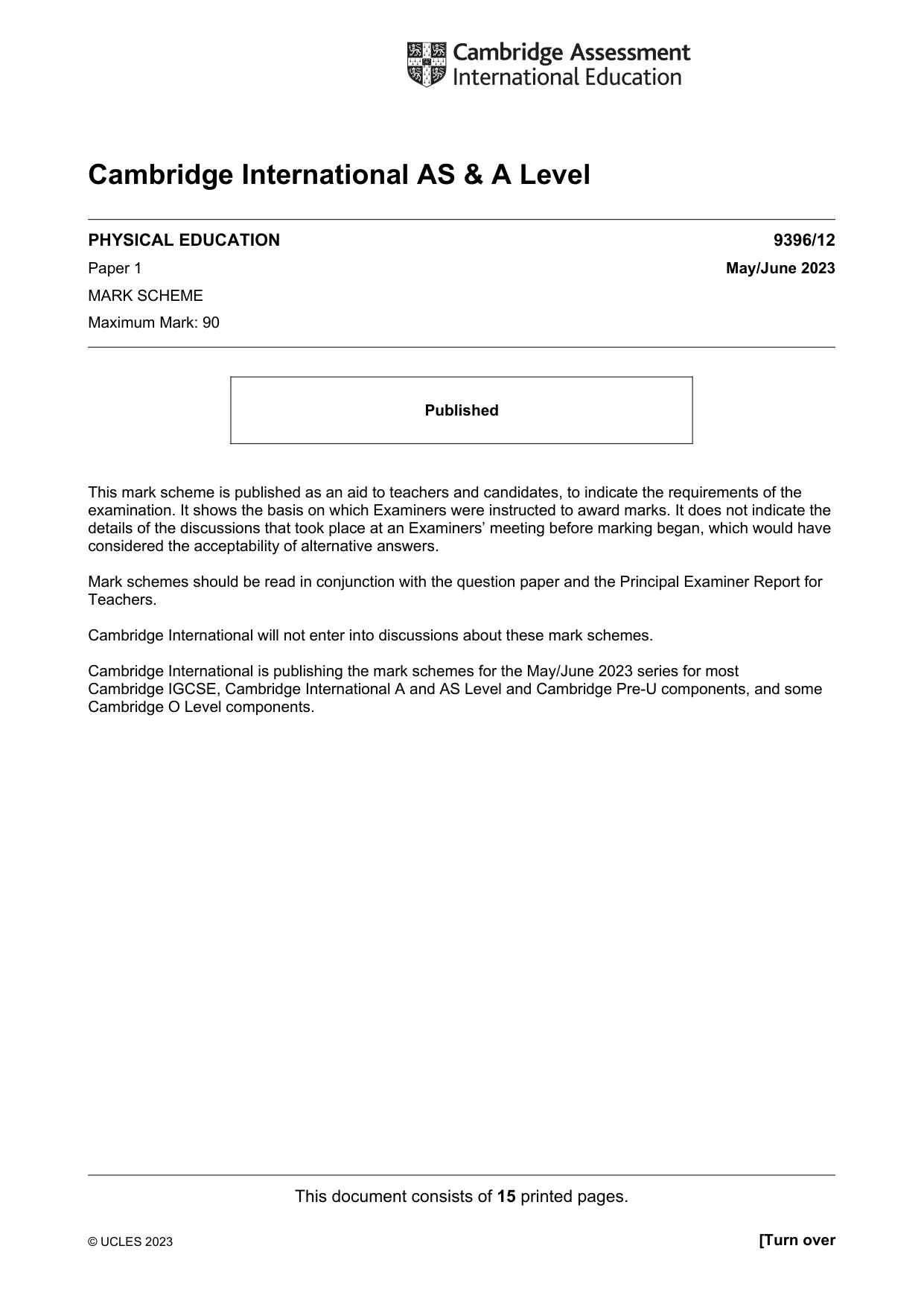
Mark scheme, page 1
This document consists of 15 printed pages. © UCLES 2023 [Turn over Cambridge International AS & A Level PHYSICAL EDUCATION 9396/12 Paper 1 May/June 2023 MARK SCHEME Maximum Mark: 90 Published This mark scheme is published as an aid to teachers and candidates, to indicate the requirements of the examination. It shows the basis on which Examiners were instructed to award marks. It does not indicate the details of the discussions that took place at an Examiners’ meeting before marking began, which would have considered the acceptability of alternative answers. Mark schemes should be read in conjunction with the question paper and the Principal Examiner Report for Teachers. Cambridge International will not enter into discussions about these mark schemes. Cambridge International is publishing the mark schemes for the May/June 2023 series for most Cambridge IGCSE, Cambridge International A and AS Level and Cambridge Pre-U components, and some Cambridge O Level components.
Mark scheme, page 2
9396/12 Cambridge International AS & A Level – Mark Scheme PUBLISHED May/June 2023 © UCLES 2023 Page 2 of 15 Generic Marking Principles These general marking principles must be applied by all examiners when marking candidate answers. They should be applied alongside the specific content of the mark scheme or generic level descriptors for a question. Each question paper and mark scheme will also comply with these marking principles. GENERIC MARKING PRINCIPLE 1: Marks must be awarded in line with: the specific content of the mark scheme or the generic level descriptors for the question the specific skills defined in the mark scheme or in the generic level descriptors for the question the standard of response required by a candidate as exemplified by the standardisation scripts. GENERIC MARKING PRINCIPLE 2: Marks awarded are always whole marks (not half marks, or other fractions). GENERIC MARKING PRINCIPLE 3: Marks must be awarded positively: marks are awarded for correct/valid answers, as defined in the mark scheme. However, credit is given for valid answers which go beyond the scope of the syllabus and mark scheme, referring to your Team Leader as appropriate marks are awarded when candidates clearly demonstrate what they know and can do marks are not deducted for errors marks are not deducted for omissions answers should only be judged on the quality of spelling, punctuation and grammar when these features are specifically assessed by the question as indicated by the mark scheme. The meaning, however, should be unambiguous. GENERIC MARKING PRINCIPLE 4: Rules must be applied consistently, e.g. in situations where candidates have not followed instructions or in the application of generic level descriptors.
Mark scheme, page 3
9396/12 Cambridge International AS & A Level – Mark Scheme PUBLISHED May/June 2023 © UCLES 2023 Page 3 of 15 GENERIC MARKING PRINCIPLE 5: Marks should be awarded using the full range of marks defined in the mark scheme for the question (however; the use of the full mark range may be limited according to the quality of the candidate responses seen). GENERIC MARKING PRINCIPLE 6: Marks awarded are based solely on the requirements as defined in the mark scheme. Marks should not be awarded with grade thresholds or grade descriptors in mind.
Mark scheme, page 4
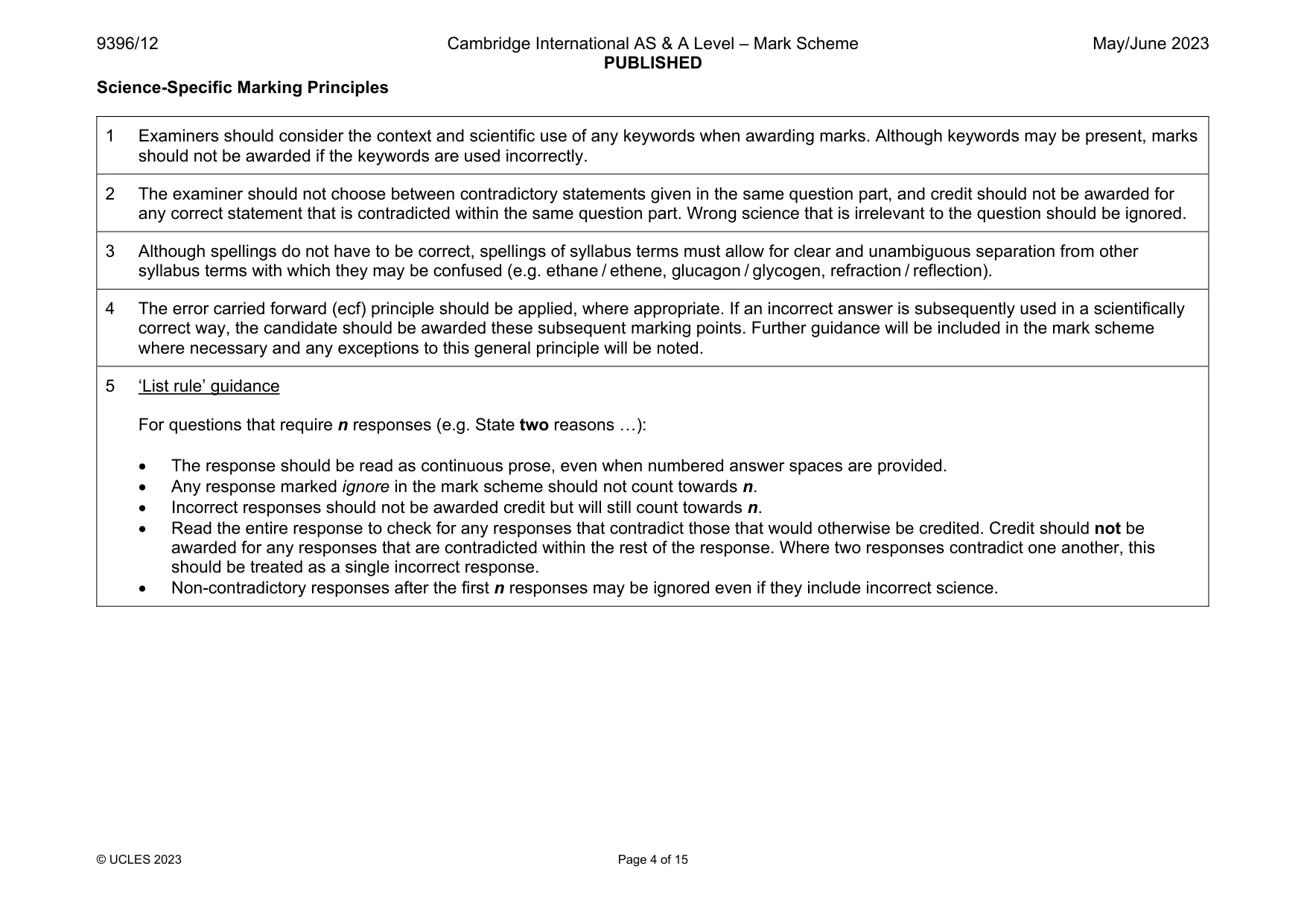
9396/12 Cambridge International AS & A Level – Mark Scheme PUBLISHED May/June 2023 © UCLES 2023 Page 4 of 15 Science-Specific Marking Principles 1 Examiners should consider the context and scientific use of any keywords when awarding marks. Although keywords may be present, marks should not be awarded if the keywords are used incorrectly. 2 The examiner should not choose between contradictory statements given in the same question part, and credit should not be awarded for any correct statement that is contradicted within the same question part. Wrong science that is irrelevant to the question should be ignored. 3 Although spellings do not have to be correct, spellings of syllabus terms must allow for clear and unambiguous separation from other syllabus terms with which they may be confused (e.g. ethane / ethene, glucagon / glycogen, refraction / reflection). 4 The error carried forward (ecf) principle should be applied, where appropriate. If an incorrect answer is subsequently used in a scientifically correct way, the candidate should be awarded these subsequent marking points. Further guidance will be included in the mark scheme where necessary and any exceptions to this general principle will be noted. 5 ‘List rule’ guidance For questions that require n responses (e.g. State two reasons …): The response should be read as continuous prose, even when numbered answer spaces are provided. Any response marked ignore in the mark scheme should not count towards n. Incorrect responses should not be awarded credit but will still count towards n. Read the entire response to check for any responses that contradict those that would otherwise be credited. Credit should not be awarded for any responses that are contradicted within the rest of the response. Where two responses contradict one another, this should be treated as a single incorrect response. Non-contradictory responses after the first n responses may be ignored even if they include incorrect science.
Mark scheme, page 5
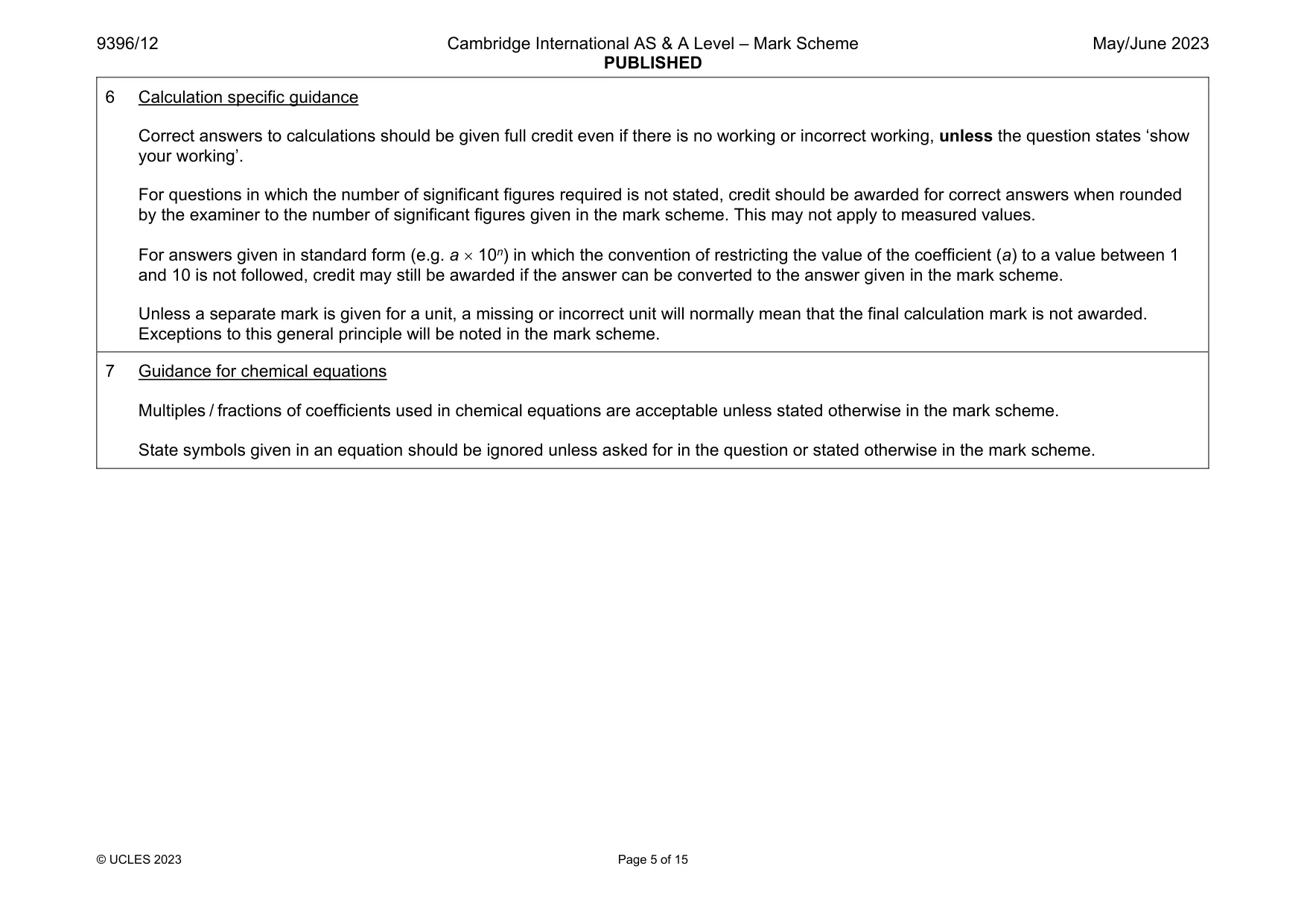
9396/12 Cambridge International AS & A Level – Mark Scheme PUBLISHED May/June 2023 © UCLES 2023 Page 5 of 15 6 Calculation specific guidance Correct answers to calculations should be given full credit even if there is no working or incorrect working, unless the question states ‘show your working’. For questions in which the number of significant figures required is not stated, credit should be awarded for correct answers when rounded by the examiner to the number of significant figures given in the mark scheme. This may not apply to measured values. For answers given in standard form (e.g. a 10n) in which the convention of restricting the value of the coefficient (a) to a value between 1 and 10 is not followed, credit may still be awarded if the answer can be converted to the answer given in the mark scheme. Unless a separate mark is given for a unit, a missing or incorrect unit will normally mean that the final calculation mark is not awarded. Exceptions to this general principle will be noted in the mark scheme. 7 Guidance for chemical equations Multiples / fractions of coefficients used in chemical equations are acceptable unless stated otherwise in the mark scheme. State symbols given in an equation should be ignored unless asked for in the question or stated otherwise in the mark scheme.
Mark scheme, page 6
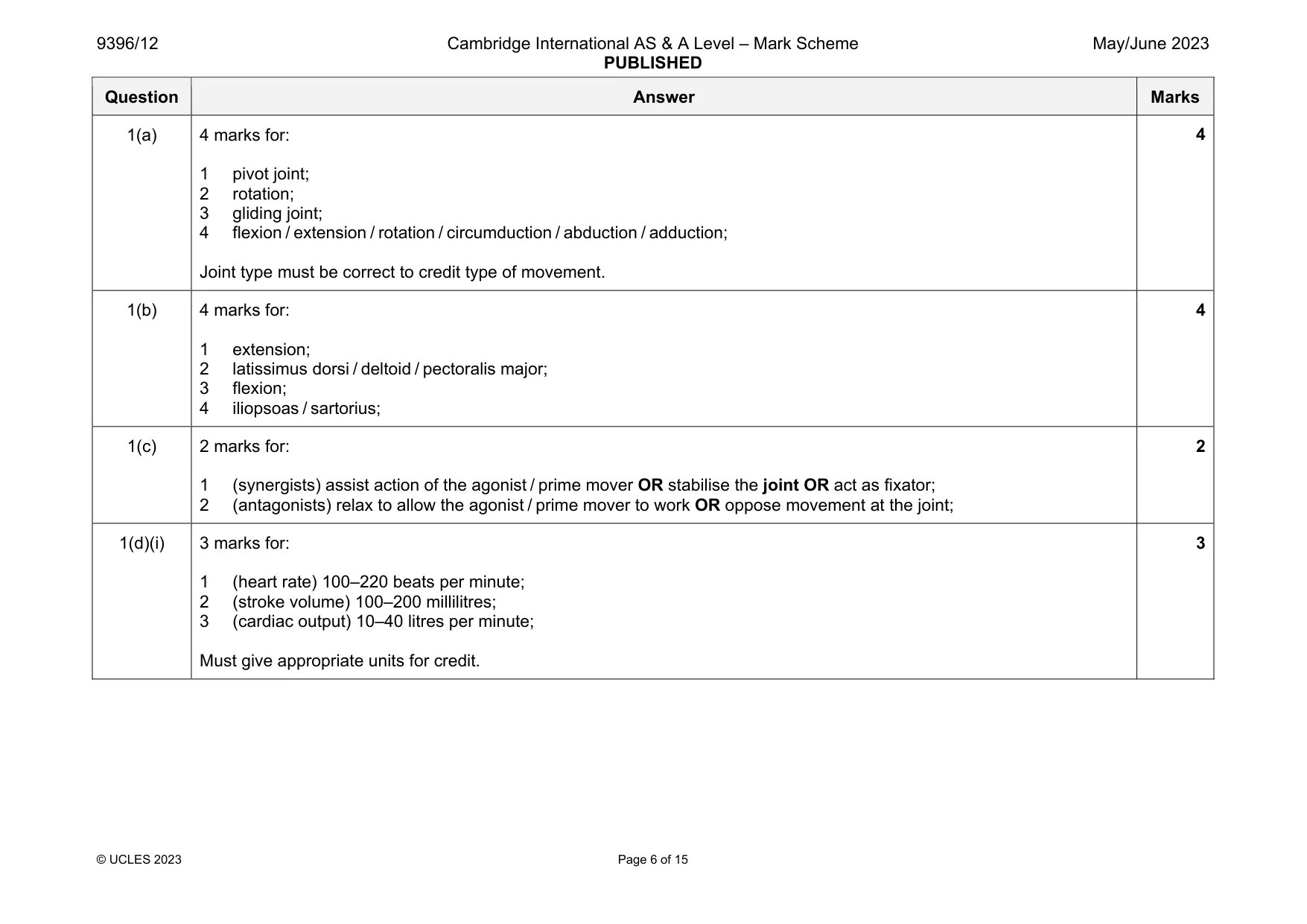
9396/12 Cambridge International AS & A Level – Mark Scheme PUBLISHED May/June 2023 © UCLES 2023 Page 6 of 15 Question Answer Marks 1(a) 4 marks for: 1 pivot joint; 2 rotation; 3 gliding joint; 4 flexion / extension / rotation / circumduction / abduction / adduction; Joint type must be correct to credit type of movement. 4 1(b) 4 marks for: 1 extension; 2 latissimus dorsi / deltoid / pectoralis major; 3 flexion; 4 iliopsoas / sartorius; 4 1(c) 2 marks for: 1 (synergists) assist action of the agonist / prime mover OR stabilise the joint OR act as fixator; 2 (antagonists) relax to allow the agonist / prime mover to work OR oppose movement at the joint; 2 1(d)(i) 3 marks for: 1 (heart rate) 100–220 beats per minute; 2 (stroke volume) 100–200 millilitres; 3 (cardiac output) 10–40 litres per minute; Must give appropriate units for credit. 3
Mark scheme, page 7
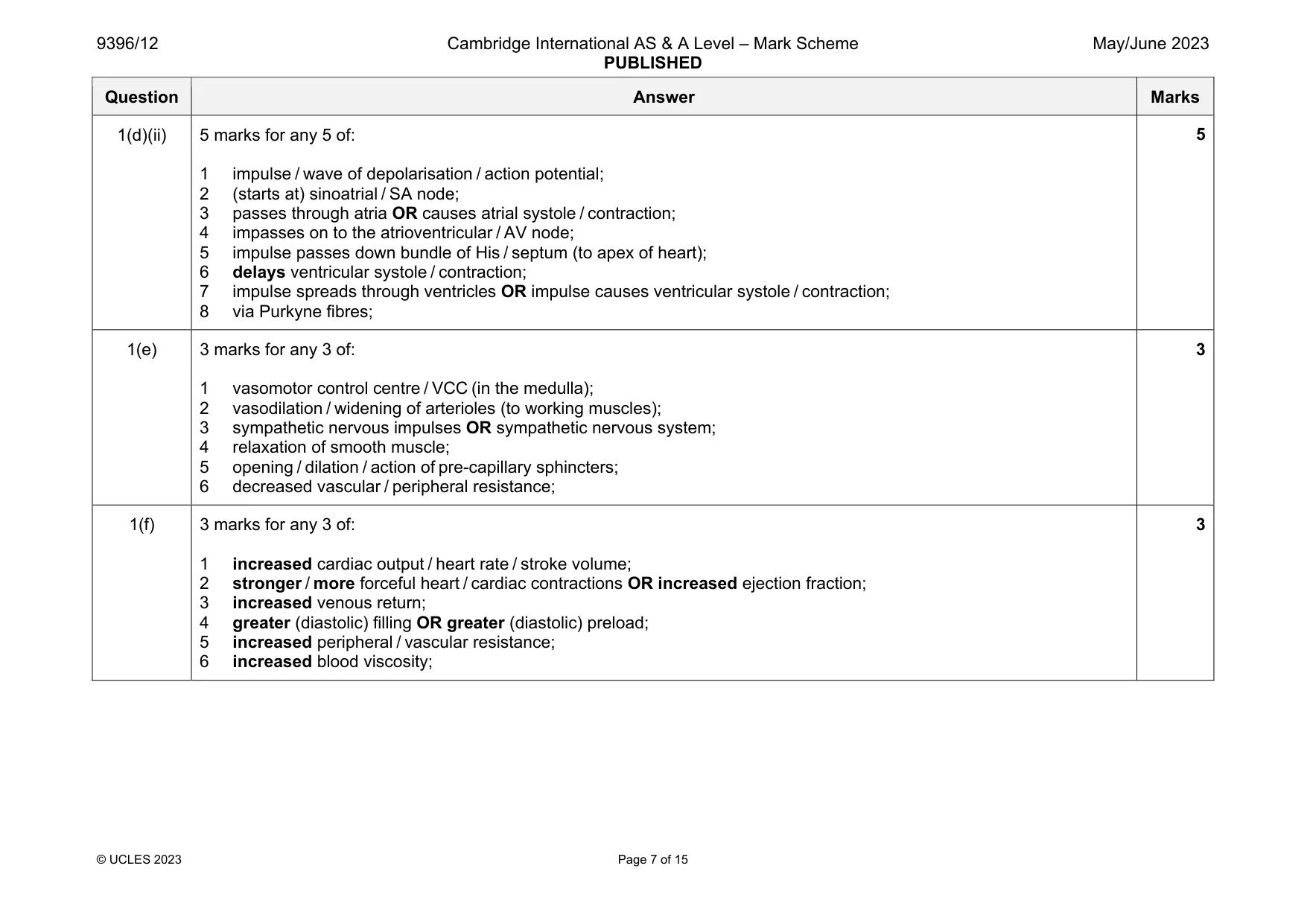
9396/12 Cambridge International AS & A Level – Mark Scheme PUBLISHED May/June 2023 © UCLES 2023 Page 7 of 15 Question Answer Marks 1(d)(ii) 5 marks for any 5 of: 1 impulse / wave of depolarisation / action potential; 2 (starts at) sinoatrial / SA node; 3 passes through atria OR causes atrial systole / contraction; 4 impasses on to the atrioventricular / AV node; 5 impulse passes down bundle of His / septum (to apex of heart); 6 delays ventricular systole / contraction; 7 impulse spreads through ventricles OR impulse causes ventricular systole / contraction; 8 via Purkyne fibres; 5 1(e) 3 marks for any 3 of: 1 vasomotor control centre / VCC (in the medulla); 2 vasodilation / widening of arterioles (to working muscles); 3 sympathetic nervous impulses OR sympathetic nervous system; 4 relaxation of smooth muscle; 5 opening / dilation / action of pre-capillary sphincters; 6 decreased vascular / peripheral resistance; 3 1(f) 3 marks for any 3 of: 1 increased cardiac output / heart rate / stroke volume; 2 stronger / more forceful heart / cardiac contractions OR increased ejection fraction; 3 increased venous return; 4 greater (diastolic) filling OR greater (diastolic) preload; 5 increased peripheral / vascular resistance; 6 increased blood viscosity; 3
Mark scheme, page 8
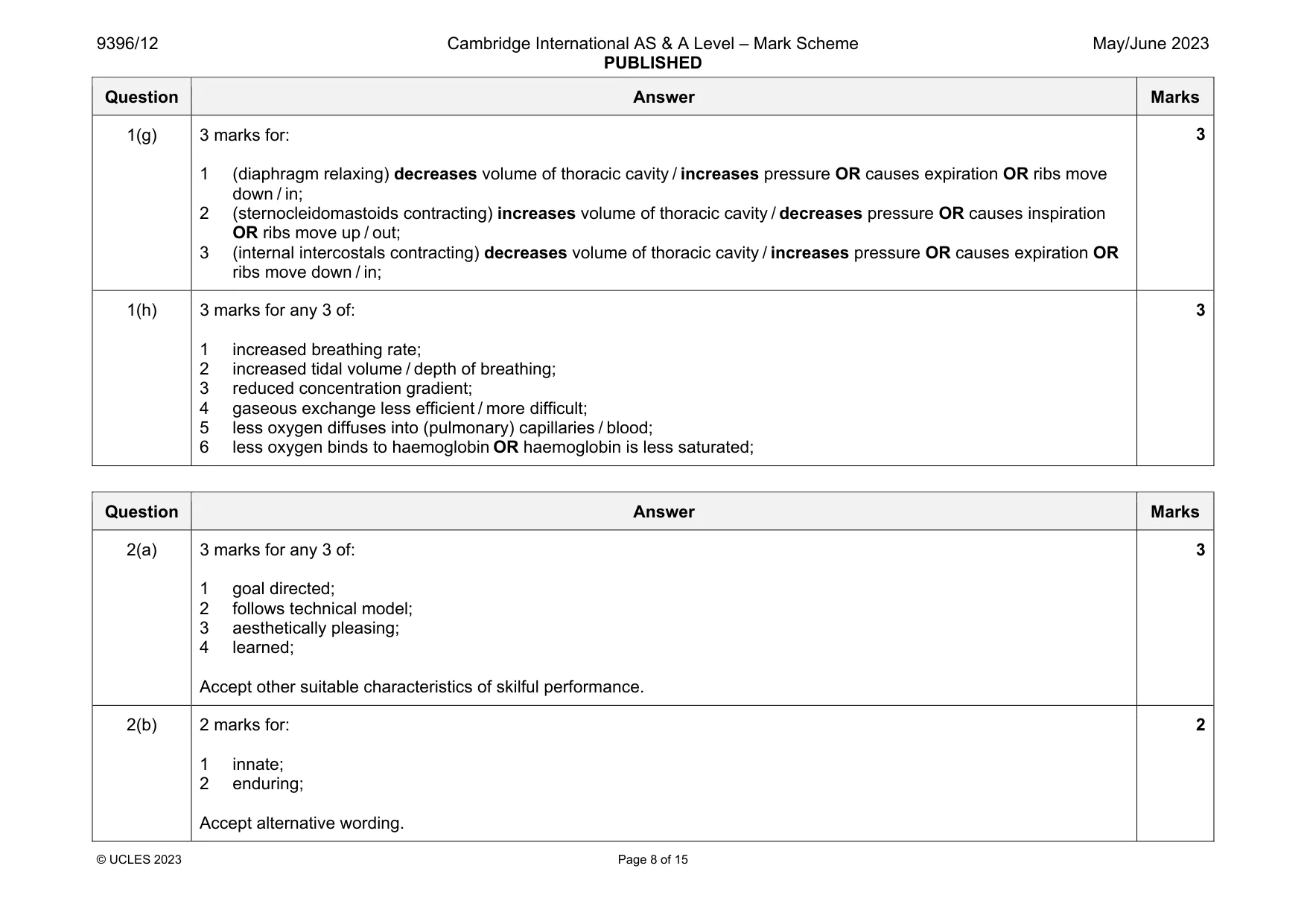
9396/12 Cambridge International AS & A Level – Mark Scheme PUBLISHED May/June 2023 © UCLES 2023 Page 8 of 15 Question Answer Marks 1(g) 3 marks for: 1 (diaphragm relaxing) decreases volume of thoracic cavity / increases pressure OR causes expiration OR ribs move down / in; 2 (sternocleidomastoids contracting) increases volume of thoracic cavity / decreases pressure OR causes inspiration OR ribs move up / out; 3 (internal intercostals contracting) decreases volume of thoracic cavity / increases pressure OR causes expiration OR ribs move down / in; 3 1(h) 3 marks for any 3 of: 1 increased breathing rate; 2 increased tidal volume / depth of breathing; 3 reduced concentration gradient; 4 gaseous exchange less efficient / more difficult; 5 less oxygen diffuses into (pulmonary) capillaries / blood; 6 less oxygen binds to haemoglobin OR haemoglobin is less saturated; 3 Question Answer Marks 2(a) 3 marks for any 3 of: 1 goal directed; 2 follows technical model; 3 aesthetically pleasing; 4 learned; Accept other suitable characteristics of skilful performance. 3 2(b) 2 marks for: 1 innate; 2 enduring; Accept alternative wording. 2
Mark scheme, page 9
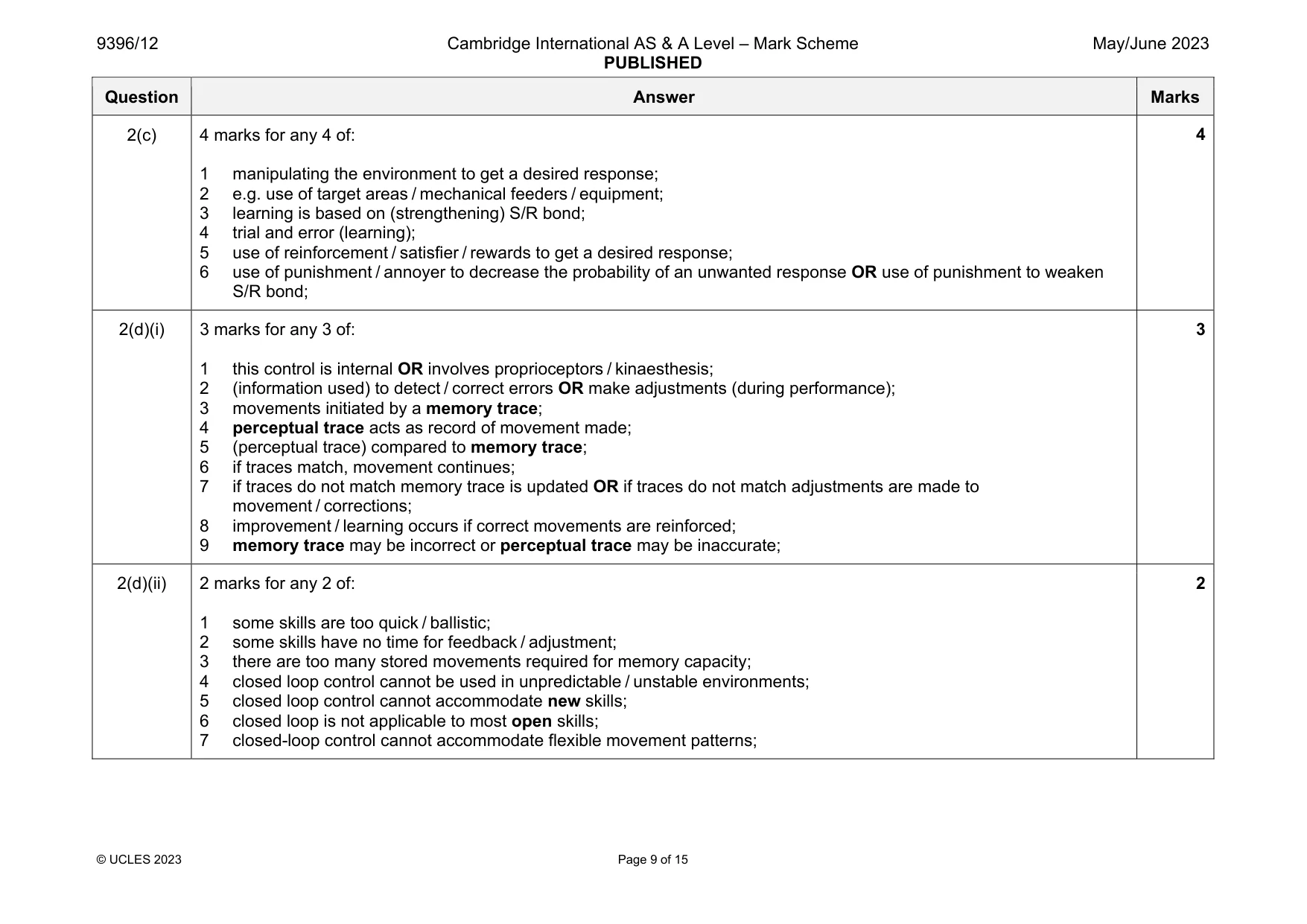
9396/12 Cambridge International AS & A Level – Mark Scheme PUBLISHED May/June 2023 © UCLES 2023 Page 9 of 15 Question Answer Marks 2(c) 4 marks for any 4 of: 1 manipulating the environment to get a desired response; 2 e.g. use of target areas / mechanical feeders / equipment; 3 learning is based on (strengthening) S/R bond; 4 trial and error (learning); 5 use of reinforcement / satisfier / rewards to get a desired response; 6 use of punishment / annoyer to decrease the probability of an unwanted response OR use of punishment to weaken S/R bond; 4 2(d)(i) 3 marks for any 3 of: 1 this control is internal OR involves proprioceptors / kinaesthesis; 2 (information used) to detect / correct errors OR make adjustments (during performance); 3 movements initiated by a memory trace; 4 perceptual trace acts as record of movement made; 5 (perceptual trace) compared to memory trace; 6 if traces match, movement continues; 7 if traces do not match memory trace is updated OR if traces do not match adjustments are made to movement / corrections; 8 improvement / learning occurs if correct movements are reinforced; 9 memory trace may be incorrect or perceptual trace may be inaccurate; 3 2(d)(ii) 2 marks for any 2 of: 1 some skills are too quick / ballistic; 2 some skills have no time for feedback / adjustment; 3 there are too many stored movements required for memory capacity; 4 closed loop control cannot be used in unpredictable / unstable environments; 5 closed loop control cannot accommodate new skills; 6 closed loop is not applicable to most open skills; 7 closed-loop control cannot accommodate flexible movement patterns; 2
Mark scheme, page 10
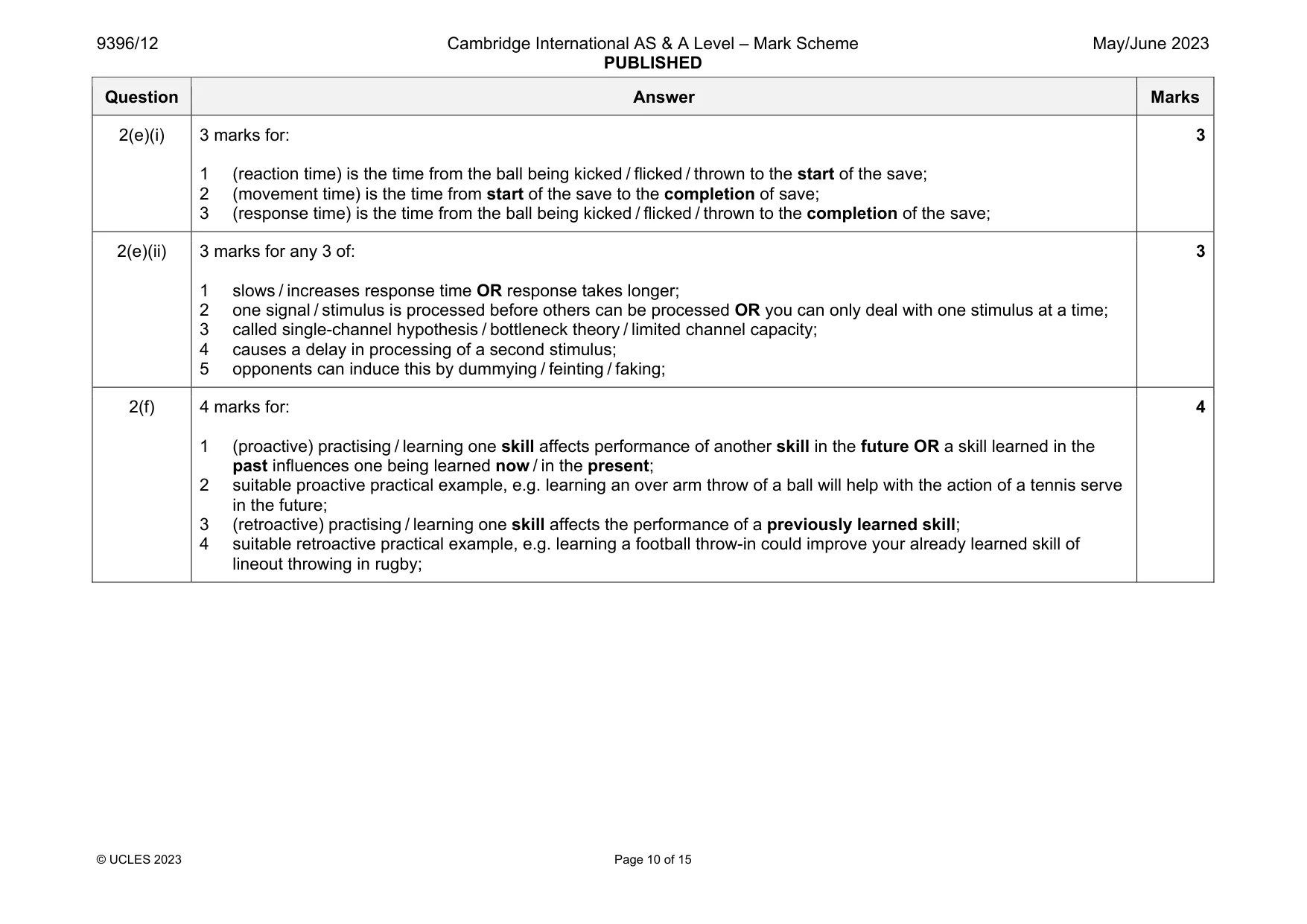
9396/12 Cambridge International AS & A Level – Mark Scheme PUBLISHED May/June 2023 © UCLES 2023 Page 10 of 15 Question Answer Marks 2(e)(i) 3 marks for: 1 (reaction time) is the time from the ball being kicked / flicked / thrown to the start of the save; 2 (movement time) is the time from start of the save to the completion of save; 3 (response time) is the time from the ball being kicked / flicked / thrown to the completion of the save; 3 2(e)(ii) 3 marks for any 3 of: 1 slows / increases response time OR response takes longer; 2 one signal / stimulus is processed before others can be processed OR you can only deal with one stimulus at a time; 3 called single-channel hypothesis / bottleneck theory / limited channel capacity; 4 causes a delay in processing of a second stimulus; 5 opponents can induce this by dummying / feinting / faking; 3 2(f) 4 marks for: 1 (proactive) practising / learning one skill affects performance of another skill in the future OR a skill learned in the past influences one being learned now / in the present; 2 suitable proactive practical example, e.g. learning an over arm throw of a ball will help with the action of a tennis serve in the future; 3 (retroactive) practising / learning one skill affects the performance of a previously learned skill; 4 suitable retroactive practical example, e.g. learning a football throw-in could improve your already learned skill of lineout throwing in rugby; 4
Mark scheme, page 11
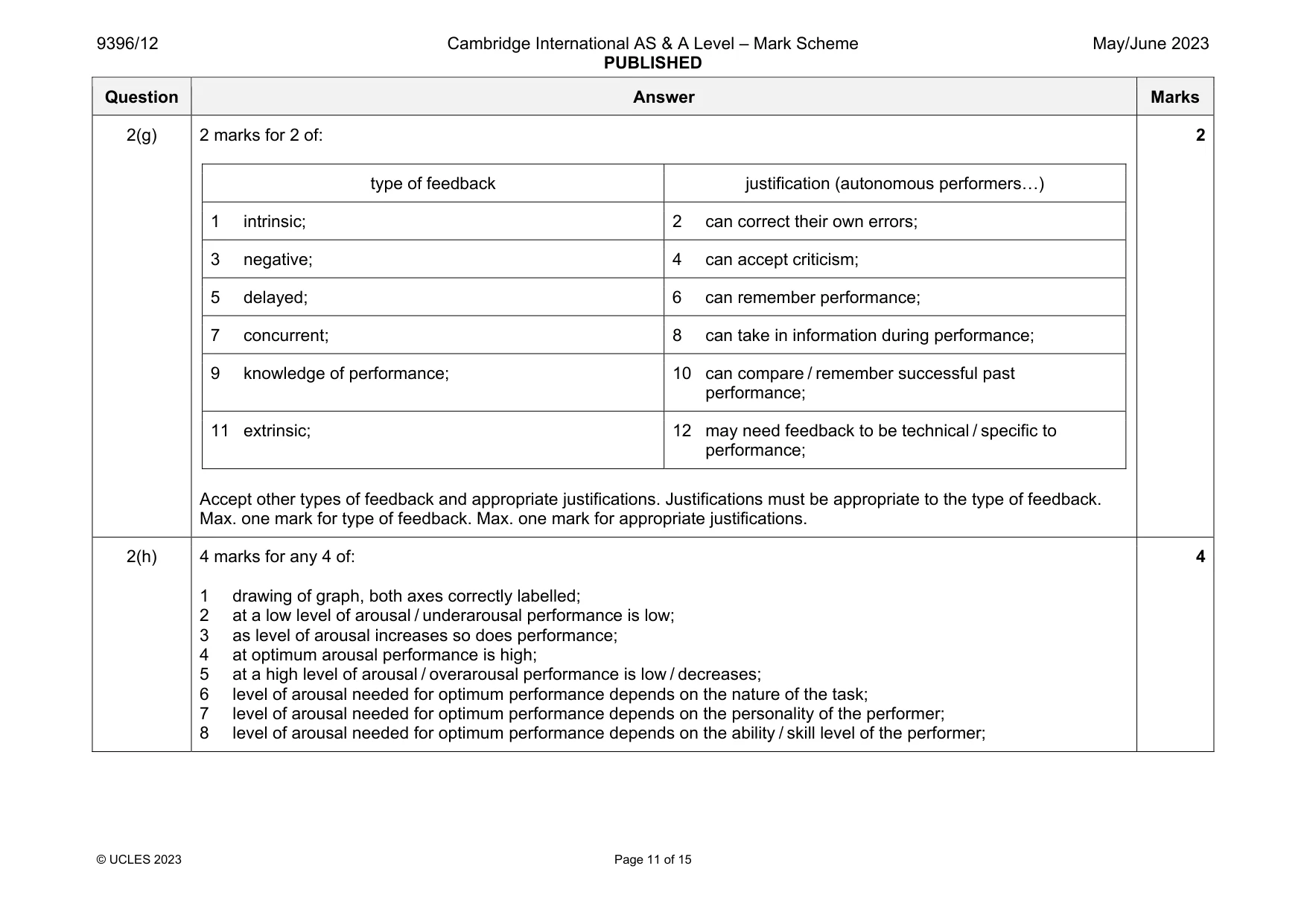
9396/12 Cambridge International AS & A Level – Mark Scheme PUBLISHED May/June 2023 © UCLES 2023 Page 11 of 15 Question Answer Marks 2(g) 2 marks for 2 of: type of feedback justification (autonomous performers…) 1 intrinsic; 2 can correct their own errors; 3 negative; 4 can accept criticism; 5 delayed; 6 can remember performance; 7 concurrent; 8 can take in information during performance; 9 knowledge of performance; 10 can compare / remember successful past performance; 11 extrinsic; 12 may need feedback to be technical / specific to performance; Accept other types of feedback and appropriate justifications. Justifications must be appropriate to the type of feedback. Max. one mark for type of feedback. Max. one mark for appropriate justifications. 2 2(h) 4 marks for any 4 of: 1 drawing of graph, both axes correctly labelled; 2 at a low level of arousal / underarousal performance is low; 3 as level of arousal increases so does performance; 4 at optimum arousal performance is high; 5 at a high level of arousal / overarousal performance is low / decreases; 6 level of arousal needed for optimum performance depends on the nature of the task; 7 level of arousal needed for optimum performance depends on the personality of the performer; 8 level of arousal needed for optimum performance depends on the ability / skill level of the performer; 4
Mark scheme, page 12
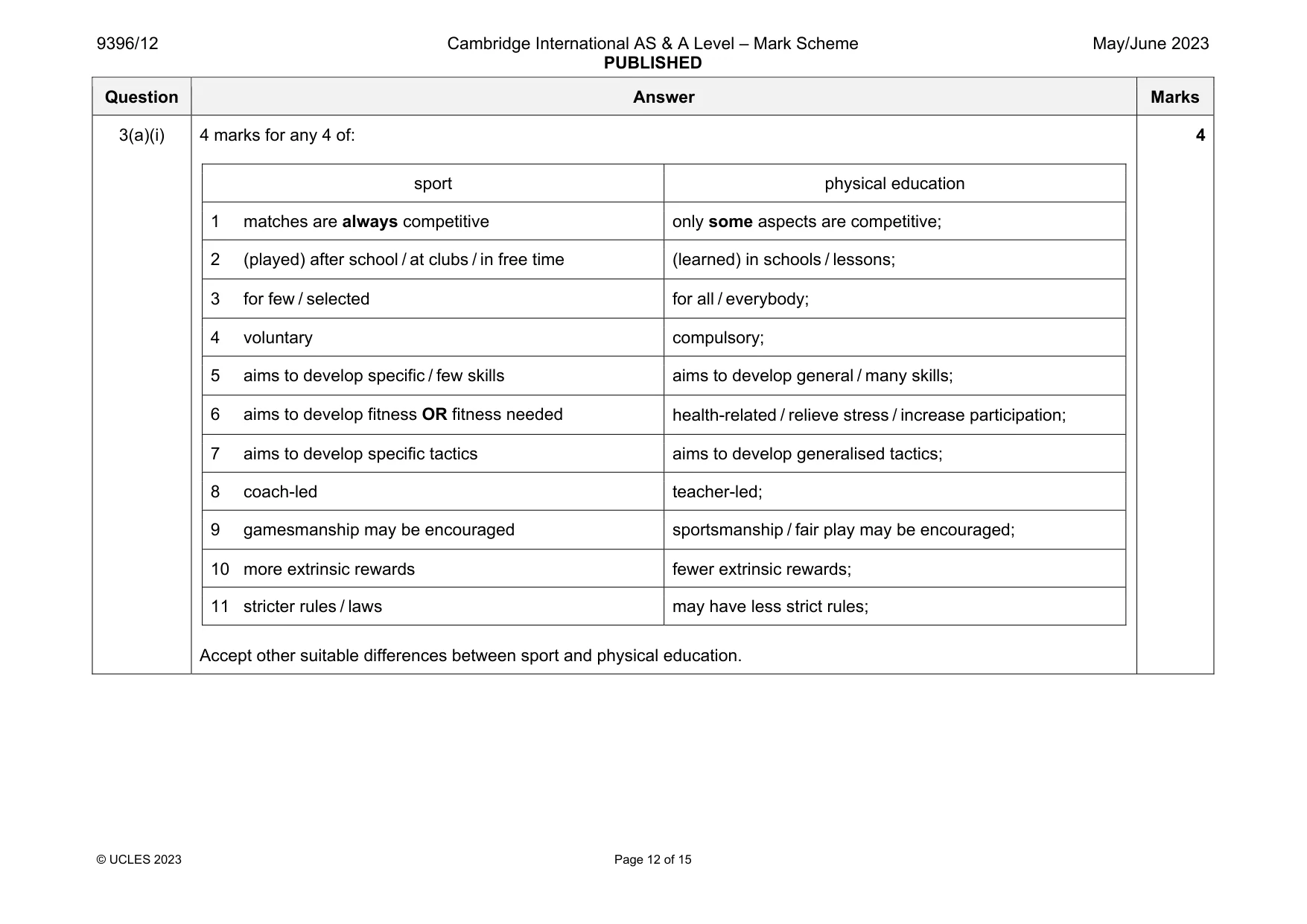
9396/12 Cambridge International AS & A Level – Mark Scheme PUBLISHED May/June 2023 © UCLES 2023 Page 12 of 15 Question Answer Marks 3(a)(i) 4 marks for any 4 of: sport physical education 1 matches are always competitive only some aspects are competitive; 2 (played) after school / at clubs / in free time (learned) in schools / lessons; 3 for few / selected for all / everybody; 4 voluntary compulsory; 5 aims to develop specific / few skills aims to develop general / many skills; 6 aims to develop fitness OR fitness needed health-related / relieve stress / increase participation; 7 aims to develop specific tactics aims to develop generalised tactics; 8 coach-led teacher-led; 9 gamesmanship may be encouraged sportsmanship / fair play may be encouraged; 10 more extrinsic rewards fewer extrinsic rewards; 11 stricter rules / laws may have less strict rules; Accept other suitable differences between sport and physical education. 4
Mark scheme, page 13
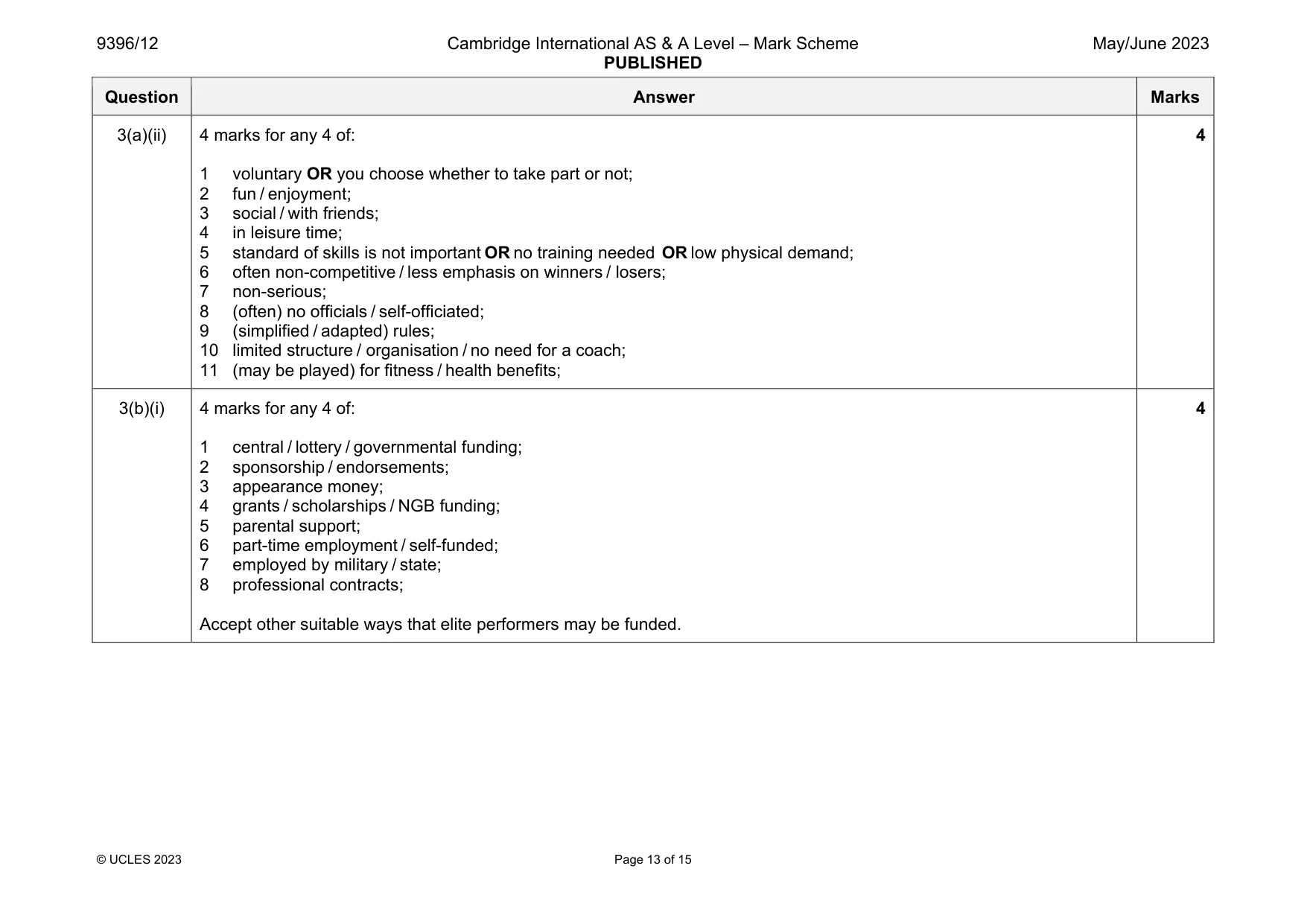
9396/12 Cambridge International AS & A Level – Mark Scheme PUBLISHED May/June 2023 © UCLES 2023 Page 13 of 15 Question Answer Marks 3(a)(ii) 4 marks for any 4 of: 1 voluntary OR you choose whether to take part or not; 2 fun / enjoyment; 3 social / with friends; 4 in leisure time; 5 standard of skills is not important OR no training needed OR low physical demand; 6 often non-competitive / less emphasis on winners / losers; 7 non-serious; 8 (often) no officials / self-officiated; 9 (simplified / adapted) rules; 10 limited structure / organisation / no need for a coach; 11 (may be played) for fitness / health benefits; 4 3(b)(i) 4 marks for any 4 of: 1 central / lottery / governmental funding; 2 sponsorship / endorsements; 3 appearance money; 4 grants / scholarships / NGB funding; 5 parental support; 6 part-time employment / self-funded; 7 employed by military / state; 8 professional contracts; Accept other suitable ways that elite performers may be funded. 4
Mark scheme, page 14
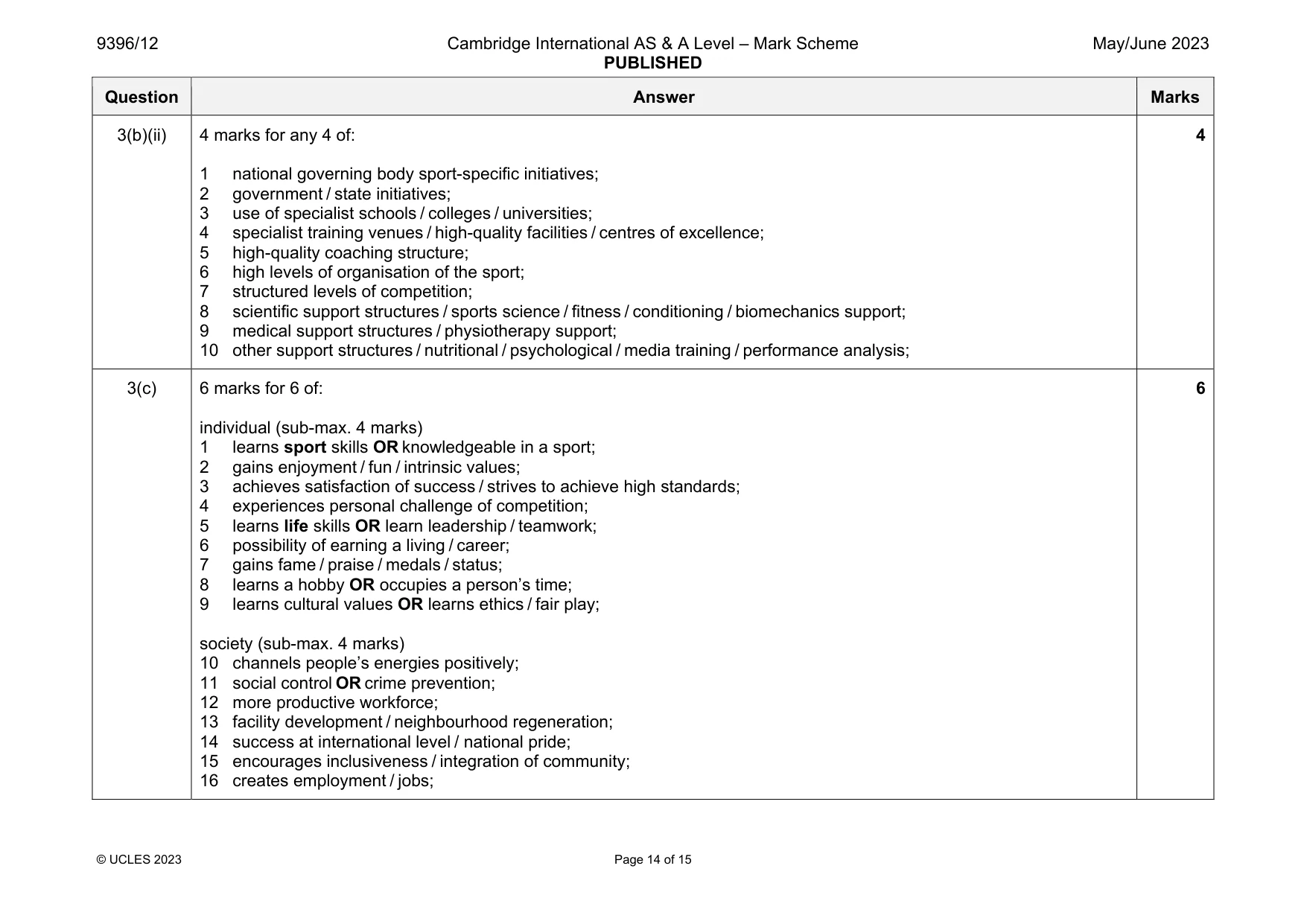
9396/12 Cambridge International AS & A Level – Mark Scheme PUBLISHED May/June 2023 © UCLES 2023 Page 14 of 15 Question Answer Marks 3(b)(ii) 4 marks for any 4 of: 1 national governing body sport-specific initiatives; 2 government / state initiatives; 3 use of specialist schools / colleges / universities; 4 specialist training venues / high-quality facilities / centres of excellence; 5 high-quality coaching structure; 6 high levels of organisation of the sport; 7 structured levels of competition; 8 scientific support structures / sports science / fitness / conditioning / biomechanics support; 9 medical support structures / physiotherapy support; 10 other support structures / nutritional / psychological / media training / performance analysis; 4 3(c) 6 marks for 6 of: individual (sub-max. 4 marks) 1 learns sport skills OR knowledgeable in a sport; 2 gains enjoyment / fun / intrinsic values; 3 achieves satisfaction of success / strives to achieve high standards; 4 experiences personal challenge of competition; 5 learns life skills OR learn leadership / teamwork; 6 possibility of earning a living / career; 7 gains fame / praise / medals / status; 8 learns a hobby OR occupies a person’s time; 9 learns cultural values OR learns ethics / fair play; society (sub-max. 4 marks) 10 channels people’s energies positively; 11 social control OR crime prevention; 12 more productive workforce; 13 facility development / neighbourhood regeneration; 14 success at international level / national pride; 15 encourages inclusiveness / integration of community; 16 creates employment / jobs; 6
Mark scheme, page 15
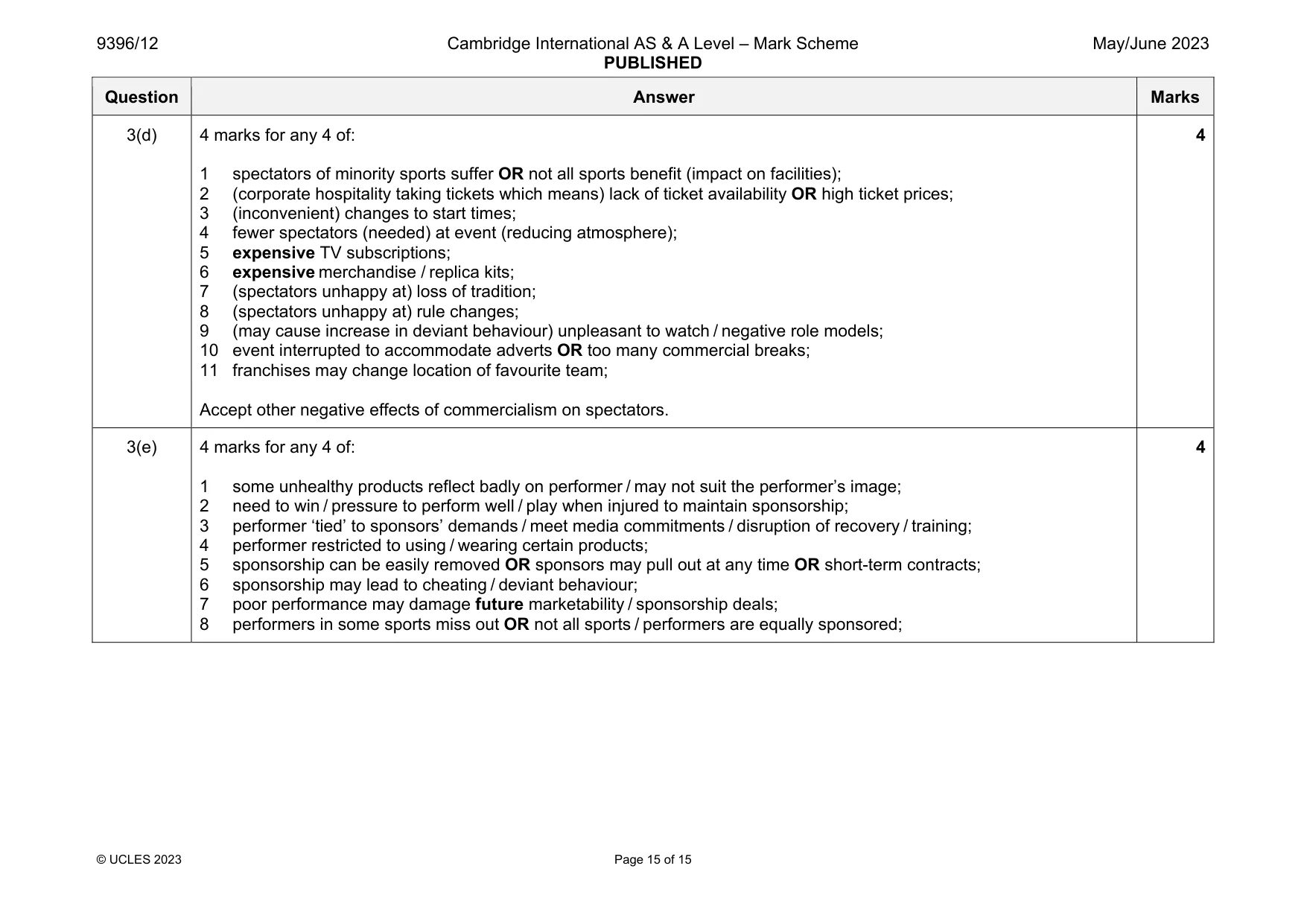
9396/12 Cambridge International AS & A Level – Mark Scheme PUBLISHED May/June 2023 © UCLES 2023 Page 15 of 15 Question Answer Marks 3(d) 4 marks for any 4 of: 1 spectators of minority sports suffer OR not all sports benefit (impact on facilities); 2 (corporate hospitality taking tickets which means) lack of ticket availability OR high ticket prices; 3 (inconvenient) changes to start times; 4 fewer spectators (needed) at event (reducing atmosphere); 5 expensive TV subscriptions; 6 expensive merchandise / replica kits; 7 (spectators unhappy at) loss of tradition; 8 (spectators unhappy at) rule changes; 9 (may cause increase in deviant behaviour) unpleasant to watch / negative role models; 10 event interrupted to accommodate adverts OR too many commercial breaks; 11 franchises may change location of favourite team; Accept other negative effects of commercialism on spectators. 4 3(e) 4 marks for any 4 of: 1 some unhealthy products reflect badly on performer / may not suit the performer’s image; 2 need to win / pressure to perform well / play when injured to maintain sponsorship; 3 performer ‘tied’ to sponsors’ demands / meet media commitments / disruption of recovery / training; 4 performer restricted to using / wearing certain products; 5 sponsorship can be easily removed OR sponsors may pull out at any time OR short-term contracts; 6 sponsorship may lead to cheating / deviant behaviour; 7 poor performance may damage future marketability / sponsorship deals; 8 performers in some sports miss out OR not all sports / performers are equally sponsored; 4
What you needed in this session
Cambridge’s own grade thresholds for 2023 May/June, Paper 1 · Variant 2. A higher threshold means an easier paper — the bar moves with how the cohort did.