Cambridge A Level Physical Education 9396 — 2021 May/June Paper 1 · Variant 1
9396/11/M/J/21 · 90 marks · ≈101 min
The question paper and its mark scheme, free to read here and free to download. This is Cambridge’s own paper, exactly as it was sat.
Question paper8 pages



Mark scheme16 pages
Answers below. Sit the paper first if you are practising.
Paper as text
Question paper, page 1
This document has 8 pages. Any blank pages are indicated. Cambridge International AS & A Level DC (MS/CT) 198362/1 © UCLES 2021 [Turn over PHYSICAL EDUCATION 9396/11 Paper 1 May/June 2021 2 hours 30 minutes You must answer on the enclosed answer booklet. You will need: Answer booklet (enclosed) INSTRUCTIONS ● Answer all questions. ● Follow the instructions on the front cover of the answer booklet. If you need additional answer paper, ask the invigilator for a continuation booklet. ● You may use a calculator. ● You should show all your working and use appropriate units. INFORMATION ● The total mark for this paper is 90. ● The number of marks for each question or part question is shown in brackets [ ]. * 4 7 8 9 1 5 9 6 5 0 *
Question paper, page 2
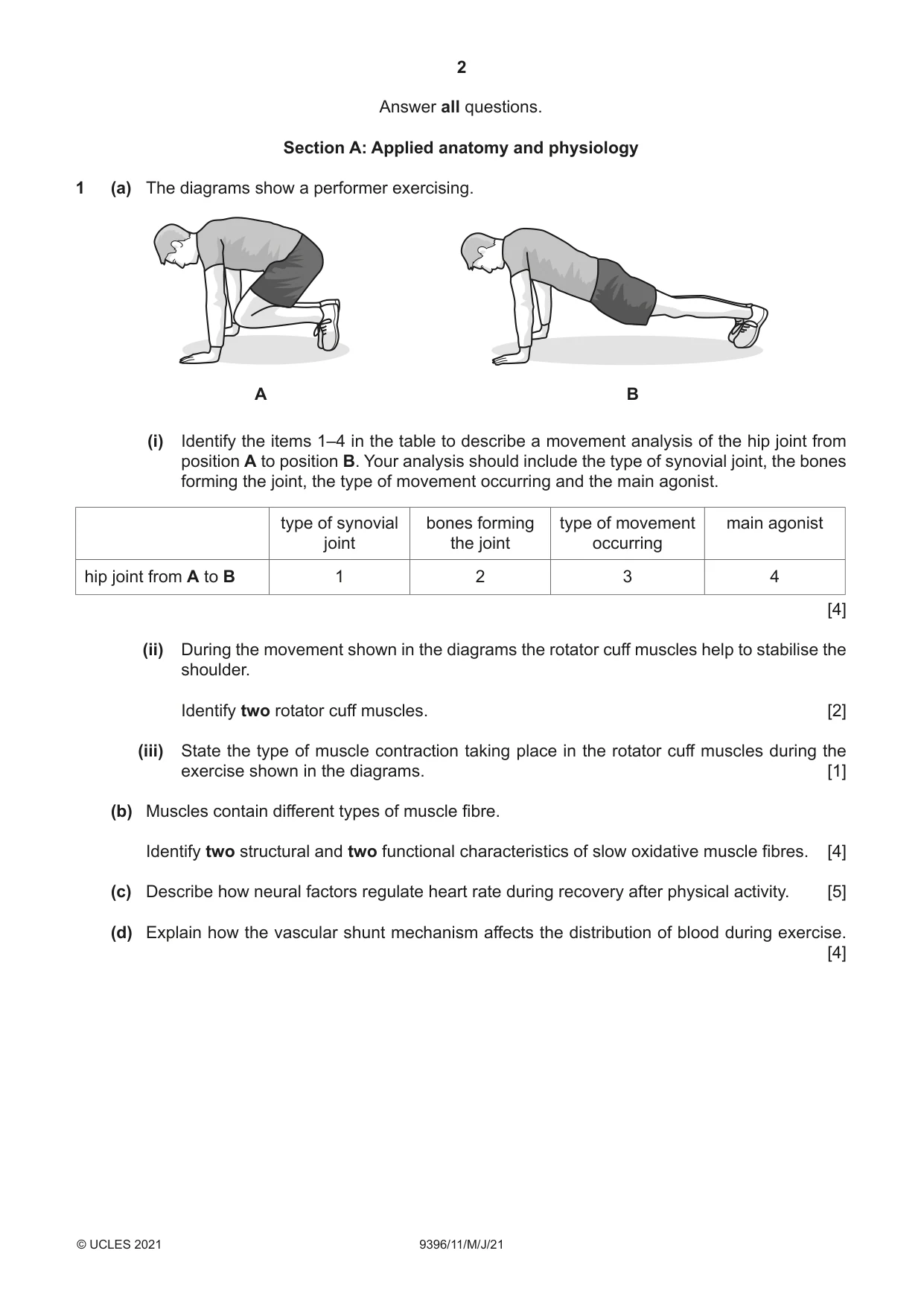
2 9396/11/M/J/21 © UCLES 2021 Answer all questions. Section A: Applied anatomy and physiology 1 (a) The diagrams show a performer exercising. B A (i) Identify the items 1–4 in the table to describe a movement analysis of the hip joint from position A to position B. Your analysis should include the type of synovial joint, the bones forming the joint, the type of movement occurring and the main agonist. type of synovial joint bones forming the joint type of movement occurring main agonist hip joint from A to B 1 2 3 4 [4] (ii) During the movement shown in the diagrams the rotator cuff muscles help to stabilise the shoulder. Identify two rotator cuff muscles. [2] (iii) State the type of muscle contraction taking place in the rotator cuff muscles during the exercise shown in the diagrams. [1] (b) Muscles contain different types of muscle fibre. Identify two structural and two functional characteristics of slow oxidative muscle fibres. [4] (c) Describe how neural factors regulate heart rate during recovery after physical activity. [5] (d) Explain how the vascular shunt mechanism affects the distribution of blood during exercise. [4]
Question paper, page 3
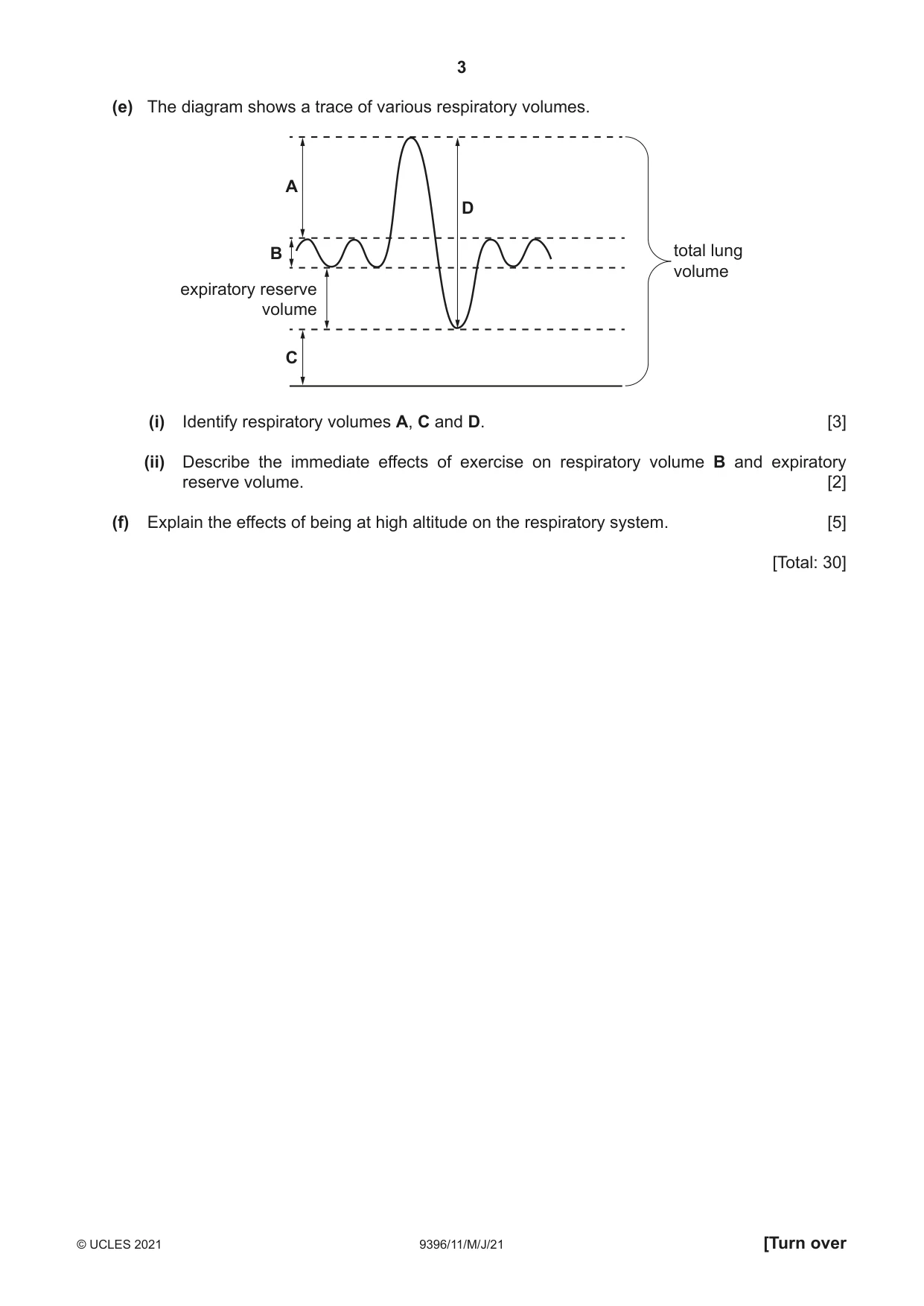
3 9396/11/M/J/21 © UCLES 2021 [Turn over (e) The diagram shows a trace of various respiratory volumes. total lung volume A D B C expiratory reserve volume (i) Identify respiratory volumes A, C and D. [3] (ii) Describe the immediate effects of exercise on respiratory volume B and expiratory reserve volume. [2] (f) Explain the effects of being at high altitude on the respiratory system. [5] [Total: 30]
Question paper, page 4
4 9396/11/M/J/21 © UCLES 2021 Section B: Acquiring, developing and performing movement skills 2 (a) Describe, using a different practical example for each, what is meant by the following: • a simple skill • a complex skill. [4] (b) (i) Explain the theory of operant conditioning. [5] (ii) Outline benefits of using operant conditioning to develop skills. [2] (c) Describe open-loop control. Explain why it is often linked with the autonomous phase of learning. [5] (d) Information processing includes the concept of perception. Explain how perception can affect the performance of physical activities. [4] (e) (i) Describe what is meant by response time when performing a movement skill. [1] (ii) Anticipation can decrease response time. Explain how other factors can affect response time. [5] (f) Describe, using a practical example for each, what is meant by the following types of transfer: • positive • negative • proactive • retroactive. [4] [Total: 30]
Question paper, page 5
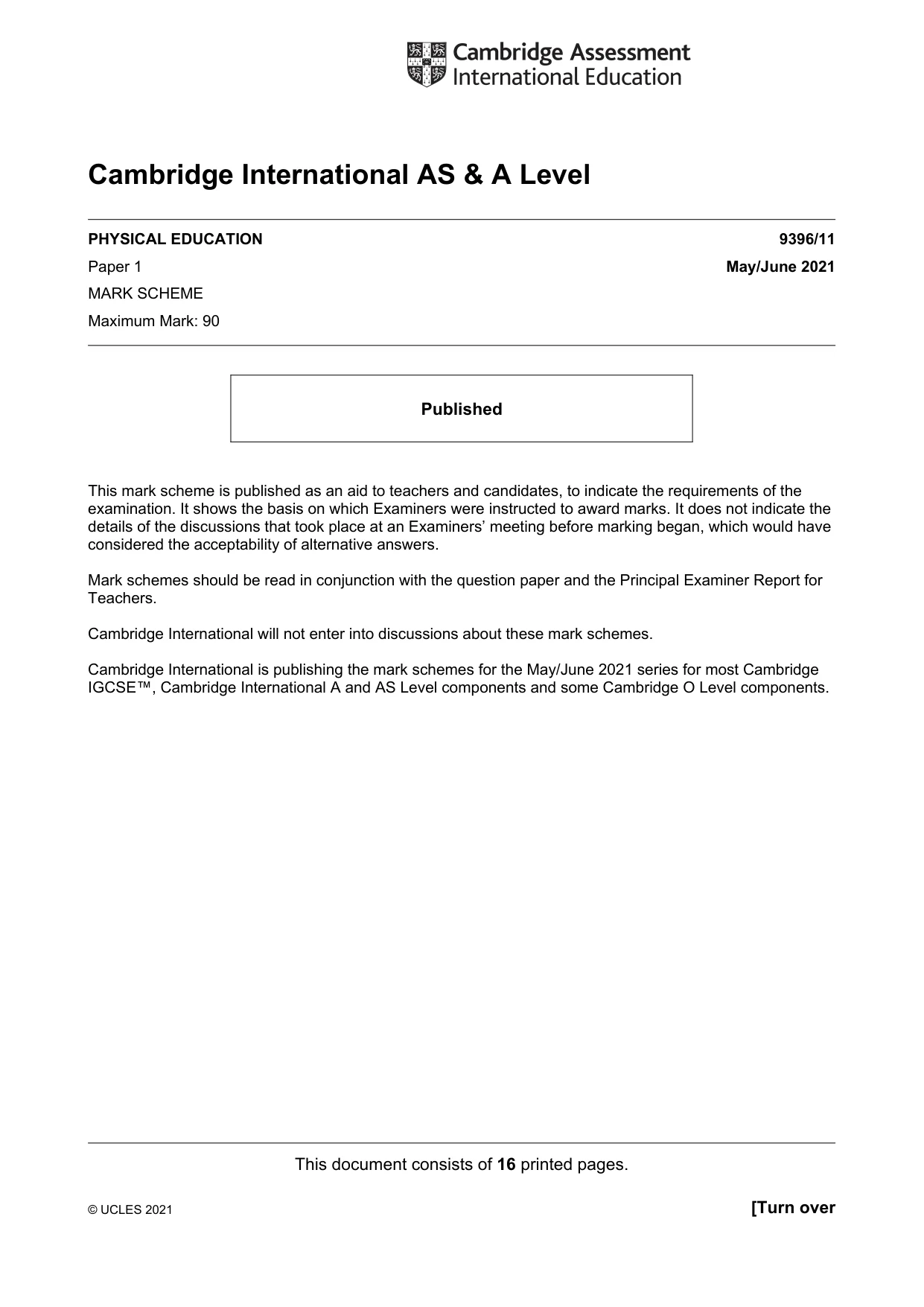
5 9396/11/M/J/21 © UCLES 2021 Section C: Contemporary studies in physical education and sport 3 (a) (i) Outline differences between outdoor recreation and outdoor education. [2] (ii) Suggest why some young people do not participate regularly in outdoor education. [3] (iii) Describe benefits that can be gained through participation in outdoor education. [3] (b) (i) State the forms of funding available to elite performers. [3] (ii) Other than funding, describe how a country may support excellence in sport. [5] (c) Suggest reasons why Olympic success is important to many countries. [5] (d) Outline possible barriers to participation faced by young people. [6] (e) Compare the possible effects of sportsmanship in sport with the possible effects of gamesmanship in sport. [3] [Total: 30]
Question paper, page 6
6 9396/11/M/J/21 © UCLES 2021 BLANK PAGE
Question paper, page 7
7 9396/11/M/J/21 © UCLES 2021 BLANK PAGE
Question paper, page 8
8 9396/11/M/J/21 © UCLES 2021 Permission to reproduce items where third-party owned material protected by copyright is included has been sought and cleared where possible. Every reasonable effort has been made by the publisher (UCLES) to trace copyright holders, but if any items requiring clearance have unwittingly been included, the publisher will be pleased to make amends at the earliest possible opportunity. To avoid the issue of disclosure of answer-related information to candidates, all copyright acknowledgements are reproduced online in the Cambridge Assessment International Education Copyright Acknowledgements Booklet. This is produced for each series of examinations and is freely available to download at www.cambridgeinternational.org after the live examination series. Cambridge Assessment International Education is part of the Cambridge Assessment Group. Cambridge Assessment is the brand name of the University of Cambridge Local Examinations Syndicate (UCLES), which itself is a department of the University of Cambridge. BLANK PAGE
Mark scheme, page 1
This document consists of 16 printed pages. © UCLES 2021 [Turn over Cambridge International AS & A Level PHYSICAL EDUCATION 9396/11 Paper 1 May/June 2021 MARK SCHEME Maximum Mark: 90 Published This mark scheme is published as an aid to teachers and candidates, to indicate the requirements of the examination. It shows the basis on which Examiners were instructed to award marks. It does not indicate the details of the discussions that took place at an Examiners’ meeting before marking began, which would have considered the acceptability of alternative answers. Mark schemes should be read in conjunction with the question paper and the Principal Examiner Report for Teachers. Cambridge International will not enter into discussions about these mark schemes. Cambridge International is publishing the mark schemes for the May/June 2021 series for most Cambridge IGCSE™, Cambridge International A and AS Level components and some Cambridge O Level components.
Mark scheme, page 2
9396/11 Cambridge International AS & A Level – Mark Scheme PUBLISHED May/June 2021 © UCLES 2021 Page 2 of 16 Generic Marking Principles These general marking principles must be applied by all examiners when marking candidate answers. They should be applied alongside the specific content of the mark scheme or generic level descriptors for a question. Each question paper and mark scheme will also comply with these marking principles. GENERIC MARKING PRINCIPLE 1: Marks must be awarded in line with: • the specific content of the mark scheme or the generic level descriptors for the question • the specific skills defined in the mark scheme or in the generic level descriptors for the question • the standard of response required by a candidate as exemplified by the standardisation scripts. GENERIC MARKING PRINCIPLE 2: Marks awarded are always whole marks (not half marks, or other fractions). GENERIC MARKING PRINCIPLE 3: Marks must be awarded positively: • marks are awarded for correct/valid answers, as defined in the mark scheme. However, credit is given for valid answers which go beyond the scope of the syllabus and mark scheme, referring to your Team Leader as appropriate • marks are awarded when candidates clearly demonstrate what they know and can do • marks are not deducted for errors • marks are not deducted for omissions • answers should only be judged on the quality of spelling, punctuation and grammar when these features are specifically assessed by the question as indicated by the mark scheme. The meaning, however, should be unambiguous. GENERIC MARKING PRINCIPLE 4: Rules must be applied consistently, e.g. in situations where candidates have not followed instructions or in the application of generic level descriptors.
Mark scheme, page 3
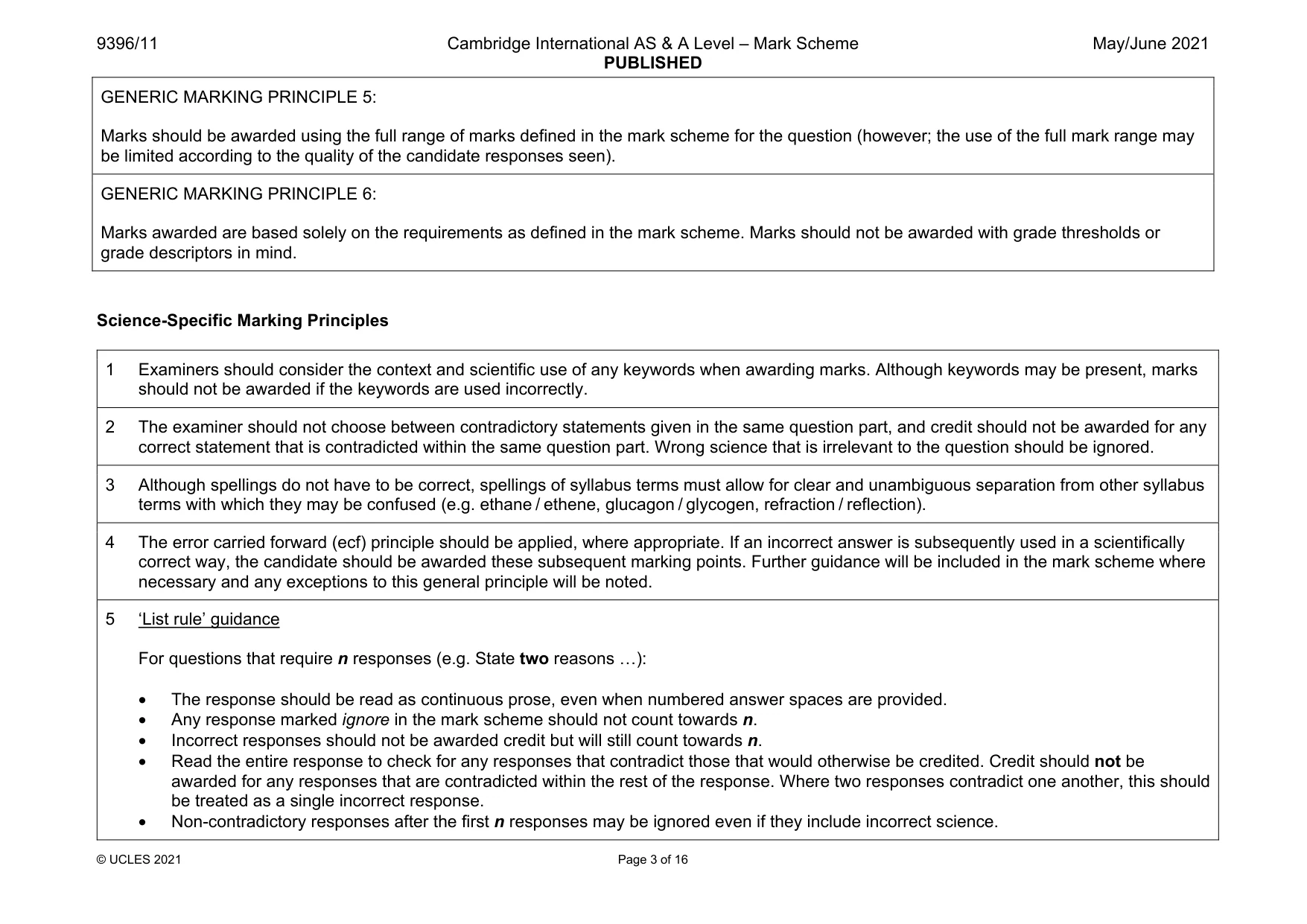
9396/11 Cambridge International AS & A Level – Mark Scheme PUBLISHED May/June 2021 © UCLES 2021 Page 3 of 16 GENERIC MARKING PRINCIPLE 5: Marks should be awarded using the full range of marks defined in the mark scheme for the question (however; the use of the full mark range may be limited according to the quality of the candidate responses seen). GENERIC MARKING PRINCIPLE 6: Marks awarded are based solely on the requirements as defined in the mark scheme. Marks should not be awarded with grade thresholds or grade descriptors in mind. Science-Specific Marking Principles 1 Examiners should consider the context and scientific use of any keywords when awarding marks. Although keywords may be present, marks should not be awarded if the keywords are used incorrectly. 2 The examiner should not choose between contradictory statements given in the same question part, and credit should not be awarded for any correct statement that is contradicted within the same question part. Wrong science that is irrelevant to the question should be ignored. 3 Although spellings do not have to be correct, spellings of syllabus terms must allow for clear and unambiguous separation from other syllabus terms with which they may be confused (e.g. ethane / ethene, glucagon / glycogen, refraction / reflection). 4 The error carried forward (ecf) principle should be applied, where appropriate. If an incorrect answer is subsequently used in a scientifically correct way, the candidate should be awarded these subsequent marking points. Further guidance will be included in the mark scheme where necessary and any exceptions to this general principle will be noted. 5 ‘List rule’ guidance For questions that require n responses (e.g. State two reasons …): • The response should be read as continuous prose, even when numbered answer spaces are provided. • Any response marked ignore in the mark scheme should not count towards n. • Incorrect responses should not be awarded credit but will still count towards n. • Read the entire response to check for any responses that contradict those that would otherwise be credited. Credit should not be awarded for any responses that are contradicted within the rest of the response. Where two responses contradict one another, this should be treated as a single incorrect response. • Non-contradictory responses after the first n responses may be ignored even if they include incorrect science.
Mark scheme, page 4
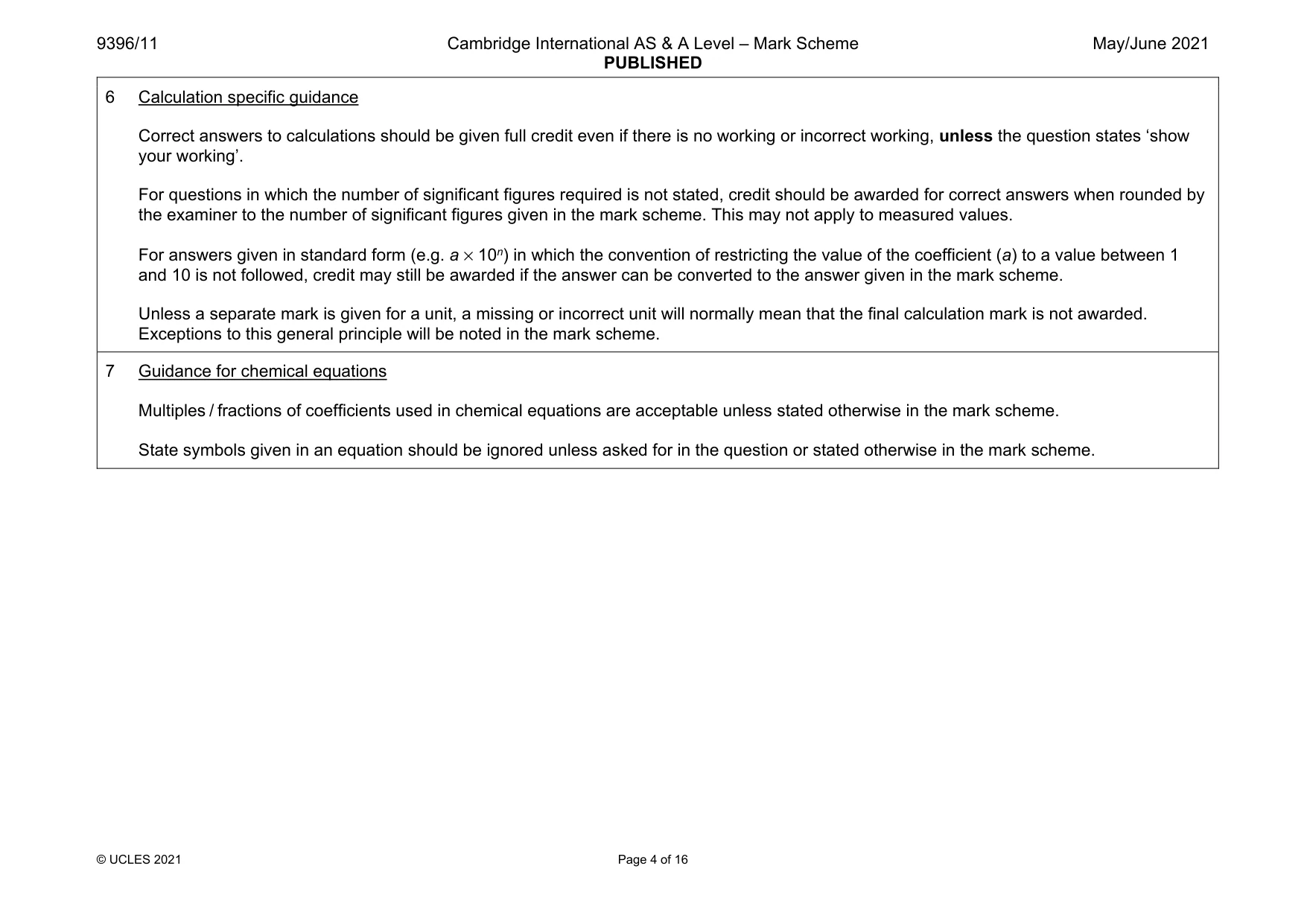
9396/11 Cambridge International AS & A Level – Mark Scheme PUBLISHED May/June 2021 © UCLES 2021 Page 4 of 16 6 Calculation specific guidance Correct answers to calculations should be given full credit even if there is no working or incorrect working, unless the question states ‘show your working’. For questions in which the number of significant figures required is not stated, credit should be awarded for correct answers when rounded by the examiner to the number of significant figures given in the mark scheme. This may not apply to measured values. For answers given in standard form (e.g. a × 10n) in which the convention of restricting the value of the coefficient (a) to a value between 1 and 10 is not followed, credit may still be awarded if the answer can be converted to the answer given in the mark scheme. Unless a separate mark is given for a unit, a missing or incorrect unit will normally mean that the final calculation mark is not awarded. Exceptions to this general principle will be noted in the mark scheme. 7 Guidance for chemical equations Multiples / fractions of coefficients used in chemical equations are acceptable unless stated otherwise in the mark scheme. State symbols given in an equation should be ignored unless asked for in the question or stated otherwise in the mark scheme.
Mark scheme, page 5
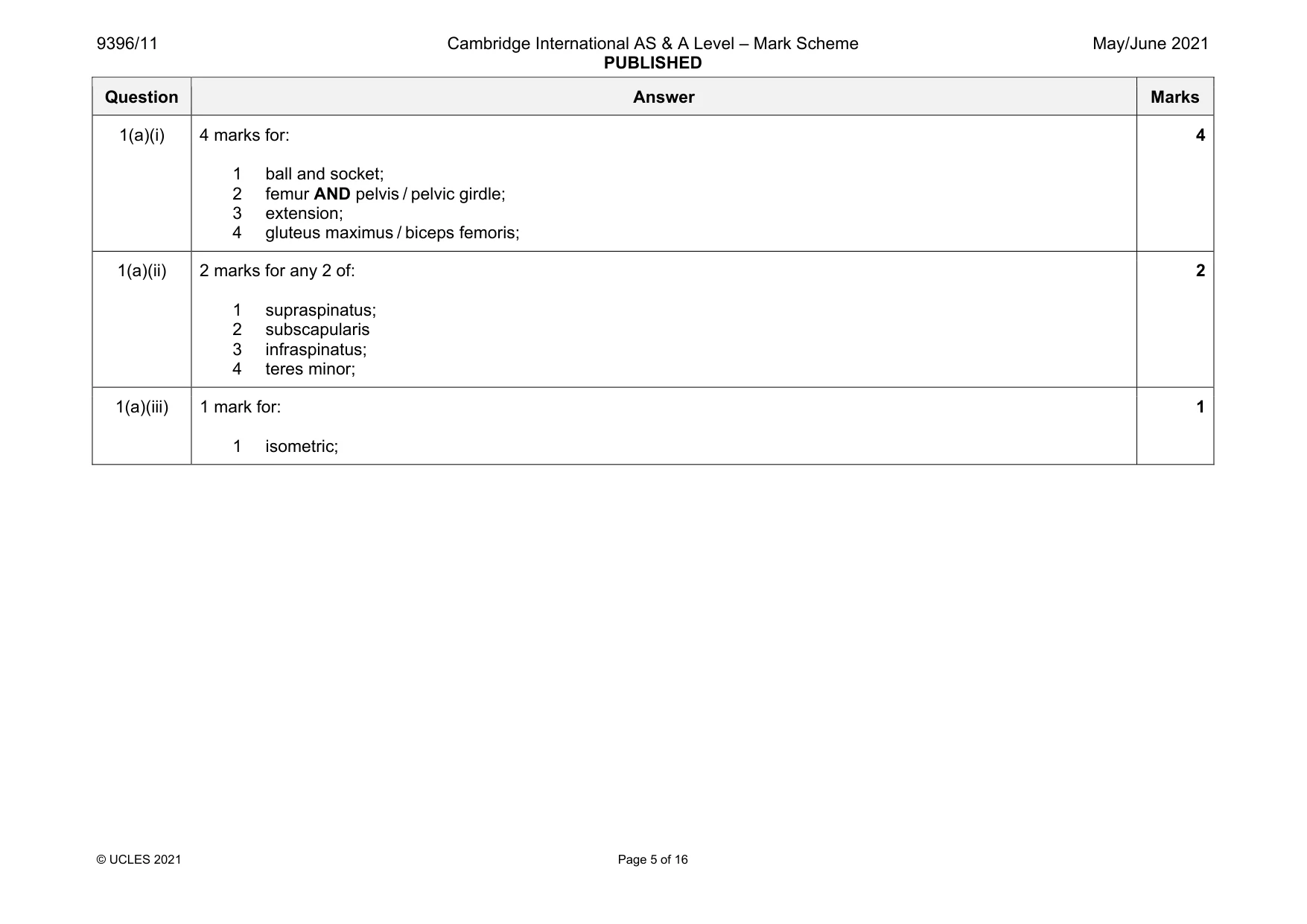
9396/11 Cambridge International AS & A Level – Mark Scheme PUBLISHED May/June 2021 © UCLES 2021 Page 5 of 16 Question Answer Marks 1(a)(i) 4 marks for: 1 ball and socket; 2 femur AND pelvis / pelvic girdle; 3 extension; 4 gluteus maximus / biceps femoris; 4 1(a)(ii) 2 marks for any 2 of: 1 supraspinatus; 2 subscapularis 3 infraspinatus; 4 teres minor; 2 1(a)(iii) 1 mark for: 1 isometric; 1
Mark scheme, page 6
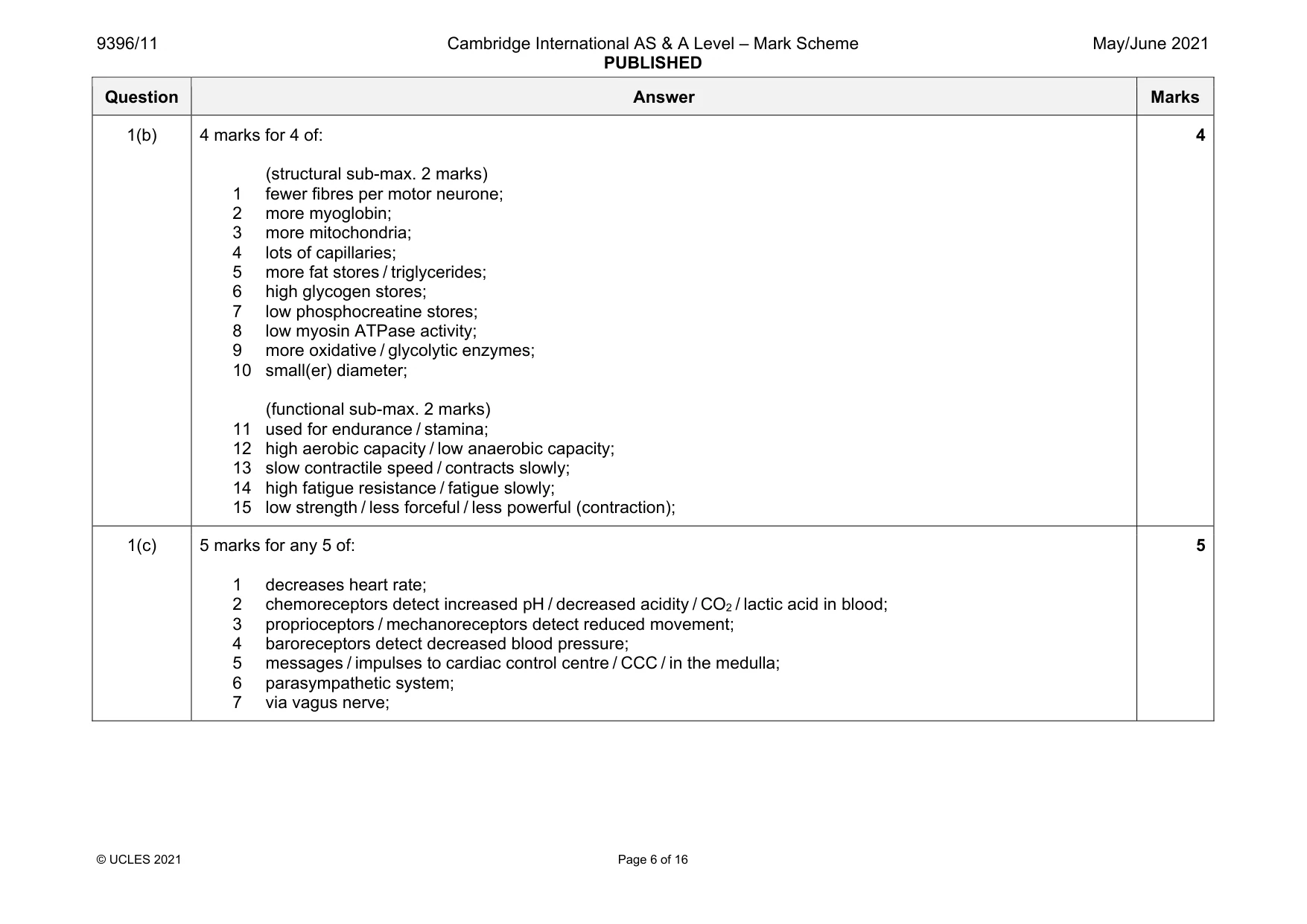
9396/11 Cambridge International AS & A Level – Mark Scheme PUBLISHED May/June 2021 © UCLES 2021 Page 6 of 16 Question Answer Marks 1(b) 4 marks for 4 of: (structural sub-max. 2 marks) 1 fewer fibres per motor neurone; 2 more myoglobin; 3 more mitochondria; 4 lots of capillaries; 5 more fat stores / triglycerides; 6 high glycogen stores; 7 low phosphocreatine stores; 8 low myosin ATPase activity; 9 more oxidative / glycolytic enzymes; 10 small(er) diameter; (functional sub-max. 2 marks) 11 used for endurance / stamina; 12 high aerobic capacity / low anaerobic capacity; 13 slow contractile speed / contracts slowly; 14 high fatigue resistance / fatigue slowly; 15 low strength / less forceful / less powerful (contraction); 4 1(c) 5 marks for any 5 of: 1 decreases heart rate; 2 chemoreceptors detect increased pH / decreased acidity / CO2 / lactic acid in blood; 3 proprioceptors / mechanoreceptors detect reduced movement; 4 baroreceptors detect decreased blood pressure; 5 messages / impulses to cardiac control centre / CCC / in the medulla; 6 parasympathetic system; 7 via vagus nerve; 5
Mark scheme, page 7
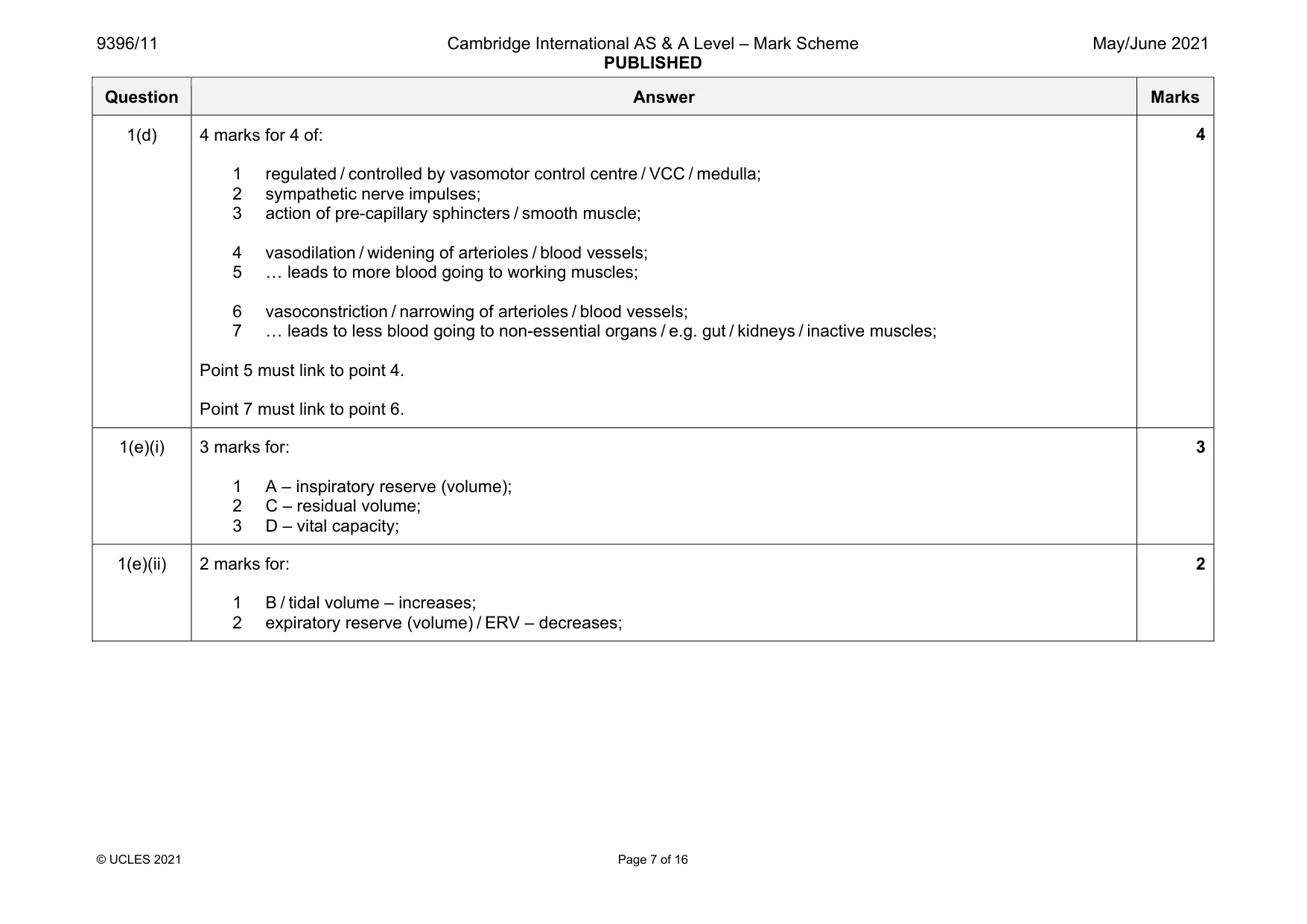
9396/11 Cambridge International AS & A Level – Mark Scheme PUBLISHED May/June 2021 © UCLES 2021 Page 7 of 16 Question Answer Marks 1(d) 4 marks for 4 of: 1 regulated / controlled by vasomotor control centre / VCC / medulla; 2 sympathetic nerve impulses; 3 action of pre-capillary sphincters / smooth muscle; 4 vasodilation / widening of arterioles / blood vessels; 5 … leads to more blood going to working muscles; 6 vasoconstriction / narrowing of arterioles / blood vessels; 7 … leads to less blood going to non-essential organs / e.g. gut / kidneys / inactive muscles; Point 5 must link to point 4. Point 7 must link to point 6. 4 1(e)(i) 3 marks for: 1 A – inspiratory reserve (volume); 2 C – residual volume; 3 D – vital capacity; 3 1(e)(ii) 2 marks for: 1 B / tidal volume – increases; 2 expiratory reserve (volume) / ERV – decreases; 2
Mark scheme, page 8
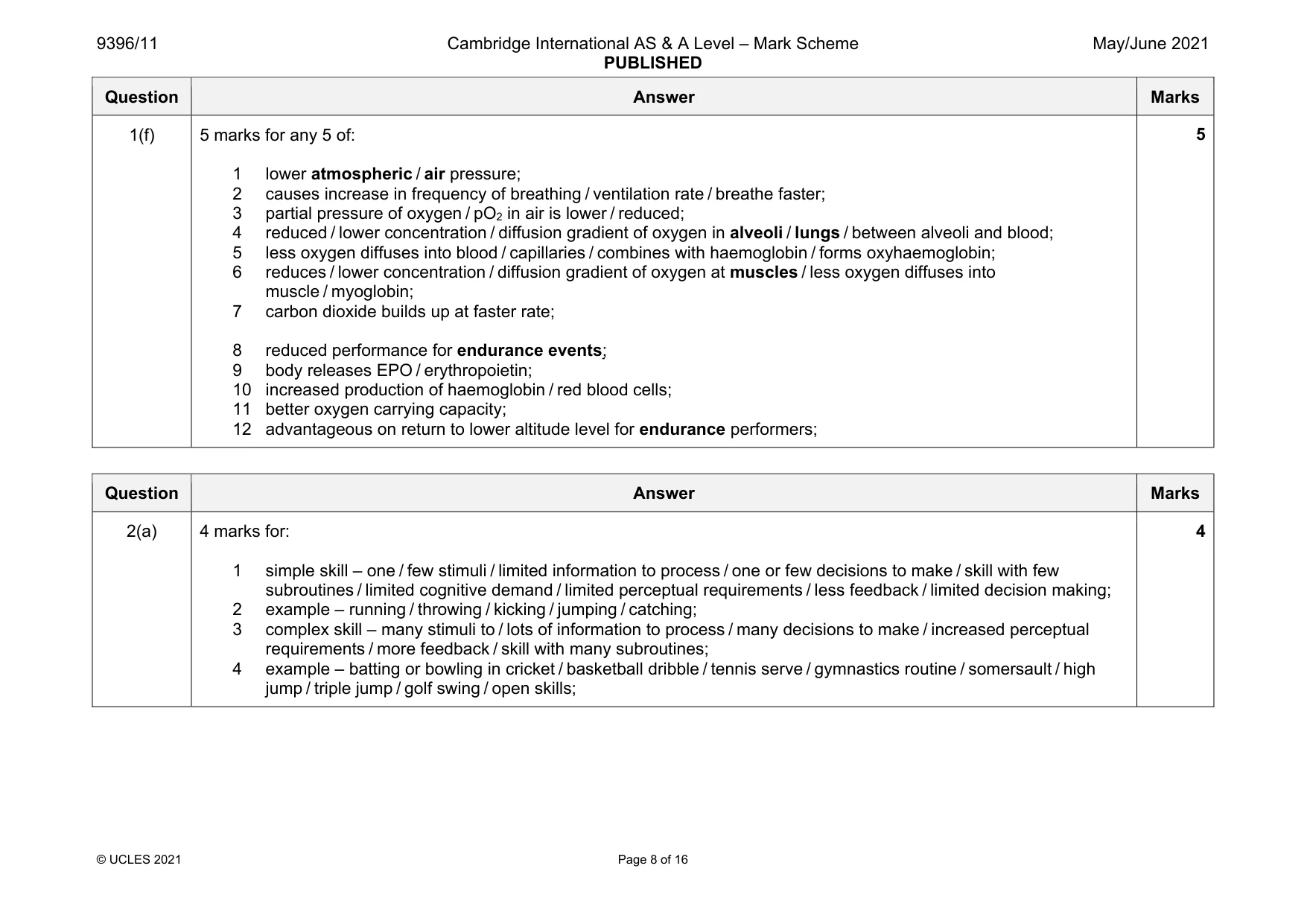
9396/11 Cambridge International AS & A Level – Mark Scheme PUBLISHED May/June 2021 © UCLES 2021 Page 8 of 16 Question Answer Marks 1(f) 5 marks for any 5 of: 1 lower atmospheric / air pressure; 2 causes increase in frequency of breathing / ventilation rate / breathe faster; 3 partial pressure of oxygen / pO2 in air is lower / reduced; 4 reduced / lower concentration / diffusion gradient of oxygen in alveoli / lungs / between alveoli and blood; 5 less oxygen diffuses into blood / capillaries / combines with haemoglobin / forms oxyhaemoglobin; 6 reduces / lower concentration / diffusion gradient of oxygen at muscles / less oxygen diffuses into muscle / myoglobin; 7 carbon dioxide builds up at faster rate; 8 reduced performance for endurance events; 9 body releases EPO / erythropoietin; 10 increased production of haemoglobin / red blood cells; 11 better oxygen carrying capacity; 12 advantageous on return to lower altitude level for endurance performers; 5 Question Answer Marks 2(a) 4 marks for: 1 simple skill – one / few stimuli / limited information to process / one or few decisions to make / skill with few subroutines / limited cognitive demand / limited perceptual requirements / less feedback / limited decision making; 2 example – running / throwing / kicking / jumping / catching; 3 complex skill – many stimuli to / lots of information to process / many decisions to make / increased perceptual requirements / more feedback / skill with many subroutines; 4 example – batting or bowling in cricket / basketball dribble / tennis serve / gymnastics routine / somersault / high jump / triple jump / golf swing / open skills; 4
Mark scheme, page 9
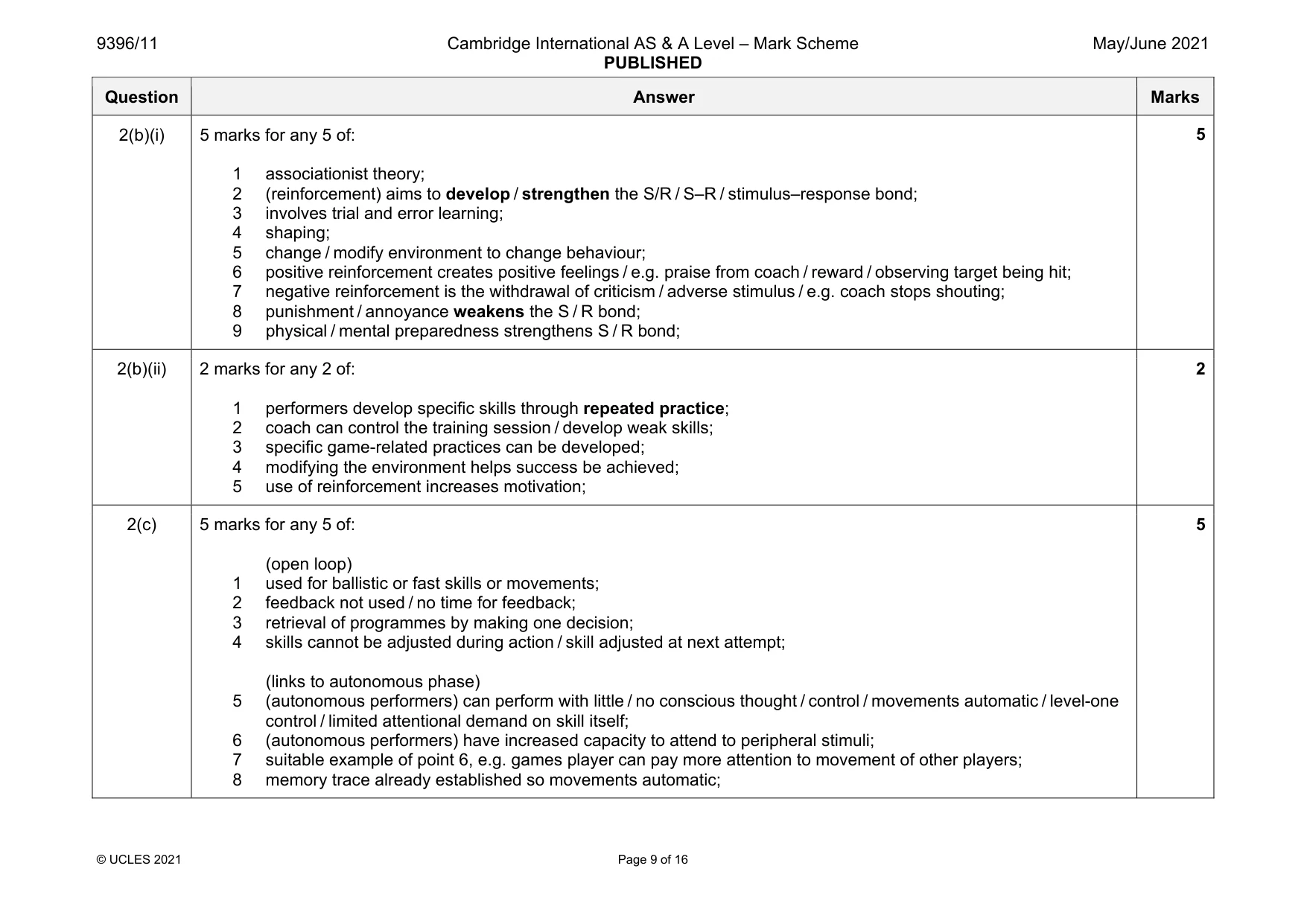
9396/11 Cambridge International AS & A Level – Mark Scheme PUBLISHED May/June 2021 © UCLES 2021 Page 9 of 16 Question Answer Marks 2(b)(i) 5 marks for any 5 of: 1 associationist theory; 2 (reinforcement) aims to develop / strengthen the S/R / S–R / stimulus–response bond; 3 involves trial and error learning; 4 shaping; 5 change / modify environment to change behaviour; 6 positive reinforcement creates positive feelings / e.g. praise from coach / reward / observing target being hit; 7 negative reinforcement is the withdrawal of criticism / adverse stimulus / e.g. coach stops shouting; 8 punishment / annoyance weakens the S / R bond; 9 physical / mental preparedness strengthens S / R bond; 5 2(b)(ii) 2 marks for any 2 of: 1 performers develop specific skills through repeated practice; 2 coach can control the training session / develop weak skills; 3 specific game-related practices can be developed; 4 modifying the environment helps success be achieved; 5 use of reinforcement increases motivation; 2 2(c) 5 marks for any 5 of: (open loop) 1 used for ballistic or fast skills or movements; 2 feedback not used / no time for feedback; 3 retrieval of programmes by making one decision; 4 skills cannot be adjusted during action / skill adjusted at next attempt; (links to autonomous phase) 5 (autonomous performers) can perform with little / no conscious thought / control / movements automatic / level-one control / limited attentional demand on skill itself; 6 (autonomous performers) have increased capacity to attend to peripheral stimuli; 7 suitable example of point 6, e.g. games player can pay more attention to movement of other players; 8 memory trace already established so movements automatic; 5
Mark scheme, page 10
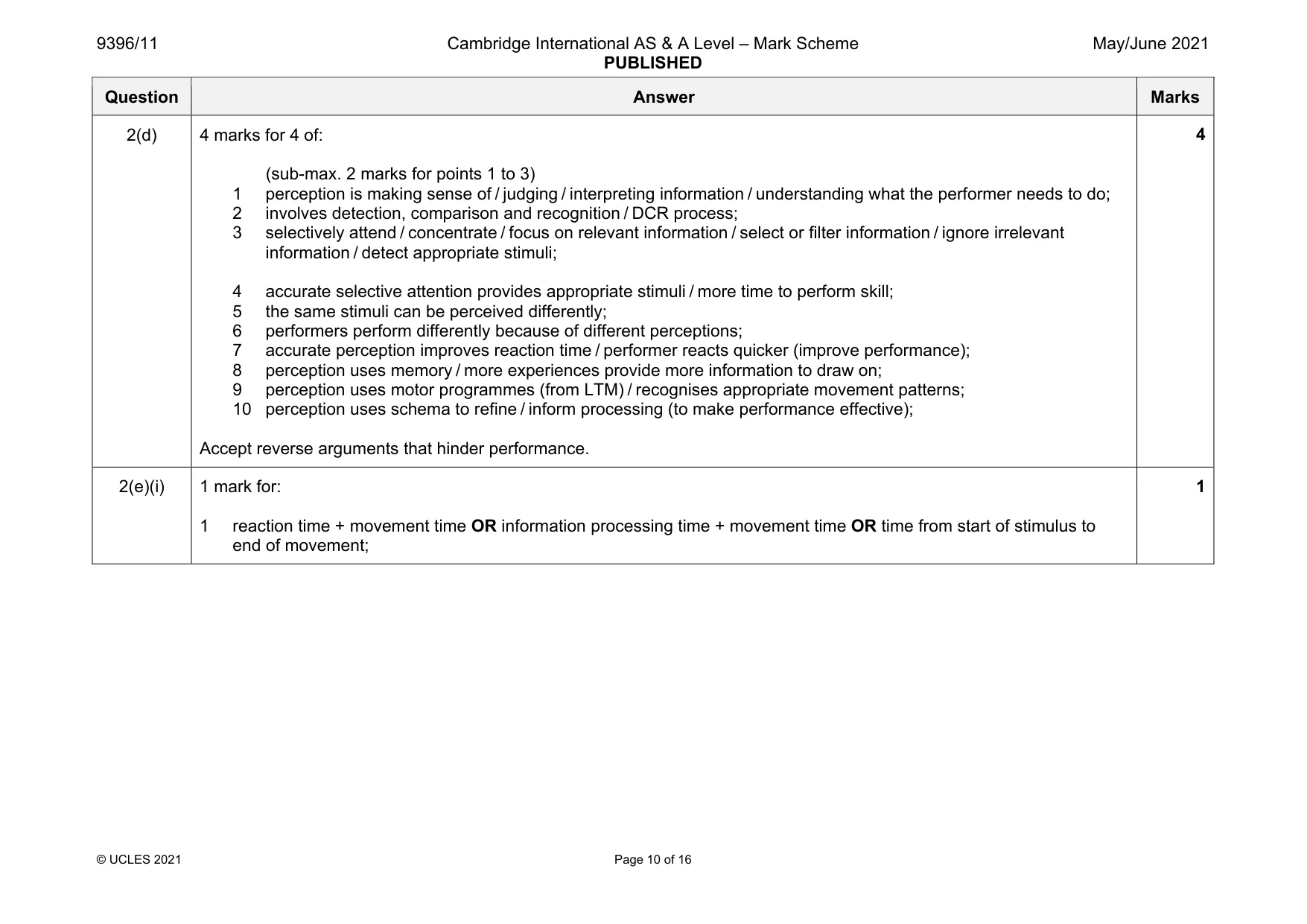
9396/11 Cambridge International AS & A Level – Mark Scheme PUBLISHED May/June 2021 © UCLES 2021 Page 10 of 16 Question Answer Marks 2(d) 4 marks for 4 of: (sub-max. 2 marks for points 1 to 3) 1 perception is making sense of / judging / interpreting information / understanding what the performer needs to do; 2 involves detection, comparison and recognition / DCR process; 3 selectively attend / concentrate / focus on relevant information / select or filter information / ignore irrelevant information / detect appropriate stimuli; 4 accurate selective attention provides appropriate stimuli / more time to perform skill; 5 the same stimuli can be perceived differently; 6 performers perform differently because of different perceptions; 7 accurate perception improves reaction time / performer reacts quicker (improve performance); 8 perception uses memory / more experiences provide more information to draw on; 9 perception uses motor programmes (from LTM) / recognises appropriate movement patterns; 10 perception uses schema to refine / inform processing (to make performance effective); Accept reverse arguments that hinder performance. 4 2(e)(i) 1 mark for: 1 reaction time + movement time OR information processing time + movement time OR time from start of stimulus to end of movement; 1
Mark scheme, page 11
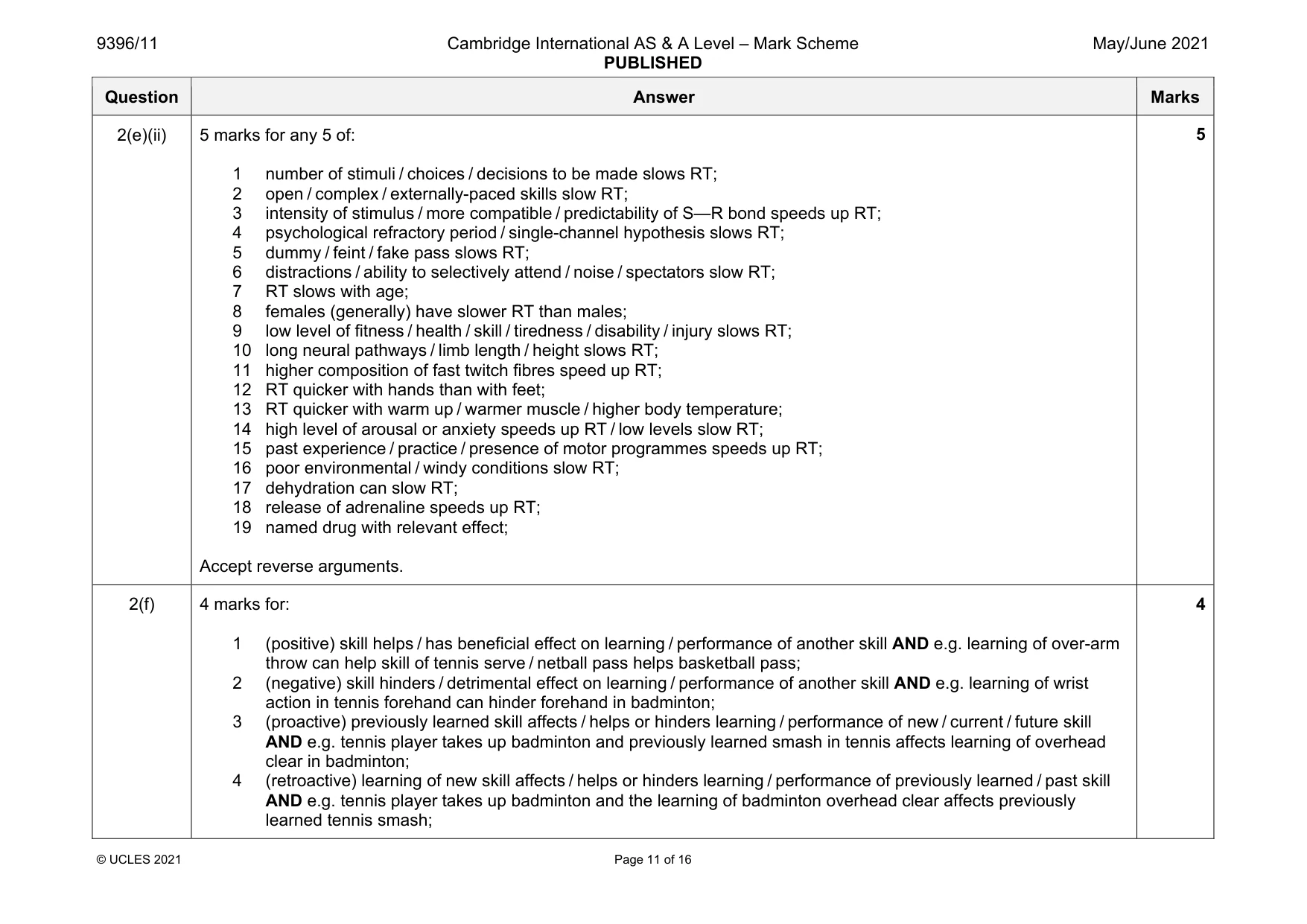
9396/11 Cambridge International AS & A Level – Mark Scheme PUBLISHED May/June 2021 © UCLES 2021 Page 11 of 16 Question Answer Marks 2(e)(ii) 5 marks for any 5 of: 1 number of stimuli / choices / decisions to be made slows RT; 2 open / complex / externally-paced skills slow RT; 3 intensity of stimulus / more compatible / predictability of S—R bond speeds up RT; 4 psychological refractory period / single-channel hypothesis slows RT; 5 dummy / feint / fake pass slows RT; 6 distractions / ability to selectively attend / noise / spectators slow RT; 7 RT slows with age; 8 females (generally) have slower RT than males; 9 low level of fitness / health / skill / tiredness / disability / injury slows RT; 10 long neural pathways / limb length / height slows RT; 11 higher composition of fast twitch fibres speed up RT; 12 RT quicker with hands than with feet; 13 RT quicker with warm up / warmer muscle / higher body temperature; 14 high level of arousal or anxiety speeds up RT / low levels slow RT; 15 past experience / practice / presence of motor programmes speeds up RT; 16 poor environmental / windy conditions slow RT; 17 dehydration can slow RT; 18 release of adrenaline speeds up RT; 19 named drug with relevant effect; Accept reverse arguments. 5 2(f) 4 marks for: 1 (positive) skill helps / has beneficial effect on learning / performance of another skill AND e.g. learning of over-arm throw can help skill of tennis serve / netball pass helps basketball pass; 2 (negative) skill hinders / detrimental effect on learning / performance of another skill AND e.g. learning of wrist action in tennis forehand can hinder forehand in badminton; 3 (proactive) previously learned skill affects / helps or hinders learning / performance of new / current / future skill AND e.g. tennis player takes up badminton and previously learned smash in tennis affects learning of overhead clear in badminton; 4 (retroactive) learning of new skill affects / helps or hinders learning / performance of previously learned / past skill AND e.g. tennis player takes up badminton and the learning of badminton overhead clear affects previously learned tennis smash; 4
Mark scheme, page 12
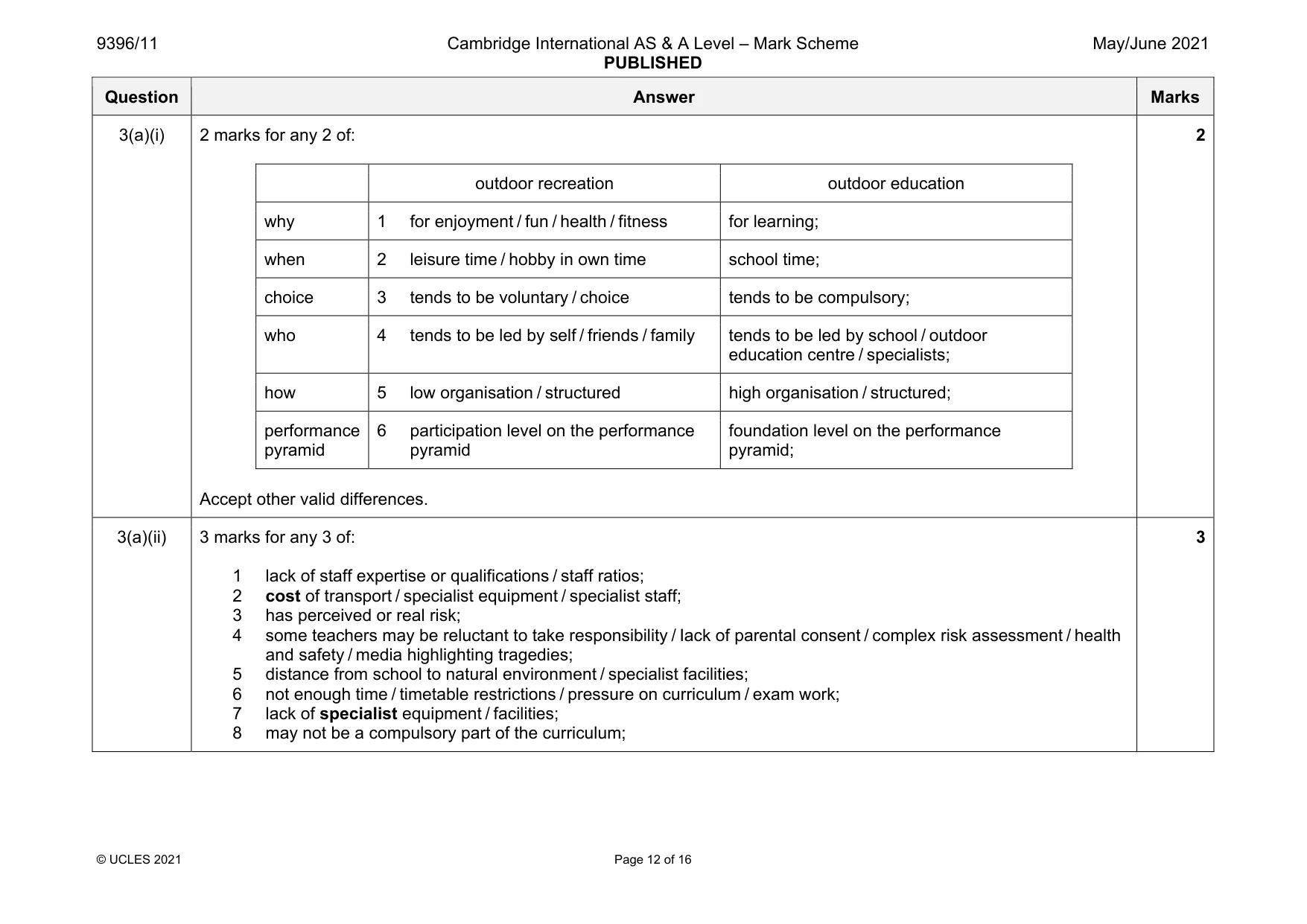
9396/11 Cambridge International AS & A Level – Mark Scheme PUBLISHED May/June 2021 © UCLES 2021 Page 12 of 16 Question Answer Marks 3(a)(i) 2 marks for any 2 of: outdoor recreation outdoor education why 1 for enjoyment / fun / health / fitness for learning; when 2 leisure time / hobby in own time school time; choice 3 tends to be voluntary / choice tends to be compulsory; who 4 tends to be led by self / friends / family tends to be led by school / outdoor education centre / specialists; how 5 low organisation / structured high organisation / structured; performance pyramid 6 participation level on the performance pyramid foundation level on the performance pyramid; Accept other valid differences. 2 3(a)(ii) 3 marks for any 3 of: 1 lack of staff expertise or qualifications / staff ratios; 2 cost of transport / specialist equipment / specialist staff; 3 has perceived or real risk; 4 some teachers may be reluctant to take responsibility / Iack of parental consent / complex risk assessment / health and safety / media highlighting tragedies; 5 distance from school to natural environment / specialist facilities; 6 not enough time / timetable restrictions / pressure on curriculum / exam work; 7 lack of specialist equipment / facilities; 8 may not be a compulsory part of the curriculum; 3
Mark scheme, page 13
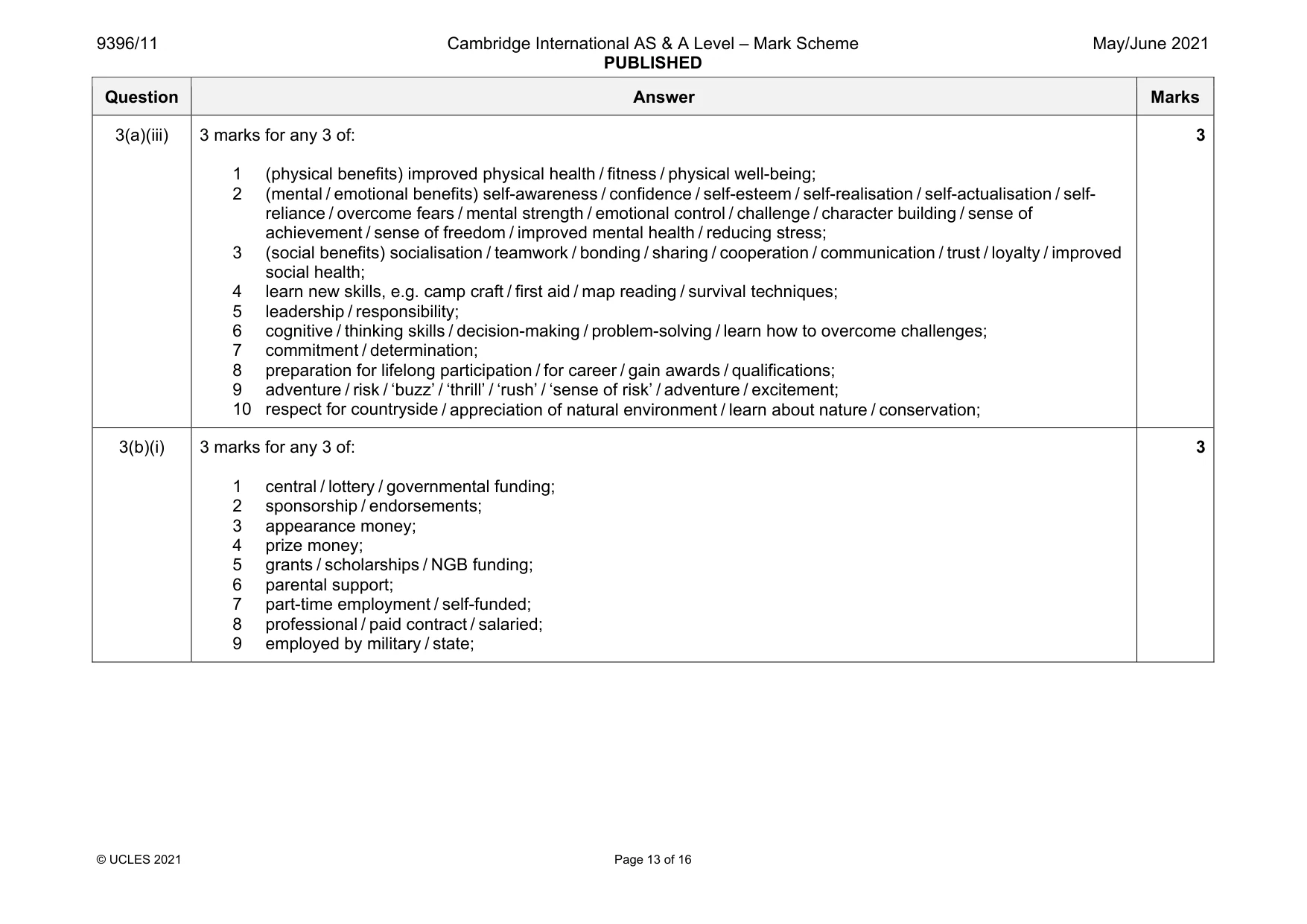
9396/11 Cambridge International AS & A Level – Mark Scheme PUBLISHED May/June 2021 © UCLES 2021 Page 13 of 16 Question Answer Marks 3(a)(iii) 3 marks for any 3 of: 1 (physical benefits) improved physical health / fitness / physical well-being; 2 (mental / emotional benefits) self-awareness / confidence / self-esteem / self-realisation / self-actualisation / self- reliance / overcome fears / mental strength / emotional control / challenge / character building / sense of achievement / sense of freedom / improved mental health / reducing stress; 3 (social benefits) socialisation / teamwork / bonding / sharing / cooperation / communication / trust / loyalty / improved social health; 4 learn new skills, e.g. camp craft / first aid / map reading / survival techniques; 5 leadership / responsibility; 6 cognitive / thinking skills / decision-making / problem-solving / learn how to overcome challenges; 7 commitment / determination; 8 preparation for lifelong participation / for career / gain awards / qualifications; 9 adventure / risk / ‘buzz’ / ‘thrill’ / ‘rush’ / ‘sense of risk’ / adventure / excitement; 10 respect for countryside / appreciation of natural environment / learn about nature / conservation; 3 3(b)(i) 3 marks for any 3 of: 1 central / lottery / governmental funding; 2 sponsorship / endorsements; 3 appearance money; 4 prize money; 5 grants / scholarships / NGB funding; 6 parental support; 7 part-time employment / self-funded; 8 professional / paid contract / salaried; 9 employed by military / state; 3
Mark scheme, page 14
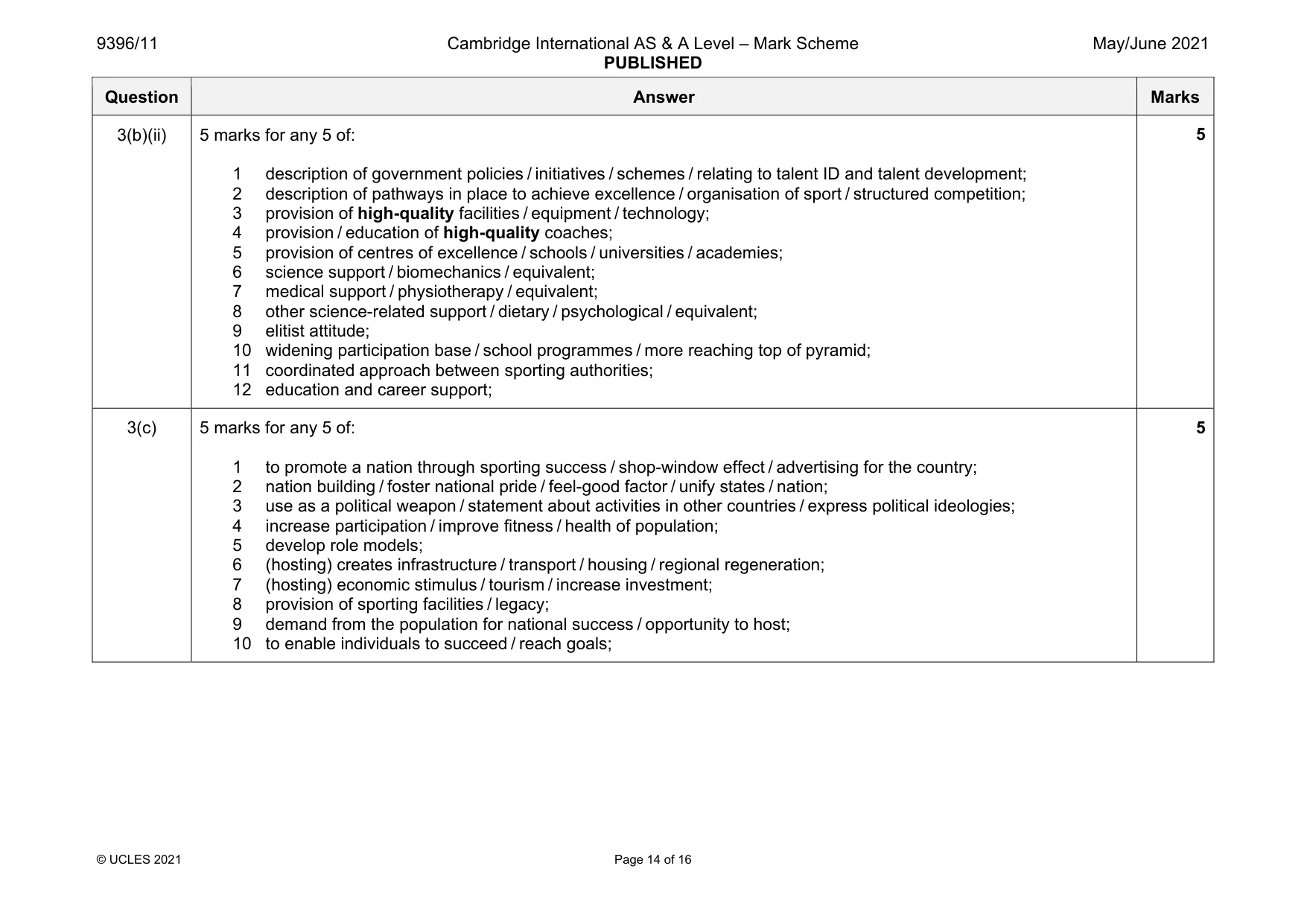
9396/11 Cambridge International AS & A Level – Mark Scheme PUBLISHED May/June 2021 © UCLES 2021 Page 14 of 16 Question Answer Marks 3(b)(ii) 5 marks for any 5 of: 1 description of government policies / initiatives / schemes / relating to talent ID and talent development; 2 description of pathways in place to achieve excellence / organisation of sport / structured competition; 3 provision of high-quality facilities / equipment / technology; 4 provision / education of high-quality coaches; 5 provision of centres of excellence / schools / universities / academies; 6 science support / biomechanics / equivalent; 7 medical support / physiotherapy / equivalent; 8 other science-related support / dietary / psychological / equivalent; 9 elitist attitude; 10 widening participation base / school programmes / more reaching top of pyramid; 11 coordinated approach between sporting authorities; 12 education and career support; 5 3(c) 5 marks for any 5 of: 1 to promote a nation through sporting success / shop-window effect / advertising for the country; 2 nation building / foster national pride / feel-good factor / unify states / nation; 3 use as a political weapon / statement about activities in other countries / express political ideologies; 4 increase participation / improve fitness / health of population; 5 develop role models; 6 (hosting) creates infrastructure / transport / housing / regional regeneration; 7 (hosting) economic stimulus / tourism / increase investment; 8 provision of sporting facilities / legacy; 9 demand from the population for national success / opportunity to host; 10 to enable individuals to succeed / reach goals; 5
Mark scheme, page 15
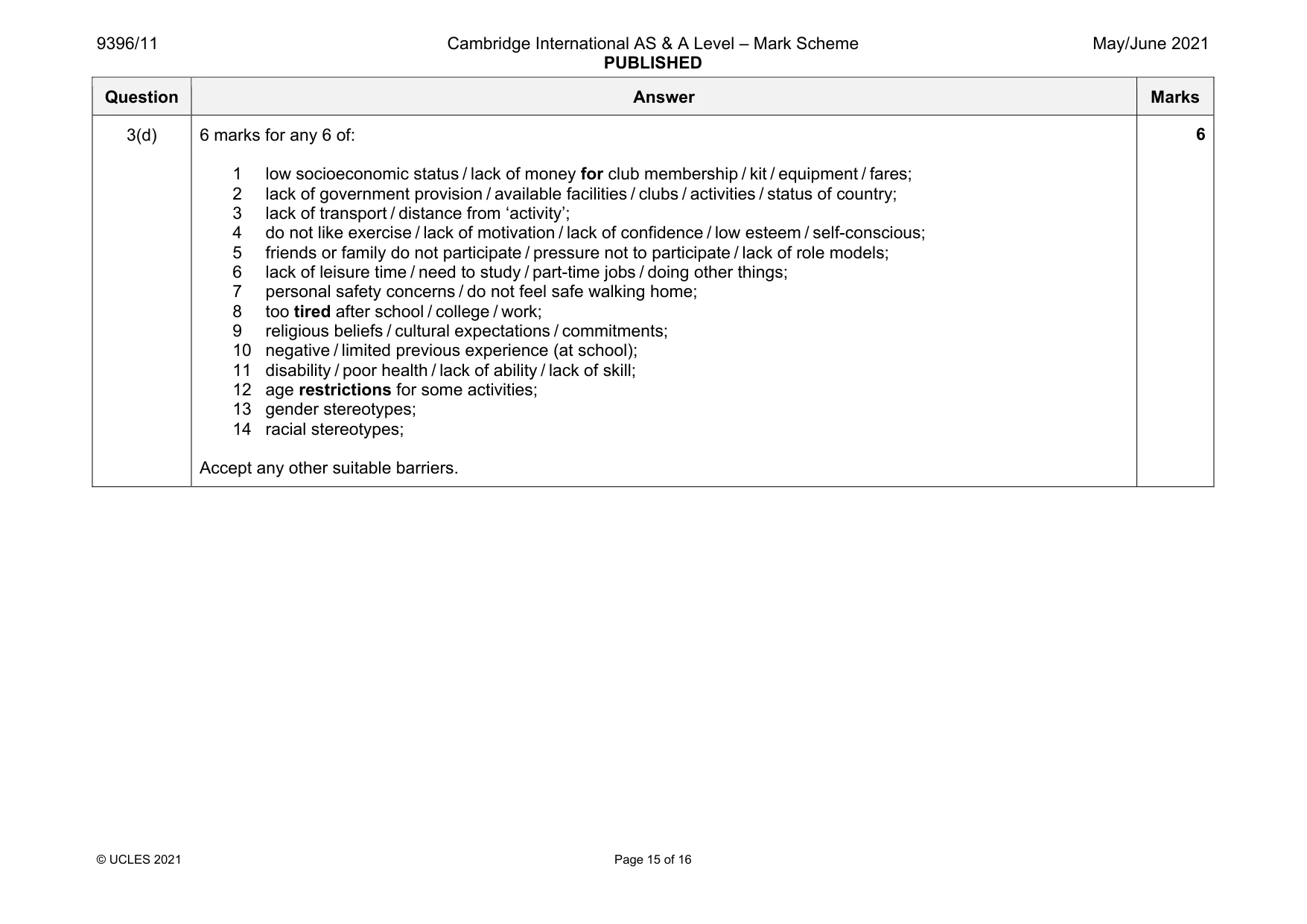
9396/11 Cambridge International AS & A Level – Mark Scheme PUBLISHED May/June 2021 © UCLES 2021 Page 15 of 16 Question Answer Marks 3(d) 6 marks for any 6 of: 1 low socioeconomic status / lack of money for club membership / kit / equipment / fares; 2 lack of government provision / available facilities / clubs / activities / status of country; 3 lack of transport / distance from ‘activity’; 4 do not like exercise / lack of motivation / lack of confidence / low esteem / self-conscious; 5 friends or family do not participate / pressure not to participate / lack of role models; 6 lack of leisure time / need to study / part-time jobs / doing other things; 7 personal safety concerns / do not feel safe walking home; 8 too tired after school / college / work; 9 religious beliefs / cultural expectations / commitments; 10 negative / limited previous experience (at school); 11 disability / poor health / lack of ability / lack of skill; 12 age restrictions for some activities; 13 gender stereotypes; 14 racial stereotypes; Accept any other suitable barriers. 6
Mark scheme, page 16
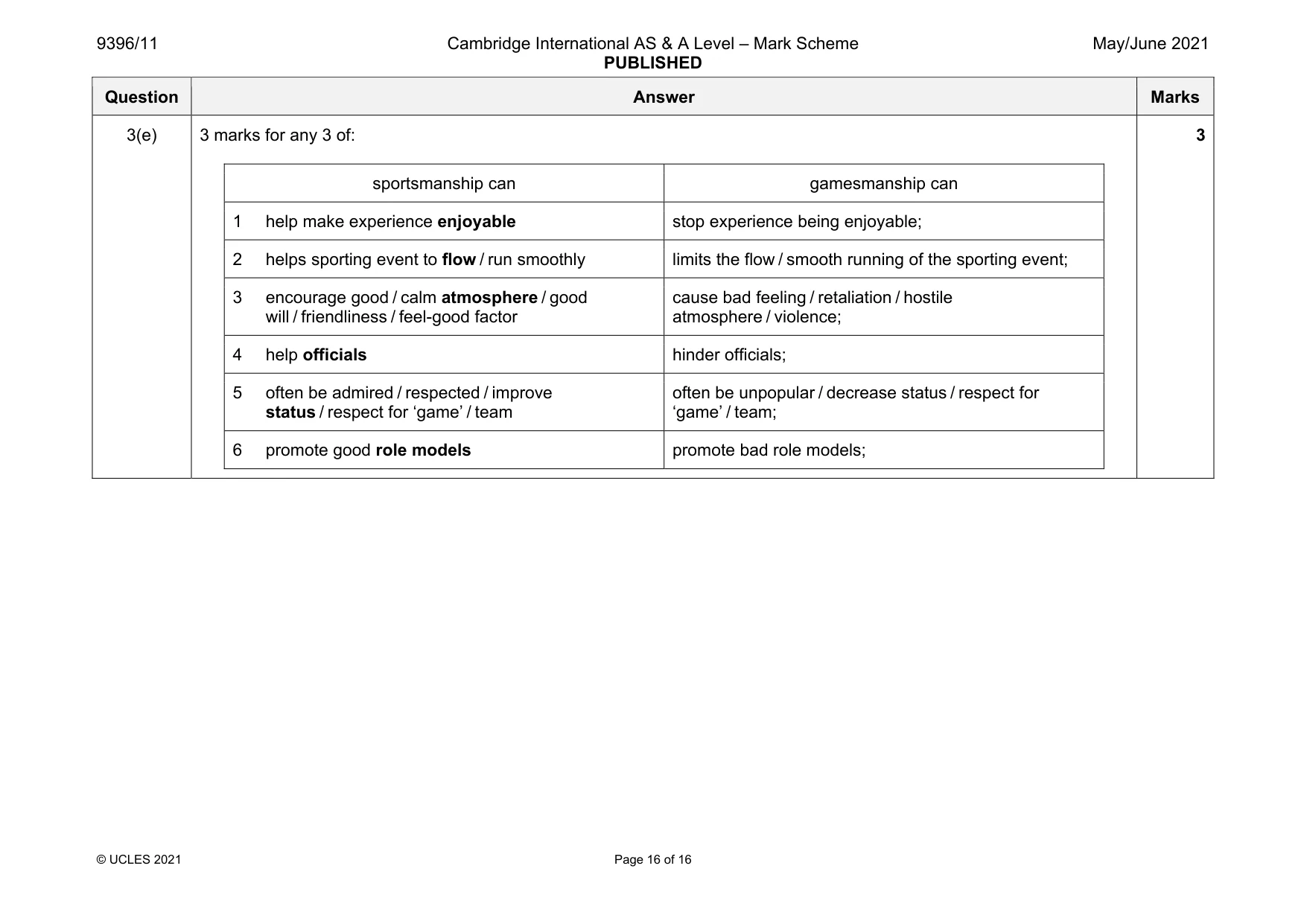
9396/11 Cambridge International AS & A Level – Mark Scheme PUBLISHED May/June 2021 © UCLES 2021 Page 16 of 16 Question Answer Marks 3(e) 3 marks for any 3 of: sportsmanship can gamesmanship can 1 help make experience enjoyable stop experience being enjoyable; 2 helps sporting event to flow / run smoothly limits the flow / smooth running of the sporting event; 3 encourage good / calm atmosphere / good will / friendliness / feel-good factor cause bad feeling / retaliation / hostile atmosphere / violence; 4 help officials hinder officials; 5 often be admired / respected / improve status / respect for ‘game’ / team often be unpopular / decrease status / respect for ‘game’ / team; 6 promote good role models promote bad role models; 3
What you needed in this session
Cambridge’s own grade thresholds for 2021 May/June, Paper 1 · Variant 1. A higher threshold means an easier paper — the bar moves with how the cohort did.