Cambridge A Level Physical Education 9396 — 2020 Oct/Nov Paper 1 · Variant 1
9396/11/O/N/20 · 90 marks · ≈101 min
The question paper and its mark scheme, free to read here and free to download. This is Cambridge’s own paper, exactly as it was sat.
Question paper8 pages



Mark scheme13 pages
Answers below. Sit the paper first if you are practising.
Paper as text
Question paper, page 1
Cambridge International AS & A Level * 9 2 4 5 0 3 9 8 7 4 * This document has 8 pages. Blank pages are indicated. DC (KS/TP) 180771/4 © UCLES 2020 [Turn over PHYSICAL EDUCATION 9396/11 Paper 1 October/November 2020 2 hours 30 minutes You must answer on the enclosed answer booklet. You will need: Answer booklet (enclosed) INSTRUCTIONS ● Answer all questions. ● Follow the instructions on the front cover of the answer booklet. If you need additional answer paper, ask the invigilator for a continuation booklet. ● You may use a calculator. ● You should show all your working and use appropriate units. INFORMATION ● The total mark for this paper is 90. ● The number of marks for each question or part question is shown in brackets [ ].
Question paper, page 2
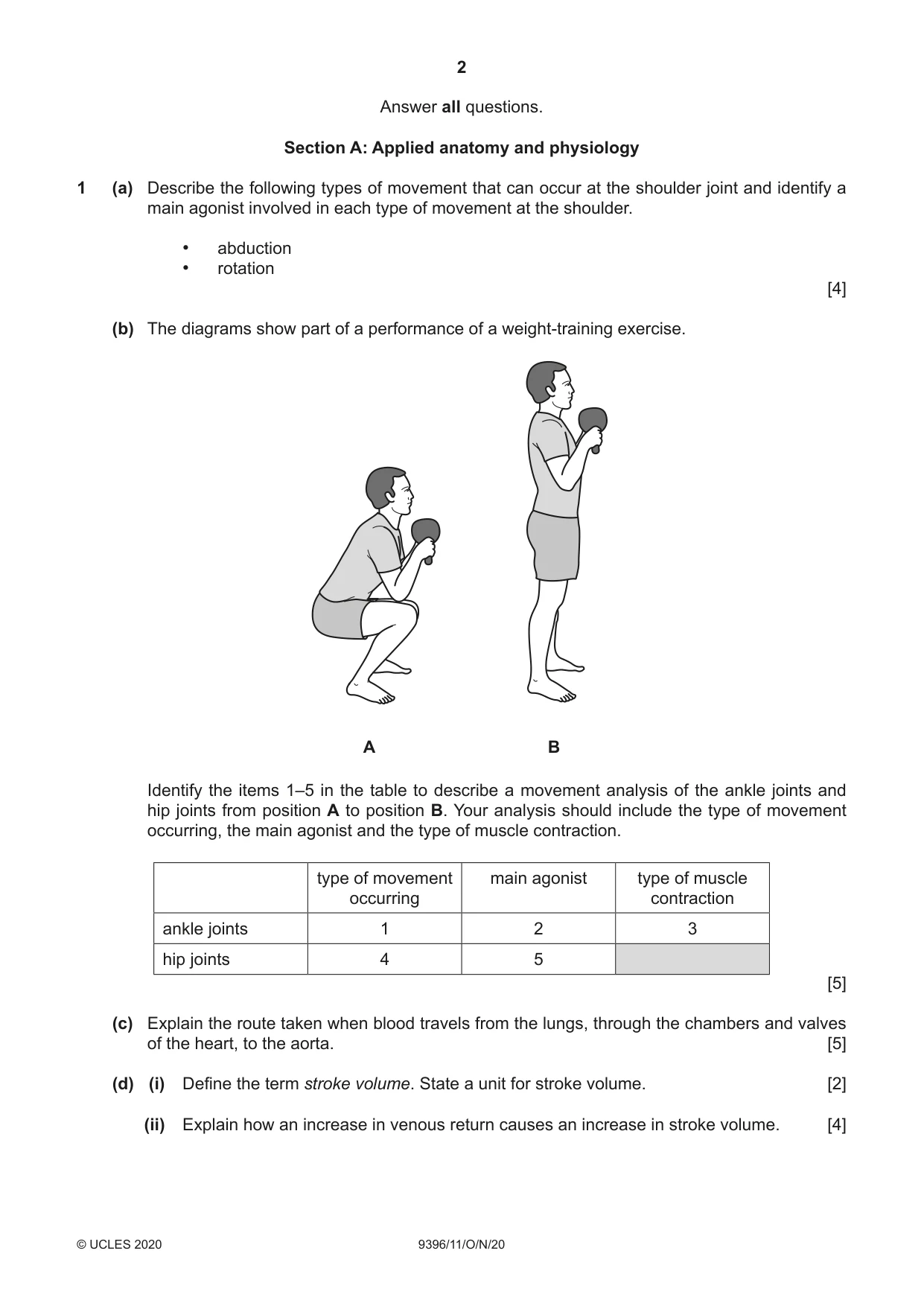
2 9396/11/O/N/20 © UCLES 2020 Answer all questions. Section A: Applied anatomy and physiology 1 (a) Describe the following types of movement that can occur at the shoulder joint and identify a main agonist involved in each type of movement at the shoulder. • abduction • rotation [4] (b) The diagrams show part of a performance of a weight-training exercise. B A Identify the items 1–5 in the table to describe a movement analysis of the ankle joints and hip joints from position A to position B. Your analysis should include the type of movement occurring, the main agonist and the type of muscle contraction. type of movement occurring main agonist type of muscle contraction ankle joints 1 2 3 hip joints 4 5 [5] (c) Explain the route taken when blood travels from the lungs, through the chambers and valves of the heart, to the aorta. [5] (d) (i) Define the term stroke volume. State a unit for stroke volume. [2] (ii) Explain how an increase in venous return causes an increase in stroke volume. [4]
Question paper, page 3
3 9396/11/O/N/20 © UCLES 2020 [Turn over (e) Explain the different roles of haemoglobin and myoglobin in the transport of oxygen. [3] (f) Describe the processes of inspiration and expiration during exercise. [4] (g) Describe three structural features of alveoli that assist gaseous exchange. [3] [Total: 30]
Question paper, page 4
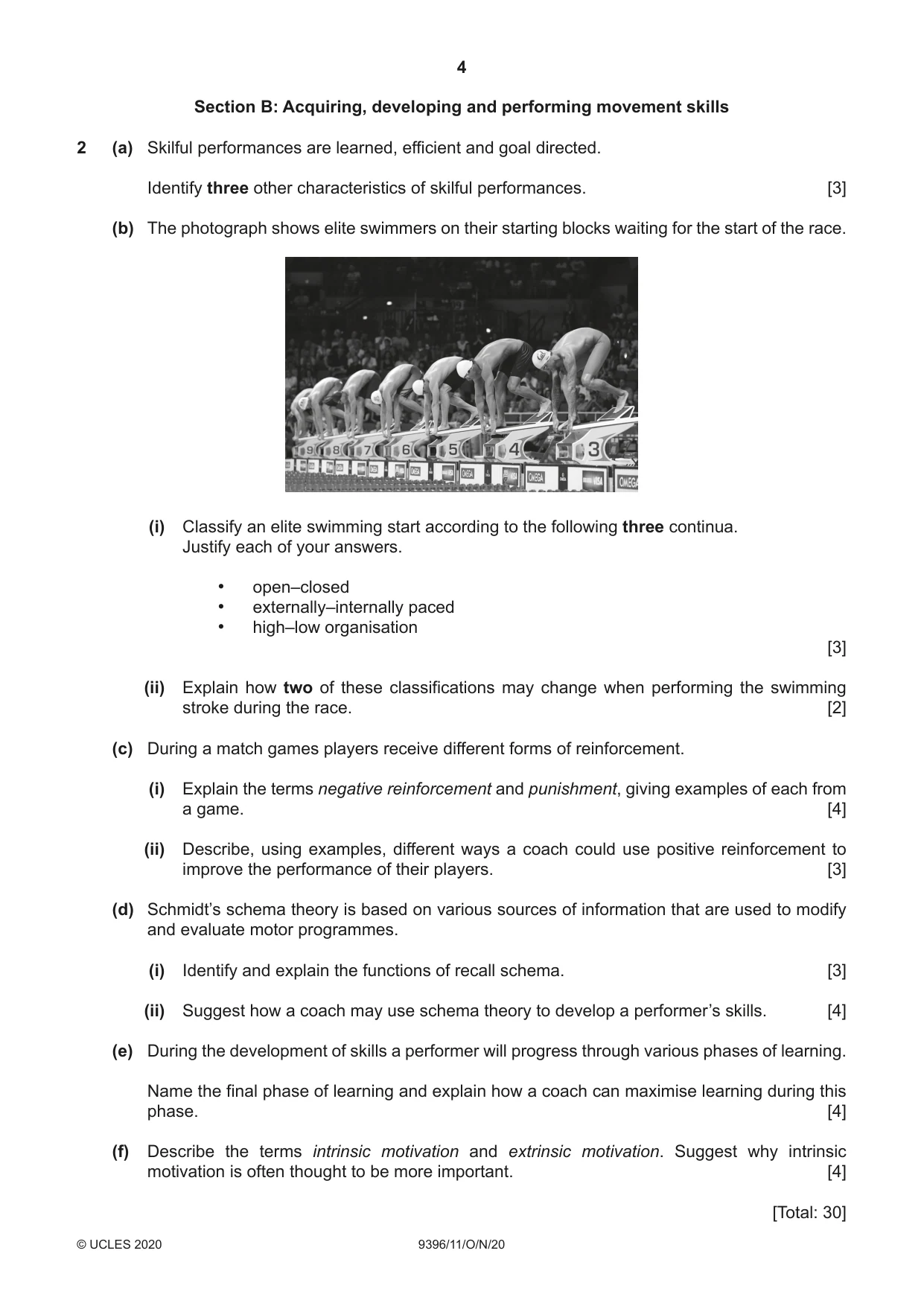
4 9396/11/O/N/20 © UCLES 2020 Section B: Acquiring, developing and performing movement skills 2 (a) Skilful performances are learned, efficient and goal directed. Identify three other characteristics of skilful performances. [3] (b) The photograph shows elite swimmers on their starting blocks waiting for the start of the race. (i) Classify an elite swimming start according to the following three continua. Justify each of your answers. • open–closed • externally–internally paced • high–low organisation [3] (ii) Explain how two of these classifications may change when performing the swimming stroke during the race. [2] (c) During a match games players receive different forms of reinforcement. (i) Explain the terms negative reinforcement and punishment, giving examples of each from a game. [4] (ii) Describe, using examples, different ways a coach could use positive reinforcement to improve the performance of their players. [3] (d) Schmidt’s schema theory is based on various sources of information that are used to modify and evaluate motor programmes. (i) Identify and explain the functions of recall schema. [3] (ii) Suggest how a coach may use schema theory to develop a performer’s skills. [4] (e) During the development of skills a performer will progress through various phases of learning. Name the final phase of learning and explain how a coach can maximise learning during this phase. [4] (f) Describe the terms intrinsic motivation and extrinsic motivation. Suggest why intrinsic motivation is often thought to be more important. [4] [Total: 30]
Question paper, page 5
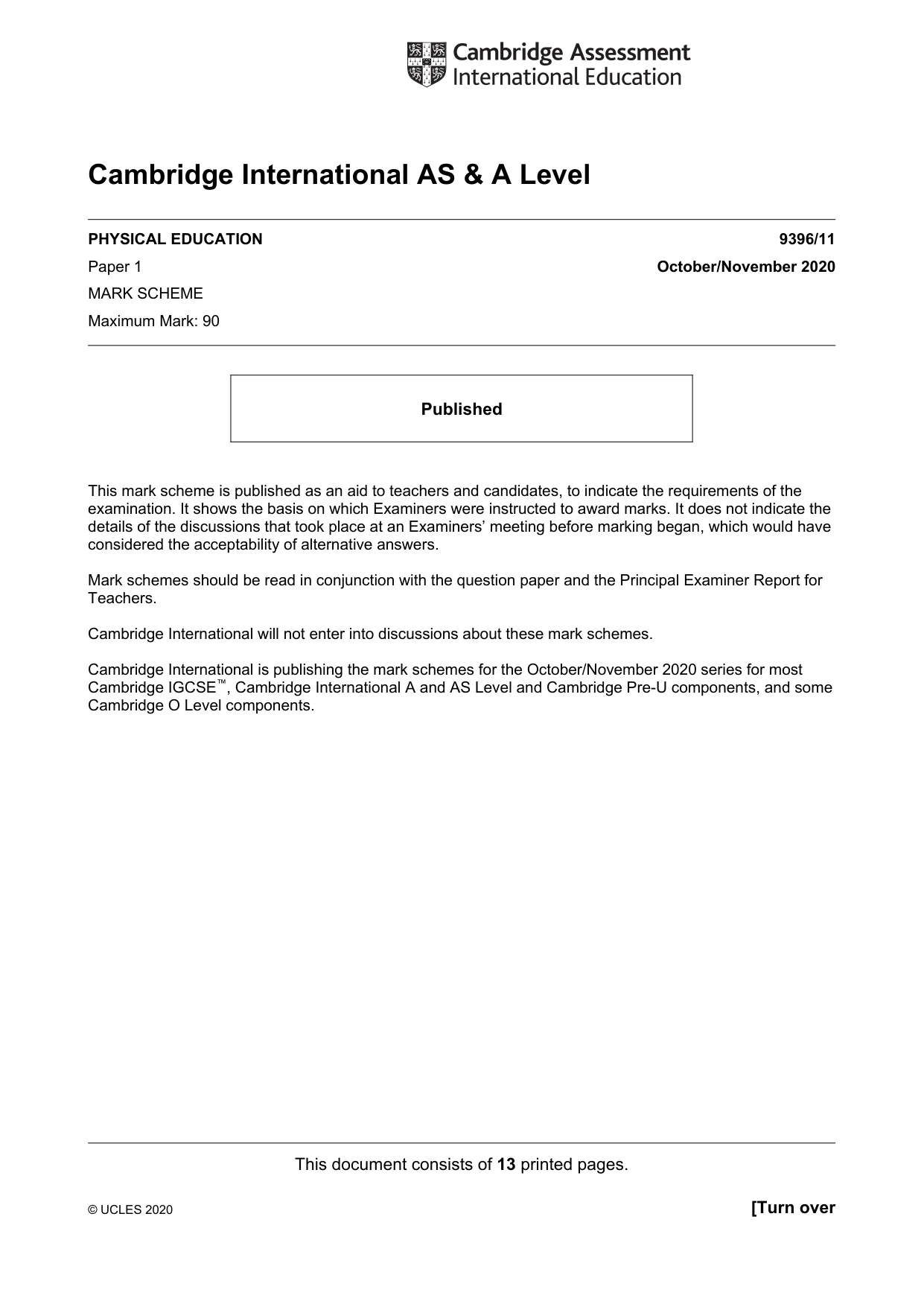
5 9396/11/O/N/20 © UCLES 2020 Section C: Contemporary studies in physical education and sport 3 (a) Hill walking and sailing are examples of outdoor recreation activities. Suggest benefits for an individual of participating in outdoor recreation activities. [4] (b) Sport is competitive. Identify three other characteristics of sport. [3] (c) (i) Describe what is meant by elite sport. [3] (ii) Suggest the provision required for a performer to reach an elite level in sport. [3] (d) Suggest how a community could benefit from regular participation in physical activity. [5] (e) Suggest how racial and religious factors may reduce participation in sport. [6] (f) Explain how sponsorship of sport is closely linked to the media. [6] [Total: 30]
Question paper, page 6
6 9396/11/O/N/20 © UCLES 2020 BLANK PAGE
Question paper, page 7
7 9396/11/O/N/20 © UCLES 2020 BLANK PAGE
Question paper, page 8
8 9396/11/O/N/20 © UCLES 2020 Permission to reproduce items where third-party owned material protected by copyright is included has been sought and cleared where possible. Every reasonable effort has been made by the publisher (UCLES) to trace copyright holders, but if any items requiring clearance have unwittingly been included, the publisher will be pleased to make amends at the earliest possible opportunity. To avoid the issue of disclosure of answer-related information to candidates, all copyright acknowledgements are reproduced online in the Cambridge Assessment International Education Copyright Acknowledgements Booklet. This is produced for each series of examinations and is freely available to download at www.cambridgeinternational.org after the live examination series. Cambridge Assessment International Education is part of the Cambridge Assessment Group. Cambridge Assessment is the brand name of the University of Cambridge Local Examinations Syndicate (UCLES), which itself is a department of the University of Cambridge. BLANK PAGE
Mark scheme, page 1
This document consists of 13 printed pages. © UCLES 2020 [Turn over Cambridge International AS & A Level PHYSICAL EDUCATION 9396/11 Paper 1 October/November 2020 MARK SCHEME Maximum Mark: 90 Published This mark scheme is published as an aid to teachers and candidates, to indicate the requirements of the examination. It shows the basis on which Examiners were instructed to award marks. It does not indicate the details of the discussions that took place at an Examiners’ meeting before marking began, which would have considered the acceptability of alternative answers. Mark schemes should be read in conjunction with the question paper and the Principal Examiner Report for Teachers. Cambridge International will not enter into discussions about these mark schemes. Cambridge International is publishing the mark schemes for the October/November 2020 series for most Cambridge IGCSE™, Cambridge International A and AS Level and Cambridge Pre-U components, and some Cambridge O Level components.
Mark scheme, page 2
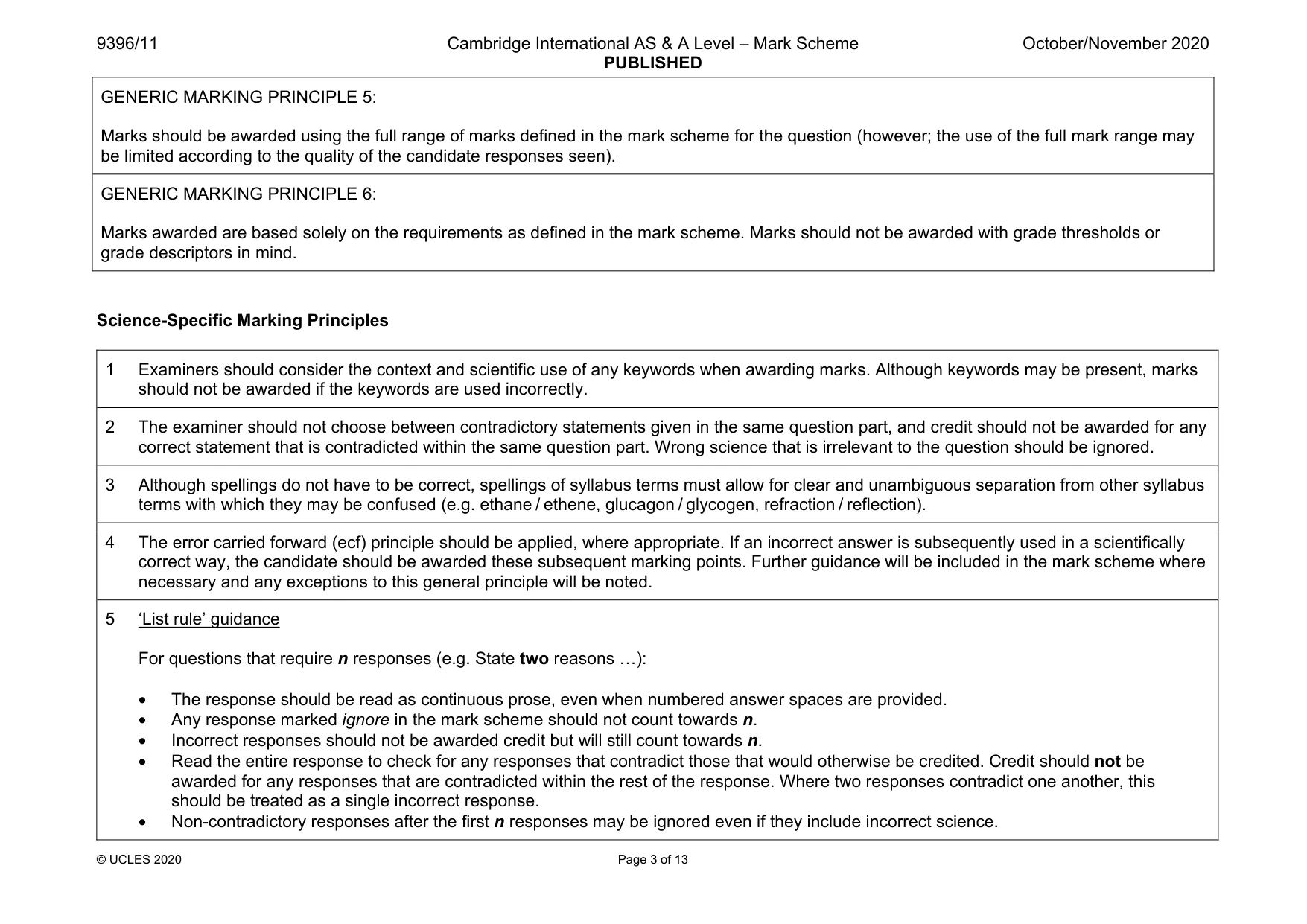
9396/11 Cambridge International AS & A Level – Mark Scheme PUBLISHED October/November 2020 © UCLES 2020 Page 2 of 13 Generic Marking Principles These general marking principles must be applied by all examiners when marking candidate answers. They should be applied alongside the specific content of the mark scheme or generic level descriptors for a question. Each question paper and mark scheme will also comply with these marking principles. GENERIC MARKING PRINCIPLE 1: Marks must be awarded in line with: • the specific content of the mark scheme or the generic level descriptors for the question • the specific skills defined in the mark scheme or in the generic level descriptors for the question • the standard of response required by a candidate as exemplified by the standardisation scripts. GENERIC MARKING PRINCIPLE 2: Marks awarded are always whole marks (not half marks, or other fractions). GENERIC MARKING PRINCIPLE 3: Marks must be awarded positively: • marks are awarded for correct/valid answers, as defined in the mark scheme. However, credit is given for valid answers which go beyond the scope of the syllabus and mark scheme, referring to your Team Leader as appropriate • marks are awarded when candidates clearly demonstrate what they know and can do • marks are not deducted for errors • marks are not deducted for omissions • answers should only be judged on the quality of spelling, punctuation and grammar when these features are specifically assessed by the question as indicated by the mark scheme. The meaning, however, should be unambiguous. GENERIC MARKING PRINCIPLE 4: Rules must be applied consistently, e.g. in situations where candidates have not followed instructions or in the application of generic level descriptors.
Mark scheme, page 3
9396/11 Cambridge International AS & A Level – Mark Scheme PUBLISHED October/November 2020 © UCLES 2020 Page 3 of 13 GENERIC MARKING PRINCIPLE 5: Marks should be awarded using the full range of marks defined in the mark scheme for the question (however; the use of the full mark range may be limited according to the quality of the candidate responses seen). GENERIC MARKING PRINCIPLE 6: Marks awarded are based solely on the requirements as defined in the mark scheme. Marks should not be awarded with grade thresholds or grade descriptors in mind. Science-Specific Marking Principles 1 Examiners should consider the context and scientific use of any keywords when awarding marks. Although keywords may be present, marks should not be awarded if the keywords are used incorrectly. 2 The examiner should not choose between contradictory statements given in the same question part, and credit should not be awarded for any correct statement that is contradicted within the same question part. Wrong science that is irrelevant to the question should be ignored. 3 Although spellings do not have to be correct, spellings of syllabus terms must allow for clear and unambiguous separation from other syllabus terms with which they may be confused (e.g. ethane / ethene, glucagon / glycogen, refraction / reflection). 4 The error carried forward (ecf) principle should be applied, where appropriate. If an incorrect answer is subsequently used in a scientifically correct way, the candidate should be awarded these subsequent marking points. Further guidance will be included in the mark scheme where necessary and any exceptions to this general principle will be noted. 5 ‘List rule’ guidance For questions that require n responses (e.g. State two reasons …): • The response should be read as continuous prose, even when numbered answer spaces are provided. • Any response marked ignore in the mark scheme should not count towards n. • Incorrect responses should not be awarded credit but will still count towards n. • Read the entire response to check for any responses that contradict those that would otherwise be credited. Credit should not be awarded for any responses that are contradicted within the rest of the response. Where two responses contradict one another, this should be treated as a single incorrect response. • Non-contradictory responses after the first n responses may be ignored even if they include incorrect science.
Mark scheme, page 4
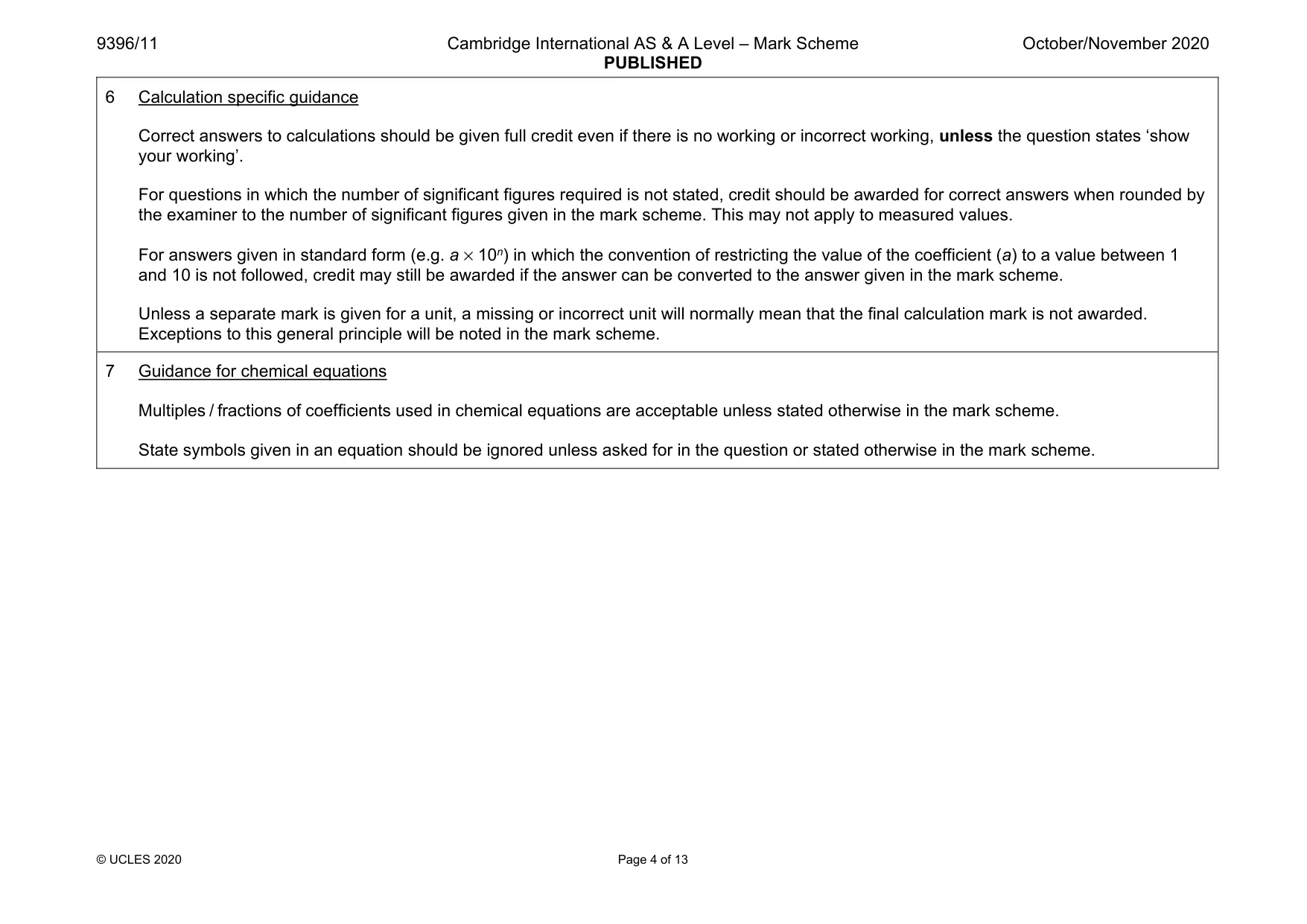
9396/11 Cambridge International AS & A Level – Mark Scheme PUBLISHED October/November 2020 © UCLES 2020 Page 4 of 13 6 Calculation specific guidance Correct answers to calculations should be given full credit even if there is no working or incorrect working, unless the question states ‘show your working’. For questions in which the number of significant figures required is not stated, credit should be awarded for correct answers when rounded by the examiner to the number of significant figures given in the mark scheme. This may not apply to measured values. For answers given in standard form (e.g. a × 10n) in which the convention of restricting the value of the coefficient (a) to a value between 1 and 10 is not followed, credit may still be awarded if the answer can be converted to the answer given in the mark scheme. Unless a separate mark is given for a unit, a missing or incorrect unit will normally mean that the final calculation mark is not awarded. Exceptions to this general principle will be noted in the mark scheme. 7 Guidance for chemical equations Multiples / fractions of coefficients used in chemical equations are acceptable unless stated otherwise in the mark scheme. State symbols given in an equation should be ignored unless asked for in the question or stated otherwise in the mark scheme.
Mark scheme, page 5
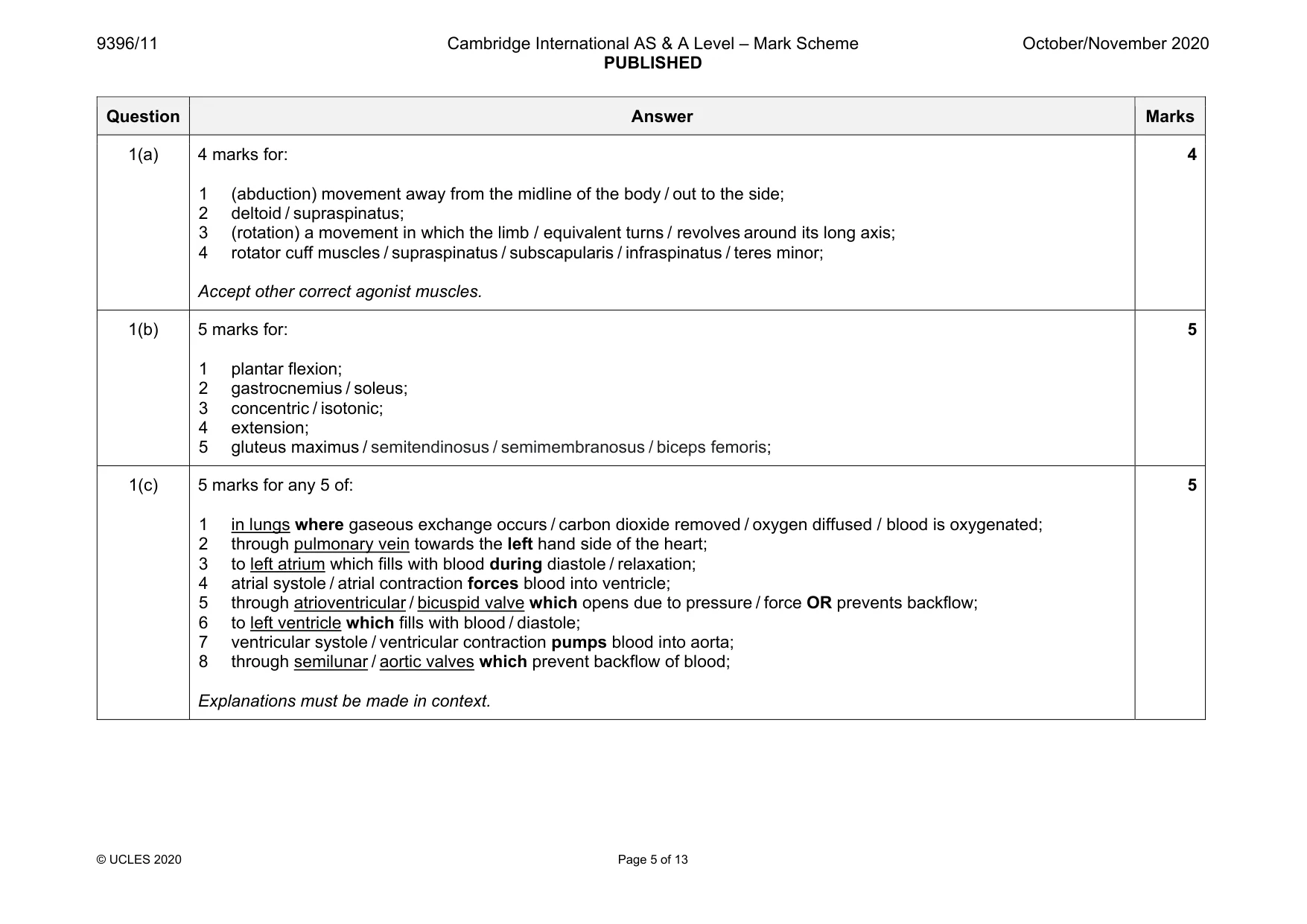
9396/11 Cambridge International AS & A Level – Mark Scheme PUBLISHED October/November 2020 © UCLES 2020 Page 5 of 13 Question Answer Marks 1(a) 4 marks for: 1 (abduction) movement away from the midline of the body / out to the side; 2 deltoid / supraspinatus; 3 (rotation) a movement in which the limb / equivalent turns / revolves around its long axis; 4 rotator cuff muscles / supraspinatus / subscapularis / infraspinatus / teres minor; Accept other correct agonist muscles. 4 1(b) 5 marks for: 1 plantar flexion; 2 gastrocnemius / soleus; 3 concentric / isotonic; 4 extension; 5 gluteus maximus / semitendinosus / semimembranosus / biceps femoris; 5 1(c) 5 marks for any 5 of: 1 in lungs where gaseous exchange occurs / carbon dioxide removed / oxygen diffused / blood is oxygenated; 2 through pulmonary vein towards the left hand side of the heart; 3 to left atrium which fills with blood during diastole / relaxation; 4 atrial systole / atrial contraction forces blood into ventricle; 5 through atrioventricular / bicuspid valve which opens due to pressure / force OR prevents backflow; 6 to left ventricle which fills with blood / diastole; 7 ventricular systole / ventricular contraction pumps blood into aorta; 8 through semilunar / aortic valves which prevent backflow of blood; Explanations must be made in context. 5
Mark scheme, page 6
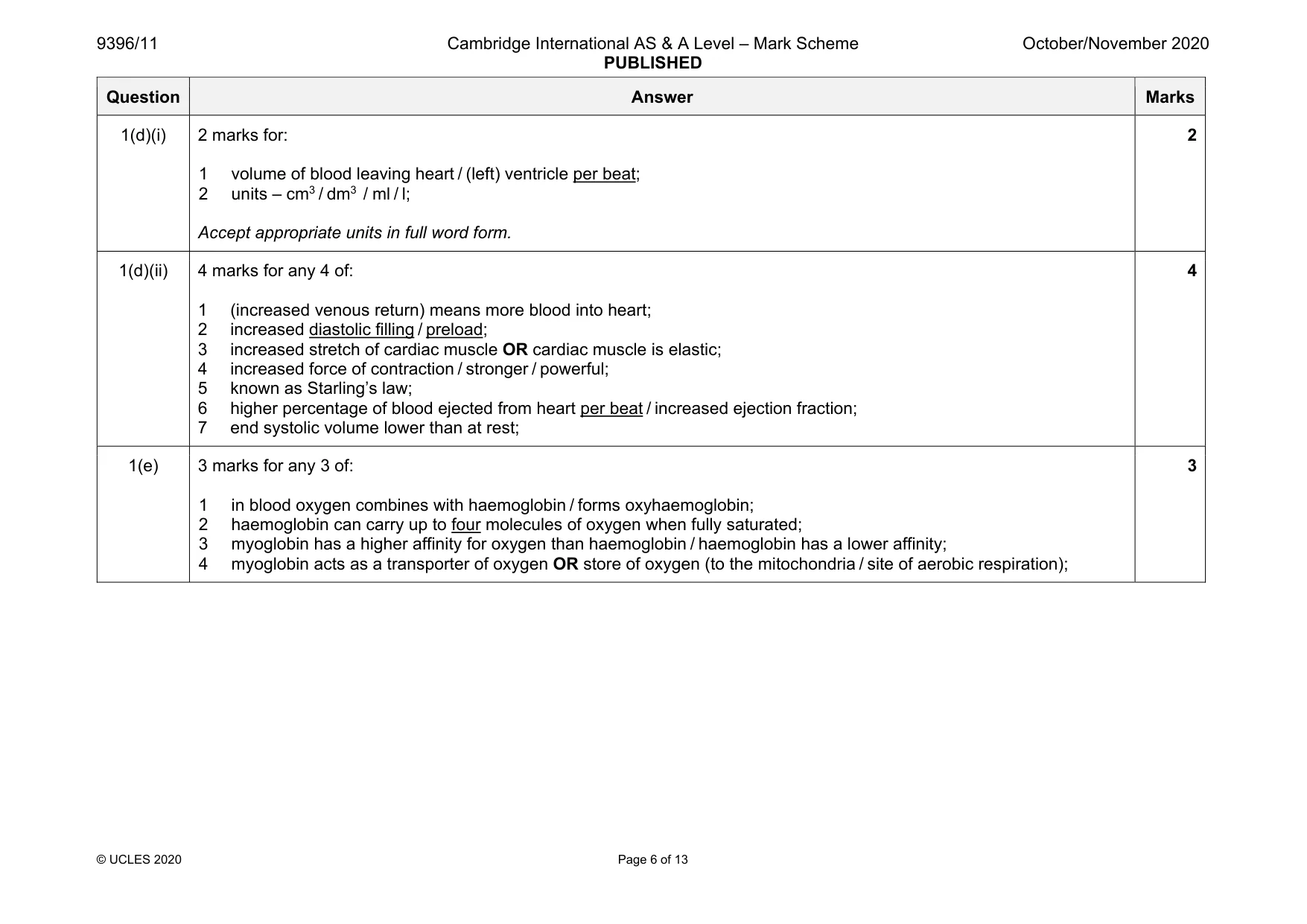
9396/11 Cambridge International AS & A Level – Mark Scheme PUBLISHED October/November 2020 © UCLES 2020 Page 6 of 13 Question Answer Marks 1(d)(i) 2 marks for: 1 volume of blood leaving heart / (left) ventricle per beat; 2 units – cm3 / dm3 / ml / l; Accept appropriate units in full word form. 2 1(d)(ii) 4 marks for any 4 of: 1 (increased venous return) means more blood into heart; 2 increased diastolic filling / preload; 3 increased stretch of cardiac muscle OR cardiac muscle is elastic; 4 increased force of contraction / stronger / powerful; 5 known as Starling’s law; 6 higher percentage of blood ejected from heart per beat / increased ejection fraction; 7 end systolic volume lower than at rest; 4 1(e) 3 marks for any 3 of: 1 in blood oxygen combines with haemoglobin / forms oxyhaemoglobin; 2 haemoglobin can carry up to four molecules of oxygen when fully saturated; 3 myoglobin has a higher affinity for oxygen than haemoglobin / haemoglobin has a lower affinity; 4 myoglobin acts as a transporter of oxygen OR store of oxygen (to the mitochondria / site of aerobic respiration); 3
Mark scheme, page 7
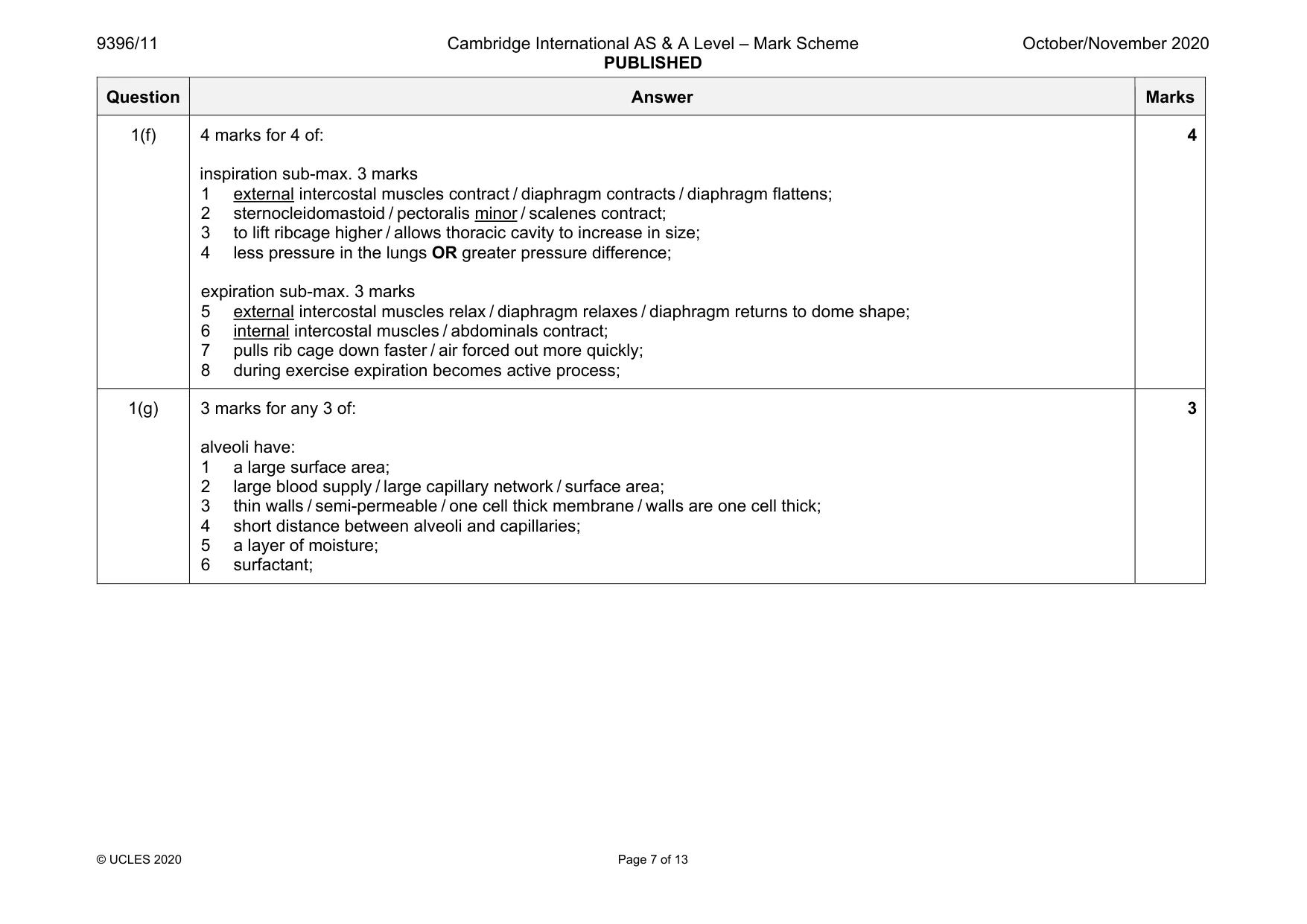
9396/11 Cambridge International AS & A Level – Mark Scheme PUBLISHED October/November 2020 © UCLES 2020 Page 7 of 13 Question Answer Marks 1(f) 4 marks for 4 of: inspiration sub-max. 3 marks 1 external intercostal muscles contract / diaphragm contracts / diaphragm flattens; 2 sternocleidomastoid / pectoralis minor / scalenes contract; 3 to lift ribcage higher / allows thoracic cavity to increase in size; 4 less pressure in the lungs OR greater pressure difference; expiration sub-max. 3 marks 5 external intercostal muscles relax / diaphragm relaxes / diaphragm returns to dome shape; 6 internal intercostal muscles / abdominals contract; 7 pulls rib cage down faster / air forced out more quickly; 8 during exercise expiration becomes active process; 4 1(g) 3 marks for any 3 of: alveoli have: 1 a large surface area; 2 large blood supply / large capillary network / surface area; 3 thin walls / semi-permeable / one cell thick membrane / walls are one cell thick; 4 short distance between alveoli and capillaries; 5 a layer of moisture; 6 surfactant; 3
Mark scheme, page 8
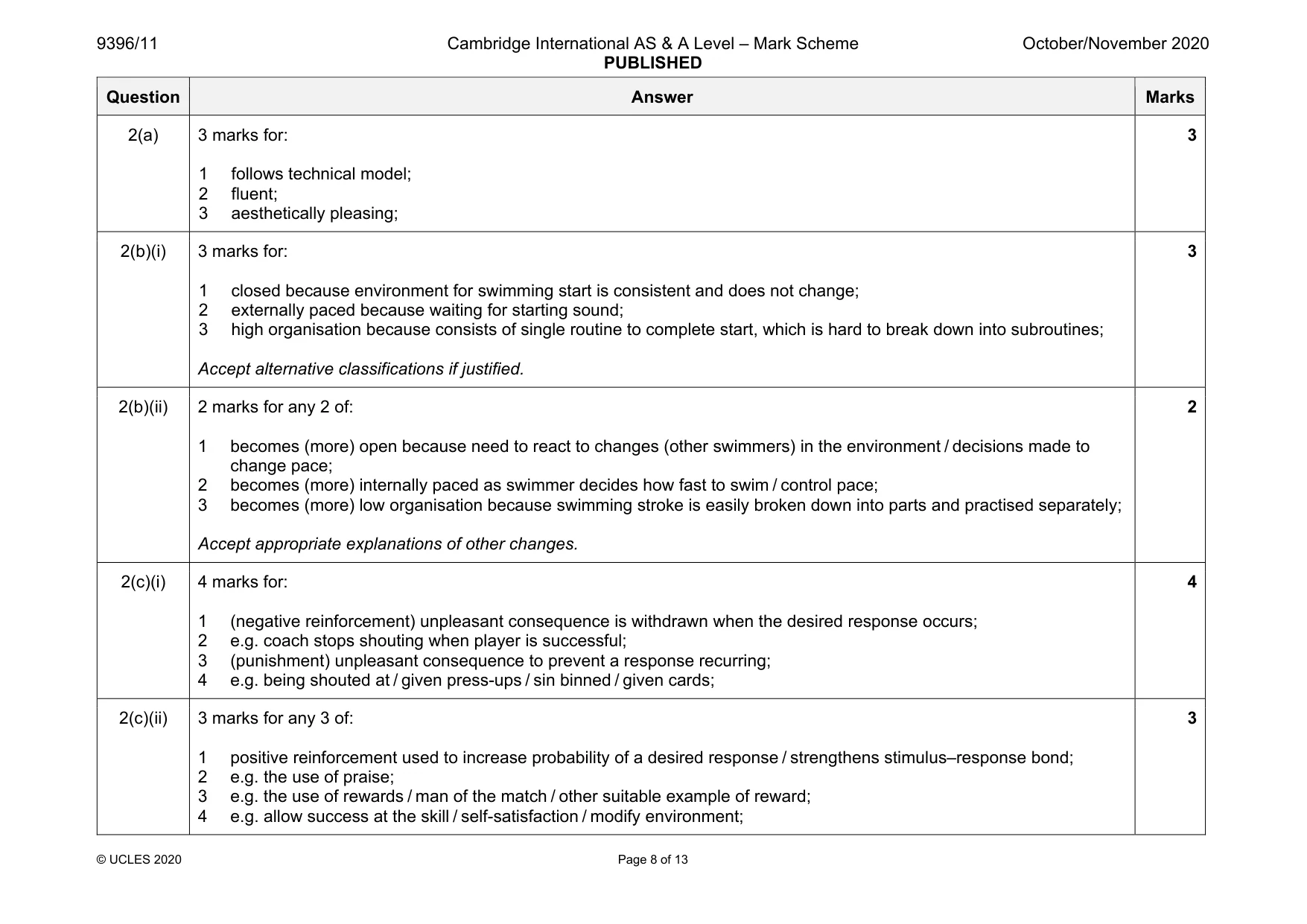
9396/11 Cambridge International AS & A Level – Mark Scheme PUBLISHED October/November 2020 © UCLES 2020 Page 8 of 13 Question Answer Marks 2(a) 3 marks for: 1 follows technical model; 2 fluent; 3 aesthetically pleasing; 3 2(b)(i) 3 marks for: 1 closed because environment for swimming start is consistent and does not change; 2 externally paced because waiting for starting sound; 3 high organisation because consists of single routine to complete start, which is hard to break down into subroutines; Accept alternative classifications if justified. 3 2(b)(ii) 2 marks for any 2 of: 1 becomes (more) open because need to react to changes (other swimmers) in the environment / decisions made to change pace; 2 becomes (more) internally paced as swimmer decides how fast to swim / control pace; 3 becomes (more) low organisation because swimming stroke is easily broken down into parts and practised separately; Accept appropriate explanations of other changes. 2 2(c)(i) 4 marks for: 1 (negative reinforcement) unpleasant consequence is withdrawn when the desired response occurs; 2 e.g. coach stops shouting when player is successful; 3 (punishment) unpleasant consequence to prevent a response recurring; 4 e.g. being shouted at / given press-ups / sin binned / given cards; 4 2(c)(ii) 3 marks for any 3 of: 1 positive reinforcement used to increase probability of a desired response / strengthens stimulus–response bond; 2 e.g. the use of praise; 3 e.g. the use of rewards / man of the match / other suitable example of reward; 4 e.g. allow success at the skill / self-satisfaction / modify environment; 3
Mark scheme, page 9
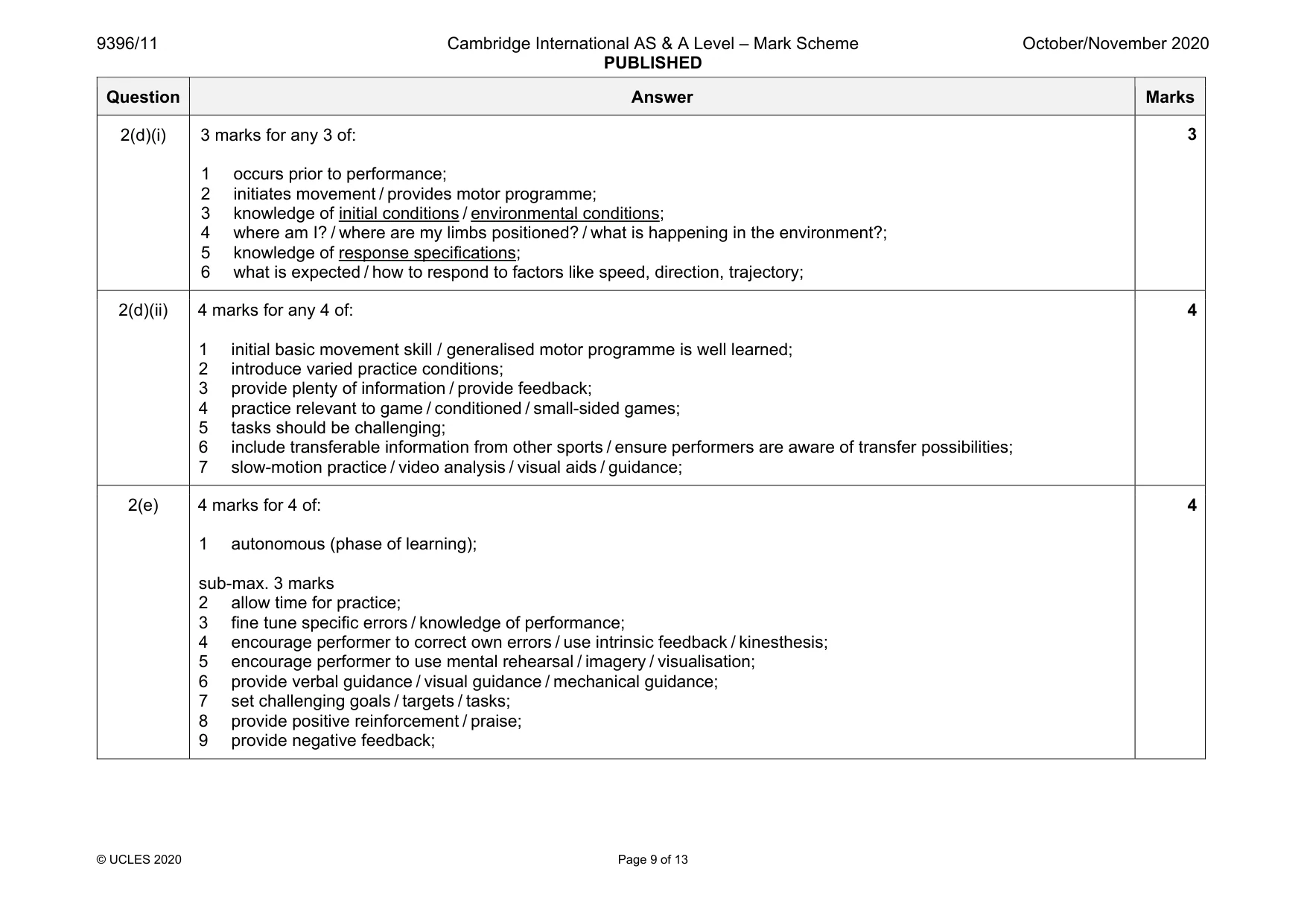
9396/11 Cambridge International AS & A Level – Mark Scheme PUBLISHED October/November 2020 © UCLES 2020 Page 9 of 13 Question Answer Marks 2(d)(i) 3 marks for any 3 of: 1 occurs prior to performance; 2 initiates movement / provides motor programme; 3 knowledge of initial conditions / environmental conditions; 4 where am I? / where are my limbs positioned? / what is happening in the environment?; 5 knowledge of response specifications; 6 what is expected / how to respond to factors like speed, direction, trajectory; 3 2(d)(ii) 4 marks for any 4 of: 1 initial basic movement skill / generalised motor programme is well learned; 2 introduce varied practice conditions; 3 provide plenty of information / provide feedback; 4 practice relevant to game / conditioned / small-sided games; 5 tasks should be challenging; 6 include transferable information from other sports / ensure performers are aware of transfer possibilities; 7 slow-motion practice / video analysis / visual aids / guidance; 4 2(e) 4 marks for 4 of: 1 autonomous (phase of learning); sub-max. 3 marks 2 allow time for practice; 3 fine tune specific errors / knowledge of performance; 4 encourage performer to correct own errors / use intrinsic feedback / kinesthesis; 5 encourage performer to use mental rehearsal / imagery / visualisation; 6 provide verbal guidance / visual guidance / mechanical guidance; 7 set challenging goals / targets / tasks; 8 provide positive reinforcement / praise; 9 provide negative feedback; 4
Mark scheme, page 10
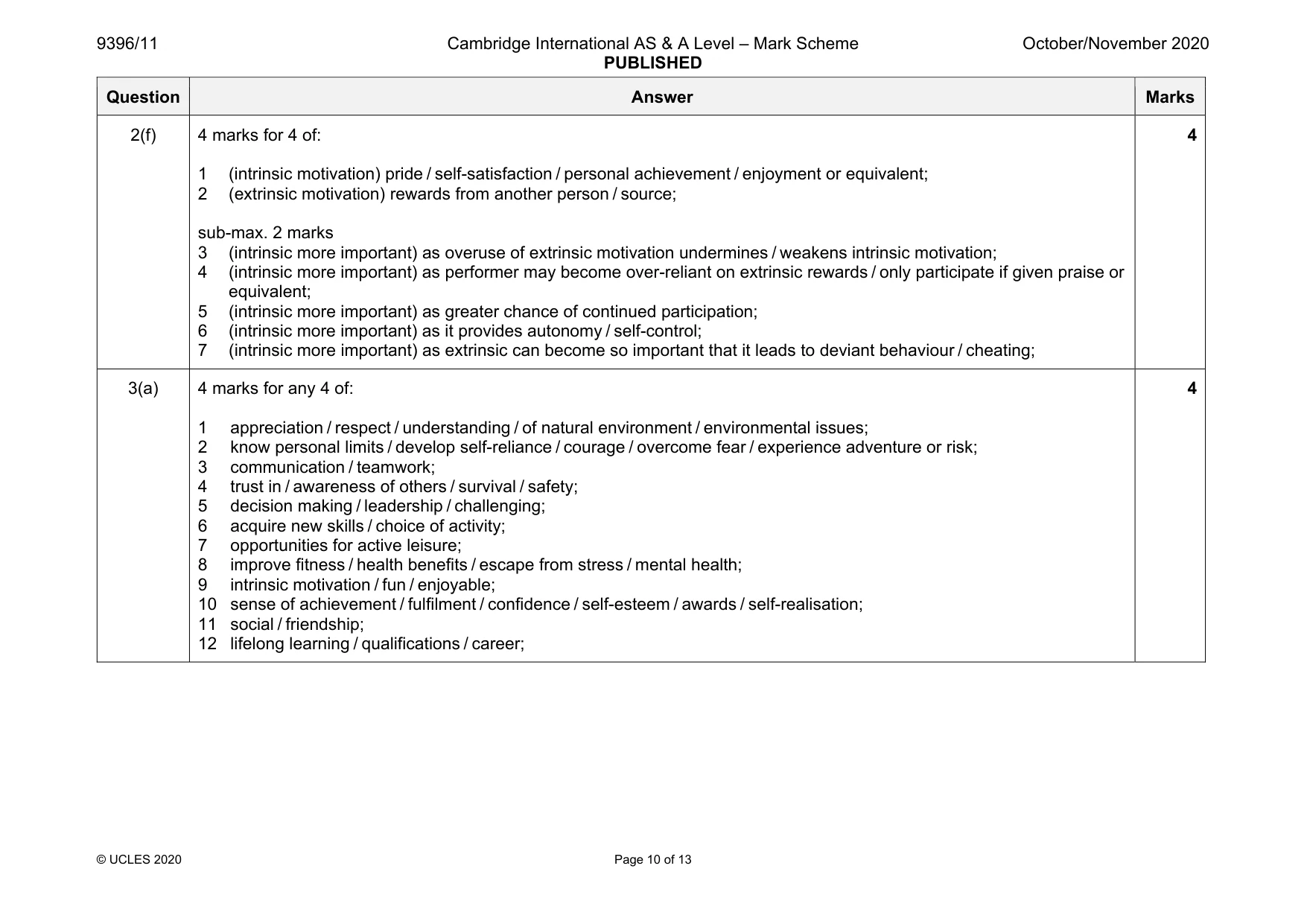
9396/11 Cambridge International AS & A Level – Mark Scheme PUBLISHED October/November 2020 © UCLES 2020 Page 10 of 13 Question Answer Marks 2(f) 4 marks for 4 of: 1 (intrinsic motivation) pride / self-satisfaction / personal achievement / enjoyment or equivalent; 2 (extrinsic motivation) rewards from another person / source; sub-max. 2 marks 3 (intrinsic more important) as overuse of extrinsic motivation undermines / weakens intrinsic motivation; 4 (intrinsic more important) as performer may become over-reliant on extrinsic rewards / only participate if given praise or equivalent; 5 (intrinsic more important) as greater chance of continued participation; 6 (intrinsic more important) as it provides autonomy / self-control; 7 (intrinsic more important) as extrinsic can become so important that it leads to deviant behaviour / cheating; 4 3(a) 4 marks for any 4 of: 1 appreciation / respect / understanding / of natural environment / environmental issues; 2 know personal limits / develop self-reliance / courage / overcome fear / experience adventure or risk; 3 communication / teamwork; 4 trust in / awareness of others / survival / safety; 5 decision making / leadership / challenging; 6 acquire new skills / choice of activity; 7 opportunities for active leisure; 8 improve fitness / health benefits / escape from stress / mental health; 9 intrinsic motivation / fun / enjoyable; 10 sense of achievement / fulfilment / confidence / self-esteem / awards / self-realisation; 11 social / friendship; 12 lifelong learning / qualifications / career; 4
Mark scheme, page 11
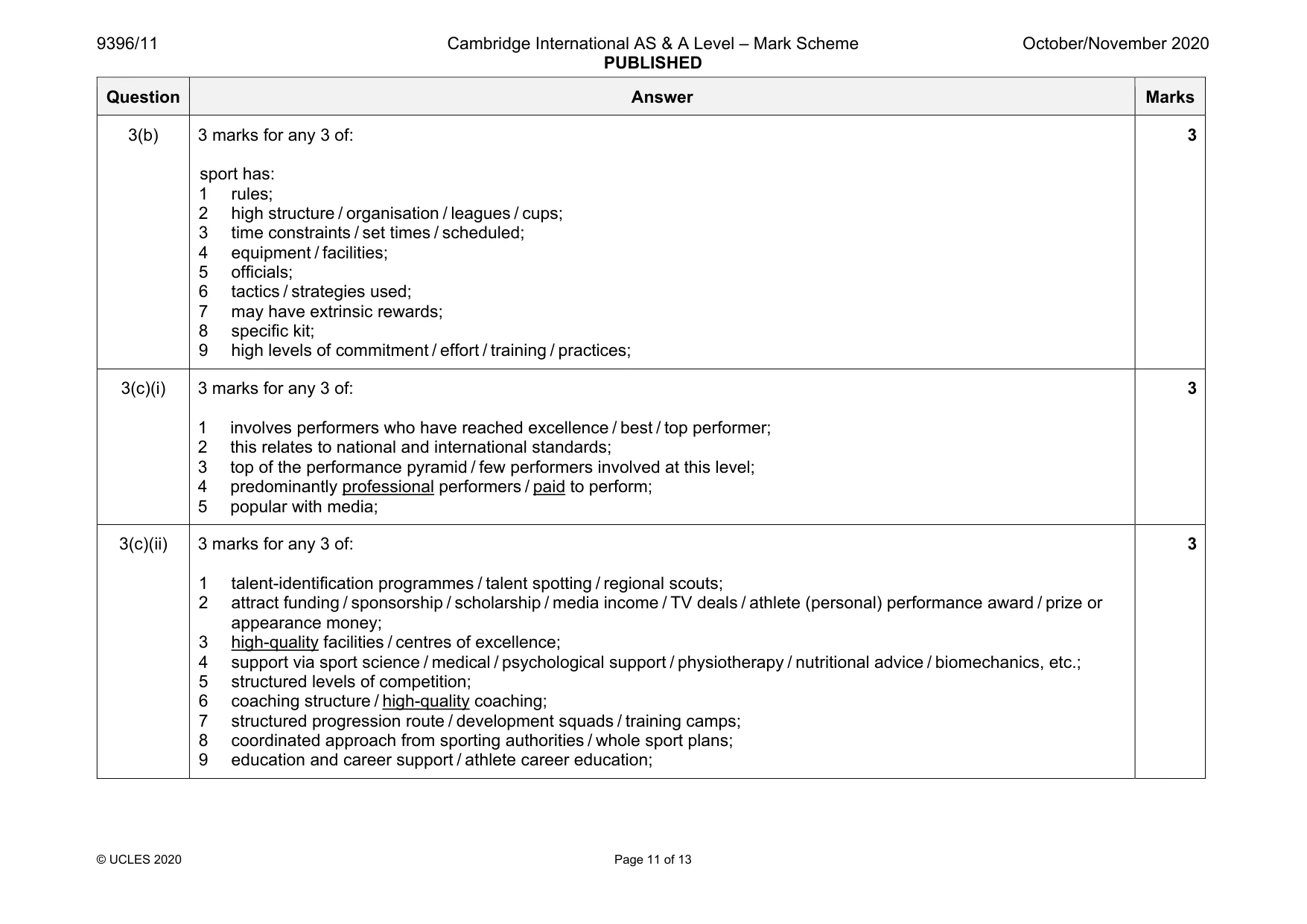
9396/11 Cambridge International AS & A Level – Mark Scheme PUBLISHED October/November 2020 © UCLES 2020 Page 11 of 13 Question Answer Marks 3(b) 3 marks for any 3 of: sport has: 1 rules; 2 high structure / organisation / leagues / cups; 3 time constraints / set times / scheduled; 4 equipment / facilities; 5 officials; 6 tactics / strategies used; 7 may have extrinsic rewards; 8 specific kit; 9 high levels of commitment / effort / training / practices; 3 3(c)(i) 3 marks for any 3 of: 1 involves performers who have reached excellence / best / top performer; 2 this relates to national and international standards; 3 top of the performance pyramid / few performers involved at this level; 4 predominantly professional performers / paid to perform; 5 popular with media; 3 3(c)(ii) 3 marks for any 3 of: 1 talent-identification programmes / talent spotting / regional scouts; 2 attract funding / sponsorship / scholarship / media income / TV deals / athlete (personal) performance award / prize or appearance money; 3 high-quality facilities / centres of excellence; 4 support via sport science / medical / psychological support / physiotherapy / nutritional advice / biomechanics, etc.; 5 structured levels of competition; 6 coaching structure / high-quality coaching; 7 structured progression route / development squads / training camps; 8 coordinated approach from sporting authorities / whole sport plans; 9 education and career support / athlete career education; 3
Mark scheme, page 12
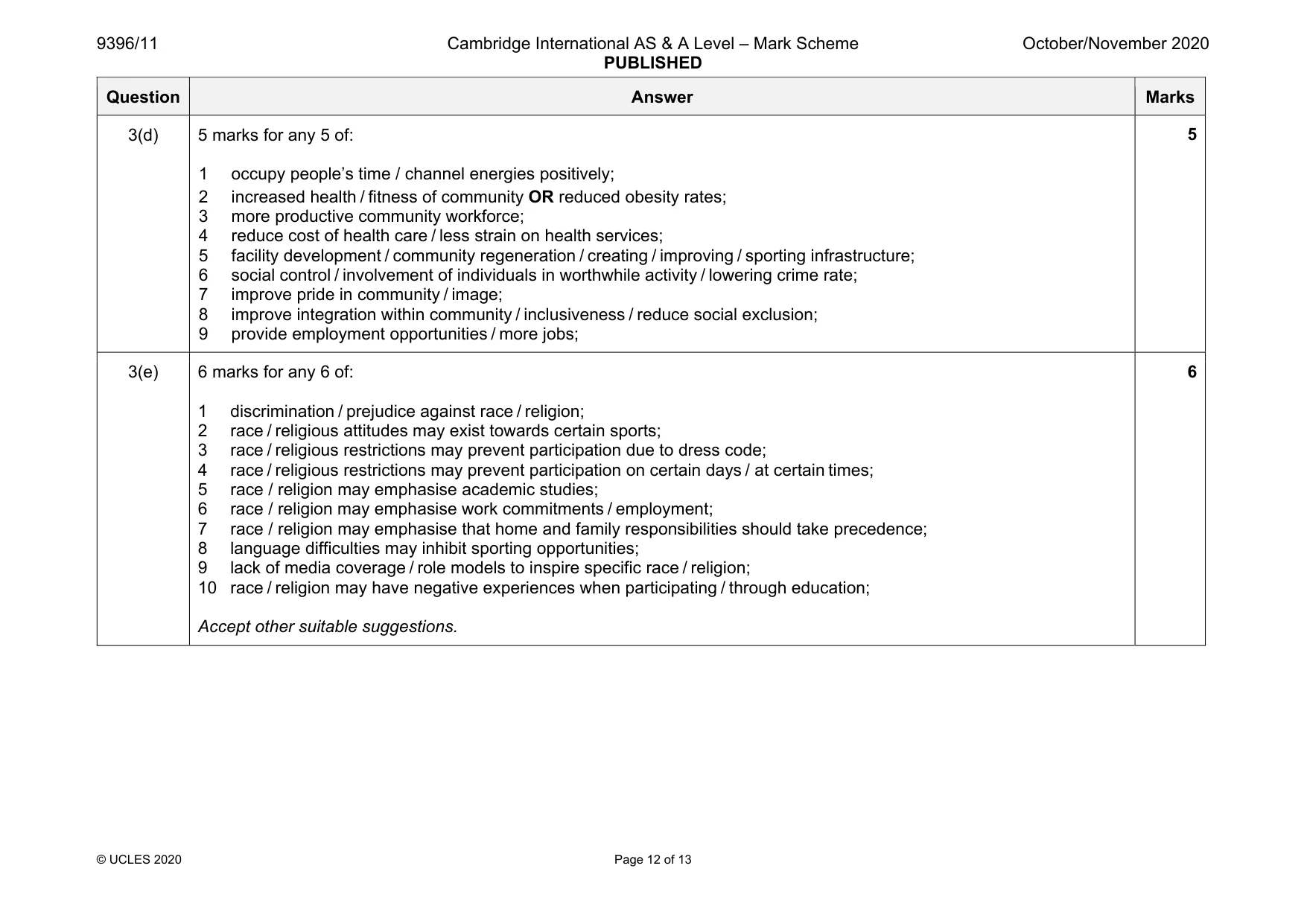
9396/11 Cambridge International AS & A Level – Mark Scheme PUBLISHED October/November 2020 © UCLES 2020 Page 12 of 13 Question Answer Marks 3(d) 5 marks for any 5 of: 1 occupy people’s time / channel energies positively; 2 increased health / fitness of community OR reduced obesity rates; 3 more productive community workforce; 4 reduce cost of health care / less strain on health services; 5 facility development / community regeneration / creating / improving / sporting infrastructure; 6 social control / involvement of individuals in worthwhile activity / lowering crime rate; 7 improve pride in community / image; 8 improve integration within community / inclusiveness / reduce social exclusion; 9 provide employment opportunities / more jobs; 5 3(e) 6 marks for any 6 of: 1 discrimination / prejudice against race / religion; 2 race / religious attitudes may exist towards certain sports; 3 race / religious restrictions may prevent participation due to dress code; 4 race / religious restrictions may prevent participation on certain days / at certain times; 5 race / religion may emphasise academic studies; 6 race / religion may emphasise work commitments / employment; 7 race / religion may emphasise that home and family responsibilities should take precedence; 8 language difficulties may inhibit sporting opportunities; 9 lack of media coverage / role models to inspire specific race / religion; 10 race / religion may have negative experiences when participating / through education; Accept other suitable suggestions. 6
Mark scheme, page 13
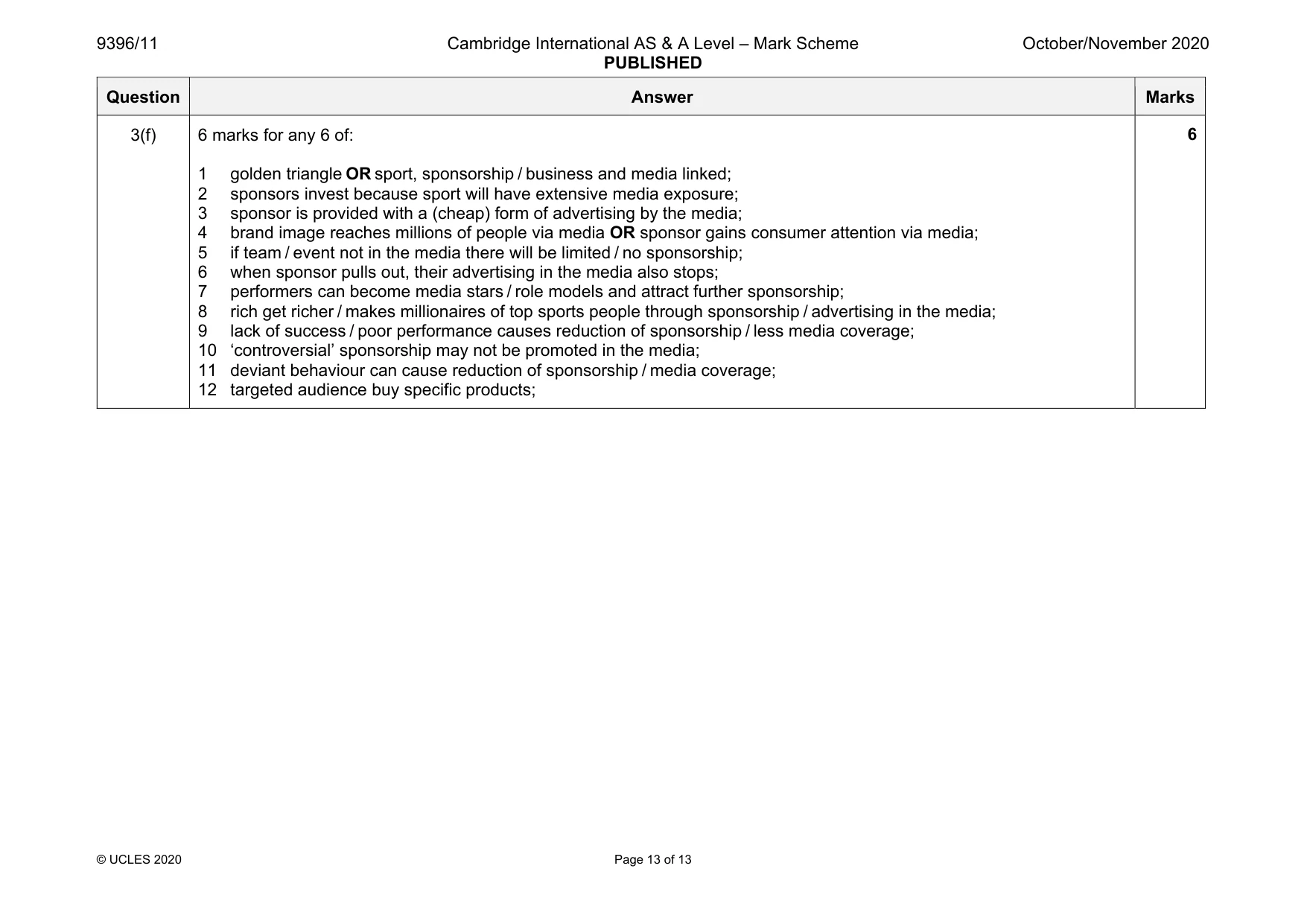
9396/11 Cambridge International AS & A Level – Mark Scheme PUBLISHED October/November 2020 © UCLES 2020 Page 13 of 13 Question Answer Marks 3(f) 6 marks for any 6 of: 1 golden triangle OR sport, sponsorship / business and media linked; 2 sponsors invest because sport will have extensive media exposure; 3 sponsor is provided with a (cheap) form of advertising by the media; 4 brand image reaches millions of people via media OR sponsor gains consumer attention via media; 5 if team / event not in the media there will be limited / no sponsorship; 6 when sponsor pulls out, their advertising in the media also stops; 7 performers can become media stars / role models and attract further sponsorship; 8 rich get richer / makes millionaires of top sports people through sponsorship / advertising in the media; 9 lack of success / poor performance causes reduction of sponsorship / less media coverage; 10 ‘controversial’ sponsorship may not be promoted in the media; 11 deviant behaviour can cause reduction of sponsorship / media coverage; 12 targeted audience buy specific products; 6
What you needed in this session
Cambridge’s own grade thresholds for 2020 Oct/Nov, Paper 1 · Variant 1. A higher threshold means an easier paper — the bar moves with how the cohort did.