Cambridge A Level Physical Education 9396 — 2020 Oct/Nov Paper 1 · Variant 3
9396/13/O/N/20 · 90 marks · ≈101 min
The question paper and its mark scheme, free to read here and free to download. This is Cambridge’s own paper, exactly as it was sat.
Question paper4 pages
Mark scheme15 pages
Answers below. Sit the paper first if you are practising.
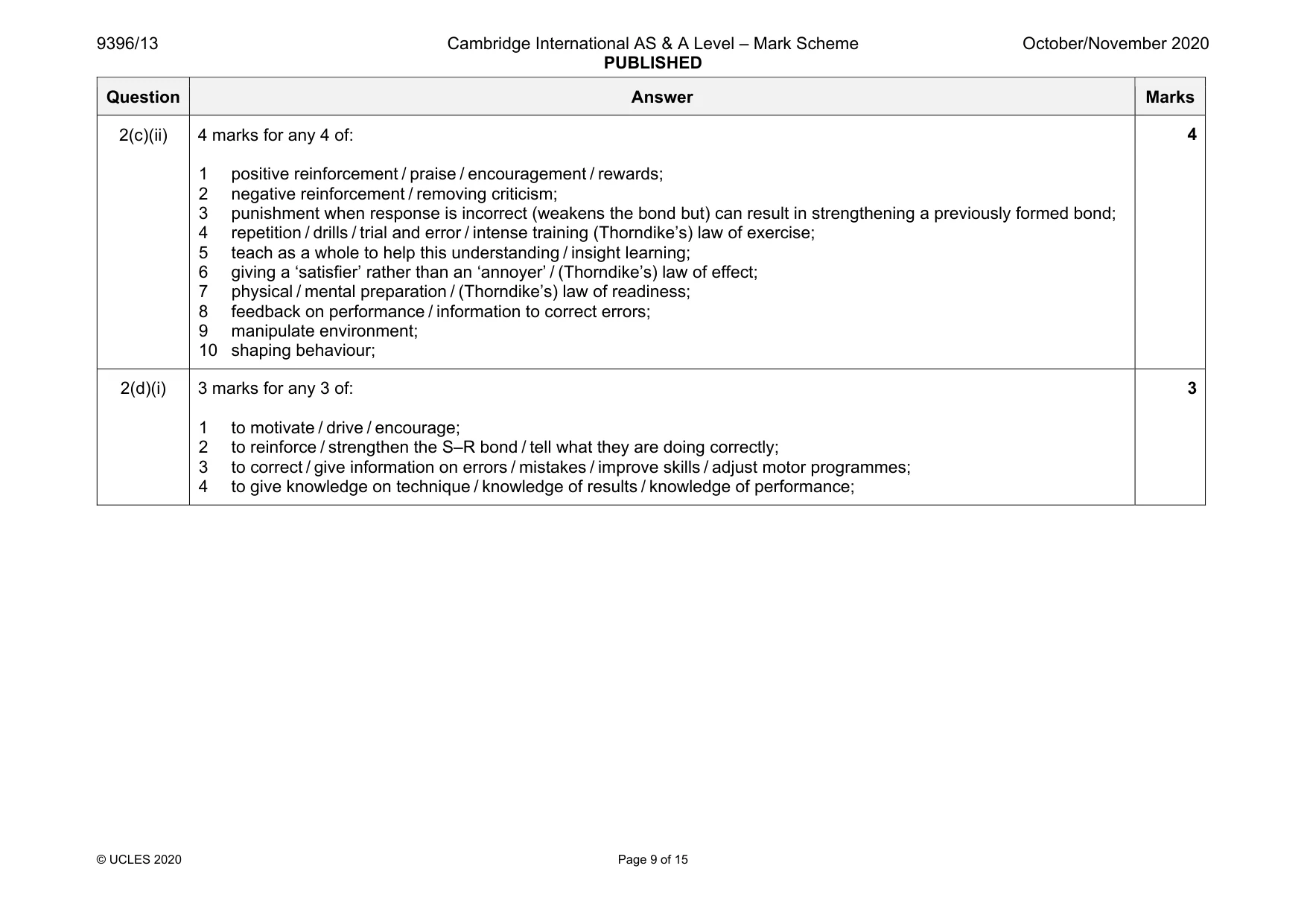
Paper as text
Question paper, page 1
Cambridge International AS & A Level DC (KS/TP) 180773/1 © UCLES 2020 [Turn over This document has 4 pages. Blank pages are indicated. * 6 6 1 2 8 3 3 7 4 5 * PHYSICAL EDUCATION 9396/13 Paper 1 October/November 2020 2 hours 30 minutes You must answer on the enclosed answer booklet. You will need: Answer booklet (enclosed) INSTRUCTIONS ● Answer all questions. ● Follow the instructions on the front cover of the answer booklet. If you need additional answer paper, ask the invigilator for a continuation booklet. ● You may use a calculator. ● You should show all your working and use appropriate units. INFORMATION ● The total mark for this paper is 90. ● The number of marks for each question or part question is shown in brackets [ ].
Question paper, page 2
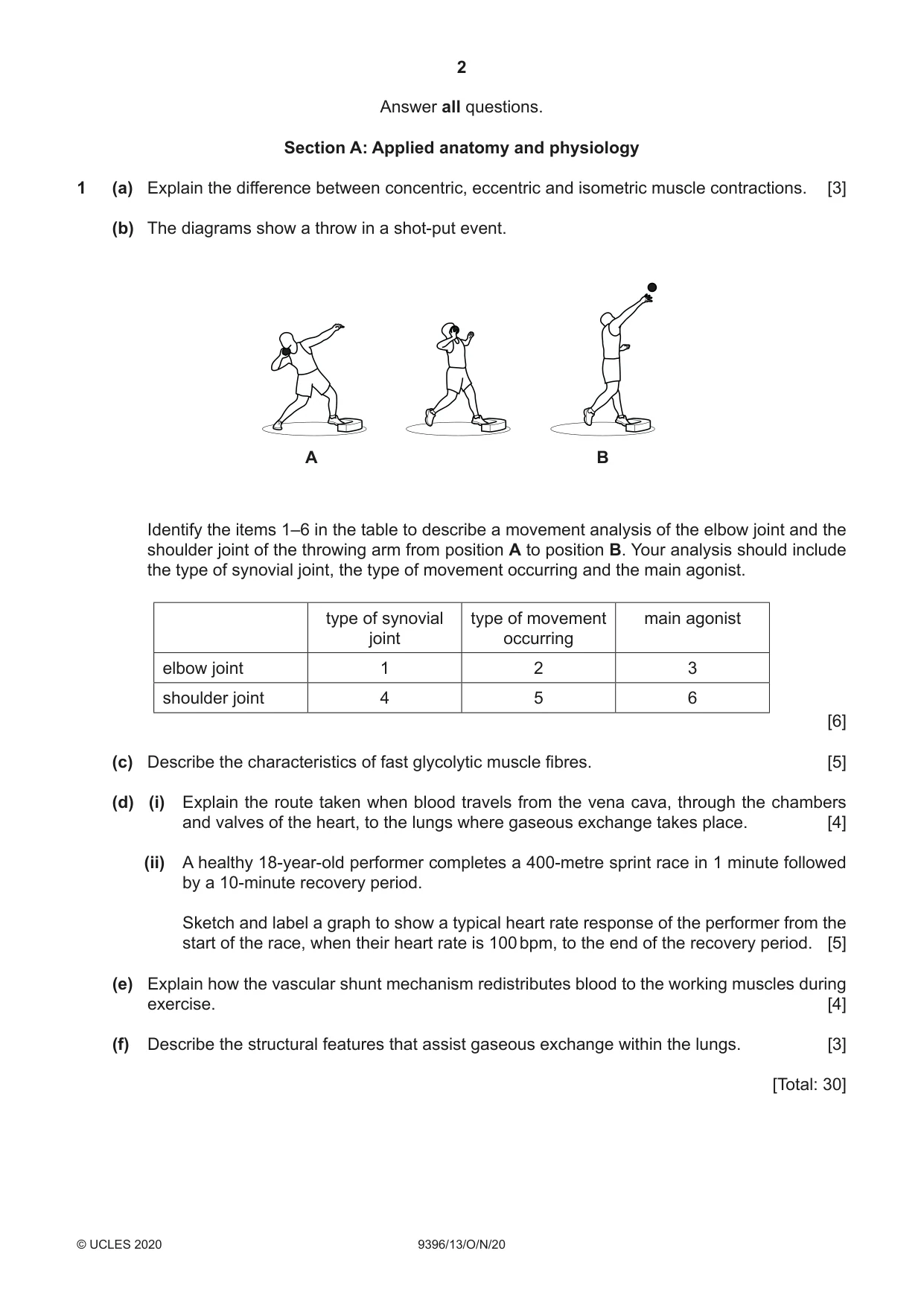
2 9396/13/O/N/20 © UCLES 2020 Answer all questions. Section A: Applied anatomy and physiology 1 (a) Explain the difference between concentric, eccentric and isometric muscle contractions. [3] (b) The diagrams show a throw in a shot-put event. A B Identify the items 1–6 in the table to describe a movement analysis of the elbow joint and the shoulder joint of the throwing arm from position A to position B. Your analysis should include the type of synovial joint, the type of movement occurring and the main agonist. type of synovial joint type of movement occurring main agonist elbow joint 1 2 3 shoulder joint 4 5 6 [6] (c) Describe the characteristics of fast glycolytic muscle fibres. [5] (d) (i) Explain the route taken when blood travels from the vena cava, through the chambers and valves of the heart, to the lungs where gaseous exchange takes place. [4] (ii) A healthy 18-year-old performer completes a 400-metre sprint race in 1 minute followed by a 10-minute recovery period. Sketch and label a graph to show a typical heart rate response of the performer from the start of the race, when their heart rate is 100 bpm, to the end of the recovery period. [5] (e) Explain how the vascular shunt mechanism redistributes blood to the working muscles during exercise. [4] (f) Describe the structural features that assist gaseous exchange within the lungs. [3] [Total: 30]
Question paper, page 3
3 9396/13/O/N/20 © UCLES 2020 [Turn over Section B: Acquiring, developing and performing movement skills 2 (a) Skilful performances: • are goal directed • follow a technical model • are fluent. Describe, using practical examples, what is meant by each of these three characteristics. [3] (b) Abilities are innate, underlying and enduring. Describe what is meant by each of these three terms. [3] (c) Operant conditioning theory suggests that skills are learned by the strengthening of the stimulus–response (S/R) bond. (i) Explain, using a practical example, what is meant by the term stimulus–response bond. [2] (ii) Suggest how the stimulus–response bond can be strengthened. [4] (d) (i) State the main functions of feedback when learning a motor skill. [3] (ii) Outline how the type of feedback used may differ between performers in the associative phase of learning and performers in the autonomous phase of learning. [4] (e) Transfer of learning may be important in the development of movement skills. (i) Explain, using an appropriate example of positive transfer, how a coach could optimise the effects of positive transfer on skill learning. [2] (ii) Describe, using an appropriate example, what is meant by the term negative transfer and suggest how a coach could limit the effects of negative transfer on skill learning. [3] (f) (i) State two different types of motivation. [1] (ii) Suggest strategies a coach could use to motivate a group of performers who train together regularly. [5] [Total: 30]
Question paper, page 4
4 9396/13/O/N/20 © UCLES 2020 Permission to reproduce items where third-party owned material protected by copyright is included has been sought and cleared where possible. Every reasonable effort has been made by the publisher (UCLES) to trace copyright holders, but if any items requiring clearance have unwittingly been included, the publisher will be pleased to make amends at the earliest possible opportunity. To avoid the issue of disclosure of answer-related information to candidates, all copyright acknowledgements are reproduced online in the Cambridge Assessment International Education Copyright Acknowledgements Booklet. This is produced for each series of examinations and is freely available to download at www.cambridgeinternational.org after the live examination series. Cambridge Assessment International Education is part of the Cambridge Assessment Group. Cambridge Assessment is the brand name of the University of Cambridge Local Examinations Syndicate (UCLES), which itself is a department of the University of Cambridge. Section C: Contemporary studies in physical education and sport 3 (a) (i) Explain, using practical examples, each of the following terms: • outdoor recreation • outdoor education. [4] (ii) Suggest benefits for an individual of participating in outdoor recreation. [4] (b) (i) Explain, using an activity of your choice, three similarities between the concept of play and the concept of recreation. [3] (ii) State four ways that the concept of sport differs from the concept of play. [4] (c) Suggest why many countries invest heavily to achieve Olympic success. [4] (d) Describe two differences between public leisure provision and private leisure provision. [2] (e) Explain the social and economic factors that may affect an individual’s opportunity to participate in sport. [4] (f) Discuss the advantages and disadvantages of sponsorship for a performer. [5] [Total: 30]
Mark scheme, page 1
This document consists of 15 printed pages. © UCLES 2020 [Turn over Cambridge International AS & A Level PHYSICAL EDUCATION 9396/13 Paper 1 October/November 2020 MARK SCHEME Maximum Mark: 90 Published This mark scheme is published as an aid to teachers and candidates, to indicate the requirements of the examination. It shows the basis on which Examiners were instructed to award marks. It does not indicate the details of the discussions that took place at an Examiners’ meeting before marking began, which would have considered the acceptability of alternative answers. Mark schemes should be read in conjunction with the question paper and the Principal Examiner Report for Teachers. Cambridge International will not enter into discussions about these mark schemes. Cambridge International is publishing the mark schemes for the October/November 2020 series for most Cambridge IGCSE™, Cambridge International A and AS Level and Cambridge Pre-U components, and some Cambridge O Level components.
Mark scheme, page 2
9396/13 Cambridge International AS & A Level – Mark Scheme PUBLISHED October/November 2020 © UCLES 2020 Page 2 of 15 Generic Marking Principles These general marking principles must be applied by all examiners when marking candidate answers. They should be applied alongside the specific content of the mark scheme or generic level descriptors for a question. Each question paper and mark scheme will also comply with these marking principles. GENERIC MARKING PRINCIPLE 1: Marks must be awarded in line with: • the specific content of the mark scheme or the generic level descriptors for the question • the specific skills defined in the mark scheme or in the generic level descriptors for the question • the standard of response required by a candidate as exemplified by the standardisation scripts. GENERIC MARKING PRINCIPLE 2: Marks awarded are always whole marks (not half marks, or other fractions). GENERIC MARKING PRINCIPLE 3: Marks must be awarded positively: • marks are awarded for correct/valid answers, as defined in the mark scheme. However, credit is given for valid answers which go beyond the scope of the syllabus and mark scheme, referring to your Team Leader as appropriate • marks are awarded when candidates clearly demonstrate what they know and can do • marks are not deducted for errors • marks are not deducted for omissions • answers should only be judged on the quality of spelling, punctuation and grammar when these features are specifically assessed by the question as indicated by the mark scheme. The meaning, however, should be unambiguous. GENERIC MARKING PRINCIPLE 4: Rules must be applied consistently, e.g. in situations where candidates have not followed instructions or in the application of generic level descriptors.
Mark scheme, page 3
9396/13 Cambridge International AS & A Level – Mark Scheme PUBLISHED October/November 2020 © UCLES 2020 Page 3 of 15 GENERIC MARKING PRINCIPLE 5: Marks should be awarded using the full range of marks defined in the mark scheme for the question (however; the use of the full mark range may be limited according to the quality of the candidate responses seen). GENERIC MARKING PRINCIPLE 6: Marks awarded are based solely on the requirements as defined in the mark scheme. Marks should not be awarded with grade thresholds or grade descriptors in mind.
Mark scheme, page 4
9396/13 Cambridge International AS & A Level – Mark Scheme PUBLISHED October/November 2020 © UCLES 2020 Page 4 of 15 Science-Specific Marking Principles 1 Examiners should consider the context and scientific use of any keywords when awarding marks. Although keywords may be present, marks should not be awarded if the keywords are used incorrectly. 2 The examiner should not choose between contradictory statements given in the same question part, and credit should not be awarded for any correct statement that is contradicted within the same question part. Wrong science that is irrelevant to the question should be ignored. 3 Although spellings do not have to be correct, spellings of syllabus terms must allow for clear and unambiguous separation from other syllabus terms with which they may be confused (e.g. ethane / ethene, glucagon / glycogen, refraction / reflection). 4 The error carried forward (ecf) principle should be applied, where appropriate. If an incorrect answer is subsequently used in a scientifically correct way, the candidate should be awarded these subsequent marking points. Further guidance will be included in the mark scheme where necessary and any exceptions to this general principle will be noted. 5 ‘List rule’ guidance For questions that require n responses (e.g. State two reasons …): • The response should be read as continuous prose, even when numbered answer spaces are provided. • Any response marked ignore in the mark scheme should not count towards n. • Incorrect responses should not be awarded credit but will still count towards n. • Read the entire response to check for any responses that contradict those that would otherwise be credited. Credit should not be awarded for any responses that are contradicted within the rest of the response. Where two responses contradict one another, this should be treated as a single incorrect response. • Non-contradictory responses after the first n responses may be ignored even if they include incorrect science.
Mark scheme, page 5
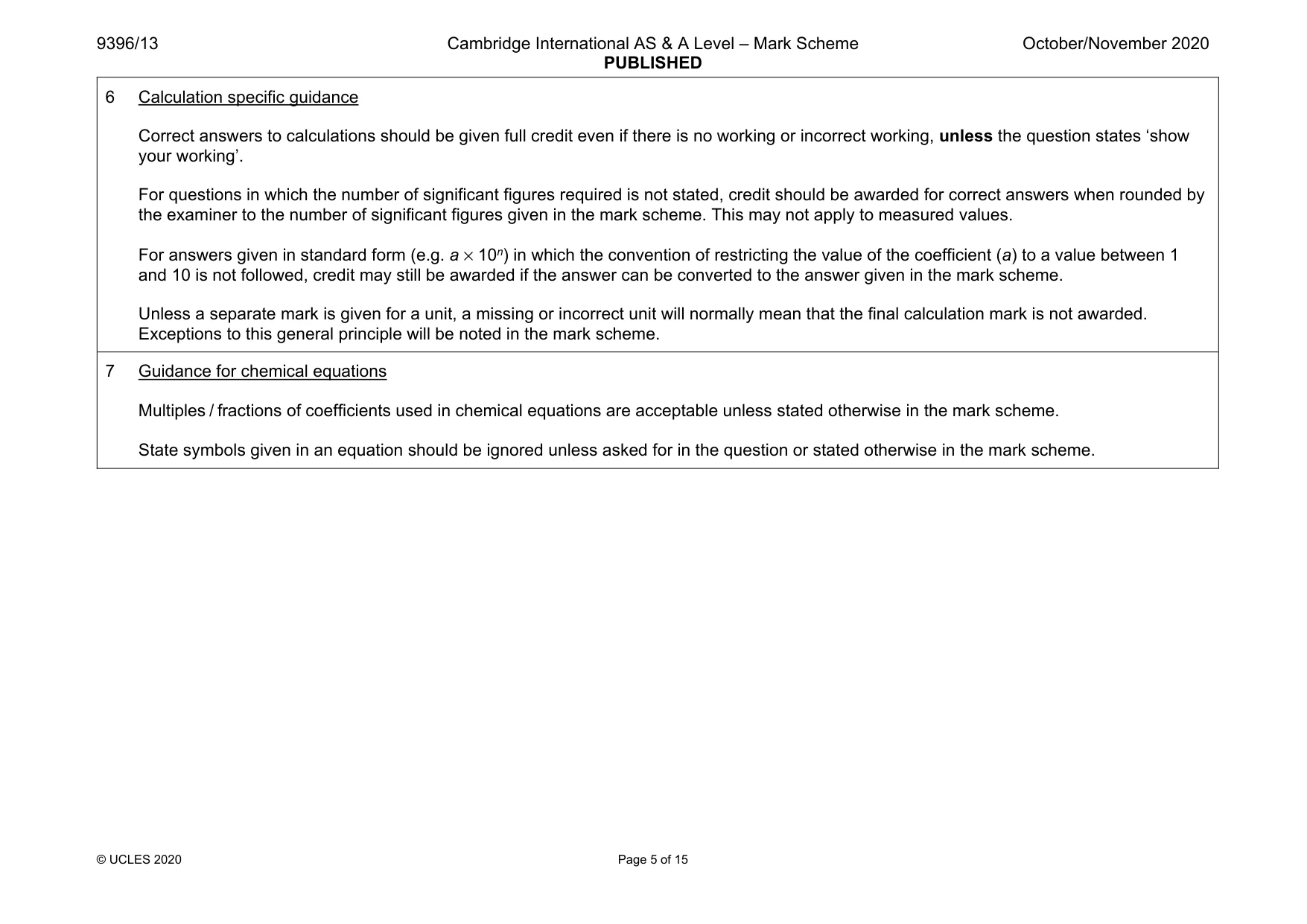
9396/13 Cambridge International AS & A Level – Mark Scheme PUBLISHED October/November 2020 © UCLES 2020 Page 5 of 15 6 Calculation specific guidance Correct answers to calculations should be given full credit even if there is no working or incorrect working, unless the question states ‘show your working’. For questions in which the number of significant figures required is not stated, credit should be awarded for correct answers when rounded by the examiner to the number of significant figures given in the mark scheme. This may not apply to measured values. For answers given in standard form (e.g. a × 10n) in which the convention of restricting the value of the coefficient (a) to a value between 1 and 10 is not followed, credit may still be awarded if the answer can be converted to the answer given in the mark scheme. Unless a separate mark is given for a unit, a missing or incorrect unit will normally mean that the final calculation mark is not awarded. Exceptions to this general principle will be noted in the mark scheme. 7 Guidance for chemical equations Multiples / fractions of coefficients used in chemical equations are acceptable unless stated otherwise in the mark scheme. State symbols given in an equation should be ignored unless asked for in the question or stated otherwise in the mark scheme.
Mark scheme, page 6
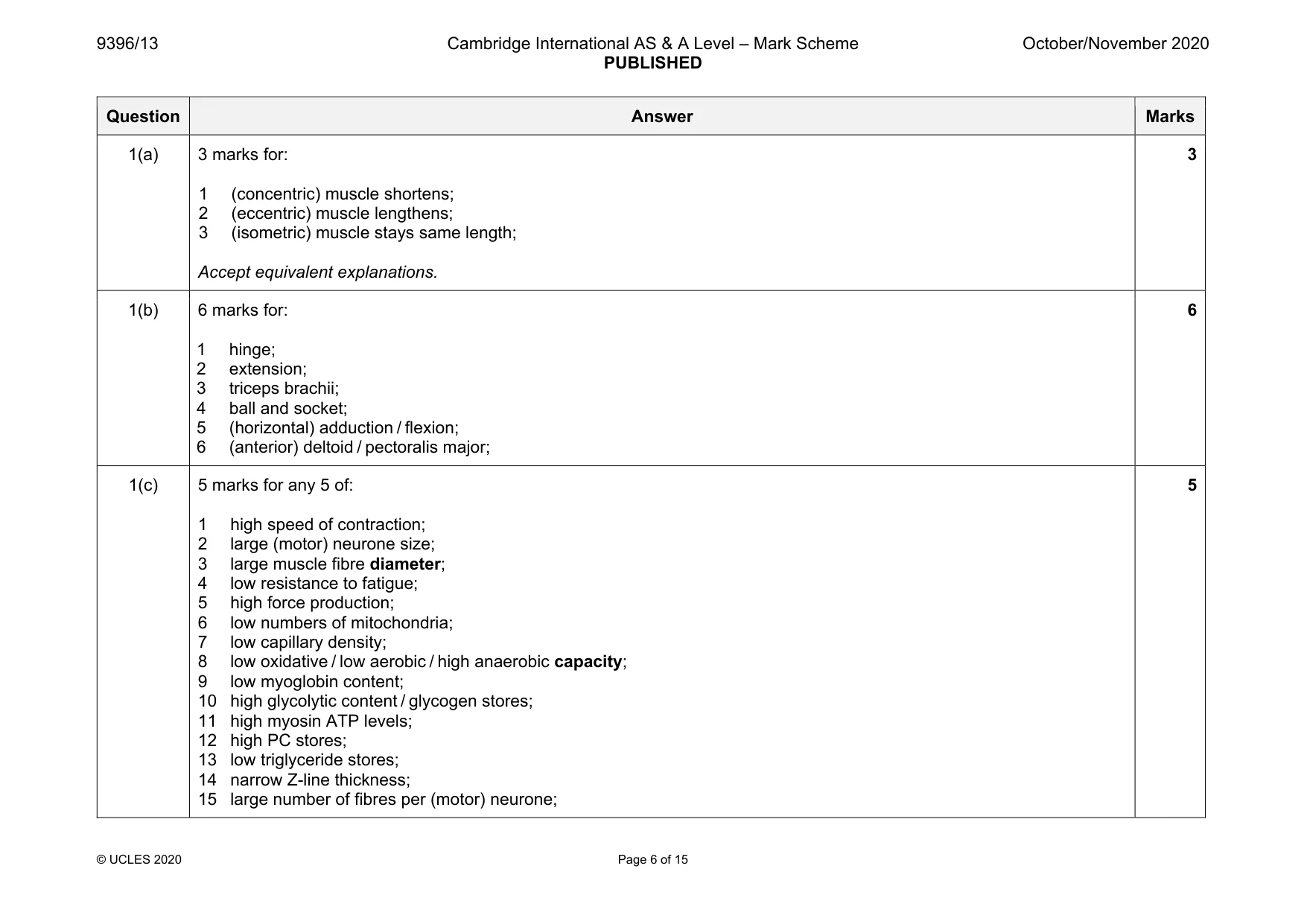
9396/13 Cambridge International AS & A Level – Mark Scheme PUBLISHED October/November 2020 © UCLES 2020 Page 6 of 15 Question Answer Marks 1(a) 3 marks for: 1 (concentric) muscle shortens; 2 (eccentric) muscle lengthens; 3 (isometric) muscle stays same length; Accept equivalent explanations. 3 1(b) 6 marks for: 1 hinge; 2 extension; 3 triceps brachii; 4 ball and socket; 5 (horizontal) adduction / flexion; 6 (anterior) deltoid / pectoralis major; 6 1(c) 5 marks for any 5 of: 1 high speed of contraction; 2 large (motor) neurone size; 3 large muscle fibre diameter; 4 low resistance to fatigue; 5 high force production; 6 low numbers of mitochondria; 7 low capillary density; 8 low oxidative / low aerobic / high anaerobic capacity; 9 low myoglobin content; 10 high glycolytic content / glycogen stores; 11 high myosin ATP levels; 12 high PC stores; 13 low triglyceride stores; 14 narrow Z-line thickness; 15 large number of fibres per (motor) neurone; 5
Mark scheme, page 7
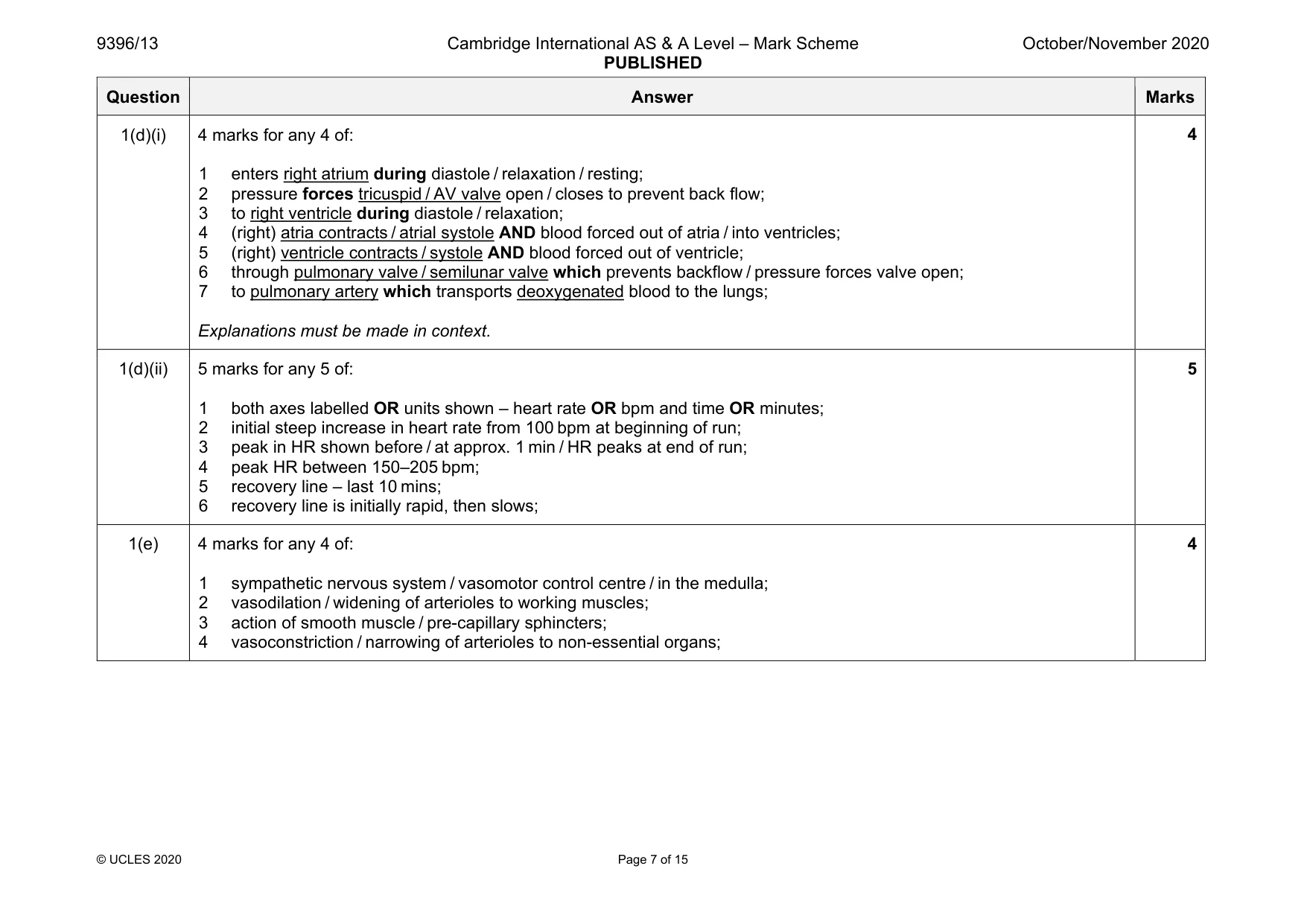
9396/13 Cambridge International AS & A Level – Mark Scheme PUBLISHED October/November 2020 © UCLES 2020 Page 7 of 15 Question Answer Marks 1(d)(i) 4 marks for any 4 of: 1 enters right atrium during diastole / relaxation / resting; 2 pressure forces tricuspid / AV valve open / closes to prevent back flow; 3 to right ventricle during diastole / relaxation; 4 (right) atria contracts / atrial systole AND blood forced out of atria / into ventricles; 5 (right) ventricle contracts / systole AND blood forced out of ventricle; 6 through pulmonary valve / semilunar valve which prevents backflow / pressure forces valve open; 7 to pulmonary artery which transports deoxygenated blood to the lungs; Explanations must be made in context. 4 1(d)(ii) 5 marks for any 5 of: 1 both axes labelled OR units shown – heart rate OR bpm and time OR minutes; 2 initial steep increase in heart rate from 100 bpm at beginning of run; 3 peak in HR shown before / at approx. 1 min / HR peaks at end of run; 4 peak HR between 150–205 bpm; 5 recovery line – last 10 mins; 6 recovery line is initially rapid, then slows; 5 1(e) 4 marks for any 4 of: 1 sympathetic nervous system / vasomotor control centre / in the medulla; 2 vasodilation / widening of arterioles to working muscles; 3 action of smooth muscle / pre-capillary sphincters; 4 vasoconstriction / narrowing of arterioles to non-essential organs; 4
Mark scheme, page 8
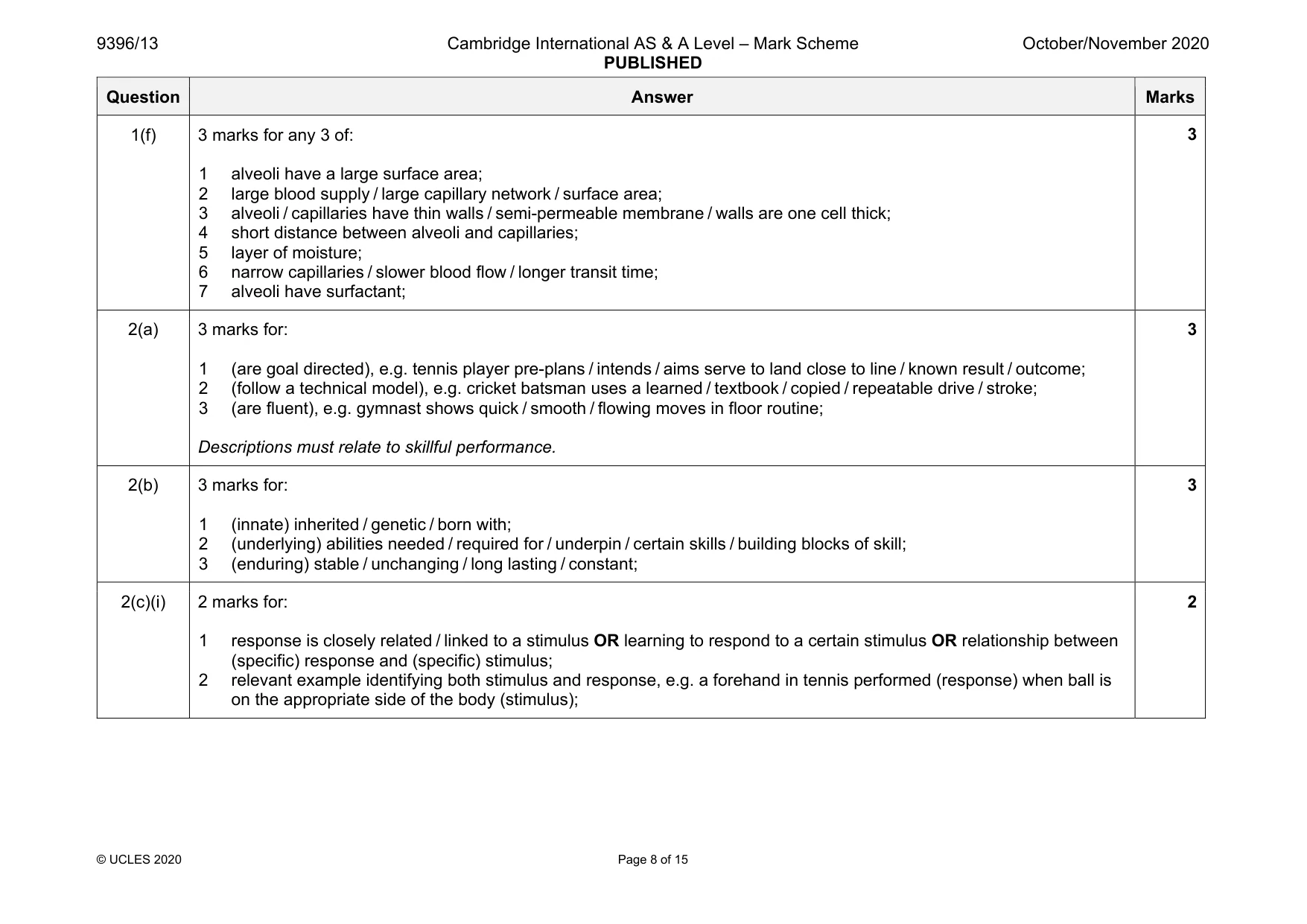
9396/13 Cambridge International AS & A Level – Mark Scheme PUBLISHED October/November 2020 © UCLES 2020 Page 8 of 15 Question Answer Marks 1(f) 3 marks for any 3 of: 1 alveoli have a large surface area; 2 large blood supply / large capillary network / surface area; 3 alveoli / capillaries have thin walls / semi-permeable membrane / walls are one cell thick; 4 short distance between alveoli and capillaries; 5 layer of moisture; 6 narrow capillaries / slower blood flow / longer transit time; 7 alveoli have surfactant; 3 2(a) 3 marks for: 1 (are goal directed), e.g. tennis player pre-plans / intends / aims serve to land close to line / known result / outcome; 2 (follow a technical model), e.g. cricket batsman uses a learned / textbook / copied / repeatable drive / stroke; 3 (are fluent), e.g. gymnast shows quick / smooth / flowing moves in floor routine; Descriptions must relate to skillful performance. 3 2(b) 3 marks for: 1 (innate) inherited / genetic / born with; 2 (underlying) abilities needed / required for / underpin / certain skills / building blocks of skill; 3 (enduring) stable / unchanging / long lasting / constant; 3 2(c)(i) 2 marks for: 1 response is closely related / linked to a stimulus OR learning to respond to a certain stimulus OR relationship between (specific) response and (specific) stimulus; 2 relevant example identifying both stimulus and response, e.g. a forehand in tennis performed (response) when ball is on the appropriate side of the body (stimulus); 2
Mark scheme, page 9
9396/13 Cambridge International AS & A Level – Mark Scheme PUBLISHED October/November 2020 © UCLES 2020 Page 9 of 15 Question Answer Marks 2(c)(ii) 4 marks for any 4 of: 1 positive reinforcement / praise / encouragement / rewards; 2 negative reinforcement / removing criticism; 3 punishment when response is incorrect (weakens the bond but) can result in strengthening a previously formed bond; 4 repetition / drills / trial and error / intense training (Thorndike’s) law of exercise; 5 teach as a whole to help this understanding / insight learning; 6 giving a ‘satisfier’ rather than an ‘annoyer’ / (Thorndike’s) law of effect; 7 physical / mental preparation / (Thorndike’s) law of readiness; 8 feedback on performance / information to correct errors; 9 manipulate environment; 10 shaping behaviour; 4 2(d)(i) 3 marks for any 3 of: 1 to motivate / drive / encourage; 2 to reinforce / strengthen the S–R bond / tell what they are doing correctly; 3 to correct / give information on errors / mistakes / improve skills / adjust motor programmes; 4 to give knowledge on technique / knowledge of results / knowledge of performance; 3
Mark scheme, page 10
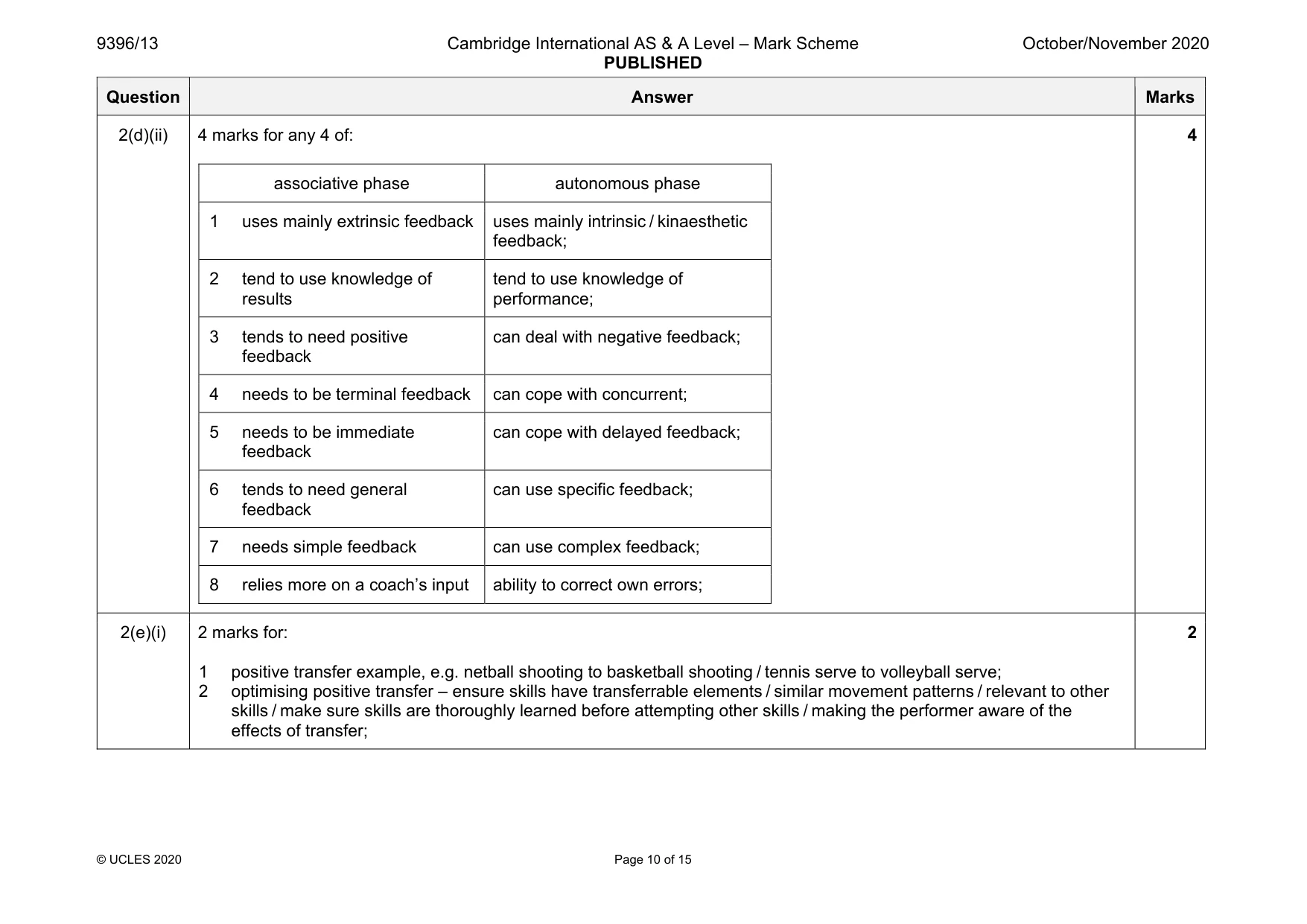
9396/13 Cambridge International AS & A Level – Mark Scheme PUBLISHED October/November 2020 © UCLES 2020 Page 10 of 15 Question Answer Marks 2(d)(ii) 4 marks for any 4 of: associative phase autonomous phase 1 uses mainly extrinsic feedback uses mainly intrinsic / kinaesthetic feedback; 2 tend to use knowledge of results tend to use knowledge of performance; 3 tends to need positive feedback can deal with negative feedback; 4 needs to be terminal feedback can cope with concurrent; 5 needs to be immediate feedback can cope with delayed feedback; 6 tends to need general feedback can use specific feedback; 7 needs simple feedback can use complex feedback; 8 relies more on a coach’s input ability to correct own errors; 4 2(e)(i) 2 marks for: 1 positive transfer example, e.g. netball shooting to basketball shooting / tennis serve to volleyball serve; 2 optimising positive transfer – ensure skills have transferrable elements / similar movement patterns / relevant to other skills / make sure skills are thoroughly learned before attempting other skills / making the performer aware of the effects of transfer; 2
Mark scheme, page 11
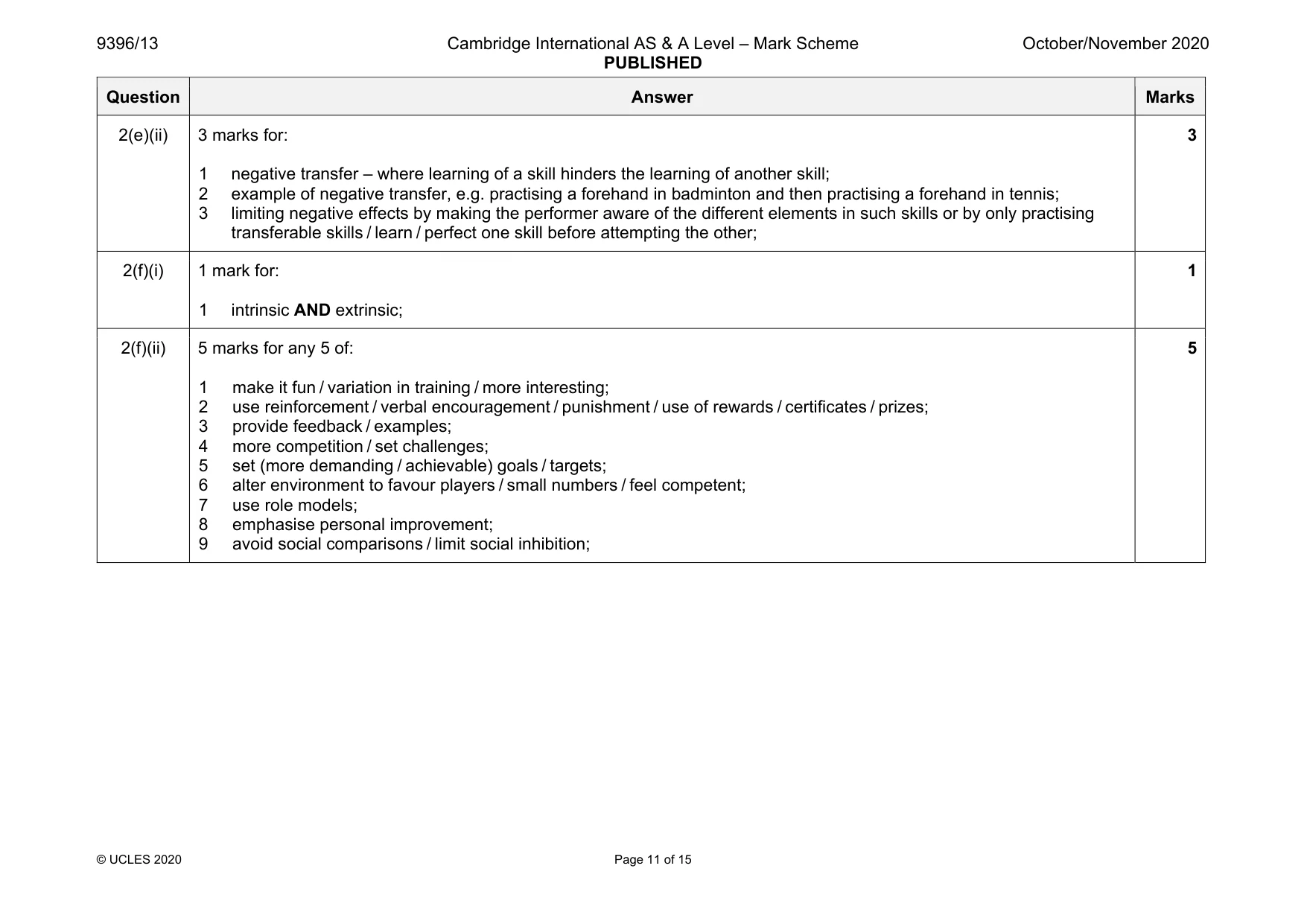
9396/13 Cambridge International AS & A Level – Mark Scheme PUBLISHED October/November 2020 © UCLES 2020 Page 11 of 15 Question Answer Marks 2(e)(ii) 3 marks for: 1 negative transfer – where learning of a skill hinders the learning of another skill; 2 example of negative transfer, e.g. practising a forehand in badminton and then practising a forehand in tennis; 3 limiting negative effects by making the performer aware of the different elements in such skills or by only practising transferable skills / learn / perfect one skill before attempting the other; 3 2(f)(i) 1 mark for: 1 intrinsic AND extrinsic; 1 2(f)(ii) 5 marks for any 5 of: 1 make it fun / variation in training / more interesting; 2 use reinforcement / verbal encouragement / punishment / use of rewards / certificates / prizes; 3 provide feedback / examples; 4 more competition / set challenges; 5 set (more demanding / achievable) goals / targets; 6 alter environment to favour players / small numbers / feel competent; 7 use role models; 8 emphasise personal improvement; 9 avoid social comparisons / limit social inhibition; 5
Mark scheme, page 12
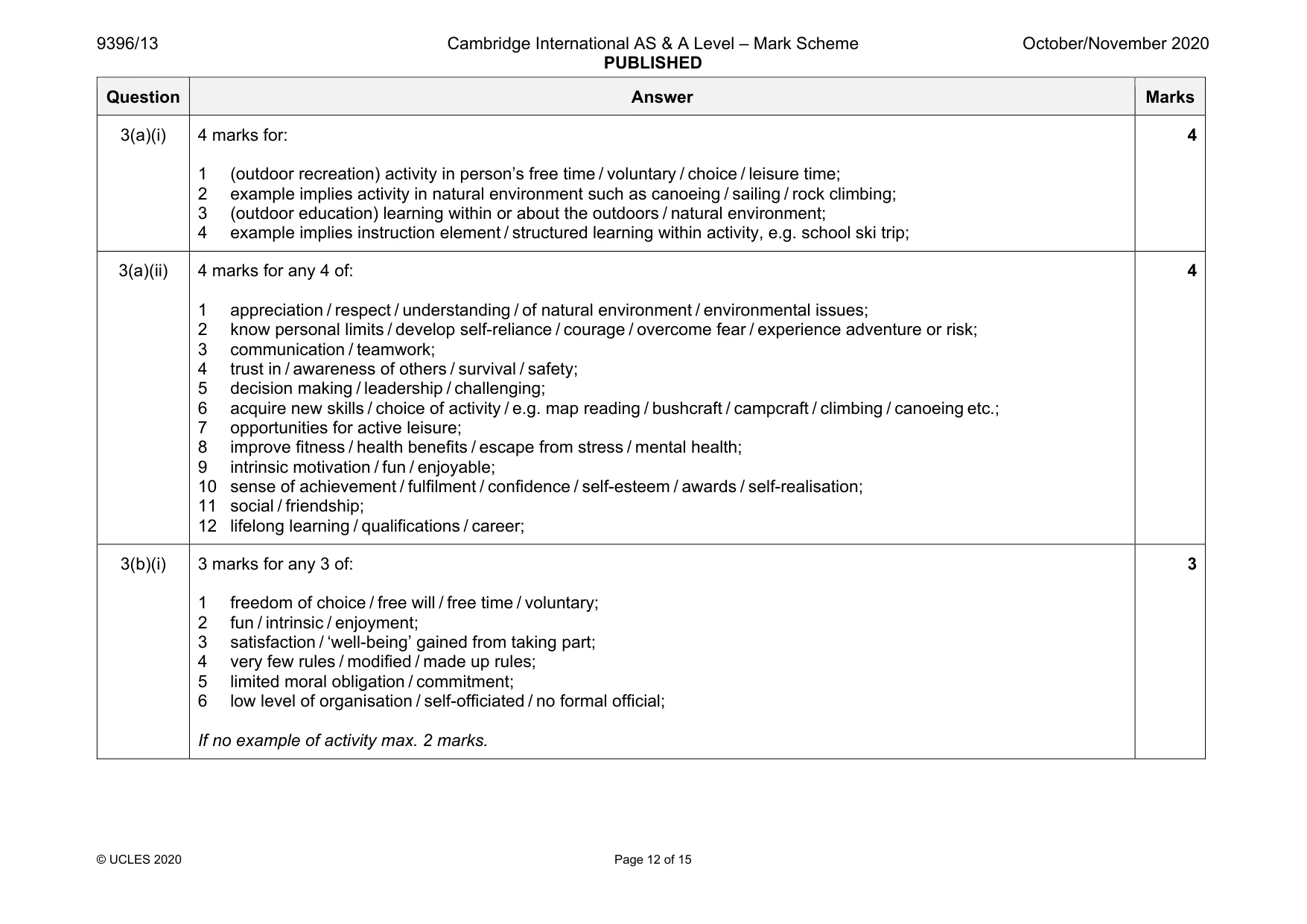
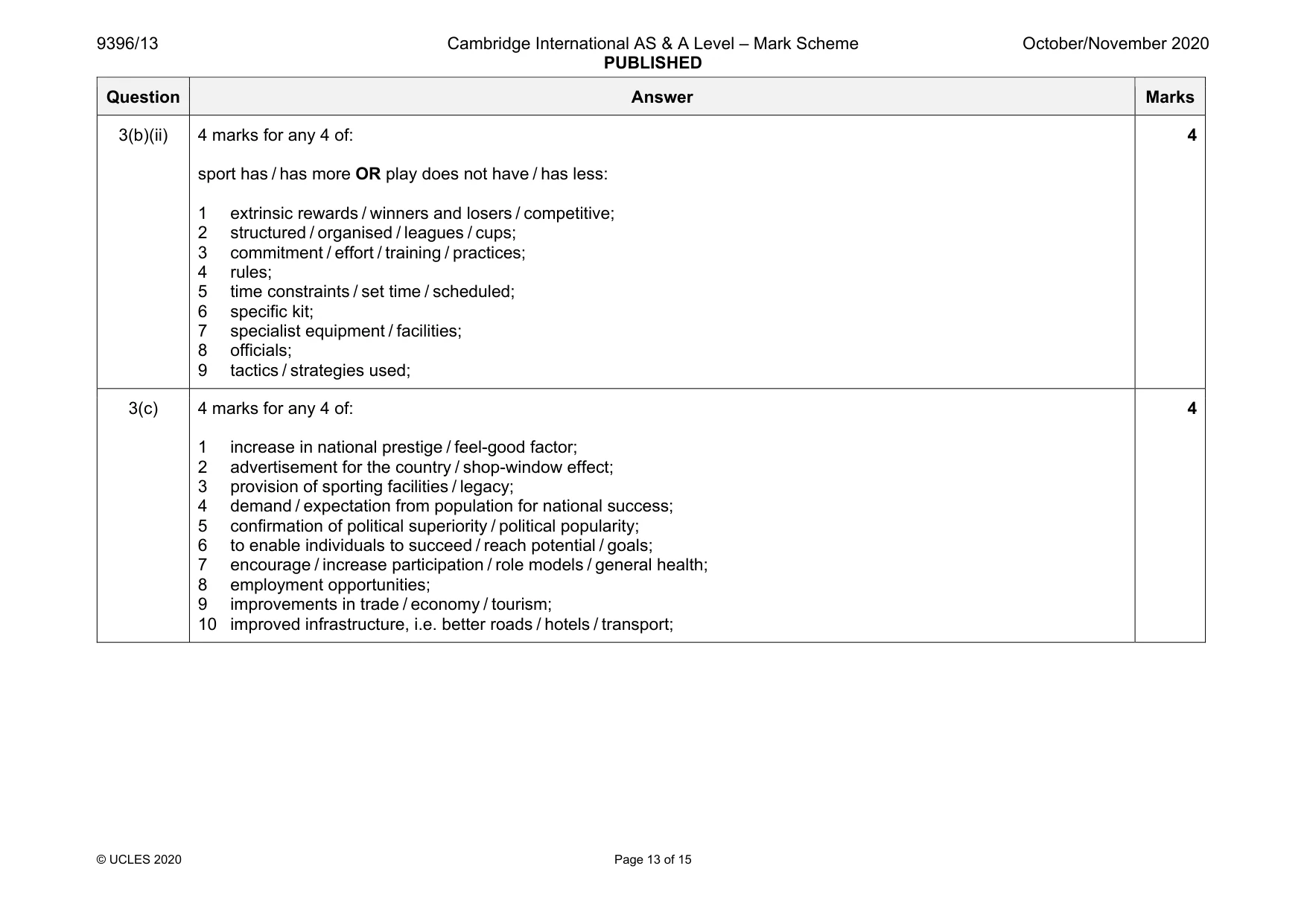
9396/13 Cambridge International AS & A Level – Mark Scheme PUBLISHED October/November 2020 © UCLES 2020 Page 12 of 15 Question Answer Marks 3(a)(i) 4 marks for: 1 (outdoor recreation) activity in person’s free time / voluntary / choice / leisure time; 2 example implies activity in natural environment such as canoeing / sailing / rock climbing; 3 (outdoor education) learning within or about the outdoors / natural environment; 4 example implies instruction element / structured learning within activity, e.g. school ski trip; 4 3(a)(ii) 4 marks for any 4 of: 1 appreciation / respect / understanding / of natural environment / environmental issues; 2 know personal limits / develop self-reliance / courage / overcome fear / experience adventure or risk; 3 communication / teamwork; 4 trust in / awareness of others / survival / safety; 5 decision making / leadership / challenging; 6 acquire new skills / choice of activity / e.g. map reading / bushcraft / campcraft / climbing / canoeing etc.; 7 opportunities for active leisure; 8 improve fitness / health benefits / escape from stress / mental health; 9 intrinsic motivation / fun / enjoyable; 10 sense of achievement / fulfilment / confidence / self-esteem / awards / self-realisation; 11 social / friendship; 12 lifelong learning / qualifications / career; 4 3(b)(i) 3 marks for any 3 of: 1 freedom of choice / free will / free time / voluntary; 2 fun / intrinsic / enjoyment; 3 satisfaction / ‘well-being’ gained from taking part; 4 very few rules / modified / made up rules; 5 limited moral obligation / commitment; 6 low level of organisation / self-officiated / no formal official; If no example of activity max. 2 marks. 3
Mark scheme, page 13
9396/13 Cambridge International AS & A Level – Mark Scheme PUBLISHED October/November 2020 © UCLES 2020 Page 13 of 15 Question Answer Marks 3(b)(ii) 4 marks for any 4 of: sport has / has more OR play does not have / has less: 1 extrinsic rewards / winners and losers / competitive; 2 structured / organised / leagues / cups; 3 commitment / effort / training / practices; 4 rules; 5 time constraints / set time / scheduled; 6 specific kit; 7 specialist equipment / facilities; 8 officials; 9 tactics / strategies used; 4 3(c) 4 marks for any 4 of: 1 increase in national prestige / feel-good factor; 2 advertisement for the country / shop-window effect; 3 provision of sporting facilities / legacy; 4 demand / expectation from population for national success; 5 confirmation of political superiority / political popularity; 6 to enable individuals to succeed / reach potential / goals; 7 encourage / increase participation / role models / general health; 8 employment opportunities; 9 improvements in trade / economy / tourism; 10 improved infrastructure, i.e. better roads / hotels / transport; 4
Mark scheme, page 14
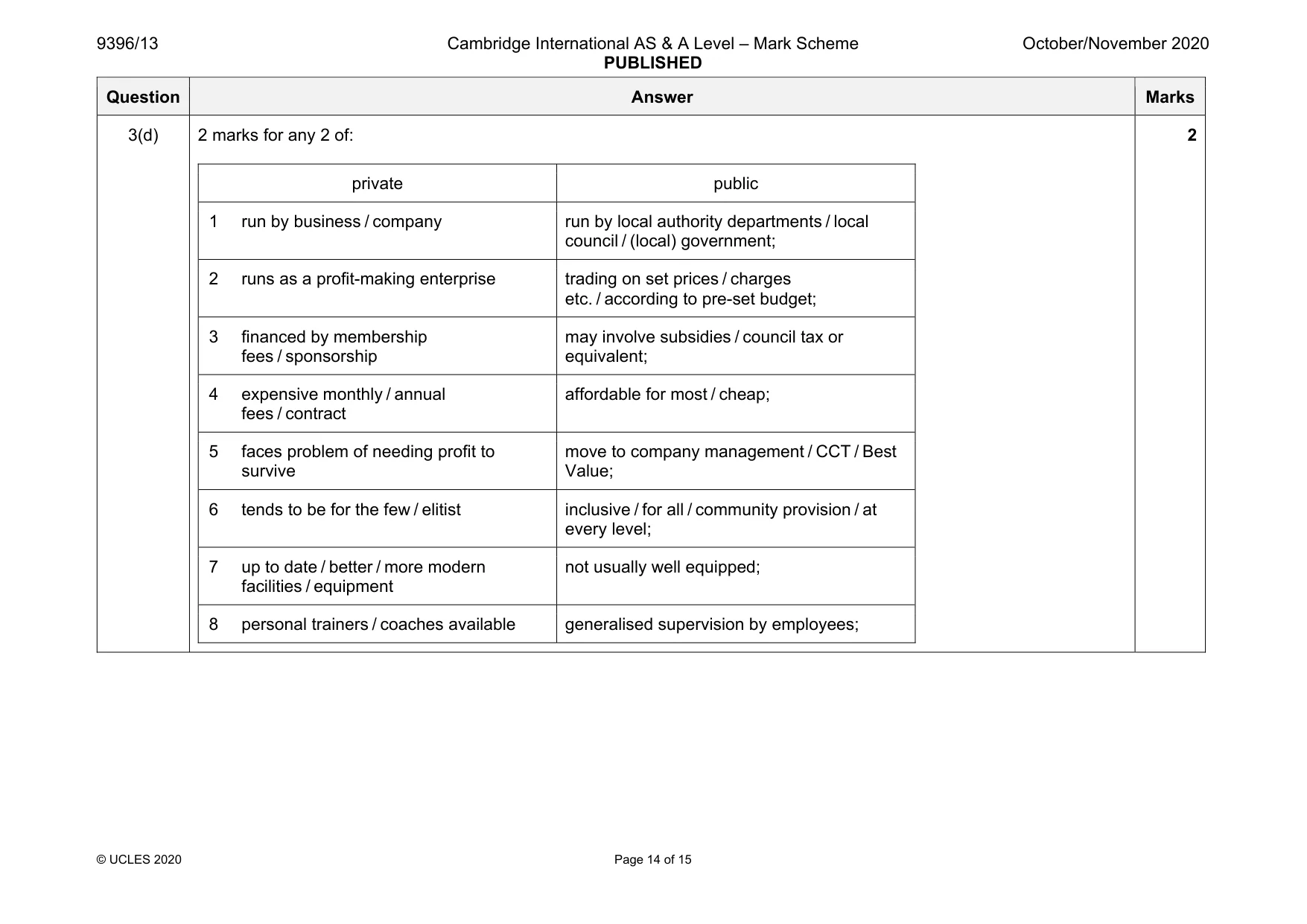
9396/13 Cambridge International AS & A Level – Mark Scheme PUBLISHED October/November 2020 © UCLES 2020 Page 14 of 15 Question Answer Marks 3(d) 2 marks for any 2 of: private public 1 run by business / company run by local authority departments / local council / (local) government; 2 runs as a profit-making enterprise trading on set prices / charges etc. / according to pre-set budget; 3 financed by membership fees / sponsorship may involve subsidies / council tax or equivalent; 4 expensive monthly / annual fees / contract affordable for most / cheap; 5 faces problem of needing profit to survive move to company management / CCT / Best Value; 6 tends to be for the few / elitist inclusive / for all / community provision / at every level; 7 up to date / better / more modern facilities / equipment not usually well equipped; 8 personal trainers / coaches available generalised supervision by employees; 2
Mark scheme, page 15
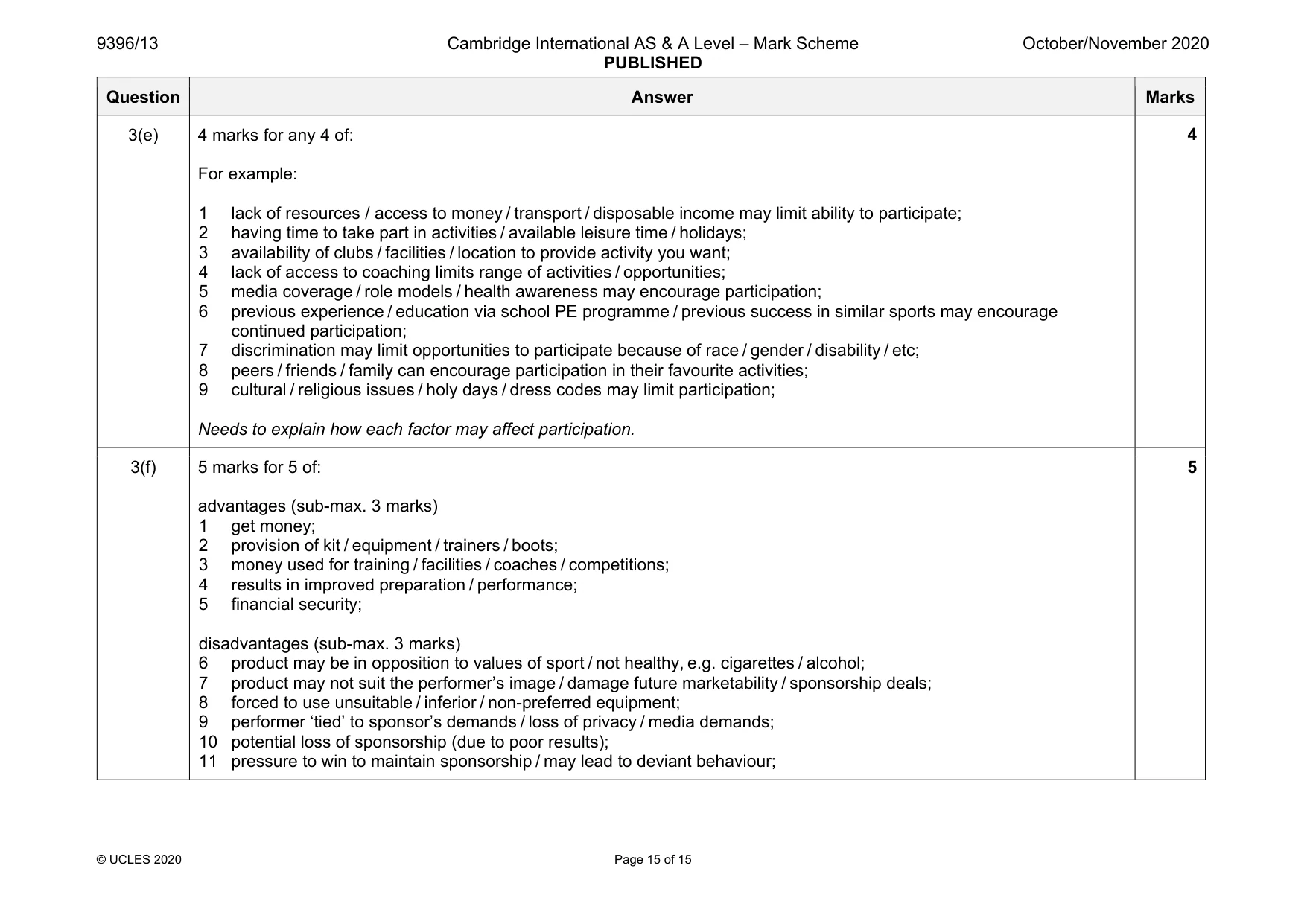
9396/13 Cambridge International AS & A Level – Mark Scheme PUBLISHED October/November 2020 © UCLES 2020 Page 15 of 15 Question Answer Marks 3(e) 4 marks for any 4 of: For example: 1 lack of resources / access to money / transport / disposable income may limit ability to participate; 2 having time to take part in activities / available leisure time / holidays; 3 availability of clubs / facilities / location to provide activity you want; 4 lack of access to coaching limits range of activities / opportunities; 5 media coverage / role models / health awareness may encourage participation; 6 previous experience / education via school PE programme / previous success in similar sports may encourage continued participation; 7 discrimination may limit opportunities to participate because of race / gender / disability / etc; 8 peers / friends / family can encourage participation in their favourite activities; 9 cultural / religious issues / holy days / dress codes may limit participation; Needs to explain how each factor may affect participation. 4 3(f) 5 marks for 5 of: advantages (sub-max. 3 marks) 1 get money; 2 provision of kit / equipment / trainers / boots; 3 money used for training / facilities / coaches / competitions; 4 results in improved preparation / performance; 5 financial security; disadvantages (sub-max. 3 marks) 6 product may be in opposition to values of sport / not healthy, e.g. cigarettes / alcohol; 7 product may not suit the performer’s image / damage future marketability / sponsorship deals; 8 forced to use unsuitable / inferior / non-preferred equipment; 9 performer ‘tied’ to sponsor’s demands / loss of privacy / media demands; 10 potential loss of sponsorship (due to poor results); 11 pressure to win to maintain sponsorship / may lead to deviant behaviour; 5
What you needed in this session
Cambridge’s own grade thresholds for 2020 Oct/Nov, Paper 1 · Variant 3. A higher threshold means an easier paper — the bar moves with how the cohort did.