Cambridge A Level Physical Education 9396 — 2018 Oct/Nov Paper 1 · Variant 2
9396/12/O/N/18 · 90 marks · ≈101 min
The question paper and its mark scheme, free to read here and free to download. This is Cambridge’s own paper, exactly as it was sat.
Question paper4 pages
Mark scheme8 pages
Answers below. Sit the paper first if you are practising.
Paper as text
Question paper, page 1
This document consists of 4 printed pages and 1 Insert. DC (NH/FC) 144163/1 © UCLES 2018 [Turn over * 7 2 1 8 7 2 9 2 6 6 * PHYSICAL EDUCATION 9396/12 Paper 1 October/November 2018 2 hours 30 minutes No Additional Materials are required. READ THESE INSTRUCTIONS FIRST An answer booklet is provided inside this question paper. You should follow the instructions on the front cover of the answer booklet. If you need additional answer paper ask the invigilator for a continuation booklet. Answer all questions. Electronic calculators may be used. You may lose marks if you do not show your working or if you do not use appropriate units. The number of marks is given in brackets [ ] at the end of each question or part question. Cambridge International Examinations Cambridge International Advanced Subsidiary and Advanced Level
Question paper, page 2
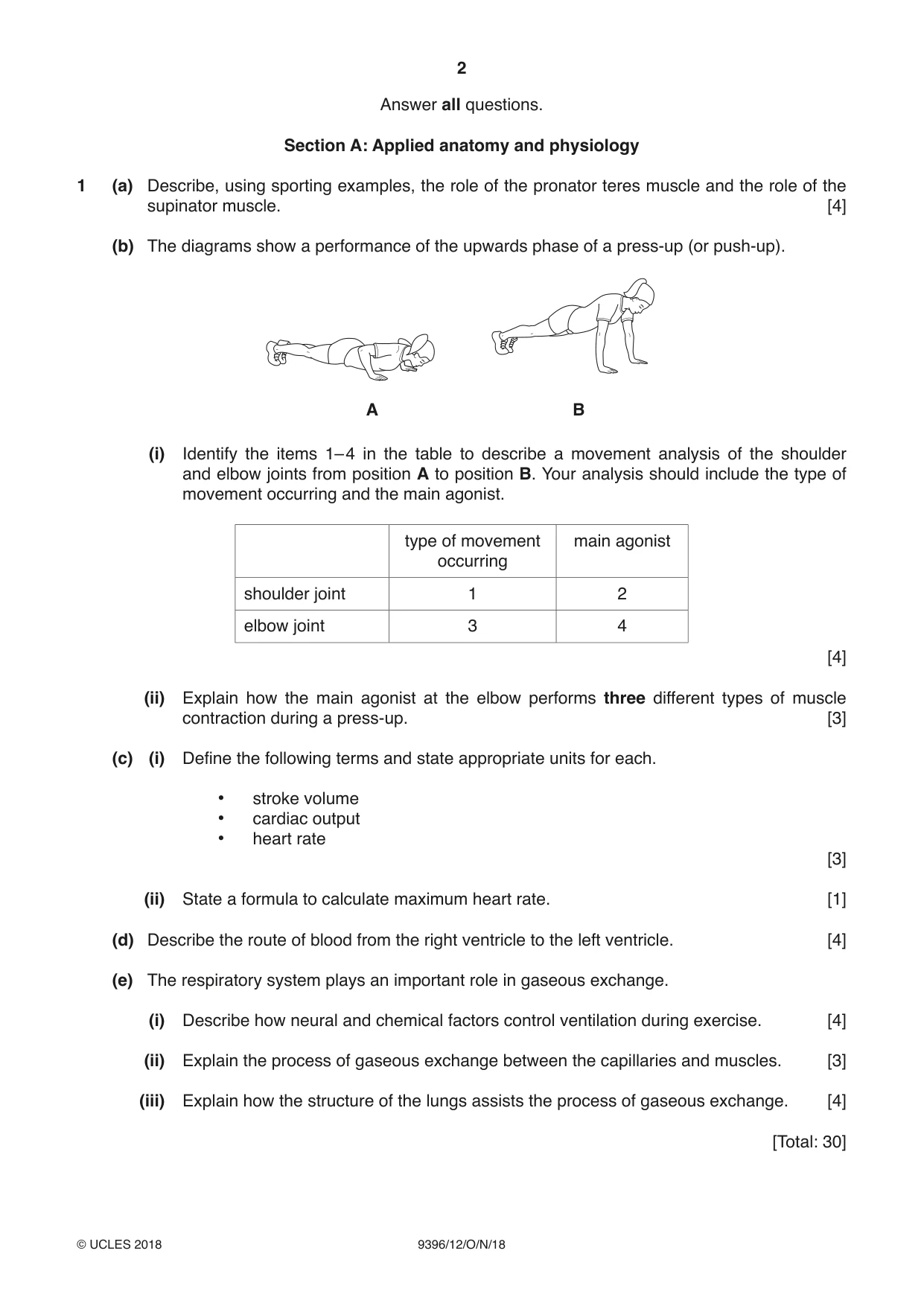
2 9396/12/O/N/18 © UCLES 2018 Answer all questions. Section A: Applied anatomy and physiology 1 (a) Describe, using sporting examples, the role of the pronator teres muscle and the role of the supinator muscle. [4] (b) The diagrams show a performance of the upwards phase of a press-up (or push-up). A B (i) Identify the items 1–4 in the table to describe a movement analysis of the shoulder and elbow joints from position A to position B. Your analysis should include the type of movement occurring and the main agonist. type of movement occurring main agonist shoulder joint 1 2 elbow joint 3 4 [4] (ii) Explain how the main agonist at the elbow performs three different types of muscle contraction during a press-up. [3] (c) (i) Define the following terms and state appropriate units for each. • stroke volume • cardiac output • heart rate [3] (ii) State a formula to calculate maximum heart rate. [1] (d) Describe the route of blood from the right ventricle to the left ventricle. [4] (e) The respiratory system plays an important role in gaseous exchange. (i) Describe how neural and chemical factors control ventilation during exercise. [4] (ii) Explain the process of gaseous exchange between the capillaries and muscles. [3] (iii) Explain how the structure of the lungs assists the process of gaseous exchange. [4] [Total: 30]
Question paper, page 3
3 9396/12/O/N/18 © UCLES 2018 [Turn over Section B: Acquiring, developing and performing movement skills 2 (a) Skilful performances are learned, aesthetically pleasing and follow a technical model. Identify three other characteristics of skilful performance. [3] (b) Explain the term gross motor ability and the term psychomotor ability. [2] (c) Skilled movements are controlled by motor programmes. (i) Explain, using a practical example, the term executive motor programme. [4] (ii) Describe closed-loop control of motor programmes. [3] (d) (i) State the main functions of feedback when learning a skill. [3] (ii) Explain why feedback should differ between the associative and autonomous phases of learning. [4] (e) (i) State the relationship between movement time, response time and reaction time. [1] (ii) Suggest strategies that a performer could use to reduce their response time. [4] (f) A performer’s level of arousal often influences their performance of movement skills. Explain, using the inverted-U theory, how the level of arousal can affect the performance of a movement skill. [6] [Total: 30]
Question paper, page 4
4 9396/12/O/N/18 © UCLES 2018 Section C: Contemporary studies in physical education and sport 3 (a) Physical performance falls into the activity categories of play, physical recreation, sport and physical education. (i) Describe, using a named physical activity, four similarities between play and physical recreation. [4] (ii) State four differences between play and sport. [4] (b) (i) Describe what is meant by the term elite performer. [2] (ii) Suggest physical and psychological qualities that are required by a performer to achieve excellence. [4] (c) Explain why many governments try to increase participation in physical activities. [4] (d) Countries have different approaches to the development of elite sport. Suggest the benefits to a country of investing heavily in developing elite sport. [4] (e) Describe the potential negative effects on a performer’s ethics of trying to achieve excellence in sport. [3] (f) Outline the disadvantages to sport of increased control by the media. [5] [Total: 30] Permission to reproduce items where third-party owned material protected by copyright is included has been sought and cleared where possible. Every reasonable effort has been made by the publisher (UCLES) to trace copyright holders, but if any items requiring clearance have unwittingly been included, the publisher will be pleased to make amends at the earliest possible opportunity. To avoid the issue of disclosure of answer-related information to candidates, all copyright acknowledgements are reproduced online in the Cambridge International Examinations Copyright Acknowledgements Booklet. This is produced for each series of examinations and is freely available to download at www.cie.org.uk after the live examination series. Cambridge International Examinations is part of the Cambridge Assessment Group. Cambridge Assessment is the brand name of University of Cambridge Local Examinations Syndicate (UCLES), which is itself a department of the University of Cambridge.
Mark scheme, page 1
This document consists of 8 printed pages. © UCLES 2018 [Turn over Cambridge Assessment International Education Cambridge International Advanced Subsidiary and Advanced Level PHYSICAL EDUCATION 9396/12 Paper 1 October/November 2018 MARK SCHEME Maximum Mark: 90 Published This mark scheme is published as an aid to teachers and candidates, to indicate the requirements of the examination. It shows the basis on which Examiners were instructed to award marks. It does not indicate the details of the discussions that took place at an Examiners’ meeting before marking began, which would have considered the acceptability of alternative answers. Mark schemes should be read in conjunction with the question paper and the Principal Examiner Report for Teachers. Cambridge International will not enter into discussions about these mark schemes. Cambridge International is publishing the mark schemes for the October/November 2018 series for most Cambridge IGCSE™, Cambridge International A and AS Level components and some Cambridge O Level components.
Mark scheme, page 2
9396/12 Cambridge International AS/A Level – Mark Scheme PUBLISHED October/November 2018 © UCLES 2018 Page 2 of 8 Generic Marking Principles These general marking principles must be applied by all examiners when marking candidate answers. They should be applied alongside the specific content of the mark scheme or generic level descriptors for a question. Each question paper and mark scheme will also comply with these marking principles. GENERIC MARKING PRINCIPLE 1: Marks must be awarded in line with: • the specific content of the mark scheme or the generic level descriptors for the question • the specific skills defined in the mark scheme or in the generic level descriptors for the question • the standard of response required by a candidate as exemplified by the standardisation scripts. GENERIC MARKING PRINCIPLE 2: Marks awarded are always whole marks (not half marks, or other fractions). GENERIC MARKING PRINCIPLE 3: Marks must be awarded positively: • marks are awarded for correct/valid answers, as defined in the mark scheme. However, credit is given for valid answers which go beyond the scope of the syllabus and mark scheme, referring to your Team Leader as appropriate • marks are awarded when candidates clearly demonstrate what they know and can do • marks are not deducted for errors • marks are not deducted for omissions • answers should only be judged on the quality of spelling, punctuation and grammar when these features are specifically assessed by the question as indicated by the mark scheme. The meaning, however, should be unambiguous. GENERIC MARKING PRINCIPLE 4: Rules must be applied consistently e.g. in situations where candidates have not followed instructions or in the application of generic level descriptors. GENERIC MARKING PRINCIPLE 5: Marks should be awarded using the full range of marks defined in the mark scheme for the question (however; the use of the full mark range may be limited according to the quality of the candidate responses seen). GENERIC MARKING PRINCIPLE 6: Marks awarded are based solely on the requirements as defined in the mark scheme. Marks should not be awarded with grade thresholds or grade descriptors in mind.
Mark scheme, page 3
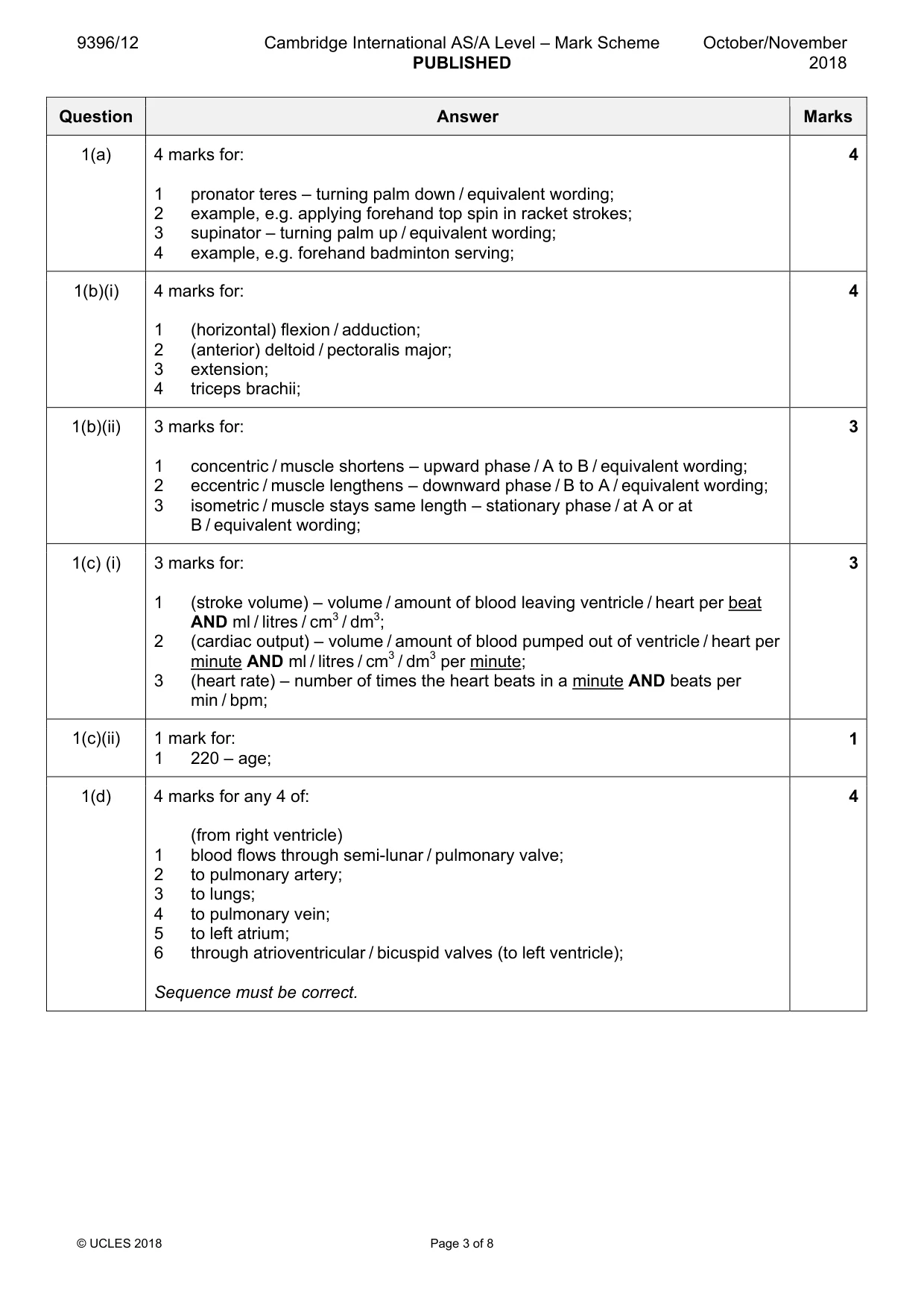
9396/12 Cambridge International AS/A Level – Mark Scheme PUBLISHED October/November 2018 © UCLES 2018 Page 3 of 8 Question Answer Marks 1(a) 4 marks for: 1 pronator teres – turning palm down / equivalent wording; 2 example, e.g. applying forehand top spin in racket strokes; 3 supinator – turning palm up / equivalent wording; 4 example, e.g. forehand badminton serving; 4 1(b)(i) 4 marks for: 1 (horizontal) flexion / adduction; 2 (anterior) deltoid / pectoralis major; 3 extension; 4 triceps brachii; 4 1(b)(ii) 3 marks for: 1 concentric / muscle shortens – upward phase / A to B / equivalent wording; 2 eccentric / muscle lengthens – downward phase / B to A / equivalent wording; 3 isometric / muscle stays same length – stationary phase / at A or at B / equivalent wording; 3 1(c) (i) 3 marks for: 1 (stroke volume) – volume / amount of blood leaving ventricle / heart per beat AND ml / litres / cm3 / dm3; 2 (cardiac output) – volume / amount of blood pumped out of ventricle / heart per minute AND ml / litres / cm3 / dm3 per minute; 3 (heart rate) – number of times the heart beats in a minute AND beats per min / bpm; 3 1(c)(ii) 1 mark for: 1 220 – age; 1 1(d) 4 marks for any 4 of: (from right ventricle) 1 blood flows through semi-lunar / pulmonary valve; 2 to pulmonary artery; 3 to lungs; 4 to pulmonary vein; 5 to left atrium; 6 through atrioventricular / bicuspid valves (to left ventricle); Sequence must be correct. 4
Mark scheme, page 4
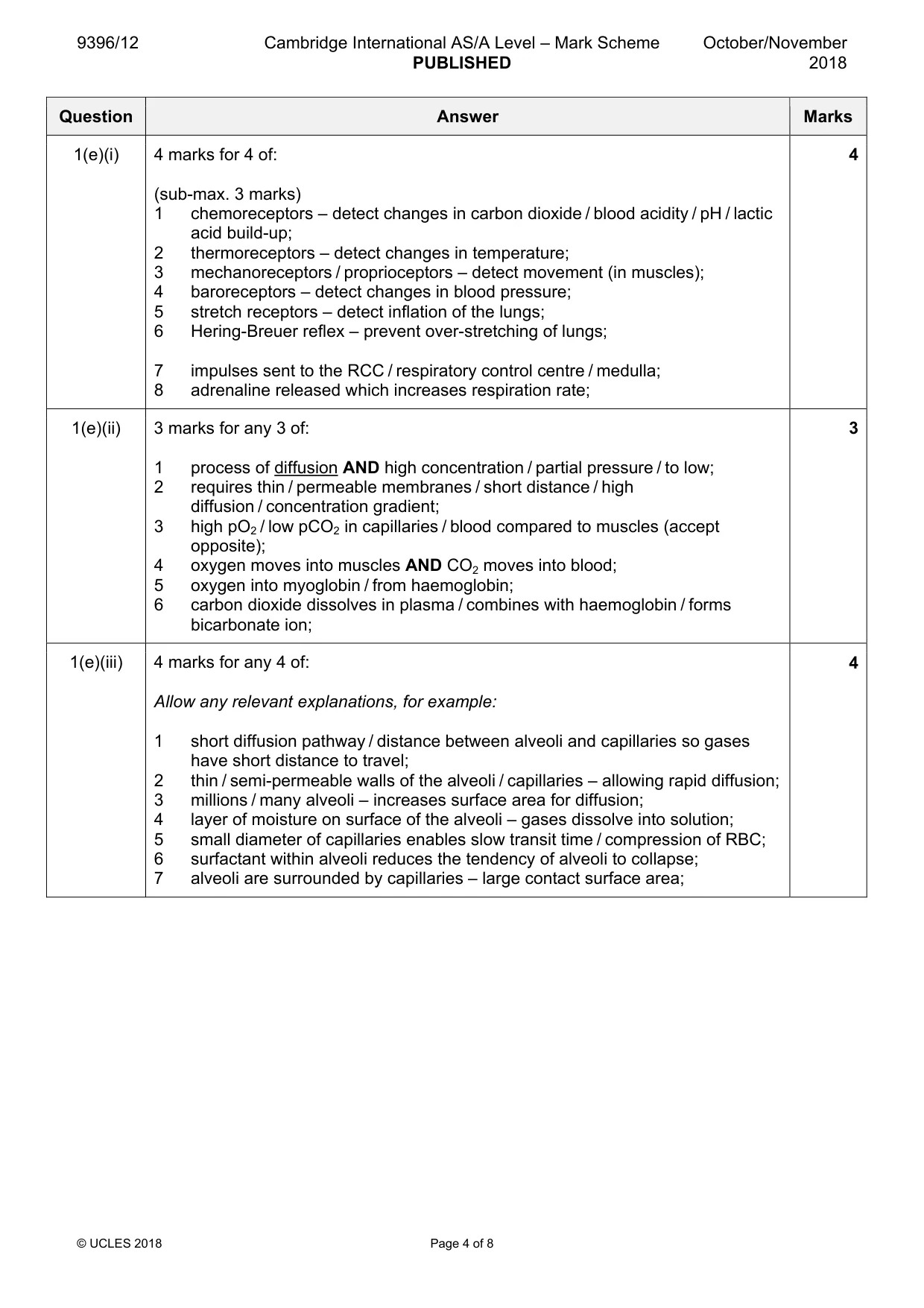
9396/12 Cambridge International AS/A Level – Mark Scheme PUBLISHED October/November 2018 © UCLES 2018 Page 4 of 8 Question Answer Marks 1(e)(i) 4 marks for 4 of: (sub-max. 3 marks) 1 chemoreceptors – detect changes in carbon dioxide / blood acidity / pH / lactic acid build-up; 2 thermoreceptors – detect changes in temperature; 3 mechanoreceptors / proprioceptors – detect movement (in muscles); 4 baroreceptors – detect changes in blood pressure; 5 stretch receptors – detect inflation of the lungs; 6 Hering-Breuer reflex – prevent over-stretching of lungs; 7 impulses sent to the RCC / respiratory control centre / medulla; 8 adrenaline released which increases respiration rate; 4 1(e)(ii) 3 marks for any 3 of: 1 process of diffusion AND high concentration / partial pressure / to low; 2 requires thin / permeable membranes / short distance / high diffusion / concentration gradient; 3 high pO2 / low pCO2 in capillaries / blood compared to muscles (accept opposite); 4 oxygen moves into muscles AND CO2 moves into blood; 5 oxygen into myoglobin / from haemoglobin; 6 carbon dioxide dissolves in plasma / combines with haemoglobin / forms bicarbonate ion; 3 1(e)(iii) 4 marks for any 4 of: Allow any relevant explanations, for example: 1 short diffusion pathway / distance between alveoli and capillaries so gases have short distance to travel; 2 thin / semi-permeable walls of the alveoli / capillaries – allowing rapid diffusion; 3 millions / many alveoli – increases surface area for diffusion; 4 layer of moisture on surface of the alveoli – gases dissolve into solution; 5 small diameter of capillaries enables slow transit time / compression of RBC; 6 surfactant within alveoli reduces the tendency of alveoli to collapse; 7 alveoli are surrounded by capillaries – large contact surface area; 4
Mark scheme, page 5
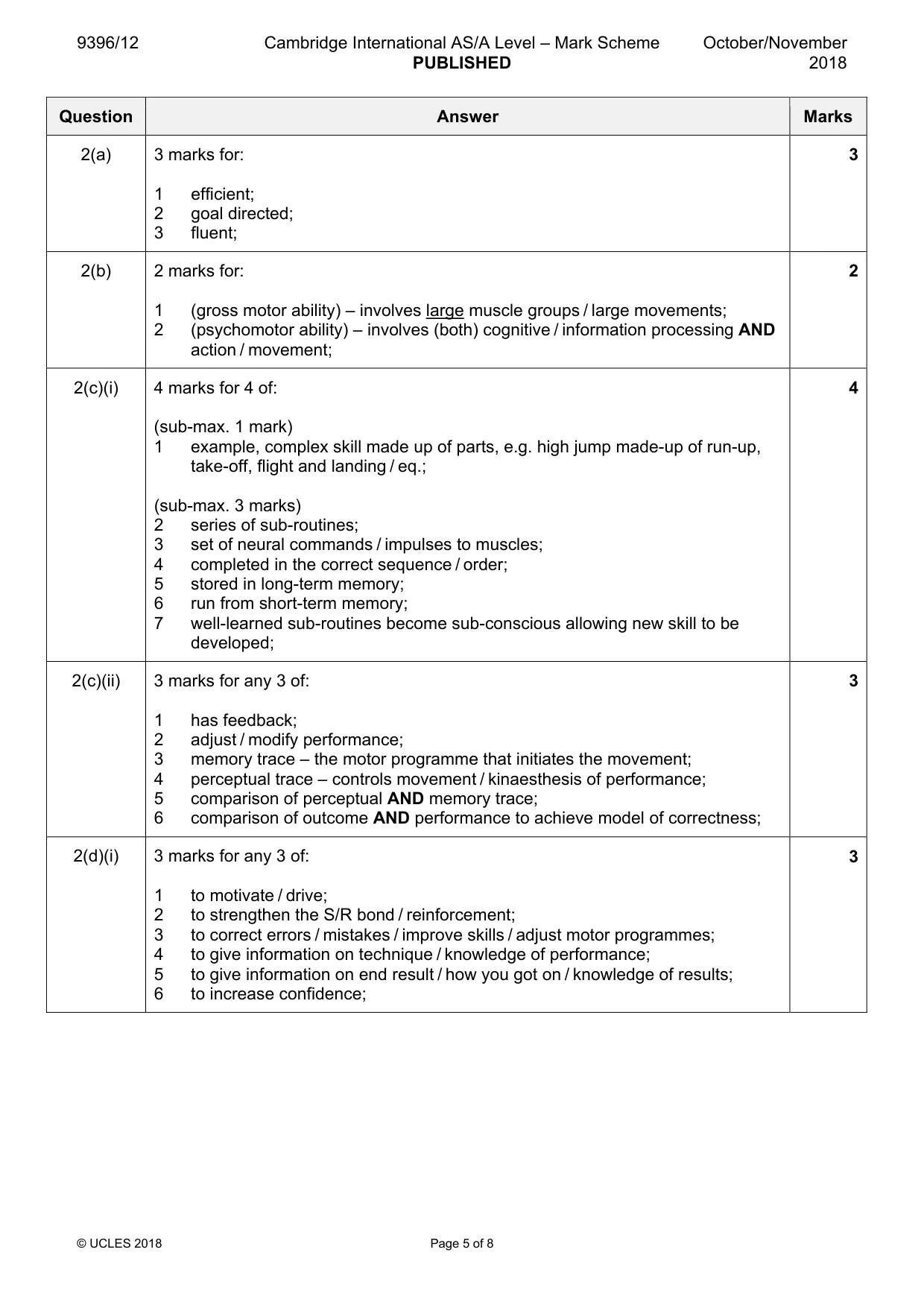
9396/12 Cambridge International AS/A Level – Mark Scheme PUBLISHED October/November 2018 © UCLES 2018 Page 5 of 8 Question Answer Marks 2(a) 3 marks for: 1 efficient; 2 goal directed; 3 fluent; 3 2(b) 2 marks for: 1 (gross motor ability) – involves large muscle groups / large movements; 2 (psychomotor ability) – involves (both) cognitive / information processing AND action / movement; 2 2(c)(i) 4 marks for 4 of: (sub-max. 1 mark) 1 example, complex skill made up of parts, e.g. high jump made-up of run-up, take-off, flight and landing / eq.; (sub-max. 3 marks) 2 series of sub-routines; 3 set of neural commands / impulses to muscles; 4 completed in the correct sequence / order; 5 stored in long-term memory; 6 run from short-term memory; 7 well-learned sub-routines become sub-conscious allowing new skill to be developed; 4 2(c)(ii) 3 marks for any 3 of: 1 has feedback; 2 adjust / modify performance; 3 memory trace – the motor programme that initiates the movement; 4 perceptual trace – controls movement / kinaesthesis of performance; 5 comparison of perceptual AND memory trace; 6 comparison of outcome AND performance to achieve model of correctness; 3 2(d)(i) 3 marks for any 3 of: 1 to motivate / drive; 2 to strengthen the S/R bond / reinforcement; 3 to correct errors / mistakes / improve skills / adjust motor programmes; 4 to give information on technique / knowledge of performance; 5 to give information on end result / how you got on / knowledge of results; 6 to increase confidence; 3
Mark scheme, page 6
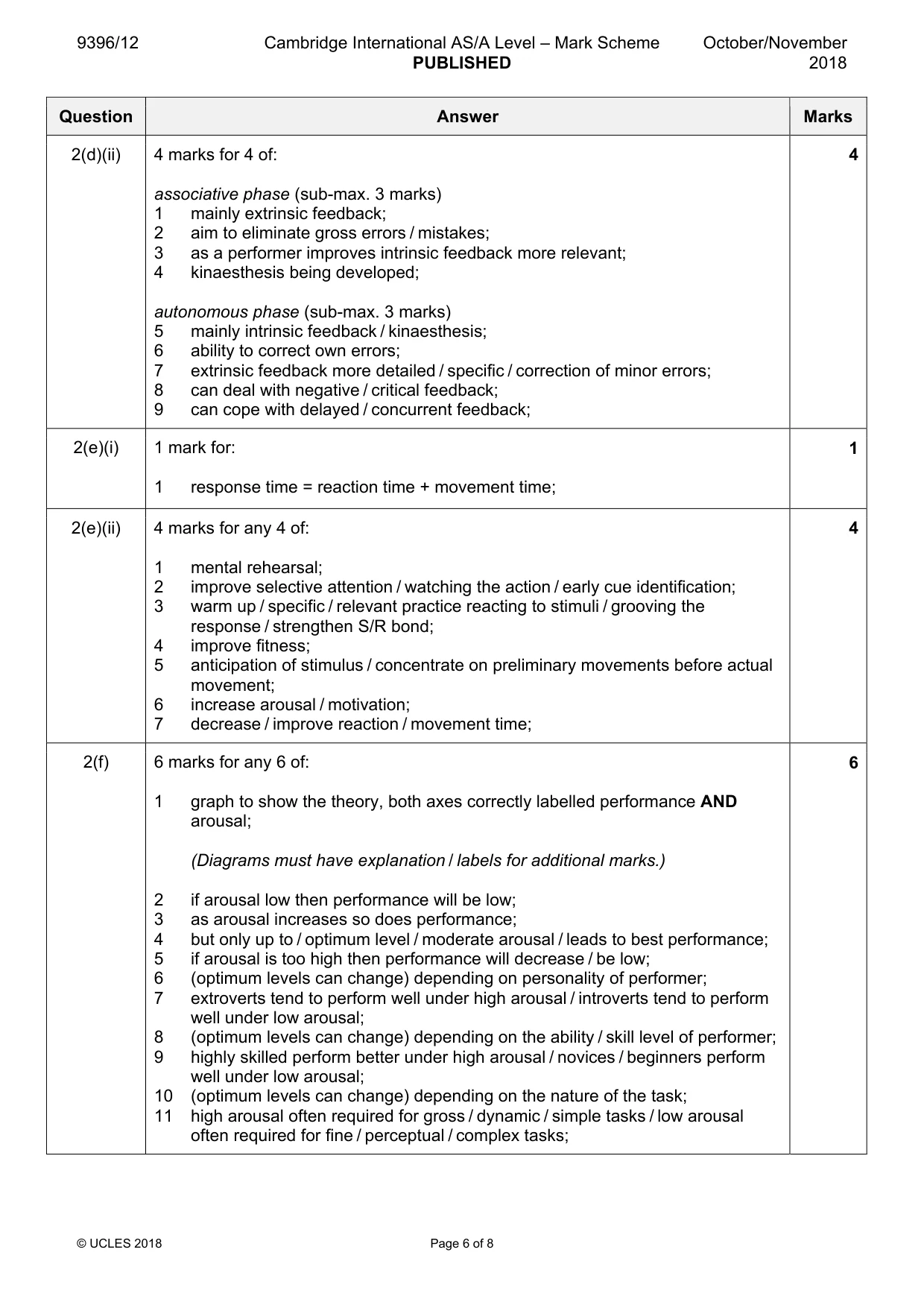
9396/12 Cambridge International AS/A Level – Mark Scheme PUBLISHED October/November 2018 © UCLES 2018 Page 6 of 8 Question Answer Marks 2(d)(ii) 4 marks for 4 of: associative phase (sub-max. 3 marks) 1 mainly extrinsic feedback; 2 aim to eliminate gross errors / mistakes; 3 as a performer improves intrinsic feedback more relevant; 4 kinaesthesis being developed; autonomous phase (sub-max. 3 marks) 5 mainly intrinsic feedback / kinaesthesis; 6 ability to correct own errors; 7 extrinsic feedback more detailed / specific / correction of minor errors; 8 can deal with negative / critical feedback; 9 can cope with delayed / concurrent feedback; 4 2(e)(i) 1 mark for: 1 response time = reaction time + movement time; 1 2(e)(ii) 4 marks for any 4 of: 1 mental rehearsal; 2 improve selective attention / watching the action / early cue identification; 3 warm up / specific / relevant practice reacting to stimuli / grooving the response / strengthen S/R bond; 4 improve fitness; 5 anticipation of stimulus / concentrate on preliminary movements before actual movement; 6 increase arousal / motivation; 7 decrease / improve reaction / movement time; 4 2(f) 6 marks for any 6 of: 1 graph to show the theory, both axes correctly labelled performance AND arousal; (Diagrams must have explanation / labels for additional marks.) 2 if arousal low then performance will be low; 3 as arousal increases so does performance; 4 but only up to / optimum level / moderate arousal / leads to best performance; 5 if arousal is too high then performance will decrease / be low; 6 (optimum levels can change) depending on personality of performer; 7 extroverts tend to perform well under high arousal / introverts tend to perform well under low arousal; 8 (optimum levels can change) depending on the ability / skill level of performer; 9 highly skilled perform better under high arousal / novices / beginners perform well under low arousal; 10 (optimum levels can change) depending on the nature of the task; 11 high arousal often required for gross / dynamic / simple tasks / low arousal often required for fine / perceptual / complex tasks; 6
Mark scheme, page 7
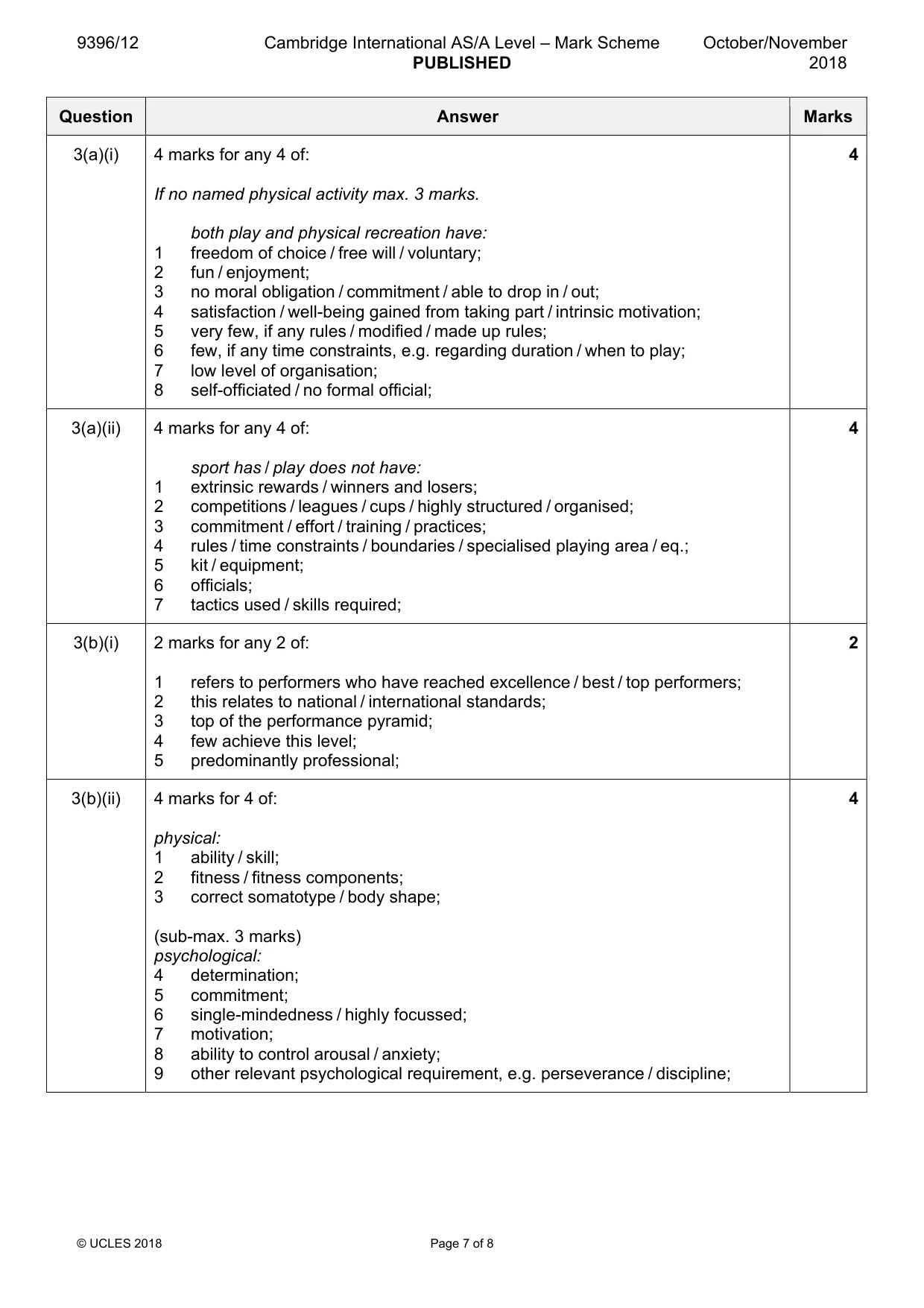
9396/12 Cambridge International AS/A Level – Mark Scheme PUBLISHED October/November 2018 © UCLES 2018 Page 7 of 8 Question Answer Marks 3(a)(i) 4 marks for any 4 of: If no named physical activity max. 3 marks. both play and physical recreation have: 1 freedom of choice / free will / voluntary; 2 fun / enjoyment; 3 no moral obligation / commitment / able to drop in / out; 4 satisfaction / well-being gained from taking part / intrinsic motivation; 5 very few, if any rules / modified / made up rules; 6 few, if any time constraints, e.g. regarding duration / when to play; 7 low level of organisation; 8 self-officiated / no formal official; 4 3(a)(ii) 4 marks for any 4 of: sport has / play does not have: 1 extrinsic rewards / winners and losers; 2 competitions / leagues / cups / highly structured / organised; 3 commitment / effort / training / practices; 4 rules / time constraints / boundaries / specialised playing area / eq.; 5 kit / equipment; 6 officials; 7 tactics used / skills required; 4 3(b)(i) 2 marks for any 2 of: 1 refers to performers who have reached excellence / best / top performers; 2 this relates to national / international standards; 3 top of the performance pyramid; 4 few achieve this level; 5 predominantly professional; 2 3(b)(ii) 4 marks for 4 of: physical: 1 ability / skill; 2 fitness / fitness components; 3 correct somatotype / body shape; (sub-max. 3 marks) psychological: 4 determination; 5 commitment; 6 single-mindedness / highly focussed; 7 motivation; 8 ability to control arousal / anxiety; 9 other relevant psychological requirement, e.g. perseverance / discipline; 4
Mark scheme, page 8
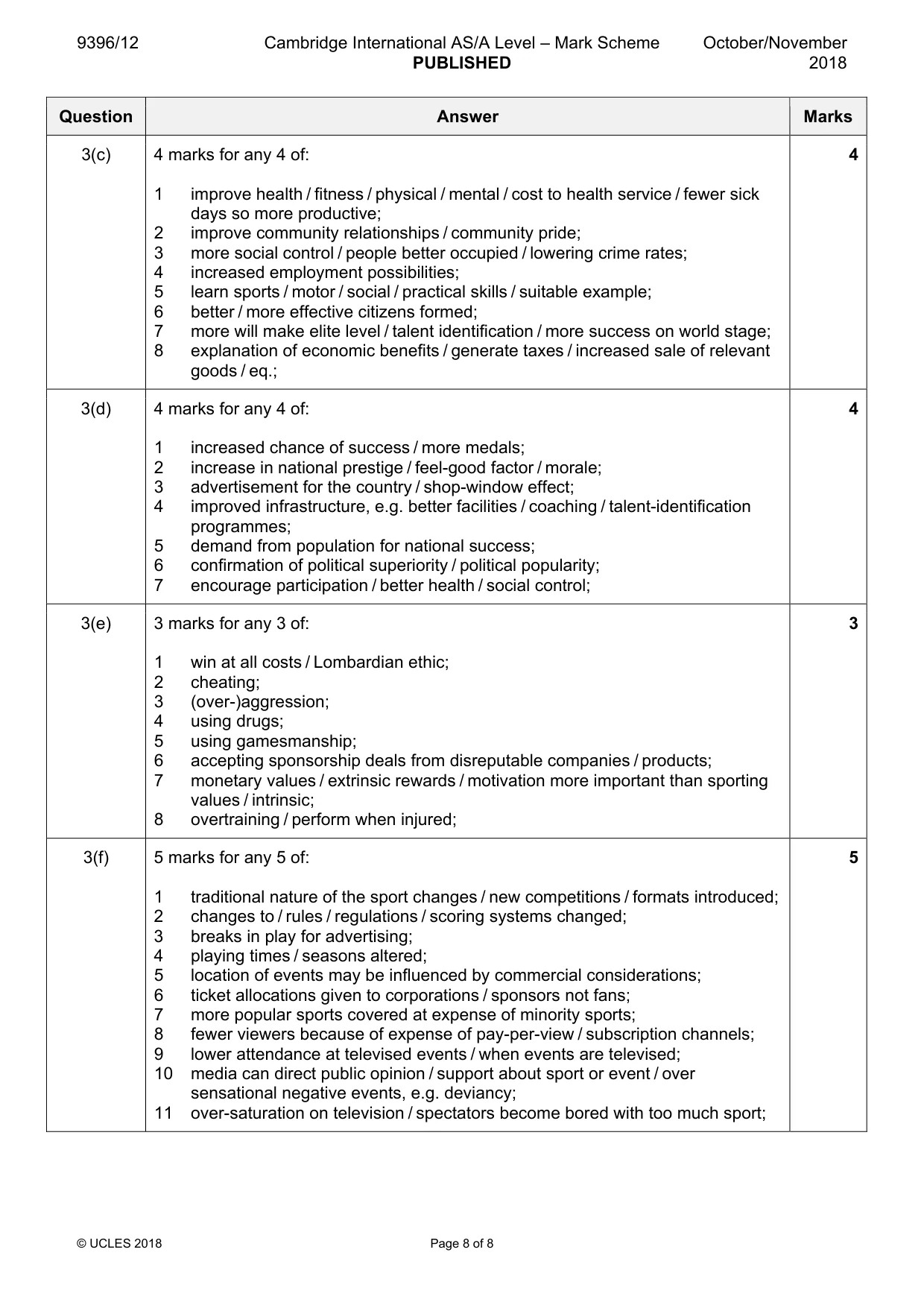
9396/12 Cambridge International AS/A Level – Mark Scheme PUBLISHED October/November 2018 © UCLES 2018 Page 8 of 8 Question Answer Marks 3(c) 4 marks for any 4 of: 1 improve health / fitness / physical / mental / cost to health service / fewer sick days so more productive; 2 improve community relationships / community pride; 3 more social control / people better occupied / lowering crime rates; 4 increased employment possibilities; 5 learn sports / motor / social / practical skills / suitable example; 6 better / more effective citizens formed; 7 more will make elite level / talent identification / more success on world stage; 8 explanation of economic benefits / generate taxes / increased sale of relevant goods / eq.; 4 3(d) 4 marks for any 4 of: 1 increased chance of success / more medals; 2 increase in national prestige / feel-good factor / morale; 3 advertisement for the country / shop-window effect; 4 improved infrastructure, e.g. better facilities / coaching / talent-identification programmes; 5 demand from population for national success; 6 confirmation of political superiority / political popularity; 7 encourage participation / better health / social control; 4 3(e) 3 marks for any 3 of: 1 win at all costs / Lombardian ethic; 2 cheating; 3 (over-)aggression; 4 using drugs; 5 using gamesmanship; 6 accepting sponsorship deals from disreputable companies / products; 7 monetary values / extrinsic rewards / motivation more important than sporting values / intrinsic; 8 overtraining / perform when injured; 3 3(f) 5 marks for any 5 of: 1 traditional nature of the sport changes / new competitions / formats introduced; 2 changes to / rules / regulations / scoring systems changed; 3 breaks in play for advertising; 4 playing times / seasons altered; 5 location of events may be influenced by commercial considerations; 6 ticket allocations given to corporations / sponsors not fans; 7 more popular sports covered at expense of minority sports; 8 fewer viewers because of expense of pay-per-view / subscription channels; 9 lower attendance at televised events / when events are televised; 10 media can direct public opinion / support about sport or event / over sensational negative events, e.g. deviancy; 11 over-saturation on television / spectators become bored with too much sport; 5
What you needed in this session
Cambridge’s own grade thresholds for 2018 Oct/Nov, Paper 1 · Variant 2. A higher threshold means an easier paper — the bar moves with how the cohort did.