Cambridge A Level Physical Education 9396 — 2018 Oct/Nov Paper 1 · Variant 3
9396/13/O/N/18 · 90 marks · ≈101 min
The question paper and its mark scheme, free to read here and free to download. This is Cambridge’s own paper, exactly as it was sat.
Question paper8 pages



Mark scheme9 pages
Answers below. Sit the paper first if you are practising.
Paper as text
Question paper, page 1
This document consists of 5 printed pages, 3 blank pages and 1 Insert. DC (NH/FC) 144162/2 © UCLES 2018 [Turn over * 8 4 1 6 1 0 0 2 8 5 * PHYSICAL EDUCATION 9396/13 Paper 1 October/November 2018 2 hours 30 minutes No Additional Materials are required. READ THESE INSTRUCTIONS FIRST An answer booklet is provided inside this question paper. You should follow the instructions on the front cover of the answer booklet. If you need additional answer paper ask the invigilator for a continuation booklet. Answer all questions. Electronic calculators may be used. You may lose marks if you do not show your working or if you do not use appropriate units. The number of marks is given in brackets [ ] at the end of each question or part question. Cambridge International Examinations Cambridge International Advanced Subsidiary and Advanced Level
Question paper, page 2
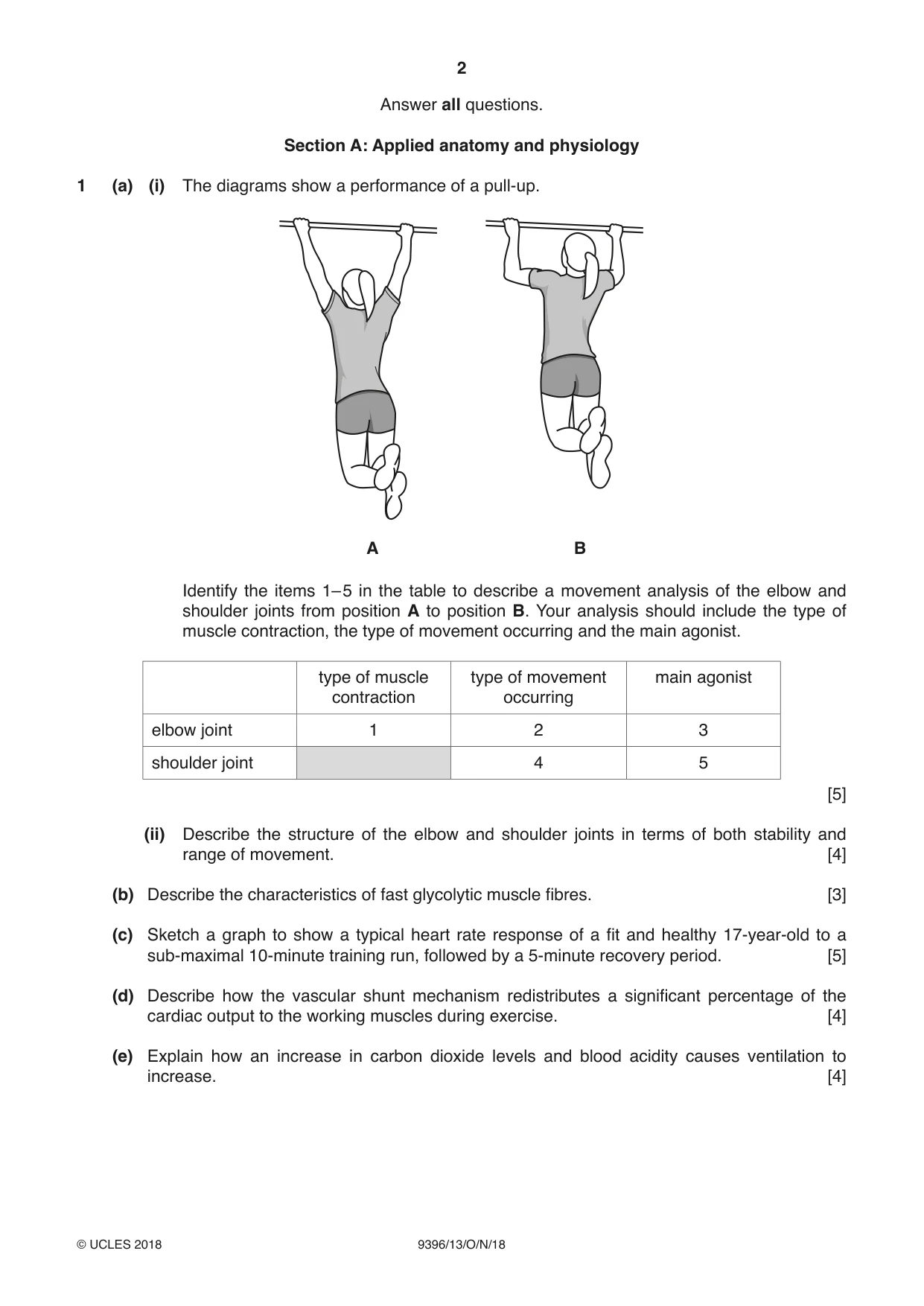
2 9396/13/O/N/18 © UCLES 2018 Answer all questions. Section A: Applied anatomy and physiology 1 (a) (i) The diagrams show a performance of a pull-up. A B Identify the items 1–5 in the table to describe a movement analysis of the elbow and shoulder joints from position A to position B. Your analysis should include the type of muscle contraction, the type of movement occurring and the main agonist. type of muscle contraction type of movement occurring main agonist elbow joint 1 2 3 shoulder joint 4 5 [5] (ii) Describe the structure of the elbow and shoulder joints in terms of both stability and range of movement. [4] (b) Describe the characteristics of fast glycolytic muscle fibres. [3] (c) Sketch a graph to show a typical heart rate response of a fit and healthy 17-year-old to a sub-maximal 10-minute training run, followed by a 5-minute recovery period. [5] (d) Describe how the vascular shunt mechanism redistributes a significant percentage of the cardiac output to the working muscles during exercise. [4] (e) Explain how an increase in carbon dioxide levels and blood acidity causes ventilation to increase. [4]
Question paper, page 3
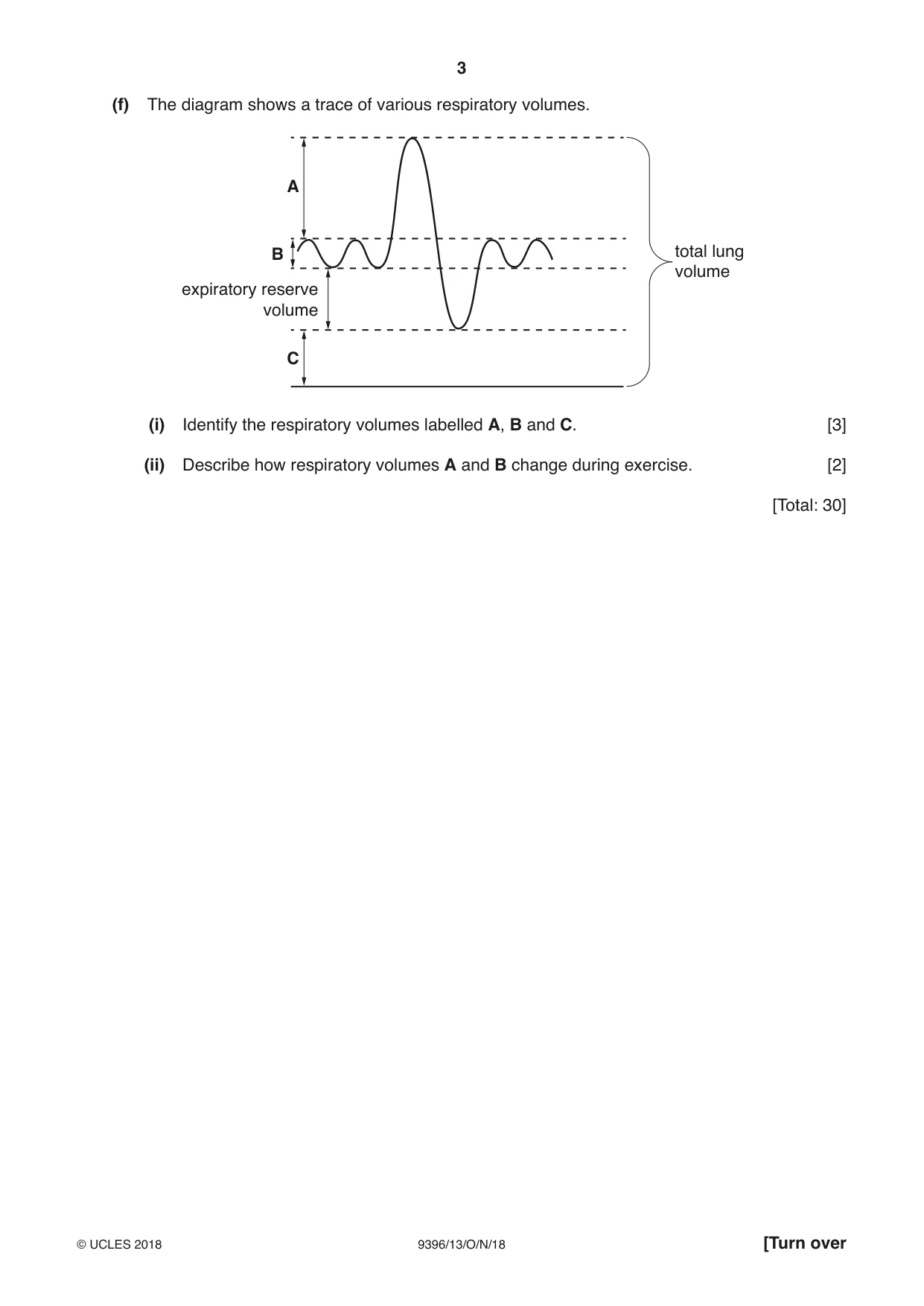
3 9396/13/O/N/18 © UCLES 2018 [Turn over (f) The diagram shows a trace of various respiratory volumes. total lung volume A B C expiratory reserve volume (i) Identify the respiratory volumes labelled A, B and C. [3] (ii) Describe how respiratory volumes A and B change during exercise. [2] [Total: 30]
Question paper, page 4
4 9396/13/O/N/18 © UCLES 2018 Section B: Acquiring, developing and performing movement skills 2 (a) (i) Skilful performances are learned, efficient and goal directed. State three other characteristics of skilful performances. [3] (ii) Explain, using sporting examples, the difference between gross motor abilities and psychomotor abilities. [4] (b) (i) Outline the theory of operant conditioning. [4] (ii) Explain the disadvantages of using operant conditioning to develop skilful performers. [2] (c) Schmidt’s schema theory is based on various sources of information. Explain the role of recognition schema in modifying and evaluating motor programmes. [4] (d) Describe, using examples for each, four types of feedback available to a performer. [4] (e) Transfer of learning may be used when developing a skill. Explain, using a suitable example, how you would optimise the effects of positive transfer. [3] (f) Both extrinsic and intrinsic motivation can be used in the learning and performance of skills. Suggest ways a coach could motivate a group of performers. [6] [Total: 30]
Question paper, page 5
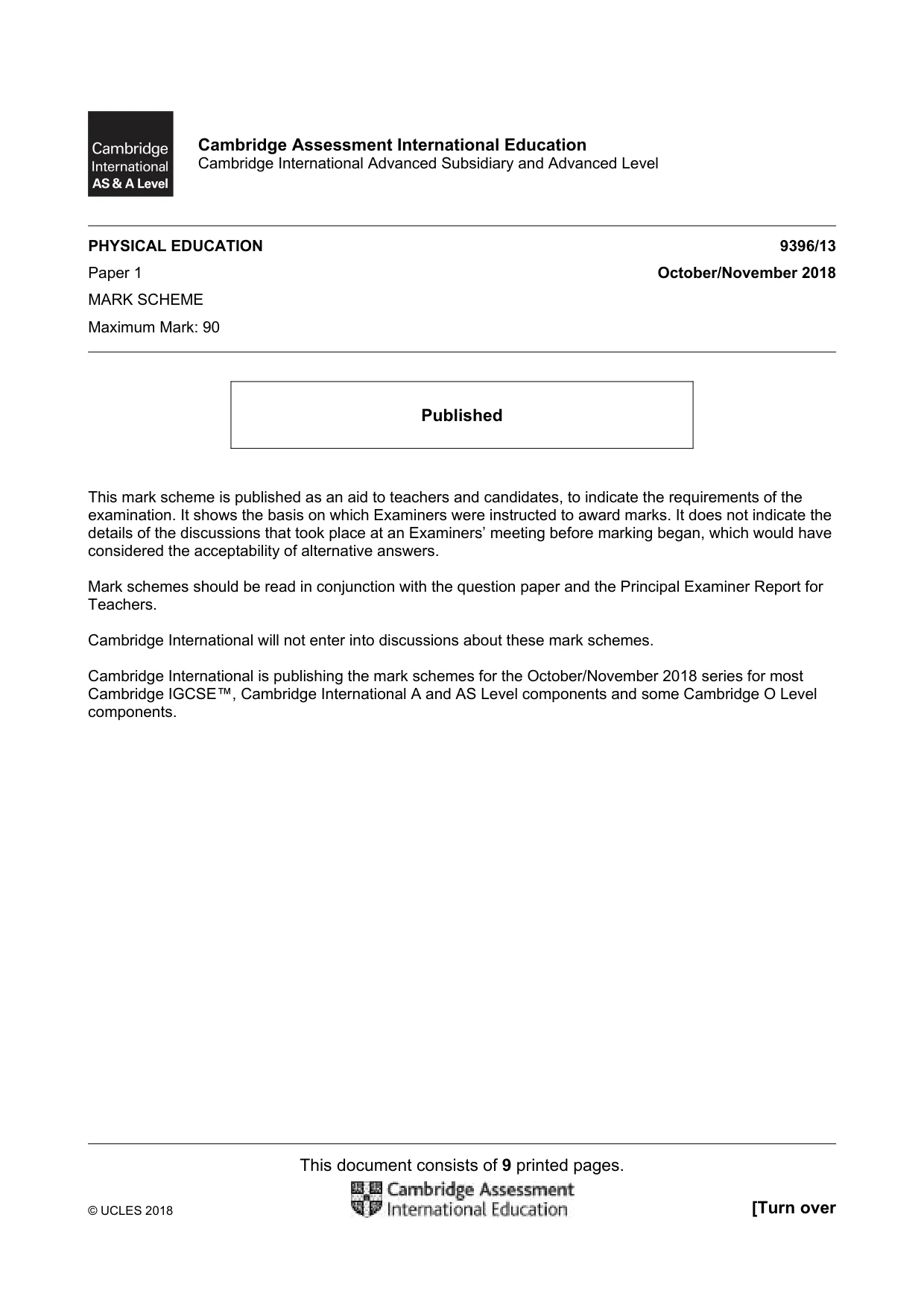
5 9396/13/O/N/18 © UCLES 2018 Section C: Contemporary studies in physical education and sport 3 (a) The concepts of physical education, physical recreation and sport are different. (i) State two similarities and two differences between physical education and physical recreation. [4] (ii) Suggest how a physical education teacher could introduce the characteristics and values of sport into their lessons. [4] (b) Describe, using a country of your choice, how potential elite performers are identified and developed. [5] (c) (i) State the benefits of increased participation in physical activity for each of the following. • the individual • society [6] (ii) Suggest why some people do not take part in physical activity. [4] (d) (i) Explain why some elite performers take illegal performance-enhancing drugs. [3] (ii) Suggest ways to solve the continuing problem of drugs in sport. [4] [Total: 30]
Question paper, page 6
6 9396/13/O/N/18 © UCLES 2018 BLANK PAGE
Question paper, page 7
7 9396/13/O/N/18 © UCLES 2018 BLANK PAGE
Question paper, page 8
8 9396/13/O/N/18 © UCLES 2018 BLANK PAGE Permission to reproduce items where third-party owned material protected by copyright is included has been sought and cleared where possible. Every reasonable effort has been made by the publisher (UCLES) to trace copyright holders, but if any items requiring clearance have unwittingly been included, the publisher will be pleased to make amends at the earliest possible opportunity. To avoid the issue of disclosure of answer-related information to candidates, all copyright acknowledgements are reproduced online in the Cambridge International Examinations Copyright Acknowledgements Booklet. This is produced for each series of examinations and is freely available to download at www.cie.org.uk after the live examination series. Cambridge International Examinations is part of the Cambridge Assessment Group. Cambridge Assessment is the brand name of University of Cambridge Local Examinations Syndicate (UCLES), which is itself a department of the University of Cambridge.
Mark scheme, page 1
This document consists of 9 printed pages. © UCLES 2018 [Turn over Cambridge Assessment International Education Cambridge International Advanced Subsidiary and Advanced Level PHYSICAL EDUCATION 9396/13 Paper 1 October/November 2018 MARK SCHEME Maximum Mark: 90 Published This mark scheme is published as an aid to teachers and candidates, to indicate the requirements of the examination. It shows the basis on which Examiners were instructed to award marks. It does not indicate the details of the discussions that took place at an Examiners’ meeting before marking began, which would have considered the acceptability of alternative answers. Mark schemes should be read in conjunction with the question paper and the Principal Examiner Report for Teachers. Cambridge International will not enter into discussions about these mark schemes. Cambridge International is publishing the mark schemes for the October/November 2018 series for most Cambridge IGCSE™, Cambridge International A and AS Level components and some Cambridge O Level components.
Mark scheme, page 2
9396/13 Cambridge International AS/A Level – Mark Scheme PUBLISHED October/November 2018 © UCLES 2018 Page 2 of 9 Generic Marking Principles These general marking principles must be applied by all examiners when marking candidate answers. They should be applied alongside the specific content of the mark scheme or generic level descriptors for a question. Each question paper and mark scheme will also comply with these marking principles. GENERIC MARKING PRINCIPLE 1: Marks must be awarded in line with: • the specific content of the mark scheme or the generic level descriptors for the question • the specific skills defined in the mark scheme or in the generic level descriptors for the question • the standard of response required by a candidate as exemplified by the standardisation scripts. GENERIC MARKING PRINCIPLE 2: Marks awarded are always whole marks (not half marks, or other fractions). GENERIC MARKING PRINCIPLE 3: Marks must be awarded positively: • marks are awarded for correct/valid answers, as defined in the mark scheme. However, credit is given for valid answers which go beyond the scope of the syllabus and mark scheme, referring to your Team Leader as appropriate • marks are awarded when candidates clearly demonstrate what they know and can do • marks are not deducted for errors • marks are not deducted for omissions • answers should only be judged on the quality of spelling, punctuation and grammar when these features are specifically assessed by the question as indicated by the mark scheme. The meaning, however, should be unambiguous. GENERIC MARKING PRINCIPLE 4: Rules must be applied consistently e.g. in situations where candidates have not followed instructions or in the application of generic level descriptors. GENERIC MARKING PRINCIPLE 5: Marks should be awarded using the full range of marks defined in the mark scheme for the question (however; the use of the full mark range may be limited according to the quality of the candidate responses seen). GENERIC MARKING PRINCIPLE 6: Marks awarded are based solely on the requirements as defined in the mark scheme. Marks should not be awarded with grade thresholds or grade descriptors in mind.
Mark scheme, page 3
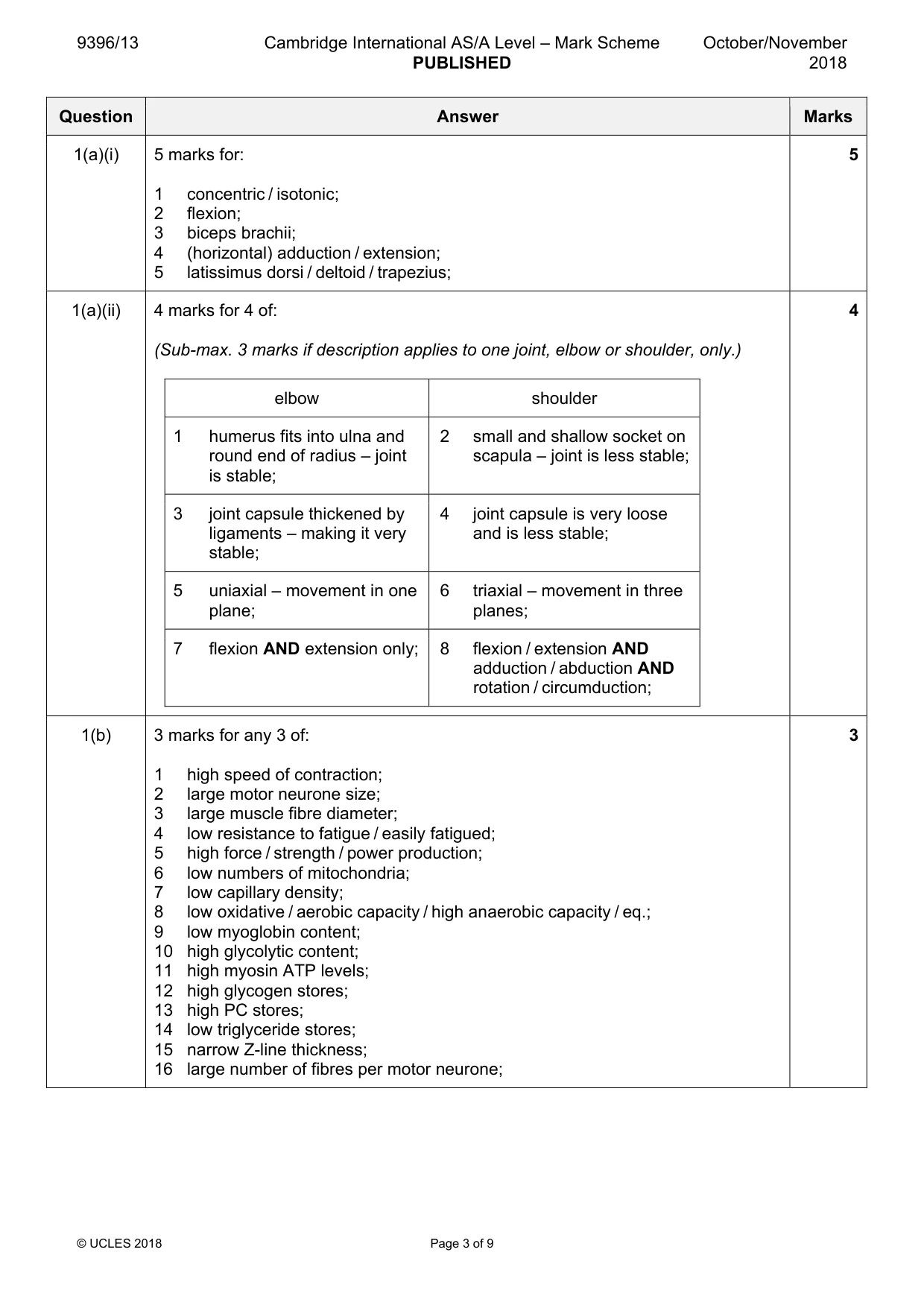
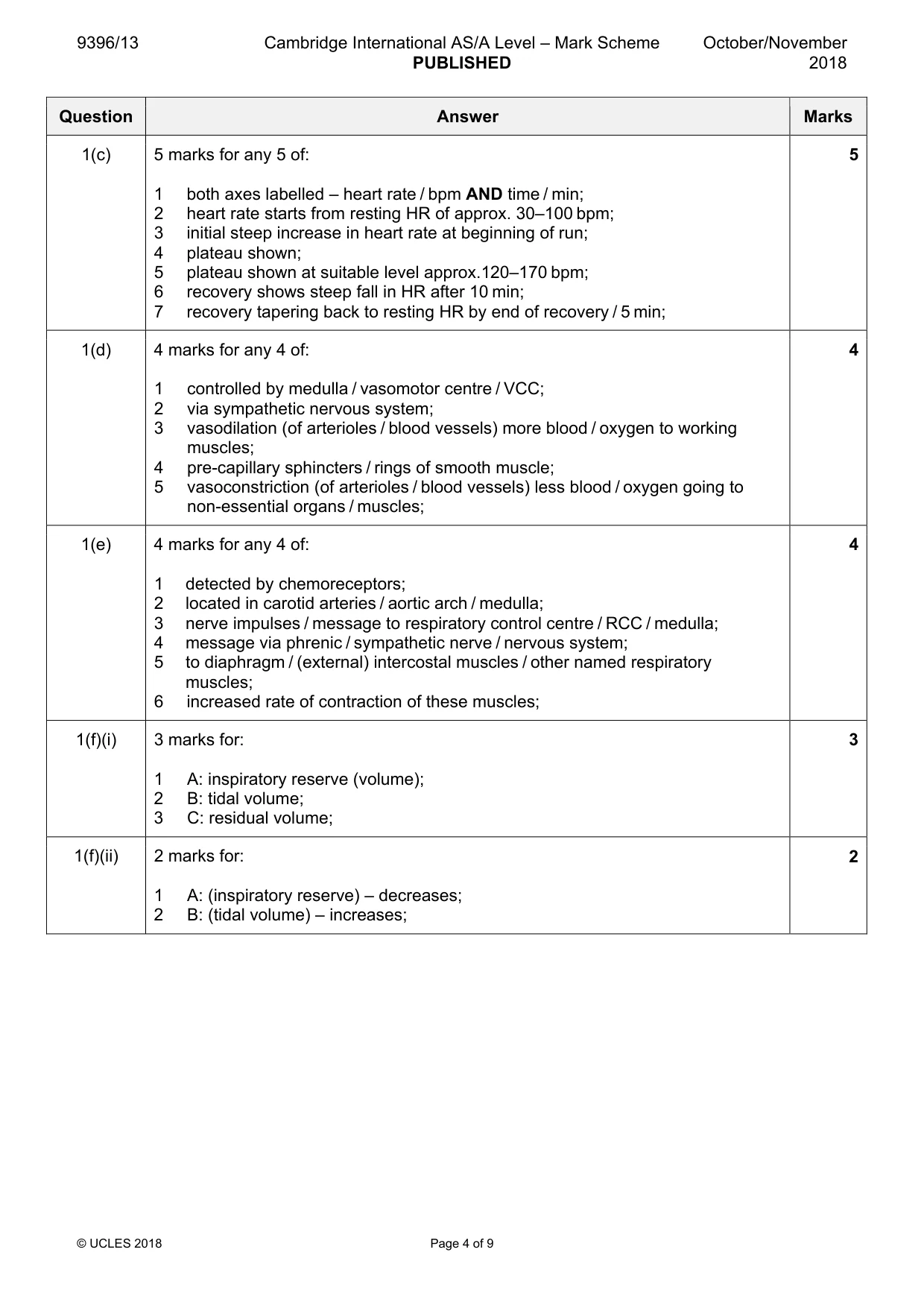
9396/13 Cambridge International AS/A Level – Mark Scheme PUBLISHED October/November 2018 © UCLES 2018 Page 3 of 9 Question Answer Marks 1(a)(i) 5 marks for: 1 concentric / isotonic; 2 flexion; 3 biceps brachii; 4 (horizontal) adduction / extension; 5 latissimus dorsi / deltoid / trapezius; 5 1(a)(ii) 4 marks for 4 of: (Sub-max. 3 marks if description applies to one joint, elbow or shoulder, only.) elbow shoulder 1 humerus fits into ulna and round end of radius – joint is stable; 2 small and shallow socket on scapula – joint is less stable; 3 joint capsule thickened by ligaments – making it very stable; 4 joint capsule is very loose and is less stable; 5 uniaxial – movement in one plane; 6 triaxial – movement in three planes; 7 flexion AND extension only; 8 flexion / extension AND adduction / abduction AND rotation / circumduction; 4 1(b) 3 marks for any 3 of: 1 high speed of contraction; 2 large motor neurone size; 3 large muscle fibre diameter; 4 low resistance to fatigue / easily fatigued; 5 high force / strength / power production; 6 low numbers of mitochondria; 7 low capillary density; 8 low oxidative / aerobic capacity / high anaerobic capacity / eq.; 9 low myoglobin content; 10 high glycolytic content; 11 high myosin ATP levels; 12 high glycogen stores; 13 high PC stores; 14 low triglyceride stores; 15 narrow Z-line thickness; 16 large number of fibres per motor neurone; 3
Mark scheme, page 4
9396/13 Cambridge International AS/A Level – Mark Scheme PUBLISHED October/November 2018 © UCLES 2018 Page 4 of 9 Question Answer Marks 1(c) 5 marks for any 5 of: 1 both axes labelled – heart rate / bpm AND time / min; 2 heart rate starts from resting HR of approx. 30–100 bpm; 3 initial steep increase in heart rate at beginning of run; 4 plateau shown; 5 plateau shown at suitable level approx.120–170 bpm; 6 recovery shows steep fall in HR after 10 min; 7 recovery tapering back to resting HR by end of recovery / 5 min; 5 1(d) 4 marks for any 4 of: 1 controlled by medulla / vasomotor centre / VCC; 2 via sympathetic nervous system; 3 vasodilation (of arterioles / blood vessels) more blood / oxygen to working muscles; 4 pre-capillary sphincters / rings of smooth muscle; 5 vasoconstriction (of arterioles / blood vessels) less blood / oxygen going to non-essential organs / muscles; 4 1(e) 4 marks for any 4 of: 1 detected by chemoreceptors; 2 located in carotid arteries / aortic arch / medulla; 3 nerve impulses / message to respiratory control centre / RCC / medulla; 4 message via phrenic / sympathetic nerve / nervous system; 5 to diaphragm / (external) intercostal muscles / other named respiratory muscles; 6 increased rate of contraction of these muscles; 4 1(f)(i) 3 marks for: 1 A: inspiratory reserve (volume); 2 B: tidal volume; 3 C: residual volume; 3 1(f)(ii) 2 marks for: 1 A: (inspiratory reserve) – decreases; 2 B: (tidal volume) – increases; 2
Mark scheme, page 5
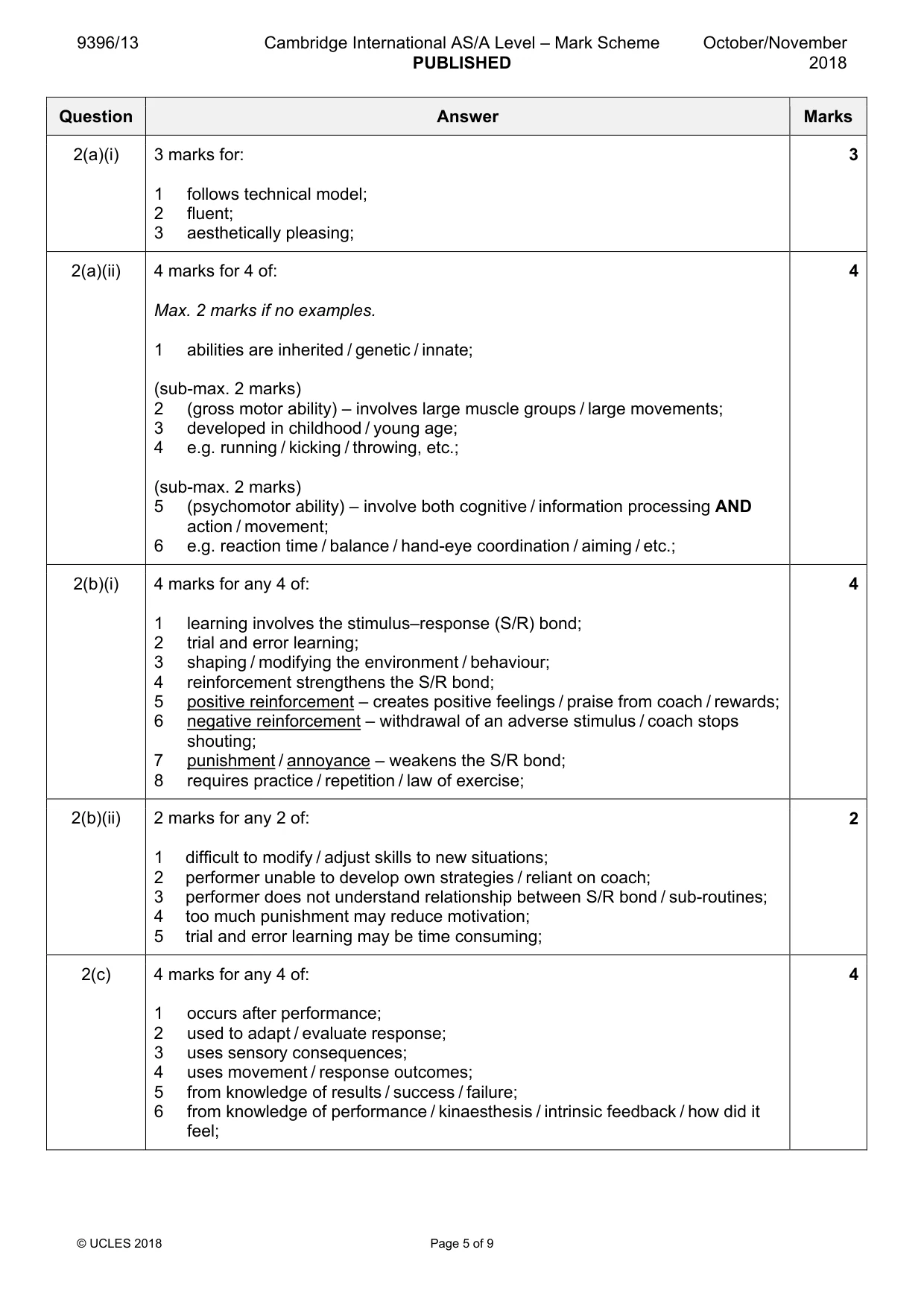
9396/13 Cambridge International AS/A Level – Mark Scheme PUBLISHED October/November 2018 © UCLES 2018 Page 5 of 9 Question Answer Marks 2(a)(i) 3 marks for: 1 follows technical model; 2 fluent; 3 aesthetically pleasing; 3 2(a)(ii) 4 marks for 4 of: Max. 2 marks if no examples. 1 abilities are inherited / genetic / innate; (sub-max. 2 marks) 2 (gross motor ability) – involves large muscle groups / large movements; 3 developed in childhood / young age; 4 e.g. running / kicking / throwing, etc.; (sub-max. 2 marks) 5 (psychomotor ability) – involve both cognitive / information processing AND action / movement; 6 e.g. reaction time / balance / hand-eye coordination / aiming / etc.; 4 2(b)(i) 4 marks for any 4 of: 1 learning involves the stimulus–response (S/R) bond; 2 trial and error learning; 3 shaping / modifying the environment / behaviour; 4 reinforcement strengthens the S/R bond; 5 positive reinforcement – creates positive feelings / praise from coach / rewards; 6 negative reinforcement – withdrawal of an adverse stimulus / coach stops shouting; 7 punishment / annoyance – weakens the S/R bond; 8 requires practice / repetition / law of exercise; 4 2(b)(ii) 2 marks for any 2 of: 1 difficult to modify / adjust skills to new situations; 2 performer unable to develop own strategies / reliant on coach; 3 performer does not understand relationship between S/R bond / sub-routines; 4 too much punishment may reduce motivation; 5 trial and error learning may be time consuming; 2 2(c) 4 marks for any 4 of: 1 occurs after performance; 2 used to adapt / evaluate response; 3 uses sensory consequences; 4 uses movement / response outcomes; 5 from knowledge of results / success / failure; 6 from knowledge of performance / kinaesthesis / intrinsic feedback / how did it feel; 4
Mark scheme, page 6
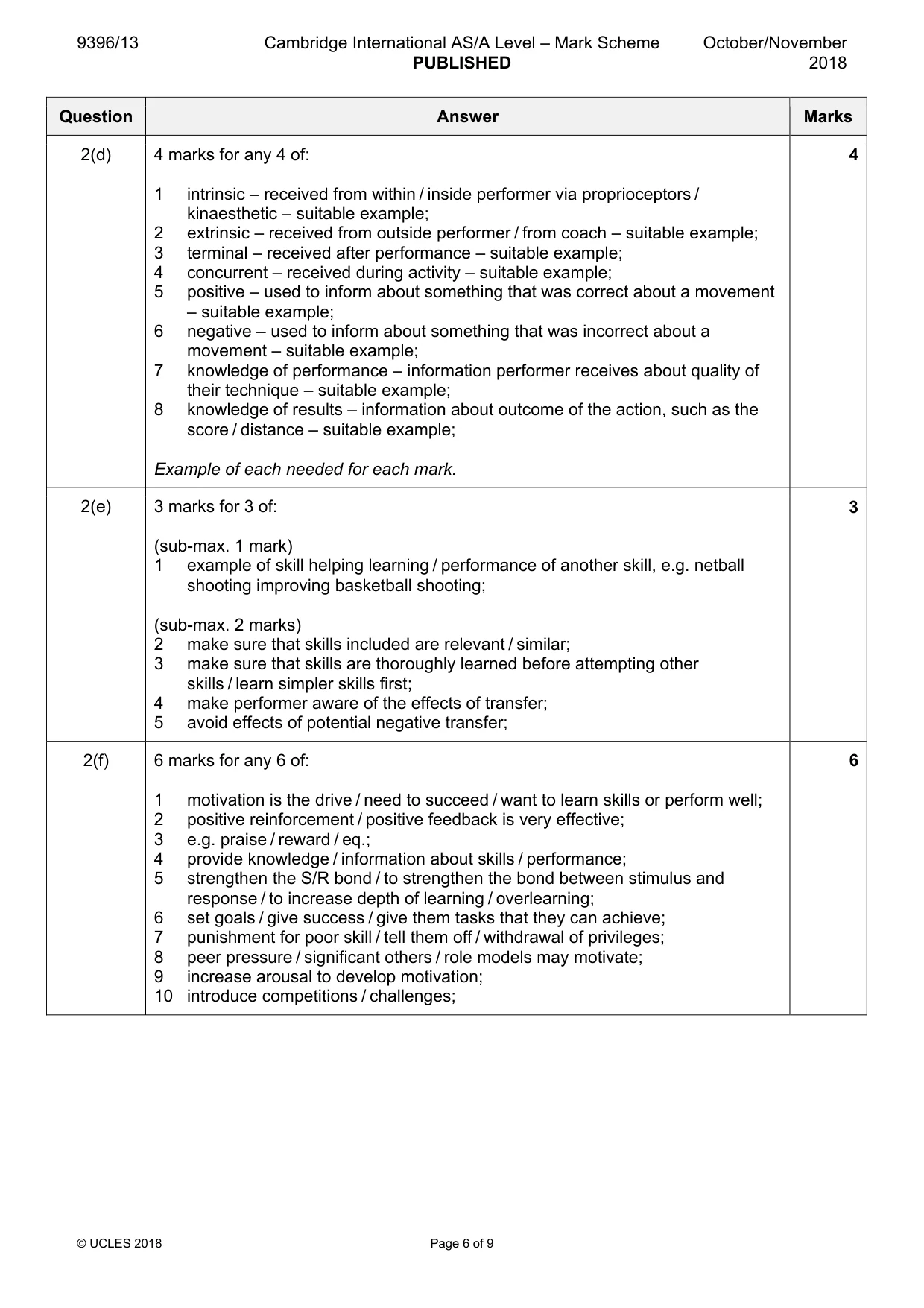
9396/13 Cambridge International AS/A Level – Mark Scheme PUBLISHED October/November 2018 © UCLES 2018 Page 6 of 9 Question Answer Marks 2(d) 4 marks for any 4 of: 1 intrinsic – received from within / inside performer via proprioceptors / kinaesthetic – suitable example; 2 extrinsic – received from outside performer / from coach – suitable example; 3 terminal – received after performance – suitable example; 4 concurrent – received during activity – suitable example; 5 positive – used to inform about something that was correct about a movement – suitable example; 6 negative – used to inform about something that was incorrect about a movement – suitable example; 7 knowledge of performance – information performer receives about quality of their technique – suitable example; 8 knowledge of results – information about outcome of the action, such as the score / distance – suitable example; Example of each needed for each mark. 4 2(e) 3 marks for 3 of: (sub-max. 1 mark) 1 example of skill helping learning / performance of another skill, e.g. netball shooting improving basketball shooting; (sub-max. 2 marks) 2 make sure that skills included are relevant / similar; 3 make sure that skills are thoroughly learned before attempting other skills / learn simpler skills first; 4 make performer aware of the effects of transfer; 5 avoid effects of potential negative transfer; 3 2(f) 6 marks for any 6 of: 1 motivation is the drive / need to succeed / want to learn skills or perform well; 2 positive reinforcement / positive feedback is very effective; 3 e.g. praise / reward / eq.; 4 provide knowledge / information about skills / performance; 5 strengthen the S/R bond / to strengthen the bond between stimulus and response / to increase depth of learning / overlearning; 6 set goals / give success / give them tasks that they can achieve; 7 punishment for poor skill / tell them off / withdrawal of privileges; 8 peer pressure / significant others / role models may motivate; 9 increase arousal to develop motivation; 10 introduce competitions / challenges; 6
Mark scheme, page 7
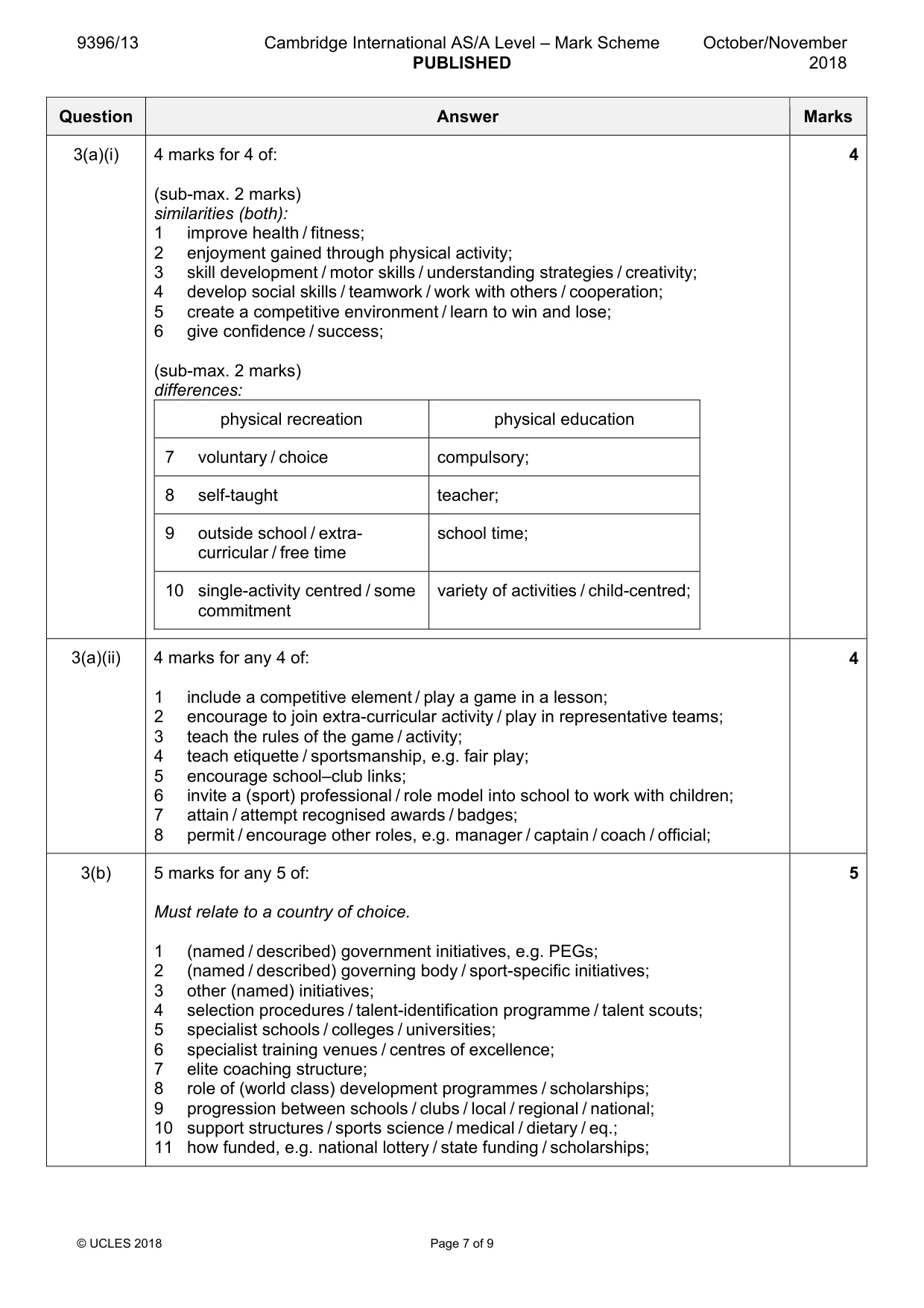
9396/13 Cambridge International AS/A Level – Mark Scheme PUBLISHED October/November 2018 © UCLES 2018 Page 7 of 9 Question Answer Marks 3(a)(i) 4 marks for 4 of: (sub-max. 2 marks) similarities (both): 1 improve health / fitness; 2 enjoyment gained through physical activity; 3 skill development / motor skills / understanding strategies / creativity; 4 develop social skills / teamwork / work with others / cooperation; 5 create a competitive environment / learn to win and lose; 6 give confidence / success; (sub-max. 2 marks) differences: physical recreation physical education 7 voluntary / choice compulsory; 8 self-taught teacher; 9 outside school / extra- curricular / free time school time; 10 single-activity centred / some commitment variety of activities / child-centred; 4 3(a)(ii) 4 marks for any 4 of: 1 include a competitive element / play a game in a lesson; 2 encourage to join extra-curricular activity / play in representative teams; 3 teach the rules of the game / activity; 4 teach etiquette / sportsmanship, e.g. fair play; 5 encourage school–club links; 6 invite a (sport) professional / role model into school to work with children; 7 attain / attempt recognised awards / badges; 8 permit / encourage other roles, e.g. manager / captain / coach / official; 4 3(b) 5 marks for any 5 of: Must relate to a country of choice. 1 (named / described) government initiatives, e.g. PEGs; 2 (named / described) governing body / sport-specific initiatives; 3 other (named) initiatives; 4 selection procedures / talent-identification programme / talent scouts; 5 specialist schools / colleges / universities; 6 specialist training venues / centres of excellence; 7 elite coaching structure; 8 role of (world class) development programmes / scholarships; 9 progression between schools / clubs / local / regional / national; 10 support structures / sports science / medical / dietary / eq.; 11 how funded, e.g. national lottery / state funding / scholarships; 5
Mark scheme, page 8
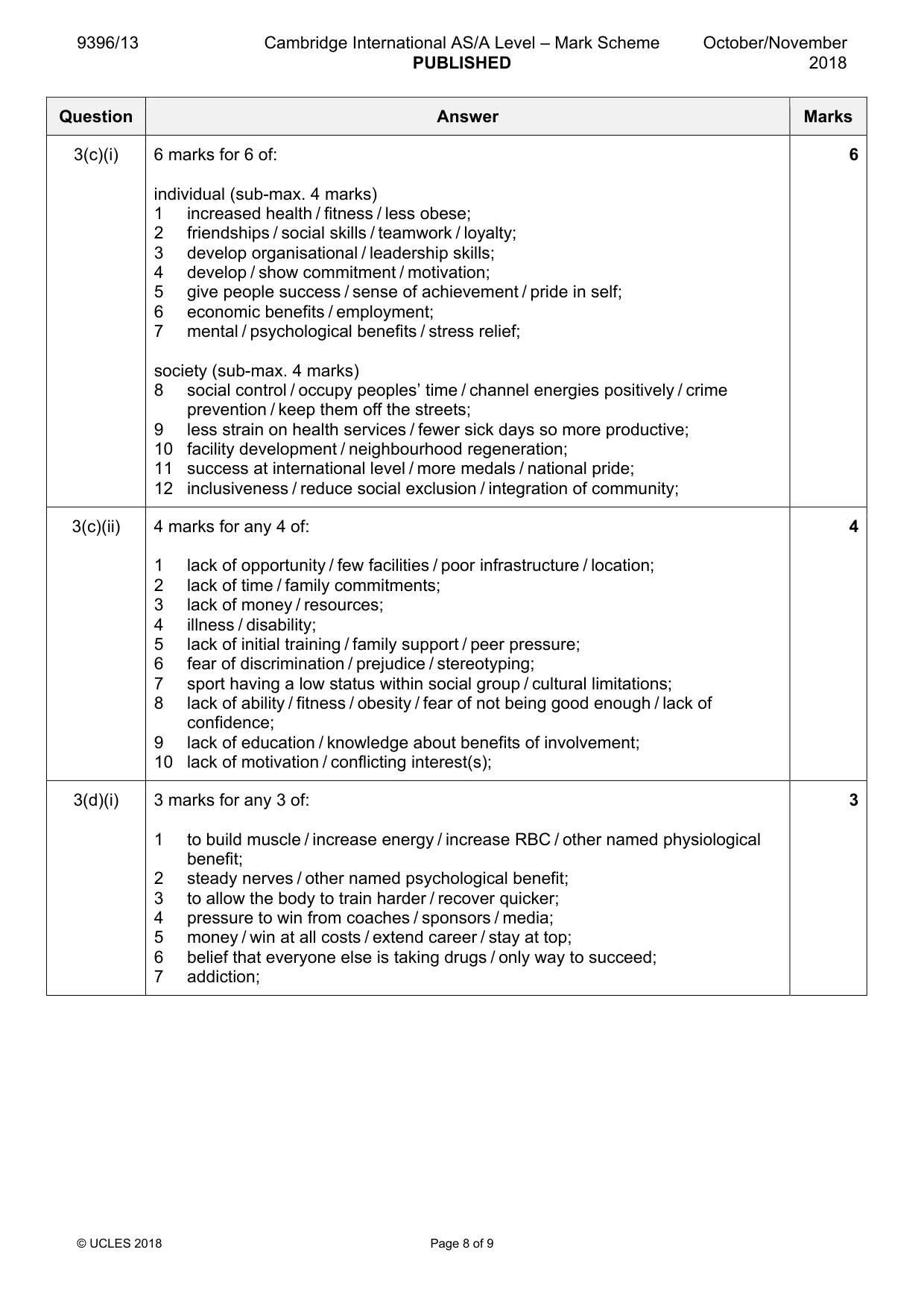
9396/13 Cambridge International AS/A Level – Mark Scheme PUBLISHED October/November 2018 © UCLES 2018 Page 8 of 9 Question Answer Marks 3(c)(i) 6 marks for 6 of: individual (sub-max. 4 marks) 1 increased health / fitness / less obese; 2 friendships / social skills / teamwork / loyalty; 3 develop organisational / leadership skills; 4 develop / show commitment / motivation; 5 give people success / sense of achievement / pride in self; 6 economic benefits / employment; 7 mental / psychological benefits / stress relief; society (sub-max. 4 marks) 8 social control / occupy peoples’ time / channel energies positively / crime prevention / keep them off the streets; 9 less strain on health services / fewer sick days so more productive; 10 facility development / neighbourhood regeneration; 11 success at international level / more medals / national pride; 12 inclusiveness / reduce social exclusion / integration of community; 6 3(c)(ii) 4 marks for any 4 of: 1 lack of opportunity / few facilities / poor infrastructure / location; 2 lack of time / family commitments; 3 lack of money / resources; 4 illness / disability; 5 lack of initial training / family support / peer pressure; 6 fear of discrimination / prejudice / stereotyping; 7 sport having a low status within social group / cultural limitations; 8 lack of ability / fitness / obesity / fear of not being good enough / lack of confidence; 9 lack of education / knowledge about benefits of involvement; 10 lack of motivation / conflicting interest(s); 4 3(d)(i) 3 marks for any 3 of: 1 to build muscle / increase energy / increase RBC / other named physiological benefit; 2 steady nerves / other named psychological benefit; 3 to allow the body to train harder / recover quicker; 4 pressure to win from coaches / sponsors / media; 5 money / win at all costs / extend career / stay at top; 6 belief that everyone else is taking drugs / only way to succeed; 7 addiction; 3
Mark scheme, page 9
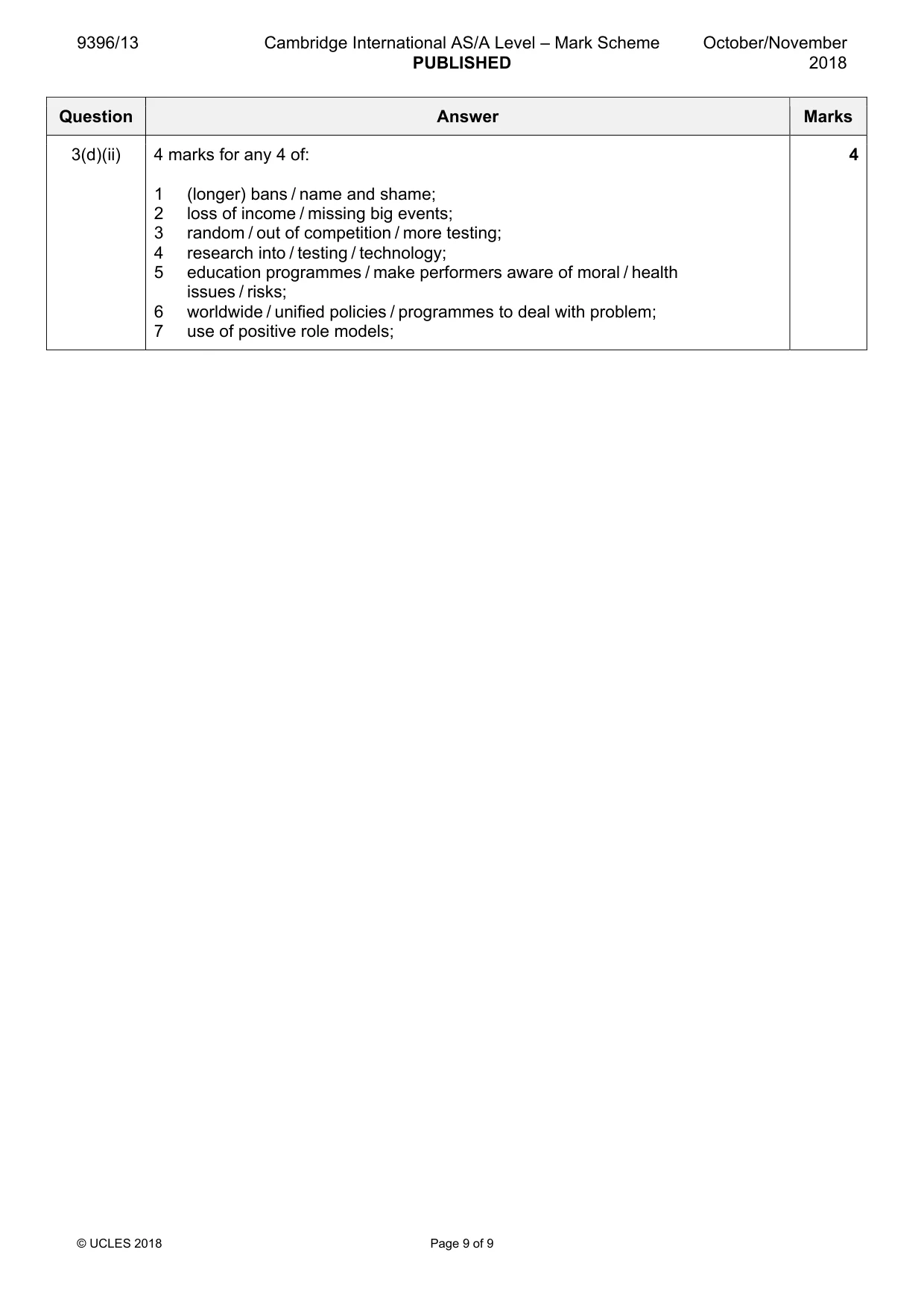
9396/13 Cambridge International AS/A Level – Mark Scheme PUBLISHED October/November 2018 © UCLES 2018 Page 9 of 9 Question Answer Marks 3(d)(ii) 4 marks for any 4 of: 1 (longer) bans / name and shame; 2 loss of income / missing big events; 3 random / out of competition / more testing; 4 research into / testing / technology; 5 education programmes / make performers aware of moral / health issues / risks; 6 worldwide / unified policies / programmes to deal with problem; 7 use of positive role models; 4
What you needed in this session
Cambridge’s own grade thresholds for 2018 Oct/Nov, Paper 1 · Variant 3. A higher threshold means an easier paper — the bar moves with how the cohort did.